SCATTER RADIATION, ITS PRODUCTION AND
MEASURES TO CONTROL IT
PRESENTED BY:-
MR. RAVINDRA KUMAR
MEDICAL TECHNOLOGIST
DEPARTMENT OF RADIODIAGNOSIS AND IMAGING
PGIMER, CHANDIGARH
INTRODUCTION
CHARACTERISTICS OF SCATTER RADIATION
PRODUCTION OF SCATTER RADIATION
FACTORS AFFECTING SCATTER RADIATION
SOURCES OF SCATTER RADIATION
CONTROL OF SCATTER RADIATION
CONCLUSION
CONTENTS
The primary radiation which is attenuated by the
patient’s tissue producing a radiographic image .
Secondary radiation which is largely Compton
scattering of the primary beam within the patient
which casts its density on the film . The scattered
photons are deflected at a random course , they
can not portray an image, they only produce fog or
unwanted blackness on the film.
 It reduces contrast .
 Result in formation of noise on x-ray film.
 Reduces light transmitting ability of radiograph.
INTRODUCTION
 Contrast and contrast resolution are
important characteristics of image
quality.
 Contrast arises from the areas of light, dark,
and shades of gray on the radiographic
image.
 Contrast resolution is the ability to image
adjacent similar tissues.
 Compton scatter x-radiation produces
noise, reducing image contrast and
contrast resolution. It makes the image
less visible.
Why need to Control Scattered Radiation
SCATTER RADIATION
Two types of x-rays are responsible for the
optical density (OD) and contrast on a
radiographic image: those that pass
through the patient without interacting and
those that are Compton scattered within the
patient.
X-rays that exit from the patient are
remnant x-rays and those that exit and
interact with the image receptor are called
image-forming x-rays.
 More oblique in nature.
 Produced by matter in all direction.
 Can travel through longer path in body than primary
beam.
 Have Less energy than primary beam
 With Increase in energy of primary radiation more
scattering in forward direction.
 Amount of scatter depends upon volume of tissue
exposed, built of patient and kVp used.
CHARACTERSTIC OF SCATTER RADIATION
Scatter radiation is produced mainly
by the following types of interaction
of radiation with matter :
1.Coherent scattering
2.Compton scattering
PRODUCTION OF SCATTER RADIATION
 Also called- elastic, unmodified, classical
Scattering
 Process by which radiation deflected without
losing any energy
 There are two types of coherent scattering
-Thomson and Rayleigh scattering.
 In Thomson scattering single electron is
involved in the interaction.
 In Rayleigh scattering all the electrons of the
atom are involved.
Compton Scattering
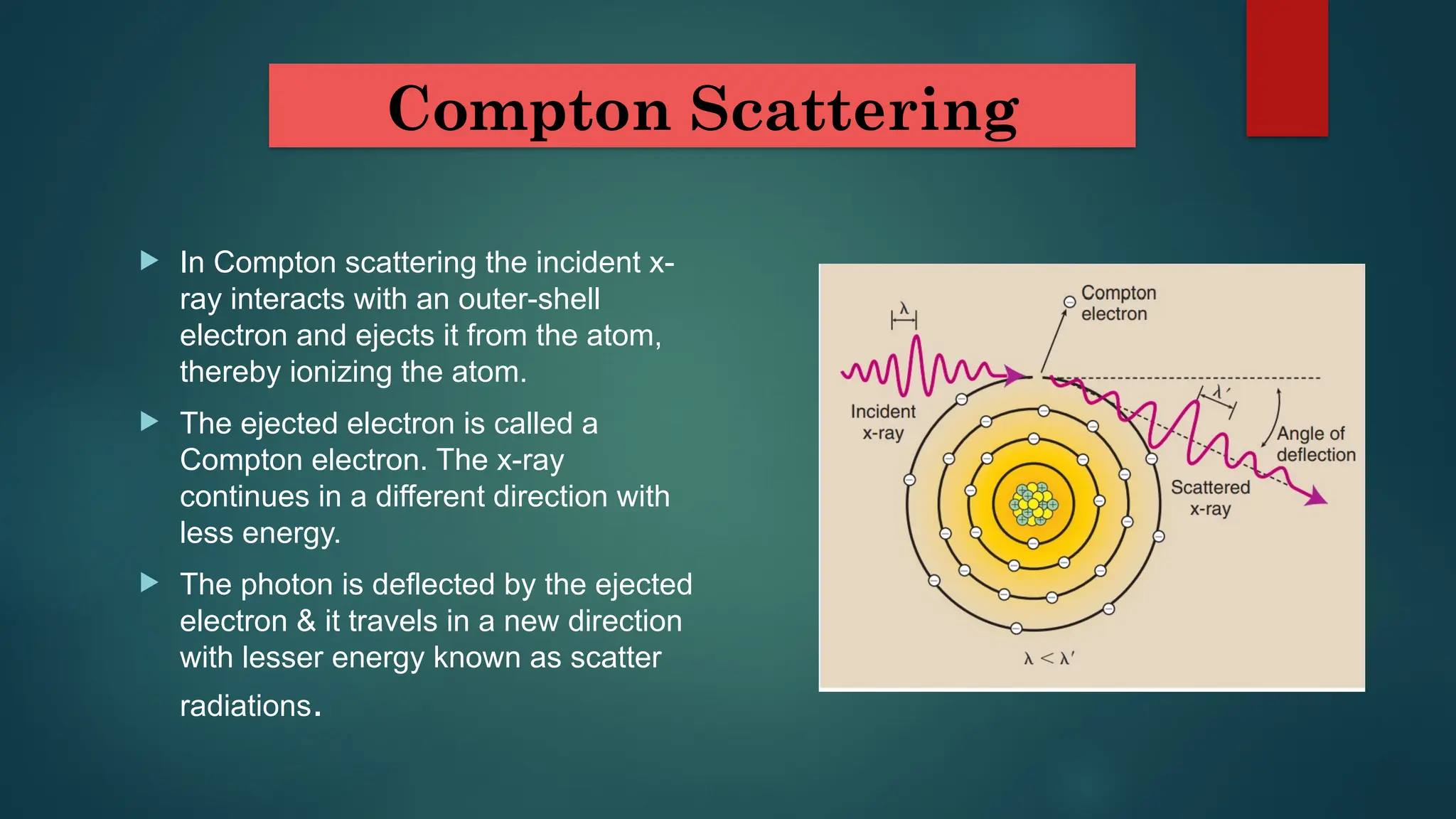
 In Compton scattering the incident x-
ray interacts with an outer-shell
electron and ejects it from the atom,
thereby ionizing the atom.
 The ejected electron is called a
Compton electron. The x-ray
continues in a different direction with
less energy.
 The photon is deflected by the ejected
electron & it travels in a new direction
with lesser energy known as scatter
radiations.
The patient.
The table top.
Back scatter from the floor.
In case of horizontal beam-
backscattered from the walls.
Sources of Scattered Radiation
Primary factors influence the relative intensity of scatter radiation
that reaches the image receptor:
 Dependent of Energy of photon (kVp)
 Dependent of field size and
 Patient thickness.
Factors Affecting the
Production of Scatter Radiation
 As x-ray energy is increased, the absolute number of Compton
interactions decreases, but the number of photoelectric
interactions decreases much more rapidly. Therefore the relative
number of x-rays that undergo Compton scattering increases.
 The percentage of x-rays incident on a 10-cm thickness of soft
tissue that will undergo photoelectric absorption and Compton
scattering at selected kVp levels. Kilovoltage, which is one of the
factors that affect the level of scatter radiation.
 The relative contributions of photoelectric effect and Compton
scatter to the radiographic image.
 The increase in photoelectric absorption results in a
considerable increase in patient radiation dose. Also, fewer x-
rays reach the image receptor at low kVp—a phenomenon that
is usually compensated for by increasing the mAs.
 The result is still a higher patient radiation dose.
1.Dependent of Energy of photon (kVp)
 With large patients, kVp must be high to ensure adequate penetration of the
portion of the body that is being radiographed. If, for example, the normal
technique factors for an anteroposterior (AP) examination of the abdomen are
inadequate, the technologist has the choice of increasing mAs or kVp.
 Increasing the mAs usually generates enough x-rays to provide a satisfactory
image but may result in high patient radiation dose.
 On the other hand, a much smaller increase in kVp is usually sufficient to provide
enough x-rays, and this can be done at a much lower patient radiation dose.
 Unfortunately, when kVp is increased, the level of scatter
radiation also increases, leading to reduced image contrast.
 Figure 11-3 shows a series of radiographs of a skull phantom taken at 70, 80, and
90 kVp with the use of appropriate collimation and grids, with the mAs adjusted to
produce radiographs of equal OD.
 Most radiologists would accept any of these radiographs. Notice that the patient
dose at 90 kVp is approximately one third that at 70 kVp.
 In general, because of this reduction in patient dose, a high-kVp radiographic
technique is preferred to a low-kVp technique.
Field Size Another factor
that affects the level of
scatter radiation and is
controlled by the
radiologic technologist is
x-ray beam field size.
As field size is increased,
scatter radiation also
increases.
2.Dependent of field size
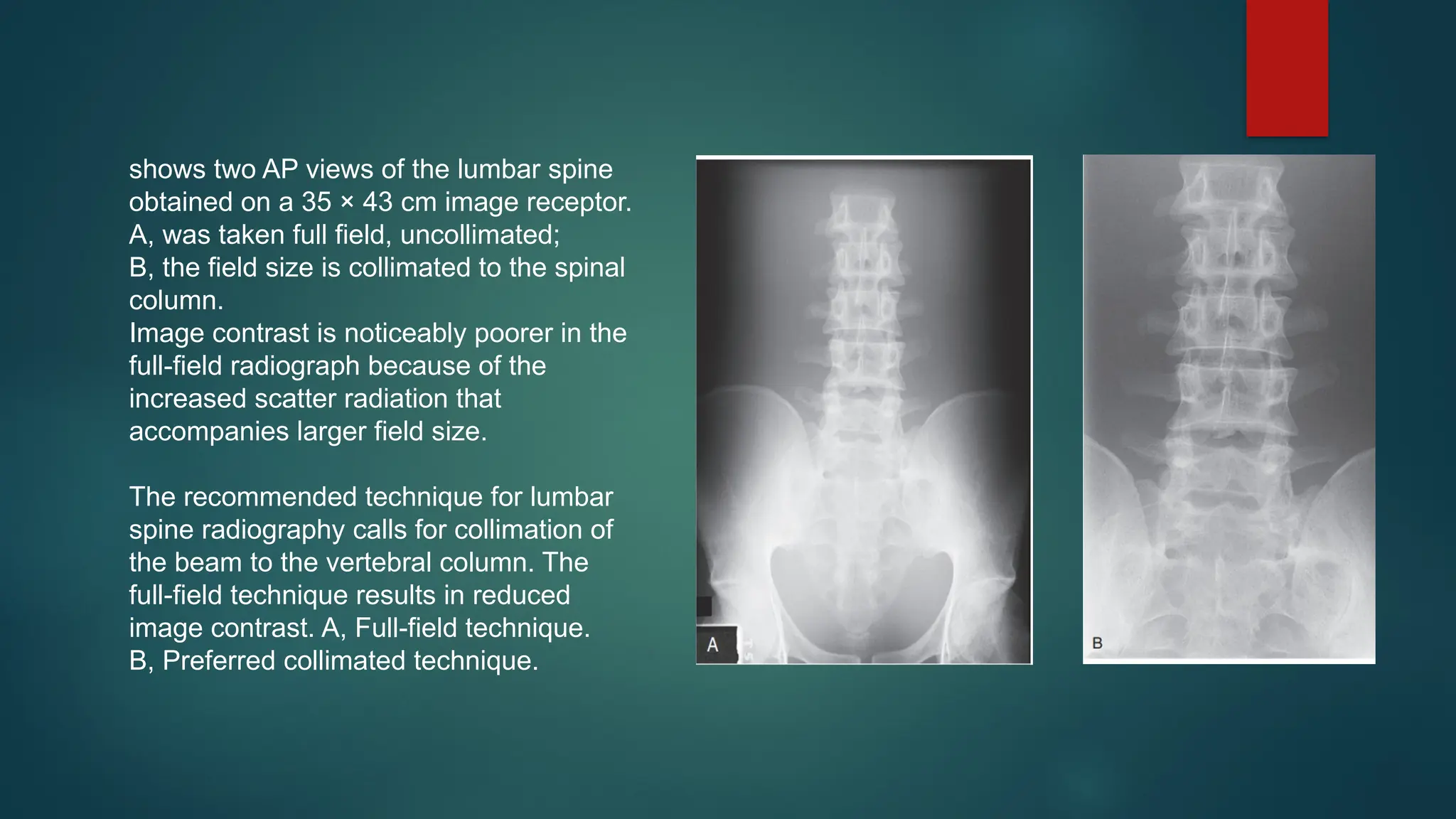
shows two AP views of the lumbar spine
obtained on a 35 × 43 cm image receptor.
A, was taken full field, uncollimated;
B, the field size is collimated to the spinal
column.
Image contrast is noticeably poorer in the
full-field radiograph because of the
increased scatter radiation that
accompanies larger field size.
The recommended technique for lumbar
spine radiography calls for collimation of
the beam to the vertebral column. The
full-field technique results in reduced
image contrast. A, Full-field technique.
B, Preferred collimated technique.
 Imaging thick parts of the body results in more scatter radiation
than does imaging thin body parts.
 Compare a radiograph of the bony structures in an extremity with a
radiograph of the bony structures of the chest or pelvis.
 Even when the two are taken with the same screen-film image
receptor, the extremity radiograph will be much sharper because of
the reduced amount of scatter radiation.
 The types of tissue (muscle, fat, bone) and pathology, such as a
fluid-filled lung, also play a part in the production of scatter
radiation.
3. Patient Thickness
Normally, patient thickness is not controlled by the
radiologic technologist. If you recognize that more x-rays
are scattered with increasing patient thickness, you can
produce a high-quality radiograph by choosing the proper
technique factors and by using devices that reduce scatter
radiation to the image receptor, such as a compression
paddle.
Compression devices improve spatial resolution by
reducing patient thickness and bringing the object
closer to the image receptor. Compression also
reduces patient radiation dose and improves contrast
resolution.
Compression is particularly
important during mammography
Control of
Scatter Radiation
Reduce the production
of Scatter Radiation
Reduce the amount of
Scatter Radiation reaching
the image receptor
By Reducing
the field size
By Reducing the
Patient thickness
By Compression
By Use Anti
scatter grid
By Use Air
gap technique
By the selection of optimum kVp , proper collimation and
using compression devices, we can reduce the amount of
scatter radiation produced to some extent. But once the
scatter radiation has been produced, two devices are mainly
used to control the amount of radiation reaching the patient
and image receptor. These are :
1. Beam restricting devices
2. Radiographic Grid
Control of Scatter Radiation
Basically, three types of
beam-restricting devices are
used:
• 1.Aperture diaphragm
• 2.cones or cylinders, and
• 3.variable-aperture
collimator.
Beam Restricting Devices
 20th century by a Boston
dentist, William Rollins.
Rollins used x-rays to
image teeth and found that
restricting the x-ray beam
with a sheet of lead with a
hole in the center, a
diaphragm, and inserting a
leather or aluminum filter
improved the diagnostic
quality of radiographs. Boston dentist, William Rollins
An aperture diaphragm is the simplest
of all beam restricting devices. It is
basically a lead or lead-lined metal
diaphragm that is attached to the x-
ray tube head. The opening in the
diaphragm usually is designed to
cover just less than the size of the
image receptor used.
Radiographic extension cones and cylinders are considered
modifications of the aperture diaphragm. In both, an extended metal
structure restricts the useful beam to the required size.
The position and size of the distal end act as an aperture and
determine field size.
 In contrast to the beam produced by an aperture diaphragm, the
useful beam produced by an extension cone or cylinder is usually
circular. Cones were used extensively in radiographic imaging.
 Today, they are reserved primarily for examinations of selected areas.
 A cone improves image contrast when used in examination of the
frontal sinuses. Cones are routinely used in dental radiography.
Cones and Cylinders
Collimators
The light-localizing variable-aperture collimator is the
most commonly used beam-restricting device in
radiography.
Collimation reduces patient radiation dose and
improves contrast resolution.
To control off-focus radiation, a first-stage entrance shuttering
device that has multiple collimator blades protrudes from the top
of the collimator into the x-ray tube housing.
The leaves of the second-stage collimator shutter are usually
made of lead that is at least 3 mm thick.
They work in pairs and are independently controlled, thereby
allowing for both rectangular and square fields. Light localization
in a typical variable-aperture collimator is accomplished with a
small lamp and mirror.
The mirror must be far enough on the x-ray tube side of the
collimator leaves to project a sufficiently sharp light pattern
through the collimator leaves when the lamp is on.
The collimator lamp and the mirror must be adjusted so that the
projected light field coincides with the x-ray beam. If the light field
and the x-ray beam do not coincide, the lamp or the mirror must
be adjusted.
Automatic Collimators (PBL)
They are also called positive beam- limiting devices which
automatically limit the size and shape of the primary beam to the
size and shape of the image receptor.
They mechanically adjust the primary beam size and shape to
that of the image receptor thus help in protecting the patients
from over exposure to radiation. It is also possible to override
PBL devices so that the field size can be controlled by the
technologist.
So all these beam limiting devices help in improving image
quality and minimizing patient dose .
 Today, nearly all light-localizing collimators manufactured for fixed
radiographic equipment are automatic. They are called positive-beam–
limiting (PBL) devices.
 When a film-loaded cassette or image receptor is inserted into the Bucky
tray, sensing devices in the tray identify the size and alignment of the
cassette or image receptor.
 A signal transmitted to the collimator housing the synchronous motors that
drive the collimator leaves to a pre calibrated position, so the x-ray beam
is restricted to the image receptor in use.
INVENTION OF GRID
ANTI-SCATTER GRIDS
GRID RATIO
GRID FREQUENCY
INTERSPACE MATERIAL,GRID STRIPS
GRID PERFOMANCE
TYPES OF GRID
GRIDS PROBLEMS
GRID SELECTION
RADIOGRAPHIC GRID
 In 1913 Gustav Bucky (German) invented
the stationary grid.
 2 months later he applied for a second
patent for a moving grid.
 In 1915 H. Potter (American), probably
unaware of Bucky’s patent because of
World War I, also invented a moving grid.
 To his credit, Potter recognized Bucky’s
work, and the Potter-Bucky grid was
introduced in 1921.
ANTI-SCATTER GRID
German radiologist
Dr.
Gustav Peter Bucky
American radiologist
Dr. Hollis E. Potter
 The grid is a carefully fabricated section of
radiopaque material (grid strip) alternating
with radiolucent material (interspace
material).
 The grid is positioned between the patient
and the image receptor.
 The grid is designed to transmit only x-rays
whose direction is on a straight line from the
x-ray tube target to the image receptor.
Scatter radiation is absorbed in the grid
material.
 X-rays that exit the patient and strike the
radiopaque grid strips are absorbed and do
not reach the image receptor.
 X-rays that exit the patient and strike the
radiopaque grid strips are absorbed and do
not reach the image receptor.
 For instance, a typical grid may have grid
strips 50 µm wide that are separated by
interspace material 350 µm wide.
Consequently, even 12.5% of x-rays
transmitted through the patient are absorbed.
 Primary beam x-rays incident on the inter-space material are transmitted
to the image receptor. Scattered x-rays incident on the inter-space
material may or may not be absorbed, depending on their angle of
incidence and the physical characteristics of the grid.
If the angle of a scattered x-ray is great enough to cause it to intersect a
lead grid strip, it will be absorbed.
 If the angle is slight , the scattered x-ray will be transmitted similarly to a
primary x-ray.
 Laboratory measurements show that high-quality grids can attenuate 80%
to 90% of the scatter radiation. Such a grid is said to exhibit good
“cleanup.”
A grid has of three important
dimensions: the thickness of the grid
strip (T), the width of the inter-space
material (D), and the height of the grid
(h). The grid ratio is the height of the
grid divided by the inter-space width.
High-ratio grids are more effective in
reducing scatter radiation than are low-
ratio grids. This is because the angle of
scatter allowed by high-ratio grids is
less than that permitted by low-ratio
grids.
GRID RATIO
 In general, grid ratios range from 5:1 to
16:1.
Higher-ratio grids are used most
often in high kV radiography. An 8:1
to 10:1 grid is frequently used with
general-purpose x-ray imaging
systems.
Whereas a 5:1 grid reduces
approximately 85% of the scatter
radiation , a 16:1 grid may reduce as
much as 97%.
 The number of grid strips per centimeter is called the grid
frequency. Grids with high frequency show less distinct grid lines on
a radiographic image than grids with low frequency.
 If grid strip width is held constant, the higher the frequency of a
grid, the thinner its interspace must be and the higher the grid ratio.
 Most grids have frequencies in the range of 25 to 45 lines per
centimeter. Grid frequency can be calculated if the widths of the
grid strip and of the interspace are known.
 Grid frequency is computed by dividing the thickness of one line
pair (T + D), expressed in µm, into 1 cm:
GRID FREQUECY
 The purpose of the interspace material is
to maintain a precise separation between
the delicate lead strips of the grid.
 The interspace material of most grids
consists of aluminum or plastic fiber.
 Aluminum has a higher atomic number
than plastic and therefore may provide
some selective filtration of scattered x-
rays not absorbed in the grid strip.
 Aluminum also has the advantage of
producing less visible grid lines on the
radiograph.
Interspace Material
 On the other hand, use of aluminum as interspace material increases the
absorption of primary x-rays in the interspace, especially at low kVp.
 For this reason, fiber interspace grids usually are preferred to aluminum
interspace grids. Still, aluminum has two additional advantages over fiber.
 1. It is non-hygroscopic, that is, it does not absorb moisture as
plastic fiber does.
 2. Fiber interspace grids can become warped if they absorb moisture.
Also, aluminum interspace grids of high quality are easier to
manufacture because aluminum is easier to form and roll into sheets
of precise thickness.
 The grid strip should be infinitely thin and
should have high absorption properties.
These strips may be formed from several
possible materials.
 Lead is most widely used because it is easy
to shape and is relatively inexpensive. Its
high atomic number and high mass density
make lead the material of choice in the
manufacture of grids.
 Tungsten, platinum, gold, and uranium all
have been tried, but none has the overall
desirable characteristics of lead.
GRID STRIP
GRID PERFOMANCE
 Perhaps the largest single factor responsible for poor radiographic image
quality is scatter radiation. By removing scattered x-rays from the remnant
beam, the radiographic grid removes the source of reduced contrast.
 Grid performance define by two factors.
•K
Contrast
improvement factor
•B
Bucky factor or
Grid factor
 This property of the grid is specified by the contrast improvement factor (k).
A contrast improvement factor of 1 indicates no improvement.
 Most grids have contrast improvement factors of between 1.5 and 2.5.
 In other words, the image contrast is approximately doubled when grids
are used.
 The contrast improvement factor usually is measured at 100 kVp, but it
should be realized that k is a complex function of the x-ray emission
spectrum, patient thickness, and the tissue irradiated.
 Mathematically, the contrast improvement factor, k, is expressed as follows:
Contrast Improvement Factor(K)
Bucky Factor(B)
Although the use of a grid improves contrast, a penalty is
paid in the form of patient radiation dose. The quantity of
image-forming x-rays transmitted through a grid is much
less than that of image-forming x-rays incident on the grid.
Therefore, when a grid is used, the radiographic technique
must be increased to produce the same image receptor
signal. The amount of this increase is given by the Bucky
factor (B).
1. The higher the grid ratio, the higher is the
Bucky factor. The penetration of primary
radiation through a grid is fairly
independent of grid ratio. Penetration of
scatter radiation through a grid becomes
less likely with increasing grid ratio;
therefore, the Bucky factor increases.
2. The Bucky factor increases with
increasing kVp. At high voltage, more
scatter radiation is produced. This scatter
radiation has a more difficult time
penetrating the grid; thus, the Bucky factor
increases.
GRID
PARALLE
L GRID
CROSSED
GRID
FOCUS
GRID
MOVING
GRID
TYPES OF GRIDS
 The simplest type of grid is the parallel
grid, which is diagrammed in cross-
section . In the parallel grid, all lead grid
strips are parallel.
 This type of grid is the easiest to
manufacture, but it has some properties
that are clinically undesirable, namely
grid cutoff, the undesirable absorption
of primary x-rays by the grid.
Parallel Grid
 Parallel grids clean up scatter radiation in only one
direction along the axis of the grid. Crossed grids
are designed to overcome this deficiency.
 Crossed grids have lead grid strips that run parallel
to the long and short axes of the grid. They are
usually fabricated by sandwiching two parallel grids
together with their grid strips perpendicular to one
another.
 Crossed grids are much more efficient than parallel
grids in cleaning up scatter radiation. In fact, a
crossed grid has a higher contrast improvement
factor than a parallel grid of twice the grid ratio.
 A 6:1 crossed grid will clean up more scatter
radiation than a 12:1 parallel grid. This advantage
of the crossed grid increases as the operating kVp
is increased. A crossed grid identified as having a
grid ratio of 6:1 is constructed with two 6:1 parallel
grids.
Crossed Grid
Focused Grid
The focused grid is designed to minimize grid cutoff. The
lead grid strips of a focused grid lie on the imaginary radial
lines of a circle centered at the focal spot, so they coincide
with the divergence of the x-ray beam. The x-ray tube
target should be placed at the center of this imaginary
circle when a focused grid is used. Focused grids are
more difficult to manufacture than parallel grids.
They are characterized by all of the properties of parallel
grids except that when properly positioned, they exhibit no
grid cutoff. Radiologic technologists must take care when
positioning focused grids because of their geometric
limitations.
Every focused grid is marked with its intended focal
distance and the side of the grid that should face the x-ray
tube. If radiographs are taken at distances other than
those intended, grid cutoff occurs.
Moving Grids
Grid lines are the images made when primary x-rays are
absorbed within the grid strips. Even though the grid strips
are very small, their image is still observable.
The presence of grid lines can be demonstrated simply by
radiographing a grid. Usually, high-frequency grids present
less obvious grid lines compared with low-frequency grids.
A major improvement in grid development occurred in
1920. Hollis E. Potter hit on a very simple idea: Move the
grid while the x-ray exposure is being made.
The grid lines disappear at little cost of increased
radiographic technique. A device that does this is called a
moving grid or a Potter-Bucky diaphragm (“Bucky” for
short).
Moving grids are placed in a holding mechanism that begins
moving just before x-ray exposure and continues moving
after the exposure ends. Two basic types of moving grid
mechanisms are in use today: reciprocating and oscillating.
• A reciprocating grid is a moving grid that is motor driven
back and forth several times during x-ray exposure. The
total distance of drive is approximately 2 cm.
• An oscillating grid is positioned within a frame with a 2- to
3-cm tolerance on all sides between the frame and the
grid.
 Most grids in diagnostic imaging are of the
moving type. They are permanently mounted in
the moving mechanism just below the tabletop or
just behind the vertical chest board. To be
effective, of course, the grid must move from side
to side. If the grid is installed incorrectly and
moves in the same direction as the grid strips,
grid lines will appear on the radiograph.
 The most frequent error in the use of grids is
improper positioning. For the grid to function
correctly, it must be precisely positioned relative
to the x-ray tube target and to the central ray of
the x-ray beam. Four situations characteristic of
focused grids must be avoided.
GRID PROBLEMS
 A properly functioning grid must lie in a plane
perpendicular to the central ray of the x-ray
beam.
 The central ray is the x-ray that travels along
the center of the useful x-ray beam.
 Despite its name, an off-level grid in fact is
usually produced with an improperly positioned
x-ray tube and not an improperly positioned grid.
 If the central ray is incident on the grid at an
angle, then all incident x-rays will be angled, and
grid cutoff will occur across the entire
radiographic image, resulting in lower OD or
intensity at the digital image receptor.
OFF LEVEL
 A grid can be perpendicular to the central
ray of the x-ray beam and still produce grid
cutoff if it is shifted laterally.
 This is a problem with focused grids in
which an off-center grid is shown with a
properly positioned grid.
 The center of a focused grid must be
positioned directly under the x-ray tube
target, so the central ray of the x-ray beam
passes through the centermost interspace of
the grid.
 Any lateral shift results in grid cutoff across
the entire radiograph, producing lower OD.
This error in positioning is called lateral
decentering.
OFF CENTER
 The grid is from the specified focal distance,
the more severe will be the grid cutoff. Grid
cutoff is not uniform across the image
receptor but instead is more severe at the
edges.
 This condition is not usually a problem if all
chest radiographs are taken at 180 cm SID
and all table radiographs at 100 cm SID.
Positioning the grid at the proper focal
distance is more important with high-ratio
grids.
OFF FOCUS
 It need occur only once, and it will be
noticed immediately.
 A radiographic image taken with an upside-
down focused grid shows severe grid cutoff
on either side of the central ray.
 Perhaps the most common improper grid
position occurs if the grid is both off center
and off focus. Without proper attention, this
can occur easily during mobile radiography.
 It is an easily recognized grid positioning
artifact because the result is uneven
exposure. The resultant radiograph appears
dark on one side and light on the other.
UPSIDE DOWN
GRID SELECTION
Selection of a grid with the proper ratio depends on an understanding of three
interrelated factors: kVp ,degree of scatter radiation reduction, and patient radiation
dose.
When a high kVp is used, high-ratio grids should be used as well.
Of course, the choice of grid is also influenced by the size and shape of the anatomy
that is being radiographed.
As grid ratio increases, scatter radiation attenuation also increases. The difference
between grid ratios of 12:1 and 16:1 is small.
The difference in patient dose is large, however; therefore, 16:1 grids are not often
used.
Many general purpose x-ray examination facilities find that an 8:1 grid represents a
good compromise between the desired levels of scatter radiation reduction and
patient radiation dose.
1. Patient radiation dose increases
with increasing grid ratio.
2. High-ratio grids are used for high-
kVp examinations.
3. The patient radiation dose at high
kVp is less than that at low kVp.
GRID SALECTION FACTORS
 A clever technique that may be used as
an alternative to the use of radiographic
grids is the air-gap technique. This is
another method of reducing scatter
radiation, thereby enhancing image
contrast. When the air-gap technique is
used, the image receptor is moved 10
to 15 cm from the patient.
 A portion of the scattered x-rays
generated in the patient would be
scattered away from the image receptor
and not be detected. Because fewer
scattered x-rays interact with the image
receptor, the contrast is enhanced.
AIR GAP TECHNOLOGY
 The air-gap technique has found
application particularly in the areas of
chest radiography and cerebral
angiography. The magnification that
accompanies these techniques is
usually acceptable.
 In chest radiography, however, some
radiologic technologists increase the
SID from 180 to 300 cm. This results in
very little magnification and a sharper
image. Of course, the technique factors
must be increased, but the patient
radiation dose is not increased.
Usually, when an air-gap technique is used, the mAs is increased
approximately 10% for every centimeter of air gap.
One disadvantage of the air-gap technique is image magnification with
associated focal-spot blur.
Disadvantage
ADVACEMENT
 RADPAD® has been specifically designed for the protection of workers
exposed to scattered radiation during femoral access interventional
radiology procedures.
RADPAD® is available in 0.25mm lead equivalence for scattered radiation
absorption up to 90% at 90kVp as well as in 0.125mm lead equivalence for
scattered radiation absorption up to 75% at 90 kVp.
 ADVANTAGES:
- Protects the hands
- Significantly reduces the dose to the eyes and chest
- Quick and intuitive use
- Sterile X-Ray protective field
- Absorbs up to 90% of the scattered radiation (Orange Pb 0.25mm to 90
kVp)
- Absorbs up to 75% of the scattered radiation (Yellow Pb 0.125mm to 90
kVp)
MEDICAL INDICATIONS:
- All interventions under fluoroscopy through femoral access.
RADPAD
 The use of bedside chest radiography has been increasing continually with the increase in aging
population and the need for care of critically ill patients. Bedside chest radiography provides
information that may not be obtained clinically.
 However, bedside examination has a major limitations involving image degradation by scattered
radiation. Although anti-scatter grid improves the contrast by reducing the scattered radiation,
many hospitals do not use grid in bedside examinations for various reasons.
 Using a grid in a bedside investigation is challenging due to the risk of misalignment and grid
cutoff, which reduces diagnostic information.
 Additional radiation is required for repeat examinations if necessary. Furthermore, grid
transportation and positioning is an additional technological burden, and grid usage typically
entails a higher radiation dose.
 Eventual damage requires grid installation and replacement, and related costs. To overcome
these limitations, researchers developed software that provides scatter correction without the
physical use of a grid.
 Recently, several vendors have developed new software that estimates the scattered radiation
and provides scatter correction without the usage of grids.
 Skyflow in Philips
 Virtual grid in Fujifilm
 SimGrid in Samsung
Grid-Like Software
 Scatter correction algorithm
 Philips SkyFlow reduces the effect of scattered radiation
for non-grid bedside chest exams, allowing you to obtain
DR images with grid-like contrast while avoiding the time
and effort of attaching and detaching a grid.
 Grid-like contrast enhancement for bedside chest
radiographs acquired without anti-scatter grid.
 With SkyFlow technology, Philips offers a novel, patient-
adaptive, digital image processing that provides grid-like
image contrast enhancement for bedside chest
radiographs acquired without an anti-scatter grid.
SkyFlow
 The recently introduced ‘SimGrid’ scatter
correction software (Samsung Electronics Co.
Ltd., Suwon, Korea) allows the estimation of the
distribution and degree of scatter radiation using
raw image data directly with pretrained
Convolutional Neural Networks.
 These networks have been trained and optimized
using tens of thousands of anthropomorphic
phantoms and clinical images. Thus, it is robust
under varying conditions of exposure, patient
status, and positional changes.
 The estimated scatter image is subtracted from
the raw image to produce a de-scattered image.
Subsequently, the de-scattered raw image is
processed by the post-processing software of the
digital radiography system.
SIM GRID
 Virtual Grid™ processing enhances image contrast and clarity
with up to 50% dose reduction compared to a real grid. Physical
grids are commonly required for mobile imaging of large anatomy
to help focus radiation and reduce scatter.
 Virtual Grid processing will be of great benefit to technologists for
mobile imaging applications in emergency room, operating room,
critical care and other exams. Virtual Grid can be applied to all
body parts,* including chest, abdomen, head, spine, pelvis, upper
and lower extremities.
 With the ability to customize its emulated grid characteristics,
Virtual Grid provides exam flexibility and eliminates image quality
problems that result from improper grid alignment or focus.
 By simulating actual grid use, Virtual Grid can be beneficial in
many clinical scenarios (bedside, ER, OR, ICU) where positioning
a physical grid can be challenging or disruptive to patient comfort.
• Eliminates physical grid-related misalignment issues
• Precisely tunes image contrast while suppressing image noise
• Emulates a wide range of physical grid characteristics, by grid
ratio, density and interspace material.
Virtual grid in Fujifilm
 The cross-hatch grids were normally used as stationary grids in
mammography Although more scatter was absorbed, the cross-
hatch resulted in a significant grid pattern artifact in the image,
which degraded image quality.
 Even when cross-hatch grids were moved during the exposure it
was difficult to remove the appearance of the grid pattern
completely from the image because of the continuous overlap of
the grid intersections.
 A unique, micro-processor control design developed by the
Hologic Lorad Division overcomes the problem of moving the grid
and eliminates all traces of the grid pattern in the image.
 A highly precise servo-motor and electronics mechanism moves
the grid an exact distance during the mammographic exposure,
regardless of the duration of the exposure.
 The High Transmission Cellular (HTC) grid results in higher
subject contrast while the micro-processor controlled movement
eliminates grid artifacts, resulting in higher quality mammographic
images.
HTC GRID
CONCLUSION
 Contrast is one of the most important characteristics of the radiographic image.
Scatter radiation, the result of Compton interaction, is the primary factor that
reduces image contrast. Grids reduce the amount of scatter that reaches the
image receptor.
 In all cases the use of a grid increases patient dose.
 The changes in grid ratio and changes in mAs or kVp that are required. Problems
can arise with the use of grids, including off-level, off-center, and upside-down grid
errors.
 An alternative to use of a grid is the air-gap technique, in which the image
receptor is moved 10 to 15 cm from the patient.
 Recently, several vendors have developed new software that estimates the
scattered radiation and provides scatter correction without the usage of grids in
portable units as well as fixed room units.
 Eisenhuber E, Schaefer-Prokop CM, Prosch H, Schima W. Bedside Chest Radiography. Respiratory Care
2012 Mar; 57(3):427-43 .
 Wandtke JC. Bedside Chest Radiography. Radiology 1994 Jan; 190(1):1-10.
 ACR Practice Guideline for the Performance of Pediatric and Adult Portable (Mobile Unit) Chest
Radiography. Revised 2011 (Resolution 55). Available at: http://www.acr.org/~/media/ACR/Documents/
PGTS/guidelines/Portable_Chest.pdf.
 The Potential Role of Grid-Like Software in Bedside Chest Radiography in Improving Image Quality and
Dose Reduction: An Observer Preference Study.Korean J Radiol 2018;19(3):526-533
 Radiologic Science for Technologists Physics, Biology, and Protection Eleventh Edition
 Christensen's book of radiation physics.
 www.google.com
REFERANCES
Question: A grid is constructed with 50-µm strips and a 350-µm interspace.
What percentage of x-rays incident on the grid will be absorbed by its entrance
surface?
ANSWER-12.5%
Question: When viewed from the top, a particular grid shows a series of lead
strips 40 µm wide separated by interspaces 300 µm wide. How much of the
radiation incident on this grid should be absorbed?
ANSWER-11.8%
Question: A grid is fabricated of 30-µm lead grid strips
sandwiched between interspace material that is 300 µm
thick. The height of the grid is 2.4 mm. What is the grid
ratio?
ANSWER - 8:1
QUESTION:A focused grid has the following characteristics: 100 cm focal
distance, 40 µm grid strips, 350 µm interspace, and 2.8 mm height. What is the
grid ratio?
Question: An Aluminum step wedge is placed on a tissue
phantom that is 20 cm thick and a radiograph is made.
Without a grid, analysis of the radiograph shows an
average gradient (a measure of contrast) of 1.1. With a
12:1 grid, radiographic contrast is 2.8. What is the
contrast improvement factor of this grid?
ANSWER-2.55
Question: What is the grid frequency of a grid that has a grid strip width
of 30 µm and an interspace width of 300 µm?
If one line pair = 300 µm + 30 µm = 330 µm, how many line pairs are in
10,000 µm (10,000 µm = 1 cm)?
ANSWER= 30.3 lines/cm
Question: A grid is fabricated of 30-µm lead grid strips sandwiched between
interspace material that is 300 µm thick. The height of the grid is 3 mm. What is
the grid ratio?
ANSWER -10:1
THANK YOU

4.SCATTER RADIATION.pptx BY Ravindra Kumar.pptx

  • 1.
    SCATTER RADIATION, ITSPRODUCTION AND MEASURES TO CONTROL IT PRESENTED BY:- MR. RAVINDRA KUMAR MEDICAL TECHNOLOGIST DEPARTMENT OF RADIODIAGNOSIS AND IMAGING PGIMER, CHANDIGARH
  • 2.
    INTRODUCTION CHARACTERISTICS OF SCATTERRADIATION PRODUCTION OF SCATTER RADIATION FACTORS AFFECTING SCATTER RADIATION SOURCES OF SCATTER RADIATION CONTROL OF SCATTER RADIATION CONCLUSION CONTENTS
  • 3.
    The primary radiationwhich is attenuated by the patient’s tissue producing a radiographic image . Secondary radiation which is largely Compton scattering of the primary beam within the patient which casts its density on the film . The scattered photons are deflected at a random course , they can not portray an image, they only produce fog or unwanted blackness on the film.  It reduces contrast .  Result in formation of noise on x-ray film.  Reduces light transmitting ability of radiograph. INTRODUCTION
  • 4.
     Contrast andcontrast resolution are important characteristics of image quality.  Contrast arises from the areas of light, dark, and shades of gray on the radiographic image.  Contrast resolution is the ability to image adjacent similar tissues.  Compton scatter x-radiation produces noise, reducing image contrast and contrast resolution. It makes the image less visible. Why need to Control Scattered Radiation
  • 5.
    SCATTER RADIATION Two typesof x-rays are responsible for the optical density (OD) and contrast on a radiographic image: those that pass through the patient without interacting and those that are Compton scattered within the patient. X-rays that exit from the patient are remnant x-rays and those that exit and interact with the image receptor are called image-forming x-rays.
  • 6.
     More obliquein nature.  Produced by matter in all direction.  Can travel through longer path in body than primary beam.  Have Less energy than primary beam  With Increase in energy of primary radiation more scattering in forward direction.  Amount of scatter depends upon volume of tissue exposed, built of patient and kVp used. CHARACTERSTIC OF SCATTER RADIATION
  • 7.
    Scatter radiation isproduced mainly by the following types of interaction of radiation with matter : 1.Coherent scattering 2.Compton scattering PRODUCTION OF SCATTER RADIATION
  • 8.
     Also called-elastic, unmodified, classical Scattering  Process by which radiation deflected without losing any energy  There are two types of coherent scattering -Thomson and Rayleigh scattering.  In Thomson scattering single electron is involved in the interaction.  In Rayleigh scattering all the electrons of the atom are involved.
  • 9.
    Compton Scattering  InCompton scattering the incident x- ray interacts with an outer-shell electron and ejects it from the atom, thereby ionizing the atom.  The ejected electron is called a Compton electron. The x-ray continues in a different direction with less energy.  The photon is deflected by the ejected electron & it travels in a new direction with lesser energy known as scatter radiations.
  • 10.
    The patient. The tabletop. Back scatter from the floor. In case of horizontal beam- backscattered from the walls. Sources of Scattered Radiation
  • 11.
    Primary factors influencethe relative intensity of scatter radiation that reaches the image receptor:  Dependent of Energy of photon (kVp)  Dependent of field size and  Patient thickness. Factors Affecting the Production of Scatter Radiation
  • 12.
     As x-rayenergy is increased, the absolute number of Compton interactions decreases, but the number of photoelectric interactions decreases much more rapidly. Therefore the relative number of x-rays that undergo Compton scattering increases.  The percentage of x-rays incident on a 10-cm thickness of soft tissue that will undergo photoelectric absorption and Compton scattering at selected kVp levels. Kilovoltage, which is one of the factors that affect the level of scatter radiation.  The relative contributions of photoelectric effect and Compton scatter to the radiographic image.  The increase in photoelectric absorption results in a considerable increase in patient radiation dose. Also, fewer x- rays reach the image receptor at low kVp—a phenomenon that is usually compensated for by increasing the mAs.  The result is still a higher patient radiation dose. 1.Dependent of Energy of photon (kVp)
  • 13.
     With largepatients, kVp must be high to ensure adequate penetration of the portion of the body that is being radiographed. If, for example, the normal technique factors for an anteroposterior (AP) examination of the abdomen are inadequate, the technologist has the choice of increasing mAs or kVp.  Increasing the mAs usually generates enough x-rays to provide a satisfactory image but may result in high patient radiation dose.  On the other hand, a much smaller increase in kVp is usually sufficient to provide enough x-rays, and this can be done at a much lower patient radiation dose.  Unfortunately, when kVp is increased, the level of scatter radiation also increases, leading to reduced image contrast.
  • 14.
     Figure 11-3shows a series of radiographs of a skull phantom taken at 70, 80, and 90 kVp with the use of appropriate collimation and grids, with the mAs adjusted to produce radiographs of equal OD.  Most radiologists would accept any of these radiographs. Notice that the patient dose at 90 kVp is approximately one third that at 70 kVp.  In general, because of this reduction in patient dose, a high-kVp radiographic technique is preferred to a low-kVp technique.
  • 15.
    Field Size Anotherfactor that affects the level of scatter radiation and is controlled by the radiologic technologist is x-ray beam field size. As field size is increased, scatter radiation also increases. 2.Dependent of field size
  • 16.
    shows two APviews of the lumbar spine obtained on a 35 × 43 cm image receptor. A, was taken full field, uncollimated; B, the field size is collimated to the spinal column. Image contrast is noticeably poorer in the full-field radiograph because of the increased scatter radiation that accompanies larger field size. The recommended technique for lumbar spine radiography calls for collimation of the beam to the vertebral column. The full-field technique results in reduced image contrast. A, Full-field technique. B, Preferred collimated technique.
  • 17.
     Imaging thickparts of the body results in more scatter radiation than does imaging thin body parts.  Compare a radiograph of the bony structures in an extremity with a radiograph of the bony structures of the chest or pelvis.  Even when the two are taken with the same screen-film image receptor, the extremity radiograph will be much sharper because of the reduced amount of scatter radiation.  The types of tissue (muscle, fat, bone) and pathology, such as a fluid-filled lung, also play a part in the production of scatter radiation. 3. Patient Thickness
  • 18.
    Normally, patient thicknessis not controlled by the radiologic technologist. If you recognize that more x-rays are scattered with increasing patient thickness, you can produce a high-quality radiograph by choosing the proper technique factors and by using devices that reduce scatter radiation to the image receptor, such as a compression paddle. Compression devices improve spatial resolution by reducing patient thickness and bringing the object closer to the image receptor. Compression also reduces patient radiation dose and improves contrast resolution.
  • 19.
  • 20.
    Control of Scatter Radiation Reducethe production of Scatter Radiation Reduce the amount of Scatter Radiation reaching the image receptor By Reducing the field size By Reducing the Patient thickness By Compression By Use Anti scatter grid By Use Air gap technique
  • 21.
    By the selectionof optimum kVp , proper collimation and using compression devices, we can reduce the amount of scatter radiation produced to some extent. But once the scatter radiation has been produced, two devices are mainly used to control the amount of radiation reaching the patient and image receptor. These are : 1. Beam restricting devices 2. Radiographic Grid Control of Scatter Radiation
  • 22.
    Basically, three typesof beam-restricting devices are used: • 1.Aperture diaphragm • 2.cones or cylinders, and • 3.variable-aperture collimator. Beam Restricting Devices
  • 23.
     20th centuryby a Boston dentist, William Rollins. Rollins used x-rays to image teeth and found that restricting the x-ray beam with a sheet of lead with a hole in the center, a diaphragm, and inserting a leather or aluminum filter improved the diagnostic quality of radiographs. Boston dentist, William Rollins
  • 24.
    An aperture diaphragmis the simplest of all beam restricting devices. It is basically a lead or lead-lined metal diaphragm that is attached to the x- ray tube head. The opening in the diaphragm usually is designed to cover just less than the size of the image receptor used.
  • 25.
    Radiographic extension conesand cylinders are considered modifications of the aperture diaphragm. In both, an extended metal structure restricts the useful beam to the required size. The position and size of the distal end act as an aperture and determine field size.  In contrast to the beam produced by an aperture diaphragm, the useful beam produced by an extension cone or cylinder is usually circular. Cones were used extensively in radiographic imaging.  Today, they are reserved primarily for examinations of selected areas.  A cone improves image contrast when used in examination of the frontal sinuses. Cones are routinely used in dental radiography. Cones and Cylinders
  • 26.
    Collimators The light-localizing variable-aperturecollimator is the most commonly used beam-restricting device in radiography. Collimation reduces patient radiation dose and improves contrast resolution.
  • 27.
    To control off-focusradiation, a first-stage entrance shuttering device that has multiple collimator blades protrudes from the top of the collimator into the x-ray tube housing. The leaves of the second-stage collimator shutter are usually made of lead that is at least 3 mm thick. They work in pairs and are independently controlled, thereby allowing for both rectangular and square fields. Light localization in a typical variable-aperture collimator is accomplished with a small lamp and mirror. The mirror must be far enough on the x-ray tube side of the collimator leaves to project a sufficiently sharp light pattern through the collimator leaves when the lamp is on. The collimator lamp and the mirror must be adjusted so that the projected light field coincides with the x-ray beam. If the light field and the x-ray beam do not coincide, the lamp or the mirror must be adjusted.
  • 28.
    Automatic Collimators (PBL) Theyare also called positive beam- limiting devices which automatically limit the size and shape of the primary beam to the size and shape of the image receptor. They mechanically adjust the primary beam size and shape to that of the image receptor thus help in protecting the patients from over exposure to radiation. It is also possible to override PBL devices so that the field size can be controlled by the technologist. So all these beam limiting devices help in improving image quality and minimizing patient dose .
  • 29.
     Today, nearlyall light-localizing collimators manufactured for fixed radiographic equipment are automatic. They are called positive-beam– limiting (PBL) devices.  When a film-loaded cassette or image receptor is inserted into the Bucky tray, sensing devices in the tray identify the size and alignment of the cassette or image receptor.  A signal transmitted to the collimator housing the synchronous motors that drive the collimator leaves to a pre calibrated position, so the x-ray beam is restricted to the image receptor in use.
  • 30.
    INVENTION OF GRID ANTI-SCATTERGRIDS GRID RATIO GRID FREQUENCY INTERSPACE MATERIAL,GRID STRIPS GRID PERFOMANCE TYPES OF GRID GRIDS PROBLEMS GRID SELECTION RADIOGRAPHIC GRID
  • 31.
     In 1913Gustav Bucky (German) invented the stationary grid.  2 months later he applied for a second patent for a moving grid.  In 1915 H. Potter (American), probably unaware of Bucky’s patent because of World War I, also invented a moving grid.  To his credit, Potter recognized Bucky’s work, and the Potter-Bucky grid was introduced in 1921. ANTI-SCATTER GRID German radiologist Dr. Gustav Peter Bucky American radiologist Dr. Hollis E. Potter
  • 32.
     The gridis a carefully fabricated section of radiopaque material (grid strip) alternating with radiolucent material (interspace material).  The grid is positioned between the patient and the image receptor.  The grid is designed to transmit only x-rays whose direction is on a straight line from the x-ray tube target to the image receptor. Scatter radiation is absorbed in the grid material.  X-rays that exit the patient and strike the radiopaque grid strips are absorbed and do not reach the image receptor.  X-rays that exit the patient and strike the radiopaque grid strips are absorbed and do not reach the image receptor.  For instance, a typical grid may have grid strips 50 µm wide that are separated by interspace material 350 µm wide. Consequently, even 12.5% of x-rays transmitted through the patient are absorbed.
  • 33.
     Primary beamx-rays incident on the inter-space material are transmitted to the image receptor. Scattered x-rays incident on the inter-space material may or may not be absorbed, depending on their angle of incidence and the physical characteristics of the grid. If the angle of a scattered x-ray is great enough to cause it to intersect a lead grid strip, it will be absorbed.  If the angle is slight , the scattered x-ray will be transmitted similarly to a primary x-ray.  Laboratory measurements show that high-quality grids can attenuate 80% to 90% of the scatter radiation. Such a grid is said to exhibit good “cleanup.”
  • 34.
    A grid hasof three important dimensions: the thickness of the grid strip (T), the width of the inter-space material (D), and the height of the grid (h). The grid ratio is the height of the grid divided by the inter-space width. High-ratio grids are more effective in reducing scatter radiation than are low- ratio grids. This is because the angle of scatter allowed by high-ratio grids is less than that permitted by low-ratio grids. GRID RATIO
  • 35.
     In general,grid ratios range from 5:1 to 16:1. Higher-ratio grids are used most often in high kV radiography. An 8:1 to 10:1 grid is frequently used with general-purpose x-ray imaging systems. Whereas a 5:1 grid reduces approximately 85% of the scatter radiation , a 16:1 grid may reduce as much as 97%.
  • 36.
     The numberof grid strips per centimeter is called the grid frequency. Grids with high frequency show less distinct grid lines on a radiographic image than grids with low frequency.  If grid strip width is held constant, the higher the frequency of a grid, the thinner its interspace must be and the higher the grid ratio.  Most grids have frequencies in the range of 25 to 45 lines per centimeter. Grid frequency can be calculated if the widths of the grid strip and of the interspace are known.  Grid frequency is computed by dividing the thickness of one line pair (T + D), expressed in µm, into 1 cm: GRID FREQUECY
  • 37.
     The purposeof the interspace material is to maintain a precise separation between the delicate lead strips of the grid.  The interspace material of most grids consists of aluminum or plastic fiber.  Aluminum has a higher atomic number than plastic and therefore may provide some selective filtration of scattered x- rays not absorbed in the grid strip.  Aluminum also has the advantage of producing less visible grid lines on the radiograph. Interspace Material
  • 38.
     On theother hand, use of aluminum as interspace material increases the absorption of primary x-rays in the interspace, especially at low kVp.  For this reason, fiber interspace grids usually are preferred to aluminum interspace grids. Still, aluminum has two additional advantages over fiber.  1. It is non-hygroscopic, that is, it does not absorb moisture as plastic fiber does.  2. Fiber interspace grids can become warped if they absorb moisture. Also, aluminum interspace grids of high quality are easier to manufacture because aluminum is easier to form and roll into sheets of precise thickness.
  • 39.
     The gridstrip should be infinitely thin and should have high absorption properties. These strips may be formed from several possible materials.  Lead is most widely used because it is easy to shape and is relatively inexpensive. Its high atomic number and high mass density make lead the material of choice in the manufacture of grids.  Tungsten, platinum, gold, and uranium all have been tried, but none has the overall desirable characteristics of lead. GRID STRIP
  • 40.
    GRID PERFOMANCE  Perhapsthe largest single factor responsible for poor radiographic image quality is scatter radiation. By removing scattered x-rays from the remnant beam, the radiographic grid removes the source of reduced contrast.  Grid performance define by two factors. •K Contrast improvement factor •B Bucky factor or Grid factor
  • 41.
     This propertyof the grid is specified by the contrast improvement factor (k). A contrast improvement factor of 1 indicates no improvement.  Most grids have contrast improvement factors of between 1.5 and 2.5.  In other words, the image contrast is approximately doubled when grids are used.  The contrast improvement factor usually is measured at 100 kVp, but it should be realized that k is a complex function of the x-ray emission spectrum, patient thickness, and the tissue irradiated.  Mathematically, the contrast improvement factor, k, is expressed as follows: Contrast Improvement Factor(K)
  • 42.
    Bucky Factor(B) Although theuse of a grid improves contrast, a penalty is paid in the form of patient radiation dose. The quantity of image-forming x-rays transmitted through a grid is much less than that of image-forming x-rays incident on the grid. Therefore, when a grid is used, the radiographic technique must be increased to produce the same image receptor signal. The amount of this increase is given by the Bucky factor (B).
  • 43.
    1. The higherthe grid ratio, the higher is the Bucky factor. The penetration of primary radiation through a grid is fairly independent of grid ratio. Penetration of scatter radiation through a grid becomes less likely with increasing grid ratio; therefore, the Bucky factor increases. 2. The Bucky factor increases with increasing kVp. At high voltage, more scatter radiation is produced. This scatter radiation has a more difficult time penetrating the grid; thus, the Bucky factor increases.
  • 44.
  • 45.
     The simplesttype of grid is the parallel grid, which is diagrammed in cross- section . In the parallel grid, all lead grid strips are parallel.  This type of grid is the easiest to manufacture, but it has some properties that are clinically undesirable, namely grid cutoff, the undesirable absorption of primary x-rays by the grid. Parallel Grid
  • 46.
     Parallel gridsclean up scatter radiation in only one direction along the axis of the grid. Crossed grids are designed to overcome this deficiency.  Crossed grids have lead grid strips that run parallel to the long and short axes of the grid. They are usually fabricated by sandwiching two parallel grids together with their grid strips perpendicular to one another.  Crossed grids are much more efficient than parallel grids in cleaning up scatter radiation. In fact, a crossed grid has a higher contrast improvement factor than a parallel grid of twice the grid ratio.  A 6:1 crossed grid will clean up more scatter radiation than a 12:1 parallel grid. This advantage of the crossed grid increases as the operating kVp is increased. A crossed grid identified as having a grid ratio of 6:1 is constructed with two 6:1 parallel grids. Crossed Grid
  • 47.
    Focused Grid The focusedgrid is designed to minimize grid cutoff. The lead grid strips of a focused grid lie on the imaginary radial lines of a circle centered at the focal spot, so they coincide with the divergence of the x-ray beam. The x-ray tube target should be placed at the center of this imaginary circle when a focused grid is used. Focused grids are more difficult to manufacture than parallel grids. They are characterized by all of the properties of parallel grids except that when properly positioned, they exhibit no grid cutoff. Radiologic technologists must take care when positioning focused grids because of their geometric limitations. Every focused grid is marked with its intended focal distance and the side of the grid that should face the x-ray tube. If radiographs are taken at distances other than those intended, grid cutoff occurs.
  • 48.
    Moving Grids Grid linesare the images made when primary x-rays are absorbed within the grid strips. Even though the grid strips are very small, their image is still observable. The presence of grid lines can be demonstrated simply by radiographing a grid. Usually, high-frequency grids present less obvious grid lines compared with low-frequency grids. A major improvement in grid development occurred in 1920. Hollis E. Potter hit on a very simple idea: Move the grid while the x-ray exposure is being made. The grid lines disappear at little cost of increased radiographic technique. A device that does this is called a moving grid or a Potter-Bucky diaphragm (“Bucky” for short).
  • 49.
    Moving grids areplaced in a holding mechanism that begins moving just before x-ray exposure and continues moving after the exposure ends. Two basic types of moving grid mechanisms are in use today: reciprocating and oscillating. • A reciprocating grid is a moving grid that is motor driven back and forth several times during x-ray exposure. The total distance of drive is approximately 2 cm. • An oscillating grid is positioned within a frame with a 2- to 3-cm tolerance on all sides between the frame and the grid.
  • 50.
     Most gridsin diagnostic imaging are of the moving type. They are permanently mounted in the moving mechanism just below the tabletop or just behind the vertical chest board. To be effective, of course, the grid must move from side to side. If the grid is installed incorrectly and moves in the same direction as the grid strips, grid lines will appear on the radiograph.  The most frequent error in the use of grids is improper positioning. For the grid to function correctly, it must be precisely positioned relative to the x-ray tube target and to the central ray of the x-ray beam. Four situations characteristic of focused grids must be avoided. GRID PROBLEMS
  • 51.
     A properlyfunctioning grid must lie in a plane perpendicular to the central ray of the x-ray beam.  The central ray is the x-ray that travels along the center of the useful x-ray beam.  Despite its name, an off-level grid in fact is usually produced with an improperly positioned x-ray tube and not an improperly positioned grid.  If the central ray is incident on the grid at an angle, then all incident x-rays will be angled, and grid cutoff will occur across the entire radiographic image, resulting in lower OD or intensity at the digital image receptor. OFF LEVEL
  • 52.
     A gridcan be perpendicular to the central ray of the x-ray beam and still produce grid cutoff if it is shifted laterally.  This is a problem with focused grids in which an off-center grid is shown with a properly positioned grid.  The center of a focused grid must be positioned directly under the x-ray tube target, so the central ray of the x-ray beam passes through the centermost interspace of the grid.  Any lateral shift results in grid cutoff across the entire radiograph, producing lower OD. This error in positioning is called lateral decentering. OFF CENTER
  • 53.
     The gridis from the specified focal distance, the more severe will be the grid cutoff. Grid cutoff is not uniform across the image receptor but instead is more severe at the edges.  This condition is not usually a problem if all chest radiographs are taken at 180 cm SID and all table radiographs at 100 cm SID. Positioning the grid at the proper focal distance is more important with high-ratio grids. OFF FOCUS
  • 54.
     It needoccur only once, and it will be noticed immediately.  A radiographic image taken with an upside- down focused grid shows severe grid cutoff on either side of the central ray.  Perhaps the most common improper grid position occurs if the grid is both off center and off focus. Without proper attention, this can occur easily during mobile radiography.  It is an easily recognized grid positioning artifact because the result is uneven exposure. The resultant radiograph appears dark on one side and light on the other. UPSIDE DOWN
  • 55.
    GRID SELECTION Selection ofa grid with the proper ratio depends on an understanding of three interrelated factors: kVp ,degree of scatter radiation reduction, and patient radiation dose. When a high kVp is used, high-ratio grids should be used as well. Of course, the choice of grid is also influenced by the size and shape of the anatomy that is being radiographed. As grid ratio increases, scatter radiation attenuation also increases. The difference between grid ratios of 12:1 and 16:1 is small. The difference in patient dose is large, however; therefore, 16:1 grids are not often used. Many general purpose x-ray examination facilities find that an 8:1 grid represents a good compromise between the desired levels of scatter radiation reduction and patient radiation dose.
  • 56.
    1. Patient radiationdose increases with increasing grid ratio. 2. High-ratio grids are used for high- kVp examinations. 3. The patient radiation dose at high kVp is less than that at low kVp. GRID SALECTION FACTORS
  • 57.
     A clevertechnique that may be used as an alternative to the use of radiographic grids is the air-gap technique. This is another method of reducing scatter radiation, thereby enhancing image contrast. When the air-gap technique is used, the image receptor is moved 10 to 15 cm from the patient.  A portion of the scattered x-rays generated in the patient would be scattered away from the image receptor and not be detected. Because fewer scattered x-rays interact with the image receptor, the contrast is enhanced. AIR GAP TECHNOLOGY
  • 58.
     The air-gaptechnique has found application particularly in the areas of chest radiography and cerebral angiography. The magnification that accompanies these techniques is usually acceptable.  In chest radiography, however, some radiologic technologists increase the SID from 180 to 300 cm. This results in very little magnification and a sharper image. Of course, the technique factors must be increased, but the patient radiation dose is not increased.
  • 59.
    Usually, when anair-gap technique is used, the mAs is increased approximately 10% for every centimeter of air gap. One disadvantage of the air-gap technique is image magnification with associated focal-spot blur. Disadvantage
  • 60.
  • 61.
     RADPAD® hasbeen specifically designed for the protection of workers exposed to scattered radiation during femoral access interventional radiology procedures. RADPAD® is available in 0.25mm lead equivalence for scattered radiation absorption up to 90% at 90kVp as well as in 0.125mm lead equivalence for scattered radiation absorption up to 75% at 90 kVp.  ADVANTAGES: - Protects the hands - Significantly reduces the dose to the eyes and chest - Quick and intuitive use - Sterile X-Ray protective field - Absorbs up to 90% of the scattered radiation (Orange Pb 0.25mm to 90 kVp) - Absorbs up to 75% of the scattered radiation (Yellow Pb 0.125mm to 90 kVp) MEDICAL INDICATIONS: - All interventions under fluoroscopy through femoral access. RADPAD
  • 64.
     The useof bedside chest radiography has been increasing continually with the increase in aging population and the need for care of critically ill patients. Bedside chest radiography provides information that may not be obtained clinically.  However, bedside examination has a major limitations involving image degradation by scattered radiation. Although anti-scatter grid improves the contrast by reducing the scattered radiation, many hospitals do not use grid in bedside examinations for various reasons.  Using a grid in a bedside investigation is challenging due to the risk of misalignment and grid cutoff, which reduces diagnostic information.  Additional radiation is required for repeat examinations if necessary. Furthermore, grid transportation and positioning is an additional technological burden, and grid usage typically entails a higher radiation dose.  Eventual damage requires grid installation and replacement, and related costs. To overcome these limitations, researchers developed software that provides scatter correction without the physical use of a grid.  Recently, several vendors have developed new software that estimates the scattered radiation and provides scatter correction without the usage of grids.  Skyflow in Philips  Virtual grid in Fujifilm  SimGrid in Samsung Grid-Like Software
  • 65.
     Scatter correctionalgorithm  Philips SkyFlow reduces the effect of scattered radiation for non-grid bedside chest exams, allowing you to obtain DR images with grid-like contrast while avoiding the time and effort of attaching and detaching a grid.  Grid-like contrast enhancement for bedside chest radiographs acquired without anti-scatter grid.  With SkyFlow technology, Philips offers a novel, patient- adaptive, digital image processing that provides grid-like image contrast enhancement for bedside chest radiographs acquired without an anti-scatter grid. SkyFlow
  • 67.
     The recentlyintroduced ‘SimGrid’ scatter correction software (Samsung Electronics Co. Ltd., Suwon, Korea) allows the estimation of the distribution and degree of scatter radiation using raw image data directly with pretrained Convolutional Neural Networks.  These networks have been trained and optimized using tens of thousands of anthropomorphic phantoms and clinical images. Thus, it is robust under varying conditions of exposure, patient status, and positional changes.  The estimated scatter image is subtracted from the raw image to produce a de-scattered image. Subsequently, the de-scattered raw image is processed by the post-processing software of the digital radiography system. SIM GRID
  • 70.
     Virtual Grid™processing enhances image contrast and clarity with up to 50% dose reduction compared to a real grid. Physical grids are commonly required for mobile imaging of large anatomy to help focus radiation and reduce scatter.  Virtual Grid processing will be of great benefit to technologists for mobile imaging applications in emergency room, operating room, critical care and other exams. Virtual Grid can be applied to all body parts,* including chest, abdomen, head, spine, pelvis, upper and lower extremities.  With the ability to customize its emulated grid characteristics, Virtual Grid provides exam flexibility and eliminates image quality problems that result from improper grid alignment or focus.  By simulating actual grid use, Virtual Grid can be beneficial in many clinical scenarios (bedside, ER, OR, ICU) where positioning a physical grid can be challenging or disruptive to patient comfort. • Eliminates physical grid-related misalignment issues • Precisely tunes image contrast while suppressing image noise • Emulates a wide range of physical grid characteristics, by grid ratio, density and interspace material. Virtual grid in Fujifilm
  • 73.
     The cross-hatchgrids were normally used as stationary grids in mammography Although more scatter was absorbed, the cross- hatch resulted in a significant grid pattern artifact in the image, which degraded image quality.  Even when cross-hatch grids were moved during the exposure it was difficult to remove the appearance of the grid pattern completely from the image because of the continuous overlap of the grid intersections.  A unique, micro-processor control design developed by the Hologic Lorad Division overcomes the problem of moving the grid and eliminates all traces of the grid pattern in the image.  A highly precise servo-motor and electronics mechanism moves the grid an exact distance during the mammographic exposure, regardless of the duration of the exposure.  The High Transmission Cellular (HTC) grid results in higher subject contrast while the micro-processor controlled movement eliminates grid artifacts, resulting in higher quality mammographic images. HTC GRID
  • 75.
    CONCLUSION  Contrast isone of the most important characteristics of the radiographic image. Scatter radiation, the result of Compton interaction, is the primary factor that reduces image contrast. Grids reduce the amount of scatter that reaches the image receptor.  In all cases the use of a grid increases patient dose.  The changes in grid ratio and changes in mAs or kVp that are required. Problems can arise with the use of grids, including off-level, off-center, and upside-down grid errors.  An alternative to use of a grid is the air-gap technique, in which the image receptor is moved 10 to 15 cm from the patient.  Recently, several vendors have developed new software that estimates the scattered radiation and provides scatter correction without the usage of grids in portable units as well as fixed room units.
  • 76.
     Eisenhuber E,Schaefer-Prokop CM, Prosch H, Schima W. Bedside Chest Radiography. Respiratory Care 2012 Mar; 57(3):427-43 .  Wandtke JC. Bedside Chest Radiography. Radiology 1994 Jan; 190(1):1-10.  ACR Practice Guideline for the Performance of Pediatric and Adult Portable (Mobile Unit) Chest Radiography. Revised 2011 (Resolution 55). Available at: http://www.acr.org/~/media/ACR/Documents/ PGTS/guidelines/Portable_Chest.pdf.  The Potential Role of Grid-Like Software in Bedside Chest Radiography in Improving Image Quality and Dose Reduction: An Observer Preference Study.Korean J Radiol 2018;19(3):526-533  Radiologic Science for Technologists Physics, Biology, and Protection Eleventh Edition  Christensen's book of radiation physics.  www.google.com REFERANCES
  • 77.
    Question: A gridis constructed with 50-µm strips and a 350-µm interspace. What percentage of x-rays incident on the grid will be absorbed by its entrance surface? ANSWER-12.5% Question: When viewed from the top, a particular grid shows a series of lead strips 40 µm wide separated by interspaces 300 µm wide. How much of the radiation incident on this grid should be absorbed? ANSWER-11.8%
  • 78.
    Question: A gridis fabricated of 30-µm lead grid strips sandwiched between interspace material that is 300 µm thick. The height of the grid is 2.4 mm. What is the grid ratio? ANSWER - 8:1
  • 79.
    QUESTION:A focused gridhas the following characteristics: 100 cm focal distance, 40 µm grid strips, 350 µm interspace, and 2.8 mm height. What is the grid ratio?
  • 80.
    Question: An Aluminumstep wedge is placed on a tissue phantom that is 20 cm thick and a radiograph is made. Without a grid, analysis of the radiograph shows an average gradient (a measure of contrast) of 1.1. With a 12:1 grid, radiographic contrast is 2.8. What is the contrast improvement factor of this grid? ANSWER-2.55
  • 81.
    Question: What isthe grid frequency of a grid that has a grid strip width of 30 µm and an interspace width of 300 µm? If one line pair = 300 µm + 30 µm = 330 µm, how many line pairs are in 10,000 µm (10,000 µm = 1 cm)? ANSWER= 30.3 lines/cm
  • 82.
    Question: A gridis fabricated of 30-µm lead grid strips sandwiched between interspace material that is 300 µm thick. The height of the grid is 3 mm. What is the grid ratio? ANSWER -10:1
  • 83.