 Different ways to overload the method
 By changing the no. of arguments
 By changing the datatype
 Why method overloading is not possible by
changing the return type
 Can we overload the main method
 method overloading with Type Promotion
 If a class have multiple methods by same name but
different parameters, it is known as Method
Overloading.
 If we have to perform only one operation, having
same name of the methods increases the readability
of the program.
 Suppose you have to perform addition of the given
numbers but there can be any number of arguments,
if you write the method such as a(int,int) for two
parameters, and b(int,int,int) for three parameters
then it may be difficult for you as well as other
programmers to understand the behaviour of the
method because its name differs. So, we perform
method overloading to figure out the program
quickly
 Method overloading increases the readability
of the program
 There are two ways to overload the method in
java
◦ 1. By changing number of arguments
◦ 2. By changing the data type
◦ NOTE:In java, Methood Overloading is not possible
by changing the return type of the method.
 In this example, we have created two overloaded methods, first sum method performs addition
of two numbers and second sum method performs addition of three numbers
 class Calculation
 {
 void sum(int a,int b)
 {
 System.out.println(a+b);
 }
 void sum(int a,int b,int c)
 {
 System.out.println(a+b+c);
 }
 public static void main(String args[])
 {
 Calculation obj=new Calculation();
 obj.sum(10,10,10);
 obj.sum(20,20);

 }
 }
 In this example, we have created two overloaded methods that
differs in data type. The first sum method receives two integer
arguments and second sum method receives two double
arguments.
 class Calculation2{
 void sum(int a,int b){System.out.println(a+b);}
 void sum(double a,double b){System.out.println(a+b);}

 public static void main(String args[]){
 Calculation2 obj=new Calculation2();
 obj.sum(10.5,10.5);
 obj.sum(20,20);

 }
 }
 In java, method overloading is not possible by changing the
return type of the method because there may occur ambiguity.
Let's see how ambiguity may occur:
 because there was problem:
 class Calculation3{
 int sum(int a,int b){System.out.println(a+b);}
 double sum(int a,int b){System.out.println(a+b);}

 public static void main(String args[]){
 Calculation3 obj=new Calculation3();
 int result=obj.sum(20,20); //Compile Time Error

 }
 }
 Yes, by method overloading. You can have any number of
main methods in a class by method overloading. Let's see
the simple example:
 class Overloading1{
 public static void main(int a){
 System.out.println(a);
 }

 public static void main(String args[]){
 System.out.println("main() method invoked");
 main(10);
 }
 }
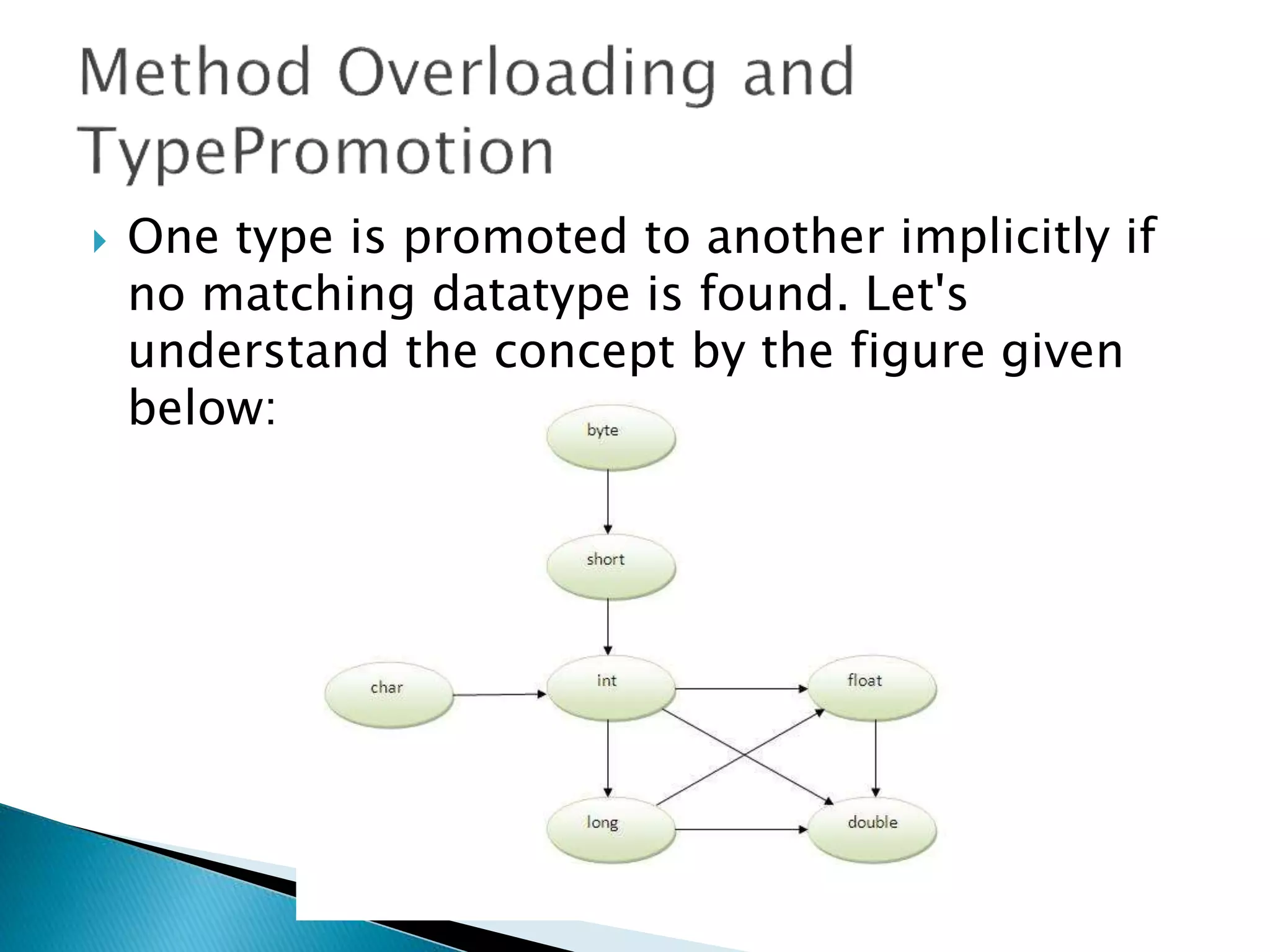
 One type is promoted to another implicitly if
no matching datatype is found. Let's
understand the concept by the figure given
below:
 As displayed in the above diagram, byte can
be promoted to short, int, long, float or
double. The short datatype can be promoted
to int,long,float or double. The char datatype
can be promoted to int,long,float or double
and so on.
 class OverloadingCalculation1{
 void sum(int a,long b){System.out.println(a+b);}
 void sum(int a,int b,int c){System.out.println(a+b+c)
;}

 public static void main(String args[]){
 OverloadingCalculation1 obj=new OverloadingCalcu
lation1();
 obj.sum(20,20);//now second int literal will be prom
oted to long
 obj.sum(20,20,20);

 }
 }
 If there are matching type arguments in the method
 class OverloadingCalculation2{
 void sum(int a,int b){System.out.println("int arg method i
nvoked");}
 void sum(long a,long b){System.out.println("long arg met
hod invoked");}

 public static void main(String args[]){
 OverloadingCalculation2 obj=new OverloadingCalculatio
n2();
 obj.sum(20,20);//now int arg sum() method gets invoked
 }
 }
 If there are no matching type arguments in the method, and each
method promotes similar number of arguments, there will be ambiguity.
 class OverloadingCalculation3{
 void sum(int a,long b){System.out.println("a method invoked");}
 void sum(long a,int b){System.out.println("b method invoked");}

 public static void main(String args[]){
 OverloadingCalculation3 obj=new OverloadingCalculation3();
 obj.sum(20,20);//now ambiguity
 }
 }
 NOTE :One type is not de-promoted implicitly for example double
cannot be depromoted to any type implicitely.

4. method overloading

  • 1.
     Different waysto overload the method  By changing the no. of arguments  By changing the datatype  Why method overloading is not possible by changing the return type  Can we overload the main method  method overloading with Type Promotion
  • 2.
     If aclass have multiple methods by same name but different parameters, it is known as Method Overloading.  If we have to perform only one operation, having same name of the methods increases the readability of the program.  Suppose you have to perform addition of the given numbers but there can be any number of arguments, if you write the method such as a(int,int) for two parameters, and b(int,int,int) for three parameters then it may be difficult for you as well as other programmers to understand the behaviour of the method because its name differs. So, we perform method overloading to figure out the program quickly
  • 3.
     Method overloadingincreases the readability of the program
  • 4.
     There aretwo ways to overload the method in java ◦ 1. By changing number of arguments ◦ 2. By changing the data type ◦ NOTE:In java, Methood Overloading is not possible by changing the return type of the method.
  • 5.
     In thisexample, we have created two overloaded methods, first sum method performs addition of two numbers and second sum method performs addition of three numbers  class Calculation  {  void sum(int a,int b)  {  System.out.println(a+b);  }  void sum(int a,int b,int c)  {  System.out.println(a+b+c);  }  public static void main(String args[])  {  Calculation obj=new Calculation();  obj.sum(10,10,10);  obj.sum(20,20);   }  }
  • 6.
     In thisexample, we have created two overloaded methods that differs in data type. The first sum method receives two integer arguments and second sum method receives two double arguments.  class Calculation2{  void sum(int a,int b){System.out.println(a+b);}  void sum(double a,double b){System.out.println(a+b);}   public static void main(String args[]){  Calculation2 obj=new Calculation2();  obj.sum(10.5,10.5);  obj.sum(20,20);   }  }
  • 7.
     In java,method overloading is not possible by changing the return type of the method because there may occur ambiguity. Let's see how ambiguity may occur:  because there was problem:  class Calculation3{  int sum(int a,int b){System.out.println(a+b);}  double sum(int a,int b){System.out.println(a+b);}   public static void main(String args[]){  Calculation3 obj=new Calculation3();  int result=obj.sum(20,20); //Compile Time Error   }  }
  • 8.
     Yes, bymethod overloading. You can have any number of main methods in a class by method overloading. Let's see the simple example:  class Overloading1{  public static void main(int a){  System.out.println(a);  }   public static void main(String args[]){  System.out.println("main() method invoked");  main(10);  }  }
  • 9.
     One typeis promoted to another implicitly if no matching datatype is found. Let's understand the concept by the figure given below:
  • 10.
     As displayedin the above diagram, byte can be promoted to short, int, long, float or double. The short datatype can be promoted to int,long,float or double. The char datatype can be promoted to int,long,float or double and so on.
  • 11.
     class OverloadingCalculation1{ void sum(int a,long b){System.out.println(a+b);}  void sum(int a,int b,int c){System.out.println(a+b+c) ;}   public static void main(String args[]){  OverloadingCalculation1 obj=new OverloadingCalcu lation1();  obj.sum(20,20);//now second int literal will be prom oted to long  obj.sum(20,20,20);   }  }
  • 12.
     If thereare matching type arguments in the method  class OverloadingCalculation2{  void sum(int a,int b){System.out.println("int arg method i nvoked");}  void sum(long a,long b){System.out.println("long arg met hod invoked");}   public static void main(String args[]){  OverloadingCalculation2 obj=new OverloadingCalculatio n2();  obj.sum(20,20);//now int arg sum() method gets invoked  }  }
  • 13.
     If thereare no matching type arguments in the method, and each method promotes similar number of arguments, there will be ambiguity.  class OverloadingCalculation3{  void sum(int a,long b){System.out.println("a method invoked");}  void sum(long a,int b){System.out.println("b method invoked");}   public static void main(String args[]){  OverloadingCalculation3 obj=new OverloadingCalculation3();  obj.sum(20,20);//now ambiguity  }  }  NOTE :One type is not de-promoted implicitly for example double cannot be depromoted to any type implicitely.