4K Display Technology
Presented by:
Vasu Jain (b120020303)
Presentation Outline
ď‚´ Introduction
ď‚´ History
ď‚´ Common Terms
ď‚´ 1080p vs. 4K resolution
ď‚´ Ultra HD Technical Details
ď‚´ Growth of 4K
ď‚´ Advantages
ď‚´ Disadvantages
ď‚´ Hang on, what about 8K
ď‚´ Conclusion
ď‚´ References
Introduction
ď‚´ 4K is the new big thing in display technology.
ď‚´ 4K denotes a very specific display resolution of 4096 x 2160
megapixels and aspect ratio (16:9)
ď‚´ 4K is also known's as Ultra High Definition(UHD).
ď‚´ 4k TVs have increased their market share in 2014. Every brand has a
few of them now, but the prices are still above mainstream level.
ď‚´ It will soon become a format for both broadcast TV and Blu ray.
History
ď‚´ 4K format was proposed by NHK Science & Technology Research
Laboratories and defined and approved by the International
Telecommunication Union(ITU)
ď‚´ The first commercially available 4K camera for cinematographic
purposes was the Dalsa Origin, released in 2003
ď‚´ The projection of films at 4K resolution at cinemas began in 2011
.The first 4K home theatre projector was released by Sony in 2012.
ď‚´ YouTube began supporting 4K for video uploads in 2010
• Users could view 4K video by selecting "Original" from the quality
settings.
• In November 2013, YouTube started to use the VP9 video
compression standard
• VP9 is being developed by Google, which owns YouTube
Common Terms
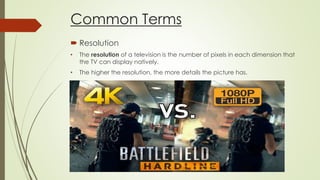
ď‚´ Resolution
• The resolution of a television is the number of pixels in each dimension that
the TV can display natively.
• The higher the resolution, the more details the picture has.
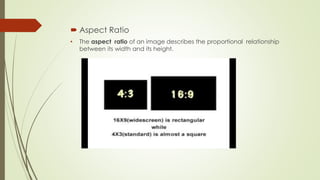
ď‚´ Aspect Ratio
• The aspect ratio of an image describes the proportional relationship
between its width and its height.
1080p vs. 4K resolution
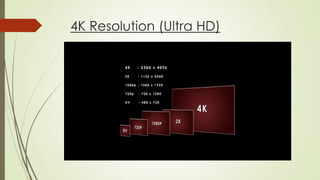
ď‚´ A High Definition TV with 1080p resolution is composed of two million
pixels (1920 x 1080), while a 4K TV (aka Ultra High Definition) has over
eight million pixels (4096 x 2160). Therefore, 4K has around four times
more resolution than 1080p and produces a clearer picture.
ď‚´ Increasing pixel density leads to closer viewing distance without the
pixel grid becoming obvious to viewer.
ď‚´ A 4K image - or Ultra HD - enables user to sit 1.6m from the screen.
4K Resolution (Ultra HD)
Ultra HD Technical Details
ITU Recommendation for
Ultra HDTV
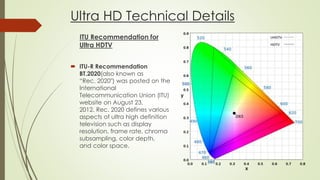
ď‚´ ITU-R Recommendation
BT.2020(also known as
“Rec. 2020″) was posted on the
International
Telecommunication Union (ITU)
website on August 23,
2012. Rec. 2020 defines various
aspects of ultra high definition
television such as display
resolution, frame rate, chroma
subsampling, color depth,
and color space.
Ultra HD Frame rate
ď‚´ Rec. 2020 allows for Ultra HDTV frame rates of 120p, 60p, 59.94p, 50p, 30p,
29.97p, 25p, 24p, and 23.976p. Only progressive frame rates are allowed.
Ultra HD Color space
ď‚´ The Rec. 2020 color space can reproduce colors that can not be shown
with the Rec. 709 (HDTV) color space.
ď‚´ In coverage of the CIE 1931 color space the Rec. 2020(UHD TV) color space
covers 75.8%, digital cinema covers 53.6%, the Adobe RGB color
space covers 52.1%, and Rec. 709 (HDTV) covers 35.9%.
Other Ultra HDTV Details
ď‚´ In addition to the significant upgrade in video quality, sound quality
is also significantly increased with Ultra HDTV. 24 channels of audio
can be used with 24 speakers, producing a difference comparable
to the Ultra HD video resolution.
ď‚´ Currently, only 3 cameras are able to capture video in Ultra HDTV
format, and can only capture about 20 minutes (requiring 4
terabytes) in a single day. Needless to say, our current infrastructure
is not designed to meet the Ultra HDTV requirements.
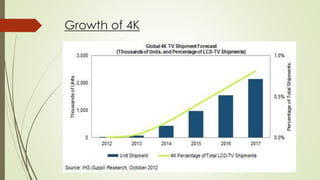
Growth of 4K
Advantages
ď‚´ 4K standard will address the demand for vastly improved resolution in
professional devices such as broadcast and cinema quality cameras,
projectors, and displays.
ď‚´ The 4k revolution isn't just about quadrupling resolution, it also supports
faster frame rates, insane contrast dynamics ,extended colours and variety
of viewing distances on different screen sizes.
Disadvantages
ď‚´ 4K has a case of putting the hardware chicken before the software egg.
• At Sony's CES 2014 it announced that it was going to shoot the World Cup
in 4K It's unclear at this point how this content will be distributed, though live
screenings at cinemas are very likely.
ď‚´ While there are currently no cable boxes that will support 4K in the india,
the industry is gearing up for a new broadcast standard which is promised
to deliver 4K resolutions. Called HEVC or H.265.
ď‚´ The number of pixels produced by 4K resolution is four times that of full-HD
1,080p, but the file sizes for typical length 4K movies are enormous, even
when stored at half the native 48-FPS (frames-per-second) frame-rate.
Forget about gigabytes (GB), it's time to think about terabyte (TB) sized files
that are one-thousand times larger.
ď‚´ Expensive technology
Hang on, what about 8K
ď‚´ If 4K offers four times the resolution of Full HD, then 8K will deliver 16 times
the definition. 8K screens comprise a staggering 33 million pixels.
ď‚´ This is an order of magnitude beyond any display technology currently
available, and only one broadcaster, Japanese state owned NHK, has
publically said it intends to commercialise the technology.
ď‚´ NHK has since pledged to shoot and transmit the 2020 Tokyo Olympics in
the format.
IN Conclusion
ď‚´ The benefits of 4k and 8k are marginal at best. You have to sit unrealistically
close to see the full detail and you need 4k source material, which is
virtually non-existent.
ď‚´ Other than that, save your cash and purchase 1080p instead. Or better
yet, purchase 1080p OLED TV instead – the near infinite contrast ratio will
offer a vastly superior quality image versus 4k resolution on an LED/LCD
panel.
ď‚´ ISF states the the most important aspects of picture quality are (in order): 1)
contrast ratio 2) color saturation, 3) color accuracy, 4) resolution.
Resolution is 4th on the list, so look at other factors first.
References
ď‚´ 1) 4K resolution, http://en.wikipedia.org/wiki/4K_resolution.
ď‚´ 2) CIExy1931 Rec 2020 and Rec 709,
http://en.wikipedia.org/wiki/File:CIExy1931_Rec_2020_and_Rec_709.svg
ď‚´ 3) Rec. 2020, http://en.wikipedia.org/wiki/Rec._2020
ď‚´ 4) Ultra high definition television,
http://en.wikipedia.org/wiki/Ultra_high_definition_television
ď‚´ 5) Ultra HD and 4K TV: Everything you need to know,
http://www.techradar.com/news/home-cinema/high-definitionultra-hd-
everything-you-need-to-know-about-4k-tv-1048954
4K Technology Presentation

4K Technology Presentation

  • 1.
    4K Display Technology Presentedby: Vasu Jain (b120020303)
  • 2.
    Presentation Outline ď‚´ Introduction ď‚´History ď‚´ Common Terms ď‚´ 1080p vs. 4K resolution ď‚´ Ultra HD Technical Details ď‚´ Growth of 4K ď‚´ Advantages ď‚´ Disadvantages ď‚´ Hang on, what about 8K ď‚´ Conclusion ď‚´ References
  • 3.
    Introduction ď‚´ 4K isthe new big thing in display technology. ď‚´ 4K denotes a very specific display resolution of 4096 x 2160 megapixels and aspect ratio (16:9) ď‚´ 4K is also known's as Ultra High Definition(UHD). ď‚´ 4k TVs have increased their market share in 2014. Every brand has a few of them now, but the prices are still above mainstream level. ď‚´ It will soon become a format for both broadcast TV and Blu ray.
  • 4.
    History  4K formatwas proposed by NHK Science & Technology Research Laboratories and defined and approved by the International Telecommunication Union(ITU)  The first commercially available 4K camera for cinematographic purposes was the Dalsa Origin, released in 2003  The projection of films at 4K resolution at cinemas began in 2011 .The first 4K home theatre projector was released by Sony in 2012.  YouTube began supporting 4K for video uploads in 2010 • Users could view 4K video by selecting "Original" from the quality settings. • In November 2013, YouTube started to use the VP9 video compression standard • VP9 is being developed by Google, which owns YouTube
  • 5.
    Common Terms  Resolution •The resolution of a television is the number of pixels in each dimension that the TV can display natively. • The higher the resolution, the more details the picture has.
  • 6.
     Aspect Ratio •The aspect ratio of an image describes the proportional relationship between its width and its height.
  • 7.
    1080p vs. 4Kresolution ď‚´ A High Definition TV with 1080p resolution is composed of two million pixels (1920 x 1080), while a 4K TV (aka Ultra High Definition) has over eight million pixels (4096 x 2160). Therefore, 4K has around four times more resolution than 1080p and produces a clearer picture. ď‚´ Increasing pixel density leads to closer viewing distance without the pixel grid becoming obvious to viewer. ď‚´ A 4K image - or Ultra HD - enables user to sit 1.6m from the screen.
  • 8.
  • 10.
    Ultra HD TechnicalDetails ITU Recommendation for Ultra HDTV  ITU-R Recommendation BT.2020(also known as “Rec. 2020″) was posted on the International Telecommunication Union (ITU) website on August 23, 2012. Rec. 2020 defines various aspects of ultra high definition television such as display resolution, frame rate, chroma subsampling, color depth, and color space.
  • 11.
    Ultra HD Framerate ď‚´ Rec. 2020 allows for Ultra HDTV frame rates of 120p, 60p, 59.94p, 50p, 30p, 29.97p, 25p, 24p, and 23.976p. Only progressive frame rates are allowed. Ultra HD Color space ď‚´ The Rec. 2020 color space can reproduce colors that can not be shown with the Rec. 709 (HDTV) color space. ď‚´ In coverage of the CIE 1931 color space the Rec. 2020(UHD TV) color space covers 75.8%, digital cinema covers 53.6%, the Adobe RGB color space covers 52.1%, and Rec. 709 (HDTV) covers 35.9%.
  • 12.
    Other Ultra HDTVDetails ď‚´ In addition to the significant upgrade in video quality, sound quality is also significantly increased with Ultra HDTV. 24 channels of audio can be used with 24 speakers, producing a difference comparable to the Ultra HD video resolution. ď‚´ Currently, only 3 cameras are able to capture video in Ultra HDTV format, and can only capture about 20 minutes (requiring 4 terabytes) in a single day. Needless to say, our current infrastructure is not designed to meet the Ultra HDTV requirements.
  • 13.
  • 14.
    Advantages ď‚´ 4K standardwill address the demand for vastly improved resolution in professional devices such as broadcast and cinema quality cameras, projectors, and displays. ď‚´ The 4k revolution isn't just about quadrupling resolution, it also supports faster frame rates, insane contrast dynamics ,extended colours and variety of viewing distances on different screen sizes.
  • 15.
    Disadvantages  4K hasa case of putting the hardware chicken before the software egg. • At Sony's CES 2014 it announced that it was going to shoot the World Cup in 4K It's unclear at this point how this content will be distributed, though live screenings at cinemas are very likely.  While there are currently no cable boxes that will support 4K in the india, the industry is gearing up for a new broadcast standard which is promised to deliver 4K resolutions. Called HEVC or H.265.  The number of pixels produced by 4K resolution is four times that of full-HD 1,080p, but the file sizes for typical length 4K movies are enormous, even when stored at half the native 48-FPS (frames-per-second) frame-rate. Forget about gigabytes (GB), it's time to think about terabyte (TB) sized files that are one-thousand times larger.  Expensive technology
  • 16.
    Hang on, whatabout 8K ď‚´ If 4K offers four times the resolution of Full HD, then 8K will deliver 16 times the definition. 8K screens comprise a staggering 33 million pixels. ď‚´ This is an order of magnitude beyond any display technology currently available, and only one broadcaster, Japanese state owned NHK, has publically said it intends to commercialise the technology. ď‚´ NHK has since pledged to shoot and transmit the 2020 Tokyo Olympics in the format.
  • 17.
    IN Conclusion  Thebenefits of 4k and 8k are marginal at best. You have to sit unrealistically close to see the full detail and you need 4k source material, which is virtually non-existent.  Other than that, save your cash and purchase 1080p instead. Or better yet, purchase 1080p OLED TV instead – the near infinite contrast ratio will offer a vastly superior quality image versus 4k resolution on an LED/LCD panel.  ISF states the the most important aspects of picture quality are (in order): 1) contrast ratio 2) color saturation, 3) color accuracy, 4) resolution. Resolution is 4th on the list, so look at other factors first.
  • 18.
    References ď‚´ 1) 4Kresolution, http://en.wikipedia.org/wiki/4K_resolution. ď‚´ 2) CIExy1931 Rec 2020 and Rec 709, http://en.wikipedia.org/wiki/File:CIExy1931_Rec_2020_and_Rec_709.svg ď‚´ 3) Rec. 2020, http://en.wikipedia.org/wiki/Rec._2020 ď‚´ 4) Ultra high definition television, http://en.wikipedia.org/wiki/Ultra_high_definition_television ď‚´ 5) Ultra HD and 4K TV: Everything you need to know, http://www.techradar.com/news/home-cinema/high-definitionultra-hd- everything-you-need-to-know-about-4k-tv-1048954