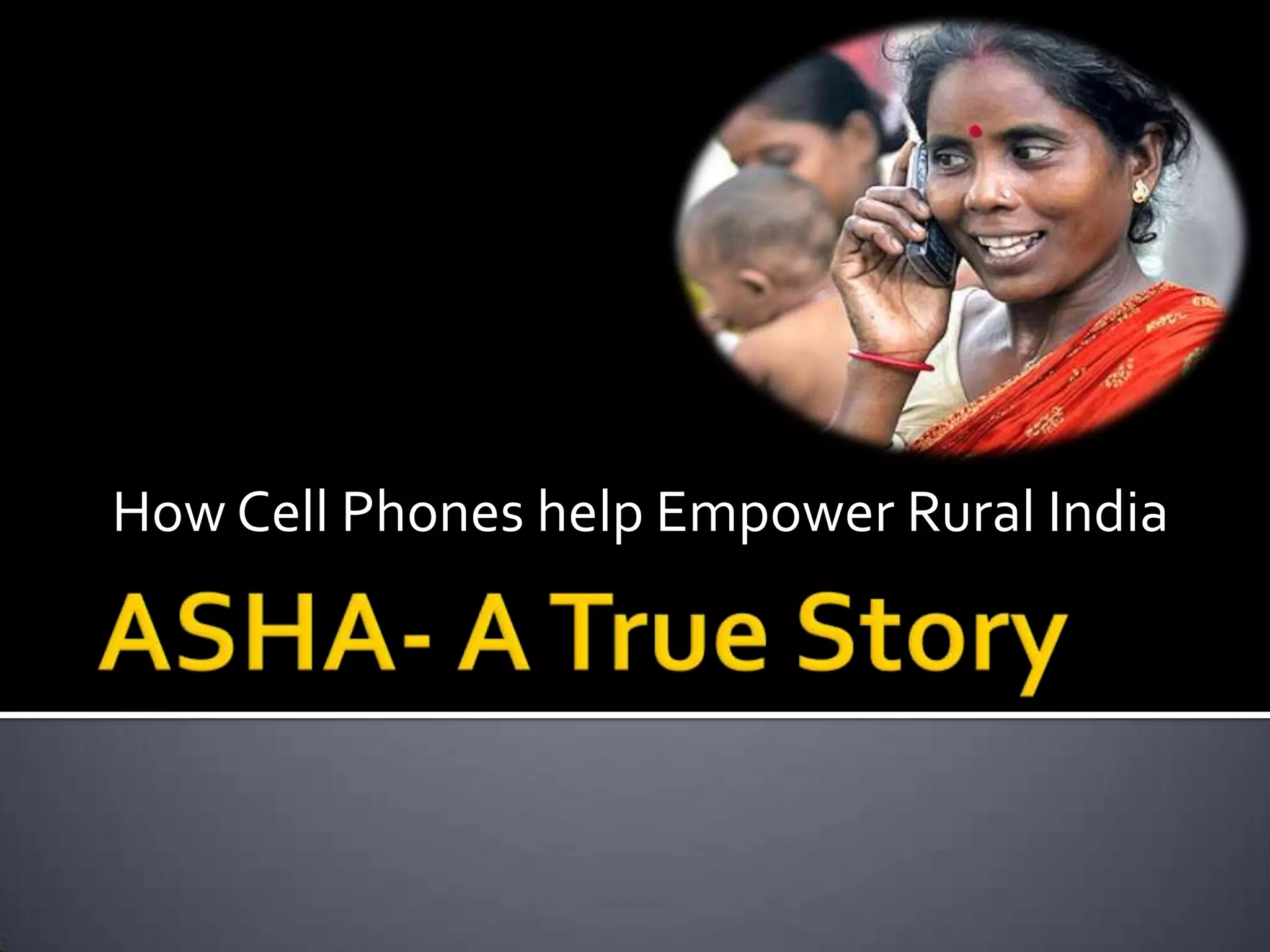
How Cell Phones help Empower Rural India
Empowering Bihar’s rural health workers with mobile phones
                   and money transfer


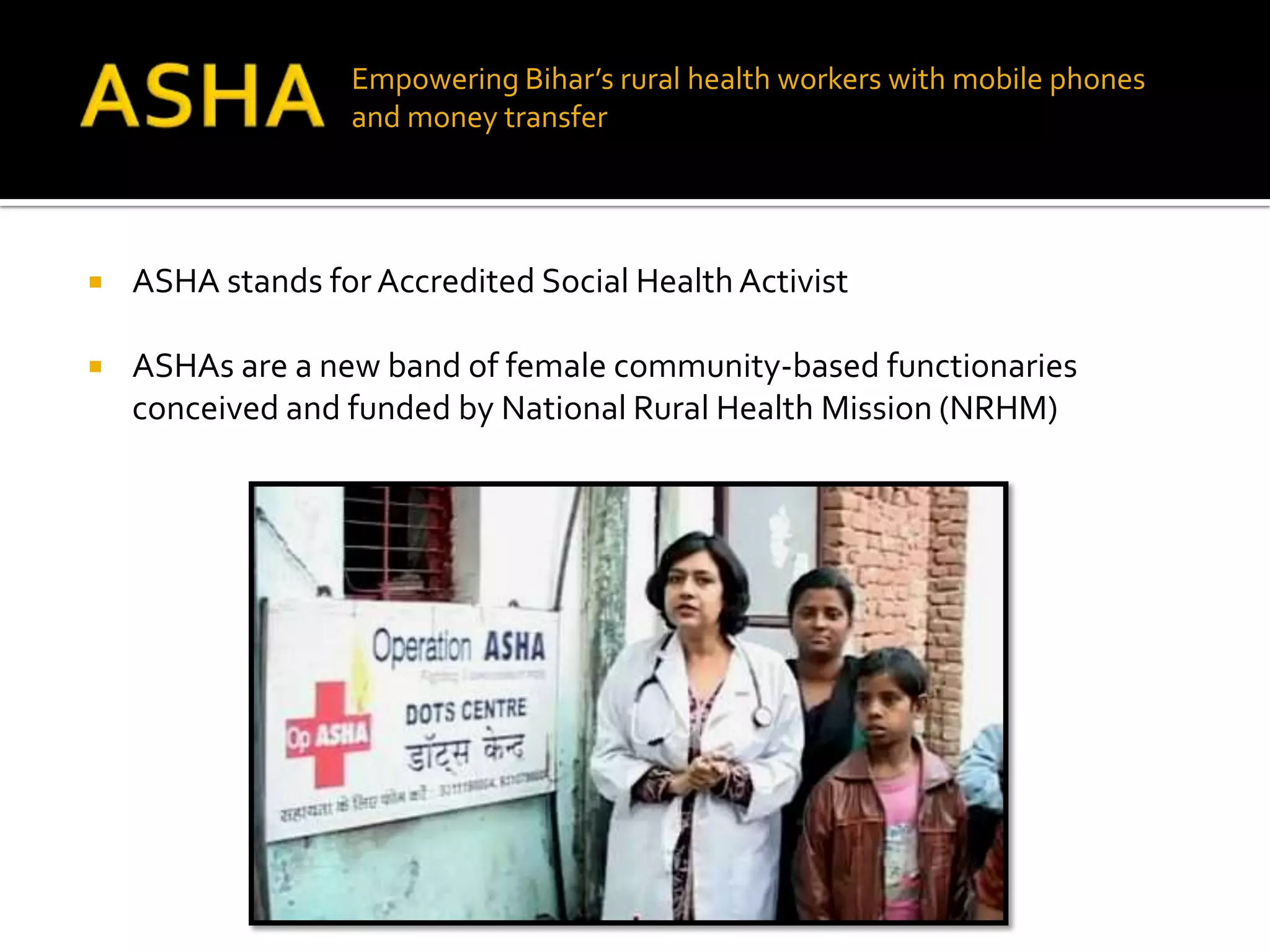
   ASHA stands for Accredited Social Health Activist

   ASHAs are a new band of female community-based functionaries
    conceived and funded by National Rural Health Mission (NRHM)
Empowering Bihar’s rural health workers with mobile phones
                   and money transfer


   ASHAs are semi-literate (i.e. formal education up to class eight) married
    women in the 25-45 age range

    Empowered with knowledge and a drug-kit to deliver first-contact
    healthcare, every ASHA is expected to participate in public health
    initiatives in her village


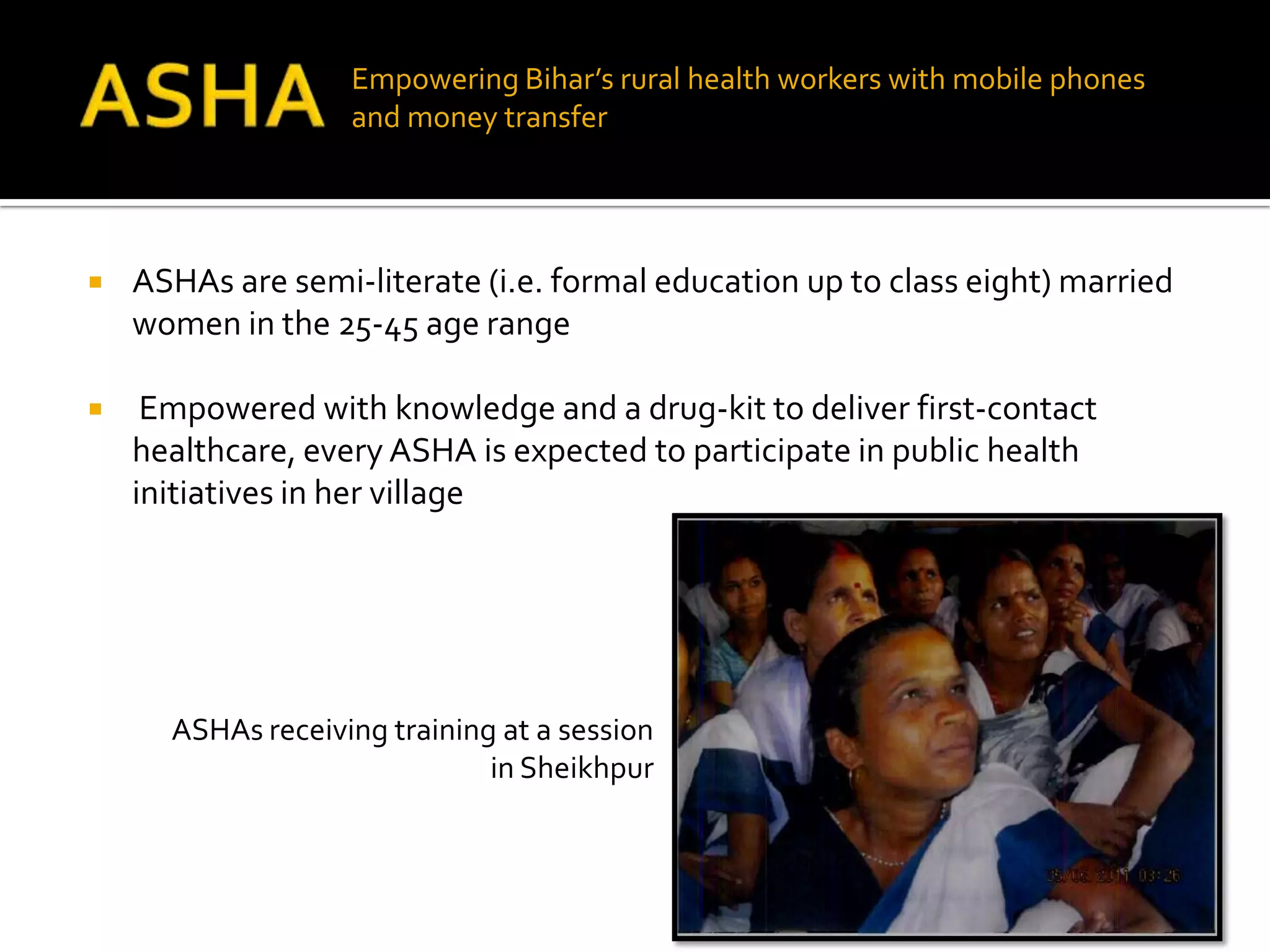
      ASHAs receiving training at a session
                              in Sheikhpur
Empowering Bihar’s rural health workers with mobile phones
                   and money transfer


   There were more than 830,000 ASHAs across 18 Indian states (till 2010)

   The ASHAs receive performance-based incentives for promoting
    universal immunization, referral and escort services for Reproductive &
    Child Health and other healthcare interventions like tuberculosis and
    leprosy

    For example, an ASHA receives Rs. 200 for every PHC delivery she helps
    facilitate

   71,350 ASHAs in were instrumental in the safe delivery of 1.1 million
    babies in Bihar alone
Empowering Bihar’s rural health workers with mobile phones
                    and money transfer


    Pain Points:
     The Bihar State Health Society, was in search of a process to help them
1.    Receive their payments on time,
2.    Bring the women dignity in their community,
3.    Ensuring equity amongst everybody
Empowering Bihar’s rural health workers with mobile phones
                   and money transfer


    The accounting process at the PHCs was manual because of poor power
     connectivity

    PHC needed to prepare 500 cheques per month for each district block

    They are separate cheques because incentive schemes differ based on
     the types of services rendered by ASHAs

   To further complicate things, the cycle of payments is longer than a
    month for some health interventions provided by ASHAs

   Also, 11 bank accounts need to be maintained because program funding
    comes from different sources

    Add 7 cheques per ASHA, 11 bank accounts per PHC, and a manual
     accounting process and you have a perfect storm of inefficiency!
Empowering Bihar’s rural health workers with mobile phones
                   and money transfer


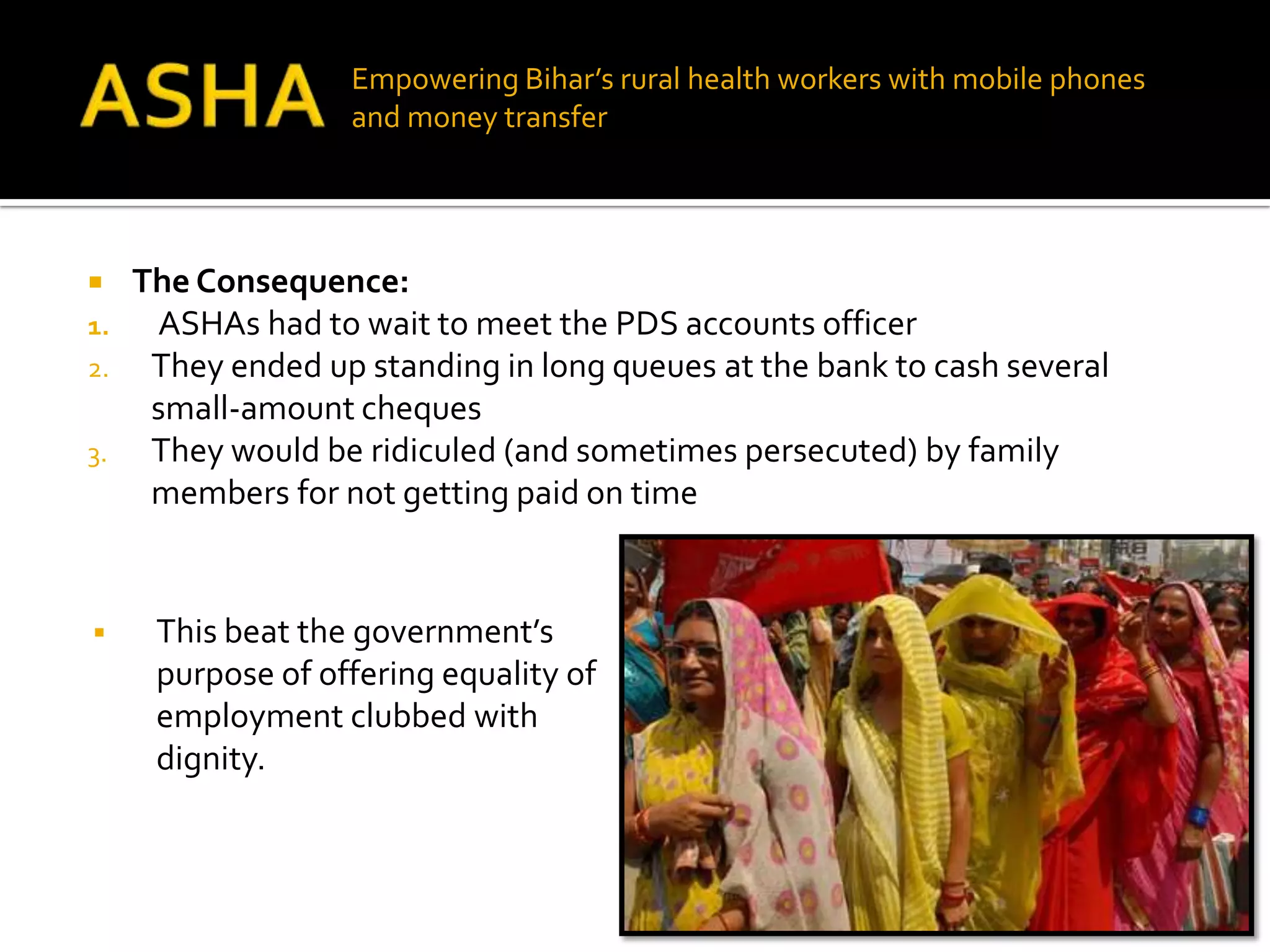
    The Consequence:
1.    ASHAs had to wait to meet the PDS accounts officer
2.    They ended up standing in long queues at the bank to cash several
      small-amount cheques
3.    They would be ridiculed (and sometimes persecuted) by family
      members for not getting paid on time


     This beat the government’s
      purpose of offering equality of
      employment clubbed with
      dignity.
Empowering Bihar’s rural health workers with mobile phones
                  and money transfer


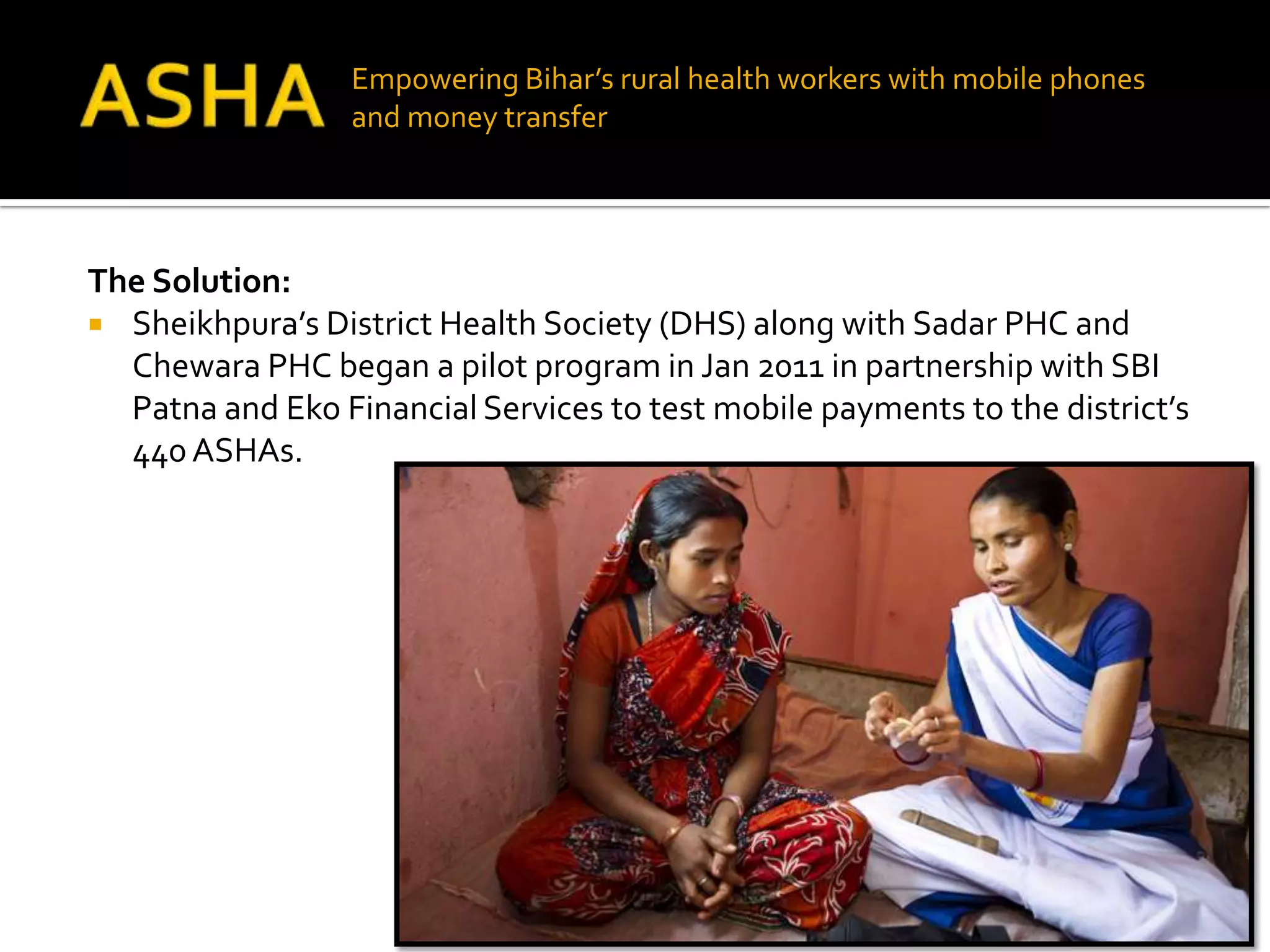
The Solution:
 Sheikhpura’s District Health Society (DHS) along with Sadar PHC and
  Chewara PHC began a pilot program in Jan 2011 in partnership with SBI
  Patna and Eko Financial Services to test mobile payments to the district’s
  440 ASHAs.
Empowering Bihar’s rural health workers with mobile phones
                     and money transfer


    The new mobile money transfer works in just four easy steps:

    PHC compiles an Excel sheet with [Name, mobile#, service-delivered, amount]
                           and forwards to DHS and Eko.


        DHS verifies and transfers the requisite funds to a specially created SBI
                                        Account.


    Within 24 hours of funds transfer, Eko transfers appropriate amounts to each of
                        the individual ASHAs on the Excel sheet.


    Each ASHA receives an SMS with their updated bank balance. She can then go
          to the nearest Eko CSP (Customer Service Point) to withdraw the
                            money whenever she wants
Empowering Bihar’s rural health workers with mobile phones
                 and money transfer


Conclusion:
 Besides staying connected with their families, ASHAs now
1. interact with their supervisors as needed,
2. help colleagues, and most importantly,
3. communicate with the mother and their families – providing
   information on nurse visits, reminders on immunization schedules, etc.

   The ASHAs can withdraw their money on all days, including holidays,
    weekends and even late evenings. Basically any time the CSP location is
    open

   No more trips to banks
Empowering Bihar’s rural health workers with mobile phones
               and money transfer


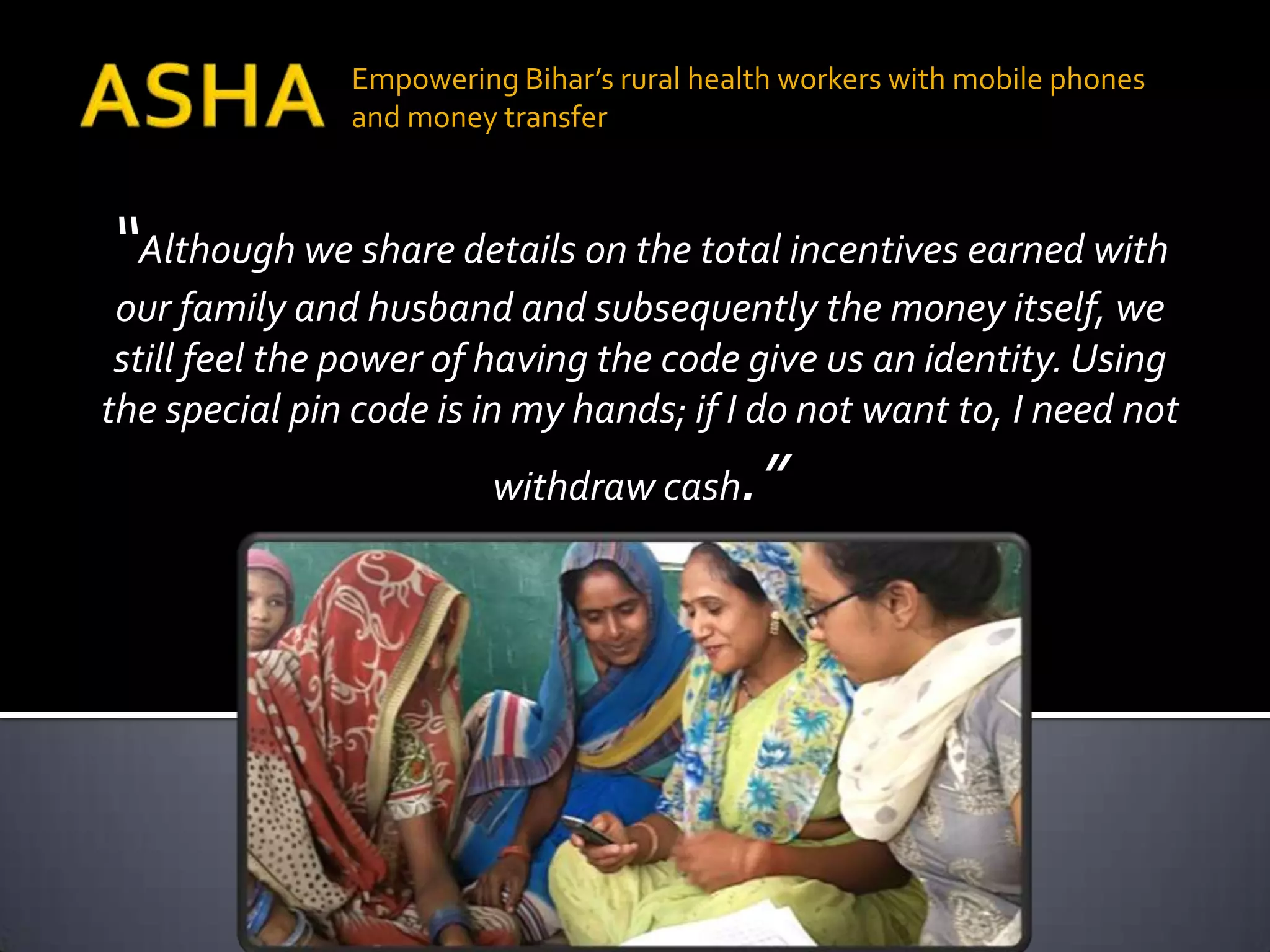
“Although we share details on the total incentives earned with
 our family and husband and subsequently the money itself, we
 still feel the power of having the code give us an identity. Using
the special pin code is in my hands; if I do not want to, I need not
                         withdraw cash     .”
www.theradiationdoctor.wordpress.com

Asha a true story

  • 1.
    How Cell Phoneshelp Empower Rural India
  • 2.
    Empowering Bihar’s ruralhealth workers with mobile phones and money transfer  ASHA stands for Accredited Social Health Activist  ASHAs are a new band of female community-based functionaries conceived and funded by National Rural Health Mission (NRHM)
  • 3.
    Empowering Bihar’s ruralhealth workers with mobile phones and money transfer  ASHAs are semi-literate (i.e. formal education up to class eight) married women in the 25-45 age range  Empowered with knowledge and a drug-kit to deliver first-contact healthcare, every ASHA is expected to participate in public health initiatives in her village ASHAs receiving training at a session in Sheikhpur
  • 4.
    Empowering Bihar’s ruralhealth workers with mobile phones and money transfer  There were more than 830,000 ASHAs across 18 Indian states (till 2010)  The ASHAs receive performance-based incentives for promoting universal immunization, referral and escort services for Reproductive & Child Health and other healthcare interventions like tuberculosis and leprosy  For example, an ASHA receives Rs. 200 for every PHC delivery she helps facilitate  71,350 ASHAs in were instrumental in the safe delivery of 1.1 million babies in Bihar alone
  • 5.
    Empowering Bihar’s ruralhealth workers with mobile phones and money transfer  Pain Points:  The Bihar State Health Society, was in search of a process to help them 1. Receive their payments on time, 2. Bring the women dignity in their community, 3. Ensuring equity amongst everybody
  • 6.
    Empowering Bihar’s ruralhealth workers with mobile phones and money transfer  The accounting process at the PHCs was manual because of poor power connectivity  PHC needed to prepare 500 cheques per month for each district block  They are separate cheques because incentive schemes differ based on the types of services rendered by ASHAs  To further complicate things, the cycle of payments is longer than a month for some health interventions provided by ASHAs  Also, 11 bank accounts need to be maintained because program funding comes from different sources Add 7 cheques per ASHA, 11 bank accounts per PHC, and a manual accounting process and you have a perfect storm of inefficiency!
  • 7.
    Empowering Bihar’s ruralhealth workers with mobile phones and money transfer  The Consequence: 1. ASHAs had to wait to meet the PDS accounts officer 2. They ended up standing in long queues at the bank to cash several small-amount cheques 3. They would be ridiculed (and sometimes persecuted) by family members for not getting paid on time  This beat the government’s purpose of offering equality of employment clubbed with dignity.
  • 8.
    Empowering Bihar’s ruralhealth workers with mobile phones and money transfer The Solution:  Sheikhpura’s District Health Society (DHS) along with Sadar PHC and Chewara PHC began a pilot program in Jan 2011 in partnership with SBI Patna and Eko Financial Services to test mobile payments to the district’s 440 ASHAs.
  • 9.
    Empowering Bihar’s ruralhealth workers with mobile phones and money transfer  The new mobile money transfer works in just four easy steps: PHC compiles an Excel sheet with [Name, mobile#, service-delivered, amount] and forwards to DHS and Eko. DHS verifies and transfers the requisite funds to a specially created SBI Account. Within 24 hours of funds transfer, Eko transfers appropriate amounts to each of the individual ASHAs on the Excel sheet. Each ASHA receives an SMS with their updated bank balance. She can then go to the nearest Eko CSP (Customer Service Point) to withdraw the money whenever she wants
  • 10.
    Empowering Bihar’s ruralhealth workers with mobile phones and money transfer Conclusion:  Besides staying connected with their families, ASHAs now 1. interact with their supervisors as needed, 2. help colleagues, and most importantly, 3. communicate with the mother and their families – providing information on nurse visits, reminders on immunization schedules, etc.  The ASHAs can withdraw their money on all days, including holidays, weekends and even late evenings. Basically any time the CSP location is open  No more trips to banks
  • 11.
    Empowering Bihar’s ruralhealth workers with mobile phones and money transfer “Although we share details on the total incentives earned with our family and husband and subsequently the money itself, we still feel the power of having the code give us an identity. Using the special pin code is in my hands; if I do not want to, I need not withdraw cash .”
  • 12.