1
Iryna Kravchuk, teacher-methodologist, school 5, Rivne
Form 4
( O.Karpiuk “English-4”, 2015)
Lesson
TOPIC: HOLIDAYS AND CELEBRATIONS
Objectives:
- to train students to use topical vocabulary, ordinal numerals and structures in Present
Simple;
- to train students in speaking, listening, reading, writing;
- to teach students to write invitations;
- to train students to speak about holidays;
- to broaden students’ outlook;
- to develop students’ memory and intellectual ability;
- to teach students to respect each other.
Equipment: textbooks ( O.Karpiuk “English-4”, 2015), cards, a poster with the pictures and
names of the holidays, a CD with the texts and songs, a video song “Happy Birthday” (film
“Elvin and Chipmunks”)
PROCEDURE
I. Greeting
T: Good morning, dear friends. I’m glad to see you. How are you feeling today? I hope you are
fine and you will be energetic and active at the lesson.
II. Aim
Today we are going to speak about holidays and celebrations in Ukraine and Great Britain, you
will listen to the information about some of the British Holidays and of course you will read
about the most favourite children’s holiday birthday.
By the end of the lesson you will be ready to speak about holidays and celebrations.
III. Warming up
Brainstorming
T: To begin with, let’s revise the names of some of the holidays, which are very popular in our
country. This poster can help you.
- What groups of holidays do you know?
HOLIDAYS
Possible students’ answers: I know state holidays.
I know religious holidays.
I know professional holidays.
I know family holidays.
2
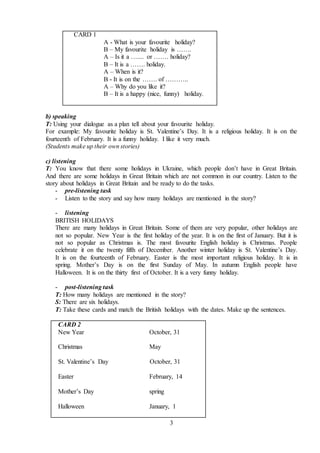
HOLIDAYS
family
state
religious professional
T: Let’s complete our word-net.
-What holidays do you know?
Name the holiday and say what kind of holiday it is. Our poster can help you. Make up
sentences, using the names of these holidays.
Possible students’ answers:
- New Year is a state holiday.
- Christmas is a religious holiday.
- Birthday is a family holiday.
- Teacher’s Day is a professional holiday. ( Etc.)
HOLIDAYS
family
state
New Year religious professional Birthday
Independence Day Mother’s Day
Women’s Day Christmas Teacher’s Day Father’s Day
Easter Army Day
St. Mykolai’s Day Doctor’s Day
(Etc.)
IV. Phonetic drill
T: Listen and repeat the names of the holidays. Pay attention on the pronunciation of the sounds
[w], [r], [i:], [].
V. Practice
a) speaking (dialogue)
T: What is your holiday? Choose the card with the name of the holiday. Imagine, it is your
favourite holiday. Work in pairs. With your friend make up a dialogue. Ask your friend:
– What is his favourite holiday?
- What kind of holiday is it?
- When is this holiday?
These cards can help you. Listen to my example.
A - What is your favourite holiday?
B – My favourite holiday is New Year.
A – Is it a state or religious holiday?
B – It is a state holiday.
A – When is it?
B - It is on the first of January.
A – Why do you like it?
B – It is a happy holiday.
(Students make up their own dialogues)
3
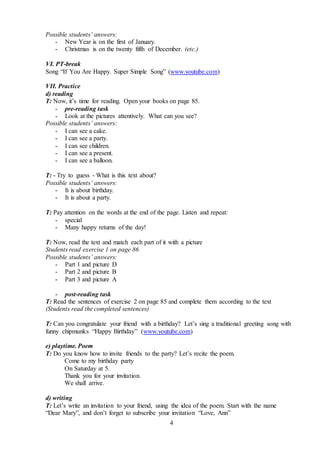
CARD 1
A - What is your favourite holiday?
B – My favourite holiday is …….
A – Is it a ….... or ……. holiday?
B – It is a ……. holiday.
A – When is it?
B - It is on the ……. of ………..
A – Why do you like it?
B – It is a happy (nice, funny) holiday.
b) speaking
T: Using your dialogue as a plan tell about your favourite holiday.
For example: My favourite holiday is St. Valentine’s Day. It is a religious holiday. It is on the
fourteenth of February. It is a funny holiday. I like it very much.
(Students make up their own stories)
c) listening
T: You know that there some holidays in Ukraine, which people don’t have in Great Britain.
And there are some holidays in Great Britain which are not common in our country. Listen to the
story about holidays in Great Britain and be ready to do the tasks.
- pre-listening task
- Listen to the story and say how many holidays are mentioned in the story?
- listening
BRITISH HOLIDAYS
There are many holidays in Great Britain. Some of them are very popular, other holidays are
not so popular. New Year is the first holiday of the year. It is on the first of January. But it is
not so popular as Christmas is. The most favourite English holiday is Christmas. People
celebrate it on the twenty fifth of December. Another winter holiday is St. Valentine’s Day.
It is on the fourteenth of February. Easter is the most important religious holiday. It is in
spring. Mother’s Day is on the first Sunday of May. In autumn English people have
Halloween. It is on the thirty first of October. It is a very funny holiday.
- post-listening task
T: How many holidays are mentioned in the story?
S: There are six holidays.
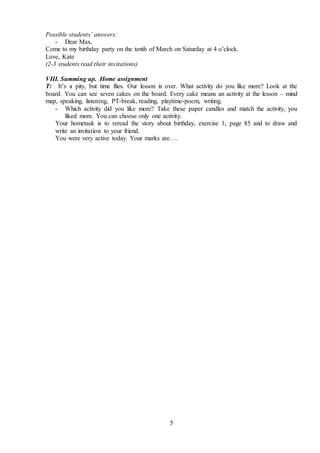
T: Take these cards and match the British holidays with the dates. Make up the sentences.
CARD 2
New Year October, 31
Christmas May
St. Valentine’s Day October, 31
Easter February, 14
Mother’s Day spring
Halloween January, 1
4
Possible students’ answers:
- New Year is on the first of January.
- Christmas is on the twenty fifth of December. (etc.)
VI. PT-break
Song “If You Are Happy. Super Simple Song” (www.youtube.com)
VII. Practice
d) reading
T: Now, it’s time for reading. Open your books on page 85.
- pre-reading task
- Look at the pictures attentively. What can you see?
Possible students’ answers:
- I can see a cake.
- I can see a party.
- I can see children.
- I can see a present.
- I can see a balloon.
T: - Try to guess - What is this text about?
Possible students’ answers:
- It is about birthday.
- It is about a party.
T: Pay attention on the words at the end of the page. Listen and repeat:
- special
- Many happy returns of the day!
T: Now, read the text and match each part of it with a picture
Students read exercise 1 on page 86
Possible students’ answers:
- Part 1 and picture D
- Part 2 and picture B
- Part 3 and picture A
- post-reading task
T: Read the sentences of exercise 2 on page 85 and complete them according to the text
(Students read the completed sentences)
T: Can you congratulate your friend with a birthday? Let’s sing a traditional greeting song with
funny chipmunks “Happy Birthday” (www.youtube.com)
e) playtime. Poem
T: Do you know how to invite friends to the party? Let’s recite the poem.
Come to my birthday party
On Saturday at 5.
Thank you for your invitation.
We shall arrive.
d) writing
T: Let’s write an invitation to your friend, using the idea of the poem. Start with the name
“Dear Mary”, and don’t forget to subscribe your invitation “Love, Ann”
5
Possible students’ answers:
- Dear Max,
Come to my birthday party on the tenth of March on Saturday at 4 o’clock.
Love, Kate
(2-3 students read their invitations)
VIII. Summing up. Home assignment
T: It’s a pity, but time flies. Our lesson is over. What activity do you like more? Look at the
board. You can see seven cakes on the board. Every cake means an activity at the lesson – mind
map, speaking, listening, PT-break, reading, playtime-poem, writing.
- Which activity did you like more? Take these paper candles and match the activity, you
liked more. You can choose only one activity.
Your hometask is to reread the story about birthday, exercise 1, page 85 and to draw and
write an invitation to your friend.
You were very active today. Your marks are….

4 cebrations

  • 1.
    1 Iryna Kravchuk, teacher-methodologist,school 5, Rivne Form 4 ( O.Karpiuk “English-4”, 2015) Lesson TOPIC: HOLIDAYS AND CELEBRATIONS Objectives: - to train students to use topical vocabulary, ordinal numerals and structures in Present Simple; - to train students in speaking, listening, reading, writing; - to teach students to write invitations; - to train students to speak about holidays; - to broaden students’ outlook; - to develop students’ memory and intellectual ability; - to teach students to respect each other. Equipment: textbooks ( O.Karpiuk “English-4”, 2015), cards, a poster with the pictures and names of the holidays, a CD with the texts and songs, a video song “Happy Birthday” (film “Elvin and Chipmunks”) PROCEDURE I. Greeting T: Good morning, dear friends. I’m glad to see you. How are you feeling today? I hope you are fine and you will be energetic and active at the lesson. II. Aim Today we are going to speak about holidays and celebrations in Ukraine and Great Britain, you will listen to the information about some of the British Holidays and of course you will read about the most favourite children’s holiday birthday. By the end of the lesson you will be ready to speak about holidays and celebrations. III. Warming up Brainstorming T: To begin with, let’s revise the names of some of the holidays, which are very popular in our country. This poster can help you. - What groups of holidays do you know? HOLIDAYS Possible students’ answers: I know state holidays. I know religious holidays. I know professional holidays. I know family holidays.
  • 2.
    2 HOLIDAYS family state religious professional T: Let’scomplete our word-net. -What holidays do you know? Name the holiday and say what kind of holiday it is. Our poster can help you. Make up sentences, using the names of these holidays. Possible students’ answers: - New Year is a state holiday. - Christmas is a religious holiday. - Birthday is a family holiday. - Teacher’s Day is a professional holiday. ( Etc.) HOLIDAYS family state New Year religious professional Birthday Independence Day Mother’s Day Women’s Day Christmas Teacher’s Day Father’s Day Easter Army Day St. Mykolai’s Day Doctor’s Day (Etc.) IV. Phonetic drill T: Listen and repeat the names of the holidays. Pay attention on the pronunciation of the sounds [w], [r], [i:], []. V. Practice a) speaking (dialogue) T: What is your holiday? Choose the card with the name of the holiday. Imagine, it is your favourite holiday. Work in pairs. With your friend make up a dialogue. Ask your friend: – What is his favourite holiday? - What kind of holiday is it? - When is this holiday? These cards can help you. Listen to my example. A - What is your favourite holiday? B – My favourite holiday is New Year. A – Is it a state or religious holiday? B – It is a state holiday. A – When is it? B - It is on the first of January. A – Why do you like it? B – It is a happy holiday. (Students make up their own dialogues)
  • 3.
    3 CARD 1 A -What is your favourite holiday? B – My favourite holiday is ……. A – Is it a ….... or ……. holiday? B – It is a ……. holiday. A – When is it? B - It is on the ……. of ……….. A – Why do you like it? B – It is a happy (nice, funny) holiday. b) speaking T: Using your dialogue as a plan tell about your favourite holiday. For example: My favourite holiday is St. Valentine’s Day. It is a religious holiday. It is on the fourteenth of February. It is a funny holiday. I like it very much. (Students make up their own stories) c) listening T: You know that there some holidays in Ukraine, which people don’t have in Great Britain. And there are some holidays in Great Britain which are not common in our country. Listen to the story about holidays in Great Britain and be ready to do the tasks. - pre-listening task - Listen to the story and say how many holidays are mentioned in the story? - listening BRITISH HOLIDAYS There are many holidays in Great Britain. Some of them are very popular, other holidays are not so popular. New Year is the first holiday of the year. It is on the first of January. But it is not so popular as Christmas is. The most favourite English holiday is Christmas. People celebrate it on the twenty fifth of December. Another winter holiday is St. Valentine’s Day. It is on the fourteenth of February. Easter is the most important religious holiday. It is in spring. Mother’s Day is on the first Sunday of May. In autumn English people have Halloween. It is on the thirty first of October. It is a very funny holiday. - post-listening task T: How many holidays are mentioned in the story? S: There are six holidays. T: Take these cards and match the British holidays with the dates. Make up the sentences. CARD 2 New Year October, 31 Christmas May St. Valentine’s Day October, 31 Easter February, 14 Mother’s Day spring Halloween January, 1
  • 4.
    4 Possible students’ answers: -New Year is on the first of January. - Christmas is on the twenty fifth of December. (etc.) VI. PT-break Song “If You Are Happy. Super Simple Song” (www.youtube.com) VII. Practice d) reading T: Now, it’s time for reading. Open your books on page 85. - pre-reading task - Look at the pictures attentively. What can you see? Possible students’ answers: - I can see a cake. - I can see a party. - I can see children. - I can see a present. - I can see a balloon. T: - Try to guess - What is this text about? Possible students’ answers: - It is about birthday. - It is about a party. T: Pay attention on the words at the end of the page. Listen and repeat: - special - Many happy returns of the day! T: Now, read the text and match each part of it with a picture Students read exercise 1 on page 86 Possible students’ answers: - Part 1 and picture D - Part 2 and picture B - Part 3 and picture A - post-reading task T: Read the sentences of exercise 2 on page 85 and complete them according to the text (Students read the completed sentences) T: Can you congratulate your friend with a birthday? Let’s sing a traditional greeting song with funny chipmunks “Happy Birthday” (www.youtube.com) e) playtime. Poem T: Do you know how to invite friends to the party? Let’s recite the poem. Come to my birthday party On Saturday at 5. Thank you for your invitation. We shall arrive. d) writing T: Let’s write an invitation to your friend, using the idea of the poem. Start with the name “Dear Mary”, and don’t forget to subscribe your invitation “Love, Ann”
  • 5.
    5 Possible students’ answers: -Dear Max, Come to my birthday party on the tenth of March on Saturday at 4 o’clock. Love, Kate (2-3 students read their invitations) VIII. Summing up. Home assignment T: It’s a pity, but time flies. Our lesson is over. What activity do you like more? Look at the board. You can see seven cakes on the board. Every cake means an activity at the lesson – mind map, speaking, listening, PT-break, reading, playtime-poem, writing. - Which activity did you like more? Take these paper candles and match the activity, you liked more. You can choose only one activity. Your hometask is to reread the story about birthday, exercise 1, page 85 and to draw and write an invitation to your friend. You were very active today. Your marks are….