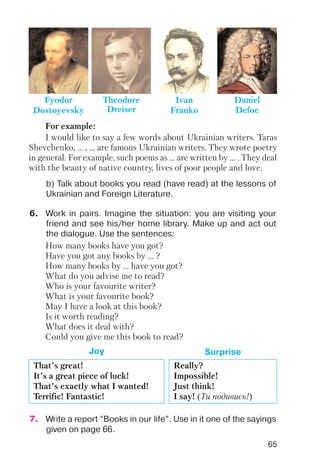
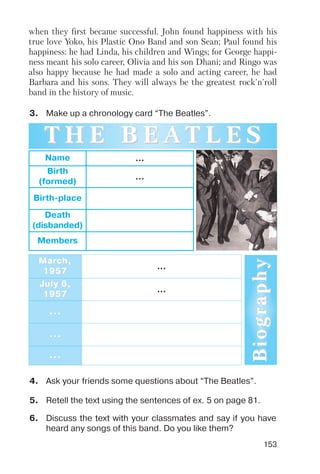
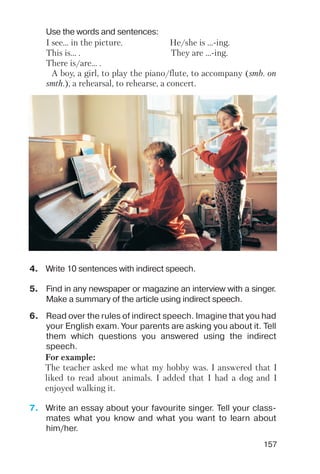
Сірик Т.Л.
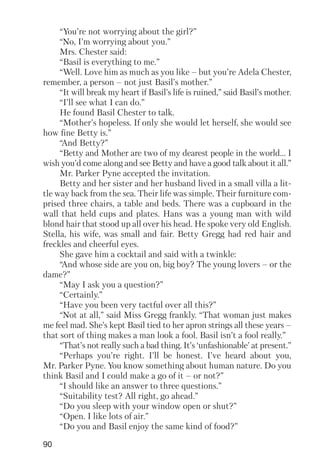
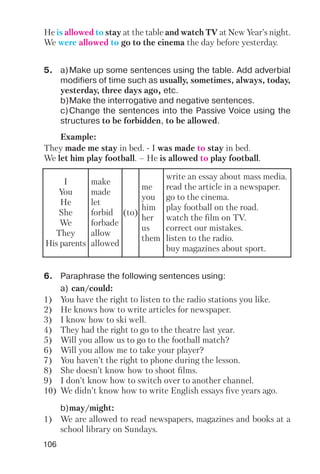
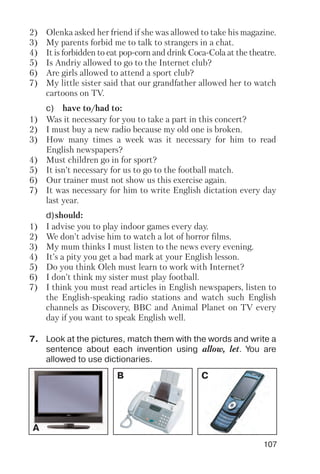
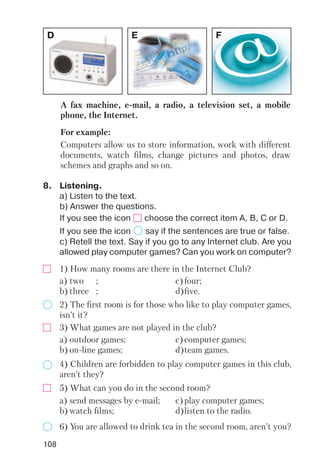
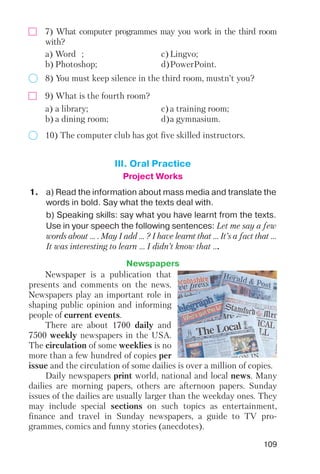
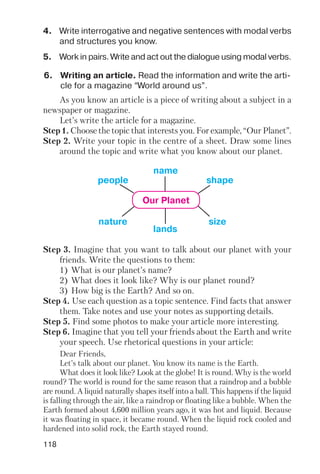
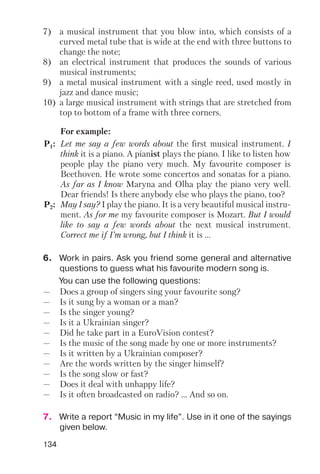
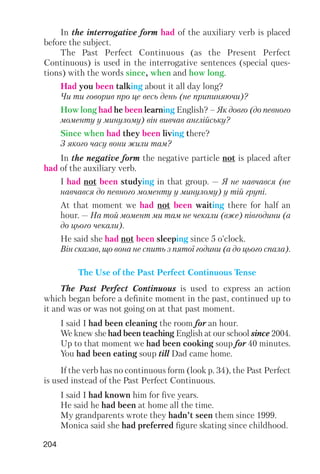
Сірик С.В.
EnglishEnglish 1010 ((66))
Полтава—2009
3
ЛЮБІ ДРУЗІ!
Ви тримаєте в руках підручник з англійської мови “English 10 (6)”,
який продовжує серію підручників для вивчення англійської
мови як другої іноземної.
Ця книга складається зі вступного курсу, 7 розділів основного
курсу та додатку.
Вступний курс (Revision) допоможе вам повторити та прига
дати вивчене на попередніх етапах навчання.
Кожен розділ Основного курсу (Basic Course) складається з
12 уроків.
Протягом шостого року навчання ви будете вчитися спілкува
тися за такими темами:
1. Моє життя (стиль життя). У цьому розділі ви будете спілку
ватись про здоровий спосіб життя, розваги, користь активного
відпочинку, а також розповідати однокласникам про своє
дозвілля та повсякденні дії. Тут ви зможете отримати
необхідні навички листування з друзями за кордоном.
2. Книги у моєму житті. Шкільна бібліотека, улюблені книги,
письменники, літературні герої – ось основні теми, які
включені до цього розділу.
3. Засоби масової інформації. Дізнайтесь про різні види джерел
інформації, періодичних видань, їхні рубрики та обговоріть це з
друзями.
4. Музика у нашому житті. Розділ присвячений музичним
стилям, інструментам, композиторам та музикантам тощо.
5. Об’єднане Королівство Великобританії та Північної Ірландії.
Уроки цього розділу пропонують вам цікаву і корисну
інформацію про країну, мову якої ви вивчаєте.
6. Україна. Поділіться своїми знаннями і враженнями про
рідний край з друзями з англомовних країн.
7. Освіта. Спілкуйтесь про своє шкільне життя та улюблені
предмети з друзями, а також дізнайтесь про навчання у
школах інших країн світу.
Кожний розділ має чітку структуру. Розпочинають його уроки
“Language Mаtеrіаl”, які призначені для ознайомлення з новими
словами і виразами. Зверніть особливу увагу на вимову звуків,
що входять до їх складу, відпрацюйте інтонацію речень з ними,
розгляньте приклади ситуацій та діалогів з цими виразами та
використайте їх як зразок для побудови власних висловлювань.
4
Уроки “Grammar Section” присвячені вивченню граматики
англійської мови. У граматичному інформаційному куточку ви
знайдете інформацію про граматичні структури, їх комунікативне
значення та особливості використання у мовленні.
“Oral Practice” пропонує вам спілкування з друзями. Ці
уроки будуть навчати вас культури спілкування, допоможуть
розширити тематику спілкування з певної сфери та закріпити
вивчене у мовленні.
Уроки “Reading” та “Writing” призначені для розвитку вміння
читання та письма.
“Time for Fun” – це куточок для розваг, де подані різноманіт
ні кросворди, ігри, гуморески тощо.
“Homework” пропонує вам багато цікавих завдань для
виконання вдома.
“Home Reading” – тексти для домашнього читання – допомо
жуть вам не лише вдосконалити уміння читати англійською
мовою, а й дізнатися багато нового з кожної теми, що вивчається.
Розділ “Check Yourself” містить тестові завдання для само
перевірки. За кожну правильну відповідь отримаєте один бал.
Відповіді ви знайдете наприкінці тесту.
Крім того, кожна серія уроків знайомить вас із англійськими
прислів’ями, приказками та крилатими виразами, містить
спеціальні вправи для розвитку навичок пошуку необхідної
інформації в Інтернеті, пропонує корисні рекомендації щодо
написання листів, творів, рефератів тощо.
Проектні роботи, що включені до кожної серії уроків,
нададуть вам змогу розкрити та розвинути свої здібності, а
також навчать вас працювати разом: розподіляти роботу,
займатися саме тим, що у вас виходить якнайкраще і разом
творити спільний проект.
Не всі завдання підручника мають однакову складність:
зверніть увагу на вправи, номери яких позначені червоним та синім
кольорами. Червоний колір вказує на завдання підвищеної склад
ності, які вимагають творчого мислення. Вправи з номерами
синього кольору призначені для тих, хто бажає знати більше.
Завершує підручник Додаток (Supplement), у якому ви
знайдете список неправильних дієслів, тексти для читання та
аудіювання, англо український словник.
З повагою,
Автор.
5
REVISION
LESSONS 1—3
Happy New School Year!
1. Greet your classmates and teacher using the sentences
given below.
Good morning./Hi!/Hello!
I am glad to see you!
How are you? — Fine, thank you.
I wish you good luck this school year.
I want to wish you to be healthy and happy.
I wish you every success and good health!
I wish you a great success in your work/study.
I’d like to wish you to have clever and well bred pupils.
May all your dreams come true!
I wish you all happiness in the world!
I wish you good luck.
All the best!
Thank you, the same to you.
Let me wish/congratulate you...
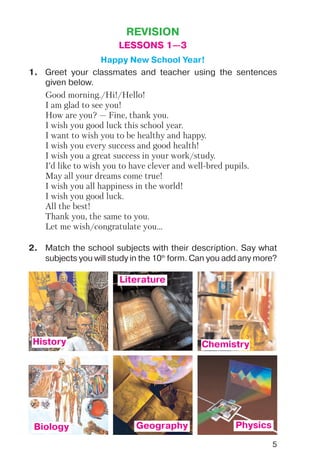
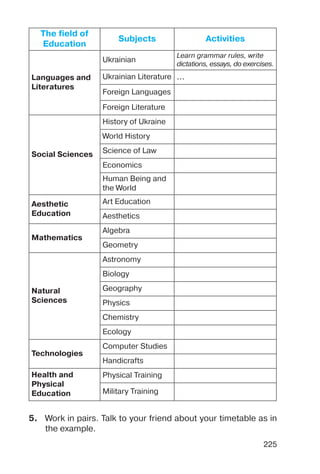
2. Match the school subjects with their description. Say what
subjects you will study in the 10th
form. Can you add any more?
History
Literature
Chemistry
Biology Geography Physics
6
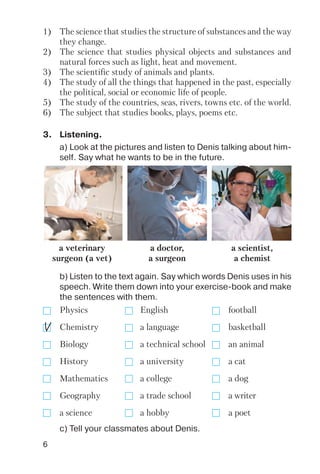
3. Listening.
a) Look at the pictures and listen to Denis talking about him
self. Say what he wants to be in the future.
b) Listen to the text again. Say which words Denis uses in his
speech. Write them down into your exercise book and make
the sentences with them.
c) Tell your classmates about Denis.
a veterinary
surgeon (a vet)
a doctor,
a surgeon
a scientist,
a chemist
Physics English football
Chemistry a language basketball
Biology a technical school an animal
History a university a cat
Mathematics a college a dog
Geography a trade school a writer
a science a hobby a poet
1) The science that studies the structure of substances and the way
they change.
2) The science that studies physical objects and substances and
natural forces such as light, heat and movement.
3) The scientific study of animals and plants.
4) The study of all the things that happened in the past, especially
the political, social or economic life of people.
5) The study of the countries, seas, rivers, towns etc. of the world.
6) The subject that studies books, plays, poems etc.
7
b) Tell your teacher about your education. Use questions
given below.
All citizens of Ukraine have the right to education.
The educational system in our country includes pre school
education, secondary education (general or vocational education)
and higher education.
Pre school education consists of kindergartens. Children learn
to paint, draw and count there. But pre school education isn’t com
pulsory – children can get it at home. Compulsory education is for
children from 6 (7) to 18 years of age.
The main link in the system of education is the general secondary
school. Children start school at the age of 6 and leave it at 18.
There are various types of schools: general secondary schools,
colleges, so called lyceums, gymnasia and so on.
The term of study in a general secondary school is 12 years and
it consists of primary, middle and upper stages.
The first stage of education is a primary school for grades 1
through 4.
The second stage (middle) is a secondary school for grades 5
through 9. At the middle stage of a secondary school the children get
the basic knowledge about nature and society at the lessons of
History, Algebra, Literature, Physics and many other subjects.
After the 9th
form pupils can either continue to attend the same
school (high school – grades 10–12) or enter a vocational school or
a trade school. At vocational and trade schools young people can
master a number of useful skills (for example, those of a technical or
a computer operator).
Those who leave the general secondary school and vocational
or trade school receive the school living certificate. Then they
have the right to pass standardized tests and enter higher educa
tional institutions — universities.
School life is the most beautiful time of our life.
4. a) Read the text and explain the meanings of the words in bold.
1) How old are you?
2) Where do you study?
3) How many years have you studied at school?
4) Did you attend a kindergarten in the childhood?
8
5) What did you learn to do there?
6) When did you start school?
7) How many years did you study at the primary school?
8) What subjects did you study at the primary school?
9) What subjects did you study at the secondary school?
10) What exams did you sit for after the 9th
form?
11) Did you receive the General Certificate of Secondary Education
after the 9th
form?
12) What could you do after the 9th
form?
Let me tell you about my favourite subject. I like … most of all.
My favourite subject is … (My favourite subjects are …)
I want to enter … . I want to be … in the future.
We … at the lessons of … .
To read texts, to write dictations/essays; to do the sums; to
count; to draw geometrical figures; to learn grammar rules; to
do exercises; to read poems/stories/novels; to recite verses; to
act out plays; to learn about historical events/wars/outstand
ing people/our rights and duties; to read the Constitution of
Ukraine; to learn about nature (climate, countries, oceans, seas,
rivers, towns and villages of the world); to work with maps; to
learn about plants and animals; to study the physical objects
and substances (chemical elements, the structure of sub
stances); to do the experiments; to cook; to sew, to embroider; to
make metal and wooden things; to give the first aid; to speak
English, to read German, to write Spanish; to listen to the
recordings; to act out the dialogues; to translate words and sen
tences; to go on educational excursions and nature trips; to spell
the words; to jump; to run; to swim; to ski; to play football/vol
leyball/basketball/tennis/chess; to work on a computer.
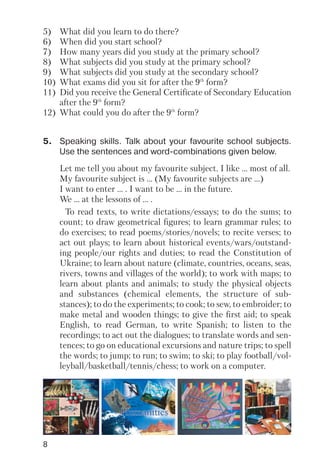
5. Speaking skills. Talk about your favourite school subjects.
Use the sentences and word combinations given below.
9
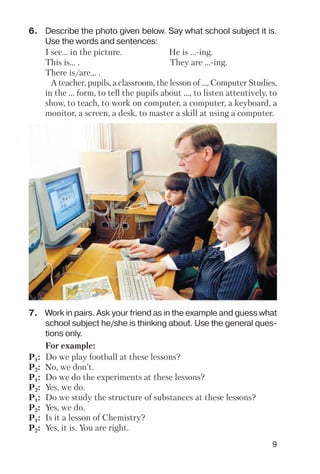
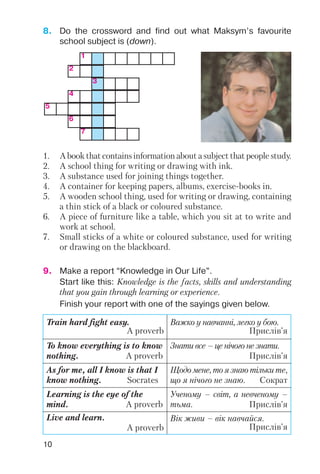
6. Describe the photo given below. Say what school subject it is.
Use the words and sentences:
I see… in the picture. He is ... ing.
This is… . They are ... ing.
There is/are… .
A teacher, pupils, a classroom, the lesson of ..., Computer Studies,
in the ... form, to tell the pupils about ..., to listen attentively, to
show, to teach, to work on computer, a computer, a keyboard, a
monitor, a screen, a desk, to master a skill at using a computer.
7. Work in pairs. Ask your friend as in the example and guess what
school subject he/she is thinking about. Use the general ques
tions only.
For example:
P1: Do we play football at these lessons?
P2: No, we don’t.
P1: Do we do the experiments at these lessons?
P2: Yes, we do.
P1: Do we study the structure of substances at these lessons?
P2: Yes, we do.
P1: Is it a lesson of Chemistry?
P2: Yes, it is. You are right.
10
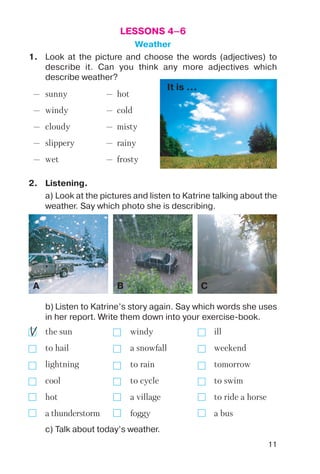
8. Do the crossword and find out what Maksym’s favourite
school subject is (down).
9. Make a report “Knowledge in Our Life”.
Start like this: Knowledge is the facts, skills and understanding
that you gain through learning or experience.
Finish your report with one of the sayings given below.
1. A book that contains information about a subject that people study.
2. A school thing for writing or drawing with ink.
3. A substance used for joining things together.
4. A container for keeping papers, albums, exercise books in.
5. A wooden school thing, used for writing or drawing, containing
a thin stick of a black or coloured substance.
6. A piece of furniture like a table, which you sit at to write and
work at school.
7. Small sticks of a white or coloured substance, used for writing
or drawing on the blackboard.
1
7
3
6
2
4
5
Train hard fight easy.
A proverb
Важко у навчанні, легко у бою.
Прислів’я
To know everything is to know
nothing. A proverb
Знати все – це нічого не знати.
Прислів’я
As for me, all I know is that I
know nothing. Socrates
Щодо мене, то я знаю тільки те,
що я нічого не знаю. Сократ
Learning is the eye of the
mind. A proverb
Ученому – світ, а невченому –
тьма. Прислів’я
Live and learn.
A proverb
Вік живи – вік навчайся.
Прислів’я
11
LESSONS 4–6
Weather
— sunny — hot
— windy — cold
— cloudy — misty
— slippery — rainy
— wet — frosty
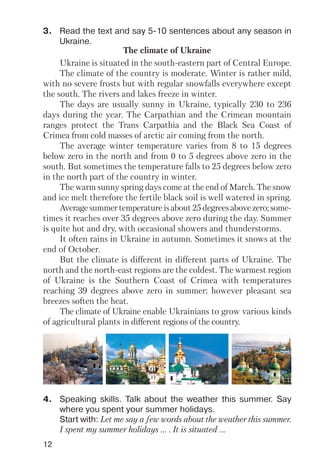
1. Look at the picture and choose the words (adjectives) to
describe it. Can you think any more adjectives which
describe weather?
It is ...
A B C
2. Listening.
a) Look at the pictures and listen to Katrine talking about the
weather. Say which photo she is describing.
b) Listen to Katrine’s story again. Say which words she uses
in her report. Write them down into your exercise book.
the sun windy ill
to hail a snowfall weekend
lightning to rain tomorrow
cool to cycle to swim
hot a village to ride a horse
a thunderstorm foggy a bus
c) Talk about today’s weather.
The climate of Ukraine
Ukraine is situated in the south eastern part of Central Europe.
The climate of the country is moderate. Winter is rather mild,
with no severe frosts but with regular snowfalls everywhere except
the south. The rivers and lakes freeze in winter.
The days are usually sunny in Ukraine, typically 230 to 236
days during the year. The Carpathian and the Crimean mountain
ranges protect the Trans Carpathia and the Black Sea Coast of
Crimea from cold masses of arctic air coming from the north.
The average winter temperature varies from 8 to 15 degrees
below zero in the north and from 0 to 5 degrees above zero in the
south. But sometimes the temperature falls to 25 degrees below zero
in the north part of the country in winter.
The warm sunny spring days come at the end of March. The snow
and ice melt therefore the fertile black soil is well watered in spring.
Average summer temperature is about 25 degrees above zero; some
times it reaches over 35 degrees above zero during the day. Summer
is quite hot and dry, with occasional showers and thunderstorms.
It often rains in Ukraine in autumn. Sometimes it snows at the
end of October.
But the climate is different in different parts of Ukraine. The
north and the north east regions are the coldest. The warmest region
of Ukraine is the Southern Coast of Crimea with temperatures
reaching 39 degrees above zero in summer; however pleasant sea
breezes soften the heat.
The climate of Ukraine enable Ukrainians to grow various kinds
of agricultural plants in different regions of the country.
12
3. Read the text and say 5 10 sentences about any season in
Ukraine.
4. Speaking skills. Talk about the weather this summer. Say
where you spent your summer holidays.
Start with: Let me say a few words about the weather this summer.
I spent my summer holidays ... . It is situated ...
13
5. a) Work in pairs. Ask your friend about his/her plans for
tomorrow (at the weekend, on Tuesday, etc.) as in the example.
For example:
P1: What are you going to do after classes tomorrow?
P2: If the weather is good, I’ll play football with my friends in the
yard. And what are you going to do at the weekend?
P1: If it rains, I’ll play on computer or read a book. ...
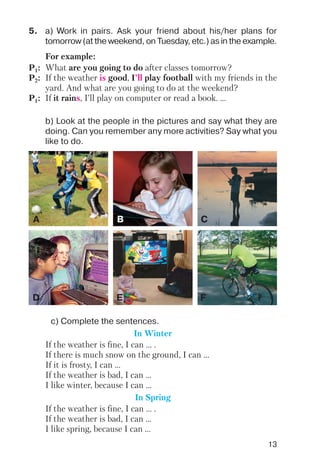
b) Look at the people in the pictures and say what they are
doing. Can you remember any more activities? Say what you
like to do.
c) Complete the sentences.
In Winter
If the weather is fine, I can ... .
If there is much snow on the ground, I can ...
If it is frosty, I can ...
If the weather is bad, I can ...
I like winter, because I can ...
In Spring
If the weather is fine, I can ... .
If the weather is bad, I can ...
I like spring, because I can ...
A B C
D E F
14
In Summer
If the weather is fine, I can ... .
If it is hot, I can ...
If it rains, I can ...
If the weather is bad, I can ...
I like summer, because I can ...
In Autumn
If the weather is fine, I can ... .
If it is misty, I can ...
If the weather is bad, I can ...
I like autumn, because I can ...
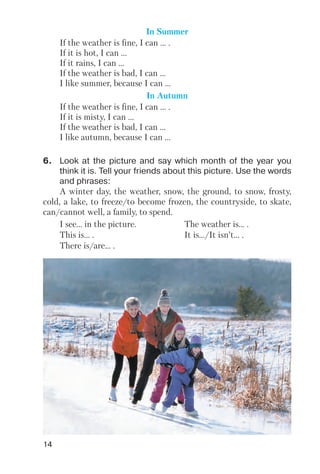
6. Look at the picture and say which month of the year you
think it is. Tell your friends about this picture. Use the words
and phrases:
A winter day, the weather, snow, the ground, to snow, frosty,
cold, a lake, to freeze/to become frozen, the countryside, to skate,
can/cannot well, a family, to spend.
I see… in the picture. The weather is… .
This is… . It is…/It isn’t… .
There is/are… .
– Hullo!
– Hello! Could I speak to Tom Brown?
– It’s me. Who is speaking?
– Good morning, Tom! It’s Oleh Velychko. I am calling to wish
many happy returns of the day to you! … birthday! May all your
… come true!
– Thank … … much, Oleh. How are you?
– Fine, … … . And you?
– Me too, thanks. Speak louder, please. I cannot … you well. .. you
in Kyiv?
– No, I’m not. I am at the Black … .
– Oh, it’s great! What is … like there?
– Sorry? Could you say it again?
– How do you like the weather …?
– Oh! The weather is … . It is sunny and … . The temperature is 30
degrees … zero.
– Does it rain sometimes?
– It … yesterday. But … … … today. There isn’t any … in the sky.
– Can you talk?
– Yes, of course.
– How do you spend time there?
– Oh, I … , … and play …with my friends all days long. The day
before yesterday we went to … . …
– Sorry. I cannot …
– OK. I’ll call you from Yalta later. The communication is better
there.
– OK. Bye bye.
– So long!
15
7. Find a photo or a picture of nature. Describe the weather in it.
8. Read the dialogue “A telephone conversation”. Oleh speaks to
Tom by phone. But they have a bad connection. Oleh doesn’t
hear some words. Complete and act out the dialogue.
9. Write down the weather forecast for tomorrow. Use the phrases
and words given below:
They are expecting ... tomorrow. (rain, a windy/sunny day,
fog/mist, etc.)
It will/will be ...
The temperature will be ...
16
LESSONS 7–9
Describing People
— a young woman — full
— straight — square
— chestnut — hazel
— large — sun tanned
— freckled — blue
— a girl — thin
— fair — wavy
— round — narrow
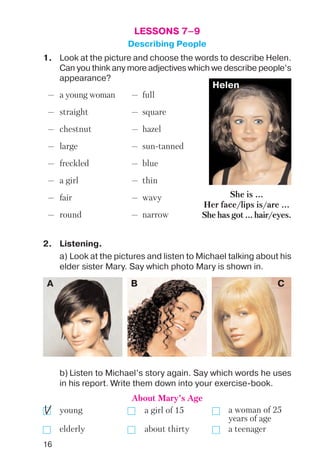
1. Look at the picture and choose the words to describe Helen.
Can you think any more adjectives which we describe people’s
appearance?
Helen
A B C
2. Listening.
a) Look at the pictures and listen to Michael talking about his
elder sister Mary. Say which photo Mary is shown in.
b) Listen to Michael’s story again. Say which words he uses
in his report. Write them down into your exercise book.
young a girl of 15
elderly about thirty a teenager
She is ...
Her face/lips is/are ...
She has got ... hair/eyes.
About Mary’s Age
a woman of 25
years of age
17
grey red long
brown dark bobbed
curly thin short
thick shoulder length red
slim plump tall
short thin medium height
petite well built overweight
About Mary’s Built and Height
hazel narrow small
green blue slanting
grey large brown
About Mary’s Eyes
square triangular pale
oval wrinkled tanned
round freckled rosy
About Mary’s Face
kind strict emotional
clever talkative lazy
cheerful shy hard working
About Mary’s Character
long straight
short snub
About Mary’s Nose
a mole a moustache
a tattoo glasses
About Mary’s Distinctive Features
About Mary’s Hair
18
c) Tell your classmates about your sister’s (brother’s/father’s/
mother’s/friend’s) appearance.
b) Say what epithets and metaphors the author uses to
describe the characters of the novel.
It appears that Red was the most comely thing you ever saw.
I’ve talked to quite a number of people who knew him in those days,
white men and they all agree that the first time you saw him his
beauty just took your breath away. They called him Red on account
of his flaming hair. It had a natural wave and he wore it long. He was
tall, six feet and an inch or two and he was made like a Greek god,
broad in the shoulders and thin in the flanks; he was like Apollo. His
skin was dazzling white, milky, like satin.
And his face was just as beautiful as his body. He had large blue
eyes, very dark, so that some say they were black and unlike most
red haired people he had dark eyebrows and long dark lashes. His
features were perfectly regular and his mouth was like a scarlet
wound. He was twenty.
He was unique. There never was anyone more beautiful. He was
a happy accident of nature.
Red was an American sailor. One day he landed at the cove. There
was a native hut there; a young girl came out and invited him to enter…
I can speak of Red only from hearsay, but I saw the girl three
years after he first met her and she was nineteen then. You cannot
imagine how exquisite she was. She had the passionate grace of the
hibiscus and the rich colour. She was rather tall, slim, with the delicate
features of her face and large eyes like pools of still water under the
palm trees; her hair, black and curling, fell down her back and she
wore a wreath of flowers. Her hands were lovely. They were small, so
exquisitely formed. And in those days she laughed easily. Her smile
was so delightful that it made your knees shake. Her skin was like a
field of ripe corn on a summer day. Good Heavens, how can I
describe her? She was too beautiful to be real.
And those two young things, she was sixteen and he was twenty,
fell in love with one another at first sight.
They were children. She was good and sweet and kind. I know
nothing of him and I like to think that he was ingenuous and frank.
I like to think that his soul was so comely as his body.
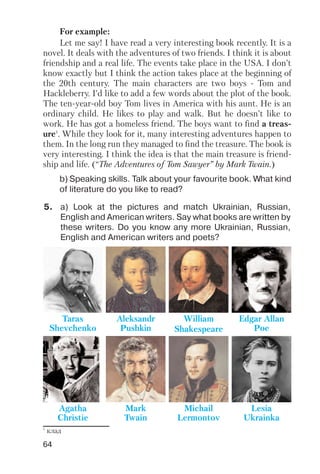
3. Read the extract from the short novel “Red” by William Somerset
Maugham. Look up the words in bold in the dictionary.
19
c) Describe one of the characters of the novel.
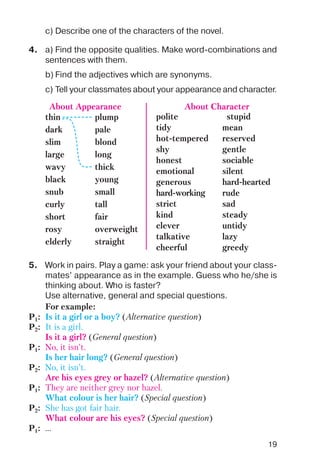
4. a) Find the opposite qualities. Make word combinations and
sentences with them.
b) Find the adjectives which are synonyms.
thin plump
dark pale
slim blond
large long
wavy thick
black young
snub small
curly tall
short fair
rosy overweight
elderly straight
About Appearance
polite stupid
tidy mean
hot tempered reserved
shy gentle
honest sociable
emotional silent
generous hard hearted
hard working rude
strict sad
kind steady
clever untidy
talkative lazy
cheerful greedy
About Character
c) Tell your classmates about your appearance and character.
5. Work in pairs. Play a game: ask your friend about your class
mates’ appearance as in the example. Guess who he/she is
thinking about. Who is faster?
Use alternative, general and special questions.
For example:
P1: Is it a girl or a boy? (Alternative question)
P2: It is a girl.
Is it a girl? (General question)
P1: No, it isn’t.
Is her hair long? (General question)
P2: No, it isn’t.
Are his eyes grey or hazel? (Alternative question)
P1: They are neither grey nor hazel.
What colour is her hair? (Special question)
P2: She has got fair hair.
What colour are his eyes? (Special question)
P1: ...
20
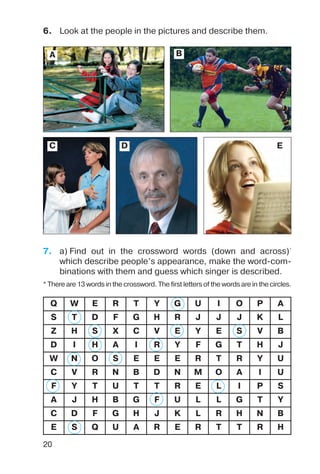
6. Look at the people in the pictures and describe them.
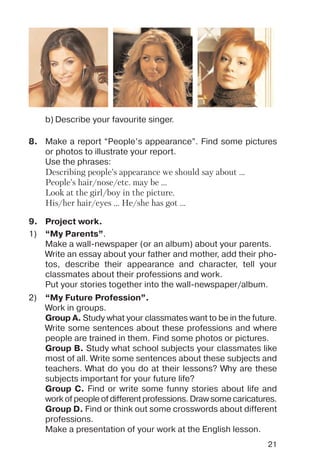
7. a) Find out in the crossword words (down and across)*
which describe people’s appearance, make the word com
binations with them and guess which singer is described.
* There are 13 words in the crossword. The first letters of the words are in the circles.
A
C D E
B
Q W E R T Y G U I O P A
S T D F G H R J J J K L
Z H S X C V E Y E S V B
D I H A I R Y F G T H J
W N O S E E E R T R Y U
C V R N B D N M O A I U
F Y T U T T R E L I P S
A J H B G F U L L G T Y
C D F G H J K L R H N B
E S Q U A R E R T T R H
21
8. Make a report “People’s appearance”. Find some pictures
or photos to illustrate your report.
Use the phrases:
Describing people’s appearance we should say about ...
People’s hair/nose/etc. may be ...
Look at the girl/boy in the picture.
His/her hair/eyes ... He/she has got ...
b) Describe your favourite singer.
9. Project work.
1) “My Parents”.
Make a wall newspaper (or an album) about your parents.
Write an essay about your father and mother, add their pho
tos, describe their appearance and character, tell your
classmates about their professions and work.
Put your stories together into the wall newspaper/album.
2) “My Future Profession”.
Work in groups.
Group A. Study what your classmates want to be in the future.
Write some sentences about these professions and where
people are trained in them. Find some photos or pictures.
Group B. Study what school subjects your classmates like
most of all. Write some sentences about these subjects and
teachers. What do you do at their lessons? Why are these
subjects important for your future life?
Group C. Find or write some funny stories about life and
work of people of different professions. Draw some caricatures.
Group D. Find or think out some crosswords about different
professions.
Make a presentation of your work at the English lesson.
22
BASIC COURSE
UNIT 1 *** IT’S MY LIFE
I. Language Material
1. a) Listen and repeat the words in the right column.
Pay attention to the correct pronunciation.
b) Read the sentences in the left column. Pay attention to
the proper intonation.
c) Make up some sentences with the words in the right
column to tell your friends about your life.
The word ‘life’ has several meanings.
Read some of them.
Life is the period between a person’s
birth and death.
But a life is also a person’s experience.
So you can lead a happy, full life.
A way of life is the way someone
chooses to live his life.
For example: you can have a traditional
way of life or a healthy way of life, etc.
Your working life is the part of your
life when you are working. Now you
study at school but in several years
you will start your working life.
After your classes you have free time
(or spare time). It’s time when you are
free, you are not working and have no
work.
Where do you study?
Do you have enough free time during
a week?
What did you do in your spare time?
life [laIf] життя
birth [bq:T] народження
death [deT] смерть
an experience [Iks!pIqrIqns]
досвід
to lead [led] life – жити
(певним життям)
full [fUl] повний
way of life – стиль життя
working life – час, коли ти
працюєш
free [frJ]/spare [spFq] time –
вільний час
enough [I!nAf] досить
23
A rest is a period of time when you
are not doing anything tiring and
you can relax or sleep. So if you are
tired, you take/have a rest.
Don’t mix up the words ‘rest’ and
‘relaxation’. Relaxation is a way of
resting and enjoying yourself. So you
can play a piano or play football for
relaxation. Maybe you enjoy reading.
What do you usually do for relaxation?
What do you enjoy?
Leisure is time when you are not
working or studying and can relax
and do things you enjoy.
Could you tell your classmates what
you do in your leisure time?
Life is beautiful! So, have the time of
your life. But don’t forget about your
duties! As the English say, business
before pleasure.
What duties do you have?
Your life will be full and happy if you
are healthy. To be healthy you should
lead a healthy way of life.
What does it mean in your opinion?
Well. You should eat healthy food.
To keep fit you should go in for sports
or do your morning exercises every day.
What kinds of sports do you know?
Which of them do you go in for?
Some people are fond of extreme
sports or games.
Look at the pictures on page 24.
rest [rest] відпочинок
tiring [!taIqrIN] виснажливий
to be tired [!taIqd] втомитись
to relax [rI!lxks], to take/
have a rest – відпочивати
relaxation [@rJlxk!seIS(q)n]
розслаблення
to enjoy [In!GOI] насолод
жуватись, отримувати за
доволення
leisure [!leZq] дозвілля
have the time of your life –
насолоджуватись життям
a duty [!dju:tI] обов’язок
healthy [!helTI] здоровий
healthy food – корисна їжа
to keep fit — бути в гарній
фізичній формі
to go in for sports – займа
тись спортом
extreme [Iks!trJm] екстре
мальний
24
parachute [!pxrqSu:t]
jumping
speleology
[@spJlI!PlqGI]
canoeing [kq!nu:IN]
freeriding
[!frJ@raIdIN]
parkour [pR!ku:r]
mountain
climbing [!klaImIN]
Extreme sports and games are often
very difficult and dangerous. It’s
necessary to receive special training
to go in for these kinds of sports.
Do you go in for extreme sports?
Where did you receive training in these
kinds of sport?
Many people have a hobby. It is an
activity that you enjoy doing in your
free time. Your hobbies can be reading
or listening to music, horse riding
or cycling, playing football or playing
the piano and so on.
Do you have a hobby?
Besides there are many entertain
ments for people. For example, films,
television, performances, shows, con
certs etc.
You can go to the theatre, cinema or
disco in your free time.
Where do you go in your free time?
difficult [!dIfIk(q)lt] складний
dangerous [!deInGrqs] не
безпечний
It’snecessary...–необхідно
to receive [rI!sJv] отримати
a hobby [!hPbI] хобі
an entertainment
[@entq!teInmqnt] розва
жальний захід
a disco [!dIskqu] дискотека
25
But if you want to be healthy and
happy, say ‘no’ to cigarettes, spirits
(alcoholic drinks) and drugs!
Smoking, drinking and taking drugs
are not only bad habits but also serious
illnesses. They can kill you.
So, as the English proverb says, “In
every beginning think of the end”.
a cigarette [@sIgq!ret] ци
гарка
spirits [!spIrIts] міцні напої
drugs [!drAgZ] наркотики
to smoke [!smqUk] палити
taking drugs – вживання
наркотиків
to take drugs – вживати
наркотики
a habit [!hxbIt] звичка
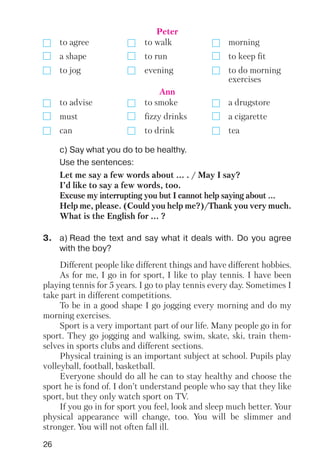
Tom Helen
Peter
Ann
B C D
2. Listening.
a) Look at the pictures and listen to the children talking
about a healthy way of life. Say which photos the boys and
the girls are talking about.
b) Listen to children’s story again. Say which words they use
in their reports. Write them down into your exercise book.
NO!
A
to eat apples carrots
to drink fat fish
meat vegetables sugar
Helen
to play football never a sports school
to play tennis always a sports section
to go in for sport a bad habit a sports club
Tom
26
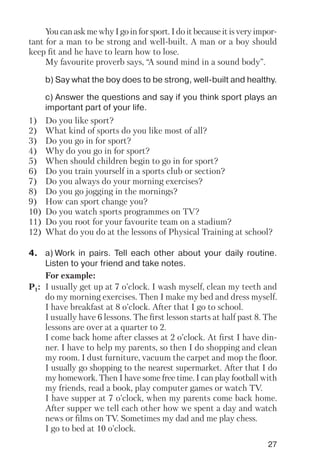
3. a) Read the text and say what it deals with. Do you agree
with the boy?
to agree to walk morning
a shape to run to keep fit
to jog evening to do morning
Peter
to advise to smoke a drugstore
must fizzy drinks a cigarette
can to drink tea
Ann
exercises
c) Say what you do to be healthy.
Use the sentences:
Let me say a few words about ... . / May I say?
I’d like to say a few words, too.
Excuse my interrupting you but I cannot help saying about ...
Help me, please. (Could you help me?)/Thank you very much.
What is the English for ... ?
Different people like different things and have different hobbies.
As for me, I go in for sport, I like to play tennis. I have been
playing tennis for 5 years. I go to play tennis every day. Sometimes I
take part in different competitions.
To be in a good shape I go jogging every morning and do my
morning exercises.
Sport is a very important part of our life. Many people go in for
sport. They go jogging and walking, swim, skate, ski, train them
selves in sports clubs and different sections.
Physical training is an important subject at school. Pupils play
volleyball, football, basketball.
Everyone should do all he can to stay healthy and choose the
sport he is fond of. I don’t understand people who say that they like
sport, but they only watch sport on TV.
If you go in for sport you feel, look and sleep much better. Your
physical appearance will change, too. You will be slimmer and
stronger. You will not often fall ill.
27
You can ask me why I go in for sport. I do it because it is very impor
tant for a man to be strong and well built. A man or a boy should
keep fit and he have to learn how to lose.
My favourite proverb says, “A sound mind in a sound body”.
b) Say what the boy does to be strong, well built and healthy.
c) Answer the questions and say if you think sport plays an
important part of your life.
1) Do you like sport?
2) What kind of sports do you like most of all?
3) Do you go in for sport?
4) Why do you go in for sport?
5) When should children begin to go in for sport?
6) Do you train yourself in a sports club or section?
7) Do you always do your morning exercises?
8) Do you go jogging in the mornings?
9) How can sport change you?
10) Do you watch sports programmes on TV?
11) Do you root for your favourite team on a stadium?
12) What do you do at the lessons of Physical Training at school?
4. a) Work in pairs. Tell each other about your daily routine.
Listen to your friend and take notes.
For example:
P1: I usually get up at 7 o’clock. I wash myself, clean my teeth and
do my morning exercises. Then I make my bed and dress myself.
I have breakfast at 8 o’clock. After that I go to school.
I usually have 6 lessons. The first lesson starts at half past 8. The
lessons are over at a quarter to 2.
I come back home after classes at 2 o’clock. At first I have din
ner. I have to help my parents, so then I do shopping and clean
my room. I dust furniture, vacuum the carpet and mop the floor.
I usually go shopping to the nearest supermarket. After that I do
my homework. Then I have some free time. I can play football with
my friends, read a book, play computer games or watch TV.
I have supper at 7 o’clock, when my parents come back home.
After supper we tell each other how we spent a day and watch
news or films on TV. Sometimes my dad and me play chess.
I go to bed at 10 o’clock.
28
b) Ask your friend as in the example.
c) Ask your friend if he/she remembers what you usually do
in the morning (after classes, at half past 4, etc.).
For example:
P1: It’s a quarter past 3. What are you doing?
P2: I am cleaning my room.
It’s 5 o’clock. What are you doing?
P1: ...
For example:
P1: Do you remember what I usually do at half past 4?
P2: As far as I’ve understood, you usually have some free time at
half past 4. Am I right?
P1: Yes, you are.
5. Speaking skills. Read the information and talk about food
you usually eat. Five pupils are the experts dietitians1
. They
comment on your reports.
Food for Thought2
1
дієтолог 2
інформація для роздумів
To eat much fat is bad for our health. But there are different kinds
of fat. Some of them are bad for us. They are found in red meat,
butter and cheese. Useful fats are in foods like nuts, olives, fish.
Fresh vegetables and fruit are very useful for our health because
they contain many vitamins and minerals. For example, carrots
are good for your eyes.
Eat different food, it is the best way to get all the vitamins and
minerals you need each day. Fresh fruits and vegetables, whole
grains, low fat dairy products, lean meat, fish, eggs and poultry
are the best for your health.
It’s OK to eat food like potato chips, pastries and pasties once
in a while, but don’t overdo! It is not very healthy.
A glass of milk is a good source of vitamin D and the minerals
calcium, phosphorous and others.
You can also match your tastes with healthy food: vegetable pizzas,
sandwiches with lean slices of meat, fresh salads and baked potatoes.
Eat less sugar and salt.
29
For example:
P1: I usually have a cup of tea and a sandwich with some sausage
and cheese for breakfast.
Dietitian: Tea is good for our health. But if there is much sugar in it,
it is not very good. Try to eat less sugar. Sausage and cheese are
not very useful for our health, either. They contain bad fat. It is
better to prepare a sandwich with some lean meat and slices of
a cucumber or a tomato. Don’t forget about fresh fruit! Eat an
apple in the morning. As a proverb says, “An apple a day keeps
doctors away”.
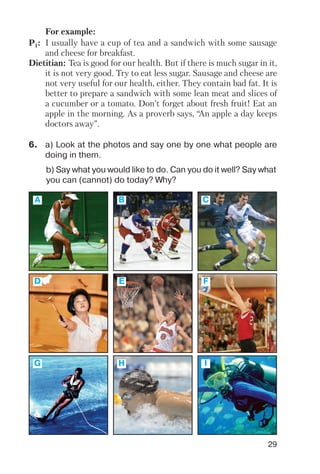
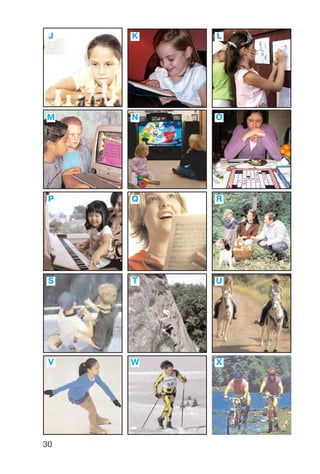
6. a) Look at the photos and say one by one what people are
doing in them.
b) Say what you would like to do. Can you do it well? Say what
you can (cannot) do today? Why?
A B C
D E F
G H I
30
J K L
M N O
P Q R
S T U
V W X
31
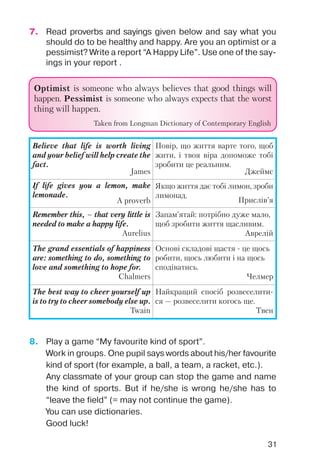
7. Read proverbs and sayings given below and say what you
should do to be healthy and happy. Are you an optimist or a
pessimist? Write a report “A Happy Life”. Use one of the say
ings in your report .
8. Play a game “My favourite kind of sport”.
Work in groups. One pupil says words about his/her favourite
kind of sport (for example, a ball, a team, a racket, etc.).
Any classmate of your group can stop the game and name
the kind of sports. But if he/she is wrong he/she has to
“leave the field” (= may not continue the game).
You can use dictionaries.
Good luck!
OptimistOptimist is someone who always believes that good things will
happen. PPessimistessimist is someone who always expects that the worst
thing will happen.
Taken from Longman Dictionary of Contemporary English
Believe that life is worth living
and your belief will help create the
fact.
James
Повір, що життя варте того, щоб
жити, і твоя віра допоможе тобі
зробити це реальним.
Джеймс
If life gives you a lemon, make
lemonade.
A proverb
Якщо життя дає тобі лимон, зроби
лимонад.
Прислів’я
Remember this, – that very little is
needed to make a happy life.
Aurelius
Запам’ятай: потрібно дуже мало,
щоб зробити життя щасливим.
Аврелій
The grand essentials of happiness
are: something to do, something to
love and something to hope for.
Chalmers
Основі складові щастя це щось
робити, щось любити і на щось
сподіватись.
Челмер
The best way to cheer yourself up
is to try to cheer somebody else up.
Twain
Найкращий спосіб розвеселити
ся — розвеселити когось ще.
Твен
32
II. Grammar Section
‘To be going to’
Revision: Indefinite and Continuous Tenses
Vocabulary
a tense – час (грам.)
present – теперішній
past – минулий
future – майбутній
indefinite – неозначений
continuous – тривалий
affirmative – стверджувальний
negative – заперечний
interrogative – питальний
time expression – обставина часу
adverbs of frequency – прислівни
ки частотності
a particle – частка
an adjunct – обставинне слово
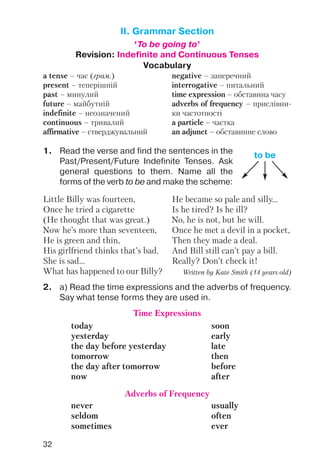
1. Read the verse and find the sentences in the
Past/Present/Future Indefinite Tenses. Ask
general questions to them. Name all the
forms of the verb to be and make the scheme:
2. a) Read the time expressions and the adverbs of frequency.
Say what tense forms they are used in.
to be
Little Billy was fourteen,
Once he tried a cigarette
(He thought that was great.)
Now he’s more than seventeen,
He is green and thin,
His girlfriend thinks that’s bad.
She is sad...
What has happened to our Billy?
He became so pale and silly...
Is he tired? Is he ill?
No, he is not, but he will.
Once he met a devil in a pocket,
Then they made a deal.
And Bill still can’t pay a bill.
Really? Don’t check it!
Written by Kate Smith (14 years old)
Time Expressions
today soon
yesterday early
the day before yesterday late
tomorrow then
the day after tomorrow before
now after
Adverbs of Frequency
never usually
seldom often
sometimes ever
33
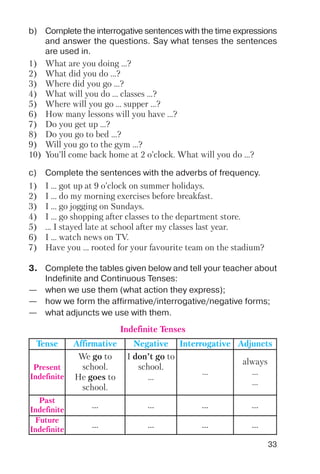
b) Complete the interrogative sentences with the time expressions
and answer the questions. Say what tenses the sentences
are used in.
1) What are you doing ...?
2) What did you do ...?
3) Where did you go ...?
4) What will you do ... classes ...?
5) Where will you go ... supper ...?
6) How many lessons will you have ...?
7) Do you get up ...?
8) Do you go to bed ...?
9) Will you go to the gym ...?
10) You’ll come back home at 2 o’clock. What will you do ...?
1) I ... got up at 9 o’clock on summer holidays.
2) I ... do my morning exercises before breakfast.
3) I ... go jogging on Sundays.
4) I ... go shopping after classes to the department store.
5) ... I stayed late at school after my classes last year.
6) I ... watch news on TV.
7) Have you ... rooted for your favourite team on the stadium?
c) Complete the sentences with the adverbs of frequency.
3. Complete the tables given below and tell your teacher about
Indefinite and Continuous Tenses:
— when we use them (what action they express);
— how we form the affirmative/interrogative/negative forms;
— what adjuncts we use with them.
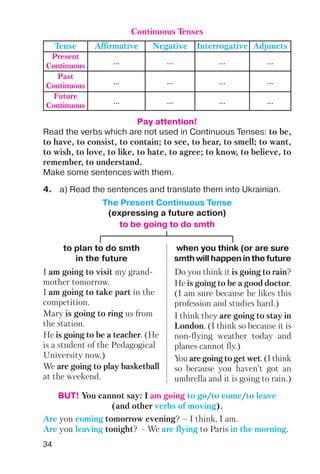
Tense Affirmative Negative Interrogative Adjuncts
Present
Indefinite
We go to
school.
He goes to
school.
I don’t go to
school.
...
...
always
...
...
Past
Indefinite
... ... ... ...
Future
Indefinite
... ... ... ...
Indefinite Tenses
34
4. a) Read the sentences and translate them into Ukrainian.
Tense Affirmative Negative Interrogative Adjuncts
Present
Continuous
... ... ... ...
Past
Continuous
... ... ... ...
Future
Continuous
... ... ... ...
Continuous Tenses
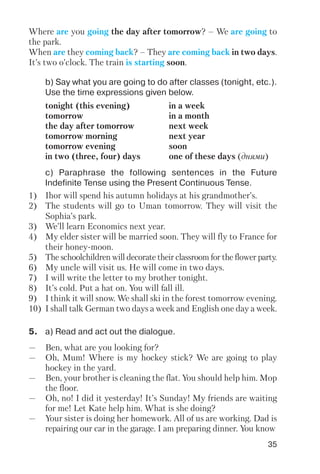
to be going to do smth
to plan to do smth
in the future
when you think (or are sure
smth will happen in the future
I am going to visit my grand
mother tomorrow.
I am going to take part in the
competition.
Mary is going to ring us from
the station.
He is going to be a teacher. (He
is a student of the Pedagogical
University now.)
We are going to play basketball
at the weekend.
Do you think it is going to rain?
He is going to be a good doctor.
(I am sure because he likes this
profession and studies hard.)
I think they are going to stay in
London. (I think so because it is
non flying weather today and
planes cannot fly.)
You are going to get wet. (I think
so because you haven’t got an
umbrella and it is going to rain.)
The Present Continuous Tense
(expressing a future action)
Pay attention!
Read the verbs which are not used in Continuous Tenses: to be,
to have, to consist, to contain; to see, to hear, to smell; to want,
to wish, to love, to like, to hate, to agree; to know, to believe, to
remember, to understand.
Make some sentences with them.
BUT! You cannot say: I am going to go/to come/to leave
(and other verbs of moving).
Are you coming tomorrow evening? – I think, I am.
Are you leaving tonight? – We are flying to Paris in the morning.
35
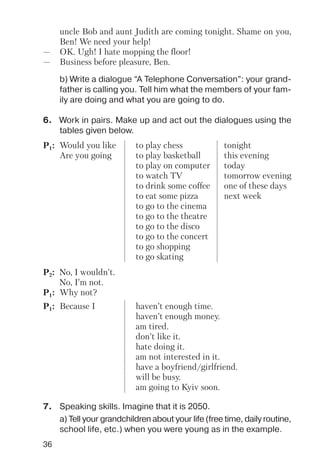
b) Say what you are going to do after classes (tonight, etc.).
Use the time expressions given below.
с) Paraphrase the following sentences in the Future
Indefinite Tense using the Present Continuous Tense.
tonight (this evening) in a week
tomorrow in a month
the day after tomorrow next week
tomorrow morning next year
tomorrow evening soon
in two (three, four) days one of these days (днями)
1) Ihor will spend his autumn holidays at his grandmother’s.
2) The students will go to Uman tomorrow. They will visit the
Sophia’s park.
3) We’ll learn Economics next year.
4) My elder sister will be married soon. They will fly to France for
their honey moon.
5) The schoolchildren will decorate their classroom for the flower party.
6) My uncle will visit us. He will come in two days.
7) I will write the letter to my brother tonight.
8) It’s cold. Put a hat on. You will fall ill.
9) I think it will snow. We shall ski in the forest tomorrow evening.
10) I shall talk German two days a week and English one day a week.
5. a) Read and act out the dialogue.
— Ben, what are you looking for?
— Oh, Mum! Where is my hockey stick? We are going to play
hockey in the yard.
— Ben, your brother is cleaning the flat. You should help him. Mop
the floor.
— Oh, no! I did it yesterday! It’s Sunday! My friends are waiting
for me! Let Kate help him. What is she doing?
— Your sister is doing her homework. All of us are working. Dad is
repairing our car in the garage. I am preparing dinner. You know
Where are you going the day after tomorrow? – We are going to
the park.
When are they coming back? – They are coming back in two days.
It’s two o’clock. The train is starting soon.
36
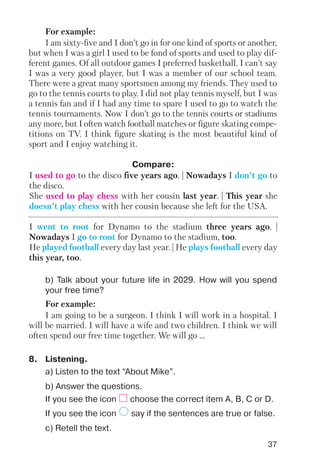
6. Work in pairs. Make up and act out the dialogues using the
tables given below.
b) Write a dialogue “A Telephone Conversation”: your grand
father is calling you. Tell him what the members of your fam
ily are doing and what you are going to do.
uncle Bob and aunt Judith are coming tonight. Shame on you,
Ben! We need your help!
— OK. Ugh! I hate mopping the floor!
— Business before pleasure, Ben.
P1: Would you like to play chess tonight
Are you going to play basketball this evening
to play on computer today
to watch TV tomorrow evening
to drink some coffee one of these days
to eat some pizza next week
to go to the cinema
to go to the theatre
to go to the disco
to go to the concert
to go shopping
to go skating
P1: Because I haven’t enough time.
haven’t enough money.
am tired.
don’t like it.
hate doing it.
am not interested in it.
have a boyfriend/girlfriend.
will be busy.
am going to Kyiv soon.
P2: No, I wouldn’t.
No, I’m not.
P1: Why not?
7. Speaking skills. Imagine that it is 2050.
a) Tell your grandchildren about your life (free time, daily routine,
school life, etc.) when you were young as in the example.
37
Compare:
I used to go to the disco five years ago. | Nowadays I don’t go to
the disco.
She used to play chess with her cousin last year. | This year she
doesn’t play chess with her cousin because she left for the USA.
I went to root for Dynamo to the stadium three years ago. |
Nowadays I go to root for Dynamo to the stadium, too.
He played football every day last year. | He plays football every day
this year, too.
For example:
I am sixty five and I don’t go in for one kind of sports or another,
but when I was a girl I used to be fond of sports and used to play dif
ferent games. Of all outdoor games I preferred basketball. I can’t say
I was a very good player, but I was a member of our school team.
There were a great many sportsmen among my friends. They used to
go to the tennis courts to play. I did not play tennis myself, but I was
a tennis fan and if I had any time to spare I used to go to watch the
tennis tournaments. Now I don’t go to the tennis courts or stadiums
any more, but I often watch football matches or figure skating compe
titions on TV. I think figure skating is the most beautiful kind of
sport and I enjoy watching it.
For example:
I am going to be a surgeon. I think I will work in a hospital. I
will be married. I will have a wife and two children. I think we will
often spend our free time together. We will go ...
b) Talk about your future life in 2029. How will you spend
your free time?
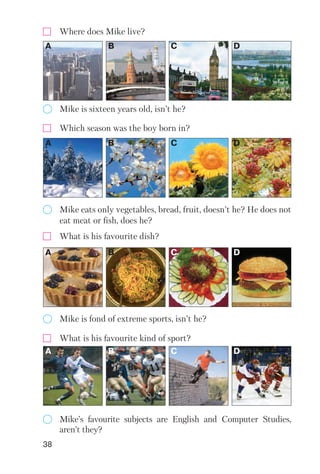
8. Listening.
a) Listen to the text “About Mike”.
b) Answer the questions.
If you see the icon choose the correct item A, B, C or D.
If you see the icon say if the sentences are true or false.
c) Retell the text.
38
Where does Mike live?
Mike is sixteen years old, isn’t he?
A B C D
Which season was the boy born in?
Mike eats only vegetables, bread, fruit, doesn’t he? He does not
eat meat or fish, does he?
A B C D
What is his favourite dish?
Mike is fond of extreme sports, isn’t he?
A B C D
Mike’s favourite subjects are English and Computer Studies,
aren’t they?
What is his favourite kind of sport?
A B C D
39
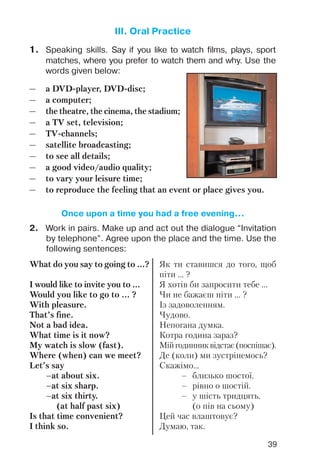
III. Oral Practice
1. Speaking skills. Say if you like to watch films, plays, sport
matches, where you prefer to watch them and why. Use the
words given below:
— a DVD player, DVD disc;
— a computer;
— the theatre, the cinema, the stadium;
— a TV set, television;
— TV channels;
— satellite broadcasting;
— to see all details;
— a good video/audio quality;
— to vary your leisure time;
— to reproduce the feeling that an event or place gives you.
2. Work in pairs. Make up and act out the dialogue “Invitation
by telephone”. Agree upon the place and the time. Use the
following sentences:
What do you say to going to ...?
I would like to invite you to ...
Would you like to go to ... ?
With pleasure.
That’s fine.
Not a bad idea.
What time is it now?
My watch is slow (fast).
Where (when) can we meet?
Let’s say
–at about six.
–at six sharp.
–at six thirty.
(at half past six)
Is that time convenient?
I think so.
Як ти ставишся до того, щоб
піти ... ?
Я хотів би запросити тебе ...
Чи не бажаєш піти ... ?
Із задоволенням.
Чудово.
Непогана думка.
Котра година зараз?
Мійгодинниквідстає(поспішає).
Де (коли) ми зустрінемось?
Скажімо...
– близько шостої.
– рівно о шостій.
– у шість тридцять.
(о пів на сьому)
Цей час влаштовує?
Думаю, так.
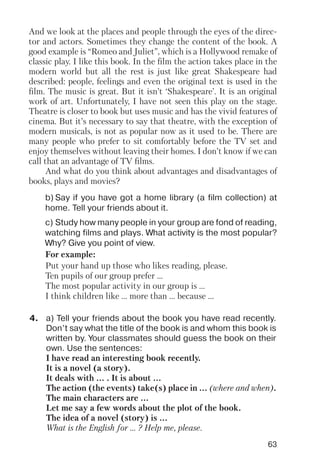
Once upon a time you had a free evening...
40
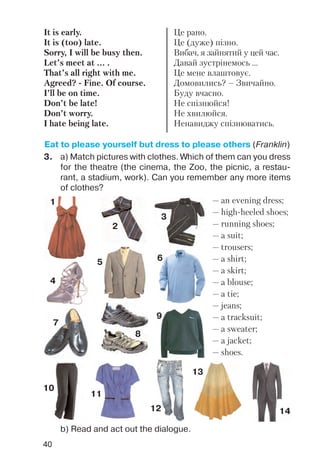
3. a) Match pictures with clothes. Which of them can you dress
for the theatre (the cinema, the Zoo, the picnic, a restau
rant, a stadium, work). Can you remember any more items
of clothes?
It is early.
It is (too) late.
Sorry, I will be busy then.
Let’s meet at ... .
That’s all right with me.
Agreed? Fine. Of course.
I’ll be on time.
Don’t be late!
Don’t worry.
I hate being late.
Це рано.
Це (дуже) пізно.
Вибач, я зайнятий у цей час.
Давай зустрінемось ...
Це мене влаштовує.
Домовились? – Звичайно.
Буду вчасно.
Не спізнюйся!
Не хвилюйся.
Ненавиджу спізнюватись.
Eat to please yourself but dress to please others (Franklin)
— an evening dress;
— high heeled shoes;
— running shoes;
— a suit;
— trousers;
— a shirt;
— a skirt;
— a blouse;
— a tie;
— jeans;
— a tracksuit;
— a sweater;
— a jacket;
— shoes.
1
2
3
4
5 6
7
8
9
10
11
12
13
14
b) Read and act out the dialogue.
41
— Mark has invited me to the theatre! We are going to the Globe.
What can I dress for it?
— The best choice is an evening dress.
— Oh! I hate wearing dresses.
— And what do you like to wear?
— Jeans and sweaters.
— No! It’s not right for theatre. Something else?
— Well. Trousers and blouses.
— OK. You can put your tracksuit, but I think the evening dress
will be much better.
— You are joking. Well. You are right. I have got two evening
dresses. Which one? Black or blue?
— Try both ones on!
Oh! You are a real fashion star! Both dresses are nice. But I should
dress this one. The dress fits perfectly. And black colour suits you.
— Well! The choice is done!
c) Imagine that you are going to the theatre (the cinema, a
sport club, the picnic, etc.). Make up and act out the dialogue
“Choosing clothes”.
4. a) Read the dialogues and work in pairs to act them out.
— Andriy! Would you like to see a film?
— What’s on today?
— “Terminator IV”.
— Oh! Is it a super film?
— Yes, it is. I have seen the three first parts.
— Did you like the film?
— It is great! What impressive trick effects!
— And who’s starring in this film?
— Didn’t you really know? Oh! Arnold Schwarzenegger!
— At what cinema is the film on?
— It’s on at the “Kotliarevsky” cinema. Do you want to go?
— Of course. As you say it is worth seeing.
— Excuse me. How can I get to the balcony?
— Go straight ahead and turn to the left.
— Thank you. I would like a play bill, please.
The real character of a man is found out
by his amusements (Reynolds)
42
b) Work in groups. Make up and act out some polylogues
“A Free Evening” using the sentences given below.
What shall we do tonight?
Where would you like to go?
– to the cinema;
– to the theatre;
– to the concert.
And what about going to ... ?
How long will it take us to get
there?
Let’s go there at once.
What is on today at ... ?
Let’s go over to the bill board
and see what’s on.
Have you seen ... ?
Is it worth seeing?
Who is the screenplay written by?
It is the film version of ... by ... .
Can we get tickets?
When does the performance
(show, concert) begin (end)?
In the box office:
What would you recommend
me to see?
When does the afternoon
(evening) show begin?
When does the next show/film
start?
Do you have tickets for ... ?
Як нам провести вечір?
Куди б ви хотіли піти?
– в кіно;
– в театр;
– на концерт.
А як щодо того, щоб піти у ...?
Скільки потрібно часу, щоб
дістатися туди?
Вирушаймо негайно.
Що сьогодні йде в ... ?
Давайте підемо до афіши і
подивимося, що йде.
Ви бачили ... ?
Це варто подивитись?
Хто автор сценарію?
Цеекранізація(книги...автора).
Ми зможемо дістати білети?
Коли починається
(закінчується) вистава (шоу,
показ, концерт)?
У касі:
Що ви мені порадите
подивитись?
Коли починається денна
(вечірня) вистава?
Коли починається наступна
вистава/показ фільму?
У вас є білети на ... ?
— Take it, please.
— How much is it?
— The price is forty cents.
— Here you are.
— Thank you.
— Could you tell me how many acts there are in the play?
— There are two acts in the play.
— How long does the interval last?
— Twenty minutes.
43
One ticket, please, for the next
showing.
I would like seats ...
– in the centre of the hall
– a little closer to the front
– a little further back
– in the middle block
How much is it?/How much
are they?
Will the curtain go up soon?
Did you like the film (show,
concert)?
I liked (didn’t like) the acting.
Oh! The concert was a great suc
cess! It was excellent.
Один білет на наступний
сеанс, будь ласка.
Я хотів би місця
– у центрі зали
– трохи ближче
– подалі
– у середньому ряду
Скільки він/вони коштує
(коштують)?
Скоро розпочнеться вистава?
Вам сподобався фільм
(вистава, концерт)?
Мені (не) сподобалась гра
акторів.
О! Концерт мав велечезний
успіх. Він був чудовий.
Tell me what you eat
and I will tell you what you are (Brillat Savarin)
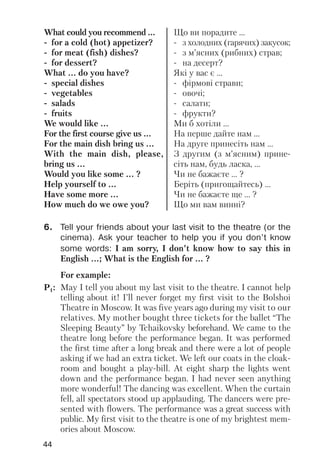
5. a)Read and act out the dialogue “In McDonald’s”.
— How do you do?
— How do you do?
— What would you like to order?
— Cheeseburger, please.
— Would you like any drink?
— Small Coke, please. What do you
have for dessert?
— Milkshake and apple pie.
— Well. I’d love to have some.
— Anything else?
— It’s enough, thank you.
b)Work in groups. Make up and act out the polylogue “In the
restaurant”. One pupil is a waiter, the others are customers.
Use the following sentences:
May we have the menu?
We are not ready to order yet.
Please, bring one more chair
(napkin, spoon, fork, knife).
Дайте меню, будь ласка.
Ми ще не готові замовити.
Будь ласка, принесіть ще один
стілець (серветку, ложку, ви
делку, ніж).
44
What could you recommend ...
for a cold (hot) appetizer?
for meat (fish) dishes?
for dessert?
What ... do you have?
special dishes
vegetables
salads
fruits
We would like ...
For the first course give us ...
For the main dish bring us ...
With the main dish, please,
bring us ...
Would you like some ... ?
Help yourself to ...
Have some more ...
How much do we owe you?
Що ви порадите ...
з холодних (гарячих) закусок;
з м’ясних (рибних) страв;
на десерт?
Які у вас є ...
фірмові страви;
овочі;
салати;
фрукти?
Ми б хотіли ...
На перше дайте нам ...
На друге принесіть нам ...
З другим (з м’ясним) прине
сіть нам, будь ласка, ...
Чи не бажаєте ... ?
Беріть (пригощайтесь) ...
Чи не бажаєте ще ... ?
Що ми вам винні?
For example:
P1: May I tell you about my last visit to the theatre. I cannot help
telling about it! I’ll never forget my first visit to the Bolshoi
Theatre in Moscow. It was five years ago during my visit to our
relatives. My mother bought three tickets for the ballet “The
Sleeping Beauty” by Tchaikovsky beforehand. We came to the
theatre long before the performance began. It was performed
the first time after a long break and there were a lot of people
asking if we had an extra ticket. We left our coats in the cloak
room and bought a play bill. At eight sharp the lights went
down and the performance began. I had never seen anything
more wonderful! The dancing was excellent. When the curtain
fell, all spectators stood up applauding. The dancers were pre
sented with flowers. The performance was a great success with
public. My first visit to the theatre is one of my brightest mem
ories about Moscow.
6. Tell your friends about your last visit to the theatre (or the
cinema). Ask your teacher to help you if you don’t know
some words: I am sorry, I don’t know how to say this in
English ...; What is the English for ... ?
45
7. Project work “My classmates”.
1) Make a wall newspaper about your classmates’ hobbies.
Divide into groups of interests (music, sports, art, collect
ing, literature). Write an essay about your hobby. Add some
photos or pictures.
2) Prepare a concert “Presentation of my class” for an English
week. Put on exhibition of your classmates’ pictures and
photos. Say a few words about them. Prepare some items for
a concert: dancing, reciting an English verse, singing an
English song, etc.
1. Answer the questions given below:
IV. Reading
1) What is your favourite kind of sports?
2) Do you go in for sport?
3) Are you fond of music?
4) Who is your favourite singer?
5) Do you play any musical instrument?
6) Have you got any collections at home?
7) Are you a cinema goer?
8) Are you a great theatre goer?
9) Have you got a pet?
10) Do you like computer games?
Tastes differ
A hundred years ago there was no problem of what working people
could do with their spare time. Their hours of work were so long that
they had hardly any leisure. Nowadays it’s even hard to name all the
activities, entertainments and hobbies run by people in their free
time. A growing number of people prefer watching films, performances,
sporting events on TV to attending them. There exists quite a different
sort of leisure activities, betting and gambling for example, which
give thousands of people hope for a huge prize and a sense of excitement
and expectation. There are various pursuits that people choose to
pass away their free time. Nowadays people spend hours watching
different informational, educational or environment programmes. Other
2. Read the text and say what it deals with.
46
popular occupations are listening to the radio, reading books, painting
and so on. Many people prefer to go in for different kinds of sports
and lead an active way of life. Sometimes they participate in compe
titions or contests and have a very good pastime. There are people
that prefer a calm way of spending their free time. They are fond of
quiet rambles or walks in parks or gardens. More serious people prefer
to visit museums, art galleries or theatres. Aerobics and shopping are
two of the most popular pursuits for women. Cooking is also very
widespread activity among them. But nothing can be compared with
the feeling of those who are really interested in some field of activity,
which has become something favourite and admired.
A “hobby” is a special interest or activity that you do in your free
time. Hobbies differ like tastes. If you have chosen a hobby according
to your character and taste you are lucky because your life becomes
more interesting. Hobbies are divided into four large classes: doing
things, making things, collecting things and learning things.
The most popular of all hobby groups is doing things. It includes
a wide variety of activities, everything from gardening to travelling and
from chess to volleyball. Gardening is one of the oldest man’s hobbies.
It is a well known fact that the English are very fond of gardening and
growing flowers, especially roses. Both grown ups and children are
fond of playing different computer games. This is a relatively new
hobby but it is becoming more and more popular. Some people have
animals as hobbies. They keep rabbits or go fishing. They train dogs
to do tricks or keep horses to race and carry messages.
Making things includes drawing, painting, making sculpture,
designing costumes, handicrafts and others. Two of the most famous
hobby painters were President Eisenhower and Sir Winston Churchill.
Some hobbyists write music or play musical instruments. One of the
American Presidents Bill Clinton, for example, plays the saxophone.
Almost everyone collects something at some period in his life:
stamps, coins, matchboxes, books, records, postcards, toys, watches
and other things. Some collections have not real value. Others become
so large and so valuable that they are housed in museums and art
galleries. Many world famous collections started in a small way with
one or two items. People with a good deal of money often collect
paintings, rare books and other art objects. Often such private col
lections are given to museums, libraries and public galleries so others
might take pleasure in seeing them.
47
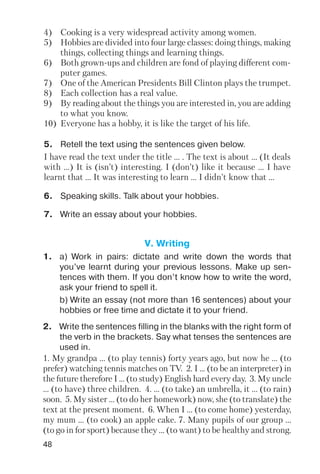
No matter what kind of hobby a
person has, he always has the opportu
nity of learning from it. By reading
about the things he is interested in, he
is adding to what he knows.
Learning things can be the most
exciting aspect of a hobby. So we think
that everyone should have a hobby, it is
like the target of your life.
3. ChoosethecorrectitemA,B,CorDtocompletethesentences.
1) If people prefer a calm way of spending their free time, they ___ .
A. participate in competitions or contests
B. are usually fond of betting and gambling
C. ramble or walk in parks or gardens with great pleasure
D. like aerobics and shopping as a rule
2) A “hobby” is a special interest or activity that you do ___ .
A. in you free time C. during your vacation
B. in your working time D. at the week end
3) The most popular of all hobby groups is ___ .
A. making things C. collecting things
B. doing things D. earning things
4) Gardening is one of the ___ man’s hobbies.
A. most popular C. youngest
B. rarest D. oldest
5) No matter what kind of hobby a person has, he always has the
opportunity of ___ .
A. getting much money C. benefiting from it
B. learning from it D. getting out of bad habits
4. Say if the following sentences are true (T) or false (F).
1) A hundred years ago there was a great problem of what working
people could do with their spare time.
2) Nowadays it’s even hard to name all the activities, entertainments
and hobbies run by people in their free time.
3) Aerobics and shopping are two of the most popular pursuits for
boys and girls.
48
4) Cooking is a very widespread activity among women.
5) Hobbies are divided into four large classes: doing things, making
things, collecting things and learning things.
6) Both grown ups and children are fond of playing different com
puter games.
7) One of the American Presidents Bill Clinton plays the trumpet.
8) Each collection has a real value.
9) By reading about the things you are interested in, you are adding
to what you know.
10) Everyone has a hobby, it is like the target of his life.
I have read the text under the title ... . The text is about ... (It deals
with ...) It is (isn’t) interesting. I (don’t) like it because ... I have
learnt that ... It was interesting to learn ... I didn’t know that ...
5. Retell the text using the sentences given below.
6. Speaking skills. Talk about your hobbies.
7. Write an essay about your hobbies.
V. Writing
1. a) Work in pairs: dictate and write down the words that
you’ve learnt during your previous lessons. Make up sen
tences with them. If you don’t know how to write the word,
ask your friend to spell it.
b) Write an essay (not more than 16 sentences) about your
hobbies or free time and dictate it to your friend.
2. Write the sentences filling in the blanks with the right form of
the verb in the brackets. Say what tenses the sentences are
used in.
1. My grandpa ... (to play tennis) forty years ago, but now he ... (to
prefer) watching tennis matches on TV. 2. I ... (to be an interpreter) in
the future therefore I ... (to study) English hard every day. 3. My uncle
... (to have) three children. 4. ... (to take) an umbrella, it ... (to rain)
soon. 5. My sister ... (to do her homework) now, she (to translate) the
text at the present moment. 6. When I ... (to come home) yesterday,
my mum ... (to cook) an apple cake. 7. Many pupils of our group ...
(to go in for sport) because they ... (to want) to be healthy and strong.
49
8. My elder brother ... (to be) lazy therefore he seldom ... (to go jogging).
9. We ... (to see) girls and boys in the picture, they ... (to ski, to skate
and to play snowballs). 10. The students ... (to go) to the disco
tonight. 11. I ... (to take part) in the sports competitions the day
after tomorrow. 12. Her pen friend ... (to come) one of these days, he
... (to live) in Poltava next year.
3. Make negative and interrogative sentences . Write general
and special questions. Say what tenses the sentences are
used in.
4. Change the following sentences into the Past, Future,
Present or Continuous Tense.
5. Work in pairs. Write and act out the dialogue “In My Free
Time” (invitation by telephone, choosing dress for an event,
about plans for a free evening, in the restaurant, in the box
office, talking about the concert/film/show, etc.)
6. Writing a daily routine. Write your daily routine and talk to
your friends about your working days and the days off.
1. My mother often skated on a lake near our house in winter in the
childhood. 2. The children were working on computer at five o’clock
yesterday. 3. Tom is playing football with his friend in the yard now.
4. I usually go jogging to the park every morning. 5. My elder brother
goes in for parachute jumping. 6. They are coming from London in
two days. 7. I am going to fish in the river next day. 8. I’ll often see
my grandparents next year because we are going to move into new
house. 9. The pupils will be writing a dictation at ten o’clock tomor
row morning. 10. We shall go to the swimming pool next month.
1. I play tennis with my friend on the tennis court every evening.
2. Maksym is reading a book about English sportsmen in the sitting
room at the present moment. 3. Do you often watch sports pro
grammes on TV? 4. They don’t go to the Zoo this year. 5. We are
writing letters to our pen friends from Great Britain at our English
lesson now.
For example:
7.00 I get up, wash myself, brush my teeth and take a shower.
7.20I do my morning exercises.
7.35...
50
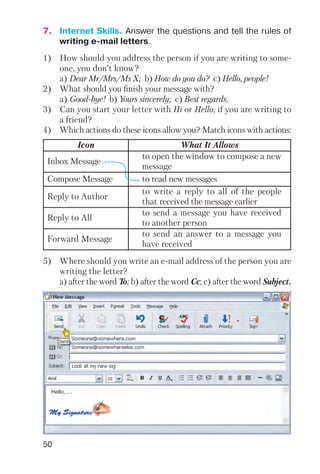
7. Internet Skills. Answer the questions and tell the rules of
writing e mail letters.
Icon What It Allows
Inbox Message
to open the window to compose a new
message
Compose Message to read new messages
Reply to Author
to write a reply to all of the people
that received the message earlier
Reply to All
to send a message you have received
to another person
Forward Message
to send an answer to a message you
have received
1) How should you address the person if you are writing to some
one, you don’t know?
a) Dear Mr/Mrs/Ms X; b) How do you do? c) Hello, people!
2) What should you finish your message with?
a) Good bye! b) Yours sincerely; c) Best regards.
3) Can you start your letter with Hi or Hello, if you are writing to
a friend?
4) Which actions do these icons allow you? Match icons with actions:
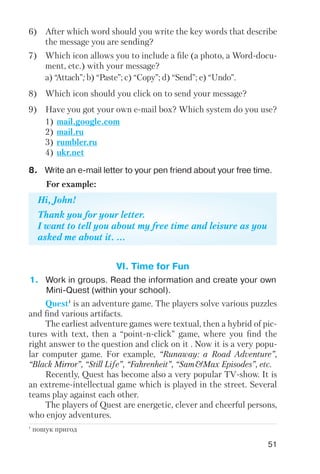
5) Where should you write an e mail address of the person you are
writing the letter?
a) after the word To; b) after the word Cc; c) after the word Subject.
Hello, ...
51
1) mail.google.com
2) mail.ru
3) rumbler.ru
4) ukr.net
6) After which word should you write the key words that describe
the message you are sending?
7) Which icon allows you to include a file (a photo, a Word docu
ment, etc.) with your message?
8) Which icon should you click on to send your message?
9) Have you got your own e mail box? Which system do you use?
a) “Attach”; b) “Paste”; c) “Copy”; d) “Send”; e) “Undo”.
Hi, John!
Thank you for your letter.
I want to tell you about my free time and leisure as you
asked me about it. ...
8. Write an e mail letter to your pen friend about your free time.
For example:
1. Work in groups. Read the information and create your own
Mini Quest (within your school).
Quest1
is an adventure game. The players solve various puzzles
and find various artifacts.
The earliest adventure games were textual, then a hybrid of pic
tures with text, then a “point n click” game, where you find the
right answer to the question and click on it . Now it is a very popu
lar computer game. For example, “Runaway: a Road Adventure”,
“Black Mirror”, “Still Life”, “Fahrenheit”, “Sam&Max Episodes”, etc.
Recently, Quest has become also a very popular TV show. It is
an extreme intellectual game which is played in the street. Several
teams play against each other.
The players of Quest are energetic, clever and cheerful persons,
who enjoy adventures.
VI. Time for Fun
1
пошук пригод
A producer was present at a performance. He seemed to be highly
pleased with it. When the performance was over, he began to applaud.
“Mister Black! Are you applauding the most to the leading lady or
the leading man?” his neighbour asked him. “Neither the one nor the
other, but the prompter”, replied the producer, “It was him that I
heard most during the performance”.
During the performance a young couple whispered to each other.
The man next to them was angry.
“Excuse me,” he said, “but I can’t hear any word!”
“I like that,” said the young man. “It’s no business of yours, sir,
what I am telling my wife.”
Jim’s uncle took him to the cinema. The boy had never gone to
the cinema before. It was dark when they went in. After ten minutes
the uncle asked the boy: “Are you enjoying the film?” Jim answered:
“Yes, but the seat is very uncomfortable. I can’t sit on it.” The uncle
looked and said: “You’ll be comfortable if you turn the seat down.”
52
For example:
They do different tasks. Players move from one point of the
town to another where the agent gives them the next task. If they
did the task incorrectly, they cannot find the place they need.
The answer: This story is about Alexander Pushkin and his poem
“The Bahchisaray Fountain”. So the Quest agent is waiting for the
players near the fountain in Pushkin Street.
Alexander heard this story from the family of General Raievsky while
travelling around the Caucasus and Crimea in 1820. He was going to the
Bahchisaray Palace at that time. There he heard a tragic legend about a young
and very beautiful Polish Princess called Mariya Pototskaya. She was stolen
and brought to Khan Mengly Gereyev. The Khan fell in love with the girl,
but she didn’t even want to see him. He pressed for her love, but Mariya
didn’t return his feelings. She lived in the harem under the name of Dylyarih
Beekesh. One night she was caught by Zarema – the Khan’s first wife. Zarema,
sank Maria in the swimming pool. Khan killed Zarema. Mariya’s death
depressed the Khan so much that he ordered to built a beautiful monument
to her. Since then the Khan’s tears streamed there day and night.
This story touched Alexander’s heart very much and he wrote a poem.
Now he is waiting for you to recite it.
2. Read the jokes and act out the one that you like.
53
A young girl was an actress of one of the Hollywood thrillers.
There was a place in the film where this girl had to jump from a high
mountain into the water. When the young actress saw the place, she
went to the producer and said: “I won’t jump. There is only a foot of
water at the bottom of the hill!” “That’s all right,” said the produc
er. “Do you think we want you to get drowned?”
HOMEWORK
1. Complete the sentence:
I want to be healthy therefore ...
2. Write an essay about your spare time (your hobbies, favourite
activities, etc.).
3. Make a poster “Bad Habits”. Prepare a report about smoking,
drinking or taking drugs.
4. Find 15 sentences in the Present, Past, Future Indefinite or
Continuous Tenses in a newspaper (English version).
6. Answer the questions and write an essay about your last visit
to the theatre.
1) Are you a great theatre goer?
2) When was the last time you were at the theatre?
3) What theatre did you go?
4) What was on?
5) What actor (actress, singer, dancer) did you like most of all?
6) What did the play deal with?
7) How many acts did the play consist of?
8) When did the play begin?
9) When was it over?
10) Is it worth seeing?
5. Find the information about your favourite actor or sports
man in Internet and make a poster about him/her. We advise
you to use Google. Come to www.google.com.ua and write the
name of your favourite singer in the line “Search”, then click
“Google Search”.
54
Home Reading
1. Read the text and look up new words in a dictionary.
Theatres in Great Britain
There are many state theatres in Ukraine, which have a perma
nent staff. Each of them has a great variety of shows. In Great
Britain it is not like that. A play is rehearsed for a few weeks by a
company of actors working together mostly for the first time and it
is then allowed to run as long as it draws the audience and pays its
way – which may be for several years.
Another peculiarity of the theatre in Great Britain is as follows:
there are two kinds of seats: bookable seats – seats, that can be
booked in advance and unbookable ones – those, which have no
numbers and the spectators occupy them on the principle of first
came, first served. There are different parts of the theatre in
England. All the front rows, as far as the barrier, are the stalls. The
barrier separates the stalls from the other part of the house. There
are separate entrances for different parts of the theatre. The pit is
the part behind the barrier. The seats there are not bookable and
have no numbers. You have to stand in a queue to get in there and
also for the gallery. The lower tier under the gallery is the dress cir
cle. People having seats there as well as in the stalls are supposed to
wear some sort of evening dress.
During the Middle Ages plays were acted inside churches and
later in the market places of towns.
The first theatre in England, the Blackfriers Theatre, was built
in 1576 and the Globe, which is closely connected with Shakespeare,
in 1599.
8. Write a letter to your pen friend, invite him/her to your native
place and tell him/her how you can spend your free time.
9. Project work. Write a play of any Ukrainian fairy tale in
English. Co operate to make the best variant of this play.
10. Make up a scheme “Hobbies” and tell your friends about them.
7. Write what you are going to do tonight, tomorrow, after
classes, etc. Use the time expressions on page 35.
55
The theatres of that time were nothing like the comfortable
places we visit today. They were rather rounded in shape, as a rule,
open to the sky, without a roof, so that it must have been very
unpleasant when it rained. The rich people had seats in raised bal
conies facing and along sides of the stage, the poor people stood in
the pit in front. They ate fruit and sweets, smoked long pipes and
laughed very much if the plays were funny.
The stage itself was a raised wooden platform with no scenery.
When the actors wanted to show the district in which a scene took
place they simply put up a placard with the description of the district.
There were no actresses at that time and boys, who were
trained for this purpose, acted instead of women.
Nowadays the most famous theatre in Great Britain is the
Opera House in London. It is situated inside the fruit, flower and
vegetable market called Covent Garden. Isn’t it strange!
The first Covent Garden Theatre was built in 1792. It was a
theatre of drama. This historic theatre was burned down in 1808
and rebuilt exactly a year after – in 1809. It opened its season with
Shakespeare’s “Macbeth” but soon became exclusively an opera
house. In 1856 a fire broke out again in the hall and in a few hours
the building was in ruins. Two years later it was again rebuilt.
There are seats for 2,000 persons and though this theatre is
rather big it looks very cosy. In the corridors the wallpaper is striped
and one can see pink settees and pink shaded lamps everywhere.
The second well known English theatre is the English National
Theatre. It is working temporarily in the Old Vic Theatre. This is
the first state theatre Britain has ever had. It has a permanent staff
of actors and actresses.
In the past few years London has become the centre of theatri
cal experiment. In 1964 Peter Brook and Charles Morowitz formed
an experimental group attached to the Royal Shakespeare Company
and presented “The Theatre of Cruelty”. What’s characteristic of
this theatre?
Firstly, images have become much more important than words
and the actor and the director share the same creative rights as the
author. Secondly, there’s a readiness to alter or rewrite the classics
to see if they can show us anything about present day problems.
Some companies place great importance on physical discipline, others
56
2. Prepare some questions and tasks for your classmates. Ask
them to:
a) choose the correct item A, B, C or D to complete the sentences;
b) say if the sentences are true or false.
3. Retell the text using the sentences:
I have read the text under the title ... . The text is about ... (It deals
with ...) It is (isn’t) interesting. I (don’t) like it because ... I have
learnt that ... It was interesting to learn ... I didn’t know that ...
4. Discuss the text in class. Talk about Ukrainian and English
theatres.
The Royal Opera House in London
put the emphasis on freedom of movement. “The Living Theatre”
can be an example of this.
The most modern building has the New London Theatre. It was
opened in 1973 and has in one complex a restaurant, underground
parking for cars, tower blocks for tenants and a theatre. The New
London Theatre is modern in design and very comfortable. The
scenery can be lowered through lowered panels in the ceiling. Walls,
stage, ceiling and even seats can be moved.
57
Check Yourself!
Choose the correct item a, b, c or d.
Complete the sentences.
1. If I want to keep fit I should ... .
a) eat only vegetables and fruit
b) go in for basketball and tennis
c) lead a healthy way of life
d) read a lot of books
2. My brother goes in ... mountain climbing.
a) to c) for
b) on d) at
3. Many boys and girls are fond of ... .
a) run c) runner
b) running d) runs
4. Ruslan is strong and well built because he ... .
a) is fond of playing computer games
b) likes to play chess
c) prefers watching sports games
d) goes in for sports
5. Find the wrong item.
a) Canoeing is the sport of travelling by sailing boat.
b) Speleology is the sport of walking and climbing in caves.
c) Theatre goer is someone who regularly watches plays at the
theatre.
d) A hobby is an activity that you enjoy doing in your free time.
6. Find the question to the answer.
He usually goes jogging at 8 o’clock every evening.
a) What does he usually do before classes?
b) What does he do to keep fit?
c) What did he do yesterday?
d) What is he going to do soon?
7. Find the answer to the question.
What kind of extreme sports does Olha like?
a) She likes reading very much.
b) She prefers canoeing to other kinds of sports.
58
c) She goes in for tennis.
d) She is fond of singing.
8. Find the correct sentence.
a) He is going to the theatre tomorrow evening.
b) He goes to the theatre tomorrow evening.
c) He will goes to the theatre tomorrow evening.
d) He is going to go to the theatre tomorrow evening.
9. Find the sentences in the Past Continuous Tense.
a) We were football fans five years ago.
b) Tom was rooting for his favourite football team at that time.
c) The boys are playing football in the yard.
d) I was tired after the competition.
10. Find the sentence that expresses a future action.
a) My parents often went to the tennis court ten years ago.
b) We won the football match the day before yesterday.
c) Our school basketball team is going to Kyiv one of these days.
d) I often do my morning exercises outdoors.
11. Choose the correct variant to translate the sentence.
Мій брат займався боксом п’ять років тому, тепер він
волейболіст.
a) My brother went in for boxing five years ago, now he is
a volleyball player.
b) My brother goes in for boxing five years ago, now he is going
for volleyball.
c) My brother went in for boxing five years ago, now he goes in
for volleyball.
d) My brother used to go in for boxing five years ago, now he is
a volleyball player.
12. Choose the proper sentence.
Your sister takes part in a tennis competition. The first event is
starting in a minute. You say to her:
a) Be a good girl!
b) Have a good trip!
c) Good bye!
d) Good luck!
Thekeystotheexercises:1c,2c,3b,4d,5a,6b,7b,8a,9b,10c,11d,12d.
59
UNIT 2 *** BOOKS IN OUR LIFE
I. Language Material
1. a) Listen and repeat the words in the right column.
Pay attention to the correct pronunciation.
b) Read the sentences in the left column. Pay attention to
the proper intonation.
c) Answer the questions in the left column.
Many people are fond of reading.
Nothing can replace books.
Books are the source of information,
knowledge and relaxation.
We read for pleasure. But reading we
learn.
A lot of us like books and stories
about imaginary people and events.
Some people like prose (novels, sto
ries, tales), the others enjoy reading
poetry (poems).
If we want to have information on a
certain subject we use non fiction:
books about real facts or events, not
imagined ones.
So there are many kinds of literature.
Look at the scheme.
replace [rI!pleIs] замінити
a source [sLs] джерело
information [@Infq!meIS(q)n]
інформація
imaginary [I!mxGIn(q)rI]
вигаданий
prose [!prqUz] проза
a novel [!nPv(q)l] роман
a story [!stO:rI] повість,
оповідання
a tale [teIl] казка
poetry [!pqUItrI] поезія
a poem [!pqUIm] вірш
non fiction [@nPn!fIkSqn]
невигаданий, реальнй
BOOKS
short stories
detective
novels
historical
novels
poems
novels
about war
adventures
love
stories
science
fiction
non fiction
60
Science fiction is a kind of writing
which describes imaginary future
discoveries in science and their effect
on life. The books of science fiction
usually tell about unusual situations
which will probably never happen.
Love stories are books about happy
or unhappy love.
A fairy tale (or a fairy story, a tale) is
an exciting children’s story in which
magical things happen.
A short story is a short written story
about imaginary situations, that usu
ally contains only a few characters.
Detective novels are stories about a
crime often a murder and a detec
tive who tries to find out who did it.
Historical novels tell us about dif
ferent historical events, facts, people
that happened/lived in the past.
Adventures are books about excit
ing adventurers’ life in which dan
gerous or unusual things happen.
Do you like reading?
What do you prefer reading?
Each of us has his favourite writer or
poet.
Who is you favourite writer (poet)?
What kinds of literature does he/she
write?
To get some facts about any subject
we often use encyclopedias.
An encyclopedia is a book or set of
books containing facts about many
different subjects or about one par
ticular subject.
Do you often use encyclopedias?
When do you use them?
science fiction [@saIqns!fIkSqn]
наукова фантастика
a discovery [dIs!kAv(q)rI]
відкриття
probably [!prPb(q)blI]
напевно, мабуть
love stories — романи про
кохання
a fairy tale [!fFqrIteIl] казка
exciting [Ik!saItIN] захоп
люючий
a short story — оповідання
a character [!kxrIktq] літе
ратурний герой
(a) detective [dI!tektIv]
детектив, детективний
a crime [kraIm] злочин
a murder [!mq:dq] вбивство
an adventure [qd!venCq]
пригода; an adventurer —
шукач пригод
writer [!raItq] письменник
poet [!pqUIt] поет
an encyclopedia [In@saIklq-
!pJdiq] енциклопедія
particular [pq!tIkjUlq] ок
ремий, певний
61
Many books are made into plays or
movies.
For example, Peter Jackson made a
screen version of a novel “The
Fellowship of the Ring”. As you know
the novel is written by J.R.R. Tolkien.
Do you know any books made into
plays or movies?
Many men and women, boys and girls
all over the world like theatre and
cinema very much.
Theatre includes such performances
as plays (tragedies and comedies),
ballet, opera, puppet shows (or
puppet plays) and others.
Which of them do you like?
Is there a drama theatre, an opera
house or a puppet show in your
town/ city?
Many people all over the world are
great cinema goers.
There are different genres of films.
They can be: dramas, melodramas,
musical films, horror films, thrillers,
crime stories, westerns, super
films, comedies and others.
Some people like serials.
Are you a great cinema goer? / Are you
a great theatre goer?
What is your favourite genre of films?
a play [pleI] п’єса, вистава
a movie (AmE) [!mu:vI] кіно
to be made into plays/
movies — бути театралізо
ваним/екранізованим
to make a screen version
[!skrJn!vq:S(q)n] of a novel
— екранізувати роман
all over the world – в
усьому світі
a performance [pq!fLmens]
вистава
a tragedy [!trxGIdI] трагедія
a comedy [!kPmIdI] комедія
ballet [!bxleI] балет
a drama [!drRmq] theatre –
драматичний театр
opera [!Pp(q)rq] опера
an opera house – театр опери
a puppet show [!pApItSqU]
ляльковий(а) вистава/театр
a cinema goer – кіноглядач
a theatre goer – театрал
a genre [ZRNr] жанр
a melodrama [!melqu@drRmq]
мелодрама
a musical film – музичний
фільм
a horror [!hPrq] film –
фільм жахів
a thriller [!TrIlq] триллер
a crime story – детектив
a western [!westqn] вестерн
a super film – бойовик
a comedy – комедія
a serial [!sIqrIql] серіал
2. Listening.
a) Look at the pictures and listen to Bohdan talking about his
hobby. Say which picture the boy is talking about.
62
LiteraturLiteraturee CinemaCinema
b) Listen to Bohdan’s story again. Write down the words
Bohdan uses in his report into your exercise book.
c) Speaking skills. Talk about Bohdan’s hobby. Do you like
it? What do you prefer: reading books or watching films?
to watch a movie a crime story
a book a film a horror film
a writer cinema a drama
poetry theatre an opera
literature theatre goer a discovery
3. a) Read the text and say what it deals with. Do you agree
with the girl? Talk about advantages and disadvantages of
literature, theatre and cinema.
My name is Olena. I am fond of reading. My mother told me it
was a problem to find a good book twenty years ago. People often
exchanged interesting books with each other. They took care of their
home libraries, were happy of any new good book. Nowadays it’s not
a problem to get any book you need. Recently many new books have
appeared. I mean pocket books. They are becoming very popular.
But in my point of view we cannot consider these books to be works
of a real literature.
I like good books, good plays and films. I think each of them has
their own advantages. Reading books we have a flight of fancy. Each
reader imagines different situations and people (characters). Cinema
shows us concrete places and people. Modern special effects work
wonders. You can see something you’ve never seen. You can learn about
the clothes, houses, ways of life and living of any era. Close ups
reproduce any thought, any emotion of a character. But watching
films we see the new work of art that directors and actors have made.
a b c
63
b) Say if you have got a home library (a film collection) at
home. Tell your friends about it.
c) Study how many people in your group are fond of reading,
watching films and plays. What activity is the most popular?
Why? Give you point of view.
And we look at the places and people through the eyes of the direc
tor and actors. Sometimes they change the content of the book. A
good example is “Romeo and Juliet”, which is a Hollywood remake of
classic play. I like this book. In the film the action takes place in the
modern world but all the rest is just like great Shakespeare had
described: people, feelings and even the original text is used in the
film. The music is great. But it isn’t ‘Shakespeare’. It is an original
work of art. Unfortunately, I have not seen this play on the stage.
Theatre is closer to book but uses music and has the vivid features of
cinema. But it’s necessary to say that theatre, with the exception of
modern musicals, is not as popular now as it used to be. There are
many people who prefer to sit comfortably before the TV set and
enjoy themselves without leaving their homes. I don’t know if we can
call that an advantage of TV films.
And what do you think about advantages and disadvantages of
books, plays and movies?
For example:
Put your hand up those who likes reading, please.
Ten pupils of our group prefer ...
The most popular activity in our group is ...
I think children like ... more than ... because ...
4. a) Tell your friends about the book you have read recently.
Don’t say what the title of the book is and whom this book is
written by. Your classmates should guess the book on their
own. Use the sentences:
I have read an interesting book recently.
It is a novel (a story).
It deals with ... . It is about ...
The action (the events) take(s) place in ... (where and when).
The main characters are ...
Let me say a few words about the plot of the book.
The idea of a novel (story) is ...
What is the English for ... ? Help me, please.
64
For example:
Let me say! I have read a very interesting book recently. It is a
novel. It deals with the adventures of two friends. I think it is about
friendship and a real life. The events take place in the USA. I don’t
know exactly but I think the action takes place at the beginning of
the 20th century. The main characters are two boys Tom and
Hackleberry. I’d like to add a few words about the plot of the book.
The ten year old boy Tom lives in America with his aunt. He is an
ordinary child. He likes to play and walk. But he doesn’t like to
work. He has got a homeless friend. The boys want to find a treas
ure1
. While they look for it, many interesting adventures happen to
them. In the long run they managed to find the treasure. The book is
very interesting. I think the idea is that the main treasure is friend
ship and life. (“The Adventures of Tom Sawyer” by Mark Twain.)
b) Speaking skills. Talk about your favourite book. What kind
of literature do you like to read?
5. a) Look at the pictures and match Ukrainian, Russian,
English and American writers. Say what books are written by
these writers. Do you know any more Ukrainian, Russian,
English and American writers and poets?
Taras
Shevchenko
Lesia
Ukrainka
Aleksandr
Pushkin
Michail
Lermontov
William
Shakespeare
Agatha
Christie
Edgar Allan
Poe
Mark
Twain
1
клад
65
For example:
I would like to say a few words about Ukrainian writers. Taras
Shevchenko, ... , ... are famous Ukrainian writers. They wrote poetry
in general. For example, such poems as ... are written by ... . They deal
with the beauty of native country, lives of poor people and love.
b) Talk about books you read (have read) at the lessons of
Ukrainian and Foreign Literature.
Ivan
Franko
Fyodor
Dostoyevsky
Daniel
Defoe
Theodore
Dreiser
6. Work in pairs. Imagine the situation: you are visiting your
friend and see his/her home library. Make up and act out
the dialogue. Use the sentences:
How many books have you got?
Have you got any books by ... ?
How many books by ... have you got?
What do you advise me to read?
Who is your favourite writer?
What is your favourite book?
May I have a look at this book?
Is it worth reading?
What does it deal with?
Could you give me this book to read?
That’s great!
It’s a great piece of luck!
That’s exactly what I wanted!
Terrific! Fantastic!
Really?
Impossible!
Just think!
I say! (Ти подивись!)
Joy Surprise
7. Write a report “Books in our life”. Use in it one of the sayings
given on page 66.
66
8. Work in groups to complete the story given below.
Discuss whose story did you like most of all.
A room without books is like a
body without a soul.
Cicero
Кімната без книжок, як тіло без
душі.
Цицерон
A book is a mirror; if an ass peers
into it you can’t expect an apostle
to look out.
Lichtenberg
Книга — це дзеркало: якщо туди
зазирає осел, не сподівайтесь, що
визирне апостол.
Ліхтенберг
The books that help you the most
are those which make you think
the most.
Parker
Найкращі книги — ті, що змушу
ють вас замислитись найбільше.
Паркер
I divide all readers into two class
es: those who read to remember
and those who read to forget.
Phelps
Я поділяю усіх читачів на дві гру
пи: тих, хто читає, щоб запам’я
тати, і тих, хто читає, щоб забути.
Фелпс
Reading is to the mind what
exercise is to the body.
Addison
Читання для розуму є тим, чим є
фізичні вправи для тіла.
Едісон
How Tom Began to Like Reading
Once upon a time there lived a boy who didn’t like to read. He
spent all days long lying on a sofa and watching TV. Sometimes he
even began to talk to TV set. But one day ...
II. Grammar Section
Passive Voice
Revision: Present Perfect Tense
Vocabulary
a main verb – основне дієслово
anauxiliaryverb –допоміжнедієслово
by means – за допомогою
participle – дієприкметник
Past Participle (Participle II) –
дієприкметник минулого часу
to be placed – розташовуватись
a subject – 1) підмет; 2) суб’єкт дії
an object – 1) додаток; 2) об’єкт дії
to take place – відбуватися
result – результат
to continue – тривати
a voice – стан дієслова (грам.)
Active Voice – активний стан
Passive Voice – пасивний стан
67
The Present Perfect Tense
nowbefore
I have bought a book.
nowyesterday
I bought a book.
Past Indefinite Present Perfect
1. Revision. a) Read, match the actions and sentences with the
Past Indefinite and the Present Perfect Tenses and say what
difference is between the Past Indefinite and the Present
Perfect Tenses.
— an action which took place before the present moment but the
result of this action is very important now;
— a single action which took place in the past;
— some actions which repeated from time to time in the past;
— an action which began before the present moment and contin
ued up to it.
I have locked the door.
We went to the theatre the day before yesterday.
Have you turned off the gas?
Did you go in for sport five years ago?
They have travelled the country up to now.
I took music lessons three days a week last year.
Yesterday I cleaned my room, then
I went shopping. I bought a book in
a book shop, some bread and veg
etables at the super market. Then I
played football with my friends.
— We have a History lesson today.
Do you remember the teacher asked
you to buy a book about Cossacks?
— Yes, I do. I have already bought it.
— Have you read it yet?
— No, I haven’t.
The Past Indefinite Tense is
used to express:
The Present Perfect Tense is
used to express:
b) Look at the scheme, complete the sentences and say how
we form the Present Perfect Tense.
+ ? –
I (you, we, they)
have asked.
He (she, it) has
asked.
Have I (you, we,
they) asked?
Has he (she, it)
asked?
I (you, we, they)
have not asked.
He (she, it) has
not asked.
68
1) The Present Perfect is formed by means of the auxiliary verb
____ and ____ of the main verb.
2) In the interrogative form the auxiliary verb is placed ___.
3) In the negative form ___ is used after ___.
c) Read the sentences and say what adverbs, time expres
sions and prepositions we can use with the Present Perfect
Tense.
d) Work in pairs. Make up and act out the dialogue using the
following scheme.
e) Speaking skills. Talk about books (films, plays) you have
read (seen). Pay attention to the Past Indefinite and the
Present Perfect Tenses. Start with: Friends! Have you ever
read books ... by Steven King?
I have just heard this song on the radio.
Had you an English lesson the day before yesterday?
We have not seen him this week.
I saw her every day.
Has he ever been to Paris? — No, he hasn’t. Oleh has never
been to France.
She has not been there yet.
They have already written a dictation.
He lived in London and spoke English every day five years ago.
What has happened? — Olenka has just broken a cup.
When did it happen? – It happened half an hour ago.
I have lived here since last year.
Have you ever played the piano?
My cat has slept for three hours.
We wrote essays about theatres in Ukraine yesterday.
P1: Would you like to go to the cinema tonight
Are you going to watch a good film ...
... ...
P1: Because I haven’t done my homework yet.
cleaned my room
...
P2: Yes, I would but I can’t.
P2: Why not?
69
The Passive Voice
2. Read and compare sentences. Translate them. Say what the
subjects and the objects of actions are. Then read the informa
tion about the Passive Voice.
My brother writes letters to
my granny every day.
He wrote this letter yesterday.
Builders build houses.
The builders built the Globe in
1599.
Actors act roles.
Ukrainian actors acted the
leading roles.
The letters are written every day.
(Листи пишуться щодня.)
This letter was written yesterday.
(Цей лист був написаний вчора.)
Houses are built by builders.
The Globe was built in 1599. It
is situated in London.
Roles are acted by actors.
The leading roles were acted by
Ukrainian actors.
Theserolesareoftenperformedby
English ballet dancers.
The tenses of the Passive Voice are formed by means of the auxi
liary verb to be and Past Participle (Participle II) of the main verb.
The subject of the action is a person or a thing that performs
(виконує) an action.
The object of the action is a person or a thing that is acted
upon (на який спрямована дія).
In the English language the verb has two voices: the Active
Voice and the Passive Voice.
If the subject of the action is a subject of the sentence, we use
the Active Voice. If the object of the action is a subject of the sen
tence, we use the Passive Voice.
The Subject and the Object of the Action
The formation of the Passive Voice
The
builder
the
house
builds The
house
by the
builder
is built
The Active Voice The Passive Voice
70
The Passive Voice: Present and Past Indefinite
to be + Participle II
I am examined. We
He You are examined.
She is examined. They
It
I am often taken by my parents to the concerts.
Батьки часто беруть мене на концерти.
This book is translated into English by O. Petrenko.
Ця книга перекладається на англійську О. Петренком.
These DVD disks are often sold in audio shops.
Ці диски часто продаються в аудіо магазинах.
Are you seen? Тебе побачили (тебе видно)?
Where is this cinema situated?
Де розташований цей кінотеатр?
Who is this article written by?
Ким написана ця стаття?
How many letters are sent every Friday?
Скільки листів відправляють кожної п’ятниці?
I am not usually told about it.
Мені про це зазвичай не розповідають.
He is not allowed to do it.
Йому не дозволяють робити це.
Children are not invited to night parties.
Дітей не запрошують на нічні вечірки.
+ ? –
P
R
E
S
E
N
T
I am dressed.
He (she, it) is
dressed.
You (we, they) are
dressed.
Am I dressed?
Is he (she, it)
dressed?
Are you (we, they)
dressed?
I am not dressed.
He (she, it) is not
dressed.
You (we, they) are
not dressed.
I We
He You were examined.
She They
It
was examined.
71
I was invited to the theatre the day before yesterday.
Мене запросили до театру позавчора.
These plays were written by the great Ukrainian writer
Ivan Kotliarevsky. Ці п’єси були написані великим українським
письменником Іваном Котляревським.
The first Ukrainian film “Zvenyhora” was made by Oleksandr
Dovzhenko and shown for the first time in 1928. Перший
український фільм був створений Олександром Довженком і
вперше демонструвався у 1928 році.
Were you seen? Тебе бачили (тебе було видно)?
When was The Ukrainian Theatre founded?
Коли був заснований “Український театр”?
Who was the screenplay of the film written by?
Ким було написано сценарій до цього фільму?
How many actors were chosen for the title role?
Скільки акторів відібрали для виконання головної ролі?
I was not told about it before the performance.
Мені про це не розповідали до початку вистави.
He was not struck by the acting.
Гра акторів не справила на нього враження.
The New Year’s performances were not begun in time.
Новорічні вистави не почалися вчасно.
+ ? –
P
A
S
T
I (he, she, it)
was invited.
You (we, they)
were invited.
Was I (he, she, it)
invited?
Were you (we, they)
invited?
I (he, she, it)
was not invited.
You (we, they)
were not invited.
3. Read the information about making films and retell the text
using the Passive Voice. Look up the words in bold in a dictionary.
For example:
Many people make a film. — A film is made by many people.
Many people make a film. They are a script writer, a camera
man, a designer, a director, a producer, a manager, actors, actress
es and other people.
The script writer writes a screenplay. The cameraman makes the
photography. The designer designs and draws the sets and costumes.
72
The director thinks over the artistic side of the film. The producer
finances the film. The manager organizes the distribution of the
film. Actors and actresses act roles in the film.
4. Make up 10 sentences from the table.
5. Work in pairs. Your classmate says a sentence (with the subject
and the object) using the Active Voice in the Present or Past
Simple and you change it into the Passive Voice. Use the verbs:
to show, to perform, to buy, to sell, to act, to make, to draw, to
paint, to write, to tell, to translate and others.
6. Work in groups. Your friends ask you to give them interesting
books to read. Give them any books written by an English
speaking writer. Write and act out the polylogue.
b) Make interrogative and negative forms.
I
This director
The film
This role
A screenplay
The theatre
We
You
Spectators
Actors
Plays
The library
The book
These books
The cinema
Poems
to be
founded
acted
told
read
presented
performed
shown
written
invited
struck
closed
situated
translated
built
the Shakespeare’s play
“Romeo and Juliet”
by a famous Ukrainian
actress Olha Sumska
by a young talented
scrip writer
by the producer
by dancing of Ulanova
with beautiful flowers
about the others works
of this director
in the centre of the town
into five languages
by students
at 8 o’clock in
the evening
in childhood
five years ago
two hundred
years ago
before showing
on New Year’s
Eve
every year
(often)
(usually)
For example:
P1: We often write essays at the English lessons.
P2: Essays are often written at the English lessons.
P1: I took the book at the library yesterday.
P2: The book was taken at the library yesterday.
73
7. Speaking skills. Talk about cinemas and theatres in your native
town (where they are situated; when they were built; what they
are called; where the tickets are sold; etc.)
Use the word combinations and sentences:
Have you ever read... ? Is it worth reading? What kind of liter
ature do you like?
To be written; to be translated; to be made into a movie/play; to
be acted; to be shown; to be performed; at the cinema; at the
theatre.
8. Listening.
a) Listen to the text.
b) Answer the questions.
If you see the icon choose the correct item A, B, C or D.
If you see the icon say if the sentences are true or false.
c) Retell the text.
1) Where did the boy and his father go at first?
2) The cinema was closed, wasn’t it?
a) to the concert; c)to the ballet theatre;
b) to the cinema; d)to the theatre.
3) Where was the ballet theatre situated?
4) The boy wasn’t a great theatre goer, was he?
a) in the centre of the city; c)close to the cinema;
b) not far from the centre; d)not far from the cinema.
5) What ballet was performed that day?
6) The music was written by Glinka, wasn’t it?
a) “Nutcracker”; c)“Swan Lake”;
b) “The Sleeping Beauty”; d)“Sadko”.
7) Where was the cast written?
8) The dancers were from St. Petersburg, weren’t they?
a) on the bill board; c)on the tickets;
b) in the play bill; d)in a newspaper.
74
9) When did the performance begin?
10) The dancers were presented with flowers, weren’t they?
a) at eight o’clock; c)at nine o’clock;
b) at half past eight; d)at ten o’clock.
III. Oral Practice
2. a) Work in groups. Act out the situation “At the library”. One
pupil in the group is a librarian. The others are readers.
1. a) You are at the school library. Look around and say what
you see. What is the furniture made of? Use the words: a
bookcase, a bookshelf, a shelving, plastic, metal, wood.
b) Tell your friends about your home library.
Use the words and sentences.
LibraryLibrary [!laIbrqrI] noun [countable]
1) a room or building containing books that can be looked at or bor
rowed; 2) a group of books, records etc, collected by one person.
Taken from Longman Dictionary of Contemporary English
How does one join this library?
You just have to fill in this read
er’s card.
What are you interested in?
What books do you like to read?
I am interested in books ...
— in English
— by English writers
I’m interested in ...
— technical literature
— science fiction
I’d like some books on ...
— history
— geography
Where is ... ?
Якзаписатисядоцієїбібліотеки?
Вам потрібно лише заповнити
читацький формуляр.
Чим ви цікавитесь?
Які книжки ви любите читати?
Я цікавлюсь книжками ...
— англійською мовою
— англійських письменників
Я цікавлюсь ...
— технічною літературою
— фантастикою
Мені потрібні книжки з ...
— історії
— географії
Де знаходиться ... ?
The lesson at the library
75
b) Explain the meaning of the underlined words (ask your
school librarian if you don’t know). Tell your classmates about
your school library.
— the author catalogue
— the subject catalogue
— bibliography section
— reference section
— periodical section
— manuscript division
— reading room
What are the rules for readers
in your library?
At what hours is the library
(reading room) open?
When shall I return the book?
The book is out.
Could you keep the book for me
when it is brought back, please?
What is the call number?
You can find it in a card index
(the author/subject catalogue).
— алфавітний каталог
— предметний показчик
— бібліографічний відділ
— довідковий відділ
— відділ періодики
— рукописний відділ
— читальна зала
Які правила для читачів у
вашій бібліотеці?
В які години працює бібліотека
(читальна зала)?
Коли я мушу повернути книгу?
Ця книга на руках.
Залиште цю книгу для мене,
коли її повернуть, будь ласка.
Який шифр книги?
Ви можете його знайти
у картотеці (алфавітному/
предметному каталозі).
3. a) Read the dialogue which American pupils had at the
English lesson at the library. Talk about encyclopedias: what
they are, how to use them, if you have got them at home,
how often you use them.
Librarian: Dear friends! What are encyclopedias? Who can tell me?
P1: May I answer this question because I often use them in my
work? Encyclopedias contain facts about people, places, ideas
and so on. Some encyclopedias deal with only one field such as
art or science. Other encyclopedias cover general information –
almost everything from A to Z.
P2: If you don’t object, I want to add a few words about advantages
of encyclopedias. They save your time. Without them, you might
have to read an entire book on a subject to find just a few facts.
Encyclopedias also stimulate your interest. Sometimes learning
a little about a subject makes you find some more interesting
information in different books, magazines and newspapers.
76
b) Work in groups with encyclopedias. Find some informa
tion about any English or American writer. Translate it into
English (if encyclopedia is Ukrainian or Russian).
c) Find some information about your favourite writer and tell
your friends about him/her.
Librarian: Today I want to give you some pieces of good advice. I
hope they will help you in your work.
An encyclopedia can be one book. Usually, however, it is a set of
books. Subjects in an encyclopedia are arranged in alphabetical
order. Each book has a letter or letters on the outside.
How to Use Encyclopedias
Find a key word. For example, you want to find the answer to
the question “When was ‘Romeo and Juliet’ by Shakespeare written?”
So you should look for the word Shakespeare first of all. Take the
book with the letters “S”. After you open the encyclopedia, look at
the words in the upper corner of each page – guide words. They can
help you to find the page you need quickly. Finally, you locate
Shakespeare. But the article is loaded with information! Try to read
only the first one or two sentences in each paragraph.
Perhaps you would like to learn more about your subject. So
you should look at the end of the article. Usually cross references
are listed there. They are references from one part of a book to another.
Cross references for Shakespeare might direct you to an article on
English literature, Globe (theatre), comedies and tragedies, etc.
Taking Notes
When pupils have to write a report or give a talk, they often use
encyclopedias. Many of them don’t do it correctly. They copy an
article word for word. The right way is to read an article several
times. Then close the encyclopedia before you start writing. In your
own words, write what you remember in note cards. Then check
your notes with the contents of the article. Correct any mistakes,
but keep the wording your own.
Information about the surrounding world constantly changes in
time. World events change countries and people. Scientific discoveries
add something new to what scientists already know. Check the dates
of the encyclopedias you use.
4. Find in the library your favourite book (or the books written
by your favourite writer) and tell your friends about it.
77
5. a) Speaking skills. Talk about other libraries in your native place.
b) Read and act out the dialogues.
– Oleh! Could you tell me how to get to the Central Public
Library? I need to write a report on American literature.
– Oh! It is a very good library. I think you can find a lot of books
on your subject there. You can get there by bus number 5. Go to
Pushkin Stop. Then ask the way to the library. It is not far from
the bus stop.
– Thank you very much.
– Not at all.
c) Work in pairs. Make up a dialogue in which you need to
ask the way to the library, theatre or cinema. Pay attention
that names of theatres, cinemas, concert halls, clubs are
used with the definite article while names of streets, parks,
bus stops and underground stations are not.
Use the sentences:
Does bus number ... go to ... ?
Where is the nearest bus stop (underground station)?
Is this the right way to ... ?
Is this far (nearby)?
Can I get there by bus (trolley bus, underground)?
Is it too far to go there on foot?
Could you tell me how to get to ... ? (How can I get to ...
street?)
What is the name of this street, please?
Does this street go to ... ?
It’s round the corner (on the left, on the right).
Turn to the left (to the right).
– Excuse me, is this the right way to the Central Public Library?
– Sorry, I think you are wrong.
– Ah! What is the name of this street?
– It’s Kovpak Street.
– How can I get to the library?
– It’s not very far from Lypova bus stop. You can get there by bus
number 20. Then go straight ahead. Take the third turning on
your right.
– Thank you very much.
– Not at all.
78
6. Speak about the film which is the screen version of the novel
you have read. Use the words and the sentences:
In my opinion; I think ... ; as far as I know ...;
to be made into plays/ movies;
to be a screen version of a novel;
The book is written by ...
I like/don’t like this book very much.
The director has (hasn’t) change the content of the book very
much;
The film is/isn’t better/worse than the book;
to be dull (exciting) – бути нудним (захоплюючим);
the action is slow (swift moving) – дія розгортається повільно
(дуже швидко);
the plot is thrilling (weak) – сюжет захопливий (млявий);
the acting is perfect (not good at all) – гра досконала (не зовсім
вдала);
my sympathies are/were with ... – мені особисто подобається/
сподобався (певний актор);
to act the title role (leading role) – виконувати головну роль;
to act the part of ... – грати роль певного героя.
7. Project work “Kinds of Literature”. Work in groups. Talk
about different kinds of literature. Each group tell the class
mates about one of the kind of literature. Find the books of
this kind at the library and talk about one of them. Ask your
friends if they have read it yet.
Make up a list of your favourite books.
1. Before you start reading, answer the questions given below:
IV. Reading
1) Who is Agatha Christie?
2) What kind of literature did she write?
3) Do you like reading this kind of books?
4) What detective stories by Agatha Christie do you know?
5) Which of them have you read?
6) Have you seen any films which are screen versions of her novels?
7) Do you know other writers who wrote detective stories?
79
2. Read the text and say what it deals with.
Agatha Christie (1890–1976)
Agatha Christie was born in
Torquay, in the county of Devon.
Her father died when she was a
child and Christie was educated at
home. She began to write from a very
early age. At sixteen she was sent to
school in Paris where she studied
singing and playing the piano. Christie
was an accomplished pianist but
because of her stage fright and shy
ness she didn’t make herself a career
in music. When Christie’s mother
took her to Cairo for a winter, she wrote a novel there. Her neighbour
and friend in Torquay was Eden Philpotts. According to his advice
she devoted herself to writing and had her short stories published.
In 1914 Christie married Archibald Christie, an officer in the
Flying Royal Corps; their daughter, Rosalind, was born in 1919.
During World War I she worked in a Red Cross Hospital in Torquay
as a hospital dispenser, which gave her knowledge of poisons. It was
to be useful when she started writing mysteries. Christie’s first
detective novel, “The Mysterious Affair at Styles”, introduced
Hercule Poirot, the Belgian detective, who appeared in more than
40 books, the last of which was “Curtain” (1975).
Poirot was a nice comic character with an egg shaped head. Her
other detective was Miss Marple, an elderly woman who liked to
solve questions dealing with crimes. She was born and lived in the
village of St. Mary Mead. Marple was featured in 17 novels, the first
being “Murder At The Vicarage” (1930) and the last “Sleeping
Murder” (1976). It’s a fact that her own grandmother was that per
son upon which a main character of novels was based.
In the course of 56 years Christie wrote 66 detective novels, among
the best of which are “The Murder of Roger Acroyd”, “A Murder On
The Orient Express” (1934), “Death On The Nile” (1937) and “Ten
Little Indians” (1939). In addition to these works, Christie wrote
her autobiography (1976) and several plays, including “The
Mousetrap”, which ran more than 30 years in London and had 8,862
performances at the Ambassadors Theatre.
80
Christie’s marriage broke up in 1926. Archie Christie, who
worked in the City, had fallen in love with a younger woman, Nancy
Neele. Her divorce was finalized in 1928 and two years later she
married the archaeologist Max Mallowan. She had met him on her
travels in Middle East in 1927 and accompanied him on his excavations
of sites in Syria and Iraq. Later Christie used these exotic settings in
her novels “A Murder In Mesopotamia” (1936) and “Death on the
Nile” (1937). Her own archaeological adventures were recounted in
“Come & Tell Me How You Live” (1946). Mallowan was Catholic
and fourteen years younger than she; he became one of the most
prominent archaeologist of his generation. About her marriage the
writer told the reporters the following: “An archaeologist is the best
husband any woman can have. The older she gets, the more interest
ed he is in her.” Mallowan worked in Iraq in the 1950s but returned
to England, when Christie’s health grew weaker.
Christie’s most prolific period began in the late 1920s. During
the 1930s she published four mystery novels, fourteen Poirot novels,
two Marple novels, two Superintendent Battle books, a book of stories
featuring Harley Quin and another featuring Mr. Parker Pyne and
two original plays. In 1936 she published the first of six psychological
romance novels under the pseudonym Mary Westmacott.
During World War II Christie worked in the dispensary of
University College Hospital in London. After the war she continued
to write a lot, also gaining success on the stage and in the cinema.
“Witness for the Prosecution”, for example, was chosen as the best
foreign play of the 1954 55 season by the New York Drama Critics
Circle. The play was put on in London in October 1953 and by
December 1954, it was on Broadway. Among the many film adapta
tions were “Murder on the Orient Express” (1974), directed by
Sidney Lument and with Albert Finney as Poirot and “Death on the
Nile” (1978), with Peter Ustinov as Poirot.
In 1967 Christie became president of the British Detection
Club and in 1971 she was made a Dame of the British Empire.
Christie died on January 12, 1976 in Wallingford, Oxfordshire. Her
literary heritage made up 100 novels and 103 translations into foreign
languages. By the time of her death Christie was the best selling
English novelist of all times.
81
3. ChoosethecorrectitemA,B,CorDtocompletethesentences.
1) At sixteen Agatha was sent to school to study ___ .
A. literature C. writing poems
B. singing and piano D. poisons
2) She had ___ .
A. two children C. a son
B. two daughters D. a daughter
3) During World War I she worked ___ .
A. at the chemist’s shop C. in a hospital
B. as a nurse D. at school
4) The characters of most of her novel were ___.
A. Hercule Poirot C. Mr. Sherlock Holmes
B. Miss Marple D. Mr. Parker Pyne
5) In 1936 the first of her ___ were published.
A. psychological romance novels C. historical novels
B. philosophical romance novels D. novels about war
4. Say if the following sentences are true (T) or false (F).
1) Agatha Christie was educated at home.
2) At sixteen she was sent to school in London.
3) Agatha didn’t make herself a career in music because of her love
to literature.
4) Christie’s first detective novel, “The Mysterious Affair at
Styles”, introduced Hercule Poirot, the Belgian detective.
5) Her other detective was Mrs Marple, a young woman who liked
to solve questions dealing with crimes.
6) The main character of the novels about Marple was based upon
a person of her own grandmother.
7) Her second husband was an archaeologist.
8) During World War II Christie worked in University College
Hospital in London.
9) In 1971 she was made a Dame of the British Empire.
10) Her literary heritage made up 103 novels and 100 translations
into foreign languages.
5. Retell the text using the sentences given below.
I have read the text about ... (It deals with ...) It is (isn’t) interesting.
I (don’t) like it because ... I have learnt that ... It was interesting to
learn ... I didn’t know that ...
82
6. Speaking skills. Talk about detective stories you have read.
7. Write an essay about one of the character of any detective story.
V. Writing
1. a) Work in pairs: dictate and write down the words that
you’ve learnt during your previous lessons. Make up sen
tences with them. If you don’t know how to write the word,
ask your friend to spell it.
b) Write an essay (not more than 16 sentences) about books
(theatres or cinemas).
2. Write the sentences choosing the right form of the verb from
the brackets. Say if the sentences are used in Active or
Passive Voice.
1. The New Year’s performance (shows, is shown, is showing, has shown,
was shown) by the children to their parents at our school the day
before yesterday. 2. These actors (choose, are choosing, were chosen,
have chosen) by the director a month ago. 3. The puppet theatre
(closes, is closed, closed, was closed) now. 4. We (don’t allow, are not
allowed, didn’t allow, were not allowed) to watch that film because it
was a horror film. 5. The ballet “The Snow Queen” (performs, is per
formed, is performing, was performed) for little schoolchildren in our
school theatre every year. 6. I (tell, was told, am telling, told, am told)
many Ukrainian fairy tales by my granny in childhood. 7. When ...
the Lesia Ukrainka Theatre ... (does found, did found, has founded,
is founded, was founded)? 8. We (watch, were watched, are watched,
watched, have watched) this films on TV several times. 9. Whom ...
that letter ... (did send, was sent, does send, is sending, is sent) yester
day to? 10. My brother (reads, read, was read, is read) in the article
that a young talented designer ... (designs and draws, designed and drew,
was designed and drawn, is designed and drawn) the sets and costumes
for that film. 11. Who ... these letters usually ... (did send, were sent,
do send, are sending, are sent, have sent) by? 12. Agatha Christie ...
(writes, wrote, has written, is written, was written) detective novels.
1. The tickets were sold in the box office. 2. They were shown the
puppet show “Ivasyk Telesyk”. 3. The opera house was situated in
3. Make negative sentences and put questions to the italicized
words.
83
4. Change the following sentences into the Passive Voice.
5. Work in pairs. Write and act out the dialogue “At the Library”.
1. A young Ukrainian writer Vasyl Symonenko wrote a poem “A
handful of Soil”. 2. I read English books every day. 3. Oleksandr
Dovzhenko made a film “Zvenyhora” in 1928. 4. We colour Easter
eggs and give them to our friends on Easter. 5. People borrow books
at a library.
Luhanska street earlier. 4. That actress was much written about five
years ago. 5. Cinemas are closed now. 6. You were asked to get tickets
for the stalls because our guests didn’t like to have seats far from the
stage. 7. This play is written by three authors. 8. I was told to leave
my coat in the cloak room. 9. His books are translated into several foreign
languages. 10. I was deeply impressed by the poetry of this young
talented poet.
6. Keeping a reader’s dairy. Read the information and make
up your own reader’s dairy.
Many readers keep a reader’s diary. It can help them to make
up the system of the books they have read. They can remember the
information which they have read.
The reader’s dairy is very important and convenient for pupils
and students because they have to read many books. By the way, many
teachers allow their students to use the reader’s dairies at exams.
What is the reader’s dairy? It is a copy book where a reader
writes information about the book he has read: an author, a title,
characters, a plot and some quotations (a sentence or phrase from a
book). Read the example and write some reader’s notes for your
reader’s book.
Title “Robinson Crusoe”
Author by Daniel Defoe
Characters
1) Robinson Crusoe, seaman,
Yorker (England),
the son of a businessman from Bremen;
2) Friday, a black man
84
Plot
After his ship is destroyed, Robinson Crusoe has to
live on a desert island. At first he thinks he is alone,
but one day he finds a black man living there who he
calls Friday because he meets him on Friday.
Quotations
1) The Robinson’s Dairy:
30 September 1659. I, poor unhappy Robinson
Crusoe, was ship wrecked in a terrible storm and came
on shore on this island. All the rest of the ship’s com
pany were drowned and I myself hardly perished.
2) About Man Friday:
He was a fine, well made young man of about
twenty five with straight, strong arms and legs. He was
tall and well built, with a very good, kind face, specially
when he smiled. His hair was long, straight and black,
his forehead was wide and high and he had sharp, intel
ligent eyes. His skin was pleasant, warm brown. His
face was round, his nose small, but not flat and he had
a good mouth with thin lips and strong white teeth.
3) The finale:
So, I said good bye to my island. I took with me my
goat skin cap, my umbrella and my parrot; also the
money, including the silver and gold from the wreck of
the Spanish ship.
And so, with my good companion Friday, on 19
December 1686, I left my island. I had been there for
twenty eight years, two months and nineteen days. We
had many other adventures, which I may perhaps
describe to you some day.
7. Internet Skills. Come to www.icqhelp.net/first and load
ICQ (computer programme). There you can read how to load
and use ICQ. Write your first dialogue with your new friend.
ICQ (I Seek You –
я шукаю тебе)
helps people to
find new friends
all over the world
and talk to them
sending on line
messages.
eagle (05:16 PM)
Hello :)
ruta.happy (05:17 PM)
Hi! )))
eagle (05:18 PM)
How are you?
Fine! And you?
85
1. Read the information and play a game “Fortune telling”
using any English book.
2. Find in the crossword (down and across) the surnames of
the writers which wrote the following books. Make the sen
tences in Passive Voice with them.
Some people like to tell fortunes. There are many different
methods of doing it: you can tell fortunes by cards, by a hand, by cof
fee ground and even by camomile.
But some people like to tell fortunes by books. They name the
number of page and line. Then they open the book and read.
For example: F. S. Fitzgerald “The Sensible Thing”, page 59, line
12 – “You won’t marry me, will you?” he said quietly.
What does it mean? What do you think about it?
VI. Time for Fun
Q W E R T Y U I O P S A S D F
H J K L Z X C V B N H F C F G
M N B V C X Z A S S A D R F G
P O I U Y K T R K E K W I Q A
M H G R D O S T O Y E V S K Y
Q W S C V T F E T T S G T S Y
C A R R O L L E T R P B I H T
R P O I U Y Y T R E E G E B V
Z X C V B A N M J G A F D S E
M P B R D R E I S E R S B R W
D F G H R E E W N F E D L K J
M N B T V V E R N E C X Z R E
H G F W D S S N B V C X D S A
R E M A R K I U Y B V C F D S
I H D I M Y U Y T R E B V K J
P O I N U Y T R E W Q J H G R
1) “Natalka–Poltavka”
2) “Three Friends”
3) “American Tragedy”
4) “King Lear”
5) “Around the World
in Eighty days”
6) “Ten Little Indians”
7) “The Adventures
of Tom Sawyer”
8) “Idiot”
9) “Alice in Wonderland”
10)“Ivanhoe”
HOMEWORK
1. Find the books of different genres at home and prepare a
speech “Tastes differ” about books. Speaking illustrate your
report by showing the books you have found.
2. Project work. Make an album “Our favourite writers”. Write
essays about your favourite writers, add their portraits and
put them together into the album.
86
5. Answer the questions and tell your teacher about your native
region.
1) Where do you live?
2) Where is your native town situated?
3) Is your native town marked on the map of Ukraine?
4) Is your region written much about by writers?
5) What new buildings are/were built in your town?
6) Are there many sights (places of interest) in your town?
9. Imagine that you are talking in ICQ to an English boy/girl
about your favourite book/film/writer. Write your dialogue.
7. Find in a newspaper what is on at the cinemas and theatres
of your native place and write the information about it in English.
6. Read the saying and write an essay about books (explain
the meaning of the aphorism).
Some books are tasted; others are swallowed ; and some few are
chewed and digested. (Bacon)
10. Watch the beginning of any English speaking film and write
who this film was directed by, produced by, what the cast
was, etc. Tell your classmates about it.
For Example:
The Lord of the Rings
Directed by: Peter Jackson
Written by: J.R.R. Tolkien (novel “The Fellowship of the Ring”);
Fran Walsh and others.
Produced by: Peter Jackson, Barre M. Osborne,Tim Sanders and others.
8. Project work. Hold a literary soiree1
devoted to English
and American writers in your class.
3. Work in groups. Find in any English book a dialogue/poly
logue and act it out at your English lesson.
4. Find in an English book or newspaper 10 sentences in the
Present/Past Indefinite Tense (Passive Voice). Make negative
and interrogative forms of them.
1
літературний вечір
87
Original Music by: Howard Shore
Cinematography by: Andrew Lesnie
Film Editing by: John Gilbert
Production Design by: Grant Major
Art Direction by: Joe Bleakly
Set Decoration by: Alan Lee
Costume Design by: Ngila Dickson and others
Cast: Elijah Wood, Sean Bean, Orlando Bloom, Sean Astin, Kate
Blanchett and others.
Home Reading
1. Read the beginning of the story “Problem at Pollensa Bay” by
Agatha Christie and look up new words in a dictionary.
The steamer from Barcelona to Majorca landed Mr. Parker
Pyne at Palma in the early hours of the morning. The hotels were
full! Palma was popular now! Everyone – the English, the
Americans – they all came to Majorca in the winter.
At a quarter to ten, he went out onto the small terrace for coffee
and rolls. There were four tables there. At the nearest him sat a family
of father and mother and two elderly daughters – Germans. Beyond
them, at the corner of the terrace, sat an English mother and son.
88
The woman was about fifty five. She had grey hair of a pretty
tone. She was not fashionably dressed in a tweed coat and skirt.
The young man was twenty five and he was typical of his class
and age. He was neither good looking nor plain, neither tall nor short.
The English boy rose from his seat, made some laughing remark
and passed into the hotel. The woman took her letters and bag and
settled herself in a chair facing the sea. Mr. Parker Pyne glanced in
her direction. Her eyes were bright with tears…
Mr. Parker Pyne found Basil Chester a most likeable young
man. He called Mr. Parker Pyne “sir” and listened most politely to
anything the older man said. Sometimes the three English people
had coffee together after dinner in the evening. After the third day,
Basil left the party after ten minutes or so and Mr. Parker Pyne was
left tete a tete with Mrs. Chester.
They talked about flowers, of the state of the English pound and
of how difficult was to get good afternoon tea.
Little by little she began to talk of Basil – of how well he had
done at school, of how everyone liked him, of how thankful she had
been that Basil had never been wild. Of course I always allow him to
be with young people but he really prefers being with me. Of course
there are a lot of Artists, a lot of young people doing nothing – and
the girls drink a lot too much.”
On the following day Basil said to Mr. Parker Pyne:
“I’m awfully glad you are here, sir – especially for my mother.
She likes having you to talk to in the evenings.”
“What did you do when you were first here?”
“We used to play piquet.”
“I see,” said Mr. Parker Pyne.
“Of course one gets tired of piquet. As a matter of fact I’ve got
some friends here. I don’t really think my mother likes them.” He
laughed. “The mater she is very old fashioned... Even girls in
trousers shock her! The girls at home round us are very dull...”
“I see,” said Mr. Parker Pyne.
All this interested him well enough.
And then the worst – from Mr. Parker Pyne’s point of view –
happened. A lady of his acquaintance came to stay at the Mariposa.
They met in the tea shop in the presence of Mrs. Chester.
The new comer screamed:
“Oh! Mr. Parker Pyne! And Adela Chester! Do you know each
other? Oh, you do? You’re staying at the same hotel? He’s the one
89
and only original wizard! What? Didn’t you know? You must have
heard about him? Haven’t you read his advertisements? ‘Are you in
trouble? Consult Mr. Parker Pyne.’ There’s just nothing he can do.
If you’ve lost interest in life he gives you the most thrilling adven
tures. As I say the man’s just a wizard!”
That evening, after coffee, Mrs. Chester said:
“Mr. Pyne, there is something I want to say to you. My boy, Mr.
Parker Pyne. You must save him. We must save him. It’s breaking my
heart. Nina Wycherley says you can do anything. She advised me to
tell you.”
He said:
“Well, a girl, I suppose?”
“Did he tell you about her?”
“Only indirectly.”
Words poured in a stream from Mrs. Chester. “The girl was
dreadful. She drank, she wore no clothes to speak of. Her sister was
married to an artist – a Dutchman. Half of them were living together
without being married. Basil was completely changed. He had
always been so quiet, so interested in serious subjects.”
“Well, well,” said Mr. Parker Pyne. “It isn’t healthy for a young
man to be interested in serious subjects.”
“Please be serious, Mr. Pyne.”
“I’m perfectly serious. He should like the young lady, by any
chance the one who had tea with you yesterday.”
He had noticed her – her grey flannel trousers – the scarlet
handkerchief tied around her breast – the vermilion mouth and the
fact that she had chosen a cocktail in preference to tea.
“You saw her? Terrible!”
“You haven’t given him much chance to admire a girl, have
you?”
“I?”
“He’s been too fond of your company! Bad!”
“You don’t understand. He wants to marry this girl – Betty
Gregg.”
“It’s gone as far as that?”
“Yes. Mr. Parker Pyne, you must do something. His whole life
will be ruined.”
“Nobody’s life can be ruined except by themselves.”
“Basil’s will be,” said Mrs. Chester positively.
“I’m not worrying about Basil.”
90
“You’re not worrying about the girl?”
“No, I’m worrying about you.”
Mrs. Chester said:
“Basil is everything to me.”
“Well. Love him as much as you like – but you’re Adela Chester,
remember, a person – not just Basil’s mother.”
“It will break my heart if Basil’s life is ruined,” said Basil’s mother.
“I’ll see what I can do.”
He found Basil Chester to talk.
“Mother’s hopeless. If only she would let herself, she would see
how fine Betty is.”
“And Betty?”
“Betty and Mother are two of my dearest people in the world… I
wish you’d come along and see Betty and have a good talk about it all.”
Mr. Parker Pyne accepted the invitation.
Betty and her sister and her husband lived in a small villa a lit
tle way back from the sea. Their life was simple. Their furniture com
prised three chairs, a table and beds. There was a cupboard in the
wall that held cups and plates. Hans was a young man with wild
blond hair that stood up all over his head. He spoke very old English.
Stella, his wife, was small and fair. Betty Gregg had red hair and
freckles and cheerful eyes.
She gave him a cocktail and said with a twinkle:
“And whose side are you on, big boy? The young lovers – or the
dame?”
“May I ask you a question?”
“Certainly.”
“Have you been very tactful over all this?”
“Not at all,” said Miss Gregg frankly. “That woman just makes
me feel mad. She’s kept Basil tied to her apron strings all these years –
that sort of thing makes a man look a fool. Basil isn’t a fool really.”
“That’s not really such a bad thing. It’s ‘unfashionable’ at present.”
“Perhaps you’re right. I’ll be honest. I’ve heard about you,
Mr. Parker Pyne. You know something about human nature. Do you
think Basil and I could make a go of it – or not?”
“I should like an answer to three questions.”
“Suitability test? All right, go ahead.”
“Do you sleep with your window open or shut?”
“Open. I like lots of air.”
“Do you and Basil enjoy the same kind of food?”
91
“Yes.”
“Do you like going to bed early or late?”
“Really, early. At half past ten.”
“You suit each other very well,” said Mr. Parker Pyne.
“Rather a superficial test.”
Mr. Parker Pyne’s face told nothing…
Next day Mr. Parker Pyne was going to Seller for a week.
To be continued...
2. Prepare some questions and tasks for your classmates
about the story you have read:
a) choose the correct item A, B, C or D to complete the sentences;
b) say if the sentences are true or false.
3. Retell the story using the sentences given below. Describe
the main characters.
I have read the story under the title ... .
It is written by ...
The story is about ... (It deals with ...)
The main characters are ...
It is (isn’t) interesting.
I (don’t) like it because ...
4. Discuss the story in class. Give your point of view.
1) Is it healthy for a young man or woman to be interested in
serious subjects?
2) Is it normal for a young woman and a man to live together
without being married?
3) Does it matter how people are clothed?
4) Should parents know about personal relations of their children
and give them some pieces of good advice?
5) Whose side are you on — the young lovers – or the loving
mother?
6) Should a husband and a wife have the same interests, habits,
tastes? Is it important for a happy family life?
7) Do you like suitability tests? What do you think about them?
8) What would you do if you were Mr. Parker Pyne (Basil, Betty)?
92
Check Yourself!
Choose the correct item a, b, c or d.
Complete the sentences.
1. The first examples of historical novel were written ___
famous English writer Sir Walter Scott.
a) with c) by
b) on d) of
2. I went ___ the cinema yesterday.
a) to c) for
b) in d) at
3. Unfortunately nowadays ___ isn’t a very popular activity.
a) a book c) literature
b) reading d) a reader
4. My brother likes to read true information about real his
torical events therefore he often takes ____ at a library.
a) non fiction c) science fiction
b) historical novels d) adventures
5. Find the wrong item.
a) A novel is a long written story in which the characters and
events are usually imaginary.
b) A play is a piece of writing performed in a theatre, consisting
of speeches and conversations between several characters.
c) A film is a story that is told using sound and moving pictures,
shown at a cinema or on television.
d) A poem is a set of printed pages that you can read.
6. Find the question to the answer.
We were shown a play of Shakespeare in the evening.
a) What are we usually shown in the evenings?
b) What did you show in the evening?
c) What are you showing?
d) What were you shown in the evening?
93
7. Find the answer to the question.
What’s on?
a) That is a book “Mermaid” by Anderson on the table.
b) There is the leading actor on the stage.
c) The play “Inspector General” by Gogol is performed.
d) I went to the theatre on foot.
8. Find the correct sentence.
a) Who was the screenplay written for the film by?
b) Who did the screenplay write for the film by?
c) Who were the screenplay written for the film by?
d) Who are the screenplay written for the film by?
9. FindthesentenceinthePresentIndefinite(PassiveVoice).
a) This novel isn’t written by Taras Shevchenko.
b) The poems were not translated into English.
c) We haven’t broadcasted the screen version of the novel yet.
d) Our reporter doesn’t take interviews with prose writers.
10. Find Past Participle (Participle II) of the verb to show.
a) shows c) showed
b) shown d) showing
11. Choose the correct variant to translate the sentence.
Цей фільм жахів не дозволено дивитись дітям до 16 років.
a) Children under sixteen are allowed to see this horror film.
b) Children under sixteen aren’t allowed to see this horror film.
c) Children under sixteen can not see this horror film.
d) Children under sixteen have not seen this horror film.
12. Choose the proper sentence.
You came to the library. You asked a librarian to give you “Harry
Potter” by J.K. Rowling in English. But someone else has already
taken the book. The librarian says to you:
a) The book is out.
b) The book is absent.
c) Come out, please.
d) There isn’t this book at the library.
Thekeystotheexercises:1c,2a,3b,4a,5d,6d,7c,8a,9a,10b,11b,12a.
94
UNIT 3 *** SOURCES OF INFORMATION
I. Language Material
1. a) Listen and repeat the words in the right column.
Pay attention to the correct pronunciation.
b) Read the sentences in the left column. Pay attention to
the proper intonation.
c) Say what role does mass media play in your life.
The word information means “facts
or details that tell you something
about a situation, person, event, etc.”
information that: We have received
information that Dan lives in London.
[+ about/on]: The book contains
information about animals.
provide information: He will provide
you with information about the area.
gather/collect information: We col
lect information about UK singers.
for your information: (spoken) is used
when you are telling someone that
they are wrong: For your information,
Sydney isn’t a capital of Australia.
The synonyms of the word ‘informa
tion’ are ‘facts’ and ‘news’.
A fact is true information.
it’s a fact/that’s a fact: It’s a fact
that smoking is very dangerous. It can
cause lung cancer – that’s a fact.
I know for a fact that (spoken) is
used to say that you know for sure
that something is true: I know for a
fact that our school was built in 1976.
information [@Infq!meIS(q)n]
інформація
to provide [prq!vaId] за
безпечувати
provide information –
надавати інформацію
to gather [!gxDq] збирати
to collect [kq!lekt] збирати
gather/collect information
– збирати інформацію
for your information – щоб
ви знали ...
a synonym [!sInqnIm] си
нонім
a fact [fxkt] факт
true [tru:] правдивий
it’s a fact / that’s a fact –
це факт, що ...
I know for a fact that ... – Я
знаю напевно ...
95
News is information about some
thing that has happened recently.
[+ about/of]: There hasn’t been any
news of him since he left Kyiv. I have
some news about his sister.
[+ that]: There is the news that
Ukrainian footballers won the game.
The sources of information are mass
media and Internet.
The Internet is a computer system
that allows millions of computer
users around the world to exchange
information.
The mass media are television,
radio and newspapers.
A newspaper is a set of large sheets
of paper which contains news, arti
cles, pictures, advertisements.
Newspapers can be daily or weekly.
The dailies can be morning or evening.
They can supply any kind of infor
mation: political, economic, cultural
and sport news.
The articles can cover the latest inter
national, national and local events,
all kinds of rumours, advertising, fun
stories, biographies of well known
people, etc.
A magazine is a large thin book with
a paper cover that contains news,
news [nju:z] новина ( и)
a source [sLs] джерело
mass media [@mxs!mJdiq]
засоби масової інформації
Internet [!Intqnet]
to allow [q!laU] дозволяти,
давати можливість
a computer user [kqm@pju:tq
!ju:zq] користувач ПК
to exchange [Iks!CeInG]
обмінюватись
a newspaper [!nju:s@peIpq]
газета
a sheet [SJt] аркуш
to contain [kqn!teIn] міс
тити
an article [!RtIkl] стаття
an advertisement
[qd!vq:tIsmqnt] реклама
daily [!deIlI] щоденний
a daily – щоденна газета
weekly [!wJklI] щотижневий
a weekly – тижнева газета
to supply [sq!plaI] надавати
to cover [!kAvq] огортати,
накривати, охоплювати
a cover – обкладинка
a rumour [!ru:mq] чутка
a biography [baI!PgrqfI]
біографія
a magazine [@mxgq!zJn]
журнал
96
stories, articles, photographs, etc. It
is printed and sold weekly or monthly.
Magazines provide information on a
wide range of topics such as business,
culture, hobbies, medicine, religion,
science and sports. They can contain
tales, stories, poetry, photography or
articles about TV or movie stars.
A radio is a piece of electronic equip
ment which you use to listen to pro
grammes that are broadcasted, such
as music and news.
Radio is also the activity of making
and broadcasting programmes.
Radio broadcasts music, news,
interviews, discussions, description
of sports events, advertising.
Recently FM radio has become very
popular.
FM is a system used for broadcasting
radio programmes which produces a
very clear sound.
The word ‘television’ has several
meanings.
1) a television set (TV set);
2) a way of broadcasting programmes;
3) the programmes are broadcasted
in this way;
4) the business of making and broad
casting programmes on television.
Many viewers around the world are
fond of watching different shows,
movies, sports, plays, games, educatio
nal and cultural programmes on TV.
Mass media have become an impor
tant part of our life.
to print [prInt] друкувати
monthly [!mAnTlI] щомі
сячний
a monthly – щомісячний
журнал
range [reInG] ряд
a star [stR] зірка
a movie star [!mu:vI stR]
кінозірка
a TV star – телезірка
radio [!reIdIqU] радіо
equipment [I!kwIpmqnt]
обладнання
programme BrE (program
AmE) [!prqUgrxm] програма
to broadcast [!brLdkRst]
транслювати, віщати
recently [!rJsntlI] остан
нім часом, нещодавно
FM [@ef !em]
television (TV) [!telI@vIZqn,
@tJ@vJ] телебачення (ТБ)
on TV – по телевізору
a television set (TV set) –
телевізор
a viewer [!vju:q] глядач
97
Many young people want to be jour
nalists, reporters, correspondents,
etc.
We all already became listeners,
readers, viewers long time ago. We
get information while we are reading
newspapers and magazines, watching
TV, listening to the news on the radio.
If we want to relax, we can just
switch on any FM station and enjoy
music or we switch on our TV set,
choose one of the channels and have
a fun.
But books still play an important
role in our life. They are the source of
information, knowledge and relaxation.
So, as proverb says, “Live and learn”.
a journalist [!Gq:nqlIst]
журналіст
a reporter [rI!pLtq] репортер
a correspondent [@kPrIs-
!pPndqnt] кореспондент
long time ago – давно
while [waIl] у той час, як;
тим часом
to switch [swIC]
to switch on – ввімкнути
to switch off – вимкнути
to switch over (+from/to)
– переключити з/на ...
a channel [!Cxnl] канал
Radio TV Newspapers Internet
b) Listen to Eugene’s story again. Write down the words the
boy uses in his report into your exercise book.
to watch a radio to switch off
a book a TV set a horror film
a programme a newspaper a drama
to broadcast a computer to listen
an article Internet a discovery
2. Listening.
a) Look at the pictures and listen to Eugene’s story. Say
which pictures the boy is talking about.
c) Speaking skills. Talk about Eugene’s story. What are your
favourite radio stations and TV channels?
98
3. Read the text and say what it deals with. Talk about commu
nications in your life. Say if you have got any of them.
4. Speaking skills. Answer the questions and talk about mass
media.
People have to admit the important role of the telecommunica
tions in our life. The Internet, phones, telegraph, mobile phones,
radio, television, satellite television, video cell phones are all the
means of communication. It’s a fact that we live in an information era,
when information is the key and engine of progress. Means of infor
mation always develop. Could you imagine 10 years ago that most of
Ukrainians would have mobile phones and Internet at home? New
technologies in electronics continue to develop. Computers become
more compact and faster. Some programmers say, “As soon as you take
your new computer into the street from a shop, it becomes out of
date”.
Could you imagine the future development of the means of com
munications? Nowadays scientists of the countries all over the world
work on solving problems of energy saving and pollution of the envi
ronment. They think about new technologies.
There is no doubt the communications will be changed. Today
they change our world. Maybe tomorrow they will change us. Who
knows?
1) What sources of information do you know?
2) Which means of mass media are the oldest (the youngest) ones?
3) How often do you read newspapers and magazines?
4) Where do you take them?
5) Do you subscribe to any magazines or newspapers?
6) What do you usually read in magazines and newspapers?
7) Do you like to listen to the radio?
8) Do you prefer listening to music on radio or on audio player?
9) Where do you learn news — listen to radio, watch on TV or read
in the Internet?
10) Do you often watch TV?
11) What programmes do you watch on TV?
12) What channels do you have at home?
13) What radio stations do you know?
14) What magazines do you know?
15) What newspapers do you know?
99
5. a) Work in pairs. Read and act out the dialogues.
b) Make and act out the dialogues using the sentences
given on page 100.
— Why are you switching on the radio?
— Shall we listen to the 7 o’clock news?
— Isn’t it too early for that now?
— Of course not. It’s already three to 7.
— Oh! Don’t switch over from this radio wave! It’s my favourite
song!
— We’ll miss the news.
— OK. Switch over to Europe Plus. Let’s listen to the news.
— Mum! What are you reading?
— Cannot you see? It’s a newspaper “Misto”.
— I mean what you are reading about.
— Sorry. I’m reading a TV programme.
— Is there a football match on TV?
— Yes, there is. At half past 9.
— How many films are there this evening?
— And what kind of films would you like to see?
— You know. I am fond of super films.
— Let me see. There are two or three good films. Take the newspa
per. I have already read it. By the way, there is an interesting
article about your favourite football team on page six there.
— Thank you. It’s great!
— Hullo, Oleh. It’s Ben from your father’s work.
— Good evening, Ben. How are you?
— Thank you, fine. And you?
— So am I. Thank you.
— Is your father at home?
— Yes, he is. Dad is watching TV.
— What’s on?
— It’s 8 o’clock. The news are broadcasted as usual.
— H’m! And what’s the news?
— “Dynamo” won Champion’s League.
— Really?
— Are you serious? It’s a joke.
— It’s a pity. OK. Call your dad, please.
100
What’s on TV (on radio) tonight?
I’d like to listen/to watch a TV programme.
When do they broadcast the news / announce the weather?
What’s the running time of this programme? (Скільки часу
відведено на цю програму?)
Switch on/off the radio/TV, please.
Switch over to another channel, please.
There’s going to be a new film on channel 3.
Turn up/down the volume, will you? (Зробіть звук гучніше/
тихіше, будь ласка.)
It’s about time for a live transmission of a boxing match.
(Скоро почнеться прямий ефір боксерського матчу.)
Please, regulate the contrast/volume/picture brightness.
6. a) Read and match the words and their meanings to com
plete the sentences*
.
b) Change the sentences into Passive Voice.
c) Say if you want to work on TV (in a newspaper, on radio).
What do you want to be in the future?
1) A journalist ...
2) A reporter ...
3) A correspondent ...
4) A newsreader
(a newscaster) ...
5) A sportscaster ...
6) A presenter ...
7) A weatherforecaster...
a) reports news from a particular area
or on a particular subject.
b) writes news reports for newspapers,
magazines, television or radio.
c) introduces the different parts of televi
sion or radio shows.
d) writes about events for a newspaper,
radio or television.
e) tells us what the weather will be like.
f) reads the news on radio or television.
g) comments on television broadcasts
of sports matches.
*Check yourself: 1–b; 2–d; 3–a; 4–f; 5–g; 6–c; 7–e.
A newspaper should be the maxi
mum of information and the mini
mum of comment.
Cobden
У газеті повинно бути максимум
інформації і мінімум пояснень.
Кобден
7. Write a report “Reading Newspapers”. Use in it one of the
sayings given below.
101
Newspapers are world’s mirrors.
Anonymous
Газети — дзеркала світу.
Невідомий автор
A good newspaper is a nation
talking to itself.
Miller
Через гарну газету спілкується
нація.
Міллер
8. Speaking skills. Talk about the news you have heard on
radio/on TV or have read in a newspaper/magazine recently.
For example:
P1: What’s the news? Who can tell me?
P2: May I say a few words about the latest sports news? I have read
in a newspaper “Sports Express” that Volodymyr Klychko is
going to box with a Russian boxer Nikolay Valuiev. Their match
will take place in June.
P3: Let me say a few words about the economic news. My father
and me watched the news on TV yesterday. And I have heard
that Ukrainian government will abate a value added tax to sup
port small private producers.
P4: May I say? I’m not keen on politics and economics. I’d like to
tell you the latest music news. I have heard on radio that
Vitaliy Kozlovsky and Ani Lorak are going to sing in a duet in
a charity concert in Kyiv. And so on.
1. Revision: a) Read the sentences and say what you (your
friends, the members of your family) can and cannot do
well. What couldn’t you do some years ago but can do now?
Vocabulary
a modal verb – модальне дієслово
a meaning – значення
an infinitive– інфінітив
a participle – дієприкметник
a particle – частка
an ending – закінчення
the third person – 3 я особа
singular – однина
present/past tense – теперішній/
минулий час
an interrogative/negative form –
питальна/заперечна форма
II. Grammar Section
Modal structures: to be allowed to, to let/ make smb do
Revision: Modal Verbs can, may, must, to have
102
CAN (COULD)
I can sing. You can ski. He can play the piano. We can write.
I can dance well because I go to the dancing school.
My sister cannot read because she is three.
He could buy running shoes there the day before yesterday.
I couldn’t play chess last year. I could play football yesterday.
Could you lift this weight five years ago?
What can you do? Can your friend do it?
b) Work in pairs. Make up and act out the dialogues using
the following scheme. What’s the meaning of the verb could
in these sentences?
c) Read the mini dialogues. Say what the meanings of the
verbs may and could are in these dialogues. Make up three
dialogues with the modal verbs may and could.
d) Read the sentences and say what you must and must not
do at school. What do you have to do after classes today?
P1: Could you help me, please?
break a fifty dollar bill?
open the window, please?
tell me the time, please?
close the window, please?
hold it in a moment, please?
give me a newspaper, please?
P1: Thank you very much.
Thank you for the help.
I am very grateful to you.
You are very kind.
— Excuse me. May my son sit here?
— Of course, he may.
— Sorry, could I ask you a question?
— Please, do.
— Does this bus go to Hyde Park?
— Yes, it does.
— Thank you.
— Not at all.
P2: Yes, of course.
Certainly.
With pleasure.
Sure.
Sorry, I can’t.
I’m afraid, I can’t.
P2: You are welcome.
Not at all.
Don’t mention it.
— Excuse, me. May I cross
the street here?
— I’m afraid, you may not.
Go down the street.
There is an underpass at
the corner.
— You are very kind. Thanks.
— You are welcome.
103
e) Read and complete the sentences. Say what the meaning
of the verb should is in these dialogues.
MUST
I must go to school on Monday because it is a working day.
We must help old people. He must be at school on time.
Must I write down this text? – You don’t have to write it.
Must Mary water the flowers every day? – No, she needn’t.
You must not talk aloud in the reading hall.
TO HAVE TO (HAD TO)
I have to go because I have a tennis coaching in half an hour.
We have to play basketball in a gymnasium because it is raining.
He has to get up at six o’clock because he does his morning exercis
es before classes every day.
She had to train hard because she wanted to win the competition.
Do we have to ski there? Does he have to go to bed early?
Did he have to compete against Oleh yesterday? – Yes, he did.
Do we have to wait for her? – Yes, you do. / No, you don’t.
I don’t have to read English books, but I want to do it.
She didn’t have to take part in that contest.
SHOULD
You should go in for jogging in the mornings.
We should do our morning exercises if we want to keep fit.
If he wants to be polite, he should ...
If you want to be strong, you should ...
If they want to be clever, they should ...
If I want to have friends, I should ...
1) Which verbs are called modal verbs?
2) Are modal verbs followed by the infinitive with the particle to?
3) Do modal verbs have the ending (e)s in the third person sin
gular of the present tense?
2. Answer the questions and tell your teacher about modal
verbs. Make up the table “Modal verbs: the interrogative
and negative forms”. Give your examples.
104
3. Read and complete the sentences with modal verbs. Make
up and act out the dialogue with one of these sentences.
1) I see you have some problems. _____ I help you?
2) Knock knock! I am sorry, I am late. _____ I come in?
3) Children _____ play on the road because there are many cars
there.
4) He did that exercise last week. _____ he do it again?
5) My sister ____ read newspapers because she is five.
6) Boys cleaned the flat and did their homework so they ____
watch a live transmission of a football match on TV.
7) The weather is fine therefore we ____ walk in the garden.
8) The weather is bad and it’s raining hard, that’s why the chil
dren ____ play tennis.
9) You ____ listen to the teacher attentively at the lessons.
10) ____ you tell me about your family, please?
11) Sorry, how ____ we get the Lesia Ukrainka Museum?
12) We ____ travel by car to the USA.
13) They ____ cancel the tennis match yesterday because it was
hailing.
14) He ___ buy a new TV set because his old one is broken.
15) You ____ go in for sport if you want to be healthy.
4. Read the structures and the sentences and make up 10
more sentences.
make smb do smthmake smb do smth
примусити
forbid smbforbid smb toto do smthdo smth
it is forbiddenit is forbidden toto do smthdo smth
заборонити
let smb do smthlet smb do smth
дозволити, веліти
allow smballow smb toto do smthdo smth
to be allowto be alloweded toto do smthdo smth
дозволити
MAKE (past – made)
His parents make him do his morning exercises every day.
I made my dog bark. He made his dog jump. She made her dog sit.
You made your dog lie. They made their dog run.
They make me eat four times a day.
He makes her go to bed at 9 o’clock.
Our mum made us change our clothes because they were wet.
Our dad doesn’t make us read newspapers.
Did he make you watch educational programmes on TV?
We didn’t make them work on computer.
Do your parents make you go jogging in the evenings?
LET (past – let )
They let me go home because I felt unwell.
The teacher always lets his pupils express their opinions.
His granny let him eat a cake.
I let my cat sleep in an armchair. I don’t let it sleep in my bed.
My brother didn’t let me take his radio.
Do you let me play with you? I can stand in the gateway. – He
asked them if they let him play with them.
Did their trainer let them play tennis yesterday?
FORBID (past – forbade / past participle forbidden)
ALLOW (past – allowed / past participle allowed)
My parents forbid me to listen to the radio while I do my homework.
Our teacher forbids us to use textbook while we write tests.
He doesn’t forbid us to use dictionaries at our English lessons.
I am forbidden to read books after 10 o’clock in the evenings.
She is forbidden to watch TV today because she has got a bad mark.
We were forbidden to watch horror films last year.
It is forbidden to cross the street there.
Her mother forbade her to leave the house.
I allow my sister to read my magazines.
A laptop allows us to work with our files, watch films, listen to
music anywhere we want — in a park, in a train, at a library, etc.
Our grandfather doesn’t allow us to eat a lot of hamburgers.
They didn’t allow me to go to the river.
My parents allowed me to celebrate last New Year.
I am allowed to skate in the skating rink.
105
106
He is allowed to stay at the table and watch TV at New Year’s night.
We were allowed to go to the cinema the day before yesterday.
5. a)Make up some sentences using the table. Add adverbial
modifiers of time such as usually, sometimes, always, today,
yesterday, three days ago, etc.
b)Make the interrogative and negative sentences.
c)Change the sentences into the Passive Voice using the
structures to be forbidden, to be allowed.
Example:
They made me stay in bed. I was made to stay in bed.
We let him play football. – He is allowed to play football.
I
You
He
She
We
They
His parents
make
made
let
forbid
forbade
allow
allowed
(to)
me
you
him
her
us
them
write an essay about mass media.
read the article in a newspaper.
go to the cinema.
play football on the road.
watch the film on TV.
correct our mistakes.
listen to the radio.
buy magazines about sport.
6. Paraphrase the following sentences using:
a) can/could:
1) You have the right to listen to the radio stations you like.
2) He knows how to write articles for newspaper.
3) I know how to ski well.
4) They had the right to go to the theatre last year.
5) Will you allow us to go to the football match?
6) Will you allow me to take your player?
7) You haven’t the right to phone during the lesson.
8) She doesn’t know how to shoot films.
9) I don’t know how to switch over to another channel.
10) We didn’t know how to write English essays five years ago.
b)may/might:
1) We are allowed to read newspapers, magazines and books at a
school library on Sundays.
107
7. Look at the pictures, match them with the words and write a
sentence about each invention using allow, let. You are
allowed to use dictionaries.
2) Olenka asked her friend if she was allowed to take his magazine.
3) My parents forbid me to talk to strangers in a chat.
4) It is forbidden to eat pop corn and drink Coca Cola at the theatre.
5) Is Andriy allowed to go to the Internet club?
6) Are girls allowed to attend a sport club?
7) My little sister said that our grandfather allowed her to watch
cartoons on TV.
c) have to/had to:
1) Was it necessary for you to take a part in this concert?
2) I must buy a new radio because my old one is broken.
3) How many times a week was it necessary for him to read
English newspapers?
4) Must children go in for sport?
5) It isn’t necessary for us to go to the football match.
6) Our trainer must not show us this exercise again.
7) It was necessary for him to write English dictation every day
last year.
d)should:
1) I advise you to play indoor games every day.
2) We don’t advise him to watch a lot of horror films.
3) My mum thinks I must listen to the news every evening.
4) It’s a pity you get a bad mark at your English lesson.
5) Do you think Oleh must learn to work with Internet?
6) I don’t think my sister must play football.
7) I think you must read articles in English newspapers, listen to
the English speaking radio stations and watch such English
channels as Discovery, BBC and Animal Planet on TV every
day if you want to speak English well.
A
B C
108
D E F
A fax machine, e mail, a radio, a television set, a mobile
phone, the Internet.
For example:
Computers allow us to store information, work with different
documents, watch films, change pictures and photos, draw
schemes and graphs and so on.
8. Listening.
a) Listen to the text.
b) Answer the questions.
If you see the icon choose the correct item A, B, C or D.
If you see the icon say if the sentences are true or false.
c) Retell the text. Say if you go to any Internet club. Are you
allowed play computer games? Can you work on computer?
1) How many rooms are there in the Internet Club?
2) The first room is for those who like to play computer games,
isn’t it?
a) two ; c)four;
b) three ; d)five.
3) What games are not played in the club?
4) Children are forbidden to play computer games in this club,
aren’t they?
a) outdoor games; c)computer games;
b) on line games; d)team games.
5) What can you do in the second room?
6) You are allowed to drink tea in the second room, aren’t you?
a) send messages by e mail; c)play computer games;
b) watch films; d)listen to the radio.
109
7) What computer programmes may you work in the third room
with?
8) You must keep silence in the third room, mustn’t you?
a) Word ; c)Lingvo;
b) Photoshop; d)PowerPoint.
9) What is the fourth room?
10) The computer club has got five skilled instructors.
a) a library; c)a training room;
b) a dining room; d)a gymnasium.
1. a) Read the information about mass media and translate the
words in bold. Say what the texts deal with.
b) Speaking skills: say what you have learnt from the texts.
Use in your speech the following sentences: Let me say a few
words about ... . May I add ... ? I have learnt that ... It’s a fact that ...
It was interesting to learn ... I didn’t know that ...
III. Oral Practice
Project Works
Newspaper is a publication that
presents and comments on the news.
Newspapers play an important role in
shaping public opinion and informing
people of current events.
There are about 1700 daily and
7500 weekly newspapers in the USA.
The circulation of some weeklies is no
more than a few hundred of copies per
issue and the circulation of some dailies is over a million of copies.
Daily newspapers print world, national and local news. Many
dailies are morning papers, others are afternoon papers. Sunday
issues of the dailies are usually larger than the weekday ones. They
may include special sections on such topics as entertainment,
finance and travel in Sunday newspapers, a guide to TV pro
grammes, comics and funny stories (anecdotes).
Newspapers
110
Weekly newspapers serve usually for smaller areas. They are
printed in smaller communities where people know each other and
are interested in activities of their friends and neighbours. Weeklies
report of weddings, births, deaths and news of local business and
politics. Most weeklies do not print world or national news.
Magazine is one of the major mass
media. Magazine is a collection of arti
cles and stories. Usually magazines
also contain illustrations.
Magazines provide information on
a wide range of topics such as business,
culture, hobbies, medicine, religion,
science and sport. Some magazines
entertain their readers with stories,
poetry, photography or articles about TV or movie stars.
Magazines are designed to be kept for a long time and that’s
why they are printed on a good paper and have covers and binding.
Magazines do not focus on daily, rapidly changing events.
There are specialized magazines intended for special business,
industrial and professional groups and consumer magazines intend
ed for general public. There are several kinds of consumer magazines.
Children’s magazines contain stories, jokes, articles on subjects
especially interesting for children and instructions for making
games or useful items.
Men’s magazines focus on such topics as adventures, entertain
ment, men’s fashion and sports.
Women’s magazines deal with child raising, fashion trends,
romance. They offer ideas of cooking and home decorating.
Intellectual magazines provide analysis of current cultural and
political events.
Magazines
Radio is one of the most important means of communication.
There are more than 25.000 radio stations and more than 1.750
millions of radios in the world. A major reason for the widespread
use of radio is its portability. It means that radio can be carried
around easily.
Radio
111
About 90% of all radio programmes in
the US provide entertainment and only 10%
provide some kind of information. Music
is the chief kind of radio entertainment.
Usually, stations specialize in one kind of
music such as rock, classical, country, etc.
Such stations have disc jockeys who
introduce and comment on the music.
Programmes that provide information include newscasts, talk
shows and descriptions of sport events. Newscasts may include
weather forecasts, traffic reports, stock market information. Talk
shows present discussions on current political topics such as an elec
tion or government policy or on a social issue, such as crime, pollu
tion, poverty, etc. Each show has a host or hostess who leads the
discussion. Listeners are invited to telephone the stations to ask
question or give their opinion about the topic.
Television, also called TV, is one of
the most popular and important means of
communication.
Most of the TV stations broadcast
mostly entertainment programmes because
they must attract larger numbers of viewers
in order to sell advertising time at high
prices. These programmes include light dramas called situation
comedies; actionpacked dramas about life of detectives or doctors;
shows featuring comedians, dancers and singers: reality shows;
movies; quiz shows; soap operas; cartoons. They also broadcast
documentaries and talk shows. Documentaries are dramatic, but
nonfictional presentation of information. These can be programmes
about people and animals in faraway places or programmes on such
issues as alcoholism, drugs, etc. On talk shows a host interviews
politicians, TV and movie stars, athletes, authors. There are also sport
programmes and brief summaries of local, national and international
news. Advertising is an important part of modern TV because the
most stations are profit.
There are some TV channels that specialize in one subject –
sport, science, music, education, politics, culture, history, geography,
animals, etc. Some channels broadcast only movies or cartoons.
Television
112
c) Choose the mass media you want to represent in your
class. Work in four groups to prepare some interesting tasks
for your friends.
2. Prepare a speech about your topic. Tell your classmates
about the advantages of the means of communication you
have chosen. What role does it play in our life?
Compulsory tasks
To make your speech more interesting and expressive you
can prepare some questions for your classmates, use proverbs
and aphorisms, give some facts and statistics and illustrate
your speech with pictures, photos or copies of magazines
and newspapers.
3. Give some interesting facts about the history of develop
ment of newspapers (magazines, radio or TV). Start with the
sentence: It is interesting to know that ... Ask your class
mates what fact was the most interesting for them.
4. Write an essay “Professions” about the process of creation
of newspapers (magazines, radio or TV programmes).
5. Make up a quiz about different professions.
Ask your friends:
a) to complete the sentences choosing the correct item A,
B, C or D.
6. Make a survey of the newspapers (magazines, FM stations,
TV programmes) which are popular in your native place.
For example: A journalist is someone who ____ .
A. writes news reports for newspapers, magazines, television or radio;
B. writes about events for a newspaper, radio or television;
C. is employed by a newspaper or a television station to report
news from a particular area or on a particular subject;
D. answer the readers’ letters.
b) to say if the sentences you are reading are true or false.
Prepare red and green cards for them. If the fact is true, your
classmates should raise a green card. If it is false, they must
raise a red one.
113
7. Make up your own newspaper/magazine or prepare a radio/
TV programme.
8. Imagine that you are an editor in chief of one of the news
papers (magazines, radio stations, TV channels). Give an
interview to your classmates: answer to their questions.
1. Before you start reading, answer the questions given below:
2. Read the article from “Kyiv Post” and tell your teacher
what it deals with.
IV. Reading
1) What Ukrainian newspapers do you know?
2) What kind of information do they provide?
3) What Ukrainian newspapers are published in English?
4) Do you read newspapers?
5) What newspapers do you read?
6) How do you get them?
7) How often do you read newspapers?
8) What sections in newspapers do you like most of all?
9) Do you keep old newspapers with interesting articles at home?
10) Is the newspaper the most important source of information
about current news in your opinion?
The geographic position of Ukraine makes it a perfect route for
energy transit from Russia and the Caspian region to the world markets.
According to the International Energy Agency, 3.9 trillion
cubic feet of Russian gas was shipped through Ukraine to Europe
last year. The same year Ukraine transported 46.7 million tons of oil
to the world markets. Such a volume of energy transit makes Ukraine
the world’s most important hydrocarbon transporting country.
Ukraine sees its energy transit infrastructure as a key strategic
asset. However, whether Ukraine will be able to remain the major
UKRAINE, A MAJOR ENERGY TRANSPORTER?
114
energy transporter in the future is not certain. Energy transit
through Ukraine has fallen.
The Energy Information Administration reported that Russian
oil transits through Ukraine in 2006 dropped 15 per cent compared
to 2005. As for gas shipments, in 2007, Ukraine transited 7.7 billion
cubic meters less to Europe compared to 2006. There was an 18 per
cent fall in Russian gas transit in 2008 compared to 2007.
The problem with Ukraine’s status as the world’s most important
energy transporter is connected with its future energy transit volumes.
First, after some conflicts with Ukraine, Russia began to look
for ways to diversify its oil and gas export routes.
North European Gas Pipeline (Nordstream), a $5.7 billion project
that will bring Russian gas to Western Europe along the Baltic
seabed totally bypassing Ukraine and other transit states, is expected
to bring about 1 trillion cubic feet to Western Europe in 2010. So it
will reduce Russian gas exports through Ukraine.
Another project, a $2.5 billion pipeline from the Belarus border
to the Russian port of Primorsk (Baltic Pipeline System 2) could
end oil shipments through the Druzhba pipeline, which exports
Russian oil through Ukraine. But because of high costs, the success
ful completion of the above projects remains to be seen.
The second problem for Ukraine can come from Europe. The
International Energy Agency reports that about 35 per cent of gas
imports of European countries come from Russia. According to the
Energy Information Administration, Europe’s dependence on
Russian oil grew from 9 per cent in 1995 to about 25 per cent in
2009. It is expected that the EU will be 70 per cent dependent on
Russian energy by 2030.
Recently, European states have worked on diversification of
their energy supply. They look for new oil and gas suppliers, but also
have started examining the possibility of increasing LNG (liquefied
natural gas) consumption. The more Europe shifts to LNG, the less
important a role Ukraine will play in energy markets in the future,
since its gas transit infrastructure is not suitable for LNG shipments.
The third problem with energy transit volumes lies within Ukraine
itself. Most of the gas and oil transit network in Ukraine is old and
need of renovation or replacement. More than 60 per cent of its gas
pipelines have been in use for 10 33 years. Oil pipelines have been in use
for 20 44 years and up to 90 per cent of them are outdated. This
hurts Ukraine’s reputation as a good energy conveyer.
115
All the reasons listed above make Ukraine’s future position as
energy transporter not as strong as it was.
However, some experts present a counterargument to the prob
lem of energy transit volumes through Ukraine. They argue that in
the near future even after increasing the share of non Russian energy
supplies and LNG consumption, European consumers will have to
increase Russian energy imports. As a result, Ukraine will still be an
important transporter of Russian energy to Europe.
The question becomes: What can Ukraine do to maintain its
position as a leading transporting state? We see three possibilities here.
First, it is important that Ukraine improves its energy transporta
tion system.
Second, Ukraine should increase transit of non Russian energy
through its territory. This can be achieved by the construction of the
Odesa Brody pipeline extension to Western Europe and the con
tracts with Caspian oil producers.
Third and most importantly Ukraine needs to develop an LNG
supporting infrastructure. If Europe increases its consumption of
LNG, it would be an advantage to have an LNG terminal, for example,
in the Odesa port. This will allow Ukraine to receive LNG (for
example, from Egypt), turn it into gas and ship it to Europe using its
existing pipeline network. This will allow Ukraine to find new pro
ducers willing to ship gas through its transportation network.
by Yadviga Semikolenova
3. Choose the correct item A, B, C or D to complete the sen
tences.
1) According to the International Energy Agency, 3.9 trillion cubic
feet ____ was shipped through Ukraine to Europe last year.
A. of Ukrainian gas C. of Russian oil
B. of Russian gas D. of Kazakh gas
2) The Energy Information Administration reported that Russian
gas transits through Ukraine in 2007 _____ compared to 2006.
A. dropped 7.7 billion m3
C. dropped 18 per cent
B. increased by 15 per cent D. dropped 15 per cent
3) The Ukrainian gas and oil transporting infrastructure is
extremely ineffective because _____ .
A. most of our gas and oil transit network is old
B. the costs of transporting is very high
116
D. Ukrainian gas and oil pipelines can transport only fuel of
good quality
C. 40 per cent of Ukrainian pipelines are outdated.
4) To be the world’s major energy transporter in the future Ukraine
should increase transit of ___ through its territory.
A. Russian energy C. non Russian energy
B. Kazakh gas D. Ukrainian gas and oil
5) The most important step that Ukraine should do to be the most
important energy transporter in the future is ___ .
A. to develop an LNG supporting infrastructure
B. to shift to liquefied natural gas
C. to improve its energy transportation system
D. to complete the construction of the Odesa Brody pipeline.
4. Say if the following sentences are true (T) or false (F).
1) The geographic position of Ukraine makes it a perfect route for
energy transit from Russia and the Caspian region to the world
markets.
2) Russia looks for ways to diversify its oil and gas export routes.
3) European countries heavily depend on Russian energy supplies.
4) The possibility of increasing LNG consumption is examined in
Europe nowadays.
5) More than 60 per cent of Ukrainian oil pipelines have been in
use for 10 33 years.
6) Ukraine’s future position as energy transporter is very strong.
7) It is important that Ukraine improves the efficiency of its ener
gy transportation system.
8) The Odesa Brody pipeline were constructed 5 years ago.
9) It is connected to the Russian pipelines.
10) To be the world’s major energy transporter in the future
Ukraine needs to develop an LNG supporting infrastructure.
I have read the article under the title ... . It is about ... (It deals with ...)
I have learnt that ... It was interesting to learn ... The fact is that ...
it’s a fact/that’s a fact.
6. Retell the text using the sentences given below.
5. Make the plan of the text.
117
7. Discuss the article: what kind of news does it inform you of?
Are there any facts in the article? Does the author of the arti
cle give her comments and analysis of facts? What do you
know about Ukraine as an energy transporting country?
V. Writing
1. a) Work in pairs: dictate and write down the words that
you’ve learnt during your previous lessons. Make up sen
tences with them. If you don’t know how to write the word,
ask your friend to spell it.
b) Write an essay (not more than 16 sentences) about mass
media.
2. Complete the sentences with one of modal verbs or modal
structures and write them.
3. Fill in the blanks with the right form of the modal structure in the
brackets. Then change the sentences into the Passive Voice.
1. I ... not speak English seven years ago but now I do it rather well.
2. My little sister is only four and a half, but she ... already read and
write a little. 3. ... I help you? 4. ... I say a few words about history
of television? 5. Spectators ... not take their coats with themselves to
the auditorium. You ... leave them in the cloakroom. 6. I ... to listen to
the news because I need to write the report on political situation in
Ukraine. 7. I ... tell you about mass media in Ukraine. ... I write down
my report? — No, you needn’t. 8. My mother doesn’t ... my little
brother to watch TV more than an hour a day. 9. She was ill and her
parents ... her stay in bed. 10. We are ... to listen to the radio during
a break at school. 11. ... Olenka tell us about the film she watched on
TV yesterday. 12. Our teacher ... us to talk in Ukrainian at our
English lessons. We ... speak English to each other if we want to
speak English well.
1. My grandmother didn’t (to allow) me to swim in a river alone five
years ago. 2. Our teacher (to let) us use dictionaries when we write
essays. 3. I (to make) my little sister wash her hands before eating.
4. They (to forbid) children under 18 to watch this film. 5. Your par
ents (to forbid) you to play computer games because you had to do
your homework.
118
4. Write interrogative and negative sentences with modal verbs
and structures you know.
5. Work in pairs. Write and act out the dialogue using modal verbs.
6. Writing an article. Read the information and write the arti
cle for a magazine “World around us”.
As you know an article is a piece of writing about a subject in a
newspaper or magazine.
Let’s write the article for a magazine.
Step 1. Choose the topic that interests you. For example, “Our Planet”.
Step 2. Write your topic in the centre of a sheet. Draw some lines
around the topic and write what you know about our planet.
Step 3. Imagine that you want to talk about our planet with your
friends. Write the questions to them:
1) What is our planet’s name?
2) What does it look like? Why is our planet round?
3) How big is the Earth? And so on.
Step 4. Use each question as a topic sentence. Find facts that answer
them. Take notes and use your notes as supporting details.
Step 5. Find some photos to make your article more interesting.
Step 6. Imagine that you tell your friends about the Earth and write
your speech. Use rhetorical questions in your article:
Dear Friends,
Let’s talk about our planet. You know its name is the Earth.
What does it look like? Look at the globe! It is round. Why is the world
round? The world is round for the same reason that a raindrop and a bubble
are round. A liquid naturally shapes itself into a ball. This happens if the liquid
is falling through the air, like a raindrop or floating like a bubble. When the
Earth formed about 4,600 million years ago, it was hot and liquid. Because
it was floating in space, it became round. When the liquid rock cooled and
hardened into solid rock, the Earth stayed round.
name
shape
size
lands
people
nature
Our Planet
119
Step 7. Check your article, add a title and glue or draw pictures.
Step 8. Add a signature:
by Olena Khmelyck, the 10th form
7. Internet Skills. Come to www.thebigproject.co.uk/news
Here you can read the newspapers (online versions) of all
the world: Great Britain, all European countries (in English
and original languages), the USA, etc. Can you think of any
more Ukrainian newspapers?
oo BBC News
oo Sky News
oo BBC ‘On This Day’
oo ITN
oo NewsNow CNN
oo Reuters
oo Times
oo The Guardian
oo Observer
oo Independent
oo Sunday Times
oo Daily Telegraph
oo Financial Times
oo Daily Express
oo Daily Mail
oo Daily Mirror
oo Sunday Mirror
oo Daily Star
oo Moscow Times
oo Russia Post
oo Pravda
oo Tass
oo Russia Today
The UK Russia
oo Boston Globe
oo Chicago Tribune
oo Dallas Morning News
oo Los Angeles Times
oo Miami Herald
oo Minneapolis Star Tribune
oo NBC
oo New York Daily News
oo New York Post
the USA
oo Kyiv Post
Ukraine
V. Time for Fun
1. Almost all the newspapers and magazines contain a section
for funny stories, anecdotes, jokes, etc. They can be both
real and made up stories. Read some of them, act out one
that you like and tell your friends your own jokes.
A little girl was watching her mother spread cold cream over her
face. “What’s it for, Mummy?” she asked. “That’s to make me beau
tiful, darling,” replied the mother. The little girl watched in silence
120
until the mother began to remove the cream. Then, in a tone of sad
ness, she whispered, “It didn’t work, did it?”
Nick with his father went to see Grandmother. In the train Nick
every minute put his head out of the window. His father said, “Nick,
keep quite. Don’t put your head out of the window!”
But Nick went on doing it.
Here his father took Nick’s cap quietly, hid it behind his back
and said, “You see, your cap has flown.” Nick began to cry. Then his
father said, “Well, whistle once! Perhaps, your cap will come back.”
Nick came up to the window and whistled. Nick’s father put
quickly the cap on Nick’s head.
Oh! It was wonderful. Nick was very pleased. He took quickly
his father’s cap and threw it out of the window. “Now it is your turn
to whistle, Dad!” he said with a smile.
BENJAMIN FRANKLIN
(1706 1790), American statesman, diplomat, philosopher
Once Benjamin Franklin was invited to a meeting of a literary
society in Paris. But when it was time to leave for the meeting, there
was nobody at home to look after his little grandson. So Franklin
took the boy with him and the child was very pleased to go with his
grandfather. Franklin did not understand French very well, but he
wanted to be polite, so he decided to clap whenever the French lady,
who was sitting between his grandson and himself, looked pleased
and clapped. When the meeting was over, Franklin’s little grandson,
who knew French better than his grandfather, said, “But grandfa
ther, you always clapped louder than anybody else when they were
speaking of you.”
HOMEWORK
1. Write an essay about sources of information in our life.
2. Listen to the news on radio or TV and take the notes. Tell your
friends about the news. Start with: There is the news that ...
3. Make a survey of any newspaper or magazine that you have
got at home. What information is printed on each page?
121
9. Write a short article to your school newspaper about any
event that has happened in your city lately. Use the sen
tence in the Passive Voice in the title.
For examples:
Ten so called “lying policemen”
were installed near schools
A town council has installed “lying policemen” before
all zebra crossing near schools in the center of the town.
They expect the step can secure our school
children.
So called “lying policemen” are used in many
countries of the world: France, Belgium, the
USA, Great Britain, Egypt, etc. They look like
low lying walls that make drivers reduce speed.
All lying policemen are accompanied by
warning road signs.
7. Prepare your project works (read the tasks on pages 112 113).
4. Find some interesting facts about mass media. Start your
report with the sentence: It is a fact that ...
6. Write 10 sentences what you are forbidden and allowed to do.
5. Find in any English newspaper or magazine 10 sentences
with modal verbs or structures. Make the negative and
interrogative forms of them.
8. Find any newspaper article in English and tell your friends
what it deals with.
10. Project work. Write an article about any of your school events
(cultural, sport) or information about your studies (statistics,
diagram, plans, etc.) for the magazine “Our school’s life”.
Home Reading
1. Read the continuation of the story “Problem at Pollensa Bay”
by Agatha Christie and look up new words in a dictionary.
122
Mr. Parker Pyne spent a very enjoyable week at Seller.
On his return he found that a totally unexpected development
had arisen.
As he entered the Pino d’Oro the first thing he saw was Mrs.
Chester and Betty Gregg having tea together. Basil was not there.
They greeted him in a friendly fashion, but neither of them men
tioned Basil.
Suddenly he heard the girl beside him. Mr. Parker Pyne turned
his head. Basil Chester was coming up the steps from the sea front.
With him was a girl so exotically beautiful that it quite took your
breath away. She was dark and her figure was marvellous. She wore
nothing but a single garment of pale blue crepe. She was heavily
made up with ochre powder and an orange scarlet mouth. As for
young Basil, he couldn’t take his eyes from her face.
“You’re very late, Basil,” said his mother. “You had to take Betty
to Mac’s.”
“My fault,” said the beautiful unknown. She turned to Basil.
“Angel get me something with alcohol in it!”
She tossed off her shoe and stretched out her manicured toe
nails which were done green to match her fingernails.
She paid no attention to the two women, but she talked a little
to Mr. Parker Pyne.
“Terrible island this,” she said. “But Basil is rather a pet!”
“Mr. Parker Pyne Miss Ramona,” said Mrs. Chester.
The girl said with a lazy smile.
“I’ll call you Parker. My name’s Dolores.”
Basil returned with the drinks..
Suddenly Dolores rose.
“Guess I’ll be going along now. I’m at the other hotel. Anyone
coming to see me home?”
Basil sprang up.
“I’ll come with you.”
Mrs. Chester said: “Basil, my dear “
“I’ll be back presently, Mother.”
“Isn’t he the mother’s boy?” Miss Ramona asked.
Basil flushed and looked awkward. Miss Ramona gave a nod in
Mrs. Chester’s direction, a smile to Mr. Parker Pyne and she and
Basil moved off together.
After they had gone there was a silence. Mr. Parker Pyne did
not like to speak first.
123
Betty Gregg was looking out to sea. Mrs. Chester looked angry.
Betty said: “Well, what do you think of our new friend in
Pollensa Bay?” Her voice was not quite steady.
Mr. Parker Pyne said:
“A little er exotic.”
“Exotic?” Betty gave a short laugh.
Mrs. Chester said: “She’s terrible terrible. Basil must be quite mad.
Betty said sharply: “Basil’s all right. I think, Mrs. Chester, I’ll go
home and not stay to dinner after all.”
“Oh, my dear Basil will be so disappointed.”
“Will he?” asked Betty with a short laugh. “Anyway, I think I
will. I’ve got a headache.”
She smiled at them both and went off. Mrs. Chester turned to
Mr. Parker Pyne.
“I wish we had never come to this place never!”
“Well,” said Mr. Parker Pyne, “this new attraction seems to have
broken his feelings to Miss Gregg.”
“I don’t know what you mean,” said Mrs. Chester. “Betty is a
dear child. She is behaving extremely well over this. I think my boy
must be mad. That Miss Ramona! She’s impossible.”
“But extremely good looking.”
Basil ran up the steps from the sea front.
“Hullo, Mater, here I am. Where’s Betty?”
“Betty’s gone home with a headache. Basil, you are unkind to
Betty.”
“For God’s sake, Mother! If Betty is going to make a fuss every
time I speak to another girl a nice sort of life we’ll lead together.”
He paused.
“Look here, if Betty isn’t going to dine with us I think I’ll go
back to the Mariposa. They did ask me to dine...”
“Oh, Basil You see,” she said.
He saw.
Matters came to a head a couple of days later. Betty and Basil
were to have gone for a long walk, taking a picnic lunch with them.
Betty arrived at the Pino d’Oro to find that Basil had forgotten the
plan and gone for the Dolores Ramona’s party.
“It’s quite all right,” she said. “It doesn’t matter.”
She slipped from her finger the ring that Basil had given her.
“Will you give him back it, Mrs Chester? And tell him it’s all
right not to worry...”
124
“Betty, dear, don’t! He does love you really.”
“It looks like it, doesn’t it?” said the girl with a short laugh. “No
I’ve got some pride. Tell him everything’s all right and that I I
wish him luck.”
When Basil returned at sunset he was greeted by a storm.
After all Basil said:
“I don’t see that it was my fault. You begged me yourself not to
marry Betty.”
“That was before I knew her. Basil my dear you are not think
ing of marrying this other creature.”
Basil Chester said:
“I’d like to marry … but I’m afraid she won’t.”
She found Mr. Parker Pyne, reading a book in a corner.
“You must do something! You must do something! My boy’s life
will be ruined.”
Mr. Parker Pyne was getting a little tired of Basil Chester’s life
being ruined.
“What can I do?”
“Go and see this terrible creature. If necessary buy her off.”
“It may come very expensive.”
“I don’t care.”
“It is a pity. There are, possibly, other ways”.
She looked a question. He shook his head.
“I’ll make no promises but I’ll see what I can do.”…
Mr. Parker Pyne returned from the Mariposa at midnight. Mrs.
Chester was sitting up for him.
“Well?” she asked.
“The Senorita Dolores Ramona will leave Pollensa tomorrow
morning and the island tomorrow night.”
“Oh, Mr. Parker Pyne! How did you manage it?”
“It won’t cost a cent,” said Mr. Parker Pyne.
“You are wonderful. Nina Wycherley was quite right. You must
let me know er your fees “
“Not a penny. It has been a pleasure. I hope all will go well. Of
course the boy will be very upset at first when he finds she’s disap
peared and left no address. Just go easy with him for a week or two.”
“If only Betty will forgive him “
“She’ll forgive him all right. They’re a nice couple. By the way,
I am leaving tomorrow, too.”
“Oh, Mr. Parker Pyne, we shall miss you.”…
125
Mr. Parker Pyne looked at the lights of Palma from the steamer.
Beside him stood Dolores Ramona.
He said:
“A very nice piece of work, Madeleine. I’m glad you have come.
It’s odd when you’re such a quiet stay at home girl really.”
Madeleine de Sara, alias Dolores Ramona, alias Maggie Sayers,
said: “I’m glad you’re pleased, Mr. Parker Pyne. It’s been a nice little
change. I think I’ll go below now and get to bed before the boat
starts. I’m such a bad sailor.”
A few minutes later a hand fell on Mr. Parker Pyne’s shoulder.
He turned to see Basil Chester.
“Had to come and see you off, Mr. Parker Pyne and give you
Betty’s love and her and my best thanks. It was a grand work of
yours. Betty and Mother are the best friends now. We’re no end
grateful to you, Betty and I.”
“I wish you every happiness,” said Mr. Parker Pyne.
“Thanks.”
There was a pause, then Basil said:
“Is Miss Miss de Sara anywhere about? I’d like to thank her, too.”
Mr. Parker Pyne shot a keen glance at him. He said:
“I’m afraid Miss de Sara’s gone to bed.”
“Oh, too bad well, perhaps I’ll see her in London sometime.”
“As a matter of fact she is going to America on business for me
almost at once.”
“Oh!” Basil’s tone was blank. “Well,” he said. “I’ll be getting along.”
Mr. Parker Pyne smiled.
2. Prepare some questions and tasks for your classmates about
the story you have read:
a) choose the correct item A, B, C or D to complete the sentences;
b) say if the sentences are true or false.
3. Retell the story. Describe the main characters.
4. Discuss the story in class. Give your point of view.
1) Should Mr. Parker Pyne help young people? Did they need his
help?
2) Do Basil and Betty love each other dearly?
3) Should the young people change themselves to please the parents
of their boy friend (or girl friend)?
126
Check Yourself!
Choose the correct item a, b, c or d.
Complete the sentences.
1. The book contains information ____ the history of Ukraine.
a) in c) about
b) on d) at
2. I have heard an interesting programme ____ the radio.
a) on c) to
b) in d) at
3. TV channel “Inter” _____ such entertaining programmes
as “A little town”, “While everyone is at home”, “Everything
is for you”, “Kartata Potata”, “Izmaylovsky Park”, etc.
a) shows c) prints
b) gives d) broadcasts
4. We wanted to listen to the news therefore we ____ to
another channel.
a) switched on c) switched over
b) turned off d) turn up the volume
5. Find the wrong item.
a) An article is a piece of writing about a particular subject
in a newspaper, magazine, etc.
b) A programme is a show or performance on television or
radio, especially one that is played regularly.
c) A newspaper is facts or details that tell you something about
a situation, person, event, etc.
d) A magazine is a large thin book with a paper cover that contains
news, stories, articles, photographs, etc.
6. Find the question to the answer.
Because it isn’t rather cold and the ice is melting there.
a) Why are you allowed to go skating to the lake?
b) Why are you forbidden to go skating to the lake?
c) Why are you let go skating to the lake?
d) Why are you going to skate tomorrow?
127
7. Find the answer to the question.
Must Andriy take part in the concert on Friday?
a) No, he needn’t. He doesn’t have to take part in that concert.
But if he wants, he can.
b) No, he must not. He mustn’t take part in that concert. But if
he wants, he can.
c) No, he must not. He isn’t allowed to take part in the concert
on Friday. But if he wants, he may.
d) No, he must not. He is forbidden to take part in that concert.
But if he wants, he can.
8. Find the correct sentence.
a) We were allowed to read the news on radio last Sunday.
b) We were allowed read the news on radio last Sunday.
c) We are allowed to read the news on radio last Sunday.
d) We were allow to read the news on radio last Sunday.
9. Find the analogue of the modal verb must in the Past Tenses.
a) have to do smth c) made smb do smth
b) had to do smth d) let smb do smth
10. Find the sentence which means polite request.
a) Can I come in? c) Am I let come in?
b) Should I come in? d) May I come in?
11. Choose the correct variant to translate the sentence.
Минулого року батьки забороняли мені дивитися телевізор у
неділю.
a) My parents made me watch TV on Sundays last year.
b) My parents let me watch TV on Sundays last year.
c) My parents allowed me to watch TV on Sundays last year.
d) My parents forbade me to watch TV on Sundays last year.
12. Choose the proper sentence.
Your mother comes into the room and she sees that a TV set is broken.
She asks you:
a) What’s the news? c) How are you getting on?
b) What’s happened? d) What’s on?
Thekeystotheexercises:1b,c,2a,3d,4c,5c,6b,7a,8a,9b,10d,11d,12b.
128
UNIT 4 *** MUSIC IN OUR LIFE
I. Language Material
1. a) Listen and repeat the words in the right column.
Pay attention to the correct pronunciation.
b) Read the sentences in the left column. Pay attention to
the proper intonation.
c) Say what role music plays in your life.
Answer the questions in the left column.
Many people in the world cannot
imagine their lives without music.
Music is made by instruments or
voices in a way that is pleasant or
exciting.
Some people are fond of listening to
music. Some ones like to sing songs.
And it doesn’t matter if they have an
ear for music. They sing out of tune
but they enjoy singing. It’s a fact that
few people have got perfect pitch.
Some people even sing in the chorus
and choirs.
Do you like to listen to music?
Are you fond of singing? Do you sing
well? Do you have an ear for music?
Is there anybody in your group who
has got perfect pitch?
Who of you sing in the choirs?
Music is also the art of writing or
playing music.
Some people go to music schools.
They are trained to play different
musical instruments. Some of them
play Ukrainian folk instruments such
as bayan, sopilka, bandura, etc.
Look at the pictures on page 129 and
say if you play any musical instrument.
Do you go to music school?
Do you play the piano/guitar, etc.?
a voice [vPIs] голос
exciting [Ik!saItIN] захоп
люючий
to listen to music — слухати
музику
to matter — мати значення
to have an ear for music —
мати музичний слух
a tune [tju:n] мелодія
to sing in tune — співати
чисто, правильно
to sing out of tune — співа
ти нечисто (фальшивити)
to have got perfect pitch —
мати абсолютний слух
a chorus [!kLrqs] хор
a choir [!kwaIq] церков
ний або шкільний хор
to play musical instruments
— грати на музичних ін
струментах
to play the piano — грати
на фортепіано
a Ukrainian folk musical
instrument — український
народний муз. інструмент
129
Some people can write music. To com
pose music you should have a talent —
a special natural ability.
Someone who writes music is called a
composer.
What is your favourite composer?
What is your favourite piece of music?
to compose [kqm!pqUz]
to write/compose music —
писати музику
an ability [q!bIlItI] здібність
a composer [kqm!pqUzq]
композитор
1
2
3
4
5
6
7
9
8
10
1) an accordion [q!kLdjqn]
2) a drum [drAm]
3) a harp [hRp]
4) a guitar [gI!tR]
5) a violin [@vaIq!lIn]
6) a piano [pI!xnqU]
7) a (violin)cello [!CelqU]
8) a synthesizer [!sInTIsaIzq]
9) a saxophone [!sxksqfqUn]
10) a trumpet [!trAmpIt]
130
What composers do you know?
What musical instruments they write
music for?
A song is a short piece of music with
words for singing. Sometimes com
posers set poems to music. Sometimes
poets write poems for music. A person
who writes the words and usually the
music of a song is called a songwriter.
Do you know any songwriters?
What is your favourite song?
Who the music and the words of this
song are written by?
There are more than 200 styles of
music: rock, pop, classical, jazz.
What kind of music do you like?
a piece of music — музич
ний твір
to set ... to music — класти
слова на музику
a songwriter — поет пісняр
classical [!klxsIk(q)l] music
— класична музика
jazz [Gxz] джаз
b) Listen to Ruslan’s story again. Say which words he uses in
his report. Write them down into your exercise book.
to listen to music a songwriter jazz
to play the guitar a pianist classical music
to play the piano a disco rock
to sing songs a chorus folk music
a saxophone to compose music to accompany
2. Listening.
a) Look at the pictures and listen to Ruslan’s story. Say which
one of the activities in the pictures the boy is talking about.
131
ethnic music
(Ukrainian, Russian, English)
romancesconcertos
pop music
blues
country
hip hop (RAP)
jazz
rock music house
techno
trance
electro
hard rock
rock’n’rollR and B
(rhythms and blues)
bard’s songs
MUSIC
folk music
electronic
music
modern popular music
sonatas
operas
symphonies
classical music
c) Speaking skills. Talk about Ruslan’s story. Do you like to
listen to music, sing songs, compose music, play musical
instruments? What do you prefer?
3. a) Read the text and say what it deals with.
There are more than 200 styles of music. Here are some of them.
Classical music is an eternal piece of art. It has been popular for
a long time. All people around the world know such names of classical
composers as Bach, Mozart, Beethoven and others. Some people
think that this music is very serious, but they are mistaken. It is a
fact that some pieces of classical music were written for amusement.
Nowadays people often listen to it for relaxation. It is popular to use
some pieces of classical music as ringtones on mobile phones.
Folk music is traditional music that has been played by ordinary
people in a particular area for a long time. There are many Ukrainian
folk chorus in our country which sing folk songs. Some of them are
very popular at home and abroad. For example, the Veriovka chorus.
Some people like to play different electronic musical instru
ments. The music they play is called electronic music. Such styles of
electronic music as house, techno, trance, electro are popular now.
132
Modern popular music is liked by a lot of people. You can choose
any style you like among pop music, country, rock music and others.
And here are some information for your vocabulary:
Blues is a slow sad style of music that came from the southern United States.
A concerto is a piece of music for one or more solo instruments and an orchestra.
Country music is popular music in the style of music from the southern and
western United States.
Hard rock is a type of rock music that has loud electric guitars and a strong beat.
Hip hop is a kind of popular dance music with a regular heavy beat and spoken
words.
Jazz is music originally played by black Americans with a strong beat and
parts in which performers can play alone.
An opera is a musical play in which all of the words are sung.
Pop music is modern music that is popular with young people and usually
consists of simple tunes with a strong beat.
R and B (rhythm and blues) is a style of popular music that is a mixture of
blues and jazz.
Rock music is a type of popular modern music with a strong loud beat,
played using guitars and drums.
Rock’n’roll is a style of music that was very popular in the 1950s and has a
strong loud beat.
A romance is a song about someone’s feelings which is often accompanied
by a guitar or a piano.
A sonata is a piece of music with three or four parts that is written for a
piano or for a piano and another instrument.
A symphony is a long piece of music usually in four parts written for an orchestra.
Techno is a type of popular electronic dance music with a fast, strong beat.
b) What pieces of music of different styles do you know? Do
you like them?
c) Speaking skills. Talk about kinds of music you like. What
kind of music do your parents and grandparents prefer?
4. Work in groups. Tell your friends about your favourite
Ukrainian folk song (romance or bard’s song). Say what it
deals with as in the example. You may use dictionaries. Let
your classmates guess what the song it is.
For example:
I would like to tell you about famous Ukrainian folk song. It is slow
and sad. It deals with a cranberry bush which is called kalyna
133
5. a) Read the words and say how the names of musicians are
made. Say how the names of sportsmen are made. Give
your examples.
in Ukraine. The song tells us how kalyna got to the field near a
river. Once a young lad went by. He liked the bush very much
and took it with himself. But then he left it in the field. The
bush could die, but it could take root there. I understand that
the song deals with the life of the young woman who was
deserted by her boy friend.
b) Speaking skills. Guess what musical instruments these
sentences are about. Say which musicians play these musical
instruments. What composers do you know? What musical
instruments they write music for? Ask your classmates if
they play any musical instruments. What Ukrainian musical
instruments do you know?
1) a large musical instrument that you play by sitting in front of it
and pressing the keys (narrow black and white bars);
2) a musical instrument that has six strings and is played by pluck
ing the strings;
3) a musical instrument made of skin stretched over a circular
frame that you hit with your hand or a stick;
4) the smallest instrument in the group of wooden musical instru
ments that are played by pulling a special stick across wire strings;
5) a musical instrument that you pull in and out to produce sounds
while pushing buttons on one side to produce different notes;
6) a large musical instrument that you hold between your knees
and play by pulling a special stick across wire strings;
an accordion — an accordionist, an accordion player
a drum — a drummer
a harp — a harpist, a harp player
a guitar — a guitarist
a violin — a violinist
a piano — a pianist
a (violin)cello — a violoncellist, a cellist
a synthesizer — a synthesizer player
a saxophone — a saxophonist
a trumpet — a trumpeter, a trumpet player
134
7) a musical instrument that you blow into, which consists of a
curved metal tube that is wide at the end with three buttons to
change the note;
8) an electrical instrument that produces the sounds of various
musical instruments;
9) a metal musical instrument with a single reed, used mostly in
jazz and dance music;
10) a large musical instrument with strings that are stretched from
top to bottom of a frame with three corners.
For example:
P1: Let me say a few words about the first musical instrument. I
think it is a piano. A pianist plays the piano. I like to listen how
people play the piano very much. My favourite composer is
Beethoven. He wrote some concertos and sonatas for a piano.
As far as I know Maryna and Olha play the piano very well.
Dear friends! Is there anybody else who plays the piano, too?
P2: May I say? I play the piano. It is a very beautiful musical instru
ment. As for me my favourite composer is Mozart. But I would
like to say a few words about the next musical instrument.
Correct me if I’m wrong, but I think it is ...
6. Work in pairs. Ask you friend some general and alternative
questions to guess what his favourite modern song is.
You can use the following questions:
— Does a group of singers sing your favourite song?
— Is it sung by a woman or a man?
— Is the singer young?
— Is it a Ukrainian singer?
— Did he take part in a EuroVision contest?
— Is the music of the song made by one or more instruments?
— Is it written by a Ukrainian composer?
— Are the words written by the singer himself?
— Is the song slow or fast?
— Does it deal with unhappy life?
— Is it often broadcasted on radio? ... And so on.
7. Write a report “Music in my life”. Use in it one of the sayings
given below.
135
8. Speaking skills. Answer the questions and talk about music.
1) Do you like music?
2) What kind of music are you fond of?
3) Are there many people fond of listening to music (singing songs,
writing music, playing musical instruments)?
4) Does music help you?
5) What is your favourite singer (composer)?
6) Do/did you go to the musical school?
7) Do you compose music?
Music is the universal language
of the world.
Longfellow
Музика — універсальна мова світу.
Лонгфело
After silence that which comes
nearest to expressing the inex
pressible is music.
Huxley
Музика стоїть на другому місці
післямовчання,колипотрібновира
зити те, що виразити неможливо.
Хакслі
Composers should write tunes
that drivers and errand boys can
whistle.
Anonymous
Композитори повинні писати такі
мелодії, які можуть насвистувати
водії та посильні.
Невідомий автор
II. Grammar Section
Indirect Speech
Revision: Direct Speech
Vocabulary
direct speech – пряма мова
indirect speech – непряма мова
a punсtuation mark — розділовий
знак
a comma – кома
inverted commas – лапки
a declarative sentence – власне
пряма мова
an object clause – підрядне речення
a conjunction – сполучник
a personal pronoun – особовий зай
менник (з.)
possessive – присвійний (з.)
interrogative – питальний (з.)
conjunctive – сполучний (з.)
demonstrative – вказівний (з.)
a sense – зміст
a reporting verb – дієслово в словах
автора
an object – додаток
a preposition – прийменник
an indirect question – непряме пи
тання
an inversion – інверсія
an adverb – прислівник
Imperative Mood – наказовий спосіб
Future in the Past – майбутній час
у минулому
136
1. Revision. a) Read and act out the dialogue.
b) Answer the questions.
c) Read the dialogue given below using the direct speech.
“Why don’t you come to see us?” Ben asked his friend Tom.
Tom said, “I’m very busy.” “You see, I’m a trumpet player of an orchest
ra,” added he, “and we perform every night”.
“Then you are free in the day time,” Ben said to Tom.
“Certainly not”, answered the man. “We have rehearsals every morning.”
Ben touched Tom’s arm, “I see. And what about the time between
the rehearsals and the performances?”
“I give music lessons in between,” Tom said sadly.
Then Ben asked him, “When do you sleep then? You play the trum
pet all the day long!”
“Oh,” the man said smiling, “it’s not a problem. I have a good sleep
during the rehearsals”.
1) Is the direct or indirect speech used in the dialogue?
2) What punctuation marks do we use in the direct speech?
3) Do we change someone’s words when we give them in the direct
speech?
— Hello, Helen. Are you busy tonight?
— Hi, Andrew. I’ve already done my homework. So, I’m free.
— What about going to the Lystopad theatre.
— That’s a very good idea. But what’s on?
— It’s a concert there tonight.
— And who is giving the concert?
— I don’t know for sure. It is the concert of classical music.
— Wow! It’s great. It is probably the Kyiv symphony orchestra. I
saw a playbill yesterday. It’s great!
— Oh, yes, it is. I’d like to listen to R’n’B bands. But I know you
are fond of classical music. It’s my surprise for you.
— Thank you very much!
— For you always welcome!
— And what time does the concert begin?
— At eight sharp. Let’s meet at 7 o’clock in the park.
— OK. See you soon.
— So long! And don’t be late!
137
2. Read the sentences and answer the questions. Then tell
your classmates about rules of using indirect speech.
1) What conjunction do we usually use before an object clause
when we change direct speech into indirect speech?
2) Is this conjunction always used?
3) Are personal and possessive pronouns changed in indirect speech?
4) When the reporting verb to say is replaced by the verb to tell?
5) Is the verb to tell used with or without the preposition to?
6) What tense is Present Indefinite changed when the reporting
verb is used in one of past tenses?
He says, "The show begins at eight." He says that the show begins at eight.
He says the show begins at eight.
She says, "I'll work at my school".
She says, "They will work at their
school".
She says that she'll work at her school.
She says they will work at their
school.
He says to me, "I know it".
He says, "I know it".
I say to him, "It’s great".
I say, "It’s great".
He tells me that he knows it.
He says that he knows it.
I tell him that it’s great.
I say that it’s great.
He said, "I know that pianist." He said that he knew that pianist.
He said, "I have translated the text." He said he had translated the text.
7) What tense is Present Continuous changed when the reporting
verb is used in one of past tenses?
8) What tense is Present Perfect changed when the reporting verb
is used in one of past tenses?
"I have been listening to music since
8 o'clock," she said.
She said that she had been listening
to music since 8 o'clock.
9) What tense is Present Perfect Continuous changed when the
reporting verb is used in one of past tenses?
"I am playing the violin," she said. She said she was playing the violin.
138
10) What tense is Past Indefinite changed when the reporting verb
is used in one of past tenses?
He said, "I saw her there." He said that he had seen her there.
11) What tense is Past Continuous changed when the reporting
verb is used in one of past tenses?
She said, "I was writing music." She said that she had been writing
music.
12) Are Past Indefinite and Past Continuous changed if the time
and the date are indicated?
13) Are Past Perfect and Past Perfect Continuous changed when
the reporting verb is used in one of past tenses?
"І saw her in May," he said.
She said, "We were listening to the
radio at 7 o’clock."
He said that he saw her in May.
She said that they were listening to
the radio at 7 o’clock.
The pupils said, "We had finished
our work by 5 o'clock."
"At that time I had been working in
the club for three years," he said.
The pupils said they had finished
their work by 5 o'clock.
He said that at that time he had been
working in the club for three years.
14) What verb is the auxiliary verb will (‘ll) in Future Indefinite,
Future Continuous and Future Perfect changed into when the
reporting verb is used in one of past tenses?
15) Which words are the demonstrative pronouns and some time
expressions changed into?
He said, "I'll go there."
She said, "I'll have read the book by
Monday."
He said, "I will be working this
summer."
He said that he would go there.
She said that she would have read
the book by Monday.
He said that he would be working
that summer.
He said, "I live in this house."
"I'll go there tomorrow," he said.
He said that he lived in that house.
He said he'd go there the next day.
this — that
these — those
today — that day
yesterday — the day before
tomorrow — the next day
ago — before
next — the next
now — then
here — there
139
"Do you know this composer?" I
asked him.
"Have you a pencil?" he asked me.
"Why didn't you come to
the theatre?" he said to me.
"Where have you been?" she
asked him.
I asked him if he knew that composer.
He asked me if I had a pencil.
He asked me why I hadn't come to
the theatre.
She asked him where he had been.
the day before yesterday – two days before
the day after tomorrow — two days later
16) Is there an inversion in indirect questions?
17) What conjunctions do we usually use before an object clause in
indirect general questions?
18) Are the interrogative pronouns and adverbs changed in indirect
special questions?
3. a) Change the following sentences into indirect speech. Pay
attention to the verbs and pronouns.
b) Change the following sentences into direct speech.
1. He said, “Mark is playing the piano for the guests now”. 2. “I’ll
meet you at the concert hall at seven tomorrow”, John said. 3. “I
cannot play any musical instrument, but I sing rather well. And I am
fond of listening to music”, Margaret said to her sister. 4. “The con
cert has already finished. We’ll come home in half an hour”, Maryna
said. 5. “My friend went to the sea five years ago”, my uncle said. 6.
“I would like to learn to play the guitar”, my sister says. 7. “Did you
hear the songs of this singer?” I asked him. 8. He said, “What did
Oleh say about those songs?” 9 “Do you have a photo of one of
German composers?” the girls asked. 10. “Where do you go today”,
the boy asked his aunt. 11. “I have a perfect pitch,” I said to him.
12. “Do you go to music school?” I am often asked.
1. George said that he was fond of jazz. 2. We said we went to the
concert the day before. 3. She told them they could listen to music
before she would come back. 4. Then he asked me if I wrote those
songs. 5. She promised her father she would be at home at 10 o’clock.
6. The boy asked me if I wanted to go to the concert. 7. He says that
he went to music school 5 years ago. 8. He said that he hadn’t enjoyed
140
the concert as much as he had done the opera. 9. She asked who was
my favourite composer. 10. I asked if he could sing.
5. a) Work in pairs as in the example.
For example:
Ask your classmate if he has got a pet.
– Have you got a pet?
– I had a dog three years ago.
– He said that he had had a dog three years before.
Maria said to me, “This pianist is the best musician in the orches
tra. He played perfectly yesterday.” – Maria told me that that
pianist was the best musician in the orchestra. She also added
that he had played perfectly the day before.
Direct Speech Indirect Speech
this
these
now
here
today
yesterday
the day before yesterday
tomorrow
the day after tomorrow
ago
next
the next day
then
the day before
that day
two days before
the next
two days later
that
before
those
there
4. Match how demonstrative pronouns and some time
expressions are shifted when the direct speech is changed
into the indirect speech. Make 10 pairs of sentences (direct
and indirect speech), using the verbs to add, to answer, to
explain, to inform, to promise, to remark, to think, to ask, to say,
to tell, to ask.
For example:
141
Ask you classmate:
1) if he goes to music school;
2) how long he has gone there;
3) where he lived five years ago;
4) if he has a hobby;
5) why he is fond of doing it;
6) what he did after classes yesterday;
7) where he spent his last summer vacation;
8) when he started to learn English;
9) if he likes music;
10) what his favourite singer was in childhood;
11) what kind of music he likes;
12) what his favourite singer/composer/song/musical instrument is.
b) Work in groups of three. Imagine the situation: your dad
receives a guest from the USA. He doesn’t speak English so
you play a role of an interpreter. Make up and act out the
dialogue “Talking about Music”.
Pupil A plays a role of the father and speaks Ukrainian.
Pupil B plays a role of his son, the interpreter. He translates
sentences using the indirect speech.
Pupil C plays a role of an American and speaks English.
6. Read the exclusive interview with Ruslana for ESCKAZ.com
by Andy Mikheev before the Eurovision contest. Retell it
using indirect speech.
— Hello, Ruslana, we congratulate
you on gaining the right to partici
pate in a very prestigious European
contest – Eurovision. What does this
participation mean for you?
Thank you!
I like such events as contests, festi
vals. This is a big chance to meet many
people and to make friends with the par
ticipants of the contest.
For me participation in Eurovision is
a window to Europe, this is a chance to
become popular on a very high level.
142
— What did you learn about the Eurovision Song Contest. Have
you seen it during last years?
I always watch it. I have dreamed about my participation in the
contest since 1997.
— Do you know any of the other competitors? Will you listen to
their songs beforehand?
Yes, Belarus and Malta. We took part in National finale there.
Surely we will attentively listen to the other songs of the partici
pants of the contest.
— Which of Russian singers do you like?
Yulia Savicheva from Stars Factory show.
— What method of selection do you prefer – closed (like in
Russia and Ukraine) or open (like in Belarus and the major
ity of the European countries)?
I like when a preselection is organized like a show. Then it is
very exciting. I think that not only the people’s voting but also the
opinion of professionals are very important. Then the selection will
be more objective.
— Tell us a little more about your song.
This is our new style, which we called "Wild Dances". We
adapted exotic ethnic style to modern music. And we took as the
basis drive rhymes and dances of the highlands. And our costumes
have some elements of the Carpathian costumes.
— You have decided to perform contest item in bilingual version.
Do you think it can be a key to your success?
I don't know if it is a key to success, but it is the wish to repro
duce the charm of Carpathian phrases and at the same time to be
understood by European audience.
— Could you tell us about a video for the song?
It will be filmed in the Carpathian mountains. Special effects
will be filmed in the studio. We don't want a lot of folk or pure folk.
This will be our vision of it in a modern style. It concerns everything:
costumes, locations and so on.
— Howdoyouconsideryourchancesforasuccessfulperformance?
If I create a hit song, if my image is vivid and if I create strong
energy during the performance with the supporting ballet, I think
my chances will be high enough.
— We wish you success and are waiting for your song. Thanks
for the interview.
Thank you, too. And I wish you the wild energy!
143
7. Write a letter to your English pen friend about your free time
and leisure. Then exchange the letters with your class
mates. Retell your friend’s letter using the indirect speech.
For example:
Andriy greeted his friend John and thanked him for his letter.
Then Andriy wrote that he wanted to tell the boy about his free
time and leisure as John had asked him about it.
Dear John!
Thank you for your letter.
I want to tell you about my free time and leisure as you asked
me about it. ...
8. Listening.
a) Listen to the text.
b) Answer the questions.
If you see the icon choose the correct item A, B, C or D.
If you see the icon say if the sentences are true or false.
c) Retell the text. Then act out the dialogue.
1) Where did Peter go?
2) Peter plays the guitar a little, doesn’t he?
a) to the concert; c)to the theatre;
b) to visit his father’s friend; d)to the father’s work.
3) What musical instrument does Oscar play?
4) Peter’s father prefers singing to playing musical instruments,
doesn’t he?
5) Who is Peter’s favourite composer?
a) Beethoven; c)Bach;
b) Mozart; d)Straus.
A B C D
144
6) Peter is fond of classical music, isn’t he?
7) What did the men and a boy do after supper?
8) Oscar has got a perfect pitch, hasn’t he?
10) Peter would like to learn to play the piano, wouldn’t he?
9) What kind of music did he play?
a) bard’s songs; c)romances;
b) folk songs; d)blues.
A B C D
1. Read the text and tell your friends about a pop rock group
“Ranetki”.
III. Oral Practice
Hello! We are Ranetki Girls, an all girl Russian pop rock group.
I am Anya Rudneva, a Back Vocal
of the group. I also play the Rhythm
Guitar. I was born on the 11th
of
January, in 1990. I often write the
words of our songs.
I am Natasha Shchelkova, a Lead
Guitar of the group. I usually play a
guitar solo. I was born on the 6th
of
April, in 1990.
145
2. a) Imagine that you are the member of your favourite group.
Tell your classmates about yourself as the Ranetki girls.
3. a) Look at the photos of Ukrainian singers and say if you like
the songs they sing. What kind of music do they sing? Who
of them takes part in Eurovision song contests? Who is your
favourite Ukrainian singer? Sing one of his/her songs.
b) Give an interview to your classmates as a music star.
b) Describe appearance of these singers. You may consult
pages 16 17.
I am Zhenia Ogurtsova, a Vocal.
I also play keyboard instruments. I
was born on the 29th
of March, in
1989. I am fond of snowboard
I am Lena Tretiakova, a Back
Vocal of the group. I play the Bass
Guitar. I was born on the 23rd
of
December, in 1988. I was a sports
man earlier. I played football and
went in for kick boxing.
I am Lera Kozlova, a Vocal of the
group. I play the Bass Guitar. I
dream to buy a motorbike "Harley
Davidson" and make a trip around
the World.
146
Ruslana Lyzhychko Sviatoslav Vakarchuk Tina Karol
Oleh Skrypka Iryna Bilyk Olexandr Ponomaryov
Natalka Mogylevska Vitaliy Kozlovsky Ani Lorak
Andriy Kuzmenko Verka Serduchka Svitlana Loboda
147
Every year countries from Europe enter the Eurovision Song
Contest. People from all over the continent watch the event on TV or
listen to it on the radio. It's a fantastic chance for singers to represent
their countries and to be heard and seen all over Europe.
According to the rules the winner is chosen not only by a competent
jury but also by TV viewers and radio listeners. It is especially exciting
for Ukrainians that the winner of the Eurovision Song Contest 2004 was
the Ukrainian singer Ruslana. She performed the song “Wild dances”.
b) Read the text and talk about the Eurovision Song Contest.
4. Work in groups of three. Ask your friend about his/her
favourite singer as in the example. Guess who he/she is.
For example:
Pupil A: Ask Maksym if his favourite singer is a man or a woman.
Pupil B: Maksym! Is your favourite singer a man or a woman?
Pupil C: My favourite singer is a man.
Pupil B: Oleh! Maksym said that his favourite singer was a man.
Pupil A: Andriy! Ask Maksym if his favourite singer lives in Ukraine.
Pupil B: Maksym! Does your favourite singer live in Ukraine?...
5. Imagine that you came to Internet page “Singers”. There
you found a forum. Read the messages, say who is right in
your opinion and give your piece of advice.
ForumForum (or(or web forumweb forum)) is an Internet page where people
have a chance to discuss different subjects. In contrast to
web chatweb chat (wherepeopletalktoeachotheratthesametime),
forum allows users to leave their messages at any time.
Section: My favourite singer
User: Bagira
Topic: Help me!!! I fell in love!!!
Date: 20/08/2009
Help me, please! I don’t know what to do. I fell in love with Dima
Bilan. He is handsome, he is the best singer in the world! I took
to him at first sight. I cannot live without him! I cannot eat and
sleep. Advise me what I can do!
148
User: Cheerful Girl
Topic: to Bagira <Help me!!! I fell in love!!!>
Date: 21/08/2009
User: Race Driver
Topic: to Cheerful Girl
Date: 21/08/2009
User: Max
Topic: to Bagira <Help me!!! I fell in love!!!>
Date: 27/08/2009
Dear Bagira! I think you shouldn’t despair. If your love is true,
you can be a success. I advise you to find the address of his
Internet page and write a letter to him.
As for me, you (Cheerful Girl) are wrong. I think you give vain hopes
to our poor Bagira. In my opinion, it is natural to fall in love with a
famous singer. Bagira didn’t write how old she was. But I think
she is 13 or 14. Bagira should live and wait when she stops loving
Dima Bilan and really falls in love with a ‘good boy next door’.
Dear Bagira! Love is beautiful. Be happy you have it. But remem
ber – love cannot be forced. Dima Bilan is a nice boy and I am
sure many girls love him. If you want him to return his love to you,
you should be a girl of his dream. Let me give you a piece of
good advice: learn about him as much as you can: what his hob
bies are, favourite dishes, books, singers, sports, etc. After that
try to “become a girl of his dream”: read the books he likes, go in
for his favourite sport, etc. And if the life gives you a chance to
meet each other, he will like you without fail!
6. a) Work in pairs. Make up and act out the dialogue: you have
got a free evening, invite you friend to the concert. Use the
sentences given below or those on pages 39, 42 43.
Do you often go to concerts?
Would you like to go to a concert?
149
7. Speaking skills. Answer the questions and tell your friends
about the disco you usually go to.
b) Talk about your last visit to the concert.
Where can one hear ... ?
classical music/modern popular music/folk music.
I want to go to a concert of ...
— symphony music;
— chamber music (камерної музики);
— light music;
— jazz music;
— instrumental music.
I’d like to go to the concert by this ... .
singer/violinist/conductor (диригент)/pianist/choir.
What time does the concert begin?
Who’s giving the concert?
What’s on the programme?
Who’s conducting?
Who is the soloist/performer?
What kind of voice does the singer have?
It’s soprano/mezzo soprano/contralto/bass/tenor/baritone.
She’s/he’s in good (bad) voice today.
Did you like the concert?
The concert was a great success.
What items got encores? (Що виконували на біс?)
1) Do you go to the disco?
2) Where do you go dancing?
3) When does the disco start there?
4) When is it over?
5) Are you allowed to come home late in the evening?
6) What kind of music is played there?
7) Can you listen to your favourite songs there?
8) Do you like dancing or watching and listening to music?
9) Do you like to dance to the music of a rock group?
10) What kind of music do you like to dance?
11) Is there a DJ there?
12) Do you often go to the disco?
150
1. Before you start reading, write down what British singers and
bands you know. What is the greatest English band in your
opinion?
2. Read the text and look up new words in a dictionary. Say
why the text has such a title.
The British Legend
In 1957 a student at Quarry Bank School in Liverpool named
John Lennon decided to form a group. It was the beginning of the
story about the most famous rock band of all time. John named the
group "The Blackjacks", in a week the name had changed into "The
Quarry Men". John sang and played the guitar, Colin Hanton played
drums, Eric Griffiths – the guitar, Pete Shotton – washboard, Rod
Davis – banjo and Bill Smith – bass. Bill was soon replaced by Ivan
Vaughan.
John was a fan of American rock'n'roll music. He introduced
songs by Buddy Holly, Carl Perkins, the Coasters, Elvis Presley,
Jerry Lee Lewis and Gene Vincent. On July 6, 1957, Ivan Vaughan
invited Paul McCartney to see their band. The fifteen year old
McCartney was introduced to sixteen year old Lennon and a
unique song writing partnership began.
Paul played the guitar and vocals. The group appeared at several
local talent contests but it wasn’t a success. By January 1959, the
group wasn't operating. George joined the Les Stewart Quartet.
Then he contacted John and Paul and The Quarry Men were
reunited as a quartet with Ken Brown. Later Ken Brown left the
group. From October 1959 to January 1960 John, Paul and George
continued as a trio with Paul on drums. They called themselves
"Johnny & the Moondogs".
John entered The Liverpool College of Art. He knew that they
needed a bass player so he asked two students if they would liked the
position. The two were Stuart Sutcliffe and Rod Murray. Both could
not buy a guitar. Later, Stuart sold one of his paintings and bought
a Hofner bass guitar and joined the group in January, 1960. At that
time the group took another name "Silver Beetles". They also need
ed drummers. At first they invited Tommy Moore. He toured with
them through Scotland and then left. The next was Norman
Chapman but he left only a few weeks later.
IV. Reading
151
Finally, Paul contacted Pete Bestand and offered him the job of
a drummer. They called the group "The Beatles" just before their
first trip to Hamburg in August, 1960. John, Paul, George, Stuart
and Pete left for Hamburg. At that time “The Beatles” weren't the
leading group in Liverpool. In Hamburg they sang all the songs, that
they had composed by that time. The concerts lasted 4 5 hours, so they
tried to "make a show". At least, they became a Liverpool's top band.
After Hamburg, Stuart Sutcliffe left and so “The Beatles” were
a four piece band and Paul was a bass guitarist. John, Paul and
George were the three front line guitarists and the leading singers.
Pete Best played drums and occasionally sang one song but he had
developed a drum sound called "the atom beat" which many other
drummers tried to imitate.
By that time, “The Beatles” had Brian Epstein as their manager
and he agreed that Decca Records would hear them. The head of
Decca Records told “The Beatles” manager, "Guitar groups are on
their way out, Mr. Epstein". “The Beatles” were upset but Epstein
organized them a contract with Parlophone Records. In August of
1962, Pete Best was replaced by Ringo Starr.
Their first single "Love Me Do" was issued on October 5, 1962
and was a hit. 1963 and 1964 were the most important years in their
careers. In 1963 the "Beatlemania" craze started in Britain. They
performed in the Royal Variety Show and the highest rating TV
show "Sunday Night At The London Palladium".
They were a great success in 1964. The group became symbols.
America was upset by the death of President John F. Kennedy and
“The Beatles” appeared on the stage to bring them fun and excite
ment. They also brought back rock'n'roll to America.
Ed Sullivan was at London airport when “The Beatles”
returned from Sweden and saw all the girls screaming, the boys
cheering and the media taking pictures. He knew they were some
thing special and he booked them to his TV show "The Ed Sullivan
Show". The same year “The Beatles” toured America for the first time
and acted in their first film "A Hard Day's Night". In 1965, “The
Beatles” second film "HELP!" premiered. Later that year, “The Beatles”
gave a concert at Shea Stadium in New York to a crowd of 55,000
screaming fans, the largest audience in the history of music life.
But they also had some problems during their tours. During the
first tour to Tokyo, Japan “The Beatles” were locked up in their hotel
and were not allowed to come out until show time.
152
The next one was in the Philippines when, on a day off, Madam
Marcos invited them to a Royal dinner. “The Beatles” politely
turned down the invitation and the public was furious. “The
Beatles” quickly left.
In 1966, “The Beatles” were under heavy pressure from mass
media after John made a remark that “The Beatles” were more popular
than Jesus. John had to apologize. The next scandal was when in
Cincinnati a concert promoter couldn’t understand why “The
Beatles” didn’t want to play electric guitars in a rainstorm.
During the sixties, “The Beatles” not only became a musical
phenomenon, they affected the styles and fashions of the decade.
They transformed the record industry as well. They gain royalties
for artists and producers, revolutionized music tours and started the
Pop promo film or what we know today as "The Music Video".
All their albums, from “Please, Please Me” to “Abbey Road”
were all popular and unique in their own way. But after the death of
their long time manager Brian Epstein, things started to fall apart
for “The Beatles”.
The group focused less and less on the band. In late 1964 they
began to take marijuana and other drugs such as LSD which they
took for the first time in late 1965. “The Beatles” played their last
concert at Candlestick Park in San Francisco on August 29, 1966.
In 1967, their manager Brian Epstein died of an accidental drug
overdose. John and Paul quarrelled because Paul was trying to
become the leader of the group after Brian's death.
After “The White Album” they worked on the "Let It Be" project.
The relations between Paul and George became worse when they
started recording at Twickenham Film Studios. “The Beatles” gave
their last public appearance on the top of the Apple building on
January 30, 1969. The band decided to get together to make one final
album "Abbey Road". Only Paul tried to keep the group together, he
made them make Magical Mystery Tour in 1967 after Brian's death
and tried to get them all excited about recording and performing.
Recording yes, performing no. That period was so called their "stu
dio years". They didn’t get together except to record. Their "Let It
Be" album was a great success on May 8, 1970. A month later Paul
publicly announced he was no longer a member of the group.
In the end, “The Beatles” became a true legend. Their music
touched the hearts of listeners. “The Beatles” wanted more than just
to be “Beatles", they wanted happiness, a happiness that they once had
153
when they first became successful. John found happiness with his
true love Yoko, his Plastic Ono Band and son Sean; Paul found his
happiness: he had Linda, his children and Wings; for George happi
ness meant his solo career, Olivia and his son Dhani; and Ringo was
also happy because he had made a solo and acting career, he had
Barbara and his sons. They will always be the greatest rock'n'roll
band in the history of music.
3. Make up a chronology card “The Beatles”.
Name ...
Birth
(formed)
...
Birth place
Death
(disbanded)
Members
MarMarch,ch,
19571957
...
July 6,July 6,
19571957
...
......
......
......
T H E B E AT H E B E A T L E ST L E S
BiographyBiography
4. Ask your friends some questions about “The Beatles”.
5. Retell the text using the sentences of ex. 5 on page 81.
6. Discuss the text with your classmates and say if you have
heard any songs of this band. Do you like them?
154
V. Writing
1. a) Work in pairs: dictate and write down the words that
you’ve learnt during your previous lessons. Make up sen
tences with them. If you don’t know how to write the word,
ask your friend to spell it.
b) Write an essay (not more than 16 sentences) about music
in Ukraine.
2. Read and act out the dialogue. Then change it into direct
and indirect speech.
— Oh, I see you have got a good music collection at home.
— It’s my hobby. I collect the best songs on discs.
— When do you listen to them all?
— I am fond of listening to music. If I want to have a drive, I lis
ten to rock music. If I need some relaxation, I choose jazz, blues
or classical music.
— And what is your favourite composer?
— I love Bach music.
— Are there any discs with modern popular music?
— Of course, there are. Here are they.
— Who is your favourite singer?
— I like Sviatoslav Vakarchuk. He writes a good music and songs.
Do you know him?
— Oh, yes, I do. As far as I remember he is a leading singer of
“Elza’s Okean”
— You are right. Would you like to listen to music now?
— With great pleasure.
3. a) Change the following sentences into indirect speech. Pay
attention to the verbs and pronouns.
b) Change the following sentences into direct speech.
1. She said, “I am writing music now”. 2. “I’ll play the drum at the
concert tomorrow”, John explained. 3. “I have never heard the songs
of this singer before. I’ll listen to them with great pleasure”, Oleh said
to his brother. 4. “Do you listen to the radio while you prepare dinner”,
the man asked. 5. “We were watching TV at 5 o’clock”, my sister said.
1. I said that I liked R’n’B very much. 2. We tell them we went to
the disco two days before. 3. She told them they would take a part in
155
4. Write some sentences to give examples to the rules of using
indirect speech.
5. Work in pairs. Ask your friend about his/her favourite singer,
composer, kind of music, etc. Write down your dialogue. Then
tell your classmates about your friends interests.
6. Writing a letter.
a) Complete the sentences about the parts of a private letter
and match them with items in the letter given below. Can you
think any more closing polite remarks?
b) Study this sample and write your own one. Pay attention
to capital letters and comas and write them correctly.
the performance the next day. 4. Then he asked his girl friend if she
was fond of rock music. 5. She asked his father when he had learnt to
play the guitar.
For example:
I asked my friend if he liked music. He told me that he liked it
very much. I asked him what his favourite singer was. He
answered that his favourite singer was Oleh Skrypka. ...
The private (friendly) letter consists of five parts.
The body gives the writer’s address and the date.
The signature says “hello”.
The heading is the main part and tells the message.
The closing says “good bye”.
The greeting tells who writes the letter.
25 Mill Street
Santa Rosa, CA 95405
February 12, 2010
Dear Maksym,
I hope that you had a nice time at the concert. Did you like it?
I took part in our school performance the day before yesterday.
I played the guitar there. I will send your some photos. ...
With best wishes,
Tom
1
2
3
4
5
156
7. Internet Skills. Go to www.google.com and type into space
«Search» a name and surname of your favourite foreign
singer. Write a report about him/her. Then click “Google
Search”.
V. Time for Fun
1. Read and act out the jokes. Retell them and tell your friends
your own funny stories.
In the Opera House a man (to his neighbour): This singer sings awfully.
His neighbour: I'm sorry you don't like, sir.
Man: But why?
His neighbour: She is my wife.
Man: Excuse me for my mistake. I think it wasn't the singer I didn't
like, but the music.
His neighbour: I'm the composer of this opera.
GEORGE BERNARD SHAW (1856 1950), British writer
When George Bernard Shaw was
still a young music critic, he was once
invited to a party. When he came into
the sitting room, the daughter of the
house was playing the piano. As soon
as she saw the guest, she stopped
playing and said to him, "I've heard
that you're very fond of music!" "I am," Shaw replied, "but never
mind, go on playing."
HOMEWORK
1. Write an essay about music in our life.
2. Project Work. Work in groups to make an album “Ukrainian
folk songs”.
1) Translate texts of some Ukrainian folk songs into English.
2) Find an information about Ukrainian folk singers and choruses.
3) Write about Ukrainian folk musical instruments and add
their pictures or photos.
3. Describe the picture. What can you say about children’s
appearance, age? What are they doing?
157
4. Write 10 sentences with indirect speech.
5. Find in any newspaper or magazine an interview with a singer.
Make a summary of the article using indirect speech.
Use the words and sentences:
I see… in the picture. He/she is ... ing.
This is… . They are ... ing.
There is/are… .
A boy, a girl, to play the piano/flute, to accompany (smb. on
smth.), a rehearsal, to rehearse, a concert.
6. Read over the rules of indirect speech. Imagine that you had
your English exam. Your parents are asking you about it. Tell
them which questions you answered using the indirect
speech.
7. Write an essay about your favourite singer. Tell your class
mates what you know and what you want to learn about
him/her.
For example:
The teacher asked me what my hobby was. I answered that I
liked to read about animals. I added that I had a dog and I
enjoyed walking it.
158
8. Prepare 10 questions for your classmates about their visiting
the concert (to the disco).
9. Write a letter to your favourite English speaking singer.
10. Project Work. Work in groups to make a wall newspaper
“Eurovision Song Contests”.
1) Find texts of songs which were performed in the contests
and translate them into Ukrainian.
2) Find an information about Ukrainian singers who took part in it.
3) Write an essay about Eurovision Song Contest 2005.
Home Reading
1. Read the songs and look up new words in a dictionary.
Dima Bilan – Believe
Even when the thunder and storm begins,
I'll be standing strong like a tree in the wind.
Nothing's gonna move this mountain
or change my direction.
I'm falling off the sky
and I'm all alone.
The courage that's inside is gonna break my fall
Nothing's gonna dim my light within.
But if I keep going on,
It will never be impossible.
Not today…
Believing
There is no I'm breathin'.
There is not a limit to what I can dream.
'Cause I got something to believe in,
Mission to keep climbing.
Nothing else can stop me if I just believe
and I believe in me.
Even when the world tries to pull me down,
Tell me that I can try to turn me around.
I won't let them put my fire out, without no.
But if I keep going on.
It will never be impossible.
Not today…
159
Yes, I got something to believe in
As long as I'm breathin'.
There is not a limit to what I can dream,
'Cause I got something to believe in,
Mission to keep climbin'.
Nothing else can stop me if I just believe
And I believe
I can do it all
Open every door
Turn unthinkable to reality
You see, I can do it all and more
Believing, as long as I'm breathing
There is not a limit to what I can dream
Believing, mission to keep climbing
Nothing else can stop me if I just believe
And I believe in me.
Years ago, when I was younger,
I kindly liked a girl I knew.
She was mine and we were sweethearts
That was then, but then it's true...
I'm in love with a fairytale,
Even though it hurts.
'Cause I don't care if I lose my mind.
I'm already cursed.
AAAAlllleeeexxxxaaaannnnddddeeeerrrr
RRRRyyyybbbbaaaakkkk
Alexander Rybak – Fairy Tale
Yesterday, all my troubles
seemed so far away.
Now it looks as though
they're here to stay.
Oh I believe in yesterday...
Suddenly, I'm not half
the man I used to be.
There's a shadow
hanging over me.
Oh yesterday came suddenly...
Why she had to go I don't know,
She wouldn't say.
I said something wrong,
now I long for yesterday.
Yesterday, love was
such an easy game to play.
Now I need a place to hide away.
Oh I believe in yesterday ...
160
Every day we started fighting,
Every night we fell in love.
No one else could make me sadder,
But no one else could lift me high above.
I don't know what I was doing,
When suddenly we fell apart.
Nowadays, I cannot find her,
But when I do, we'll get a brand new start.
I'm in love with a fairytale,
Even though it hurts.
'Cause I don't care if I lose my mind
I'm already cursed.
She's a fairytale.
John Lennon & Paul McCartney – Yesterday
2. Sing the songs.
3. Write some sentences about the plots of the songs.
4. Speaking skills. Talk about the singers who sang the songs.
Do you like them?
161
Check Yourself!
Choose the correct item a, b, c or d.
Complete the sentences.
1. I am fond ____.
a) of listening to music
b) of listening to the music
c) to listen to music
d) of listening the music
2. He plays ____ piano very well.
a) on c) in
b) the d) at
3. The styles of modern popular music are ____ and others.
a) classical music c) blues
b) rock music d) jazz
4. The singer couldn’t sing yesterday because he ___.
a) hadn’t an ear for music
b) was in a good voice
c) hadn’t got perfect pitch
d) was in a bad voice
5. Find the wrong item.
a) A musician is someone who sets poems to music.
b) A composer is someone who writes music.
c) A singer is someone who sings songs.
d) Asongwriterissomeonewhowrites the words and usually the
music of a song.
6. Find the question to the answer.
He said he went to the concert that day.
a) Where did he go yesterday?
b) Where did he go today?
c) Where will he go tomorrow?
d) Where did he go the day before yesterday?
162
7. Change the sentence into direct speech.
Andriy told me he played the guitar.
a) Andriy said to me, “I played the guitar”.
b) Andriy said, “I play the guitar”.
c) Andriy said to me, “I play the guitar”.
d) Andriy said to me, “I am playing the guitar”.
8. Change the sentence into direct speech.
My mother said to me, “I shall go there tomorrow”.
a) My mother said to me she’d go there the next day.
b) My mother said she’d go there tomorrow.
c) My mother told me that she’d go there the next day.
d) My mother told me that she’d go there tomorrow.
9. Which of these tenses don’t changed when the reporting
verb is used in one of past tenses?
a) Past Indefinite c) Past Perfect
b) Present Perfect d) Future Indefinite
10. Which word is the time expression “the day after
tomorrow” changed into when we use indirect speech?
a) two days later c) that day
b) two days before d) the next day
11. Choose the correct variant to translate the sentence.
Мій друг запитав мене, яку музику я люблю.
a) My friend asked me what kind of music I liked.
b) My friend asks me what kind of music I like.
c) My friend asked me if I liked music.
d) My friend asked me what kind of music I like.
12. Choose the proper sentence.
You went to the concert yesterday. Spectators liked it very much.
Your grandfather asks you about the concert. You answer:
a) It had a great success. c) It got a great success.
b) It was a poor success. d) It was a great success.
Thekeystotheexercises:1a,2b,3b,c,d,4d,5a,6b,7c,8c,9c,10a,11a,12d.
163
UNIT 5 *** THE UNITED KINGDOM
OF GREAT BRITAIN AND NORTHERN IRELAND
I. Language Material
1. a) Listen and repeat the words in the right column.
Pay attention to the correct pronunciation.
b) Read the sentences in the left column. Pay attention to
the proper intonation.
c) Say what you know about the United Kingdom.
Answer the questions in the left column.
The official name of the country, we
usually call England and sometimes
Great Britain, is the United Kingdom
of Great Britain and Northern Ireland.
The UK is a part of Europe, a mem
ber of the European Union and a
founding member of NATO.
How do you usually call the country?
The United Kingdom is located in the
Western Europe, to the north west of
the coast of France. Great Britain is
separated from the continent by the
English Channel. The narrowest part
of the channel is called the Strait of
Dover. The country is situated between
the North Atlantic Ocean and the
North Sea.
Its total territory is 244,820 sq km.
It has a land border with Ireland.
The United Kingdom lies on the
British Isles and includes the northern
one sixth of the island of Ireland.
The British Isles are surrounded by
the shallow water of the Irish Sea on
the west; the North Sea on the north
and north east; the Norwegian Sea
on the East.
Where is the United Kingdom situated?
Point to it on the map of Europe.
united [jU!naItId] об’єднаний
the European [@jUqrq!pJqn]
Union – Євросоюз
a founding member – член
засновник
NATO [!neItqU] (North At
lantic Treaty Organization) —
НАТО (Північноатлантич
ний союз)
a coast [kqUst] морське уз
бережжя
a channel [!Cxnl] канал
to separate [!seprIt] відок
ремлювати
narrow [!nxrqU] вузький
a strait [streIt] протока
total [!tqUtl] загальний
sq km (square [skwFq] kilo
meter) — км2
a border [!bLdq] кордон
toborder(on)—межувати(з)
an isle [aIl] острів (поет.)
toinclude[In!klu:d]включати
to surround [sq!raund] ото
чувати
shallow [!SxlqU] мілкий
Norwegian [nL!wJG(q)n]
норвезький
164
the United Kingdom of Great Britain and Northern Ireland
Great Britain
England
Scotland
Wales
Isle of Wight
Scilly Isles the Orkneys
Shetland
the Hebrides
Anglesey
Northern Ireland
(Ulster)
numerous
smaller islands
Look at the structure of the UK: structure [!strAkCq] струк
тура
Which parts does the UK consist of?
Which parts does Great Britain include?
How is Northern Ireland also called?
What islands is the UK made up of?
The United Kingdom is the union of
four countries: England, Scotland,
Wales and Northern Ireland.
They used to be separate nations.
The capital of the UK is London.
The capital of England is London, of
Scotland — Edinburgh, of Wales —
Cardiff and of Northern Ireland —
Belfast.
Point to the parts of the UK and their
capitals on the map.
People in the UK are called British
but they have different nationalities.
They are the English, the Scotch, the
Welsh and the Irish.
The UK is a home for 60.2 million
people, of which 50.4 million live in
England. Nine out of ten people live in
towns and cities.
Official languages are English, Welsh
(26 per cent (%) of the population of
a union [!ju:njqn] об’єднання
England [!INglqnd] Англія
Scotland [!skPtlqnd] Шот
ландія
Wales [weIlz] Уельс
Northern Ireland [!nO:Dqn
!aIqlqnd] Північна Ірландія
the British [!brItIS] британці
the Scotch [skPC] шотландці
the Welsh [welS] уельсці
the Irish [!aI(q)rIS] ірландці
60.2 — sixty point two
nine out of ten – 9 з 10 ти
population [@pPpju!leIS(q)n]
населення
165
Wales) and Scottish (about 60,000
people in Scotland).
Who lives in the UK?
What languages do they speak?
The landscape of the UK is various.
There are mountains in the northern
Highlands of Scotland. It is a home
of the deer and the eagles.
Northern England Mountains and
the Cambrian Mountains in Wales
are much lower.
In the south of England are the famous
chalk hills, some of them form the
Dover Cliffs.
The southern and south eastern parts
of the island form lowlands.
The lowest point of the UK is Fenland
in England (4 metres below sea level),
the highest one is Ben Nevis in Scot
land (1,343 m).
The rivers of the country are short and
of no great importance for shipping.
ThelongestriveristheSevern(354km),
the Thames is the deepest one.
The main ports of the UK are London,
Liverpool, Manchester, Hull and Glas
gow. They have beautiful harbours.
Scottish [!skPtIS] шотланд
ський
a highland [!hailqnd] плато,
нагір’я
a deer (pl. deer) [dIq] олень
an eagle [!Jgl] орел
low [lqU] низький
a hill [hIl] височина, пагорб
chalk [CLk] крейда
a cliff [klIf] обрив, стрімчак
a lowland [!lqUlqnd] низина,
долина
sea level — рівень моря
deep [dJp] глибокий
a harbour [!hRbq] гавань
2. Listening.
a) Look at the pictures and listen to Adam’s story. Match the
symbols with the four parts of the United Kingdom and say
which part the boy lives in.
a shamrocka red rose a thistlea daffodil
166
b) Listen to Adam’s story again. Say which words he uses in
his report. Write them down into your exercise book.
c) Retell Adam’s story. Have you learnt some new facts?
country England a forest
Great Britain a mountain an ocean
the UK a hill a sea
a lake a cliff a plain
a lowland a lake a harbour
3. Look at the pictures and match them with the words which
mean landscapes. Talk about the landscape of the UK.
A mountain, a hill, a chalk cliff, an ocean, a sea, a river, a lake, a
strait, a harbour, a plain, an island, a coast, a highland.
1 2
3 4
167
5 6
7 8
7 8
For example:
Let me say a few words about picture 1. I see mountains in it. I
think it is a highland. There are mountains in the north of Great
Britain in Scotland and in the west in Wales. ...
4. a) Read the text and say what it deals with. Who is it written
by? What do you know about the author?
168
5. Look at the maps of the United Kingdom, answer the ques
tions and talk about its structure, location and landscapes.
b) Say what you have learnt about the British and ancient
Great Britain. How were they called? What did they used to do?
If you look at the map of Great Britain, you'll see two islands.
In the old days, a long, long while ago, these islands were in the same
place and the stormy sea roared round them, just as it roars now. But
the sea was not alive then, with great ships and brave sailors sailing to
and from all parts of the world. The people living on these islands knew
nothing of the rest of the world and the rest of the world knew nothing
of them. Once some ancient people came in ships to these islands and
found that they produced tin and lead. They traded with the Britons
for these metals and gave them other useful things in exchange.
At that time the whole country was covered with forests. The
greater part of it was very misty and cold. The Britons planted little
corn, but they could make cloth and were clever in basket work. Such
were the conditions of life of the ancient Britons when the Romans
came one late summer morning of the year 55 B.C. (before Christ).
After Charles Dickens
169
7. Describe the photo given below.
6. Work in pairs. Make up a quiz for your friend: ask some
questions about the UK.
1) Where is the United Kingdom of Great Britain situated?
2) What islands does the UK include?
3) Where do the British Isles lie?
4) What are the British Isles separated from the continent by?
5) What is the UK washed by?
6) What parts does the United Kingdom consist of?
7) How is the largest part called?
8) Where do the parts of the United Kingdom lie?
9) Where are the mountains located in the UK?
10) Where is the lowland situated?
For example:
1) What is the official name of Great Britain?
2) What is the capital of England?
3) What rivers of Great Britain do you know?
4) Which sights of the UK are well known?
5) What does the flag of Great Britain look like?
170
8. Make a report “Travelling to the UK”.
Write if you would like to travel to Great Britain. Why?
Finish your report with one of the sayings given below.
East or west home is best.
A proverb
В гостях добре, а вдома краще.
Прислів’я
A man travels the world over in
search of what he needs and
returns home to find it.
Moore
Людина подорожує світом у пошу
ках того, що їй потрібно, і повер
тається додому, щоб знайти це.
Т. Мур
The world is a book and those who
do not travel, read only a page.
Augustine, St.
Світ – це книга, і той, хто не подо
рожує, читає лише одну сторінку.
Св. Августин
On this shrunken globe, men
can no longer live as strangers.
Stevenson, Adlai
На цій тісній планеті люди не
можуть більше жити як чужі.
А. Стівенсон
II. Grammar Section
Countable and Uncountable Nouns
Revision: Plural of Nouns
Vocabulary
noun – іменник
singular (form)– однина
plural (form) – множина
pronounce – вимовляти
sound – звук
vowel – голосний
consonant – приголосний
voiceless – глухий
voiced – дзвінкий
ending – закінчення
except – окрім
exception – виключення
countable – злічуваний
uncountable – незлічуваний
matter – речовина
substance – речовина
abstract – абстрактний
1. Revision. a) Complete the sentences about the rules of form
ing the plural of nouns and make up the tables.
noun + (e)s
[s] [[zz]] [[IIzz]]
After ... ... ...
an aunt aunts
...
a cousin cousins
...
a niece nieces
...
171
If the noun ends in:
s, ss, ... ... ... ...
+es
a bus buses
...
a fly flies
...
a hero heroes
...
a wife wives
...
1) To form the plural of ___ we add the ending ___ to the ___.
2) This ending is pronounced [[ss]] after ___ except ___.
3) This ending is pronounced [[zz]] after ___ except ___.
4) This ending is pronounced [[IIzz]] after the sounds ___.
1) The ending es is added if the noun ends in ___ .
2) The letter y is changed into ___ before the ending es.
3) The letter f / fe is changed into ___ before the ending es.
b) Form the plural of the following nouns.
c) Form the singular of the following nouns.
Son, task, man, aunt, husband, cake, pig, hand, song, sister,
brother, parent, room, deer, day, Sunday, holiday, letter, duty, house,
family, foot, country, city, life, leaf, photo, potato, dress, mouse, fox, way.
Lips, legs, geese, lines, streets, nieces, times, stories, melodies,
dishes, halves, knives, heroes, types, women, teeth, shelves, classes,
mice, pianos, uncles, sheep, boys.
d) Make up some sentences with the nouns of Ex. 1 (b, c).
EXCEPTIONS:
man – ... foot – ... sheep – ...
woman – ... tooth – ... deer – ...
child – ... goose – ... fish – ...
mouse – ... ox – ... swine – ...
2. Read the information about countable and uncountable
nouns. Make some sentences with uncountable nouns.
The nouns can be countable and uncountable in English.
A countable noun has both a singular and a plural form, for
example, one pen, two pens, three pens, etc.
172
A noun that is uncountable has no plural form and means
something which cannot be counted , for example, ‘water’ or ‘beau
ty’. We cannot count them, can we? You can say two bottles or litres
of water, but you cannot say two waters.
Uncountable nouns are those which mean:
1) matters and substances: butter, milk, bread, steel.
2) abstract nouns – something that you cannot see or touch: honesty,
kindness, heat, news, information.
Read the sentences with uncountable nouns and pay attention
to the verbs:
The milk is fresh.
Kindness is a good quality.
Give me a glass of water. The water is hot.
The news was good. There was no bad news.
The snow is cold. There is no snow on the ground.
As you see, those uncountable nouns are used only in the sin
gular. But there are some uncountable nouns in English which are
used only in the plural. They are paired things: scissors, trousers,
spectacles, sneakers.
The scissors were sharp.
The sneakers fit me well.
3. a) Read the text and find all the nouns. Say if they are in the
singular or in the plural forms. Are they countable or
uncountable? Change the nouns into the singular/plural
form if it is possible.
“Home sweet home”, the British use these words to say how
pleasant it is to be at home. Many English families live in flats, but
most live in their own houses.
On the ground floor they usually have the dining room, the sit
ting room, the kitchen and the hall. There is a stand for hats, coats
and umbrellas in the hall. The stairs lead you to the first floor. There
are bedrooms, a bathroom and a lavatory on the first floor.
In front of the house they usually have a small garden, in which
they grow flowers. At the back of the house you will seldom see
swimming pools full of water. There is a much larger garden with a lawn
and some fruit trees. It is very beautiful in spring, when the trees are
in blossom and in winter, when there is snow on the trees. There is also
a vegetable garden where they grow all kinds of vegetables, such as
potatoes, cabbages, onions and tomatoes.
173
4. Listening. Listen to the sentences your teacher will read
and write down all the nouns. Say if they are in the singular
or in the plural forms. Are they countable or uncountable?
5. a) Match the things in the pictures with matters or sub
stances and say what they are made of.
b) Speaking skills. Talk about the English home. Would you
like to have such a house. Do you like English traditions?
The beauty of a garden is that you can make it on your own. The
British spend a lot of free time in the garden. But although they have
much work there they are fond of gardening.
For example: A vase is made of glass.
Glass, steel, clay, bronze, wheat, meat, silver, metal, leather,
gold, plastic, wood, paper, milk, stone, cotton.
174
b) Say if the nouns are countable or uncountable, if they are
in the singular or in the plural forms. Make the sentences in
which matters or substances are subjects.
6. a) Read the example and make the sentences with the words
many/few/a few/ much/little/a little.
7. Complete the sentences with the proper form of verbs.
8. Work in groups. Make up and act out the dialogue using the
idioms and expressions given below:
b) Work in pairs. Act out the situation: your friend offers you
to do something after classes. Agree or disagree and explain
that you have much / little / a little free time (homework,
housework).
багато / мало / трохи
many / few / a few
before countable nouns
much / little / a little
before uncountable nouns
We have got many books.
There are few men in the room.
I have got a few newspapers.
We have much news.
He has got little information.
There is a little sugar in the cup.
For example: Glass is used for making windows and bottles.
1. Be careful! The scissors ... very sharp (to be). 2. Water ... sugar and
salt (to dissolve). 3. Salt ... the taste of food better (to make).
4. There ... little tea in the cup (to be). 5. These spectacles ... of spe
cial glass (to be made). 6. The heat .. me mad (to drive). I hate such
weather. 7. There ... a little money in the purse (to be). 8. The news ...
good (to be). 9. It seems that milk ... of honey (to taste). 10. Unfor
tunately there ... no love lost between Paul and Ann (to be).
— for your information (spoken) — is used when you are telling
someone that they are wrong about a particular fact: For your
information, it doesn’t usually snow in the UK in winter.
— my/our information is — is used when you say what you know
about a situation: My information is that Great Britain continues
to use pounds as its money .
— in all honesty (spoken) — is used when telling someone that
what you are saying is what you really think: I must add, in all
honesty, that I think the task ahead of us will be difficult.
This is the flag of the United Kingdom
of Great Britain and Northern Ireland. The
Union Flag is also known as the Union Jack.
It symbolizes the union of the countries of
the UK. It is made up of the individual flags
of three countries in the Kingdom — England, Scotland and Ireland.
You can see the red cross (red on white) and the white and red diagonal
crosses on a blue ground on the Union Jack.
— be good/bad news for — if the facts about something are good
or bad news for someone, they are likely to make life better or
worse for them: It is good news for us.
— a word/piece of advice: some advice: Let me give you a piece of
advice.
1. Look at the flags of the parts of the UK and describe them.
2. a) Look at the photos of famous people of the United
Kingdom. What do you know about them? Can you name
any more well known British people?
III. Oral Practice
The United Kingdom in Photos
National Flags
Northern IrelandEngland ScotlandWales
175
Winston Churchill Margaret Tetcher David Beckham
176
Royal Family
Queen Elizabeth Prince Charles Prince William
b) Make a report about one of the famous people of the UK.
3. Work in groups of three. Read and act out the dialogue
“Meeting People”. Make up and act out your own one.
Tom: Hello, Ben!
Ben: Hi, Tom! Have you met my friend Oleh?
Tom: How do you do, Oleh? Nice to meet you. I'm Tom Brown,
Ben's classmate.
Oleh: How do you do, Tom. I am glad to meet you, too.
Tom: Do you speak English?
Oleh: Oh, yes, I do.
Ben: He speaks English very well.
Tom: Where are you from?
Oleh: I'm from Ukraine.
Ben: Oleh is here as a tourist. He is a son of my mother's friend. So
he is staying with us.
Tom: Have you ever been to London?
Oleh: No, I haven't. I'm here for the first time.
Tom: What is your first impression?
Oleh: Oh! The city is beautiful.
Ben: Sorry, Tom. We are in a hurry. See you later.
Tom: Oh! I have to go, too. Oleh, have a nice time in London.
Oleh: Thank you very much.
Tom: I hope to see you again.
Oleh: So am I.
177
4. a) Look at the sights and say what you know about them.
You can use the following sentences:
Tom: Well. Good bye, boys!
Ben: See you later, Tom.
Oleh: Good bye!
Let me introduce myself. I am …
I want you to meet my friend. / Have you met … ?
Meet my sister./Let me introduce … to you.
Where do you study?/Where do you work?
Where do you come from?
I wish you good luck!/Have a good time!/Have a nice holiday!
Thank you. The same to you.
Famous Landmarks
Houses of Parliament and Big Ben Stone Hedge
Buckingham Palace
178
Trafalgar Square Tower Bridge
Kent, the Weald St. Paul's Cathedral
b) Work in pairs. Imagine that you are in London. Make up
and act out the dialogue “Asking the Way” using the follow
ing sentences.
Does bus number... go to... ?
Where is the nearest bus stop (underground station)?
Is this the right way to... ?
Is this far (nearby)?
Can I get there by bus (the underground)?
Is it too far to go there on foot?
Could you tell me the way to... ?
How can I get to... Street?
What is the name of this street (square), please?
Does this street go to... ?
It’s just round the corner (on the left, on the right).
179
Turn to the left (to the right).
Take the bus number...
Go straight ahead.
5. a) Look at the photos and talk about British food.
Food and Drink
Fish and Chips Christmas Pudding
Cereal Eggs and Bacon
More than four hundred years
ago the British used to drink coffee.
But in 1660 traders brought a new
drink into Great Britain from China.
It was called tea. The British liked it
very much. And in 1750 tea was the
most popular drink for all types and
classes of people. By the way, a pound
of tea (453,6 g) costs a third of work
er's weekly wage!
180
6. Listening.
Listen to the text and answer the questions.
Choose the correct item A, B, C or D.
Say if the sentences are true (T) or false (F).
What time does Mrs White have her breakfast?
A B C D
The main meal is breakfast in Great Britain, isn’t it?
What vegetables did the British use to have for breakfast?
Mrs White didn’t eat cereal for breakfast, did she?
A B C D
What did the woman take for breakfast at first?
She ate it with bread, didn’t she?
A B C D
b) Say what your favourite dish is. What do you usually have
for breakfast (dinner, supper)?
c) Work in pairs. Make up and act out the dialogue “At Dinner”.
Consult ex. 5, page 43.
181
What does Mrs White usually drink for breakfast?
A
She’ll eat some toasts with butter, won’t she?
B C D
7. a) Look at the photos and say what the favourite British
sports are.
b) Say if you like these kinds of sports. Can you play them?
For example:
One of the favourite British sports is football. As far as I know
it is also called soccer. Football is a game which is played by two
teams of eleven players. The football players try to kick a round
ball into their opponents’ goal.
Sports in the United Kingdom
Football Cricket Tennis
Rugby Horse Racing Grass hockey
182
c) Work in groups. Make up and act out the dialogue: you
are in London and have got a free evening; invite your
friends to a sports competition (football match, tennis tour
nament, etc.). You can use the following sentences:
Are you interested in sport?
Are you good at tennis?
I like sport, but don't go in for anyone.
I prefer watching sports competitions.
I am only a sports fan.
Can we get tickets for a football match?
When does the football match start?
How can we get to the stadium?
What teams are playing?
It should be a great match.
The teamwork is good and the players are in excellent trim.
(Команда грає добре, гравці в чудовій формі.)
What's the score? (Який рахунок?)
I think the game will end with the score three to one.
Could we see a boxing match? / I'd like to see a …
Would you care for a game of chess (tennis)? (Як щодо гри в ... ?)
How long have you been playing tennis?
8. Project work. Find some interesting facts about sport,
meals, sights, etc. in the United Kingdom. Prepare a report
about them for your classmates.
Start your report with one of the sentences:
It is interesting to know that ...
Do you know that ... ?
1. Before you start reading, talk to your friends how you spend
your week ends. What do you usually do at the week ends?
2. Read the text and look up new words in a dictionary. Say
what the text deals with.
Most people in Britain work a five day week, from Monday to
Friday. Schools, colleges and universities are also closed on Saturdays
and Sundays. Therefore from Friday evening till Monday morning
people are usually free.
IV. Reading
183
Everyone looks forward to the week end and when Friday
comes along, as people leave work they say to each other, “Have a
nice week end.” Then in Monday morning they ask, “Did you have
a nice week end?” or “What did you do at the week end?”
Students, young people working away from home like to go
away for the week end. They may go home, go to stay with relatives
or friends in different parts of the country or stay in a hotel or
boarding house in the country or at the sea. Most towns in the UK
are not more than four hours apart by train and some are much less.
These who stay at home at the week end try both to relax and
to catch up with all the jobs they are too busy to do during the week.
For women who go out to work these include housework, washing,
shopping and sometimes gardening; for men — repairs and other odd
jobs in the house, cleaning the car, mowing the lawn and gardening.
Saturday morning is a very busy time for shopping, as this is the only
day when people who are at work can shop for any length of time.
On Sunday shops are closed all day.
On Saturday afternoon the most important sporting events of
the week take place — football, rugby, cricket, tennis, horse racing
and other sports. Some men go and watch; others sit and watch the
sports programmes on TV. In the late afternoon the sports results are
announced on radio and television and sports editions of the evening
papers are on sale.
Saturday evening is the favourite time for parties, dances, going
to the pictures (cinema) or the theatre.
Having gone to bed late the night before, many people have a
lie in on Sunday morning. When the finally get up they have break
fast in bed. Some people even get up, get breakfast themselves and
take it back to bed. While having breakfast people start reading the
Sunday newspapers. There are at least eight newspapers which are
published weekly on Sunday.
Sunday dinner is traditionally the most important family meal
of the week. Most people have a “joint” (a piece of meat for roasting
in the oven), which is roasted, then carved and served with roast and
boiled potatoes and one or more other vegetables, such as peas or
cabbage. Then comes the pudding, for example, apple pie and cus
tard and finally tea or coffee.
Then comes tea time, that is 5—5.30. Besides the all important
tea there are sandwiches and cakes. Quite often friends are invited
to Sunday tea.
184
Some people spend Sunday evening quietly at home, others go
to see friends, go to a concert or to see a film.
4. Say if the following sentences are true (T) or false (F).
1) Schools, colleges and universities are closed on Saturdays and
Sundays in the UK.
2) Students usually work to earn some money at the week end.
3) On Saturday and Sunday shops are closed all day.
4) On Saturday afternoon the most important sporting events of
the week take place — football, rugby, cricket, tennis, horse racing
and other sports.
5) Saturday evening is the favourite time for parties, dances, going
to the pictures or the theatre.
6) The British never eat in bed.
7) There are no more than four newspapers which are published
weekly on Sunday.
8) Saturday dinner is traditionally the most important family
meal of the week.
3. Choose the correct item A, B, C or D to complete the sen
tences.
1) ____ are the day off in the United Kingdom
A. Friday and Saturday C. Sunday and Monday
B. Saturday and Sunday D. Friday and Monday
2) Most towns in the UK are not more than ___ apart by train.
A. one hour C. three hours
B. two hours D. four hours
3) The jobs that British women usually do at the week end are ___ .
A. washing C. gardening
B. shopping D. cleaning the car
4) The sports results are announced on radio and television ___ .
A. in the morning on Saturday
B. in the late afternoon on Saturday
C. in the early morning on Sunday
D. in the late afternoon on Sunday
5) Roasted joint is usually served with ___ for Sunday dinner.
A. boiled potatoes C. cereal
B. fried potatoes D. fried eggs
185
I have read the article under the title ... . It is about ... (It deals with ...)
I have learnt that ... It was interesting to learn ...
6. Retell the text using the sentences given below.
7. Discuss the text with your classmates. Talk about British
traditions of spending week end.
5. Make the plan of the text.
9) The British usually cook the pudding for Sunday dinner.
10) Friends are very seldom invited to Sunday tea.
V. Writing
1. a) Work in pairs: dictate and write down the words that
you’ve learnt during your previous lessons. Make up sen
tences with them. If you don’t know how to write the word,
ask your friend to spell it.
b) Write an essay about the United Kingdom. You can write
about location, structure, landscape, population or tradi
tions of the United Kingdom.
2. Write down the sentences using structure there is/there are
and the words many/few/a few/much/little/a little. Find the
nouns and say if they are in the singular/plural form, they are
countable or uncountable.
3. Fill in the blanks with uncountable nouns and write down the
sentences.
Sportsmen in the gymnasium; text books in the school bags;
water in the bottle; snow on the ground; horses in a horse race; a
knife on the table; mountains on the island; news in the article;
newspapers in the mail box; children in the classroom; trousers in
the shop; Welshmen in the court; rivers in the country.
For example: Scotchmen on the stadium
There were many Scotchmen on the stadium.
Scotchmen — plural, countable; stadium – singular, countable.
1. He gave me a word of good ... . 2. We write with a piece of ... on
the blackboard. 3. I bought a loaf of ... at the baker’s. 4. We have ...
186
that she has returned to this country. 5. Mr. Black usually drinks a
cup of green .... in the morning. 6. She prefers to drink a glass of ...
with honey before bedtime. 7. There is much ... in the swimming
pool. 8. When did you call to Mike the last time? Is there any ... of
him? 9. My grandfather worked a lot because he had to earn ... . 10.
I had a little free ... therefore I read newspapers.
4. Write the rules “Plural form of Nouns”. Give your examples.
5. Work in pairs. Make the plural or singular form of the noun your
friend says. Then write the sentences with these words.
6. Signing the envelope.
a) Read the information given below and sign the envelope.
As Longman Dictionary of Contemporary English says, the word
“letter” means “a written or printed message that is usually put in an
envelope and sent by mail”. The envelope is an essential part of the
letter. Nobody (except your pen friend) sees your letter. The enve
lope is seen by many people who work in a post office. If the address
is written correctly, your addressee can receive your letter in time.
There are some rules how to sign the envelope.
The letters can be both private and official.
1) If the letter is official, the address should be printed.
2) The address is written in the bottom right hand corner.
3) The number of a building should be written before the name of
the street, the city, etc.
4) The words street, road, avenue can be abbreviated: St. (Str.),
Rd., Ave.: Haygate St., Fifth Rd., Lexington Ave. If there is a
number of the street, it should be printed: 10 Stand Str.
5) The order of the address is the following:
1st line: the addressee's name (isn't written when you write the let
ter to the organization and don’t know the name);
2nd line: title, post (isn't written when the address is a home);
3rd line: the name of the organization, firm, institution (isn't writ
ten when the address is a home);
4th line: the number of a building and the name of the street (the
number of a flat after comma);
5th line: city (town), state in the USA or county in the UK (can be
abbreviated), ZIP code;
6th line: country (is usually underlined).
187
6) In Great Britain all lines are usually written with commas.
Lines have no commas in the USA.
7) Return address is written in the top left hand corner.
8) The word Mr. can be changed Esq. (in Great Britain).
For Example:
R.S.Jones, Esq. Mrs. Helen Brown,
Chairman, Manager,
A. Smith & Co., Ltd., A.B. Green & Co., Ltd
12 City New Road, 5 Wall St.,
London, E.C.I. Dursley, Glos.,
England England
The Modern Machine Tool Company, Ltd.
3 Broadway Str.
New York, NY 7712
USA
And this is an example of the envelope of a private letter:
Counties of Great Britain
Argyllshire
Bedfordshire
Berkshire
Argyl.
Beds.
Berks.
Buckinghamshire
Cambridgeshire
Caernarvonshire
Bucks.
Cambs.
Carn.
Below you can find how the state in the USA and counties in
the UK are abbreviated.
188
Counties of Great Britain
Cheshire
Cornwall
Cumberland
Denbighshire
Derbyshire
Devonshire
Flintshire
Glamorganshire
Gloucestershire
Hampshire
Hertfordshire
Huntingdonshire
Lancashire
Leicestershire
Ches.
Corn.
Cumb.
Den.
Derbs./Derb.
Devon.
Flints./Flint.
Glam.
Glos.
Hants.
Herts.
Hunts.
Lancs.
Li./Lincs.
Middlesex
Monmouthshire
Northamptonshire
Nottinghamshire
Oxfordshire
Pembrokeshire
Somersetshire
Staffordshire
Warwickshire
Wiltshire
Worcestershire
Yorkshire
Midds./
Midd'x/Mx.
Mon.
Northants/
Northn.
Notts.
Oxon.
Pemb.
Soms.
Staffs.
Warw.
Wilts.
Wo./Worcs.
Yks./Yorks.
States in the USA
Alabama
Alaska
Arizona
Arkansas
California
Colorado
Connecticut
Delaware
District of Columbia
Florida
Georgia
Hawaii
Idaho
Illinois
Indiana
Iowa
Kansas
Kentucky
Louisiana
Maine
Maryland
Massachusetts
Minnesota
Michigan
AL
AK
AZ
AR
CA
CO
CT
DE
DC
FL
GA
HI
ID
IL
ID
IA
KS
KY
LA
ME
MD
MA
MN
MI
Mississippi
Missouri
Montana
Nebraska
Nevada
New Hampshire
New Jersey
New Mexico
New York
North Carolina
North Dakota
Ohio
Oklahoma
Oregon
Pennsylvania
Road Island
South Carolina
South Dakota
Tennessee
Vermont
Virginia
Washington
Wisconsin
Wyoming
MS
MO
MT
NE
NV
NH
NJ
NM
NY
NC
ND
OH
OK
OR
PA
RI
SC
CD
TN
VT
VA
WA
WI
WY
189
b) Work with maps of the United Kingdom to find the names
of streets of towns and cities in different counties and sign
5 envelopes.
c) Try to name not less than 10 counties of the UK and 10 states
of the USA. Play a game: who can name more counties/states.
7. Internet Skills: Internet diaries.
a) Read the information and text given below.
Many people in the world keep a diary. A diary is a book in
which you write down the things that happen to you each day. Some
people keep Internet diaries. Reading them you can learn how people
live in different countries.
And here is a story about five days in the life of a teenager girl
during a school holiday taken from her Internet Dairy.
I've had an OK day today. I got up at 12 midday, ate cookie crisp
for breakfast. Mum went out to Tescos during the afternoon. I was
n't on my own too long though. Mum only bought food for lunch.
I checked my mobile phone during lunch – one of my friends
texted me early in the morning and I'd only just noticed it! I sent
back a reply and apologized for not replying sooner.
After lunch I sat around watching telly and finishing doing my
English / History / German / Science homework.
Had dinner at about 6:30, I had a microwaveable pizza and crin
kle chips. I went upstairs, finished off my English homework, I lis
tened to Avril Lavigne and Dido for a while, came back downstairs
at about 7:15, came onto the internet. Watched Emmerdale, then
Coronation Street and am now watching Eastenders.
Tesco is a supermarket.
Telly is slang for television.
Emmerdale, Coronation Street and Eastenders are all Soap Operas.
I woke up at 10:45, Mum and I went to town. Then, we phoned
mum's mate and her daughter (my mate) to ask if we could come
round afterwards, as we hadn't seen each other for months!
Day One *** Day One *** Day One *** Day One
Day Two *** Day Two *** Day Two *** Day Two
190
We stayed at our friends’ house for an hour and a half – during
that time my mate and me browsed the internet. Afterwards we
went to Tescos to buy something for dinner – microwaveable Indian
meal for three (mum, dad, me).
I woke up at 10 a.m., I think. Mum and I went back into
Maidstone today, as we needed to get the Sunday Roast stuff for,
well, Sunday. We also bought fish and chips for lunch and I bought
some new funky crayola spider pens. We popped in to Sainsburys on
our way back home.
Ever since then, I have been surfing the internet, eating dinner
(sausages, mash, beans) and watching a bit of TV.
Mum went to work today, I did some more homework and in the
afternoon I surfed the internet. Mum had cooked lunch for me
before she went. I also prayed at about 2 pm.
Now watching channel FIVE.
I'm afraid that's all I've done today.
I woke up at 2 p.m. and so did my mum. We went to Tesco at
3:30 p.m. – where mum kept meeting her friends and we chatted for
2 hours! When we got home, it was already time for dinner (sausage,
egg and chips). Afterwards, I did more homework until 2 a.m. – and
I'm not joking!
Day Three *** Day Three *** Day Three *** Day Three
Day Four *** Day Four *** Day Four *** Day Four
Day Five *** Day Five *** Day Five *** Day Five
b) Retell the information about one of these days using indirect
speech.
c) Discuss the text with your classmates. Is the life of the girl
interesting in your opinion? Is it like yours?
d) Write a dairy about your life during a week.
V. Time for Fun
1. Do the crossword “The United Kingdom”.
Across: 1. One of the most popular sports in the UK. 2. The capital of Northern
Ireland. 3. One of the islands of the UK. 4. The capital of the United
Kingdom of Great Britain and Northern Ireland. 5. The ocean washed the UK.
191
1 2 19
3 16 4
14
15 20
5 17 6
18
7
8
9
10 11
12 13
6. The main city of Wales. 7. The largest region of the UK. 8. Abbreviated
name of Leicestershire. 9. One of the nationalities in the UK. 10. Abbreviated
name of Derbyshire. 11. A traditional British drink. 13. The sight in
London, the symbol of the UK. 13. Abbreviated name of Oxfordshire.
Down: 14. The name of a prince of the UK. 15.One of the main ports of the UK.
16. The capital of Scotland. 17. A country bordering on the UK. 18. A part of
the UK the national symbol of which is a daffodil. 19. A part of the UK where
the highest peak Ben Nevis is situated. 20. One of the counties of the UK.
HOMEWORK
1. Draw the map of the United Kingdom and Northern Ireland.
Mark the borders of its parts and point the capitals of these
countries.
2. Write an essay about geographical position and landscape of
the United Kingdom.
3. Imagine that you are travelling across England. Write your
travel notes: about the weather, landscape, sights, nature,
etc. Start with: It’s ____ (date). I am travelling to (from, across)
____ by ____ (means of transport) .
4. Copy out 16 sentences from any English book (newspaper,
magazine). Find the nouns and say if they are countable/
uncountable, in the singular/plural form.
5. Write 10 sentences starting with: There is/are many/few/a
few/much/little/a little...
192
6. Make a report about one of the sights of London.
7. Prepare your project work (ex. 8, p. 182).
10. Plan your trip to the UK and tell your friends about it.
8. Write a letter to your pen friend from the UK and ask everything
you want to know about his country. Sign the envelope.
9. Project Work. Write an article for a school wall newspaper
“Well known people of the United Kingdom of Great Britain
and Northern Ireland”. You can write about a British actor or
an actress, a singer, a member of the royal family, a politician,
a scientist or any person who played or plays an important role
in the history of the UK. Add some photos.
Home Reading
1. Read the legends and look up new words in a dictionary.
A Welsh legend goes that in the 13th century, Llewellyn, Prince
of North Wales, had a palace there. He had a faithful dog, Gelert,
that went with him everywhere and that he was very fond of. But
one day the Prince went out hunting and he told Gelert to stay at
home and guard the Prince's son. Gelert obediently lay down by the
cradle of the baby and Llewellyn went away.
When he returned in the evening, Gelert came out joyfully to
meet him and the Prince was horrified to see that the baby's cradle
was overturned, the bed clothes and the floor were covered with
blood and there was blood round Gelert's mouth. The baby was
nowhere to be seen. The Prince thought the dog had killed the child
and wild with rage and fear he drew his sword and thrust in into
Gelert's heart. The dying cry of the dog was followed by a child's cry.
Llewellyn looked round and there, under the torn and bloodstained
blankets, was his baby son, quite safe. And beside it was the body of
a huge wolf that Gelert had killed in defending his master's son.
Llewellyn was so filled with sorrow that it is said he never
smiled again. He buried Gelert in the place which has been known as
Beddgelert, which means "The Grave of Gelert".
As you know the thistle is the national symbol of Scotland. This
is how, according to the legend, that plant came to be chosen as a
badge, in preference to any other.
In very ancient times the Norsemen (how the Normans were
called earlier) once landed somewhere on the east coast of Scotland.
193
They wanted to win the Scots and settle in the country. The Scots
assembled with their arms and took their stations behind the river
Tay, the largest in Scotland, at the only ford. As they arrived late in
the day, weary and tired after a long march, they pitched their camp
and rested, not expecting the enemy before the next day.
The Norsemen, however, were near; noticing that no guards or
sentinels protected the camp, they crossed the Tay, intending to take
the Scots by surprise and slaughter them in their sleep. To this end,
they took off their shoes so as to make the least noise possible. But
one of the Norsemen stepped on a thistle. The sudden and sharp pain
he felt cause him to shriek. The alarm was given in the Scots' camp.
The Norsemen were put to flight. Thanks to unexpected help from
the thistle, the Scots took it as their national emblem.
This is the Irish legend about the red right hand which we can
see on the Irish coat of arms.
The Vikings from Scandinavia on their way to Ireland,
Greenland and Vinland in the 8 10 centuries stopped over in Ireland
to fill their boats with food and water.
Once on returning home two Viking chiefs decided that one of
them would become the king of Ireland. As Viking did not fight
among themselves, it was decided that the one who would first
touch Irish soil would become King.
They set off in their big boats, the race between the two big
boats was very even and each crew did everything to win the race.
When they were quite close to the shore Heremon O'Neil, that was
the name of the Viking chief that became king, cut off his right hand
and threw it on the land. It is due to this that the red right hand been
a part of the coat of arms of Ireland ever since.
2. Prepare some questions and tasks for your classmates
about the legends you have read:
a) choose the correct item A, B, C or D to complete the sentences;
b) say if the sentences are true or false.
3. Retell the legends using the sentences:
I have read some ... legends. They are about ... (The Welsh legend
deals with ...) It is (isn’t) interesting. I (don’t) like it because ... It
was interesting to learn ... I didn’t know that ... I like most of all...
4. Tell your friends what Ukrainian and English legends you know.
194
Check Yourself!
Choose the correct item a, b, c or d.
Complete the sentences.
1. The east coast of the United Kingdom is washed ___ the
North Sea.
a) by c) in
b) with d) at
2. Northern Ireland borders ___ the Republic of Ireland.
a) in c) with
b) on d) by
3. The United Kingdom of Great Britain and Northern
Ireland is separated from France by ____ .
a) the Atlantic ocean
b) the Norwegian Sea
c) the North Sea
d) the English Channel
4. The capital of Wales is ____ .
a) Edinburgh c) Belfast
b) Cardiff d) Daffodil
5. Find the wrong item.
a) A continent is a large mass of land surrounded by sea.
b) A hill is an area of land that is higher than the land around it,
like a mountain but smaller.
c) An island is a piece of land completely surrounded by water.
d) A mountain is the solid dry part of the Earth's surface.
6. Change the sentence from direct into indirect speech
using a correct variant given below:
He said, “I shall go to the south of Wales next week.”
a) He said that he would go to the south of Wales the next week.
b) He said that he will go to the south of Wales the next week.
c) He said that he shall go to the south of Wales next week.
d) He said that he is going to the south of Wales next week.
195
7. Choose the proper form of the verb ‘to be’.
He said that there ... much snow on the ground that day.
a) is c) was
b) are d) were
8. Find the sentence with the word in the plural.
a) The child was eating cheese.
b) His mother’s niece lives in Great Britain.
c) Kindness is a very good quality.
d) The British used to eat cereal for breakfast.
9. Find an uncountable noun which is used in the plural form.
a) news c) scissors
b) honesty d) Englishmen
10. Find the correct sentence.
a) I have many free time on Saturdays.
b) I has a little free time on Saturdays.
c) We have much free time on Saturdays.
d) He has a few free time on Saturdays.
11. Choose the correct variant to translate the sentence.
Великобританія є частиною Європи.
a) England is the part of Europe.
b) Great Britain is the part of Europe.
c) The United Kingdom of Great Britain and Northern Ireland
is the part of Europe.
d) The British Isles are the part of Europe.
12. Choose the proper sentence.
Imagine that you meet somebody for the first time in England. He
says to you, “How do you do?” You answers:
a) So am I.
b) And what about you?
c) Thank you, I’m fine.
d) How do you do?
Thekeystotheexercises:1a,2b,3d,4b,5d,6a,7c,8d,9c,10c,11c,12d.
196
UNIT 6 *** UKRAINE
I. Language Material
1. a) Listen and repeat the words in the right column.
Pay attention to the correct pronunciation.
b) Read the sentences in the left column. Pay attention to
the proper intonation.
c) Say what you know about Ukraine.
Answer the questions in the left column.
Ukraine is situated in the south east
ern part of Central Europe and has
its own territory, government and
state symbols of the country .
What are the state symbols of Ukraine?
It borders on 7 countries on land and
5 countries on sea.
What countries does Ukraine border on
land/on sea?
The territory of Ukraine is mostly a
level, treeless plain, which is called
"steppe". There are mixed forests in
the north and in the west of the
country. The forest steppe is situated
in the central part of Ukraine.
There are the Crimean Mountains in
the Crimean peninsula and the
Carpathians in the west, but they are
not very high.
Which part of Ukraine do you live?
What trees grow in your native place?
WhatmountainsaresituatedinUkraine?
There are more than 73 thousand
rivers in Ukraine. Over a hundred of
them are longer than 100 kilometres.
The main Ukrainian river is the Dnipro.
It is the third in length in Europe
after the Volga and the Danube.
What Ukrainian rivers do you know?
a government [!gAvnmqnt]
уряд
state [steIt] держава, дер
жавнй
to border [!bLdq] межувати
level [!levl] плаский
treeless [!trJlIs] безлісний
a plain [pleIn] рівнина
steppe [step] степ
mixed forest [!mIkst!fPrIst]
мішаний ліс
forest steppe — лісостеп
a peninsula [pI!nInsjUlq]
півострів
over [!qUvq] понад
length [leNT] довжина
the Danube [!dxnju:b]
Дунай
197
There are two seas in Ukraine.
Look at the map of Ukraine. The
Kerch Strait links the Black Sea with
the Sea of Azov and the Bosphorus —
with the Sea of Marmara.
Name the seas of Ukraine and point at
them on the map.
Ukraine has the 5th
largest popula
tion in Europe (after Germany, Italy,
the UK, France) and it is the 21st
most populous country in the world.
It accounts for 7.3% (seven point
three per cent) of European and 1% of
the global population.
The first Ukrainian national popula
tion census was held on December,
5th, 2001 (the previous one took
place in 1989 when Ukraine was a
part of the USSR). According to the
data of that census, more than 48
million people live in Ukraine.
How many people live in Ukraine?
to link [lINk] з’єднувати
the Bosphorus [!bO:spqrqs]
протока Босфор
the Sea of Marmara [!mR-
mFq] Мармурове море
a population [@pPpjU!leIS(q)n]
населення
populous [!pPpjUlqs] густо
населений
to account [q!kaUnt] налі
чувати
global [!glqUbql] світовий
a population census [!sen-
sqs] перепис населення
to hold (past held) – про
водити
previous [!prJvjqs] попе
редній
to take place – відбуватись
USSR – СРСР
according [q!kLdIN] відпо
відно до
data (pl) [!deItq] дані
2. Listening.
a) Look at the pictures and listen to Tom talking about his
summer holidays. Say what place he is describing.
the Carpathian
Mountains
the Black Sea
coast
the bank
of the Dnipro River
198
b) Listen to the Tom’s story again. Say which words he uses
in his speech. Write them down into your exercise book.
c) Say where you would like to spend your summer holidays.
a coast a bank a beach
the Black Sea the Sea of Azov the Dnipro River
to surf to boat to dive
an island a peninsula a mountain
b) Speaking skills. Tell your classmates about your native place.
c) Say what sights there can be in a city (town, village)?
d) What regions of Ukraine do you know? Where are they situ
ated? Point to them on a map.
My native town is situated in the Poltava region.
There are no theatres and multistorey buildings in my town.
But I like it very much. I was born here, my parents and friends live
here – and as for me, it is the best place in the world.
Some people think that the life in small towns is dull and is not
interesting. But it's not true. Every morning I get up and breathe in
fresh air. In summer it smells of fresh grass and flowers, in winter it
is a smell of frost and snow.
My native town becomes very beautiful in early spring when
everything is in blossom. This time I like to walk down the street:
there are many chestnut trees, mountain ashes and limes there.
Children like to spend their free time in the recreation Park. There
are many side shows there. Those who prefer dancing may go to a
disco. It's very popular with young people and teenagers.
It's a pity we have no concert halls or theatres but you may go
to the cinema and watch a film there. There are two big stadiums in
our town. You can go there if you like sports.
But the main thing is our nature. There is a river, two lakes, a
forest near my native town. You may swim, boat, fish, gather berries and
mushrooms, play paintball there. In winter you may ski and skate there.
3. a) Read the text and say what it deals with.
199
4. Look at the map of Ukraine, answer the questions and talk
about its landscape and location.
5. Work in pairs. Ask your friend to find and point to any city,
town, river, etc. of Ukraine as in the example.
1) Where is Ukraine situated?
2) What countries does it border on?
3) What kind of landscape occupies the most territory of Ukraine?
4) Are there any mountains/seas there?
5) Where are they situated?
6) Are there many rivers in Ukraine?
7) Which are the longest ones?
8) Are there any lakes there?
For example:
P1: It is a city in the centre of Ukraine.
P2: Is it Kyiv?
P1: No, it isn’t. You are wrong. It is to the south of Kyiv.
P2: Is it Vinnytsia?
P1: No, it isn’t. You are wrong. It is to the east of Vinnytsia.
P2: Is it Cherkasy?
P1: Yes, it is. You are right.
200
6. a) Write the names of all regions of Ukraine and their main
cities. Say where each region is located and which regions it
borders on.
7. a) Look at the photos on pages 201 202 and say what you
know about these sights.
b) Write a report about Kyiv.
8. Project work. Your friends from the UK come to visit you.
They are going to stay for 10 days. Think your route of trip
around Ukraine.
b) Work in groups. Make a report about any region of
Ukraine: its nature (animals and plants), landscape, location.
Tell your classmates about it: don’t say any place names.
Your friends should guess what region you are telling about.
Regions of Ukraine
For example:
The Vinnytsia region is located in the centre of Ukraine. It borders
on the Khmelnytsky, Zhytomyr, Kyiv, Cherkasy, Kirovohrad
and Odesa regions.
201
Use the sentences: We’ll start our trip from Kyiv, the capital
of Ukraine. There we’ll see ... . We will travel by ... from Kyiv to ... .
We’ll stay there for ... days.
1
2
3 4
6 7
108
5
9
Sights of Kyiv: 1) Maidan Nezalezhnosti; 2) the Golden Gates; 3) the Bohdan
Khmelnytsky Monument; 4) St. Sophia’s Cathedral; 5) Kyiv Pecherska Lavra;
6) Glory Park; 7) the Cabinet of Ministers; 8) Mariyinsky Park; 9) Paton Bridge;
10) The Memorial of World War II.
202
II. Grammar Section
Past Perfect Continuous
Revision: Present Perfect Continuous
Vocabulary
to be formed – утворюватись
by means of – за допомогою
an ending – закінчення
an auxiliary verb – допоміжне
дієслово (e.g. to be, to have, to do)
a main verb – основне (змістове)
дієслово
a subject – підмет
Present Participle (Participle I) –
дієприкметник теперішнього часу
(verb+ing)
an interrogative/negative form –
питальна/заперечна форма
to be placed – розміщатись,
ставитись
a particle – частка
definite – певний, визначений
1. Revision. a) Complete the table and say how the Present
Perfect Continuous Tense is formed.
b) Say which tenses (Present Continuous, Past Continuous or
Present Perfect Continuous) these schemes show.
Give your examples.
I have been working. We
He You ...
She ... They
It
The Formation of the Present Perfect Continuous Tense
nowbefore now
action
nowat 5 o’clock
yesterday
action
nowpast
action1
2 3
203
c) Answer the following questions.
d) Make the interrogative and negative sentences.
1) What is your favourite subject? How long have you been
studying it?
2) When did you begin to learn English? How long have you been
studying it?
3) What foreign languages do you learn? Since when have you
been learning them?
4) Where do you study? Since when have you been studying there?
5) Where do you live? How long have you been living there?
1) I have been waiting for my cousin for an hour.
2) He has been reading the tale since two o’clock.
3) We have been preparing breakfast for two hours.
4) They have been working in this bank since 1995.
5) She has been talking about it since yesterday.
The Past Perfect Continuous Tense
I (he, she, it, we, you, they) had been working.
The Past Perfect Continuous is formed by means of the auxiliary
verb to be in the Past Perfect and Present Participle (Participle I)
of the main verb.
The Formation of the Present Perfect Continuous Tense
2. Read the information and make some sentences to illu
strate the rules of using the Past Perfect Continuous Tense.
Tom said that his mother had been working at this school for
ten years. — Том сказав, що його мама працює у цій школі вже
протягом десяти років (почала працювати 10 років потому
і продовжувала працювати до того моменту, коли Том
сказав про це).
I explained that we had been waiting for him for twenty minutes.
— Я пояснив, що ми чекаємо на нього вже двадцять хвилин
(дія почалася за 20 хвилин до того, як я скаазв про це, і
тривала до моменту мовлення.)
204
In the interrogative form had of the auxiliary verb is placed
before the subject.
The Past Perfect Continuous (as the Present Perfect
Continuous) is used in the interrogative sentences (special ques
tions) with the words since, when and how long.
Had you been talking about it all day long?
Чи ти говорив про це весь день (не припиняючи)?
How long had he been learning English? – Як довго (до певного
моменту у минулому) він вивчав англійську?
Since when had they been living there?
З якого часу вони жили там?
In the negative form the negative particle not is placed after
had of the auxiliary verb.
I had not been studying in that group. — Я не навчався (не
навчався до певного моменту у минулому) у тій групі.
At that moment we had not been waiting there for half an
hour. — На той момент ми там не чекали (вже) півгодини (а
до цього чекали).
He said she had not been sleeping since 5 o’clock.
Він сказав, що вона не спить з пятої години (а до цього спала).
The Use of the Past Perfect Continuous Tense
The Past Perfect Continuous is used to express an action
which began before a definite moment in the past, continued up to
it and was or was not going on at that past moment.
I said I had been cleaning the room for an hour.
We knew she had been teaching English at our school since 2004.
Up to that moment we had been cooking soup for 40 minutes.
You had been eating soup till Dad came home.
If the verb has no continuous form (look p. 34), the Past Perfect
is used instead of the Past Perfect Continuous.
I said I had known him for five years.
He said he had been at home all the time.
My grandparents wrote they hadn’t seen them since 1999.
Monica said she had preferred figure skating since childhood.
205
3. Make up five sentences using the table and adding the main
verbs.
I
We
You
They
He
She
said
wrote
I
we
you
they
he
she
had
been
learning English
...
...
...
...
...
...
for 5 years.
for 2 minutes.
for 10 minutes.
for half an hour.
for two hours.
since last year.
since 1995.
4. Choose the correct form of the verb in brackets. Explain
your choice.
1) He said he (is doing his homework, did his homework, had done
his homework, has been doing his homework, had been doing his
homework) since 3 o’clock.
2) She (is working, works, worked, has worked, has been working,
has been working) as a guide at the Lutsk Museum of Local Lore
since 2000 up to the present moment.
3) The English school children wrote that they never (were, have
been, had been, had been being) in Kyiv.
4) Supper will be ready in a minute – dad (is mashing, mashes, has
mashed, has been mashing, had been mashing) potatoes now.
5) Up to that moment the children (were playing, played, had
played, have been playing, had been playing) in the garden for
three hours.
6) ... you ... (do ... want, are ... wanting, have ... wanted, have ... been
wanting) to make a tour around Kyiv now?
7) How long ... Maksym ... (does ... watch, is ... watching, has ... watched,
has ... been watching) the film? I think it’s time to do his homework.
8) He said they (don’t live, are not living, have not lived, have not
been living, had not been living) in this building for 5 years but
he still (remember, had remembered, had been remembering)
their neighbours’ names.
5. Make interrogative/negative forms of the following sentences.
1) I had been waiting for my cousin for an hour.
2) He had been reading the tale since two o’clock.
3) We had been preparing breakfast for two hours.
206
6. Change direct into indirect speech. Pay attention to the
demonstrative pronouns and time expressions which can
be changed (consult p. 138).
Example:
Andriy said, “I have been translating the text for half an hour”. —
Andriy said that he had been translating the text for half an hour.
1) I said, “I have been reading this story for ten minutes”.
2) Father said, “Mum has been cooking dinner since twelve
o’clock”.
3) My parents said to me, “We have been working together since
1998”.
4) He said, “Your grandmother has been sleeping for half an hour”.
5) The teacher said, “You have been learning German for 9 years”.
7. a)Work in pairs. Ask your classmate:
b) Change his/her answers into indirect speech.
if he/she learns English; when he/she began to study English;
since when he/she has been learning English; how long he/she
has been studying English; what he/she is doing now; how long
he/she has been doing it; since when he/she has been studying
at your school; how long he/she has been learning
Geography/Chemistry/Algebra/Physics/Biology; where he/
she lives; since when he/she has been living there.
4) They had been working in this bank since 1995.
5) She had been talking about it since yesterday.
1. Look at the state symbols of Ukraine, read the information and
tell your friends about them. What are the symbols of your
native town?
III. Oral Practice
Ukraine in Photos, Pictures, Schemes and Tables
According to the Constitution of Ukraine the state symbols of
the country are: the State Flag of Ukraine, the State Coat of Arms
of Ukraine (The State Emblem), the State Anthem of Ukraine.
207
2. Study the following schemes and tables and tell your class
mates about population of Ukraine.
The State Flag is made of two horizontal bars of blue and yellow.
The main element of the Major State Coat of Arms of Ukraine
is the Trident (the Minor State Coat of Arms – 1). The components of
the Major State Coat of Arms (2) are elements of the Coats of Arms of
the Cossack Army of Zaporizhzhia and the Galycia and Volyn
Principality: a Cossack with a musket and a Golden Lion.
The State Anthem of Ukraine is set to music by Mykhailo
Verbytsky and verse by Pavlo Chubynsky “Ukraine’s Glory Hasn’t
Perished”.
1 2
Urban Population
Urban
Population
Ukraine 32 million
Kyiv 2,6 million
The most
urbanized
regions
Donetsk 90 %
Luhansk 86 %
Dnipropetrovsk 83 %
454 cities and towns
37
withpopulationbetween
100and500thousand
9
withpopulation
over500thousand
5
withpopulation
over1millionpeople
403
withpopulation
under100thousand
208
Rural Population
The lowest rate
of
rural population
Donetsk 10 %
Luhansk 14 %
Dnipropetrovsk 17 %
Kharkiv 21 %
Zaporizhzhia 24 %
The most
rural regions
Ternopil and Zakarpattia 59 %
Ivano Frankivsk and Chernivtsi 58 %
Vinnytsia 56 %
Rivne 55 %
Age composition Ethnical composition
of the population
Pensioners
23,9 %
Children
18,1 %
Women (age 18 55)
and men (age 18 60)
58 %
The average life term is 68 years:
73 for females
63 for males.
Ukrainians Russians other
nationalities77,8% 17,3%
million
million
4. a) Look at the photos and tell your classmates about land
scape of Ukraine.
b) Make some photos of nature (or find in the Internet
resources, magazines, etc.), describe them and tell your
classmates about nature and weather of Ukraine.
3. Work in pairs. Act out the situation: you are watching your
family photo album. Make up the dialogue “My Family Tree”:
tell your friend about the members of your family.
209
5. Project Work. Work in groups of five to make your rating1
of 10 famous Ukrainians. Tell your classmates about them
and explain your choice. You can choose famous sports
men, writers, politicians, actors, singers, etc.
6. Anessay competition. Write an essay “Why I love my country”.
1 2
3 4
1
рейтинг
1. Before you start reading, talk to your friend about what you
know about Bohdan Khmelnytsky.
2. Read the text and look up new words in a dictionary. Say
what the text deals with.
Bohdan Khmelnytsky
In fact the history of the Ukrainian state is the history of
national movement for freedom and independence. Any movement
has its heroes. Bohdan Khmelnytsky is one of them.
IV. Reading
210
He was born in 1595 and he is
well known as a public figure, a gener
al and the Ukrainian Hetman (Chief
tain) from 1648.
Bohdan Khmelnytsky was a well
educated, brilliant man. He knew such
languages as Ukrainian, Russian,
Polish, Latin, Turkish and Tatar. He
had great knowledge on history, geog
raphy, law and other sciences. From
youth he was good as a soldier. In 1620
both he and his father took part in a
campaign of the Polish army against
the Turks in Moldova. The same year he was taken prisoner by the
Turks. The captivity lasted two long years. Later he served in the
army and participated in the rebellions of 1637 1638. In 1637 he
occupied the post of the army clerk, in 1638 1646 the position of
the Chygyrynsky sotnik. Because of the persecution from the side of
the Polish authorities, at the end of 1647 he ran away to Zaporizhian
Sich, where he was at the head of revolt in 1648. This insurrection
was the beginning of the war for liberty and independence of
Ukraine against Poland (1648 1654). He led the army in a great
number of successful battles.
On June 8, 1648 Khmelnytsky sent a letter to the Russian tsar
Aleksey Myhailovych with the request to take Ukraine into Russian
authority and to render assistance in the war. As a result of tremen
dous effort the union of the Russian and Ukrainian lands became a
reality. The agreement was signed in 1654 on the Pereiaslavska Rada.
Bohdan Khmelnytsky remained a chief of the Hetman Admi
nistration till his death in 1657. Folk, historical songs and legends
are devoted to him. This hero of the war for liberty in 1648 1654 is
shown in the works of Shevchenko, Hrebinka, Franko. The image of
Bohdan Khmelnytsky is widely reflected both in literature, music,
movie and theatrical art.
3. Complete the sentences: choose the correct item A, B
or C.
1) Bohdan Khmelnytsky is well known as ____ .
A. a public figure, a general and the Ukrainian Hetman
211
B. a famous Ukrainian poet
C. a famous Ukrainian composer
2) He was born in ____ .
A. 1648
B. 1595
C. 1620
3) Khmelnytsky was a well educated man and knew such lan
guages as ____ .
A. Ukrainian, English and French
B. Ukrainian, Russian, Polish, Latin, Turkish and Tatar
C. Russian, Polish, English, Turkish and Tatar
4) From youth he was good as ____ .
A. a Chieftain
B. a historian
C. a soldier
5) In 1620 both he and his father took part in a campaign ____ .
A. of the Polish army against the Turks in Moldova.
B. for freedom and independence of Ukraine.
C. for freedom and independence of Russia.
6) He was taken prisoner by the Turks ____ .
A. in 1637.
B. in 1638.
C. in 1620.
7) At the end of 1647 he ran away to Zaporizhian Sich where he
was at the head of revolt in 1648 because ____ .
A. of the persecution from the side of the Polish authorities
B. he served in the army and participated in the rebellions of
1637 1638
C. he occupied the post of the army clerk
8) This insurrection was the beginning of the war for liberty and
independence ____ .
A. of Russia against Poland
B. of Ukraine against Poland (1648 1654)
C. of Ukraine against Russia
9) On June 8, 1648 Khmelnytsky sent a letter to the Russian tsar
with the request ____ .
A. to begin war against Poland
B. to reflect his image in literature, music, movie and theatrical art
C. totakeUkraineintoRussianauthorityandtorenderassistance
in the war
212
4. Say if the following sentences are true (T) or false (F).
1) Bohdan Khmelnytsky is one of the heroes of the history of the
Ukrainian state.
2) He is well known as a public figure, a general and the Ukrainian
Hetman (Chieftain) from 1595.
3) Bohdan Khmelnytsky was a well educated man and knew
many languages.
4) He was taken prisoner by the Turks in 1620.
5) He ran away to Zaporizhian Sich because of the persecution from
the side of the Polish authorities.
6) He was at the head of revolt in 1648.
7) Bohdan Khmelnytsky took part in the war for liberty and inde
pendence of Ukraine against Poland.
8) The Russian tsar Aleksey Myhailovych received a letter from
Khmelnytsky with the request to take Ukraine into Russian
authority and to render assistance in the war in 1648.
9) The union of the Russian and Ukrainian lands didn't become a
reality.
10) This hero of the war for liberty in 1648 1654 is shown in the
works of the famous Ukrainian poets and writers.
10) Bohdan Khmelnytsky remained a chief of the Hetman
Administration till ___ .
A. his death in 1657
B. 1654
C. 1648
I have read the text under the title ... . It is about ... (It deals
with ...) I have learnt that ... It was interesting to learn ...
6. Retell the text using the sentences given below.
7. Discuss the text in class. Talk about heroes of Ukrainian history.
5. Make up the plan to the text.
V. Writing
1. a) Work in pairs: dictate and write down the words that
you’ve learnt during your previous lessons. Make up sen
tences with them. If you don’t know how to write the word,
ask your friend to spell it.
213
b) Write an essay about Ukraine. You can write about loca
tion, structure, landscape, population, historical events or
traditions of our country.
b) Make interrogative sentences .
c) Make negative sentences.
3. Turn the sentences given below into the Past Perfect
Continuous Tense as in the example.
4. Ask your friend 5 questions in the Present Perfect Continuous
Tense. Write his/her answers using indirect speech.
1. I have been thinking about exams all day. 2. She has been doing
her homework for an hour. 3. Tom has been in Ukraine for two
weeks. 4. The teacher has been correcting our exercise books. 5. My
grandparents have been living abroad for a long time. 6. I have been
skiing for an hour and a half. 7. Oleh Petrovych has been working at
the factory for seven years. 8. You have been learning English since
2005. 9. The children have been looking for this dog since 9 o’clock.
10. We have been waiting for this letter for a week.
2. a) Make up sentences using the table. Write down five of them.
I
We
You
They
He
She
It
had
been
looking for a book
studying there
living there
working at school
waiting for us
sleeping
eating
for 5 years
for 2 minutes
for 10 minutes
for half an hour
for two hours
since last year
since 1995
when she came.
before he left.
by that time.
by 12 o’clock.
Example:
I have been reading an article for half an hour.
I said that I had been reading an article for half an hour. /
I had been reading an article for half an hour when Oleh came.
For example:
– How long have you been learning English?
– I have been learning English for six years.
Anton said that he had been learning English for six years.
214
5. Read the dialogue “A telephone conversation” and say
which tenses the sentences are used in. Write and act out
your own dialogue.
6. Preparing for a report. Read the information and use the
pieces of advise to prepare a report about Ukraine.
– Hullo!
– Hello! Could I speak to Oleh?
– It’s me. Who is speaking?
– Hi, Oleh! It’s Andrew Bondarenko. What are you doing now?
– Hi! I am watching TV.
— And what’s on?
— A football match “Dynamo” against “Vorskla”.
– And how long has the match been lasting?
– I’m not sure. Wait a moment... My father said it had been lasting
for half an hour.
– I see. Let’s play football after the match in a yard.
– OK. It’s a good idea. See you later then.
– Well. So long.
Before reporting about the topic you may do some steps which
help you to do your work well.
Step 1. Make schemes.
In the centre of a sheet of paper, write the subject. Draw a circle
around it. Then draw 8 10 straight lines from the circle. Ask your
self what you know about this subject and what you want to learn
more about. Write each answer to the second question at the end of
a line. After this you can make an outline of your speech.
The Parts of
Ukraine A Geographical
PositionMinerals
Rivers
Seas
Borders
Lands
Mountains Forests
Steppes
The Landscape
of Ukraine
For example: 4938 – the capital of
Ukraine. (Kyiv)
1) 3677328749 – the first president of
Ukraine.
2) 4326755 – the main city of one of the
regions of Ukraine.
215
6. Preparing for a report. Read the information and use the
pieces of advise to prepare a report about Ukraine.
You can also make bar or circle schemes. (Consult ex. 2, p. 207 208.)
Step 2. Make a plan (outline) of your report.
Write each main point you wish to explain.
For example:
1. State symbols of Ukraine:
a) the flag;
b) …
Step 3. Make tables.
If you want to tell your friends about some events, make a
chronology1
. (Consult ex. 3, p. 153).
Step 4. Note down some quotations.
You can use in your speech quotations: sentences or phrases
from a book, speech etc. which you repeat in a speech or piece of
writing because it is interesting.
1
хронологічна таблиця
7. Internet skills. Looking for photos and pictures.
If you want to find some photos or pictures (photos of
famous people, landscapes, flags etc.), you can use the
Internet resources.
Click on the key “Photos” in the left upper corner in Google.
There you can print a key word in space “Search”.
For example: Franklin, Bohdan Chmelnytsky, Rybak, etc.
V. Time for Fun
1. Play a game "Decoder". Look at the decoder and guess
which words are encoded. Who is faster?
1
abc
2
def
3
ghi
4
jkl
5
mno
6
pqr
7
stu
8
vwx
9
yz
216
3) 7837919 – the deepest lake of Ukraine.
4) 253665 – the longest river of Ukraine.
5) 16352157 – the mountains of Ukraine.
6) 85495 – one of the regions of Ukraine.
7) 7632257 – the main element of the Major State Coat of Arms
of Ukraine.
8) 14114 – the sea of Ukraine.
9) 1152761 – Ukrainian folk musical instrument.
10) 3753169 – one of the countries which Ukraine borders on.
Homework
1. Use a contour map1
of Ukraine. Mark the borders of its
regions and point to the main towns/cities of them. Write the
names of the countries which Ukraine borders on and the
seas it is washed by.
2. Write 10 questions for your classmates about the geogra
phical position and landscape of Ukraine. Use all types of inter
rogative sentences.
3. Write 10 sentences in the Past Perfect Continuous Tense.
4. Write what places of Ukraine you have (and have not) been to.
7. Write a letter to your pen friend from Great Britain and tell
him/her about your trip to your grandparents’ place.
6. Prepare your project work (Ex. 5, p. 209).
5. Make up a photo poster “Ukraine, My Motherland” (draw or
cut out the pictures from old newspapers and magazines or
find them in the Internet). Write a few sentences about the
places represented in the photos.
8. Project Work. Write an essay for your wall newspaper
“Well known people of Ukraine”.
You can write about a Ukrainian actor or actress, a singer, a
politician, a scientist, a writer or a poet or any person who
played or plays an important role in the history of Ukraine.
1
контурна карта
217
9. Write an essay for an essay competition “Why I love my
country” (for a project work — ex. 6, page 209).
10. Prepare a report about your native place.
Ukrainians Abroad
It is a fact that not so long ago Ukraine had very weak connections
with other countries. But nowadays Ukraine is an independent state
and it has wide relations with Canada, the USA, the UK and other
countries in policy, economics, culture, education and science.
It's very important to mention that many people who are
Ukrainians by origin live in Canada. Many of the Ukrainians living
now in Canada and other English speaking countries don't loose
connections with Ukraine.
But what we know about them? Who was the first Ukrainian in
America? Learn some facts.
Historians don't know exactly who was the first Ukrainian
arrived on the North American continent. Some documents show
that it was Ivan Bohdan, from the west Ukrainian town of
Kolomyia. On the 1st of October, in 1608, he with five Poles and
under the leadership of Captain John Smith arrived in Virginia.
Smith was an Englishman. He had been captured by Turks. When he
escaped across Ukraine around 1603 he met Bohdan in that country.
So later Smith and his followers, including Ivan Bohdan, founded
Jamestown, one of the first European colonies in America.
Ukrainians coming from Eastern Europe have over a century of
settlement in Canada. Over this period there have been four major
waves of emigration to this country.
The first wave came between 1891 and 1914 from the provinces
of Galicia and Bukovyna under the Austro Hungarian Empire.
These were mostly peasant farmers who were attracted by the "free
lands of the prairies".
The second wave came after World War I, between 1920 and
1929. This wave was better educated. Many of the Ukrainians fol
lowed their kinfolk to the rural areas, but some of them settled in
cities. This wave established many of the Ukrainian cultural, social,
educational and religious institutions in Canada.
Home Reading
1. Read the text and look up new words in a dictionary.
218
The third wave arrived after World War II, between 1947 and
1952. These Ukrainians were mostly refugees. They were educated
people of different professions. Most people of this wave settled in
urban centres, especially in eastern Canada. The third wave joined
the already existing institutions in Canada and added new ones.
The forth wave was the smallest one. In the 1980's and 1990's
Ukrainians, that were allowed to leave UkrainianSSR and later
Ukraine, came to Canada. Since 1991 (Ukraine's independence)
new immigrant have been added. These Ukrainians also were well
educated. They settled mostly in urban regions.
Nowadays there are more than one million people who are
Ukrainians by origin in Canada. One in ten Canadians can trace
his/her origins to the Ukrainian settlers.
2. Prepare some questions and tasks for your classmates
about the text you have read:
a) complete the sentences choosing the correct item A, B, C or D;
b) say if the sentences are true or false.
3. Retell the text using the sentences:
I have read the text under the title ... It is about ... (It deals with ...)
It is (isn’t) interesting. I (don’t) like it because ... It was interest
ing to learn ... I didn’t know that ...
4. Tell your classmates what you know about Ukrainians abroad.
Ottawa Toronto
Calgary Lake Louise
219
Check Yourself!
Choose the correct item a, b, c or d*.
Complete the sentences:
1. There are ___ regions and the Crimean autonomous
republic in Ukraine.
a) 22 c) 24
b) 23 d) 25
2. Ukraine borders ___ five countries on land.
a) in c) to
b) with d) on
3. Through the sea Ukraine’s neighbour country is ___ in
the south.
a) Georgia c) Bulgaria
b) Russia d) Turkey
4. The Dnipro is ___ in length in Europe.
a) the first c) the third
b) the second d) the fourth
5. Find the wrong item:
a) A national anthem is an official song of a nation that is
sung or played on certain formal occasions.
b) A state flag is a piece of cloth with a coloured pattern
or picture on it that represents a country.
c) A state symbol is a set of pictures or patterns painted
on a shield and used as the special sign of a country.
d) A state coat of arms is a picture or shape that is used to
represent a country.
6. Find the question to the answer:
I had been walking to St. Sophia’s Cathedral for half an hour.
a) Are you walking to St. Sophia’s Cathedral?
b) How long have you been walking to St. Sophia’s Cathedral?
c) How long had you been walking to St. Sophia’s Cathedral
when I rang you up?
d) Where were you going when I rang you up?
220
7. Find the answer to the question.
How long had he been studying at school by that time?
a) He had been studying at school for 2001 by that time.
b) He has been studying at school for two years by that time.
c) He had been studying at school for two years by that time.
d) He studied at school last year.
8. Find the correct sentence.
a) These pupils are reading the English text at the moment.
b) This pupil has been reading the English text now.
c) These pupils had been reading the English text now.
d) This pupils is reading the English text now.
9. Find Present Participle (Participle I) of the verb to border.
a) borders c) bordered
b) to border d) bordering
10. Find the sentence in the Past Perfect Continuous Tense.
a) I have been writing an essay about the Crimean Mountains
for two hours.
b) He said he had been travelling around Ukraine since Sunday.
c) We had bought a map of Lutsk for him till 5 o’clock.
d) I have some interesting material for my report about the
Danube River.
11. Choose the correct variant to translate the sentence.
Вони пояснили, що живуть у Києві з минулого року.
a) They explained that they live in Kyiv since last year.
b) TheyexplainedthattheyhavebeenlivinginKyivsincelastyear.
c) They explained that they had been living in Kyiv since last year.
d) They explained that they lived in Kyiv since last year.
12. Choose the proper sentence.
Your friend goes to London. You wish him:
a) Have a good trip! c) Welcome to London!
b) Have a good day! d) Help yourself!
*Thekeystotheexercises:1c,2d,3d,4c,5c,6c,7c,8a,9d,10b,11c,12a.
221
UNIT 7 *** EDUCATION
I. Language Material
1. a) Listen and repeat the words in the right column.
Pay attention to the correct pronunciation.
b) Read the sentences in the left column. Pay attention to
the proper intonation.
c) Say what you know about education in Great Britain.
d) Answer the questions in the left column and tell your friends
about education in Ukraine.
Education is important in any country.
Education is an important part of
British life, too. There are hundreds
of schools, colleges and universities,
including some of the most famous in
the world. English children are
required by law to have an education
until they are 16 years old. Education
is compulsory, but school is not, chil
dren are not required to attend
school. They could be educated at
home.
Education is free for all children from
5 to 18. About 94 per cent of pupils in
the UK receive free education from
public funds, while 6 per cent attend
independent fee paying schools.
Is education compulsory in Ukraine?
Must all children attend school in
Ukraine? Is education free or fee
paying in Ukraine?
Children's education in the UK is
divided into two separate stages.
English children begin with primary
education at the age of 5 and this usu
ally lasts until they are 11. Then they
move to a secondary school, there they
stay until they reach 16 or 18 years.
Teachers in primary schools are always
addressed by their surname by parents
education [@edjU!keISqn]
освіта
to require [rI!kwaIq] вима
гати
a law [lL] закон
compulsory [kqm!pAlsqrI]
обов’язковий
to attend [q!tend] відвіду
вати
to educate [!edjU(:)keIt]
давати освіту
free [frJ] безкоштовний
to receive [rI!sJv] отри
мувати
public funds [fAndz] дер
жавні кошти
fee paying [!fJ@peIN] платний
separate [!seprIt] окремий
a stage [steIG] етап
primary [!praImqrI] почат
ковий (про школу, освіту)
to last [lRst] тривати
secondary [!sekqndqrI] се
редній (про школу, освіту)
to reach [rJC] досягати
222
and pupils – like Mr Brown, Mrs
Red or Miss Smith, etc. At secondary
schools, teachers are always addressed
as Miss or Sir.
In general, children start school on
the first day of the term after they
turn 5. At the age of 11, they move
on to regular high schools, known as
secondary schools.
English children are required to attend
school until they are 16 years old.
How many stages of education are
there in Ukraine? When do Ukrainian
boys and girls begin to study at
school? When do they leave school?
How do you call your teachers?
At the age of 16, students pass an
examination called the GCSE
(General Certificate of Secondary
Education). All students are tested
in Mathematics, English Literature,
English, Chemistry, Biology, Physics,
History or the Classics, one modern
language and one other subject, such
as Art or Computer Studies. After
completing the GCSE, some stu
dents leave school, others go onto a
technical college, whilst others con
tinue at high school for two more
years and take standardized exams,
known as A levels, in three or four
subjects. These exams show whether
a student is ready for university.
What subjects do you study at school?
Do you pass any exams? What can
Ukrainian pupils do after 9th
form?
There are such marks in the UK as:
A* – excellent, super! (pupils get this
to address [q!dres] зверта
тись
to turn [!tq:n] досягати
to move on [!mu:vPn] пере
ходити
regular high [!regjUlq !haI]
school – середня школа
to pass [pRs] складати
an examination [Ig@zxmI-
!nqISqn] складати іспит
the General Certificate
[sq!tIfIkIt] of Secondary
Education – атестат про
загальну середню освіту
Classics [!klxsIks] антична
культура, класичні мови
(латинь, грецька)
to leave school – закінчу
вати школу
technical college [!teknIk(q)l
!kPlIG] технічний вуз
whilst [waIlst] поки
highschool–середняшкола
to take an exam – скла
дати іспит
standardized [!stxndqdaIzd]
exams – випускні іспити
whether [!weDq] чи
excellent [!eks(q)lqnt] від
мінно, чудово
223
mark very seldom); A – excellent;
B – very well; С – well; D – not very
well; E – bad; F – very bad/failed; N –
unsatisfactory; U – unclassified.
But it's necessary to say that to get
mark E and lower in the UK means
very very bad.
What marks do pupils get at your
school? What marks do you usually get?
The school year in the UK is 39
weeks long and is divided into six
terms:
— from September to October;
— from February to March;
— from October to December;
— from April to May;
— from January to February;
— from June to July.
The main school holidays in the
United Kingdom are:
— Christmas – 2 weeks;
— Spring – 2 weeks;
— Summer – 6 weeks.
There are also one week holidays: at
the end of October, in the mid
February and at the end of May.
How many terms are there at the
Ukrainian schools? What holidays do
you have during a school year?
failed [!feIld] невдало
unsatisfactory
[!An@sxtIs!fxkt(q)rI]
незадовільно
unclassified [An!klxsIfaId]
неатестовано
lower [!lqUq] нище
long [!lPN] тривалістю у ...
a term [tE:m] 1) термін,
2) семестр, чверть (у школі)
mid [mId] середина
2. Listening.
a) Look at the pictures and listen to Taras talking about his
favourite subject. Say what subject he is talking about.
ForForeigneign
LiteraturLiteraturee
EnglishEnglish GeographyGeography
a lesson a vocabulary an exam
to educate a text book a mark
a subject foreign a term
a secondary school German a form
224
b) Listen to the Taras’s story again. Say which words he uses
in his speech. Write them down into your exercise book.
c) Tell your classmates about Taras’s English lessons. Say
what your favourite subject is.
b) Speaking skills. Talk to your classmates about your school.
c) Say what you do to do your school better. What do you
want to change at your school?
Our school is not very large. It's a modern three storeyed build
ing. In front of the school there is a big sports ground, behind it
there is a small garden with beautiful flower beds. Here on the
sports ground pupils have their classes in Physical Training when
the weather is fine.
When you enter the school you will see a large gymnasium and
workshops on the left. On the right there is a dining room. The cloak
room is downstairs.
The classroom, the laboratories, the nurse's room, the Teachers'
room are on the upper floors. On the walls of the corridors you can
see portraits of famous scientists, writers and outstanding people of
our country. There are light curtains on the windows and many flow
ers on the window sills. The halls are full of sunlight.
Entering a classroom you'll find three rows of desks, a teacher's
table, a blackboard and a bookcase. You'll also see different pictures,
diagrams and wall newspapers.
At school we have classrooms for foreign languages. Our
English classroom is on the second floor.
I like my school very much.
3. a) Read the text and say what it deals with.
4. Complete the table and say what subjects you learn. When
and how many times a week do you have them?
225
5. Work in pairs. Talk to your friend about your timetable as in
the example.
The field of
Education
Subjects Activities
Languages and
Literatures
Ukrainian
Learn grammar rules, write
dictations, essays, do exercises.
Ukrainian Literature ...
Foreign Languages
Foreign Literature
Social Sciences
History of Ukraine
World History
Science of Law
Economics
Human Being and
the World
Aesthetic
Education
Art Education
Aesthetics
Mathematics
Algebra
Geometry
Natural
Sciences
Astronomy
Biology
Geography
Physics
Chemistry
Ecology
Technologies
Computer Studies
Handicrafts
Health and
Physical
Education
Physical Training
Military Training
226
For example:
P1: What day is it today?
P2: It’s Monday today?
P1: What lessons do we have today?
P2: We have 7 lessons today. They are Geometry, English, Foreign
Literature, Ukrainian Literature, History, Biology and
Computer Studies.
6. Describe the photos given below. Say what school subjects
they are. Use the words and sentences:
7. Write an essay “Education in our life”. Use one of the following
sayings or quotations in it.
I see… in the picture. He/she is ... ing.
This is… . They are ... ing.
There is/are… .
Pupils, schoolchildren, boys/girls, a classroom, a gymnasium,
a laboratory, the lesson of ..., in the ... form.
A B
Train hard fight easy.
A proverb
Важко у навчанні, легко у бою.
Прислів’я
As for me, all I know is that I
know nothing.
Socrates
Щодо мене, то я знаю тільки те,
що я нічого не знаю.
Сократ
Learning is the eye of the
mind. A proverb
Ученому – світ, а невченому –
тьма. Прислів’я
Live and learn.
A proverb
Вік живи – вік навчайся.
Прислів’я
227
II. Grammar Section
The Conjunction
1. Read the sentences with the following conjunctions and
give your examples.
as ... as ... – так ... , як ... (такий ... , як ...)
My cat is as fat as a ball. Your dog is as big as my cat.
He is as old as me. My sister is not as old as him.
Oleh is as clever as our teacher. I am not so clever as Oleh.
Natalka is as tall as Olenka. Ann is as short as her brother.
I cannot run as fast as Maksym does.
Read the idiomatic expressions:
as good as gold – добре вихований (хлопчик, дитина тощо)
A child was as good as gold. Olenka is as good as gold.
be as good as one’s word – міцно тримати слово (обіцянку)
You should be as good as your word. I’ll be as good as my word.
as soon as possible – якомога швидше
We should finish the work as soon as possible.
I’ll do it as soon as possible. I did it as soon as possible.
He will come back as soon as possible.
as well as – так само, як і ...
We read texts as well as write essays at the English lessons.
We have Algebra as well as Biology today.
Pupils have six lessons today, as well as on Monday.
as right as rain – здоровий, як бик
He is as right as rain.
as important, as snow of yesterday – потрібно, як торішній сніг
It is as important, as snow of yesterday.
both ... and ... – i ... , i ...
We both run and play football at the lessons of Physical Training.
I have got both brother and sister.
Both parents and their children like to travel.
The pupils of the 7th form can both speak and write English.
The essay about our school was written by both Oleh and Ann.
228
either ... or ... – або ... , або ...
Either Olenka or Natalka is on duty today.
He has got either two or three sisters.
We either draw or paint pictures at the Art lessons.
His leg was either broken or dislocated.
so do I/so is he (= too)– і я/він також
(додається до ствержувального речення)
Olenka likes Maths and so do I.
If you're going to the park then so will I.
MrBlackpreferstoreadnewspapersinthemorningandsodoeshiswife.
His mother would like to listen to music and so would he.
I enjoy playing football. — So do I.
Compare: Tom likes dogs. I like dogs, too.
I am glad to see you. — Me, too.
2. Complete the sentences using the proper conjunctions.
1) I am thirteen. So I am ... a child ... an adult: I am a teenager.
2) ... girls ... boys study in our class.
3) Oleh is ... old ... Olha. They are twins (близнюки).
4) Our cousin is ... tall ... short: she is of medium height.
5) ... Denys ... Ruslan made a big wooden hare at the lesson of
Handicrafts. The hare was made by one of their friends.
6) My uncle and aunt have got two children. They have ... a
daughter ... a son.
7) Mykola’s niece has ... fair ... black hair, she has got a chestnut one.
8) I shall return the book to the library ... soon ... possible.
9) I don’t remember exactly but I think we gave a concert for our
parents ... at the end of the first term ... at the beginning of the
second one.
10) We have got Geometry on Tuesday, ... well ... on Friday.
neither ... nor ... – нi ... , нi ...
Neither his mother nor his father works at school.
She has got neither brother nor sister.
We neither read nor write at the lessons of Handicrafts.
It is neither forbidden nor allowed.
229
3. Work in pairs. Make up and act out the dialogue using con
junctions you have learnt.
4. a)Complete the sentences with words: a torpid bear (ведмідь у
сплячці), a leaf, a horse, a nightingale (соловей), a lion, a fish.
5. Work in pairs. Look at the pictures and name the school things
one by one. Ask your classmate what school things he/she has
got and what there is in his/her knapsack. Use alternative
questions and conjunctions neither ... nor ... ; both ... and ... .
Use dictionaries if you have forgotten the words.
1) My brother is very fast, he runs like ____ .
2) His uncle Taras is very strong and he swims like ____ .
3) Her niece is lazy and she sleeps all the day long like ___ .
4) Our cousin is very brave, he fights like ____ .
5) My sister sings very beautiful, she sings like ____ .
6) Their dog is cowardly and it often trembles like ____ .
b) Paraphrase the sentences using as ... as ... .
c) Paraphrase the sentences using so do I if it’s true.
Example:
My brother is very agile, he can climb a tree like a monkey. – My
brother is as agile as a monkey.
Example:
My brother is very fast and so am I. He runs like a hare and so do I.
For example:
P1: Have you got pens or pencils?
P2: I have both pens and pencils.
P1: Is there a globe or construction paper in your knapsack?
P2: There is neither a globe nor construction paper in my knapsack.
230
6. Paraphrase the sentences using neither ... nor ...; both ...
and; either ... or ... .
7. Make up and write the sentences with the conjunctions nei
ther ... nor ...; both ... and ... ; either ... or ... ; as ... as ... .
Imagine any situation where they can be used and make up
a short story or riddles.
1) Danylo has a lesson of Ukrainian Literature today. He has a les
son of Foreign Literature today, too.
2) We wrote a dictations at the English lesson yesterday. We also
read a story yesterday.
3) One hospital is situated in Gogol Street in our town. Another
hospital is situated in Pushkin Street.
4) I don’t like to play tennis. My brother doesn’t like to play ten
nis either.
5) We decided to prepare a concert or a play for our guests.
6) Olena goes to the music school and, as far as I remember, she
plays the piano or the guitar.
7) I have no sister. I have no brother.
8) I cannot sing well. I cannot dance well either.
9) These pictures were painted in oil paints. Those pictures were
painted in watercolours.
10) Our English lab is equipped with a TV set. It is equipped with
a tape recorder, too.
231
1) It has neither feet nor legs but it can walk.
2) It has neither lips nor tongue but it can tell you a tale.
3) It has both four legs and a back but it isn’t an animal.
For example:
1. Speaking skills. Read the text and talk to each other about
your teachers. Use the word in bold.
2. Work in pairs. Make up and act out the dialogue “A Telephone
Conversation”: you were absent at school; call your friend and
ask what is the homework.
III. Oral Practice
Meet Oleh Petrovych Kovalenko. He is
both the Headmaster of our school and a
teacher of History. He is about fifty. He has
been working for thirty years at our school.
He teaches both History of Ukraine and the
World History. We have the lessons of
History twice a week. Oleh Petrovych tells
us about different historical events, wars
and outstanding people. He is a great talker
and a good organizer. His lessons are very
interesting. He also teaches us how to use different maps, work
with contour map, make up chronologies. Oleh Petrovych is a very
good teacher. He is strict but fair. Pupils like his lessons very much.
For example:
– Hullo!
– Hello! Could I speak to Maksym?
232
– It’s me. Who is speaking?
– Hi, Maksym! It’s Andriy Petrenko.
– Hello, Andriy. You were absent today. How are you? Had some
thing happened?
– No, everything is OK. I felt unwell in the morning
– It’s a pity.
– Never mind. I’m fine now.
– Oh, it’s good. Are you going to school tomorrow?
– Yes, I am. I’m calling you to ask about homework.
– Just a moment. I’ll take my mark book.
– OK.
– Well. We’ll have 7 lessons tomorrow.
– Listen! They are Algebra, English, Ukrainian Literature, Ukrainian,
Geography, Chemistry and the Art education, aren’t they?
– Yes, they are. You are right.
– I need homework for English and Ukrainian Literature only. I
know the others.
— OK. Write down: for English: exercises 2, 3, 4, page 100 and to
read and retell the text about the UK; for Ukrainian Literature:
to write an essay about your favourite modern poet and learn
by heart two of his or her poems. Have you written it down?
— Oh, yes. Thank you very much.
— Not at all.
— Well. Good bye. See you tomorrow.
— So long! See you soon!
3. Work in groups. Make up and act out the situation: you have an
English lesson. One pupil of the group is a teacher.
4. Speaking skills. Read the information about education in the
USA and act out the situation: four five pupils of your class are
the schoolchildren from the USA. Talk to them about your
school life.
The American system of school education differs from the sys
tem of education in other countries. There are state public schools,
private elementary schools and private secondary schools. Public
schools are free and private schools are fee paying. Each state has its
own system of public schools.
233
5. Listening.
Elementary education begins at
the age of six or seven. There pupils
have English, Arithmetic, Geography,
the History of the USA, Natural
Sciences, Physical Training, Singing,
Drawing, wood or metal work.
Sometimes they learn a foreign lan
guage and world history. At the end of
every school year children have a test.
If a child does well, he/she goes to the
next form (“grade”). If he/she doesn't do well, he/she must repeat
the grade.
At the age of sixteen schoolchildren leave the elementary school
and may continue their education at one of the secondary schools.
These schools are also called high schools.
Besides the subjects of general education young Americans at
some high schools have the subjects which are useful for their future
profession in industry or agriculture.
Listen to the text and answer the questions.
Choose the correct item a, b, c or d.
Say if the sentences are true (T) or false (F).
Where does Tom live?
A B C D
He is an English teenager, isn’t he?
What school does the boy go to?
He learns such foreign languages as English and French, doesn’t he?
a) a nursery school c) an elementary school
b) a junior school d) a secondary school
What time does the first lesson usually start at Tom’s school?
234
The boy has five lessons a day, hasn’t he?
That’s why he studies biology hard, doesn’t he?
A B C D
What does Tom want to be in the future?
A B C D
6. Project Work. Work in groups to prepare a report about educa
tion in English speaking countries. (You can also tell your
friends about school in any European country or in Ukraine.)
Group A. Education of the United Kingdom.
Group B. Education of the USA.
Group C. Education of Canada.
Group D. Education of Australia.
Group E. Education of New Zealand.
1. Before you start reading, talk to your friends about what kinds
of literature you read at your lessons of Ukrainian and Foreign
Literatures. What kind of books do you like?
2. Read the text and look up new words in a dictionary. Say what
the text deals with. What kind of writing does the text belong to?
Strange Messages
One night in 1828, the captain of a ship crossing the Atlantic
Ocean was in his cabin when suddenly a man stepped into the room.
The captain had never seen the man before. The man said nothing,
IV. Reading
235
but he wrote a message on the wall of the cabin and then disappeared.
The message said, “Turn the ship and sail to the northwest”. The cap
tain was surprised but decided to follow the stranger’s instructions.
A few hours later, he saw a small ship ahead that was sinking. The
captain asked his crew to see what had happened. They only found
one person on board the ship. It was the same man the captain had
seen in his cabin. The man explained he had just awakened from a
deep sleep. In his sleep, he dreamed that he was going to be rescued.
In 1956, a young Swedish sailor on a ship at sea became bored.
He wrote a message and put it in a bottle. The message gave his
name and address and asked any pretty girl who found it to write to
him. Two years later, an Italian fisherman found the bottle and
showed the message to his daughter. Just for a joke, she wrote to the
sailor. He replied and soon they started writing to each other regu
larly. Then they decided to meet. Shortly after their first meeting,
the sailor and the fisherman’s daughter got married.
Abraham Lincoln, the sixteenth president of the United States,
may have received a message about his own death in a dream. One
night in 1865, he had a strange dream. He dreamed he was inside the
White House. A group of people was standing around a coffin in the
East Room of the White House. Many of them were crying. “Who is
dead?” he asked. “The president,” someone answered. “He was killed
by an assassin”. A few days after this, on April 14th, Lincoln was shot
and killed while he was watching a play at Ford’s Theatre in
Washington, D.C.
3. Complete the sentences: choose the correct item A, B
or C.
1) One night in 1828, the captain of a ship crossing the Atlantic
Ocean was in his cabin when suddenly ____ stepped into the
room.
A. a man B. sailors C. a cook
2) The man said nothing but he wrote a message ____ .
A. on the wall of the cabin
B. on a piece of paper
C. on the door of the cabin
3) The captain was surprised but decided ___ .
A. to call all his sailors
236
B. to follow the stranger's instructions
C. to take that man away
4) A few hours later, he saw ___ .
A. that strange man on a small ship
B. a small ship ahead that was sinking
C. his crew sinking
5) A young Swedish sailor on a ship at sea ____ .
A. became bored
B. fell in love
C. bought a bottle
6) Two years later, an Italian fisherman found the bottle and ____ .
A. sold it at the market
B. showed the message to his daughter
C. threw it back into the sea
7) Abraham Lincoln dreamed he was inside the White House and a
group of people ____ in the East Room of the White House.
A. was having an argument
B. was standing around a coffin
C. was discussing the future elections
8) Lincoln was shot and killed ____ at Ford's Theatre in
Washington, D.C.
A. while he was making a speech
B. while he was watching a play
C. while he was meeting his friend
4. Say if the following sentences are true (T) or false (F).
1) The captain had never seen the man before.
2) The captain wrote a message on the wall of the cabin.
3) The message said, "Turn the ship and sail to the northeast".
4) The captain was surprised and decided not to follow the
stranger's instructions.
5) In his sleep, the captain dreamed that he was going to be res
cued.
6) A young Swedish sailor wrote a message and put it in a bottle.
7) The message gave his name and address and asked any pretty
girl who found it to phone him.
8) The sailor and the fisherman's daughter got married.
237
9) Abraham Lincoln may have received a message about his own
death in a dream.
10) Lincoln was shot and killed while he was watching a play.
I have read the text under the title ... . It is about ... (It deals
with ...) I have learnt that ... It was interesting to learn ... The
stories are interesting/dull.
6. Retell the text using the sentences given below.
7. Project Work. Think and write your opinion.
– Do you believe in fate?
– Can a person change his fate?
– Which of the stories is the strangest?
– Has anything strange ever happened to you? Write about
your strange experience.
5. Make up the plan of the text.
V. Writing
1. a) Work in pairs: dictate and write down the words that
you’ve learnt during your previous lessons. Make up sen
tences with them. If you don’t know how to write the word,
ask your friend to spell it.
b) Write an essay about your favourite subject.
b) Make interrogative sentences : ask alternative questions
to them.
c) Make negative sentences.
3. Make up 5 sentences with conjunctions as ... as.
Paraphrase them using so do I/so am I/so is he/so is she.
2. a) Make up 5 sentences with conjunctions both ... and.
For example:
Olenka is as tall as her brother.
Olenka is rather tall and so is her brother.
238
4. Work in groups. Write an essay “My school” and dictate it to
your friends.
5. Revise the rules of degrees of comparison of adverbs. Answer
the questions as in the example.
For example:
Does Tom drive a car as carefully as your father?
No, he doesn’t. My father drives a car more carefully.
1. Does a trolleybus run as fast as a train? 2. Did Olena recite verses
as expressively as her sister? 3. Is Maksym reading the text as fluently
as his classmate? 4. Did you come home after classes as late as your
mother? 5. Do your classmates speak English as slowly as the pupils
from the 5th form? 6. Does Olha’s grandmother speak Ukrainian as
well as her teacher? 7. Do you get up as early as your parents? 8. Does
Andriy do his homework as badly as he did last week? 9. Do your
classmates study as hard as they did last year? 10. Are you writing
down the sentences as carefully as your friend?
Degrees of comparison
One syllable (один склад)
late (пізно)
fast (швидко)
later (пізніше)
faster (швидше)
latest (найпізніше)
fastest (найшвидше)
Two or more syllables (два або більше складів)
quietly
(тихо)
carefully
(обережно)
But! early
more quietly
(тихіше)
more carefully
(обережніше)
earlier
most quietly
(найтихіше)
most carefully
(найобережніше)
earliest
REMEMBER!!!
well (добре) – better (краще) – best (найкраще)
badly (погано) – worse (гірше) – worst (найгірше)
239
6. Language Card. A language card shows your speaking,
reading and writing skills. Have you been keeping it for last
years? Continue your language card or make up new one as
in the example.
LANGUAGE CARD
1. Name: Volodymyr Karpenko
2. School: № 12, Lutsk
3. Form: 10A
4. Age: sixteen
5. My mother tongue: Ukrainian
6. I speak to my friends: Ukrainian
7. I speak to my parents: Ukrainian
8. I speak well: Ukrainian, Russian, English
9. I study at school: Ukrainian, English, German
I can now:
1. English speaking skills:
1) I can tell people about myself, my family , ... .
2) I can describe pictures.
3) I can retell the text and say what it deals with.
4) ...
2. English reading skills:
1) I can read words and sentences.
2) I can read texts.
3) ...
3. English writing skills:
1) I can write words and their transcription.
2) I can write a letter.
3) ...
240
7. Internet skills.
If you want to find some information, interesting stories in
English, English proverbs and quotations, etc., you can use
the Internet resources. Here are some useful addresses:
www.en.wikipedia.org (the encyclopedia in English);
www.alexander.sensusdesign.ru (English proverbs);
www.thefreelibrary.com (books of English speaking writers);
longlongtimeago.com (stories in English);
www.franklang.uk (stories and novels in English);
www.bbc.co.uk (news in English);
You can use also www.google.com. There you can print a
key word in space “Search”.
For example: Lady D, education, climate of the UK, etc.
V. Time for Fun
1. Play a game "Trick Truck".
The rules:
1) Write words (nouns) one by one.
2) For each word – 1 point.
3) Add 2 points if you write the word concerning to the topic
«School».
N
A
T
U S
R U
V E G E T A B L E
J
E
C
T
241
2. Look and guess the names of some useful plants. Try to
make your own rebuses.
1609
metres+ +
,,
,
,
the 3rd letter
of the ABC
або
+
+
+
c = g
Ukrainian English 3
2
1
4
5
Keys:1.Camomile.2.Garlic.3.Orange.4.Lemon.
Homework
1. Write 10 sentences about your favourite subject. State why
you like it, what days of the week and how many times a
week you have it on, what you do at these lessons, who your
teacher is, etc.
2. Write your daily routine for tomorrow.
3. Write 10 sentences with conjunctions as ... as, both ... and,
neither ... nor, either ... or.
4. Write an essay about the profession of a teacher. Do you
want to be a teacher? Why? Why not?
5. Prepare your project work (Ex. 6, “Oral Practice”).
6. Make an oral report “Educational System of Ukraine”.
242
7. Make a photo poster “Our School”. Write a few sentences
about the places on the photos.
8. Project Work. Prepare and hold any English out of class
activity1
for the pupils of primary school.
9. Write a few sentences about the subjects you will learn next
year.
10. Look at your language card and say what you could and
couldn’t do last year.
1
позакласний захід
Planets and the Solar System
Who are the planets named after?
All the planets except for one are named after gods and god
desses of Greek or Roman legends. The biggest planet, Jupiter, is
named after the Roman king of the gods, for example. The exception
is our planet, which we call the Earth. This is because the other planets
were thought to be in heaven, like the gods and our planet lay
beneath, like the earth.
What is the difference between a planet and a moon?
A planet is a world that goes around the Sun. A moon is a smaller
world that goes around a planet. All except two of the planets have
moons. The Earth and Pluto have only one, whereas Jupiter has six
teen. Mercury and Venus have none.
What is the Solar System?
The Solar System is made up of the Sun and all the bodies that
go around the Sun. These are the planets and their moons, the asteroids
or minor planets, meteoroids and comets. Each moves in a particular
path or orbit around the Sun. The Sun's force of gravity holds all these
bodies together in the Solar System because it is bigger than they are.
Home Reading
1. Next year you’ll begin to study Astronomy. Some fact of this
science you have learnt at the lessons of Natural Sciences.
Read the text about Astronomy and look up new words in a
dictionary.
243
How many planets are there?
The Sun has nine planets. They are Mercury which is closest to
the Sun and then come Venus, Earth, Mars, Jupiter, Saturn, Uranus,
Neptune and finally Pluto. Pluto is the most distant planet, but it
had been closer to the Sun, than Neptune until 1999. We cannot say
how many planets there are in the Universe because other stars
almost certainly have planets like the Sun does, although we cannot
see them.
Which is the biggest planet?
The biggest planet is Jupiter. Its diameter is 88,600 miles, more
than eleven times the diameter of the Earth. In volume, Jupiter is
more than 1,300 times the size of the Earth! In fact, Jupiter is so massive
that it weighs 21 times as much as all the other eight planets put
together.
Which is the smallest planet?
Pluto is the smallest planet. Its diameter is about 1,800 miles.
This is about three fourths the size of our Moon. Recently scientists
have considered it to be a pygmean planet.
What is the difference between a planet and a star?
A star is a huge ball of hot glowing gas, like the Sun. A planet is
a world like the Earth. The Sun and stars produce their own light.
The planets are lit by light from the Sun. In the night sky, you can
not tell the planets from the stars. They all look like tiny points of light,
because they are far away. However, the planets are nearer than the
stars. Through a powerful telescope, you can see that the planets
The Solar System
244
are other worlds. The stars are so very distant that they still look like
points of light, even through the most powerful telescope.
Where does the Solar System end?
The most distant planet, Pluto, is often thought to be at the
edge of the Solar System. Its orbit takes it an average distance of
3,700 million miles from the Sun. This is about a million times the
width of the Atlantic Ocean between Europe and the United States.
However, some comets are thought to travel halfway to the nearest
star – a distance of about two light years. This would make the Solar
System about four light years across, which is nearly 25 trillion miles.
2. Prepare some questions and tasks for your classmates
about the text you have read:
a) choose the correct item A, B, C or D to complete the sentences;
b) say if the sentences are true or false.
3. Retell the text using the sentences:
I have read the text under the title ... It is about ... (It deals with ...)
It is (isn’t) interesting. I (don’t) like it because ... It was interest
ing to learn ... I didn’t know that ...
4. Speak to your classmates about planets of the Solar System.
245
Check Yourself!
Choose the correct item a, b, c or d*.
Complete the sentences:
1. I study two foreign languages ... school.
a) on c) in
b) into d) at
2. We learn about historical events and outstanding people
... the History lessons.
a) in c) on
b) at d) by
3. The second stage of general school is ... in Ukraine.
a) secondary school c) high school
b) primary school d) pre school education
4. We learn both about different countries and their cli
mate, nature at the lessons of ____.
a) Geography c) Foreign Literature
b) World History d) Foreign Language
5. Find the wrong item.
a) Mathematics is the science of numbers and of shapes,
including Algebra, Geometry and Arithmetic.
b) Chemistry is the science that is concerned with studying
the structure of substances and the way that they change.
c) Physics is the scientific study of living things.
d) Geography is the study of the countries, seas, rivers,
towns, etc. of the world.
6. Find the question to the answer.
I like both English and German.
a) Do you like both English and German?
b) Do you like either English or German?
c) Do you like English or German?
d) Do you like neither English or German?
246
7. Find the answer to the question.
He is as right as rain today.
a) Is Tom right?
b) Is it raining today?
c) How is Ben today?
d) Is the boy on the right road?
8. Find the correct sentence.
a) We didn’t read neither texts nor poems at the last lesson.
b) We read neither texts nor poems at the last lesson.
c) We read either texts nor poems at the last lesson.
d) We didn’t read both texts and poems at the last lesson.
9. Find the wrong sentence.
a) My brother likes History and so do I.
b) My cousin likes Maths and so does his friend.
c) My sister likes English and so am I.
d) My friend likes Geography. I like this subject, too.
10. Find the comparative degree of the adverb well.
a) weller c) better
b) more well d) more better
11. Choose the correct variant to translate the sentence.
Мій молодший брат розмовляє англійською так добре, як я
2 роки тому.
a) My elder brother speaks English as well as I did two years ago.
b) My younger brother speaks English as well as I did two
years ago.
c) My younger brother speaks English as well as I two years ago.
d) My elder brother speaks English well and so did I two
years ago.
12. Choose the proper sentence.
You and your friend revise topics before the English exam. You
have been learning them for 2 hours and your friend says that he
can do it no more because he is tired. You said to him:
a) Live and learn! c) Train hard fight easy.
b) My home is my castle. d) Help yourself!
*Thekeystotheexercises:1d,2b,3a,4a,5c,6c,7c,8b,9c,10c,11b,12c.
247
SUPPLEMENT
I. Irregular Verbs
arise [q!raIz]
awake [q!weIk]
be [bJ]
bear [beq]
become [bI!kAm]
begin [bI!gIn]
bend [bend]
bind [baInd]
blow [blqU]
break [breIk]
breed [brJd]
bring [brIN]
build [bIld]
burn [bE:n]
buy [baI]
catch [kxC]
choose [Cu:z]
come [kAm]
cost [kPst]
cut [kAt]
deal [dJl]
dig [dIg]
do [dU]
draw [drL]
dream [drJm]
drink [drINk]
drive [draIv]
eat [Jt]
fall [fLl]
feed [fJd]
feel [fJl]
fight [faIt]
find [faInd]
fly [flaI]
arose [q!rqUz]
awoke [q!wqUk]
was/were [wPz wF:]
bore [bL]
became [bI!keIm]
began [bI!gxn]
bent [bent]
bound [baUnd]
blew [blu:]
broke [brqUk]
bred [bred]
brought [brLt]
built [bIlt]
burnt [bE:nt]
bought [bO:t]
caught [kO:t]
chose [CqUz]
came [keIm]
cost [kPst]
cut [kAt]
dealt [delt]
dug [dAg]
did [dId]
drew [dru:]
dreamt [dremt]
dreamed [drJmd]
drank [drxNk]
drove [drqUv]
ate [eIt]
fell [fel]
fed [fed]
felt [felt]
fought [fLt]
found [faUnd]
flew [flu:]
arisen [q!rIzqn]
awoken[q!wqUkqn]
been [bJn]
born [bLn]
become [bI!kAm]
begun [bI!gAn]
bent [bent]
bound [baUnd]
blown [blqUn]
broken [brqUkn]
bred [bred]
brought [brLt]
built [bIlt]
burnt [bE:nt]
bought [bO:t]
caught [kO:t]
chosen [!CqUzqn]
come [kAm]
cost [kPst]
cut [kAt]
dealt [delt]
dug [dAg]
done [dAn]
drawn [drLn]
dreamt [dremt]
dreamed [drJmd]
drunk [drANk]
driven [drIvn]
eaten [!Jtn]
fallen [fLln]
fed [fed]
felt [felt]
fought [fLt]
found [faUnd]
flown [flqUn]
сходити
прокидатись
бути
народжувати(сь)
ставати
починати
згинати
зв’язувати
дути
ламати
розводити
приносити
будувати
палити, горіти
купувати
ловити, хапати
обирати
приходити
коштувати
різати
мати справу
копати
робити
малювати
мріяти
пити
їхати, керувати
їсти
падати
годувати
відчувати
битися
знаходити
літати
INFINITIVE PAST INDEFINITE PAST PARTICIPLE MEANING
248
forget [fq!gqt]
forgive [fq!gIv]
freeze [frJz]
get [get]
give [gIv]
grow [grqU]
go [gqU]
have [hxv]
hear [hIq]
hide [haId]
hit [hIt]
hold [hqUld]
hurt [hE:t]
keep [kJp]
kneel [nJl]
knit [nIt]
know [nqU]
lay [leI]
lead [lJd]
leap [lJp]
learn [lE:n]
leave [lJv]
let [let]
lie [laI]
light [laIt]
lose [lu:z]
make [meIk]
mean [mJn]
meet [mJt]
mistake[mIs!teIk]
read [rJd]
ride [raId]
ring [rIN]
rise [raIz]
run [rAn]
say [seI]
INFINITIVE PAST INDEFINITE PAST PARTICIPLE MEANING
forgot [fq!gPt]
forgave [fq!geIv]
froze [frqUz]
got [gPt]
gave [geIv]
grew [gru:]
went [went]
had [hxd]
heard [hE:d]
hid [hId]
hit [hIt]
held [held]
hurt [hE:t]
kept [kept]
knelt [nelt]
knit [nIt]
knew [nju:]
laid [leId]
led [led]
leapt [lept]
leaped [lJpt]
learnt [lE:nt]
left [left]
let [let]
lay [leI]
lit [lIt]
lost [lPst]
made [meId]
meant [ment]
met [met]
mistook [mIs!tUk]
read [red]
rode [rqUd]
rang [rxN]
rose [rqUz]
ran [rxn]
said [sed]
forgotten [fq!gPtn]
forgiven [fq!gIvn]
frozen [frqUzqn]
got [gPt]
given [gIvn]
grown [grqUn]
gone [gPn]
had [hxd]
heard [hE:d]
hidden [hIdn]
hit [hIt]
held [held]
hurt [hE:t]
kept [kept]
knelt [nelt]
knit(ted)[nIt(Id)]
know [nqUn]
laid [leId]
led [led]
leapt [lept]
leaped [lJpt]
learnt [lE:nt]
left [left]
let [let]
lain [leIn]
lit [lIt]
lost [lPst]
made [meId]
meant [ment]
met [met]
mistaken[mIs!teIkn]
read [red]
ridden [rIdn]
rung [rAN]
risen [!rIzqn]
run [rAn]
said [sed]
забувати
вибачати
замерзати
отримувати
давати
рости
іти, ходити
мати
слухати
ховати(ся)
ударяти
тримати
завдавати болю
берегти, тримати
стояти навколішки
в’язати, плести
знати
класти
вести
плигати
вчитися
залишати
дозволяти
лежати
освітлювати
губити
робити, виготовляти
мати на увазі
зустрічати
помилятись
читати
їхати верхи
дзвонити
сходити
бігти
говорити
249
INFINITIVE PAST INDEFINITE PAST PARTICIPLE MEANING
see [sJ]
seek [sJk]
sell [sel]
send [send]
set [set]
sew [sqU]
shake [SeIk]
shine [SaIn]
shoe [Su:]
shoot [Su:t]
show [SqU]
sing [sIN]
sit [sIt]
sleep [slJp]
slide [slaId]
smell [smel]
speak [spJk]
spell [spel]
spend [spend]
spread [spred]
stand [stxnd]
steal [stJl]
strike [straIk]
strive [straIv]
sweep [swJp]
swim [swIm]
take [teIk]
teach [tJC]
tell [tel]
think [TINk]
understand
[@Andq!stxnd]
upset [Ap!set]
wake [weIk]
wear [weq]
saw [sL]
sought [sLt]
sold [sqUld]
sent [sent]
set [set]
sewed [seUd]
shook [SUk]
shone [SPn]
shod [SPd]
shot [SPt]
showed [SqUd]
sang [sxN]
sat [sxt]
slept [slept]
slid [slId]
smelt [smelt]
spoke [spqUk]
spelt [spelt]
spelled [speld]
spent [spent]
spread [spred]
stood [stUd]
stole [stqUl]
struck [strAk]
strove [strqUv]
swept [swept]
swam [swxm]
took [tUk]
taught [tO:t]
told [tqUld]
thought [TO:t]
understood
[@Andq!stUd]
upset [Ap!set]
woke [wqUk]
wore [wO:]
seen [sJn]
sought [sLt]
sold [sqUld]
sent [sent]
set [set]
sewed [seUd]
sewn [sqUn]
shaken [!SeIkqn]
shone [SPn]
shod [SPd]
shot [SPt]
shown [SqUn]
sung [sAN]
sat [sxt]
slept [slept]
slid [slId]
smelt [smelt]
spoken [spqUkn]
spelt [spelt]
spelled [speld]
spent [spent]
spread [spred]
stood [stUd]
stolen [stqUln]
struck [strAk]
striven [strIvn]
swept [swept]
swum [swAm]
taken [teIkn]
taught [tO:t]
told [tqUld]
thought [TO:t]
understood
[@Andq!stUd]
upset [Ap!set]
woken [wqUkn]
worn [wO:n]
бачити
шукати
продавати
посилати
встановлювати
шити
трясти
світити, сяяти
взувати
стріляти
показувати
співати
сидіти
спати
ковзати
пахнути
розмовляти
писати/вимов
ляти по літерах
витрачати
намазувати
стояти
красти
ударяти, бити
старатися
підмітати
плавати
брати
навчати
розказувати
думати
розуміти
засмучувати(сь)
прокидатися
носити (одяг)
250
THE LOST CONTINENT OF ATLANTIS
1. Listen to the text about the lost continent of Atlantis and find
4 theories which explain the disappearance of the continent.
For centuries people have been discussing about the existence
of the legendary continent of Atlantis.
In Greek mythology Atlantis is described as a large island
which was destroyed by an earthquake around 9,000 BC. But could
the great continent of Atlantis sink because of an earthquake? Most
scientists think it isn’t possible. An earthquake might have
destroyed part of the island continent or caused landslides around
its shores. But a quake couldn’t destroy a huge landmass.
Had Atlantis been an island with a very low land? Might it have
been flooded? Plato describes Atlantis as a mountainous country. A
tsunami could have washed over Atlantis, but it could not have
washed it away.
And a volcanic eruption could have blown part of the continent
into the ocean. But if Atlantis was as big as Plato wrote about it, we
would still see the continent above the sea.
And where was Atlantis situated? Plato writes that it was in the
western sea or Atlantic Ocean as it is called today. If this is correct,
could there be a geological explanation for its disappearance?
Earlier many geologists supposed that a continent, Atlantis, sunk
under the Atlantic waves. But today most scientists agree that
Atlantis could be a part of North America. There is a theory of conti
nental drift. While the continent of North America had moved and
drifted away, Atlantis submerged in the Atlantic. Is it possible? No,
it isn’t. The continents are moving apart at the rate of about 5–9
centimetres a year, but Plato wrote about the submergence of
Atlantis in a day and a night.
Believers in Atlantis think that discoveries of modern science
will help to find the lost continent. Perhaps human beings existed
long before the scientists think. Perhaps there was some extraordi
nary global catastrophe. Perhaps Atlantis didn’t exist after all.
2. Are these statements true or false?
1. In Greek mythology Atlantis was a large island which was
destroyed by an earthquake.
II. Texts for Reading
251
2. It is not possible for an earthquake to destroy a large continent.
3. Atlantis is more likely to have been destroyed by floods.
4. In the past many scientists believed that Atlantis was situated
in the Atlantic Ocean.
5. The theory of continental drift suggests a geological explana
tion for the disappearance of Atlantis.
6. Atlantis was the mythical name of North America.
3. Complete these statements with explanations from the text.
1. Atlantis couldn't have been destroyed by an earthquake
because __ .
2. It couldn't have been submerged by flooding because __ .
3. A volcano could not have blown it into the sea because __ .
4. Atlantis couldn't have been the Greek name for North America
because __ .
ASTROLOGY
Most people know their astrological signs and the characteristics
associated with the twelve signs of the zodiac. Astrology is based
upon your month of birth. Traditional Chinese astrology is different.
It's based on your year of birth. There are twelve signs, too, but they are
named after animals. The Chinese New Year falls on a different date
each year, but it begins somewhere between mid January and mid
February. The twelve year cycle begins with the year of the Rat, which
last century first fell in 1900; so it is easy to calculate Chinese years.
The legend is that the order was decided thousands of years ago
by Buddha, who called all the animals to a New Year meeting. Only
twelve came and the years were named after the twelve animals in
the order in which they arrived.
First was the aggressive Rat, second was the hard working Ox.
Then the smiling Tiger came, followed by the cautious Rabbit. The
showy Dragon came next, then the wise Snake. The gifted Horse was
next, followed by the gentle Goat, then the merry Monkey and the
proud Rooster came. Last were the faithful Dog and the honest Pig.
Chinese believe that people born in specific years have charac
teristics of the year's animal. This should not be taken too seriously.
The animals are symbols and the Chinese idea of each animal's charac
ter is often different from traditional Western view. The interesting
252
thing about the cycle of Chinese years is that they relate to the
cycles of change in the Sun, which is known to affect the Earth's
weather and may relate to the earthquakes and electrical changes in
the atmosphere. And how seriously do you take them?
1. Are these statements true or false?
1. All people know the twelve signs of zodiac.
2. Astrology is based on someone's month of birth.
3. Traditional Chinese astrology is based on your month of birth.
4. Twelve Chinese signs are named after stars.
5. The twelve year cycle begins with the year of the Pig.
6. Buddha called all the animals to a New Year meeting.
7. Only twenty animals came to Buddha.
8. The years were named after the animals in еру order in which
they arrived.
9. Chinese idea is different from a traditional Western view.
10. We must take the signs seriously.
2. Choose the correct item a, b or c.
1. Most people know their astrological signs, associated
a) with the twelve signs of stars.
b) with the twelve signs of animals.
c) with the twelve signs of the zodiac.
2. Western astrology is based on
a) the Earth's weather.
b) the month of birth.
c) the animal's character.
3. The Chinese New Year falls on somewhere between
a) mid February and mid March.
b) mid December and mid January.
c) mid January and mid February.
4. The first animal that came to Buddha was
a) the hard working Ox.
b) the wise Snake.
c) the aggressive Rat.
5. The last animal that arrived was
a) the honest Pig.
b) the smiling Tiger.
c) the merry Monkey.
253
6. The cycle of Chinese years relates to
a) the Earth's weather.
b) the cycles of change in the atmosphere.
c) the cycles of change in the Sun.
3. Make up the questions for the answers:
1. With the 12 signs of the zodiac.
2. Upon your month of birth.
3. On your year of birth.
4. After animals.
5. Buddha did.
6. Only twelve animals.
7. Yes, they are symbols.
4. Project Work. Write some information about your horoscope.
FAUNA OF AUSTRALIA
Australian seasons are different from those in Europe and North
America. It's hot in December and many Australians spend
Christmas at the beach, while in July and August it's midwinter.
Summer begins in December, autumn – in March, winter – in June
and spring – in September. Winter isn't too severe in most parts of
Australia. Only in Tasmania it is very cold in winter.
Australia has fascinating native fauna.
Some creatures are unique and can be found
only on this land. Among them kangaroos (1)
which are probably the most famous animals
connected with Australia. The biggest of
the fifty different kinds is the red kangaroo.
They have big strong back legs and a tail
and an adult can measure 2.4 metres high.
They can jump more than four metres and
run at 70 kilometres an hour.
Everyone loves the sleepy grey koalas (2). Like kangaroos, they
have a pouch (a kind of pocket) on their fronts for their babies; after
six months here, baby koalas ride on their mother's back. They live
in eucalyptus trees, sleeping for eighteen hours and eating one kilo
of leaves each day. They drink almost nothing; the word koala means
1
254
“no water”. A koala measures about 70 cm and weighs about 10 kg.
Their most distinctive features are tufted ears and hard black nose.
The dingo (3) is Australia's native dog. It differs from the
domestic dog in that it howls rather than barks and breeds only once
a year.
Finally, two very strange animals – the echidna and the platy
pus (4). Their babies are born from eggs but drink milk from their
mothers; no other animals in the world do this.
Australia's birdlife is as beautiful as it is varied, with over 750
species, many of them can be found only on this land.
The emu (5) is a shaggy feathered bird that stands two metres
high. The only bird larger than the emu is the African ostrich, also
flightless.
The laughing blue winged kookaburra is heard as much as it is
seen – you can’t miss its loud, cackling laugh. This bird likes to visit
friendly households, but only if the food is excellent.
The shy superb lyrebird is a ground dwelling rainforest bird
found in south eastern Australia. It has a beautiful song and very
clever mimics.
2
3
4 5
255
1. Are these statements true or false?
1. Australian seasons are different from those in Europe and North
America.
2. The climatic extremes are too severe in most parts of Australia.
3. Some creatures are unique and can be found only in Australia.
4. There are fifty different kinds of kangaroos in Australia.
5. Baby kangaroos ride on their mother's back.
6. Koalas live in eucalyptus trees, sleeping for eighteen hours and
eating one kilo of leaves each day.
7. A kangaroo measures about 70 cm and weighs about 10 kg.
8. The word koala means “no water” because they drink almost nothing.
9. Australia’s native dog is the dingo.
10. You can't miss kookaburra's loud, cackling laugh.
2. Choose the correct item a, b or c.
1. Australian seasons are
a) different from those in Europe and North America.
b) the same as in Europe and North America.
c) different from those in New Zealand.
2. Australians spend Christmas at the beach because
a) December is a midwinter.
b) autumn begins in December.
c) it’s hot in December.
3. Winter begins
a) in March.
b) in June.
c) in September.
4. In Australia there are creatures that can be found
a) only on this land.
b) in Europe and North America.
c) everywhere.
5. The most recognizable animals connected with Australia are
a) echidna and the platypus.
b) kangaroos.
c) koalas.
6. They can jump more than four metres and travel at 70 kilome
tres an hour.
a) Grey koalas.
b) Dingoes.
c) Red kangaroos.
7. Grey koalas have a pouch like
a) kangaroos.
b) echidnas.
c) domestic dogs.
8. Koalas
a) drink much water.
b) eat one kilo of leaves each day.
c) drink much milk.
9. Their babies are born from eggs but drink milk from their mothers;
no other animals in the world do this. They are
a) dingoes
b) echidna and platypus.
c) African ostriches.
10. It has a beautiful song and is very clever mimics.
a) The emu.
b) The kookaburra.
c) The lyrebird.
3. Complete the crossword:
1. An animal, a symbol of Australia
shown in the coat of arms of this country.
2. A shaggy feathered bird that cannot fly
and can be found only in Australia.
3. ...
4. ...
4. Project Work. Write a report about one
of Australian animals or birds.
THE SMALLEST ENGLISH SPEAKING COUNTRY
You know that English speaking countries are the United
Kingdom of Great Britain and Northern Ireland, the United States
of America, Canada, Australia and New Zealand. New Zealand is the
smallest one among them. Its capital is Wellington.
What kind of country is New Zealand? First of all, it is a long
way from everywhere — three hours by plane from Australia and
about twenty six hours by plane from London. It is a country of
islands; the North Island and the South Island are the main ones and
there are many small ones.
3
2
256
U
S
T
R
A
L
I
A
1
K A N G A R O O
257
It is a long, narrow land; nowhere in New Zealand is more than
125 kilometres from the sea. It is a little larger than Great Britain,
but Great Britain has a population of 57 million and New Zealand
has just 3.4 million people. It is an exciting and surprising land; as
well as mountains, forests, lakes, deserts and rivers, there are places
where hot water and steam explode out of the ground. It is in
Rotorua, a city in the northern part of the North Island. Surely, it is
the strangest place in New Zealand. You can walk beside lakes of hot
water in extraordinary colours and there are pools of natural hot
water where you can swim. The air smells like eggs there. Near
Rotorua, steam is used to make electricity.
About 170 kilometres south of Rotorua are the Wailomo caves.
These enormous caves were made by a river. The best part of a visit
is a journey along the river in a boat; you travel silently through the
darkness until suddenly you see thousands of little stars above you.
In fact these stars are lights; they belong to very small animals, like
flies, which live on the roof of the caves.
New Zealand is a young country. The first Maori people landed
there a thousand years ago and the first British people came to live
there around 1840.
The oldest tree in New Zealand is more than 1,200 years old, but you
will not find many buildings that are more than about 150 years old.
258
1. Are these statements true or false?
1. New Zealand is a long way from everywhere – three hours by plane
from London and about twenty six hours by plane from Australia.
2. Nowhere in New Zealand is more than 125 kilometres from the sea.
3. Great Britain is smaller than New Zealand though Great Britain
has a population of 57 million and New Zealand has just 3.4 mil
lion people.
4. The strangest place in New Zealand is surely the South Island.
5. There are many mountains, forests, lakes, deserts and rivers in
New Zealand.
6. There are lakes of hot water in extraordinary colours and there
are pools of natural hot water where you can swim in Rotorua.
7 The Wailomo caves are another strange and wonderful things in
New Zealand.
8. Travelling through the darkness you can suddenly see thou
sands of little stars in the blue sky.
9. New Zealand is a young country.
10. The first people landed there a thousand years ago were Maori.
2. Choose the correct item a, b or c.
1. New Zealand is a long way
a) from Australia.
b) from everywhere.
c) from London.
2. Nowhere in New Zealand is more than
a) 125 kilometres from the sea.
b) 57 kilometres from the sea.
c) 34 kilometres from the sea.
3. New Zealand has a population of
a) 57 million people.
b) 3.4 million people.
c) one million people.
4. Rotorua is
a) in the South Island
b) in the centre of the country.
c) in the northern part of the North Island.
5. The capital of New Zealand is
a) Rotorua.
b) Wailomo.
c) Wellington.
259
6. In Rotorua you can walk beside lakes
a) of hot water.
b) of cold water.
c) full of eggs.
7. Near Rotorua, steam is used to make
a) extraordinary colours.
b) electricity.
c) hot water.
8. Wailomo caves were made
a) by a river.
b) by the British people.
c) by the Maori people
9. The stars that you can see while travelling in the darkness are
a) in the sky.
b) on the roof of the caves.
c) in the river.
10 The oldest tree in New Zealand is
a) 150 years old.
b) 1,840 years old.
c) more than 1,200 years old.
3. Find any more information about New Zealand and prepare
a game "Decoder" for you classmates. (Consult page 215.)
4. Project Work. Work in groups. Choose an English speaking
country and make an interesting report for the album “English
speaking Countries”.
ENGLISH POETS
Great Britain gave the world lot of talented people. Many
famous writers and poets were born and lived in Great Britain.
One of the best known English playwrights was William
Shakespeare. He drew ideas for his tragedies and comedies from the
history of England and ancient Rome. Many people know and like
his works but many facts of Shakespeare's life are still unknown.
William Shakespeare was born in 1564 in Stratford on Avon, a
small English town. He studied at local grammar school, because his
father wanted his son to be an educated person. Young William was
fond of actor's profession and decided to become an actor. Therefore
260
he went to London. There he played
and wrote plays as well. His plays were
staged in many theatres and were trans
lated into many languages. The writer
wrote thirty seven plays. He coope
rated with the best English theaters
during twenty five years. His best and
the most famous plays are «Othello»,
«King Lear», «Hamlet», «Romeo and
Juliet». William Shakespeare died in
1616. But his plays and poems are still popular now and millions of
people still admire them. Read one of them — the soliloquy of Hamlet.
To be or not be, – that is the question;
Whether 'tis nobler in the mind to suffer
The slings and arrows of outrageous fortune
Or to take arias against a sea of troubles
And by opposing end them? To die, to sleep;
No more? And by a sleep, to say we end
The heart ache and the thousand natural shocks
That flesh is heir to. 'Tis a consumation
Devoutly to be wish'd. To die, to sleep.
To sleep! Perchance to dream. Ay, there's the rub.
For in that sleep of death, what dreams may come,
When we have shuffled off this mortal coil
Must give us pause. There's the respect
That makes calamity of so long life.
For who would bear the whips and scorns of time,
Th' oppressor's wrong, the proud man's contumely,
The pangs of despis'd love, the law's delay,
The insolence of office and the spurns
That patient merit of th' unworthy takes,
When he himself might his quietus make
With a bare bodkin? Who would these fardels bear,
To grunt and sweat under a weary life,
But that the dread of something after death –
The undiscover'd country, from whose bourn
No traveller returns – puzzles the will,
And makes us rather bear those ills we have
Than fly to others that we know not of!
261
And now meet another famous English poet John Cornford.
J. Cornford was born in 1915 in Cambridge. His father was a professor.
He read lectures at Cambridge University. His mother was a poetess.
John studied at Cambridge University. His fate was very tragic. He
was under the influence of revolutionary ideas and took part in the
civil war in Spain. In one of the battles he was killed. Read one of his
verses.
The poetry of earth is never dead:
When all the birds are faint with the hot sun,
And hide in cooling trees, a voice will run
From hedge to hedge about the new mown mead,
That is the Grasshopper's – he takes the lead
In summer luxury, – he has never done
With his delights, for when tired out with fun
He rests at ease beneath some pleasant weed.
The poetry of earth is ceasing never:
On a lone winter evening, when the frost
Has wrought a silence, from the stove there shrills
The Cricket's song, in warmth increasing ever,
And seems to one in drowsiness half lost,
The Grasshopper's among some grassy hills.
1. Learn by heart and recite one of the poems.
2. Find the translation of the verses by L. Grebinka and S. Marshak
at your school library or try your hand at translating them
into your mother tongue.
3. Find any more information and interesting facts about
William Shakespeare and prepare a quiz "Unknown Shake
speare" for you classmates. Start each fact with the sen
tence: Do you believe that ...
4. Project Work. Work in groups. Choose any English writer or
poet and make an interesting report for the album “British
Literature”.
262
III. Texts for Listening Comprehension
Ex. 3, p. 6
Hello! I am Denis Kravchenko. Last year I finished the 9th form and sat
for my final examinations in English, Geography, Biology, Algebra and
wrote a Ukrainian dictation.
I could enter a vocational school or a trade school. But I want to be a
doctor a surgeon, therefore I plan to enter the Medical University. So I
decided to go to the 10th form at my school. I am interested in a deep study
of Chemistry. I will attend the Chemical class.
My favourite subjects are Chemistry, Biology, History and Literature. I
think these subjects are very important for my future life.
I am fond of reading. I read both popular scientific literature (books on
chemistry, biology, history) and belletristic literature. I enjoy reading clas
sical literature and books by modern writers. My favourite writer is
Anatoliy Rybakov. My favourite book is "Arbat's Children".
Besides I also like to play football and volleyball. I often spend my free
time with my friends. I have got many friends.
I like animals. I have got a pet. It's my dog Night.
Ex. 2, p. 11
The weather was bad the day before yesterday. It was wet, cloudy and
chilly.
The day before my friends and me decided to go to the country. We are
the members of a photo study group. The weather was fine, the sun shined
brightly, therefore we planned to take some photos of nature in the coun
tryside.
But our plans fell to the ground because of the rain.
So I sat in an arm chair and looked through the window. It was raining.
"The sun isn't shining brightly", I thought. The sun didn't shine at all that
day. There were no people in the street. I saw a car, but suddenly it thun
dered and the car stopped. "What has happened? Lightning?" I thought.
Oh! It was pouring. It rained dogs and cats! But in a moment I noticed it
wasn't pouring. It was hailing. The hails as large as cherries fell like hard
balls of ice.
I jumped up, caught my camera and began to photograph.
The hail stopped as suddenly as began. But photos were taken! Well
done!
Ex. 2, p. 16
Hello, I'm Michael. Let me tell you about my elder sister. Her name is
Mary. She is a pretty young woman of 25 years of age. She graduated from
the Medical Academy two years ago and works as a doctor in a hospital. She
is very clever and hard working. I think she is a person with a bright future.
263
I'd like to say a few words about her appearance. As I said she looked
very pretty. She is rather tall and slim. Her hair is curly, thick and dark. It
is of shoulder length. Mary has got large hazel eyes. Her nose is neither long
nor short. It is snub a little. Her lips are full. She has got a square face. Her
skin is tanned as our father has got. There is a little mole on her cheek. Boys
like my sister, but her heart is still free.
Mary is a kind and cheerful young woman. She has got many friends. Her
friends and family love her because she is a very good person who is always
ready to help people.
Ex. 2, p. 25
Teacher: Dear friends! You know that to be healthy you should lead a
healthy way of life. Tell me, please, what you do to be healthy.
I see Helen wants to give us a piece of good advice. Welcome, Helen.
Helen: Let me say a few words about a healthy way of life. I think that to
be healthy we should eat healthy food. As for me I try to eat less fat,
sugar and salt. Besides I usually eat many fresh vegetables and fruits.
Teacher: Thank you, Helen. And you, Peter? Would you like to add a few
words?
Peter: Yes, I do. Thank you. I agree with Helen, but I think healthy eating
isn't enough for our health. As for me, to be in a good shape I go jogging
every morning and do my morning exercises.
Tom: Mrs Black, may I add a few words?
Teacher: Yes, of course, Tom, you may.
Tom: I would like to say, that sport is a very important part of our life. Peter
is right. To keep fit we should always do our morning exercises. Besides
I advise you to go in for one of the different kinds of sports. I mean to
train yourselves in different sport clubs. As for me, I have been playing
tennis for six years.
Teacher: Ann, what do you want to add?
Ann: My friends gave us some pieces of good advice. But I'd like to say what
we mustn't do to be healthy. We should say 'no' to cigarettes, alcoholic
drinks and drugs. As for me I never smoked, drank spirits and took drugs.
Teacher: Thank you, Ann. Children, and what do you do to be healthy?
Ex. 8, p. 38
Mike is an American. But he lives in Kyiv.
He is fifteen years old. Mike was born in Boston on the 7th of August in
1995. His mother is Ukrainian and his parent left for Kyiv when he was a
child. He had lived in the USA till 1998. Then his family left for Ukraine.
So the boy speaks Ukrainian and English very well.
Mike always takes care of his health. He doesn't smoke because it's very
harmful. He eats only healthy food. He is a vegetarian. His favourite dish is
noodles with stewed vegetables. To be healthy he eats much fresh fruit and
264
vegetables. Besides he does his morning exercises every day and goes in for
sports. He is fond of playing football. But don't mix up. He doesn't like soc
cer. His favourite game is American football. Last year Mike began to go in
for parkour. The boy is interested in extreme kinds of sports.
Mike goes to school specialized in foreign languages and computer
studying. He is in the tenth form. He studies 4 foreign languages: English,
German, French and Russian. But his favourite subjects are Algebra and
Computer Studies. He enjoys doing the sums because he likes puzzles very
much. The boy is going to be a computer programmer in the future there
fore he studies hard.
Ex. 2, p. 61
I am Bohdan Snytko. I'd like to tell you about my hobby. I like watching
films. I also collect films which won Oscar rewards.
Once I read an article about various kinds of entertainment. It says that
TV and cinema become more and more popular among people of different
ages all over the world. There was a time when people knew what to do to
enjoy themselves: they played musical instruments, sang, read a lot, gave
balls and danced. Nowadays we enjoy watching TV, going to the theatre or
the cinema. And I think it is splendid!
Unfortunately I don't like reading very much. But thanks to the cinema
I can learn many works of literature, both classic and modern. You can
watch cinema no matter where you live. As for me, I have a cable television
at home. It is very convenient. There are many different channels there and
I can choose the film I like. Besides, I often watch films on computer or
DVD player. I usually take films in a video rental shop. Sometimes I
exchange DVD disks with my friends.
I am also a great cinema goer. Visiting the cinema is a modern ritual. You
buy popcorn and enjoy the film. You can always find the film you like
among horror films, thrillers, westerns, detectives, melodramas, musical
films, super films or comedies.
I think cinema is one of the greatest human discoveries.
Ex. 8, p. 73
My father and me decided to go to the cinema yesterday. The film was
directed by Quentin Tarantino. The cinema wasn't closed, but we couldn't
watch the film, because the tickets were sold.
The cinema was situated not far from the ballet theatre. I have never
seen a ballet before. I am not a great theatre goer at all. But my dad asked
me and we went there. The ballet "Nutcracker" was performed that day.
The music was written by Tchaikovsky. We bought two tickets, a play bill
and went to the hall. I read in the play bill that the leading roles were acted
by Russian dancers from St. Petersburg. At eight o'clock the performance
began. I was surprised that I liked the show. The ballet dancers danced
265
wonderful. When the show was over two hour later, I applauded louder
than others. The dancers were presented with flowers. They were called to
the stage several times. The performance was a great success with public. I
was not sorry about the evening. I think a ballet is a beautiful art.
Ex. 2, p. 97
I think it's impossible to imagine our life without radio and TV. They are
widely used in today's world. It is the fastest means of spreading news and
information.
When I come home after classes, I switch on the radio and do my work
about the house. My favourite radio stations are Europe Plus and Hit FM.
They broadcast many interesting programmes, but I like to listen to news
and music.
I am also fond of watching TV in the evenings. Many different films are
broadcasted on TV. They are dramas, melodramas, musical films, horror
films, thrillers, crime stories, westerns, super films, comedies and others. As
for me I prefer crime stories and comedies. The best TV channels for me are
Discovery Channel and "1+1". Sometimes I switch on a TV set to watch an
interesting programme or show. For example, I enjoy watching such shows
as "I Dance for You" and "Ukraine has many talents" on TV at weekends.
Every evening I watch news on TV.
I think people cannot live without TV and radio nowadays.
Ex. 8, p. 108
Welcome to our Internet Club.
There are four large rooms in our club.
The first room is for those who like to play computer games. You can play
both computer games for one player and team games for several players.
Our club lets you choose the team game in our club network or an Internet
on line game. But there is a rule in our Internet Club. Children under 16
can play computer games here if their parents allow them to do it. It is for
bidden the boys and girls to play in our Internet Club if they have no writ
ten permission. If the children are allowed to play computer games they
bring a written permission with mobile phone numbers of their parents.
The second room is for those who want to check and send messages by e mail,
to talk in different chats and forums, to find new friends by ICQ or watch
a film using ear laps. You may drink some juice or tea and have a snack here.
In the third room you can work on computer using Internet. Besides our
computers allow you to use different computer programmes such as Word,
Excel, PowerPoint, Photoshop, Corel Draw, Quark, Illustrator, Lingvo and
others. It is forbidden to talk in this room.
The forth room is a training room. We have got many skilled instructors.
They can train you to work in different computer programmes or use
Internet resources.
266
Ex. 2, p. 130
I am fond of music. Some people like to listen to it or sing song. But I
prefer playing the piano. I went to music school. Last year I pass my exams
and get my diploma in piano. I was invited to St. Peter's Church and now
I accompany a choir on the piano in Saturdays and Sundays. But I hope to
make myself a career in music.
I am going to enter the music conservatory in three years. Now I contin
ue to take my music lessons. I often practise on the piano at home. I am fond
of Bach's, Mozart's, Beethoven's classical music. The Moonlight Sonata is
one of my favourite pieces of music. My favourite modern composer is Igor
Krutoy. Sometimes I try to write music, too. But I understand that I am not
a great composer.
I also play the guitar. When my classmates and me take camping trips,
we often play the guitar and sing songs.
I cannot imagine my life without music.
Ex. 8, p. 143
Hi, I'm Peter. I would like to tell you about my last visit to my father's
friend Oscar.
My dad told me that Oscar was very hospitable and he played the guitar
very well. My father said that they had studied together at school fifteen
years before.
When we came to the Oscar's he asked me if I could play the guitar or
the piano. I answered that I didn't play any musical instrument. And father
added that as for him he preferred listening to the guitar to playing it.
Oscar promised that he would play the guitar after supper and asked me
what my favourite composer was. I said that I liked some Straus's waltzes
but I was fond of modern popular music more than classical one.
After supper Oscar played the guitar and sang bard's songs. He played
very well. I asked if he had got a perfect pitch. He said with a smile that he
had an ear for music at the most. I asked if he could teach me to play the
guitar and Oscar promised that he would do it.
Then my father and Oscar talked about their classmates and showed me
their old photos.
Ex. 2, p. 165
Hello! I am Adam. I live in London. It is the capital of the United
Kingdom. It is its political, economic and cultural centre. London is one of
the largest and most interesting cities in the world. London is situated on
the river Thames. The city is very old and beautiful. It is also the main city
of England.
Let me say a few words about each part of Great Britain. As you know,
the United Kingdom consists of four parts: England, Wales, Scotland and
Northern Ireland. England, the central part, occupies the most of the island
267
of Great Britain. It is the largest region of the UK. It is a country of forests
and plains. There are no high mountains in this country. The national sym
bol of England is a red rose.
To the west lies Wales. Cardiff is the main city of Wales. The national
symbol of Wales is a daffodil. Wales is the country of lakes and mountains.
There are very beautiful mountains in the north of Wales.
In the north of Great Britain the third part of the country, Scotland, is
situated. There is the highest peak of Great Britain, Ben Nevis. The capital
of Scotland is Edinburgh. The national symbol of this country is a thistle.
A lot of places in Scotland are a natural paradise, still untouched by man.
Scotland is also the land of mysteries. I think, everyone knows about the
Loch Ness Monster.
The fourth part, the Northern Ireland or Ulster, is located in the north
of the second island, Ireland. The capital of the Northern Ireland is Belfast.
The national symbol is a shamrock. The history of the country is tragic and
full of legends and historic facts. Northern Ireland has a strong cultural tra
dition: songs, dances, literature and festivals.
Ex. 6, p. 180
Mrs White is British.
It's a quarter past seven and Mrs White has her breakfast at home.
Breakfast is in the morning between 8 and 9 o'clock in the UK. It used
to be a large meal with cereal, eggs and bacon, sausages and tomatoes. But
nowadays the British don't usually eat much for breakfast. The main meal
is dinner in Great Britain.
At first Mrs White ate some cornflakes with milk. Mrs White didn't eat
bread because she eats bread only with a meat dish.
Now she is drinking tea. A cup of green tea is a usual start of her working
day. The woman doesn't drink coffee because it isn't good for health.
Sometimes she drinks juices or mineral water. But she prefers them for dinner.
For a dessert Mrs White will take some toasts with jam.
Ex. 2, p. 197
Hello, I am Tom. I live in the United Kingdom. I am English. But my
grandfather is Ukrainian. He lives at the coast of the Black Sea on the
Crimean peninsula in Ukraine.
I like this country very much. Its nature is beautiful. There are many
fields, forests, steppes, rivers and lakes there. Ukraine has two seas. There
are some seas in the United Kingdom, too. But the water is cold in them.
Therefore I like to spend my summer holidays at the Black Sea. There are
nice beaches there. The weather is usually fine. It doesn't rain. So I can
swim, dive and sunbathe all day long. Sometimes my grandpa and me go
boating and fishing.
268
There are the Crimean Mountains there. I had some trips to the moun
tains last year. I saw caves. It was so beautiful there!
There are many lovely places in my native place, too. Come to see them!
Welcome! You will have a nice time.
Ex. 2, p. 223
I am a pupil of the tenth form. I study at school number 35 in Kharkiv.
Pupils at our school learn different languages: Ukrainian, Russian, English,
French and German. English, French and German are foreign languages. I
learn English and German. But my favourite subject is English.
I have been learning it for six years. I have my English three times a
week. Every Monday, Wednesday and Friday I take my English text book,
vocabulary and exercise book and go to my English lesson.
The bell rings and the teacher and the pupils come into the classroom.
We sit down at our tables, open our text books and the lesson begins. During
the lesson we listen to the tape recorder, ask each other questions and
speak out on what we have heard. Sometimes it is a story, sometimes it is a
dialogue or a conversation. They are not very long but are always very inte
resting. We speak English a lot, but we read texts from our text books, too. We
learn many facts about English speaking countries, traditions and customs
of their people. We speak about writers and read extracts from their books.
We also write sentences on the blackboard, learn grammar rules and do
exercises at the lesson. Two times a month we have our home reading les
sons. At these lessons we speak about what we have read and discuss inter
esting places from our books.
I never get bad marks at my English lessons because I always prepare my
homework well. I like my English lessons very much and come there with
great pleasure.
Ex. 5, p. 233
David is eleven. He lives in Edinburgh, the capital of Scotland.
He goes to a junior school. He has such subjects as English, Maths,
History, Music, Natural Sciences, Drawing, Handicrafts, French and Latin
in his timetable. His lessons begin later than in Ukraine, but English boys
and girls stay at school longer.
His first lesson usually starts at 9 o'clock. There are three lessons before
an hour break for lunch. Besides, after each lesson he and his classmates
have short breaks of 10 minutes. After lunch they have two more lessons.
The classes are over at half past three.
David loves animals very much, he wants to be a vet in the future and
help sick animals, therefore he studies Natural Sciences hard. He likes to
study. This summer he will go to a secondary school.
269
IV. English Ukrainian Vocabulary
Aa
ability [q!bIlItI] здібність
according [q!kLdIN] відповідно
до
accordion [q!kLdjqn] акордеон
account [q!kaUnt] налічувати
address [q!dres] звертатись
adventure [qd!venCq] пригода
advertisement [qd!vq:tIsmqnt]
реклама
allow [q!laU] дозволяти, давати
можливість
article [!RtIkl] стаття
attend [q!tend] відвідувати
Bb
ballet [!bxleI] балет
biography [baI!PgrqfI] біографія
birth [bq:T] народження
border [!bLdq] кордон, межувати
Bosphorus [!bO:spqrqs] протока
Босфор
British [!brItIS] британський
broadcast [!brLdkRst] транслю
вати, віщати
Cc
canoeing [kq!nu:IN] веслування
cello [!CelqU] віолончель
census [!sensqs] перепис, збір
даних
chalk [CLk] крейда
channel [!Cxnl] канал
choir [!kwaIq] церковний або
шкільний хор
chorus [!kLrqs] хор
cigarette [@sIgq!ret] цигарка
classical [!klxsIk(q)l] класичний
Classics [!klxsIks] антична
культура, класичні мови
(латинь, грецька)
cliff [klIf] обрив, стрімчак
climb [!klaIm] вздератися, лазити
coast [kqUst] морське узбережжя
collect [kq!lekt] збирати
comedy [!kPmIdI] комедія
compose [kqm!pqUz] писати
музику
composer [kqm!pqUzq] компо
зитор
compulsory [kqm!pAlsqrI] обо
в'язковий
computer user [kqm@pju:tq !ju:zq]
користувач ПК
contain [kqn!teIn] містити
correspondent [@kPrIs!pPndqnt]
кореспондент
cover [!kAvq] огортати, накривати,
охоплювати
crime [kraIm] злочин
Dd
daily [!deIlI] щоденний
dangerous [!deInGrqs]
небезпечний
Danube [!dxnju:b] Дунай
data (pl) [!deItq] дані
death [deT] смерть
deep [dJp] глибокий
deer (pl. deer) [dIq] олень
detective [dI!tektIv] детектив,
детективний
difficult [!dIfIk(q)lt] складний
disco [!dIskqu] дискотека
discovery [dIs!kAv(q)rI]
відкриття
drama [!drRmq] драматичний
drugs [!drAgZ] наркотики
drum [drAm] барабан
duty [!dju:tI] обов'язок
Ee
eagle [!Jgl] орел
educate [!edjU(:)keIt] давати освіту
270
education [@edjU!keISqn] освіта
encyclopedia [In@saIklq!pJdiq]
енциклопедія
England [!INglqnd] Англія
enjoy [In!GOI] насолоджуватись,
отримувати задоволення
enough [I!nAf] досить
entertainment [@entq!teInmqnt]
захід
equipment [I!kwIpmqnt]
обладнання
examination [Ig@zxmI!nqISqn]
складати іспит
excellent [!eks(q)lqnt] відмінний,
чудовий
except [Ik!sept] крім
exchange [Iks!CeInG] обміню
ватись
exciting [Ik!saItIN] захоплюючий
experience [Iks!pIqrIqns] досвід
extreme [Iks!trJm] екстремальний
Ff
fact [fxkt] факт
failed [!feIld] невдало
fairy tale [!fFqrIteIl] казка
fantasy [!fxntqsI] уява, фантазія
fee paying [!fJ@peIN] платний
free [frJ] безкоштовний, вільний
freeriding [!frJ@raIdIN] фрірай
дінг (вид велосипедного спорту)
full [fUl] повний
funds [fAndz] кошти
Gg
gather [!gxDq] збирати
genre [ZRNr] жанр
global [!glqUbql] світовий
government [!gAvnmqnt] уряд
guitar [gI!tR] гитара
Hh
habit [!hxbIt] звичка
harbour [!hRbq] гавань
harp [hRp] арфа
healthy [!helTI] здоровий
highland [!hailqnd] плато,
нагір’я
hill [hIl] височина, пагорб
hobby [!hPbI] хобі
horror [!hPrq] жах, страх
Ii
imaginary [I!mxGIn(q)rI] вига
даний
include [In!klu:d] включати
information [@Infq!meIS(q)n] ін
формація
Internet [!Intqnet] Інтернет
Irish [!aI(q)rIS] ірландський,
ірландець
isle [aIl] острів (поет.)
Jj
jazz [Gxz] джаз
journalist [!Gq:nqlIst] журналіст
Kk
kayaking [!kaIxkIN] веслування
на байдарках
kind [kaInd] 1) вид, сорт; 2) добрий
kindergarten [!kIndq@gRtn] дитсадок
kingdom [!kINdqm] королівство
knowledge [!nPlIG] знання
Ll
last [lRst] тривати
law [lL] закон
lead [led] вести, проводити
leisure [!leZq] дозвілля
length [leNT] довжина
level [!levl] плаский
life [laIf] життя
link [lINk] з’єднувати
long [!lPN] тривалістю у ...
271
low [lqU] низький
lower [!lqUq] нище
lowland [!lqUlqnd] низина, долина
lyceum [laI!sJqm] ліцей
Mm
magazine [@mxgq!zJn] журнал
mass media [@mxs!mJdiq] ЗМІ
(засоби масової інформації)
melodrama [!melqu@drRmq]
мелодрама
mid [mId] середина
mix up [!mIksAp] переплутати
mixed forest [!mIkst!fPrIst]
мішаний ліс
monthly [!mAnTlI] щомісячний
move on [!mu:vPn] переходити
movie (AmE) [!mu:vI] кіно
movie star [!mu:vIstR] кінозірка
murder [!mq:dq] вбивство
Nn
narrow [!nxrqU] вузький
NATO [!neItqU] (North Atlantic
Treaty Organization) — НАТО
(Північноатлантичний союз)
news [nju:z] новина ( и)
newspaper [!nju:s@peIpq] газета
non fiction [@nPn!fIkSqn] неви
гаданий, реальнй
Northern Ireland [!nO:Dqn
!aIqlqnd] Північна Ірландія
Norweigian [nL!wJG(q)n]
норвезький
novel [!nPv(q)l] роман
Oo
opera [!Pp(q)rq] опера
over [!q vq] понад
Pp
parachute [!pxrqSu:t] парашут
parkour [pR!ku:r] паркур
particular [pq!tIkjUlq] окремий,
певний
pass [pRs] складати
peninsula [pI!nInsj lq] півострів
performance [pq!fLmens] вистава
piano [pI!xnqU] фортепіано
plain [pleIn] рівнина
play [pleI] п’єса, вистава
poem [!pqUIm] вірш
poet [!pqUIt] поет
poetry [!pqUItrI] поезія
population [@pPpju!leIS(q)n]
населення
populous [!pPpjUlqs] густонасе
лений
pre school [@prJ!sku:l] дошкільний
previous [!prJvjqs] попередній
primary [!praImqrI] початкова
(школа, освіта)
print [prInt] друкувати
probably [!prPb(q)blI] напевно,
мабуть
programme BrE (program AmE)
[!prqUgrxm] програма
prose [!prqUz] проза
provide [prq!vaId] забезпечувати
puppet show [!pApItSqU]
ляльковий(а) вистава/театр
Qq
qualitative [!kwPlItqtIv] якісний
quantitative [!kwPntItqtIv] кількісний
quite [kwaIt] цілком
Rr
radio [!reIdIqU] радіо
range [reInG] ряд
reach [rJC] досягати
receive [rI!sJv] отримувати
recently [!rJsntlI] останнім
часом, нещодавно
relax [rI!lxks] відпочивати
272
relaxation [@rJlxk!seIS(q)n]
розслаблення
replace [rI!pleIs] замінити
reporter [rI!pLtq] репортер
require [rI!kwaIq] вимагати
rest [rest] відпочинок
rumour [!ru:mq] чутка
Ss
saxophone [!sxksqfqUn] саксофон
science fiction [@saIqns!fIkSqn]
наукова фантастика
Scotch [skPC] шотландець
Scotland [!skPtlqnd] Шотландія
Scottish [!skPtIS] шотландський
screen version [!skrJn!vq:S(q)n]
екранізація
secondary [!sekqndqrI] середня
(школа, освіта)
separate [!seprIt] окремий,
відокремлювати
serial [!sIqrIql] серіал
shallow [!SxlqU] мілкий
sheet [SJt] аркуш
smoke [!smqUk] палити
source [sLs] джерело
spare [spFq] вільний (час),
запасний
specialization [@speSqlaI!zeISqn]
спеціальність, спеціалізація
speleology [@spJlI!PlqGI]
спеліологія
spend [spend] проводити (час,
життя); витрачати (гроші)
spirits [!spIrIts] міцні напої
stage [steIG] етап
star [stR] зірка
state [steIt] держава, державнй
steppe [step] степ
story [!stO:rI] повість, оповідання
strait [streIt] протока
structure [!strAkCq] структура
subject [!sAbGIkt] 1) предмет (у
школі); 2) підмет
super film [!sjupq!fIlm] бойовик
supply [sq!plaI] надавати
surround [sq!raund] оточувати
switch [swIC] вмикати,
перемикати, вимикати
synonym [!sInqnIm] синонім
synthesizer [!sInTIsaIzq] синте
затор
Tt
tale [!teIl] оповідання, казка
teach [tJC] навчати
technical college [!teknIk(q)l
!kPlIG] технічний вуз
television (TV) [!telI@vIZqn /
@tJ@vJ] телебачення (ТБ)
tense [tens] час (грам.)
term [tE:m] 1) термін, 2)
семестр, чверть (у школі)
thriller [!TrIlq] триллер
tired [!taIqd] втомлений
tiring [!taIqrIN] виснажливий
total [!tqUtl] загальний
trade [treId] професія
tragedy [!trxGIdI] трагедія
treeless [!trJlIs] безлісний
true [tru:] правдивий
trumpet [!trAmpIt] труба (муз.)
tune [tju:n] мелодія
turn [!tq:n] досягати, повертати
Uu
unclassified [An!klxsIfaId]
неатестовано
union [!ju:njqn] об’єднання
united [ju!naItId] об’єднаний
university [@ju:nI!vE:sItI] універ
ситет
unsatisfactory [!An@sxtIs!fxkt(q)rI]
незадовільно
273
Vv
varied [!veqrId] різноманітний
various [!veqrIqs] різноманітний
view [vju:] погляд, точка зору
viewer [!vju:q] глядач
village [!vIlIdZ] село
vinegar [!vInIgq] оцет
violin [@vaIq!lIn] скрипка
vocational school [vqU!keISqnql
!sku:l] професійне училище
voice [vPIs] голос
vowel [!vaUql] голосний
Ww
Wales [weIlz] Уельс
wash [wPS] омивати
wavy [!weIvI] хвилястий
weekly [!wJklI] щотижневий
weigh [weI] зважувати
well built [!wel!bIlt] міцний за
статурою
Welsh [welS] уельсець
west [west] захід
western [!westqn] вестерн
whether [!weDq] чи
wetland [!wetlxnd] заболочена
місцевість
wheat [wi:t] пшениця
while [waIl] у той час, як; тим
часом
whilst [waIlst] поки
wide [waId] широкий
within [wI!DIn] не далі ніж
wool [wUl] вовна, вовняний
wrinkled [!rINkld] зморшкуватий
writer [!raItq] письменник
274
CONTENTS
Revision
Lessons 1–3 ......................................................................……………................
Lessons 4–6 ......................................................................…………….............
Lessons 7–9 ......................................................................…………….............
Basic Course
Unit One It’s My Life .................................................................................
Unit Two Books in My Life ...................................................................
Unit Three Sources of Information ...........................................................
Unit Four Music in Our Life ...........................................................
Unit Five The United Kingdom of Great Britain
and Northern Ireland ...............................................................
Unit Six Ukraine ....................................................................…..........
Unit SevenEducation .......................................................................….........
Supplement
І. Irregular Verbs .........................................................................................
II. Texts for Listening Comprehension ...................................................
III. Texts for Reading ....................................................................................
IV. English Ukrainian Vocabulary .....................................................

6 англ сірик_2010_укр

  • 1.
    Сірик Т.Л. Сірик С.В. EnglishEnglish1010 ((66)) Полтава—2009
  • 2.
    3 ЛЮБІ ДРУЗІ! Ви тримаєтев руках підручник з англійської мови “English 10 (6)”, який продовжує серію підручників для вивчення англійської мови як другої іноземної. Ця книга складається зі вступного курсу, 7 розділів основного курсу та додатку. Вступний курс (Revision) допоможе вам повторити та прига дати вивчене на попередніх етапах навчання. Кожен розділ Основного курсу (Basic Course) складається з 12 уроків. Протягом шостого року навчання ви будете вчитися спілкува тися за такими темами: 1. Моє життя (стиль життя). У цьому розділі ви будете спілку ватись про здоровий спосіб життя, розваги, користь активного відпочинку, а також розповідати однокласникам про своє дозвілля та повсякденні дії. Тут ви зможете отримати необхідні навички листування з друзями за кордоном. 2. Книги у моєму житті. Шкільна бібліотека, улюблені книги, письменники, літературні герої – ось основні теми, які включені до цього розділу. 3. Засоби масової інформації. Дізнайтесь про різні види джерел інформації, періодичних видань, їхні рубрики та обговоріть це з друзями. 4. Музика у нашому житті. Розділ присвячений музичним стилям, інструментам, композиторам та музикантам тощо. 5. Об’єднане Королівство Великобританії та Північної Ірландії. Уроки цього розділу пропонують вам цікаву і корисну інформацію про країну, мову якої ви вивчаєте. 6. Україна. Поділіться своїми знаннями і враженнями про рідний край з друзями з англомовних країн. 7. Освіта. Спілкуйтесь про своє шкільне життя та улюблені предмети з друзями, а також дізнайтесь про навчання у школах інших країн світу. Кожний розділ має чітку структуру. Розпочинають його уроки “Language Mаtеrіаl”, які призначені для ознайомлення з новими словами і виразами. Зверніть особливу увагу на вимову звуків, що входять до їх складу, відпрацюйте інтонацію речень з ними, розгляньте приклади ситуацій та діалогів з цими виразами та використайте їх як зразок для побудови власних висловлювань.
  • 3.
    4 Уроки “Grammar Section”присвячені вивченню граматики англійської мови. У граматичному інформаційному куточку ви знайдете інформацію про граматичні структури, їх комунікативне значення та особливості використання у мовленні. “Oral Practice” пропонує вам спілкування з друзями. Ці уроки будуть навчати вас культури спілкування, допоможуть розширити тематику спілкування з певної сфери та закріпити вивчене у мовленні. Уроки “Reading” та “Writing” призначені для розвитку вміння читання та письма. “Time for Fun” – це куточок для розваг, де подані різноманіт ні кросворди, ігри, гуморески тощо. “Homework” пропонує вам багато цікавих завдань для виконання вдома. “Home Reading” – тексти для домашнього читання – допомо жуть вам не лише вдосконалити уміння читати англійською мовою, а й дізнатися багато нового з кожної теми, що вивчається. Розділ “Check Yourself” містить тестові завдання для само перевірки. За кожну правильну відповідь отримаєте один бал. Відповіді ви знайдете наприкінці тесту. Крім того, кожна серія уроків знайомить вас із англійськими прислів’ями, приказками та крилатими виразами, містить спеціальні вправи для розвитку навичок пошуку необхідної інформації в Інтернеті, пропонує корисні рекомендації щодо написання листів, творів, рефератів тощо. Проектні роботи, що включені до кожної серії уроків, нададуть вам змогу розкрити та розвинути свої здібності, а також навчать вас працювати разом: розподіляти роботу, займатися саме тим, що у вас виходить якнайкраще і разом творити спільний проект. Не всі завдання підручника мають однакову складність: зверніть увагу на вправи, номери яких позначені червоним та синім кольорами. Червоний колір вказує на завдання підвищеної склад ності, які вимагають творчого мислення. Вправи з номерами синього кольору призначені для тих, хто бажає знати більше. Завершує підручник Додаток (Supplement), у якому ви знайдете список неправильних дієслів, тексти для читання та аудіювання, англо український словник. З повагою, Автор.
  • 4.
    5 REVISION LESSONS 1—3 Happy NewSchool Year! 1. Greet your classmates and teacher using the sentences given below. Good morning./Hi!/Hello! I am glad to see you! How are you? — Fine, thank you. I wish you good luck this school year. I want to wish you to be healthy and happy. I wish you every success and good health! I wish you a great success in your work/study. I’d like to wish you to have clever and well bred pupils. May all your dreams come true! I wish you all happiness in the world! I wish you good luck. All the best! Thank you, the same to you. Let me wish/congratulate you... 2. Match the school subjects with their description. Say what subjects you will study in the 10th form. Can you add any more? History Literature Chemistry Biology Geography Physics
  • 5.
    6 3. Listening. a) Lookat the pictures and listen to Denis talking about him self. Say what he wants to be in the future. b) Listen to the text again. Say which words Denis uses in his speech. Write them down into your exercise book and make the sentences with them. c) Tell your classmates about Denis. a veterinary surgeon (a vet) a doctor, a surgeon a scientist, a chemist Physics English football Chemistry a language basketball Biology a technical school an animal History a university a cat Mathematics a college a dog Geography a trade school a writer a science a hobby a poet 1) The science that studies the structure of substances and the way they change. 2) The science that studies physical objects and substances and natural forces such as light, heat and movement. 3) The scientific study of animals and plants. 4) The study of all the things that happened in the past, especially the political, social or economic life of people. 5) The study of the countries, seas, rivers, towns etc. of the world. 6) The subject that studies books, plays, poems etc.
  • 6.
    7 b) Tell yourteacher about your education. Use questions given below. All citizens of Ukraine have the right to education. The educational system in our country includes pre school education, secondary education (general or vocational education) and higher education. Pre school education consists of kindergartens. Children learn to paint, draw and count there. But pre school education isn’t com pulsory – children can get it at home. Compulsory education is for children from 6 (7) to 18 years of age. The main link in the system of education is the general secondary school. Children start school at the age of 6 and leave it at 18. There are various types of schools: general secondary schools, colleges, so called lyceums, gymnasia and so on. The term of study in a general secondary school is 12 years and it consists of primary, middle and upper stages. The first stage of education is a primary school for grades 1 through 4. The second stage (middle) is a secondary school for grades 5 through 9. At the middle stage of a secondary school the children get the basic knowledge about nature and society at the lessons of History, Algebra, Literature, Physics and many other subjects. After the 9th form pupils can either continue to attend the same school (high school – grades 10–12) or enter a vocational school or a trade school. At vocational and trade schools young people can master a number of useful skills (for example, those of a technical or a computer operator). Those who leave the general secondary school and vocational or trade school receive the school living certificate. Then they have the right to pass standardized tests and enter higher educa tional institutions — universities. School life is the most beautiful time of our life. 4. a) Read the text and explain the meanings of the words in bold. 1) How old are you? 2) Where do you study? 3) How many years have you studied at school? 4) Did you attend a kindergarten in the childhood?
  • 7.
    8 5) What didyou learn to do there? 6) When did you start school? 7) How many years did you study at the primary school? 8) What subjects did you study at the primary school? 9) What subjects did you study at the secondary school? 10) What exams did you sit for after the 9th form? 11) Did you receive the General Certificate of Secondary Education after the 9th form? 12) What could you do after the 9th form? Let me tell you about my favourite subject. I like … most of all. My favourite subject is … (My favourite subjects are …) I want to enter … . I want to be … in the future. We … at the lessons of … . To read texts, to write dictations/essays; to do the sums; to count; to draw geometrical figures; to learn grammar rules; to do exercises; to read poems/stories/novels; to recite verses; to act out plays; to learn about historical events/wars/outstand ing people/our rights and duties; to read the Constitution of Ukraine; to learn about nature (climate, countries, oceans, seas, rivers, towns and villages of the world); to work with maps; to learn about plants and animals; to study the physical objects and substances (chemical elements, the structure of sub stances); to do the experiments; to cook; to sew, to embroider; to make metal and wooden things; to give the first aid; to speak English, to read German, to write Spanish; to listen to the recordings; to act out the dialogues; to translate words and sen tences; to go on educational excursions and nature trips; to spell the words; to jump; to run; to swim; to ski; to play football/vol leyball/basketball/tennis/chess; to work on a computer. 5. Speaking skills. Talk about your favourite school subjects. Use the sentences and word combinations given below.
  • 8.
    9 6. Describe thephoto given below. Say what school subject it is. Use the words and sentences: I see… in the picture. He is ... ing. This is… . They are ... ing. There is/are… . A teacher, pupils, a classroom, the lesson of ..., Computer Studies, in the ... form, to tell the pupils about ..., to listen attentively, to show, to teach, to work on computer, a computer, a keyboard, a monitor, a screen, a desk, to master a skill at using a computer. 7. Work in pairs. Ask your friend as in the example and guess what school subject he/she is thinking about. Use the general ques tions only. For example: P1: Do we play football at these lessons? P2: No, we don’t. P1: Do we do the experiments at these lessons? P2: Yes, we do. P1: Do we study the structure of substances at these lessons? P2: Yes, we do. P1: Is it a lesson of Chemistry? P2: Yes, it is. You are right.
  • 9.
    10 8. Do thecrossword and find out what Maksym’s favourite school subject is (down). 9. Make a report “Knowledge in Our Life”. Start like this: Knowledge is the facts, skills and understanding that you gain through learning or experience. Finish your report with one of the sayings given below. 1. A book that contains information about a subject that people study. 2. A school thing for writing or drawing with ink. 3. A substance used for joining things together. 4. A container for keeping papers, albums, exercise books in. 5. A wooden school thing, used for writing or drawing, containing a thin stick of a black or coloured substance. 6. A piece of furniture like a table, which you sit at to write and work at school. 7. Small sticks of a white or coloured substance, used for writing or drawing on the blackboard. 1 7 3 6 2 4 5 Train hard fight easy. A proverb Важко у навчанні, легко у бою. Прислів’я To know everything is to know nothing. A proverb Знати все – це нічого не знати. Прислів’я As for me, all I know is that I know nothing. Socrates Щодо мене, то я знаю тільки те, що я нічого не знаю. Сократ Learning is the eye of the mind. A proverb Ученому – світ, а невченому – тьма. Прислів’я Live and learn. A proverb Вік живи – вік навчайся. Прислів’я
  • 10.
    11 LESSONS 4–6 Weather — sunny— hot — windy — cold — cloudy — misty — slippery — rainy — wet — frosty 1. Look at the picture and choose the words (adjectives) to describe it. Can you think any more adjectives which describe weather? It is ... A B C 2. Listening. a) Look at the pictures and listen to Katrine talking about the weather. Say which photo she is describing. b) Listen to Katrine’s story again. Say which words she uses in her report. Write them down into your exercise book. the sun windy ill to hail a snowfall weekend lightning to rain tomorrow cool to cycle to swim hot a village to ride a horse a thunderstorm foggy a bus c) Talk about today’s weather.
  • 11.
    The climate ofUkraine Ukraine is situated in the south eastern part of Central Europe. The climate of the country is moderate. Winter is rather mild, with no severe frosts but with regular snowfalls everywhere except the south. The rivers and lakes freeze in winter. The days are usually sunny in Ukraine, typically 230 to 236 days during the year. The Carpathian and the Crimean mountain ranges protect the Trans Carpathia and the Black Sea Coast of Crimea from cold masses of arctic air coming from the north. The average winter temperature varies from 8 to 15 degrees below zero in the north and from 0 to 5 degrees above zero in the south. But sometimes the temperature falls to 25 degrees below zero in the north part of the country in winter. The warm sunny spring days come at the end of March. The snow and ice melt therefore the fertile black soil is well watered in spring. Average summer temperature is about 25 degrees above zero; some times it reaches over 35 degrees above zero during the day. Summer is quite hot and dry, with occasional showers and thunderstorms. It often rains in Ukraine in autumn. Sometimes it snows at the end of October. But the climate is different in different parts of Ukraine. The north and the north east regions are the coldest. The warmest region of Ukraine is the Southern Coast of Crimea with temperatures reaching 39 degrees above zero in summer; however pleasant sea breezes soften the heat. The climate of Ukraine enable Ukrainians to grow various kinds of agricultural plants in different regions of the country. 12 3. Read the text and say 5 10 sentences about any season in Ukraine. 4. Speaking skills. Talk about the weather this summer. Say where you spent your summer holidays. Start with: Let me say a few words about the weather this summer. I spent my summer holidays ... . It is situated ...
  • 12.
    13 5. a) Workin pairs. Ask your friend about his/her plans for tomorrow (at the weekend, on Tuesday, etc.) as in the example. For example: P1: What are you going to do after classes tomorrow? P2: If the weather is good, I’ll play football with my friends in the yard. And what are you going to do at the weekend? P1: If it rains, I’ll play on computer or read a book. ... b) Look at the people in the pictures and say what they are doing. Can you remember any more activities? Say what you like to do. c) Complete the sentences. In Winter If the weather is fine, I can ... . If there is much snow on the ground, I can ... If it is frosty, I can ... If the weather is bad, I can ... I like winter, because I can ... In Spring If the weather is fine, I can ... . If the weather is bad, I can ... I like spring, because I can ... A B C D E F
  • 13.
    14 In Summer If theweather is fine, I can ... . If it is hot, I can ... If it rains, I can ... If the weather is bad, I can ... I like summer, because I can ... In Autumn If the weather is fine, I can ... . If it is misty, I can ... If the weather is bad, I can ... I like autumn, because I can ... 6. Look at the picture and say which month of the year you think it is. Tell your friends about this picture. Use the words and phrases: A winter day, the weather, snow, the ground, to snow, frosty, cold, a lake, to freeze/to become frozen, the countryside, to skate, can/cannot well, a family, to spend. I see… in the picture. The weather is… . This is… . It is…/It isn’t… . There is/are… .
  • 14.
    – Hullo! – Hello!Could I speak to Tom Brown? – It’s me. Who is speaking? – Good morning, Tom! It’s Oleh Velychko. I am calling to wish many happy returns of the day to you! … birthday! May all your … come true! – Thank … … much, Oleh. How are you? – Fine, … … . And you? – Me too, thanks. Speak louder, please. I cannot … you well. .. you in Kyiv? – No, I’m not. I am at the Black … . – Oh, it’s great! What is … like there? – Sorry? Could you say it again? – How do you like the weather …? – Oh! The weather is … . It is sunny and … . The temperature is 30 degrees … zero. – Does it rain sometimes? – It … yesterday. But … … … today. There isn’t any … in the sky. – Can you talk? – Yes, of course. – How do you spend time there? – Oh, I … , … and play …with my friends all days long. The day before yesterday we went to … . … – Sorry. I cannot … – OK. I’ll call you from Yalta later. The communication is better there. – OK. Bye bye. – So long! 15 7. Find a photo or a picture of nature. Describe the weather in it. 8. Read the dialogue “A telephone conversation”. Oleh speaks to Tom by phone. But they have a bad connection. Oleh doesn’t hear some words. Complete and act out the dialogue. 9. Write down the weather forecast for tomorrow. Use the phrases and words given below: They are expecting ... tomorrow. (rain, a windy/sunny day, fog/mist, etc.) It will/will be ... The temperature will be ...
  • 15.
    16 LESSONS 7–9 Describing People —a young woman — full — straight — square — chestnut — hazel — large — sun tanned — freckled — blue — a girl — thin — fair — wavy — round — narrow 1. Look at the picture and choose the words to describe Helen. Can you think any more adjectives which we describe people’s appearance? Helen A B C 2. Listening. a) Look at the pictures and listen to Michael talking about his elder sister Mary. Say which photo Mary is shown in. b) Listen to Michael’s story again. Say which words he uses in his report. Write them down into your exercise book. young a girl of 15 elderly about thirty a teenager She is ... Her face/lips is/are ... She has got ... hair/eyes. About Mary’s Age a woman of 25 years of age
  • 16.
    17 grey red long browndark bobbed curly thin short thick shoulder length red slim plump tall short thin medium height petite well built overweight About Mary’s Built and Height hazel narrow small green blue slanting grey large brown About Mary’s Eyes square triangular pale oval wrinkled tanned round freckled rosy About Mary’s Face kind strict emotional clever talkative lazy cheerful shy hard working About Mary’s Character long straight short snub About Mary’s Nose a mole a moustache a tattoo glasses About Mary’s Distinctive Features About Mary’s Hair
  • 17.
    18 c) Tell yourclassmates about your sister’s (brother’s/father’s/ mother’s/friend’s) appearance. b) Say what epithets and metaphors the author uses to describe the characters of the novel. It appears that Red was the most comely thing you ever saw. I’ve talked to quite a number of people who knew him in those days, white men and they all agree that the first time you saw him his beauty just took your breath away. They called him Red on account of his flaming hair. It had a natural wave and he wore it long. He was tall, six feet and an inch or two and he was made like a Greek god, broad in the shoulders and thin in the flanks; he was like Apollo. His skin was dazzling white, milky, like satin. And his face was just as beautiful as his body. He had large blue eyes, very dark, so that some say they were black and unlike most red haired people he had dark eyebrows and long dark lashes. His features were perfectly regular and his mouth was like a scarlet wound. He was twenty. He was unique. There never was anyone more beautiful. He was a happy accident of nature. Red was an American sailor. One day he landed at the cove. There was a native hut there; a young girl came out and invited him to enter… I can speak of Red only from hearsay, but I saw the girl three years after he first met her and she was nineteen then. You cannot imagine how exquisite she was. She had the passionate grace of the hibiscus and the rich colour. She was rather tall, slim, with the delicate features of her face and large eyes like pools of still water under the palm trees; her hair, black and curling, fell down her back and she wore a wreath of flowers. Her hands were lovely. They were small, so exquisitely formed. And in those days she laughed easily. Her smile was so delightful that it made your knees shake. Her skin was like a field of ripe corn on a summer day. Good Heavens, how can I describe her? She was too beautiful to be real. And those two young things, she was sixteen and he was twenty, fell in love with one another at first sight. They were children. She was good and sweet and kind. I know nothing of him and I like to think that he was ingenuous and frank. I like to think that his soul was so comely as his body. 3. Read the extract from the short novel “Red” by William Somerset Maugham. Look up the words in bold in the dictionary.
  • 18.
    19 c) Describe oneof the characters of the novel. 4. a) Find the opposite qualities. Make word combinations and sentences with them. b) Find the adjectives which are synonyms. thin plump dark pale slim blond large long wavy thick black young snub small curly tall short fair rosy overweight elderly straight About Appearance polite stupid tidy mean hot tempered reserved shy gentle honest sociable emotional silent generous hard hearted hard working rude strict sad kind steady clever untidy talkative lazy cheerful greedy About Character c) Tell your classmates about your appearance and character. 5. Work in pairs. Play a game: ask your friend about your class mates’ appearance as in the example. Guess who he/she is thinking about. Who is faster? Use alternative, general and special questions. For example: P1: Is it a girl or a boy? (Alternative question) P2: It is a girl. Is it a girl? (General question) P1: No, it isn’t. Is her hair long? (General question) P2: No, it isn’t. Are his eyes grey or hazel? (Alternative question) P1: They are neither grey nor hazel. What colour is her hair? (Special question) P2: She has got fair hair. What colour are his eyes? (Special question) P1: ...
  • 19.
    20 6. Look atthe people in the pictures and describe them. 7. a) Find out in the crossword words (down and across)* which describe people’s appearance, make the word com binations with them and guess which singer is described. * There are 13 words in the crossword. The first letters of the words are in the circles. A C D E B Q W E R T Y G U I O P A S T D F G H R J J J K L Z H S X C V E Y E S V B D I H A I R Y F G T H J W N O S E E E R T R Y U C V R N B D N M O A I U F Y T U T T R E L I P S A J H B G F U L L G T Y C D F G H J K L R H N B E S Q U A R E R T T R H
  • 20.
    21 8. Make areport “People’s appearance”. Find some pictures or photos to illustrate your report. Use the phrases: Describing people’s appearance we should say about ... People’s hair/nose/etc. may be ... Look at the girl/boy in the picture. His/her hair/eyes ... He/she has got ... b) Describe your favourite singer. 9. Project work. 1) “My Parents”. Make a wall newspaper (or an album) about your parents. Write an essay about your father and mother, add their pho tos, describe their appearance and character, tell your classmates about their professions and work. Put your stories together into the wall newspaper/album. 2) “My Future Profession”. Work in groups. Group A. Study what your classmates want to be in the future. Write some sentences about these professions and where people are trained in them. Find some photos or pictures. Group B. Study what school subjects your classmates like most of all. Write some sentences about these subjects and teachers. What do you do at their lessons? Why are these subjects important for your future life? Group C. Find or write some funny stories about life and work of people of different professions. Draw some caricatures. Group D. Find or think out some crosswords about different professions. Make a presentation of your work at the English lesson.
  • 21.
    22 BASIC COURSE UNIT 1*** IT’S MY LIFE I. Language Material 1. a) Listen and repeat the words in the right column. Pay attention to the correct pronunciation. b) Read the sentences in the left column. Pay attention to the proper intonation. c) Make up some sentences with the words in the right column to tell your friends about your life. The word ‘life’ has several meanings. Read some of them. Life is the period between a person’s birth and death. But a life is also a person’s experience. So you can lead a happy, full life. A way of life is the way someone chooses to live his life. For example: you can have a traditional way of life or a healthy way of life, etc. Your working life is the part of your life when you are working. Now you study at school but in several years you will start your working life. After your classes you have free time (or spare time). It’s time when you are free, you are not working and have no work. Where do you study? Do you have enough free time during a week? What did you do in your spare time? life [laIf] життя birth [bq:T] народження death [deT] смерть an experience [Iks!pIqrIqns] досвід to lead [led] life – жити (певним життям) full [fUl] повний way of life – стиль життя working life – час, коли ти працюєш free [frJ]/spare [spFq] time – вільний час enough [I!nAf] досить
  • 22.
    23 A rest isa period of time when you are not doing anything tiring and you can relax or sleep. So if you are tired, you take/have a rest. Don’t mix up the words ‘rest’ and ‘relaxation’. Relaxation is a way of resting and enjoying yourself. So you can play a piano or play football for relaxation. Maybe you enjoy reading. What do you usually do for relaxation? What do you enjoy? Leisure is time when you are not working or studying and can relax and do things you enjoy. Could you tell your classmates what you do in your leisure time? Life is beautiful! So, have the time of your life. But don’t forget about your duties! As the English say, business before pleasure. What duties do you have? Your life will be full and happy if you are healthy. To be healthy you should lead a healthy way of life. What does it mean in your opinion? Well. You should eat healthy food. To keep fit you should go in for sports or do your morning exercises every day. What kinds of sports do you know? Which of them do you go in for? Some people are fond of extreme sports or games. Look at the pictures on page 24. rest [rest] відпочинок tiring [!taIqrIN] виснажливий to be tired [!taIqd] втомитись to relax [rI!lxks], to take/ have a rest – відпочивати relaxation [@rJlxk!seIS(q)n] розслаблення to enjoy [In!GOI] насолод жуватись, отримувати за доволення leisure [!leZq] дозвілля have the time of your life – насолоджуватись життям a duty [!dju:tI] обов’язок healthy [!helTI] здоровий healthy food – корисна їжа to keep fit — бути в гарній фізичній формі to go in for sports – займа тись спортом extreme [Iks!trJm] екстре мальний
  • 23.
    24 parachute [!pxrqSu:t] jumping speleology [@spJlI!PlqGI] canoeing [kq!nu:IN] freeriding [!frJ@raIdIN] parkour[pR!ku:r] mountain climbing [!klaImIN] Extreme sports and games are often very difficult and dangerous. It’s necessary to receive special training to go in for these kinds of sports. Do you go in for extreme sports? Where did you receive training in these kinds of sport? Many people have a hobby. It is an activity that you enjoy doing in your free time. Your hobbies can be reading or listening to music, horse riding or cycling, playing football or playing the piano and so on. Do you have a hobby? Besides there are many entertain ments for people. For example, films, television, performances, shows, con certs etc. You can go to the theatre, cinema or disco in your free time. Where do you go in your free time? difficult [!dIfIk(q)lt] складний dangerous [!deInGrqs] не безпечний It’snecessary...–необхідно to receive [rI!sJv] отримати a hobby [!hPbI] хобі an entertainment [@entq!teInmqnt] розва жальний захід a disco [!dIskqu] дискотека
  • 24.
    25 But if youwant to be healthy and happy, say ‘no’ to cigarettes, spirits (alcoholic drinks) and drugs! Smoking, drinking and taking drugs are not only bad habits but also serious illnesses. They can kill you. So, as the English proverb says, “In every beginning think of the end”. a cigarette [@sIgq!ret] ци гарка spirits [!spIrIts] міцні напої drugs [!drAgZ] наркотики to smoke [!smqUk] палити taking drugs – вживання наркотиків to take drugs – вживати наркотики a habit [!hxbIt] звичка Tom Helen Peter Ann B C D 2. Listening. a) Look at the pictures and listen to the children talking about a healthy way of life. Say which photos the boys and the girls are talking about. b) Listen to children’s story again. Say which words they use in their reports. Write them down into your exercise book. NO! A to eat apples carrots to drink fat fish meat vegetables sugar Helen to play football never a sports school to play tennis always a sports section to go in for sport a bad habit a sports club Tom
  • 25.
    26 3. a) Readthe text and say what it deals with. Do you agree with the boy? to agree to walk morning a shape to run to keep fit to jog evening to do morning Peter to advise to smoke a drugstore must fizzy drinks a cigarette can to drink tea Ann exercises c) Say what you do to be healthy. Use the sentences: Let me say a few words about ... . / May I say? I’d like to say a few words, too. Excuse my interrupting you but I cannot help saying about ... Help me, please. (Could you help me?)/Thank you very much. What is the English for ... ? Different people like different things and have different hobbies. As for me, I go in for sport, I like to play tennis. I have been playing tennis for 5 years. I go to play tennis every day. Sometimes I take part in different competitions. To be in a good shape I go jogging every morning and do my morning exercises. Sport is a very important part of our life. Many people go in for sport. They go jogging and walking, swim, skate, ski, train them selves in sports clubs and different sections. Physical training is an important subject at school. Pupils play volleyball, football, basketball. Everyone should do all he can to stay healthy and choose the sport he is fond of. I don’t understand people who say that they like sport, but they only watch sport on TV. If you go in for sport you feel, look and sleep much better. Your physical appearance will change, too. You will be slimmer and stronger. You will not often fall ill.
  • 26.
    27 You can askme why I go in for sport. I do it because it is very impor tant for a man to be strong and well built. A man or a boy should keep fit and he have to learn how to lose. My favourite proverb says, “A sound mind in a sound body”. b) Say what the boy does to be strong, well built and healthy. c) Answer the questions and say if you think sport plays an important part of your life. 1) Do you like sport? 2) What kind of sports do you like most of all? 3) Do you go in for sport? 4) Why do you go in for sport? 5) When should children begin to go in for sport? 6) Do you train yourself in a sports club or section? 7) Do you always do your morning exercises? 8) Do you go jogging in the mornings? 9) How can sport change you? 10) Do you watch sports programmes on TV? 11) Do you root for your favourite team on a stadium? 12) What do you do at the lessons of Physical Training at school? 4. a) Work in pairs. Tell each other about your daily routine. Listen to your friend and take notes. For example: P1: I usually get up at 7 o’clock. I wash myself, clean my teeth and do my morning exercises. Then I make my bed and dress myself. I have breakfast at 8 o’clock. After that I go to school. I usually have 6 lessons. The first lesson starts at half past 8. The lessons are over at a quarter to 2. I come back home after classes at 2 o’clock. At first I have din ner. I have to help my parents, so then I do shopping and clean my room. I dust furniture, vacuum the carpet and mop the floor. I usually go shopping to the nearest supermarket. After that I do my homework. Then I have some free time. I can play football with my friends, read a book, play computer games or watch TV. I have supper at 7 o’clock, when my parents come back home. After supper we tell each other how we spent a day and watch news or films on TV. Sometimes my dad and me play chess. I go to bed at 10 o’clock.
  • 27.
    28 b) Ask yourfriend as in the example. c) Ask your friend if he/she remembers what you usually do in the morning (after classes, at half past 4, etc.). For example: P1: It’s a quarter past 3. What are you doing? P2: I am cleaning my room. It’s 5 o’clock. What are you doing? P1: ... For example: P1: Do you remember what I usually do at half past 4? P2: As far as I’ve understood, you usually have some free time at half past 4. Am I right? P1: Yes, you are. 5. Speaking skills. Read the information and talk about food you usually eat. Five pupils are the experts dietitians1 . They comment on your reports. Food for Thought2 1 дієтолог 2 інформація для роздумів To eat much fat is bad for our health. But there are different kinds of fat. Some of them are bad for us. They are found in red meat, butter and cheese. Useful fats are in foods like nuts, olives, fish. Fresh vegetables and fruit are very useful for our health because they contain many vitamins and minerals. For example, carrots are good for your eyes. Eat different food, it is the best way to get all the vitamins and minerals you need each day. Fresh fruits and vegetables, whole grains, low fat dairy products, lean meat, fish, eggs and poultry are the best for your health. It’s OK to eat food like potato chips, pastries and pasties once in a while, but don’t overdo! It is not very healthy. A glass of milk is a good source of vitamin D and the minerals calcium, phosphorous and others. You can also match your tastes with healthy food: vegetable pizzas, sandwiches with lean slices of meat, fresh salads and baked potatoes. Eat less sugar and salt.
  • 28.
    29 For example: P1: Iusually have a cup of tea and a sandwich with some sausage and cheese for breakfast. Dietitian: Tea is good for our health. But if there is much sugar in it, it is not very good. Try to eat less sugar. Sausage and cheese are not very useful for our health, either. They contain bad fat. It is better to prepare a sandwich with some lean meat and slices of a cucumber or a tomato. Don’t forget about fresh fruit! Eat an apple in the morning. As a proverb says, “An apple a day keeps doctors away”. 6. a) Look at the photos and say one by one what people are doing in them. b) Say what you would like to do. Can you do it well? Say what you can (cannot) do today? Why? A B C D E F G H I
  • 29.
    30 J K L MN O P Q R S T U V W X
  • 30.
    31 7. Read proverbsand sayings given below and say what you should do to be healthy and happy. Are you an optimist or a pessimist? Write a report “A Happy Life”. Use one of the say ings in your report . 8. Play a game “My favourite kind of sport”. Work in groups. One pupil says words about his/her favourite kind of sport (for example, a ball, a team, a racket, etc.). Any classmate of your group can stop the game and name the kind of sports. But if he/she is wrong he/she has to “leave the field” (= may not continue the game). You can use dictionaries. Good luck! OptimistOptimist is someone who always believes that good things will happen. PPessimistessimist is someone who always expects that the worst thing will happen. Taken from Longman Dictionary of Contemporary English Believe that life is worth living and your belief will help create the fact. James Повір, що життя варте того, щоб жити, і твоя віра допоможе тобі зробити це реальним. Джеймс If life gives you a lemon, make lemonade. A proverb Якщо життя дає тобі лимон, зроби лимонад. Прислів’я Remember this, – that very little is needed to make a happy life. Aurelius Запам’ятай: потрібно дуже мало, щоб зробити життя щасливим. Аврелій The grand essentials of happiness are: something to do, something to love and something to hope for. Chalmers Основі складові щастя це щось робити, щось любити і на щось сподіватись. Челмер The best way to cheer yourself up is to try to cheer somebody else up. Twain Найкращий спосіб розвеселити ся — розвеселити когось ще. Твен
  • 31.
    32 II. Grammar Section ‘Tobe going to’ Revision: Indefinite and Continuous Tenses Vocabulary a tense – час (грам.) present – теперішній past – минулий future – майбутній indefinite – неозначений continuous – тривалий affirmative – стверджувальний negative – заперечний interrogative – питальний time expression – обставина часу adverbs of frequency – прислівни ки частотності a particle – частка an adjunct – обставинне слово 1. Read the verse and find the sentences in the Past/Present/Future Indefinite Tenses. Ask general questions to them. Name all the forms of the verb to be and make the scheme: 2. a) Read the time expressions and the adverbs of frequency. Say what tense forms they are used in. to be Little Billy was fourteen, Once he tried a cigarette (He thought that was great.) Now he’s more than seventeen, He is green and thin, His girlfriend thinks that’s bad. She is sad... What has happened to our Billy? He became so pale and silly... Is he tired? Is he ill? No, he is not, but he will. Once he met a devil in a pocket, Then they made a deal. And Bill still can’t pay a bill. Really? Don’t check it! Written by Kate Smith (14 years old) Time Expressions today soon yesterday early the day before yesterday late tomorrow then the day after tomorrow before now after Adverbs of Frequency never usually seldom often sometimes ever
  • 32.
    33 b) Complete theinterrogative sentences with the time expressions and answer the questions. Say what tenses the sentences are used in. 1) What are you doing ...? 2) What did you do ...? 3) Where did you go ...? 4) What will you do ... classes ...? 5) Where will you go ... supper ...? 6) How many lessons will you have ...? 7) Do you get up ...? 8) Do you go to bed ...? 9) Will you go to the gym ...? 10) You’ll come back home at 2 o’clock. What will you do ...? 1) I ... got up at 9 o’clock on summer holidays. 2) I ... do my morning exercises before breakfast. 3) I ... go jogging on Sundays. 4) I ... go shopping after classes to the department store. 5) ... I stayed late at school after my classes last year. 6) I ... watch news on TV. 7) Have you ... rooted for your favourite team on the stadium? c) Complete the sentences with the adverbs of frequency. 3. Complete the tables given below and tell your teacher about Indefinite and Continuous Tenses: — when we use them (what action they express); — how we form the affirmative/interrogative/negative forms; — what adjuncts we use with them. Tense Affirmative Negative Interrogative Adjuncts Present Indefinite We go to school. He goes to school. I don’t go to school. ... ... always ... ... Past Indefinite ... ... ... ... Future Indefinite ... ... ... ... Indefinite Tenses
  • 33.
    34 4. a) Readthe sentences and translate them into Ukrainian. Tense Affirmative Negative Interrogative Adjuncts Present Continuous ... ... ... ... Past Continuous ... ... ... ... Future Continuous ... ... ... ... Continuous Tenses to be going to do smth to plan to do smth in the future when you think (or are sure smth will happen in the future I am going to visit my grand mother tomorrow. I am going to take part in the competition. Mary is going to ring us from the station. He is going to be a teacher. (He is a student of the Pedagogical University now.) We are going to play basketball at the weekend. Do you think it is going to rain? He is going to be a good doctor. (I am sure because he likes this profession and studies hard.) I think they are going to stay in London. (I think so because it is non flying weather today and planes cannot fly.) You are going to get wet. (I think so because you haven’t got an umbrella and it is going to rain.) The Present Continuous Tense (expressing a future action) Pay attention! Read the verbs which are not used in Continuous Tenses: to be, to have, to consist, to contain; to see, to hear, to smell; to want, to wish, to love, to like, to hate, to agree; to know, to believe, to remember, to understand. Make some sentences with them. BUT! You cannot say: I am going to go/to come/to leave (and other verbs of moving). Are you coming tomorrow evening? – I think, I am. Are you leaving tonight? – We are flying to Paris in the morning.
  • 34.
    35 b) Say whatyou are going to do after classes (tonight, etc.). Use the time expressions given below. с) Paraphrase the following sentences in the Future Indefinite Tense using the Present Continuous Tense. tonight (this evening) in a week tomorrow in a month the day after tomorrow next week tomorrow morning next year tomorrow evening soon in two (three, four) days one of these days (днями) 1) Ihor will spend his autumn holidays at his grandmother’s. 2) The students will go to Uman tomorrow. They will visit the Sophia’s park. 3) We’ll learn Economics next year. 4) My elder sister will be married soon. They will fly to France for their honey moon. 5) The schoolchildren will decorate their classroom for the flower party. 6) My uncle will visit us. He will come in two days. 7) I will write the letter to my brother tonight. 8) It’s cold. Put a hat on. You will fall ill. 9) I think it will snow. We shall ski in the forest tomorrow evening. 10) I shall talk German two days a week and English one day a week. 5. a) Read and act out the dialogue. — Ben, what are you looking for? — Oh, Mum! Where is my hockey stick? We are going to play hockey in the yard. — Ben, your brother is cleaning the flat. You should help him. Mop the floor. — Oh, no! I did it yesterday! It’s Sunday! My friends are waiting for me! Let Kate help him. What is she doing? — Your sister is doing her homework. All of us are working. Dad is repairing our car in the garage. I am preparing dinner. You know Where are you going the day after tomorrow? – We are going to the park. When are they coming back? – They are coming back in two days. It’s two o’clock. The train is starting soon.
  • 35.
    36 6. Work inpairs. Make up and act out the dialogues using the tables given below. b) Write a dialogue “A Telephone Conversation”: your grand father is calling you. Tell him what the members of your fam ily are doing and what you are going to do. uncle Bob and aunt Judith are coming tonight. Shame on you, Ben! We need your help! — OK. Ugh! I hate mopping the floor! — Business before pleasure, Ben. P1: Would you like to play chess tonight Are you going to play basketball this evening to play on computer today to watch TV tomorrow evening to drink some coffee one of these days to eat some pizza next week to go to the cinema to go to the theatre to go to the disco to go to the concert to go shopping to go skating P1: Because I haven’t enough time. haven’t enough money. am tired. don’t like it. hate doing it. am not interested in it. have a boyfriend/girlfriend. will be busy. am going to Kyiv soon. P2: No, I wouldn’t. No, I’m not. P1: Why not? 7. Speaking skills. Imagine that it is 2050. a) Tell your grandchildren about your life (free time, daily routine, school life, etc.) when you were young as in the example.
  • 36.
    37 Compare: I used togo to the disco five years ago. | Nowadays I don’t go to the disco. She used to play chess with her cousin last year. | This year she doesn’t play chess with her cousin because she left for the USA. I went to root for Dynamo to the stadium three years ago. | Nowadays I go to root for Dynamo to the stadium, too. He played football every day last year. | He plays football every day this year, too. For example: I am sixty five and I don’t go in for one kind of sports or another, but when I was a girl I used to be fond of sports and used to play dif ferent games. Of all outdoor games I preferred basketball. I can’t say I was a very good player, but I was a member of our school team. There were a great many sportsmen among my friends. They used to go to the tennis courts to play. I did not play tennis myself, but I was a tennis fan and if I had any time to spare I used to go to watch the tennis tournaments. Now I don’t go to the tennis courts or stadiums any more, but I often watch football matches or figure skating compe titions on TV. I think figure skating is the most beautiful kind of sport and I enjoy watching it. For example: I am going to be a surgeon. I think I will work in a hospital. I will be married. I will have a wife and two children. I think we will often spend our free time together. We will go ... b) Talk about your future life in 2029. How will you spend your free time? 8. Listening. a) Listen to the text “About Mike”. b) Answer the questions. If you see the icon choose the correct item A, B, C or D. If you see the icon say if the sentences are true or false. c) Retell the text.
  • 37.
    38 Where does Mikelive? Mike is sixteen years old, isn’t he? A B C D Which season was the boy born in? Mike eats only vegetables, bread, fruit, doesn’t he? He does not eat meat or fish, does he? A B C D What is his favourite dish? Mike is fond of extreme sports, isn’t he? A B C D Mike’s favourite subjects are English and Computer Studies, aren’t they? What is his favourite kind of sport? A B C D
  • 38.
    39 III. Oral Practice 1.Speaking skills. Say if you like to watch films, plays, sport matches, where you prefer to watch them and why. Use the words given below: — a DVD player, DVD disc; — a computer; — the theatre, the cinema, the stadium; — a TV set, television; — TV channels; — satellite broadcasting; — to see all details; — a good video/audio quality; — to vary your leisure time; — to reproduce the feeling that an event or place gives you. 2. Work in pairs. Make up and act out the dialogue “Invitation by telephone”. Agree upon the place and the time. Use the following sentences: What do you say to going to ...? I would like to invite you to ... Would you like to go to ... ? With pleasure. That’s fine. Not a bad idea. What time is it now? My watch is slow (fast). Where (when) can we meet? Let’s say –at about six. –at six sharp. –at six thirty. (at half past six) Is that time convenient? I think so. Як ти ставишся до того, щоб піти ... ? Я хотів би запросити тебе ... Чи не бажаєш піти ... ? Із задоволенням. Чудово. Непогана думка. Котра година зараз? Мійгодинниквідстає(поспішає). Де (коли) ми зустрінемось? Скажімо... – близько шостої. – рівно о шостій. – у шість тридцять. (о пів на сьому) Цей час влаштовує? Думаю, так. Once upon a time you had a free evening...
  • 39.
    40 3. a) Matchpictures with clothes. Which of them can you dress for the theatre (the cinema, the Zoo, the picnic, a restau rant, a stadium, work). Can you remember any more items of clothes? It is early. It is (too) late. Sorry, I will be busy then. Let’s meet at ... . That’s all right with me. Agreed? Fine. Of course. I’ll be on time. Don’t be late! Don’t worry. I hate being late. Це рано. Це (дуже) пізно. Вибач, я зайнятий у цей час. Давай зустрінемось ... Це мене влаштовує. Домовились? – Звичайно. Буду вчасно. Не спізнюйся! Не хвилюйся. Ненавиджу спізнюватись. Eat to please yourself but dress to please others (Franklin) — an evening dress; — high heeled shoes; — running shoes; — a suit; — trousers; — a shirt; — a skirt; — a blouse; — a tie; — jeans; — a tracksuit; — a sweater; — a jacket; — shoes. 1 2 3 4 5 6 7 8 9 10 11 12 13 14 b) Read and act out the dialogue.
  • 40.
    41 — Mark hasinvited me to the theatre! We are going to the Globe. What can I dress for it? — The best choice is an evening dress. — Oh! I hate wearing dresses. — And what do you like to wear? — Jeans and sweaters. — No! It’s not right for theatre. Something else? — Well. Trousers and blouses. — OK. You can put your tracksuit, but I think the evening dress will be much better. — You are joking. Well. You are right. I have got two evening dresses. Which one? Black or blue? — Try both ones on! Oh! You are a real fashion star! Both dresses are nice. But I should dress this one. The dress fits perfectly. And black colour suits you. — Well! The choice is done! c) Imagine that you are going to the theatre (the cinema, a sport club, the picnic, etc.). Make up and act out the dialogue “Choosing clothes”. 4. a) Read the dialogues and work in pairs to act them out. — Andriy! Would you like to see a film? — What’s on today? — “Terminator IV”. — Oh! Is it a super film? — Yes, it is. I have seen the three first parts. — Did you like the film? — It is great! What impressive trick effects! — And who’s starring in this film? — Didn’t you really know? Oh! Arnold Schwarzenegger! — At what cinema is the film on? — It’s on at the “Kotliarevsky” cinema. Do you want to go? — Of course. As you say it is worth seeing. — Excuse me. How can I get to the balcony? — Go straight ahead and turn to the left. — Thank you. I would like a play bill, please. The real character of a man is found out by his amusements (Reynolds)
  • 41.
    42 b) Work ingroups. Make up and act out some polylogues “A Free Evening” using the sentences given below. What shall we do tonight? Where would you like to go? – to the cinema; – to the theatre; – to the concert. And what about going to ... ? How long will it take us to get there? Let’s go there at once. What is on today at ... ? Let’s go over to the bill board and see what’s on. Have you seen ... ? Is it worth seeing? Who is the screenplay written by? It is the film version of ... by ... . Can we get tickets? When does the performance (show, concert) begin (end)? In the box office: What would you recommend me to see? When does the afternoon (evening) show begin? When does the next show/film start? Do you have tickets for ... ? Як нам провести вечір? Куди б ви хотіли піти? – в кіно; – в театр; – на концерт. А як щодо того, щоб піти у ...? Скільки потрібно часу, щоб дістатися туди? Вирушаймо негайно. Що сьогодні йде в ... ? Давайте підемо до афіши і подивимося, що йде. Ви бачили ... ? Це варто подивитись? Хто автор сценарію? Цеекранізація(книги...автора). Ми зможемо дістати білети? Коли починається (закінчується) вистава (шоу, показ, концерт)? У касі: Що ви мені порадите подивитись? Коли починається денна (вечірня) вистава? Коли починається наступна вистава/показ фільму? У вас є білети на ... ? — Take it, please. — How much is it? — The price is forty cents. — Here you are. — Thank you. — Could you tell me how many acts there are in the play? — There are two acts in the play. — How long does the interval last? — Twenty minutes.
  • 42.
    43 One ticket, please,for the next showing. I would like seats ... – in the centre of the hall – a little closer to the front – a little further back – in the middle block How much is it?/How much are they? Will the curtain go up soon? Did you like the film (show, concert)? I liked (didn’t like) the acting. Oh! The concert was a great suc cess! It was excellent. Один білет на наступний сеанс, будь ласка. Я хотів би місця – у центрі зали – трохи ближче – подалі – у середньому ряду Скільки він/вони коштує (коштують)? Скоро розпочнеться вистава? Вам сподобався фільм (вистава, концерт)? Мені (не) сподобалась гра акторів. О! Концерт мав велечезний успіх. Він був чудовий. Tell me what you eat and I will tell you what you are (Brillat Savarin) 5. a)Read and act out the dialogue “In McDonald’s”. — How do you do? — How do you do? — What would you like to order? — Cheeseburger, please. — Would you like any drink? — Small Coke, please. What do you have for dessert? — Milkshake and apple pie. — Well. I’d love to have some. — Anything else? — It’s enough, thank you. b)Work in groups. Make up and act out the polylogue “In the restaurant”. One pupil is a waiter, the others are customers. Use the following sentences: May we have the menu? We are not ready to order yet. Please, bring one more chair (napkin, spoon, fork, knife). Дайте меню, будь ласка. Ми ще не готові замовити. Будь ласка, принесіть ще один стілець (серветку, ложку, ви делку, ніж).
  • 43.
    44 What could yourecommend ... for a cold (hot) appetizer? for meat (fish) dishes? for dessert? What ... do you have? special dishes vegetables salads fruits We would like ... For the first course give us ... For the main dish bring us ... With the main dish, please, bring us ... Would you like some ... ? Help yourself to ... Have some more ... How much do we owe you? Що ви порадите ... з холодних (гарячих) закусок; з м’ясних (рибних) страв; на десерт? Які у вас є ... фірмові страви; овочі; салати; фрукти? Ми б хотіли ... На перше дайте нам ... На друге принесіть нам ... З другим (з м’ясним) прине сіть нам, будь ласка, ... Чи не бажаєте ... ? Беріть (пригощайтесь) ... Чи не бажаєте ще ... ? Що ми вам винні? For example: P1: May I tell you about my last visit to the theatre. I cannot help telling about it! I’ll never forget my first visit to the Bolshoi Theatre in Moscow. It was five years ago during my visit to our relatives. My mother bought three tickets for the ballet “The Sleeping Beauty” by Tchaikovsky beforehand. We came to the theatre long before the performance began. It was performed the first time after a long break and there were a lot of people asking if we had an extra ticket. We left our coats in the cloak room and bought a play bill. At eight sharp the lights went down and the performance began. I had never seen anything more wonderful! The dancing was excellent. When the curtain fell, all spectators stood up applauding. The dancers were pre sented with flowers. The performance was a great success with public. My first visit to the theatre is one of my brightest mem ories about Moscow. 6. Tell your friends about your last visit to the theatre (or the cinema). Ask your teacher to help you if you don’t know some words: I am sorry, I don’t know how to say this in English ...; What is the English for ... ?
  • 44.
    45 7. Project work“My classmates”. 1) Make a wall newspaper about your classmates’ hobbies. Divide into groups of interests (music, sports, art, collect ing, literature). Write an essay about your hobby. Add some photos or pictures. 2) Prepare a concert “Presentation of my class” for an English week. Put on exhibition of your classmates’ pictures and photos. Say a few words about them. Prepare some items for a concert: dancing, reciting an English verse, singing an English song, etc. 1. Answer the questions given below: IV. Reading 1) What is your favourite kind of sports? 2) Do you go in for sport? 3) Are you fond of music? 4) Who is your favourite singer? 5) Do you play any musical instrument? 6) Have you got any collections at home? 7) Are you a cinema goer? 8) Are you a great theatre goer? 9) Have you got a pet? 10) Do you like computer games? Tastes differ A hundred years ago there was no problem of what working people could do with their spare time. Their hours of work were so long that they had hardly any leisure. Nowadays it’s even hard to name all the activities, entertainments and hobbies run by people in their free time. A growing number of people prefer watching films, performances, sporting events on TV to attending them. There exists quite a different sort of leisure activities, betting and gambling for example, which give thousands of people hope for a huge prize and a sense of excitement and expectation. There are various pursuits that people choose to pass away their free time. Nowadays people spend hours watching different informational, educational or environment programmes. Other 2. Read the text and say what it deals with.
  • 45.
    46 popular occupations arelistening to the radio, reading books, painting and so on. Many people prefer to go in for different kinds of sports and lead an active way of life. Sometimes they participate in compe titions or contests and have a very good pastime. There are people that prefer a calm way of spending their free time. They are fond of quiet rambles or walks in parks or gardens. More serious people prefer to visit museums, art galleries or theatres. Aerobics and shopping are two of the most popular pursuits for women. Cooking is also very widespread activity among them. But nothing can be compared with the feeling of those who are really interested in some field of activity, which has become something favourite and admired. A “hobby” is a special interest or activity that you do in your free time. Hobbies differ like tastes. If you have chosen a hobby according to your character and taste you are lucky because your life becomes more interesting. Hobbies are divided into four large classes: doing things, making things, collecting things and learning things. The most popular of all hobby groups is doing things. It includes a wide variety of activities, everything from gardening to travelling and from chess to volleyball. Gardening is one of the oldest man’s hobbies. It is a well known fact that the English are very fond of gardening and growing flowers, especially roses. Both grown ups and children are fond of playing different computer games. This is a relatively new hobby but it is becoming more and more popular. Some people have animals as hobbies. They keep rabbits or go fishing. They train dogs to do tricks or keep horses to race and carry messages. Making things includes drawing, painting, making sculpture, designing costumes, handicrafts and others. Two of the most famous hobby painters were President Eisenhower and Sir Winston Churchill. Some hobbyists write music or play musical instruments. One of the American Presidents Bill Clinton, for example, plays the saxophone. Almost everyone collects something at some period in his life: stamps, coins, matchboxes, books, records, postcards, toys, watches and other things. Some collections have not real value. Others become so large and so valuable that they are housed in museums and art galleries. Many world famous collections started in a small way with one or two items. People with a good deal of money often collect paintings, rare books and other art objects. Often such private col lections are given to museums, libraries and public galleries so others might take pleasure in seeing them.
  • 46.
    47 No matter whatkind of hobby a person has, he always has the opportu nity of learning from it. By reading about the things he is interested in, he is adding to what he knows. Learning things can be the most exciting aspect of a hobby. So we think that everyone should have a hobby, it is like the target of your life. 3. ChoosethecorrectitemA,B,CorDtocompletethesentences. 1) If people prefer a calm way of spending their free time, they ___ . A. participate in competitions or contests B. are usually fond of betting and gambling C. ramble or walk in parks or gardens with great pleasure D. like aerobics and shopping as a rule 2) A “hobby” is a special interest or activity that you do ___ . A. in you free time C. during your vacation B. in your working time D. at the week end 3) The most popular of all hobby groups is ___ . A. making things C. collecting things B. doing things D. earning things 4) Gardening is one of the ___ man’s hobbies. A. most popular C. youngest B. rarest D. oldest 5) No matter what kind of hobby a person has, he always has the opportunity of ___ . A. getting much money C. benefiting from it B. learning from it D. getting out of bad habits 4. Say if the following sentences are true (T) or false (F). 1) A hundred years ago there was a great problem of what working people could do with their spare time. 2) Nowadays it’s even hard to name all the activities, entertainments and hobbies run by people in their free time. 3) Aerobics and shopping are two of the most popular pursuits for boys and girls.
  • 47.
    48 4) Cooking isa very widespread activity among women. 5) Hobbies are divided into four large classes: doing things, making things, collecting things and learning things. 6) Both grown ups and children are fond of playing different com puter games. 7) One of the American Presidents Bill Clinton plays the trumpet. 8) Each collection has a real value. 9) By reading about the things you are interested in, you are adding to what you know. 10) Everyone has a hobby, it is like the target of his life. I have read the text under the title ... . The text is about ... (It deals with ...) It is (isn’t) interesting. I (don’t) like it because ... I have learnt that ... It was interesting to learn ... I didn’t know that ... 5. Retell the text using the sentences given below. 6. Speaking skills. Talk about your hobbies. 7. Write an essay about your hobbies. V. Writing 1. a) Work in pairs: dictate and write down the words that you’ve learnt during your previous lessons. Make up sen tences with them. If you don’t know how to write the word, ask your friend to spell it. b) Write an essay (not more than 16 sentences) about your hobbies or free time and dictate it to your friend. 2. Write the sentences filling in the blanks with the right form of the verb in the brackets. Say what tenses the sentences are used in. 1. My grandpa ... (to play tennis) forty years ago, but now he ... (to prefer) watching tennis matches on TV. 2. I ... (to be an interpreter) in the future therefore I ... (to study) English hard every day. 3. My uncle ... (to have) three children. 4. ... (to take) an umbrella, it ... (to rain) soon. 5. My sister ... (to do her homework) now, she (to translate) the text at the present moment. 6. When I ... (to come home) yesterday, my mum ... (to cook) an apple cake. 7. Many pupils of our group ... (to go in for sport) because they ... (to want) to be healthy and strong.
  • 48.
    49 8. My elderbrother ... (to be) lazy therefore he seldom ... (to go jogging). 9. We ... (to see) girls and boys in the picture, they ... (to ski, to skate and to play snowballs). 10. The students ... (to go) to the disco tonight. 11. I ... (to take part) in the sports competitions the day after tomorrow. 12. Her pen friend ... (to come) one of these days, he ... (to live) in Poltava next year. 3. Make negative and interrogative sentences . Write general and special questions. Say what tenses the sentences are used in. 4. Change the following sentences into the Past, Future, Present or Continuous Tense. 5. Work in pairs. Write and act out the dialogue “In My Free Time” (invitation by telephone, choosing dress for an event, about plans for a free evening, in the restaurant, in the box office, talking about the concert/film/show, etc.) 6. Writing a daily routine. Write your daily routine and talk to your friends about your working days and the days off. 1. My mother often skated on a lake near our house in winter in the childhood. 2. The children were working on computer at five o’clock yesterday. 3. Tom is playing football with his friend in the yard now. 4. I usually go jogging to the park every morning. 5. My elder brother goes in for parachute jumping. 6. They are coming from London in two days. 7. I am going to fish in the river next day. 8. I’ll often see my grandparents next year because we are going to move into new house. 9. The pupils will be writing a dictation at ten o’clock tomor row morning. 10. We shall go to the swimming pool next month. 1. I play tennis with my friend on the tennis court every evening. 2. Maksym is reading a book about English sportsmen in the sitting room at the present moment. 3. Do you often watch sports pro grammes on TV? 4. They don’t go to the Zoo this year. 5. We are writing letters to our pen friends from Great Britain at our English lesson now. For example: 7.00 I get up, wash myself, brush my teeth and take a shower. 7.20I do my morning exercises. 7.35...
  • 49.
    50 7. Internet Skills.Answer the questions and tell the rules of writing e mail letters. Icon What It Allows Inbox Message to open the window to compose a new message Compose Message to read new messages Reply to Author to write a reply to all of the people that received the message earlier Reply to All to send a message you have received to another person Forward Message to send an answer to a message you have received 1) How should you address the person if you are writing to some one, you don’t know? a) Dear Mr/Mrs/Ms X; b) How do you do? c) Hello, people! 2) What should you finish your message with? a) Good bye! b) Yours sincerely; c) Best regards. 3) Can you start your letter with Hi or Hello, if you are writing to a friend? 4) Which actions do these icons allow you? Match icons with actions: 5) Where should you write an e mail address of the person you are writing the letter? a) after the word To; b) after the word Cc; c) after the word Subject. Hello, ...
  • 50.
    51 1) mail.google.com 2) mail.ru 3)rumbler.ru 4) ukr.net 6) After which word should you write the key words that describe the message you are sending? 7) Which icon allows you to include a file (a photo, a Word docu ment, etc.) with your message? 8) Which icon should you click on to send your message? 9) Have you got your own e mail box? Which system do you use? a) “Attach”; b) “Paste”; c) “Copy”; d) “Send”; e) “Undo”. Hi, John! Thank you for your letter. I want to tell you about my free time and leisure as you asked me about it. ... 8. Write an e mail letter to your pen friend about your free time. For example: 1. Work in groups. Read the information and create your own Mini Quest (within your school). Quest1 is an adventure game. The players solve various puzzles and find various artifacts. The earliest adventure games were textual, then a hybrid of pic tures with text, then a “point n click” game, where you find the right answer to the question and click on it . Now it is a very popu lar computer game. For example, “Runaway: a Road Adventure”, “Black Mirror”, “Still Life”, “Fahrenheit”, “Sam&Max Episodes”, etc. Recently, Quest has become also a very popular TV show. It is an extreme intellectual game which is played in the street. Several teams play against each other. The players of Quest are energetic, clever and cheerful persons, who enjoy adventures. VI. Time for Fun 1 пошук пригод
  • 51.
    A producer waspresent at a performance. He seemed to be highly pleased with it. When the performance was over, he began to applaud. “Mister Black! Are you applauding the most to the leading lady or the leading man?” his neighbour asked him. “Neither the one nor the other, but the prompter”, replied the producer, “It was him that I heard most during the performance”. During the performance a young couple whispered to each other. The man next to them was angry. “Excuse me,” he said, “but I can’t hear any word!” “I like that,” said the young man. “It’s no business of yours, sir, what I am telling my wife.” Jim’s uncle took him to the cinema. The boy had never gone to the cinema before. It was dark when they went in. After ten minutes the uncle asked the boy: “Are you enjoying the film?” Jim answered: “Yes, but the seat is very uncomfortable. I can’t sit on it.” The uncle looked and said: “You’ll be comfortable if you turn the seat down.” 52 For example: They do different tasks. Players move from one point of the town to another where the agent gives them the next task. If they did the task incorrectly, they cannot find the place they need. The answer: This story is about Alexander Pushkin and his poem “The Bahchisaray Fountain”. So the Quest agent is waiting for the players near the fountain in Pushkin Street. Alexander heard this story from the family of General Raievsky while travelling around the Caucasus and Crimea in 1820. He was going to the Bahchisaray Palace at that time. There he heard a tragic legend about a young and very beautiful Polish Princess called Mariya Pototskaya. She was stolen and brought to Khan Mengly Gereyev. The Khan fell in love with the girl, but she didn’t even want to see him. He pressed for her love, but Mariya didn’t return his feelings. She lived in the harem under the name of Dylyarih Beekesh. One night she was caught by Zarema – the Khan’s first wife. Zarema, sank Maria in the swimming pool. Khan killed Zarema. Mariya’s death depressed the Khan so much that he ordered to built a beautiful monument to her. Since then the Khan’s tears streamed there day and night. This story touched Alexander’s heart very much and he wrote a poem. Now he is waiting for you to recite it. 2. Read the jokes and act out the one that you like.
  • 52.
    53 A young girlwas an actress of one of the Hollywood thrillers. There was a place in the film where this girl had to jump from a high mountain into the water. When the young actress saw the place, she went to the producer and said: “I won’t jump. There is only a foot of water at the bottom of the hill!” “That’s all right,” said the produc er. “Do you think we want you to get drowned?” HOMEWORK 1. Complete the sentence: I want to be healthy therefore ... 2. Write an essay about your spare time (your hobbies, favourite activities, etc.). 3. Make a poster “Bad Habits”. Prepare a report about smoking, drinking or taking drugs. 4. Find 15 sentences in the Present, Past, Future Indefinite or Continuous Tenses in a newspaper (English version). 6. Answer the questions and write an essay about your last visit to the theatre. 1) Are you a great theatre goer? 2) When was the last time you were at the theatre? 3) What theatre did you go? 4) What was on? 5) What actor (actress, singer, dancer) did you like most of all? 6) What did the play deal with? 7) How many acts did the play consist of? 8) When did the play begin? 9) When was it over? 10) Is it worth seeing? 5. Find the information about your favourite actor or sports man in Internet and make a poster about him/her. We advise you to use Google. Come to www.google.com.ua and write the name of your favourite singer in the line “Search”, then click “Google Search”.
  • 53.
    54 Home Reading 1. Readthe text and look up new words in a dictionary. Theatres in Great Britain There are many state theatres in Ukraine, which have a perma nent staff. Each of them has a great variety of shows. In Great Britain it is not like that. A play is rehearsed for a few weeks by a company of actors working together mostly for the first time and it is then allowed to run as long as it draws the audience and pays its way – which may be for several years. Another peculiarity of the theatre in Great Britain is as follows: there are two kinds of seats: bookable seats – seats, that can be booked in advance and unbookable ones – those, which have no numbers and the spectators occupy them on the principle of first came, first served. There are different parts of the theatre in England. All the front rows, as far as the barrier, are the stalls. The barrier separates the stalls from the other part of the house. There are separate entrances for different parts of the theatre. The pit is the part behind the barrier. The seats there are not bookable and have no numbers. You have to stand in a queue to get in there and also for the gallery. The lower tier under the gallery is the dress cir cle. People having seats there as well as in the stalls are supposed to wear some sort of evening dress. During the Middle Ages plays were acted inside churches and later in the market places of towns. The first theatre in England, the Blackfriers Theatre, was built in 1576 and the Globe, which is closely connected with Shakespeare, in 1599. 8. Write a letter to your pen friend, invite him/her to your native place and tell him/her how you can spend your free time. 9. Project work. Write a play of any Ukrainian fairy tale in English. Co operate to make the best variant of this play. 10. Make up a scheme “Hobbies” and tell your friends about them. 7. Write what you are going to do tonight, tomorrow, after classes, etc. Use the time expressions on page 35.
  • 54.
    55 The theatres ofthat time were nothing like the comfortable places we visit today. They were rather rounded in shape, as a rule, open to the sky, without a roof, so that it must have been very unpleasant when it rained. The rich people had seats in raised bal conies facing and along sides of the stage, the poor people stood in the pit in front. They ate fruit and sweets, smoked long pipes and laughed very much if the plays were funny. The stage itself was a raised wooden platform with no scenery. When the actors wanted to show the district in which a scene took place they simply put up a placard with the description of the district. There were no actresses at that time and boys, who were trained for this purpose, acted instead of women. Nowadays the most famous theatre in Great Britain is the Opera House in London. It is situated inside the fruit, flower and vegetable market called Covent Garden. Isn’t it strange! The first Covent Garden Theatre was built in 1792. It was a theatre of drama. This historic theatre was burned down in 1808 and rebuilt exactly a year after – in 1809. It opened its season with Shakespeare’s “Macbeth” but soon became exclusively an opera house. In 1856 a fire broke out again in the hall and in a few hours the building was in ruins. Two years later it was again rebuilt. There are seats for 2,000 persons and though this theatre is rather big it looks very cosy. In the corridors the wallpaper is striped and one can see pink settees and pink shaded lamps everywhere. The second well known English theatre is the English National Theatre. It is working temporarily in the Old Vic Theatre. This is the first state theatre Britain has ever had. It has a permanent staff of actors and actresses. In the past few years London has become the centre of theatri cal experiment. In 1964 Peter Brook and Charles Morowitz formed an experimental group attached to the Royal Shakespeare Company and presented “The Theatre of Cruelty”. What’s characteristic of this theatre? Firstly, images have become much more important than words and the actor and the director share the same creative rights as the author. Secondly, there’s a readiness to alter or rewrite the classics to see if they can show us anything about present day problems. Some companies place great importance on physical discipline, others
  • 55.
    56 2. Prepare somequestions and tasks for your classmates. Ask them to: a) choose the correct item A, B, C or D to complete the sentences; b) say if the sentences are true or false. 3. Retell the text using the sentences: I have read the text under the title ... . The text is about ... (It deals with ...) It is (isn’t) interesting. I (don’t) like it because ... I have learnt that ... It was interesting to learn ... I didn’t know that ... 4. Discuss the text in class. Talk about Ukrainian and English theatres. The Royal Opera House in London put the emphasis on freedom of movement. “The Living Theatre” can be an example of this. The most modern building has the New London Theatre. It was opened in 1973 and has in one complex a restaurant, underground parking for cars, tower blocks for tenants and a theatre. The New London Theatre is modern in design and very comfortable. The scenery can be lowered through lowered panels in the ceiling. Walls, stage, ceiling and even seats can be moved.
  • 56.
    57 Check Yourself! Choose thecorrect item a, b, c or d. Complete the sentences. 1. If I want to keep fit I should ... . a) eat only vegetables and fruit b) go in for basketball and tennis c) lead a healthy way of life d) read a lot of books 2. My brother goes in ... mountain climbing. a) to c) for b) on d) at 3. Many boys and girls are fond of ... . a) run c) runner b) running d) runs 4. Ruslan is strong and well built because he ... . a) is fond of playing computer games b) likes to play chess c) prefers watching sports games d) goes in for sports 5. Find the wrong item. a) Canoeing is the sport of travelling by sailing boat. b) Speleology is the sport of walking and climbing in caves. c) Theatre goer is someone who regularly watches plays at the theatre. d) A hobby is an activity that you enjoy doing in your free time. 6. Find the question to the answer. He usually goes jogging at 8 o’clock every evening. a) What does he usually do before classes? b) What does he do to keep fit? c) What did he do yesterday? d) What is he going to do soon? 7. Find the answer to the question. What kind of extreme sports does Olha like? a) She likes reading very much. b) She prefers canoeing to other kinds of sports.
  • 57.
    58 c) She goesin for tennis. d) She is fond of singing. 8. Find the correct sentence. a) He is going to the theatre tomorrow evening. b) He goes to the theatre tomorrow evening. c) He will goes to the theatre tomorrow evening. d) He is going to go to the theatre tomorrow evening. 9. Find the sentences in the Past Continuous Tense. a) We were football fans five years ago. b) Tom was rooting for his favourite football team at that time. c) The boys are playing football in the yard. d) I was tired after the competition. 10. Find the sentence that expresses a future action. a) My parents often went to the tennis court ten years ago. b) We won the football match the day before yesterday. c) Our school basketball team is going to Kyiv one of these days. d) I often do my morning exercises outdoors. 11. Choose the correct variant to translate the sentence. Мій брат займався боксом п’ять років тому, тепер він волейболіст. a) My brother went in for boxing five years ago, now he is a volleyball player. b) My brother goes in for boxing five years ago, now he is going for volleyball. c) My brother went in for boxing five years ago, now he goes in for volleyball. d) My brother used to go in for boxing five years ago, now he is a volleyball player. 12. Choose the proper sentence. Your sister takes part in a tennis competition. The first event is starting in a minute. You say to her: a) Be a good girl! b) Have a good trip! c) Good bye! d) Good luck! Thekeystotheexercises:1c,2c,3b,4d,5a,6b,7b,8a,9b,10c,11d,12d.
  • 58.
    59 UNIT 2 ***BOOKS IN OUR LIFE I. Language Material 1. a) Listen and repeat the words in the right column. Pay attention to the correct pronunciation. b) Read the sentences in the left column. Pay attention to the proper intonation. c) Answer the questions in the left column. Many people are fond of reading. Nothing can replace books. Books are the source of information, knowledge and relaxation. We read for pleasure. But reading we learn. A lot of us like books and stories about imaginary people and events. Some people like prose (novels, sto ries, tales), the others enjoy reading poetry (poems). If we want to have information on a certain subject we use non fiction: books about real facts or events, not imagined ones. So there are many kinds of literature. Look at the scheme. replace [rI!pleIs] замінити a source [sLs] джерело information [@Infq!meIS(q)n] інформація imaginary [I!mxGIn(q)rI] вигаданий prose [!prqUz] проза a novel [!nPv(q)l] роман a story [!stO:rI] повість, оповідання a tale [teIl] казка poetry [!pqUItrI] поезія a poem [!pqUIm] вірш non fiction [@nPn!fIkSqn] невигаданий, реальнй BOOKS short stories detective novels historical novels poems novels about war adventures love stories science fiction non fiction
  • 59.
    60 Science fiction isa kind of writing which describes imaginary future discoveries in science and their effect on life. The books of science fiction usually tell about unusual situations which will probably never happen. Love stories are books about happy or unhappy love. A fairy tale (or a fairy story, a tale) is an exciting children’s story in which magical things happen. A short story is a short written story about imaginary situations, that usu ally contains only a few characters. Detective novels are stories about a crime often a murder and a detec tive who tries to find out who did it. Historical novels tell us about dif ferent historical events, facts, people that happened/lived in the past. Adventures are books about excit ing adventurers’ life in which dan gerous or unusual things happen. Do you like reading? What do you prefer reading? Each of us has his favourite writer or poet. Who is you favourite writer (poet)? What kinds of literature does he/she write? To get some facts about any subject we often use encyclopedias. An encyclopedia is a book or set of books containing facts about many different subjects or about one par ticular subject. Do you often use encyclopedias? When do you use them? science fiction [@saIqns!fIkSqn] наукова фантастика a discovery [dIs!kAv(q)rI] відкриття probably [!prPb(q)blI] напевно, мабуть love stories — романи про кохання a fairy tale [!fFqrIteIl] казка exciting [Ik!saItIN] захоп люючий a short story — оповідання a character [!kxrIktq] літе ратурний герой (a) detective [dI!tektIv] детектив, детективний a crime [kraIm] злочин a murder [!mq:dq] вбивство an adventure [qd!venCq] пригода; an adventurer — шукач пригод writer [!raItq] письменник poet [!pqUIt] поет an encyclopedia [In@saIklq- !pJdiq] енциклопедія particular [pq!tIkjUlq] ок ремий, певний
  • 60.
    61 Many books aremade into plays or movies. For example, Peter Jackson made a screen version of a novel “The Fellowship of the Ring”. As you know the novel is written by J.R.R. Tolkien. Do you know any books made into plays or movies? Many men and women, boys and girls all over the world like theatre and cinema very much. Theatre includes such performances as plays (tragedies and comedies), ballet, opera, puppet shows (or puppet plays) and others. Which of them do you like? Is there a drama theatre, an opera house or a puppet show in your town/ city? Many people all over the world are great cinema goers. There are different genres of films. They can be: dramas, melodramas, musical films, horror films, thrillers, crime stories, westerns, super films, comedies and others. Some people like serials. Are you a great cinema goer? / Are you a great theatre goer? What is your favourite genre of films? a play [pleI] п’єса, вистава a movie (AmE) [!mu:vI] кіно to be made into plays/ movies — бути театралізо ваним/екранізованим to make a screen version [!skrJn!vq:S(q)n] of a novel — екранізувати роман all over the world – в усьому світі a performance [pq!fLmens] вистава a tragedy [!trxGIdI] трагедія a comedy [!kPmIdI] комедія ballet [!bxleI] балет a drama [!drRmq] theatre – драматичний театр opera [!Pp(q)rq] опера an opera house – театр опери a puppet show [!pApItSqU] ляльковий(а) вистава/театр a cinema goer – кіноглядач a theatre goer – театрал a genre [ZRNr] жанр a melodrama [!melqu@drRmq] мелодрама a musical film – музичний фільм a horror [!hPrq] film – фільм жахів a thriller [!TrIlq] триллер a crime story – детектив a western [!westqn] вестерн a super film – бойовик a comedy – комедія a serial [!sIqrIql] серіал 2. Listening. a) Look at the pictures and listen to Bohdan talking about his hobby. Say which picture the boy is talking about.
  • 61.
    62 LiteraturLiteraturee CinemaCinema b) Listento Bohdan’s story again. Write down the words Bohdan uses in his report into your exercise book. c) Speaking skills. Talk about Bohdan’s hobby. Do you like it? What do you prefer: reading books or watching films? to watch a movie a crime story a book a film a horror film a writer cinema a drama poetry theatre an opera literature theatre goer a discovery 3. a) Read the text and say what it deals with. Do you agree with the girl? Talk about advantages and disadvantages of literature, theatre and cinema. My name is Olena. I am fond of reading. My mother told me it was a problem to find a good book twenty years ago. People often exchanged interesting books with each other. They took care of their home libraries, were happy of any new good book. Nowadays it’s not a problem to get any book you need. Recently many new books have appeared. I mean pocket books. They are becoming very popular. But in my point of view we cannot consider these books to be works of a real literature. I like good books, good plays and films. I think each of them has their own advantages. Reading books we have a flight of fancy. Each reader imagines different situations and people (characters). Cinema shows us concrete places and people. Modern special effects work wonders. You can see something you’ve never seen. You can learn about the clothes, houses, ways of life and living of any era. Close ups reproduce any thought, any emotion of a character. But watching films we see the new work of art that directors and actors have made. a b c
  • 62.
    63 b) Say ifyou have got a home library (a film collection) at home. Tell your friends about it. c) Study how many people in your group are fond of reading, watching films and plays. What activity is the most popular? Why? Give you point of view. And we look at the places and people through the eyes of the direc tor and actors. Sometimes they change the content of the book. A good example is “Romeo and Juliet”, which is a Hollywood remake of classic play. I like this book. In the film the action takes place in the modern world but all the rest is just like great Shakespeare had described: people, feelings and even the original text is used in the film. The music is great. But it isn’t ‘Shakespeare’. It is an original work of art. Unfortunately, I have not seen this play on the stage. Theatre is closer to book but uses music and has the vivid features of cinema. But it’s necessary to say that theatre, with the exception of modern musicals, is not as popular now as it used to be. There are many people who prefer to sit comfortably before the TV set and enjoy themselves without leaving their homes. I don’t know if we can call that an advantage of TV films. And what do you think about advantages and disadvantages of books, plays and movies? For example: Put your hand up those who likes reading, please. Ten pupils of our group prefer ... The most popular activity in our group is ... I think children like ... more than ... because ... 4. a) Tell your friends about the book you have read recently. Don’t say what the title of the book is and whom this book is written by. Your classmates should guess the book on their own. Use the sentences: I have read an interesting book recently. It is a novel (a story). It deals with ... . It is about ... The action (the events) take(s) place in ... (where and when). The main characters are ... Let me say a few words about the plot of the book. The idea of a novel (story) is ... What is the English for ... ? Help me, please.
  • 63.
    64 For example: Let mesay! I have read a very interesting book recently. It is a novel. It deals with the adventures of two friends. I think it is about friendship and a real life. The events take place in the USA. I don’t know exactly but I think the action takes place at the beginning of the 20th century. The main characters are two boys Tom and Hackleberry. I’d like to add a few words about the plot of the book. The ten year old boy Tom lives in America with his aunt. He is an ordinary child. He likes to play and walk. But he doesn’t like to work. He has got a homeless friend. The boys want to find a treas ure1 . While they look for it, many interesting adventures happen to them. In the long run they managed to find the treasure. The book is very interesting. I think the idea is that the main treasure is friend ship and life. (“The Adventures of Tom Sawyer” by Mark Twain.) b) Speaking skills. Talk about your favourite book. What kind of literature do you like to read? 5. a) Look at the pictures and match Ukrainian, Russian, English and American writers. Say what books are written by these writers. Do you know any more Ukrainian, Russian, English and American writers and poets? Taras Shevchenko Lesia Ukrainka Aleksandr Pushkin Michail Lermontov William Shakespeare Agatha Christie Edgar Allan Poe Mark Twain 1 клад
  • 64.
    65 For example: I wouldlike to say a few words about Ukrainian writers. Taras Shevchenko, ... , ... are famous Ukrainian writers. They wrote poetry in general. For example, such poems as ... are written by ... . They deal with the beauty of native country, lives of poor people and love. b) Talk about books you read (have read) at the lessons of Ukrainian and Foreign Literature. Ivan Franko Fyodor Dostoyevsky Daniel Defoe Theodore Dreiser 6. Work in pairs. Imagine the situation: you are visiting your friend and see his/her home library. Make up and act out the dialogue. Use the sentences: How many books have you got? Have you got any books by ... ? How many books by ... have you got? What do you advise me to read? Who is your favourite writer? What is your favourite book? May I have a look at this book? Is it worth reading? What does it deal with? Could you give me this book to read? That’s great! It’s a great piece of luck! That’s exactly what I wanted! Terrific! Fantastic! Really? Impossible! Just think! I say! (Ти подивись!) Joy Surprise 7. Write a report “Books in our life”. Use in it one of the sayings given on page 66.
  • 65.
    66 8. Work ingroups to complete the story given below. Discuss whose story did you like most of all. A room without books is like a body without a soul. Cicero Кімната без книжок, як тіло без душі. Цицерон A book is a mirror; if an ass peers into it you can’t expect an apostle to look out. Lichtenberg Книга — це дзеркало: якщо туди зазирає осел, не сподівайтесь, що визирне апостол. Ліхтенберг The books that help you the most are those which make you think the most. Parker Найкращі книги — ті, що змушу ють вас замислитись найбільше. Паркер I divide all readers into two class es: those who read to remember and those who read to forget. Phelps Я поділяю усіх читачів на дві гру пи: тих, хто читає, щоб запам’я тати, і тих, хто читає, щоб забути. Фелпс Reading is to the mind what exercise is to the body. Addison Читання для розуму є тим, чим є фізичні вправи для тіла. Едісон How Tom Began to Like Reading Once upon a time there lived a boy who didn’t like to read. He spent all days long lying on a sofa and watching TV. Sometimes he even began to talk to TV set. But one day ... II. Grammar Section Passive Voice Revision: Present Perfect Tense Vocabulary a main verb – основне дієслово anauxiliaryverb –допоміжнедієслово by means – за допомогою participle – дієприкметник Past Participle (Participle II) – дієприкметник минулого часу to be placed – розташовуватись a subject – 1) підмет; 2) суб’єкт дії an object – 1) додаток; 2) об’єкт дії to take place – відбуватися result – результат to continue – тривати a voice – стан дієслова (грам.) Active Voice – активний стан Passive Voice – пасивний стан
  • 66.
    67 The Present PerfectTense nowbefore I have bought a book. nowyesterday I bought a book. Past Indefinite Present Perfect 1. Revision. a) Read, match the actions and sentences with the Past Indefinite and the Present Perfect Tenses and say what difference is between the Past Indefinite and the Present Perfect Tenses. — an action which took place before the present moment but the result of this action is very important now; — a single action which took place in the past; — some actions which repeated from time to time in the past; — an action which began before the present moment and contin ued up to it. I have locked the door. We went to the theatre the day before yesterday. Have you turned off the gas? Did you go in for sport five years ago? They have travelled the country up to now. I took music lessons three days a week last year. Yesterday I cleaned my room, then I went shopping. I bought a book in a book shop, some bread and veg etables at the super market. Then I played football with my friends. — We have a History lesson today. Do you remember the teacher asked you to buy a book about Cossacks? — Yes, I do. I have already bought it. — Have you read it yet? — No, I haven’t. The Past Indefinite Tense is used to express: The Present Perfect Tense is used to express: b) Look at the scheme, complete the sentences and say how we form the Present Perfect Tense. + ? – I (you, we, they) have asked. He (she, it) has asked. Have I (you, we, they) asked? Has he (she, it) asked? I (you, we, they) have not asked. He (she, it) has not asked.
  • 67.
    68 1) The PresentPerfect is formed by means of the auxiliary verb ____ and ____ of the main verb. 2) In the interrogative form the auxiliary verb is placed ___. 3) In the negative form ___ is used after ___. c) Read the sentences and say what adverbs, time expres sions and prepositions we can use with the Present Perfect Tense. d) Work in pairs. Make up and act out the dialogue using the following scheme. e) Speaking skills. Talk about books (films, plays) you have read (seen). Pay attention to the Past Indefinite and the Present Perfect Tenses. Start with: Friends! Have you ever read books ... by Steven King? I have just heard this song on the radio. Had you an English lesson the day before yesterday? We have not seen him this week. I saw her every day. Has he ever been to Paris? — No, he hasn’t. Oleh has never been to France. She has not been there yet. They have already written a dictation. He lived in London and spoke English every day five years ago. What has happened? — Olenka has just broken a cup. When did it happen? – It happened half an hour ago. I have lived here since last year. Have you ever played the piano? My cat has slept for three hours. We wrote essays about theatres in Ukraine yesterday. P1: Would you like to go to the cinema tonight Are you going to watch a good film ... ... ... P1: Because I haven’t done my homework yet. cleaned my room ... P2: Yes, I would but I can’t. P2: Why not?
  • 68.
    69 The Passive Voice 2.Read and compare sentences. Translate them. Say what the subjects and the objects of actions are. Then read the informa tion about the Passive Voice. My brother writes letters to my granny every day. He wrote this letter yesterday. Builders build houses. The builders built the Globe in 1599. Actors act roles. Ukrainian actors acted the leading roles. The letters are written every day. (Листи пишуться щодня.) This letter was written yesterday. (Цей лист був написаний вчора.) Houses are built by builders. The Globe was built in 1599. It is situated in London. Roles are acted by actors. The leading roles were acted by Ukrainian actors. Theserolesareoftenperformedby English ballet dancers. The tenses of the Passive Voice are formed by means of the auxi liary verb to be and Past Participle (Participle II) of the main verb. The subject of the action is a person or a thing that performs (виконує) an action. The object of the action is a person or a thing that is acted upon (на який спрямована дія). In the English language the verb has two voices: the Active Voice and the Passive Voice. If the subject of the action is a subject of the sentence, we use the Active Voice. If the object of the action is a subject of the sen tence, we use the Passive Voice. The Subject and the Object of the Action The formation of the Passive Voice The builder the house builds The house by the builder is built The Active Voice The Passive Voice
  • 69.
    70 The Passive Voice:Present and Past Indefinite to be + Participle II I am examined. We He You are examined. She is examined. They It I am often taken by my parents to the concerts. Батьки часто беруть мене на концерти. This book is translated into English by O. Petrenko. Ця книга перекладається на англійську О. Петренком. These DVD disks are often sold in audio shops. Ці диски часто продаються в аудіо магазинах. Are you seen? Тебе побачили (тебе видно)? Where is this cinema situated? Де розташований цей кінотеатр? Who is this article written by? Ким написана ця стаття? How many letters are sent every Friday? Скільки листів відправляють кожної п’ятниці? I am not usually told about it. Мені про це зазвичай не розповідають. He is not allowed to do it. Йому не дозволяють робити це. Children are not invited to night parties. Дітей не запрошують на нічні вечірки. + ? – P R E S E N T I am dressed. He (she, it) is dressed. You (we, they) are dressed. Am I dressed? Is he (she, it) dressed? Are you (we, they) dressed? I am not dressed. He (she, it) is not dressed. You (we, they) are not dressed. I We He You were examined. She They It was examined.
  • 70.
    71 I was invitedto the theatre the day before yesterday. Мене запросили до театру позавчора. These plays were written by the great Ukrainian writer Ivan Kotliarevsky. Ці п’єси були написані великим українським письменником Іваном Котляревським. The first Ukrainian film “Zvenyhora” was made by Oleksandr Dovzhenko and shown for the first time in 1928. Перший український фільм був створений Олександром Довженком і вперше демонструвався у 1928 році. Were you seen? Тебе бачили (тебе було видно)? When was The Ukrainian Theatre founded? Коли був заснований “Український театр”? Who was the screenplay of the film written by? Ким було написано сценарій до цього фільму? How many actors were chosen for the title role? Скільки акторів відібрали для виконання головної ролі? I was not told about it before the performance. Мені про це не розповідали до початку вистави. He was not struck by the acting. Гра акторів не справила на нього враження. The New Year’s performances were not begun in time. Новорічні вистави не почалися вчасно. + ? – P A S T I (he, she, it) was invited. You (we, they) were invited. Was I (he, she, it) invited? Were you (we, they) invited? I (he, she, it) was not invited. You (we, they) were not invited. 3. Read the information about making films and retell the text using the Passive Voice. Look up the words in bold in a dictionary. For example: Many people make a film. — A film is made by many people. Many people make a film. They are a script writer, a camera man, a designer, a director, a producer, a manager, actors, actress es and other people. The script writer writes a screenplay. The cameraman makes the photography. The designer designs and draws the sets and costumes.
  • 71.
    72 The director thinksover the artistic side of the film. The producer finances the film. The manager organizes the distribution of the film. Actors and actresses act roles in the film. 4. Make up 10 sentences from the table. 5. Work in pairs. Your classmate says a sentence (with the subject and the object) using the Active Voice in the Present or Past Simple and you change it into the Passive Voice. Use the verbs: to show, to perform, to buy, to sell, to act, to make, to draw, to paint, to write, to tell, to translate and others. 6. Work in groups. Your friends ask you to give them interesting books to read. Give them any books written by an English speaking writer. Write and act out the polylogue. b) Make interrogative and negative forms. I This director The film This role A screenplay The theatre We You Spectators Actors Plays The library The book These books The cinema Poems to be founded acted told read presented performed shown written invited struck closed situated translated built the Shakespeare’s play “Romeo and Juliet” by a famous Ukrainian actress Olha Sumska by a young talented scrip writer by the producer by dancing of Ulanova with beautiful flowers about the others works of this director in the centre of the town into five languages by students at 8 o’clock in the evening in childhood five years ago two hundred years ago before showing on New Year’s Eve every year (often) (usually) For example: P1: We often write essays at the English lessons. P2: Essays are often written at the English lessons. P1: I took the book at the library yesterday. P2: The book was taken at the library yesterday.
  • 72.
    73 7. Speaking skills.Talk about cinemas and theatres in your native town (where they are situated; when they were built; what they are called; where the tickets are sold; etc.) Use the word combinations and sentences: Have you ever read... ? Is it worth reading? What kind of liter ature do you like? To be written; to be translated; to be made into a movie/play; to be acted; to be shown; to be performed; at the cinema; at the theatre. 8. Listening. a) Listen to the text. b) Answer the questions. If you see the icon choose the correct item A, B, C or D. If you see the icon say if the sentences are true or false. c) Retell the text. 1) Where did the boy and his father go at first? 2) The cinema was closed, wasn’t it? a) to the concert; c)to the ballet theatre; b) to the cinema; d)to the theatre. 3) Where was the ballet theatre situated? 4) The boy wasn’t a great theatre goer, was he? a) in the centre of the city; c)close to the cinema; b) not far from the centre; d)not far from the cinema. 5) What ballet was performed that day? 6) The music was written by Glinka, wasn’t it? a) “Nutcracker”; c)“Swan Lake”; b) “The Sleeping Beauty”; d)“Sadko”. 7) Where was the cast written? 8) The dancers were from St. Petersburg, weren’t they? a) on the bill board; c)on the tickets; b) in the play bill; d)in a newspaper.
  • 73.
    74 9) When didthe performance begin? 10) The dancers were presented with flowers, weren’t they? a) at eight o’clock; c)at nine o’clock; b) at half past eight; d)at ten o’clock. III. Oral Practice 2. a) Work in groups. Act out the situation “At the library”. One pupil in the group is a librarian. The others are readers. 1. a) You are at the school library. Look around and say what you see. What is the furniture made of? Use the words: a bookcase, a bookshelf, a shelving, plastic, metal, wood. b) Tell your friends about your home library. Use the words and sentences. LibraryLibrary [!laIbrqrI] noun [countable] 1) a room or building containing books that can be looked at or bor rowed; 2) a group of books, records etc, collected by one person. Taken from Longman Dictionary of Contemporary English How does one join this library? You just have to fill in this read er’s card. What are you interested in? What books do you like to read? I am interested in books ... — in English — by English writers I’m interested in ... — technical literature — science fiction I’d like some books on ... — history — geography Where is ... ? Якзаписатисядоцієїбібліотеки? Вам потрібно лише заповнити читацький формуляр. Чим ви цікавитесь? Які книжки ви любите читати? Я цікавлюсь книжками ... — англійською мовою — англійських письменників Я цікавлюсь ... — технічною літературою — фантастикою Мені потрібні книжки з ... — історії — географії Де знаходиться ... ? The lesson at the library
  • 74.
    75 b) Explain themeaning of the underlined words (ask your school librarian if you don’t know). Tell your classmates about your school library. — the author catalogue — the subject catalogue — bibliography section — reference section — periodical section — manuscript division — reading room What are the rules for readers in your library? At what hours is the library (reading room) open? When shall I return the book? The book is out. Could you keep the book for me when it is brought back, please? What is the call number? You can find it in a card index (the author/subject catalogue). — алфавітний каталог — предметний показчик — бібліографічний відділ — довідковий відділ — відділ періодики — рукописний відділ — читальна зала Які правила для читачів у вашій бібліотеці? В які години працює бібліотека (читальна зала)? Коли я мушу повернути книгу? Ця книга на руках. Залиште цю книгу для мене, коли її повернуть, будь ласка. Який шифр книги? Ви можете його знайти у картотеці (алфавітному/ предметному каталозі). 3. a) Read the dialogue which American pupils had at the English lesson at the library. Talk about encyclopedias: what they are, how to use them, if you have got them at home, how often you use them. Librarian: Dear friends! What are encyclopedias? Who can tell me? P1: May I answer this question because I often use them in my work? Encyclopedias contain facts about people, places, ideas and so on. Some encyclopedias deal with only one field such as art or science. Other encyclopedias cover general information – almost everything from A to Z. P2: If you don’t object, I want to add a few words about advantages of encyclopedias. They save your time. Without them, you might have to read an entire book on a subject to find just a few facts. Encyclopedias also stimulate your interest. Sometimes learning a little about a subject makes you find some more interesting information in different books, magazines and newspapers.
  • 75.
    76 b) Work ingroups with encyclopedias. Find some informa tion about any English or American writer. Translate it into English (if encyclopedia is Ukrainian or Russian). c) Find some information about your favourite writer and tell your friends about him/her. Librarian: Today I want to give you some pieces of good advice. I hope they will help you in your work. An encyclopedia can be one book. Usually, however, it is a set of books. Subjects in an encyclopedia are arranged in alphabetical order. Each book has a letter or letters on the outside. How to Use Encyclopedias Find a key word. For example, you want to find the answer to the question “When was ‘Romeo and Juliet’ by Shakespeare written?” So you should look for the word Shakespeare first of all. Take the book with the letters “S”. After you open the encyclopedia, look at the words in the upper corner of each page – guide words. They can help you to find the page you need quickly. Finally, you locate Shakespeare. But the article is loaded with information! Try to read only the first one or two sentences in each paragraph. Perhaps you would like to learn more about your subject. So you should look at the end of the article. Usually cross references are listed there. They are references from one part of a book to another. Cross references for Shakespeare might direct you to an article on English literature, Globe (theatre), comedies and tragedies, etc. Taking Notes When pupils have to write a report or give a talk, they often use encyclopedias. Many of them don’t do it correctly. They copy an article word for word. The right way is to read an article several times. Then close the encyclopedia before you start writing. In your own words, write what you remember in note cards. Then check your notes with the contents of the article. Correct any mistakes, but keep the wording your own. Information about the surrounding world constantly changes in time. World events change countries and people. Scientific discoveries add something new to what scientists already know. Check the dates of the encyclopedias you use. 4. Find in the library your favourite book (or the books written by your favourite writer) and tell your friends about it.
  • 76.
    77 5. a) Speakingskills. Talk about other libraries in your native place. b) Read and act out the dialogues. – Oleh! Could you tell me how to get to the Central Public Library? I need to write a report on American literature. – Oh! It is a very good library. I think you can find a lot of books on your subject there. You can get there by bus number 5. Go to Pushkin Stop. Then ask the way to the library. It is not far from the bus stop. – Thank you very much. – Not at all. c) Work in pairs. Make up a dialogue in which you need to ask the way to the library, theatre or cinema. Pay attention that names of theatres, cinemas, concert halls, clubs are used with the definite article while names of streets, parks, bus stops and underground stations are not. Use the sentences: Does bus number ... go to ... ? Where is the nearest bus stop (underground station)? Is this the right way to ... ? Is this far (nearby)? Can I get there by bus (trolley bus, underground)? Is it too far to go there on foot? Could you tell me how to get to ... ? (How can I get to ... street?) What is the name of this street, please? Does this street go to ... ? It’s round the corner (on the left, on the right). Turn to the left (to the right). – Excuse me, is this the right way to the Central Public Library? – Sorry, I think you are wrong. – Ah! What is the name of this street? – It’s Kovpak Street. – How can I get to the library? – It’s not very far from Lypova bus stop. You can get there by bus number 20. Then go straight ahead. Take the third turning on your right. – Thank you very much. – Not at all.
  • 77.
    78 6. Speak aboutthe film which is the screen version of the novel you have read. Use the words and the sentences: In my opinion; I think ... ; as far as I know ...; to be made into plays/ movies; to be a screen version of a novel; The book is written by ... I like/don’t like this book very much. The director has (hasn’t) change the content of the book very much; The film is/isn’t better/worse than the book; to be dull (exciting) – бути нудним (захоплюючим); the action is slow (swift moving) – дія розгортається повільно (дуже швидко); the plot is thrilling (weak) – сюжет захопливий (млявий); the acting is perfect (not good at all) – гра досконала (не зовсім вдала); my sympathies are/were with ... – мені особисто подобається/ сподобався (певний актор); to act the title role (leading role) – виконувати головну роль; to act the part of ... – грати роль певного героя. 7. Project work “Kinds of Literature”. Work in groups. Talk about different kinds of literature. Each group tell the class mates about one of the kind of literature. Find the books of this kind at the library and talk about one of them. Ask your friends if they have read it yet. Make up a list of your favourite books. 1. Before you start reading, answer the questions given below: IV. Reading 1) Who is Agatha Christie? 2) What kind of literature did she write? 3) Do you like reading this kind of books? 4) What detective stories by Agatha Christie do you know? 5) Which of them have you read? 6) Have you seen any films which are screen versions of her novels? 7) Do you know other writers who wrote detective stories?
  • 78.
    79 2. Read thetext and say what it deals with. Agatha Christie (1890–1976) Agatha Christie was born in Torquay, in the county of Devon. Her father died when she was a child and Christie was educated at home. She began to write from a very early age. At sixteen she was sent to school in Paris where she studied singing and playing the piano. Christie was an accomplished pianist but because of her stage fright and shy ness she didn’t make herself a career in music. When Christie’s mother took her to Cairo for a winter, she wrote a novel there. Her neighbour and friend in Torquay was Eden Philpotts. According to his advice she devoted herself to writing and had her short stories published. In 1914 Christie married Archibald Christie, an officer in the Flying Royal Corps; their daughter, Rosalind, was born in 1919. During World War I she worked in a Red Cross Hospital in Torquay as a hospital dispenser, which gave her knowledge of poisons. It was to be useful when she started writing mysteries. Christie’s first detective novel, “The Mysterious Affair at Styles”, introduced Hercule Poirot, the Belgian detective, who appeared in more than 40 books, the last of which was “Curtain” (1975). Poirot was a nice comic character with an egg shaped head. Her other detective was Miss Marple, an elderly woman who liked to solve questions dealing with crimes. She was born and lived in the village of St. Mary Mead. Marple was featured in 17 novels, the first being “Murder At The Vicarage” (1930) and the last “Sleeping Murder” (1976). It’s a fact that her own grandmother was that per son upon which a main character of novels was based. In the course of 56 years Christie wrote 66 detective novels, among the best of which are “The Murder of Roger Acroyd”, “A Murder On The Orient Express” (1934), “Death On The Nile” (1937) and “Ten Little Indians” (1939). In addition to these works, Christie wrote her autobiography (1976) and several plays, including “The Mousetrap”, which ran more than 30 years in London and had 8,862 performances at the Ambassadors Theatre.
  • 79.
    80 Christie’s marriage brokeup in 1926. Archie Christie, who worked in the City, had fallen in love with a younger woman, Nancy Neele. Her divorce was finalized in 1928 and two years later she married the archaeologist Max Mallowan. She had met him on her travels in Middle East in 1927 and accompanied him on his excavations of sites in Syria and Iraq. Later Christie used these exotic settings in her novels “A Murder In Mesopotamia” (1936) and “Death on the Nile” (1937). Her own archaeological adventures were recounted in “Come & Tell Me How You Live” (1946). Mallowan was Catholic and fourteen years younger than she; he became one of the most prominent archaeologist of his generation. About her marriage the writer told the reporters the following: “An archaeologist is the best husband any woman can have. The older she gets, the more interest ed he is in her.” Mallowan worked in Iraq in the 1950s but returned to England, when Christie’s health grew weaker. Christie’s most prolific period began in the late 1920s. During the 1930s she published four mystery novels, fourteen Poirot novels, two Marple novels, two Superintendent Battle books, a book of stories featuring Harley Quin and another featuring Mr. Parker Pyne and two original plays. In 1936 she published the first of six psychological romance novels under the pseudonym Mary Westmacott. During World War II Christie worked in the dispensary of University College Hospital in London. After the war she continued to write a lot, also gaining success on the stage and in the cinema. “Witness for the Prosecution”, for example, was chosen as the best foreign play of the 1954 55 season by the New York Drama Critics Circle. The play was put on in London in October 1953 and by December 1954, it was on Broadway. Among the many film adapta tions were “Murder on the Orient Express” (1974), directed by Sidney Lument and with Albert Finney as Poirot and “Death on the Nile” (1978), with Peter Ustinov as Poirot. In 1967 Christie became president of the British Detection Club and in 1971 she was made a Dame of the British Empire. Christie died on January 12, 1976 in Wallingford, Oxfordshire. Her literary heritage made up 100 novels and 103 translations into foreign languages. By the time of her death Christie was the best selling English novelist of all times.
  • 80.
    81 3. ChoosethecorrectitemA,B,CorDtocompletethesentences. 1) Atsixteen Agatha was sent to school to study ___ . A. literature C. writing poems B. singing and piano D. poisons 2) She had ___ . A. two children C. a son B. two daughters D. a daughter 3) During World War I she worked ___ . A. at the chemist’s shop C. in a hospital B. as a nurse D. at school 4) The characters of most of her novel were ___. A. Hercule Poirot C. Mr. Sherlock Holmes B. Miss Marple D. Mr. Parker Pyne 5) In 1936 the first of her ___ were published. A. psychological romance novels C. historical novels B. philosophical romance novels D. novels about war 4. Say if the following sentences are true (T) or false (F). 1) Agatha Christie was educated at home. 2) At sixteen she was sent to school in London. 3) Agatha didn’t make herself a career in music because of her love to literature. 4) Christie’s first detective novel, “The Mysterious Affair at Styles”, introduced Hercule Poirot, the Belgian detective. 5) Her other detective was Mrs Marple, a young woman who liked to solve questions dealing with crimes. 6) The main character of the novels about Marple was based upon a person of her own grandmother. 7) Her second husband was an archaeologist. 8) During World War II Christie worked in University College Hospital in London. 9) In 1971 she was made a Dame of the British Empire. 10) Her literary heritage made up 103 novels and 100 translations into foreign languages. 5. Retell the text using the sentences given below. I have read the text about ... (It deals with ...) It is (isn’t) interesting. I (don’t) like it because ... I have learnt that ... It was interesting to learn ... I didn’t know that ...
  • 81.
    82 6. Speaking skills.Talk about detective stories you have read. 7. Write an essay about one of the character of any detective story. V. Writing 1. a) Work in pairs: dictate and write down the words that you’ve learnt during your previous lessons. Make up sen tences with them. If you don’t know how to write the word, ask your friend to spell it. b) Write an essay (not more than 16 sentences) about books (theatres or cinemas). 2. Write the sentences choosing the right form of the verb from the brackets. Say if the sentences are used in Active or Passive Voice. 1. The New Year’s performance (shows, is shown, is showing, has shown, was shown) by the children to their parents at our school the day before yesterday. 2. These actors (choose, are choosing, were chosen, have chosen) by the director a month ago. 3. The puppet theatre (closes, is closed, closed, was closed) now. 4. We (don’t allow, are not allowed, didn’t allow, were not allowed) to watch that film because it was a horror film. 5. The ballet “The Snow Queen” (performs, is per formed, is performing, was performed) for little schoolchildren in our school theatre every year. 6. I (tell, was told, am telling, told, am told) many Ukrainian fairy tales by my granny in childhood. 7. When ... the Lesia Ukrainka Theatre ... (does found, did found, has founded, is founded, was founded)? 8. We (watch, were watched, are watched, watched, have watched) this films on TV several times. 9. Whom ... that letter ... (did send, was sent, does send, is sending, is sent) yester day to? 10. My brother (reads, read, was read, is read) in the article that a young talented designer ... (designs and draws, designed and drew, was designed and drawn, is designed and drawn) the sets and costumes for that film. 11. Who ... these letters usually ... (did send, were sent, do send, are sending, are sent, have sent) by? 12. Agatha Christie ... (writes, wrote, has written, is written, was written) detective novels. 1. The tickets were sold in the box office. 2. They were shown the puppet show “Ivasyk Telesyk”. 3. The opera house was situated in 3. Make negative sentences and put questions to the italicized words.
  • 82.
    83 4. Change thefollowing sentences into the Passive Voice. 5. Work in pairs. Write and act out the dialogue “At the Library”. 1. A young Ukrainian writer Vasyl Symonenko wrote a poem “A handful of Soil”. 2. I read English books every day. 3. Oleksandr Dovzhenko made a film “Zvenyhora” in 1928. 4. We colour Easter eggs and give them to our friends on Easter. 5. People borrow books at a library. Luhanska street earlier. 4. That actress was much written about five years ago. 5. Cinemas are closed now. 6. You were asked to get tickets for the stalls because our guests didn’t like to have seats far from the stage. 7. This play is written by three authors. 8. I was told to leave my coat in the cloak room. 9. His books are translated into several foreign languages. 10. I was deeply impressed by the poetry of this young talented poet. 6. Keeping a reader’s dairy. Read the information and make up your own reader’s dairy. Many readers keep a reader’s diary. It can help them to make up the system of the books they have read. They can remember the information which they have read. The reader’s dairy is very important and convenient for pupils and students because they have to read many books. By the way, many teachers allow their students to use the reader’s dairies at exams. What is the reader’s dairy? It is a copy book where a reader writes information about the book he has read: an author, a title, characters, a plot and some quotations (a sentence or phrase from a book). Read the example and write some reader’s notes for your reader’s book. Title “Robinson Crusoe” Author by Daniel Defoe Characters 1) Robinson Crusoe, seaman, Yorker (England), the son of a businessman from Bremen; 2) Friday, a black man
  • 83.
    84 Plot After his shipis destroyed, Robinson Crusoe has to live on a desert island. At first he thinks he is alone, but one day he finds a black man living there who he calls Friday because he meets him on Friday. Quotations 1) The Robinson’s Dairy: 30 September 1659. I, poor unhappy Robinson Crusoe, was ship wrecked in a terrible storm and came on shore on this island. All the rest of the ship’s com pany were drowned and I myself hardly perished. 2) About Man Friday: He was a fine, well made young man of about twenty five with straight, strong arms and legs. He was tall and well built, with a very good, kind face, specially when he smiled. His hair was long, straight and black, his forehead was wide and high and he had sharp, intel ligent eyes. His skin was pleasant, warm brown. His face was round, his nose small, but not flat and he had a good mouth with thin lips and strong white teeth. 3) The finale: So, I said good bye to my island. I took with me my goat skin cap, my umbrella and my parrot; also the money, including the silver and gold from the wreck of the Spanish ship. And so, with my good companion Friday, on 19 December 1686, I left my island. I had been there for twenty eight years, two months and nineteen days. We had many other adventures, which I may perhaps describe to you some day. 7. Internet Skills. Come to www.icqhelp.net/first and load ICQ (computer programme). There you can read how to load and use ICQ. Write your first dialogue with your new friend. ICQ (I Seek You – я шукаю тебе) helps people to find new friends all over the world and talk to them sending on line messages. eagle (05:16 PM) Hello :) ruta.happy (05:17 PM) Hi! ))) eagle (05:18 PM) How are you? Fine! And you?
  • 84.
    85 1. Read theinformation and play a game “Fortune telling” using any English book. 2. Find in the crossword (down and across) the surnames of the writers which wrote the following books. Make the sen tences in Passive Voice with them. Some people like to tell fortunes. There are many different methods of doing it: you can tell fortunes by cards, by a hand, by cof fee ground and even by camomile. But some people like to tell fortunes by books. They name the number of page and line. Then they open the book and read. For example: F. S. Fitzgerald “The Sensible Thing”, page 59, line 12 – “You won’t marry me, will you?” he said quietly. What does it mean? What do you think about it? VI. Time for Fun Q W E R T Y U I O P S A S D F H J K L Z X C V B N H F C F G M N B V C X Z A S S A D R F G P O I U Y K T R K E K W I Q A M H G R D O S T O Y E V S K Y Q W S C V T F E T T S G T S Y C A R R O L L E T R P B I H T R P O I U Y Y T R E E G E B V Z X C V B A N M J G A F D S E M P B R D R E I S E R S B R W D F G H R E E W N F E D L K J M N B T V V E R N E C X Z R E H G F W D S S N B V C X D S A R E M A R K I U Y B V C F D S I H D I M Y U Y T R E B V K J P O I N U Y T R E W Q J H G R 1) “Natalka–Poltavka” 2) “Three Friends” 3) “American Tragedy” 4) “King Lear” 5) “Around the World in Eighty days” 6) “Ten Little Indians” 7) “The Adventures of Tom Sawyer” 8) “Idiot” 9) “Alice in Wonderland” 10)“Ivanhoe” HOMEWORK 1. Find the books of different genres at home and prepare a speech “Tastes differ” about books. Speaking illustrate your report by showing the books you have found. 2. Project work. Make an album “Our favourite writers”. Write essays about your favourite writers, add their portraits and put them together into the album.
  • 85.
    86 5. Answer thequestions and tell your teacher about your native region. 1) Where do you live? 2) Where is your native town situated? 3) Is your native town marked on the map of Ukraine? 4) Is your region written much about by writers? 5) What new buildings are/were built in your town? 6) Are there many sights (places of interest) in your town? 9. Imagine that you are talking in ICQ to an English boy/girl about your favourite book/film/writer. Write your dialogue. 7. Find in a newspaper what is on at the cinemas and theatres of your native place and write the information about it in English. 6. Read the saying and write an essay about books (explain the meaning of the aphorism). Some books are tasted; others are swallowed ; and some few are chewed and digested. (Bacon) 10. Watch the beginning of any English speaking film and write who this film was directed by, produced by, what the cast was, etc. Tell your classmates about it. For Example: The Lord of the Rings Directed by: Peter Jackson Written by: J.R.R. Tolkien (novel “The Fellowship of the Ring”); Fran Walsh and others. Produced by: Peter Jackson, Barre M. Osborne,Tim Sanders and others. 8. Project work. Hold a literary soiree1 devoted to English and American writers in your class. 3. Work in groups. Find in any English book a dialogue/poly logue and act it out at your English lesson. 4. Find in an English book or newspaper 10 sentences in the Present/Past Indefinite Tense (Passive Voice). Make negative and interrogative forms of them. 1 літературний вечір
  • 86.
    87 Original Music by:Howard Shore Cinematography by: Andrew Lesnie Film Editing by: John Gilbert Production Design by: Grant Major Art Direction by: Joe Bleakly Set Decoration by: Alan Lee Costume Design by: Ngila Dickson and others Cast: Elijah Wood, Sean Bean, Orlando Bloom, Sean Astin, Kate Blanchett and others. Home Reading 1. Read the beginning of the story “Problem at Pollensa Bay” by Agatha Christie and look up new words in a dictionary. The steamer from Barcelona to Majorca landed Mr. Parker Pyne at Palma in the early hours of the morning. The hotels were full! Palma was popular now! Everyone – the English, the Americans – they all came to Majorca in the winter. At a quarter to ten, he went out onto the small terrace for coffee and rolls. There were four tables there. At the nearest him sat a family of father and mother and two elderly daughters – Germans. Beyond them, at the corner of the terrace, sat an English mother and son.
  • 87.
    88 The woman wasabout fifty five. She had grey hair of a pretty tone. She was not fashionably dressed in a tweed coat and skirt. The young man was twenty five and he was typical of his class and age. He was neither good looking nor plain, neither tall nor short. The English boy rose from his seat, made some laughing remark and passed into the hotel. The woman took her letters and bag and settled herself in a chair facing the sea. Mr. Parker Pyne glanced in her direction. Her eyes were bright with tears… Mr. Parker Pyne found Basil Chester a most likeable young man. He called Mr. Parker Pyne “sir” and listened most politely to anything the older man said. Sometimes the three English people had coffee together after dinner in the evening. After the third day, Basil left the party after ten minutes or so and Mr. Parker Pyne was left tete a tete with Mrs. Chester. They talked about flowers, of the state of the English pound and of how difficult was to get good afternoon tea. Little by little she began to talk of Basil – of how well he had done at school, of how everyone liked him, of how thankful she had been that Basil had never been wild. Of course I always allow him to be with young people but he really prefers being with me. Of course there are a lot of Artists, a lot of young people doing nothing – and the girls drink a lot too much.” On the following day Basil said to Mr. Parker Pyne: “I’m awfully glad you are here, sir – especially for my mother. She likes having you to talk to in the evenings.” “What did you do when you were first here?” “We used to play piquet.” “I see,” said Mr. Parker Pyne. “Of course one gets tired of piquet. As a matter of fact I’ve got some friends here. I don’t really think my mother likes them.” He laughed. “The mater she is very old fashioned... Even girls in trousers shock her! The girls at home round us are very dull...” “I see,” said Mr. Parker Pyne. All this interested him well enough. And then the worst – from Mr. Parker Pyne’s point of view – happened. A lady of his acquaintance came to stay at the Mariposa. They met in the tea shop in the presence of Mrs. Chester. The new comer screamed: “Oh! Mr. Parker Pyne! And Adela Chester! Do you know each other? Oh, you do? You’re staying at the same hotel? He’s the one
  • 88.
    89 and only originalwizard! What? Didn’t you know? You must have heard about him? Haven’t you read his advertisements? ‘Are you in trouble? Consult Mr. Parker Pyne.’ There’s just nothing he can do. If you’ve lost interest in life he gives you the most thrilling adven tures. As I say the man’s just a wizard!” That evening, after coffee, Mrs. Chester said: “Mr. Pyne, there is something I want to say to you. My boy, Mr. Parker Pyne. You must save him. We must save him. It’s breaking my heart. Nina Wycherley says you can do anything. She advised me to tell you.” He said: “Well, a girl, I suppose?” “Did he tell you about her?” “Only indirectly.” Words poured in a stream from Mrs. Chester. “The girl was dreadful. She drank, she wore no clothes to speak of. Her sister was married to an artist – a Dutchman. Half of them were living together without being married. Basil was completely changed. He had always been so quiet, so interested in serious subjects.” “Well, well,” said Mr. Parker Pyne. “It isn’t healthy for a young man to be interested in serious subjects.” “Please be serious, Mr. Pyne.” “I’m perfectly serious. He should like the young lady, by any chance the one who had tea with you yesterday.” He had noticed her – her grey flannel trousers – the scarlet handkerchief tied around her breast – the vermilion mouth and the fact that she had chosen a cocktail in preference to tea. “You saw her? Terrible!” “You haven’t given him much chance to admire a girl, have you?” “I?” “He’s been too fond of your company! Bad!” “You don’t understand. He wants to marry this girl – Betty Gregg.” “It’s gone as far as that?” “Yes. Mr. Parker Pyne, you must do something. His whole life will be ruined.” “Nobody’s life can be ruined except by themselves.” “Basil’s will be,” said Mrs. Chester positively. “I’m not worrying about Basil.”
  • 89.
    90 “You’re not worryingabout the girl?” “No, I’m worrying about you.” Mrs. Chester said: “Basil is everything to me.” “Well. Love him as much as you like – but you’re Adela Chester, remember, a person – not just Basil’s mother.” “It will break my heart if Basil’s life is ruined,” said Basil’s mother. “I’ll see what I can do.” He found Basil Chester to talk. “Mother’s hopeless. If only she would let herself, she would see how fine Betty is.” “And Betty?” “Betty and Mother are two of my dearest people in the world… I wish you’d come along and see Betty and have a good talk about it all.” Mr. Parker Pyne accepted the invitation. Betty and her sister and her husband lived in a small villa a lit tle way back from the sea. Their life was simple. Their furniture com prised three chairs, a table and beds. There was a cupboard in the wall that held cups and plates. Hans was a young man with wild blond hair that stood up all over his head. He spoke very old English. Stella, his wife, was small and fair. Betty Gregg had red hair and freckles and cheerful eyes. She gave him a cocktail and said with a twinkle: “And whose side are you on, big boy? The young lovers – or the dame?” “May I ask you a question?” “Certainly.” “Have you been very tactful over all this?” “Not at all,” said Miss Gregg frankly. “That woman just makes me feel mad. She’s kept Basil tied to her apron strings all these years – that sort of thing makes a man look a fool. Basil isn’t a fool really.” “That’s not really such a bad thing. It’s ‘unfashionable’ at present.” “Perhaps you’re right. I’ll be honest. I’ve heard about you, Mr. Parker Pyne. You know something about human nature. Do you think Basil and I could make a go of it – or not?” “I should like an answer to three questions.” “Suitability test? All right, go ahead.” “Do you sleep with your window open or shut?” “Open. I like lots of air.” “Do you and Basil enjoy the same kind of food?”
  • 90.
    91 “Yes.” “Do you likegoing to bed early or late?” “Really, early. At half past ten.” “You suit each other very well,” said Mr. Parker Pyne. “Rather a superficial test.” Mr. Parker Pyne’s face told nothing… Next day Mr. Parker Pyne was going to Seller for a week. To be continued... 2. Prepare some questions and tasks for your classmates about the story you have read: a) choose the correct item A, B, C or D to complete the sentences; b) say if the sentences are true or false. 3. Retell the story using the sentences given below. Describe the main characters. I have read the story under the title ... . It is written by ... The story is about ... (It deals with ...) The main characters are ... It is (isn’t) interesting. I (don’t) like it because ... 4. Discuss the story in class. Give your point of view. 1) Is it healthy for a young man or woman to be interested in serious subjects? 2) Is it normal for a young woman and a man to live together without being married? 3) Does it matter how people are clothed? 4) Should parents know about personal relations of their children and give them some pieces of good advice? 5) Whose side are you on — the young lovers – or the loving mother? 6) Should a husband and a wife have the same interests, habits, tastes? Is it important for a happy family life? 7) Do you like suitability tests? What do you think about them? 8) What would you do if you were Mr. Parker Pyne (Basil, Betty)?
  • 91.
    92 Check Yourself! Choose thecorrect item a, b, c or d. Complete the sentences. 1. The first examples of historical novel were written ___ famous English writer Sir Walter Scott. a) with c) by b) on d) of 2. I went ___ the cinema yesterday. a) to c) for b) in d) at 3. Unfortunately nowadays ___ isn’t a very popular activity. a) a book c) literature b) reading d) a reader 4. My brother likes to read true information about real his torical events therefore he often takes ____ at a library. a) non fiction c) science fiction b) historical novels d) adventures 5. Find the wrong item. a) A novel is a long written story in which the characters and events are usually imaginary. b) A play is a piece of writing performed in a theatre, consisting of speeches and conversations between several characters. c) A film is a story that is told using sound and moving pictures, shown at a cinema or on television. d) A poem is a set of printed pages that you can read. 6. Find the question to the answer. We were shown a play of Shakespeare in the evening. a) What are we usually shown in the evenings? b) What did you show in the evening? c) What are you showing? d) What were you shown in the evening?
  • 92.
    93 7. Find theanswer to the question. What’s on? a) That is a book “Mermaid” by Anderson on the table. b) There is the leading actor on the stage. c) The play “Inspector General” by Gogol is performed. d) I went to the theatre on foot. 8. Find the correct sentence. a) Who was the screenplay written for the film by? b) Who did the screenplay write for the film by? c) Who were the screenplay written for the film by? d) Who are the screenplay written for the film by? 9. FindthesentenceinthePresentIndefinite(PassiveVoice). a) This novel isn’t written by Taras Shevchenko. b) The poems were not translated into English. c) We haven’t broadcasted the screen version of the novel yet. d) Our reporter doesn’t take interviews with prose writers. 10. Find Past Participle (Participle II) of the verb to show. a) shows c) showed b) shown d) showing 11. Choose the correct variant to translate the sentence. Цей фільм жахів не дозволено дивитись дітям до 16 років. a) Children under sixteen are allowed to see this horror film. b) Children under sixteen aren’t allowed to see this horror film. c) Children under sixteen can not see this horror film. d) Children under sixteen have not seen this horror film. 12. Choose the proper sentence. You came to the library. You asked a librarian to give you “Harry Potter” by J.K. Rowling in English. But someone else has already taken the book. The librarian says to you: a) The book is out. b) The book is absent. c) Come out, please. d) There isn’t this book at the library. Thekeystotheexercises:1c,2a,3b,4a,5d,6d,7c,8a,9a,10b,11b,12a.
  • 93.
    94 UNIT 3 ***SOURCES OF INFORMATION I. Language Material 1. a) Listen and repeat the words in the right column. Pay attention to the correct pronunciation. b) Read the sentences in the left column. Pay attention to the proper intonation. c) Say what role does mass media play in your life. The word information means “facts or details that tell you something about a situation, person, event, etc.” information that: We have received information that Dan lives in London. [+ about/on]: The book contains information about animals. provide information: He will provide you with information about the area. gather/collect information: We col lect information about UK singers. for your information: (spoken) is used when you are telling someone that they are wrong: For your information, Sydney isn’t a capital of Australia. The synonyms of the word ‘informa tion’ are ‘facts’ and ‘news’. A fact is true information. it’s a fact/that’s a fact: It’s a fact that smoking is very dangerous. It can cause lung cancer – that’s a fact. I know for a fact that (spoken) is used to say that you know for sure that something is true: I know for a fact that our school was built in 1976. information [@Infq!meIS(q)n] інформація to provide [prq!vaId] за безпечувати provide information – надавати інформацію to gather [!gxDq] збирати to collect [kq!lekt] збирати gather/collect information – збирати інформацію for your information – щоб ви знали ... a synonym [!sInqnIm] си нонім a fact [fxkt] факт true [tru:] правдивий it’s a fact / that’s a fact – це факт, що ... I know for a fact that ... – Я знаю напевно ...
  • 94.
    95 News is informationabout some thing that has happened recently. [+ about/of]: There hasn’t been any news of him since he left Kyiv. I have some news about his sister. [+ that]: There is the news that Ukrainian footballers won the game. The sources of information are mass media and Internet. The Internet is a computer system that allows millions of computer users around the world to exchange information. The mass media are television, radio and newspapers. A newspaper is a set of large sheets of paper which contains news, arti cles, pictures, advertisements. Newspapers can be daily or weekly. The dailies can be morning or evening. They can supply any kind of infor mation: political, economic, cultural and sport news. The articles can cover the latest inter national, national and local events, all kinds of rumours, advertising, fun stories, biographies of well known people, etc. A magazine is a large thin book with a paper cover that contains news, news [nju:z] новина ( и) a source [sLs] джерело mass media [@mxs!mJdiq] засоби масової інформації Internet [!Intqnet] to allow [q!laU] дозволяти, давати можливість a computer user [kqm@pju:tq !ju:zq] користувач ПК to exchange [Iks!CeInG] обмінюватись a newspaper [!nju:s@peIpq] газета a sheet [SJt] аркуш to contain [kqn!teIn] міс тити an article [!RtIkl] стаття an advertisement [qd!vq:tIsmqnt] реклама daily [!deIlI] щоденний a daily – щоденна газета weekly [!wJklI] щотижневий a weekly – тижнева газета to supply [sq!plaI] надавати to cover [!kAvq] огортати, накривати, охоплювати a cover – обкладинка a rumour [!ru:mq] чутка a biography [baI!PgrqfI] біографія a magazine [@mxgq!zJn] журнал
  • 95.
    96 stories, articles, photographs,etc. It is printed and sold weekly or monthly. Magazines provide information on a wide range of topics such as business, culture, hobbies, medicine, religion, science and sports. They can contain tales, stories, poetry, photography or articles about TV or movie stars. A radio is a piece of electronic equip ment which you use to listen to pro grammes that are broadcasted, such as music and news. Radio is also the activity of making and broadcasting programmes. Radio broadcasts music, news, interviews, discussions, description of sports events, advertising. Recently FM radio has become very popular. FM is a system used for broadcasting radio programmes which produces a very clear sound. The word ‘television’ has several meanings. 1) a television set (TV set); 2) a way of broadcasting programmes; 3) the programmes are broadcasted in this way; 4) the business of making and broad casting programmes on television. Many viewers around the world are fond of watching different shows, movies, sports, plays, games, educatio nal and cultural programmes on TV. Mass media have become an impor tant part of our life. to print [prInt] друкувати monthly [!mAnTlI] щомі сячний a monthly – щомісячний журнал range [reInG] ряд a star [stR] зірка a movie star [!mu:vI stR] кінозірка a TV star – телезірка radio [!reIdIqU] радіо equipment [I!kwIpmqnt] обладнання programme BrE (program AmE) [!prqUgrxm] програма to broadcast [!brLdkRst] транслювати, віщати recently [!rJsntlI] остан нім часом, нещодавно FM [@ef !em] television (TV) [!telI@vIZqn, @tJ@vJ] телебачення (ТБ) on TV – по телевізору a television set (TV set) – телевізор a viewer [!vju:q] глядач
  • 96.
    97 Many young peoplewant to be jour nalists, reporters, correspondents, etc. We all already became listeners, readers, viewers long time ago. We get information while we are reading newspapers and magazines, watching TV, listening to the news on the radio. If we want to relax, we can just switch on any FM station and enjoy music or we switch on our TV set, choose one of the channels and have a fun. But books still play an important role in our life. They are the source of information, knowledge and relaxation. So, as proverb says, “Live and learn”. a journalist [!Gq:nqlIst] журналіст a reporter [rI!pLtq] репортер a correspondent [@kPrIs- !pPndqnt] кореспондент long time ago – давно while [waIl] у той час, як; тим часом to switch [swIC] to switch on – ввімкнути to switch off – вимкнути to switch over (+from/to) – переключити з/на ... a channel [!Cxnl] канал Radio TV Newspapers Internet b) Listen to Eugene’s story again. Write down the words the boy uses in his report into your exercise book. to watch a radio to switch off a book a TV set a horror film a programme a newspaper a drama to broadcast a computer to listen an article Internet a discovery 2. Listening. a) Look at the pictures and listen to Eugene’s story. Say which pictures the boy is talking about. c) Speaking skills. Talk about Eugene’s story. What are your favourite radio stations and TV channels?
  • 97.
    98 3. Read thetext and say what it deals with. Talk about commu nications in your life. Say if you have got any of them. 4. Speaking skills. Answer the questions and talk about mass media. People have to admit the important role of the telecommunica tions in our life. The Internet, phones, telegraph, mobile phones, radio, television, satellite television, video cell phones are all the means of communication. It’s a fact that we live in an information era, when information is the key and engine of progress. Means of infor mation always develop. Could you imagine 10 years ago that most of Ukrainians would have mobile phones and Internet at home? New technologies in electronics continue to develop. Computers become more compact and faster. Some programmers say, “As soon as you take your new computer into the street from a shop, it becomes out of date”. Could you imagine the future development of the means of com munications? Nowadays scientists of the countries all over the world work on solving problems of energy saving and pollution of the envi ronment. They think about new technologies. There is no doubt the communications will be changed. Today they change our world. Maybe tomorrow they will change us. Who knows? 1) What sources of information do you know? 2) Which means of mass media are the oldest (the youngest) ones? 3) How often do you read newspapers and magazines? 4) Where do you take them? 5) Do you subscribe to any magazines or newspapers? 6) What do you usually read in magazines and newspapers? 7) Do you like to listen to the radio? 8) Do you prefer listening to music on radio or on audio player? 9) Where do you learn news — listen to radio, watch on TV or read in the Internet? 10) Do you often watch TV? 11) What programmes do you watch on TV? 12) What channels do you have at home? 13) What radio stations do you know? 14) What magazines do you know? 15) What newspapers do you know?
  • 98.
    99 5. a) Workin pairs. Read and act out the dialogues. b) Make and act out the dialogues using the sentences given on page 100. — Why are you switching on the radio? — Shall we listen to the 7 o’clock news? — Isn’t it too early for that now? — Of course not. It’s already three to 7. — Oh! Don’t switch over from this radio wave! It’s my favourite song! — We’ll miss the news. — OK. Switch over to Europe Plus. Let’s listen to the news. — Mum! What are you reading? — Cannot you see? It’s a newspaper “Misto”. — I mean what you are reading about. — Sorry. I’m reading a TV programme. — Is there a football match on TV? — Yes, there is. At half past 9. — How many films are there this evening? — And what kind of films would you like to see? — You know. I am fond of super films. — Let me see. There are two or three good films. Take the newspa per. I have already read it. By the way, there is an interesting article about your favourite football team on page six there. — Thank you. It’s great! — Hullo, Oleh. It’s Ben from your father’s work. — Good evening, Ben. How are you? — Thank you, fine. And you? — So am I. Thank you. — Is your father at home? — Yes, he is. Dad is watching TV. — What’s on? — It’s 8 o’clock. The news are broadcasted as usual. — H’m! And what’s the news? — “Dynamo” won Champion’s League. — Really? — Are you serious? It’s a joke. — It’s a pity. OK. Call your dad, please.
  • 99.
    100 What’s on TV(on radio) tonight? I’d like to listen/to watch a TV programme. When do they broadcast the news / announce the weather? What’s the running time of this programme? (Скільки часу відведено на цю програму?) Switch on/off the radio/TV, please. Switch over to another channel, please. There’s going to be a new film on channel 3. Turn up/down the volume, will you? (Зробіть звук гучніше/ тихіше, будь ласка.) It’s about time for a live transmission of a boxing match. (Скоро почнеться прямий ефір боксерського матчу.) Please, regulate the contrast/volume/picture brightness. 6. a) Read and match the words and their meanings to com plete the sentences* . b) Change the sentences into Passive Voice. c) Say if you want to work on TV (in a newspaper, on radio). What do you want to be in the future? 1) A journalist ... 2) A reporter ... 3) A correspondent ... 4) A newsreader (a newscaster) ... 5) A sportscaster ... 6) A presenter ... 7) A weatherforecaster... a) reports news from a particular area or on a particular subject. b) writes news reports for newspapers, magazines, television or radio. c) introduces the different parts of televi sion or radio shows. d) writes about events for a newspaper, radio or television. e) tells us what the weather will be like. f) reads the news on radio or television. g) comments on television broadcasts of sports matches. *Check yourself: 1–b; 2–d; 3–a; 4–f; 5–g; 6–c; 7–e. A newspaper should be the maxi mum of information and the mini mum of comment. Cobden У газеті повинно бути максимум інформації і мінімум пояснень. Кобден 7. Write a report “Reading Newspapers”. Use in it one of the sayings given below.
  • 100.
    101 Newspapers are world’smirrors. Anonymous Газети — дзеркала світу. Невідомий автор A good newspaper is a nation talking to itself. Miller Через гарну газету спілкується нація. Міллер 8. Speaking skills. Talk about the news you have heard on radio/on TV or have read in a newspaper/magazine recently. For example: P1: What’s the news? Who can tell me? P2: May I say a few words about the latest sports news? I have read in a newspaper “Sports Express” that Volodymyr Klychko is going to box with a Russian boxer Nikolay Valuiev. Their match will take place in June. P3: Let me say a few words about the economic news. My father and me watched the news on TV yesterday. And I have heard that Ukrainian government will abate a value added tax to sup port small private producers. P4: May I say? I’m not keen on politics and economics. I’d like to tell you the latest music news. I have heard on radio that Vitaliy Kozlovsky and Ani Lorak are going to sing in a duet in a charity concert in Kyiv. And so on. 1. Revision: a) Read the sentences and say what you (your friends, the members of your family) can and cannot do well. What couldn’t you do some years ago but can do now? Vocabulary a modal verb – модальне дієслово a meaning – значення an infinitive– інфінітив a participle – дієприкметник a particle – частка an ending – закінчення the third person – 3 я особа singular – однина present/past tense – теперішній/ минулий час an interrogative/negative form – питальна/заперечна форма II. Grammar Section Modal structures: to be allowed to, to let/ make smb do Revision: Modal Verbs can, may, must, to have
  • 101.
    102 CAN (COULD) I cansing. You can ski. He can play the piano. We can write. I can dance well because I go to the dancing school. My sister cannot read because she is three. He could buy running shoes there the day before yesterday. I couldn’t play chess last year. I could play football yesterday. Could you lift this weight five years ago? What can you do? Can your friend do it? b) Work in pairs. Make up and act out the dialogues using the following scheme. What’s the meaning of the verb could in these sentences? c) Read the mini dialogues. Say what the meanings of the verbs may and could are in these dialogues. Make up three dialogues with the modal verbs may and could. d) Read the sentences and say what you must and must not do at school. What do you have to do after classes today? P1: Could you help me, please? break a fifty dollar bill? open the window, please? tell me the time, please? close the window, please? hold it in a moment, please? give me a newspaper, please? P1: Thank you very much. Thank you for the help. I am very grateful to you. You are very kind. — Excuse me. May my son sit here? — Of course, he may. — Sorry, could I ask you a question? — Please, do. — Does this bus go to Hyde Park? — Yes, it does. — Thank you. — Not at all. P2: Yes, of course. Certainly. With pleasure. Sure. Sorry, I can’t. I’m afraid, I can’t. P2: You are welcome. Not at all. Don’t mention it. — Excuse, me. May I cross the street here? — I’m afraid, you may not. Go down the street. There is an underpass at the corner. — You are very kind. Thanks. — You are welcome.
  • 102.
    103 e) Read andcomplete the sentences. Say what the meaning of the verb should is in these dialogues. MUST I must go to school on Monday because it is a working day. We must help old people. He must be at school on time. Must I write down this text? – You don’t have to write it. Must Mary water the flowers every day? – No, she needn’t. You must not talk aloud in the reading hall. TO HAVE TO (HAD TO) I have to go because I have a tennis coaching in half an hour. We have to play basketball in a gymnasium because it is raining. He has to get up at six o’clock because he does his morning exercis es before classes every day. She had to train hard because she wanted to win the competition. Do we have to ski there? Does he have to go to bed early? Did he have to compete against Oleh yesterday? – Yes, he did. Do we have to wait for her? – Yes, you do. / No, you don’t. I don’t have to read English books, but I want to do it. She didn’t have to take part in that contest. SHOULD You should go in for jogging in the mornings. We should do our morning exercises if we want to keep fit. If he wants to be polite, he should ... If you want to be strong, you should ... If they want to be clever, they should ... If I want to have friends, I should ... 1) Which verbs are called modal verbs? 2) Are modal verbs followed by the infinitive with the particle to? 3) Do modal verbs have the ending (e)s in the third person sin gular of the present tense? 2. Answer the questions and tell your teacher about modal verbs. Make up the table “Modal verbs: the interrogative and negative forms”. Give your examples.
  • 103.
    104 3. Read andcomplete the sentences with modal verbs. Make up and act out the dialogue with one of these sentences. 1) I see you have some problems. _____ I help you? 2) Knock knock! I am sorry, I am late. _____ I come in? 3) Children _____ play on the road because there are many cars there. 4) He did that exercise last week. _____ he do it again? 5) My sister ____ read newspapers because she is five. 6) Boys cleaned the flat and did their homework so they ____ watch a live transmission of a football match on TV. 7) The weather is fine therefore we ____ walk in the garden. 8) The weather is bad and it’s raining hard, that’s why the chil dren ____ play tennis. 9) You ____ listen to the teacher attentively at the lessons. 10) ____ you tell me about your family, please? 11) Sorry, how ____ we get the Lesia Ukrainka Museum? 12) We ____ travel by car to the USA. 13) They ____ cancel the tennis match yesterday because it was hailing. 14) He ___ buy a new TV set because his old one is broken. 15) You ____ go in for sport if you want to be healthy. 4. Read the structures and the sentences and make up 10 more sentences. make smb do smthmake smb do smth примусити forbid smbforbid smb toto do smthdo smth it is forbiddenit is forbidden toto do smthdo smth заборонити let smb do smthlet smb do smth дозволити, веліти allow smballow smb toto do smthdo smth to be allowto be alloweded toto do smthdo smth дозволити
  • 104.
    MAKE (past –made) His parents make him do his morning exercises every day. I made my dog bark. He made his dog jump. She made her dog sit. You made your dog lie. They made their dog run. They make me eat four times a day. He makes her go to bed at 9 o’clock. Our mum made us change our clothes because they were wet. Our dad doesn’t make us read newspapers. Did he make you watch educational programmes on TV? We didn’t make them work on computer. Do your parents make you go jogging in the evenings? LET (past – let ) They let me go home because I felt unwell. The teacher always lets his pupils express their opinions. His granny let him eat a cake. I let my cat sleep in an armchair. I don’t let it sleep in my bed. My brother didn’t let me take his radio. Do you let me play with you? I can stand in the gateway. – He asked them if they let him play with them. Did their trainer let them play tennis yesterday? FORBID (past – forbade / past participle forbidden) ALLOW (past – allowed / past participle allowed) My parents forbid me to listen to the radio while I do my homework. Our teacher forbids us to use textbook while we write tests. He doesn’t forbid us to use dictionaries at our English lessons. I am forbidden to read books after 10 o’clock in the evenings. She is forbidden to watch TV today because she has got a bad mark. We were forbidden to watch horror films last year. It is forbidden to cross the street there. Her mother forbade her to leave the house. I allow my sister to read my magazines. A laptop allows us to work with our files, watch films, listen to music anywhere we want — in a park, in a train, at a library, etc. Our grandfather doesn’t allow us to eat a lot of hamburgers. They didn’t allow me to go to the river. My parents allowed me to celebrate last New Year. I am allowed to skate in the skating rink. 105
  • 105.
    106 He is allowedto stay at the table and watch TV at New Year’s night. We were allowed to go to the cinema the day before yesterday. 5. a)Make up some sentences using the table. Add adverbial modifiers of time such as usually, sometimes, always, today, yesterday, three days ago, etc. b)Make the interrogative and negative sentences. c)Change the sentences into the Passive Voice using the structures to be forbidden, to be allowed. Example: They made me stay in bed. I was made to stay in bed. We let him play football. – He is allowed to play football. I You He She We They His parents make made let forbid forbade allow allowed (to) me you him her us them write an essay about mass media. read the article in a newspaper. go to the cinema. play football on the road. watch the film on TV. correct our mistakes. listen to the radio. buy magazines about sport. 6. Paraphrase the following sentences using: a) can/could: 1) You have the right to listen to the radio stations you like. 2) He knows how to write articles for newspaper. 3) I know how to ski well. 4) They had the right to go to the theatre last year. 5) Will you allow us to go to the football match? 6) Will you allow me to take your player? 7) You haven’t the right to phone during the lesson. 8) She doesn’t know how to shoot films. 9) I don’t know how to switch over to another channel. 10) We didn’t know how to write English essays five years ago. b)may/might: 1) We are allowed to read newspapers, magazines and books at a school library on Sundays.
  • 106.
    107 7. Look atthe pictures, match them with the words and write a sentence about each invention using allow, let. You are allowed to use dictionaries. 2) Olenka asked her friend if she was allowed to take his magazine. 3) My parents forbid me to talk to strangers in a chat. 4) It is forbidden to eat pop corn and drink Coca Cola at the theatre. 5) Is Andriy allowed to go to the Internet club? 6) Are girls allowed to attend a sport club? 7) My little sister said that our grandfather allowed her to watch cartoons on TV. c) have to/had to: 1) Was it necessary for you to take a part in this concert? 2) I must buy a new radio because my old one is broken. 3) How many times a week was it necessary for him to read English newspapers? 4) Must children go in for sport? 5) It isn’t necessary for us to go to the football match. 6) Our trainer must not show us this exercise again. 7) It was necessary for him to write English dictation every day last year. d)should: 1) I advise you to play indoor games every day. 2) We don’t advise him to watch a lot of horror films. 3) My mum thinks I must listen to the news every evening. 4) It’s a pity you get a bad mark at your English lesson. 5) Do you think Oleh must learn to work with Internet? 6) I don’t think my sister must play football. 7) I think you must read articles in English newspapers, listen to the English speaking radio stations and watch such English channels as Discovery, BBC and Animal Planet on TV every day if you want to speak English well. A B C
  • 107.
    108 D E F Afax machine, e mail, a radio, a television set, a mobile phone, the Internet. For example: Computers allow us to store information, work with different documents, watch films, change pictures and photos, draw schemes and graphs and so on. 8. Listening. a) Listen to the text. b) Answer the questions. If you see the icon choose the correct item A, B, C or D. If you see the icon say if the sentences are true or false. c) Retell the text. Say if you go to any Internet club. Are you allowed play computer games? Can you work on computer? 1) How many rooms are there in the Internet Club? 2) The first room is for those who like to play computer games, isn’t it? a) two ; c)four; b) three ; d)five. 3) What games are not played in the club? 4) Children are forbidden to play computer games in this club, aren’t they? a) outdoor games; c)computer games; b) on line games; d)team games. 5) What can you do in the second room? 6) You are allowed to drink tea in the second room, aren’t you? a) send messages by e mail; c)play computer games; b) watch films; d)listen to the radio.
  • 108.
    109 7) What computerprogrammes may you work in the third room with? 8) You must keep silence in the third room, mustn’t you? a) Word ; c)Lingvo; b) Photoshop; d)PowerPoint. 9) What is the fourth room? 10) The computer club has got five skilled instructors. a) a library; c)a training room; b) a dining room; d)a gymnasium. 1. a) Read the information about mass media and translate the words in bold. Say what the texts deal with. b) Speaking skills: say what you have learnt from the texts. Use in your speech the following sentences: Let me say a few words about ... . May I add ... ? I have learnt that ... It’s a fact that ... It was interesting to learn ... I didn’t know that ... III. Oral Practice Project Works Newspaper is a publication that presents and comments on the news. Newspapers play an important role in shaping public opinion and informing people of current events. There are about 1700 daily and 7500 weekly newspapers in the USA. The circulation of some weeklies is no more than a few hundred of copies per issue and the circulation of some dailies is over a million of copies. Daily newspapers print world, national and local news. Many dailies are morning papers, others are afternoon papers. Sunday issues of the dailies are usually larger than the weekday ones. They may include special sections on such topics as entertainment, finance and travel in Sunday newspapers, a guide to TV pro grammes, comics and funny stories (anecdotes). Newspapers
  • 109.
    110 Weekly newspapers serveusually for smaller areas. They are printed in smaller communities where people know each other and are interested in activities of their friends and neighbours. Weeklies report of weddings, births, deaths and news of local business and politics. Most weeklies do not print world or national news. Magazine is one of the major mass media. Magazine is a collection of arti cles and stories. Usually magazines also contain illustrations. Magazines provide information on a wide range of topics such as business, culture, hobbies, medicine, religion, science and sport. Some magazines entertain their readers with stories, poetry, photography or articles about TV or movie stars. Magazines are designed to be kept for a long time and that’s why they are printed on a good paper and have covers and binding. Magazines do not focus on daily, rapidly changing events. There are specialized magazines intended for special business, industrial and professional groups and consumer magazines intend ed for general public. There are several kinds of consumer magazines. Children’s magazines contain stories, jokes, articles on subjects especially interesting for children and instructions for making games or useful items. Men’s magazines focus on such topics as adventures, entertain ment, men’s fashion and sports. Women’s magazines deal with child raising, fashion trends, romance. They offer ideas of cooking and home decorating. Intellectual magazines provide analysis of current cultural and political events. Magazines Radio is one of the most important means of communication. There are more than 25.000 radio stations and more than 1.750 millions of radios in the world. A major reason for the widespread use of radio is its portability. It means that radio can be carried around easily. Radio
  • 110.
    111 About 90% ofall radio programmes in the US provide entertainment and only 10% provide some kind of information. Music is the chief kind of radio entertainment. Usually, stations specialize in one kind of music such as rock, classical, country, etc. Such stations have disc jockeys who introduce and comment on the music. Programmes that provide information include newscasts, talk shows and descriptions of sport events. Newscasts may include weather forecasts, traffic reports, stock market information. Talk shows present discussions on current political topics such as an elec tion or government policy or on a social issue, such as crime, pollu tion, poverty, etc. Each show has a host or hostess who leads the discussion. Listeners are invited to telephone the stations to ask question or give their opinion about the topic. Television, also called TV, is one of the most popular and important means of communication. Most of the TV stations broadcast mostly entertainment programmes because they must attract larger numbers of viewers in order to sell advertising time at high prices. These programmes include light dramas called situation comedies; actionpacked dramas about life of detectives or doctors; shows featuring comedians, dancers and singers: reality shows; movies; quiz shows; soap operas; cartoons. They also broadcast documentaries and talk shows. Documentaries are dramatic, but nonfictional presentation of information. These can be programmes about people and animals in faraway places or programmes on such issues as alcoholism, drugs, etc. On talk shows a host interviews politicians, TV and movie stars, athletes, authors. There are also sport programmes and brief summaries of local, national and international news. Advertising is an important part of modern TV because the most stations are profit. There are some TV channels that specialize in one subject – sport, science, music, education, politics, culture, history, geography, animals, etc. Some channels broadcast only movies or cartoons. Television
  • 111.
    112 c) Choose themass media you want to represent in your class. Work in four groups to prepare some interesting tasks for your friends. 2. Prepare a speech about your topic. Tell your classmates about the advantages of the means of communication you have chosen. What role does it play in our life? Compulsory tasks To make your speech more interesting and expressive you can prepare some questions for your classmates, use proverbs and aphorisms, give some facts and statistics and illustrate your speech with pictures, photos or copies of magazines and newspapers. 3. Give some interesting facts about the history of develop ment of newspapers (magazines, radio or TV). Start with the sentence: It is interesting to know that ... Ask your class mates what fact was the most interesting for them. 4. Write an essay “Professions” about the process of creation of newspapers (magazines, radio or TV programmes). 5. Make up a quiz about different professions. Ask your friends: a) to complete the sentences choosing the correct item A, B, C or D. 6. Make a survey of the newspapers (magazines, FM stations, TV programmes) which are popular in your native place. For example: A journalist is someone who ____ . A. writes news reports for newspapers, magazines, television or radio; B. writes about events for a newspaper, radio or television; C. is employed by a newspaper or a television station to report news from a particular area or on a particular subject; D. answer the readers’ letters. b) to say if the sentences you are reading are true or false. Prepare red and green cards for them. If the fact is true, your classmates should raise a green card. If it is false, they must raise a red one.
  • 112.
    113 7. Make upyour own newspaper/magazine or prepare a radio/ TV programme. 8. Imagine that you are an editor in chief of one of the news papers (magazines, radio stations, TV channels). Give an interview to your classmates: answer to their questions. 1. Before you start reading, answer the questions given below: 2. Read the article from “Kyiv Post” and tell your teacher what it deals with. IV. Reading 1) What Ukrainian newspapers do you know? 2) What kind of information do they provide? 3) What Ukrainian newspapers are published in English? 4) Do you read newspapers? 5) What newspapers do you read? 6) How do you get them? 7) How often do you read newspapers? 8) What sections in newspapers do you like most of all? 9) Do you keep old newspapers with interesting articles at home? 10) Is the newspaper the most important source of information about current news in your opinion? The geographic position of Ukraine makes it a perfect route for energy transit from Russia and the Caspian region to the world markets. According to the International Energy Agency, 3.9 trillion cubic feet of Russian gas was shipped through Ukraine to Europe last year. The same year Ukraine transported 46.7 million tons of oil to the world markets. Such a volume of energy transit makes Ukraine the world’s most important hydrocarbon transporting country. Ukraine sees its energy transit infrastructure as a key strategic asset. However, whether Ukraine will be able to remain the major UKRAINE, A MAJOR ENERGY TRANSPORTER?
  • 113.
    114 energy transporter inthe future is not certain. Energy transit through Ukraine has fallen. The Energy Information Administration reported that Russian oil transits through Ukraine in 2006 dropped 15 per cent compared to 2005. As for gas shipments, in 2007, Ukraine transited 7.7 billion cubic meters less to Europe compared to 2006. There was an 18 per cent fall in Russian gas transit in 2008 compared to 2007. The problem with Ukraine’s status as the world’s most important energy transporter is connected with its future energy transit volumes. First, after some conflicts with Ukraine, Russia began to look for ways to diversify its oil and gas export routes. North European Gas Pipeline (Nordstream), a $5.7 billion project that will bring Russian gas to Western Europe along the Baltic seabed totally bypassing Ukraine and other transit states, is expected to bring about 1 trillion cubic feet to Western Europe in 2010. So it will reduce Russian gas exports through Ukraine. Another project, a $2.5 billion pipeline from the Belarus border to the Russian port of Primorsk (Baltic Pipeline System 2) could end oil shipments through the Druzhba pipeline, which exports Russian oil through Ukraine. But because of high costs, the success ful completion of the above projects remains to be seen. The second problem for Ukraine can come from Europe. The International Energy Agency reports that about 35 per cent of gas imports of European countries come from Russia. According to the Energy Information Administration, Europe’s dependence on Russian oil grew from 9 per cent in 1995 to about 25 per cent in 2009. It is expected that the EU will be 70 per cent dependent on Russian energy by 2030. Recently, European states have worked on diversification of their energy supply. They look for new oil and gas suppliers, but also have started examining the possibility of increasing LNG (liquefied natural gas) consumption. The more Europe shifts to LNG, the less important a role Ukraine will play in energy markets in the future, since its gas transit infrastructure is not suitable for LNG shipments. The third problem with energy transit volumes lies within Ukraine itself. Most of the gas and oil transit network in Ukraine is old and need of renovation or replacement. More than 60 per cent of its gas pipelines have been in use for 10 33 years. Oil pipelines have been in use for 20 44 years and up to 90 per cent of them are outdated. This hurts Ukraine’s reputation as a good energy conveyer.
  • 114.
    115 All the reasonslisted above make Ukraine’s future position as energy transporter not as strong as it was. However, some experts present a counterargument to the prob lem of energy transit volumes through Ukraine. They argue that in the near future even after increasing the share of non Russian energy supplies and LNG consumption, European consumers will have to increase Russian energy imports. As a result, Ukraine will still be an important transporter of Russian energy to Europe. The question becomes: What can Ukraine do to maintain its position as a leading transporting state? We see three possibilities here. First, it is important that Ukraine improves its energy transporta tion system. Second, Ukraine should increase transit of non Russian energy through its territory. This can be achieved by the construction of the Odesa Brody pipeline extension to Western Europe and the con tracts with Caspian oil producers. Third and most importantly Ukraine needs to develop an LNG supporting infrastructure. If Europe increases its consumption of LNG, it would be an advantage to have an LNG terminal, for example, in the Odesa port. This will allow Ukraine to receive LNG (for example, from Egypt), turn it into gas and ship it to Europe using its existing pipeline network. This will allow Ukraine to find new pro ducers willing to ship gas through its transportation network. by Yadviga Semikolenova 3. Choose the correct item A, B, C or D to complete the sen tences. 1) According to the International Energy Agency, 3.9 trillion cubic feet ____ was shipped through Ukraine to Europe last year. A. of Ukrainian gas C. of Russian oil B. of Russian gas D. of Kazakh gas 2) The Energy Information Administration reported that Russian gas transits through Ukraine in 2007 _____ compared to 2006. A. dropped 7.7 billion m3 C. dropped 18 per cent B. increased by 15 per cent D. dropped 15 per cent 3) The Ukrainian gas and oil transporting infrastructure is extremely ineffective because _____ . A. most of our gas and oil transit network is old B. the costs of transporting is very high
  • 115.
    116 D. Ukrainian gasand oil pipelines can transport only fuel of good quality C. 40 per cent of Ukrainian pipelines are outdated. 4) To be the world’s major energy transporter in the future Ukraine should increase transit of ___ through its territory. A. Russian energy C. non Russian energy B. Kazakh gas D. Ukrainian gas and oil 5) The most important step that Ukraine should do to be the most important energy transporter in the future is ___ . A. to develop an LNG supporting infrastructure B. to shift to liquefied natural gas C. to improve its energy transportation system D. to complete the construction of the Odesa Brody pipeline. 4. Say if the following sentences are true (T) or false (F). 1) The geographic position of Ukraine makes it a perfect route for energy transit from Russia and the Caspian region to the world markets. 2) Russia looks for ways to diversify its oil and gas export routes. 3) European countries heavily depend on Russian energy supplies. 4) The possibility of increasing LNG consumption is examined in Europe nowadays. 5) More than 60 per cent of Ukrainian oil pipelines have been in use for 10 33 years. 6) Ukraine’s future position as energy transporter is very strong. 7) It is important that Ukraine improves the efficiency of its ener gy transportation system. 8) The Odesa Brody pipeline were constructed 5 years ago. 9) It is connected to the Russian pipelines. 10) To be the world’s major energy transporter in the future Ukraine needs to develop an LNG supporting infrastructure. I have read the article under the title ... . It is about ... (It deals with ...) I have learnt that ... It was interesting to learn ... The fact is that ... it’s a fact/that’s a fact. 6. Retell the text using the sentences given below. 5. Make the plan of the text.
  • 116.
    117 7. Discuss thearticle: what kind of news does it inform you of? Are there any facts in the article? Does the author of the arti cle give her comments and analysis of facts? What do you know about Ukraine as an energy transporting country? V. Writing 1. a) Work in pairs: dictate and write down the words that you’ve learnt during your previous lessons. Make up sen tences with them. If you don’t know how to write the word, ask your friend to spell it. b) Write an essay (not more than 16 sentences) about mass media. 2. Complete the sentences with one of modal verbs or modal structures and write them. 3. Fill in the blanks with the right form of the modal structure in the brackets. Then change the sentences into the Passive Voice. 1. I ... not speak English seven years ago but now I do it rather well. 2. My little sister is only four and a half, but she ... already read and write a little. 3. ... I help you? 4. ... I say a few words about history of television? 5. Spectators ... not take their coats with themselves to the auditorium. You ... leave them in the cloakroom. 6. I ... to listen to the news because I need to write the report on political situation in Ukraine. 7. I ... tell you about mass media in Ukraine. ... I write down my report? — No, you needn’t. 8. My mother doesn’t ... my little brother to watch TV more than an hour a day. 9. She was ill and her parents ... her stay in bed. 10. We are ... to listen to the radio during a break at school. 11. ... Olenka tell us about the film she watched on TV yesterday. 12. Our teacher ... us to talk in Ukrainian at our English lessons. We ... speak English to each other if we want to speak English well. 1. My grandmother didn’t (to allow) me to swim in a river alone five years ago. 2. Our teacher (to let) us use dictionaries when we write essays. 3. I (to make) my little sister wash her hands before eating. 4. They (to forbid) children under 18 to watch this film. 5. Your par ents (to forbid) you to play computer games because you had to do your homework.
  • 117.
    118 4. Write interrogativeand negative sentences with modal verbs and structures you know. 5. Work in pairs. Write and act out the dialogue using modal verbs. 6. Writing an article. Read the information and write the arti cle for a magazine “World around us”. As you know an article is a piece of writing about a subject in a newspaper or magazine. Let’s write the article for a magazine. Step 1. Choose the topic that interests you. For example, “Our Planet”. Step 2. Write your topic in the centre of a sheet. Draw some lines around the topic and write what you know about our planet. Step 3. Imagine that you want to talk about our planet with your friends. Write the questions to them: 1) What is our planet’s name? 2) What does it look like? Why is our planet round? 3) How big is the Earth? And so on. Step 4. Use each question as a topic sentence. Find facts that answer them. Take notes and use your notes as supporting details. Step 5. Find some photos to make your article more interesting. Step 6. Imagine that you tell your friends about the Earth and write your speech. Use rhetorical questions in your article: Dear Friends, Let’s talk about our planet. You know its name is the Earth. What does it look like? Look at the globe! It is round. Why is the world round? The world is round for the same reason that a raindrop and a bubble are round. A liquid naturally shapes itself into a ball. This happens if the liquid is falling through the air, like a raindrop or floating like a bubble. When the Earth formed about 4,600 million years ago, it was hot and liquid. Because it was floating in space, it became round. When the liquid rock cooled and hardened into solid rock, the Earth stayed round. name shape size lands people nature Our Planet
  • 118.
    119 Step 7. Checkyour article, add a title and glue or draw pictures. Step 8. Add a signature: by Olena Khmelyck, the 10th form 7. Internet Skills. Come to www.thebigproject.co.uk/news Here you can read the newspapers (online versions) of all the world: Great Britain, all European countries (in English and original languages), the USA, etc. Can you think of any more Ukrainian newspapers? oo BBC News oo Sky News oo BBC ‘On This Day’ oo ITN oo NewsNow CNN oo Reuters oo Times oo The Guardian oo Observer oo Independent oo Sunday Times oo Daily Telegraph oo Financial Times oo Daily Express oo Daily Mail oo Daily Mirror oo Sunday Mirror oo Daily Star oo Moscow Times oo Russia Post oo Pravda oo Tass oo Russia Today The UK Russia oo Boston Globe oo Chicago Tribune oo Dallas Morning News oo Los Angeles Times oo Miami Herald oo Minneapolis Star Tribune oo NBC oo New York Daily News oo New York Post the USA oo Kyiv Post Ukraine V. Time for Fun 1. Almost all the newspapers and magazines contain a section for funny stories, anecdotes, jokes, etc. They can be both real and made up stories. Read some of them, act out one that you like and tell your friends your own jokes. A little girl was watching her mother spread cold cream over her face. “What’s it for, Mummy?” she asked. “That’s to make me beau tiful, darling,” replied the mother. The little girl watched in silence
  • 119.
    120 until the motherbegan to remove the cream. Then, in a tone of sad ness, she whispered, “It didn’t work, did it?” Nick with his father went to see Grandmother. In the train Nick every minute put his head out of the window. His father said, “Nick, keep quite. Don’t put your head out of the window!” But Nick went on doing it. Here his father took Nick’s cap quietly, hid it behind his back and said, “You see, your cap has flown.” Nick began to cry. Then his father said, “Well, whistle once! Perhaps, your cap will come back.” Nick came up to the window and whistled. Nick’s father put quickly the cap on Nick’s head. Oh! It was wonderful. Nick was very pleased. He took quickly his father’s cap and threw it out of the window. “Now it is your turn to whistle, Dad!” he said with a smile. BENJAMIN FRANKLIN (1706 1790), American statesman, diplomat, philosopher Once Benjamin Franklin was invited to a meeting of a literary society in Paris. But when it was time to leave for the meeting, there was nobody at home to look after his little grandson. So Franklin took the boy with him and the child was very pleased to go with his grandfather. Franklin did not understand French very well, but he wanted to be polite, so he decided to clap whenever the French lady, who was sitting between his grandson and himself, looked pleased and clapped. When the meeting was over, Franklin’s little grandson, who knew French better than his grandfather, said, “But grandfa ther, you always clapped louder than anybody else when they were speaking of you.” HOMEWORK 1. Write an essay about sources of information in our life. 2. Listen to the news on radio or TV and take the notes. Tell your friends about the news. Start with: There is the news that ... 3. Make a survey of any newspaper or magazine that you have got at home. What information is printed on each page?
  • 120.
    121 9. Write ashort article to your school newspaper about any event that has happened in your city lately. Use the sen tence in the Passive Voice in the title. For examples: Ten so called “lying policemen” were installed near schools A town council has installed “lying policemen” before all zebra crossing near schools in the center of the town. They expect the step can secure our school children. So called “lying policemen” are used in many countries of the world: France, Belgium, the USA, Great Britain, Egypt, etc. They look like low lying walls that make drivers reduce speed. All lying policemen are accompanied by warning road signs. 7. Prepare your project works (read the tasks on pages 112 113). 4. Find some interesting facts about mass media. Start your report with the sentence: It is a fact that ... 6. Write 10 sentences what you are forbidden and allowed to do. 5. Find in any English newspaper or magazine 10 sentences with modal verbs or structures. Make the negative and interrogative forms of them. 8. Find any newspaper article in English and tell your friends what it deals with. 10. Project work. Write an article about any of your school events (cultural, sport) or information about your studies (statistics, diagram, plans, etc.) for the magazine “Our school’s life”. Home Reading 1. Read the continuation of the story “Problem at Pollensa Bay” by Agatha Christie and look up new words in a dictionary.
  • 121.
    122 Mr. Parker Pynespent a very enjoyable week at Seller. On his return he found that a totally unexpected development had arisen. As he entered the Pino d’Oro the first thing he saw was Mrs. Chester and Betty Gregg having tea together. Basil was not there. They greeted him in a friendly fashion, but neither of them men tioned Basil. Suddenly he heard the girl beside him. Mr. Parker Pyne turned his head. Basil Chester was coming up the steps from the sea front. With him was a girl so exotically beautiful that it quite took your breath away. She was dark and her figure was marvellous. She wore nothing but a single garment of pale blue crepe. She was heavily made up with ochre powder and an orange scarlet mouth. As for young Basil, he couldn’t take his eyes from her face. “You’re very late, Basil,” said his mother. “You had to take Betty to Mac’s.” “My fault,” said the beautiful unknown. She turned to Basil. “Angel get me something with alcohol in it!” She tossed off her shoe and stretched out her manicured toe nails which were done green to match her fingernails. She paid no attention to the two women, but she talked a little to Mr. Parker Pyne. “Terrible island this,” she said. “But Basil is rather a pet!” “Mr. Parker Pyne Miss Ramona,” said Mrs. Chester. The girl said with a lazy smile. “I’ll call you Parker. My name’s Dolores.” Basil returned with the drinks.. Suddenly Dolores rose. “Guess I’ll be going along now. I’m at the other hotel. Anyone coming to see me home?” Basil sprang up. “I’ll come with you.” Mrs. Chester said: “Basil, my dear “ “I’ll be back presently, Mother.” “Isn’t he the mother’s boy?” Miss Ramona asked. Basil flushed and looked awkward. Miss Ramona gave a nod in Mrs. Chester’s direction, a smile to Mr. Parker Pyne and she and Basil moved off together. After they had gone there was a silence. Mr. Parker Pyne did not like to speak first.
  • 122.
    123 Betty Gregg waslooking out to sea. Mrs. Chester looked angry. Betty said: “Well, what do you think of our new friend in Pollensa Bay?” Her voice was not quite steady. Mr. Parker Pyne said: “A little er exotic.” “Exotic?” Betty gave a short laugh. Mrs. Chester said: “She’s terrible terrible. Basil must be quite mad. Betty said sharply: “Basil’s all right. I think, Mrs. Chester, I’ll go home and not stay to dinner after all.” “Oh, my dear Basil will be so disappointed.” “Will he?” asked Betty with a short laugh. “Anyway, I think I will. I’ve got a headache.” She smiled at them both and went off. Mrs. Chester turned to Mr. Parker Pyne. “I wish we had never come to this place never!” “Well,” said Mr. Parker Pyne, “this new attraction seems to have broken his feelings to Miss Gregg.” “I don’t know what you mean,” said Mrs. Chester. “Betty is a dear child. She is behaving extremely well over this. I think my boy must be mad. That Miss Ramona! She’s impossible.” “But extremely good looking.” Basil ran up the steps from the sea front. “Hullo, Mater, here I am. Where’s Betty?” “Betty’s gone home with a headache. Basil, you are unkind to Betty.” “For God’s sake, Mother! If Betty is going to make a fuss every time I speak to another girl a nice sort of life we’ll lead together.” He paused. “Look here, if Betty isn’t going to dine with us I think I’ll go back to the Mariposa. They did ask me to dine...” “Oh, Basil You see,” she said. He saw. Matters came to a head a couple of days later. Betty and Basil were to have gone for a long walk, taking a picnic lunch with them. Betty arrived at the Pino d’Oro to find that Basil had forgotten the plan and gone for the Dolores Ramona’s party. “It’s quite all right,” she said. “It doesn’t matter.” She slipped from her finger the ring that Basil had given her. “Will you give him back it, Mrs Chester? And tell him it’s all right not to worry...”
  • 123.
    124 “Betty, dear, don’t!He does love you really.” “It looks like it, doesn’t it?” said the girl with a short laugh. “No I’ve got some pride. Tell him everything’s all right and that I I wish him luck.” When Basil returned at sunset he was greeted by a storm. After all Basil said: “I don’t see that it was my fault. You begged me yourself not to marry Betty.” “That was before I knew her. Basil my dear you are not think ing of marrying this other creature.” Basil Chester said: “I’d like to marry … but I’m afraid she won’t.” She found Mr. Parker Pyne, reading a book in a corner. “You must do something! You must do something! My boy’s life will be ruined.” Mr. Parker Pyne was getting a little tired of Basil Chester’s life being ruined. “What can I do?” “Go and see this terrible creature. If necessary buy her off.” “It may come very expensive.” “I don’t care.” “It is a pity. There are, possibly, other ways”. She looked a question. He shook his head. “I’ll make no promises but I’ll see what I can do.”… Mr. Parker Pyne returned from the Mariposa at midnight. Mrs. Chester was sitting up for him. “Well?” she asked. “The Senorita Dolores Ramona will leave Pollensa tomorrow morning and the island tomorrow night.” “Oh, Mr. Parker Pyne! How did you manage it?” “It won’t cost a cent,” said Mr. Parker Pyne. “You are wonderful. Nina Wycherley was quite right. You must let me know er your fees “ “Not a penny. It has been a pleasure. I hope all will go well. Of course the boy will be very upset at first when he finds she’s disap peared and left no address. Just go easy with him for a week or two.” “If only Betty will forgive him “ “She’ll forgive him all right. They’re a nice couple. By the way, I am leaving tomorrow, too.” “Oh, Mr. Parker Pyne, we shall miss you.”…
  • 124.
    125 Mr. Parker Pynelooked at the lights of Palma from the steamer. Beside him stood Dolores Ramona. He said: “A very nice piece of work, Madeleine. I’m glad you have come. It’s odd when you’re such a quiet stay at home girl really.” Madeleine de Sara, alias Dolores Ramona, alias Maggie Sayers, said: “I’m glad you’re pleased, Mr. Parker Pyne. It’s been a nice little change. I think I’ll go below now and get to bed before the boat starts. I’m such a bad sailor.” A few minutes later a hand fell on Mr. Parker Pyne’s shoulder. He turned to see Basil Chester. “Had to come and see you off, Mr. Parker Pyne and give you Betty’s love and her and my best thanks. It was a grand work of yours. Betty and Mother are the best friends now. We’re no end grateful to you, Betty and I.” “I wish you every happiness,” said Mr. Parker Pyne. “Thanks.” There was a pause, then Basil said: “Is Miss Miss de Sara anywhere about? I’d like to thank her, too.” Mr. Parker Pyne shot a keen glance at him. He said: “I’m afraid Miss de Sara’s gone to bed.” “Oh, too bad well, perhaps I’ll see her in London sometime.” “As a matter of fact she is going to America on business for me almost at once.” “Oh!” Basil’s tone was blank. “Well,” he said. “I’ll be getting along.” Mr. Parker Pyne smiled. 2. Prepare some questions and tasks for your classmates about the story you have read: a) choose the correct item A, B, C or D to complete the sentences; b) say if the sentences are true or false. 3. Retell the story. Describe the main characters. 4. Discuss the story in class. Give your point of view. 1) Should Mr. Parker Pyne help young people? Did they need his help? 2) Do Basil and Betty love each other dearly? 3) Should the young people change themselves to please the parents of their boy friend (or girl friend)?
  • 125.
    126 Check Yourself! Choose thecorrect item a, b, c or d. Complete the sentences. 1. The book contains information ____ the history of Ukraine. a) in c) about b) on d) at 2. I have heard an interesting programme ____ the radio. a) on c) to b) in d) at 3. TV channel “Inter” _____ such entertaining programmes as “A little town”, “While everyone is at home”, “Everything is for you”, “Kartata Potata”, “Izmaylovsky Park”, etc. a) shows c) prints b) gives d) broadcasts 4. We wanted to listen to the news therefore we ____ to another channel. a) switched on c) switched over b) turned off d) turn up the volume 5. Find the wrong item. a) An article is a piece of writing about a particular subject in a newspaper, magazine, etc. b) A programme is a show or performance on television or radio, especially one that is played regularly. c) A newspaper is facts or details that tell you something about a situation, person, event, etc. d) A magazine is a large thin book with a paper cover that contains news, stories, articles, photographs, etc. 6. Find the question to the answer. Because it isn’t rather cold and the ice is melting there. a) Why are you allowed to go skating to the lake? b) Why are you forbidden to go skating to the lake? c) Why are you let go skating to the lake? d) Why are you going to skate tomorrow?
  • 126.
    127 7. Find theanswer to the question. Must Andriy take part in the concert on Friday? a) No, he needn’t. He doesn’t have to take part in that concert. But if he wants, he can. b) No, he must not. He mustn’t take part in that concert. But if he wants, he can. c) No, he must not. He isn’t allowed to take part in the concert on Friday. But if he wants, he may. d) No, he must not. He is forbidden to take part in that concert. But if he wants, he can. 8. Find the correct sentence. a) We were allowed to read the news on radio last Sunday. b) We were allowed read the news on radio last Sunday. c) We are allowed to read the news on radio last Sunday. d) We were allow to read the news on radio last Sunday. 9. Find the analogue of the modal verb must in the Past Tenses. a) have to do smth c) made smb do smth b) had to do smth d) let smb do smth 10. Find the sentence which means polite request. a) Can I come in? c) Am I let come in? b) Should I come in? d) May I come in? 11. Choose the correct variant to translate the sentence. Минулого року батьки забороняли мені дивитися телевізор у неділю. a) My parents made me watch TV on Sundays last year. b) My parents let me watch TV on Sundays last year. c) My parents allowed me to watch TV on Sundays last year. d) My parents forbade me to watch TV on Sundays last year. 12. Choose the proper sentence. Your mother comes into the room and she sees that a TV set is broken. She asks you: a) What’s the news? c) How are you getting on? b) What’s happened? d) What’s on? Thekeystotheexercises:1b,c,2a,3d,4c,5c,6b,7a,8a,9b,10d,11d,12b.
  • 127.
    128 UNIT 4 ***MUSIC IN OUR LIFE I. Language Material 1. a) Listen and repeat the words in the right column. Pay attention to the correct pronunciation. b) Read the sentences in the left column. Pay attention to the proper intonation. c) Say what role music plays in your life. Answer the questions in the left column. Many people in the world cannot imagine their lives without music. Music is made by instruments or voices in a way that is pleasant or exciting. Some people are fond of listening to music. Some ones like to sing songs. And it doesn’t matter if they have an ear for music. They sing out of tune but they enjoy singing. It’s a fact that few people have got perfect pitch. Some people even sing in the chorus and choirs. Do you like to listen to music? Are you fond of singing? Do you sing well? Do you have an ear for music? Is there anybody in your group who has got perfect pitch? Who of you sing in the choirs? Music is also the art of writing or playing music. Some people go to music schools. They are trained to play different musical instruments. Some of them play Ukrainian folk instruments such as bayan, sopilka, bandura, etc. Look at the pictures on page 129 and say if you play any musical instrument. Do you go to music school? Do you play the piano/guitar, etc.? a voice [vPIs] голос exciting [Ik!saItIN] захоп люючий to listen to music — слухати музику to matter — мати значення to have an ear for music — мати музичний слух a tune [tju:n] мелодія to sing in tune — співати чисто, правильно to sing out of tune — співа ти нечисто (фальшивити) to have got perfect pitch — мати абсолютний слух a chorus [!kLrqs] хор a choir [!kwaIq] церков ний або шкільний хор to play musical instruments — грати на музичних ін струментах to play the piano — грати на фортепіано a Ukrainian folk musical instrument — український народний муз. інструмент
  • 128.
    129 Some people canwrite music. To com pose music you should have a talent — a special natural ability. Someone who writes music is called a composer. What is your favourite composer? What is your favourite piece of music? to compose [kqm!pqUz] to write/compose music — писати музику an ability [q!bIlItI] здібність a composer [kqm!pqUzq] композитор 1 2 3 4 5 6 7 9 8 10 1) an accordion [q!kLdjqn] 2) a drum [drAm] 3) a harp [hRp] 4) a guitar [gI!tR] 5) a violin [@vaIq!lIn] 6) a piano [pI!xnqU] 7) a (violin)cello [!CelqU] 8) a synthesizer [!sInTIsaIzq] 9) a saxophone [!sxksqfqUn] 10) a trumpet [!trAmpIt]
  • 129.
    130 What composers doyou know? What musical instruments they write music for? A song is a short piece of music with words for singing. Sometimes com posers set poems to music. Sometimes poets write poems for music. A person who writes the words and usually the music of a song is called a songwriter. Do you know any songwriters? What is your favourite song? Who the music and the words of this song are written by? There are more than 200 styles of music: rock, pop, classical, jazz. What kind of music do you like? a piece of music — музич ний твір to set ... to music — класти слова на музику a songwriter — поет пісняр classical [!klxsIk(q)l] music — класична музика jazz [Gxz] джаз b) Listen to Ruslan’s story again. Say which words he uses in his report. Write them down into your exercise book. to listen to music a songwriter jazz to play the guitar a pianist classical music to play the piano a disco rock to sing songs a chorus folk music a saxophone to compose music to accompany 2. Listening. a) Look at the pictures and listen to Ruslan’s story. Say which one of the activities in the pictures the boy is talking about.
  • 130.
    131 ethnic music (Ukrainian, Russian,English) romancesconcertos pop music blues country hip hop (RAP) jazz rock music house techno trance electro hard rock rock’n’rollR and B (rhythms and blues) bard’s songs MUSIC folk music electronic music modern popular music sonatas operas symphonies classical music c) Speaking skills. Talk about Ruslan’s story. Do you like to listen to music, sing songs, compose music, play musical instruments? What do you prefer? 3. a) Read the text and say what it deals with. There are more than 200 styles of music. Here are some of them. Classical music is an eternal piece of art. It has been popular for a long time. All people around the world know such names of classical composers as Bach, Mozart, Beethoven and others. Some people think that this music is very serious, but they are mistaken. It is a fact that some pieces of classical music were written for amusement. Nowadays people often listen to it for relaxation. It is popular to use some pieces of classical music as ringtones on mobile phones. Folk music is traditional music that has been played by ordinary people in a particular area for a long time. There are many Ukrainian folk chorus in our country which sing folk songs. Some of them are very popular at home and abroad. For example, the Veriovka chorus. Some people like to play different electronic musical instru ments. The music they play is called electronic music. Such styles of electronic music as house, techno, trance, electro are popular now.
  • 131.
    132 Modern popular musicis liked by a lot of people. You can choose any style you like among pop music, country, rock music and others. And here are some information for your vocabulary: Blues is a slow sad style of music that came from the southern United States. A concerto is a piece of music for one or more solo instruments and an orchestra. Country music is popular music in the style of music from the southern and western United States. Hard rock is a type of rock music that has loud electric guitars and a strong beat. Hip hop is a kind of popular dance music with a regular heavy beat and spoken words. Jazz is music originally played by black Americans with a strong beat and parts in which performers can play alone. An opera is a musical play in which all of the words are sung. Pop music is modern music that is popular with young people and usually consists of simple tunes with a strong beat. R and B (rhythm and blues) is a style of popular music that is a mixture of blues and jazz. Rock music is a type of popular modern music with a strong loud beat, played using guitars and drums. Rock’n’roll is a style of music that was very popular in the 1950s and has a strong loud beat. A romance is a song about someone’s feelings which is often accompanied by a guitar or a piano. A sonata is a piece of music with three or four parts that is written for a piano or for a piano and another instrument. A symphony is a long piece of music usually in four parts written for an orchestra. Techno is a type of popular electronic dance music with a fast, strong beat. b) What pieces of music of different styles do you know? Do you like them? c) Speaking skills. Talk about kinds of music you like. What kind of music do your parents and grandparents prefer? 4. Work in groups. Tell your friends about your favourite Ukrainian folk song (romance or bard’s song). Say what it deals with as in the example. You may use dictionaries. Let your classmates guess what the song it is. For example: I would like to tell you about famous Ukrainian folk song. It is slow and sad. It deals with a cranberry bush which is called kalyna
  • 132.
    133 5. a) Readthe words and say how the names of musicians are made. Say how the names of sportsmen are made. Give your examples. in Ukraine. The song tells us how kalyna got to the field near a river. Once a young lad went by. He liked the bush very much and took it with himself. But then he left it in the field. The bush could die, but it could take root there. I understand that the song deals with the life of the young woman who was deserted by her boy friend. b) Speaking skills. Guess what musical instruments these sentences are about. Say which musicians play these musical instruments. What composers do you know? What musical instruments they write music for? Ask your classmates if they play any musical instruments. What Ukrainian musical instruments do you know? 1) a large musical instrument that you play by sitting in front of it and pressing the keys (narrow black and white bars); 2) a musical instrument that has six strings and is played by pluck ing the strings; 3) a musical instrument made of skin stretched over a circular frame that you hit with your hand or a stick; 4) the smallest instrument in the group of wooden musical instru ments that are played by pulling a special stick across wire strings; 5) a musical instrument that you pull in and out to produce sounds while pushing buttons on one side to produce different notes; 6) a large musical instrument that you hold between your knees and play by pulling a special stick across wire strings; an accordion — an accordionist, an accordion player a drum — a drummer a harp — a harpist, a harp player a guitar — a guitarist a violin — a violinist a piano — a pianist a (violin)cello — a violoncellist, a cellist a synthesizer — a synthesizer player a saxophone — a saxophonist a trumpet — a trumpeter, a trumpet player
  • 133.
    134 7) a musicalinstrument that you blow into, which consists of a curved metal tube that is wide at the end with three buttons to change the note; 8) an electrical instrument that produces the sounds of various musical instruments; 9) a metal musical instrument with a single reed, used mostly in jazz and dance music; 10) a large musical instrument with strings that are stretched from top to bottom of a frame with three corners. For example: P1: Let me say a few words about the first musical instrument. I think it is a piano. A pianist plays the piano. I like to listen how people play the piano very much. My favourite composer is Beethoven. He wrote some concertos and sonatas for a piano. As far as I know Maryna and Olha play the piano very well. Dear friends! Is there anybody else who plays the piano, too? P2: May I say? I play the piano. It is a very beautiful musical instru ment. As for me my favourite composer is Mozart. But I would like to say a few words about the next musical instrument. Correct me if I’m wrong, but I think it is ... 6. Work in pairs. Ask you friend some general and alternative questions to guess what his favourite modern song is. You can use the following questions: — Does a group of singers sing your favourite song? — Is it sung by a woman or a man? — Is the singer young? — Is it a Ukrainian singer? — Did he take part in a EuroVision contest? — Is the music of the song made by one or more instruments? — Is it written by a Ukrainian composer? — Are the words written by the singer himself? — Is the song slow or fast? — Does it deal with unhappy life? — Is it often broadcasted on radio? ... And so on. 7. Write a report “Music in my life”. Use in it one of the sayings given below.
  • 134.
    135 8. Speaking skills.Answer the questions and talk about music. 1) Do you like music? 2) What kind of music are you fond of? 3) Are there many people fond of listening to music (singing songs, writing music, playing musical instruments)? 4) Does music help you? 5) What is your favourite singer (composer)? 6) Do/did you go to the musical school? 7) Do you compose music? Music is the universal language of the world. Longfellow Музика — універсальна мова світу. Лонгфело After silence that which comes nearest to expressing the inex pressible is music. Huxley Музика стоїть на другому місці післямовчання,колипотрібновира зити те, що виразити неможливо. Хакслі Composers should write tunes that drivers and errand boys can whistle. Anonymous Композитори повинні писати такі мелодії, які можуть насвистувати водії та посильні. Невідомий автор II. Grammar Section Indirect Speech Revision: Direct Speech Vocabulary direct speech – пряма мова indirect speech – непряма мова a punсtuation mark — розділовий знак a comma – кома inverted commas – лапки a declarative sentence – власне пряма мова an object clause – підрядне речення a conjunction – сполучник a personal pronoun – особовий зай менник (з.) possessive – присвійний (з.) interrogative – питальний (з.) conjunctive – сполучний (з.) demonstrative – вказівний (з.) a sense – зміст a reporting verb – дієслово в словах автора an object – додаток a preposition – прийменник an indirect question – непряме пи тання an inversion – інверсія an adverb – прислівник Imperative Mood – наказовий спосіб Future in the Past – майбутній час у минулому
  • 135.
    136 1. Revision. a)Read and act out the dialogue. b) Answer the questions. c) Read the dialogue given below using the direct speech. “Why don’t you come to see us?” Ben asked his friend Tom. Tom said, “I’m very busy.” “You see, I’m a trumpet player of an orchest ra,” added he, “and we perform every night”. “Then you are free in the day time,” Ben said to Tom. “Certainly not”, answered the man. “We have rehearsals every morning.” Ben touched Tom’s arm, “I see. And what about the time between the rehearsals and the performances?” “I give music lessons in between,” Tom said sadly. Then Ben asked him, “When do you sleep then? You play the trum pet all the day long!” “Oh,” the man said smiling, “it’s not a problem. I have a good sleep during the rehearsals”. 1) Is the direct or indirect speech used in the dialogue? 2) What punctuation marks do we use in the direct speech? 3) Do we change someone’s words when we give them in the direct speech? — Hello, Helen. Are you busy tonight? — Hi, Andrew. I’ve already done my homework. So, I’m free. — What about going to the Lystopad theatre. — That’s a very good idea. But what’s on? — It’s a concert there tonight. — And who is giving the concert? — I don’t know for sure. It is the concert of classical music. — Wow! It’s great. It is probably the Kyiv symphony orchestra. I saw a playbill yesterday. It’s great! — Oh, yes, it is. I’d like to listen to R’n’B bands. But I know you are fond of classical music. It’s my surprise for you. — Thank you very much! — For you always welcome! — And what time does the concert begin? — At eight sharp. Let’s meet at 7 o’clock in the park. — OK. See you soon. — So long! And don’t be late!
  • 136.
    137 2. Read thesentences and answer the questions. Then tell your classmates about rules of using indirect speech. 1) What conjunction do we usually use before an object clause when we change direct speech into indirect speech? 2) Is this conjunction always used? 3) Are personal and possessive pronouns changed in indirect speech? 4) When the reporting verb to say is replaced by the verb to tell? 5) Is the verb to tell used with or without the preposition to? 6) What tense is Present Indefinite changed when the reporting verb is used in one of past tenses? He says, "The show begins at eight." He says that the show begins at eight. He says the show begins at eight. She says, "I'll work at my school". She says, "They will work at their school". She says that she'll work at her school. She says they will work at their school. He says to me, "I know it". He says, "I know it". I say to him, "It’s great". I say, "It’s great". He tells me that he knows it. He says that he knows it. I tell him that it’s great. I say that it’s great. He said, "I know that pianist." He said that he knew that pianist. He said, "I have translated the text." He said he had translated the text. 7) What tense is Present Continuous changed when the reporting verb is used in one of past tenses? 8) What tense is Present Perfect changed when the reporting verb is used in one of past tenses? "I have been listening to music since 8 o'clock," she said. She said that she had been listening to music since 8 o'clock. 9) What tense is Present Perfect Continuous changed when the reporting verb is used in one of past tenses? "I am playing the violin," she said. She said she was playing the violin.
  • 137.
    138 10) What tenseis Past Indefinite changed when the reporting verb is used in one of past tenses? He said, "I saw her there." He said that he had seen her there. 11) What tense is Past Continuous changed when the reporting verb is used in one of past tenses? She said, "I was writing music." She said that she had been writing music. 12) Are Past Indefinite and Past Continuous changed if the time and the date are indicated? 13) Are Past Perfect and Past Perfect Continuous changed when the reporting verb is used in one of past tenses? "І saw her in May," he said. She said, "We were listening to the radio at 7 o’clock." He said that he saw her in May. She said that they were listening to the radio at 7 o’clock. The pupils said, "We had finished our work by 5 o'clock." "At that time I had been working in the club for three years," he said. The pupils said they had finished their work by 5 o'clock. He said that at that time he had been working in the club for three years. 14) What verb is the auxiliary verb will (‘ll) in Future Indefinite, Future Continuous and Future Perfect changed into when the reporting verb is used in one of past tenses? 15) Which words are the demonstrative pronouns and some time expressions changed into? He said, "I'll go there." She said, "I'll have read the book by Monday." He said, "I will be working this summer." He said that he would go there. She said that she would have read the book by Monday. He said that he would be working that summer. He said, "I live in this house." "I'll go there tomorrow," he said. He said that he lived in that house. He said he'd go there the next day. this — that these — those today — that day yesterday — the day before tomorrow — the next day ago — before next — the next now — then here — there
  • 138.
    139 "Do you knowthis composer?" I asked him. "Have you a pencil?" he asked me. "Why didn't you come to the theatre?" he said to me. "Where have you been?" she asked him. I asked him if he knew that composer. He asked me if I had a pencil. He asked me why I hadn't come to the theatre. She asked him where he had been. the day before yesterday – two days before the day after tomorrow — two days later 16) Is there an inversion in indirect questions? 17) What conjunctions do we usually use before an object clause in indirect general questions? 18) Are the interrogative pronouns and adverbs changed in indirect special questions? 3. a) Change the following sentences into indirect speech. Pay attention to the verbs and pronouns. b) Change the following sentences into direct speech. 1. He said, “Mark is playing the piano for the guests now”. 2. “I’ll meet you at the concert hall at seven tomorrow”, John said. 3. “I cannot play any musical instrument, but I sing rather well. And I am fond of listening to music”, Margaret said to her sister. 4. “The con cert has already finished. We’ll come home in half an hour”, Maryna said. 5. “My friend went to the sea five years ago”, my uncle said. 6. “I would like to learn to play the guitar”, my sister says. 7. “Did you hear the songs of this singer?” I asked him. 8. He said, “What did Oleh say about those songs?” 9 “Do you have a photo of one of German composers?” the girls asked. 10. “Where do you go today”, the boy asked his aunt. 11. “I have a perfect pitch,” I said to him. 12. “Do you go to music school?” I am often asked. 1. George said that he was fond of jazz. 2. We said we went to the concert the day before. 3. She told them they could listen to music before she would come back. 4. Then he asked me if I wrote those songs. 5. She promised her father she would be at home at 10 o’clock. 6. The boy asked me if I wanted to go to the concert. 7. He says that he went to music school 5 years ago. 8. He said that he hadn’t enjoyed
  • 139.
    140 the concert asmuch as he had done the opera. 9. She asked who was my favourite composer. 10. I asked if he could sing. 5. a) Work in pairs as in the example. For example: Ask your classmate if he has got a pet. – Have you got a pet? – I had a dog three years ago. – He said that he had had a dog three years before. Maria said to me, “This pianist is the best musician in the orches tra. He played perfectly yesterday.” – Maria told me that that pianist was the best musician in the orchestra. She also added that he had played perfectly the day before. Direct Speech Indirect Speech this these now here today yesterday the day before yesterday tomorrow the day after tomorrow ago next the next day then the day before that day two days before the next two days later that before those there 4. Match how demonstrative pronouns and some time expressions are shifted when the direct speech is changed into the indirect speech. Make 10 pairs of sentences (direct and indirect speech), using the verbs to add, to answer, to explain, to inform, to promise, to remark, to think, to ask, to say, to tell, to ask. For example:
  • 140.
    141 Ask you classmate: 1)if he goes to music school; 2) how long he has gone there; 3) where he lived five years ago; 4) if he has a hobby; 5) why he is fond of doing it; 6) what he did after classes yesterday; 7) where he spent his last summer vacation; 8) when he started to learn English; 9) if he likes music; 10) what his favourite singer was in childhood; 11) what kind of music he likes; 12) what his favourite singer/composer/song/musical instrument is. b) Work in groups of three. Imagine the situation: your dad receives a guest from the USA. He doesn’t speak English so you play a role of an interpreter. Make up and act out the dialogue “Talking about Music”. Pupil A plays a role of the father and speaks Ukrainian. Pupil B plays a role of his son, the interpreter. He translates sentences using the indirect speech. Pupil C plays a role of an American and speaks English. 6. Read the exclusive interview with Ruslana for ESCKAZ.com by Andy Mikheev before the Eurovision contest. Retell it using indirect speech. — Hello, Ruslana, we congratulate you on gaining the right to partici pate in a very prestigious European contest – Eurovision. What does this participation mean for you? Thank you! I like such events as contests, festi vals. This is a big chance to meet many people and to make friends with the par ticipants of the contest. For me participation in Eurovision is a window to Europe, this is a chance to become popular on a very high level.
  • 141.
    142 — What didyou learn about the Eurovision Song Contest. Have you seen it during last years? I always watch it. I have dreamed about my participation in the contest since 1997. — Do you know any of the other competitors? Will you listen to their songs beforehand? Yes, Belarus and Malta. We took part in National finale there. Surely we will attentively listen to the other songs of the partici pants of the contest. — Which of Russian singers do you like? Yulia Savicheva from Stars Factory show. — What method of selection do you prefer – closed (like in Russia and Ukraine) or open (like in Belarus and the major ity of the European countries)? I like when a preselection is organized like a show. Then it is very exciting. I think that not only the people’s voting but also the opinion of professionals are very important. Then the selection will be more objective. — Tell us a little more about your song. This is our new style, which we called "Wild Dances". We adapted exotic ethnic style to modern music. And we took as the basis drive rhymes and dances of the highlands. And our costumes have some elements of the Carpathian costumes. — You have decided to perform contest item in bilingual version. Do you think it can be a key to your success? I don't know if it is a key to success, but it is the wish to repro duce the charm of Carpathian phrases and at the same time to be understood by European audience. — Could you tell us about a video for the song? It will be filmed in the Carpathian mountains. Special effects will be filmed in the studio. We don't want a lot of folk or pure folk. This will be our vision of it in a modern style. It concerns everything: costumes, locations and so on. — Howdoyouconsideryourchancesforasuccessfulperformance? If I create a hit song, if my image is vivid and if I create strong energy during the performance with the supporting ballet, I think my chances will be high enough. — We wish you success and are waiting for your song. Thanks for the interview. Thank you, too. And I wish you the wild energy!
  • 142.
    143 7. Write aletter to your English pen friend about your free time and leisure. Then exchange the letters with your class mates. Retell your friend’s letter using the indirect speech. For example: Andriy greeted his friend John and thanked him for his letter. Then Andriy wrote that he wanted to tell the boy about his free time and leisure as John had asked him about it. Dear John! Thank you for your letter. I want to tell you about my free time and leisure as you asked me about it. ... 8. Listening. a) Listen to the text. b) Answer the questions. If you see the icon choose the correct item A, B, C or D. If you see the icon say if the sentences are true or false. c) Retell the text. Then act out the dialogue. 1) Where did Peter go? 2) Peter plays the guitar a little, doesn’t he? a) to the concert; c)to the theatre; b) to visit his father’s friend; d)to the father’s work. 3) What musical instrument does Oscar play? 4) Peter’s father prefers singing to playing musical instruments, doesn’t he? 5) Who is Peter’s favourite composer? a) Beethoven; c)Bach; b) Mozart; d)Straus. A B C D
  • 143.
    144 6) Peter isfond of classical music, isn’t he? 7) What did the men and a boy do after supper? 8) Oscar has got a perfect pitch, hasn’t he? 10) Peter would like to learn to play the piano, wouldn’t he? 9) What kind of music did he play? a) bard’s songs; c)romances; b) folk songs; d)blues. A B C D 1. Read the text and tell your friends about a pop rock group “Ranetki”. III. Oral Practice Hello! We are Ranetki Girls, an all girl Russian pop rock group. I am Anya Rudneva, a Back Vocal of the group. I also play the Rhythm Guitar. I was born on the 11th of January, in 1990. I often write the words of our songs. I am Natasha Shchelkova, a Lead Guitar of the group. I usually play a guitar solo. I was born on the 6th of April, in 1990.
  • 144.
    145 2. a) Imaginethat you are the member of your favourite group. Tell your classmates about yourself as the Ranetki girls. 3. a) Look at the photos of Ukrainian singers and say if you like the songs they sing. What kind of music do they sing? Who of them takes part in Eurovision song contests? Who is your favourite Ukrainian singer? Sing one of his/her songs. b) Give an interview to your classmates as a music star. b) Describe appearance of these singers. You may consult pages 16 17. I am Zhenia Ogurtsova, a Vocal. I also play keyboard instruments. I was born on the 29th of March, in 1989. I am fond of snowboard I am Lena Tretiakova, a Back Vocal of the group. I play the Bass Guitar. I was born on the 23rd of December, in 1988. I was a sports man earlier. I played football and went in for kick boxing. I am Lera Kozlova, a Vocal of the group. I play the Bass Guitar. I dream to buy a motorbike "Harley Davidson" and make a trip around the World.
  • 145.
    146 Ruslana Lyzhychko SviatoslavVakarchuk Tina Karol Oleh Skrypka Iryna Bilyk Olexandr Ponomaryov Natalka Mogylevska Vitaliy Kozlovsky Ani Lorak Andriy Kuzmenko Verka Serduchka Svitlana Loboda
  • 146.
    147 Every year countriesfrom Europe enter the Eurovision Song Contest. People from all over the continent watch the event on TV or listen to it on the radio. It's a fantastic chance for singers to represent their countries and to be heard and seen all over Europe. According to the rules the winner is chosen not only by a competent jury but also by TV viewers and radio listeners. It is especially exciting for Ukrainians that the winner of the Eurovision Song Contest 2004 was the Ukrainian singer Ruslana. She performed the song “Wild dances”. b) Read the text and talk about the Eurovision Song Contest. 4. Work in groups of three. Ask your friend about his/her favourite singer as in the example. Guess who he/she is. For example: Pupil A: Ask Maksym if his favourite singer is a man or a woman. Pupil B: Maksym! Is your favourite singer a man or a woman? Pupil C: My favourite singer is a man. Pupil B: Oleh! Maksym said that his favourite singer was a man. Pupil A: Andriy! Ask Maksym if his favourite singer lives in Ukraine. Pupil B: Maksym! Does your favourite singer live in Ukraine?... 5. Imagine that you came to Internet page “Singers”. There you found a forum. Read the messages, say who is right in your opinion and give your piece of advice. ForumForum (or(or web forumweb forum)) is an Internet page where people have a chance to discuss different subjects. In contrast to web chatweb chat (wherepeopletalktoeachotheratthesametime), forum allows users to leave their messages at any time. Section: My favourite singer User: Bagira Topic: Help me!!! I fell in love!!! Date: 20/08/2009 Help me, please! I don’t know what to do. I fell in love with Dima Bilan. He is handsome, he is the best singer in the world! I took to him at first sight. I cannot live without him! I cannot eat and sleep. Advise me what I can do!
  • 147.
    148 User: Cheerful Girl Topic:to Bagira <Help me!!! I fell in love!!!> Date: 21/08/2009 User: Race Driver Topic: to Cheerful Girl Date: 21/08/2009 User: Max Topic: to Bagira <Help me!!! I fell in love!!!> Date: 27/08/2009 Dear Bagira! I think you shouldn’t despair. If your love is true, you can be a success. I advise you to find the address of his Internet page and write a letter to him. As for me, you (Cheerful Girl) are wrong. I think you give vain hopes to our poor Bagira. In my opinion, it is natural to fall in love with a famous singer. Bagira didn’t write how old she was. But I think she is 13 or 14. Bagira should live and wait when she stops loving Dima Bilan and really falls in love with a ‘good boy next door’. Dear Bagira! Love is beautiful. Be happy you have it. But remem ber – love cannot be forced. Dima Bilan is a nice boy and I am sure many girls love him. If you want him to return his love to you, you should be a girl of his dream. Let me give you a piece of good advice: learn about him as much as you can: what his hob bies are, favourite dishes, books, singers, sports, etc. After that try to “become a girl of his dream”: read the books he likes, go in for his favourite sport, etc. And if the life gives you a chance to meet each other, he will like you without fail! 6. a) Work in pairs. Make up and act out the dialogue: you have got a free evening, invite you friend to the concert. Use the sentences given below or those on pages 39, 42 43. Do you often go to concerts? Would you like to go to a concert?
  • 148.
    149 7. Speaking skills.Answer the questions and tell your friends about the disco you usually go to. b) Talk about your last visit to the concert. Where can one hear ... ? classical music/modern popular music/folk music. I want to go to a concert of ... — symphony music; — chamber music (камерної музики); — light music; — jazz music; — instrumental music. I’d like to go to the concert by this ... . singer/violinist/conductor (диригент)/pianist/choir. What time does the concert begin? Who’s giving the concert? What’s on the programme? Who’s conducting? Who is the soloist/performer? What kind of voice does the singer have? It’s soprano/mezzo soprano/contralto/bass/tenor/baritone. She’s/he’s in good (bad) voice today. Did you like the concert? The concert was a great success. What items got encores? (Що виконували на біс?) 1) Do you go to the disco? 2) Where do you go dancing? 3) When does the disco start there? 4) When is it over? 5) Are you allowed to come home late in the evening? 6) What kind of music is played there? 7) Can you listen to your favourite songs there? 8) Do you like dancing or watching and listening to music? 9) Do you like to dance to the music of a rock group? 10) What kind of music do you like to dance? 11) Is there a DJ there? 12) Do you often go to the disco?
  • 149.
    150 1. Before youstart reading, write down what British singers and bands you know. What is the greatest English band in your opinion? 2. Read the text and look up new words in a dictionary. Say why the text has such a title. The British Legend In 1957 a student at Quarry Bank School in Liverpool named John Lennon decided to form a group. It was the beginning of the story about the most famous rock band of all time. John named the group "The Blackjacks", in a week the name had changed into "The Quarry Men". John sang and played the guitar, Colin Hanton played drums, Eric Griffiths – the guitar, Pete Shotton – washboard, Rod Davis – banjo and Bill Smith – bass. Bill was soon replaced by Ivan Vaughan. John was a fan of American rock'n'roll music. He introduced songs by Buddy Holly, Carl Perkins, the Coasters, Elvis Presley, Jerry Lee Lewis and Gene Vincent. On July 6, 1957, Ivan Vaughan invited Paul McCartney to see their band. The fifteen year old McCartney was introduced to sixteen year old Lennon and a unique song writing partnership began. Paul played the guitar and vocals. The group appeared at several local talent contests but it wasn’t a success. By January 1959, the group wasn't operating. George joined the Les Stewart Quartet. Then he contacted John and Paul and The Quarry Men were reunited as a quartet with Ken Brown. Later Ken Brown left the group. From October 1959 to January 1960 John, Paul and George continued as a trio with Paul on drums. They called themselves "Johnny & the Moondogs". John entered The Liverpool College of Art. He knew that they needed a bass player so he asked two students if they would liked the position. The two were Stuart Sutcliffe and Rod Murray. Both could not buy a guitar. Later, Stuart sold one of his paintings and bought a Hofner bass guitar and joined the group in January, 1960. At that time the group took another name "Silver Beetles". They also need ed drummers. At first they invited Tommy Moore. He toured with them through Scotland and then left. The next was Norman Chapman but he left only a few weeks later. IV. Reading
  • 150.
    151 Finally, Paul contactedPete Bestand and offered him the job of a drummer. They called the group "The Beatles" just before their first trip to Hamburg in August, 1960. John, Paul, George, Stuart and Pete left for Hamburg. At that time “The Beatles” weren't the leading group in Liverpool. In Hamburg they sang all the songs, that they had composed by that time. The concerts lasted 4 5 hours, so they tried to "make a show". At least, they became a Liverpool's top band. After Hamburg, Stuart Sutcliffe left and so “The Beatles” were a four piece band and Paul was a bass guitarist. John, Paul and George were the three front line guitarists and the leading singers. Pete Best played drums and occasionally sang one song but he had developed a drum sound called "the atom beat" which many other drummers tried to imitate. By that time, “The Beatles” had Brian Epstein as their manager and he agreed that Decca Records would hear them. The head of Decca Records told “The Beatles” manager, "Guitar groups are on their way out, Mr. Epstein". “The Beatles” were upset but Epstein organized them a contract with Parlophone Records. In August of 1962, Pete Best was replaced by Ringo Starr. Their first single "Love Me Do" was issued on October 5, 1962 and was a hit. 1963 and 1964 were the most important years in their careers. In 1963 the "Beatlemania" craze started in Britain. They performed in the Royal Variety Show and the highest rating TV show "Sunday Night At The London Palladium". They were a great success in 1964. The group became symbols. America was upset by the death of President John F. Kennedy and “The Beatles” appeared on the stage to bring them fun and excite ment. They also brought back rock'n'roll to America. Ed Sullivan was at London airport when “The Beatles” returned from Sweden and saw all the girls screaming, the boys cheering and the media taking pictures. He knew they were some thing special and he booked them to his TV show "The Ed Sullivan Show". The same year “The Beatles” toured America for the first time and acted in their first film "A Hard Day's Night". In 1965, “The Beatles” second film "HELP!" premiered. Later that year, “The Beatles” gave a concert at Shea Stadium in New York to a crowd of 55,000 screaming fans, the largest audience in the history of music life. But they also had some problems during their tours. During the first tour to Tokyo, Japan “The Beatles” were locked up in their hotel and were not allowed to come out until show time.
  • 151.
    152 The next onewas in the Philippines when, on a day off, Madam Marcos invited them to a Royal dinner. “The Beatles” politely turned down the invitation and the public was furious. “The Beatles” quickly left. In 1966, “The Beatles” were under heavy pressure from mass media after John made a remark that “The Beatles” were more popular than Jesus. John had to apologize. The next scandal was when in Cincinnati a concert promoter couldn’t understand why “The Beatles” didn’t want to play electric guitars in a rainstorm. During the sixties, “The Beatles” not only became a musical phenomenon, they affected the styles and fashions of the decade. They transformed the record industry as well. They gain royalties for artists and producers, revolutionized music tours and started the Pop promo film or what we know today as "The Music Video". All their albums, from “Please, Please Me” to “Abbey Road” were all popular and unique in their own way. But after the death of their long time manager Brian Epstein, things started to fall apart for “The Beatles”. The group focused less and less on the band. In late 1964 they began to take marijuana and other drugs such as LSD which they took for the first time in late 1965. “The Beatles” played their last concert at Candlestick Park in San Francisco on August 29, 1966. In 1967, their manager Brian Epstein died of an accidental drug overdose. John and Paul quarrelled because Paul was trying to become the leader of the group after Brian's death. After “The White Album” they worked on the "Let It Be" project. The relations between Paul and George became worse when they started recording at Twickenham Film Studios. “The Beatles” gave their last public appearance on the top of the Apple building on January 30, 1969. The band decided to get together to make one final album "Abbey Road". Only Paul tried to keep the group together, he made them make Magical Mystery Tour in 1967 after Brian's death and tried to get them all excited about recording and performing. Recording yes, performing no. That period was so called their "stu dio years". They didn’t get together except to record. Their "Let It Be" album was a great success on May 8, 1970. A month later Paul publicly announced he was no longer a member of the group. In the end, “The Beatles” became a true legend. Their music touched the hearts of listeners. “The Beatles” wanted more than just to be “Beatles", they wanted happiness, a happiness that they once had
  • 152.
    153 when they firstbecame successful. John found happiness with his true love Yoko, his Plastic Ono Band and son Sean; Paul found his happiness: he had Linda, his children and Wings; for George happi ness meant his solo career, Olivia and his son Dhani; and Ringo was also happy because he had made a solo and acting career, he had Barbara and his sons. They will always be the greatest rock'n'roll band in the history of music. 3. Make up a chronology card “The Beatles”. Name ... Birth (formed) ... Birth place Death (disbanded) Members MarMarch,ch, 19571957 ... July 6,July 6, 19571957 ... ...... ...... ...... T H E B E AT H E B E A T L E ST L E S BiographyBiography 4. Ask your friends some questions about “The Beatles”. 5. Retell the text using the sentences of ex. 5 on page 81. 6. Discuss the text with your classmates and say if you have heard any songs of this band. Do you like them?
  • 153.
    154 V. Writing 1. a)Work in pairs: dictate and write down the words that you’ve learnt during your previous lessons. Make up sen tences with them. If you don’t know how to write the word, ask your friend to spell it. b) Write an essay (not more than 16 sentences) about music in Ukraine. 2. Read and act out the dialogue. Then change it into direct and indirect speech. — Oh, I see you have got a good music collection at home. — It’s my hobby. I collect the best songs on discs. — When do you listen to them all? — I am fond of listening to music. If I want to have a drive, I lis ten to rock music. If I need some relaxation, I choose jazz, blues or classical music. — And what is your favourite composer? — I love Bach music. — Are there any discs with modern popular music? — Of course, there are. Here are they. — Who is your favourite singer? — I like Sviatoslav Vakarchuk. He writes a good music and songs. Do you know him? — Oh, yes, I do. As far as I remember he is a leading singer of “Elza’s Okean” — You are right. Would you like to listen to music now? — With great pleasure. 3. a) Change the following sentences into indirect speech. Pay attention to the verbs and pronouns. b) Change the following sentences into direct speech. 1. She said, “I am writing music now”. 2. “I’ll play the drum at the concert tomorrow”, John explained. 3. “I have never heard the songs of this singer before. I’ll listen to them with great pleasure”, Oleh said to his brother. 4. “Do you listen to the radio while you prepare dinner”, the man asked. 5. “We were watching TV at 5 o’clock”, my sister said. 1. I said that I liked R’n’B very much. 2. We tell them we went to the disco two days before. 3. She told them they would take a part in
  • 154.
    155 4. Write somesentences to give examples to the rules of using indirect speech. 5. Work in pairs. Ask your friend about his/her favourite singer, composer, kind of music, etc. Write down your dialogue. Then tell your classmates about your friends interests. 6. Writing a letter. a) Complete the sentences about the parts of a private letter and match them with items in the letter given below. Can you think any more closing polite remarks? b) Study this sample and write your own one. Pay attention to capital letters and comas and write them correctly. the performance the next day. 4. Then he asked his girl friend if she was fond of rock music. 5. She asked his father when he had learnt to play the guitar. For example: I asked my friend if he liked music. He told me that he liked it very much. I asked him what his favourite singer was. He answered that his favourite singer was Oleh Skrypka. ... The private (friendly) letter consists of five parts. The body gives the writer’s address and the date. The signature says “hello”. The heading is the main part and tells the message. The closing says “good bye”. The greeting tells who writes the letter. 25 Mill Street Santa Rosa, CA 95405 February 12, 2010 Dear Maksym, I hope that you had a nice time at the concert. Did you like it? I took part in our school performance the day before yesterday. I played the guitar there. I will send your some photos. ... With best wishes, Tom 1 2 3 4 5
  • 155.
    156 7. Internet Skills.Go to www.google.com and type into space «Search» a name and surname of your favourite foreign singer. Write a report about him/her. Then click “Google Search”. V. Time for Fun 1. Read and act out the jokes. Retell them and tell your friends your own funny stories. In the Opera House a man (to his neighbour): This singer sings awfully. His neighbour: I'm sorry you don't like, sir. Man: But why? His neighbour: She is my wife. Man: Excuse me for my mistake. I think it wasn't the singer I didn't like, but the music. His neighbour: I'm the composer of this opera. GEORGE BERNARD SHAW (1856 1950), British writer When George Bernard Shaw was still a young music critic, he was once invited to a party. When he came into the sitting room, the daughter of the house was playing the piano. As soon as she saw the guest, she stopped playing and said to him, "I've heard that you're very fond of music!" "I am," Shaw replied, "but never mind, go on playing." HOMEWORK 1. Write an essay about music in our life. 2. Project Work. Work in groups to make an album “Ukrainian folk songs”. 1) Translate texts of some Ukrainian folk songs into English. 2) Find an information about Ukrainian folk singers and choruses. 3) Write about Ukrainian folk musical instruments and add their pictures or photos. 3. Describe the picture. What can you say about children’s appearance, age? What are they doing?
  • 156.
    157 4. Write 10sentences with indirect speech. 5. Find in any newspaper or magazine an interview with a singer. Make a summary of the article using indirect speech. Use the words and sentences: I see… in the picture. He/she is ... ing. This is… . They are ... ing. There is/are… . A boy, a girl, to play the piano/flute, to accompany (smb. on smth.), a rehearsal, to rehearse, a concert. 6. Read over the rules of indirect speech. Imagine that you had your English exam. Your parents are asking you about it. Tell them which questions you answered using the indirect speech. 7. Write an essay about your favourite singer. Tell your class mates what you know and what you want to learn about him/her. For example: The teacher asked me what my hobby was. I answered that I liked to read about animals. I added that I had a dog and I enjoyed walking it.
  • 157.
    158 8. Prepare 10questions for your classmates about their visiting the concert (to the disco). 9. Write a letter to your favourite English speaking singer. 10. Project Work. Work in groups to make a wall newspaper “Eurovision Song Contests”. 1) Find texts of songs which were performed in the contests and translate them into Ukrainian. 2) Find an information about Ukrainian singers who took part in it. 3) Write an essay about Eurovision Song Contest 2005. Home Reading 1. Read the songs and look up new words in a dictionary. Dima Bilan – Believe Even when the thunder and storm begins, I'll be standing strong like a tree in the wind. Nothing's gonna move this mountain or change my direction. I'm falling off the sky and I'm all alone. The courage that's inside is gonna break my fall Nothing's gonna dim my light within. But if I keep going on, It will never be impossible. Not today… Believing There is no I'm breathin'. There is not a limit to what I can dream. 'Cause I got something to believe in, Mission to keep climbing. Nothing else can stop me if I just believe and I believe in me. Even when the world tries to pull me down, Tell me that I can try to turn me around. I won't let them put my fire out, without no. But if I keep going on. It will never be impossible. Not today…
  • 158.
    159 Yes, I gotsomething to believe in As long as I'm breathin'. There is not a limit to what I can dream, 'Cause I got something to believe in, Mission to keep climbin'. Nothing else can stop me if I just believe And I believe I can do it all Open every door Turn unthinkable to reality You see, I can do it all and more Believing, as long as I'm breathing There is not a limit to what I can dream Believing, mission to keep climbing Nothing else can stop me if I just believe And I believe in me. Years ago, when I was younger, I kindly liked a girl I knew. She was mine and we were sweethearts That was then, but then it's true... I'm in love with a fairytale, Even though it hurts. 'Cause I don't care if I lose my mind. I'm already cursed. AAAAlllleeeexxxxaaaannnnddddeeeerrrr RRRRyyyybbbbaaaakkkk Alexander Rybak – Fairy Tale
  • 159.
    Yesterday, all mytroubles seemed so far away. Now it looks as though they're here to stay. Oh I believe in yesterday... Suddenly, I'm not half the man I used to be. There's a shadow hanging over me. Oh yesterday came suddenly... Why she had to go I don't know, She wouldn't say. I said something wrong, now I long for yesterday. Yesterday, love was such an easy game to play. Now I need a place to hide away. Oh I believe in yesterday ... 160 Every day we started fighting, Every night we fell in love. No one else could make me sadder, But no one else could lift me high above. I don't know what I was doing, When suddenly we fell apart. Nowadays, I cannot find her, But when I do, we'll get a brand new start. I'm in love with a fairytale, Even though it hurts. 'Cause I don't care if I lose my mind I'm already cursed. She's a fairytale. John Lennon & Paul McCartney – Yesterday 2. Sing the songs. 3. Write some sentences about the plots of the songs. 4. Speaking skills. Talk about the singers who sang the songs. Do you like them?
  • 160.
    161 Check Yourself! Choose thecorrect item a, b, c or d. Complete the sentences. 1. I am fond ____. a) of listening to music b) of listening to the music c) to listen to music d) of listening the music 2. He plays ____ piano very well. a) on c) in b) the d) at 3. The styles of modern popular music are ____ and others. a) classical music c) blues b) rock music d) jazz 4. The singer couldn’t sing yesterday because he ___. a) hadn’t an ear for music b) was in a good voice c) hadn’t got perfect pitch d) was in a bad voice 5. Find the wrong item. a) A musician is someone who sets poems to music. b) A composer is someone who writes music. c) A singer is someone who sings songs. d) Asongwriterissomeonewhowrites the words and usually the music of a song. 6. Find the question to the answer. He said he went to the concert that day. a) Where did he go yesterday? b) Where did he go today? c) Where will he go tomorrow? d) Where did he go the day before yesterday?
  • 161.
    162 7. Change thesentence into direct speech. Andriy told me he played the guitar. a) Andriy said to me, “I played the guitar”. b) Andriy said, “I play the guitar”. c) Andriy said to me, “I play the guitar”. d) Andriy said to me, “I am playing the guitar”. 8. Change the sentence into direct speech. My mother said to me, “I shall go there tomorrow”. a) My mother said to me she’d go there the next day. b) My mother said she’d go there tomorrow. c) My mother told me that she’d go there the next day. d) My mother told me that she’d go there tomorrow. 9. Which of these tenses don’t changed when the reporting verb is used in one of past tenses? a) Past Indefinite c) Past Perfect b) Present Perfect d) Future Indefinite 10. Which word is the time expression “the day after tomorrow” changed into when we use indirect speech? a) two days later c) that day b) two days before d) the next day 11. Choose the correct variant to translate the sentence. Мій друг запитав мене, яку музику я люблю. a) My friend asked me what kind of music I liked. b) My friend asks me what kind of music I like. c) My friend asked me if I liked music. d) My friend asked me what kind of music I like. 12. Choose the proper sentence. You went to the concert yesterday. Spectators liked it very much. Your grandfather asks you about the concert. You answer: a) It had a great success. c) It got a great success. b) It was a poor success. d) It was a great success. Thekeystotheexercises:1a,2b,3b,c,d,4d,5a,6b,7c,8c,9c,10a,11a,12d.
  • 162.
    163 UNIT 5 ***THE UNITED KINGDOM OF GREAT BRITAIN AND NORTHERN IRELAND I. Language Material 1. a) Listen and repeat the words in the right column. Pay attention to the correct pronunciation. b) Read the sentences in the left column. Pay attention to the proper intonation. c) Say what you know about the United Kingdom. Answer the questions in the left column. The official name of the country, we usually call England and sometimes Great Britain, is the United Kingdom of Great Britain and Northern Ireland. The UK is a part of Europe, a mem ber of the European Union and a founding member of NATO. How do you usually call the country? The United Kingdom is located in the Western Europe, to the north west of the coast of France. Great Britain is separated from the continent by the English Channel. The narrowest part of the channel is called the Strait of Dover. The country is situated between the North Atlantic Ocean and the North Sea. Its total territory is 244,820 sq km. It has a land border with Ireland. The United Kingdom lies on the British Isles and includes the northern one sixth of the island of Ireland. The British Isles are surrounded by the shallow water of the Irish Sea on the west; the North Sea on the north and north east; the Norwegian Sea on the East. Where is the United Kingdom situated? Point to it on the map of Europe. united [jU!naItId] об’єднаний the European [@jUqrq!pJqn] Union – Євросоюз a founding member – член засновник NATO [!neItqU] (North At lantic Treaty Organization) — НАТО (Північноатлантич ний союз) a coast [kqUst] морське уз бережжя a channel [!Cxnl] канал to separate [!seprIt] відок ремлювати narrow [!nxrqU] вузький a strait [streIt] протока total [!tqUtl] загальний sq km (square [skwFq] kilo meter) — км2 a border [!bLdq] кордон toborder(on)—межувати(з) an isle [aIl] острів (поет.) toinclude[In!klu:d]включати to surround [sq!raund] ото чувати shallow [!SxlqU] мілкий Norwegian [nL!wJG(q)n] норвезький
  • 163.
    164 the United Kingdomof Great Britain and Northern Ireland Great Britain England Scotland Wales Isle of Wight Scilly Isles the Orkneys Shetland the Hebrides Anglesey Northern Ireland (Ulster) numerous smaller islands Look at the structure of the UK: structure [!strAkCq] струк тура Which parts does the UK consist of? Which parts does Great Britain include? How is Northern Ireland also called? What islands is the UK made up of? The United Kingdom is the union of four countries: England, Scotland, Wales and Northern Ireland. They used to be separate nations. The capital of the UK is London. The capital of England is London, of Scotland — Edinburgh, of Wales — Cardiff and of Northern Ireland — Belfast. Point to the parts of the UK and their capitals on the map. People in the UK are called British but they have different nationalities. They are the English, the Scotch, the Welsh and the Irish. The UK is a home for 60.2 million people, of which 50.4 million live in England. Nine out of ten people live in towns and cities. Official languages are English, Welsh (26 per cent (%) of the population of a union [!ju:njqn] об’єднання England [!INglqnd] Англія Scotland [!skPtlqnd] Шот ландія Wales [weIlz] Уельс Northern Ireland [!nO:Dqn !aIqlqnd] Північна Ірландія the British [!brItIS] британці the Scotch [skPC] шотландці the Welsh [welS] уельсці the Irish [!aI(q)rIS] ірландці 60.2 — sixty point two nine out of ten – 9 з 10 ти population [@pPpju!leIS(q)n] населення
  • 164.
    165 Wales) and Scottish(about 60,000 people in Scotland). Who lives in the UK? What languages do they speak? The landscape of the UK is various. There are mountains in the northern Highlands of Scotland. It is a home of the deer and the eagles. Northern England Mountains and the Cambrian Mountains in Wales are much lower. In the south of England are the famous chalk hills, some of them form the Dover Cliffs. The southern and south eastern parts of the island form lowlands. The lowest point of the UK is Fenland in England (4 metres below sea level), the highest one is Ben Nevis in Scot land (1,343 m). The rivers of the country are short and of no great importance for shipping. ThelongestriveristheSevern(354km), the Thames is the deepest one. The main ports of the UK are London, Liverpool, Manchester, Hull and Glas gow. They have beautiful harbours. Scottish [!skPtIS] шотланд ський a highland [!hailqnd] плато, нагір’я a deer (pl. deer) [dIq] олень an eagle [!Jgl] орел low [lqU] низький a hill [hIl] височина, пагорб chalk [CLk] крейда a cliff [klIf] обрив, стрімчак a lowland [!lqUlqnd] низина, долина sea level — рівень моря deep [dJp] глибокий a harbour [!hRbq] гавань 2. Listening. a) Look at the pictures and listen to Adam’s story. Match the symbols with the four parts of the United Kingdom and say which part the boy lives in. a shamrocka red rose a thistlea daffodil
  • 165.
    166 b) Listen toAdam’s story again. Say which words he uses in his report. Write them down into your exercise book. c) Retell Adam’s story. Have you learnt some new facts? country England a forest Great Britain a mountain an ocean the UK a hill a sea a lake a cliff a plain a lowland a lake a harbour 3. Look at the pictures and match them with the words which mean landscapes. Talk about the landscape of the UK. A mountain, a hill, a chalk cliff, an ocean, a sea, a river, a lake, a strait, a harbour, a plain, an island, a coast, a highland. 1 2 3 4
  • 166.
    167 5 6 7 8 78 For example: Let me say a few words about picture 1. I see mountains in it. I think it is a highland. There are mountains in the north of Great Britain in Scotland and in the west in Wales. ... 4. a) Read the text and say what it deals with. Who is it written by? What do you know about the author?
  • 167.
    168 5. Look atthe maps of the United Kingdom, answer the ques tions and talk about its structure, location and landscapes. b) Say what you have learnt about the British and ancient Great Britain. How were they called? What did they used to do? If you look at the map of Great Britain, you'll see two islands. In the old days, a long, long while ago, these islands were in the same place and the stormy sea roared round them, just as it roars now. But the sea was not alive then, with great ships and brave sailors sailing to and from all parts of the world. The people living on these islands knew nothing of the rest of the world and the rest of the world knew nothing of them. Once some ancient people came in ships to these islands and found that they produced tin and lead. They traded with the Britons for these metals and gave them other useful things in exchange. At that time the whole country was covered with forests. The greater part of it was very misty and cold. The Britons planted little corn, but they could make cloth and were clever in basket work. Such were the conditions of life of the ancient Britons when the Romans came one late summer morning of the year 55 B.C. (before Christ). After Charles Dickens
  • 168.
    169 7. Describe thephoto given below. 6. Work in pairs. Make up a quiz for your friend: ask some questions about the UK. 1) Where is the United Kingdom of Great Britain situated? 2) What islands does the UK include? 3) Where do the British Isles lie? 4) What are the British Isles separated from the continent by? 5) What is the UK washed by? 6) What parts does the United Kingdom consist of? 7) How is the largest part called? 8) Where do the parts of the United Kingdom lie? 9) Where are the mountains located in the UK? 10) Where is the lowland situated? For example: 1) What is the official name of Great Britain? 2) What is the capital of England? 3) What rivers of Great Britain do you know? 4) Which sights of the UK are well known? 5) What does the flag of Great Britain look like?
  • 169.
    170 8. Make areport “Travelling to the UK”. Write if you would like to travel to Great Britain. Why? Finish your report with one of the sayings given below. East or west home is best. A proverb В гостях добре, а вдома краще. Прислів’я A man travels the world over in search of what he needs and returns home to find it. Moore Людина подорожує світом у пошу ках того, що їй потрібно, і повер тається додому, щоб знайти це. Т. Мур The world is a book and those who do not travel, read only a page. Augustine, St. Світ – це книга, і той, хто не подо рожує, читає лише одну сторінку. Св. Августин On this shrunken globe, men can no longer live as strangers. Stevenson, Adlai На цій тісній планеті люди не можуть більше жити як чужі. А. Стівенсон II. Grammar Section Countable and Uncountable Nouns Revision: Plural of Nouns Vocabulary noun – іменник singular (form)– однина plural (form) – множина pronounce – вимовляти sound – звук vowel – голосний consonant – приголосний voiceless – глухий voiced – дзвінкий ending – закінчення except – окрім exception – виключення countable – злічуваний uncountable – незлічуваний matter – речовина substance – речовина abstract – абстрактний 1. Revision. a) Complete the sentences about the rules of form ing the plural of nouns and make up the tables. noun + (e)s [s] [[zz]] [[IIzz]] After ... ... ... an aunt aunts ... a cousin cousins ... a niece nieces ...
  • 170.
    171 If the nounends in: s, ss, ... ... ... ... +es a bus buses ... a fly flies ... a hero heroes ... a wife wives ... 1) To form the plural of ___ we add the ending ___ to the ___. 2) This ending is pronounced [[ss]] after ___ except ___. 3) This ending is pronounced [[zz]] after ___ except ___. 4) This ending is pronounced [[IIzz]] after the sounds ___. 1) The ending es is added if the noun ends in ___ . 2) The letter y is changed into ___ before the ending es. 3) The letter f / fe is changed into ___ before the ending es. b) Form the plural of the following nouns. c) Form the singular of the following nouns. Son, task, man, aunt, husband, cake, pig, hand, song, sister, brother, parent, room, deer, day, Sunday, holiday, letter, duty, house, family, foot, country, city, life, leaf, photo, potato, dress, mouse, fox, way. Lips, legs, geese, lines, streets, nieces, times, stories, melodies, dishes, halves, knives, heroes, types, women, teeth, shelves, classes, mice, pianos, uncles, sheep, boys. d) Make up some sentences with the nouns of Ex. 1 (b, c). EXCEPTIONS: man – ... foot – ... sheep – ... woman – ... tooth – ... deer – ... child – ... goose – ... fish – ... mouse – ... ox – ... swine – ... 2. Read the information about countable and uncountable nouns. Make some sentences with uncountable nouns. The nouns can be countable and uncountable in English. A countable noun has both a singular and a plural form, for example, one pen, two pens, three pens, etc.
  • 171.
    172 A noun thatis uncountable has no plural form and means something which cannot be counted , for example, ‘water’ or ‘beau ty’. We cannot count them, can we? You can say two bottles or litres of water, but you cannot say two waters. Uncountable nouns are those which mean: 1) matters and substances: butter, milk, bread, steel. 2) abstract nouns – something that you cannot see or touch: honesty, kindness, heat, news, information. Read the sentences with uncountable nouns and pay attention to the verbs: The milk is fresh. Kindness is a good quality. Give me a glass of water. The water is hot. The news was good. There was no bad news. The snow is cold. There is no snow on the ground. As you see, those uncountable nouns are used only in the sin gular. But there are some uncountable nouns in English which are used only in the plural. They are paired things: scissors, trousers, spectacles, sneakers. The scissors were sharp. The sneakers fit me well. 3. a) Read the text and find all the nouns. Say if they are in the singular or in the plural forms. Are they countable or uncountable? Change the nouns into the singular/plural form if it is possible. “Home sweet home”, the British use these words to say how pleasant it is to be at home. Many English families live in flats, but most live in their own houses. On the ground floor they usually have the dining room, the sit ting room, the kitchen and the hall. There is a stand for hats, coats and umbrellas in the hall. The stairs lead you to the first floor. There are bedrooms, a bathroom and a lavatory on the first floor. In front of the house they usually have a small garden, in which they grow flowers. At the back of the house you will seldom see swimming pools full of water. There is a much larger garden with a lawn and some fruit trees. It is very beautiful in spring, when the trees are in blossom and in winter, when there is snow on the trees. There is also a vegetable garden where they grow all kinds of vegetables, such as potatoes, cabbages, onions and tomatoes.
  • 172.
    173 4. Listening. Listento the sentences your teacher will read and write down all the nouns. Say if they are in the singular or in the plural forms. Are they countable or uncountable? 5. a) Match the things in the pictures with matters or sub stances and say what they are made of. b) Speaking skills. Talk about the English home. Would you like to have such a house. Do you like English traditions? The beauty of a garden is that you can make it on your own. The British spend a lot of free time in the garden. But although they have much work there they are fond of gardening. For example: A vase is made of glass. Glass, steel, clay, bronze, wheat, meat, silver, metal, leather, gold, plastic, wood, paper, milk, stone, cotton.
  • 173.
    174 b) Say ifthe nouns are countable or uncountable, if they are in the singular or in the plural forms. Make the sentences in which matters or substances are subjects. 6. a) Read the example and make the sentences with the words many/few/a few/ much/little/a little. 7. Complete the sentences with the proper form of verbs. 8. Work in groups. Make up and act out the dialogue using the idioms and expressions given below: b) Work in pairs. Act out the situation: your friend offers you to do something after classes. Agree or disagree and explain that you have much / little / a little free time (homework, housework). багато / мало / трохи many / few / a few before countable nouns much / little / a little before uncountable nouns We have got many books. There are few men in the room. I have got a few newspapers. We have much news. He has got little information. There is a little sugar in the cup. For example: Glass is used for making windows and bottles. 1. Be careful! The scissors ... very sharp (to be). 2. Water ... sugar and salt (to dissolve). 3. Salt ... the taste of food better (to make). 4. There ... little tea in the cup (to be). 5. These spectacles ... of spe cial glass (to be made). 6. The heat .. me mad (to drive). I hate such weather. 7. There ... a little money in the purse (to be). 8. The news ... good (to be). 9. It seems that milk ... of honey (to taste). 10. Unfor tunately there ... no love lost between Paul and Ann (to be). — for your information (spoken) — is used when you are telling someone that they are wrong about a particular fact: For your information, it doesn’t usually snow in the UK in winter. — my/our information is — is used when you say what you know about a situation: My information is that Great Britain continues to use pounds as its money . — in all honesty (spoken) — is used when telling someone that what you are saying is what you really think: I must add, in all honesty, that I think the task ahead of us will be difficult.
  • 174.
    This is theflag of the United Kingdom of Great Britain and Northern Ireland. The Union Flag is also known as the Union Jack. It symbolizes the union of the countries of the UK. It is made up of the individual flags of three countries in the Kingdom — England, Scotland and Ireland. You can see the red cross (red on white) and the white and red diagonal crosses on a blue ground on the Union Jack. — be good/bad news for — if the facts about something are good or bad news for someone, they are likely to make life better or worse for them: It is good news for us. — a word/piece of advice: some advice: Let me give you a piece of advice. 1. Look at the flags of the parts of the UK and describe them. 2. a) Look at the photos of famous people of the United Kingdom. What do you know about them? Can you name any more well known British people? III. Oral Practice The United Kingdom in Photos National Flags Northern IrelandEngland ScotlandWales 175 Winston Churchill Margaret Tetcher David Beckham
  • 175.
    176 Royal Family Queen ElizabethPrince Charles Prince William b) Make a report about one of the famous people of the UK. 3. Work in groups of three. Read and act out the dialogue “Meeting People”. Make up and act out your own one. Tom: Hello, Ben! Ben: Hi, Tom! Have you met my friend Oleh? Tom: How do you do, Oleh? Nice to meet you. I'm Tom Brown, Ben's classmate. Oleh: How do you do, Tom. I am glad to meet you, too. Tom: Do you speak English? Oleh: Oh, yes, I do. Ben: He speaks English very well. Tom: Where are you from? Oleh: I'm from Ukraine. Ben: Oleh is here as a tourist. He is a son of my mother's friend. So he is staying with us. Tom: Have you ever been to London? Oleh: No, I haven't. I'm here for the first time. Tom: What is your first impression? Oleh: Oh! The city is beautiful. Ben: Sorry, Tom. We are in a hurry. See you later. Tom: Oh! I have to go, too. Oleh, have a nice time in London. Oleh: Thank you very much. Tom: I hope to see you again. Oleh: So am I.
  • 176.
    177 4. a) Lookat the sights and say what you know about them. You can use the following sentences: Tom: Well. Good bye, boys! Ben: See you later, Tom. Oleh: Good bye! Let me introduce myself. I am … I want you to meet my friend. / Have you met … ? Meet my sister./Let me introduce … to you. Where do you study?/Where do you work? Where do you come from? I wish you good luck!/Have a good time!/Have a nice holiday! Thank you. The same to you. Famous Landmarks Houses of Parliament and Big Ben Stone Hedge Buckingham Palace
  • 177.
    178 Trafalgar Square TowerBridge Kent, the Weald St. Paul's Cathedral b) Work in pairs. Imagine that you are in London. Make up and act out the dialogue “Asking the Way” using the follow ing sentences. Does bus number... go to... ? Where is the nearest bus stop (underground station)? Is this the right way to... ? Is this far (nearby)? Can I get there by bus (the underground)? Is it too far to go there on foot? Could you tell me the way to... ? How can I get to... Street? What is the name of this street (square), please? Does this street go to... ? It’s just round the corner (on the left, on the right).
  • 178.
    179 Turn to theleft (to the right). Take the bus number... Go straight ahead. 5. a) Look at the photos and talk about British food. Food and Drink Fish and Chips Christmas Pudding Cereal Eggs and Bacon More than four hundred years ago the British used to drink coffee. But in 1660 traders brought a new drink into Great Britain from China. It was called tea. The British liked it very much. And in 1750 tea was the most popular drink for all types and classes of people. By the way, a pound of tea (453,6 g) costs a third of work er's weekly wage!
  • 179.
    180 6. Listening. Listen tothe text and answer the questions. Choose the correct item A, B, C or D. Say if the sentences are true (T) or false (F). What time does Mrs White have her breakfast? A B C D The main meal is breakfast in Great Britain, isn’t it? What vegetables did the British use to have for breakfast? Mrs White didn’t eat cereal for breakfast, did she? A B C D What did the woman take for breakfast at first? She ate it with bread, didn’t she? A B C D b) Say what your favourite dish is. What do you usually have for breakfast (dinner, supper)? c) Work in pairs. Make up and act out the dialogue “At Dinner”. Consult ex. 5, page 43.
  • 180.
    181 What does MrsWhite usually drink for breakfast? A She’ll eat some toasts with butter, won’t she? B C D 7. a) Look at the photos and say what the favourite British sports are. b) Say if you like these kinds of sports. Can you play them? For example: One of the favourite British sports is football. As far as I know it is also called soccer. Football is a game which is played by two teams of eleven players. The football players try to kick a round ball into their opponents’ goal. Sports in the United Kingdom Football Cricket Tennis Rugby Horse Racing Grass hockey
  • 181.
    182 c) Work ingroups. Make up and act out the dialogue: you are in London and have got a free evening; invite your friends to a sports competition (football match, tennis tour nament, etc.). You can use the following sentences: Are you interested in sport? Are you good at tennis? I like sport, but don't go in for anyone. I prefer watching sports competitions. I am only a sports fan. Can we get tickets for a football match? When does the football match start? How can we get to the stadium? What teams are playing? It should be a great match. The teamwork is good and the players are in excellent trim. (Команда грає добре, гравці в чудовій формі.) What's the score? (Який рахунок?) I think the game will end with the score three to one. Could we see a boxing match? / I'd like to see a … Would you care for a game of chess (tennis)? (Як щодо гри в ... ?) How long have you been playing tennis? 8. Project work. Find some interesting facts about sport, meals, sights, etc. in the United Kingdom. Prepare a report about them for your classmates. Start your report with one of the sentences: It is interesting to know that ... Do you know that ... ? 1. Before you start reading, talk to your friends how you spend your week ends. What do you usually do at the week ends? 2. Read the text and look up new words in a dictionary. Say what the text deals with. Most people in Britain work a five day week, from Monday to Friday. Schools, colleges and universities are also closed on Saturdays and Sundays. Therefore from Friday evening till Monday morning people are usually free. IV. Reading
  • 182.
    183 Everyone looks forwardto the week end and when Friday comes along, as people leave work they say to each other, “Have a nice week end.” Then in Monday morning they ask, “Did you have a nice week end?” or “What did you do at the week end?” Students, young people working away from home like to go away for the week end. They may go home, go to stay with relatives or friends in different parts of the country or stay in a hotel or boarding house in the country or at the sea. Most towns in the UK are not more than four hours apart by train and some are much less. These who stay at home at the week end try both to relax and to catch up with all the jobs they are too busy to do during the week. For women who go out to work these include housework, washing, shopping and sometimes gardening; for men — repairs and other odd jobs in the house, cleaning the car, mowing the lawn and gardening. Saturday morning is a very busy time for shopping, as this is the only day when people who are at work can shop for any length of time. On Sunday shops are closed all day. On Saturday afternoon the most important sporting events of the week take place — football, rugby, cricket, tennis, horse racing and other sports. Some men go and watch; others sit and watch the sports programmes on TV. In the late afternoon the sports results are announced on radio and television and sports editions of the evening papers are on sale. Saturday evening is the favourite time for parties, dances, going to the pictures (cinema) or the theatre. Having gone to bed late the night before, many people have a lie in on Sunday morning. When the finally get up they have break fast in bed. Some people even get up, get breakfast themselves and take it back to bed. While having breakfast people start reading the Sunday newspapers. There are at least eight newspapers which are published weekly on Sunday. Sunday dinner is traditionally the most important family meal of the week. Most people have a “joint” (a piece of meat for roasting in the oven), which is roasted, then carved and served with roast and boiled potatoes and one or more other vegetables, such as peas or cabbage. Then comes the pudding, for example, apple pie and cus tard and finally tea or coffee. Then comes tea time, that is 5—5.30. Besides the all important tea there are sandwiches and cakes. Quite often friends are invited to Sunday tea.
  • 183.
    184 Some people spendSunday evening quietly at home, others go to see friends, go to a concert or to see a film. 4. Say if the following sentences are true (T) or false (F). 1) Schools, colleges and universities are closed on Saturdays and Sundays in the UK. 2) Students usually work to earn some money at the week end. 3) On Saturday and Sunday shops are closed all day. 4) On Saturday afternoon the most important sporting events of the week take place — football, rugby, cricket, tennis, horse racing and other sports. 5) Saturday evening is the favourite time for parties, dances, going to the pictures or the theatre. 6) The British never eat in bed. 7) There are no more than four newspapers which are published weekly on Sunday. 8) Saturday dinner is traditionally the most important family meal of the week. 3. Choose the correct item A, B, C or D to complete the sen tences. 1) ____ are the day off in the United Kingdom A. Friday and Saturday C. Sunday and Monday B. Saturday and Sunday D. Friday and Monday 2) Most towns in the UK are not more than ___ apart by train. A. one hour C. three hours B. two hours D. four hours 3) The jobs that British women usually do at the week end are ___ . A. washing C. gardening B. shopping D. cleaning the car 4) The sports results are announced on radio and television ___ . A. in the morning on Saturday B. in the late afternoon on Saturday C. in the early morning on Sunday D. in the late afternoon on Sunday 5) Roasted joint is usually served with ___ for Sunday dinner. A. boiled potatoes C. cereal B. fried potatoes D. fried eggs
  • 184.
    185 I have readthe article under the title ... . It is about ... (It deals with ...) I have learnt that ... It was interesting to learn ... 6. Retell the text using the sentences given below. 7. Discuss the text with your classmates. Talk about British traditions of spending week end. 5. Make the plan of the text. 9) The British usually cook the pudding for Sunday dinner. 10) Friends are very seldom invited to Sunday tea. V. Writing 1. a) Work in pairs: dictate and write down the words that you’ve learnt during your previous lessons. Make up sen tences with them. If you don’t know how to write the word, ask your friend to spell it. b) Write an essay about the United Kingdom. You can write about location, structure, landscape, population or tradi tions of the United Kingdom. 2. Write down the sentences using structure there is/there are and the words many/few/a few/much/little/a little. Find the nouns and say if they are in the singular/plural form, they are countable or uncountable. 3. Fill in the blanks with uncountable nouns and write down the sentences. Sportsmen in the gymnasium; text books in the school bags; water in the bottle; snow on the ground; horses in a horse race; a knife on the table; mountains on the island; news in the article; newspapers in the mail box; children in the classroom; trousers in the shop; Welshmen in the court; rivers in the country. For example: Scotchmen on the stadium There were many Scotchmen on the stadium. Scotchmen — plural, countable; stadium – singular, countable. 1. He gave me a word of good ... . 2. We write with a piece of ... on the blackboard. 3. I bought a loaf of ... at the baker’s. 4. We have ...
  • 185.
    186 that she hasreturned to this country. 5. Mr. Black usually drinks a cup of green .... in the morning. 6. She prefers to drink a glass of ... with honey before bedtime. 7. There is much ... in the swimming pool. 8. When did you call to Mike the last time? Is there any ... of him? 9. My grandfather worked a lot because he had to earn ... . 10. I had a little free ... therefore I read newspapers. 4. Write the rules “Plural form of Nouns”. Give your examples. 5. Work in pairs. Make the plural or singular form of the noun your friend says. Then write the sentences with these words. 6. Signing the envelope. a) Read the information given below and sign the envelope. As Longman Dictionary of Contemporary English says, the word “letter” means “a written or printed message that is usually put in an envelope and sent by mail”. The envelope is an essential part of the letter. Nobody (except your pen friend) sees your letter. The enve lope is seen by many people who work in a post office. If the address is written correctly, your addressee can receive your letter in time. There are some rules how to sign the envelope. The letters can be both private and official. 1) If the letter is official, the address should be printed. 2) The address is written in the bottom right hand corner. 3) The number of a building should be written before the name of the street, the city, etc. 4) The words street, road, avenue can be abbreviated: St. (Str.), Rd., Ave.: Haygate St., Fifth Rd., Lexington Ave. If there is a number of the street, it should be printed: 10 Stand Str. 5) The order of the address is the following: 1st line: the addressee's name (isn't written when you write the let ter to the organization and don’t know the name); 2nd line: title, post (isn't written when the address is a home); 3rd line: the name of the organization, firm, institution (isn't writ ten when the address is a home); 4th line: the number of a building and the name of the street (the number of a flat after comma); 5th line: city (town), state in the USA or county in the UK (can be abbreviated), ZIP code; 6th line: country (is usually underlined).
  • 186.
    187 6) In GreatBritain all lines are usually written with commas. Lines have no commas in the USA. 7) Return address is written in the top left hand corner. 8) The word Mr. can be changed Esq. (in Great Britain). For Example: R.S.Jones, Esq. Mrs. Helen Brown, Chairman, Manager, A. Smith & Co., Ltd., A.B. Green & Co., Ltd 12 City New Road, 5 Wall St., London, E.C.I. Dursley, Glos., England England The Modern Machine Tool Company, Ltd. 3 Broadway Str. New York, NY 7712 USA And this is an example of the envelope of a private letter: Counties of Great Britain Argyllshire Bedfordshire Berkshire Argyl. Beds. Berks. Buckinghamshire Cambridgeshire Caernarvonshire Bucks. Cambs. Carn. Below you can find how the state in the USA and counties in the UK are abbreviated.
  • 187.
    188 Counties of GreatBritain Cheshire Cornwall Cumberland Denbighshire Derbyshire Devonshire Flintshire Glamorganshire Gloucestershire Hampshire Hertfordshire Huntingdonshire Lancashire Leicestershire Ches. Corn. Cumb. Den. Derbs./Derb. Devon. Flints./Flint. Glam. Glos. Hants. Herts. Hunts. Lancs. Li./Lincs. Middlesex Monmouthshire Northamptonshire Nottinghamshire Oxfordshire Pembrokeshire Somersetshire Staffordshire Warwickshire Wiltshire Worcestershire Yorkshire Midds./ Midd'x/Mx. Mon. Northants/ Northn. Notts. Oxon. Pemb. Soms. Staffs. Warw. Wilts. Wo./Worcs. Yks./Yorks. States in the USA Alabama Alaska Arizona Arkansas California Colorado Connecticut Delaware District of Columbia Florida Georgia Hawaii Idaho Illinois Indiana Iowa Kansas Kentucky Louisiana Maine Maryland Massachusetts Minnesota Michigan AL AK AZ AR CA CO CT DE DC FL GA HI ID IL ID IA KS KY LA ME MD MA MN MI Mississippi Missouri Montana Nebraska Nevada New Hampshire New Jersey New Mexico New York North Carolina North Dakota Ohio Oklahoma Oregon Pennsylvania Road Island South Carolina South Dakota Tennessee Vermont Virginia Washington Wisconsin Wyoming MS MO MT NE NV NH NJ NM NY NC ND OH OK OR PA RI SC CD TN VT VA WA WI WY
  • 188.
    189 b) Work withmaps of the United Kingdom to find the names of streets of towns and cities in different counties and sign 5 envelopes. c) Try to name not less than 10 counties of the UK and 10 states of the USA. Play a game: who can name more counties/states. 7. Internet Skills: Internet diaries. a) Read the information and text given below. Many people in the world keep a diary. A diary is a book in which you write down the things that happen to you each day. Some people keep Internet diaries. Reading them you can learn how people live in different countries. And here is a story about five days in the life of a teenager girl during a school holiday taken from her Internet Dairy. I've had an OK day today. I got up at 12 midday, ate cookie crisp for breakfast. Mum went out to Tescos during the afternoon. I was n't on my own too long though. Mum only bought food for lunch. I checked my mobile phone during lunch – one of my friends texted me early in the morning and I'd only just noticed it! I sent back a reply and apologized for not replying sooner. After lunch I sat around watching telly and finishing doing my English / History / German / Science homework. Had dinner at about 6:30, I had a microwaveable pizza and crin kle chips. I went upstairs, finished off my English homework, I lis tened to Avril Lavigne and Dido for a while, came back downstairs at about 7:15, came onto the internet. Watched Emmerdale, then Coronation Street and am now watching Eastenders. Tesco is a supermarket. Telly is slang for television. Emmerdale, Coronation Street and Eastenders are all Soap Operas. I woke up at 10:45, Mum and I went to town. Then, we phoned mum's mate and her daughter (my mate) to ask if we could come round afterwards, as we hadn't seen each other for months! Day One *** Day One *** Day One *** Day One Day Two *** Day Two *** Day Two *** Day Two
  • 189.
    190 We stayed atour friends’ house for an hour and a half – during that time my mate and me browsed the internet. Afterwards we went to Tescos to buy something for dinner – microwaveable Indian meal for three (mum, dad, me). I woke up at 10 a.m., I think. Mum and I went back into Maidstone today, as we needed to get the Sunday Roast stuff for, well, Sunday. We also bought fish and chips for lunch and I bought some new funky crayola spider pens. We popped in to Sainsburys on our way back home. Ever since then, I have been surfing the internet, eating dinner (sausages, mash, beans) and watching a bit of TV. Mum went to work today, I did some more homework and in the afternoon I surfed the internet. Mum had cooked lunch for me before she went. I also prayed at about 2 pm. Now watching channel FIVE. I'm afraid that's all I've done today. I woke up at 2 p.m. and so did my mum. We went to Tesco at 3:30 p.m. – where mum kept meeting her friends and we chatted for 2 hours! When we got home, it was already time for dinner (sausage, egg and chips). Afterwards, I did more homework until 2 a.m. – and I'm not joking! Day Three *** Day Three *** Day Three *** Day Three Day Four *** Day Four *** Day Four *** Day Four Day Five *** Day Five *** Day Five *** Day Five b) Retell the information about one of these days using indirect speech. c) Discuss the text with your classmates. Is the life of the girl interesting in your opinion? Is it like yours? d) Write a dairy about your life during a week. V. Time for Fun 1. Do the crossword “The United Kingdom”. Across: 1. One of the most popular sports in the UK. 2. The capital of Northern Ireland. 3. One of the islands of the UK. 4. The capital of the United Kingdom of Great Britain and Northern Ireland. 5. The ocean washed the UK.
  • 190.
    191 1 2 19 316 4 14 15 20 5 17 6 18 7 8 9 10 11 12 13 6. The main city of Wales. 7. The largest region of the UK. 8. Abbreviated name of Leicestershire. 9. One of the nationalities in the UK. 10. Abbreviated name of Derbyshire. 11. A traditional British drink. 13. The sight in London, the symbol of the UK. 13. Abbreviated name of Oxfordshire. Down: 14. The name of a prince of the UK. 15.One of the main ports of the UK. 16. The capital of Scotland. 17. A country bordering on the UK. 18. A part of the UK the national symbol of which is a daffodil. 19. A part of the UK where the highest peak Ben Nevis is situated. 20. One of the counties of the UK. HOMEWORK 1. Draw the map of the United Kingdom and Northern Ireland. Mark the borders of its parts and point the capitals of these countries. 2. Write an essay about geographical position and landscape of the United Kingdom. 3. Imagine that you are travelling across England. Write your travel notes: about the weather, landscape, sights, nature, etc. Start with: It’s ____ (date). I am travelling to (from, across) ____ by ____ (means of transport) . 4. Copy out 16 sentences from any English book (newspaper, magazine). Find the nouns and say if they are countable/ uncountable, in the singular/plural form. 5. Write 10 sentences starting with: There is/are many/few/a few/much/little/a little...
  • 191.
    192 6. Make areport about one of the sights of London. 7. Prepare your project work (ex. 8, p. 182). 10. Plan your trip to the UK and tell your friends about it. 8. Write a letter to your pen friend from the UK and ask everything you want to know about his country. Sign the envelope. 9. Project Work. Write an article for a school wall newspaper “Well known people of the United Kingdom of Great Britain and Northern Ireland”. You can write about a British actor or an actress, a singer, a member of the royal family, a politician, a scientist or any person who played or plays an important role in the history of the UK. Add some photos. Home Reading 1. Read the legends and look up new words in a dictionary. A Welsh legend goes that in the 13th century, Llewellyn, Prince of North Wales, had a palace there. He had a faithful dog, Gelert, that went with him everywhere and that he was very fond of. But one day the Prince went out hunting and he told Gelert to stay at home and guard the Prince's son. Gelert obediently lay down by the cradle of the baby and Llewellyn went away. When he returned in the evening, Gelert came out joyfully to meet him and the Prince was horrified to see that the baby's cradle was overturned, the bed clothes and the floor were covered with blood and there was blood round Gelert's mouth. The baby was nowhere to be seen. The Prince thought the dog had killed the child and wild with rage and fear he drew his sword and thrust in into Gelert's heart. The dying cry of the dog was followed by a child's cry. Llewellyn looked round and there, under the torn and bloodstained blankets, was his baby son, quite safe. And beside it was the body of a huge wolf that Gelert had killed in defending his master's son. Llewellyn was so filled with sorrow that it is said he never smiled again. He buried Gelert in the place which has been known as Beddgelert, which means "The Grave of Gelert". As you know the thistle is the national symbol of Scotland. This is how, according to the legend, that plant came to be chosen as a badge, in preference to any other. In very ancient times the Norsemen (how the Normans were called earlier) once landed somewhere on the east coast of Scotland.
  • 192.
    193 They wanted towin the Scots and settle in the country. The Scots assembled with their arms and took their stations behind the river Tay, the largest in Scotland, at the only ford. As they arrived late in the day, weary and tired after a long march, they pitched their camp and rested, not expecting the enemy before the next day. The Norsemen, however, were near; noticing that no guards or sentinels protected the camp, they crossed the Tay, intending to take the Scots by surprise and slaughter them in their sleep. To this end, they took off their shoes so as to make the least noise possible. But one of the Norsemen stepped on a thistle. The sudden and sharp pain he felt cause him to shriek. The alarm was given in the Scots' camp. The Norsemen were put to flight. Thanks to unexpected help from the thistle, the Scots took it as their national emblem. This is the Irish legend about the red right hand which we can see on the Irish coat of arms. The Vikings from Scandinavia on their way to Ireland, Greenland and Vinland in the 8 10 centuries stopped over in Ireland to fill their boats with food and water. Once on returning home two Viking chiefs decided that one of them would become the king of Ireland. As Viking did not fight among themselves, it was decided that the one who would first touch Irish soil would become King. They set off in their big boats, the race between the two big boats was very even and each crew did everything to win the race. When they were quite close to the shore Heremon O'Neil, that was the name of the Viking chief that became king, cut off his right hand and threw it on the land. It is due to this that the red right hand been a part of the coat of arms of Ireland ever since. 2. Prepare some questions and tasks for your classmates about the legends you have read: a) choose the correct item A, B, C or D to complete the sentences; b) say if the sentences are true or false. 3. Retell the legends using the sentences: I have read some ... legends. They are about ... (The Welsh legend deals with ...) It is (isn’t) interesting. I (don’t) like it because ... It was interesting to learn ... I didn’t know that ... I like most of all... 4. Tell your friends what Ukrainian and English legends you know.
  • 193.
    194 Check Yourself! Choose thecorrect item a, b, c or d. Complete the sentences. 1. The east coast of the United Kingdom is washed ___ the North Sea. a) by c) in b) with d) at 2. Northern Ireland borders ___ the Republic of Ireland. a) in c) with b) on d) by 3. The United Kingdom of Great Britain and Northern Ireland is separated from France by ____ . a) the Atlantic ocean b) the Norwegian Sea c) the North Sea d) the English Channel 4. The capital of Wales is ____ . a) Edinburgh c) Belfast b) Cardiff d) Daffodil 5. Find the wrong item. a) A continent is a large mass of land surrounded by sea. b) A hill is an area of land that is higher than the land around it, like a mountain but smaller. c) An island is a piece of land completely surrounded by water. d) A mountain is the solid dry part of the Earth's surface. 6. Change the sentence from direct into indirect speech using a correct variant given below: He said, “I shall go to the south of Wales next week.” a) He said that he would go to the south of Wales the next week. b) He said that he will go to the south of Wales the next week. c) He said that he shall go to the south of Wales next week. d) He said that he is going to the south of Wales next week.
  • 194.
    195 7. Choose theproper form of the verb ‘to be’. He said that there ... much snow on the ground that day. a) is c) was b) are d) were 8. Find the sentence with the word in the plural. a) The child was eating cheese. b) His mother’s niece lives in Great Britain. c) Kindness is a very good quality. d) The British used to eat cereal for breakfast. 9. Find an uncountable noun which is used in the plural form. a) news c) scissors b) honesty d) Englishmen 10. Find the correct sentence. a) I have many free time on Saturdays. b) I has a little free time on Saturdays. c) We have much free time on Saturdays. d) He has a few free time on Saturdays. 11. Choose the correct variant to translate the sentence. Великобританія є частиною Європи. a) England is the part of Europe. b) Great Britain is the part of Europe. c) The United Kingdom of Great Britain and Northern Ireland is the part of Europe. d) The British Isles are the part of Europe. 12. Choose the proper sentence. Imagine that you meet somebody for the first time in England. He says to you, “How do you do?” You answers: a) So am I. b) And what about you? c) Thank you, I’m fine. d) How do you do? Thekeystotheexercises:1a,2b,3d,4b,5d,6a,7c,8d,9c,10c,11c,12d.
  • 195.
    196 UNIT 6 ***UKRAINE I. Language Material 1. a) Listen and repeat the words in the right column. Pay attention to the correct pronunciation. b) Read the sentences in the left column. Pay attention to the proper intonation. c) Say what you know about Ukraine. Answer the questions in the left column. Ukraine is situated in the south east ern part of Central Europe and has its own territory, government and state symbols of the country . What are the state symbols of Ukraine? It borders on 7 countries on land and 5 countries on sea. What countries does Ukraine border on land/on sea? The territory of Ukraine is mostly a level, treeless plain, which is called "steppe". There are mixed forests in the north and in the west of the country. The forest steppe is situated in the central part of Ukraine. There are the Crimean Mountains in the Crimean peninsula and the Carpathians in the west, but they are not very high. Which part of Ukraine do you live? What trees grow in your native place? WhatmountainsaresituatedinUkraine? There are more than 73 thousand rivers in Ukraine. Over a hundred of them are longer than 100 kilometres. The main Ukrainian river is the Dnipro. It is the third in length in Europe after the Volga and the Danube. What Ukrainian rivers do you know? a government [!gAvnmqnt] уряд state [steIt] держава, дер жавнй to border [!bLdq] межувати level [!levl] плаский treeless [!trJlIs] безлісний a plain [pleIn] рівнина steppe [step] степ mixed forest [!mIkst!fPrIst] мішаний ліс forest steppe — лісостеп a peninsula [pI!nInsjUlq] півострів over [!qUvq] понад length [leNT] довжина the Danube [!dxnju:b] Дунай
  • 196.
    197 There are twoseas in Ukraine. Look at the map of Ukraine. The Kerch Strait links the Black Sea with the Sea of Azov and the Bosphorus — with the Sea of Marmara. Name the seas of Ukraine and point at them on the map. Ukraine has the 5th largest popula tion in Europe (after Germany, Italy, the UK, France) and it is the 21st most populous country in the world. It accounts for 7.3% (seven point three per cent) of European and 1% of the global population. The first Ukrainian national popula tion census was held on December, 5th, 2001 (the previous one took place in 1989 when Ukraine was a part of the USSR). According to the data of that census, more than 48 million people live in Ukraine. How many people live in Ukraine? to link [lINk] з’єднувати the Bosphorus [!bO:spqrqs] протока Босфор the Sea of Marmara [!mR- mFq] Мармурове море a population [@pPpjU!leIS(q)n] населення populous [!pPpjUlqs] густо населений to account [q!kaUnt] налі чувати global [!glqUbql] світовий a population census [!sen- sqs] перепис населення to hold (past held) – про водити previous [!prJvjqs] попе редній to take place – відбуватись USSR – СРСР according [q!kLdIN] відпо відно до data (pl) [!deItq] дані 2. Listening. a) Look at the pictures and listen to Tom talking about his summer holidays. Say what place he is describing. the Carpathian Mountains the Black Sea coast the bank of the Dnipro River
  • 197.
    198 b) Listen tothe Tom’s story again. Say which words he uses in his speech. Write them down into your exercise book. c) Say where you would like to spend your summer holidays. a coast a bank a beach the Black Sea the Sea of Azov the Dnipro River to surf to boat to dive an island a peninsula a mountain b) Speaking skills. Tell your classmates about your native place. c) Say what sights there can be in a city (town, village)? d) What regions of Ukraine do you know? Where are they situ ated? Point to them on a map. My native town is situated in the Poltava region. There are no theatres and multistorey buildings in my town. But I like it very much. I was born here, my parents and friends live here – and as for me, it is the best place in the world. Some people think that the life in small towns is dull and is not interesting. But it's not true. Every morning I get up and breathe in fresh air. In summer it smells of fresh grass and flowers, in winter it is a smell of frost and snow. My native town becomes very beautiful in early spring when everything is in blossom. This time I like to walk down the street: there are many chestnut trees, mountain ashes and limes there. Children like to spend their free time in the recreation Park. There are many side shows there. Those who prefer dancing may go to a disco. It's very popular with young people and teenagers. It's a pity we have no concert halls or theatres but you may go to the cinema and watch a film there. There are two big stadiums in our town. You can go there if you like sports. But the main thing is our nature. There is a river, two lakes, a forest near my native town. You may swim, boat, fish, gather berries and mushrooms, play paintball there. In winter you may ski and skate there. 3. a) Read the text and say what it deals with.
  • 198.
    199 4. Look atthe map of Ukraine, answer the questions and talk about its landscape and location. 5. Work in pairs. Ask your friend to find and point to any city, town, river, etc. of Ukraine as in the example. 1) Where is Ukraine situated? 2) What countries does it border on? 3) What kind of landscape occupies the most territory of Ukraine? 4) Are there any mountains/seas there? 5) Where are they situated? 6) Are there many rivers in Ukraine? 7) Which are the longest ones? 8) Are there any lakes there? For example: P1: It is a city in the centre of Ukraine. P2: Is it Kyiv? P1: No, it isn’t. You are wrong. It is to the south of Kyiv. P2: Is it Vinnytsia? P1: No, it isn’t. You are wrong. It is to the east of Vinnytsia. P2: Is it Cherkasy? P1: Yes, it is. You are right.
  • 199.
    200 6. a) Writethe names of all regions of Ukraine and their main cities. Say where each region is located and which regions it borders on. 7. a) Look at the photos on pages 201 202 and say what you know about these sights. b) Write a report about Kyiv. 8. Project work. Your friends from the UK come to visit you. They are going to stay for 10 days. Think your route of trip around Ukraine. b) Work in groups. Make a report about any region of Ukraine: its nature (animals and plants), landscape, location. Tell your classmates about it: don’t say any place names. Your friends should guess what region you are telling about. Regions of Ukraine For example: The Vinnytsia region is located in the centre of Ukraine. It borders on the Khmelnytsky, Zhytomyr, Kyiv, Cherkasy, Kirovohrad and Odesa regions.
  • 200.
    201 Use the sentences:We’ll start our trip from Kyiv, the capital of Ukraine. There we’ll see ... . We will travel by ... from Kyiv to ... . We’ll stay there for ... days. 1 2 3 4 6 7 108 5 9 Sights of Kyiv: 1) Maidan Nezalezhnosti; 2) the Golden Gates; 3) the Bohdan Khmelnytsky Monument; 4) St. Sophia’s Cathedral; 5) Kyiv Pecherska Lavra; 6) Glory Park; 7) the Cabinet of Ministers; 8) Mariyinsky Park; 9) Paton Bridge; 10) The Memorial of World War II.
  • 201.
    202 II. Grammar Section PastPerfect Continuous Revision: Present Perfect Continuous Vocabulary to be formed – утворюватись by means of – за допомогою an ending – закінчення an auxiliary verb – допоміжне дієслово (e.g. to be, to have, to do) a main verb – основне (змістове) дієслово a subject – підмет Present Participle (Participle I) – дієприкметник теперішнього часу (verb+ing) an interrogative/negative form – питальна/заперечна форма to be placed – розміщатись, ставитись a particle – частка definite – певний, визначений 1. Revision. a) Complete the table and say how the Present Perfect Continuous Tense is formed. b) Say which tenses (Present Continuous, Past Continuous or Present Perfect Continuous) these schemes show. Give your examples. I have been working. We He You ... She ... They It The Formation of the Present Perfect Continuous Tense nowbefore now action nowat 5 o’clock yesterday action nowpast action1 2 3
  • 202.
    203 c) Answer thefollowing questions. d) Make the interrogative and negative sentences. 1) What is your favourite subject? How long have you been studying it? 2) When did you begin to learn English? How long have you been studying it? 3) What foreign languages do you learn? Since when have you been learning them? 4) Where do you study? Since when have you been studying there? 5) Where do you live? How long have you been living there? 1) I have been waiting for my cousin for an hour. 2) He has been reading the tale since two o’clock. 3) We have been preparing breakfast for two hours. 4) They have been working in this bank since 1995. 5) She has been talking about it since yesterday. The Past Perfect Continuous Tense I (he, she, it, we, you, they) had been working. The Past Perfect Continuous is formed by means of the auxiliary verb to be in the Past Perfect and Present Participle (Participle I) of the main verb. The Formation of the Present Perfect Continuous Tense 2. Read the information and make some sentences to illu strate the rules of using the Past Perfect Continuous Tense. Tom said that his mother had been working at this school for ten years. — Том сказав, що його мама працює у цій школі вже протягом десяти років (почала працювати 10 років потому і продовжувала працювати до того моменту, коли Том сказав про це). I explained that we had been waiting for him for twenty minutes. — Я пояснив, що ми чекаємо на нього вже двадцять хвилин (дія почалася за 20 хвилин до того, як я скаазв про це, і тривала до моменту мовлення.)
  • 203.
    204 In the interrogativeform had of the auxiliary verb is placed before the subject. The Past Perfect Continuous (as the Present Perfect Continuous) is used in the interrogative sentences (special ques tions) with the words since, when and how long. Had you been talking about it all day long? Чи ти говорив про це весь день (не припиняючи)? How long had he been learning English? – Як довго (до певного моменту у минулому) він вивчав англійську? Since when had they been living there? З якого часу вони жили там? In the negative form the negative particle not is placed after had of the auxiliary verb. I had not been studying in that group. — Я не навчався (не навчався до певного моменту у минулому) у тій групі. At that moment we had not been waiting there for half an hour. — На той момент ми там не чекали (вже) півгодини (а до цього чекали). He said she had not been sleeping since 5 o’clock. Він сказав, що вона не спить з пятої години (а до цього спала). The Use of the Past Perfect Continuous Tense The Past Perfect Continuous is used to express an action which began before a definite moment in the past, continued up to it and was or was not going on at that past moment. I said I had been cleaning the room for an hour. We knew she had been teaching English at our school since 2004. Up to that moment we had been cooking soup for 40 minutes. You had been eating soup till Dad came home. If the verb has no continuous form (look p. 34), the Past Perfect is used instead of the Past Perfect Continuous. I said I had known him for five years. He said he had been at home all the time. My grandparents wrote they hadn’t seen them since 1999. Monica said she had preferred figure skating since childhood.
  • 204.
    205 3. Make upfive sentences using the table and adding the main verbs. I We You They He She said wrote I we you they he she had been learning English ... ... ... ... ... ... for 5 years. for 2 minutes. for 10 minutes. for half an hour. for two hours. since last year. since 1995. 4. Choose the correct form of the verb in brackets. Explain your choice. 1) He said he (is doing his homework, did his homework, had done his homework, has been doing his homework, had been doing his homework) since 3 o’clock. 2) She (is working, works, worked, has worked, has been working, has been working) as a guide at the Lutsk Museum of Local Lore since 2000 up to the present moment. 3) The English school children wrote that they never (were, have been, had been, had been being) in Kyiv. 4) Supper will be ready in a minute – dad (is mashing, mashes, has mashed, has been mashing, had been mashing) potatoes now. 5) Up to that moment the children (were playing, played, had played, have been playing, had been playing) in the garden for three hours. 6) ... you ... (do ... want, are ... wanting, have ... wanted, have ... been wanting) to make a tour around Kyiv now? 7) How long ... Maksym ... (does ... watch, is ... watching, has ... watched, has ... been watching) the film? I think it’s time to do his homework. 8) He said they (don’t live, are not living, have not lived, have not been living, had not been living) in this building for 5 years but he still (remember, had remembered, had been remembering) their neighbours’ names. 5. Make interrogative/negative forms of the following sentences. 1) I had been waiting for my cousin for an hour. 2) He had been reading the tale since two o’clock. 3) We had been preparing breakfast for two hours.
  • 205.
    206 6. Change directinto indirect speech. Pay attention to the demonstrative pronouns and time expressions which can be changed (consult p. 138). Example: Andriy said, “I have been translating the text for half an hour”. — Andriy said that he had been translating the text for half an hour. 1) I said, “I have been reading this story for ten minutes”. 2) Father said, “Mum has been cooking dinner since twelve o’clock”. 3) My parents said to me, “We have been working together since 1998”. 4) He said, “Your grandmother has been sleeping for half an hour”. 5) The teacher said, “You have been learning German for 9 years”. 7. a)Work in pairs. Ask your classmate: b) Change his/her answers into indirect speech. if he/she learns English; when he/she began to study English; since when he/she has been learning English; how long he/she has been studying English; what he/she is doing now; how long he/she has been doing it; since when he/she has been studying at your school; how long he/she has been learning Geography/Chemistry/Algebra/Physics/Biology; where he/ she lives; since when he/she has been living there. 4) They had been working in this bank since 1995. 5) She had been talking about it since yesterday. 1. Look at the state symbols of Ukraine, read the information and tell your friends about them. What are the symbols of your native town? III. Oral Practice Ukraine in Photos, Pictures, Schemes and Tables According to the Constitution of Ukraine the state symbols of the country are: the State Flag of Ukraine, the State Coat of Arms of Ukraine (The State Emblem), the State Anthem of Ukraine.
  • 206.
    207 2. Study thefollowing schemes and tables and tell your class mates about population of Ukraine. The State Flag is made of two horizontal bars of blue and yellow. The main element of the Major State Coat of Arms of Ukraine is the Trident (the Minor State Coat of Arms – 1). The components of the Major State Coat of Arms (2) are elements of the Coats of Arms of the Cossack Army of Zaporizhzhia and the Galycia and Volyn Principality: a Cossack with a musket and a Golden Lion. The State Anthem of Ukraine is set to music by Mykhailo Verbytsky and verse by Pavlo Chubynsky “Ukraine’s Glory Hasn’t Perished”. 1 2 Urban Population Urban Population Ukraine 32 million Kyiv 2,6 million The most urbanized regions Donetsk 90 % Luhansk 86 % Dnipropetrovsk 83 % 454 cities and towns 37 withpopulationbetween 100and500thousand 9 withpopulation over500thousand 5 withpopulation over1millionpeople 403 withpopulation under100thousand
  • 207.
    208 Rural Population The lowestrate of rural population Donetsk 10 % Luhansk 14 % Dnipropetrovsk 17 % Kharkiv 21 % Zaporizhzhia 24 % The most rural regions Ternopil and Zakarpattia 59 % Ivano Frankivsk and Chernivtsi 58 % Vinnytsia 56 % Rivne 55 % Age composition Ethnical composition of the population Pensioners 23,9 % Children 18,1 % Women (age 18 55) and men (age 18 60) 58 % The average life term is 68 years: 73 for females 63 for males. Ukrainians Russians other nationalities77,8% 17,3% million million 4. a) Look at the photos and tell your classmates about land scape of Ukraine. b) Make some photos of nature (or find in the Internet resources, magazines, etc.), describe them and tell your classmates about nature and weather of Ukraine. 3. Work in pairs. Act out the situation: you are watching your family photo album. Make up the dialogue “My Family Tree”: tell your friend about the members of your family.
  • 208.
    209 5. Project Work.Work in groups of five to make your rating1 of 10 famous Ukrainians. Tell your classmates about them and explain your choice. You can choose famous sports men, writers, politicians, actors, singers, etc. 6. Anessay competition. Write an essay “Why I love my country”. 1 2 3 4 1 рейтинг 1. Before you start reading, talk to your friend about what you know about Bohdan Khmelnytsky. 2. Read the text and look up new words in a dictionary. Say what the text deals with. Bohdan Khmelnytsky In fact the history of the Ukrainian state is the history of national movement for freedom and independence. Any movement has its heroes. Bohdan Khmelnytsky is one of them. IV. Reading
  • 209.
    210 He was bornin 1595 and he is well known as a public figure, a gener al and the Ukrainian Hetman (Chief tain) from 1648. Bohdan Khmelnytsky was a well educated, brilliant man. He knew such languages as Ukrainian, Russian, Polish, Latin, Turkish and Tatar. He had great knowledge on history, geog raphy, law and other sciences. From youth he was good as a soldier. In 1620 both he and his father took part in a campaign of the Polish army against the Turks in Moldova. The same year he was taken prisoner by the Turks. The captivity lasted two long years. Later he served in the army and participated in the rebellions of 1637 1638. In 1637 he occupied the post of the army clerk, in 1638 1646 the position of the Chygyrynsky sotnik. Because of the persecution from the side of the Polish authorities, at the end of 1647 he ran away to Zaporizhian Sich, where he was at the head of revolt in 1648. This insurrection was the beginning of the war for liberty and independence of Ukraine against Poland (1648 1654). He led the army in a great number of successful battles. On June 8, 1648 Khmelnytsky sent a letter to the Russian tsar Aleksey Myhailovych with the request to take Ukraine into Russian authority and to render assistance in the war. As a result of tremen dous effort the union of the Russian and Ukrainian lands became a reality. The agreement was signed in 1654 on the Pereiaslavska Rada. Bohdan Khmelnytsky remained a chief of the Hetman Admi nistration till his death in 1657. Folk, historical songs and legends are devoted to him. This hero of the war for liberty in 1648 1654 is shown in the works of Shevchenko, Hrebinka, Franko. The image of Bohdan Khmelnytsky is widely reflected both in literature, music, movie and theatrical art. 3. Complete the sentences: choose the correct item A, B or C. 1) Bohdan Khmelnytsky is well known as ____ . A. a public figure, a general and the Ukrainian Hetman
  • 210.
    211 B. a famousUkrainian poet C. a famous Ukrainian composer 2) He was born in ____ . A. 1648 B. 1595 C. 1620 3) Khmelnytsky was a well educated man and knew such lan guages as ____ . A. Ukrainian, English and French B. Ukrainian, Russian, Polish, Latin, Turkish and Tatar C. Russian, Polish, English, Turkish and Tatar 4) From youth he was good as ____ . A. a Chieftain B. a historian C. a soldier 5) In 1620 both he and his father took part in a campaign ____ . A. of the Polish army against the Turks in Moldova. B. for freedom and independence of Ukraine. C. for freedom and independence of Russia. 6) He was taken prisoner by the Turks ____ . A. in 1637. B. in 1638. C. in 1620. 7) At the end of 1647 he ran away to Zaporizhian Sich where he was at the head of revolt in 1648 because ____ . A. of the persecution from the side of the Polish authorities B. he served in the army and participated in the rebellions of 1637 1638 C. he occupied the post of the army clerk 8) This insurrection was the beginning of the war for liberty and independence ____ . A. of Russia against Poland B. of Ukraine against Poland (1648 1654) C. of Ukraine against Russia 9) On June 8, 1648 Khmelnytsky sent a letter to the Russian tsar with the request ____ . A. to begin war against Poland B. to reflect his image in literature, music, movie and theatrical art C. totakeUkraineintoRussianauthorityandtorenderassistance in the war
  • 211.
    212 4. Say ifthe following sentences are true (T) or false (F). 1) Bohdan Khmelnytsky is one of the heroes of the history of the Ukrainian state. 2) He is well known as a public figure, a general and the Ukrainian Hetman (Chieftain) from 1595. 3) Bohdan Khmelnytsky was a well educated man and knew many languages. 4) He was taken prisoner by the Turks in 1620. 5) He ran away to Zaporizhian Sich because of the persecution from the side of the Polish authorities. 6) He was at the head of revolt in 1648. 7) Bohdan Khmelnytsky took part in the war for liberty and inde pendence of Ukraine against Poland. 8) The Russian tsar Aleksey Myhailovych received a letter from Khmelnytsky with the request to take Ukraine into Russian authority and to render assistance in the war in 1648. 9) The union of the Russian and Ukrainian lands didn't become a reality. 10) This hero of the war for liberty in 1648 1654 is shown in the works of the famous Ukrainian poets and writers. 10) Bohdan Khmelnytsky remained a chief of the Hetman Administration till ___ . A. his death in 1657 B. 1654 C. 1648 I have read the text under the title ... . It is about ... (It deals with ...) I have learnt that ... It was interesting to learn ... 6. Retell the text using the sentences given below. 7. Discuss the text in class. Talk about heroes of Ukrainian history. 5. Make up the plan to the text. V. Writing 1. a) Work in pairs: dictate and write down the words that you’ve learnt during your previous lessons. Make up sen tences with them. If you don’t know how to write the word, ask your friend to spell it.
  • 212.
    213 b) Write anessay about Ukraine. You can write about loca tion, structure, landscape, population, historical events or traditions of our country. b) Make interrogative sentences . c) Make negative sentences. 3. Turn the sentences given below into the Past Perfect Continuous Tense as in the example. 4. Ask your friend 5 questions in the Present Perfect Continuous Tense. Write his/her answers using indirect speech. 1. I have been thinking about exams all day. 2. She has been doing her homework for an hour. 3. Tom has been in Ukraine for two weeks. 4. The teacher has been correcting our exercise books. 5. My grandparents have been living abroad for a long time. 6. I have been skiing for an hour and a half. 7. Oleh Petrovych has been working at the factory for seven years. 8. You have been learning English since 2005. 9. The children have been looking for this dog since 9 o’clock. 10. We have been waiting for this letter for a week. 2. a) Make up sentences using the table. Write down five of them. I We You They He She It had been looking for a book studying there living there working at school waiting for us sleeping eating for 5 years for 2 minutes for 10 minutes for half an hour for two hours since last year since 1995 when she came. before he left. by that time. by 12 o’clock. Example: I have been reading an article for half an hour. I said that I had been reading an article for half an hour. / I had been reading an article for half an hour when Oleh came. For example: – How long have you been learning English? – I have been learning English for six years. Anton said that he had been learning English for six years.
  • 213.
    214 5. Read thedialogue “A telephone conversation” and say which tenses the sentences are used in. Write and act out your own dialogue. 6. Preparing for a report. Read the information and use the pieces of advise to prepare a report about Ukraine. – Hullo! – Hello! Could I speak to Oleh? – It’s me. Who is speaking? – Hi, Oleh! It’s Andrew Bondarenko. What are you doing now? – Hi! I am watching TV. — And what’s on? — A football match “Dynamo” against “Vorskla”. – And how long has the match been lasting? – I’m not sure. Wait a moment... My father said it had been lasting for half an hour. – I see. Let’s play football after the match in a yard. – OK. It’s a good idea. See you later then. – Well. So long. Before reporting about the topic you may do some steps which help you to do your work well. Step 1. Make schemes. In the centre of a sheet of paper, write the subject. Draw a circle around it. Then draw 8 10 straight lines from the circle. Ask your self what you know about this subject and what you want to learn more about. Write each answer to the second question at the end of a line. After this you can make an outline of your speech. The Parts of Ukraine A Geographical PositionMinerals Rivers Seas Borders Lands Mountains Forests Steppes The Landscape of Ukraine
  • 214.
    For example: 4938– the capital of Ukraine. (Kyiv) 1) 3677328749 – the first president of Ukraine. 2) 4326755 – the main city of one of the regions of Ukraine. 215 6. Preparing for a report. Read the information and use the pieces of advise to prepare a report about Ukraine. You can also make bar or circle schemes. (Consult ex. 2, p. 207 208.) Step 2. Make a plan (outline) of your report. Write each main point you wish to explain. For example: 1. State symbols of Ukraine: a) the flag; b) … Step 3. Make tables. If you want to tell your friends about some events, make a chronology1 . (Consult ex. 3, p. 153). Step 4. Note down some quotations. You can use in your speech quotations: sentences or phrases from a book, speech etc. which you repeat in a speech or piece of writing because it is interesting. 1 хронологічна таблиця 7. Internet skills. Looking for photos and pictures. If you want to find some photos or pictures (photos of famous people, landscapes, flags etc.), you can use the Internet resources. Click on the key “Photos” in the left upper corner in Google. There you can print a key word in space “Search”. For example: Franklin, Bohdan Chmelnytsky, Rybak, etc. V. Time for Fun 1. Play a game "Decoder". Look at the decoder and guess which words are encoded. Who is faster? 1 abc 2 def 3 ghi 4 jkl 5 mno 6 pqr 7 stu 8 vwx 9 yz
  • 215.
    216 3) 7837919 –the deepest lake of Ukraine. 4) 253665 – the longest river of Ukraine. 5) 16352157 – the mountains of Ukraine. 6) 85495 – one of the regions of Ukraine. 7) 7632257 – the main element of the Major State Coat of Arms of Ukraine. 8) 14114 – the sea of Ukraine. 9) 1152761 – Ukrainian folk musical instrument. 10) 3753169 – one of the countries which Ukraine borders on. Homework 1. Use a contour map1 of Ukraine. Mark the borders of its regions and point to the main towns/cities of them. Write the names of the countries which Ukraine borders on and the seas it is washed by. 2. Write 10 questions for your classmates about the geogra phical position and landscape of Ukraine. Use all types of inter rogative sentences. 3. Write 10 sentences in the Past Perfect Continuous Tense. 4. Write what places of Ukraine you have (and have not) been to. 7. Write a letter to your pen friend from Great Britain and tell him/her about your trip to your grandparents’ place. 6. Prepare your project work (Ex. 5, p. 209). 5. Make up a photo poster “Ukraine, My Motherland” (draw or cut out the pictures from old newspapers and magazines or find them in the Internet). Write a few sentences about the places represented in the photos. 8. Project Work. Write an essay for your wall newspaper “Well known people of Ukraine”. You can write about a Ukrainian actor or actress, a singer, a politician, a scientist, a writer or a poet or any person who played or plays an important role in the history of Ukraine. 1 контурна карта
  • 216.
    217 9. Write anessay for an essay competition “Why I love my country” (for a project work — ex. 6, page 209). 10. Prepare a report about your native place. Ukrainians Abroad It is a fact that not so long ago Ukraine had very weak connections with other countries. But nowadays Ukraine is an independent state and it has wide relations with Canada, the USA, the UK and other countries in policy, economics, culture, education and science. It's very important to mention that many people who are Ukrainians by origin live in Canada. Many of the Ukrainians living now in Canada and other English speaking countries don't loose connections with Ukraine. But what we know about them? Who was the first Ukrainian in America? Learn some facts. Historians don't know exactly who was the first Ukrainian arrived on the North American continent. Some documents show that it was Ivan Bohdan, from the west Ukrainian town of Kolomyia. On the 1st of October, in 1608, he with five Poles and under the leadership of Captain John Smith arrived in Virginia. Smith was an Englishman. He had been captured by Turks. When he escaped across Ukraine around 1603 he met Bohdan in that country. So later Smith and his followers, including Ivan Bohdan, founded Jamestown, one of the first European colonies in America. Ukrainians coming from Eastern Europe have over a century of settlement in Canada. Over this period there have been four major waves of emigration to this country. The first wave came between 1891 and 1914 from the provinces of Galicia and Bukovyna under the Austro Hungarian Empire. These were mostly peasant farmers who were attracted by the "free lands of the prairies". The second wave came after World War I, between 1920 and 1929. This wave was better educated. Many of the Ukrainians fol lowed their kinfolk to the rural areas, but some of them settled in cities. This wave established many of the Ukrainian cultural, social, educational and religious institutions in Canada. Home Reading 1. Read the text and look up new words in a dictionary.
  • 217.
    218 The third wavearrived after World War II, between 1947 and 1952. These Ukrainians were mostly refugees. They were educated people of different professions. Most people of this wave settled in urban centres, especially in eastern Canada. The third wave joined the already existing institutions in Canada and added new ones. The forth wave was the smallest one. In the 1980's and 1990's Ukrainians, that were allowed to leave UkrainianSSR and later Ukraine, came to Canada. Since 1991 (Ukraine's independence) new immigrant have been added. These Ukrainians also were well educated. They settled mostly in urban regions. Nowadays there are more than one million people who are Ukrainians by origin in Canada. One in ten Canadians can trace his/her origins to the Ukrainian settlers. 2. Prepare some questions and tasks for your classmates about the text you have read: a) complete the sentences choosing the correct item A, B, C or D; b) say if the sentences are true or false. 3. Retell the text using the sentences: I have read the text under the title ... It is about ... (It deals with ...) It is (isn’t) interesting. I (don’t) like it because ... It was interest ing to learn ... I didn’t know that ... 4. Tell your classmates what you know about Ukrainians abroad. Ottawa Toronto Calgary Lake Louise
  • 218.
    219 Check Yourself! Choose thecorrect item a, b, c or d*. Complete the sentences: 1. There are ___ regions and the Crimean autonomous republic in Ukraine. a) 22 c) 24 b) 23 d) 25 2. Ukraine borders ___ five countries on land. a) in c) to b) with d) on 3. Through the sea Ukraine’s neighbour country is ___ in the south. a) Georgia c) Bulgaria b) Russia d) Turkey 4. The Dnipro is ___ in length in Europe. a) the first c) the third b) the second d) the fourth 5. Find the wrong item: a) A national anthem is an official song of a nation that is sung or played on certain formal occasions. b) A state flag is a piece of cloth with a coloured pattern or picture on it that represents a country. c) A state symbol is a set of pictures or patterns painted on a shield and used as the special sign of a country. d) A state coat of arms is a picture or shape that is used to represent a country. 6. Find the question to the answer: I had been walking to St. Sophia’s Cathedral for half an hour. a) Are you walking to St. Sophia’s Cathedral? b) How long have you been walking to St. Sophia’s Cathedral? c) How long had you been walking to St. Sophia’s Cathedral when I rang you up? d) Where were you going when I rang you up?
  • 219.
    220 7. Find theanswer to the question. How long had he been studying at school by that time? a) He had been studying at school for 2001 by that time. b) He has been studying at school for two years by that time. c) He had been studying at school for two years by that time. d) He studied at school last year. 8. Find the correct sentence. a) These pupils are reading the English text at the moment. b) This pupil has been reading the English text now. c) These pupils had been reading the English text now. d) This pupils is reading the English text now. 9. Find Present Participle (Participle I) of the verb to border. a) borders c) bordered b) to border d) bordering 10. Find the sentence in the Past Perfect Continuous Tense. a) I have been writing an essay about the Crimean Mountains for two hours. b) He said he had been travelling around Ukraine since Sunday. c) We had bought a map of Lutsk for him till 5 o’clock. d) I have some interesting material for my report about the Danube River. 11. Choose the correct variant to translate the sentence. Вони пояснили, що живуть у Києві з минулого року. a) They explained that they live in Kyiv since last year. b) TheyexplainedthattheyhavebeenlivinginKyivsincelastyear. c) They explained that they had been living in Kyiv since last year. d) They explained that they lived in Kyiv since last year. 12. Choose the proper sentence. Your friend goes to London. You wish him: a) Have a good trip! c) Welcome to London! b) Have a good day! d) Help yourself! *Thekeystotheexercises:1c,2d,3d,4c,5c,6c,7c,8a,9d,10b,11c,12a.
  • 220.
    221 UNIT 7 ***EDUCATION I. Language Material 1. a) Listen and repeat the words in the right column. Pay attention to the correct pronunciation. b) Read the sentences in the left column. Pay attention to the proper intonation. c) Say what you know about education in Great Britain. d) Answer the questions in the left column and tell your friends about education in Ukraine. Education is important in any country. Education is an important part of British life, too. There are hundreds of schools, colleges and universities, including some of the most famous in the world. English children are required by law to have an education until they are 16 years old. Education is compulsory, but school is not, chil dren are not required to attend school. They could be educated at home. Education is free for all children from 5 to 18. About 94 per cent of pupils in the UK receive free education from public funds, while 6 per cent attend independent fee paying schools. Is education compulsory in Ukraine? Must all children attend school in Ukraine? Is education free or fee paying in Ukraine? Children's education in the UK is divided into two separate stages. English children begin with primary education at the age of 5 and this usu ally lasts until they are 11. Then they move to a secondary school, there they stay until they reach 16 or 18 years. Teachers in primary schools are always addressed by their surname by parents education [@edjU!keISqn] освіта to require [rI!kwaIq] вима гати a law [lL] закон compulsory [kqm!pAlsqrI] обов’язковий to attend [q!tend] відвіду вати to educate [!edjU(:)keIt] давати освіту free [frJ] безкоштовний to receive [rI!sJv] отри мувати public funds [fAndz] дер жавні кошти fee paying [!fJ@peIN] платний separate [!seprIt] окремий a stage [steIG] етап primary [!praImqrI] почат ковий (про школу, освіту) to last [lRst] тривати secondary [!sekqndqrI] се редній (про школу, освіту) to reach [rJC] досягати
  • 221.
    222 and pupils –like Mr Brown, Mrs Red or Miss Smith, etc. At secondary schools, teachers are always addressed as Miss or Sir. In general, children start school on the first day of the term after they turn 5. At the age of 11, they move on to regular high schools, known as secondary schools. English children are required to attend school until they are 16 years old. How many stages of education are there in Ukraine? When do Ukrainian boys and girls begin to study at school? When do they leave school? How do you call your teachers? At the age of 16, students pass an examination called the GCSE (General Certificate of Secondary Education). All students are tested in Mathematics, English Literature, English, Chemistry, Biology, Physics, History or the Classics, one modern language and one other subject, such as Art or Computer Studies. After completing the GCSE, some stu dents leave school, others go onto a technical college, whilst others con tinue at high school for two more years and take standardized exams, known as A levels, in three or four subjects. These exams show whether a student is ready for university. What subjects do you study at school? Do you pass any exams? What can Ukrainian pupils do after 9th form? There are such marks in the UK as: A* – excellent, super! (pupils get this to address [q!dres] зверта тись to turn [!tq:n] досягати to move on [!mu:vPn] пере ходити regular high [!regjUlq !haI] school – середня школа to pass [pRs] складати an examination [Ig@zxmI- !nqISqn] складати іспит the General Certificate [sq!tIfIkIt] of Secondary Education – атестат про загальну середню освіту Classics [!klxsIks] антична культура, класичні мови (латинь, грецька) to leave school – закінчу вати школу technical college [!teknIk(q)l !kPlIG] технічний вуз whilst [waIlst] поки highschool–середняшкола to take an exam – скла дати іспит standardized [!stxndqdaIzd] exams – випускні іспити whether [!weDq] чи excellent [!eks(q)lqnt] від мінно, чудово
  • 222.
    223 mark very seldom);A – excellent; B – very well; С – well; D – not very well; E – bad; F – very bad/failed; N – unsatisfactory; U – unclassified. But it's necessary to say that to get mark E and lower in the UK means very very bad. What marks do pupils get at your school? What marks do you usually get? The school year in the UK is 39 weeks long and is divided into six terms: — from September to October; — from February to March; — from October to December; — from April to May; — from January to February; — from June to July. The main school holidays in the United Kingdom are: — Christmas – 2 weeks; — Spring – 2 weeks; — Summer – 6 weeks. There are also one week holidays: at the end of October, in the mid February and at the end of May. How many terms are there at the Ukrainian schools? What holidays do you have during a school year? failed [!feIld] невдало unsatisfactory [!An@sxtIs!fxkt(q)rI] незадовільно unclassified [An!klxsIfaId] неатестовано lower [!lqUq] нище long [!lPN] тривалістю у ... a term [tE:m] 1) термін, 2) семестр, чверть (у школі) mid [mId] середина 2. Listening. a) Look at the pictures and listen to Taras talking about his favourite subject. Say what subject he is talking about. ForForeigneign LiteraturLiteraturee EnglishEnglish GeographyGeography
  • 223.
    a lesson avocabulary an exam to educate a text book a mark a subject foreign a term a secondary school German a form 224 b) Listen to the Taras’s story again. Say which words he uses in his speech. Write them down into your exercise book. c) Tell your classmates about Taras’s English lessons. Say what your favourite subject is. b) Speaking skills. Talk to your classmates about your school. c) Say what you do to do your school better. What do you want to change at your school? Our school is not very large. It's a modern three storeyed build ing. In front of the school there is a big sports ground, behind it there is a small garden with beautiful flower beds. Here on the sports ground pupils have their classes in Physical Training when the weather is fine. When you enter the school you will see a large gymnasium and workshops on the left. On the right there is a dining room. The cloak room is downstairs. The classroom, the laboratories, the nurse's room, the Teachers' room are on the upper floors. On the walls of the corridors you can see portraits of famous scientists, writers and outstanding people of our country. There are light curtains on the windows and many flow ers on the window sills. The halls are full of sunlight. Entering a classroom you'll find three rows of desks, a teacher's table, a blackboard and a bookcase. You'll also see different pictures, diagrams and wall newspapers. At school we have classrooms for foreign languages. Our English classroom is on the second floor. I like my school very much. 3. a) Read the text and say what it deals with. 4. Complete the table and say what subjects you learn. When and how many times a week do you have them?
  • 224.
    225 5. Work inpairs. Talk to your friend about your timetable as in the example. The field of Education Subjects Activities Languages and Literatures Ukrainian Learn grammar rules, write dictations, essays, do exercises. Ukrainian Literature ... Foreign Languages Foreign Literature Social Sciences History of Ukraine World History Science of Law Economics Human Being and the World Aesthetic Education Art Education Aesthetics Mathematics Algebra Geometry Natural Sciences Astronomy Biology Geography Physics Chemistry Ecology Technologies Computer Studies Handicrafts Health and Physical Education Physical Training Military Training
  • 225.
    226 For example: P1: Whatday is it today? P2: It’s Monday today? P1: What lessons do we have today? P2: We have 7 lessons today. They are Geometry, English, Foreign Literature, Ukrainian Literature, History, Biology and Computer Studies. 6. Describe the photos given below. Say what school subjects they are. Use the words and sentences: 7. Write an essay “Education in our life”. Use one of the following sayings or quotations in it. I see… in the picture. He/she is ... ing. This is… . They are ... ing. There is/are… . Pupils, schoolchildren, boys/girls, a classroom, a gymnasium, a laboratory, the lesson of ..., in the ... form. A B Train hard fight easy. A proverb Важко у навчанні, легко у бою. Прислів’я As for me, all I know is that I know nothing. Socrates Щодо мене, то я знаю тільки те, що я нічого не знаю. Сократ Learning is the eye of the mind. A proverb Ученому – світ, а невченому – тьма. Прислів’я Live and learn. A proverb Вік живи – вік навчайся. Прислів’я
  • 226.
    227 II. Grammar Section TheConjunction 1. Read the sentences with the following conjunctions and give your examples. as ... as ... – так ... , як ... (такий ... , як ...) My cat is as fat as a ball. Your dog is as big as my cat. He is as old as me. My sister is not as old as him. Oleh is as clever as our teacher. I am not so clever as Oleh. Natalka is as tall as Olenka. Ann is as short as her brother. I cannot run as fast as Maksym does. Read the idiomatic expressions: as good as gold – добре вихований (хлопчик, дитина тощо) A child was as good as gold. Olenka is as good as gold. be as good as one’s word – міцно тримати слово (обіцянку) You should be as good as your word. I’ll be as good as my word. as soon as possible – якомога швидше We should finish the work as soon as possible. I’ll do it as soon as possible. I did it as soon as possible. He will come back as soon as possible. as well as – так само, як і ... We read texts as well as write essays at the English lessons. We have Algebra as well as Biology today. Pupils have six lessons today, as well as on Monday. as right as rain – здоровий, як бик He is as right as rain. as important, as snow of yesterday – потрібно, як торішній сніг It is as important, as snow of yesterday. both ... and ... – i ... , i ... We both run and play football at the lessons of Physical Training. I have got both brother and sister. Both parents and their children like to travel. The pupils of the 7th form can both speak and write English. The essay about our school was written by both Oleh and Ann.
  • 227.
    228 either ... or... – або ... , або ... Either Olenka or Natalka is on duty today. He has got either two or three sisters. We either draw or paint pictures at the Art lessons. His leg was either broken or dislocated. so do I/so is he (= too)– і я/він також (додається до ствержувального речення) Olenka likes Maths and so do I. If you're going to the park then so will I. MrBlackpreferstoreadnewspapersinthemorningandsodoeshiswife. His mother would like to listen to music and so would he. I enjoy playing football. — So do I. Compare: Tom likes dogs. I like dogs, too. I am glad to see you. — Me, too. 2. Complete the sentences using the proper conjunctions. 1) I am thirteen. So I am ... a child ... an adult: I am a teenager. 2) ... girls ... boys study in our class. 3) Oleh is ... old ... Olha. They are twins (близнюки). 4) Our cousin is ... tall ... short: she is of medium height. 5) ... Denys ... Ruslan made a big wooden hare at the lesson of Handicrafts. The hare was made by one of their friends. 6) My uncle and aunt have got two children. They have ... a daughter ... a son. 7) Mykola’s niece has ... fair ... black hair, she has got a chestnut one. 8) I shall return the book to the library ... soon ... possible. 9) I don’t remember exactly but I think we gave a concert for our parents ... at the end of the first term ... at the beginning of the second one. 10) We have got Geometry on Tuesday, ... well ... on Friday. neither ... nor ... – нi ... , нi ... Neither his mother nor his father works at school. She has got neither brother nor sister. We neither read nor write at the lessons of Handicrafts. It is neither forbidden nor allowed.
  • 228.
    229 3. Work inpairs. Make up and act out the dialogue using con junctions you have learnt. 4. a)Complete the sentences with words: a torpid bear (ведмідь у сплячці), a leaf, a horse, a nightingale (соловей), a lion, a fish. 5. Work in pairs. Look at the pictures and name the school things one by one. Ask your classmate what school things he/she has got and what there is in his/her knapsack. Use alternative questions and conjunctions neither ... nor ... ; both ... and ... . Use dictionaries if you have forgotten the words. 1) My brother is very fast, he runs like ____ . 2) His uncle Taras is very strong and he swims like ____ . 3) Her niece is lazy and she sleeps all the day long like ___ . 4) Our cousin is very brave, he fights like ____ . 5) My sister sings very beautiful, she sings like ____ . 6) Their dog is cowardly and it often trembles like ____ . b) Paraphrase the sentences using as ... as ... . c) Paraphrase the sentences using so do I if it’s true. Example: My brother is very agile, he can climb a tree like a monkey. – My brother is as agile as a monkey. Example: My brother is very fast and so am I. He runs like a hare and so do I. For example: P1: Have you got pens or pencils? P2: I have both pens and pencils. P1: Is there a globe or construction paper in your knapsack? P2: There is neither a globe nor construction paper in my knapsack.
  • 229.
    230 6. Paraphrase thesentences using neither ... nor ...; both ... and; either ... or ... . 7. Make up and write the sentences with the conjunctions nei ther ... nor ...; both ... and ... ; either ... or ... ; as ... as ... . Imagine any situation where they can be used and make up a short story or riddles. 1) Danylo has a lesson of Ukrainian Literature today. He has a les son of Foreign Literature today, too. 2) We wrote a dictations at the English lesson yesterday. We also read a story yesterday. 3) One hospital is situated in Gogol Street in our town. Another hospital is situated in Pushkin Street. 4) I don’t like to play tennis. My brother doesn’t like to play ten nis either. 5) We decided to prepare a concert or a play for our guests. 6) Olena goes to the music school and, as far as I remember, she plays the piano or the guitar. 7) I have no sister. I have no brother. 8) I cannot sing well. I cannot dance well either. 9) These pictures were painted in oil paints. Those pictures were painted in watercolours. 10) Our English lab is equipped with a TV set. It is equipped with a tape recorder, too.
  • 230.
    231 1) It hasneither feet nor legs but it can walk. 2) It has neither lips nor tongue but it can tell you a tale. 3) It has both four legs and a back but it isn’t an animal. For example: 1. Speaking skills. Read the text and talk to each other about your teachers. Use the word in bold. 2. Work in pairs. Make up and act out the dialogue “A Telephone Conversation”: you were absent at school; call your friend and ask what is the homework. III. Oral Practice Meet Oleh Petrovych Kovalenko. He is both the Headmaster of our school and a teacher of History. He is about fifty. He has been working for thirty years at our school. He teaches both History of Ukraine and the World History. We have the lessons of History twice a week. Oleh Petrovych tells us about different historical events, wars and outstanding people. He is a great talker and a good organizer. His lessons are very interesting. He also teaches us how to use different maps, work with contour map, make up chronologies. Oleh Petrovych is a very good teacher. He is strict but fair. Pupils like his lessons very much. For example: – Hullo! – Hello! Could I speak to Maksym?
  • 231.
    232 – It’s me.Who is speaking? – Hi, Maksym! It’s Andriy Petrenko. – Hello, Andriy. You were absent today. How are you? Had some thing happened? – No, everything is OK. I felt unwell in the morning – It’s a pity. – Never mind. I’m fine now. – Oh, it’s good. Are you going to school tomorrow? – Yes, I am. I’m calling you to ask about homework. – Just a moment. I’ll take my mark book. – OK. – Well. We’ll have 7 lessons tomorrow. – Listen! They are Algebra, English, Ukrainian Literature, Ukrainian, Geography, Chemistry and the Art education, aren’t they? – Yes, they are. You are right. – I need homework for English and Ukrainian Literature only. I know the others. — OK. Write down: for English: exercises 2, 3, 4, page 100 and to read and retell the text about the UK; for Ukrainian Literature: to write an essay about your favourite modern poet and learn by heart two of his or her poems. Have you written it down? — Oh, yes. Thank you very much. — Not at all. — Well. Good bye. See you tomorrow. — So long! See you soon! 3. Work in groups. Make up and act out the situation: you have an English lesson. One pupil of the group is a teacher. 4. Speaking skills. Read the information about education in the USA and act out the situation: four five pupils of your class are the schoolchildren from the USA. Talk to them about your school life. The American system of school education differs from the sys tem of education in other countries. There are state public schools, private elementary schools and private secondary schools. Public schools are free and private schools are fee paying. Each state has its own system of public schools.
  • 232.
    233 5. Listening. Elementary educationbegins at the age of six or seven. There pupils have English, Arithmetic, Geography, the History of the USA, Natural Sciences, Physical Training, Singing, Drawing, wood or metal work. Sometimes they learn a foreign lan guage and world history. At the end of every school year children have a test. If a child does well, he/she goes to the next form (“grade”). If he/she doesn't do well, he/she must repeat the grade. At the age of sixteen schoolchildren leave the elementary school and may continue their education at one of the secondary schools. These schools are also called high schools. Besides the subjects of general education young Americans at some high schools have the subjects which are useful for their future profession in industry or agriculture. Listen to the text and answer the questions. Choose the correct item a, b, c or d. Say if the sentences are true (T) or false (F). Where does Tom live? A B C D He is an English teenager, isn’t he? What school does the boy go to? He learns such foreign languages as English and French, doesn’t he? a) a nursery school c) an elementary school b) a junior school d) a secondary school What time does the first lesson usually start at Tom’s school?
  • 233.
    234 The boy hasfive lessons a day, hasn’t he? That’s why he studies biology hard, doesn’t he? A B C D What does Tom want to be in the future? A B C D 6. Project Work. Work in groups to prepare a report about educa tion in English speaking countries. (You can also tell your friends about school in any European country or in Ukraine.) Group A. Education of the United Kingdom. Group B. Education of the USA. Group C. Education of Canada. Group D. Education of Australia. Group E. Education of New Zealand. 1. Before you start reading, talk to your friends about what kinds of literature you read at your lessons of Ukrainian and Foreign Literatures. What kind of books do you like? 2. Read the text and look up new words in a dictionary. Say what the text deals with. What kind of writing does the text belong to? Strange Messages One night in 1828, the captain of a ship crossing the Atlantic Ocean was in his cabin when suddenly a man stepped into the room. The captain had never seen the man before. The man said nothing, IV. Reading
  • 234.
    235 but he wrotea message on the wall of the cabin and then disappeared. The message said, “Turn the ship and sail to the northwest”. The cap tain was surprised but decided to follow the stranger’s instructions. A few hours later, he saw a small ship ahead that was sinking. The captain asked his crew to see what had happened. They only found one person on board the ship. It was the same man the captain had seen in his cabin. The man explained he had just awakened from a deep sleep. In his sleep, he dreamed that he was going to be rescued. In 1956, a young Swedish sailor on a ship at sea became bored. He wrote a message and put it in a bottle. The message gave his name and address and asked any pretty girl who found it to write to him. Two years later, an Italian fisherman found the bottle and showed the message to his daughter. Just for a joke, she wrote to the sailor. He replied and soon they started writing to each other regu larly. Then they decided to meet. Shortly after their first meeting, the sailor and the fisherman’s daughter got married. Abraham Lincoln, the sixteenth president of the United States, may have received a message about his own death in a dream. One night in 1865, he had a strange dream. He dreamed he was inside the White House. A group of people was standing around a coffin in the East Room of the White House. Many of them were crying. “Who is dead?” he asked. “The president,” someone answered. “He was killed by an assassin”. A few days after this, on April 14th, Lincoln was shot and killed while he was watching a play at Ford’s Theatre in Washington, D.C. 3. Complete the sentences: choose the correct item A, B or C. 1) One night in 1828, the captain of a ship crossing the Atlantic Ocean was in his cabin when suddenly ____ stepped into the room. A. a man B. sailors C. a cook 2) The man said nothing but he wrote a message ____ . A. on the wall of the cabin B. on a piece of paper C. on the door of the cabin 3) The captain was surprised but decided ___ . A. to call all his sailors
  • 235.
    236 B. to followthe stranger's instructions C. to take that man away 4) A few hours later, he saw ___ . A. that strange man on a small ship B. a small ship ahead that was sinking C. his crew sinking 5) A young Swedish sailor on a ship at sea ____ . A. became bored B. fell in love C. bought a bottle 6) Two years later, an Italian fisherman found the bottle and ____ . A. sold it at the market B. showed the message to his daughter C. threw it back into the sea 7) Abraham Lincoln dreamed he was inside the White House and a group of people ____ in the East Room of the White House. A. was having an argument B. was standing around a coffin C. was discussing the future elections 8) Lincoln was shot and killed ____ at Ford's Theatre in Washington, D.C. A. while he was making a speech B. while he was watching a play C. while he was meeting his friend 4. Say if the following sentences are true (T) or false (F). 1) The captain had never seen the man before. 2) The captain wrote a message on the wall of the cabin. 3) The message said, "Turn the ship and sail to the northeast". 4) The captain was surprised and decided not to follow the stranger's instructions. 5) In his sleep, the captain dreamed that he was going to be res cued. 6) A young Swedish sailor wrote a message and put it in a bottle. 7) The message gave his name and address and asked any pretty girl who found it to phone him. 8) The sailor and the fisherman's daughter got married.
  • 236.
    237 9) Abraham Lincolnmay have received a message about his own death in a dream. 10) Lincoln was shot and killed while he was watching a play. I have read the text under the title ... . It is about ... (It deals with ...) I have learnt that ... It was interesting to learn ... The stories are interesting/dull. 6. Retell the text using the sentences given below. 7. Project Work. Think and write your opinion. – Do you believe in fate? – Can a person change his fate? – Which of the stories is the strangest? – Has anything strange ever happened to you? Write about your strange experience. 5. Make up the plan of the text. V. Writing 1. a) Work in pairs: dictate and write down the words that you’ve learnt during your previous lessons. Make up sen tences with them. If you don’t know how to write the word, ask your friend to spell it. b) Write an essay about your favourite subject. b) Make interrogative sentences : ask alternative questions to them. c) Make negative sentences. 3. Make up 5 sentences with conjunctions as ... as. Paraphrase them using so do I/so am I/so is he/so is she. 2. a) Make up 5 sentences with conjunctions both ... and. For example: Olenka is as tall as her brother. Olenka is rather tall and so is her brother.
  • 237.
    238 4. Work ingroups. Write an essay “My school” and dictate it to your friends. 5. Revise the rules of degrees of comparison of adverbs. Answer the questions as in the example. For example: Does Tom drive a car as carefully as your father? No, he doesn’t. My father drives a car more carefully. 1. Does a trolleybus run as fast as a train? 2. Did Olena recite verses as expressively as her sister? 3. Is Maksym reading the text as fluently as his classmate? 4. Did you come home after classes as late as your mother? 5. Do your classmates speak English as slowly as the pupils from the 5th form? 6. Does Olha’s grandmother speak Ukrainian as well as her teacher? 7. Do you get up as early as your parents? 8. Does Andriy do his homework as badly as he did last week? 9. Do your classmates study as hard as they did last year? 10. Are you writing down the sentences as carefully as your friend? Degrees of comparison One syllable (один склад) late (пізно) fast (швидко) later (пізніше) faster (швидше) latest (найпізніше) fastest (найшвидше) Two or more syllables (два або більше складів) quietly (тихо) carefully (обережно) But! early more quietly (тихіше) more carefully (обережніше) earlier most quietly (найтихіше) most carefully (найобережніше) earliest REMEMBER!!! well (добре) – better (краще) – best (найкраще) badly (погано) – worse (гірше) – worst (найгірше)
  • 238.
    239 6. Language Card.A language card shows your speaking, reading and writing skills. Have you been keeping it for last years? Continue your language card or make up new one as in the example. LANGUAGE CARD 1. Name: Volodymyr Karpenko 2. School: № 12, Lutsk 3. Form: 10A 4. Age: sixteen 5. My mother tongue: Ukrainian 6. I speak to my friends: Ukrainian 7. I speak to my parents: Ukrainian 8. I speak well: Ukrainian, Russian, English 9. I study at school: Ukrainian, English, German I can now: 1. English speaking skills: 1) I can tell people about myself, my family , ... . 2) I can describe pictures. 3) I can retell the text and say what it deals with. 4) ... 2. English reading skills: 1) I can read words and sentences. 2) I can read texts. 3) ... 3. English writing skills: 1) I can write words and their transcription. 2) I can write a letter. 3) ...
  • 239.
    240 7. Internet skills. Ifyou want to find some information, interesting stories in English, English proverbs and quotations, etc., you can use the Internet resources. Here are some useful addresses: www.en.wikipedia.org (the encyclopedia in English); www.alexander.sensusdesign.ru (English proverbs); www.thefreelibrary.com (books of English speaking writers); longlongtimeago.com (stories in English); www.franklang.uk (stories and novels in English); www.bbc.co.uk (news in English); You can use also www.google.com. There you can print a key word in space “Search”. For example: Lady D, education, climate of the UK, etc. V. Time for Fun 1. Play a game "Trick Truck". The rules: 1) Write words (nouns) one by one. 2) For each word – 1 point. 3) Add 2 points if you write the word concerning to the topic «School». N A T U S R U V E G E T A B L E J E C T
  • 240.
    241 2. Look andguess the names of some useful plants. Try to make your own rebuses. 1609 metres+ + ,, , , the 3rd letter of the ABC або + + + c = g Ukrainian English 3 2 1 4 5 Keys:1.Camomile.2.Garlic.3.Orange.4.Lemon. Homework 1. Write 10 sentences about your favourite subject. State why you like it, what days of the week and how many times a week you have it on, what you do at these lessons, who your teacher is, etc. 2. Write your daily routine for tomorrow. 3. Write 10 sentences with conjunctions as ... as, both ... and, neither ... nor, either ... or. 4. Write an essay about the profession of a teacher. Do you want to be a teacher? Why? Why not? 5. Prepare your project work (Ex. 6, “Oral Practice”). 6. Make an oral report “Educational System of Ukraine”.
  • 241.
    242 7. Make aphoto poster “Our School”. Write a few sentences about the places on the photos. 8. Project Work. Prepare and hold any English out of class activity1 for the pupils of primary school. 9. Write a few sentences about the subjects you will learn next year. 10. Look at your language card and say what you could and couldn’t do last year. 1 позакласний захід Planets and the Solar System Who are the planets named after? All the planets except for one are named after gods and god desses of Greek or Roman legends. The biggest planet, Jupiter, is named after the Roman king of the gods, for example. The exception is our planet, which we call the Earth. This is because the other planets were thought to be in heaven, like the gods and our planet lay beneath, like the earth. What is the difference between a planet and a moon? A planet is a world that goes around the Sun. A moon is a smaller world that goes around a planet. All except two of the planets have moons. The Earth and Pluto have only one, whereas Jupiter has six teen. Mercury and Venus have none. What is the Solar System? The Solar System is made up of the Sun and all the bodies that go around the Sun. These are the planets and their moons, the asteroids or minor planets, meteoroids and comets. Each moves in a particular path or orbit around the Sun. The Sun's force of gravity holds all these bodies together in the Solar System because it is bigger than they are. Home Reading 1. Next year you’ll begin to study Astronomy. Some fact of this science you have learnt at the lessons of Natural Sciences. Read the text about Astronomy and look up new words in a dictionary.
  • 242.
    243 How many planetsare there? The Sun has nine planets. They are Mercury which is closest to the Sun and then come Venus, Earth, Mars, Jupiter, Saturn, Uranus, Neptune and finally Pluto. Pluto is the most distant planet, but it had been closer to the Sun, than Neptune until 1999. We cannot say how many planets there are in the Universe because other stars almost certainly have planets like the Sun does, although we cannot see them. Which is the biggest planet? The biggest planet is Jupiter. Its diameter is 88,600 miles, more than eleven times the diameter of the Earth. In volume, Jupiter is more than 1,300 times the size of the Earth! In fact, Jupiter is so massive that it weighs 21 times as much as all the other eight planets put together. Which is the smallest planet? Pluto is the smallest planet. Its diameter is about 1,800 miles. This is about three fourths the size of our Moon. Recently scientists have considered it to be a pygmean planet. What is the difference between a planet and a star? A star is a huge ball of hot glowing gas, like the Sun. A planet is a world like the Earth. The Sun and stars produce their own light. The planets are lit by light from the Sun. In the night sky, you can not tell the planets from the stars. They all look like tiny points of light, because they are far away. However, the planets are nearer than the stars. Through a powerful telescope, you can see that the planets The Solar System
  • 243.
    244 are other worlds.The stars are so very distant that they still look like points of light, even through the most powerful telescope. Where does the Solar System end? The most distant planet, Pluto, is often thought to be at the edge of the Solar System. Its orbit takes it an average distance of 3,700 million miles from the Sun. This is about a million times the width of the Atlantic Ocean between Europe and the United States. However, some comets are thought to travel halfway to the nearest star – a distance of about two light years. This would make the Solar System about four light years across, which is nearly 25 trillion miles. 2. Prepare some questions and tasks for your classmates about the text you have read: a) choose the correct item A, B, C or D to complete the sentences; b) say if the sentences are true or false. 3. Retell the text using the sentences: I have read the text under the title ... It is about ... (It deals with ...) It is (isn’t) interesting. I (don’t) like it because ... It was interest ing to learn ... I didn’t know that ... 4. Speak to your classmates about planets of the Solar System.
  • 244.
    245 Check Yourself! Choose thecorrect item a, b, c or d*. Complete the sentences: 1. I study two foreign languages ... school. a) on c) in b) into d) at 2. We learn about historical events and outstanding people ... the History lessons. a) in c) on b) at d) by 3. The second stage of general school is ... in Ukraine. a) secondary school c) high school b) primary school d) pre school education 4. We learn both about different countries and their cli mate, nature at the lessons of ____. a) Geography c) Foreign Literature b) World History d) Foreign Language 5. Find the wrong item. a) Mathematics is the science of numbers and of shapes, including Algebra, Geometry and Arithmetic. b) Chemistry is the science that is concerned with studying the structure of substances and the way that they change. c) Physics is the scientific study of living things. d) Geography is the study of the countries, seas, rivers, towns, etc. of the world. 6. Find the question to the answer. I like both English and German. a) Do you like both English and German? b) Do you like either English or German? c) Do you like English or German? d) Do you like neither English or German?
  • 245.
    246 7. Find theanswer to the question. He is as right as rain today. a) Is Tom right? b) Is it raining today? c) How is Ben today? d) Is the boy on the right road? 8. Find the correct sentence. a) We didn’t read neither texts nor poems at the last lesson. b) We read neither texts nor poems at the last lesson. c) We read either texts nor poems at the last lesson. d) We didn’t read both texts and poems at the last lesson. 9. Find the wrong sentence. a) My brother likes History and so do I. b) My cousin likes Maths and so does his friend. c) My sister likes English and so am I. d) My friend likes Geography. I like this subject, too. 10. Find the comparative degree of the adverb well. a) weller c) better b) more well d) more better 11. Choose the correct variant to translate the sentence. Мій молодший брат розмовляє англійською так добре, як я 2 роки тому. a) My elder brother speaks English as well as I did two years ago. b) My younger brother speaks English as well as I did two years ago. c) My younger brother speaks English as well as I two years ago. d) My elder brother speaks English well and so did I two years ago. 12. Choose the proper sentence. You and your friend revise topics before the English exam. You have been learning them for 2 hours and your friend says that he can do it no more because he is tired. You said to him: a) Live and learn! c) Train hard fight easy. b) My home is my castle. d) Help yourself! *Thekeystotheexercises:1d,2b,3a,4a,5c,6c,7c,8b,9c,10c,11b,12c.
  • 246.
    247 SUPPLEMENT I. Irregular Verbs arise[q!raIz] awake [q!weIk] be [bJ] bear [beq] become [bI!kAm] begin [bI!gIn] bend [bend] bind [baInd] blow [blqU] break [breIk] breed [brJd] bring [brIN] build [bIld] burn [bE:n] buy [baI] catch [kxC] choose [Cu:z] come [kAm] cost [kPst] cut [kAt] deal [dJl] dig [dIg] do [dU] draw [drL] dream [drJm] drink [drINk] drive [draIv] eat [Jt] fall [fLl] feed [fJd] feel [fJl] fight [faIt] find [faInd] fly [flaI] arose [q!rqUz] awoke [q!wqUk] was/were [wPz wF:] bore [bL] became [bI!keIm] began [bI!gxn] bent [bent] bound [baUnd] blew [blu:] broke [brqUk] bred [bred] brought [brLt] built [bIlt] burnt [bE:nt] bought [bO:t] caught [kO:t] chose [CqUz] came [keIm] cost [kPst] cut [kAt] dealt [delt] dug [dAg] did [dId] drew [dru:] dreamt [dremt] dreamed [drJmd] drank [drxNk] drove [drqUv] ate [eIt] fell [fel] fed [fed] felt [felt] fought [fLt] found [faUnd] flew [flu:] arisen [q!rIzqn] awoken[q!wqUkqn] been [bJn] born [bLn] become [bI!kAm] begun [bI!gAn] bent [bent] bound [baUnd] blown [blqUn] broken [brqUkn] bred [bred] brought [brLt] built [bIlt] burnt [bE:nt] bought [bO:t] caught [kO:t] chosen [!CqUzqn] come [kAm] cost [kPst] cut [kAt] dealt [delt] dug [dAg] done [dAn] drawn [drLn] dreamt [dremt] dreamed [drJmd] drunk [drANk] driven [drIvn] eaten [!Jtn] fallen [fLln] fed [fed] felt [felt] fought [fLt] found [faUnd] flown [flqUn] сходити прокидатись бути народжувати(сь) ставати починати згинати зв’язувати дути ламати розводити приносити будувати палити, горіти купувати ловити, хапати обирати приходити коштувати різати мати справу копати робити малювати мріяти пити їхати, керувати їсти падати годувати відчувати битися знаходити літати INFINITIVE PAST INDEFINITE PAST PARTICIPLE MEANING
  • 247.
    248 forget [fq!gqt] forgive [fq!gIv] freeze[frJz] get [get] give [gIv] grow [grqU] go [gqU] have [hxv] hear [hIq] hide [haId] hit [hIt] hold [hqUld] hurt [hE:t] keep [kJp] kneel [nJl] knit [nIt] know [nqU] lay [leI] lead [lJd] leap [lJp] learn [lE:n] leave [lJv] let [let] lie [laI] light [laIt] lose [lu:z] make [meIk] mean [mJn] meet [mJt] mistake[mIs!teIk] read [rJd] ride [raId] ring [rIN] rise [raIz] run [rAn] say [seI] INFINITIVE PAST INDEFINITE PAST PARTICIPLE MEANING forgot [fq!gPt] forgave [fq!geIv] froze [frqUz] got [gPt] gave [geIv] grew [gru:] went [went] had [hxd] heard [hE:d] hid [hId] hit [hIt] held [held] hurt [hE:t] kept [kept] knelt [nelt] knit [nIt] knew [nju:] laid [leId] led [led] leapt [lept] leaped [lJpt] learnt [lE:nt] left [left] let [let] lay [leI] lit [lIt] lost [lPst] made [meId] meant [ment] met [met] mistook [mIs!tUk] read [red] rode [rqUd] rang [rxN] rose [rqUz] ran [rxn] said [sed] forgotten [fq!gPtn] forgiven [fq!gIvn] frozen [frqUzqn] got [gPt] given [gIvn] grown [grqUn] gone [gPn] had [hxd] heard [hE:d] hidden [hIdn] hit [hIt] held [held] hurt [hE:t] kept [kept] knelt [nelt] knit(ted)[nIt(Id)] know [nqUn] laid [leId] led [led] leapt [lept] leaped [lJpt] learnt [lE:nt] left [left] let [let] lain [leIn] lit [lIt] lost [lPst] made [meId] meant [ment] met [met] mistaken[mIs!teIkn] read [red] ridden [rIdn] rung [rAN] risen [!rIzqn] run [rAn] said [sed] забувати вибачати замерзати отримувати давати рости іти, ходити мати слухати ховати(ся) ударяти тримати завдавати болю берегти, тримати стояти навколішки в’язати, плести знати класти вести плигати вчитися залишати дозволяти лежати освітлювати губити робити, виготовляти мати на увазі зустрічати помилятись читати їхати верхи дзвонити сходити бігти говорити
  • 248.
    249 INFINITIVE PAST INDEFINITEPAST PARTICIPLE MEANING see [sJ] seek [sJk] sell [sel] send [send] set [set] sew [sqU] shake [SeIk] shine [SaIn] shoe [Su:] shoot [Su:t] show [SqU] sing [sIN] sit [sIt] sleep [slJp] slide [slaId] smell [smel] speak [spJk] spell [spel] spend [spend] spread [spred] stand [stxnd] steal [stJl] strike [straIk] strive [straIv] sweep [swJp] swim [swIm] take [teIk] teach [tJC] tell [tel] think [TINk] understand [@Andq!stxnd] upset [Ap!set] wake [weIk] wear [weq] saw [sL] sought [sLt] sold [sqUld] sent [sent] set [set] sewed [seUd] shook [SUk] shone [SPn] shod [SPd] shot [SPt] showed [SqUd] sang [sxN] sat [sxt] slept [slept] slid [slId] smelt [smelt] spoke [spqUk] spelt [spelt] spelled [speld] spent [spent] spread [spred] stood [stUd] stole [stqUl] struck [strAk] strove [strqUv] swept [swept] swam [swxm] took [tUk] taught [tO:t] told [tqUld] thought [TO:t] understood [@Andq!stUd] upset [Ap!set] woke [wqUk] wore [wO:] seen [sJn] sought [sLt] sold [sqUld] sent [sent] set [set] sewed [seUd] sewn [sqUn] shaken [!SeIkqn] shone [SPn] shod [SPd] shot [SPt] shown [SqUn] sung [sAN] sat [sxt] slept [slept] slid [slId] smelt [smelt] spoken [spqUkn] spelt [spelt] spelled [speld] spent [spent] spread [spred] stood [stUd] stolen [stqUln] struck [strAk] striven [strIvn] swept [swept] swum [swAm] taken [teIkn] taught [tO:t] told [tqUld] thought [TO:t] understood [@Andq!stUd] upset [Ap!set] woken [wqUkn] worn [wO:n] бачити шукати продавати посилати встановлювати шити трясти світити, сяяти взувати стріляти показувати співати сидіти спати ковзати пахнути розмовляти писати/вимов ляти по літерах витрачати намазувати стояти красти ударяти, бити старатися підмітати плавати брати навчати розказувати думати розуміти засмучувати(сь) прокидатися носити (одяг)
  • 249.
    250 THE LOST CONTINENTOF ATLANTIS 1. Listen to the text about the lost continent of Atlantis and find 4 theories which explain the disappearance of the continent. For centuries people have been discussing about the existence of the legendary continent of Atlantis. In Greek mythology Atlantis is described as a large island which was destroyed by an earthquake around 9,000 BC. But could the great continent of Atlantis sink because of an earthquake? Most scientists think it isn’t possible. An earthquake might have destroyed part of the island continent or caused landslides around its shores. But a quake couldn’t destroy a huge landmass. Had Atlantis been an island with a very low land? Might it have been flooded? Plato describes Atlantis as a mountainous country. A tsunami could have washed over Atlantis, but it could not have washed it away. And a volcanic eruption could have blown part of the continent into the ocean. But if Atlantis was as big as Plato wrote about it, we would still see the continent above the sea. And where was Atlantis situated? Plato writes that it was in the western sea or Atlantic Ocean as it is called today. If this is correct, could there be a geological explanation for its disappearance? Earlier many geologists supposed that a continent, Atlantis, sunk under the Atlantic waves. But today most scientists agree that Atlantis could be a part of North America. There is a theory of conti nental drift. While the continent of North America had moved and drifted away, Atlantis submerged in the Atlantic. Is it possible? No, it isn’t. The continents are moving apart at the rate of about 5–9 centimetres a year, but Plato wrote about the submergence of Atlantis in a day and a night. Believers in Atlantis think that discoveries of modern science will help to find the lost continent. Perhaps human beings existed long before the scientists think. Perhaps there was some extraordi nary global catastrophe. Perhaps Atlantis didn’t exist after all. 2. Are these statements true or false? 1. In Greek mythology Atlantis was a large island which was destroyed by an earthquake. II. Texts for Reading
  • 250.
    251 2. It isnot possible for an earthquake to destroy a large continent. 3. Atlantis is more likely to have been destroyed by floods. 4. In the past many scientists believed that Atlantis was situated in the Atlantic Ocean. 5. The theory of continental drift suggests a geological explana tion for the disappearance of Atlantis. 6. Atlantis was the mythical name of North America. 3. Complete these statements with explanations from the text. 1. Atlantis couldn't have been destroyed by an earthquake because __ . 2. It couldn't have been submerged by flooding because __ . 3. A volcano could not have blown it into the sea because __ . 4. Atlantis couldn't have been the Greek name for North America because __ . ASTROLOGY Most people know their astrological signs and the characteristics associated with the twelve signs of the zodiac. Astrology is based upon your month of birth. Traditional Chinese astrology is different. It's based on your year of birth. There are twelve signs, too, but they are named after animals. The Chinese New Year falls on a different date each year, but it begins somewhere between mid January and mid February. The twelve year cycle begins with the year of the Rat, which last century first fell in 1900; so it is easy to calculate Chinese years. The legend is that the order was decided thousands of years ago by Buddha, who called all the animals to a New Year meeting. Only twelve came and the years were named after the twelve animals in the order in which they arrived. First was the aggressive Rat, second was the hard working Ox. Then the smiling Tiger came, followed by the cautious Rabbit. The showy Dragon came next, then the wise Snake. The gifted Horse was next, followed by the gentle Goat, then the merry Monkey and the proud Rooster came. Last were the faithful Dog and the honest Pig. Chinese believe that people born in specific years have charac teristics of the year's animal. This should not be taken too seriously. The animals are symbols and the Chinese idea of each animal's charac ter is often different from traditional Western view. The interesting
  • 251.
    252 thing about thecycle of Chinese years is that they relate to the cycles of change in the Sun, which is known to affect the Earth's weather and may relate to the earthquakes and electrical changes in the atmosphere. And how seriously do you take them? 1. Are these statements true or false? 1. All people know the twelve signs of zodiac. 2. Astrology is based on someone's month of birth. 3. Traditional Chinese astrology is based on your month of birth. 4. Twelve Chinese signs are named after stars. 5. The twelve year cycle begins with the year of the Pig. 6. Buddha called all the animals to a New Year meeting. 7. Only twenty animals came to Buddha. 8. The years were named after the animals in еру order in which they arrived. 9. Chinese idea is different from a traditional Western view. 10. We must take the signs seriously. 2. Choose the correct item a, b or c. 1. Most people know their astrological signs, associated a) with the twelve signs of stars. b) with the twelve signs of animals. c) with the twelve signs of the zodiac. 2. Western astrology is based on a) the Earth's weather. b) the month of birth. c) the animal's character. 3. The Chinese New Year falls on somewhere between a) mid February and mid March. b) mid December and mid January. c) mid January and mid February. 4. The first animal that came to Buddha was a) the hard working Ox. b) the wise Snake. c) the aggressive Rat. 5. The last animal that arrived was a) the honest Pig. b) the smiling Tiger. c) the merry Monkey.
  • 252.
    253 6. The cycleof Chinese years relates to a) the Earth's weather. b) the cycles of change in the atmosphere. c) the cycles of change in the Sun. 3. Make up the questions for the answers: 1. With the 12 signs of the zodiac. 2. Upon your month of birth. 3. On your year of birth. 4. After animals. 5. Buddha did. 6. Only twelve animals. 7. Yes, they are symbols. 4. Project Work. Write some information about your horoscope. FAUNA OF AUSTRALIA Australian seasons are different from those in Europe and North America. It's hot in December and many Australians spend Christmas at the beach, while in July and August it's midwinter. Summer begins in December, autumn – in March, winter – in June and spring – in September. Winter isn't too severe in most parts of Australia. Only in Tasmania it is very cold in winter. Australia has fascinating native fauna. Some creatures are unique and can be found only on this land. Among them kangaroos (1) which are probably the most famous animals connected with Australia. The biggest of the fifty different kinds is the red kangaroo. They have big strong back legs and a tail and an adult can measure 2.4 metres high. They can jump more than four metres and run at 70 kilometres an hour. Everyone loves the sleepy grey koalas (2). Like kangaroos, they have a pouch (a kind of pocket) on their fronts for their babies; after six months here, baby koalas ride on their mother's back. They live in eucalyptus trees, sleeping for eighteen hours and eating one kilo of leaves each day. They drink almost nothing; the word koala means 1
  • 253.
    254 “no water”. Akoala measures about 70 cm and weighs about 10 kg. Their most distinctive features are tufted ears and hard black nose. The dingo (3) is Australia's native dog. It differs from the domestic dog in that it howls rather than barks and breeds only once a year. Finally, two very strange animals – the echidna and the platy pus (4). Their babies are born from eggs but drink milk from their mothers; no other animals in the world do this. Australia's birdlife is as beautiful as it is varied, with over 750 species, many of them can be found only on this land. The emu (5) is a shaggy feathered bird that stands two metres high. The only bird larger than the emu is the African ostrich, also flightless. The laughing blue winged kookaburra is heard as much as it is seen – you can’t miss its loud, cackling laugh. This bird likes to visit friendly households, but only if the food is excellent. The shy superb lyrebird is a ground dwelling rainforest bird found in south eastern Australia. It has a beautiful song and very clever mimics. 2 3 4 5
  • 254.
    255 1. Are thesestatements true or false? 1. Australian seasons are different from those in Europe and North America. 2. The climatic extremes are too severe in most parts of Australia. 3. Some creatures are unique and can be found only in Australia. 4. There are fifty different kinds of kangaroos in Australia. 5. Baby kangaroos ride on their mother's back. 6. Koalas live in eucalyptus trees, sleeping for eighteen hours and eating one kilo of leaves each day. 7. A kangaroo measures about 70 cm and weighs about 10 kg. 8. The word koala means “no water” because they drink almost nothing. 9. Australia’s native dog is the dingo. 10. You can't miss kookaburra's loud, cackling laugh. 2. Choose the correct item a, b or c. 1. Australian seasons are a) different from those in Europe and North America. b) the same as in Europe and North America. c) different from those in New Zealand. 2. Australians spend Christmas at the beach because a) December is a midwinter. b) autumn begins in December. c) it’s hot in December. 3. Winter begins a) in March. b) in June. c) in September. 4. In Australia there are creatures that can be found a) only on this land. b) in Europe and North America. c) everywhere. 5. The most recognizable animals connected with Australia are a) echidna and the platypus. b) kangaroos. c) koalas. 6. They can jump more than four metres and travel at 70 kilome tres an hour. a) Grey koalas. b) Dingoes. c) Red kangaroos.
  • 255.
    7. Grey koalashave a pouch like a) kangaroos. b) echidnas. c) domestic dogs. 8. Koalas a) drink much water. b) eat one kilo of leaves each day. c) drink much milk. 9. Their babies are born from eggs but drink milk from their mothers; no other animals in the world do this. They are a) dingoes b) echidna and platypus. c) African ostriches. 10. It has a beautiful song and is very clever mimics. a) The emu. b) The kookaburra. c) The lyrebird. 3. Complete the crossword: 1. An animal, a symbol of Australia shown in the coat of arms of this country. 2. A shaggy feathered bird that cannot fly and can be found only in Australia. 3. ... 4. ... 4. Project Work. Write a report about one of Australian animals or birds. THE SMALLEST ENGLISH SPEAKING COUNTRY You know that English speaking countries are the United Kingdom of Great Britain and Northern Ireland, the United States of America, Canada, Australia and New Zealand. New Zealand is the smallest one among them. Its capital is Wellington. What kind of country is New Zealand? First of all, it is a long way from everywhere — three hours by plane from Australia and about twenty six hours by plane from London. It is a country of islands; the North Island and the South Island are the main ones and there are many small ones. 3 2 256 U S T R A L I A 1 K A N G A R O O
  • 256.
    257 It is along, narrow land; nowhere in New Zealand is more than 125 kilometres from the sea. It is a little larger than Great Britain, but Great Britain has a population of 57 million and New Zealand has just 3.4 million people. It is an exciting and surprising land; as well as mountains, forests, lakes, deserts and rivers, there are places where hot water and steam explode out of the ground. It is in Rotorua, a city in the northern part of the North Island. Surely, it is the strangest place in New Zealand. You can walk beside lakes of hot water in extraordinary colours and there are pools of natural hot water where you can swim. The air smells like eggs there. Near Rotorua, steam is used to make electricity. About 170 kilometres south of Rotorua are the Wailomo caves. These enormous caves were made by a river. The best part of a visit is a journey along the river in a boat; you travel silently through the darkness until suddenly you see thousands of little stars above you. In fact these stars are lights; they belong to very small animals, like flies, which live on the roof of the caves. New Zealand is a young country. The first Maori people landed there a thousand years ago and the first British people came to live there around 1840. The oldest tree in New Zealand is more than 1,200 years old, but you will not find many buildings that are more than about 150 years old.
  • 257.
    258 1. Are thesestatements true or false? 1. New Zealand is a long way from everywhere – three hours by plane from London and about twenty six hours by plane from Australia. 2. Nowhere in New Zealand is more than 125 kilometres from the sea. 3. Great Britain is smaller than New Zealand though Great Britain has a population of 57 million and New Zealand has just 3.4 mil lion people. 4. The strangest place in New Zealand is surely the South Island. 5. There are many mountains, forests, lakes, deserts and rivers in New Zealand. 6. There are lakes of hot water in extraordinary colours and there are pools of natural hot water where you can swim in Rotorua. 7 The Wailomo caves are another strange and wonderful things in New Zealand. 8. Travelling through the darkness you can suddenly see thou sands of little stars in the blue sky. 9. New Zealand is a young country. 10. The first people landed there a thousand years ago were Maori. 2. Choose the correct item a, b or c. 1. New Zealand is a long way a) from Australia. b) from everywhere. c) from London. 2. Nowhere in New Zealand is more than a) 125 kilometres from the sea. b) 57 kilometres from the sea. c) 34 kilometres from the sea. 3. New Zealand has a population of a) 57 million people. b) 3.4 million people. c) one million people. 4. Rotorua is a) in the South Island b) in the centre of the country. c) in the northern part of the North Island. 5. The capital of New Zealand is a) Rotorua. b) Wailomo. c) Wellington.
  • 258.
    259 6. In Rotoruayou can walk beside lakes a) of hot water. b) of cold water. c) full of eggs. 7. Near Rotorua, steam is used to make a) extraordinary colours. b) electricity. c) hot water. 8. Wailomo caves were made a) by a river. b) by the British people. c) by the Maori people 9. The stars that you can see while travelling in the darkness are a) in the sky. b) on the roof of the caves. c) in the river. 10 The oldest tree in New Zealand is a) 150 years old. b) 1,840 years old. c) more than 1,200 years old. 3. Find any more information about New Zealand and prepare a game "Decoder" for you classmates. (Consult page 215.) 4. Project Work. Work in groups. Choose an English speaking country and make an interesting report for the album “English speaking Countries”. ENGLISH POETS Great Britain gave the world lot of talented people. Many famous writers and poets were born and lived in Great Britain. One of the best known English playwrights was William Shakespeare. He drew ideas for his tragedies and comedies from the history of England and ancient Rome. Many people know and like his works but many facts of Shakespeare's life are still unknown. William Shakespeare was born in 1564 in Stratford on Avon, a small English town. He studied at local grammar school, because his father wanted his son to be an educated person. Young William was fond of actor's profession and decided to become an actor. Therefore
  • 259.
    260 he went toLondon. There he played and wrote plays as well. His plays were staged in many theatres and were trans lated into many languages. The writer wrote thirty seven plays. He coope rated with the best English theaters during twenty five years. His best and the most famous plays are «Othello», «King Lear», «Hamlet», «Romeo and Juliet». William Shakespeare died in 1616. But his plays and poems are still popular now and millions of people still admire them. Read one of them — the soliloquy of Hamlet. To be or not be, – that is the question; Whether 'tis nobler in the mind to suffer The slings and arrows of outrageous fortune Or to take arias against a sea of troubles And by opposing end them? To die, to sleep; No more? And by a sleep, to say we end The heart ache and the thousand natural shocks That flesh is heir to. 'Tis a consumation Devoutly to be wish'd. To die, to sleep. To sleep! Perchance to dream. Ay, there's the rub. For in that sleep of death, what dreams may come, When we have shuffled off this mortal coil Must give us pause. There's the respect That makes calamity of so long life. For who would bear the whips and scorns of time, Th' oppressor's wrong, the proud man's contumely, The pangs of despis'd love, the law's delay, The insolence of office and the spurns That patient merit of th' unworthy takes, When he himself might his quietus make With a bare bodkin? Who would these fardels bear, To grunt and sweat under a weary life, But that the dread of something after death – The undiscover'd country, from whose bourn No traveller returns – puzzles the will, And makes us rather bear those ills we have Than fly to others that we know not of!
  • 260.
    261 And now meetanother famous English poet John Cornford. J. Cornford was born in 1915 in Cambridge. His father was a professor. He read lectures at Cambridge University. His mother was a poetess. John studied at Cambridge University. His fate was very tragic. He was under the influence of revolutionary ideas and took part in the civil war in Spain. In one of the battles he was killed. Read one of his verses. The poetry of earth is never dead: When all the birds are faint with the hot sun, And hide in cooling trees, a voice will run From hedge to hedge about the new mown mead, That is the Grasshopper's – he takes the lead In summer luxury, – he has never done With his delights, for when tired out with fun He rests at ease beneath some pleasant weed. The poetry of earth is ceasing never: On a lone winter evening, when the frost Has wrought a silence, from the stove there shrills The Cricket's song, in warmth increasing ever, And seems to one in drowsiness half lost, The Grasshopper's among some grassy hills. 1. Learn by heart and recite one of the poems. 2. Find the translation of the verses by L. Grebinka and S. Marshak at your school library or try your hand at translating them into your mother tongue. 3. Find any more information and interesting facts about William Shakespeare and prepare a quiz "Unknown Shake speare" for you classmates. Start each fact with the sen tence: Do you believe that ... 4. Project Work. Work in groups. Choose any English writer or poet and make an interesting report for the album “British Literature”.
  • 261.
    262 III. Texts forListening Comprehension Ex. 3, p. 6 Hello! I am Denis Kravchenko. Last year I finished the 9th form and sat for my final examinations in English, Geography, Biology, Algebra and wrote a Ukrainian dictation. I could enter a vocational school or a trade school. But I want to be a doctor a surgeon, therefore I plan to enter the Medical University. So I decided to go to the 10th form at my school. I am interested in a deep study of Chemistry. I will attend the Chemical class. My favourite subjects are Chemistry, Biology, History and Literature. I think these subjects are very important for my future life. I am fond of reading. I read both popular scientific literature (books on chemistry, biology, history) and belletristic literature. I enjoy reading clas sical literature and books by modern writers. My favourite writer is Anatoliy Rybakov. My favourite book is "Arbat's Children". Besides I also like to play football and volleyball. I often spend my free time with my friends. I have got many friends. I like animals. I have got a pet. It's my dog Night. Ex. 2, p. 11 The weather was bad the day before yesterday. It was wet, cloudy and chilly. The day before my friends and me decided to go to the country. We are the members of a photo study group. The weather was fine, the sun shined brightly, therefore we planned to take some photos of nature in the coun tryside. But our plans fell to the ground because of the rain. So I sat in an arm chair and looked through the window. It was raining. "The sun isn't shining brightly", I thought. The sun didn't shine at all that day. There were no people in the street. I saw a car, but suddenly it thun dered and the car stopped. "What has happened? Lightning?" I thought. Oh! It was pouring. It rained dogs and cats! But in a moment I noticed it wasn't pouring. It was hailing. The hails as large as cherries fell like hard balls of ice. I jumped up, caught my camera and began to photograph. The hail stopped as suddenly as began. But photos were taken! Well done! Ex. 2, p. 16 Hello, I'm Michael. Let me tell you about my elder sister. Her name is Mary. She is a pretty young woman of 25 years of age. She graduated from the Medical Academy two years ago and works as a doctor in a hospital. She is very clever and hard working. I think she is a person with a bright future.
  • 262.
    263 I'd like tosay a few words about her appearance. As I said she looked very pretty. She is rather tall and slim. Her hair is curly, thick and dark. It is of shoulder length. Mary has got large hazel eyes. Her nose is neither long nor short. It is snub a little. Her lips are full. She has got a square face. Her skin is tanned as our father has got. There is a little mole on her cheek. Boys like my sister, but her heart is still free. Mary is a kind and cheerful young woman. She has got many friends. Her friends and family love her because she is a very good person who is always ready to help people. Ex. 2, p. 25 Teacher: Dear friends! You know that to be healthy you should lead a healthy way of life. Tell me, please, what you do to be healthy. I see Helen wants to give us a piece of good advice. Welcome, Helen. Helen: Let me say a few words about a healthy way of life. I think that to be healthy we should eat healthy food. As for me I try to eat less fat, sugar and salt. Besides I usually eat many fresh vegetables and fruits. Teacher: Thank you, Helen. And you, Peter? Would you like to add a few words? Peter: Yes, I do. Thank you. I agree with Helen, but I think healthy eating isn't enough for our health. As for me, to be in a good shape I go jogging every morning and do my morning exercises. Tom: Mrs Black, may I add a few words? Teacher: Yes, of course, Tom, you may. Tom: I would like to say, that sport is a very important part of our life. Peter is right. To keep fit we should always do our morning exercises. Besides I advise you to go in for one of the different kinds of sports. I mean to train yourselves in different sport clubs. As for me, I have been playing tennis for six years. Teacher: Ann, what do you want to add? Ann: My friends gave us some pieces of good advice. But I'd like to say what we mustn't do to be healthy. We should say 'no' to cigarettes, alcoholic drinks and drugs. As for me I never smoked, drank spirits and took drugs. Teacher: Thank you, Ann. Children, and what do you do to be healthy? Ex. 8, p. 38 Mike is an American. But he lives in Kyiv. He is fifteen years old. Mike was born in Boston on the 7th of August in 1995. His mother is Ukrainian and his parent left for Kyiv when he was a child. He had lived in the USA till 1998. Then his family left for Ukraine. So the boy speaks Ukrainian and English very well. Mike always takes care of his health. He doesn't smoke because it's very harmful. He eats only healthy food. He is a vegetarian. His favourite dish is noodles with stewed vegetables. To be healthy he eats much fresh fruit and
  • 263.
    264 vegetables. Besides hedoes his morning exercises every day and goes in for sports. He is fond of playing football. But don't mix up. He doesn't like soc cer. His favourite game is American football. Last year Mike began to go in for parkour. The boy is interested in extreme kinds of sports. Mike goes to school specialized in foreign languages and computer studying. He is in the tenth form. He studies 4 foreign languages: English, German, French and Russian. But his favourite subjects are Algebra and Computer Studies. He enjoys doing the sums because he likes puzzles very much. The boy is going to be a computer programmer in the future there fore he studies hard. Ex. 2, p. 61 I am Bohdan Snytko. I'd like to tell you about my hobby. I like watching films. I also collect films which won Oscar rewards. Once I read an article about various kinds of entertainment. It says that TV and cinema become more and more popular among people of different ages all over the world. There was a time when people knew what to do to enjoy themselves: they played musical instruments, sang, read a lot, gave balls and danced. Nowadays we enjoy watching TV, going to the theatre or the cinema. And I think it is splendid! Unfortunately I don't like reading very much. But thanks to the cinema I can learn many works of literature, both classic and modern. You can watch cinema no matter where you live. As for me, I have a cable television at home. It is very convenient. There are many different channels there and I can choose the film I like. Besides, I often watch films on computer or DVD player. I usually take films in a video rental shop. Sometimes I exchange DVD disks with my friends. I am also a great cinema goer. Visiting the cinema is a modern ritual. You buy popcorn and enjoy the film. You can always find the film you like among horror films, thrillers, westerns, detectives, melodramas, musical films, super films or comedies. I think cinema is one of the greatest human discoveries. Ex. 8, p. 73 My father and me decided to go to the cinema yesterday. The film was directed by Quentin Tarantino. The cinema wasn't closed, but we couldn't watch the film, because the tickets were sold. The cinema was situated not far from the ballet theatre. I have never seen a ballet before. I am not a great theatre goer at all. But my dad asked me and we went there. The ballet "Nutcracker" was performed that day. The music was written by Tchaikovsky. We bought two tickets, a play bill and went to the hall. I read in the play bill that the leading roles were acted by Russian dancers from St. Petersburg. At eight o'clock the performance began. I was surprised that I liked the show. The ballet dancers danced
  • 264.
    265 wonderful. When theshow was over two hour later, I applauded louder than others. The dancers were presented with flowers. They were called to the stage several times. The performance was a great success with public. I was not sorry about the evening. I think a ballet is a beautiful art. Ex. 2, p. 97 I think it's impossible to imagine our life without radio and TV. They are widely used in today's world. It is the fastest means of spreading news and information. When I come home after classes, I switch on the radio and do my work about the house. My favourite radio stations are Europe Plus and Hit FM. They broadcast many interesting programmes, but I like to listen to news and music. I am also fond of watching TV in the evenings. Many different films are broadcasted on TV. They are dramas, melodramas, musical films, horror films, thrillers, crime stories, westerns, super films, comedies and others. As for me I prefer crime stories and comedies. The best TV channels for me are Discovery Channel and "1+1". Sometimes I switch on a TV set to watch an interesting programme or show. For example, I enjoy watching such shows as "I Dance for You" and "Ukraine has many talents" on TV at weekends. Every evening I watch news on TV. I think people cannot live without TV and radio nowadays. Ex. 8, p. 108 Welcome to our Internet Club. There are four large rooms in our club. The first room is for those who like to play computer games. You can play both computer games for one player and team games for several players. Our club lets you choose the team game in our club network or an Internet on line game. But there is a rule in our Internet Club. Children under 16 can play computer games here if their parents allow them to do it. It is for bidden the boys and girls to play in our Internet Club if they have no writ ten permission. If the children are allowed to play computer games they bring a written permission with mobile phone numbers of their parents. The second room is for those who want to check and send messages by e mail, to talk in different chats and forums, to find new friends by ICQ or watch a film using ear laps. You may drink some juice or tea and have a snack here. In the third room you can work on computer using Internet. Besides our computers allow you to use different computer programmes such as Word, Excel, PowerPoint, Photoshop, Corel Draw, Quark, Illustrator, Lingvo and others. It is forbidden to talk in this room. The forth room is a training room. We have got many skilled instructors. They can train you to work in different computer programmes or use Internet resources.
  • 265.
    266 Ex. 2, p.130 I am fond of music. Some people like to listen to it or sing song. But I prefer playing the piano. I went to music school. Last year I pass my exams and get my diploma in piano. I was invited to St. Peter's Church and now I accompany a choir on the piano in Saturdays and Sundays. But I hope to make myself a career in music. I am going to enter the music conservatory in three years. Now I contin ue to take my music lessons. I often practise on the piano at home. I am fond of Bach's, Mozart's, Beethoven's classical music. The Moonlight Sonata is one of my favourite pieces of music. My favourite modern composer is Igor Krutoy. Sometimes I try to write music, too. But I understand that I am not a great composer. I also play the guitar. When my classmates and me take camping trips, we often play the guitar and sing songs. I cannot imagine my life without music. Ex. 8, p. 143 Hi, I'm Peter. I would like to tell you about my last visit to my father's friend Oscar. My dad told me that Oscar was very hospitable and he played the guitar very well. My father said that they had studied together at school fifteen years before. When we came to the Oscar's he asked me if I could play the guitar or the piano. I answered that I didn't play any musical instrument. And father added that as for him he preferred listening to the guitar to playing it. Oscar promised that he would play the guitar after supper and asked me what my favourite composer was. I said that I liked some Straus's waltzes but I was fond of modern popular music more than classical one. After supper Oscar played the guitar and sang bard's songs. He played very well. I asked if he had got a perfect pitch. He said with a smile that he had an ear for music at the most. I asked if he could teach me to play the guitar and Oscar promised that he would do it. Then my father and Oscar talked about their classmates and showed me their old photos. Ex. 2, p. 165 Hello! I am Adam. I live in London. It is the capital of the United Kingdom. It is its political, economic and cultural centre. London is one of the largest and most interesting cities in the world. London is situated on the river Thames. The city is very old and beautiful. It is also the main city of England. Let me say a few words about each part of Great Britain. As you know, the United Kingdom consists of four parts: England, Wales, Scotland and Northern Ireland. England, the central part, occupies the most of the island
  • 266.
    267 of Great Britain.It is the largest region of the UK. It is a country of forests and plains. There are no high mountains in this country. The national sym bol of England is a red rose. To the west lies Wales. Cardiff is the main city of Wales. The national symbol of Wales is a daffodil. Wales is the country of lakes and mountains. There are very beautiful mountains in the north of Wales. In the north of Great Britain the third part of the country, Scotland, is situated. There is the highest peak of Great Britain, Ben Nevis. The capital of Scotland is Edinburgh. The national symbol of this country is a thistle. A lot of places in Scotland are a natural paradise, still untouched by man. Scotland is also the land of mysteries. I think, everyone knows about the Loch Ness Monster. The fourth part, the Northern Ireland or Ulster, is located in the north of the second island, Ireland. The capital of the Northern Ireland is Belfast. The national symbol is a shamrock. The history of the country is tragic and full of legends and historic facts. Northern Ireland has a strong cultural tra dition: songs, dances, literature and festivals. Ex. 6, p. 180 Mrs White is British. It's a quarter past seven and Mrs White has her breakfast at home. Breakfast is in the morning between 8 and 9 o'clock in the UK. It used to be a large meal with cereal, eggs and bacon, sausages and tomatoes. But nowadays the British don't usually eat much for breakfast. The main meal is dinner in Great Britain. At first Mrs White ate some cornflakes with milk. Mrs White didn't eat bread because she eats bread only with a meat dish. Now she is drinking tea. A cup of green tea is a usual start of her working day. The woman doesn't drink coffee because it isn't good for health. Sometimes she drinks juices or mineral water. But she prefers them for dinner. For a dessert Mrs White will take some toasts with jam. Ex. 2, p. 197 Hello, I am Tom. I live in the United Kingdom. I am English. But my grandfather is Ukrainian. He lives at the coast of the Black Sea on the Crimean peninsula in Ukraine. I like this country very much. Its nature is beautiful. There are many fields, forests, steppes, rivers and lakes there. Ukraine has two seas. There are some seas in the United Kingdom, too. But the water is cold in them. Therefore I like to spend my summer holidays at the Black Sea. There are nice beaches there. The weather is usually fine. It doesn't rain. So I can swim, dive and sunbathe all day long. Sometimes my grandpa and me go boating and fishing.
  • 267.
    268 There are theCrimean Mountains there. I had some trips to the moun tains last year. I saw caves. It was so beautiful there! There are many lovely places in my native place, too. Come to see them! Welcome! You will have a nice time. Ex. 2, p. 223 I am a pupil of the tenth form. I study at school number 35 in Kharkiv. Pupils at our school learn different languages: Ukrainian, Russian, English, French and German. English, French and German are foreign languages. I learn English and German. But my favourite subject is English. I have been learning it for six years. I have my English three times a week. Every Monday, Wednesday and Friday I take my English text book, vocabulary and exercise book and go to my English lesson. The bell rings and the teacher and the pupils come into the classroom. We sit down at our tables, open our text books and the lesson begins. During the lesson we listen to the tape recorder, ask each other questions and speak out on what we have heard. Sometimes it is a story, sometimes it is a dialogue or a conversation. They are not very long but are always very inte resting. We speak English a lot, but we read texts from our text books, too. We learn many facts about English speaking countries, traditions and customs of their people. We speak about writers and read extracts from their books. We also write sentences on the blackboard, learn grammar rules and do exercises at the lesson. Two times a month we have our home reading les sons. At these lessons we speak about what we have read and discuss inter esting places from our books. I never get bad marks at my English lessons because I always prepare my homework well. I like my English lessons very much and come there with great pleasure. Ex. 5, p. 233 David is eleven. He lives in Edinburgh, the capital of Scotland. He goes to a junior school. He has such subjects as English, Maths, History, Music, Natural Sciences, Drawing, Handicrafts, French and Latin in his timetable. His lessons begin later than in Ukraine, but English boys and girls stay at school longer. His first lesson usually starts at 9 o'clock. There are three lessons before an hour break for lunch. Besides, after each lesson he and his classmates have short breaks of 10 minutes. After lunch they have two more lessons. The classes are over at half past three. David loves animals very much, he wants to be a vet in the future and help sick animals, therefore he studies Natural Sciences hard. He likes to study. This summer he will go to a secondary school.
  • 268.
    269 IV. English UkrainianVocabulary Aa ability [q!bIlItI] здібність according [q!kLdIN] відповідно до accordion [q!kLdjqn] акордеон account [q!kaUnt] налічувати address [q!dres] звертатись adventure [qd!venCq] пригода advertisement [qd!vq:tIsmqnt] реклама allow [q!laU] дозволяти, давати можливість article [!RtIkl] стаття attend [q!tend] відвідувати Bb ballet [!bxleI] балет biography [baI!PgrqfI] біографія birth [bq:T] народження border [!bLdq] кордон, межувати Bosphorus [!bO:spqrqs] протока Босфор British [!brItIS] британський broadcast [!brLdkRst] транслю вати, віщати Cc canoeing [kq!nu:IN] веслування cello [!CelqU] віолончель census [!sensqs] перепис, збір даних chalk [CLk] крейда channel [!Cxnl] канал choir [!kwaIq] церковний або шкільний хор chorus [!kLrqs] хор cigarette [@sIgq!ret] цигарка classical [!klxsIk(q)l] класичний Classics [!klxsIks] антична культура, класичні мови (латинь, грецька) cliff [klIf] обрив, стрімчак climb [!klaIm] вздератися, лазити coast [kqUst] морське узбережжя collect [kq!lekt] збирати comedy [!kPmIdI] комедія compose [kqm!pqUz] писати музику composer [kqm!pqUzq] компо зитор compulsory [kqm!pAlsqrI] обо в'язковий computer user [kqm@pju:tq !ju:zq] користувач ПК contain [kqn!teIn] містити correspondent [@kPrIs!pPndqnt] кореспондент cover [!kAvq] огортати, накривати, охоплювати crime [kraIm] злочин Dd daily [!deIlI] щоденний dangerous [!deInGrqs] небезпечний Danube [!dxnju:b] Дунай data (pl) [!deItq] дані death [deT] смерть deep [dJp] глибокий deer (pl. deer) [dIq] олень detective [dI!tektIv] детектив, детективний difficult [!dIfIk(q)lt] складний disco [!dIskqu] дискотека discovery [dIs!kAv(q)rI] відкриття drama [!drRmq] драматичний drugs [!drAgZ] наркотики drum [drAm] барабан duty [!dju:tI] обов'язок Ee eagle [!Jgl] орел educate [!edjU(:)keIt] давати освіту
  • 269.
    270 education [@edjU!keISqn] освіта encyclopedia[In@saIklq!pJdiq] енциклопедія England [!INglqnd] Англія enjoy [In!GOI] насолоджуватись, отримувати задоволення enough [I!nAf] досить entertainment [@entq!teInmqnt] захід equipment [I!kwIpmqnt] обладнання examination [Ig@zxmI!nqISqn] складати іспит excellent [!eks(q)lqnt] відмінний, чудовий except [Ik!sept] крім exchange [Iks!CeInG] обміню ватись exciting [Ik!saItIN] захоплюючий experience [Iks!pIqrIqns] досвід extreme [Iks!trJm] екстремальний Ff fact [fxkt] факт failed [!feIld] невдало fairy tale [!fFqrIteIl] казка fantasy [!fxntqsI] уява, фантазія fee paying [!fJ@peIN] платний free [frJ] безкоштовний, вільний freeriding [!frJ@raIdIN] фрірай дінг (вид велосипедного спорту) full [fUl] повний funds [fAndz] кошти Gg gather [!gxDq] збирати genre [ZRNr] жанр global [!glqUbql] світовий government [!gAvnmqnt] уряд guitar [gI!tR] гитара Hh habit [!hxbIt] звичка harbour [!hRbq] гавань harp [hRp] арфа healthy [!helTI] здоровий highland [!hailqnd] плато, нагір’я hill [hIl] височина, пагорб hobby [!hPbI] хобі horror [!hPrq] жах, страх Ii imaginary [I!mxGIn(q)rI] вига даний include [In!klu:d] включати information [@Infq!meIS(q)n] ін формація Internet [!Intqnet] Інтернет Irish [!aI(q)rIS] ірландський, ірландець isle [aIl] острів (поет.) Jj jazz [Gxz] джаз journalist [!Gq:nqlIst] журналіст Kk kayaking [!kaIxkIN] веслування на байдарках kind [kaInd] 1) вид, сорт; 2) добрий kindergarten [!kIndq@gRtn] дитсадок kingdom [!kINdqm] королівство knowledge [!nPlIG] знання Ll last [lRst] тривати law [lL] закон lead [led] вести, проводити leisure [!leZq] дозвілля length [leNT] довжина level [!levl] плаский life [laIf] життя link [lINk] з’єднувати long [!lPN] тривалістю у ...
  • 270.
    271 low [lqU] низький lower[!lqUq] нище lowland [!lqUlqnd] низина, долина lyceum [laI!sJqm] ліцей Mm magazine [@mxgq!zJn] журнал mass media [@mxs!mJdiq] ЗМІ (засоби масової інформації) melodrama [!melqu@drRmq] мелодрама mid [mId] середина mix up [!mIksAp] переплутати mixed forest [!mIkst!fPrIst] мішаний ліс monthly [!mAnTlI] щомісячний move on [!mu:vPn] переходити movie (AmE) [!mu:vI] кіно movie star [!mu:vIstR] кінозірка murder [!mq:dq] вбивство Nn narrow [!nxrqU] вузький NATO [!neItqU] (North Atlantic Treaty Organization) — НАТО (Північноатлантичний союз) news [nju:z] новина ( и) newspaper [!nju:s@peIpq] газета non fiction [@nPn!fIkSqn] неви гаданий, реальнй Northern Ireland [!nO:Dqn !aIqlqnd] Північна Ірландія Norweigian [nL!wJG(q)n] норвезький novel [!nPv(q)l] роман Oo opera [!Pp(q)rq] опера over [!q vq] понад Pp parachute [!pxrqSu:t] парашут parkour [pR!ku:r] паркур particular [pq!tIkjUlq] окремий, певний pass [pRs] складати peninsula [pI!nInsj lq] півострів performance [pq!fLmens] вистава piano [pI!xnqU] фортепіано plain [pleIn] рівнина play [pleI] п’єса, вистава poem [!pqUIm] вірш poet [!pqUIt] поет poetry [!pqUItrI] поезія population [@pPpju!leIS(q)n] населення populous [!pPpjUlqs] густонасе лений pre school [@prJ!sku:l] дошкільний previous [!prJvjqs] попередній primary [!praImqrI] початкова (школа, освіта) print [prInt] друкувати probably [!prPb(q)blI] напевно, мабуть programme BrE (program AmE) [!prqUgrxm] програма prose [!prqUz] проза provide [prq!vaId] забезпечувати puppet show [!pApItSqU] ляльковий(а) вистава/театр Qq qualitative [!kwPlItqtIv] якісний quantitative [!kwPntItqtIv] кількісний quite [kwaIt] цілком Rr radio [!reIdIqU] радіо range [reInG] ряд reach [rJC] досягати receive [rI!sJv] отримувати receive [rI!sJv] отримувати recently [!rJsntlI] останнім часом, нещодавно relax [rI!lxks] відпочивати
  • 271.
    272 relaxation [@rJlxk!seIS(q)n] розслаблення replace [rI!pleIs]замінити reporter [rI!pLtq] репортер require [rI!kwaIq] вимагати rest [rest] відпочинок rumour [!ru:mq] чутка Ss saxophone [!sxksqfqUn] саксофон science fiction [@saIqns!fIkSqn] наукова фантастика Scotch [skPC] шотландець Scotland [!skPtlqnd] Шотландія Scottish [!skPtIS] шотландський screen version [!skrJn!vq:S(q)n] екранізація secondary [!sekqndqrI] середня (школа, освіта) separate [!seprIt] окремий, відокремлювати serial [!sIqrIql] серіал shallow [!SxlqU] мілкий sheet [SJt] аркуш smoke [!smqUk] палити source [sLs] джерело spare [spFq] вільний (час), запасний specialization [@speSqlaI!zeISqn] спеціальність, спеціалізація speleology [@spJlI!PlqGI] спеліологія spend [spend] проводити (час, життя); витрачати (гроші) spirits [!spIrIts] міцні напої stage [steIG] етап star [stR] зірка state [steIt] держава, державнй steppe [step] степ story [!stO:rI] повість, оповідання strait [streIt] протока structure [!strAkCq] структура subject [!sAbGIkt] 1) предмет (у школі); 2) підмет super film [!sjupq!fIlm] бойовик supply [sq!plaI] надавати surround [sq!raund] оточувати switch [swIC] вмикати, перемикати, вимикати synonym [!sInqnIm] синонім synthesizer [!sInTIsaIzq] синте затор Tt tale [!teIl] оповідання, казка teach [tJC] навчати technical college [!teknIk(q)l !kPlIG] технічний вуз television (TV) [!telI@vIZqn / @tJ@vJ] телебачення (ТБ) tense [tens] час (грам.) term [tE:m] 1) термін, 2) семестр, чверть (у школі) thriller [!TrIlq] триллер tired [!taIqd] втомлений tiring [!taIqrIN] виснажливий total [!tqUtl] загальний trade [treId] професія tragedy [!trxGIdI] трагедія treeless [!trJlIs] безлісний true [tru:] правдивий trumpet [!trAmpIt] труба (муз.) tune [tju:n] мелодія turn [!tq:n] досягати, повертати Uu unclassified [An!klxsIfaId] неатестовано union [!ju:njqn] об’єднання united [ju!naItId] об’єднаний university [@ju:nI!vE:sItI] універ ситет unsatisfactory [!An@sxtIs!fxkt(q)rI] незадовільно
  • 272.
    273 Vv varied [!veqrId] різноманітний various[!veqrIqs] різноманітний view [vju:] погляд, точка зору viewer [!vju:q] глядач village [!vIlIdZ] село vinegar [!vInIgq] оцет violin [@vaIq!lIn] скрипка vocational school [vqU!keISqnql !sku:l] професійне училище voice [vPIs] голос vowel [!vaUql] голосний Ww Wales [weIlz] Уельс wash [wPS] омивати wavy [!weIvI] хвилястий weekly [!wJklI] щотижневий weigh [weI] зважувати well built [!wel!bIlt] міцний за статурою Welsh [welS] уельсець west [west] захід western [!westqn] вестерн whether [!weDq] чи wetland [!wetlxnd] заболочена місцевість wheat [wi:t] пшениця while [waIl] у той час, як; тим часом whilst [waIlst] поки wide [waId] широкий within [wI!DIn] не далі ніж wool [wUl] вовна, вовняний wrinkled [!rINkld] зморшкуватий writer [!raItq] письменник
  • 273.
    274 CONTENTS Revision Lessons 1–3 ......................................................................……………................ Lessons4–6 ......................................................................……………............. Lessons 7–9 ......................................................................……………............. Basic Course Unit One It’s My Life ................................................................................. Unit Two Books in My Life ................................................................... Unit Three Sources of Information ........................................................... Unit Four Music in Our Life ........................................................... Unit Five The United Kingdom of Great Britain and Northern Ireland ............................................................... Unit Six Ukraine ....................................................................….......... Unit SevenEducation .......................................................................…......... Supplement І. Irregular Verbs ......................................................................................... II. Texts for Listening Comprehension ................................................... III. Texts for Reading .................................................................................... IV. English Ukrainian Vocabulary .....................................................