UPPER LIMB
 Introduction
 Organization
 Function
By: Dr. Mujahid Khan
BREAST
Introduction:
• Breasts are specialized accessory glands
• Secrete milk
• Present in both sexes
• Similar in males and immature females
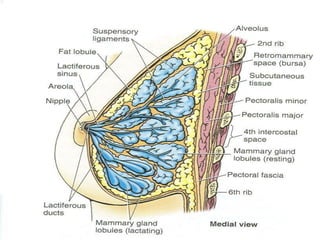
Anatomy of Breast
• Has nipples
• Surrounded by a colored area of skin
“Areola”
• Consist of a system of ducts embedded in
connective tissue
At Puberty
• Gradually enlarge
• Assume their hemispherical shape
• Under the influence of ovarian hormones
• The ducts elongate in size
Extension
• Base extends from 2nd to the 6th ribs
• From lateral margin of sternum to
midaxillary line
• Greater part of a gland lies in superficial
fascia
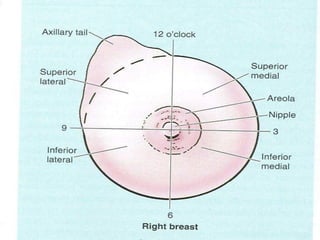
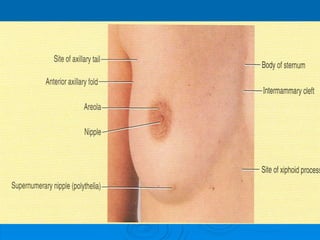
Axillary Tail
• Extends upward and laterally
• Pierces the deep fascia at the lower
border of pectoralis major muscle
• Then enters the axilla
Formation
• Each breast consists of 15-20 lobes which
radiate out from the nipple
• The main duct from each lobe opens
separately on the summit of the nipple
called Ampulla
• Base of nipple is surrounded by AREOLA
• Tiny tubercles on the areola produced by
the underlying areolar glands
Fibrous Septa
• Lobes of the glands are separated by
fibrous septa
• Are well developed in the upper part of the
gland
• Extend from skin to the deep fascia
• Serve as a suspensory ligament
Retromammary Space
These are the connective tissues which
separate the breasts from the deep fascia
covering the underlying muscles
Young & Old
• Breasts tend to protrude forward from a
circular base in young women
• They tend to be pendulous in older women
• They reach their maximum size during
lactation
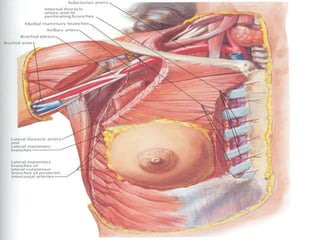
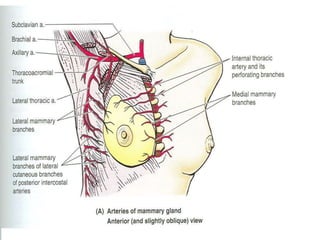
Blood Supply
• Perforating branches of the internal
thoracic artery and the intercostal arteries
• Axillary artery via lateral thoracic and
thoracoacromial branches
Lymph Drainage
• Important clinically because of frequent
development of a cancer
• Subsequent dissemination of the
malignant cells along the lymph vessels to
the lymph nodes
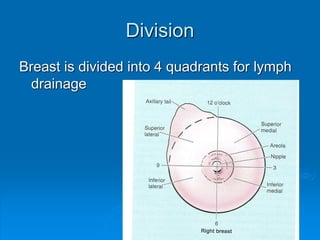
Division
Breast is divided into 4 quadrants for lymph
drainage
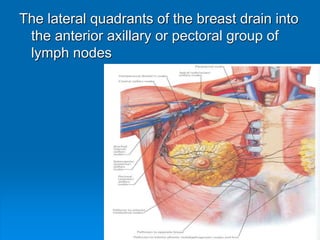
The lateral quadrants of the breast drain into
the anterior axillary or pectoral group of
lymph nodes
The medial quadrants drain by means of
vessels that pierce the intercostal spaces
and enter the internal thoracic group of
nodes
3-Upper Limb breast.pptx

3-Upper Limb breast.pptx

  • 1.
    UPPER LIMB  Introduction Organization  Function By: Dr. Mujahid Khan
  • 5.
    BREAST Introduction: • Breasts arespecialized accessory glands • Secrete milk • Present in both sexes • Similar in males and immature females
  • 6.
    Anatomy of Breast •Has nipples • Surrounded by a colored area of skin “Areola” • Consist of a system of ducts embedded in connective tissue
  • 7.
    At Puberty • Graduallyenlarge • Assume their hemispherical shape • Under the influence of ovarian hormones • The ducts elongate in size
  • 8.
    Extension • Base extendsfrom 2nd to the 6th ribs • From lateral margin of sternum to midaxillary line • Greater part of a gland lies in superficial fascia
  • 9.
    Axillary Tail • Extendsupward and laterally • Pierces the deep fascia at the lower border of pectoralis major muscle • Then enters the axilla
  • 12.
    Formation • Each breastconsists of 15-20 lobes which radiate out from the nipple • The main duct from each lobe opens separately on the summit of the nipple called Ampulla • Base of nipple is surrounded by AREOLA • Tiny tubercles on the areola produced by the underlying areolar glands
  • 14.
    Fibrous Septa • Lobesof the glands are separated by fibrous septa • Are well developed in the upper part of the gland • Extend from skin to the deep fascia • Serve as a suspensory ligament
  • 15.
    Retromammary Space These arethe connective tissues which separate the breasts from the deep fascia covering the underlying muscles
  • 16.
    Young & Old •Breasts tend to protrude forward from a circular base in young women • They tend to be pendulous in older women • They reach their maximum size during lactation
  • 17.
    Blood Supply • Perforatingbranches of the internal thoracic artery and the intercostal arteries • Axillary artery via lateral thoracic and thoracoacromial branches
  • 19.
    Lymph Drainage • Importantclinically because of frequent development of a cancer • Subsequent dissemination of the malignant cells along the lymph vessels to the lymph nodes
  • 20.
    Division Breast is dividedinto 4 quadrants for lymph drainage
  • 21.
    The lateral quadrantsof the breast drain into the anterior axillary or pectoral group of lymph nodes
  • 22.
    The medial quadrantsdrain by means of vessels that pierce the intercostal spaces and enter the internal thoracic group of nodes