Copyright © 2021 PhdAssistance. All rights reserved 1
Stimulus-Organism-Response (SOR) Model
Dr. Nancy Agnes, Head, Technical Operations Phdassistance, info@phdassistance.co
Keyword:
Organism Response (SOR) Model , Stimulus
Organism Response Theory, environmental situation
influence, frameworks Help, Organism-Response ,
Stimulus-Organism-Response
I. INTRODUCTION
Woodworth, (1929) proposed stimulus-organism-model
(S-O-R) as an expansion of Pavlov (2010)'s classic
theory of the stimulus–response mode. The stimulus-
response model was first procedure to understand the
buyer behavior of consumers. The consciousness of the
Buyer depends upon the marketing and environmental
stimuli while purchase decisions are succefully done
with the help of the Buyer's characteristics and decision
process.
II. THREE DIMENSIONS OF EMOTIONAL
RESPONSES
The three dimensions based on the emotional responses
to the environment elaborated by Mehrabian and
Russel (1974):
a. Measuring pleasure regarding the verbal judgments
based on the emotions such as happiness, joy, or
satisfaction level in some scenarios.
b. Arousal can be measured using verbal judgment,
such as the person's happiness level or situation-based
activeness.
c. Dominance can be predicted using the feelings of the
respondent's indication, which is in the form of
willingness to be dominant and based on environmental
situation influence. Based on the three dimensions,
assume that every individual may affect by emotional
conditions by each environment.
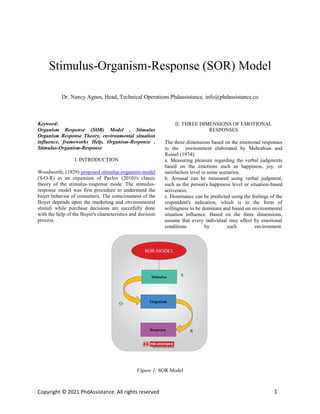
Figure 1: SOR Model
Copyright © 2021 PhdAssistance. All rights reserved 2
In the past decades, stimulus–organism–response
(SOR) model has become one of the most commonly
used frameworks that integrate input, process and
outputs in a single model. To a great extent, this model
helps in understanding the causes behind individual’s
behavior and hence it is applied in addressing human
behavior-related issues. Stimulus-organism-response
(S-O-R) model is generally used to examine the
association between stimulus and response and to
examine how the organisms mediate these
relationships. This is carried out through different
pathways that provoke the cognitive and emotional
states of an individual, which then initiate behavioral
responses (Ul Islam & Rahman, 2017). In this model,
stimuli (S) induce two opposing types of responses (R)
in the user: approach or avoidance. Thus, internal
assessments of individuals (O) of several motions in the
world produce these behaviors. The below figure
represents the SOR model
Also, this model is considered to be best suited for
understanding consumer decisions whether to admit and
adopt or not (response) as it establishes cognitive
appraisal of individuals (stimuli)(apprehensions &
facilitating conditions). However, other models such as
(Technology acceptance model) TAM, unified
technology acceptance and use theory (UTAUT) etc.
are constrained and insufficient in elucidating how a
stimulus initiates attitude and intention of the
consumers (Dzandu et al., 2020). Thus, researchers
have adapted the SOR methodology to incorporate
complex aspects like cognitive and affective
components into the process in their own study settings,
due to its widespread applicability (Kim et al., 2020).
III. CONCLUSION
Researchers have widely embraced and used the
stimulus-organism-response model (S-O-R) to analyse
behaviour in the context of social media engagement
(Ul Islam & Rahman, 2017), mobile auctions (Chen &
Yao, 2018), healthcare (Suess & Mody, 2018), online
hotel booking behaviour (Emir et al., 2016). To
conclude, the S-O-R model
signifies the relation among stimuli in the environment,
emotional states of people and the behavior of approach
or avoidance which arises from the collaboration of
stimuli and emotion.
REFERENCES
Chen, C.-C., & Yao, J.-Y. (2018). What drives impulse
buying behaviors in a mobile auction? The perspective
of the Stimulus-Organism-Response model. Telematics
and Informatics, 35(5), 1249–1262.
https://doi.org/10.1016/j.tele.2018.02.007
Dzandu, M., Pathak, B., & Gulliver, S. (2020).
Stimulus-Organism-Response model for understanding
autonomous vehicle adoption in the UK.
http://centaur.reading.ac.uk/91325/
Emir, A., Halim, H., Hedre, A., Abdullah, D., Azmi, A.,
& Kamal, S. B. M. (2016). Factors influencing online
hotel booking intention: A conceptual framework from
stimulus-organism-response perspective. International
Academic Research Journal of Business and
Technology, 2(2), 129–134.
Kim, M. J., Lee, C.-K., & Jung, T. (2020). Exploring
consumer behavior in virtual reality tourism using an
extended stimulus-organism-response model. Journal of
Travel Research, 59(1), 69–89.
https://journals.sagepub.com/doi/abs/10.1177/00472875
18818915
Mehrabian, & Russell. (1974). An approach to
environmental psychology.
https://psycnet.apa.org/record/1974-22049-000
Pavlov, P. I. (2010). Conditioned reflexes: an
investigation of the physiological activity of the
cerebral cortex. Annals of Neurosciences, 17(3), 136.
https://www.ncbi.nlm.nih.gov/pmc/articles/PMC41169
85/
Suess, C., & Mody, M. (2018). The influence of
hospitable design and service on patient responses. The
Service Industries Journal, 38(1–2), 127–147.
https://doi.org/10.1080/02642069.2017.1385773
Ul Islam, J., & Rahman, Z. (2017). The impact of
online brand community characteristics on customer
engagement: An application of Stimulus-Organism-
Response paradigm. Telematics and Informatics, 34(4),
96–109. https://doi.org/10.1016/j.tele.2017.01.004
Woodworth, R. S. (1929). Psychology (revised edition).
Henry Holt & Co., New York.
https://www.sciencedirect.com/science/article/pii/S019
0740920322052

Stimulus-Organism-Response ( SOR ) Model - Phdassistance

  • 1.
    Copyright © 2021PhdAssistance. All rights reserved 1 Stimulus-Organism-Response (SOR) Model Dr. Nancy Agnes, Head, Technical Operations Phdassistance, info@phdassistance.co Keyword: Organism Response (SOR) Model , Stimulus Organism Response Theory, environmental situation influence, frameworks Help, Organism-Response , Stimulus-Organism-Response I. INTRODUCTION Woodworth, (1929) proposed stimulus-organism-model (S-O-R) as an expansion of Pavlov (2010)'s classic theory of the stimulus–response mode. The stimulus- response model was first procedure to understand the buyer behavior of consumers. The consciousness of the Buyer depends upon the marketing and environmental stimuli while purchase decisions are succefully done with the help of the Buyer's characteristics and decision process. II. THREE DIMENSIONS OF EMOTIONAL RESPONSES The three dimensions based on the emotional responses to the environment elaborated by Mehrabian and Russel (1974): a. Measuring pleasure regarding the verbal judgments based on the emotions such as happiness, joy, or satisfaction level in some scenarios. b. Arousal can be measured using verbal judgment, such as the person's happiness level or situation-based activeness. c. Dominance can be predicted using the feelings of the respondent's indication, which is in the form of willingness to be dominant and based on environmental situation influence. Based on the three dimensions, assume that every individual may affect by emotional conditions by each environment. Figure 1: SOR Model
  • 2.
    Copyright © 2021PhdAssistance. All rights reserved 2 In the past decades, stimulus–organism–response (SOR) model has become one of the most commonly used frameworks that integrate input, process and outputs in a single model. To a great extent, this model helps in understanding the causes behind individual’s behavior and hence it is applied in addressing human behavior-related issues. Stimulus-organism-response (S-O-R) model is generally used to examine the association between stimulus and response and to examine how the organisms mediate these relationships. This is carried out through different pathways that provoke the cognitive and emotional states of an individual, which then initiate behavioral responses (Ul Islam & Rahman, 2017). In this model, stimuli (S) induce two opposing types of responses (R) in the user: approach or avoidance. Thus, internal assessments of individuals (O) of several motions in the world produce these behaviors. The below figure represents the SOR model Also, this model is considered to be best suited for understanding consumer decisions whether to admit and adopt or not (response) as it establishes cognitive appraisal of individuals (stimuli)(apprehensions & facilitating conditions). However, other models such as (Technology acceptance model) TAM, unified technology acceptance and use theory (UTAUT) etc. are constrained and insufficient in elucidating how a stimulus initiates attitude and intention of the consumers (Dzandu et al., 2020). Thus, researchers have adapted the SOR methodology to incorporate complex aspects like cognitive and affective components into the process in their own study settings, due to its widespread applicability (Kim et al., 2020). III. CONCLUSION Researchers have widely embraced and used the stimulus-organism-response model (S-O-R) to analyse behaviour in the context of social media engagement (Ul Islam & Rahman, 2017), mobile auctions (Chen & Yao, 2018), healthcare (Suess & Mody, 2018), online hotel booking behaviour (Emir et al., 2016). To conclude, the S-O-R model signifies the relation among stimuli in the environment, emotional states of people and the behavior of approach or avoidance which arises from the collaboration of stimuli and emotion. REFERENCES Chen, C.-C., & Yao, J.-Y. (2018). What drives impulse buying behaviors in a mobile auction? The perspective of the Stimulus-Organism-Response model. Telematics and Informatics, 35(5), 1249–1262. https://doi.org/10.1016/j.tele.2018.02.007 Dzandu, M., Pathak, B., & Gulliver, S. (2020). Stimulus-Organism-Response model for understanding autonomous vehicle adoption in the UK. http://centaur.reading.ac.uk/91325/ Emir, A., Halim, H., Hedre, A., Abdullah, D., Azmi, A., & Kamal, S. B. M. (2016). Factors influencing online hotel booking intention: A conceptual framework from stimulus-organism-response perspective. International Academic Research Journal of Business and Technology, 2(2), 129–134. Kim, M. J., Lee, C.-K., & Jung, T. (2020). Exploring consumer behavior in virtual reality tourism using an extended stimulus-organism-response model. Journal of Travel Research, 59(1), 69–89. https://journals.sagepub.com/doi/abs/10.1177/00472875 18818915 Mehrabian, & Russell. (1974). An approach to environmental psychology. https://psycnet.apa.org/record/1974-22049-000 Pavlov, P. I. (2010). Conditioned reflexes: an investigation of the physiological activity of the cerebral cortex. Annals of Neurosciences, 17(3), 136. https://www.ncbi.nlm.nih.gov/pmc/articles/PMC41169 85/ Suess, C., & Mody, M. (2018). The influence of hospitable design and service on patient responses. The Service Industries Journal, 38(1–2), 127–147. https://doi.org/10.1080/02642069.2017.1385773 Ul Islam, J., & Rahman, Z. (2017). The impact of online brand community characteristics on customer engagement: An application of Stimulus-Organism- Response paradigm. Telematics and Informatics, 34(4), 96–109. https://doi.org/10.1016/j.tele.2017.01.004 Woodworth, R. S. (1929). Psychology (revised edition). Henry Holt & Co., New York. https://www.sciencedirect.com/science/article/pii/S019 0740920322052