



1
Wonsup Lee1,2, Baekhee Lee2, Sungho Kim2, Hayoung Jung2,
Eunjin Jeon2, Teukgyu Choi3, and Heecheon You2
1 Faculty of Industrial Design Engineering, Delft University of Technology
2 Department of Industrial and Management Engineering,
Pohang University of Science and Technology (POSTECH), South Korea
3 Humanopia Inc., Pohang, Korea
2
Contents
3
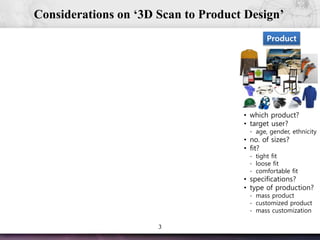
Considerations on ‘3D Scan to Product Design’
Product
• which product?
• target user?
- age, gender, ethnicity
• no. of sizes?
• fit?
- tight fit
- loose fit
- comfortable fit
• specifications?
• type of production?
- mass product
- customized product
- mass customization
4
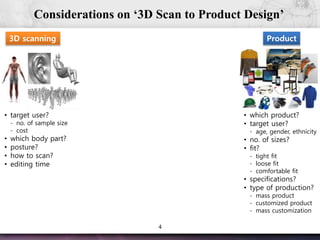
Considerations on ‘3D Scan to Product Design’
3D scanning
• target user?
- no. of sample size
- cost
• which body part?
• posture?
• how to scan?
• editing time
Product
• which product?
• target user?
- age, gender, ethnicity
• no. of sizes?
• fit?
- tight fit
- loose fit
- comfortable fit
• specifications?
• type of production?
- mass product
- customized product
- mass customization
5
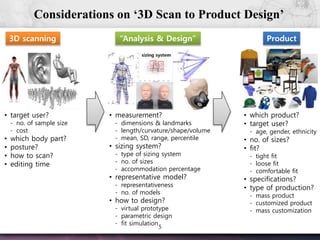
Considerations on ‘3D Scan to Product Design’
3D scanning
• target user?
- no. of sample size
- cost
• which body part?
• posture?
• how to scan?
• editing time
“Analysis & Design”
• measurement?
- dimensions & landmarks
- length/curvature/shape/volume
- mean, SD, range, percentile
• sizing system?
- type of sizing system
- no. of sizes
- accommodation percentage
• representative model?
- representativeness
- no. of models
• how to design?
- virtual prototype
- parametric design
- fit simulation
Product
• which product?
• target user?
- age, gender, ethnicity
• no. of sizes?
• fit?
- tight fit
- loose fit
- comfortable fit
• specifications?
• type of production?
- mass product
- customized product
- mass customization
6
N95 mask
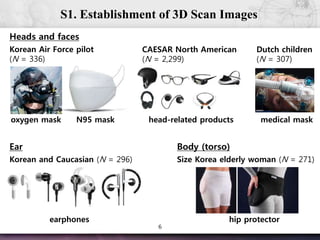
S1. Establishment of 3D Scan Images
Heads and faces
Korean Air Force pilot
(N = 336)
CAESAR North American
(N = 2,299)
Ear
Korean and Caucasian (N = 296)
Body (torso)
Size Korea elderly woman (N = 271)
oxygen mask head-related products
Dutch children
(N = 307)
medical mask
earphones hip protector
7
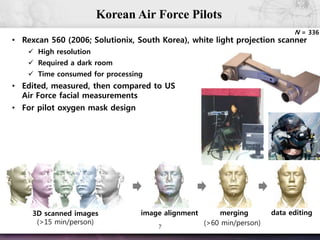
Korean Air Force Pilots
N = 336
• Rexcan 560 (2006; Solutionix, South Korea), white light projection scanner
 High resolution
 Required a dark room
 Time consumed for processing
• Edited, measured, then compared to US
Air Force facial measurements
• For pilot oxygen mask design
3D scanned images
(>15 min/person)
image alignment merging data editing
(>60 min/person)
8
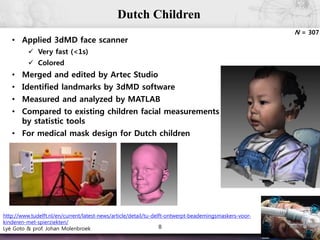
Dutch Children
N = 307
• Applied 3dMD face scanner
 Very fast (<1s)
 Colored
• Merged and edited by Artec Studio
• Identified landmarks by 3dMD software
• Measured and analyzed by MATLAB
• Compared to existing children facial measurements
by statistic tools
• For medical mask design for Dutch children
http://www.tudelft.nl/en/current/latest-news/article/detail/tu-delft-ontwerpt-beademingsmaskers-voor-
kinderen-met-spierziekten/
Lyè Goto & prof. Johan Molenbroek
9
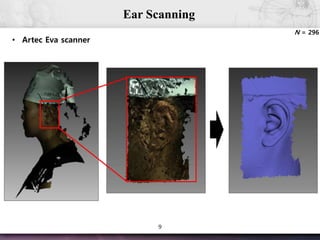
Ear Scanning
• Artec Eva scanner
N = 296
10
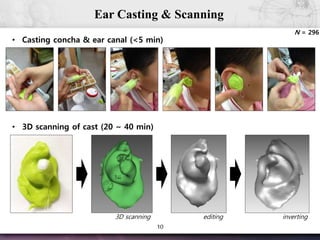
Ear Casting & Scanning
• Casting concha & ear canal (<5 min)
• 3D scanning of cast (20 ~ 40 min)
invertingediting3D scanning
N = 296
11
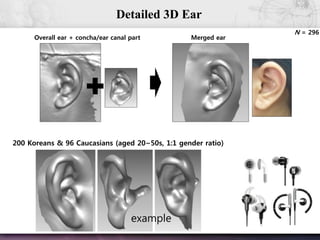
Detailed 3D Ear
N = 296
Overall ear + concha/ear canal part Merged ear
200 Koreans & 96 Caucasians (aged 20~50s, 1:1 gender ratio)
example
12
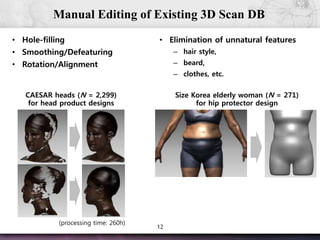
Manual Editing of Existing 3D Scan DB
CAESAR heads (N = 2,299)
for head product designs
(processing time: 260h)
Size Korea elderly woman (N = 271)
for hip protector design
• Hole-filling
• Smoothing/Defeaturing
• Rotation/Alignment
• Elimination of unnatural features
– hair style,
– beard,
– clothes, etc.
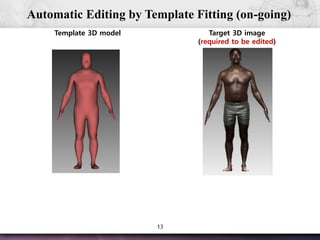
13
Target 3D image
(required to be edited)
Automatic Editing by Template Fitting (on-going)
Template 3D model
14
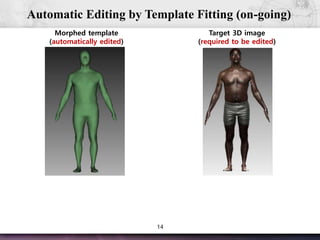
Target 3D image
(required to be edited)
Automatic Editing by Template Fitting (on-going)
Morphed template
(automatically edited)
15
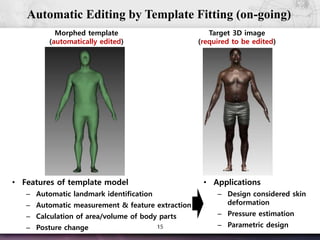
Target 3D image
(required to be edited)
Morphed template
(automatically edited)
Automatic Editing by Template Fitting (on-going)
• Features of template model
– Automatic landmark identification
– Automatic measurement & feature extraction
– Calculation of area/volume of body parts
– Posture change
• Applications
– Design considered skin
deformation
– Pressure estimation
– Parametric design
16
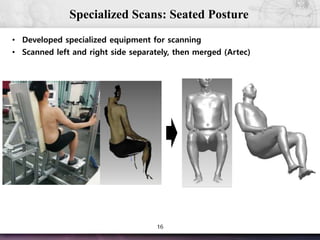
Specialized Scans: Seated Posture
• Developed specialized equipment for scanning
• Scanned left and right side separately, then merged (Artec)
17
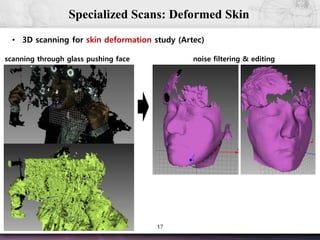
Specialized Scans: Deformed Skin
scanning through glass pushing face noise filtering & editing
• 3D scanning for skin deformation study (Artec)
18
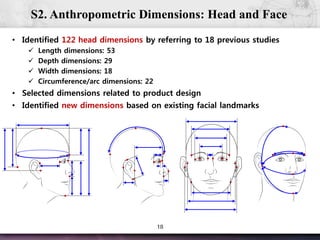
S2. Anthropometric Dimensions: Head and Face
• Identified 122 head dimensions by referring to 18 previous studies
 Length dimensions: 53
 Depth dimensions: 29
 Width dimensions: 18
 Circumference/arc dimensions: 22
• Selected dimensions related to product design
• Identified new dimensions based on existing facial landmarks
19
head breadth
head circumference
glabella-vertex-occiput arc
head length
bitragion-vertex arc
glabella to
vertex
length
tragion to vertex length
superior auricle to vertex length
Inferior auricle to vertex length
ear breadth
glabella to tragion length
ear length
bitragion-glabella arc
inion to
vertex length
bitragion-inion arc
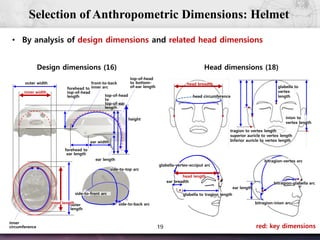
Selection of Anthropometric Dimensions: Helmet
Design dimensions (16) Head dimensions (18)
outer width
top-of-head
to
top-of-ear
length
outer
length
inner width
height
forehead to
top-of-head
length
ear width
forehead to
ear length
ear length
side-to-back arcinner length
inner
circumference
front-to-back
inner arc
top-of-head
to bottom-
of-ear length
side-to-top arc
side-to-front arc
red: key dimensions
• By analysis of design dimensions and related head dimensions
20
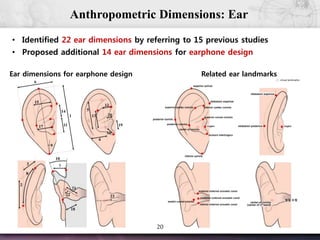
Anthropometric Dimensions: Ear
• Identified 22 ear dimensions by referring to 15 previous studies
• Proposed additional 14 ear dimensions for earphone design
Ear dimensions for earphone design Related ear landmarks
21
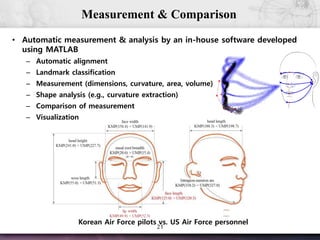
Measurement & Comparison
• Automatic measurement & analysis by an in-house software developed
using MATLAB
– Automatic alignment
– Landmark classification
– Measurement (dimensions, curvature, area, volume)
– Shape analysis (e.g., curvature extraction)
– Comparison of measurement
– Visualization
Korean Air Force pilots vs. US Air Force personnel
22
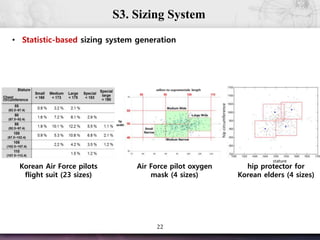
S3. Sizing System
Korean Air Force pilots
flight suit (23 sizes)
Air Force pilot oxygen
mask (4 sizes)
hip protector for
Korean elders (4 sizes)
• Statistic-based sizing system generation
23
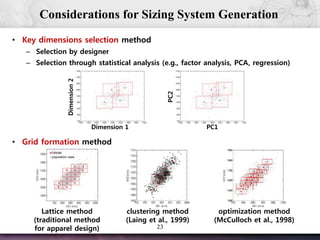
Considerations for Sizing System Generation
• Key dimensions selection method
– Selection by designer
– Selection through statistical analysis (e.g., factor analysis, PCA, regression)
• Grid formation method
DRHM
population case
Lattice method
(traditional method
for apparel design)
optimization method
(McCulloch et al., 1998)
clustering method
(Laing et al., 1999)
Dimension 1
Dimension2
PC1
PC2
24
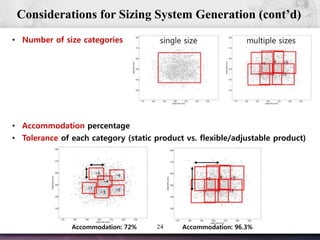
Considerations for Sizing System Generation (cont’d)
• Number of size categories
• Accommodation percentage
• Tolerance of each category (static product vs. flexible/adjustable product)
Accommodation: 96.3%Accommodation: 72%
single size multiple sizes
25
Computerized Program for Sizing System Analysis
• To make statistical analyses easy and simple
(planned to be commercialized)
26
Development of
3D Anthropometric Sizing Analysis System
• Simplified version of sizing analysis program for designers in SAMSUNG
• Based on CAESAR head measurements
27
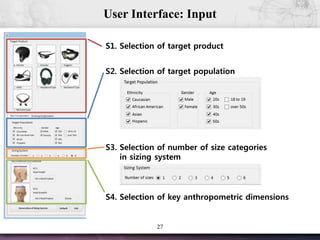
User Interface: Input
S1. Selection of target product
S2. Selection of target population
S3. Selection of number of size categories
in sizing system
S4. Selection of key anthropometric dimensions
28
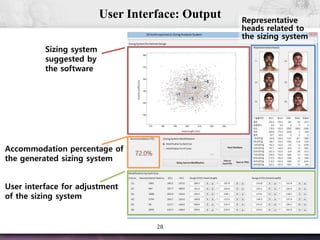
User Interface: Output
Sizing system
suggested by
the software
Accommodation percentage of
the generated sizing system
Representative
heads related to
the sizing system
User interface for adjustment
of the sizing system
29
stature
Hipcircumference
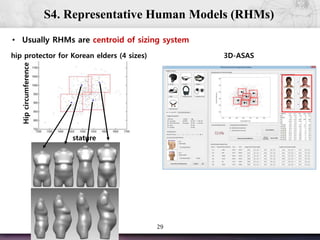
S4. Representative Human Models (RHMs)
3D-ASAS
• Usually RHMs are centroid of sizing system
hip protector for Korean elders (4 sizes)
30
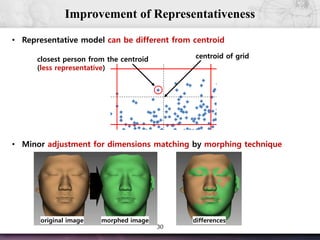
Improvement of Representativeness
closest person from the centroid
(less representative)
centroid of grid
• Representative model can be different from centroid
• Minor adjustment for dimensions matching by morphing technique
original image morphed image differences
31
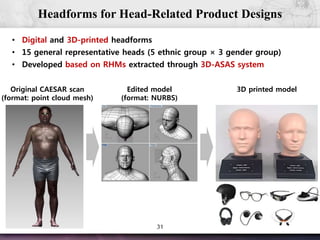
Headforms for Head-Related Product Designs
• Digital and 3D-printed headforms
• 15 general representative heads (5 ethnic group × 3 gender group)
• Developed based on RHMs extracted through 3D-ASAS system
Original CAESAR scan
(format: point cloud mesh)
Edited model
(format: NURBS)
3D printed model
32
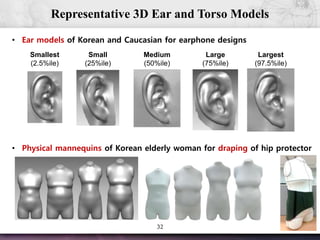
Representative 3D Ear and Torso Models
Medium
(50%ile)
Smallest
(2.5%ile)
Largest
(97.5%ile)
Small
(25%ile)
Large
(75%ile)
• Ear models of Korean and Caucasian for earphone designs
• Physical mannequins of Korean elderly woman for draping of hip protector
33
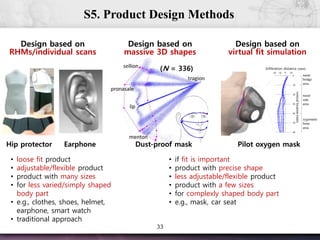
S5. Product Design Methods
Design based on
RHMs/individual scans
Hip protector
Design based on
massive 3D shapes
(N = 336)
Dust-proof mask
Design based on
virtual fit simulation
0
20
40
60
80
100
-10010
infiltration distance (mm)
verticallocation(mm)
0
10
20
30
40
50
60
-20 -10 0 10
Infiltration distance (mm)
verticallocation(mm)
nasal
bridge
area
nasal
side
area
zygomatic
bone
area
20 10 -10
Pilot oxygen mask
• loose fit product
• adjustable/flexible product
• product with many sizes
• for less varied/simply shaped
body part
• e.g., clothes, shoes, helmet,
earphone, smart watch
• traditional approach
• if fit is important
• product with precise shape
• less adjustable/flexible product
• product with a few sizes
• for complexly shaped body part
• e.g., mask, car seat
Earphone
34
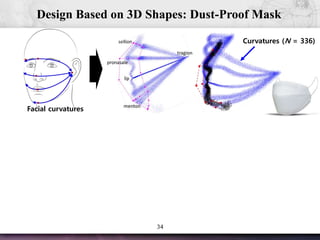
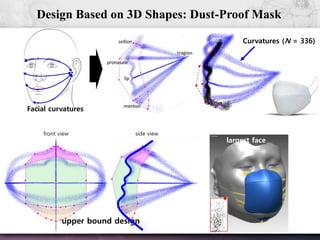
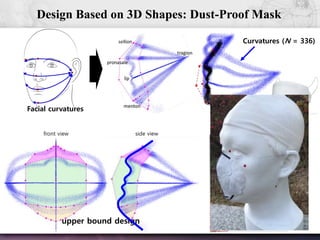
Design Based on 3D Shapes: Dust-Proof Mask
Curvatures (N = 336)
Facial curvatures
35
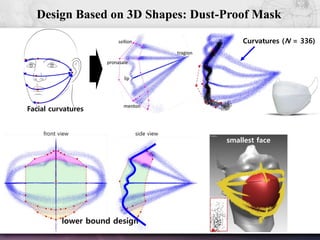
Design Based on 3D Shapes: Dust-Proof Mask
Curvatures (N = 336)
lower bound design
smallest face
Facial curvatures
36
Design Based on 3D Shapes: Dust-Proof Mask
Curvatures (N = 336)
lower bound design
smallest face
upper bound design
largest face
Facial curvatures
37
Design Based on 3D Shapes: Dust-Proof Mask
Curvatures (N = 336)
lower bound design
smallest face
upper bound design
largest face
Facial curvatures
38
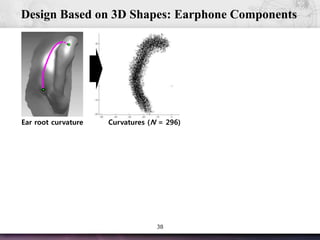
Design Based on 3D Shapes: Earphone Components
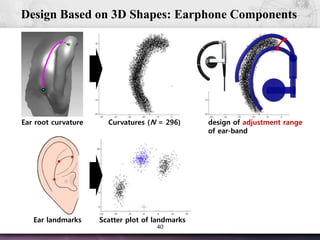
Ear root curvature Curvatures (N = 296)
39
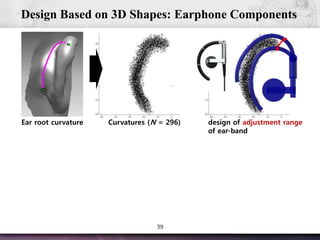
Design Based on 3D Shapes: Earphone Components
Ear root curvature design of adjustment range
of ear-band
Curvatures (N = 296)
40
Scatter plot of landmarksEar landmarks
Design Based on 3D Shapes: Earphone Components
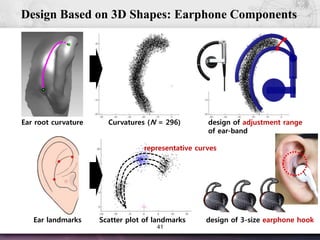
Ear root curvature design of adjustment range
of ear-band
Curvatures (N = 296)
41
Scatter plot of landmarksEar landmarks
Design Based on 3D Shapes: Earphone Components
Ear root curvature design of adjustment range
of ear-band
Curvatures (N = 296)
design of 3-size earphone hook
representative curves
42
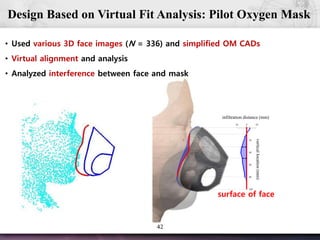
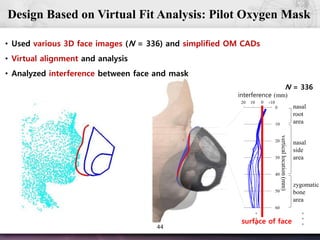
Design Based on Virtual Fit Analysis: Pilot Oxygen Mask
0
20
40
60
80
100
-10010
infiltration distance (mm)
verticallocation(mm)
surface of face
• Used various 3D face images (N = 336) and simplified OM CADs
• Virtual alignment and analysis
• Analyzed interference between face and mask
43
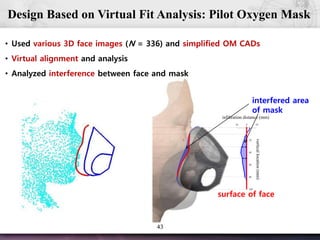
Design Based on Virtual Fit Analysis: Pilot Oxygen Mask
0
20
40
60
80
100
-10010
infiltration distance (mm)
verticallocation(mm)
surface of face
• Used various 3D face images (N = 336) and simplified OM CADs
• Virtual alignment and analysis
• Analyzed interference between face and mask
interfered area
of mask
44
Design Based on Virtual Fit Analysis: Pilot Oxygen Mask
0
20
40
60
80
100
-10010
infiltration distance (mm)
verticallocation(mm)
• Used various 3D face images (N = 336) and simplified OM CADs
• Virtual alignment and analysis
• Analyzed interference between face and mask
0
10
20
30
40
50
60
-20 -10 0 10
interference (mm)
verticallocation(mm)
nasal
root
area
nasal
side
area
zygomatic
bone
area
20 10 -10
surface of face
N = 336
45
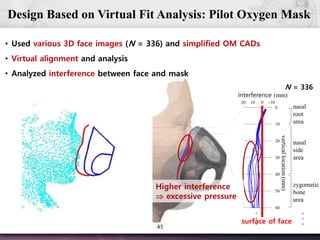
Design Based on Virtual Fit Analysis: Pilot Oxygen Mask
0
20
40
60
80
100
-10010
infiltration distance (mm)
verticallocation(mm)
• Used various 3D face images (N = 336) and simplified OM CADs
• Virtual alignment and analysis
• Analyzed interference between face and mask
0
10
20
30
40
50
60
-20 -10 0 10
interference (mm)
verticallocation(mm)
nasal
root
area
nasal
side
area
zygomatic
bone
area
20 10 -10
surface of face
N = 336
Higher interference
 excessive pressure
46
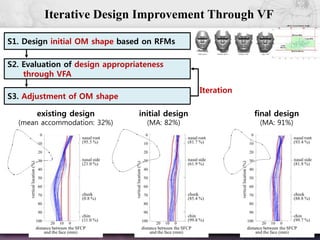
Iterative Design Improvement Through VF
S3. Adjustment of OM shape
Iteration
S2. Evaluation of design appropriateness
through VFA
S1. Design initial OM shape based on RFMs
existing design
(mean accommodation: 32%)
initial design
(MA: 82%)
final design
(MA: 91%)
47
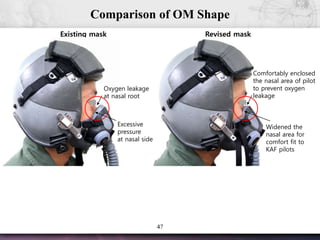
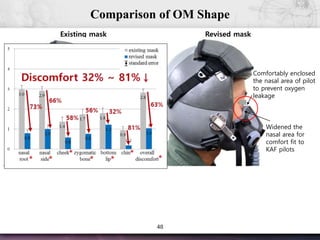
Comparison of OM Shape
Existing mask Revised mask
Excessive
pressure
at nasal side
Oxygen leakage
at nasal root
Widened the
nasal area for
comfort fit to
KAF pilots
Comfortably enclosed
the nasal area of pilot
to prevent oxygen
leakage
48
Comparison of OM Shape
Existing mask Revised mask
Excessive
pressure
at nasal side
Oxygen leakage
at nasal root
Widened the
nasal area for
comfort fit to
KAF pilots
Comfortably enclosed
the nasal area of pilot
to prevent oxygen
leakage
49
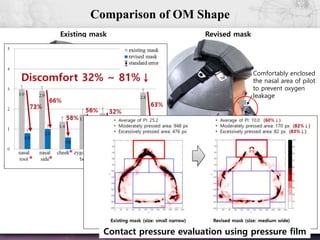
Comparison of OM Shape
Existing mask Revised mask
Excessive
pressure
at nasal side
Oxygen leakage
at nasal root
Widened the
nasal area for
comfort fit to
KAF pilots
Comfortably enclosed
the nasal area of pilot
to prevent oxygen
leakage
Contact pressure evaluation using pressure film
50
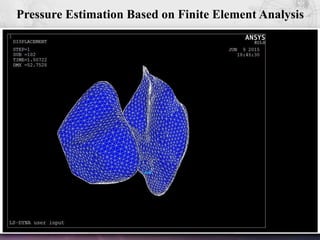
Pressure Estimation Based on Finite Element Analysis
51
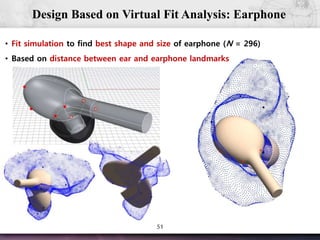
Design Based on Virtual Fit Analysis: Earphone
• Fit simulation to find best shape and size of earphone (N = 296)
• Based on distance between ear and earphone landmarks
52
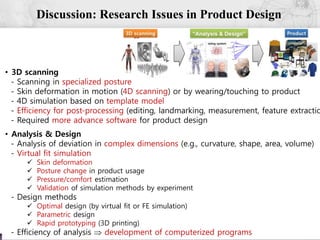
Discussion: Research Issues in Product Design
• 3D scanning
- Scanning in specialized posture
- Skin deformation in motion (4D scanning) or by wearing/touching to product
- 4D simulation based on template model
- Efficiency for post-processing (editing, landmarking, measurement, feature extractio
- Required more advance software for product design
• Analysis & Design
- Analysis of deviation in complex dimensions (e.g., curvature, shape, area, volume)
- Virtual fit simulation
 Skin deformation
 Posture change in product usage
 Pressure/comfort estimation
 Validation of simulation methods by experiment
- Design methods
 Optimal design (by virtual fit or FE simulation)
 Parametric design
 Rapid prototyping (3D printing)
- Efficiency of analysis  development of computerized programs
53
Discussion: Development of Computerized Systems
• For easy and convenient analyses to product designers
Computerized programs for sizing system and RHMs analyses
• Virtual fit analysis
• Pressure estimation
• Comfort estimation
• Parametric design
54
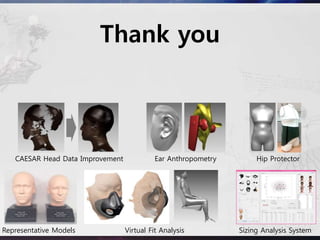
Thank you
Sizing Analysis SystemVirtual Fit AnalysisRepresentative Models
Ear AnthropometryCAESAR Head Data Improvement Hip Protector

3D Scan to Product Design: Methods, Techniques, and Cases

  • 1.
    1 Wonsup Lee1,2, BaekheeLee2, Sungho Kim2, Hayoung Jung2, Eunjin Jeon2, Teukgyu Choi3, and Heecheon You2 1 Faculty of Industrial Design Engineering, Delft University of Technology 2 Department of Industrial and Management Engineering, Pohang University of Science and Technology (POSTECH), South Korea 3 Humanopia Inc., Pohang, Korea
  • 2.
  • 3.
    3 Considerations on ‘3DScan to Product Design’ Product • which product? • target user? - age, gender, ethnicity • no. of sizes? • fit? - tight fit - loose fit - comfortable fit • specifications? • type of production? - mass product - customized product - mass customization
  • 4.
    4 Considerations on ‘3DScan to Product Design’ 3D scanning • target user? - no. of sample size - cost • which body part? • posture? • how to scan? • editing time Product • which product? • target user? - age, gender, ethnicity • no. of sizes? • fit? - tight fit - loose fit - comfortable fit • specifications? • type of production? - mass product - customized product - mass customization
  • 5.
    5 Considerations on ‘3DScan to Product Design’ 3D scanning • target user? - no. of sample size - cost • which body part? • posture? • how to scan? • editing time “Analysis & Design” • measurement? - dimensions & landmarks - length/curvature/shape/volume - mean, SD, range, percentile • sizing system? - type of sizing system - no. of sizes - accommodation percentage • representative model? - representativeness - no. of models • how to design? - virtual prototype - parametric design - fit simulation Product • which product? • target user? - age, gender, ethnicity • no. of sizes? • fit? - tight fit - loose fit - comfortable fit • specifications? • type of production? - mass product - customized product - mass customization
  • 6.
    6 N95 mask S1. Establishmentof 3D Scan Images Heads and faces Korean Air Force pilot (N = 336) CAESAR North American (N = 2,299) Ear Korean and Caucasian (N = 296) Body (torso) Size Korea elderly woman (N = 271) oxygen mask head-related products Dutch children (N = 307) medical mask earphones hip protector
  • 7.
    7 Korean Air ForcePilots N = 336 • Rexcan 560 (2006; Solutionix, South Korea), white light projection scanner  High resolution  Required a dark room  Time consumed for processing • Edited, measured, then compared to US Air Force facial measurements • For pilot oxygen mask design 3D scanned images (>15 min/person) image alignment merging data editing (>60 min/person)
  • 8.
    8 Dutch Children N =307 • Applied 3dMD face scanner  Very fast (<1s)  Colored • Merged and edited by Artec Studio • Identified landmarks by 3dMD software • Measured and analyzed by MATLAB • Compared to existing children facial measurements by statistic tools • For medical mask design for Dutch children http://www.tudelft.nl/en/current/latest-news/article/detail/tu-delft-ontwerpt-beademingsmaskers-voor- kinderen-met-spierziekten/ Lyè Goto & prof. Johan Molenbroek
  • 9.
    9 Ear Scanning • ArtecEva scanner N = 296
  • 10.
    10 Ear Casting &Scanning • Casting concha & ear canal (<5 min) • 3D scanning of cast (20 ~ 40 min) invertingediting3D scanning N = 296
  • 11.
    11 Detailed 3D Ear N= 296 Overall ear + concha/ear canal part Merged ear 200 Koreans & 96 Caucasians (aged 20~50s, 1:1 gender ratio) example
  • 12.
    12 Manual Editing ofExisting 3D Scan DB CAESAR heads (N = 2,299) for head product designs (processing time: 260h) Size Korea elderly woman (N = 271) for hip protector design • Hole-filling • Smoothing/Defeaturing • Rotation/Alignment • Elimination of unnatural features – hair style, – beard, – clothes, etc.
  • 13.
    13 Target 3D image (requiredto be edited) Automatic Editing by Template Fitting (on-going) Template 3D model
  • 14.
    14 Target 3D image (requiredto be edited) Automatic Editing by Template Fitting (on-going) Morphed template (automatically edited)
  • 15.
    15 Target 3D image (requiredto be edited) Morphed template (automatically edited) Automatic Editing by Template Fitting (on-going) • Features of template model – Automatic landmark identification – Automatic measurement & feature extraction – Calculation of area/volume of body parts – Posture change • Applications – Design considered skin deformation – Pressure estimation – Parametric design
  • 16.
    16 Specialized Scans: SeatedPosture • Developed specialized equipment for scanning • Scanned left and right side separately, then merged (Artec)
  • 17.
    17 Specialized Scans: DeformedSkin scanning through glass pushing face noise filtering & editing • 3D scanning for skin deformation study (Artec)
  • 18.
    18 S2. Anthropometric Dimensions:Head and Face • Identified 122 head dimensions by referring to 18 previous studies  Length dimensions: 53  Depth dimensions: 29  Width dimensions: 18  Circumference/arc dimensions: 22 • Selected dimensions related to product design • Identified new dimensions based on existing facial landmarks
  • 19.
    19 head breadth head circumference glabella-vertex-occiputarc head length bitragion-vertex arc glabella to vertex length tragion to vertex length superior auricle to vertex length Inferior auricle to vertex length ear breadth glabella to tragion length ear length bitragion-glabella arc inion to vertex length bitragion-inion arc Selection of Anthropometric Dimensions: Helmet Design dimensions (16) Head dimensions (18) outer width top-of-head to top-of-ear length outer length inner width height forehead to top-of-head length ear width forehead to ear length ear length side-to-back arcinner length inner circumference front-to-back inner arc top-of-head to bottom- of-ear length side-to-top arc side-to-front arc red: key dimensions • By analysis of design dimensions and related head dimensions
  • 20.
    20 Anthropometric Dimensions: Ear •Identified 22 ear dimensions by referring to 15 previous studies • Proposed additional 14 ear dimensions for earphone design Ear dimensions for earphone design Related ear landmarks
  • 21.
    21 Measurement & Comparison •Automatic measurement & analysis by an in-house software developed using MATLAB – Automatic alignment – Landmark classification – Measurement (dimensions, curvature, area, volume) – Shape analysis (e.g., curvature extraction) – Comparison of measurement – Visualization Korean Air Force pilots vs. US Air Force personnel
  • 22.
    22 S3. Sizing System KoreanAir Force pilots flight suit (23 sizes) Air Force pilot oxygen mask (4 sizes) hip protector for Korean elders (4 sizes) • Statistic-based sizing system generation
  • 23.
    23 Considerations for SizingSystem Generation • Key dimensions selection method – Selection by designer – Selection through statistical analysis (e.g., factor analysis, PCA, regression) • Grid formation method DRHM population case Lattice method (traditional method for apparel design) optimization method (McCulloch et al., 1998) clustering method (Laing et al., 1999) Dimension 1 Dimension2 PC1 PC2
  • 24.
    24 Considerations for SizingSystem Generation (cont’d) • Number of size categories • Accommodation percentage • Tolerance of each category (static product vs. flexible/adjustable product) Accommodation: 96.3%Accommodation: 72% single size multiple sizes
  • 25.
    25 Computerized Program forSizing System Analysis • To make statistical analyses easy and simple (planned to be commercialized)
  • 26.
    26 Development of 3D AnthropometricSizing Analysis System • Simplified version of sizing analysis program for designers in SAMSUNG • Based on CAESAR head measurements
  • 27.
    27 User Interface: Input S1.Selection of target product S2. Selection of target population S3. Selection of number of size categories in sizing system S4. Selection of key anthropometric dimensions
  • 28.
    28 User Interface: Output Sizingsystem suggested by the software Accommodation percentage of the generated sizing system Representative heads related to the sizing system User interface for adjustment of the sizing system
  • 29.
    29 stature Hipcircumference S4. Representative HumanModels (RHMs) 3D-ASAS • Usually RHMs are centroid of sizing system hip protector for Korean elders (4 sizes)
  • 30.
    30 Improvement of Representativeness closestperson from the centroid (less representative) centroid of grid • Representative model can be different from centroid • Minor adjustment for dimensions matching by morphing technique original image morphed image differences
  • 31.
    31 Headforms for Head-RelatedProduct Designs • Digital and 3D-printed headforms • 15 general representative heads (5 ethnic group × 3 gender group) • Developed based on RHMs extracted through 3D-ASAS system Original CAESAR scan (format: point cloud mesh) Edited model (format: NURBS) 3D printed model
  • 32.
    32 Representative 3D Earand Torso Models Medium (50%ile) Smallest (2.5%ile) Largest (97.5%ile) Small (25%ile) Large (75%ile) • Ear models of Korean and Caucasian for earphone designs • Physical mannequins of Korean elderly woman for draping of hip protector
  • 33.
    33 S5. Product DesignMethods Design based on RHMs/individual scans Hip protector Design based on massive 3D shapes (N = 336) Dust-proof mask Design based on virtual fit simulation 0 20 40 60 80 100 -10010 infiltration distance (mm) verticallocation(mm) 0 10 20 30 40 50 60 -20 -10 0 10 Infiltration distance (mm) verticallocation(mm) nasal bridge area nasal side area zygomatic bone area 20 10 -10 Pilot oxygen mask • loose fit product • adjustable/flexible product • product with many sizes • for less varied/simply shaped body part • e.g., clothes, shoes, helmet, earphone, smart watch • traditional approach • if fit is important • product with precise shape • less adjustable/flexible product • product with a few sizes • for complexly shaped body part • e.g., mask, car seat Earphone
  • 34.
    34 Design Based on3D Shapes: Dust-Proof Mask Curvatures (N = 336) Facial curvatures
  • 35.
    35 Design Based on3D Shapes: Dust-Proof Mask Curvatures (N = 336) lower bound design smallest face Facial curvatures
  • 36.
    36 Design Based on3D Shapes: Dust-Proof Mask Curvatures (N = 336) lower bound design smallest face upper bound design largest face Facial curvatures
  • 37.
    37 Design Based on3D Shapes: Dust-Proof Mask Curvatures (N = 336) lower bound design smallest face upper bound design largest face Facial curvatures
  • 38.
    38 Design Based on3D Shapes: Earphone Components Ear root curvature Curvatures (N = 296)
  • 39.
    39 Design Based on3D Shapes: Earphone Components Ear root curvature design of adjustment range of ear-band Curvatures (N = 296)
  • 40.
    40 Scatter plot oflandmarksEar landmarks Design Based on 3D Shapes: Earphone Components Ear root curvature design of adjustment range of ear-band Curvatures (N = 296)
  • 41.
    41 Scatter plot oflandmarksEar landmarks Design Based on 3D Shapes: Earphone Components Ear root curvature design of adjustment range of ear-band Curvatures (N = 296) design of 3-size earphone hook representative curves
  • 42.
    42 Design Based onVirtual Fit Analysis: Pilot Oxygen Mask 0 20 40 60 80 100 -10010 infiltration distance (mm) verticallocation(mm) surface of face • Used various 3D face images (N = 336) and simplified OM CADs • Virtual alignment and analysis • Analyzed interference between face and mask
  • 43.
    43 Design Based onVirtual Fit Analysis: Pilot Oxygen Mask 0 20 40 60 80 100 -10010 infiltration distance (mm) verticallocation(mm) surface of face • Used various 3D face images (N = 336) and simplified OM CADs • Virtual alignment and analysis • Analyzed interference between face and mask interfered area of mask
  • 44.
    44 Design Based onVirtual Fit Analysis: Pilot Oxygen Mask 0 20 40 60 80 100 -10010 infiltration distance (mm) verticallocation(mm) • Used various 3D face images (N = 336) and simplified OM CADs • Virtual alignment and analysis • Analyzed interference between face and mask 0 10 20 30 40 50 60 -20 -10 0 10 interference (mm) verticallocation(mm) nasal root area nasal side area zygomatic bone area 20 10 -10 surface of face N = 336
  • 45.
    45 Design Based onVirtual Fit Analysis: Pilot Oxygen Mask 0 20 40 60 80 100 -10010 infiltration distance (mm) verticallocation(mm) • Used various 3D face images (N = 336) and simplified OM CADs • Virtual alignment and analysis • Analyzed interference between face and mask 0 10 20 30 40 50 60 -20 -10 0 10 interference (mm) verticallocation(mm) nasal root area nasal side area zygomatic bone area 20 10 -10 surface of face N = 336 Higher interference  excessive pressure
  • 46.
    46 Iterative Design ImprovementThrough VF S3. Adjustment of OM shape Iteration S2. Evaluation of design appropriateness through VFA S1. Design initial OM shape based on RFMs existing design (mean accommodation: 32%) initial design (MA: 82%) final design (MA: 91%)
  • 47.
    47 Comparison of OMShape Existing mask Revised mask Excessive pressure at nasal side Oxygen leakage at nasal root Widened the nasal area for comfort fit to KAF pilots Comfortably enclosed the nasal area of pilot to prevent oxygen leakage
  • 48.
    48 Comparison of OMShape Existing mask Revised mask Excessive pressure at nasal side Oxygen leakage at nasal root Widened the nasal area for comfort fit to KAF pilots Comfortably enclosed the nasal area of pilot to prevent oxygen leakage
  • 49.
    49 Comparison of OMShape Existing mask Revised mask Excessive pressure at nasal side Oxygen leakage at nasal root Widened the nasal area for comfort fit to KAF pilots Comfortably enclosed the nasal area of pilot to prevent oxygen leakage Contact pressure evaluation using pressure film
  • 50.
    50 Pressure Estimation Basedon Finite Element Analysis
  • 51.
    51 Design Based onVirtual Fit Analysis: Earphone • Fit simulation to find best shape and size of earphone (N = 296) • Based on distance between ear and earphone landmarks
  • 52.
    52 Discussion: Research Issuesin Product Design • 3D scanning - Scanning in specialized posture - Skin deformation in motion (4D scanning) or by wearing/touching to product - 4D simulation based on template model - Efficiency for post-processing (editing, landmarking, measurement, feature extractio - Required more advance software for product design • Analysis & Design - Analysis of deviation in complex dimensions (e.g., curvature, shape, area, volume) - Virtual fit simulation  Skin deformation  Posture change in product usage  Pressure/comfort estimation  Validation of simulation methods by experiment - Design methods  Optimal design (by virtual fit or FE simulation)  Parametric design  Rapid prototyping (3D printing) - Efficiency of analysis  development of computerized programs
  • 53.
    53 Discussion: Development ofComputerized Systems • For easy and convenient analyses to product designers Computerized programs for sizing system and RHMs analyses • Virtual fit analysis • Pressure estimation • Comfort estimation • Parametric design
  • 54.
    54 Thank you Sizing AnalysisSystemVirtual Fit AnalysisRepresentative Models Ear AnthropometryCAESAR Head Data Improvement Hip Protector