HMIS: Ask the Expert
Michelle Hayes, The Cloudburst Group
 Kat Freeman, The Cloudburst Group


                         Focusing Energy on Results
Structure of Session
• Brief overview of HMIS
• Questions and Answers
• Resources
What is HMIS?

• A Homeless Management Information System
  (HMIS) is a locally administered, electronic data
  collection system that stores longitudinal
  person-level information about persons who
  access the homeless service system in a
  Continuum of Care.


                                                  3
Why is HMIS Required?
• HMIS is HUD’s response to a
  Congressional Directive to capture better
  data on homelessness.
• The American Recovery and Reinvestment
  Act of 2009 authorized HMIS as the
  primary tool for data collection and
  reporting for the HPRP program.
• HEARTH Act also requires participation
  in HMIS.
Why is HMIS Important?
• Every Continuum of Care (CoC) is required to
  implement an HMIS and is scored annually in the
  CoC NOFA.
• Local HMIS data is critical for:
   – SHP Annual Performance Report (APR)
   – Annual Homeless Assessment Report (AHAR)
   – HPRP Quarterly (QPR) and Annual Performance Report
     (APR)
   – Homeless Pulse
   – Projects for Assistance in Transition for Homelessness
     (PATH)
                                                          5
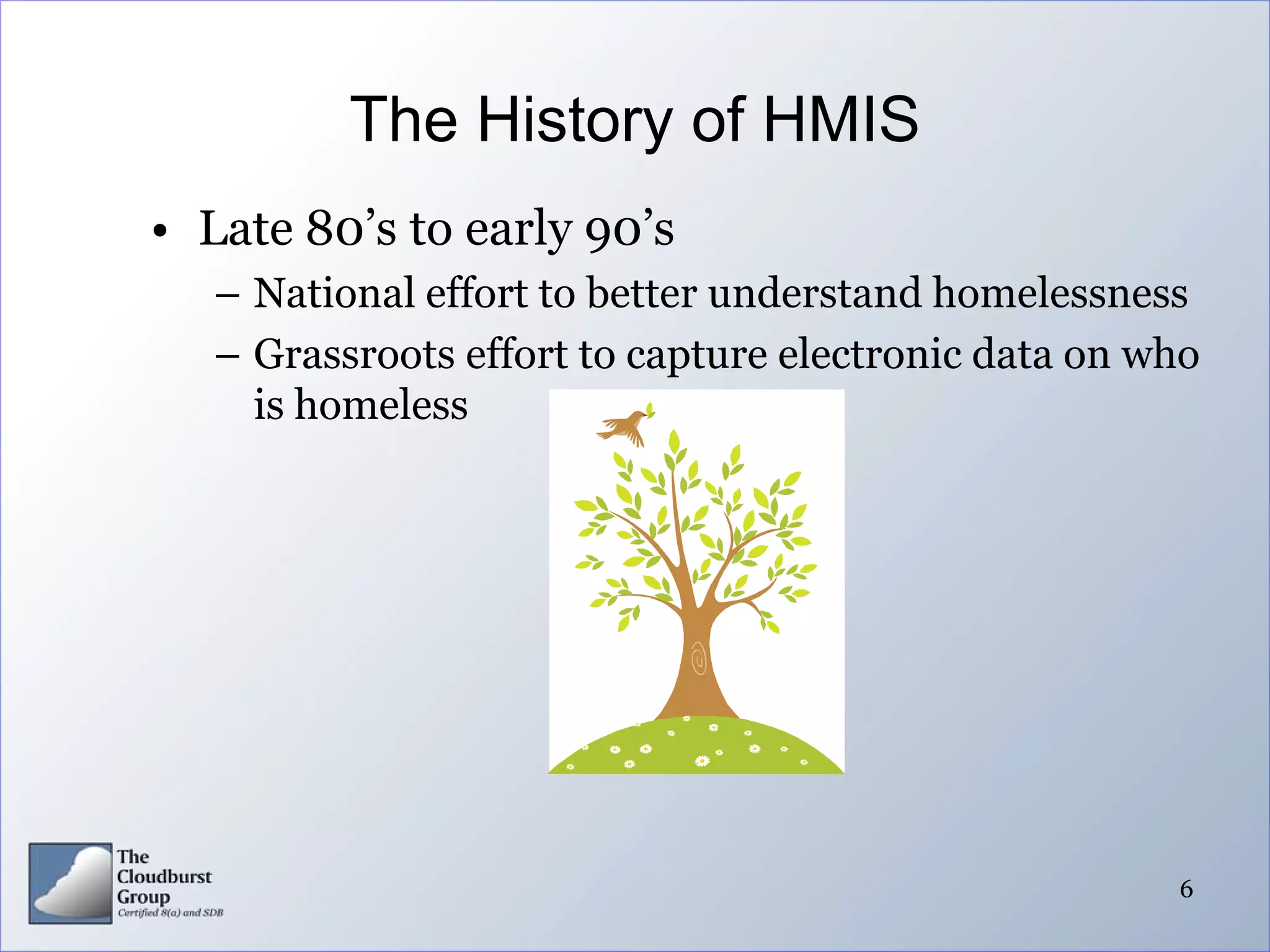
The History of HMIS
• Late 80’s to early 90’s
   – National effort to better understand homelessness
   – Grassroots effort to capture electronic data on who
     is homeless


                                                      6
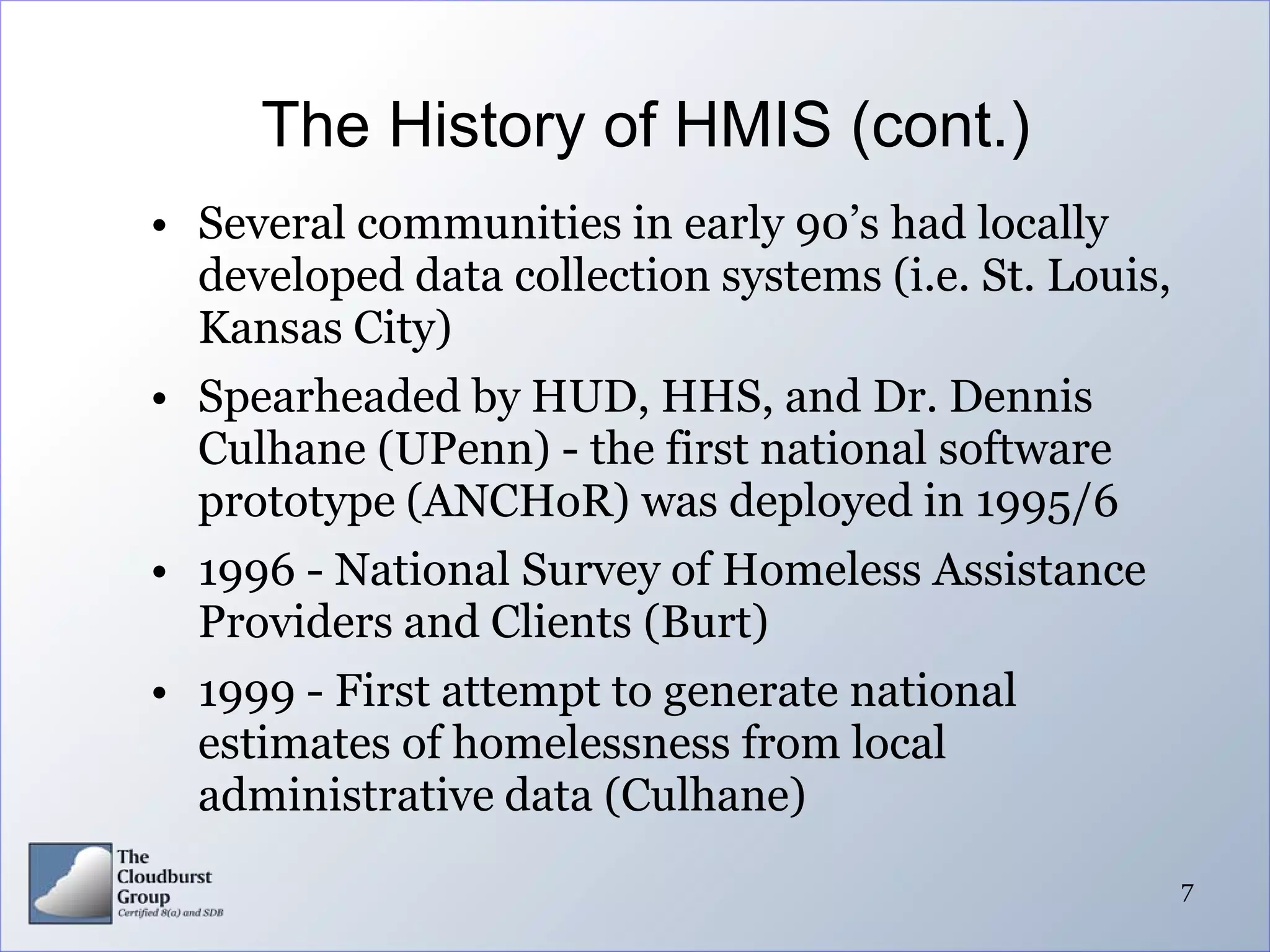
The History of HMIS (cont.)
• Several communities in early 90’s had locally
  developed data collection systems (i.e. St. Louis,
  Kansas City)
• Spearheaded by HUD, HHS, and Dr. Dennis
  Culhane (UPenn) - the first national software
  prototype (ANCHoR) was deployed in 1995/6
• 1996 - National Survey of Homeless Assistance
  Providers and Clients (Burt)
• 1999 - First attempt to generate national
  estimates of homelessness from local
  administrative data (Culhane)
                                                       7
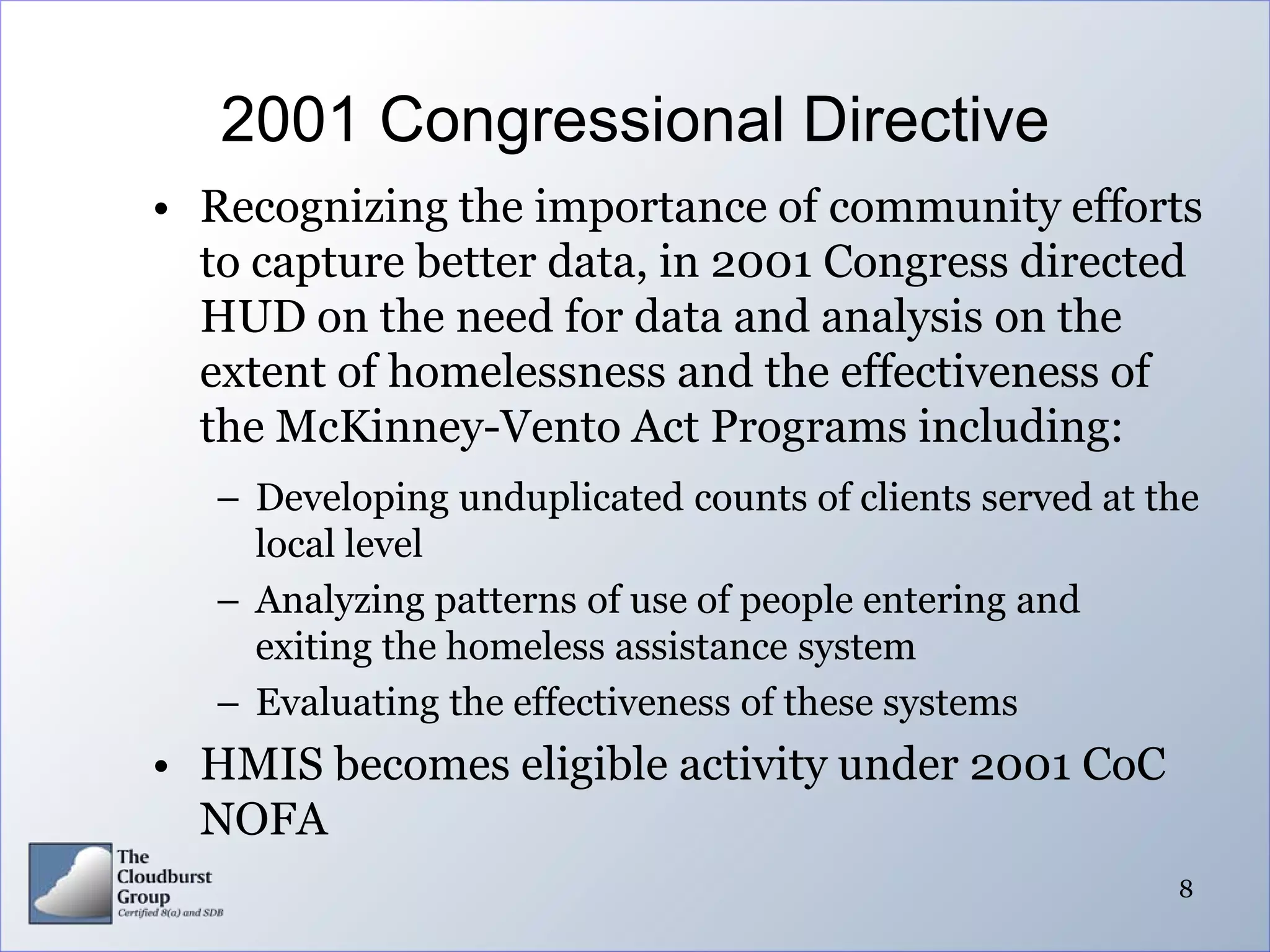
2001 Congressional Directive
• Recognizing the importance of community efforts
  to capture better data, in 2001 Congress directed
  HUD on the need for data and analysis on the
  extent of homelessness and the effectiveness of
  the McKinney-Vento Act Programs including:
   – Developing unduplicated counts of clients served at the
     local level
   – Analyzing patterns of use of people entering and
     exiting the homeless assistance system
   – Evaluating the effectiveness of these systems
• HMIS becomes eligible activity under 2001 CoC
  NOFA
                                                          8
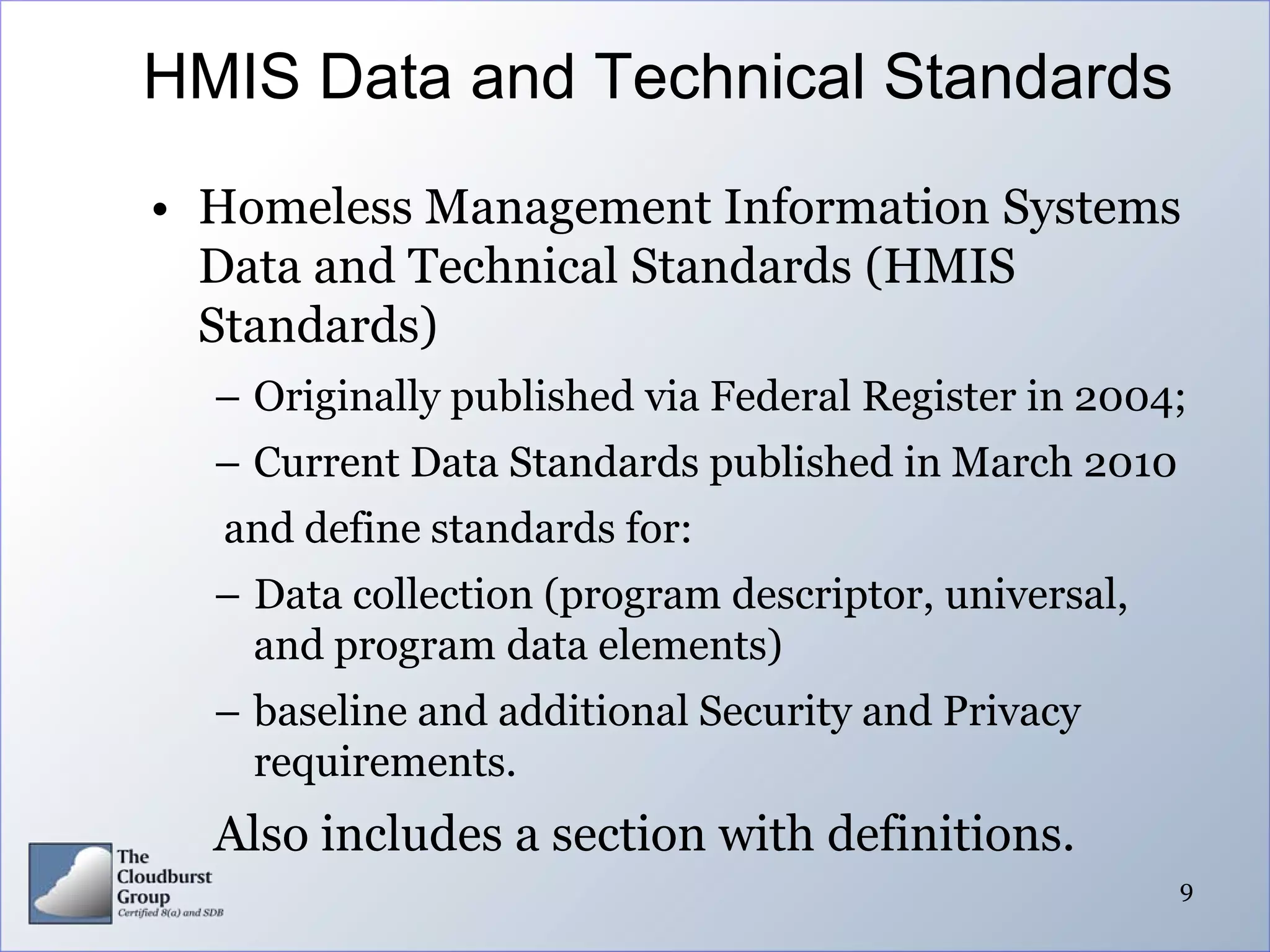
HMIS Data and Technical Standards
• Homeless Management Information Systems
  Data and Technical Standards (HMIS
  Standards)
  – Originally published via Federal Register in 2004;
  – Current Data Standards published in March 2010
  and define standards for:
  – Data collection (program descriptor, universal,
    and program data elements)
  – baseline and additional Security and Privacy
    requirements.
  Also includes a section with definitions.
                                                      9
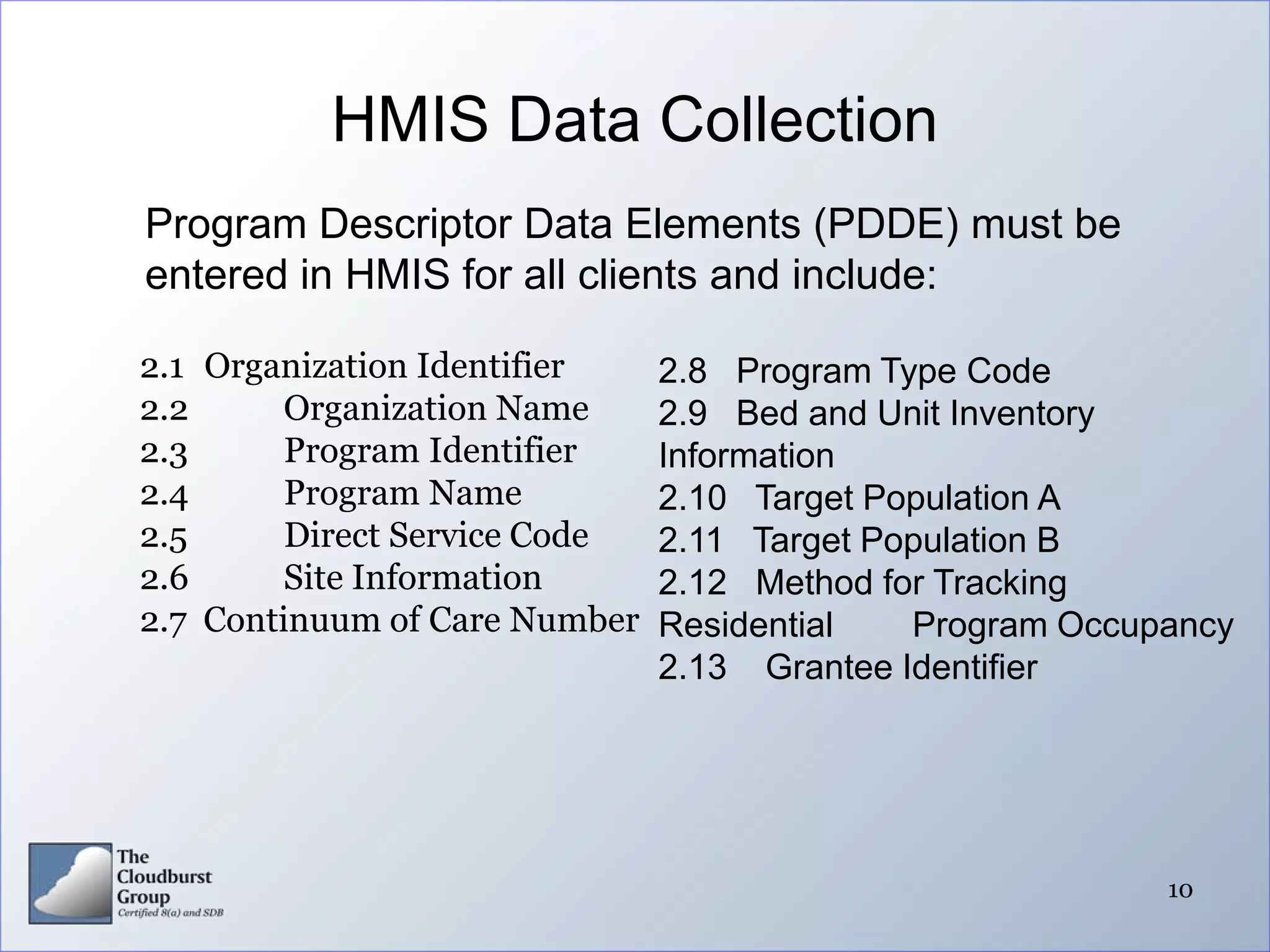
HMIS Data Collection
Program Descriptor Data Elements (PDDE) must be
entered in HMIS for all clients and include:

2.1 Organization Identifier    2.8 Program Type Code
2.2      Organization Name     2.9 Bed and Unit Inventory
2.3      Program Identifier    Information
2.4      Program Name          2.10 Target Population A
2.5      Direct Service Code   2.11 Target Population B
2.6      Site Information      2.12 Method for Tracking
2.7 Continuum of Care Number   Residential   Program Occupancy
                               2.13 Grantee Identifier


                                                          10
HMIS Data Collection
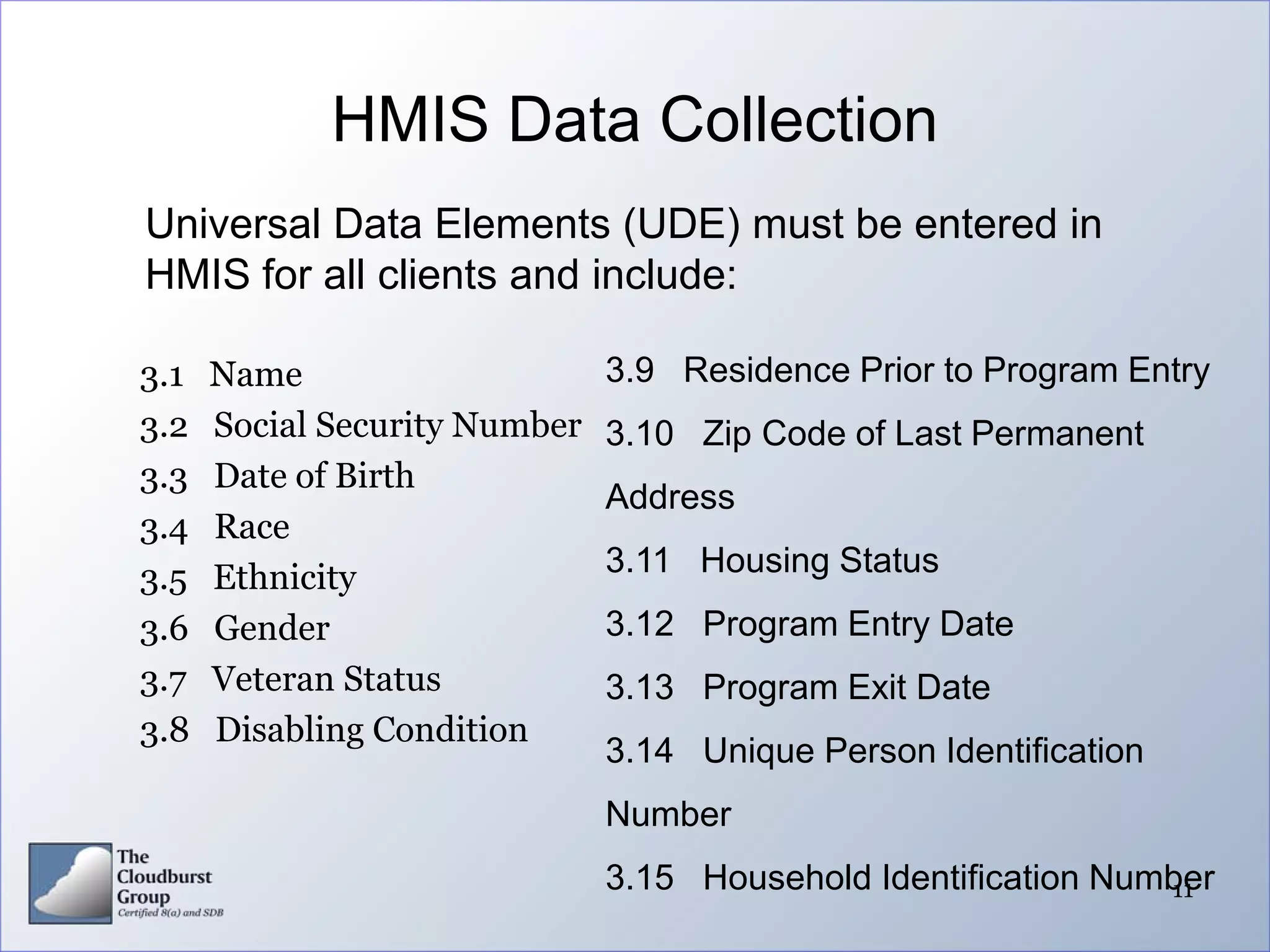
Universal Data Elements (UDE) must be entered in
HMIS for all clients and include:

3.1   Name                     3.9 Residence Prior to Program Entry
3.2   Social Security Number   3.10 Zip Code of Last Permanent
3.3   Date of Birth
                               Address
3.4   Race
3.5   Ethnicity                3.11 Housing Status
3.6   Gender                   3.12 Program Entry Date
3.7   Veteran Status           3.13 Program Exit Date
3.8   Disabling Condition
                               3.14 Unique Person Identification
                               Number
                               3.15 Household Identification Number
                                                                11
HMIS Data Collection
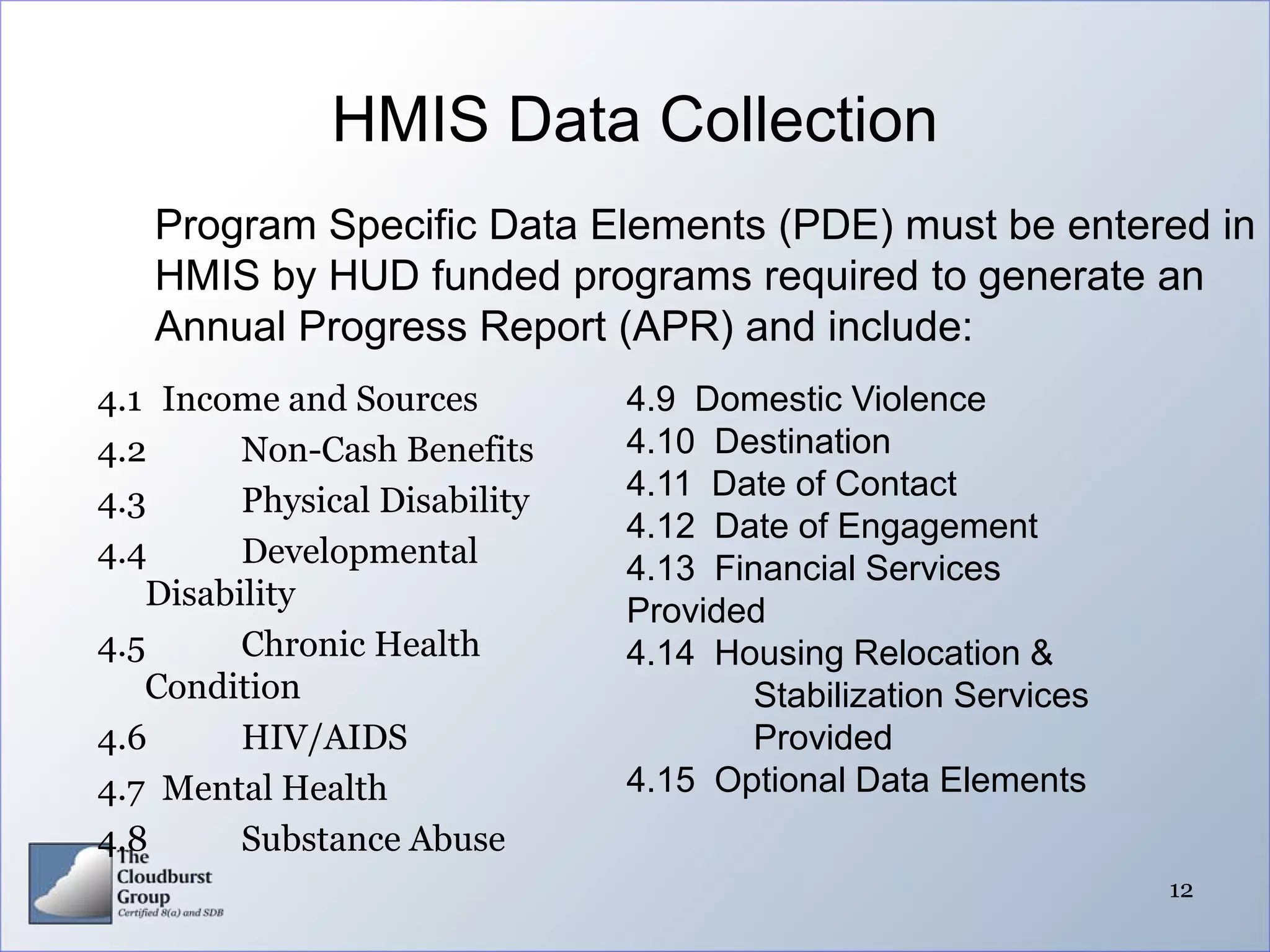
   Program Specific Data Elements (PDE) must be entered in
   HMIS by HUD funded programs required to generate an
   Annual Progress Report (APR) and include:
4.1 Income and Sources         4.9 Domestic Violence
4.2      Non-Cash Benefits     4.10 Destination
4.3      Physical Disability   4.11 Date of Contact
                               4.12 Date of Engagement
4.4      Developmental         4.13 Financial Services
   Disability                  Provided
4.5      Chronic Health        4.14 Housing Relocation &
   Condition                          Stabilization Services
4.6      HIV/AIDS                     Provided
4.7 Mental Health              4.15 Optional Data Elements
4.8      Substance Abuse
                                                               12
HMIS Data Collection
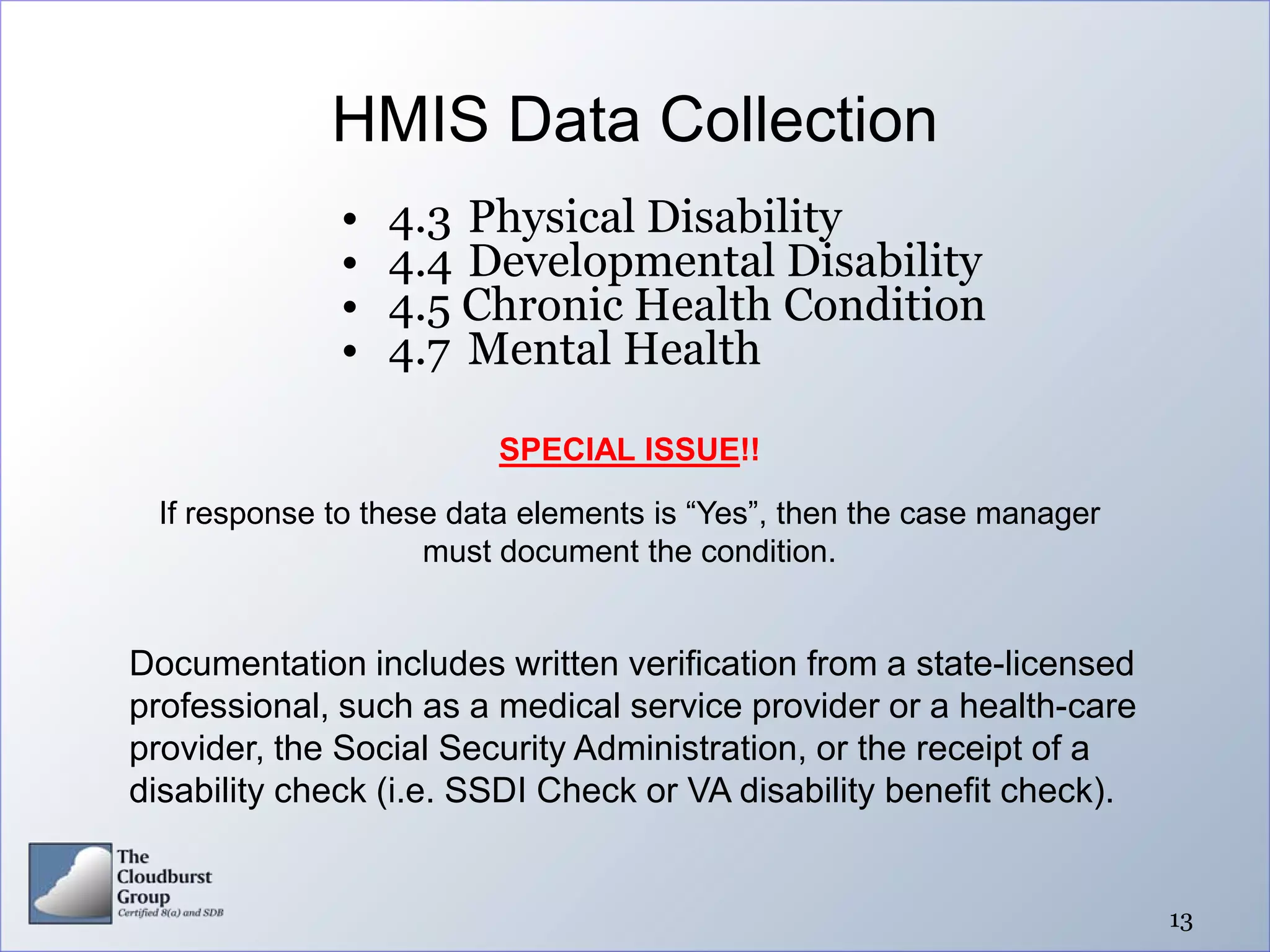
             •   4.3 Physical Disability
             •   4.4 Developmental Disability
             •   4.5 Chronic Health Condition
             •   4.7 Mental Health

                        SPECIAL ISSUE!!

 If response to these data elements is “Yes”, then the case manager
                    must document the condition.


Documentation includes written verification from a state-licensed
professional, such as a medical service provider or a health-care
provider, the Social Security Administration, or the receipt of a
disability check (i.e. SSDI Check or VA disability benefit check).


                                                                      13
Victim Service Providers
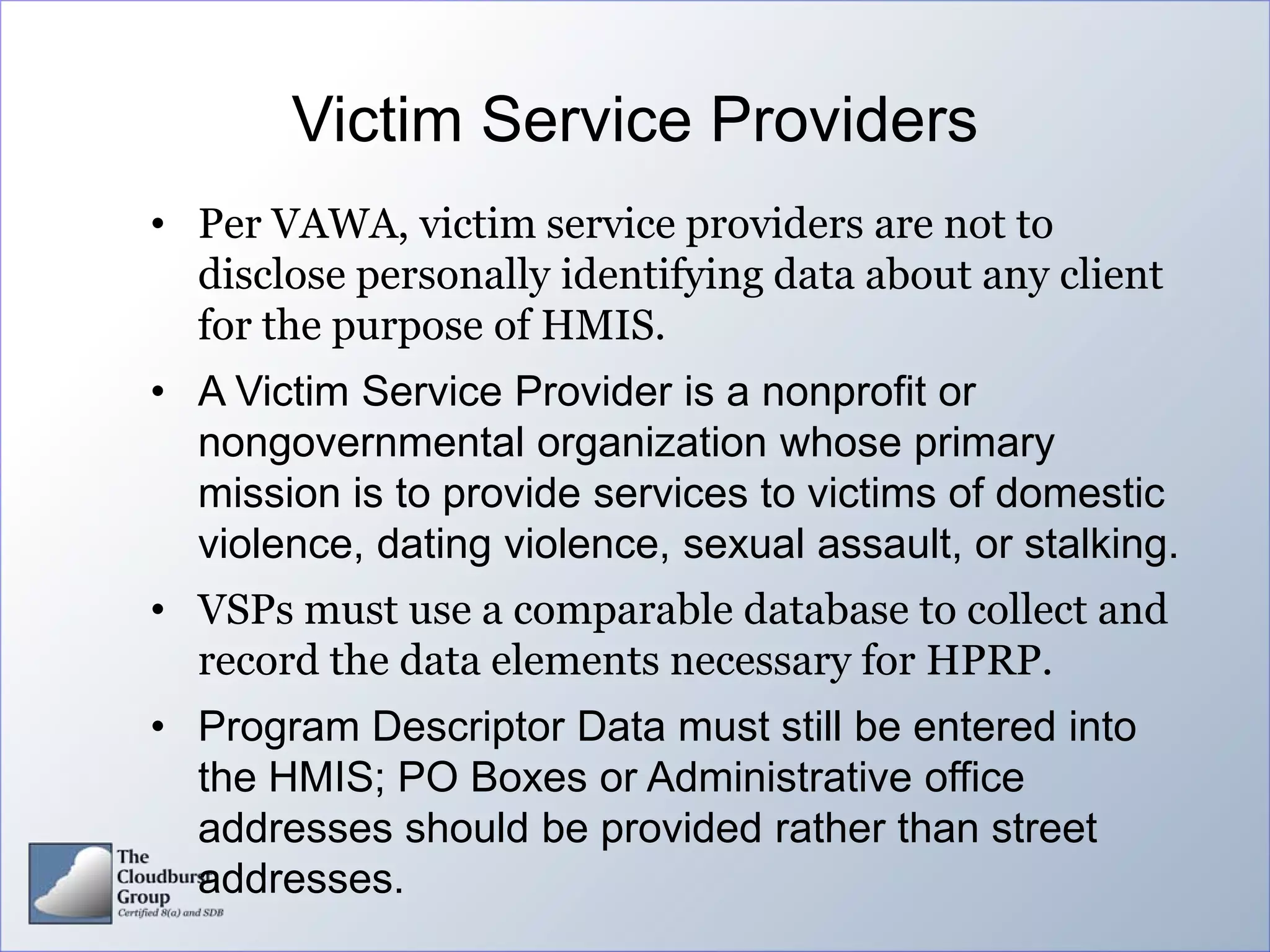
• Per VAWA, victim service providers are not to
  disclose personally identifying data about any client
  for the purpose of HMIS.
• A Victim Service Provider is a nonprofit or
  nongovernmental organization whose primary
  mission is to provide services to victims of domestic
  violence, dating violence, sexual assault, or stalking.
• VSPs must use a comparable database to collect and
  record the data elements necessary for HPRP.
• Program Descriptor Data must still be entered into
  the HMIS; PO Boxes or Administrative office
  addresses should be provided rather than street
  addresses.
HMIS Data Collection
Program Specific Optional Data Elements (PDE) are
additional data elements that communities may want to
collect to assist in client needs assessments and program
design:
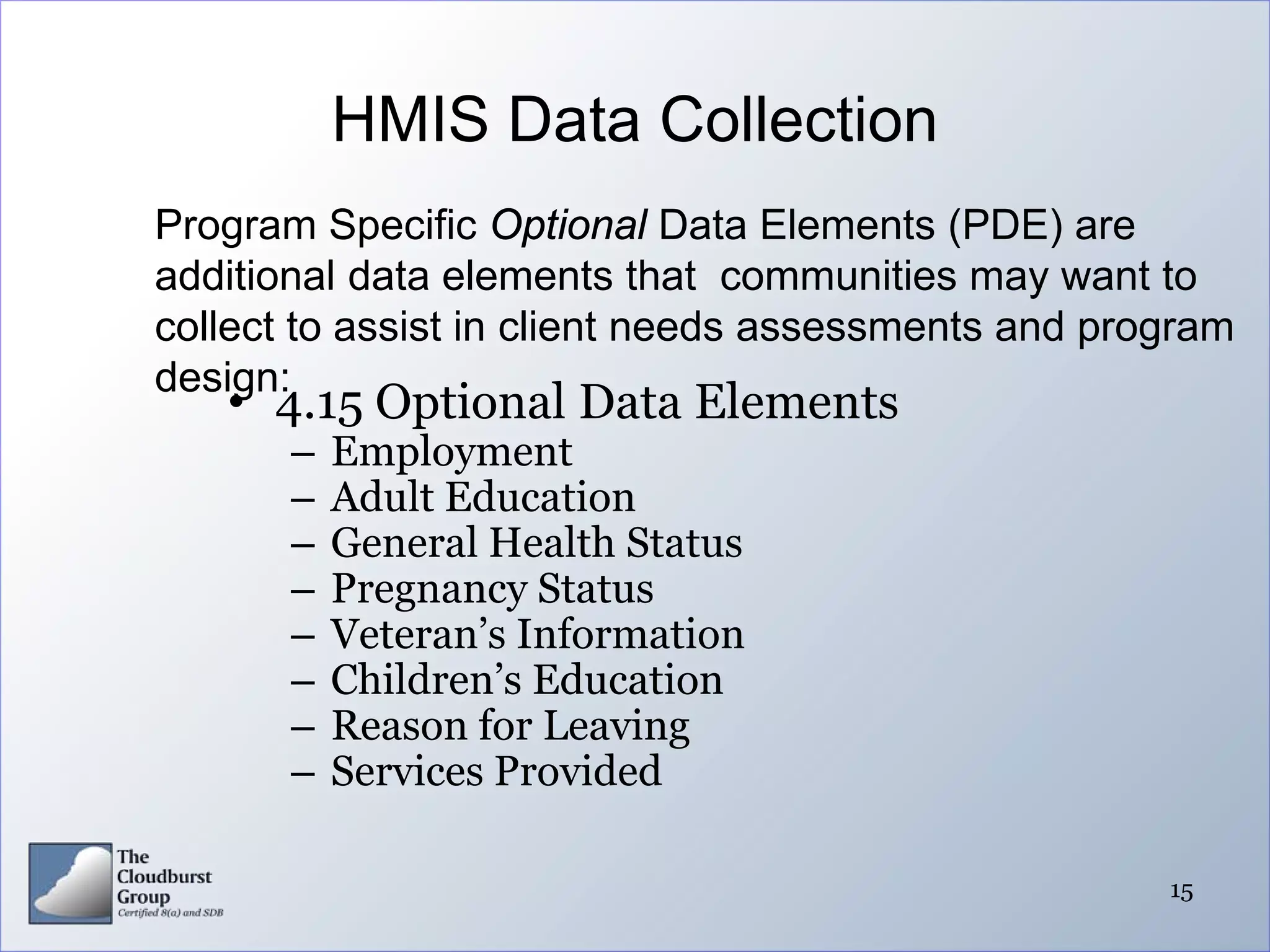
   • 4.15 Optional Data Elements
       –   Employment
       –   Adult Education
       –   General Health Status
       –   Pregnancy Status
       –   Veteran’s Information
       –   Children’s Education
       –   Reason for Leaving
       –   Services Provided

                                                     15
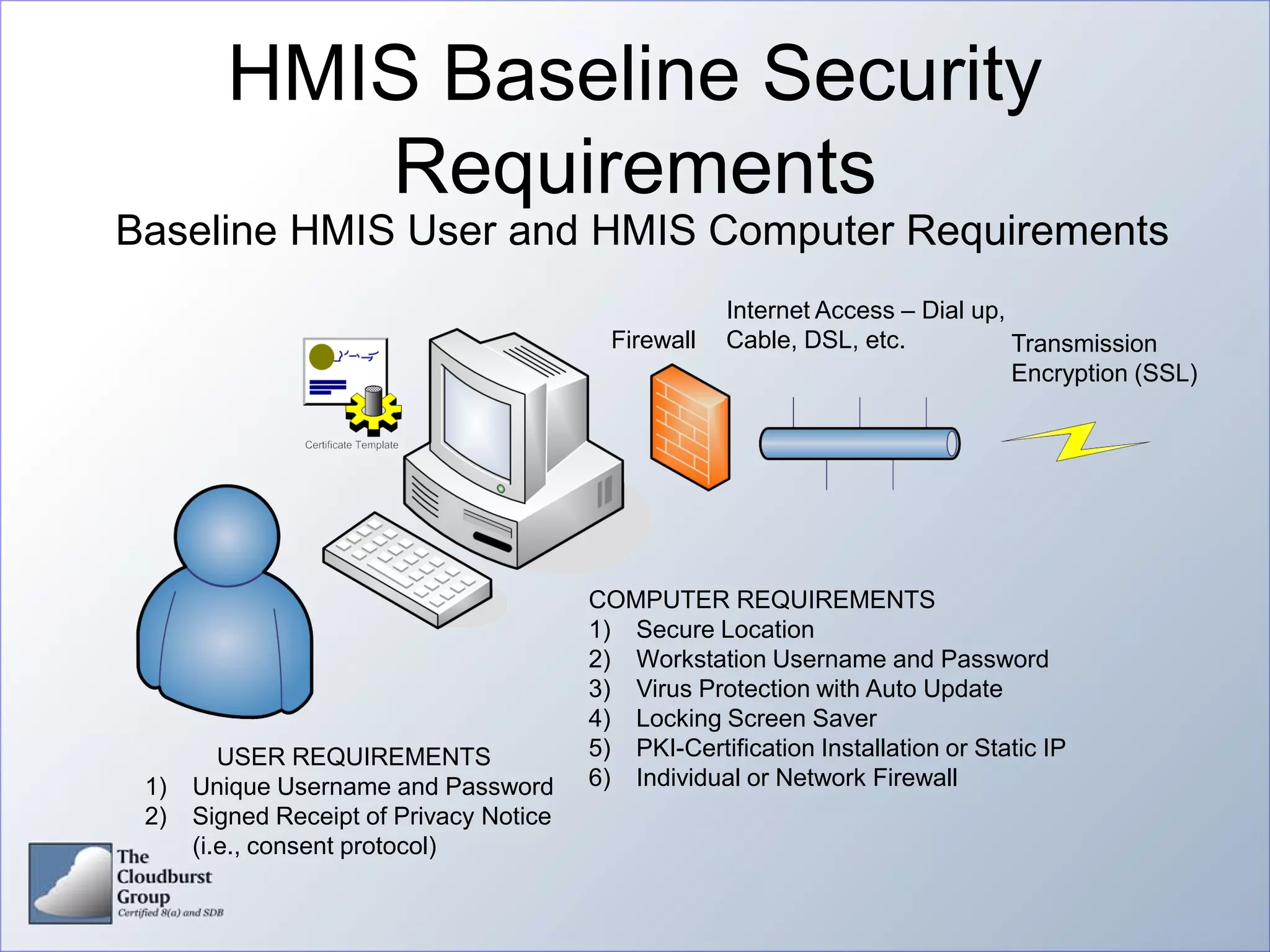
HMIS Baseline Security
            Requirements
Baseline HMIS User and HMIS Computer Requirements
                                                      Internet Access – Dial up,
                                           Firewall   Cable, DSL, etc.           Transmission
                                                                                 Encryption (SSL)


                                         COMPUTER REQUIREMENTS
                                         1) Secure Location
                                         2) Workstation Username and Password
                                         3) Virus Protection with Auto Update
                                         4) Locking Screen Saver
         USER REQUIREMENTS               5) PKI-Certification Installation or Static IP
 1)   Unique Username and Password       6) Individual or Network Firewall
 2)   Signed Receipt of Privacy Notice
      (i.e., consent protocol)
Baseline Security Requirements
• User authentication
     – Limited multiple access
•   Virus protection with auto-update
•   Firewalls - individual workstation or network
•   Encryption - transmission
•   Public access controls
•   Location control
•   Backup and disaster recovery
•   System monitoring
•   Secure disposal

                                                    17
Privacy Standards Framework

• Personal Protected Information (PPI)
  – Includes name, SSN, program entry/exit, zip code of
    last permanent address, system/program ID, and
    program type.
• Allow for reasonable, responsible data
  disclosures
• Derived from principles of fair information
  practices
• Borrowed from HIPAA - Health Insurance
  Portability and Accountability Act
                                                          18
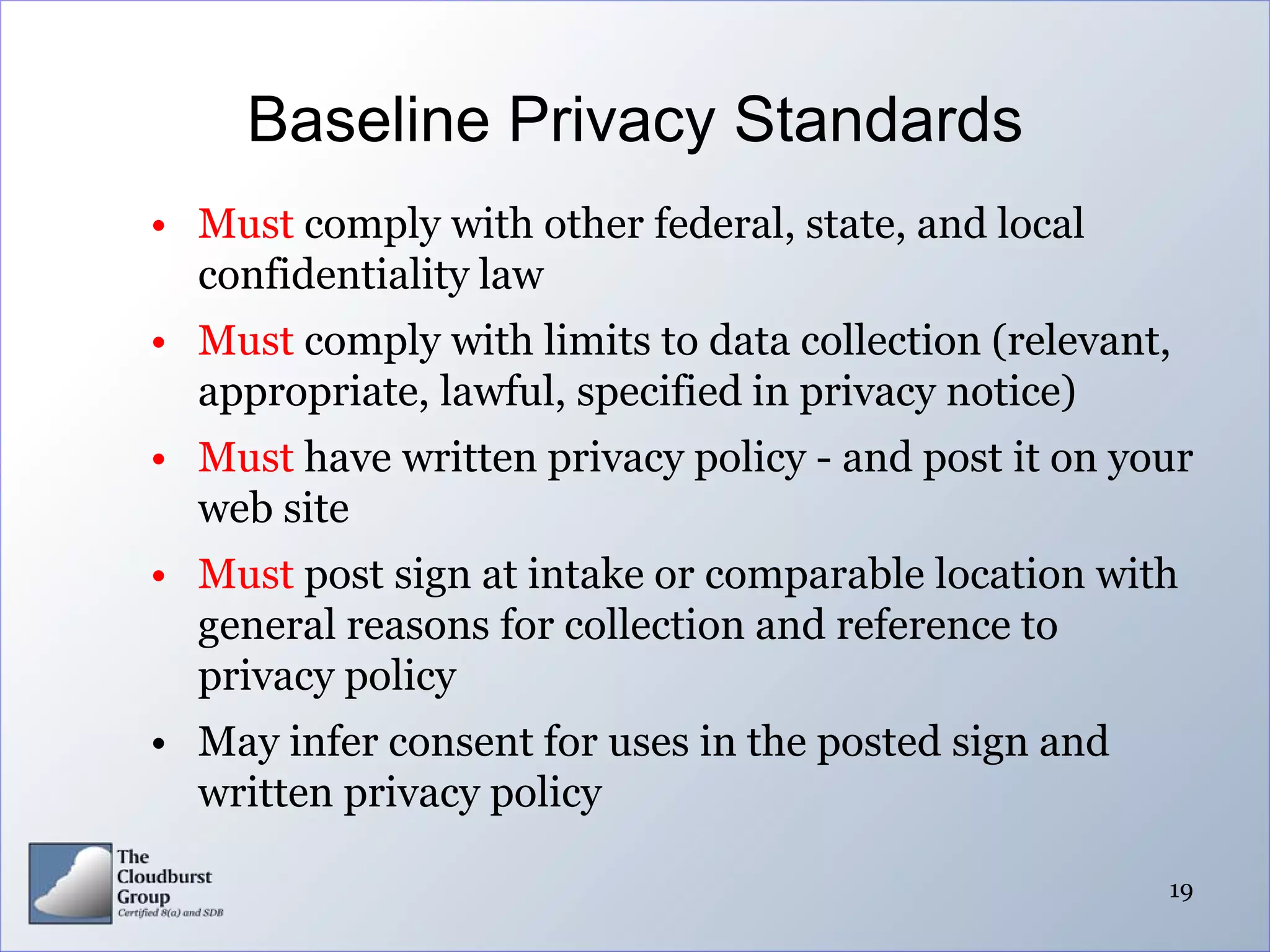
Baseline Privacy Standards
• Must comply with other federal, state, and local
  confidentiality law
• Must comply with limits to data collection (relevant,
  appropriate, lawful, specified in privacy notice)
• Must have written privacy policy - and post it on your
  web site
• Must post sign at intake or comparable location with
  general reasons for collection and reference to
  privacy policy
• May infer consent for uses in the posted sign and
  written privacy policy

                                                      19
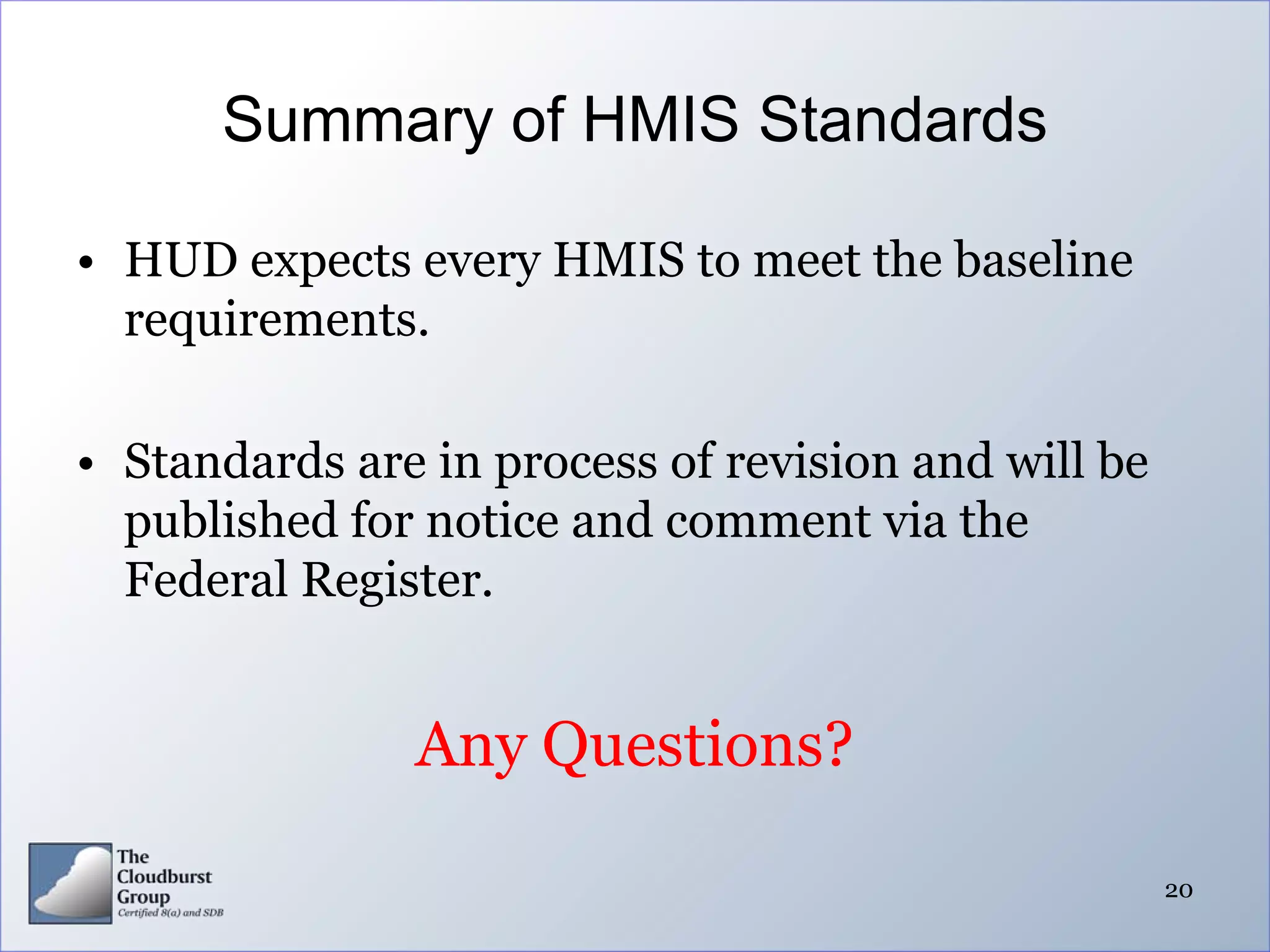
Summary of HMIS Standards

• HUD expects every HMIS to meet the baseline
  requirements.

• Standards are in process of revision and will be
  published for notice and comment via the
  Federal Register.


               Any Questions?

                                                     20
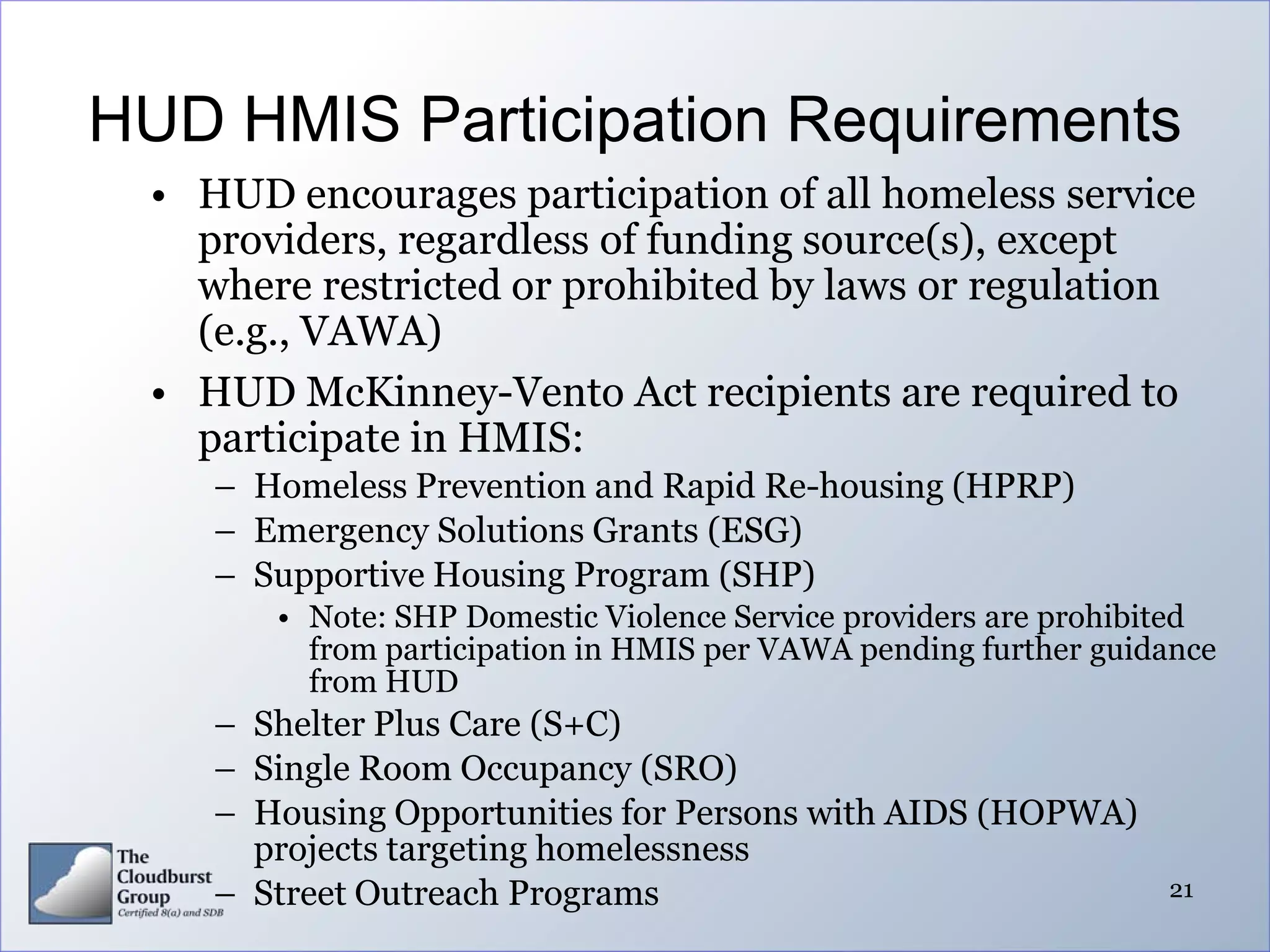
HUD HMIS Participation Requirements
 • HUD encourages participation of all homeless service
   providers, regardless of funding source(s), except
   where restricted or prohibited by laws or regulation
   (e.g., VAWA)
 • HUD McKinney-Vento Act recipients are required to
   participate in HMIS:
    – Homeless Prevention and Rapid Re-housing (HPRP)
    – Emergency Solutions Grants (ESG)
    – Supportive Housing Program (SHP)
       • Note: SHP Domestic Violence Service providers are prohibited
         from participation in HMIS per VAWA pending further guidance
         from HUD
    – Shelter Plus Care (S+C)
    – Single Room Occupancy (SRO)
    – Housing Opportunities for Persons with AIDS (HOPWA)
      projects targeting homelessness
    – Street Outreach Programs                                   21
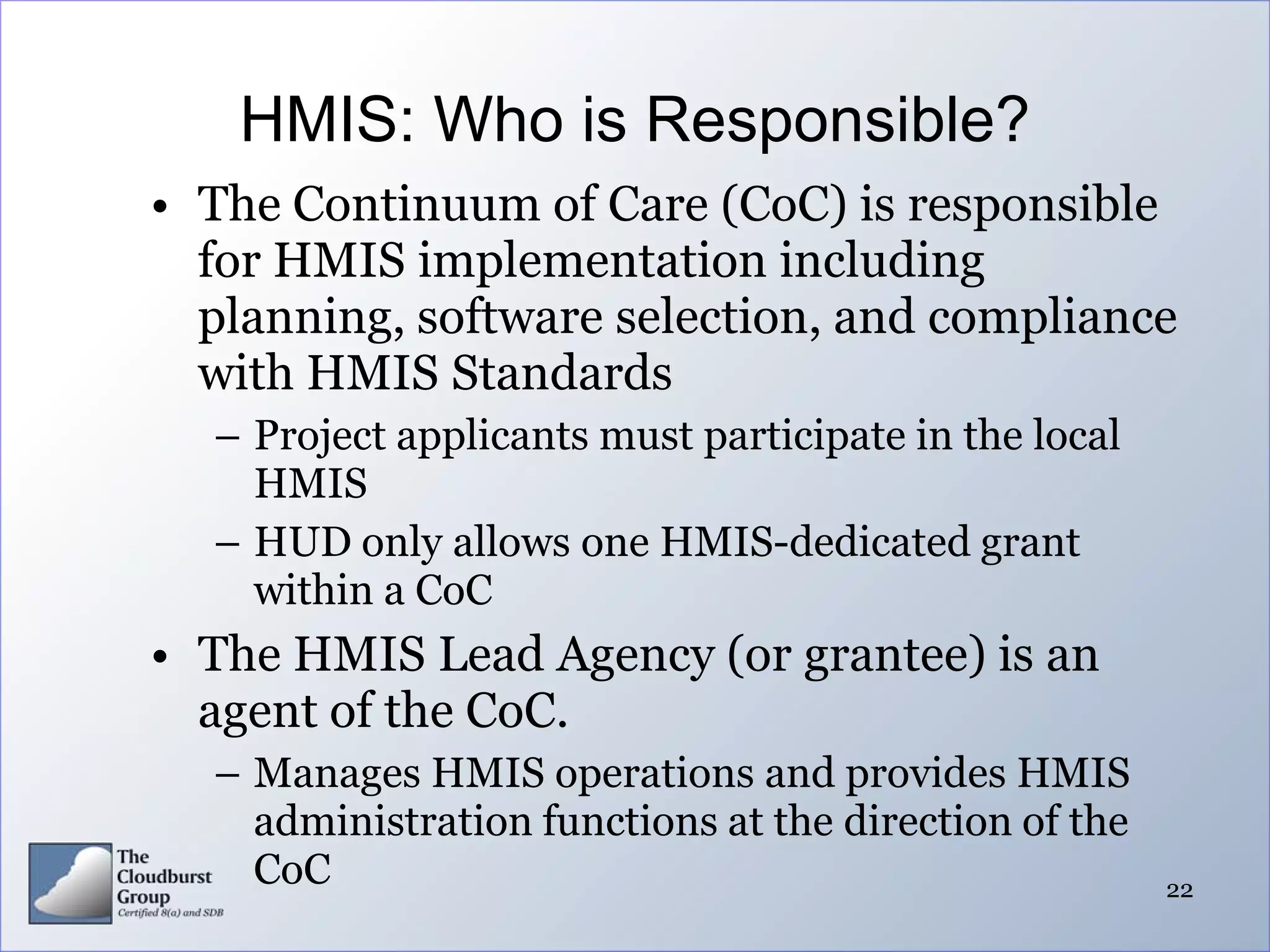
HMIS: Who is Responsible?
• The Continuum of Care (CoC) is responsible
  for HMIS implementation including
  planning, software selection, and compliance
  with HMIS Standards
  – Project applicants must participate in the local
    HMIS
  – HUD only allows one HMIS-dedicated grant
    within a CoC
• The HMIS Lead Agency (or grantee) is an
  agent of the CoC.
  – Manages HMIS operations and provides HMIS
    administration functions at the direction of the
    CoC                                                22

Questions and Answers
Resources
• www.HUDHRE.info
• www.HMIS.info
• National TA
• Regional HMIS Collaboratives
• Community Resources

3.7 HMIS: Ask the Experts

  • 1.
    HMIS: Ask theExpert Michelle Hayes, The Cloudburst Group Kat Freeman, The Cloudburst Group Focusing Energy on Results
  • 2.
    Structure of Session •Brief overview of HMIS • Questions and Answers • Resources
  • 3.
    What is HMIS? •A Homeless Management Information System (HMIS) is a locally administered, electronic data collection system that stores longitudinal person-level information about persons who access the homeless service system in a Continuum of Care. 3
  • 4.
    Why is HMISRequired? • HMIS is HUD’s response to a Congressional Directive to capture better data on homelessness. • The American Recovery and Reinvestment Act of 2009 authorized HMIS as the primary tool for data collection and reporting for the HPRP program. • HEARTH Act also requires participation in HMIS.
  • 5.
    Why is HMISImportant? • Every Continuum of Care (CoC) is required to implement an HMIS and is scored annually in the CoC NOFA. • Local HMIS data is critical for: – SHP Annual Performance Report (APR) – Annual Homeless Assessment Report (AHAR) – HPRP Quarterly (QPR) and Annual Performance Report (APR) – Homeless Pulse – Projects for Assistance in Transition for Homelessness (PATH) 5
  • 6.
    The History ofHMIS • Late 80’s to early 90’s – National effort to better understand homelessness – Grassroots effort to capture electronic data on who is homeless 6
  • 7.
    The History ofHMIS (cont.) • Several communities in early 90’s had locally developed data collection systems (i.e. St. Louis, Kansas City) • Spearheaded by HUD, HHS, and Dr. Dennis Culhane (UPenn) - the first national software prototype (ANCHoR) was deployed in 1995/6 • 1996 - National Survey of Homeless Assistance Providers and Clients (Burt) • 1999 - First attempt to generate national estimates of homelessness from local administrative data (Culhane) 7
  • 8.
    2001 Congressional Directive •Recognizing the importance of community efforts to capture better data, in 2001 Congress directed HUD on the need for data and analysis on the extent of homelessness and the effectiveness of the McKinney-Vento Act Programs including: – Developing unduplicated counts of clients served at the local level – Analyzing patterns of use of people entering and exiting the homeless assistance system – Evaluating the effectiveness of these systems • HMIS becomes eligible activity under 2001 CoC NOFA 8
  • 9.
    HMIS Data andTechnical Standards • Homeless Management Information Systems Data and Technical Standards (HMIS Standards) – Originally published via Federal Register in 2004; – Current Data Standards published in March 2010 and define standards for: – Data collection (program descriptor, universal, and program data elements) – baseline and additional Security and Privacy requirements. Also includes a section with definitions. 9
  • 10.
    HMIS Data Collection ProgramDescriptor Data Elements (PDDE) must be entered in HMIS for all clients and include: 2.1 Organization Identifier 2.8 Program Type Code 2.2 Organization Name 2.9 Bed and Unit Inventory 2.3 Program Identifier Information 2.4 Program Name 2.10 Target Population A 2.5 Direct Service Code 2.11 Target Population B 2.6 Site Information 2.12 Method for Tracking 2.7 Continuum of Care Number Residential Program Occupancy 2.13 Grantee Identifier 10
  • 11.
    HMIS Data Collection UniversalData Elements (UDE) must be entered in HMIS for all clients and include: 3.1 Name 3.9 Residence Prior to Program Entry 3.2 Social Security Number 3.10 Zip Code of Last Permanent 3.3 Date of Birth Address 3.4 Race 3.5 Ethnicity 3.11 Housing Status 3.6 Gender 3.12 Program Entry Date 3.7 Veteran Status 3.13 Program Exit Date 3.8 Disabling Condition 3.14 Unique Person Identification Number 3.15 Household Identification Number 11
  • 12.
    HMIS Data Collection Program Specific Data Elements (PDE) must be entered in HMIS by HUD funded programs required to generate an Annual Progress Report (APR) and include: 4.1 Income and Sources 4.9 Domestic Violence 4.2 Non-Cash Benefits 4.10 Destination 4.3 Physical Disability 4.11 Date of Contact 4.12 Date of Engagement 4.4 Developmental 4.13 Financial Services Disability Provided 4.5 Chronic Health 4.14 Housing Relocation & Condition Stabilization Services 4.6 HIV/AIDS Provided 4.7 Mental Health 4.15 Optional Data Elements 4.8 Substance Abuse 12
  • 13.
    HMIS Data Collection • 4.3 Physical Disability • 4.4 Developmental Disability • 4.5 Chronic Health Condition • 4.7 Mental Health SPECIAL ISSUE!! If response to these data elements is “Yes”, then the case manager must document the condition. Documentation includes written verification from a state-licensed professional, such as a medical service provider or a health-care provider, the Social Security Administration, or the receipt of a disability check (i.e. SSDI Check or VA disability benefit check). 13
  • 14.
    Victim Service Providers •Per VAWA, victim service providers are not to disclose personally identifying data about any client for the purpose of HMIS. • A Victim Service Provider is a nonprofit or nongovernmental organization whose primary mission is to provide services to victims of domestic violence, dating violence, sexual assault, or stalking. • VSPs must use a comparable database to collect and record the data elements necessary for HPRP. • Program Descriptor Data must still be entered into the HMIS; PO Boxes or Administrative office addresses should be provided rather than street addresses.
  • 15.
    HMIS Data Collection ProgramSpecific Optional Data Elements (PDE) are additional data elements that communities may want to collect to assist in client needs assessments and program design: • 4.15 Optional Data Elements – Employment – Adult Education – General Health Status – Pregnancy Status – Veteran’s Information – Children’s Education – Reason for Leaving – Services Provided 15
  • 16.
    HMIS Baseline Security Requirements Baseline HMIS User and HMIS Computer Requirements Internet Access – Dial up, Firewall Cable, DSL, etc. Transmission Encryption (SSL) COMPUTER REQUIREMENTS 1) Secure Location 2) Workstation Username and Password 3) Virus Protection with Auto Update 4) Locking Screen Saver USER REQUIREMENTS 5) PKI-Certification Installation or Static IP 1) Unique Username and Password 6) Individual or Network Firewall 2) Signed Receipt of Privacy Notice (i.e., consent protocol)
  • 17.
    Baseline Security Requirements •User authentication – Limited multiple access • Virus protection with auto-update • Firewalls - individual workstation or network • Encryption - transmission • Public access controls • Location control • Backup and disaster recovery • System monitoring • Secure disposal 17
  • 18.
    Privacy Standards Framework •Personal Protected Information (PPI) – Includes name, SSN, program entry/exit, zip code of last permanent address, system/program ID, and program type. • Allow for reasonable, responsible data disclosures • Derived from principles of fair information practices • Borrowed from HIPAA - Health Insurance Portability and Accountability Act 18
  • 19.
    Baseline Privacy Standards •Must comply with other federal, state, and local confidentiality law • Must comply with limits to data collection (relevant, appropriate, lawful, specified in privacy notice) • Must have written privacy policy - and post it on your web site • Must post sign at intake or comparable location with general reasons for collection and reference to privacy policy • May infer consent for uses in the posted sign and written privacy policy 19
  • 20.
    Summary of HMISStandards • HUD expects every HMIS to meet the baseline requirements. • Standards are in process of revision and will be published for notice and comment via the Federal Register. Any Questions? 20
  • 21.
    HUD HMIS ParticipationRequirements • HUD encourages participation of all homeless service providers, regardless of funding source(s), except where restricted or prohibited by laws or regulation (e.g., VAWA) • HUD McKinney-Vento Act recipients are required to participate in HMIS: – Homeless Prevention and Rapid Re-housing (HPRP) – Emergency Solutions Grants (ESG) – Supportive Housing Program (SHP) • Note: SHP Domestic Violence Service providers are prohibited from participation in HMIS per VAWA pending further guidance from HUD – Shelter Plus Care (S+C) – Single Room Occupancy (SRO) – Housing Opportunities for Persons with AIDS (HOPWA) projects targeting homelessness – Street Outreach Programs 21
  • 22.
    HMIS: Who isResponsible? • The Continuum of Care (CoC) is responsible for HMIS implementation including planning, software selection, and compliance with HMIS Standards – Project applicants must participate in the local HMIS – HUD only allows one HMIS-dedicated grant within a CoC • The HMIS Lead Agency (or grantee) is an agent of the CoC. – Manages HMIS operations and provides HMIS administration functions at the direction of the CoC 22

  • 23.
  • 24.
    Resources • www.HUDHRE.info • www.HMIS.info •National TA • Regional HMIS Collaboratives • Community Resources