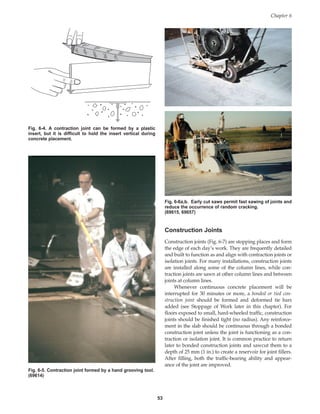
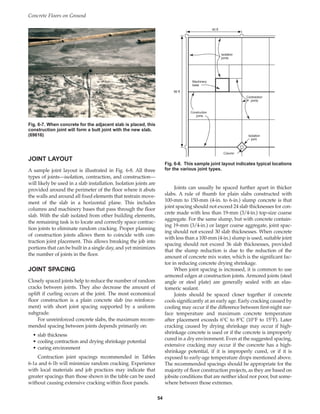
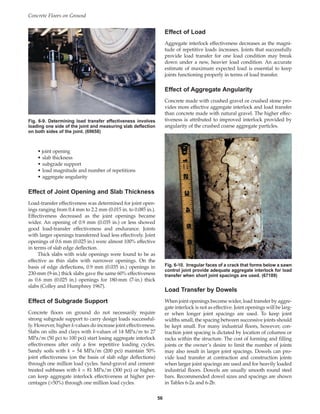
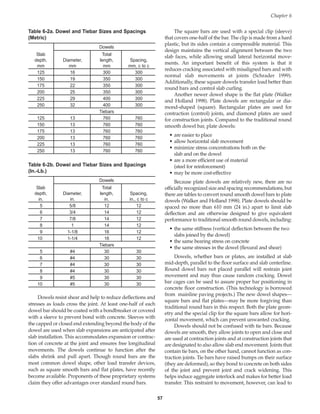
CONCRETE FLOORS
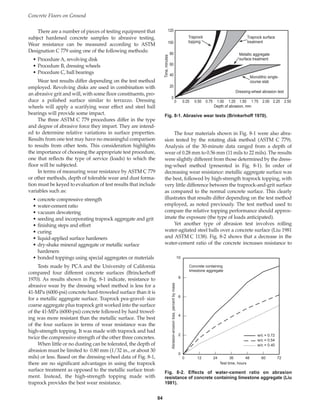
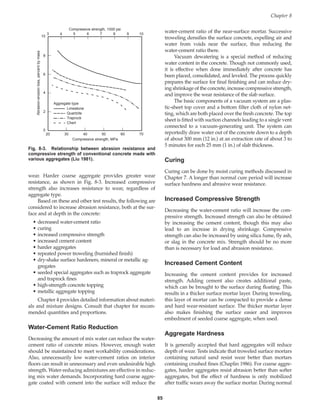
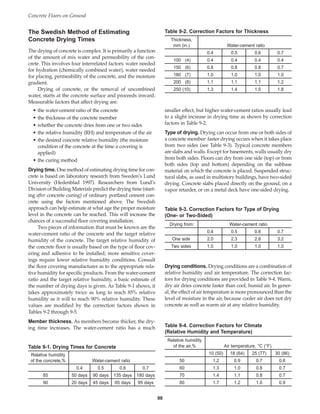
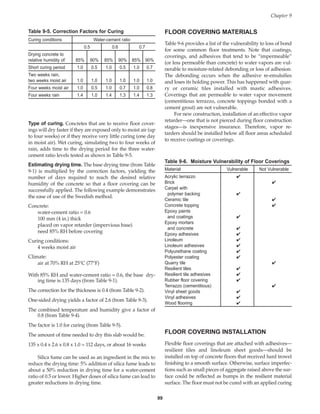
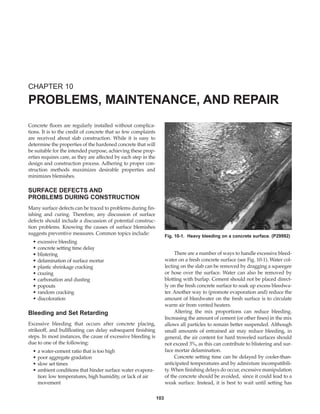
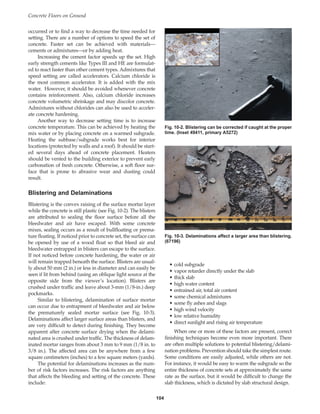
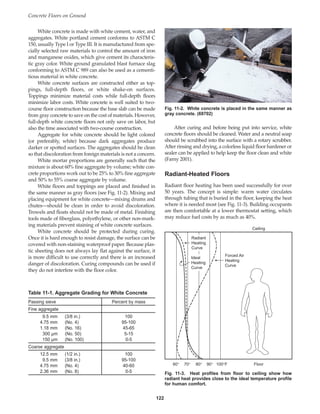
ON GROUND
P O R T L A N D C E M E N T A S S O C I A T I O N
EB075
Book Contents
Publication List
KEYWORDS: abrasion, admixtures, aggregate interlock, aggregates (coarse and fine), air content, bearing capacity, bleed-
ing, blistering, bonded toppings, burnished floors, calcium chloride test, carbonation, cleaning, coatings, color pigments,
colored concrete, compressive strength, concrete drying, consolidation, contact area, crack width, cracking, curing, darby-
ing, decorative concrete, delamination, discoloration, distributed loads, dowels, dry-shake toppings, dusting, edging,
expansive soils, Face Floor Profile, fibers, finishing, fire resistance, flatness, flexural strength, flexural stress, floating, floor
coverings, forklift, freezers, gap slabs, grinding, hardeners, high-rack storage, ice rinks, industrial floors, insulation, joints
(isolation, control, construction), joint filling, joint layout, joint sealing, laser screed, levelness, light reflective floors, load
transfer, maintenance, mat bond test, moisture meters, moisture testing, modulus of subgrade reaction, mixing, nuclear
gauges, patching, pigments, placing, plastic shrinkage cracking, popouts, portland cement, post loads, post-tensioning,
pozzolans, proportioning, radiant heat, radon, random cracking, relative humidity meters, repair (full depth and partial
depth), self-leveling topping, safety factors, shrinkage, slag, slump, soil, special floors, standards, steel reinforcement,
straightedge, strike-off, stains, subbase, subgrade, sulfates, supplementary cementing materials, surface blemishes, surface
waviness index, terrazzo, texture, thickness design, tiebars, truck loads, unusual loads, vapor barriers, vapor retarders,
variable loading, warehouses, wear resistance, wheel loads, white cement
ABSTRACT: This expanded third edition describes the design, construction, and repair of concrete floors on ground for
residential, light industrial, commercial, warehouse, and heavy industrial buildings. The approach described emphasizes
attaining the best possible balance among service requirements, costs, and maintenance. The text includes a discussion of
floor flatness and levelness (Face Floor Profile Numbers and Surface Waviness Index), moisture testing and floor cover-
ings, concrete durability, white concrete floors, and a glossary of slab-on-grade terms.
REFERENCE: Farny, James A., Concrete Floors on Ground, EB075, Portland Cement Association, Skokie, Illinois, U.S.A.,
2001, 136 pages.
Book Contents
Publication List
ENGINEERING BULLETIN
Concrete Floors on Ground
by James A. Farny
An organization of cement companies to improve
and extend the uses of portland cement and concrete
through market development, engineering, research,
education, and public affairs work.
5420 Old Orchard Road, Skokie, Illinois 60077-1083 USA
i
Book Contents
Publication List
ii
About the author: The author of this engineering bulletin is
James A. Farny, Program Coordinator, Masonry and Special
Products, Portland Cement Association.
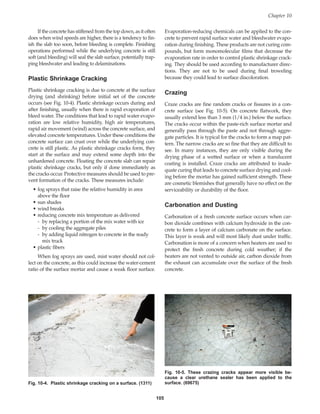
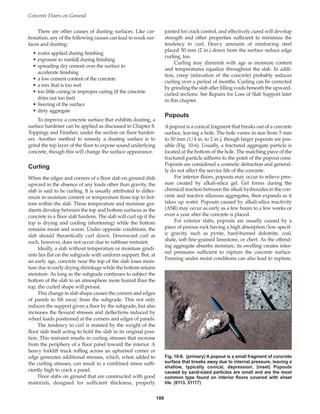
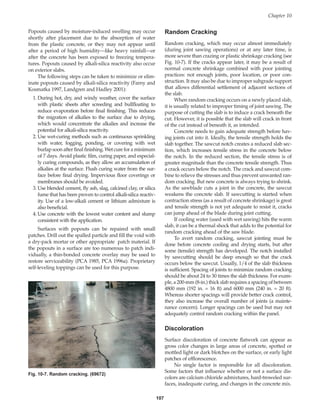
On the cover: Illustrations on the cover are clockwise from
top left (1) a ride-on trowel (69871); (2) high rack warehouse
floor (69655); and (3) placing concrete for a floor with a
pump and a laser screed (69718).
Third Edition
© Portland Cement Association 2001
All right reserved. No part of this book may be reproduced
in any form without permission in writing from the pub-
lisher, except by a reviewer who wishes to quote brief pas-
sages in a review written for inclusion in a magazine or
newspaper.
ISBN 0-89312-211-4
PCA R&D Serial No. 2524
Printed in the United States of America
This publication is intended SOLELY for use by PROFES-
SIONAL PERSONNEL who are competent to evaluate the
significance and limitations of the information provided
herein, and who will accept total responsibility for the
application of this information. The Portland Cement
Association DISCLAIMS any and all RESPONSIBILITY and
LIABILITY for the accuracy of and the application of the
information contained in this publication to the full extent
permitted by law.
ACKNOWLEDGMENTS
Many people were involved with bringing this technical
handbook to print. Not all of them can be mentioned here,
but several individuals should be recognized. This document
is an updated and expanded version of Concrete Floors on
Ground (EB075.02D), by Ralph E. Spears (deceased) and
William C. Panarese, respectively, former manager, Building
Construction Section, and former manager, Construction
Information Services, PCA. Peter Nussbaum, formerly of
CTL, did the initial review of the previous edition, suggested
many changes, and provided a final technical review of the
new edition. Two notable experts shared their knowledge to
ensure that the best current practice is provided: Steven
Metzger, consultant, Metzger-McGuire, on jointing, joint fill-
ing and sealing, and joint repair; and Howard Kanare,
Construction Technology Laboratories, Inc., on moisture in
concrete and moisture testing. Overall technical reviews
were given by Terry Collins, PCA’s Concrete Construction
Engineer, Martin McGovern, PCA’s Concrete Engineer,
Warren Baas of Ohio Ready Mix, and Carl Bimel, consultant
and chairman of ACI’s Committee 302, Slabs on Ground.
Steven Kosmatka, PCA’s Managing Director of Research and
Technical Services, provided assistance throughout the entire
revision. Thank you all.
PHOTO AND FIGURE CREDITS
Several individuals and companies shared photographs and
other figures for this publication. They include: Baker Con-
crete Construction, Inc.; The Euclid Chemical Company;
Howard Kanare and Scott Tarr, CTL; John Rohrer
Contracting Company; Hanley-Wood, LLC (Concrete Con-
struction magazine); Lehigh Portland Cement Company;
Maxxon Corporation; National Ready Mixed Concrete
Association; and Peter Nussbaum, formerly of CTL.
EB075.03
Warning: Contact with wet (unhardened) concrete, mor-
tar, cement, or cement mixtures can cause SKIN IRRITA-
TION, SEVERE CHEMICAL BURNS (THIRD-DEGREE),
or SERIOUS EYE DAMAGE. Frequent exposure may be
associated with irritant and/or allergic contact dermatitis.
Wear waterproof gloves, a long-sleeved shirt, full-length
trousers, and proper eye protection when working with
these materials. If you have to stand in wet concrete, use
waterproof boots that are high enough to keep concrete
from flowing into them. Wash wet concrete, mortar,
cement, or cement mixtures from your skin immediately.
Flush eyes with clean water immediately after contact.
Indirect contact through clothing can be as serious as
direct contact, so promptly rinse out wet concrete, mortar,
cement, or cement mixtures from clothing. Seek immedi-
ate medical attention if you have persistent or severe dis-
comfort.
Book Contents
Publication List
1 CONCRETE FLOORS ON GROUND . . . . . . . . . . . . . . . . . . . . . . . . . . . . . . . . . . . . . . . . . 1
Types of Floors . . . . . . . . . . . . . . . . . . . . . . . . . . . . . . . . . . . . . . . . . . . . . . . . . . . . . . . . . 1
Floor Performance Criteria . . . . . . . . . . . . . . . . . . . . . . . . . . . . . . . . . . . . . . . . . . . . . . . 3
Cost Effectiveness of Thicker Floors . . . . . . . . . . . . . . . . . . . . . . . . . . . . . . . . . . . . . . . . 4
2 SUBGRADE AND SUBBASES . . . . . . . . . . . . . . . . . . . . . . . . . . . . . . . . . . . . . . . . . . . . . . 5
Subgrade Characteristics and Function . . . . . . . . . . . . . . . . . . . . . . . . . . . . . . . . . . . . . 5
Soils . . . . . . . . . . . . . . . . . . . . . . . . . . . . . . . . . . . . . . . . . . . . . . . . . . . . . . . . . . . . . . . . . . 5
Classification . . . . . . . . . . . . . . . . . . . . . . . . . . . . . . . . . . . . . . . . . . . . . . . . . . . . . . . . 5
Density. . . . . . . . . . . . . . . . . . . . . . . . . . . . . . . . . . . . . . . . . . . . . . . . . . . . . . . . . . . . . 6
Plasticity Index . . . . . . . . . . . . . . . . . . . . . . . . . . . . . . . . . . . . . . . . . . . . . . . . . . . . . . 6
Problem Soils. . . . . . . . . . . . . . . . . . . . . . . . . . . . . . . . . . . . . . . . . . . . . . . . . . . . . . . . 6
Site Preparation. . . . . . . . . . . . . . . . . . . . . . . . . . . . . . . . . . . . . . . . . . . . . . . . . . . . . . . . . 6
Expansive Soils . . . . . . . . . . . . . . . . . . . . . . . . . . . . . . . . . . . . . . . . . . . . . . . . . . . . . . 7
Hard Spots and Soft Spots . . . . . . . . . . . . . . . . . . . . . . . . . . . . . . . . . . . . . . . . . . . . . 8
Backfilling . . . . . . . . . . . . . . . . . . . . . . . . . . . . . . . . . . . . . . . . . . . . . . . . . . . . . . . . . . 8
Subgrade-Subbase Strength . . . . . . . . . . . . . . . . . . . . . . . . . . . . . . . . . . . . . . . . . . . . . . . 8
Subbases. . . . . . . . . . . . . . . . . . . . . . . . . . . . . . . . . . . . . . . . . . . . . . . . . . . . . . . . . . . . . . 10
Box: Radon. . . . . . . . . . . . . . . . . . . . . . . . . . . . . . . . . . . . . . . . . . . . . . . . . . . . . . . . . 11
Special Subbases . . . . . . . . . . . . . . . . . . . . . . . . . . . . . . . . . . . . . . . . . . . . . . . . . . . . 11
3 MOISTURE CONTROL AND VAPOR RETARDERS. . . . . . . . . . . . . . . . . . . . . . . . . . . . 13
Moisture Sources. . . . . . . . . . . . . . . . . . . . . . . . . . . . . . . . . . . . . . . . . . . . . . . . . . . . . . . 13
Soil . . . . . . . . . . . . . . . . . . . . . . . . . . . . . . . . . . . . . . . . . . . . . . . . . . . . . . . . . . . . . . . 13
Artificial Sources . . . . . . . . . . . . . . . . . . . . . . . . . . . . . . . . . . . . . . . . . . . . . . . . . . . . 13
Precipitation. . . . . . . . . . . . . . . . . . . . . . . . . . . . . . . . . . . . . . . . . . . . . . . . . . . . . . . . 14
Concrete Mix Water . . . . . . . . . . . . . . . . . . . . . . . . . . . . . . . . . . . . . . . . . . . . . . . . . 14
Control of Floor Moisture Movement. . . . . . . . . . . . . . . . . . . . . . . . . . . . . . . . . . . . . . 14
Preliminary Design . . . . . . . . . . . . . . . . . . . . . . . . . . . . . . . . . . . . . . . . . . . . . . . . . . 14
Subgrade and Subbase Design. . . . . . . . . . . . . . . . . . . . . . . . . . . . . . . . . . . . . . . . . 14
Vapor Retarder Design . . . . . . . . . . . . . . . . . . . . . . . . . . . . . . . . . . . . . . . . . . . . . . . 15
Granular Layers Over Vapor Barriers or Retarders. . . . . . . . . . . . . . . . . . . . . . . . 16
Construction Practices . . . . . . . . . . . . . . . . . . . . . . . . . . . . . . . . . . . . . . . . . . . . . . . . . . 17
4 CONCRETE FOR FLOORS . . . . . . . . . . . . . . . . . . . . . . . . . . . . . . . . . . . . . . . . . . . . . . . . 19
Ingredients and Characteristics . . . . . . . . . . . . . . . . . . . . . . . . . . . . . . . . . . . . . . . . . . . 19
Cement Type and Content . . . . . . . . . . . . . . . . . . . . . . . . . . . . . . . . . . . . . . . . . . . . 19
Supplementary Cementing Materials . . . . . . . . . . . . . . . . . . . . . . . . . . . . . . . . . . . 21
Coarse Aggregate . . . . . . . . . . . . . . . . . . . . . . . . . . . . . . . . . . . . . . . . . . . . . . . . . . . 21
Fine Aggregate . . . . . . . . . . . . . . . . . . . . . . . . . . . . . . . . . . . . . . . . . . . . . . . . . . . . . 22
Chemical Admixtures. . . . . . . . . . . . . . . . . . . . . . . . . . . . . . . . . . . . . . . . . . . . . . . . 22
Fibers . . . . . . . . . . . . . . . . . . . . . . . . . . . . . . . . . . . . . . . . . . . . . . . . . . . . . . . . . . . . . 23
Concrete Tolerances . . . . . . . . . . . . . . . . . . . . . . . . . . . . . . . . . . . . . . . . . . . . . . . . . 23
Concrete Floors on Ground
iii
TABLE OF CONTENTS
CHAPTER
Book Contents
Publication List
Fresh and Hardened Properties. . . . . . . . . . . . . . . . . . . . . . . . . . . . . . . . . . . . . . . . . . . 23
Slump . . . . . . . . . . . . . . . . . . . . . . . . . . . . . . . . . . . . . . . . . . . . . . . . . . . . . . . . . . . . . 24
Air Content . . . . . . . . . . . . . . . . . . . . . . . . . . . . . . . . . . . . . . . . . . . . . . . . . . . . . . . . 24
Bleeding . . . . . . . . . . . . . . . . . . . . . . . . . . . . . . . . . . . . . . . . . . . . . . . . . . . . . . . . . . . 25
Shrinkage . . . . . . . . . . . . . . . . . . . . . . . . . . . . . . . . . . . . . . . . . . . . . . . . . . . . . . . . . . 25
Compressive Strength. . . . . . . . . . . . . . . . . . . . . . . . . . . . . . . . . . . . . . . . . . . . . . . . 27
Flexural Strength. . . . . . . . . . . . . . . . . . . . . . . . . . . . . . . . . . . . . . . . . . . . . . . . . . . . 27
Durability. . . . . . . . . . . . . . . . . . . . . . . . . . . . . . . . . . . . . . . . . . . . . . . . . . . . . . . . . . . . . 29
Wear Resistance. . . . . . . . . . . . . . . . . . . . . . . . . . . . . . . . . . . . . . . . . . . . . . . . . . . . . 29
Chemical Resistance . . . . . . . . . . . . . . . . . . . . . . . . . . . . . . . . . . . . . . . . . . . . . . . . . 29
Alkali-Aggregate Reaction . . . . . . . . . . . . . . . . . . . . . . . . . . . . . . . . . . . . . . . . . . . . 29
Fire Resistance. . . . . . . . . . . . . . . . . . . . . . . . . . . . . . . . . . . . . . . . . . . . . . . . . . . . . . 30
5 FLOOR THICKNESS DESIGN . . . . . . . . . . . . . . . . . . . . . . . . . . . . . . . . . . . . . . . . . . . . . . 31
Design Objectives . . . . . . . . . . . . . . . . . . . . . . . . . . . . . . . . . . . . . . . . . . . . . . . . . . . . . . 31
Flexural Stress and Safety Factors. . . . . . . . . . . . . . . . . . . . . . . . . . . . . . . . . . . . . . . . . 32
Box: Safety Factors, Shrinkage Stresses, and Impact . . . . . . . . . . . . . . . . . . . . . . . 32
Box: Crack Width Calculation Below a Contraction Joint Sawcut . . . . . . . . . . . . 33
Vehicle Loads. . . . . . . . . . . . . . . . . . . . . . . . . . . . . . . . . . . . . . . . . . . . . . . . . . . . . . . . . . 34
Design Example—Vehicle Loads, Single Wheel . . . . . . . . . . . . . . . . . . . . . . . . . . . . . 36
Subgrade and Concrete Data . . . . . . . . . . . . . . . . . . . . . . . . . . . . . . . . . . . . . . . . . . 36
Design Steps (Convert all metric values to in.-lb values
before continuing) . . . . . . . . . . . . . . . . . . . . . . . . . . . . . . . . . . . . . . . . . . . . . . . . 37
Design Example—Vehicle Loads, Dual Wheel. . . . . . . . . . . . . . . . . . . . . . . . . . . . . . . 37
Subgrade and Concrete Data . . . . . . . . . . . . . . . . . . . . . . . . . . . . . . . . . . . . . . . . . . 37
Design Steps . . . . . . . . . . . . . . . . . . . . . . . . . . . . . . . . . . . . . . . . . . . . . . . . . . . . . . . 37
Post Loads . . . . . . . . . . . . . . . . . . . . . . . . . . . . . . . . . . . . . . . . . . . . . . . . . . . . . . . . . . . . 38
Box: Bearing Plates and Flexural Stresses. . . . . . . . . . . . . . . . . . . . . . . . . . . . . . . . 38
Safety Factors for Post Loads. . . . . . . . . . . . . . . . . . . . . . . . . . . . . . . . . . . . . . . . . . 41
Joint Factors for Post Loads . . . . . . . . . . . . . . . . . . . . . . . . . . . . . . . . . . . . . . . . . . . 42
Design Example—Post Loads . . . . . . . . . . . . . . . . . . . . . . . . . . . . . . . . . . . . . . . . . . . . 43
Data for Post Configuration and Load . . . . . . . . . . . . . . . . . . . . . . . . . . . . . . . . . . 43
Subgrade and Concrete Data . . . . . . . . . . . . . . . . . . . . . . . . . . . . . . . . . . . . . . . . . . 43
Floor Joint Spacing . . . . . . . . . . . . . . . . . . . . . . . . . . . . . . . . . . . . . . . . . . . . . . . . . . 43
Design Steps . . . . . . . . . . . . . . . . . . . . . . . . . . . . . . . . . . . . . . . . . . . . . . . . . . . . . . . 43
Distributed Loads . . . . . . . . . . . . . . . . . . . . . . . . . . . . . . . . . . . . . . . . . . . . . . . . . . . . . . 45
Box: Maximum Loads and Critical Aisle Width . . . . . . . . . . . . . . . . . . . . . . . . . . 46
Allowable Loads to Prevent Cracking in an
Unjointed Aisleway. . . . . . . . . . . . . . . . . . . . . . . . . . . . . . . . . . . . . . . . . . . . . . . 46
Variable Storage Layout . . . . . . . . . . . . . . . . . . . . . . . . . . . . . . . . . . . . . . . . . . . . . . 46
Fixed Storage Layout . . . . . . . . . . . . . . . . . . . . . . . . . . . . . . . . . . . . . . . . . . . . . . . . 48
Allowable Loads to Prevent Slab Settlement . . . . . . . . . . . . . . . . . . . . . . . . . . . . . 48
Strip Loads. . . . . . . . . . . . . . . . . . . . . . . . . . . . . . . . . . . . . . . . . . . . . . . . . . . . . . . . . 48
Unusual Loads and Other Considerations. . . . . . . . . . . . . . . . . . . . . . . . . . . . . . . . . . 49
Box: What is a Large Contact Area? . . . . . . . . . . . . . . . . . . . . . . . . . . . . . . . . . . . . 50
Support Losses Due to Erosion . . . . . . . . . . . . . . . . . . . . . . . . . . . . . . . . . . . . . . . . 50
CHAPTER
iv
Book Contents
Publication List
v
6 JOINTS, REINFORCEMENT, AND CRACK CONTROL. . . . . . . . . . . . . . . . . . . . . . . . . 51
Joint Classification by Function. . . . . . . . . . . . . . . . . . . . . . . . . . . . . . . . . . . . . . . . . . . 51
Isolation Joints. . . . . . . . . . . . . . . . . . . . . . . . . . . . . . . . . . . . . . . . . . . . . . . . . . . . . . 51
Contraction Joints . . . . . . . . . . . . . . . . . . . . . . . . . . . . . . . . . . . . . . . . . . . . . . . . . . . 51
Construction Joints . . . . . . . . . . . . . . . . . . . . . . . . . . . . . . . . . . . . . . . . . . . . . . . . . . 53
Joint Layout. . . . . . . . . . . . . . . . . . . . . . . . . . . . . . . . . . . . . . . . . . . . . . . . . . . . . . . . . . . 54
Joint Spacing . . . . . . . . . . . . . . . . . . . . . . . . . . . . . . . . . . . . . . . . . . . . . . . . . . . . . . . . . . 54
Load Transfer at Joints . . . . . . . . . . . . . . . . . . . . . . . . . . . . . . . . . . . . . . . . . . . . . . . . . . 55
Load Transfer by Aggregate Interlock . . . . . . . . . . . . . . . . . . . . . . . . . . . . . . . . . . 55
Effect of Joint Opening and Slab Thickness . . . . . . . . . . . . . . . . . . . . . . . . . . . . . . 56
Effect of Subgrade Support . . . . . . . . . . . . . . . . . . . . . . . . . . . . . . . . . . . . . . . . . . . 56
Effect of Load. . . . . . . . . . . . . . . . . . . . . . . . . . . . . . . . . . . . . . . . . . . . . . . . . . . . . . . 56
Effect of Aggregate Angularity . . . . . . . . . . . . . . . . . . . . . . . . . . . . . . . . . . . . . . . . 56
Load Transfer by Dowels . . . . . . . . . . . . . . . . . . . . . . . . . . . . . . . . . . . . . . . . . . . . . 56
Load Transfer by Keyways. . . . . . . . . . . . . . . . . . . . . . . . . . . . . . . . . . . . . . . . . . . . 58
Filling and Sealing Joints . . . . . . . . . . . . . . . . . . . . . . . . . . . . . . . . . . . . . . . . . . . . . . . . 58
Distributed Steel for Floors on Ground . . . . . . . . . . . . . . . . . . . . . . . . . . . . . . . . . . . . 59
Subgrade Drag Formula for Determining Amount
of Distributed Steel . . . . . . . . . . . . . . . . . . . . . . . . . . . . . . . . . . . . . . . . . . . . . . . 60
Alternative Methods for Determining Amount
of Distributed Steel . . . . . . . . . . . . . . . . . . . . . . . . . . . . . . . . . . . . . . . . . . . . . . . 60
Advantages of Higher Distributed Steel Quantities . . . . . . . . . . . . . . . . . . . . . . . 61
Floors Without Contraction Joints. . . . . . . . . . . . . . . . . . . . . . . . . . . . . . . . . . . . . . . . . 61
Post-Tensioned Slabs. . . . . . . . . . . . . . . . . . . . . . . . . . . . . . . . . . . . . . . . . . . . . . . . . 61
Continuously Reinforced Slabs . . . . . . . . . . . . . . . . . . . . . . . . . . . . . . . . . . . . . . . . 62
Shrinkage-Compensating Concrete. . . . . . . . . . . . . . . . . . . . . . . . . . . . . . . . . . . . . 63
Stoppage of Work . . . . . . . . . . . . . . . . . . . . . . . . . . . . . . . . . . . . . . . . . . . . . . . . . . . 63
7 CONCRETE PLACEMENT AND FINISHING . . . . . . . . . . . . . . . . . . . . . . . . . . . . . . . . . . 65
Preparations for Placing Concrete. . . . . . . . . . . . . . . . . . . . . . . . . . . . . . . . . . . . . . . . . 65
Subgrades and Slab Thickness Tolerances . . . . . . . . . . . . . . . . . . . . . . . . . . . . . . . 65
Expansive Soils . . . . . . . . . . . . . . . . . . . . . . . . . . . . . . . . . . . . . . . . . . . . . . . . . . . . . 67
Subbase or Cushion . . . . . . . . . . . . . . . . . . . . . . . . . . . . . . . . . . . . . . . . . . . . . . . . . 67
Vapor Retarder . . . . . . . . . . . . . . . . . . . . . . . . . . . . . . . . . . . . . . . . . . . . . . . . . . . . . 67
Insulation Under Slabs . . . . . . . . . . . . . . . . . . . . . . . . . . . . . . . . . . . . . . . . . . . . . . . 68
Edge Forms . . . . . . . . . . . . . . . . . . . . . . . . . . . . . . . . . . . . . . . . . . . . . . . . . . . . . . . . 68
Positioning Reinforcing Steel and Embedments . . . . . . . . . . . . . . . . . . . . . . . . . . 69
Tolerance for Embedded Items . . . . . . . . . . . . . . . . . . . . . . . . . . . . . . . . . . . . . . . . 70
Concreting Procedures . . . . . . . . . . . . . . . . . . . . . . . . . . . . . . . . . . . . . . . . . . . . . . . . . . 71
Placing and Spreading . . . . . . . . . . . . . . . . . . . . . . . . . . . . . . . . . . . . . . . . . . . . . . . 71
Striking Off and Consolidating . . . . . . . . . . . . . . . . . . . . . . . . . . . . . . . . . . . . . . . . 71
Leveling . . . . . . . . . . . . . . . . . . . . . . . . . . . . . . . . . . . . . . . . . . . . . . . . . . . . . . . . . . . 72
Edging . . . . . . . . . . . . . . . . . . . . . . . . . . . . . . . . . . . . . . . . . . . . . . . . . . . . . . . . . . . . 73
Floating . . . . . . . . . . . . . . . . . . . . . . . . . . . . . . . . . . . . . . . . . . . . . . . . . . . . . . . . . . . 73
Finishing Flat and Level Floors . . . . . . . . . . . . . . . . . . . . . . . . . . . . . . . . . . . . . . . . 74
Troweling . . . . . . . . . . . . . . . . . . . . . . . . . . . . . . . . . . . . . . . . . . . . . . . . . . . . . . . . . . 74
Jointing. . . . . . . . . . . . . . . . . . . . . . . . . . . . . . . . . . . . . . . . . . . . . . . . . . . . . . . . . . . . 75
Curing . . . . . . . . . . . . . . . . . . . . . . . . . . . . . . . . . . . . . . . . . . . . . . . . . . . . . . . . . . . . 76
Floor Surface Tolerances. . . . . . . . . . . . . . . . . . . . . . . . . . . . . . . . . . . . . . . . . . . . . . . . . 78
CHAPTER
Book Contents
Publication List
8 TOPPINGS AND FINISHES . . . . . . . . . . . . . . . . . . . . . . . . . . . . . . . . . . . . . . . . . . . . . . . . 83
Improving Wear Resistance . . . . . . . . . . . . . . . . . . . . . . . . . . . . . . . . . . . . . . . . . . . . . . 83
Water-Cement Ratio Reduction . . . . . . . . . . . . . . . . . . . . . . . . . . . . . . . . . . . . . . . . 85
Curing . . . . . . . . . . . . . . . . . . . . . . . . . . . . . . . . . . . . . . . . . . . . . . . . . . . . . . . . . . . . 85
Increased Compressive Strength . . . . . . . . . . . . . . . . . . . . . . . . . . . . . . . . . . . . . . . 85
Increased Cement Content. . . . . . . . . . . . . . . . . . . . . . . . . . . . . . . . . . . . . . . . . . . . 85
Aggregate Hardness . . . . . . . . . . . . . . . . . . . . . . . . . . . . . . . . . . . . . . . . . . . . . . . . . 85
Special Wear Resistant Finishes. . . . . . . . . . . . . . . . . . . . . . . . . . . . . . . . . . . . . . . . . . . 86
Burnished Floor Finishes . . . . . . . . . . . . . . . . . . . . . . . . . . . . . . . . . . . . . . . . . . . . . 86
Dry-Shake Toppings: Surface Hardeners and
Colored Pigments . . . . . . . . . . . . . . . . . . . . . . . . . . . . . . . . . . . . . . . . . . . . . . . . 86
Embedment of Abrasion Resistant Aggregates . . . . . . . . . . . . . . . . . . . . . . . . . . . 87
Toppings . . . . . . . . . . . . . . . . . . . . . . . . . . . . . . . . . . . . . . . . . . . . . . . . . . . . . . . . . . . . . 87
High-Strength Toppings. . . . . . . . . . . . . . . . . . . . . . . . . . . . . . . . . . . . . . . . . . . . . . 87
Monolithic Toppings. . . . . . . . . . . . . . . . . . . . . . . . . . . . . . . . . . . . . . . . . . . . . . . . . 88
Terrazzo . . . . . . . . . . . . . . . . . . . . . . . . . . . . . . . . . . . . . . . . . . . . . . . . . . . . . . . . . . . 88
Separate Bonded Toppings. . . . . . . . . . . . . . . . . . . . . . . . . . . . . . . . . . . . . . . . . . . . 88
Bond Testing . . . . . . . . . . . . . . . . . . . . . . . . . . . . . . . . . . . . . . . . . . . . . . . . . . . . . . . 88
Mode of Failure . . . . . . . . . . . . . . . . . . . . . . . . . . . . . . . . . . . . . . . . . . . . . . . . . . 88
Joints. . . . . . . . . . . . . . . . . . . . . . . . . . . . . . . . . . . . . . . . . . . . . . . . . . . . . . . . . . . 89
Thickness . . . . . . . . . . . . . . . . . . . . . . . . . . . . . . . . . . . . . . . . . . . . . . . . . . . . . . . 89
Separate Unbonded Toppings . . . . . . . . . . . . . . . . . . . . . . . . . . . . . . . . . . . . . . . . . 89
Floor Hardeners . . . . . . . . . . . . . . . . . . . . . . . . . . . . . . . . . . . . . . . . . . . . . . . . . . . . . . . 90
Sodium Silicate (Water Glass) . . . . . . . . . . . . . . . . . . . . . . . . . . . . . . . . . . . . . . . . . 90
Fluosilicates . . . . . . . . . . . . . . . . . . . . . . . . . . . . . . . . . . . . . . . . . . . . . . . . . . . . . . . . 90
Floor Coatings. . . . . . . . . . . . . . . . . . . . . . . . . . . . . . . . . . . . . . . . . . . . . . . . . . . . . . . . . 90
9 FLOOR COVERINGS AND DRYING OF CONCRETE . . . . . . . . . . . . . . . . . . . . . . . . . . 91
The Importance of Concrete Drying . . . . . . . . . . . . . . . . . . . . . . . . . . . . . . . . . . . . . . . 91
Concrete Proportioning . . . . . . . . . . . . . . . . . . . . . . . . . . . . . . . . . . . . . . . . . . . . . . 91
Initial Drying . . . . . . . . . . . . . . . . . . . . . . . . . . . . . . . . . . . . . . . . . . . . . . . . . . . . . . . 92
Moisture Movement in Service . . . . . . . . . . . . . . . . . . . . . . . . . . . . . . . . . . . . . . . . 92
Water from Within and Below Slab. . . . . . . . . . . . . . . . . . . . . . . . . . . . . . . . . . . . . 93
Moisture Measurement. . . . . . . . . . . . . . . . . . . . . . . . . . . . . . . . . . . . . . . . . . . . . . . 93
Plastic Sheet Test . . . . . . . . . . . . . . . . . . . . . . . . . . . . . . . . . . . . . . . . . . . . . . . . . 93
Mat Bond Test . . . . . . . . . . . . . . . . . . . . . . . . . . . . . . . . . . . . . . . . . . . . . . . . . . . 94
Gravimetric Moisture Content. . . . . . . . . . . . . . . . . . . . . . . . . . . . . . . . . . . . . . 94
Calcium Chloride Test . . . . . . . . . . . . . . . . . . . . . . . . . . . . . . . . . . . . . . . . . . . . 95
Relative Humidity Measurement . . . . . . . . . . . . . . . . . . . . . . . . . . . . . . . . . . . 95
Electrical Resistance Test . . . . . . . . . . . . . . . . . . . . . . . . . . . . . . . . . . . . . . . . . . 97
Electrical Impedance Test . . . . . . . . . . . . . . . . . . . . . . . . . . . . . . . . . . . . . . . . . . 97
Nuclear Moisture Gauge . . . . . . . . . . . . . . . . . . . . . . . . . . . . . . . . . . . . . . . . . . 97
The Swedish Method of Estimating Concrete Drying Times . . . . . . . . . . . . . . . . 98
Drying Time. . . . . . . . . . . . . . . . . . . . . . . . . . . . . . . . . . . . . . . . . . . . . . . . . . . . . 98
Member Thickness . . . . . . . . . . . . . . . . . . . . . . . . . . . . . . . . . . . . . . . . . . . . . . . 98
Type of Drying. . . . . . . . . . . . . . . . . . . . . . . . . . . . . . . . . . . . . . . . . . . . . . . . . . . 98
Drying Conditions . . . . . . . . . . . . . . . . . . . . . . . . . . . . . . . . . . . . . . . . . . . . . . . 98
Type of Curing. . . . . . . . . . . . . . . . . . . . . . . . . . . . . . . . . . . . . . . . . . . . . . . . . . . 99
Estimating Drying Time . . . . . . . . . . . . . . . . . . . . . . . . . . . . . . . . . . . . . . . . . . . 99
CHAPTER
vi
Book Contents
Publication List
vii
Floor Covering Materials . . . . . . . . . . . . . . . . . . . . . . . . . . . . . . . . . . . . . . . . . . . . . . . . 99
Floor Covering Installation . . . . . . . . . . . . . . . . . . . . . . . . . . . . . . . . . . . . . . . . . . . . . . 99
Coating Failures . . . . . . . . . . . . . . . . . . . . . . . . . . . . . . . . . . . . . . . . . . . . . . . . . . . . . . 100
Breathable Coatings . . . . . . . . . . . . . . . . . . . . . . . . . . . . . . . . . . . . . . . . . . . . . 100
Proper Ambient Conditions . . . . . . . . . . . . . . . . . . . . . . . . . . . . . . . . . . . . . . . 100
Primers . . . . . . . . . . . . . . . . . . . . . . . . . . . . . . . . . . . . . . . . . . . . . . . . . . . . . . . . 100
Intermediate Toppings . . . . . . . . . . . . . . . . . . . . . . . . . . . . . . . . . . . . . . . . . . . 101
Alkalies. . . . . . . . . . . . . . . . . . . . . . . . . . . . . . . . . . . . . . . . . . . . . . . . . . . . . . . . 101
10 PROBLEMS, MAINTENANCE, AND REPAIR . . . . . . . . . . . . . . . . . . . . . . . . . . . . . . . . 103
Surface Defects and Problems During Construction. . . . . . . . . . . . . . . . . . . . . . . . . 103
Bleeding and Set Retarding . . . . . . . . . . . . . . . . . . . . . . . . . . . . . . . . . . . . . . . . . . 103
Blistering and Delaminations. . . . . . . . . . . . . . . . . . . . . . . . . . . . . . . . . . . . . . . . . 104
Plastic Shrinkage Cracking. . . . . . . . . . . . . . . . . . . . . . . . . . . . . . . . . . . . . . . . . . . 105
Crazing. . . . . . . . . . . . . . . . . . . . . . . . . . . . . . . . . . . . . . . . . . . . . . . . . . . . . . . . . . . 105
Carbonation and Dusting. . . . . . . . . . . . . . . . . . . . . . . . . . . . . . . . . . . . . . . . . . . . 105
Curling . . . . . . . . . . . . . . . . . . . . . . . . . . . . . . . . . . . . . . . . . . . . . . . . . . . . . . . . . . . 106
Popouts . . . . . . . . . . . . . . . . . . . . . . . . . . . . . . . . . . . . . . . . . . . . . . . . . . . . . . . . . . 106
Random Cracking . . . . . . . . . . . . . . . . . . . . . . . . . . . . . . . . . . . . . . . . . . . . . . . . . . 107
Discoloration . . . . . . . . . . . . . . . . . . . . . . . . . . . . . . . . . . . . . . . . . . . . . . . . . . . . . . 107
Efflorescence . . . . . . . . . . . . . . . . . . . . . . . . . . . . . . . . . . . . . . . . . . . . . . . . . . . 108
Floor Maintenance and Repairs. . . . . . . . . . . . . . . . . . . . . . . . . . . . . . . . . . . . . . . . . . 109
Evaluation of Deficiency. . . . . . . . . . . . . . . . . . . . . . . . . . . . . . . . . . . . . . . . . . . . . 109
Evaluation Methods . . . . . . . . . . . . . . . . . . . . . . . . . . . . . . . . . . . . . . . . . . . . . . . . 109
Repair of Cracks and Joints . . . . . . . . . . . . . . . . . . . . . . . . . . . . . . . . . . . . . . . . . . 110
Inactive Crack/Joint Repair . . . . . . . . . . . . . . . . . . . . . . . . . . . . . . . . . . . . . . . 111
Active Crack/Joint Repair . . . . . . . . . . . . . . . . . . . . . . . . . . . . . . . . . . . . . . . . 111
Partial- and Full-Depth Repairs . . . . . . . . . . . . . . . . . . . . . . . . . . . . . . . . . . . . 111
Repairs for Loss of Slab Support . . . . . . . . . . . . . . . . . . . . . . . . . . . . . . . . . . . . . . 112
Dowel Retrofit . . . . . . . . . . . . . . . . . . . . . . . . . . . . . . . . . . . . . . . . . . . . . . . . . . 112
Undersealing . . . . . . . . . . . . . . . . . . . . . . . . . . . . . . . . . . . . . . . . . . . . . . . . . . . 112
Grinding . . . . . . . . . . . . . . . . . . . . . . . . . . . . . . . . . . . . . . . . . . . . . . . . . . . . . . . 114
Concrete Floor Surface Repair . . . . . . . . . . . . . . . . . . . . . . . . . . . . . . . . . . . . . . . . 114
Concrete Floor Surface Preparation. . . . . . . . . . . . . . . . . . . . . . . . . . . . . . . . . . . . 114
Wet Cleaning . . . . . . . . . . . . . . . . . . . . . . . . . . . . . . . . . . . . . . . . . . . . . . . . . . . 114
Dry Preparation . . . . . . . . . . . . . . . . . . . . . . . . . . . . . . . . . . . . . . . . . . . . . . . . . 115
Concrete Overlays. . . . . . . . . . . . . . . . . . . . . . . . . . . . . . . . . . . . . . . . . . . . . . . . . . 115
Bonded Patching . . . . . . . . . . . . . . . . . . . . . . . . . . . . . . . . . . . . . . . . . . . . . . . . . . . . . . 116
Mix Proportions for Patching Concrete. . . . . . . . . . . . . . . . . . . . . . . . . . . . . . 116
Placing and Finishing the Concrete . . . . . . . . . . . . . . . . . . . . . . . . . . . . . . . . . 117
Curing. . . . . . . . . . . . . . . . . . . . . . . . . . . . . . . . . . . . . . . . . . . . . . . . . . . . . . . . . 117
Thin Bonded Topping . . . . . . . . . . . . . . . . . . . . . . . . . . . . . . . . . . . . . . . . . . . . . . . 117
Mix Preparation for Bonded Overlays . . . . . . . . . . . . . . . . . . . . . . . . . . . . . . 117
Formwork. . . . . . . . . . . . . . . . . . . . . . . . . . . . . . . . . . . . . . . . . . . . . . . . . . . . . . 117
Laying the Topping . . . . . . . . . . . . . . . . . . . . . . . . . . . . . . . . . . . . . . . . . . . . . . 117
Epoxy Concrete Toppings. . . . . . . . . . . . . . . . . . . . . . . . . . . . . . . . . . . . . . . . . . . . 118
Unbonded Toppings . . . . . . . . . . . . . . . . . . . . . . . . . . . . . . . . . . . . . . . . . . . . . . . . 118
CHAPTER
Book Contents
Publication List
Self-Leveling Toppings and Underlayments for Floors. . . . . . . . . . . . . . . . . . . . . . . 118
Composition. . . . . . . . . . . . . . . . . . . . . . . . . . . . . . . . . . . . . . . . . . . . . . . . . . . . . . . 118
Properties . . . . . . . . . . . . . . . . . . . . . . . . . . . . . . . . . . . . . . . . . . . . . . . . . . . . . . . . . 119
Application and Installation. . . . . . . . . . . . . . . . . . . . . . . . . . . . . . . . . . . . . . . . . . 119
11 SPECIAL FLOORS . . . . . . . . . . . . . . . . . . . . . . . . . . . . . . . . . . . . . . . . . . . . . . . . . . . . . . 121
Types and Applications . . . . . . . . . . . . . . . . . . . . . . . . . . . . . . . . . . . . . . . . . . . . . . . . 121
White Cement Concrete Floors . . . . . . . . . . . . . . . . . . . . . . . . . . . . . . . . . . . . . . . 121
Radiant-Heated Floors . . . . . . . . . . . . . . . . . . . . . . . . . . . . . . . . . . . . . . . . . . . . . . 122
Freezer Floors and Ice Rinks . . . . . . . . . . . . . . . . . . . . . . . . . . . . . . . . . . . . . . . . . 123
High-Temperature Environments . . . . . . . . . . . . . . . . . . . . . . . . . . . . . . . . . . . . . 124
Colored and Textured Floors . . . . . . . . . . . . . . . . . . . . . . . . . . . . . . . . . . . . . . . . . 125
REFERENCES . . . . . . . . . . . . . . . . . . . . . . . . . . . . . . . . . . . . . . . . . . . . . . . . . . . . . . . . . . 127
STANDARDS—ASTM AND OTHER . . . . . . . . . . . . . . . . . . . . . . . . . . . . . . . . . . . . . . . . 130
GLOSSARY. . . . . . . . . . . . . . . . . . . . . . . . . . . . . . . . . . . . . . . . . . . . . . . . . . . . . . . . . . . . . 132
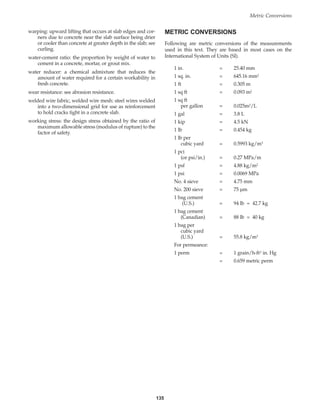
METRIC CONVERSIONS . . . . . . . . . . . . . . . . . . . . . . . . . . . . . . . . . . . . . . . . . . . . . . . . . 135
RELATED PUBLICATIONS . . . . . . . . . . . . . . . . . . . . . . . . . . . . . . . . . . . . . . . . . . . . . . . 136
RELATED WEB SITES . . . . . . . . . . . . . . . . . . . . . . . . . . . . . . . . . . . . . . . . . . . . . . . . . . . 136
viii
CHAPTER
Book Contents
Publication List
TYPES OF FLOORS
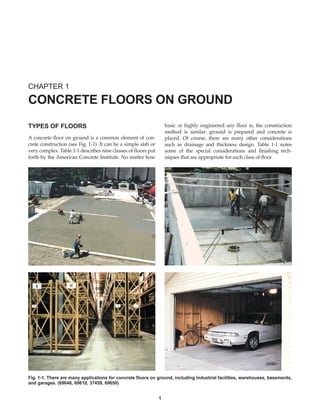
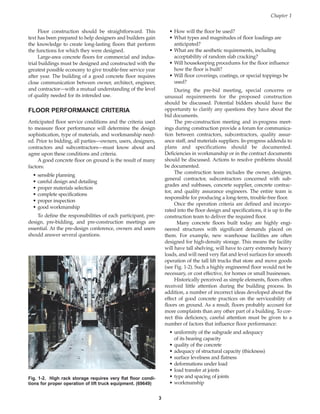
A concrete floor on ground is a common element of con-
crete construction (see Fig. 1-1). It can be a simple slab or
very complex. Table 1-1 describes nine classes of floors put
forth by the American Concrete Institute. No matter how
basic or highly engineered any floor is, the construction
method is similar: ground is prepared and concrete is
placed. Of course, there are many other considerations
such as drainage and thickness design. Table 1-1 notes
some of the special considerations and finishing tech-
niques that are appropriate for each class of floor.
CHAPTER 1
CONCRETE FLOORS ON GROUND
1
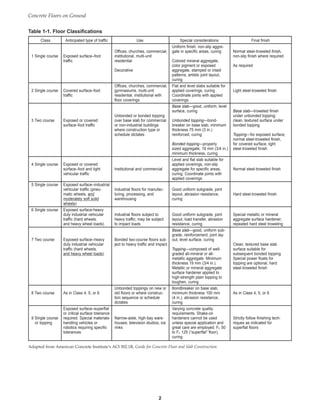
Fig. 1-1. There are many applications for concrete floors on ground, including industrial facilities, warehouses, basements,
and garages. (69648, 69610, 37459, 69650)
Book Contents
Publication List
2
Concrete Floors on Ground
Table 1-1. Floor Classifications
Class Anticipated type of traffic Use Special considerations Final finish
Uniform finish, non-slip aggre-
Offices, churches, commercial, gate in specific areas, curing Normal steel-troweled finish,
1 Single course Exposed surface–foot institutional, multi-unit non-slip finish where required
traffic residential Colored mineral aggregate,
color pigment or exposed As required
Decorative aggregate, stamped or inlaid
patterns, artistic joint layout,
curing
Offices, churches, commercial, Flat and level slabs suitable for
2 Single course Covered surface–foot gymnasiums, multi-unit applied coverings, curing Light steel-troweled finish
traffic residential, institutional with Coordinate joints with applied
floor coverings coverings
Base slab—good, uniform, level
surface, curing Base slab—troweled finish
Unbonded or bonded topping under unbonded topping;
3 Two course Exposed or covered over base slab for commercial Unbonded topping—bond- clean, textured surface under
surface–foot traffic or non-industrial buildings breaker on base slab, minimum bonded topping
where construction type or thickness 75 mm (3 in.)
schedule dictates reinforced, curing Topping—for exposed surface,
normal steel-troweled finish,
Bonded topping—properly for covered surface, light
sized aggregate, 19 mm (3/4 in.) steel-troweled finish
minimum thickness, curing
Level and flat slab suitable for
4 Single course Exposed or covered applied coverings, non-slip
surface–foot and light Institutional and commercial aggregate for specific areas, Normal steel-troweled finish
vehicular traffic curing. Coordinate joints with
applied coverings
5 Single course Exposed surface–industrial
vehicular traffic (pneu- Industrial floors for manufac- Good uniform subgrade, joint
matic wheels, and turing, processing, and layout, abrasion resistance, Hard steel-troweled finish
moderately soft solid warehousing curing
wheels)
6 Single course Exposed surface-heavy
duty industrial vehicular Industrial floors subject to Good uniform subgrade, joint Special metallic or mineral
traffic (hard wheels, heavy traffic; may be subject layout, load transfer, abrasion aggregate surface hardener;
and heavy wheel loads) to impact loads resistance, curing repeated hard steel troweling
Base slab—good, uniform sub-
grade, reinforcement, joint lay-
7 Two course Exposed surface–heavy Bonded two-course floors sub- out, level surface, curing
duty industrial vehicular ject to heavy traffic and impact Clean, textured base slab
traffic (hard wheels, Topping—composed of well- surface suitable for
and heavy wheel loads) graded all-mineral or all- subsequent bonded topping.
metallic aggregate. Minimum Special power floats for
thickness 19 mm (3/4 in.). topping are optional, hard
Metallic or mineral aggregate steel-troweled finish
surface hardener applied to
high-strength plain topping to
toughen, curing
Unbonded toppings on new or Bondbreaker on base slab,
8 Two course As in Class 4, 5, or 6 old floors or where construc- minimum thickness 100 mm As in Class 4, 5, or 6
tion sequence or schedule (4 in.), abrasion resistance,
dictates curing
Exposed surface–superflat Varying concrete quality
or critical surface tolerance requirements. Shake-on
9 Single course required. Special materials- Narrow-aisle, high-bay ware- hardeners cannot be used Strictly follow finishing tech-
or topping handling vehicles or houses; television studios, ice unless special application and niques as indicated for
robotics requiring specific rinks great care are employed. FF 50 superflat floors
tolerances to FF 125 (“superflat” floor),
curing
Adapted from American Concrete Institute’s ACI 302.1R, Guide for Concrete Floor and Slab Construction.
Book Contents
Publication List
Floor construction should be straightforward. This
text has been prepared to help designers and builders gain
the knowledge to create long-lasting floors that perform
the functions for which they were designed.
Large-area concrete floors for commercial and indus-
trial buildings must be designed and constructed with the
greatest possible economy to give trouble-free service year
after year. The building of a good concrete floor requires
close communication between owner, architect, engineer,
and contractor—with a mutual understanding of the level
of quality needed for its intended use.
FLOOR PERFORMANCE CRITERIA
Anticipated floor service conditions and the criteria used
to measure floor performance will determine the design
sophistication, type of materials, and workmanship need-
ed. Prior to bidding, all parties—owners, users, designers,
contractors and subcontractors—must know about and
agree upon these conditions and criteria.
A good concrete floor on ground is the result of many
factors:
• sensible planning
• careful design and detailing
• proper materials selection
• complete specifications
• proper inspection
• good workmanship
To define the responsibilities of each participant, pre-
design, pre-bidding, and pre-construction meetings are
essential. At the pre-design conference, owners and users
should answer several questions.
• How will the floor be used?
• What types and magnitudes of floor loadings are
anticipated?
• What are the aesthetic requirements, including
acceptability of random slab cracking?
• Will housekeeping procedures for the floor influence
how the floor is built?
• Will floor coverings, coatings, or special toppings be
used?
During the pre-bid meeting, special concerns or
unusual requirements for the proposed construction
should be discussed. Potential bidders should have the
opportunity to clarify any questions they have about the
bid documents.
The pre-construction meeting and in-progress meet-
ings during construction provide a forum for communica-
tion between contractors, subcontractors, quality assur-
ance staff, and materials suppliers. In-progress addenda to
plans and specifications should be documented.
Deficiencies in workmanship or in the contract documents
should be discussed. Actions to resolve problems should
be documented.
The construction team includes the owner, designer,
general contractor, subcontractors concerned with sub-
grades and subbases, concrete supplier, concrete contrac-
tor, and quality assurance engineers. The entire team is
responsible for producing a long-term, trouble-free floor.
Once the operation criteria are defined and incorpo-
rated into the floor design and specifications, it is up to the
construction team to deliver the required floor.
Many concrete floors built today are highly engi-
neered structures with significant demands placed on
them. For example, new warehouse facilities are often
designed for high-density storage. This means the facility
will have tall shelving, will have to carry extremely heavy
loads, and will need very flat and level surfaces for smooth
operation of the tall lift trucks that store and move goods
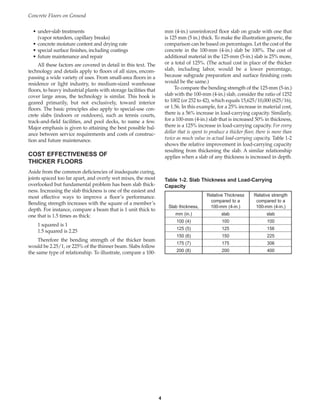
(see Fig. 1-2). Such a highly engineered floor would not be
necessary, or cost effective, for homes or small businesses.
Historically perceived as simple elements, floors often
received little attention during the building process. In
addition, a number of incorrect ideas developed about the
effect of good concrete practices on the serviceability of
floors on ground. As a result, floors probably account for
more complaints than any other part of a building. To cor-
rect this deficiency, careful attention must be given to a
number of factors that influence floor performance:
• uniformity of the subgrade and adequacy
of its bearing capacity
• quality of the concrete
• adequacy of structural capacity (thickness)
• surface levelness and flatness
• deformations under load
• load transfer at joints
• type and spacing of joints
• workmanship
Chapter 1
3
Fig. 1-2. High rack storage requires very flat floor condi-
tions for proper operation of lift truck equipment. (69649)
Book Contents
Publication List
4
• under-slab treatments
(vapor retarders, capillary breaks)
• concrete moisture content and drying rate
• special surface finishes, including coatings
• future maintenance and repair
All these factors are covered in detail in this text. The
technology and details apply to floors of all sizes, encom-
passing a wide variety of uses. From small-area floors in a
residence or light industry, to medium-sized warehouse
floors, to heavy industrial plants with storage facilities that
cover large areas, the technology is similar. This book is
geared primarily, but not exclusively, toward interior
floors. The basic principles also apply to special-use con-
crete slabs (indoors or outdoors), such as tennis courts,
track-and-field facilities, and pool decks, to name a few.
Major emphasis is given to attaining the best possible bal-
ance between service requirements and costs of construc-
tion and future maintenance.
COST EFFECTIVENESS OF
THICKER FLOORS
Aside from the common deficiencies of inadequate curing,
joints spaced too far apart, and overly wet mixes, the most
overlooked but fundamental problem has been slab thick-
ness. Increasing the slab thickness is one of the easiest and
most effective ways to improve a floor’s performance.
Bending strength increases with the square of a member’s
depth. For instance, compare a beam that is 1 unit thick to
one that is 1.5 times as thick:
1 squared is 1
1.5 squared is 2.25
Therefore the bending strength of the thicker beam
would be 2.25/1, or 225% of the thinner beam. Slabs follow
the same type of relationship. To illustrate, compare a 100-
Concrete Floors on Ground
Table 1-2. Slab Thickness and Load-Carrying
Capacity
Relative Thickness Relative strength
compared to a compared to a
Slab thickness, 100-mm (4-in.) 100-mm (4-in.)
mm (in.) slab slab
100 (4) 100 100
125 (5) 125 156
150 (6) 150 225
175 (7) 175 306
200 (8) 200 400
mm (4-in.) unreinforced floor slab on grade with one that
is 125 mm (5 in.) thick. To make the illustration generic, the
comparison can be based on percentages. Let the cost of the
concrete in the 100-mm (4-in.) slab be 100%. The cost of
additional material in the 125-mm (5-in.) slab is 25% more,
or a total of 125%. (The actual cost in place of the thicker
slab, including labor, would be a lower percentage,
because subgrade preparation and surface finishing costs
would be the same.)
To compare the bending strength of the 125-mm (5-in.)
slab with the 100-mm (4-in.) slab, consider the ratio of 1252
to 1002 (or 252 to 42), which equals 15,625/10,000 (625/16),
or 1.56. In this example, for a 25% increase in material cost,
there is a 56% increase in load-carrying capacity. Similarly,
for a 100-mm (4-in.) slab that is increased 50% in thickness,
there is a 125% increase in load-carrying capacity. For every
dollar that is spent to produce a thicker floor, there is more than
twice as much value in actual load-carrying capacity. Table 1-2
shows the relative improvement in load-carrying capacity
resulting from thickening the slab. A similar relationship
applies when a slab of any thickness is increased in depth.
Book Contents
Publication List
5
To ensure that the concrete floor will carry its design load-
ing successfully and without settlement, it is vital to design
and construct the subgrade in preparation for the floor. A
subbase, while not mandatory, can provide added benefits
in construction and performance (see Fig. 2-1).
SUBGRADE CHARACTERISTICS AND
FUNCTION
The subgrade is the natural ground, graded and compact-
ed, on which the floor is built. The subgrade can be
improved by drainage, compaction (see “Density”), or soil
stabilization. In cases of extremely poor soil, removal and
replacement of the subgrade with a compactible material
may be the best option. Subgrade support should be rea-
sonably uniform without abrupt changes from hard to soft,
and the upper portion of the subgrade must be of uniform
material and density.
Because concrete floor slabs are rigid, concentrated
loads from forklift wheels or high-rack legs are spread over
large areas and pressures on the subgrade are usually low.
Therefore, concrete floors do not necessarily require strong
support from the subgrade. However, support from sub-
grades and/or subbases contributes to solid edge support,
which is beneficial at slab joints exposed to heavy lift-truck
loadings. If support from the subgrade or subbase is weak,
densification may occur as heavy loads pass over the floor,
leading to loss of slab edge support.
In some instances, pressures transmitted to subgrade
soils can be significant. This is true where heavy goods—like
steel products or large rolls of paper—are stored directly on
the floor (see Fig. 2-2). In these cases, long-term soil consoli-
dation effects should be considered in subgrade performance.
SOILS
Classification
Proper classification of the subgrade soil must be made to
identify potential problem soils (see PCA Soil Primer,
EB007). One soil classification system in common use is
CHAPTER 2
SUBGRADE AND SUBBASES
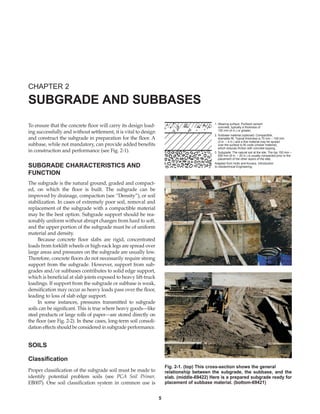
1. Wearing surface: Portland cement
concrete, typically a thickness of
100 mm (4 in.) or greater.
2. Subbase material (optional): Compactible,
drainable fill. Typical thickness is 75 mm – 100 mm
(3 in. – 4 in.) and a fine material may be spread
over the surface to fill voids (choker material),
which reduces friction with concrete topping.
3. Subgrade: The natural soil at the site. The top 150 mm –
500 mm (6 in. – 20 in.) is usually compacted prior to the
placement of the other layers of the slab.
Adapted from Holtz and Kovacs, Introduction
to Geotechnical Engineering.
Fig. 2-1. (top) This cross-section shows the general
relationship between the subgrade, the subbase, and the
slab. (middle-69422) Here is a prepared subgrade ready for
placement of subbase material. (bottom-69421)
Book Contents
Publication List
Classification of Soils for Engineering Purposes, American
Society for Testing and Materials (ASTM) Designation D
2487. Table 2-1, based on the ASTM system, shows the
major divisions of soils with descriptive names and letter
symbols indicating their principal characteristics. When
soil is a combination of two types, it is described by com-
bining both names. Thus, clayey sand is predominantly
sand but contains an appreciable amount of clay. Reverse
the name to sandy clay and the soil is predominantly clay
with an appreciable amount of sand.
Density
The strength of the soil—its supporting capacity and resist-
ance to densification or consolidation—is important to the
performance of floors on ground, particularly when the
floor must support extremely heavy loads. Soil strength is
affected by soil type, degree of compaction, and moisture
content.
Compaction is a method for purposely densifying or
increasing the unit weight of a soil mass by rolling, tamp-
ing, or vibrating. It is the lowest-cost way to improve the
structural properties of a soil. Density of a soil is measured
in terms of its mass per unit volume. Higher densities usu-
ally provide improved support.
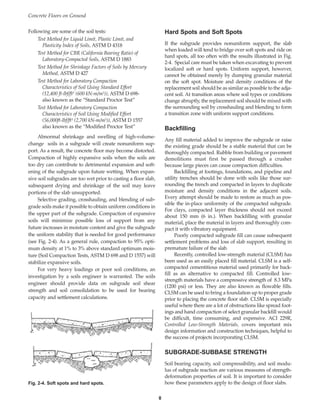
Tests performed according to Moisture-Density Rela-
tions of Soils, ASTM D 698 and D 1557, will determine the
maximum density and corresponding optimum moisture
content of the soil (see Fig. 2-3). Soil moisture contents are
expressed in percent: the ratio of the mass of water divid-
ed by the mass of dry soil, then multiplied by 100.
Plasticity Index
When a soil can be rolled into thin threads, it is called plas-
tic. Most fine-grained soils containing clay minerals are
plastic. The plastic limit (PL) is the amount of moisture
present when a soil changes from semisolid to plastic state.
The liquid limit (LL) is the amount of moisture present
when the soil changes from a plastic to liquid state. The
degree of plasticity is expressed as the plasticity index (PI).
The PI is the numerical difference between the liquid limit
and plastic limit.
PI = LL - PL
Problem Soils
Soils are considered problem soils when they:
• are highly expansive
• are highly compressible
• do not provide reasonably uniform support
Cohesive soils that gain moisture after being compact-
ed (for example, by a rising water table) can cause prob-
lems for concrete floors. Soils with a PI of 5 or greater can
deform plastically when the soil moisture content increas-
es. If this happens, loads passing over the floor may lead to
deflections due to the loss of bearing support strength.
Sensitive floor locations are near slab edges and corners
exposed to repetitive wheeled traffic. Cohesive soils with a
high PI (greater than 20) that gain soil moisture may
become expansive, putting excessive pressure on the slab
from below.
Concrete-floor-on-ground design is based on the
assumption of uniform subgrade support. The key word is
“uniform.” Where problem soils create nonuniform condi-
tions, correction is most economically and effectively
achieved through subgrade preparation methods.
SITE PREPARATION
To construct a reasonably uniform subgrade, special care
must be taken to ensure that there are no variations of sup-
port within the floor area and that the following major
causes of nonuniform support are controlled:
• expansive soils
• hard spots and soft spots
• backfilling
Concrete Floors on Ground
6
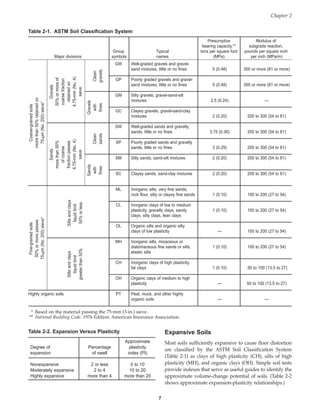
Fig. 2-2. Heavy loads on a concrete floor. (69651)
0 5 10 15 20 25
2
1.9
1.8
1.7
1.6
Dry
density,
Mg/m
3
Dry
density,
lb/ft
3
125
120
115
110
105
100
Standard Proctor
Modified Proctor
Water content, %
Fig. 2-3. Soil testing determines the optimum moisture
concrete that allows for maximum compaction.
Book Contents
Publication List
Expansive Soils
Most soils sufficiently expansive to cause floor distortion
are classified by the ASTM Soil Classification System
(Table 2-1) as clays of high plasticity (CH), silts of high
plasticity (MH), and organic clays (OH). Simple soil tests
provide indexes that serve as useful guides to identify the
approximate volume-change potential of soils. (Table 2-2
shows approximate expansion-plasticity relationships.)
Chapter 2
7
Table 2-1. ASTM Soil Classification System
Presumptive Modulus of
bearing capacity,** subgrade reaction,
Group Typical tons per square foot pounds per square inch
Major divisions symbols names (MPa) per inch (MPa/m)
GW Well-graded gravels and gravel-
sand mixtures, little or no fines 5 (0.48) 300 or more (81 or more)
GP Poorly graded gravels and gravel-
sand mixtures, little or no fines 5 (0.48) 300 or more (81 or more)
GM Silty gravels, gravel-sand-silt
mixtures 2.5 (0.24) —
GC Clayey gravels, gravel-sand-clay
mixtures 2 (0.20) 200 to 300 (54 to 81)
SW Well-graded sands and gravelly,
sands, little or no fines 3.75 (0.36) 200 to 300 (54 to 81)
SP Poorly graded sands and gravelly
sands, little or no fines 3 (0.29) 200 to 300 (54 to 81)
SM Silty sands, sand-silt mixtures 2 (0.20) 200 to 300 (54 to 81)
SC Clayey sands, sand-clay mixtures 2 (0.20) 200 to 300 (54 to 81)
ML Inorganic silts, very fine sands,
rock flour, silty or clayey fine sands 1 (0.10) 100 to 200 (27 to 54)
CL Inorganic clays of low to medium
plasticity, gravelly clays, sandy 1 (0.10) 100 to 200 (27 to 54)
clays, silty clays, lean clays
OL Organic silts and organic silty
clays of low plasticity — 100 to 200 (27 to 54)
MH Inorganic silts, micaceous or
diatomaceous fine sands or silts, 1 (0.10) 100 to 200 (27 to 54)
elastic silts
CH Inorganic clays of high plasticity,
fat clays 1 (0.10) 50 to 100 (13.5 to 27)
OH Organic clays of medium to high
plasticity — 50 to 100 (13.5 to 27)
Highly organic soils PT Peat, muck, and other highly
organic soils — —
Coarse-grained
soils
moire
than
50%
retained
on
75-µm
(No.
200)
sieve*
Sands
Gravels
more
than
50%
50%
or
more
of
of
coarse
coarse
fraction
fraction
passes
retained
on
4.75-mm
(No.
4)
4.75-mm
(No.
4)
sieve
sieve
Sands
Gravels
with
Clean
with
Clean
fines
sands
fines
gravels
Fine-grained
soils
50%
or
more
passes
75-µm
(No.
200)
sieve*
Silts
and
clays
Silts
and
clays
liquid
limit
liquid
limit
greater
than
50%
50%
or
less
* Based on the material passing the 75-mm (3-in.) sieve.
** National Building Code. 1976 Edition. American Insurance Association.
Table 2-2. Expansion Versus Plasticity
Approximate
Degree of Percentage plasticity
expansion of swell index (PI)
Nonexpansive 2 or less 0 to 10
Moderately expansive 2 to 4 10 to 20
Highly expansive more than 4 more than 20
Book Contents
Publication List
Following are some of the soil tests:
Test Method for Liquid Limit, Plastic Limit, and
Plasticity Index of Soils, ASTM D 4318
Test Method for CBR (California Bearing Ratio) of
Laboratory-Compacted Soils, ASTM D 1883
Test Method for Shrinkage Factors of Soils by Mercury
Method, ASTM D 427
Test Method for Laboratory Compaction
Characteristics of Soil Using Standard Effort
(12,400 ft-lbf/ft3 (600 kN-m/m3)), ASTM D 698-
also known as the “Standard Proctor Test”
Test Method for Laboratory Compaction
Characteristics of Soil Using Modified Effort
(56,000ft-lbf/ft3 (2,700 kN-m/m3)), ASTM D 1557
also known as the “Modified Proctor Test”
Abnormal shrinkage and swelling of high-volume-
change soils in a subgrade will create nonuniform sup-
port. As a result, the concrete floor may become distorted.
Compaction of highly expansive soils when the soils are
too dry can contribute to detrimental expansion and soft-
ening of the subgrade upon future wetting. When expan-
sive soil subgrades are too wet prior to casting a floor slab,
subsequent drying and shrinkage of the soil may leave
portions of the slab unsupported.
Selective grading, crosshauling, and blending of sub-
grade soils make it possible to obtain uniform conditions in
the upper part of the subgrade. Compaction of expansive
soils will minimize possible loss of support from any
future increases in moisture content and give the subgrade
the uniform stability that is needed for good performance
(see Fig. 2-4). As a general rule, compaction to 95% opti-
mum density at 1% to 3% above standard optimum mois-
ture (Soil Compaction Tests, ASTM D 698 and D 1557) will
stabilize expansive soils.
For very heavy loadings or poor soil conditions, an
investigation by a soils engineer is warranted. The soils
engineer should provide data on subgrade soil shear
strength and soil consolidation to be used for bearing
capacity and settlement calculations.
Hard Spots and Soft Spots
If the subgrade provides nonuniform support, the slab
when loaded will tend to bridge over soft spots and ride on
hard spots, all too often with the results illustrated in Fig.
2-4. Special care must be taken when excavating to prevent
localized soft or hard spots. Uniform support, however,
cannot be obtained merely by dumping granular material
on the soft spot. Moisture and density conditions of the
replacement soil should be as similar as possible to the adja-
cent soil. At transition areas where soil types or conditions
change abruptly, the replacement soil should be mixed with
the surrounding soil by crosshauling and blending to form
a transition zone with uniform support conditions.
Backfilling
Any fill material added to improve the subgrade or raise
the existing grade should be a stable material that can be
thoroughly compacted. Rubble from building or pavement
demolitions must first be passed through a crusher
because large pieces can cause compaction difficulties.
Backfilling at footings, foundations, and pipeline and
utility trenches should be done with soils like those sur-
rounding the trench and compacted in layers to duplicate
moisture and density conditions in the adjacent soils.
Every attempt should be made to restore as much as pos-
sible the in-place uniformity of the compacted subgrade.
For clays, compacted layer thickness should not exceed
about 150 mm (6 in.). When backfilling with granular
material, place the material in layers and thoroughly com-
pact it with vibratory equipment.
Poorly compacted subgrade fill can cause subsequent
settlement problems and loss of slab support, resulting in
premature failure of the slab.
Recently, controlled low-strength material (CLSM) has
been used as an easily placed fill material. CLSM is a self-
compacted cementitious material used primarily for back-
fill as an alternative to compacted fill. Controlled low-
strength materials have a compressive strength of 8.3 MPa
(1200 psi) or less. They are also known as flowable fills.
CLSM can be used to bring a foundation up to proper grade
prior to placing the concrete floor slab. CLSM is especially
useful where there are a lot of obstructions like spread foot-
ings and hand compaction of select granular backfill would
be difficult, time consuming, and expensive. ACI 229R,
Controlled Low-Strength Materials, covers important mix
design information and construction techniques, helpful to
the success of projects incorporating CLSM.
SUBGRADE-SUBBASE STRENGTH
Soil bearing capacity, soil compressibility, and soil modu-
lus of subgrade reaction are various measures of strength-
deformation properties of soil. It is important to consider
how these parameters apply to the design of floor slabs.
Concrete Floors on Ground
8
Fig. 2-4. Soft spots and hard spots.
Book Contents
Publication List
The allowable soil bearing capacity is the maximum
pressure that can be permitted on foundation soil with
adequate safety against soil rupture or excessive settle-
ment. Allowable soil pressure may be based on:
• laboratory shear strength tests (of soil samples) such as
the direct shear test, triaxial compression test, or
unconfined compression test
• field tests such as the standard penetration test or cone
penetrometer test
• soil classification
• moisture-density-strength relationships (established by
conducting strength tests on soil specimens prepared
for moisture-density testing)
Beyond the allowable soil pressure is the ultimate
bearing capacity, the load per unit area (soil pressure) that
will produce failure by rupture of a supporting soil.
Another soil characteristic, compressibility of cohesive
soils, determines the amount of long-term settlement
under load. The usual method for predicting settlement is
based on conducting soil consolidation tests and determin-
ing the compression index for use in the settlement com-
putations. The compression index may be estimated by
correlation to the liquid limit of the soil.
A third measure of soil strength, Westergaard’s modu-
lus of subgrade reaction, k, is commonly used in design
procedures for concrete pavements and floors-on-grade
that are not structural elements in the building (floors not
supporting columns and load-bearing walls).
There is no reliable correlation between the three
measures of soil properties—modulus of subgrade reac-
tion, soil bearing capacity, and soil compressibility—
because they are measurements of entirely different char-
acteristics of a soil. The k-value used for floor-slab design
reflects the response of the subgrade under temporary
(elastic) conditions and small deflections, usually 1.25 mm
(0.05 in.) or less. Soil compressibility and bearing capacity
values (normally used to predict and limit differential set-
tlements between footings or parts of a foundation) reflect
total permanent (inelastic) subgrade deformations that
may be 20 to 40 (or more) times greater than the small
deflections on which k-values are based.
Substantial pavement research has shown that elastic
deflections and stresses of the slab can be predicted rea-
sonably well when using k-value to represent the subgrade
response. Consequently, the control of slab stresses based
on the subgrade k-value is a valid design procedure.
Although the k-value does not reflect the effect of
compressible soil layers at some depth in the subgrade, it
is the correct factor to use in design for wheel loads and
other concentrated loads because soil pressures under a
slab of adequate thickness are not excessive. However, if
heavy distributed loads will be applied to the floor, the
allowable soil pressure and the amount of settlement
should be estimated to determine if shear failure or exces-
sive settlement might occur.
If there are no unusually adverse soil conditions, the
design analysis requires only the determination of the
strength of the subgrade in terms of k. The k-value is meas-
ured by plate-loading tests taken on top of the compacted
subgrade (or subbase, if used) as seen in Fig. 2-5. A gener-
al procedure for load testing is given in ASTM D 1196,
Standard Test Method for Nonrepetitive Static Plate Load Tests
of Soils and Flexible Pavement Components, for Use in
Evaluation and Design of Airport and Highway Pavements.
This method provides guidance in the field determination
of subgrade modulus with various plate diameters. Design
of Slabs on Grade (ACI 360R) is specifically oriented to the
determination of modulus of subgrade reaction using a
760-mm (30-in.) diameter plate and gives more detailed
information on test methods using this size plate. This
plate is loaded to a deflection not greater than 1.25 mm
(0.05 in.), and the k-value is computed by dividing the unit
load by the deflection obtained. A more economical test
using smaller plates (300 mm [12 in.]) that determines a
modified subgrade reaction modulus
is mentioned in ACI 360R. In each
case, the units of k are given in pres-
sure per length: MPa/m in the metric
system, or in in.-lb units, pounds per
square inch per inch, or psi per in. or,
as commonly expressed, pounds per
cubic inch (pci). The plate load test is
no longer commonly run in practice.
Instead, subgrade reaction values are
estimated from the California Bearing
Ratio or from the soil classification.
When plate-bearing tests are not per-
formed at the jobsite, the k-value can
be estimated from correlations such as
those shown in Table 2-3.
Chapter 2
9
Fig. 2-5. Testing to determine the modulus of subgrade reaction. (69652)
Book Contents
Publication List
If a high-quality, well-compacted granular subbase is
used under the floor slab, the k-value will increase. On
large projects it may be feasible to construct a test section
and perform plate load tests on top of the subbase. If this is
not practical, the k-value on top of the subbase can be esti-
mated from Fig. 2-6.
SUBBASES
A subbase—the layer of granular material placed on top of
prepared subgrade—is not mandatory for floors on
ground. A granular subbase, however, can provide benefits
during the construction process and afterwards (to the
completed floor). During construction, the subbase func-
tions as a stable work platform for heavy equipment. When
grading and compaction operations do not produce a uni-
form subgrade, a granular subbase will provide a cushion
for more uniform slab support by equalizing minor sub-
grade defects. The cushioning effect and increased unifor-
mity can be very important for cohesive soils that are sus-
ceptible to reduced bearing support with increases in mois-
ture content. A subbase also serves as a capillary break,
reducing moisture migration towards the bottom of the
completed slab. A granular subbase can also serve as a col-
lection layer for radon gas (see box on radon, page 9).
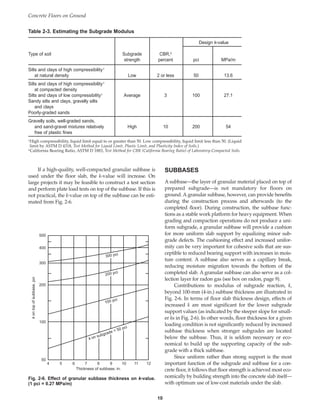
Contributions to modulus of subgrade reaction, k,
beyond 100-mm (4-in.) subbase thickness are illustrated in
Fig. 2-6. In terms of floor slab thickness design, effects of
increased k are most significant for the lower subgrade
support values (as indicated by the steeper slope for small-
er ks in Fig. 2-6). In other words, floor thickness for a given
loading condition is not significantly reduced by increased
subbase thickness when stronger subgrades are located
below the subbase. Thus, it is seldom necessary or eco-
nomical to build up the supporting capacity of the sub-
grade with a thick subbase.
Since uniform rather than strong support is the most
important function of the subgrade and subbase for a con-
crete floor, it follows that floor strength is achieved most eco-
nomically by building strength into the concrete slab itself—
with optimum use of low-cost materials under the slab.
Concrete Floors on Ground
10
Table 2-3. Estimating the Subgrade Modulus
Design k-value
Type of soil Subgrade CBR,2
strength percent pci MPa/m
Silts and clays of high compressibility1
at natural density Low 2 or less 50 13.6
Silts and clays of high compressibility1
at compacted density
Silts and clays of low compressibility1 Average 3 100 27.1
Sandy silts and clays, gravelly silts
and clays
Poorly-graded sands
Gravelly soils, well-graded sands,
and sand-gravel mixtures relatively High 10 200 54
free of plastic fines
1High compressibility, liquid limit equal to or greater than 50. Low compressibility, liquid limit less than 50. (Liquid
limit by ASTM D 4318, Test Method for Liquid Limit, Plastic Limit, and Plasticity Index of Soils.)
2 California Bearing Ratio, ASTM D 1883, Test Method for CBR (California Bearing Ratio) of Laboratory-Compacted Soils.
500
400
300
200
100
50
4 5 6 7 8 9 10 11 12
Thickness of subbase, in.
k
on
top
of
subbase,
pci
k on subgrade = 50 pci
100 pci
200 pci
300 pci
Fig. 2-6. Effect of granular subbase thickness on k-value.
(1 pci = 0.27 MPa/m)
Book Contents
Publication List
To prevent subbase densification after the floor is in
service, subbase material should be compacted to high
density. Determine the optimum moisture content for max-
imum subbase density by running a standard Proctor lab-
oratory compaction test (ASTM D 698). Because the sub-
base is only 100 mm (4 in.) thick, field density tests do not
accurately measure in-place density. Moisture content
samples should be taken to ensure that the material is field
compacted at optimum moisture content. Field com-
paction of the subbase should be verified in some manner.
Proofrolling is one of the simplest and most practical meth-
ods of determining the ability of the full soil support sys-
tem to take loads (ACI 302 1997). If any rutting or pump-
ing is evident during the procedure, corrective actions
should be taken to improve the soil support.
Granular material for the subbase can be sand, sand-
gravel, crushed stone, or combinations of these materials.
A satisfactory dense-graded material will meet the follow-
ing requirements:
Maximum particle size: Not more than 1/3 the
subbase thickness
Passing 75µm (No. 200) 15% maximum by mass
sieve: of dry material
Plasticity index: 6 maximum
Liquid limit: 25 maximum
More information on preparing the grade is described in
Subgrades and Subbases for Concrete Pavements.
Special Subbases
Special subbases are used for a variety of reasons. They
consist of one of various materials, including crushed
stone, recycled concrete, asphalt, lean concrete, CLSM, and
insulation boards. They may be placed to improve sub-
grade support values, expedite construction, or prevent
subgrade frost heave in food freezer warehouses or ice
rinks (also see Chapter 11, Special Floors).
Chapter 2
11
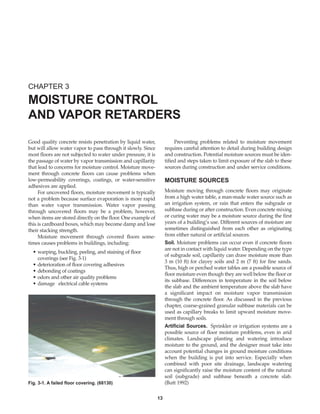
Radon
Radon is an odorless, colorless, radioactive gas. Radon
is produced naturally when uranium and radium in the
soil decay. Though radon exists virtually everywhere,
the concentration varies with geographic location. Parts
of Pennsylvania, New Jersey, New York, Florida,
Colorado, and Montana have been identified as having
high radon concentrations. It is most prevalent in high-
ly permeable soil with high concentrations of uranium
or radium.
Soil gas enters a building through openings in the
foundation walls or slab. Soil gas can have a high radon
content. Radon gas itself breaks down into solid parti-
cles called progeny, or “daughters,” which can lodge in
lung tissue and increase the chances of lung cancer.
Radon is measured in picocuries per liter of air, or
pCi/L, a measure of the radioactivity. In 1988, The
Indoor Radon Abatement Act established a long-term
goal of achieving radon levels inside a building no high-
er than the ambient air outside the building. Test kits are
used to measure the average concentration of radon in
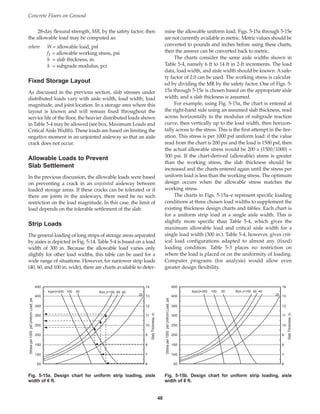
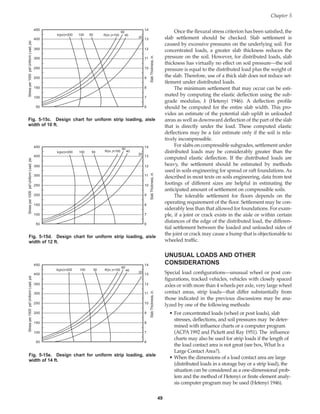
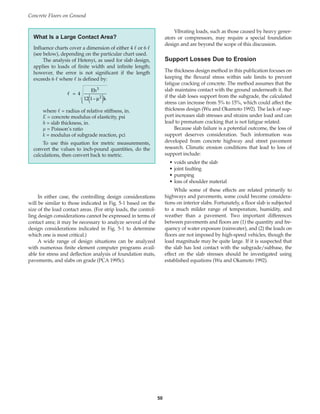
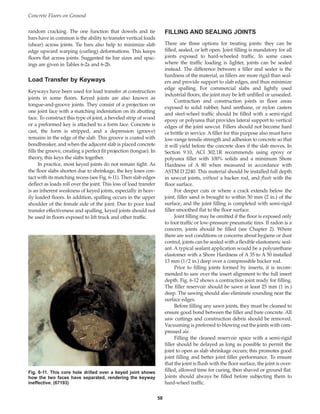
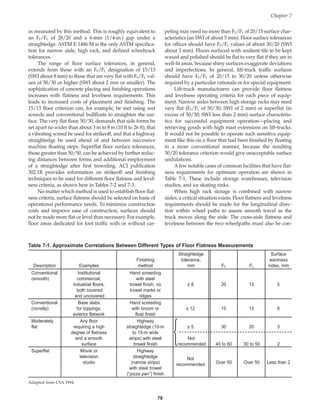
the air. In the U. S., the average concentration of radon
is 1.2-1.5 pCi/L. When the level exceeds 4 pCi/L, action
should be taken to reduce radon gas concentration.
Typical features of a high-risk house include:
• high concentration of radium in the soil
beneath the house
• a sump opening
• exposed dirt or wood floor in the basement
• cracks in the foundation or basement slab
• well water
Where radon is a potential concern for residential
buildings, proper design and construction are necessary
to minimize the entrance of soil gas into the living space.
A simple method for controlling indoor radon is to col-
lect the gas, then vent it to the outside. In many
instances, a 100-mm to 150-mm (4-in. to 6-in.) thick layer
of a compacted aggregate placed beneath the slab is an
acceptable method of collection. Coarse aggregate con-
tains sufficient voids to allow for adequate air move-
ment. If sand is used, a geotextile drainage mat will
increase the air movement above the collection layer.
A polyethylene sheet placed on top of the aggregate
will seal the surface and help contain the gas: it is
known as a soil gas retarder. Sheets for soil gas retarders
can be 0.15 mm (6 mil) thick, but if they also serve
as vapor retarders, they may have to be thicker.
Sheets should be lapped at joints, fit closely around all
penetrations, and sealed where punctures or tears occur.
The concrete for the slab should have minimal
shrinkage and cracking. Large holes should be filled
with mortar, grout, or foam to create airtight seals.
Openings like sumps or drains should be plugged. All
cracks and joints should be sealed with elastomeric joint
sealants such as polyurethane or concrete-rated silicone.
Before placing the concrete slab, a vertical pipe
should be embedded into the subslab aggregate layer
and extended up to the rooftop or to an exterior wall to
vent gases away from any fresh air intakes (windows,
doors). The pipe should be a minimum of 75 mm (3 in.)
in diameter and have a tee on the end beneath the slab.
Book Contents
Publication List
Subgrade support can be considerably improved by
installing either a cement-treated subbase, CLSM, or lean
concrete subbase. A subbase can also be installed as a
working platform for erection of facility superstructures.
Subbases of CLSM provide better thickness control of floor
slabs and a firm surface to support chairs that hold steel
reinforcement. The solid support helps with adequate steel
placement, which is especially important for installations
of shrinkage compensating concrete.
Generally, cement-treated and lean concrete sub-bases
are 100 mm to 150 mm (4 in. to 6 in.) thick. A modulus of
subgrade reaction of 110 MPa/m to 140 MPa/m (400 pci to
500 pci) can be used to calculate the required thickness of
floors placed directly on lean concrete, and cement-treated
or roller-compacted subbases.
When insulation is used, a modulus of subgrade reac-
tion test (ASTM D 1196) should be run on a mockup of the
insulation layer.
Concrete Floors on Ground
12
Book Contents
Publication List
Good quality concrete resists penetration by liquid water,
but will allow water vapor to pass through it slowly. Since
most floors are not subjected to water under pressure, it is
the passage of water by vapor transmission and capillarity
that lead to concerns for moisture control. Moisture move-
ment through concrete floors can cause problems when
low-permeability coverings, coatings, or water-sensitive
adhesives are applied.
For uncovered floors, moisture movement is typically
not a problem because surface evaporation is more rapid
than water vapor transmission. Water vapor passing
through uncovered floors may be a problem, however,
when items are stored directly on the floor. One example of
this is cardboard boxes, which may become damp and lose
their stacking strength.
Moisture movement through covered floors some-
times causes problems in buildings, including:
• warping, buckling, peeling, and staining of floor
coverings (see Fig. 3-1)
• deterioration of floor covering adhesives
• debonding of coatings
• odors and other air quality problems
• damage electrical cable systems
Preventing problems related to moisture movement
requires careful attention to detail during building design
and construction. Potential moisture sources must be iden-
tified and steps taken to limit exposure of the slab to these
sources during construction and under service conditions.
MOISTURE SOURCES
Moisture moving through concrete floors may originate
from a high water table, a man-made water source such as
an irrigation system, or rain that enters the subgrade or
subbase during or after construction. Even concrete mixing
or curing water may be a moisture source during the first
years of a building’s use. Different sources of moisture are
sometimes distinguished from each other as originating
from either natural or artificial sources.
Soil. Moisture problems can occur even if concrete floors
are not in contact with liquid water. Depending on the type
of subgrade soil, capillarity can draw moisture more than
3 m (10 ft) for clayey soils and 2 m (7 ft) for fine sands.
Thus, high or perched water tables are a possible source of
floor moisture even though they are well below the floor or
its subbase. Differences in temperature in the soil below
the slab and the ambient temperature above the slab have
a significant impact on moisture vapor transmission
through the concrete floor. As discussed in the previous
chapter, coarse-grained granular subbase materials can be
used as capillary breaks to limit upward moisture move-
ment through soils.
Artificial Sources. Sprinkler or irrigation systems are a
possible source of floor moisture problems, even in arid
climates. Landscape planting and watering introduce
moisture to the ground, and the designer must take into
account potential changes in ground moisture conditions
when the building is put into service. Especially when
combined with poor site drainage, landscape watering
can significantly raise the moisture content of the natural
soil (subgrade) and subbase beneath a concrete slab.
(Butt 1992)
CHAPTER 3
MOISTURE CONTROL
AND VAPOR RETARDERS
13
Fig. 3-1. A failed floor covering. (68130)
Book Contents
Publication List
Precipitation. Rain can also raise the moisture content of
the subgrade and subbase before a building is enclosed or,
if the site is poorly drained, after construction is complete.
If a granular layer is placed directly beneath a floor, exces-
sive sprinkling of this layer before concrete placement pro-
duces a similar effect.
Concrete Mix Water. Newly placed concrete contains
water, some of which will evaporate after the concrete has
been cured and allowed to dry. After sealed curing for 7
days, a cubic meter of normal weight concrete made with
320 kg of cement and 160 kg of water would contain about
95 kg of surplus water in the hydrated cement paste and
about 18 kg of water in the aggregate pores. (Conversion to
in.-lb: After sealed curing for 7 days, a cu yd of concrete
made with 540 lb of cement and 270 lb of water would con-
tain about 160 lb of surplus water in the paste and 30 lb in
the aggregate pores.) Some of the surplus water in the
paste continues to combine with unhydrated cement and
some is adsorbed on surfaces of new hydration products.
The rest evaporates at a rate dependent on the temperature
and relative humidity at the floor surface.
If the concrete is wet cured—wet coverings, continu-
ous sprinkling, or ponding—the amount of surplus mois-
ture will be slightly higher. The latter two curing methods
are not recommended for floors to receive low-permeabili-
ty coverings, because these methods may raise subgrade or
subbase moisture contents to undesirable levels.
Chapter 9 discusses the drying of concrete and other
concerns related to floor coverings. This chapter focuses on
limiting moisture that passes through the concrete slab,
such as when and how to use a vapor retarder, and proper
subgrade preparation.
CONTROL OF FLOOR
MOISTURE MOVEMENT
Preliminary Design
The floor designer must draw on information from several
sources before and during the design process. Site inspec-
tion and testing by a geotechnical engineering firm will
provide some of the information needed to design for con-
trol of floor moisture movement. The geotechnical report
should include information about:
• soils: types, conditions, and properties
• groundwater: level of water table, movement
(hydrology), and seasonal/historical data (flooding)
Information on soil types identifies soils with high silt
and clay contents that can cause problems because of high-
er natural moisture contents due to capillarity. This knowl-
edge, plus data on seasonal high and low water tables,
helps in deciding whether a granular layer is needed to
provide a capillary break.
Site topographic surveys and grading plans establish
surface drainage patterns. Along with historical data on
surface flooding, this helps the designer to anticipate the
worst possible moisture conditions at the site. It is also
important to consider how ongoing development of the
surrounding area will affect the future water table level
and water movement on site.
For proper drainage, exterior finish grades should be
at or below the floor subgrade level whenever possible (see
Fig. 3-2). If the bottom of the granular subbase is below the
adjacent finished grade, it could become a reservoir for
water. The exterior grade also should slope away from the
structure at a minimum slope of 40 mm per meter (1/2 in.
per ft) for a distance of 2-1/2 m to 3 m (8 ft to 10 ft) beyond
the building foundation.
Subgrade and Subbase Design
Special design features are needed when the subgrade ele-
vation is below the exterior finish grade. If the elevation
difference is slight, the design detail shown in Fig. 3-3 is
suggested. This detail includes a waterproofing membrane
system on the outside of the wall and footing and an exte-
rior drainpipe encased in granular fill. Drainage details for
floors with subgrade levels substantially below grade are
beyond the scope of this document.
Concrete Floors on Ground
14
Minimum sloped distance
21/2 m – 3 m (8 ft – 10 ft)
Slope 40 mm/m
(1/2 in. per ft)
Wall
Vapor retarder/
barrier
Concrete slab
Footing
Subbase
(optional)
Compacted
subgrade
Fig. 3-2. Site grading to promote adequate drainage
near buildings. Adapted from ASTM E 1643.
Minimum sloped distance
21/2 m – 3 m (8 ft – 10 ft)
Slope 40 mm/m
(1/2 in. per ft)
Wall
Vapor retarder/
barrier
Concrete slab
Footing
Subbase
(optional)
Compacted
subgrade
Drain pipe
Granular
fill wrapped
in geotextile
filter fabric
Fig. 3-3. Design detail when the subgrade is slightly below
exterior finish grade. Adapted from ASTM E 1643.
Book Contents
Publication List
A layer of open-graded, clean, compacted coarse
aggregate is usually needed as a capillary break when the
floor will be built on sandy soils or very fine soils (more
than 45% of the particles by weight pass the 75-micron
[No. 200] sieve). The capillary break usually consists of a
100-mm to 200-mm (4-in. to 8-in.) thick layer of 19-mm
(3/4-in.) washed, single-size aggregate (see Fig. 3-4). The
uniform aggregate size allows for air pockets between par-
ticles and reduces the upward movement of water. Gravel
is preferred to crushed stone when a vapor retarder is spec-
ified because the smoother particles are less likely to punc-
ture or tear the vapor retarder. Alternately, a geotextile fab-
ric can protect the vapor retarder from the aggregate parti-
cles. If the water table is far enough below the surface, cap-
illary water will not reach the underside of the slab and
there is little need for a capillary break.
Vapor Retarder Design
Floors on ground that are to receive any form of floor cover-
ing should be built with a vapor retarder below the slab (see
Fig. 3-5). A vapor retarder may also be needed in areas with
a high water table or other source of subsurface moisture.
Where some or all of the structure is located below the
water table, it may be necessary to use a vapor barrier
(rather than a vapor retarder), a membrane that virtually
stops moisture from passing through it. True vapor barri-
ers are products such as rugged reinforced membranes
that do not allow the passage of water vapor; they have
water-vapor transmission ratings of 0.00 perms (per sq m
per hr or per sq ft per hr) when tested in accordance with
ASTM E 96. These are generally multiple ply products that
may include polyethylene, reinforcing fibers or boards,
metallic foils, paper and/or bituminous materials (see Fig.
3-5). Proper performance of vapor barriers requires sealing
of all laps and strict adherence to the manufacturers’
recommendations.
Vapor retarders effectively minimize water vapor
transmission from the subbase through the slab, but are
not 100% effective in preventing water vapor passage.
Materials that have been used include 150-micrometer to
250-micrometer (6-mil to 10-mil) low-density polyethylene
sheets and medium- to high-density polyethylene films.
Some of these materials can be cross-laminated or rein-
forced. Because low-density polyethylene may deteriorate,
it is recommended to use high-density polyethylene. Vapor
retarders should meet the requirements of ASTM E 1745,
Standard Specification for Water Vapor Retarders Used in
Contact with Soil or Granular Fill Under Concrete Slabs. This
standard sets requirements for water vapor permeance
and establishes three grade classifications related to dura-
bility. Vapor retarders are required to have a permeance of
less than 0.3 perms as determined by ASTM E 96.
Vapor retarders, especially thinner ones, are suscepti-
ble to damage. While a 1.25-mm (50-mil) sheet of polyeth-
ylene will most likely resist any type of construction traffic,
a 100-micrometer (4-mil) sheet of polyethylene may be too
thin to remain intact and may not provide long-term dura-
bility. During placement, thin sheets can be torn. During
construction, they can be punctured when forms are
placed, when steel is set, when concrete is placed, or by
work traffic. As a result, both tensile strength and puncture
resistance are important. (The practice of intentionally
Chapter 3
15
Fig. 3-4. Subbase materials are spread over the ground
(subgrade), then leveled and compacted to provide a
stable work surface that will not settle during or after
concrete placement. (69423)
Fig. 3-5. Vapor retarders and vapor barriers can be made
from many types of materials, but all serve the same
purpose: to reduce or eliminate the passage of water vapor
through concrete. (69683)
Book Contents
Publication List
punching holes through a vapor retarder to allow bleed-
water to exit the slab bottom is unacceptable because it
defeats the purpose of the membrane.) A vapor retarder
sheet placed directly on a crushed stone subbase is very
likely to be damaged. Some specifiers recommend choking
the top surface of the subbase with sand or crusher fines to
prevent tearing or puncturing the vapor retarder. To fur-
ther protect against punctures, some specifiers require a
granular layer to be placed on top of the vapor retarder,
between it and the concrete. This cushion also serves as a
blotter layer and is discussed in more detail in the next sec-
tion. Adequate lap and lap sealing at vapor retarder joints
are also needed to ensure proper performance. ASTM E
1643, Standard Practice for Installation of Water Vapor
Retarders Used in Contact with Earth or Granular Fill Under
Concrete Slabs, covers surface preparation, placement, joint
sealing, protection, and repair.
Vapor retarders installed for moisture control can also
provide protection from radon gas. A limited discussion of
radon, its effects on humans, and radon control in resi-
dential construction is given in Chapter 2, Subgrade
Preparation.
Granular Layers over Vapor Barriers or
Retarders
There is disagreement on the need for a granular layer
between the vapor retarder and the concrete. Figure 3-6
provides a series of questions to consider when assessing
whether or not a vapor retarder should be used. Figure 3-6
also helps a specifier decide where to place a vapor
retarder (depending on why it is used). This decision
should be made on a job-to-job basis.
Some specifiers always recommend the use of a vapor
retarder under a slab. A vapor retarder prevents the sub-
base or subgrade from absorbing water from the fresh con-
crete and prolongs the period during which bleedwater
accumulates at the surface. The longer bleeding period
delays finishing or may cause related problems such as
blistering or sheet scaling (delamination) if the concrete is
finished too soon. Settlement cracking over reinforcing
steel is another possible result of a longer bleeding period.
One study linked increased plastic shrinkage cracking to
concrete placed directly on a vapor retarder (Nicholson
1981). This study, however, evaluated concrete mixes with
high water-cement ratios (greater than 0.7) representative
of extreme conditions.
Concrete Floors on Ground
16
Slabs with vapor-
sensitive coverings
Slabs in humidity-
controlled areas
Vapor retarder
is not required
Vapor retarder/barrier is required
Does the
project have a
vapor-sensitive covering
or a humidity-
controlled
area?
Does the
concrete have
a low water
content?
Will
the slabs
be placed with the
roof membrane
in place?
Fig. 3-6D
Fig. 3-6B
Fig. 3-6B
Fig. 3-6C
Fig. 3-6D
Fig. 3-6D
Slab
Dry
granular
material
Slab
Vapor retarder
Dry
granular
material
Slab
Granular
material
Fig. 3-6C
Fig. 3-6C
Yes
Yes
Yes
No
No
No
Fig. 3-6. A flow chart shows some steps to consider when deciding if a vapor retarder should be specified and where and
how it should be placed. Adapted from Suprenant and Malisch 1998.
Book Contents
Publication List
Placing concrete directly on the vapor retarder can also
cause hardened concrete problems. Drying is not uniform
in floors placed directly on vapor retarders. The top surface
dries faster and thus shrinks more than the bottom. This
can lead to curling of the slab edges and corners.
To minimize these problems, some specifications call
for a blotter layer of granular material to be placed
between the vapor retarder and the floor. A blotter layer
can offer these advantages:
• puncture protection of the vapor retarder
• reduced finishing delays because the bleeding
period is shorter
• less chance of blistering or sheet scaling
• less chance of settlement cracking over
reinforcing steel
• less curling of the floor when it dries
• reduced likelihood of plastic shrinkage cracking
• possible increased concrete strength
To provide these benefits, it is recommended to use a
75-mm to 100-mm (3-in. to 4-in.) layer of trimmable, com-
pactible, self-draining granular fill for the blotter layer.
Concrete sand (ASTM C 33) is not recommended for this
purpose because it does not provide a stable work plat-
form. Concrete placement and workers walking on the
sand can disturb the sand surface enough to cause irregu-
lar floor thickness and possibly create sand lenses in the
concrete.
Other specifiers believe that no blotter layer is needed
and that concrete should be placed directly on the vapor
retarder. The idea is that concrete slabs should be cured
from both the top and bottom. A granular layer between
the vapor retarder and the concrete creates a potential
water reservoir that could cause moisture problems in
floors with coverings. Because more soil must be removed
to accommodate the additional 75-mm to 100-mm (3-in. to
4-in.) blotter layer, the layer is more likely to be placed
below finished grade level, increasing the chance of its
holding water. Furthermore, an uncovered vapor retarder
acts as a slip sheet that reduces slab restraint and thereby
reduces random cracking.
Concrete placed directly on the vapor retarder can
offer these advantages:
• reduced costs—less excavation, no need
for additional granular material
• better curing of the slab bottom
• less chance of moisture problems with floor covering
materials caused by water trapped in the granular
layer
• low friction between the concrete and vapor
retarder—reduced cracking
When placing concrete directly on a vapor retarder, it
is recommended to use a low-water-content concrete and
water-reducing admixtures to reduce bleeding, shrinkage,
and curling of concrete.
CONSTRUCTION PRACTICES
When the design calls for a low-permeability covering to
be placed on a concrete floor, special care may be needed
during construction to control moisture content of the sub-
grade, subbase, or blotter layer (when used) over the vapor
retarder. Wherever possible, the floor should be placed
after the building is enclosed and watertight. This reduces
floor moisture problems resulting from rainwater that
might rewet the slab and saturate the subgrade, capillary
break, or other granular layers.
Excessive sprinkling of a blotter layer before concrete
placement can delay drying of the concrete floor. Wet cur-
ing methods such as ponding or continuous sprinkling
will allow water to enter random slab cracks, or cracks
below control or construction joints, and to pond in col-
umn blockouts, also contributing to a high moisture con-
tent beneath the floor slab.
Design details and construction methods affect drying
rates of concrete floors and also affect performance of
floors with low-permeability coverings. The steps
described in this chapter are based on currently accepted
practices for proper ground preparation and concrete
placement and should help to control performance prob-
lems related to floor moisture.
Chapter 3
17
Book Contents
Publication List
Concrete Floors on Ground
18
Book Contents
Publication List
The common function shared by most types of concrete
floors is to provide support for applied loads, including
people, vehicles, and goods. In addition, concrete often
serves as the wearing surface. Good quality concrete is
needed to carry loads and resist wear (see Fig. 4-1). The
ingredients, the way they are combined, and the manner in
which the concrete is placed all affect the quality and
resulting performance of the floor. This section describes
appropriate ingredients for concrete mixtures and fresh
and hardened concrete properties. A detailed look at con-
crete performance allows drawing interrelationships
between ingredients and properties.
INGREDIENTS AND CHARACTERISTICS
Cement Type and Content
Cement is the binder used to hold together all concrete
ingredients. Cement specifications for portland and blended
CHAPTER 4
CONCRETE FOR FLOORS
19
Table 4-1. Applications for Commonly Used Cements
Applications*
Moderate Moderate High Resistance to
Cement General heat High early sulfate sulfate alkali-silica
specification purpose of hydration strength resistance resistance reactivity**
ASTM C 150 I II III II V Low
portland (moderate alkali
cements heat option) option
ASTM C 595 IS IS(MH) IS(MS) Low
blended IP IP(MH) IP(MS) reactivity
hydraulic I(PM) I(PM)(MH) P(MS) option
cements I(SM) I(SM()MH) I(PM)(MS)
P I(SM)(MS)
ASTM C 1157 GU MH HE MS HS Option R
hydraulic
cements***
* Check the local availability of specific cements as all cements are not available everywhere.
** The option for low reactivity with ASR susceptible aggregates can be applied to any cement type in the columns to the left.
*** For ASTM C 1157 cements, the nomenclature of hydraulic cement, portland cement, air-entraining portland cement, modified portland
cement, or blended hydraulic cement is used with the type designation.
7,000
6000,
5,000
4,000
3,000
2,000
1,000
0
ACI Class 5 Floor
ACI Class 4 Floor
3 Day Minimum
0.35 0.45 0.55 0.65
28-Day
3-Day
WATER TO CEMENT RATIO
Non-air-entrained concrete
Cement: Type I
COMPRESSIVE STRENGTH, PSI
1,000 psi  7 MPa
Fig. 4-1. ACI-recommended minimum concrete strengths
for institutional/commercial (Class 4) and light-duty
industrial (Class 5) floors on ground. (ACI 302)
Book Contents
Publication List
cements are found in ASTM C 150, ASTM C 595, and
ASTM C 1157 (see Table 4-1).
If there are no special construction needs, a normal-use
portland or blended cement is regularly used, as these are
the most readily available. In ASTM C 150, this would be a
Type I, II, or I/II; in C 595, Types IS, IP, P, I(PM), and I(SM);
and in C 1157, Type GU. A single cement may simul-
taneously meet the requirements of more than one of these
classifications.
Sometimes, construction needs or service environment
dictate that a special cement type be used. Regarding con-
struction needs, a fairly common requirement is putting
the floor into service as quickly as possible. In this case, the
use of high early strength cement may be warranted.
Regarding service environment, aggressive exposures may
suggest the use of a special type of cement for durability.
For instance, high-sulfate environments can be due to soils
in certain regions of the country or can be the result of cer-
tain industrial processes. Sulfate-resistant cements are
available to meet the need of durable concrete in these
environments.
When sulfate exposures are encountered in natural
soils or in an industrial facility, cement should be chosen
for its ability to resist sulfate attack. The severity of the
exposure dictates the choice of cement that should be used
to provide sulfate resistance to the concrete. Cement
options for this purpose are shown in Table 4-2. Research
has shown that low water-cementitious materials ratios are
critical in the role of concrete durability in moderate or
severe sulfate environments (see Fig. 4-2).
With modern concrete technology, higher strengths
can now be obtained with less cement than in the past.
Where strength alone is the decisive criterion, less cement
means greater economy. Wear resistance of concrete, how-
Concrete Floors on Ground
20
Table 4-2. Requirements for Concrete Exposed to Sulfate-Containing Solutions*
Water-soluble sulfate Maximum water- Minimum
(SO4) in soil, Sulfate (SO4) cementitious compressive strength,
Sulfate exposure % by weight** in water, ppm** Cement type*** materials ratio MPa (psi)
Negligible 0.00–0.10 0–150 No restriction — —
II, IP(MS), IS(MS),
Moderate† 0.10–0.20 150–1500 P(MS), I(PM)(MS), 0.50 28 (4000)
I(SM)(MS), MS
Severe 0.20–2.00 1500–10,000 V, HS 0.45 31 (4500)
Very severe Over 2.00 Over 10,000 V, HS 0.40 34 (5000)
* Adapted from References [Kosmatka and Panarese 1992, U.S. BUREC 1975, and ACI 318]
** Test procedure: Method for Determining the Quantity of Soluble Sulfate in Solid (Soil or Rock) and Water Samples, Bureau of Reclamation, 1977.
ASTM is in the process of standardizing this method.
*** Cement Types II and V are specified in ASTM C 150, blended cements with the (MS)-suffix are specified in ASTM C 595, and the blended
cements designated as MS or HS are specified in ASTM C 1157. Pozzolans (ASTM C 618), slag (ASTM C 989), or silica fume (ASTM C 1240)
that have been determined by test or service record to improve sulfate resistance can also be used.
† Seawater.
Note: See (Kosmatka 1988) for alternatives when Type V or Type HS cement is not available. One option discussed is to use a cement and miner-
al admixture combination that has a maximum expansion of 0.10% at one year when tested according to ASTM C 1012, Test Method for Length
Change of Hydraulic-Cement Mortars Exposed to a Sulfate Solution. Another option is to reduce the water to cementitious materials ratio to 0.35 or less.
0.3 0.4 0.5 0.6 0.7 0.8
1.0
2.0
3.0
4.0
5.0
Visual
rating
Water-cement ratio by mass
Type I
Type II
TypeV
Rating:
1.0 = no deterioration
5.0 = severe deterioration
Fig. 4-2. (top) Both the cement type and the water-cement
ratio affect concrete’s ability to resist sulfate environments.
(bottom) Beams in sulfate-soil test plot with durability
illustrated in top graph. (66900)
Book Contents
Publication List
increasingly common ingredients in concrete, largely
because of the benefits they provide:
• improved strength
• reduced permeability
• improved durability (such as reducing ASR)
• improved placing or finishing characteristics
• reduced cement content of the concrete
SCMs often improve the strength of concrete at later
ages, but may slow the rate of strength gain at early ages,
especially in cold weather (set times are extended except
for silica fume). Concrete performance varies consider-ably
with material characteristics and with combinations of
materials. Chemical admixtures (retarders, accelerators)
can be added to offset the differences incurred by the use
of SCMs. Test mixes should be made to establish propor-
tions, finishing behavior, setting characteristics, rate of
strength gain, and ultimate strength. Availability of materi-
als also influences which ones are chosen.
Pozzolans and slag, in addition to adding strength to
concrete, help reduce the permeability and can increase
durability in certain environments. Examples of potential-
ly severe environments include sulfate exposures and
abrasive environments.
Concrete finishers often appreciate the addition of fly
ash or slag to a concrete mixture because it improves fin-
ishing characteristics. Silica fume, on the other hand, can
make a mix sticky at high dosages. When using silica fume
concrete mixtures, it may be necessary to modify the fin-
ishing operations. Floating should be accomplished imme-
diately after strike-off, and since silica fume mixes do not
bleed, fogging the surface may be necessary to prevent
plastic shrinkage cracking.
In general, fly ash is used at a dosage of 15% to 30% of
the total cementitious material. Silica fume typically
accounts for between 5% and 10% of the total mass of
cementitious material, while slag dosages range from 25%
to 50%.
SCM usage can lead to more economical mixtures. For
example, a concrete mixture containing a maximum aggre-
gate size of 19 mm requires 320-kg cement per Table 4-3a.
This concrete could be made with 320 kg of portland
cement, or it could be made with 300 kg of portland or
blended cement plus 20 kg of fly ash per cubic meter of
concrete. Depending on the specifications, the fly ash
dosage could be higher.
Coarse Aggregate
Coarse aggregate shall meet the requirements of ASTM C
33. Floors generally perform better when random shrink-
age cracking is minimal. The size and amount of coarse
aggregate in the concrete influences random cracking. The
larger the coarse aggregate particle, the better it restrains
cement paste shrinkage. Also, for a given mass of material,
the larger the coarse aggregate size, the lower the surface
area of the aggregate. This permits using the lowest water
Chapter 4
21
Table 4-3a. Minimum Cement Content (Metric)
Nominal
maximum size of Cement,*
aggregate, mm kg/m3
37.5 280
25.0 310
19.0 320
12.5 350
9.5 360
* Include supplementary cementing materials as part of the cement
value. If SCMs are included in the cement content, the water-
cement ratio (w/c) is more commonly referred to as water-cemen-
titious materials ratio (w/cm).
Table 4-3b. Minimum Cement Content (Inch-Pound)
Nominal
maximum size of Cement,*
aggregate, (in.) lb/yd3
1-1/2 470
1 520
3/4 540
1/2 590
3/8 610
* Include supplementary cementing materials as part of the cement
value. If SCMs are included in the cement content, the water-
cement ratio (w/c) is more commonly referred to as water-cemen-
titious materials ratio (w/cm).
ever, depends upon surface hardness as well as internal
strength, and requires more cement than might be needed
for strength alone. In order for finishing operations to
progress smoothly, a floor surface requires sufficient
cement paste. This is assured by specifying a minimum
cement content. A minimum cement content also ensures
adequate internal strength of the concrete.
The amount of cement should not be less than shown
in Tables 4-3a and b. As indicated, using the largest possi-
ble aggregate size allows using lower cement contents.
Supplementary Cementing Materials
In addition to plain portland cement, other binders are
available for use in concrete. Concrete mixtures for floors
are regularly made with portland cement plus a supple-
mentary cementing material (SCM), with blended cement,
or with blended cement plus a supplementary cementing
material. The common SCMs include fly ash, silica fume,
calcined clay, and slag. Blended cements are formulated by
combining one or more of these materials with portland
cement, either before, during, or after grinding. SCMs are
Book Contents
Publication List
content to mix the concrete, and low water content reduces
random shrinkage cracking. Another factor that keeps
water contents to a minimum is the use of well-graded
aggregates—both coarse and fine—thus minimizing ran-
dom shrinkage cracking.
Concrete has the lowest shrinkage potential when it
contains:
• the largest possible size of coarse aggregate
• the largest amount of coarse aggregate in the mix pro-
portions, while maintaining workability
• well graded aggregate to minimize voids between
aggregate particles
Table 4-3 shows cement contents corresponding to
aggregate size. The largest possible aggregate size should
be used if it is economically available and if it satisfies plac-
ing and finishing requirements. The maximum aggregate
size should not exceed:
• three-fourths the clear space between reinforcing bars
• one-third the depth of the slab
Fine Aggregate
Fine aggregate is composed of natural sand, manufactured
sand, or a combination of the two. It fills spaces between
coarse aggregate particles in concrete to make a more tight-
ly packed mix. Along with cement and water, fine aggre-
gate is part of the mortar that becomes the finished floor
surface. Physical characteristics of the fine aggregate influ-
ence its performance in concrete. In a hard troweled floor,
the very thin surface layer is paste (cement plus water)
from the concrete mix. Just below it is the mortar layer
(paste plus fine aggregate). Usually the concrete coarse
aggregate is more depressed below the surface. If a floor is
not hard troweled, the surface consists of mortar because
paste is not brought to the surface.
Grading is one of the most important characteristics of
fine aggregate because it affects water demand, workabili-
ty, bleeding, and finishability. ASTM C 33 and C 330 pro-
vide standard gradations that can be used for most con-
crete mixtures. The C 33 limits shown in Table 4-4 are gen-
erally satisfactory for most concretes.
The fineness modulus (FM) is a common measure of
gradation. FM is calculated by adding the cumulative per-
cent material retained on the sieve sizes noted above, then
dividing by 100. Sand should have an FM between 2.3 and
3.1 if it is to be used in concrete. A higher number indicates
a coarser material. Once a material is chosen, its fineness
modulus should not vary by more than 0.2 during floor
placement. For hand-finished floors or where a smooth
surface texture is desired, fine aggregate with at least 15%
passing the 300 µm (No. 50) sieve and 3% or more passing
the 150 µm (No. 100) sieve should be used. If finer cements,
SCMs, or moderate to high cement contents are used, it
may be possible (and even desirable) to reduce the amount
of material passing these two sieves with no noticeable dif-
ference in quality of finish.
Particle shape may also affect finishability: rounded
particles are generally better for finishing, whereas flat or
elongated particles may make finishing difficult (Garber
1991). However, there is no way to predict the aggregate’s
behavior, so the best indicator of performance in concrete
is experience with the specific materials.
Chemical Admixtures
Good quality, basic concrete, of nominal strength and
durability, can be made without admixtures. However,
chemical admixtures offer a number of advantages in con-
crete construction that include improving concrete proper-
ties and construction procedures:
• reduced bleeding
• improved setting and finishing characteristics
• less cracking
• increased strength, durability
• uninterrupted hot or cold weather construction
• economical mixes
Since admixtures are best used to enhance a mix, a
suitable admixture should be identified only after choos-
ing cementing materials and aggregates that meet the
needs of the job.
Chemical admixtures in North America should con-
form to ASTM C 494 and C 1017. Compliance with ASTM,
however, does not guarantee that the admixture will
achieve the desired result. Consult the manufacturer’s rep-
resentatives and product literature before mixing test
batches to verify performance. Materials include water-
reducing, retarding, accelerating, and superplasticizing
admixtures, or combinations thereof. Air-entraining ad-
mixtures have their own specification, ASTM C 260.
Chemical admixtures may reduce or increase concrete
shrinkage. Shrinkage reducing admixtures are a newer
class of admixtures whose ultimate purpose is to reduce
cracking. No ASTM designation yet exists for shrinkage
reducing admixtures.
Water-reducing admixtures are usually specified for
one of two purposes: maintaining workability or decreas-
ing the water-cementitious materials ratio. Designers often
have to limit the water-cementitious materials ratio
(w/cm) to improve both strength and durability. At low
Concrete Floors on Ground
22
Table 4-4. Fine Aggregate Grading (ASTM C 33)
Sieve size Percent passing by mass
9.5 mm 3/8 in. 100
4.75 mm No. 4 95 to 100
2.36 mm No. 8 80 to 100
1.18 mm No. 16 50 to 85
600 µm No. 30 25 to 60
300 µm No. 50 10 to 30
150 µm No. 100 2 to 10
Book Contents
Publication List
water-cementitious materials ratios, a mix can be hard to
place and consolidate, but the addition of a water-reducing
admixture can change that and provide the needed work-
ability. Another use of a water-reducing admixture is to
remove a portion of the cementing materials while main-
taining strength and workability, thus increasing the econ-
omy of the mix. This can only be done if the reduction in
cement content is acceptable from the standpoint of floor
finish and durability.
Retarding admixtures are beneficial in hot weather,
when temperatures are warm enough to speed up the ini-
tial set. If set time decreases, there may not be enough time
available for finishing. A retarder can delay the set of the
concrete to allow construction to proceed at a normal pace.
Water-reducing admixtures and retarding admixtures
often are based on similar chemicals. When using these
chemicals, it should be recognized that the other effect may
be introduced to the concrete. This may be desirable or
undesirable. To call attention to the distinction, some
water-reducing admixtures are designated by a secondary
function: water-reducing/retarding or water-reducing/
accelerating.
Accelerating admixtures have the opposite effect of
retarders and are used in cold weather. Because cold tem-
peratures slow the set of concrete, it may take a long time
to reach initial set, and this can place unreasonable
demands on the finishing crew. An accelerator helps com-
bat the problem.
Air-entraining admixtures are used primarily for
freeze-thaw protection. A secondary use is improved
workability of fresh concrete. Whereas air-entraining
admixtures have an excellent track record in outdoor slabs,
these slabs often receive a minimum of finishing. The
admixtures should be used with caution for interior floors
on ground, only being specified when they are absolutely
needed. Interior slabs often receive a great deal of finish-
ing, and the addition of air entrainment may lead to fin-
ishing difficulties or problems with delaminations, blisters,
or other surface defects.
Commercial shrinkage-reducing admixtures were
introduced in the 1990s. Manufacturers claim they typical-
ly provide a 25% to 50% reduction in the ultimate shrinkage
of concrete. Less shrinkage should lead to a reduction in the
number and/or size of cracks. This could be beneficial in
certain applications where cracks due to drying shrinkage
should be minimized, such as on industrial floors. There are
many approaches for reducing drying shrinkage, such as
keeping the water content to a minimum and maximizing
the coarse aggregate size and content.
Fibers
Many types of fibers are used in concrete (PCA 1991).
Common fibers for floor applications are made of plastic.
Steel fibers, providing high flexural strengths and impact
resistance, are found in heavy-duty industrial floors and
other floors.
Fibers can improve concrete’s flexural strength, ductil-
ity, toughness, impact resistance, fatigue, and wear resist-
ance. Depending on the fiber type and dosage, fibers can
reduce plastic shrinkage cracking in fresh concrete.
Fibers are identified according to their length, diame-
ter, specific gravity, tensile strength, and modulus of elas-
ticity. Fibers are generally added to fresh concrete by the
ready-mix producer and dispersed by the action of mixing.
In no case should extra water be added to compensate for appar-
ent reduced workability caused by the addition of fibers.
Chemical admixtures or other mix adjustments should be
considered to improve fresh handling properties. Joints in
the concrete must be handled in the same way as if the
fibers were not present.
Plastic fibers are generally dosed at 0.1% to 0.3% by
volume for low-volume percentages and 0.4% to 0.8% for
high-volume percentages. The 0.1%-level, common for
slabs on grade, is equivalent to 0.9 kg/m3 (1.5 lb per yd3).
At this dosage, physical properties of the concrete can be
marginally improved, and plastic shrinkage cracking (if it
is a problem) may be reduced (ACI 544.1R). High-volume
percentages can provide substantial increases in ductility
and impact resistance. Plastic fibers should conform to the
requirements of ASTM C 1116.
Steel fiber contents generally range from 0.5% to 2.0%
by volume. Beyond 2% dosage, dispersion of the fibers in
the mix is generally too poor and workability is greatly
reduced. The properties of concrete most positively influ-
enced by adding steel fibers are flexural strength and
toughness (PCA 1991). Steel fibers should conform to the
requirements of ASTM A 820.
Concrete Tolerances
Concrete proportioning, slump, and strength tolerances
should be as follows:
• cement by weight ± 1%
• added water by weight ± 1%
• fine and coarse aggregate by weight ± 2%
• admixtures by weight ± 3%
• slump at stated maximum or up to 25 mm (1 in.) less
Strength is acceptable if the average strength of all sets
of three consecutive strength tests exceed the specified
strength and no individual result is less than 3.4 MPa (500
PSI) of specified strength.
FRESH AND HARDENED PROPERTIES
Fresh concrete properties affect both how the concrete is
handled and the hardened concrete characteristics. For
floors, hardened concrete should be able to carry loads and
resist wear. Both load-carrying capacity and wear resist-
ance are affected by compressive strength of the concrete.
Chapter 4
23
Book Contents
Publication List
Floor class* Surface traffic Slab surface
28-day compressive strength Maximum slump**
MPa psi mm in.
1 foot exposed 21.0 3000 125 5
2 covered 21.0 3000 125 5
3 exposed 28.0 4000 125 5
3 covered 21.0 3000 125 5
4 light vehicle exposed 28.0 4000 125 5
4 covered 24.5 3500 125 5
5 soft solid wheels exposed 31.5§§ 4500§§ 75 3
6 hard wheels no† 35.0§§ 5000§§ 75 3
6 hardener† 31.5 4500 75 3
7 base 28.0§§ 4000§§ 125 5
7 topping 35.0+ 5000+ 75 3
8 as for Class 4-6 base 28.0+§§ 4000+§§ 125 5
8 topping††, § 35.0+ 5000+ 75 3
9 superflat†† 31.5§§ 4500§§ 75 3
Slump
Excessive water used to produce high slump is a primary
cause of poor floor performance, as it leads to bleeding,
segregation, and increased drying shrinkage. If a finished
floor is to be level, uniform in appearance, and wear resist-
ant, all batches placed in the floor must have nearly the
same slump and must meet specification criteria.
Low-slump (50 mm to 100 mm [2 in. to 4 in.]) concrete
flatwork is routinely struck off with mechanical equipment
like vibratory screeds. Typically, using such equipment for
floor work facilitates concrete consolidation, requiring less
water to be added at the jobsite, which ultimately results in
improved wear resistance of the surface. Low-slump con-
crete (see Fig. 4-3) helps to:
• reduce finishing time
• reduce cracking
• minimize surface defects
Recommended strengths and slumps for each ACI
class of floor are given in Table 4-5, adapted from ACI
302.1R. This slump limit is the same whether or not the
concrete contains chemical admixtures (superplasticizers
or normal water-reducing admixtures). Table 1-1 defines
all nine floor classes.
Air Content
Concrete for floors is usually not air entrained. A small
amount of entrained air is sometimes useful for concrete
floors because it reduces bleeding and increases plasticity.
A total air content (including both entrapped and
entrained air) of 2% to 3% is suggested. Concrete that will
be exposed to cycles of freezing and thawing and the appli-
cation of deicer chemicals requires a greater total air con-
tent—about 5% to 8% depending upon maximum size of
aggregate—to ensure resistance to scaling. For most floors
discussed in this publication, the maximum size aggregate
used will be between 9.5 mm and 37.5 mm [3/8 in. and 1-
Concrete Floors on Ground
24
Table 4-5. Recommended Strength and Slump for Floors
* Refer to Table 1-1 for floor class definitions.
** Target slumps should be 25 mm (1 in.) less than the maximum shown to allow for mix variation. Some floor classes allow up to 125-mm
(5-in.) slump, but lower slumps will result in less shrinkage, less curling, and other desirable properties.
† Metallic or mineral aggregate surface hardener.
†† The strength required will depend on the severity of usage.
§ Maximum aggregate size not greater than one-quarter the thickness of unbonded topping.
§§ Minimum 28-day flexural strength of 4 MPa (600 psi) (solid and hard wheels include heavy vehicle loading).
Fig. 4-3. Low- to moderate-slump concrete alleviates many
concerns associated with concrete floor placement and
finishing. (44485)
Book Contents
Publication List
1/2 in.]. However, it should be recognized that floating
and troweling, depending on finishing intensity, may
remove a significant amount (or all) of the entrained air
from the concrete mortar at the surface, severely impairing
freeze-thaw durability.
Whereas minimum air contents are well established
for durability (resistance to freeze-thaw or deicer attack),
there is a reason to consider setting a maximum: when
floor finishing operations include steel troweling. A maxi-
mum total air content of 3% has been established to reduce
the possibility of blistering. This occurs because steel trow-
els can seal the surface and trap air pockets beneath it,
especially when monolithic surface treatments are used.
Air content is chosen based on the needs of construc-
tion (ease of placement) and service environment (expo-
sure). The air content of the fresh concrete must be tested if
compliance with specifications is mandatory. Though test-
ing is recommended, it is not always performed on small-
er projects. Regardless of project specifications, if the floor will
be subjected to traffic, total air content should be measured
at the point of placement to verify compliance with the
specified air content. Unintentionally entrained air might
push the total air content above an acceptable level. Dry-
shake surfaces, especially, are at risk of blistering if the total
air content exceeds 3%.
Testing can be done using a pressure air meter (see Fig.
4-4) or a volumetric meter. Building codes and standards
indicate air content testing frequency, which is at least one
test daily. Only a qualified inspector should run an air test
for verifying conformance to specifications.
Whenever entrained air is used in concrete that will
receive a steel trowel finish, precautions must be taken to
prevent surface blistering. Air-entrained concrete bleeds
more slowly than non-air-entrained concrete, so the sur-
face may appear ready for floating and troweling while the
underlying concrete is still bleeding or plastic and releas-
ing air. If finishers seal the surface by troweling before
bleeding has ceased, blisters can form below a dense trow-
eled skin of mortar about 3 mm (1/8 in.) thick. Blisters
form late in the finishing process, after floating and the first
troweling.
To avoid blistering, place, strike off, and float the con-
crete as rapidly as possible without working up an exces-
sive layer of cement paste. Keep the float blades flat in ini-
tial floating to avoid densifying the surface too early. After
these operations are completed, delay further finishing as
long as possible by covering the surface with polyethylene
or otherwise protecting it from evaporation.
If these measures do not prevent blistering, avoid
using an air-entraining admixture in the concrete.
Do not use air-entrained concrete for floors that will
receive an application of dry-shake surface hardener.
These products require some moisture at the slab surface
so they can be thoroughly worked in. Because the en-
trained air slows bleeding, needed moisture may not be
present, and blistering or delamination of the hardened
surface is more likely.
Bleeding
In concrete construction, bleeding is the development of a
layer of surface water caused by the settling of solid parti-
cles (cement and aggregate) and the simultaneous upward
migration of water (Fig. 4-5). Some bleeding is normal and
helps to control plastic shrinkage cracking, but excessive
bleeding increases the water-cement ratio near the surface,
particularly if finishing operations take place while bleed-
water is present. This may result in a weak surface with
poor durability (Kosmatka 1994).
The amount and rate of bleeding increases with high-
er initial water content and thicker floors. The following
means can be used to reduce bleeding:
• properly graded aggregate
• supplementary cementitious materials
• finer cements
• certain chemical admixtures
• air entrainment
Shrinkage
Cracking can be the result of one or a combination of fac-
tors such as drying shrinkage, thermal contraction,
Chapter 4
25
Fig. 4-4. A pressure meter is the most common way of
checking the air content of a fresh concrete mixture. (66113)
Book Contents
Publication List
restraint (external or internal) to shortening, subgrade set-
tlement, and applied loads. Installing joints in concrete
floors forces cracks to occur in places where they are incon-
spicuous and thus controls random cracking.
Cracks that occur before hardening are usually the
result of settlement within the concrete mass, or shrinkage
of the surface caused by rapid loss of water while the con-
crete is still plastic. These are referred to as plastic-shrink-
age cracks.
As the concrete settles or subsides, cracks may devel-
op over embedded items, such as reinforcing steel, or adja-
cent to edges where it contacts forms or hardened concrete.
These cracks are referred to as settlement cracks.
Settlement cracking results from insufficient consolidation
(vibration), high slumps (overly wet concrete), or a lack of
adequate cover over embedded items.
Plastic-shrinkage cracks are relatively short cracks that
may occur before final finishing on days when one or more
of the following conditions exist; wind, low humidity, and
high temperature. Under these conditions, surface mois-
ture evaporates faster than it can be replaced by rising
bleedwater. As a result, the surface of the concrete sets
before lower portions of the slab. As the surface hardens it
begins to shrink more than the concrete below, allowing
plastic shrinkage cracks to develop in the slab surface.
Plastic shrinkage cracks often penetrate to mid-depth of a
slab. They vary in length and are usually parallel to each
other, spaced from a few centimeters (inches) up to 3 m (10
ft) apart.
Cracks that occur after hardening are usually the
result of drying shrinkage, thermal contraction, or sub-
grade settlement. After hardening, concrete begins to dry
and shrink as a result of water leaving the system. For
small, unrestrained concrete specimens (cylinders), shrink-
age (strain) has been measured at 500 to 800 millionths (at
50% relative humidity and 23°C [73°F])(Hanson 1968).
“Real” concrete shrinks less. A floor (which is retrained by
the subgrade) typically will be at 80% to 95% relative
humidity so the shrinkage is actually closer to 100 to 300
millionths.
To accommodate shrinkage and control the location of
cracks, joints are placed at regular intervals. Experience has
shown that contraction joints (induced cracks) should be
spaced at a distance from about 24 to 30 times the slab
thickness. This is equivalent to 5-m to 6 -m (17-ft to 20-ft)
intervals in each direction in 200-mm (8-in.) thick unrein-
forced concrete slabs on grade. If reinforcement is added,
and if intermediate random joints are acceptable, longer
joint spacings can be used. See Tables 6-1a and b for other
slab thicknesses and corresponding joint spacings.
The major factor influencing the drying shrinkage of
concrete is the total water content. As the concrete’s water
content increases, the amount of shrinkage increases pro-
portionally. Large increases in the sand content and signifi-
cant reductions in the size of the coarse aggregate increase
shrinkage because total water is increased and because
smaller size coarse aggregates provide less internal restraint
to shrinkage. Use of high-shrinkage aggregates and calcium
chloride admixtures also increase shrinkage. Some chemi-
cal admixtures complying with ASTM C 494 can increase
shrinkage. Within the range of practical concrete mixes—
280 to 445 kg/m3 cement content (470 to 750 lb/yd3, for-
merly referred to as “5- to 8-bag” mixes)—increases in
cement content have little to no effect on shrinkage as long
as the water requirement is not increased significantly.
Silica fume can make highly cohesive, sticky concrete,
with little bleeding capacity. With little or no bleedwater on
the surface, silica fume concrete is prone to plastic shrink-
age cracking on hot, windy days. Fogging the air above the
concrete and erecting windshades reduce the risk of plastic
shrinkage cracking.
Concrete has a coefficient of thermal expansion and
contraction of about 0.0000010 mm/mm/°C (0.0000055 in.
per in. per °F). Concrete placed during hot midday tem-
peratures will contract as it cools during the night. A 22°C
(40°F) drop in temperature between day and night—not
uncommon in some areas—would cause about 0.8 mm
(1/32 in.) of contraction in a 3-m (10-ft) length of concrete,
sufficient to cause cracking if the concrete is restrained.
Thermal expansion can also cause cracking.
Cracking in concrete slabs on grade of correct thick-
ness for the intended use can be reduced significantly or
eliminated by observing the following practices:
• Use proper subgrade preparation, including uniform
support and proper subbase material with adequate
moisture content.
• Minimize the mix water content by maximizing the
size and amount of coarse aggregate and by using
low-shrinkage aggregate.
• Use the lowest amount of mix water required for
workability; do not permit overly wet consistencies.
• Avoid calcium chloride admixtures.
Concrete Floors on Ground
26
Fig. 4-5. Bleeding brings water to the concrete surface.
(P29992)
Book Contents
Publication List
• Prevent rapid loss of surface moisture while the con-
crete is still plastic through use of spray-applied finish-
ing aids or plastic sheets to avoid plastic-shrinkage
cracks.
• Provide contraction joints at reasonable intervals, 24 to
30 times the slab thickness.
• Provide isolation joints to prevent restraint from ad-
joining elements of a structure.
• Prevent extreme changes in temperature.
• To minimize cracking on top of vapor retarders, use a
100-mm (4-in.) thick layer of slightly damp, com-
pactible, drainable fill choked off with fine-grade
material. If concrete must be placed directly on poly-
ethylene sheet or other vapor retarder, use a mix with
a low water content.
• Properly place, consolidate, finish, and cure the
concrete.
• Consider using a shrinkage reducing admixture to
reduce drying shrinkage, which may reduce shrink-
age cracking.
• Consider using plastic fibers to control plastic shrink-
age cracking.
Proper mix design and selection of suitable concrete
materials can significantly reduce or eliminate the forma-
tion of cracks.
Compressive Strength
For offices, residential, and commercial applications (class-
es 1-3), a minimum strength of 21 MPa (3000 psi) is required
at 28 days (see Table 4-4). Lower strengths (less than 20
MPa) have been used successfully in applications not need-
ing high degrees of wear resistance. Aminimum strength of
28 MPa (4000 psi) at 28 days is advisable for most light-duty
industrial and institutional/commercial floor use. For
industrial floors subject to heavy traffic, a 28-day strength of
31 MPa (4500 psi) or higher is recommended. Lower
strength may be adequate for supporting the loads on the
floor, but can be inadequate for satisfactory wear resistance
in highly abrasive environments. It is also advisable to
require 12.5 MPa (1800 psi) strength before allowing light-
weight construction traffic on the slab. Note: Concrete
strength is affected by many factors. The curves shown in
Fig. 4-6 represent typical strength values for concrete made
with an ASTM C 150 Type I cement. Actual strengths on a
job will vary from strength shown in the figure.
Wear resistance of concrete floor surfaces, as it relates
to rolling traffic from equipment with solid rubber tires,
hard polyurethane wheels, and steel casters, is enhanced
by hard troweling densification during floor finishing.
Wear resistance is most important in the top 3 mm (1/8 in.)
of the floor, and is very much influenced by the construc-
tion methods employed, especially finishing methods.
Further discussion of finishing to provide hard, wear-
resistant, and non-dusting surfaces is presented in Chapter
8 under “Burnished Floors.”
Required strength should be no more than is necessary
to meet the strength and wear resistance requirements of
the slab. However, strengths greater than the minimums
indicated above may permit a reduction in slab thickness
and provide improved wear resistance.
Classification of floors on the basis of intended use is
given in Table 1-1.
Flexural Strength
When a load is applied to a floor on ground, it produces
stresses in the concrete slab (see Fig. 4-7). Compressive
stresses caused by the load on the slab are typically much
lower than the compressive strength. More important than
the compressive stress is the flexural stress caused by load-
ing. Flexure is critical because it places a portion of the con-
crete in tension, and the tensile strength of concrete is a
small fraction of the compressive strength. Most slabs that
Chapter 4
27
0 100 200 300 400
50
40
30
20
10
8000
6000
4000
2000
0
0
Strength,
MPa
Strength,
psi
Age, days
28-day strength
Type I cement concrete
307 kg/m3 (517 lb/yd3)
w/c = 0.43
75x150 mm (3x6 in.) cylinders
23°C (73°F) moist curing
Fig. 4-6. Typical strength curve for concrete made with Type
I cement. Data are shown for 1, 3, 7, 14, 28, and 91 days and
for 1 year (Gebler and Klieger 1985).
Compression Compression
Tension Tension
Load
Fig. 4-7. Loads on a floor induce flexural stresses in a
concrete slab.
Book Contents
Publication List
fail do so as a result of failure in flexure. Consequently, the
flexural stress and the flexural strength (modulus of rupture) of
the concrete are used in floor design to determine slab thickness.
Flexural strength is determined by modulus of rupture
(MOR or MR) tests in accordance with ASTM C 78, Flexural
Strength of Concrete (Using Simple Beam with Third-Point
Loading) (see Fig. 4-8). Usually the 28-day strength is select-
ed as the design strength for floors. This is generally con-
servative since the concrete continues to gain strength after
28 days. It may not be conservative when early-age con-
struction loading occurs.
There are some difficulties associated with flexural
strength testing. The test specimens are large, so they are
somewhat difficult to handle. The measurement of flexur-
al strength is quite sensitive to variations in test specimens
and procedures, more so than compressive strength test-
ing. Compressive strength cylinders (see Fig. 4-8) are easi-
er to make and move, and are less prone to damage than
flexural strength specimens. This is an important consider-
ation for specimens made at the jobsite that will have to be
transported to the lab for testing. For these reasons, a rela-
tionship is developed between flexural strength and com-
pressive strength by laboratory testing. Compressive
strength test results can then be used to estimate the flex-
ural strength by the formula:
MR = modulus of rupture or flexural strength,
in MPa or psi
fc = compressive strength, in MPa or psi
k (metric) = constant, usually between 0.7 (for
rounded aggregate) and 0.8 (for crushed
aggregate)
k (in.-lb) = constant, usually 9 to 11
Approximate correlations between compressive and
flexural concrete strength (for the case where k = approx.
0.74, metric [k = 9 in in.-lb units]) are listed in Table 4-6a, b.
Evidence of the relationship between compressive
strength and square root of the flexural strength is seen
graphically in Fig. 4-8, which shows long-term data for a
number of concrete mixtures.
MR k f
= c
Concrete Floors on Ground
28
Square root of (MPa) compressive strength
Square root of (psi) compressive strength
Modulus
of
rupture,
MPa
Modulus
of
rupture,
psi
Standard moist-cured cylinders,
150 x 300 mm (6 x 12 in.) nominal
Ages from 1 day to 5 years
20
0 40 80
60 120
100
6
1000
900
800
700
600
500
400
300
200
100
0
5
4
3
2
1
0
0 1 2 3 4 5 6 7 8 9 10
Fig. 4-8. (top) Third-point loading tests measure the flexural
strength of concrete beam specimens in the lab or in the
field with a portable flexural strength tester (shown here).
Results from compressive strength tests of cylinders are
correlated with flexural strength, useful in the quality con-
trol of concrete for floors. (middle) Companion beam and
cylinder samples can be made and tested to deter-mine the
relationship between flexural and compressive strengths.
(bottom) Long-term data show that compressive strength is
proportional to the square root of flexural strength
(measured by third-point loading) over a wide range of
strength levels (Wood 1992). (69684, 69653)
Book Contents
Publication List
DURABILITY
There may be other considerations for concrete durability,
depending on the service environment. While air entrain-
ment is beneficial for concrete exposed to cycles of freeze-
thaw, it must be used with caution (if at all) for interior con-
crete floors, especially ones that will receive coverings or
special toppings. See ACI 302.1R for further information.
Wear Resistance
Research has shown that a reduced water-cement ratio at
the surface improves wear resistance and strength. Mortar
richness is important because coarse aggregate hardness
and toughness become significant only after the surface-
mortar matrix has worn away. For flatwork, concrete
placeability and finishability are as important as strength
because they have a significant effect on the quality of the
top 3.0 mm (1/8 in.) of the wearing surface. Thus, strength
alone is not a good measure of the concrete quality needed
for flatwork.
To get the desired concrete quality, the ready-mixed
concrete order must clearly state the basic information con-
tained in job specifications. Strength, minimum cement
content, coarse aggregate maximum size, and slump
should all be specified. Air content should also be specified
when applicable.
For outdoor applications where free-thaw occurs,
there is no question that concrete should contain entrained
air. The added air protects exposed flatwork from cycles of
freezing and thawing and from deicing agents.
For interior applications where freeze-thaw occurs, the
needs are different. A small amount of entrained air (about
3% total air content) is sometimes specified for interior
floors to improve finishability by increasing plasticity and
reducing bleeding and segregation. For a steel-trowel fin-
ish, most specifiers and floor constructors prefer to leave
out the air-entraining admixture to reduce the risk of blis-
tering and delaminations.
Chemical Resistance
Concrete floors can be exposed to many types of chemicals
that can attack and deteriorate concrete. For instance,
cleaning agents and substances that are used in chemical or
meat processing plants may be harmful to concrete.
Good quality concrete is the first line of defense
against chemical attack. All aspects of making concrete—
ingredients, mixing, and handling—can have an affect on
concrete’s chemical resistance. While applying coatings or
coverings in severe environments prevents corrosive sub-
stances from contacting the concrete, protective surface
treatments are not infallible, as they can be damaged dur-
ing construction or can deteriorate with use (traffic over
the floor).
In general, two requirements for durable concrete are
adequate strength and sufficiently low permeability.
For further information on the chemical resistance of
concrete, see Effects of Substances on Concrete and Guide to
Protective Treatments (PCA 2001).
Alkali-Aggregate Reaction
Aggregates containing certain constituents can react with
alkali hydroxides in concrete. The reactivity is potentially
harmful only when it produces significant expansion.
Alkali-aggregate reactivity (AAR) has two forms—alkali-
silica reaction (ASR), which is common, and alkali-carbon-
ate reaction (ACR), which is rare. Distress resulting from
ASR in structural concrete, however, is not common.
In floors, typical indicators of ASR presence might be
popouts or a network of cracks. ASR popouts induced by
sand particles can occur soon after a floor is placed. See
Chapter 10 for more information.
In general, the alkali-silica reaction forms a gel that
swells as it draws water from the surrounding cement
paste. Reaction products from ASR have a great affinity for
moisture. In absorbing water, these gels can induce pres-
sure, expansion, and cracking of the aggregate and sur-
rounding paste. The reaction can be visualized as a two-
step process:
1. Alkali + reactive silica ➝ gel reaction product
(alkali-silica gel)
2. Gel reaction product + moisture ➝ expansion
The amount of gel formed in the concrete depends on
the amount and type of silica and alkali hydroxide concen-
tration. The presence of gel does not always coincide with
Chapter 4
29
Table 4-6a. Approximate Relationship Between
Compressive and Flexural Strength of Concrete (Metric)
Compressive strength, fc, Flexural strength, MR,
MPa MPa
28 3.9
31 4.1
34 4.3
38 4.6
41 4.7
45 5.0
48 5.1
Table 4-6b. Approximate Relationship Between Compres-
sive and Flexural Strength of Concrete (In.-Lb Units)
Compressive strength, fc, Flexural strength, MR,
psi psi
4,000 570
4,500 600
5,000 640
5,500 670
6,000 700
6,500 730
7,000 750
Book Contents
Publication List
distress, and thus, gel presence doesn’t necessarily indicate
destructive ASR.
For alkali-silica reaction to occur, three conditions
must be present:
• reactive forms of silica in the aggregate
• high-alkali (pH) pore solution
• sufficient moisture
The best way to avoid ASR is to take appropriate pre-
cautions before concrete is placed. Standard concrete spec-
ifications may require modification to address ASR. The
most effective way of controlling expansion is to design
mixes specifically to control ASR, preferably using locally
available materials. In North America, current practices
include using a pozzolan, slag, or blended cement proven
by testing to control ASR or limiting the alkali content of
the concrete.
See Diagnosis and Control of Alkali-Aggregate Reactions in
Concrete (Farny and Kosmatka 1997) for more information.
In addition, it is prudent to check concrete mixtures for
susceptibility to alkali-silica reaction (potentially reactive
combinations of cement and aggregate). See PCA’s IS413
and IS415 for guidance.
Fire Resistance
Hardened concrete can be exposed to elevated tempera-
tures for extended periods without experiencing any dete-
rioration. Usually, exposure temperatures of about 200°C
(400°F) or less cause no damage to concrete. When the tem-
perature goes above this limit, moisture begins to be driv-
en out of the concrete, potentially resulting in strength loss,
spalling, and other irreversible damage (Hanley-Wood
1971). At higher temperatures, the cement paste starts to
dehydrate and aggregates begin to break down. The tem-
perature at which aggregate deterioration commences is
dependent on aggregate type.
Concrete fire resistance for floors (and walls and roofs)
is measured in accordance with ASTM E 119, Test Methods
for Fire Tests of Building Construction and Materials. The fire
rating is the minimum length of time (in hours) that con-
crete will:
• ensure structural adequacy and protect human life
• prevent the spread of high temperatures between
adjoining rooms/floors
Carbonate and lightweight aggregates usually per-
form slightly better than siliceous aggregates. Concrete
made with either carbonate or lightweight aggregates can
retain more than 75% of its original compressive strength
at temperatures up to 650°C (1200°F). The corresponding
temperature for the siliceous aggregate concrete is about
430°C (800°F) (Abrams 1973). As temperatures increase,
strengths decrease. The percent of strength retained is
independent of the original concrete strength.
There are a number of factors that affect the measured
fire rating of concrete. Its moisture condition has a large
influence on behavior at high temperatures. New concrete
contains much moisture and should not be exposed to ele-
vated temperatures until it has had a chance to dry.
Otherwise, free water in the concrete pores can turn to
vapor, an expansive process that can result in concrete
spalls.
Concrete for high-temperature applications, called
refractory concrete, should be specially designed. This
includes the choice of aggregate and cement type. As noted
above, some aggregates resist fire better than others. In
general, carbonate aggregate performs better than siliceous
aggregate, and lightweight or expanded aggregate per-
forms better than normal-weight aggregate. Guidelines for
choosing aggregates based on service temperature are
found in ACI 547R, Refractory Concrete.
The size of the concrete member also has an effect on
the structural behavior of the element. Independent of
aggregate type, a 2-hour fire endurance is attainable if the
floor thickness is 125 mm (5 in.) or greater (Abrams and
Gustaferro 1968). Since two hours is a typical fire rating
required by many building codes, and since many indus-
trial and commercial floors often exceed this thickness for
structural purposes, fire resistance is generally not the crit-
ical design criterion.
Concrete Floors on Ground
30
Book Contents
Publication List
Many variables directly or indirectly influence the deter-
mination of thickness requirements for concrete floors on
ground. To include all of them in a design method would
be an unduly complex procedure and could lead to over-
confidence in the design as a guarantee of good floor per-
formance. Sometimes shortcomings of workmanship,
rather than inadequate design or specifications, are the
cause of unsatisfactory floor performance. Since it is the
top surface of the floor that is continually and critically
appraised by the user, added attention to the construction
of the top surface of the slab and to proper jointing may
contribute more to user satisfaction than undue attention
to the thickness of the slab itself.
Still, for structural design, a floor thickness must be
chosen. Based on extensive data from many years of labo-
ratory and field research and testing from highway pave-
ment engineering, the Portland Cement Association design
method for concrete floors on ground is well established.
The charts published in this chapter offer a fast means of
establishing floor thickness using easily determined
parameters. Alternately, computer programs are widely
available for floor thickness design.
Plain concrete slabs—ones without distributed steel or
structural reinforcement—offer advantages of economy
and ease of construction. Acknowledging the obvious sim-
ilarities and differences between an unreinforced pave-
ment and a plain concrete floor slab, pavement theory was
reduced to easily used thickness design charts for floors on
ground. The design method was initially presented in Slab
Thickness Design for Industrial Concrete Floors on Grade
(IS195) and is applicable as well to slabs on ground for out-
door storage and material-handling areas. As in pavement
design, the factors involved in determining the required
floor slab thickness include:
• subgrade and subbase bearing support
• strength of concrete
• location and frequency of imposed loads
• load magnitude, including construction loads
The floor on ground thickness design procedure, as
previously published by the Portland Cement Association
(IS195), is presented with some modifications in the fol-
lowing material.
Variations in the two concrete properties, modulus of
elasticity, E, and Poisson’s ratio, µ, have only a slight effect
on thickness design. The values used to develop the design
charts in this publication are E = 27.6 GPa (4,000,000 psi)
and µ = 0.15.
DESIGN OBJECTIVES
Several types of slab distress due to excessive loads can
occur—cracking due to excessive flexural stress; excessive
deflections; settlement due to excessive soil pressures; and,
for very concentrated loads, excessive concrete bearing or
shear stresses.
The strategy of floor-slab design is to keep all these
responses within safe limits. The most critical of these
responses—the controlling design consideration—is differ-
ent for different sizes of load contact area, as indicated in
Fig. 5-1. For example, flexural stress is the controlling
CHAPTER 5
FLOOR THICKNESS DESIGN
31
Type of Load
Storage Areas
Without With
Base Plates Base Plates
Concentrated Loads
Distributed Loads
Posts of Storage Racks
Vehicle Wheels
Solid
Tires
Pneumatic
Tires
Special
Tires Special Loads
e.g., rolls or coils
3 to 7-ft. dia.
Controlling Design Considerations
– Concrete Bearing
– Punching Shear
– Negative Moment In
Unloaded Area
– Joint Faulting
– Settlement
– Flexural Stress Under Load
2 4 20
10 40 100 200 400 1000 10 20 40 100 200 400
Square Inches Square Feet
Load Contact Area
(for each tire, post, or single loaded area)
Fig. 5-1. Controlling design consideration depends on size
of load contact area.
Book Contents
Publication List
design consideration for lift trucks that normally have
individual wheel contact areas in the range shown. A slab
thickness that keeps wheel-load induced flexural stress
below a specified safe limit will generally provide an even
greater factor of safety against failure from other load
responses shown in Fig. 5-1.
For distributed loads covering large areas in storage
bays, flexural stress under the load is not as critical as other
responses (see Fig. 5-2). Negative moments—tensile stress-
es in the top of the slab—away from the load may cause a
crack in the aisleway, or the load may cause joints to fault
as a result of differential settlements. Also, excessive soil
pressures due to distributed loads may result in objection-
able settlement of some soils.
Load contact area is critical for heavy loads on the leg
or post of a storage rack (see Fig. 5-3). If the base plate area
is too small, slab distress due to excessive bearing or
punching shear is of more concern than the other respons-
es. When the base plate is large enough to prevent a bear-
ing or shear failure, flexural stress becomes the controlling
design consideration.
It should be noted that Fig. 5-1 is presented as a guide
only. Obviously, boundaries between different controlling
design considerations are not exact and will vary some-
what depending on many factors, including slab thickness,
concrete strength, and subgrade strength and compress-
ibility. Thus, for values of contact areas between or near the
limits shown, the other appropriate responses should be
considered in the design.
The load effects and the controlling design considera-
tions are also discussed in the following pages under
Vehicle Loads, Post Loads, and Distributed Loads.
FLEXURAL STRESSES
AND SAFETY FACTORS
Flexure is a viable design criterion for floors because it
directly relates to the overall structural behavior of floors
under imposed loads (see Fig. 4-7). This strength in bend-
ing, flexural strength, is also referred to as the modulus of
rupture and abbreviated MOR or MR. Compressive
strength relates more directly to the behavior of the materi-
al (concrete) only. Flexural strength of concrete is propor-
tional to the compressive strength: higher compressive
strengths generally yield higher flexural strengths. The
modulus of rupture of any concrete can be determined by
testing or can be estimated from equations based on the
compressive strength (see Chapter 4).
One of the preliminary steps in thickness design of
concrete floors is to determine the flexural stress that the
concrete can withstand. The allowable working stress is
determined by dividing the concrete flexural strength by
an appropriate safety factor. The loading on a concrete
floor will induce stress in the concrete, and the designer’s
job is to keep this stress below the allowable stress by
choosing the appropriate concrete strength and thickness.
The safety factors for vehicle loads have been established
based on experience gained in pavement performance and
take into account the influence of the number of load repe-
Concrete Floors on Ground
32
Fig. 5-2. Distributed loads on a floor. (67197)
Fig. 5-3. Post loads on a floor. (69654)
Safety Factors, Shrinkage Stresses,
and Impact
Except for long, continuously reinforced slabs, shrinkage
stresses are not considered significant. For example, a
shrinkage stress of 0.16 MPa (23 psi) is computed for a 200-
mm (8-in.) slab jointed at 6 m (20 ft) using the commonly
accepted subgrade friction factor of 1.5. Pavement research
shows that the actual stress developed will be only a third or
half of that computed (Friberg 1954, Kelley 1939).
In some procedures for industrial floor design, the
loads are increased by a factor for the effect of wheel
impact. However, pavement research shows that slab
stresses are less for moving loads than for static loads (HRB
1952, HRB 1962). Therefore, a load impact factor is not used
in this procedure.
Book Contents
Publication List
titions (most important), shrinkage stresses, and impact
(see Safety Factors, Shrinkage Stresses, and Impact).
Appropriate safety factors for static loads, either con-
centrated or distributed, are not well established by expe-
rience or research. The designer should give careful con-
sideration to specific design conditions and performance
requirements and determine performance characteristics
of slabs under similar loading conditions.
Slab stresses for vehicle and post loads were deter-
mined by the use of a computer program with appropriate
modifications in load contact area (Packard 1967). The flex-
ural stresses indicated in the design charts are those at the
interior of a slab, assuming that the load is applied at some
distance from any free edge. For loads applied at or near
free slab edges, calculated flexural stresses are about 50% to
60% greater than those for interior load positions.* When
load transfer occurs across joints (either by dowels or aggre-
gate interlock), flexural stresses at the edge are reduced.
This stress reduction depends on stress transfer efficiency.
Because flexural stresses are 50% to 60% greater at slab
edges without adequate load transfer, slab thickness
should be increased at undoweled butt joints, whether the
joints are at the floor periphery or at interior locations. The
thickened slab compensates for the absence of load trans-
fer and keeps flexural stresses at these edges within safe
limits. See Vehicle Loads (this chapter) for guidelines on
thickening slabs.
For butt-type construction joints with dowel load trans-
fer, load-deflection transfer efficiencies are generally 85% or
better but the corresponding load-stress transfer efficiencies
(calculated) are only about 30% (note: the deflection and
stress load transfer efficiency are not the same). Slab thick-
ening aimed at maintaining tolerable flexural stresses is gen-
erally not needed for doweled joints. Instead, the working
stress is adjusted to accommodate edge stress effects. This is
illustrated in the following paragraph.
The slab thickness design charts used in this publica-
tion were developed for interior-of-slab load locations.
However, the same charts can be used for joints without
significant stress transfer efficiency that are subjected to
moving loads. Effects of edge stresses are accounted for by
adjusting the working stress (WS), using an appropriate
joint factor (JF) based on the higher flexural stresses at
loaded edges. For example, for a modulus of rupture of 3.9
MPa (560 psi), using a safety factor (SF) of 2.2 for interior
load location will provide a working stress of 1.8 MPa (255
psi) (see 5-1 and its accompanying discussion of allowable
number of load applications). For edge loads, the SF is
adjusted by a joint factor of 1.6 (60% higher than for the
interior load condition) to account for the higher concrete
flexural stresses at the edge. Thus the allowable WS is
lower: 3.9/(2.2 x 1.6) = 1.1 MPa [560/(2.2 x 1.6) = 160 psi].
When joint load transfer (and thus stress transfer) can be
assured—for example, by good aggregate interlock or by
dowels—the adjustment to the working stress for frequent
loadings is not as great. However, the designer is cautioned
that slab contraction caused by cooling and drying may
produce control joint cracks that are too wide to permit
aggregate interlock load transfer (Tabatabuie, Barenberg,
and Smith 1979).
Aggregate interlock load transfer efficiency decreases
significantly as the crack widens with time. Crack width
depends on the amount of slab contraction and on joint
spacings.All cracks are affected, whether they occur beneath
contraction joint sawcuts, strip inserts, or at random. The
magnitude of contraction depends on concrete placement
temperatures relative to operating floor temperatures and
on concrete drying shrinkage. Crack width should not exceed
0.89 mm (0.035 in.) if aggregate interlock is to remain effective
(Colley and Humphrey 1967). For thicker floors, aggregate
interlock may be effective even at wider joint openings.
The effects of concrete volume change on contraction
joint crack width are illustrated by the example provided
in the box, Crack Width Calculation Below a Contraction
Joint Sawcut. The coefficient of expansion of concrete is the
change in length per unit length with changes in tempera-
ture. A typical value for the coefficient of expansion of con-
crete is 9.9 x 10⁻⁶/°C (5.5 x 10⁻⁶/°F).
The slab described in the example in the box (Crack
Width Calculation) would not have effective load transfer
Chapter 5
33
*Analysis of concrete flexural stresses using the ILLI SLAB finite element
computer program show that edge stresses for free edge loads and interi-
or slab loads range from 50% to 60% greater when compared to interior
slab stresses. Calculations were made for lift truck and axle wheel spac-
ings of 910 mm and 1220 mm (36 in. and 48 in.), respectively, and a range
of  (radius of relative stiffness) from 510 mm to 1520 mm (20 in. to 60 in.).
Crack Width Calculation Below a
Contraction Joint Sawcut
Joint spacing = 4.575 m = 4575 mm* (15 ft)
Temperature drop (from placing concrete to floor
operation) = 11.1°C (20°F)
Long term drying shrinkage = 200 millionths
∆ LT Contraction due to temperature =
0.0000099  ∆ T (°C)  L (mm)
∆ LD Contraction due to drying =
(200 ÷ 1,000,000)  L (mm)
Total crack width (in mm) = ∆ LT + ∆ LD
= 0.502 + 0.915 = 1.417 mm, say 1.42 mm
∆ LT Contraction due to temperature =
0.0000055  ∆ T (°F)  L (in.)
∆ LD Contraction due to drying = (200 ÷ 1,000,000)  L (in.)
Total crack width (in.) = ∆ LT + ∆ LD
= 0.0198 + 0.036 = 0.0558 in., say 0.056 in.
*The convention on metric plans is to use mm for all length meas-
urements to avoid confusion. In this publication, however, length
measurements in meters are also used.
= × × ×
( )+





 × ×






0 0000099 20 15 12
200
1 000 000
15 12
.
, ,
= × ×
( )+





 ×






0 0000099 11 1 4575
200
1 000 000
4575
. .
, ,
Book Contents
Publication List
at its joints because the crack openings exceed the distance
for good aggregate interlock. In order for a slab with this
joint spacing and temperature conditioning to have effec-
tive aggregate interlock, the drying shrinkage of the con-
crete would need to be reduced by about one-half. Then,
for long-term exposure with zero subgrade restraint, con-
traction joint crack width would be 0.91 mm (0.036 in.) for
the following conditions:
• 4.57 m (15 ft) joint spacing
• 11°C (20°F) temperature drop of the concrete from
as-constructed conditions to operating conditions
• drying shrinkage of 100 millionths
VEHICLE LOADS
The design procedure for vehicle loads involves determi-
nation of several specific design factors:
• maximum axle load
• number of load repetitions
• tire contact area
• spacing between wheels on heaviest axle
• subgrade-subbase strength
• flexural strength of concrete
• factor of safety
• load transfer at joints
Where long joint spacings are used—certainly any-
thing over 6.0 m (20 ft)—dowels should be considered at
contraction joints. Otherwise, loads may not be transmit-
ted across the joint because the opening is too wide. Joint
spacings less than 4.5 m (15 ft) are considered rather short
and will likely provide good stress transfer. Between these
two distances, the designer has some discretion about how
good the stress transfer will be. Aggregate interlock effec-
tiveness decreases rapidly as joints open more than 0.89
mm (0.035 in.). When a joint has no provision for load
transfer, the slab can be thickened at the joint to improve
performance under loading. The typical method is to
increase the slab depth by 20% at a taper extending away
from the joint a distance 6 to 10 times the pavement thick-
ness (ACPA 1991). Some designers increase the thickness
by 25% at a taper not to exceed a 1-in-10 slope. Joint thick-
ening is less common now than it was in the past. For
floors with large areas and many joints, concrete placement
practicalities make thickened edge joints undesirable.
Floor design requires that traffic be estimated correct-
ly. Traffic information includes:
• load magnitudes
• load frequencies
• wheel configurations of the vehicles riding on the floor
The magnitude of load quantifies the force acting on
the floor. Frequency refers to the number of times that a
given magnitude of load is applied to the concrete (affect-
ed by repeated loading). Failure due to repeated loading is
termed fatigue and is manifested as cracking. Additionally,
the layout of wheels affects how much pressure is placed
on the floor. All of these factors together are needed to
describe the traffic.
Traffic and load data for past and future facility oper-
ating conditions can be gathered from several sources,
including plant maintenance and engineering depart-
ments, planning and operations departments, and manu-
facturers’ data for lift trucks and other vehicles. Based on
this information, an adequate safety factor can be selected
to determine an allowable working stress.
For floors, the factor of safety is the ratio of the con-
crete flexural strength (modulus of rupture) to the working
flexural stress. It can be thought of as a ratio of the total
capacity available before failure would occur to the
amount of strength being used. The inverse of safety factor
(flexural stress divided by flexural strength) is called the
stress ratio. In fatigue studies, stress ratio values are relat-
ed to allowable load repetitions.
As long as the stress ratio is kept at or below 0.45, con-
crete can endure an unlimited number of load repetitions
without fatigue cracking. (A stress ratio of 0.45 is equiva-
lent to a safety factor of 2.2.) For stress ratios greater than
0.45 (factor of safety less than 2.2), Table 5-1 lists the maxi-
mum number of load repetitions that can be sustained
without causing fatigue cracking.
Concrete Floors on Ground
34
Table 5-1. Stress Ratio Versus Allowable Load
Repetitions (PCA Fatigue Curve)*
Allowable load Allowable load
Stress ratio repetitions Stress ratio repetitions
 0.45 unlimited 0.73 832
0.45 62,790,761 0.74 630
0.46 14,335,236 0.75 477
0.47 5,202,474 0.76 361
0.48 2,402,754 0.77 274
0.49 1,286,914 0.78 207
0.50 762,043 0.79 157
0.51 485,184 0.80 119
0.52 326,334 0.81 90
0.53 229,127 0.82 68
0.54 166,533 0.83 52
0.55 124,523 0.84 39
0.56 94,065 0.85 30
0.57 71,229 0.86 22
0.58 53,937 0.87 17
0.59 40,842 0.88 13
0.60 30,927 0.89 10
0.61 23,419 0.90 7
0.62 17,733 0.91 6
0.63 13,428 0.92 4
0.64 10,168 0.93 3
0.65 7,700 0.94 2
0.66 5,830 0.95 2
0.67 4,415 0.96 1
0.68 3,343 0.97 1
0.69 2,532 0.98 1
0.70 1,917 0.99 1
0.71 1,452 1.00 0
0.72 1,099 1.00 0
*Thickness Design for Concrete Highway and Street Pavements,
EB109.01P, Portland Cement Association, Skokie, IL, 1984.
Book Contents
Publication List
The safety factor or corresponding stress ratio
depends on the frequency of the heaviest lift-truck loading.
Safety factors of 2.2 can be used for entire facilities; in the
case of large facilities, it might be economical to choose
variable safety factors. Wherever a large number of load
repetitions is expected, a high safety factor can be used
(usually 2.0 or higher). In other areas where less traffic is
expected, a lower safety factor can be chosen. For truck
aisles it might be 1.7 to 2.0. For non-critical areas, like uni-
formly loaded storage areas, it might be 1.4 to 1.7 (Packard
and Spears). This design flexibility can save money on con-
crete materials by allowing for thinner floor sections or
lower strength concrete mixtures. However, reduced thick-
ness areas may limit future alternate floor-use strategies.
Because of the large variety of sizes, axle loads, and
wheel spacings of industrial trucks, it is not practical to
provide separate design charts for each vehicle. Conse-
quently, two design charts, Figs. 5-4 and 5-5, have been
prepared and can be used for the axle loads and axle-wheel
configurations of most industrial trucks affecting floor
design. (Important note: Presenting these thickness design
charts in dual units would be cumbersome and confusing.
Instead, units should be converted from metric to in.-lb
before proceeding with thickness design by this method.)
Fig. 5-4 is used for industrial trucks with axles equip-
ped with single wheels. The chart is entered with an allow-
able working stress per 1,000 lb of axle load. This allowable
stress is computed by dividing the concrete flexural
strength by the safety factor and, if needed, by the joint fac-
tor and then dividing this result by the axle load in kips (1
kip = 1,000 lb). The safety factor is obtained from consider-
ations of the stress ratio and load repetitions, as provided
in Table 5-1.
For axles equipped with dual wheels, Figs. 5-4 and 5-5
are used together to determine floor slab thickness. First,
Fig. 5-5 is used to convert the dual-wheel axle load to an
equivalent single-wheel axle load (the axle load is multi-
Chapter 5
35
Fig. 5-4. Design chart for axles with single wheels.
Book Contents
Publication List
plied by the factor F). Then, with the equivalent load, Fig.
5-4 is used to determine the flexural stress in the slab.
The load contact area refers to the gross contact area of
one tire against the slab, regardless of the tire tread design.
If tire data are not available, the contact area may be esti-
mated for pneumatic tires by dividing wheel load by infla-
tion pressure, and roughly approximated for solid or cush-
ion tires by multiplying tire width (in.) by three or four. If
the tire size is known, the tire data may be obtained from
manufacturers’ tables (Tire and Rim Association 1974 and
Goodyear 2001).
When the tire contact area has been determined, Fig.
5-6 is used to find the effective contact area for use in the
design charts. This correction is made because slab stress-
es for small load contact areas are overestimated when
computed by conventional theory. The basis for this adjust-
ment is given in Westergaard 1925. (This same adjustment
is used for post loads discussed in a later section.) In using
Fig. 5-6 it is necessary to assume a slab thickness; this is a
trial-and-error process to be checked against the final
required design thickness. The degree of correction
increases as contact area becomes smaller and slab thick-
ness becomes greater.
DESIGN EXAMPLE—VEHICLE LOADS,
SINGLE WHEEL
The following example problems illustrate the use of Figs.
5-4 and 5-5 for slab-thickness design for vehicle loads:
NOTE: CONVERT ALL METRIC VALUES TO IN.-LB
VALUES.
Data for Lift Truck A
Axle load 111 kN (25 kips)
Wheel spacing 940 mm (37 in.)
No. of wheels on axle 2
Tire inflation pressure 0.76 MPa (110 psi)
Subgrade and Concrete Data
Subgrade modulus, k 27 MPa/m (100 pci)
Concrete flexural
strength, MR 4.4 MPa (640 psi)
at 28 days
= = 114 sq. in.
25 000
2
110
,










Tire contact area =
wheel load
inflation pressure
Concrete Floors on Ground
36
Fig. 5-5. Design chart for axles with dual wheels.
Fig. 5-6. Effective load contact area depends on slab
thickness.
Book Contents
Publication List
Design Steps (Convert all metric values
to in.-lb values before continuing)
1. Safety factor:
Select the safety factor using the data from Table 5-1
for the expected number of forklift loads in channelized
aisle traffic. Select 2.2 for unlimited stress repetitions. If
anticipated load repetitions are expected to number about
750,000, use 2.0. (SF is the inverse of stress ratio.)
2. Joint Factor:
For interior load-based design the joint factor is 1.0.
For frequent load crossings of joints without load (or
stress) transfer, the JF is 1.6. This value is used because
floor slab joint spacing at this example facility will be
greater than 4.5 m (15 ft). Thus aggregate interlock load
transfer will diminish with load repetitions. For many
facilities, joint spacings are at 1/2 or 1/3 of column spac-
ings. Joint spacings less than 4.5 m (15 ft) are not often
used, even though these closer spacings can permit
decreased floor thickness.
3. Concrete working stress:
4. Slab stress per 1,000 lb of axle load:
5. Enter the left-hand axis of Fig. 5-4 with a stress of
7.3 psi and move right to contact area of 114 in.2 From that
point, proceed upwards to a wheel spacing of 37 in. From
there, move horizontally to the right to read slab thickness
of 11.2 in. on the line for subgrade k = 100 pci and use a
11-1/4 in.-thick slab.
If lower use areas are identifiable (large facilities),
choose safety factors from Table 5-1 for the estimated
number of load repetitions. This may result in reduced
floor thickness for those areas.
DESIGN EXAMPLE—VEHICLE LOADS,
DUAL WHEELS
Data for Lift Truck B
Axle load 222.4 kN (50 kips)
Dual wheel spacing 460 mm (18 in.)
Wheel assembly spacing 1015 mm (40 in.)
No. of wheels on axle 4
Tire inflation pressure 0.86 MPa (125 psi)
Tire contact area =
wheel load
inflation pressure
= = 100 sq. in.
50 000
4
125
,










=
WS
axleload, kips
=
182
25
= 7.3 psi












WS =
MR
SF JF
=
640
2.2 1.6
= 182 psi
×






×






This contact area is large enough that correction by the
use of Fig. 5-6 is not required.
Subgrade and Concrete Data
Subgrade modulus, k 27 MPa/m (100 pci)
Concrete flexural
strength, MR 4.4 MPa (640 psi) at 28 days
Design Steps
1. Safety factor:
Lift truck B will carry its maximum load inside the
warehouse infrequently, only once or twice a week. For a
40-year design life, there will be about 4000 load repeti-
tions. Thus Table 5-1 provides a stress ratio of 0.67 and a
safety factor of 1.5.
2. Joint factor:
With anticipated joint spacing at 1/3 of column
spacing (3.5 m) (12 ft), the joint factor can be taken as 1.3 if
aggregate interlock (and stress transfer) is good.
3. Concrete working stress:
4. Enter Fig. 5-5 with a dual wheel spacing of 18 in.;
move right to a contact area of 100 in.2; then up to a trial
slab thickness of 10 in.; then right to an equivalent load fac-
tor, F, of 0.775. The equivalent single-wheel axle load is the
factor F times the dual-wheel axle load = 0.775 x 50 = 38.8
kips. In using these figures, it is necessary to assume a
trial slab thickness to do the graphical solution. The result
(design thickness) will have to be compared against the
assumed thickness. This trial-and-error process—steps 3
through 5—may have to be repeated until the assumed
thickness and the design thickness agree.
5. Slab stress per 1,000 lb of axle load
6. Enter Fig. 5-4 with stress of 8.5 psi; move right to
contact area of 100 in.2; move up to a wheel spacing of 40
in.; move right to a slab thickness of 10.3 in. on the line for
subgrade k of 100 pci. Use a 10.5-in. slab thickness. The
10.5-in. slab thickness is about the same thickness as was
assumed converting dual wheels to equivalent single
wheel loads. Thus steps 4 through 6 need not be repeated.
7. Convert thickness back to metric equivalent (if
needed):
10.5 in. = 265 mm (rounded to nearest 5 mm)
In preliminary design stages, or when detailed design
data are not available, Fig. 5-7 may be used as a guide to
indicate slab thickness based on the rated capacity of the
heaviest lift trucks that will use the floor. This preliminary
=
WS
axleload, kips
=
328
38.8
= 8.5 psi












WS =
MR
SF JF
=
640
1.5 1.3
= 328 psi
×






×






Chapter 5
37
Book Contents
Publication List
design will be based on interior slab load location. To
adjust thickness for joints with inadequate stress transfer,
increase preliminary thickness by 20%. The figure was pre-
pared for typical lift trucks from manufacturers’ data, com-
posites of which are shown in Table 5-2. The figure would
not apply for vehicles with load and wheel-spacing data
that differ substantially from the tabulated data.
The conservative assumptions in Fig. 5-7 regarding the
subgrade strength and working stress in the concrete should
be noted. The combination of these assumptions results in a
greater-than-usual degree of conservatism, which seems
necessary when detailed design data are not available. Fig.
5-7 is intended as a rough guide only; more reliable and usu-
ally more economical designs may be obtained using more
complete design data and Figs. 5-4, 5-5, and 5-6.
POST LOADS
In many industrial buildings and warehouses, racks are
used for storing products or materials. If the rack loads are
heavy, posts supporting the rack induce significant stress-
es in the floor slab. Flexural stresses from these concentrat-
ed loads can be greater than stresses caused by wheel loads
of vehicles operating in the building, and thus may control
the thickness design of the floor slab. High rack storage
and the high-lift forklift trucks that serve them necessitate
close tolerances in floor smoothness. There is a great need
to eliminate or at least minimize slab cracking from load-
ing to provide a good riding surface for vehicle operation.
For post loads, the design objective is to keep flexural
stresses in the slab within safe limits. Within the range of
design variables presented in this section, flexure controls
the slab-thickness design. When flexural requirements are
satisfied with an adequate slab thickness, soil pressures are
not excessive; and when the appropriate size of base plate
is used, concrete bearing and shear stresses are not exces-
sive (see box, Bearing Plates
and Flexural Stresses).
Because flexure controls,
the design factors are similar
to those used for vehicle
loads. An even higher safety
factor may be appropriate,
however, if the rack posts are
also used to transmit roof
loads to the floor slab in place
of an independent column
footing. The specific design
factors are:
• maximum post load
• load contact area
• spacing between posts
• subgrade-subbase strength
• flexural strength of concrete
• safety factor
Figs. 5-8a, 5-8b, and 5-8c
are used to determine the
slab thickness requirements
for k-values of 50, 100, and
200 pci. The charts were
developed to estimate interi-
Concrete Floors on Ground
38
Fig. 5-7. Estimated slab thickness for lift trucks (based on average truck data shown in Table
5-2 and conservative design assumptions: k = 50 pci; concrete working stress of 250 psi).
Bearing Plates and Flexural Stresses
For inadequate-size base plates, concrete bearing and
shear stresses may be excessive even though flexural
stresses are not. The size of the base plate should be
large enough so that concrete bearing stress under
maximum service load does not exceed 4.2 times the
28-day modulus of rupture, or half of this for loads
applied at slab edges or corners. With an adequate
base plate size to control bearing stresses and an ade-
quate slab thickness to control flexural stresses, shear
stresses are not excessive for the ranges of design vari-
ables indicated in this section.
In this case, the allowable shear is taken as 0.27
times the modulus of rupture and the critical section
for shear is assumed to act at a distance of half the slab
depth from the periphery of the loaded area. For loads
at an edge or corner of the slab, any section along a
joint is excluded. These criteria are a suggested inter-
pretation of how building code requirements (ACI
318) may be applied to the situation of post loads on
floor slabs.
Book Contents
Publication List
or slab stresses for the two equivalent post configurations
and load conditions shown schematically in Fig. 5-9, repre-
senting continuous racks. Fig. 5-10 shows a similar
schematic for edge-of-slab loading. (For a structurally rein-
forced slab, bending moments computed from the flexural
stress determined from Figs. 5-8a, 5-8b, and 5-8c may be
used to compute the required tensile reinforcement.) Edge
loading places higher stresses on floors and, unless
accounted for, could lead to more cracking. One way to
address higher stress is to modify the working stress val-
ues with a joint factor before entering Figs. 5-8.
Another option for addressing higher edge stresses is
to use supplemental charts that have been developed for
post loads along slab edges (Okamoto and Nussbaum
1984). Figs. 5-11a, 5-11b, 5-11c, and 5-11d take into account
the higher edge stress (the joint factor is incorporated into
the charts) and are used in much the same way as Figs. 5-
8. In Figs. 5-11, the stress on the post load is calculated, x-
and y-spacings are determined, the correct chart is entered
(for the y-spacing), and the subgrade modulus is used to
help read the correct slab thickness off the right-hand side
of the chart. If the base plate differs from a contact area of
10 in.2, the allowable stress should be modified to a design
stress using chart 5-12a or 5-12b for Figs. 5-11. One is for
tensile stress in the bottom edge and the other is for tensile
stress in the top edge. Figures 5-11 and 5-12 are currently
only available in U. S. customary units, so conversions
from metric should be made before entering the charts and
then again to convert the final results back to metric.
Similarly, Fig. 5-6 provides the correction for the load con-
tact area to effective contact area for design charts in Figs.
5-8. Figs. 5-8 and 5-11 should yield the same result (the
same slab thickness) for the same in-put (post configura-
tion, loads, sub-grade modulus, and contact area).
In Figs. 5-8 and 5-11, the post spacing, y, is in the longi-
tudinal direction of a continuous rack and x is the trans-
verse spacing. The charts provide spacings from 40 in. to
100 in. in Fig. 5-8 and from 20 in. to 100 in. in Fig. 5-11.
Intermediate spacings can be interpolated in these figures.
If two posts come close enough together so that their base
plates would touch or overlap (e.g. back-to-back racks), the
posts can be assumed to act as one load equivalent to the
sum of their combined loads. The values in these charts rep-
resent common rack spacings. Computer programs allow
more flexibility in choosing the distances between posts.
The k-values represent generic soil conditions for low,
medium, and somewhat high soil support. In these design
charts, the k-values are fixed, though it is possible to inter-
polate between them with acceptable results.
These thickness design charts apply to a wide range of
slabs. Because they cannot cover all situations, it may be
necessary to use other means to determine slab thickness.
Computer programs allow for input parameters of all
aspects of the slab design, including soil support, special
Chapter 5
39
Fig. 5-8a. Design chart for post loads, subgrade k = 50 pci.
Book Contents
Publication List
Concrete Floors on Ground
40
Fig. 5-8c. Design chart for post loads, subgrade k = 200 pci.
Fig. 5-8b. Design chart for post loads, subgrade k = 100 pci.
Book Contents
Publication List
load configurations, and concrete strength. For special post
load configurations that deviate substantially from those
indicated in Fig. 5-9, slab stresses may be determined by
computer program (ACPA 1992) or by influence charts
(Pickett and Ray 1951). The computer program may be
used with appropriate modifications in the shape of the
contact area. For the range of contact areas involved, a cir-
cular or elliptical area may be used without significant
error to approximate a square or rectangular area.
It should be noted that the design procedure is based
on load stresses only; it is not necessary to consider shrink-
age stresses (see box, Safety Factors, Shrinkage Stresses,
and Impact).
Safety Factors for Post Loads
The specific safety factors to be selected for concentrated
static loads are not given here but are left to the judgment
of the design engineer. There are two reasons for this:
1. The range of possible safety factors may be quite
wide; the factor may be relatively low—1.5 or less—
under a non-critical loading condition, or quite
high—approximately 5—in a situation where conse-
quences of slab failure are quite serious.
2. Performance experience and experimental data for
concentrated static loads are not available.
Some of the points to be considered in the selection of
the safety factors are discussed below.
Static loads on posts have effects different from loads
on vehicles in that (1) moving wheel loads produce lower
slab stresses than static loads of the same magnitude, and
(2) creep effects reduce stress under static load. Informa-
tion on how these effects may be quantified in design prob-
lems is not available.
There are reasons to use higher safety factors for loads
on high racks than those used for low racks, vehicle loads,
or distributed loads. The rack posts are sometimes
designed to partially support the roof structure, and effects
of differences in deflection between rack posts are magni-
fied with high racks.
Since there is a lack of published data on performance
experience with rack loads on slabs on grade, safety factors
cannot be suggested with as much confidence as for vehi-
cle loads. This makes it important to carefully consider the
characteristics of this type of loading and the desired per-
formance requirements.
A safety factor of 4.8 can be used based on building
code requirements if the post is considered a critical struc-
tural element—a column—in the building and the slab is
considered an unreinforced spread footing (ACI 318).
This value of 4.8 is considered the upper limit of the
safety factor range because the post load situation is usual-
ly not as critical as that for columns on footings. Columns
are spaced farther apart and each supports a greater pro-
portion of the total structural load. The fundamental differ-
ence between the two types of loading lies in differences in
pressures on the underlying soil. Soil pressures under a
footing may be near the limit of allowable soil bearing; if a
Chapter 5
41
x x
y
P/2 P P P
P/2
Load on
each post
Fig. 5-9a,b. Post configurations and loads for which Figs. 5-8a, 5-8b, and 5-8c apply (interior loading). (69655)
Book Contents
Publication List
failure should occur in the footing, the allowable soil pres-
sure would be exceeded and there would be a possibility of
intolerable soil penetration, settlement, or complete col-
lapse. On the other hand, soil pressures under a slab of ade-
quate thickness supporting a post load are much lower than
those for a footing. This is because the slab distributes the
load over a large area of subgrade. Even if a joint or crack
(or intersection of either) should occur at a post, deflections
and soil pressures will be increased by a magnitude of 2 or
3 but are still not excessive (Childs 1964). Soil pressures can
be computed from experimental data from deflections due
to loads at slab corners, edges, and interiors.
Joint Factors for Post Loads
For warehouses and storage areas of manufacturing facili-
ties, storage racks are frequently placed back-to-back
along, and parallel to, column lines.
The column line alignments often coincide with con-
struction or contraction joints. If joint spacings are short or
if doweled joints are used, effective load transfer occurs.
Joint spacings are considered short if they are less than
about 4.5 m (15 ft). With good load transfer, edge slab
stresses are reduced 20% to 25% along the jointed edges
(Okamoto and Nussbaum 1984). This effect can be
accounted for by increasing the working stress by 20%. If
longer joint spacings or no dowels are used, aggregate
interlock (and stress transfer) across sawcut joints is gener-
ally ineffective, and a joint factor of 1.6 should be used for
rack-post-loading slab thickness determination. (Note:
keyed construction joints should not be used.)
Calculate the working stress, WS, by dividing the con-
crete modulus of rupture by the product of the safety fac-
tor and joint factor. Thus, if needed, Figs. 5-8a, 5-8b, and 5-
8c for interior slab loading conditions can be used for post-
load edge loading locations when the joint factor is used
for calculating working stress.
After the designer has selected an appropriate safety
factor and joint factor based on the criticality of the loading
conditions, Fig. 5-8a, 5-8b, or 5-8c is used to establish a slab
design thickness based on flexure. Shear stress and con-
crete bearing stress should also be computed to determine
if these values are within safe limits. The following exam-
ple problem illustrates the procedure for determining slab
stresses due to post loads.
Concrete Floors on Ground
42
POST
CONTACT
AREA
Y – POST
SPACING
X – POST
SPACING
SLAB EDGE
Fig. 5-10. Post configurations for post loading along the
slab edge.
100
90
80
70
60
50
40
30
20
10
14
13
12
11
10
9
8
7
6
5
x(in.)=100 60 20
40
k(pci)=50 100 200
Stress
per
1000
lb
Post
Load,
psi
Slab
Thickness,
in.
Fig. 5-11a. Design chart for slab edge post loads,
post-spacing: y = 20 in., stress at slab bottom surface.
100
90
80
70
60
50
40
30
20
10
14
13
12
11
10
9
8
7
6
5
x(in.)=20 100
60
40
k(pci)=200
100
50
Stress
per
1000
lb
Post
Load,
psi
Slab
Thickness,
in.
Fig. 5-11b. Design chart for slab edge post loads,
post-spacing: y = 40 in., stress at slab bottom surface.
Book Contents
Publication List
DESIGN EXAMPLE—POST LOADS
Data for Post Configuration and Load
CONVERT ALL METRIC VALUES TO IN.-LB
VALUES.
Post spacing longitudinal (y): 2500 mm
(98 in.)
transverse (x): 1700 mm (66 in.)
Post loads 57.8 kN (13 kips), each post
Load contact area 41,210 mm2 (64 in.2), a 203-mm
(8-in.) square plate
Subgrade and Concrete Data
Subgrade
modulus, k 27 MPa/m (100 pci)
Concrete flexural
strength, MR 4.4 MPa (640 psi) at 28 days
Floor Joint Spacing
Column spacing 15200 mm (50 ft)
Construction and/
or contraction
joint spacing 5100 mm (16.7 ft)
Design Steps
1. Safety factor:
Select SF of 2, as posts carry no building compo-
nents and rack height is less than 10.7 m (35 ft).
2. Joint factor:
Select JF of 1.6, as joint spacing is in excess of 4.5 m
(15 ft) and aggregate interlock joint stress transfer conse-
quently is negligible.
3. Concrete working stress:
4. Slab stress per 1,000 lb of post load:
5. For a subgrade k-value of 100 pci, use Fig. 5-8b. In
the grid at the left of the figure, locate the point correspon-
ding to 15.4 psi stress and 64 in.2 contact area. Then move
right to y-post spacing of 98 in. Move up to x-post spacing
of 66 in. Then move right to a slab thickness of 10.4 in. (use
a 10.5 in. thick slab).
6. Use Fig. 5-6 to determine if the effective contact area
is significantly larger than the actual contact area. For a
10.5-in. slab and contact area of 64 in.2, the effective contact
area is 72 in.2; this correction does not significantly change
the required slab thickness.
7. The following check of concrete bearing and shear
stresses indicates that they are within allowable limits (see
Bearing Plates and Flexural Stresses, page 37).
Allowable bearing stress
At 4.2 times the 28-day modulus of rupture for
interior load
= 4.2MR = 2,690 psi
At 1/2 of 4.2 times the 28-day modulus of rupture
for edge or corner load
= 2.1MR = 1,345 psi
Computed bearing stress =
post load
load area
=
13,000
64
= 203 psi
=
WS
post load, kips
=
200
13
= 15.4 psi












WS =
MR
SF JF
=
640
2 1.6
= 200 psi
×






×






Chapter 5
43
100
90
80
70
60
50
40
30
20
10
14
13
12
11
10
9
8
7
6
5
x(in.)=20 100
60
40
k(pci)=200
100
50
Stress
per
1000
lb
Post
Load,
psi
Slab
Thickness,
in.
Fig. 5-11c. Design chart for slab edge post loads,
post-spacing: y = 60 in., stress at slab bottom surface.
100
90
80
70
60
50
40
30
20
10
14
13
12
11
10
9
8
7
6
5
x(in.)=20 40 60 100
k(pci)=200
100
50
Stress
per
1000
lb
Post
Load,
psi
Slab
Thickness,
in.
Fig. 5-11d. Design chart for slab edge post loads,
post-spacing: y = 100 in., stress at slab top surface.
Book Contents
Publication List
Bearing stress is significantly less than allowable bearing
stress.
So the computed shear stress for the bearing area is:
Computed shear stress for edge load:
Computed shear stress for corner load:
=
post load
slab depth 0.5 load periphery + slab depth
=
13,000
10.5 0.5 32 + 10.5
= 47 psi
× ×
( ) ( )
[ ]
× ×
( ) ( )
[ ]
=
post load
slab depth 0.75 load periphery + 2 slab depth
=
13,000
10.5 0.75 32 + 2 10.5
= 28 psi
× ×
( ) ×
( )
[ ]
× ×
( ) ×
( )
[ ]
=
13,000
10.5 [32 + 42]
= 17 psi
×
Allowable shear stress
= 0.27 = 0.27 640 = 173 psi
Computed shear stress =
post load
shear area
Computed shear stress for interior load
Load periphery is four times the square root of
=
post load
slab thickness load periphery + 4 slab thickness
Load periphery is four times the square root of bearing
area — here :
= 4 64 = 32 in.
× ×
× ×
( )
[ ]
MR
Calculated corner, edge, and interior shear stresses are
significantly less than allowable concrete shear stresses.
Convert thickness of slab back to metric (if needed):
10.5 in. = 265 mm
Alternately, the floor thickness design for post loads
located parallel to and along a slab edge or joint with no
load transfer may be accomplished through the use of Figs.
5-10 through 5-12. Post load positions are shown in Fig.
5-10. Figs. 5-11a through 5-11d were based on analysis of
the effect of post loading along slab edges using the JSLAB
finite element analysis program. Figs. 5-11a, b, and c are
for stresses at slab bottom. Fig. 5-11d is for stresses at slab
top surface (negative bending stress). The following inputs
(in.-lb) were used for the analysis:
E = 4 million psi
Poisson’s ratio = 0.15
Slab dimensions = 17 ft by 17 ft
Post contact area = 10 in.2
Modulus of subgrade reaction, k, of 50, 100 and 200 pci
Four spacings of post loads in each direction
Joint factors are not included as the design is based on
free edge loading. Taking an example, for post load spac-
ings of y = 20 in., x = 60 in., and k = 100 pci, use Fig. 5-11a.
(For other y-dimensions, use Figs. 5-11b, c, or d.) With
roughly 28-psi stress per 1000 lb post load for the example
shown, move horizontally to the x = 60 in. line, drop a ver-
tical line to the k = 100 pci curve, then move horizontally to
the right axis to determine a slab thickness of 6.4 in.
For a contact area other than 10 in.2 a correction factor
is used to account for the beneficial effect of a larger bear-
ing plate under the post. Correction factors are provided in
Fig. 5-12a for Figs. 5-11a, b, and c (for slab bottom surface
Concrete Floors on Ground
44
100
80
60
40
20
0 20 40 60 80 100
Allowable Stress per 1000 lb Post Load, psi
Design
Stress
per
1000
lb
Post
Load,
psi
Contact Area (sq in.) = 80 40 20 10
100
80
60
40
20
0 20 40 60 80 100
Allowable Stress per 1000 lb Post Load, psi
Design
Stress
per
1000
lb
Post
Load,
psi
Contact Area (sq in.) = 80 40 20 10
Fig. 5-12a. Design stress depends on allowable stress and
contact area for the case of tensile stress at the slab bottom
for slab edge post loads.
Fig. 5-12b. Design stress depends on allowable stress and
contact area for the case of tensile stress at the slab top for
slab edge post loads.
Book Contents
Publication List
stresses) and in Fig. 5-12b for Fig. 5-11d for top surface
stresses. For example, Fig. 5-12a is entered from the x-axis
with an allowable stress of 40 psi. Following a vertical line
up to the contact area line (in this case 20 in.2), a design
working stress of about 49 psi (per 1000 lb. post load) is
determined from the y-axis.
For very heavy post loads, the required thickness of
plain concrete slabs may be great enough that alternate
designs should be considered, such as:
• integral or separate footings under each post or line of
posts (post locations would have to be permanently
fixed)
• structurally reinforced slabs with steel designed to
take the tensile stresses
• use of a cement-treated subbase under the concrete
slab
• pier or pile foundation for posts if there is potential
for long-term slab settlement attributable to soil
consolidation
Chapter 2 discusses the design of subbases and also
the benefits they can provide to a concrete floor, including:
better support; improved load transfer across the joint
(especially for cement-treated subbases under a concrete
floor slab subjected to very high loading conditions); a sta-
ble working platform; and reduced floor thickness.
DISTRIBUTED LOADS
Distributed loads act over large areas of a floor. The loads
are primarily the result of material being placed directly on
the floor in storage bays. For most plant and warehouse
buildings, concentrated loads control floor design since
they produce higher flexural stresses than distributed
loads. However, after an adequate slab thickness has been
selected to support the heaviest vehicle and post loads, the
effects of distributed loads should also be examined. An
example of distributed loading is shown in Fig. 5-13, with
a graphic representation given in Fig. 5-14.
Two criteria control floor design where distributed
loads are concerned:
• to prevent cracks in the aisleways due to excessive
negative moment (tension in top of slab)
• to avoid objectionable settlement of the slab
Distributed loads can result in cracking in an unjoint-
ed aisle. Usually, distributed loads placed on floors are not
great enough to cause excessive settlement of properly pre-
pared and compacted subgrades. Although making the
slab thicker can control cracking, it does not prevent slab
settlement. For very heavy distributed loads on compress-
ible subgrades, the possibility of soil consolidation should
be examined by soil foundation engineering techniques.
Heavy distributed loads on portions of the slab may
cause differential settlement and slab deformation. The
slab bending stresses due to slab deformations may be
additive to the negative bending stresses in aisles. Design
of slabs subjected to differential slab settlement is beyond
the scope of this publication. It is helpful to consult a foun-
dation engineer in these cases.
Chapter 5
45
Fig. 5-13. Distributed loads on a floor surface. (69656) Fig. 5-14. Uniform or “strip” loading on a concrete floor.
Book Contents
Publication List
Allowable Loads to Prevent Cracking in an
Unjointed Aisleway
In an unjointed aisleway between distributed load areas,
the maximum negative bending moment in the slab may
be up to twice as great as the moment in the slab beneath
the loaded area. As a result, one design objective is to limit
maximum negative moment stresses in the aisleway so
that a crack will not occur.
This publication presents two methods to determine
the magnitude of allowable distributed loads based on this
design objective: one uses tables, and the other involves
figures. The use of the tables is discussed first.
Table 5-3 is used if the aisle and storage layout is vari-
able and may be changed during the service life of the floor.
If the layout is permanently fixed, Table 5-4 is used. In both
of these tables, flexural stresses were computed based on
the work of Hetenyi (1946). Rice used a similar approach,
but because he made a large allowance for slab shrinkage
stresses and considered zero uplift of joints in the aisleway
as one of the design criteria, the allowable distributed loads
are different (Rice 1957). As explained earlier in this chap-
ter, shrinkage stresses may be disregarded in the design
procedure. Also, it can be shown that loads up to the mag-
nitudes shown in these tables produce very small joint
uplifts that would be tolerable for most requirements. Slab
stresses due to wheel loads at uplifted joints are less than
the stresses in slabs not uplifted at the joint (Childs 1964).
It should be noted that the k-value of the subgrade,
rather than the k on top of the subbase (if there is one), is
used in Tables 5-3 and 5-4. This is appropriate for distrib-
uted loads covering large areas, while the use of the
k-value on the top of the subbase is appropriate for con-
centrated loads.
Variable Storage Layout
Flexural stresses and deflections due to distributed loads
vary with slab thickness and subgrade strength. They also
depend on aisle width, width of loaded area, load magni-
tude, and whether or not there are joints or cracks in the
aisleway. These additional variables are not always con-
stant or predictable during the service life of a floor.
Therefore, the allowable loads shown in Table 5-3, repre-
senting the most critical conditions, are suggested for prac-
tical design use where the aisle and storage layout is not
predictable or permanent.
Since the allowable loads in Table 5-3 are based on the
most critical conditions, there are no restrictions on the
load layout configuration or the uniformity of loading.
Loads up to these magnitudes may be placed non-uni-
formly in any configuration and changed during the serv-
ice life of the floor. (Heavier loads may be allowed, as
shown in Table 5-4, under restricted conditions of load con-
figuration.)
The allowable loads in Table 5-3 are based on a safety
factor of 2.0 (allowable working stress equal to one-half of
the concrete’s flexural strength). This is conservative. If the
designer wants to incorporate other safety factors, the
allowable working stress is first computed by dividing the
W = 0.123 • ft h k
•
Concrete Floors on Ground
46
Table 5-3. Allowable Distributed Loads, Unjointed
Aisle (Nonuniform Loading, Variable Layout)
Allowable load, psf 2
Slab Subgrade
Concrete flexural strength, psi
thickness, k,1
in. pci 550 600 650 700
50 535 585 635 685
5 100 760 830 900 965
200 1,075 1,175 1,270 1,370
50 585 640 695 750
6 100 830 905 980 1,055
200 1,175 1,280 1,390 1,495
50 680 740 800 865
8 100 960 1,045 1,135 1,220
200 1,355 1,480 1,603 1,725
50 760 830 895 965
10 100 1,070 1,170 1,265 1,365
200 1,515 1,655 1,790 1,930
50 830 905 980 1,055
12 100 1,175 1,280 1,390 1,495
200 1,660 1,810 1,965 2,115
50 895 980 1,060 1,140
14 100 1,270 1,385 1,500 1,615
200 1,795 1,960 2,120 2,285
1 k of subgrade; disregard increase in k due to subbase.
2For allowable stress equal to 1/2 flexural strength.
Based on aisle and load widths giving maximum stress.
Maximum Loads and Critical Aisle Width
For a given slab thickness and subgrade strength there
is a critical aisle width for which the slab stress in the
aisleway is maximum. As shown in Table 5-4, the
allowable load for the critical aisle width is less than
for any other aisle width. This means that both nar-
rower and wider aisles will allow heavier loads to be
placed on the slab. The critical aisle width exists when
the maximum bending moment in the aisle, due to a
load on one side of the aisle, coincides with the point
of maximum moment, due to the load on the other
side of the aisle. This doubles the negative bending
moment (tension in top of slab) at aisle centerline. For
other than the critical aisle width, the maximum
bending moments, due to loads on each side of the
aisle, do not coincide; the load on one side of the aisle
may even counteract stress caused by a load on the
other side.
Book Contents
Publication List
Chapter 5
47
Table 5-4. Allowable Distributed Loads, Unjointed Aisle (Uniform Load, Fixed Layout)
Allowable load, psf
Slab Working Critical At critical At other aisle widths
thickness, stress, aisle width, aisle 6-ft 8-ft 10-ft 12-ft 14-ft
in. psi ft** width aisle aisle aisle aisle aisle
Subgrade k = 50 pci*
300 5.6 610 615 670 815 1,050 1,215
5 350 5.6 710 715 785 950 1,225 1,420
400 5.6 815 820 895 1,085 1,400 1,620
300 6.4 670 675 695 780 945 1,175
6 350 6.4 785 785 810 910 1,100 1,370
400 6.4 895 895 925 1,040 1,260 1,570
300 8.0 770 800 770 800 880 1,010
8 350 8.0 900 9.5 900 935 1,025 1,180
400 8.0 1,025 1,070 1,025 1,065 1,175 1,350
300 9.4 845 930 855 950 885 960
10 350 9.4 985 1,085 1,000 990 1,035 1,120
400 9.4 1,130 1,240 1,145 1,135 1,185 1,285
300 10.8 915 1,065 955 915 925 965
12 350 10.8 1,065 1,240 1,115 1,070 1,080 1,125
400 10.8 1,220 1,420 1,270 1,220 1,230 1,290
300 12.1 980 1,225 1,070 1,000 980 995
14 350 12.1 1,145 1,430 1,245 1,170 1,145 1,160
400 12.1 1,310 1,630 1,425 1,335 1,310 1,330
Subgrade k = 100 pci*
300 4.7 865 900 1,090 1,470 1,745 1,810
5 350 4.7 1,010 1,050 1,270 1,715 2,035 2,115
400 4.7 1,115 1,200 1,455 1,955 2,325 2,415
300 5.4 950 955 1,065 1,320 1,700 1,925
6 350 5.4 1,105 1,115 1,245 1,540 1,985 2,245
400 5.4 1,265 1,275 1,420 1,760 2,270 2,565
300 6.7 1,095 1,105 1,120 1,240 1,465 1,815
8 350 6.7 1,280 1,285 1,305 1,445 1,705 2,120
400 6.7 1,460 1,470 1,495 1,650 1,950 2,420
300 7.9 1,215 1,265 1,215 1,270 1,395 1,610
10 350 7.9 1,420 1,475 1,420 1,480 1,630 1,880
400 7.9 1,625 1,645 1,625 1,690 1,860 2,150
300 9.1 1,320 1,425 1,325 1,330 1,400 1,535
12 350 9.1 1,540 1,665 1,545 1,550 1,635 1,880
400 9.1 1,755 1,900 1,770 1,770 1,865 2,050
300 10.2 1,405 1,590 1,445 1,405 1,435 1,525
14 350 10.2 1,640 1,855 1,685 1,640 1,675 1,775
400 10.2 1,875 2,120 1,925 1,875 1,915 2,030
Subgrade k = 200 pci*
300 4.0 1,225 1,400 1,930 2,450 2,565 2,520
5 350 4.0 1,425 1,630 2,255 2,860 2,990 2,940
400 4.0 1,630 1,865 2,575 3,270 3,420 3,360
300 4.5 1,340 1,415 1,755 2,395 2,740 2,810
6 350 4.5 1,565 1,650 2,050 2,800 3,200 3,275
400 4.5 1,785 1,890 2,345 3,190 3,655 3,745
300 5.6 1,550 1,550 1,695 2,045 2,635 3,070
8 350 5.6 1,810 1,810 1,980 2,385 3,075 3,580
400 5.6 2,065 2,070 2,615 2,730 3,515 4,095
300 6.6 1,730 1,745 1,775 1,965 2,330 2,895
10 350 6.6 2,020 2,035 2,070 2,290 2,715 3,300
400 6.6 2,310 2,325 2,365 2,620 3,105 3,860
300 7.6 1,890 1,945 1,895 1,995 2,230 2,610
12 350 7.6 2,205 2,270 2,210 2,330 2,600 3,045
400 7.6 2,520 2,595 2,525 2,660 2,972 3,480
300 8.6 2,025 2,150 2,030 2,065 2,210 2,480
14 350 8.6 2,360 2,510 2,365 2,405 2,580 2,890
400 8.6 2,700 2,870 2,705 2,750 2,950 3,305
* k of subgrade; disregard increase in k due to subbase.
** Critical aisle width equals 2.209 times radius of relative stiffness.
Assumed load width = 300 in.; allowable load varies only slightly for other load widths.
Allowable stress = one-half flexural strength (safety factor = 2.0).
Book Contents
Publication List
28-day flexural strength, MR, by the safety factor; then
the allowable load may be computed as:
where W = allowable load, psf
ft = allowable working stress, psi
h = slab thickness, in.
k = subgrade modulus, pci
Fixed Storage Layout
As discussed in the previous section, slab stresses under
distributed loads vary with aisle width, load width, load
magnitude, and joint location. In a storage area where this
layout is known and will remain fixed throughout the
service life of the floor, the heavier distributed loads shown
in Table 5-4 may be allowed (see box, Maximum Loads and
Critical Aisle Width). These loads are based on limiting the
negative moment in an unjointed aisleway so that an aisle
crack does not occur.
Allowable Loads to Prevent
Slab Settlement
In the previous discussion, the allowable loads were based
on preventing a crack in an unjointed aisleway between
loaded storage areas. If these cracks can be tolerated or if
there are joints in the aisleways, there need be no such
restriction on the load magnitude. In this case, the limit of
load depends on the tolerable settlement of the slab.
Strip Loads
The general loading of long strips of storage areas separated
by aisles is depicted in Fig. 5-14. Table 5-4 is based on a load
width of 300 in. Because the allowable load varies only
slightly for other load widths, this table can be used for a
wide range of situations. However, for narrower strip loads
(40, 60, and 100 in. wide), there are charts available to deter-
mine the allowable uniform load. Figs. 5-15a through 5-15e
are not currently available in metric. Metric values should be
converted to pounds and inches before using these charts,
then the answer can be converted back to metric.
The charts consider the same aisle widths shown in
Table 5-4, namely 6 ft to 14 ft in 2-ft increments. The load
data, load width, and aisle width should be known. A safe-
ty factor of 2.0 can be used. The working stress is calculat-
ed by dividing the MR by the safety factor. One of Figs. 5-
15a through 5-15e is chosen based on the appropriate aisle
width, and a slab thickness is assumed.
For example, using Fig. 5-15a, the chart is entered at
the right-hand side using an assumed slab thickness, read
across horizontally to the modulus of subgrade reaction
curve, then vertically up to the load width, then horizon-
tally across to the stress. This is the first attempt in the iter-
ation. This stress is per 1000 psf uniform load: if the value
read from the chart is 200 psi and the load is 1500 psf, then
the actual allowable stress would be 200 x (1500/1000) =
300 psi. If the chart-derived (allowable) stress is greater
than the working stress, the slab thickness should be
increased and the charts entered again until the stress per
uniform load is less than the working stress. The optimum
design occurs when the allowable stress matches the
working stress.
The charts in Figs. 5-15a–e represent specific loading
conditions at three chosen load widths to supplement the
existing thickness design charts and tables. Each chart is
for a uniform strip load at a single aisle width. This is
slightly more specific than Table 5-4, which gives the
maximum allowable load and critical aisle width for a
single load width (300 in.). Table 5-4, however, gives crit-
ical load configurations adapted to almost any (fixed)
loading condition. Table 5-3 places no restriction on
where the load is placed or on the uniformity of loading.
Computer programs (for analysis) would allow even
greater design flexibility.
Concrete Floors on Ground
48
R(in.)=100 60 40
20
k(pci)=200 100 50
450
400
350
300
250
200
150
100
50
14
13
12
11
10
9
8
7
6
Stress
per
1000
psf
Uniform
Load,
psi
Slab
Thickness,
in.
R(in.)=100 60 40
20
k(pci)=200 100 50
450
400
350
300
250
200
150
100
50
14
13
12
11
10
9
8
7
6
Stress
per
1000
psf
Uniform
Load,
psi
Slab
Thickness,
in.
Fig. 5-15a. Design chart for uniform strip loading, aisle
width of 6 ft.
Fig. 5-15b. Design chart for uniform strip loading, aisle
width of 8 ft.
Book Contents
Publication List
Once the flexural stress criterion has been satisfied, the
slab settlement should be checked. Slab settlement is
caused by excessive pressures on the underlying soil. For
concentrated loads, a greater slab thickness reduces the
pressure on the soil. However, for distributed loads, slab
thickness has virtually no effect on soil pressure—the soil
pressure is equal to the distributed load plus the weight of
the slab. Therefore, use of a thick slab does not reduce set-
tlement under distributed loads.
The minimum settlement that may occur can be esti-
mated by computing the elastic deflection using the sub-
grade modulus, k (Hetenyi 1946). A deflection profile
should be computed for the entire slab width. This pro-
vides an estimate of the potential slab uplift in unloaded
areas as well as downward deflection of the part of the slab
that is directly under the load. These computed elastic
deflections may be a fair estimate only if the soil is rela-
tively incompressible.
For slabs on compressible subgrades, settlement under
distributed loads may be considerably greater than the
computed elastic deflection. If the distributed loads are
heavy, the settlement should be estimated by methods
used in soils engineering for spread or raft foundations. As
described in most texts on soils engineering, data from test
footings of different sizes are helpful in estimating the
anticipated amount of settlement on compressible soils.
The tolerable settlement for floors depends on the
operating requirement of the floor. Settlement may be con-
siderably less than that allowed for foundations. For exam-
ple, if a joint or crack exists in the aisle or within certain
distances of the edge of the distributed load, the differen-
tial settlement between the loaded and unloaded sides of
the joint or crack may cause a bump that is objectionable to
wheeled traffic.
UNUSUAL LOADS AND OTHER
CONSIDERATIONS
Special load configurations—unusual wheel or post con-
figurations, tracked vehicles, vehicles with closely spaced
axles or with more than 4 wheels per axle, very large wheel
contact areas, strip loads—that differ substantially from
those indicated in the previous discussions may be ana-
lyzed by one of the following methods:
• For concentrated loads (wheel or post loads), slab
stresses, deflections, and soil pressures may be deter-
mined with influence charts or a computer program
(ACPA 1992 and Pickett and Ray 1951). The influence
charts may also be used for strip loads if the length of
the load contact area is not great (see box, What Is a
Large Contact Area?).
• When the dimensions of a load contact area are large
(distributed loads in a storage bay or a strip load), the
situation can be considered as a one-dimensional prob-
lem and the method of Hetenyi or finite element analy-
sis computer program may be used (Hetenyi 1946).
Chapter 5
49
R(in.)=100
60
40
20
k(pci)=200 100 50
450
400
350
300
250
200
150
100
50
14
13
12
11
10
9
8
7
6
Stress
per
1000
psf
Uniform
Load,
psi
Slab
Thickness,
in.
Fig. 5-15c. Design chart for uniform strip loading, aisle
width of 10 ft.
R(in.)=100
60
40
20
k(pci)=200 100 50
450
400
350
300
250
200
150
100
50
14
13
12
11
10
9
8
7
6
Stress
per
1000
psf
Uniform
Load,
psi
Slab
Thickness,
in.
Fig. 5-15d. Design chart for uniform strip loading, aisle
width of 12 ft.
R(in.)=100
60
40
20
k(pci)=200 100 50
450
400
350
300
250
200
150
100
50
14
13
12
11
10
9
8
7
6
Stress
per
1000
psf
Uniform
Load,
psi
Slab
Thickness,
in.
Fig. 5-15e. Design chart for uniform strip loading, aisle
width of 14 ft.
Book Contents
Publication List
Vibrating loads, such as those caused by heavy gener-
ators or compressors, may require a special foundation
design and are beyond the scope of this discussion.
Support Losses Due to Erosion
The thickness design method in this publication focuses on
keeping the flexural stress within safe limits to prevent
fatigue cracking of concrete. The method assumes that the
slab maintains contact with the ground underneath it. But
if the slab loses support from the subgrade, the calculated
stress can increase from 5% to 15%, which could affect the
thickness design (Wu and Okamoto 1992). The lack of sup-
port increases slab stresses and strains under load and can
lead to premature cracking that is not fatigue related.
Because slab failure is a potential outcome, the loss of
support deserves consideration. Such information was
developed from concrete highway and street pavement
research. Climatic erosion conditions that lead to loss of
support include:
• voids under the slab
• joint faulting
• pumping
• loss of shoulder material
While some of these effects are related primarily to
highways and pavements, some could become considera-
tions on interior slabs. Fortunately, a floor slab is subjected
to a much milder range of temperature, humidity, and
weather than a pavement. Two important differences
between pavements and floors are (1) the quantity and fre-
quency of water exposure (rainwater), and (2) the loads on
floors are not imposed by high-speed vehicles, though the
load magnitude may be quite large. If it is suspected that
the slab has lost contact with the subgrade/subbase, the
effect on the slab stresses should be investigated using
established equations (Wu and Okamoto 1992).
Concrete Floors on Ground
50
In either case, the controlling design considerations
will be similar to those indicated in Fig. 5-1 based on the
size of the load contact areas. (For strip loads, the control-
ling design considerations cannot be expressed in terms of
contact area; it may be necessary to analyze several of the
design considerations indicated in Fig. 5-1 to determine
which one is most critical.)
A wide range of design situations can be analyzed
with numerous finite element computer programs avail-
able for stress and deflection analysis of foundation mats,
pavements, and slabs on grade (PCA 1995c).
What Is a Large Contact Area?
Influence charts cover a dimension of either 4  or 6 
(see below), depending on the particular chart used.
The analysis of Hetenyi, as used for slab design,
applies to loads of finite width and infinite length;
however, the error is not significant if the length
exceeds 6  where  is defined by:
where  = radius of relative stiffness, in.
E = concrete modulus of elasticity, psi
h = slab thickness, in.
µ = Poisson’s ratio
k = modulus of subgrade reaction, pci
To use this equation for metric measurements,
convert the values to inch-pound quantities, do the
calculations, then convert back to metric.
 = 4
Eh
12 1– k
3
µ
( )
2
Book Contents
Publication List
Cracks in concrete floors are often caused by restrained
volume changes that create tensile stresses. When tensile
stresses exceed concrete tensile strength, the concrete
cracks. The possibility of random cracking exists because
cooling contraction and drying shrinkage are unavoidable,
inherent properties of hardened concrete.
Random cracking in concrete should be controlled, and
there are many effective ways to accomplish this. One pri-
mary consideration is to minimize volume changes of the
hardened concrete as discussed in Chapter 4. Other ways
include jointing, use of reinforcing bars, or welded wire fab-
ric. Fibers can help control plastic shrinkage cracks. Post-
tensioning or shrinkage-compensating concrete can also be
used, although these methods add a premium to the cost of
the floor and require contractors with extensive experience
and specialized equipment and materials. Post-tensioning
and shrinkage-compensating concrete are described briefly
later in this chapter, but are otherwise beyond the scope of
this book.
Joints permit concrete to move slightly, thus reducing
restraint and relieving stresses that cause random cracking.
While joints are aesthetically more pleasing in appearance
than random cracks, they may require filling and later
maintenance to control spalling at the edges.
A jointing plan, or joint layout, should be prepared by
the floor designer for all slab-on-grade work. Stating the
type, number, and location of floor joints allows for better
cost estimates and fewer mistakes during construction. (See
Joint Layout later in this chapter for more information.)
JOINT CLASSIFICATION BY FUNCTION
Isolation Joints
Isolation joints permit horizontal and vertical movement
between the abutting faces of a floor slab and fixed parts of
the building, such as walls, columns, and machinery bases.
Isolation joints completely separate the floor from the
adjoining concrete, allowing each part to move independ-
ently without damage to the other. Columns on separate
footings are isolated from the floor slab either with a circu-
lar- or square-shaped isolation joint. The square shape
should be rotated to align its corners with control and con-
struction joints, as shown in Fig. 6-1. The joint material
should extend through the entire slab depth and be thick
enough to allow for some compressibility or other move-
ment (see Fig. 6-2).
Contraction Joints
Contraction joints (also called control joints) relieve stress-
es caused by restrained curling, cooling contraction, or
drying shrinkage. With proper spacing and timely installa-
tion, these joints help to control random cracking by allow-
ing horizontal slab movement. [Note: HIPERPAV, software
CHAPTER 6
JOINTS, REINFORCEMENT,
AND CRACK CONTROL
51
Fig. 6-1. Box-out for isolation joint. Isolation joints can be
circular or square shaped and are used between the floor
slab and fixed parts of building, such as walls, columns,
and machinery bases. (69611)
Book Contents
Publication List
sponsored by the FHWA, can be used to evaluate cracking
potential.]
Contraction joints can be made in several ways:
• sawing a continuous straight slot in semi-hardened
(slightly soft) concrete with special early-cut saws
• sawing a continuous straight slot in the hardened
concrete
• hand grooving fresh concrete during finishing (not
practical for floors more than 100 mm [4 in.] thick)
• installing premolded plastic or metal inserts during
placing and finishing
Whether joints are made by hand grooving, insert-
ing premolded materials, or sawing slightly soft or hard-
ened concrete, they should usually extend into the slab to
a depth of one-fourth the slab thickness (see Figs. 6-3, 6-4,
and 6-5). The objective is to form a plane of weakness in the
slab so that the crack will occur along that line and no-
where else, as shown in Fig. 6-3.
When floors carry vehicular traffic and joint fillers are
needed, saw cutting the joint is the only acceptable
method. Hand-grooved joints have rounded edges that are
undesirable. Premolded inserts should be avoided because
they may be disturbed during finishing. If the inserts are
not plumb, spalling of the hardened concrete at joint edges
is likely.
Joints in industrial and commercial floors are usually
cut with a saw. Timing of joint sawing is critical. To mini-
mize tensile stresses and random cracking caused by
restrained curling or cooling contraction, sawing should be
done before concrete cools appreciably. Slabs are especial-
ly vulnerable to curling and contraction stresses within the
first 6 to 18 hours after concrete placement, when tensile
strength is very low. Joints should be sawn as soon as the
concrete is hard enough that the sawing does not ravel
joint edges or dislodge coarse aggregate particles.
Lightweight, high-speed, early-cut saws have been
developed to permit joint sawing very soon after floor fin-
ishing, sometimes within 0 to 2 hours (see Fig. 6-6). At this
point, the concrete is very weak, having a strength of about
1 MPa to 3.5 MPa (150 psi to 500 psi). By cutting the slab
before stress builds up, the mechanics of slab cracking that
relate slab thickness to depth of cut are changed. In other
words, if the cut is sawn within a few hours after final fin-
ishing, random cracking can be controlled even if the cut is
less than one-fourth of the slab depth (PCA 1995b).
Most early-cut saws have a small-diameter diamond saw
blade that extends through a slot in a metal skid plate and
cuts a narrow slot about 20 mm to 25 mm (3/4 in. to 1 in.)
deep. The largest early-cut saws can make cuts up to 75 mm
(3 in.) deep, which the saw manufacturer recommends for
slabs up to 660 mm (26 in.) thick. Some contractors use the
lightweight saw for early crack control, then chase the same
saw cut with a larger blade conventional saw 12 to 24 hours
after concrete placement. This second saw pass increases the
sawcut depth to at least one-fourth the slab depth.
In floors with welded wire fabric or reinforcing bars,
there are different ways of handling steel at the joints,
depending on how the joint should function (Ringo 1991):
• open/working joint—cut the steel (provide dowels if
load transfer is needed)
• closed joint—continue steel through the joint (this can
lead to cracking within the panel)
Designers may choose to partially continue steel
through the joint in some instances. In any case, it is impor-
tant to realize that how the steel is designed will affect the
operation of the joint and the potential for cracking within
slab panels (private communication with C. Bimel).
Concrete Floors on Ground
52
Fig. 6-2. Joint material can be wrapped around circular
members or can be attached to formwork before concreting
begins. (69612)
Fig. 6-3. Contraction joint formed by a saw cut. This side
shot of a slab shows a joint extending about one-fourth of
the slab depth, which usually ensures that the crack will
form beneath the joint. (4434)
Book Contents
Publication List
Construction Joints
Construction joints (Fig. 6-7) are stopping places and form
the edge of each day’s work. They are frequently detailed
and built to function as and align with contraction joints or
isolation joints. For many installations, construction joints
are installed along some of the column lines, while con-
traction joints are sawn at other column lines and between
joints at column lines.
Whenever continuous concrete placement will be
interrupted for 30 minutes or more, a bonded or tied con-
struction joint should be formed and deformed tie bars
added (see Stoppage of Work later in this chapter). For
floors exposed to small, hard-wheeled traffic, construction
joints should be finished tight (no radius). Any reinforce-
ment in the slab should be continuous through a bonded
construction joint unless the joint is functioning as a con-
traction or isolation joint. It is common practice to return
later to bonded construction joints and sawcut them to a
depth of 25 mm (1 in.) to create a reservoir for joint fillers.
After filling, both the traffic-bearing ability and appear-
ance of the joint are improved.
Chapter 6
53
Fig. 6-4. A contraction joint can be formed by a plastic
insert, but it is difficult to hold the insert vertical during
concrete placement.
Fig. 6-5. Contraction joint formed by a hand grooving tool.
(69614)
Fig. 6-6a,b. Early cut saws permit fast sawing of joints and
reduce the occurrence of random cracking.
(69615, 69657)
Book Contents
Publication List
JOINT LAYOUT
A sample joint layout is illustrated in Fig. 6-8. All three
types of joints—isolation, contraction, and construction—
will likely be used in a slab installation. Isolation joints are
provided around the perimeter of the floor where it abuts
the walls and around all fixed elements that restrain move-
ment of the slab in a horizontal plane. This includes
columns and machinery bases that pass through the floor
slab. With the slab isolated from other building elements,
the remaining task is to locate and correctly space contrac-
tion joints to eliminate random cracking. Proper planning
of construction joints allows them to coincide with con-
traction joint placement. This allows breaking the job into
portions that can be built in a single day, and yet minimizes
the number of joints in the floor.
JOINT SPACING
Closely spaced joints help to reduce the number of random
cracks between joints. They also decrease the amount of
uplift if curling occurs at the joint. The most economical
floor construction is a plain concrete slab (no reinforce-
ment) with short joint spacing supported by a uniform
subgrade.
For unreinforced concrete slabs, the maximum recom-
mended spacing between joints depends primarily on:
• slab thickness
• cooling contraction and drying shrinkage potential
• curing environment
Contraction joint spacings recommended in Tables
6-1a and 6-1b will minimize random cracking. Experience
with local materials and job practices may indicate that
greater spacings than those shown in the table can be used
without causing extensive cracking within floor panels.
Joints can usually be spaced further apart in thicker
slabs. A rule of thumb for plain slabs constructed with
100-mm to 150-mm (4-in. to 6-in.) slump concrete is that
joint spacing should not exceed 24 slab thicknesses for con-
crete made with less than 19-mm (3/4-in.) top-size coarse
aggregate. For the same slump, but with concrete contain-
ing 19-mm (3/4-in.) or larger coarse aggregate, joint spac-
ing should not exceed 30 slab thicknesses. When concrete
with less than a 100-mm (4-in.) slump is used, suitable joint
spacing should not exceed 36 slab thicknesses, provided
that the slump reduction is due to the reduction of the
amount of concrete mix water, which is the significant fac-
tor in reducing concrete drying shrinkage.
When joint spacing is increased, it is common to use
armored edges at construction joints. Armored joints (steel
angle or steel plate) are generally sealed with an elas-
tomeric sealant.
Joints should be spaced closer together if concrete
cools significantly at an early age. Early cracking caused by
cooling may occur if the difference between first-night sur-
face temperature and maximum concrete temperature
after placement exceeds 6°C to 8°C (10°F to 15°F). Later
cracking caused by drying shrinkage may occur if high-
shrinkage concrete is used or if the concrete is improperly
cured in a dry environment. Even at the suggested spacing,
extensive cracking may occur if the concrete has a high-
shrinkage potential, if it is improperly cured, or if it is
exposed to early-age temperature drops mentioned above.
The recommended spacings should be appropriate for the
majority of floor construction projects, as they are based on
jobsite conditions that are neither ideal nor poor, but some-
where between those extremes.
Concrete Floors on Ground
54
Fig. 6-7. When concrete for the adjacent slab is placed, this
construction joint will form a butt joint with the new slab.
(69616)
40 ft
80 ft
Isolation
joints
Isolation
joint
Machinery
base
Contraction
joints
Construction
joints
Column
Fig. 6-8. This sample joint layout indicates typical locations
for the various joint types.
Book Contents
Publication List
While a given joint spacing may control random crack-
ing within the panel, that same spacing may not adequate-
ly limit the width of the opening at the joint. This may
affect load transfer across the joint. Crack width (below
contraction joint sawcuts or formed inserts) depends on
the amount of cooling contraction and drying shrinkage.
Contraction joint crack widths can be calculated as shown
in the following example:
Metric
Joint spacing = 4575 mm = (4.575 m)
Concrete cooling = 11.1°C from initial hardening to
facility condition in winter
Temperature coefficients = 9 x 10⁻⁶/°C
Drying skrinkage coefficient = 100 x 10-6
Cooling contraction = 11.1 x 9 x 10-6 x 4575 mm =
0.46 mm
Drying shrinkage = 100 x 10-6 x 4575 mm = 0.46 mm
Total crack width = 0.92 mm
In./lb.
Joint spacing = 15 ft = 180 in.
Concrete cooling = 20°F from initial hardening to facil-
ity condition in winter
Temperature coefficients = 5 x 10⁻⁶/°F
Drying shrinkage coefficient = 100 x 10-6
Cooling contraction = 20 x 5 x 10-6 x 180 in. = 0.0180 in.
Drying shrinkage = 100 x 10-6 x 180 = 0.0180 in.
Total crack width = 0.036 in.
Note that this example shows a crack width that is slightly
exceeding the aggregate interlock effectiveness limit (for
slabs up to 175 mm [7 in.] thick). Concrete with a higher
shrinkage potential or an increase in the temperature dif-
ference (from installation to operation) will push the crack
beyond the limit.
For long joint spacings or for heavily loaded slabs,
round, smooth, steel dowel bars can be used as load trans-
fer devices at contraction or construction joints (see Load
Transfer by Dowels, page 56). However, dowels are not
needed when slab edge loading is considered in the design
process and/or thickened edges are used.
LOAD TRANSFER AT JOINTS
When floor thickness design is based on interior-of-slab
loading, load transfer is needed at joints. Load transfer
across closely spaced contraction joints (less than 4.5 m [15
ft]) is provided by the interlocking action of the aggregate
particles at the fracture faces of the crack that forms below
saw cuts or formed notches (Colley and Humphrey 1967).
This is called aggregate interlock. Load transfer across
wider cracks is developed by a combination of aggregate
interlock and mechanical devices such as dowel bars.
When load transfer is effective, the stresses and deflections
in the slab near the joint are low, and forklift and industri-
al trucks move smoothly across the joint without damag-
ing it, the vehicle, or the cargo.
Load Transfer by Aggregate Interlock
Aggregate interlock at joints in concrete pavements was
investigated by the Portland Cement Association (Colley
and Humphrey 1967, Nowlen 1968). Joint effectiveness
measures the ability (percentage) of the joint to transfer
load from the loaded slab to the unloaded slab (Fig. 6-9). If
load transfer at a joint were perfect, deflections of the
loaded and unloaded slabs would be equal and the effec-
tiveness in terms of slab edge deflections would be 100%.
If there were no load transfer at a joint, only the loaded slab
would deflect and the effectiveness would be zero.
Observations from the investigation are also applicable to
industrial floors on ground.
Effectiveness of aggregate interlock load transfer
depends on:
Chapter 6
55
Table 6-1a. Spacing of Contraction Joints in Meters*
Slab Maximum-size Maximum-size
thickness, aggregate aggregate
mm less than 19 mm 19 mm and larger
125 3.0 3.75
150 3.75 4.5
175 4.25 5.25**
200 5.0** 6.0**
225 5.5** 6.75**
250 6.0** 7.5**
* Spacings are appropriate for slump between 100 mm and 150 mm.
If concrete cools at an early age, shorter spacings may be needed
to control random cracking. (A temperature difference of only 6°C
may be critical.) For slump less than 100 mm, joint spacing can be
increased by 20%.
** When spacings exceed 4.5 m, load transfer by aggregate interlock
decreases markedly.
Table 6-1b. Spacing of Contraction Joints in Feet*
Slab Maximum-size Maximum-size
thickness, aggregate aggregate
in. less than 3/4 in. 3/4 in. and larger
5 10 13
6 12 15
7 14 18**
8 16** 20**
9 18** 23**
10 20** 25**
* Spacings are appropriate for slump between 4 in. and 6 in. If con-
crete cools at an early age, shorter spacings may be needed to con-
trol random cracking. (A temperature difference of only 10°F may
be critical.) For slump less than 4 in., joint spacing can be
increased by 20%.
** When spacings exceed 15 ft, load transfer by aggregate interlock
decreases markedly.
Book Contents
Publication List
• joint opening
• slab thickness
• subgrade support
• load magnitude and number of repetitions
• aggregate angularity
Effect of Joint Opening and Slab Thickness
Load-transfer effectiveness was determined for joint open-
ings ranging from 0.4 mm to 2.2 mm (0.015 in. to 0.085 in.).
Effectiveness decreased as the joint openings became
wider. An opening of 0.9 mm (0.035 in.) or less showed
good load-transfer effectiveness and endurance. Joints
with larger openings transferred load less effectively. Joint
openings of 0.6 mm (0.025 in.) were almost 100% effective
in terms of slab edge deflection.
Thick slabs with wide openings were found to be as
effective as thin slabs with narrower openings. On the
basis of edge deflections, 0.9 mm (0.035 in.) openings in
230-mm (9-in.) thick slabs gave the same 60% effectiveness
as 0.6 mm (0.025 in.) openings for 180-mm (7-in.) thick
slabs (Colley and Humphrey 1967).
Effect of Subgrade Support
Concrete floors on ground do not necessarily require
strong subgrade support to carry design loads successful-
ly. However, higher k-values do increase joint effectiveness.
Slabs on silts and clays with k-values of 14 MPa/m to 27
MPa/m (50 pci to 100 pci) start losing aggregate interlock
effectiveness after only a few repetitive loading cycles.
Sandy soils with k = 54 MPa/m (200 pci) maintain 50%
joint effectiveness (on the basis of slab edge deflections)
through one million load cycles. Sand-gravel and cement-
treated subbases with k = 81 MPa/m (300 pci) or higher,
can keep aggregate interlock effectiveness at higher per-
centages (50%) through one million load cycles.
Effect of Load
Aggregate interlock effectiveness decreases as the magni-
tude of repetitive loads increases. Joints that successfully
provide load transfer for one load condition may break
down under a new, heavier load condition. An accurate
estimate of maximum expected load is essential to keep
joints functioning properly in terms of load transfer.
Effect of Aggregate Angularity
Concrete made with crushed gravel or crushed stone pro-
vides more effective aggregate interlock and load transfer
than concrete made with natural gravel. The higher effec-
tiveness is attributed to improved interlock provided by
angularity of the crushed coarse aggregate particles.
Load Transfer by Dowels
When joint openings become wider, load transfer by aggre-
gate interlock is not as effective. Joint openings will be larg-
er when longer joint spacings are used. To keep joint
widths small, the spacing between successive joints should
be kept small. For many industrial floors, however, con-
traction joint spacing is dictated by location of columns or
racks within the structure. The cost of forming and filling
joints or the owner’s desire to limit the number of joints
may also result in larger joint spacings. Dowels can pro-
vide load transfer at contraction and construction joints
when larger joint spacings are used and for heavily loaded
industrial floors. Dowels are usually smooth round steel
bars. Recommended dowel sizes and spacings are shown
in Tables 6-2a and 6-2b.
Concrete Floors on Ground
56
Fig. 6-9. Determining load transfer effectiveness involves
loading one side of the joint and measuring slab deflection
on both sides of the joint. (69658)
Fig. 6-10. Irregular faces of a crack that forms below a sawn
control joint provide adequate aggregate interlock for load
transfer when short joint spacings are used. (67189)
Book Contents
Publication List
Dowels resist shear and help to reduce deflections and
stresses as loads cross the joint. At least one-half of each
dowel bar should be coated with a bondbreaker or covered
with a sleeve to prevent bond with concrete. Sleeves with
the capped or closed end extending beyond the body of the
dowel are used when slab expansions are anticipated after
slab installation. This accommodates expansion or contrac-
tion of concrete at the joint and ensures free longitudinal
movements. The dowels continue to function after the
slabs shrink and pull apart. Though round bars are the
most common dowel shape, other load transfer devices,
such as square smooth bars and flat plates, have recently
become available. Proponents of these proprietary systems
claim they offer advantages over standard round bars.
The square bars are used with a special clip (sleeve)
that covers one-half of the bar. The clip is made from a hard
plastic, but its sides contain a compressible material. This
design maintains the vertical alignment between the two
slab faces, while allowing small lateral horizontal move-
ments. An important benefit of this system is that it
reduces cracking associated with misaligned bars and with
normal slab movements at joints (Schrader 1999).
Additionally, these square dowels transfer load better than
round bars and control slab curling.
Another newer dowel shape is the flat plate (Walker
and Holland 1998). Plate dowels are rectangular or dia-
mond-shaped (square). Rectangular plates are used for
contraction (control) joints, and diamond plates are used
for construction joints. Compared to the traditional round
smooth dowel bar, plate dowels:
• are easier to place
• allow horizontal slab movement
• minimize stress concentrations both on the
slab and on the dowel
• are a more efficient use of material
(steel for reinforcement)
• may be more cost-effective
Because plate dowels are relatively new, there are no
officially recognized size and spacing recommendations, but
there are tables to convert round smooth dowel bars to plate
dowels (Walker and Holland 1998). Plate dowels should be
spaced no more than 610 mm (24 in.) apart to limit slab
deflection and are otherwise designed to give equivalent
performance to traditional smooth round dowels, including:
• the same stiffness (vertical deflection between the two
slabs joined by the dowel)
• the same bearing stress on concrete
• the same stresses in the dowel (flexural and shear)
Dowels, whether bars or plates, are installed at slab
mid-depth, parallel to the floor surface and slab centerline.
Round dowel bars not placed parallel will restrain joint
movement and may thus cause random cracking. Dowel
bar cages can be used to assure proper bar positioning in
concrete floor construction. (This technology is borrowed
from mainline paving projects.) The new dowel shapes—
square bars and flat plates—may be more forgiving than
traditional round bars in this respect. Both the plate geom-
etry and the special clip for the square bars allow for hori-
zontal movement, which can prevent unwanted cracking.
Dowels should not be confused with tie bars. Because
dowels are smooth, they allow joints to open and close and
are used at contraction joints and at construction joints that
are designated to also allow slab end movement. Joints that
contain tie bars, on the other hand, cannot function as con-
traction joints. Tie bars have raised bumps on their surface
(they are deformed), so they bond to concrete on both sides
of the joint and prevent joint and crack widening. This
helps induce aggregate interlock and makes for better load
transfer. This restraint to movement, however, can lead to
Chapter 6
57
Table 6-2a. Dowel and Tiebar Sizes and Spacings
(Metric)
Dowels
Slab Total
depth, Diameter, length, Spacing,
mm mm mm mm, c to c
125 16 300 300
150 19 350 300
175 22 350 300
200 25 350 300
225 29 400 300
250 32 400 300
Tiebars
125 13 760 760
150 13 760 760
175 13 760 760
200 13 760 760
225 13 760 760
250 13 760 760
Table 6-2b. Dowel and Tiebar Sizes and Spacings
(In.-Lb.)
Dowels
Slab Total
depth, Diameter, length, Spacing,
in. in. in. in., c to c
5 5/8 12 12
6 3/4 14 12
7 7/8 14 12
8 1 14 12
9 1-1/8 16 12
10 1-1/4 16 12
Tiebars
5 #4 30 30
6 #4 30 30
7 #4 30 30
8 #4 30 30
9 #5 30 30
10 #5 30 30
Book Contents
Publication List
random cracking. The one function that dowels and tie
bars have in common is the ability to transfer vertical loads
(shear) across joints. Tie bars also help to minimize slab
edge upward warping (curling) deformations. This keeps
floors flat across joints. Suggested tie bar sizes and spac-
ings are given in Tables 6-2a and 6-2b.
Load Transfer by Keyways
Keyways have been used for load transfer at construction
joints in some floors. Keyed joints are also known as
tongue-and-groove joints. They consist of a projection on
one joint face with a matching indentation on its abutting
face. To construct this type of joint, a beveled strip of wood
or a preformed key is attached to a form face. Concrete is
cast, the form is stripped, and a depression (groove)
remains in the edge of the slab. This groove is coated with
bondbreaker, and when the adjacent slab is placed concrete
fills the groove, creating a perfect fit projection (tongue). In
theory, this keys the slabs together.
In practice, most keyed joints do not remain tight. As
the floor slabs shorten due to shrinkage, the key loses con-
tact with its matching recess (see Fig. 6-11). Then slab edges
deflect as loads roll over the joint. This loss of load transfer
is an inherent weakness of keyed joints, especially in heav-
ily loaded floors. In addition, spalling occurs in the upper
shoulder of the female side of the joint. Due to poor load
transfer effectiveness and spalling, keyed joints should not
be used in floors exposed to lift truck and other traffic.
FILLING AND SEALING JOINTS
There are three options for treating joints: they can be
filled, sealed, or left open. Joint filling is mandatory for all
joints exposed to hard-wheeled traffic. In some cases
where the traffic loading is lighter, joints can be sealed
instead. The difference between a filler and sealer is the
hardness of the material, as fillers are more rigid than seal-
ers and provide support to slab edges, and thus minimize
edge spalling. For commercial slabs and lightly used
industrial floors, the joint may be left unfilled or unsealed.
Contraction and construction joints in floor areas
exposed to solid rubber, hard urethane, or nylon casters
and steel-wheel traffic should be filled with a semi-rigid
epoxy or polyurea that provides lateral support to vertical
edges of the joint sawcut. Fillers should not become hard
or brittle in service. A filler for this purpose also must have
low-range tensile strength and adhesion to concrete so that
it will yield before the concrete does if the slab moves. In
Section 9.10, ACI 302.1R recommends using epoxy or
polyurea filler with 100% solids and a minimum Shore
Hardness of A 80 when measured in accordance with
ASTM D 2240. This material should be installed full depth
in sawcut joints, without a backer rod, and flush with the
floor surface.
For deeper cuts or where a crack extends below the
joint, filler sand is brought to within 50 mm (2 in.) of the
surface, and the joint filling is completed with semi-rigid
filler smoothed flat to the floor surface.
Joint filling may be omitted if the floor is exposed only
to foot traffic or low-pressure pneumatic tires. If radon is a
concern, joints should be filled (see Chapter 2). Where
there are wet conditions or concerns about hygiene or dust
control, joints can be sealed with a flexible elastomeric seal-
ant. A typical sealant application would be a polyurethane
elastomer with a Shore Hardness of A 35 to A 50 installed
13 mm (1/2 in.) deep over a compressible backer rod.
Prior to filling joints formed by inserts, it is recom-
mended to saw over the insert alignment to the full insert
depth. Fig. 6-12 shows a contraction joint ready for filling.
The filler reservoir should be sawn at least 25 mm (1 in.)
deep. The sawing should also eliminate rounding near the
surface edges.
Before filling any sawn joints, they must be cleaned to
ensure good bond between the filler and bare concrete. All
saw cuttings and construction debris should be removed.
Vacuuming is preferred to blowing out the joints with com-
pressed air.
Filling the cleaned reservoir space with a semi-rigid
filler should be delayed as long as possible to permit the
joint to open as slab shrinkage occurs; this promotes good
joint filling and better joint filler performance. To ensure
that the joint is flush with the floor surface, the joint is over-
filled, allowed time for curing, then shaved or ground flat.
Joints should always be filled before subjecting them to
hard-wheel traffic.
Concrete Floors on Ground
58
Fig. 6-11. This core hole drilled over a keyed joint shows
how the two faces have separated, rendering the keyway
ineffective. (67193)
Book Contents
Publication List
Following filling or sealing, a joint that is moving
could exceed the filler extensibility and lead to a separation
at the joint wall (adhesion failure) or within the filler (cohe-
sion failure). When filler separation occurs, the voids
should be refilled with the same original filler or a com-
panion material supplied by the same manufacturer. If the
filler becomes loose to the touch, it should be totally
removed and replaced. Separated sealants must be
removed and replaced.
Isolation joints, which are designed to accommodate
movement, can be filled by removing (“raking out”) the
top portion of the premolded compressible material, then
filling the cavity with an elastomeric material. Alternately,
a premolded joint former with a removable insert can be
used to provide the reservoir for the sealant.
If joints do not function properly, there may be edge
spalling at the joint face, or random cracks may appear in
the slab. The greatest portion of floor repair and mainte-
nance is for joint edge deterioration and crack correction. See
Chapter 10 for information on repairing joints and cracks.
DISTRIBUTED STEEL FOR FLOORS ON
GROUND
ideal for resisting stress, double layers of steel are not
always economically justified, and there may not be
enough space to accommodate two layers. Ease of place-
ment, or “constructibility,” should also be considered.
Distributed steel can minimize the number of joints
required in floor slabs, especially when long joint spacings
are selected. Cracks due to restrained contraction or curl-
ing may occur, but sufficient amounts of distributed steel
will hold the cracks tightly closed to permit load transfer
through aggregate interlock.
Distributed steel does not prevent cracking, compen-
sate for poor subgrade preparation, or significantly in-
crease load-carrying capacity of the floor. Distributed steel
reinforcement, both wire mesh or bar mats, should be ter-
minated (cut) within 50 mm (2 in.) of both sides of con-
Chapter 6
59
Table 6-3. Reinforcement for Floors on Ground
Is reinforcement necessary?
NO • With uniform support and short joint spacing
YES • When long joint spacing is required
• When joints are unacceptable in floor use
Distributed steel refers to welded wire fabric or reinforcing
bars placed in concrete slabs. The relatively small amount
of steel is used to hold together fracture faces when (ran-
dom) cracks form. Floors that contain steel bars or fabric
are referred to as reinforced slabs (see Fig. 6-13). When
floor joints are spaced less than 4.5 m (15 ft) apart, distrib-
uted steel is not needed in concrete floors on ground unless
cracks must be tightly held together. Normally, short panel
lengths will control cracking between joints. The short pan-
els will reduce the total shrinkage in any one panel to a
small enough value that the contraction joint may be satis-
factory to assure aggregate interlock.
In slabs with long joint spacings, the purpose of dis-
tributed steel is to hold random intermediate cracks tight.
Floor designers should therefore be aware and should
accept that random intermediate cracks may, can, and do
occur on concrete slabs having long joint spacings and con-
taining distributed steel.
Since critical flexural stresses occur in both the top and
bottom of concrete floors, steel should be placed in two lay-
ers to best resist stresses. Though two layers of steel may be
Fig. 6-12. Cut-away view (core) of a joint showing the reser-
voir that will accept a joint filler. (69659)
Fig. 6-13. A reinforced slab containing plate dowels and a
mat of rebar. (69617)
Book Contents
Publication List
traction and construction joint alignments. Failure to cut all
wires and bars would transfer shrinkage and contraction
restraints across the joints and would contribute to inter-
mediate random cracks and variable joint openings. This
would make joint filling and sealing maintenance more
difficult.
Subgrade Drag Formula for Determining
Amount of Distributed Steel
The traditional subgrade-drag formula provides one
method for determining the amount of distributed steel
needed. The cross-sectional area of steel per lineal foot of
slab width is given by:
FLw
As =
2fs
in which
As = cross-sectional area of steel, in square inches per
lineal foot of slab width
F = coefficient of subgrade friction. (Designers use
1.5 or 2.0 for pavements; 1.5 is recommended for
concrete floors on ground.)
L = slab length (or width if appropriate) between
free ends, in feet. (A free end is any joint free to
move in a horizontal plane.)
w = weight of slab, in pounds per square foot. (For
normal-weight concrete, designers use 12.5
pounds per inch of floor thickness.)
fs = allowable working stress of reinforcement, in
pounds per square inch. (The working stress of
steel is usually 0.67 or 0.75 times the yield
strength of the steel in pounds per square inch.)
Whether welded-wire fabric, high-yield steel bars, or
mild steel bars are used, the subgrade-drag formula often
results in calculated steel areas less than 0.1% of the cross-
sectional area of the slab. However, based on experience
and slab performance surveys, some researchers, floor
designers, and contractors suggest that for best perform-
ance, a minimum amount of distributed steel may be need-
ed (CCA 1985, Gilbert 1992, Marias and Perrie 1993). In an
FHWA study of jointed concrete pavement performance,
pavement sections with more than 0.1% reinforcing steel
exhibited less deteriorated transverse cracking. Sections
with less than 0.1% reinforcing steel often displayed a sig-
nificant amount of deteriorated transverse cracking, espe-
cially in colder climates. Because of this, the study recom-
mended using a minimum of 0.1% reinforcing steel based
on cross-sectional area, with larger amounts required for
harsher climates and longer slabs.
Similar recommendations have been made for con-
crete floors. One approach for floors with long joint spac-
ings is to use the subgrade-drag equation in conjunction
with a minimum allowable reinforcement ratio. A mini-
mum reinforcement ratio of 0.15% has been suggested
(ACI 360). Based on experience and available information,
a South African handbook on concrete floor design and
construction recommends a minimum distributed steel
percentage of 0.1% for high-yield steel bars and welded-
wire fabric and 0.2% for deformed mild steel bars (Marias
and Perrie 1993).
Alternative Methods for Determining
Amount of Distributed Steel
Researchers at the University of Texas (Kunt and
McCullogh 1990) have proposed a modified subgrade-
drag formula for determining the required amount of dis-
tributed steel. Based on experimental results from studies
of subbase friction, they developed the following formula,
which better represents the actual frictional resistance of a
range of available subbase types:
Ps = (600*L*T)/D*fs (4)
where Ps = ratio of steel area to concrete area
L = spacing of transverse joints, ft
T = frictional resistance, psi
D = pavement thickness, in.
fs = maximum allowable steel stress, psi
Concrete Floors on Ground
60
0.18
0.16
0.14
0.12
0.10
0.08
0.06
0.04
0.02
0
20 30 40 50 60 70
Distance in feet between free ends
AS , sq in./ft when fS = 45,000 psi
12
in. slab
10 in. slab
8 in. slab
6 in. slab
Note: The values shown in Fig. 6-14 were calculated by the subgrade-
drag method. A working stress value of 0.75 times the yield strength
was used because the consequences of a reinforcement failure are
much less important than in normal reinforced concrete structural
work.
Fig. 6-14. Selection chart for distributed steel.
Book Contents
Publication List
For a granular subbase, the frictional resistance is taken
as 3.37. This formula yields significantly higher reinforce-
ment ratios than does the original subgrade-drag equation.
Advantages of Higher
Distributed Steel Quantities
Higher reinforcement ratios (than those calculated by the
traditional subgrade-drag equation) provide an additional
safety factor against crack widening. For instance, the steel
requirement in short slabs may be doubled if a doweled
joint freezes, thus doubling the spacing between working
transverse joints. Highway researchers attribute the poor
performance of some lightly reinforced jointed concrete
pavements to steel yielding caused by malfunctioning
doweled joints.
A typical amount of drying shrinkage might be about
200 to 300 millionths for a slab that contains an average
amount of reinforcement. If the quantity of reinforcing steel
were appreciably increased (so that the slab was considered
“heavily reinforced”), it might provide enough restraint to
reduce the shortening effects of drying shrinkage.
There are also construction advantages when using
higher reinforcement ratios. Light gauge roll fabrics are
often used for lightly reinforced slabs. There is no easy way
to keep the fabric flat after it has been unrolled. Some of it
bulges up near the top surface, and most gets stepped on
and driven to the bottom of the slab, where it is of little use
in holding cracks tightly closed. Reinforcing bars or sheets
of welded-wire fabric with larger wires can be chaired to
the correct height. And the spaces between bars or wires
can be made larger to allow workers to step into openings,
thus reducing the risk of steel displacement.
FLOORS WITHOUT CONTRACTION JOINTS
In some cases, contraction joints may be unacceptable to
the building owner. Or the owner may prefer to eliminate
contraction joints because of reduced floor and forklift
maintenance costs. Three methods for building these floors
are suggested:
• post-tensioned slabs
• continuously reinforced slabs
• shrinkage-compensating concrete slabs
Post-Tensioned Slabs
Post-tensioned prestressed slabs can be used to greatly
reduce the number of floor joints in commercial and indus-
trial floors. For building dimensions of about 60 m (200 ft)
or less, the joints located near the periphery of the floor
area can accommodate both slab end movements and post-
tensioning anchorage. For larger facilities, post-tensioning
anchorage and slab end movements have to be accommo-
dated at interior floor locations (joints). Load-transfer
dowels are installed at these joints, which are also detailed
to handle wheeled traffic.
Post-tensioning a slab induces a compressive stress in
the concrete that increases its modulus of rupture (flexural
strength). This additional flexural strength allows a reduc-
tion of the floor thickness. However, reducing the floor
thickness could result in greater deflections under load,
depending on the subgrade support. In all cases, thickness
design for post-tensioned slabs is based on the condition
“interior slab loading” (see Chapter 5).
In most instances, post-tensioned slabs are installed
over one or two layers of polyethylene sheeting to reduce
subgrade friction. Tendons are located at about slab mid-
depth with the ends placed slightly higher (one-third
depth from the top) to counteract potential upward warp-
ing of the slab ends.
Tendons are anchored at slab ends. Post-tensioning is
done in two or three stages as the concrete gains strength.
The post-tensioning is initiated as early as possible to min-
imize random slab cracking. Each level of post-tensioning
applied through anchor bearing plates should be balanced
with the concrete strength to avert shear or other bearing
failures.
To accommodate the post-tensioning equipment and
activities, gap slabs are provided between ends of adjacent
prestressed slabs or ends of slabs and building compo-
nents. A gap slab is shown in Fig. 6-15. Joints are installed
as part of the gap slab construction to accommodate slab
end movements.
Chapter 6
61
Gap Slab
Active
Joint
Active
Joint
Fig. 6-15. Gap slab.
Joints at ends of long post-tensioned slabs should
accommodate concrete horizontal dimensional changes
due to long-term drying, creep, and ranges of facility tem-
perature operating conditions. Joint widths should be
selected to be compatible with lift-truck wheel types and
diameters. The potential amount of joint widening for a
post-tensioned slab is the sum of drying shrinkage (ds),
concrete creep (dc), and temperature contraction (dt). The
potential joint widening can be reduced when an active
joint is installed at both sides of a gap slab.
Book Contents
Publication List
Most of the joint widening is expected to occur within
one year after concrete placement. Beyond that time,
changes in joint width for mature post-tensioned floors
depend primarily on facility operating conditions, which
could fluctuate as much as 11°C (20°F) as a result of win-
tertime heating.
Post-tensioned slabs must be designed by a structural
engineer. Such a design involves choosing sizes and spac-
ings of post-tensioning tendons or bars and strength of the
steel wire. Tendons (strands) generally have diameters of 9
mm, 11 mm, and 13 mm (3/8 in., 7/16 in., and 1/2 in.) for
slabs on grade. Spacings for tendons generally range from
about 500 mm to 1000 mm (20 in. to 40 in.). Ultimate
strength of the steel is 1860 MPa (270 ksi). The steel strands
are typically tensioned to 80% of tendon ultimate capacity.
In addition to tendon anchorage installed at the ends
of the post-tensioned slabs, load transfer dowels are
installed between the ends of post-tensioned slabs and the
gap slabs. Dowels are typically placed at 300 mm (12 in.)
on centers at slab mid-depth.
Gap slabs typically contain reinforcement to hold
potential cracks tightly closed. This reinforcement is placed
at one-third depth from the top of the slab.
Some opening of joints is expected where the post-ten-
sioned slab meets the gap slab. Tolerable joint widths at
ends of post-tensioned slabs depend on types of lift-truck
wheels that will pass over the joint. The objective should be
to minimize wheel ingress into the joint space to prevent
jarring and excessive vehicle maintenance.
A semi-rigid epoxy filler, as recommended for plain
slab-on-grade joints, should be considered for filling active
joints exposed to lift-truck traffic. The joints at the ends of
new post-tensioned slabs will continually widen, often to a
significant degree. To put a floor into service faster, the
joint should be filled prior to introduction of traffic and
should be repaired or replaced when widening makes the
filler ineffective in spall protection. For mature installa-
tions, the movement will result only due to temperature
variations and should require less repair. Fillers should be
installed flush with the floor surface. Joints at ends of pre-
stressed slabs that are not exposed to hard-wheeled traffic
can be sealed with an elastomeric sealant.
Post-tensioned slabs may be used throughout a struc-
ture. Another option is to use them only in dedicated floor
areas, such as for aisles between high storage racks having
stringent flatness and levelness criteria. For relatively nar-
row post-tensioned slabs, the prestress may be needed only
in the direction parallel to the slab’s longitudinal axis.
However, slab width should not exceed the contraction joint
width criteria used for plain slabs. Post-Tensioning Institute
publications should be consulted for further information on
post-tensioned floors (PTI 1983, PTI 1990, PTI 1996).
Continuously Reinforced Slabs
Using relatively large amounts of continuous reinforce-
ment is another way to control cracking in floors with no
contraction joints. Continuous reinforcement is sometimes
used in concrete pavements. At reinforcement percentages
ranging from 0.5% to 0.7% of the slab cross-sectional area,
the amount of steel is about 5 to 7 times greater than that
used in conventionally reinforced slabs with “distributed”
steel. Most floors that contain continuous reinforcement
are designed with about 0.5% steel.
The high percentage of reinforcing steel does not pre-
vent cracking. Instead, closely spaced, narrow cracks form.
Crack spacings range from about 0.6 m to 1.2 m (2 ft to 4
ft). Because the cracks are narrow, load transfer occurs by
aggregate interlock.
For long narrow slabs, such as aisles, the reinforcement
is placed parallel to the longitudinal slab axis. The reinforc-
ing bars are positioned at about one-third the slab depth
below the slab surface and this should be 1.75 of the clear
distance below the slab surface. Spacings between longitu-
dinal bars should be about 150 mm to 200 mm (6 in. to 8 in.).
As an example, for a 150 mm (6 in.) thick floor that contains
13-mm (No. 4) diameter deformed bars at 150-mm (6-in.)
spacings, the amount of reinforcement is 0.55 percent.
Amounts of reinforcement in the slab transverse direc-
tion should be sufficient to avert longitudinal cracks.
Transverse reinforcement can be dimensioned on the basis
of the drag formula as presented on page 60.
Slab ends must be restrained for good floor perform-
ance. Restraints of slab ends to drying shrinkage and tem-
perature contraction are essential to the formation of close-
ly spaced cracks. In the absence of slab end restraints, crack
spacing increases and cracks will widen near slab ends.
(Observation of continuously reinforced highway pave-
ments has shown that if slab ends are not restrained, rough-
ly 46 m [150 ft] of the slab near the ends will exhibit move-
ment and increased crack spacings.) Slab end restraint is
typically provided in one of two ways. The slab ends are
either tied into building foundations or into special below-
grade bulkheads by means of reinforcement. Continuously
reinforced concrete floors should only be tied to peripheral
foundation walls that are designed to carry the horizontal
thrust resulting from floor expansions. Even narrow cracks
can fill with incompressibles over time. With rigid connec-
tions to walls and no room for movement, serious founda-
tion wall displacements could result.
Thickness design for continuously reinforced slabs can
be accomplished by using the design charts for the case of
interior slab loadings found on pages 38 and 39. Where
significant traffic or rack post loads are at or near longitu-
dinal construction joints, the joints should be butt-type
joints with load transfer dowels.
Concrete Floors on Ground
62
Book Contents
Publication List
Shrinkage-Compensating Concrete
For large slabs, those ranging from about 900 m2 to 1400 m2
(10,000 ft2 to 15,000 ft2), constructed with a shrinkage-
compensating cement concrete, no intermediate control
joints are needed. Construction joints are installed along
the outside edge of each slab. The shrinkage-compensating
cement concrete works together with the slab reinforce-
ment to avert random intermediate slab cracking.
The following description of shrinkage-compensating
concrete shows that the concept is simple. After concrete is
placed, and initial hardening occurs, a bond develops
between the concrete and the reinforcing steel, and shrink-
age-compensating cement undergoes a slight expansion.
During moist curing, as the concrete expands, the steel
restrains the expansion, and the steel is consequently put
into tension. Thus, at the end of moist curing a quasi-pre-
stress exists within the slab. When the concrete subse-
quently dries and contracts, the tensile forces in the steel
are lost. The benefits of concrete expansion restraint by the
reinforcement during the moist curing period are twofold:
• Total drying shrinkage is reduced.
• The concrete gains tensile strength before contraction
restraint stresses develop.
Thickness design for the large shrinkage-compensat-
ing cement concrete slabs is based on interior loading con-
ditions. Design charts (nomographs) presented in this pub-
lication can be used to determine thickness.
The amount of reinforcement needed to restrain con-
crete expansion is 0.15% of slab cross-sectional area of the
concrete. The reinforcement should be installed at about
one-third of slab depth below surface and terminated at
construction joints. Structural slabs, of course, would still
contain the required two mats of steel reinforcement.
Slab end movements due to long-term drying shrink-
age, if any, depend on effectiveness of the shrinkage- com-
pensating system. Slab end movements due to exposure of
the floor to temperature variations are accommodated at
the construction joints. Considerations are similar to those
discussed for post-tensioned slabs for active joints.
Though the concept of shrinkage compensation is well
developed, the design and construction of such floors
require special materials, knowledge, and experience with
this type of system.
Stoppage of Work
Whenever continuous concrete placement will be inter-
rupted for 30 minutes or more, a bonded construction joint
should be inserted to avoid the formation of a cold joint. A
bonded construction joint in a plain slab is a butt-type con-
struction joint with tiebars. Tiebar sizes and spacings are
shown in Tables 6-2a and 6-2b. Any reinforcement in the
slab is continuous through the bonded construction joint.
The bonded construction joint should not be used if it is
located at a contraction joint alignment.
Construction joints, except for “emergency” bonded
construction joints, will accommodate slab end movements,
and thus function similar to contraction joints. All slab rein-
forcement should be terminated at the joint lines. Load trans-
fer dowels should be smooth bars and should be installed
parallel both to the floor surface and slab centerline.
Chapter 6
63
Book Contents
Publication List
Concrete Floors on Ground
64
Book Contents
Publication List
Concrete should be placed and finished by skilled workers
who have experience with concrete floor construction.
Finishing, especially, requires skilled cement masons for
best results. Producing a finished surface usually requires
three stages:
1. concrete placement, compaction, and truing (to a rather
rough surface) of the struck-off or screeded surface by
the use of a hand-screed or vibratory screed
2. shaping and smoothing the surface by bullfloating or
darbying, followed by straightedging
3. final compaction and smoothing by steel-troweling
with a hand or power-driven trowel
There are three basic finishes for a concrete slab sur-
face: screeded, floated, and troweled.
A screeded finish involves the least amount of work.
Immediately following consolidation, surplus concrete is
removed by striking off the surface using a straightedge.
Certain types of construction require no more than a
screeded finish. The name of the finish is derived from the
guides, called screeds, that determine the elevation of the
surface. Edge forms can be used as screeds. Placing a nar-
row row of concrete at a certain elevation can serve as a
wet screed, though this method does not afford tight con-
trol over finished elevations.
A floated finish is normal for outdoor slab surfaces.
After screeding, the concrete begins to stiffen and the water
sheen disappears from the surface. At this point, floating
begins. Floating should work the concrete no more than
necessary to produce a surface that is level, uniform in tex-
ture, and free of foot and screed marks. If a troweled or
broomed finish is to be applied, floating should leave a
small amount of mortar on the surface. There should be no
excess water. The mortar permits effective troweling or
brooming. For interior slabs exposed to freezing and thaw-
ing during construction, and for all outdoor slabs, the fin-
ishing procedure should not remove entrained air from the
mortar surface.
A troweled finish is used on interior floor slabs. Steel
troweling improves the cosmetic appearance and provides
a surface that is stronger, more wear resistant, and easier to
clean. The steel troweling may be omitted if a coarse tex-
ture is desired. Two conditions must be met to properly
time the troweling: the moisture film and sheen should
have disappeared from the floated surface, and the con-
crete should have hardened enough to prevent an excess of
fine material and water from being worked to the surface.
Steel troweling is performed with a firm pressure that will
transform the open, sandy surface left by floating into a
hard, dense, uniform surface free of blemishes, ripples, and
trowel marks.
Different degrees of troweling yield different finishes.
A very fine-grained swirl finish is the result of light trow-
eling. To create this nonslip finish, the trowel is held flat
and moved over the surface in a circular motion immedi-
ately after the first regular troweling. A very smooth hard
finish is the result of repeated troweling. If the hard steel
troweling is repeated until the surface has a somewhat pol-
ished (glossy) look, a burnished surface will result. This
special finish provides added resistance to abrasion and
wear. See Chapter 8 for detailed information about pro-
ducing burnished floor finishes.
Industrial and commercial (interior) floor slabs should
have a troweled finish, but there are no compelling reasons
to trowel finish an outdoor slab. Texture is better for out-
door surfaces, and steel-trowel finishes provide little trac-
tion when wet. If a light broom finish is wanted, the sur-
face should be floated, troweled, and then broomed. If a
rough broom finish is desired, the surface should be float-
ed, followed by rough brooming. (In this case, the trowel-
ing step is skipped.) Another reason to avoid troweling
outdoor slabs is that densification by troweling may elimi-
nate entrained air from the concrete surface, leaving it vul-
nerable to scaling.
PREPARATIONS FOR PLACING
CONCRETE
Subgrades and Slab Thickness Tolerances
Good floors begin with well-prepared subgrades. Many
floor problems can be traced to poor subgrade preparation.
CHAPTER 7
CONCRETE PLACEMENT AND FINISHING
65
Book Contents
Publication List
The subgrade should be uniform, firm, and free from all
sod, grass, humus, and other rich organic matter, as these
materials do not compact. See Chapter 2 for a discussion
of soil properties as they relate to the proper type of sub-
grade and preparation for concrete floors on ground.
For floors with heavy loads—post loads or direct stor-
age on floors—special considerations regarding soil con-
solidation, densification, and/or subsidence are mandato-
ry during design and construction.
Concrete should be placed on a level, uniform surface.
Placement will either be directly on the subgrade or on the
subbase. The subgrade is the natural in-place soil; the sub-
base is generally a compactible fill material that brings the
surface to the proper grade. The subgrade/subbase must
be brought to within required tolerances at the specified
grade. A reasonably accurate, level subgrade will ensure
that the correct thickness of concrete (and subbase if need-
ed) is placed. If the subgrade or subbase surface is uneven,
concrete will be wasted, and the potential for random
cracking will be increased.
Using laser alignment tools permits measurements of
the graded surface to be taken quickly. A scratch template
can be used as a check to reveal high and low spots. For
even faster grading with a high level of accuracy, laser-
guided grading boxes can be used (see Fig. 7-1). This
equipment is capable of fine grading the base to a tolerance
of ± 6 mm (1/4 in.), which can save substantial amounts of
concrete on large slab areas and also improves the surface
flatness and levelness of the floor (Basham 1998). After the
subgrade/subbase has been leveled, it should be compact-
ed. The subgrade/subbase should be moist but not satu-
rated when concrete placement begins (Fig. 7-2).
Section 4.4.1 of ACI 117-90, Standard Specifications for
Tolerances for Concrete Construction and Materials, gives
acceptable thickness tolerances for cast-in-place concrete
slabs. ASTM C 174, Standard Test Method for Measuring
Thickness of Elements Using Drilled Concrete Cores.
For slabs with cross-sections up to 300 mm (12 in.)
thick, the limits are:
+9.5 mm (+3/8 in.) and -6 mm (-1/4 in.)
For slabs thicker than 300 mm (12 in.), but not more
than 900 mm (3 ft) thick, the limits are:
+13 mm (+1/2 in.) and -9.5 mm (-3/8 in.)
The thickness tolerance statement shown above
applies to structural slabs—whether they are on grade or
suspended. From floor load-carrying capability considera-
tions, exceeding the design thickness is not detrimental.
Constructing slabs thinner than shown on the plans, how-
ever, can have a significant impact. The stated -6 mm (-1/4
in.) tolerance can raise flexural stresses by about 10% for
125-mm (5-in.) thick slabs. For thicker slabs, the percent
increase in flexural stress is not as great. In theory, it would
be possible to reduce the tolerance to 3 mm (1/8 in.) for
thinner floors (125 mm to 150 mm [5 in. to 6 in.]) with sig-
nificant loads, but it would be difficult to construct a sub-
grade to such a tight tolerance. Within reason, increased
floor thickness from dimensions shown in contract docu-
ments is acceptable. One caution is that sudden thickness
increases from ruts or holes in the subgrade/subbase
should be avoided, as sudden differences in (concrete)
thickness can lead to localized stresses and cracking.
Where floor elements are thickened, the transition slope
should be shallow (no more than 1 vertical: 10 horizontal).
Concrete Floors on Ground
66
Fig. 7-1. A laser-guided grading box can quickly and accur-
ately level the subgrade. (69660)
Fig. 7-2. Subgrade and/or subbase should be moist when
concrete is placed. (69618)
Book Contents
Publication List
Expansive Soils
Expansive soils under slabs often lead to problems.
Excessive swelling can cause subgrade heaving; differen-
tial shrinkage can cause subgrade settlement. Without uni-
form support, a floor slab may distort and crack. The
harmful effects of expansive clay soils can sometimes be
made less severe if the upper 200 mm to 300 mm (8 in. to
12 in.) is stabilized by mixing in cement or lime followed
by compaction. For soil conditions like those found in parts
of the southeastern United States, special cardboard forms
can be used to create blockouts beneath concrete floors.
These voids serve as outlets for soil expansion and prevent
unwanted pressure on the floor.
Subbase or Cushion
If a floor on ground will not be subjected to moving loads,
it can be built without a subbase. However, a subbase is
frequently used as a leveling course for fine grading and as
a cushion that will equalize minor surface irregularities
and contribute to uniform support. It also may serve as a
capillary break between the floor slab and subgrade,
depending on its thickness.
For jointed slab-on-grade floors exposed to moving
loads, a subbase sandwiched between the concrete slab
and the subgrade is mandatory for all but well-graded
sand and gravel subgrades (AASHTO classification A-2-4
or better). The minimum subbase thickness is 25 mm
(1 in.). If the subbase is also acting as a capillary break, its
thickness is commonly 100 mm (4 in.) or more.
A subbase composed of open-graded crushed materi-
al or gravel should receive a choker course of fine aggre-
gate to fill surface voids. This filler course does a number
of things. The choker course helps to bind, or tighten, the
surface of the fill during compaction. The fine aggregate
particles rest in the voids between larger aggregate parti-
cles, so the surface is relatively smooth. This reduces fric-
tion between the slab and subbase, minimizing restraint
that can contribute to random cracking. The smooth sur-
face is also less likely to rip a vapor barrier placed over it.
The subbase is fine graded, or trimmed, and compact-
ed to maximum density before placing concrete. Granular
subgrades and subbases are compacted with a vibratory
roller, a flat-plate vibrator, or a tandem roller. Hand tamp-
ers can be used in confined places. Sheepsfoot rollers or
hand-held rammers are the best method of compacting
cohesive subgrades. On large floor projects, compaction
equipment similar to that used in highway or airport con-
struction can be used.
Vapor Retarder
Many of the moisture problems associated with floors on
ground can be minimized or eliminated by proper prelim-
inary grading, correct selection of fill or subbase materials,
and installation of a vapor retarder. The flow chart in
Chapter 3 along with the following discussion will help
guide designers and specifiers in the selection and place-
ment of vapor retarders.
A vaporproof membrane should be placed beneath all
concrete floors on ground that receive an impermeable
floor finish. These “nonbreathing” finishes include resilient
tile, rubberized carpet backing, epoxy mortar surfacings,
and urethane coatings. Some breathable coverings, such as
wood flooring and cork tile are also affected by moisture.
Vaporproof membranes are required for floors in
humidity-controlled areas, interior locations where the
passage of water vapor through the floor is undesirable.
This includes warehouses having storage areas for card-
board boxes, pallets, and other objects. It also includes liv-
ing or work areas where furniture sits directly on a floor.
Without a vapor retarder in place, moisture can condense
beneath these items, causing moisture damage: dampness,
mildew, and rot.
Good quality, well-consolidated concrete at least 100
mm (4 in.) thick is impermeable to the passage of liquid
water from the ground, unless the water is under consider-
able pressure; but concrete several times that thick is not
impermeable to the slow passage of water vapor.
Water vapor normally passes through the concrete and
evaporates at the slab surface. In the absence of vapor
retarders below floors, excess moisture can pass through
the concrete, resulting in adhesive failures and delamina-
tion of vinyl floor coverings (see Figs. 7-3 and 7-4). Ure-
thane coatings and epoxy surfacings may become unbonded
due to water vapor pressure, but this generally only occurs if
the coating becomes emulsified again or if it did not properly
bond when first applied. If good bond develops at the time of
application, water vapor pressure should not be great enough
to lift the coating from the surface.
Vapor retarder materials with a permeance of less than
0.20 metric perms (0.30 perms) are suitable for floor-on-
ground construction. Acceptable materials are available in
preformed sheets or mastics that will resist deterioration
and punctures from subsequent construction operations.
Vapor retarder material placed directly under the slab
also functions as a slipsheet to reduce subgrade drag fric-
Chapter 7
67
Fig. 7-3. Adhesive failure on a concrete slab. (68129)
Book Contents
Publication List
tion, permitting freer slab movement and reducing crack-
ing in the slab. However, vapor retarders may contribute to
the slab’s upward warping (curling) and aggravate prob-
lems of plastic cracking. When a vapor retarder is used, a
75-mm (3-in.) thick layer of granular, self-draining com-
pactible fill can be placed over the vapor retarder to mini-
mize the above problems. The layer also protects the vapor
retarder from puncture during construction operations.
Care should be exercised that sharp stones from above or
below the vapor retarder do not pierce the membrane.
Insulation Under Slabs
For floors containing heat piping or other heating provi-
sions, insulation below the floor can provide energy sav-
ings. Insulation below concrete slabs is mandatory for cold
storage, ice-skating rinks, and freezer floors. The insulation
averts frost penetration into subbase and subgrade soils
and prevents frost heaving of these materials. For freezer
floors and ice rinks, the insulation is located between the
concrete slab bottom and a mudslab. Mudslabs are gener-
ally constructed by placing a lean concrete mix. Heat
return ducts are encased in the mudslab to prevent
subgrade freezing and heaving that could occur in
spite of the insulation below the floor. Mudslabs also
provide a stable working surface.
Under-slab insulation has to perform two func-
tions: it has to insulate the slab and it has to provide
support to the slab both during and after construction.
Insulating properties are based on the material itself
and the thickness used. The support provided is known
to vary with insulation board density and is given as
the bearing value (equivalent modulus of subgrade
reaction) determined by a plate load test (ASTM
Designation D 1196). Insulation below floors should not
be allowed to absorb water, as the insulating quality is
lost with increases in moisture content.
In cold climate regions, insulation below floors on
ground is used at floor edges adjacent to exterior foun-
dations or walls. The insulation is placed inward for a
distance of about 600 mm to 900 mm (24 in. to 36 in.). The
insulation may also be used vertically along the founda-
tion wall to aid in heat retention.
Edge Forms
Edge forms or sideforms used along longitudinal casting
lane sides are set to the proper floor surface elevation and
checked. Grades should be marked on stakes at floor inte-
riors and along foundation walls at slab peripheries to
show top-of-finished-floor surface elevations. When the
sideforms are set, the slab thickness should be checked.
Between forms, the thickness measurement should be
made from a straightedge laid across the forms down to
the top of the subgrade. If wet screed methods are used for
surface control, string lines should be used from marked
stakes and walls to measure downward to the
subbase/subgrade surface. High spots should be removed
and low spots filled with the same material. The surface
should be choked and recompacted as needed prior to
placing concrete.
The surface-finish tolerance of the floor slab depends
on careful setting of the edge form elevations. Temporary
intermediate screed guides are placed between the edge
forms, and their elevation is established using a leveling
device set on the edge form. This provides close control of
surface elevation.
Concrete placement for floors is typically done in
lanes; the sequence may be either alternate lanes or adja-
cent lanes (see Fig. 7-5). If the method chosen is alternate
lanes, sideforms are set on both sides of the lane. One lane
is placed, the adjacent lane is skipped, and the next lane is
placed. Once two lanes have been placed, the intermediate
lane may be placed between them. With good elevation
control on the two outside lane placements, the lane
between them will be at the proper elevation. If adjacent,
rather than alternate, lane placement is chosen, then after
Concrete Floors on Ground
68
Fig. 7-4. Delamination of a floor covering installed over a
concrete floor. (68130)
1 4 2 5 3 6
1 2 3 4 5 6
adjacent lanes alternate lanes
sequence of casting lanes
SATISFACTORY
COSTLY
NOT NECESSARY
Panels or lanes cast first
Infill panels or lanes
Formed joints
Sawed joints
Fig. 7-5. Sequence for casting concrete floors on ground.
Book Contents
Publication List
the first lane has been placed, only one sideform is needed
for subsequent lane placements.
Checkerboard methods for concrete placement should
not be used. Though sometimes used in the past in an
attempt to minimize cracking from shrinkage, this method
is labor intensive and does not provide any benefit because
construction schedules are too fast to allow shrinkage to
take place prior to the placement of the alternate slabs.
Edge forms and screed guides must be supported
firmly by wood or steel stakes driven solidly into the
ground to prevent any movement during mechanical
strikeoff and consolidation. Loose edge forms cause
uneven floors. Temporary screed guides that are not posi-
tively positioned can be displaced, causing uneven floors.
All forms should be straight, free from warping, and of suf-
ficient strength to resist concrete pressure without bulging.
Edge forms should be full slab depth and continuously
supported on the compacted subgrade or subbase (see Fig.
7-6); for this reason steel road-type forms are preferred.
Vibratory strikeoff and compaction equipment slides easi-
ly on a steel surface. A release agent eases form removal.
When a continuous vapor retarder or barrier is re-
quired under the floor slab, special care is needed to place
the sheet material correctly under the edge forms before
the pins are driven.
In order to minimize construction costs when placing
very flat or superflat floors, flatness characteristics should
be specified only as strict as required for the operations
that will take place on the completed floor. In facilities
where narrow aisles are used for high-rack storage, the
truck-dedicated lanes (aisles) should be placed first, with
close attention paid to surface elevations. These lanes can
then serve as screed support for strikeoff of the infill lanes
dedicated to support racks, which require a lesser surface
profile quality. In all cases, a properly graded subgrade
meeting tight tolerances makes it easier to obtain a more
flat and level floor surface.
Positioning Reinforcing Steel and
Embedments
Reinforcing bars or welded-wire fabric (wire mesh) are
used in floor slabs for crack control. In order for reinforcing
bars or mesh to bond properly with the concrete, they
should be free of mud, oil, or other coatings that would
adversely affect the bonding capacity. The reinforcement
should be placed in the upper portion of the slab—50 mm
(2 in.) below the surface is suggested—and if it is to func-
tion properly for crack control, it must be held securely in
that position during concrete placement. Also, it is imper-
ative that the steel be discontinued at all contraction joints.
Embedments describe items other than reinforcement
that are located partially or completely within the concrete
slab. This includes fully embedded circulation coils, such
as coolant ducts for ice rinks and heating ducts for heated
floors; drains for the floor surface; and pipes that pass com-
pletely through the slab. Embedments can be supported on
chairs, slab bolsters, or small concrete bricks and blocks.
Sand plates should be used with reinforcement or ducts
supported above sandy subbase material and above vapor
retarders and insulation. Supports should be strong
enough and the spacing close enough to endure imposed
loads from the concrete placing crew without displace-
ment of the embedded item.
Support accessories for wire mesh must be more close-
ly spaced than for reinforcing bars (see Fig. 7-7). The rein-
forcement and supports should be able to support the con-
crete placement crew without permanent downward dis-
placement. The practice of laying the mesh on the sub-
grade/subbase before concrete is placed, then “hooking it
up” into position during concrete placement is not recom-
mended. Alternately, some people claim that wire fabric
can be placed in the slab by “walking it in.” After the con-
Chapter 7
69
Fig. 7-6. Edge forms and screed guides must be solidly
supported to prevent any movement during strikeoff and
consolidation. (69619)
Fig. 7-7. A rebar mat is supported to hold it in place while
concrete is being placed. (69686)
Book Contents
Publication List
crete is placed full depth and struck off, mesh is placed on
the surface and the finishing crew carefully walks on it,
forcing it into the concrete. This method requires a low-
slump concrete, and even then accurate positioning of the
steel fabric is difficult. Walking the steel in is not a recom-
mended method for placing mesh. Neither method—
hooked up or walked in—gives assurance that the mesh
will be located at the proper depth in the concrete nor that
it will remain flat.
Flat-sheet mesh is preferable to rolled mesh. It can be
placed by the sandwich method in two-course work. This
involves first placing a layer of concrete struck off 50 mm
(2 in.) below the finished grade. The mesh is laid on this
layer, and then the top layer of concrete is placed. Work
must be completed quickly so that the top layer is placed
while the bottom is still plastic. Regardless of slab thick-
ness, vibration with spud vibrators (internal slab vibration)
is recommended when the sandwich placement method is
used. Two-course work requires more labor than single-
course methods.
Wherever dowels or tiebars are placed in joints, they
should be installed in sideforms or in dowel baskets at con-
traction joint alignments. Contraction joints should be
marked at tops of forms to assure proper joint location. The
usual methods of creating a contraction joint are to place
joint formers during concrete placement or make sawcuts
after concrete finishing. One-half of each dowel length
should be oiled to prevent bond to the concrete. Dowel
alignment with the horizontal and vertical planes should
be checked and corrected, as needed, immediately prior to
concrete placement.
Tolerance for Embedded Items
Random cracks can occur when concrete is restrained
against contraction or can occur as a result of slab warping.
Temperature and shrinkage reinforcement (used to limit
the width of random cracks) should be placed close to the
top surface, yet deep enough to avert surface cracks over
the reinforcement. Place welded wire reinforcement 50 mm
(2 in.) below the surface or in the upper one-third of the
slab thickness, whichever is closer to the surface. Rein-
forcement should extend to within 50 mm (2 in.) of the slab
edge (joint). In chloride environments, concrete cover for
corrosion protection governs steel placement.
Round or square smooth-surface load-transfer dowels
should be 360 mm to 460 mm (14 in. to 18 in.) in length,
with approximately one-half of the dowel extending into
either adjoining slab. Dowels should be located parallel to
the slab surface; for sloping slabs, the dowel should be
installed at the same slope as the slab surface with a verti-
cal accuracy of ± 3 mm (1/8 in.).
Embedment of heating ducts or coolant conduits in
floors should be at a clear depth of 50 mm to 75 mm (2 in. to
Concrete Floors on Ground
70
Fig. 7-8. (top left) Concrete is most easily deposited into forms right off the truck by means of the chute. (bottom left) Buggies or
wheelbarrows allow moving small loads of concrete to hard-to-access areas on grade. (top right) A crane with a bucket attachment
can place concrete from a central location and can be used for at-grade work. (bottom right) A concrete pump is a very common
method of placing concrete, and the discharge is easily moved around the site. (69661, 54088, 69687, 69424)
Book Contents
Publication List
Chapter 7
71
3 in.) below the surface to provide uniformity of heating or
freezing at the concrete surface. Electric resistance heating
cables are embedded 25 mm to 75 mm (1 in. to 3 in.) below
the surface. At least 25 mm (1 in.) of concrete below the pip-
ing or cables is needed, but twice that amount is preferable.
CONCRETING PROCEDURES
Tools for placing, consolidating, and finishing concrete
floors are largely mechanized, though some amount of hand
labor is generally necessary for striking off, compacting, and
finishing. Large jobs require more equipment, and small
jobs may have restrictions based on access to the work area.
Floors cast under the protective cover of a tight roof
with the walls of the building in place are apt to be better
constructed than floors cast without overhead protection.
Outside work can be adversely affected by the weather (sun,
heat, cold, wind, and rain) and have a greater risk of prob-
lems such as cracking, crazing, and curling. The main pre-
caution for indoor construction is to vent heater exhaust to
the outside whenever heaters are used to protect the con-
crete from freezing. Otherwise, poor air quality could lead to
health concerns for workers and surface dusting of the floor.
Placing and Spreading
Rutted or marred subgrade or subbase surfaces must be
regraded and recompacted before placing concrete. There
are several ways to place fresh concrete where it is needed,
including directly from a truck mixer’s chute, by buggy on
wooden ramps, by crane with bucket, by conveyor belt, or
by pump (see Fig. 7-8 and PCA 1988). Concrete placement
should start at corners and proceed away from the corners.
Continuous, uninterrupted placement is desirable. Con-
crete should be placed as closely as possible to its final posi-
tion and slightly above the top of the edge forms or screed
guides. It is then spread with shovels, special concrete
rakes, or come-alongs. Vibration should not be used to
move the concrete laterally. Air trapped in the concrete dur-
ing mixing and placing must be removed by consolidation.
Striking Off and Consolidating
Concrete is brought to its initial level and surface by the
operations of strikeoff, consolidation, and darbying or
bullfloating. Striking off, or screeding, is the action of lev-
eling the top surface of concrete when it is first deposited
into the forms. Where surface tolerance is important, the
strikeoff lane width should be limited to 6 m to 7 m (about
20 ft to 24 ft), even less for superflat work. The limited
width makes it possible to use a crossrod or straightedge
more accurately.
Strikeoff can be done by a variety of equipment, vary-
ing from simple methods (straightedges and roller
screeds), to vibratory screeds, to high-tech laser screeds
(see Fig. 7-9). Straightedges and vibratory screeds ride on
top of the side forms, but laser screeds need no screed rails.
Laser screeds are capable of leveling the surface of fresh
Fig. 7-9. (top) A template, or straightedge, can be used to
strike off and level the concrete. (second and third photo)
Strikeoff can be done with a vibratory screed. (bottom) A
laser screed quickly places concrete to tight tolerances.
(69662, 69663, 69620, 69664)
Book Contents
Publication List
concrete to tight tolerances because the elevation is con-
stantly and automatically monitored and adjusted. These
machines are mobile and capable of moving quickly from
one location to another to speed the strike off operations.
Surface vibration is considered sufficient consolida-
tion effort for slabs of up to 200-mm (8-in.) thickness; when
slabs are thicker than this, internal vibration is required.
Internal vibration is also needed for floors that contain
heavy reinforcement, load transfer dowels, or conduit.
When a thick slab has been compacted by internal vibra-
tors, final compaction of the surface should be done with a
beam- or truss-type surface vibrator.
Strikeoff and consolidation must be completed before
any excess water bleeds to the surface. The secret of prop-
er strikeoff and compaction is to maintain an adequate
surcharge of concrete at the screed face; a 150-mm (6-in.)
thick slab needs a surcharge of about 25 mm (1 in.). If
power-driven equipment is used properly to strike off
low-slump concrete, the surface will be ready for edging
and finishing with power floats and trowels with very lit-
tle handwork necessary.
The initial strikeoff and consolidation of the concrete
will have a greater effect on surface tolerances and levels
than subsequent operations of floating and finishing.
Leveling
After strike off, the concrete surface is further leveled and
smoothed to prepare the surface for subsequent finishing
operations. Leveling should immediately follow screeding
and be completed before any bleedwater is present on the
surface (see Fig. 7-10). Any finishing operation performed
while there is excess moisture or bleedwater on the surface can
cause surface defects.
This leveling/smoothing is done with a bullfloat, a
powerfloat, or a darby (see Figs. 7-11, 7-12). The purpose of
the bullfloat or darby is to eliminate ridges and fill in sur-
face voids left by striking off and consolidating. This is also
referred to as cutting high spots and filling low spots. In
addition, the bullfloat or darby slightly embeds the coarse
aggregate.
Surface flatness and levelness requirements dictate the
length of bullfloat that should be used; longer bull-floats
yield flatter floors. For overall flatness of 20 or less, a 1.2-m
to 1.5-m (4-ft to 5-ft) bullfloat can be used. For flatness val-
ues between 20 and 25, a 2.4-m to 3.0-m (8-ft to 10-ft) long
bullfloat should be employed (see Table 7-2). For finishes
with a flatness number greater than 25, a 3-m (10-ft) long
highway straightedge must be used for the second
straightening pass and for any subsequent passes.
Bullfloats and darbies are used for the same purpose
but provide different advantages and yield slightly differ-
ent results. Because bullfloats have long handles, they
make it easier to reach large areas but harder to apply
leverage. This makes achieving close tolerances more diffi-
cult and may adversely affect the flatness of a floor slab.
Furthermore, the bullfloat may slightly depress or raise the
Concrete Floors on Ground
72
Fig. 7-10. A bleeding slab surface. (69665)
Fig. 7-11. Floating corrects small irregularities and
smoothes out ridges. (69666)
Fig. 7-12. Darbying brings the surface to the specified level
and is done in tight places where the bullfloat can not
reach. (42241)
Book Contents
Publication List
surface near an edge form, which would then require cor-
rection—releveling the surface with a darby. As for dar-
bies, their short handles make it easier to exercise control
over the finishing operation, but make it difficult or impos-
sible to reach far from the edges of the concrete slab.
Where close tolerances are required, a straightedge
can be used to advantage. Minor surface irregularities and
excess laitance are removed by scraping with a 2-m to 4-m
(6-ft to 12-ft) straightedge (Fig. 7-13). It should be used
with a smooth, continuous action to float the surface; a
jerky, cutting action is used only for removing high spots.
Each pass should overlap one-half the length of the previ-
ous pass. Surface smoothness should be checked as late in
the finishing operations as possible but while the concrete
is still plastic enough to permit surface corrections. To test
the flatness, a checking straightedge is laid across the sur-
face in successive positions.
On a typical construction project, a bullfloat or darby
is used immediately following strikeoff. It improves the
resulting floor finish. However, not all floor surfaces have
strict requirements for flatness and levelness, and bull-
floating or darbying after strikeoff is optional.
Edging
Edging may be required along isolation and construction
joints. The purpose is to densify the concrete at the edge of
the slab, making it more durable and less vulnerable to
spalling and chipping. Edging should be completed before
bleedwater comes to the surface. Before running the edger,
the concrete should be cut away from the forms with a
pointed mason’s trowel or margin trowel (see Figs. 7-14a,
7-14b). An alternative to using an edging tool at construc-
tion joints is to lightly grind the edges with a silicon car-
bide stone after the forms are stripped and before the adja-
cent slab is placed.
At construction joints exposed to truck traffic with
solid tires or hard casters, joint edges need lateral support
to prevent spalling and chipping. No edging or stoning is
done. Instead, a 25-mm (1-in.) deep sawcut is made at the
construction joint to create a reservoir that will be filled
with a semi-rigid filler.
Following edging, a slight stiffening of the concrete is
necessary prior to floating. This stiffening requires time
and is dependent on many variables including the concrete
mix and the weather (temperature, humidity, and wind).
Floating
The concrete should be allowed time to stiffen before it is
floated. Floating, whether it is done by hand or by machine,
has four purposes:
• to depress large aggregates slightly beneath the
surface
• to remove minor imperfections and even out humps
and voids for a smooth surface
• to bring mortar to the surface in preparation for later
finishing operations
• to keep the surface open so excess bleedwater and
bleed air can escape
Chapter 7
73
Fig. 7-13. A highway straightedge helps maintain tight
tolerances during the early finishing operations. (69719)
Fig. 7-14a. Edging involves cutting concrete away from the
forms with a margin trowel. (34064)
Fig. 7-14b. The second step in edging is running the edger
to smooth and densify the corner. (68973)
Book Contents
Publication List
In general, three conditions indicate that concrete is
ready for floating:
• the water sheen has disappeared from the surface
• the concrete will support the weight of a person with
only a slight surface indentation
• mortar is not thrown by the rotating blades
The surface indentation should be no more than 6 mm
(1/4 in.) (Fig. 7-15). The conditions will be met after a wait-
ing period, which is sometimes difficult to determine. The
length of time required for reaching the proper conditions
varies; in cold weather, it might be 3 hours or longer, but in
hot weather, the concrete may stiffen rapidly. Experience
plays a big part in judging when the slab is ready for fur-
ther finishing operations.
Floating concrete is now done almost exclusively by
machine. Either a power float with rotating steel disc or a
troweling machine equipped with float blades is used.
Caution: Pans must not be used too early. Use conventional
float blades or float shoes on the first pass. Using pans too
soon could create blistering, especially where dry-shakes
are used. Float blades should sit almost flat on the surface.
Floating should start along walls and around columns and
then move systematically across the surface, leaving a
matte finish. The float should also be run along and over
edge forms.
Marks left by the edger should be removed by float-
ing. During the interval between power floating and the
first power troweling, a steel hand trowel should be used
along the edges to improve the surface and keep the con-
crete level with the side forms. As with floating, troweling
should be done along and over edge forms.
Finishing Flat and Level Floors
Finishing flat and level floors requires more attention to
detail than normal finishing, but follows the same general
steps. For successful installation of flat and level floors,
forms should be set to the required surface elevation accu-
racy listed in Tables 7-2 and 7-3 (as presented under the
discussion of floor surface tolerance). For levelness of 50
and better, the tops of forms should be checked with a
straightedge, and high points should be planed. As level-
ness requirements increase, the distance between forms
(lane width) should be reduced.
The flatness and levelness characteristics are better
obtained through the use of vibratory screed concrete
strikeoff and consolidation. Floors thicker than 200 mm
(8 in.) or floors with embedments (such as load transfer
dowels) require that spud vibrator consolidation be fol-
lowed by vibratory screed strikeoff. The strikeoff surface
should be checked with a straightedge, and strikeoff
should be repeated as needed.
Highway straightedges are used for cutting floor sur-
face high spots and filling low spots. Their use should fol-
low initial smoothing with a bullfloat, waiting (for cessa-
tion of bleeding), and initial machine floating. As flatness
and levelness criteria are raised (as listed in Tables 7-2 and
7-3) and placement lanes are narrowed, straightedging is
done at 45º to the lane axis. If low spots are encountered,
they are filled with additional concrete mix with the largest
size coarse aggregate removed.
For superflat floors with FF/FL-values at 50 or higher,
vibratory screed strikeoff is followed by several (hand)
passes of a straightedge. Initial smoothing is accom-
plished with a wide bullfloat used at 45º to the lane axis.
Following initial power floating, cutting and filling of
high and low spots is done with a highway straightedge.
Power troweling follows this. Cutting of high spots fol-
lows initial power troweling; there should be no low
spots. After an additional waiting period to allow more
concrete stiffening, more troweling is done to densify the
surface for increased wear resistance.
Troweling
The purpose of troweling is to improve localized surface
smoothness and to provide a hard abrasion-resistant sur-
face for the floor. The troweling action densifies surface
mortar. Both free water and air are expelled from the slab
surface. For mortar near the surface, troweling reduces the
water-cement ratio and increases its strength. When cores
from troweled concrete slabs are examined, there is a color
difference between the top 3-mm (1/8-in.) layer of surface
mortar and the core body. The darker mortar layer is
indicative of a lower water-cement ratio.
Apower trowel is like a power float except that it is fit-
ted with smaller, individual steel-trowel blades that can be
tilted slightly to exert pressure on the surface. Generally,
greater tilt will produce a smoother and denser surface.
Power troweling should start when the excess mois-
ture brought to the surface by initial power floating has
evaporated and the concrete is not sticky. The waiting time
between floating and troweling depends upon the absence
Concrete Floors on Ground
74
Fig. 7-15. A shallow footprint is one of the indications that
concrete is ready for finishing. (69429)
Book Contents
Publication List
or presence of an admixture in the concrete and the atmos-
pheric condition at the surface.
Power troweling should be done in a systematic pat-
tern. Two or more passes frequently are required to
increase the compaction of fines at the surface and give
greater resistance to wear. Time must be allowed between
each troweling for the concrete to stiffen and the water
sheen to disappear. The tilt of the trowel blades should be
increased with each pass to exert additional pressure as the
concrete hardens. Each successive troweling should be
made in a direction at right angles to the previous pass.
Jointing
Proper jointing can eliminate unsightly random cracks.
Aspects of jointing that lead to a good job are choosing the
correct type of joint for each location, establishing a good
joint pattern and layout, and installing the joint at the cor-
rect time. Timing of the jointing operations depends on the
tool used to make the joint. (Formed joints have to be made
before troweling.)
Contraction joints can be made with a hand groover, a
preformed insert, or a power saw; however, sawed joints
are the only acceptable type for joints in floors subject to
forklift traffic.
The joint groove, plastic insert, or sawcut should ex-
tend into the slab one-fourth of the slab thickness. Some-
times, a joint depth of one-third the slab thickness is speci-
fied. Some research indicates that a cut shallower than one-
forth may be adequate if made at the proper time. What-
ever the depth of groove, insert, or sawcut specified, it
must be adequate to raise the tensile stress in the reduced
slab section below the joint and thus induce a crack to form
beneath the joint, where it will be inconspicuous.
There are few instances in industrial and commercial
floor work when a hand groover is used to make joints;
however, the groover’s bit must be thin and deep enough
to cut the slab one-fourth of the depth. If joints are created
with hand tools, the control joints should be cut into the
surface while the edging is being done or immediately
after edging.
On large floors it is more convenient to cut joints with
a power saw fitted with an abrasive or diamond blade (Fig.
7-16). Sawing should begin as soon as the surface is firm
enough so that it will not be torn or damaged by the blade,
usually within 4 to 12 hours after the concrete hardens.
However, sawing should be complete prior to the onset of
stresses from curling and contraction. A good rule of
thumb is to complete sawcutting before the new concrete
floor surface cools. Cooling normally occurs the same day
as the concrete placement (depending on the time of day
that placement began).
Contraction or curling stresses can be increased unex-
pectedly. Sudden rain-showers falling on exposed fresh
concrete surfaces will rapidly cool them. This has the
potential to cause restraint stresses and, consequently, ran-
dom cracking. Protecting the fresh surface from drastic
changes in moisture and/or temperature helps prevent
unwanted stresses. The HIPERPAV™ computer program
addresses strength, stress development, and other condi-
tions related to cracking of concrete pavements. It is a help-
ful design and troubleshooting tool. By predicting the
effect of various environmental factors, potentially harm-
ful (crack-inducing) situations can be avoided. During con-
struction, it can be used to identify protective measures for
dealing with unanticipated weather events.
It is important to prevent damage to joint edges. Small,
hard wheels can damage the edges of improperly con-
structed joints. The joints should be filled with a semi-rigid
filler flush with the floor surface. If a joint is formed by an
insert, the insert should be removed by sawing over the
joint alignment and sealing with a semi-rigid filler. Sawing
over the strip to remove it creates the filler reservoir. This
is the only acceptable way to use plastic strips for forming
joints in traffic areas.
Sawcutting the floor to install control joints has tradi-
tionally been done by wet sawing with diamond impreg-
nated blades. Special blades are available for sawing hard
and soft aggregates. Dry sawing with carborundum blades
is done to a limited extent. Dry sawing produces dust, and
the sawcut depth must be frequently monitored because of
potentially rapid blade wear. A more recent innovation is
to cut joints with a relatively small-diameter diamond-
impregnated blade. The blade velocity (revolutions per
minute [rpm]) is much higher than that of the traditional
wet sawcut equipment. Cutting with the high-rpm blade is
done considerably earlier than with traditional methods.
Depth of cut is restricted to 75 mm (3 in.). Two plates (one
on either side of the blade) that rest on top of the concrete
surface and confine the concrete mitigate aggregate ravel-
ing. The equipment is light enough to use on the surface
soon after troweling. If the slab is thicker than about 125
mm (5 in.), it is generally recommended to resaw the crack
to the proper depth at a later time before filling with joint
Chapter 7
75
Fig. 7-16. Control joints can be made by a power saw. These
joints induce straight-line cracking at predetermined
locations. (69657)
Book Contents
Publication List
sealant. Saw blades should be selected to suit the type of
aggregate prevalent locally.
Installation of contraction joints poses a challenge to
the surface flatness and levelness characteristics of very flat
and superflat floors after slab cooling and drying. When
cracks form and widen below the contraction joint notch,
upward warping occurs at the slab edges, that is, to either
side of the sawcut and below the sawcut crack. The
upward warping can be partly mitigated by installing
smooth steel load transfer dowels at the control joint.
Tests made within the first 72 hours after concrete
placement may not indicate upward slab edge curling at
contraction joints. (Traverses for measuring flatness and
levelness of floor should neither cross construction nor
control joints.) The upward warping due to moisture gra-
dients occurs upon completion of concrete curing when
drying begins at the top surface. Using concrete mixes that
minimize drying shrinkage can minimize upward slab
edge deformations. Shrinkage is minimized for concrete
that has:
• low water content
• low paste content
• low slump
• no chloride-containing additives
• maximum coarse aggregate size and amount
• well-graded aggregate
The aggregates used should have low shrinkage
potential. Additionally, a proper distribution of all aggre-
gate sizes should be used to minimize voids between
aggregate particles and minimize paste demand. The con-
crete should be placed and cured without causing signifi-
cant temperature gradients in the slab during the first few
days. Good curing practices that minimize evaporation
cooling during initial concrete hardening and delay the
onset of moisture gradients due to surface drying will help
reduce curling. If a small amount of curling does occur,
surface grinding can remove the deformation and restore a
flat surface at the joint.
Alternately, contraction joints can be minimized by
installing narrow lanes between storage racks. Shrinkage-
compensating concrete mixes, sufficient reinforcement,
and post-tensioned long narrow slabs are various methods
of increasing the distance between joints.
Curing
The objective of curing concrete floors on ground is to opti-
mize cement hydration, which is accomplished by main-
taining favorable moisture content and temperature condi-
tions in the concrete. With thorough hydration of cement
particles, concrete strength development increases and
wear resistance of the surface improves. Optimum con-
crete slab curing conditions range between 10°C and 21°C
(50°F and 70°F). At lower than 10°C (50°F), the setting time
is extended and finishing takes longer. At higher than 21°C
(70°F), the risk of random cracking is greater due to in-
creased warping restraint stresses.
A concrete floor slab has a large exposed surface area
in relation to its volume. If the surface is unprotected,
water can quickly evaporate and cause early drying. This
inhibits cement hydration and can cause a weak concrete
surface with poor wear resistance. If the drying is exces-
sive, even light traffic on the slab may result in dusting.
Craze cracking is often attributed to inadequate curing. For
these reasons, prompt and adequate curing is mandatory.
The slab should be continuously moist-cured for at least 7
days (see Figs. 7-17 through 7-20).
For curing, use wet curing or a liquid curing com-
pound. While there are many products that present vari-
ous claims (multi-purpose liquids), the primary goal of
applying a material should be curing. Read manufacturer's
literature before choosing a product.
If a moisture-sensitive covering will be applied to the
floor, reduce the curing period to 3 days to obtain the best
balance between durability and fast drying.
Three alternate methods of curing are suggested:
1. Wet-cure by fully covering the surface with wet burlap
as soon as it can be placed without marking the sur-
face. Keep the burlap continuously wet and in place as
long as possible. When wetting, the amount of water
should be controlled so that no free water reaches the
slab bottom. (The magnitude of upward slab edge
Concrete Floors on Ground
76
Fig. 7-17. A walk-behind curing compound sprayer.
(69629)
Fig. 7-18. Water
curing is performed
by spraying water
onto the floor
surface. (69688)
Book Contents
Publication List
warping increases if water is located at the bottom of
the slab upon completion of curing.) To ensure conti-
nuity of moist curing under burlap without intermit-
tent drying, polyethylene sheets can be laid over the
burlap. This will make intermittent wetting of the
burlap unnecessary.
2. Wet-cure by fully covering the previously wetted sur-
face with plastic sheeting or waterproof paper as soon
as it can be placed without marking the surface, and
keep in place as long as possible. This curing method
should not be used for slabs to be kept exposed to
view because the concrete surface color may be non-
uniform. Blotchiness of the surface is accentuated
when the polyethylene covered surface is exposed to
sunlight during curing.
3. Seal the slab surface and edges by spraying a liquid-
membrane-forming curing compound on the finished
surface. The curing compound should be a type that
leaves no permanent discoloration on the surface and
does not interfere with the application of any subse-
quent surface treatment or overlay. Curing com-
pounds should be avoided on concrete scheduled to
receive a floor covering installed with adhesives
unless compatibility is established by mockup testing
using project materials. Floor areas to be painted,
striped, or covered with urethanes or epoxy coatings
should not be cured with spray-on sealants unless the
slab surface is blasted with an abrasive prior to paint-
ing or coating.
Water that is ponded or continually sprayed on the sur-
face is a very thorough method of wet curing, but there are
some drawbacks to this type of curing. It limits all other
work on the concrete slab surface. Very little can be done
until the water is removed when the curing period is over. In
addition, the ponded water can seep into joints in the surface
or cracks around the perimeter dyke, increasing the water
content of the subgrade/subbase. Furthermore, wet curing
and wet subgrades or subbases lead to long drying times for
the slab, which will delay the application of floor coverings.
A combination of curing methods can be used. For
example, a cover of burlap, plastic, or paper can be kept on
for 5 days and then a liquid-membrane-forming curing
compound can be applied so that the concrete will dry out
slowly and extend the curing period.
No matter what type of curing is chosen, joint edges
must be cured, too. This is especially critical for joints in
industrial floors that will be impacted by hard wheel traffic.
If using a liquid curing compound, it should be applied to
joint edges. If the curing compound could interfere with
adhesion of the joint filler or sealant, the compound must be
removed by sawing and grinding. One simple alternative is
to fill the joints with moist sand before applying curing
compound. The sand should be kept moist during curing.
When moist-curing is completed, drying should begin
gradually to minimize shocking the slab. Drying out
should be a long, slow process but the drying period can
be shortened by special accelerated drying methods.
Concrete drying and application of floor coverings are
described in detail in Chapter 9.
The surface of a newly completed floor slab should be
protected. Subsequent construction activities must not be
allowed to damage the surface through neglect and care-
lessness. These rules should be followed:
1. Keep foot traffic off for 1 day.
2. Keep light, rubber-tired vehicles off for 7 days, unless
tests from concrete cylinders cured adjacent to the slab
show at least 21-MPa (3000-psi) compressive strength.
3. Leave plastic or waterproof-paper curing sheets in
place as long as possible.
4. Protect the surface with sheets of plywood or hard-
board where heavy traffic is expected.
There are sure to be changes during construction. Each
party should approve of any change. If meetings between
the builder and the owner are ongoing, there will be an
opportunity to discuss the progress of the construction.
Revisions to construction methods during the project can
alleviate future problems, may reduce the cost of construct-
ing the floor, and should lead to the best final product.
Chapter 7
77
Fig. 7-19. Fogging prevents rapid evaporation of water and
limits cracking without adding water to the surface. (65114)
Fig. 7-20. Plastic sheets or burlap with plastic backing are
also good curing methods. (69668)
Book Contents
Publication List
FLOOR SURFACE TOLERANCES
For a long time, floor surface tolerances were measured by
laying a straightedge across the floor surface. The quality
of the surface was based on the difference in elevation
between the highest and lowest spots over a 3-m (10-ft)
length. If the difference was small, the floor was fairly flat
in that location; if large, it meant the surface was not as flat.
The straightedge would be moved from one location to
another to measure floor surface flatness.
In the last decade, other methods for measuring floor
surface tolerance were developed because modern vehicles
required flatter surfaces for optimum operation, and more
equitable standards were needed. Of the best known
newer methods, one system is called the F-number system
and the other is known as the surface waviness index
(Wambold and Antle 1996). These methods offer a signifi-
cant advantage over the straightedge method because data
points are collected and saved. If adjustment is necessary
to bring the surface to the required flatness (typically by
grinding), the data make it possible to locate specific areas
on the floor.
These newer methods look at surface differences over
both short lengths and long lengths (chords) and analyze
results using statistics. Elevation differences over short
lengths tell if the surface is bumpy, wavy, or flat, and over
long lengths tell if the surface is sloped, level, or curved.
The measurements not only identify these characteristics,
but make it possible to quantify the surface, that is, tell how
flat or how level it is. ACI recommends that the floor sur-
face tolerance be measured preferably within 24 hours
after placement, but not later than 72 hours after installa-
tion. The Canadian Standards Association suggests taking
the measurements at 72 hours plus-or-minus 12 hours after
completion of the floor finishing.
For the classic method, the 3-m (10-ft) straightedge is
placed in any orientation on the floor surface. With the
straightedge resting on floor surface highpoints, the depth
of a depression in the floor surface is measured. There are
four floor classes to describe the slab surface flatness based
on the depth of depression. For Class AA, the depression is
limited to 3.2 mm (1/8 in.) or smaller; for Class AX, the
limit is 4.8 mm (3/16 in.); for Class BX, the limit is 7.9 mm
(5/16 in.); and for Class CX, it is 12.7 mm (1/2 in.). As ACI
302 points out, there is no accepted standard test procedure
for taking measurements or establishing compliance, so
this method of specifying floor surfaces could lead to con-
flict and litigation.
For the F-number system, also called the “Face Floor
Profile Numbers,” two numbers—a flatness number (FF)
and a levelness number (FL) are used to describe the floor
surface. With this system, floor characteristics are meas-
ured in terms of either metric or inch-pound units, two val-
ues for the floor surface are calculated, and results are
reported as dimensionless ratings.
The FF-number provides criteria for short-wave wavi-
ness of the floor surface. Measurements are made at 300-
mm (1-foot) spacings along straight traverse lines that
extend from joint to joint, but do not cross joints. The flat-
ness number quantitatively describes the bumpiness of the
floor. The FL-number provides limits to surface elevation
variance from design grade. Measurements are made as for
the flatness numbers. The same data used for the flatness
numbers are used to generate the levelness numbers,
which describe how level or slanted the surface is from one
side to another. Notation is always flatness followed by
levelness, with a slash separating the two numbers (FF/FL).
The FF/FL-numbers determine the minimum surface
tolerance acceptable for a floor. Measurements to obtain
the input data for calculating the FF- and FL-number can be
made with an optical level, laser level, leveled straight-
edge, profilograph, dipstick, or digital readout profiler.
Measurements and FF- and FL-number calculations are
made in accordance with ASTM E 1155, Standard Method for
Determining Floor Flatness and Levelness Using the F-Number
System. Though developed in inch-pound units, a com-
plete metric companion to this method has been developed
and is designated ASTM E 1155 M. Floor levelness criteria
should not be applied to floor surfaces purposely sloped,
as, for example, for surface drainage.
The other modern method for assessing a floor surface
is the surface waviness index. The waviness index is
assessed using the standard method described in ASTM E
1486 M, Standard Test Method for Determining Floor
Tolerances Using Waviness, Wheel Path, and Levelness Criteria
[Metric]. (There is a companion inch-pound version desig-
nated ASTM E 1486. Solely for purposes of this discussion,
metric and inch-pound units appear together. There are
two separate standards.) Like the F-number system, it
measures differences in elevation over chords of specific
lengths: usually 0.6 m, 1.2 m, 1.8 m, 2.4 m, and 3.0 m (2 ft,
4 ft, 6 ft, 8 ft, and 10 ft). Readings are taken along a line to
yield a line waviness index (LWI); then these LWIs are
combined into a single value, which is known as the sur-
face waviness index, or SWI. This single number describes
the degree of planeness of the entire floor surface. This is
slightly different from the F-number system, which
describes the planeness of the floor with 2 numbers, one
for flatness and one for levelness (FF/FL). In either system,
results are repeatable, but the two systems are separate and
distinct. While there is no generally recognized correlation
between F-numbers and surface waviness, Table 7-1 pro-
vides a comparison of the various flatness measure-
ments—straightedge tolerance, F-numbers, and SWI.
Note, however, that only one system should be chosen
to describe the surface characteristics of a floor. Table 7-1
compares all three systems. Supporters of the waviness
system, which is often based on chords 0.6 m to 3.0 m (2 ft
to 10 ft), claim it is well suited to floors designed for ran-
dom forklift traffic, because it provides good rideability at
typical speeds. The ACI Committee on tolerances is con-
sidering the suggested standard tolerances. Vinyl tile cov-
ered floors should have an SWI2-10 of about 3 mm (0.12 in.)
Concrete Floors on Ground
78
Book Contents
Publication List
Chapter 7
79
Table 7-1. Approximate Correlations Between Different Types of Floor Flatness Measurements
Straightedge Surface
Finishing tolerance, waviness
Description Examples method mm FF FL index, mm
Conventional Institutional Hand screeding
(smooth) commercial, with steel
industrial floors, trowel finish, no ± 8 20 15 5
both covered trowel marks or
and uncovered ridges
Conventional Base slabs Hand screeding
(nonslip) for toppings, with broom or ± 12 15 15 8
exterior flatwork float finish
Moderately Any floor Highway
flat requiring a high straightedge (10-m ± 5 30 20 3
degree of flatness to 15-m wide

and a smooth strips) with steel Not
surface trowel finish recommended 40 to 60 30 to 50 2
Superflat Movie or Highway
television straightedge Not
studio (narrow strips) recommended Over 50 Over 50 Less than 2
with steel trowel
(“pizza pan”) finish
Adapted from CSA 1994.
as measured by this method. This is roughly equivalent to
an FF/FL of 28/20 and a 6-mm (1/4-in.) gap under a
straightedge. ASTM E 1486 M is the only ASTM specifica-
tion for narrow aisle, high rack, and defined wheeltrack
tolerances.
The range of floor surface tolerances, in general,
extends from those with an FF/FL designation of 15/13
(SWI about 8 mm) to those that are very flat with FF/FL val-
ues of 50/30 or higher (SWI about 2 mm or smaller). The
sophistication of concrete placing and finishing operations
increases with flatness and levelness requirements. This
leads to increased costs of placement and finishing. The
15/13 floor criterion can, for example, be met using wet
screeds and conventional bullfloats to straighten the sur-
face. The very flat floor, 50/30, demands that side forms be
set apart no wider than about 3 m to 8 m (10 ft to 26 ft), that
a vibrating screed be used for strikeoff, and that a highway
straightedge be used ahead of and between successive
machine floating steps. Superflat floor surface tolerances,
those greater than 50/50, can be achieved by further reduc-
ing distances between forms and additional employment
of a straightedge after first troweling. ACI publication
302.1R provides information on strikeoff and finishing
techniques to be used for different floor flatness and level-
ness criteria, as shown here in Tables 7-2 and 7-3.
No matter which method is used to establish floor flat-
ness criteria, surface flatness should be selected on basis of
operational performance needs. To minimize construction
costs and improve ease of construction, surfaces should
not be made more flat or level than necessary. For example,
floor areas dedicated for foot traffic with or without car-
peting may need no more than FF/FL of 20/15 surface char-
acteristics (an SWI of about 5 mm). Floor surface tolerances
for offices should have FF/FL values of about 30/20 (SWI
about 3 mm). Floors surfaced with resilient tile to be kept
waxed and polished should be flat to very flat if they are in
well-lit areas, because shiny surfaces exaggerate deviations
and imperfections. In general, lift-truck traffic surfaces
should have FF/FL of 20/15 to 30/20 unless otherwise
required by a particular rationale or for special equipment.
Lift-truck manufacturers can provide floor flatness
and levelness operating criteria for each piece of equip-
ment. Narrow aisles between high storage racks may need
very flat (FF/FL of 50/30; SWI of 2 mm) or superflat (in
excess of 50/30; SWI less than 2 mm) surface characteris-
tics for successful equipment operation—placing and
retrieving goods with high mast extensions on lift-trucks.
It would not be possible to operate such sensitive equip-
ment like this on a floor that had been finished by floating
in a more conventional manner, because the resulting
30/20 tolerance criterion would give unacceptable surface
undulations.
Afew notable cases of common facilities that have flat-
ness requirements for optimum operation are shown in
Table 7-1. These include storage warehouses, television
studios, and ice skating rinks.
When high rack storage is combined with narrow
aisles, a critical situation exists. Floor flatness and levelness
requirements should be made for the longitudinal direc-
tion within wheel paths to assure smooth travel as the
truck moves along the aisle. The cross-aisle flatness and
levelness between the two wheelpaths must also be con-
Book Contents
Publication List
Concrete Floors on Ground
80
Table 7-2. Slab on Grade—Flatness, FF
Typical specification
requirements Typical finishing methods
Specified overall value 20 1. Smooth surface using 100 mm to
Minimum local value 15 125 mm (4 in. to 5 in.) wide bullfloat.
2. Wait until bleedwater sheen has
disappeared.
3. Float surface with one or more
passes using a power float (combi-
nation or float blades).
4. Multiple passes using a power trow-
el (combination or trowel blades).
Specified overall value 25 1. Smooth and re-straighten surface
Minimum local value 17 using 200 mm to 250 mm
(8 in. to 10 in.) wide bullfloat.
2. Wait until bleedwater sheen has dis-
appeared.
3. Float surface with one or more
passes using a power float (combi-
nation or float blades).
4. Re-straighten surface following
paste-generating float passes using
250 mm (10 in.) wide highway
straightedge.
5. Multiple passes using a power trow-
el (combination or trowel blades).
Specified overall value 35 1. Smooth and re-straighten surface
Minimum local value 24 using 200 mm to 250 mm (8 in. to
10 in.) wide bullfloat. Apply in two
directions at 45 degree angle to
strip.
2. Wait until bleedwater sheen has dis-
appeared.
3. Float surface with one or more
passes using a power float (float
blades are preferable).
4. Re-straighten surface following
paste-generating float passes using
250 mm (10 in.) wide highway
straightedge. Use in two directions
at 45 degree angle to strip. Use sup-
plementary material to fill low spots.
5. Multiple passes using a power trow-
el (trowel blades are preferable).
Specified overall value 50 1. Smooth and re-straighten surface
Minimum local value 35 using 200 mm to 250 mm (8 in. to
10 in.) wide bullfloat or highway
straightedge. Apply in two directions
at 45 degree angle to strip.
2. Wait until bleedwater sheen has dis-
appeared.
3. Float surface with one or more
passes using a power float (float
blades are preferable). First float
pass should be across width of
strip.
4. Re-straighten surface following
paste-generating float passes using
250 mm (10 in.) wide highway
straightedge. Use in two directions
at 45 degree angle to strip. Use
supplementary material to fill low
spots.
5. Multiple passes using a power trow-
el (trowel blades are preferable).
6. Re-straighten surface after trowel
passes using multiple passes with
weighted highway straightedge to
scrape high spots. No filling of low
spots is done at this stage.
Table 7-3. Slab on Grade—Levelness, FL
Typical specification
requirements Typical finishing methods
Specified overall value 20 1. Smooth surface using 100 mm to
Minimum local value 15 125 mm (4 in. to 5 in.) wide bullfloat.
2. Wait until bleedwater sheen has
disappeared.
3. Float surface with one or more
passes using a power float (combi-
nation or float blades).
4. Multiple passes using a power trow-
el (combination or trowel blades).
Specified overall value 15 1. Set perimeter forms (optical or
Minimum local value 10 laser instruments).
2. Block placements of varying dimen-
sions are common. Wet screed
strikeoff techniques are used to
establish initial grade.
Specified overall value 20 1. Set perimeter forms (optical or
Minimum local value 15 laser instruments).
2. Block placements of varying dimen-
sions are common. Wet screed or
moveable screed strikeoff tech-
niques are used to establish initial
grade.
3. Check grade after strikeoff. Repeat
strikeoff as necessary.
Specified overall value 25 1. Set edge forms using optical or
Minimum local value 17 laser instruments. Optical instru-
ments provide more accurate eleva-
tion control.
2. Use strip placements with maximum
widths of 15 m (50 ft). Utilize edge
forms to establish initial grade.
3. Use vibratory screed for initial strike-
off.
Specified overall value 30 1. Set edge forms using optical or
Minimum local value 20 laser instruments. Optical instru-
ments provide more accurate eleva-
tion control.
2. Use strip placements with maximum
widths of 9 m (30 ft). Utilize edge
forms to establish initial grade.
3. Use vibratory screed for initial strike-
off.
4. Check grade after strikeoff. Repeat
strikeoff as necessary.
5. A laser screed can be used in lieu of
rigid strikeoff guides and vibratory
screed to produce this quality.
Specified overall value 50 1. Set edge forms using optical instru-
Minimum local value 35 ment to +/- 1.5 mm (1/16 in.) accu-
racy. Use straightedge to identify
form high spots; plane top surface to
fit inside 1.5 mm (1/16 in.) envelope.
2. Use strip placements with maximum
widths of 6 m (20 ft). Utilize edge
forms to establish initial grade.
3. Use vibratory screed for initial strike-
off.
4. Check grade after strikeoff. Repeat
strikeoff as necessary.
5. Follow vibratory screed pass with
two or three hand straightedge
passes along axis of screed.
6. Use a laser screed in lieu of rigid
strikeoff guides and vibratory screed
to produce this same quality.
Adapted from CSA 1994.
Book Contents
Publication List
sidered so that the lift-truck will sit level. For a high-rack
storage facility with well-defined pathways (and no an-
ticipated changes in storage rack layout), the very flat
floor construction effort can be restricted to narrow, but
long, strips.
Movie and television studios require very flat, level
floors to enable smooth camera operation. Unlike storage
facilities where racks limit travel to specific paths, studios
do not have any restrictions for direction of travel of cam-
era dollies. Similarly, in ice skating rinks, the surface of the
floor must be very flat and level in every direction, because
uniform ice sheet thickness is important to the skating sur-
face. For facilities such as these, special attention to finish-
ing is needed in order to achieve the desired floor profile.
Owners, users, designers, and quality assurance staff
are cautioned that requirements for floor surface flat-
ness and levelness agree with anticipated floor uses and
not be specified any more restrictive than necessary.
Floor installation and compliance costs increase with
tighter tolerances.
As previously discussed, specifications require floor
surface measurements to be taken within 72 hours after
concrete placement. This timeframe provides ongoing con-
trol and feedback to the floor installer and allows fine-tun-
ing of the placement, strikeoff, and finishing techniques to
meet floor surface tolerances. However, final (ultimate)
floor surface levelness, and to a lesser degree surface flat-
ness, can be less than as-constructed and measured (with-
in 72 hours) because following curing, concrete surface
Chapter 7
81
Fig. 7-21. Grinding can be used to correct slab edges that
have warped so that the floor meets specified flatness and
levelness criteria. (69685)
drying may lead to upward slab warping. Warping is
unpredictable, however, so it is not possible to preshape or
camber the slab to compensate for warping. Instead, fol-
lowing drying, remedial measures such as surface grind-
ing may occasionally be required to meet surface opera-
tional requirements, even if flatness/levelness criteria were
met during construction (see Fig. 7-21).
Book Contents
Publication List
Concrete Floors on Ground
82
Book Contents
Publication List
Concrete floors are widely used because they are durable
and attractive. Leaving concrete floors uncovered in com-
mercial buildings creates opportunities for saving money by:
• eliminating the cost of covering the floor
• creating a low-maintenance, wear-resistant surface
• allowing earlier occupancy
• avoiding potential moisture-related floor covering
failures
For a wide range of floor applications, typical concrete
provides adequate durability and appearance. In some
cases, it is desirable to increase durability or improve the
appearance of the floor surface.
One critical measure of floor performance is how well
the surface wears. In general, concrete is a hard material
that resists wear well. However, a floor surface might lack
adequate abrasion resistance even though the floor is struc-
turally sufficient. These floors may require special treat-
ment to create a surface that withstands the abrasive wear
loads applied to it, such as heavy equipment traffic.
Abrasion resistance can be improved by applying top-
pings, aggregate-type surface hardeners, or other special
finishes to the concrete surface. Generally, anything that
improves concrete strength also improves its resistance to
abrasion.
Chemical resistance is another aspect of floor durabil-
ity. Coating concrete with special materials can prevent
chemical attack. These toppings alter the appearance of
concrete.
With some floors, appearance is the most important
consideration. When concrete is used as a floor finish, the
color and texture can be chosen for decorative purposes.
Depending on the desired characteristics, the floor appear-
ance may be achieved by use of integral pigments, dry-
shake toppings, or surface stains and waxes.
IMPROVING WEAR RESISTANCE
Wear resistance is the ability of the concrete floor to
support foot or vehicular traffic without a loss of surface
material. One way to classify floors is given by the
American Concrete Institute committee on floors (ACI 302)
on the basis of traffic exposure and corresponding choices
of floor surface and/or floor covering (see Table 8-1).
Resistance to wear is classified by degrees: from nominal—
that needed to meet demands from foot and pneumatic tire
traffic—to extremely high—that needed for special instal-
lations, such as waste handling facilities exposed to scrap-
ing from tire chains and front end loader buckets. For very
high wear resistance floor categories (Classes 7 and 8), spe-
cial mixes (aggregates) or special finishing techniques
(repeated hard-steel troweling), and application of a sur-
face hardener during finishing are design and construction
options.
For some facilities, even small amounts of dust due to
surface wear can be a problem. This might include pro-
cessing areas for food, pharmaceuticals, or electronic com-
ponents. For other facilities, sustaining the structural
integrity of the floor is the primary reason for preventing
substantial surface wear. This might include any place
where heavy equipment processing of bulk materials takes
place, such as lumber yards or trash facilities.
CHAPTER 8
TOPPINGS AND FINISHES
83
Table 8-1. Wear Resistance Rating
Wear resistance Traffic exposure ACI 302 Class
Nominal Foot and 1, 2, 3, 5
pneumatic tires
Good Solid rubber tires 4
High Hard solid tires,
hard casters- 6, 9
light loads
Very High Heavy-duty lift
trucks, solid tires,
hard casters 7, 8
and steel wheels-
medium loads
Extremely Heavy vehicles
High with solid wheels,
dragging skids, —
tires with chains
and spinup
Book Contents
Publication List
There are a number of pieces of testing equipment that
subject hardened concrete samples to abrasive testing.
Wear resistance can be measured according to ASTM
Designation C 779 using one of the following methods:
• Procedure A, revolving disk
• Procedure B, dressing wheels
• Procedure C, ball bearings
Wear test results differ depending on the test method
employed. Revolving disks are used in combination with
an abrasive grit and will, with some floor constituents, pro-
duce a polished surface similar to terrazzo. Dressing
wheels will apply a scarifying wear effect and steel ball
bearings will provide some impact.
The three ASTM C 779 procedures differ in the type
and degree of abrasive force they impart. They are intend-
ed to determine relative variations in surface properties.
Results from one test may have no meaningful comparison
to results from other tests. This consideration highlights
the importance of choosing the appropriate test procedure,
one that reflects the type of service (loads) to which the
floor will be subjected.
In terms of measuring wear resistance by ASTM C 779
or other methods, depth of tolerable wear and dust forma-
tion must be keyed to evaluation of test results that include
variables such as:
• concrete compressive strength
• water-cement ratio
• vacuum dewatering
• seeding and incorporating traprock aggregate and grit
• finishing steps and effort
• curing
• liquid-applied surface hardeners
• dry-shake mineral aggregate or metallic surface
hardeners
• bonded toppings using special aggregates or materials
Tests made by PCA and the University of California
compared four different concrete surfaces (Brinckerhoff
1970). As results shown in Fig. 8-1 indicate, resistance to
abrasive wear by the dressing wheel method is less for a
41-MPa (6000-psi) concrete hard-troweled surface than it is
for a metallic aggregate surface. Traprock pea-gravel- size
coarse aggregate plus traprock grit worked into the surface
of the 41-MPa (6000-psi) concrete followed by hard trowel-
ing was more resistant than the metallic surface. The best
of the four surfaces in terms of wear resistance was the
high-strength topping. It was made with traprock and had
twice the compressive strength of the other three concretes.
When little or no dusting can be tolerated, the depth of
abrasion must be limited to 0.80 mm (1/32 in., or about 30
mils) or less. Based on the dressing-wheel data of Fig. 8-1,
there are no significant advantages in using the traprock
surface treatment as opposed to the metallic surface treat-
ment. Instead, the high-strength topping made with
traprock provides the best wear resistance.
The four materials shown in Fig. 8-1 were also abra-
sion tested by the rotating disk method (ASTM C 779).
Analysis of the 30-minute data ranged from a depth of
wear of 0.28 mm to 0.56 mm (11 mils to 22 mils). The results
were slightly different from those determined by the dress-
ing-wheel method (presented in Fig. 8-1). In order of
decreasing wear resistance: metallic aggregate surface was
the best, followed by high-strength traprock topping, with
very little difference between the traprock-and-grit surface
as compared to the normal concrete surface. This clearly
illustrates that results differ depending on the test method
employed, as noted previously. The test method used to
compare the relative topping performance should approx-
imate the exposure (the type of loads anticipated).
Yet another type of abrasion test involves rolling
water-agitated steel balls over a concrete surface (Liu 1981
and ASTM C 1138). Fig. 8-2 shows that a decrease in the
water-cement ratio of the concrete increases resistance to
Concrete Floors on Ground
84
Traprock surface
treatment
Traprock
topping
Metallic aggregate
surface treatment
Monolithic single-
course slab
Dressing-wheel abrasion test
Depth of abrasion, mm
Time,
minutes
120
100
80
60
40
20
0
0 0.25 0.50 0.75 1.00 1.25 1.50 1.75 2.00 2.25 2.50
Fig. 8-1. Abrasive wear tests (Brinkerhoff 1970).
10
8
4
6
2
0
0 12 24 36 48 60 72
Test time, hours
Abrasion-erosion
loss,
percent
by
mass
Concrete containing
limestone aggregate
w/c = 0.72
w/c = 0.54
w/c = 0.40
Fig. 8-2. Effects of water-cement ratio on abrasion
resistance of concrete containing limestone aggregate (Liu
1981).
Book Contents
Publication List
wear. Harder coarse aggregate provides greater wear
resistance, as shown in Fig. 8-3. Increased compressive
strength also increases resistance to wear, regardless of
aggregate type.
Based on these and other test results, the following are
considered to increase abrasion resistance, both at the sur-
face and at depth in the concrete:
• decreased water-cement ratio
• curing
• increased compressive strength
• increased cement content
• harder aggregates
• repeated power troweling (burnished finish)
• dry-shake surface hardeners, mineral or metallic ag-
gregates
• seeded special aggregates such as traprock aggregate
and traprock fines
• high-strength concrete topping
• metallic aggregate topping
Chapter 4 provides detailed information about materi-
als and mixture designs. Consult that chapter for recom-
mended quantities and proportions.
Water-Cement Ratio Reduction
Decreasing the amount of mix water can reduce the water-
cement ratio of concrete mixes. However, enough water
should be maintained to meet workability considerations.
Also, unnecessarily low water-cement ratios on interior
floors can result in unnecessary and even undesirable high
strength. Water-reducing admixtures are effective in reduc-
ing mix water demands. Incorporating hard coarse aggre-
gate coated with cement into the surface will reduce the
water-cement ratio of the near-surface mortar. Successive
troweling densifies the surface concrete, expelling air and
water from voids near the surface, thus reducing the
water-cement ratio there.
Vacuum dewatering is a special method of reducing
water content in the concrete. Though not commonly used,
it is effective when done immediately after concrete has
been placed, consolidated, and leveled. The process quickly
prepares the surface for final finishing and can reduce dry-
ing shrinkage of the concrete, increase compressive strength,
and improve the wear resistance of the slab surface.
The basic components of a vacuum system are a plas-
tic-sheet top cover and a bottom filter cloth of nylon net-
ting, which are both placed over the fresh concrete. The top
sheet is fitted with suction channels leading to a single vent
connected to a vacuum-generating unit. The system can
reportedly draw water out of the concrete down to a depth
of about 300 mm (12 in.) at an extraction rate of about 3 to
5 minutes for each 25 mm (1 in.) of slab thickness.
Curing
Curing can be done by moist curing methods discussed in
Chapter 7. A longer than normal cure period will increase
surface hardness and abrasive wear resistance.
Increased Compressive Strength
Decreasing the water-cement ratio will increase the com-
pressive strength. Increased strength can also be obtained
by increasing the cement content, though this may also
lead to an increase in drying shrinkage. Compressive
strength can also be increased by using silica fume, fly ash,
or slag in the concrete mix. Strength should be no more
than is necessary for load and abrasion resistance.
Increased Cement Content
Increasing the cement content provides for increased
strength. Adding cement also creates additional paste,
which can be brought to the surface during floating. This
results in a thicker surface mortar layer. During troweling,
this layer of mortar can be compacted to provide a dense
and hard wear-resistant surface. The thicker mortar layer
also makes finishing the surface easier and improves
embedment of seeded coarse aggregate, when used.
Aggregate Hardness
It is generally accepted that hard aggregates will reduce
depth of wear. Tests indicate that troweled surface mortars
containing natural sand resist wear better than mortars
containing crushed fines (Chaplin 1986). For coarse aggre-
gates, harder aggregates resist abrasion better than softer
aggregates, but the effect of hardness is only mobilized
after traffic wears away the surface mortar. During normal
Chapter 8
85
10
8
4
6
2
0
20 30 40 50 60 70
Compressive strength, MPa
3 4 5 6 7 8 10
9
Compressive strength, 1000 psi
Abrasion-erosion
loss,
percent
by
mass
Limestone
Quartzite
Traprock
Chert
Aggregate type
Fig. 8-3. Relationship between abrasion resistance and
compressive strength of conventional concrete made with
various aggregates (Liu 1981).
Book Contents
Publication List
finishing the coarse aggregate can be depressed to a signif-
icant depth below the floor surface. Floors depending on
wear resistance from coarse aggregates thus use the mortar
above the aggregate as a sacrificial layer.
SPECIAL WEAR RESISTANT FINISHES
Burnished Floor Finishes
A burnished finish is produced by repeatedly power trow-
eling the concrete floor until it has a mirror-like appearance
(see Fig. 8-4). Often used on industrial floors to improve
wear resistance, the procedure densifies, strengthens, and
darkens the surface, while removing pinholes and other
surface irregularities.
To burnish a floor requires multiple passes with a trow-
el. On the first troweling pass, the finisher keeps the trowel
blades almost level. On each of the following passes, he
increases the tilt angle and rotation speed of the blade.
When a floor has reached the burnished condition, the
trowel blades make a ringing sound as they slide over the
surface. Because the sound of a trowel blade is subjective,
specifiers must make their expectations clear. The best way
to achieve a burnished finish may be a combination of a
prescriptive and performance specification.
Material requirements include fine aggregate grading
limits, minimum cement content, and minimum and max-
imum slump. Finishing requirements could include
repeated steel troweling with a power trowel until the
trowel blades make a ringing sound and the floor surface
has a glossy appearance. Because “repeated steel trowel-
ing,” “ringing sound,” and “glossy appearance” are all
subjective terms, a concrete contractor may be asked to
prove his ability to produce an acceptable burnished finish.
Getting an acceptable result is much more likely when
the contractor has experience with burnished finishes.
Contractors can demonstrate their proficiency by showing
the architect examples of burnished floors their firm has
placed or by building a mockup of a floor section.
Mockups are a good choice because:
• they prove that the contractor has qualified personnel
to do the work
• they help identify potential construction difficulties
• the sample becomes a reference/standard of accept-
ance for the remainder of the floor
As for appearance, surface defects will be more notice-
able on a burnished finish than on a surface that is not as
smooth, such as a conventionally troweled surface. A bur-
nished finish will not be perfectly uniform, but may exhib-
it dark colors, craze cracking, circular patterns from power
troweling, and other surface blemishes. All of these are cos-
metic and do not affect floor performance. It is unrealistic
to expect uniform color, but the contractor and concrete
supplier can take some steps to avoid discoloration. See
Chapter 10.
Burnished floors offer an alternative to conventional
finishes, adding value and aesthetic appeal to commercial
or institutional buildings. The economics of a burnished
floor finish vary from job to job: they often eliminate the
need and cost of floor coverings, but increase the cost of
finishing compared to a conventionally troweled surface.
Dry-Shake Toppings: Surface Hardeners
and Colored Pigments
Dry-shake toppings are sometimes applied to fresh con-
crete floor surfaces for one of two reasons: to improve the
wear resistance or to provide a decorative color treatment.
Coloring concrete by the dry-shake method involves the
same process discussed below for surface hardeners.
Alternately, concrete can be integrally colored with miner-
al pigments for purely decorative purposes without chang-
ing the concrete’s abrasion resistance. Additional informa-
tion about coloring concrete is found in Chapter 11.
Wear resistance can be improved by embedding a
select mineral or metallic aggregate into the concrete sur-
face. Materials are sold as proprietary toppings that usual-
ly consist of these fine aggregates blended with portland
cement. The amount of dry-shake used depends on the
severity of anticipated traffic. Other characteristics that
affect wear resistance are the aggregate’s hardness, grada-
tion, shape, and proportion of aggregate to cement in the
dry-shake.
Application of the topping is generally as follows.
Light dosages are applied after floating the surface. One-
half of the shake quantity is cast over the surface and
floated in, followed by partial setting of the concrete (see
Concrete Floors on Ground
86
Fig. 8-4. Often used on industrial floors, a burnished finish
can be an economical and attractive alternative to more
costly floor treatments for commercial or institutional
buildings. (69435)
Book Contents
Publication List
Fig. 8-5). When the surface is hard enough to resist a heel
imprint, the remainder of the shake is applied and power
troweled with steel blades.
For heavy dosages, the application occurs in three stages
instead of two. One-third of the shake quantity is spread
over the surface immediately after strikeoff. When bleedwa-
ter has disappeared, the second one-third of the shake is
applied and floated in. After partial hardening, enough to
resist a heel imprint, the remaining shake material is floated
and power steel troweled to a dense, hard surface.
Shake finishes require special skills and should be
applied only by experienced craftspeople. There is a poten-
tial for blistering and delaminations when the concrete air
content exceeds 3%, and the potential increases with steel
troweling. Since dry-shake toppings are steel troweled
with many passes, they should not be used with air-
entrained concrete mixes.
Colored floors can be achieved by embedding pure
mineral oxide pigments or synthetic iron-oxide colorants
into the fresh concrete surface. These fine mineral pig-
ments are mixed with portland cement and other materials
and intimately blended to assure uniform color results.
Because pigmented dry-shakes are used for appearance,
select curing products and methods are specifically sug-
gested by the dry-shake manufacturer.
Colors are generally deeper when greater amounts of
pigment are used. Though the pigments will adequately
stain gray concrete floors, white concrete will provide rich-
er colors. Proprietary products are formulated to match the
color of stain with a finishing wax to enhance the color and
appearance of the floor surface. Chapter 11 contains infor-
mation about placing white concrete floors. PCA’s Finishing
Concrete Slabs with Color and Texture (PA124) contains exten-
sive information about coloring concrete surfaces.
Embedment of Abrasion Resistant
Aggregates
In some instances, hard aggregates are worked into the
floor surface during the finishing process to reduce wear
(see Fig. 8-1). Like dry-shake materials, these hard aggre-
gates provide added resistance to wear at the surface,
where it is needed. Very hard aggregates are used for this
purpose. Aggregate hardness is quantified according to
Moh’s scale, with higher numbers representing harder
aggregates. For instance, diamonds are 10 on the scale and
talc is 1. All aggregates fall between these extremes. In Figs.
8-2 and 8-3, Moh’s hardness values for limestone, traprock,
chert, and quartzite are 3.5, 6.4, 6.6, and 7.0, respectively.
These results confirm the beneficial effect of aggregate
hardness on resistance to abrasion.
Hard aggregates, such as traprock, are surface wetted
then coated with cement; this improves bond. The coated
aggregate is broadcast over the fresh concrete surface after
strikeoff and floated into the floor surface without exces-
sively depressing the aggregate. Floating and troweling
floors with hard aggregate toppings is similar to working
floors that have a dry-shake finish (see Dry-Shake
Toppings above).
TOPPINGS
High-Strength Concrete Toppings
Where abrasive conditions require concrete of exceptional-
ly high strength, it becomes economical to apply a concrete
topping using a different mix. Toppings can be put in place
before the base slab hardens (monolithic) or after harden-
ing (bonded).
High-strength concrete topping mixes (monolithic or
bonded) should be made with special aggregates selected
for hardness, surface texture, and particle shape. Choosing
quality aggregate and limiting the aggregate-cement ratio
produces the following desirable properties of toppings:
• high strength
• low shrinkage
• abrasion resistance
• good traction (not slippery)
Decreasing the water-cement ratio or increasing the
strength of a topping generally improves its resistance to
abrasion (see Figs. 8-2 and 8-3). A water-cement ratio of
0.42 or less, an aggregate-cement ratio of 3 (by mass), and
good-quality coarse aggregate with a natural sand have
proved to be suitable.
Chapter 8
87
Fig. 8-5a,b. Dry-shake is applied in two or three passes to
assure complete coverage. (69669, 69670)
Book Contents
Publication List
Adding silica fume or other pozzolans or slag to the
mix can enhance strength and increase abrasion resistance.
High-strength mixes can be susceptible to rapid surface
drying and plastic-shrinkage cracking. Methods for avert-
ing rapid surface evaporation are given on pages 23, 24, 81,
and 82. Good curing is essential not only to produce a hard
top surface but also to avert warping stresses that could
cause debonding before bond strength has developed.
Monolithic Toppings
Monolithic toppings intimately bond to the slab beneath
them, so they can be very thin—13 mm to 25 mm (1/2 in.
to 1 in.). The base slab should be placed and compacted,
then brought to the correct elevation with the topping con-
crete, which is vibrated while the base is still plastic. In this
way the topping becomes part of the structural thickness of
the slab. Construction procedures, panel sizes, joints, and
jointing arrangements are the same as those specified for
the slab itself.
Terrazzo
Portland cement terrazzo is a decorative concrete flooring
material that is typically ground and polished to reveal col-
ored aggregate in a white or colored cement matrix. Its
hard surface is long wearing, which makes it suitable for
heavy duty, high traffic areas where good looks are
desired. Some of the common applications are heavily
used public buildings, such as airport and train terminals,
hospitals, schools, and supermarkets.
The terrazzo surface itself typically is 13 mm (1/2 in.)
thick bonded or monolithically installed over slabs.
Terrazzo surfaces are separated into panels by metal
divider strips that help control unwanted cracking and may
also provide decorative patterns, especially when various
colors are used on adjacent panel sections. The dividers also
serve as leveling guides when placing the terrazzo.
Aggregates most frequently used in conventional
ground and polished terrazzo include granite, marble, and
onyx chips. The chips range in size from 1.6 mm (1/16 in.)
up to 29 mm (1-1/8 in.), but chips can be even wider in
breadth for a different appearance. Two parts of aggregate
are mixed with one part cement matrix, the material is
placed, and additional chips are sprinkled over the top-
ping and troweled into it to achieve the proper consistency
and appearance.
After polishing the floor, a coating of clear epoxy seal-
er can be applied for chemical protection. The National
Terrazzo and Mosaic Association provides information
about specifying and installing these systems.
Separate Bonded Toppings
Separate bonded toppings 19 mm to 25 mm (3/4 in. to
1 in.) thick are applied after the base structural slab has
hardened. A fully bonded topping is considered a part of
the structural thickness of the floor because the base slab
and the topping act together as a monolithic slab. Being
thin, these toppings have little load-carrying capacity of
their own and their satisfactory performance depends
upon their being fully bonded to the base slab.
In preparation for the topping, the slab must be
mechanically roughened so that the coarse aggregate is
exposed and the surface blown clean of dust and debris.
Preparation can be done by rotomilling followed by sand-
blasting or by heavy media shotblasting. For base slabs
with a thick mortar layer near the surface, however, the
scarification need not expose the base slab coarse aggre-
gate. If the base slab concrete is hot and dry, it should be
wetted prior to receiving the bonded topping. After wet-
ting, the surface should be damp (no free water).
Immediately before the topping concrete is placed, a
bonding grout should be brushed into the surface. One
instance when bonding grout may not be needed—which
should be demonstrated by testing—is for a fluid topping
that contains a high cement content. Grout typically con-
sists of 1:1:1/2 cement-sand-water or neat cement (water
plus cement) mixed to a creamy consistency. The slurry is
applied in a thin coat (3-mm [1/8-in.]) and covered with a
topping before the slurry dries out.
Bond Testing
Good bond between topping and base slab is essential for
successful floor performance and high wear resistance. The
quality of the bonded installation can be determined by
bond pulloff tests using the apparatus shown in Fig. 8-6. To
perform the test, a core is drilled through the topping and
bond grout layer into the base concrete. A threaded steel
plug is epoxy-bonded to the topping surface, and a rod
instrumented with a strain gauge is fixed to the threaded
portion of the plug (see Fig. 8-7). Tensile force is applied to
the rod by means of a hydraulic jack. Bond-strength data are
determined from strains in the steel rod at tensile failure.
Examination of the failure surface will demonstrate
where tensile failure occurred, which is one of the five fol-
lowing locations:
• within the topping
• within the bond grout layer
• at the interface between the grout and the topping
• at the interface between the grout and the base slab
• within the base slab concrete
A test method described in ASTM C 1404 provides a
means to measure the adhesive characteristics of materials
used to bond freshly mixed mortar to hardened concrete.
Mode of failure. Because the topping is a high-strength
concrete with a low water-cement ratio, its tensile strength
is in most instances greater than the base slab concrete.
Bonding grouts are also produced with low water-cement
ratios, and may also have greater tensile strength than the
Concrete Floors on Ground
88
Book Contents
Publication List
base concrete. Most bond test failures will occur within the
base slab concrete. When tensile failure occurs at interfaces
between grout and the topping or grout and the base, there
are a number of probable causes, especially if the tensile
strength is less than 1.0 MPa (150 psi). Failure can be due
to insufficient cleaning of base slab surface, insufficient
effort in brushing the grout mix into the base slab surface,
a time delay allowing grout drying (“skinning over” of the
grout surface) before placing topping concrete, or sub-stan-
dard compaction of the concrete topping.
To determine bond pull-off criteria for toppings, it is
essential to verify, by testing, the tensile pull-off value of
the base concrete. This is done by coring 10 mm (3/8 in.)
into the base slab to create a “plug” where the test appara-
tus can be attached, then applying tensile force.
Acceptance criteria for bonded toppings should not exceed
the tensile bond pull-off strength of the base slab.
Joints. Joints in the bonded topping should only be installed
where joints occur in the base slab. No intermediate joints should
be installed. Joints matching base slab joint alignments
should be sawcut to full depth of topping. Existing cracks
in the base slab should be immobilized by either epoxy
injection or by joint stitching. Joints are stitched by drilling
vertical holes into the base slab on either side of the crack
and installing deformed bars (shaped like large staples)
across the crack.
Thickness. Thickness of bonded high-strength concrete
should range from about 13 mm to 25 mm (1/2 in. to 1 in.)
depending on types and sizes of materials. Thicker bond-
ed toppings make it more difficult to establish good con-
tact with the bond grout layer and to provide good com-
paction at the underside of the topping. This makes thick-
er toppings more prone to delaminate at joints and corners
due to upward warping of the edge.
Separate Unbonded Toppings
Unbonded toppings are used when the existing floor slab
is cracked or otherwise not suitable to receive a fully bond-
ed topping, but is still sound enough to provide a good
base for a new slab. The base slab should be covered with
a separation sheet of polyethylene or waterproof paper to
ensure there will be no bond between the old slab and the
new concrete topping. The unbonded topping thickness
should be dimensioned on basis of floor thickness design
(see Chapter 5), but a minimum topping thickness of 100
mm (4 in.) is recommended.
In the design of an unbonded topping placed over an
existing concrete slab, a large value can be used for the
modulus of subgrade reaction. In general, 136 MPa/m (500
pci) can be used for interior load positions. However, 54
MPa/m (200 pci) is the maximum subgrade support mod-
ulus value given in the nomographs of this publication.
This value should be used for the thickness design, and to
account for the better support that the base slab will actu-
Chapter 8
89
Fig. 8-6. Tensile bond pull-off test equipment. (69671)
Test core
cross-sectional
area, A
Overlay
concrete
Pull-off force, F
Substrate concrete
Pull-off strength = F/A
TENSILE BOND PULL-OFF TEST
Fig. 8-7a,b,c. Tensile bond pull-off test: performing the pull-
off, the resulting core sample, and a schematic depicting
the test equipment. (69673, 69674)
Book Contents
Publication List
ally provide, the resulting slab thickness determined from
these figures can be reduced by about 5%. However, it
should be recognized that an unbonded topping slab is
prone to severe upward edge and corner warping if it is
placed over a polyethylene bond breaking slip-sheet over a
very hard base. Thus, this type of construction should be
limited to floors that carry foot traffic and, at best, very
light carts.
Because there is a bondbreaker between the old and
new slabs, joints in the new topping can be laid out in pan-
els to the most suitable size and shape, taking into account
the thickness of the topping and the amount of reinforce-
ment provided (if any). Isolation joints in the base slab,
however, should be extended up through the topping.
FLOOR HARDENERS
Floor hardeners can upgrade wear resistance, reduce dust-
ing, and improve chemical resistance of a floor surface.
These products are normally based on sodium silicate or a
type of fluosilicate. It is important to note that none of
these products will convert a poor-quality floor into a
good-quality floor.
Sodium Silicate (Water Glass)
The cement hydration reaction that takes place during cur-
ing produces hydrated lime [Ca(OH)2] within the concrete
that is converted to calcium carbonate after prolonged
exposure to air. When a solution of sodium metasilicate
(Na2SiO3), commonly known as water glass, is allowed to
soak into the surface, the silicate reacts with calcium com-
pounds to form a hard, glassy substance within the pores
of the concrete. This new substance fills the pores and, after
drying, gives the concrete a denser, harder surface. The
degree of improvement is dependent upon the depth of
penetration by the silicate solution. Therefore, the solution
is diluted significantly to allow adequate penetration.
The treatment consists of two or more coats applied on
successive days. On new concrete, a period of air-drying
after completion of moist-curing gives a reasonably dry
surface to gain maximum penetration. The floor should be
at least 28 days old. The first coat should be a solution of 4
parts by volume of water to 1 part of silicate. The second
coat should be the same solution applied after the first one
has dried. The third coat should be a 3-to-1 solution
applied after the second coat has dried. The treatment is
completed as soon as the concrete surface gains a glassy,
reflective finish. Water-glass treatment will minimize dust-
ing, improve hardness, and increase resistance to chemical
attack, such as from organic acids.
Fluosilicates
Zinc and magnesium fluosilicate sealers are applied in the
same manner as water glass. Each of the compounds can
be used separately or in combination, but a mixture of 20%
zinc and 80% magnesium gives excellent results. For the
first application, 3 parts by weight of fluosilicate com-
pound should be dissolved in 25 parts by weight of water.
(This is equivalent to 120 g of fluosilicate compound per
liter [L] of water, or 1 lb per gallon.) For subsequent coat-
ings, the solution should be 6 parts by weight to each 25
parts of water. (This is the same as 240 g of fluosilicate com-
pound per L of water, or 2 lb per gallon.) To remove
encrusted salts, the floor should be mopped with clear
water shortly after the preceding application has dried.
Safety precautions must be observed when applying these
compounds, owing to their toxicity. Fluoridation of con-
crete surfaces increases the chemical resistance and hard-
ness of the surface.
FLOOR COATINGS
Acids, sugars, and some oils are common chemicals that
can attack concrete floors. Spills should always be cleaned
up quickly. Coatings are applied to floors to improve
chemical resistance, as the concrete by itself resists chemi-
cal attack poorly. Coatings also facilitate housekeeping.
The choice of material or coating system should be
based on how effectively it resists the anticipated exposure
(PCA 2001). When used appropriately, these products offer
good abrasion and chemical resistance and can also be pig-
mented for attractive appearance (PCA 1992). Synthetic
floor coatings include epoxies, polymers, polyurethanes,
chlorinated rubbers, and phenolics. Many of these are pro-
prietary products and are commercially available.
Common to floor coatings is the need for adequate
concrete surface preparation prior to coating application.
The manufacturer’s directions for concrete surface prepa-
ration and application of coatings must be followed close-
ly. New or old, the floor must be treated by shotblasting,
sandblasting, or acid etching to remove surface laitance
and surface contaminants that could prevent bond
between the concrete surface and the coating. Acid etching
is used only when other methods are not practical.
In general, the coating installation consists of a primer
and the coating. The coatings can be applied by roller,
brush, spray, or squeegee. Coating thickness should be as
recommended by the manufacturer but must at least
exceed surface texture or roughness resulting from surface
preparation. Broadcasting silica sand over the wet coating
provides traction on the floor surface, especially useful for
wet exposures. It should be recognized that coatings, like
many floor coverings, are generally impermeable to liquids
and moisture vapor. Successful long-term performance
depends, in part, on absence of moisture vapor pressures
that lead to debonding of the coating. See Chapter 3 for fur-
ther information on moisture control and vapor retarders.
Concrete Floors on Ground
90
Book Contents
Publication List
91
THE IMPORTANCE OF CONCRETE DRYING
Concrete must be allowed to dry before installing a floor
covering because moisture affects the installation and per-
formance of floor coverings. There are two main concerns
about moisture and its movement: the amount of time
needed for concrete drying and the behavior of the floor
covering once it is in place.
Excessive floor moisture at the time of installation is
one of the main causes of failed floor coverings. Because
construction schedules are often designed for the fastest
possible completion, floor coverings or coatings may be
installed too soon after placing concrete. This increases the
risk of failure. Allowing concrete sufficient time to dry
reduces the possibility of failed floor coverings. Therefore,
it is essential to know the amount of time needed for con-
crete to dry to an acceptable moisture level. There must
also be a way to measure moisture in concrete.
The other concern about floor moisture is how the floor
covering performs once it is in place. Although the concrete
surface may be dry enough for successful installation when
the floor covering is placed, adding an impermeable cover-
ing prevents the escape of any additional water vapor that
moves to the surface. Ultimately, it is the moisture sensitiv-
ity of the floor-covering adhesive in combination with the
moisture content of the concrete and the moisture vapor
transmission rate through the concrete that determine the
performance of floor coverings. Furthermore, water vapor
transmission rates can change (increase or decrease) due to
changes in the interior building environment or changes
outside the building. If vapor collects beneath the floor cov-
ering, it can condense, and the water may dissolve the
adhesive and lead to a failure (see Fig. 9-1).
In addition to potential floor covering failure, vapor or
liquid trapped beneath surface materials creates a moist
environment for microbial growth that may produce odors
and cause other indoor air-quality problems. Usually,
increased amounts of moisture in a building have the
potential to lead to greater amounts of damage. The prob-
lem can be costly in terms of repair dollars and temporary
vacancy during repair.
Concrete Proportioning
Both the water content and water-cement ratio have an
effect on concrete drying time. For a fixed cement content,
decreasing the quantity of concrete mix water decreases
the amount of water that must eventually evaporate.
Consistent mix water content can generally be achieved by
good slump control. Small variations in mix water content
will not significantly affect the drying time needed for floor
covering installation.
If a floor is to receive a low-permeability covering, it is
beneficial to proportion the concrete mixture with a low
water content to speed concrete drying. Some of the water
combines chemically with the cement. This hydration re-
duces the amount of water that can move to the floor sur-
face after curing. Low water-cement ratio concretes under-
go more internal drying (called self-desiccation) than high
water-cement ratio concretes. Another drawback of high
water-cement ratio concretes is their higher capillary per-
meability, which may allow water from external sources to
penetrate the concrete more readily.
CHAPTER 9
FLOOR COVERINGS
AND DRYING OF CONCRETE
Fig. 9-1. Moisture trapped beneath the floor covering
dissolved the adhesive and caused this floor covering to
fail. (68129)
Book Contents
Publication List
A water-cement ratio in the range of 0.40 produces a
concrete that has been called “quick drying” (Suprenant
1998a, 1998b). If cured long enough, without adding exter-
nal water, concrete with a water-cement ratio lower than
0.42 should theoretically use up the surplus water.
Concretes that have greater strength as a result of a lower
water-cement ratio will dry faster than those that have a
lower strength and higher water-cement ratio. Otherwise,
concrete strength has little effect on the drying time.
Internal drying can also be accelerated by using high-
ly reactive pozzolanic admixtures such as silica fume in the
concrete. However, the use of a low water-cement ratio and
silica fume generally creates cohesive mixtures. This can
make finishing difficult.
Initial Drying
External drying starts when curing is discontinued.
This drying occurs by water vapor escaping through capil-
lary pores and microcracks that provide continuous flow
paths within the concrete. The capillary pores are formed
by remnants of mix water not used for hydration. Micro-
cracks are caused by autogenous shrinkage, drying shrink-
age, and thermal contraction. Reducing the water-cement
ratio benefits external drying because it reduces the size
and number of capillary pores. It also reduces the time
needed for some of the capillary pores to become discon-
tinuous and restrict movement of water vapor to the sur-
face. For concrete with a water-cement ratio of 0.7 or
greater, capillary pores never become discontinuous,
regardless of curing time. Although water vapor moves to
the surface faster through these continuous pores, there is
more surplus water to be removed. Thus a high water-
cement ratio does not help to speed the initial drying
process and may cause problems in service if the floor is
exposed to an external water source.
High surface air temperature and low relative humid-
ity speed drying. In humid climates, drying takes longer,
and may require heat, dehumidification, and ventilation to
produce a moisture content that is suitable for floor cover-
ing installation.
Beneath the surface, concrete reaches moisture equi-
librium very slowly. Fig. 9-2 shows the results of test on a
normal weight 28-MPa (4000-psi) concrete that was moist
cured for 7 days and air dried at 23°C (73°F) and 50% rela-
tive humidity. Concrete 6 mm (1/4 in.) from the drying
surface reached 70% relative humidity in 28 days, but con-
crete 75 mm (3 in.) from the drying surface took 6 months
to reach 70% relative humidity. Other studies showed that
when 150-mm (6-in.) thick concrete slabs were dried to a
target internal relative humidity level of 75%, only concrete
that was 19 mm (3/4 in.) or less from the drying surface
had a relative humidity gradient (variable relative humid-
ity). Throughout the rest of the slab thickness, relative
humidity remained at a fairly constant 75%. This was true
whether slabs were dried at an ambient relative humidity
of 10%, 35%, or 50% (Abrams and Orals 1965).
Moisture Movement in Service
Experience has shown that flooring distress caused by
moisture is often not related to the concrete surface mois-
ture content when the floor covering was installed. For
instance, in arid climates, the surface may dry quickly
while moisture content in the deeper concrete remains
high. When an impermeable covering is bonded to the
floor, the moisture content beneath it may increase as mois-
ture deeper in the slab moves to the surface.
Changes in external water sources may also cause
increased movement of moisture toward the floor surface.
A rising water table, heavy rains and poor site drainage, or
excessive watering of landscaping are some examples.
Changes inside the building can raise moisture content at
the concrete surface. During either heating or cooling sea-
Concrete Floors on Ground
92
50
60
70
80
90
100
Relative
humidity,
percent 0
200
400
600
800
Shrinkage,
millionths
0
0.1
0.2
0.3
0.4
0.5
1.5
1.0
0.5
0
0.6
0 10 100 730
Mass
loss,
kg
Weight
loss,
lb
Time of drying, days
Normal-weight concrete
Cement content: 270 kg/m3 (454 lb/cu yd)
Normal-weight concrete
w/c ratio: 0.66
75 mm (3 in.) depth
45 (1-3/4)
6 (1/4)
20 (3/4)
Fig. 9-2. Relative humidity versus depth in 150 mm x 300
mm (6 in. x 12 in.) concrete cylinder. Also shown is mass
loss and shrinkage (Hanson 1968).
Book Contents
Publication List
sons, lowered relative humidity may draw more water
vapor to uncovered surfaces. If the floor is covered with a
low-permeability material, temperature changes at the sur-
face or base of the concrete slab may cause water vapor to
move either toward the surface or the base.
The best protection against harmful consequences is
careful attention to all phases of design, construction, and
maintenance of the building.
Water from Within and Below Slab
The presence of water can interfere with floor surface treat-
ments. This is true whether water is in the concrete slab or
supplied from moist soils beneath it. Moisture can prevent
bond of new coatings or can destroy bond of coatings
installed at an earlier time (see Fig. 9-1). Before installing a
coating or covering, the concrete floor surface should be
tested to determine concrete floor moisture conditions.
Moisture Measurement
Tests for moisture conditions are designed to tell if the floor
conditions are acceptable for installing coatings or cover-
ings. Results may be qualitative or quantitative, and are
reported in different ways, depending on the method.
They can be visual observations, physical tests, or meas-
urements of water quantities or percentages.
The moisture level in concrete can be expressed as rel-
ative humidity, moisture content, or moisture ratio. The in-
place relative humidity can be determined from a moisture
sensor placed in a bore hole drilled into the concrete, from
a core drilled from the concrete and calibrated with a sen-
sor, or by an in-situ meter.
In all types of moisture measurement, there can be
errors. To minimize errors, only trained professionals
should measure moisture in concrete.
Water vapor transmission occurs due to the following
conditions, which create a driving force:
• higher relative humidity below the slab
• lower relative humidity above the slab
For uncovered floors, water movement through the
slab is normally not a problem, because surface evapora-
tion is more rapid than water vapor transmission.
It is not necessary to have free water beneath a slab for
moisture vapor transmission through the floor. Even
though the soil appears completely dry prior to placing
concrete, there is no assurance that water vapor transmis-
sion will not occur through the floor at some point in the
future. In fact, altering the facility interior ambient condi-
tions can create a driving force for vapor, drawing mois-
ture through the slab into the building. For example, in-
creasing interior temperature by 6°C (10°F) and reducing
ambient interior humidity by 20% (from 80% to 60% due to
the drying effect of heating) will about double the vapor
pressure differential.
93
There are many different types of tests and equipment
for measuring the moisture condition of the slab:
• polyethylene sheet test
• mat bond test
• gravimetric moisture test
• calcium chloride test
• relative humidity probes
• electrical resistance meters
• electrical impedance test
• nuclear moisture gauge
Consult the floor covering manufacturer about choos-
ing the most appropriate test for their product and what
degree of dryness should be attained for successful floor
covering installation.
Some of the quantitative tests described here are sub-
ject to many interferences and are not recognized by stan-
dards setting bodies or by flooring manufacturers for the
purpose of accepting or rejecting the moisture content of a
concrete floor.
Plastic sheet test. (ASTM D 4263, Test Method for
Indicating Moisture in Concrete by the Plastic Sheet
Method). This simple test involves taping a 460-mm (18-
in.) square of 0.1-mm (4-mil) polyethylene onto a concrete
surface and allowing it to remain for at least 16 hr, then
examining the underside of the sheet and the concrete for
signs of moisture (see Fig. 9-3). If condensed moisture is
present under the sheet, or if the concrete has darkened
noticeably, then excessive moisture is present and the con-
crete is not ready to receive a moisture-sensitive covering.
Some flooring manufacturers specify a 24-hr test period
using heavy-duty polyethylene sheeting.
Chapter 9
Fig. 9-3a,b.
The plastic
sheet test.
(69689, 69690)
Book Contents
Publication List
Concrete Floors on Ground
94
This test can be misleading. Although easy to perform,
the test provides unreliable results. In order for visible
moisture to condense under the plastic sheet, the tempera-
ture on the concrete surface must be below the dewpoint.
If the (ambient) temperature is warm enough, even a high
moisture content in the slab will not cause condensation
under the plastic sheet. That result would be termed a false
negative.
The plastic sheet test only indicates moisture problems
that might occur within the first few days following instal-
lation of the floor covering. This would result from mois-
ture near the concrete surface. Problems that might devel-
op over a longer period, such as moisture vapor migration
from the subbase into the slab, are not detected by this test.
Mat bond test. In this test, a 1-m (3-ft) square sample of
resilient sheet flooring is adhered to the concrete floor
using the manufacturer’s recommended (written) adhe-
sive and installation procedure. The edges of the flooring
are taped to the concrete. (Some instructions suggest
applying the floor immediately after applying adhesive,
with no open time, to see if the excess moisture from the
adhesive remains wet or soaks into the concrete.) After 72
hours the flooring is pulled up by hand. The force required
to remove the flooring is judged, and the condition of the
adhesive is examined. If the adhesive is re-emulsified or
obviously wet, or if the bond is unacceptably weak, then
the floor is not ready to receive flooring. Wet adhesive can
also indicate an impermeable sealer is present on the sur-
face of the concrete.
This technique requires judgement and experience to
evaluate the quality of adhesive bond. Awell-bonded sam-
ple suggests that the floor is suitable for installation of the
flooring.
The mat bond test only indicates moisture problems
that might occur within the first few days following instal-
lation of the floor covering. This would result from mois-
ture near the concrete surface. Problems that might devel-
op over a longer period, such as moisture vapor migration
from the subbase into the slab, are not detected by this test.
Gravimetric moisture content. The weight percent of free
moisture in concrete can be determined from a representa-
tive sample of a floor slab. The best sample is a full-depth
core with diameter at least three times the aggregate top-
size. The core should be dry-cut to avoid introducing addi-
tional water from the coring operation. Alternatively,
pieces of concrete can be cut (with a dry masonry saw) and
chiseled from the floor, being sure to go deep enough to
represent the bulk of the slab, not just the top surface. The
sample must be sealed immediately in a moisture-proof
container (or wrapped in impermeable foil) so its moisture
content does not change during transport and storage.
In a laboratory, the concrete is weighed and then heat-
ed at 105°C (220°F) for 24 hr, cooled in a desiccator, and re-
weighed. The weight loss is calculated and expressed as
percent of the dry weight.
This technique can produce a very accurate measure of
the weight percent of free moisture in concrete. However,
free moisture determined by this method does not correlate well
with field performance of adhesives and floor coverings. While
gravimetric moisture measurement is an indispensable
tool for assessing the moisture content of aggregates, soil,
and subbase materials, it is not very useful for assessing
the readiness of a concrete floor to receive floor covering.
Water vapor, not liquid water, is the major cause of moisture
problems in concrete floors.
Fig. 9-4. The mat bond test. (69691) Fig. 9-5. The gravimetric moisture test. (69692)
Book Contents
Publication List
enclosed with its heating/ventilating/air-conditioning
systems operating. After conditioning the room and floor
to the anticipated service conditions for at least 48 hours,
select test areas to represent the entire floor, including the
center and perimeter of the floor, and run the test.
The floor is prepared by scraping or brushing to pro-
vide a clean surface. A calcium chloride dish is weighed to
the nearest 0.1 g (including the lid, label, and tape). The
label is marked with the starting date, time, weight, and
test location. The dish is opened, placed on the floor, and
covered with the plastic dome. After 72 hours, the dome is
cut with a utility knife, the dish removed, and the lid
sealed to the dish using the tape. Then the dish is weighed
and the net weight gain in grams is calculated. This is the
amount of water that the calcium chloride has absorbed
during the test period.
Calculate the moisture vapor emission rate in lb/1000
ft2/24 hr as shown in the kit manufacturer’s instructions.
Because ambient air humidity and slab temperature can
significantly affect the reported MVER, it is useful to meas-
ure and report these data along with the MVER results.
The MVER test determines moisture emitted from the
upper few centimeters (roughly an inch) of a concrete slab
and is not a good indicator of moisture deep in the slab. A
typical, 100-mm (4-in.) thick concrete floor slab requires
several months to equilibrate with moisture above and
below. Therefore, the MVER test yields just a snapshot-in-
time of moisture emission from the upper portion of the
concrete and cannot predict the long-term performance of
a floor, especially if there is no vapor retarder below the
slab. As with the qualitative tests discussed previously, a
high MVER result indicates a floor is not ready to receive
flooring, but a low MVER result only indicates that the
moisture level in the upper portion of the concrete may be
acceptable at the time of the test.
Relative humidity measurement. In several countries
outside the United States, standards for floor moisture are
based on relative humidity (RH) within, or in equilibrium
with, the concrete floor slab. This practice has several
advantages over other concrete moisture measurement
techniques:
1. RH probes can be placed at precise depths in a con-
crete slab to determine the relative humidity below the
surface or to determine the RH profile as a function of
depth.
2. RH probes actually measure the relative humidity
within the slab and are not sensitive to short-term fluc-
tuations in ambient air humidity and temperature
above the slab.
95
Calcium chloride test (ASTM F 1869). (Moisture vapor
emission rate, or MVER.) This test is the one most com-
monly used in the United States and is recommended by
the Resilient Floor Covering Institute, the Carpet and Rug
Institute, and many floor covering manufacturers.
This test expresses moisture vapor emission from con-
crete floors as pounds of moisture emitted from 1000 sq ft
in 24 hours. Specification limits vary by flooring manufac-
turer and material type; typical maximum MVER limits are:
5 lb/1000 sq ft/24 hr for: vinyl composition tile, felt-
backed resilient sheet flooring,
and porous-backed carpet
3 lb/1000 sq ft/24 hr for: solid vinyl sheet flooring,
vinyl-backed carpet, and non-
porous-backed carpet
MVER test kits consist of:
1. A plastic dish with lid approximately 75-mm (3-in.) in
diameter containing 15 g to 30 g (1/2 oz to 1 oz) anhy-
drous calcium chloride, tape to seal the lid to the floor,
a paper label to record data on the top of the lid, and a
“dry bag” to contain the dish during storage until
needed for use.
2. A flanged, clear plastic cover, (sometimes called the
“dome”) 30 mm (1.5 in.) in height and encompassing
an area of 460 cm2 (0.5 ft2).
3. Caulk to form an airtight seal between the dome and
the concrete floor.
Because ambient relative humidity and temperature
can significantly affect test results, the building must be
Chapter 9
Fig. 9-6. The calcium chloride test kit. (69693)
Book Contents
Publication List
Build 439, Concrete Hardened: Relative Humidity Measured in
Drilled Holes). For a floor slab drying from its top surface
only, a probe placed at 40% of the slab depth (measured
from the top of the slab) will determine the relative humidi-
ty that will eventually be achieved in the slab at equilibrium
after an impermeable floor covering is installed.
RH probes must be set into sleeves that isolate the
walls of the drilled holes from the probe so that the probe
“sees” only the bottom of the hole. The drilled hole must be
allowed to equilibrate for at least 72 hours before making a
measurement (it is best to leave a probe in the hole for this
period, but the probe can be placed into a previously drilled
hole and allowed to re-equilibrate, generally in about an
hour). When a hole is first drilled, heat from the friction
between the drill bit and the concrete frees moisture that
escapes into the hole and nearby concrete; RH measure-
ment made shortly after drilling will yield an inaccurate RH
value, which slowly changes over several days to an equi-
librium value. Because time, temperature, alkalies, and
other factors affect RH measurements in concrete, strict
attention must be paid to details of the test procedures.
An advantage of this method is that once a hole is
formed in the concrete (or cast into it), the hole can be used
repeatedly to check the progress of slab drying. Acceptable
RH levels (based on within-slab RH measurements) are
given in various sources (see Kanare 2000).
RH probes require regular calibration by the manufac-
turer (at least once per year). The calibration should be cer-
tified and traceable to a national standard (in the U.S. cer-
tificates are traceable to the National Institute of Standards
and Technology). Users can check performance by placing
a probe in a moist room or moist cabinet (protecting the
sensor from condensation); after equilibration, the probe
should yield a reading of 98%-100% RH.
Another method of determining relative humidity in
concrete is to obtain sufficient representative pieces of the
concrete from a slab by chisel or hammer drill, place them
into a bottle, then cover with a cap having an RH probe
sealed through the cap. This method requires that the bot-
tle, RH probe, and concrete pieces come to thermal and
moisture equilibrium, a process that typically requires at
least overnight. Do not use concrete powder drilled from a hole
for this purpose, since much of the moisture in the concrete is lost
due to frictional heat during drilling.
RH measurements typically are quite precise, + 2%
being commonly achieved in the field. However, accuracy
of RH measurements depends on careful calibration of the
sensor and on achieving thermal equilibrium before
recording the measurement. At the high relative humidity
encountered in new concrete, a safety margin of several
percent should be subtracted from the specification limit.
For example, if a flooring manufacturer specifies that RH
must not exceed 85%, then the RH measured in the field
should not exceed 80% - 82% for the floor to be considered
ready for installation.
Concrete Floors on Ground
96
3. Throughout the slab’s depth, RH probes directly
measure the relative humidity differential, which is
the driving force for water vapor movement.
4. RH probes placed at specific depths in the concrete can
determine the relative humidity that will exist after the
floor is covered. When a floor covering is placed on
top of a slab it effectively seals the top surface of the
slab, or at least significantly reduces evaporation of
moisture at the surface; moisture within the slab then
distributes itself to achieve a new equilibrium due to
temperature and chemical interactions from top to bot-
tom of the slab. Adhesive and flooring are then
exposed to the equilibrium moisture level at the top of
the slab.
Two British standards, BS5325: 1996, Code of Practice for
Installation of Textile Floor Coverings and BS8203: 1996, Code
of Practice for Installation of Resilient Floor Coverings, use a
hygrometer or relative humidity probe sealed under an
insulated, impermeable box to trap moisture in an air
pocket above the floor. The box is sealed to the concrete.
The hygrometer or probe is allowed to equilibrate for
at least 72 hours before taking the first reading.
Equilibrium is achieved when two consecutive readings at
24 hr intervals agree within the precision of the instrument,
generally + 3% RH. Under these two British practices,
floors are acceptable for installation of resilient or textile
floor coverings when the relative humidity is 75% or less.
The New Zealand Federation of Master Flooring
Contractors published a similar method using a hygrome-
ter (Edney Gauge) sealed directly to the concrete floor and
covered by an insulated box.
In Sweden and Finland, relative humidity measure-
ments are made by drilling holes in the concrete floor slab
and placing probes into the holes (Nordtest Method NT
Fig. 9-7a,b.
Relative
humidity probes.
(69694, 69695)
Book Contents
Publication List
Electrical resistance test. Handheld meters with sensing
pins or probes are placed in contact with a surface and the
meter is read directly in percent moisture content. Some
meters are calibrated especially for wood. Though meters
provide results that are accurate (and useful) for wood, they
do not work very well with concrete because the surface
readings do not correlate with internal concrete moisture.
The electrical resistivity of concrete depends on many fac-
tors besides moisture content, such as extent of hydration,
composition of hydration products, alkalies, and the pres-
ence of pozzolans. Pin-type meters only contact the con-
crete surface and therefore cannot measure the moisture
deep within the slab. Such pin-type electrical resistance
tests can be quite misleading and are not recommended for
any serious floor moisture testing. Some resistance meters
use probes placed in holes drilled into the concrete.
Electrical impedance test. Electrical impedance meters
are handheld devices placed on a concrete surface. They
measure how electricity travels through concrete. A trans-
mitting electrode on the meter emits a low-frequency elec-
tronic signal that is received by another electrode on the
meter. The electronic field created by the instrument is
affected by the concrete and by moisture in the concrete.
Wet concrete is a fair conductor, and dry concrete is a poor
conductor. As the moisture level in concrete decreases, the
impedance of the concrete increases.
Electrical impedance meters can provide useful infor-
mation on relative differences in moisture conditions to a
depth of about 50 mm (2 in.); they are easy to use, provide
fast results, and make good survey tools for preliminary
testing and for troubleshooting investigations.
Nuclear moisture gauge. This portable meter contains a
radioactive source that emits gamma rays and high-speed
neutrons. The neutrons are slowed by interactions with
hydrogen atoms in concrete and water, being converted
into “thermal” neutrons that are backscattered and detect-
ed by a counter in the instrument. A digital display on the
instrument indicates the number of counts collected over a
fixed time, generally 10–60 seconds per measurement.
A nuclear moisture gauge can read concrete moisture
through flooring and floor coatings, but polypropylene-
backed flooring can give false high readings due to the
concentration of hydrogen in the polymer.
This type of instrument can produce useful informa-
tion on relative differences in moisture conditions to a depth
of 100 mm (4 in.). However, this instrument is sensitive to
moisture anywhere in the concrete depth, and it does not
differentiate between concrete that is wetter at the top or
bottom. Concrete has to dry for a long time before this type
of meter detects a difference.
Like the electrical impedance meters, the nuclear
gauge is easy to use and fast. However, because the instru-
ment contains radioactive material, there are safety pre-
cautions that must be taken. Users must be trained and
licensed; the owner must be licensed; documents are
97
required to be kept with the instrument, and special fees
and travel documents must be obtained for interstate
transport; the instrument must be kept locked and plac-
arded with warning signs when not in use.
Chapter 9
Fig. 9-8. Electrical impedance meter. (69697)
Fig. 9-9. Electrical impedance meter. (69697)
Fig. 9-10. Nuclear
moisture gauge. (69699)
Book Contents
Publication List
Concrete Floors on Ground
98
The Swedish Method of Estimating
Concrete Drying Times
The drying of concrete is complex. It is primarily a function
of the amount of mix water and permeability of the con-
crete. This involves four interrelated factors: water needed
for hydration (chemically combined water), water needed
for placing, permeability of the concrete, and the moisture
gradient.
Drying of concrete, or the removal of uncombined
water, starts at the concrete surface and proceeds inward.
Measurable factors that affect drying are:
• the water-cement ratio of the concrete
• the thickness of the concrete member
• whether the concrete dries from one or two sides
• the relative humidity (RH) and temperature of the air
• the desired concrete relative humidity (the moisture
condition of the concrete at the time a covering is
applied)
• the curing method
Drying time. One method of estimating drying time for con-
crete is based on laboratory research from Sweden’s Lund
University (Hedenblad 1997). Researchers from Lund’s
Division of Building Materials predict the drying time (start-
ing after concrete curing) of ordinary portland cement con-
crete using the factors mentioned above. The Swedish
approach can help estimate at what age the proper moisture
level in the concrete can be reached. This will increase the
chances of a successful floor covering installation.
Two pieces of information that must be known are the
water-cement ratio of the concrete and the target relative
humidity of the concrete. The target relative humidity of
the concrete floor is usually based on the type of floor cov-
ering and adhesive to be installed; more sensitive cover-
ings require lower relative humidity conditions. Consult
the floor covering manufacturer as to the appropriate rela-
tive humidity for specific products. From the water-cement
ratio and the target relative humidity, a basic estimate of
the number of drying days is given. As Table 9-1 shows, it
takes approximately twice as long to reach 85% relative
humidity as it will to reach 90% relative humidity. These
values are modified by the correction factors shown in
Tables 9-2 through 9-5.
Member thickness. As members become thicker, the dry-
ing time increases. The water-cement ratio has a much
smaller effect, but higher water-cement ratios usually lead
to a slight increase in drying time as shown by correction
factors in Table 9-2.
Type of drying. Drying can occur from one or both sides of
a concrete member: faster drying occurs when it takes place
from two sides (see Table 9-3). Typical concrete members
are slabs and walls. Except for basements, walls usually dry
from both sides. Floors can dry from one side (top) or from
both sides (top and bottom) depending on the subbase
material on which the concrete is placed. Suspended struc-
tural slabs, as used in multistory buildings, have two-sided
drying. Concrete slabs placed directly on the ground, on a
vapor retarder, or on a metal deck have one-sided drying.
Thickness,
mm (in.) Water-cement ratio
0.4 0.5 0.6 0.7
100 (4) 0.4 0.4 0.4 0.4
150 (6) 0.8 0.8 0.8 0.7
180 (7) 1.0 1.0 1.0 1.0
200 (8) 1.1 1.1 1.1 1.2
250 (10) 1.3 1.4 1.5 1.8
Table 9-1. Drying Times for Concrete
Relative humidity
of the concrete,% Water-cement ratio
0.4 0.5 0.6 0.7
85 50 days 90 days 135 days 180 days
90 20 days 45 days 65 days 95 days
Table 9-4. Correction Factors for Climate
(Relative Humidity and Temperature)
Relative humidity
of the air,% Air temperature, °C (°F)
10 (50) 18 (64) 25 (77) 30 (86)
50 1.2 0.9 0.7 0.6
60 1.3 1.0 0.8 0.7
70 1.4 1.1 0.8 0.7
80 1.7 1.2 1.0 0.9
Table 9-2. Correction Factors for Thickness
Drying from: Water-cement ratio
0.4 0.5 0.6 0.7
One side 2.0 2.3 2.6 3.2
Two sides 1.0 1.0 1.0 1.0
Table 9-3. Correction Factors for Type of Drying
(One- or Two-Sided)
Drying conditions. Drying conditions are a combination of
relative humidity and air temperature. The correction fac-
tors for drying conditions are provided in Table 9-4. Warm,
dry air dries concrete faster than cool, humid air. In gener-
al, the effect of air temperature is more pronounced than the
level of moisture in the air, because cooler air does not dry
concrete as well as warm air at any relative humidity.
Book Contents
Publication List
99
Type of curing. Concretes that are to receive floor cover-
ings will dry faster if they are exposed only to moist air (up
to four weeks) or if they receive very little curing (one day
in moist air). Wet curing, simulating two to four weeks of
rain, adds time to the drying period for the three water-
cement ratio levels tested as shown in Table 9-5.
Estimating drying time. The base drying time (from Table
9-1) is multiplied by the correction factors, yielding the
number of days required to reach the desired relative
humidity of the concrete so that a floor covering can be
successfully applied. The following example demonstrates
the ease of use of the Swedish method.
Concrete:
water-cement ratio = 0.6
100 mm (4 in.) thick
placed on vapor retarder (impervious base)
need 85% RH before covering
Curing conditions:
4 weeks moist air
Climate:
air at 70% RH at 25°C (77°F)
With 85% RH and water-cement ratio = 0.6, the base dry-
ing time is 135 days (from Table 9-1).
The correction for the thickness is 0.4 (from Table 9-2).
One-sided drying yields a factor of 2.6 (from Table 9-3).
The combined temperature and humidity give a factor of
0.8 (from Table 9-4).
The factor is 1.0 for curing (from Table 9-5).
The amount of time needed to dry this slab would be:
135 x 0.4 x 2.6 x 0.8 x 1.0 = 112 days, or about 16 weeks
Silica fume can be used as an ingredient in the mix to
reduce the drying time: 5% addition of silica fume leads to
about a 50% reduction in drying time for a water-cement
ratio of 0.5 or lower. Higher doses of silica fume can lead to
greater reductions in drying time.
FLOOR COVERING MATERIALS
Table 9-6 provides a list of the vulnerability to loss of bond
for some common floor treatments. Note that coatings,
coverings, and adhesives that tend to be “impermeable”
(or less permeable than concrete) to water vapors are vul-
nerable to moisture-related debonding or loss of adhesion.
The debonding occurs when the adhesive re-emulsifies
and loses its holding power. This has happened with quar-
ry or ceramic tiles installed with mastic adhesives.
Coverings that are permeable to water vapor movement
(cementitious terrazzo, concrete toppings bonded with a
cement grout) are not vulnerable.
For new construction, installation of an effective vapor
retarder—one that is not pierced during floor construction
stages—is inexpensive insurance. Therefore, vapor re-
tarders should be installed below all floor areas scheduled
to receive coatings or coverings.
Chapter 9
Curing conditions Water-cement ratio
0.5 0.6 0.7
Drying concrete to
relative humidity of: 85% 90% 85% 90% 85% 90%
Short curing period 1.0 0.5 1.0 0.5 1.0 0.7
Two weeks rain,
two weeks moist air 1.0 1.0 1.0 1.0 1.0 1.0
Four weeks moist air 1.0 0.5 1.0 0.7 1.0 0.8
Four weeks rain 1.4 1.0 1.4 1.3 1.4 1.3
Table 9-5. Correction Factors for Curing
Material Vulnerable Not Vulnerable
Acrylic terrazzo ✔
Brick ✔
Carpet with
polymer backing ✔
Ceramic tile ✔
Concrete topping ✔
Epoxy paints
and coatings ✔
Epoxy mortars
and concrete ✔
Epoxy adhesives ✔
Linoleum ✔
Linoleum adhesives ✔
Polyurethane coating ✔
Polyester coating ✔
Quarry tile ✔
Resilient tiles ✔
Resilient tile adhesives ✔
Rubber floor covering ✔
Terrazzo (cementitious) ✔
Vinyl sheet goods ✔
Vinyl adhesives ✔
Wood flooring ✔
Table 9-6. Moisture Vulnerability of Floor Coverings
FLOOR COVERING INSTALLATION
Flexible floor coverings that are attached with adhesives—
resilient tiles and linoleum sheet goods—should be
installed on top of concrete floors that received hard trowel
finishing to a smooth surface. Otherwise, surface imperfec-
tions such as small pieces of aggregate raised above the sur-
face could be reflected as bumps in the resilient material
surface. The floor must not be cured with an applied curing
Book Contents
Publication List
compound unless tests have shown that the curing com-
pound is compatible with the surface adhesive. The glue is
applied to the clean concrete surface with a notched trowel,
and the covering is pressed into place. Traffic should not be
allowed on the surface until the adhesive has set.
Quarry tile, terrazzo tile, and concrete toppings are
installed over a concrete surface prepared by shotblasting
or sandblasting. If bonded topping installation is sched-
uled, the surface preparation should include rotomilling
followed by sandblasting. Even newly placed concrete
requires shotblasting or sandblasting.
The bond grout for quarry tile can be either a propri-
etary thinset mixture or a cement mixture. The thinset
mixes generally have a latex additive in the mix (usually
contained in the liquid portion of the two-component sys-
tem). The thinset must not be allowed to dry (skin over)
before tiles are pressed into place. Neat cement grouts
(cement plus water mixed to a thick, creamy consistency)
or sand-cement grouts are also used. The thinset or grout is
placed on the prepared, cleaned, and dustfree concrete sur-
face with a notched trowel. Tile should make intimate con-
tact with the grout so that its support is uniform, thus
averting tile cracking under traffic.
Cast-in-place terrazzo should be installed in accor-
dance with the Mosaic Terrazzo Institute methods (NTMA
1999). Base slab surface preparation requirements are as
discussed above for quarry tile installation.
Contraction joints and isolation joints in quarry tile,
ceramic tiles, or terrazzo tile coverings should match those
in the floor base slab. The joints should be full depth and
where exposed to traffic—including foot traffic—they
should be sealed with a semi-rigid epoxy flush with the tile
surface. Spaces between tiles not aligned over contraction
joints should be filled to full depth with a cementitious
joint mortar flush with the surface of adjacent tiles.
Construction joints in base slabs should be treated as con-
traction joints in the covering. Isolation joints should be
filled with a flexible sealant.
COATING FAILURES
When moisture is present in or beneath a concrete slab,
many types of coatings will fail unless they can develop a
good bond soon after application. Nonbreathable coatings
like epoxy, polyester, polyurethane, vinyl ester, and
methacrylate can trap moisture or vapor rising through the
slab, leading to blistering or loss of bond. Coatings can
appear well-bonded even if they have only developed a
bond strength of 0.007 MPa or 0.014 MPa (1 psi or 2 psi). A
well-bonded coating, however, will develop a bond
strength of at least 0.7-MPa (100 psi), and may even exceed
1.4 MPa (200 psi). Neither a hydrostatic head, capillary
action, nor water vapor exerts enough pressure to dislodge
a coating that has a 0.7 MPa (100-psi) bond pull-off
strength. In other words, if a coating can develop good
bond at the time of application, and if the glue is resistant
to moisture (does not dissolve over time), moisture that
rises through the slab will not lead to loss of bond with the
coating. Instead, coatings that suffer moisture-related dam-
age probably never achieved a good bond to the concrete
(Gaul 1996).
Moisture can cause coating failures in two ways: by
preventing proper cure, or by allowing cure but preventing
good bond. For some coatings, the chemical cure is inter-
rupted or severely retarded by the presence of moisture.
This results in a soft coating or one that is sticky on its
underside. There may be a noticeable odor from one of the
coating components. Visually, small blisters (diameter less
than 6 mm [1/4 in.]), closely spaced, will be noticeable.
If the coating cures properly and completely in the
presence of water, there is still the possibility that it will not
achieve good bond under certain moisture conditions. The
experience of the coatings industry has shown that a mois-
ture vapor transmission rate of more than 2.5 kg per 100 m2
per 24 hr (5 lb per 1000 ft2 per 24 hr) (as measured by
ASTM F 1869) can lead to failure. If this type of failure
occurs, the coating has a hard underside that can be easily
peeled from the surface using a blade (putty knife).
Whereas coatings whose cure is prevented by moisture
exhibit small blisters, poorly-bonded coatings exhibit larger
diameter blisters. If osmotic pressure develops, these blis-
ters may contain water under pressure, which will squirt
out when the blister is punctured.
Before a coating is applied, the moisture condition of
the floor must be known. See “Moisture Measurement”
earlier in this chapter for a description of various methods
available for checking moisture in concrete.
To avoid moisture-related failures of floor coverings
due to poor bond, several approaches are suggested. A
vapor retarder located under the slab is the first line of
defense. This prevents excess water from reaching the
underside of the slab.
Breathable coatings. When possible, a coating that
breathes should be used. The trouble with these coatings is
that they are not generally very resistant to chemicals, do
not protect the concrete from water penetration, and are
more difficult to clean.
Proper ambient conditions. Turning off heating or air
conditioning systems reduces the moisture gradient
between the underside and top of a slab. Concrete should
be protected from the sun when coatings are applied. If
concrete is warmed by the sun, water vapor pressure in the
capillaries increases, and a vapor pressure gradient is
established. This tends to push coatings off the surface.
Installing the coatings in the shade and when the concrete
temperature is dropping helps to pull the coating into the
concrete.
Primers. Afast-setting primer will bond quickly to the slab
and should be considered. This material can develop bond
quickly, before moisture collects under the coating or
before vapor pressure builds up to interfere with the bond.
Concrete Floors on Ground
100
Book Contents
Publication List
101
It may be beneficial to install a fast-setting primer to any
concrete slab that is to be coated.
Intermediate toppings. Use of a semipermeable, breath-
able membrane can reduce the vapor transmission rate to
less than the 1.5 kg per 100 m2 (3 lb per 1000 ft2). Materials
for this purpose include latex-modified cementitious coat-
ing applied at a thickness of 1.5 mm to 3 mm (1/16 in. to
1/8 in.). A fast-setting primer should be applied over the
semipermeable membrane.
Alkalies. Ordinary portland cement concrete is highly
alkaline, having a pH greater than 12.5. In hardened con-
crete, the high pH is beneficial because it inhibits corrosion
of embedded steel, such as reinforcing bars and wire mesh.
However, when carbon dioxide in ambient air reacts
with concrete, it causes a thin layer of carbonated cement
paste to form on the concrete surface and reduces the pH
to close to neutral. This reaction is known as carbonation.
Typically, carbonation proceeds inward from a concrete
surface at a rate of roughly 1 mm per year, depending on
relative humidity and temperature. It occurs most quickly
at about 50% relative humidity.
Because alkalies from concrete can attack adhesives
and floor coverings, a small amount of surface carbonation
is desirable for concrete floors. Floor covering problems
can be the result of:
• flooring installed before the concrete has carbonated
sufficiently
• moisture/vapor carrying dissolved alkalies to the sur-
face while traveling through the concrete
Chapter 9
Book Contents
Publication List
Concrete Floors on Ground
102
Book Contents
Publication List
103
Concrete floors are regularly installed without complica-
tions. It is to the credit of concrete that so few complaints
are received about slab construction. While it is easy to
determine the properties of the hardened concrete that will
be suitable for the intended purpose, achieving these prop-
erties requires care, as they are affected by each step in the
design and construction process. Adhering to proper con-
struction methods maximizes desirable properties and
minimizes blemishes.
SURFACE DEFECTS AND
PROBLEMS DURING CONSTRUCTION
Many surface defects can be traced to problems during fin-
ishing and curing. Therefore, any discussion of surface
defects should include a discussion of potential construc-
tion problems. Knowing the causes of surface blemishes
suggests preventive measures. Common topics include:
• excessive bleeding
• concrete setting time delay
• blistering
• delamination of surface mortar
• plastic shrinkage cracking
• crazing
• carbonation and dusting
• popouts
• random cracking
• discoloration
Bleeding and Set Retarding
Excessive bleeding that occurs after concrete placing,
strikeoff, and bullfloating can delay subsequent finishing
steps. In most instances, the cause of excessive bleeding is
due to one of the following:
• a water-cement ratio that is too high
• poor aggregate gradation
• slow set times
• ambient conditions that hinder surface water evapora-
tion: low temperatures, high humidity, or lack of air
movement
There are a number of ways to handle excessive bleed-
water on a fresh concrete surface (see Fig. 10-1). Water col-
lecting on the slab can be removed by dragging a squeegee
or hose over the surface. Water can also be removed by
blotting with burlap. Cement should not be placed direct-
ly on the fresh concrete surface to soak up excess bleedwa-
ter. Another way to (promote evaporation and) reduce the
amount of bleedwater on the fresh surface is to circulate
warm air from vented heaters.
Altering the mix proportions can reduce bleeding.
Increasing the amount of cement (or other fines) in the mix
allows all particles to remain better suspended. Although
small amounts of entrained air may reduce bleeding, in
general, the air content for hard troweled surfaces should
not exceed 3%, as this can contribute to blistering and sur-
face mortar delamination.
Concrete setting time can be delayed by cooler-than-
anticipated temperatures and by admixture incompatibili-
ty. When finishing delays do occur, excessive manipulation
of the concrete should be avoided, since it could lead to a
weak surface. Instead, it is best to wait until setting has
CHAPTER 10
PROBLEMS, MAINTENANCE, AND REPAIR
Fig. 10-1. Heavy bleeding on a concrete surface. (P29992)
Book Contents
Publication List
occurred or to find a way to decrease the time needed for
setting. There are a number of options to speed the set of
concrete. Faster set can be achieved with materials—
cements or admixtures—or by adding heat.
Increasing the cement factor speeds up the set. High
early strength cements like Types III and HE are formulat-
ed to react faster than other cement types. Admixtures that
speed setting are called accelerators. Calcium chloride is
the most common accelerator. It is added with the mix
water. However, it should be avoided whenever concrete
contains reinforcement. Also, calcium chloride increases
concrete volumetric shrinkage and may discolor concrete.
Admixtures without chlorides can also be used to acceler-
ate concrete hardening.
Another way to decrease setting time is to increase
concrete temperature. This can be achieved by heating the
mix water or by placing concrete on a warmed subgrade.
Heating the subbase/subgrade works best for interior
locations (protected by walls and a roof). It should be start-
ed several days ahead of concrete placement. Heaters
should be vented to the building exterior to prevent early
carbonation of fresh concrete. Otherwise, a soft floor sur-
face that is prone to abrasive wear and dusting could
result.
Blistering and Delaminations
Blistering is the convex raising of the surface mortar layer
while the concrete is still plastic (see Fig. 10-2). The blisters
are attributed to sealing the floor surface before all the
bleedwater and air have escaped. With some concrete
mixes, sealing occurs as a result of bullfloating or prema-
ture floating. If noticed prior to concrete set, the surface can
be opened by use of a wood float so that bleed air and
bleedwater entrapped in blisters can escape to the surface.
If not noticed before concrete hardening, the water or air
will remain trapped beneath the surface. Blisters are usual-
ly about 50 mm (2 in.) or less in diameter and can easily be
seen if lit from behind (using an oblique light source at the
opposite side from the viewer’s location). Blisters are
crushed under traffic and leave about 3-mm (1/8-in.) deep
pockmarks.
Similar to blistering, delamination of surface mortar
can occur due to entrapment of bleedwater and air below
the prematurely sealed mortar surface (see Fig. 10-3).
Delaminations affect larger surface areas than blisters, and
are very difficult to detect during finishing. They become
apparent after concrete surface drying when the delami-
nated area is crushed under traffic. The thickness of delam-
inated mortar ranges from about 3 mm to 9 mm (1/8 in. to
3/8 in.). The affected area can be anywhere from a few
square centimeters (inches) to a few square meters (yards).
The potential for delaminations increases as the num-
ber of risk factors increases. The risk factors are anything
that affects the bleeding and setting of the concrete. These
include:
Concrete Floors on Ground
104
• cold subgrade
• vapor retarder directly under the slab
• thick slab
• high water content
• entrained air, total air content
• some chemical admixtures
• some fly ashes and slags
• high wind velocity
• low relative humidity
• direct sunlight and rising air temperature
When one or more of these factors are present, correct
finishing techniques become even more important. There
are often multiple solutions to potential blistering/delami-
nation problems. Prevention should take the simplest route.
Some conditions are easily adjusted, while others are not.
For instance, it would be easy to warm the subgrade so the
entire thickness of concrete sets at approximately the same
rate as the surface, but it would be difficult to change the
slab thickness, which is dictated by slab structural design.
Fig. 10-2. Blistering can be corrected if caught at the proper
time. (Inset 49411, primary A5272)
Fig. 10-3. Delaminations affect a larger area than blistering.
(67196)
Book Contents
Publication List
105
If the concrete has stiffened from the top down, as it often
does when wind speeds are higher, there is a tendency to fin-
ish the slab too soon, before bleeding is complete. Finishing
operations performed while the underlying concrete is still
soft (and bleeding) will seal the slab surface, potentially trap-
ping bleedwater and leading to delaminations.
Plastic Shrinkage Cracking
Plastic shrinkage cracking is due to concrete at the surface
drying (and shrinking) before initial set of the concrete
occurs (see Fig. 10-4). Plastic shrinkage occurs during and
after finishing, usually when there is rapid evaporation of
bleed water. The conditions that lead to rapid water evapo-
ration are low relative humidity, high air temperatures,
rapid air movement (wind) across the concrete surface, and
elevated concrete temperatures. Under these conditions the
concrete surface can crust over while the underlying con-
crete is still plastic. As plastic shrinkage cracks form, they
start at the surface and may extend some depth into the
unhardened concrete. Floating the concrete slab can repair
plastic shrinkage cracks, but only if done immediately as
the cracks occur. Protective measures should be used to pre-
vent formation of the cracks. These measures include:
• fog sprays that raise the relative humidity in area
above the floor
• sun shades
• wind breaks
• reducing concrete mix temperature as delivered
- by replacing a portion of the mix water with ice
- by cooling the aggregate piles
- by adding liquid nitrogen to concrete in the ready
mix truck
• plastic fibers
When fog sprays are used, mist water should not col-
lect on the concrete, as this could increase the water-cement
ratio of the surface mortar and cause a weak floor surface.
Evaporation-reducing chemicals can be applied to the con-
crete to prevent rapid surface water and bleedwater evapo-
ration during finishing. These products are not curing com-
pounds, but form monomolecular films that decrease the
evaporation rate in order to control plastic shrinkage crack-
ing. They should be used according to manufacturer direc-
tions. They are not to be used during final troweling
because they could lead to surface discoloration.
Crazing
Craze cracks are fine random cracks or fissures in a con-
crete surface (see Fig. 10-5). On concrete flatwork, they
usually extend less than 3 mm (1/4 in.) below the surface.
The cracks occur within the paste-rich surface mortar and
generally pass through the paste and not through aggre-
gate particles. It is typical for the cracks to form a map pat-
tern. The narrow cracks are so fine that they are difficult to
see. In many instances, they are only visible during the
drying phase of a wetted surface or when a translucent
coating is installed. Craze cracks are attributed to inade-
quate curing that leads to concrete surface drying and cool-
ing before the mortar has gained sufficient strength. These
are cosmetic blemishes that generally have no effect on the
serviceability or durability of the floor.
Carbonation and Dusting
Carbonation of a fresh concrete surface occurs when car-
bon dioxide combines with calcium hydroxide in the con-
crete to form a layer of calcium carbonate on the surface.
This layer is weak and will most likely dust under traffic.
Carbonation is more of a concern when heaters are used to
protect the fresh concrete during cold weather; if the
heaters are not vented to outside air, carbon dioxide from
the exhaust can accumulate over the surface of the fresh
concrete.
Chapter 10
Fig. 10-4. Plastic shrinkage cracking on a surface. (1311)
Fig. 10-5. These crazing cracks appear more visible be-
cause a clear urethane sealer has been applied to the
surface. (69675)
Book Contents
Publication List
There are other causes of dusting surfaces. Like car-
bonation, any of the following causes can lead to weak sur-
faces and dusting:
• water applied during finishing
• exposure to rainfall during finishing
• spreading dry cement over the surface to
accelerate finishing
• a low cement content of the concrete
• a mix that is too wet
• too little curing or improper curing (if the concrete
dries out too fast)
• freezing of the surface
• dirty aggregate
To improve a concrete surface that exhibits dusting, a
surface hardener can be applied as discussed in Chapter 8,
Toppings and Finishes, under the section on floor harden-
ers. Another method to remedy a dusting surface is to
grind the top layer of the floor to expose sound underlying
concrete, though this will change the surface appearance.
Curling
When the edges and corners of a floor slab on ground dish
upward in the absence of any loads other than gravity, the
slab is said to be curling. It is usually attributed to differ-
ences in moisture content or temperature from top to bot-
tom within the slab. These temperature and moisture gra-
dients develop between the top and bottom surfaces as the
concrete in a floor slab hardens. The slab will curl up if the
top is drying and cooling (shortening) while the bottom
remains moist and warm. Under opposite conditions, the
slab should theoretically curl down. Downward curl as
such, however, does not occur due to subbase restraint.
Ideally, a slab without temperature or moisture gradi-
ents lies flat on the subgrade with uniform support. But, at
an early age, concrete near the top of the slab loses mois-
ture due to early drying shrinkage while the bottom retains
moisture. As long as the subgrade continues to subject the
bottom of the slab to an atmosphere more humid than the
top, the curled shape will persist.
This change in slab shape causes the corners and edges
of panels to lift away from the subgrade. This not only
reduces the support given a floor by the subgrade, but also
increases the flexural stresses and deflections induced by
wheel loads positioned at the corners and edges of panels.
The tendency to curl is resisted by the weight of the
floor slab itself acting to hold the slab in its original posi-
tion. This restraint results in curling stresses that increase
from the periphery of a floor panel toward the interior. A
heavy forklift truck rolling across an upturned corner or
edge generates additional stresses, which, when added to
the curling stresses, can result in a combined stress suffi-
ciently high to crack a panel.
Floor slabs on ground that are constructed with good
materials, designed for sufficient thickness, properly
Concrete Floors on Ground
106
jointed for crack control, and effectively cured will develop
strength and other properties sufficient to minimize the
tendency to curl. Heavy amounts of reinforcing steel
placed 50 mm (2 in.) down from the surface reduce edge
curling, too.
Curling may diminish with age as moisture content
and temperatures equalize throughout the slab. In addi-
tion, creep (relaxation of the concrete) probably reduces
curling over a period of months. Curling can be corrected
by grinding the slab after filling voids beneath the upward-
curled sections. See Repairs for Loss of Slab Support later
in this chapter.
Popouts
Apopout is a conical fragment that breaks out of a concrete
surface, leaving a hole. The hole varies in size from 5 mm
to 50 mm (1/4 in. to 2 in.), though larger popouts are pos-
sible (Fig. 10-6). Usually, a fractured aggregate particle is
located at the bottom of the hole. The matching piece of the
fractured particle adheres to the point of the popout cone.
Popouts are considered a cosmetic detraction and general-
ly do not affect the service life of the concrete.
For interior floors, popouts may occur to relieve pres-
sure created by alkali-silica gel. Gel forms during the
chemical reaction between the alkali hydroxides in the con-
crete and reactive siliceous aggregates, then expands as it
takes up water. Popouts caused by alkali-silica reactivity
(ASR) may occur as early as a few hours to a few weeks or
even a year after the concrete is placed.
For exterior slabs, popouts are usually caused by a
piece of porous rock having a high absorption/low specif-
ic gravity, such as pyrite, hard-burned dolomite, coal,
shale, soft fine-grained limestone, or chert. As the offend-
ing aggregate absorbs moisture, its swelling creates inter-
nal pressures sufficient to rupture the concrete surface.
Freezing under moist conditions can also lead to rupture.
Fig. 10-6. (primary) A popout is a small fragment of concrete
surface that breaks away due to internal pressure, leaving a
shallow, typically conical, depression. (inset) Popouts
caused by sand-sized particles are small and are the most
common type found on interior floors covered with sheet
tile. (0113, 51117)
Book Contents
Publication List
107
Popouts caused by moisture-induced swelling may occur
shortly after placement due to the absorption of water
from the plastic concrete, or they may not appear until
after a period of high humidity—like heavy rainfall—or
after the concrete has been exposed to freezing tempera-
tures. Popouts caused by alkali-silica reactivity also occur
on exterior slabs.
The following steps can be taken to minimize or elim-
inate popouts caused by alkali-silica reactivity (Farny and
Kosmatka 1997, Landgren and Hadley 2001):
1. During hot, dry, and windy weather, cover the surface
with plastic sheets after screeding and bullfloating to
reduce evaporation before final finishing. This reduces
the migration of alkalies to the surface due to drying,
which would concentrate the alkalies and increase the
potential for alkali-silica reactivity.
2. Use wet-curing methods such as continuous sprinkling
with water, fogging, ponding, or covering with wet
burlap soon after final finishing. Wet cure for a minimum
of 7 days. Avoid plastic film, curing paper, and especial-
ly curing compounds, as they allow an accumulation of
alkalies at the surface. Flush curing water from the sur-
face before final drying. Impervious floor coverings or
membranes should be avoided.
3. Use blended cement, fly ash, slag, calcined clay, or silica
fume that has been proven to control alkali-silica reactiv-
ity. Use of a low-alkali cement or lithium admixture is
also beneficial.
4. Use concrete with the lowest water content and slump
consistent with the application.
Surfaces with popouts can be repaired with small
patches. Drill out the spalled particle and fill the void with
a dry-pack mortar or other appropriate patch material. If
the popouts in a surface are too numerous to patch indi-
vidually, a thin-bonded concrete overlay may be used to
restore serviceability (PCA 1985, PCA 1996a). Proprietary
self-leveling toppings can be used for this purpose.
Random Cracking
Random cracking, which may occur almost immediately
(during joint sawing operations) or at any later time, is
more severe than crazing or plastic shrinkage cracking (see
Fig. 10-7). If the cracks appear later, it may be a result of
normal concrete shrinkage combined with poor jointing
practices: not enough joints, poor location, or poor con-
struction. It may also be due to improper subgrade support
that allows differential settlement of adjacent sections of
the slab.
When random cracking occurs on a newly placed slab,
it is usually related to improper timing of joint sawing. The
purpose of cutting the slab is to induce a crack beneath the
cut. However, it is possible that the slab will crack in front
of the cut instead of beneath it, as intended.
Concrete needs to gain adequate strength before hav-
ing joints cut into it. Ideally, the tensile strength holds the
slab together. The sawcut notch creates a reduced slab sec-
tion, which increases tensile stress in the concrete below
the notch. In the reduced section, the tensile stress is of
greater magnitude than the concrete tensile strength. Thus
a crack occurs below the notch. The crack and sawcut com-
bine to relieve the stresses and thus prevent unwanted ran-
dom cracking. But new concrete is always trying to shrink.
As the sawblade cuts a joint in the concrete, the sawcut
weakens the concrete slab. If sawcutting is started when
contraction stress (as a result of concrete shrinkage) is great
and tensile strength is not yet adequate to resist it, cracks
can jump ahead of the blade during joint cutting.
If cooling water (used with wet sawing) hits the warm
slab, it can be a thermal shock that adds to the potential for
random cracking ahead of the saw blade.
To avert random cracking, sawcut jointing must be
done before concrete cooling and drying starts, but after
some (tensile) strength has developed. The notch installed
by sawcutting should be deep enough so that the crack
occurs below the sawcut. Usually, 1/4 of the slab thickness
is sufficient. Spacing of joints to minimize random cracking
should be about 24 to 30 times the slab thickness. For exam-
ple, a 200-mm (8-in.) thick slab requires a spacing of between
4800 mm (192 in. = 16 ft) and 6000 mm (240 in. = 20 ft).
Whereas shorter spacings will provide better crack control,
they also increase the overall number of joints (a mainte-
nance concern). Longer spacings can be used but may not
adequately control random cracking within the panel.
Discoloration
Surface discoloration of concrete flatwork can appear as
gross color changes in large areas of concrete, spotted or
mottled light or dark blotches on the surface, or early light
patches of efflorescence.
No single factor is responsible for all discoloration.
Some factors that influence whether or not a surface dis-
colors are calcium chloride admixtures, hard-troweled sur-
faces, inadequate curing, and changes in the concrete mix.
Chapter 10
Fig. 10-7. Random cracking. (69672)
Book Contents
Publication List
This type of buff to red/orange staining is difficult to
remove. The following chemicals are largely ineffective:
hydrochloric acid (2%), hydrogen peroxide (3%), bleach,
phosphoric acid (10%), diammonium citrate (0.2 M), and
oxalic acid (3%). Commercial sodium bisulfate cleaners are
somewhat successful in removing the stain; however, with-
in several weeks after cleaning, the stain reappears (Miller,
Powers, and Taylor 1999, and Taylor, Detwiler, and Tang
2000).
Changes in concrete materials or proportions affect
concrete color. The sources of sand and cementitious mate-
rials should not change if the color of the floor is to remain
consistent. And while the source of water will be easy to
keep the same, the amount of water mixed with each batch
can vary, resulting in potential color changes. With given
materials, the concrete having a higher water-cement ratio
will generally be lighter in color than the concrete having a
lower water-cement ratio.
Efflorescence. Efflorescence is usually a white deposit on
the surface of concrete, which can occur just after placing
the floor. Efflorescence is a product of the combination of
the following three factors:
• soluble salts in the material (carbonates of calcium,
potassium, and sodium; sulfates of sodium, potas-
sium, magnesium, calcium, and iron; and bicarbonate
of sodium or silicate of sodium)
• moisture to dissolve these salts
• evaporation or hydrostatic pressure to move the mois-
ture toward the surface
Efflorescence is more common in winter when a slow
rate of evaporation allows migration of salts to the surface.
In warmer weather, evaporation occurs so quickly that com-
paratively small amounts of salt are brought to the surface.
To avoid efflorescence, sand should be washed and mix
water should not contain harmful amounts of acids, organ-
ic material, minerals, or salts. Seawater should not be used.
The floor should be cleaned promptly to remove the
efflorescence before the calcium hydroxide reacts with car-
bon dioxide and forms an insoluble calcium carbonate.
Acidic cleaners can remove the calcium carbonate but they
may etch the surface. If a glossy look is desired from the
beginning, an acrylic curing compound or a liquid surface
sealer can be used.
By using properly graded aggregate, an adequate
cement content, a low water-cement ratio, and thorough
curing, the concrete will have low absorption and maxi-
mum watertightness, and therefore minimal efflorescence.
If a whitish deposit does appear on the surface of the con-
crete, it can be cleaned with dry brushing, waterblasting,
gritblasting, or by scrubbing with a mild acid solution.
Treating the entire surface helps avoid uneven surface col-
ors. See Related Literature, Concrete Slab Surface Defects:
Causes, Prevention, Repair (IS177), for detailed information
on efflorescence.
Concrete Floors on Ground
108
Calcium chloride admixture can be used to accelerate
cement hydration. The presence of calcium chloride, howev-
er, retards hydration of the ferrite compound in portland
cement. Since the ferrite phase generally lightens with hydra-
tion, if it is retarded, it can remain unhydrated and dark.
Repeatedly steel troweling a floor creates a hard,
dense surface that is resistant to wear and abrasion. If, as a
result of the steel troweling, the water-cement ratio is dras-
tically decreased in localized areas, the concrete in that
location will be darker than surrounding areas.
Waterproof paper and plastic sheets used to moist-
cure concrete containing calcium chloride have been
known to give a mottled appearance due to the difficulty
in placing and keeping a cover in complete contact with
the surface. The places that are in contact with curing
sheets will be lighter colored than those that are not touch-
ing the sheets (Greening and Landgren 1966).
A rare discoloration ranging from buff to red/orange
has been reported in Wisconsin, Illinois, Louisiana, and
other states. This type of discoloration is more likely to
occur during periods of combined high relative humidity
and high ambient temperature combined with certain
types and amounts of wet curing. Fly ash aggravates the
staining by intensifying the color.
This staining is probably caused by differences in cur-
ing and degree of hydration of the surface cementitious
materials. In particular, additional hydration of the ferrite
compounds in cementitious materials leads to more
reduced iron being available to oxidize and discolor the
concrete. Research has found that the staining occurs
under a certain set of conditions, which includes the avail-
ability of water and oxygen. Rapid drying of the concrete
results in insufficient moisture to produce staining, while
continuous immersion does not allow access of air. In both
cases, discoloration does not occur. Therefore, it is recom-
mended that the concrete be kept fully wet for the required
curing period, then allowed to dry as rapidly as possible
thereafter. For instance, wet burlap with a plastic sheet cov-
ering should be removed in the morning of a hot day
rather than in the evening or before rain is expected.
Fig. 10-8. Discoloration. (14019)
Book Contents
Publication List
FLOOR MAINTENANCE AND REPAIRS
General maintenance does much to assure long-term per-
formance of any concrete floor. Some repairs may be nec-
essary from time to time. The bulk of the attention is given
to protecting the floor surface and the proper functioning
of joints. When maintenance and repairs are performed in
a timely manner, the floor:
• is able to carry loads it was designed to carry
• protects goods stored on it
• can remain in service without interruptions to traffic
flow
For a well-designed floor installed with good work-
manship and good materials, maintenance will primarily
be focused on minor repairs and cleaning. Repairs include
patching spalls at slab edges or joints, routing and sealing
or filling of random cracks, and the restoration of areas
damaged by chemical attack from spillage or impacts from
heavy materials. The preceding maintenance examples are
to be differentiated from housekeeping maintenance done
to assure cleanliness, safety, or compliance with regulatory
agency requirements (if applicable). Regular washing of
floors can reduce wear by abrasion (by removing grit).
Unfortunately, not all floors are designed and con-
structed to ideal standards, nor does the design use neces-
sarily prevail for the life of the floor. When floors are
exposed to uses other than originally intended—resulting
in increased loads or additional traffic—it is possible that
damage will occur and require substantial repairs. Also,
some facilities serve beyond their anticipated life, then
need rehabilitation to bring them to a serviceable condi-
tion. Repair and rehabilitation requirements can be exten-
sive, so only the more common repair methods are dis-
cussed here.
Planning the scope of repairs and rehabilitation
should be done in consideration of:
• future use of the facility—loading and traffic
• final elevation of the floor surface (proposed repairs
can change floor height)
• maintenance and repair budget
• operations and downtime—can facility be shut down
during repairs or must it continue to operate?
• scheduling—how long will floor be occupied during
repairs?
• protection of adjacent work and/or storage areas
The basic principles of successful floor repairs include
determining the cause and extent of damage, careful prepa-
ration of the old concrete, the placement and curing of high-
quality replacement concrete, and proper joint treatment.
The following information and recommendations should
be used as a guide to obtaining satisfactory results.
Evaluation of Deficiency
Evaluation of deficiency is necessary to determine the
cause or causes for observed distress; from this informa-
tion, a repair method can be determined. This helps ensure
that the repair will be effective and the deficiency will not
extend into the concrete surrounding the repair area. The
following list is not intended to be all-inclusive, but should
provide some of the factors that need to be evaluated in
order to design and plan a repair:
• slab thickness • joint sealants
• slab loading • warping at joint
• random slab cracks • warping at corners
– crack width • load transfer dowels
– spalling at cracks • loss of slab support
– location of reinforcement • surface hardness-dusting
– warping at cracks • surface scaling
• spalling at joints • surface blistering
– depth of spalls • surface delamination
– width of spalls • popouts
– width of crack at joint • surface gouging
– load transfer dowels • surface levelness
• active and non-active joints • surface flatness
For best results, an engineer with expertise in floor
design, construction, performance, and repair should be
hired to (1) do an evaluation, (2) design and specify repairs,
and (3) supervise repair work.
Evaluation Methods
Prior to repair, an inventory should be made of floor defi-
ciencies. This helps define the scope of work and strategies
for accomplishing repairs. The listing below serves as a
starting point for assessing the condition of the floor. Not
every test is needed for every floor. On the other hand,
additional tests may be needed for some floors. The extent
of the evaluation depends on the experience and judgment
of the engineer in charge of the repair. Activities for the
evaluation and the results they provide may include:
• visual examination
• surface elevation profile measurements to quantify
flatness, levelness, and upward warping deformations
at joints (ASTM E 1155)
• sounding for surface delaminations or debonding of
toppings (ASTM D 4580)
• coring slab for strength testing and to confirm results
from sounding (ASTM C 42)
• coring at cracks and joints
• petrographic examination (ASTM C 856) to determine
– concrete quality
– near-surface characteristics
– reactive aggregates
– depth of contaminants
– depth of removal (bonded repair toppings)
109
Chapter 10
Book Contents
Publication List
Concrete Floors on Ground
110
• ground penetrating radar survey to determine
– location of steel reinforcement in floor slab
– alignment (or misalignment) of load transfer dowels
– slab thickness (especially where deficient)
– presence of voids beneath the slab
• pachometer measurements to determine the depth and
location of reinforcement in the slab
• plate bearing tests (on top of subbase/subgrade) to
determine modulus of subgrade reaction (ASTM D
1196)
• slab thickness (ASTM C 174)
• cone penetrometer measurements (made through core
holes) to determine subgrade compaction density
(ASTM D 4633)
• pulse velocity to indicate the presence of voids or
cracks (ASTM C 597)
Repair of Cracks and Joints
Although joints are placed in concrete floors to provide
crack control—that is, to encourage the location of slab
cracks (from shrinkage or other contraction stresses)
beneath the sawcut alignment—random slab cracks, as
shown in Fig. 10-7, occur in some floors. Random cracks
are usually the result of the following causes, alone or in
combination with each other:
• distance between contraction joints (sawcuts) is too
great
• sawcuts are made too late, that is, after restraint stress-
es have exceeded concrete tensile strength
• isolation joint is not properly constructed (for ex-
ample, reinforcement is carried from walls into floor)
• slab reinforcement is continued through joints
• joint notch is of insufficient depth (either sawcut or
formed joint)
• dowel alignment is poor, causing restraints to slab end
movements
• loads exceed as-constructed floor load capacity
– inadequate subgrade support and/or soil consoli-
dation or settlement
– design error
– inadequate concrete flexural strength
– overloading during construction
Joints and/or cracks must be prepared before they can
be repaired.
Tightly closed cracks and fine cracks subject only to
light industrial traffic should be left alone, but kept under
observation. They usually do not affect floor serviceability.
As concrete contracts (shrinks), cracks can open. If
cracks open up or show signs of spalling, they should be
filled (see Fig. 10-9). Spalling occurs at widened (opened)
cracks subjected to hard rubber or solid tires, hard
polyurethane casters, or steel wheels. The unsupported slab
edges at the crack cannot support the wheel loads, so they
break off, or spall. If not repaired when first observed, the
spall becomes wider and deeper because wheel traffic loads
gain an impact component. Thus, what is initially a rela-
tively simple repair of routing and filling can develop into
a more complex and costly partial depth repair, as shown in
Fig. 10-10, or full depth joint repair, as shown in Fig. 10-11.
In concrete slabs, expansion and contraction occur reg-
ularly as a result of temperature and moisture fluctuations.
These ongoing slab movements may have to be accommo-
dated after the cracks have been repaired. If nearby joints
are inactive (do not accommodate slab end movements),
provisions need to be made as part of the repair to contin-
ue to accommodate the movements at the crack.
Otherwise, the crack repair will fail when the slab move-
ments occur again.
Semi-rigid joint fillers have very limited expansion
capability and may separate adhesively or cohesively
when movement occurs (see Fig. 10-12a and b). Repair
may be needed if the filler becomes loose or ineffective in
preventing spalls.
Elastomeric sealants can also fail when subjected to
joint movement (see Fig. 10-12c). Failed sealants cannot be
repaired and require removal and replacement.
Spalling at joints, like at cracks, is usually attributed to
traffic across the joint. Spalling occurs because the edge of
the slab (a vertical face) is not supported laterally. The
Spall Spall
Sawcut Sawcut
A A A A
Plan of crack spall Plan of joint spall
Maximum 50 mm
(2 in.)
Minimum 13 mm
(1/2 in.)
Sawcut
edge
Stage 1
Stage 2
Note
Section A-A
Fig. 10-9. Joint and crack routing repairs. Section A-A.
Note: Spalls in floors subject to hard wheel traffic should
be repaired with semi-rigid filler as shown. Some filler
manufacturers recommend adding silica sand to filler for
spalls greater than 19 mm (3/4 in.). Follow manufacturer’s
recommendations.
Book Contents
Publication List
111
immediate objective of spall repair at a joint is to restore the
distressed slab edge, and the long-term objective is to avert
future performance problems.
In effect, a crack is a self-determined joint in the con-
crete slab. Because cracks and joints are very similar,
repairs for cracks and joints share many similarities and
are discussed together in the following material. In the
next few sections regarding repair, the terms crack and
joint are used interchangeably unless noted otherwise.
Inactive crack/joint repair. For crack and joint repairs
where there is no movement, the spalled concrete is
removed by routing out the crack or joint with a saw and
gluing the two sections back together. Preparing concrete by
routing includes removing all unsound concrete, dust, and
debris. Astructural epoxy can be used to bond the two crack
faces, and an epoxy concrete repair mortar can be installed
in the routed-out space. If stipulated by the epoxy mortar
supplier, a primer is applied to the concrete repair surface.
Active crack/joint repair. If slab movements are to be
accommodated at the joint or crack, the repair is done with
a semi-rigid epoxy. This will provide support to the verti-
cal edges, but still allow expansion or contraction move-
ments without damaging the repaired area. Routing in
preparation for installing the semi-rigid epoxy should be to
a depth of about 13 mm to 25 mm (1/2 in. to 1 in.) and as
narrow as practical.
Partial- and full-depth repairs. Deeper and wider spalls
require deeper and wider repairs. In every case, the repair
must extend to sound concrete. If depth to sound concrete
is greater than one-half of the slab thickness, full-depth
repairs must be made.
For partial-depth repairs, the outline of the repair area
is marked. A sawcut to a minimum 50-mm (2-in.) depth is
made around the edge of the repair area, and concrete is
removed by chipping or scabbling. After reaching sound
concrete, the repair area is then blasted with grit or shot.
Ganged diamond saw blades or cylindrical drums impreg-
nated with diamonds can be used instead of the impact
removal methods. After surface cleaning, a neat cement
grout or epoxy bonding agent is applied to the repair sur-
face. A concrete repair mix or an epoxy concrete is then
placed over the bonding layer before it dries. If movements
are to be accommodated at the joint, the joint must be car-
ried to the slab surface for the full repair depth. A form
installed over the joint can serve the purpose. This should
be removed after hardening of the repair material, and the
space filled with a semi-rigid epoxy.
For full-depth repairs, the slab is sawcut to full depth
to include all spalled and unsound concrete in the joint
vicinity. The minimum width and length of repair area is
about one meter (one yard) in both directions to accommo-
date dowels. After making full-depth sawcuts, horizontal
(dowel) holes are drilled into the vertical sawcut face at all
four sides of the opening. The subbase in the repair area
should be recompacted and the surface graded to allow the
Chapter 10
A A
Sawcut
Spall
PLAN
Spalled
concrete
removal
Sawcut edge
25 mm (1 in.)
minimum
Jackhammer to
sound concrete
Stage 1
Stage 2
Repair
concrete
Stage 3
Sawcut for full
depth of repair
concrete
SECTION A-A
Fig. 10-10a,b. Partial depth repair. (69676)
Book Contents
Publication List
Concrete Floors on Ground
112
1. slabs are cut transverse to the joint and the concrete is
removed
2. holes are drilled into concrete faces at mid-depth
3. dowels are placed in the joint (aligned
perpendicular to the joint face)
4. the slot is filled with an epoxy concrete (interior slabs
only)
Instead of individual dowels, a proprietary load trans-
fer device can be used to establish load transfer. Whether
individual dowels or proprietary load transfer devices are
used, (at least) one end of the smooth steel dowel surface
should be coated with a bond breaker. When the patch
material is placed, the dowels should be completely sur-
rounded by new concrete and have good bearing.
Undersealing. If large areas of the slab are affected and
require stabilization, a grout mix consisting of cement and
fly ash is pumped into the void below the slab. Using opti-
proper slab thickness. Repairs that cross an
active joint or crack must not interfere with
the joint function. Fig. 10-11 (Section A-A)
shows that repairs are made first to one
side of the joint, then to the other. Bond is
prevented between the two joint faces. A
fillerreservoir (aligned with the joint) must
be formed or cut and sealed with a semi-
rigid filler. Dimensions of the reservoir are
about 6 mm (1/4-in.) wide by 40 mm
(1-1/2 in.) deep.
The elevation of the repaired concrete
surface must match that of the surrounding
floor. A concrete mix should be installed,
moist-cured, and protected from traffic
until the repair material reaches the speci-
fied strength of the original concrete (floor).
Repairs for Loss of Slab
Support
Loss of slab support can be attributed to:
• upward warping deformations at
slab edges and corners (curling)
• densification of subgrade and sub-
base due to slab vibration under
traffic
• pumping (displacement of relatively
soft/moist cohesive soils due to slab
edge deflections under repeated
traffic)
• soil shrinkage and settlement due to
reduced moisture content (caused by
droughts or reduced water tables)
Large edge deflections can be attributed to:
• insufficient slab thickness
• inadequate load transfer efficiency at the joint
As a result of loss of support or repeated large edge
deflections, a void or soft area occurs below the slab edge.
If left unattended, a crack parallel to the joint can occur.
Pumping grout under the slab to fill the void, often
called “undersealing,” will restore slab support and can
reduce large deflections. In some cases, soft cohesive soils
will again yield under repeated deflections. Then the poten-
tial cracking problem (parallel to the joint) is not resolved,
only postponed. For certain areas, establishing load transfer
across joints is the only way to reduce deflections.
Dowel Retrofit. If the loss of support occurs in isolated
locations, load transfer can be established by filling the
joint and crack below the sawcut with a rigid epoxy. If,
however, the problem occurs at successive joints for an
appreciable length of the floor, load transfer is established
by installation of dowels–smooth steel bars. To install
dowels for a joint repair, these four steps are followed:
A A
A A
A A
Joint
Full depth sawcut
Unsound
concrete
Drilled holes to receive
deformed dowels
Granular subbase
Compact subbase
Stage
1
Stage
2
Stage
3
Concrete
removed
Welded wire fabric Deformed dowel
Smooth
dowel Form
PLAN
SECTION A-A
Cast one side
first, remove
form, and cast
second side.
Fig. 10-11. Full depth joint repair.
Book Contents
Publication List
113
Chapter 10
A Too deep compared to
width. Bonded at bottom.
B Overextended: may lead
to fatigue failure.
C Peeling at points of stress
concentration such as edges.
D Adhesion (bond to
joint face) failure.
E Cohesion (internal
rupture) failure.
F Impact spall if
concrete is weak.
Water and debris can
now penetrate
Water and debris can now penetrate
Fig. 10-12. (top left, top right) These joint fillers did not accommodate all of the joint movement. Semi-rigid fillers are not
expected to do so, but correction may be required if the filler ceases to be effective in preventing joint edge spalling. (67201,
69680). (bottom) Joint sealants must be installed to the proper thickness and depth. Sealants must be able to stick to
concrete, stretch, and compress to accommodate joint movements, but semi-rigid fillers used in interior slab joints are not
expected to. (ACI 504 R)
cal or mechanical instrumentation, the elevation (grade) of
the slab surface should be monitored during the pumping
operation. Care must be exercised not to raise the slab.
Holes through the slab for introducing the grout mix-
ture are spaced at about 0.6 m (2 ft) on centers and about 0.3
m to 0.6 m (1 ft to 2 ft) inward from the joint—depending on
dimensions of the void below the slab. Low-pressure pump-
ing is used to stabilize slabs. Since the goal is not to lift the
slab but merely stabilize what is under it, required pressures
for grouting are low—from gravity feed to around 0.15 MPa
(25 psi)—though higher pressures may be used. In any case,
the grout pump should be equipped with a pressure cutoff
control as excessive pressure surges can cause slab lifting.
Grouting is continued until grout flow is observed at adja-
Book Contents
Publication List
cent holes and at the joint. Upon completion of grouting, the
joint space should be cleaned to remove all grout and lai-
tance in preparation for joint sealing.
Grinding. Power grinding is done both on new and exist-
ing slabs. Grinders can be used to remove weak, friable lai-
tance; improve levels; and remove high spots and trowel
and other marks. Grinding also can be used to produce a
smoother floor. The wear resistance of the surface may be
increased or decreased by grinding, depending on the fin-
ishing techniques and aggregates.
If a surface is soft or abrasion-prone, it may wear and
produce dust under traffic. Grinding is a technique used to
improve this kind of surface by removing a thin layer of
concrete, about 1 mm to 1.5 mm (1/32 in. to 1/16 in.) or
more. For the grinding to be effective, the underlying con-
crete must have sufficient resistance to wear.
Grinding can also be used to correct slab curling.
Curling, or warping, occasionally occurs on slabs, usually
near joints or other slab edges.
Where upward warping deformations of slab edges
interfere with operating conditions of the facility, surface
grinding can restore the desired flatness. In most instances,
it is only necessary to grind inward from the joint a distance
of about 0.6 m to 1.0 m (2 ft to 3 ft). Grinding can be done
with a terrazzo grinder equipped with a diamond-impreg-
nated disk, or if the magnitude of warping is severe, by
localized rotomilling followed by grinding. Rotomilling
should not be done if it causes joint spalling. It should be
recognized that grinding will alter the appearance and
properties of the concrete surface. Coarse aggregate will be
exposed at the surface, similar to a terrazzo surface. In addi-
tion, the surface hardness of the ground area may be less
than that of the adjacent hard troweled surface, depending
on the finishing techniques and aggregates.
Concrete Floor Surface Repair
Concrete surface repairs can range from small areas with a
localized deficiency—extending over less than a few pan-
els—to restoration of the entire slab-on-grade floor within a
facility. In most instances, repairs must be made without
changing the original slab surface elevation. Operation of
lift trucks generally makes it undesirable to use transition
slopes and ramps to accommodate overlays of varying
thicknesses (as occurs when the depth of scarification of the
existing floor is not uniform). For most repairs and restora-
tions, the choice of floor surface replacement falls between
complete removal and replacement of the floor to installing
a bonded topping. If the installation will only be exposed to
foot traffic and can tolerate slight slopes to adjust surface
elevations, an unbonded overlay can be used.
Following are some of the reasons to consider floor
surface repairs or restoration:
• dusting and rapid surface wear
• a surface deficiency (delamination, blistering, other)
• abrasive wear in wheel paths
• surface gouging, as occurs from heavy abrasion (from
equipment, pallets, or skids)
• surface erosion (chemical attack, moving water)
• to replace wood block or tile surfaces with concrete
surfaces
• to overlay asphalt floors
Surface preparation is vital to production of a satisfac-
tory concrete repair. Irrespective of materials, method, sys-
tem, or thickness to be used, it is essential to achieve a
clean, strong bonding surface with a suitable mechanical
key that is free of contamination, laitance, and dust. There
are many suitable methods of surface preparation, some of
which are described in the following section.
Concrete Floor Surface Preparation
In preparing a concrete floor to receive topping repairs, one
or more methods may be used. These include wet and dry
methods. The best equipment/method for the job will
depend on a number of factors:
• thickness of material to be removed
• condition of the concrete (sound, cracked, soft)
• presence of steel reinforcement close to the surface
• type and thickness of new coating or topping
• allowable noise, dust, exhaust fumes
Selection of method also depends on the type and
severity of contamination, and the magnitude of bond
pull-off strength needed for successful performance of the
bonded topping. Testing for adequacy of surface prepara-
tion is discussed under bond pull-off testing on pages 88
and 89.
Wet cleaning. By wet cleaning, it may be possible to bring
a floor to an adequate surface condition to accept a bond-
ed topping. Two materials, one acid-based and the other
alkali-based, are commonly used in three separate opera-
tions: (1) degreasing, (2) acid treatment, and (3) neutraliz-
ing. Cleaning operations should be performed only under
conditions where appropriate safety precautions are taken.
Degreasing is accomplished by mixing a cleaner and
curing-compound remover (a chlorinated, emulsifiable
solvent), an industrial grease remover (a highly alkaline,
low-phosphate, biodegradable detergent), and liberal
amounts of water. The mixture is used to scrub the sur-
face—repeatedly, if necessary—for added cleaning effect.
The surface finally is rinsed and scrubbed with clear water,
vacuumed damp-dry, and then allowed to air-dry.
Acid treatment of the surface is accomplished by
applying an etching solution (a mild organic acid com-
bined with detergents, emulsifiers, and solvent) to the dry
floor. The solution is scrubbed over the floor, followed by a
vacuum machine to pick up residual material. The surface
is then rinsed, scrubbed clean of acid solution, and dried.
Neutralization of the surface for any residual acid is
necessary. This is done by wetting the surface with clear
Concrete Floors on Ground
114
Book Contents
Publication List
115
water, sprinkling on a detergent cleaner (highly alkaline,
high-phosphate, non-residue detergent), scrubbing, rinsing
with water, and vacuuming damp-dry. The surface is then
rinsed again with clear water, vacuumed damp-dry, and
allowed to air-dry before applying the new surface finish.
An acid treatment is recommended only for cleaning
floor surfaces that are to receive a new surface finish. Acid
treatment of floors has become less and less common
because the acid cleaners require strict handling and dis-
posal procedures for safety.
Other wet cleaning methods include high-pressure
water-jet blasting and steam cleaning (see Fig. 10-13) (PCA
1995a). Tough cleaning jobs require the use of heat (up to
about 95°C [200°F]) and chemicals. Water blasting can be
done with or without abrasives and at varying water pres-
sures. In addition to water, abrasives may be used to
improve the cutting action. Water blasters can be used to
scarify the concrete surface, removing only 6 mm (1/4 in.).
At the other extreme, water jets can remove concrete
depths up to 300 mm (12 in.). Operating pressures vary
from 0.6 MPa to 69 MPa (100 psi up to 10,000 psi), with 14
MPa to 21 MPa (2000 psi or 3000 psi) being common for
cleaning. Steam cleaning can be done with or without
chemicals. But because it is slow, requires high water tem-
peratures, and does not do as good a job as pressure wash-
ers, steam cleaning slabs is generally not economical.
Dry preparation. Mechanical methods offer an efficient
and economical way to dry clean a concrete surface.
Equipment is available for scabbling, scarifying, grind-
ing, shotblasting, planing, and flame cleaning. Some
machines have a variety of interchangeable cutting and
brushing heads.
Most scabbling and scarifying machines are mecha-
nized versions of a hammer and chisel. Scabbling uses an
air-driven machine that has a varying number of pistons
mounted in a block. Each piston is fitted with a tungsten
carbide bit. Operating much the same as a bushhammer or
chipping hammer (Fig. 10-14), the striking action shatters
away the surface contamination, exposing a clean, sound
concrete with a good mechanical key for bonding.
Scarifying uses a power-driven tool with rotary heads
that can be fitted with a wide variety of scrubbing brushes,
cutting wheels, scouring brushes, and steel scarifying
brushes. Large open areas are suited for scarification by
machine. Scarifying and scabbling tend to roughen the sur-
face more than shotblasting or abrasive blasting.
Shotblasting is done by closed-cycle steel-particle
bombardment to remove any surface contaminants. Shot-
blasting is virtually dust free and is frequently used to pre-
pare floors for installation of coatings.
Planing machines can remove laitance, paint marks,
pitch adhesives, and thermoplastic adhesives, and can cut
back the level of the concrete. Other uses include grooving
the concrete and making nonskid surfaces. The machines
have hardened-steel cutting wheels for hammering off the
surface.
Scabbling, bushhammering, rotomilling, and chipping
cause impacts at the concrete surface (see Fig. 10-15). These
impacts can cause horizontal or near-horizontal cleavage
planes that reduce concrete tensile strength at the surface. To
determine if the tensile strength has been reduced, a bond
pull-off test is made. Where tensile strength is lower due to
the impact scarification process, abrasive blasting or water
blasting is required before installing the bonded topping.
Concrete Overlays
When surface wear has reached a point considered detri-
mental to building operations, action is required to rebuild
Chapter 10
Fig. 10-13. Water blasting or jet blasting is an effective
method of removing concrete without harming the concrete
substrate that remains. (69700)
Fig. 10-14. Weak, defective concrete can be removed with a
chipping hammer or jack hammer. (69677)
Book Contents
Publication List
Concrete Floors on Ground
116
and restore the original surface. The choice of repair
method depends on cost, volume of the repair area, accept-
able downtime, required strength, required chemical and
abrasion resistance, and ambient conditions while repair is
underway.
Abonded topping (also called thin-bonded resurfacing)
can be installed using normal or high-strength portland
cement concrete mixes or epoxy concrete formulations. With
concrete overlays, bonding grouts may be used, but are not
always necessary. Concrete overlay mixes that have a high
paste content or that are fluid usually do not require a bond-
ing grout. A test patch should be placed to verify the ade-
quacy of bond. When bonding grouts are used, they can
either be cementitious (neat cement) or epoxy primers
and/or epoxy grouts. Many epoxy materials are not resist-
ant to moisture, so they should not be used where moisture
barriers were not installed below the concrete slab (as dis-
cussed in Chapter 3 ), nor anywhere else there is a potential
for water vapor pressure in the slab. Some epoxies can be
used in moist conditions without concern.
When relatively small areas on the concrete surface
require repair, bonded patching is used. The basic princi-
ples are the same as for toppings. Both patching and thin-
bonded resurfacing are discussed below.
BONDED PATCHING
Surface preparation is the key to producing a well-bonded,
shallow concrete patch. Usually, if the patch fails to bond
tightly, it is because laitance, dust, or other contaminants
were not properly removed from the floor surface.
All weak and defective concrete must be removed,
preferably by saw-cutting 20 mm (3/4 in.) deep around the
perimeter of the patch, followed by removal of defective
concrete with a chipping hammer, a bushhammer, or a
scabbler. A chipping hammer should not be heavier than
the nominal 7-kg (15-lb) class. Hand tools such as hammers
and chisels should be used to remove all final particles of
unsound concrete. If needed, gritblasting or water-jet blast-
ing should follow. This step can clean the exposed rein-
forcement of attached mortar and visible rust. It also cleans
all concrete surfaces against which new patch material will
be placed. Prior to placing new concrete, the surface
should be blown clean by airblast, free of compressor oils,
and then flushed with water. Puddles of free water must be
removed before placing the patch.
If using a bonding grout (optional), it should be placed
immediately prior to placing the new concrete. The
cleaned surface should be brushed with a thin (3-mm [1/8-
in.]) coat of freshly mixed grout consisting of sand, cement,
and water (see Fig. 10-16). This bonding grout should have
one part fine sand (2.36 mm [No. 8] maximum size) and
one part portland cement mixed with one-half part water
to give a creamy consistency. Alternately, the bonding
grout could consist of a neat cement mixture (no sand).
Whichever grout is chosen, it should be applied at a rate
that will keep it from drying or skinning over before it is
covered with new concrete.
Mix proportions for patching concrete. When normal or
high-early-strength portland cement is used for the repair,
the mix proportions by volume for concrete and mortar
should be as follows:
Mortar (for patches less than 25 mm [1 in.] thick):
1 part portland cement
2-1/2 to 3 parts sand
Concrete (for deeper patches):
1 part portland cement
2-1/2 parts sand
2-1/2 parts coarse aggregate
Fig. 10-15. Shotblasting removes concrete by impelling
steel shot towards the surface. (52255)
Fig. 10-16. A bonding grout is scrubbed into the prepared
concrete surface with a stiff broom. (69678)
Book Contents
Publication List
uously wet for 24 hours, and then covered with polyethyl-
ene film or waterproof paper for an additional 48 hours.
Ambient conditions (hot or cold, dry or humid, calm or
windy) dictate the choice of a satisfactory curing method.
Thin Bonded Topping
A fully bonded concrete topping is usually at least 20 mm
(3/4 in.) thick; an unbonded topping is usually a mini-
mum of 100 mm (4 in.) thick. The thickness of an overlay
must be considered because it raises the level of the floor.
The best surface preparation for a bonded overlay is
obtained with one of the dry-cleaning methods described
previously. If contamination is present after dry cleaning,
then wet-cleaning methods should be used to further pre-
pare the surface. An effective check for contamination is to
sprinkle water on the concrete: if the water forms little
globules, contaminants are present that will interfere with
bond. If the water is immediately absorbed, it can be
assumed that the concrete is clean. For surfaces contami-
nated to significant depth by oils—as for example machine
building and automotive production plants—petrographic
examination will provide guidance on the depth of scarifi-
cation needed to reach sound concrete that will provide
good bond pull-off strength.
Mix preparation for bonded overlays. Volume propor-
tions are suitable for small patches, but for large resurfac-
ing jobs, weight batching should be used to eliminate vari-
ations in quality. The mix design varies, depending upon
the thickness of concrete to be placed. The water-cement
ratio can range from 0.33 to 0.45. Aggregates can be select-
ed for their hardwearing and abrasion-resisting qualities.
Low-slump concrete generally works well (50 mm to 75
mm [2 in. to 3 in.]). Adjustments in consistency depend on
thickness of topping, temperature, and equipment avail-
able to do the work. A water-reducing admixture can
improve workability of low-slump concrete, and a super-
plasticizer can produce high-strength concrete at flowable
consistencies.
Formwork. The same principles that apply to edge forms
in general apply to topping forms. The method of
installing and anchoring varies greatly depending on the
job conditions. The forms and intermediate screeds must
be set to grade and positively anchored in position to
maintain a true level.
Laying the topping. The topping should be placed in pan-
els with panel edges aligned with base slab joints. The top-
ping must be well compacted to ensure bond, strength,
and durability. On large projects, a self-propelled finishing
machine with vibrating screed supported on guide rails
should be used. On smaller jobs, a manually operated
vibratory screed or tamper can give satisfactory results.
Various methods of finishing floor slabs have already
been discussed. The new surface must be moist cured for
at least 3 days (preferably 7 days). One practical and satis-
117
For concrete patches, the maximum size of coarse
aggregate is limited to roughly one-third the patch depth.
For 20 mm (3/4 in.) thick topping patches, the maximum
size of coarse aggregate should be 10 mm (3/8 in.). For 50
mm (2 in.) thick patches, the maximum size of coarse
aggregate should be 19 mm (3/4 in.).
The materials are proportioned to make a low-slump
mix using a water-cement ratio not to exceed 0.44 by weight.
Concrete subjected to freeze-thaw cycles and deicer chemi-
cals needs an adequate system of air entrainment with about
5% to 7% total air content (9% for mortar). Where rapid
reuse of the patched area is needed, calcium chloride, not to
exceed 2% by weight of cement, can be used to accelerate
hardening and early-strength gain of non-reinforced con-
crete. Topping patches must not be feather edged.
Caution: Calcium chloride should not be used when dissim-
ilar metals or electrical conduit are encased in the concrete.
Placing and finishing the concrete. Some type of surface
vibration is mandatory for compacting surface patches. A
hand-operated vibratory screed or strikeoff is effective, as
is a portable plate vibrator or compactor float. Hand tamp-
ers can be used when power equipment is not available.
New concrete should be placed and struck off slightly
above the final grade and then mechanically vibrated,
screeded, and floated to final grade (see Fig. 10-17). When a
stiff, low-slump mix is used, there may be no water gain on
the surface. Troweling should not be done when there is free
water on the surface and should not be done to the extent
that free water will be brought to the surface. When the sur-
face has become quite hard, it should be given a second and
third troweling to produce a very hard, dense finish.
Curing. Evaporation of water from thin-concrete patches is
rapid, and if not prevented immediately after the concrete
is finished, rapid evaporation may cause surface crazing,
cracking, and curling. Covering the patch with wet burlap
prevents rapid drying. The surface should be kept contin-
Chapter 10
Fig. 10-17. A stiff mix is placed onto a slab area coated with
a still-wet bonding grout. (69679)
Book Contents
Publication List
factory method is to cover the surface with polyethylene
sheets, with laps sealed and all edges held down. After
removing the sheets, an application of curing compound
will extend the curing period.
All joints in the original floor must be duplicated exact-
ly in the new topping; that is, they must be located directly
over the joints in the original slab and must be of equal or
slightly greater width. Duplicating joints can be done with-
out difficulty by placing inserts in the new concrete after
screeding the surface. Saw cuts must be timed to avoid
reflective cracking from the joint in the old slab below.
Epoxy Concrete Toppings
Epoxy concrete toppings with high wear resistance and
high strength can be installed as mortars (2-part epoxy mix
added to and intermixed with sand-size aggregate) to 6
mm (1/4 in.) or greater thickness. Epoxy concrete thickness
should be 13 mm (1/2 in.) or greater. Surface preparation
is as described above for bonded patches and bonded top-
ping. The epoxy systems gain strength rapidly and can be
quickly opened to traffic. Manufacturer’s recommenda-
tions should be followed. The epoxy systems should not be
installed on floors with water vapor pressure and water
transmission potential.
Unbonded Toppings
The minimum thickness of an unbonded topping is 100
mm (4 in.) for foot traffic; heavier loads require thicker
floors. Thickness is determined on the basis of thickness
design as discussed in Chapter 5, although a minimum of
150 mm (6 in.) is suggested for floors carrying heavy mov-
ing loads and subjected to severe impact. The amount of
work required to prepare the old slab is negligible, consist-
ing only of sweeping clean and filling in badly worn areas
and holes with a cement and sand mortar.
A separation layer should be used to ensure that no
bond occurs between the old and new concrete. A 0.10-mm
(4-mil) polyethylene sheet is adequate for this purpose.
The separation layer prevents cracks in the old floor from
carrying through into the new topping—this is called
reflective cracking. It also reduces friction at the interface
so that the new topping can move (from drying shrinkage
and thermal changes) independently of the floor below.
The concrete mix proportions should be the same as
those suggested for bonded toppings or for new floor
construction.
Placing and finishing operations are similar to those
used to construct a new concrete floor on plastic sheeting.
An unbonded overlay permits contraction and construc-
tion joints in the old slab to be ignored. The new topping
can have a jointing arrangement designed for the most
convenient panel size and shape, taking into account the
thickness of the topping and the amount of reinforcement
provided (if any). However, isolation joints in the old slab
must be repeated in the new topping.
Concrete Floors on Ground
118
SELF-LEVELING TOPPINGS AND
UNDERLAYMENTS FOR FLOORS
Many proprietary thin toppings and underlayments are
available for floor applications. They are often referred to
as self-leveling (nontroweling) or trowelable materials (see
Fig. 10-18). These materials are primarily used to provide a
smooth, level floor surface, as well as repair floors that
have deteriorated, sagged, scaled, or become worn. These
materials may reduce sound and heat transmission
between slabs as well as provide additional fire resistance.
Toppings provide the actual wearing surface of a floor
and have been previously discussed under the headings of
thin bonded concrete and epoxy concrete toppings. These
are appropriately used when the topping surface carries
traffic or when the topping is selected for its chemical resis-
tivity. Certain topping materials can be used outdoors.
Underlayments can be provided when a material such
as tile or carpet is used as a floor covering. Particular
underlayments are formulated to be applied over old or
new floors constructed of cast-in-place concrete, precast
concrete, wood, tile, and terrazzo, as well as floors con-
taminated with adhesive residues. Some can be placed
over radiant-heating pipes. Most underlayments are for
interior use.
Composition
Underlayments are composed of a combination of cemen-
titious materials, sand, air, water, and admixtures.
Sometimes coarse aggregate, polymer modifiers, or fibers
are used. The dry materials are usually blended together
and packaged in bags for easy use on small projects.
Lightweight cellular concrete is an underlayment
material (floor fill) containing normal grout or concrete
ingredients (minus the coarse aggregate) along with a
Fig. 10-18. Self-
leveling floor
toppings and
underlayments are
used to provide a
smooth, level floor
surface as well as
repair floors that
have deteriorated,
sagged, scaled, or
become worn.
(69682).
Book Contents
Publication List
119
foaming agent that produces a high air content. The high
air content provides low weight and added fire and sound
resistance. It is usually centrally batched using normal
bulk materials. More information on lightweight concretes
for these and other applications can be found in Design and
Control of Concrete Mixtures (EB001), available from the
Portland Cement Association; see Related Publications.
For further information on low-density concrete, see
References ACI 523 (1992) and ACI 523 (1993).
Properties
Self-leveling underlayments are formulated for minimal
shrinkage, rapid strength gain, and flowability without seg-
regation. However, these and other properties can be
adversely affected by an excessive amount of water. Too
much water will cause dusting, low strength, and shrink-
age cracks. Self-leveling toppings and underlayments must
be pumpable and be able to level off after minor screeding.
Trowelable mixes have a stiffer, less-watery consistency.
These materials weigh from 1600 kg/m3 to 1920 kg/m3
(100 pcf to 120 pcf) dry and have compressive strengths of
7 MPa to 52 MPa (1000 psi to 7500 psi) after 28 days.
Cellular concrete has a minimum strength of 7 MPa (1000
psi) for residential applications or 10 MPa (1500 psi) or
more for commercial underlayments. The strength of cel-
lular concrete can be increased to about 21 MPa (3000 psi)
or more by reducing air and sand content. Many noncellu-
lar underlayments range in strength from 20 MPa to 40
MPa (3000 psi to 6000 psi).
The shrinkage characteristics of proprietary underlay-
ment products can vary considerably; therefore the manu-
facturer should be consulted about joint spacing and crack
control. Joint spacings commonly range from 3 m to 9 m
(10 ft to 30 ft). Joints in the base slab must be duplicated in
the underlayment.
Underlayment thickness, minimum and maximum,
depends upon the individual product and where or how it
is used. The range of allowable thicknesses varies from 3
mm to 100 mm (1/8 in. to 4 in.). Thin applications—less
than 25 mm (1 in.) deep—are usually bonded. Thicknesses
greater than 13 mm to 38 mm (1/2 in. to 1-1/2 in.) have
aggregate added to reduce shrinkage. Minimum thickness
over wood will be more than over concrete. The minimum
thickness for a cellular concrete fill is about 40 mm (1-1/2
in.) or 20 mm (3/4 in.) if bonded over precast concrete.
Cellular concrete is placed by bonding directly to the con-
crete base slab or is installed unbonded by inserting a poly-
ethylene sheet or other bond breaker between the base slab
and the cellular concrete topping.
Application and Installation
Before underlayments are placed, the subfloor must be
cleaned. Subfloors must be solid and free of dust and coat-
ings like paint or wax. ASTM standards, D 4259, D 4260,
D 4261, and D 4262 can be helpful in preparing concrete
subfloors.
A primer is applied to a cleaned subfloor by roller,
brush, sprayer, or squeegee to seal the surface and aid
bond. To attain good bond—and thus enhance perform-
ance—the slab surface scheduled to receive a bonded
underlayment should be prepared by scarification and/or
acid etching. These preparation methods are discussed
under concrete floor surface preparation beginning on
page 115. For cellular concrete underlayments, the floor
should be swept clean, and any hole should be filled prior
to applying a bond breaker (such as kraft paper) or a
bonded moisture barrier (such as liquid latex). Strip con-
traction joints should be installed as needed.
Depending on the product, traditional or special mix-
ing equipment is used. Small quantities of some products
can be mixed in a pail or drum using an electric drill and
paddle. The product can be poured directly onto the floor
from the container. On large jobs, automatic equipment is
used to mix and then pump the grout to the desired loca-
tion. The mixture is spread over the floor using a rake or
squeegee, after which most self-leveling materials need no
further finishing, as they are self-smoothing. Perimeter
chalk lines and plastic guides on the subfloor help control
the depth. Some coating and concrete resurfacing products
are designed to be spray-applied. Metal reinforcement is
usually not used or needed.
The mixture must be allowed to set and harden before
further work can be done on the floor. Manufacturers can
provide guidance on:
• setting and hardening time
• the time required before the product can be walked on
or construction can be resumed
• when a floor covering can be applied
Chapter 9 contains information about the drying of
concrete. As moisture can interfere with the performance
of many floor coverings, before placing a covering, the
moisture condition of the slab should be tested or a test
installation should be made of the product to be used.
Chapter 9 contains a description of many moisture tests for
concrete floors. To avoid moisture-related problems, new
full-depth concrete floors may require more than 2 months
of drying before floor coverings or even some underlay-
ments can be installed. Further information can be found
in “Floor-Covering Materials and Moisture in Concrete”;
see Related Publications.
Chapter 10
Book Contents
Publication List
Concrete Floors on Ground
120
Book Contents
Publication List
121
TYPES AND APPLICATIONS
Throughout this book, concrete floors on ground have
been described for use in many common applications. In
addition, concrete makes a good choice for floors having
special technical or aesthetic needs, such as:
• white cement concrete floors
• radiant-heated floors
• cold rooms, freezers, or ice rinks
• service environments with elevated temperatures
• colored and textured floors
White Cement Concrete Floors
One of the primary uses of a white cement concrete floor is
to improve illumination. Although visibility can be
upgraded by increasing the number or intensity of lighting
units, it costs more money to install and operate extra or
more powerful lights. Light colored surfaces are beneficial
because they provide maximum light reflectance. As a
background, they reduce shadows from large machinery,
stacked goods, and tall racks.
White cement concrete floors reflect light significantly
better than gray concrete floors. Even after continued serv-
ice, there is little change in light-reflecting ability with
appropriate cleaning.
CHAPTER 11
SPECIAL FLOORS
Fig. 11-1 (top left, bottom left, top right, bottom right). Concrete floors have special uses beyond the standard floors on ground
(white surface, radiant heating, ice rink, foundry). (69701, 69681, K21324)
Book Contents
Publication List
Concrete Floors on Ground
122
White concrete is made with white cement, water, and
aggregates. White portland cement conforms to ASTM C
150, usually Type I or Type III. It is manufactured from spe-
cially selected raw materials to control the amount of iron
and manganese oxides, which give cement its characteris-
tic gray color. White ground granulated blast furnace slag
conforming to ASTM C 989 can also be used as a cementi-
tious material in white concrete.
White concrete surfaces are constructed either as top-
pings, full-depth floors, or white shake-on surfaces.
Toppings minimize material costs while full-depth floors
minimize labor costs. White concrete is well suited to two-
course floor construction because the base slab can be made
from gray concrete to save on the cost of materials. However,
full-depth white concrete floors not only save on labor, but
also the time associated with two-course construction.
Aggregate for white concrete should be light colored
(or preferably, white) because dark aggregates produce
darker or spotted surfaces. The aggregates should be clean
so that discoloration from foreign materials is not a concern.
White mortar proportions are generally such that the
mixture is about 60% fine aggregate by volume; white con-
crete proportions work out to be 25% to 30% fine aggregate
and 50% to 55% coarse aggregate by volume.
White floors and toppings are placed and finished in
the same manner as gray floors (see Fig. 11-2). Mixing and
placing equipment for white concrete—mixing drums and
chutes—should be clean in order to avoid discoloration.
Trowels and floats should not be made of metal. Finishing
tools made of fiberglass, polyethylene, or other non-mark-
ing materials prevent staining of white concrete surfaces.
White concrete should be protected during curing.
Once it is hard enough to resist damage, the surface can be
covered with non-staining waterproof paper. Because plas-
tic sheeting does not always lay flat against the surface, it
is more difficult to use correctly and there is an increased
danger of discoloration. Curing compounds can be used if
they do not interfere with the floor color.
After curing and before being put into service, white
concrete floors should be cleaned. Water and a neutral soap
should be scrubbed into the surface with a rotary scrubber.
After rinsing and drying, a colorless liquid floor hardener or
sealer can be applied to help keep the floor clean and white
(Farny 2001).
Radiant-Heated Floors
Radiant floor heating has been used successfully for over
50 years. The concept is simple: warm water circulates
through tubing that is buried in the floor, keeping the heat
where it is needed most (see Fig. 11-3). Building occupants
are then comfortable at a lower thermostat setting, which
may reduce fuel costs by as much as 40%.
Table 11-1. Aggregate Grading for White Concrete
Passing sieve Percent by mass
Fine aggregate
9.5 mm (3/8 in.) 100
4.75 mm (No. 4) 95-100
1.18 mm (No. 16) 45-65
300 µm (No. 50) 5-15
150 µm (No. 100) 0-5
Coarse aggregate
12.5 mm (1/2 in.) 100
9.5 mm (3/8 in.) 95-100
4.75 mm (No. 4) 40-60
2.36 mm (No. 8) 0-5
Fig. 11-2. White concrete is placed in the same manner as
gray concrete. (69702)
Radiant
Heating
Curve
Ideal
Heating
Curve
Forced Air
Heating
Curve
Ceiling
Floor
100°F
90°
80°
70°
60°
Fig. 11-3. Heat profiles from floor to ceiling show how
radiant heat provides close to the ideal temperature profile
for human comfort.
Book Contents
Publication List
123
The biggest benefits of radiant heat are comfort and
efficiency. These advantages are suited to both residential
construction and commercial applications, particularly
when heating spaces with large air volumes. New con-
struction and retrofit applications are possible.
Radiant heat warms objects, not just the air. Air quali-
ty is improved since there is no hot air blowing dust and
allergens throughout the building. Also, less air escapes
each time windows or doors are opened.
With radiant floor heating, the heat can be zoned, or
placed exactly where it is wanted and needed. For
instance, in large buildings, it is possible to heat different
areas to different temperatures as required by activities
and occupants in that area.
Concrete is ideally suited to the benefits of radiant
floor heating. Slab-on-grade applications provide an easy
method of tube installation. Heated concrete slabs quickly
return warmth to the room after an influx of cold air. Open
doors, large windows and even high air changes will not
significantly affect the building’s temperature. The heat is
retained in the concrete, so the room stays warmer longer
without extreme temperature fluctuations.
The key to designing a radiant floor system for a con-
crete slab is accurate heat loss calculations. The concrete
slab acts as a giant radiator to heat the building, so it is
important to reduce heat losses by using insulation
beneath the slab. Most radiant floor heating manufacturers
have computer programs that calculate the heat loss of par-
ticular concrete slabs. These programs are very thorough:
they take into account everything from water table tem-
peratures to slab depth to floor cover R-values to deter-
mine heat loss.
Once the design is complete, installation of a radiant
floor system in a concrete slab is simple. After being laid
out, tubing is either stapled to the insulation or tied to the
wire mesh or rebar. Fastening tubing in this way prevents
it from floating to the surface during concrete placement
(see Fig. 11-4). In commercial applications, tubing is often
placed 300 mm (12 in.) on center. Tubing for radiant heat-
ing has an outside diameter of 13 mm to 19 mm (1/2 in. to
3/4 in.).
The following recommendations are suggested when
specifying and constructing radiant-heated concrete floors:
• regular concrete mix, 21 MPa (3000 psi)
• 50-mm (2-in.) cover
• protection (no crushing) of tube
• spacing (typically 300 mm or 12 in.) and layout of tub-
ing (zig-zag, looped, or other configuration) consistent
with manufacturer’s guidelines
• adequate attachment to subfloor/insulation, wire
mesh, or steel reinforcement by staples or wire ties
• compliance with ASTM F 876 and F 877
The appropriate building codes should be consulted
for additional requirements.
Radiant heating can be added to existing floors by
embedding the tubing in a floor topping. See page 116 for
information on overlaying concrete floors.
There are other applications of radiant slab heating,
such as snow and ice melting. Whether for loading docks,
residential driveways, city streets, sidewalks, or parking
lots, concrete slabs can be kept free of ice and snow all win-
ter (see Fig. 11-5). If the system remains under constant cir-
culation, the pavement will remain clear and never experi-
ence the stresses caused by freeze-thaw cycles. This, and
the elimination of snow removal equipment and deicing
chemicals, contributes to reduced maintenance costs and a
longer pavement life.
Freezer Floors and Ice Rinks
Floors that will be exposed to low temperatures during
service, such as freezers, cold rooms, and ice rinks, require
some special considerations. Concrete mix design and
placement are standard, because the slabs are constructed
Chapter 11
Fig. 11-4. Concrete is placed over tubing for a radiant floor.
(66664)
Fig. 11-5. Compatible with all types of concrete pavements,
radiant heat is useful both indoors and out. Here, streets
and sidewalks are kept free of snow and ice, adding safety
and increasing durability. (66665)
Book Contents
Publication List
A second notable difference from normal temperature
slabs is the amount of thermal contraction that can be
expected. If a slab is constructed at 20°C (68°F), and the
service temperature is about –20°C (-4°F), thermal contrac-
tion for a 100-m (330-ft) long slab will result in a shorten-
ing of about 45 mm (1.8 in.). To accommodate the shrink-
age without excessive cracking, properly detailed and con-
structed joints and slab ends are required.
Joints will open wider in freezer slabs than in normal
temperature slabs for two reasons: the thermal contraction
of the concrete and the reduced friction beneath the slab.
Insulation boards usually have a smooth surface and pro-
vide minimal restraint to contraction. A polyethylene slip-
sheet is normally installed between the insulation board
top surface and the bottom of the concrete. Thermal con-
traction for freezer floors might be three or more times as
great as for typical temperature floors. Delaying the joint
filling for as long as possible allows the concrete to shrink
and the joints to open. This should result in better joint fill-
ing and better joint sealant performance.
Another special consideration for freezer floors is that
the floors are difficult to repair in service. Many repair ma-
terials cannot be used at low temperatures. Even mechani-
cal methods such as grinding are difficult to accomplish
inside a freezer. The difficulty and expense of removing the
floor from service is much greater than it is for a typical-use
concrete floor. It also takes a long time to return the floor to
service, because excess moisture in the new concrete neces-
sitates a slow reduction to operating temperature.
Ultimately, a floor for cold applications should be
designed and constructed correctly the first time. This
avoids difficult and potentially very costly repairs.
High-Temperature Environments
High temperatures are important in many industries, such
as: iron and steel, petrochemical, nuclear, and incinerator
(ACI 547 1997). Just as freezer floors have special require-
ments for concrete placement, floors placed in high-tem-
perature environments must be carefully designed and
constructed. Above all, they must meet all the basic
requirements for concrete floors. In addition, they must
meet special requirements imposed by elevated service
temperatures. The structure and the material are both
affected by heat.
Normal concrete that has been properly cured and
dried can perform adequately when periodically subjected
to concrete temperatures up to about 205°C (400°F). As
long as excess mix water has been allowed time to chemi-
cally combine with the cement (by hydration) or to evapo-
rate, there is little concern for spalling below this tempera-
ture. If desired, special aggregates can be chosen to give
added protection to the concrete floor. To reduce the cost,
these are sometimes added only to a topping layer rather
than the entire floor thickness. All the recommendations
for regular concrete toppings apply (see Chapter 8).
Concrete Floors on Ground
124
at normal temperatures. There are, however, at least three
notable differences from standard floors:
• subgrade preparation and insulation
• thermal contraction
• potential difficulty with repairs (Garber 1991)
Cold rooms can transmit cold deep into the ground,
freezing moisture in the soil and leading to subgrade heav-
ing. To prevent this, a layer of insulation—polystyrene
insulating board (styrofoam)—is installed (see Fig. 11-6).
Insulation thickness commonly ranges from 100 mm to 200
mm (4 in. to 8 in.), constructed from multiple layers of 50-
mm (2-in.) insulation boards. In addition, a mud slab con-
taining or overlying heat return conduits may be installed
beneath the insulation.
The modulus of subgrade reaction, or k-value, is
dependent on insulation board density and compressive
strength. Different materials provide different support,
ranging from about 7 MPa/m (25 pci) on the low end to
about 42 MPa/m (150 pci) on the high end. The k-value
may be taken at an in-between value of about 21 MPa/m
(75 pci) or may be determined by testing (Ringo and
Anderson 1996). For large installations, the k-value should
be determined from a mockup of the insulation system,
using the modulus of subgrade reaction test (ASTM D
1196). A mockup consists of the planned thickness of insu-
lation board over a rigid support simulating the mud slab
or natural subgrade. A variation in k can have a significant
effect on required concrete floor thickness for a given load-
ing. Estimates made on the basis of compression-vertical
strain of the insulation layer can result in serious overesti-
mates of k-values and should not be used for floor thick-
ness design.
Fig. 11-6. Freezer and other cold floors are placed on top of
a layer of insulation. It is especially important to maintain
form alignment during concrete placement because forms
have a tendency to shift. (69613)
Book Contents
Publication List
125
The most significant difference that will apply to the
structural design of the floor is how the joints are handled.
High temperatures will cause expansion of the concrete
slab. A typical refractory concrete has a reversible thermal
expansion of approximately 5 x 10⁻⁶ cm/cm /°C (3 x 10⁻⁶
in./in./°F) (ACI 547 1997). This movement should be
accounted for by proper joint design. If the joints do not
allow enough room for expansion, the joint faces can be
subjected to pressures great enough to cause spalling and
crumbling. In extreme cases, there is also potential for
buckling of the slabs.
Colored and Textured Floors
Colored and textured concrete surfaces gained popularity
in the 1980s and 1990s. They have widespread appeal for
their looks, durability, and economy. These surface treat-
ments are just as pleasing in the interior as they are on the
exterior of a home or commercial building (see Fig. 11-7).
Air entrainment is required for outdoor surfaces where
freezing temperatures or deicers are anticipated. In addi-
tion to the regular benefits of concrete, these finishes
enhance the prestige and value of any property. They can
complete the architect’s overall design and provide distinc-
tion to a project.
Pattern stamping comes alive with color. Varying
styles and intensities of color can be achieved depending
on whether integral pigments, dry-shake treatments,
stains, or decorative aggregates are used. Aggregates,
which are available in a range of colors and sizes, can com-
plement or contrast the cement paste.
Each of the coloring techniques is briefly discussed
here. Additional information on decorative concrete slabs
is found in Finishing Concrete Slabs with Color and Texture
(PA124) available from the Portland Cement Association.
Integral pigments are made from synthetic or natural
metal oxides conforming to ASTM C 979, Specification for
Pigments for Integrally Colored Concrete. Pigment is mixed
into a batch of fresh concrete so that color is dispersed
throughout. The dosage, typically up to 5% by mass of
cement, is dependent on the intensity of color desired.
Virtually any color is possible, as the use of white cement
instead of gray extends the palette to include bright and
pastel colors. White cement also allows for the most effi-
cient use of pigment.
Dry-shake finishes are surface treatments used with or
without pattern stamping (see Chapter 8 for more infor-
mation). Colored dry-shake materials are a mixture of
cement, pigments, and fine sand. A dry-shake finish is
applied to the concrete surface in two or three passes, with
troweling after each pass. Once the surface has been col-
ored, it can be left to cure or it can be further worked with
pattern stamping. Combining dry-shake finishes and
stamping techniques allows for a wide variety of surface
appearances.
Stains offer yet another method of coloring concrete
(see Fig. 11-8). Unlike integral pigments or dry-shake hard-
eners, these materials are applied to hardened concrete.
They can be used on new or old surfaces. The chemical
stains react with the substrate to lock the color in. Though
the color is less intense than it is with other methods, it is
Chapter 11
Fig. 11-8. Stained concrete makes an attractive floor for this
church. (58992)
Fig. 11-7. Decorative concrete floors are used in both in-
terior and exterior applications, and are suited to high-
traffic areas, such as shopping malls. (47843)
Book Contents
Publication List
possible to create variegated effects by applying multiple
stains in layers. Gritblasting patterns into the surface adds
another dimension to the texture and reveals the color lay-
ers to create unusual and unique designs. Special floor
waxes formulated for use with color-stained concrete not
only deepen the color, but also provide an easy-to-main-
tain surface.
Exposed-aggregate concrete has a long history of use
and continues to be popular. Exposed-aggregate finishes
are rugged, slip resistant, and highly immune to wear
and weather. These finishes are constructed in one of
three ways:
• by seeding a select aggregate into the surface
• by mixing a chosen aggregate (usually gap-graded)
into the concrete
• by applying a special topping course
A surface retarder is applied to help delay the set of
the surface paste. After some setting of the concrete, aggre-
gates are exposed by removing the surface paste with
water brushing. A penetrating sealer is often applied to
exposed-aggregate concrete to improve surface appear-
ance and durability.
Concrete Floors on Ground
126
Book Contents
Publication List
References
127
Abrams, M. S., Compressive Strength of Concrete at
Temperatures to 1600 °F, RD016T, Portland Cement
Association, Skokie, Illinois, 1973.
Abrams, M. S., and Orals, D. L., Concrete Drying Methods
and Their Effect on Fire Resistance, Research Department
Bulletin RX181, Portland Cement Association, Skokie,
Illinois, 1965.
ACPA, Design and Construction of Joints for Concrete
Highways, American Concrete Pavement Association,
Skokie, Illinois, 1991.
ACPA, Concrete Thickness for Airport and Industrial
Pavements, MC006, American Concrete Pavement
Association, Skokie, Illinois, 1992. (Formerly, Packard, R.
B., Computer Program for Airport Pavement Design,
SR029, Portland Cement Association, Skokie, Illinois,
1967.)
ACPA, Recycling Concrete Pavement, TB014, American
Concrete Pavement Association, Skokie, Illinois, 1993.
ACI, Committee 301, Standard Specifications For Structural
Concrete, ACI 301, American Concrete Institute,
Farmington Hills, Michigan, 1996.
ACI, Committee 302, Guide for Concrete Floor and Slab
Construction, ACI 302.1R, American Concrete Institute,
Farmington Hills, Michigan, 1997.
ACI, Committee 306, Cold Weather Concreting, ACI 306R
American Concrete Institute, Farmington Hills, Michigan,
1988.
ACI, Committee 318, Building Code Requirements for
Reinforced Concrete and Commentary, ACI 318/318R,
American Concrete Institute, Farmington Hills, Michigan,
1999.
ACI, Committee 504, Joint Sealants, ACI 504R, American
Concrete Institute, Farmington Hills, Michigan, 1990 (reap-
proved 1997).
ACI, Committee 523, Guide for Cast-in-Place Low-Density
Concrete, ACI 523.1R, American Concrete Institute, Farm-
ington Hills, Michigan, 1992.
ACI, Committee 523, Guide for Cellular Concrete Above 50
pcf, and for Aggregate Concretes Above 50 pcf with Compressive
Strengths Less Than 2500 psi, ACI 523.3R, American
Concrete Institute, Farmington Hills, Michigan, 1993.
ACI, Committee 544, State-of-the-Art Report on Fiber
Reinforced Concrete, ACI 544.1R, American Concrete
Institute, Farmington Hills, Michigan, 1997.
ACI, Committee 547, Refractory Concrete: Abstract of State-of-
the-Art Report, ACI 547R-79, American Concrete Institute,
Farmington Hills, Michigan, 1997.
Basham, Kim, “Fine Grading with Tractor Loaders,”
Concrete Construction, Hanley-Wood, LLC, Addison,
Illinois, May 1998, pages 64–65.
Brinckerhoff, C. H., Report to ASTM C-9 Subcommittee III-M
(Testing of Concrete for Abrasion) Cooperative Abrasion Test
Program, University of California and Portland Cement
Association, Skokie, Illinois, 1970.
Bureau of Reclamation, Concrete Manual, 8th ed., U.S.
Bureau of Reclamation, Denver, 1975, page 11.
Butt, Thomas K. “Avoiding and Repairing Moisture
Problems in Slabs on Grade,” The Construction Specifier,
Alexandria, Virginia, December 1992.
CCA, Concrete Industrial Floor and Pavement Design, Cement
and Concrete Association of Australia, North Sydney, New
South Wales, 1985, 34 pages.
Chaplin, R.G., “The Influence of Cement Replacement
Materials, Fine Aggregate and Curing on Abrasion
Resistance of Concrete Floor Slabs,” Cement and Concrete
Association, Wexham Springs, England, 1986, page 11.
Childs, L.D., Tests of Concrete Pavement Slabs on Gravel
Subbases, Tests of Concrete Pavements on Crushed Stone
Subbases, Tests of Concrete Pavement Slabs on Cement-Treated
Subbases, Development Department Bulletins, respectively:
DX21, 1958; DX65, 1963; DX86, Portland Cement
Association, Skokie, Illinois, 1964.
Colley, B.E. and Humphrey, H.A., Aggregate Interlock at
Joints in Concrete Pavements, Development Department
Bulletin DX124, Portland Cement Association, Skokie,
Illinois, 1967.
CSA, Concrete Materials and Methods of Concrete
Construction, A23.1-94, Canadian Standards Association,
Toronto, Ontario, Canada, June 1994.
EPA, Model Standards and Techniques for Control of Radon in
New Residential Buildings, EPA 402-R-94-009, United States
Environmental Protection Agency, March 1994.
Farny, J.A., White Cement Concrete, EB217, Portland Cement
Association, Skokie, Illinois, 2001.
Farny, J.A., and Kosmatka, S.H., Diagnosis and Control of
Alkali-Aggregate Reactions in Concrete, IS413, Portland
Cement Association, Skokie, Illinois, 1997.
Friberg, B.F., “Frictional Resistance Under Concrete
Pavements and Restraint Stresses in Long Reinforced
Slabs,” Proceedings, Highway Research Board, 1954, pages
167–184.
Garber, G., Design and Construction of Concrete Floors,
Halsted Press, a division of John Wiley  Sons, Inc., New
York, 1991.
Gaul, R. W., “Moisture-Caused Coating Failures: Facts and
Fiction,” Concrete Repair Digest, Hanley-Wood, LLC,
Addison, Illinois, October/November 1996, pages 255
–259.
Gebler, S. H., Klieger, P., Effect of Fly Ash on Some of the
Physical Properties of Concrete, Research Department
Bulletin RD089, Portland Cement Association, Skokie,
Illinois, 1985.
REFERENCES
Book Contents
Publication List
Concrete Floors on Ground
128
Gilbert, R. I., “Shrinkage Cracking in Fully Restrained
Concrete Members,” ACI Structural Journal, American
Concrete Institute, Farmington Hills, Michigan, March-
April 1992, pages 141–49.
Greening, N. R., and Landgren, R., Surface Discoloration of
Concrete Flatwork, Research Department Bulletin RX203,
Portland Cement Association, Skokie, Illinois, 1966.
Goodyear, Off-The-Road Tires Engineering Data Book,
Goodyear Tire and Rubber Co., Akron, Ohio, 2001, (view at
www.goodyearotr.com/otr/index.html).
Goeb, E. O., “Technical Talk: Do Plastic Fibers Replace Wire
Mesh in a Slab on Grade?” Concrete Products, Primedia
Intertec, Overland Park, Kansas, March 1989, page 11.
Haddadin, M.J., Computer Program for the Analysis and
Design of Foundation Mats and Combined Footings, SR100,
Portland Cement Association, Skokie, Illinois, 1971.
Hanley-Wood, “Effect of High Temperature on Hardened
Concrete,” Concrete Construction, Hanley-Wood, LLC,
Addison, Illinois, November 1971, pages 477–479.
Hanson, J.A., Effects of Curing and Drying Environments on
Splitting Tensile Strength of Concrete, Development Depart-
ment Bulletin DX141, Portland Cement Association,
Skokie, Illinois, 1968.
Hedenblad, G., Drying of Construction Water in
Concrete–Drying Times and Moisture Measurement, T9,
Swedish Council for Building Research, Stockholm, 1997.
[Available from Portland Cement Association as LT229.]
Hedenblad, G., “Drying of Construction Water in
Concrete–The Swedish Experience,” Issues in Moisture
Migration in Concrete, ACBM Technology Transfer Day,
NSF Center for Advanced Cement-Based Materials (at
Northwestern University), Evanston, Illinois, April 1998.
Hetenyi, M., Beams on Elastic Foundations, The University of
Michigan Press, Ann Arbor, Michigan, 1946, 255 pages.
HRB, Road Test One-MD, Highway Research Board, 1952.
HRB, The AASHTO Road Test, Highway Research Board
Special Report No. 61E, 1962.
Kanare, H. M., Understanding Concrete Floors and Moisture
Issues, CD014, Portland Cement Association, Skokie,
Illinois, 2000.
Kelley, E.F., “Applications of the Results of Research to the
Structural Design of Concrete Pavements,” Public Roads,
Vol. 20, No. 5, July 1939, pages 83–104.
Kosmatka, S. H., “Floor-Covering Materials and Moisture
in Concrete,” Concrete Technology Today, PL853, Portland
Cement Association, Skokie, Illinois, September 1985.
Kosmatka, S. H., “Sulfate-Resistant Concrete,” Concrete
Technology Today, PL883, Portland Cement Association,
Skokie, Illinois, October 1988, 3 pages.
Kosmatka, S. H., “Bleeding,” Significance of Tests and
Properties of Concrete and Concrete-Making Materials, STP
169C, American Society for Testing and Materials, West
Conshohocken, Pennsylvania, 1994, pages 88–111. [Also
available from PCA as RP328.]
Kosmatka, S. H., and Panarese, W.C., Design and Control of
Concrete Mixtures, EB001, 13th edition, Portland Cement
Association, Skokie, Illinois, revised 1994, 212 pages.
Kunt, M. M., and McCullogh, B. F., “Evaluation of the
Subbase Drag Formula by Considering Realistic Subbase
Friction Values,” Transportation Research Record 1286,
Transportation Research Board National Research Council
Washington, D.C., 1990, pages 78–83.
Landgren, R., and Hadley, D.W., Surface Popouts Caused by
Alkali-Aggregation Reaction, RD121, Portland Cement
Association, Skokie, Illinois, (to be published) late 2001.
Liu, T. C., “Abrasion Resistance of Concrete,” ACI Journal,
American Concrete Institute, Farmington Hills, Michigan,
September–October 1981.
Lytton, R.L., and Meyer, K.T., “Stiffened Mats on
Expansive Clay,” Journal, Soil Mechanics and Foundations
Division, American Society of Civil Engineers, July 1971.
Marais, L. R., and Perrie, B. D., Concrete Industrial Floors on
the Ground, Portland Cement Institute, Midrand, South
Africa, 1993.
Miller, F.M., Powers, L.J., Taylor, P.C., Investigation of
Discoloration in Concrete Slabs, Serial No. 2228, Portland
Cement Association, Skokie, Illinois, 1999, 22 pages.
Monfore, G. E., A Small Probe-Type Gage for Measuring
Relative Humidity, Research Department Bulletin RX160,
Portland Cement Association, Skokie, Illinois, May 1963.
NAHB, Building Radon Resistant Foundations, #TR104,
National Association of Home Builders National Research
Center, Upper Marlboro, Maryland, 1989.
NAS, Critical for Selection and Design of Residential Slabs-on-
Ground, U.S. National Academy of Sciences Publication
1571, Washington, D.C., 1968.
Nicholson, L. P., “How to Minimize Cracking and Increase
Strength of Slabs on Grade,” Concrete Construction, Hanley-
Wood, LLC, Addison, Illinois, 1981, pages 739–742.
Nowlen, W. J., “Influence of Aggregate Properties on
Effectiveness of Interlock Joints in Concrete Pavements,”
Journal of the PCA Research and Development Laboratories, Vol.
10, No. 2, Portland Cement Association, Skokie, Illinois,
May 1968.
NTMA, Terrazzo Specifications and Design Guide, The
National Terrazzo and Mosaic Association, Inc., Leesburg,
Virginia, 1999, 50 pages (pdf).
Okamoto, P. A., and Nussbaum, Peter J., Concentrated Loads
on Industrial Concrete Floors on Grade, Serial No. 1943,
Portland Cement Association, Skokie, Illinois, July 1984.
Packard, R.G., Computer Program for Airport Pavement
Design, SR029, Portland Cement Association, 1967.
Book Contents
Publication List
129
References
Packard, R.G., and Spears, Ralph E., Slab Thickness Design
for Factory or Warehouse Floors, Serial No. 1298, Portland
Cement Association.
PCA 1958, “Tentative Recommendations for Prestressed
Concrete,” Journal of the American Concrete Institute, v.29,
no.7, Jan. 1958, Proceedings, v.54, Portland Cement
Association, Skokie, Illinois, January.
PCA 1966, Thickness Design for Concrete Pavements, IS010P,
Portland Cement Association, Skokie, Illinois.
PCA 1985, “Popouts: Causes, Prevention, Repair,” Concrete
Technology Today, PL852, Portland Cement Association,
Skokie, Illinois, June.
PCA 1991, Fiber Reinforced Concrete, SP039, Portland
Cement Association, Skokie, Illinois, September.
PCA 1992, Painting Concrete, IS134, Portland Cement
Association, Skokie, Illinois.
PCA 1995a , “Cleaning Concrete Pavements by Power
Washing,” Concrete Technology Today, PL953, Portland
Cement Association, Skokie, Illinois, November.
PCA 1995b , “Early Sawing to Control Slab Cracking,”
Concrete Technology Today, PL953, Portland Cement
Association, Skokie, Illinois, November.
PCA 1995c, PCA-MATS—Analysis and Design of Mat
Foundations, Combined Footings, and Slabs on Grade,
MC012 computer program, Portland Cement Association,
Skokie, Illinois.
PCA 1996a, Resurfacing Concrete Floors, IS144, Portland
Cement Association, Skokie, Illinois.
PCA 1996b, “Specifying a Burnished Floor Finish,”
Concrete Technology Today, PL963, Portland Cement
Association, Skokie, Illinois, December.
PCA 1997, “Radiant Heat with Concrete,” Concrete
Technology Today, PL971, Portland Cement Association,
Skokie, Illinois, April.
PCA 2001, Effects of Substances on Concrete and Guide to
Protective Treatments, IS001, Portland Cement Association,
Skokie, Illinois.
Pickett, G., and Ray, G.K., “Influence Charts for Concrete
Pavements,” American Society of Civil Engineers,
Transactions, Paper No. 2425, Vol. 116, 1951, pages 49–73.
PTI, Construction and Maintenance Procedures Manual for
Post-Tensioned Slabs-on-Ground, Second Edition, Post-
Tensioning Institute, Phoenix, Arizona, 1998, 84 pages.
PTI, Design and Construction of Post-Tensioned Slabs-on-
Ground, Second Edition, Post-Tensioning Institute,
Phoenix, Arizona, 1996, 90 pages.
PTI, Post-Tensioned Commercial and Industrial Floors, Post-
Tensioning Institute, Phoenix, Arizona, 1983.
PTI, Post-Tensioning Manual, Fifth Edition, Post-Tensioning
Institute, Phoenix, Arizona, 1990.
Ray, G.K., Cawley, M.L., and Packard, R.G., “Concrete
Airport Pavement Design—Where Are We?” Airports, Key
to the Air Transportation System, American Society of Civil
Engineers, April 1971, pages 183–226.
Rice, P.F., “Design of Concrete Floors on Ground for
Warehouse Loadings,” Title No. 54-7, ACI Journal, Vol. 29,
No. 2, August 1957, pages 105–113.
Ringo, B., Reinforcing Steel in Slabs-on-Grade, Engineering
Data Report No. 37, Concrete Reinforcing Steel Institute
(and Tech Facts TF701, Wire Reinforcement Institute),
Schaumburg, Illinois, 1991.
Ringo, B., and Anderson, R. B., Designing Floor Slabs on
Grade, Hanley-Wood, LLC, Addison, Illinois, 1996.
Schrader, E. K., “Square Dowels Control Slab Curling,”
Concrete Construction, Hanley-Wood, LLC, Addison,
Illinois, 1999.
Suprenant, B. A., 1998a, “Qualifying Quick-Dry Concrete,”
Concrete Producer, Hanley-Wood, LLC, Addison, Illinois,
September, pages 619–620.
Suprenant, B. A., 1998b, “Quick-Dry Concrete: A New
Market for Ready-Mix Producers,” Concrete Producer,
Hanley-Wood, LLC, Addison, Illinois, May, pages 330–333.
Suprenant, B. A., and Malisch, W. R., “Where to Place the
Vapor Retarder,” Concrete Construction, Hanley-Wood,
LLC, Addison, Illinois, May 1998, pages 427–433.
Tabatabuie, A. M., Barenberg, E. J., and Smith, R. E.,
“Longitudinal Joint Systems in Slip-Formed Rigid
Pavements, Volume II, Analysis of Load Transfer Systems
for Concrete Pavements, Report No. FAA-RD 79-4, II,
Federal Aviation Administration, Washington D. C.,
November 1979.
Taylor, P.C., Detwiler, R.J., and Tang, F.J., Investigation of
Discoloration of Concrete Slabs (Phase 2), Serial No. 2228b,
Portland Cement Association, Skokie, Illinois, 2000, 22
pages.
The Tire and Rim Association, 1974 Yearbook, Akron, Ohio,
1974.
Transtec, HIPERPAV™ Computer Program, Federal
Highway Administration, U.S. Department of
Transportation FHWA Research Development and
Technology, Turner-Fairbank Highway Research Center,
6300 Georgetown Pike, McClean Virginia, 22101-2296,
October 1999.
Walker, W. W., Holland, J. A., “Plate Dowels for Slabs on
Ground,” Concrete International, American Concrete
Institute, Farmington Hills, Michigan, July 1998, pages
32–35.
Wambold, J. C., Ph.D., and Antle, C. E., Ph.D., Evaluation of
F-Number System and Waviness Index for Measuring Floor
Flatness and Levelness, American Concrete Institute,
Farmington Hills, Michigan, 1996, 10 pages.
Westergaard, H.M., “Computation of Stresses in Concrete
Roads,” Proceedings, Highway Research Board, Vol. 5, Part
I, 1925, pages 90–112.
Book Contents
Publication List
Wood, S. L., Evaluation of the Long-Term Properties of
Concrete, RD102T, Portland Cement Association, Skokie,
Illinois, 1992.
Wu, C., and Okamoto, P. A., Refinement of the Portland
Cement Association Thickness Design Procedure for Concrete
Highway and Street Pavements, Serial No. 1916, Portland
Cement Association, Skokie, Illinois, 1992
STANDARDS—ASTM AND OTHER
ASTM A 82-97a, Standard Specification for Steel Wire, Plain,
for Concrete Reinforcement
ASTM A 184/A 184M, Standard Specification for Fabricated
Deformed Steel Bar Mats for Concrete Reinforcement
ASTM A 185, Standard Specification for Steel Welded Wire
Fabric, Plain, for Concrete Reinforcement
ASTM A 496, Standard Specification for Steel Wire, Deformed,
for Concrete Reinforcement
ASTM A 497, Standard Specification for Steel Welded Wire
Fabric, Deformed, for Concrete Reinforcement
ASTM A 615/A 615M, Standard Specification for Deformed
and Plain Billet-Steel Bars for Concrete Reinforcement
ASTM A 704/A 704M, Standard Specification for Welded Steel
Plain Bar or Rod Mats for Concrete Reinforcement
ASTM A 706/A 706M, Standard Specification for Low-Alloy
Steel Deformed and Plain Bars for Concrete Reinforcement
ASTM A 767/A 767M, Standard Specification for Zinc-Coated
(Galvanized) Steel Bars for Concrete Reinforcement
ASTM A 820, Specification for Steel Fibers for Fiber-Reinforced
Concrete
ASTM A 884/A 884M, Specification for Epoxy-Coated Steel
Wire and Welded Wire Fabric for Reinforcement
ASTM A 955M, Standard Specification for Deformed and Plain
Stainless Steel Bars For Concrete Reinforcement [Metric]
ASTM A996/A996M-01, Specification for Rail-Steel and Axle-
Steel Deformed Bars for Concrete Reinforcement
ASTM C 33, Specification for Concrete Aggregates
ASTM C 42, Method for Obtaining and Testing Drilled Cores
and Sawed Beams of Concrete
ASTM C 78, Test Method for Flexural Strength of Concrete
(Using Simple Beam with Third-Point Loading)
ASTM C 94, Standard Specification for Ready-Mixed Concrete
ASTM C 150, Standard Specification for Portland Cement
ASTM C 157, Standard Test Method for Length Change of
Hardened Hydraulic-Cement Mortar and Concrete
ASTM C 174, Standard Test Method for Measuring Thickness
of Concrete Elements Using Drilled Concrete Cores
ASTM C 232, Test Methods for Bleeding of Concrete
ASTM C 260, Specification for Air-Entraining Admixtures for
Concrete
ASTM C 295, Practice for Petrographic Examination of
Aggregates for Concrete
ASTM C 330, Specification for Lightweight Aggregates for
Structural Concrete
ASTM C 494 and ASTM C 494M, Specification for Chemical
Admixtures for Concrete
Concrete Floors on Ground
130
Book Contents
Publication List
Standards
131
ASTM C 595, Standard Specification for Blended Hydraulic
Cements
ASTM C 597, Test Method for Pulse Velocity Through Concrete
ASTM C 618, Specification for Coal Fly Ash and Raw or
Calcined Natural Pozzolan for Use as a Mineral Admixture in
Portland Cement Concrete
ASTM C 779, Test Method for Abrasion Resistance of
Horizontal Concrete Surfaces
ASTM C 856, Practice for Petrographic Examination of
Hardened Concrete
ASTM C 881, Specification for Epoxy-Resin-Base Bonding
Systems for Concrete
ASTM C 882, Test for Bond Strength of Epoxy-Resin Systems
Used with Concrete
ASTM C 979, Specification for Pigments for Integrally Colored
Concrete
ASTM C 989, Specification for Ground Granulated Blast-
Furnace Slag for Use in Concrete and Mortars
ASTM C 1012, Test Method for Length Change of Hydraulic-
Cement Mortars Exposed to a Sulfate Solution
ASTM C 1017 and ASTM C 1017M, Specification for
Chemical Admixtures for Use in Producing Flowing Concrete
ASTM C 1116, Specification for Fiber-Reinforced Concrete and
Shotcrete
ASTM C 1138, Test Method for Abrasion Resistance of Concrete
(Underwater Method)
ASTM C 1157, Standard Performance Specification for Blended
Hydraulic Cement
ASTM C 1240, Specification for Use of Silica Fume as a Mineral
Admixture in Hydraulic-Cement Concrete, Mortar, and Grout
ASTM C 1404, Standard Test Method for Bond Strength of
Adhesive Systems Used with Concrete as Measured by Direct
Tension
ASTM D 427, Test Method for Shrinkage Factor of Soils
ASTM D 698, Test Method for Laboratory Compaction
Characteristics of Soil Using Standard Effort (12,400 ft-lbf/ft3
(600 kN-m/m3))—also known as the “Standard Proctor
Test”
ASTM D 1194, Test Method for Bearing Capacity of Soil for
Static Load and Spread Footings
ASTM D 1196, Methods for Nonrepetitive Static Plate Load
Tests of Soils and Flexible Pavement Components, for Use in
Evaluation and Design of Airport and Highway Pavements
ASTM D 1557, Test Method for Laboratory Compaction
Characteristics of Soil Using Modified Effort (56,000 ft-lbf/ft3
(2700 kN-m/m3))—also known as the “Modified Proctor
Test”
ASTM D 1883, Test Method for CBR (California Bearing Ratio)
of Laboratory-Compacted Soils
ASTM D 2240, Test Method for Rubber Property—Durometer
Hardness
ASTM D 2487, Practice for Classification of Soils for
Engineering Purposes (Unified Soils Classification System)
ASTM D 4259, Practice for Abrading Concrete
ASTM D 4260, Practice for Acid Etching Concrete
ASTM D 4261, Practice for Surface Cleaning Concrete Unit
Masonry for Coating
ASTM D 4262, Test Method for pH of Chemically Cleaned or
Etched Concrete Surfaces
ASTM D 4263, Test Method for Indicating Moisture in
Concrete by the Plastic Sheet Method
ASTM D 4318, Test Method for Liquid Limit, Plastic Limit, and
Plasticity Index of Soils
ASTM D 4397, Specification for Polyethylene Sheeting for
Construction, Industrial, and Agricultural Applications
ASTM D 4429, Test Method for CBR (California Bearing Ratio)
of Soils in Place
ASTM D 4580, Practice for Measuring Delaminations in
Concrete Bridge by Sounding
ASTM D 4633, Test Method for Stress Wave Energy
Measurement for Dynamic Penetrometer Testing Systems
ASTM E 96, Test Methods for Water Vapor Transmission of
Materials
ASTM E 119, Test Methods for Fire Tests of Building
Construction and Materials
ASTM E 1155, Test Method for Determining Floor Flatness and
Levelness Using the F-Number System (Inch-Pound Units)
ASTM E 1155 M, Test Method for Determining Floor Flatness
and Levelness Using the F-Number System (Metric Units)
ASTM E 1465, Standard Guide for Radon Control Options for
the Design and Construction of New Low Rise Residential
Buildings
ASTM E 1486, Standard Test Method for Determining Floor
Flatness and Levelness Using Waviness, Wheel Path and
Levelness Criteria
ASTM E 1486 M, Standard Test Method for Determining Floor
Flatness and Levelness Using Waviness, Wheel Path and
Levelness Criteria (Metric Units) Check metric title
ASTM E 1643, Practice for Installation of Water Vapor
Retarders Used in Contact with Earth or Granular Fill Under
Concrete Slabs
ASTM E 1745, Specification for Plastic Water Vapor Retarders
Used in Contact with Soil or Granular Fill Under Concrete Slabs
ASTM F 876, Specification for Crosslinked Polyethylene (PEX)
Tubing
ASTM F 877, Specification for Crosslinked Polyethylene (PEX)
Plastic Hot- and Cold-Water Distribution Systems
Book Contents
Publication List
GLOSSARY
abrasion resistance: the wear resistance of a concrete floor
surface as measured according to ASTM C 944.
aggregate interlock: load transfer mobilized at a control
(contraction) joint due to contact between aggregate at
the crack surfaces located below control joint when
one slab edge deflects under a load.
Atterberg limits: see plasticity.
axle load: the amount of weight supported by the front
axle of a lift truck with a load placed on the front forks
(used for floor thickness design).
backer rod: a leave-in insert placed at the bottom of a
sealant reservoir to create a convex shape at the sealant
bottom in order to maximize sealant extensibility;
backer rods are used for pavements exposed to pneu-
matic tire traffic and should not be installed in slab-on-
grade floors at interior locations and/or slabs exposed
to solid tire or caster traffic.
bleeding: settlement of the heavier particles (cement, aggre-
gate) in fresh concrete that displace mix air and water
upward toward the slab surface before hardening.
blisters: raised surface bumps in the concrete surface due
to premature densification that traps bleed air or water
beneath the surface.
bushhammer: a tool used to scarify concrete surfaces—
sometimes used for concrete repair (to remove un-
sound material).
butt joint: the location where the vertical edges of two adja-
cent slabs meet; see construction joint.
compressive strength: a measure of the maximum load
supported per unit area (failure strength) of an uncon-
fined cylindrical soil (ASTM D 2166) or concrete
(ASTM C 39) specimen.
construction joint: a vertical surface that meets at predeter-
mined or unplanned (emergency) locations to facili-
tate concrete placement sequences; concrete in the first
placement hardens before starting adjacent floor
placement.
control or contraction joint: a sawed or formed groove in a
slab that steers cracks to align at predetermined loca-
tions (beneath the groove) in order to minimize (con-
trol) random slab cracking.
continuously reinforced floor: a concrete slab that contains
deformed bar reinforcement (0.5% to 0.7% of cross sec-
tion area); the slab has no control joints because the
reinforcement induces closely spaced tight transverse
cracks.
contraction joint: see control joint.
crazing, crazing cracks: small pattern cracks occurring in
a slab surface, associated with early surface drying
or cooling; crazing cracks are generally less than
6 mm (1/4 in.) deep and are generally not structurally
significant.
ASTM F 1869, Test Method for Measuring Moisture Vapor
Emission Rate of Concrete Subfloor Using Anhydrous Calcium
Chloride
CAN/CSA Standard B137.5M-96, Crosslinked Polyethylene
(PEX) Tubing Systems for Pressure Applications
CAN/CSA-A5/A8/A362-93, Portland Cement/Masonry
Cement/Blended Hydraulic Cement
CAN/CSA A 23.1-94, Concrete Materials and Methods of
Concrete Construction
CAN/CSA A 23.5-M86 (R1992), Supplementary Cementing
Materials
CAN/CSA A 363-93, Cementitious Hydraulic Slag
ANSI/NSF Certification 14 (Ingredients, materials, prod-
ucts, quality assurance, and marking for thermoplastic and
thermoset piping systems)
ANSI/NSF Certification 61 (Toxicity for plumbing materi-
als)
ICBO Evaluation Report No. 4407 (Piping with oxygen dif-
fusion barrier)
ICBO Evaluation Report No. 5142 (Piping with no oxygen
diffusion barrier)
Concrete Floors on Ground
132
Book Contents
Publication List
133
Glossary
curing: maintaining adequate moisture and temperature in
freshly placed concrete to optimize early strength
development and durability.
curing membrane: a coating or cover on the concrete sur-
face to prevent evaporation of moisture.
curling: upward deformations that occur at slab edges and
corners due to shrinkage of concrete near the slab sur-
face; cooler and drier conditions at the surface increase
curling; see warping.
delamination: an area of surface mortar, generally about 3
to 5 mm (1/8 to 1/4 in.) thick, that has separated from
underlying concrete (roughly horizontal layer); it
results from a prematurely closed (densified) surface
that prevents bleed water and air from escaping.
density: the measure of soil subgrade and subbase com-
paction, as a percentage of compaction attainable, as
measured according to ASTM D 698.
dowel: a short length of smooth steel bar installed across
joints; smooth bars (no deformations) provide load
transfer that keeps slabs vertically aligned under load
while permitting the joint to open and close as needed
for concrete volume changes (expansion or contraction).
drag: the resistance to free horizontal movement provided
by subgrade friction when concrete slabs change vol-
ume (shrink).
dry-shake: surface application of a mixture of dry cement
and other materials; these materials can be hard fine
mineral or metallic aggregate to improve resistance to
abrasion or can be fine aggregate mixed with a pig-
ment to color the slab.
drying shrinkage: decrease in length (and volume) of hard-
ened concrete element due to loss of moisture.
dusting: the development of a weak, powdery material on
the concrete surface; often due to improper concreting
practices (placing or curing), poor wear resistance, or
abrasive traffic.
effective prestress: the amount of compressive stress that
remains in a post-tensioned slab after accounting for
losses from subgrade friction, strand friction, concrete
creep, strand relaxation, elastic concrete shortening,
and strand wobble friction.
entrained air: the microscopic air voids purposely intro-
duced into the concrete during mixing by means of a
chemical admixture to improve fresh or hardened con-
crete properties.
entrapped air: air voids that occur in fresh and hardened
concrete as a result of concrete mixing and placing—
usually no more than 1% to 2.5% of concrete volume;
entrapped air voids are larger in size than entrained
air voids.
expansion joint: see isolation joint.
factor of safety: the ratio of flexural strength (modulus of
rupture) of the concrete to stress due to loading of a
slab-on-grade or the ratio of flexural strength to the
design working stress.
fatigue failure: the cracking of a concrete slab due to re-
peated loadings.
finishing: the construction activities following concrete
deposition on grade starting with strikeoff and com-
pleted with broom texturing or hard troweling,
depending on surface finish.
flatness: the measure of smoothness of a concrete floor sur-
face as determined by ASTM E 1155 or by the 3 m (10
ft) straightedge; a distinction is made between inclined
or sloped surfaces and level surfaces—the inclined
surfaces have flatness but not levelness.
flexural strength: a measure of concrete’s resistance to
bending, as tested according to ASTM C 78; frequent-
ly used in floor and pavement design.
floating: the finishing technique following bullfloating and
air and/or water bleeding. this step compacts the sur-
face, slightly embeds coarse aggregate, and removes
small surface imperfections; it levels the surface and
consolidates the mortar for further finishing.
fluosilicate: a zinc or magnesium fluoride used as a floor
hardener.
grout: a mixture of sand with cement and water (sand-
cement grout) or a mixture of only cement and water
(neat grout) used as a bonding agent between an exist-
ing slab and a concrete topping.
isolation joint: a through-slab separation that allows the
two adjacent members to move freely of one another,
both horizontally and vertically; these are used at
edges of floor slabs or around inserts within the floor
such as machine foundations, column bases, etc.
joint: a separation through a concrete section that is used
for controlling cracking and for facilitating concrete
placement; there are three common types of joints:
control or contraction, construction, and isolation
(expansion). see specific type for definition.
joint sealant: material placed into joint reservoirs to pre-
vent ingress of foreign objects and, if needed, to pro-
vide support to adjacent vertical faces of slab edges.
joint sealant reservoir: the space formed (generally by saw-
ing) at the upper portion of slab edges to accommo-
date joint sealant(s).
liquid limit: lower limit of viscous flow of a soil; a measure
of the water content at which a soil exhibits a change
in behavior from a workable (plastic) state to a flowing
(fluid) state.
levelness: a measure of how close to a horizontal plane or
how different from a horizontal plane the overall sur-
face of a floor is, as measured by ASTM E 1155.
Book Contents
Publication List
membrane curing: the prevention of water evaporation
from a fresh concrete surface by application of a liquid
curing compound, plastic, or paper sheets.
mesh, mesh reinforcement: see welded wire fabric.
modulus of elasticity: the ratio of concrete stress to strain
either determined by flexural strength or compressive
strength testing (ASTM C 469).
modulus of rupture: see flexural strength.
modulus of subgrade reaction: the measure of the amount
of support provided by the material on which the con-
crete slab rests, as determined by a plate bearing test
according to ASTM D 1195.
moisture retarder: see vapor retarder.
mortar: a mixture of cement, fine aggregate, and water.
plastic index: lower limit of the plastic state of a soil; a
measure of the water content at which a soil exhibits a
change in behavior from a workable (plastic) state to a
non-workable (solid) state.
plasticity: the measure of deformability of a fine grained
(clayey) soil as determined in accordance with ASTM
D 4318; the difference between the liquid limit and the
plastic limit of a soil.
post-tensioning: the application of a tensile stress to a steel
tendon or bar, balancing the force with the compres-
sive strength of the concrete floor.
prestressing: to apply a compressive stress to the concrete
floor slab by post-tensioning. see post-tensioning.
raveling: tearing of aggregate at sawcut control joint edges
occurring due to insufficient paste-aggregate bond
strength at time of jointing.
reinforcement: the deformed round steel bars or welded
wire fabric located in the concrete slab to carry tensile
forces across cracks; in structurally reinforced slabs-
on-grade, the reinforcement is proportioned to work
together with the concrete to carry the imposed loads
in bending.
restraint stress: the force (tensile, compressive, bending)
that is developed in a concrete member as a result of
the concrete being held tightly in place while it is being
subjected to loads or changes in moisture or tempera-
ture; the forces that are acting would lead to move-
ment or a change in volume if the concrete were not
held in place.
safety factor: see factor of safety.
sawed joint: control joint reservoir and/or weakened plane
made by sawing with a diamond or carborundum
blade.
scaling: the process of surface mortar loss by flaking that
exposes coarse aggregate below the surface; depend-
ing on severity, can also include loss of near-surface
coarse aggregate; usually occurs on inadequately air-
entrained concrete that is exposed to freezing and
thawing and, possibly, deicers.
screeding: the first activity immediately following concrete
placement in forms that is the initial step in shaping
the floor surface; also called strikeoff.
shrinkage compensating concrete: a concrete mix that
expands during curing. this expansion is transferred
to the reinforcement, which is put into tension. the
overall effect is “shrinkage compensation,” which
allows construction of large floor slabs having fewer
joints without intermediate cracking.
shrinkage limit: the maximum water content of a cohesive
soil at which no volume change will occur as the soil
dries; measured in accordance with ASTM D 4943.
slab stabilization: the introduction of a grout mix into the
void space between slab bottom and subbase/sub-
grade to restore uniform slab support.
slabjacking: a special version of slab stabilization used to
return slabs to proper elevation. pressurized grout is
pumped under the slab and the surface elevation is
monitored.
slump: a measure of the consistency of fresh concrete as
determined by ASTM C 143; values are reported in
mm (0 to 300) or in inches (0 to 12).
spalling: the breaking off of concrete edges at joint faces
occurring due to solid tire or caster traffic when ade-
quate constraint to the concrete is not provided by
joint sealant.
strain: change in length due to load, reported as deforma-
tion per length of original member: dimensionless
length change, mm per mm (in. per in.).
stress: force per unit area, reported as MPa or psi; can be
tension, flexure (bending), or compression.
subbase: the (optional) granular or stabilized soil layer
located on top of the subgrade and beneath the slab
bottom.
subgrade: the soil located below the (optional) subbase or
concrete slab bottom; the subgrade soil can be either
an imported and compacted fill or the existing soil
after stripping unsuitable materials and compacting
the top 150 mm to 300 mm (6 in. to 12 in.).
subgrade friction: the measure of resistance to horizontal
slab movement provided by the subbase or subgrade.
thermal contraction: decrease in length due to cooling.
troweling: the finishing activity that follows floating; it den-
sifies the slab surface and improves surface flatness.
vapor retarder: a low-permeability membrane installed
below a concrete slab-on-grade floor to minimize
moisture vapor migration through the slab.
vibration: the act of consolidating granular soils or fresh
concrete by applying repeated high frequency
mechanical shaking to reduce the size and number of
voids between particles.
Concrete Floors on Ground
134
Book Contents
Publication List
135
Metric Conversions
warping: upward lifting that occurs at slab edges and cor-
ners due to concrete near the slab surface being drier
or cooler than concrete at greater depth in the slab; see
curling.
water-cement ratio: the proportion by weight of water to
cement in a concrete, mortar, or grout mix.
water reducer: a chemical admixture that reduces the
amount of water required for a certain workability in
fresh concrete.
wear resistance: see abrasion resistance.
welded wire fabric, welded wire mesh: steel wires welded
into a two-dimensional grid for use as reinforcement
to hold cracks tight in a concrete slab.
working stress: the design stress obtained by the ratio of
maximum allowable stress (modulus of rupture) to the
factor of safety.
METRIC CONVERSIONS
Following are metric conversions of the measurements
used in this text. They are based in most cases on the
International System of Units (SI).
1 in. = 25.40 mm
1 sq. in. = 645.16 mm2
1 ft = 0.305 m
1 sq ft = 0.093 m2
1 sq ft
per gallon = 0.025m2/L
1 gal = 3.8 L
1 kip = 4.5 kN
1 lb = 0.454 kg
1 lb per
cubic yard = 0.5993 kg/m3
1 pci
(or psi/in.) = 0.27 MPa/m
1 psf = 4.88 kg/m2
1 psi = 0.0069 MPa
No. 4 sieve = 4.75 mm
No. 200 sieve = 75 µm
1 bag cement
(U.S.) = 94 lb = 42.7 kg
1 bag cement
(Canadian) = 88 lb = 40 kg
1 bag per
cubic yard
(U.S.) = 55.8 kg/m3
For permeance:
1 perm = 1 grain/h-ft2 in. Hg
= 0.659 metric perm
Book Contents
Publication List
RELATED PUBLICATIONS
The publications cited in this text as well as other related
publications can be purchased from Portland Cement
Association. The following are particularly useful:
Cement Mason’s Guide, (PA122)
Concrete Slab Surface Causes, Prevention, Repair, (IS177)
Design and Control of Concrete Mixtures, (EB001)
“Discoloration of Concrete—Causes and Remedies,”
Concrete Technology Today (PL861)
Drying of Construction Water in Concrete—Drying Times and
Moisture Measurement (LT229)
Effects of Substances on Concrete and Guide to Protective
Treatments (IS001)
“Floor-Covering Materials and Moisture in Concrete,”
Concrete Technology Today (PL883)
“How to Double the Value of Your Concrete [Floor]
Dollar,” Concrete Technology Today (PL852)
Maintenance of Joints and Cracks in Concrete Pavements
(IS188)
Painting Concrete (EB007)
PCA Soil Primer (EB007)
Removing Stains and Cleaning Concrete Surfaces (IS214)
“Repair with Thin-Bonded Overlay,” Concrete Technology
Today (PL851)
Resurfacing Concrete Floors (IS144)
Slab Thickness Design for Industrial Concrete Floors on Grade
(IS195)
Steel Fiber Reinforced Concrete Properties and Resurfacing
Applications (RD049)
Subgrades and Subbases for Concrete Pavements (IS029)
Surface Treatments for Concrete Floors (IS147)
Transporting and Handling Concrete (IS178)
Understanding Concrete Floors and Moisture Issues (CD014)
White Cement Concrete (EB217)
To order, write, phone, or fax
Customer Service
Portland Cement Association
PO Box 726
Skokie, IL 60076-0726
847.966.6200, ext. 564
800.868.6733 toll free
847.966.9666 fax
Or visit our Web site at www.portcement.org.
Listings of PCA materials are available in the Association’s
various catalogs of publications, computer software, and
audiovisual materials. Free.
An organization of cement companies to improve
and extend the uses of portland cement and concrete
through market development, engineering, research, edu-
cation, and public affairs work.
RELATED WEB SITES
American Concrete Institute
ACI www.aci-int.org
American Concrete Paving Association
ACPA www.pavement.com
American Society for Testing and Materials
ASTM www.astm.org
Canadian Standards Association
CSA www.csa.ca
Construction Specifications Institute
CSI www.csi.org
Decorative Concrete Council
DCC www.decorativeconcretecouncil.org/
Decorative Concrete Network
DCN www.decorative-concrete.net/
National Terrazzo and Mosaic Association
NTMA www.ntma.com
Portland Cement Association
PCA www.portcement.org
Post-Tensioning Institute
PTI www.post-tensioning.org
Concrete Floors on Ground
136
Book Contents
Publication List
5420 Old Orchard Road
Skokie, Illinois 60077-1083 USA
Phone: 847.966.6200
Fax: 847.966.9781
Internet: www.portcement.org
EB075.03
An organization of cement companies to improve
and extend the uses of portland cement and concrete
through market development, engineering, research,
education, and public affairs work.
Book Contents
Publication List

Eb075 concrete floors

  • 1.
    CONCRETE FLOORS ON GROUND PO R T L A N D C E M E N T A S S O C I A T I O N EB075 Book Contents Publication List
  • 2.
    KEYWORDS: abrasion, admixtures,aggregate interlock, aggregates (coarse and fine), air content, bearing capacity, bleed- ing, blistering, bonded toppings, burnished floors, calcium chloride test, carbonation, cleaning, coatings, color pigments, colored concrete, compressive strength, concrete drying, consolidation, contact area, crack width, cracking, curing, darby- ing, decorative concrete, delamination, discoloration, distributed loads, dowels, dry-shake toppings, dusting, edging, expansive soils, Face Floor Profile, fibers, finishing, fire resistance, flatness, flexural strength, flexural stress, floating, floor coverings, forklift, freezers, gap slabs, grinding, hardeners, high-rack storage, ice rinks, industrial floors, insulation, joints (isolation, control, construction), joint filling, joint layout, joint sealing, laser screed, levelness, light reflective floors, load transfer, maintenance, mat bond test, moisture meters, moisture testing, modulus of subgrade reaction, mixing, nuclear gauges, patching, pigments, placing, plastic shrinkage cracking, popouts, portland cement, post loads, post-tensioning, pozzolans, proportioning, radiant heat, radon, random cracking, relative humidity meters, repair (full depth and partial depth), self-leveling topping, safety factors, shrinkage, slag, slump, soil, special floors, standards, steel reinforcement, straightedge, strike-off, stains, subbase, subgrade, sulfates, supplementary cementing materials, surface blemishes, surface waviness index, terrazzo, texture, thickness design, tiebars, truck loads, unusual loads, vapor barriers, vapor retarders, variable loading, warehouses, wear resistance, wheel loads, white cement ABSTRACT: This expanded third edition describes the design, construction, and repair of concrete floors on ground for residential, light industrial, commercial, warehouse, and heavy industrial buildings. The approach described emphasizes attaining the best possible balance among service requirements, costs, and maintenance. The text includes a discussion of floor flatness and levelness (Face Floor Profile Numbers and Surface Waviness Index), moisture testing and floor cover- ings, concrete durability, white concrete floors, and a glossary of slab-on-grade terms. REFERENCE: Farny, James A., Concrete Floors on Ground, EB075, Portland Cement Association, Skokie, Illinois, U.S.A., 2001, 136 pages. Book Contents Publication List
  • 3.
    ENGINEERING BULLETIN Concrete Floorson Ground by James A. Farny An organization of cement companies to improve and extend the uses of portland cement and concrete through market development, engineering, research, education, and public affairs work. 5420 Old Orchard Road, Skokie, Illinois 60077-1083 USA i Book Contents Publication List
  • 4.
    ii About the author:The author of this engineering bulletin is James A. Farny, Program Coordinator, Masonry and Special Products, Portland Cement Association. On the cover: Illustrations on the cover are clockwise from top left (1) a ride-on trowel (69871); (2) high rack warehouse floor (69655); and (3) placing concrete for a floor with a pump and a laser screed (69718). Third Edition © Portland Cement Association 2001 All right reserved. No part of this book may be reproduced in any form without permission in writing from the pub- lisher, except by a reviewer who wishes to quote brief pas- sages in a review written for inclusion in a magazine or newspaper. ISBN 0-89312-211-4 PCA R&D Serial No. 2524 Printed in the United States of America This publication is intended SOLELY for use by PROFES- SIONAL PERSONNEL who are competent to evaluate the significance and limitations of the information provided herein, and who will accept total responsibility for the application of this information. The Portland Cement Association DISCLAIMS any and all RESPONSIBILITY and LIABILITY for the accuracy of and the application of the information contained in this publication to the full extent permitted by law. ACKNOWLEDGMENTS Many people were involved with bringing this technical handbook to print. Not all of them can be mentioned here, but several individuals should be recognized. This document is an updated and expanded version of Concrete Floors on Ground (EB075.02D), by Ralph E. Spears (deceased) and William C. Panarese, respectively, former manager, Building Construction Section, and former manager, Construction Information Services, PCA. Peter Nussbaum, formerly of CTL, did the initial review of the previous edition, suggested many changes, and provided a final technical review of the new edition. Two notable experts shared their knowledge to ensure that the best current practice is provided: Steven Metzger, consultant, Metzger-McGuire, on jointing, joint fill- ing and sealing, and joint repair; and Howard Kanare, Construction Technology Laboratories, Inc., on moisture in concrete and moisture testing. Overall technical reviews were given by Terry Collins, PCA’s Concrete Construction Engineer, Martin McGovern, PCA’s Concrete Engineer, Warren Baas of Ohio Ready Mix, and Carl Bimel, consultant and chairman of ACI’s Committee 302, Slabs on Ground. Steven Kosmatka, PCA’s Managing Director of Research and Technical Services, provided assistance throughout the entire revision. Thank you all. PHOTO AND FIGURE CREDITS Several individuals and companies shared photographs and other figures for this publication. They include: Baker Con- crete Construction, Inc.; The Euclid Chemical Company; Howard Kanare and Scott Tarr, CTL; John Rohrer Contracting Company; Hanley-Wood, LLC (Concrete Con- struction magazine); Lehigh Portland Cement Company; Maxxon Corporation; National Ready Mixed Concrete Association; and Peter Nussbaum, formerly of CTL. EB075.03 Warning: Contact with wet (unhardened) concrete, mor- tar, cement, or cement mixtures can cause SKIN IRRITA- TION, SEVERE CHEMICAL BURNS (THIRD-DEGREE), or SERIOUS EYE DAMAGE. Frequent exposure may be associated with irritant and/or allergic contact dermatitis. Wear waterproof gloves, a long-sleeved shirt, full-length trousers, and proper eye protection when working with these materials. If you have to stand in wet concrete, use waterproof boots that are high enough to keep concrete from flowing into them. Wash wet concrete, mortar, cement, or cement mixtures from your skin immediately. Flush eyes with clean water immediately after contact. Indirect contact through clothing can be as serious as direct contact, so promptly rinse out wet concrete, mortar, cement, or cement mixtures from clothing. Seek immedi- ate medical attention if you have persistent or severe dis- comfort. Book Contents Publication List
  • 5.
    1 CONCRETE FLOORSON GROUND . . . . . . . . . . . . . . . . . . . . . . . . . . . . . . . . . . . . . . . . . 1 Types of Floors . . . . . . . . . . . . . . . . . . . . . . . . . . . . . . . . . . . . . . . . . . . . . . . . . . . . . . . . . 1 Floor Performance Criteria . . . . . . . . . . . . . . . . . . . . . . . . . . . . . . . . . . . . . . . . . . . . . . . 3 Cost Effectiveness of Thicker Floors . . . . . . . . . . . . . . . . . . . . . . . . . . . . . . . . . . . . . . . . 4 2 SUBGRADE AND SUBBASES . . . . . . . . . . . . . . . . . . . . . . . . . . . . . . . . . . . . . . . . . . . . . . 5 Subgrade Characteristics and Function . . . . . . . . . . . . . . . . . . . . . . . . . . . . . . . . . . . . . 5 Soils . . . . . . . . . . . . . . . . . . . . . . . . . . . . . . . . . . . . . . . . . . . . . . . . . . . . . . . . . . . . . . . . . . 5 Classification . . . . . . . . . . . . . . . . . . . . . . . . . . . . . . . . . . . . . . . . . . . . . . . . . . . . . . . . 5 Density. . . . . . . . . . . . . . . . . . . . . . . . . . . . . . . . . . . . . . . . . . . . . . . . . . . . . . . . . . . . . 6 Plasticity Index . . . . . . . . . . . . . . . . . . . . . . . . . . . . . . . . . . . . . . . . . . . . . . . . . . . . . . 6 Problem Soils. . . . . . . . . . . . . . . . . . . . . . . . . . . . . . . . . . . . . . . . . . . . . . . . . . . . . . . . 6 Site Preparation. . . . . . . . . . . . . . . . . . . . . . . . . . . . . . . . . . . . . . . . . . . . . . . . . . . . . . . . . 6 Expansive Soils . . . . . . . . . . . . . . . . . . . . . . . . . . . . . . . . . . . . . . . . . . . . . . . . . . . . . . 7 Hard Spots and Soft Spots . . . . . . . . . . . . . . . . . . . . . . . . . . . . . . . . . . . . . . . . . . . . . 8 Backfilling . . . . . . . . . . . . . . . . . . . . . . . . . . . . . . . . . . . . . . . . . . . . . . . . . . . . . . . . . . 8 Subgrade-Subbase Strength . . . . . . . . . . . . . . . . . . . . . . . . . . . . . . . . . . . . . . . . . . . . . . . 8 Subbases. . . . . . . . . . . . . . . . . . . . . . . . . . . . . . . . . . . . . . . . . . . . . . . . . . . . . . . . . . . . . . 10 Box: Radon. . . . . . . . . . . . . . . . . . . . . . . . . . . . . . . . . . . . . . . . . . . . . . . . . . . . . . . . . 11 Special Subbases . . . . . . . . . . . . . . . . . . . . . . . . . . . . . . . . . . . . . . . . . . . . . . . . . . . . 11 3 MOISTURE CONTROL AND VAPOR RETARDERS. . . . . . . . . . . . . . . . . . . . . . . . . . . . 13 Moisture Sources. . . . . . . . . . . . . . . . . . . . . . . . . . . . . . . . . . . . . . . . . . . . . . . . . . . . . . . 13 Soil . . . . . . . . . . . . . . . . . . . . . . . . . . . . . . . . . . . . . . . . . . . . . . . . . . . . . . . . . . . . . . . 13 Artificial Sources . . . . . . . . . . . . . . . . . . . . . . . . . . . . . . . . . . . . . . . . . . . . . . . . . . . . 13 Precipitation. . . . . . . . . . . . . . . . . . . . . . . . . . . . . . . . . . . . . . . . . . . . . . . . . . . . . . . . 14 Concrete Mix Water . . . . . . . . . . . . . . . . . . . . . . . . . . . . . . . . . . . . . . . . . . . . . . . . . 14 Control of Floor Moisture Movement. . . . . . . . . . . . . . . . . . . . . . . . . . . . . . . . . . . . . . 14 Preliminary Design . . . . . . . . . . . . . . . . . . . . . . . . . . . . . . . . . . . . . . . . . . . . . . . . . . 14 Subgrade and Subbase Design. . . . . . . . . . . . . . . . . . . . . . . . . . . . . . . . . . . . . . . . . 14 Vapor Retarder Design . . . . . . . . . . . . . . . . . . . . . . . . . . . . . . . . . . . . . . . . . . . . . . . 15 Granular Layers Over Vapor Barriers or Retarders. . . . . . . . . . . . . . . . . . . . . . . . 16 Construction Practices . . . . . . . . . . . . . . . . . . . . . . . . . . . . . . . . . . . . . . . . . . . . . . . . . . 17 4 CONCRETE FOR FLOORS . . . . . . . . . . . . . . . . . . . . . . . . . . . . . . . . . . . . . . . . . . . . . . . . 19 Ingredients and Characteristics . . . . . . . . . . . . . . . . . . . . . . . . . . . . . . . . . . . . . . . . . . . 19 Cement Type and Content . . . . . . . . . . . . . . . . . . . . . . . . . . . . . . . . . . . . . . . . . . . . 19 Supplementary Cementing Materials . . . . . . . . . . . . . . . . . . . . . . . . . . . . . . . . . . . 21 Coarse Aggregate . . . . . . . . . . . . . . . . . . . . . . . . . . . . . . . . . . . . . . . . . . . . . . . . . . . 21 Fine Aggregate . . . . . . . . . . . . . . . . . . . . . . . . . . . . . . . . . . . . . . . . . . . . . . . . . . . . . 22 Chemical Admixtures. . . . . . . . . . . . . . . . . . . . . . . . . . . . . . . . . . . . . . . . . . . . . . . . 22 Fibers . . . . . . . . . . . . . . . . . . . . . . . . . . . . . . . . . . . . . . . . . . . . . . . . . . . . . . . . . . . . . 23 Concrete Tolerances . . . . . . . . . . . . . . . . . . . . . . . . . . . . . . . . . . . . . . . . . . . . . . . . . 23 Concrete Floors on Ground iii TABLE OF CONTENTS CHAPTER Book Contents Publication List
  • 6.
    Fresh and HardenedProperties. . . . . . . . . . . . . . . . . . . . . . . . . . . . . . . . . . . . . . . . . . . 23 Slump . . . . . . . . . . . . . . . . . . . . . . . . . . . . . . . . . . . . . . . . . . . . . . . . . . . . . . . . . . . . . 24 Air Content . . . . . . . . . . . . . . . . . . . . . . . . . . . . . . . . . . . . . . . . . . . . . . . . . . . . . . . . 24 Bleeding . . . . . . . . . . . . . . . . . . . . . . . . . . . . . . . . . . . . . . . . . . . . . . . . . . . . . . . . . . . 25 Shrinkage . . . . . . . . . . . . . . . . . . . . . . . . . . . . . . . . . . . . . . . . . . . . . . . . . . . . . . . . . . 25 Compressive Strength. . . . . . . . . . . . . . . . . . . . . . . . . . . . . . . . . . . . . . . . . . . . . . . . 27 Flexural Strength. . . . . . . . . . . . . . . . . . . . . . . . . . . . . . . . . . . . . . . . . . . . . . . . . . . . 27 Durability. . . . . . . . . . . . . . . . . . . . . . . . . . . . . . . . . . . . . . . . . . . . . . . . . . . . . . . . . . . . . 29 Wear Resistance. . . . . . . . . . . . . . . . . . . . . . . . . . . . . . . . . . . . . . . . . . . . . . . . . . . . . 29 Chemical Resistance . . . . . . . . . . . . . . . . . . . . . . . . . . . . . . . . . . . . . . . . . . . . . . . . . 29 Alkali-Aggregate Reaction . . . . . . . . . . . . . . . . . . . . . . . . . . . . . . . . . . . . . . . . . . . . 29 Fire Resistance. . . . . . . . . . . . . . . . . . . . . . . . . . . . . . . . . . . . . . . . . . . . . . . . . . . . . . 30 5 FLOOR THICKNESS DESIGN . . . . . . . . . . . . . . . . . . . . . . . . . . . . . . . . . . . . . . . . . . . . . . 31 Design Objectives . . . . . . . . . . . . . . . . . . . . . . . . . . . . . . . . . . . . . . . . . . . . . . . . . . . . . . 31 Flexural Stress and Safety Factors. . . . . . . . . . . . . . . . . . . . . . . . . . . . . . . . . . . . . . . . . 32 Box: Safety Factors, Shrinkage Stresses, and Impact . . . . . . . . . . . . . . . . . . . . . . . 32 Box: Crack Width Calculation Below a Contraction Joint Sawcut . . . . . . . . . . . . 33 Vehicle Loads. . . . . . . . . . . . . . . . . . . . . . . . . . . . . . . . . . . . . . . . . . . . . . . . . . . . . . . . . . 34 Design Example—Vehicle Loads, Single Wheel . . . . . . . . . . . . . . . . . . . . . . . . . . . . . 36 Subgrade and Concrete Data . . . . . . . . . . . . . . . . . . . . . . . . . . . . . . . . . . . . . . . . . . 36 Design Steps (Convert all metric values to in.-lb values before continuing) . . . . . . . . . . . . . . . . . . . . . . . . . . . . . . . . . . . . . . . . . . . . . . . . 37 Design Example—Vehicle Loads, Dual Wheel. . . . . . . . . . . . . . . . . . . . . . . . . . . . . . . 37 Subgrade and Concrete Data . . . . . . . . . . . . . . . . . . . . . . . . . . . . . . . . . . . . . . . . . . 37 Design Steps . . . . . . . . . . . . . . . . . . . . . . . . . . . . . . . . . . . . . . . . . . . . . . . . . . . . . . . 37 Post Loads . . . . . . . . . . . . . . . . . . . . . . . . . . . . . . . . . . . . . . . . . . . . . . . . . . . . . . . . . . . . 38 Box: Bearing Plates and Flexural Stresses. . . . . . . . . . . . . . . . . . . . . . . . . . . . . . . . 38 Safety Factors for Post Loads. . . . . . . . . . . . . . . . . . . . . . . . . . . . . . . . . . . . . . . . . . 41 Joint Factors for Post Loads . . . . . . . . . . . . . . . . . . . . . . . . . . . . . . . . . . . . . . . . . . . 42 Design Example—Post Loads . . . . . . . . . . . . . . . . . . . . . . . . . . . . . . . . . . . . . . . . . . . . 43 Data for Post Configuration and Load . . . . . . . . . . . . . . . . . . . . . . . . . . . . . . . . . . 43 Subgrade and Concrete Data . . . . . . . . . . . . . . . . . . . . . . . . . . . . . . . . . . . . . . . . . . 43 Floor Joint Spacing . . . . . . . . . . . . . . . . . . . . . . . . . . . . . . . . . . . . . . . . . . . . . . . . . . 43 Design Steps . . . . . . . . . . . . . . . . . . . . . . . . . . . . . . . . . . . . . . . . . . . . . . . . . . . . . . . 43 Distributed Loads . . . . . . . . . . . . . . . . . . . . . . . . . . . . . . . . . . . . . . . . . . . . . . . . . . . . . . 45 Box: Maximum Loads and Critical Aisle Width . . . . . . . . . . . . . . . . . . . . . . . . . . 46 Allowable Loads to Prevent Cracking in an Unjointed Aisleway. . . . . . . . . . . . . . . . . . . . . . . . . . . . . . . . . . . . . . . . . . . . . . . 46 Variable Storage Layout . . . . . . . . . . . . . . . . . . . . . . . . . . . . . . . . . . . . . . . . . . . . . . 46 Fixed Storage Layout . . . . . . . . . . . . . . . . . . . . . . . . . . . . . . . . . . . . . . . . . . . . . . . . 48 Allowable Loads to Prevent Slab Settlement . . . . . . . . . . . . . . . . . . . . . . . . . . . . . 48 Strip Loads. . . . . . . . . . . . . . . . . . . . . . . . . . . . . . . . . . . . . . . . . . . . . . . . . . . . . . . . . 48 Unusual Loads and Other Considerations. . . . . . . . . . . . . . . . . . . . . . . . . . . . . . . . . . 49 Box: What is a Large Contact Area? . . . . . . . . . . . . . . . . . . . . . . . . . . . . . . . . . . . . 50 Support Losses Due to Erosion . . . . . . . . . . . . . . . . . . . . . . . . . . . . . . . . . . . . . . . . 50 CHAPTER iv Book Contents Publication List
  • 7.
    v 6 JOINTS, REINFORCEMENT,AND CRACK CONTROL. . . . . . . . . . . . . . . . . . . . . . . . . 51 Joint Classification by Function. . . . . . . . . . . . . . . . . . . . . . . . . . . . . . . . . . . . . . . . . . . 51 Isolation Joints. . . . . . . . . . . . . . . . . . . . . . . . . . . . . . . . . . . . . . . . . . . . . . . . . . . . . . 51 Contraction Joints . . . . . . . . . . . . . . . . . . . . . . . . . . . . . . . . . . . . . . . . . . . . . . . . . . . 51 Construction Joints . . . . . . . . . . . . . . . . . . . . . . . . . . . . . . . . . . . . . . . . . . . . . . . . . . 53 Joint Layout. . . . . . . . . . . . . . . . . . . . . . . . . . . . . . . . . . . . . . . . . . . . . . . . . . . . . . . . . . . 54 Joint Spacing . . . . . . . . . . . . . . . . . . . . . . . . . . . . . . . . . . . . . . . . . . . . . . . . . . . . . . . . . . 54 Load Transfer at Joints . . . . . . . . . . . . . . . . . . . . . . . . . . . . . . . . . . . . . . . . . . . . . . . . . . 55 Load Transfer by Aggregate Interlock . . . . . . . . . . . . . . . . . . . . . . . . . . . . . . . . . . 55 Effect of Joint Opening and Slab Thickness . . . . . . . . . . . . . . . . . . . . . . . . . . . . . . 56 Effect of Subgrade Support . . . . . . . . . . . . . . . . . . . . . . . . . . . . . . . . . . . . . . . . . . . 56 Effect of Load. . . . . . . . . . . . . . . . . . . . . . . . . . . . . . . . . . . . . . . . . . . . . . . . . . . . . . . 56 Effect of Aggregate Angularity . . . . . . . . . . . . . . . . . . . . . . . . . . . . . . . . . . . . . . . . 56 Load Transfer by Dowels . . . . . . . . . . . . . . . . . . . . . . . . . . . . . . . . . . . . . . . . . . . . . 56 Load Transfer by Keyways. . . . . . . . . . . . . . . . . . . . . . . . . . . . . . . . . . . . . . . . . . . . 58 Filling and Sealing Joints . . . . . . . . . . . . . . . . . . . . . . . . . . . . . . . . . . . . . . . . . . . . . . . . 58 Distributed Steel for Floors on Ground . . . . . . . . . . . . . . . . . . . . . . . . . . . . . . . . . . . . 59 Subgrade Drag Formula for Determining Amount of Distributed Steel . . . . . . . . . . . . . . . . . . . . . . . . . . . . . . . . . . . . . . . . . . . . . . . 60 Alternative Methods for Determining Amount of Distributed Steel . . . . . . . . . . . . . . . . . . . . . . . . . . . . . . . . . . . . . . . . . . . . . . . 60 Advantages of Higher Distributed Steel Quantities . . . . . . . . . . . . . . . . . . . . . . . 61 Floors Without Contraction Joints. . . . . . . . . . . . . . . . . . . . . . . . . . . . . . . . . . . . . . . . . 61 Post-Tensioned Slabs. . . . . . . . . . . . . . . . . . . . . . . . . . . . . . . . . . . . . . . . . . . . . . . . . 61 Continuously Reinforced Slabs . . . . . . . . . . . . . . . . . . . . . . . . . . . . . . . . . . . . . . . . 62 Shrinkage-Compensating Concrete. . . . . . . . . . . . . . . . . . . . . . . . . . . . . . . . . . . . . 63 Stoppage of Work . . . . . . . . . . . . . . . . . . . . . . . . . . . . . . . . . . . . . . . . . . . . . . . . . . . 63 7 CONCRETE PLACEMENT AND FINISHING . . . . . . . . . . . . . . . . . . . . . . . . . . . . . . . . . . 65 Preparations for Placing Concrete. . . . . . . . . . . . . . . . . . . . . . . . . . . . . . . . . . . . . . . . . 65 Subgrades and Slab Thickness Tolerances . . . . . . . . . . . . . . . . . . . . . . . . . . . . . . . 65 Expansive Soils . . . . . . . . . . . . . . . . . . . . . . . . . . . . . . . . . . . . . . . . . . . . . . . . . . . . . 67 Subbase or Cushion . . . . . . . . . . . . . . . . . . . . . . . . . . . . . . . . . . . . . . . . . . . . . . . . . 67 Vapor Retarder . . . . . . . . . . . . . . . . . . . . . . . . . . . . . . . . . . . . . . . . . . . . . . . . . . . . . 67 Insulation Under Slabs . . . . . . . . . . . . . . . . . . . . . . . . . . . . . . . . . . . . . . . . . . . . . . . 68 Edge Forms . . . . . . . . . . . . . . . . . . . . . . . . . . . . . . . . . . . . . . . . . . . . . . . . . . . . . . . . 68 Positioning Reinforcing Steel and Embedments . . . . . . . . . . . . . . . . . . . . . . . . . . 69 Tolerance for Embedded Items . . . . . . . . . . . . . . . . . . . . . . . . . . . . . . . . . . . . . . . . 70 Concreting Procedures . . . . . . . . . . . . . . . . . . . . . . . . . . . . . . . . . . . . . . . . . . . . . . . . . . 71 Placing and Spreading . . . . . . . . . . . . . . . . . . . . . . . . . . . . . . . . . . . . . . . . . . . . . . . 71 Striking Off and Consolidating . . . . . . . . . . . . . . . . . . . . . . . . . . . . . . . . . . . . . . . . 71 Leveling . . . . . . . . . . . . . . . . . . . . . . . . . . . . . . . . . . . . . . . . . . . . . . . . . . . . . . . . . . . 72 Edging . . . . . . . . . . . . . . . . . . . . . . . . . . . . . . . . . . . . . . . . . . . . . . . . . . . . . . . . . . . . 73 Floating . . . . . . . . . . . . . . . . . . . . . . . . . . . . . . . . . . . . . . . . . . . . . . . . . . . . . . . . . . . 73 Finishing Flat and Level Floors . . . . . . . . . . . . . . . . . . . . . . . . . . . . . . . . . . . . . . . . 74 Troweling . . . . . . . . . . . . . . . . . . . . . . . . . . . . . . . . . . . . . . . . . . . . . . . . . . . . . . . . . . 74 Jointing. . . . . . . . . . . . . . . . . . . . . . . . . . . . . . . . . . . . . . . . . . . . . . . . . . . . . . . . . . . . 75 Curing . . . . . . . . . . . . . . . . . . . . . . . . . . . . . . . . . . . . . . . . . . . . . . . . . . . . . . . . . . . . 76 Floor Surface Tolerances. . . . . . . . . . . . . . . . . . . . . . . . . . . . . . . . . . . . . . . . . . . . . . . . . 78 CHAPTER Book Contents Publication List
  • 8.
    8 TOPPINGS ANDFINISHES . . . . . . . . . . . . . . . . . . . . . . . . . . . . . . . . . . . . . . . . . . . . . . . . 83 Improving Wear Resistance . . . . . . . . . . . . . . . . . . . . . . . . . . . . . . . . . . . . . . . . . . . . . . 83 Water-Cement Ratio Reduction . . . . . . . . . . . . . . . . . . . . . . . . . . . . . . . . . . . . . . . . 85 Curing . . . . . . . . . . . . . . . . . . . . . . . . . . . . . . . . . . . . . . . . . . . . . . . . . . . . . . . . . . . . 85 Increased Compressive Strength . . . . . . . . . . . . . . . . . . . . . . . . . . . . . . . . . . . . . . . 85 Increased Cement Content. . . . . . . . . . . . . . . . . . . . . . . . . . . . . . . . . . . . . . . . . . . . 85 Aggregate Hardness . . . . . . . . . . . . . . . . . . . . . . . . . . . . . . . . . . . . . . . . . . . . . . . . . 85 Special Wear Resistant Finishes. . . . . . . . . . . . . . . . . . . . . . . . . . . . . . . . . . . . . . . . . . . 86 Burnished Floor Finishes . . . . . . . . . . . . . . . . . . . . . . . . . . . . . . . . . . . . . . . . . . . . . 86 Dry-Shake Toppings: Surface Hardeners and Colored Pigments . . . . . . . . . . . . . . . . . . . . . . . . . . . . . . . . . . . . . . . . . . . . . . . . 86 Embedment of Abrasion Resistant Aggregates . . . . . . . . . . . . . . . . . . . . . . . . . . . 87 Toppings . . . . . . . . . . . . . . . . . . . . . . . . . . . . . . . . . . . . . . . . . . . . . . . . . . . . . . . . . . . . . 87 High-Strength Toppings. . . . . . . . . . . . . . . . . . . . . . . . . . . . . . . . . . . . . . . . . . . . . . 87 Monolithic Toppings. . . . . . . . . . . . . . . . . . . . . . . . . . . . . . . . . . . . . . . . . . . . . . . . . 88 Terrazzo . . . . . . . . . . . . . . . . . . . . . . . . . . . . . . . . . . . . . . . . . . . . . . . . . . . . . . . . . . . 88 Separate Bonded Toppings. . . . . . . . . . . . . . . . . . . . . . . . . . . . . . . . . . . . . . . . . . . . 88 Bond Testing . . . . . . . . . . . . . . . . . . . . . . . . . . . . . . . . . . . . . . . . . . . . . . . . . . . . . . . 88 Mode of Failure . . . . . . . . . . . . . . . . . . . . . . . . . . . . . . . . . . . . . . . . . . . . . . . . . . 88 Joints. . . . . . . . . . . . . . . . . . . . . . . . . . . . . . . . . . . . . . . . . . . . . . . . . . . . . . . . . . . 89 Thickness . . . . . . . . . . . . . . . . . . . . . . . . . . . . . . . . . . . . . . . . . . . . . . . . . . . . . . . 89 Separate Unbonded Toppings . . . . . . . . . . . . . . . . . . . . . . . . . . . . . . . . . . . . . . . . . 89 Floor Hardeners . . . . . . . . . . . . . . . . . . . . . . . . . . . . . . . . . . . . . . . . . . . . . . . . . . . . . . . 90 Sodium Silicate (Water Glass) . . . . . . . . . . . . . . . . . . . . . . . . . . . . . . . . . . . . . . . . . 90 Fluosilicates . . . . . . . . . . . . . . . . . . . . . . . . . . . . . . . . . . . . . . . . . . . . . . . . . . . . . . . . 90 Floor Coatings. . . . . . . . . . . . . . . . . . . . . . . . . . . . . . . . . . . . . . . . . . . . . . . . . . . . . . . . . 90 9 FLOOR COVERINGS AND DRYING OF CONCRETE . . . . . . . . . . . . . . . . . . . . . . . . . . 91 The Importance of Concrete Drying . . . . . . . . . . . . . . . . . . . . . . . . . . . . . . . . . . . . . . . 91 Concrete Proportioning . . . . . . . . . . . . . . . . . . . . . . . . . . . . . . . . . . . . . . . . . . . . . . 91 Initial Drying . . . . . . . . . . . . . . . . . . . . . . . . . . . . . . . . . . . . . . . . . . . . . . . . . . . . . . . 92 Moisture Movement in Service . . . . . . . . . . . . . . . . . . . . . . . . . . . . . . . . . . . . . . . . 92 Water from Within and Below Slab. . . . . . . . . . . . . . . . . . . . . . . . . . . . . . . . . . . . . 93 Moisture Measurement. . . . . . . . . . . . . . . . . . . . . . . . . . . . . . . . . . . . . . . . . . . . . . . 93 Plastic Sheet Test . . . . . . . . . . . . . . . . . . . . . . . . . . . . . . . . . . . . . . . . . . . . . . . . . 93 Mat Bond Test . . . . . . . . . . . . . . . . . . . . . . . . . . . . . . . . . . . . . . . . . . . . . . . . . . . 94 Gravimetric Moisture Content. . . . . . . . . . . . . . . . . . . . . . . . . . . . . . . . . . . . . . 94 Calcium Chloride Test . . . . . . . . . . . . . . . . . . . . . . . . . . . . . . . . . . . . . . . . . . . . 95 Relative Humidity Measurement . . . . . . . . . . . . . . . . . . . . . . . . . . . . . . . . . . . 95 Electrical Resistance Test . . . . . . . . . . . . . . . . . . . . . . . . . . . . . . . . . . . . . . . . . . 97 Electrical Impedance Test . . . . . . . . . . . . . . . . . . . . . . . . . . . . . . . . . . . . . . . . . . 97 Nuclear Moisture Gauge . . . . . . . . . . . . . . . . . . . . . . . . . . . . . . . . . . . . . . . . . . 97 The Swedish Method of Estimating Concrete Drying Times . . . . . . . . . . . . . . . . 98 Drying Time. . . . . . . . . . . . . . . . . . . . . . . . . . . . . . . . . . . . . . . . . . . . . . . . . . . . . 98 Member Thickness . . . . . . . . . . . . . . . . . . . . . . . . . . . . . . . . . . . . . . . . . . . . . . . 98 Type of Drying. . . . . . . . . . . . . . . . . . . . . . . . . . . . . . . . . . . . . . . . . . . . . . . . . . . 98 Drying Conditions . . . . . . . . . . . . . . . . . . . . . . . . . . . . . . . . . . . . . . . . . . . . . . . 98 Type of Curing. . . . . . . . . . . . . . . . . . . . . . . . . . . . . . . . . . . . . . . . . . . . . . . . . . . 99 Estimating Drying Time . . . . . . . . . . . . . . . . . . . . . . . . . . . . . . . . . . . . . . . . . . . 99 CHAPTER vi Book Contents Publication List
  • 9.
    vii Floor Covering Materials. . . . . . . . . . . . . . . . . . . . . . . . . . . . . . . . . . . . . . . . . . . . . . . . 99 Floor Covering Installation . . . . . . . . . . . . . . . . . . . . . . . . . . . . . . . . . . . . . . . . . . . . . . 99 Coating Failures . . . . . . . . . . . . . . . . . . . . . . . . . . . . . . . . . . . . . . . . . . . . . . . . . . . . . . 100 Breathable Coatings . . . . . . . . . . . . . . . . . . . . . . . . . . . . . . . . . . . . . . . . . . . . . 100 Proper Ambient Conditions . . . . . . . . . . . . . . . . . . . . . . . . . . . . . . . . . . . . . . . 100 Primers . . . . . . . . . . . . . . . . . . . . . . . . . . . . . . . . . . . . . . . . . . . . . . . . . . . . . . . . 100 Intermediate Toppings . . . . . . . . . . . . . . . . . . . . . . . . . . . . . . . . . . . . . . . . . . . 101 Alkalies. . . . . . . . . . . . . . . . . . . . . . . . . . . . . . . . . . . . . . . . . . . . . . . . . . . . . . . . 101 10 PROBLEMS, MAINTENANCE, AND REPAIR . . . . . . . . . . . . . . . . . . . . . . . . . . . . . . . . 103 Surface Defects and Problems During Construction. . . . . . . . . . . . . . . . . . . . . . . . . 103 Bleeding and Set Retarding . . . . . . . . . . . . . . . . . . . . . . . . . . . . . . . . . . . . . . . . . . 103 Blistering and Delaminations. . . . . . . . . . . . . . . . . . . . . . . . . . . . . . . . . . . . . . . . . 104 Plastic Shrinkage Cracking. . . . . . . . . . . . . . . . . . . . . . . . . . . . . . . . . . . . . . . . . . . 105 Crazing. . . . . . . . . . . . . . . . . . . . . . . . . . . . . . . . . . . . . . . . . . . . . . . . . . . . . . . . . . . 105 Carbonation and Dusting. . . . . . . . . . . . . . . . . . . . . . . . . . . . . . . . . . . . . . . . . . . . 105 Curling . . . . . . . . . . . . . . . . . . . . . . . . . . . . . . . . . . . . . . . . . . . . . . . . . . . . . . . . . . . 106 Popouts . . . . . . . . . . . . . . . . . . . . . . . . . . . . . . . . . . . . . . . . . . . . . . . . . . . . . . . . . . 106 Random Cracking . . . . . . . . . . . . . . . . . . . . . . . . . . . . . . . . . . . . . . . . . . . . . . . . . . 107 Discoloration . . . . . . . . . . . . . . . . . . . . . . . . . . . . . . . . . . . . . . . . . . . . . . . . . . . . . . 107 Efflorescence . . . . . . . . . . . . . . . . . . . . . . . . . . . . . . . . . . . . . . . . . . . . . . . . . . . 108 Floor Maintenance and Repairs. . . . . . . . . . . . . . . . . . . . . . . . . . . . . . . . . . . . . . . . . . 109 Evaluation of Deficiency. . . . . . . . . . . . . . . . . . . . . . . . . . . . . . . . . . . . . . . . . . . . . 109 Evaluation Methods . . . . . . . . . . . . . . . . . . . . . . . . . . . . . . . . . . . . . . . . . . . . . . . . 109 Repair of Cracks and Joints . . . . . . . . . . . . . . . . . . . . . . . . . . . . . . . . . . . . . . . . . . 110 Inactive Crack/Joint Repair . . . . . . . . . . . . . . . . . . . . . . . . . . . . . . . . . . . . . . . 111 Active Crack/Joint Repair . . . . . . . . . . . . . . . . . . . . . . . . . . . . . . . . . . . . . . . . 111 Partial- and Full-Depth Repairs . . . . . . . . . . . . . . . . . . . . . . . . . . . . . . . . . . . . 111 Repairs for Loss of Slab Support . . . . . . . . . . . . . . . . . . . . . . . . . . . . . . . . . . . . . . 112 Dowel Retrofit . . . . . . . . . . . . . . . . . . . . . . . . . . . . . . . . . . . . . . . . . . . . . . . . . . 112 Undersealing . . . . . . . . . . . . . . . . . . . . . . . . . . . . . . . . . . . . . . . . . . . . . . . . . . . 112 Grinding . . . . . . . . . . . . . . . . . . . . . . . . . . . . . . . . . . . . . . . . . . . . . . . . . . . . . . . 114 Concrete Floor Surface Repair . . . . . . . . . . . . . . . . . . . . . . . . . . . . . . . . . . . . . . . . 114 Concrete Floor Surface Preparation. . . . . . . . . . . . . . . . . . . . . . . . . . . . . . . . . . . . 114 Wet Cleaning . . . . . . . . . . . . . . . . . . . . . . . . . . . . . . . . . . . . . . . . . . . . . . . . . . . 114 Dry Preparation . . . . . . . . . . . . . . . . . . . . . . . . . . . . . . . . . . . . . . . . . . . . . . . . . 115 Concrete Overlays. . . . . . . . . . . . . . . . . . . . . . . . . . . . . . . . . . . . . . . . . . . . . . . . . . 115 Bonded Patching . . . . . . . . . . . . . . . . . . . . . . . . . . . . . . . . . . . . . . . . . . . . . . . . . . . . . . 116 Mix Proportions for Patching Concrete. . . . . . . . . . . . . . . . . . . . . . . . . . . . . . 116 Placing and Finishing the Concrete . . . . . . . . . . . . . . . . . . . . . . . . . . . . . . . . . 117 Curing. . . . . . . . . . . . . . . . . . . . . . . . . . . . . . . . . . . . . . . . . . . . . . . . . . . . . . . . . 117 Thin Bonded Topping . . . . . . . . . . . . . . . . . . . . . . . . . . . . . . . . . . . . . . . . . . . . . . . 117 Mix Preparation for Bonded Overlays . . . . . . . . . . . . . . . . . . . . . . . . . . . . . . 117 Formwork. . . . . . . . . . . . . . . . . . . . . . . . . . . . . . . . . . . . . . . . . . . . . . . . . . . . . . 117 Laying the Topping . . . . . . . . . . . . . . . . . . . . . . . . . . . . . . . . . . . . . . . . . . . . . . 117 Epoxy Concrete Toppings. . . . . . . . . . . . . . . . . . . . . . . . . . . . . . . . . . . . . . . . . . . . 118 Unbonded Toppings . . . . . . . . . . . . . . . . . . . . . . . . . . . . . . . . . . . . . . . . . . . . . . . . 118 CHAPTER Book Contents Publication List
  • 10.
    Self-Leveling Toppings andUnderlayments for Floors. . . . . . . . . . . . . . . . . . . . . . . 118 Composition. . . . . . . . . . . . . . . . . . . . . . . . . . . . . . . . . . . . . . . . . . . . . . . . . . . . . . . 118 Properties . . . . . . . . . . . . . . . . . . . . . . . . . . . . . . . . . . . . . . . . . . . . . . . . . . . . . . . . . 119 Application and Installation. . . . . . . . . . . . . . . . . . . . . . . . . . . . . . . . . . . . . . . . . . 119 11 SPECIAL FLOORS . . . . . . . . . . . . . . . . . . . . . . . . . . . . . . . . . . . . . . . . . . . . . . . . . . . . . . 121 Types and Applications . . . . . . . . . . . . . . . . . . . . . . . . . . . . . . . . . . . . . . . . . . . . . . . . 121 White Cement Concrete Floors . . . . . . . . . . . . . . . . . . . . . . . . . . . . . . . . . . . . . . . 121 Radiant-Heated Floors . . . . . . . . . . . . . . . . . . . . . . . . . . . . . . . . . . . . . . . . . . . . . . 122 Freezer Floors and Ice Rinks . . . . . . . . . . . . . . . . . . . . . . . . . . . . . . . . . . . . . . . . . 123 High-Temperature Environments . . . . . . . . . . . . . . . . . . . . . . . . . . . . . . . . . . . . . 124 Colored and Textured Floors . . . . . . . . . . . . . . . . . . . . . . . . . . . . . . . . . . . . . . . . . 125 REFERENCES . . . . . . . . . . . . . . . . . . . . . . . . . . . . . . . . . . . . . . . . . . . . . . . . . . . . . . . . . . 127 STANDARDS—ASTM AND OTHER . . . . . . . . . . . . . . . . . . . . . . . . . . . . . . . . . . . . . . . . 130 GLOSSARY. . . . . . . . . . . . . . . . . . . . . . . . . . . . . . . . . . . . . . . . . . . . . . . . . . . . . . . . . . . . . 132 METRIC CONVERSIONS . . . . . . . . . . . . . . . . . . . . . . . . . . . . . . . . . . . . . . . . . . . . . . . . . 135 RELATED PUBLICATIONS . . . . . . . . . . . . . . . . . . . . . . . . . . . . . . . . . . . . . . . . . . . . . . . 136 RELATED WEB SITES . . . . . . . . . . . . . . . . . . . . . . . . . . . . . . . . . . . . . . . . . . . . . . . . . . . 136 viii CHAPTER Book Contents Publication List
  • 11.
    TYPES OF FLOORS Aconcrete floor on ground is a common element of con- crete construction (see Fig. 1-1). It can be a simple slab or very complex. Table 1-1 describes nine classes of floors put forth by the American Concrete Institute. No matter how basic or highly engineered any floor is, the construction method is similar: ground is prepared and concrete is placed. Of course, there are many other considerations such as drainage and thickness design. Table 1-1 notes some of the special considerations and finishing tech- niques that are appropriate for each class of floor. CHAPTER 1 CONCRETE FLOORS ON GROUND 1 Fig. 1-1. There are many applications for concrete floors on ground, including industrial facilities, warehouses, basements, and garages. (69648, 69610, 37459, 69650) Book Contents Publication List
  • 12.
    2 Concrete Floors onGround Table 1-1. Floor Classifications Class Anticipated type of traffic Use Special considerations Final finish Uniform finish, non-slip aggre- Offices, churches, commercial, gate in specific areas, curing Normal steel-troweled finish, 1 Single course Exposed surface–foot institutional, multi-unit non-slip finish where required traffic residential Colored mineral aggregate, color pigment or exposed As required Decorative aggregate, stamped or inlaid patterns, artistic joint layout, curing Offices, churches, commercial, Flat and level slabs suitable for 2 Single course Covered surface–foot gymnasiums, multi-unit applied coverings, curing Light steel-troweled finish traffic residential, institutional with Coordinate joints with applied floor coverings coverings Base slab—good, uniform, level surface, curing Base slab—troweled finish Unbonded or bonded topping under unbonded topping; 3 Two course Exposed or covered over base slab for commercial Unbonded topping—bond- clean, textured surface under surface–foot traffic or non-industrial buildings breaker on base slab, minimum bonded topping where construction type or thickness 75 mm (3 in.) schedule dictates reinforced, curing Topping—for exposed surface, normal steel-troweled finish, Bonded topping—properly for covered surface, light sized aggregate, 19 mm (3/4 in.) steel-troweled finish minimum thickness, curing Level and flat slab suitable for 4 Single course Exposed or covered applied coverings, non-slip surface–foot and light Institutional and commercial aggregate for specific areas, Normal steel-troweled finish vehicular traffic curing. Coordinate joints with applied coverings 5 Single course Exposed surface–industrial vehicular traffic (pneu- Industrial floors for manufac- Good uniform subgrade, joint matic wheels, and turing, processing, and layout, abrasion resistance, Hard steel-troweled finish moderately soft solid warehousing curing wheels) 6 Single course Exposed surface-heavy duty industrial vehicular Industrial floors subject to Good uniform subgrade, joint Special metallic or mineral traffic (hard wheels, heavy traffic; may be subject layout, load transfer, abrasion aggregate surface hardener; and heavy wheel loads) to impact loads resistance, curing repeated hard steel troweling Base slab—good, uniform sub- grade, reinforcement, joint lay- 7 Two course Exposed surface–heavy Bonded two-course floors sub- out, level surface, curing duty industrial vehicular ject to heavy traffic and impact Clean, textured base slab traffic (hard wheels, Topping—composed of well- surface suitable for and heavy wheel loads) graded all-mineral or all- subsequent bonded topping. metallic aggregate. Minimum Special power floats for thickness 19 mm (3/4 in.). topping are optional, hard Metallic or mineral aggregate steel-troweled finish surface hardener applied to high-strength plain topping to toughen, curing Unbonded toppings on new or Bondbreaker on base slab, 8 Two course As in Class 4, 5, or 6 old floors or where construc- minimum thickness 100 mm As in Class 4, 5, or 6 tion sequence or schedule (4 in.), abrasion resistance, dictates curing Exposed surface–superflat Varying concrete quality or critical surface tolerance requirements. Shake-on 9 Single course required. Special materials- Narrow-aisle, high-bay ware- hardeners cannot be used Strictly follow finishing tech- or topping handling vehicles or houses; television studios, ice unless special application and niques as indicated for robotics requiring specific rinks great care are employed. FF 50 superflat floors tolerances to FF 125 (“superflat” floor), curing Adapted from American Concrete Institute’s ACI 302.1R, Guide for Concrete Floor and Slab Construction. Book Contents Publication List
  • 13.
    Floor construction shouldbe straightforward. This text has been prepared to help designers and builders gain the knowledge to create long-lasting floors that perform the functions for which they were designed. Large-area concrete floors for commercial and indus- trial buildings must be designed and constructed with the greatest possible economy to give trouble-free service year after year. The building of a good concrete floor requires close communication between owner, architect, engineer, and contractor—with a mutual understanding of the level of quality needed for its intended use. FLOOR PERFORMANCE CRITERIA Anticipated floor service conditions and the criteria used to measure floor performance will determine the design sophistication, type of materials, and workmanship need- ed. Prior to bidding, all parties—owners, users, designers, contractors and subcontractors—must know about and agree upon these conditions and criteria. A good concrete floor on ground is the result of many factors: • sensible planning • careful design and detailing • proper materials selection • complete specifications • proper inspection • good workmanship To define the responsibilities of each participant, pre- design, pre-bidding, and pre-construction meetings are essential. At the pre-design conference, owners and users should answer several questions. • How will the floor be used? • What types and magnitudes of floor loadings are anticipated? • What are the aesthetic requirements, including acceptability of random slab cracking? • Will housekeeping procedures for the floor influence how the floor is built? • Will floor coverings, coatings, or special toppings be used? During the pre-bid meeting, special concerns or unusual requirements for the proposed construction should be discussed. Potential bidders should have the opportunity to clarify any questions they have about the bid documents. The pre-construction meeting and in-progress meet- ings during construction provide a forum for communica- tion between contractors, subcontractors, quality assur- ance staff, and materials suppliers. In-progress addenda to plans and specifications should be documented. Deficiencies in workmanship or in the contract documents should be discussed. Actions to resolve problems should be documented. The construction team includes the owner, designer, general contractor, subcontractors concerned with sub- grades and subbases, concrete supplier, concrete contrac- tor, and quality assurance engineers. The entire team is responsible for producing a long-term, trouble-free floor. Once the operation criteria are defined and incorpo- rated into the floor design and specifications, it is up to the construction team to deliver the required floor. Many concrete floors built today are highly engi- neered structures with significant demands placed on them. For example, new warehouse facilities are often designed for high-density storage. This means the facility will have tall shelving, will have to carry extremely heavy loads, and will need very flat and level surfaces for smooth operation of the tall lift trucks that store and move goods (see Fig. 1-2). Such a highly engineered floor would not be necessary, or cost effective, for homes or small businesses. Historically perceived as simple elements, floors often received little attention during the building process. In addition, a number of incorrect ideas developed about the effect of good concrete practices on the serviceability of floors on ground. As a result, floors probably account for more complaints than any other part of a building. To cor- rect this deficiency, careful attention must be given to a number of factors that influence floor performance: • uniformity of the subgrade and adequacy of its bearing capacity • quality of the concrete • adequacy of structural capacity (thickness) • surface levelness and flatness • deformations under load • load transfer at joints • type and spacing of joints • workmanship Chapter 1 3 Fig. 1-2. High rack storage requires very flat floor condi- tions for proper operation of lift truck equipment. (69649) Book Contents Publication List
  • 14.
    4 • under-slab treatments (vaporretarders, capillary breaks) • concrete moisture content and drying rate • special surface finishes, including coatings • future maintenance and repair All these factors are covered in detail in this text. The technology and details apply to floors of all sizes, encom- passing a wide variety of uses. From small-area floors in a residence or light industry, to medium-sized warehouse floors, to heavy industrial plants with storage facilities that cover large areas, the technology is similar. This book is geared primarily, but not exclusively, toward interior floors. The basic principles also apply to special-use con- crete slabs (indoors or outdoors), such as tennis courts, track-and-field facilities, and pool decks, to name a few. Major emphasis is given to attaining the best possible bal- ance between service requirements and costs of construc- tion and future maintenance. COST EFFECTIVENESS OF THICKER FLOORS Aside from the common deficiencies of inadequate curing, joints spaced too far apart, and overly wet mixes, the most overlooked but fundamental problem has been slab thick- ness. Increasing the slab thickness is one of the easiest and most effective ways to improve a floor’s performance. Bending strength increases with the square of a member’s depth. For instance, compare a beam that is 1 unit thick to one that is 1.5 times as thick: 1 squared is 1 1.5 squared is 2.25 Therefore the bending strength of the thicker beam would be 2.25/1, or 225% of the thinner beam. Slabs follow the same type of relationship. To illustrate, compare a 100- Concrete Floors on Ground Table 1-2. Slab Thickness and Load-Carrying Capacity Relative Thickness Relative strength compared to a compared to a Slab thickness, 100-mm (4-in.) 100-mm (4-in.) mm (in.) slab slab 100 (4) 100 100 125 (5) 125 156 150 (6) 150 225 175 (7) 175 306 200 (8) 200 400 mm (4-in.) unreinforced floor slab on grade with one that is 125 mm (5 in.) thick. To make the illustration generic, the comparison can be based on percentages. Let the cost of the concrete in the 100-mm (4-in.) slab be 100%. The cost of additional material in the 125-mm (5-in.) slab is 25% more, or a total of 125%. (The actual cost in place of the thicker slab, including labor, would be a lower percentage, because subgrade preparation and surface finishing costs would be the same.) To compare the bending strength of the 125-mm (5-in.) slab with the 100-mm (4-in.) slab, consider the ratio of 1252 to 1002 (or 252 to 42), which equals 15,625/10,000 (625/16), or 1.56. In this example, for a 25% increase in material cost, there is a 56% increase in load-carrying capacity. Similarly, for a 100-mm (4-in.) slab that is increased 50% in thickness, there is a 125% increase in load-carrying capacity. For every dollar that is spent to produce a thicker floor, there is more than twice as much value in actual load-carrying capacity. Table 1-2 shows the relative improvement in load-carrying capacity resulting from thickening the slab. A similar relationship applies when a slab of any thickness is increased in depth. Book Contents Publication List
  • 15.
    5 To ensure thatthe concrete floor will carry its design load- ing successfully and without settlement, it is vital to design and construct the subgrade in preparation for the floor. A subbase, while not mandatory, can provide added benefits in construction and performance (see Fig. 2-1). SUBGRADE CHARACTERISTICS AND FUNCTION The subgrade is the natural ground, graded and compact- ed, on which the floor is built. The subgrade can be improved by drainage, compaction (see “Density”), or soil stabilization. In cases of extremely poor soil, removal and replacement of the subgrade with a compactible material may be the best option. Subgrade support should be rea- sonably uniform without abrupt changes from hard to soft, and the upper portion of the subgrade must be of uniform material and density. Because concrete floor slabs are rigid, concentrated loads from forklift wheels or high-rack legs are spread over large areas and pressures on the subgrade are usually low. Therefore, concrete floors do not necessarily require strong support from the subgrade. However, support from sub- grades and/or subbases contributes to solid edge support, which is beneficial at slab joints exposed to heavy lift-truck loadings. If support from the subgrade or subbase is weak, densification may occur as heavy loads pass over the floor, leading to loss of slab edge support. In some instances, pressures transmitted to subgrade soils can be significant. This is true where heavy goods—like steel products or large rolls of paper—are stored directly on the floor (see Fig. 2-2). In these cases, long-term soil consoli- dation effects should be considered in subgrade performance. SOILS Classification Proper classification of the subgrade soil must be made to identify potential problem soils (see PCA Soil Primer, EB007). One soil classification system in common use is CHAPTER 2 SUBGRADE AND SUBBASES 1. Wearing surface: Portland cement concrete, typically a thickness of 100 mm (4 in.) or greater. 2. Subbase material (optional): Compactible, drainable fill. Typical thickness is 75 mm – 100 mm (3 in. – 4 in.) and a fine material may be spread over the surface to fill voids (choker material), which reduces friction with concrete topping. 3. Subgrade: The natural soil at the site. The top 150 mm – 500 mm (6 in. – 20 in.) is usually compacted prior to the placement of the other layers of the slab. Adapted from Holtz and Kovacs, Introduction to Geotechnical Engineering. Fig. 2-1. (top) This cross-section shows the general relationship between the subgrade, the subbase, and the slab. (middle-69422) Here is a prepared subgrade ready for placement of subbase material. (bottom-69421) Book Contents Publication List
  • 16.
    Classification of Soilsfor Engineering Purposes, American Society for Testing and Materials (ASTM) Designation D 2487. Table 2-1, based on the ASTM system, shows the major divisions of soils with descriptive names and letter symbols indicating their principal characteristics. When soil is a combination of two types, it is described by com- bining both names. Thus, clayey sand is predominantly sand but contains an appreciable amount of clay. Reverse the name to sandy clay and the soil is predominantly clay with an appreciable amount of sand. Density The strength of the soil—its supporting capacity and resist- ance to densification or consolidation—is important to the performance of floors on ground, particularly when the floor must support extremely heavy loads. Soil strength is affected by soil type, degree of compaction, and moisture content. Compaction is a method for purposely densifying or increasing the unit weight of a soil mass by rolling, tamp- ing, or vibrating. It is the lowest-cost way to improve the structural properties of a soil. Density of a soil is measured in terms of its mass per unit volume. Higher densities usu- ally provide improved support. Tests performed according to Moisture-Density Rela- tions of Soils, ASTM D 698 and D 1557, will determine the maximum density and corresponding optimum moisture content of the soil (see Fig. 2-3). Soil moisture contents are expressed in percent: the ratio of the mass of water divid- ed by the mass of dry soil, then multiplied by 100. Plasticity Index When a soil can be rolled into thin threads, it is called plas- tic. Most fine-grained soils containing clay minerals are plastic. The plastic limit (PL) is the amount of moisture present when a soil changes from semisolid to plastic state. The liquid limit (LL) is the amount of moisture present when the soil changes from a plastic to liquid state. The degree of plasticity is expressed as the plasticity index (PI). The PI is the numerical difference between the liquid limit and plastic limit. PI = LL - PL Problem Soils Soils are considered problem soils when they: • are highly expansive • are highly compressible • do not provide reasonably uniform support Cohesive soils that gain moisture after being compact- ed (for example, by a rising water table) can cause prob- lems for concrete floors. Soils with a PI of 5 or greater can deform plastically when the soil moisture content increas- es. If this happens, loads passing over the floor may lead to deflections due to the loss of bearing support strength. Sensitive floor locations are near slab edges and corners exposed to repetitive wheeled traffic. Cohesive soils with a high PI (greater than 20) that gain soil moisture may become expansive, putting excessive pressure on the slab from below. Concrete-floor-on-ground design is based on the assumption of uniform subgrade support. The key word is “uniform.” Where problem soils create nonuniform condi- tions, correction is most economically and effectively achieved through subgrade preparation methods. SITE PREPARATION To construct a reasonably uniform subgrade, special care must be taken to ensure that there are no variations of sup- port within the floor area and that the following major causes of nonuniform support are controlled: • expansive soils • hard spots and soft spots • backfilling Concrete Floors on Ground 6 Fig. 2-2. Heavy loads on a concrete floor. (69651) 0 5 10 15 20 25 2 1.9 1.8 1.7 1.6 Dry density, Mg/m 3 Dry density, lb/ft 3 125 120 115 110 105 100 Standard Proctor Modified Proctor Water content, % Fig. 2-3. Soil testing determines the optimum moisture concrete that allows for maximum compaction. Book Contents Publication List
  • 17.
    Expansive Soils Most soilssufficiently expansive to cause floor distortion are classified by the ASTM Soil Classification System (Table 2-1) as clays of high plasticity (CH), silts of high plasticity (MH), and organic clays (OH). Simple soil tests provide indexes that serve as useful guides to identify the approximate volume-change potential of soils. (Table 2-2 shows approximate expansion-plasticity relationships.) Chapter 2 7 Table 2-1. ASTM Soil Classification System Presumptive Modulus of bearing capacity,** subgrade reaction, Group Typical tons per square foot pounds per square inch Major divisions symbols names (MPa) per inch (MPa/m) GW Well-graded gravels and gravel- sand mixtures, little or no fines 5 (0.48) 300 or more (81 or more) GP Poorly graded gravels and gravel- sand mixtures, little or no fines 5 (0.48) 300 or more (81 or more) GM Silty gravels, gravel-sand-silt mixtures 2.5 (0.24) — GC Clayey gravels, gravel-sand-clay mixtures 2 (0.20) 200 to 300 (54 to 81) SW Well-graded sands and gravelly, sands, little or no fines 3.75 (0.36) 200 to 300 (54 to 81) SP Poorly graded sands and gravelly sands, little or no fines 3 (0.29) 200 to 300 (54 to 81) SM Silty sands, sand-silt mixtures 2 (0.20) 200 to 300 (54 to 81) SC Clayey sands, sand-clay mixtures 2 (0.20) 200 to 300 (54 to 81) ML Inorganic silts, very fine sands, rock flour, silty or clayey fine sands 1 (0.10) 100 to 200 (27 to 54) CL Inorganic clays of low to medium plasticity, gravelly clays, sandy 1 (0.10) 100 to 200 (27 to 54) clays, silty clays, lean clays OL Organic silts and organic silty clays of low plasticity — 100 to 200 (27 to 54) MH Inorganic silts, micaceous or diatomaceous fine sands or silts, 1 (0.10) 100 to 200 (27 to 54) elastic silts CH Inorganic clays of high plasticity, fat clays 1 (0.10) 50 to 100 (13.5 to 27) OH Organic clays of medium to high plasticity — 50 to 100 (13.5 to 27) Highly organic soils PT Peat, muck, and other highly organic soils — — Coarse-grained soils moire than 50% retained on 75-µm (No. 200) sieve* Sands Gravels more than 50% 50% or more of of coarse coarse fraction fraction passes retained on 4.75-mm (No. 4) 4.75-mm (No. 4) sieve sieve Sands Gravels with Clean with Clean fines sands fines gravels Fine-grained soils 50% or more passes 75-µm (No. 200) sieve* Silts and clays Silts and clays liquid limit liquid limit greater than 50% 50% or less * Based on the material passing the 75-mm (3-in.) sieve. ** National Building Code. 1976 Edition. American Insurance Association. Table 2-2. Expansion Versus Plasticity Approximate Degree of Percentage plasticity expansion of swell index (PI) Nonexpansive 2 or less 0 to 10 Moderately expansive 2 to 4 10 to 20 Highly expansive more than 4 more than 20 Book Contents Publication List
  • 18.
    Following are someof the soil tests: Test Method for Liquid Limit, Plastic Limit, and Plasticity Index of Soils, ASTM D 4318 Test Method for CBR (California Bearing Ratio) of Laboratory-Compacted Soils, ASTM D 1883 Test Method for Shrinkage Factors of Soils by Mercury Method, ASTM D 427 Test Method for Laboratory Compaction Characteristics of Soil Using Standard Effort (12,400 ft-lbf/ft3 (600 kN-m/m3)), ASTM D 698- also known as the “Standard Proctor Test” Test Method for Laboratory Compaction Characteristics of Soil Using Modified Effort (56,000ft-lbf/ft3 (2,700 kN-m/m3)), ASTM D 1557 also known as the “Modified Proctor Test” Abnormal shrinkage and swelling of high-volume- change soils in a subgrade will create nonuniform sup- port. As a result, the concrete floor may become distorted. Compaction of highly expansive soils when the soils are too dry can contribute to detrimental expansion and soft- ening of the subgrade upon future wetting. When expan- sive soil subgrades are too wet prior to casting a floor slab, subsequent drying and shrinkage of the soil may leave portions of the slab unsupported. Selective grading, crosshauling, and blending of sub- grade soils make it possible to obtain uniform conditions in the upper part of the subgrade. Compaction of expansive soils will minimize possible loss of support from any future increases in moisture content and give the subgrade the uniform stability that is needed for good performance (see Fig. 2-4). As a general rule, compaction to 95% opti- mum density at 1% to 3% above standard optimum mois- ture (Soil Compaction Tests, ASTM D 698 and D 1557) will stabilize expansive soils. For very heavy loadings or poor soil conditions, an investigation by a soils engineer is warranted. The soils engineer should provide data on subgrade soil shear strength and soil consolidation to be used for bearing capacity and settlement calculations. Hard Spots and Soft Spots If the subgrade provides nonuniform support, the slab when loaded will tend to bridge over soft spots and ride on hard spots, all too often with the results illustrated in Fig. 2-4. Special care must be taken when excavating to prevent localized soft or hard spots. Uniform support, however, cannot be obtained merely by dumping granular material on the soft spot. Moisture and density conditions of the replacement soil should be as similar as possible to the adja- cent soil. At transition areas where soil types or conditions change abruptly, the replacement soil should be mixed with the surrounding soil by crosshauling and blending to form a transition zone with uniform support conditions. Backfilling Any fill material added to improve the subgrade or raise the existing grade should be a stable material that can be thoroughly compacted. Rubble from building or pavement demolitions must first be passed through a crusher because large pieces can cause compaction difficulties. Backfilling at footings, foundations, and pipeline and utility trenches should be done with soils like those sur- rounding the trench and compacted in layers to duplicate moisture and density conditions in the adjacent soils. Every attempt should be made to restore as much as pos- sible the in-place uniformity of the compacted subgrade. For clays, compacted layer thickness should not exceed about 150 mm (6 in.). When backfilling with granular material, place the material in layers and thoroughly com- pact it with vibratory equipment. Poorly compacted subgrade fill can cause subsequent settlement problems and loss of slab support, resulting in premature failure of the slab. Recently, controlled low-strength material (CLSM) has been used as an easily placed fill material. CLSM is a self- compacted cementitious material used primarily for back- fill as an alternative to compacted fill. Controlled low- strength materials have a compressive strength of 8.3 MPa (1200 psi) or less. They are also known as flowable fills. CLSM can be used to bring a foundation up to proper grade prior to placing the concrete floor slab. CLSM is especially useful where there are a lot of obstructions like spread foot- ings and hand compaction of select granular backfill would be difficult, time consuming, and expensive. ACI 229R, Controlled Low-Strength Materials, covers important mix design information and construction techniques, helpful to the success of projects incorporating CLSM. SUBGRADE-SUBBASE STRENGTH Soil bearing capacity, soil compressibility, and soil modu- lus of subgrade reaction are various measures of strength- deformation properties of soil. It is important to consider how these parameters apply to the design of floor slabs. Concrete Floors on Ground 8 Fig. 2-4. Soft spots and hard spots. Book Contents Publication List
  • 19.
    The allowable soilbearing capacity is the maximum pressure that can be permitted on foundation soil with adequate safety against soil rupture or excessive settle- ment. Allowable soil pressure may be based on: • laboratory shear strength tests (of soil samples) such as the direct shear test, triaxial compression test, or unconfined compression test • field tests such as the standard penetration test or cone penetrometer test • soil classification • moisture-density-strength relationships (established by conducting strength tests on soil specimens prepared for moisture-density testing) Beyond the allowable soil pressure is the ultimate bearing capacity, the load per unit area (soil pressure) that will produce failure by rupture of a supporting soil. Another soil characteristic, compressibility of cohesive soils, determines the amount of long-term settlement under load. The usual method for predicting settlement is based on conducting soil consolidation tests and determin- ing the compression index for use in the settlement com- putations. The compression index may be estimated by correlation to the liquid limit of the soil. A third measure of soil strength, Westergaard’s modu- lus of subgrade reaction, k, is commonly used in design procedures for concrete pavements and floors-on-grade that are not structural elements in the building (floors not supporting columns and load-bearing walls). There is no reliable correlation between the three measures of soil properties—modulus of subgrade reac- tion, soil bearing capacity, and soil compressibility— because they are measurements of entirely different char- acteristics of a soil. The k-value used for floor-slab design reflects the response of the subgrade under temporary (elastic) conditions and small deflections, usually 1.25 mm (0.05 in.) or less. Soil compressibility and bearing capacity values (normally used to predict and limit differential set- tlements between footings or parts of a foundation) reflect total permanent (inelastic) subgrade deformations that may be 20 to 40 (or more) times greater than the small deflections on which k-values are based. Substantial pavement research has shown that elastic deflections and stresses of the slab can be predicted rea- sonably well when using k-value to represent the subgrade response. Consequently, the control of slab stresses based on the subgrade k-value is a valid design procedure. Although the k-value does not reflect the effect of compressible soil layers at some depth in the subgrade, it is the correct factor to use in design for wheel loads and other concentrated loads because soil pressures under a slab of adequate thickness are not excessive. However, if heavy distributed loads will be applied to the floor, the allowable soil pressure and the amount of settlement should be estimated to determine if shear failure or exces- sive settlement might occur. If there are no unusually adverse soil conditions, the design analysis requires only the determination of the strength of the subgrade in terms of k. The k-value is meas- ured by plate-loading tests taken on top of the compacted subgrade (or subbase, if used) as seen in Fig. 2-5. A gener- al procedure for load testing is given in ASTM D 1196, Standard Test Method for Nonrepetitive Static Plate Load Tests of Soils and Flexible Pavement Components, for Use in Evaluation and Design of Airport and Highway Pavements. This method provides guidance in the field determination of subgrade modulus with various plate diameters. Design of Slabs on Grade (ACI 360R) is specifically oriented to the determination of modulus of subgrade reaction using a 760-mm (30-in.) diameter plate and gives more detailed information on test methods using this size plate. This plate is loaded to a deflection not greater than 1.25 mm (0.05 in.), and the k-value is computed by dividing the unit load by the deflection obtained. A more economical test using smaller plates (300 mm [12 in.]) that determines a modified subgrade reaction modulus is mentioned in ACI 360R. In each case, the units of k are given in pres- sure per length: MPa/m in the metric system, or in in.-lb units, pounds per square inch per inch, or psi per in. or, as commonly expressed, pounds per cubic inch (pci). The plate load test is no longer commonly run in practice. Instead, subgrade reaction values are estimated from the California Bearing Ratio or from the soil classification. When plate-bearing tests are not per- formed at the jobsite, the k-value can be estimated from correlations such as those shown in Table 2-3. Chapter 2 9 Fig. 2-5. Testing to determine the modulus of subgrade reaction. (69652) Book Contents Publication List
  • 20.
    If a high-quality,well-compacted granular subbase is used under the floor slab, the k-value will increase. On large projects it may be feasible to construct a test section and perform plate load tests on top of the subbase. If this is not practical, the k-value on top of the subbase can be esti- mated from Fig. 2-6. SUBBASES A subbase—the layer of granular material placed on top of prepared subgrade—is not mandatory for floors on ground. A granular subbase, however, can provide benefits during the construction process and afterwards (to the completed floor). During construction, the subbase func- tions as a stable work platform for heavy equipment. When grading and compaction operations do not produce a uni- form subgrade, a granular subbase will provide a cushion for more uniform slab support by equalizing minor sub- grade defects. The cushioning effect and increased unifor- mity can be very important for cohesive soils that are sus- ceptible to reduced bearing support with increases in mois- ture content. A subbase also serves as a capillary break, reducing moisture migration towards the bottom of the completed slab. A granular subbase can also serve as a col- lection layer for radon gas (see box on radon, page 9). Contributions to modulus of subgrade reaction, k, beyond 100-mm (4-in.) subbase thickness are illustrated in Fig. 2-6. In terms of floor slab thickness design, effects of increased k are most significant for the lower subgrade support values (as indicated by the steeper slope for small- er ks in Fig. 2-6). In other words, floor thickness for a given loading condition is not significantly reduced by increased subbase thickness when stronger subgrades are located below the subbase. Thus, it is seldom necessary or eco- nomical to build up the supporting capacity of the sub- grade with a thick subbase. Since uniform rather than strong support is the most important function of the subgrade and subbase for a con- crete floor, it follows that floor strength is achieved most eco- nomically by building strength into the concrete slab itself— with optimum use of low-cost materials under the slab. Concrete Floors on Ground 10 Table 2-3. Estimating the Subgrade Modulus Design k-value Type of soil Subgrade CBR,2 strength percent pci MPa/m Silts and clays of high compressibility1 at natural density Low 2 or less 50 13.6 Silts and clays of high compressibility1 at compacted density Silts and clays of low compressibility1 Average 3 100 27.1 Sandy silts and clays, gravelly silts and clays Poorly-graded sands Gravelly soils, well-graded sands, and sand-gravel mixtures relatively High 10 200 54 free of plastic fines 1High compressibility, liquid limit equal to or greater than 50. Low compressibility, liquid limit less than 50. (Liquid limit by ASTM D 4318, Test Method for Liquid Limit, Plastic Limit, and Plasticity Index of Soils.) 2 California Bearing Ratio, ASTM D 1883, Test Method for CBR (California Bearing Ratio) of Laboratory-Compacted Soils. 500 400 300 200 100 50 4 5 6 7 8 9 10 11 12 Thickness of subbase, in. k on top of subbase, pci k on subgrade = 50 pci 100 pci 200 pci 300 pci Fig. 2-6. Effect of granular subbase thickness on k-value. (1 pci = 0.27 MPa/m) Book Contents Publication List
  • 21.
    To prevent subbasedensification after the floor is in service, subbase material should be compacted to high density. Determine the optimum moisture content for max- imum subbase density by running a standard Proctor lab- oratory compaction test (ASTM D 698). Because the sub- base is only 100 mm (4 in.) thick, field density tests do not accurately measure in-place density. Moisture content samples should be taken to ensure that the material is field compacted at optimum moisture content. Field com- paction of the subbase should be verified in some manner. Proofrolling is one of the simplest and most practical meth- ods of determining the ability of the full soil support sys- tem to take loads (ACI 302 1997). If any rutting or pump- ing is evident during the procedure, corrective actions should be taken to improve the soil support. Granular material for the subbase can be sand, sand- gravel, crushed stone, or combinations of these materials. A satisfactory dense-graded material will meet the follow- ing requirements: Maximum particle size: Not more than 1/3 the subbase thickness Passing 75µm (No. 200) 15% maximum by mass sieve: of dry material Plasticity index: 6 maximum Liquid limit: 25 maximum More information on preparing the grade is described in Subgrades and Subbases for Concrete Pavements. Special Subbases Special subbases are used for a variety of reasons. They consist of one of various materials, including crushed stone, recycled concrete, asphalt, lean concrete, CLSM, and insulation boards. They may be placed to improve sub- grade support values, expedite construction, or prevent subgrade frost heave in food freezer warehouses or ice rinks (also see Chapter 11, Special Floors). Chapter 2 11 Radon Radon is an odorless, colorless, radioactive gas. Radon is produced naturally when uranium and radium in the soil decay. Though radon exists virtually everywhere, the concentration varies with geographic location. Parts of Pennsylvania, New Jersey, New York, Florida, Colorado, and Montana have been identified as having high radon concentrations. It is most prevalent in high- ly permeable soil with high concentrations of uranium or radium. Soil gas enters a building through openings in the foundation walls or slab. Soil gas can have a high radon content. Radon gas itself breaks down into solid parti- cles called progeny, or “daughters,” which can lodge in lung tissue and increase the chances of lung cancer. Radon is measured in picocuries per liter of air, or pCi/L, a measure of the radioactivity. In 1988, The Indoor Radon Abatement Act established a long-term goal of achieving radon levels inside a building no high- er than the ambient air outside the building. Test kits are used to measure the average concentration of radon in the air. In the U. S., the average concentration of radon is 1.2-1.5 pCi/L. When the level exceeds 4 pCi/L, action should be taken to reduce radon gas concentration. Typical features of a high-risk house include: • high concentration of radium in the soil beneath the house • a sump opening • exposed dirt or wood floor in the basement • cracks in the foundation or basement slab • well water Where radon is a potential concern for residential buildings, proper design and construction are necessary to minimize the entrance of soil gas into the living space. A simple method for controlling indoor radon is to col- lect the gas, then vent it to the outside. In many instances, a 100-mm to 150-mm (4-in. to 6-in.) thick layer of a compacted aggregate placed beneath the slab is an acceptable method of collection. Coarse aggregate con- tains sufficient voids to allow for adequate air move- ment. If sand is used, a geotextile drainage mat will increase the air movement above the collection layer. A polyethylene sheet placed on top of the aggregate will seal the surface and help contain the gas: it is known as a soil gas retarder. Sheets for soil gas retarders can be 0.15 mm (6 mil) thick, but if they also serve as vapor retarders, they may have to be thicker. Sheets should be lapped at joints, fit closely around all penetrations, and sealed where punctures or tears occur. The concrete for the slab should have minimal shrinkage and cracking. Large holes should be filled with mortar, grout, or foam to create airtight seals. Openings like sumps or drains should be plugged. All cracks and joints should be sealed with elastomeric joint sealants such as polyurethane or concrete-rated silicone. Before placing the concrete slab, a vertical pipe should be embedded into the subslab aggregate layer and extended up to the rooftop or to an exterior wall to vent gases away from any fresh air intakes (windows, doors). The pipe should be a minimum of 75 mm (3 in.) in diameter and have a tee on the end beneath the slab. Book Contents Publication List
  • 22.
    Subgrade support canbe considerably improved by installing either a cement-treated subbase, CLSM, or lean concrete subbase. A subbase can also be installed as a working platform for erection of facility superstructures. Subbases of CLSM provide better thickness control of floor slabs and a firm surface to support chairs that hold steel reinforcement. The solid support helps with adequate steel placement, which is especially important for installations of shrinkage compensating concrete. Generally, cement-treated and lean concrete sub-bases are 100 mm to 150 mm (4 in. to 6 in.) thick. A modulus of subgrade reaction of 110 MPa/m to 140 MPa/m (400 pci to 500 pci) can be used to calculate the required thickness of floors placed directly on lean concrete, and cement-treated or roller-compacted subbases. When insulation is used, a modulus of subgrade reac- tion test (ASTM D 1196) should be run on a mockup of the insulation layer. Concrete Floors on Ground 12 Book Contents Publication List
  • 23.
    Good quality concreteresists penetration by liquid water, but will allow water vapor to pass through it slowly. Since most floors are not subjected to water under pressure, it is the passage of water by vapor transmission and capillarity that lead to concerns for moisture control. Moisture move- ment through concrete floors can cause problems when low-permeability coverings, coatings, or water-sensitive adhesives are applied. For uncovered floors, moisture movement is typically not a problem because surface evaporation is more rapid than water vapor transmission. Water vapor passing through uncovered floors may be a problem, however, when items are stored directly on the floor. One example of this is cardboard boxes, which may become damp and lose their stacking strength. Moisture movement through covered floors some- times causes problems in buildings, including: • warping, buckling, peeling, and staining of floor coverings (see Fig. 3-1) • deterioration of floor covering adhesives • debonding of coatings • odors and other air quality problems • damage electrical cable systems Preventing problems related to moisture movement requires careful attention to detail during building design and construction. Potential moisture sources must be iden- tified and steps taken to limit exposure of the slab to these sources during construction and under service conditions. MOISTURE SOURCES Moisture moving through concrete floors may originate from a high water table, a man-made water source such as an irrigation system, or rain that enters the subgrade or subbase during or after construction. Even concrete mixing or curing water may be a moisture source during the first years of a building’s use. Different sources of moisture are sometimes distinguished from each other as originating from either natural or artificial sources. Soil. Moisture problems can occur even if concrete floors are not in contact with liquid water. Depending on the type of subgrade soil, capillarity can draw moisture more than 3 m (10 ft) for clayey soils and 2 m (7 ft) for fine sands. Thus, high or perched water tables are a possible source of floor moisture even though they are well below the floor or its subbase. Differences in temperature in the soil below the slab and the ambient temperature above the slab have a significant impact on moisture vapor transmission through the concrete floor. As discussed in the previous chapter, coarse-grained granular subbase materials can be used as capillary breaks to limit upward moisture move- ment through soils. Artificial Sources. Sprinkler or irrigation systems are a possible source of floor moisture problems, even in arid climates. Landscape planting and watering introduce moisture to the ground, and the designer must take into account potential changes in ground moisture conditions when the building is put into service. Especially when combined with poor site drainage, landscape watering can significantly raise the moisture content of the natural soil (subgrade) and subbase beneath a concrete slab. (Butt 1992) CHAPTER 3 MOISTURE CONTROL AND VAPOR RETARDERS 13 Fig. 3-1. A failed floor covering. (68130) Book Contents Publication List
  • 24.
    Precipitation. Rain canalso raise the moisture content of the subgrade and subbase before a building is enclosed or, if the site is poorly drained, after construction is complete. If a granular layer is placed directly beneath a floor, exces- sive sprinkling of this layer before concrete placement pro- duces a similar effect. Concrete Mix Water. Newly placed concrete contains water, some of which will evaporate after the concrete has been cured and allowed to dry. After sealed curing for 7 days, a cubic meter of normal weight concrete made with 320 kg of cement and 160 kg of water would contain about 95 kg of surplus water in the hydrated cement paste and about 18 kg of water in the aggregate pores. (Conversion to in.-lb: After sealed curing for 7 days, a cu yd of concrete made with 540 lb of cement and 270 lb of water would con- tain about 160 lb of surplus water in the paste and 30 lb in the aggregate pores.) Some of the surplus water in the paste continues to combine with unhydrated cement and some is adsorbed on surfaces of new hydration products. The rest evaporates at a rate dependent on the temperature and relative humidity at the floor surface. If the concrete is wet cured—wet coverings, continu- ous sprinkling, or ponding—the amount of surplus mois- ture will be slightly higher. The latter two curing methods are not recommended for floors to receive low-permeabili- ty coverings, because these methods may raise subgrade or subbase moisture contents to undesirable levels. Chapter 9 discusses the drying of concrete and other concerns related to floor coverings. This chapter focuses on limiting moisture that passes through the concrete slab, such as when and how to use a vapor retarder, and proper subgrade preparation. CONTROL OF FLOOR MOISTURE MOVEMENT Preliminary Design The floor designer must draw on information from several sources before and during the design process. Site inspec- tion and testing by a geotechnical engineering firm will provide some of the information needed to design for con- trol of floor moisture movement. The geotechnical report should include information about: • soils: types, conditions, and properties • groundwater: level of water table, movement (hydrology), and seasonal/historical data (flooding) Information on soil types identifies soils with high silt and clay contents that can cause problems because of high- er natural moisture contents due to capillarity. This knowl- edge, plus data on seasonal high and low water tables, helps in deciding whether a granular layer is needed to provide a capillary break. Site topographic surveys and grading plans establish surface drainage patterns. Along with historical data on surface flooding, this helps the designer to anticipate the worst possible moisture conditions at the site. It is also important to consider how ongoing development of the surrounding area will affect the future water table level and water movement on site. For proper drainage, exterior finish grades should be at or below the floor subgrade level whenever possible (see Fig. 3-2). If the bottom of the granular subbase is below the adjacent finished grade, it could become a reservoir for water. The exterior grade also should slope away from the structure at a minimum slope of 40 mm per meter (1/2 in. per ft) for a distance of 2-1/2 m to 3 m (8 ft to 10 ft) beyond the building foundation. Subgrade and Subbase Design Special design features are needed when the subgrade ele- vation is below the exterior finish grade. If the elevation difference is slight, the design detail shown in Fig. 3-3 is suggested. This detail includes a waterproofing membrane system on the outside of the wall and footing and an exte- rior drainpipe encased in granular fill. Drainage details for floors with subgrade levels substantially below grade are beyond the scope of this document. Concrete Floors on Ground 14 Minimum sloped distance 21/2 m – 3 m (8 ft – 10 ft) Slope 40 mm/m (1/2 in. per ft) Wall Vapor retarder/ barrier Concrete slab Footing Subbase (optional) Compacted subgrade Fig. 3-2. Site grading to promote adequate drainage near buildings. Adapted from ASTM E 1643. Minimum sloped distance 21/2 m – 3 m (8 ft – 10 ft) Slope 40 mm/m (1/2 in. per ft) Wall Vapor retarder/ barrier Concrete slab Footing Subbase (optional) Compacted subgrade Drain pipe Granular fill wrapped in geotextile filter fabric Fig. 3-3. Design detail when the subgrade is slightly below exterior finish grade. Adapted from ASTM E 1643. Book Contents Publication List
  • 25.
    A layer ofopen-graded, clean, compacted coarse aggregate is usually needed as a capillary break when the floor will be built on sandy soils or very fine soils (more than 45% of the particles by weight pass the 75-micron [No. 200] sieve). The capillary break usually consists of a 100-mm to 200-mm (4-in. to 8-in.) thick layer of 19-mm (3/4-in.) washed, single-size aggregate (see Fig. 3-4). The uniform aggregate size allows for air pockets between par- ticles and reduces the upward movement of water. Gravel is preferred to crushed stone when a vapor retarder is spec- ified because the smoother particles are less likely to punc- ture or tear the vapor retarder. Alternately, a geotextile fab- ric can protect the vapor retarder from the aggregate parti- cles. If the water table is far enough below the surface, cap- illary water will not reach the underside of the slab and there is little need for a capillary break. Vapor Retarder Design Floors on ground that are to receive any form of floor cover- ing should be built with a vapor retarder below the slab (see Fig. 3-5). A vapor retarder may also be needed in areas with a high water table or other source of subsurface moisture. Where some or all of the structure is located below the water table, it may be necessary to use a vapor barrier (rather than a vapor retarder), a membrane that virtually stops moisture from passing through it. True vapor barri- ers are products such as rugged reinforced membranes that do not allow the passage of water vapor; they have water-vapor transmission ratings of 0.00 perms (per sq m per hr or per sq ft per hr) when tested in accordance with ASTM E 96. These are generally multiple ply products that may include polyethylene, reinforcing fibers or boards, metallic foils, paper and/or bituminous materials (see Fig. 3-5). Proper performance of vapor barriers requires sealing of all laps and strict adherence to the manufacturers’ recommendations. Vapor retarders effectively minimize water vapor transmission from the subbase through the slab, but are not 100% effective in preventing water vapor passage. Materials that have been used include 150-micrometer to 250-micrometer (6-mil to 10-mil) low-density polyethylene sheets and medium- to high-density polyethylene films. Some of these materials can be cross-laminated or rein- forced. Because low-density polyethylene may deteriorate, it is recommended to use high-density polyethylene. Vapor retarders should meet the requirements of ASTM E 1745, Standard Specification for Water Vapor Retarders Used in Contact with Soil or Granular Fill Under Concrete Slabs. This standard sets requirements for water vapor permeance and establishes three grade classifications related to dura- bility. Vapor retarders are required to have a permeance of less than 0.3 perms as determined by ASTM E 96. Vapor retarders, especially thinner ones, are suscepti- ble to damage. While a 1.25-mm (50-mil) sheet of polyeth- ylene will most likely resist any type of construction traffic, a 100-micrometer (4-mil) sheet of polyethylene may be too thin to remain intact and may not provide long-term dura- bility. During placement, thin sheets can be torn. During construction, they can be punctured when forms are placed, when steel is set, when concrete is placed, or by work traffic. As a result, both tensile strength and puncture resistance are important. (The practice of intentionally Chapter 3 15 Fig. 3-4. Subbase materials are spread over the ground (subgrade), then leveled and compacted to provide a stable work surface that will not settle during or after concrete placement. (69423) Fig. 3-5. Vapor retarders and vapor barriers can be made from many types of materials, but all serve the same purpose: to reduce or eliminate the passage of water vapor through concrete. (69683) Book Contents Publication List
  • 26.
    punching holes througha vapor retarder to allow bleed- water to exit the slab bottom is unacceptable because it defeats the purpose of the membrane.) A vapor retarder sheet placed directly on a crushed stone subbase is very likely to be damaged. Some specifiers recommend choking the top surface of the subbase with sand or crusher fines to prevent tearing or puncturing the vapor retarder. To fur- ther protect against punctures, some specifiers require a granular layer to be placed on top of the vapor retarder, between it and the concrete. This cushion also serves as a blotter layer and is discussed in more detail in the next sec- tion. Adequate lap and lap sealing at vapor retarder joints are also needed to ensure proper performance. ASTM E 1643, Standard Practice for Installation of Water Vapor Retarders Used in Contact with Earth or Granular Fill Under Concrete Slabs, covers surface preparation, placement, joint sealing, protection, and repair. Vapor retarders installed for moisture control can also provide protection from radon gas. A limited discussion of radon, its effects on humans, and radon control in resi- dential construction is given in Chapter 2, Subgrade Preparation. Granular Layers over Vapor Barriers or Retarders There is disagreement on the need for a granular layer between the vapor retarder and the concrete. Figure 3-6 provides a series of questions to consider when assessing whether or not a vapor retarder should be used. Figure 3-6 also helps a specifier decide where to place a vapor retarder (depending on why it is used). This decision should be made on a job-to-job basis. Some specifiers always recommend the use of a vapor retarder under a slab. A vapor retarder prevents the sub- base or subgrade from absorbing water from the fresh con- crete and prolongs the period during which bleedwater accumulates at the surface. The longer bleeding period delays finishing or may cause related problems such as blistering or sheet scaling (delamination) if the concrete is finished too soon. Settlement cracking over reinforcing steel is another possible result of a longer bleeding period. One study linked increased plastic shrinkage cracking to concrete placed directly on a vapor retarder (Nicholson 1981). This study, however, evaluated concrete mixes with high water-cement ratios (greater than 0.7) representative of extreme conditions. Concrete Floors on Ground 16 Slabs with vapor- sensitive coverings Slabs in humidity- controlled areas Vapor retarder is not required Vapor retarder/barrier is required Does the project have a vapor-sensitive covering or a humidity- controlled area? Does the concrete have a low water content? Will the slabs be placed with the roof membrane in place? Fig. 3-6D Fig. 3-6B Fig. 3-6B Fig. 3-6C Fig. 3-6D Fig. 3-6D Slab Dry granular material Slab Vapor retarder Dry granular material Slab Granular material Fig. 3-6C Fig. 3-6C Yes Yes Yes No No No Fig. 3-6. A flow chart shows some steps to consider when deciding if a vapor retarder should be specified and where and how it should be placed. Adapted from Suprenant and Malisch 1998. Book Contents Publication List
  • 27.
    Placing concrete directlyon the vapor retarder can also cause hardened concrete problems. Drying is not uniform in floors placed directly on vapor retarders. The top surface dries faster and thus shrinks more than the bottom. This can lead to curling of the slab edges and corners. To minimize these problems, some specifications call for a blotter layer of granular material to be placed between the vapor retarder and the floor. A blotter layer can offer these advantages: • puncture protection of the vapor retarder • reduced finishing delays because the bleeding period is shorter • less chance of blistering or sheet scaling • less chance of settlement cracking over reinforcing steel • less curling of the floor when it dries • reduced likelihood of plastic shrinkage cracking • possible increased concrete strength To provide these benefits, it is recommended to use a 75-mm to 100-mm (3-in. to 4-in.) layer of trimmable, com- pactible, self-draining granular fill for the blotter layer. Concrete sand (ASTM C 33) is not recommended for this purpose because it does not provide a stable work plat- form. Concrete placement and workers walking on the sand can disturb the sand surface enough to cause irregu- lar floor thickness and possibly create sand lenses in the concrete. Other specifiers believe that no blotter layer is needed and that concrete should be placed directly on the vapor retarder. The idea is that concrete slabs should be cured from both the top and bottom. A granular layer between the vapor retarder and the concrete creates a potential water reservoir that could cause moisture problems in floors with coverings. Because more soil must be removed to accommodate the additional 75-mm to 100-mm (3-in. to 4-in.) blotter layer, the layer is more likely to be placed below finished grade level, increasing the chance of its holding water. Furthermore, an uncovered vapor retarder acts as a slip sheet that reduces slab restraint and thereby reduces random cracking. Concrete placed directly on the vapor retarder can offer these advantages: • reduced costs—less excavation, no need for additional granular material • better curing of the slab bottom • less chance of moisture problems with floor covering materials caused by water trapped in the granular layer • low friction between the concrete and vapor retarder—reduced cracking When placing concrete directly on a vapor retarder, it is recommended to use a low-water-content concrete and water-reducing admixtures to reduce bleeding, shrinkage, and curling of concrete. CONSTRUCTION PRACTICES When the design calls for a low-permeability covering to be placed on a concrete floor, special care may be needed during construction to control moisture content of the sub- grade, subbase, or blotter layer (when used) over the vapor retarder. Wherever possible, the floor should be placed after the building is enclosed and watertight. This reduces floor moisture problems resulting from rainwater that might rewet the slab and saturate the subgrade, capillary break, or other granular layers. Excessive sprinkling of a blotter layer before concrete placement can delay drying of the concrete floor. Wet cur- ing methods such as ponding or continuous sprinkling will allow water to enter random slab cracks, or cracks below control or construction joints, and to pond in col- umn blockouts, also contributing to a high moisture con- tent beneath the floor slab. Design details and construction methods affect drying rates of concrete floors and also affect performance of floors with low-permeability coverings. The steps described in this chapter are based on currently accepted practices for proper ground preparation and concrete placement and should help to control performance prob- lems related to floor moisture. Chapter 3 17 Book Contents Publication List
  • 28.
    Concrete Floors onGround 18 Book Contents Publication List
  • 29.
    The common functionshared by most types of concrete floors is to provide support for applied loads, including people, vehicles, and goods. In addition, concrete often serves as the wearing surface. Good quality concrete is needed to carry loads and resist wear (see Fig. 4-1). The ingredients, the way they are combined, and the manner in which the concrete is placed all affect the quality and resulting performance of the floor. This section describes appropriate ingredients for concrete mixtures and fresh and hardened concrete properties. A detailed look at con- crete performance allows drawing interrelationships between ingredients and properties. INGREDIENTS AND CHARACTERISTICS Cement Type and Content Cement is the binder used to hold together all concrete ingredients. Cement specifications for portland and blended CHAPTER 4 CONCRETE FOR FLOORS 19 Table 4-1. Applications for Commonly Used Cements Applications* Moderate Moderate High Resistance to Cement General heat High early sulfate sulfate alkali-silica specification purpose of hydration strength resistance resistance reactivity** ASTM C 150 I II III II V Low portland (moderate alkali cements heat option) option ASTM C 595 IS IS(MH) IS(MS) Low blended IP IP(MH) IP(MS) reactivity hydraulic I(PM) I(PM)(MH) P(MS) option cements I(SM) I(SM()MH) I(PM)(MS) P I(SM)(MS) ASTM C 1157 GU MH HE MS HS Option R hydraulic cements*** * Check the local availability of specific cements as all cements are not available everywhere. ** The option for low reactivity with ASR susceptible aggregates can be applied to any cement type in the columns to the left. *** For ASTM C 1157 cements, the nomenclature of hydraulic cement, portland cement, air-entraining portland cement, modified portland cement, or blended hydraulic cement is used with the type designation. 7,000 6000, 5,000 4,000 3,000 2,000 1,000 0 ACI Class 5 Floor ACI Class 4 Floor 3 Day Minimum 0.35 0.45 0.55 0.65 28-Day 3-Day WATER TO CEMENT RATIO Non-air-entrained concrete Cement: Type I COMPRESSIVE STRENGTH, PSI 1,000 psi 7 MPa Fig. 4-1. ACI-recommended minimum concrete strengths for institutional/commercial (Class 4) and light-duty industrial (Class 5) floors on ground. (ACI 302) Book Contents Publication List
  • 30.
    cements are foundin ASTM C 150, ASTM C 595, and ASTM C 1157 (see Table 4-1). If there are no special construction needs, a normal-use portland or blended cement is regularly used, as these are the most readily available. In ASTM C 150, this would be a Type I, II, or I/II; in C 595, Types IS, IP, P, I(PM), and I(SM); and in C 1157, Type GU. A single cement may simul- taneously meet the requirements of more than one of these classifications. Sometimes, construction needs or service environment dictate that a special cement type be used. Regarding con- struction needs, a fairly common requirement is putting the floor into service as quickly as possible. In this case, the use of high early strength cement may be warranted. Regarding service environment, aggressive exposures may suggest the use of a special type of cement for durability. For instance, high-sulfate environments can be due to soils in certain regions of the country or can be the result of cer- tain industrial processes. Sulfate-resistant cements are available to meet the need of durable concrete in these environments. When sulfate exposures are encountered in natural soils or in an industrial facility, cement should be chosen for its ability to resist sulfate attack. The severity of the exposure dictates the choice of cement that should be used to provide sulfate resistance to the concrete. Cement options for this purpose are shown in Table 4-2. Research has shown that low water-cementitious materials ratios are critical in the role of concrete durability in moderate or severe sulfate environments (see Fig. 4-2). With modern concrete technology, higher strengths can now be obtained with less cement than in the past. Where strength alone is the decisive criterion, less cement means greater economy. Wear resistance of concrete, how- Concrete Floors on Ground 20 Table 4-2. Requirements for Concrete Exposed to Sulfate-Containing Solutions* Water-soluble sulfate Maximum water- Minimum (SO4) in soil, Sulfate (SO4) cementitious compressive strength, Sulfate exposure % by weight** in water, ppm** Cement type*** materials ratio MPa (psi) Negligible 0.00–0.10 0–150 No restriction — — II, IP(MS), IS(MS), Moderate† 0.10–0.20 150–1500 P(MS), I(PM)(MS), 0.50 28 (4000) I(SM)(MS), MS Severe 0.20–2.00 1500–10,000 V, HS 0.45 31 (4500) Very severe Over 2.00 Over 10,000 V, HS 0.40 34 (5000) * Adapted from References [Kosmatka and Panarese 1992, U.S. BUREC 1975, and ACI 318] ** Test procedure: Method for Determining the Quantity of Soluble Sulfate in Solid (Soil or Rock) and Water Samples, Bureau of Reclamation, 1977. ASTM is in the process of standardizing this method. *** Cement Types II and V are specified in ASTM C 150, blended cements with the (MS)-suffix are specified in ASTM C 595, and the blended cements designated as MS or HS are specified in ASTM C 1157. Pozzolans (ASTM C 618), slag (ASTM C 989), or silica fume (ASTM C 1240) that have been determined by test or service record to improve sulfate resistance can also be used. † Seawater. Note: See (Kosmatka 1988) for alternatives when Type V or Type HS cement is not available. One option discussed is to use a cement and miner- al admixture combination that has a maximum expansion of 0.10% at one year when tested according to ASTM C 1012, Test Method for Length Change of Hydraulic-Cement Mortars Exposed to a Sulfate Solution. Another option is to reduce the water to cementitious materials ratio to 0.35 or less. 0.3 0.4 0.5 0.6 0.7 0.8 1.0 2.0 3.0 4.0 5.0 Visual rating Water-cement ratio by mass Type I Type II TypeV Rating: 1.0 = no deterioration 5.0 = severe deterioration Fig. 4-2. (top) Both the cement type and the water-cement ratio affect concrete’s ability to resist sulfate environments. (bottom) Beams in sulfate-soil test plot with durability illustrated in top graph. (66900) Book Contents Publication List
  • 31.
    increasingly common ingredientsin concrete, largely because of the benefits they provide: • improved strength • reduced permeability • improved durability (such as reducing ASR) • improved placing or finishing characteristics • reduced cement content of the concrete SCMs often improve the strength of concrete at later ages, but may slow the rate of strength gain at early ages, especially in cold weather (set times are extended except for silica fume). Concrete performance varies consider-ably with material characteristics and with combinations of materials. Chemical admixtures (retarders, accelerators) can be added to offset the differences incurred by the use of SCMs. Test mixes should be made to establish propor- tions, finishing behavior, setting characteristics, rate of strength gain, and ultimate strength. Availability of materi- als also influences which ones are chosen. Pozzolans and slag, in addition to adding strength to concrete, help reduce the permeability and can increase durability in certain environments. Examples of potential- ly severe environments include sulfate exposures and abrasive environments. Concrete finishers often appreciate the addition of fly ash or slag to a concrete mixture because it improves fin- ishing characteristics. Silica fume, on the other hand, can make a mix sticky at high dosages. When using silica fume concrete mixtures, it may be necessary to modify the fin- ishing operations. Floating should be accomplished imme- diately after strike-off, and since silica fume mixes do not bleed, fogging the surface may be necessary to prevent plastic shrinkage cracking. In general, fly ash is used at a dosage of 15% to 30% of the total cementitious material. Silica fume typically accounts for between 5% and 10% of the total mass of cementitious material, while slag dosages range from 25% to 50%. SCM usage can lead to more economical mixtures. For example, a concrete mixture containing a maximum aggre- gate size of 19 mm requires 320-kg cement per Table 4-3a. This concrete could be made with 320 kg of portland cement, or it could be made with 300 kg of portland or blended cement plus 20 kg of fly ash per cubic meter of concrete. Depending on the specifications, the fly ash dosage could be higher. Coarse Aggregate Coarse aggregate shall meet the requirements of ASTM C 33. Floors generally perform better when random shrink- age cracking is minimal. The size and amount of coarse aggregate in the concrete influences random cracking. The larger the coarse aggregate particle, the better it restrains cement paste shrinkage. Also, for a given mass of material, the larger the coarse aggregate size, the lower the surface area of the aggregate. This permits using the lowest water Chapter 4 21 Table 4-3a. Minimum Cement Content (Metric) Nominal maximum size of Cement,* aggregate, mm kg/m3 37.5 280 25.0 310 19.0 320 12.5 350 9.5 360 * Include supplementary cementing materials as part of the cement value. If SCMs are included in the cement content, the water- cement ratio (w/c) is more commonly referred to as water-cemen- titious materials ratio (w/cm). Table 4-3b. Minimum Cement Content (Inch-Pound) Nominal maximum size of Cement,* aggregate, (in.) lb/yd3 1-1/2 470 1 520 3/4 540 1/2 590 3/8 610 * Include supplementary cementing materials as part of the cement value. If SCMs are included in the cement content, the water- cement ratio (w/c) is more commonly referred to as water-cemen- titious materials ratio (w/cm). ever, depends upon surface hardness as well as internal strength, and requires more cement than might be needed for strength alone. In order for finishing operations to progress smoothly, a floor surface requires sufficient cement paste. This is assured by specifying a minimum cement content. A minimum cement content also ensures adequate internal strength of the concrete. The amount of cement should not be less than shown in Tables 4-3a and b. As indicated, using the largest possi- ble aggregate size allows using lower cement contents. Supplementary Cementing Materials In addition to plain portland cement, other binders are available for use in concrete. Concrete mixtures for floors are regularly made with portland cement plus a supple- mentary cementing material (SCM), with blended cement, or with blended cement plus a supplementary cementing material. The common SCMs include fly ash, silica fume, calcined clay, and slag. Blended cements are formulated by combining one or more of these materials with portland cement, either before, during, or after grinding. SCMs are Book Contents Publication List
  • 32.
    content to mixthe concrete, and low water content reduces random shrinkage cracking. Another factor that keeps water contents to a minimum is the use of well-graded aggregates—both coarse and fine—thus minimizing ran- dom shrinkage cracking. Concrete has the lowest shrinkage potential when it contains: • the largest possible size of coarse aggregate • the largest amount of coarse aggregate in the mix pro- portions, while maintaining workability • well graded aggregate to minimize voids between aggregate particles Table 4-3 shows cement contents corresponding to aggregate size. The largest possible aggregate size should be used if it is economically available and if it satisfies plac- ing and finishing requirements. The maximum aggregate size should not exceed: • three-fourths the clear space between reinforcing bars • one-third the depth of the slab Fine Aggregate Fine aggregate is composed of natural sand, manufactured sand, or a combination of the two. It fills spaces between coarse aggregate particles in concrete to make a more tight- ly packed mix. Along with cement and water, fine aggre- gate is part of the mortar that becomes the finished floor surface. Physical characteristics of the fine aggregate influ- ence its performance in concrete. In a hard troweled floor, the very thin surface layer is paste (cement plus water) from the concrete mix. Just below it is the mortar layer (paste plus fine aggregate). Usually the concrete coarse aggregate is more depressed below the surface. If a floor is not hard troweled, the surface consists of mortar because paste is not brought to the surface. Grading is one of the most important characteristics of fine aggregate because it affects water demand, workabili- ty, bleeding, and finishability. ASTM C 33 and C 330 pro- vide standard gradations that can be used for most con- crete mixtures. The C 33 limits shown in Table 4-4 are gen- erally satisfactory for most concretes. The fineness modulus (FM) is a common measure of gradation. FM is calculated by adding the cumulative per- cent material retained on the sieve sizes noted above, then dividing by 100. Sand should have an FM between 2.3 and 3.1 if it is to be used in concrete. A higher number indicates a coarser material. Once a material is chosen, its fineness modulus should not vary by more than 0.2 during floor placement. For hand-finished floors or where a smooth surface texture is desired, fine aggregate with at least 15% passing the 300 µm (No. 50) sieve and 3% or more passing the 150 µm (No. 100) sieve should be used. If finer cements, SCMs, or moderate to high cement contents are used, it may be possible (and even desirable) to reduce the amount of material passing these two sieves with no noticeable dif- ference in quality of finish. Particle shape may also affect finishability: rounded particles are generally better for finishing, whereas flat or elongated particles may make finishing difficult (Garber 1991). However, there is no way to predict the aggregate’s behavior, so the best indicator of performance in concrete is experience with the specific materials. Chemical Admixtures Good quality, basic concrete, of nominal strength and durability, can be made without admixtures. However, chemical admixtures offer a number of advantages in con- crete construction that include improving concrete proper- ties and construction procedures: • reduced bleeding • improved setting and finishing characteristics • less cracking • increased strength, durability • uninterrupted hot or cold weather construction • economical mixes Since admixtures are best used to enhance a mix, a suitable admixture should be identified only after choos- ing cementing materials and aggregates that meet the needs of the job. Chemical admixtures in North America should con- form to ASTM C 494 and C 1017. Compliance with ASTM, however, does not guarantee that the admixture will achieve the desired result. Consult the manufacturer’s rep- resentatives and product literature before mixing test batches to verify performance. Materials include water- reducing, retarding, accelerating, and superplasticizing admixtures, or combinations thereof. Air-entraining ad- mixtures have their own specification, ASTM C 260. Chemical admixtures may reduce or increase concrete shrinkage. Shrinkage reducing admixtures are a newer class of admixtures whose ultimate purpose is to reduce cracking. No ASTM designation yet exists for shrinkage reducing admixtures. Water-reducing admixtures are usually specified for one of two purposes: maintaining workability or decreas- ing the water-cementitious materials ratio. Designers often have to limit the water-cementitious materials ratio (w/cm) to improve both strength and durability. At low Concrete Floors on Ground 22 Table 4-4. Fine Aggregate Grading (ASTM C 33) Sieve size Percent passing by mass 9.5 mm 3/8 in. 100 4.75 mm No. 4 95 to 100 2.36 mm No. 8 80 to 100 1.18 mm No. 16 50 to 85 600 µm No. 30 25 to 60 300 µm No. 50 10 to 30 150 µm No. 100 2 to 10 Book Contents Publication List
  • 33.
    water-cementitious materials ratios,a mix can be hard to place and consolidate, but the addition of a water-reducing admixture can change that and provide the needed work- ability. Another use of a water-reducing admixture is to remove a portion of the cementing materials while main- taining strength and workability, thus increasing the econ- omy of the mix. This can only be done if the reduction in cement content is acceptable from the standpoint of floor finish and durability. Retarding admixtures are beneficial in hot weather, when temperatures are warm enough to speed up the ini- tial set. If set time decreases, there may not be enough time available for finishing. A retarder can delay the set of the concrete to allow construction to proceed at a normal pace. Water-reducing admixtures and retarding admixtures often are based on similar chemicals. When using these chemicals, it should be recognized that the other effect may be introduced to the concrete. This may be desirable or undesirable. To call attention to the distinction, some water-reducing admixtures are designated by a secondary function: water-reducing/retarding or water-reducing/ accelerating. Accelerating admixtures have the opposite effect of retarders and are used in cold weather. Because cold tem- peratures slow the set of concrete, it may take a long time to reach initial set, and this can place unreasonable demands on the finishing crew. An accelerator helps com- bat the problem. Air-entraining admixtures are used primarily for freeze-thaw protection. A secondary use is improved workability of fresh concrete. Whereas air-entraining admixtures have an excellent track record in outdoor slabs, these slabs often receive a minimum of finishing. The admixtures should be used with caution for interior floors on ground, only being specified when they are absolutely needed. Interior slabs often receive a great deal of finish- ing, and the addition of air entrainment may lead to fin- ishing difficulties or problems with delaminations, blisters, or other surface defects. Commercial shrinkage-reducing admixtures were introduced in the 1990s. Manufacturers claim they typical- ly provide a 25% to 50% reduction in the ultimate shrinkage of concrete. Less shrinkage should lead to a reduction in the number and/or size of cracks. This could be beneficial in certain applications where cracks due to drying shrinkage should be minimized, such as on industrial floors. There are many approaches for reducing drying shrinkage, such as keeping the water content to a minimum and maximizing the coarse aggregate size and content. Fibers Many types of fibers are used in concrete (PCA 1991). Common fibers for floor applications are made of plastic. Steel fibers, providing high flexural strengths and impact resistance, are found in heavy-duty industrial floors and other floors. Fibers can improve concrete’s flexural strength, ductil- ity, toughness, impact resistance, fatigue, and wear resist- ance. Depending on the fiber type and dosage, fibers can reduce plastic shrinkage cracking in fresh concrete. Fibers are identified according to their length, diame- ter, specific gravity, tensile strength, and modulus of elas- ticity. Fibers are generally added to fresh concrete by the ready-mix producer and dispersed by the action of mixing. In no case should extra water be added to compensate for appar- ent reduced workability caused by the addition of fibers. Chemical admixtures or other mix adjustments should be considered to improve fresh handling properties. Joints in the concrete must be handled in the same way as if the fibers were not present. Plastic fibers are generally dosed at 0.1% to 0.3% by volume for low-volume percentages and 0.4% to 0.8% for high-volume percentages. The 0.1%-level, common for slabs on grade, is equivalent to 0.9 kg/m3 (1.5 lb per yd3). At this dosage, physical properties of the concrete can be marginally improved, and plastic shrinkage cracking (if it is a problem) may be reduced (ACI 544.1R). High-volume percentages can provide substantial increases in ductility and impact resistance. Plastic fibers should conform to the requirements of ASTM C 1116. Steel fiber contents generally range from 0.5% to 2.0% by volume. Beyond 2% dosage, dispersion of the fibers in the mix is generally too poor and workability is greatly reduced. The properties of concrete most positively influ- enced by adding steel fibers are flexural strength and toughness (PCA 1991). Steel fibers should conform to the requirements of ASTM A 820. Concrete Tolerances Concrete proportioning, slump, and strength tolerances should be as follows: • cement by weight ± 1% • added water by weight ± 1% • fine and coarse aggregate by weight ± 2% • admixtures by weight ± 3% • slump at stated maximum or up to 25 mm (1 in.) less Strength is acceptable if the average strength of all sets of three consecutive strength tests exceed the specified strength and no individual result is less than 3.4 MPa (500 PSI) of specified strength. FRESH AND HARDENED PROPERTIES Fresh concrete properties affect both how the concrete is handled and the hardened concrete characteristics. For floors, hardened concrete should be able to carry loads and resist wear. Both load-carrying capacity and wear resist- ance are affected by compressive strength of the concrete. Chapter 4 23 Book Contents Publication List
  • 34.
    Floor class* Surfacetraffic Slab surface 28-day compressive strength Maximum slump** MPa psi mm in. 1 foot exposed 21.0 3000 125 5 2 covered 21.0 3000 125 5 3 exposed 28.0 4000 125 5 3 covered 21.0 3000 125 5 4 light vehicle exposed 28.0 4000 125 5 4 covered 24.5 3500 125 5 5 soft solid wheels exposed 31.5§§ 4500§§ 75 3 6 hard wheels no† 35.0§§ 5000§§ 75 3 6 hardener† 31.5 4500 75 3 7 base 28.0§§ 4000§§ 125 5 7 topping 35.0+ 5000+ 75 3 8 as for Class 4-6 base 28.0+§§ 4000+§§ 125 5 8 topping††, § 35.0+ 5000+ 75 3 9 superflat†† 31.5§§ 4500§§ 75 3 Slump Excessive water used to produce high slump is a primary cause of poor floor performance, as it leads to bleeding, segregation, and increased drying shrinkage. If a finished floor is to be level, uniform in appearance, and wear resist- ant, all batches placed in the floor must have nearly the same slump and must meet specification criteria. Low-slump (50 mm to 100 mm [2 in. to 4 in.]) concrete flatwork is routinely struck off with mechanical equipment like vibratory screeds. Typically, using such equipment for floor work facilitates concrete consolidation, requiring less water to be added at the jobsite, which ultimately results in improved wear resistance of the surface. Low-slump con- crete (see Fig. 4-3) helps to: • reduce finishing time • reduce cracking • minimize surface defects Recommended strengths and slumps for each ACI class of floor are given in Table 4-5, adapted from ACI 302.1R. This slump limit is the same whether or not the concrete contains chemical admixtures (superplasticizers or normal water-reducing admixtures). Table 1-1 defines all nine floor classes. Air Content Concrete for floors is usually not air entrained. A small amount of entrained air is sometimes useful for concrete floors because it reduces bleeding and increases plasticity. A total air content (including both entrapped and entrained air) of 2% to 3% is suggested. Concrete that will be exposed to cycles of freezing and thawing and the appli- cation of deicer chemicals requires a greater total air con- tent—about 5% to 8% depending upon maximum size of aggregate—to ensure resistance to scaling. For most floors discussed in this publication, the maximum size aggregate used will be between 9.5 mm and 37.5 mm [3/8 in. and 1- Concrete Floors on Ground 24 Table 4-5. Recommended Strength and Slump for Floors * Refer to Table 1-1 for floor class definitions. ** Target slumps should be 25 mm (1 in.) less than the maximum shown to allow for mix variation. Some floor classes allow up to 125-mm (5-in.) slump, but lower slumps will result in less shrinkage, less curling, and other desirable properties. † Metallic or mineral aggregate surface hardener. †† The strength required will depend on the severity of usage. § Maximum aggregate size not greater than one-quarter the thickness of unbonded topping. §§ Minimum 28-day flexural strength of 4 MPa (600 psi) (solid and hard wheels include heavy vehicle loading). Fig. 4-3. Low- to moderate-slump concrete alleviates many concerns associated with concrete floor placement and finishing. (44485) Book Contents Publication List
  • 35.
    1/2 in.]. However,it should be recognized that floating and troweling, depending on finishing intensity, may remove a significant amount (or all) of the entrained air from the concrete mortar at the surface, severely impairing freeze-thaw durability. Whereas minimum air contents are well established for durability (resistance to freeze-thaw or deicer attack), there is a reason to consider setting a maximum: when floor finishing operations include steel troweling. A maxi- mum total air content of 3% has been established to reduce the possibility of blistering. This occurs because steel trow- els can seal the surface and trap air pockets beneath it, especially when monolithic surface treatments are used. Air content is chosen based on the needs of construc- tion (ease of placement) and service environment (expo- sure). The air content of the fresh concrete must be tested if compliance with specifications is mandatory. Though test- ing is recommended, it is not always performed on small- er projects. Regardless of project specifications, if the floor will be subjected to traffic, total air content should be measured at the point of placement to verify compliance with the specified air content. Unintentionally entrained air might push the total air content above an acceptable level. Dry- shake surfaces, especially, are at risk of blistering if the total air content exceeds 3%. Testing can be done using a pressure air meter (see Fig. 4-4) or a volumetric meter. Building codes and standards indicate air content testing frequency, which is at least one test daily. Only a qualified inspector should run an air test for verifying conformance to specifications. Whenever entrained air is used in concrete that will receive a steel trowel finish, precautions must be taken to prevent surface blistering. Air-entrained concrete bleeds more slowly than non-air-entrained concrete, so the sur- face may appear ready for floating and troweling while the underlying concrete is still bleeding or plastic and releas- ing air. If finishers seal the surface by troweling before bleeding has ceased, blisters can form below a dense trow- eled skin of mortar about 3 mm (1/8 in.) thick. Blisters form late in the finishing process, after floating and the first troweling. To avoid blistering, place, strike off, and float the con- crete as rapidly as possible without working up an exces- sive layer of cement paste. Keep the float blades flat in ini- tial floating to avoid densifying the surface too early. After these operations are completed, delay further finishing as long as possible by covering the surface with polyethylene or otherwise protecting it from evaporation. If these measures do not prevent blistering, avoid using an air-entraining admixture in the concrete. Do not use air-entrained concrete for floors that will receive an application of dry-shake surface hardener. These products require some moisture at the slab surface so they can be thoroughly worked in. Because the en- trained air slows bleeding, needed moisture may not be present, and blistering or delamination of the hardened surface is more likely. Bleeding In concrete construction, bleeding is the development of a layer of surface water caused by the settling of solid parti- cles (cement and aggregate) and the simultaneous upward migration of water (Fig. 4-5). Some bleeding is normal and helps to control plastic shrinkage cracking, but excessive bleeding increases the water-cement ratio near the surface, particularly if finishing operations take place while bleed- water is present. This may result in a weak surface with poor durability (Kosmatka 1994). The amount and rate of bleeding increases with high- er initial water content and thicker floors. The following means can be used to reduce bleeding: • properly graded aggregate • supplementary cementitious materials • finer cements • certain chemical admixtures • air entrainment Shrinkage Cracking can be the result of one or a combination of fac- tors such as drying shrinkage, thermal contraction, Chapter 4 25 Fig. 4-4. A pressure meter is the most common way of checking the air content of a fresh concrete mixture. (66113) Book Contents Publication List
  • 36.
    restraint (external orinternal) to shortening, subgrade set- tlement, and applied loads. Installing joints in concrete floors forces cracks to occur in places where they are incon- spicuous and thus controls random cracking. Cracks that occur before hardening are usually the result of settlement within the concrete mass, or shrinkage of the surface caused by rapid loss of water while the con- crete is still plastic. These are referred to as plastic-shrink- age cracks. As the concrete settles or subsides, cracks may devel- op over embedded items, such as reinforcing steel, or adja- cent to edges where it contacts forms or hardened concrete. These cracks are referred to as settlement cracks. Settlement cracking results from insufficient consolidation (vibration), high slumps (overly wet concrete), or a lack of adequate cover over embedded items. Plastic-shrinkage cracks are relatively short cracks that may occur before final finishing on days when one or more of the following conditions exist; wind, low humidity, and high temperature. Under these conditions, surface mois- ture evaporates faster than it can be replaced by rising bleedwater. As a result, the surface of the concrete sets before lower portions of the slab. As the surface hardens it begins to shrink more than the concrete below, allowing plastic shrinkage cracks to develop in the slab surface. Plastic shrinkage cracks often penetrate to mid-depth of a slab. They vary in length and are usually parallel to each other, spaced from a few centimeters (inches) up to 3 m (10 ft) apart. Cracks that occur after hardening are usually the result of drying shrinkage, thermal contraction, or sub- grade settlement. After hardening, concrete begins to dry and shrink as a result of water leaving the system. For small, unrestrained concrete specimens (cylinders), shrink- age (strain) has been measured at 500 to 800 millionths (at 50% relative humidity and 23°C [73°F])(Hanson 1968). “Real” concrete shrinks less. A floor (which is retrained by the subgrade) typically will be at 80% to 95% relative humidity so the shrinkage is actually closer to 100 to 300 millionths. To accommodate shrinkage and control the location of cracks, joints are placed at regular intervals. Experience has shown that contraction joints (induced cracks) should be spaced at a distance from about 24 to 30 times the slab thickness. This is equivalent to 5-m to 6 -m (17-ft to 20-ft) intervals in each direction in 200-mm (8-in.) thick unrein- forced concrete slabs on grade. If reinforcement is added, and if intermediate random joints are acceptable, longer joint spacings can be used. See Tables 6-1a and b for other slab thicknesses and corresponding joint spacings. The major factor influencing the drying shrinkage of concrete is the total water content. As the concrete’s water content increases, the amount of shrinkage increases pro- portionally. Large increases in the sand content and signifi- cant reductions in the size of the coarse aggregate increase shrinkage because total water is increased and because smaller size coarse aggregates provide less internal restraint to shrinkage. Use of high-shrinkage aggregates and calcium chloride admixtures also increase shrinkage. Some chemi- cal admixtures complying with ASTM C 494 can increase shrinkage. Within the range of practical concrete mixes— 280 to 445 kg/m3 cement content (470 to 750 lb/yd3, for- merly referred to as “5- to 8-bag” mixes)—increases in cement content have little to no effect on shrinkage as long as the water requirement is not increased significantly. Silica fume can make highly cohesive, sticky concrete, with little bleeding capacity. With little or no bleedwater on the surface, silica fume concrete is prone to plastic shrink- age cracking on hot, windy days. Fogging the air above the concrete and erecting windshades reduce the risk of plastic shrinkage cracking. Concrete has a coefficient of thermal expansion and contraction of about 0.0000010 mm/mm/°C (0.0000055 in. per in. per °F). Concrete placed during hot midday tem- peratures will contract as it cools during the night. A 22°C (40°F) drop in temperature between day and night—not uncommon in some areas—would cause about 0.8 mm (1/32 in.) of contraction in a 3-m (10-ft) length of concrete, sufficient to cause cracking if the concrete is restrained. Thermal expansion can also cause cracking. Cracking in concrete slabs on grade of correct thick- ness for the intended use can be reduced significantly or eliminated by observing the following practices: • Use proper subgrade preparation, including uniform support and proper subbase material with adequate moisture content. • Minimize the mix water content by maximizing the size and amount of coarse aggregate and by using low-shrinkage aggregate. • Use the lowest amount of mix water required for workability; do not permit overly wet consistencies. • Avoid calcium chloride admixtures. Concrete Floors on Ground 26 Fig. 4-5. Bleeding brings water to the concrete surface. (P29992) Book Contents Publication List
  • 37.
    • Prevent rapidloss of surface moisture while the con- crete is still plastic through use of spray-applied finish- ing aids or plastic sheets to avoid plastic-shrinkage cracks. • Provide contraction joints at reasonable intervals, 24 to 30 times the slab thickness. • Provide isolation joints to prevent restraint from ad- joining elements of a structure. • Prevent extreme changes in temperature. • To minimize cracking on top of vapor retarders, use a 100-mm (4-in.) thick layer of slightly damp, com- pactible, drainable fill choked off with fine-grade material. If concrete must be placed directly on poly- ethylene sheet or other vapor retarder, use a mix with a low water content. • Properly place, consolidate, finish, and cure the concrete. • Consider using a shrinkage reducing admixture to reduce drying shrinkage, which may reduce shrink- age cracking. • Consider using plastic fibers to control plastic shrink- age cracking. Proper mix design and selection of suitable concrete materials can significantly reduce or eliminate the forma- tion of cracks. Compressive Strength For offices, residential, and commercial applications (class- es 1-3), a minimum strength of 21 MPa (3000 psi) is required at 28 days (see Table 4-4). Lower strengths (less than 20 MPa) have been used successfully in applications not need- ing high degrees of wear resistance. Aminimum strength of 28 MPa (4000 psi) at 28 days is advisable for most light-duty industrial and institutional/commercial floor use. For industrial floors subject to heavy traffic, a 28-day strength of 31 MPa (4500 psi) or higher is recommended. Lower strength may be adequate for supporting the loads on the floor, but can be inadequate for satisfactory wear resistance in highly abrasive environments. It is also advisable to require 12.5 MPa (1800 psi) strength before allowing light- weight construction traffic on the slab. Note: Concrete strength is affected by many factors. The curves shown in Fig. 4-6 represent typical strength values for concrete made with an ASTM C 150 Type I cement. Actual strengths on a job will vary from strength shown in the figure. Wear resistance of concrete floor surfaces, as it relates to rolling traffic from equipment with solid rubber tires, hard polyurethane wheels, and steel casters, is enhanced by hard troweling densification during floor finishing. Wear resistance is most important in the top 3 mm (1/8 in.) of the floor, and is very much influenced by the construc- tion methods employed, especially finishing methods. Further discussion of finishing to provide hard, wear- resistant, and non-dusting surfaces is presented in Chapter 8 under “Burnished Floors.” Required strength should be no more than is necessary to meet the strength and wear resistance requirements of the slab. However, strengths greater than the minimums indicated above may permit a reduction in slab thickness and provide improved wear resistance. Classification of floors on the basis of intended use is given in Table 1-1. Flexural Strength When a load is applied to a floor on ground, it produces stresses in the concrete slab (see Fig. 4-7). Compressive stresses caused by the load on the slab are typically much lower than the compressive strength. More important than the compressive stress is the flexural stress caused by load- ing. Flexure is critical because it places a portion of the con- crete in tension, and the tensile strength of concrete is a small fraction of the compressive strength. Most slabs that Chapter 4 27 0 100 200 300 400 50 40 30 20 10 8000 6000 4000 2000 0 0 Strength, MPa Strength, psi Age, days 28-day strength Type I cement concrete 307 kg/m3 (517 lb/yd3) w/c = 0.43 75x150 mm (3x6 in.) cylinders 23°C (73°F) moist curing Fig. 4-6. Typical strength curve for concrete made with Type I cement. Data are shown for 1, 3, 7, 14, 28, and 91 days and for 1 year (Gebler and Klieger 1985). Compression Compression Tension Tension Load Fig. 4-7. Loads on a floor induce flexural stresses in a concrete slab. Book Contents Publication List
  • 38.
    fail do soas a result of failure in flexure. Consequently, the flexural stress and the flexural strength (modulus of rupture) of the concrete are used in floor design to determine slab thickness. Flexural strength is determined by modulus of rupture (MOR or MR) tests in accordance with ASTM C 78, Flexural Strength of Concrete (Using Simple Beam with Third-Point Loading) (see Fig. 4-8). Usually the 28-day strength is select- ed as the design strength for floors. This is generally con- servative since the concrete continues to gain strength after 28 days. It may not be conservative when early-age con- struction loading occurs. There are some difficulties associated with flexural strength testing. The test specimens are large, so they are somewhat difficult to handle. The measurement of flexur- al strength is quite sensitive to variations in test specimens and procedures, more so than compressive strength test- ing. Compressive strength cylinders (see Fig. 4-8) are easi- er to make and move, and are less prone to damage than flexural strength specimens. This is an important consider- ation for specimens made at the jobsite that will have to be transported to the lab for testing. For these reasons, a rela- tionship is developed between flexural strength and com- pressive strength by laboratory testing. Compressive strength test results can then be used to estimate the flex- ural strength by the formula: MR = modulus of rupture or flexural strength, in MPa or psi fc = compressive strength, in MPa or psi k (metric) = constant, usually between 0.7 (for rounded aggregate) and 0.8 (for crushed aggregate) k (in.-lb) = constant, usually 9 to 11 Approximate correlations between compressive and flexural concrete strength (for the case where k = approx. 0.74, metric [k = 9 in in.-lb units]) are listed in Table 4-6a, b. Evidence of the relationship between compressive strength and square root of the flexural strength is seen graphically in Fig. 4-8, which shows long-term data for a number of concrete mixtures. MR k f = c Concrete Floors on Ground 28 Square root of (MPa) compressive strength Square root of (psi) compressive strength Modulus of rupture, MPa Modulus of rupture, psi Standard moist-cured cylinders, 150 x 300 mm (6 x 12 in.) nominal Ages from 1 day to 5 years 20 0 40 80 60 120 100 6 1000 900 800 700 600 500 400 300 200 100 0 5 4 3 2 1 0 0 1 2 3 4 5 6 7 8 9 10 Fig. 4-8. (top) Third-point loading tests measure the flexural strength of concrete beam specimens in the lab or in the field with a portable flexural strength tester (shown here). Results from compressive strength tests of cylinders are correlated with flexural strength, useful in the quality con- trol of concrete for floors. (middle) Companion beam and cylinder samples can be made and tested to deter-mine the relationship between flexural and compressive strengths. (bottom) Long-term data show that compressive strength is proportional to the square root of flexural strength (measured by third-point loading) over a wide range of strength levels (Wood 1992). (69684, 69653) Book Contents Publication List
  • 39.
    DURABILITY There may beother considerations for concrete durability, depending on the service environment. While air entrain- ment is beneficial for concrete exposed to cycles of freeze- thaw, it must be used with caution (if at all) for interior con- crete floors, especially ones that will receive coverings or special toppings. See ACI 302.1R for further information. Wear Resistance Research has shown that a reduced water-cement ratio at the surface improves wear resistance and strength. Mortar richness is important because coarse aggregate hardness and toughness become significant only after the surface- mortar matrix has worn away. For flatwork, concrete placeability and finishability are as important as strength because they have a significant effect on the quality of the top 3.0 mm (1/8 in.) of the wearing surface. Thus, strength alone is not a good measure of the concrete quality needed for flatwork. To get the desired concrete quality, the ready-mixed concrete order must clearly state the basic information con- tained in job specifications. Strength, minimum cement content, coarse aggregate maximum size, and slump should all be specified. Air content should also be specified when applicable. For outdoor applications where free-thaw occurs, there is no question that concrete should contain entrained air. The added air protects exposed flatwork from cycles of freezing and thawing and from deicing agents. For interior applications where freeze-thaw occurs, the needs are different. A small amount of entrained air (about 3% total air content) is sometimes specified for interior floors to improve finishability by increasing plasticity and reducing bleeding and segregation. For a steel-trowel fin- ish, most specifiers and floor constructors prefer to leave out the air-entraining admixture to reduce the risk of blis- tering and delaminations. Chemical Resistance Concrete floors can be exposed to many types of chemicals that can attack and deteriorate concrete. For instance, cleaning agents and substances that are used in chemical or meat processing plants may be harmful to concrete. Good quality concrete is the first line of defense against chemical attack. All aspects of making concrete— ingredients, mixing, and handling—can have an affect on concrete’s chemical resistance. While applying coatings or coverings in severe environments prevents corrosive sub- stances from contacting the concrete, protective surface treatments are not infallible, as they can be damaged dur- ing construction or can deteriorate with use (traffic over the floor). In general, two requirements for durable concrete are adequate strength and sufficiently low permeability. For further information on the chemical resistance of concrete, see Effects of Substances on Concrete and Guide to Protective Treatments (PCA 2001). Alkali-Aggregate Reaction Aggregates containing certain constituents can react with alkali hydroxides in concrete. The reactivity is potentially harmful only when it produces significant expansion. Alkali-aggregate reactivity (AAR) has two forms—alkali- silica reaction (ASR), which is common, and alkali-carbon- ate reaction (ACR), which is rare. Distress resulting from ASR in structural concrete, however, is not common. In floors, typical indicators of ASR presence might be popouts or a network of cracks. ASR popouts induced by sand particles can occur soon after a floor is placed. See Chapter 10 for more information. In general, the alkali-silica reaction forms a gel that swells as it draws water from the surrounding cement paste. Reaction products from ASR have a great affinity for moisture. In absorbing water, these gels can induce pres- sure, expansion, and cracking of the aggregate and sur- rounding paste. The reaction can be visualized as a two- step process: 1. Alkali + reactive silica ➝ gel reaction product (alkali-silica gel) 2. Gel reaction product + moisture ➝ expansion The amount of gel formed in the concrete depends on the amount and type of silica and alkali hydroxide concen- tration. The presence of gel does not always coincide with Chapter 4 29 Table 4-6a. Approximate Relationship Between Compressive and Flexural Strength of Concrete (Metric) Compressive strength, fc, Flexural strength, MR, MPa MPa 28 3.9 31 4.1 34 4.3 38 4.6 41 4.7 45 5.0 48 5.1 Table 4-6b. Approximate Relationship Between Compres- sive and Flexural Strength of Concrete (In.-Lb Units) Compressive strength, fc, Flexural strength, MR, psi psi 4,000 570 4,500 600 5,000 640 5,500 670 6,000 700 6,500 730 7,000 750 Book Contents Publication List
  • 40.
    distress, and thus,gel presence doesn’t necessarily indicate destructive ASR. For alkali-silica reaction to occur, three conditions must be present: • reactive forms of silica in the aggregate • high-alkali (pH) pore solution • sufficient moisture The best way to avoid ASR is to take appropriate pre- cautions before concrete is placed. Standard concrete spec- ifications may require modification to address ASR. The most effective way of controlling expansion is to design mixes specifically to control ASR, preferably using locally available materials. In North America, current practices include using a pozzolan, slag, or blended cement proven by testing to control ASR or limiting the alkali content of the concrete. See Diagnosis and Control of Alkali-Aggregate Reactions in Concrete (Farny and Kosmatka 1997) for more information. In addition, it is prudent to check concrete mixtures for susceptibility to alkali-silica reaction (potentially reactive combinations of cement and aggregate). See PCA’s IS413 and IS415 for guidance. Fire Resistance Hardened concrete can be exposed to elevated tempera- tures for extended periods without experiencing any dete- rioration. Usually, exposure temperatures of about 200°C (400°F) or less cause no damage to concrete. When the tem- perature goes above this limit, moisture begins to be driv- en out of the concrete, potentially resulting in strength loss, spalling, and other irreversible damage (Hanley-Wood 1971). At higher temperatures, the cement paste starts to dehydrate and aggregates begin to break down. The tem- perature at which aggregate deterioration commences is dependent on aggregate type. Concrete fire resistance for floors (and walls and roofs) is measured in accordance with ASTM E 119, Test Methods for Fire Tests of Building Construction and Materials. The fire rating is the minimum length of time (in hours) that con- crete will: • ensure structural adequacy and protect human life • prevent the spread of high temperatures between adjoining rooms/floors Carbonate and lightweight aggregates usually per- form slightly better than siliceous aggregates. Concrete made with either carbonate or lightweight aggregates can retain more than 75% of its original compressive strength at temperatures up to 650°C (1200°F). The corresponding temperature for the siliceous aggregate concrete is about 430°C (800°F) (Abrams 1973). As temperatures increase, strengths decrease. The percent of strength retained is independent of the original concrete strength. There are a number of factors that affect the measured fire rating of concrete. Its moisture condition has a large influence on behavior at high temperatures. New concrete contains much moisture and should not be exposed to ele- vated temperatures until it has had a chance to dry. Otherwise, free water in the concrete pores can turn to vapor, an expansive process that can result in concrete spalls. Concrete for high-temperature applications, called refractory concrete, should be specially designed. This includes the choice of aggregate and cement type. As noted above, some aggregates resist fire better than others. In general, carbonate aggregate performs better than siliceous aggregate, and lightweight or expanded aggregate per- forms better than normal-weight aggregate. Guidelines for choosing aggregates based on service temperature are found in ACI 547R, Refractory Concrete. The size of the concrete member also has an effect on the structural behavior of the element. Independent of aggregate type, a 2-hour fire endurance is attainable if the floor thickness is 125 mm (5 in.) or greater (Abrams and Gustaferro 1968). Since two hours is a typical fire rating required by many building codes, and since many indus- trial and commercial floors often exceed this thickness for structural purposes, fire resistance is generally not the crit- ical design criterion. Concrete Floors on Ground 30 Book Contents Publication List
  • 41.
    Many variables directlyor indirectly influence the deter- mination of thickness requirements for concrete floors on ground. To include all of them in a design method would be an unduly complex procedure and could lead to over- confidence in the design as a guarantee of good floor per- formance. Sometimes shortcomings of workmanship, rather than inadequate design or specifications, are the cause of unsatisfactory floor performance. Since it is the top surface of the floor that is continually and critically appraised by the user, added attention to the construction of the top surface of the slab and to proper jointing may contribute more to user satisfaction than undue attention to the thickness of the slab itself. Still, for structural design, a floor thickness must be chosen. Based on extensive data from many years of labo- ratory and field research and testing from highway pave- ment engineering, the Portland Cement Association design method for concrete floors on ground is well established. The charts published in this chapter offer a fast means of establishing floor thickness using easily determined parameters. Alternately, computer programs are widely available for floor thickness design. Plain concrete slabs—ones without distributed steel or structural reinforcement—offer advantages of economy and ease of construction. Acknowledging the obvious sim- ilarities and differences between an unreinforced pave- ment and a plain concrete floor slab, pavement theory was reduced to easily used thickness design charts for floors on ground. The design method was initially presented in Slab Thickness Design for Industrial Concrete Floors on Grade (IS195) and is applicable as well to slabs on ground for out- door storage and material-handling areas. As in pavement design, the factors involved in determining the required floor slab thickness include: • subgrade and subbase bearing support • strength of concrete • location and frequency of imposed loads • load magnitude, including construction loads The floor on ground thickness design procedure, as previously published by the Portland Cement Association (IS195), is presented with some modifications in the fol- lowing material. Variations in the two concrete properties, modulus of elasticity, E, and Poisson’s ratio, µ, have only a slight effect on thickness design. The values used to develop the design charts in this publication are E = 27.6 GPa (4,000,000 psi) and µ = 0.15. DESIGN OBJECTIVES Several types of slab distress due to excessive loads can occur—cracking due to excessive flexural stress; excessive deflections; settlement due to excessive soil pressures; and, for very concentrated loads, excessive concrete bearing or shear stresses. The strategy of floor-slab design is to keep all these responses within safe limits. The most critical of these responses—the controlling design consideration—is differ- ent for different sizes of load contact area, as indicated in Fig. 5-1. For example, flexural stress is the controlling CHAPTER 5 FLOOR THICKNESS DESIGN 31 Type of Load Storage Areas Without With Base Plates Base Plates Concentrated Loads Distributed Loads Posts of Storage Racks Vehicle Wheels Solid Tires Pneumatic Tires Special Tires Special Loads e.g., rolls or coils 3 to 7-ft. dia. Controlling Design Considerations – Concrete Bearing – Punching Shear – Negative Moment In Unloaded Area – Joint Faulting – Settlement – Flexural Stress Under Load 2 4 20 10 40 100 200 400 1000 10 20 40 100 200 400 Square Inches Square Feet Load Contact Area (for each tire, post, or single loaded area) Fig. 5-1. Controlling design consideration depends on size of load contact area. Book Contents Publication List
  • 42.
    design consideration forlift trucks that normally have individual wheel contact areas in the range shown. A slab thickness that keeps wheel-load induced flexural stress below a specified safe limit will generally provide an even greater factor of safety against failure from other load responses shown in Fig. 5-1. For distributed loads covering large areas in storage bays, flexural stress under the load is not as critical as other responses (see Fig. 5-2). Negative moments—tensile stress- es in the top of the slab—away from the load may cause a crack in the aisleway, or the load may cause joints to fault as a result of differential settlements. Also, excessive soil pressures due to distributed loads may result in objection- able settlement of some soils. Load contact area is critical for heavy loads on the leg or post of a storage rack (see Fig. 5-3). If the base plate area is too small, slab distress due to excessive bearing or punching shear is of more concern than the other respons- es. When the base plate is large enough to prevent a bear- ing or shear failure, flexural stress becomes the controlling design consideration. It should be noted that Fig. 5-1 is presented as a guide only. Obviously, boundaries between different controlling design considerations are not exact and will vary some- what depending on many factors, including slab thickness, concrete strength, and subgrade strength and compress- ibility. Thus, for values of contact areas between or near the limits shown, the other appropriate responses should be considered in the design. The load effects and the controlling design considera- tions are also discussed in the following pages under Vehicle Loads, Post Loads, and Distributed Loads. FLEXURAL STRESSES AND SAFETY FACTORS Flexure is a viable design criterion for floors because it directly relates to the overall structural behavior of floors under imposed loads (see Fig. 4-7). This strength in bend- ing, flexural strength, is also referred to as the modulus of rupture and abbreviated MOR or MR. Compressive strength relates more directly to the behavior of the materi- al (concrete) only. Flexural strength of concrete is propor- tional to the compressive strength: higher compressive strengths generally yield higher flexural strengths. The modulus of rupture of any concrete can be determined by testing or can be estimated from equations based on the compressive strength (see Chapter 4). One of the preliminary steps in thickness design of concrete floors is to determine the flexural stress that the concrete can withstand. The allowable working stress is determined by dividing the concrete flexural strength by an appropriate safety factor. The loading on a concrete floor will induce stress in the concrete, and the designer’s job is to keep this stress below the allowable stress by choosing the appropriate concrete strength and thickness. The safety factors for vehicle loads have been established based on experience gained in pavement performance and take into account the influence of the number of load repe- Concrete Floors on Ground 32 Fig. 5-2. Distributed loads on a floor. (67197) Fig. 5-3. Post loads on a floor. (69654) Safety Factors, Shrinkage Stresses, and Impact Except for long, continuously reinforced slabs, shrinkage stresses are not considered significant. For example, a shrinkage stress of 0.16 MPa (23 psi) is computed for a 200- mm (8-in.) slab jointed at 6 m (20 ft) using the commonly accepted subgrade friction factor of 1.5. Pavement research shows that the actual stress developed will be only a third or half of that computed (Friberg 1954, Kelley 1939). In some procedures for industrial floor design, the loads are increased by a factor for the effect of wheel impact. However, pavement research shows that slab stresses are less for moving loads than for static loads (HRB 1952, HRB 1962). Therefore, a load impact factor is not used in this procedure. Book Contents Publication List
  • 43.
    titions (most important),shrinkage stresses, and impact (see Safety Factors, Shrinkage Stresses, and Impact). Appropriate safety factors for static loads, either con- centrated or distributed, are not well established by expe- rience or research. The designer should give careful con- sideration to specific design conditions and performance requirements and determine performance characteristics of slabs under similar loading conditions. Slab stresses for vehicle and post loads were deter- mined by the use of a computer program with appropriate modifications in load contact area (Packard 1967). The flex- ural stresses indicated in the design charts are those at the interior of a slab, assuming that the load is applied at some distance from any free edge. For loads applied at or near free slab edges, calculated flexural stresses are about 50% to 60% greater than those for interior load positions.* When load transfer occurs across joints (either by dowels or aggre- gate interlock), flexural stresses at the edge are reduced. This stress reduction depends on stress transfer efficiency. Because flexural stresses are 50% to 60% greater at slab edges without adequate load transfer, slab thickness should be increased at undoweled butt joints, whether the joints are at the floor periphery or at interior locations. The thickened slab compensates for the absence of load trans- fer and keeps flexural stresses at these edges within safe limits. See Vehicle Loads (this chapter) for guidelines on thickening slabs. For butt-type construction joints with dowel load trans- fer, load-deflection transfer efficiencies are generally 85% or better but the corresponding load-stress transfer efficiencies (calculated) are only about 30% (note: the deflection and stress load transfer efficiency are not the same). Slab thick- ening aimed at maintaining tolerable flexural stresses is gen- erally not needed for doweled joints. Instead, the working stress is adjusted to accommodate edge stress effects. This is illustrated in the following paragraph. The slab thickness design charts used in this publica- tion were developed for interior-of-slab load locations. However, the same charts can be used for joints without significant stress transfer efficiency that are subjected to moving loads. Effects of edge stresses are accounted for by adjusting the working stress (WS), using an appropriate joint factor (JF) based on the higher flexural stresses at loaded edges. For example, for a modulus of rupture of 3.9 MPa (560 psi), using a safety factor (SF) of 2.2 for interior load location will provide a working stress of 1.8 MPa (255 psi) (see 5-1 and its accompanying discussion of allowable number of load applications). For edge loads, the SF is adjusted by a joint factor of 1.6 (60% higher than for the interior load condition) to account for the higher concrete flexural stresses at the edge. Thus the allowable WS is lower: 3.9/(2.2 x 1.6) = 1.1 MPa [560/(2.2 x 1.6) = 160 psi]. When joint load transfer (and thus stress transfer) can be assured—for example, by good aggregate interlock or by dowels—the adjustment to the working stress for frequent loadings is not as great. However, the designer is cautioned that slab contraction caused by cooling and drying may produce control joint cracks that are too wide to permit aggregate interlock load transfer (Tabatabuie, Barenberg, and Smith 1979). Aggregate interlock load transfer efficiency decreases significantly as the crack widens with time. Crack width depends on the amount of slab contraction and on joint spacings.All cracks are affected, whether they occur beneath contraction joint sawcuts, strip inserts, or at random. The magnitude of contraction depends on concrete placement temperatures relative to operating floor temperatures and on concrete drying shrinkage. Crack width should not exceed 0.89 mm (0.035 in.) if aggregate interlock is to remain effective (Colley and Humphrey 1967). For thicker floors, aggregate interlock may be effective even at wider joint openings. The effects of concrete volume change on contraction joint crack width are illustrated by the example provided in the box, Crack Width Calculation Below a Contraction Joint Sawcut. The coefficient of expansion of concrete is the change in length per unit length with changes in tempera- ture. A typical value for the coefficient of expansion of con- crete is 9.9 x 10⁻⁶/°C (5.5 x 10⁻⁶/°F). The slab described in the example in the box (Crack Width Calculation) would not have effective load transfer Chapter 5 33 *Analysis of concrete flexural stresses using the ILLI SLAB finite element computer program show that edge stresses for free edge loads and interi- or slab loads range from 50% to 60% greater when compared to interior slab stresses. Calculations were made for lift truck and axle wheel spac- ings of 910 mm and 1220 mm (36 in. and 48 in.), respectively, and a range of (radius of relative stiffness) from 510 mm to 1520 mm (20 in. to 60 in.). Crack Width Calculation Below a Contraction Joint Sawcut Joint spacing = 4.575 m = 4575 mm* (15 ft) Temperature drop (from placing concrete to floor operation) = 11.1°C (20°F) Long term drying shrinkage = 200 millionths ∆ LT Contraction due to temperature = 0.0000099 ∆ T (°C) L (mm) ∆ LD Contraction due to drying = (200 ÷ 1,000,000) L (mm) Total crack width (in mm) = ∆ LT + ∆ LD = 0.502 + 0.915 = 1.417 mm, say 1.42 mm ∆ LT Contraction due to temperature = 0.0000055 ∆ T (°F) L (in.) ∆ LD Contraction due to drying = (200 ÷ 1,000,000) L (in.) Total crack width (in.) = ∆ LT + ∆ LD = 0.0198 + 0.036 = 0.0558 in., say 0.056 in. *The convention on metric plans is to use mm for all length meas- urements to avoid confusion. In this publication, however, length measurements in meters are also used. = × × × ( )+       × ×       0 0000099 20 15 12 200 1 000 000 15 12 . , , = × × ( )+       ×       0 0000099 11 1 4575 200 1 000 000 4575 . . , , Book Contents Publication List
  • 44.
    at its jointsbecause the crack openings exceed the distance for good aggregate interlock. In order for a slab with this joint spacing and temperature conditioning to have effec- tive aggregate interlock, the drying shrinkage of the con- crete would need to be reduced by about one-half. Then, for long-term exposure with zero subgrade restraint, con- traction joint crack width would be 0.91 mm (0.036 in.) for the following conditions: • 4.57 m (15 ft) joint spacing • 11°C (20°F) temperature drop of the concrete from as-constructed conditions to operating conditions • drying shrinkage of 100 millionths VEHICLE LOADS The design procedure for vehicle loads involves determi- nation of several specific design factors: • maximum axle load • number of load repetitions • tire contact area • spacing between wheels on heaviest axle • subgrade-subbase strength • flexural strength of concrete • factor of safety • load transfer at joints Where long joint spacings are used—certainly any- thing over 6.0 m (20 ft)—dowels should be considered at contraction joints. Otherwise, loads may not be transmit- ted across the joint because the opening is too wide. Joint spacings less than 4.5 m (15 ft) are considered rather short and will likely provide good stress transfer. Between these two distances, the designer has some discretion about how good the stress transfer will be. Aggregate interlock effec- tiveness decreases rapidly as joints open more than 0.89 mm (0.035 in.). When a joint has no provision for load transfer, the slab can be thickened at the joint to improve performance under loading. The typical method is to increase the slab depth by 20% at a taper extending away from the joint a distance 6 to 10 times the pavement thick- ness (ACPA 1991). Some designers increase the thickness by 25% at a taper not to exceed a 1-in-10 slope. Joint thick- ening is less common now than it was in the past. For floors with large areas and many joints, concrete placement practicalities make thickened edge joints undesirable. Floor design requires that traffic be estimated correct- ly. Traffic information includes: • load magnitudes • load frequencies • wheel configurations of the vehicles riding on the floor The magnitude of load quantifies the force acting on the floor. Frequency refers to the number of times that a given magnitude of load is applied to the concrete (affect- ed by repeated loading). Failure due to repeated loading is termed fatigue and is manifested as cracking. Additionally, the layout of wheels affects how much pressure is placed on the floor. All of these factors together are needed to describe the traffic. Traffic and load data for past and future facility oper- ating conditions can be gathered from several sources, including plant maintenance and engineering depart- ments, planning and operations departments, and manu- facturers’ data for lift trucks and other vehicles. Based on this information, an adequate safety factor can be selected to determine an allowable working stress. For floors, the factor of safety is the ratio of the con- crete flexural strength (modulus of rupture) to the working flexural stress. It can be thought of as a ratio of the total capacity available before failure would occur to the amount of strength being used. The inverse of safety factor (flexural stress divided by flexural strength) is called the stress ratio. In fatigue studies, stress ratio values are relat- ed to allowable load repetitions. As long as the stress ratio is kept at or below 0.45, con- crete can endure an unlimited number of load repetitions without fatigue cracking. (A stress ratio of 0.45 is equiva- lent to a safety factor of 2.2.) For stress ratios greater than 0.45 (factor of safety less than 2.2), Table 5-1 lists the maxi- mum number of load repetitions that can be sustained without causing fatigue cracking. Concrete Floors on Ground 34 Table 5-1. Stress Ratio Versus Allowable Load Repetitions (PCA Fatigue Curve)* Allowable load Allowable load Stress ratio repetitions Stress ratio repetitions 0.45 unlimited 0.73 832 0.45 62,790,761 0.74 630 0.46 14,335,236 0.75 477 0.47 5,202,474 0.76 361 0.48 2,402,754 0.77 274 0.49 1,286,914 0.78 207 0.50 762,043 0.79 157 0.51 485,184 0.80 119 0.52 326,334 0.81 90 0.53 229,127 0.82 68 0.54 166,533 0.83 52 0.55 124,523 0.84 39 0.56 94,065 0.85 30 0.57 71,229 0.86 22 0.58 53,937 0.87 17 0.59 40,842 0.88 13 0.60 30,927 0.89 10 0.61 23,419 0.90 7 0.62 17,733 0.91 6 0.63 13,428 0.92 4 0.64 10,168 0.93 3 0.65 7,700 0.94 2 0.66 5,830 0.95 2 0.67 4,415 0.96 1 0.68 3,343 0.97 1 0.69 2,532 0.98 1 0.70 1,917 0.99 1 0.71 1,452 1.00 0 0.72 1,099 1.00 0 *Thickness Design for Concrete Highway and Street Pavements, EB109.01P, Portland Cement Association, Skokie, IL, 1984. Book Contents Publication List
  • 45.
    The safety factoror corresponding stress ratio depends on the frequency of the heaviest lift-truck loading. Safety factors of 2.2 can be used for entire facilities; in the case of large facilities, it might be economical to choose variable safety factors. Wherever a large number of load repetitions is expected, a high safety factor can be used (usually 2.0 or higher). In other areas where less traffic is expected, a lower safety factor can be chosen. For truck aisles it might be 1.7 to 2.0. For non-critical areas, like uni- formly loaded storage areas, it might be 1.4 to 1.7 (Packard and Spears). This design flexibility can save money on con- crete materials by allowing for thinner floor sections or lower strength concrete mixtures. However, reduced thick- ness areas may limit future alternate floor-use strategies. Because of the large variety of sizes, axle loads, and wheel spacings of industrial trucks, it is not practical to provide separate design charts for each vehicle. Conse- quently, two design charts, Figs. 5-4 and 5-5, have been prepared and can be used for the axle loads and axle-wheel configurations of most industrial trucks affecting floor design. (Important note: Presenting these thickness design charts in dual units would be cumbersome and confusing. Instead, units should be converted from metric to in.-lb before proceeding with thickness design by this method.) Fig. 5-4 is used for industrial trucks with axles equip- ped with single wheels. The chart is entered with an allow- able working stress per 1,000 lb of axle load. This allowable stress is computed by dividing the concrete flexural strength by the safety factor and, if needed, by the joint fac- tor and then dividing this result by the axle load in kips (1 kip = 1,000 lb). The safety factor is obtained from consider- ations of the stress ratio and load repetitions, as provided in Table 5-1. For axles equipped with dual wheels, Figs. 5-4 and 5-5 are used together to determine floor slab thickness. First, Fig. 5-5 is used to convert the dual-wheel axle load to an equivalent single-wheel axle load (the axle load is multi- Chapter 5 35 Fig. 5-4. Design chart for axles with single wheels. Book Contents Publication List
  • 46.
    plied by thefactor F). Then, with the equivalent load, Fig. 5-4 is used to determine the flexural stress in the slab. The load contact area refers to the gross contact area of one tire against the slab, regardless of the tire tread design. If tire data are not available, the contact area may be esti- mated for pneumatic tires by dividing wheel load by infla- tion pressure, and roughly approximated for solid or cush- ion tires by multiplying tire width (in.) by three or four. If the tire size is known, the tire data may be obtained from manufacturers’ tables (Tire and Rim Association 1974 and Goodyear 2001). When the tire contact area has been determined, Fig. 5-6 is used to find the effective contact area for use in the design charts. This correction is made because slab stress- es for small load contact areas are overestimated when computed by conventional theory. The basis for this adjust- ment is given in Westergaard 1925. (This same adjustment is used for post loads discussed in a later section.) In using Fig. 5-6 it is necessary to assume a slab thickness; this is a trial-and-error process to be checked against the final required design thickness. The degree of correction increases as contact area becomes smaller and slab thick- ness becomes greater. DESIGN EXAMPLE—VEHICLE LOADS, SINGLE WHEEL The following example problems illustrate the use of Figs. 5-4 and 5-5 for slab-thickness design for vehicle loads: NOTE: CONVERT ALL METRIC VALUES TO IN.-LB VALUES. Data for Lift Truck A Axle load 111 kN (25 kips) Wheel spacing 940 mm (37 in.) No. of wheels on axle 2 Tire inflation pressure 0.76 MPa (110 psi) Subgrade and Concrete Data Subgrade modulus, k 27 MPa/m (100 pci) Concrete flexural strength, MR 4.4 MPa (640 psi) at 28 days = = 114 sq. in. 25 000 2 110 ,           Tire contact area = wheel load inflation pressure Concrete Floors on Ground 36 Fig. 5-5. Design chart for axles with dual wheels. Fig. 5-6. Effective load contact area depends on slab thickness. Book Contents Publication List
  • 47.
    Design Steps (Convertall metric values to in.-lb values before continuing) 1. Safety factor: Select the safety factor using the data from Table 5-1 for the expected number of forklift loads in channelized aisle traffic. Select 2.2 for unlimited stress repetitions. If anticipated load repetitions are expected to number about 750,000, use 2.0. (SF is the inverse of stress ratio.) 2. Joint Factor: For interior load-based design the joint factor is 1.0. For frequent load crossings of joints without load (or stress) transfer, the JF is 1.6. This value is used because floor slab joint spacing at this example facility will be greater than 4.5 m (15 ft). Thus aggregate interlock load transfer will diminish with load repetitions. For many facilities, joint spacings are at 1/2 or 1/3 of column spac- ings. Joint spacings less than 4.5 m (15 ft) are not often used, even though these closer spacings can permit decreased floor thickness. 3. Concrete working stress: 4. Slab stress per 1,000 lb of axle load: 5. Enter the left-hand axis of Fig. 5-4 with a stress of 7.3 psi and move right to contact area of 114 in.2 From that point, proceed upwards to a wheel spacing of 37 in. From there, move horizontally to the right to read slab thickness of 11.2 in. on the line for subgrade k = 100 pci and use a 11-1/4 in.-thick slab. If lower use areas are identifiable (large facilities), choose safety factors from Table 5-1 for the estimated number of load repetitions. This may result in reduced floor thickness for those areas. DESIGN EXAMPLE—VEHICLE LOADS, DUAL WHEELS Data for Lift Truck B Axle load 222.4 kN (50 kips) Dual wheel spacing 460 mm (18 in.) Wheel assembly spacing 1015 mm (40 in.) No. of wheels on axle 4 Tire inflation pressure 0.86 MPa (125 psi) Tire contact area = wheel load inflation pressure = = 100 sq. in. 50 000 4 125 ,           = WS axleload, kips = 182 25 = 7.3 psi             WS = MR SF JF = 640 2.2 1.6 = 182 psi ×       ×       This contact area is large enough that correction by the use of Fig. 5-6 is not required. Subgrade and Concrete Data Subgrade modulus, k 27 MPa/m (100 pci) Concrete flexural strength, MR 4.4 MPa (640 psi) at 28 days Design Steps 1. Safety factor: Lift truck B will carry its maximum load inside the warehouse infrequently, only once or twice a week. For a 40-year design life, there will be about 4000 load repeti- tions. Thus Table 5-1 provides a stress ratio of 0.67 and a safety factor of 1.5. 2. Joint factor: With anticipated joint spacing at 1/3 of column spacing (3.5 m) (12 ft), the joint factor can be taken as 1.3 if aggregate interlock (and stress transfer) is good. 3. Concrete working stress: 4. Enter Fig. 5-5 with a dual wheel spacing of 18 in.; move right to a contact area of 100 in.2; then up to a trial slab thickness of 10 in.; then right to an equivalent load fac- tor, F, of 0.775. The equivalent single-wheel axle load is the factor F times the dual-wheel axle load = 0.775 x 50 = 38.8 kips. In using these figures, it is necessary to assume a trial slab thickness to do the graphical solution. The result (design thickness) will have to be compared against the assumed thickness. This trial-and-error process—steps 3 through 5—may have to be repeated until the assumed thickness and the design thickness agree. 5. Slab stress per 1,000 lb of axle load 6. Enter Fig. 5-4 with stress of 8.5 psi; move right to contact area of 100 in.2; move up to a wheel spacing of 40 in.; move right to a slab thickness of 10.3 in. on the line for subgrade k of 100 pci. Use a 10.5-in. slab thickness. The 10.5-in. slab thickness is about the same thickness as was assumed converting dual wheels to equivalent single wheel loads. Thus steps 4 through 6 need not be repeated. 7. Convert thickness back to metric equivalent (if needed): 10.5 in. = 265 mm (rounded to nearest 5 mm) In preliminary design stages, or when detailed design data are not available, Fig. 5-7 may be used as a guide to indicate slab thickness based on the rated capacity of the heaviest lift trucks that will use the floor. This preliminary = WS axleload, kips = 328 38.8 = 8.5 psi             WS = MR SF JF = 640 1.5 1.3 = 328 psi ×       ×       Chapter 5 37 Book Contents Publication List
  • 48.
    design will bebased on interior slab load location. To adjust thickness for joints with inadequate stress transfer, increase preliminary thickness by 20%. The figure was pre- pared for typical lift trucks from manufacturers’ data, com- posites of which are shown in Table 5-2. The figure would not apply for vehicles with load and wheel-spacing data that differ substantially from the tabulated data. The conservative assumptions in Fig. 5-7 regarding the subgrade strength and working stress in the concrete should be noted. The combination of these assumptions results in a greater-than-usual degree of conservatism, which seems necessary when detailed design data are not available. Fig. 5-7 is intended as a rough guide only; more reliable and usu- ally more economical designs may be obtained using more complete design data and Figs. 5-4, 5-5, and 5-6. POST LOADS In many industrial buildings and warehouses, racks are used for storing products or materials. If the rack loads are heavy, posts supporting the rack induce significant stress- es in the floor slab. Flexural stresses from these concentrat- ed loads can be greater than stresses caused by wheel loads of vehicles operating in the building, and thus may control the thickness design of the floor slab. High rack storage and the high-lift forklift trucks that serve them necessitate close tolerances in floor smoothness. There is a great need to eliminate or at least minimize slab cracking from load- ing to provide a good riding surface for vehicle operation. For post loads, the design objective is to keep flexural stresses in the slab within safe limits. Within the range of design variables presented in this section, flexure controls the slab-thickness design. When flexural requirements are satisfied with an adequate slab thickness, soil pressures are not excessive; and when the appropriate size of base plate is used, concrete bearing and shear stresses are not exces- sive (see box, Bearing Plates and Flexural Stresses). Because flexure controls, the design factors are similar to those used for vehicle loads. An even higher safety factor may be appropriate, however, if the rack posts are also used to transmit roof loads to the floor slab in place of an independent column footing. The specific design factors are: • maximum post load • load contact area • spacing between posts • subgrade-subbase strength • flexural strength of concrete • safety factor Figs. 5-8a, 5-8b, and 5-8c are used to determine the slab thickness requirements for k-values of 50, 100, and 200 pci. The charts were developed to estimate interi- Concrete Floors on Ground 38 Fig. 5-7. Estimated slab thickness for lift trucks (based on average truck data shown in Table 5-2 and conservative design assumptions: k = 50 pci; concrete working stress of 250 psi). Bearing Plates and Flexural Stresses For inadequate-size base plates, concrete bearing and shear stresses may be excessive even though flexural stresses are not. The size of the base plate should be large enough so that concrete bearing stress under maximum service load does not exceed 4.2 times the 28-day modulus of rupture, or half of this for loads applied at slab edges or corners. With an adequate base plate size to control bearing stresses and an ade- quate slab thickness to control flexural stresses, shear stresses are not excessive for the ranges of design vari- ables indicated in this section. In this case, the allowable shear is taken as 0.27 times the modulus of rupture and the critical section for shear is assumed to act at a distance of half the slab depth from the periphery of the loaded area. For loads at an edge or corner of the slab, any section along a joint is excluded. These criteria are a suggested inter- pretation of how building code requirements (ACI 318) may be applied to the situation of post loads on floor slabs. Book Contents Publication List
  • 49.
    or slab stressesfor the two equivalent post configurations and load conditions shown schematically in Fig. 5-9, repre- senting continuous racks. Fig. 5-10 shows a similar schematic for edge-of-slab loading. (For a structurally rein- forced slab, bending moments computed from the flexural stress determined from Figs. 5-8a, 5-8b, and 5-8c may be used to compute the required tensile reinforcement.) Edge loading places higher stresses on floors and, unless accounted for, could lead to more cracking. One way to address higher stress is to modify the working stress val- ues with a joint factor before entering Figs. 5-8. Another option for addressing higher edge stresses is to use supplemental charts that have been developed for post loads along slab edges (Okamoto and Nussbaum 1984). Figs. 5-11a, 5-11b, 5-11c, and 5-11d take into account the higher edge stress (the joint factor is incorporated into the charts) and are used in much the same way as Figs. 5- 8. In Figs. 5-11, the stress on the post load is calculated, x- and y-spacings are determined, the correct chart is entered (for the y-spacing), and the subgrade modulus is used to help read the correct slab thickness off the right-hand side of the chart. If the base plate differs from a contact area of 10 in.2, the allowable stress should be modified to a design stress using chart 5-12a or 5-12b for Figs. 5-11. One is for tensile stress in the bottom edge and the other is for tensile stress in the top edge. Figures 5-11 and 5-12 are currently only available in U. S. customary units, so conversions from metric should be made before entering the charts and then again to convert the final results back to metric. Similarly, Fig. 5-6 provides the correction for the load con- tact area to effective contact area for design charts in Figs. 5-8. Figs. 5-8 and 5-11 should yield the same result (the same slab thickness) for the same in-put (post configura- tion, loads, sub-grade modulus, and contact area). In Figs. 5-8 and 5-11, the post spacing, y, is in the longi- tudinal direction of a continuous rack and x is the trans- verse spacing. The charts provide spacings from 40 in. to 100 in. in Fig. 5-8 and from 20 in. to 100 in. in Fig. 5-11. Intermediate spacings can be interpolated in these figures. If two posts come close enough together so that their base plates would touch or overlap (e.g. back-to-back racks), the posts can be assumed to act as one load equivalent to the sum of their combined loads. The values in these charts rep- resent common rack spacings. Computer programs allow more flexibility in choosing the distances between posts. The k-values represent generic soil conditions for low, medium, and somewhat high soil support. In these design charts, the k-values are fixed, though it is possible to inter- polate between them with acceptable results. These thickness design charts apply to a wide range of slabs. Because they cannot cover all situations, it may be necessary to use other means to determine slab thickness. Computer programs allow for input parameters of all aspects of the slab design, including soil support, special Chapter 5 39 Fig. 5-8a. Design chart for post loads, subgrade k = 50 pci. Book Contents Publication List
  • 50.
    Concrete Floors onGround 40 Fig. 5-8c. Design chart for post loads, subgrade k = 200 pci. Fig. 5-8b. Design chart for post loads, subgrade k = 100 pci. Book Contents Publication List
  • 51.
    load configurations, andconcrete strength. For special post load configurations that deviate substantially from those indicated in Fig. 5-9, slab stresses may be determined by computer program (ACPA 1992) or by influence charts (Pickett and Ray 1951). The computer program may be used with appropriate modifications in the shape of the contact area. For the range of contact areas involved, a cir- cular or elliptical area may be used without significant error to approximate a square or rectangular area. It should be noted that the design procedure is based on load stresses only; it is not necessary to consider shrink- age stresses (see box, Safety Factors, Shrinkage Stresses, and Impact). Safety Factors for Post Loads The specific safety factors to be selected for concentrated static loads are not given here but are left to the judgment of the design engineer. There are two reasons for this: 1. The range of possible safety factors may be quite wide; the factor may be relatively low—1.5 or less— under a non-critical loading condition, or quite high—approximately 5—in a situation where conse- quences of slab failure are quite serious. 2. Performance experience and experimental data for concentrated static loads are not available. Some of the points to be considered in the selection of the safety factors are discussed below. Static loads on posts have effects different from loads on vehicles in that (1) moving wheel loads produce lower slab stresses than static loads of the same magnitude, and (2) creep effects reduce stress under static load. Informa- tion on how these effects may be quantified in design prob- lems is not available. There are reasons to use higher safety factors for loads on high racks than those used for low racks, vehicle loads, or distributed loads. The rack posts are sometimes designed to partially support the roof structure, and effects of differences in deflection between rack posts are magni- fied with high racks. Since there is a lack of published data on performance experience with rack loads on slabs on grade, safety factors cannot be suggested with as much confidence as for vehi- cle loads. This makes it important to carefully consider the characteristics of this type of loading and the desired per- formance requirements. A safety factor of 4.8 can be used based on building code requirements if the post is considered a critical struc- tural element—a column—in the building and the slab is considered an unreinforced spread footing (ACI 318). This value of 4.8 is considered the upper limit of the safety factor range because the post load situation is usual- ly not as critical as that for columns on footings. Columns are spaced farther apart and each supports a greater pro- portion of the total structural load. The fundamental differ- ence between the two types of loading lies in differences in pressures on the underlying soil. Soil pressures under a footing may be near the limit of allowable soil bearing; if a Chapter 5 41 x x y P/2 P P P P/2 Load on each post Fig. 5-9a,b. Post configurations and loads for which Figs. 5-8a, 5-8b, and 5-8c apply (interior loading). (69655) Book Contents Publication List
  • 52.
    failure should occurin the footing, the allowable soil pres- sure would be exceeded and there would be a possibility of intolerable soil penetration, settlement, or complete col- lapse. On the other hand, soil pressures under a slab of ade- quate thickness supporting a post load are much lower than those for a footing. This is because the slab distributes the load over a large area of subgrade. Even if a joint or crack (or intersection of either) should occur at a post, deflections and soil pressures will be increased by a magnitude of 2 or 3 but are still not excessive (Childs 1964). Soil pressures can be computed from experimental data from deflections due to loads at slab corners, edges, and interiors. Joint Factors for Post Loads For warehouses and storage areas of manufacturing facili- ties, storage racks are frequently placed back-to-back along, and parallel to, column lines. The column line alignments often coincide with con- struction or contraction joints. If joint spacings are short or if doweled joints are used, effective load transfer occurs. Joint spacings are considered short if they are less than about 4.5 m (15 ft). With good load transfer, edge slab stresses are reduced 20% to 25% along the jointed edges (Okamoto and Nussbaum 1984). This effect can be accounted for by increasing the working stress by 20%. If longer joint spacings or no dowels are used, aggregate interlock (and stress transfer) across sawcut joints is gener- ally ineffective, and a joint factor of 1.6 should be used for rack-post-loading slab thickness determination. (Note: keyed construction joints should not be used.) Calculate the working stress, WS, by dividing the con- crete modulus of rupture by the product of the safety fac- tor and joint factor. Thus, if needed, Figs. 5-8a, 5-8b, and 5- 8c for interior slab loading conditions can be used for post- load edge loading locations when the joint factor is used for calculating working stress. After the designer has selected an appropriate safety factor and joint factor based on the criticality of the loading conditions, Fig. 5-8a, 5-8b, or 5-8c is used to establish a slab design thickness based on flexure. Shear stress and con- crete bearing stress should also be computed to determine if these values are within safe limits. The following exam- ple problem illustrates the procedure for determining slab stresses due to post loads. Concrete Floors on Ground 42 POST CONTACT AREA Y – POST SPACING X – POST SPACING SLAB EDGE Fig. 5-10. Post configurations for post loading along the slab edge. 100 90 80 70 60 50 40 30 20 10 14 13 12 11 10 9 8 7 6 5 x(in.)=100 60 20 40 k(pci)=50 100 200 Stress per 1000 lb Post Load, psi Slab Thickness, in. Fig. 5-11a. Design chart for slab edge post loads, post-spacing: y = 20 in., stress at slab bottom surface. 100 90 80 70 60 50 40 30 20 10 14 13 12 11 10 9 8 7 6 5 x(in.)=20 100 60 40 k(pci)=200 100 50 Stress per 1000 lb Post Load, psi Slab Thickness, in. Fig. 5-11b. Design chart for slab edge post loads, post-spacing: y = 40 in., stress at slab bottom surface. Book Contents Publication List
  • 53.
    DESIGN EXAMPLE—POST LOADS Datafor Post Configuration and Load CONVERT ALL METRIC VALUES TO IN.-LB VALUES. Post spacing longitudinal (y): 2500 mm (98 in.) transverse (x): 1700 mm (66 in.) Post loads 57.8 kN (13 kips), each post Load contact area 41,210 mm2 (64 in.2), a 203-mm (8-in.) square plate Subgrade and Concrete Data Subgrade modulus, k 27 MPa/m (100 pci) Concrete flexural strength, MR 4.4 MPa (640 psi) at 28 days Floor Joint Spacing Column spacing 15200 mm (50 ft) Construction and/ or contraction joint spacing 5100 mm (16.7 ft) Design Steps 1. Safety factor: Select SF of 2, as posts carry no building compo- nents and rack height is less than 10.7 m (35 ft). 2. Joint factor: Select JF of 1.6, as joint spacing is in excess of 4.5 m (15 ft) and aggregate interlock joint stress transfer conse- quently is negligible. 3. Concrete working stress: 4. Slab stress per 1,000 lb of post load: 5. For a subgrade k-value of 100 pci, use Fig. 5-8b. In the grid at the left of the figure, locate the point correspon- ding to 15.4 psi stress and 64 in.2 contact area. Then move right to y-post spacing of 98 in. Move up to x-post spacing of 66 in. Then move right to a slab thickness of 10.4 in. (use a 10.5 in. thick slab). 6. Use Fig. 5-6 to determine if the effective contact area is significantly larger than the actual contact area. For a 10.5-in. slab and contact area of 64 in.2, the effective contact area is 72 in.2; this correction does not significantly change the required slab thickness. 7. The following check of concrete bearing and shear stresses indicates that they are within allowable limits (see Bearing Plates and Flexural Stresses, page 37). Allowable bearing stress At 4.2 times the 28-day modulus of rupture for interior load = 4.2MR = 2,690 psi At 1/2 of 4.2 times the 28-day modulus of rupture for edge or corner load = 2.1MR = 1,345 psi Computed bearing stress = post load load area = 13,000 64 = 203 psi = WS post load, kips = 200 13 = 15.4 psi             WS = MR SF JF = 640 2 1.6 = 200 psi ×       ×       Chapter 5 43 100 90 80 70 60 50 40 30 20 10 14 13 12 11 10 9 8 7 6 5 x(in.)=20 100 60 40 k(pci)=200 100 50 Stress per 1000 lb Post Load, psi Slab Thickness, in. Fig. 5-11c. Design chart for slab edge post loads, post-spacing: y = 60 in., stress at slab bottom surface. 100 90 80 70 60 50 40 30 20 10 14 13 12 11 10 9 8 7 6 5 x(in.)=20 40 60 100 k(pci)=200 100 50 Stress per 1000 lb Post Load, psi Slab Thickness, in. Fig. 5-11d. Design chart for slab edge post loads, post-spacing: y = 100 in., stress at slab top surface. Book Contents Publication List
  • 54.
    Bearing stress issignificantly less than allowable bearing stress. So the computed shear stress for the bearing area is: Computed shear stress for edge load: Computed shear stress for corner load: = post load slab depth 0.5 load periphery + slab depth = 13,000 10.5 0.5 32 + 10.5 = 47 psi × × ( ) ( ) [ ] × × ( ) ( ) [ ] = post load slab depth 0.75 load periphery + 2 slab depth = 13,000 10.5 0.75 32 + 2 10.5 = 28 psi × × ( ) × ( ) [ ] × × ( ) × ( ) [ ] = 13,000 10.5 [32 + 42] = 17 psi × Allowable shear stress = 0.27 = 0.27 640 = 173 psi Computed shear stress = post load shear area Computed shear stress for interior load Load periphery is four times the square root of = post load slab thickness load periphery + 4 slab thickness Load periphery is four times the square root of bearing area — here : = 4 64 = 32 in. × × × × ( ) [ ] MR Calculated corner, edge, and interior shear stresses are significantly less than allowable concrete shear stresses. Convert thickness of slab back to metric (if needed): 10.5 in. = 265 mm Alternately, the floor thickness design for post loads located parallel to and along a slab edge or joint with no load transfer may be accomplished through the use of Figs. 5-10 through 5-12. Post load positions are shown in Fig. 5-10. Figs. 5-11a through 5-11d were based on analysis of the effect of post loading along slab edges using the JSLAB finite element analysis program. Figs. 5-11a, b, and c are for stresses at slab bottom. Fig. 5-11d is for stresses at slab top surface (negative bending stress). The following inputs (in.-lb) were used for the analysis: E = 4 million psi Poisson’s ratio = 0.15 Slab dimensions = 17 ft by 17 ft Post contact area = 10 in.2 Modulus of subgrade reaction, k, of 50, 100 and 200 pci Four spacings of post loads in each direction Joint factors are not included as the design is based on free edge loading. Taking an example, for post load spac- ings of y = 20 in., x = 60 in., and k = 100 pci, use Fig. 5-11a. (For other y-dimensions, use Figs. 5-11b, c, or d.) With roughly 28-psi stress per 1000 lb post load for the example shown, move horizontally to the x = 60 in. line, drop a ver- tical line to the k = 100 pci curve, then move horizontally to the right axis to determine a slab thickness of 6.4 in. For a contact area other than 10 in.2 a correction factor is used to account for the beneficial effect of a larger bear- ing plate under the post. Correction factors are provided in Fig. 5-12a for Figs. 5-11a, b, and c (for slab bottom surface Concrete Floors on Ground 44 100 80 60 40 20 0 20 40 60 80 100 Allowable Stress per 1000 lb Post Load, psi Design Stress per 1000 lb Post Load, psi Contact Area (sq in.) = 80 40 20 10 100 80 60 40 20 0 20 40 60 80 100 Allowable Stress per 1000 lb Post Load, psi Design Stress per 1000 lb Post Load, psi Contact Area (sq in.) = 80 40 20 10 Fig. 5-12a. Design stress depends on allowable stress and contact area for the case of tensile stress at the slab bottom for slab edge post loads. Fig. 5-12b. Design stress depends on allowable stress and contact area for the case of tensile stress at the slab top for slab edge post loads. Book Contents Publication List
  • 55.
    stresses) and inFig. 5-12b for Fig. 5-11d for top surface stresses. For example, Fig. 5-12a is entered from the x-axis with an allowable stress of 40 psi. Following a vertical line up to the contact area line (in this case 20 in.2), a design working stress of about 49 psi (per 1000 lb. post load) is determined from the y-axis. For very heavy post loads, the required thickness of plain concrete slabs may be great enough that alternate designs should be considered, such as: • integral or separate footings under each post or line of posts (post locations would have to be permanently fixed) • structurally reinforced slabs with steel designed to take the tensile stresses • use of a cement-treated subbase under the concrete slab • pier or pile foundation for posts if there is potential for long-term slab settlement attributable to soil consolidation Chapter 2 discusses the design of subbases and also the benefits they can provide to a concrete floor, including: better support; improved load transfer across the joint (especially for cement-treated subbases under a concrete floor slab subjected to very high loading conditions); a sta- ble working platform; and reduced floor thickness. DISTRIBUTED LOADS Distributed loads act over large areas of a floor. The loads are primarily the result of material being placed directly on the floor in storage bays. For most plant and warehouse buildings, concentrated loads control floor design since they produce higher flexural stresses than distributed loads. However, after an adequate slab thickness has been selected to support the heaviest vehicle and post loads, the effects of distributed loads should also be examined. An example of distributed loading is shown in Fig. 5-13, with a graphic representation given in Fig. 5-14. Two criteria control floor design where distributed loads are concerned: • to prevent cracks in the aisleways due to excessive negative moment (tension in top of slab) • to avoid objectionable settlement of the slab Distributed loads can result in cracking in an unjoint- ed aisle. Usually, distributed loads placed on floors are not great enough to cause excessive settlement of properly pre- pared and compacted subgrades. Although making the slab thicker can control cracking, it does not prevent slab settlement. For very heavy distributed loads on compress- ible subgrades, the possibility of soil consolidation should be examined by soil foundation engineering techniques. Heavy distributed loads on portions of the slab may cause differential settlement and slab deformation. The slab bending stresses due to slab deformations may be additive to the negative bending stresses in aisles. Design of slabs subjected to differential slab settlement is beyond the scope of this publication. It is helpful to consult a foun- dation engineer in these cases. Chapter 5 45 Fig. 5-13. Distributed loads on a floor surface. (69656) Fig. 5-14. Uniform or “strip” loading on a concrete floor. Book Contents Publication List
  • 56.
    Allowable Loads toPrevent Cracking in an Unjointed Aisleway In an unjointed aisleway between distributed load areas, the maximum negative bending moment in the slab may be up to twice as great as the moment in the slab beneath the loaded area. As a result, one design objective is to limit maximum negative moment stresses in the aisleway so that a crack will not occur. This publication presents two methods to determine the magnitude of allowable distributed loads based on this design objective: one uses tables, and the other involves figures. The use of the tables is discussed first. Table 5-3 is used if the aisle and storage layout is vari- able and may be changed during the service life of the floor. If the layout is permanently fixed, Table 5-4 is used. In both of these tables, flexural stresses were computed based on the work of Hetenyi (1946). Rice used a similar approach, but because he made a large allowance for slab shrinkage stresses and considered zero uplift of joints in the aisleway as one of the design criteria, the allowable distributed loads are different (Rice 1957). As explained earlier in this chap- ter, shrinkage stresses may be disregarded in the design procedure. Also, it can be shown that loads up to the mag- nitudes shown in these tables produce very small joint uplifts that would be tolerable for most requirements. Slab stresses due to wheel loads at uplifted joints are less than the stresses in slabs not uplifted at the joint (Childs 1964). It should be noted that the k-value of the subgrade, rather than the k on top of the subbase (if there is one), is used in Tables 5-3 and 5-4. This is appropriate for distrib- uted loads covering large areas, while the use of the k-value on the top of the subbase is appropriate for con- centrated loads. Variable Storage Layout Flexural stresses and deflections due to distributed loads vary with slab thickness and subgrade strength. They also depend on aisle width, width of loaded area, load magni- tude, and whether or not there are joints or cracks in the aisleway. These additional variables are not always con- stant or predictable during the service life of a floor. Therefore, the allowable loads shown in Table 5-3, repre- senting the most critical conditions, are suggested for prac- tical design use where the aisle and storage layout is not predictable or permanent. Since the allowable loads in Table 5-3 are based on the most critical conditions, there are no restrictions on the load layout configuration or the uniformity of loading. Loads up to these magnitudes may be placed non-uni- formly in any configuration and changed during the serv- ice life of the floor. (Heavier loads may be allowed, as shown in Table 5-4, under restricted conditions of load con- figuration.) The allowable loads in Table 5-3 are based on a safety factor of 2.0 (allowable working stress equal to one-half of the concrete’s flexural strength). This is conservative. If the designer wants to incorporate other safety factors, the allowable working stress is first computed by dividing the W = 0.123 • ft h k • Concrete Floors on Ground 46 Table 5-3. Allowable Distributed Loads, Unjointed Aisle (Nonuniform Loading, Variable Layout) Allowable load, psf 2 Slab Subgrade Concrete flexural strength, psi thickness, k,1 in. pci 550 600 650 700 50 535 585 635 685 5 100 760 830 900 965 200 1,075 1,175 1,270 1,370 50 585 640 695 750 6 100 830 905 980 1,055 200 1,175 1,280 1,390 1,495 50 680 740 800 865 8 100 960 1,045 1,135 1,220 200 1,355 1,480 1,603 1,725 50 760 830 895 965 10 100 1,070 1,170 1,265 1,365 200 1,515 1,655 1,790 1,930 50 830 905 980 1,055 12 100 1,175 1,280 1,390 1,495 200 1,660 1,810 1,965 2,115 50 895 980 1,060 1,140 14 100 1,270 1,385 1,500 1,615 200 1,795 1,960 2,120 2,285 1 k of subgrade; disregard increase in k due to subbase. 2For allowable stress equal to 1/2 flexural strength. Based on aisle and load widths giving maximum stress. Maximum Loads and Critical Aisle Width For a given slab thickness and subgrade strength there is a critical aisle width for which the slab stress in the aisleway is maximum. As shown in Table 5-4, the allowable load for the critical aisle width is less than for any other aisle width. This means that both nar- rower and wider aisles will allow heavier loads to be placed on the slab. The critical aisle width exists when the maximum bending moment in the aisle, due to a load on one side of the aisle, coincides with the point of maximum moment, due to the load on the other side of the aisle. This doubles the negative bending moment (tension in top of slab) at aisle centerline. For other than the critical aisle width, the maximum bending moments, due to loads on each side of the aisle, do not coincide; the load on one side of the aisle may even counteract stress caused by a load on the other side. Book Contents Publication List
  • 57.
    Chapter 5 47 Table 5-4.Allowable Distributed Loads, Unjointed Aisle (Uniform Load, Fixed Layout) Allowable load, psf Slab Working Critical At critical At other aisle widths thickness, stress, aisle width, aisle 6-ft 8-ft 10-ft 12-ft 14-ft in. psi ft** width aisle aisle aisle aisle aisle Subgrade k = 50 pci* 300 5.6 610 615 670 815 1,050 1,215 5 350 5.6 710 715 785 950 1,225 1,420 400 5.6 815 820 895 1,085 1,400 1,620 300 6.4 670 675 695 780 945 1,175 6 350 6.4 785 785 810 910 1,100 1,370 400 6.4 895 895 925 1,040 1,260 1,570 300 8.0 770 800 770 800 880 1,010 8 350 8.0 900 9.5 900 935 1,025 1,180 400 8.0 1,025 1,070 1,025 1,065 1,175 1,350 300 9.4 845 930 855 950 885 960 10 350 9.4 985 1,085 1,000 990 1,035 1,120 400 9.4 1,130 1,240 1,145 1,135 1,185 1,285 300 10.8 915 1,065 955 915 925 965 12 350 10.8 1,065 1,240 1,115 1,070 1,080 1,125 400 10.8 1,220 1,420 1,270 1,220 1,230 1,290 300 12.1 980 1,225 1,070 1,000 980 995 14 350 12.1 1,145 1,430 1,245 1,170 1,145 1,160 400 12.1 1,310 1,630 1,425 1,335 1,310 1,330 Subgrade k = 100 pci* 300 4.7 865 900 1,090 1,470 1,745 1,810 5 350 4.7 1,010 1,050 1,270 1,715 2,035 2,115 400 4.7 1,115 1,200 1,455 1,955 2,325 2,415 300 5.4 950 955 1,065 1,320 1,700 1,925 6 350 5.4 1,105 1,115 1,245 1,540 1,985 2,245 400 5.4 1,265 1,275 1,420 1,760 2,270 2,565 300 6.7 1,095 1,105 1,120 1,240 1,465 1,815 8 350 6.7 1,280 1,285 1,305 1,445 1,705 2,120 400 6.7 1,460 1,470 1,495 1,650 1,950 2,420 300 7.9 1,215 1,265 1,215 1,270 1,395 1,610 10 350 7.9 1,420 1,475 1,420 1,480 1,630 1,880 400 7.9 1,625 1,645 1,625 1,690 1,860 2,150 300 9.1 1,320 1,425 1,325 1,330 1,400 1,535 12 350 9.1 1,540 1,665 1,545 1,550 1,635 1,880 400 9.1 1,755 1,900 1,770 1,770 1,865 2,050 300 10.2 1,405 1,590 1,445 1,405 1,435 1,525 14 350 10.2 1,640 1,855 1,685 1,640 1,675 1,775 400 10.2 1,875 2,120 1,925 1,875 1,915 2,030 Subgrade k = 200 pci* 300 4.0 1,225 1,400 1,930 2,450 2,565 2,520 5 350 4.0 1,425 1,630 2,255 2,860 2,990 2,940 400 4.0 1,630 1,865 2,575 3,270 3,420 3,360 300 4.5 1,340 1,415 1,755 2,395 2,740 2,810 6 350 4.5 1,565 1,650 2,050 2,800 3,200 3,275 400 4.5 1,785 1,890 2,345 3,190 3,655 3,745 300 5.6 1,550 1,550 1,695 2,045 2,635 3,070 8 350 5.6 1,810 1,810 1,980 2,385 3,075 3,580 400 5.6 2,065 2,070 2,615 2,730 3,515 4,095 300 6.6 1,730 1,745 1,775 1,965 2,330 2,895 10 350 6.6 2,020 2,035 2,070 2,290 2,715 3,300 400 6.6 2,310 2,325 2,365 2,620 3,105 3,860 300 7.6 1,890 1,945 1,895 1,995 2,230 2,610 12 350 7.6 2,205 2,270 2,210 2,330 2,600 3,045 400 7.6 2,520 2,595 2,525 2,660 2,972 3,480 300 8.6 2,025 2,150 2,030 2,065 2,210 2,480 14 350 8.6 2,360 2,510 2,365 2,405 2,580 2,890 400 8.6 2,700 2,870 2,705 2,750 2,950 3,305 * k of subgrade; disregard increase in k due to subbase. ** Critical aisle width equals 2.209 times radius of relative stiffness. Assumed load width = 300 in.; allowable load varies only slightly for other load widths. Allowable stress = one-half flexural strength (safety factor = 2.0). Book Contents Publication List
  • 58.
    28-day flexural strength,MR, by the safety factor; then the allowable load may be computed as: where W = allowable load, psf ft = allowable working stress, psi h = slab thickness, in. k = subgrade modulus, pci Fixed Storage Layout As discussed in the previous section, slab stresses under distributed loads vary with aisle width, load width, load magnitude, and joint location. In a storage area where this layout is known and will remain fixed throughout the service life of the floor, the heavier distributed loads shown in Table 5-4 may be allowed (see box, Maximum Loads and Critical Aisle Width). These loads are based on limiting the negative moment in an unjointed aisleway so that an aisle crack does not occur. Allowable Loads to Prevent Slab Settlement In the previous discussion, the allowable loads were based on preventing a crack in an unjointed aisleway between loaded storage areas. If these cracks can be tolerated or if there are joints in the aisleways, there need be no such restriction on the load magnitude. In this case, the limit of load depends on the tolerable settlement of the slab. Strip Loads The general loading of long strips of storage areas separated by aisles is depicted in Fig. 5-14. Table 5-4 is based on a load width of 300 in. Because the allowable load varies only slightly for other load widths, this table can be used for a wide range of situations. However, for narrower strip loads (40, 60, and 100 in. wide), there are charts available to deter- mine the allowable uniform load. Figs. 5-15a through 5-15e are not currently available in metric. Metric values should be converted to pounds and inches before using these charts, then the answer can be converted back to metric. The charts consider the same aisle widths shown in Table 5-4, namely 6 ft to 14 ft in 2-ft increments. The load data, load width, and aisle width should be known. A safe- ty factor of 2.0 can be used. The working stress is calculat- ed by dividing the MR by the safety factor. One of Figs. 5- 15a through 5-15e is chosen based on the appropriate aisle width, and a slab thickness is assumed. For example, using Fig. 5-15a, the chart is entered at the right-hand side using an assumed slab thickness, read across horizontally to the modulus of subgrade reaction curve, then vertically up to the load width, then horizon- tally across to the stress. This is the first attempt in the iter- ation. This stress is per 1000 psf uniform load: if the value read from the chart is 200 psi and the load is 1500 psf, then the actual allowable stress would be 200 x (1500/1000) = 300 psi. If the chart-derived (allowable) stress is greater than the working stress, the slab thickness should be increased and the charts entered again until the stress per uniform load is less than the working stress. The optimum design occurs when the allowable stress matches the working stress. The charts in Figs. 5-15a–e represent specific loading conditions at three chosen load widths to supplement the existing thickness design charts and tables. Each chart is for a uniform strip load at a single aisle width. This is slightly more specific than Table 5-4, which gives the maximum allowable load and critical aisle width for a single load width (300 in.). Table 5-4, however, gives crit- ical load configurations adapted to almost any (fixed) loading condition. Table 5-3 places no restriction on where the load is placed or on the uniformity of loading. Computer programs (for analysis) would allow even greater design flexibility. Concrete Floors on Ground 48 R(in.)=100 60 40 20 k(pci)=200 100 50 450 400 350 300 250 200 150 100 50 14 13 12 11 10 9 8 7 6 Stress per 1000 psf Uniform Load, psi Slab Thickness, in. R(in.)=100 60 40 20 k(pci)=200 100 50 450 400 350 300 250 200 150 100 50 14 13 12 11 10 9 8 7 6 Stress per 1000 psf Uniform Load, psi Slab Thickness, in. Fig. 5-15a. Design chart for uniform strip loading, aisle width of 6 ft. Fig. 5-15b. Design chart for uniform strip loading, aisle width of 8 ft. Book Contents Publication List
  • 59.
    Once the flexuralstress criterion has been satisfied, the slab settlement should be checked. Slab settlement is caused by excessive pressures on the underlying soil. For concentrated loads, a greater slab thickness reduces the pressure on the soil. However, for distributed loads, slab thickness has virtually no effect on soil pressure—the soil pressure is equal to the distributed load plus the weight of the slab. Therefore, use of a thick slab does not reduce set- tlement under distributed loads. The minimum settlement that may occur can be esti- mated by computing the elastic deflection using the sub- grade modulus, k (Hetenyi 1946). A deflection profile should be computed for the entire slab width. This pro- vides an estimate of the potential slab uplift in unloaded areas as well as downward deflection of the part of the slab that is directly under the load. These computed elastic deflections may be a fair estimate only if the soil is rela- tively incompressible. For slabs on compressible subgrades, settlement under distributed loads may be considerably greater than the computed elastic deflection. If the distributed loads are heavy, the settlement should be estimated by methods used in soils engineering for spread or raft foundations. As described in most texts on soils engineering, data from test footings of different sizes are helpful in estimating the anticipated amount of settlement on compressible soils. The tolerable settlement for floors depends on the operating requirement of the floor. Settlement may be con- siderably less than that allowed for foundations. For exam- ple, if a joint or crack exists in the aisle or within certain distances of the edge of the distributed load, the differen- tial settlement between the loaded and unloaded sides of the joint or crack may cause a bump that is objectionable to wheeled traffic. UNUSUAL LOADS AND OTHER CONSIDERATIONS Special load configurations—unusual wheel or post con- figurations, tracked vehicles, vehicles with closely spaced axles or with more than 4 wheels per axle, very large wheel contact areas, strip loads—that differ substantially from those indicated in the previous discussions may be ana- lyzed by one of the following methods: • For concentrated loads (wheel or post loads), slab stresses, deflections, and soil pressures may be deter- mined with influence charts or a computer program (ACPA 1992 and Pickett and Ray 1951). The influence charts may also be used for strip loads if the length of the load contact area is not great (see box, What Is a Large Contact Area?). • When the dimensions of a load contact area are large (distributed loads in a storage bay or a strip load), the situation can be considered as a one-dimensional prob- lem and the method of Hetenyi or finite element analy- sis computer program may be used (Hetenyi 1946). Chapter 5 49 R(in.)=100 60 40 20 k(pci)=200 100 50 450 400 350 300 250 200 150 100 50 14 13 12 11 10 9 8 7 6 Stress per 1000 psf Uniform Load, psi Slab Thickness, in. Fig. 5-15c. Design chart for uniform strip loading, aisle width of 10 ft. R(in.)=100 60 40 20 k(pci)=200 100 50 450 400 350 300 250 200 150 100 50 14 13 12 11 10 9 8 7 6 Stress per 1000 psf Uniform Load, psi Slab Thickness, in. Fig. 5-15d. Design chart for uniform strip loading, aisle width of 12 ft. R(in.)=100 60 40 20 k(pci)=200 100 50 450 400 350 300 250 200 150 100 50 14 13 12 11 10 9 8 7 6 Stress per 1000 psf Uniform Load, psi Slab Thickness, in. Fig. 5-15e. Design chart for uniform strip loading, aisle width of 14 ft. Book Contents Publication List
  • 60.
    Vibrating loads, suchas those caused by heavy gener- ators or compressors, may require a special foundation design and are beyond the scope of this discussion. Support Losses Due to Erosion The thickness design method in this publication focuses on keeping the flexural stress within safe limits to prevent fatigue cracking of concrete. The method assumes that the slab maintains contact with the ground underneath it. But if the slab loses support from the subgrade, the calculated stress can increase from 5% to 15%, which could affect the thickness design (Wu and Okamoto 1992). The lack of sup- port increases slab stresses and strains under load and can lead to premature cracking that is not fatigue related. Because slab failure is a potential outcome, the loss of support deserves consideration. Such information was developed from concrete highway and street pavement research. Climatic erosion conditions that lead to loss of support include: • voids under the slab • joint faulting • pumping • loss of shoulder material While some of these effects are related primarily to highways and pavements, some could become considera- tions on interior slabs. Fortunately, a floor slab is subjected to a much milder range of temperature, humidity, and weather than a pavement. Two important differences between pavements and floors are (1) the quantity and fre- quency of water exposure (rainwater), and (2) the loads on floors are not imposed by high-speed vehicles, though the load magnitude may be quite large. If it is suspected that the slab has lost contact with the subgrade/subbase, the effect on the slab stresses should be investigated using established equations (Wu and Okamoto 1992). Concrete Floors on Ground 50 In either case, the controlling design considerations will be similar to those indicated in Fig. 5-1 based on the size of the load contact areas. (For strip loads, the control- ling design considerations cannot be expressed in terms of contact area; it may be necessary to analyze several of the design considerations indicated in Fig. 5-1 to determine which one is most critical.) A wide range of design situations can be analyzed with numerous finite element computer programs avail- able for stress and deflection analysis of foundation mats, pavements, and slabs on grade (PCA 1995c). What Is a Large Contact Area? Influence charts cover a dimension of either 4 or 6 (see below), depending on the particular chart used. The analysis of Hetenyi, as used for slab design, applies to loads of finite width and infinite length; however, the error is not significant if the length exceeds 6 where is defined by: where = radius of relative stiffness, in. E = concrete modulus of elasticity, psi h = slab thickness, in. µ = Poisson’s ratio k = modulus of subgrade reaction, pci To use this equation for metric measurements, convert the values to inch-pound quantities, do the calculations, then convert back to metric. = 4 Eh 12 1– k 3 µ ( ) 2 Book Contents Publication List
  • 61.
    Cracks in concretefloors are often caused by restrained volume changes that create tensile stresses. When tensile stresses exceed concrete tensile strength, the concrete cracks. The possibility of random cracking exists because cooling contraction and drying shrinkage are unavoidable, inherent properties of hardened concrete. Random cracking in concrete should be controlled, and there are many effective ways to accomplish this. One pri- mary consideration is to minimize volume changes of the hardened concrete as discussed in Chapter 4. Other ways include jointing, use of reinforcing bars, or welded wire fab- ric. Fibers can help control plastic shrinkage cracks. Post- tensioning or shrinkage-compensating concrete can also be used, although these methods add a premium to the cost of the floor and require contractors with extensive experience and specialized equipment and materials. Post-tensioning and shrinkage-compensating concrete are described briefly later in this chapter, but are otherwise beyond the scope of this book. Joints permit concrete to move slightly, thus reducing restraint and relieving stresses that cause random cracking. While joints are aesthetically more pleasing in appearance than random cracks, they may require filling and later maintenance to control spalling at the edges. A jointing plan, or joint layout, should be prepared by the floor designer for all slab-on-grade work. Stating the type, number, and location of floor joints allows for better cost estimates and fewer mistakes during construction. (See Joint Layout later in this chapter for more information.) JOINT CLASSIFICATION BY FUNCTION Isolation Joints Isolation joints permit horizontal and vertical movement between the abutting faces of a floor slab and fixed parts of the building, such as walls, columns, and machinery bases. Isolation joints completely separate the floor from the adjoining concrete, allowing each part to move independ- ently without damage to the other. Columns on separate footings are isolated from the floor slab either with a circu- lar- or square-shaped isolation joint. The square shape should be rotated to align its corners with control and con- struction joints, as shown in Fig. 6-1. The joint material should extend through the entire slab depth and be thick enough to allow for some compressibility or other move- ment (see Fig. 6-2). Contraction Joints Contraction joints (also called control joints) relieve stress- es caused by restrained curling, cooling contraction, or drying shrinkage. With proper spacing and timely installa- tion, these joints help to control random cracking by allow- ing horizontal slab movement. [Note: HIPERPAV, software CHAPTER 6 JOINTS, REINFORCEMENT, AND CRACK CONTROL 51 Fig. 6-1. Box-out for isolation joint. Isolation joints can be circular or square shaped and are used between the floor slab and fixed parts of building, such as walls, columns, and machinery bases. (69611) Book Contents Publication List
  • 62.
    sponsored by theFHWA, can be used to evaluate cracking potential.] Contraction joints can be made in several ways: • sawing a continuous straight slot in semi-hardened (slightly soft) concrete with special early-cut saws • sawing a continuous straight slot in the hardened concrete • hand grooving fresh concrete during finishing (not practical for floors more than 100 mm [4 in.] thick) • installing premolded plastic or metal inserts during placing and finishing Whether joints are made by hand grooving, insert- ing premolded materials, or sawing slightly soft or hard- ened concrete, they should usually extend into the slab to a depth of one-fourth the slab thickness (see Figs. 6-3, 6-4, and 6-5). The objective is to form a plane of weakness in the slab so that the crack will occur along that line and no- where else, as shown in Fig. 6-3. When floors carry vehicular traffic and joint fillers are needed, saw cutting the joint is the only acceptable method. Hand-grooved joints have rounded edges that are undesirable. Premolded inserts should be avoided because they may be disturbed during finishing. If the inserts are not plumb, spalling of the hardened concrete at joint edges is likely. Joints in industrial and commercial floors are usually cut with a saw. Timing of joint sawing is critical. To mini- mize tensile stresses and random cracking caused by restrained curling or cooling contraction, sawing should be done before concrete cools appreciably. Slabs are especial- ly vulnerable to curling and contraction stresses within the first 6 to 18 hours after concrete placement, when tensile strength is very low. Joints should be sawn as soon as the concrete is hard enough that the sawing does not ravel joint edges or dislodge coarse aggregate particles. Lightweight, high-speed, early-cut saws have been developed to permit joint sawing very soon after floor fin- ishing, sometimes within 0 to 2 hours (see Fig. 6-6). At this point, the concrete is very weak, having a strength of about 1 MPa to 3.5 MPa (150 psi to 500 psi). By cutting the slab before stress builds up, the mechanics of slab cracking that relate slab thickness to depth of cut are changed. In other words, if the cut is sawn within a few hours after final fin- ishing, random cracking can be controlled even if the cut is less than one-fourth of the slab depth (PCA 1995b). Most early-cut saws have a small-diameter diamond saw blade that extends through a slot in a metal skid plate and cuts a narrow slot about 20 mm to 25 mm (3/4 in. to 1 in.) deep. The largest early-cut saws can make cuts up to 75 mm (3 in.) deep, which the saw manufacturer recommends for slabs up to 660 mm (26 in.) thick. Some contractors use the lightweight saw for early crack control, then chase the same saw cut with a larger blade conventional saw 12 to 24 hours after concrete placement. This second saw pass increases the sawcut depth to at least one-fourth the slab depth. In floors with welded wire fabric or reinforcing bars, there are different ways of handling steel at the joints, depending on how the joint should function (Ringo 1991): • open/working joint—cut the steel (provide dowels if load transfer is needed) • closed joint—continue steel through the joint (this can lead to cracking within the panel) Designers may choose to partially continue steel through the joint in some instances. In any case, it is impor- tant to realize that how the steel is designed will affect the operation of the joint and the potential for cracking within slab panels (private communication with C. Bimel). Concrete Floors on Ground 52 Fig. 6-2. Joint material can be wrapped around circular members or can be attached to formwork before concreting begins. (69612) Fig. 6-3. Contraction joint formed by a saw cut. This side shot of a slab shows a joint extending about one-fourth of the slab depth, which usually ensures that the crack will form beneath the joint. (4434) Book Contents Publication List
  • 63.
    Construction Joints Construction joints(Fig. 6-7) are stopping places and form the edge of each day’s work. They are frequently detailed and built to function as and align with contraction joints or isolation joints. For many installations, construction joints are installed along some of the column lines, while con- traction joints are sawn at other column lines and between joints at column lines. Whenever continuous concrete placement will be interrupted for 30 minutes or more, a bonded or tied con- struction joint should be formed and deformed tie bars added (see Stoppage of Work later in this chapter). For floors exposed to small, hard-wheeled traffic, construction joints should be finished tight (no radius). Any reinforce- ment in the slab should be continuous through a bonded construction joint unless the joint is functioning as a con- traction or isolation joint. It is common practice to return later to bonded construction joints and sawcut them to a depth of 25 mm (1 in.) to create a reservoir for joint fillers. After filling, both the traffic-bearing ability and appear- ance of the joint are improved. Chapter 6 53 Fig. 6-4. A contraction joint can be formed by a plastic insert, but it is difficult to hold the insert vertical during concrete placement. Fig. 6-5. Contraction joint formed by a hand grooving tool. (69614) Fig. 6-6a,b. Early cut saws permit fast sawing of joints and reduce the occurrence of random cracking. (69615, 69657) Book Contents Publication List
  • 64.
    JOINT LAYOUT A samplejoint layout is illustrated in Fig. 6-8. All three types of joints—isolation, contraction, and construction— will likely be used in a slab installation. Isolation joints are provided around the perimeter of the floor where it abuts the walls and around all fixed elements that restrain move- ment of the slab in a horizontal plane. This includes columns and machinery bases that pass through the floor slab. With the slab isolated from other building elements, the remaining task is to locate and correctly space contrac- tion joints to eliminate random cracking. Proper planning of construction joints allows them to coincide with con- traction joint placement. This allows breaking the job into portions that can be built in a single day, and yet minimizes the number of joints in the floor. JOINT SPACING Closely spaced joints help to reduce the number of random cracks between joints. They also decrease the amount of uplift if curling occurs at the joint. The most economical floor construction is a plain concrete slab (no reinforce- ment) with short joint spacing supported by a uniform subgrade. For unreinforced concrete slabs, the maximum recom- mended spacing between joints depends primarily on: • slab thickness • cooling contraction and drying shrinkage potential • curing environment Contraction joint spacings recommended in Tables 6-1a and 6-1b will minimize random cracking. Experience with local materials and job practices may indicate that greater spacings than those shown in the table can be used without causing extensive cracking within floor panels. Joints can usually be spaced further apart in thicker slabs. A rule of thumb for plain slabs constructed with 100-mm to 150-mm (4-in. to 6-in.) slump concrete is that joint spacing should not exceed 24 slab thicknesses for con- crete made with less than 19-mm (3/4-in.) top-size coarse aggregate. For the same slump, but with concrete contain- ing 19-mm (3/4-in.) or larger coarse aggregate, joint spac- ing should not exceed 30 slab thicknesses. When concrete with less than a 100-mm (4-in.) slump is used, suitable joint spacing should not exceed 36 slab thicknesses, provided that the slump reduction is due to the reduction of the amount of concrete mix water, which is the significant fac- tor in reducing concrete drying shrinkage. When joint spacing is increased, it is common to use armored edges at construction joints. Armored joints (steel angle or steel plate) are generally sealed with an elas- tomeric sealant. Joints should be spaced closer together if concrete cools significantly at an early age. Early cracking caused by cooling may occur if the difference between first-night sur- face temperature and maximum concrete temperature after placement exceeds 6°C to 8°C (10°F to 15°F). Later cracking caused by drying shrinkage may occur if high- shrinkage concrete is used or if the concrete is improperly cured in a dry environment. Even at the suggested spacing, extensive cracking may occur if the concrete has a high- shrinkage potential, if it is improperly cured, or if it is exposed to early-age temperature drops mentioned above. The recommended spacings should be appropriate for the majority of floor construction projects, as they are based on jobsite conditions that are neither ideal nor poor, but some- where between those extremes. Concrete Floors on Ground 54 Fig. 6-7. When concrete for the adjacent slab is placed, this construction joint will form a butt joint with the new slab. (69616) 40 ft 80 ft Isolation joints Isolation joint Machinery base Contraction joints Construction joints Column Fig. 6-8. This sample joint layout indicates typical locations for the various joint types. Book Contents Publication List
  • 65.
    While a givenjoint spacing may control random crack- ing within the panel, that same spacing may not adequate- ly limit the width of the opening at the joint. This may affect load transfer across the joint. Crack width (below contraction joint sawcuts or formed inserts) depends on the amount of cooling contraction and drying shrinkage. Contraction joint crack widths can be calculated as shown in the following example: Metric Joint spacing = 4575 mm = (4.575 m) Concrete cooling = 11.1°C from initial hardening to facility condition in winter Temperature coefficients = 9 x 10⁻⁶/°C Drying skrinkage coefficient = 100 x 10-6 Cooling contraction = 11.1 x 9 x 10-6 x 4575 mm = 0.46 mm Drying shrinkage = 100 x 10-6 x 4575 mm = 0.46 mm Total crack width = 0.92 mm In./lb. Joint spacing = 15 ft = 180 in. Concrete cooling = 20°F from initial hardening to facil- ity condition in winter Temperature coefficients = 5 x 10⁻⁶/°F Drying shrinkage coefficient = 100 x 10-6 Cooling contraction = 20 x 5 x 10-6 x 180 in. = 0.0180 in. Drying shrinkage = 100 x 10-6 x 180 = 0.0180 in. Total crack width = 0.036 in. Note that this example shows a crack width that is slightly exceeding the aggregate interlock effectiveness limit (for slabs up to 175 mm [7 in.] thick). Concrete with a higher shrinkage potential or an increase in the temperature dif- ference (from installation to operation) will push the crack beyond the limit. For long joint spacings or for heavily loaded slabs, round, smooth, steel dowel bars can be used as load trans- fer devices at contraction or construction joints (see Load Transfer by Dowels, page 56). However, dowels are not needed when slab edge loading is considered in the design process and/or thickened edges are used. LOAD TRANSFER AT JOINTS When floor thickness design is based on interior-of-slab loading, load transfer is needed at joints. Load transfer across closely spaced contraction joints (less than 4.5 m [15 ft]) is provided by the interlocking action of the aggregate particles at the fracture faces of the crack that forms below saw cuts or formed notches (Colley and Humphrey 1967). This is called aggregate interlock. Load transfer across wider cracks is developed by a combination of aggregate interlock and mechanical devices such as dowel bars. When load transfer is effective, the stresses and deflections in the slab near the joint are low, and forklift and industri- al trucks move smoothly across the joint without damag- ing it, the vehicle, or the cargo. Load Transfer by Aggregate Interlock Aggregate interlock at joints in concrete pavements was investigated by the Portland Cement Association (Colley and Humphrey 1967, Nowlen 1968). Joint effectiveness measures the ability (percentage) of the joint to transfer load from the loaded slab to the unloaded slab (Fig. 6-9). If load transfer at a joint were perfect, deflections of the loaded and unloaded slabs would be equal and the effec- tiveness in terms of slab edge deflections would be 100%. If there were no load transfer at a joint, only the loaded slab would deflect and the effectiveness would be zero. Observations from the investigation are also applicable to industrial floors on ground. Effectiveness of aggregate interlock load transfer depends on: Chapter 6 55 Table 6-1a. Spacing of Contraction Joints in Meters* Slab Maximum-size Maximum-size thickness, aggregate aggregate mm less than 19 mm 19 mm and larger 125 3.0 3.75 150 3.75 4.5 175 4.25 5.25** 200 5.0** 6.0** 225 5.5** 6.75** 250 6.0** 7.5** * Spacings are appropriate for slump between 100 mm and 150 mm. If concrete cools at an early age, shorter spacings may be needed to control random cracking. (A temperature difference of only 6°C may be critical.) For slump less than 100 mm, joint spacing can be increased by 20%. ** When spacings exceed 4.5 m, load transfer by aggregate interlock decreases markedly. Table 6-1b. Spacing of Contraction Joints in Feet* Slab Maximum-size Maximum-size thickness, aggregate aggregate in. less than 3/4 in. 3/4 in. and larger 5 10 13 6 12 15 7 14 18** 8 16** 20** 9 18** 23** 10 20** 25** * Spacings are appropriate for slump between 4 in. and 6 in. If con- crete cools at an early age, shorter spacings may be needed to con- trol random cracking. (A temperature difference of only 10°F may be critical.) For slump less than 4 in., joint spacing can be increased by 20%. ** When spacings exceed 15 ft, load transfer by aggregate interlock decreases markedly. Book Contents Publication List
  • 66.
    • joint opening •slab thickness • subgrade support • load magnitude and number of repetitions • aggregate angularity Effect of Joint Opening and Slab Thickness Load-transfer effectiveness was determined for joint open- ings ranging from 0.4 mm to 2.2 mm (0.015 in. to 0.085 in.). Effectiveness decreased as the joint openings became wider. An opening of 0.9 mm (0.035 in.) or less showed good load-transfer effectiveness and endurance. Joints with larger openings transferred load less effectively. Joint openings of 0.6 mm (0.025 in.) were almost 100% effective in terms of slab edge deflection. Thick slabs with wide openings were found to be as effective as thin slabs with narrower openings. On the basis of edge deflections, 0.9 mm (0.035 in.) openings in 230-mm (9-in.) thick slabs gave the same 60% effectiveness as 0.6 mm (0.025 in.) openings for 180-mm (7-in.) thick slabs (Colley and Humphrey 1967). Effect of Subgrade Support Concrete floors on ground do not necessarily require strong subgrade support to carry design loads successful- ly. However, higher k-values do increase joint effectiveness. Slabs on silts and clays with k-values of 14 MPa/m to 27 MPa/m (50 pci to 100 pci) start losing aggregate interlock effectiveness after only a few repetitive loading cycles. Sandy soils with k = 54 MPa/m (200 pci) maintain 50% joint effectiveness (on the basis of slab edge deflections) through one million load cycles. Sand-gravel and cement- treated subbases with k = 81 MPa/m (300 pci) or higher, can keep aggregate interlock effectiveness at higher per- centages (50%) through one million load cycles. Effect of Load Aggregate interlock effectiveness decreases as the magni- tude of repetitive loads increases. Joints that successfully provide load transfer for one load condition may break down under a new, heavier load condition. An accurate estimate of maximum expected load is essential to keep joints functioning properly in terms of load transfer. Effect of Aggregate Angularity Concrete made with crushed gravel or crushed stone pro- vides more effective aggregate interlock and load transfer than concrete made with natural gravel. The higher effec- tiveness is attributed to improved interlock provided by angularity of the crushed coarse aggregate particles. Load Transfer by Dowels When joint openings become wider, load transfer by aggre- gate interlock is not as effective. Joint openings will be larg- er when longer joint spacings are used. To keep joint widths small, the spacing between successive joints should be kept small. For many industrial floors, however, con- traction joint spacing is dictated by location of columns or racks within the structure. The cost of forming and filling joints or the owner’s desire to limit the number of joints may also result in larger joint spacings. Dowels can pro- vide load transfer at contraction and construction joints when larger joint spacings are used and for heavily loaded industrial floors. Dowels are usually smooth round steel bars. Recommended dowel sizes and spacings are shown in Tables 6-2a and 6-2b. Concrete Floors on Ground 56 Fig. 6-9. Determining load transfer effectiveness involves loading one side of the joint and measuring slab deflection on both sides of the joint. (69658) Fig. 6-10. Irregular faces of a crack that forms below a sawn control joint provide adequate aggregate interlock for load transfer when short joint spacings are used. (67189) Book Contents Publication List
  • 67.
    Dowels resist shearand help to reduce deflections and stresses as loads cross the joint. At least one-half of each dowel bar should be coated with a bondbreaker or covered with a sleeve to prevent bond with concrete. Sleeves with the capped or closed end extending beyond the body of the dowel are used when slab expansions are anticipated after slab installation. This accommodates expansion or contrac- tion of concrete at the joint and ensures free longitudinal movements. The dowels continue to function after the slabs shrink and pull apart. Though round bars are the most common dowel shape, other load transfer devices, such as square smooth bars and flat plates, have recently become available. Proponents of these proprietary systems claim they offer advantages over standard round bars. The square bars are used with a special clip (sleeve) that covers one-half of the bar. The clip is made from a hard plastic, but its sides contain a compressible material. This design maintains the vertical alignment between the two slab faces, while allowing small lateral horizontal move- ments. An important benefit of this system is that it reduces cracking associated with misaligned bars and with normal slab movements at joints (Schrader 1999). Additionally, these square dowels transfer load better than round bars and control slab curling. Another newer dowel shape is the flat plate (Walker and Holland 1998). Plate dowels are rectangular or dia- mond-shaped (square). Rectangular plates are used for contraction (control) joints, and diamond plates are used for construction joints. Compared to the traditional round smooth dowel bar, plate dowels: • are easier to place • allow horizontal slab movement • minimize stress concentrations both on the slab and on the dowel • are a more efficient use of material (steel for reinforcement) • may be more cost-effective Because plate dowels are relatively new, there are no officially recognized size and spacing recommendations, but there are tables to convert round smooth dowel bars to plate dowels (Walker and Holland 1998). Plate dowels should be spaced no more than 610 mm (24 in.) apart to limit slab deflection and are otherwise designed to give equivalent performance to traditional smooth round dowels, including: • the same stiffness (vertical deflection between the two slabs joined by the dowel) • the same bearing stress on concrete • the same stresses in the dowel (flexural and shear) Dowels, whether bars or plates, are installed at slab mid-depth, parallel to the floor surface and slab centerline. Round dowel bars not placed parallel will restrain joint movement and may thus cause random cracking. Dowel bar cages can be used to assure proper bar positioning in concrete floor construction. (This technology is borrowed from mainline paving projects.) The new dowel shapes— square bars and flat plates—may be more forgiving than traditional round bars in this respect. Both the plate geom- etry and the special clip for the square bars allow for hori- zontal movement, which can prevent unwanted cracking. Dowels should not be confused with tie bars. Because dowels are smooth, they allow joints to open and close and are used at contraction joints and at construction joints that are designated to also allow slab end movement. Joints that contain tie bars, on the other hand, cannot function as con- traction joints. Tie bars have raised bumps on their surface (they are deformed), so they bond to concrete on both sides of the joint and prevent joint and crack widening. This helps induce aggregate interlock and makes for better load transfer. This restraint to movement, however, can lead to Chapter 6 57 Table 6-2a. Dowel and Tiebar Sizes and Spacings (Metric) Dowels Slab Total depth, Diameter, length, Spacing, mm mm mm mm, c to c 125 16 300 300 150 19 350 300 175 22 350 300 200 25 350 300 225 29 400 300 250 32 400 300 Tiebars 125 13 760 760 150 13 760 760 175 13 760 760 200 13 760 760 225 13 760 760 250 13 760 760 Table 6-2b. Dowel and Tiebar Sizes and Spacings (In.-Lb.) Dowels Slab Total depth, Diameter, length, Spacing, in. in. in. in., c to c 5 5/8 12 12 6 3/4 14 12 7 7/8 14 12 8 1 14 12 9 1-1/8 16 12 10 1-1/4 16 12 Tiebars 5 #4 30 30 6 #4 30 30 7 #4 30 30 8 #4 30 30 9 #5 30 30 10 #5 30 30 Book Contents Publication List
  • 68.
    random cracking. Theone function that dowels and tie bars have in common is the ability to transfer vertical loads (shear) across joints. Tie bars also help to minimize slab edge upward warping (curling) deformations. This keeps floors flat across joints. Suggested tie bar sizes and spac- ings are given in Tables 6-2a and 6-2b. Load Transfer by Keyways Keyways have been used for load transfer at construction joints in some floors. Keyed joints are also known as tongue-and-groove joints. They consist of a projection on one joint face with a matching indentation on its abutting face. To construct this type of joint, a beveled strip of wood or a preformed key is attached to a form face. Concrete is cast, the form is stripped, and a depression (groove) remains in the edge of the slab. This groove is coated with bondbreaker, and when the adjacent slab is placed concrete fills the groove, creating a perfect fit projection (tongue). In theory, this keys the slabs together. In practice, most keyed joints do not remain tight. As the floor slabs shorten due to shrinkage, the key loses con- tact with its matching recess (see Fig. 6-11). Then slab edges deflect as loads roll over the joint. This loss of load transfer is an inherent weakness of keyed joints, especially in heav- ily loaded floors. In addition, spalling occurs in the upper shoulder of the female side of the joint. Due to poor load transfer effectiveness and spalling, keyed joints should not be used in floors exposed to lift truck and other traffic. FILLING AND SEALING JOINTS There are three options for treating joints: they can be filled, sealed, or left open. Joint filling is mandatory for all joints exposed to hard-wheeled traffic. In some cases where the traffic loading is lighter, joints can be sealed instead. The difference between a filler and sealer is the hardness of the material, as fillers are more rigid than seal- ers and provide support to slab edges, and thus minimize edge spalling. For commercial slabs and lightly used industrial floors, the joint may be left unfilled or unsealed. Contraction and construction joints in floor areas exposed to solid rubber, hard urethane, or nylon casters and steel-wheel traffic should be filled with a semi-rigid epoxy or polyurea that provides lateral support to vertical edges of the joint sawcut. Fillers should not become hard or brittle in service. A filler for this purpose also must have low-range tensile strength and adhesion to concrete so that it will yield before the concrete does if the slab moves. In Section 9.10, ACI 302.1R recommends using epoxy or polyurea filler with 100% solids and a minimum Shore Hardness of A 80 when measured in accordance with ASTM D 2240. This material should be installed full depth in sawcut joints, without a backer rod, and flush with the floor surface. For deeper cuts or where a crack extends below the joint, filler sand is brought to within 50 mm (2 in.) of the surface, and the joint filling is completed with semi-rigid filler smoothed flat to the floor surface. Joint filling may be omitted if the floor is exposed only to foot traffic or low-pressure pneumatic tires. If radon is a concern, joints should be filled (see Chapter 2). Where there are wet conditions or concerns about hygiene or dust control, joints can be sealed with a flexible elastomeric seal- ant. A typical sealant application would be a polyurethane elastomer with a Shore Hardness of A 35 to A 50 installed 13 mm (1/2 in.) deep over a compressible backer rod. Prior to filling joints formed by inserts, it is recom- mended to saw over the insert alignment to the full insert depth. Fig. 6-12 shows a contraction joint ready for filling. The filler reservoir should be sawn at least 25 mm (1 in.) deep. The sawing should also eliminate rounding near the surface edges. Before filling any sawn joints, they must be cleaned to ensure good bond between the filler and bare concrete. All saw cuttings and construction debris should be removed. Vacuuming is preferred to blowing out the joints with com- pressed air. Filling the cleaned reservoir space with a semi-rigid filler should be delayed as long as possible to permit the joint to open as slab shrinkage occurs; this promotes good joint filling and better joint filler performance. To ensure that the joint is flush with the floor surface, the joint is over- filled, allowed time for curing, then shaved or ground flat. Joints should always be filled before subjecting them to hard-wheel traffic. Concrete Floors on Ground 58 Fig. 6-11. This core hole drilled over a keyed joint shows how the two faces have separated, rendering the keyway ineffective. (67193) Book Contents Publication List
  • 69.
    Following filling orsealing, a joint that is moving could exceed the filler extensibility and lead to a separation at the joint wall (adhesion failure) or within the filler (cohe- sion failure). When filler separation occurs, the voids should be refilled with the same original filler or a com- panion material supplied by the same manufacturer. If the filler becomes loose to the touch, it should be totally removed and replaced. Separated sealants must be removed and replaced. Isolation joints, which are designed to accommodate movement, can be filled by removing (“raking out”) the top portion of the premolded compressible material, then filling the cavity with an elastomeric material. Alternately, a premolded joint former with a removable insert can be used to provide the reservoir for the sealant. If joints do not function properly, there may be edge spalling at the joint face, or random cracks may appear in the slab. The greatest portion of floor repair and mainte- nance is for joint edge deterioration and crack correction. See Chapter 10 for information on repairing joints and cracks. DISTRIBUTED STEEL FOR FLOORS ON GROUND ideal for resisting stress, double layers of steel are not always economically justified, and there may not be enough space to accommodate two layers. Ease of place- ment, or “constructibility,” should also be considered. Distributed steel can minimize the number of joints required in floor slabs, especially when long joint spacings are selected. Cracks due to restrained contraction or curl- ing may occur, but sufficient amounts of distributed steel will hold the cracks tightly closed to permit load transfer through aggregate interlock. Distributed steel does not prevent cracking, compen- sate for poor subgrade preparation, or significantly in- crease load-carrying capacity of the floor. Distributed steel reinforcement, both wire mesh or bar mats, should be ter- minated (cut) within 50 mm (2 in.) of both sides of con- Chapter 6 59 Table 6-3. Reinforcement for Floors on Ground Is reinforcement necessary? NO • With uniform support and short joint spacing YES • When long joint spacing is required • When joints are unacceptable in floor use Distributed steel refers to welded wire fabric or reinforcing bars placed in concrete slabs. The relatively small amount of steel is used to hold together fracture faces when (ran- dom) cracks form. Floors that contain steel bars or fabric are referred to as reinforced slabs (see Fig. 6-13). When floor joints are spaced less than 4.5 m (15 ft) apart, distrib- uted steel is not needed in concrete floors on ground unless cracks must be tightly held together. Normally, short panel lengths will control cracking between joints. The short pan- els will reduce the total shrinkage in any one panel to a small enough value that the contraction joint may be satis- factory to assure aggregate interlock. In slabs with long joint spacings, the purpose of dis- tributed steel is to hold random intermediate cracks tight. Floor designers should therefore be aware and should accept that random intermediate cracks may, can, and do occur on concrete slabs having long joint spacings and con- taining distributed steel. Since critical flexural stresses occur in both the top and bottom of concrete floors, steel should be placed in two lay- ers to best resist stresses. Though two layers of steel may be Fig. 6-12. Cut-away view (core) of a joint showing the reser- voir that will accept a joint filler. (69659) Fig. 6-13. A reinforced slab containing plate dowels and a mat of rebar. (69617) Book Contents Publication List
  • 70.
    traction and constructionjoint alignments. Failure to cut all wires and bars would transfer shrinkage and contraction restraints across the joints and would contribute to inter- mediate random cracks and variable joint openings. This would make joint filling and sealing maintenance more difficult. Subgrade Drag Formula for Determining Amount of Distributed Steel The traditional subgrade-drag formula provides one method for determining the amount of distributed steel needed. The cross-sectional area of steel per lineal foot of slab width is given by: FLw As = 2fs in which As = cross-sectional area of steel, in square inches per lineal foot of slab width F = coefficient of subgrade friction. (Designers use 1.5 or 2.0 for pavements; 1.5 is recommended for concrete floors on ground.) L = slab length (or width if appropriate) between free ends, in feet. (A free end is any joint free to move in a horizontal plane.) w = weight of slab, in pounds per square foot. (For normal-weight concrete, designers use 12.5 pounds per inch of floor thickness.) fs = allowable working stress of reinforcement, in pounds per square inch. (The working stress of steel is usually 0.67 or 0.75 times the yield strength of the steel in pounds per square inch.) Whether welded-wire fabric, high-yield steel bars, or mild steel bars are used, the subgrade-drag formula often results in calculated steel areas less than 0.1% of the cross- sectional area of the slab. However, based on experience and slab performance surveys, some researchers, floor designers, and contractors suggest that for best perform- ance, a minimum amount of distributed steel may be need- ed (CCA 1985, Gilbert 1992, Marias and Perrie 1993). In an FHWA study of jointed concrete pavement performance, pavement sections with more than 0.1% reinforcing steel exhibited less deteriorated transverse cracking. Sections with less than 0.1% reinforcing steel often displayed a sig- nificant amount of deteriorated transverse cracking, espe- cially in colder climates. Because of this, the study recom- mended using a minimum of 0.1% reinforcing steel based on cross-sectional area, with larger amounts required for harsher climates and longer slabs. Similar recommendations have been made for con- crete floors. One approach for floors with long joint spac- ings is to use the subgrade-drag equation in conjunction with a minimum allowable reinforcement ratio. A mini- mum reinforcement ratio of 0.15% has been suggested (ACI 360). Based on experience and available information, a South African handbook on concrete floor design and construction recommends a minimum distributed steel percentage of 0.1% for high-yield steel bars and welded- wire fabric and 0.2% for deformed mild steel bars (Marias and Perrie 1993). Alternative Methods for Determining Amount of Distributed Steel Researchers at the University of Texas (Kunt and McCullogh 1990) have proposed a modified subgrade- drag formula for determining the required amount of dis- tributed steel. Based on experimental results from studies of subbase friction, they developed the following formula, which better represents the actual frictional resistance of a range of available subbase types: Ps = (600*L*T)/D*fs (4) where Ps = ratio of steel area to concrete area L = spacing of transverse joints, ft T = frictional resistance, psi D = pavement thickness, in. fs = maximum allowable steel stress, psi Concrete Floors on Ground 60 0.18 0.16 0.14 0.12 0.10 0.08 0.06 0.04 0.02 0 20 30 40 50 60 70 Distance in feet between free ends AS , sq in./ft when fS = 45,000 psi 12 in. slab 10 in. slab 8 in. slab 6 in. slab Note: The values shown in Fig. 6-14 were calculated by the subgrade- drag method. A working stress value of 0.75 times the yield strength was used because the consequences of a reinforcement failure are much less important than in normal reinforced concrete structural work. Fig. 6-14. Selection chart for distributed steel. Book Contents Publication List
  • 71.
    For a granularsubbase, the frictional resistance is taken as 3.37. This formula yields significantly higher reinforce- ment ratios than does the original subgrade-drag equation. Advantages of Higher Distributed Steel Quantities Higher reinforcement ratios (than those calculated by the traditional subgrade-drag equation) provide an additional safety factor against crack widening. For instance, the steel requirement in short slabs may be doubled if a doweled joint freezes, thus doubling the spacing between working transverse joints. Highway researchers attribute the poor performance of some lightly reinforced jointed concrete pavements to steel yielding caused by malfunctioning doweled joints. A typical amount of drying shrinkage might be about 200 to 300 millionths for a slab that contains an average amount of reinforcement. If the quantity of reinforcing steel were appreciably increased (so that the slab was considered “heavily reinforced”), it might provide enough restraint to reduce the shortening effects of drying shrinkage. There are also construction advantages when using higher reinforcement ratios. Light gauge roll fabrics are often used for lightly reinforced slabs. There is no easy way to keep the fabric flat after it has been unrolled. Some of it bulges up near the top surface, and most gets stepped on and driven to the bottom of the slab, where it is of little use in holding cracks tightly closed. Reinforcing bars or sheets of welded-wire fabric with larger wires can be chaired to the correct height. And the spaces between bars or wires can be made larger to allow workers to step into openings, thus reducing the risk of steel displacement. FLOORS WITHOUT CONTRACTION JOINTS In some cases, contraction joints may be unacceptable to the building owner. Or the owner may prefer to eliminate contraction joints because of reduced floor and forklift maintenance costs. Three methods for building these floors are suggested: • post-tensioned slabs • continuously reinforced slabs • shrinkage-compensating concrete slabs Post-Tensioned Slabs Post-tensioned prestressed slabs can be used to greatly reduce the number of floor joints in commercial and indus- trial floors. For building dimensions of about 60 m (200 ft) or less, the joints located near the periphery of the floor area can accommodate both slab end movements and post- tensioning anchorage. For larger facilities, post-tensioning anchorage and slab end movements have to be accommo- dated at interior floor locations (joints). Load-transfer dowels are installed at these joints, which are also detailed to handle wheeled traffic. Post-tensioning a slab induces a compressive stress in the concrete that increases its modulus of rupture (flexural strength). This additional flexural strength allows a reduc- tion of the floor thickness. However, reducing the floor thickness could result in greater deflections under load, depending on the subgrade support. In all cases, thickness design for post-tensioned slabs is based on the condition “interior slab loading” (see Chapter 5). In most instances, post-tensioned slabs are installed over one or two layers of polyethylene sheeting to reduce subgrade friction. Tendons are located at about slab mid- depth with the ends placed slightly higher (one-third depth from the top) to counteract potential upward warp- ing of the slab ends. Tendons are anchored at slab ends. Post-tensioning is done in two or three stages as the concrete gains strength. The post-tensioning is initiated as early as possible to min- imize random slab cracking. Each level of post-tensioning applied through anchor bearing plates should be balanced with the concrete strength to avert shear or other bearing failures. To accommodate the post-tensioning equipment and activities, gap slabs are provided between ends of adjacent prestressed slabs or ends of slabs and building compo- nents. A gap slab is shown in Fig. 6-15. Joints are installed as part of the gap slab construction to accommodate slab end movements. Chapter 6 61 Gap Slab Active Joint Active Joint Fig. 6-15. Gap slab. Joints at ends of long post-tensioned slabs should accommodate concrete horizontal dimensional changes due to long-term drying, creep, and ranges of facility tem- perature operating conditions. Joint widths should be selected to be compatible with lift-truck wheel types and diameters. The potential amount of joint widening for a post-tensioned slab is the sum of drying shrinkage (ds), concrete creep (dc), and temperature contraction (dt). The potential joint widening can be reduced when an active joint is installed at both sides of a gap slab. Book Contents Publication List
  • 72.
    Most of thejoint widening is expected to occur within one year after concrete placement. Beyond that time, changes in joint width for mature post-tensioned floors depend primarily on facility operating conditions, which could fluctuate as much as 11°C (20°F) as a result of win- tertime heating. Post-tensioned slabs must be designed by a structural engineer. Such a design involves choosing sizes and spac- ings of post-tensioning tendons or bars and strength of the steel wire. Tendons (strands) generally have diameters of 9 mm, 11 mm, and 13 mm (3/8 in., 7/16 in., and 1/2 in.) for slabs on grade. Spacings for tendons generally range from about 500 mm to 1000 mm (20 in. to 40 in.). Ultimate strength of the steel is 1860 MPa (270 ksi). The steel strands are typically tensioned to 80% of tendon ultimate capacity. In addition to tendon anchorage installed at the ends of the post-tensioned slabs, load transfer dowels are installed between the ends of post-tensioned slabs and the gap slabs. Dowels are typically placed at 300 mm (12 in.) on centers at slab mid-depth. Gap slabs typically contain reinforcement to hold potential cracks tightly closed. This reinforcement is placed at one-third depth from the top of the slab. Some opening of joints is expected where the post-ten- sioned slab meets the gap slab. Tolerable joint widths at ends of post-tensioned slabs depend on types of lift-truck wheels that will pass over the joint. The objective should be to minimize wheel ingress into the joint space to prevent jarring and excessive vehicle maintenance. A semi-rigid epoxy filler, as recommended for plain slab-on-grade joints, should be considered for filling active joints exposed to lift-truck traffic. The joints at the ends of new post-tensioned slabs will continually widen, often to a significant degree. To put a floor into service faster, the joint should be filled prior to introduction of traffic and should be repaired or replaced when widening makes the filler ineffective in spall protection. For mature installa- tions, the movement will result only due to temperature variations and should require less repair. Fillers should be installed flush with the floor surface. Joints at ends of pre- stressed slabs that are not exposed to hard-wheeled traffic can be sealed with an elastomeric sealant. Post-tensioned slabs may be used throughout a struc- ture. Another option is to use them only in dedicated floor areas, such as for aisles between high storage racks having stringent flatness and levelness criteria. For relatively nar- row post-tensioned slabs, the prestress may be needed only in the direction parallel to the slab’s longitudinal axis. However, slab width should not exceed the contraction joint width criteria used for plain slabs. Post-Tensioning Institute publications should be consulted for further information on post-tensioned floors (PTI 1983, PTI 1990, PTI 1996). Continuously Reinforced Slabs Using relatively large amounts of continuous reinforce- ment is another way to control cracking in floors with no contraction joints. Continuous reinforcement is sometimes used in concrete pavements. At reinforcement percentages ranging from 0.5% to 0.7% of the slab cross-sectional area, the amount of steel is about 5 to 7 times greater than that used in conventionally reinforced slabs with “distributed” steel. Most floors that contain continuous reinforcement are designed with about 0.5% steel. The high percentage of reinforcing steel does not pre- vent cracking. Instead, closely spaced, narrow cracks form. Crack spacings range from about 0.6 m to 1.2 m (2 ft to 4 ft). Because the cracks are narrow, load transfer occurs by aggregate interlock. For long narrow slabs, such as aisles, the reinforcement is placed parallel to the longitudinal slab axis. The reinforc- ing bars are positioned at about one-third the slab depth below the slab surface and this should be 1.75 of the clear distance below the slab surface. Spacings between longitu- dinal bars should be about 150 mm to 200 mm (6 in. to 8 in.). As an example, for a 150 mm (6 in.) thick floor that contains 13-mm (No. 4) diameter deformed bars at 150-mm (6-in.) spacings, the amount of reinforcement is 0.55 percent. Amounts of reinforcement in the slab transverse direc- tion should be sufficient to avert longitudinal cracks. Transverse reinforcement can be dimensioned on the basis of the drag formula as presented on page 60. Slab ends must be restrained for good floor perform- ance. Restraints of slab ends to drying shrinkage and tem- perature contraction are essential to the formation of close- ly spaced cracks. In the absence of slab end restraints, crack spacing increases and cracks will widen near slab ends. (Observation of continuously reinforced highway pave- ments has shown that if slab ends are not restrained, rough- ly 46 m [150 ft] of the slab near the ends will exhibit move- ment and increased crack spacings.) Slab end restraint is typically provided in one of two ways. The slab ends are either tied into building foundations or into special below- grade bulkheads by means of reinforcement. Continuously reinforced concrete floors should only be tied to peripheral foundation walls that are designed to carry the horizontal thrust resulting from floor expansions. Even narrow cracks can fill with incompressibles over time. With rigid connec- tions to walls and no room for movement, serious founda- tion wall displacements could result. Thickness design for continuously reinforced slabs can be accomplished by using the design charts for the case of interior slab loadings found on pages 38 and 39. Where significant traffic or rack post loads are at or near longitu- dinal construction joints, the joints should be butt-type joints with load transfer dowels. Concrete Floors on Ground 62 Book Contents Publication List
  • 73.
    Shrinkage-Compensating Concrete For largeslabs, those ranging from about 900 m2 to 1400 m2 (10,000 ft2 to 15,000 ft2), constructed with a shrinkage- compensating cement concrete, no intermediate control joints are needed. Construction joints are installed along the outside edge of each slab. The shrinkage-compensating cement concrete works together with the slab reinforce- ment to avert random intermediate slab cracking. The following description of shrinkage-compensating concrete shows that the concept is simple. After concrete is placed, and initial hardening occurs, a bond develops between the concrete and the reinforcing steel, and shrink- age-compensating cement undergoes a slight expansion. During moist curing, as the concrete expands, the steel restrains the expansion, and the steel is consequently put into tension. Thus, at the end of moist curing a quasi-pre- stress exists within the slab. When the concrete subse- quently dries and contracts, the tensile forces in the steel are lost. The benefits of concrete expansion restraint by the reinforcement during the moist curing period are twofold: • Total drying shrinkage is reduced. • The concrete gains tensile strength before contraction restraint stresses develop. Thickness design for the large shrinkage-compensat- ing cement concrete slabs is based on interior loading con- ditions. Design charts (nomographs) presented in this pub- lication can be used to determine thickness. The amount of reinforcement needed to restrain con- crete expansion is 0.15% of slab cross-sectional area of the concrete. The reinforcement should be installed at about one-third of slab depth below surface and terminated at construction joints. Structural slabs, of course, would still contain the required two mats of steel reinforcement. Slab end movements due to long-term drying shrink- age, if any, depend on effectiveness of the shrinkage- com- pensating system. Slab end movements due to exposure of the floor to temperature variations are accommodated at the construction joints. Considerations are similar to those discussed for post-tensioned slabs for active joints. Though the concept of shrinkage compensation is well developed, the design and construction of such floors require special materials, knowledge, and experience with this type of system. Stoppage of Work Whenever continuous concrete placement will be inter- rupted for 30 minutes or more, a bonded construction joint should be inserted to avoid the formation of a cold joint. A bonded construction joint in a plain slab is a butt-type con- struction joint with tiebars. Tiebar sizes and spacings are shown in Tables 6-2a and 6-2b. Any reinforcement in the slab is continuous through the bonded construction joint. The bonded construction joint should not be used if it is located at a contraction joint alignment. Construction joints, except for “emergency” bonded construction joints, will accommodate slab end movements, and thus function similar to contraction joints. All slab rein- forcement should be terminated at the joint lines. Load trans- fer dowels should be smooth bars and should be installed parallel both to the floor surface and slab centerline. Chapter 6 63 Book Contents Publication List
  • 74.
    Concrete Floors onGround 64 Book Contents Publication List
  • 75.
    Concrete should beplaced and finished by skilled workers who have experience with concrete floor construction. Finishing, especially, requires skilled cement masons for best results. Producing a finished surface usually requires three stages: 1. concrete placement, compaction, and truing (to a rather rough surface) of the struck-off or screeded surface by the use of a hand-screed or vibratory screed 2. shaping and smoothing the surface by bullfloating or darbying, followed by straightedging 3. final compaction and smoothing by steel-troweling with a hand or power-driven trowel There are three basic finishes for a concrete slab sur- face: screeded, floated, and troweled. A screeded finish involves the least amount of work. Immediately following consolidation, surplus concrete is removed by striking off the surface using a straightedge. Certain types of construction require no more than a screeded finish. The name of the finish is derived from the guides, called screeds, that determine the elevation of the surface. Edge forms can be used as screeds. Placing a nar- row row of concrete at a certain elevation can serve as a wet screed, though this method does not afford tight con- trol over finished elevations. A floated finish is normal for outdoor slab surfaces. After screeding, the concrete begins to stiffen and the water sheen disappears from the surface. At this point, floating begins. Floating should work the concrete no more than necessary to produce a surface that is level, uniform in tex- ture, and free of foot and screed marks. If a troweled or broomed finish is to be applied, floating should leave a small amount of mortar on the surface. There should be no excess water. The mortar permits effective troweling or brooming. For interior slabs exposed to freezing and thaw- ing during construction, and for all outdoor slabs, the fin- ishing procedure should not remove entrained air from the mortar surface. A troweled finish is used on interior floor slabs. Steel troweling improves the cosmetic appearance and provides a surface that is stronger, more wear resistant, and easier to clean. The steel troweling may be omitted if a coarse tex- ture is desired. Two conditions must be met to properly time the troweling: the moisture film and sheen should have disappeared from the floated surface, and the con- crete should have hardened enough to prevent an excess of fine material and water from being worked to the surface. Steel troweling is performed with a firm pressure that will transform the open, sandy surface left by floating into a hard, dense, uniform surface free of blemishes, ripples, and trowel marks. Different degrees of troweling yield different finishes. A very fine-grained swirl finish is the result of light trow- eling. To create this nonslip finish, the trowel is held flat and moved over the surface in a circular motion immedi- ately after the first regular troweling. A very smooth hard finish is the result of repeated troweling. If the hard steel troweling is repeated until the surface has a somewhat pol- ished (glossy) look, a burnished surface will result. This special finish provides added resistance to abrasion and wear. See Chapter 8 for detailed information about pro- ducing burnished floor finishes. Industrial and commercial (interior) floor slabs should have a troweled finish, but there are no compelling reasons to trowel finish an outdoor slab. Texture is better for out- door surfaces, and steel-trowel finishes provide little trac- tion when wet. If a light broom finish is wanted, the sur- face should be floated, troweled, and then broomed. If a rough broom finish is desired, the surface should be float- ed, followed by rough brooming. (In this case, the trowel- ing step is skipped.) Another reason to avoid troweling outdoor slabs is that densification by troweling may elimi- nate entrained air from the concrete surface, leaving it vul- nerable to scaling. PREPARATIONS FOR PLACING CONCRETE Subgrades and Slab Thickness Tolerances Good floors begin with well-prepared subgrades. Many floor problems can be traced to poor subgrade preparation. CHAPTER 7 CONCRETE PLACEMENT AND FINISHING 65 Book Contents Publication List
  • 76.
    The subgrade shouldbe uniform, firm, and free from all sod, grass, humus, and other rich organic matter, as these materials do not compact. See Chapter 2 for a discussion of soil properties as they relate to the proper type of sub- grade and preparation for concrete floors on ground. For floors with heavy loads—post loads or direct stor- age on floors—special considerations regarding soil con- solidation, densification, and/or subsidence are mandato- ry during design and construction. Concrete should be placed on a level, uniform surface. Placement will either be directly on the subgrade or on the subbase. The subgrade is the natural in-place soil; the sub- base is generally a compactible fill material that brings the surface to the proper grade. The subgrade/subbase must be brought to within required tolerances at the specified grade. A reasonably accurate, level subgrade will ensure that the correct thickness of concrete (and subbase if need- ed) is placed. If the subgrade or subbase surface is uneven, concrete will be wasted, and the potential for random cracking will be increased. Using laser alignment tools permits measurements of the graded surface to be taken quickly. A scratch template can be used as a check to reveal high and low spots. For even faster grading with a high level of accuracy, laser- guided grading boxes can be used (see Fig. 7-1). This equipment is capable of fine grading the base to a tolerance of ± 6 mm (1/4 in.), which can save substantial amounts of concrete on large slab areas and also improves the surface flatness and levelness of the floor (Basham 1998). After the subgrade/subbase has been leveled, it should be compact- ed. The subgrade/subbase should be moist but not satu- rated when concrete placement begins (Fig. 7-2). Section 4.4.1 of ACI 117-90, Standard Specifications for Tolerances for Concrete Construction and Materials, gives acceptable thickness tolerances for cast-in-place concrete slabs. ASTM C 174, Standard Test Method for Measuring Thickness of Elements Using Drilled Concrete Cores. For slabs with cross-sections up to 300 mm (12 in.) thick, the limits are: +9.5 mm (+3/8 in.) and -6 mm (-1/4 in.) For slabs thicker than 300 mm (12 in.), but not more than 900 mm (3 ft) thick, the limits are: +13 mm (+1/2 in.) and -9.5 mm (-3/8 in.) The thickness tolerance statement shown above applies to structural slabs—whether they are on grade or suspended. From floor load-carrying capability considera- tions, exceeding the design thickness is not detrimental. Constructing slabs thinner than shown on the plans, how- ever, can have a significant impact. The stated -6 mm (-1/4 in.) tolerance can raise flexural stresses by about 10% for 125-mm (5-in.) thick slabs. For thicker slabs, the percent increase in flexural stress is not as great. In theory, it would be possible to reduce the tolerance to 3 mm (1/8 in.) for thinner floors (125 mm to 150 mm [5 in. to 6 in.]) with sig- nificant loads, but it would be difficult to construct a sub- grade to such a tight tolerance. Within reason, increased floor thickness from dimensions shown in contract docu- ments is acceptable. One caution is that sudden thickness increases from ruts or holes in the subgrade/subbase should be avoided, as sudden differences in (concrete) thickness can lead to localized stresses and cracking. Where floor elements are thickened, the transition slope should be shallow (no more than 1 vertical: 10 horizontal). Concrete Floors on Ground 66 Fig. 7-1. A laser-guided grading box can quickly and accur- ately level the subgrade. (69660) Fig. 7-2. Subgrade and/or subbase should be moist when concrete is placed. (69618) Book Contents Publication List
  • 77.
    Expansive Soils Expansive soilsunder slabs often lead to problems. Excessive swelling can cause subgrade heaving; differen- tial shrinkage can cause subgrade settlement. Without uni- form support, a floor slab may distort and crack. The harmful effects of expansive clay soils can sometimes be made less severe if the upper 200 mm to 300 mm (8 in. to 12 in.) is stabilized by mixing in cement or lime followed by compaction. For soil conditions like those found in parts of the southeastern United States, special cardboard forms can be used to create blockouts beneath concrete floors. These voids serve as outlets for soil expansion and prevent unwanted pressure on the floor. Subbase or Cushion If a floor on ground will not be subjected to moving loads, it can be built without a subbase. However, a subbase is frequently used as a leveling course for fine grading and as a cushion that will equalize minor surface irregularities and contribute to uniform support. It also may serve as a capillary break between the floor slab and subgrade, depending on its thickness. For jointed slab-on-grade floors exposed to moving loads, a subbase sandwiched between the concrete slab and the subgrade is mandatory for all but well-graded sand and gravel subgrades (AASHTO classification A-2-4 or better). The minimum subbase thickness is 25 mm (1 in.). If the subbase is also acting as a capillary break, its thickness is commonly 100 mm (4 in.) or more. A subbase composed of open-graded crushed materi- al or gravel should receive a choker course of fine aggre- gate to fill surface voids. This filler course does a number of things. The choker course helps to bind, or tighten, the surface of the fill during compaction. The fine aggregate particles rest in the voids between larger aggregate parti- cles, so the surface is relatively smooth. This reduces fric- tion between the slab and subbase, minimizing restraint that can contribute to random cracking. The smooth sur- face is also less likely to rip a vapor barrier placed over it. The subbase is fine graded, or trimmed, and compact- ed to maximum density before placing concrete. Granular subgrades and subbases are compacted with a vibratory roller, a flat-plate vibrator, or a tandem roller. Hand tamp- ers can be used in confined places. Sheepsfoot rollers or hand-held rammers are the best method of compacting cohesive subgrades. On large floor projects, compaction equipment similar to that used in highway or airport con- struction can be used. Vapor Retarder Many of the moisture problems associated with floors on ground can be minimized or eliminated by proper prelim- inary grading, correct selection of fill or subbase materials, and installation of a vapor retarder. The flow chart in Chapter 3 along with the following discussion will help guide designers and specifiers in the selection and place- ment of vapor retarders. A vaporproof membrane should be placed beneath all concrete floors on ground that receive an impermeable floor finish. These “nonbreathing” finishes include resilient tile, rubberized carpet backing, epoxy mortar surfacings, and urethane coatings. Some breathable coverings, such as wood flooring and cork tile are also affected by moisture. Vaporproof membranes are required for floors in humidity-controlled areas, interior locations where the passage of water vapor through the floor is undesirable. This includes warehouses having storage areas for card- board boxes, pallets, and other objects. It also includes liv- ing or work areas where furniture sits directly on a floor. Without a vapor retarder in place, moisture can condense beneath these items, causing moisture damage: dampness, mildew, and rot. Good quality, well-consolidated concrete at least 100 mm (4 in.) thick is impermeable to the passage of liquid water from the ground, unless the water is under consider- able pressure; but concrete several times that thick is not impermeable to the slow passage of water vapor. Water vapor normally passes through the concrete and evaporates at the slab surface. In the absence of vapor retarders below floors, excess moisture can pass through the concrete, resulting in adhesive failures and delamina- tion of vinyl floor coverings (see Figs. 7-3 and 7-4). Ure- thane coatings and epoxy surfacings may become unbonded due to water vapor pressure, but this generally only occurs if the coating becomes emulsified again or if it did not properly bond when first applied. If good bond develops at the time of application, water vapor pressure should not be great enough to lift the coating from the surface. Vapor retarder materials with a permeance of less than 0.20 metric perms (0.30 perms) are suitable for floor-on- ground construction. Acceptable materials are available in preformed sheets or mastics that will resist deterioration and punctures from subsequent construction operations. Vapor retarder material placed directly under the slab also functions as a slipsheet to reduce subgrade drag fric- Chapter 7 67 Fig. 7-3. Adhesive failure on a concrete slab. (68129) Book Contents Publication List
  • 78.
    tion, permitting freerslab movement and reducing crack- ing in the slab. However, vapor retarders may contribute to the slab’s upward warping (curling) and aggravate prob- lems of plastic cracking. When a vapor retarder is used, a 75-mm (3-in.) thick layer of granular, self-draining com- pactible fill can be placed over the vapor retarder to mini- mize the above problems. The layer also protects the vapor retarder from puncture during construction operations. Care should be exercised that sharp stones from above or below the vapor retarder do not pierce the membrane. Insulation Under Slabs For floors containing heat piping or other heating provi- sions, insulation below the floor can provide energy sav- ings. Insulation below concrete slabs is mandatory for cold storage, ice-skating rinks, and freezer floors. The insulation averts frost penetration into subbase and subgrade soils and prevents frost heaving of these materials. For freezer floors and ice rinks, the insulation is located between the concrete slab bottom and a mudslab. Mudslabs are gener- ally constructed by placing a lean concrete mix. Heat return ducts are encased in the mudslab to prevent subgrade freezing and heaving that could occur in spite of the insulation below the floor. Mudslabs also provide a stable working surface. Under-slab insulation has to perform two func- tions: it has to insulate the slab and it has to provide support to the slab both during and after construction. Insulating properties are based on the material itself and the thickness used. The support provided is known to vary with insulation board density and is given as the bearing value (equivalent modulus of subgrade reaction) determined by a plate load test (ASTM Designation D 1196). Insulation below floors should not be allowed to absorb water, as the insulating quality is lost with increases in moisture content. In cold climate regions, insulation below floors on ground is used at floor edges adjacent to exterior foun- dations or walls. The insulation is placed inward for a distance of about 600 mm to 900 mm (24 in. to 36 in.). The insulation may also be used vertically along the founda- tion wall to aid in heat retention. Edge Forms Edge forms or sideforms used along longitudinal casting lane sides are set to the proper floor surface elevation and checked. Grades should be marked on stakes at floor inte- riors and along foundation walls at slab peripheries to show top-of-finished-floor surface elevations. When the sideforms are set, the slab thickness should be checked. Between forms, the thickness measurement should be made from a straightedge laid across the forms down to the top of the subgrade. If wet screed methods are used for surface control, string lines should be used from marked stakes and walls to measure downward to the subbase/subgrade surface. High spots should be removed and low spots filled with the same material. The surface should be choked and recompacted as needed prior to placing concrete. The surface-finish tolerance of the floor slab depends on careful setting of the edge form elevations. Temporary intermediate screed guides are placed between the edge forms, and their elevation is established using a leveling device set on the edge form. This provides close control of surface elevation. Concrete placement for floors is typically done in lanes; the sequence may be either alternate lanes or adja- cent lanes (see Fig. 7-5). If the method chosen is alternate lanes, sideforms are set on both sides of the lane. One lane is placed, the adjacent lane is skipped, and the next lane is placed. Once two lanes have been placed, the intermediate lane may be placed between them. With good elevation control on the two outside lane placements, the lane between them will be at the proper elevation. If adjacent, rather than alternate, lane placement is chosen, then after Concrete Floors on Ground 68 Fig. 7-4. Delamination of a floor covering installed over a concrete floor. (68130) 1 4 2 5 3 6 1 2 3 4 5 6 adjacent lanes alternate lanes sequence of casting lanes SATISFACTORY COSTLY NOT NECESSARY Panels or lanes cast first Infill panels or lanes Formed joints Sawed joints Fig. 7-5. Sequence for casting concrete floors on ground. Book Contents Publication List
  • 79.
    the first lanehas been placed, only one sideform is needed for subsequent lane placements. Checkerboard methods for concrete placement should not be used. Though sometimes used in the past in an attempt to minimize cracking from shrinkage, this method is labor intensive and does not provide any benefit because construction schedules are too fast to allow shrinkage to take place prior to the placement of the alternate slabs. Edge forms and screed guides must be supported firmly by wood or steel stakes driven solidly into the ground to prevent any movement during mechanical strikeoff and consolidation. Loose edge forms cause uneven floors. Temporary screed guides that are not posi- tively positioned can be displaced, causing uneven floors. All forms should be straight, free from warping, and of suf- ficient strength to resist concrete pressure without bulging. Edge forms should be full slab depth and continuously supported on the compacted subgrade or subbase (see Fig. 7-6); for this reason steel road-type forms are preferred. Vibratory strikeoff and compaction equipment slides easi- ly on a steel surface. A release agent eases form removal. When a continuous vapor retarder or barrier is re- quired under the floor slab, special care is needed to place the sheet material correctly under the edge forms before the pins are driven. In order to minimize construction costs when placing very flat or superflat floors, flatness characteristics should be specified only as strict as required for the operations that will take place on the completed floor. In facilities where narrow aisles are used for high-rack storage, the truck-dedicated lanes (aisles) should be placed first, with close attention paid to surface elevations. These lanes can then serve as screed support for strikeoff of the infill lanes dedicated to support racks, which require a lesser surface profile quality. In all cases, a properly graded subgrade meeting tight tolerances makes it easier to obtain a more flat and level floor surface. Positioning Reinforcing Steel and Embedments Reinforcing bars or welded-wire fabric (wire mesh) are used in floor slabs for crack control. In order for reinforcing bars or mesh to bond properly with the concrete, they should be free of mud, oil, or other coatings that would adversely affect the bonding capacity. The reinforcement should be placed in the upper portion of the slab—50 mm (2 in.) below the surface is suggested—and if it is to func- tion properly for crack control, it must be held securely in that position during concrete placement. Also, it is imper- ative that the steel be discontinued at all contraction joints. Embedments describe items other than reinforcement that are located partially or completely within the concrete slab. This includes fully embedded circulation coils, such as coolant ducts for ice rinks and heating ducts for heated floors; drains for the floor surface; and pipes that pass com- pletely through the slab. Embedments can be supported on chairs, slab bolsters, or small concrete bricks and blocks. Sand plates should be used with reinforcement or ducts supported above sandy subbase material and above vapor retarders and insulation. Supports should be strong enough and the spacing close enough to endure imposed loads from the concrete placing crew without displace- ment of the embedded item. Support accessories for wire mesh must be more close- ly spaced than for reinforcing bars (see Fig. 7-7). The rein- forcement and supports should be able to support the con- crete placement crew without permanent downward dis- placement. The practice of laying the mesh on the sub- grade/subbase before concrete is placed, then “hooking it up” into position during concrete placement is not recom- mended. Alternately, some people claim that wire fabric can be placed in the slab by “walking it in.” After the con- Chapter 7 69 Fig. 7-6. Edge forms and screed guides must be solidly supported to prevent any movement during strikeoff and consolidation. (69619) Fig. 7-7. A rebar mat is supported to hold it in place while concrete is being placed. (69686) Book Contents Publication List
  • 80.
    crete is placedfull depth and struck off, mesh is placed on the surface and the finishing crew carefully walks on it, forcing it into the concrete. This method requires a low- slump concrete, and even then accurate positioning of the steel fabric is difficult. Walking the steel in is not a recom- mended method for placing mesh. Neither method— hooked up or walked in—gives assurance that the mesh will be located at the proper depth in the concrete nor that it will remain flat. Flat-sheet mesh is preferable to rolled mesh. It can be placed by the sandwich method in two-course work. This involves first placing a layer of concrete struck off 50 mm (2 in.) below the finished grade. The mesh is laid on this layer, and then the top layer of concrete is placed. Work must be completed quickly so that the top layer is placed while the bottom is still plastic. Regardless of slab thick- ness, vibration with spud vibrators (internal slab vibration) is recommended when the sandwich placement method is used. Two-course work requires more labor than single- course methods. Wherever dowels or tiebars are placed in joints, they should be installed in sideforms or in dowel baskets at con- traction joint alignments. Contraction joints should be marked at tops of forms to assure proper joint location. The usual methods of creating a contraction joint are to place joint formers during concrete placement or make sawcuts after concrete finishing. One-half of each dowel length should be oiled to prevent bond to the concrete. Dowel alignment with the horizontal and vertical planes should be checked and corrected, as needed, immediately prior to concrete placement. Tolerance for Embedded Items Random cracks can occur when concrete is restrained against contraction or can occur as a result of slab warping. Temperature and shrinkage reinforcement (used to limit the width of random cracks) should be placed close to the top surface, yet deep enough to avert surface cracks over the reinforcement. Place welded wire reinforcement 50 mm (2 in.) below the surface or in the upper one-third of the slab thickness, whichever is closer to the surface. Rein- forcement should extend to within 50 mm (2 in.) of the slab edge (joint). In chloride environments, concrete cover for corrosion protection governs steel placement. Round or square smooth-surface load-transfer dowels should be 360 mm to 460 mm (14 in. to 18 in.) in length, with approximately one-half of the dowel extending into either adjoining slab. Dowels should be located parallel to the slab surface; for sloping slabs, the dowel should be installed at the same slope as the slab surface with a verti- cal accuracy of ± 3 mm (1/8 in.). Embedment of heating ducts or coolant conduits in floors should be at a clear depth of 50 mm to 75 mm (2 in. to Concrete Floors on Ground 70 Fig. 7-8. (top left) Concrete is most easily deposited into forms right off the truck by means of the chute. (bottom left) Buggies or wheelbarrows allow moving small loads of concrete to hard-to-access areas on grade. (top right) A crane with a bucket attachment can place concrete from a central location and can be used for at-grade work. (bottom right) A concrete pump is a very common method of placing concrete, and the discharge is easily moved around the site. (69661, 54088, 69687, 69424) Book Contents Publication List
  • 81.
    Chapter 7 71 3 in.)below the surface to provide uniformity of heating or freezing at the concrete surface. Electric resistance heating cables are embedded 25 mm to 75 mm (1 in. to 3 in.) below the surface. At least 25 mm (1 in.) of concrete below the pip- ing or cables is needed, but twice that amount is preferable. CONCRETING PROCEDURES Tools for placing, consolidating, and finishing concrete floors are largely mechanized, though some amount of hand labor is generally necessary for striking off, compacting, and finishing. Large jobs require more equipment, and small jobs may have restrictions based on access to the work area. Floors cast under the protective cover of a tight roof with the walls of the building in place are apt to be better constructed than floors cast without overhead protection. Outside work can be adversely affected by the weather (sun, heat, cold, wind, and rain) and have a greater risk of prob- lems such as cracking, crazing, and curling. The main pre- caution for indoor construction is to vent heater exhaust to the outside whenever heaters are used to protect the con- crete from freezing. Otherwise, poor air quality could lead to health concerns for workers and surface dusting of the floor. Placing and Spreading Rutted or marred subgrade or subbase surfaces must be regraded and recompacted before placing concrete. There are several ways to place fresh concrete where it is needed, including directly from a truck mixer’s chute, by buggy on wooden ramps, by crane with bucket, by conveyor belt, or by pump (see Fig. 7-8 and PCA 1988). Concrete placement should start at corners and proceed away from the corners. Continuous, uninterrupted placement is desirable. Con- crete should be placed as closely as possible to its final posi- tion and slightly above the top of the edge forms or screed guides. It is then spread with shovels, special concrete rakes, or come-alongs. Vibration should not be used to move the concrete laterally. Air trapped in the concrete dur- ing mixing and placing must be removed by consolidation. Striking Off and Consolidating Concrete is brought to its initial level and surface by the operations of strikeoff, consolidation, and darbying or bullfloating. Striking off, or screeding, is the action of lev- eling the top surface of concrete when it is first deposited into the forms. Where surface tolerance is important, the strikeoff lane width should be limited to 6 m to 7 m (about 20 ft to 24 ft), even less for superflat work. The limited width makes it possible to use a crossrod or straightedge more accurately. Strikeoff can be done by a variety of equipment, vary- ing from simple methods (straightedges and roller screeds), to vibratory screeds, to high-tech laser screeds (see Fig. 7-9). Straightedges and vibratory screeds ride on top of the side forms, but laser screeds need no screed rails. Laser screeds are capable of leveling the surface of fresh Fig. 7-9. (top) A template, or straightedge, can be used to strike off and level the concrete. (second and third photo) Strikeoff can be done with a vibratory screed. (bottom) A laser screed quickly places concrete to tight tolerances. (69662, 69663, 69620, 69664) Book Contents Publication List
  • 82.
    concrete to tighttolerances because the elevation is con- stantly and automatically monitored and adjusted. These machines are mobile and capable of moving quickly from one location to another to speed the strike off operations. Surface vibration is considered sufficient consolida- tion effort for slabs of up to 200-mm (8-in.) thickness; when slabs are thicker than this, internal vibration is required. Internal vibration is also needed for floors that contain heavy reinforcement, load transfer dowels, or conduit. When a thick slab has been compacted by internal vibra- tors, final compaction of the surface should be done with a beam- or truss-type surface vibrator. Strikeoff and consolidation must be completed before any excess water bleeds to the surface. The secret of prop- er strikeoff and compaction is to maintain an adequate surcharge of concrete at the screed face; a 150-mm (6-in.) thick slab needs a surcharge of about 25 mm (1 in.). If power-driven equipment is used properly to strike off low-slump concrete, the surface will be ready for edging and finishing with power floats and trowels with very lit- tle handwork necessary. The initial strikeoff and consolidation of the concrete will have a greater effect on surface tolerances and levels than subsequent operations of floating and finishing. Leveling After strike off, the concrete surface is further leveled and smoothed to prepare the surface for subsequent finishing operations. Leveling should immediately follow screeding and be completed before any bleedwater is present on the surface (see Fig. 7-10). Any finishing operation performed while there is excess moisture or bleedwater on the surface can cause surface defects. This leveling/smoothing is done with a bullfloat, a powerfloat, or a darby (see Figs. 7-11, 7-12). The purpose of the bullfloat or darby is to eliminate ridges and fill in sur- face voids left by striking off and consolidating. This is also referred to as cutting high spots and filling low spots. In addition, the bullfloat or darby slightly embeds the coarse aggregate. Surface flatness and levelness requirements dictate the length of bullfloat that should be used; longer bull-floats yield flatter floors. For overall flatness of 20 or less, a 1.2-m to 1.5-m (4-ft to 5-ft) bullfloat can be used. For flatness val- ues between 20 and 25, a 2.4-m to 3.0-m (8-ft to 10-ft) long bullfloat should be employed (see Table 7-2). For finishes with a flatness number greater than 25, a 3-m (10-ft) long highway straightedge must be used for the second straightening pass and for any subsequent passes. Bullfloats and darbies are used for the same purpose but provide different advantages and yield slightly differ- ent results. Because bullfloats have long handles, they make it easier to reach large areas but harder to apply leverage. This makes achieving close tolerances more diffi- cult and may adversely affect the flatness of a floor slab. Furthermore, the bullfloat may slightly depress or raise the Concrete Floors on Ground 72 Fig. 7-10. A bleeding slab surface. (69665) Fig. 7-11. Floating corrects small irregularities and smoothes out ridges. (69666) Fig. 7-12. Darbying brings the surface to the specified level and is done in tight places where the bullfloat can not reach. (42241) Book Contents Publication List
  • 83.
    surface near anedge form, which would then require cor- rection—releveling the surface with a darby. As for dar- bies, their short handles make it easier to exercise control over the finishing operation, but make it difficult or impos- sible to reach far from the edges of the concrete slab. Where close tolerances are required, a straightedge can be used to advantage. Minor surface irregularities and excess laitance are removed by scraping with a 2-m to 4-m (6-ft to 12-ft) straightedge (Fig. 7-13). It should be used with a smooth, continuous action to float the surface; a jerky, cutting action is used only for removing high spots. Each pass should overlap one-half the length of the previ- ous pass. Surface smoothness should be checked as late in the finishing operations as possible but while the concrete is still plastic enough to permit surface corrections. To test the flatness, a checking straightedge is laid across the sur- face in successive positions. On a typical construction project, a bullfloat or darby is used immediately following strikeoff. It improves the resulting floor finish. However, not all floor surfaces have strict requirements for flatness and levelness, and bull- floating or darbying after strikeoff is optional. Edging Edging may be required along isolation and construction joints. The purpose is to densify the concrete at the edge of the slab, making it more durable and less vulnerable to spalling and chipping. Edging should be completed before bleedwater comes to the surface. Before running the edger, the concrete should be cut away from the forms with a pointed mason’s trowel or margin trowel (see Figs. 7-14a, 7-14b). An alternative to using an edging tool at construc- tion joints is to lightly grind the edges with a silicon car- bide stone after the forms are stripped and before the adja- cent slab is placed. At construction joints exposed to truck traffic with solid tires or hard casters, joint edges need lateral support to prevent spalling and chipping. No edging or stoning is done. Instead, a 25-mm (1-in.) deep sawcut is made at the construction joint to create a reservoir that will be filled with a semi-rigid filler. Following edging, a slight stiffening of the concrete is necessary prior to floating. This stiffening requires time and is dependent on many variables including the concrete mix and the weather (temperature, humidity, and wind). Floating The concrete should be allowed time to stiffen before it is floated. Floating, whether it is done by hand or by machine, has four purposes: • to depress large aggregates slightly beneath the surface • to remove minor imperfections and even out humps and voids for a smooth surface • to bring mortar to the surface in preparation for later finishing operations • to keep the surface open so excess bleedwater and bleed air can escape Chapter 7 73 Fig. 7-13. A highway straightedge helps maintain tight tolerances during the early finishing operations. (69719) Fig. 7-14a. Edging involves cutting concrete away from the forms with a margin trowel. (34064) Fig. 7-14b. The second step in edging is running the edger to smooth and densify the corner. (68973) Book Contents Publication List
  • 84.
    In general, threeconditions indicate that concrete is ready for floating: • the water sheen has disappeared from the surface • the concrete will support the weight of a person with only a slight surface indentation • mortar is not thrown by the rotating blades The surface indentation should be no more than 6 mm (1/4 in.) (Fig. 7-15). The conditions will be met after a wait- ing period, which is sometimes difficult to determine. The length of time required for reaching the proper conditions varies; in cold weather, it might be 3 hours or longer, but in hot weather, the concrete may stiffen rapidly. Experience plays a big part in judging when the slab is ready for fur- ther finishing operations. Floating concrete is now done almost exclusively by machine. Either a power float with rotating steel disc or a troweling machine equipped with float blades is used. Caution: Pans must not be used too early. Use conventional float blades or float shoes on the first pass. Using pans too soon could create blistering, especially where dry-shakes are used. Float blades should sit almost flat on the surface. Floating should start along walls and around columns and then move systematically across the surface, leaving a matte finish. The float should also be run along and over edge forms. Marks left by the edger should be removed by float- ing. During the interval between power floating and the first power troweling, a steel hand trowel should be used along the edges to improve the surface and keep the con- crete level with the side forms. As with floating, troweling should be done along and over edge forms. Finishing Flat and Level Floors Finishing flat and level floors requires more attention to detail than normal finishing, but follows the same general steps. For successful installation of flat and level floors, forms should be set to the required surface elevation accu- racy listed in Tables 7-2 and 7-3 (as presented under the discussion of floor surface tolerance). For levelness of 50 and better, the tops of forms should be checked with a straightedge, and high points should be planed. As level- ness requirements increase, the distance between forms (lane width) should be reduced. The flatness and levelness characteristics are better obtained through the use of vibratory screed concrete strikeoff and consolidation. Floors thicker than 200 mm (8 in.) or floors with embedments (such as load transfer dowels) require that spud vibrator consolidation be fol- lowed by vibratory screed strikeoff. The strikeoff surface should be checked with a straightedge, and strikeoff should be repeated as needed. Highway straightedges are used for cutting floor sur- face high spots and filling low spots. Their use should fol- low initial smoothing with a bullfloat, waiting (for cessa- tion of bleeding), and initial machine floating. As flatness and levelness criteria are raised (as listed in Tables 7-2 and 7-3) and placement lanes are narrowed, straightedging is done at 45º to the lane axis. If low spots are encountered, they are filled with additional concrete mix with the largest size coarse aggregate removed. For superflat floors with FF/FL-values at 50 or higher, vibratory screed strikeoff is followed by several (hand) passes of a straightedge. Initial smoothing is accom- plished with a wide bullfloat used at 45º to the lane axis. Following initial power floating, cutting and filling of high and low spots is done with a highway straightedge. Power troweling follows this. Cutting of high spots fol- lows initial power troweling; there should be no low spots. After an additional waiting period to allow more concrete stiffening, more troweling is done to densify the surface for increased wear resistance. Troweling The purpose of troweling is to improve localized surface smoothness and to provide a hard abrasion-resistant sur- face for the floor. The troweling action densifies surface mortar. Both free water and air are expelled from the slab surface. For mortar near the surface, troweling reduces the water-cement ratio and increases its strength. When cores from troweled concrete slabs are examined, there is a color difference between the top 3-mm (1/8-in.) layer of surface mortar and the core body. The darker mortar layer is indicative of a lower water-cement ratio. Apower trowel is like a power float except that it is fit- ted with smaller, individual steel-trowel blades that can be tilted slightly to exert pressure on the surface. Generally, greater tilt will produce a smoother and denser surface. Power troweling should start when the excess mois- ture brought to the surface by initial power floating has evaporated and the concrete is not sticky. The waiting time between floating and troweling depends upon the absence Concrete Floors on Ground 74 Fig. 7-15. A shallow footprint is one of the indications that concrete is ready for finishing. (69429) Book Contents Publication List
  • 85.
    or presence ofan admixture in the concrete and the atmos- pheric condition at the surface. Power troweling should be done in a systematic pat- tern. Two or more passes frequently are required to increase the compaction of fines at the surface and give greater resistance to wear. Time must be allowed between each troweling for the concrete to stiffen and the water sheen to disappear. The tilt of the trowel blades should be increased with each pass to exert additional pressure as the concrete hardens. Each successive troweling should be made in a direction at right angles to the previous pass. Jointing Proper jointing can eliminate unsightly random cracks. Aspects of jointing that lead to a good job are choosing the correct type of joint for each location, establishing a good joint pattern and layout, and installing the joint at the cor- rect time. Timing of the jointing operations depends on the tool used to make the joint. (Formed joints have to be made before troweling.) Contraction joints can be made with a hand groover, a preformed insert, or a power saw; however, sawed joints are the only acceptable type for joints in floors subject to forklift traffic. The joint groove, plastic insert, or sawcut should ex- tend into the slab one-fourth of the slab thickness. Some- times, a joint depth of one-third the slab thickness is speci- fied. Some research indicates that a cut shallower than one- forth may be adequate if made at the proper time. What- ever the depth of groove, insert, or sawcut specified, it must be adequate to raise the tensile stress in the reduced slab section below the joint and thus induce a crack to form beneath the joint, where it will be inconspicuous. There are few instances in industrial and commercial floor work when a hand groover is used to make joints; however, the groover’s bit must be thin and deep enough to cut the slab one-fourth of the depth. If joints are created with hand tools, the control joints should be cut into the surface while the edging is being done or immediately after edging. On large floors it is more convenient to cut joints with a power saw fitted with an abrasive or diamond blade (Fig. 7-16). Sawing should begin as soon as the surface is firm enough so that it will not be torn or damaged by the blade, usually within 4 to 12 hours after the concrete hardens. However, sawing should be complete prior to the onset of stresses from curling and contraction. A good rule of thumb is to complete sawcutting before the new concrete floor surface cools. Cooling normally occurs the same day as the concrete placement (depending on the time of day that placement began). Contraction or curling stresses can be increased unex- pectedly. Sudden rain-showers falling on exposed fresh concrete surfaces will rapidly cool them. This has the potential to cause restraint stresses and, consequently, ran- dom cracking. Protecting the fresh surface from drastic changes in moisture and/or temperature helps prevent unwanted stresses. The HIPERPAV™ computer program addresses strength, stress development, and other condi- tions related to cracking of concrete pavements. It is a help- ful design and troubleshooting tool. By predicting the effect of various environmental factors, potentially harm- ful (crack-inducing) situations can be avoided. During con- struction, it can be used to identify protective measures for dealing with unanticipated weather events. It is important to prevent damage to joint edges. Small, hard wheels can damage the edges of improperly con- structed joints. The joints should be filled with a semi-rigid filler flush with the floor surface. If a joint is formed by an insert, the insert should be removed by sawing over the joint alignment and sealing with a semi-rigid filler. Sawing over the strip to remove it creates the filler reservoir. This is the only acceptable way to use plastic strips for forming joints in traffic areas. Sawcutting the floor to install control joints has tradi- tionally been done by wet sawing with diamond impreg- nated blades. Special blades are available for sawing hard and soft aggregates. Dry sawing with carborundum blades is done to a limited extent. Dry sawing produces dust, and the sawcut depth must be frequently monitored because of potentially rapid blade wear. A more recent innovation is to cut joints with a relatively small-diameter diamond- impregnated blade. The blade velocity (revolutions per minute [rpm]) is much higher than that of the traditional wet sawcut equipment. Cutting with the high-rpm blade is done considerably earlier than with traditional methods. Depth of cut is restricted to 75 mm (3 in.). Two plates (one on either side of the blade) that rest on top of the concrete surface and confine the concrete mitigate aggregate ravel- ing. The equipment is light enough to use on the surface soon after troweling. If the slab is thicker than about 125 mm (5 in.), it is generally recommended to resaw the crack to the proper depth at a later time before filling with joint Chapter 7 75 Fig. 7-16. Control joints can be made by a power saw. These joints induce straight-line cracking at predetermined locations. (69657) Book Contents Publication List
  • 86.
    sealant. Saw bladesshould be selected to suit the type of aggregate prevalent locally. Installation of contraction joints poses a challenge to the surface flatness and levelness characteristics of very flat and superflat floors after slab cooling and drying. When cracks form and widen below the contraction joint notch, upward warping occurs at the slab edges, that is, to either side of the sawcut and below the sawcut crack. The upward warping can be partly mitigated by installing smooth steel load transfer dowels at the control joint. Tests made within the first 72 hours after concrete placement may not indicate upward slab edge curling at contraction joints. (Traverses for measuring flatness and levelness of floor should neither cross construction nor control joints.) The upward warping due to moisture gra- dients occurs upon completion of concrete curing when drying begins at the top surface. Using concrete mixes that minimize drying shrinkage can minimize upward slab edge deformations. Shrinkage is minimized for concrete that has: • low water content • low paste content • low slump • no chloride-containing additives • maximum coarse aggregate size and amount • well-graded aggregate The aggregates used should have low shrinkage potential. Additionally, a proper distribution of all aggre- gate sizes should be used to minimize voids between aggregate particles and minimize paste demand. The con- crete should be placed and cured without causing signifi- cant temperature gradients in the slab during the first few days. Good curing practices that minimize evaporation cooling during initial concrete hardening and delay the onset of moisture gradients due to surface drying will help reduce curling. If a small amount of curling does occur, surface grinding can remove the deformation and restore a flat surface at the joint. Alternately, contraction joints can be minimized by installing narrow lanes between storage racks. Shrinkage- compensating concrete mixes, sufficient reinforcement, and post-tensioned long narrow slabs are various methods of increasing the distance between joints. Curing The objective of curing concrete floors on ground is to opti- mize cement hydration, which is accomplished by main- taining favorable moisture content and temperature condi- tions in the concrete. With thorough hydration of cement particles, concrete strength development increases and wear resistance of the surface improves. Optimum con- crete slab curing conditions range between 10°C and 21°C (50°F and 70°F). At lower than 10°C (50°F), the setting time is extended and finishing takes longer. At higher than 21°C (70°F), the risk of random cracking is greater due to in- creased warping restraint stresses. A concrete floor slab has a large exposed surface area in relation to its volume. If the surface is unprotected, water can quickly evaporate and cause early drying. This inhibits cement hydration and can cause a weak concrete surface with poor wear resistance. If the drying is exces- sive, even light traffic on the slab may result in dusting. Craze cracking is often attributed to inadequate curing. For these reasons, prompt and adequate curing is mandatory. The slab should be continuously moist-cured for at least 7 days (see Figs. 7-17 through 7-20). For curing, use wet curing or a liquid curing com- pound. While there are many products that present vari- ous claims (multi-purpose liquids), the primary goal of applying a material should be curing. Read manufacturer's literature before choosing a product. If a moisture-sensitive covering will be applied to the floor, reduce the curing period to 3 days to obtain the best balance between durability and fast drying. Three alternate methods of curing are suggested: 1. Wet-cure by fully covering the surface with wet burlap as soon as it can be placed without marking the sur- face. Keep the burlap continuously wet and in place as long as possible. When wetting, the amount of water should be controlled so that no free water reaches the slab bottom. (The magnitude of upward slab edge Concrete Floors on Ground 76 Fig. 7-17. A walk-behind curing compound sprayer. (69629) Fig. 7-18. Water curing is performed by spraying water onto the floor surface. (69688) Book Contents Publication List
  • 87.
    warping increases ifwater is located at the bottom of the slab upon completion of curing.) To ensure conti- nuity of moist curing under burlap without intermit- tent drying, polyethylene sheets can be laid over the burlap. This will make intermittent wetting of the burlap unnecessary. 2. Wet-cure by fully covering the previously wetted sur- face with plastic sheeting or waterproof paper as soon as it can be placed without marking the surface, and keep in place as long as possible. This curing method should not be used for slabs to be kept exposed to view because the concrete surface color may be non- uniform. Blotchiness of the surface is accentuated when the polyethylene covered surface is exposed to sunlight during curing. 3. Seal the slab surface and edges by spraying a liquid- membrane-forming curing compound on the finished surface. The curing compound should be a type that leaves no permanent discoloration on the surface and does not interfere with the application of any subse- quent surface treatment or overlay. Curing com- pounds should be avoided on concrete scheduled to receive a floor covering installed with adhesives unless compatibility is established by mockup testing using project materials. Floor areas to be painted, striped, or covered with urethanes or epoxy coatings should not be cured with spray-on sealants unless the slab surface is blasted with an abrasive prior to paint- ing or coating. Water that is ponded or continually sprayed on the sur- face is a very thorough method of wet curing, but there are some drawbacks to this type of curing. It limits all other work on the concrete slab surface. Very little can be done until the water is removed when the curing period is over. In addition, the ponded water can seep into joints in the surface or cracks around the perimeter dyke, increasing the water content of the subgrade/subbase. Furthermore, wet curing and wet subgrades or subbases lead to long drying times for the slab, which will delay the application of floor coverings. A combination of curing methods can be used. For example, a cover of burlap, plastic, or paper can be kept on for 5 days and then a liquid-membrane-forming curing compound can be applied so that the concrete will dry out slowly and extend the curing period. No matter what type of curing is chosen, joint edges must be cured, too. This is especially critical for joints in industrial floors that will be impacted by hard wheel traffic. If using a liquid curing compound, it should be applied to joint edges. If the curing compound could interfere with adhesion of the joint filler or sealant, the compound must be removed by sawing and grinding. One simple alternative is to fill the joints with moist sand before applying curing compound. The sand should be kept moist during curing. When moist-curing is completed, drying should begin gradually to minimize shocking the slab. Drying out should be a long, slow process but the drying period can be shortened by special accelerated drying methods. Concrete drying and application of floor coverings are described in detail in Chapter 9. The surface of a newly completed floor slab should be protected. Subsequent construction activities must not be allowed to damage the surface through neglect and care- lessness. These rules should be followed: 1. Keep foot traffic off for 1 day. 2. Keep light, rubber-tired vehicles off for 7 days, unless tests from concrete cylinders cured adjacent to the slab show at least 21-MPa (3000-psi) compressive strength. 3. Leave plastic or waterproof-paper curing sheets in place as long as possible. 4. Protect the surface with sheets of plywood or hard- board where heavy traffic is expected. There are sure to be changes during construction. Each party should approve of any change. If meetings between the builder and the owner are ongoing, there will be an opportunity to discuss the progress of the construction. Revisions to construction methods during the project can alleviate future problems, may reduce the cost of construct- ing the floor, and should lead to the best final product. Chapter 7 77 Fig. 7-19. Fogging prevents rapid evaporation of water and limits cracking without adding water to the surface. (65114) Fig. 7-20. Plastic sheets or burlap with plastic backing are also good curing methods. (69668) Book Contents Publication List
  • 88.
    FLOOR SURFACE TOLERANCES Fora long time, floor surface tolerances were measured by laying a straightedge across the floor surface. The quality of the surface was based on the difference in elevation between the highest and lowest spots over a 3-m (10-ft) length. If the difference was small, the floor was fairly flat in that location; if large, it meant the surface was not as flat. The straightedge would be moved from one location to another to measure floor surface flatness. In the last decade, other methods for measuring floor surface tolerance were developed because modern vehicles required flatter surfaces for optimum operation, and more equitable standards were needed. Of the best known newer methods, one system is called the F-number system and the other is known as the surface waviness index (Wambold and Antle 1996). These methods offer a signifi- cant advantage over the straightedge method because data points are collected and saved. If adjustment is necessary to bring the surface to the required flatness (typically by grinding), the data make it possible to locate specific areas on the floor. These newer methods look at surface differences over both short lengths and long lengths (chords) and analyze results using statistics. Elevation differences over short lengths tell if the surface is bumpy, wavy, or flat, and over long lengths tell if the surface is sloped, level, or curved. The measurements not only identify these characteristics, but make it possible to quantify the surface, that is, tell how flat or how level it is. ACI recommends that the floor sur- face tolerance be measured preferably within 24 hours after placement, but not later than 72 hours after installa- tion. The Canadian Standards Association suggests taking the measurements at 72 hours plus-or-minus 12 hours after completion of the floor finishing. For the classic method, the 3-m (10-ft) straightedge is placed in any orientation on the floor surface. With the straightedge resting on floor surface highpoints, the depth of a depression in the floor surface is measured. There are four floor classes to describe the slab surface flatness based on the depth of depression. For Class AA, the depression is limited to 3.2 mm (1/8 in.) or smaller; for Class AX, the limit is 4.8 mm (3/16 in.); for Class BX, the limit is 7.9 mm (5/16 in.); and for Class CX, it is 12.7 mm (1/2 in.). As ACI 302 points out, there is no accepted standard test procedure for taking measurements or establishing compliance, so this method of specifying floor surfaces could lead to con- flict and litigation. For the F-number system, also called the “Face Floor Profile Numbers,” two numbers—a flatness number (FF) and a levelness number (FL) are used to describe the floor surface. With this system, floor characteristics are meas- ured in terms of either metric or inch-pound units, two val- ues for the floor surface are calculated, and results are reported as dimensionless ratings. The FF-number provides criteria for short-wave wavi- ness of the floor surface. Measurements are made at 300- mm (1-foot) spacings along straight traverse lines that extend from joint to joint, but do not cross joints. The flat- ness number quantitatively describes the bumpiness of the floor. The FL-number provides limits to surface elevation variance from design grade. Measurements are made as for the flatness numbers. The same data used for the flatness numbers are used to generate the levelness numbers, which describe how level or slanted the surface is from one side to another. Notation is always flatness followed by levelness, with a slash separating the two numbers (FF/FL). The FF/FL-numbers determine the minimum surface tolerance acceptable for a floor. Measurements to obtain the input data for calculating the FF- and FL-number can be made with an optical level, laser level, leveled straight- edge, profilograph, dipstick, or digital readout profiler. Measurements and FF- and FL-number calculations are made in accordance with ASTM E 1155, Standard Method for Determining Floor Flatness and Levelness Using the F-Number System. Though developed in inch-pound units, a com- plete metric companion to this method has been developed and is designated ASTM E 1155 M. Floor levelness criteria should not be applied to floor surfaces purposely sloped, as, for example, for surface drainage. The other modern method for assessing a floor surface is the surface waviness index. The waviness index is assessed using the standard method described in ASTM E 1486 M, Standard Test Method for Determining Floor Tolerances Using Waviness, Wheel Path, and Levelness Criteria [Metric]. (There is a companion inch-pound version desig- nated ASTM E 1486. Solely for purposes of this discussion, metric and inch-pound units appear together. There are two separate standards.) Like the F-number system, it measures differences in elevation over chords of specific lengths: usually 0.6 m, 1.2 m, 1.8 m, 2.4 m, and 3.0 m (2 ft, 4 ft, 6 ft, 8 ft, and 10 ft). Readings are taken along a line to yield a line waviness index (LWI); then these LWIs are combined into a single value, which is known as the sur- face waviness index, or SWI. This single number describes the degree of planeness of the entire floor surface. This is slightly different from the F-number system, which describes the planeness of the floor with 2 numbers, one for flatness and one for levelness (FF/FL). In either system, results are repeatable, but the two systems are separate and distinct. While there is no generally recognized correlation between F-numbers and surface waviness, Table 7-1 pro- vides a comparison of the various flatness measure- ments—straightedge tolerance, F-numbers, and SWI. Note, however, that only one system should be chosen to describe the surface characteristics of a floor. Table 7-1 compares all three systems. Supporters of the waviness system, which is often based on chords 0.6 m to 3.0 m (2 ft to 10 ft), claim it is well suited to floors designed for ran- dom forklift traffic, because it provides good rideability at typical speeds. The ACI Committee on tolerances is con- sidering the suggested standard tolerances. Vinyl tile cov- ered floors should have an SWI2-10 of about 3 mm (0.12 in.) Concrete Floors on Ground 78 Book Contents Publication List
  • 89.
    Chapter 7 79 Table 7-1.Approximate Correlations Between Different Types of Floor Flatness Measurements Straightedge Surface Finishing tolerance, waviness Description Examples method mm FF FL index, mm Conventional Institutional Hand screeding (smooth) commercial, with steel industrial floors, trowel finish, no ± 8 20 15 5 both covered trowel marks or and uncovered ridges Conventional Base slabs Hand screeding (nonslip) for toppings, with broom or ± 12 15 15 8 exterior flatwork float finish Moderately Any floor Highway flat requiring a high straightedge (10-m ± 5 30 20 3 degree of flatness to 15-m wide and a smooth strips) with steel Not surface trowel finish recommended 40 to 60 30 to 50 2 Superflat Movie or Highway television straightedge Not studio (narrow strips) recommended Over 50 Over 50 Less than 2 with steel trowel (“pizza pan”) finish Adapted from CSA 1994. as measured by this method. This is roughly equivalent to an FF/FL of 28/20 and a 6-mm (1/4-in.) gap under a straightedge. ASTM E 1486 M is the only ASTM specifica- tion for narrow aisle, high rack, and defined wheeltrack tolerances. The range of floor surface tolerances, in general, extends from those with an FF/FL designation of 15/13 (SWI about 8 mm) to those that are very flat with FF/FL val- ues of 50/30 or higher (SWI about 2 mm or smaller). The sophistication of concrete placing and finishing operations increases with flatness and levelness requirements. This leads to increased costs of placement and finishing. The 15/13 floor criterion can, for example, be met using wet screeds and conventional bullfloats to straighten the sur- face. The very flat floor, 50/30, demands that side forms be set apart no wider than about 3 m to 8 m (10 ft to 26 ft), that a vibrating screed be used for strikeoff, and that a highway straightedge be used ahead of and between successive machine floating steps. Superflat floor surface tolerances, those greater than 50/50, can be achieved by further reduc- ing distances between forms and additional employment of a straightedge after first troweling. ACI publication 302.1R provides information on strikeoff and finishing techniques to be used for different floor flatness and level- ness criteria, as shown here in Tables 7-2 and 7-3. No matter which method is used to establish floor flat- ness criteria, surface flatness should be selected on basis of operational performance needs. To minimize construction costs and improve ease of construction, surfaces should not be made more flat or level than necessary. For example, floor areas dedicated for foot traffic with or without car- peting may need no more than FF/FL of 20/15 surface char- acteristics (an SWI of about 5 mm). Floor surface tolerances for offices should have FF/FL values of about 30/20 (SWI about 3 mm). Floors surfaced with resilient tile to be kept waxed and polished should be flat to very flat if they are in well-lit areas, because shiny surfaces exaggerate deviations and imperfections. In general, lift-truck traffic surfaces should have FF/FL of 20/15 to 30/20 unless otherwise required by a particular rationale or for special equipment. Lift-truck manufacturers can provide floor flatness and levelness operating criteria for each piece of equip- ment. Narrow aisles between high storage racks may need very flat (FF/FL of 50/30; SWI of 2 mm) or superflat (in excess of 50/30; SWI less than 2 mm) surface characteris- tics for successful equipment operation—placing and retrieving goods with high mast extensions on lift-trucks. It would not be possible to operate such sensitive equip- ment like this on a floor that had been finished by floating in a more conventional manner, because the resulting 30/20 tolerance criterion would give unacceptable surface undulations. Afew notable cases of common facilities that have flat- ness requirements for optimum operation are shown in Table 7-1. These include storage warehouses, television studios, and ice skating rinks. When high rack storage is combined with narrow aisles, a critical situation exists. Floor flatness and levelness requirements should be made for the longitudinal direc- tion within wheel paths to assure smooth travel as the truck moves along the aisle. The cross-aisle flatness and levelness between the two wheelpaths must also be con- Book Contents Publication List
  • 90.
    Concrete Floors onGround 80 Table 7-2. Slab on Grade—Flatness, FF Typical specification requirements Typical finishing methods Specified overall value 20 1. Smooth surface using 100 mm to Minimum local value 15 125 mm (4 in. to 5 in.) wide bullfloat. 2. Wait until bleedwater sheen has disappeared. 3. Float surface with one or more passes using a power float (combi- nation or float blades). 4. Multiple passes using a power trow- el (combination or trowel blades). Specified overall value 25 1. Smooth and re-straighten surface Minimum local value 17 using 200 mm to 250 mm (8 in. to 10 in.) wide bullfloat. 2. Wait until bleedwater sheen has dis- appeared. 3. Float surface with one or more passes using a power float (combi- nation or float blades). 4. Re-straighten surface following paste-generating float passes using 250 mm (10 in.) wide highway straightedge. 5. Multiple passes using a power trow- el (combination or trowel blades). Specified overall value 35 1. Smooth and re-straighten surface Minimum local value 24 using 200 mm to 250 mm (8 in. to 10 in.) wide bullfloat. Apply in two directions at 45 degree angle to strip. 2. Wait until bleedwater sheen has dis- appeared. 3. Float surface with one or more passes using a power float (float blades are preferable). 4. Re-straighten surface following paste-generating float passes using 250 mm (10 in.) wide highway straightedge. Use in two directions at 45 degree angle to strip. Use sup- plementary material to fill low spots. 5. Multiple passes using a power trow- el (trowel blades are preferable). Specified overall value 50 1. Smooth and re-straighten surface Minimum local value 35 using 200 mm to 250 mm (8 in. to 10 in.) wide bullfloat or highway straightedge. Apply in two directions at 45 degree angle to strip. 2. Wait until bleedwater sheen has dis- appeared. 3. Float surface with one or more passes using a power float (float blades are preferable). First float pass should be across width of strip. 4. Re-straighten surface following paste-generating float passes using 250 mm (10 in.) wide highway straightedge. Use in two directions at 45 degree angle to strip. Use supplementary material to fill low spots. 5. Multiple passes using a power trow- el (trowel blades are preferable). 6. Re-straighten surface after trowel passes using multiple passes with weighted highway straightedge to scrape high spots. No filling of low spots is done at this stage. Table 7-3. Slab on Grade—Levelness, FL Typical specification requirements Typical finishing methods Specified overall value 20 1. Smooth surface using 100 mm to Minimum local value 15 125 mm (4 in. to 5 in.) wide bullfloat. 2. Wait until bleedwater sheen has disappeared. 3. Float surface with one or more passes using a power float (combi- nation or float blades). 4. Multiple passes using a power trow- el (combination or trowel blades). Specified overall value 15 1. Set perimeter forms (optical or Minimum local value 10 laser instruments). 2. Block placements of varying dimen- sions are common. Wet screed strikeoff techniques are used to establish initial grade. Specified overall value 20 1. Set perimeter forms (optical or Minimum local value 15 laser instruments). 2. Block placements of varying dimen- sions are common. Wet screed or moveable screed strikeoff tech- niques are used to establish initial grade. 3. Check grade after strikeoff. Repeat strikeoff as necessary. Specified overall value 25 1. Set edge forms using optical or Minimum local value 17 laser instruments. Optical instru- ments provide more accurate eleva- tion control. 2. Use strip placements with maximum widths of 15 m (50 ft). Utilize edge forms to establish initial grade. 3. Use vibratory screed for initial strike- off. Specified overall value 30 1. Set edge forms using optical or Minimum local value 20 laser instruments. Optical instru- ments provide more accurate eleva- tion control. 2. Use strip placements with maximum widths of 9 m (30 ft). Utilize edge forms to establish initial grade. 3. Use vibratory screed for initial strike- off. 4. Check grade after strikeoff. Repeat strikeoff as necessary. 5. A laser screed can be used in lieu of rigid strikeoff guides and vibratory screed to produce this quality. Specified overall value 50 1. Set edge forms using optical instru- Minimum local value 35 ment to +/- 1.5 mm (1/16 in.) accu- racy. Use straightedge to identify form high spots; plane top surface to fit inside 1.5 mm (1/16 in.) envelope. 2. Use strip placements with maximum widths of 6 m (20 ft). Utilize edge forms to establish initial grade. 3. Use vibratory screed for initial strike- off. 4. Check grade after strikeoff. Repeat strikeoff as necessary. 5. Follow vibratory screed pass with two or three hand straightedge passes along axis of screed. 6. Use a laser screed in lieu of rigid strikeoff guides and vibratory screed to produce this same quality. Adapted from CSA 1994. Book Contents Publication List
  • 91.
    sidered so thatthe lift-truck will sit level. For a high-rack storage facility with well-defined pathways (and no an- ticipated changes in storage rack layout), the very flat floor construction effort can be restricted to narrow, but long, strips. Movie and television studios require very flat, level floors to enable smooth camera operation. Unlike storage facilities where racks limit travel to specific paths, studios do not have any restrictions for direction of travel of cam- era dollies. Similarly, in ice skating rinks, the surface of the floor must be very flat and level in every direction, because uniform ice sheet thickness is important to the skating sur- face. For facilities such as these, special attention to finish- ing is needed in order to achieve the desired floor profile. Owners, users, designers, and quality assurance staff are cautioned that requirements for floor surface flat- ness and levelness agree with anticipated floor uses and not be specified any more restrictive than necessary. Floor installation and compliance costs increase with tighter tolerances. As previously discussed, specifications require floor surface measurements to be taken within 72 hours after concrete placement. This timeframe provides ongoing con- trol and feedback to the floor installer and allows fine-tun- ing of the placement, strikeoff, and finishing techniques to meet floor surface tolerances. However, final (ultimate) floor surface levelness, and to a lesser degree surface flat- ness, can be less than as-constructed and measured (with- in 72 hours) because following curing, concrete surface Chapter 7 81 Fig. 7-21. Grinding can be used to correct slab edges that have warped so that the floor meets specified flatness and levelness criteria. (69685) drying may lead to upward slab warping. Warping is unpredictable, however, so it is not possible to preshape or camber the slab to compensate for warping. Instead, fol- lowing drying, remedial measures such as surface grind- ing may occasionally be required to meet surface opera- tional requirements, even if flatness/levelness criteria were met during construction (see Fig. 7-21). Book Contents Publication List
  • 92.
    Concrete Floors onGround 82 Book Contents Publication List
  • 93.
    Concrete floors arewidely used because they are durable and attractive. Leaving concrete floors uncovered in com- mercial buildings creates opportunities for saving money by: • eliminating the cost of covering the floor • creating a low-maintenance, wear-resistant surface • allowing earlier occupancy • avoiding potential moisture-related floor covering failures For a wide range of floor applications, typical concrete provides adequate durability and appearance. In some cases, it is desirable to increase durability or improve the appearance of the floor surface. One critical measure of floor performance is how well the surface wears. In general, concrete is a hard material that resists wear well. However, a floor surface might lack adequate abrasion resistance even though the floor is struc- turally sufficient. These floors may require special treat- ment to create a surface that withstands the abrasive wear loads applied to it, such as heavy equipment traffic. Abrasion resistance can be improved by applying top- pings, aggregate-type surface hardeners, or other special finishes to the concrete surface. Generally, anything that improves concrete strength also improves its resistance to abrasion. Chemical resistance is another aspect of floor durabil- ity. Coating concrete with special materials can prevent chemical attack. These toppings alter the appearance of concrete. With some floors, appearance is the most important consideration. When concrete is used as a floor finish, the color and texture can be chosen for decorative purposes. Depending on the desired characteristics, the floor appear- ance may be achieved by use of integral pigments, dry- shake toppings, or surface stains and waxes. IMPROVING WEAR RESISTANCE Wear resistance is the ability of the concrete floor to support foot or vehicular traffic without a loss of surface material. One way to classify floors is given by the American Concrete Institute committee on floors (ACI 302) on the basis of traffic exposure and corresponding choices of floor surface and/or floor covering (see Table 8-1). Resistance to wear is classified by degrees: from nominal— that needed to meet demands from foot and pneumatic tire traffic—to extremely high—that needed for special instal- lations, such as waste handling facilities exposed to scrap- ing from tire chains and front end loader buckets. For very high wear resistance floor categories (Classes 7 and 8), spe- cial mixes (aggregates) or special finishing techniques (repeated hard-steel troweling), and application of a sur- face hardener during finishing are design and construction options. For some facilities, even small amounts of dust due to surface wear can be a problem. This might include pro- cessing areas for food, pharmaceuticals, or electronic com- ponents. For other facilities, sustaining the structural integrity of the floor is the primary reason for preventing substantial surface wear. This might include any place where heavy equipment processing of bulk materials takes place, such as lumber yards or trash facilities. CHAPTER 8 TOPPINGS AND FINISHES 83 Table 8-1. Wear Resistance Rating Wear resistance Traffic exposure ACI 302 Class Nominal Foot and 1, 2, 3, 5 pneumatic tires Good Solid rubber tires 4 High Hard solid tires, hard casters- 6, 9 light loads Very High Heavy-duty lift trucks, solid tires, hard casters 7, 8 and steel wheels- medium loads Extremely Heavy vehicles High with solid wheels, dragging skids, — tires with chains and spinup Book Contents Publication List
  • 94.
    There are anumber of pieces of testing equipment that subject hardened concrete samples to abrasive testing. Wear resistance can be measured according to ASTM Designation C 779 using one of the following methods: • Procedure A, revolving disk • Procedure B, dressing wheels • Procedure C, ball bearings Wear test results differ depending on the test method employed. Revolving disks are used in combination with an abrasive grit and will, with some floor constituents, pro- duce a polished surface similar to terrazzo. Dressing wheels will apply a scarifying wear effect and steel ball bearings will provide some impact. The three ASTM C 779 procedures differ in the type and degree of abrasive force they impart. They are intend- ed to determine relative variations in surface properties. Results from one test may have no meaningful comparison to results from other tests. This consideration highlights the importance of choosing the appropriate test procedure, one that reflects the type of service (loads) to which the floor will be subjected. In terms of measuring wear resistance by ASTM C 779 or other methods, depth of tolerable wear and dust forma- tion must be keyed to evaluation of test results that include variables such as: • concrete compressive strength • water-cement ratio • vacuum dewatering • seeding and incorporating traprock aggregate and grit • finishing steps and effort • curing • liquid-applied surface hardeners • dry-shake mineral aggregate or metallic surface hardeners • bonded toppings using special aggregates or materials Tests made by PCA and the University of California compared four different concrete surfaces (Brinckerhoff 1970). As results shown in Fig. 8-1 indicate, resistance to abrasive wear by the dressing wheel method is less for a 41-MPa (6000-psi) concrete hard-troweled surface than it is for a metallic aggregate surface. Traprock pea-gravel- size coarse aggregate plus traprock grit worked into the surface of the 41-MPa (6000-psi) concrete followed by hard trowel- ing was more resistant than the metallic surface. The best of the four surfaces in terms of wear resistance was the high-strength topping. It was made with traprock and had twice the compressive strength of the other three concretes. When little or no dusting can be tolerated, the depth of abrasion must be limited to 0.80 mm (1/32 in., or about 30 mils) or less. Based on the dressing-wheel data of Fig. 8-1, there are no significant advantages in using the traprock surface treatment as opposed to the metallic surface treat- ment. Instead, the high-strength topping made with traprock provides the best wear resistance. The four materials shown in Fig. 8-1 were also abra- sion tested by the rotating disk method (ASTM C 779). Analysis of the 30-minute data ranged from a depth of wear of 0.28 mm to 0.56 mm (11 mils to 22 mils). The results were slightly different from those determined by the dress- ing-wheel method (presented in Fig. 8-1). In order of decreasing wear resistance: metallic aggregate surface was the best, followed by high-strength traprock topping, with very little difference between the traprock-and-grit surface as compared to the normal concrete surface. This clearly illustrates that results differ depending on the test method employed, as noted previously. The test method used to compare the relative topping performance should approx- imate the exposure (the type of loads anticipated). Yet another type of abrasion test involves rolling water-agitated steel balls over a concrete surface (Liu 1981 and ASTM C 1138). Fig. 8-2 shows that a decrease in the water-cement ratio of the concrete increases resistance to Concrete Floors on Ground 84 Traprock surface treatment Traprock topping Metallic aggregate surface treatment Monolithic single- course slab Dressing-wheel abrasion test Depth of abrasion, mm Time, minutes 120 100 80 60 40 20 0 0 0.25 0.50 0.75 1.00 1.25 1.50 1.75 2.00 2.25 2.50 Fig. 8-1. Abrasive wear tests (Brinkerhoff 1970). 10 8 4 6 2 0 0 12 24 36 48 60 72 Test time, hours Abrasion-erosion loss, percent by mass Concrete containing limestone aggregate w/c = 0.72 w/c = 0.54 w/c = 0.40 Fig. 8-2. Effects of water-cement ratio on abrasion resistance of concrete containing limestone aggregate (Liu 1981). Book Contents Publication List
  • 95.
    wear. Harder coarseaggregate provides greater wear resistance, as shown in Fig. 8-3. Increased compressive strength also increases resistance to wear, regardless of aggregate type. Based on these and other test results, the following are considered to increase abrasion resistance, both at the sur- face and at depth in the concrete: • decreased water-cement ratio • curing • increased compressive strength • increased cement content • harder aggregates • repeated power troweling (burnished finish) • dry-shake surface hardeners, mineral or metallic ag- gregates • seeded special aggregates such as traprock aggregate and traprock fines • high-strength concrete topping • metallic aggregate topping Chapter 4 provides detailed information about materi- als and mixture designs. Consult that chapter for recom- mended quantities and proportions. Water-Cement Ratio Reduction Decreasing the amount of mix water can reduce the water- cement ratio of concrete mixes. However, enough water should be maintained to meet workability considerations. Also, unnecessarily low water-cement ratios on interior floors can result in unnecessary and even undesirable high strength. Water-reducing admixtures are effective in reduc- ing mix water demands. Incorporating hard coarse aggre- gate coated with cement into the surface will reduce the water-cement ratio of the near-surface mortar. Successive troweling densifies the surface concrete, expelling air and water from voids near the surface, thus reducing the water-cement ratio there. Vacuum dewatering is a special method of reducing water content in the concrete. Though not commonly used, it is effective when done immediately after concrete has been placed, consolidated, and leveled. The process quickly prepares the surface for final finishing and can reduce dry- ing shrinkage of the concrete, increase compressive strength, and improve the wear resistance of the slab surface. The basic components of a vacuum system are a plas- tic-sheet top cover and a bottom filter cloth of nylon net- ting, which are both placed over the fresh concrete. The top sheet is fitted with suction channels leading to a single vent connected to a vacuum-generating unit. The system can reportedly draw water out of the concrete down to a depth of about 300 mm (12 in.) at an extraction rate of about 3 to 5 minutes for each 25 mm (1 in.) of slab thickness. Curing Curing can be done by moist curing methods discussed in Chapter 7. A longer than normal cure period will increase surface hardness and abrasive wear resistance. Increased Compressive Strength Decreasing the water-cement ratio will increase the com- pressive strength. Increased strength can also be obtained by increasing the cement content, though this may also lead to an increase in drying shrinkage. Compressive strength can also be increased by using silica fume, fly ash, or slag in the concrete mix. Strength should be no more than is necessary for load and abrasion resistance. Increased Cement Content Increasing the cement content provides for increased strength. Adding cement also creates additional paste, which can be brought to the surface during floating. This results in a thicker surface mortar layer. During troweling, this layer of mortar can be compacted to provide a dense and hard wear-resistant surface. The thicker mortar layer also makes finishing the surface easier and improves embedment of seeded coarse aggregate, when used. Aggregate Hardness It is generally accepted that hard aggregates will reduce depth of wear. Tests indicate that troweled surface mortars containing natural sand resist wear better than mortars containing crushed fines (Chaplin 1986). For coarse aggre- gates, harder aggregates resist abrasion better than softer aggregates, but the effect of hardness is only mobilized after traffic wears away the surface mortar. During normal Chapter 8 85 10 8 4 6 2 0 20 30 40 50 60 70 Compressive strength, MPa 3 4 5 6 7 8 10 9 Compressive strength, 1000 psi Abrasion-erosion loss, percent by mass Limestone Quartzite Traprock Chert Aggregate type Fig. 8-3. Relationship between abrasion resistance and compressive strength of conventional concrete made with various aggregates (Liu 1981). Book Contents Publication List
  • 96.
    finishing the coarseaggregate can be depressed to a signif- icant depth below the floor surface. Floors depending on wear resistance from coarse aggregates thus use the mortar above the aggregate as a sacrificial layer. SPECIAL WEAR RESISTANT FINISHES Burnished Floor Finishes A burnished finish is produced by repeatedly power trow- eling the concrete floor until it has a mirror-like appearance (see Fig. 8-4). Often used on industrial floors to improve wear resistance, the procedure densifies, strengthens, and darkens the surface, while removing pinholes and other surface irregularities. To burnish a floor requires multiple passes with a trow- el. On the first troweling pass, the finisher keeps the trowel blades almost level. On each of the following passes, he increases the tilt angle and rotation speed of the blade. When a floor has reached the burnished condition, the trowel blades make a ringing sound as they slide over the surface. Because the sound of a trowel blade is subjective, specifiers must make their expectations clear. The best way to achieve a burnished finish may be a combination of a prescriptive and performance specification. Material requirements include fine aggregate grading limits, minimum cement content, and minimum and max- imum slump. Finishing requirements could include repeated steel troweling with a power trowel until the trowel blades make a ringing sound and the floor surface has a glossy appearance. Because “repeated steel trowel- ing,” “ringing sound,” and “glossy appearance” are all subjective terms, a concrete contractor may be asked to prove his ability to produce an acceptable burnished finish. Getting an acceptable result is much more likely when the contractor has experience with burnished finishes. Contractors can demonstrate their proficiency by showing the architect examples of burnished floors their firm has placed or by building a mockup of a floor section. Mockups are a good choice because: • they prove that the contractor has qualified personnel to do the work • they help identify potential construction difficulties • the sample becomes a reference/standard of accept- ance for the remainder of the floor As for appearance, surface defects will be more notice- able on a burnished finish than on a surface that is not as smooth, such as a conventionally troweled surface. A bur- nished finish will not be perfectly uniform, but may exhib- it dark colors, craze cracking, circular patterns from power troweling, and other surface blemishes. All of these are cos- metic and do not affect floor performance. It is unrealistic to expect uniform color, but the contractor and concrete supplier can take some steps to avoid discoloration. See Chapter 10. Burnished floors offer an alternative to conventional finishes, adding value and aesthetic appeal to commercial or institutional buildings. The economics of a burnished floor finish vary from job to job: they often eliminate the need and cost of floor coverings, but increase the cost of finishing compared to a conventionally troweled surface. Dry-Shake Toppings: Surface Hardeners and Colored Pigments Dry-shake toppings are sometimes applied to fresh con- crete floor surfaces for one of two reasons: to improve the wear resistance or to provide a decorative color treatment. Coloring concrete by the dry-shake method involves the same process discussed below for surface hardeners. Alternately, concrete can be integrally colored with miner- al pigments for purely decorative purposes without chang- ing the concrete’s abrasion resistance. Additional informa- tion about coloring concrete is found in Chapter 11. Wear resistance can be improved by embedding a select mineral or metallic aggregate into the concrete sur- face. Materials are sold as proprietary toppings that usual- ly consist of these fine aggregates blended with portland cement. The amount of dry-shake used depends on the severity of anticipated traffic. Other characteristics that affect wear resistance are the aggregate’s hardness, grada- tion, shape, and proportion of aggregate to cement in the dry-shake. Application of the topping is generally as follows. Light dosages are applied after floating the surface. One- half of the shake quantity is cast over the surface and floated in, followed by partial setting of the concrete (see Concrete Floors on Ground 86 Fig. 8-4. Often used on industrial floors, a burnished finish can be an economical and attractive alternative to more costly floor treatments for commercial or institutional buildings. (69435) Book Contents Publication List
  • 97.
    Fig. 8-5). Whenthe surface is hard enough to resist a heel imprint, the remainder of the shake is applied and power troweled with steel blades. For heavy dosages, the application occurs in three stages instead of two. One-third of the shake quantity is spread over the surface immediately after strikeoff. When bleedwa- ter has disappeared, the second one-third of the shake is applied and floated in. After partial hardening, enough to resist a heel imprint, the remaining shake material is floated and power steel troweled to a dense, hard surface. Shake finishes require special skills and should be applied only by experienced craftspeople. There is a poten- tial for blistering and delaminations when the concrete air content exceeds 3%, and the potential increases with steel troweling. Since dry-shake toppings are steel troweled with many passes, they should not be used with air- entrained concrete mixes. Colored floors can be achieved by embedding pure mineral oxide pigments or synthetic iron-oxide colorants into the fresh concrete surface. These fine mineral pig- ments are mixed with portland cement and other materials and intimately blended to assure uniform color results. Because pigmented dry-shakes are used for appearance, select curing products and methods are specifically sug- gested by the dry-shake manufacturer. Colors are generally deeper when greater amounts of pigment are used. Though the pigments will adequately stain gray concrete floors, white concrete will provide rich- er colors. Proprietary products are formulated to match the color of stain with a finishing wax to enhance the color and appearance of the floor surface. Chapter 11 contains infor- mation about placing white concrete floors. PCA’s Finishing Concrete Slabs with Color and Texture (PA124) contains exten- sive information about coloring concrete surfaces. Embedment of Abrasion Resistant Aggregates In some instances, hard aggregates are worked into the floor surface during the finishing process to reduce wear (see Fig. 8-1). Like dry-shake materials, these hard aggre- gates provide added resistance to wear at the surface, where it is needed. Very hard aggregates are used for this purpose. Aggregate hardness is quantified according to Moh’s scale, with higher numbers representing harder aggregates. For instance, diamonds are 10 on the scale and talc is 1. All aggregates fall between these extremes. In Figs. 8-2 and 8-3, Moh’s hardness values for limestone, traprock, chert, and quartzite are 3.5, 6.4, 6.6, and 7.0, respectively. These results confirm the beneficial effect of aggregate hardness on resistance to abrasion. Hard aggregates, such as traprock, are surface wetted then coated with cement; this improves bond. The coated aggregate is broadcast over the fresh concrete surface after strikeoff and floated into the floor surface without exces- sively depressing the aggregate. Floating and troweling floors with hard aggregate toppings is similar to working floors that have a dry-shake finish (see Dry-Shake Toppings above). TOPPINGS High-Strength Concrete Toppings Where abrasive conditions require concrete of exceptional- ly high strength, it becomes economical to apply a concrete topping using a different mix. Toppings can be put in place before the base slab hardens (monolithic) or after harden- ing (bonded). High-strength concrete topping mixes (monolithic or bonded) should be made with special aggregates selected for hardness, surface texture, and particle shape. Choosing quality aggregate and limiting the aggregate-cement ratio produces the following desirable properties of toppings: • high strength • low shrinkage • abrasion resistance • good traction (not slippery) Decreasing the water-cement ratio or increasing the strength of a topping generally improves its resistance to abrasion (see Figs. 8-2 and 8-3). A water-cement ratio of 0.42 or less, an aggregate-cement ratio of 3 (by mass), and good-quality coarse aggregate with a natural sand have proved to be suitable. Chapter 8 87 Fig. 8-5a,b. Dry-shake is applied in two or three passes to assure complete coverage. (69669, 69670) Book Contents Publication List
  • 98.
    Adding silica fumeor other pozzolans or slag to the mix can enhance strength and increase abrasion resistance. High-strength mixes can be susceptible to rapid surface drying and plastic-shrinkage cracking. Methods for avert- ing rapid surface evaporation are given on pages 23, 24, 81, and 82. Good curing is essential not only to produce a hard top surface but also to avert warping stresses that could cause debonding before bond strength has developed. Monolithic Toppings Monolithic toppings intimately bond to the slab beneath them, so they can be very thin—13 mm to 25 mm (1/2 in. to 1 in.). The base slab should be placed and compacted, then brought to the correct elevation with the topping con- crete, which is vibrated while the base is still plastic. In this way the topping becomes part of the structural thickness of the slab. Construction procedures, panel sizes, joints, and jointing arrangements are the same as those specified for the slab itself. Terrazzo Portland cement terrazzo is a decorative concrete flooring material that is typically ground and polished to reveal col- ored aggregate in a white or colored cement matrix. Its hard surface is long wearing, which makes it suitable for heavy duty, high traffic areas where good looks are desired. Some of the common applications are heavily used public buildings, such as airport and train terminals, hospitals, schools, and supermarkets. The terrazzo surface itself typically is 13 mm (1/2 in.) thick bonded or monolithically installed over slabs. Terrazzo surfaces are separated into panels by metal divider strips that help control unwanted cracking and may also provide decorative patterns, especially when various colors are used on adjacent panel sections. The dividers also serve as leveling guides when placing the terrazzo. Aggregates most frequently used in conventional ground and polished terrazzo include granite, marble, and onyx chips. The chips range in size from 1.6 mm (1/16 in.) up to 29 mm (1-1/8 in.), but chips can be even wider in breadth for a different appearance. Two parts of aggregate are mixed with one part cement matrix, the material is placed, and additional chips are sprinkled over the top- ping and troweled into it to achieve the proper consistency and appearance. After polishing the floor, a coating of clear epoxy seal- er can be applied for chemical protection. The National Terrazzo and Mosaic Association provides information about specifying and installing these systems. Separate Bonded Toppings Separate bonded toppings 19 mm to 25 mm (3/4 in. to 1 in.) thick are applied after the base structural slab has hardened. A fully bonded topping is considered a part of the structural thickness of the floor because the base slab and the topping act together as a monolithic slab. Being thin, these toppings have little load-carrying capacity of their own and their satisfactory performance depends upon their being fully bonded to the base slab. In preparation for the topping, the slab must be mechanically roughened so that the coarse aggregate is exposed and the surface blown clean of dust and debris. Preparation can be done by rotomilling followed by sand- blasting or by heavy media shotblasting. For base slabs with a thick mortar layer near the surface, however, the scarification need not expose the base slab coarse aggre- gate. If the base slab concrete is hot and dry, it should be wetted prior to receiving the bonded topping. After wet- ting, the surface should be damp (no free water). Immediately before the topping concrete is placed, a bonding grout should be brushed into the surface. One instance when bonding grout may not be needed—which should be demonstrated by testing—is for a fluid topping that contains a high cement content. Grout typically con- sists of 1:1:1/2 cement-sand-water or neat cement (water plus cement) mixed to a creamy consistency. The slurry is applied in a thin coat (3-mm [1/8-in.]) and covered with a topping before the slurry dries out. Bond Testing Good bond between topping and base slab is essential for successful floor performance and high wear resistance. The quality of the bonded installation can be determined by bond pulloff tests using the apparatus shown in Fig. 8-6. To perform the test, a core is drilled through the topping and bond grout layer into the base concrete. A threaded steel plug is epoxy-bonded to the topping surface, and a rod instrumented with a strain gauge is fixed to the threaded portion of the plug (see Fig. 8-7). Tensile force is applied to the rod by means of a hydraulic jack. Bond-strength data are determined from strains in the steel rod at tensile failure. Examination of the failure surface will demonstrate where tensile failure occurred, which is one of the five fol- lowing locations: • within the topping • within the bond grout layer • at the interface between the grout and the topping • at the interface between the grout and the base slab • within the base slab concrete A test method described in ASTM C 1404 provides a means to measure the adhesive characteristics of materials used to bond freshly mixed mortar to hardened concrete. Mode of failure. Because the topping is a high-strength concrete with a low water-cement ratio, its tensile strength is in most instances greater than the base slab concrete. Bonding grouts are also produced with low water-cement ratios, and may also have greater tensile strength than the Concrete Floors on Ground 88 Book Contents Publication List
  • 99.
    base concrete. Mostbond test failures will occur within the base slab concrete. When tensile failure occurs at interfaces between grout and the topping or grout and the base, there are a number of probable causes, especially if the tensile strength is less than 1.0 MPa (150 psi). Failure can be due to insufficient cleaning of base slab surface, insufficient effort in brushing the grout mix into the base slab surface, a time delay allowing grout drying (“skinning over” of the grout surface) before placing topping concrete, or sub-stan- dard compaction of the concrete topping. To determine bond pull-off criteria for toppings, it is essential to verify, by testing, the tensile pull-off value of the base concrete. This is done by coring 10 mm (3/8 in.) into the base slab to create a “plug” where the test appara- tus can be attached, then applying tensile force. Acceptance criteria for bonded toppings should not exceed the tensile bond pull-off strength of the base slab. Joints. Joints in the bonded topping should only be installed where joints occur in the base slab. No intermediate joints should be installed. Joints matching base slab joint alignments should be sawcut to full depth of topping. Existing cracks in the base slab should be immobilized by either epoxy injection or by joint stitching. Joints are stitched by drilling vertical holes into the base slab on either side of the crack and installing deformed bars (shaped like large staples) across the crack. Thickness. Thickness of bonded high-strength concrete should range from about 13 mm to 25 mm (1/2 in. to 1 in.) depending on types and sizes of materials. Thicker bond- ed toppings make it more difficult to establish good con- tact with the bond grout layer and to provide good com- paction at the underside of the topping. This makes thick- er toppings more prone to delaminate at joints and corners due to upward warping of the edge. Separate Unbonded Toppings Unbonded toppings are used when the existing floor slab is cracked or otherwise not suitable to receive a fully bond- ed topping, but is still sound enough to provide a good base for a new slab. The base slab should be covered with a separation sheet of polyethylene or waterproof paper to ensure there will be no bond between the old slab and the new concrete topping. The unbonded topping thickness should be dimensioned on basis of floor thickness design (see Chapter 5), but a minimum topping thickness of 100 mm (4 in.) is recommended. In the design of an unbonded topping placed over an existing concrete slab, a large value can be used for the modulus of subgrade reaction. In general, 136 MPa/m (500 pci) can be used for interior load positions. However, 54 MPa/m (200 pci) is the maximum subgrade support mod- ulus value given in the nomographs of this publication. This value should be used for the thickness design, and to account for the better support that the base slab will actu- Chapter 8 89 Fig. 8-6. Tensile bond pull-off test equipment. (69671) Test core cross-sectional area, A Overlay concrete Pull-off force, F Substrate concrete Pull-off strength = F/A TENSILE BOND PULL-OFF TEST Fig. 8-7a,b,c. Tensile bond pull-off test: performing the pull- off, the resulting core sample, and a schematic depicting the test equipment. (69673, 69674) Book Contents Publication List
  • 100.
    ally provide, theresulting slab thickness determined from these figures can be reduced by about 5%. However, it should be recognized that an unbonded topping slab is prone to severe upward edge and corner warping if it is placed over a polyethylene bond breaking slip-sheet over a very hard base. Thus, this type of construction should be limited to floors that carry foot traffic and, at best, very light carts. Because there is a bondbreaker between the old and new slabs, joints in the new topping can be laid out in pan- els to the most suitable size and shape, taking into account the thickness of the topping and the amount of reinforce- ment provided (if any). Isolation joints in the base slab, however, should be extended up through the topping. FLOOR HARDENERS Floor hardeners can upgrade wear resistance, reduce dust- ing, and improve chemical resistance of a floor surface. These products are normally based on sodium silicate or a type of fluosilicate. It is important to note that none of these products will convert a poor-quality floor into a good-quality floor. Sodium Silicate (Water Glass) The cement hydration reaction that takes place during cur- ing produces hydrated lime [Ca(OH)2] within the concrete that is converted to calcium carbonate after prolonged exposure to air. When a solution of sodium metasilicate (Na2SiO3), commonly known as water glass, is allowed to soak into the surface, the silicate reacts with calcium com- pounds to form a hard, glassy substance within the pores of the concrete. This new substance fills the pores and, after drying, gives the concrete a denser, harder surface. The degree of improvement is dependent upon the depth of penetration by the silicate solution. Therefore, the solution is diluted significantly to allow adequate penetration. The treatment consists of two or more coats applied on successive days. On new concrete, a period of air-drying after completion of moist-curing gives a reasonably dry surface to gain maximum penetration. The floor should be at least 28 days old. The first coat should be a solution of 4 parts by volume of water to 1 part of silicate. The second coat should be the same solution applied after the first one has dried. The third coat should be a 3-to-1 solution applied after the second coat has dried. The treatment is completed as soon as the concrete surface gains a glassy, reflective finish. Water-glass treatment will minimize dust- ing, improve hardness, and increase resistance to chemical attack, such as from organic acids. Fluosilicates Zinc and magnesium fluosilicate sealers are applied in the same manner as water glass. Each of the compounds can be used separately or in combination, but a mixture of 20% zinc and 80% magnesium gives excellent results. For the first application, 3 parts by weight of fluosilicate com- pound should be dissolved in 25 parts by weight of water. (This is equivalent to 120 g of fluosilicate compound per liter [L] of water, or 1 lb per gallon.) For subsequent coat- ings, the solution should be 6 parts by weight to each 25 parts of water. (This is the same as 240 g of fluosilicate com- pound per L of water, or 2 lb per gallon.) To remove encrusted salts, the floor should be mopped with clear water shortly after the preceding application has dried. Safety precautions must be observed when applying these compounds, owing to their toxicity. Fluoridation of con- crete surfaces increases the chemical resistance and hard- ness of the surface. FLOOR COATINGS Acids, sugars, and some oils are common chemicals that can attack concrete floors. Spills should always be cleaned up quickly. Coatings are applied to floors to improve chemical resistance, as the concrete by itself resists chemi- cal attack poorly. Coatings also facilitate housekeeping. The choice of material or coating system should be based on how effectively it resists the anticipated exposure (PCA 2001). When used appropriately, these products offer good abrasion and chemical resistance and can also be pig- mented for attractive appearance (PCA 1992). Synthetic floor coatings include epoxies, polymers, polyurethanes, chlorinated rubbers, and phenolics. Many of these are pro- prietary products and are commercially available. Common to floor coatings is the need for adequate concrete surface preparation prior to coating application. The manufacturer’s directions for concrete surface prepa- ration and application of coatings must be followed close- ly. New or old, the floor must be treated by shotblasting, sandblasting, or acid etching to remove surface laitance and surface contaminants that could prevent bond between the concrete surface and the coating. Acid etching is used only when other methods are not practical. In general, the coating installation consists of a primer and the coating. The coatings can be applied by roller, brush, spray, or squeegee. Coating thickness should be as recommended by the manufacturer but must at least exceed surface texture or roughness resulting from surface preparation. Broadcasting silica sand over the wet coating provides traction on the floor surface, especially useful for wet exposures. It should be recognized that coatings, like many floor coverings, are generally impermeable to liquids and moisture vapor. Successful long-term performance depends, in part, on absence of moisture vapor pressures that lead to debonding of the coating. See Chapter 3 for fur- ther information on moisture control and vapor retarders. Concrete Floors on Ground 90 Book Contents Publication List
  • 101.
    91 THE IMPORTANCE OFCONCRETE DRYING Concrete must be allowed to dry before installing a floor covering because moisture affects the installation and per- formance of floor coverings. There are two main concerns about moisture and its movement: the amount of time needed for concrete drying and the behavior of the floor covering once it is in place. Excessive floor moisture at the time of installation is one of the main causes of failed floor coverings. Because construction schedules are often designed for the fastest possible completion, floor coverings or coatings may be installed too soon after placing concrete. This increases the risk of failure. Allowing concrete sufficient time to dry reduces the possibility of failed floor coverings. Therefore, it is essential to know the amount of time needed for con- crete to dry to an acceptable moisture level. There must also be a way to measure moisture in concrete. The other concern about floor moisture is how the floor covering performs once it is in place. Although the concrete surface may be dry enough for successful installation when the floor covering is placed, adding an impermeable cover- ing prevents the escape of any additional water vapor that moves to the surface. Ultimately, it is the moisture sensitiv- ity of the floor-covering adhesive in combination with the moisture content of the concrete and the moisture vapor transmission rate through the concrete that determine the performance of floor coverings. Furthermore, water vapor transmission rates can change (increase or decrease) due to changes in the interior building environment or changes outside the building. If vapor collects beneath the floor cov- ering, it can condense, and the water may dissolve the adhesive and lead to a failure (see Fig. 9-1). In addition to potential floor covering failure, vapor or liquid trapped beneath surface materials creates a moist environment for microbial growth that may produce odors and cause other indoor air-quality problems. Usually, increased amounts of moisture in a building have the potential to lead to greater amounts of damage. The prob- lem can be costly in terms of repair dollars and temporary vacancy during repair. Concrete Proportioning Both the water content and water-cement ratio have an effect on concrete drying time. For a fixed cement content, decreasing the quantity of concrete mix water decreases the amount of water that must eventually evaporate. Consistent mix water content can generally be achieved by good slump control. Small variations in mix water content will not significantly affect the drying time needed for floor covering installation. If a floor is to receive a low-permeability covering, it is beneficial to proportion the concrete mixture with a low water content to speed concrete drying. Some of the water combines chemically with the cement. This hydration re- duces the amount of water that can move to the floor sur- face after curing. Low water-cement ratio concretes under- go more internal drying (called self-desiccation) than high water-cement ratio concretes. Another drawback of high water-cement ratio concretes is their higher capillary per- meability, which may allow water from external sources to penetrate the concrete more readily. CHAPTER 9 FLOOR COVERINGS AND DRYING OF CONCRETE Fig. 9-1. Moisture trapped beneath the floor covering dissolved the adhesive and caused this floor covering to fail. (68129) Book Contents Publication List
  • 102.
    A water-cement ratioin the range of 0.40 produces a concrete that has been called “quick drying” (Suprenant 1998a, 1998b). If cured long enough, without adding exter- nal water, concrete with a water-cement ratio lower than 0.42 should theoretically use up the surplus water. Concretes that have greater strength as a result of a lower water-cement ratio will dry faster than those that have a lower strength and higher water-cement ratio. Otherwise, concrete strength has little effect on the drying time. Internal drying can also be accelerated by using high- ly reactive pozzolanic admixtures such as silica fume in the concrete. However, the use of a low water-cement ratio and silica fume generally creates cohesive mixtures. This can make finishing difficult. Initial Drying External drying starts when curing is discontinued. This drying occurs by water vapor escaping through capil- lary pores and microcracks that provide continuous flow paths within the concrete. The capillary pores are formed by remnants of mix water not used for hydration. Micro- cracks are caused by autogenous shrinkage, drying shrink- age, and thermal contraction. Reducing the water-cement ratio benefits external drying because it reduces the size and number of capillary pores. It also reduces the time needed for some of the capillary pores to become discon- tinuous and restrict movement of water vapor to the sur- face. For concrete with a water-cement ratio of 0.7 or greater, capillary pores never become discontinuous, regardless of curing time. Although water vapor moves to the surface faster through these continuous pores, there is more surplus water to be removed. Thus a high water- cement ratio does not help to speed the initial drying process and may cause problems in service if the floor is exposed to an external water source. High surface air temperature and low relative humid- ity speed drying. In humid climates, drying takes longer, and may require heat, dehumidification, and ventilation to produce a moisture content that is suitable for floor cover- ing installation. Beneath the surface, concrete reaches moisture equi- librium very slowly. Fig. 9-2 shows the results of test on a normal weight 28-MPa (4000-psi) concrete that was moist cured for 7 days and air dried at 23°C (73°F) and 50% rela- tive humidity. Concrete 6 mm (1/4 in.) from the drying surface reached 70% relative humidity in 28 days, but con- crete 75 mm (3 in.) from the drying surface took 6 months to reach 70% relative humidity. Other studies showed that when 150-mm (6-in.) thick concrete slabs were dried to a target internal relative humidity level of 75%, only concrete that was 19 mm (3/4 in.) or less from the drying surface had a relative humidity gradient (variable relative humid- ity). Throughout the rest of the slab thickness, relative humidity remained at a fairly constant 75%. This was true whether slabs were dried at an ambient relative humidity of 10%, 35%, or 50% (Abrams and Orals 1965). Moisture Movement in Service Experience has shown that flooring distress caused by moisture is often not related to the concrete surface mois- ture content when the floor covering was installed. For instance, in arid climates, the surface may dry quickly while moisture content in the deeper concrete remains high. When an impermeable covering is bonded to the floor, the moisture content beneath it may increase as mois- ture deeper in the slab moves to the surface. Changes in external water sources may also cause increased movement of moisture toward the floor surface. A rising water table, heavy rains and poor site drainage, or excessive watering of landscaping are some examples. Changes inside the building can raise moisture content at the concrete surface. During either heating or cooling sea- Concrete Floors on Ground 92 50 60 70 80 90 100 Relative humidity, percent 0 200 400 600 800 Shrinkage, millionths 0 0.1 0.2 0.3 0.4 0.5 1.5 1.0 0.5 0 0.6 0 10 100 730 Mass loss, kg Weight loss, lb Time of drying, days Normal-weight concrete Normal-weight concrete Cement content: 270 kg/m3 (454 lb/cu yd) Normal-weight concrete w/c ratio: 0.66 75 mm (3 in.) depth 45 (1-3/4) 6 (1/4) 20 (3/4) Fig. 9-2. Relative humidity versus depth in 150 mm x 300 mm (6 in. x 12 in.) concrete cylinder. Also shown is mass loss and shrinkage (Hanson 1968). Book Contents Publication List
  • 103.
    sons, lowered relativehumidity may draw more water vapor to uncovered surfaces. If the floor is covered with a low-permeability material, temperature changes at the sur- face or base of the concrete slab may cause water vapor to move either toward the surface or the base. The best protection against harmful consequences is careful attention to all phases of design, construction, and maintenance of the building. Water from Within and Below Slab The presence of water can interfere with floor surface treat- ments. This is true whether water is in the concrete slab or supplied from moist soils beneath it. Moisture can prevent bond of new coatings or can destroy bond of coatings installed at an earlier time (see Fig. 9-1). Before installing a coating or covering, the concrete floor surface should be tested to determine concrete floor moisture conditions. Moisture Measurement Tests for moisture conditions are designed to tell if the floor conditions are acceptable for installing coatings or cover- ings. Results may be qualitative or quantitative, and are reported in different ways, depending on the method. They can be visual observations, physical tests, or meas- urements of water quantities or percentages. The moisture level in concrete can be expressed as rel- ative humidity, moisture content, or moisture ratio. The in- place relative humidity can be determined from a moisture sensor placed in a bore hole drilled into the concrete, from a core drilled from the concrete and calibrated with a sen- sor, or by an in-situ meter. In all types of moisture measurement, there can be errors. To minimize errors, only trained professionals should measure moisture in concrete. Water vapor transmission occurs due to the following conditions, which create a driving force: • higher relative humidity below the slab • lower relative humidity above the slab For uncovered floors, water movement through the slab is normally not a problem, because surface evapora- tion is more rapid than water vapor transmission. It is not necessary to have free water beneath a slab for moisture vapor transmission through the floor. Even though the soil appears completely dry prior to placing concrete, there is no assurance that water vapor transmis- sion will not occur through the floor at some point in the future. In fact, altering the facility interior ambient condi- tions can create a driving force for vapor, drawing mois- ture through the slab into the building. For example, in- creasing interior temperature by 6°C (10°F) and reducing ambient interior humidity by 20% (from 80% to 60% due to the drying effect of heating) will about double the vapor pressure differential. 93 There are many different types of tests and equipment for measuring the moisture condition of the slab: • polyethylene sheet test • mat bond test • gravimetric moisture test • calcium chloride test • relative humidity probes • electrical resistance meters • electrical impedance test • nuclear moisture gauge Consult the floor covering manufacturer about choos- ing the most appropriate test for their product and what degree of dryness should be attained for successful floor covering installation. Some of the quantitative tests described here are sub- ject to many interferences and are not recognized by stan- dards setting bodies or by flooring manufacturers for the purpose of accepting or rejecting the moisture content of a concrete floor. Plastic sheet test. (ASTM D 4263, Test Method for Indicating Moisture in Concrete by the Plastic Sheet Method). This simple test involves taping a 460-mm (18- in.) square of 0.1-mm (4-mil) polyethylene onto a concrete surface and allowing it to remain for at least 16 hr, then examining the underside of the sheet and the concrete for signs of moisture (see Fig. 9-3). If condensed moisture is present under the sheet, or if the concrete has darkened noticeably, then excessive moisture is present and the con- crete is not ready to receive a moisture-sensitive covering. Some flooring manufacturers specify a 24-hr test period using heavy-duty polyethylene sheeting. Chapter 9 Fig. 9-3a,b. The plastic sheet test. (69689, 69690) Book Contents Publication List
  • 104.
    Concrete Floors onGround 94 This test can be misleading. Although easy to perform, the test provides unreliable results. In order for visible moisture to condense under the plastic sheet, the tempera- ture on the concrete surface must be below the dewpoint. If the (ambient) temperature is warm enough, even a high moisture content in the slab will not cause condensation under the plastic sheet. That result would be termed a false negative. The plastic sheet test only indicates moisture problems that might occur within the first few days following instal- lation of the floor covering. This would result from mois- ture near the concrete surface. Problems that might devel- op over a longer period, such as moisture vapor migration from the subbase into the slab, are not detected by this test. Mat bond test. In this test, a 1-m (3-ft) square sample of resilient sheet flooring is adhered to the concrete floor using the manufacturer’s recommended (written) adhe- sive and installation procedure. The edges of the flooring are taped to the concrete. (Some instructions suggest applying the floor immediately after applying adhesive, with no open time, to see if the excess moisture from the adhesive remains wet or soaks into the concrete.) After 72 hours the flooring is pulled up by hand. The force required to remove the flooring is judged, and the condition of the adhesive is examined. If the adhesive is re-emulsified or obviously wet, or if the bond is unacceptably weak, then the floor is not ready to receive flooring. Wet adhesive can also indicate an impermeable sealer is present on the sur- face of the concrete. This technique requires judgement and experience to evaluate the quality of adhesive bond. Awell-bonded sam- ple suggests that the floor is suitable for installation of the flooring. The mat bond test only indicates moisture problems that might occur within the first few days following instal- lation of the floor covering. This would result from mois- ture near the concrete surface. Problems that might devel- op over a longer period, such as moisture vapor migration from the subbase into the slab, are not detected by this test. Gravimetric moisture content. The weight percent of free moisture in concrete can be determined from a representa- tive sample of a floor slab. The best sample is a full-depth core with diameter at least three times the aggregate top- size. The core should be dry-cut to avoid introducing addi- tional water from the coring operation. Alternatively, pieces of concrete can be cut (with a dry masonry saw) and chiseled from the floor, being sure to go deep enough to represent the bulk of the slab, not just the top surface. The sample must be sealed immediately in a moisture-proof container (or wrapped in impermeable foil) so its moisture content does not change during transport and storage. In a laboratory, the concrete is weighed and then heat- ed at 105°C (220°F) for 24 hr, cooled in a desiccator, and re- weighed. The weight loss is calculated and expressed as percent of the dry weight. This technique can produce a very accurate measure of the weight percent of free moisture in concrete. However, free moisture determined by this method does not correlate well with field performance of adhesives and floor coverings. While gravimetric moisture measurement is an indispensable tool for assessing the moisture content of aggregates, soil, and subbase materials, it is not very useful for assessing the readiness of a concrete floor to receive floor covering. Water vapor, not liquid water, is the major cause of moisture problems in concrete floors. Fig. 9-4. The mat bond test. (69691) Fig. 9-5. The gravimetric moisture test. (69692) Book Contents Publication List
  • 105.
    enclosed with itsheating/ventilating/air-conditioning systems operating. After conditioning the room and floor to the anticipated service conditions for at least 48 hours, select test areas to represent the entire floor, including the center and perimeter of the floor, and run the test. The floor is prepared by scraping or brushing to pro- vide a clean surface. A calcium chloride dish is weighed to the nearest 0.1 g (including the lid, label, and tape). The label is marked with the starting date, time, weight, and test location. The dish is opened, placed on the floor, and covered with the plastic dome. After 72 hours, the dome is cut with a utility knife, the dish removed, and the lid sealed to the dish using the tape. Then the dish is weighed and the net weight gain in grams is calculated. This is the amount of water that the calcium chloride has absorbed during the test period. Calculate the moisture vapor emission rate in lb/1000 ft2/24 hr as shown in the kit manufacturer’s instructions. Because ambient air humidity and slab temperature can significantly affect the reported MVER, it is useful to meas- ure and report these data along with the MVER results. The MVER test determines moisture emitted from the upper few centimeters (roughly an inch) of a concrete slab and is not a good indicator of moisture deep in the slab. A typical, 100-mm (4-in.) thick concrete floor slab requires several months to equilibrate with moisture above and below. Therefore, the MVER test yields just a snapshot-in- time of moisture emission from the upper portion of the concrete and cannot predict the long-term performance of a floor, especially if there is no vapor retarder below the slab. As with the qualitative tests discussed previously, a high MVER result indicates a floor is not ready to receive flooring, but a low MVER result only indicates that the moisture level in the upper portion of the concrete may be acceptable at the time of the test. Relative humidity measurement. In several countries outside the United States, standards for floor moisture are based on relative humidity (RH) within, or in equilibrium with, the concrete floor slab. This practice has several advantages over other concrete moisture measurement techniques: 1. RH probes can be placed at precise depths in a con- crete slab to determine the relative humidity below the surface or to determine the RH profile as a function of depth. 2. RH probes actually measure the relative humidity within the slab and are not sensitive to short-term fluc- tuations in ambient air humidity and temperature above the slab. 95 Calcium chloride test (ASTM F 1869). (Moisture vapor emission rate, or MVER.) This test is the one most com- monly used in the United States and is recommended by the Resilient Floor Covering Institute, the Carpet and Rug Institute, and many floor covering manufacturers. This test expresses moisture vapor emission from con- crete floors as pounds of moisture emitted from 1000 sq ft in 24 hours. Specification limits vary by flooring manufac- turer and material type; typical maximum MVER limits are: 5 lb/1000 sq ft/24 hr for: vinyl composition tile, felt- backed resilient sheet flooring, and porous-backed carpet 3 lb/1000 sq ft/24 hr for: solid vinyl sheet flooring, vinyl-backed carpet, and non- porous-backed carpet MVER test kits consist of: 1. A plastic dish with lid approximately 75-mm (3-in.) in diameter containing 15 g to 30 g (1/2 oz to 1 oz) anhy- drous calcium chloride, tape to seal the lid to the floor, a paper label to record data on the top of the lid, and a “dry bag” to contain the dish during storage until needed for use. 2. A flanged, clear plastic cover, (sometimes called the “dome”) 30 mm (1.5 in.) in height and encompassing an area of 460 cm2 (0.5 ft2). 3. Caulk to form an airtight seal between the dome and the concrete floor. Because ambient relative humidity and temperature can significantly affect test results, the building must be Chapter 9 Fig. 9-6. The calcium chloride test kit. (69693) Book Contents Publication List
  • 106.
    Build 439, ConcreteHardened: Relative Humidity Measured in Drilled Holes). For a floor slab drying from its top surface only, a probe placed at 40% of the slab depth (measured from the top of the slab) will determine the relative humidi- ty that will eventually be achieved in the slab at equilibrium after an impermeable floor covering is installed. RH probes must be set into sleeves that isolate the walls of the drilled holes from the probe so that the probe “sees” only the bottom of the hole. The drilled hole must be allowed to equilibrate for at least 72 hours before making a measurement (it is best to leave a probe in the hole for this period, but the probe can be placed into a previously drilled hole and allowed to re-equilibrate, generally in about an hour). When a hole is first drilled, heat from the friction between the drill bit and the concrete frees moisture that escapes into the hole and nearby concrete; RH measure- ment made shortly after drilling will yield an inaccurate RH value, which slowly changes over several days to an equi- librium value. Because time, temperature, alkalies, and other factors affect RH measurements in concrete, strict attention must be paid to details of the test procedures. An advantage of this method is that once a hole is formed in the concrete (or cast into it), the hole can be used repeatedly to check the progress of slab drying. Acceptable RH levels (based on within-slab RH measurements) are given in various sources (see Kanare 2000). RH probes require regular calibration by the manufac- turer (at least once per year). The calibration should be cer- tified and traceable to a national standard (in the U.S. cer- tificates are traceable to the National Institute of Standards and Technology). Users can check performance by placing a probe in a moist room or moist cabinet (protecting the sensor from condensation); after equilibration, the probe should yield a reading of 98%-100% RH. Another method of determining relative humidity in concrete is to obtain sufficient representative pieces of the concrete from a slab by chisel or hammer drill, place them into a bottle, then cover with a cap having an RH probe sealed through the cap. This method requires that the bot- tle, RH probe, and concrete pieces come to thermal and moisture equilibrium, a process that typically requires at least overnight. Do not use concrete powder drilled from a hole for this purpose, since much of the moisture in the concrete is lost due to frictional heat during drilling. RH measurements typically are quite precise, + 2% being commonly achieved in the field. However, accuracy of RH measurements depends on careful calibration of the sensor and on achieving thermal equilibrium before recording the measurement. At the high relative humidity encountered in new concrete, a safety margin of several percent should be subtracted from the specification limit. For example, if a flooring manufacturer specifies that RH must not exceed 85%, then the RH measured in the field should not exceed 80% - 82% for the floor to be considered ready for installation. Concrete Floors on Ground 96 3. Throughout the slab’s depth, RH probes directly measure the relative humidity differential, which is the driving force for water vapor movement. 4. RH probes placed at specific depths in the concrete can determine the relative humidity that will exist after the floor is covered. When a floor covering is placed on top of a slab it effectively seals the top surface of the slab, or at least significantly reduces evaporation of moisture at the surface; moisture within the slab then distributes itself to achieve a new equilibrium due to temperature and chemical interactions from top to bot- tom of the slab. Adhesive and flooring are then exposed to the equilibrium moisture level at the top of the slab. Two British standards, BS5325: 1996, Code of Practice for Installation of Textile Floor Coverings and BS8203: 1996, Code of Practice for Installation of Resilient Floor Coverings, use a hygrometer or relative humidity probe sealed under an insulated, impermeable box to trap moisture in an air pocket above the floor. The box is sealed to the concrete. The hygrometer or probe is allowed to equilibrate for at least 72 hours before taking the first reading. Equilibrium is achieved when two consecutive readings at 24 hr intervals agree within the precision of the instrument, generally + 3% RH. Under these two British practices, floors are acceptable for installation of resilient or textile floor coverings when the relative humidity is 75% or less. The New Zealand Federation of Master Flooring Contractors published a similar method using a hygrome- ter (Edney Gauge) sealed directly to the concrete floor and covered by an insulated box. In Sweden and Finland, relative humidity measure- ments are made by drilling holes in the concrete floor slab and placing probes into the holes (Nordtest Method NT Fig. 9-7a,b. Relative humidity probes. (69694, 69695) Book Contents Publication List
  • 107.
    Electrical resistance test.Handheld meters with sensing pins or probes are placed in contact with a surface and the meter is read directly in percent moisture content. Some meters are calibrated especially for wood. Though meters provide results that are accurate (and useful) for wood, they do not work very well with concrete because the surface readings do not correlate with internal concrete moisture. The electrical resistivity of concrete depends on many fac- tors besides moisture content, such as extent of hydration, composition of hydration products, alkalies, and the pres- ence of pozzolans. Pin-type meters only contact the con- crete surface and therefore cannot measure the moisture deep within the slab. Such pin-type electrical resistance tests can be quite misleading and are not recommended for any serious floor moisture testing. Some resistance meters use probes placed in holes drilled into the concrete. Electrical impedance test. Electrical impedance meters are handheld devices placed on a concrete surface. They measure how electricity travels through concrete. A trans- mitting electrode on the meter emits a low-frequency elec- tronic signal that is received by another electrode on the meter. The electronic field created by the instrument is affected by the concrete and by moisture in the concrete. Wet concrete is a fair conductor, and dry concrete is a poor conductor. As the moisture level in concrete decreases, the impedance of the concrete increases. Electrical impedance meters can provide useful infor- mation on relative differences in moisture conditions to a depth of about 50 mm (2 in.); they are easy to use, provide fast results, and make good survey tools for preliminary testing and for troubleshooting investigations. Nuclear moisture gauge. This portable meter contains a radioactive source that emits gamma rays and high-speed neutrons. The neutrons are slowed by interactions with hydrogen atoms in concrete and water, being converted into “thermal” neutrons that are backscattered and detect- ed by a counter in the instrument. A digital display on the instrument indicates the number of counts collected over a fixed time, generally 10–60 seconds per measurement. A nuclear moisture gauge can read concrete moisture through flooring and floor coatings, but polypropylene- backed flooring can give false high readings due to the concentration of hydrogen in the polymer. This type of instrument can produce useful informa- tion on relative differences in moisture conditions to a depth of 100 mm (4 in.). However, this instrument is sensitive to moisture anywhere in the concrete depth, and it does not differentiate between concrete that is wetter at the top or bottom. Concrete has to dry for a long time before this type of meter detects a difference. Like the electrical impedance meters, the nuclear gauge is easy to use and fast. However, because the instru- ment contains radioactive material, there are safety pre- cautions that must be taken. Users must be trained and licensed; the owner must be licensed; documents are 97 required to be kept with the instrument, and special fees and travel documents must be obtained for interstate transport; the instrument must be kept locked and plac- arded with warning signs when not in use. Chapter 9 Fig. 9-8. Electrical impedance meter. (69697) Fig. 9-9. Electrical impedance meter. (69697) Fig. 9-10. Nuclear moisture gauge. (69699) Book Contents Publication List
  • 108.
    Concrete Floors onGround 98 The Swedish Method of Estimating Concrete Drying Times The drying of concrete is complex. It is primarily a function of the amount of mix water and permeability of the con- crete. This involves four interrelated factors: water needed for hydration (chemically combined water), water needed for placing, permeability of the concrete, and the moisture gradient. Drying of concrete, or the removal of uncombined water, starts at the concrete surface and proceeds inward. Measurable factors that affect drying are: • the water-cement ratio of the concrete • the thickness of the concrete member • whether the concrete dries from one or two sides • the relative humidity (RH) and temperature of the air • the desired concrete relative humidity (the moisture condition of the concrete at the time a covering is applied) • the curing method Drying time. One method of estimating drying time for con- crete is based on laboratory research from Sweden’s Lund University (Hedenblad 1997). Researchers from Lund’s Division of Building Materials predict the drying time (start- ing after concrete curing) of ordinary portland cement con- crete using the factors mentioned above. The Swedish approach can help estimate at what age the proper moisture level in the concrete can be reached. This will increase the chances of a successful floor covering installation. Two pieces of information that must be known are the water-cement ratio of the concrete and the target relative humidity of the concrete. The target relative humidity of the concrete floor is usually based on the type of floor cov- ering and adhesive to be installed; more sensitive cover- ings require lower relative humidity conditions. Consult the floor covering manufacturer as to the appropriate rela- tive humidity for specific products. From the water-cement ratio and the target relative humidity, a basic estimate of the number of drying days is given. As Table 9-1 shows, it takes approximately twice as long to reach 85% relative humidity as it will to reach 90% relative humidity. These values are modified by the correction factors shown in Tables 9-2 through 9-5. Member thickness. As members become thicker, the dry- ing time increases. The water-cement ratio has a much smaller effect, but higher water-cement ratios usually lead to a slight increase in drying time as shown by correction factors in Table 9-2. Type of drying. Drying can occur from one or both sides of a concrete member: faster drying occurs when it takes place from two sides (see Table 9-3). Typical concrete members are slabs and walls. Except for basements, walls usually dry from both sides. Floors can dry from one side (top) or from both sides (top and bottom) depending on the subbase material on which the concrete is placed. Suspended struc- tural slabs, as used in multistory buildings, have two-sided drying. Concrete slabs placed directly on the ground, on a vapor retarder, or on a metal deck have one-sided drying. Thickness, mm (in.) Water-cement ratio 0.4 0.5 0.6 0.7 100 (4) 0.4 0.4 0.4 0.4 150 (6) 0.8 0.8 0.8 0.7 180 (7) 1.0 1.0 1.0 1.0 200 (8) 1.1 1.1 1.1 1.2 250 (10) 1.3 1.4 1.5 1.8 Table 9-1. Drying Times for Concrete Relative humidity of the concrete,% Water-cement ratio 0.4 0.5 0.6 0.7 85 50 days 90 days 135 days 180 days 90 20 days 45 days 65 days 95 days Table 9-4. Correction Factors for Climate (Relative Humidity and Temperature) Relative humidity of the air,% Air temperature, °C (°F) 10 (50) 18 (64) 25 (77) 30 (86) 50 1.2 0.9 0.7 0.6 60 1.3 1.0 0.8 0.7 70 1.4 1.1 0.8 0.7 80 1.7 1.2 1.0 0.9 Table 9-2. Correction Factors for Thickness Drying from: Water-cement ratio 0.4 0.5 0.6 0.7 One side 2.0 2.3 2.6 3.2 Two sides 1.0 1.0 1.0 1.0 Table 9-3. Correction Factors for Type of Drying (One- or Two-Sided) Drying conditions. Drying conditions are a combination of relative humidity and air temperature. The correction fac- tors for drying conditions are provided in Table 9-4. Warm, dry air dries concrete faster than cool, humid air. In gener- al, the effect of air temperature is more pronounced than the level of moisture in the air, because cooler air does not dry concrete as well as warm air at any relative humidity. Book Contents Publication List
  • 109.
    99 Type of curing.Concretes that are to receive floor cover- ings will dry faster if they are exposed only to moist air (up to four weeks) or if they receive very little curing (one day in moist air). Wet curing, simulating two to four weeks of rain, adds time to the drying period for the three water- cement ratio levels tested as shown in Table 9-5. Estimating drying time. The base drying time (from Table 9-1) is multiplied by the correction factors, yielding the number of days required to reach the desired relative humidity of the concrete so that a floor covering can be successfully applied. The following example demonstrates the ease of use of the Swedish method. Concrete: water-cement ratio = 0.6 100 mm (4 in.) thick placed on vapor retarder (impervious base) need 85% RH before covering Curing conditions: 4 weeks moist air Climate: air at 70% RH at 25°C (77°F) With 85% RH and water-cement ratio = 0.6, the base dry- ing time is 135 days (from Table 9-1). The correction for the thickness is 0.4 (from Table 9-2). One-sided drying yields a factor of 2.6 (from Table 9-3). The combined temperature and humidity give a factor of 0.8 (from Table 9-4). The factor is 1.0 for curing (from Table 9-5). The amount of time needed to dry this slab would be: 135 x 0.4 x 2.6 x 0.8 x 1.0 = 112 days, or about 16 weeks Silica fume can be used as an ingredient in the mix to reduce the drying time: 5% addition of silica fume leads to about a 50% reduction in drying time for a water-cement ratio of 0.5 or lower. Higher doses of silica fume can lead to greater reductions in drying time. FLOOR COVERING MATERIALS Table 9-6 provides a list of the vulnerability to loss of bond for some common floor treatments. Note that coatings, coverings, and adhesives that tend to be “impermeable” (or less permeable than concrete) to water vapors are vul- nerable to moisture-related debonding or loss of adhesion. The debonding occurs when the adhesive re-emulsifies and loses its holding power. This has happened with quar- ry or ceramic tiles installed with mastic adhesives. Coverings that are permeable to water vapor movement (cementitious terrazzo, concrete toppings bonded with a cement grout) are not vulnerable. For new construction, installation of an effective vapor retarder—one that is not pierced during floor construction stages—is inexpensive insurance. Therefore, vapor re- tarders should be installed below all floor areas scheduled to receive coatings or coverings. Chapter 9 Curing conditions Water-cement ratio 0.5 0.6 0.7 Drying concrete to relative humidity of: 85% 90% 85% 90% 85% 90% Short curing period 1.0 0.5 1.0 0.5 1.0 0.7 Two weeks rain, two weeks moist air 1.0 1.0 1.0 1.0 1.0 1.0 Four weeks moist air 1.0 0.5 1.0 0.7 1.0 0.8 Four weeks rain 1.4 1.0 1.4 1.3 1.4 1.3 Table 9-5. Correction Factors for Curing Material Vulnerable Not Vulnerable Acrylic terrazzo ✔ Brick ✔ Carpet with polymer backing ✔ Ceramic tile ✔ Concrete topping ✔ Epoxy paints and coatings ✔ Epoxy mortars and concrete ✔ Epoxy adhesives ✔ Linoleum ✔ Linoleum adhesives ✔ Polyurethane coating ✔ Polyester coating ✔ Quarry tile ✔ Resilient tiles ✔ Resilient tile adhesives ✔ Rubber floor covering ✔ Terrazzo (cementitious) ✔ Vinyl sheet goods ✔ Vinyl adhesives ✔ Wood flooring ✔ Table 9-6. Moisture Vulnerability of Floor Coverings FLOOR COVERING INSTALLATION Flexible floor coverings that are attached with adhesives— resilient tiles and linoleum sheet goods—should be installed on top of concrete floors that received hard trowel finishing to a smooth surface. Otherwise, surface imperfec- tions such as small pieces of aggregate raised above the sur- face could be reflected as bumps in the resilient material surface. The floor must not be cured with an applied curing Book Contents Publication List
  • 110.
    compound unless testshave shown that the curing com- pound is compatible with the surface adhesive. The glue is applied to the clean concrete surface with a notched trowel, and the covering is pressed into place. Traffic should not be allowed on the surface until the adhesive has set. Quarry tile, terrazzo tile, and concrete toppings are installed over a concrete surface prepared by shotblasting or sandblasting. If bonded topping installation is sched- uled, the surface preparation should include rotomilling followed by sandblasting. Even newly placed concrete requires shotblasting or sandblasting. The bond grout for quarry tile can be either a propri- etary thinset mixture or a cement mixture. The thinset mixes generally have a latex additive in the mix (usually contained in the liquid portion of the two-component sys- tem). The thinset must not be allowed to dry (skin over) before tiles are pressed into place. Neat cement grouts (cement plus water mixed to a thick, creamy consistency) or sand-cement grouts are also used. The thinset or grout is placed on the prepared, cleaned, and dustfree concrete sur- face with a notched trowel. Tile should make intimate con- tact with the grout so that its support is uniform, thus averting tile cracking under traffic. Cast-in-place terrazzo should be installed in accor- dance with the Mosaic Terrazzo Institute methods (NTMA 1999). Base slab surface preparation requirements are as discussed above for quarry tile installation. Contraction joints and isolation joints in quarry tile, ceramic tiles, or terrazzo tile coverings should match those in the floor base slab. The joints should be full depth and where exposed to traffic—including foot traffic—they should be sealed with a semi-rigid epoxy flush with the tile surface. Spaces between tiles not aligned over contraction joints should be filled to full depth with a cementitious joint mortar flush with the surface of adjacent tiles. Construction joints in base slabs should be treated as con- traction joints in the covering. Isolation joints should be filled with a flexible sealant. COATING FAILURES When moisture is present in or beneath a concrete slab, many types of coatings will fail unless they can develop a good bond soon after application. Nonbreathable coatings like epoxy, polyester, polyurethane, vinyl ester, and methacrylate can trap moisture or vapor rising through the slab, leading to blistering or loss of bond. Coatings can appear well-bonded even if they have only developed a bond strength of 0.007 MPa or 0.014 MPa (1 psi or 2 psi). A well-bonded coating, however, will develop a bond strength of at least 0.7-MPa (100 psi), and may even exceed 1.4 MPa (200 psi). Neither a hydrostatic head, capillary action, nor water vapor exerts enough pressure to dislodge a coating that has a 0.7 MPa (100-psi) bond pull-off strength. In other words, if a coating can develop good bond at the time of application, and if the glue is resistant to moisture (does not dissolve over time), moisture that rises through the slab will not lead to loss of bond with the coating. Instead, coatings that suffer moisture-related dam- age probably never achieved a good bond to the concrete (Gaul 1996). Moisture can cause coating failures in two ways: by preventing proper cure, or by allowing cure but preventing good bond. For some coatings, the chemical cure is inter- rupted or severely retarded by the presence of moisture. This results in a soft coating or one that is sticky on its underside. There may be a noticeable odor from one of the coating components. Visually, small blisters (diameter less than 6 mm [1/4 in.]), closely spaced, will be noticeable. If the coating cures properly and completely in the presence of water, there is still the possibility that it will not achieve good bond under certain moisture conditions. The experience of the coatings industry has shown that a mois- ture vapor transmission rate of more than 2.5 kg per 100 m2 per 24 hr (5 lb per 1000 ft2 per 24 hr) (as measured by ASTM F 1869) can lead to failure. If this type of failure occurs, the coating has a hard underside that can be easily peeled from the surface using a blade (putty knife). Whereas coatings whose cure is prevented by moisture exhibit small blisters, poorly-bonded coatings exhibit larger diameter blisters. If osmotic pressure develops, these blis- ters may contain water under pressure, which will squirt out when the blister is punctured. Before a coating is applied, the moisture condition of the floor must be known. See “Moisture Measurement” earlier in this chapter for a description of various methods available for checking moisture in concrete. To avoid moisture-related failures of floor coverings due to poor bond, several approaches are suggested. A vapor retarder located under the slab is the first line of defense. This prevents excess water from reaching the underside of the slab. Breathable coatings. When possible, a coating that breathes should be used. The trouble with these coatings is that they are not generally very resistant to chemicals, do not protect the concrete from water penetration, and are more difficult to clean. Proper ambient conditions. Turning off heating or air conditioning systems reduces the moisture gradient between the underside and top of a slab. Concrete should be protected from the sun when coatings are applied. If concrete is warmed by the sun, water vapor pressure in the capillaries increases, and a vapor pressure gradient is established. This tends to push coatings off the surface. Installing the coatings in the shade and when the concrete temperature is dropping helps to pull the coating into the concrete. Primers. Afast-setting primer will bond quickly to the slab and should be considered. This material can develop bond quickly, before moisture collects under the coating or before vapor pressure builds up to interfere with the bond. Concrete Floors on Ground 100 Book Contents Publication List
  • 111.
    101 It may bebeneficial to install a fast-setting primer to any concrete slab that is to be coated. Intermediate toppings. Use of a semipermeable, breath- able membrane can reduce the vapor transmission rate to less than the 1.5 kg per 100 m2 (3 lb per 1000 ft2). Materials for this purpose include latex-modified cementitious coat- ing applied at a thickness of 1.5 mm to 3 mm (1/16 in. to 1/8 in.). A fast-setting primer should be applied over the semipermeable membrane. Alkalies. Ordinary portland cement concrete is highly alkaline, having a pH greater than 12.5. In hardened con- crete, the high pH is beneficial because it inhibits corrosion of embedded steel, such as reinforcing bars and wire mesh. However, when carbon dioxide in ambient air reacts with concrete, it causes a thin layer of carbonated cement paste to form on the concrete surface and reduces the pH to close to neutral. This reaction is known as carbonation. Typically, carbonation proceeds inward from a concrete surface at a rate of roughly 1 mm per year, depending on relative humidity and temperature. It occurs most quickly at about 50% relative humidity. Because alkalies from concrete can attack adhesives and floor coverings, a small amount of surface carbonation is desirable for concrete floors. Floor covering problems can be the result of: • flooring installed before the concrete has carbonated sufficiently • moisture/vapor carrying dissolved alkalies to the sur- face while traveling through the concrete Chapter 9 Book Contents Publication List
  • 112.
    Concrete Floors onGround 102 Book Contents Publication List
  • 113.
    103 Concrete floors areregularly installed without complica- tions. It is to the credit of concrete that so few complaints are received about slab construction. While it is easy to determine the properties of the hardened concrete that will be suitable for the intended purpose, achieving these prop- erties requires care, as they are affected by each step in the design and construction process. Adhering to proper con- struction methods maximizes desirable properties and minimizes blemishes. SURFACE DEFECTS AND PROBLEMS DURING CONSTRUCTION Many surface defects can be traced to problems during fin- ishing and curing. Therefore, any discussion of surface defects should include a discussion of potential construc- tion problems. Knowing the causes of surface blemishes suggests preventive measures. Common topics include: • excessive bleeding • concrete setting time delay • blistering • delamination of surface mortar • plastic shrinkage cracking • crazing • carbonation and dusting • popouts • random cracking • discoloration Bleeding and Set Retarding Excessive bleeding that occurs after concrete placing, strikeoff, and bullfloating can delay subsequent finishing steps. In most instances, the cause of excessive bleeding is due to one of the following: • a water-cement ratio that is too high • poor aggregate gradation • slow set times • ambient conditions that hinder surface water evapora- tion: low temperatures, high humidity, or lack of air movement There are a number of ways to handle excessive bleed- water on a fresh concrete surface (see Fig. 10-1). Water col- lecting on the slab can be removed by dragging a squeegee or hose over the surface. Water can also be removed by blotting with burlap. Cement should not be placed direct- ly on the fresh concrete surface to soak up excess bleedwa- ter. Another way to (promote evaporation and) reduce the amount of bleedwater on the fresh surface is to circulate warm air from vented heaters. Altering the mix proportions can reduce bleeding. Increasing the amount of cement (or other fines) in the mix allows all particles to remain better suspended. Although small amounts of entrained air may reduce bleeding, in general, the air content for hard troweled surfaces should not exceed 3%, as this can contribute to blistering and sur- face mortar delamination. Concrete setting time can be delayed by cooler-than- anticipated temperatures and by admixture incompatibili- ty. When finishing delays do occur, excessive manipulation of the concrete should be avoided, since it could lead to a weak surface. Instead, it is best to wait until setting has CHAPTER 10 PROBLEMS, MAINTENANCE, AND REPAIR Fig. 10-1. Heavy bleeding on a concrete surface. (P29992) Book Contents Publication List
  • 114.
    occurred or tofind a way to decrease the time needed for setting. There are a number of options to speed the set of concrete. Faster set can be achieved with materials— cements or admixtures—or by adding heat. Increasing the cement factor speeds up the set. High early strength cements like Types III and HE are formulat- ed to react faster than other cement types. Admixtures that speed setting are called accelerators. Calcium chloride is the most common accelerator. It is added with the mix water. However, it should be avoided whenever concrete contains reinforcement. Also, calcium chloride increases concrete volumetric shrinkage and may discolor concrete. Admixtures without chlorides can also be used to acceler- ate concrete hardening. Another way to decrease setting time is to increase concrete temperature. This can be achieved by heating the mix water or by placing concrete on a warmed subgrade. Heating the subbase/subgrade works best for interior locations (protected by walls and a roof). It should be start- ed several days ahead of concrete placement. Heaters should be vented to the building exterior to prevent early carbonation of fresh concrete. Otherwise, a soft floor sur- face that is prone to abrasive wear and dusting could result. Blistering and Delaminations Blistering is the convex raising of the surface mortar layer while the concrete is still plastic (see Fig. 10-2). The blisters are attributed to sealing the floor surface before all the bleedwater and air have escaped. With some concrete mixes, sealing occurs as a result of bullfloating or prema- ture floating. If noticed prior to concrete set, the surface can be opened by use of a wood float so that bleed air and bleedwater entrapped in blisters can escape to the surface. If not noticed before concrete hardening, the water or air will remain trapped beneath the surface. Blisters are usual- ly about 50 mm (2 in.) or less in diameter and can easily be seen if lit from behind (using an oblique light source at the opposite side from the viewer’s location). Blisters are crushed under traffic and leave about 3-mm (1/8-in.) deep pockmarks. Similar to blistering, delamination of surface mortar can occur due to entrapment of bleedwater and air below the prematurely sealed mortar surface (see Fig. 10-3). Delaminations affect larger surface areas than blisters, and are very difficult to detect during finishing. They become apparent after concrete surface drying when the delami- nated area is crushed under traffic. The thickness of delam- inated mortar ranges from about 3 mm to 9 mm (1/8 in. to 3/8 in.). The affected area can be anywhere from a few square centimeters (inches) to a few square meters (yards). The potential for delaminations increases as the num- ber of risk factors increases. The risk factors are anything that affects the bleeding and setting of the concrete. These include: Concrete Floors on Ground 104 • cold subgrade • vapor retarder directly under the slab • thick slab • high water content • entrained air, total air content • some chemical admixtures • some fly ashes and slags • high wind velocity • low relative humidity • direct sunlight and rising air temperature When one or more of these factors are present, correct finishing techniques become even more important. There are often multiple solutions to potential blistering/delami- nation problems. Prevention should take the simplest route. Some conditions are easily adjusted, while others are not. For instance, it would be easy to warm the subgrade so the entire thickness of concrete sets at approximately the same rate as the surface, but it would be difficult to change the slab thickness, which is dictated by slab structural design. Fig. 10-2. Blistering can be corrected if caught at the proper time. (Inset 49411, primary A5272) Fig. 10-3. Delaminations affect a larger area than blistering. (67196) Book Contents Publication List
  • 115.
    105 If the concretehas stiffened from the top down, as it often does when wind speeds are higher, there is a tendency to fin- ish the slab too soon, before bleeding is complete. Finishing operations performed while the underlying concrete is still soft (and bleeding) will seal the slab surface, potentially trap- ping bleedwater and leading to delaminations. Plastic Shrinkage Cracking Plastic shrinkage cracking is due to concrete at the surface drying (and shrinking) before initial set of the concrete occurs (see Fig. 10-4). Plastic shrinkage occurs during and after finishing, usually when there is rapid evaporation of bleed water. The conditions that lead to rapid water evapo- ration are low relative humidity, high air temperatures, rapid air movement (wind) across the concrete surface, and elevated concrete temperatures. Under these conditions the concrete surface can crust over while the underlying con- crete is still plastic. As plastic shrinkage cracks form, they start at the surface and may extend some depth into the unhardened concrete. Floating the concrete slab can repair plastic shrinkage cracks, but only if done immediately as the cracks occur. Protective measures should be used to pre- vent formation of the cracks. These measures include: • fog sprays that raise the relative humidity in area above the floor • sun shades • wind breaks • reducing concrete mix temperature as delivered - by replacing a portion of the mix water with ice - by cooling the aggregate piles - by adding liquid nitrogen to concrete in the ready mix truck • plastic fibers When fog sprays are used, mist water should not col- lect on the concrete, as this could increase the water-cement ratio of the surface mortar and cause a weak floor surface. Evaporation-reducing chemicals can be applied to the con- crete to prevent rapid surface water and bleedwater evapo- ration during finishing. These products are not curing com- pounds, but form monomolecular films that decrease the evaporation rate in order to control plastic shrinkage crack- ing. They should be used according to manufacturer direc- tions. They are not to be used during final troweling because they could lead to surface discoloration. Crazing Craze cracks are fine random cracks or fissures in a con- crete surface (see Fig. 10-5). On concrete flatwork, they usually extend less than 3 mm (1/4 in.) below the surface. The cracks occur within the paste-rich surface mortar and generally pass through the paste and not through aggre- gate particles. It is typical for the cracks to form a map pat- tern. The narrow cracks are so fine that they are difficult to see. In many instances, they are only visible during the drying phase of a wetted surface or when a translucent coating is installed. Craze cracks are attributed to inade- quate curing that leads to concrete surface drying and cool- ing before the mortar has gained sufficient strength. These are cosmetic blemishes that generally have no effect on the serviceability or durability of the floor. Carbonation and Dusting Carbonation of a fresh concrete surface occurs when car- bon dioxide combines with calcium hydroxide in the con- crete to form a layer of calcium carbonate on the surface. This layer is weak and will most likely dust under traffic. Carbonation is more of a concern when heaters are used to protect the fresh concrete during cold weather; if the heaters are not vented to outside air, carbon dioxide from the exhaust can accumulate over the surface of the fresh concrete. Chapter 10 Fig. 10-4. Plastic shrinkage cracking on a surface. (1311) Fig. 10-5. These crazing cracks appear more visible be- cause a clear urethane sealer has been applied to the surface. (69675) Book Contents Publication List
  • 116.
    There are othercauses of dusting surfaces. Like car- bonation, any of the following causes can lead to weak sur- faces and dusting: • water applied during finishing • exposure to rainfall during finishing • spreading dry cement over the surface to accelerate finishing • a low cement content of the concrete • a mix that is too wet • too little curing or improper curing (if the concrete dries out too fast) • freezing of the surface • dirty aggregate To improve a concrete surface that exhibits dusting, a surface hardener can be applied as discussed in Chapter 8, Toppings and Finishes, under the section on floor harden- ers. Another method to remedy a dusting surface is to grind the top layer of the floor to expose sound underlying concrete, though this will change the surface appearance. Curling When the edges and corners of a floor slab on ground dish upward in the absence of any loads other than gravity, the slab is said to be curling. It is usually attributed to differ- ences in moisture content or temperature from top to bot- tom within the slab. These temperature and moisture gra- dients develop between the top and bottom surfaces as the concrete in a floor slab hardens. The slab will curl up if the top is drying and cooling (shortening) while the bottom remains moist and warm. Under opposite conditions, the slab should theoretically curl down. Downward curl as such, however, does not occur due to subbase restraint. Ideally, a slab without temperature or moisture gradi- ents lies flat on the subgrade with uniform support. But, at an early age, concrete near the top of the slab loses mois- ture due to early drying shrinkage while the bottom retains moisture. As long as the subgrade continues to subject the bottom of the slab to an atmosphere more humid than the top, the curled shape will persist. This change in slab shape causes the corners and edges of panels to lift away from the subgrade. This not only reduces the support given a floor by the subgrade, but also increases the flexural stresses and deflections induced by wheel loads positioned at the corners and edges of panels. The tendency to curl is resisted by the weight of the floor slab itself acting to hold the slab in its original posi- tion. This restraint results in curling stresses that increase from the periphery of a floor panel toward the interior. A heavy forklift truck rolling across an upturned corner or edge generates additional stresses, which, when added to the curling stresses, can result in a combined stress suffi- ciently high to crack a panel. Floor slabs on ground that are constructed with good materials, designed for sufficient thickness, properly Concrete Floors on Ground 106 jointed for crack control, and effectively cured will develop strength and other properties sufficient to minimize the tendency to curl. Heavy amounts of reinforcing steel placed 50 mm (2 in.) down from the surface reduce edge curling, too. Curling may diminish with age as moisture content and temperatures equalize throughout the slab. In addi- tion, creep (relaxation of the concrete) probably reduces curling over a period of months. Curling can be corrected by grinding the slab after filling voids beneath the upward- curled sections. See Repairs for Loss of Slab Support later in this chapter. Popouts Apopout is a conical fragment that breaks out of a concrete surface, leaving a hole. The hole varies in size from 5 mm to 50 mm (1/4 in. to 2 in.), though larger popouts are pos- sible (Fig. 10-6). Usually, a fractured aggregate particle is located at the bottom of the hole. The matching piece of the fractured particle adheres to the point of the popout cone. Popouts are considered a cosmetic detraction and general- ly do not affect the service life of the concrete. For interior floors, popouts may occur to relieve pres- sure created by alkali-silica gel. Gel forms during the chemical reaction between the alkali hydroxides in the con- crete and reactive siliceous aggregates, then expands as it takes up water. Popouts caused by alkali-silica reactivity (ASR) may occur as early as a few hours to a few weeks or even a year after the concrete is placed. For exterior slabs, popouts are usually caused by a piece of porous rock having a high absorption/low specif- ic gravity, such as pyrite, hard-burned dolomite, coal, shale, soft fine-grained limestone, or chert. As the offend- ing aggregate absorbs moisture, its swelling creates inter- nal pressures sufficient to rupture the concrete surface. Freezing under moist conditions can also lead to rupture. Fig. 10-6. (primary) A popout is a small fragment of concrete surface that breaks away due to internal pressure, leaving a shallow, typically conical, depression. (inset) Popouts caused by sand-sized particles are small and are the most common type found on interior floors covered with sheet tile. (0113, 51117) Book Contents Publication List
  • 117.
    107 Popouts caused bymoisture-induced swelling may occur shortly after placement due to the absorption of water from the plastic concrete, or they may not appear until after a period of high humidity—like heavy rainfall—or after the concrete has been exposed to freezing tempera- tures. Popouts caused by alkali-silica reactivity also occur on exterior slabs. The following steps can be taken to minimize or elim- inate popouts caused by alkali-silica reactivity (Farny and Kosmatka 1997, Landgren and Hadley 2001): 1. During hot, dry, and windy weather, cover the surface with plastic sheets after screeding and bullfloating to reduce evaporation before final finishing. This reduces the migration of alkalies to the surface due to drying, which would concentrate the alkalies and increase the potential for alkali-silica reactivity. 2. Use wet-curing methods such as continuous sprinkling with water, fogging, ponding, or covering with wet burlap soon after final finishing. Wet cure for a minimum of 7 days. Avoid plastic film, curing paper, and especial- ly curing compounds, as they allow an accumulation of alkalies at the surface. Flush curing water from the sur- face before final drying. Impervious floor coverings or membranes should be avoided. 3. Use blended cement, fly ash, slag, calcined clay, or silica fume that has been proven to control alkali-silica reactiv- ity. Use of a low-alkali cement or lithium admixture is also beneficial. 4. Use concrete with the lowest water content and slump consistent with the application. Surfaces with popouts can be repaired with small patches. Drill out the spalled particle and fill the void with a dry-pack mortar or other appropriate patch material. If the popouts in a surface are too numerous to patch indi- vidually, a thin-bonded concrete overlay may be used to restore serviceability (PCA 1985, PCA 1996a). Proprietary self-leveling toppings can be used for this purpose. Random Cracking Random cracking, which may occur almost immediately (during joint sawing operations) or at any later time, is more severe than crazing or plastic shrinkage cracking (see Fig. 10-7). If the cracks appear later, it may be a result of normal concrete shrinkage combined with poor jointing practices: not enough joints, poor location, or poor con- struction. It may also be due to improper subgrade support that allows differential settlement of adjacent sections of the slab. When random cracking occurs on a newly placed slab, it is usually related to improper timing of joint sawing. The purpose of cutting the slab is to induce a crack beneath the cut. However, it is possible that the slab will crack in front of the cut instead of beneath it, as intended. Concrete needs to gain adequate strength before hav- ing joints cut into it. Ideally, the tensile strength holds the slab together. The sawcut notch creates a reduced slab sec- tion, which increases tensile stress in the concrete below the notch. In the reduced section, the tensile stress is of greater magnitude than the concrete tensile strength. Thus a crack occurs below the notch. The crack and sawcut com- bine to relieve the stresses and thus prevent unwanted ran- dom cracking. But new concrete is always trying to shrink. As the sawblade cuts a joint in the concrete, the sawcut weakens the concrete slab. If sawcutting is started when contraction stress (as a result of concrete shrinkage) is great and tensile strength is not yet adequate to resist it, cracks can jump ahead of the blade during joint cutting. If cooling water (used with wet sawing) hits the warm slab, it can be a thermal shock that adds to the potential for random cracking ahead of the saw blade. To avert random cracking, sawcut jointing must be done before concrete cooling and drying starts, but after some (tensile) strength has developed. The notch installed by sawcutting should be deep enough so that the crack occurs below the sawcut. Usually, 1/4 of the slab thickness is sufficient. Spacing of joints to minimize random cracking should be about 24 to 30 times the slab thickness. For exam- ple, a 200-mm (8-in.) thick slab requires a spacing of between 4800 mm (192 in. = 16 ft) and 6000 mm (240 in. = 20 ft). Whereas shorter spacings will provide better crack control, they also increase the overall number of joints (a mainte- nance concern). Longer spacings can be used but may not adequately control random cracking within the panel. Discoloration Surface discoloration of concrete flatwork can appear as gross color changes in large areas of concrete, spotted or mottled light or dark blotches on the surface, or early light patches of efflorescence. No single factor is responsible for all discoloration. Some factors that influence whether or not a surface dis- colors are calcium chloride admixtures, hard-troweled sur- faces, inadequate curing, and changes in the concrete mix. Chapter 10 Fig. 10-7. Random cracking. (69672) Book Contents Publication List
  • 118.
    This type ofbuff to red/orange staining is difficult to remove. The following chemicals are largely ineffective: hydrochloric acid (2%), hydrogen peroxide (3%), bleach, phosphoric acid (10%), diammonium citrate (0.2 M), and oxalic acid (3%). Commercial sodium bisulfate cleaners are somewhat successful in removing the stain; however, with- in several weeks after cleaning, the stain reappears (Miller, Powers, and Taylor 1999, and Taylor, Detwiler, and Tang 2000). Changes in concrete materials or proportions affect concrete color. The sources of sand and cementitious mate- rials should not change if the color of the floor is to remain consistent. And while the source of water will be easy to keep the same, the amount of water mixed with each batch can vary, resulting in potential color changes. With given materials, the concrete having a higher water-cement ratio will generally be lighter in color than the concrete having a lower water-cement ratio. Efflorescence. Efflorescence is usually a white deposit on the surface of concrete, which can occur just after placing the floor. Efflorescence is a product of the combination of the following three factors: • soluble salts in the material (carbonates of calcium, potassium, and sodium; sulfates of sodium, potas- sium, magnesium, calcium, and iron; and bicarbonate of sodium or silicate of sodium) • moisture to dissolve these salts • evaporation or hydrostatic pressure to move the mois- ture toward the surface Efflorescence is more common in winter when a slow rate of evaporation allows migration of salts to the surface. In warmer weather, evaporation occurs so quickly that com- paratively small amounts of salt are brought to the surface. To avoid efflorescence, sand should be washed and mix water should not contain harmful amounts of acids, organ- ic material, minerals, or salts. Seawater should not be used. The floor should be cleaned promptly to remove the efflorescence before the calcium hydroxide reacts with car- bon dioxide and forms an insoluble calcium carbonate. Acidic cleaners can remove the calcium carbonate but they may etch the surface. If a glossy look is desired from the beginning, an acrylic curing compound or a liquid surface sealer can be used. By using properly graded aggregate, an adequate cement content, a low water-cement ratio, and thorough curing, the concrete will have low absorption and maxi- mum watertightness, and therefore minimal efflorescence. If a whitish deposit does appear on the surface of the con- crete, it can be cleaned with dry brushing, waterblasting, gritblasting, or by scrubbing with a mild acid solution. Treating the entire surface helps avoid uneven surface col- ors. See Related Literature, Concrete Slab Surface Defects: Causes, Prevention, Repair (IS177), for detailed information on efflorescence. Concrete Floors on Ground 108 Calcium chloride admixture can be used to accelerate cement hydration. The presence of calcium chloride, howev- er, retards hydration of the ferrite compound in portland cement. Since the ferrite phase generally lightens with hydra- tion, if it is retarded, it can remain unhydrated and dark. Repeatedly steel troweling a floor creates a hard, dense surface that is resistant to wear and abrasion. If, as a result of the steel troweling, the water-cement ratio is dras- tically decreased in localized areas, the concrete in that location will be darker than surrounding areas. Waterproof paper and plastic sheets used to moist- cure concrete containing calcium chloride have been known to give a mottled appearance due to the difficulty in placing and keeping a cover in complete contact with the surface. The places that are in contact with curing sheets will be lighter colored than those that are not touch- ing the sheets (Greening and Landgren 1966). A rare discoloration ranging from buff to red/orange has been reported in Wisconsin, Illinois, Louisiana, and other states. This type of discoloration is more likely to occur during periods of combined high relative humidity and high ambient temperature combined with certain types and amounts of wet curing. Fly ash aggravates the staining by intensifying the color. This staining is probably caused by differences in cur- ing and degree of hydration of the surface cementitious materials. In particular, additional hydration of the ferrite compounds in cementitious materials leads to more reduced iron being available to oxidize and discolor the concrete. Research has found that the staining occurs under a certain set of conditions, which includes the avail- ability of water and oxygen. Rapid drying of the concrete results in insufficient moisture to produce staining, while continuous immersion does not allow access of air. In both cases, discoloration does not occur. Therefore, it is recom- mended that the concrete be kept fully wet for the required curing period, then allowed to dry as rapidly as possible thereafter. For instance, wet burlap with a plastic sheet cov- ering should be removed in the morning of a hot day rather than in the evening or before rain is expected. Fig. 10-8. Discoloration. (14019) Book Contents Publication List
  • 119.
    FLOOR MAINTENANCE ANDREPAIRS General maintenance does much to assure long-term per- formance of any concrete floor. Some repairs may be nec- essary from time to time. The bulk of the attention is given to protecting the floor surface and the proper functioning of joints. When maintenance and repairs are performed in a timely manner, the floor: • is able to carry loads it was designed to carry • protects goods stored on it • can remain in service without interruptions to traffic flow For a well-designed floor installed with good work- manship and good materials, maintenance will primarily be focused on minor repairs and cleaning. Repairs include patching spalls at slab edges or joints, routing and sealing or filling of random cracks, and the restoration of areas damaged by chemical attack from spillage or impacts from heavy materials. The preceding maintenance examples are to be differentiated from housekeeping maintenance done to assure cleanliness, safety, or compliance with regulatory agency requirements (if applicable). Regular washing of floors can reduce wear by abrasion (by removing grit). Unfortunately, not all floors are designed and con- structed to ideal standards, nor does the design use neces- sarily prevail for the life of the floor. When floors are exposed to uses other than originally intended—resulting in increased loads or additional traffic—it is possible that damage will occur and require substantial repairs. Also, some facilities serve beyond their anticipated life, then need rehabilitation to bring them to a serviceable condi- tion. Repair and rehabilitation requirements can be exten- sive, so only the more common repair methods are dis- cussed here. Planning the scope of repairs and rehabilitation should be done in consideration of: • future use of the facility—loading and traffic • final elevation of the floor surface (proposed repairs can change floor height) • maintenance and repair budget • operations and downtime—can facility be shut down during repairs or must it continue to operate? • scheduling—how long will floor be occupied during repairs? • protection of adjacent work and/or storage areas The basic principles of successful floor repairs include determining the cause and extent of damage, careful prepa- ration of the old concrete, the placement and curing of high- quality replacement concrete, and proper joint treatment. The following information and recommendations should be used as a guide to obtaining satisfactory results. Evaluation of Deficiency Evaluation of deficiency is necessary to determine the cause or causes for observed distress; from this informa- tion, a repair method can be determined. This helps ensure that the repair will be effective and the deficiency will not extend into the concrete surrounding the repair area. The following list is not intended to be all-inclusive, but should provide some of the factors that need to be evaluated in order to design and plan a repair: • slab thickness • joint sealants • slab loading • warping at joint • random slab cracks • warping at corners – crack width • load transfer dowels – spalling at cracks • loss of slab support – location of reinforcement • surface hardness-dusting – warping at cracks • surface scaling • spalling at joints • surface blistering – depth of spalls • surface delamination – width of spalls • popouts – width of crack at joint • surface gouging – load transfer dowels • surface levelness • active and non-active joints • surface flatness For best results, an engineer with expertise in floor design, construction, performance, and repair should be hired to (1) do an evaluation, (2) design and specify repairs, and (3) supervise repair work. Evaluation Methods Prior to repair, an inventory should be made of floor defi- ciencies. This helps define the scope of work and strategies for accomplishing repairs. The listing below serves as a starting point for assessing the condition of the floor. Not every test is needed for every floor. On the other hand, additional tests may be needed for some floors. The extent of the evaluation depends on the experience and judgment of the engineer in charge of the repair. Activities for the evaluation and the results they provide may include: • visual examination • surface elevation profile measurements to quantify flatness, levelness, and upward warping deformations at joints (ASTM E 1155) • sounding for surface delaminations or debonding of toppings (ASTM D 4580) • coring slab for strength testing and to confirm results from sounding (ASTM C 42) • coring at cracks and joints • petrographic examination (ASTM C 856) to determine – concrete quality – near-surface characteristics – reactive aggregates – depth of contaminants – depth of removal (bonded repair toppings) 109 Chapter 10 Book Contents Publication List
  • 120.
    Concrete Floors onGround 110 • ground penetrating radar survey to determine – location of steel reinforcement in floor slab – alignment (or misalignment) of load transfer dowels – slab thickness (especially where deficient) – presence of voids beneath the slab • pachometer measurements to determine the depth and location of reinforcement in the slab • plate bearing tests (on top of subbase/subgrade) to determine modulus of subgrade reaction (ASTM D 1196) • slab thickness (ASTM C 174) • cone penetrometer measurements (made through core holes) to determine subgrade compaction density (ASTM D 4633) • pulse velocity to indicate the presence of voids or cracks (ASTM C 597) Repair of Cracks and Joints Although joints are placed in concrete floors to provide crack control—that is, to encourage the location of slab cracks (from shrinkage or other contraction stresses) beneath the sawcut alignment—random slab cracks, as shown in Fig. 10-7, occur in some floors. Random cracks are usually the result of the following causes, alone or in combination with each other: • distance between contraction joints (sawcuts) is too great • sawcuts are made too late, that is, after restraint stress- es have exceeded concrete tensile strength • isolation joint is not properly constructed (for ex- ample, reinforcement is carried from walls into floor) • slab reinforcement is continued through joints • joint notch is of insufficient depth (either sawcut or formed joint) • dowel alignment is poor, causing restraints to slab end movements • loads exceed as-constructed floor load capacity – inadequate subgrade support and/or soil consoli- dation or settlement – design error – inadequate concrete flexural strength – overloading during construction Joints and/or cracks must be prepared before they can be repaired. Tightly closed cracks and fine cracks subject only to light industrial traffic should be left alone, but kept under observation. They usually do not affect floor serviceability. As concrete contracts (shrinks), cracks can open. If cracks open up or show signs of spalling, they should be filled (see Fig. 10-9). Spalling occurs at widened (opened) cracks subjected to hard rubber or solid tires, hard polyurethane casters, or steel wheels. The unsupported slab edges at the crack cannot support the wheel loads, so they break off, or spall. If not repaired when first observed, the spall becomes wider and deeper because wheel traffic loads gain an impact component. Thus, what is initially a rela- tively simple repair of routing and filling can develop into a more complex and costly partial depth repair, as shown in Fig. 10-10, or full depth joint repair, as shown in Fig. 10-11. In concrete slabs, expansion and contraction occur reg- ularly as a result of temperature and moisture fluctuations. These ongoing slab movements may have to be accommo- dated after the cracks have been repaired. If nearby joints are inactive (do not accommodate slab end movements), provisions need to be made as part of the repair to contin- ue to accommodate the movements at the crack. Otherwise, the crack repair will fail when the slab move- ments occur again. Semi-rigid joint fillers have very limited expansion capability and may separate adhesively or cohesively when movement occurs (see Fig. 10-12a and b). Repair may be needed if the filler becomes loose or ineffective in preventing spalls. Elastomeric sealants can also fail when subjected to joint movement (see Fig. 10-12c). Failed sealants cannot be repaired and require removal and replacement. Spalling at joints, like at cracks, is usually attributed to traffic across the joint. Spalling occurs because the edge of the slab (a vertical face) is not supported laterally. The Spall Spall Sawcut Sawcut A A A A Plan of crack spall Plan of joint spall Maximum 50 mm (2 in.) Minimum 13 mm (1/2 in.) Sawcut edge Stage 1 Stage 2 Note Section A-A Fig. 10-9. Joint and crack routing repairs. Section A-A. Note: Spalls in floors subject to hard wheel traffic should be repaired with semi-rigid filler as shown. Some filler manufacturers recommend adding silica sand to filler for spalls greater than 19 mm (3/4 in.). Follow manufacturer’s recommendations. Book Contents Publication List
  • 121.
    111 immediate objective ofspall repair at a joint is to restore the distressed slab edge, and the long-term objective is to avert future performance problems. In effect, a crack is a self-determined joint in the con- crete slab. Because cracks and joints are very similar, repairs for cracks and joints share many similarities and are discussed together in the following material. In the next few sections regarding repair, the terms crack and joint are used interchangeably unless noted otherwise. Inactive crack/joint repair. For crack and joint repairs where there is no movement, the spalled concrete is removed by routing out the crack or joint with a saw and gluing the two sections back together. Preparing concrete by routing includes removing all unsound concrete, dust, and debris. Astructural epoxy can be used to bond the two crack faces, and an epoxy concrete repair mortar can be installed in the routed-out space. If stipulated by the epoxy mortar supplier, a primer is applied to the concrete repair surface. Active crack/joint repair. If slab movements are to be accommodated at the joint or crack, the repair is done with a semi-rigid epoxy. This will provide support to the verti- cal edges, but still allow expansion or contraction move- ments without damaging the repaired area. Routing in preparation for installing the semi-rigid epoxy should be to a depth of about 13 mm to 25 mm (1/2 in. to 1 in.) and as narrow as practical. Partial- and full-depth repairs. Deeper and wider spalls require deeper and wider repairs. In every case, the repair must extend to sound concrete. If depth to sound concrete is greater than one-half of the slab thickness, full-depth repairs must be made. For partial-depth repairs, the outline of the repair area is marked. A sawcut to a minimum 50-mm (2-in.) depth is made around the edge of the repair area, and concrete is removed by chipping or scabbling. After reaching sound concrete, the repair area is then blasted with grit or shot. Ganged diamond saw blades or cylindrical drums impreg- nated with diamonds can be used instead of the impact removal methods. After surface cleaning, a neat cement grout or epoxy bonding agent is applied to the repair sur- face. A concrete repair mix or an epoxy concrete is then placed over the bonding layer before it dries. If movements are to be accommodated at the joint, the joint must be car- ried to the slab surface for the full repair depth. A form installed over the joint can serve the purpose. This should be removed after hardening of the repair material, and the space filled with a semi-rigid epoxy. For full-depth repairs, the slab is sawcut to full depth to include all spalled and unsound concrete in the joint vicinity. The minimum width and length of repair area is about one meter (one yard) in both directions to accommo- date dowels. After making full-depth sawcuts, horizontal (dowel) holes are drilled into the vertical sawcut face at all four sides of the opening. The subbase in the repair area should be recompacted and the surface graded to allow the Chapter 10 A A Sawcut Spall PLAN Spalled concrete removal Sawcut edge 25 mm (1 in.) minimum Jackhammer to sound concrete Stage 1 Stage 2 Repair concrete Stage 3 Sawcut for full depth of repair concrete SECTION A-A Fig. 10-10a,b. Partial depth repair. (69676) Book Contents Publication List
  • 122.
    Concrete Floors onGround 112 1. slabs are cut transverse to the joint and the concrete is removed 2. holes are drilled into concrete faces at mid-depth 3. dowels are placed in the joint (aligned perpendicular to the joint face) 4. the slot is filled with an epoxy concrete (interior slabs only) Instead of individual dowels, a proprietary load trans- fer device can be used to establish load transfer. Whether individual dowels or proprietary load transfer devices are used, (at least) one end of the smooth steel dowel surface should be coated with a bond breaker. When the patch material is placed, the dowels should be completely sur- rounded by new concrete and have good bearing. Undersealing. If large areas of the slab are affected and require stabilization, a grout mix consisting of cement and fly ash is pumped into the void below the slab. Using opti- proper slab thickness. Repairs that cross an active joint or crack must not interfere with the joint function. Fig. 10-11 (Section A-A) shows that repairs are made first to one side of the joint, then to the other. Bond is prevented between the two joint faces. A fillerreservoir (aligned with the joint) must be formed or cut and sealed with a semi- rigid filler. Dimensions of the reservoir are about 6 mm (1/4-in.) wide by 40 mm (1-1/2 in.) deep. The elevation of the repaired concrete surface must match that of the surrounding floor. A concrete mix should be installed, moist-cured, and protected from traffic until the repair material reaches the speci- fied strength of the original concrete (floor). Repairs for Loss of Slab Support Loss of slab support can be attributed to: • upward warping deformations at slab edges and corners (curling) • densification of subgrade and sub- base due to slab vibration under traffic • pumping (displacement of relatively soft/moist cohesive soils due to slab edge deflections under repeated traffic) • soil shrinkage and settlement due to reduced moisture content (caused by droughts or reduced water tables) Large edge deflections can be attributed to: • insufficient slab thickness • inadequate load transfer efficiency at the joint As a result of loss of support or repeated large edge deflections, a void or soft area occurs below the slab edge. If left unattended, a crack parallel to the joint can occur. Pumping grout under the slab to fill the void, often called “undersealing,” will restore slab support and can reduce large deflections. In some cases, soft cohesive soils will again yield under repeated deflections. Then the poten- tial cracking problem (parallel to the joint) is not resolved, only postponed. For certain areas, establishing load transfer across joints is the only way to reduce deflections. Dowel Retrofit. If the loss of support occurs in isolated locations, load transfer can be established by filling the joint and crack below the sawcut with a rigid epoxy. If, however, the problem occurs at successive joints for an appreciable length of the floor, load transfer is established by installation of dowels–smooth steel bars. To install dowels for a joint repair, these four steps are followed: A A A A A A Joint Full depth sawcut Unsound concrete Drilled holes to receive deformed dowels Granular subbase Compact subbase Stage 1 Stage 2 Stage 3 Concrete removed Welded wire fabric Deformed dowel Smooth dowel Form PLAN SECTION A-A Cast one side first, remove form, and cast second side. Fig. 10-11. Full depth joint repair. Book Contents Publication List
  • 123.
    113 Chapter 10 A Toodeep compared to width. Bonded at bottom. B Overextended: may lead to fatigue failure. C Peeling at points of stress concentration such as edges. D Adhesion (bond to joint face) failure. E Cohesion (internal rupture) failure. F Impact spall if concrete is weak. Water and debris can now penetrate Water and debris can now penetrate Fig. 10-12. (top left, top right) These joint fillers did not accommodate all of the joint movement. Semi-rigid fillers are not expected to do so, but correction may be required if the filler ceases to be effective in preventing joint edge spalling. (67201, 69680). (bottom) Joint sealants must be installed to the proper thickness and depth. Sealants must be able to stick to concrete, stretch, and compress to accommodate joint movements, but semi-rigid fillers used in interior slab joints are not expected to. (ACI 504 R) cal or mechanical instrumentation, the elevation (grade) of the slab surface should be monitored during the pumping operation. Care must be exercised not to raise the slab. Holes through the slab for introducing the grout mix- ture are spaced at about 0.6 m (2 ft) on centers and about 0.3 m to 0.6 m (1 ft to 2 ft) inward from the joint—depending on dimensions of the void below the slab. Low-pressure pump- ing is used to stabilize slabs. Since the goal is not to lift the slab but merely stabilize what is under it, required pressures for grouting are low—from gravity feed to around 0.15 MPa (25 psi)—though higher pressures may be used. In any case, the grout pump should be equipped with a pressure cutoff control as excessive pressure surges can cause slab lifting. Grouting is continued until grout flow is observed at adja- Book Contents Publication List
  • 124.
    cent holes andat the joint. Upon completion of grouting, the joint space should be cleaned to remove all grout and lai- tance in preparation for joint sealing. Grinding. Power grinding is done both on new and exist- ing slabs. Grinders can be used to remove weak, friable lai- tance; improve levels; and remove high spots and trowel and other marks. Grinding also can be used to produce a smoother floor. The wear resistance of the surface may be increased or decreased by grinding, depending on the fin- ishing techniques and aggregates. If a surface is soft or abrasion-prone, it may wear and produce dust under traffic. Grinding is a technique used to improve this kind of surface by removing a thin layer of concrete, about 1 mm to 1.5 mm (1/32 in. to 1/16 in.) or more. For the grinding to be effective, the underlying con- crete must have sufficient resistance to wear. Grinding can also be used to correct slab curling. Curling, or warping, occasionally occurs on slabs, usually near joints or other slab edges. Where upward warping deformations of slab edges interfere with operating conditions of the facility, surface grinding can restore the desired flatness. In most instances, it is only necessary to grind inward from the joint a distance of about 0.6 m to 1.0 m (2 ft to 3 ft). Grinding can be done with a terrazzo grinder equipped with a diamond-impreg- nated disk, or if the magnitude of warping is severe, by localized rotomilling followed by grinding. Rotomilling should not be done if it causes joint spalling. It should be recognized that grinding will alter the appearance and properties of the concrete surface. Coarse aggregate will be exposed at the surface, similar to a terrazzo surface. In addi- tion, the surface hardness of the ground area may be less than that of the adjacent hard troweled surface, depending on the finishing techniques and aggregates. Concrete Floor Surface Repair Concrete surface repairs can range from small areas with a localized deficiency—extending over less than a few pan- els—to restoration of the entire slab-on-grade floor within a facility. In most instances, repairs must be made without changing the original slab surface elevation. Operation of lift trucks generally makes it undesirable to use transition slopes and ramps to accommodate overlays of varying thicknesses (as occurs when the depth of scarification of the existing floor is not uniform). For most repairs and restora- tions, the choice of floor surface replacement falls between complete removal and replacement of the floor to installing a bonded topping. If the installation will only be exposed to foot traffic and can tolerate slight slopes to adjust surface elevations, an unbonded overlay can be used. Following are some of the reasons to consider floor surface repairs or restoration: • dusting and rapid surface wear • a surface deficiency (delamination, blistering, other) • abrasive wear in wheel paths • surface gouging, as occurs from heavy abrasion (from equipment, pallets, or skids) • surface erosion (chemical attack, moving water) • to replace wood block or tile surfaces with concrete surfaces • to overlay asphalt floors Surface preparation is vital to production of a satisfac- tory concrete repair. Irrespective of materials, method, sys- tem, or thickness to be used, it is essential to achieve a clean, strong bonding surface with a suitable mechanical key that is free of contamination, laitance, and dust. There are many suitable methods of surface preparation, some of which are described in the following section. Concrete Floor Surface Preparation In preparing a concrete floor to receive topping repairs, one or more methods may be used. These include wet and dry methods. The best equipment/method for the job will depend on a number of factors: • thickness of material to be removed • condition of the concrete (sound, cracked, soft) • presence of steel reinforcement close to the surface • type and thickness of new coating or topping • allowable noise, dust, exhaust fumes Selection of method also depends on the type and severity of contamination, and the magnitude of bond pull-off strength needed for successful performance of the bonded topping. Testing for adequacy of surface prepara- tion is discussed under bond pull-off testing on pages 88 and 89. Wet cleaning. By wet cleaning, it may be possible to bring a floor to an adequate surface condition to accept a bond- ed topping. Two materials, one acid-based and the other alkali-based, are commonly used in three separate opera- tions: (1) degreasing, (2) acid treatment, and (3) neutraliz- ing. Cleaning operations should be performed only under conditions where appropriate safety precautions are taken. Degreasing is accomplished by mixing a cleaner and curing-compound remover (a chlorinated, emulsifiable solvent), an industrial grease remover (a highly alkaline, low-phosphate, biodegradable detergent), and liberal amounts of water. The mixture is used to scrub the sur- face—repeatedly, if necessary—for added cleaning effect. The surface finally is rinsed and scrubbed with clear water, vacuumed damp-dry, and then allowed to air-dry. Acid treatment of the surface is accomplished by applying an etching solution (a mild organic acid com- bined with detergents, emulsifiers, and solvent) to the dry floor. The solution is scrubbed over the floor, followed by a vacuum machine to pick up residual material. The surface is then rinsed, scrubbed clean of acid solution, and dried. Neutralization of the surface for any residual acid is necessary. This is done by wetting the surface with clear Concrete Floors on Ground 114 Book Contents Publication List
  • 125.
    115 water, sprinkling ona detergent cleaner (highly alkaline, high-phosphate, non-residue detergent), scrubbing, rinsing with water, and vacuuming damp-dry. The surface is then rinsed again with clear water, vacuumed damp-dry, and allowed to air-dry before applying the new surface finish. An acid treatment is recommended only for cleaning floor surfaces that are to receive a new surface finish. Acid treatment of floors has become less and less common because the acid cleaners require strict handling and dis- posal procedures for safety. Other wet cleaning methods include high-pressure water-jet blasting and steam cleaning (see Fig. 10-13) (PCA 1995a). Tough cleaning jobs require the use of heat (up to about 95°C [200°F]) and chemicals. Water blasting can be done with or without abrasives and at varying water pres- sures. In addition to water, abrasives may be used to improve the cutting action. Water blasters can be used to scarify the concrete surface, removing only 6 mm (1/4 in.). At the other extreme, water jets can remove concrete depths up to 300 mm (12 in.). Operating pressures vary from 0.6 MPa to 69 MPa (100 psi up to 10,000 psi), with 14 MPa to 21 MPa (2000 psi or 3000 psi) being common for cleaning. Steam cleaning can be done with or without chemicals. But because it is slow, requires high water tem- peratures, and does not do as good a job as pressure wash- ers, steam cleaning slabs is generally not economical. Dry preparation. Mechanical methods offer an efficient and economical way to dry clean a concrete surface. Equipment is available for scabbling, scarifying, grind- ing, shotblasting, planing, and flame cleaning. Some machines have a variety of interchangeable cutting and brushing heads. Most scabbling and scarifying machines are mecha- nized versions of a hammer and chisel. Scabbling uses an air-driven machine that has a varying number of pistons mounted in a block. Each piston is fitted with a tungsten carbide bit. Operating much the same as a bushhammer or chipping hammer (Fig. 10-14), the striking action shatters away the surface contamination, exposing a clean, sound concrete with a good mechanical key for bonding. Scarifying uses a power-driven tool with rotary heads that can be fitted with a wide variety of scrubbing brushes, cutting wheels, scouring brushes, and steel scarifying brushes. Large open areas are suited for scarification by machine. Scarifying and scabbling tend to roughen the sur- face more than shotblasting or abrasive blasting. Shotblasting is done by closed-cycle steel-particle bombardment to remove any surface contaminants. Shot- blasting is virtually dust free and is frequently used to pre- pare floors for installation of coatings. Planing machines can remove laitance, paint marks, pitch adhesives, and thermoplastic adhesives, and can cut back the level of the concrete. Other uses include grooving the concrete and making nonskid surfaces. The machines have hardened-steel cutting wheels for hammering off the surface. Scabbling, bushhammering, rotomilling, and chipping cause impacts at the concrete surface (see Fig. 10-15). These impacts can cause horizontal or near-horizontal cleavage planes that reduce concrete tensile strength at the surface. To determine if the tensile strength has been reduced, a bond pull-off test is made. Where tensile strength is lower due to the impact scarification process, abrasive blasting or water blasting is required before installing the bonded topping. Concrete Overlays When surface wear has reached a point considered detri- mental to building operations, action is required to rebuild Chapter 10 Fig. 10-13. Water blasting or jet blasting is an effective method of removing concrete without harming the concrete substrate that remains. (69700) Fig. 10-14. Weak, defective concrete can be removed with a chipping hammer or jack hammer. (69677) Book Contents Publication List
  • 126.
    Concrete Floors onGround 116 and restore the original surface. The choice of repair method depends on cost, volume of the repair area, accept- able downtime, required strength, required chemical and abrasion resistance, and ambient conditions while repair is underway. Abonded topping (also called thin-bonded resurfacing) can be installed using normal or high-strength portland cement concrete mixes or epoxy concrete formulations. With concrete overlays, bonding grouts may be used, but are not always necessary. Concrete overlay mixes that have a high paste content or that are fluid usually do not require a bond- ing grout. A test patch should be placed to verify the ade- quacy of bond. When bonding grouts are used, they can either be cementitious (neat cement) or epoxy primers and/or epoxy grouts. Many epoxy materials are not resist- ant to moisture, so they should not be used where moisture barriers were not installed below the concrete slab (as dis- cussed in Chapter 3 ), nor anywhere else there is a potential for water vapor pressure in the slab. Some epoxies can be used in moist conditions without concern. When relatively small areas on the concrete surface require repair, bonded patching is used. The basic princi- ples are the same as for toppings. Both patching and thin- bonded resurfacing are discussed below. BONDED PATCHING Surface preparation is the key to producing a well-bonded, shallow concrete patch. Usually, if the patch fails to bond tightly, it is because laitance, dust, or other contaminants were not properly removed from the floor surface. All weak and defective concrete must be removed, preferably by saw-cutting 20 mm (3/4 in.) deep around the perimeter of the patch, followed by removal of defective concrete with a chipping hammer, a bushhammer, or a scabbler. A chipping hammer should not be heavier than the nominal 7-kg (15-lb) class. Hand tools such as hammers and chisels should be used to remove all final particles of unsound concrete. If needed, gritblasting or water-jet blast- ing should follow. This step can clean the exposed rein- forcement of attached mortar and visible rust. It also cleans all concrete surfaces against which new patch material will be placed. Prior to placing new concrete, the surface should be blown clean by airblast, free of compressor oils, and then flushed with water. Puddles of free water must be removed before placing the patch. If using a bonding grout (optional), it should be placed immediately prior to placing the new concrete. The cleaned surface should be brushed with a thin (3-mm [1/8- in.]) coat of freshly mixed grout consisting of sand, cement, and water (see Fig. 10-16). This bonding grout should have one part fine sand (2.36 mm [No. 8] maximum size) and one part portland cement mixed with one-half part water to give a creamy consistency. Alternately, the bonding grout could consist of a neat cement mixture (no sand). Whichever grout is chosen, it should be applied at a rate that will keep it from drying or skinning over before it is covered with new concrete. Mix proportions for patching concrete. When normal or high-early-strength portland cement is used for the repair, the mix proportions by volume for concrete and mortar should be as follows: Mortar (for patches less than 25 mm [1 in.] thick): 1 part portland cement 2-1/2 to 3 parts sand Concrete (for deeper patches): 1 part portland cement 2-1/2 parts sand 2-1/2 parts coarse aggregate Fig. 10-15. Shotblasting removes concrete by impelling steel shot towards the surface. (52255) Fig. 10-16. A bonding grout is scrubbed into the prepared concrete surface with a stiff broom. (69678) Book Contents Publication List
  • 127.
    uously wet for24 hours, and then covered with polyethyl- ene film or waterproof paper for an additional 48 hours. Ambient conditions (hot or cold, dry or humid, calm or windy) dictate the choice of a satisfactory curing method. Thin Bonded Topping A fully bonded concrete topping is usually at least 20 mm (3/4 in.) thick; an unbonded topping is usually a mini- mum of 100 mm (4 in.) thick. The thickness of an overlay must be considered because it raises the level of the floor. The best surface preparation for a bonded overlay is obtained with one of the dry-cleaning methods described previously. If contamination is present after dry cleaning, then wet-cleaning methods should be used to further pre- pare the surface. An effective check for contamination is to sprinkle water on the concrete: if the water forms little globules, contaminants are present that will interfere with bond. If the water is immediately absorbed, it can be assumed that the concrete is clean. For surfaces contami- nated to significant depth by oils—as for example machine building and automotive production plants—petrographic examination will provide guidance on the depth of scarifi- cation needed to reach sound concrete that will provide good bond pull-off strength. Mix preparation for bonded overlays. Volume propor- tions are suitable for small patches, but for large resurfac- ing jobs, weight batching should be used to eliminate vari- ations in quality. The mix design varies, depending upon the thickness of concrete to be placed. The water-cement ratio can range from 0.33 to 0.45. Aggregates can be select- ed for their hardwearing and abrasion-resisting qualities. Low-slump concrete generally works well (50 mm to 75 mm [2 in. to 3 in.]). Adjustments in consistency depend on thickness of topping, temperature, and equipment avail- able to do the work. A water-reducing admixture can improve workability of low-slump concrete, and a super- plasticizer can produce high-strength concrete at flowable consistencies. Formwork. The same principles that apply to edge forms in general apply to topping forms. The method of installing and anchoring varies greatly depending on the job conditions. The forms and intermediate screeds must be set to grade and positively anchored in position to maintain a true level. Laying the topping. The topping should be placed in pan- els with panel edges aligned with base slab joints. The top- ping must be well compacted to ensure bond, strength, and durability. On large projects, a self-propelled finishing machine with vibrating screed supported on guide rails should be used. On smaller jobs, a manually operated vibratory screed or tamper can give satisfactory results. Various methods of finishing floor slabs have already been discussed. The new surface must be moist cured for at least 3 days (preferably 7 days). One practical and satis- 117 For concrete patches, the maximum size of coarse aggregate is limited to roughly one-third the patch depth. For 20 mm (3/4 in.) thick topping patches, the maximum size of coarse aggregate should be 10 mm (3/8 in.). For 50 mm (2 in.) thick patches, the maximum size of coarse aggregate should be 19 mm (3/4 in.). The materials are proportioned to make a low-slump mix using a water-cement ratio not to exceed 0.44 by weight. Concrete subjected to freeze-thaw cycles and deicer chemi- cals needs an adequate system of air entrainment with about 5% to 7% total air content (9% for mortar). Where rapid reuse of the patched area is needed, calcium chloride, not to exceed 2% by weight of cement, can be used to accelerate hardening and early-strength gain of non-reinforced con- crete. Topping patches must not be feather edged. Caution: Calcium chloride should not be used when dissim- ilar metals or electrical conduit are encased in the concrete. Placing and finishing the concrete. Some type of surface vibration is mandatory for compacting surface patches. A hand-operated vibratory screed or strikeoff is effective, as is a portable plate vibrator or compactor float. Hand tamp- ers can be used when power equipment is not available. New concrete should be placed and struck off slightly above the final grade and then mechanically vibrated, screeded, and floated to final grade (see Fig. 10-17). When a stiff, low-slump mix is used, there may be no water gain on the surface. Troweling should not be done when there is free water on the surface and should not be done to the extent that free water will be brought to the surface. When the sur- face has become quite hard, it should be given a second and third troweling to produce a very hard, dense finish. Curing. Evaporation of water from thin-concrete patches is rapid, and if not prevented immediately after the concrete is finished, rapid evaporation may cause surface crazing, cracking, and curling. Covering the patch with wet burlap prevents rapid drying. The surface should be kept contin- Chapter 10 Fig. 10-17. A stiff mix is placed onto a slab area coated with a still-wet bonding grout. (69679) Book Contents Publication List
  • 128.
    factory method isto cover the surface with polyethylene sheets, with laps sealed and all edges held down. After removing the sheets, an application of curing compound will extend the curing period. All joints in the original floor must be duplicated exact- ly in the new topping; that is, they must be located directly over the joints in the original slab and must be of equal or slightly greater width. Duplicating joints can be done with- out difficulty by placing inserts in the new concrete after screeding the surface. Saw cuts must be timed to avoid reflective cracking from the joint in the old slab below. Epoxy Concrete Toppings Epoxy concrete toppings with high wear resistance and high strength can be installed as mortars (2-part epoxy mix added to and intermixed with sand-size aggregate) to 6 mm (1/4 in.) or greater thickness. Epoxy concrete thickness should be 13 mm (1/2 in.) or greater. Surface preparation is as described above for bonded patches and bonded top- ping. The epoxy systems gain strength rapidly and can be quickly opened to traffic. Manufacturer’s recommenda- tions should be followed. The epoxy systems should not be installed on floors with water vapor pressure and water transmission potential. Unbonded Toppings The minimum thickness of an unbonded topping is 100 mm (4 in.) for foot traffic; heavier loads require thicker floors. Thickness is determined on the basis of thickness design as discussed in Chapter 5, although a minimum of 150 mm (6 in.) is suggested for floors carrying heavy mov- ing loads and subjected to severe impact. The amount of work required to prepare the old slab is negligible, consist- ing only of sweeping clean and filling in badly worn areas and holes with a cement and sand mortar. A separation layer should be used to ensure that no bond occurs between the old and new concrete. A 0.10-mm (4-mil) polyethylene sheet is adequate for this purpose. The separation layer prevents cracks in the old floor from carrying through into the new topping—this is called reflective cracking. It also reduces friction at the interface so that the new topping can move (from drying shrinkage and thermal changes) independently of the floor below. The concrete mix proportions should be the same as those suggested for bonded toppings or for new floor construction. Placing and finishing operations are similar to those used to construct a new concrete floor on plastic sheeting. An unbonded overlay permits contraction and construc- tion joints in the old slab to be ignored. The new topping can have a jointing arrangement designed for the most convenient panel size and shape, taking into account the thickness of the topping and the amount of reinforcement provided (if any). However, isolation joints in the old slab must be repeated in the new topping. Concrete Floors on Ground 118 SELF-LEVELING TOPPINGS AND UNDERLAYMENTS FOR FLOORS Many proprietary thin toppings and underlayments are available for floor applications. They are often referred to as self-leveling (nontroweling) or trowelable materials (see Fig. 10-18). These materials are primarily used to provide a smooth, level floor surface, as well as repair floors that have deteriorated, sagged, scaled, or become worn. These materials may reduce sound and heat transmission between slabs as well as provide additional fire resistance. Toppings provide the actual wearing surface of a floor and have been previously discussed under the headings of thin bonded concrete and epoxy concrete toppings. These are appropriately used when the topping surface carries traffic or when the topping is selected for its chemical resis- tivity. Certain topping materials can be used outdoors. Underlayments can be provided when a material such as tile or carpet is used as a floor covering. Particular underlayments are formulated to be applied over old or new floors constructed of cast-in-place concrete, precast concrete, wood, tile, and terrazzo, as well as floors con- taminated with adhesive residues. Some can be placed over radiant-heating pipes. Most underlayments are for interior use. Composition Underlayments are composed of a combination of cemen- titious materials, sand, air, water, and admixtures. Sometimes coarse aggregate, polymer modifiers, or fibers are used. The dry materials are usually blended together and packaged in bags for easy use on small projects. Lightweight cellular concrete is an underlayment material (floor fill) containing normal grout or concrete ingredients (minus the coarse aggregate) along with a Fig. 10-18. Self- leveling floor toppings and underlayments are used to provide a smooth, level floor surface as well as repair floors that have deteriorated, sagged, scaled, or become worn. (69682). Book Contents Publication List
  • 129.
    119 foaming agent thatproduces a high air content. The high air content provides low weight and added fire and sound resistance. It is usually centrally batched using normal bulk materials. More information on lightweight concretes for these and other applications can be found in Design and Control of Concrete Mixtures (EB001), available from the Portland Cement Association; see Related Publications. For further information on low-density concrete, see References ACI 523 (1992) and ACI 523 (1993). Properties Self-leveling underlayments are formulated for minimal shrinkage, rapid strength gain, and flowability without seg- regation. However, these and other properties can be adversely affected by an excessive amount of water. Too much water will cause dusting, low strength, and shrink- age cracks. Self-leveling toppings and underlayments must be pumpable and be able to level off after minor screeding. Trowelable mixes have a stiffer, less-watery consistency. These materials weigh from 1600 kg/m3 to 1920 kg/m3 (100 pcf to 120 pcf) dry and have compressive strengths of 7 MPa to 52 MPa (1000 psi to 7500 psi) after 28 days. Cellular concrete has a minimum strength of 7 MPa (1000 psi) for residential applications or 10 MPa (1500 psi) or more for commercial underlayments. The strength of cel- lular concrete can be increased to about 21 MPa (3000 psi) or more by reducing air and sand content. Many noncellu- lar underlayments range in strength from 20 MPa to 40 MPa (3000 psi to 6000 psi). The shrinkage characteristics of proprietary underlay- ment products can vary considerably; therefore the manu- facturer should be consulted about joint spacing and crack control. Joint spacings commonly range from 3 m to 9 m (10 ft to 30 ft). Joints in the base slab must be duplicated in the underlayment. Underlayment thickness, minimum and maximum, depends upon the individual product and where or how it is used. The range of allowable thicknesses varies from 3 mm to 100 mm (1/8 in. to 4 in.). Thin applications—less than 25 mm (1 in.) deep—are usually bonded. Thicknesses greater than 13 mm to 38 mm (1/2 in. to 1-1/2 in.) have aggregate added to reduce shrinkage. Minimum thickness over wood will be more than over concrete. The minimum thickness for a cellular concrete fill is about 40 mm (1-1/2 in.) or 20 mm (3/4 in.) if bonded over precast concrete. Cellular concrete is placed by bonding directly to the con- crete base slab or is installed unbonded by inserting a poly- ethylene sheet or other bond breaker between the base slab and the cellular concrete topping. Application and Installation Before underlayments are placed, the subfloor must be cleaned. Subfloors must be solid and free of dust and coat- ings like paint or wax. ASTM standards, D 4259, D 4260, D 4261, and D 4262 can be helpful in preparing concrete subfloors. A primer is applied to a cleaned subfloor by roller, brush, sprayer, or squeegee to seal the surface and aid bond. To attain good bond—and thus enhance perform- ance—the slab surface scheduled to receive a bonded underlayment should be prepared by scarification and/or acid etching. These preparation methods are discussed under concrete floor surface preparation beginning on page 115. For cellular concrete underlayments, the floor should be swept clean, and any hole should be filled prior to applying a bond breaker (such as kraft paper) or a bonded moisture barrier (such as liquid latex). Strip con- traction joints should be installed as needed. Depending on the product, traditional or special mix- ing equipment is used. Small quantities of some products can be mixed in a pail or drum using an electric drill and paddle. The product can be poured directly onto the floor from the container. On large jobs, automatic equipment is used to mix and then pump the grout to the desired loca- tion. The mixture is spread over the floor using a rake or squeegee, after which most self-leveling materials need no further finishing, as they are self-smoothing. Perimeter chalk lines and plastic guides on the subfloor help control the depth. Some coating and concrete resurfacing products are designed to be spray-applied. Metal reinforcement is usually not used or needed. The mixture must be allowed to set and harden before further work can be done on the floor. Manufacturers can provide guidance on: • setting and hardening time • the time required before the product can be walked on or construction can be resumed • when a floor covering can be applied Chapter 9 contains information about the drying of concrete. As moisture can interfere with the performance of many floor coverings, before placing a covering, the moisture condition of the slab should be tested or a test installation should be made of the product to be used. Chapter 9 contains a description of many moisture tests for concrete floors. To avoid moisture-related problems, new full-depth concrete floors may require more than 2 months of drying before floor coverings or even some underlay- ments can be installed. Further information can be found in “Floor-Covering Materials and Moisture in Concrete”; see Related Publications. Chapter 10 Book Contents Publication List
  • 130.
    Concrete Floors onGround 120 Book Contents Publication List
  • 131.
    121 TYPES AND APPLICATIONS Throughoutthis book, concrete floors on ground have been described for use in many common applications. In addition, concrete makes a good choice for floors having special technical or aesthetic needs, such as: • white cement concrete floors • radiant-heated floors • cold rooms, freezers, or ice rinks • service environments with elevated temperatures • colored and textured floors White Cement Concrete Floors One of the primary uses of a white cement concrete floor is to improve illumination. Although visibility can be upgraded by increasing the number or intensity of lighting units, it costs more money to install and operate extra or more powerful lights. Light colored surfaces are beneficial because they provide maximum light reflectance. As a background, they reduce shadows from large machinery, stacked goods, and tall racks. White cement concrete floors reflect light significantly better than gray concrete floors. Even after continued serv- ice, there is little change in light-reflecting ability with appropriate cleaning. CHAPTER 11 SPECIAL FLOORS Fig. 11-1 (top left, bottom left, top right, bottom right). Concrete floors have special uses beyond the standard floors on ground (white surface, radiant heating, ice rink, foundry). (69701, 69681, K21324) Book Contents Publication List
  • 132.
    Concrete Floors onGround 122 White concrete is made with white cement, water, and aggregates. White portland cement conforms to ASTM C 150, usually Type I or Type III. It is manufactured from spe- cially selected raw materials to control the amount of iron and manganese oxides, which give cement its characteris- tic gray color. White ground granulated blast furnace slag conforming to ASTM C 989 can also be used as a cementi- tious material in white concrete. White concrete surfaces are constructed either as top- pings, full-depth floors, or white shake-on surfaces. Toppings minimize material costs while full-depth floors minimize labor costs. White concrete is well suited to two- course floor construction because the base slab can be made from gray concrete to save on the cost of materials. However, full-depth white concrete floors not only save on labor, but also the time associated with two-course construction. Aggregate for white concrete should be light colored (or preferably, white) because dark aggregates produce darker or spotted surfaces. The aggregates should be clean so that discoloration from foreign materials is not a concern. White mortar proportions are generally such that the mixture is about 60% fine aggregate by volume; white con- crete proportions work out to be 25% to 30% fine aggregate and 50% to 55% coarse aggregate by volume. White floors and toppings are placed and finished in the same manner as gray floors (see Fig. 11-2). Mixing and placing equipment for white concrete—mixing drums and chutes—should be clean in order to avoid discoloration. Trowels and floats should not be made of metal. Finishing tools made of fiberglass, polyethylene, or other non-mark- ing materials prevent staining of white concrete surfaces. White concrete should be protected during curing. Once it is hard enough to resist damage, the surface can be covered with non-staining waterproof paper. Because plas- tic sheeting does not always lay flat against the surface, it is more difficult to use correctly and there is an increased danger of discoloration. Curing compounds can be used if they do not interfere with the floor color. After curing and before being put into service, white concrete floors should be cleaned. Water and a neutral soap should be scrubbed into the surface with a rotary scrubber. After rinsing and drying, a colorless liquid floor hardener or sealer can be applied to help keep the floor clean and white (Farny 2001). Radiant-Heated Floors Radiant floor heating has been used successfully for over 50 years. The concept is simple: warm water circulates through tubing that is buried in the floor, keeping the heat where it is needed most (see Fig. 11-3). Building occupants are then comfortable at a lower thermostat setting, which may reduce fuel costs by as much as 40%. Table 11-1. Aggregate Grading for White Concrete Passing sieve Percent by mass Fine aggregate 9.5 mm (3/8 in.) 100 4.75 mm (No. 4) 95-100 1.18 mm (No. 16) 45-65 300 µm (No. 50) 5-15 150 µm (No. 100) 0-5 Coarse aggregate 12.5 mm (1/2 in.) 100 9.5 mm (3/8 in.) 95-100 4.75 mm (No. 4) 40-60 2.36 mm (No. 8) 0-5 Fig. 11-2. White concrete is placed in the same manner as gray concrete. (69702) Radiant Heating Curve Ideal Heating Curve Forced Air Heating Curve Ceiling Floor 100°F 90° 80° 70° 60° Fig. 11-3. Heat profiles from floor to ceiling show how radiant heat provides close to the ideal temperature profile for human comfort. Book Contents Publication List
  • 133.
    123 The biggest benefitsof radiant heat are comfort and efficiency. These advantages are suited to both residential construction and commercial applications, particularly when heating spaces with large air volumes. New con- struction and retrofit applications are possible. Radiant heat warms objects, not just the air. Air quali- ty is improved since there is no hot air blowing dust and allergens throughout the building. Also, less air escapes each time windows or doors are opened. With radiant floor heating, the heat can be zoned, or placed exactly where it is wanted and needed. For instance, in large buildings, it is possible to heat different areas to different temperatures as required by activities and occupants in that area. Concrete is ideally suited to the benefits of radiant floor heating. Slab-on-grade applications provide an easy method of tube installation. Heated concrete slabs quickly return warmth to the room after an influx of cold air. Open doors, large windows and even high air changes will not significantly affect the building’s temperature. The heat is retained in the concrete, so the room stays warmer longer without extreme temperature fluctuations. The key to designing a radiant floor system for a con- crete slab is accurate heat loss calculations. The concrete slab acts as a giant radiator to heat the building, so it is important to reduce heat losses by using insulation beneath the slab. Most radiant floor heating manufacturers have computer programs that calculate the heat loss of par- ticular concrete slabs. These programs are very thorough: they take into account everything from water table tem- peratures to slab depth to floor cover R-values to deter- mine heat loss. Once the design is complete, installation of a radiant floor system in a concrete slab is simple. After being laid out, tubing is either stapled to the insulation or tied to the wire mesh or rebar. Fastening tubing in this way prevents it from floating to the surface during concrete placement (see Fig. 11-4). In commercial applications, tubing is often placed 300 mm (12 in.) on center. Tubing for radiant heat- ing has an outside diameter of 13 mm to 19 mm (1/2 in. to 3/4 in.). The following recommendations are suggested when specifying and constructing radiant-heated concrete floors: • regular concrete mix, 21 MPa (3000 psi) • 50-mm (2-in.) cover • protection (no crushing) of tube • spacing (typically 300 mm or 12 in.) and layout of tub- ing (zig-zag, looped, or other configuration) consistent with manufacturer’s guidelines • adequate attachment to subfloor/insulation, wire mesh, or steel reinforcement by staples or wire ties • compliance with ASTM F 876 and F 877 The appropriate building codes should be consulted for additional requirements. Radiant heating can be added to existing floors by embedding the tubing in a floor topping. See page 116 for information on overlaying concrete floors. There are other applications of radiant slab heating, such as snow and ice melting. Whether for loading docks, residential driveways, city streets, sidewalks, or parking lots, concrete slabs can be kept free of ice and snow all win- ter (see Fig. 11-5). If the system remains under constant cir- culation, the pavement will remain clear and never experi- ence the stresses caused by freeze-thaw cycles. This, and the elimination of snow removal equipment and deicing chemicals, contributes to reduced maintenance costs and a longer pavement life. Freezer Floors and Ice Rinks Floors that will be exposed to low temperatures during service, such as freezers, cold rooms, and ice rinks, require some special considerations. Concrete mix design and placement are standard, because the slabs are constructed Chapter 11 Fig. 11-4. Concrete is placed over tubing for a radiant floor. (66664) Fig. 11-5. Compatible with all types of concrete pavements, radiant heat is useful both indoors and out. Here, streets and sidewalks are kept free of snow and ice, adding safety and increasing durability. (66665) Book Contents Publication List
  • 134.
    A second notabledifference from normal temperature slabs is the amount of thermal contraction that can be expected. If a slab is constructed at 20°C (68°F), and the service temperature is about –20°C (-4°F), thermal contrac- tion for a 100-m (330-ft) long slab will result in a shorten- ing of about 45 mm (1.8 in.). To accommodate the shrink- age without excessive cracking, properly detailed and con- structed joints and slab ends are required. Joints will open wider in freezer slabs than in normal temperature slabs for two reasons: the thermal contraction of the concrete and the reduced friction beneath the slab. Insulation boards usually have a smooth surface and pro- vide minimal restraint to contraction. A polyethylene slip- sheet is normally installed between the insulation board top surface and the bottom of the concrete. Thermal con- traction for freezer floors might be three or more times as great as for typical temperature floors. Delaying the joint filling for as long as possible allows the concrete to shrink and the joints to open. This should result in better joint fill- ing and better joint sealant performance. Another special consideration for freezer floors is that the floors are difficult to repair in service. Many repair ma- terials cannot be used at low temperatures. Even mechani- cal methods such as grinding are difficult to accomplish inside a freezer. The difficulty and expense of removing the floor from service is much greater than it is for a typical-use concrete floor. It also takes a long time to return the floor to service, because excess moisture in the new concrete neces- sitates a slow reduction to operating temperature. Ultimately, a floor for cold applications should be designed and constructed correctly the first time. This avoids difficult and potentially very costly repairs. High-Temperature Environments High temperatures are important in many industries, such as: iron and steel, petrochemical, nuclear, and incinerator (ACI 547 1997). Just as freezer floors have special require- ments for concrete placement, floors placed in high-tem- perature environments must be carefully designed and constructed. Above all, they must meet all the basic requirements for concrete floors. In addition, they must meet special requirements imposed by elevated service temperatures. The structure and the material are both affected by heat. Normal concrete that has been properly cured and dried can perform adequately when periodically subjected to concrete temperatures up to about 205°C (400°F). As long as excess mix water has been allowed time to chemi- cally combine with the cement (by hydration) or to evapo- rate, there is little concern for spalling below this tempera- ture. If desired, special aggregates can be chosen to give added protection to the concrete floor. To reduce the cost, these are sometimes added only to a topping layer rather than the entire floor thickness. All the recommendations for regular concrete toppings apply (see Chapter 8). Concrete Floors on Ground 124 at normal temperatures. There are, however, at least three notable differences from standard floors: • subgrade preparation and insulation • thermal contraction • potential difficulty with repairs (Garber 1991) Cold rooms can transmit cold deep into the ground, freezing moisture in the soil and leading to subgrade heav- ing. To prevent this, a layer of insulation—polystyrene insulating board (styrofoam)—is installed (see Fig. 11-6). Insulation thickness commonly ranges from 100 mm to 200 mm (4 in. to 8 in.), constructed from multiple layers of 50- mm (2-in.) insulation boards. In addition, a mud slab con- taining or overlying heat return conduits may be installed beneath the insulation. The modulus of subgrade reaction, or k-value, is dependent on insulation board density and compressive strength. Different materials provide different support, ranging from about 7 MPa/m (25 pci) on the low end to about 42 MPa/m (150 pci) on the high end. The k-value may be taken at an in-between value of about 21 MPa/m (75 pci) or may be determined by testing (Ringo and Anderson 1996). For large installations, the k-value should be determined from a mockup of the insulation system, using the modulus of subgrade reaction test (ASTM D 1196). A mockup consists of the planned thickness of insu- lation board over a rigid support simulating the mud slab or natural subgrade. A variation in k can have a significant effect on required concrete floor thickness for a given load- ing. Estimates made on the basis of compression-vertical strain of the insulation layer can result in serious overesti- mates of k-values and should not be used for floor thick- ness design. Fig. 11-6. Freezer and other cold floors are placed on top of a layer of insulation. It is especially important to maintain form alignment during concrete placement because forms have a tendency to shift. (69613) Book Contents Publication List
  • 135.
    125 The most significantdifference that will apply to the structural design of the floor is how the joints are handled. High temperatures will cause expansion of the concrete slab. A typical refractory concrete has a reversible thermal expansion of approximately 5 x 10⁻⁶ cm/cm /°C (3 x 10⁻⁶ in./in./°F) (ACI 547 1997). This movement should be accounted for by proper joint design. If the joints do not allow enough room for expansion, the joint faces can be subjected to pressures great enough to cause spalling and crumbling. In extreme cases, there is also potential for buckling of the slabs. Colored and Textured Floors Colored and textured concrete surfaces gained popularity in the 1980s and 1990s. They have widespread appeal for their looks, durability, and economy. These surface treat- ments are just as pleasing in the interior as they are on the exterior of a home or commercial building (see Fig. 11-7). Air entrainment is required for outdoor surfaces where freezing temperatures or deicers are anticipated. In addi- tion to the regular benefits of concrete, these finishes enhance the prestige and value of any property. They can complete the architect’s overall design and provide distinc- tion to a project. Pattern stamping comes alive with color. Varying styles and intensities of color can be achieved depending on whether integral pigments, dry-shake treatments, stains, or decorative aggregates are used. Aggregates, which are available in a range of colors and sizes, can com- plement or contrast the cement paste. Each of the coloring techniques is briefly discussed here. Additional information on decorative concrete slabs is found in Finishing Concrete Slabs with Color and Texture (PA124) available from the Portland Cement Association. Integral pigments are made from synthetic or natural metal oxides conforming to ASTM C 979, Specification for Pigments for Integrally Colored Concrete. Pigment is mixed into a batch of fresh concrete so that color is dispersed throughout. The dosage, typically up to 5% by mass of cement, is dependent on the intensity of color desired. Virtually any color is possible, as the use of white cement instead of gray extends the palette to include bright and pastel colors. White cement also allows for the most effi- cient use of pigment. Dry-shake finishes are surface treatments used with or without pattern stamping (see Chapter 8 for more infor- mation). Colored dry-shake materials are a mixture of cement, pigments, and fine sand. A dry-shake finish is applied to the concrete surface in two or three passes, with troweling after each pass. Once the surface has been col- ored, it can be left to cure or it can be further worked with pattern stamping. Combining dry-shake finishes and stamping techniques allows for a wide variety of surface appearances. Stains offer yet another method of coloring concrete (see Fig. 11-8). Unlike integral pigments or dry-shake hard- eners, these materials are applied to hardened concrete. They can be used on new or old surfaces. The chemical stains react with the substrate to lock the color in. Though the color is less intense than it is with other methods, it is Chapter 11 Fig. 11-8. Stained concrete makes an attractive floor for this church. (58992) Fig. 11-7. Decorative concrete floors are used in both in- terior and exterior applications, and are suited to high- traffic areas, such as shopping malls. (47843) Book Contents Publication List
  • 136.
    possible to createvariegated effects by applying multiple stains in layers. Gritblasting patterns into the surface adds another dimension to the texture and reveals the color lay- ers to create unusual and unique designs. Special floor waxes formulated for use with color-stained concrete not only deepen the color, but also provide an easy-to-main- tain surface. Exposed-aggregate concrete has a long history of use and continues to be popular. Exposed-aggregate finishes are rugged, slip resistant, and highly immune to wear and weather. These finishes are constructed in one of three ways: • by seeding a select aggregate into the surface • by mixing a chosen aggregate (usually gap-graded) into the concrete • by applying a special topping course A surface retarder is applied to help delay the set of the surface paste. After some setting of the concrete, aggre- gates are exposed by removing the surface paste with water brushing. A penetrating sealer is often applied to exposed-aggregate concrete to improve surface appear- ance and durability. Concrete Floors on Ground 126 Book Contents Publication List
  • 137.
    References 127 Abrams, M. S.,Compressive Strength of Concrete at Temperatures to 1600 °F, RD016T, Portland Cement Association, Skokie, Illinois, 1973. Abrams, M. S., and Orals, D. L., Concrete Drying Methods and Their Effect on Fire Resistance, Research Department Bulletin RX181, Portland Cement Association, Skokie, Illinois, 1965. ACPA, Design and Construction of Joints for Concrete Highways, American Concrete Pavement Association, Skokie, Illinois, 1991. ACPA, Concrete Thickness for Airport and Industrial Pavements, MC006, American Concrete Pavement Association, Skokie, Illinois, 1992. (Formerly, Packard, R. B., Computer Program for Airport Pavement Design, SR029, Portland Cement Association, Skokie, Illinois, 1967.) ACPA, Recycling Concrete Pavement, TB014, American Concrete Pavement Association, Skokie, Illinois, 1993. ACI, Committee 301, Standard Specifications For Structural Concrete, ACI 301, American Concrete Institute, Farmington Hills, Michigan, 1996. ACI, Committee 302, Guide for Concrete Floor and Slab Construction, ACI 302.1R, American Concrete Institute, Farmington Hills, Michigan, 1997. ACI, Committee 306, Cold Weather Concreting, ACI 306R American Concrete Institute, Farmington Hills, Michigan, 1988. ACI, Committee 318, Building Code Requirements for Reinforced Concrete and Commentary, ACI 318/318R, American Concrete Institute, Farmington Hills, Michigan, 1999. ACI, Committee 504, Joint Sealants, ACI 504R, American Concrete Institute, Farmington Hills, Michigan, 1990 (reap- proved 1997). ACI, Committee 523, Guide for Cast-in-Place Low-Density Concrete, ACI 523.1R, American Concrete Institute, Farm- ington Hills, Michigan, 1992. ACI, Committee 523, Guide for Cellular Concrete Above 50 pcf, and for Aggregate Concretes Above 50 pcf with Compressive Strengths Less Than 2500 psi, ACI 523.3R, American Concrete Institute, Farmington Hills, Michigan, 1993. ACI, Committee 544, State-of-the-Art Report on Fiber Reinforced Concrete, ACI 544.1R, American Concrete Institute, Farmington Hills, Michigan, 1997. ACI, Committee 547, Refractory Concrete: Abstract of State-of- the-Art Report, ACI 547R-79, American Concrete Institute, Farmington Hills, Michigan, 1997. Basham, Kim, “Fine Grading with Tractor Loaders,” Concrete Construction, Hanley-Wood, LLC, Addison, Illinois, May 1998, pages 64–65. Brinckerhoff, C. H., Report to ASTM C-9 Subcommittee III-M (Testing of Concrete for Abrasion) Cooperative Abrasion Test Program, University of California and Portland Cement Association, Skokie, Illinois, 1970. Bureau of Reclamation, Concrete Manual, 8th ed., U.S. Bureau of Reclamation, Denver, 1975, page 11. Butt, Thomas K. “Avoiding and Repairing Moisture Problems in Slabs on Grade,” The Construction Specifier, Alexandria, Virginia, December 1992. CCA, Concrete Industrial Floor and Pavement Design, Cement and Concrete Association of Australia, North Sydney, New South Wales, 1985, 34 pages. Chaplin, R.G., “The Influence of Cement Replacement Materials, Fine Aggregate and Curing on Abrasion Resistance of Concrete Floor Slabs,” Cement and Concrete Association, Wexham Springs, England, 1986, page 11. Childs, L.D., Tests of Concrete Pavement Slabs on Gravel Subbases, Tests of Concrete Pavements on Crushed Stone Subbases, Tests of Concrete Pavement Slabs on Cement-Treated Subbases, Development Department Bulletins, respectively: DX21, 1958; DX65, 1963; DX86, Portland Cement Association, Skokie, Illinois, 1964. Colley, B.E. and Humphrey, H.A., Aggregate Interlock at Joints in Concrete Pavements, Development Department Bulletin DX124, Portland Cement Association, Skokie, Illinois, 1967. CSA, Concrete Materials and Methods of Concrete Construction, A23.1-94, Canadian Standards Association, Toronto, Ontario, Canada, June 1994. EPA, Model Standards and Techniques for Control of Radon in New Residential Buildings, EPA 402-R-94-009, United States Environmental Protection Agency, March 1994. Farny, J.A., White Cement Concrete, EB217, Portland Cement Association, Skokie, Illinois, 2001. Farny, J.A., and Kosmatka, S.H., Diagnosis and Control of Alkali-Aggregate Reactions in Concrete, IS413, Portland Cement Association, Skokie, Illinois, 1997. Friberg, B.F., “Frictional Resistance Under Concrete Pavements and Restraint Stresses in Long Reinforced Slabs,” Proceedings, Highway Research Board, 1954, pages 167–184. Garber, G., Design and Construction of Concrete Floors, Halsted Press, a division of John Wiley Sons, Inc., New York, 1991. Gaul, R. W., “Moisture-Caused Coating Failures: Facts and Fiction,” Concrete Repair Digest, Hanley-Wood, LLC, Addison, Illinois, October/November 1996, pages 255 –259. Gebler, S. H., Klieger, P., Effect of Fly Ash on Some of the Physical Properties of Concrete, Research Department Bulletin RD089, Portland Cement Association, Skokie, Illinois, 1985. REFERENCES Book Contents Publication List
  • 138.
    Concrete Floors onGround 128 Gilbert, R. I., “Shrinkage Cracking in Fully Restrained Concrete Members,” ACI Structural Journal, American Concrete Institute, Farmington Hills, Michigan, March- April 1992, pages 141–49. Greening, N. R., and Landgren, R., Surface Discoloration of Concrete Flatwork, Research Department Bulletin RX203, Portland Cement Association, Skokie, Illinois, 1966. Goodyear, Off-The-Road Tires Engineering Data Book, Goodyear Tire and Rubber Co., Akron, Ohio, 2001, (view at www.goodyearotr.com/otr/index.html). Goeb, E. O., “Technical Talk: Do Plastic Fibers Replace Wire Mesh in a Slab on Grade?” Concrete Products, Primedia Intertec, Overland Park, Kansas, March 1989, page 11. Haddadin, M.J., Computer Program for the Analysis and Design of Foundation Mats and Combined Footings, SR100, Portland Cement Association, Skokie, Illinois, 1971. Hanley-Wood, “Effect of High Temperature on Hardened Concrete,” Concrete Construction, Hanley-Wood, LLC, Addison, Illinois, November 1971, pages 477–479. Hanson, J.A., Effects of Curing and Drying Environments on Splitting Tensile Strength of Concrete, Development Depart- ment Bulletin DX141, Portland Cement Association, Skokie, Illinois, 1968. Hedenblad, G., Drying of Construction Water in Concrete–Drying Times and Moisture Measurement, T9, Swedish Council for Building Research, Stockholm, 1997. [Available from Portland Cement Association as LT229.] Hedenblad, G., “Drying of Construction Water in Concrete–The Swedish Experience,” Issues in Moisture Migration in Concrete, ACBM Technology Transfer Day, NSF Center for Advanced Cement-Based Materials (at Northwestern University), Evanston, Illinois, April 1998. Hetenyi, M., Beams on Elastic Foundations, The University of Michigan Press, Ann Arbor, Michigan, 1946, 255 pages. HRB, Road Test One-MD, Highway Research Board, 1952. HRB, The AASHTO Road Test, Highway Research Board Special Report No. 61E, 1962. Kanare, H. M., Understanding Concrete Floors and Moisture Issues, CD014, Portland Cement Association, Skokie, Illinois, 2000. Kelley, E.F., “Applications of the Results of Research to the Structural Design of Concrete Pavements,” Public Roads, Vol. 20, No. 5, July 1939, pages 83–104. Kosmatka, S. H., “Floor-Covering Materials and Moisture in Concrete,” Concrete Technology Today, PL853, Portland Cement Association, Skokie, Illinois, September 1985. Kosmatka, S. H., “Sulfate-Resistant Concrete,” Concrete Technology Today, PL883, Portland Cement Association, Skokie, Illinois, October 1988, 3 pages. Kosmatka, S. H., “Bleeding,” Significance of Tests and Properties of Concrete and Concrete-Making Materials, STP 169C, American Society for Testing and Materials, West Conshohocken, Pennsylvania, 1994, pages 88–111. [Also available from PCA as RP328.] Kosmatka, S. H., and Panarese, W.C., Design and Control of Concrete Mixtures, EB001, 13th edition, Portland Cement Association, Skokie, Illinois, revised 1994, 212 pages. Kunt, M. M., and McCullogh, B. F., “Evaluation of the Subbase Drag Formula by Considering Realistic Subbase Friction Values,” Transportation Research Record 1286, Transportation Research Board National Research Council Washington, D.C., 1990, pages 78–83. Landgren, R., and Hadley, D.W., Surface Popouts Caused by Alkali-Aggregation Reaction, RD121, Portland Cement Association, Skokie, Illinois, (to be published) late 2001. Liu, T. C., “Abrasion Resistance of Concrete,” ACI Journal, American Concrete Institute, Farmington Hills, Michigan, September–October 1981. Lytton, R.L., and Meyer, K.T., “Stiffened Mats on Expansive Clay,” Journal, Soil Mechanics and Foundations Division, American Society of Civil Engineers, July 1971. Marais, L. R., and Perrie, B. D., Concrete Industrial Floors on the Ground, Portland Cement Institute, Midrand, South Africa, 1993. Miller, F.M., Powers, L.J., Taylor, P.C., Investigation of Discoloration in Concrete Slabs, Serial No. 2228, Portland Cement Association, Skokie, Illinois, 1999, 22 pages. Monfore, G. E., A Small Probe-Type Gage for Measuring Relative Humidity, Research Department Bulletin RX160, Portland Cement Association, Skokie, Illinois, May 1963. NAHB, Building Radon Resistant Foundations, #TR104, National Association of Home Builders National Research Center, Upper Marlboro, Maryland, 1989. NAS, Critical for Selection and Design of Residential Slabs-on- Ground, U.S. National Academy of Sciences Publication 1571, Washington, D.C., 1968. Nicholson, L. P., “How to Minimize Cracking and Increase Strength of Slabs on Grade,” Concrete Construction, Hanley- Wood, LLC, Addison, Illinois, 1981, pages 739–742. Nowlen, W. J., “Influence of Aggregate Properties on Effectiveness of Interlock Joints in Concrete Pavements,” Journal of the PCA Research and Development Laboratories, Vol. 10, No. 2, Portland Cement Association, Skokie, Illinois, May 1968. NTMA, Terrazzo Specifications and Design Guide, The National Terrazzo and Mosaic Association, Inc., Leesburg, Virginia, 1999, 50 pages (pdf). Okamoto, P. A., and Nussbaum, Peter J., Concentrated Loads on Industrial Concrete Floors on Grade, Serial No. 1943, Portland Cement Association, Skokie, Illinois, July 1984. Packard, R.G., Computer Program for Airport Pavement Design, SR029, Portland Cement Association, 1967. Book Contents Publication List
  • 139.
    129 References Packard, R.G., andSpears, Ralph E., Slab Thickness Design for Factory or Warehouse Floors, Serial No. 1298, Portland Cement Association. PCA 1958, “Tentative Recommendations for Prestressed Concrete,” Journal of the American Concrete Institute, v.29, no.7, Jan. 1958, Proceedings, v.54, Portland Cement Association, Skokie, Illinois, January. PCA 1966, Thickness Design for Concrete Pavements, IS010P, Portland Cement Association, Skokie, Illinois. PCA 1985, “Popouts: Causes, Prevention, Repair,” Concrete Technology Today, PL852, Portland Cement Association, Skokie, Illinois, June. PCA 1991, Fiber Reinforced Concrete, SP039, Portland Cement Association, Skokie, Illinois, September. PCA 1992, Painting Concrete, IS134, Portland Cement Association, Skokie, Illinois. PCA 1995a , “Cleaning Concrete Pavements by Power Washing,” Concrete Technology Today, PL953, Portland Cement Association, Skokie, Illinois, November. PCA 1995b , “Early Sawing to Control Slab Cracking,” Concrete Technology Today, PL953, Portland Cement Association, Skokie, Illinois, November. PCA 1995c, PCA-MATS—Analysis and Design of Mat Foundations, Combined Footings, and Slabs on Grade, MC012 computer program, Portland Cement Association, Skokie, Illinois. PCA 1996a, Resurfacing Concrete Floors, IS144, Portland Cement Association, Skokie, Illinois. PCA 1996b, “Specifying a Burnished Floor Finish,” Concrete Technology Today, PL963, Portland Cement Association, Skokie, Illinois, December. PCA 1997, “Radiant Heat with Concrete,” Concrete Technology Today, PL971, Portland Cement Association, Skokie, Illinois, April. PCA 2001, Effects of Substances on Concrete and Guide to Protective Treatments, IS001, Portland Cement Association, Skokie, Illinois. Pickett, G., and Ray, G.K., “Influence Charts for Concrete Pavements,” American Society of Civil Engineers, Transactions, Paper No. 2425, Vol. 116, 1951, pages 49–73. PTI, Construction and Maintenance Procedures Manual for Post-Tensioned Slabs-on-Ground, Second Edition, Post- Tensioning Institute, Phoenix, Arizona, 1998, 84 pages. PTI, Design and Construction of Post-Tensioned Slabs-on- Ground, Second Edition, Post-Tensioning Institute, Phoenix, Arizona, 1996, 90 pages. PTI, Post-Tensioned Commercial and Industrial Floors, Post- Tensioning Institute, Phoenix, Arizona, 1983. PTI, Post-Tensioning Manual, Fifth Edition, Post-Tensioning Institute, Phoenix, Arizona, 1990. Ray, G.K., Cawley, M.L., and Packard, R.G., “Concrete Airport Pavement Design—Where Are We?” Airports, Key to the Air Transportation System, American Society of Civil Engineers, April 1971, pages 183–226. Rice, P.F., “Design of Concrete Floors on Ground for Warehouse Loadings,” Title No. 54-7, ACI Journal, Vol. 29, No. 2, August 1957, pages 105–113. Ringo, B., Reinforcing Steel in Slabs-on-Grade, Engineering Data Report No. 37, Concrete Reinforcing Steel Institute (and Tech Facts TF701, Wire Reinforcement Institute), Schaumburg, Illinois, 1991. Ringo, B., and Anderson, R. B., Designing Floor Slabs on Grade, Hanley-Wood, LLC, Addison, Illinois, 1996. Schrader, E. K., “Square Dowels Control Slab Curling,” Concrete Construction, Hanley-Wood, LLC, Addison, Illinois, 1999. Suprenant, B. A., 1998a, “Qualifying Quick-Dry Concrete,” Concrete Producer, Hanley-Wood, LLC, Addison, Illinois, September, pages 619–620. Suprenant, B. A., 1998b, “Quick-Dry Concrete: A New Market for Ready-Mix Producers,” Concrete Producer, Hanley-Wood, LLC, Addison, Illinois, May, pages 330–333. Suprenant, B. A., and Malisch, W. R., “Where to Place the Vapor Retarder,” Concrete Construction, Hanley-Wood, LLC, Addison, Illinois, May 1998, pages 427–433. Tabatabuie, A. M., Barenberg, E. J., and Smith, R. E., “Longitudinal Joint Systems in Slip-Formed Rigid Pavements, Volume II, Analysis of Load Transfer Systems for Concrete Pavements, Report No. FAA-RD 79-4, II, Federal Aviation Administration, Washington D. C., November 1979. Taylor, P.C., Detwiler, R.J., and Tang, F.J., Investigation of Discoloration of Concrete Slabs (Phase 2), Serial No. 2228b, Portland Cement Association, Skokie, Illinois, 2000, 22 pages. The Tire and Rim Association, 1974 Yearbook, Akron, Ohio, 1974. Transtec, HIPERPAV™ Computer Program, Federal Highway Administration, U.S. Department of Transportation FHWA Research Development and Technology, Turner-Fairbank Highway Research Center, 6300 Georgetown Pike, McClean Virginia, 22101-2296, October 1999. Walker, W. W., Holland, J. A., “Plate Dowels for Slabs on Ground,” Concrete International, American Concrete Institute, Farmington Hills, Michigan, July 1998, pages 32–35. Wambold, J. C., Ph.D., and Antle, C. E., Ph.D., Evaluation of F-Number System and Waviness Index for Measuring Floor Flatness and Levelness, American Concrete Institute, Farmington Hills, Michigan, 1996, 10 pages. Westergaard, H.M., “Computation of Stresses in Concrete Roads,” Proceedings, Highway Research Board, Vol. 5, Part I, 1925, pages 90–112. Book Contents Publication List
  • 140.
    Wood, S. L.,Evaluation of the Long-Term Properties of Concrete, RD102T, Portland Cement Association, Skokie, Illinois, 1992. Wu, C., and Okamoto, P. A., Refinement of the Portland Cement Association Thickness Design Procedure for Concrete Highway and Street Pavements, Serial No. 1916, Portland Cement Association, Skokie, Illinois, 1992 STANDARDS—ASTM AND OTHER ASTM A 82-97a, Standard Specification for Steel Wire, Plain, for Concrete Reinforcement ASTM A 184/A 184M, Standard Specification for Fabricated Deformed Steel Bar Mats for Concrete Reinforcement ASTM A 185, Standard Specification for Steel Welded Wire Fabric, Plain, for Concrete Reinforcement ASTM A 496, Standard Specification for Steel Wire, Deformed, for Concrete Reinforcement ASTM A 497, Standard Specification for Steel Welded Wire Fabric, Deformed, for Concrete Reinforcement ASTM A 615/A 615M, Standard Specification for Deformed and Plain Billet-Steel Bars for Concrete Reinforcement ASTM A 704/A 704M, Standard Specification for Welded Steel Plain Bar or Rod Mats for Concrete Reinforcement ASTM A 706/A 706M, Standard Specification for Low-Alloy Steel Deformed and Plain Bars for Concrete Reinforcement ASTM A 767/A 767M, Standard Specification for Zinc-Coated (Galvanized) Steel Bars for Concrete Reinforcement ASTM A 820, Specification for Steel Fibers for Fiber-Reinforced Concrete ASTM A 884/A 884M, Specification for Epoxy-Coated Steel Wire and Welded Wire Fabric for Reinforcement ASTM A 955M, Standard Specification for Deformed and Plain Stainless Steel Bars For Concrete Reinforcement [Metric] ASTM A996/A996M-01, Specification for Rail-Steel and Axle- Steel Deformed Bars for Concrete Reinforcement ASTM C 33, Specification for Concrete Aggregates ASTM C 42, Method for Obtaining and Testing Drilled Cores and Sawed Beams of Concrete ASTM C 78, Test Method for Flexural Strength of Concrete (Using Simple Beam with Third-Point Loading) ASTM C 94, Standard Specification for Ready-Mixed Concrete ASTM C 150, Standard Specification for Portland Cement ASTM C 157, Standard Test Method for Length Change of Hardened Hydraulic-Cement Mortar and Concrete ASTM C 174, Standard Test Method for Measuring Thickness of Concrete Elements Using Drilled Concrete Cores ASTM C 232, Test Methods for Bleeding of Concrete ASTM C 260, Specification for Air-Entraining Admixtures for Concrete ASTM C 295, Practice for Petrographic Examination of Aggregates for Concrete ASTM C 330, Specification for Lightweight Aggregates for Structural Concrete ASTM C 494 and ASTM C 494M, Specification for Chemical Admixtures for Concrete Concrete Floors on Ground 130 Book Contents Publication List
  • 141.
    Standards 131 ASTM C 595,Standard Specification for Blended Hydraulic Cements ASTM C 597, Test Method for Pulse Velocity Through Concrete ASTM C 618, Specification for Coal Fly Ash and Raw or Calcined Natural Pozzolan for Use as a Mineral Admixture in Portland Cement Concrete ASTM C 779, Test Method for Abrasion Resistance of Horizontal Concrete Surfaces ASTM C 856, Practice for Petrographic Examination of Hardened Concrete ASTM C 881, Specification for Epoxy-Resin-Base Bonding Systems for Concrete ASTM C 882, Test for Bond Strength of Epoxy-Resin Systems Used with Concrete ASTM C 979, Specification for Pigments for Integrally Colored Concrete ASTM C 989, Specification for Ground Granulated Blast- Furnace Slag for Use in Concrete and Mortars ASTM C 1012, Test Method for Length Change of Hydraulic- Cement Mortars Exposed to a Sulfate Solution ASTM C 1017 and ASTM C 1017M, Specification for Chemical Admixtures for Use in Producing Flowing Concrete ASTM C 1116, Specification for Fiber-Reinforced Concrete and Shotcrete ASTM C 1138, Test Method for Abrasion Resistance of Concrete (Underwater Method) ASTM C 1157, Standard Performance Specification for Blended Hydraulic Cement ASTM C 1240, Specification for Use of Silica Fume as a Mineral Admixture in Hydraulic-Cement Concrete, Mortar, and Grout ASTM C 1404, Standard Test Method for Bond Strength of Adhesive Systems Used with Concrete as Measured by Direct Tension ASTM D 427, Test Method for Shrinkage Factor of Soils ASTM D 698, Test Method for Laboratory Compaction Characteristics of Soil Using Standard Effort (12,400 ft-lbf/ft3 (600 kN-m/m3))—also known as the “Standard Proctor Test” ASTM D 1194, Test Method for Bearing Capacity of Soil for Static Load and Spread Footings ASTM D 1196, Methods for Nonrepetitive Static Plate Load Tests of Soils and Flexible Pavement Components, for Use in Evaluation and Design of Airport and Highway Pavements ASTM D 1557, Test Method for Laboratory Compaction Characteristics of Soil Using Modified Effort (56,000 ft-lbf/ft3 (2700 kN-m/m3))—also known as the “Modified Proctor Test” ASTM D 1883, Test Method for CBR (California Bearing Ratio) of Laboratory-Compacted Soils ASTM D 2240, Test Method for Rubber Property—Durometer Hardness ASTM D 2487, Practice for Classification of Soils for Engineering Purposes (Unified Soils Classification System) ASTM D 4259, Practice for Abrading Concrete ASTM D 4260, Practice for Acid Etching Concrete ASTM D 4261, Practice for Surface Cleaning Concrete Unit Masonry for Coating ASTM D 4262, Test Method for pH of Chemically Cleaned or Etched Concrete Surfaces ASTM D 4263, Test Method for Indicating Moisture in Concrete by the Plastic Sheet Method ASTM D 4318, Test Method for Liquid Limit, Plastic Limit, and Plasticity Index of Soils ASTM D 4397, Specification for Polyethylene Sheeting for Construction, Industrial, and Agricultural Applications ASTM D 4429, Test Method for CBR (California Bearing Ratio) of Soils in Place ASTM D 4580, Practice for Measuring Delaminations in Concrete Bridge by Sounding ASTM D 4633, Test Method for Stress Wave Energy Measurement for Dynamic Penetrometer Testing Systems ASTM E 96, Test Methods for Water Vapor Transmission of Materials ASTM E 119, Test Methods for Fire Tests of Building Construction and Materials ASTM E 1155, Test Method for Determining Floor Flatness and Levelness Using the F-Number System (Inch-Pound Units) ASTM E 1155 M, Test Method for Determining Floor Flatness and Levelness Using the F-Number System (Metric Units) ASTM E 1465, Standard Guide for Radon Control Options for the Design and Construction of New Low Rise Residential Buildings ASTM E 1486, Standard Test Method for Determining Floor Flatness and Levelness Using Waviness, Wheel Path and Levelness Criteria ASTM E 1486 M, Standard Test Method for Determining Floor Flatness and Levelness Using Waviness, Wheel Path and Levelness Criteria (Metric Units) Check metric title ASTM E 1643, Practice for Installation of Water Vapor Retarders Used in Contact with Earth or Granular Fill Under Concrete Slabs ASTM E 1745, Specification for Plastic Water Vapor Retarders Used in Contact with Soil or Granular Fill Under Concrete Slabs ASTM F 876, Specification for Crosslinked Polyethylene (PEX) Tubing ASTM F 877, Specification for Crosslinked Polyethylene (PEX) Plastic Hot- and Cold-Water Distribution Systems Book Contents Publication List
  • 142.
    GLOSSARY abrasion resistance: thewear resistance of a concrete floor surface as measured according to ASTM C 944. aggregate interlock: load transfer mobilized at a control (contraction) joint due to contact between aggregate at the crack surfaces located below control joint when one slab edge deflects under a load. Atterberg limits: see plasticity. axle load: the amount of weight supported by the front axle of a lift truck with a load placed on the front forks (used for floor thickness design). backer rod: a leave-in insert placed at the bottom of a sealant reservoir to create a convex shape at the sealant bottom in order to maximize sealant extensibility; backer rods are used for pavements exposed to pneu- matic tire traffic and should not be installed in slab-on- grade floors at interior locations and/or slabs exposed to solid tire or caster traffic. bleeding: settlement of the heavier particles (cement, aggre- gate) in fresh concrete that displace mix air and water upward toward the slab surface before hardening. blisters: raised surface bumps in the concrete surface due to premature densification that traps bleed air or water beneath the surface. bushhammer: a tool used to scarify concrete surfaces— sometimes used for concrete repair (to remove un- sound material). butt joint: the location where the vertical edges of two adja- cent slabs meet; see construction joint. compressive strength: a measure of the maximum load supported per unit area (failure strength) of an uncon- fined cylindrical soil (ASTM D 2166) or concrete (ASTM C 39) specimen. construction joint: a vertical surface that meets at predeter- mined or unplanned (emergency) locations to facili- tate concrete placement sequences; concrete in the first placement hardens before starting adjacent floor placement. control or contraction joint: a sawed or formed groove in a slab that steers cracks to align at predetermined loca- tions (beneath the groove) in order to minimize (con- trol) random slab cracking. continuously reinforced floor: a concrete slab that contains deformed bar reinforcement (0.5% to 0.7% of cross sec- tion area); the slab has no control joints because the reinforcement induces closely spaced tight transverse cracks. contraction joint: see control joint. crazing, crazing cracks: small pattern cracks occurring in a slab surface, associated with early surface drying or cooling; crazing cracks are generally less than 6 mm (1/4 in.) deep and are generally not structurally significant. ASTM F 1869, Test Method for Measuring Moisture Vapor Emission Rate of Concrete Subfloor Using Anhydrous Calcium Chloride CAN/CSA Standard B137.5M-96, Crosslinked Polyethylene (PEX) Tubing Systems for Pressure Applications CAN/CSA-A5/A8/A362-93, Portland Cement/Masonry Cement/Blended Hydraulic Cement CAN/CSA A 23.1-94, Concrete Materials and Methods of Concrete Construction CAN/CSA A 23.5-M86 (R1992), Supplementary Cementing Materials CAN/CSA A 363-93, Cementitious Hydraulic Slag ANSI/NSF Certification 14 (Ingredients, materials, prod- ucts, quality assurance, and marking for thermoplastic and thermoset piping systems) ANSI/NSF Certification 61 (Toxicity for plumbing materi- als) ICBO Evaluation Report No. 4407 (Piping with oxygen dif- fusion barrier) ICBO Evaluation Report No. 5142 (Piping with no oxygen diffusion barrier) Concrete Floors on Ground 132 Book Contents Publication List
  • 143.
    133 Glossary curing: maintaining adequatemoisture and temperature in freshly placed concrete to optimize early strength development and durability. curing membrane: a coating or cover on the concrete sur- face to prevent evaporation of moisture. curling: upward deformations that occur at slab edges and corners due to shrinkage of concrete near the slab sur- face; cooler and drier conditions at the surface increase curling; see warping. delamination: an area of surface mortar, generally about 3 to 5 mm (1/8 to 1/4 in.) thick, that has separated from underlying concrete (roughly horizontal layer); it results from a prematurely closed (densified) surface that prevents bleed water and air from escaping. density: the measure of soil subgrade and subbase com- paction, as a percentage of compaction attainable, as measured according to ASTM D 698. dowel: a short length of smooth steel bar installed across joints; smooth bars (no deformations) provide load transfer that keeps slabs vertically aligned under load while permitting the joint to open and close as needed for concrete volume changes (expansion or contraction). drag: the resistance to free horizontal movement provided by subgrade friction when concrete slabs change vol- ume (shrink). dry-shake: surface application of a mixture of dry cement and other materials; these materials can be hard fine mineral or metallic aggregate to improve resistance to abrasion or can be fine aggregate mixed with a pig- ment to color the slab. drying shrinkage: decrease in length (and volume) of hard- ened concrete element due to loss of moisture. dusting: the development of a weak, powdery material on the concrete surface; often due to improper concreting practices (placing or curing), poor wear resistance, or abrasive traffic. effective prestress: the amount of compressive stress that remains in a post-tensioned slab after accounting for losses from subgrade friction, strand friction, concrete creep, strand relaxation, elastic concrete shortening, and strand wobble friction. entrained air: the microscopic air voids purposely intro- duced into the concrete during mixing by means of a chemical admixture to improve fresh or hardened con- crete properties. entrapped air: air voids that occur in fresh and hardened concrete as a result of concrete mixing and placing— usually no more than 1% to 2.5% of concrete volume; entrapped air voids are larger in size than entrained air voids. expansion joint: see isolation joint. factor of safety: the ratio of flexural strength (modulus of rupture) of the concrete to stress due to loading of a slab-on-grade or the ratio of flexural strength to the design working stress. fatigue failure: the cracking of a concrete slab due to re- peated loadings. finishing: the construction activities following concrete deposition on grade starting with strikeoff and com- pleted with broom texturing or hard troweling, depending on surface finish. flatness: the measure of smoothness of a concrete floor sur- face as determined by ASTM E 1155 or by the 3 m (10 ft) straightedge; a distinction is made between inclined or sloped surfaces and level surfaces—the inclined surfaces have flatness but not levelness. flexural strength: a measure of concrete’s resistance to bending, as tested according to ASTM C 78; frequent- ly used in floor and pavement design. floating: the finishing technique following bullfloating and air and/or water bleeding. this step compacts the sur- face, slightly embeds coarse aggregate, and removes small surface imperfections; it levels the surface and consolidates the mortar for further finishing. fluosilicate: a zinc or magnesium fluoride used as a floor hardener. grout: a mixture of sand with cement and water (sand- cement grout) or a mixture of only cement and water (neat grout) used as a bonding agent between an exist- ing slab and a concrete topping. isolation joint: a through-slab separation that allows the two adjacent members to move freely of one another, both horizontally and vertically; these are used at edges of floor slabs or around inserts within the floor such as machine foundations, column bases, etc. joint: a separation through a concrete section that is used for controlling cracking and for facilitating concrete placement; there are three common types of joints: control or contraction, construction, and isolation (expansion). see specific type for definition. joint sealant: material placed into joint reservoirs to pre- vent ingress of foreign objects and, if needed, to pro- vide support to adjacent vertical faces of slab edges. joint sealant reservoir: the space formed (generally by saw- ing) at the upper portion of slab edges to accommo- date joint sealant(s). liquid limit: lower limit of viscous flow of a soil; a measure of the water content at which a soil exhibits a change in behavior from a workable (plastic) state to a flowing (fluid) state. levelness: a measure of how close to a horizontal plane or how different from a horizontal plane the overall sur- face of a floor is, as measured by ASTM E 1155. Book Contents Publication List
  • 144.
    membrane curing: theprevention of water evaporation from a fresh concrete surface by application of a liquid curing compound, plastic, or paper sheets. mesh, mesh reinforcement: see welded wire fabric. modulus of elasticity: the ratio of concrete stress to strain either determined by flexural strength or compressive strength testing (ASTM C 469). modulus of rupture: see flexural strength. modulus of subgrade reaction: the measure of the amount of support provided by the material on which the con- crete slab rests, as determined by a plate bearing test according to ASTM D 1195. moisture retarder: see vapor retarder. mortar: a mixture of cement, fine aggregate, and water. plastic index: lower limit of the plastic state of a soil; a measure of the water content at which a soil exhibits a change in behavior from a workable (plastic) state to a non-workable (solid) state. plasticity: the measure of deformability of a fine grained (clayey) soil as determined in accordance with ASTM D 4318; the difference between the liquid limit and the plastic limit of a soil. post-tensioning: the application of a tensile stress to a steel tendon or bar, balancing the force with the compres- sive strength of the concrete floor. prestressing: to apply a compressive stress to the concrete floor slab by post-tensioning. see post-tensioning. raveling: tearing of aggregate at sawcut control joint edges occurring due to insufficient paste-aggregate bond strength at time of jointing. reinforcement: the deformed round steel bars or welded wire fabric located in the concrete slab to carry tensile forces across cracks; in structurally reinforced slabs- on-grade, the reinforcement is proportioned to work together with the concrete to carry the imposed loads in bending. restraint stress: the force (tensile, compressive, bending) that is developed in a concrete member as a result of the concrete being held tightly in place while it is being subjected to loads or changes in moisture or tempera- ture; the forces that are acting would lead to move- ment or a change in volume if the concrete were not held in place. safety factor: see factor of safety. sawed joint: control joint reservoir and/or weakened plane made by sawing with a diamond or carborundum blade. scaling: the process of surface mortar loss by flaking that exposes coarse aggregate below the surface; depend- ing on severity, can also include loss of near-surface coarse aggregate; usually occurs on inadequately air- entrained concrete that is exposed to freezing and thawing and, possibly, deicers. screeding: the first activity immediately following concrete placement in forms that is the initial step in shaping the floor surface; also called strikeoff. shrinkage compensating concrete: a concrete mix that expands during curing. this expansion is transferred to the reinforcement, which is put into tension. the overall effect is “shrinkage compensation,” which allows construction of large floor slabs having fewer joints without intermediate cracking. shrinkage limit: the maximum water content of a cohesive soil at which no volume change will occur as the soil dries; measured in accordance with ASTM D 4943. slab stabilization: the introduction of a grout mix into the void space between slab bottom and subbase/sub- grade to restore uniform slab support. slabjacking: a special version of slab stabilization used to return slabs to proper elevation. pressurized grout is pumped under the slab and the surface elevation is monitored. slump: a measure of the consistency of fresh concrete as determined by ASTM C 143; values are reported in mm (0 to 300) or in inches (0 to 12). spalling: the breaking off of concrete edges at joint faces occurring due to solid tire or caster traffic when ade- quate constraint to the concrete is not provided by joint sealant. strain: change in length due to load, reported as deforma- tion per length of original member: dimensionless length change, mm per mm (in. per in.). stress: force per unit area, reported as MPa or psi; can be tension, flexure (bending), or compression. subbase: the (optional) granular or stabilized soil layer located on top of the subgrade and beneath the slab bottom. subgrade: the soil located below the (optional) subbase or concrete slab bottom; the subgrade soil can be either an imported and compacted fill or the existing soil after stripping unsuitable materials and compacting the top 150 mm to 300 mm (6 in. to 12 in.). subgrade friction: the measure of resistance to horizontal slab movement provided by the subbase or subgrade. thermal contraction: decrease in length due to cooling. troweling: the finishing activity that follows floating; it den- sifies the slab surface and improves surface flatness. vapor retarder: a low-permeability membrane installed below a concrete slab-on-grade floor to minimize moisture vapor migration through the slab. vibration: the act of consolidating granular soils or fresh concrete by applying repeated high frequency mechanical shaking to reduce the size and number of voids between particles. Concrete Floors on Ground 134 Book Contents Publication List
  • 145.
    135 Metric Conversions warping: upwardlifting that occurs at slab edges and cor- ners due to concrete near the slab surface being drier or cooler than concrete at greater depth in the slab; see curling. water-cement ratio: the proportion by weight of water to cement in a concrete, mortar, or grout mix. water reducer: a chemical admixture that reduces the amount of water required for a certain workability in fresh concrete. wear resistance: see abrasion resistance. welded wire fabric, welded wire mesh: steel wires welded into a two-dimensional grid for use as reinforcement to hold cracks tight in a concrete slab. working stress: the design stress obtained by the ratio of maximum allowable stress (modulus of rupture) to the factor of safety. METRIC CONVERSIONS Following are metric conversions of the measurements used in this text. They are based in most cases on the International System of Units (SI). 1 in. = 25.40 mm 1 sq. in. = 645.16 mm2 1 ft = 0.305 m 1 sq ft = 0.093 m2 1 sq ft per gallon = 0.025m2/L 1 gal = 3.8 L 1 kip = 4.5 kN 1 lb = 0.454 kg 1 lb per cubic yard = 0.5993 kg/m3 1 pci (or psi/in.) = 0.27 MPa/m 1 psf = 4.88 kg/m2 1 psi = 0.0069 MPa No. 4 sieve = 4.75 mm No. 200 sieve = 75 µm 1 bag cement (U.S.) = 94 lb = 42.7 kg 1 bag cement (Canadian) = 88 lb = 40 kg 1 bag per cubic yard (U.S.) = 55.8 kg/m3 For permeance: 1 perm = 1 grain/h-ft2 in. Hg = 0.659 metric perm Book Contents Publication List
  • 146.
    RELATED PUBLICATIONS The publicationscited in this text as well as other related publications can be purchased from Portland Cement Association. The following are particularly useful: Cement Mason’s Guide, (PA122) Concrete Slab Surface Causes, Prevention, Repair, (IS177) Design and Control of Concrete Mixtures, (EB001) “Discoloration of Concrete—Causes and Remedies,” Concrete Technology Today (PL861) Drying of Construction Water in Concrete—Drying Times and Moisture Measurement (LT229) Effects of Substances on Concrete and Guide to Protective Treatments (IS001) “Floor-Covering Materials and Moisture in Concrete,” Concrete Technology Today (PL883) “How to Double the Value of Your Concrete [Floor] Dollar,” Concrete Technology Today (PL852) Maintenance of Joints and Cracks in Concrete Pavements (IS188) Painting Concrete (EB007) PCA Soil Primer (EB007) Removing Stains and Cleaning Concrete Surfaces (IS214) “Repair with Thin-Bonded Overlay,” Concrete Technology Today (PL851) Resurfacing Concrete Floors (IS144) Slab Thickness Design for Industrial Concrete Floors on Grade (IS195) Steel Fiber Reinforced Concrete Properties and Resurfacing Applications (RD049) Subgrades and Subbases for Concrete Pavements (IS029) Surface Treatments for Concrete Floors (IS147) Transporting and Handling Concrete (IS178) Understanding Concrete Floors and Moisture Issues (CD014) White Cement Concrete (EB217) To order, write, phone, or fax Customer Service Portland Cement Association PO Box 726 Skokie, IL 60076-0726 847.966.6200, ext. 564 800.868.6733 toll free 847.966.9666 fax Or visit our Web site at www.portcement.org. Listings of PCA materials are available in the Association’s various catalogs of publications, computer software, and audiovisual materials. Free. An organization of cement companies to improve and extend the uses of portland cement and concrete through market development, engineering, research, edu- cation, and public affairs work. RELATED WEB SITES American Concrete Institute ACI www.aci-int.org American Concrete Paving Association ACPA www.pavement.com American Society for Testing and Materials ASTM www.astm.org Canadian Standards Association CSA www.csa.ca Construction Specifications Institute CSI www.csi.org Decorative Concrete Council DCC www.decorativeconcretecouncil.org/ Decorative Concrete Network DCN www.decorative-concrete.net/ National Terrazzo and Mosaic Association NTMA www.ntma.com Portland Cement Association PCA www.portcement.org Post-Tensioning Institute PTI www.post-tensioning.org Concrete Floors on Ground 136 Book Contents Publication List
  • 147.
    5420 Old OrchardRoad Skokie, Illinois 60077-1083 USA Phone: 847.966.6200 Fax: 847.966.9781 Internet: www.portcement.org EB075.03 An organization of cement companies to improve and extend the uses of portland cement and concrete through market development, engineering, research, education, and public affairs work. Book Contents Publication List