s.aMHI
THE MATERIAL HANDLING INSTITUTE, INC.
CMAA IS AN AFFILIATE OF MHI
cmAA
CRANE MANUFACTURERS
ASSOCIATION OF AMERICA, INC.
C.M.A.A. SPECIFICATION NO. 70-1983
SPECIFICATIONS FOR ELECTRIC OVERHEAD TRAVELING CRANES
INTRODUCTION
This specification has been developed by the Crane Manufacturers Association
of America, Inc. [C.M.A.A.], an organization of leading electric overhead traveling
crane manufacturers in the United States, for the purpose of promoting standardi-
zation and providing a basis for equipment selection. The use of this specification
should not limit the ingenuity of the individual manufacturer but should provide
guidelines for technical procedure.
In addition to specifications, the pUblication contains information which should
be helpful to the purchasers and users of cranes and to the engineering and archi-
tectural professions. While much of this information must be of a general nature,
the items listed may be checked with individual manufacturers and comparisons
made leading to optimum selection of equipment.
These specifications consist of eight sections, as follows:
70-1. General Specifications.
70-2. Crane Service Classification.
70-3 Structural Design.
70-4. Mechanical Design.
70-5. Electrical Equipment.
70-6. Inquiry Data Sheet and Speeds.
70-7. Glossary.
70-8. Index.
DISCLAIMER'
Users should rely on their own engineers/designers or a manufacturer represen-
tative to specify or design applications or uses. Whenever a user refers to all or
any part of this specification to place an order, mandatory language imposing
requirements in the specification is intended as the user's voluntary acceptance
of those specifications for that order.
The voluntary use of these specifications is not intended to, and does not in any
way, limit the ingenuity or prerogative of individual manufacturers to design or pro-
duce electric overhead traveling cranes which do not comply with these specifica-
tions. Rather, these specifications provide technical guidelines for the user to specify
his application. Following these specifications does not assure compliance with
applicable federal, state, or local regulations and codes which must be referenced
in each instance.
These specifications are not binding on any person and do not have the effect
of law, and CMAA assumes no responsibility and disclaims all liability of any kind,
however arising, as a result of acceptance or use of these specifications.
TABLE OF CONTENTS
70-1 General Specifications, Page 2 3.12 Bridge Trucks for 8, 12, and
1.1 Scope 16 Wheel Cranes
1.2 Building Design Considerations 3.13 Structural Bolting
1.3 Clearance 3.14 Gantry Cranes
1.4 Runway
1.5 Runway Conductors 70-4 Mechanical Design, Page 31
1.6 Rated Capacity 4.1 Mean Effective Load
1.7 Design Stresses 4.2 Load Blocks
1.8 General 4.3 Overload Limit Device
1.9 Painting 4.4 Hoisting Ropes
1.10 Assembly and Preparation for Shipment 4.5 Sheaves
1.11 Testing 4.6 Drum
1.12 Drawings 4.7 Gearing
1.13 Erection 4.8 Bearing
1.14 Lubrication 4.9 Brakes
1.15 Inspection, Maintenance and 4.10 Bridge Drives
Crane Operator 4.11 Shafting
4.12 Couplings
4.13 Wheels
70-2 Crane Classifications, Page 8 4.14 Bumpers and Stops
2.1 General
2.2 Class A 70-5 Electrical Equipment, Page 51
2.3 Class B 5.1 General
• 2.4 Class C 5.2 Motors - A.C. and D. C.
:4
.';
2.5 Class D 5.3 Brakes
2.6 Class E 5.4 Controllers, A.C. and D.C.
2.7 Class F 5.5 Resistors
2.8 Crane Service Class in Terms of 5.6 Protective and Safety Features
Load Class and Load Cycles 5.7 Master Switches
5.8 Floor Operated Pendant
70-3 Structural Design, Page 10 Pushbutton Stations
3.1 Material 5.9 Limit Switches
3.2 Welding 5.10 Installation
3.3 Structure 5.11 Bridge Conductor Systems
3.4 Allowable Stresses 5.12 Runway Conductor Systems
3.5 Design Limitations 5.13 Voltage Drop
3.6 Bridge End Truck
3.7 Footwalks and Handrails 70-6 Inquiry Data Sheet and Speeds, Page 75
3.8 Operator's Cab
3.9 Trolley Frames 70-7 Glossary, Page 79
3.10 Bridge Rails
3.11 End Ties 70-8 Index, Page 83
,
'"a
i_
2
70-1 GENERAL SPECIFICATIONS
1.1 SCOPE
1.1.1 This specification shaH be known as the Specifications for Electric Overhead Traveling Cranes·
C.M.AA Specification No. 70 - Revised 1983.
1.1.2 The specifications and information contained in this pUblication apply to top running bridge and gan-
try type multiple girder electric overhead traveling cranes. It should be understood that the specifica-
tions are general in nature and other specifications may be agreed upon between the purchaser and
the manufacturer to suit each specific instaHation. C.M.AA Specification No. 74 covers top running
and under running single girder overhead traveling cranes. later specifications will cover cranes
of the stacker and other special purpose or special application types. These specifications do not
cover equipment used to lift, lower, or transport personnel suspended from the hoist rope system.
1.1.3 This specification outlines in Section 70-2 six different classes of crane service as a guide for deter-
mining the service requirements of the individual application. In many cases there is no clear category
of service in which a particular crane operation may fall, and the proper selection of a crane can
be made only through a discussion of service requirements and crane details with the crane manufac-
turer or other qualified persons.
1.1.4 Service conditions have an important influence on the life of the wearing parts of a crane, such as
wheels, gears, bearings, wire rope, electrical equipment and must be considered in specifying a crane
to assure maximum life and minimum maintenance.
1.1.5 In selecting overhead crane equipment, it is important that not only present but future operations
be considered which may increase loading and service requirements and that equipment be selE,ctEld
which will satisfy future increased service conditions, thereby minimizing the possibility of ov"rlc)adling
or placing in a duty classification higher than intended.
1.1.6 Parts of this specification refer to certain portions of other applicabie specifications, codes or
ards. Where interpretations differ, C.MAA. recommends that this specification be used as
guideline. Mentioned in the text are pUblications of the following organizations.
AGMA - American Gear Manufacturers Assn.
1901 North Ft. Meyer Drive
Arlington, Virginia 22209
210.02-1965 - Surface Durability (Pitting)
of Spur Gear Teeth
211.02-1969 - Surface Durability (Pitting)
of Helical and Herringbone
Gear Teeth
220.02-1966 - Rating the Strength of Spur
Gear Teeth
221.02-1965 - Rating the Strength of Helical
and Herrington Gear Teeth
AISC - American Institute of Steel Construction
400 North Michigan Avenue
Chicago, illinois 60611
ANSI - American National Standards Institute
1430 8roadway
New York, New York 10018
A58.1-1971 - Building Code Requirements for
Minimum Design Loads in
Buildings and Other Structures
B30.2,0-1976 - Overhead & Gantry Cranes
(Top Running Bridge,
Multiple Girder)
ASME - The American Society of Mechanical Engineers
345 East 47th Street, NW,
New York, New York 10017
-----------"~---------------
ASTM , American Society for Testing & Materials
1916 Race Street
Philadelphia, Pennsylvania 19013
AWS - American Welding Society
550 N. LeJeune Road
Miami, Florida 33126
D14.1-85 Specification for Welding of
Industrial and Mill Cranes
CMAA - Crane Manufacturers Association of America, Inc.
8720 Red Oak Blvd., Suite 201
Charlotte, North Carolina 28217
Overhead Crane Inspection and Maintenance
Checklist
Crane Operators Manual
NEC • National Electrical Code
National Fire Protection Association
470 Atlantic Avenue
Boston, Massachusetts 02210
NFPA 70·1981 National Electric Code
NEMA • National Electrical Manufacturers Assn.
2101 ''I:' Street, N.W.
Washington, D.C. 20037
ICS1-1978 NEMA Standards
OSHA • Office of Safety & Health Standards
U.S. Department of Labor
Washington, D.C. 20210
OSHA 2206·1976 General Industry Standards
Stress Concentration Factors
R.E. Peterson
Copyright, 1974
John Wiley & Sons, Inc.
Data was utilized from (FEM) Federation Europeenne De La Manutention, Section I Heavy lilt-
ing Equipment, Rules for the Design of Hoisting Appliances, 2nd Edition - December 1970.
1.2 BUILDING DESIGN CONSIDERATIONS
1.2.1 The building in which an overhead crane is to be installed must be designed with consideration given
to the following points:
1.2.1.1 The distance from the floor to the lowest overhead obstruction must be such as to allow for the required
hook lilt plus the distance from the saddle or palm of the hook in its highest position to the high
point on the crane plus clearance to the lowest overhead obstruction.
1.2.1.2 in addition, the distance from the floor to the lowest overhead obstruction must be such that the
lowest point on the crane will clear all machinery or when necessary provide railroad clearance under
the crane.
1.2.1.3 After determination of the building height, based on the factors above, the crane runway must be
located with the top of the runway rail at a distance below the lowest overhead obstruction equal
to the height of the crane plus clearance.
1.2.1.4 Lights, pipes, or any other objects projecting below the lowest point on the building truss must be
considered in the determination of the lowest overhead obstruction.
1.2.1.5 The building knee braces must be designed to permit the required hook approaches.
1.2.1.6 Access to the cab or bridge walkway should be a fixed ladder, stairs, or platform requiring no step
over any gap exceeding 12 inches (304.8 mm). Fixed ladder shall be in conformance with ANSI safety
code for fixed ladders, A 14.3.
3
4
1.3 CLEARANCE
1.3.1 A minimum clearance of 3 inches between the highest point of the crane and the lowest overhead
obstruction shall be provided. For buildings where truss sag becomes a factor, this clearance should
be increased.
1.3.2 The clearance between the end of the crane and the building columns, knee braces or any other
obstructions shall not be less than 2 inches with crane centered on runway rails. Pipes, conduits,
etc. must not reduce this clearance.
1.3.3 Where passageways or walkways are provided on the structure supporting the crane, obstructions
on the supporting structure shall not be placed so that personnel will be struck by movement of the
crane. The accuracy of building dimensions is the responsibility of the owner or specifier of the
equipment.
1.4 RUNWAY
1.4.1 The crane runway, runway rails, and crane stops are typically furnished by the purchaser unless
otherwise specified. The crane stops furnished by the purchaser are to be designed to suit the specific
crane to be installed.
1.4.2 The runway rails shall be straight, parallel, level and at the same elevation. The distance, center to
center, and the elevation shall be within the tolerances given in Table 1.4.2-1. The runway rails should
be standard rail sections or any other commercial rolled sections with equivalent specifications of
a proper size for the crane to be installed and must be prOVided with proper rail splices and hold-
down fasteners. Rail separation at joint should not exceed 'ls2 inch. Floating rails are not recommended.
1.4.3 The crane runway shall be designed with SUfficient strength and rigidity to prevent detrimental iateral
or vertical deflection.
The lateral deflection should not exceed U400 based on 10 percent of maximum wheelload(s) WnnOlJI
impact. The vertical deflection should not exceed Ll600 based on maximum wheel load(s)
impact. Gantry and other types of special cranes may require additional considerations.
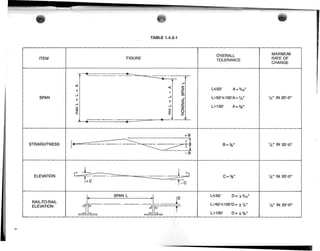
TABLE 1.4.2-1
OVERALL MAXIMUM
ITEM FIGURE TOLERANCE RATE OF
CHANGE
- - -
-'
« « z
+ tt L<;SO' A:::: 3116"
I
-' -'
en
SPAN -' L>SO'<;100'A ~ %" %" IN 20'-0"
II
II «
-' -'
z
L>100' A~%"
~ :2
c:
a
E "E z
- - -
+B
I" ~~
STRAIGHTNESS - - - B~%" %" IN 20'-0"
-B
L L--.J
ELEVATION
~
- C~%" %" IN 20'-0"
f-c
I-
SPAN L
-I lD
L<;SO' D= ±3As'f
RAIL-TO-RAIL
- - L>SO'<;100'D ~ ± %"
ELEVATION
r- ~ f
,/.' IN 20'-0"
L>100' D~ ±%"
'"
6
1.5 RUNWAY CONDUCTORS
1.5.1 The runway conductors may be bare hard drawn copper wire, hard copper, aluminum or steel in the
form of stiff shapes, insulated cables, cable reel pickup or other suitable means to meet the particu-
lar apPlication and shall be installed in accordance with Article 610 of the Natlonai Electrical Code
and comply with all local applicable codes.
1.5.2 Contact conductors shall be guarded in a manner that persons cannot inadvertently touch energized
current - carrying parts. Flexible conductor systems shall be designed and installed in a manner to
minimize the effects of flexing, cable tension, and abrasion
1.5.3 Runway conductors are normally furnished and installed by the purchaser unless otherwise specified.
1.5.4 The conductors shall be properly supported and aligned horizontally and vertically with the runway rail.
1.5.5 The conductors shall have sufficient ampacity to carry the required current to the crane, or cranes,
when operating with rated load. The conductor ratings shall be selected in accordance with Article
610 of the National Electrical Code. For manufactured conductor systems with pUblished ampacities,
the intermittent ratings may be used. The ampacities of fixed loads such as heating, lighting, and
air conditioning may be computed as 2.25 times their sum total which will permit the application of
the intermittent ampacity ratings for use with continuous fixed loads.
1.5.6 The nominal runway conductor supply system voltage, actual input tap voltage, and runway conduc-
tor voltage drops shall result in crane motor voltage tolerances per Section 5.13 (Voltage Drops).
1.5.7 In a crane inquiry the runway conductor system type should be specified and if the system will be
supplied by the purchaser or crane manufacturer. If supplied by the purchaser, the location should
be stated.
1.6 RATED CAPACITY
1.6.1 The rated capacity of a crane is specified by the manufacturer. This capacity shall be marked
each side of the crane and shall be legible from the operating floor.
1.6.2 The rated capacity of a crane bridge with multiple hoist units is the rated capacity of the m,lxirnUlm
individual hoist unit. Each individual hoist unit shall have its rated capacity marked on its bottom block.
1.6.3 When determining the rated capacity of a crane, all accessories beiow the hook, such as load bars,
magnets, grabs, etc. shall be included as part of the load to be handled.
1.7 DESIGN STRESSES
1.7.1 Materials shall be properly selected for the stresses and work cycles to which they are subjected.
Structural parts shall be designed according to the appropriate limits as per chapter 70-3 of this
specification. Mechanical parts shall be designed according to Chapter 70-4 of this specification.
All other load carrying parts shall be designed so that the calculated static stress in the material,
based on rated crane capacity, shall not exceed 20 percent of the published average ultimate strFlnal:h
of the material.
This limitation of stress provides a margin of strength to allow for variations in the properties
materials, manufacturing and operating conditions, and design assumptions, and under no condi-
tion ShDUld imply authDrizatiDn Dr protectiDn for users loading the crane beyDnd rated capacity.
1.8 GENERAL
1.8.1 All apparatus covered by this specificatiDn shall be constructed in a thDrDugh and workmanlike
Due regard shall be given in the design fDr operatiDn, accessibility, interchangeability and dur'abiilitv
of parts.
1.8.2 This specification includes all applicable features of OSHA Section 1910.179 - Overhead and r,~ntrv
Cranes, and ANSI B30.2.0-Safety Standard for Overhead and Gantry Cranes.
1.9 PAINTING
1.9.1 Before shipment, the crane shall be cleaned and given a protective coating.
1.9.2 The coating may consist of any number of coats of primer and finish paint according to the manufac-
turer's standard or as otherwise specified.
1.10 ASSEMBLY AND PREPARATION FOR SHIPMENT
1.10.1
1.10.2
1.10.3
The crane should be assembled in the manufacturer's plant according to the manufacturer's stand-
ard. When feasible, the trolley should be placed on the assembled crane bridge, but it is not required
to reeve the hoisting rope.
All parts of the crane should be carefully match-marked.
All exposed finished parts and electrical equipment are to be protected for shipment. If storage is
required, arrangements should be made with the manufacturer for extra protection.
1.11 TESTING
1.11.1
1.11.2
Testing in the manufacturer's plant is conducted according to the manufacturer's testing procedure,
unless otherwise specified.
Any documentation of non-destructive testing of material such as x-ray, ultrasonic, magnetic particle,
etc. should be considered as an extra item and is normally done only if specified.
1.12.1
1.12 DRAWINGS
Normally two (2) copies of the manufacturer's clearance diagrams are submitted for approval, one
of which is approved and returned to the crane manufacturer. Also, two sets of operating instructions
and spare parts information are typically furnished. Detail draWings are normally not furnished.
ie 1.13 ERECTION
1.14 LUBRICATION
1.15 INSPECTION, MAINTENANCE AND CRANE OPERATOR
1.13.1
1.14.1
1.15.1
1.15.2
The crane erection (including assembly, field wiring, installation and starting) is normally agreed upon
between the manufacturer and the owner or specifier. Supervision offield assembly and/or final
checkout may also be agreed upon separately between the manufacturer and the owner or specifier.
The crane shall be provided with all necessary lubrication fittings. Before putting the crane in opera-
tion, the erector of the crane shall assure that all bearings, gears, etc. are lubricated in accordance
with the crane manufacturer's recommendations.
For inspection and maintenance of cranes, refer to applicable section of ANSI 1330.2.0, Chapter 2-2,
and CMAA-Overhead Crane Inspection and Maintenance Checklist.
For operator responsibility and training, refer to applicable section of ANSI 1330.2.0, Chapter 2-3,
and CMAA-Crane Operators Manual.
7
70·2 CRANE CLASSIFICATIONS
2 . 1 Service classes have been established so that the most economical crane for the Installation may be specified
in accordance with this specification.
This service covers cranes which may be used in heavy machine shops, foundries, fabricating maims.
warehouses, container yards, lumber mills, etc., and standard duty bucket and magnet oDI~raliorls
heavy duty production is required. In this type of service, loads approaching 50 percent of rated
ty will be handled constantly during the working period. High speeds are desirable for this type
with 10 to 20 lifts per hour averaging 15 feet, not over 65 percent of the lifts at rated capacity.
This service covers cranes which may be used in machine shops or papermill machine rooms,
service requirements are moderate. In this type of service the crane will handle loads which ~V<"~""
percent of the rated capacity with 5 to 10 lifts per hour, averaging 15 feet, not over 50 percent of
at rated capacity.
This service class covers cranes which may be used in installations such as powerhouses, public utiliti
turbine rooms, motor rooms and transformer stations where precise handling of equipment at slow spa
with long, idle periods between lifts are required. Capacity loads may be handled for initial installatio
equipment and for infrequent maintenance.
This service covers cranes which may be used in repair shops, light assembly operations, service buildi
light warehousing, etc., where service requirements are light and the speed is slow. Loads may vary
no load to occasional full rated loads with two to five lifts per hour, averaging ten feet per lift.
3/ 3 3 3 3
k = V W, P, + W2 P2 + W3 P3 + .... W n . Pn
Where W = Load magnitude; expressed as a ratio of each lifted load to the rated capacity. Operation
with no lifted load and the weight of any attachment must be included.
p = Load probability; expressed as a ratio of cycles under each load magnitUde condition
to the total cycles. The sum total of the load probabilities p must equal 1.0.
k = Mean effective load factor. (Used to establish crane service class only)
All classes of cranes are affected by the operating conditions, therefore for the purpose of the classifica.
tions, it is assumed that the crane will be operating in normal ambient temperature 0° to 104°F (-17.78
to 40°C) and normal atmospheric conditions (free from excessive dust, moisture and corrosive fumes).
The cranes can be classified into loading groups according to the service conditions of the most sever~l¥
loaded part of the crane. The individual parts which are clearly separate from the rest, or forming a self,
oontained structural unit, can be classified into different loading groupsilthe service conditions arefully kno
The crane service classification is based on the load spectrum reflecting the actual service conditions as
closely as possible.
Load spectrum is a mean effective load, which is uniformly distributed over a probability scale and applied
to the equipment at a specified frequency. The selection of the properly sized crane component to perform
a given function is determined by the varying load magnitudes and given load cycles which can be expressed
in terms of the mean effective load factor.
2.4 CLASS C (MODERATE SERVICE)
2.3 CLASS B (LIGHT SERVICE)
2.5 CLASS D (HEAVY SERVICE)
2.2 CLASS A (STANDBY OR INFREQUENT SERVICE)
B
2.6 CLASS E (SEVERE SERVICE)
This type of service requires a crane capable of handling loads approaching a rated capacity throughout
its life. Applications may include magnet, bucket, magnet/bucket combination cranes for scrap yards, cement
mills, lumber mills, fertilizer plants, container handling, etc., with twenty or more lifts per hour at or near
the rated capacity.
2.7 CLASS F (CONTINUOUS SEVERE SERVICE)
This type of service requires a crane capable of handling loads approaching rated capacity continuously
under severe service conditions throughout its life. Applications may include custom designed specialty
cranes essential to performing the critical work tasks affecting the total production facility. These cranes
must provide the highest reliability with special allention to ease of maintenance features.
2.8 CRANE SERVICE CLASS IN TERMS OF LOAD CLASS AND LOAD CYCLES
The definition of CMAA crane service class in terms of load class and load cycles is shown in Table 2.8-1.
TABLE 2.8-1
DEFINITION OF CMAA CRANE SERVICE CLASS
IN TERMS OF LOAD CLASS AND LOAD CYCLES
Load Cycles K = MEAN
LOAD EFFECTIVE
CLASS N, Nz N3 N4 LOAD
FACTOR
L, A B C D 0.35 -0.53
Lz B C D E 0.531-0.67
L3 C D E F 0.671-0.85
L4 D E F F 0.851-1.00
Irregular
occasional Regular Regular Regular use
use use in use in in severe
followed by intermillent continuous continuous
long idle operation operation operation
periods
LOAD CLASSES:
L, = Cranes which hoist the rated load exceptionally and, normally, very light loads.
Lz = Cranes which rarely hoist the rated load, and normal loads of about one third of the rated
load.
L3 = Cranes which hoist the rated load fairly frequently and normally, loads between % and %
of the rated load.
L4 = Cranes which are regularly loaded close to the rated load.
LOAD CYCLES:
N, = 20,000 to 200,000 cycles
Nz = 200,000 to 600,000 cycles
N3 = 600,000 to 2,000,000 cycles
N4 = Over 2,000,000 cycles
9
10
70-3 STRUCTURAL DESIGN:
3.1 MATERIAL
All structural steel used should conform to ASTM-A36 specifications or shall be an accepted type for the
purpose for which the steei is to be used and for the operations to be performed on it. Other suitable materials
may be used provided that the parts are proportioned to comparable design factors.
3.2 WELDING
All welding designs and procedures shall conform to the current issue of AWS D14.1, "Specification for
Welding of Industrial and Mili Cranes and other Overhead Material Handling Equipment," with the excep-
tion of Section 705 which shall be in accordance with the Crane Manufacturer's Standard Tolerance for
deviation from specified camber and sweep, with all such measurements taken at the manufacturer's plant
prior to shipment. Base weld stresses applicable to load combination Case 1, Section 3.3.2.4.1.
3.3 STRUCTURE
3.3.1 General
The crane girders shall be welded structural steel box sections, wide flange beams, SlanOi,UO
I-beams, reinforced beams or sections fabricated from structural plates and shapes. The
turer shall specify the type and the construction to be furnished.
3.3.2 Loadings
3.3.2.1 The crane structures are subjected in service to repeated loading varying with time which
variable stresses in members and connections through the interaction of the structural syste
and the cross-sectional shapes. The loads acting on the structure are divided into three differerJ
categories. All of the loads having an influence on engineering strength analysis are regardEl9
as principal loads, namely the dead loads, which are always present; the hoist load, acting d
ing each cycle; and the inertia forces acting during the movements of cranes, crane componeh
and hoist loads. Load effects, such as operating wind loads, skewing forces, snow loa
temperature effect, loads on walkways, stairways, platforms and handrails are classed as ad
tional loads and are only considered for the general strength analysis and in stability analY~i
Other loads such as collision, out of service wind loads, and test loads applied during the 10
test are regarded as extraordinary loads and except for collision and out of service wind loa.
are not part of the specification. Seismic forces are not considered in this design specificatid
However, if required, accelerations shall be specified at the crane rail elevation by the owh
or specifier. The allowable stress levels under this condition of loading shall be agreed up
with the crane manufacturer.
3.3.2.1.1 Principal Loads
3.3.2.1.1.1 Dead Load (OL)
The weight of all effective parts of the bridge structure, the machinery parts and the fixed equi
ment supported by the structure.
3.3.2.1.1.2 Trolley Load (TL)
The weight of the trolley and the equipment attached to the trolley.
3.3.2.1.1.3 Lifted Load (LL)
The lifted load consists of the working load and the weight of the lifting devices used for handli
and holding the working load such as the load block, lifting beam, bucket, magnet, grab a
the other supplemental devices.
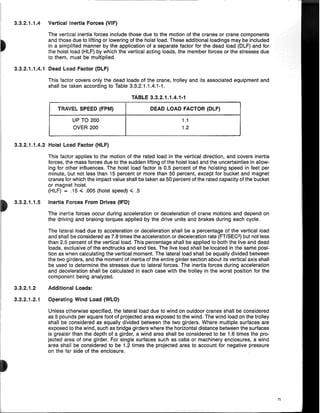
3.3.2.1.1.4.2 Hoist Load Factor (HLF)
3.3.2.1.1.4.1 Dead Load Factor (DLF)
11
TRAVEL SPEED (FPM) DEAD LOAD FACTOR (DLF)
UP TO 200 1.1
OVER 200 1.2
The vertical inertia forces include those due to the motion of the cranes or crane components
and those due to lifting or lowering of the hoist load. These additional loadings may be included
in a simplified manner by the application of a separate factor for the dead load (DLF) and for
the hoist load (HLF) by which the vertical acting loads, the member forces or the stresses due
to them, must be multiplied.
The inertia forces occur during acceleration or deceleration of crane motions and depend on
the driving and braking torques applied by the drive units and brakes during each cycle.
The lateral load due to acceleration or deceleration shall be a percentage of the vertical load
and shall be considered as 7.8 times the acceleration or deceleration rate (FT/SEC2) but not less
than 2.5 percent of the vertical load. This percentage shall be applied to both the live and dead
loads, exclusive of the endtrucks and end ties. The live load shall be located in the same posi-
tion as when calculating the vertical moment. The lateral load shall be equally divided between
the two girders, and the moment of inertia of the entire girder section about its vertical axis shall
be used to determine the stresses due to lateral forces. The inertia forces during acceleration
and deceleration shall be calculated in each case with the trolley in the worst position for the
component being analyzed.
This factor applies to the motion of the rated load in the vertical direction, and covers inertia
forces, the mass forces due to the sudden lifting of the hoist load and the uncertainties in allow-
ing for other influences. The hoist load factor is 0.5 percent of the hoisting speed in feet per
minute, but not less than 15 percent or more than 50 percent, except for bucket and magnet
cranes for which the impact value shall be taken as 50 percent of the rated capacity of the bucket
or magnet hoist.
(H LF) = .15" .005 (hoist speed) " .5
- - - - - - - - - - - - - - - _ . _ - - - ---~._.._---
Additional Loads:
Vertical Inertia Forces (VIF)
Inertia Forces From Drives (IFD)
Unless otherwise specified, the lateral load due to wind on outdoor cranes shall be considered
as 5 pounds per square foot of projected area exposed to the wind. The wind load on the trolley
shall be considered as equally divided between the two girders. Where multiple surfaces are
exposed to the wind, such as bridge girders where the horizontal distance between the surfaces
is greater than the depth of a girder, a wind area shall be considered to be 1.6 times the pro-
jected area of one girder. For single surfaces such as cabs or machinery enclosures, a wind
area shall be considered to be 1.2 times the projected area to account for negative pressure
on the far side of the enclosure.
TABLE 3.3.2.1.1.4.1-1
This factor covers only the dead loads of the crane, trolley and its associated equipment and
shall be taken according to Table 3.3.2.1.1.4.1-1.
3.3.2.1.1.5
3.3.2.1.1.4
3.3.2.1.2
3.3.2.1.2.1 Operating Wind Load (WLO)
I
I
[
~
!
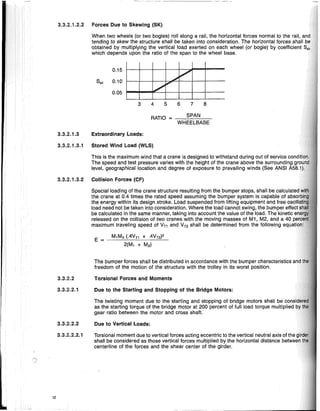
3.3.2.1.2.2 Forces Due to Skewing (SK)
3.3.2.1.3.1 Stored Wind Load (WLS)
8
7
6
5
4
RATIO = --,-,-,-=.S,-PAc...N
,-,---:,..--.,.-
WHEELBASE
3
0.05
E =
The bumper forces shall be distributed in accordance with the bumper characteristics
freedom of the motion of the structure with the trolley in its worst position.
Torsional Forces and Moments
Due to the Starting and Stopping of the Bridge Motors:
The twisting moment due to the starting and stopping of bridge motors shall be ~orl~idi
as the starting torque of the bridge motor at 200 percent of full load torque multiplied
gear ratio between the motor and cross shaft.
Torsionai moment due to vertical forces acting eccentric to the vertical neutral axis of
shall be considered as those vertical forces multiplied by the horizontal distance bet'weEln
centerline of the forces and the shear center of the girder.
Due to Vertical Loads:
Special loading of the crane structure resulting from the bumper stops, shall be
the crane at 0.4 times the rated speed assuming the bumper system is capable of
the energy within its design stroke. Load suspended from lifting equipment and free
load need not be taken into consideration. Where the load cannot swing, the bumper
be calculated in the same manner, taking into account the value of the load. The kinetic
released on the collision of two cranes with the moving masses of M1, M2, and a 40
maximum traveling speed of VT1 and VT2 shall be determined from the following equat@
M,M2 (.4Vn + .4VTZ)2
2(M, + M2)
This is the maximum wind that a crane is designed to withstand during out of service ~n1,rli'ti,
The speed and test pressure varies with the height of the crane above the sur'rolmrllioo
level, geographical location and degree of exposure to prevailing winds (See ANSI
0.15
Ssk 0.10
When two wheels (or two bogies) roll along a rail, the horizontal forces normal to the rail,
tending to skew the structure shall be taken into consideration. The horizontal forces shall
obtained by multiplying the vertical load exerted on each wheel (or bogie) by coefficient
which depends upon the ratio of the span to the wheel base.
3.3.2.1.3 Extraordinary Loads:
3.3.2.1.3.2 Collision Forces (CF)
3.3.2.2.2
3.3.2.2
3.3.2.2.1
3.3.2.2.2.1
12
3.3.2.4.3.3 Test Loads
3.3.2.4.3.2 Crane in collision
13
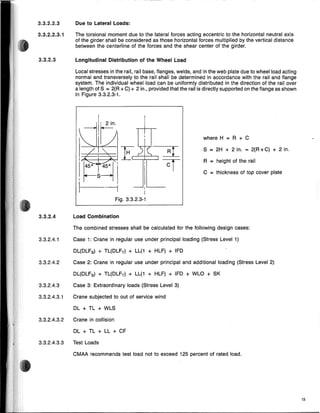
S = 2H + 2 in. = 2(R +C) + 2 in.
R = height of the rail
where H = R + C
C = thickness of top cover plate
~,~ ,
J / , ( E71(
!~s~'i J'
I --i 1'------
Fig. 3.3.2.3-1
The torsional moment due to the lateral forces acting eccentric to the horizontal neutral axis
of the girder shall be considered as those horizontal forces multiplied by the vertical distance
between the centerline of the forces and the shear center of the girder.
Due to Lateral Loads:
Local stresses in the rail, rail base, flanges, welds, and in the web plate due to wheel load acting
normal and transversely to the rail shall be determined in accordance with the rail and flange
system. The individual wheel load can be uniformly distributed in the direction of the rail over
a length of S = 2(R +C) + 2 in., provided that the rail is directly supported on the flange as shown
in Figure 3.3.2.3-1.
Longitudinal Distribution of the Wheel Load
DL + TL + LL + CF
Case 2: Crane in regular use under principal and additional loading (Stress Level 2)
Crane subjected to out of service wind
DL + TL + WLS
DL(DLFB) + TL(DLFT) + LL(1 + HLF) + IFD
Case 3: Extraordinary loads (Stress Level 3)
DL(DLFB) + TL(DLFT) + LL(1 + HLF) + IFD + WLO + SK
The combined stresses shall be calculated for the following design cases:
Case 1: Crane in regular use under principal loading (Stress Level 1)
CMAA recommends test load not to exceed 125 percent of rated load.
Load Combination
3.3.2.4.2
3.3.2.4.1
3.3.2.4
3.3.2.3
3.3.2.4.3
3.3.2.4.3.1
3.3.2.2.3.1
3.3.2.2.3
-----------"------------
3.4.6 Compression Member
3.4.6.2 On the cross section of axially loaded compression members susceptible to buckling shall
lated when KL/r exceeds Cc:
O.350yp
O.3750yp
0.430yp
ALLOWABLE
SHEAR
STRESS
ALLOWABLE
TENSION
STRESS
] N
ALLOWABLE
COMPRESSION
STRESS*
21I2E
0,
STRESS
LEVEL
AND CASE
[
(KL/r)2
1 - 2C 2
OA '
[
53 + 3 (KUr)
BC,
where: C, = V
3.4.1 1 O.600yp O.600yp
3.4.2 2 O.660yp O.660yp
3.4.3 3 O.750yp O.750yp
*Not subject to buckling. "See paragraph 3.4.6 and 3.4.B"
The analysis for proving safety against local buckling and lateral and torsional buckling of
plate and local buckling of the rectangular plates forming part of the compression member,
made in accordance with a generally accepted theory of the strength of materials. (See Sectic)h
3.4 ALLOWABLE STRESSES
3.4.4 Combined Stresses
12TI2E
aA = -----:c23:c'(c=K"'LI'--:r)~2""N,----
3.4.6.1 The average allowable compression stress on the cross section area of axially loaded compr
members susceptible to buckling shall be calculated when KUr (the largest effective slend
ratio of any segment) is less than Cc:
3.4.4.1 Where state of combined plane stresses exist, the reference stress at can be calculated
following formula:
at =VOx2 + Oy2 - OxOy + 3Txl " aALL.
3.4.4.2 For welds, maximum combined stress Ov shall be calculated as follows:
1 1 r-------
Ov = 2[Ox + Oyl ±2Y (Ox - OyJ2 +4T2 " OALL.
3.4.5 Buckling Analysis
14
3.4.6.3 Members subjected to both axial compression and bending stresses shall be nrrlnclClil,h"d
the following requirements:
___
c-",m=-,a--'b""__ + __-,-C-",moc,o-,-b",-y__ <;; 1.0
[1-~]aBX [1 -~]aBY
Oex Oey
~ + ab, + aaby <;;1.0
aBK aBX BY
a,
when aA <;; .15 the following formula may be used
a, ab
, ab
" ~1 0
- - + - - + ~~
aA
aBX
aBy '
where:
K
L
r
E
ay,p
a.
ab
aA
aB
N
N
N
Cmx
Cmy
= effective length factor
= unbraced length of compression member
= radius of gyration of member
= modulus of elasticity
= yield point
= the computed axial stress
= computed compressive bending stress at the point under
consideration
= axial stress that will be permitted if axial force alone existed
= compressive bending stress that will be permitted if bending
moment alone existed
= allowable compression stress from Section 3.4
= __1.:.:2:.;:,1T.:-
2.::E__
23(KUr)2N
= 1.1 Case 1
= 1.0 Case 2
= 0.89 Case 3
a coefficient whose value is taken to be:
1. For compression members in frames subject to joint translation
(sidesway), Cm = 0.85
2. For restrained compression members in frames braced against
joint translation and not sUbject to transverse loading between
their supports in the plane of bending,
M,
Cm = 0.6 - 0.4 M
2
' but not less than 0.4
where M,/M2 is the ratio of the smaller to larger moments at the
ends of that portion of the member unbraced in the plane of bend-
ing under consideration. M,/M2 is positive when the member is
bent in reverse curvature, negative when bent in single curvature.
3. For compression members in frame braced against joint transla-
tion in the plane of loading and sUbjected to transverse loading
between their supports, the value of Cm may be determined by
rational analysis. However, in lieu of such analysis, the following
values may be used:
a. For members whose ends are restrained Cm = 0.85
b. For members whose ends are unrestrained Cm = 1.0
15
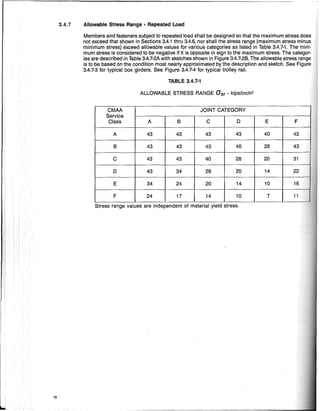
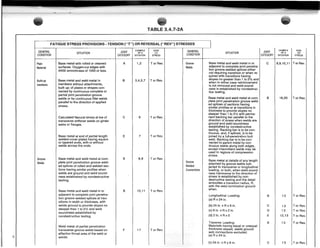
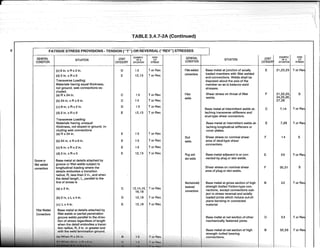
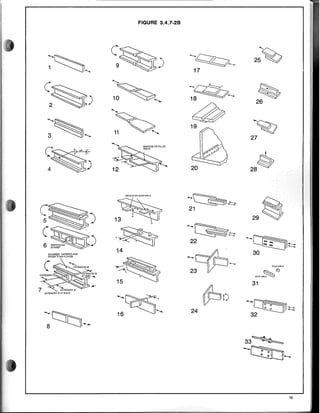
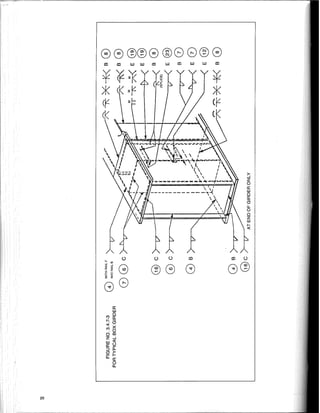
3.4.1 Allowable Stress Range· Repeated load
Members and fasteners subject to repeated load shall be designed so that the maximum stress does
not exceed that shown in Sections 3.4.1 thru 3.4.6, nor shall the stress range (maximum stress minus
minimum stress) exceed allowabie values for various categories as listed in Table 3.4.1-1. The mini-
mum stress is considered to be negative if it is opposite in sign to the maximum stress. The categor-
ies are described in Table 3.4.1-2A with sketches shown in Figure 3.4.7-2B. The allowable stress range
is to be based on the condition most nearly approximated by the description and sketch. See Figure
3.4.7-3 for typical box girders. See Figure 3.4.7-4 for typical trolley rail.
I
L
16
TABLE 3.4.7-1
ALLOWABLE STRESS RANGE Osr • kips/inch2
CMAA JOINT CATEGORY
Service
Class A B C D E F
A 43 43 43 43 40 43
B 43 43 43 40 28 43
C 43 43 40 28 20 31
D 43 34 28 20 14 22
E 34 24 20 14 10 16
F 24 17 14 10 7 11
Stress range values are independent of material yield stress.
TABLE 3.4.7-2A
FATIGUE STRESS PROVISIONS· TENSION ("T") OR REVERSAL ("REV") STRESSES
I
GENERAL JOINT
EXAMPLE KIND GENERAL JOINT
EXAMPLE KIND
SITUATION OFA OF SITUATION OF A OF
CONDITION CATEGORY SITUATION STRESS CONDITION CATEGORY SITUATION STRESS
Plain Base metal with rolled or cleaned A 1,2 T or Rev. Groove Base metal and weld metal in or C 8,9,10,11 T or Rev.
Malerial surfaces. Oxygen-cut edges with Welds adjacent to complete joint penetra-
ANSI smoothness of 1000 or less. tion groove welded splices either
not requiring transition or when re-
quired with transitions having
Built-up Base metal and weld metal in B 3,4,5,7 T or Rev. slopes no greater than 1 to 2V2 and
when in either case reinforcement
members members without attachments,
is not removed and weld sound~
built up; of plates or shapes con- ness is established by nondestruc-
nected by continuous complete or tive testing.
partial joint penetration groove
welds or by continuous fillet welds Base metal and weld metal at com- B 19,20 T or Rev.
parallel to the direction of applied plete joint penetration groove weld-
stress.
ed splices of sections having
similar profiles or at transitions in
thickness to provide slopes no
steeper than 1 to 21/2 with perma-
Calculated flexural stress at toe of C 6 T or Rev. nent backing bar parallel to the
transverse stiffener welds on girder direction of stress when welds are
webs or flanges. ground and weld soundness
established by nondestructive
testing. Backing bar is to be con-
tinuous, and, if spliced, is to be
Base metal at end of partial length E 7 T or Rev. joined by a fullwpenetration butt
welded cover plates having square weld. Backing bar is to be can-
or tapered ends, with or without nected to parent metal by con-
welds across the ends. tinuous welds along both edges,
except intermittent welds may be
used in regions of compression
stress.
Groove Base metal and weld metal at comw B 8,9 T or Rev.
Base metal at details of any length
Welds plete joint penetration groove weld- Groove
attached by groove welds sub-
ed splices of rolled and welded sec- Welded jected to transverse or longitudinal
tions having similar profiles when Connections loading, or both, when weld sound-
welds are ground and weld sound- ness transverse to the direction of
ness established by nondestructive stress is established by non-
testing. destructive testing and the detail
embodies a transition radius, R,
with the weld termination ground
Base metal and weld metal in or B 10,11 T or Rev.
when.
adjacent to complete joint penetra- Longitudinal Loading: B 13 T or Rev.
tion groove welded splices at tran-
(a) R x 24 in.
sitions in width or thickness, with
welds ground to provide slopes no (b) 24 in. x R x 6 in. C 13 T or Rev.
steeper than 1 to 21/2 and weld (c) 6 in. x R x 2 in. D 13 T or Rev.
soundness established by
nondestructive testing. (d) 2 in. x R x ° E 12,13 T or Rev.
Traverse Loading: B 13 T or Rev.
Weld metal of partial penetration Materials having equal or unequal
transverse groove welds based on F 17 T or Rev. thickness sloped, welds ground
effective throat area of the weld or web connections excluded.
welds.
(a) R x 24 in.
(b) 24 in. x R x 6 in. C 13 T or Rev.
TABLE 3.4.7-2A (Continued)
~I I FATIGUE STRESS PROVISIONS· TENSION ("T") OR REVERSAL ("REV") STRESSES
GENERAL
I I JOINT
EXAMPLE KIND GENERAL JOINT
EXAMPLE KIND
SITUATION OFA OF SITUATION OFA OF
CONDITION CATEGORY SITUATION STRESS CONDITION CATEGOR SITUATION STRESS
(c) 6 in. x A x 2 in. D 13 T or Rev. Fillelwelded Base metal at junction of axially E 21,22,23 TorRe
(d) 2 in. x R x 0 E 12,13 TorRev. connections loaded members with fillet welded
end connections. Welds shall be
Transverse Loading: disposed about the axis of the
Materials having equal thickness, member so as to balance weld
not ground, web connections ex- stresses.
eluded.
I
I 21,22,23,1
<a) R x 24 in. C 13 T or Rev. Fillet Shear stress on throat of fillet F S
welds welds. 24,25,26,
(b) 24 in. x R x 6 in. C 13 T or Rev. 27,28
(c) 6 in. x A x 2 in. D 13 T or Rev.
I C I ! TorRe
Base metal at intermittent welds at- 7,14
(d) 2 in. x R x 0 E 12,13 T or Rev. taching transverse stiffeners and
studMtype shear connectors.
Transverse Loading:
Materials having unequal Base metal at intermittent welds atMI E I 7,29 j TorRe'
thickness, not sloped or ground, inM taching longitudinal stiffeners or
cluding web connections cover plates.
(a) R x 24 in. E 13 T or Rev.
Stud Shear stress on nominal shear I F I 14 I S
(b) 24 in. x R x 6 in. E 13 Tor Rev. welds area of studMtype shear
connectors.
(c) 6 in. x R x 2 in. E 13 T or Rev.
(d) 2 in. x R x 0 E 12,13 TorRev.!
I
Plug and
I
Base metal adjacent to or con- I E I 30 I TorRe'
Groove or IBase metal at details attached by
slot welds nected by plug or slot welds.
fillet welded groove or fillet welds subject to
I I I I I I
I I 30,31 I
connections longitudinal loading where the Shear stress on nominal shear F S
details embodies a transition area of plug or slot welds.
radius, R, less than 2 in., and when
the detail length, L, parallel to the
line of stress is
1 112,14,15,
Mechanically Base metal at gross section of high I B I 32 I TorRe
(a) x 2 in. C T or Rev. fastened strength bolted frictionMtype can-
16,18 connections nections, except connections subM
ject to stress reversal and axially
(b) 2 in. x L x 4 in.
I
D
I
12,18 T or Rev. loaded joints which induce out-of-
plane bending in connected
(c) Lx4in. E 12,18 T or Rev. material
Fillel Welded
I
Base metal at details attached by
Connections fillet welds or partial penetration
I I I I I I
groove welds parallel to the direc- Base metal at net section of other I D I 33 I TorRe'
tion of stress regardless of length mechanically fastened joints.
when the detail embodies a transi-
tionra~i~:3,R;?irl,()r grl:'ater and
I I I I I I Base metal at net section of high I B I 32,33 I Tor Ra.,.
'Vittltl1E:!;'V~It:ttE:!;rr'l'li"l:lti()rl 9!'9u"t:t:
19
33~
-Cl1I:J--
FIGURE 3.4.7-28
~~-
c~ 25~
9 . J --~
"
---
17
~~)
'"
~ -~
10
~.
~
-.... 18 ---
"'~
26
""""
~~- 1~'
~
" ",,/
19
~
C~
.........
27
~
4 ) 12 20 28
(;AOOVE OR FIE.lET WHD
-~:--
~
)
21 --
29
"
) ,~ -~-~
-CJ£t:Jl~::.-::
22
SqUARED, TAPERED AND
14
~39P·~
WIDER THAN FLANGE
30
~~
;~l ,;,""
PllIGWE,O
@
15
STATW~
<¥"
~O
31
-~' ~-~n~
~t:rt:n~-
16 -. 24
32
rn
w w
OJ
G
w rn
o 0
  I
--------- - -- -,:.(

w w rn
rn
a:
w
Cl
(') a:
,.:.-
.,.O
o;~
o '"
z --'
w -0:
a:2
~ Q.
S2 ~
LLa:
o
u.
rn
GG®®G®8G®G
20
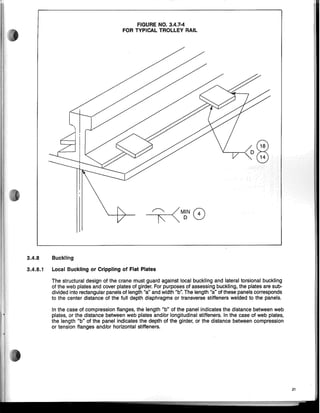
FIGURE NO. 3.4.7-4
FOR TYPICAL TROLLEY RAIL
D@
G
3.4.8 Buckling
3.4.8.1 Local Buckling or Crippling of Flat Plates
The structural design of the crane must guard against local buckling and lateral torsional buckling
of the web plates and cover plates of girder. For purposes of assessing buckling, the plates are sub-
divided into rectangular panels of length "a" and width "b". The length "a" of these panels corresponds
to the center distance of the full depth diaphragms or transverse stiffeners welded to the panels.
In the case of compression flanges, the length "b" of the panel indicates the distance between web
plates, or the distance between web plates and/or longitudinal stiffeners. In the case of web plates,
the length "b" of the panel indicates the depth of the girder, or the distance between compression
or tension flanges and/or horizontal stiffeners.
21
21
~D0)
G
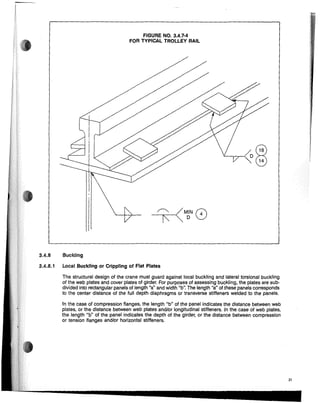
FIGURE NO. 3.4,7·4
FOR TYPICAL TROLLEY RAIL
The structural design of the crane must guard against local buckling and lateral torsional buckling
of the web plates and cover plates of girder. For purposes of assessing buckling, the plates are sUb-
divided into rectangular panels of length "a" and width "b". The length "a" of these panels corresponds
to the center distance of the full depth diaphragms or transverse stiffeners welded to the panels.
In the case of compression flanges, the length "b" of the panel indicates the distance between web
plates, or the distance between web plates and/or longitudinal stiffeners. In the case of web plates,
the length "b" of the panel indicates the depth of the girder, or the distance between compression
or tension flanges and/or horizontal stiffeners.
3.4.8 Buckling
3.4.8.1 local Buckling or Crippling of Flat Plates
where:
- type of loading sustained by the plate.
manner in which the plate is supported along the edges
O'kR ~ 0.18360; + 0 ,,"
where: °y ~ yield strength
Op ~ proportional limit (assumed at 0/1.32)
where: Kc ~ buckling coefficient compression
KT ~ buckling coefficient shear
The buckling coefficient Kc and KT are identified for a few simple cases for plates with simply
ported edges in Table 3.4.8.2-1 and depend on:
ratio Q' ~ alb of the two sides of the plate.
b = width of plate (in inches) perpendicular to the compression force
If compression and shear stresses occur simultaneously, the individual critical buckling
and Tk and the calculated stress values°and T are used to determine the critical COll1pal
1t2E [t ]2 [ t]2
0, ~ 12(1-W) b = 26.21 X 10· b
a = actual compression stress
T = actual shear stress
Ok = critical compression stress
Tk = critical shear stress
'I' = stress ratio (see Table No. 3.4.9.2-1)
In the special case where T ~ 0 it is simply 01k ~ Ok and in the special case Wh'''AI
O'k ~ T kV3
If the resulting critical stress is below the proportional limit, buckling is said to be elalmc.
value is above the proportional limit, buckling is said to be inelastic. For inelastic lJUl;~""U
stress shall be reduced to:
0yO,,"
Where: E = modulus of elasticity (for steel E = 29,000,000 PSI)
/A = Poisson's ratio (for steel /A = 0.3)
= thickness of plate (in inches)
It is not the intention of this specification to enter into further details of this problem. For a
detailed and complex analysis such as evaluation of elastically restrained edges, of
and determination of the coefficient of restraint, reference should be made to specialized
0, ~ Euler buckling stress which can be determined from the following formula:
3.4.8.2 Critical buckling stress shall be assumed to be a multiple of the Euler Stress 0,
Ok~ KoO,; Tk~K,O,
22
-~-------~~~
•
Case Loading
Buckling Range of
Buckling Coefficient
Stress Application
1 Compressive stresses, 0, 0, a ;;, 1 8.4
varying as a straight
, Olr Ok = KoO, K(1=
tj1 + 1.1
line.
[ 1 ] 2 [ 2.1 ]
0"tj1"1 tj10,
~a=ab4 tj10, a < 1 KG = a + a (x) tj1 + 1.1
2 Compressive and tensile stresses;
0, 0,
Ko = [(1 + tj1)K'J - (tj1K") + [10tj1 (1 + tj1)]
varying as a straight line and with wherein K' is the
the compression predominating.
"OIf Ok = KoO,
buckling coefficient for tj1 = 0
- 1<tj1<0
(case 1) and K" is the
tj10,
~a=ab~
tj10, buckling coefficient for tj1 = - 1
(case 3).
3 Compressive and tensile stresses, 0, 0,
varying as a straight line, with equal
' OIl Ka = 23.9
edge values, tj1 = -lor with a;;,%
predominantly tensile stresses,
-0, i"a=ab~ -0, Ok = KoO,
a<% 1.87
"tj1<-1
0, 0, KG = 15.87 + ---zy2 + 8.aa2
 011
tj10, I+a = ab~ tj10,
4 Uniformly distributed shear stresses. a;;, 1 4.00
KT = 5.34 + ---zy2
+- +T.....- T k = KTO,
to+r a < 1
1-'+ ,I-' .D
.t t -± 5.34
-+T--- ----... KT = 4.00 + ---zy2
~a=ab~
[;l
TABLE NO. 3.4.8.2-1
"For the calculation of a and 0, in case 3 with predominant tension, replace dimension
actual b dimension to determine a and 0, for the simultaneously acting shear
b by 2 x the width of the compression zone. But use
24
- - - - - - - - - - - - - - - - - - - - - ~ -
3.4.8.3 Design Factors
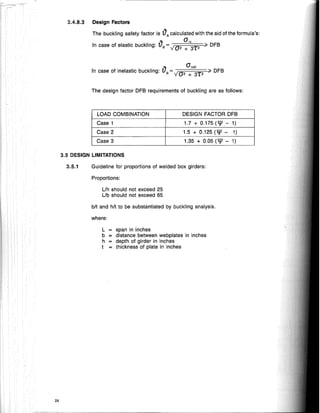
The buckling safety factor is VB calculated with the aid of the formula's:
o
In case of elastic buckling: VB = V0 2 +'~T2 ;;. DFB
.'1- OlkR
In case of inelastic buckling: U B = V0 2
+ 3T2 ;;. DFB
The design factor DFB requirements of buckling are as follows:
LOAD COMBINATION DESIGN FACTOR DFB
Case 1 1.7 + 0.175(jJ - 1)
Case 2 1.5 + 0.125 (jJ - 1)
Case 3 1.35 + 0.05 (jJ - 1)
3.5 DESIGN LIMITATIONS
3.5.1 Guideline for proportions of welded box girders:
Proportions:
Llh should not exceed 25
Lib should not exceed 65
bit and hit to be substantiated by buckling analysis.
where:
L = span in inches
b = distance between webplates in inches
h = depth of girder in inches
t = thickness of plate in inches
- - ------"_...'"-------~._ .._~._-=.~--------
where:
a = longitudinal distance between full depth diaphragms or transverse stiffeners in inches.
25
[
a [a J2 A a ] .
1
0 = 1.2 0.4 + 0.6 h + 0.9 h + 8 h~t hf3-m4
Longitudinal Stiffeners
When one longitudinal stiffener is used, it should be placed so that its centerline is approximately
0.4 times the distance from the inner surface of the compression flange plate to the neutral axis.
It shall have a moment of inertia no less than:
The moment of inertia need not be greater in any case than as given by the following equation:
I = [22 + 10 3 ~ [1 + ~J ] bf3-ln4
o • • ~ ~
3.5.3.2 For one longitudinal stiffener at the center of the compression plate, where b/2 Is the unsupported
half width between web and stiffener, the moment of inertia of the stiffener shall be no less than:
3.5.3.1 When one, two or three longitudinal stiffeners are added to a plate under uniform compression, divid-
ing it into segments having equal unsupported widths, full edge support will be provided by the longi-
tudinal stiffeners, and the provisions of Section 3.5.2.3 may be applied to the design of the plate material
when stiffeners meet minimum requirements as follows:
[ a [a J2 A a] .
I = 0 6 - + 0 2 - + 3.0 -'- bf3-ln4
o • b . b b2t
A = area of one longitudinal stiffener in square inches.
If Oc is greater than aT a distance equal to twice the distance from the inner surface of the compres-
sion flange to the neutral axis shall be substituted in place of "h" in equation for 1
o.
1
0 = 1.2 [0.3 + 0.4 ~ + 1.3 [~J2 + 14 ~~~ }f3-in4
3.5.2.3 The moment of inertia of longitudinal stiffeners welded to one side of a plate shall be calculated about
the interface of the plate adjacent to the stiffener. For elements of the stiffeners supported along
one edge, the maximum width to thickness ratio shall not be greater than 12.7, and for elements
supported along both edges, the maximum width to thickness ratio shall not be greater than 42.2.
If the ratio of 12.7 is exceeded for the element of the stiffener supported along one edge, but a por-
tion of the stiffener element conforms to the maximum width-thickness ratio and meets the stress
requirements with the excess considered as removed, the member is considered acceptable.
3.5.3 Stiffened Plates in Compression:
3.5.2
3.5.2.1
If Oc is greater than aT a distance equal to twice the distance from the inner surface of the compres-
sion fiange to the neutral axis shall be substituted in place of "h" in equation for 1
o.
3.5.2.2 When two longitudinal stiffeners are used, they should be placed so that their centerlines are ap-
proximately 0.25 and 0.55 times the distance, respectively, from the inner surface of the compres-
sion flange plate to the neutral axis. They shall each have a moment of inertia no less than:
where:
to = minimum required web thickness - inches
a = 350 t
'IV
a = longitudinal distance between diaphragms or transverse stiffeners - inches
As = area of the stiffener - square inches
t = thickness of the stiffened plate - inches
where: a = longitudinal distance between diaphragms or transverse stiffeners - inches
t = thickness of web in inches
Stiffeners shall be designed to the provisions of Section 3.5.2.3.
Diaphragms and Vertical Stiffeners
The spacing of the vertical web stiffeners in inches shali not exceed the amount given by the
I = 1.2 h3
t0
3
in4
a02
3.5.4
where: aD = required distance between stiffeners - inches
3.5.3.4 For three longitudinal stiffeners, spaced equidistant at the one fourth width locations where
the unsupported width, and limited to alb less than three, the moment of inertia of each of the
stiffeners shall be no less than:
i. = [0.35 ~ + 1.10 [ ~ J2 + 12 ~:~]bt3-in4
3.5.3.3 For two longitudinal stiffeners at the third points of the compression fiange, where bl3 is the un'iUp·
ported width, and A the area of one stiffener, the moment of inertia of each of the two stiffeners
be no less than:
I = [0 4 ~ + 0 8 [~J2 + 80 A,a] bP-in4
• ' b ' b 'b2t
The moment of inertia need not be greater in any case than:
I = [9 + 56 ~ + 90 [~J2 ]bP-in4
• bt bt
3.5.4.1
v = shear stress in web plates (k.s.!.)
Nor should the spacing exceed 72 inches or h, the depth of the web, whichever is greater.
3.5.4.2 Full depth diaphragms may be included as vertical web stiffeners toward meeting this
3.5.4.3 The moment of inertia of any transverse stiffener about the interface of the web plate, if used
absence of diaphragms, shall be no less than:
This moment of inertia does not include additional requirements, if any, for local moments.
elements shall be proportioned to the provisions of Section 3.5.2.3.
3.5.4.4 Web plates shall be suitably reinforced with full depth diaphragms or stiffeners at all major load
3.5.4.5 All diaphragms shall bear against the top cover plate and shall be welded to the web plate
thickness of the diaphragm plate shall be sufficient to resist the trolley wheel load in bearing
allowable bearing stress on the assumption that the wheel load is distributed over a distance
to the width of the rail base pius twice the distance from the rail base to the top of the diaphragm
26
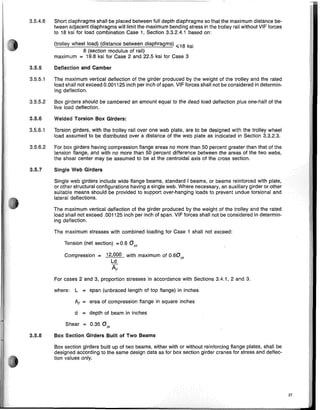
3.5.4.6 Short diaphragms shall be placed between full depth diaphragms so that the maximum distance be-
tween adjacent diaphragms will limit the maximum bending stress in the trolley rail without VIF forces
to 18 ksi for load combination Case 1, Section 3.3.2.4.1 based on:
(trolley wheel load) (distance between diaphragms) <;18 ksi
6 (section modulus of rail)
maximum = 19.8 ksi for Case 2 and 22.5 ksi for Case 3
3.5.5 Deflection and Camber
3.5.5.1 The maximum vertical deflection of the girder produced by the weight of the trolley and the rated
load shall not exceed 0.001125 inch per inch of span. VIF forces shall not be considered in determin-
ing deflection.
3.5.5.2 Box girders should be cambered an amount equal to the dead load deflection plus one-half of the
live load deflection.
3.5.5 Welded Torsion Box Girders:
3.5.6.1 Torsion girders, with the trolley rail over one web plate, are to be designed with the trolley wheel
load assumed to be distributed over a distance of the web plate as indicated in Section 3.3.2.3.
3.5.6.2 For box girders having compression flange areas no more than 50 percent greater than that of the
tension flange, and with no more than 50 percent difference between the areas of the two webs,
the shear center may be assumed to be at the centroidal axis of the cross section.
3.5.7 Single Web Girders
Single web girders include wide flange beams, standard I beams, or beams reinforced with plate,
or other structural configurations having a single web. Where necessary, an auxiliary girder or other
suitable means should be provided to support over-hanging loads to prevent undue torsional and
lateral deflections.
The maximum vertical deflection of the girder produced by the weight of the trolley and the rated
load shall not exceed .001125 inch per inch of span. VIF forces shall not be considered in determin-
ing deflection.
The maximum stresses with combined loading for Case 1 shall not exceed:
Tension (net section) = 0.6 Oyp
Compression = 12,000 with maximum of 0.60yp
Ld
At
For cases 2 and 3, proportion stresses in accordance with Sections 3.4.1, 2 and 3.
where: L = span (unbraced length of top flange) in inches
At = area of compression flange in square inches
d = depth of beam in inches
Shear = 0.35 Oyp
3.5.8 Box Section Girders Built of Two Beams
Box section girders built up of two beams, either with or without reinforcing flange plates, shall be
designed according to the same design data as for box section girder cranes for stress and deflec-
tion values only.
27
3.10 BRIDGE RAILS
3.9 TROLLEY FRAMES
3.8 OPERATOR'S CAB
Bridge rails shall be securely fastened in place to maintain center distance of rails.
Bridge and trolley rails should be in accordance with Table 4.13.3-4 and consistent
diameter and the maximum wheel load.
All bridge rails shall be of first quality and conform to all requirements set forth in the
of the ASCE, ARA, AREA or any other commercial rolled sections with equivalent
Bridge rails shall be joined by standard joint bars or welded. The ends of non-welded
be square andcSections joined without opening between ends. Provision shall be
creeping of the bridge rails.
3.9.1 The trolley frame shall be constructed of structural steel and shall be designed to trar,srtl
to the bridge rails without deflection which will impair functional operation of
3.8.5 Means of access and egress from cab should comply with ANSI 1330.2.
A footwalk with a substantial handrail should be provided where required and specified.
rail shall be at least 42 inches high and provided with an intermediate railing. The fnr,lw:.1I
have a slip-resistant walking surface. The footwalk shall be protected on all exposed
suitable toe guard. All footwalks shall be designed for a live load of 50 pounds per sou'are
allowable stresses, use stress level 2, Section 3.4.2.
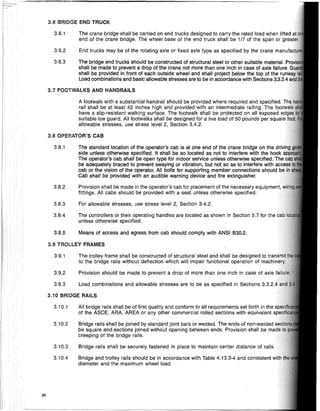
3.9.2 Provision should be made to prevent a drop of more than one inch in case of axle
3.6.1 The crane bridge shall be carried on end trucks designed to carry the rated load when lifted
end of the crane bridge. The wheel base of the end truck shall be 1/7 of the span or
3.6.2 End trucks may be of the rotating axle or fixed axle type as specified by the crane manufa
3.6.3 The bridge end trucks should be constructed of structural steel or other suitable material. Pro
shall be made to prevent a drop of the crane not more than one inch in case of axle failure. (j
shall be provided in front of each outside wheel and shall project below the top of the runW
Load combinations and basic allowable stresses are to be in accordance with Sections 3.3.2.4
3.9.3 Load combinations and allowable stresses are to be as specified in Sections
3.10.1
3.10.2
3.10.3
3.10.4
3.8.4 The controllers or their operating handles are located as shown in Section 5.7 for the
unless otherwise specified.
3.8.1 The standard location of the operator's cab is at one end of the crane bridge on the
side unless otherwise specified. It shall be so located as not to interfere with the hook
The operator's cab shall be open type for indoor service unless otherwise specified.
be adequately braced to prevent swaying or vibration, but not so as to interfere with
cab or the vision of the operator. All bolts for supporting member connections should
Cab shall be provided with an audible warning device and fire extinguisher.
3.8.2 Provision shall be made in the operator's cab for placement of the necessary Anllin,m,ml,
fittings. All cabs should be provided with a seat unless otherwise specified.
3.8.3 For allowable stresses, use stress level 2, Section 3.4.2.
3.6 BRIDGE END TRUCK
3.7 FOOTWALKS AND HANDRAILS
28
29
r T
8-WHEEl EQUALIZING
16-WHEEl EQUALIZING
12-WHEEl EQUALIZING
8-WHEEl COMPENSATING
16-WHEEl COMPENSATING
FIGURE 3.12.2-1
12-WHEEl COMPENSATING
'ij' if
It II
r r
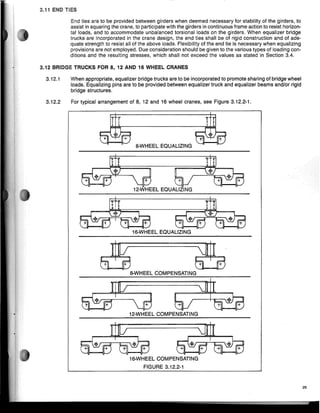
When appropriate, equalizer bridge trucks are to be incorporated to promote sharing of bridge wheel
loads. Equalizing pins are to be provided between equalizer truck and equalizer beams and/or rigid
bridge structures.
For typical arrangement of 8, 12 and 16 wheel cranes, see Figure 3.12.2-1.
End ties are to be provided between girders when deemed necessary for stability of the girders, to
assist in squaring the crane, to participate with the girders in continuous frame action to resist horizon-
tal loads, and to accommodate unbaianced torsional loads on the girders. When equalizer bridge
trucks are incorporated in the crane design, the end ties shall be of rigid construction and of ade-
quate strength to resist all of the above loads. Flexibility of the end tie is necessary when equalizing
provisions are not employed. Due consideration should be given to the various types of loading con-
ditions and the resulting stresses, which shall not exceed the values as stated in Section 3.4.
3.12.1
3.12.2
3.12 BRIDGE TRUCKS FOR 8,12 AND 16 WHEEL CRANES
3.11 END TIES
3.13 STRUCTURAL BOLTING
3.14 GANTRY CRANES
30
3.13.1
3.13.2
3.13.3
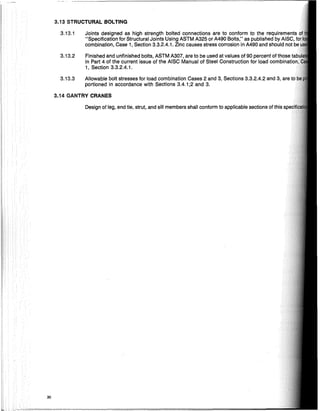
Joints designed as high strength bolted connections are to conform to the requirements
"Specification for Structural Joints Using ASTM A325 or A490 Bolts," as published by
combination, Case 1, Section 3.3.2.4.1. Zinc causes stress corrosion in A490 and should not
Finished and unfinished bolts, ASTM A307, are to be used at values of 90 percent of those
in Part 4 of the current issue of the AISC Manual of Steel Construction for load cOlnbinal:ion
1, Section 3.3.2.4.1.
Allowable bolt stresses for load combination Cases 2 and 3, Sections 3.3.2.4.2 and 3, are
portioned in accordance with Sections 3.4.1;2 and 3.
Design of leg, end tie, strut, and sill members shall conform to applicable sections of this
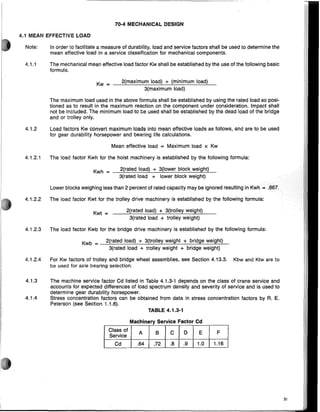
TABLE 4.1.3-1
31
3(maximum load)
3(rated load + trolley weight)
2(rated load) + 3(trolley weight)
2(maximum load) + (minimum load)
Class of
A B C D E F
Service
Cd .64 .72 .8 .9 1.0 1.16
Kw =
Mean effective load = Maximum load x Kw
Kwh = _.:::2>:.(r:::.at:.::e:::.d,::lo:..:a:.:d:L)--,+c...::
3>:.(lo:..:w.:..:e:.:,r-,::b:.::lo:;-c:.::k...:w.:..:e:;;ig'''h:.:,t),-----
3(rated load + lower block weight)
Kw1 =
The load factor Kwh for the hoist machinery is established by the following formula:
Kwb = -----'2::>(""ra:.:te:..:d:..-:..:lo:::.ad~)':--'-+--'3:.>(t=ro:cI.:.:le:Ly...:w'_;e:.::ig"'h:..:t_+,-;-"bc-:ri:::.dg",e=--.:..:w.;:-e'7'ig.:.;ht:l...)_
3(rated load + trolley weight + bridge weight)
Machinery Service Factor Cd
70-4 MECHANICAL DESIGN
Note: In order to facilitate a measure of durability, load and service factors shall be used to determine the
mean effective load in a service classification for mechanical components.
The maximum load used in the above formula shall be established by using the rated load so posi-
tioned as to result in the maximum reaction on the component under consideration. Impact shall
not be included. The minimum load to be used shall be established by the dead load of the bridge
and or trolley only.
4.1.2 Load factors Kw convert maximum loads into mean effective loads as follows, and are to be used
for gear durability horsepower and bearing life calculations.
4.1.3 The machine service factor Cd listed in Table 4.1.3-1 depends on the class of crane service and
accounts for expected differences of load spectrum density and severity of service and is used to
determine gear durability horsepower.
4.1.4 Stress concentration factors can be obtained from data in stress concentration factors by R. E.
Peterson (see Section 1.1.6).
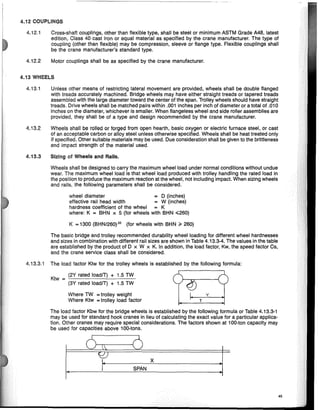
4.1.1 The mechanical mean effective load factor Kw shall be established by the use of the following basic
formula.
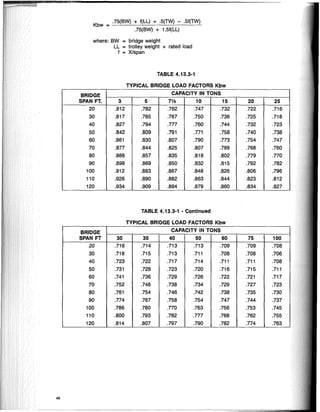
4.1 .2.4 For Kw factors of trolley and bridge wheel assemblies, see Section 4.13.3. Kbw and Ktw are to
be used for axle bearing selection.
4.1.2.1
Lower blocks weighing less than 2 percent of rated capacity may be ignored resulting In
4.1.2.2 The load factor Kwt for the trolley drive machinery is established by the following formula:
4.1.2.3 The load factor KWb for the bridge drive machinery is established by the following formula:
4.1 MEAN EFFECTIVE LOAD
4.3 OVERLOAD LIMIT DEVICE
4.2 LOAD BLOCKS
-OR-
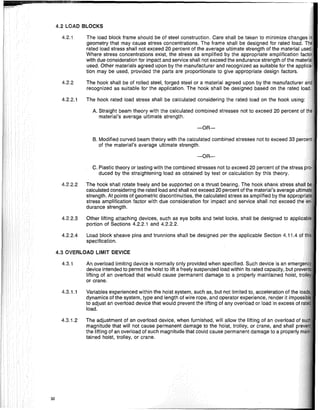
The load block frame should be of steel construction. Care shall be taken to minimize changes'
geometry that may cause stress concentrations. The frame shall be designed for rated load. Til
rated load stress shall not exceed 20 percent of the average ultimate strength of the material use
Where stress concentrations exist, the stress as amplified by the appropriate amplification fact
with due consideration for impact and service shall not exceed the endurance strength of the mate'
used. Other materials agreed upon by the manufacturer and recognized as suitable for the applic
tion may be used, provided the parts are proportionate to give appropriate design factors.
The hook shall be of rolled steel, forged steel or a material agreed upon by the manufacturer a
recognized as suitable for the application. The hook shall be designed based on the rated loa
The hook rated ioad stress shall be calculated considering the rated load on the hook using:
A. Straight beam theory with the calculated combined stresses not to exceed 20 percent of
material's average ultimate strength.
B. Modified curved beam theory with the calculated combined stresses not to exceed 33
of the material's average ultimate strength.
-OR-
4.2.2
4.2.1
4.2.2.1
C. Plastic theory or testing with the combined stresses not to exceed 20 percent of the stress
duced by the straightening load as obtained by test or calculation by this theory.
4.2.2.2 The hook shall rotate freely and be supported on a thrust bearing. The hook shank stress
calculated considering the rated load and shall not exceed 20 percent of the material's average ulti
strength. At points of geometric discontinuities, the calculated stress as amplified by the appropr
stress amplification factor with due consideration for impact and service shall not exceed tile
durance strength.
4.2.2.3 Other lifting attaching devices, such as eye bolts and twist locks, shall be designed to applica
portion of Sections 4.2.2.1 and 4.2.2.2.
4.2.2.4 Load block sheave pins and trunnions shall be designed per the applicable Section 4.11.4 of t
specification.
4.3.1 An overload limiting device is normally oniy provided when specified. Such device is an emerg
device intended to permit the hoist to lift a freely suspended load within its rated capacity, but pre!
lifting of an overload that would cause permanent damage to a properly maintained hoist, tr
or crane.
4.3.1.1 Variables experienced within the hoist system, such as, but not limited to, acceleration of the lo~
dynamics of the system, type and length of wire rope, and operator experience, render it impossi
to adjust an overload device that would prevent the lifting of any overload or load in excess of r
load.
4.3.1.2 The adjustment of an overload device, when furnished, will allow the lifting of an overload of
magnitude that will not cause permanent damage to the hoist, trolley, or crane, and shall pre
the lifting of an overload of such magnitude that could cause permanent damage to a properly
tained hoist, trolley, or crane.
32
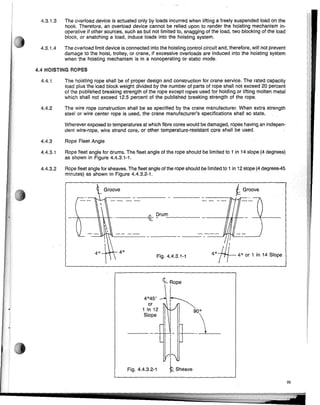
iGroove
4°'7__ 40 or 1 in 14 Slope
Fig. 4.4.3.1-1
_+_---'---I- -----Bt&- !?rum:..:....- _
4.4.3.2 Rope fleet angle for sheaves. The fleet angle of the rope should be limited to 1 in 12 slope (4 degrees-45
minutes) as shown in Figure 4.4.3.2-1.
Wherever exposed to temperatures at which fibre cores would be damaged, ropes having an indepen-
dent wire-rope, wire strand core, or other temperature-resistant core shall be used.
4.4.3 Rope Fleet Angle
4.4.3.1 Rope fleet angle for drums. The fleet angle of the rope should be limited to 1 in 14 slope (4 degrees)
as shown in Figure 4.4.3.1-1.
4.4.1 The hoisting rope shall be of proper design and construction for crane service. The rated capacity
load plus the ioad block weight divided by the number of parts of rope shall not exceed 20 percent
of the published breaking strength of the rope except ropes used for holding or lifting molten metal
which shall not exceed 12.5 percent of the published breaking strength of the rope.
4.4.2 The wire rope construction shall be as specified by the crane manufacturer. When extra strength
steel or wire center rope is used, the crane manufacturer's specifications shall so state.
4.3.1.3 The overload device is actuated only by loads incurred when lifting a freely suspended load on the
hook. Therefore, an overload device cannot be relied upon to render the hoisting mechanism in-
operative if other sources, such as but not limited to, snagging of the load, two blocking of the load
block, or snatching a load, induce loads into the hoisting system.
4.3.1.4 The overioad limit device is connected into the hoisting control circuit and, therefore, will not prevent
damage to the hoist, trolley, or crane, if excessive overloads are induced into the hoisting system
when the hoisting mechanism is in a nonoperating or static mode.
4.4 HOISTING ROPES
':~5,J~
1 in 12 V 900
_ _S_iope .L
Fig. 4.4.3.2-1
i/'i
kSheave
33
~~~------------~~~~~~
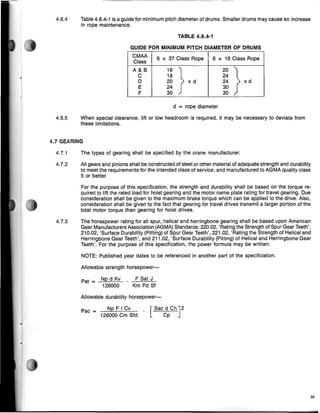
4.6.4 Table 4.6.4-1 is a guide for minimum pitch diameter of drums. Smaller drums may cause an increase
in rope maintenance.
TABLE 4.6.4-1
GUIDE FOR MINIMUM PITCH DIAMETER OF DRUMS
CMAA
6 x 37 Class Rope 6 x 19 Class Rope
Class
A&B 16
} 'd
ro}
C 18 24
D 20 24 x d
E 24 30
F 30 30
d = rope diameter
4.6.5 When special clearance, lift or low headroom is required, it may be necessary to deviate from
these limitations.
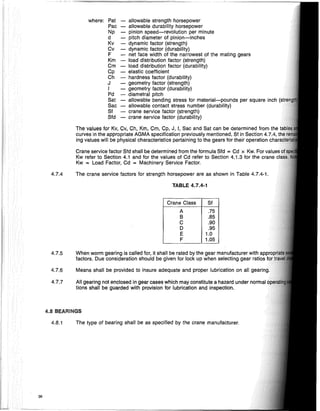
4.7 GEARING
4.7.1 The types of gearing shall be specified by the crane manufacturer.
4.7.2 All gears and pinions shall be constructed of steel or other material of adequate strength and durability
to meet the requirements for the intended class of service, and manufactured to AGMA quality class
5 or better.
For the purpose of this specification, the strength and durability shall be based on the torque re-
quired to lift the rated load for hoist gearing and the motor name plate rating for travel gearing. Due
consideration shall be given to the maximum brake torque which can be applied to the drive. Also,
consideration shall be given to the fact that gearing for travel drives transmit a larger portion of the
total motor torque than gearing for hoist drives.
4.7.3 The horsepower rating for all spur, helical and herringbone gearing shall be based upon American
Gear Manufacturers Association (AGMA) Standards: 220.02, 'Rating the Strength of Spur Gear Teeth',
210.02, 'Surface Durability (Pitting) of Spur Gear Teeth', 221.02, 'Rating the Strength of Helical and
Herringbone Gear Teeth', and 211.02, 'Surface Durability (Pitting) of Helical and Herringbone Gear
Teeth'. For the purpose of this specification, the power formula may be written:
NOTE: Published year dates to be referenced in another part of the specification.
Allowable strength horsepower-
Pat = Np d Kv . F Sat J
126000 Km Pd Sf
Allowable durability horsepower-
Pac = NpFICv . [SaCdChJ2
126000 Cm Sfd Cp
35
36
where: Pat allowable strength horsepower
Pac allowable durability horsepower
Np pinion speed-revolution per minute
d pitch diameter of pinion-inches
Kv dynamic factor (strength)
Cv dynamic factor (durability)
F net face width of the narrowest of the mating gears
Km load distribution factor (strength)
Cm load distribution factor (durability)
Cp - elastic coefficient
Ch - hardness factor (durability)
J - geometry factor (strength)
, - geometry factor (durability)
Pd - diametral pitch
Sat - allowable bending stress for material-pounds per square inch
Sac - allowable contact stress number (durability)
Sf - crane service factor (strength)
Sfd - crane service factor (durability)
The values for Kv, Cv, Ch, Km, Cm, Gp, J, I, Sac and Sat can be determined from the
curves in the appropriate AGMA specification previously mentioned, Sf in Section 4.7.4, t
ing values will be physical characteristics pertaining to the gears for their operation "hAr",,;
Crane service factor Sfd shall be determined from the formula Sfd = Cd x Kw. For
Kw refer to Section 4.1 and for the values of Cd refer to Section 4.1.3 for the crane
Kw = Load Factor, Cd = Machinery Service Factor.
4.7.4 The crane service factors for strength horsepower are as shown in Table 4.7.4-1.
TABLE 4.7.4-1
Crane Class Sf
A .75
B .85
C .90
D .95
E 1.0
F 1.05
4.7.5 When worm gearing is called for, it shall be rated by the gear manufacturer with Anr,rrll'l
factors. Due consideration should be given for lock up when selecting gear ratios
4.7.6 Means shall be provided to insure adequate and proper lubrication on all oearilna.
4.7.7 All gearing not enclosed in gear cases which may constitute a hazard under normal
tions shall be guarded with provision for lubrication and inspection.
4.8 BEARINGS
4.8.1 The type of bearing shall be as specified by the crane manufacturer.
4.8.2 Anti-friction bearings shall be selected to give a minimum life expectancy based on full rated speed
as follows:
AFBMA Lo
l0 BEARING LIFE
Class A 1250 Hours
Class B 2500 Hours
Class C 5000 Hours
Class D 10000 Hours
Class E 20000 Hours
Class F 40000 Hours
Use Kw load factor for all applications as determined in Section 4.1 of this specification.
*Due consideration to be given to the selection of the bearing in the event a crane is used for a
limited time at an increased service class such as:
Example-'during a construction phase.'
4.8.3 Sleeve bearings shall have a maximum allowable unit bearing pressure as recommended by the
bearing manufacturer.
4.8.4 All bearings shall be provided with proper lubrication or means of lubrication. Bearing enclosures
should be designed as far as practicable to exclude dirt and prevent leakage of oil or grease.
4.9 BRAKES
4.9.1 Holst Holding Brakes
4.9.1.1 Each independent hoisting unit of a crane shall be equipped with at least one holding brake. ThiS
brake shall be applied directly to the motor shaft or some other shaft in the hoist gear train.
4.9.1.2 Hoist holding brakes shall have minimum torque ratings, stated as a percentage of the rated load
hoisting torque, at the point where the holding brake is applied as follows:
4.9.1.2.1 125 percent when used with a control braking means other than mechanical.
4.9.1.2.2 100 percent when used with mechanical control braking means.
4.9.1.2.3 100 percent for each holding brake if two holding brakes are provided..
4.9.1.3 Hoist holding brakes shall have thermal capacity for the frequency of operation required by the service.
4.9.1.4 Hoist holding brakes shall be provided with means to compensate for lining wear.
4.9.1.5 Each independent hoisting unit of a crane that handles molten materials shall have one of the follow-
ing arrangements:
4.9.1.5.1 Two holding brakes (one of which is mounted on a gear reducer shaft) plus control braking means
shall be provided. Each brake shall have a minimum torque rating equal to rated load hoisting torque
at the point where the brake is applied.
4.9.1.5.2 If the hoist unit has a mechanical load brake or a controlled braking means that provides emergency
braking in the lowering direction upon loss of power, only one holding brake is required. The holding
brake shall have a minimum torque rating equal to 150 percent of the rated load hoisting torque
at the point where the brake is applied.
37
----------,-----~-----
Emergen
Drag orN
Coasting
MechaniC:
Drive
Outdoor
Remote or Pulpit
Operated
FLOOR
Emergency or
Drag or Non-
Coasting
Mechanical
Drive
Indoor
Drag
Outdoor
Attached to
Bridge
Drag
Indoor
Service
Emergency
Parking
Outdoor
CAB OPERATED
Attached to
Trolley
FIGURE 4.9.3.7-1
Trolley Brakes
Service
Emergency
Indoor
IZI A trolley brake is required.
o A trolley brake is not required.
4.9.3.1 On cab operated (non-skeleton) cranes with cab on trolley, a trolley brake shall be providedh
torque capability to stop the trolley motion within distance in feet equal to 10 percent of rate
speed in feet per minute when traveling at rated speed with rated load.
4.9.3.2 On cab-operated (non-skeleton) cranes with cab on bridge, a trolley brake or non-coasting mec:
drive may be provided when specified. When provided, the brake or non-coasting mechanic
shall meet the stop travel distance requirements of Section 4.9.3.1
4.9.3.3 On floor, remote or pUlpit-operated cranes, including skeleton cab-operated cranes, a trolle
or non-coasting mechanical drive may be provided when specified. When provided, the brake
coasting mechanical drive shall meet the stop travel distance requirements of Section 4.
4.9.3.4 Trolley brakes, when provided, shall have thermal capacity for the frequency of
by the service.
4.9.3.5 If a trolley parking brake is provided, it should have a torque rating of at least 50 percent
motor torque.
4.9.3.6 A drag brake may be applied to hold the trolley in a desired position on the bridge and
creep with the power off.
4.9.3.7 The minimum requirements for trolley brakes and braking means per ANSI B30.2.0 is
4.9.3.7-1.
4.9.3 Trolley Brakes
4.9.2.3 Hoist control braking means shall have thermal capacity for the frequency of operation requirg
the service.
4.9.2 Hoist Control Braking Means
4.9.2.1 Each independent hoisting unit of a crane, except worm-geared hoists, the angle of whose
is such as to prevent the load from accelerating in the lowering direction, shall be equipped
control braking means to control lowering speeds.
4.9.2.2 Control braking means shall be mechanical, hydraulic, pneumatic or electric power (such as
current, dynamic, regenerative or counter torque). All methods must be capable of maintaining 6
trolled lowering speeds. The inherent regenerative controlled braking means of a squirrel cage m
may be used if the holding brake is designed to meet the additional'requirement of retarding a de
ing load upon power removal.
38
4.9 BRAKES
4.9.4 Bridge Brakes.
4,9.4,1 On cab-operated (non-skeleton) cranes, a bridge brake shall be required having torque capability
to stop the bridge motion within a distance in feet equal to 10 percent of rated load speed in feet
per minute when traveling at rated speed with rated load,
4,9.4,2 On floor, remote or pulpit-operated cranes including skeleton (dummy) cab-operated cranes, a bridge
brake or non-coasting mechanical drive shall be required having torque capability to stop the bridge
motion within a distance in feet equal to 10 percent of rated load speed in feet per minute when
traveling at rated speed with rated load.
4.9.4.3 Bridge brakes, when prOVided, shall have thermal capacity for the frequency of operation required
by the service,
4.9.4.4 If a bridge parking brake is provided, it should have a torque rating of at least 50 percent of the rated
motor torque.
4,9.4.5 On cranes designed with high speed and high acceleration rates, consideration should be given to
provide braking means to achieve proportionally high deceleration rates,
4,9.5 General brake comments for normal cab-operated cranes.
4,9.5,1 Foot operated brakes shall require an applied force of not more than 70 pounds to develop rated
brake torque.
4.9,5.2 Brake pedals, latches, and ievers should be designed to allow release without the Av."tir,n
force than was used in applying the brake.
4.9,5.3 Brakes should be applied by mechanical, electrical, pneumatic, hydraulic or gravity meahS,
4.9,5.4 All foot-brake pedals shall be constructed so that the operator's foot will not readily slip off the
4,9.5,5 Foot-operated brakes shall be eqUipped with a means for positive release when force is released
from the pedal.
4,9.5,6 The foot-brake pedals should be so located that they are convenient to the operator at the controls,
4.9,5.7 If parking brakes are provided on the bridge or trolley, they shall not prohibit the use of a drift point
in the control circuit.
4,9.5,8 The minimum requirements for bridge brakes and braking means per ANSI B30,2,O is shown in Figure
4.9,5.8-1.
Figure 4.9.5.8-1
Bridge Brakes
CAB OPERATED FLOOR
Attached to Attached to Remote or Pulpit
Trolley Bridge Operated
Indoor Outdoor Indoor Outdoor Indoor Outdoor
Service Service Service Service Emergency or Emergency or
Emergency Emergency Non-Coasting Non-Coasting
Mechanical Mechanical
I:?!I Drive Drive
~ ~ ~ i:I';J Y'A
~ A bridge brake is required.
o A bridge brake is not required.
39
._--_._._--.....
II CRANE
,
r- II CRANE
j<- II CRANE
,..1'" I r·t···
. t ., "I n .
, '.• I • .... I
-----' - -;:r-r- I ~ ~ -
"'j J" lCJ"j-'"
,.----. ... II :~A~:
FIGURE 4.10-1-1
ARRANGEMENT OF CRANE BRIDGE DRIVES
-----------_.-- -
Bridge drives shall consist of one of the following arrangements, as specified on information
and as illustrated in Figure 4.10.1-1. These arrangements cover most four or eight wheel crane
For the number of driven wheels for a specific acceleration rate-refer to the electrical S
5.2.9.1.2.1 A & B of this specification.
4.10 BRIDGE DRIVES
4.10.1
40
4.10.1.1 A-1 Drive: The motor is located near the center of the bridge and connected to
reduction unit located near the center of the bridge. Output of the gear reduction
directly to the truck wheel axles by means of suitable shafts and couplings.
4.10.1.2 A-2 Drive: The motor is connected to a self-contained gear reduction unit located near the center
of the bridge. The truck wheels shall be driven through gears pressed and keyed on their axles or
by gears fastened to, or integral with, the truck wheels and with pinions mounted on the end sections
of the cross-shaft. The end sections of the cross-shaft shall be connected by suitable couplings.
4.10.1.3 A-3 Drive: The motor is located at the center of the bridge and is connected to the cross-shaft and
the gear reduction units with suitable couplings. Self-contained gear reduction units located near
each end of the bridge shall be either directly connected to the wheel axle extension or connected
to wheel axles by means of shafts with suitable couplings.
4.10.1.4 A-4 Drive: The motors are located near each end of the bridge without torque shafts. The motors
shall be connected to self-contained gear reduction units. The gear reduction units shall be applied
to the truck wheels by means of either suitable shafts and couplings or directly mounted to the wheel
axle shaft extension. Another variation of this drive would separate the high speed and final reduc-
tions by locating the motors near each end of the bridge without torque shafts. The motors will be
connected to self-contained high speed gear boxes which will drive the truck wheels through gears
pressed and keyed on their axles or by gears fastened to the truck wheels, and with pinions mounted
on the end section on the shaft from the high speed gear box and the final reduction shall be con-
nected by means of suitable shafts and couplings.
4.10.1.5 A-5 Drive: The motor is located near the center of the bridge and is connected to a self-contained
gear reduction unit located near the center of the bridge. This reduction unit shall be connected by
sections of cross-shaft having suitable couplings to self-contained gear reduction units located near
each end of the crane, and these in turn connected to truck wheel axles by means of shafts with
suitable couplings.
4.10.1.6 A-6 Drive: The motors are located near each end of the bridge and connected with a torque shaft.
On the drive end, the motors shall be connected to self-contained gear reduction units by suitable
couplings. The output of the gear reduction units shall be connected directly to the truck wheel axle
by means of suitable shafts and couplings.
4.11 SHAFTING
4.11.1 General Nomenclature and Values for Section 4.11
TABLE 4.11.1-1
SURFACE CONDITION FACTOR
Ksc
Ksc SURFACE CONDITION
1.4 For Polished-Heat treated and inspected shafting
1.0 For Machined-Heat treated and inspected shafting
.75 For Machined-General usage shafting
TABLE 4.11.1-2
CRANE CRANE CLASS FACTOR
CLASS Kc
A 1.0
B 1.015
C 1.03
D 1.06
E 1.125
F 1.25
41
4.760,000 D
L =
The torsional deflection of the bridge cross-shaft shall not exceed the values shown on
The types of drive referred to on the table are as defined in Section 4.9 and the percent
is the portion of the full load torque of the bridge drive motor(s) at its normal time
ice involved, increased by any gear reduction between the motor and the shaft. The
deflection is expressed in degrees per foot. In addition the total angular deflection
motor torque in Table 4.11.3-1 should result in a bridge drive wheel movement no
percent of the wheel circumference or 0.5 inch on the circumference, whichever is
1.2N
L = Distance between bearing centers (inches)
D = Shaft diameter (inches)
N = Maximum shaft speed (RPM)
L = y432,000 D2
L = Distance between bearing centers (inches)
D = Shaft diameter (inches)
When the shaft speed exceeds 400 RPM. the bearing spacing shall not exceed that
the following formula, or the preceeding formula whichever is less in order to avoid
vibration at critical shaft speeds:
Se = endurance strength of shaft material = .36 Su' Ksc
Su = average tensile strength of shaft material
Su' = minimum tensile strength of shaft material
Syp = minimum yield strength of shaft material
Oav = that part of the bending stress not due to fluctuating loads
Tav = that part of the shear stress not due to fluctuating loads
Or = that part of the bending stress due to fluctuating loads
Tr = that part of the shear stress due to fluctuating loads
Kt = stress amplification factor for tension or bending
Ks = stress amplification factor for shear
Kc = crane class factor
Ksc = surface condition factor
The bearing spacing for rotating shafts less than 400 RPM shall not exceed that cal<;ula
All shafts, except the bridge cross-shaft sections which do not carry gears, should be cold
quality or better. The shaft diameter and method of support shall be as specified by the
facturer.
4.11.3
4.11.2
42
TABLE 4.11.3-1
Maximum Allowable Angular
Deflection Degrees Per Foot
Type of Percent Cab Controlled Floor & Remote
Drive Motor Torque Cranes Controlled Cranes
A1 67 .080 0.10
A2 50 .080 0.10
A3 67 .080 0.10
A4 100 .070 0.10
A5 50 .080 0.10
A6 100 .070 0.10
4.11.4 Stress Calculations
All shafting shall be designed to meet the stresses encountered in actual operation. For the pur-
poses of this specification, the strength shall be based on the torque required to lift the rated load
for hoist machinery and the motor nameplate rating for drive machinery. Due consideration shall
be given to the maximum brake torque which may be applied to the shaft. When significant stresses
are produced by other forces, these forces shall be positioned to provide the maximum stresses at
the section under consideration. Impact shall not be included.
4.11.4.1 Static Stress Check for Operating Conditions
A. For shafting subjected to axial loads, the stress shall be calculated as follows - (for shafting not
limited by buckling)
P= total axial load
a = PIA A = cross sectional area of shaft
This axial stress shall not exceed Su/5.
B. For shafting loaded in bending, the stress shall be calculated as follows -
M = bending moment at point of examination
a = Mrll r = outside radius of shaft at point of examination
I = bending moment of inertia at point of examination
This bending stress shall not exceed Su/5.
C. For shafting loaded in torque, the shear stress shall be calculated as follows -
D. Transverse shear stress in shafting shall be calculated as follows -
These shear stresses shall not exceed Su/(5 v3).
T = torque at point of examination
T = Tr/J r = outside radius of shaft at point of examination
J = polar moment of inertia of shaft at point of examination
This shear stress shall not exceed Su/(5 v3).
43
V = shear load at point of examination
A = cross sectional area at point of examination
T=1.33 VIA
T=2 VIA
For Solid Shaft -
For Hollow Shafts-
4.11.4.2 Fatigue Stress Check for Fluctuating, Operating Stresses
This stress shall not exceed Suf5.
E. When combinations of stresses are present on the same element, they should be combined
follows·
C. For combined stresses where all of the shear and bending is fluctuating·
a = y(K,O)2 + 3(K,T)2 .; Sa
t K.,
D. For combined shear and bending where only part of the stresses are fluctuating·
at = Y(O., + K, SypJSe)2 + 3(T., + K, SypTJS,)2 .; ~:
Shafting in bearing must be checked for operating conditions. The bearing stress is <""~U1"""
dividing the radial load by the projected area, ie, Pf(d . L), where d is the shaft diameter
the length in bearing. This bearing stress must not exceed 50 percent of the minimum yield
rotating shafting.
This bearing stress must not exceed 20 percent of the minimum yield for oscillating sh~lftirlo
not limited by the bushing material.
B. Shear and combined shear, ie, T
A. Tensile and bending stress, ie, a
axial and bending stresses
a = a, + O2 + 0 3 + ... + 0 0
and shall not exceed Su/5
Any shafting subjected to fluctuating stresses such as the bending in rotating shafts or the
in reversing drives must be checked for fatigue. This check is in addition to Section 4.11.4.1
need only be performed at points of geometric discontinuity where stress concentrations exist,
as fillets, holes, keys, press fits, etc. pure stresses, ie, (not combined) are to be calculated
Section 4.11.4.1 except multiplied by the appropriate stress amplification factor. The allowable slre,s.qe
are as follows.
axial and bending with shear:
at = Y02 + 3T2
shear stresses
T = T, + T 2 + ... + To
and shall not exceed SUf(5 V3).
Note that bending and torsional stresses are maximum on the outer fibers of the shaft and
be combined. The transverse shear stresses are maximum at the center of the shaft and do not co
bine with bending or torsional stresses.
4.11.5
44
4.13 WHEELS
45
y
T
x
SPAN
y
I
0- 
Cross-shaft couplings, other than flexible type, shall be steel or minimum ASTM Grade A48, latest
edition, Ciass 40 cast iron or equal material as specified by the crane manufacturer. The type of
coupling (other than flexible) may be compression, sleeve or flange type. Flexible couplings shall
be the crane manufacturer's standard type.
Motor couplings shall be as specified by the crane manufacturer.
wheel diameter = D (inches)
effective rail head width = W (inches)
hardness coefficient of the wheel = K
where: K = BHN x 5 (for wheels with BHN <;260)
K = 1300 (BHN/260)33 (for wheels with BHN ;;. 260)
Unless other means of restricting lateral movement are provided, wheels shall be double flanged
with treads accurately machined. Bridge wheels may have either straight treads or tapered treads
assembied with the large diameter toward the center of the span. Trolley wheels should have straight
treads. Drive wheels shall be matched pairs within .001 inches per inch of diameter or a total of .010
inches on the diameter, whichever is smaller. When flangeless wheel and side roller assemblies are
provided, they shall be of a type and design recommended by the crane manufacturer.
Wheeis shall be rolled or forged from open hearth, basic oxygen or electric furnace steel, or cast
of an acceptable carbon or alloy steel unless otherwise specified. Wheels shall be heat treated only
if specified. Other suitable materials may be used. Due consideration shall be given to the brittleness
and impact strength of the material used.
Sizing of Wheels and Ralls.
Wheeis shall be designed to carry the maximum wheel load under normal conditions without undue
wear. The maximum wheel load is that wheel load produced with trolley handling the rated load in
the position to produce the maximum reaction at the wheel, not including impact. When sizing wheels
and rails, the following parameters shall be considered.
The basic bridge and trolley recommended durability wheel loading for different wheel hardnesses
and sizes in combination with different rail sizes are shown in Table 4.13.3-4. The values in the table
are established by the product of D x W x K. In addition, the load factor, Kw, the speed factor Cs,
and the crane service class shall be considered.
4.12.1
4.12.2
The load factor Kbw for the bridge wheels is established by the follOWing formula or Table 4.13.3-1
may be used for standard hook cranes in lieu of calculating the exact value for a particular applica-
tion. Other cranes may require special considerations. The factors shown at 1DO-ton capacity may
be used for capacities above 1DO-tons.
4.13.1
4.13.2
4.13.3.1 The load factor Ktw for the trolley wheels is established by the following formula:
K
(2Y rated 10adfT) + 1.5 TW
tw = "'------'-----
(3Y rated 10adfT) + 1.5 TW
Where TW = trolley weight
Where Ktw = trolley load factor
4.13.3
4.12 COUPLINGS
46
Kbw = _.7_5-,-(B_W)--,-+--,f(_LL-,-)_+_.S-,-(TW)--,_-_.5_f(TW),---,-
.75(BW) + 1.5f(LL)
where: BW = bridge weight
LL = trolley weight + rated load
f = Xlspan
TABLE 4.13.3-1
TYPICAL BRIDGE LOAD FACTORS Kbw
BRIDGE CAPACITY IN TONS
SPAN FT. 3 5 7V. 10 15 20 25
20 .812 .782 .762 .747 .732 .722 ..716
30 .817 .785 .767 .750 .736 .725 .718
40 .827 .794 .777 .760 .744 .732 .723
50 .842 .809 .791 .771 .758 .740 .738
60 .861 .830 .807 .790 .773 .754 .747
70 .877 .844 .825 .807 .789 .768 .760
80 .888 .857 .835 .818 .802 .779 .770
90 .898 .869 .850 .832 .815 .792 .782
100 .912 .883 .867 .848 .826 .806 .796
110 .926 .890 .882 .863 .844 .823 .812
120 .934 .909 .894 .879 .860 .834 .827
TABLE 4.13.3-1 - Continued
TYPICAL BRIDGE LOAD FACTORS Kbw
BRIDGE CAPACITY IN TONS
SPAN FT 30 35 40 50 60 75 100
20 .716 .714 .713 .713 .709 .709 .708
30 .718 .715 .713 .711 .708 .708 .706
40 .723 .722 .717 .714 .711 .711 .708
50 .731 .728 .723 .720 .716 .715 .711
60 .741 .736 .729 .726 .722 .721 .717
70 .752 .746 .738 .734 .729 .727 .723
80 .761 .754 .746 .742 .738 .735 .730
90 .774 .767 .758 .754 .747 .744 .737
100 .786 .780 .770 .763 .756 .753 .745
110 .800 .793 .782 .777 .768 .762 .755
120 .814 .807 .797 .790 .782 .774 .763
,
i
4.13.3.2 The speed factor Cs depends on the rotational speed of the wheel and is listed in Table 4.13.3-2.
These factors are obtained from the following formulas:
for RPM ~ 31.5
for RPM ;;, 31.5
Cs = [1 + (RPM3~031.5)J2
CS = 1 + (RPM - 31.5)
328.5
TABLE 4.13.3-2
SPEED FACTOR Cs
WHEEL SPEED IN FEET PER MINUTE
DlA.
IN
30 50 75 100 125 150 175 200 250 300 350 400
INCHES
8 .907 .958 1.013 1.049 1.086 1.122 1.158 1.195 1.267 1.340 1.413 1.485
9 .898 .944 1.001 1.033 1.066 1.098 1.130 1.163 1.227 1.292 1.356 1.421
10 .892 .932 .984 1.020 1.049 1.079 1.108 1.137 1.195 1.253 1.311 1.369
12 .882 .915 .958 1.001 1.025 1.049 1.074 1.098 1.146 1.195 1.243 1.292
15 .872 .898 .932 .967 1.001 1.020 1.040 1.059 1.098 1.137 1.175 1.214
18 .865 .887 .915 .944 .973 1.001 1.017 1.033 1.066 1.098 1.130 1.163
21 .860 .879 .903 .927 .952 .977 1.001 1.015 1.043 1.070 1.098 1.126
24 .857 .873 .894 .915 .937 .958 .980 1.001 1.025 1.049 1.074 1.098
27 .854 .869 .887 .906 .925 .944 .963 .982 1.012 1.033 1.055 1.076
30 .852 .865 .882 .898 .915 .932 .949 .967 1.001 1.020 1.040 1.059
36 .849 .860 .873 .887 .901 .915 .929 .944 .973 1.001 1.017 1.033
4.13.3.3 The wheel service factor Sm is equal to 1.25 times the machinery service factor Cd and is shown
in the Table 4.13.3-3 for the different service classifications. This factor recognizes that the interac-
tion between rail and wheel is more demanding in terms of durability than well aligned and lubricated
interaction of machined parts.
4.13.3.4 The wheel load service coefficient Kwl = Kw x Cs x 8m with the following limitations:
Kwl may not be smaller than Kwl min. shown in Table 4.13.3-3.
4.13.3.5 The equivalent durability wheel load Pe shall be determined as follows:
Pe = Max. wheel load x Kwl the equivalent durability wheel load Pe shall not
exceed wheel loads listed in Table 4.13.3-4.
4.13.4
4.13.5
Proper Clearance for Bridge Wheels
A total of approximately 3,4 inch to one inch wider than rail head should be provided between the
wheel flanges and rail head. Tapered tread wheels may have a clearance over the rail head of 150
percent of the clearance provided for straight tread wheels as recommended by the crane
manufacturer.
When rotating axles are used, wheels should be mounted on the axle with a press fit alone, press
fit and keys, or with keys alone.
47
48
TABLE 4.13.3-3
WHEEL SERVICE FACTOR Sm AND MINIMUM LOAD SERVICE FACTOR Kwl MINIM
CLASS OF
CRANE A B C D E F
SERVICE
Kwl MIN. .75 .75 .8 .85 .9 .95
8m .8 .9 1. 1.12 1.25 1.45
TABLE 4.13.3-4
GUIDE FOR BASIC BRIDGE AND TROLLEY WHEEL LOADINGS, POUNDS. (P) (KDW)
ASCE
Wheel ASCE 80 &85#
Wheel dia. ASCE ASCE ASCE ASCE ARA-A 60 &70# ARA-A ASCE BETH
BHN (D) 20# 25# 30# 40# 90# ARA-B 100# 100# &USS
Inches 100# BETH 104 135#
USS 105#
8 6750 8000 8500 10000
9 7600 9000 9500 11250 14900 15750
10 8450 10000 10600 12500 16550 17500
12 12000 12750 15000 19850 21000 22500 25500
200 15 15950 18750 24850 25250 28150 31900
18 19150 22500 29800 31500 33750 38250 40500
21 26250 34800 35750 39400 44650 47250
24 39750 42000 45000 51000 54000
27 50650 57400 60750
30 56250 63750 67500
36 76500 81000
8 8800 10400 11100 13000
9 9900 11700 12400 14600 19400 20500
10 11000 13000 13800 16250 21500 22750
12 15600 16600 19500 25800 27300 29250 33200
260 15 20700 24400 32300 34100 36600 41400
18 24900 29250 38750 41000 43900 49700 52650
21 34100 45200 47800 51200 58000 61400
24 51700 54600 58500 66300 70200
27 65800 74600 79000
30 73100 82900 87750
36 99500 105300
8 9400 11200 11800 13900
9 10600 12500 13300 15700 20800 21900
10 11800 13900 14800 17400 23100 24400
320 12 16700 17800 20900 27700 29300 31300 35500
15 22200 26100 34600 36600 39200 44400
18 26700 31300 41500 43900 47000 53300 56400
21 36600 48400 51200 54900 62200 65800
24 55400 58500 62700 71100 75200
27 70500 79900 84600
30 78400 88800 94000
36 106600 112800
Effective Width of
Rail Head (W)
Inches .844 1.000 1.063 1.250 1.656 1.750 1.875 2.125 2.250
(Top of head minus
corner radii)
4.14 BUMPERS AND STOPS
4.14.1 Bridge bumpers - A crane shall be provided with bumpers or other means providing equivalent effect,
unless the crane has a high deceleration rate due to the use of sleeve bearings, or is not operated
near the ends of bridge travel, or is restricted to a limited distance by the nature of the crane opera-
tion and there is no hazard of striking any object in this limited area. These bumpers, when used,
shall have the following minimum characteristics:
4.14.1.1 Have energy absorbing (or dissipating) capacity to stop the crane when traveling with power off in
either direction at a speed of at least 40 percent of rated load speed.
4.14.1.2 Be capable of stopping the crane (not including load block and lifted load unless guided vertically)
at a rate of deceleration not to exceed an average of 3 feet per second per second when traveling
with power off in either direction at 20 percent of rated load speed.
4.14.1.3 Be so mounted that there is no direct shear on bolts upon impact.
4.14.2 Bumpers shall be designed and installed to minimize parts falling from the crane in case of breakage
or loosening of bolted connections.
4.14.3 When more than one crane is located and operated on the same runway, bumpers shall be provided
on their adjacent ends or on one end of one crane to meet the requirements of Sections 4.14.1.1
thru 4.14.2.
4.14.4 It is the responsibility of the owner or specifier to provide the crane manufacturer with information
for bumper design. Information necessary for proper bumper design includes:
4.14.4.1 Number of cranes on runway, bridge speed, approximate weight, etc.
.4.14.4.2 Height of runway stops or bumper above the runway rail.
4.14.4.3 Clearance between cranes and end of runway.
4.14.5 Runway stops are normally designed and provided by the owner or specifier and are located at the
limits of the bridge travel and engage the full surface of the bumper.
4.14.6 Runway stops engaging the tread of the wheel are not recommended.
4.14.7 Trolley Bumpers - A trolley shall be provided with bumpers or other means of equivalent effect, unless
the trolley is not operated near the ends of trolley travel, or is restricted to a limited distance of the
bridge girder and there is no hazard of striking any object in this limited area. These bumpers, when
used, shall have the following minimum characteristics:
4.14.7.1 Have energy absorbing (or dissipating) capacity to stop the trolley when traveling with power off in
either direction at a speed of at least 50 percent of rated load speed.
4.14.7.2 Be capable of stopping the trolley (not including load block and lifted load unless gUided vertically)
at a rate of deceleration not to exceed an average of 4.7 feet per second per second when traveling
with power off in either direction at '13 of rated load speed.
49
50
4.14.7.3 Be so mounted that there is no direct shear on bolts upon impact.
4.14.8 Bumpers shall be designed and installed to minimize parts falling from the trolley in case of
4.14.9 When more than one trolley is operated on the same bridge, bumpers shall be provided
adjacent ends or on one end of one trolley to meet the requirements of Sections 4.14.7.1 thru
4.14.10 Trolley stops shall be provided at the limit of the trolley travel, and shall engage the full
the bumper.
4.14.11 Trolley stops engaging the tread of the wheel are not recommended.
70·5 ELECTRICAL EQUIPMENT
5.1 GENERAL
TABLE 5.2.2-1
5.2 MOTORS· AC and DC
51
DC Motors
..
TEFC &
Open Dripproof TENV
100 Deg. C 110 Deg. C
130 Deg. C 140 Deg. C
155 Deg. C 165 Deg. C
A C Motors
Insulation Open Dripproof
Class & TEFC TENV
B 80 Deg. C 85 Deg. C
F 105 Deg. C 110 Deg. C
H 125 Deg. C 135 Deg. C
"If ambient temperatures exceed 40 Deg. C, the permissible Winding temperature rise must be
decreased by the same amount, or may be decreased per the applicable NEMA Standards.
+The crane manufacturer will assume 40 Deg. C ambient temperature unless otherwise specified
by the purchaser.
5.2.1 Motors shall be designed specifically for crane and hoist duty and shall conform to NEMA Standards
MG1 or AISE Standards NO.1 or 1A, where applicable. Designs not in accordance with these stand-
ards may be specified.
5.2.1.1 AC induction motors may be wound rotor (slip ring) or squirrel cage (single speed or multi-speed) types.
5.2.1.2 DC motors may be series, shunt, or compound wound.
5.2.2 Motor Insulations
Unless otherwise specified by the crane manufacturer, the insulation rating shall be in accordance
with Table 5.2.2-1.
5.1.5 Electrical equipment shall comply with ANSI B30.2.0 Safety Standard for Overhead and Gantry Cranes.
NEMA Permissible Motor Winding Temperature
Rise, Above 40 Degrees C Ambient, Measured by
Resistance "+
5.2.3 Motors shall be provided with anti-friction bearings.
5.1.1 The electrical equipment section of this specification is intended to cover top running bridge and
gantry type, multiple girder electric overhead traveling cranes for operation with alternating current
or direct current power supplies.
Cranes for alternating current power supplies may be equipped with squirrel cage and wound rotor
motors with compatible control for single speed, multi-speed or variable speed operation. Cranes
for direct current power supplies, or alternating current power supply rectified on the crane, may
be equipped with series, shunt or compound wound motors with compatible control for single speed
or variable speed operation.
5.1.2 The proposal of the crane manufacturer shall include the rating and description of all motors, brakes,
control and protective and safety features.
5.1.3 The crane manufacturer shall furnish and mount all electrical equipment, conduit and wiring, unless
otherwise specified. If it is necessary to partially disassemble the crane for shipment, all conduit and
wiring affected shall be cut to length and identified to facilitate reassembly. Bridge conductors, run-
way collectors and other accessory equipment may be removed for shipment.
5.1.4 Wiring and equipment shall comply with Article 610 of the National Electrical Code.
- - - - - - - - - -
TABLE 5.2.4-1
Motor
Rated
Voltage
115
240 150 or 24
Adjustable Voltage
Shunt or Compound
230 or 240 (3) (8)
460
230 or 240 (3) (8)
575
230 230
200
380
500 240 or 300.
Constant Potential
Series, Shunt,
230 (4) 230 (5)
Armature Shunt Field
Three Phase Single Phase
DC
250
(7) (9)
(6) (9)
(9)
360 Max.
460 Max. (9)
Nominal
System
Voltage
400
240
AC
120
600
208
480
208
thru
600
400-3-60
240-3-60
460-3-60
Nominal System and Motor Rated Voltage
50 Hz
Rectified
60 Hz (1) (2)
Generator or
Battery
AC
DC
SOURCE DESCRIPTION
Motor rated voltage and corresponding nominal system voltage shall be in accordance with
5.2.4.-1 (References: AC-ANSI C84. 1-1977, Appendix and Table C3. DC-AISE Std. No.1, Re',isEld
September 1968, Electrical 2. Voltage Source and 3. Field Voltage; also NEMA MGI-10.62)
(1) Applicable to all nominal system voltages containing this voltage.
(2) For nominal system voltages other than shown above, the motor rated voltage should
the same as the nominal system voltage or related to the nominal system voltage by
imate ratio of 115 to 120. Certain kinds of equipment have a maximum voltage limit
the manufacturer and/or power supplier should be consulted to assure proper
(3) Performance will not necessarily equal rated performance when appreciable ripple
(4) AISE Std. No.1, Rev. 9-68 Electrical 2B (mill motors).
(5) AISE Std. No.1, Rev. 9-68 Electrical 3 (mill motors).
(6) NEMA MG1-l0.62B & Table 10-4 (industrial motors).
(7) NEMA MG1-10.62B & Table 10-5 (industrial motors).
(8) Rated voltage may be 250 for large frames 300 HP, 850 RPM, and larger.
(9) Maximum motor input voltage.
5.2.4 Voltage
52
5.2.4.1 Variations - AC
5.2.4.1.1 Variation from Rated Voltage
All AC Induction motors with rated frequency and balanced voltage applied shall be capable of
accelerating and running with rated hook load at plus or minus 10 percent of rated motor voltage,
but not necessarily at rated voltage performance values. (Reference NEMA MG 1-12.43)
5.2.4.1.2 Voltage Unbalance
AC polyphase motors shall be capable of accelerating and running with rated hook load when the
voltage unbalance at the motor terminals does not exceed 1 percent. Performance will not necessarily
be the same as when the motor is operating with a balanced voltage at the motor terminals. (Reference
NEMA MG 1-12.45.a.)
5.2.4.2 Variations - DC
DC motors shall be capable of accelerating and running with rated hook load with applied armature
and field voltages up to and including 110 percent of the rated values of the selected adjustable
voltage power supply. With rectified power supplies successful operation shall result when AC line
voltage variation is plus or minus 10 percent of rated. Performance will not necessarily be in accor-
dance with the standards for operation at rated voltage. (Reference NEMA MG 1-12.63)
5.2.5 Operation with voltage variations beyond those shown in Sections 5.2.4.1 and 5.2.4.2. Operation
at reduced voltage may result in unsatisfactory drive performance with rated hook load such as reduced
speed, slower acceleration, increased motor current, noise, and heating. Protective devices may
operate stopping the drive in order to protect the equipment. Operation at elevated voltages may
result in unsatisfactory operation, such as, excessive torques. Prompt corrective action is recom-
mended; the urgency for such action depends upon many factors such as the location and nature
of the load and circuits involved and the magnitude and duration of the deviation of the voltage.
(References ANSI C84.1.2.4.3 range B, also IEEE Standard 141).
5.2.6 Deviations from rated line frequency and/or combinations of deviations of line frequency and voltage
may result in unsatisfactory drive operation. These conditions should be reviewed based on the type
of drive used.
5.2.7 Motor Time Ratings
Unless otherwise specified by the crane manufacturer, the minimum motor time rating shall be In
acccordance with Table 5.2.7-1.
53
TABLE 5.2.7-1 MIN. MOTOR TIME RATINGS IN MINUTES 3.
ELECTRICAL CONTROL TYPE
HOISTS BRIDGES & TROLLEYS
CMAA
AC OR DC MAG- DC MAGNETIC AC MAGNETIC AC STATIC AC OR DC AC STATIC WITH
SERVICE
CLASS NETIC WITH CONSTANT or DC STATIC WITH FIXED MAGNETIC FIXED SECONDARY
MECHANICAL POTENTIAL ADJ. VOLTAGE SECONDARY CONSTANT RESISTANCE or DC
LOAD BRAKE WITH CONTROL WITH CONTROL RESISTANCE POTENTIAL STATIC ADJ.
BRAKING BRAKING VOLTAGE
A 15 15 30 60 15 30
B 15 15 30 60 15 30
C 30 30 30 60 30 60
D 30 1 30 ' 60 ' 60 ' 30 ' 60 '
E Not recommended 60 5 60 2 60 2 60 2 60 2
F Not recommended 60 5 60 2 60 2 60 2 60 2
Note:
1Selection of time rating and insulation class depends on analysis of actual service requirement.
21nsulation class should be of a higher permissible temperature rise than the rated temperature rise of the motor. However, the
temperature rise of the motor shall not exceed its rated temperature rise. The actual duty cycle of the drive should also be analyzed
before final motor selection.
'Insulation classes shall be manufacturer's standard unless indicated otherwise.
'Under unusual conditions, such as long lifts at reduced speeds, abnormal inching or jogging requirements, short repeated travel
drive movements, altitudes over 3,300 feet above sea level, abnormal ambient temperatures, etc., the motor time rating must be
increased accordingly.
5For D.C. drives, appropriate service factors may be applied to the motor horsepower rating for the designated time rating, in addi-
tion to the 5.2.9.1.1.2 Kc factor, to attain adequate thermal dissipating ability, with control designed accordingly.
5.2.8 Squirrel cage motors shall have high starting torque, low starting current and high slip at full load,
simiiar to NEMA Design D, unless otherwise specified by the crane manufacturer.
5.2.9 Motor size selection: The motor size selection involves torque and thermal considerations.
5.2.9.1 The motor rating of any drive, hoist or horizontal travel, using either AC or DC power, is basically
the mechanical horsepower with considerations for the effect of control, ambient temperature, and
service class.
5.2.9.1.1 Hoist Drives
5.2.9.1.1.1 Mechanicai Horsepower
Mechanical HP = W x V
33000 x E
W = total weight in pounds to be lifted by the hoist drive rope system. This includes all items
applicable to the hoist such as the purchaser's lifted load, which includes purchaser furn-
ished attachments and crane manufacturers furnished items including the hook block and
attachments.
V = specified speed in feet per minute when lifting weight W
E = mechanical efficiency between the load and the motor, expressed in decimal form, where:
Eg = efficiency per gear reduction.
n = number of gear reductions.
Es = rope system efficiency per rotating sheave.
m = the number of rotating sheaves between drum and equalizer passed over by each part of
the moving rope attached to the drum.
TABLE 5.2.9.1.1.1-1
Typical Efficiency Values
,Bearings Eg* Es
Anti-friction .97 .99
Sleeve .93 .98
*Note: The values of gear efficiency shown apply primarily to spur, herringbone, and helical gear-
ing, and are not intended for special cases such as worm gearing.
55
56
HOIST MECHANICAL EFFICIENCY
The tabulated values of overall hoist mechanical efficiency, E, as defined for anti-friction ~h~,~,,~
bearings are shown in the following Table 5.2.9.1.1.1-2.
TABLE 5.2.9.1.1.1-2
HOIST OVERALL MECHANICAL EFFICIENCY
Total Number of Total Number Efficiency of
Overall Combined
Efficiency, E
Ropes Supporting of Rotating Ropes Only
2 Gear 3 Gear
One Hook Block Sheaves for (Es)m
Reductions Reductions
Each Rope
Double Single Off Drum
n = 2 n = 3
Reeved Reeved m (.99m) Egn = .9409 Egn = .9127
4 2 1 .990 .931 .903
6 3 2 .980 .922 .894
8 4 3 .970 .913 .885
10 5 4 .960 .904 .877
12 6 5 .951 .895 .868
14 7 6 .941 .886 .859
16 8 7 .932 .877 .850
18 9 8 .922 .868 .842
20 10 9 .913 .859 .834
22 11 10 .904 .851 .825
24 12 11 .895 .842 .817
26 13 12 .886 .834 .809
28 14 13 .877 .826 .801
30 15 14 .869 .817 .793
32 16 15 .860 .809 .785
34 17 16 .851 .801 .777
36 18 17 .843 .793 .769
38 19 18 .834 .785 .761
40 20 19 .826 .777 .754
42 21 20 .818 .769 .746
5.2.9.1.1.2 Required Motor Horsepower:
The hoist motor shall be selected so that its horsepower rating should not be less than that
by the following formula:
Required rated horsepower = Mechanical horsepower x Kc
where Kc = Control factor, which is a correction value that accounts for the effects the
on motor torque and speed.
Kc = 1 for the majority of controls such as AC wound rotor magnetic or static
where there are no secondary permanent slip resistors, systems for "mllm.,
motors, and constant potential magnetic systems with DC Power shop
For AC wound rotor systems, magnetic or static control, with secondary permanent slip
Kc = motor rated full load RPM
* motor operating RPM, when hoisting
*At rated torque with permanent slip resistors
Kc values for power supplies rectified on the crane, for use with DC motors, magnetic
control systems, shall be determined by consultation with the motor and control
The methods described for hoist motor horsepower selection are recommended for use
CMAA Class D. For Classes E and F, due consideration shall also be given to the th~,m.,1
HP
Ka =
Ks =
W =
V =
caused by the service. For example, this may require larger frame, larger horsepower, forced
cooling, etc.
Latitude is permitted in selecting the nearest rated motor horsepower, over or under the required
horsepower, to utilize commercially available motors. In either case, due consideration must be
given to proper performance of the drive.
5.2.9.1.2 Bridge and Trolley Drives
5.2.9.1.2.1 indoor Cranes: Bridge and Trolley
Required Motor Horsepower:
The travel motor shall be selected so that the horsepower rating is not less than that given by
the following formula:
KaxWxVxKs
acceleration factor for type of motor used
service factor which accounts for the type of drive and duty cycle.
For reference see Table 5.2.9.1.2.1-E
total weight to be moved including all dead and live loads in tons
rated drive speed in feet per minute
For the general case of bridge and trolley drives:
Ka =
f+ 2000a x Cr
g x E
----"------,--,- x
33,000 x Kt
Nr
Nf
g =
E =
Nr =
Nf =
Kt =
f = rolling friction of drive (including transmission losses) in pounds
per ton) (Ref. Table 5.2.9.1.2.1-0)
a = average or equivalent uniform acceleration rate in feet per second
per second up to rated motor RPM. For guidance, see Table
5.2.9.1.2.1-A and Table 5.2.9.1.2.1-B
Cr = rotational inertia factor.
= WK2 of crane & load + WK2 of rotating mass
WK2 of crane & load
or 1.05 + (all.5) if WK2 is unknown
32.2 feet per second per second.
mechanical efficiency of drive machinery expressed as a per unit
decimal. (suggest use of .9 if efficiency is unknown).
rated speed of motor in RPM at full load.
free running RPM of motor when driving at speed V (see also
Section 5.2.10.2)
equivalent steady state torque relative to rated motor torque
which results in accelerating up to rated motor RPM (Nr) in the
same time as the actual variable torque speed characteristic of
the motor and control characteristic used. See Table 5.2.9.1.2.1-C
for typical values of Kt.
57
Free Running a = Acceleration
Rate in
Full Load Speed Feet per Sec. per Sec.
Ft. per Min. Ft. per Sec. for AC or DO Motors
60 1.0 .25 Min.
120 2.0 .25 - .80
180 3.0 .30 - 1.0
240 4.0 .40-1.0
300 5.0 .50 - 1.1
360 6.0 .60 - 1.1
420 7.0 .70 - 1.2
480 8.0 .80 - 1.3
540 9.0 .90-1.4
600 10.0 1.0 - 1.6
Guide for Travel Motion
Typical Acceleration Rates Range'
GUIDE FOR
Maximum Acceleration Rate to Prevent Wheel Skidding
TABLE 5.2.9.1.2.1-A
RECOMMENDED VALUES OF Kr (ACCELERATING TORQUE FACTOR)
Type of Motor Type of Control 1Kr
AC Wound Rotor Contactor-Resistor 1.3-1.52
AC Wound Rotor Static Stepless 1.3-1.52
AC Wound Rotor, Mill Contactor-Resistor 1.5-1.72
AC Sq Cage Ballast Resistor 1.3
DC Shunt Wound Adjustable Voltage 1.5
DC Series Wound Contactor-Resistor 1.35
2Low end of range is recommended when permanent slip resistance is used.
1Kr is a function of control and/or resistor design.
Percent of Driven Wheels 100 50 33.33 25 16.67
Maximum Acceleration Rate
Feet per Sec. per Sec. - Dry
4.8 2.4 1.6 1.2 .8
Rails - Based on .2 Coefficient
of Friction
Acceleration Rate
- Wet Rails - Based on
2.9 1.5 1.0 .7 .5
.12 Coefficient
of Friction
TABLE 5.2.9.1.2.1-C
Note' - The actual acceleration rates shall be selected to account for proper performance including
such items as acceleration time, free running time, motor and resistor heating, duty cycle, load spot-
ting capability, and hook swing. The acceleration rate shall not exceed the values shown in Table
5.2.9.1.2.1-B to avoid wheel skidding.
Note2- For D.C. series motors the acceleration rate 'a' is the value occurring while on series resistors.
This wouid be in the range of 50 to 80 percent of the free running speed (Nf).
TABLE 5.2.9.1.2.1-B
58
------- -----------------------
TABLE 5.2.9.1.2.1-0
Suggested Values for f (Friction Factor)
For Bridges & Trolleys with Metallic Wheels
& Anti-Friction Bearings
Wheel Dia.
Inches 36 30 27 24 21 18 15 12 10 8 6
Friction
LblTon(f) 10 10 12 12 12 15 15 15 15 16 16
Note 1-For cranes equipped with sleeve bearings of normal proportions,
a friction factor of 24 pounds per ton may be used.
Note 2-The above friction factors may require modifications for other
variables such as low efficiency worm gearing, non-metallic wheels, special
bearings, and unusual rail conditions.
TABLE 5.2.9.1.2.1-E
Recommended Values of Travel Drive Service Class Factor Ks3
DC Constant Potential
AC Magnetic
AC Static with
CMAA w/AISE Series Mill Mtrs' fixed Secondary
Service Adjustable Voitage Resistance
Class 60 Minutes 30 Minutes with DC Shunt Motors (Permanent Slip)
A .75 1.0 1.0 1.2
B .75 1.0 1.0 1.2
C .75 1.0 1.0 1.2
D .85 1.15 1.1 1.3
E1 1.0 N/A 1.2 1.4
F2 1.4 N/A 1.4 1.6
1The recommended values shown for Class E are based on a maximum of 30
percent time on and a maximum of 25 cycles per hour of the drive. A cycle for a
bridge or trolley consists of two (2) moves (one (1) loaded and one (1) unloaded).
For drive duty higher than this basis, it is recommended that duty cycle methods
of analysis be used.
2The recommended values shown for Class F are based on a maximum of 50 per-
cent time on and a maximum of 45 cycles per hour of the drive. A cycle for a bridge
or trolley consists of two (2) moves (one (1) loaded and one (1) unloaded). For drive
duty higher than this basis, it is recommended that duty cycle methods of analysis
be used.
3For recommended values of Ks for controls not shown, consult crane manufacturer.
'For industrial type D.C. motors, consult crane manufacturer.
5.2.9.1.2.2 Latitude is permitted in selecting the nearest rated motor horsepower over or under, the required
horsepower to utilize commercially available motors. In either case, consideration must be given
to proper performance of the drive.
5.2.9.1.2.3 Outdoor Cranes: Bridge drive motor horsepower for outdoor cranes.
59
~._--~._-- •..._ - - - - - - - - - - - - - - -
5.2.9.1.2.3.1 Compute the free running bridge motor horsepower (HPF) at rated load and rated speed,
ing any wind load, using the following formula:
HPF = W x V x f
33000
where W = full load weight to be accelerated in tons.
V = full load speed in feet per minute.
f = friction factor = pounds per Table 5.2.9.1.2.1-D
5.2.9.1.2.3.2 Compute the free running bridge motor horsepower due to wind force only (HPw) using the
ing formula:
HPw = P x wind area x V
33000 x E
where: P = wind pressure in pounds per square foot computed from the formula P =
where Vw is the wind velocity in miles per hour.
when Vw is unspecified, P = 5 pounds per square foot should be used.
Wind area = effective crane surface area exposed to wind in square feet as computed in
3.3.2.1.2.1
V = full load speed in feet per minute.
E = bridge drive mechanical efficiency.
5.2.9.1.2.3.3 The bridge drive motor horsepower shall be selected so that its horsepower rating
be less than given by the following formula:
Required motor horsepower = 0.75 (HPF + HPw) Ks
using HPF and HPw as computed above.
where: Ks = service class factor utilized per Table 5.2.9.1.2.1-E
5.2.9.1.2.3.4 The following items must be considered in the overall bridge drive design to assure
tion under all specified load and wind conditions:
a. Proper speed control, acceleration and braking without wind.
b. Ability of control to reach full speed mode of operation against wind.
c. Bridge speed, on any control point, when traveling with the wind not to exceed
resulting in the maximum safe speed of the bridge drive machinery.
d. Avoidance of wheel skidding which could likely occur under no load, low percent
and wind conditions.
e. Sufficient braking means to maintain the bridge braking requirements as defined
4.9.4.
5.2.9.1.2.4 Outdoor Cranes: Trolley drive motor horsepower shall use same selection procedure
cranes per section 5.2.9.1.2.1.
5.2.10 The gear ratio should be selected to provide the specified drive speed with rated
hook, for the actual motor and control system used.
60
5.2.10.1 Hoist Drive Gear Ratio.
Hoist drive gear ratio Nf x 0 x IT
= - - - -
R x V x 12
where: Nf = free running motor RPM when hoisting rated load W (Ibs) at speed V (FPM) the
value Nf is established from the motor-control speed-torque curves at the full load hoisting
(HP FL).
HP FL = WxV
33000 x E
E = mechanical efficiency per 5.2.9.1.1.1.
o = drum pitch diameter in inches.
V = specified full load hoisting speed in FPM
R = rope reduction ratio = total number of ropes
supporting the load block
number of ropes from
the drum(s)
5.3.1 Types of electrical brakes for hoist and traverse motions shall be specified by the crane manufacturer.
5.3.6 Brake coil time rating shall be selected for the duration and frequency of operation required by the
service. Any electrical traverse drive brake used only for emergency stop on power loss or setting
by operator choice shall have a coil rated for continuous duty.
5.3.2 Refer to Section 4.9 of this specification for brake selection and rating.
5.3.3 Holding brakes shall be applied automatically when power to the brake is removed.
5.3.4 On hoists equipped with two electric holding brakes, a time delay setting of one brake may be included.
5.3.5 On direct current shunt brakes, it may be desirable to include a forcing circuit to provide rapid set-
ting and release.
61
Nf = free running RPM of the motor, after the drive has accelerated, with rated load
to the steady state speed V. The value of Nf is established from the motor-control speed-
torque curves at the free running horsepower (HP FR)
HP FR = W x f x V
33000
Travel Drive Gear Ratios-Bridge and Trolley.
Bridge or trolley drive gear ratio = Nf x Ow x IT
V x 12
where: W = total load in tons.
f = rolling friction in pounds per ton reference Table 5.2.9.1.2.1-0
V = specified full load travel drive speed in feet per minute.
Ow = wheel tread diameter in inches.
Variations from the calculated gear ratio is permissible to facilitate the use of standard available
ratios, provided that motor heating and operational performance is not adversely affected. The
actual full load drive speed may vary a maximum of ± 10 percent of the specified full load speed.
5.3 BRAKES
5.2.10.3
5.2.10.2
Maximum Intermittent Rating"
Size of 8-hour Horsepower at
Contactor Open Rating, Amperes' 460 and
Amperes 230 Volts 575 Volts
0 20 20 3 5
1 30 30 7V2 10
2 50 67 20 40
3 100 133 40 80
4 150 200 63 125
5 300 400 150 300
6 600 800 300 600
7 900 1200 450 900
8 1350 1800 600 1200
Typical power means include dynamic lowering, eddy-current braking, counter-torque, regenerat
braking, variable frequency, and adjustable or variable voltage.
Typical mechanical means include mechanical load brakes or self-locking worm drives.
Bridge and Trolley Travel
With the exception of floor operated pendant control class A, B & C cranes, all bridges and troll
shall be furnished with reversing control systems incorporating plugging protection. Typical pi
ging protection include a magnetic plugging contactor, ballast resistors, slip couplings, m
characteristics, or static controlled torque.
On cranes with a combination of cab with master switches, and pendant fioor control, the applicabl
specifications for cab controlled cranes shall apply. On floor operated cranes where the penda
master is also used in a 'skeleton' cab, the applicable specifications for floor controlled cranes sha
apply.
Magnetic Control
Each magnetic control shall have contactors of a size and quantity for starting, accelerating, rey
ing, and stopping, and for the specified CMAA crane service class. All reversing contactors
be mechanically and electrically interlocked.
The minimum NEMA size of magnetic contactors shall be in accordance with Tables
Wound Rotor, 5.4.5.2-2 AC Squirrel Cage, and 5.4.5.2-3 DC. Definite purpose contactors ~n"r.ifil
rated for crane and hoist duty service may be used for CMAA crane service classes A,
provided the application does not exceed the contactor manufacturer's published ratings.
TABLE 5.4.5.2-1
AC CONTACTOR RATINGS FOR WOUND ROTOR MOTORS
On remote controlled cranes, such as by radio or carrier signal the applicable floor control specific
tions shall apply, unless otherwise specified.
Control systems may be manual, magnetic, static or in combination as specified.
Hoists shall be furnished with a control braking means, either mechanical or power.
'The ultimate trip current of overload (overcurrent) relays or other motor protective de'{ioElS
shall not exceed 115 percent of these values or 125 percent of the motor full load current,
is smaller.
• 'Wound rotor primary contactors shall be selected to be not less than the current and
ratings. Wound rotor secondary contactors shall be selected to be not less than the
secondary current, using contactor intermittent rating. The ampere intermittent rating of a
secondary contactor with poles in delta shall be 11
/2 times its wound rotor
5.4.2
5.4.4
5.4.5.2
5.4.3
5.4.4.1
5.4.4.2
5.4.5
5.4.5.1
5.4 CONTROLLERS, ALTERNATING AND DIRECT CURRENT
5.4.1 Scope-This section covers requirements for selecting and controlling the direction, speed, acceler
tion and electrical braking of the crane hoist and travel motors. Other control requirements such a
protection and master switches are covered in other sections.
62
TABLE 5.4.5.2-2
AC CONTACTOR RATINGS FOR SQUIRREL CAGE MOTORS
MAXIMUM INTERMITTENT HORSEPOWER RATING
Size of 230 460 & 575
Contactor Volts Volts
0 3 5
1 71
12 10
2 15 25*
3 30 * 50*
*Squirrel cage motors over 20 horsepower are not normally used for crane motions.
TABLE 5.4.5.2-3
DC CONTACTOR RATINGS FOR 230 VOLT CONTROLS**
8-hour Maximum Intermittent Rating
Size of Open Rating,
Contactor Amperes Amperes Horsepower
1 25 30 7V2
2 50 67 15
3 100 133 35
4 150 200 55
5 300 400 110
6 600 800 225
7* 900 1200 330
8* 1350 1800 500
9' 2500 3330 1000
*Resistor stepping contactors may be rated for the actual current carried.
* *For constant potential D.C. drives other than 230 to 250 volts, refer to NEMA ICS 3-443.20.3.
For adjustable voltage D.C. drives at voltage other than 230 volts, the contactor horsepower ratings
will be directly proportional to the voltage up to a maximum of 600 volts.
5.4.5.3 The minimum number of resistor stepping contactors, time delay devices and speed points for A.C.
wound rotor motors and D.C. motors shall be as shown in Table 5.4.5.3-1.
63
TABLE 5.4.5.3-1
Notes to Table continue on next page.
MINIMUM NUMBER OF RESISTOR STEPPING CONTACTORS,
TIME DELAY DEVICES AND SPEED POINTS FOR MAGNETIC CONTROLS
4
4
5
5
6
6
7
4
5
4
5
5
5
5
6
3
4
3
4
2
3
FOR D.C. MOTOR SERIES RESISTORS @230 VOLTS
CAS CONTROL CRANES
FOR D.C. MOTOR SERIES RESISTORS @230 VOLTS
FLOOR CONTROL CRANES
2 2 3 1 1
Same as for cab control cranes
CMAA CLASS CMAA CLASS CMAA CLASS
A,S C D,E,F A,S C D,E,F A,S C D,E,F
FOR A.C. WOUND ROTOR SECONDARY RESISTORS
CAS CONTROL CRANES
MIN. NO. OF MIN. NO. OF MIN. NO. OF
RESISTOR STEPPING TIME DELAY SPEED POINTS
CONTACTORS DEVICES
(See Note 1) (See Note 2) (See Note 3)
FOR A.C. WOUND ROTOR SECONDARY RESISTOR
FLOOR CONTROL CRANES
2 2 3 1 1
3 3 4 2 2
Same as for cab control cranes
3 3 3 1 2 2 4 4
3 4 4 1 3** 3** 4 5
3 4 4 1 3* * 3* * 4 5
3 4 4 1 3** 3** 4 5
4 4 4 3** 3** 3** 5 5
5 5 5 4** 4** 4** 6 6
2* 3 3 1 2 2 3 4
3 3 3 1 2 2 4 4
3* 4 4 1 3 3 4 5
4 4 4 1 3 3 5 5
5 5 5 1 4 4 6 6
5 5 5 4 4 4 6 6
6 6 6 5 5 5 7 7
HORSEPOWER
Less than 30
Greater than 30
othru 15
16 thru 30
Greater than 30
Less than 8
8 thru 15
16 thru 30
31 thru 75
76 thru 125
126 thru 200
Greater than 200
Less than 8
8 thru 15
16 thru 35
36 thru 55
56 thru 110
Greater than 110
64
Foot Notes to Table 5.4.5.3-1
•A 10 percent slip resistance or one (1) additional contactor shall be provided on bridge and trolley
drives.
.. Numbers shown apply to bridge and trolley drives. For hoists, a minimum of two (2) time delay
devices are required in the hoisting direction.
Note 1: One (1) contactor of the number shown may be used for plugging on bridge or trolley con-
trols or low torque on hoist controls.
If more than one (1) plugging step is used, additional contactors may be required.
Note 2: Plugging detection means shall be added to prevent closure of the plugging contactors until
the bridge or trolley drive has reached approximately zero speed.
Note 3: A speed point may be manual hand controlled, or automatic. as required.
The minimum number of operator station hand controlled speed points shall be three (3) in each
direction except as follows:
(a) Class C,D,E and F, cab operated hoist controllers with four (4) or more resistor stepping contac-
tors shall have a minimum of five (5) hand controlled speed points in each direction.
(b) Ciass A and B, controllers for A.C. wound rotor motors less than 8 horsepower shall have a minimum
of two (2) hand controlled speed points in each direction.
(c) Controllers for floor operated bridge and trolley motions shall have a minimum of one (1) hand
controlled speed point in each direction.
(d) When specified, a drift point (no motor power, brake released) shall be included as a hand con-
trolled speed point in addition to the above minimum requirements for bridge and trolley motions.
On multi-motor drives, the contactor requirements of this section apply to each motor individually,
except if one set of line reversing contactors is used for all motors in parallel, then the line contactors
shall be sized for the sum of the individual horsepowers. The resistor stepping contactors may be
common multi-pole devices, if desired. An individual set of acceleration resistors for each motor shall
be provided unless otherwise specified. Timing shall be done with one (1) set of time delay devices.
Static Control
Static power components such as rectifiers, reactors, resistors, etc., as required, shall be sized with
due consideration of the motor ratings, drive requirements, service class, duty cycle, and applica-
tion in the control.
Magnetic contactors, if used, shall be rated in accordance with Section 5.4.5.2.
Static control systems may be regulated or non-regulated, providing stepped or stepless control us-
ing AC or DC motors, as specified.
Travel drives systems may be speed and/or torque regulated, as specified. If a speed regulated system
is selected the method of deceleration to a slower speed may be by drive friction or drive torque
reversal, as specified. Hoist drives are assumed to be inherently speed regulated and due considera-
tion shall be given to the available speed range, the degree of speed regulation, and optional load float.
Primary reversing of AC motor drives shall be accomplished with magnetic contactors or static com-
ponents as specified. When static components are used, a line contactor shall be furnished for the
drive.
Current and torque limiting provisions shall be included not to exceed the motor design limitations,
and with consideration for desired acceleration.
65
5.4.7 Enclosures
5.4.7.3 Unless otherwise specified, enclosures for electrical equipment other than controls shall be
for the environment, and in accordance with the following practices.:
ENCLOSURES FOR HAZARDOUS LOCATIONS
ENCLOSURES FOR NON-HAZARDOUS LOCATIONS
- General purpose-Indoor.
- General purpose-Indoor-Gasketed.
(Note: Type 1-A enclosure is not currently recognized by NEMA)
- Dripproof-Indoor.
- Dusttight, raintight and sleet-resistant, ice-resistant-Outdoor.
- Rainproof and sleet-resistant, ice-resistant-Outdoor.
- Dusttight, raintight and sleet (Ice-) proof-Outdoor.
- Watertight and dusttight-Indoor and Outdoor.
- Watertight, dusttight and corrosion-resistant-Indoor and Outdoor.
- Industrial Use-Dusttight and driptight-Indoor.
- Oiltight and dusttight-Indoor.
Type 1
Type 1A
Type 2
Type 3
Type 3R
Type 3S
Type 4
Type 4X
Type 12
Type 13
Type 7 - Class I, Division I, Group A, B, C, or D-Indoor Hazardous
Locations-Air-break Equipment.
Type 9 - Class II, Division I, Group E, F, or G-Indoor Hazardous Locations-
Air-break Equipment.
(a) Auxiliary devices such as safety switches, junction boxes, transformers, pendant maIS"!fS.
panels, main line disconnects, accessory drive controls, brake rectifier panels, limit ~witr.i,"~
may be supplied in enclosures other than specified for the control panel.
(b) Resistor covers for indoor cranes, if required to prevent accidental contact under normal
conditions, shall include necessary screening and ventilation. Resistor covers for VUI.VV'UI
shall be adequately ventilated.
(c) Brake covers:
1. Brakes, for indoor cranes, may be supplied without covers.
2. Brakes, for outdoor cranes, shall be supplied with covers.
5.4.7.2 Enclosures containing devices that produce excessive heat or ozone or devices that require
for proper operation, may require ventilation means. These enclosures shall be equipped
necessary ventilation such as louvers or forced cooling. Air filters or similar devices may be
depending on the environment. Since the original definition of the enclosure per its ~n"r.ifiArl
may be somewhat altered by the nature of the ventilation means, the final design
functional intent.
5.4.7.1 Control panels should be enclosed and shall be suitable for the environment and type of cnrmrlL
The type of enclosure shall be determined by agreement between the purchaser and the
manufacturer. A typical non-ventilated enclosure may be in accordance with one of the following
Standards publication ICS6 classifications:
5.4.6.9 The crane specifications shall state whether the hoist motor horsepower used with static control
on the basis of average hoisting and lowering speed with rated load or on the basis of actual hni~tir,n
speed to raise rated load.
5.4.6.7 Control torque plugging provisions shall be included for bridge or trolley drives.
5.4.6.8 Permanent slip resistance may be included providing due consideration is given to the actual
speeds under rated conditions.
66
5.5 RESISTORS
5.5.1 Resistors (except those in permanent sections) shall have a thermal capacity of not less than NEMA
Class 150 series for CMAA crane service classes A, Band C and not less than NEMA Class 160
series for CMAA service classes D, E, and F.
5.5.2 Resistors used with power electrical braking systems on A.C. hoists not equipped with mechanical
load brakes shall have a thermal capacity of not less than NEMA Class 160 series.
5.5.3 Resistors shall be designed to provide the proper speed and torque as required by the control system
used.
5.5.4 Resistors shall be installed with adequate ventilation, and with proper supports to withstand vibra-
tion and to prevent broken parts or molten metal falling from the crane.
5.6 PROTECTION AND SAFETY FEATURES
5.6.1 A crane disconnecting means, either a current-rated circuit breaker or motor rated switch, lockable
in the open position, shall be provided in the leads from the runway contact conductors or other power
supply.
5.6.2 The continuous current rating of the switch or circuit breaker in Section 5.6.1 shall not be less than
50 percent of the combined short time motor full load currents, nor less than 75 percent of the sum
of the short time full load currents of the motors required for any single crane motion, plus any addi-
tional loads fed by the device.
5.6.3 The disconnecting means in Section 5.6.1 shall have an opening means located where it is readily
accessible to the operator's station, or a mainline contactor connected after the device in Section
5.6.1 may be furnished and shall be operable from the operator's station.
5.6.4 Power circuit fault protection devices shall be furnished in accordance with NEC Sections 110-9 In-
terrupting Rating. The user shall state the available fault current or the crane manufacturer shall
state in the specification the interrupting rating being furnished.
5.6.5 Branch circuit protection shall be provided per NEC Section 610-42 Branch Circuit Protection.
5.6.6 Magnetic Mainline contactors, when used, shall be as shown in Tables 5.6.6-1 and 5.6.6-2. The size
shall not be less than the rating of the largest primary contactor used on anyone motion.
67
===......----------------IIiIIIII---- .iI.fu1j!lil~I.I. • • • •1I
7'12
15
35
55
110
225
330
500
Maximum Horsepower
for any Motion
10
22
55
80
160
320
480
725
Maximum Total
Motor Horsepower
30
67
133
200
400
800
1200
1800
3330
Maximum
Intermittent
Duty Rating
Amperes
TABLE 5.6.6-2
RATINGS AT 230 to 250 VOLTS OF DC
CONTACTORS
for Mainline Service
25
50
100
150
300
600
900
1350
2500
8-hour
Open rating
Amperes
1
2
3
4
5
6
7
8
9
TABLE 5.6.6-1
AC CONTACTOR RATINGS
for Mainline Service
8-hour
Maximum Maximum Total Maximum Horsepower
Size of
Open rating
Intermittent Motor Horsepower for any Motion
Contactors
Amperes
Duty Rating 460 & 460 &
Amperes' 230V 575V 230V 575V
0 20 20 6 6 3 5
1 30 30 10 20 7V2 10
2 50 67 30 60 20 40
3 100 133 63 125 40 80
4 150 200 110 225 63 125
5 300 400 225 450 150 300
6 600 800 450 900 300 600
7 900 1200 675 1350 450 900
8 1350 1800 900 1800 600 1200
Size of
Contactors
'The ultimate trip current of overload (overcurrent) relays or other motor protective devices
shall not exceed 115 percent of these values or 125 percent of the motor full load current, whichE1Ver
is smaller.
68
5.6.7 Motor running overcurrent protection shall be provided in accordance with NEC 610-43 Motor Run-
ning Overcurrent Protection.
5.6.8 Control circuits shall be protected in accordance with NEC 610-53 overcurrent protection.
5.6.9 Undervoltage protection shall be provided as a function of each motor controller, or an enclosed pro-
tective panel, or a magnetic mainline contactor, or a manual-magnetic disconnect switch.
5.6.10 An automatically reset instantaneous trip overload relay set at approximately 200 percent of the hoist
motor fUll load current shall be furnished for D.C. hoists. Devices offering equivalent motor torque
limitation may be used in lieu of the overload relay.
5.6.11 Cranes not equipped with spring-return controllers, spring-return master switches, or momentary con-
tact pushbuttons, shall be provided with a device which will disconnect all motors from the line on
failure of power and will not permit any motor to be restarted until the controller handle is brought
to the 'off' position, or a reset switch or button is operated.
5.6.12 Remote radio cranes shall be provided with a permissive radio signal in addition to a crane motion
radio signal, and both signals shall be present in order to start and maintain a crane motion.
5.6.13 On automatic cranes, all motions shall be discontinued if the crane does not operate in accordance
with the automatic sequence of operation.
5.6.14 Working space dimensions shall apply only to bridge mounted control panel enclosures or sWitching
devices that are serviceable from a crane mounted walkway. The horizontal distance from the sur-
face of the enclosure door to the nearest metallic or other obstruction shall be a minimum of 30 inches.
In addition, the work space in front of the enclosure shall be at least as wide as the enclosure and
shall not be less than 30 inches wide.
5.6.15 Warning Devices
5.6.15.1 Except for floor-operated cranes a gong or other effective warning signal shall be provided for each
crane equipped with a power traveling mechanism.
5.6.15.2 Owner or Specifier, having full knowledge of the environment in which the crane will be operated,
is responsible for the adequacy of the warning devices.
5.7 MASTER SWiTCHES
5.7.1 Cab controlled cranes shall be furnished with master switches for hoist, trolley and bridge motions,
as applicable, that are located within reach of the operator.
5.7.2 Cab master switches shall be provided with a notch, or spring return arrangement latch, which, in
the 'off' position prevents the handle from being inadvertently moved to the 'on' position.
5.7.3 The movement of each master switch handle should be in the same general direction as the result-
ant movement of the load, except as shown in Figures 5.7.3a and 5.7.3b, unless otherwise specified.
5.7.4 The arrangement of master switches should conform to Figures 5.7.3a and 5.7.3b, unless otherwise
specified.
5.7.5 The arrangement of other master switches, lever switches or pushbuttons for controller,. other than
hoist, trolley or bridge, (such as grabs, magnetic disconnects, turntables, etc.) are normally specified
by the manufacturer.
5.7.6 If a master switch is provided for a magnet controller, the 'lift' direction shall be toward the operator
and the 'drop' direction away from the operator.
5:7.7 Cranes furnished with skelton (dummy) cabs are to be operated via the pendant pushbutton station
and thereby do not require master switches unless otherwise specified by the purchaser.
5.7.8 Master switches shall be clearly labeled to indicate their functions.
69
Right-Hand
Bridge
~-=--
M. Hoisl
--<>-+ --:::---j-l
Trolley ~2
+---<>---+ ---:,=:--+t=!:
Bridge ~fJ
~----+--1
Right-Hand Cab
A, Ho;st
M, Hoist
=:::..r, -<>-+ --="""""'-
Trolley
~--"""""'-
~-~~
Center Cab
4 Motor Crane
Fig. 5.7.3b
Center Cab
3 Motor Crane
RECOMMENDED ARRANGEMENT OF CONTROLLERS
M. Hoist
Fig. 5.7.3a
RECOMMENDED ARRANGEMENT OF CONTROLLERS
Bridge Drive Girder
Left-hand Cab
Bridge Drive Girder
Left-Hand Cab
Bridg<:>
H----~
Bridge
Iff-+----~
Trolley
f-t----::-- +-0-+ -, '=:.J
®~
Ci:EJ+--=--=::'-- ---.0---+- -r-L=:.J
~~ A Hoist
L~+--- +-0--->- TL='-'
70
5.8 FLOOR OPERATED PENDANT PUSHBUTTON STATIONS
5.8.1 The arrangement of pendant pushbutton stations and radio transmitters should conform to Figures
5.8.1a, 5.8.1b., or 5.8.1c.
5.8.2 Pushbuttons shali return to the 'off' position when pressure is released by the crane operator.
5.8.3 Pendant pushbutton stations shall have a grounding conductor between a ground terminal in the
station and the crane.
5.8.4 The maximum voltage in pendant pushbutton stations shall be 150 Volts AC or 300 Volts DC.
5.8.5 Pushbuttons shall be guarded or shrouded to prevent accidentai actuation of crane motions.
5.8.6 'Stop' pushbuttons shall be colored red.
5.8.7 Pendant pushbutton station enclosures shall be as defined in Section 5.4.7.3(a).
5.8.8 Pendant pushbutton stations shali be supported in a manner that will protect the electrical conduc-
tors against strain.
5.8.9 Minimum wire size of multiconductor flexible cords for pendant pushbutton stations shall be #16 AWG
unless otherwise permitted by Article 610 of the National Electrical Code.
71
Fig.5.8.1b
Pendant Pushbutton Station
Arrangements
4 MOlion
Bridge Trolley Main Aux.
Hoist Hoist
X y Down Down
f f
1
f
~
w z Up Up
~~
:3 Motion
Bridge Trolley Hoist
X y Down
J
i t
i
w z Up
~ ~
Fig.5.8.1c
Radio Crane Control
Transmitter Lever
Arrangement
Note:
Markings on the crane, visible from
the floor, shall indicate the direction
of bridge and trolley travei corresponding
to the W, X, Y and Z designations on
the transmitter.
The letters used are only intended for
the purpose of illustration.
Designations should be selected as
appropriate to each installation.
0
Power On
0
Power On
0
Up
0
Down
Main Hoist
0
Up
0
Down
Aux. Hoist
0
Right
0
L'ft
Trolley
0
Forward
0
Reverse
Bridge
0, Off
I I I
Power
Fig. 5.8.1a
In each user location, the relative arrangement
of units on crane pendant pushbutton stations
should be standardized. In the absence of such
standardization, suggested arrangements are
shown in Figure 5.8.1 a and 5.8.1 b.
0
Power On
0
Power Off
0
Up
0
Down
Main Hoist
0
Up
0
Down
Aux. Hoist
0
Right
0
L'ft
Trolley
0
Forward
0
Reverse
Bridge
72
5.9 LIMIT SWITCHES
5.10 INSTALLATION
5.11 BRIDGE CONDUCTOR SYSTEMS
73
Electrical equipment shall be so located or enclosed to prevent the operator from accidental contact
with live parts under normal operating conditions.
Electrical equipment shall be installed in accessible locations and protected against ambient environ-
mental conditions as agreed to by the purchaser and the crane manufacturer.
The crane manufacturer shall state the type conductors to be furnished.
Current collectors, if used, shall be compatible with the type of contact conductors furnished and
shall be rated for the ampacity of the circuit in which they are used. Two (2) sets of current collectors
shall be furnished for all contact conductors that supply current to a lifting magnet.
If local conditions require enclosed conductors, they must be specified by owner or specifier.
The bridge conductors may be bare hard drawn copper wire, hard copper, aluminum or steel in the
form of stiff shapes, insulated cables, cable reel pickup or other suitable means to meet the par-
ticular application and shall be sized and installed in accordance with Article 610 of the National
Electrical Code.
The published crane intermittent ratings of manufactured conductor systems shall not be less than
the ampacity required for the circuit in which they are used.
Refer to Section 1.5 of 70-1 General Specifications for information on runway conductors.
Current collectors, if used, shall be compatible with the type of contact conductors furnished. The
collector rating shall be sized for the crane ampacity as computed by Article 610 of the National
Electrical Code. A minimum of two collectors for each runway conductor shall be furnished when
the crane is used with a lifting magnet.
5.11.3
5.11.1
5.9.4 Lower limit switches shall be provided where the hook can be lowered beyond the rated hook travel
under normal operating conditions and shall be of the control circuit type.
5.9.5 Trolley travel and bridge travel limit switches, when specified shall be of the control circuit type.
5.9.6 The trip point of all limit switches shall be located to allow for maximum runout distance of the motion
being stopped for the braking system being used.
5.9.1 The hoist motion of all cranes shall be equipped with an overtravel limit switch in the raising direc-
tion to stop hoisting motion.
5.9.2 Interruption of the raising motion shall not interfere with the lowering motion. Lowering of the block
shall automatically reset the limit switch unless otherwise specified.
5.9.3 The upper limit switch shall be power circuit type, control circuit type or as specified by the purchaser.
The manufacturers proposal shall state which type is being furnished.
5.11.5
5.11.2
5.12.1
5.10.2
5.10.1
5.11.4
5.12.2
5.12 RUNWAY CONDUCTOR SYSTEMS
5.13 VOLTAGE DROP
74
5.13.1
5.13.2
5.13.3
5.13.4
5.14.5
The purchaser shall furnish actual voltage at the runway conductor supply taps not more than 105
percent and not less than 96 percent of the nominal system voltage, and shall define the requirements
of the runway conductor system to achieve an input voltage not less than 93 percent of the nominal
system voltage to the crane at the point of runway conductor collection farthest from the runway
conductor supply taps.
The crane manufacturer shall limit the voltage drops within the crane to the motors and other
trical loads to approximately 2 percent of the nominal system voltage.
All voltage drops in Section 5.13.1 and 5.13.2 shall be computed by using main feeder
individual motor currents, fixed load currents, and demand factors of multiple cranes on the
runway as defined by Article 610 of the National Electrical Code.
Voltage drops shall be calculated during maximum inrush (starting) conditions to insure that the
terminal voltages are not less than 90 percent of rated motor voltage, and control and brake vnl'O"Q"
are not less than 85 percent of device rated voltage.
The actual operating voltages at the crane motor terminals shall not exceed 110 percent or not
below 95 percent of motor ratings, for rated running conditions, to achieve the results defined
Section 5.2.4 (voltage.)
70-6 RECOMMENDED CRANE INQUIRY DATA SHEET
Fig. 6.1
Customer _
Spec No. _
Date _
1. Number Cranes Required _
2. Capacity: Main Hoist Tons Aux. Hoist Tons Bridge Tons
3. Required Hook Lift (Max. Including Pits or Wells Below Floor Eievation)
Main Hoist Ft. In. Aux. Hoist Ft. In.
4. Approximate Length of Runway Ft.
5. Number of Cranes on Runway
6. Service Information: C.M.AA Class (See Section 70-2)
Main Hoist: Average Lift Ft. Number of Lifts per Hour Speed EP.M.
Hours per Day Hook Magnet Bucket
Give Size & Weight of Magnet or Bucket _
Aux. Hoist: Average Lift ,Ft. Number of Lifts per Hour Speed EP.M.
Hours per Day Hook Magnet Bucket _
Give Size & Weight of Magnet or Bucket _
Bridge:
TrOlley:
Number Moves per Hour Hours per Day Speed F.P.M.
Average Movement _
Number of Moves per Hour Hours per Day Speed F.P.M.
Average Movement _
7. Furnish complete information regarding special conditions such as acid fumes, steam. high temperatures, high
altitudes, excessive dust or moisture, very severe duty, speciai or precise load handling:
8. Ambient Temperature in Buiiding: Max. Min. _
9. Materiai Handled _
10. Crane to Operate: Indoors Outdoors Both _
75
15. Type of Control Enclosure: (Ref. 5.4.7.1) ~
Trolley _
Bridge _
Auxiliary nOlsl. _
Bare Wires Angles Other -+-+
Other _
Main Hoist _
Describe briefly (See Items 7 & 8) --?
Furnished By: --......+
11. Power: Volts Phase Hertz ~A.C., Volts D.C.
13. Location of Control: End of Crane Center On Trolley _
14. Type of Control (Give complete information, including number of speed points) Ref. 5.4.4
12. Method of Control: Cab Floor Other _
20. List of Special Equipment or Accessories Desired
16. Type of Motors: (Give complete information) _
17. Must wiring comply with Special Conditions or Codes ~+
21. For special cranes with multiple hooks or trolley or other unique requirements, provide detailed inf,ornlatio,
on hook spacing, orientation, capacities, and total bridge capacity.
19. Runway Conductor Type: Insulated (MFR) _
18. Bridge Conductor Type: ~_+
22. Complete attached building clearance drawing, making special note of any obstructions which may
with the crane, including special clearance conditions underneath the girders or cab.
76
CLEARANCES: Complete the building drawing below making special note of any obstructions which may
interfere with the crane including special clearance requirements under girders or cab.
77
Pit Floor
F
-I-'-----" -----"
Low point of roof truss, lights,
sprinkler, or other obstructions
Operating
Floor
A (Span-c to c of runway rails)
l
<::
<::
L Idler Girder ("8" Girder)
'" Centerline of Hooks --.
(])
- - - - - I-
,
iii
,
,
>- .- Drive Girder ("A" Girder)
'"
"
<::
oj
" I
~
Walkway-if required
~
Indicate the "North" direction, cab or pendant location, relative locations of
main and auxiliary hook, runway conductor location, adjacent cranes, etc.
P LAN
-'
'0
ill
'0
a:
n
C --L
,
JI+-_IR<;:;r~A;f:(~SFP.::a"n--,c:...:cto:....:c_o"f"r..:u,-n,-w..:a""y_r,,a,-i1.::s),-_--=;:====-:"L E
-r--+-DH:' Rail Size: a r
Cap Channel Size: R +;.1p-,
Runway 8eam Size' S L. . :;::=:L
~
"T Runway /1 L 1
M1
N I
T-~ , U Conductors It11
, Type: P
Obstruction " V
8
1
ELEVATION
A H P
8 Q
C J R
D K S
E L T
F M U
G N V
Fig. 6.2
SUGGESTED OPERATING SPEEDS
FEET PER MINUTE
FLOOR CONTROLLED CRANES
CAPACITY HOIST TROLLEY BRIDGE
IN
TONS SLOW MEDIUM FAST SLOW MEDIUM FAST SLOW MEDIUM FAST
3 14 35 45 50 80 125 50 115 175
5 14 27 40 50 80 125 50 115 175
7.5 13 27 38 50 80 125 50 115 175
10 13 21 35 50 80 125 50 115 175
15 13 19 31 50 80 125 50 115 175
20 10 17 30 50 80 125 50 115 175
25 8 14 29 50 80 125 50 115 175
30 7 14 28 50 80 125 50 115 150
35 7 12 25 50 80 125 50 115 150
40 7 12 25 40 70 100 40 100 150
50 5 11 20 40 70 100 40 100 150
60 5 9 18 40 70 100 40 75 125
75 4 9 15 40 70 100 30 75 125
100 4 8 13 30 60 80 25 50 100
150 3 6 11 25 60 80 25 50 100
NOTE: Consideration must be given to iength of runway for the bridge speed, span of bridge for the troiiey
speed, distance average travei, and spotting characteristics required.
Fig. 6.3
SUGGESTED OPERATING SPEEDS
FEET PER MINUTE
CAB CONTROLLED CRANES
CAPACITY HOIST TROLLEY BRIDGE
IN
TONS SLOW MEDIUM FAST SLOW MEDIUM FAST SLOW MEDIUM FAST
3 14 35 45 125 150 200 200 300 400
5 14 27 40 125 150 200 200 300 400
7.5 13 27 38 125 150 200 200 300 400
10 13 21 35 125 150 200 200 300 400
15 13 19 31 125 150 200 200 300 400
20 10 17 30 125 150 200 200 300 400
25 8 14 29 100 150 175 200 300 400
30 7 14 28 100 125 175 150 250 350
35 7 12 25 100 125 150 150 250 350
40 7 12 25 100 125 150 150 250 350
50 5 11 20 75 125 150 100 200 300
60 5 9 18 75 100 150 100 200 300
75 4 9 15 50 100 125 75 150 200
100 4 8 13 50 100 125 50 100 150
150 3 6 11 30 75 100 50 75 100
NOTE: Consideration must be given to iength of runway for the bridge speed, span of bridge for the troiiey
speed, distance average travei, and spotting characteristics required.
78
70-7 GLOSSARY
ABNORMAL OPERATING CONDITIONS: Environmental
conditions that are unfavorable, harmful or detrimental to or
for the operation of a hoist, such as excessively high (over
100 deg. F.) or low (below 0 deg. F.) ambient temperatures,
corrosive fumes, dust laden or moisture laden atmospheres,
and hazardous locations.
ADJUSTABLE OR VARIABLE VOLTAGE: A method of con-
trol by which the motor supply voltage can be adjusted.
AUTOMATIC CRANE: A crane which when activated
operates through a perset cycle or cycles.
AUXILIARY HOIST: A suppiemental hoisting unit, usually
designed to handle lighter loads at a higher speed than the
main hoist.
AUXILIARY GIRDER (OUTRIGGER): A girder arranged
parallel to the main girder for supporting the platform, motor
base, operator's cab, controi panels, etc., to reduce the tor-
sianal forces such load would otherwise impose on the main
girder.
BEARING LIFE EXPECTANCY: The L-10 life of an anti-
friction bearing is the minimum expected iife, hours, of 90
percent of a group of bearings which are operating at a given
speed and loading. The average expected life of the bear-
ings is approximately five times the L-10 life.
BHN: Brlnell hardness number, measurement of material
hardness.
BOX SECTION: The rectangular cross section of girders,
trucks or other members enclosed on four sides.
BRAKE: A device, other than a motor, used for retarding or
stopping motion by friction or power means. (See Section 4.9)
BRANCH CIRCUIT: The circuit conductors between the final
overcurrent device protecting the circuit and the outiet(s).
BRIDGE: That part of an overhead crane consisting of girders,
trucks, end ties, walkway and drive mechanism which car-
ries the trolley and traveis in a direction parallel to the runway.
BRIDGE CONDUCTORS: The electricai conductors located
along the bridge structure of a crane to provide power to the
trolley.
BRIDGE RAIL: The rail supported by the bridge girders on
which the trolley travels.
BUMPER (BUFFER): An energy absorbing device for reduc-
ing impact when a moving crane or trolley reaches the end
Of its permitted travel, or when two moving cranes or trolleys
come into contact.
CAB·OPERATED CRANE: A crane controlled by an operator
in a cab located on the bridge or trolley.
CAMBER: The slight upward vertical curve given to girders
to compensate partially for deflection due to hook load and
weight of the Crane.
CAPACITY: The maximum rated load (in tons) which a crane
is designed to handle.
CLEARANCE: Minimum distance from the extremity of a
crane to the nearest obstruction.
CMAA: Crane Manufacturers Association of America (form-
erly EOCI-Electric Overhead Crane Institute).
COLLECTORS: Contacting devices for collecting current
from the runway or bridge conductors. The mainline collec-
tors are mounted on the bridge to transmit current from the
runway conductors, and the trolley collectors are mounted
on the trolley to transmit current from the bridge conductors.
CONTACTOR, MAGNETIC: An electro-magnetic device for
opening and closing an electric power circuit.
CONTROLLER: A device for regUlating in a pre-determined
way the power deiivered to the motor or other equipment.
COUNTER·TORQUE: A method of control by which the motor
is reversed to develop power to the opposite direction.
COVER PLATE: The top or bottom plate of a box girder.
CROSS SHAFT: The shaft extending across the bridge, used
to transmit torque from motor to bridge drive wheels.
CUSHIONED START: An electrical or mechanical method for
reducing the rate of acceleration of a travel motion.
DEAD LOADS: The loads on a structure which remain in a
fixed position relative to the structure. On a crane bridge such
loads inciude the girders, footwalk, cross shaft, drive units,
panels, etc.
DEFLECTION: Displacement due to bending or twisting in
a vertical or lateral plane, caused by the imposed live and
dead loads.
DIAPHRAGM: A piate or partition between opposite parts of
a member, serving a definite purpose in the structural design
of the member.
DRIVE GIRDER: The girder on which the bridge drive
machinery is mounted.
DUMMY CAB: An operator's compartment or platform on a
pendant or radio controlled crane, having no permanently-
mounted electrical controls, in which an operator may ride
while controlling the crane.
DYNAMIC LOWERING: A method of control by which the
hoist motor is so connected in the lowering direction, that
when it is over-hauled by the load, it acts as a generator and
forces current either through the resistors or back into the line.
EDDY-CURRENT BRAKING: A method of control by which
the motor drives through an electrical induction load brake.
EFFICIENCY OF GEARING AND SHEAVES: The percentage
of force transmitted through these components that is not lost
to friction.
79
ELECTRIC OVERHEAD TRAVELING CRANE: An electrically
operated machine for lifting, lowering and transporting loads,
consisting of a movable bridge carrying a fixed or movable
hoisting mechanism and traveling on an overhead runway
structure.
ELECTRICAL BRAKING SYSTEM: A method of controlling
crane motor speed when in an overhauling condition, without
the use of friction braking.
ENCLOSED CONDUCTOR (S): A conductor or group of con-
ductors substantially enclosed to prevent accidental contact.
ENCLOSURE: A housing to contain electrical components,
usually specified by a NEMA classification number.
END APPROACH: The minimum horizontal distance, parallel
to the runway, between the outermost extremities of the crane
and the centerline of the hook.
END TIE: A structurai member other than the end truck which
connects the ends of the girders to maintain the squareness
of the bridge.
END TRUCK: The unit consisting of truck frame, wheels,
bearings, axies, etc., which supports the bridge girders.
FAIL-SAFE: A provision designed to automatically stop or
safely control any motion in which a malfunction occurs.
FIELD WIRING: The wiring required after erection of the
crane.
FIXED AXLE: An axle which is fixed in the truck and on which
the wheel revolves.
FLOOR·OPERATED CRANE: A crane which is pendant con-
trolled by an operator on the floor or an independent platform.
FOOTWALK: The walkway with handrail and toeboards, at-
tached to the bridge or trolley for access purposes.
GANTRY CRANE: A crane similar to an overhead crane
except that the bridge for carrying the trolley or trolleys is
rigidly supported on two or more legs running on fixed rails
or other runway.
GIRDERS: The principal horizontal beams of the crane bridge
which supports the trolley and is supported by the end trucks.
GROUND FAULT: An accidental conducting connection
between the electrical circuit or equipment and the earth or
some conducting body that serves in place of the earth.
HOIST: A machinery unit that is used for lifting and lowering
a load.
HOLDING BRAKE: A brake that automatically prevents
motion when power is off.
HOOK APPROACH: The minimum horizontal distance
between the center of the runway rail and the hook.
80
HYDRAULIC BRAKE: A brake that provides retarding or
ping motion by hydraulic means.
IDLER SHEAVE: A sheave used to equalize tension in
site parts of a rope. Because of its Slight movement, it is
termed a funning sheave.
IMPACT ALLOWANCE: Additional hook load assumed
result from the dynamic effect of the live load.
INDUSTRIAL DUTY CRANE: Service classification
by CMAA Specification No. 70, 'Specmcations for
Overhead Traveling Cranes'.
INSULATION CLASS: Motor Winding insulation rating
indicates its ability to withstand heat and moisture.
K.S.I.: Kips per square inch, measurement of stress inten
KIP: A unit of force, equivalent to 1000 pounds.
KNEE BRACE: The diagonal structural member
building column and roof truss.
LATERAL FORCES: Horizontal forces pel'pendi,cu
axis of the member being considered.
LIFT: Maximum safe vertical distance through
hook, magnet, or bucket can move.
LIFT CYCLE: Single lifting and lowering
without load).
LIFTING DEVICES: Buckets, magnets, grabs and
piemental devices, the weight of which is to be
part of the rated load, used for ease in handling
of loads.
LIMIT SWITCH: A device designed to cut off
automatically at or near the limit of travel for the
LINE CONTACTOR: A contactor to rli"cormAC!
the supply lines.
LIVE LOAD: A load which moves relative to
under consideration.
LOAD BLOCK: The assembly of hook,
sheaves, pins and frame suspended by the
LOAD CARRYING PART: Any part of the
induced stress is influenced by the load on
LOAD CYCLE: One lift cycle with load
without load.
LONGITUDINAL STIFFENERS:
attached to the web of the bridge
buckling.
MAGNETIC CONTROL: A means of controlling direction and
speed by using magnetic contactors and relays.
MAIN LINE CONTACTOR: A magnetic contactor used in the
incoming power circuit from the main line collectors.
MAIN LINE DISCONNECT SWITCH: A manuai switch which
breaks the power lines leading from the main line collectors.
MANUAL·MAGNETIC DISCONNECT SWITCH: A power
disconnecting means consisting of a magnetic contactor that
can be operated by remote pushbutton and can be manu-
ally operated by a handle on the switch.
MASTER SWITCH: A manually operated device which serves
to govern the operation of contactors and auxiliary devices
of an electric control.
MATCH MARKING: Identification of non-interchangeable
parts for reassembly after shipment.
MECHANICAL LOAD BRAKE: An automatic type of friction
brake used for controlling loads in the lowering direction. This
unidirectional device requires torque from the motor to lower
a load but does not impose additional load on the motor when
lifting a load.
MEAN EFFECTIVE LOAD: A load used in durabiiity calcula-
tions accounting for both maximum and minimum loads.
MILL DUTY CRANE: Service classification covered by AISE
Standard No.6, 'Specification for Electric Overhead Travel-
ing Cranes for Steel Mill Service'.
MULTIPLE GIRDER CRANE: A crane which has two or more
girders for supporting the iive load.
NON-COASTING MECHANICAL DRIVE: A drive with
coasting characteristics such that it will stop the motion within
a distance in feet equal to 10 percent of the rated speed in
feet per minute when traveling at rated speed with rated load.
OPERATOR'S CAB: The operator's compartment from which
movements of the crane are controlled. To be specified by
the manufacturer as open, having only sides or a railing
around the operator, or enclosed, complete with roof, win~
dows, etc.
OVERLOAD: Any load greater than the rated load.
OVERLOAD LIMIT DEVICE: Refer to Section 4.3 for a com-
plete definition.
OVERLOAD PROTECTION (OVERCURRENT): A device
operative on excessive current to cause and maintain the in-
terruption or reduction of current flow to the equipment
governed.
PENDANT PUSHBUTTON STATION: Means suspended
from the crane operating the controllers from the floor or other
level beneath the crane.
PITCH DIAMETER (ROPE): Distance through the center of
a drum Or sheave from center to center of a rope passed
about the periphery.
PLAIN REVERSING CONTROL: A reversing control which
has identical characteristics for both directions of motor
rotation.
PLUGGING: A control function which accompiishes braking
by reversing the motor line voltage polarity or phase
sequence.
PROTECTIVE PANEL: An assembly containing overload and
undervoltage protection for all crane motions.
QUALIFIED: A person who, by possession of a recognized
degree, certificate of professional standing or who by exten-
sive knowledge, training, and experience, has successfully
demonstrated the ability to solve or resolve problems relating
to the subject matter and work.
RATED LOAD: The maximum load which the crane is
designed to handle safely as designated by the manufacturer.
REGENERATIVE BRAKING: A method of controlling speed
in which electrical energy generated by the motor is fed back
into the power system.
REGULATED SPEED: A function which tends to maintain
constant motor speed for any load for a given speed setting
of the controller.
REMOTE OPERATED CRANE: A crane controlled by an
operator not in a pulpit or in the cab attached to the crane,
by any method other than pendant or rope control.
RESISTOR RATING: Rating established by NEMA which
classifies resistors according to percent of full load current
on first point and duty cycle.
ROTATING AXLE: An axle which rotates with the wheel.
RUNNING SHEAVE: A sheave which rotates as the hook is
raised or lowered.
RUNWAY: The rails, beams, brackets and framework on
which the crane operates.
RUNWAY CONDUCTORS: The main conductors mounted
on or parallel to the runway which supplies current to the
crane.
RUNWAY RAIL: The rail supported by the runway beams on
which the bridge travels.
SHALL: This word indicates that adherence to the particular
requirement is necessary in order to conform to the
specification.
SHEAVE: A grooved wheel or pulley used with a rope or chain
to change direction and point of application of a pulling force.
SHOULD: This word indicates that the requirement is a
recommendation, the advisability of which depends on the
facts in each situation.
SKELETON CAB: Same as dummy cab.
SKEWING FORCES: Lateral forces on the bridge truck
wheels caused by the bridge girders not running perpen-
dicular to the runways. Some normal skewing occurs in ali
bridges.
81
SPAN: The horizontal distance center-to-center of runway
rails.
STATIC CONTROL: A method of switching electrical circuits
without the use of contacts.
STEPLESS CONTROL: A type of control system with infinite
speed control between minimum speed and full speed.
STEPPED CONTROL: A type of control system with fixed
speed points.
STOP: A device to limit travel of a trolley or crane bridge.
This device normally is attached to a fixed structure and nor-
mally does not have energy absorbing ability.
STRENGTH, AVERAGE ULTIMATE: The average tensile
force per unit of cross sectional area required to rupture the
material as determined by test.
SWEEP: Maximum lateral deviation from straightness of a
structural member, measured at right angles to the V-V axis.
TEFC: Totally enciosed fan cooled.
TENV: Totally enciosed non ventilated.
TORQUE, FULL LOAD (MOTOR): The torque produced by
a motor operating at its rated horsepower and speed.
TORSIONAL BOX GIRDER: Girder in which the trolley rail
is located over one web.
82
TORSIONAL FORCES: Forces which can cause twisting of
a member.
TROLLEY: The unit carrying the hoisting mechanism which
travels on the bridge rails.
TROLLEY FRAME: The basic structure of the trolley on which
are mounted the hoisting and traversing mechanisms.
TWO BLOCKING: Condition under which the load biock or
load suspended from the hook becomes jammed against
the crane structure preventing further winding up of the
hoist drum.
UNDERVOLTAGE PROTECTION: A device operative on
reduction or failure of voltage to cause and maintain
interruption of power in the main circuit.
VARIABLE FREQUENCY: A method of control by which
motor supply frequency can be adjusted.
VOLTAGE DROP: The loss of voltage in an electric cnr'nt"'.
tor between supply tap and load tap.
WEB PLATE: The vertical plate connecting the upper
lower flanges or cover plates of a girder.
WHEELBASE: Distance from center-to-center of oullerrnb'lt
wheels.
WHEEL LOAD: The load without impact on any wheel
the trolley and lifted load (rated capacity) positioned on
bridge to give maximum loading.
Acceleration Factors 5.2.9.1.2.1 C
Acceleration Rate-Guide Table 5.2.9.1.2.1-A
Acceleration Rate-Maximum Table 5.2.9.1.2.1-B
Accessibility-Control 5.10.2
Allowable Stress-Structural 3.4
Allowable Stress-Shaft 4.11.4.1
Allowable Stress-Gears 4.7.3
Anchors-Rope 4.6.2
Assembly 1.10
Bearings 4.8
Bearing-Cross Shaft 4.11.2
Bearing Life 4.8.2
Block-Hoist 4.2
Bolts-Structural 3.13
Box Girder-Proportions 3.5.1
Brake Bridge 4.9.4 and Figure 4.9.3
Brake Hoist Holding 4.9.1 and 5.3.3 and 5.3.4
Brake Trolley 4.9.3 and Figure 4.9.3
Brake Electrical 4.9 and 5.3
Brake Enclosures 5.4.7.3 (c)
Brake Coil Time Rating 5.3.6
Brake D C Shunt 5.3.5
Bridge Acceleration Table 5.2.9.1.2.1-A
Bridge Conductors 5.11
Bridge Drives-Type 4.10 and Figure 4.10.1
Bridge Motors 5.2.9.1.2
Bridge Wheels 4,13
Buckling 3.4.9
Buckling Coefficient Table 3.4.9.2-1
Bumpers 3.3.2.1.3.2 and 4.14
BUilding 1.2 and 1.3
Cab-Operators 3.8
Camber-Girder 3.5.6
Capacity-Rated 1.6
Classification of Cranes 2.0 thru 2.8
Clearance 1.3
Codes-Referenced 1.1.6
Collectors 5.11.5 5.12.2
Collision Loads 3.3.2.4.3.2
Collision Forces-Bumpers 3.3.2.1.3.2
Compression Member 3.4.6
Contactor Rating A.C. Squirrel Cage 5.4.5.2-2
A.C. Wound Rotor 5.4.5.2-1
D.C. 230 Volt 5.4.5.2-3
Control-Magnetic 5.4.5
Control-Remote 5.4.3
Control-Static 5.4.6
ContrOllers-Arrangement Figure 5.7.3 and 5.7.4
Controllers-A,C. and D.C. 5.4
Controllers-Bridge 5.4.4.2
Controllers-Hoist (with control braking means) 5.4.4.1
Controllers-Trolley 5.4.4.2.
70·8 INDEX
Coupling 4.12
Cross Shaft-Bridge 4.11.2, 4.11.3
Deflection 3.5.6
Diaphragms 3.5.5
Disclaimer Page 1
Disconnect-Drive 5.6
Drawings 1.12.1
Drives Bridge 4.10 and Table 4.10.1
Drum-Rope 4.6
Efficiency Table 5.2.9.1.1.1-1 and 5.2.9.1.1.1-2
Electrical Equipment 5.10.1
Enclosure-Brake 5.4.7.3 (c)
Enclosure-Control 5.4.7
Enclosure-Resistor 5.4.7.3 (b)
Enclosure-Type 5.4.7.1
Enclosure Ventilated 5.4.7.2
End Ties 3.11
End Trucks-Bridge 3.6 Figure 3.12-1
Endurance Stress-Shafting 4.11.1
Equalizer Trucks 3.11 and 3.12.1
Erection 1.13
Euler Stress 3.4.9.2
Fatigue-Shaft Endurance 4.11.1
Fatigue-Structural Stress Table 3.4.8-1
Fleet Angle 4.4.3
Footwalk 3.7
Friction-Travel Wheel Tagle 5.2.9.1.2.1-0
Gantry Cranes 3.14
Gears 4.7
Gear Ratio-Hoist 5.2.10.1
Gear Ratio-Travel 5.2.10.2
Gear Service Factors Table 4.7.3
Girder-Box-Proportions 3.5.1
Girder-Beam Box 3.5.9
Girder-Single Web 3.5.8
Girder Torsion 3.5.7
Girder-Welding Figure 3.4.8-3
Glossary 70-7
Handrail 3.7
Hoist Brakes 4.9.1
Holst Control Braking Means 4.9.2 and 5.4.4.1
Hoist Load Factors 3.3.2.1.1.4.2
Hoist Motors 5.2.9.1.1
Hoist Ropes 4.4
Hooks 4.2.2
Hook Blocks 4.2
Inspection 1.15
Impact (See Hoist Load Factors)
Leg-Gantry 3.14
Life-Bearing 4.8.2
Limit Device-Overload 4.3
Limit Switch 5.9
83
84
Loads 3.3.2
Load Block 4.2
Load Combination 3.3.2.4
Load Factor-Dead 3.3.2.1.1.4.1
Load Factor-Hoist 3.3.2.1.1.4.2
Load-Mean Effective 4.1
Load Principal 3.3.2.1.1
Load Spectrum 2.1
Longitudinal Stiffeners 3.5.3
Lubrication 1.14,4.7.6,4.7.7,4.8.4
Machinery Service Factors Table 4.1.3
Magnet Control 5.7.6
Magnetic Control 5.4.5
Main Line Contactor 5.6.6
Maintenance 1.15
Master Switches 5.7
Material-Structural 3.1
Mechanical Load Brake 4.9.1.2.2 and 4.9.1.5.2
Molten Metal Crane 4.4.1
Motors 5.2
Motor Hoist 5.2.9.1.1
Motor Travel 5.2.9.1.2
Operator 1.15
Operators Cab 3.8
Outdoor-Bridge Drive Power 5.2.9.1.2.3
Overload Limit Device 4.3
Paint 1.9
Protection-Electrical 5.6
Pushbutton Pendant 5.8 Figure 5.8.1
Proportions-Box Girder 3.5.1
Rail-Bridge 3.10
Rail Clips Figure 3.4.8-4
Railing 3.7
Radio Control 5.6.12, 5.8.1, Figure 5.8.1-C
Remote Control 5.4.3
Resistors 5.5, 5.4.5.3
Resistor Enclosure 5.4.7.3 (b)
Rope Anchor 4.6.2
Rope Drum 4.6
Rope-Hoist 4.4
Rope-Fleet Angle 4.4.3
Rope-Sheaves 4.5
Runway 1.4
Runway Conductor 1.5, 5.12
Runway Tolerances Table 1.4.2.1
Service Class Table 2.8-1
Shafting 4.11
Shafting-Bridge Cross Shaft 4.11.2
Shafting Endurance Stress 4.11.1
Shaft Angular Deflection 4.11.3
Sheave 4.5
Sheave-Idler 4.5.3
Skewing Forces 3.3.2.1.2.2
Speed-Floor Control 70-6-1
Cab Control 70-6-2
Standards-Referenced 1.1.6
Stability Analysis 3.4.5
Stiffened Plates 3.5.4
Stiffener-Longitudinal Web 3.5.3
Stiffener-Vertical 3.5.5
Stress-Allowable Structural 3.4
Stress-Allowable Shaft 4.11.4
Stress-Allowable Range 3.4.8
Stress-Combined 3.4.4 and 4.11
Stress Concentration Factors 4.1.4
Testing 1.11
Ties-End 3.11
Torsion-Box Girders 3.3.2.2.1,
Beam Box Girders 3.5.9
Torsion-Cross Shaft Deflection
Trolley Bumper 4.14.7
Trolley Frame 3.9
Truck 3.6 Figure 3.12-1
Voltage Drop 5.13
Warning Devices 5.6.15
Weld Stress 3.4.4.2
Welding 3.2, Figure 3.4.8-3,
Wheels 4.13
Wheel Load Longitudinal
Wheels-Multiple Arrangements
Wheel Loads 4.13.3
Wheel Load Factors Table 4.13.3.1
Wheel Sizing 4.13.3, Table
Wheel Skidding-Maximum Accelera,tidl
Rate 5.2.9.1.2.1-B
Wheel Speed Factor Table 4.13.3-2
Wind Loads 3.3.2.1.2.1, 3.3.2.1.3.1,
CmAA"
CRANE MANUFACTURERS
ASSOCIATION OF AMERICA, INC.
An Affiliate Of
The Material Handling Institute, Inc.
8720 Red Oak Blvd. Suite 201
Charlotte, NC 28217
704/522-8644
TELEX 9102402510 MATERIAL HAN NC
ESL 62952239
© 5000 4/88

Cmaa specification-70

  • 1.
    s.aMHI THE MATERIAL HANDLINGINSTITUTE, INC. CMAA IS AN AFFILIATE OF MHI cmAA CRANE MANUFACTURERS ASSOCIATION OF AMERICA, INC.
  • 2.
    C.M.A.A. SPECIFICATION NO.70-1983 SPECIFICATIONS FOR ELECTRIC OVERHEAD TRAVELING CRANES INTRODUCTION This specification has been developed by the Crane Manufacturers Association of America, Inc. [C.M.A.A.], an organization of leading electric overhead traveling crane manufacturers in the United States, for the purpose of promoting standardi- zation and providing a basis for equipment selection. The use of this specification should not limit the ingenuity of the individual manufacturer but should provide guidelines for technical procedure. In addition to specifications, the pUblication contains information which should be helpful to the purchasers and users of cranes and to the engineering and archi- tectural professions. While much of this information must be of a general nature, the items listed may be checked with individual manufacturers and comparisons made leading to optimum selection of equipment. These specifications consist of eight sections, as follows: 70-1. General Specifications. 70-2. Crane Service Classification. 70-3 Structural Design. 70-4. Mechanical Design. 70-5. Electrical Equipment. 70-6. Inquiry Data Sheet and Speeds. 70-7. Glossary. 70-8. Index. DISCLAIMER' Users should rely on their own engineers/designers or a manufacturer represen- tative to specify or design applications or uses. Whenever a user refers to all or any part of this specification to place an order, mandatory language imposing requirements in the specification is intended as the user's voluntary acceptance of those specifications for that order. The voluntary use of these specifications is not intended to, and does not in any way, limit the ingenuity or prerogative of individual manufacturers to design or pro- duce electric overhead traveling cranes which do not comply with these specifica- tions. Rather, these specifications provide technical guidelines for the user to specify his application. Following these specifications does not assure compliance with applicable federal, state, or local regulations and codes which must be referenced in each instance. These specifications are not binding on any person and do not have the effect of law, and CMAA assumes no responsibility and disclaims all liability of any kind, however arising, as a result of acceptance or use of these specifications.
  • 3.
    TABLE OF CONTENTS 70-1General Specifications, Page 2 3.12 Bridge Trucks for 8, 12, and 1.1 Scope 16 Wheel Cranes 1.2 Building Design Considerations 3.13 Structural Bolting 1.3 Clearance 3.14 Gantry Cranes 1.4 Runway 1.5 Runway Conductors 70-4 Mechanical Design, Page 31 1.6 Rated Capacity 4.1 Mean Effective Load 1.7 Design Stresses 4.2 Load Blocks 1.8 General 4.3 Overload Limit Device 1.9 Painting 4.4 Hoisting Ropes 1.10 Assembly and Preparation for Shipment 4.5 Sheaves 1.11 Testing 4.6 Drum 1.12 Drawings 4.7 Gearing 1.13 Erection 4.8 Bearing 1.14 Lubrication 4.9 Brakes 1.15 Inspection, Maintenance and 4.10 Bridge Drives Crane Operator 4.11 Shafting 4.12 Couplings 4.13 Wheels 70-2 Crane Classifications, Page 8 4.14 Bumpers and Stops 2.1 General 2.2 Class A 70-5 Electrical Equipment, Page 51 2.3 Class B 5.1 General • 2.4 Class C 5.2 Motors - A.C. and D. C. :4 .'; 2.5 Class D 5.3 Brakes 2.6 Class E 5.4 Controllers, A.C. and D.C. 2.7 Class F 5.5 Resistors 2.8 Crane Service Class in Terms of 5.6 Protective and Safety Features Load Class and Load Cycles 5.7 Master Switches 5.8 Floor Operated Pendant 70-3 Structural Design, Page 10 Pushbutton Stations 3.1 Material 5.9 Limit Switches 3.2 Welding 5.10 Installation 3.3 Structure 5.11 Bridge Conductor Systems 3.4 Allowable Stresses 5.12 Runway Conductor Systems 3.5 Design Limitations 5.13 Voltage Drop 3.6 Bridge End Truck 3.7 Footwalks and Handrails 70-6 Inquiry Data Sheet and Speeds, Page 75 3.8 Operator's Cab 3.9 Trolley Frames 70-7 Glossary, Page 79 3.10 Bridge Rails 3.11 End Ties 70-8 Index, Page 83 , '"a i_
  • 4.
    2 70-1 GENERAL SPECIFICATIONS 1.1SCOPE 1.1.1 This specification shaH be known as the Specifications for Electric Overhead Traveling Cranes· C.M.AA Specification No. 70 - Revised 1983. 1.1.2 The specifications and information contained in this pUblication apply to top running bridge and gan- try type multiple girder electric overhead traveling cranes. It should be understood that the specifica- tions are general in nature and other specifications may be agreed upon between the purchaser and the manufacturer to suit each specific instaHation. C.M.AA Specification No. 74 covers top running and under running single girder overhead traveling cranes. later specifications will cover cranes of the stacker and other special purpose or special application types. These specifications do not cover equipment used to lift, lower, or transport personnel suspended from the hoist rope system. 1.1.3 This specification outlines in Section 70-2 six different classes of crane service as a guide for deter- mining the service requirements of the individual application. In many cases there is no clear category of service in which a particular crane operation may fall, and the proper selection of a crane can be made only through a discussion of service requirements and crane details with the crane manufac- turer or other qualified persons. 1.1.4 Service conditions have an important influence on the life of the wearing parts of a crane, such as wheels, gears, bearings, wire rope, electrical equipment and must be considered in specifying a crane to assure maximum life and minimum maintenance. 1.1.5 In selecting overhead crane equipment, it is important that not only present but future operations be considered which may increase loading and service requirements and that equipment be selE,ctEld which will satisfy future increased service conditions, thereby minimizing the possibility of ov"rlc)adling or placing in a duty classification higher than intended. 1.1.6 Parts of this specification refer to certain portions of other applicabie specifications, codes or ards. Where interpretations differ, C.MAA. recommends that this specification be used as guideline. Mentioned in the text are pUblications of the following organizations. AGMA - American Gear Manufacturers Assn. 1901 North Ft. Meyer Drive Arlington, Virginia 22209 210.02-1965 - Surface Durability (Pitting) of Spur Gear Teeth 211.02-1969 - Surface Durability (Pitting) of Helical and Herringbone Gear Teeth 220.02-1966 - Rating the Strength of Spur Gear Teeth 221.02-1965 - Rating the Strength of Helical and Herrington Gear Teeth AISC - American Institute of Steel Construction 400 North Michigan Avenue Chicago, illinois 60611 ANSI - American National Standards Institute 1430 8roadway New York, New York 10018 A58.1-1971 - Building Code Requirements for Minimum Design Loads in Buildings and Other Structures B30.2,0-1976 - Overhead & Gantry Cranes (Top Running Bridge, Multiple Girder) ASME - The American Society of Mechanical Engineers 345 East 47th Street, NW, New York, New York 10017
  • 5.
    -----------"~--------------- ASTM , AmericanSociety for Testing & Materials 1916 Race Street Philadelphia, Pennsylvania 19013 AWS - American Welding Society 550 N. LeJeune Road Miami, Florida 33126 D14.1-85 Specification for Welding of Industrial and Mill Cranes CMAA - Crane Manufacturers Association of America, Inc. 8720 Red Oak Blvd., Suite 201 Charlotte, North Carolina 28217 Overhead Crane Inspection and Maintenance Checklist Crane Operators Manual NEC • National Electrical Code National Fire Protection Association 470 Atlantic Avenue Boston, Massachusetts 02210 NFPA 70·1981 National Electric Code NEMA • National Electrical Manufacturers Assn. 2101 ''I:' Street, N.W. Washington, D.C. 20037 ICS1-1978 NEMA Standards OSHA • Office of Safety & Health Standards U.S. Department of Labor Washington, D.C. 20210 OSHA 2206·1976 General Industry Standards Stress Concentration Factors R.E. Peterson Copyright, 1974 John Wiley & Sons, Inc. Data was utilized from (FEM) Federation Europeenne De La Manutention, Section I Heavy lilt- ing Equipment, Rules for the Design of Hoisting Appliances, 2nd Edition - December 1970. 1.2 BUILDING DESIGN CONSIDERATIONS 1.2.1 The building in which an overhead crane is to be installed must be designed with consideration given to the following points: 1.2.1.1 The distance from the floor to the lowest overhead obstruction must be such as to allow for the required hook lilt plus the distance from the saddle or palm of the hook in its highest position to the high point on the crane plus clearance to the lowest overhead obstruction. 1.2.1.2 in addition, the distance from the floor to the lowest overhead obstruction must be such that the lowest point on the crane will clear all machinery or when necessary provide railroad clearance under the crane. 1.2.1.3 After determination of the building height, based on the factors above, the crane runway must be located with the top of the runway rail at a distance below the lowest overhead obstruction equal to the height of the crane plus clearance. 1.2.1.4 Lights, pipes, or any other objects projecting below the lowest point on the building truss must be considered in the determination of the lowest overhead obstruction. 1.2.1.5 The building knee braces must be designed to permit the required hook approaches. 1.2.1.6 Access to the cab or bridge walkway should be a fixed ladder, stairs, or platform requiring no step over any gap exceeding 12 inches (304.8 mm). Fixed ladder shall be in conformance with ANSI safety code for fixed ladders, A 14.3. 3
  • 6.
    4 1.3 CLEARANCE 1.3.1 Aminimum clearance of 3 inches between the highest point of the crane and the lowest overhead obstruction shall be provided. For buildings where truss sag becomes a factor, this clearance should be increased. 1.3.2 The clearance between the end of the crane and the building columns, knee braces or any other obstructions shall not be less than 2 inches with crane centered on runway rails. Pipes, conduits, etc. must not reduce this clearance. 1.3.3 Where passageways or walkways are provided on the structure supporting the crane, obstructions on the supporting structure shall not be placed so that personnel will be struck by movement of the crane. The accuracy of building dimensions is the responsibility of the owner or specifier of the equipment. 1.4 RUNWAY 1.4.1 The crane runway, runway rails, and crane stops are typically furnished by the purchaser unless otherwise specified. The crane stops furnished by the purchaser are to be designed to suit the specific crane to be installed. 1.4.2 The runway rails shall be straight, parallel, level and at the same elevation. The distance, center to center, and the elevation shall be within the tolerances given in Table 1.4.2-1. The runway rails should be standard rail sections or any other commercial rolled sections with equivalent specifications of a proper size for the crane to be installed and must be prOVided with proper rail splices and hold- down fasteners. Rail separation at joint should not exceed 'ls2 inch. Floating rails are not recommended. 1.4.3 The crane runway shall be designed with SUfficient strength and rigidity to prevent detrimental iateral or vertical deflection. The lateral deflection should not exceed U400 based on 10 percent of maximum wheelload(s) WnnOlJI impact. The vertical deflection should not exceed Ll600 based on maximum wheel load(s) impact. Gantry and other types of special cranes may require additional considerations.
  • 7.
    TABLE 1.4.2-1 OVERALL MAXIMUM ITEMFIGURE TOLERANCE RATE OF CHANGE - - - -' « « z + tt L<;SO' A:::: 3116" I -' -' en SPAN -' L>SO'<;100'A ~ %" %" IN 20'-0" II II « -' -' z L>100' A~%" ~ :2 c: a E "E z - - - +B I" ~~ STRAIGHTNESS - - - B~%" %" IN 20'-0" -B L L--.J ELEVATION ~ - C~%" %" IN 20'-0" f-c I- SPAN L -I lD L<;SO' D= ±3As'f RAIL-TO-RAIL - - L>SO'<;100'D ~ ± %" ELEVATION r- ~ f ,/.' IN 20'-0" L>100' D~ ±%" '"
  • 8.
    6 1.5 RUNWAY CONDUCTORS 1.5.1The runway conductors may be bare hard drawn copper wire, hard copper, aluminum or steel in the form of stiff shapes, insulated cables, cable reel pickup or other suitable means to meet the particu- lar apPlication and shall be installed in accordance with Article 610 of the Natlonai Electrical Code and comply with all local applicable codes. 1.5.2 Contact conductors shall be guarded in a manner that persons cannot inadvertently touch energized current - carrying parts. Flexible conductor systems shall be designed and installed in a manner to minimize the effects of flexing, cable tension, and abrasion 1.5.3 Runway conductors are normally furnished and installed by the purchaser unless otherwise specified. 1.5.4 The conductors shall be properly supported and aligned horizontally and vertically with the runway rail. 1.5.5 The conductors shall have sufficient ampacity to carry the required current to the crane, or cranes, when operating with rated load. The conductor ratings shall be selected in accordance with Article 610 of the National Electrical Code. For manufactured conductor systems with pUblished ampacities, the intermittent ratings may be used. The ampacities of fixed loads such as heating, lighting, and air conditioning may be computed as 2.25 times their sum total which will permit the application of the intermittent ampacity ratings for use with continuous fixed loads. 1.5.6 The nominal runway conductor supply system voltage, actual input tap voltage, and runway conduc- tor voltage drops shall result in crane motor voltage tolerances per Section 5.13 (Voltage Drops). 1.5.7 In a crane inquiry the runway conductor system type should be specified and if the system will be supplied by the purchaser or crane manufacturer. If supplied by the purchaser, the location should be stated. 1.6 RATED CAPACITY 1.6.1 The rated capacity of a crane is specified by the manufacturer. This capacity shall be marked each side of the crane and shall be legible from the operating floor. 1.6.2 The rated capacity of a crane bridge with multiple hoist units is the rated capacity of the m,lxirnUlm individual hoist unit. Each individual hoist unit shall have its rated capacity marked on its bottom block. 1.6.3 When determining the rated capacity of a crane, all accessories beiow the hook, such as load bars, magnets, grabs, etc. shall be included as part of the load to be handled. 1.7 DESIGN STRESSES 1.7.1 Materials shall be properly selected for the stresses and work cycles to which they are subjected. Structural parts shall be designed according to the appropriate limits as per chapter 70-3 of this specification. Mechanical parts shall be designed according to Chapter 70-4 of this specification. All other load carrying parts shall be designed so that the calculated static stress in the material, based on rated crane capacity, shall not exceed 20 percent of the published average ultimate strFlnal:h of the material. This limitation of stress provides a margin of strength to allow for variations in the properties materials, manufacturing and operating conditions, and design assumptions, and under no condi- tion ShDUld imply authDrizatiDn Dr protectiDn for users loading the crane beyDnd rated capacity. 1.8 GENERAL 1.8.1 All apparatus covered by this specificatiDn shall be constructed in a thDrDugh and workmanlike Due regard shall be given in the design fDr operatiDn, accessibility, interchangeability and dur'abiilitv of parts. 1.8.2 This specification includes all applicable features of OSHA Section 1910.179 - Overhead and r,~ntrv Cranes, and ANSI B30.2.0-Safety Standard for Overhead and Gantry Cranes.
  • 9.
    1.9 PAINTING 1.9.1 Beforeshipment, the crane shall be cleaned and given a protective coating. 1.9.2 The coating may consist of any number of coats of primer and finish paint according to the manufac- turer's standard or as otherwise specified. 1.10 ASSEMBLY AND PREPARATION FOR SHIPMENT 1.10.1 1.10.2 1.10.3 The crane should be assembled in the manufacturer's plant according to the manufacturer's stand- ard. When feasible, the trolley should be placed on the assembled crane bridge, but it is not required to reeve the hoisting rope. All parts of the crane should be carefully match-marked. All exposed finished parts and electrical equipment are to be protected for shipment. If storage is required, arrangements should be made with the manufacturer for extra protection. 1.11 TESTING 1.11.1 1.11.2 Testing in the manufacturer's plant is conducted according to the manufacturer's testing procedure, unless otherwise specified. Any documentation of non-destructive testing of material such as x-ray, ultrasonic, magnetic particle, etc. should be considered as an extra item and is normally done only if specified. 1.12.1 1.12 DRAWINGS Normally two (2) copies of the manufacturer's clearance diagrams are submitted for approval, one of which is approved and returned to the crane manufacturer. Also, two sets of operating instructions and spare parts information are typically furnished. Detail draWings are normally not furnished. ie 1.13 ERECTION 1.14 LUBRICATION 1.15 INSPECTION, MAINTENANCE AND CRANE OPERATOR 1.13.1 1.14.1 1.15.1 1.15.2 The crane erection (including assembly, field wiring, installation and starting) is normally agreed upon between the manufacturer and the owner or specifier. Supervision offield assembly and/or final checkout may also be agreed upon separately between the manufacturer and the owner or specifier. The crane shall be provided with all necessary lubrication fittings. Before putting the crane in opera- tion, the erector of the crane shall assure that all bearings, gears, etc. are lubricated in accordance with the crane manufacturer's recommendations. For inspection and maintenance of cranes, refer to applicable section of ANSI 1330.2.0, Chapter 2-2, and CMAA-Overhead Crane Inspection and Maintenance Checklist. For operator responsibility and training, refer to applicable section of ANSI 1330.2.0, Chapter 2-3, and CMAA-Crane Operators Manual. 7
  • 10.
    70·2 CRANE CLASSIFICATIONS 2. 1 Service classes have been established so that the most economical crane for the Installation may be specified in accordance with this specification. This service covers cranes which may be used in heavy machine shops, foundries, fabricating maims. warehouses, container yards, lumber mills, etc., and standard duty bucket and magnet oDI~raliorls heavy duty production is required. In this type of service, loads approaching 50 percent of rated ty will be handled constantly during the working period. High speeds are desirable for this type with 10 to 20 lifts per hour averaging 15 feet, not over 65 percent of the lifts at rated capacity. This service covers cranes which may be used in machine shops or papermill machine rooms, service requirements are moderate. In this type of service the crane will handle loads which ~V<"~"" percent of the rated capacity with 5 to 10 lifts per hour, averaging 15 feet, not over 50 percent of at rated capacity. This service class covers cranes which may be used in installations such as powerhouses, public utiliti turbine rooms, motor rooms and transformer stations where precise handling of equipment at slow spa with long, idle periods between lifts are required. Capacity loads may be handled for initial installatio equipment and for infrequent maintenance. This service covers cranes which may be used in repair shops, light assembly operations, service buildi light warehousing, etc., where service requirements are light and the speed is slow. Loads may vary no load to occasional full rated loads with two to five lifts per hour, averaging ten feet per lift. 3/ 3 3 3 3 k = V W, P, + W2 P2 + W3 P3 + .... W n . Pn Where W = Load magnitude; expressed as a ratio of each lifted load to the rated capacity. Operation with no lifted load and the weight of any attachment must be included. p = Load probability; expressed as a ratio of cycles under each load magnitUde condition to the total cycles. The sum total of the load probabilities p must equal 1.0. k = Mean effective load factor. (Used to establish crane service class only) All classes of cranes are affected by the operating conditions, therefore for the purpose of the classifica. tions, it is assumed that the crane will be operating in normal ambient temperature 0° to 104°F (-17.78 to 40°C) and normal atmospheric conditions (free from excessive dust, moisture and corrosive fumes). The cranes can be classified into loading groups according to the service conditions of the most sever~l¥ loaded part of the crane. The individual parts which are clearly separate from the rest, or forming a self, oontained structural unit, can be classified into different loading groupsilthe service conditions arefully kno The crane service classification is based on the load spectrum reflecting the actual service conditions as closely as possible. Load spectrum is a mean effective load, which is uniformly distributed over a probability scale and applied to the equipment at a specified frequency. The selection of the properly sized crane component to perform a given function is determined by the varying load magnitudes and given load cycles which can be expressed in terms of the mean effective load factor. 2.4 CLASS C (MODERATE SERVICE) 2.3 CLASS B (LIGHT SERVICE) 2.5 CLASS D (HEAVY SERVICE) 2.2 CLASS A (STANDBY OR INFREQUENT SERVICE) B
  • 11.
    2.6 CLASS E(SEVERE SERVICE) This type of service requires a crane capable of handling loads approaching a rated capacity throughout its life. Applications may include magnet, bucket, magnet/bucket combination cranes for scrap yards, cement mills, lumber mills, fertilizer plants, container handling, etc., with twenty or more lifts per hour at or near the rated capacity. 2.7 CLASS F (CONTINUOUS SEVERE SERVICE) This type of service requires a crane capable of handling loads approaching rated capacity continuously under severe service conditions throughout its life. Applications may include custom designed specialty cranes essential to performing the critical work tasks affecting the total production facility. These cranes must provide the highest reliability with special allention to ease of maintenance features. 2.8 CRANE SERVICE CLASS IN TERMS OF LOAD CLASS AND LOAD CYCLES The definition of CMAA crane service class in terms of load class and load cycles is shown in Table 2.8-1. TABLE 2.8-1 DEFINITION OF CMAA CRANE SERVICE CLASS IN TERMS OF LOAD CLASS AND LOAD CYCLES Load Cycles K = MEAN LOAD EFFECTIVE CLASS N, Nz N3 N4 LOAD FACTOR L, A B C D 0.35 -0.53 Lz B C D E 0.531-0.67 L3 C D E F 0.671-0.85 L4 D E F F 0.851-1.00 Irregular occasional Regular Regular Regular use use use in use in in severe followed by intermillent continuous continuous long idle operation operation operation periods LOAD CLASSES: L, = Cranes which hoist the rated load exceptionally and, normally, very light loads. Lz = Cranes which rarely hoist the rated load, and normal loads of about one third of the rated load. L3 = Cranes which hoist the rated load fairly frequently and normally, loads between % and % of the rated load. L4 = Cranes which are regularly loaded close to the rated load. LOAD CYCLES: N, = 20,000 to 200,000 cycles Nz = 200,000 to 600,000 cycles N3 = 600,000 to 2,000,000 cycles N4 = Over 2,000,000 cycles 9
  • 12.
    10 70-3 STRUCTURAL DESIGN: 3.1MATERIAL All structural steel used should conform to ASTM-A36 specifications or shall be an accepted type for the purpose for which the steei is to be used and for the operations to be performed on it. Other suitable materials may be used provided that the parts are proportioned to comparable design factors. 3.2 WELDING All welding designs and procedures shall conform to the current issue of AWS D14.1, "Specification for Welding of Industrial and Mili Cranes and other Overhead Material Handling Equipment," with the excep- tion of Section 705 which shall be in accordance with the Crane Manufacturer's Standard Tolerance for deviation from specified camber and sweep, with all such measurements taken at the manufacturer's plant prior to shipment. Base weld stresses applicable to load combination Case 1, Section 3.3.2.4.1. 3.3 STRUCTURE 3.3.1 General The crane girders shall be welded structural steel box sections, wide flange beams, SlanOi,UO I-beams, reinforced beams or sections fabricated from structural plates and shapes. The turer shall specify the type and the construction to be furnished. 3.3.2 Loadings 3.3.2.1 The crane structures are subjected in service to repeated loading varying with time which variable stresses in members and connections through the interaction of the structural syste and the cross-sectional shapes. The loads acting on the structure are divided into three differerJ categories. All of the loads having an influence on engineering strength analysis are regardEl9 as principal loads, namely the dead loads, which are always present; the hoist load, acting d ing each cycle; and the inertia forces acting during the movements of cranes, crane componeh and hoist loads. Load effects, such as operating wind loads, skewing forces, snow loa temperature effect, loads on walkways, stairways, platforms and handrails are classed as ad tional loads and are only considered for the general strength analysis and in stability analY~i Other loads such as collision, out of service wind loads, and test loads applied during the 10 test are regarded as extraordinary loads and except for collision and out of service wind loa. are not part of the specification. Seismic forces are not considered in this design specificatid However, if required, accelerations shall be specified at the crane rail elevation by the owh or specifier. The allowable stress levels under this condition of loading shall be agreed up with the crane manufacturer. 3.3.2.1.1 Principal Loads 3.3.2.1.1.1 Dead Load (OL) The weight of all effective parts of the bridge structure, the machinery parts and the fixed equi ment supported by the structure. 3.3.2.1.1.2 Trolley Load (TL) The weight of the trolley and the equipment attached to the trolley. 3.3.2.1.1.3 Lifted Load (LL) The lifted load consists of the working load and the weight of the lifting devices used for handli and holding the working load such as the load block, lifting beam, bucket, magnet, grab a the other supplemental devices.
  • 13.
    3.3.2.1.1.4.2 Hoist LoadFactor (HLF) 3.3.2.1.1.4.1 Dead Load Factor (DLF) 11 TRAVEL SPEED (FPM) DEAD LOAD FACTOR (DLF) UP TO 200 1.1 OVER 200 1.2 The vertical inertia forces include those due to the motion of the cranes or crane components and those due to lifting or lowering of the hoist load. These additional loadings may be included in a simplified manner by the application of a separate factor for the dead load (DLF) and for the hoist load (HLF) by which the vertical acting loads, the member forces or the stresses due to them, must be multiplied. The inertia forces occur during acceleration or deceleration of crane motions and depend on the driving and braking torques applied by the drive units and brakes during each cycle. The lateral load due to acceleration or deceleration shall be a percentage of the vertical load and shall be considered as 7.8 times the acceleration or deceleration rate (FT/SEC2) but not less than 2.5 percent of the vertical load. This percentage shall be applied to both the live and dead loads, exclusive of the endtrucks and end ties. The live load shall be located in the same posi- tion as when calculating the vertical moment. The lateral load shall be equally divided between the two girders, and the moment of inertia of the entire girder section about its vertical axis shall be used to determine the stresses due to lateral forces. The inertia forces during acceleration and deceleration shall be calculated in each case with the trolley in the worst position for the component being analyzed. This factor applies to the motion of the rated load in the vertical direction, and covers inertia forces, the mass forces due to the sudden lifting of the hoist load and the uncertainties in allow- ing for other influences. The hoist load factor is 0.5 percent of the hoisting speed in feet per minute, but not less than 15 percent or more than 50 percent, except for bucket and magnet cranes for which the impact value shall be taken as 50 percent of the rated capacity of the bucket or magnet hoist. (H LF) = .15" .005 (hoist speed) " .5 - - - - - - - - - - - - - - - _ . _ - - - ---~._.._--- Additional Loads: Vertical Inertia Forces (VIF) Inertia Forces From Drives (IFD) Unless otherwise specified, the lateral load due to wind on outdoor cranes shall be considered as 5 pounds per square foot of projected area exposed to the wind. The wind load on the trolley shall be considered as equally divided between the two girders. Where multiple surfaces are exposed to the wind, such as bridge girders where the horizontal distance between the surfaces is greater than the depth of a girder, a wind area shall be considered to be 1.6 times the pro- jected area of one girder. For single surfaces such as cabs or machinery enclosures, a wind area shall be considered to be 1.2 times the projected area to account for negative pressure on the far side of the enclosure. TABLE 3.3.2.1.1.4.1-1 This factor covers only the dead loads of the crane, trolley and its associated equipment and shall be taken according to Table 3.3.2.1.1.4.1-1. 3.3.2.1.1.5 3.3.2.1.1.4 3.3.2.1.2 3.3.2.1.2.1 Operating Wind Load (WLO) I I [ ~ !
  • 14.
    3.3.2.1.2.2 Forces Dueto Skewing (SK) 3.3.2.1.3.1 Stored Wind Load (WLS) 8 7 6 5 4 RATIO = --,-,-,-=.S,-PAc...N ,-,---:,..--.,.- WHEELBASE 3 0.05 E = The bumper forces shall be distributed in accordance with the bumper characteristics freedom of the motion of the structure with the trolley in its worst position. Torsional Forces and Moments Due to the Starting and Stopping of the Bridge Motors: The twisting moment due to the starting and stopping of bridge motors shall be ~orl~idi as the starting torque of the bridge motor at 200 percent of full load torque multiplied gear ratio between the motor and cross shaft. Torsionai moment due to vertical forces acting eccentric to the vertical neutral axis of shall be considered as those vertical forces multiplied by the horizontal distance bet'weEln centerline of the forces and the shear center of the girder. Due to Vertical Loads: Special loading of the crane structure resulting from the bumper stops, shall be the crane at 0.4 times the rated speed assuming the bumper system is capable of the energy within its design stroke. Load suspended from lifting equipment and free load need not be taken into consideration. Where the load cannot swing, the bumper be calculated in the same manner, taking into account the value of the load. The kinetic released on the collision of two cranes with the moving masses of M1, M2, and a 40 maximum traveling speed of VT1 and VT2 shall be determined from the following equat@ M,M2 (.4Vn + .4VTZ)2 2(M, + M2) This is the maximum wind that a crane is designed to withstand during out of service ~n1,rli'ti, The speed and test pressure varies with the height of the crane above the sur'rolmrllioo level, geographical location and degree of exposure to prevailing winds (See ANSI 0.15 Ssk 0.10 When two wheels (or two bogies) roll along a rail, the horizontal forces normal to the rail, tending to skew the structure shall be taken into consideration. The horizontal forces shall obtained by multiplying the vertical load exerted on each wheel (or bogie) by coefficient which depends upon the ratio of the span to the wheel base. 3.3.2.1.3 Extraordinary Loads: 3.3.2.1.3.2 Collision Forces (CF) 3.3.2.2.2 3.3.2.2 3.3.2.2.1 3.3.2.2.2.1 12
  • 15.
    3.3.2.4.3.3 Test Loads 3.3.2.4.3.2Crane in collision 13 S = 2H + 2 in. = 2(R +C) + 2 in. R = height of the rail where H = R + C C = thickness of top cover plate ~,~ , J / , ( E71( !~s~'i J' I --i 1'------ Fig. 3.3.2.3-1 The torsional moment due to the lateral forces acting eccentric to the horizontal neutral axis of the girder shall be considered as those horizontal forces multiplied by the vertical distance between the centerline of the forces and the shear center of the girder. Due to Lateral Loads: Local stresses in the rail, rail base, flanges, welds, and in the web plate due to wheel load acting normal and transversely to the rail shall be determined in accordance with the rail and flange system. The individual wheel load can be uniformly distributed in the direction of the rail over a length of S = 2(R +C) + 2 in., provided that the rail is directly supported on the flange as shown in Figure 3.3.2.3-1. Longitudinal Distribution of the Wheel Load DL + TL + LL + CF Case 2: Crane in regular use under principal and additional loading (Stress Level 2) Crane subjected to out of service wind DL + TL + WLS DL(DLFB) + TL(DLFT) + LL(1 + HLF) + IFD Case 3: Extraordinary loads (Stress Level 3) DL(DLFB) + TL(DLFT) + LL(1 + HLF) + IFD + WLO + SK The combined stresses shall be calculated for the following design cases: Case 1: Crane in regular use under principal loading (Stress Level 1) CMAA recommends test load not to exceed 125 percent of rated load. Load Combination 3.3.2.4.2 3.3.2.4.1 3.3.2.4 3.3.2.3 3.3.2.4.3 3.3.2.4.3.1 3.3.2.2.3.1 3.3.2.2.3
  • 16.
    -----------"------------ 3.4.6 Compression Member 3.4.6.2On the cross section of axially loaded compression members susceptible to buckling shall lated when KL/r exceeds Cc: O.350yp O.3750yp 0.430yp ALLOWABLE SHEAR STRESS ALLOWABLE TENSION STRESS ] N ALLOWABLE COMPRESSION STRESS* 21I2E 0, STRESS LEVEL AND CASE [ (KL/r)2 1 - 2C 2 OA ' [ 53 + 3 (KUr) BC, where: C, = V 3.4.1 1 O.600yp O.600yp 3.4.2 2 O.660yp O.660yp 3.4.3 3 O.750yp O.750yp *Not subject to buckling. "See paragraph 3.4.6 and 3.4.B" The analysis for proving safety against local buckling and lateral and torsional buckling of plate and local buckling of the rectangular plates forming part of the compression member, made in accordance with a generally accepted theory of the strength of materials. (See Sectic)h 3.4 ALLOWABLE STRESSES 3.4.4 Combined Stresses 12TI2E aA = -----:c23:c'(c=K"'LI'--:r)~2""N,---- 3.4.6.1 The average allowable compression stress on the cross section area of axially loaded compr members susceptible to buckling shall be calculated when KUr (the largest effective slend ratio of any segment) is less than Cc: 3.4.4.1 Where state of combined plane stresses exist, the reference stress at can be calculated following formula: at =VOx2 + Oy2 - OxOy + 3Txl " aALL. 3.4.4.2 For welds, maximum combined stress Ov shall be calculated as follows: 1 1 r------- Ov = 2[Ox + Oyl ±2Y (Ox - OyJ2 +4T2 " OALL. 3.4.5 Buckling Analysis 14
  • 17.
    3.4.6.3 Members subjectedto both axial compression and bending stresses shall be nrrlnclClil,h"d the following requirements: ___ c-",m=-,a--'b""__ + __-,-C-",moc,o-,-b",-y__ <;; 1.0 [1-~]aBX [1 -~]aBY Oex Oey ~ + ab, + aaby <;;1.0 aBK aBX BY a, when aA <;; .15 the following formula may be used a, ab , ab " ~1 0 - - + - - + ~~ aA aBX aBy ' where: K L r E ay,p a. ab aA aB N N N Cmx Cmy = effective length factor = unbraced length of compression member = radius of gyration of member = modulus of elasticity = yield point = the computed axial stress = computed compressive bending stress at the point under consideration = axial stress that will be permitted if axial force alone existed = compressive bending stress that will be permitted if bending moment alone existed = allowable compression stress from Section 3.4 = __1.:.:2:.;:,1T.:- 2.::E__ 23(KUr)2N = 1.1 Case 1 = 1.0 Case 2 = 0.89 Case 3 a coefficient whose value is taken to be: 1. For compression members in frames subject to joint translation (sidesway), Cm = 0.85 2. For restrained compression members in frames braced against joint translation and not sUbject to transverse loading between their supports in the plane of bending, M, Cm = 0.6 - 0.4 M 2 ' but not less than 0.4 where M,/M2 is the ratio of the smaller to larger moments at the ends of that portion of the member unbraced in the plane of bend- ing under consideration. M,/M2 is positive when the member is bent in reverse curvature, negative when bent in single curvature. 3. For compression members in frame braced against joint transla- tion in the plane of loading and sUbjected to transverse loading between their supports, the value of Cm may be determined by rational analysis. However, in lieu of such analysis, the following values may be used: a. For members whose ends are restrained Cm = 0.85 b. For members whose ends are unrestrained Cm = 1.0 15
  • 18.
    3.4.1 Allowable StressRange· Repeated load Members and fasteners subject to repeated load shall be designed so that the maximum stress does not exceed that shown in Sections 3.4.1 thru 3.4.6, nor shall the stress range (maximum stress minus minimum stress) exceed allowabie values for various categories as listed in Table 3.4.1-1. The mini- mum stress is considered to be negative if it is opposite in sign to the maximum stress. The categor- ies are described in Table 3.4.1-2A with sketches shown in Figure 3.4.7-2B. The allowable stress range is to be based on the condition most nearly approximated by the description and sketch. See Figure 3.4.7-3 for typical box girders. See Figure 3.4.7-4 for typical trolley rail. I L 16 TABLE 3.4.7-1 ALLOWABLE STRESS RANGE Osr • kips/inch2 CMAA JOINT CATEGORY Service Class A B C D E F A 43 43 43 43 40 43 B 43 43 43 40 28 43 C 43 43 40 28 20 31 D 43 34 28 20 14 22 E 34 24 20 14 10 16 F 24 17 14 10 7 11 Stress range values are independent of material yield stress.
  • 19.
    TABLE 3.4.7-2A FATIGUE STRESSPROVISIONS· TENSION ("T") OR REVERSAL ("REV") STRESSES I GENERAL JOINT EXAMPLE KIND GENERAL JOINT EXAMPLE KIND SITUATION OFA OF SITUATION OF A OF CONDITION CATEGORY SITUATION STRESS CONDITION CATEGORY SITUATION STRESS Plain Base metal with rolled or cleaned A 1,2 T or Rev. Groove Base metal and weld metal in or C 8,9,10,11 T or Rev. Malerial surfaces. Oxygen-cut edges with Welds adjacent to complete joint penetra- ANSI smoothness of 1000 or less. tion groove welded splices either not requiring transition or when re- quired with transitions having Built-up Base metal and weld metal in B 3,4,5,7 T or Rev. slopes no greater than 1 to 2V2 and when in either case reinforcement members members without attachments, is not removed and weld sound~ built up; of plates or shapes con- ness is established by nondestruc- nected by continuous complete or tive testing. partial joint penetration groove welds or by continuous fillet welds Base metal and weld metal at com- B 19,20 T or Rev. parallel to the direction of applied plete joint penetration groove weld- stress. ed splices of sections having similar profiles or at transitions in thickness to provide slopes no steeper than 1 to 21/2 with perma- Calculated flexural stress at toe of C 6 T or Rev. nent backing bar parallel to the transverse stiffener welds on girder direction of stress when welds are webs or flanges. ground and weld soundness established by nondestructive testing. Backing bar is to be con- tinuous, and, if spliced, is to be Base metal at end of partial length E 7 T or Rev. joined by a fullwpenetration butt welded cover plates having square weld. Backing bar is to be can- or tapered ends, with or without nected to parent metal by con- welds across the ends. tinuous welds along both edges, except intermittent welds may be used in regions of compression stress. Groove Base metal and weld metal at comw B 8,9 T or Rev. Base metal at details of any length Welds plete joint penetration groove weld- Groove attached by groove welds sub- ed splices of rolled and welded sec- Welded jected to transverse or longitudinal tions having similar profiles when Connections loading, or both, when weld sound- welds are ground and weld sound- ness transverse to the direction of ness established by nondestructive stress is established by non- testing. destructive testing and the detail embodies a transition radius, R, with the weld termination ground Base metal and weld metal in or B 10,11 T or Rev. when. adjacent to complete joint penetra- Longitudinal Loading: B 13 T or Rev. tion groove welded splices at tran- (a) R x 24 in. sitions in width or thickness, with welds ground to provide slopes no (b) 24 in. x R x 6 in. C 13 T or Rev. steeper than 1 to 21/2 and weld (c) 6 in. x R x 2 in. D 13 T or Rev. soundness established by nondestructive testing. (d) 2 in. x R x ° E 12,13 T or Rev. Traverse Loading: B 13 T or Rev. Weld metal of partial penetration Materials having equal or unequal transverse groove welds based on F 17 T or Rev. thickness sloped, welds ground effective throat area of the weld or web connections excluded. welds. (a) R x 24 in. (b) 24 in. x R x 6 in. C 13 T or Rev.
  • 20.
    TABLE 3.4.7-2A (Continued) ~II FATIGUE STRESS PROVISIONS· TENSION ("T") OR REVERSAL ("REV") STRESSES GENERAL I I JOINT EXAMPLE KIND GENERAL JOINT EXAMPLE KIND SITUATION OFA OF SITUATION OFA OF CONDITION CATEGORY SITUATION STRESS CONDITION CATEGOR SITUATION STRESS (c) 6 in. x A x 2 in. D 13 T or Rev. Fillelwelded Base metal at junction of axially E 21,22,23 TorRe (d) 2 in. x R x 0 E 12,13 TorRev. connections loaded members with fillet welded end connections. Welds shall be Transverse Loading: disposed about the axis of the Materials having equal thickness, member so as to balance weld not ground, web connections ex- stresses. eluded. I I 21,22,23,1 <a) R x 24 in. C 13 T or Rev. Fillet Shear stress on throat of fillet F S welds welds. 24,25,26, (b) 24 in. x R x 6 in. C 13 T or Rev. 27,28 (c) 6 in. x A x 2 in. D 13 T or Rev. I C I ! TorRe Base metal at intermittent welds at- 7,14 (d) 2 in. x R x 0 E 12,13 T or Rev. taching transverse stiffeners and studMtype shear connectors. Transverse Loading: Materials having unequal Base metal at intermittent welds atMI E I 7,29 j TorRe' thickness, not sloped or ground, inM taching longitudinal stiffeners or cluding web connections cover plates. (a) R x 24 in. E 13 T or Rev. Stud Shear stress on nominal shear I F I 14 I S (b) 24 in. x R x 6 in. E 13 Tor Rev. welds area of studMtype shear connectors. (c) 6 in. x R x 2 in. E 13 T or Rev. (d) 2 in. x R x 0 E 12,13 TorRev.! I Plug and I Base metal adjacent to or con- I E I 30 I TorRe' Groove or IBase metal at details attached by slot welds nected by plug or slot welds. fillet welded groove or fillet welds subject to I I I I I I I I 30,31 I connections longitudinal loading where the Shear stress on nominal shear F S details embodies a transition area of plug or slot welds. radius, R, less than 2 in., and when the detail length, L, parallel to the line of stress is 1 112,14,15, Mechanically Base metal at gross section of high I B I 32 I TorRe (a) x 2 in. C T or Rev. fastened strength bolted frictionMtype can- 16,18 connections nections, except connections subM ject to stress reversal and axially (b) 2 in. x L x 4 in. I D I 12,18 T or Rev. loaded joints which induce out-of- plane bending in connected (c) Lx4in. E 12,18 T or Rev. material Fillel Welded I Base metal at details attached by Connections fillet welds or partial penetration I I I I I I groove welds parallel to the direc- Base metal at net section of other I D I 33 I TorRe' tion of stress regardless of length mechanically fastened joints. when the detail embodies a transi- tionra~i~:3,R;?irl,()r grl:'ater and I I I I I I Base metal at net section of high I B I 32,33 I Tor Ra.,. 'Vittltl1E:!;'V~It:ttE:!;rr'l'li"l:lti()rl 9!'9u"t:t:
  • 21.
    19 33~ -Cl1I:J-- FIGURE 3.4.7-28 ~~- c~ 25~ 9. J --~ " --- 17 ~~) '" ~ -~ 10 ~. ~ -.... 18 --- "'~ 26 """" ~~- 1~' ~ " ",,/ 19 ~ C~ ......... 27 ~ 4 ) 12 20 28 (;AOOVE OR FIE.lET WHD -~:-- ~ ) 21 -- 29 " ) ,~ -~-~ -CJ£t:Jl~::.-:: 22 SqUARED, TAPERED AND 14 ~39P·~ WIDER THAN FLANGE 30 ~~ ;~l ,;,"" PllIGWE,O @ 15 STATW~ <¥" ~O 31 -~' ~-~n~ ~t:rt:n~- 16 -. 24 32
  • 22.
    rn w w OJ G w rn o0 I --------- - -- -,:.( w w rn rn a: w Cl (') a: ,.:.- .,.O o;~ o '" z --' w -0: a:2 ~ Q. S2 ~ LLa: o u. rn GG®®G®8G®G 20
  • 23.
    FIGURE NO. 3.4.7-4 FORTYPICAL TROLLEY RAIL D@ G 3.4.8 Buckling 3.4.8.1 Local Buckling or Crippling of Flat Plates The structural design of the crane must guard against local buckling and lateral torsional buckling of the web plates and cover plates of girder. For purposes of assessing buckling, the plates are sub- divided into rectangular panels of length "a" and width "b". The length "a" of these panels corresponds to the center distance of the full depth diaphragms or transverse stiffeners welded to the panels. In the case of compression flanges, the length "b" of the panel indicates the distance between web plates, or the distance between web plates and/or longitudinal stiffeners. In the case of web plates, the length "b" of the panel indicates the depth of the girder, or the distance between compression or tension flanges and/or horizontal stiffeners. 21
  • 24.
    21 ~D0) G FIGURE NO. 3.4,7·4 FORTYPICAL TROLLEY RAIL The structural design of the crane must guard against local buckling and lateral torsional buckling of the web plates and cover plates of girder. For purposes of assessing buckling, the plates are sUb- divided into rectangular panels of length "a" and width "b". The length "a" of these panels corresponds to the center distance of the full depth diaphragms or transverse stiffeners welded to the panels. In the case of compression flanges, the length "b" of the panel indicates the distance between web plates, or the distance between web plates and/or longitudinal stiffeners. In the case of web plates, the length "b" of the panel indicates the depth of the girder, or the distance between compression or tension flanges and/or horizontal stiffeners. 3.4.8 Buckling 3.4.8.1 local Buckling or Crippling of Flat Plates
  • 25.
    where: - type ofloading sustained by the plate. manner in which the plate is supported along the edges O'kR ~ 0.18360; + 0 ,," where: °y ~ yield strength Op ~ proportional limit (assumed at 0/1.32) where: Kc ~ buckling coefficient compression KT ~ buckling coefficient shear The buckling coefficient Kc and KT are identified for a few simple cases for plates with simply ported edges in Table 3.4.8.2-1 and depend on: ratio Q' ~ alb of the two sides of the plate. b = width of plate (in inches) perpendicular to the compression force If compression and shear stresses occur simultaneously, the individual critical buckling and Tk and the calculated stress values°and T are used to determine the critical COll1pal 1t2E [t ]2 [ t]2 0, ~ 12(1-W) b = 26.21 X 10· b a = actual compression stress T = actual shear stress Ok = critical compression stress Tk = critical shear stress 'I' = stress ratio (see Table No. 3.4.9.2-1) In the special case where T ~ 0 it is simply 01k ~ Ok and in the special case Wh'''AI O'k ~ T kV3 If the resulting critical stress is below the proportional limit, buckling is said to be elalmc. value is above the proportional limit, buckling is said to be inelastic. For inelastic lJUl;~""U stress shall be reduced to: 0yO,," Where: E = modulus of elasticity (for steel E = 29,000,000 PSI) /A = Poisson's ratio (for steel /A = 0.3) = thickness of plate (in inches) It is not the intention of this specification to enter into further details of this problem. For a detailed and complex analysis such as evaluation of elastically restrained edges, of and determination of the coefficient of restraint, reference should be made to specialized 0, ~ Euler buckling stress which can be determined from the following formula: 3.4.8.2 Critical buckling stress shall be assumed to be a multiple of the Euler Stress 0, Ok~ KoO,; Tk~K,O, 22
  • 26.
    -~-------~~~ • Case Loading Buckling Rangeof Buckling Coefficient Stress Application 1 Compressive stresses, 0, 0, a ;;, 1 8.4 varying as a straight , Olr Ok = KoO, K(1= tj1 + 1.1 line. [ 1 ] 2 [ 2.1 ] 0"tj1"1 tj10, ~a=ab4 tj10, a < 1 KG = a + a (x) tj1 + 1.1 2 Compressive and tensile stresses; 0, 0, Ko = [(1 + tj1)K'J - (tj1K") + [10tj1 (1 + tj1)] varying as a straight line and with wherein K' is the the compression predominating. "OIf Ok = KoO, buckling coefficient for tj1 = 0 - 1<tj1<0 (case 1) and K" is the tj10, ~a=ab~ tj10, buckling coefficient for tj1 = - 1 (case 3). 3 Compressive and tensile stresses, 0, 0, varying as a straight line, with equal ' OIl Ka = 23.9 edge values, tj1 = -lor with a;;,% predominantly tensile stresses, -0, i"a=ab~ -0, Ok = KoO, a<% 1.87 "tj1<-1 0, 0, KG = 15.87 + ---zy2 + 8.aa2 011 tj10, I+a = ab~ tj10, 4 Uniformly distributed shear stresses. a;;, 1 4.00 KT = 5.34 + ---zy2 +- +T.....- T k = KTO, to+r a < 1 1-'+ ,I-' .D .t t -± 5.34 -+T--- ----... KT = 4.00 + ---zy2 ~a=ab~ [;l TABLE NO. 3.4.8.2-1 "For the calculation of a and 0, in case 3 with predominant tension, replace dimension actual b dimension to determine a and 0, for the simultaneously acting shear b by 2 x the width of the compression zone. But use
  • 27.
    24 - - -- - - - - - - - - - - - - - - - - - ~ - 3.4.8.3 Design Factors The buckling safety factor is VB calculated with the aid of the formula's: o In case of elastic buckling: VB = V0 2 +'~T2 ;;. DFB .'1- OlkR In case of inelastic buckling: U B = V0 2 + 3T2 ;;. DFB The design factor DFB requirements of buckling are as follows: LOAD COMBINATION DESIGN FACTOR DFB Case 1 1.7 + 0.175(jJ - 1) Case 2 1.5 + 0.125 (jJ - 1) Case 3 1.35 + 0.05 (jJ - 1) 3.5 DESIGN LIMITATIONS 3.5.1 Guideline for proportions of welded box girders: Proportions: Llh should not exceed 25 Lib should not exceed 65 bit and hit to be substantiated by buckling analysis. where: L = span in inches b = distance between webplates in inches h = depth of girder in inches t = thickness of plate in inches - - ------"_...'"-------~._ .._~._-=.~--------
  • 28.
    where: a = longitudinaldistance between full depth diaphragms or transverse stiffeners in inches. 25 [ a [a J2 A a ] . 1 0 = 1.2 0.4 + 0.6 h + 0.9 h + 8 h~t hf3-m4 Longitudinal Stiffeners When one longitudinal stiffener is used, it should be placed so that its centerline is approximately 0.4 times the distance from the inner surface of the compression flange plate to the neutral axis. It shall have a moment of inertia no less than: The moment of inertia need not be greater in any case than as given by the following equation: I = [22 + 10 3 ~ [1 + ~J ] bf3-ln4 o • • ~ ~ 3.5.3.2 For one longitudinal stiffener at the center of the compression plate, where b/2 Is the unsupported half width between web and stiffener, the moment of inertia of the stiffener shall be no less than: 3.5.3.1 When one, two or three longitudinal stiffeners are added to a plate under uniform compression, divid- ing it into segments having equal unsupported widths, full edge support will be provided by the longi- tudinal stiffeners, and the provisions of Section 3.5.2.3 may be applied to the design of the plate material when stiffeners meet minimum requirements as follows: [ a [a J2 A a] . I = 0 6 - + 0 2 - + 3.0 -'- bf3-ln4 o • b . b b2t A = area of one longitudinal stiffener in square inches. If Oc is greater than aT a distance equal to twice the distance from the inner surface of the compres- sion flange to the neutral axis shall be substituted in place of "h" in equation for 1 o. 1 0 = 1.2 [0.3 + 0.4 ~ + 1.3 [~J2 + 14 ~~~ }f3-in4 3.5.2.3 The moment of inertia of longitudinal stiffeners welded to one side of a plate shall be calculated about the interface of the plate adjacent to the stiffener. For elements of the stiffeners supported along one edge, the maximum width to thickness ratio shall not be greater than 12.7, and for elements supported along both edges, the maximum width to thickness ratio shall not be greater than 42.2. If the ratio of 12.7 is exceeded for the element of the stiffener supported along one edge, but a por- tion of the stiffener element conforms to the maximum width-thickness ratio and meets the stress requirements with the excess considered as removed, the member is considered acceptable. 3.5.3 Stiffened Plates in Compression: 3.5.2 3.5.2.1 If Oc is greater than aT a distance equal to twice the distance from the inner surface of the compres- sion fiange to the neutral axis shall be substituted in place of "h" in equation for 1 o. 3.5.2.2 When two longitudinal stiffeners are used, they should be placed so that their centerlines are ap- proximately 0.25 and 0.55 times the distance, respectively, from the inner surface of the compres- sion flange plate to the neutral axis. They shall each have a moment of inertia no less than:
  • 29.
    where: to = minimumrequired web thickness - inches a = 350 t 'IV a = longitudinal distance between diaphragms or transverse stiffeners - inches As = area of the stiffener - square inches t = thickness of the stiffened plate - inches where: a = longitudinal distance between diaphragms or transverse stiffeners - inches t = thickness of web in inches Stiffeners shall be designed to the provisions of Section 3.5.2.3. Diaphragms and Vertical Stiffeners The spacing of the vertical web stiffeners in inches shali not exceed the amount given by the I = 1.2 h3 t0 3 in4 a02 3.5.4 where: aD = required distance between stiffeners - inches 3.5.3.4 For three longitudinal stiffeners, spaced equidistant at the one fourth width locations where the unsupported width, and limited to alb less than three, the moment of inertia of each of the stiffeners shall be no less than: i. = [0.35 ~ + 1.10 [ ~ J2 + 12 ~:~]bt3-in4 3.5.3.3 For two longitudinal stiffeners at the third points of the compression fiange, where bl3 is the un'iUp· ported width, and A the area of one stiffener, the moment of inertia of each of the two stiffeners be no less than: I = [0 4 ~ + 0 8 [~J2 + 80 A,a] bP-in4 • ' b ' b 'b2t The moment of inertia need not be greater in any case than: I = [9 + 56 ~ + 90 [~J2 ]bP-in4 • bt bt 3.5.4.1 v = shear stress in web plates (k.s.!.) Nor should the spacing exceed 72 inches or h, the depth of the web, whichever is greater. 3.5.4.2 Full depth diaphragms may be included as vertical web stiffeners toward meeting this 3.5.4.3 The moment of inertia of any transverse stiffener about the interface of the web plate, if used absence of diaphragms, shall be no less than: This moment of inertia does not include additional requirements, if any, for local moments. elements shall be proportioned to the provisions of Section 3.5.2.3. 3.5.4.4 Web plates shall be suitably reinforced with full depth diaphragms or stiffeners at all major load 3.5.4.5 All diaphragms shall bear against the top cover plate and shall be welded to the web plate thickness of the diaphragm plate shall be sufficient to resist the trolley wheel load in bearing allowable bearing stress on the assumption that the wheel load is distributed over a distance to the width of the rail base pius twice the distance from the rail base to the top of the diaphragm 26
  • 30.
    3.5.4.6 Short diaphragmsshall be placed between full depth diaphragms so that the maximum distance be- tween adjacent diaphragms will limit the maximum bending stress in the trolley rail without VIF forces to 18 ksi for load combination Case 1, Section 3.3.2.4.1 based on: (trolley wheel load) (distance between diaphragms) <;18 ksi 6 (section modulus of rail) maximum = 19.8 ksi for Case 2 and 22.5 ksi for Case 3 3.5.5 Deflection and Camber 3.5.5.1 The maximum vertical deflection of the girder produced by the weight of the trolley and the rated load shall not exceed 0.001125 inch per inch of span. VIF forces shall not be considered in determin- ing deflection. 3.5.5.2 Box girders should be cambered an amount equal to the dead load deflection plus one-half of the live load deflection. 3.5.5 Welded Torsion Box Girders: 3.5.6.1 Torsion girders, with the trolley rail over one web plate, are to be designed with the trolley wheel load assumed to be distributed over a distance of the web plate as indicated in Section 3.3.2.3. 3.5.6.2 For box girders having compression flange areas no more than 50 percent greater than that of the tension flange, and with no more than 50 percent difference between the areas of the two webs, the shear center may be assumed to be at the centroidal axis of the cross section. 3.5.7 Single Web Girders Single web girders include wide flange beams, standard I beams, or beams reinforced with plate, or other structural configurations having a single web. Where necessary, an auxiliary girder or other suitable means should be provided to support over-hanging loads to prevent undue torsional and lateral deflections. The maximum vertical deflection of the girder produced by the weight of the trolley and the rated load shall not exceed .001125 inch per inch of span. VIF forces shall not be considered in determin- ing deflection. The maximum stresses with combined loading for Case 1 shall not exceed: Tension (net section) = 0.6 Oyp Compression = 12,000 with maximum of 0.60yp Ld At For cases 2 and 3, proportion stresses in accordance with Sections 3.4.1, 2 and 3. where: L = span (unbraced length of top flange) in inches At = area of compression flange in square inches d = depth of beam in inches Shear = 0.35 Oyp 3.5.8 Box Section Girders Built of Two Beams Box section girders built up of two beams, either with or without reinforcing flange plates, shall be designed according to the same design data as for box section girder cranes for stress and deflec- tion values only. 27
  • 31.
    3.10 BRIDGE RAILS 3.9TROLLEY FRAMES 3.8 OPERATOR'S CAB Bridge rails shall be securely fastened in place to maintain center distance of rails. Bridge and trolley rails should be in accordance with Table 4.13.3-4 and consistent diameter and the maximum wheel load. All bridge rails shall be of first quality and conform to all requirements set forth in the of the ASCE, ARA, AREA or any other commercial rolled sections with equivalent Bridge rails shall be joined by standard joint bars or welded. The ends of non-welded be square andcSections joined without opening between ends. Provision shall be creeping of the bridge rails. 3.9.1 The trolley frame shall be constructed of structural steel and shall be designed to trar,srtl to the bridge rails without deflection which will impair functional operation of 3.8.5 Means of access and egress from cab should comply with ANSI 1330.2. A footwalk with a substantial handrail should be provided where required and specified. rail shall be at least 42 inches high and provided with an intermediate railing. The fnr,lw:.1I have a slip-resistant walking surface. The footwalk shall be protected on all exposed suitable toe guard. All footwalks shall be designed for a live load of 50 pounds per sou'are allowable stresses, use stress level 2, Section 3.4.2. 3.9.2 Provision should be made to prevent a drop of more than one inch in case of axle 3.6.1 The crane bridge shall be carried on end trucks designed to carry the rated load when lifted end of the crane bridge. The wheel base of the end truck shall be 1/7 of the span or 3.6.2 End trucks may be of the rotating axle or fixed axle type as specified by the crane manufa 3.6.3 The bridge end trucks should be constructed of structural steel or other suitable material. Pro shall be made to prevent a drop of the crane not more than one inch in case of axle failure. (j shall be provided in front of each outside wheel and shall project below the top of the runW Load combinations and basic allowable stresses are to be in accordance with Sections 3.3.2.4 3.9.3 Load combinations and allowable stresses are to be as specified in Sections 3.10.1 3.10.2 3.10.3 3.10.4 3.8.4 The controllers or their operating handles are located as shown in Section 5.7 for the unless otherwise specified. 3.8.1 The standard location of the operator's cab is at one end of the crane bridge on the side unless otherwise specified. It shall be so located as not to interfere with the hook The operator's cab shall be open type for indoor service unless otherwise specified. be adequately braced to prevent swaying or vibration, but not so as to interfere with cab or the vision of the operator. All bolts for supporting member connections should Cab shall be provided with an audible warning device and fire extinguisher. 3.8.2 Provision shall be made in the operator's cab for placement of the necessary Anllin,m,ml, fittings. All cabs should be provided with a seat unless otherwise specified. 3.8.3 For allowable stresses, use stress level 2, Section 3.4.2. 3.6 BRIDGE END TRUCK 3.7 FOOTWALKS AND HANDRAILS 28
  • 32.
    29 r T 8-WHEEl EQUALIZING 16-WHEElEQUALIZING 12-WHEEl EQUALIZING 8-WHEEl COMPENSATING 16-WHEEl COMPENSATING FIGURE 3.12.2-1 12-WHEEl COMPENSATING 'ij' if It II r r When appropriate, equalizer bridge trucks are to be incorporated to promote sharing of bridge wheel loads. Equalizing pins are to be provided between equalizer truck and equalizer beams and/or rigid bridge structures. For typical arrangement of 8, 12 and 16 wheel cranes, see Figure 3.12.2-1. End ties are to be provided between girders when deemed necessary for stability of the girders, to assist in squaring the crane, to participate with the girders in continuous frame action to resist horizon- tal loads, and to accommodate unbaianced torsional loads on the girders. When equalizer bridge trucks are incorporated in the crane design, the end ties shall be of rigid construction and of ade- quate strength to resist all of the above loads. Flexibility of the end tie is necessary when equalizing provisions are not employed. Due consideration should be given to the various types of loading con- ditions and the resulting stresses, which shall not exceed the values as stated in Section 3.4. 3.12.1 3.12.2 3.12 BRIDGE TRUCKS FOR 8,12 AND 16 WHEEL CRANES 3.11 END TIES
  • 33.
    3.13 STRUCTURAL BOLTING 3.14GANTRY CRANES 30 3.13.1 3.13.2 3.13.3 Joints designed as high strength bolted connections are to conform to the requirements "Specification for Structural Joints Using ASTM A325 or A490 Bolts," as published by combination, Case 1, Section 3.3.2.4.1. Zinc causes stress corrosion in A490 and should not Finished and unfinished bolts, ASTM A307, are to be used at values of 90 percent of those in Part 4 of the current issue of the AISC Manual of Steel Construction for load cOlnbinal:ion 1, Section 3.3.2.4.1. Allowable bolt stresses for load combination Cases 2 and 3, Sections 3.3.2.4.2 and 3, are portioned in accordance with Sections 3.4.1;2 and 3. Design of leg, end tie, strut, and sill members shall conform to applicable sections of this
  • 34.
    TABLE 4.1.3-1 31 3(maximum load) 3(ratedload + trolley weight) 2(rated load) + 3(trolley weight) 2(maximum load) + (minimum load) Class of A B C D E F Service Cd .64 .72 .8 .9 1.0 1.16 Kw = Mean effective load = Maximum load x Kw Kwh = _.:::2>:.(r:::.at:.::e:::.d,::lo:..:a:.:d:L)--,+c...:: 3>:.(lo:..:w.:..:e:.:,r-,::b:.::lo:;-c:.::k...:w.:..:e:;;ig'''h:.:,t),----- 3(rated load + lower block weight) Kw1 = The load factor Kwh for the hoist machinery is established by the following formula: Kwb = -----'2::>(""ra:.:te:..:d:..-:..:lo:::.ad~)':--'-+--'3:.>(t=ro:cI.:.:le:Ly...:w'_;e:.::ig"'h:..:t_+,-;-"bc-:ri:::.dg",e=--.:..:w.;:-e'7'ig.:.;ht:l...)_ 3(rated load + trolley weight + bridge weight) Machinery Service Factor Cd 70-4 MECHANICAL DESIGN Note: In order to facilitate a measure of durability, load and service factors shall be used to determine the mean effective load in a service classification for mechanical components. The maximum load used in the above formula shall be established by using the rated load so posi- tioned as to result in the maximum reaction on the component under consideration. Impact shall not be included. The minimum load to be used shall be established by the dead load of the bridge and or trolley only. 4.1.2 Load factors Kw convert maximum loads into mean effective loads as follows, and are to be used for gear durability horsepower and bearing life calculations. 4.1.3 The machine service factor Cd listed in Table 4.1.3-1 depends on the class of crane service and accounts for expected differences of load spectrum density and severity of service and is used to determine gear durability horsepower. 4.1.4 Stress concentration factors can be obtained from data in stress concentration factors by R. E. Peterson (see Section 1.1.6). 4.1.1 The mechanical mean effective load factor Kw shall be established by the use of the following basic formula. 4.1 .2.4 For Kw factors of trolley and bridge wheel assemblies, see Section 4.13.3. Kbw and Ktw are to be used for axle bearing selection. 4.1.2.1 Lower blocks weighing less than 2 percent of rated capacity may be ignored resulting In 4.1.2.2 The load factor Kwt for the trolley drive machinery is established by the following formula: 4.1.2.3 The load factor KWb for the bridge drive machinery is established by the following formula: 4.1 MEAN EFFECTIVE LOAD
  • 35.
    4.3 OVERLOAD LIMITDEVICE 4.2 LOAD BLOCKS -OR- The load block frame should be of steel construction. Care shall be taken to minimize changes' geometry that may cause stress concentrations. The frame shall be designed for rated load. Til rated load stress shall not exceed 20 percent of the average ultimate strength of the material use Where stress concentrations exist, the stress as amplified by the appropriate amplification fact with due consideration for impact and service shall not exceed the endurance strength of the mate' used. Other materials agreed upon by the manufacturer and recognized as suitable for the applic tion may be used, provided the parts are proportionate to give appropriate design factors. The hook shall be of rolled steel, forged steel or a material agreed upon by the manufacturer a recognized as suitable for the application. The hook shall be designed based on the rated loa The hook rated ioad stress shall be calculated considering the rated load on the hook using: A. Straight beam theory with the calculated combined stresses not to exceed 20 percent of material's average ultimate strength. B. Modified curved beam theory with the calculated combined stresses not to exceed 33 of the material's average ultimate strength. -OR- 4.2.2 4.2.1 4.2.2.1 C. Plastic theory or testing with the combined stresses not to exceed 20 percent of the stress duced by the straightening load as obtained by test or calculation by this theory. 4.2.2.2 The hook shall rotate freely and be supported on a thrust bearing. The hook shank stress calculated considering the rated load and shall not exceed 20 percent of the material's average ulti strength. At points of geometric discontinuities, the calculated stress as amplified by the appropr stress amplification factor with due consideration for impact and service shall not exceed tile durance strength. 4.2.2.3 Other lifting attaching devices, such as eye bolts and twist locks, shall be designed to applica portion of Sections 4.2.2.1 and 4.2.2.2. 4.2.2.4 Load block sheave pins and trunnions shall be designed per the applicable Section 4.11.4 of t specification. 4.3.1 An overload limiting device is normally oniy provided when specified. Such device is an emerg device intended to permit the hoist to lift a freely suspended load within its rated capacity, but pre! lifting of an overload that would cause permanent damage to a properly maintained hoist, tr or crane. 4.3.1.1 Variables experienced within the hoist system, such as, but not limited to, acceleration of the lo~ dynamics of the system, type and length of wire rope, and operator experience, render it impossi to adjust an overload device that would prevent the lifting of any overload or load in excess of r load. 4.3.1.2 The adjustment of an overload device, when furnished, will allow the lifting of an overload of magnitude that will not cause permanent damage to the hoist, trolley, or crane, and shall pre the lifting of an overload of such magnitude that could cause permanent damage to a properly tained hoist, trolley, or crane. 32
  • 36.
    iGroove 4°'7__ 40 or1 in 14 Slope Fig. 4.4.3.1-1 _+_---'---I- -----Bt&- !?rum:..:....- _ 4.4.3.2 Rope fleet angle for sheaves. The fleet angle of the rope should be limited to 1 in 12 slope (4 degrees-45 minutes) as shown in Figure 4.4.3.2-1. Wherever exposed to temperatures at which fibre cores would be damaged, ropes having an indepen- dent wire-rope, wire strand core, or other temperature-resistant core shall be used. 4.4.3 Rope Fleet Angle 4.4.3.1 Rope fleet angle for drums. The fleet angle of the rope should be limited to 1 in 14 slope (4 degrees) as shown in Figure 4.4.3.1-1. 4.4.1 The hoisting rope shall be of proper design and construction for crane service. The rated capacity load plus the ioad block weight divided by the number of parts of rope shall not exceed 20 percent of the published breaking strength of the rope except ropes used for holding or lifting molten metal which shall not exceed 12.5 percent of the published breaking strength of the rope. 4.4.2 The wire rope construction shall be as specified by the crane manufacturer. When extra strength steel or wire center rope is used, the crane manufacturer's specifications shall so state. 4.3.1.3 The overload device is actuated only by loads incurred when lifting a freely suspended load on the hook. Therefore, an overload device cannot be relied upon to render the hoisting mechanism in- operative if other sources, such as but not limited to, snagging of the load, two blocking of the load block, or snatching a load, induce loads into the hoisting system. 4.3.1.4 The overioad limit device is connected into the hoisting control circuit and, therefore, will not prevent damage to the hoist, trolley, or crane, if excessive overloads are induced into the hoisting system when the hoisting mechanism is in a nonoperating or static mode. 4.4 HOISTING ROPES ':~5,J~ 1 in 12 V 900 _ _S_iope .L Fig. 4.4.3.2-1 i/'i kSheave 33
  • 37.
    ~~~------------~~~~~~ 4.6.4 Table 4.6.4-1is a guide for minimum pitch diameter of drums. Smaller drums may cause an increase in rope maintenance. TABLE 4.6.4-1 GUIDE FOR MINIMUM PITCH DIAMETER OF DRUMS CMAA 6 x 37 Class Rope 6 x 19 Class Rope Class A&B 16 } 'd ro} C 18 24 D 20 24 x d E 24 30 F 30 30 d = rope diameter 4.6.5 When special clearance, lift or low headroom is required, it may be necessary to deviate from these limitations. 4.7 GEARING 4.7.1 The types of gearing shall be specified by the crane manufacturer. 4.7.2 All gears and pinions shall be constructed of steel or other material of adequate strength and durability to meet the requirements for the intended class of service, and manufactured to AGMA quality class 5 or better. For the purpose of this specification, the strength and durability shall be based on the torque re- quired to lift the rated load for hoist gearing and the motor name plate rating for travel gearing. Due consideration shall be given to the maximum brake torque which can be applied to the drive. Also, consideration shall be given to the fact that gearing for travel drives transmit a larger portion of the total motor torque than gearing for hoist drives. 4.7.3 The horsepower rating for all spur, helical and herringbone gearing shall be based upon American Gear Manufacturers Association (AGMA) Standards: 220.02, 'Rating the Strength of Spur Gear Teeth', 210.02, 'Surface Durability (Pitting) of Spur Gear Teeth', 221.02, 'Rating the Strength of Helical and Herringbone Gear Teeth', and 211.02, 'Surface Durability (Pitting) of Helical and Herringbone Gear Teeth'. For the purpose of this specification, the power formula may be written: NOTE: Published year dates to be referenced in another part of the specification. Allowable strength horsepower- Pat = Np d Kv . F Sat J 126000 Km Pd Sf Allowable durability horsepower- Pac = NpFICv . [SaCdChJ2 126000 Cm Sfd Cp 35
  • 38.
    36 where: Pat allowablestrength horsepower Pac allowable durability horsepower Np pinion speed-revolution per minute d pitch diameter of pinion-inches Kv dynamic factor (strength) Cv dynamic factor (durability) F net face width of the narrowest of the mating gears Km load distribution factor (strength) Cm load distribution factor (durability) Cp - elastic coefficient Ch - hardness factor (durability) J - geometry factor (strength) , - geometry factor (durability) Pd - diametral pitch Sat - allowable bending stress for material-pounds per square inch Sac - allowable contact stress number (durability) Sf - crane service factor (strength) Sfd - crane service factor (durability) The values for Kv, Cv, Ch, Km, Cm, Gp, J, I, Sac and Sat can be determined from the curves in the appropriate AGMA specification previously mentioned, Sf in Section 4.7.4, t ing values will be physical characteristics pertaining to the gears for their operation "hAr",,; Crane service factor Sfd shall be determined from the formula Sfd = Cd x Kw. For Kw refer to Section 4.1 and for the values of Cd refer to Section 4.1.3 for the crane Kw = Load Factor, Cd = Machinery Service Factor. 4.7.4 The crane service factors for strength horsepower are as shown in Table 4.7.4-1. TABLE 4.7.4-1 Crane Class Sf A .75 B .85 C .90 D .95 E 1.0 F 1.05 4.7.5 When worm gearing is called for, it shall be rated by the gear manufacturer with Anr,rrll'l factors. Due consideration should be given for lock up when selecting gear ratios 4.7.6 Means shall be provided to insure adequate and proper lubrication on all oearilna. 4.7.7 All gearing not enclosed in gear cases which may constitute a hazard under normal tions shall be guarded with provision for lubrication and inspection. 4.8 BEARINGS 4.8.1 The type of bearing shall be as specified by the crane manufacturer.
  • 39.
    4.8.2 Anti-friction bearingsshall be selected to give a minimum life expectancy based on full rated speed as follows: AFBMA Lo l0 BEARING LIFE Class A 1250 Hours Class B 2500 Hours Class C 5000 Hours Class D 10000 Hours Class E 20000 Hours Class F 40000 Hours Use Kw load factor for all applications as determined in Section 4.1 of this specification. *Due consideration to be given to the selection of the bearing in the event a crane is used for a limited time at an increased service class such as: Example-'during a construction phase.' 4.8.3 Sleeve bearings shall have a maximum allowable unit bearing pressure as recommended by the bearing manufacturer. 4.8.4 All bearings shall be provided with proper lubrication or means of lubrication. Bearing enclosures should be designed as far as practicable to exclude dirt and prevent leakage of oil or grease. 4.9 BRAKES 4.9.1 Holst Holding Brakes 4.9.1.1 Each independent hoisting unit of a crane shall be equipped with at least one holding brake. ThiS brake shall be applied directly to the motor shaft or some other shaft in the hoist gear train. 4.9.1.2 Hoist holding brakes shall have minimum torque ratings, stated as a percentage of the rated load hoisting torque, at the point where the holding brake is applied as follows: 4.9.1.2.1 125 percent when used with a control braking means other than mechanical. 4.9.1.2.2 100 percent when used with mechanical control braking means. 4.9.1.2.3 100 percent for each holding brake if two holding brakes are provided.. 4.9.1.3 Hoist holding brakes shall have thermal capacity for the frequency of operation required by the service. 4.9.1.4 Hoist holding brakes shall be provided with means to compensate for lining wear. 4.9.1.5 Each independent hoisting unit of a crane that handles molten materials shall have one of the follow- ing arrangements: 4.9.1.5.1 Two holding brakes (one of which is mounted on a gear reducer shaft) plus control braking means shall be provided. Each brake shall have a minimum torque rating equal to rated load hoisting torque at the point where the brake is applied. 4.9.1.5.2 If the hoist unit has a mechanical load brake or a controlled braking means that provides emergency braking in the lowering direction upon loss of power, only one holding brake is required. The holding brake shall have a minimum torque rating equal to 150 percent of the rated load hoisting torque at the point where the brake is applied. 37
  • 40.
    ----------,-----~----- Emergen Drag orN Coasting MechaniC: Drive Outdoor Remote orPulpit Operated FLOOR Emergency or Drag or Non- Coasting Mechanical Drive Indoor Drag Outdoor Attached to Bridge Drag Indoor Service Emergency Parking Outdoor CAB OPERATED Attached to Trolley FIGURE 4.9.3.7-1 Trolley Brakes Service Emergency Indoor IZI A trolley brake is required. o A trolley brake is not required. 4.9.3.1 On cab operated (non-skeleton) cranes with cab on trolley, a trolley brake shall be providedh torque capability to stop the trolley motion within distance in feet equal to 10 percent of rate speed in feet per minute when traveling at rated speed with rated load. 4.9.3.2 On cab-operated (non-skeleton) cranes with cab on bridge, a trolley brake or non-coasting mec: drive may be provided when specified. When provided, the brake or non-coasting mechanic shall meet the stop travel distance requirements of Section 4.9.3.1 4.9.3.3 On floor, remote or pUlpit-operated cranes, including skeleton cab-operated cranes, a trolle or non-coasting mechanical drive may be provided when specified. When provided, the brake coasting mechanical drive shall meet the stop travel distance requirements of Section 4. 4.9.3.4 Trolley brakes, when provided, shall have thermal capacity for the frequency of by the service. 4.9.3.5 If a trolley parking brake is provided, it should have a torque rating of at least 50 percent motor torque. 4.9.3.6 A drag brake may be applied to hold the trolley in a desired position on the bridge and creep with the power off. 4.9.3.7 The minimum requirements for trolley brakes and braking means per ANSI B30.2.0 is 4.9.3.7-1. 4.9.3 Trolley Brakes 4.9.2.3 Hoist control braking means shall have thermal capacity for the frequency of operation requirg the service. 4.9.2 Hoist Control Braking Means 4.9.2.1 Each independent hoisting unit of a crane, except worm-geared hoists, the angle of whose is such as to prevent the load from accelerating in the lowering direction, shall be equipped control braking means to control lowering speeds. 4.9.2.2 Control braking means shall be mechanical, hydraulic, pneumatic or electric power (such as current, dynamic, regenerative or counter torque). All methods must be capable of maintaining 6 trolled lowering speeds. The inherent regenerative controlled braking means of a squirrel cage m may be used if the holding brake is designed to meet the additional'requirement of retarding a de ing load upon power removal. 38
  • 41.
    4.9 BRAKES 4.9.4 BridgeBrakes. 4,9.4,1 On cab-operated (non-skeleton) cranes, a bridge brake shall be required having torque capability to stop the bridge motion within a distance in feet equal to 10 percent of rated load speed in feet per minute when traveling at rated speed with rated load, 4,9.4,2 On floor, remote or pulpit-operated cranes including skeleton (dummy) cab-operated cranes, a bridge brake or non-coasting mechanical drive shall be required having torque capability to stop the bridge motion within a distance in feet equal to 10 percent of rated load speed in feet per minute when traveling at rated speed with rated load. 4.9.4.3 Bridge brakes, when prOVided, shall have thermal capacity for the frequency of operation required by the service, 4.9.4.4 If a bridge parking brake is provided, it should have a torque rating of at least 50 percent of the rated motor torque. 4,9.4.5 On cranes designed with high speed and high acceleration rates, consideration should be given to provide braking means to achieve proportionally high deceleration rates, 4,9.5 General brake comments for normal cab-operated cranes. 4,9.5,1 Foot operated brakes shall require an applied force of not more than 70 pounds to develop rated brake torque. 4.9,5.2 Brake pedals, latches, and ievers should be designed to allow release without the Av."tir,n force than was used in applying the brake. 4.9,5.3 Brakes should be applied by mechanical, electrical, pneumatic, hydraulic or gravity meahS, 4.9,5.4 All foot-brake pedals shall be constructed so that the operator's foot will not readily slip off the 4,9.5,5 Foot-operated brakes shall be eqUipped with a means for positive release when force is released from the pedal. 4,9.5,6 The foot-brake pedals should be so located that they are convenient to the operator at the controls, 4.9,5.7 If parking brakes are provided on the bridge or trolley, they shall not prohibit the use of a drift point in the control circuit. 4,9.5,8 The minimum requirements for bridge brakes and braking means per ANSI B30,2,O is shown in Figure 4.9,5.8-1. Figure 4.9.5.8-1 Bridge Brakes CAB OPERATED FLOOR Attached to Attached to Remote or Pulpit Trolley Bridge Operated Indoor Outdoor Indoor Outdoor Indoor Outdoor Service Service Service Service Emergency or Emergency or Emergency Emergency Non-Coasting Non-Coasting Mechanical Mechanical I:?!I Drive Drive ~ ~ ~ i:I';J Y'A ~ A bridge brake is required. o A bridge brake is not required. 39
  • 42.
    ._--_._._--..... II CRANE , r- IICRANE j<- II CRANE ,..1'" I r·t··· . t ., "I n . , '.• I • .... I -----' - -;:r-r- I ~ ~ - "'j J" lCJ"j-'" ,.----. ... II :~A~: FIGURE 4.10-1-1 ARRANGEMENT OF CRANE BRIDGE DRIVES -----------_.-- - Bridge drives shall consist of one of the following arrangements, as specified on information and as illustrated in Figure 4.10.1-1. These arrangements cover most four or eight wheel crane For the number of driven wheels for a specific acceleration rate-refer to the electrical S 5.2.9.1.2.1 A & B of this specification. 4.10 BRIDGE DRIVES 4.10.1 40
  • 43.
    4.10.1.1 A-1 Drive:The motor is located near the center of the bridge and connected to reduction unit located near the center of the bridge. Output of the gear reduction directly to the truck wheel axles by means of suitable shafts and couplings. 4.10.1.2 A-2 Drive: The motor is connected to a self-contained gear reduction unit located near the center of the bridge. The truck wheels shall be driven through gears pressed and keyed on their axles or by gears fastened to, or integral with, the truck wheels and with pinions mounted on the end sections of the cross-shaft. The end sections of the cross-shaft shall be connected by suitable couplings. 4.10.1.3 A-3 Drive: The motor is located at the center of the bridge and is connected to the cross-shaft and the gear reduction units with suitable couplings. Self-contained gear reduction units located near each end of the bridge shall be either directly connected to the wheel axle extension or connected to wheel axles by means of shafts with suitable couplings. 4.10.1.4 A-4 Drive: The motors are located near each end of the bridge without torque shafts. The motors shall be connected to self-contained gear reduction units. The gear reduction units shall be applied to the truck wheels by means of either suitable shafts and couplings or directly mounted to the wheel axle shaft extension. Another variation of this drive would separate the high speed and final reduc- tions by locating the motors near each end of the bridge without torque shafts. The motors will be connected to self-contained high speed gear boxes which will drive the truck wheels through gears pressed and keyed on their axles or by gears fastened to the truck wheels, and with pinions mounted on the end section on the shaft from the high speed gear box and the final reduction shall be con- nected by means of suitable shafts and couplings. 4.10.1.5 A-5 Drive: The motor is located near the center of the bridge and is connected to a self-contained gear reduction unit located near the center of the bridge. This reduction unit shall be connected by sections of cross-shaft having suitable couplings to self-contained gear reduction units located near each end of the crane, and these in turn connected to truck wheel axles by means of shafts with suitable couplings. 4.10.1.6 A-6 Drive: The motors are located near each end of the bridge and connected with a torque shaft. On the drive end, the motors shall be connected to self-contained gear reduction units by suitable couplings. The output of the gear reduction units shall be connected directly to the truck wheel axle by means of suitable shafts and couplings. 4.11 SHAFTING 4.11.1 General Nomenclature and Values for Section 4.11 TABLE 4.11.1-1 SURFACE CONDITION FACTOR Ksc Ksc SURFACE CONDITION 1.4 For Polished-Heat treated and inspected shafting 1.0 For Machined-Heat treated and inspected shafting .75 For Machined-General usage shafting TABLE 4.11.1-2 CRANE CRANE CLASS FACTOR CLASS Kc A 1.0 B 1.015 C 1.03 D 1.06 E 1.125 F 1.25 41
  • 44.
    4.760,000 D L = Thetorsional deflection of the bridge cross-shaft shall not exceed the values shown on The types of drive referred to on the table are as defined in Section 4.9 and the percent is the portion of the full load torque of the bridge drive motor(s) at its normal time ice involved, increased by any gear reduction between the motor and the shaft. The deflection is expressed in degrees per foot. In addition the total angular deflection motor torque in Table 4.11.3-1 should result in a bridge drive wheel movement no percent of the wheel circumference or 0.5 inch on the circumference, whichever is 1.2N L = Distance between bearing centers (inches) D = Shaft diameter (inches) N = Maximum shaft speed (RPM) L = y432,000 D2 L = Distance between bearing centers (inches) D = Shaft diameter (inches) When the shaft speed exceeds 400 RPM. the bearing spacing shall not exceed that the following formula, or the preceeding formula whichever is less in order to avoid vibration at critical shaft speeds: Se = endurance strength of shaft material = .36 Su' Ksc Su = average tensile strength of shaft material Su' = minimum tensile strength of shaft material Syp = minimum yield strength of shaft material Oav = that part of the bending stress not due to fluctuating loads Tav = that part of the shear stress not due to fluctuating loads Or = that part of the bending stress due to fluctuating loads Tr = that part of the shear stress due to fluctuating loads Kt = stress amplification factor for tension or bending Ks = stress amplification factor for shear Kc = crane class factor Ksc = surface condition factor The bearing spacing for rotating shafts less than 400 RPM shall not exceed that cal<;ula All shafts, except the bridge cross-shaft sections which do not carry gears, should be cold quality or better. The shaft diameter and method of support shall be as specified by the facturer. 4.11.3 4.11.2 42
  • 45.
    TABLE 4.11.3-1 Maximum AllowableAngular Deflection Degrees Per Foot Type of Percent Cab Controlled Floor & Remote Drive Motor Torque Cranes Controlled Cranes A1 67 .080 0.10 A2 50 .080 0.10 A3 67 .080 0.10 A4 100 .070 0.10 A5 50 .080 0.10 A6 100 .070 0.10 4.11.4 Stress Calculations All shafting shall be designed to meet the stresses encountered in actual operation. For the pur- poses of this specification, the strength shall be based on the torque required to lift the rated load for hoist machinery and the motor nameplate rating for drive machinery. Due consideration shall be given to the maximum brake torque which may be applied to the shaft. When significant stresses are produced by other forces, these forces shall be positioned to provide the maximum stresses at the section under consideration. Impact shall not be included. 4.11.4.1 Static Stress Check for Operating Conditions A. For shafting subjected to axial loads, the stress shall be calculated as follows - (for shafting not limited by buckling) P= total axial load a = PIA A = cross sectional area of shaft This axial stress shall not exceed Su/5. B. For shafting loaded in bending, the stress shall be calculated as follows - M = bending moment at point of examination a = Mrll r = outside radius of shaft at point of examination I = bending moment of inertia at point of examination This bending stress shall not exceed Su/5. C. For shafting loaded in torque, the shear stress shall be calculated as follows - D. Transverse shear stress in shafting shall be calculated as follows - These shear stresses shall not exceed Su/(5 v3). T = torque at point of examination T = Tr/J r = outside radius of shaft at point of examination J = polar moment of inertia of shaft at point of examination This shear stress shall not exceed Su/(5 v3). 43 V = shear load at point of examination A = cross sectional area at point of examination T=1.33 VIA T=2 VIA For Solid Shaft - For Hollow Shafts-
  • 46.
    4.11.4.2 Fatigue StressCheck for Fluctuating, Operating Stresses This stress shall not exceed Suf5. E. When combinations of stresses are present on the same element, they should be combined follows· C. For combined stresses where all of the shear and bending is fluctuating· a = y(K,O)2 + 3(K,T)2 .; Sa t K., D. For combined shear and bending where only part of the stresses are fluctuating· at = Y(O., + K, SypJSe)2 + 3(T., + K, SypTJS,)2 .; ~: Shafting in bearing must be checked for operating conditions. The bearing stress is <""~U1""" dividing the radial load by the projected area, ie, Pf(d . L), where d is the shaft diameter the length in bearing. This bearing stress must not exceed 50 percent of the minimum yield rotating shafting. This bearing stress must not exceed 20 percent of the minimum yield for oscillating sh~lftirlo not limited by the bushing material. B. Shear and combined shear, ie, T A. Tensile and bending stress, ie, a axial and bending stresses a = a, + O2 + 0 3 + ... + 0 0 and shall not exceed Su/5 Any shafting subjected to fluctuating stresses such as the bending in rotating shafts or the in reversing drives must be checked for fatigue. This check is in addition to Section 4.11.4.1 need only be performed at points of geometric discontinuity where stress concentrations exist, as fillets, holes, keys, press fits, etc. pure stresses, ie, (not combined) are to be calculated Section 4.11.4.1 except multiplied by the appropriate stress amplification factor. The allowable slre,s.qe are as follows. axial and bending with shear: at = Y02 + 3T2 shear stresses T = T, + T 2 + ... + To and shall not exceed SUf(5 V3). Note that bending and torsional stresses are maximum on the outer fibers of the shaft and be combined. The transverse shear stresses are maximum at the center of the shaft and do not co bine with bending or torsional stresses. 4.11.5 44
  • 47.
    4.13 WHEELS 45 y T x SPAN y I 0- Cross-shaftcouplings, other than flexible type, shall be steel or minimum ASTM Grade A48, latest edition, Ciass 40 cast iron or equal material as specified by the crane manufacturer. The type of coupling (other than flexible) may be compression, sleeve or flange type. Flexible couplings shall be the crane manufacturer's standard type. Motor couplings shall be as specified by the crane manufacturer. wheel diameter = D (inches) effective rail head width = W (inches) hardness coefficient of the wheel = K where: K = BHN x 5 (for wheels with BHN <;260) K = 1300 (BHN/260)33 (for wheels with BHN ;;. 260) Unless other means of restricting lateral movement are provided, wheels shall be double flanged with treads accurately machined. Bridge wheels may have either straight treads or tapered treads assembied with the large diameter toward the center of the span. Trolley wheels should have straight treads. Drive wheels shall be matched pairs within .001 inches per inch of diameter or a total of .010 inches on the diameter, whichever is smaller. When flangeless wheel and side roller assemblies are provided, they shall be of a type and design recommended by the crane manufacturer. Wheeis shall be rolled or forged from open hearth, basic oxygen or electric furnace steel, or cast of an acceptable carbon or alloy steel unless otherwise specified. Wheels shall be heat treated only if specified. Other suitable materials may be used. Due consideration shall be given to the brittleness and impact strength of the material used. Sizing of Wheels and Ralls. Wheeis shall be designed to carry the maximum wheel load under normal conditions without undue wear. The maximum wheel load is that wheel load produced with trolley handling the rated load in the position to produce the maximum reaction at the wheel, not including impact. When sizing wheels and rails, the following parameters shall be considered. The basic bridge and trolley recommended durability wheel loading for different wheel hardnesses and sizes in combination with different rail sizes are shown in Table 4.13.3-4. The values in the table are established by the product of D x W x K. In addition, the load factor, Kw, the speed factor Cs, and the crane service class shall be considered. 4.12.1 4.12.2 The load factor Kbw for the bridge wheels is established by the follOWing formula or Table 4.13.3-1 may be used for standard hook cranes in lieu of calculating the exact value for a particular applica- tion. Other cranes may require special considerations. The factors shown at 1DO-ton capacity may be used for capacities above 1DO-tons. 4.13.1 4.13.2 4.13.3.1 The load factor Ktw for the trolley wheels is established by the following formula: K (2Y rated 10adfT) + 1.5 TW tw = "'------'----- (3Y rated 10adfT) + 1.5 TW Where TW = trolley weight Where Ktw = trolley load factor 4.13.3 4.12 COUPLINGS
  • 48.
    46 Kbw = _.7_5-,-(B_W)--,-+--,f(_LL-,-)_+_.S-,-(TW)--,_-_.5_f(TW),---,- .75(BW)+ 1.5f(LL) where: BW = bridge weight LL = trolley weight + rated load f = Xlspan TABLE 4.13.3-1 TYPICAL BRIDGE LOAD FACTORS Kbw BRIDGE CAPACITY IN TONS SPAN FT. 3 5 7V. 10 15 20 25 20 .812 .782 .762 .747 .732 .722 ..716 30 .817 .785 .767 .750 .736 .725 .718 40 .827 .794 .777 .760 .744 .732 .723 50 .842 .809 .791 .771 .758 .740 .738 60 .861 .830 .807 .790 .773 .754 .747 70 .877 .844 .825 .807 .789 .768 .760 80 .888 .857 .835 .818 .802 .779 .770 90 .898 .869 .850 .832 .815 .792 .782 100 .912 .883 .867 .848 .826 .806 .796 110 .926 .890 .882 .863 .844 .823 .812 120 .934 .909 .894 .879 .860 .834 .827 TABLE 4.13.3-1 - Continued TYPICAL BRIDGE LOAD FACTORS Kbw BRIDGE CAPACITY IN TONS SPAN FT 30 35 40 50 60 75 100 20 .716 .714 .713 .713 .709 .709 .708 30 .718 .715 .713 .711 .708 .708 .706 40 .723 .722 .717 .714 .711 .711 .708 50 .731 .728 .723 .720 .716 .715 .711 60 .741 .736 .729 .726 .722 .721 .717 70 .752 .746 .738 .734 .729 .727 .723 80 .761 .754 .746 .742 .738 .735 .730 90 .774 .767 .758 .754 .747 .744 .737 100 .786 .780 .770 .763 .756 .753 .745 110 .800 .793 .782 .777 .768 .762 .755 120 .814 .807 .797 .790 .782 .774 .763
  • 49.
    , i 4.13.3.2 The speedfactor Cs depends on the rotational speed of the wheel and is listed in Table 4.13.3-2. These factors are obtained from the following formulas: for RPM ~ 31.5 for RPM ;;, 31.5 Cs = [1 + (RPM3~031.5)J2 CS = 1 + (RPM - 31.5) 328.5 TABLE 4.13.3-2 SPEED FACTOR Cs WHEEL SPEED IN FEET PER MINUTE DlA. IN 30 50 75 100 125 150 175 200 250 300 350 400 INCHES 8 .907 .958 1.013 1.049 1.086 1.122 1.158 1.195 1.267 1.340 1.413 1.485 9 .898 .944 1.001 1.033 1.066 1.098 1.130 1.163 1.227 1.292 1.356 1.421 10 .892 .932 .984 1.020 1.049 1.079 1.108 1.137 1.195 1.253 1.311 1.369 12 .882 .915 .958 1.001 1.025 1.049 1.074 1.098 1.146 1.195 1.243 1.292 15 .872 .898 .932 .967 1.001 1.020 1.040 1.059 1.098 1.137 1.175 1.214 18 .865 .887 .915 .944 .973 1.001 1.017 1.033 1.066 1.098 1.130 1.163 21 .860 .879 .903 .927 .952 .977 1.001 1.015 1.043 1.070 1.098 1.126 24 .857 .873 .894 .915 .937 .958 .980 1.001 1.025 1.049 1.074 1.098 27 .854 .869 .887 .906 .925 .944 .963 .982 1.012 1.033 1.055 1.076 30 .852 .865 .882 .898 .915 .932 .949 .967 1.001 1.020 1.040 1.059 36 .849 .860 .873 .887 .901 .915 .929 .944 .973 1.001 1.017 1.033 4.13.3.3 The wheel service factor Sm is equal to 1.25 times the machinery service factor Cd and is shown in the Table 4.13.3-3 for the different service classifications. This factor recognizes that the interac- tion between rail and wheel is more demanding in terms of durability than well aligned and lubricated interaction of machined parts. 4.13.3.4 The wheel load service coefficient Kwl = Kw x Cs x 8m with the following limitations: Kwl may not be smaller than Kwl min. shown in Table 4.13.3-3. 4.13.3.5 The equivalent durability wheel load Pe shall be determined as follows: Pe = Max. wheel load x Kwl the equivalent durability wheel load Pe shall not exceed wheel loads listed in Table 4.13.3-4. 4.13.4 4.13.5 Proper Clearance for Bridge Wheels A total of approximately 3,4 inch to one inch wider than rail head should be provided between the wheel flanges and rail head. Tapered tread wheels may have a clearance over the rail head of 150 percent of the clearance provided for straight tread wheels as recommended by the crane manufacturer. When rotating axles are used, wheels should be mounted on the axle with a press fit alone, press fit and keys, or with keys alone. 47
  • 50.
    48 TABLE 4.13.3-3 WHEEL SERVICEFACTOR Sm AND MINIMUM LOAD SERVICE FACTOR Kwl MINIM CLASS OF CRANE A B C D E F SERVICE Kwl MIN. .75 .75 .8 .85 .9 .95 8m .8 .9 1. 1.12 1.25 1.45 TABLE 4.13.3-4 GUIDE FOR BASIC BRIDGE AND TROLLEY WHEEL LOADINGS, POUNDS. (P) (KDW) ASCE Wheel ASCE 80 &85# Wheel dia. ASCE ASCE ASCE ASCE ARA-A 60 &70# ARA-A ASCE BETH BHN (D) 20# 25# 30# 40# 90# ARA-B 100# 100# &USS Inches 100# BETH 104 135# USS 105# 8 6750 8000 8500 10000 9 7600 9000 9500 11250 14900 15750 10 8450 10000 10600 12500 16550 17500 12 12000 12750 15000 19850 21000 22500 25500 200 15 15950 18750 24850 25250 28150 31900 18 19150 22500 29800 31500 33750 38250 40500 21 26250 34800 35750 39400 44650 47250 24 39750 42000 45000 51000 54000 27 50650 57400 60750 30 56250 63750 67500 36 76500 81000 8 8800 10400 11100 13000 9 9900 11700 12400 14600 19400 20500 10 11000 13000 13800 16250 21500 22750 12 15600 16600 19500 25800 27300 29250 33200 260 15 20700 24400 32300 34100 36600 41400 18 24900 29250 38750 41000 43900 49700 52650 21 34100 45200 47800 51200 58000 61400 24 51700 54600 58500 66300 70200 27 65800 74600 79000 30 73100 82900 87750 36 99500 105300 8 9400 11200 11800 13900 9 10600 12500 13300 15700 20800 21900 10 11800 13900 14800 17400 23100 24400 320 12 16700 17800 20900 27700 29300 31300 35500 15 22200 26100 34600 36600 39200 44400 18 26700 31300 41500 43900 47000 53300 56400 21 36600 48400 51200 54900 62200 65800 24 55400 58500 62700 71100 75200 27 70500 79900 84600 30 78400 88800 94000 36 106600 112800 Effective Width of Rail Head (W) Inches .844 1.000 1.063 1.250 1.656 1.750 1.875 2.125 2.250 (Top of head minus corner radii)
  • 51.
    4.14 BUMPERS ANDSTOPS 4.14.1 Bridge bumpers - A crane shall be provided with bumpers or other means providing equivalent effect, unless the crane has a high deceleration rate due to the use of sleeve bearings, or is not operated near the ends of bridge travel, or is restricted to a limited distance by the nature of the crane opera- tion and there is no hazard of striking any object in this limited area. These bumpers, when used, shall have the following minimum characteristics: 4.14.1.1 Have energy absorbing (or dissipating) capacity to stop the crane when traveling with power off in either direction at a speed of at least 40 percent of rated load speed. 4.14.1.2 Be capable of stopping the crane (not including load block and lifted load unless guided vertically) at a rate of deceleration not to exceed an average of 3 feet per second per second when traveling with power off in either direction at 20 percent of rated load speed. 4.14.1.3 Be so mounted that there is no direct shear on bolts upon impact. 4.14.2 Bumpers shall be designed and installed to minimize parts falling from the crane in case of breakage or loosening of bolted connections. 4.14.3 When more than one crane is located and operated on the same runway, bumpers shall be provided on their adjacent ends or on one end of one crane to meet the requirements of Sections 4.14.1.1 thru 4.14.2. 4.14.4 It is the responsibility of the owner or specifier to provide the crane manufacturer with information for bumper design. Information necessary for proper bumper design includes: 4.14.4.1 Number of cranes on runway, bridge speed, approximate weight, etc. .4.14.4.2 Height of runway stops or bumper above the runway rail. 4.14.4.3 Clearance between cranes and end of runway. 4.14.5 Runway stops are normally designed and provided by the owner or specifier and are located at the limits of the bridge travel and engage the full surface of the bumper. 4.14.6 Runway stops engaging the tread of the wheel are not recommended. 4.14.7 Trolley Bumpers - A trolley shall be provided with bumpers or other means of equivalent effect, unless the trolley is not operated near the ends of trolley travel, or is restricted to a limited distance of the bridge girder and there is no hazard of striking any object in this limited area. These bumpers, when used, shall have the following minimum characteristics: 4.14.7.1 Have energy absorbing (or dissipating) capacity to stop the trolley when traveling with power off in either direction at a speed of at least 50 percent of rated load speed. 4.14.7.2 Be capable of stopping the trolley (not including load block and lifted load unless gUided vertically) at a rate of deceleration not to exceed an average of 4.7 feet per second per second when traveling with power off in either direction at '13 of rated load speed. 49
  • 52.
    50 4.14.7.3 Be somounted that there is no direct shear on bolts upon impact. 4.14.8 Bumpers shall be designed and installed to minimize parts falling from the trolley in case of 4.14.9 When more than one trolley is operated on the same bridge, bumpers shall be provided adjacent ends or on one end of one trolley to meet the requirements of Sections 4.14.7.1 thru 4.14.10 Trolley stops shall be provided at the limit of the trolley travel, and shall engage the full the bumper. 4.14.11 Trolley stops engaging the tread of the wheel are not recommended.
  • 53.
    70·5 ELECTRICAL EQUIPMENT 5.1GENERAL TABLE 5.2.2-1 5.2 MOTORS· AC and DC 51 DC Motors .. TEFC & Open Dripproof TENV 100 Deg. C 110 Deg. C 130 Deg. C 140 Deg. C 155 Deg. C 165 Deg. C A C Motors Insulation Open Dripproof Class & TEFC TENV B 80 Deg. C 85 Deg. C F 105 Deg. C 110 Deg. C H 125 Deg. C 135 Deg. C "If ambient temperatures exceed 40 Deg. C, the permissible Winding temperature rise must be decreased by the same amount, or may be decreased per the applicable NEMA Standards. +The crane manufacturer will assume 40 Deg. C ambient temperature unless otherwise specified by the purchaser. 5.2.1 Motors shall be designed specifically for crane and hoist duty and shall conform to NEMA Standards MG1 or AISE Standards NO.1 or 1A, where applicable. Designs not in accordance with these stand- ards may be specified. 5.2.1.1 AC induction motors may be wound rotor (slip ring) or squirrel cage (single speed or multi-speed) types. 5.2.1.2 DC motors may be series, shunt, or compound wound. 5.2.2 Motor Insulations Unless otherwise specified by the crane manufacturer, the insulation rating shall be in accordance with Table 5.2.2-1. 5.1.5 Electrical equipment shall comply with ANSI B30.2.0 Safety Standard for Overhead and Gantry Cranes. NEMA Permissible Motor Winding Temperature Rise, Above 40 Degrees C Ambient, Measured by Resistance "+ 5.2.3 Motors shall be provided with anti-friction bearings. 5.1.1 The electrical equipment section of this specification is intended to cover top running bridge and gantry type, multiple girder electric overhead traveling cranes for operation with alternating current or direct current power supplies. Cranes for alternating current power supplies may be equipped with squirrel cage and wound rotor motors with compatible control for single speed, multi-speed or variable speed operation. Cranes for direct current power supplies, or alternating current power supply rectified on the crane, may be equipped with series, shunt or compound wound motors with compatible control for single speed or variable speed operation. 5.1.2 The proposal of the crane manufacturer shall include the rating and description of all motors, brakes, control and protective and safety features. 5.1.3 The crane manufacturer shall furnish and mount all electrical equipment, conduit and wiring, unless otherwise specified. If it is necessary to partially disassemble the crane for shipment, all conduit and wiring affected shall be cut to length and identified to facilitate reassembly. Bridge conductors, run- way collectors and other accessory equipment may be removed for shipment. 5.1.4 Wiring and equipment shall comply with Article 610 of the National Electrical Code.
  • 54.
    - - -- - - - - - - TABLE 5.2.4-1 Motor Rated Voltage 115 240 150 or 24 Adjustable Voltage Shunt or Compound 230 or 240 (3) (8) 460 230 or 240 (3) (8) 575 230 230 200 380 500 240 or 300. Constant Potential Series, Shunt, 230 (4) 230 (5) Armature Shunt Field Three Phase Single Phase DC 250 (7) (9) (6) (9) (9) 360 Max. 460 Max. (9) Nominal System Voltage 400 240 AC 120 600 208 480 208 thru 600 400-3-60 240-3-60 460-3-60 Nominal System and Motor Rated Voltage 50 Hz Rectified 60 Hz (1) (2) Generator or Battery AC DC SOURCE DESCRIPTION Motor rated voltage and corresponding nominal system voltage shall be in accordance with 5.2.4.-1 (References: AC-ANSI C84. 1-1977, Appendix and Table C3. DC-AISE Std. No.1, Re',isEld September 1968, Electrical 2. Voltage Source and 3. Field Voltage; also NEMA MGI-10.62) (1) Applicable to all nominal system voltages containing this voltage. (2) For nominal system voltages other than shown above, the motor rated voltage should the same as the nominal system voltage or related to the nominal system voltage by imate ratio of 115 to 120. Certain kinds of equipment have a maximum voltage limit the manufacturer and/or power supplier should be consulted to assure proper (3) Performance will not necessarily equal rated performance when appreciable ripple (4) AISE Std. No.1, Rev. 9-68 Electrical 2B (mill motors). (5) AISE Std. No.1, Rev. 9-68 Electrical 3 (mill motors). (6) NEMA MG1-l0.62B & Table 10-4 (industrial motors). (7) NEMA MG1-10.62B & Table 10-5 (industrial motors). (8) Rated voltage may be 250 for large frames 300 HP, 850 RPM, and larger. (9) Maximum motor input voltage. 5.2.4 Voltage 52
  • 55.
    5.2.4.1 Variations -AC 5.2.4.1.1 Variation from Rated Voltage All AC Induction motors with rated frequency and balanced voltage applied shall be capable of accelerating and running with rated hook load at plus or minus 10 percent of rated motor voltage, but not necessarily at rated voltage performance values. (Reference NEMA MG 1-12.43) 5.2.4.1.2 Voltage Unbalance AC polyphase motors shall be capable of accelerating and running with rated hook load when the voltage unbalance at the motor terminals does not exceed 1 percent. Performance will not necessarily be the same as when the motor is operating with a balanced voltage at the motor terminals. (Reference NEMA MG 1-12.45.a.) 5.2.4.2 Variations - DC DC motors shall be capable of accelerating and running with rated hook load with applied armature and field voltages up to and including 110 percent of the rated values of the selected adjustable voltage power supply. With rectified power supplies successful operation shall result when AC line voltage variation is plus or minus 10 percent of rated. Performance will not necessarily be in accor- dance with the standards for operation at rated voltage. (Reference NEMA MG 1-12.63) 5.2.5 Operation with voltage variations beyond those shown in Sections 5.2.4.1 and 5.2.4.2. Operation at reduced voltage may result in unsatisfactory drive performance with rated hook load such as reduced speed, slower acceleration, increased motor current, noise, and heating. Protective devices may operate stopping the drive in order to protect the equipment. Operation at elevated voltages may result in unsatisfactory operation, such as, excessive torques. Prompt corrective action is recom- mended; the urgency for such action depends upon many factors such as the location and nature of the load and circuits involved and the magnitude and duration of the deviation of the voltage. (References ANSI C84.1.2.4.3 range B, also IEEE Standard 141). 5.2.6 Deviations from rated line frequency and/or combinations of deviations of line frequency and voltage may result in unsatisfactory drive operation. These conditions should be reviewed based on the type of drive used. 5.2.7 Motor Time Ratings Unless otherwise specified by the crane manufacturer, the minimum motor time rating shall be In acccordance with Table 5.2.7-1. 53
  • 56.
    TABLE 5.2.7-1 MIN.MOTOR TIME RATINGS IN MINUTES 3. ELECTRICAL CONTROL TYPE HOISTS BRIDGES & TROLLEYS CMAA AC OR DC MAG- DC MAGNETIC AC MAGNETIC AC STATIC AC OR DC AC STATIC WITH SERVICE CLASS NETIC WITH CONSTANT or DC STATIC WITH FIXED MAGNETIC FIXED SECONDARY MECHANICAL POTENTIAL ADJ. VOLTAGE SECONDARY CONSTANT RESISTANCE or DC LOAD BRAKE WITH CONTROL WITH CONTROL RESISTANCE POTENTIAL STATIC ADJ. BRAKING BRAKING VOLTAGE A 15 15 30 60 15 30 B 15 15 30 60 15 30 C 30 30 30 60 30 60 D 30 1 30 ' 60 ' 60 ' 30 ' 60 ' E Not recommended 60 5 60 2 60 2 60 2 60 2 F Not recommended 60 5 60 2 60 2 60 2 60 2 Note: 1Selection of time rating and insulation class depends on analysis of actual service requirement. 21nsulation class should be of a higher permissible temperature rise than the rated temperature rise of the motor. However, the temperature rise of the motor shall not exceed its rated temperature rise. The actual duty cycle of the drive should also be analyzed before final motor selection. 'Insulation classes shall be manufacturer's standard unless indicated otherwise. 'Under unusual conditions, such as long lifts at reduced speeds, abnormal inching or jogging requirements, short repeated travel drive movements, altitudes over 3,300 feet above sea level, abnormal ambient temperatures, etc., the motor time rating must be increased accordingly. 5For D.C. drives, appropriate service factors may be applied to the motor horsepower rating for the designated time rating, in addi- tion to the 5.2.9.1.1.2 Kc factor, to attain adequate thermal dissipating ability, with control designed accordingly.
  • 57.
    5.2.8 Squirrel cagemotors shall have high starting torque, low starting current and high slip at full load, simiiar to NEMA Design D, unless otherwise specified by the crane manufacturer. 5.2.9 Motor size selection: The motor size selection involves torque and thermal considerations. 5.2.9.1 The motor rating of any drive, hoist or horizontal travel, using either AC or DC power, is basically the mechanical horsepower with considerations for the effect of control, ambient temperature, and service class. 5.2.9.1.1 Hoist Drives 5.2.9.1.1.1 Mechanicai Horsepower Mechanical HP = W x V 33000 x E W = total weight in pounds to be lifted by the hoist drive rope system. This includes all items applicable to the hoist such as the purchaser's lifted load, which includes purchaser furn- ished attachments and crane manufacturers furnished items including the hook block and attachments. V = specified speed in feet per minute when lifting weight W E = mechanical efficiency between the load and the motor, expressed in decimal form, where: Eg = efficiency per gear reduction. n = number of gear reductions. Es = rope system efficiency per rotating sheave. m = the number of rotating sheaves between drum and equalizer passed over by each part of the moving rope attached to the drum. TABLE 5.2.9.1.1.1-1 Typical Efficiency Values ,Bearings Eg* Es Anti-friction .97 .99 Sleeve .93 .98 *Note: The values of gear efficiency shown apply primarily to spur, herringbone, and helical gear- ing, and are not intended for special cases such as worm gearing. 55
  • 58.
    56 HOIST MECHANICAL EFFICIENCY Thetabulated values of overall hoist mechanical efficiency, E, as defined for anti-friction ~h~,~,,~ bearings are shown in the following Table 5.2.9.1.1.1-2. TABLE 5.2.9.1.1.1-2 HOIST OVERALL MECHANICAL EFFICIENCY Total Number of Total Number Efficiency of Overall Combined Efficiency, E Ropes Supporting of Rotating Ropes Only 2 Gear 3 Gear One Hook Block Sheaves for (Es)m Reductions Reductions Each Rope Double Single Off Drum n = 2 n = 3 Reeved Reeved m (.99m) Egn = .9409 Egn = .9127 4 2 1 .990 .931 .903 6 3 2 .980 .922 .894 8 4 3 .970 .913 .885 10 5 4 .960 .904 .877 12 6 5 .951 .895 .868 14 7 6 .941 .886 .859 16 8 7 .932 .877 .850 18 9 8 .922 .868 .842 20 10 9 .913 .859 .834 22 11 10 .904 .851 .825 24 12 11 .895 .842 .817 26 13 12 .886 .834 .809 28 14 13 .877 .826 .801 30 15 14 .869 .817 .793 32 16 15 .860 .809 .785 34 17 16 .851 .801 .777 36 18 17 .843 .793 .769 38 19 18 .834 .785 .761 40 20 19 .826 .777 .754 42 21 20 .818 .769 .746 5.2.9.1.1.2 Required Motor Horsepower: The hoist motor shall be selected so that its horsepower rating should not be less than that by the following formula: Required rated horsepower = Mechanical horsepower x Kc where Kc = Control factor, which is a correction value that accounts for the effects the on motor torque and speed. Kc = 1 for the majority of controls such as AC wound rotor magnetic or static where there are no secondary permanent slip resistors, systems for "mllm., motors, and constant potential magnetic systems with DC Power shop For AC wound rotor systems, magnetic or static control, with secondary permanent slip Kc = motor rated full load RPM * motor operating RPM, when hoisting *At rated torque with permanent slip resistors Kc values for power supplies rectified on the crane, for use with DC motors, magnetic control systems, shall be determined by consultation with the motor and control The methods described for hoist motor horsepower selection are recommended for use CMAA Class D. For Classes E and F, due consideration shall also be given to the th~,m.,1
  • 59.
    HP Ka = Ks = W= V = caused by the service. For example, this may require larger frame, larger horsepower, forced cooling, etc. Latitude is permitted in selecting the nearest rated motor horsepower, over or under the required horsepower, to utilize commercially available motors. In either case, due consideration must be given to proper performance of the drive. 5.2.9.1.2 Bridge and Trolley Drives 5.2.9.1.2.1 indoor Cranes: Bridge and Trolley Required Motor Horsepower: The travel motor shall be selected so that the horsepower rating is not less than that given by the following formula: KaxWxVxKs acceleration factor for type of motor used service factor which accounts for the type of drive and duty cycle. For reference see Table 5.2.9.1.2.1-E total weight to be moved including all dead and live loads in tons rated drive speed in feet per minute For the general case of bridge and trolley drives: Ka = f+ 2000a x Cr g x E ----"------,--,- x 33,000 x Kt Nr Nf g = E = Nr = Nf = Kt = f = rolling friction of drive (including transmission losses) in pounds per ton) (Ref. Table 5.2.9.1.2.1-0) a = average or equivalent uniform acceleration rate in feet per second per second up to rated motor RPM. For guidance, see Table 5.2.9.1.2.1-A and Table 5.2.9.1.2.1-B Cr = rotational inertia factor. = WK2 of crane & load + WK2 of rotating mass WK2 of crane & load or 1.05 + (all.5) if WK2 is unknown 32.2 feet per second per second. mechanical efficiency of drive machinery expressed as a per unit decimal. (suggest use of .9 if efficiency is unknown). rated speed of motor in RPM at full load. free running RPM of motor when driving at speed V (see also Section 5.2.10.2) equivalent steady state torque relative to rated motor torque which results in accelerating up to rated motor RPM (Nr) in the same time as the actual variable torque speed characteristic of the motor and control characteristic used. See Table 5.2.9.1.2.1-C for typical values of Kt. 57
  • 60.
    Free Running a= Acceleration Rate in Full Load Speed Feet per Sec. per Sec. Ft. per Min. Ft. per Sec. for AC or DO Motors 60 1.0 .25 Min. 120 2.0 .25 - .80 180 3.0 .30 - 1.0 240 4.0 .40-1.0 300 5.0 .50 - 1.1 360 6.0 .60 - 1.1 420 7.0 .70 - 1.2 480 8.0 .80 - 1.3 540 9.0 .90-1.4 600 10.0 1.0 - 1.6 Guide for Travel Motion Typical Acceleration Rates Range' GUIDE FOR Maximum Acceleration Rate to Prevent Wheel Skidding TABLE 5.2.9.1.2.1-A RECOMMENDED VALUES OF Kr (ACCELERATING TORQUE FACTOR) Type of Motor Type of Control 1Kr AC Wound Rotor Contactor-Resistor 1.3-1.52 AC Wound Rotor Static Stepless 1.3-1.52 AC Wound Rotor, Mill Contactor-Resistor 1.5-1.72 AC Sq Cage Ballast Resistor 1.3 DC Shunt Wound Adjustable Voltage 1.5 DC Series Wound Contactor-Resistor 1.35 2Low end of range is recommended when permanent slip resistance is used. 1Kr is a function of control and/or resistor design. Percent of Driven Wheels 100 50 33.33 25 16.67 Maximum Acceleration Rate Feet per Sec. per Sec. - Dry 4.8 2.4 1.6 1.2 .8 Rails - Based on .2 Coefficient of Friction Acceleration Rate - Wet Rails - Based on 2.9 1.5 1.0 .7 .5 .12 Coefficient of Friction TABLE 5.2.9.1.2.1-C Note' - The actual acceleration rates shall be selected to account for proper performance including such items as acceleration time, free running time, motor and resistor heating, duty cycle, load spot- ting capability, and hook swing. The acceleration rate shall not exceed the values shown in Table 5.2.9.1.2.1-B to avoid wheel skidding. Note2- For D.C. series motors the acceleration rate 'a' is the value occurring while on series resistors. This wouid be in the range of 50 to 80 percent of the free running speed (Nf). TABLE 5.2.9.1.2.1-B 58
  • 61.
    ------- ----------------------- TABLE 5.2.9.1.2.1-0 SuggestedValues for f (Friction Factor) For Bridges & Trolleys with Metallic Wheels & Anti-Friction Bearings Wheel Dia. Inches 36 30 27 24 21 18 15 12 10 8 6 Friction LblTon(f) 10 10 12 12 12 15 15 15 15 16 16 Note 1-For cranes equipped with sleeve bearings of normal proportions, a friction factor of 24 pounds per ton may be used. Note 2-The above friction factors may require modifications for other variables such as low efficiency worm gearing, non-metallic wheels, special bearings, and unusual rail conditions. TABLE 5.2.9.1.2.1-E Recommended Values of Travel Drive Service Class Factor Ks3 DC Constant Potential AC Magnetic AC Static with CMAA w/AISE Series Mill Mtrs' fixed Secondary Service Adjustable Voitage Resistance Class 60 Minutes 30 Minutes with DC Shunt Motors (Permanent Slip) A .75 1.0 1.0 1.2 B .75 1.0 1.0 1.2 C .75 1.0 1.0 1.2 D .85 1.15 1.1 1.3 E1 1.0 N/A 1.2 1.4 F2 1.4 N/A 1.4 1.6 1The recommended values shown for Class E are based on a maximum of 30 percent time on and a maximum of 25 cycles per hour of the drive. A cycle for a bridge or trolley consists of two (2) moves (one (1) loaded and one (1) unloaded). For drive duty higher than this basis, it is recommended that duty cycle methods of analysis be used. 2The recommended values shown for Class F are based on a maximum of 50 per- cent time on and a maximum of 45 cycles per hour of the drive. A cycle for a bridge or trolley consists of two (2) moves (one (1) loaded and one (1) unloaded). For drive duty higher than this basis, it is recommended that duty cycle methods of analysis be used. 3For recommended values of Ks for controls not shown, consult crane manufacturer. 'For industrial type D.C. motors, consult crane manufacturer. 5.2.9.1.2.2 Latitude is permitted in selecting the nearest rated motor horsepower over or under, the required horsepower to utilize commercially available motors. In either case, consideration must be given to proper performance of the drive. 5.2.9.1.2.3 Outdoor Cranes: Bridge drive motor horsepower for outdoor cranes. 59
  • 62.
    ~._--~._-- •..._ -- - - - - - - - - - - - - - 5.2.9.1.2.3.1 Compute the free running bridge motor horsepower (HPF) at rated load and rated speed, ing any wind load, using the following formula: HPF = W x V x f 33000 where W = full load weight to be accelerated in tons. V = full load speed in feet per minute. f = friction factor = pounds per Table 5.2.9.1.2.1-D 5.2.9.1.2.3.2 Compute the free running bridge motor horsepower due to wind force only (HPw) using the ing formula: HPw = P x wind area x V 33000 x E where: P = wind pressure in pounds per square foot computed from the formula P = where Vw is the wind velocity in miles per hour. when Vw is unspecified, P = 5 pounds per square foot should be used. Wind area = effective crane surface area exposed to wind in square feet as computed in 3.3.2.1.2.1 V = full load speed in feet per minute. E = bridge drive mechanical efficiency. 5.2.9.1.2.3.3 The bridge drive motor horsepower shall be selected so that its horsepower rating be less than given by the following formula: Required motor horsepower = 0.75 (HPF + HPw) Ks using HPF and HPw as computed above. where: Ks = service class factor utilized per Table 5.2.9.1.2.1-E 5.2.9.1.2.3.4 The following items must be considered in the overall bridge drive design to assure tion under all specified load and wind conditions: a. Proper speed control, acceleration and braking without wind. b. Ability of control to reach full speed mode of operation against wind. c. Bridge speed, on any control point, when traveling with the wind not to exceed resulting in the maximum safe speed of the bridge drive machinery. d. Avoidance of wheel skidding which could likely occur under no load, low percent and wind conditions. e. Sufficient braking means to maintain the bridge braking requirements as defined 4.9.4. 5.2.9.1.2.4 Outdoor Cranes: Trolley drive motor horsepower shall use same selection procedure cranes per section 5.2.9.1.2.1. 5.2.10 The gear ratio should be selected to provide the specified drive speed with rated hook, for the actual motor and control system used. 60
  • 63.
    5.2.10.1 Hoist DriveGear Ratio. Hoist drive gear ratio Nf x 0 x IT = - - - - R x V x 12 where: Nf = free running motor RPM when hoisting rated load W (Ibs) at speed V (FPM) the value Nf is established from the motor-control speed-torque curves at the full load hoisting (HP FL). HP FL = WxV 33000 x E E = mechanical efficiency per 5.2.9.1.1.1. o = drum pitch diameter in inches. V = specified full load hoisting speed in FPM R = rope reduction ratio = total number of ropes supporting the load block number of ropes from the drum(s) 5.3.1 Types of electrical brakes for hoist and traverse motions shall be specified by the crane manufacturer. 5.3.6 Brake coil time rating shall be selected for the duration and frequency of operation required by the service. Any electrical traverse drive brake used only for emergency stop on power loss or setting by operator choice shall have a coil rated for continuous duty. 5.3.2 Refer to Section 4.9 of this specification for brake selection and rating. 5.3.3 Holding brakes shall be applied automatically when power to the brake is removed. 5.3.4 On hoists equipped with two electric holding brakes, a time delay setting of one brake may be included. 5.3.5 On direct current shunt brakes, it may be desirable to include a forcing circuit to provide rapid set- ting and release. 61 Nf = free running RPM of the motor, after the drive has accelerated, with rated load to the steady state speed V. The value of Nf is established from the motor-control speed- torque curves at the free running horsepower (HP FR) HP FR = W x f x V 33000 Travel Drive Gear Ratios-Bridge and Trolley. Bridge or trolley drive gear ratio = Nf x Ow x IT V x 12 where: W = total load in tons. f = rolling friction in pounds per ton reference Table 5.2.9.1.2.1-0 V = specified full load travel drive speed in feet per minute. Ow = wheel tread diameter in inches. Variations from the calculated gear ratio is permissible to facilitate the use of standard available ratios, provided that motor heating and operational performance is not adversely affected. The actual full load drive speed may vary a maximum of ± 10 percent of the specified full load speed. 5.3 BRAKES 5.2.10.3 5.2.10.2
  • 64.
    Maximum Intermittent Rating" Sizeof 8-hour Horsepower at Contactor Open Rating, Amperes' 460 and Amperes 230 Volts 575 Volts 0 20 20 3 5 1 30 30 7V2 10 2 50 67 20 40 3 100 133 40 80 4 150 200 63 125 5 300 400 150 300 6 600 800 300 600 7 900 1200 450 900 8 1350 1800 600 1200 Typical power means include dynamic lowering, eddy-current braking, counter-torque, regenerat braking, variable frequency, and adjustable or variable voltage. Typical mechanical means include mechanical load brakes or self-locking worm drives. Bridge and Trolley Travel With the exception of floor operated pendant control class A, B & C cranes, all bridges and troll shall be furnished with reversing control systems incorporating plugging protection. Typical pi ging protection include a magnetic plugging contactor, ballast resistors, slip couplings, m characteristics, or static controlled torque. On cranes with a combination of cab with master switches, and pendant fioor control, the applicabl specifications for cab controlled cranes shall apply. On floor operated cranes where the penda master is also used in a 'skeleton' cab, the applicable specifications for floor controlled cranes sha apply. Magnetic Control Each magnetic control shall have contactors of a size and quantity for starting, accelerating, rey ing, and stopping, and for the specified CMAA crane service class. All reversing contactors be mechanically and electrically interlocked. The minimum NEMA size of magnetic contactors shall be in accordance with Tables Wound Rotor, 5.4.5.2-2 AC Squirrel Cage, and 5.4.5.2-3 DC. Definite purpose contactors ~n"r.ifil rated for crane and hoist duty service may be used for CMAA crane service classes A, provided the application does not exceed the contactor manufacturer's published ratings. TABLE 5.4.5.2-1 AC CONTACTOR RATINGS FOR WOUND ROTOR MOTORS On remote controlled cranes, such as by radio or carrier signal the applicable floor control specific tions shall apply, unless otherwise specified. Control systems may be manual, magnetic, static or in combination as specified. Hoists shall be furnished with a control braking means, either mechanical or power. 'The ultimate trip current of overload (overcurrent) relays or other motor protective de'{ioElS shall not exceed 115 percent of these values or 125 percent of the motor full load current, is smaller. • 'Wound rotor primary contactors shall be selected to be not less than the current and ratings. Wound rotor secondary contactors shall be selected to be not less than the secondary current, using contactor intermittent rating. The ampere intermittent rating of a secondary contactor with poles in delta shall be 11 /2 times its wound rotor 5.4.2 5.4.4 5.4.5.2 5.4.3 5.4.4.1 5.4.4.2 5.4.5 5.4.5.1 5.4 CONTROLLERS, ALTERNATING AND DIRECT CURRENT 5.4.1 Scope-This section covers requirements for selecting and controlling the direction, speed, acceler tion and electrical braking of the crane hoist and travel motors. Other control requirements such a protection and master switches are covered in other sections. 62
  • 65.
    TABLE 5.4.5.2-2 AC CONTACTORRATINGS FOR SQUIRREL CAGE MOTORS MAXIMUM INTERMITTENT HORSEPOWER RATING Size of 230 460 & 575 Contactor Volts Volts 0 3 5 1 71 12 10 2 15 25* 3 30 * 50* *Squirrel cage motors over 20 horsepower are not normally used for crane motions. TABLE 5.4.5.2-3 DC CONTACTOR RATINGS FOR 230 VOLT CONTROLS** 8-hour Maximum Intermittent Rating Size of Open Rating, Contactor Amperes Amperes Horsepower 1 25 30 7V2 2 50 67 15 3 100 133 35 4 150 200 55 5 300 400 110 6 600 800 225 7* 900 1200 330 8* 1350 1800 500 9' 2500 3330 1000 *Resistor stepping contactors may be rated for the actual current carried. * *For constant potential D.C. drives other than 230 to 250 volts, refer to NEMA ICS 3-443.20.3. For adjustable voltage D.C. drives at voltage other than 230 volts, the contactor horsepower ratings will be directly proportional to the voltage up to a maximum of 600 volts. 5.4.5.3 The minimum number of resistor stepping contactors, time delay devices and speed points for A.C. wound rotor motors and D.C. motors shall be as shown in Table 5.4.5.3-1. 63
  • 66.
    TABLE 5.4.5.3-1 Notes toTable continue on next page. MINIMUM NUMBER OF RESISTOR STEPPING CONTACTORS, TIME DELAY DEVICES AND SPEED POINTS FOR MAGNETIC CONTROLS 4 4 5 5 6 6 7 4 5 4 5 5 5 5 6 3 4 3 4 2 3 FOR D.C. MOTOR SERIES RESISTORS @230 VOLTS CAS CONTROL CRANES FOR D.C. MOTOR SERIES RESISTORS @230 VOLTS FLOOR CONTROL CRANES 2 2 3 1 1 Same as for cab control cranes CMAA CLASS CMAA CLASS CMAA CLASS A,S C D,E,F A,S C D,E,F A,S C D,E,F FOR A.C. WOUND ROTOR SECONDARY RESISTORS CAS CONTROL CRANES MIN. NO. OF MIN. NO. OF MIN. NO. OF RESISTOR STEPPING TIME DELAY SPEED POINTS CONTACTORS DEVICES (See Note 1) (See Note 2) (See Note 3) FOR A.C. WOUND ROTOR SECONDARY RESISTOR FLOOR CONTROL CRANES 2 2 3 1 1 3 3 4 2 2 Same as for cab control cranes 3 3 3 1 2 2 4 4 3 4 4 1 3** 3** 4 5 3 4 4 1 3* * 3* * 4 5 3 4 4 1 3** 3** 4 5 4 4 4 3** 3** 3** 5 5 5 5 5 4** 4** 4** 6 6 2* 3 3 1 2 2 3 4 3 3 3 1 2 2 4 4 3* 4 4 1 3 3 4 5 4 4 4 1 3 3 5 5 5 5 5 1 4 4 6 6 5 5 5 4 4 4 6 6 6 6 6 5 5 5 7 7 HORSEPOWER Less than 30 Greater than 30 othru 15 16 thru 30 Greater than 30 Less than 8 8 thru 15 16 thru 30 31 thru 75 76 thru 125 126 thru 200 Greater than 200 Less than 8 8 thru 15 16 thru 35 36 thru 55 56 thru 110 Greater than 110 64
  • 67.
    Foot Notes toTable 5.4.5.3-1 •A 10 percent slip resistance or one (1) additional contactor shall be provided on bridge and trolley drives. .. Numbers shown apply to bridge and trolley drives. For hoists, a minimum of two (2) time delay devices are required in the hoisting direction. Note 1: One (1) contactor of the number shown may be used for plugging on bridge or trolley con- trols or low torque on hoist controls. If more than one (1) plugging step is used, additional contactors may be required. Note 2: Plugging detection means shall be added to prevent closure of the plugging contactors until the bridge or trolley drive has reached approximately zero speed. Note 3: A speed point may be manual hand controlled, or automatic. as required. The minimum number of operator station hand controlled speed points shall be three (3) in each direction except as follows: (a) Class C,D,E and F, cab operated hoist controllers with four (4) or more resistor stepping contac- tors shall have a minimum of five (5) hand controlled speed points in each direction. (b) Ciass A and B, controllers for A.C. wound rotor motors less than 8 horsepower shall have a minimum of two (2) hand controlled speed points in each direction. (c) Controllers for floor operated bridge and trolley motions shall have a minimum of one (1) hand controlled speed point in each direction. (d) When specified, a drift point (no motor power, brake released) shall be included as a hand con- trolled speed point in addition to the above minimum requirements for bridge and trolley motions. On multi-motor drives, the contactor requirements of this section apply to each motor individually, except if one set of line reversing contactors is used for all motors in parallel, then the line contactors shall be sized for the sum of the individual horsepowers. The resistor stepping contactors may be common multi-pole devices, if desired. An individual set of acceleration resistors for each motor shall be provided unless otherwise specified. Timing shall be done with one (1) set of time delay devices. Static Control Static power components such as rectifiers, reactors, resistors, etc., as required, shall be sized with due consideration of the motor ratings, drive requirements, service class, duty cycle, and applica- tion in the control. Magnetic contactors, if used, shall be rated in accordance with Section 5.4.5.2. Static control systems may be regulated or non-regulated, providing stepped or stepless control us- ing AC or DC motors, as specified. Travel drives systems may be speed and/or torque regulated, as specified. If a speed regulated system is selected the method of deceleration to a slower speed may be by drive friction or drive torque reversal, as specified. Hoist drives are assumed to be inherently speed regulated and due considera- tion shall be given to the available speed range, the degree of speed regulation, and optional load float. Primary reversing of AC motor drives shall be accomplished with magnetic contactors or static com- ponents as specified. When static components are used, a line contactor shall be furnished for the drive. Current and torque limiting provisions shall be included not to exceed the motor design limitations, and with consideration for desired acceleration. 65
  • 68.
    5.4.7 Enclosures 5.4.7.3 Unlessotherwise specified, enclosures for electrical equipment other than controls shall be for the environment, and in accordance with the following practices.: ENCLOSURES FOR HAZARDOUS LOCATIONS ENCLOSURES FOR NON-HAZARDOUS LOCATIONS - General purpose-Indoor. - General purpose-Indoor-Gasketed. (Note: Type 1-A enclosure is not currently recognized by NEMA) - Dripproof-Indoor. - Dusttight, raintight and sleet-resistant, ice-resistant-Outdoor. - Rainproof and sleet-resistant, ice-resistant-Outdoor. - Dusttight, raintight and sleet (Ice-) proof-Outdoor. - Watertight and dusttight-Indoor and Outdoor. - Watertight, dusttight and corrosion-resistant-Indoor and Outdoor. - Industrial Use-Dusttight and driptight-Indoor. - Oiltight and dusttight-Indoor. Type 1 Type 1A Type 2 Type 3 Type 3R Type 3S Type 4 Type 4X Type 12 Type 13 Type 7 - Class I, Division I, Group A, B, C, or D-Indoor Hazardous Locations-Air-break Equipment. Type 9 - Class II, Division I, Group E, F, or G-Indoor Hazardous Locations- Air-break Equipment. (a) Auxiliary devices such as safety switches, junction boxes, transformers, pendant maIS"!fS. panels, main line disconnects, accessory drive controls, brake rectifier panels, limit ~witr.i,"~ may be supplied in enclosures other than specified for the control panel. (b) Resistor covers for indoor cranes, if required to prevent accidental contact under normal conditions, shall include necessary screening and ventilation. Resistor covers for VUI.VV'UI shall be adequately ventilated. (c) Brake covers: 1. Brakes, for indoor cranes, may be supplied without covers. 2. Brakes, for outdoor cranes, shall be supplied with covers. 5.4.7.2 Enclosures containing devices that produce excessive heat or ozone or devices that require for proper operation, may require ventilation means. These enclosures shall be equipped necessary ventilation such as louvers or forced cooling. Air filters or similar devices may be depending on the environment. Since the original definition of the enclosure per its ~n"r.ifiArl may be somewhat altered by the nature of the ventilation means, the final design functional intent. 5.4.7.1 Control panels should be enclosed and shall be suitable for the environment and type of cnrmrlL The type of enclosure shall be determined by agreement between the purchaser and the manufacturer. A typical non-ventilated enclosure may be in accordance with one of the following Standards publication ICS6 classifications: 5.4.6.9 The crane specifications shall state whether the hoist motor horsepower used with static control on the basis of average hoisting and lowering speed with rated load or on the basis of actual hni~tir,n speed to raise rated load. 5.4.6.7 Control torque plugging provisions shall be included for bridge or trolley drives. 5.4.6.8 Permanent slip resistance may be included providing due consideration is given to the actual speeds under rated conditions. 66
  • 69.
    5.5 RESISTORS 5.5.1 Resistors(except those in permanent sections) shall have a thermal capacity of not less than NEMA Class 150 series for CMAA crane service classes A, Band C and not less than NEMA Class 160 series for CMAA service classes D, E, and F. 5.5.2 Resistors used with power electrical braking systems on A.C. hoists not equipped with mechanical load brakes shall have a thermal capacity of not less than NEMA Class 160 series. 5.5.3 Resistors shall be designed to provide the proper speed and torque as required by the control system used. 5.5.4 Resistors shall be installed with adequate ventilation, and with proper supports to withstand vibra- tion and to prevent broken parts or molten metal falling from the crane. 5.6 PROTECTION AND SAFETY FEATURES 5.6.1 A crane disconnecting means, either a current-rated circuit breaker or motor rated switch, lockable in the open position, shall be provided in the leads from the runway contact conductors or other power supply. 5.6.2 The continuous current rating of the switch or circuit breaker in Section 5.6.1 shall not be less than 50 percent of the combined short time motor full load currents, nor less than 75 percent of the sum of the short time full load currents of the motors required for any single crane motion, plus any addi- tional loads fed by the device. 5.6.3 The disconnecting means in Section 5.6.1 shall have an opening means located where it is readily accessible to the operator's station, or a mainline contactor connected after the device in Section 5.6.1 may be furnished and shall be operable from the operator's station. 5.6.4 Power circuit fault protection devices shall be furnished in accordance with NEC Sections 110-9 In- terrupting Rating. The user shall state the available fault current or the crane manufacturer shall state in the specification the interrupting rating being furnished. 5.6.5 Branch circuit protection shall be provided per NEC Section 610-42 Branch Circuit Protection. 5.6.6 Magnetic Mainline contactors, when used, shall be as shown in Tables 5.6.6-1 and 5.6.6-2. The size shall not be less than the rating of the largest primary contactor used on anyone motion. 67 ===......----------------IIiIIIII---- .iI.fu1j!lil~I.I. • • • •1I
  • 70.
    7'12 15 35 55 110 225 330 500 Maximum Horsepower for anyMotion 10 22 55 80 160 320 480 725 Maximum Total Motor Horsepower 30 67 133 200 400 800 1200 1800 3330 Maximum Intermittent Duty Rating Amperes TABLE 5.6.6-2 RATINGS AT 230 to 250 VOLTS OF DC CONTACTORS for Mainline Service 25 50 100 150 300 600 900 1350 2500 8-hour Open rating Amperes 1 2 3 4 5 6 7 8 9 TABLE 5.6.6-1 AC CONTACTOR RATINGS for Mainline Service 8-hour Maximum Maximum Total Maximum Horsepower Size of Open rating Intermittent Motor Horsepower for any Motion Contactors Amperes Duty Rating 460 & 460 & Amperes' 230V 575V 230V 575V 0 20 20 6 6 3 5 1 30 30 10 20 7V2 10 2 50 67 30 60 20 40 3 100 133 63 125 40 80 4 150 200 110 225 63 125 5 300 400 225 450 150 300 6 600 800 450 900 300 600 7 900 1200 675 1350 450 900 8 1350 1800 900 1800 600 1200 Size of Contactors 'The ultimate trip current of overload (overcurrent) relays or other motor protective devices shall not exceed 115 percent of these values or 125 percent of the motor full load current, whichE1Ver is smaller. 68
  • 71.
    5.6.7 Motor runningovercurrent protection shall be provided in accordance with NEC 610-43 Motor Run- ning Overcurrent Protection. 5.6.8 Control circuits shall be protected in accordance with NEC 610-53 overcurrent protection. 5.6.9 Undervoltage protection shall be provided as a function of each motor controller, or an enclosed pro- tective panel, or a magnetic mainline contactor, or a manual-magnetic disconnect switch. 5.6.10 An automatically reset instantaneous trip overload relay set at approximately 200 percent of the hoist motor fUll load current shall be furnished for D.C. hoists. Devices offering equivalent motor torque limitation may be used in lieu of the overload relay. 5.6.11 Cranes not equipped with spring-return controllers, spring-return master switches, or momentary con- tact pushbuttons, shall be provided with a device which will disconnect all motors from the line on failure of power and will not permit any motor to be restarted until the controller handle is brought to the 'off' position, or a reset switch or button is operated. 5.6.12 Remote radio cranes shall be provided with a permissive radio signal in addition to a crane motion radio signal, and both signals shall be present in order to start and maintain a crane motion. 5.6.13 On automatic cranes, all motions shall be discontinued if the crane does not operate in accordance with the automatic sequence of operation. 5.6.14 Working space dimensions shall apply only to bridge mounted control panel enclosures or sWitching devices that are serviceable from a crane mounted walkway. The horizontal distance from the sur- face of the enclosure door to the nearest metallic or other obstruction shall be a minimum of 30 inches. In addition, the work space in front of the enclosure shall be at least as wide as the enclosure and shall not be less than 30 inches wide. 5.6.15 Warning Devices 5.6.15.1 Except for floor-operated cranes a gong or other effective warning signal shall be provided for each crane equipped with a power traveling mechanism. 5.6.15.2 Owner or Specifier, having full knowledge of the environment in which the crane will be operated, is responsible for the adequacy of the warning devices. 5.7 MASTER SWiTCHES 5.7.1 Cab controlled cranes shall be furnished with master switches for hoist, trolley and bridge motions, as applicable, that are located within reach of the operator. 5.7.2 Cab master switches shall be provided with a notch, or spring return arrangement latch, which, in the 'off' position prevents the handle from being inadvertently moved to the 'on' position. 5.7.3 The movement of each master switch handle should be in the same general direction as the result- ant movement of the load, except as shown in Figures 5.7.3a and 5.7.3b, unless otherwise specified. 5.7.4 The arrangement of master switches should conform to Figures 5.7.3a and 5.7.3b, unless otherwise specified. 5.7.5 The arrangement of other master switches, lever switches or pushbuttons for controller,. other than hoist, trolley or bridge, (such as grabs, magnetic disconnects, turntables, etc.) are normally specified by the manufacturer. 5.7.6 If a master switch is provided for a magnet controller, the 'lift' direction shall be toward the operator and the 'drop' direction away from the operator. 5:7.7 Cranes furnished with skelton (dummy) cabs are to be operated via the pendant pushbutton station and thereby do not require master switches unless otherwise specified by the purchaser. 5.7.8 Master switches shall be clearly labeled to indicate their functions. 69
  • 72.
    Right-Hand Bridge ~-=-- M. Hoisl --<>-+ --:::---j-l Trolley~2 +---<>---+ ---:,=:--+t=!: Bridge ~fJ ~----+--1 Right-Hand Cab A, Ho;st M, Hoist =:::..r, -<>-+ --="""""'- Trolley ~--"""""'- ~-~~ Center Cab 4 Motor Crane Fig. 5.7.3b Center Cab 3 Motor Crane RECOMMENDED ARRANGEMENT OF CONTROLLERS M. Hoist Fig. 5.7.3a RECOMMENDED ARRANGEMENT OF CONTROLLERS Bridge Drive Girder Left-hand Cab Bridge Drive Girder Left-Hand Cab Bridg<:> H----~ Bridge Iff-+----~ Trolley f-t----::-- +-0-+ -, '=:.J ®~ Ci:EJ+--=--=::'-- ---.0---+- -r-L=:.J ~~ A Hoist L~+--- +-0--->- TL='-' 70
  • 73.
    5.8 FLOOR OPERATEDPENDANT PUSHBUTTON STATIONS 5.8.1 The arrangement of pendant pushbutton stations and radio transmitters should conform to Figures 5.8.1a, 5.8.1b., or 5.8.1c. 5.8.2 Pushbuttons shali return to the 'off' position when pressure is released by the crane operator. 5.8.3 Pendant pushbutton stations shall have a grounding conductor between a ground terminal in the station and the crane. 5.8.4 The maximum voltage in pendant pushbutton stations shall be 150 Volts AC or 300 Volts DC. 5.8.5 Pushbuttons shall be guarded or shrouded to prevent accidentai actuation of crane motions. 5.8.6 'Stop' pushbuttons shall be colored red. 5.8.7 Pendant pushbutton station enclosures shall be as defined in Section 5.4.7.3(a). 5.8.8 Pendant pushbutton stations shali be supported in a manner that will protect the electrical conduc- tors against strain. 5.8.9 Minimum wire size of multiconductor flexible cords for pendant pushbutton stations shall be #16 AWG unless otherwise permitted by Article 610 of the National Electrical Code. 71
  • 74.
    Fig.5.8.1b Pendant Pushbutton Station Arrangements 4MOlion Bridge Trolley Main Aux. Hoist Hoist X y Down Down f f 1 f ~ w z Up Up ~~ :3 Motion Bridge Trolley Hoist X y Down J i t i w z Up ~ ~ Fig.5.8.1c Radio Crane Control Transmitter Lever Arrangement Note: Markings on the crane, visible from the floor, shall indicate the direction of bridge and trolley travei corresponding to the W, X, Y and Z designations on the transmitter. The letters used are only intended for the purpose of illustration. Designations should be selected as appropriate to each installation. 0 Power On 0 Power On 0 Up 0 Down Main Hoist 0 Up 0 Down Aux. Hoist 0 Right 0 L'ft Trolley 0 Forward 0 Reverse Bridge 0, Off I I I Power Fig. 5.8.1a In each user location, the relative arrangement of units on crane pendant pushbutton stations should be standardized. In the absence of such standardization, suggested arrangements are shown in Figure 5.8.1 a and 5.8.1 b. 0 Power On 0 Power Off 0 Up 0 Down Main Hoist 0 Up 0 Down Aux. Hoist 0 Right 0 L'ft Trolley 0 Forward 0 Reverse Bridge 72
  • 75.
    5.9 LIMIT SWITCHES 5.10INSTALLATION 5.11 BRIDGE CONDUCTOR SYSTEMS 73 Electrical equipment shall be so located or enclosed to prevent the operator from accidental contact with live parts under normal operating conditions. Electrical equipment shall be installed in accessible locations and protected against ambient environ- mental conditions as agreed to by the purchaser and the crane manufacturer. The crane manufacturer shall state the type conductors to be furnished. Current collectors, if used, shall be compatible with the type of contact conductors furnished and shall be rated for the ampacity of the circuit in which they are used. Two (2) sets of current collectors shall be furnished for all contact conductors that supply current to a lifting magnet. If local conditions require enclosed conductors, they must be specified by owner or specifier. The bridge conductors may be bare hard drawn copper wire, hard copper, aluminum or steel in the form of stiff shapes, insulated cables, cable reel pickup or other suitable means to meet the par- ticular application and shall be sized and installed in accordance with Article 610 of the National Electrical Code. The published crane intermittent ratings of manufactured conductor systems shall not be less than the ampacity required for the circuit in which they are used. Refer to Section 1.5 of 70-1 General Specifications for information on runway conductors. Current collectors, if used, shall be compatible with the type of contact conductors furnished. The collector rating shall be sized for the crane ampacity as computed by Article 610 of the National Electrical Code. A minimum of two collectors for each runway conductor shall be furnished when the crane is used with a lifting magnet. 5.11.3 5.11.1 5.9.4 Lower limit switches shall be provided where the hook can be lowered beyond the rated hook travel under normal operating conditions and shall be of the control circuit type. 5.9.5 Trolley travel and bridge travel limit switches, when specified shall be of the control circuit type. 5.9.6 The trip point of all limit switches shall be located to allow for maximum runout distance of the motion being stopped for the braking system being used. 5.9.1 The hoist motion of all cranes shall be equipped with an overtravel limit switch in the raising direc- tion to stop hoisting motion. 5.9.2 Interruption of the raising motion shall not interfere with the lowering motion. Lowering of the block shall automatically reset the limit switch unless otherwise specified. 5.9.3 The upper limit switch shall be power circuit type, control circuit type or as specified by the purchaser. The manufacturers proposal shall state which type is being furnished. 5.11.5 5.11.2 5.12.1 5.10.2 5.10.1 5.11.4 5.12.2 5.12 RUNWAY CONDUCTOR SYSTEMS
  • 76.
    5.13 VOLTAGE DROP 74 5.13.1 5.13.2 5.13.3 5.13.4 5.14.5 Thepurchaser shall furnish actual voltage at the runway conductor supply taps not more than 105 percent and not less than 96 percent of the nominal system voltage, and shall define the requirements of the runway conductor system to achieve an input voltage not less than 93 percent of the nominal system voltage to the crane at the point of runway conductor collection farthest from the runway conductor supply taps. The crane manufacturer shall limit the voltage drops within the crane to the motors and other trical loads to approximately 2 percent of the nominal system voltage. All voltage drops in Section 5.13.1 and 5.13.2 shall be computed by using main feeder individual motor currents, fixed load currents, and demand factors of multiple cranes on the runway as defined by Article 610 of the National Electrical Code. Voltage drops shall be calculated during maximum inrush (starting) conditions to insure that the terminal voltages are not less than 90 percent of rated motor voltage, and control and brake vnl'O"Q" are not less than 85 percent of device rated voltage. The actual operating voltages at the crane motor terminals shall not exceed 110 percent or not below 95 percent of motor ratings, for rated running conditions, to achieve the results defined Section 5.2.4 (voltage.)
  • 77.
    70-6 RECOMMENDED CRANEINQUIRY DATA SHEET Fig. 6.1 Customer _ Spec No. _ Date _ 1. Number Cranes Required _ 2. Capacity: Main Hoist Tons Aux. Hoist Tons Bridge Tons 3. Required Hook Lift (Max. Including Pits or Wells Below Floor Eievation) Main Hoist Ft. In. Aux. Hoist Ft. In. 4. Approximate Length of Runway Ft. 5. Number of Cranes on Runway 6. Service Information: C.M.AA Class (See Section 70-2) Main Hoist: Average Lift Ft. Number of Lifts per Hour Speed EP.M. Hours per Day Hook Magnet Bucket Give Size & Weight of Magnet or Bucket _ Aux. Hoist: Average Lift ,Ft. Number of Lifts per Hour Speed EP.M. Hours per Day Hook Magnet Bucket _ Give Size & Weight of Magnet or Bucket _ Bridge: TrOlley: Number Moves per Hour Hours per Day Speed F.P.M. Average Movement _ Number of Moves per Hour Hours per Day Speed F.P.M. Average Movement _ 7. Furnish complete information regarding special conditions such as acid fumes, steam. high temperatures, high altitudes, excessive dust or moisture, very severe duty, speciai or precise load handling: 8. Ambient Temperature in Buiiding: Max. Min. _ 9. Materiai Handled _ 10. Crane to Operate: Indoors Outdoors Both _ 75
  • 78.
    15. Type ofControl Enclosure: (Ref. 5.4.7.1) ~ Trolley _ Bridge _ Auxiliary nOlsl. _ Bare Wires Angles Other -+-+ Other _ Main Hoist _ Describe briefly (See Items 7 & 8) --? Furnished By: --......+ 11. Power: Volts Phase Hertz ~A.C., Volts D.C. 13. Location of Control: End of Crane Center On Trolley _ 14. Type of Control (Give complete information, including number of speed points) Ref. 5.4.4 12. Method of Control: Cab Floor Other _ 20. List of Special Equipment or Accessories Desired 16. Type of Motors: (Give complete information) _ 17. Must wiring comply with Special Conditions or Codes ~+ 21. For special cranes with multiple hooks or trolley or other unique requirements, provide detailed inf,ornlatio, on hook spacing, orientation, capacities, and total bridge capacity. 19. Runway Conductor Type: Insulated (MFR) _ 18. Bridge Conductor Type: ~_+ 22. Complete attached building clearance drawing, making special note of any obstructions which may with the crane, including special clearance conditions underneath the girders or cab. 76
  • 79.
    CLEARANCES: Complete thebuilding drawing below making special note of any obstructions which may interfere with the crane including special clearance requirements under girders or cab. 77 Pit Floor F -I-'-----" -----" Low point of roof truss, lights, sprinkler, or other obstructions Operating Floor A (Span-c to c of runway rails) l <:: <:: L Idler Girder ("8" Girder) '" Centerline of Hooks --. (]) - - - - - I- , iii , , >- .- Drive Girder ("A" Girder) '" " <:: oj " I ~ Walkway-if required ~ Indicate the "North" direction, cab or pendant location, relative locations of main and auxiliary hook, runway conductor location, adjacent cranes, etc. P LAN -' '0 ill '0 a: n C --L , JI+-_IR<;:;r~A;f:(~SFP.::a"n--,c:...:cto:....:c_o"f"r..:u,-n,-w..:a""y_r,,a,-i1.::s),-_--=;:====-:"L E -r--+-DH:' Rail Size: a r Cap Channel Size: R +;.1p-, Runway 8eam Size' S L. . :;::=:L ~ "T Runway /1 L 1 M1 N I T-~ , U Conductors It11 , Type: P Obstruction " V 8 1 ELEVATION A H P 8 Q C J R D K S E L T F M U G N V
  • 80.
    Fig. 6.2 SUGGESTED OPERATINGSPEEDS FEET PER MINUTE FLOOR CONTROLLED CRANES CAPACITY HOIST TROLLEY BRIDGE IN TONS SLOW MEDIUM FAST SLOW MEDIUM FAST SLOW MEDIUM FAST 3 14 35 45 50 80 125 50 115 175 5 14 27 40 50 80 125 50 115 175 7.5 13 27 38 50 80 125 50 115 175 10 13 21 35 50 80 125 50 115 175 15 13 19 31 50 80 125 50 115 175 20 10 17 30 50 80 125 50 115 175 25 8 14 29 50 80 125 50 115 175 30 7 14 28 50 80 125 50 115 150 35 7 12 25 50 80 125 50 115 150 40 7 12 25 40 70 100 40 100 150 50 5 11 20 40 70 100 40 100 150 60 5 9 18 40 70 100 40 75 125 75 4 9 15 40 70 100 30 75 125 100 4 8 13 30 60 80 25 50 100 150 3 6 11 25 60 80 25 50 100 NOTE: Consideration must be given to iength of runway for the bridge speed, span of bridge for the troiiey speed, distance average travei, and spotting characteristics required. Fig. 6.3 SUGGESTED OPERATING SPEEDS FEET PER MINUTE CAB CONTROLLED CRANES CAPACITY HOIST TROLLEY BRIDGE IN TONS SLOW MEDIUM FAST SLOW MEDIUM FAST SLOW MEDIUM FAST 3 14 35 45 125 150 200 200 300 400 5 14 27 40 125 150 200 200 300 400 7.5 13 27 38 125 150 200 200 300 400 10 13 21 35 125 150 200 200 300 400 15 13 19 31 125 150 200 200 300 400 20 10 17 30 125 150 200 200 300 400 25 8 14 29 100 150 175 200 300 400 30 7 14 28 100 125 175 150 250 350 35 7 12 25 100 125 150 150 250 350 40 7 12 25 100 125 150 150 250 350 50 5 11 20 75 125 150 100 200 300 60 5 9 18 75 100 150 100 200 300 75 4 9 15 50 100 125 75 150 200 100 4 8 13 50 100 125 50 100 150 150 3 6 11 30 75 100 50 75 100 NOTE: Consideration must be given to iength of runway for the bridge speed, span of bridge for the troiiey speed, distance average travei, and spotting characteristics required. 78
  • 81.
    70-7 GLOSSARY ABNORMAL OPERATINGCONDITIONS: Environmental conditions that are unfavorable, harmful or detrimental to or for the operation of a hoist, such as excessively high (over 100 deg. F.) or low (below 0 deg. F.) ambient temperatures, corrosive fumes, dust laden or moisture laden atmospheres, and hazardous locations. ADJUSTABLE OR VARIABLE VOLTAGE: A method of con- trol by which the motor supply voltage can be adjusted. AUTOMATIC CRANE: A crane which when activated operates through a perset cycle or cycles. AUXILIARY HOIST: A suppiemental hoisting unit, usually designed to handle lighter loads at a higher speed than the main hoist. AUXILIARY GIRDER (OUTRIGGER): A girder arranged parallel to the main girder for supporting the platform, motor base, operator's cab, controi panels, etc., to reduce the tor- sianal forces such load would otherwise impose on the main girder. BEARING LIFE EXPECTANCY: The L-10 life of an anti- friction bearing is the minimum expected iife, hours, of 90 percent of a group of bearings which are operating at a given speed and loading. The average expected life of the bear- ings is approximately five times the L-10 life. BHN: Brlnell hardness number, measurement of material hardness. BOX SECTION: The rectangular cross section of girders, trucks or other members enclosed on four sides. BRAKE: A device, other than a motor, used for retarding or stopping motion by friction or power means. (See Section 4.9) BRANCH CIRCUIT: The circuit conductors between the final overcurrent device protecting the circuit and the outiet(s). BRIDGE: That part of an overhead crane consisting of girders, trucks, end ties, walkway and drive mechanism which car- ries the trolley and traveis in a direction parallel to the runway. BRIDGE CONDUCTORS: The electricai conductors located along the bridge structure of a crane to provide power to the trolley. BRIDGE RAIL: The rail supported by the bridge girders on which the trolley travels. BUMPER (BUFFER): An energy absorbing device for reduc- ing impact when a moving crane or trolley reaches the end Of its permitted travel, or when two moving cranes or trolleys come into contact. CAB·OPERATED CRANE: A crane controlled by an operator in a cab located on the bridge or trolley. CAMBER: The slight upward vertical curve given to girders to compensate partially for deflection due to hook load and weight of the Crane. CAPACITY: The maximum rated load (in tons) which a crane is designed to handle. CLEARANCE: Minimum distance from the extremity of a crane to the nearest obstruction. CMAA: Crane Manufacturers Association of America (form- erly EOCI-Electric Overhead Crane Institute). COLLECTORS: Contacting devices for collecting current from the runway or bridge conductors. The mainline collec- tors are mounted on the bridge to transmit current from the runway conductors, and the trolley collectors are mounted on the trolley to transmit current from the bridge conductors. CONTACTOR, MAGNETIC: An electro-magnetic device for opening and closing an electric power circuit. CONTROLLER: A device for regUlating in a pre-determined way the power deiivered to the motor or other equipment. COUNTER·TORQUE: A method of control by which the motor is reversed to develop power to the opposite direction. COVER PLATE: The top or bottom plate of a box girder. CROSS SHAFT: The shaft extending across the bridge, used to transmit torque from motor to bridge drive wheels. CUSHIONED START: An electrical or mechanical method for reducing the rate of acceleration of a travel motion. DEAD LOADS: The loads on a structure which remain in a fixed position relative to the structure. On a crane bridge such loads inciude the girders, footwalk, cross shaft, drive units, panels, etc. DEFLECTION: Displacement due to bending or twisting in a vertical or lateral plane, caused by the imposed live and dead loads. DIAPHRAGM: A piate or partition between opposite parts of a member, serving a definite purpose in the structural design of the member. DRIVE GIRDER: The girder on which the bridge drive machinery is mounted. DUMMY CAB: An operator's compartment or platform on a pendant or radio controlled crane, having no permanently- mounted electrical controls, in which an operator may ride while controlling the crane. DYNAMIC LOWERING: A method of control by which the hoist motor is so connected in the lowering direction, that when it is over-hauled by the load, it acts as a generator and forces current either through the resistors or back into the line. EDDY-CURRENT BRAKING: A method of control by which the motor drives through an electrical induction load brake. EFFICIENCY OF GEARING AND SHEAVES: The percentage of force transmitted through these components that is not lost to friction. 79
  • 82.
    ELECTRIC OVERHEAD TRAVELINGCRANE: An electrically operated machine for lifting, lowering and transporting loads, consisting of a movable bridge carrying a fixed or movable hoisting mechanism and traveling on an overhead runway structure. ELECTRICAL BRAKING SYSTEM: A method of controlling crane motor speed when in an overhauling condition, without the use of friction braking. ENCLOSED CONDUCTOR (S): A conductor or group of con- ductors substantially enclosed to prevent accidental contact. ENCLOSURE: A housing to contain electrical components, usually specified by a NEMA classification number. END APPROACH: The minimum horizontal distance, parallel to the runway, between the outermost extremities of the crane and the centerline of the hook. END TIE: A structurai member other than the end truck which connects the ends of the girders to maintain the squareness of the bridge. END TRUCK: The unit consisting of truck frame, wheels, bearings, axies, etc., which supports the bridge girders. FAIL-SAFE: A provision designed to automatically stop or safely control any motion in which a malfunction occurs. FIELD WIRING: The wiring required after erection of the crane. FIXED AXLE: An axle which is fixed in the truck and on which the wheel revolves. FLOOR·OPERATED CRANE: A crane which is pendant con- trolled by an operator on the floor or an independent platform. FOOTWALK: The walkway with handrail and toeboards, at- tached to the bridge or trolley for access purposes. GANTRY CRANE: A crane similar to an overhead crane except that the bridge for carrying the trolley or trolleys is rigidly supported on two or more legs running on fixed rails or other runway. GIRDERS: The principal horizontal beams of the crane bridge which supports the trolley and is supported by the end trucks. GROUND FAULT: An accidental conducting connection between the electrical circuit or equipment and the earth or some conducting body that serves in place of the earth. HOIST: A machinery unit that is used for lifting and lowering a load. HOLDING BRAKE: A brake that automatically prevents motion when power is off. HOOK APPROACH: The minimum horizontal distance between the center of the runway rail and the hook. 80 HYDRAULIC BRAKE: A brake that provides retarding or ping motion by hydraulic means. IDLER SHEAVE: A sheave used to equalize tension in site parts of a rope. Because of its Slight movement, it is termed a funning sheave. IMPACT ALLOWANCE: Additional hook load assumed result from the dynamic effect of the live load. INDUSTRIAL DUTY CRANE: Service classification by CMAA Specification No. 70, 'Specmcations for Overhead Traveling Cranes'. INSULATION CLASS: Motor Winding insulation rating indicates its ability to withstand heat and moisture. K.S.I.: Kips per square inch, measurement of stress inten KIP: A unit of force, equivalent to 1000 pounds. KNEE BRACE: The diagonal structural member building column and roof truss. LATERAL FORCES: Horizontal forces pel'pendi,cu axis of the member being considered. LIFT: Maximum safe vertical distance through hook, magnet, or bucket can move. LIFT CYCLE: Single lifting and lowering without load). LIFTING DEVICES: Buckets, magnets, grabs and piemental devices, the weight of which is to be part of the rated load, used for ease in handling of loads. LIMIT SWITCH: A device designed to cut off automatically at or near the limit of travel for the LINE CONTACTOR: A contactor to rli"cormAC! the supply lines. LIVE LOAD: A load which moves relative to under consideration. LOAD BLOCK: The assembly of hook, sheaves, pins and frame suspended by the LOAD CARRYING PART: Any part of the induced stress is influenced by the load on LOAD CYCLE: One lift cycle with load without load. LONGITUDINAL STIFFENERS: attached to the web of the bridge buckling.
  • 83.
    MAGNETIC CONTROL: Ameans of controlling direction and speed by using magnetic contactors and relays. MAIN LINE CONTACTOR: A magnetic contactor used in the incoming power circuit from the main line collectors. MAIN LINE DISCONNECT SWITCH: A manuai switch which breaks the power lines leading from the main line collectors. MANUAL·MAGNETIC DISCONNECT SWITCH: A power disconnecting means consisting of a magnetic contactor that can be operated by remote pushbutton and can be manu- ally operated by a handle on the switch. MASTER SWITCH: A manually operated device which serves to govern the operation of contactors and auxiliary devices of an electric control. MATCH MARKING: Identification of non-interchangeable parts for reassembly after shipment. MECHANICAL LOAD BRAKE: An automatic type of friction brake used for controlling loads in the lowering direction. This unidirectional device requires torque from the motor to lower a load but does not impose additional load on the motor when lifting a load. MEAN EFFECTIVE LOAD: A load used in durabiiity calcula- tions accounting for both maximum and minimum loads. MILL DUTY CRANE: Service classification covered by AISE Standard No.6, 'Specification for Electric Overhead Travel- ing Cranes for Steel Mill Service'. MULTIPLE GIRDER CRANE: A crane which has two or more girders for supporting the iive load. NON-COASTING MECHANICAL DRIVE: A drive with coasting characteristics such that it will stop the motion within a distance in feet equal to 10 percent of the rated speed in feet per minute when traveling at rated speed with rated load. OPERATOR'S CAB: The operator's compartment from which movements of the crane are controlled. To be specified by the manufacturer as open, having only sides or a railing around the operator, or enclosed, complete with roof, win~ dows, etc. OVERLOAD: Any load greater than the rated load. OVERLOAD LIMIT DEVICE: Refer to Section 4.3 for a com- plete definition. OVERLOAD PROTECTION (OVERCURRENT): A device operative on excessive current to cause and maintain the in- terruption or reduction of current flow to the equipment governed. PENDANT PUSHBUTTON STATION: Means suspended from the crane operating the controllers from the floor or other level beneath the crane. PITCH DIAMETER (ROPE): Distance through the center of a drum Or sheave from center to center of a rope passed about the periphery. PLAIN REVERSING CONTROL: A reversing control which has identical characteristics for both directions of motor rotation. PLUGGING: A control function which accompiishes braking by reversing the motor line voltage polarity or phase sequence. PROTECTIVE PANEL: An assembly containing overload and undervoltage protection for all crane motions. QUALIFIED: A person who, by possession of a recognized degree, certificate of professional standing or who by exten- sive knowledge, training, and experience, has successfully demonstrated the ability to solve or resolve problems relating to the subject matter and work. RATED LOAD: The maximum load which the crane is designed to handle safely as designated by the manufacturer. REGENERATIVE BRAKING: A method of controlling speed in which electrical energy generated by the motor is fed back into the power system. REGULATED SPEED: A function which tends to maintain constant motor speed for any load for a given speed setting of the controller. REMOTE OPERATED CRANE: A crane controlled by an operator not in a pulpit or in the cab attached to the crane, by any method other than pendant or rope control. RESISTOR RATING: Rating established by NEMA which classifies resistors according to percent of full load current on first point and duty cycle. ROTATING AXLE: An axle which rotates with the wheel. RUNNING SHEAVE: A sheave which rotates as the hook is raised or lowered. RUNWAY: The rails, beams, brackets and framework on which the crane operates. RUNWAY CONDUCTORS: The main conductors mounted on or parallel to the runway which supplies current to the crane. RUNWAY RAIL: The rail supported by the runway beams on which the bridge travels. SHALL: This word indicates that adherence to the particular requirement is necessary in order to conform to the specification. SHEAVE: A grooved wheel or pulley used with a rope or chain to change direction and point of application of a pulling force. SHOULD: This word indicates that the requirement is a recommendation, the advisability of which depends on the facts in each situation. SKELETON CAB: Same as dummy cab. SKEWING FORCES: Lateral forces on the bridge truck wheels caused by the bridge girders not running perpen- dicular to the runways. Some normal skewing occurs in ali bridges. 81
  • 84.
    SPAN: The horizontaldistance center-to-center of runway rails. STATIC CONTROL: A method of switching electrical circuits without the use of contacts. STEPLESS CONTROL: A type of control system with infinite speed control between minimum speed and full speed. STEPPED CONTROL: A type of control system with fixed speed points. STOP: A device to limit travel of a trolley or crane bridge. This device normally is attached to a fixed structure and nor- mally does not have energy absorbing ability. STRENGTH, AVERAGE ULTIMATE: The average tensile force per unit of cross sectional area required to rupture the material as determined by test. SWEEP: Maximum lateral deviation from straightness of a structural member, measured at right angles to the V-V axis. TEFC: Totally enciosed fan cooled. TENV: Totally enciosed non ventilated. TORQUE, FULL LOAD (MOTOR): The torque produced by a motor operating at its rated horsepower and speed. TORSIONAL BOX GIRDER: Girder in which the trolley rail is located over one web. 82 TORSIONAL FORCES: Forces which can cause twisting of a member. TROLLEY: The unit carrying the hoisting mechanism which travels on the bridge rails. TROLLEY FRAME: The basic structure of the trolley on which are mounted the hoisting and traversing mechanisms. TWO BLOCKING: Condition under which the load biock or load suspended from the hook becomes jammed against the crane structure preventing further winding up of the hoist drum. UNDERVOLTAGE PROTECTION: A device operative on reduction or failure of voltage to cause and maintain interruption of power in the main circuit. VARIABLE FREQUENCY: A method of control by which motor supply frequency can be adjusted. VOLTAGE DROP: The loss of voltage in an electric cnr'nt"'. tor between supply tap and load tap. WEB PLATE: The vertical plate connecting the upper lower flanges or cover plates of a girder. WHEELBASE: Distance from center-to-center of oullerrnb'lt wheels. WHEEL LOAD: The load without impact on any wheel the trolley and lifted load (rated capacity) positioned on bridge to give maximum loading.
  • 85.
    Acceleration Factors 5.2.9.1.2.1C Acceleration Rate-Guide Table 5.2.9.1.2.1-A Acceleration Rate-Maximum Table 5.2.9.1.2.1-B Accessibility-Control 5.10.2 Allowable Stress-Structural 3.4 Allowable Stress-Shaft 4.11.4.1 Allowable Stress-Gears 4.7.3 Anchors-Rope 4.6.2 Assembly 1.10 Bearings 4.8 Bearing-Cross Shaft 4.11.2 Bearing Life 4.8.2 Block-Hoist 4.2 Bolts-Structural 3.13 Box Girder-Proportions 3.5.1 Brake Bridge 4.9.4 and Figure 4.9.3 Brake Hoist Holding 4.9.1 and 5.3.3 and 5.3.4 Brake Trolley 4.9.3 and Figure 4.9.3 Brake Electrical 4.9 and 5.3 Brake Enclosures 5.4.7.3 (c) Brake Coil Time Rating 5.3.6 Brake D C Shunt 5.3.5 Bridge Acceleration Table 5.2.9.1.2.1-A Bridge Conductors 5.11 Bridge Drives-Type 4.10 and Figure 4.10.1 Bridge Motors 5.2.9.1.2 Bridge Wheels 4,13 Buckling 3.4.9 Buckling Coefficient Table 3.4.9.2-1 Bumpers 3.3.2.1.3.2 and 4.14 BUilding 1.2 and 1.3 Cab-Operators 3.8 Camber-Girder 3.5.6 Capacity-Rated 1.6 Classification of Cranes 2.0 thru 2.8 Clearance 1.3 Codes-Referenced 1.1.6 Collectors 5.11.5 5.12.2 Collision Loads 3.3.2.4.3.2 Collision Forces-Bumpers 3.3.2.1.3.2 Compression Member 3.4.6 Contactor Rating A.C. Squirrel Cage 5.4.5.2-2 A.C. Wound Rotor 5.4.5.2-1 D.C. 230 Volt 5.4.5.2-3 Control-Magnetic 5.4.5 Control-Remote 5.4.3 Control-Static 5.4.6 ContrOllers-Arrangement Figure 5.7.3 and 5.7.4 Controllers-A,C. and D.C. 5.4 Controllers-Bridge 5.4.4.2 Controllers-Hoist (with control braking means) 5.4.4.1 Controllers-Trolley 5.4.4.2. 70·8 INDEX Coupling 4.12 Cross Shaft-Bridge 4.11.2, 4.11.3 Deflection 3.5.6 Diaphragms 3.5.5 Disclaimer Page 1 Disconnect-Drive 5.6 Drawings 1.12.1 Drives Bridge 4.10 and Table 4.10.1 Drum-Rope 4.6 Efficiency Table 5.2.9.1.1.1-1 and 5.2.9.1.1.1-2 Electrical Equipment 5.10.1 Enclosure-Brake 5.4.7.3 (c) Enclosure-Control 5.4.7 Enclosure-Resistor 5.4.7.3 (b) Enclosure-Type 5.4.7.1 Enclosure Ventilated 5.4.7.2 End Ties 3.11 End Trucks-Bridge 3.6 Figure 3.12-1 Endurance Stress-Shafting 4.11.1 Equalizer Trucks 3.11 and 3.12.1 Erection 1.13 Euler Stress 3.4.9.2 Fatigue-Shaft Endurance 4.11.1 Fatigue-Structural Stress Table 3.4.8-1 Fleet Angle 4.4.3 Footwalk 3.7 Friction-Travel Wheel Tagle 5.2.9.1.2.1-0 Gantry Cranes 3.14 Gears 4.7 Gear Ratio-Hoist 5.2.10.1 Gear Ratio-Travel 5.2.10.2 Gear Service Factors Table 4.7.3 Girder-Box-Proportions 3.5.1 Girder-Beam Box 3.5.9 Girder-Single Web 3.5.8 Girder Torsion 3.5.7 Girder-Welding Figure 3.4.8-3 Glossary 70-7 Handrail 3.7 Hoist Brakes 4.9.1 Holst Control Braking Means 4.9.2 and 5.4.4.1 Hoist Load Factors 3.3.2.1.1.4.2 Hoist Motors 5.2.9.1.1 Hoist Ropes 4.4 Hooks 4.2.2 Hook Blocks 4.2 Inspection 1.15 Impact (See Hoist Load Factors) Leg-Gantry 3.14 Life-Bearing 4.8.2 Limit Device-Overload 4.3 Limit Switch 5.9 83
  • 86.
    84 Loads 3.3.2 Load Block4.2 Load Combination 3.3.2.4 Load Factor-Dead 3.3.2.1.1.4.1 Load Factor-Hoist 3.3.2.1.1.4.2 Load-Mean Effective 4.1 Load Principal 3.3.2.1.1 Load Spectrum 2.1 Longitudinal Stiffeners 3.5.3 Lubrication 1.14,4.7.6,4.7.7,4.8.4 Machinery Service Factors Table 4.1.3 Magnet Control 5.7.6 Magnetic Control 5.4.5 Main Line Contactor 5.6.6 Maintenance 1.15 Master Switches 5.7 Material-Structural 3.1 Mechanical Load Brake 4.9.1.2.2 and 4.9.1.5.2 Molten Metal Crane 4.4.1 Motors 5.2 Motor Hoist 5.2.9.1.1 Motor Travel 5.2.9.1.2 Operator 1.15 Operators Cab 3.8 Outdoor-Bridge Drive Power 5.2.9.1.2.3 Overload Limit Device 4.3 Paint 1.9 Protection-Electrical 5.6 Pushbutton Pendant 5.8 Figure 5.8.1 Proportions-Box Girder 3.5.1 Rail-Bridge 3.10 Rail Clips Figure 3.4.8-4 Railing 3.7 Radio Control 5.6.12, 5.8.1, Figure 5.8.1-C Remote Control 5.4.3 Resistors 5.5, 5.4.5.3 Resistor Enclosure 5.4.7.3 (b) Rope Anchor 4.6.2 Rope Drum 4.6 Rope-Hoist 4.4 Rope-Fleet Angle 4.4.3 Rope-Sheaves 4.5 Runway 1.4 Runway Conductor 1.5, 5.12 Runway Tolerances Table 1.4.2.1 Service Class Table 2.8-1 Shafting 4.11 Shafting-Bridge Cross Shaft 4.11.2 Shafting Endurance Stress 4.11.1 Shaft Angular Deflection 4.11.3 Sheave 4.5 Sheave-Idler 4.5.3 Skewing Forces 3.3.2.1.2.2 Speed-Floor Control 70-6-1 Cab Control 70-6-2 Standards-Referenced 1.1.6 Stability Analysis 3.4.5 Stiffened Plates 3.5.4 Stiffener-Longitudinal Web 3.5.3 Stiffener-Vertical 3.5.5 Stress-Allowable Structural 3.4 Stress-Allowable Shaft 4.11.4 Stress-Allowable Range 3.4.8 Stress-Combined 3.4.4 and 4.11 Stress Concentration Factors 4.1.4 Testing 1.11 Ties-End 3.11 Torsion-Box Girders 3.3.2.2.1, Beam Box Girders 3.5.9 Torsion-Cross Shaft Deflection Trolley Bumper 4.14.7 Trolley Frame 3.9 Truck 3.6 Figure 3.12-1 Voltage Drop 5.13 Warning Devices 5.6.15 Weld Stress 3.4.4.2 Welding 3.2, Figure 3.4.8-3, Wheels 4.13 Wheel Load Longitudinal Wheels-Multiple Arrangements Wheel Loads 4.13.3 Wheel Load Factors Table 4.13.3.1 Wheel Sizing 4.13.3, Table Wheel Skidding-Maximum Accelera,tidl Rate 5.2.9.1.2.1-B Wheel Speed Factor Table 4.13.3-2 Wind Loads 3.3.2.1.2.1, 3.3.2.1.3.1,
  • 87.
    CmAA" CRANE MANUFACTURERS ASSOCIATION OFAMERICA, INC. An Affiliate Of The Material Handling Institute, Inc. 8720 Red Oak Blvd. Suite 201 Charlotte, NC 28217 704/522-8644 TELEX 9102402510 MATERIAL HAN NC ESL 62952239 © 5000 4/88