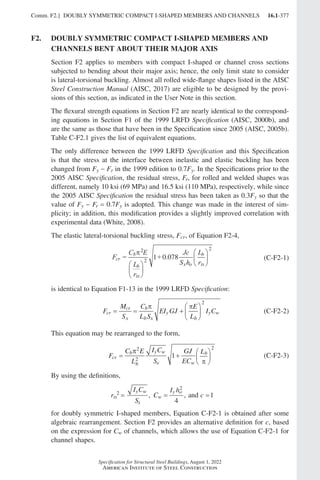
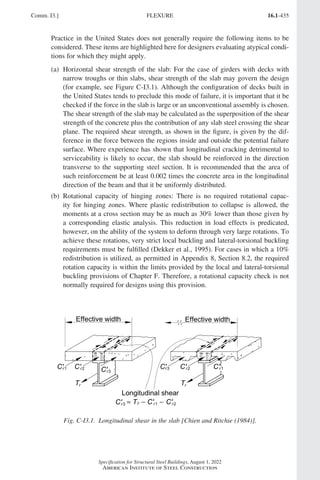
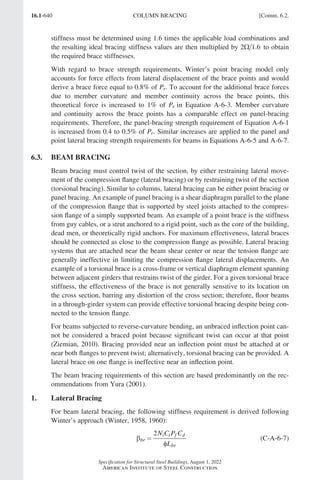
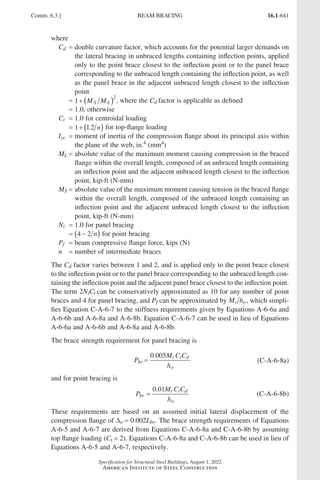
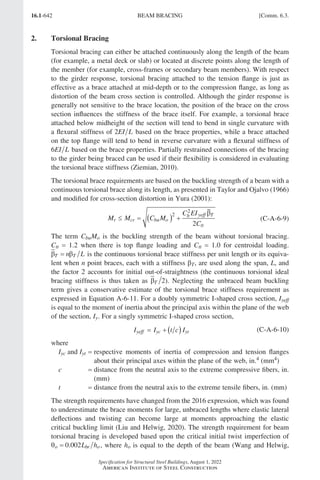
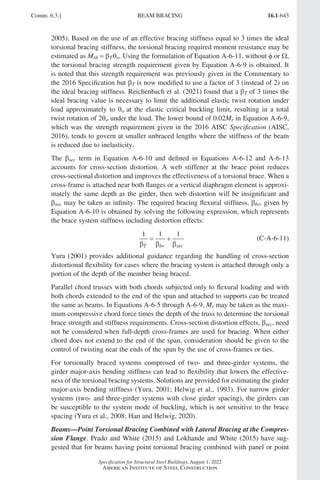
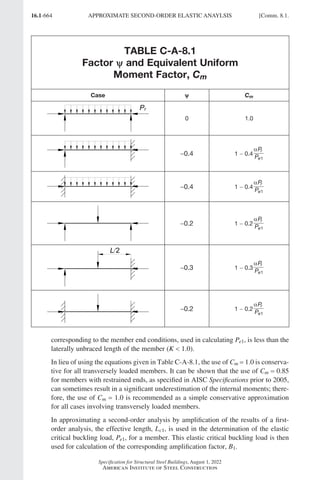
ANSI/AISC 360-22
An American National Standard
Specification for
Structural
Steel Buildings
August 1, 2022
Supersedes the Specification for Structural Steel Buildings
dated June 7, 2016, and all previous versions
Approved by the Committee on Specifications
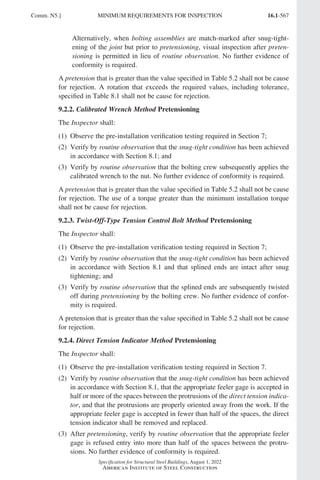
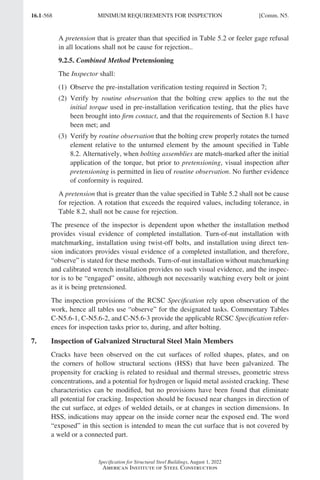
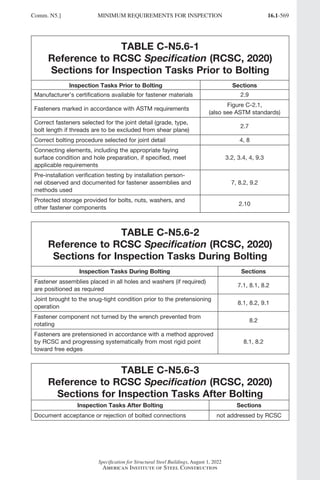
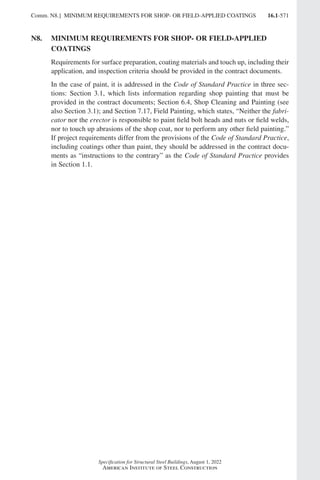
ANSI/AISC 360-22
An American National Standard
Specification for
Structural
Steel Buildings
August 1, 2022
Supersedes the Specification for Structural Steel Buildings
dated June 7, 2016, and all previous versions
Approved by the Committee on Specifications
16.1-ii
Specification for Structural Steel Buildings, August 1, 2022
American Institute of Steel Construction
© AISC 2022
by
American Institute of Steel Construction
All rights reserved. This book or any part thereof
must not be reproduced in any form without the
written permission of the publisher.
The AISC logo is a registered trademark of AISC.
The information presented in this publication has been prepared by a balanced commit-
tee following American National Standards Institute (ANSI) consensus procedures and
recognized principles of design and construction. While it is believed to be accurate, this
information should not be used or relied upon for any specific application without compe-
tent professional examination and verification of its accuracy, suitability, and applicability
by a licensed engineer or architect. The publication of this information is not a representa-
tion or warranty on the part of the American Institute of Steel Construction, its officers,
agents, employees, or committee members, or of any other person named herein, that this
information is suitable for any general or particular use, or of freedom from infringement
of any patent or patents. All representations or warranties, express or implied, other than as
stated above, are specifically disclaimed. Anyone making use of the information presented
in this publication assumes all liability arising from such use.
Caution must be exercised when relying upon standards and guidelines developed by
other bodies and incorporated by reference herein since such material may be modified or
amended from time to time subsequent to the printing of this edition. The American Institute
of Steel Construction bears no responsibility for such material other than to refer to it and
incorporate it by reference at the time of the initial publication of this edition.
Printed in the United States of America
Revised September 2023
Part 16.1 Prelims (i-lxvi).indd 2
Part 16.1 Prelims (i-lxvi).indd 2 2023-09-24 11:00 PM
2023-09-24 11:00 PM
16.1-iii
Specification for Structural Steel Buildings, August 1, 2022
American Institute of Steel Construction
DEDICATION
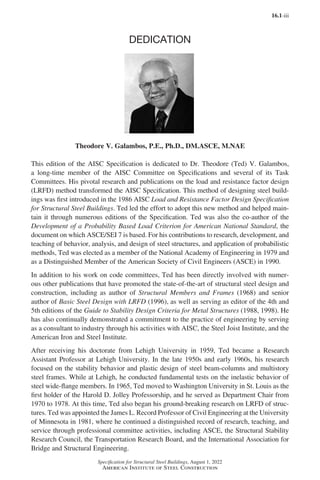
Theodore V. Galambos, P.E., Ph.D., DM.ASCE, M.NAE
This edition of the AISC Specification is dedicated to Dr. Theodore (Ted) V. Galambos,
a long-time member of the AISC Committee on Specifications and several of its Task
Committees. His pivotal research and publications on the load and resistance factor design
(LRFD) method transformed the AISC Specification. This method of designing steel build-
ings was first introduced in the 1986 AISC Load and Resistance Factor Design Specification
for Structural Steel Buildings. Ted led the effort to adopt this new method and helped main-
tain it through numerous editions of the Specification. Ted was also the co-author of the
Development of a Probability Based Load Criterion for American National Standard, the
document on which ASCE/SEI 7 is based. For his contributions to research, development, and
teaching of behavior, analysis, and design of steel structures, and application of probabilistic
methods, Ted was elected as a member of the National Academy of Engineering in 1979 and
as a Distinguished Member of the American Society of Civil Engineers (ASCE) in 1990.
In addition to his work on code committees, Ted has been directly involved with numer-
ous other publications that have promoted the state-of-the-art of structural steel design and
construction, including as author of Structural Members and Frames (1968) and senior
author of Basic Steel Design with LRFD (1996), as well as serving as editor of the 4th and
5th editions of the Guide to Stability Design Criteria for Metal Structures (1988, 1998). He
has also continually demonstrated a commitment to the practice of engineering by serving
as a consultant to industry through his activities with AISC, the Steel Joist Institute, and the
American Iron and Steel Institute.
After receiving his doctorate from Lehigh University in 1959, Ted became a Research
Assistant Professor at Lehigh University. In the late 1950s and early 1960s, his research
focused on the stability behavior and plastic design of steel beam-columns and multistory
steel frames. While at Lehigh, he conducted fundamental tests on the inelastic behavior of
steel wide-flange members. In 1965, Ted moved to Washington University in St. Louis as the
first holder of the Harold D. Jolley Professorship, and he served as Department Chair from
1970 to 1978. At this time, Ted also began his ground-breaking research on LRFD of struc-
tures. Ted was appointed the James L. Record Professor of Civil Engineering at the University
of Minnesota in 1981, where he continued a distinguished record of research, teaching, and
service through professional committee activities, including ASCE, the Structural Stability
Research Council, the Transportation Research Board, and the International Association for
Bridge and Structural Engineering.
Part 16.1 Prelims (i-lxvi).indd 3
Part 16.1 Prelims (i-lxvi).indd 3 2023-01-11 9:08 AM
2023-01-11 9:08 AM
16.1-iv
Specification for Structural Steel Buildings, August 1, 2022
American Institute of Steel Construction
As a professor, Ted is a beloved teacher who instructed many future engineers in steel
design with an exemplary blending of theory and practice. Ted’s commitment to sharing
his knowledge, his willingness to mentor several generations of young researchers, and his
strong ethical standards have made him one of the giants of his generation. His contributions
on the behavior of steel structures will have a lasting impact on the structural engineering
profession.
DEDICATION
Part 16.1 Prelims (i-lxvi).indd 4
Part 16.1 Prelims (i-lxvi).indd 4 2023-01-11 9:08 AM
2023-01-11 9:08 AM
16.1-v
Specification for Structural Steel Buildings, August 1, 2022
American Institute of Steel Construction
PREFACE
(This Preface is not part of ANSI/AISC 360-22, Specification for Structural Steel Buildings,
but is included for informational purposes only.)
This Specification is based upon past successful usage, advances in the state of knowl-
edge, and changes in design practice. The 2022 American Institute of Steel Construction’s
Specification for Structural Steel Buildings provides an integrated treatment of allowable
strength design (ASD) and load and resistance factor design (LRFD), and replaces earlier
Specifications. As indicated in Chapter B of the Specification, designs can be made accord-
ing to either ASD or LRFD provisions.
This ANSI-approved Specification has been developed as a consensus document using
ANSI-accredited procedures to provide a uniform practice in the design of steel-framed
buildings and other structures. The intention is to provide design criteria for routine use and
not to provide specific criteria for infrequently encountered problems that occur in the full
range of structural design.
This Specification is the result of the consensus deliberations of a committee of structural
engineers with wide experience and high professional standing, representing a wide geo-
graphical distribution throughout the United States. The committee includes approximately
equal numbers of engineers in private practice and code agencies, engineers involved in
research and teaching, and engineers employed by steel fabricating and producing compa-
nies. The contributions and assistance of more than 50 additional professional volunteers
working in task committees are also hereby acknowledged.
The Symbols, Glossary, Abbreviations, and Appendices to this Specification are an
integral part of the Specification. A nonmandatory Commentary has been prepared to pro-
vide background for the Specification provisions and the user is encouraged to consult it.
Additionally, nonmandatory User Notes are interspersed throughout the Specification to
provide concise and practical guidance in the application of the provisions.
A number of significant technical modifications have also been made since the 2016 edi-
tion of the Specification, including the following:
• 
A new table is incorporated into Section A3 that lists allowable grades and strengths and
other specific limitations of referenced materials.
• 
Section J3 adopts ASTM F3148 bolts that provide a strength of 144 ksi. A new combined
installation method is incorporated into Chapter J applicable to these bolts by reference
to the RCSC Specification.
• 
Section A4 provides a detailed list related to what information must be provided on
structural design documents. These criteria have been moved from the Code of Standard
Practice for Structural Steel Buildings.
• 
A new Section A5, Approvals, is added to specifically address the review and approval
of approval documents.
• 
A new Section B8, Dimensional Tolerances, is added to clarify that the provisions of the
Specification are based on specific tolerances provided in the Code of Standard Practice
and referenced ASTM standards.
• 
Provisions are added in Section E4 for doubly symmetric I-shaped compression members
to address lateral bracing that is offset from the shear center.
Part 16.1 Prelims (i-lxvi).indd 5
Part 16.1 Prelims (i-lxvi).indd 5 2023-01-11 9:08 AM
2023-01-11 9:08 AM
16.1-vi
Specification for Structural Steel Buildings, August 1, 2022
American Institute of Steel Construction
• 
For flexural strength of members with holes in the tension flange, it is clarified that the
Section F13.1 provisions apply only to bolt holes.
• 
Provisions are added to Chapter G to permit tension field action in end panels.
• 
Provisions are added to Chapter H for HSS subjected to combined forces, to include
biaxial bending and shear.
• 
Provisions are added to Chapter I for longitudinal and transverse reinforcing steel require-
ments for filled composite columns and for both encased composite and filled composite
beams.
• 
Chapter I now includes additional stiffness and strength provisions for concrete filled
composite plate shear walls consisting of two steel plates connected by tie bars.
• 
Provisions for the design of rectangular filled composite members constructed from mate-
rials with strengths above the limits noted in Chapter I are added in a new Appendix 2.
• 
Section J2 provides revised requirements to qualify partial-joint-penetration groove welds
with effective throats larger than those prescribed in AWS D1.1/D1.1M.
• 
Requirements regarding the use of low-hydrogen electrodes as they relate to minimum
size fillet welds are revised in Table J2.4.
• 
The directional strength increase for transversely loaded fillet welds is rewritten and pro-
hibited for use in the ends of rectangular HSS.
• 
An alternative bolt tensile strength based on the net tensile area of bolts is added.
• 
Added limit states for rectangular HSS moment connections in Chapter K.
• 
Section N4 now addresses coating inspection personnel requirements.
• 
A new Section N8, Minimum Requirements for Shop or Field Applied Coatings, is added.
• 
Appendix 2, Design for Ponding, is removed and replaced with updated guidance on this
topic in Section B3.10.
• 
Appendix 3 clarifies hole forming provisions for elements subjected to fatigue.
• Appendix 4 incorporates temperature-dependent stress-strain equations from the Eurocode
to provide material properties for steel at elevated temperatures.
• 
Prescriptive steel fire-protection design equations and related information based on stan-
dard ASTM E119 fire tests are incorporated into Appendix 4.
• 
Appendix 4, Section 4.4d, Design by Simple Methods of Analysis, includes provisions for
compressive strength in filled composite columns and for compression in filled composite
plate shear walls.
• 
Provisions for calculating rivet strength are added in Appendix 5.
This Specification was approved by the Committee on Specifications:
James O. Malley, Chair Bruce R. Ellingwood, Emeritus
Scott F. Armbrust, Vice Chair Michael D. Engelhardt
Allen Adams Shu-Jin Fang, Emeritus
Taha D. Al-Shawaf James M. Fisher, Emeritus
William F. Baker John W. Fisher, Emeritus
John M. Barsom, Emeritus Theodore V. Galambos, Emeritus
Roger L. Brockenbrough, Emeritus Michael E. Gase
Susan B. Burmeister Louis F. Geschwindner
Gregory G. Deierlein Ramon E. Gilsanz
Bo Dowswell Lawrence G. Griffis		
Carol J. Drucker Jerome F. Hajjar
W. Samuel Easterling Ronald O. Hamburger
PREFACE
Part 16.1 Prelims (i-lxvi).indd 6
Part 16.1 Prelims (i-lxvi).indd 6 2023-01-11 9:08 AM
2023-01-11 9:08 AM
16.1-vii
Specification for Structural Steel Buildings, August 1, 2022
American Institute of Steel Construction
Patrick M. Hassett R. Shankar Nair, Emeritus		
Tony C. Hazel Conrad Paulson
Todd A. Helwig Douglas A. Rees-Evans
Richard A. Henige, Jr. Rafael Sabelli
Mark V. Holland Thomas A. Sabol
John D. Hooper Fahim H. Sadek
Nestor R. Iwankiw Benjamin W. Schafer
William P. Jacobs, V Robert E. Shaw, Jr.
Ronald J. Janowiak Donald R. Sherman, Emeritus
Lawrence A. Kloiber, Emeritus W. Lee Shoemaker
Lawrence F. Kruth William A. Thornton, Emeritus
Jay W. Larson Chia-Ming Uang
Roberto T. Leon Amit H. Varma
Judy Liu Donald W. White
Duane K. Miller Jamie Winans
Larry S. Muir Ronald D. Ziemian
Thomas M. Murray, Emeritus Cynthia J. Duncan, Secretary
The Committee honors former members, vice-chair, Patrick J. Fortney, and emeritus
members, Reidar Bjorhovde, Duane S. Ellifritt, and Raymond H.R. Tide, who passed away
during this cycle.
The Committee gratefully acknowledges AISC Board Oversights, Matt Smith and Duff
Zimmerman; advisory members, Carlos Aguirre and Tiziano Perea; and the following task
committee and staff members for their involvement in the development of this document.
Farid Alfawakhiri Rodney D. Gibble
Abbas Aminmansour Nathaniel P. Gonner
Caroline R. Bennett Arvind V. Goverdhan
Robert Berhinig Perry S. Green
Eric Bolin Christina Harber
Mark Braekevelt John Harris
Michel Bruneau Alfred A. Herget
Art Bustos Stephen M. Herlache
Joel A. Chandler Steven J. Herth
Robert Chmielowski Devin Huber
Lisa Choe Ronald B. Johnson
Douglas Crampton Jeffrey Keileh
Rachel Chicchi Cross Kerry Kreitman
Mark D. Denavit David W. Landis
Matthew F. Fadden Chad M. Larson
Larry A. Fahnestock Dawn E. Lehman
Shelley C. Finnigan Andres Lepage
Erica C. Fischer Brent Leu
Timothy P. Fraser Carlo Lini
Christine Freisinger LeRoy A. Lutz
Michael Gannon Andrew Lye
Rupa Garai Bonnie E. Manley
Jeffrey Gasparott Michael R. Marian
PREFACE
Part 16.1 Prelims (i-lxvi).indd 7
Part 16.1 Prelims (i-lxvi).indd 7 2023-01-11 9:08 AM
2023-01-11 9:08 AM
16.1-viii
Specification for Structural Steel Buildings, August 1, 2022
American Institute of Steel Construction
Jason P. McCormick Kristi Sattler
Austin A. Meier Brandt Saxey
Jared Moseley Thomas J. Schlafly
J.R. Ubejd Mujagic Jim Schoen
Kimberley T. Olson William Scott
Jeffrey A. Packer Richard Scruton
Garner Palenske Bahram M. Shahrooz
Robert Pekelnicky Thomas Sputo
Thomas D. Poulos Ryan Staudt
Max Puchtel Andrea E. Surovek
Christopher H. Raebel James A. Swanson
Gian Andrea Rassati Matthew Trammell
Charles W. Roeder Sriramulu Vinnakota
John A. Rolfes Michael A. West
Sougata Roy
PREFACE
Part 16.1 Prelims (i-lxvi).indd 8
Part 16.1 Prelims (i-lxvi).indd 8 2023-01-11 9:08 AM
2023-01-11 9:08 AM
16.1-ix
Specification for Structural Steel Buildings, August 1, 2022
American Institute of Steel Construction
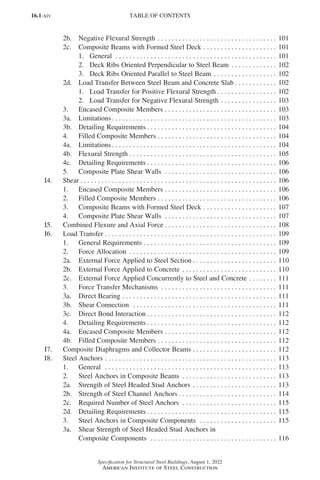
TABLE OF CONTENTS
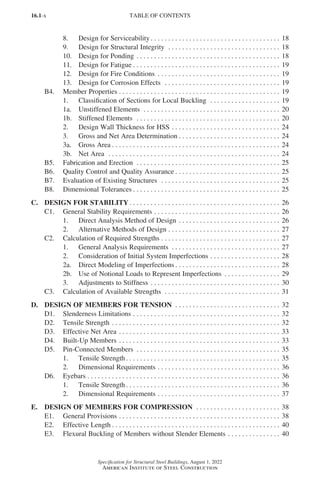
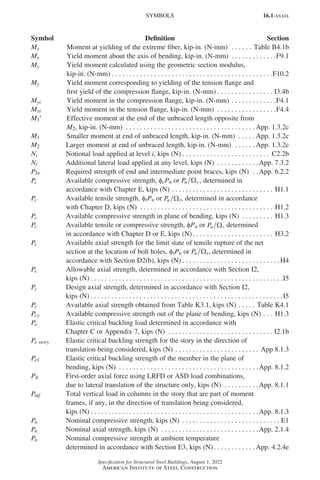
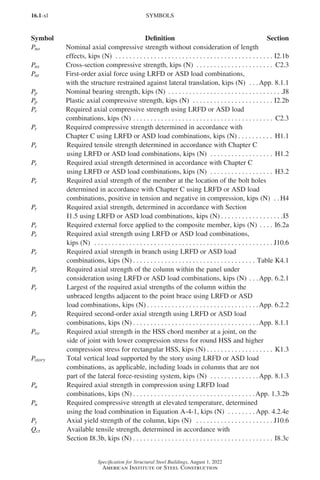
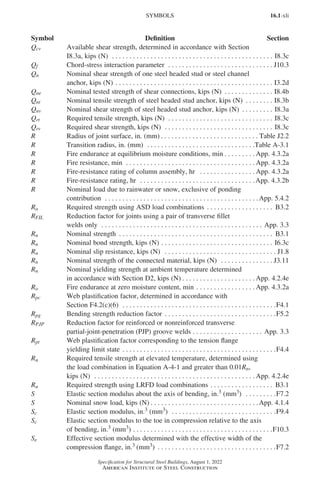
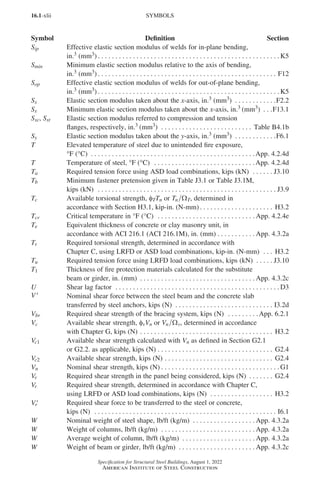
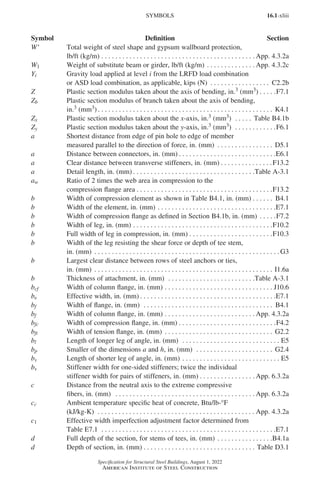
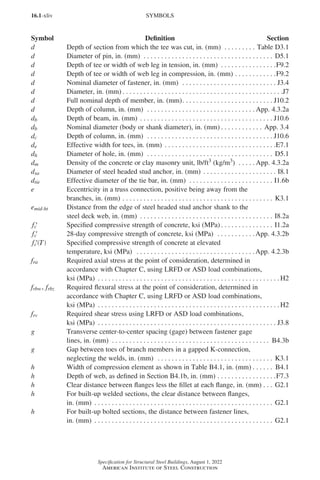
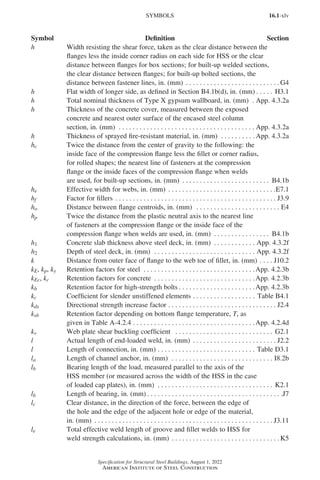
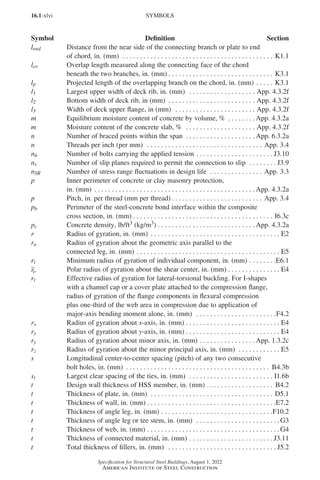
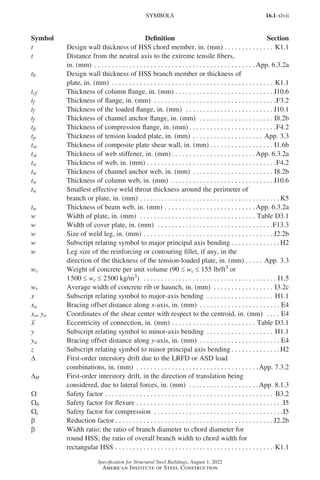
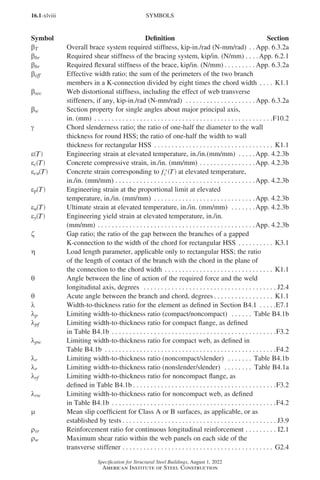
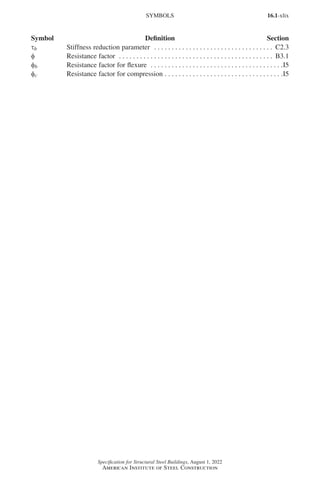
SYMBOLS . . . . . . . . . . . . . . . . . . . . . . . . . . . . . . . . . . . . . . . . . . . . . . . . . . . . . . . . . . . xxxi
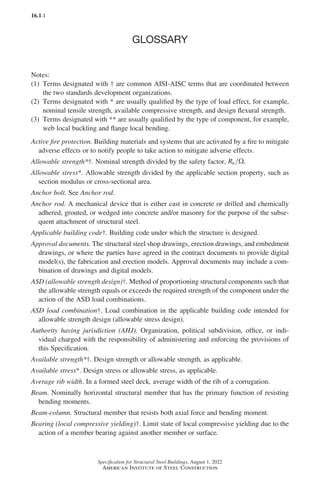
GLOSSARY . . . . . . . . . . . . . . . . . . . . . . . . . . . . . . . . . . . . . . . . . . . . . . . . . . . . . . . . . . . . . l
ABBREVIATIONS . . . . . . . . . . . . . . . . . . . . . . . . . . . . . . . . . . . . . . . . . . . . . . . . . . . . . lxv
A. GENERAL PROVISIONS   . . . . . . . . . . . . . . . . . . . . . . . . . . . . . . . . . . . . . . . . . . . . . 1
A1. Scope . . . . . . . . . . . . . . . . . . . . . . . . . . . . . . . . . . . . . . . . . . . . . . . . . . . . . . . . . . 1
1. Seismic Applications. . . . . . . . . . . . . . . . . . . . . . . . . . . . . . . . . . . . . . . . . . 2
2. Nuclear Applications. . . . . . . . . . . . . . . . . . . . . . . . . . . . . . . . . . . . . . . . . . 2
A2. Referenced Specifications, Codes, and Standards. . . . . . . . . . . . . . . . . . . . . . . . 2
A3. Material . . . . . . . . . . . . . . . . . . . . . . . . . . . . . . . . . . . . . . . . . . . . . . . . . . . . . . . . 6
1. Structural Steel Materials . . . . . . . . . . . . . . . . . . . . . . . . . . . . . . . . . . . . . . 6
1a. Listed Materials. . . . . . . . . . . . . . . . . . . . . . . . . . . . . . . . . . . . . . . . . . . . . . 8
1b. Other Materials . . . . . . . . . . . . . . . . . . . . . . . . . . . . . . . . . . . . . . . . . . . . . . 8
1c. Unidentified Steel . . . . . . . . . . . . . . . . . . . . . . . . . . . . . . . . . . . . . . . . . . . . 8
1d. Rolled Heavy Shapes . . . . . . . . . . . . . . . . . . . . . . . . . . . . . . . . . . . . . . . . . 9
1e. Built-Up Heavy Shapes. . . . . . . . . . . . . . . . . . . . . . . . . . . . . . . . . . . . . . . . 9
2. Steel Castings and Forgings . . . . . . . . . . . . . . . . . . . . . . . . . . . . . . . . . . . 10
3. Bolts, Washers, and Nuts . . . . . . . . . . . . . . . . . . . . . . . . . . . . . . . . . . . . . 10
4. Anchor Rods and Threaded Rods. . . . . . . . . . . . . . . . . . . . . . . . . . . . . . . 10
5. Consumables for Welding. . . . . . . . . . . . . . . . . . . . . . . . . . . . . . . . . . . . . 11
6. Headed Stud Anchors . . . . . . . . . . . . . . . . . . . . . . . . . . . . . . . . . . . . . . . . 11
A4. Structural Design Documents and Specifications . . . . . . . . . . . . . . . . . . . . . . . 11
1. Structural Design Documents and Specifications Issued for
Construction . . . . . . . . . . . . . . . . . . . . . . . . . . . . . . . . . . . . . . . . . . . . . . . 11
2. Structural Design Documents and Specifications Issued for
Any Purpose . . . . . . . . . . . . . . . . . . . . . . . . . . . . . . . . . . . . . . . . . . . . . . . 13
A5. Approvals. . . . . . . . . . . . . . . . . . . . . . . . . . . . . . . . . . . . . . . . . . . . . . . . . . . . . . 14
B. DESIGN REQUIREMENTS. . . . . . . . . . . . . . . . . . . . . . . . . . . . . . . . . . . . . . . . . . . 15
B1. General Provisions. . . . . . . . . . . . . . . . . . . . . . . . . . . . . . . . . . . . . . . . . . . . . . . 15
B2. Loads and Load Combinations . . . . . . . . . . . . . . . . . . . . . . . . . . . . . . . . . . . . . 15
B3. Design Basis. . . . . . . . . . . . . . . . . . . . . . . . . . . . . . . . . . . . . . . . . . . . . . . . . . . . 15
1. Design for Strength Using Load and Resistance Factor
Design (LRFD) . . . . . . . . . . . . . . . . . . . . . . . . . . . . . . . . . . . . . . . . . . . . . 16
2. Design for Strength Using Allowable Strength Design (ASD) . . . . . . . . 16
3. Required Strength . . . . . . . . . . . . . . . . . . . . . . . . . . . . . . . . . . . . . . . . . . . 16
4. Design of Connections and Supports . . . . . . . . . . . . . . . . . . . . . . . . . . . . 17
4a. Simple Connections   . . . . . . . . . . . . . . . . . . . . . . . . . . . . . . . . . . . . . . . . . 17
4b. Moment Connections . . . . . . . . . . . . . . . . . . . . . . . . . . . . . . . . . . . . . . . . 17
5. Design of Diaphragms and Collectors . . . . . . . . . . . . . . . . . . . . . . . . . . . 17
6. Design of Anchorages to Concrete . . . . . . . . . . . . . . . . . . . . . . . . . . . . . . 18
7. Design for Stability . . . . . . . . . . . . . . . . . . . . . . . . . . . . . . . . . . . . . . . . . . 18
Part 16.1 Prelims (i-lxvi).indd 9
Part 16.1 Prelims (i-lxvi).indd 9 2023-01-11 9:08 AM
2023-01-11 9:08 AM
16.1-x
Specification for Structural Steel Buildings, August 1, 2022
American Institute of Steel Construction
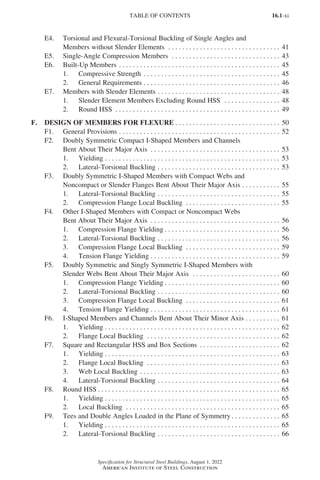
8. Design for Serviceability. . . . . . . . . . . . . . . . . . . . . . . . . . . . . . . . . . . . . . 18
9. Design for Structural Integrity . . . . . . . . . . . . . . . . . . . . . . . . . . . . . . . . . 18
10. Design for Ponding. . . . . . . . . . . . . . . . . . . . . . . . . . . . . . . . . . . . . . . . . . 18
11. Design for Fatigue. . . . . . . . . . . . . . . . . . . . . . . . . . . . . . . . . . . . . . . . . . . 19
12. Design for Fire Conditions . . . . . . . . . . . . . . . . . . . . . . . . . . . . . . . . . . . . 19
13. Design for Corrosion Effects . . . . . . . . . . . . . . . . . . . . . . . . . . . . . . . . . . 19
B4. Member Properties. . . . . . . . . . . . . . . . . . . . . . . . . . . . . . . . . . . . . . . . . . . . . . . 19
1. Classification of Sections for Local Buckling . . . . . . . . . . . . . . . . . . . . . 19
1a. Unstiffened Elements . . . . . . . . . . . . . . . . . . . . . . . . . . . . . . . . . . . . . . . . 20
1b. Stiffened Elements . . . . . . . . . . . . . . . . . . . . . . . . . . . . . . . . . . . . . . . . . . 20
2. Design Wall Thickness for HSS. . . . . . . . . . . . . . . . . . . . . . . . . . . . . . . . 24
3. Gross and Net Area Determination. . . . . . . . . . . . . . . . . . . . . . . . . . . . . . 24
3a. Gross Area. . . . . . . . . . . . . . . . . . . . . . . . . . . . . . . . . . . . . . . . . . . . . . . . . 24
3b. Net Area . . . . . . . . . . . . . . . . . . . . . . . . . . . . . . . . . . . . . . . . . . . . . . . . . . 24
B5. Fabrication and Erection . . . . . . . . . . . . . . . . . . . . . . . . . . . . . . . . . . . . . . . . . . 25
B6. Quality Control and Quality Assurance. . . . . . . . . . . . . . . . . . . . . . . . . . . . . . . 25
B7. Evaluation of Existing Structures . . . . . . . . . . . . . . . . . . . . . . . . . . . . . . . . . . . 25
B8. Dimensional Tolerances. . . . . . . . . . . . . . . . . . . . . . . . . . . . . . . . . . . . . . . . . . . 25
C. DESIGN FOR STABILITY. . . . . . . . . . . . . . . . . . . . . . . . . . . . . . . . . . . . . . . . . . . . 26
C1. General Stability Requirements. . . . . . . . . . . . . . . . . . . . . . . . . . . . . . . . . . . . . 26
1. Direct Analysis Method of Design. . . . . . . . . . . . . . . . . . . . . . . . . . . . . . 26
2. Alternative Methods of Design. . . . . . . . . . . . . . . . . . . . . . . . . . . . . . . . . 27
C2. Calculation of Required Strengths. . . . . . . . . . . . . . . . . . . . . . . . . . . . . . . . . . . 27
1. General Analysis Requirements . . . . . . . . . . . . . . . . . . . . . . . . . . . . . . . . 27
2. Consideration of Initial System Imperfections. . . . . . . . . . . . . . . . . . . . . 28
2a. Direct Modeling of Imperfections. . . . . . . . . . . . . . . . . . . . . . . . . . . . . . . 28
2b. Use of Notional Loads to Represent Imperfections . . . . . . . . . . . . . . . . . 29
3. Adjustments to Stiffness. . . . . . . . . . . . . . . . . . . . . . . . . . . . . . . . . . . . . . 30
C3. Calculation of Available Strengths . . . . . . . . . . . . . . . . . . . . . . . . . . . . . . . . . . 31
D. DESIGN OF MEMBERS FOR TENSION . . . . . . . . . . . . . . . . . . . . . . . . . . . . . . . 32
D1. Slenderness Limitations. . . . . . . . . . . . . . . . . . . . . . . . . . . . . . . . . . . . . . . . . . . 32
D2. Tensile Strength. . . . . . . . . . . . . . . . . . . . . . . . . . . . . . . . . . . . . . . . . . . . . . . . . 32
D3. Effective Net Area. . . . . . . . . . . . . . . . . . . . . . . . . . . . . . . . . . . . . . . . . . . . . . . 33
D4. Built-Up Members. . . . . . . . . . . . . . . . . . . . . . . . . . . . . . . . . . . . . . . . . . . . . . . 33
D5. Pin-Connected Members . . . . . . . . . . . . . . . . . . . . . . . . . . . . . . . . . . . . . . . . . . 35
1. Tensile Strength. . . . . . . . . . . . . . . . . . . . . . . . . . . . . . . . . . . . . . . . . . . . . 35
2. Dimensional Requirements. . . . . . . . . . . . . . . . . . . . . . . . . . . . . . . . . . . . 36
D6. Eyebars. . . . . . . . . . . . . . . . . . . . . . . . . . . . . . . . . . . . . . . . . . . . . . . . . . . . . . . . 36
1. Tensile Strength. . . . . . . . . . . . . . . . . . . . . . . . . . . . . . . . . . . . . . . . . . . . . 36
2. Dimensional Requirements. . . . . . . . . . . . . . . . . . . . . . . . . . . . . . . . . . . . 37
E. DESIGN OF MEMBERS FOR COMPRESSION . . . . . . . . . . . . . . . . . . . . . . . . . 38
E1. General Provisions. . . . . . . . . . . . . . . . . . . . . . . . . . . . . . . . . . . . . . . . . . . . . . . 38
E2. Effective Length. . . . . . . . . . . . . . . . . . . . . . . . . . . . . . . . . . . . . . . . . . . . . . . . . 40
E3. Flexural Buckling of Members without Slender Elements. . . . . . . . . . . . . . . . 40
TABLE OF CONTENTS
Part 16.1 Prelims (i-lxvi).indd 10
Part 16.1 Prelims (i-lxvi).indd 10 2023-01-11 9:08 AM
2023-01-11 9:08 AM
16.1-xi
Specification for Structural Steel Buildings, August 1, 2022
American Institute of Steel Construction
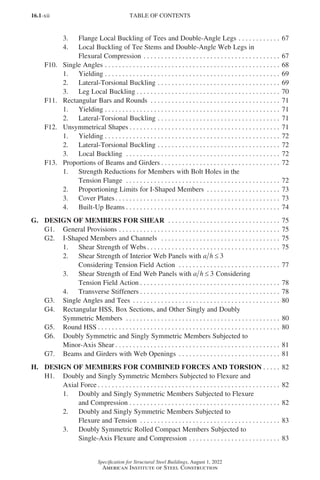
E4.	
Torsional and Flexural-Torsional Buckling of Single Angles and
Members without Slender Elements . . . . . . . . . . . . . . . . . . . . . . . . . . . . . . . . . 41
E5. Single-Angle Compression Members . . . . . . . . . . . . . . . . . . . . . . . . . . . . . . . . 43
E6. Built-Up Members. . . . . . . . . . . . . . . . . . . . . . . . . . . . . . . . . . . . . . . . . . . . . . . 45
1. Compressive Strength. . . . . . . . . . . . . . . . . . . . . . . . . . . . . . . . . . . . . . . . 45
2. General Requirements. . . . . . . . . . . . . . . . . . . . . . . . . . . . . . . . . . . . . . . . 46
E7. Members with Slender Elements. . . . . . . . . . . . . . . . . . . . . . . . . . . . . . . . . . . . 48
1. Slender Element Members Excluding Round HSS . . . . . . . . . . . . . . . . . 48
2. Round HSS . . . . . . . . . . . . . . . . . . . . . . . . . . . . . . . . . . . . . . . . . . . . . . . . 49
F. DESIGN OF MEMBERS FOR FLEXURE. . . . . . . . . . . . . . . . . . . . . . . . . . . . . . . 50
F1. General Provisions. . . . . . . . . . . . . . . . . . . . . . . . . . . . . . . . . . . . . . . . . . . . . . . 52
F2. Doubly Symmetric Compact I-Shaped Members and Channels
Bent About Their Major Axis . . . . . . . . . . . . . . . . . . . . . . . . . . . . . . . . . . . . . . 53
1. Yielding. . . . . . . . . . . . . . . . . . . . . . . . . . . . . . . . . . . . . . . . . . . . . . . . . . . 53
2. Lateral-Torsional Buckling. . . . . . . . . . . . . . . . . . . . . . . . . . . . . . . . . . . . 53
F3. Doubly Symmetric I-Shaped Members with Compact Webs and
Noncompact or Slender Flanges Bent About Their Major Axis. . . . . . . . . . . . 55
1. Lateral-Torsional Buckling. . . . . . . . . . . . . . . . . . . . . . . . . . . . . . . . . . . . 55
2. Compression Flange Local Buckling . . . . . . . . . . . . . . . . . . . . . . . . . . . . 55
F4. Other I-Shaped Members with Compact or Noncompact Webs
Bent About Their Major Axis . . . . . . . . . . . . . . . . . . . . . . . . . . . . . . . . . . . . . . 56
1. Compression Flange Yielding. . . . . . . . . . . . . . . . . . . . . . . . . . . . . . . . . . 56
2. Lateral-Torsional Buckling. . . . . . . . . . . . . . . . . . . . . . . . . . . . . . . . . . . . 56
3. Compression Flange Local Buckling . . . . . . . . . . . . . . . . . . . . . . . . . . . . 59
4. Tension Flange Yielding. . . . . . . . . . . . . . . . . . . . . . . . . . . . . . . . . . . . . . 59
F5. Doubly Symmetric and Singly Symmetric I-Shaped Members with
Slender Webs Bent About Their Major Axis . . . . . . . . . . . . . . . . . . . . . . . . . . 60
1. Compression Flange Yielding. . . . . . . . . . . . . . . . . . . . . . . . . . . . . . . . . . 60
2. Lateral-Torsional Buckling. . . . . . . . . . . . . . . . . . . . . . . . . . . . . . . . . . . . 60
3. Compression Flange Local Buckling . . . . . . . . . . . . . . . . . . . . . . . . . . . . 61
4. Tension Flange Yielding. . . . . . . . . . . . . . . . . . . . . . . . . . . . . . . . . . . . . . 61
F6. I-Shaped Members and Channels Bent About Their Minor Axis. . . . . . . . . . . 61
1. Yielding. . . . . . . . . . . . . . . . . . . . . . . . . . . . . . . . . . . . . . . . . . . . . . . . . . . 62
2. Flange Local Buckling . . . . . . . . . . . . . . . . . . . . . . . . . . . . . . . . . . . . . . . 62
F7. Square and Rectangular HSS and Box Sections . . . . . . . . . . . . . . . . . . . . . . . . 62
1. Yielding. . . . . . . . . . . . . . . . . . . . . . . . . . . . . . . . . . . . . . . . . . . . . . . . . . . 63
2. Flange Local Buckling . . . . . . . . . . . . . . . . . . . . . . . . . . . . . . . . . . . . . . . 63
3. Web Local Buckling. . . . . . . . . . . . . . . . . . . . . . . . . . . . . . . . . . . . . . . . . 63
4. Lateral-Torsional Buckling. . . . . . . . . . . . . . . . . . . . . . . . . . . . . . . . . . . . 64
F8. Round HSS. . . . . . . . . . . . . . . . . . . . . . . . . . . . . . . . . . . . . . . . . . . . . . . . . . . . . 65
1. Yielding. . . . . . . . . . . . . . . . . . . . . . . . . . . . . . . . . . . . . . . . . . . . . . . . . . . 65
2. Local Buckling . . . . . . . . . . . . . . . . . . . . . . . . . . . . . . . . . . . . . . . . . . . . . 65
F9. Tees and Double Angles Loaded in the Plane of Symmetry. . . . . . . . . . . . . . . 65
1. Yielding. . . . . . . . . . . . . . . . . . . . . . . . . . . . . . . . . . . . . . . . . . . . . . . . . . . 65
2. Lateral-Torsional Buckling. . . . . . . . . . . . . . . . . . . . . . . . . . . . . . . . . . . . 66
TABLE OF CONTENTS
Part 16.1 Prelims (i-lxvi).indd 11
Part 16.1 Prelims (i-lxvi).indd 11 2023-01-11 9:08 AM
2023-01-11 9:08 AM
16.1-xii
Specification for Structural Steel Buildings, August 1, 2022
American Institute of Steel Construction
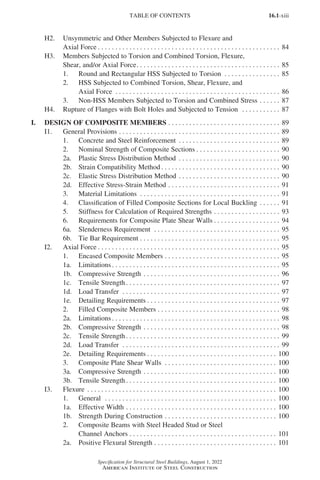
3. Flange Local Buckling of Tees and Double-Angle Legs. . . . . . . . . . . . . 67
4. Local Buckling of Tee Stems and Double-Angle Web Legs in
Flexural Compression. . . . . . . . . . . . . . . . . . . . . . . . . . . . . . . . . . . . . . . . 67
F10. Single Angles. . . . . . . . . . . . . . . . . . . . . . . . . . . . . . . . . . . . . . . . . . . . . . . . . . . 68
1. Yielding. . . . . . . . . . . . . . . . . . . . . . . . . . . . . . . . . . . . . . . . . . . . . . . . . . . 69
2. Lateral-Torsional Buckling. . . . . . . . . . . . . . . . . . . . . . . . . . . . . . . . . . . . 69
3. Leg Local Buckling. . . . . . . . . . . . . . . . . . . . . . . . . . . . . . . . . . . . . . . . . . 70
F11. Rectangular Bars and Rounds . . . . . . . . . . . . . . . . . . . . . . . . . . . . . . . . . . . . . . 71
1. Yielding. . . . . . . . . . . . . . . . . . . . . . . . . . . . . . . . . . . . . . . . . . . . . . . . . . . 71
2. Lateral-Torsional Buckling. . . . . . . . . . . . . . . . . . . . . . . . . . . . . . . . . . . . 71
F12. Unsymmetrical Shapes. . . . . . . . . . . . . . . . . . . . . . . . . . . . . . . . . . . . . . . . . . . . 71
1. Yielding. . . . . . . . . . . . . . . . . . . . . . . . . . . . . . . . . . . . . . . . . . . . . . . . . . . 72
2. Lateral-Torsional Buckling. . . . . . . . . . . . . . . . . . . . . . . . . . . . . . . . . . . . 72
3. Local Buckling . . . . . . . . . . . . . . . . . . . . . . . . . . . . . . . . . . . . . . . . . . . . . 72
F13. Proportions of Beams and Girders. . . . . . . . . . . . . . . . . . . . . . . . . . . . . . . . . . . 72
1. Strength Reductions for Members with Bolt Holes in the
Tension Flange . . . . . . . . . . . . . . . . . . . . . . . . . . . . . . . . . . . . . . . . . . . . . 72
2. Proportioning Limits for I-Shaped Members . . . . . . . . . . . . . . . . . . . . . . 73
3. Cover Plates. . . . . . . . . . . . . . . . . . . . . . . . . . . . . . . . . . . . . . . . . . . . . . . . 73
4. Built-Up Beams. . . . . . . . . . . . . . . . . . . . . . . . . . . . . . . . . . . . . . . . . . . . . 74
G. DESIGN OF MEMBERS FOR SHEAR . . . . . . . . . . . . . . . . . . . . . . . . . . . . . . . . . 75
G1. General Provisions. . . . . . . . . . . . . . . . . . . . . . . . . . . . . . . . . . . . . . . . . . . . . . . 75
G2. I-Shaped Members and Channels . . . . . . . . . . . . . . . . . . . . . . . . . . . . . . . . . . . 75
1. Shear Strength of Webs. . . . . . . . . . . . . . . . . . . . . . . . . . . . . . . . . . . . . . . 75
2. Shear Strength of Interior Web Panels with a h ≤ 3
Considering Tension Field Action . . . . . . . . . . . . . . . . . . . . . . . . . . . . . . 77
3. Shear Strength of End Web Panels with a h ≤ 3 Considering
Tension Field Action. . . . . . . . . . . . . . . . . . . . . . . . . . . . . . . . . . . . . . . . . 78
4. Transverse Stiffeners. . . . . . . . . . . . . . . . . . . . . . . . . . . . . . . . . . . . . . . . . 78
G3. Single Angles and Tees . . . . . . . . . . . . . . . . . . . . . . . . . . . . . . . . . . . . . . . . . . . 80
G4. Rectangular HSS, Box Sections, and Other Singly and Doubly
Symmetric Members . . . . . . . . . . . . . . . . . . . . . . . . . . . . . . . . . . . . . . . . . . . . . 80
G5. Round HSS. . . . . . . . . . . . . . . . . . . . . . . . . . . . . . . . . . . . . . . . . . . . . . . . . . . . . 80
G6. Doubly Symmetric and Singly Symmetric Members Subjected to
Minor-Axis Shear. . . . . . . . . . . . . . . . . . . . . . . . . . . . . . . . . . . . . . . . . . . . . . . . 81
G7. Beams and Girders with Web Openings . . . . . . . . . . . . . . . . . . . . . . . . . . . . . . 81
H. DESIGN OF MEMBERS FOR COMBINED FORCES AND TORSION. . . . . . 82
H1. Doubly and Singly Symmetric Members Subjected to Flexure and
Axial Force. . . . . . . . . . . . . . . . . . . . . . . . . . . . . . . . . . . . . . . . . . . . . . . . . . . . . 82
1. Doubly and Singly Symmetric Members Subjected to Flexure
and Compression. . . . . . . . . . . . . . . . . . . . . . . . . . . . . . . . . . . . . . . . . . . . 82
2. Doubly and Singly Symmetric Members Subjected to
Flexure and Tension . . . . . . . . . . . . . . . . . . . . . . . . . . . . . . . . . . . . . . . . . 83
3. Doubly Symmetric Rolled Compact Members Subjected to
Single-Axis Flexure and Compression. . . . . . . . . . . . . . . . . . . . . . . . . . . 83
TABLE OF CONTENTS
Part 16.1 Prelims (i-lxvi).indd 12
Part 16.1 Prelims (i-lxvi).indd 12 2023-01-11 9:08 AM
2023-01-11 9:08 AM
16.1-xiii
Specification for Structural Steel Buildings, August 1, 2022
American Institute of Steel Construction
H2. Unsymmetric and Other Members Subjected to Flexure and
Axial Force. . . . . . . . . . . . . . . . . . . . . . . . . . . . . . . . . . . . . . . . . . . . . . . . . . . . . 84
H3. Members Subjected to Torsion and Combined Torsion, Flexure,
Shear, and/or Axial Force. . . . . . . . . . . . . . . . . . . . . . . . . . . . . . . . . . . . . . . . . . 85
1. Round and Rectangular HSS Subjected to Torsion . . . . . . . . . . . . . . . . . 85
2. HSS Subjected to Combined Torsion, Shear, Flexure, and
Axial Force . . . . . . . . . . . . . . . . . . . . . . . . . . . . . . . . . . . . . . . . . . . . . . . . 86
3. Non-HSS Members Subjected to Torsion and Combined Stress. . . . . . . 87
H4. Rupture of Flanges with Bolt Holes and Subjected to Tension . . . . . . . . . . . . 87
I. DESIGN OF COMPOSITE MEMBERS. . . . . . . . . . . . . . . . . . . . . . . . . . . . . . . . . 89
I1. General Provisions. . . . . . . . . . . . . . . . . . . . . . . . . . . . . . . . . . . . . . . . . . . . . . . 89
1. Concrete and Steel Reinforcement . . . . . . . . . . . . . . . . . . . . . . . . . . . . . . 89
2. Nominal Strength of Composite Sections. . . . . . . . . . . . . . . . . . . . . . . . . 90
2a. Plastic Stress Distribution Method . . . . . . . . . . . . . . . . . . . . . . . . . . . . . . 90
2b. Strain Compatibility Method. . . . . . . . . . . . . . . . . . . . . . . . . . . . . . . . . . . 90
2c. Elastic Stress Distribution Method. . . . . . . . . . . . . . . . . . . . . . . . . . . . . . 90
2d. Effective Stress-Strain Method . . . . . . . . . . . . . . . . . . . . . . . . . . . . . . . . . 91
3. Material Limitations . . . . . . . . . . . . . . . . . . . . . . . . . . . . . . . . . . . . . . . . . 91
4. Classification of Filled Composite Sections for Local Buckling. . . . . . . 91
5. Stiffness for Calculation of Required Strengths. . . . . . . . . . . . . . . . . . . . 93
6. Requirements for Composite Plate Shear Walls. . . . . . . . . . . . . . . . . . . . 94
6a. Slenderness Requirement . . . . . . . . . . . . . . . . . . . . . . . . . . . . . . . . . . . . . 95
6b. Tie Bar Requirement. . . . . . . . . . . . . . . . . . . . . . . . . . . . . . . . . . . . . . . . . 95
I2. Axial Force. . . . . . . . . . . . . . . . . . . . . . . . . . . . . . . . . . . . . . . . . . . . . . . . . . . . . 95
1. Encased Composite Members. . . . . . . . . . . . . . . . . . . . . . . . . . . . . . . . . . 95
1a. Limitations. . . . . . . . . . . . . . . . . . . . . . . . . . . . . . . . . . . . . . . . . . . . . . . . . 95
1b. Compressive Strength. . . . . . . . . . . . . . . . . . . . . . . . . . . . . . . . . . . . . . . . 96
1c. Tensile Strength. . . . . . . . . . . . . . . . . . . . . . . . . . . . . . . . . . . . . . . . . . . . . 97
1d. Load Transfer . . . . . . . . . . . . . . . . . . . . . . . . . . . . . . . . . . . . . . . . . . . . . . 97
1e. Detailing Requirements. . . . . . . . . . . . . . . . . . . . . . . . . . . . . . . . . . . . . . . 97
2. Filled Composite Members. . . . . . . . . . . . . . . . . . . . . . . . . . . . . . . . . . . . 98
2a. Limitations. . . . . . . . . . . . . . . . . . . . . . . . . . . . . . . . . . . . . . . . . . . . . . . . . 98
2b. Compressive Strength. . . . . . . . . . . . . . . . . . . . . . . . . . . . . . . . . . . . . . . . 98
2c. Tensile Strength. . . . . . . . . . . . . . . . . . . . . . . . . . . . . . . . . . . . . . . . . . . . . 99
2d. Load Transfer . . . . . . . . . . . . . . . . . . . . . . . . . . . . . . . . . . . . . . . . . . . . . . 99
2e. Detailing Requirements. . . . . . . . . . . . . . . . . . . . . . . . . . . . . . . . . . . . . . 100
3. Composite Plate Shear Walls . . . . . . . . . . . . . . . . . . . . . . . . . . . . . . . . . 100
3a. Compressive Strength. . . . . . . . . . . . . . . . . . . . . . . . . . . . . . . . . . . . . . . 100
3b. Tensile Strength. . . . . . . . . . . . . . . . . . . . . . . . . . . . . . . . . . . . . . . . . . . . 100
I3. Flexure . . . . . . . . . . . . . . . . . . . . . . . . . . . . . . . . . . . . . . . . . . . . . . . . . . . . . . . 100
1. General . . . . . . . . . . . . . . . . . . . . . . . . . . . . . . . . . . . . . . . . . . . . . . . . . . 100
1a. Effective Width. . . . . . . . . . . . . . . . . . . . . . . . . . . . . . . . . . . . . . . . . . . . 100
1b. Strength During Construction. . . . . . . . . . . . . . . . . . . . . . . . . . . . . . . . . 100
2. Composite Beams with Steel Headed Stud or Steel
Channel Anchors. . . . . . . . . . . . . . . . . . . . . . . . . . . . . . . . . . . . . . . . . . . 101
2a. Positive Flexural Strength. . . . . . . . . . . . . . . . . . . . . . . . . . . . . . . . . . . . 101
TABLE OF CONTENTS
Part 16.1 Prelims (i-lxvi).indd 13
Part 16.1 Prelims (i-lxvi).indd 13 2023-01-11 9:08 AM
2023-01-11 9:08 AM
16.1-xiv
Specification for Structural Steel Buildings, August 1, 2022
American Institute of Steel Construction
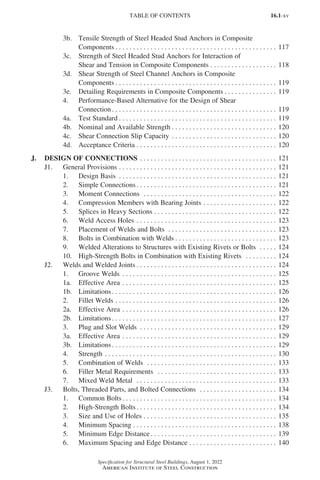
2b. Negative Flexural Strength. . . . . . . . . . . . . . . . . . . . . . . . . . . . . . . . . . . 101
2c. Composite Beams with Formed Steel Deck. . . . . . . . . . . . . . . . . . . . . . 101
1. General . . . . . . . . . . . . . . . . . . . . . . . . . . . . . . . . . . . . . . . . . . . . . . . 101
2. Deck Ribs Oriented Perpendicular to Steel Beam . . . . . . . . . . . . . . 102
3. Deck Ribs Oriented Parallel to Steel Beam . . . . . . . . . . . . . . . . . . . 102
2d. Load Transfer Between Steel Beam and Concrete Slab. . . . . . . . . . . . . 102
1. Load Transfer for Positive Flexural Strength. . . . . . . . . . . . . . . . . . 102
2. Load Transfer for Negative Flexural Strength. . . . . . . . . . . . . . . . . 103
3. Encased Composite Members. . . . . . . . . . . . . . . . . . . . . . . . . . . . . . . . . 103
3a. Limitations. . . . . . . . . . . . . . . . . . . . . . . . . . . . . . . . . . . . . . . . . . . . . . . . 103
3b. Detailing Requirements. . . . . . . . . . . . . . . . . . . . . . . . . . . . . . . . . . . . . . 104
4. Filled Composite Members. . . . . . . . . . . . . . . . . . . . . . . . . . . . . . . . . . . 104
4a. Limitations. . . . . . . . . . . . . . . . . . . . . . . . . . . . . . . . . . . . . . . . . . . . . . . . 104
4b. Flexural Strength. . . . . . . . . . . . . . . . . . . . . . . . . . . . . . . . . . . . . . . . . . . 105
4c. Detailing Requirements. . . . . . . . . . . . . . . . . . . . . . . . . . . . . . . . . . . . . . 106
5. Composite Plate Shear Walls . . . . . . . . . . . . . . . . . . . . . . . . . . . . . . . . . 106
I4. Shear. . . . . . . . . . . . . . . . . . . . . . . . . . . . . . . . . . . . . . . . . . . . . . . . . . . . . . . . . 106
1. Encased Composite Members. . . . . . . . . . . . . . . . . . . . . . . . . . . . . . . . . 106
2. Filled Composite Members. . . . . . . . . . . . . . . . . . . . . . . . . . . . . . . . . . . 106
3. Composite Beams with Formed Steel Deck. . . . . . . . . . . . . . . . . . . . . . 107
4. Composite Plate Shear Walls . . . . . . . . . . . . . . . . . . . . . . . . . . . . . . . . . 107
I5. Combined Flexure and Axial Force. . . . . . . . . . . . . . . . . . . . . . . . . . . . . . . . . 108
I6. Load Transfer. . . . . . . . . . . . . . . . . . . . . . . . . . . . . . . . . . . . . . . . . . . . . . . . . . 109
1. General Requirements. . . . . . . . . . . . . . . . . . . . . . . . . . . . . . . . . . . . . . . 109
2. Force Allocation . . . . . . . . . . . . . . . . . . . . . . . . . . . . . . . . . . . . . . . . . . . 109
2a. External Force Applied to Steel Section. . . . . . . . . . . . . . . . . . . . . . . . . 110
2b. External Force Applied to Concrete. . . . . . . . . . . . . . . . . . . . . . . . . . . . 110
2c. External Force Applied Concurrently to Steel and Concrete. . . . . . . . . 111
3. Force Transfer Mechanisms . . . . . . . . . . . . . . . . . . . . . . . . . . . . . . . . . . 111
3a. Direct Bearing. . . . . . . . . . . . . . . . . . . . . . . . . . . . . . . . . . . . . . . . . . . . . 111
3b. Shear Connection . . . . . . . . . . . . . . . . . . . . . . . . . . . . . . . . . . . . . . . . . . 111
3c. Direct Bond Interaction. . . . . . . . . . . . . . . . . . . . . . . . . . . . . . . . . . . . . . 112
4. Detailing Requirements. . . . . . . . . . . . . . . . . . . . . . . . . . . . . . . . . . . . . . 112
4a. Encased Composite Members. . . . . . . . . . . . . . . . . . . . . . . . . . . . . . . . . 112
4b. Filled Composite Members. . . . . . . . . . . . . . . . . . . . . . . . . . . . . . . . . . . 112
I7. Composite Diaphragms and Collector Beams. . . . . . . . . . . . . . . . . . . . . . . . . 112
I8. Steel Anchors. . . . . . . . . . . . . . . . . . . . . . . . . . . . . . . . . . . . . . . . . . . . . . . . . . 113
1. General . . . . . . . . . . . . . . . . . . . . . . . . . . . . . . . . . . . . . . . . . . . . . . . . . . 113
2. Steel Anchors in Composite Beams . . . . . . . . . . . . . . . . . . . . . . . . . . . . 113
2a. Strength of Steel Headed Stud Anchors. . . . . . . . . . . . . . . . . . . . . . . . . 113
2b. Strength of Steel Channel Anchors. . . . . . . . . . . . . . . . . . . . . . . . . . . . . 114
2c. Required Number of Steel Anchors . . . . . . . . . . . . . . . . . . . . . . . . . . . . 115
2d. Detailing Requirements. . . . . . . . . . . . . . . . . . . . . . . . . . . . . . . . . . . . . . 115
3. Steel Anchors in Composite Components . . . . . . . . . . . . . . . . . . . . . . . 115
3a. Shear Strength of Steel Headed Stud Anchors in
Composite Components . . . . . . . . . . . . . . . . . . . . . . . . . . . . . . . . . . . . . 116
TABLE OF CONTENTS
Part 16.1 Prelims (i-lxvi).indd 14
Part 16.1 Prelims (i-lxvi).indd 14 2023-01-11 9:08 AM
2023-01-11 9:08 AM
16.1-xv
Specification for Structural Steel Buildings, August 1, 2022
American Institute of Steel Construction
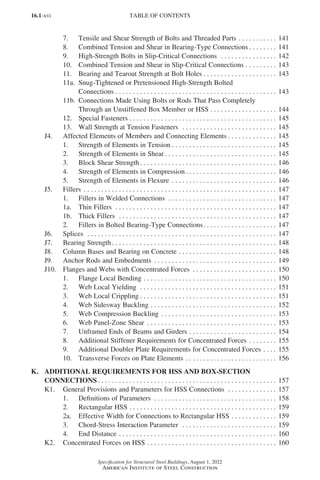
3b. Tensile Strength of Steel Headed Stud Anchors in Composite
Components. . . . . . . . . . . . . . . . . . . . . . . . . . . . . . . . . . . . . . . . . . . . . . . 117
3c. Strength of Steel Headed Stud Anchors for Interaction of
Shear and Tension in Composite Components. . . . . . . . . . . . . . . . . . . . 118
3d. Shear Strength of Steel Channel Anchors in Composite
Components. . . . . . . . . . . . . . . . . . . . . . . . . . . . . . . . . . . . . . . . . . . . . . . 119
3e. Detailing Requirements in Composite Components. . . . . . . . . . . . . . . . 119
4. Performance-Based Alternative for the Design of Shear
Connection. . . . . . . . . . . . . . . . . . . . . . . . . . . . . . . . . . . . . . . . . . . . . . . . 119
4a. Test Standard. . . . . . . . . . . . . . . . . . . . . . . . . . . . . . . . . . . . . . . . . . . . . . 119
4b. Nominal and Available Strength. . . . . . . . . . . . . . . . . . . . . . . . . . . . . . . 120
4c. Shear Connection Slip Capacity. . . . . . . . . . . . . . . . . . . . . . . . . . . . . . . 120
4d. Acceptance Criteria. . . . . . . . . . . . . . . . . . . . . . . . . . . . . . . . . . . . . . . . . 120
J. DESIGN OF CONNECTIONS. . . . . . . . . . . . . . . . . . . . . . . . . . . . . . . . . . . . . . . . 121
J1. General Provisions. . . . . . . . . . . . . . . . . . . . . . . . . . . . . . . . . . . . . . . . . . . . . . 121
1. Design Basis . . . . . . . . . . . . . . . . . . . . . . . . . . . . . . . . . . . . . . . . . . . . . . 121
2. Simple Connections. . . . . . . . . . . . . . . . . . . . . . . . . . . . . . . . . . . . . . . . . 121
3. Moment Connections . . . . . . . . . . . . . . . . . . . . . . . . . . . . . . . . . . . . . . . 122
4. Compression Members with Bearing Joints. . . . . . . . . . . . . . . . . . . . . . 122
5. Splices in Heavy Sections. . . . . . . . . . . . . . . . . . . . . . . . . . . . . . . . . . . . 122
6. Weld Access Holes. . . . . . . . . . . . . . . . . . . . . . . . . . . . . . . . . . . . . . . . . 123
7. Placement of Welds and Bolts . . . . . . . . . . . . . . . . . . . . . . . . . . . . . . . . 123
8. Bolts in Combination with Welds. . . . . . . . . . . . . . . . . . . . . . . . . . . . . . 123
9. Welded Alterations to Structures with Existing Rivets or Bolts . . . . . . 124
10. High-Strength Bolts in Combination with Existing Rivets . . . . . . . . . . 124
J2. Welds and Welded Joints. . . . . . . . . . . . . . . . . . . . . . . . . . . . . . . . . . . . . . . . . 124
1. Groove Welds . . . . . . . . . . . . . . . . . . . . . . . . . . . . . . . . . . . . . . . . . . . . . 125
1a. Effective Area. . . . . . . . . . . . . . . . . . . . . . . . . . . . . . . . . . . . . . . . . . . . . 125
1b. Limitations. . . . . . . . . . . . . . . . . . . . . . . . . . . . . . . . . . . . . . . . . . . . . . . . 126
2. Fillet Welds. . . . . . . . . . . . . . . . . . . . . . . . . . . . . . . . . . . . . . . . . . . . . . . 126
2a. Effective Area. . . . . . . . . . . . . . . . . . . . . . . . . . . . . . . . . . . . . . . . . . . . . 126
2b. Limitations. . . . . . . . . . . . . . . . . . . . . . . . . . . . . . . . . . . . . . . . . . . . . . . . 127
3. Plug and Slot Welds . . . . . . . . . . . . . . . . . . . . . . . . . . . . . . . . . . . . . . . . 129
3a. Effective Area. . . . . . . . . . . . . . . . . . . . . . . . . . . . . . . . . . . . . . . . . . . . . 129
3b. Limitations. . . . . . . . . . . . . . . . . . . . . . . . . . . . . . . . . . . . . . . . . . . . . . . . 129
4. Strength. . . . . . . . . . . . . . . . . . . . . . . . . . . . . . . . . . . . . . . . . . . . . . . . . . 130
5. Combination of Welds . . . . . . . . . . . . . . . . . . . . . . . . . . . . . . . . . . . . . . 133
6. Filler Metal Requirements . . . . . . . . . . . . . . . . . . . . . . . . . . . . . . . . . . . 133
7. Mixed Weld Metal . . . . . . . . . . . . . . . . . . . . . . . . . . . . . . . . . . . . . . . . . 133
J3. Bolts, Threaded Parts, and Bolted Connections . . . . . . . . . . . . . . . . . . . . . . . 134
1. Common Bolts. . . . . . . . . . . . . . . . . . . . . . . . . . . . . . . . . . . . . . . . . . . . . 134
2. High-Strength Bolts. . . . . . . . . . . . . . . . . . . . . . . . . . . . . . . . . . . . . . . . . 134
3. Size and Use of Holes. . . . . . . . . . . . . . . . . . . . . . . . . . . . . . . . . . . . . . . 135
4. Minimum Spacing. . . . . . . . . . . . . . . . . . . . . . . . . . . . . . . . . . . . . . . . . . 138
5. Minimum Edge Distance. . . . . . . . . . . . . . . . . . . . . . . . . . . . . . . . . . . . . 139
6. Maximum Spacing and Edge Distance. . . . . . . . . . . . . . . . . . . . . . . . . . 140
TABLE OF CONTENTS
Part 16.1 Prelims (i-lxvi).indd 15
Part 16.1 Prelims (i-lxvi).indd 15 2023-01-11 9:08 AM
2023-01-11 9:08 AM
16.1-xvi
Specification for Structural Steel Buildings, August 1, 2022
American Institute of Steel Construction
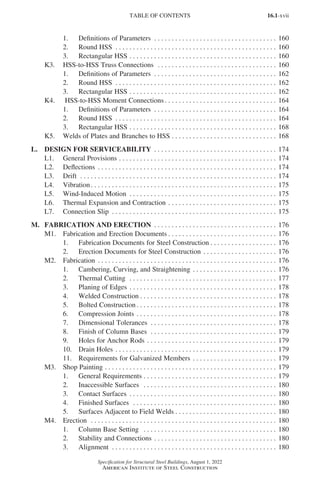
7. Tensile and Shear Strength of Bolts and Threaded Parts. . . . . . . . . . . . 141
8. Combined Tension and Shear in Bearing-Type Connections. . . . . . . . . 141
9. High-Strength Bolts in Slip-Critical Connections . . . . . . . . . . . . . . . . . 142
10. Combined Tension and Shear in Slip-Critical Connections. . . . . . . . . . 143
11. Bearing and Tearout Strength at Bolt Holes. . . . . . . . . . . . . . . . . . . . . . 143
11a. Snug-Tightened or Pretensioned High-Strength Bolted
Connections. . . . . . . . . . . . . . . . . . . . . . . . . . . . . . . . . . . . . . . . . . . . . . . 143
11b. Connections Made Using Bolts or Rods That Pass Completely
Through an Unstiffened Box Member or HSS. . . . . . . . . . . . . . . . . . . . 144
12. Special Fasteners. . . . . . . . . . . . . . . . . . . . . . . . . . . . . . . . . . . . . . . . . . . 145
13. Wall Strength at Tension Fasteners . . . . . . . . . . . . . . . . . . . . . . . . . . . . 145
J4. Affected Elements of Members and Connecting Elements. . . . . . . . . . . . . . . 145
1. Strength of Elements in Tension. . . . . . . . . . . . . . . . . . . . . . . . . . . . . . . 145
2. Strength of Elements in Shear. . . . . . . . . . . . . . . . . . . . . . . . . . . . . . . . . 145
3. Block Shear Strength. . . . . . . . . . . . . . . . . . . . . . . . . . . . . . . . . . . . . . . . 146
4. Strength of Elements in Compression. . . . . . . . . . . . . . . . . . . . . . . . . . . 146
5. Strength of Elements in Flexure. . . . . . . . . . . . . . . . . . . . . . . . . . . . . . . 146
J5. Fillers . . . . . . . . . . . . . . . . . . . . . . . . . . . . . . . . . . . . . . . . . . . . . . . . . . . . . . . . 147
1. Fillers in Welded Connections . . . . . . . . . . . . . . . . . . . . . . . . . . . . . . . . 147
1a. Thin Fillers . . . . . . . . . . . . . . . . . . . . . . . . . . . . . . . . . . . . . . . . . . . . . . . 147
1b. Thick Fillers . . . . . . . . . . . . . . . . . . . . . . . . . . . . . . . . . . . . . . . . . . . . . . 147
2. Fillers in Bolted Bearing-Type Connections. . . . . . . . . . . . . . . . . . . . . . 147
J6. Splices . . . . . . . . . . . . . . . . . . . . . . . . . . . . . . . . . . . . . . . . . . . . . . . . . . . . . . . 147
J7. Bearing Strength. . . . . . . . . . . . . . . . . . . . . . . . . . . . . . . . . . . . . . . . . . . . . . . . 148
J8. Column Bases and Bearing on Concrete. . . . . . . . . . . . . . . . . . . . . . . . . . . . . 148
J9. Anchor Rods and Embedments . . . . . . . . . . . . . . . . . . . . . . . . . . . . . . . . . . . . 149
J10. Flanges and Webs with Concentrated Forces . . . . . . . . . . . . . . . . . . . . . . . . . 150
1. Flange Local Bending. . . . . . . . . . . . . . . . . . . . . . . . . . . . . . . . . . . . . . . 150
2. Web Local Yielding . . . . . . . . . . . . . . . . . . . . . . . . . . . . . . . . . . . . . . . . 151
3. Web Local Crippling. . . . . . . . . . . . . . . . . . . . . . . . . . . . . . . . . . . . . . . . 151
4. Web Sidesway Buckling. . . . . . . . . . . . . . . . . . . . . . . . . . . . . . . . . . . . . 152
5. Web Compression Buckling. . . . . . . . . . . . . . . . . . . . . . . . . . . . . . . . . . 153
6. Web Panel-Zone Shear . . . . . . . . . . . . . . . . . . . . . . . . . . . . . . . . . . . . . . 153
7. Unframed Ends of Beams and Girders. . . . . . . . . . . . . . . . . . . . . . . . . . 154
8. Additional Stiffener Requirements for Concentrated Forces. . . . . . . . . 155
9. Additional Doubler Plate Requirements for Concentrated Forces. . . . . 155
10. Transverse Forces on Plate Elements. . . . . . . . . . . . . . . . . . . . . . . . . . . 156
K. ADDITIONAL REQUIREMENTS FOR HSS AND BOX-SECTION
CONNECTIONS. . . . . . . . . . . . . . . . . . . . . . . . . . . . . . . . . . . . . . . . . . . . . . . . . . . . 157
K1. General Provisions and Parameters for HSS Connections . . . . . . . . . . . . . . . 157
1. Definitions of Parameters . . . . . . . . . . . . . . . . . . . . . . . . . . . . . . . . . . . . 158
2. Rectangular HSS. . . . . . . . . . . . . . . . . . . . . . . . . . . . . . . . . . . . . . . . . . . 159
2a. Effective Width for Connections to Rectangular HSS. . . . . . . . . . . . . . 159
3. Chord-Stress Interaction Parameter . . . . . . . . . . . . . . . . . . . . . . . . . . . . 159
4. End Distance. . . . . . . . . . . . . . . . . . . . . . . . . . . . . . . . . . . . . . . . . . . . . . 160
K2. Concentrated Forces on HSS. . . . . . . . . . . . . . . . . . . . . . . . . . . . . . . . . . . . . . 160
TABLE OF CONTENTS
Part 16.1 Prelims (i-lxvi).indd 16
Part 16.1 Prelims (i-lxvi).indd 16 2023-01-11 9:08 AM
2023-01-11 9:08 AM
16.1-xvii
Specification for Structural Steel Buildings, August 1, 2022
American Institute of Steel Construction
1. Definitions of Parameters . . . . . . . . . . . . . . . . . . . . . . . . . . . . . . . . . . . . 160
2. Round HSS . . . . . . . . . . . . . . . . . . . . . . . . . . . . . . . . . . . . . . . . . . . . . . . 160
3. Rectangular HSS. . . . . . . . . . . . . . . . . . . . . . . . . . . . . . . . . . . . . . . . . . . 160
K3. HSS-to-HSS Truss Connections . . . . . . . . . . . . . . . . . . . . . . . . . . . . . . . . . . . 160
1. Definitions of Parameters . . . . . . . . . . . . . . . . . . . . . . . . . . . . . . . . . . . . 162
2. Round HSS . . . . . . . . . . . . . . . . . . . . . . . . . . . . . . . . . . . . . . . . . . . . . . . 162
3. Rectangular HSS. . . . . . . . . . . . . . . . . . . . . . . . . . . . . . . . . . . . . . . . . . . 162
K4. HSS-to-HSS Moment Connections. . . . . . . . . . . . . . . . . . . . . . . . . . . . . . . . . 164
1. Definitions of Parameters . . . . . . . . . . . . . . . . . . . . . . . . . . . . . . . . . . . . 164
2. Round HSS . . . . . . . . . . . . . . . . . . . . . . . . . . . . . . . . . . . . . . . . . . . . . . . 164
3. Rectangular HSS. . . . . . . . . . . . . . . . . . . . . . . . . . . . . . . . . . . . . . . . . . . 168
K5. Welds of Plates and Branches to HSS . . . . . . . . . . . . . . . . . . . . . . . . . . . . . . 168
L. DESIGN FOR SERVICEABILITY . . . . . . . . . . . . . . . . . . . . . . . . . . . . . . . . . . . . 174
L1. General Provisions. . . . . . . . . . . . . . . . . . . . . . . . . . . . . . . . . . . . . . . . . . . . . . 174
L2. Deflections . . . . . . . . . . . . . . . . . . . . . . . . . . . . . . . . . . . . . . . . . . . . . . . . . . . . 174
L3. Drift . . . . . . . . . . . . . . . . . . . . . . . . . . . . . . . . . . . . . . . . . . . . . . . . . . . . . . . . . 174
L4. Vibration. . . . . . . . . . . . . . . . . . . . . . . . . . . . . . . . . . . . . . . . . . . . . . . . . . . . . . 175
L5. Wind-Induced Motion . . . . . . . . . . . . . . . . . . . . . . . . . . . . . . . . . . . . . . . . . . . 175
L6. Thermal Expansion and Contraction. . . . . . . . . . . . . . . . . . . . . . . . . . . . . . . . 175
L7. Connection Slip . . . . . . . . . . . . . . . . . . . . . . . . . . . . . . . . . . . . . . . . . . . . . . . . 175
M. FABRICATION AND ERECTION . . . . . . . . . . . . . . . . . . . . . . . . . . . . . . . . . . . . 176
M1. Fabrication and Erection Documents. . . . . . . . . . . . . . . . . . . . . . . . . . . . . . . . 176
1. Fabrication Documents for Steel Construction. . . . . . . . . . . . . . . . . . . . 176
2. Erection Documents for Steel Construction. . . . . . . . . . . . . . . . . . . . . . 176
M2. Fabrication . . . . . . . . . . . . . . . . . . . . . . . . . . . . . . . . . . . . . . . . . . . . . . . . . . . . 176
1. Cambering, Curving, and Straightening. . . . . . . . . . . . . . . . . . . . . . . . . 176
2. Thermal Cutting . . . . . . . . . . . . . . . . . . . . . . . . . . . . . . . . . . . . . . . . . . . 177
3. Planing of Edges. . . . . . . . . . . . . . . . . . . . . . . . . . . . . . . . . . . . . . . . . . . 178
4. Welded Construction. . . . . . . . . . . . . . . . . . . . . . . . . . . . . . . . . . . . . . . . 178
5. Bolted Construction. . . . . . . . . . . . . . . . . . . . . . . . . . . . . . . . . . . . . . . . . 178
6. Compression Joints. . . . . . . . . . . . . . . . . . . . . . . . . . . . . . . . . . . . . . . . . 178
7. Dimensional Tolerances . . . . . . . . . . . . . . . . . . . . . . . . . . . . . . . . . . . . . 178
8. Finish of Column Bases . . . . . . . . . . . . . . . . . . . . . . . . . . . . . . . . . . . . . 179
9. Holes for Anchor Rods. . . . . . . . . . . . . . . . . . . . . . . . . . . . . . . . . . . . . . 179
10. Drain Holes . . . . . . . . . . . . . . . . . . . . . . . . . . . . . . . . . . . . . . . . . . . . . . . 179
11. Requirements for Galvanized Members. . . . . . . . . . . . . . . . . . . . . . . . . 179
M3. Shop Painting. . . . . . . . . . . . . . . . . . . . . . . . . . . . . . . . . . . . . . . . . . . . . . . . . . 179
1. General Requirements. . . . . . . . . . . . . . . . . . . . . . . . . . . . . . . . . . . . . . . 179
2. Inaccessible Surfaces . . . . . . . . . . . . . . . . . . . . . . . . . . . . . . . . . . . . . . . 180
3. Contact Surfaces . . . . . . . . . . . . . . . . . . . . . . . . . . . . . . . . . . . . . . . . . . . 180
4. Finished Surfaces . . . . . . . . . . . . . . . . . . . . . . . . . . . . . . . . . . . . . . . . . . 180
5. Surfaces Adjacent to Field Welds. . . . . . . . . . . . . . . . . . . . . . . . . . . . . . 180
M4. Erection . . . . . . . . . . . . . . . . . . . . . . . . . . . . . . . . . . . . . . . . . . . . . . . . . . . . . . 180
1. Column Base Setting . . . . . . . . . . . . . . . . . . . . . . . . . . . . . . . . . . . . . . . 180
2. Stability and Connections. . . . . . . . . . . . . . . . . . . . . . . . . . . . . . . . . . . . 180
3. Alignment . . . . . . . . . . . . . . . . . . . . . . . . . . . . . . . . . . . . . . . . . . . . . . . . 180
TABLE OF CONTENTS
Part 16.1 Prelims (i-lxvi).indd 17
Part 16.1 Prelims (i-lxvi).indd 17 2023-01-11 9:08 AM
2023-01-11 9:08 AM
16.1-xviii
Specification for Structural Steel Buildings, August 1, 2022
American Institute of Steel Construction
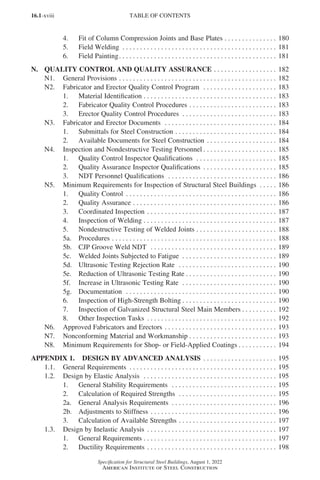
4. Fit of Column Compression Joints and Base Plates. . . . . . . . . . . . . . . . 180
5. Field Welding . . . . . . . . . . . . . . . . . . . . . . . . . . . . . . . . . . . . . . . . . . . . . 181
6. Field Painting. . . . . . . . . . . . . . . . . . . . . . . . . . . . . . . . . . . . . . . . . . . . . . 181
N. QUALITY CONTROL AND QUALITY ASSURANCE. . . . . . . . . . . . . . . . . . . 182
N1. General Provisions . . . . . . . . . . . . . . . . . . . . . . . . . . . . . . . . . . . . . . . . . . . . . . 182
N2. Fabricator and Erector Quality Control Program . . . . . . . . . . . . . . . . . . . . . . 183
1. Material Identification . . . . . . . . . . . . . . . . . . . . . . . . . . . . . . . . . . . . . . 183
2. Fabricator Quality Control Procedures. . . . . . . . . . . . . . . . . . . . . . . . . . 183
3. Erector Quality Control Procedures . . . . . . . . . . . . . . . . . . . . . . . . . . . . 183
N3. Fabricator and Erector Documents . . . . . . . . . . . . . . . . . . . . . . . . . . . . . . . . . 184
1. Submittals for Steel Construction. . . . . . . . . . . . . . . . . . . . . . . . . . . . . . 184
2. Available Documents for Steel Construction. . . . . . . . . . . . . . . . . . . . . 184
N4. Inspection and Nondestructive Testing Personnel. . . . . . . . . . . . . . . . . . . . . . 185
1. Quality Control Inspector Qualifications . . . . . . . . . . . . . . . . . . . . . . . . 185
2. Quality Assurance Inspector Qualifications . . . . . . . . . . . . . . . . . . . . . . 185
3. NDT Personnel Qualifications . . . . . . . . . . . . . . . . . . . . . . . . . . . . . . . . 186
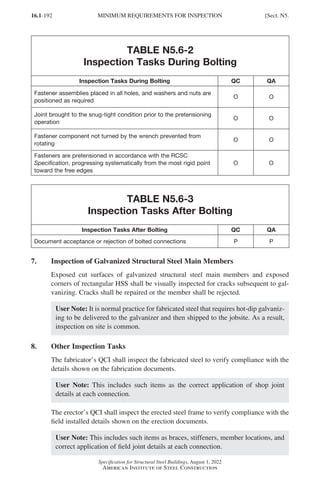
N5. Minimum Requirements for Inspection of Structural Steel Buildings . . . . . . 186
1. Quality Control . . . . . . . . . . . . . . . . . . . . . . . . . . . . . . . . . . . . . . . . . . . . 186
2. Quality Assurance. . . . . . . . . . . . . . . . . . . . . . . . . . . . . . . . . . . . . . . . . . 186
3. Coordinated Inspection. . . . . . . . . . . . . . . . . . . . . . . . . . . . . . . . . . . . . . 187
4. Inspection of Welding. . . . . . . . . . . . . . . . . . . . . . . . . . . . . . . . . . . . . . . 187
5. Nondestructive Testing of Welded Joints. . . . . . . . . . . . . . . . . . . . . . . . 188
5a. Procedures. . . . . . . . . . . . . . . . . . . . . . . . . . . . . . . . . . . . . . . . . . . . . . . . 188
5b. CJP Groove Weld NDT . . . . . . . . . . . . . . . . . . . . . . . . . . . . . . . . . . . . . 189
5c. Welded Joints Subjected to Fatigue . . . . . . . . . . . . . . . . . . . . . . . . . . . . 189
5d. Ultrasonic Testing Rejection Rate . . . . . . . . . . . . . . . . . . . . . . . . . . . . . 190
5e. Reduction of Ultrasonic Testing Rate. . . . . . . . . . . . . . . . . . . . . . . . . . . 190
5f. Increase in Ultrasonic Testing Rate . . . . . . . . . . . . . . . . . . . . . . . . . . . . 190
5g. Documentation . . . . . . . . . . . . . . . . . . . . . . . . . . . . . . . . . . . . . . . . . . . . 190
6. Inspection of High-Strength Bolting. . . . . . . . . . . . . . . . . . . . . . . . . . . . 190
7. Inspection of Galvanized Structural Steel Main Members. . . . . . . . . . . 192
8. Other Inspection Tasks . . . . . . . . . . . . . . . . . . . . . . . . . . . . . . . . . . . . . . 192
N6. Approved Fabricators and Erectors. . . . . . . . . . . . . . . . . . . . . . . . . . . . . . . . . 193
N7. Nonconforming Material and Workmanship. . . . . . . . . . . . . . . . . . . . . . . . . . 193
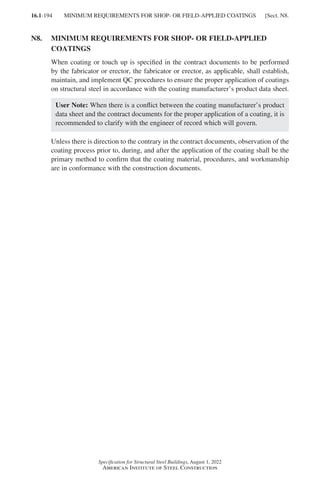
N8. Minimum Requirements for Shop- or Field-Applied Coatings. . . . . . . . . . . . 194
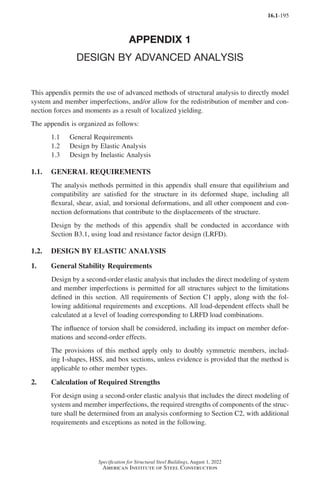
APPENDIX 1. DESIGN BY ADVANCED ANALYSIS . . . . . . . . . . . . . . . . . . . . . . 195
1.1. General Requirements . . . . . . . . . . . . . . . . . . . . . . . . . . . . . . . . . . . . . . . . . . . 195
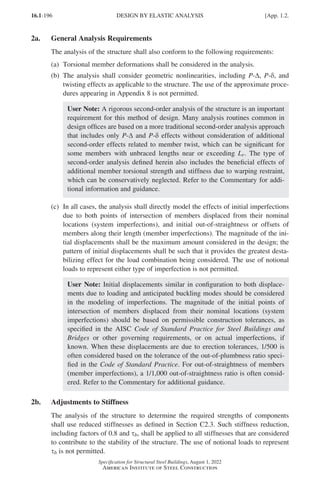
1.2. Design by Elastic Analysis . . . . . . . . . . . . . . . . . . . . . . . . . . . . . . . . . . . . . . . 195
1. General Stability Requirements . . . . . . . . . . . . . . . . . . . . . . . . . . . . . . . 195
2. Calculation of Required Strengths . . . . . . . . . . . . . . . . . . . . . . . . . . . . . 195
2a. General Analysis Requirements . . . . . . . . . . . . . . . . . . . . . . . . . . . . . . . 196
2b. Adjustments to Stiffness. . . . . . . . . . . . . . . . . . . . . . . . . . . . . . . . . . . . . 196
3. Calculation of Available Strengths. . . . . . . . . . . . . . . . . . . . . . . . . . . . . 197
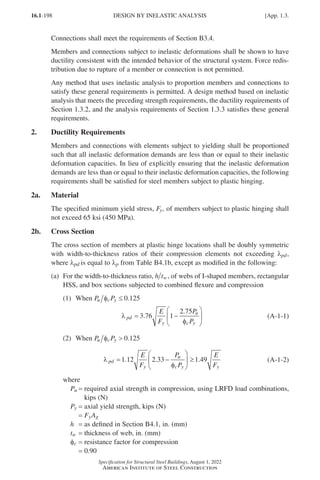
1.3. Design by Inelastic Analysis . . . . . . . . . . . . . . . . . . . . . . . . . . . . . . . . . . . . . . 197
1. General Requirements. . . . . . . . . . . . . . . . . . . . . . . . . . . . . . . . . . . . . . . 197
2. Ductility Requirements. . . . . . . . . . . . . . . . . . . . . . . . . . . . . . . . . . . . . . 198
TABLE OF CONTENTS
Part 16.1 Prelims (i-lxvi).indd 18
Part 16.1 Prelims (i-lxvi).indd 18 2023-01-11 9:08 AM
2023-01-11 9:08 AM
16.1-xix
Specification for Structural Steel Buildings, August 1, 2022
American Institute of Steel Construction
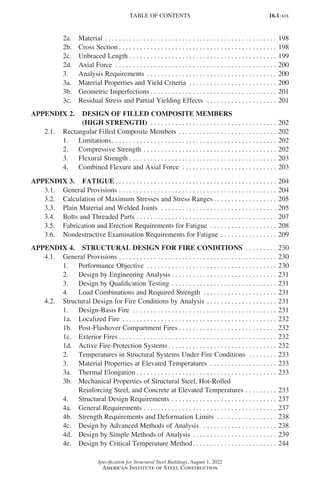
2a. Material. . . . . . . . . . . . . . . . . . . . . . . . . . . . . . . . . . . . . . . . . . . . . . . . . . 198
2b. Cross Section. . . . . . . . . . . . . . . . . . . . . . . . . . . . . . . . . . . . . . . . . . . . . . 198
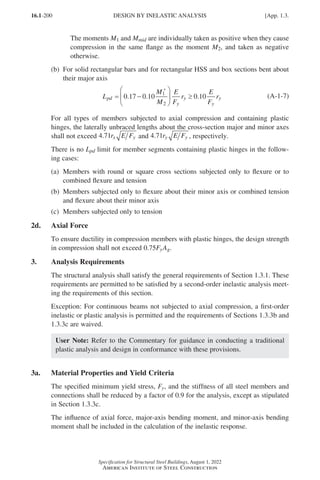
2c. Unbraced Length. . . . . . . . . . . . . . . . . . . . . . . . . . . . . . . . . . . . . . . . . . . 199
2d. Axial Force . . . . . . . . . . . . . . . . . . . . . . . . . . . . . . . . . . . . . . . . . . . . . . . 200
3. Analysis Requirements . . . . . . . . . . . . . . . . . . . . . . . . . . . . . . . . . . . . . . 200
3a. Material Properties and Yield Criteria . . . . . . . . . . . . . . . . . . . . . . . . . . 200
3b. Geometric Imperfections. . . . . . . . . . . . . . . . . . . . . . . . . . . . . . . . . . . . . 201
3c. Residual Stress and Partial Yielding Effects . . . . . . . . . . . . . . . . . . . . . 201
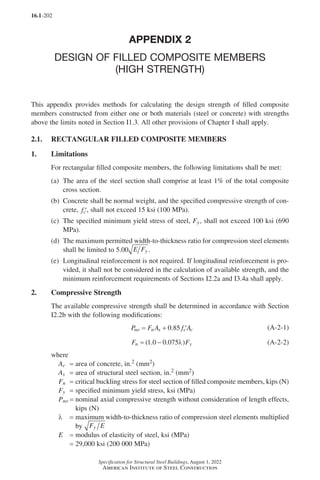
APPENDIX 2.	
DESIGN OF FILLED COMPOSITE MEMBERS
		 (HIGH STRENGTH) . . . . . . . . . . . . . . . . . . . . . . . . . . . . . . . . . . . . . 202
2.1. Rectangular Filled Composite Members. . . . . . . . . . . . . . . . . . . . . . . . . . . . . 202
1. Limitations. . . . . . . . . . . . . . . . . . . . . . . . . . . . . . . . . . . . . . . . . . . . . . . . 202
2. Compressive Strength . . . . . . . . . . . . . . . . . . . . . . . . . . . . . . . . . . . . . . . 202
3. Flexural Strength. . . . . . . . . . . . . . . . . . . . . . . . . . . . . . . . . . . . . . . . . . . 203
4. Combined Flexure and Axial Force . . . . . . . . . . . . . . . . . . . . . . . . . . . . 203
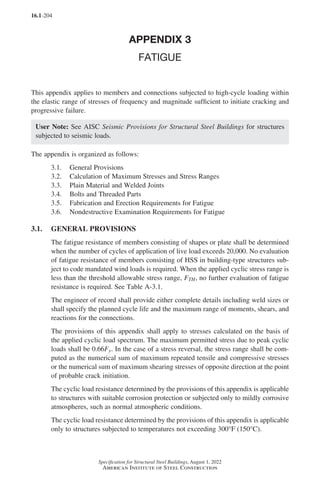
APPENDIX 3.	
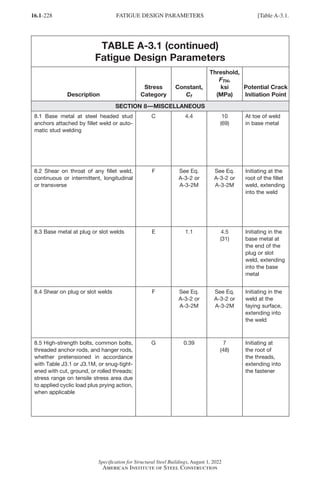
FATIGUE. . . . . . . . . . . . . . . . . . . . . . . . . . . . . . . . . . . . . . . . . . . . . . . 204
3.1. General Provisions. . . . . . . . . . . . . . . . . . . . . . . . . . . . . . . . . . . . . . . . . . . . . . 204
3.2. Calculation of Maximum Stresses and Stress Ranges. . . . . . . . . . . . . . . . . . . 205
3.3. Plain Material and Welded Joints . . . . . . . . . . . . . . . . . . . . . . . . . . . . . . . . . . 205
3.4. Bolts and Threaded Parts. . . . . . . . . . . . . . . . . . . . . . . . . . . . . . . . . . . . . . . . . 207
3.5. Fabrication and Erection Requirements for Fatigue . . . . . . . . . . . . . . . . . . . . 208
3.6. Nondestructive Examination Requirements for Fatigue . . . . . . . . . . . . . . . . . 209
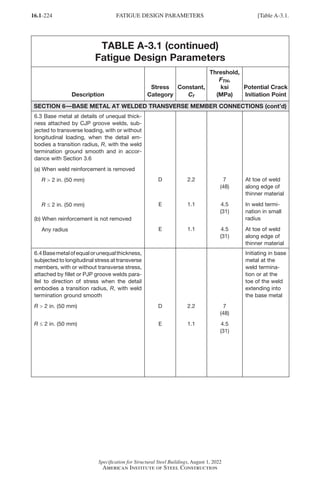
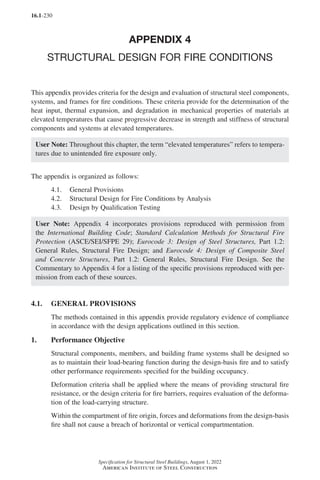
APPENDIX 4. STRUCTURAL DESIGN FOR FIRE CONDITIONS . . . . . . . . . . 230
4.1. General Provisions. . . . . . . . . . . . . . . . . . . . . . . . . . . . . . . . . . . . . . . . . . . . . . 230
1. Performance Objective . . . . . . . . . . . . . . . . . . . . . . . . . . . . . . . . . . . . . . 230
2. Design by Engineering Analysis. . . . . . . . . . . . . . . . . . . . . . . . . . . . . . . 231
3. Design by Qualification Testing. . . . . . . . . . . . . . . . . . . . . . . . . . . . . . . 231
4. Load Combinations and Required Strength . . . . . . . . . . . . . . . . . . . . . . 231
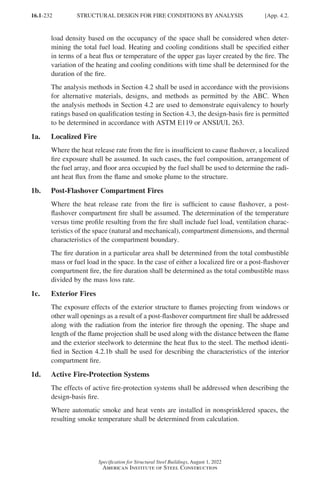
4.2. Structural Design for Fire Conditions by Analysis. . . . . . . . . . . . . . . . . . . . . 231
1. Design-Basis Fire . . . . . . . . . . . . . . . . . . . . . . . . . . . . . . . . . . . . . . . . . . 231
1a. Localized Fire . . . . . . . . . . . . . . . . . . . . . . . . . . . . . . . . . . . . . . . . . . . . . 232
1b. Post-Flashover Compartment Fires. . . . . . . . . . . . . . . . . . . . . . . . . . . . . 232
1c. Exterior Fires. . . . . . . . . . . . . . . . . . . . . . . . . . . . . . . . . . . . . . . . . . . . . . 232
1d. Active Fire-Protection Systems. . . . . . . . . . . . . . . . . . . . . . . . . . . . . . . . 232
2. Temperatures in Structural Systems Under Fire Conditions . . . . . . . . . 233
3. Material Properties at Elevated Temperatures . . . . . . . . . . . . . . . . . . . . 233
3a. Thermal Elongation. . . . . . . . . . . . . . . . . . . . . . . . . . . . . . . . . . . . . . . . . 233
3b. Mechanical Properties of Structural Steel, Hot-Rolled
Reinforcing Steel, and Concrete at Elevated Temperatures. . . . . . . . . . 233
4. Structural Design Requirements. . . . . . . . . . . . . . . . . . . . . . . . . . . . . . . 237
4a. General Requirements. . . . . . . . . . . . . . . . . . . . . . . . . . . . . . . . . . . . . . . 237
4b. Strength Requirements and Deformation Limits . . . . . . . . . . . . . . . . . . 238
4c. Design by Advanced Methods of Analysis . . . . . . . . . . . . . . . . . . . . . . 238
4d. Design by Simple Methods of Analysis. . . . . . . . . . . . . . . . . . . . . . . . . 239
4e. Design by Critical Temperature Method. . . . . . . . . . . . . . . . . . . . . . . . . 244
TABLE OF CONTENTS
Part 16.1 Prelims (i-lxvi).indd 19
Part 16.1 Prelims (i-lxvi).indd 19 2023-01-11 9:08 AM
2023-01-11 9:08 AM
16.1-xx
Specification for Structural Steel Buildings, August 1, 2022
American Institute of Steel Construction
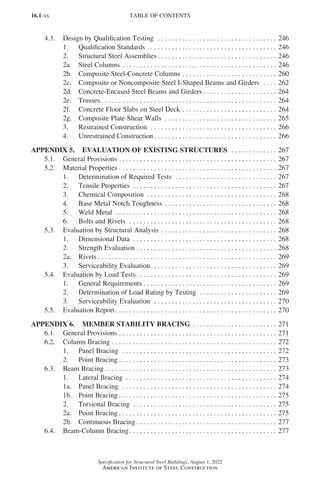
4.3. Design by Qualification Testing . . . . . . . . . . . . . . . . . . . . . . . . . . . . . . . . . . . 246
1. Qualification Standards. . . . . . . . . . . . . . . . . . . . . . . . . . . . . . . . . . . . . . 246
2. Structural Steel Assemblies. . . . . . . . . . . . . . . . . . . . . . . . . . . . . . . . . . . 246
2a. Steel Columns. . . . . . . . . . . . . . . . . . . . . . . . . . . . . . . . . . . . . . . . . . . . . 246
2b. Composite Steel-Concrete Columns. . . . . . . . . . . . . . . . . . . . . . . . . . . . 260
2c. Composite or Noncomposite Steel I-Shaped Beams and Girders . . . . . 262
2d. Concrete-Encased Steel Beams and Girders. . . . . . . . . . . . . . . . . . . . . . 264
2e. Trusses. . . . . . . . . . . . . . . . . . . . . . . . . . . . . . . . . . . . . . . . . . . . . . . . . . . 264
2f. Concrete Floor Slabs on Steel Deck. . . . . . . . . . . . . . . . . . . . . . . . . . . . 264
2g. Composite Plate Shear Walls . . . . . . . . . . . . . . . . . . . . . . . . . . . . . . . . . 265
3. Restrained Construction . . . . . . . . . . . . . . . . . . . . . . . . . . . . . . . . . . . . . 266
4. Unrestrained Construction. . . . . . . . . . . . . . . . . . . . . . . . . . . . . . . . . . . . 266
APPENDIX 5. EVALUATION OF EXISTING STRUCTURES . . . . . . . . . . . . . . 267
5.1. General Provisions. . . . . . . . . . . . . . . . . . . . . . . . . . . . . . . . . . . . . . . . . . . . . . 267
5.2. Material Properties. . . . . . . . . . . . . . . . . . . . . . . . . . . . . . . . . . . . . . . . . . . . . . 267
1. Determination of Required Tests . . . . . . . . . . . . . . . . . . . . . . . . . . . . . . 267
2. Tensile Properties . . . . . . . . . . . . . . . . . . . . . . . . . . . . . . . . . . . . . . . . . . 267
3. Chemical Composition . . . . . . . . . . . . . . . . . . . . . . . . . . . . . . . . . . . . . . 268
4. Base Metal Notch Toughness. . . . . . . . . . . . . . . . . . . . . . . . . . . . . . . . . 268
5. Weld Metal . . . . . . . . . . . . . . . . . . . . . . . . . . . . . . . . . . . . . . . . . . . . . . . 268
6. Bolts and Rivets . . . . . . . . . . . . . . . . . . . . . . . . . . . . . . . . . . . . . . . . . . . 268
5.3. Evaluation by Structural Analysis. . . . . . . . . . . . . . . . . . . . . . . . . . . . . . . . . . 268
1. Dimensional Data . . . . . . . . . . . . . . . . . . . . . . . . . . . . . . . . . . . . . . . . . . 268
2. Strength Evaluation. . . . . . . . . . . . . . . . . . . . . . . . . . . . . . . . . . . . . . . . . 268
2a. Rivets. . . . . . . . . . . . . . . . . . . . . . . . . . . . . . . . . . . . . . . . . . . . . . . . . . . . 269
3. Serviceability Evaluation . . . . . . . . . . . . . . . . . . . . . . . . . . . . . . . . . . . . 269
5.4. Evaluation by Load Tests. . . . . . . . . . . . . . . . . . . . . . . . . . . . . . . . . . . . . . . . . 269
1. General Requirements. . . . . . . . . . . . . . . . . . . . . . . . . . . . . . . . . . . . . . . 269
2. Determination of Load Rating by Testing . . . . . . . . . . . . . . . . . . . . . . . 269
3. Serviceability Evaluation . . . . . . . . . . . . . . . . . . . . . . . . . . . . . . . . . . . . 270
5.5. Evaluation Report. . . . . . . . . . . . . . . . . . . . . . . . . . . . . . . . . . . . . . . . . . . . . . . 270
APPENDIX 6. MEMBER STABILITY BRACING . . . . . . . . . . . . . . . . . . . . . . . . . 271
6.1. General Provisions. . . . . . . . . . . . . . . . . . . . . . . . . . . . . . . . . . . . . . . . . . . . . . 271
6.2. Column Bracing. . . . . . . . . . . . . . . . . . . . . . . . . . . . . . . . . . . . . . . . . . . . . . . . 272
1. Panel Bracing . . . . . . . . . . . . . . . . . . . . . . . . . . . . . . . . . . . . . . . . . . . . . 272
2. Point Bracing. . . . . . . . . . . . . . . . . . . . . . . . . . . . . . . . . . . . . . . . . . . . . . 273
6.3. Beam Bracing. . . . . . . . . . . . . . . . . . . . . . . . . . . . . . . . . . . . . . . . . . . . . . . . . . 273
1. Lateral Bracing . . . . . . . . . . . . . . . . . . . . . . . . . . . . . . . . . . . . . . . . . . . . 274
1a. Panel Bracing . . . . . . . . . . . . . . . . . . . . . . . . . . . . . . . . . . . . . . . . . . . . . 274
1b. Point Bracing. . . . . . . . . . . . . . . . . . . . . . . . . . . . . . . . . . . . . . . . . . . . . . 275
2. Torsional Bracing . . . . . . . . . . . . . . . . . . . . . . . . . . . . . . . . . . . . . . . . . . 275
2a. Point Bracing. . . . . . . . . . . . . . . . . . . . . . . . . . . . . . . . . . . . . . . . . . . . . . 275
2b. Continuous Bracing. . . . . . . . . . . . . . . . . . . . . . . . . . . . . . . . . . . . . . . . . 277
6.4. Beam-Column Bracing. . . . . . . . . . . . . . . . . . . . . . . . . . . . . . . . . . . . . . . . . . . 277
TABLE OF CONTENTS
Part 16.1 Prelims (i-lxvi).indd 20
Part 16.1 Prelims (i-lxvi).indd 20 2023-01-11 9:08 AM
2023-01-11 9:08 AM
16.1-xxi
Specification for Structural Steel Buildings, August 1, 2022
American Institute of Steel Construction
APPENDIX 7. ALTERNATIVE METHODS OF DESIGN FOR
		 STABILITY. . . . . . . . . . . . . . . . . . . . . . . . . . . . . . . . . . . . . . . . . . . . . 279
7.1. General Stability Requirements. . . . . . . . . . . . . . . . . . . . . . . . . . . . . . . . . . . . 279
7.2. Effective Length Method. . . . . . . . . . . . . . . . . . . . . . . . . . . . . . . . . . . . . . . . . 279
1. Limitations. . . . . . . . . . . . . . . . . . . . . . . . . . . . . . . . . . . . . . . . . . . . . . . . 279
2. Required Strengths . . . . . . . . . . . . . . . . . . . . . . . . . . . . . . . . . . . . . . . . . 279
3. Available Strengths. . . . . . . . . . . . . . . . . . . . . . . . . . . . . . . . . . . . . . . . . 280
7.3. First-Order Analysis Method. . . . . . . . . . . . . . . . . . . . . . . . . . . . . . . . . . . . . . 280
1. Limitations. . . . . . . . . . . . . . . . . . . . . . . . . . . . . . . . . . . . . . . . . . . . . . . . 280
2. Required Strengths . . . . . . . . . . . . . . . . . . . . . . . . . . . . . . . . . . . . . . . . . 281
3. Available Strengths. . . . . . . . . . . . . . . . . . . . . . . . . . . . . . . . . . . . . . . . . 282
APPENDIX 8. APPROXIMATE ANALYSIS. . . . . . . . . . . . . . . . . . . . . . . . . . . . . . 283
8.1. Approximate Second-Order Elastic Analysis . . . . . . . . . . . . . . . . . . . . . . . . . 283
1. Calculation Procedure. . . . . . . . . . . . . . . . . . . . . . . . . . . . . . . . . . . . . . . 283
2. Multiplier B1 for P-δ Effects. . . . . . . . . . . . . . . . . . . . . . . . . . . . . . . . . . 284
3. Multiplier B2 for P-Δ Effects . . . . . . . . . . . . . . . . . . . . . . . . . . . . . . . . . 285
8.2. Approximate Inelastic Moment Redistribution. . . . . . . . . . . . . . . . . . . . . . . . 286
COMMENTARY ON THE SPECIFICATION FOR STRUCTURAL STEEL
BUILDINGS
INTRODUCTION . . . . . . . . . . . . . . . . . . . . . . . . . . . . . . . . . . . . . . . . . . . . . . . . . . . . . . 287
COMMENTARY SYMBOLS. . . . . . . . . . . . . . . . . . . . . . . . . . . . . . . . . . . . . . . . . . . . . 288
COMMENTARY GLOSSARY . . . . . . . . . . . . . . . . . . . . . . . . . . . . . . . . . . . . . . . . . . . 292
A. GENERAL PROVISIONS. . . . . . . . . . . . . . . . . . . . . . . . . . . . . . . . . . . . . . . . . . . . 295
A1. Scope . . . . . . . . . . . . . . . . . . . . . . . . . . . . . . . . . . . . . . . . . . . . . . . . . . . . . . . . 295
A2. Referenced Specifications, Codes, and Standards. . . . . . . . . . . . . . . . . . . . . . 297
A3. Material . . . . . . . . . . . . . . . . . . . . . . . . . . . . . . . . . . . . . . . . . . . . . . . . . . . . . . 297
1. Structural Steel Materials . . . . . . . . . . . . . . . . . . . . . . . . . . . . . . . . . . . . 297
1a. Listed Materials. . . . . . . . . . . . . . . . . . . . . . . . . . . . . . . . . . . . . . . . . . . . 297
1d. Rolled Heavy Shapes . . . . . . . . . . . . . . . . . . . . . . . . . . . . . . . . . . . . . . . 302
1e. Built-Up Heavy Shapes. . . . . . . . . . . . . . . . . . . . . . . . . . . . . . . . . . . . . . 303
2. Steel Castings and Forgings . . . . . . . . . . . . . . . . . . . . . . . . . . . . . . . . . . 303
3. Bolts, Washers, and Nuts . . . . . . . . . . . . . . . . . . . . . . . . . . . . . . . . . . . . 304
4. Anchor Rods and Threaded Rods. . . . . . . . . . . . . . . . . . . . . . . . . . . . . . 304
5. Consumables for Welding. . . . . . . . . . . . . . . . . . . . . . . . . . . . . . . . . . . . 305
A4. Structural Design Documents and Specifications . . . . . . . . . . . . . . . . . . . . . . 305
1. Structural Design Documents and Specifications
Issued for Construction. . . . . . . . . . . . . . . . . . . . . . . . . . . . . . . . . . . . . . 305
2. Structural Design Documents and Specifications Issued for
Any Purpose . . . . . . . . . . . . . . . . . . . . . . . . . . . . . . . . . . . . . . . . . . . . . . 308
A5. Approvals. . . . . . . . . . . . . . . . . . . . . . . . . . . . . . . . . . . . . . . . . . . . . . . . . . . . . 309
B. DESIGN REQUIREMENTS. . . . . . . . . . . . . . . . . . . . . . . . . . . . . . . . . . . . . . . . . . 310
B1. General Provisions. . . . . . . . . . . . . . . . . . . . . . . . . . . . . . . . . . . . . . . . . . . . . . 310
B2. Loads and Load Combinations . . . . . . . . . . . . . . . . . . . . . . . . . . . . . . . . . . . . 311
TABLE OF CONTENTS
Part 16.1 Prelims (i-lxvi).indd 21
Part 16.1 Prelims (i-lxvi).indd 21 2023-01-11 9:08 AM
2023-01-11 9:08 AM
16.1-xxii
Specification for Structural Steel Buildings, August 1, 2022
American Institute of Steel Construction
B3. Design Basis. . . . . . . . . . . . . . . . . . . . . . . . . . . . . . . . . . . . . . . . . . . . . . . . . . . 313
1. Design for Strength Using Load and Resistance Factor
Design (LRFD) . . . . . . . . . . . . . . . . . . . . . . . . . . . . . . . . . . . . . . . . . . . . 313
2. Design for Strength Using Allowable Strength Design (ASD) . . . . . . . 316
3. Required Strength . . . . . . . . . . . . . . . . . . . . . . . . . . . . . . . . . . . . . . . . . . 318
4. Design of Connections and Supports . . . . . . . . . . . . . . . . . . . . . . . . . . . 318
5. Design of Diaphragms and Collectors . . . . . . . . . . . . . . . . . . . . . . . . . . 322
6. Design of Anchorages to Concrete . . . . . . . . . . . . . . . . . . . . . . . . . . . . . 323
7. Design for Stability. . . . . . . . . . . . . . . . . . . . . . . . . . . . . . . . . . . . . . . . . 323
8. Design for Serviceability. . . . . . . . . . . . . . . . . . . . . . . . . . . . . . . . . . . . . 323
9. Design for Structural Integrity . . . . . . . . . . . . . . . . . . . . . . . . . . . . . . . . 323
10. Design for Ponding. . . . . . . . . . . . . . . . . . . . . . . . . . . . . . . . . . . . . . . . . 324
11. Design for Fatigue. . . . . . . . . . . . . . . . . . . . . . . . . . . . . . . . . . . . . . . . . . 325
12. Design for Fire Conditions . . . . . . . . . . . . . . . . . . . . . . . . . . . . . . . . . . . 325
13. Design for Corrosion Effects . . . . . . . . . . . . . . . . . . . . . . . . . . . . . . . . . 325
B4. Member Properties. . . . . . . . . . . . . . . . . . . . . . . . . . . . . . . . . . . . . . . . . . . . . . 326
1. Classifications of Sections for Local Buckling. . . . . . . . . . . . . . . . . . . . 326
2. Design Wall Thickness for HSS. . . . . . . . . . . . . . . . . . . . . . . . . . . . . . . 329
3. Gross and Net Area Determination. . . . . . . . . . . . . . . . . . . . . . . . . . . . . 330
3a. Gross Area. . . . . . . . . . . . . . . . . . . . . . . . . . . . . . . . . . . . . . . . . . . . . . . . 330
3b. Net Area . . . . . . . . . . . . . . . . . . . . . . . . . . . . . . . . . . . . . . . . . . . . . . . . . 330
B5. Fabrication and Erection . . . . . . . . . . . . . . . . . . . . . . . . . . . . . . . . . . . . . . . . . 330
B6. Quality Control and Quality Assurance. . . . . . . . . . . . . . . . . . . . . . . . . . . . . . 330
B7. Evaluation of Existing Structures . . . . . . . . . . . . . . . . . . . . . . . . . . . . . . . . . . 331
B8. Dimensional Tolerances. . . . . . . . . . . . . . . . . . . . . . . . . . . . . . . . . . . . . . . . . . 331
C. DESIGN FOR STABILITY. . . . . . . . . . . . . . . . . . . . . . . . . . . . . . . . . . . . . . . . . . . 333
C1. General Stability Requirements. . . . . . . . . . . . . . . . . . . . . . . . . . . . . . . . . . . . 333
C2. Calculation of Required Strengths. . . . . . . . . . . . . . . . . . . . . . . . . . . . . . . . . . 335
1. General Analysis Requirements . . . . . . . . . . . . . . . . . . . . . . . . . . . . . . . 335
2. Consideration of Initial System Imperfections. . . . . . . . . . . . . . . . . . . . 340
3. Adjustments to Stiffness. . . . . . . . . . . . . . . . . . . . . . . . . . . . . . . . . . . . . 341
C3. Calculation of Available Strengths . . . . . . . . . . . . . . . . . . . . . . . . . . . . . . . . . 343
D. DESIGN OF MEMBERS FOR TENSION . . . . . . . . . . . . . . . . . . . . . . . . . . . . . . 345
D1. Slenderness Limitations. . . . . . . . . . . . . . . . . . . . . . . . . . . . . . . . . . . . . . . . . . 345
D2. Tensile Strength. . . . . . . . . . . . . . . . . . . . . . . . . . . . . . . . . . . . . . . . . . . . . . . . 346
D3. Effective Net Area. . . . . . . . . . . . . . . . . . . . . . . . . . . . . . . . . . . . . . . . . . . . . . 346
D4. Built-Up Members. . . . . . . . . . . . . . . . . . . . . . . . . . . . . . . . . . . . . . . . . . . . . . 350
D5. Pin-Connected Members . . . . . . . . . . . . . . . . . . . . . . . . . . . . . . . . . . . . . . . . . 350
1. Tensile Strength. . . . . . . . . . . . . . . . . . . . . . . . . . . . . . . . . . . . . . . . . . . . 350
2. Dimensional Requirements. . . . . . . . . . . . . . . . . . . . . . . . . . . . . . . . . . . 351
D6. Eyebars. . . . . . . . . . . . . . . . . . . . . . . . . . . . . . . . . . . . . . . . . . . . . . . . . . . . . . . 351
1. Tensile Strength. . . . . . . . . . . . . . . . . . . . . . . . . . . . . . . . . . . . . . . . . . . . 352
2. Dimensional Requirements. . . . . . . . . . . . . . . . . . . . . . . . . . . . . . . . . . . 352
E. DESIGN OF MEMBERS FOR COMPRESSION . . . . . . . . . . . . . . . . . . . . . . . . 353
E1. General Provisions. . . . . . . . . . . . . . . . . . . . . . . . . . . . . . . . . . . . . . . . . . . . . . 353
TABLE OF CONTENTS
Part 16.1 Prelims (i-lxvi).indd 22
Part 16.1 Prelims (i-lxvi).indd 22 2023-01-11 9:08 AM
2023-01-11 9:08 AM
16.1-xxiii
Specification for Structural Steel Buildings, August 1, 2022
American Institute of Steel Construction
E2. Effective Length. . . . . . . . . . . . . . . . . . . . . . . . . . . . . . . . . . . . . . . . . . . . . . . . 354
E3. Flexural Buckling of Members without Slender Elements. . . . . . . . . . . . . . . 356
E4. Torsional and Flexural-Torsional Buckling of Single Angles and
Members without Slender Elements . . . . . . . . . . . . . . . . . . . . . . . . . . . . . . . . 358
E5. Single-Angle Compression Members . . . . . . . . . . . . . . . . . . . . . . . . . . . . . . . 362
E6. Built-Up Members. . . . . . . . . . . . . . . . . . . . . . . . . . . . . . . . . . . . . . . . . . . . . . 363
1. Compressive Strength. . . . . . . . . . . . . . . . . . . . . . . . . . . . . . . . . . . . . . . 364
2. General Requirements. . . . . . . . . . . . . . . . . . . . . . . . . . . . . . . . . . . . . . . 365
E7. Members with Slender Elements. . . . . . . . . . . . . . . . . . . . . . . . . . . . . . . . . . . 366
1. Slender Element Members Excluding Round HSS . . . . . . . . . . . . . . . . 366
2. Round HSS . . . . . . . . . . . . . . . . . . . . . . . . . . . . . . . . . . . . . . . . . . . . . . . 369
F. DESIGN OF MEMBERS FOR FLEXURE. . . . . . . . . . . . . . . . . . . . . . . . . . . . . . 370
F1. General Provisions. . . . . . . . . . . . . . . . . . . . . . . . . . . . . . . . . . . . . . . . . . . . . . 372
F2. Doubly Symmetric Compact I-Shaped Members and Channels
Bent About Their Major Axis . . . . . . . . . . . . . . . . . . . . . . . . . . . . . . . . . . . . . 377
F3. Doubly Symmetric I-Shaped Members with Compact Webs and
Noncompact or Slender Flanges Bent About Their Major Axis. . . . . . . . . . . 378
F4. Other I-Shaped Members with Compact or Noncompact Webs
Bent About Their Major Axis . . . . . . . . . . . . . . . . . . . . . . . . . . . . . . . . . . . . . 379
F5. Doubly Symmetric and Singly Symmetric I-Shaped Members with
Slender Webs Bent About Their Major Axis . . . . . . . . . . . . . . . . . . . . . . . . . 381
F6. I-Shaped Members and Channels Bent About Their Minor Axis. . . . . . . . . . 381
F7. Square and Rectangular HSS and Box Sections . . . . . . . . . . . . . . . . . . . . . . . 381
F8. Round HSS. . . . . . . . . . . . . . . . . . . . . . . . . . . . . . . . . . . . . . . . . . . . . . . . . . . . 383
F9. Tees and Double Angles Loaded in the Plane of Symmetry. . . . . . . . . . . . . . 383
F10. Single Angles. . . . . . . . . . . . . . . . . . . . . . . . . . . . . . . . . . . . . . . . . . . . . . . . . . 388
1. Yielding. . . . . . . . . . . . . . . . . . . . . . . . . . . . . . . . . . . . . . . . . . . . . . . . . . 388
2. Lateral-Torsional Buckling. . . . . . . . . . . . . . . . . . . . . . . . . . . . . . . . . . . 389
3. Leg Local Buckling. . . . . . . . . . . . . . . . . . . . . . . . . . . . . . . . . . . . . . . . . 392
F11. Rectangular Bars and Rounds . . . . . . . . . . . . . . . . . . . . . . . . . . . . . . . . . . . . . 392
F12. Unsymmetrical Shapes. . . . . . . . . . . . . . . . . . . . . . . . . . . . . . . . . . . . . . . . . . . 393
F13. Proportions of Beams and Girders. . . . . . . . . . . . . . . . . . . . . . . . . . . . . . . . . . 393
1. Strength Reductions for Members with Bolt Holes in the
Tension Flange . . . . . . . . . . . . . . . . . . . . . . . . . . . . . . . . . . . . . . . . . . . . 393
2. Proportioning Limits for I-Shaped Members . . . . . . . . . . . . . . . . . . . . . 394
3. Cover Plates. . . . . . . . . . . . . . . . . . . . . . . . . . . . . . . . . . . . . . . . . . . . . . . 394
G. DESIGN OF MEMBERS FOR SHEAR . . . . . . . . . . . . . . . . . . . . . . . . . . . . . . . . 396
G1. General Provisions. . . . . . . . . . . . . . . . . . . . . . . . . . . . . . . . . . . . . . . . . . . . . . 396
G2. I-Shaped Members and Channels . . . . . . . . . . . . . . . . . . . . . . . . . . . . . . . . . . 396
1. Shear Strength of Webs. . . . . . . . . . . . . . . . . . . . . . . . . . . . . . . . . . . . . . 396
2. Shear Strength of Interior Web Panels with a h ≤ 3 Considering
Tension Field Action. . . . . . . . . . . . . . . . . . . . . . . . . . . . . . . . . . . . . . . . 398
3. Shear Strength of End Web Panels with a h ≤ 3 Considering
Tension Field Action. . . . . . . . . . . . . . . . . . . . . . . . . . . . . . . . . . . . . . . . 399
4. Transverse Stiffeners. . . . . . . . . . . . . . . . . . . . . . . . . . . . . . . . . . . . . . . . 401
G3. Single Angles and Tees . . . . . . . . . . . . . . . . . . . . . . . . . . . . . . . . . . . . . . . . . . 401
TABLE OF CONTENTS
Part 16.1 Prelims (i-lxvi).indd 23
Part 16.1 Prelims (i-lxvi).indd 23 2023-01-11 9:08 AM
2023-01-11 9:08 AM
16.1-xxiv
Specification for Structural Steel Buildings, August 1, 2022
American Institute of Steel Construction
G4. Rectangular HSS, Box Sections, and Other Singly and Doubly
Symmetric Members . . . . . . . . . . . . . . . . . . . . . . . . . . . . . . . . . . . . . . . . . . . . 402
G5. Round HSS. . . . . . . . . . . . . . . . . . . . . . . . . . . . . . . . . . . . . . . . . . . . . . . . . . . . 402
G6. Doubly Symmetric and Singly Symmetric Members Subjected to
Minor-Axis Shear. . . . . . . . . . . . . . . . . . . . . . . . . . . . . . . . . . . . . . . . . . . . . . . 402
G7. Beams and Girders with Web Openings . . . . . . . . . . . . . . . . . . . . . . . . . . . . . 403
H. DESIGN OF MEMBERS FOR COMBINED FORCES AND TORSION. . . . . 404
H1. Doubly and Singly Symmetric Members Subjected to Flexure and
Axial Force. . . . . . . . . . . . . . . . . . . . . . . . . . . . . . . . . . . . . . . . . . . . . . . . . . . . 404
1. Doubly and Singly Symmetric Members Subjected to
Flexure and Compression . . . . . . . . . . . . . . . . . . . . . . . . . . . . . . . . . . . . 404
2. Doubly and Singly Symmetric Members Subjected to
Flexure and Tension . . . . . . . . . . . . . . . . . . . . . . . . . . . . . . . . . . . . . . . . 408
3. Doubly Symmetric Rolled Compact Members Subjected to
Single-Axis Flexure and Compression. . . . . . . . . . . . . . . . . . . . . . . . . . 408
H2. Unsymmetric and Other Members Subjected to Flexure and Axial Force. . . 410
H3. Members Subjected to Torsion and Combined Torsion, Flexure,
Shear, and/or Axial Force . . . . . . . . . . . . . . . . . . . . . . . . . . . . . . . . . . . . . . . . 413
1. Round and Rectangular HSS Subjected to Torsion . . . . . . . . . . . . . . . . 414
2. HSS Subjected to Combined Torsion, Shear, Flexure, and
Axial Force . . . . . . . . . . . . . . . . . . . . . . . . . . . . . . . . . . . . . . . . . . . . . . . 415
3. Non-HSS Members Subjected to Torsion and Combined Stress. . . . . . 416
H4. Rupture of Flanges with Bolt Holes and Subjected to Tension. . . . . . . . . . . . 417
I. DESIGN OF COMPOSITE MEMBERS. . . . . . . . . . . . . . . . . . . . . . . . . . . . . . . . 418
I1. General Provisions. . . . . . . . . . . . . . . . . . . . . . . . . . . . . . . . . . . . . . . . . . . . . . 418
1. Concrete and Steel Reinforcement . . . . . . . . . . . . . . . . . . . . . . . . . . . . . 419
2. Nominal Strength of Composite Sections. . . . . . . . . . . . . . . . . . . . . . . . 419
2a. Plastic Stress Distribution Method . . . . . . . . . . . . . . . . . . . . . . . . . . . . . 420
2b. Strain-Compatibility Method . . . . . . . . . . . . . . . . . . . . . . . . . . . . . . . . . 421
2c. Elastic Stress Distribution Method . . . . . . . . . . . . . . . . . . . . . . . . . . . . . 421
2d. Effective Stress-Strain Method. . . . . . . . . . . . . . . . . . . . . . . . . . . . . . . . 421
3. Material Limitations . . . . . . . . . . . . . . . . . . . . . . . . . . . . . . . . . . . . . . . . 422
4. Classification of Filled Composite Sections for Local Buckling. . . . . . 422
5. Stiffness for Calculation of Required Strengths. . . . . . . . . . . . . . . . . . . 424
6. Requirements for Composite Plate Shear Walls. . . . . . . . . . . . . . . . . . . 426
6a. Slenderness Requirement . . . . . . . . . . . . . . . . . . . . . . . . . . . . . . . . . . . . 427
6b. Tie Bar Requirement. . . . . . . . . . . . . . . . . . . . . . . . . . . . . . . . . . . . . . . . 428
I2. Axial Force. . . . . . . . . . . . . . . . . . . . . . . . . . . . . . . . . . . . . . . . . . . . . . . . . . . . 429
1. Encased Composite Members. . . . . . . . . . . . . . . . . . . . . . . . . . . . . . . . . 429
1a. Limitations. . . . . . . . . . . . . . . . . . . . . . . . . . . . . . . . . . . . . . . . . . . . . . . . 429
1b. Compressive Strength. . . . . . . . . . . . . . . . . . . . . . . . . . . . . . . . . . . . . . . 430
1c. Tensile Strength. . . . . . . . . . . . . . . . . . . . . . . . . . . . . . . . . . . . . . . . . . . . 430
2. Filled Composite Members. . . . . . . . . . . . . . . . . . . . . . . . . . . . . . . . . . . 430
2a. Limitations. . . . . . . . . . . . . . . . . . . . . . . . . . . . . . . . . . . . . . . . . . . . . . . . 430
2b. Compressive Strength. . . . . . . . . . . . . . . . . . . . . . . . . . . . . . . . . . . . . . . 431
TABLE OF CONTENTS
Part 16.1 Prelims (i-lxvi).indd 24
Part 16.1 Prelims (i-lxvi).indd 24 2023-01-29 11:40 AM
2023-01-29 11:40 AM
16.1-xxv
Specification for Structural Steel Buildings, August 1, 2022
American Institute of Steel Construction
2c. Tensile Strength. . . . . . . . . . . . . . . . . . . . . . . . . . . . . . . . . . . . . . . . . . . . 432
3. Composite Plate Shear Walls . . . . . . . . . . . . . . . . . . . . . . . . . . . . . . . . . 432
3a. Compressive Strength. . . . . . . . . . . . . . . . . . . . . . . . . . . . . . . . . . . . . . . 432
I3. Flexure . . . . . . . . . . . . . . . . . . . . . . . . . . . . . . . . . . . . . . . . . . . . . . . . . . . . . . . 432
1. General . . . . . . . . . . . . . . . . . . . . . . . . . . . . . . . . . . . . . . . . . . . . . . . . . . 432
1a. Effective Width. . . . . . . . . . . . . . . . . . . . . . . . . . . . . . . . . . . . . . . . . . . . 432
1b. Strength During Construction. . . . . . . . . . . . . . . . . . . . . . . . . . . . . . . . . 432
2. Composite Beams with Steel Headed Stud or Steel Channel
Anchors. . . . . . . . . . . . . . . . . . . . . . . . . . . . . . . . . . . . . . . . . . . . . . . . . . 433
2a. Positive Flexural Strength. . . . . . . . . . . . . . . . . . . . . . . . . . . . . . . . . . . . 436
2b. Negative Flexural Strength. . . . . . . . . . . . . . . . . . . . . . . . . . . . . . . . . . . 438
2c. Composite Beams with Formed Steel Deck. . . . . . . . . . . . . . . . . . . . . . 440
2d. Load Transfer Between Steel Beam and Concrete Slab. . . . . . . . . . . . . 442
1. Load Transfer for Positive Flexural Strength. . . . . . . . . . . . . . . . . . 442
2. Load Transfer for Negative Flexural Strength. . . . . . . . . . . . . . . . . 444
3. Encased Composite Members. . . . . . . . . . . . . . . . . . . . . . . . . . . . . . . . . 445
4. Filled Composite Members. . . . . . . . . . . . . . . . . . . . . . . . . . . . . . . . . . . 445
5. Composite Plate Shear Walls . . . . . . . . . . . . . . . . . . . . . . . . . . . . . . . . . 448
I4. Shear. . . . . . . . . . . . . . . . . . . . . . . . . . . . . . . . . . . . . . . . . . . . . . . . . . . . . . . . . 448
1. Encased Composite Members. . . . . . . . . . . . . . . . . . . . . . . . . . . . . . . . . 448
2. Filled Composite Members. . . . . . . . . . . . . . . . . . . . . . . . . . . . . . . . . . . 448
3. Composite Beams with Formed Steel Deck. . . . . . . . . . . . . . . . . . . . . . 449
4. Composite Plate Shear Walls . . . . . . . . . . . . . . . . . . . . . . . . . . . . . . . . . 449
I5. Combined Flexure and Axial Force. . . . . . . . . . . . . . . . . . . . . . . . . . . . . . . . . 450
I6. Load Transfer. . . . . . . . . . . . . . . . . . . . . . . . . . . . . . . . . . . . . . . . . . . . . . . . . . 455
1. General Requirements. . . . . . . . . . . . . . . . . . . . . . . . . . . . . . . . . . . . . . . 455
2. Force Allocation . . . . . . . . . . . . . . . . . . . . . . . . . . . . . . . . . . . . . . . . . . . 456
3. Force Transfer Mechanisms . . . . . . . . . . . . . . . . . . . . . . . . . . . . . . . . . . 457
3a. Direct Bearing. . . . . . . . . . . . . . . . . . . . . . . . . . . . . . . . . . . . . . . . . . . . . 458
3b. Shear Connection . . . . . . . . . . . . . . . . . . . . . . . . . . . . . . . . . . . . . . . . . . 458
3c. Direct Bond Interaction. . . . . . . . . . . . . . . . . . . . . . . . . . . . . . . . . . . . . . 458
4. Detailing Requirements. . . . . . . . . . . . . . . . . . . . . . . . . . . . . . . . . . . . . . 458
I7. Composite Diaphragms and Collector Beams. . . . . . . . . . . . . . . . . . . . . . . . . 459
I8. Steel Anchors. . . . . . . . . . . . . . . . . . . . . . . . . . . . . . . . . . . . . . . . . . . . . . . . . . 462
1. General . . . . . . . . . . . . . . . . . . . . . . . . . . . . . . . . . . . . . . . . . . . . . . . . . . 462
2. Steel Anchors in Composite Beams . . . . . . . . . . . . . . . . . . . . . . . . . . . . 463
2a. Strength of Steel Headed Stud Anchors. . . . . . . . . . . . . . . . . . . . . . . . . 463
2b. Strength of Steel Channel Anchors. . . . . . . . . . . . . . . . . . . . . . . . . . . . . 465
2d. Detailing Requirements. . . . . . . . . . . . . . . . . . . . . . . . . . . . . . . . . . . . . . 466
3. Steel Anchors in Composite Components . . . . . . . . . . . . . . . . . . . . . . . 467
4. Performance-Based Alternative for the Design of Shear
Connection. . . . . . . . . . . . . . . . . . . . . . . . . . . . . . . . . . . . . . . . . . . . . . . . 469
4a. Test Standard. . . . . . . . . . . . . . . . . . . . . . . . . . . . . . . . . . . . . . . . . . . . . . 470
4b. Nominal and Available Strength. . . . . . . . . . . . . . . . . . . . . . . . . . . . . . . 470
4c. Shear Connection Slip Capacity. . . . . . . . . . . . . . . . . . . . . . . . . . . . . . . 471
4d. Acceptance Criteria. . . . . . . . . . . . . . . . . . . . . . . . . . . . . . . . . . . . . . . . . 471
TABLE OF CONTENTS
Part 16.1 Prelims (i-lxvi).indd 25
Part 16.1 Prelims (i-lxvi).indd 25 2023-01-29 11:40 AM
2023-01-29 11:40 AM
16.1-xxvi
Specification for Structural Steel Buildings, August 1, 2022
American Institute of Steel Construction
J. DESIGN OF CONNECTIONS.  .  .  .  .  .  .  .  .  .  .  .  .  .  .  .  .  .  .  .  .  .  .  .  .  .  .  .  .  .  .  .  .  .  .  .  .  .  .  . 473
J1.	 General Provisions.  .  .  .  .  .  .  .  .  .  .  .  .  .  .  .  .  .  .  .  .  .  .  .  .  .  .  .  .  .  .  .  .  .  .  .  .  .  .  .  .  .  .  .  .  . 473
1.	 Design Basis .  .  .  .  .  .  .  .  .  .  .  .  .  .  .  .  .  .  .  .  .  .  .  .  .  .  .  .  .  .  .  .  .  .  .  .  .  .  .  .  .  .  .  .  .  . 473
2.	 Simple Connections. .  .  .  .  .  .  .  .  .  .  .  .  .  .  .  .  .  .  .  .  .  .  .  .  .  .  .  .  .  .  .  .  .  .  .  .  .  .  .  . 474
3. Moment Connections .  .  .  .  .  .  .  .  .  .  .  .  .  .  .  .  .  .  .  .  .  .  .  .  .  .  .  .  .  .  .  .  .  .  .  .  .  .  . 474
4. Compression Members with Bearing Joints.  .  .  .  .  .  .  .  .  .  .  .  .  .  .  .  .  .  .  .  .  . 474
5. Splices in Heavy Sections.  .  .  .  .  .  .  .  .  .  .  .  .  .  .  .  .  .  .  .  .  .  .  .  .  .  .  .  .  .  .  .  .  .  .  . 475
6. Weld Access Holes.  .  .  .  .  .  .  .  .  .  .  .  .  .  .  .  .  .  .  .  .  .  .  .  .  .  .  .  .  .  .  .  .  .  .  .  .  .  .  .  . 476
7. Placement of Welds and Bolts .  .  .  .  .  .  .  .  .  .  .  .  .  .  .  .  .  .  .  .  .  .  .  .  .  .  .  .  .  .  .  . 478
8. Bolts in Combination with Welds.  .  .  .  .  .  .  .  .  .  .  .  .  .  .  .  .  .  .  .  .  .  .  .  .  .  .  .  .  . 478
10.	 High-Strength Bolts in Combination with Existing Rivets .  .  .  .  .  .  .  .  .  . 479
J2.	 Welds and Welded Joints. .  .  .  .  .  .  .  .  .  .  .  .  .  .  .  .  .  .  .  .  .  .  .  .  .  .  .  .  .  .  .  .  .  .  .  .  .  .  .  . 479
1.	 Groove Welds .  .  .  .  .  .  .  .  .  .  .  .  .  .  .  .  .  .  .  .  .  .  .  .  .  .  .  .  .  .  .  .  .  .  .  .  .  .  .  .  .  .  .  .  . 480
1a.	 Effective Area.  .  .  .  .  .  .  .  .  .  .  .  .  .  .  .  .  .  .  .  .  .  .  .  .  .  .  .  .  .  .  .  .  .  .  .  .  .  .  .  .  .  .  .  . 480
1b. Limitations. .  .  .  .  .  .  .  .  .  .  .  .  .  .  .  .  .  .  .  .  .  .  .  .  .  .  .  .  .  .  .  .  .  .  .  .  .  .  .  .  .  .  .  .  .  .  . 480
2. Fillet Welds.  .  .  .  .  .  .  .  .  .  .  .  .  .  .  .  .  .  .  .  .  .  .  .  .  .  .  .  .  .  .  .  .  .  .  .  .  .  .  .  .  .  .  .  .  .  . 481
2a. Effective Area.  .  .  .  .  .  .  .  .  .  .  .  .  .  .  .  .  .  .  .  .  .  .  .  .  .  .  .  .  .  .  .  .  .  .  .  .  .  .  .  .  .  .  .  . 481
2b. Limitations. .  .  .  .  .  .  .  .  .  .  .  .  .  .  .  .  .  .  .  .  .  .  .  .  .  .  .  .  .  .  .  .  .  .  .  .  .  .  .  .  .  .  .  .  .  .  . 481
3. Plug and Slot Welds .  .  .  .  .  .  .  .  .  .  .  .  .  .  .  .  .  .  .  .  .  .  .  .  .  .  .  .  .  .  .  .  .  .  .  .  .  .  .  . 486
3a. Effective Area.  .  .  .  .  .  .  .  .  .  .  .  .  .  .  .  .  .  .  .  .  .  .  .  .  .  .  .  .  .  .  .  .  .  .  .  .  .  .  .  .  .  .  .  . 487
3b.	Limitations. .  .  .  .  .  .  .  .  .  .  .  .  .  .  .  .  .  .  .  .  .  .  .  .  .  .  .  .  .  .  .  .  .  .  .  .  .  .  .  .  .  .  .  .  .  .  . 487
4. Strength.  .  .  .  .  .  .  .  .  .  .  .  .  .  .  .  .  .  .  .  .  .  .  .  .  .  .  .  .  .  .  .  .  .  .  .  .  .  .  .  .  .  .  .  .  .  .  .  .  . 487
5. Combination of Welds .  .  .  .  .  .  .  .  .  .  .  .  .  .  .  .  .  .  .  .  .  .  .  .  .  .  .  .  .  .  .  .  .  .  .  .  .  . 491
6. Filler Metal Requirements. .  .  .  .  .  .  .  .  .  .  .  .  .  .  .  .  .  .  .  .  .  .  .  .  .  .  .  .  .  .  .  .  .  .  . 491
7. Mixed Weld Metal .  .  .  .  .  .  .  .  .  .  .  .  .  .  .  .  .  .  .  .  .  .  .  .  .  .  .  .  .  .  .  .  .  .  .  .  .  .  .  .  . 492
J3.	 Bolts, Threaded Parts, and Bolted Connections .  .  .  .  .  .  .  .  .  .  .  .  .  .  .  .  .  .  .  .  .  .  . 492
2. High-Strength Bolts. .  .  .  .  .  .  .  .  .  .  .  .  .  .  .  .  .  .  .  .  .  .  .  .  .  .  .  .  .  .  .  .  .  .  .  .  .  .  .  . 492
3. Size and Use of Holes.  .  .  .  .  .  .  .  .  .  .  .  .  .  .  .  .  .  .  .  .  .  .  .  .  .  .  .  .  .  .  .  .  .  .  .  .  .  . 495
4. Minimum Spacing.  .  .  .  .  .  .  .  .  .  .  .  .  .  .  .  .  .  .  .  .  .  .  .  .  .  .  .  .  .  .  .  .  .  .  .  .  .  .  .  .  . 495
5. Minimum Edge Distance. .  .  .  .  .  .  .  .  .  .  .  .  .  .  .  .  .  .  .  .  .  .  .  .  .  .  .  .  .  .  .  .  .  .  .  . 496
6. Maximum Spacing and Edge Distance.  .  .  .  .  .  .  .  .  .  .  .  .  .  .  .  .  .  .  .  .  .  .  .  .  . 496
7. Tension and Shear Strength of Bolts and Threaded Parts .  .  .  .  .  .  .  .  .  .  . 496
8. Combined Tension and Shear in Bearing-Type Connections. .  .  .  .  .  .  .  . 499
9. High-Strength Bolts in Slip-Critical Connections .  .  .  .  .  .  .  .  .  .  .  .  .  .  .  .  . 500
11. Bearing and Tearout Strength at Bolt Holes. .  .  .  .  .  .  .  .  .  .  .  .  .  .  .  .  .  .  .  .  . 504
13.	 Wall Strength at Tension Fasteners .  .  .  .  .  .  .  .  .  .  .  .  .  .  .  .  .  .  .  .  .  .  .  .  .  .  .  . 505
J4.	 Affected Elements of Members and Connecting Elements. .  .  .  .  .  .  .  .  .  .  .  .  .  . 506
1. Strength of Elements in Tension.  .  .  .  .  .  .  .  .  .  .  .  .  .  .  .  .  .  .  .  .  .  .  .  .  .  .  .  .  .  . 506
2. Strength of Elements in Shear. .  .  .  .  .  .  .  .  .  .  .  .  .  .  .  .  .  .  .  .  .  .  .  .  .  .  .  .  .  .  .  . 506
3. Block Shear Strength. .  .  .  .  .  .  .  .  .  .  .  .  .  .  .  .  .  .  .  .  .  .  .  .  .  .  .  .  .  .  .  .  .  .  .  .  .  .  . 506
4. Strength of Elements in Compression.  .  .  .  .  .  .  .  .  .  .  .  .  .  .  .  .  .  .  .  .  .  .  .  .  .  . 508
5. Strength of Elements in Flexure.  .  .  .  .  .  .  .  .  .  .  .  .  .  .  .  .  .  .  .  .  .  .  .  .  .  .  .  .  .  . 508
J5.	Fillers .  .  .  .  .  .  .  .  .  .  .  .  .  .  .  .  .  .  .  .  .  .  .  .  .  .  .  .  .  .  .  .  .  .  .  .  .  .  .  .  .  .  .  .  .  .  .  .  .  .  .  .  .  .  .  . 509
J7.	 Bearing Strength. .  .  .  .  .  .  .  .  .  .  .  .  .  .  .  .  .  .  .  .  .  .  .  .  .  .  .  .  .  .  .  .  .  .  .  .  .  .  .  .  .  .  .  .  .  .  . 509
J8.	 Column Bases and Bearing on Concrete.  .  .  .  .  .  .  .  .  .  .  .  .  .  .  .  .  .  .  .  .  .  .  .  .  .  .  .  . 509
J9.	 Anchor Rods and Embedments .  .  .  .  .  .  .  .  .  .  .  .  .  .  .  .  .  .  .  .  .  .  .  .  .  .  .  .  .  .  .  .  .  .  .  . 509
J10.	 Flanges and Webs with Concentrated Forces .  .  .  .  .  .  .  .  .  .  .  .  .  .  .  .  .  .  .  .  .  .  .  .  . 511
TABLE OF CONTENTS
Part 16.1 Prelims (i-lxvi).indd 26
Part 16.1 Prelims (i-lxvi).indd 26 2023-01-21 12:00 PM
2023-01-21 12:00 PM
16.1-xxvii
Specification for Structural Steel Buildings, August 1, 2022
American Institute of Steel Construction
1. Flange Local Bending. . . . . . . . . . . . . . . . . . . . . . . . . . . . . . . . . . . . . . . 512
2. Web Local Yielding . . . . . . . . . . . . . . . . . . . . . . . . . . . . . . . . . . . . . . . . 513
3. Web Local Crippling. . . . . . . . . . . . . . . . . . . . . . . . . . . . . . . . . . . . . . . . 514
4. Web Sidesway Buckling. . . . . . . . . . . . . . . . . . . . . . . . . . . . . . . . . . . . . 514
5. Web Compression Buckling. . . . . . . . . . . . . . . . . . . . . . . . . . . . . . . . . . 516
6. Web Panel-Zone Shear . . . . . . . . . . . . . . . . . . . . . . . . . . . . . . . . . . . . . . 516
7. Unframed Ends of Beams and Girders. . . . . . . . . . . . . . . . . . . . . . . . . . 519
8. Additional Stiffener Requirements for Concentrated Forces. . . . . . . . . 519
9. Additional Doubler Plate Requirements for Concentrated Forces. . . . . 521
10. Transverse Forces on Plate Elements . . . . . . . . . . . . . . . . . . . . . . . . . . . 522
K. ADDITIONAL REQUIREMENTS FOR HSS AND BOX-SECTION
CONNECTIONS. . . . . . . . . . . . . . . . . . . . . . . . . . . . . . . . . . . . . . . . . . . . . . . . . . . . 524
K1. General Provisions and Parameters for HSS Connections . . . . . . . . . . . . . . . 526
2. Rectangular HSS . . . . . . . . . . . . . . . . . . . . . . . . . . . . . . . . . . . . . . . . . . . 526
3. Chord-Stress Interaction Parameter . . . . . . . . . . . . . . . . . . . . . . . . . . . . 530
4. End Distance. . . . . . . . . . . . . . . . . . . . . . . . . . . . . . . . . . . . . . . . . . . . . . 531
K2. Concentrated Forces on HSS . . . . . . . . . . . . . . . . . . . . . . . . . . . . . . . . . . . . . . 531
1. Definitions of Parameters . . . . . . . . . . . . . . . . . . . . . . . . . . . . . . . . . . . . 531
2. Round HSS . . . . . . . . . . . . . . . . . . . . . . . . . . . . . . . . . . . . . . . . . . . . . . . 531
3. Rectangular HSS. . . . . . . . . . . . . . . . . . . . . . . . . . . . . . . . . . . . . . . . . . . 531
K3. HSS-to-HSS Truss Connections . . . . . . . . . . . . . . . . . . . . . . . . . . . . . . . . . . . 533
1. Definitions of Parameters . . . . . . . . . . . . . . . . . . . . . . . . . . . . . . . . . . . . 534
2. Round HSS . . . . . . . . . . . . . . . . . . . . . . . . . . . . . . . . . . . . . . . . . . . . . . . 535
3. Rectangular HSS. . . . . . . . . . . . . . . . . . . . . . . . . . . . . . . . . . . . . . . . . . . 536
K4. HSS-to-HSS Moment Connections . . . . . . . . . . . . . . . . . . . . . . . . . . . . . . . . . 539
K5. Welds of Plates and Branches to HSS. . . . . . . . . . . . . . . . . . . . . . . . . . . . . . . 539
L. DESIGN FOR SERVICEABILITY . . . . . . . . . . . . . . . . . . . . . . . . . . . . . . . . . . . . 542
L1. General Provisions. . . . . . . . . . . . . . . . . . . . . . . . . . . . . . . . . . . . . . . . . . . . . . 542
L2. Deflections . . . . . . . . . . . . . . . . . . . . . . . . . . . . . . . . . . . . . . . . . . . . . . . . . . . . 543
L3. Drift . . . . . . . . . . . . . . . . . . . . . . . . . . . . . . . . . . . . . . . . . . . . . . . . . . . . . . . . . 544
L4. Vibration  . . . . . . . . . . . . . . . . . . . . . . . . . . . . . . . . . . . . . . . . . . . . . . . . . . . . . 545
L5. Wind-Induced Motion . . . . . . . . . . . . . . . . . . . . . . . . . . . . . . . . . . . . . . . . . . . 546
L6. Thermal Expansion and Contraction. . . . . . . . . . . . . . . . . . . . . . . . . . . . . . . . 547
L7. Connection Slip . . . . . . . . . . . . . . . . . . . . . . . . . . . . . . . . . . . . . . . . . . . . . . . . 547
M. FABRICATION AND ERECTION . . . . . . . . . . . . . . . . . . . . . . . . . . . . . . . . . . . . 548
M1. Fabrication and Erection Documents. . . . . . . . . . . . . . . . . . . . . . . . . . . . . . . . 548
M2. Fabrication . . . . . . . . . . . . . . . . . . . . . . . . . . . . . . . . . . . . . . . . . . . . . . . . . . . . 548
1. Cambering, Curving, and Straightening. . . . . . . . . . . . . . . . . . . . . . . . . 548
2. Thermal Cutting . . . . . . . . . . . . . . . . . . . . . . . . . . . . . . . . . . . . . . . . . . . 549
4. Welded Construction. . . . . . . . . . . . . . . . . . . . . . . . . . . . . . . . . . . . . . . . 549
5. Bolted Construction. . . . . . . . . . . . . . . . . . . . . . . . . . . . . . . . . . . . . . . . . 549
10. Drain Holes . . . . . . . . . . . . . . . . . . . . . . . . . . . . . . . . . . . . . . . . . . . . . . . 550
11. Requirements for Galvanized Members. . . . . . . . . . . . . . . . . . . . . . . . . 550
M3. Shop Painting . . . . . . . . . . . . . . . . . . . . . . . . . . . . . . . . . . . . . . . . . . . . . . . . . . 552
1. General Requirements. . . . . . . . . . . . . . . . . . . . . . . . . . . . . . . . . . . . . . . 552
TABLE OF CONTENTS
Part 16.1 Prelims (i-lxvi).indd 27
Part 16.1 Prelims (i-lxvi).indd 27 2023-01-11 9:08 AM
2023-01-11 9:08 AM
16.1-xxviii
Specification for Structural Steel Buildings, August 1, 2022
American Institute of Steel Construction
3. Contact Surfaces . . . . . . . . . . . . . . . . . . . . . . . . . . . . . . . . . . . . . . . . . . . 552
5. Surfaces Adjacent to Field Welds. . . . . . . . . . . . . . . . . . . . . . . . . . . . . . 552
M4. Erection . . . . . . . . . . . . . . . . . . . . . . . . . . . . . . . . . . . . . . . . . . . . . . . . . . . . . . 552
2. Stability and Connections. . . . . . . . . . . . . . . . . . . . . . . . . . . . . . . . . . . . 552
4. Fit of Column Compression Joints and Base Plates. . . . . . . . . . . . . . . . 552
5. Field Welding . . . . . . . . . . . . . . . . . . . . . . . . . . . . . . . . . . . . . . . . . . . . . 552
N. QUALITY CONTROL AND QUALITY ASSURANCE. . . . . . . . . . . . . . . . . . . 554
N1. General Provisions. . . . . . . . . . . . . . . . . . . . . . . . . . . . . . . . . . . . . . . . . . . . . . 554
N2. Fabricator and Erector Quality Control Program . . . . . . . . . . . . . . . . . . . . . . 555
N3. Fabricator and Erector Documents . . . . . . . . . . . . . . . . . . . . . . . . . . . . . . . . . 556
1. Submittals for Steel Construction. . . . . . . . . . . . . . . . . . . . . . . . . . . . . . 556
2. Available Documents for Steel Construction. . . . . . . . . . . . . . . . . . . . . 556
N4. Inspection and Nondestructive Testing Personnel. . . . . . . . . . . . . . . . . . . . . . 557
1. Quality Control Inspector Qualifications . . . . . . . . . . . . . . . . . . . . . . . . 557
2. Quality Assurance Inspector Qualifications . . . . . . . . . . . . . . . . . . . . . . 557
3. NDT Personnel Qualifications . . . . . . . . . . . . . . . . . . . . . . . . . . . . . . . . 558
N5. Minimum Requirements for Inspection of Structural Steel Buildings . . . . . . 558
1. Quality Control . . . . . . . . . . . . . . . . . . . . . . . . . . . . . . . . . . . . . . . . . . . . 558
2. Quality Assurance. . . . . . . . . . . . . . . . . . . . . . . . . . . . . . . . . . . . . . . . . . 559
3. Coordinated Inspection. . . . . . . . . . . . . . . . . . . . . . . . . . . . . . . . . . . . . . 560
4. Inspection of Welding. . . . . . . . . . . . . . . . . . . . . . . . . . . . . . . . . . . . . . . 560
5. Nondestructive Testing of Welded Joints. . . . . . . . . . . . . . . . . . . . . . . . 564
5a. Procedures. . . . . . . . . . . . . . . . . . . . . . . . . . . . . . . . . . . . . . . . . . . . . . . . 564
5b. CJP Groove Weld NDT . . . . . . . . . . . . . . . . . . . . . . . . . . . . . . . . . . . . . 565
5c. Welded Joints Subjected to Fatigue . . . . . . . . . . . . . . . . . . . . . . . . . . . . 565
5e. Reduction of Ultrasonic Testing Rate. . . . . . . . . . . . . . . . . . . . . . . . . . . 565
5f. Increase in Ultrasonic Testing Rate . . . . . . . . . . . . . . . . . . . . . . . . . . . . 566
6. Inspection of High-Strength Bolting. . . . . . . . . . . . . . . . . . . . . . . . . . . . 566
7. Inspection of Galvanized Structural Steel Main Members. . . . . . . . . . . 568
8. Other Inspection Tasks . . . . . . . . . . . . . . . . . . . . . . . . . . . . . . . . . . . . . . 570
N6. Approved Fabricators and Erectors. . . . . . . . . . . . . . . . . . . . . . . . . . . . . . . . . 570
N8. Minimum Requirements for Shop- or Field-Applied Coatings. . . . . . . . . . . . 571
APPENDIX 1. DESIGN BY ADVANCED ANALYSIS . . . . . . . . . . . . . . . . . . . . . . 572
1.1. General Requirements . . . . . . . . . . . . . . . . . . . . . . . . . . . . . . . . . . . . . . . . . . . 572
1.2. Design by Elastic Analysis . . . . . . . . . . . . . . . . . . . . . . . . . . . . . . . . . . . . . . . 572
1. General Stability Requirements . . . . . . . . . . . . . . . . . . . . . . . . . . . . . . . 573
2. Calculation of Required Strengths . . . . . . . . . . . . . . . . . . . . . . . . . . . . . 574
3. Calculation of Available Strengths. . . . . . . . . . . . . . . . . . . . . . . . . . . . . 579
1.3. Design by Inelastic Analysis . . . . . . . . . . . . . . . . . . . . . . . . . . . . . . . . . . . . . . 579
1. General Requirements. . . . . . . . . . . . . . . . . . . . . . . . . . . . . . . . . . . . . . . 579
2. Ductility Requirements. . . . . . . . . . . . . . . . . . . . . . . . . . . . . . . . . . . . . . 582
2a. Material. . . . . . . . . . . . . . . . . . . . . . . . . . . . . . . . . . . . . . . . . . . . . . . . . . 582
2b. Cross Section. . . . . . . . . . . . . . . . . . . . . . . . . . . . . . . . . . . . . . . . . . . . . . 582
2c. Unbraced Length. . . . . . . . . . . . . . . . . . . . . . . . . . . . . . . . . . . . . . . . . . . 583
2d. Axial Force . . . . . . . . . . . . . . . . . . . . . . . . . . . . . . . . . . . . . . . . . . . . . . . 585
3. Analysis Requirements . . . . . . . . . . . . . . . . . . . . . . . . . . . . . . . . . . . . . . 585
TABLE OF CONTENTS
Part 16.1 Prelims (i-lxvi).indd 28
Part 16.1 Prelims (i-lxvi).indd 28 2023-01-30 10:49 AM
2023-01-30 10:49 AM
16.1-xxix
Specification for Structural Steel Buildings, August 1, 2022
American Institute of Steel Construction
3a. Material Properties and Yield Criteria . . . . . . . . . . . . . . . . . . . . . . . . . . 585
3b. Geometric Imperfections. . . . . . . . . . . . . . . . . . . . . . . . . . . . . . . . . . . . . 586
3c. Residual Stresses and Partial Yielding Effects. . . . . . . . . . . . . . . . . . . . 586
APPENDIX 2. DESIGN OF FILLED COMPOSITE MEMBERS
		 (HIGH STRENGTH) . . . . . . . . . . . . . . . . . . . . . . . . . . . . . . . . . . . . . 588
2.1 Rectangular Filled Composite Members. . . . . . . . . . . . . . . . . . . . . . . . . . . . . 588
1. Limitations   . . . . . . . . . . . . . . . . . . . . . . . . . . . . . . . . . . . . . . . . . . . . . . . 588
2. Compressive Strength. . . . . . . . . . . . . . . . . . . . . . . . . . . . . . . . . . . . . . . 588
4. Combined Flexure and Axial Force . . . . . . . . . . . . . . . . . . . . . . . . . . . . 588
APPENDIX 3. FATIGUE   . . . . . . . . . . . . . . . . . . . . . . . . . . . . . . . . . . . . . . . . . . . . . . 589
3.1. General Provisions. . . . . . . . . . . . . . . . . . . . . . . . . . . . . . . . . . . . . . . . . . . . . . 589
3.2. Calculation of Maximum Stresses and Stress Ranges. . . . . . . . . . . . . . . . . . . 590
3.3. Plain Material and Welded Joints . . . . . . . . . . . . . . . . . . . . . . . . . . . . . . . . . . 590
3.4. Bolts and Threaded Parts. . . . . . . . . . . . . . . . . . . . . . . . . . . . . . . . . . . . . . . . . 592
3.5. Fabrication and Erection Requirements for Fatigue . . . . . . . . . . . . . . . . . . . . 595
APPENDIX 4.	
STRUCTURAL DESIGN FOR FIRE CONDITIONS . . . . . . . . . . 597
4.1. General Provisions. . . . . . . . . . . . . . . . . . . . . . . . . . . . . . . . . . . . . . . . . . . . . . 597
1. Performance Objective . . . . . . . . . . . . . . . . . . . . . . . . . . . . . . . . . . . . . . 598
2 Design by Engineering Analysis. . . . . . . . . . . . . . . . . . . . . . . . . . . . . . . 598
4. Load Combinations and Required Strength . . . . . . . . . . . . . . . . . . . . . . 599
4.2. Structural Design for Fire Conditions by Analysis. . . . . . . . . . . . . . . . . . . . . 600
1. Design-Basis Fire . . . . . . . . . . . . . . . . . . . . . . . . . . . . . . . . . . . . . . . . . . 600
1a. Localized Fire . . . . . . . . . . . . . . . . . . . . . . . . . . . . . . . . . . . . . . . . . . . . . 600
1b. Post-Flashover Compartment Fires. . . . . . . . . . . . . . . . . . . . . . . . . . . . . 600
1c. Exterior Fires. . . . . . . . . . . . . . . . . . . . . . . . . . . . . . . . . . . . . . . . . . . . . . 601
1d. Active Fire-Protection Systems. . . . . . . . . . . . . . . . . . . . . . . . . . . . . . . . 601
2. Temperatures in Structural Systems Under Fire Conditions . . . . . . . . . 601
3. Material Properties at Elevated Temperatures . . . . . . . . . . . . . . . . . . . . 605
4. Structural Design Requirements. . . . . . . . . . . . . . . . . . . . . . . . . . . . . . . 608
4a. General Requirements. . . . . . . . . . . . . . . . . . . . . . . . . . . . . . . . . . . . . . . 608
4b. Strength Requirements and Deformation Limits . . . . . . . . . . . . . . . . . . 609
4c. Design by Advanced Methods of Analysis  . . . . . . . . . . . . . . . . . . . . . . 610
4d. Design by Simple Methods of Analysis . . . . . . . . . . . . . . . . . . . . . . . . . 612
4e. Design by Critical Temperature Method . . . . . . . . . . . . . . . . . . . . . . . . 617
4.3. Design by Qualification Testing . . . . . . . . . . . . . . . . . . . . . . . . . . . . . . . . . . . 617
1. Qualification Standards. . . . . . . . . . . . . . . . . . . . . . . . . . . . . . . . . . . . . . 617
2. Structural Steel Assemblies. . . . . . . . . . . . . . . . . . . . . . . . . . . . . . . . . . . 621
2a. Steel Columns. . . . . . . . . . . . . . . . . . . . . . . . . . . . . . . . . . . . . . . . . . . . . 623
2b. Composite Steel-Concrete Columns. . . . . . . . . . . . . . . . . . . . . . . . . . . . 623
2c. Composite or Noncomposite Steel I-Shaped Beams and Girders . . . . . 624
2e. Trusses. . . . . . . . . . . . . . . . . . . . . . . . . . . . . . . . . . . . . . . . . . . . . . . . . . . 625
2f. Concrete Floor Slabs on Steel Deck. . . . . . . . . . . . . . . . . . . . . . . . . . . . 625
2g. Composite Plate Shear Walls . . . . . . . . . . . . . . . . . . . . . . . . . . . . . . . . . 626
3. Restrained Construction . . . . . . . . . . . . . . . . . . . . . . . . . . . . . . . . . . . . . 626
4. Unrestrained Construction. . . . . . . . . . . . . . . . . . . . . . . . . . . . . . . . . . . . 627
TABLE OF CONTENTS
Part 16.1 Prelims (i-lxvi).indd 29
Part 16.1 Prelims (i-lxvi).indd 29 2023-01-29 11:43 AM
2023-01-29 11:43 AM
16.1-xxx
Specification for Structural Steel Buildings, August 1, 2022
American Institute of Steel Construction
APPENDIX 5.	
EVALUATION OF EXISTING STRUCTURES  . . . . . . . . . . . . . . 628
5.1. General Provisions. . . . . . . . . . . . . . . . . . . . . . . . . . . . . . . . . . . . . . . . . . . . . . 628
5.2. Material Properties. . . . . . . . . . . . . . . . . . . . . . . . . . . . . . . . . . . . . . . . . . . . . . 628
1. Determination of Required Tests . . . . . . . . . . . . . . . . . . . . . . . . . . . . . . 628
2. Tensile Properties . . . . . . . . . . . . . . . . . . . . . . . . . . . . . . . . . . . . . . . . . . 628
3. Chemical Composition . . . . . . . . . . . . . . . . . . . . . . . . . . . . . . . . . . . . . . 629
4. Base Metal Notch Toughness. . . . . . . . . . . . . . . . . . . . . . . . . . . . . . . . . 629
5. Weld Metal . . . . . . . . . . . . . . . . . . . . . . . . . . . . . . . . . . . . . . . . . . . . . . . 629
6. Bolts and Rivets . . . . . . . . . . . . . . . . . . . . . . . . . . . . . . . . . . . . . . . . . . . 630
5.3. Evaluation by Structural Analysis. . . . . . . . . . . . . . . . . . . . . . . . . . . . . . . . . . 630
2. Strength Evaluation. . . . . . . . . . . . . . . . . . . . . . . . . . . . . . . . . . . . . . . . . 630
2a. Rivets. . . . . . . . . . . . . . . . . . . . . . . . . . . . . . . . . . . . . . . . . . . . . . . . . . . . 630
5.4. Evaluation by Load Tests  . . . . . . . . . . . . . . . . . . . . . . . . . . . . . . . . . . . . . . . . 630
1. General Requirements. . . . . . . . . . . . . . . . . . . . . . . . . . . . . . . . . . . . . . . 630
2. Determination of Load Rating by Testing . . . . . . . . . . . . . . . . . . . . . . . 631
3. Serviceability Evaluation . . . . . . . . . . . . . . . . . . . . . . . . . . . . . . . . . . . . 631
5.5. Evaluation Report  . . . . . . . . . . . . . . . . . . . . . . . . . . . . . . . . . . . . . . . . . . . . . . 631
APPENDIX 6. MEMBER STABILITY BRACING . . . . . . . . . . . . . . . . . . . . . . . . . 632
6.1. General Provisions. . . . . . . . . . . . . . . . . . . . . . . . . . . . . . . . . . . . . . . . . . . . . . 632
6.2. Column Bracing. . . . . . . . . . . . . . . . . . . . . . . . . . . . . . . . . . . . . . . . . . . . . . . . 639
6.3. Beam Bracing. . . . . . . . . . . . . . . . . . . . . . . . . . . . . . . . . . . . . . . . . . . . . . . . . . 640
1. Lateral Bracing . . . . . . . . . . . . . . . . . . . . . . . . . . . . . . . . . . . . . . . . . . . . 640
2. Torsional Bracing . . . . . . . . . . . . . . . . . . . . . . . . . . . . . . . . . . . . . . . . . . 642
6.4. Beam-Column Bracing. . . . . . . . . . . . . . . . . . . . . . . . . . . . . . . . . . . . . . . . . . . 645
APPENDIX 7. ALTERNATIVE METHODS OF DESIGN FOR
		 STABILITY . . . . . . . . . . . . . . . . . . . . . . . . . . . . . . . . . . . . . . . . . . . . . 648
7.2. Effective Length Method. . . . . . . . . . . . . . . . . . . . . . . . . . . . . . . . . . . . . . . . . 648
7.3. First-Order Analysis Method. . . . . . . . . . . . . . . . . . . . . . . . . . . . . . . . . . . . . . 657
APPENDIX 8. APPROXIMATE ANALYSIS. . . . . . . . . . . . . . . . . . . . . . . . . . . . . . 659
8.1. Approximate Second-Order Elastic Analysis . . . . . . . . . . . . . . . . . . . . . . . . . 659
8.2. Approximate Inelastic Moment Redistribution. . . . . . . . . . . . . . . . . . . . . . . . 665
REFERENCES . . . . . . . . . . . . . . . . . . . . . . . . . . . . . . . . . . . . . . . . . . . . . . . . . . . . . . . . 667
METRIC CONVERSION FACTORS FOR COMMON STEEL DESIGN UNITS
USED IN THE AISC SPECIFICATION. . . . . . . . . . . . . . . . . . . . . . . . . . . . . . . . 709
TABLE OF CONTENTS
Part 16.1 Prelims (i-lxvi).indd 30
Part 16.1 Prelims (i-lxvi).indd 30 2023-01-11 9:08 AM
2023-01-11 9:08 AM
16.1-xxxi
Specification for Structural Steel Buildings, August 1, 2022
American Institute of Steel Construction
SYMBOLS
Definitions for the symbols used in this standard are provided here and reflect the defini-
tions provided in the body of this standard. Some symbols may be used and defined multiple
times throughout the document. The section or table number shown in the right-hand
column of the list identifies the first time the symbol is used in this document. Symbols
without text definitions are omitted.
Symbol Definition Section
ABM Area of the base metal, in.2 (mm2) . . . . . . . . . . . . . . . . . . . . . . . . . . . . . . . . J2.4
Ab Nominal unthreaded body area of bolt or threaded part, in.2 (mm2) . . . . . . J3.7
Ab Nominal body area of undriven rivet, in.2 (mm2). . . . . . . . . . . . . .  App. 5.3.2a
Ac Area of concrete, in.2 (mm2) . . . . . . . . . . . . . . . . . . . . . . . . . . . . . . . . . . . . . I1.5
Ac Area of concrete slab within effective width, in.2 (mm2). . . . . . . . . . . . . . I3.2d
Ac Area of concrete infill, in.2 (mm2). . . . . . . . . . . . . . . . . . . . . . . . . . . . . . . . . I4.2
Ae Effective net area, in.2 (mm2) . . . . . . . . . . . . . . . . . . . . . . . . . . . . . . . . . . . .  D2
Ae Summation of the effective areas of the cross section based on reduced
effective widths, be, de, or he, or the area as given by Equation E7-6
or E7-7, in.2 (mm2) . . . . . . . . . . . . . . . . . . . . . . . . . . . . . . . . . . . . . . . . . . . . . E7
Ae Effective area, in.2 (mm2) . . . . . . . . . . . . . . . . . . . . . . . . . . . . . . . . . . . . . . E7.2
Afc Area of compression flange, in.2 (mm2) . . . . . . . . . . . . . . . . . . . . . . . . . . . G2.2
Afg Gross area of tension flange, calculated in accordance with
Section B4.3a, in.2 (mm2) . . . . . . . . . . . . . . . . . . . . . . . . . . . . . . . . . . . . . F13.1
Afn Net area of tension flange, calculated in accordance with Section
B4.3b, in.2 (mm2). . . . . . . . . . . . . . . . . . . . . . . . . . . . . . . . . . . . . . . . . . . . F13.1
Aft Area of tension flange, in.2 (mm2) . . . . . . . . . . . . . . . . . . . . . . . . . . . . . . . . G2.2
Ag Gross area of angle, in.2 (mm2). . . . . . . . . . . . . . . . . . . . . . . . . . . . . . . . . F10.2
Ag Gross area of member, in.2 (mm2) . . . . . . . . . . . . . . . . . . . . . . . . . . . . . . . B4.3a
Ag Gross area of eyebar body, in.2 (mm2) . . . . . . . . . . . . . . . . . . . . . . . . . . . . D6.1
Ag Gross area of composite member, in.2 (mm2). . . . . . . . . . . . . . . . . . . . . . . I2.1a
Ag Gross cross-sectional area of member, in.2 (mm2) . . . . . . . . . . . . . . . . . . . K1.1
Agv Gross area subjected to shear, in.2 (mm2). . . . . . . . . . . . . . . . . . . . . . . . . . . J4.2
An Net area of member, in.2 (mm2) . . . . . . . . . . . . . . . . . . . . . . . . . . . . . . . . B4.3b
An Area of directly connected elements, in.2 (mm2) . . . . . . . . . . . . . . . Table D3.1
Ant Net area subjected to tension, in.2 (mm2) . . . . . . . . . . . . . . . . . . . . . . . . . . . J4.3
Anv Net area subjected to shear, in.2 (mm2). . . . . . . . . . . . . . . . . . . . . . . . . . . . . J4.2
Apb Projected area in bearing, in.2 (mm2). . . . . . . . . . . . . . . . . . . . . . . . . . . . . . . . J7
As Area of steel section, in.2 (mm2). . . . . . . . . . . . . . . . . . . . . . . . . . . . . . . . . . I1.5
As Cross-sectional area of structural steel section, in.2 (mm2) . . . . . . . . . . . . I2.1b
As Cross-sectional area of column, in.2 (mm2). . . . . . . . . . . . . . . . . . .  App. 4.3.2a
Asa Cross-sectional area of steel headed stud anchor, in.2 (mm2). . . . . . . . . . . I8.2a
Asf Area on the shear failure path, in.2 (mm2) . . . . . . . . . . . . . . . . . . . . . . . . . D5.1
Asr Area of continuous longitudinal reinforcing bars, in.2 (mm2). . . . . . . . . . . I2.1a
Asr Area of developed longitudinal reinforcing steel within the
effective width of the concrete slab, in.2 (mm2) . . . . . . . . . . . . . . . . . . . I3.2d.2
Part 16.1 Prelims (i-lxvi).indd 31
Part 16.1 Prelims (i-lxvi).indd 31 2023-01-11 9:08 AM
2023-01-11 9:08 AM
16.1-xxxii
Specification for Structural Steel Buildings, August 1, 2022
American Institute of Steel Construction
Asw Area of steel plates in the direction of in-plane shear, in.2 (mm2) . . . . . . . . I1.5
AT Nominal forces and deformations due to the design-basis fire
defined in Section 4.2.1. . . . . . . . . . . . . . . . . . . . . . . . . . . . . . . . . . . App. 4.1.4
At Net area in tension, in.2 (mm2) . . . . . . . . . . . . . . . . . . . . . . . . . . . . . . . App. 3.4
Av Shear area of the steel portion of a composite member, in.2 (mm2). . . . . . . I4.2
Aw Area of web, the overall depth times the web thickness, dtw, in.2 (mm2) . . . G2.1
Aw Area of web or webs, taken as the sum of the overall depth times
the web thickness, dtw, in.2 (mm2). . . . . . . . . . . . . . . . . . . . . . . . . . . . . . . . .  G4
Awe Effective area of the weld, in.2 (mm2) . . . . . . . . . . . . . . . . . . . . . . . . . . . . . . J2.4
Awel Effective area of longitudinally loaded fillet welds, in.2 (mm2). . . . . . . . . . J2.4
Awet Effective area of transversely loaded fillet welds, in.2 (mm2). . . . . . . . . . . . J2.4
A1 Loaded area of concrete, in.2 (mm2) . . . . . . . . . . . . . . . . . . . . . . . . . . . . . . I6.3a
A1 Area of steel concentrically bearing on a concrete support, in.2 (mm2). . . . . J8
A2 Maximum area of the portion of the supporting surface that is geometrically
similar to and concentric with the loaded area, in.2 (mm2). . . . . . . . . . . . . . . J8
B Overall width of rectangular HSS member, measured 90° to the
plane of the connection, in. (mm) . . . . . . . . . . . . . . . . . . . . . . . . . . . Table D3.1
B Overall width of rectangular HSS chord member, measured 90° to
the plane of the connection, in. (mm) . . . . . . . . . . . . . . . . . . . . . . . . . . . . . K1.1
B Flange width of rectangular cross section, in. (mm). . . . . . . . . . . . . App. 2.1.4
Bb Overall width of rectangular HSS branch member or plate, measured
90° to the plane of the connection, in. (mm). . . . . . . . . . . . . . . . . . . . . . . . K1.1
Be Effective width of rectangular HSS branch member or plate for local
yielding of the transverse element, in. (mm). . . . . . . . . . . . . . . . . . . . . . . . K1.1
Bep Effective width of rectangular HSS branch member or plate for
punching shear, in. (mm) . . . . . . . . . . . . . . . . . . . . . . . . . . . . . . . . . . . . . . . K1.1
B1 Multiplier to account for P-δ effects. . . . . . . . . . . . . . . . . . . . . . . . . App. 8.1.1
B2 Multiplier to account for P-∆ effects. . . . . . . . . . . . . . . . . . . . . . . . . App. 8.1.1
C HSS torsional constant, in.3 (mm3) . . . . . . . . . . . . . . . . . . . . . . . . . . . . . . . H3.1
C Compressive force due to unfactored dead load and live load,
kips (kN) . . . . . . . . . . . . . . . . . . . . . . . . . . . . . . . . . . . . . . . . . . . . . App. 4.3.2b
Cb Lateral-torsional buckling modification factor for nonuniform moment
diagrams when both ends of the segment are braced . . . . . . . . . . . . . . . . . . . F1
Cf Constant from Table A-3.1 for the fatigue category. . . . . . . . . . . . . . . App. 3.3
Cm Equivalent uniform moment factor, assuming no relative
translation of member ends . . . . . . . . . . . . . . . . . . . . . . . . . . . . . . . . App. 8.1.2
Cr Reduction factor for shear rupture on pin-connected members . . . . . . . . . D5.1
Cv1 Web shear strength coefficient . . . . . . . . . . . . . . . . . . . . . . . . . . . . . . . . . . . G2.1
Cv2 Web shear buckling coefficient . . . . . . . . . . . . . . . . . . . . . . . . . . . . . . . . . . G2.2
Cw Warping constant, in.6 (mm6) . . . . . . . . . . . . . . . . . . . . . . . . . . . . . . . . . . . . . E4
C1 Coefficient for calculation of effective rigidity of encased composite
compression member. . . . . . . . . . . . . . . . . . . . . . . . . . . . . . . . . . . . . . . . . . I2.1b
C1, C2, Material dependent constants prescribed in specified rated
C3, C4 assembly. . . . . . . . . . . . . . . . . . . . . . . . . . . . . . . . . . . . . . . . . . . . . .  App. 4.3.2a
C2 Edge distance increment, in. (mm) . . . . . . . . . . . . . . . . . . . . . . . . . .  Table J3.5
SYMBOLS
Symbol Definition Section
Part 16.1 Prelims (i-lxvi).indd 32
Part 16.1 Prelims (i-lxvi).indd 32 2023-01-11 9:08 AM
2023-01-11 9:08 AM
16.1-xxxiii
Specification for Structural Steel Buildings, August 1, 2022
American Institute of Steel Construction
C3 Coefficient for calculation of effective rigidity of filled composite
compression member. . . . . . . . . . . . . . . . . . . . . . . . . . . . . . . . . . . . . . . . . . I2.2b
D Nominal dead load, kips (N) . . . . . . . . . . . . . . . . . . . . . . . . . . . . . . . . . . . . B3.9
D Width of stiffened element, taken as the outside diameter of
round HSS, in. (mm) . . . . . . . . . . . . . . . . . . . . . . . . . . . . . . . . . . . . . . . . . B4.1b
D Outside diameter of round HSS, in. (mm) . . . . . . . . . . . . . . . . . . . . . Table D3.1
D Outside diameter of round HSS chord member, in. (mm) . . . . . . . . . . . . . K1.1
D Heated perimeter of the beam, in. (mm) . . . . . . . . . . . . . . . . . . . . . App. 4.3.2b
D Heated perimeter of the column, in. (mm) . . . . . . . . . . . . . . . . . . .  App. 4.3.2a
D Inside heated perimeter of the gypsum board, in. (mm). . . . . . . . .  App. 4.3.2a
D Outside diameter for circular columns, outside dimension for
square columns, or least outside dimension for rectangular
columns, in. (mm) . . . . . . . . . . . . . . . . . . . . . . . . . . . . . . . . . . . . . . App. 4.3.2b
D Nominal dead load rating . . . . . . . . . . . . . . . . . . . . . . . . . . . . . . . . . . App. 5.4.2
Db Outside diameter of round HSS branch member, in. (mm) . . . . . . . . . . . . K1.1
Du A multiplier that reflects the ratio of the mean installed bolt
pretension to the specified minimum bolt pretension . . . . . . . . . . . . . . . . . . J3.9
D1 Heated perimeter of substitute beam or girder, in. (mm) . . . . . . . .  App. 4.3.2c
E Modulus of elasticity of steel = 29,000 ksi (200 000 MPa) . . . . . . Table B4.1a
E T
( ) Modulus of elasticity of steel at elevated temperature,
ksi (MPa) . . . . . . . . . . . . . . . . . . . . . . . . . . . . . . . . . . . . . . . . . . . . . App. 4.2.3b
Ec Modulus of elasticity of concrete = w f
c c
1 5
.
′, ksi
(0 043 1 5
. .
w f
c c′, MPa). . . . . . . . . . . . . . . . . . . . . . . . . . . . . . . . . . . . . . . . . . . I1.5
Ec T
( ) Modulus of elasticity of concrete at elevated temperature,
ksi (MPa) . . . . . . . . . . . . . . . . . . . . . . . . . . . . . . . . . . . . . . . . . . . . . App. 4.2.3b
Es Modulus of elasticity of steel = 29,000 ksi (200 000 MPa) . . . . . . . . . . . . . I1.5
(EI)eff Effective stiffness of composite section, kip-in.2 (N-mm2) . . . . . . . . . . . . I2.1b
F T
( ) Engineering stress at elevated temperature, ksi (MPa). . . . . . . . . . App. 4.2.3b
Fc Available stress in chord member, ksi (MPa). . . . . . . . . . . . . . . . . . . . . . . K1.1
Fc T
( ) Concrete compressive stress, ksi (MPa) . . . . . . . . . . . . . . . . . . . . . App. 4.2.3b
Fca Available axial stress at the point of consideration, determined
in accordance with Chapter E for compression or Section D2
for tension, ksi (MPa) . . . . . . . . . . . . . . . . . . . . . . . . . . . . . . . . . . . . . . . . . .  H2
Fcbw, Fcbz Available flexural stress at the point of consideration, determined in
accordance with Chapter F, ksi (MPa) . . . . . . . . . . . . . . . . . . . . . . . . . . . . .  H2
Fcr Critical stress, ksi (MPa) . . . . . . . . . . . . . . . . . . . . . . . . . . . . . . . . . . . . . . . F2.2
Fcr Lateral-torsional buckling stress for the section as determined by
analysis, ksi (MPa). . . . . . . . . . . . . . . . . . . . . . . . . . . . . . . . . . . . . . . . . . . F12.2
Fcr Local buckling stress for the section as determined by analysis,
ksi (MPa) . . . . . . . . . . . . . . . . . . . . . . . . . . . . . . . . . . . . . . . . . . . . . . . . . . F12.3
Fcr Buckling stress for the section as determined by analysis, ksi (MPa) . . . . H3.3
Fe Elastic buckling stress, ksi (MPa) . . . . . . . . . . . . . . . . . . . . . . . . . . . . . . . . . . E3
Fel Elastic local buckling stress determined according to Equation E7-5
or an elastic local buckling analysis, ksi (MPa) . . . . . . . . . . . . . . . . . . . . . E7.1
FEXX Filler metal classification strength, ksi (MPa). . . . . . . . . . . . . . . . . .  Table J2.5
Fin Nominal bond stress, ksi (MPa) . . . . . . . . . . . . . . . . . . . . . . . . . . . . . . . . . I6.3c
SYMBOLS
Symbol Definition Section
Part 16.1 Prelims (i-lxvi).indd 33
Part 16.1 Prelims (i-lxvi).indd 33 2023-01-11 9:08 AM
2023-01-11 9:08 AM
16.1-xxxiv
Specification for Structural Steel Buildings, August 1, 2022
American Institute of Steel Construction
FL Nominal compression flange stress above which the inelastic
buckling limit states apply, ksi (MPa). . . . . . . . . . . . . . . . . . . . . . . . . . . . . F4.2
Fn Nominal stress, ksi. . . . . . . . . . . . . . . . . . . . . . . . . . . . . . . . . . . . . . . . . . . . . . E3
Fn Critical buckling stress for structural steel section of filled composite
members, ksi (MPa). . . . . . . . . . . . . . . . . . . . . . . . . . . . . . . . . . . . . . . . . . . I2.2b
Fn Nominal tensile stress, Fnt, or shear stress, Fnv, from Table J3.2,
ksi (MPa) . . . . . . . . . . . . . . . . . . . . . . . . . . . . . . . . . . . . . . . . . . . . . . . . . . . . J3.7
FnBM Nominal stress of the base metal, ksi (MPa). . . . . . . . . . . . . . . . . . . . . . . . . J2.4
Fnt Nominal tensile stress from Table J3.2, ksi (MPa). . . . . . . . . . . . . . . . . . . . J3.7
Fnt Nominal tensile strength of the driven rivet from Table A-5.3.1,
ksi (MPa) . . . . . . . . . . . . . . . . . . . . . . . . . . . . . . . . . . . . . . . . . . . . .  App. 5.3.2a
Fnt T
( ) Nominal tensile strength of the bolt, ksi (MPa) . . . . . . . . . . . . . . . App. 4.2.3b
F′
nt Nominal tensile stress modified to include the effects of shear
stress, ksi (MPa)  . . . . . . . . . . . . . . . . . . . . . . . . . . . . . . . . . . . . . . . . . . . . . . J3.8
Fnv Nominal shear stress from Table J3.2, ksi (MPa). . . . . . . . . . . . . . . . . . . . . J3.7
Fnv Nominal shear strength of the driven rivet from Table A-5.3.1,
ksi (MPa) . . . . . . . . . . . . . . . . . . . . . . . . . . . . . . . . . . . . . . . . . . . . .  App. 5.3.2a
Fnv T
( ) Nominal shear strength of the bolt, ksi (MPa) . . . . . . . . . . . . . . . . App. 4.2.3b
Fnw Nominal stress of the weld metal, ksi (MPa) . . . . . . . . . . . . . . . . . . . . . . . . J2.4
Fp T
( ) Proportional limit at elevated temperature . . . . . . . . . . . . . . . . . . . App. 4.2.3b
FSR Allowable stress range, ksi (MPa). . . . . . . . . . . . . . . . . . . . . . . . . . . . . App. 3.3
FTH Threshold allowable stress range, maximum stress range for
indefinite design life from Table A-3.1, ksi (MPa). . . . . . . . . . . . . . . . App. 3.3
Fu Specified minimum tensile strength, ksi (MPa) . . . . . . . . . . . . . . . . . . . . . .  D2
Fu Specified minimum tensile strength of a steel headed stud anchor,
ksi (MPa) . . . . . . . . . . . . . . . . . . . . . . . . . . . . . . . . . . . . . . . . . . . . . . . . . . . I8.2a
Fu Specified minimum tensile strength of the connected material,
ksi (MPa). . . . . . . . . . . . . . . . . . . . . . . . . . . . . . . . . . . . . . . . . . . . . . . . . . . . . . J3.11
Fu Specified minimum tensile strength of HSS chord member material,
ksi (MPa) . . . . . . . . . . . . . . . . . . . . . . . . . . . . . . . . . . . . . . . . . . . . . . . . . . . K1.1
Fu T
( ) Specified minimum tensile strength at elevated temperature,
ksi (MPa) . . . . . . . . . . . . . . . . . . . . . . . . . . . . . . . . . . . . . . . . . . . . . App. 4.2.3b
Fub Specified minimum tensile strength of HSS branch member
material, ksi (MPa) . . . . . . . . . . . . . . . . . . . . . . . . . . . . . . . . . . . . . . . . . . . K1.1
Fy Specified minimum yield stress, ksi (MPa). As used in this
Specification, “yield stress” denotes either the specified minimum
yield point (for those steels that have a yield point) or specified
yield strength (for those steels that do not have a yield point). . . . Table B4.1a
Fy Specified minimum yield stress of the type of steel being used,
ksi (MPa) . . . . . . . . . . . . . . . . . . . . . . . . . . . . . . . . . . . . . . . . . . . . . . . . . . . . . E3
Fy Specified minimum yield stress of the column web, ksi (MPa) . . . . . . . . . J10.6
Fy Specified minimum yield stress of HSS chord member material,
ksi (MPa) . . . . . . . . . . . . . . . . . . . . . . . . . . . . . . . . . . . . . . . . . . . . . . . . . . . K1.1
Fy Specified minimum yield stress of the compression flange,
ksi (MPa) . . . . . . . . . . . . . . . . . . . . . . . . . . . . . . . . . . . . . . . . . . . . . . . . App. 8.2
SYMBOLS
Symbol Definition Section
Part 16.1 Prelims (i-lxvi).indd 34
Part 16.1 Prelims (i-lxvi).indd 34 2023-01-11 9:08 AM
2023-01-11 9:08 AM
16.1-xxxv
Specification for Structural Steel Buildings, August 1, 2022
American Institute of Steel Construction
Fy T
( ) Specified minimum yield stress of steel at elevated temperature,
ksi (MPa) . . . . . . . . . . . . . . . . . . . . . . . . . . . . . . . . . . . . . . . . . . . . . App. 4.2.3b
Fyb Specified minimum yield stress of HSS branch member or plate
material, ksi (MPa) . . . . . . . . . . . . . . . . . . . . . . . . . . . . . . . . . . . . . . . . . . . K1.1
Fyf Specified minimum yield stress of the flange, ksi (MPa) . . . . . . . . . . . . . . J10.1
Fysr Specified minimum yield stress of reinforcing steel, ksi (MPa) . . . . . . . . . I2.1b
Fyst Specified minimum yield stress of the stiffener material, ksi (MPa) . . . . . G2.4
Fyw Specified minimum yield stress of the web material, ksi (MPa) . . . . . . . . . G2.3
Fy,max Maximum permitted yield stress of steel, ksi (MPa) . . . . . . . . . . . . .App. 2.1.4
G Shear modulus of elasticity of steel = 11,200 ksi (77 200 MPa) . . . . . . . . . . E4
G T
( ) Shear modulus of elasticity of steel at elevated temperature,
ksi (MPa) . . . . . . . . . . . . . . . . . . . . . . . . . . . . . . . . . . . . . . . . . . . . . App. 4.2.3b
Gc Shear modulus of concrete = 0.4Ec, ksi (MPa). . . . . . . . . . . . . . . . . . . . . . . I1.5
Gs Shear modulus of steel = 11,200 ksi (77 200 MPa), ksi (MPa) . . . . . . . . . . I1.5
H Overall height of rectangular HSS member, measured in the plane
of the connection, in. (mm) . . . . . . . . . . . . . . . . . . . . . . . . . . . . . . . . Table D3.1
H Flexural constant . . . . . . . . . . . . . . . . . . . . . . . . . . . . . . . . . . . . . . . . . . . . . . . E4
H Maximum transverse dimension of rectangular steel member,
in. (mm) . . . . . . . . . . . . . . . . . . . . . . . . . . . . . . . . . . . . . . . . . . . . . . . . . . . . I6.3c
H Overall height of rectangular HSS chord member, measured in
the plane of the connection, in. (mm) . . . . . . . . . . . . . . . . . . . . . . . . . . . . . K1.1
H Web depth of rectangular cross section, in. (mm) . . . . . . . . . . . . . . . App. 2.1.4
H Ambient temperature thermal capacity of the steel column,
Btu/ft-°F (kJ/m-K). . . . . . . . . . . . . . . . . . . . . . . . . . . . . . . . . . . . . .  App. 4.3.2a
H Total story shear, in the direction of translation being considered,
produced by the lateral forces used to compute ∆H, kips (N). . . . . . App. 8.1.3
Hb Overall height of rectangular HSS branch member, measured in
the plane of the connection, in. (mm) . . . . . . . . . . . . . . . . . . . . . . . . . . . . . K1.1
I Moment of inertia in the plane of bending, in.4 (mm4) . . . . . . . . . . . App. 8.1.2
Ic Moment of inertia of the concrete section about the elastic neutral
axis of the composite section, in.4 (mm4) . . . . . . . . . . . . . . . . . . . . . . . . . . . I1.5
Is Moment of inertia of steel shape about the elastic neutral axis of the
composite section, in.4 (mm4) . . . . . . . . . . . . . . . . . . . . . . . . . . . . . . . . . . . . I1.5
Isr Moment of inertia of reinforcing bars about the elastic neutral axis
of the composite section, in.4 (mm4). . . . . . . . . . . . . . . . . . . . . . . . . . . . . . I2.1b
Ist Moment of inertia of transverse stiffeners about an axis in the web
center for stiffener pairs, or about the face in contact with the
web plate for single stiffeners, in.4 (mm4) . . . . . . . . . . . . . . . . . . . . . . . . . G2.4
Ist1 Minimum moment of inertia of transverse stiffeners required for
development of the full shear post buckling resistance of the stiffened
web panels, Vr = Vc1, in.4 (mm4) . . . . . . . . . . . . . . . . . . . . . . . . . . . . . . . . . G2.4
Ist2 Minimum moment of inertia of transverse stiffeners required for
development of web shear buckling resistance, Vr = Vc2, in.4 (mm4) . . . . . G2.4
Ix, Iy Moment of inertia about the principal axes, in.4 (mm4) . . . . . . . . . . . . . . . . . E4
Iy Moment of inertia about the y-axis, in.4 (mm4). . . . . . . . . . . . . . . . . . . . . . F2.2
SYMBOLS
Symbol Definition Section
Part 16.1 Prelims (i-lxvi).indd 35
Part 16.1 Prelims (i-lxvi).indd 35 2023-01-11 9:08 AM
2023-01-11 9:08 AM
16.1-xxxvi
Specification for Structural Steel Buildings, August 1, 2022
American Institute of Steel Construction
Iyeff Effective out-of-plane moment of inertia, in.4 (mm4). . . . . . . . . . . App. 6.3.2a
Iyc Moment of inertia of the compression flange about the y-axis,
in.4 (mm4) . . . . . . . . . . . . . . . . . . . . . . . . . . . . . . . . . . . . . . . . . . . . . . . . . . F4.2
Iyt Moment of inertia of the tension flange about the y-axis,
in.4 (mm4) . . . . . . . . . . . . . . . . . . . . . . . . . . . . . . . . . . . . . . . . . . . . App. 6.3.2a
J Torsional constant, in.4 (mm4). . . . . . . . . . . . . . . . . . . . . . . . . . . . . . . . . . . . . E4
K Effective length factor . . . . . . . . . . . . . . . . . . . . . . . . . . . . . . . . . . . . . . . . . . . E2
Kc Ambient temperature thermal conductivity of the concrete,
Btu/hr-ft-°F (W/m-K) . . . . . . . . . . . . . . . . . . . . . . . . . . . . . . . . . . . . App. 4.3.2a
Kc Thermal conductivity of concrete or clay masonry unit,
Btu/hr-ft-°F (W/m-K) . . . . . . . . . . . . . . . . . . . . . . . . . . . . . . . . . . . . App. 4.3.2a
Kx Effective length factor for flexural buckling about x-axis . . . . . . . . . . . . . . . . E4
Ky Effective length factor for flexural buckling about y-axis . . . . . . . . . . . . . . . . E4
Kz Effective length factor for torsional buckling about the longitudinal axis . . . E4
L Nominal live load, kips (N). . . . . . . . . . . . . . . . . . . . . . . . . . . . . . . . . . . . . B3.9
L Laterally unbraced length of member, in. (mm) . . . . . . . . . . . . . . . . . . . . . . . E2
L Length of member between work points at truss chord centerlines,
in. (mm) . . . . . . . . . . . . . . . . . . . . . . . . . . . . . . . . . . . . . . . . . . . . . . . . . . . . . . E5
L Length of member, in. (mm) . . . . . . . . . . . . . . . . . . . . . . . . . . . . . . . . . . . . H3.1
L Laterally unbraced length of element, in. (mm) . . . . . . . . . . . . . . . . . . . . . . J4.4
L Nominal occupancy live load, kips (N) . . . . . . . . . . . . . . . . . . . . . . . App. 4.1.4
L Interior dimension of one side of a square concrete box
protection, in. (mm). . . . . . . . . . . . . . . . . . . . . . . . . . . . . . . . . . . . .  App. 4.3.2a
L Nominal live load rating . . . . . . . . . . . . . . . . . . . . . . . . . . . . . . . . . . App. 5.4.2
L Length of span, in. (mm). . . . . . . . . . . . . . . . . . . . . . . . . . . . . . . . .  App. 6.3.2a
L Height of story, in. (mm). . . . . . . . . . . . . . . . . . . . . . . . . . . . . . . . . . App. 7.3.2
Lb Length between points that are either braced against lateral
displacement of compression flange or braced against twist of the
cross section, in. (mm). . . . . . . . . . . . . . . . . . . . . . . . . . . . . . . . . . . . . . . . . F2.2
Lb Laterally unbraced length of member, in. (mm) . . . . . . . . . . . . . . . . . . . . F10.2
Lb Length between points that are either braced against lateral
displacement of the compression region, or between points braced
to prevent twist of the cross section, in. (mm) . . . . . . . . . . . . . . . . . . . . . F11.2
Lb Largest laterally unbraced length along either flange at the point of
load, in. (mm) . . . . . . . . . . . . . . . . . . . . . . . . . . . . . . . . . . . . . . . . . . . . . . . . J10.4
Lbr Unbraced length within the panel under consideration, in. (mm). . . App. 6.2.1
Lbr Unbraced length adjacent to the point brace, in. (mm). . . . . . . . . . . App. 6.2.2
Lc Effective length of member, in. (mm). . . . . . . . . . . . . . . . . . . . . . . . . . . . . . . E2
Lc Effective length of member for buckling about the minor axis, in. (mm) . . . E5
Lc Effective length of built-up member, in. (mm). . . . . . . . . . . . . . . . . . . . . . E6.1
Lc Column effective length, ft (mm) . . . . . . . . . . . . . . . . . . . . . . . . . . App. 4.3.2b
Lcx Effective length of member for buckling about x-axis, in. (mm) . . . . . . . . . . E4
Lcy Effective length of member for buckling about y-axis, in. (mm) . . . . . . . . . . E4
Lcz Effective length of member for buckling about longitudinal axis,
in. (mm) . . . . . . . . . . . . . . . . . . . . . . . . . . . . . . . . . . . . . . . . . . . . . . . . . . . . . . E4
SYMBOLS
Symbol Definition Section
Part 16.1 Prelims (i-lxvi).indd 36
Part 16.1 Prelims (i-lxvi).indd 36 2023-01-11 9:08 AM
2023-01-11 9:08 AM
16.1-xxxvii
Specification for Structural Steel Buildings, August 1, 2022
American Institute of Steel Construction
Lc1 Effective length in the plane of bending, calculated based on the
assumption of no lateral translation at the member ends, set equal
to the laterally unbraced length of the member unless analysis
justifies a smaller value, in. (mm) . . . . . . . . . . . . . . . . . . . . . . . . . . . App. 8.1.2
Lin Load introduction length, determined in accordance with
Section I6.4, in. (mm) . . . . . . . . . . . . . . . . . . . . . . . . . . . . . . . . . . . . . . . . . I6.3c
Lp Limiting laterally unbraced length for the limit state of yielding,
in. (mm) . . . . . . . . . . . . . . . . . . . . . . . . . . . . . . . . . . . . . . . . . . . . . . . . . . . . F2.2
Lr Limiting laterally unbraced length for the limit state of inelastic
lateral-torsional buckling, in. (mm). . . . . . . . . . . . . . . . . . . . . . . . . . . . . . . F2.2
Lr Nominal roof live load. . . . . . . . . . . . . . . . . . . . . . . . . . . . . . . . . . . . App. 5.4.2
Lv Distance from maximum to zero shear force, in. (mm) . . . . . . . . . . . . . . . .  G5
Lx, Ly, Lz Laterally unbraced length of the member for each axis, in. (mm) . . . . . . . . . E4
MA Absolute value of moment at quarter point of the unbraced segment,
kip-in. (N-mm) . . . . . . . . . . . . . . . . . . . . . . . . . . . . . . . . . . . . . . . . . . . . . . . . . F1
MB Absolute value of moment at centerline of the unbraced segment,
kip-in. (N-mm). . . . . . . . . . . . . . . . . . . . . . . . . . . . . . . . . . . . . . . . . . . . . . . . . F1
Mbr Required flexural strength of the brace, kip-in. (N-mm) . . . . . . . . .  App. 6.3.2a
MC Absolute value of moment at three-quarter point of the unbraced
segment, kip-in. (N-mm). . . . . . . . . . . . . . . . . . . . . . . . . . . . . . . . . . . . . . . . . F1
Mc Available flexural strength, φbMn or Mn Ωb, determined in
accordance with Chapter F, kip-in. (N-mm) . . . . . . . . . . . . . . . . . . . . . . . . H1.1
Mc Design flexural strength, determined in accordance with Section I3,
kip-in. (N-mm) . . . . . . . . . . . . . . . . . . . . . . . . . . . . . . . . . . . . . . . . . . . . . . . . . I5
Mc Allowable flexural strength, determined in accordance with Section I3,
kip-in. (N-mm). . . . . . . . . . . . . . . . . . . . . . . . . . . . . . . . . . . . . . . . . . . . . . . . . I5
Mc-ip Available strength for in-plane bending, kip-in. (N-mm). . . . . . . . . Table K4.1
Mc-op Available strength for out-of-plane bending, kip-in. (N-mm) . . . . . . Table K4.1
Mcr Elastic lateral-torsional buckling moment, kip-in. (N-mm) . . . . . . . . . . . F10.2
Mcx Available lateral-torsional strength for major-axis flexure determined
in accordance with Chapter F using Cb = 1.0, kip-in. (N-mm). . . . . . . . . . H1.3
Mcx Available flexural strength about x-axis for the limit state of tensile
rupture of the flange, φbMn or Mn Ωb, determined according to
Section F13.1, kip-in. (N-mm) . . . . . . . . . . . . . . . . . . . . . . . . . . . . . . . . . . .  H4
Mcx, Mcy Available flexural strength, φbMn or Mn Ωb, determined in
accordance with Chapter F, kip-in. (N-mm) . . . . . . . . . . . . . . . . . . . . . . . . H3.2
Mlt First-order moment using LRFD or ASD load combinations, due
to lateral translation of the structure only, kip-in. (N-mm). . . . . . . . App. 8.1.1
Mmax Absolute value of maximum moment in the unbraced segment,
kip-in. (N-mm). . . . . . . . . . . . . . . . . . . . . . . . . . . . . . . . . . . . . . . . . . . . . . . . . F1
Mmid Moment at middle of unbraced length, kip-in. (N-mm) . . . . . . . . .  App. 1.3.2c
Mn Nominal flexural strength, kip-in. (N-mm) . . . . . . . . . . . . . . . . . . . . . . . . . . . F1
Mn Nominal flexural strength at ambient temperature calculated in
accordance with provisions of Chapter I, kip-in. (N-mm) . . . . . . . App. 4.2.4d
SYMBOLS
Symbol Definition Section
Part 16.1 Prelims (i-lxvi).indd 37
Part 16.1 Prelims (i-lxvi).indd 37 2023-01-11 9:08 AM
2023-01-11 9:08 AM
16.1-xxxviii
Specification for Structural Steel Buildings, August 1, 2022
American Institute of Steel Construction
Mn Nominal flexural strength due to yielding at ambient temperature
determined in accordance with the provisions in Section F2.1,
kip-in. (N-mm) . . . . . . . . . . . . . . . . . . . . . . . . . . . . . . . . . . . . . . . . .  App. 4.2.4e
Mnt First-order moment using LRFD or ASD load combinations, with the
structure restrained against lateral translation, kip-in. (N-mm) . . . . App. 8.1.1
Mp Plastic moment, kip-in. (N-mm) . . . . . . . . . . . . . . . . . . . . . . . . . . . Table B4.1b
Mp Moment corresponding to plastic stress distribution over the
composite cross section, kip-in. (N-mm) . . . . . . . . . . . . . . . . . . . . . . . . . . . I3.4b
Mpf Plastic moment of a section composed of the flange and a segment
of the web with a depth, de, kip-in. (N-mm). . . . . . . . . . . . . . . . . . . . . . . . G2.3
Mpm Smaller of Mpf and Mpst, kip-in. (N-mm) . . . . . . . . . . . . . . . . . . . . . . . . . . G2.3
Mpst Plastic moment of a section composed of the end stiffener plus a
length of web equal to de plus the distance from the inside face of
the stiffener to the end of the beam, except that the distance from
the inside face of the stiffener to the end of the beam shall not
exceed 0 84
. t E F
w y for calculation purposes, kip-in. (N-mm) . . . . . . . . . G2.3
Mr Required flexural strength, determined in accordance with
Chapter C, using LRFD or ASD load combinations, kip-in. (N-mm) . . . . H1.1
Mr Required flexural strength, determined in accordance with
Section I1.5, using LRFD or ASD load combinations, kip-in. (N-mm). . . . . I5
Mr Required flexural strength using LRFD or ASD load combinations,
kip-in. (N-mm). . . . . . . . . . . . . . . . . . . . . . . . . . . . . . . . . . . . . . . . . . . . . . . J10.4
Mr Required flexural strength of the beam within the panel under
consideration, using LRFD or ASD load combinations, kip-in.
(N-mm) . . . . . . . . . . . . . . . . . . . . . . . . . . . . . . . . . . . . . . . . . . . . . . .  App. 6.3.1a
Mr Largest of the required flexural strengths of the beam within
the unbraced lengths adjacent to the point brace, using LRFD
or ASD load combinations, kip-in. (N-mm) . . . . . . . . . . . . . . . . . . App. 6.3.1b
Mr Required second-order flexural strength using LRFD or ASD
load combinations, kip-in. (N-mm). . . . . . . . . . . . . . . . . . . . . . . . . . App. 8.1.1
Mro Required flexural strength in the HSS chord member at a joint,
on the side of joint with lower compression stress for round HSS and
higher compression stress for rectangular HSS, kip-in. (N-mm) . . . . . . . . K1.3
Mr-ip Required in-plane flexural strength in branch using LRFD or ASD
load combinations, kip-in. (N-mm). . . . . . . . . . . . . . . . . . . . . . . . . . Table K4.1
Mr-op Required out-of-plane flexural strength in branch using LRFD
or ASD load combinations, kip-in. (N-mm) . . . . . . . . . . . . . . . . . . . Table K4.1
Mrx Required flexural strength at the location of the bolt holes, determined
in accordance with Chapter C, using LRFD or ASD load combinations,
positive for tension and negative for compression in the flange under
consideration, kip-in. (N-mm). . . . . . . . . . . . . . . . . . . . . . . . . . . . . . . . . . . .  H4
Mrx, Mry Required flexural strength, determined in accordance with Chapter C,
using LRFD or ASD load combinations, kip-in. (N-mm) . . . . . . . . . . . . . . H3.2
Mu Required flexural strength at elevated temperature, determined using
the load combination in Equation A-4-1 and greater than 0.01Mn,
kip-in. (N-mm). . . . . . . . . . . . . . . . . . . . . . . . . . . . . . . . . . . . . . . . .  App. 4.2.4e
SYMBOLS
Symbol Definition Section
Part 16.1 Prelims (i-lxvi).indd 38
Part 16.1 Prelims (i-lxvi).indd 38 2023-01-11 9:08 AM
2023-01-11 9:08 AM
16.1-xxxix
Specification for Structural Steel Buildings, August 1, 2022
American Institute of Steel Construction
My Moment at yielding of the extreme fiber, kip-in. (N-mm) . . . . . . . Table B4.1b
My Yield moment about the axis of bending, kip-in. (N-mm) . . . . . . . . . . . . . F9.1
My Yield moment calculated using the geometric section modulus,
kip-in. (N-mm). . . . . . . . . . . . . . . . . . . . . . . . . . . . . . . . . . . . . . . . . . . . . . F10.2
My Yield moment corresponding to yielding of the tension flange and
first yield of the compression flange, kip-in. (N-mm). . . . . . . . . . . . . . . . . I3.4b
Myc Yield moment in the compression flange, kip-in. (N-mm). . . . . . . . . . . . . F4.1
Myt Yield moment in the tension flange, kip-in. (N-mm) . . . . . . . . . . . . . . . . . F4.4
M1′ Effective moment at the end of the unbraced length opposite from
M2, kip-in. (N-mm) . . . . . . . . . . . . . . . . . . . . . . . . . . . . . . . . . . . . .  App. 1.3.2c
M1 Smaller moment at end of unbraced length, kip-in. (N-mm) . . . . .  App. 1.3.2c
M2 Larger moment at end of unbraced length, kip-in. (N-mm) . . . . . .  App. 1.3.2c
Ni Notional load applied at level i, kips (N). . . . . . . . . . . . . . . . . . . . . . . . . . C2.2b
Ni Additional lateral load applied at any level, kips (N) . . . . . . . . . . . . App. 7.3.2
Pbr Required strength of end and intermediate point braces, kips (N) . . App. 6.2.2
Pc Available compressive strength, φcPn or Pn Ωc, determined in
accordance with Chapter E, kips (N). . . . . . . . . . . . . . . . . . . . . . . . . . . . . . H1.1
Pc Available tensile strength, ftPn or Pn Ωt, determined in accordance
with Chapter D, kips (N) . . . . . . . . . . . . . . . . . . . . . . . . . . . . . . . . . . . . . . . H1.2
Pc Available compressive strength in plane of bending, kips (N) . . . . . . . . . . H1.3
Pc Available tensile or compressive strength, φPn or Pn Ω, determined
in accordance with Chapter D or E, kips (N) . . . . . . . . . . . . . . . . . . . . . . . H3.2
Pc Available axial strength for the limit state of tensile rupture of the net
section at the location of bolt holes, φtPn or Pn Ωt, determined in
accordance with Section D2(b), kips (N). . . . . . . . . . . . . . . . . . . . . . . . . . . .  H4
Pc Allowable axial strength, determined in accordance with Section I2,
kips (N) . . . . . . . . . . . . . . . . . . . . . . . . . . . . . . . . . . . . . . . . . . . . . . . . . . . . . . . .I5
Pc Design axial strength, determined in accordance with Section I2,
kips (N) . . . . . . . . . . . . . . . . . . . . . . . . . . . . . . . . . . . . . . . . . . . . . . . . . . . . . . . I5
Pc Available axial strength obtained from Table K3.1, kips (N). . . . . . Table K4.1
Pcy Available compressive strength out of the plane of bending, kips (N). . . . H1.3
Pe Elastic critical buckling load determined in accordance with
Chapter C or Appendix 7, kips (N) . . . . . . . . . . . . . . . . . . . . . . . . . . . . . . . I2.1b
Pe story Elastic critical buckling strength for the story in the direction of
translation being considered, kips (N). . . . . . . . . . . . . . . . . . . . . . . . . App 8.1.3
Pe1 Elastic critical buckling strength of the member in the plane of
bending, kips (N) . . . . . . . . . . . . . . . . . . . . . . . . . . . . . . . . . . . . . . . . App. 8.1.2
Plt First-order axial force using LRFD or ASD load combinations,
due to lateral translation of the structure only, kips (N) . . . . . . . . . . App. 8.1.1
Pmf Total vertical load in columns in the story that are part of moment
frames, if any, in the direction of translation being considered,
kips (N) . . . . . . . . . . . . . . . . . . . . . . . . . . . . . . . . . . . . . . . . . . . . . . . . App. 8.1.3
Pn Nominal compressive strength, kips (N) . . . . . . . . . . . . . . . . . . . . . . . . . . . . . E1
Pn Nominal axial strength, kips (N) . . . . . . . . . . . . . . . . . . . . . . . . . . . . App. 2.1.4
Pn Nominal compressive strength at ambient temperature
determined in accordance with Section E3, kips (N). . . . . . . . . . . .  App. 4.2.4e
SYMBOLS
Symbol Definition Section
Part 16.1 Prelims (i-lxvi).indd 39
Part 16.1 Prelims (i-lxvi).indd 39 2023-01-11 9:08 AM
2023-01-11 9:08 AM
16.1-xl
Specification for Structural Steel Buildings, August 1, 2022
American Institute of Steel Construction
Pno Nominal axial compressive strength without consideration of length
effects, kips (N) . . . . . . . . . . . . . . . . . . . . . . . . . . . . . . . . . . . . . . . . . . . . . . I2.1b
Pns Cross-section compressive strength, kips (N) . . . . . . . . . . . . . . . . . . . . . . . C2.3
Pnt First-order axial force using LRFD or ASD load combinations,
with the structure restrained against lateral translation, kips (N) . . . App. 8.1.1
Pp Nominal bearing strength, kips (N) . . . . . . . . . . . . . . . . . . . . . . . . . . . . . . . . . J8
Pp Plastic axial compressive strength, kips (N) . . . . . . . . . . . . . . . . . . . . . . . . I2.2b
Pr Required axial compressive strength using LRFD or ASD load
combinations, kips (N). . . . . . . . . . . . . . . . . . . . . . . . . . . . . . . . . . . . . . . . . C2.3
Pr Required compressive strength determined in accordance with
Chapter C using LRFD or ASD load combinations, kips (N). . . . . . . . . . . H1.1
Pr Required tensile strength determined in accordance with Chapter C
using LRFD or ASD load combinations, kips (N) . . . . . . . . . . . . . . . . . . . H1.2
Pr Required axial strength determined in accordance with Chapter C
using LRFD or ASD load combinations, kips (N) . . . . . . . . . . . . . . . . . . . H3.2
Pr Required axial strength of the member at the location of the bolt holes
determined in accordance with Chapter C using LRFD or ASD load
combinations, positive in tension and negative in compression, kips (N) . .  H4
Pr Required axial strength, determined in accordance with Section
I1.5 using LRFD or ASD load combinations, kips (N) . . . . . . . . . . . . . . . . . . I5
Pr Required external force applied to the composite member, kips (N). . . . . I6.2a
Pr Required axial strength using LRFD or ASD load combinations,
kips (N) . . . . . . . . . . . . . . . . . . . . . . . . . . . . . . . . . . . . . . . . . . . . . . . . . . . . J10.6
Pr Required axial strength in branch using LRFD or ASD load
combinations, kips (N) . . . . . . . . . . . . . . . . . . . . . . . . . . . . . . . . . . . . Table K4.1
Pr Required axial strength of the column within the panel under
consideration using LRFD or ASD load combinations, kips (N). . . App. 6.2.1
Pr Largest of the required axial strengths of the column within the
unbraced lengths adjacent to the point brace using LRFD or ASD
load combinations, kips (N) . . . . . . . . . . . . . . . . . . . . . . . . . . . . . . . . App. 6.2.2
Pr Required second-order axial strength using LRFD or ASD load
combinations, kips (N) . . . . . . . . . . . . . . . . . . . . . . . . . . . . . . . . . . . . App. 8.1.1
Pro Required axial strength in the HSS chord member at a joint, on the
side of joint with lower compression stress for round HSS and higher
compression stress for rectangular HSS, kips (N). . . . . . . . . . . . . . . . . . . . K1.3
Pstory Total vertical load supported by the story using LRFD or ASD load
combinations, as applicable, including loads in columns that are not
part of the lateral force-resisting system, kips (N) . . . . . . . . . . . . . . App. 8.1.3
Pu Required axial strength in compression using LRFD load
combinations, kips (N) . . . . . . . . . . . . . . . . . . . . . . . . . . . . . . . . . . . App. 1.3.2b
Pu Required compressive strength at elevated temperature, determined
using the load combination in Equation A-4-1, kips (N) . . . . . . . .  App. 4.2.4e
Py Axial yield strength of the column, kips (N) . . . . . . . . . . . . . . . . . . . . . . . J10.6
Qct Available tensile strength, determined in accordance with
Section I8.3b, kips (N) . . . . . . . . . . . . . . . . . . . . . . . . . . . . . . . . . . . . . . . . . I8.3c
SYMBOLS
Symbol Definition Section
Part 16.1 Prelims (i-lxvi).indd 40
Part 16.1 Prelims (i-lxvi).indd 40 2023-01-11 9:08 AM
2023-01-11 9:08 AM
16.1-xli
Specification for Structural Steel Buildings, August 1, 2022
American Institute of Steel Construction
Qcv Available shear strength, determined in accordance with Section
I8.3a, kips (N) . . . . . . . . . . . . . . . . . . . . . . . . . . . . . . . . . . . . . . . . . . . . . . . I8.3c
Qf Chord-stress interaction parameter . . . . . . . . . . . . . . . . . . . . . . . . . . . . . . . J10.3
Qn Nominal shear strength of one steel headed stud or steel channel
anchor, kips (N). . . . . . . . . . . . . . . . . . . . . . . . . . . . . . . . . . . . . . . . . . . . . . I3.2d
Qne Nominal tested strength of shear connections, kips (N) . . . . . . . . . . . . . . . I8.4b
Qnt Nominal tensile strength of steel headed stud anchor, kips (N) . . . . . . . . . I8.3b
Qnv Nominal shear strength of steel headed stud anchor, kips (N) . . . . . . . . . . I8.3a
Qrt Required tensile strength, kips (N) . . . . . . . . . . . . . . . . . . . . . . . . . . . . . . . I8.3c
Qrv Required shear strength, kips (N) . . . . . . . . . . . . . . . . . . . . . . . . . . . . . . . . I8.3c
R Radius of joint surface, in. (mm) . . . . . . . . . . . . . . . . . . . . . . . . . . . .  Table J2.2
R Transition radius, in. (mm) . . . . . . . . . . . . . . . . . . . . . . . . . . . . . . . Table A-3.1
R Fire endurance at equilibrium moisture conditions, min . . . . . . . . .  App. 4.3.2a
R Fire resistance, min . . . . . . . . . . . . . . . . . . . . . . . . . . . . . . . . . . . . .  App. 4.3.2a
R Fire-resistance rating of column assembly, hr . . . . . . . . . . . . . . . .  App. 4.3.2a
R Fire-resistance rating, hr . . . . . . . . . . . . . . . . . . . . . . . . . . . . . . . . . App. 4.3.2b
R Nominal load due to rainwater or snow, exclusive of ponding
contribution . . . . . . . . . . . . . . . . . . . . . . . . . . . . . . . . . . . . . . . . . . . . App. 5.4.2
Ra Required strength using ASD load combinations . . . . . . . . . . . . . . . . . . . . B3.2
RFIL Reduction factor for joints using a pair of transverse fillet
welds only . . . . . . . . . . . . . . . . . . . . . . . . . . . . . . . . . . . . . . . . . . . . . . . App. 3.3
Rn Nominal strength . . . . . . . . . . . . . . . . . . . . . . . . . . . . . . . . . . . . . . . . . . . . . B3.1
Rn Nominal bond strength, kips (N). . . . . . . . . . . . . . . . . . . . . . . . . . . . . . . . . I6.3c
Rn Nominal slip resistance, kips (N) . . . . . . . . . . . . . . . . . . . . . . . . . . . . . . . . . J1.8
Rn Nominal strength of the connected material, kips (N) . . . . . . . . . . . . . . . . J3.11
Rn Nominal yielding strength at ambient temperature determined
in accordance with Section D2, kips (N) . . . . . . . . . . . . . . . . . . . . .  App. 4.2.4e
Ro Fire endurance at zero moisture content, min. . . . . . . . . . . . . . . . .  App. 4.3.2a
Rpc Web plastification factor, determined in accordance with
Section F4.2(c)(6) . . . . . . . . . . . . . . . . . . . . . . . . . . . . . . . . . . . . . . . . . . . . F4.1
Rpg Bending strength reduction factor . . . . . . . . . . . . . . . . . . . . . . . . . . . . . . . . F5.2
RPJP Reduction factor for reinforced or nonreinforced transverse
partial-joint-penetration (PJP) groove welds . . . . . . . . . . . . . . . . . . . . . App. 3.3
Rpt Web plastification factor corresponding to the tension flange
yielding limit state. . . . . . . . . . . . . . . . . . . . . . . . . . . . . . . . . . . . . . . . . . . . F4.4
Ru Required tensile strength at elevated temperature, determined using
the load combination in Equation A-4-1 and greater than 0.01Rn,
kips (N) . . . . . . . . . . . . . . . . . . . . . . . . . . . . . . . . . . . . . . . . . . . . . .  App. 4.2.4e
Ru Required strength using LRFD load combinations . . . . . . . . . . . . . . . . . . . B3.1
S Elastic section modulus about the axis of bending, in.3 (mm3) . . . . . . . . . F7.2
S Nominal snow load, kips (N) . . . . . . . . . . . . . . . . . . . . . . . . . . . . . . . App. 4.1.4
Sc Elastic section modulus, in.3 (mm3) . . . . . . . . . . . . . . . . . . . . . . . . . . . . . . F9.4
Sc Elastic section modulus to the toe in compression relative to the axis
of bending, in.3 (mm3). . . . . . . . . . . . . . . . . . . . . . . . . . . . . . . . . . . . . . . . F10.3
Se Effective section modulus determined with the effective width of the
compression flange, in.3 (mm3) . . . . . . . . . . . . . . . . . . . . . . . . . . . . . . . . . . F7.2
SYMBOLS
Symbol Definition Section
Part 16.1 Prelims (i-lxvi).indd 41
Part 16.1 Prelims (i-lxvi).indd 41 2023-01-11 9:08 AM
2023-01-11 9:08 AM
16.1-xlii
Specification for Structural Steel Buildings, August 1, 2022
American Institute of Steel Construction
Sip Effective elastic section modulus of welds for in-plane bending,
in.3 (mm3) . . . . . . . . . . . . . . . . . . . . . . . . . . . . . . . . . . . . . . . . . . . . . . . . . . . .  K5
Smin Minimum elastic section modulus relative to the axis of bending,
in.3 (mm3) . . . . . . . . . . . . . . . . . . . . . . . . . . . . . . . . . . . . . . . . . . . . . . . . . . . . F12
Sop Effective elastic section modulus of welds for out-of-plane bending,
in.3 (mm3) . . . . . . . . . . . . . . . . . . . . . . . . . . . . . . . . . . . . . . . . . . . . . . . . . . . .  K5
Sx Elastic section modulus taken about the x-axis, in.3 (mm3) . . . . . . . . . . . . F2.2
Sx Minimum elastic section modulus taken about the x-axis, in.3 (mm3) . . . F13.1
Sxc, Sxt Elastic section modulus referred to compression and tension
flanges, respectively, in.3 (mm3) . . . . . . . . . . . . . . . . . . . . . . . . . . . Table B4.1b
Sy Elastic section modulus taken about the y-axis, in.3 (mm3) . . . . . . . . . . . . F6.1
T Elevated temperature of steel due to unintended fire exposure,
°F (°C) . . . . . . . . . . . . . . . . . . . . . . . . . . . . . . . . . . . . . . . . . . . . . . . App. 4.2.4d
T Temperature of steel, °F (°C) . . . . . . . . . . . . . . . . . . . . . . . . . . . . . App. 4.2.4d
Ta Required tension force using ASD load combinations, kips (kN) . . . . . . . J3.10
Tb Minimum fastener pretension given in Table J3.1 or Table J3.1M,
kips (kN) . . . . . . . . . . . . . . . . . . . . . . . . . . . . . . . . . . . . . . . . . . . . . . . . . . . . J3.9
Tc Available torsional strength, φTTn or Tn ΩT, determined in
accordance with Section H3.1, kip-in. (N-mm) . . . . . . . . . . . . . . . . . . . . . H3.2
Tcr Critical temperature in °F (°C) . . . . . . . . . . . . . . . . . . . . . . . . . . . .  App. 4.2.4e
Te Equivalent thickness of concrete or clay masonry unit, in
accordance with ACI 216.1 (ACI 216.1M), in. (mm) . . . . . . . . . . .  App. 4.3.2a
Tr Required torsional strength, determined in accordance with
Chapter C, using LRFD or ASD load combinations, kip-in. (N-mm) . . . . H3.2
Tu Required tension force using LRFD load combinations, kips (kN) . . . . . . J3.10
T1 Thickness of fire protection materials calculated for the substitute
beam or girder, in. (mm) . . . . . . . . . . . . . . . . . . . . . . . . . . . . . . . . .  App. 4.3.2c
U Shear lag factor . . . . . . . . . . . . . . . . . . . . . . . . . . . . . . . . . . . . . . . . . . . . . . .  D3
′
V Nominal shear force between the steel beam and the concrete slab
transferred by steel anchors, kips (N) . . . . . . . . . . . . . . . . . . . . . . . . . . . . . I3.2d
Vbr Required shear strength of the bracing system, kips (N) . . . . . . . . . App. 6.2.1
Vc Available shear strength, φvVn or Vn Ωv, determined in accordance
with Chapter G, kips (N). . . . . . . . . . . . . . . . . . . . . . . . . . . . . . . . . . . . . . . H3.2
Vc1 Available shear strength calculated with Vn as defined in Section G2.1
or G2.2. as applicable, kips (N). . . . . . . . . . . . . . . . . . . . . . . . . . . . . . . . . . G2.4
Vc2 Available shear strength, kips (N) . . . . . . . . . . . . . . . . . . . . . . . . . . . . . . . . G2.4
Vn Nominal shear strength, kips (N) . . . . . . . . . . . . . . . . . . . . . . . . . . . . . . . . . .  G1
Vr Required shear strength in the panel being considered, kips (N) . . . . . . . . G2.4
Vr Required shear strength, determined in accordance with Chapter C,
using LRFD or ASD load combinations, kips (N) . . . . . . . . . . . . . . . . . . . H3.2
′
Vr Required shear force to be transferred to the steel or concrete,
kips (N) . . . . . . . . . . . . . . . . . . . . . . . . . . . . . . . . . . . . . . . . . . . . . . . . . . . . . I6.1
W Nominal weight of steel shape, lb/ft (kg/m) . . . . . . . . . . . . . . . . . .  App. 4.3.2a
W Weight of columns, lb/ft (kg/m) . . . . . . . . . . . . . . . . . . . . . . . . . . .  App. 4.3.2a
W Average weight of column, lb/ft (kg/m) . . . . . . . . . . . . . . . . . . . . .  App. 4.3.2a
W Weight of beam or girder, lb/ft (kg/m) . . . . . . . . . . . . . . . . . . . . . .  App. 4.3.2c
SYMBOLS
Symbol Definition Section
Part 16.1 Prelims (i-lxvi).indd 42
Part 16.1 Prelims (i-lxvi).indd 42 2023-01-11 9:08 AM
2023-01-11 9:08 AM
16.1-xliii
Specification for Structural Steel Buildings, August 1, 2022
American Institute of Steel Construction
W′ Total weight of steel shape and gypsum wallboard protection,
lb/ft (kg/m). . . . . . . . . . . . . . . . . . . . . . . . . . . . . . . . . . . . . . . . . . . .  App. 4.3.2a
W1 Weight of substitute beam or girder, lb/ft (kg/m). . . . . . . . . . . . . .  App. 4.3.2c
Yi Gravity load applied at level i from the LRFD load combination
or ASD load combination, as applicable, kips (N) . . . . . . . . . . . . . . . . . . C2.2b
Z Plastic section modulus taken about the axis of bending, in.3 (mm3) . . . . . F7.1
Zb Plastic section modulus of branch taken about the axis of bending,
in.3 (mm3) . . . . . . . . . . . . . . . . . . . . . . . . . . . . . . . . . . . . . . . . . . . . . . . . . . . K4.1
Zx Plastic section modulus taken about the x-axis, in.3 (mm3) . . . . . . Table B4.1b
Zy Plastic section modulus taken about the y-axis, in.3 (mm3) . . . . . . . . . . . . F6.1
a Shortest distance from edge of pin hole to edge of member
measured parallel to the direction of force, in. (mm) . . . . . . . . . . . . . . . . . D5.1
a Distance between connectors, in. (mm) . . . . . . . . . . . . . . . . . . . . . . . . . . . . E6.1
a Clear distance between transverse stiffeners, in. (mm) . . . . . . . . . . . . . . . F13.2
a Detail length, in. (mm) . . . . . . . . . . . . . . . . . . . . . . . . . . . . . . . . . . . Table A-3.1
aw Ratio of 2 times the web area in compression to the
compression flange area. . . . . . . . . . . . . . . . . . . . . . . . . . . . . . . . . . . . . . . F13.2
b Width of compression element as shown in Table B4.1, in. (mm). . . . . . . B4.1
b Width of the element, in. (mm). . . . . . . . . . . . . . . . . . . . . . . . . . . . . . . . . . E7.1
b Width of compression flange as defined in Section B4.1b, in. (mm). . . . . F7.2
b Width of leg, in. (mm). . . . . . . . . . . . . . . . . . . . . . . . . . . . . . . . . . . . . . . . F10.2
b Full width of leg in compression, in. (mm). . . . . . . . . . . . . . . . . . . . . . . . F10.3
b Width of the leg resisting the shear force or depth of tee stem,
in. (mm) . . . . . . . . . . . . . . . . . . . . . . . . . . . . . . . . . . . . . . . . . . . . . . . . . . . . .  G3
b Largest clear distance between rows of steel anchors or ties,
in. (mm) . . . . . . . . . . . . . . . . . . . . . . . . . . . . . . . . . . . . . . . . . . . . . . . . . . . . I1.6a
b Thickness of attachment, in. (mm) . . . . . . . . . . . . . . . . . . . . . . . . . Table A-3.1
bcf Width of column flange, in. (mm) . . . . . . . . . . . . . . . . . . . . . . . . . . . . . . . . J10.6
be Effective width, in. (mm) . . . . . . . . . . . . . . . . . . . . . . . . . . . . . . . . . . . . . . . E7.1
bf Width of flange, in. (mm) . . . . . . . . . . . . . . . . . . . . . . . . . . . . . . . . . . . . . . B4.1
bf Width of column flange, in. (mm). . . . . . . . . . . . . . . . . . . . . . . . . .  App. 4.3.2a
bfc Width of compression flange, in. (mm) . . . . . . . . . . . . . . . . . . . . . . . . . . . . F4.2
bft Width of tension flange, in. (mm) . . . . . . . . . . . . . . . . . . . . . . . . . . . . . . . . G2.2
bl Length of longer leg of angle, in. (mm) . . . . . . . . . . . . . . . . . . . . . . . . . . . . . E5
bp Smaller of the dimensions a and h, in. (mm) . . . . . . . . . . . . . . . . . . . . . . . G2.4
bs Length of shorter leg of angle, in. (mm). . . . . . . . . . . . . . . . . . . . . . . . . . . . . E5
bs Stiffener width for one-sided stiffeners; twice the individual
stiffener width for pairs of stiffeners, in. (mm) . . . . . . . . . . . . . . . .  App. 6.3.2a
c Distance from the neutral axis to the extreme compressive
fibers, in. (mm) . . . . . . . . . . . . . . . . . . . . . . . . . . . . . . . . . . . . . . . .  App. 6.3.2a
cc Ambient temperature specific heat of concrete, Btu/lb-°F
(kJ/kg-K) . . . . . . . . . . . . . . . . . . . . . . . . . . . . . . . . . . . . . . . . . . . . .  App. 4.3.2a
c1 Effective width imperfection adjustment factor determined from
Table E7.1 . . . . . . . . . . . . . . . . . . . . . . . . . . . . . . . . . . . . . . . . . . . . . . . . . . E7.1
d Full depth of the section, for stems of tees, in. (mm). . . . . . . . . . . . . . . . B4.1a
d Depth of section, in. (mm) . . . . . . . . . . . . . . . . . . . . . . . . . . . . . . . . . Table D3.1
SYMBOLS
Symbol Definition Section
Part 16.1 Prelims (i-lxvi).indd 43
Part 16.1 Prelims (i-lxvi).indd 43 2023-01-11 9:08 AM
2023-01-11 9:08 AM
16.1-xliv
Specification for Structural Steel Buildings, August 1, 2022
American Institute of Steel Construction
d Depth of section from which the tee was cut, in. (mm) . . . . . . . . . . Table D3.1
d Diameter of pin, in. (mm) . . . . . . . . . . . . . . . . . . . . . . . . . . . . . . . . . . . . . . D5.1
d Depth of tee or width of web leg in tension, in. (mm) . . . . . . . . . . . . . . . . F9.2
d Depth of tee or width of web leg in compression, in. (mm) . . . . . . . . . . . . F9.2
d Nominal diameter of fastener, in. (mm) . . . . . . . . . . . . . . . . . . . . . . . . . . . . J3.4
d Diameter, in. (mm) . . . . . . . . . . . . . . . . . . . . . . . . . . . . . . . . . . . . . . . . . . . . . . J7
d Full nominal depth of member, in. (mm). . . . . . . . . . . . . . . . . . . . . . . . . . . J10.2
d Depth of column, in. (mm) . . . . . . . . . . . . . . . . . . . . . . . . . . . . . . .  App. 4.3.2a
db Depth of beam, in. (mm) . . . . . . . . . . . . . . . . . . . . . . . . . . . . . . . . . . . . . . . J10.6
db Nominal diameter (body or shank diameter), in. (mm) . . . . . . . . . . . . . App. 3.4
dc Depth of column, in. (mm) . . . . . . . . . . . . . . . . . . . . . . . . . . . . . . . . . . . . . J10.6
de Effective width for tees, in. (mm) . . . . . . . . . . . . . . . . . . . . . . . . . . . . . . . . E7.1
dh Diameter of hole, in. (mm) . . . . . . . . . . . . . . . . . . . . . . . . . . . . . . . . . . . . . D5.1
dm Density of the concrete or clay masonry unit, lb/ft3 (kg/m3) . . . . .  App. 4.3.2a
dsa Diameter of steel headed stud anchor, in. (mm) . . . . . . . . . . . . . . . . . . . . . . I8.1
dtie Effective diameter of the tie bar, in. (mm) . . . . . . . . . . . . . . . . . . . . . . . . . I1.6b
e Eccentricity in a truss connection, positive being away from the
branches, in. (mm). . . . . . . . . . . . . . . . . . . . . . . . . . . . . . . . . . . . . . . . . . . . K3.1
emid-ht Distance from the edge of steel headed stud anchor shank to the
steel deck web, in. (mm) . . . . . . . . . . . . . . . . . . . . . . . . . . . . . . . . . . . . . . . I8.2a
′
fc Specified compressive strength of concrete, ksi (MPa) . . . . . . . . . . . . . . . I1.2a
′
fc 28-day compressive strength of concrete, ksi (MPa) . . . . . . . . . . . App. 4.3.2b
′
fc T
( ) Specified compressive strength of concrete at elevated
temperature, ksi (MPa) . . . . . . . . . . . . . . . . . . . . . . . . . . . . . . . . . . App. 4.2.3b
fra Required axial stress at the point of consideration, determined in
accordance with Chapter C, using LRFD or ASD load combinations,
ksi (MPa) . . . . . . . . . . . . . . . . . . . . . . . . . . . . . . . . . . . . . . . . . . . . . . . . . . . .  H2
frbw, frbz Required flexural stress at the point of consideration, determined in
accordance with Chapter C, using LRFD or ASD load combinations,
ksi (MPa) . . . . . . . . . . . . . . . . . . . . . . . . . . . . . . . . . . . . . . . . . . . . . . . . . . . .  H2
frv Required shear stress using LRFD or ASD load combinations,
ksi (MPa) . . . . . . . . . . . . . . . . . . . . . . . . . . . . . . . . . . . . . . . . . . . . . . . . . . . . J3.8
g Transverse center-to-center spacing (gage) between fastener gage
lines, in. (mm) . . . . . . . . . . . . . . . . . . . . . . . . . . . . . . . . . . . . . . . . . . . . . . B4.3b
g Gap between toes of branch members in a gapped K-connection,
neglecting the welds, in. (mm) . . . . . . . . . . . . . . . . . . . . . . . . . . . . . . . . . . K3.1
h Width of compression element as shown in Table B4.1, in. (mm) . . . . . . . B4.1
h Depth of web, as defined in Section B4.1b, in. (mm). . . . . . . . . . . . . . . . . F7.3
h Clear distance between flanges less the fillet at each flange, in. (mm). . . . G2.1
h For built-up welded sections, the clear distance between flanges,
in. (mm) . . . . . . . . . . . . . . . . . . . . . . . . . . . . . . . . . . . . . . . . . . . . . . . . . . . . G2.1
h For built-up bolted sections, the distance between fastener lines,
in. (mm) . . . . . . . . . . . . . . . . . . . . . . . . . . . . . . . . . . . . . . . . . . . . . . . . . . . . G2.1
SYMBOLS
Symbol Definition Section
Part 16.1 Prelims (i-lxvi).indd 44
Part 16.1 Prelims (i-lxvi).indd 44 2023-01-11 9:08 AM
2023-01-11 9:08 AM
16.1-xlv
Specification for Structural Steel Buildings, August 1, 2022
American Institute of Steel Construction
h Width resisting the shear force, taken as the clear distance between the
flanges less the inside corner radius on each side for HSS or the clear
distance between flanges for box sections; for built-up welded sections,
the clear distance between flanges; for built-up bolted sections, the
distance between fastener lines, in. (mm) . . . . . . . . . . . . . . . . . . . . . . . . . . .  G4
h Flat width of longer side, as defined in Section B4.1b(d), in. (mm) . . . . . . H3.1
h Total nominal thickness of Type X gypsum wallboard, in. (mm) .  App. 4.3.2a
h Thickness of the concrete cover, measured between the exposed
concrete and nearest outer surface of the encased steel column
section, in. (mm) . . . . . . . . . . . . . . . . . . . . . . . . . . . . . . . . . . . . . . .  App. 4.3.2a
h Thickness of sprayed fire-resistant material, in. (mm) . . . . . . . . . .  App. 4.3.2a
hc Twice the distance from the center of gravity to the following: the
inside face of the compression flange less the fillet or corner radius,
for rolled shapes; the nearest line of fasteners at the compression
flange or the inside faces of the compression flange when welds
are used, for built-up sections, in. (mm) . . . . . . . . . . . . . . . . . . . . . . . . . . B4.1b
he Effective width for webs, in. (mm) . . . . . . . . . . . . . . . . . . . . . . . . . . . . . . . E7.1
hf Factor for fillers . . . . . . . . . . . . . . . . . . . . . . . . . . . . . . . . . . . . . . . . . . . . . . . J3.9
ho Distance between flange centroids, in. (mm) . . . . . . . . . . . . . . . . . . . . . . . . . E4
hp Twice the distance from the plastic neutral axis to the nearest line
of fasteners at the compression flange or the inside face of the
compression flange when welds are used, in. (mm) . . . . . . . . . . . . . . . . . B4.1b
h1 Concrete slab thickness above steel deck, in. (mm) . . . . . . . . . . . . . App. 4.3.2f
h2 Depth of steel deck, in. (mm) . . . . . . . . . . . . . . . . . . . . . . . . . . . . . . App. 4.3.2f
k Distance from outer face of flange to the web toe of fillet, in. (mm). . . . . J10.2
kE, kp, ky Retention factors for steel . . . . . . . . . . . . . . . . . . . . . . . . . . . . . . . . App. 4.2.3b
kEc, kc Retention factors for concrete . . . . . . . . . . . . . . . . . . . . . . . . . . . . . App. 4.2.3b
kb Retention factor for high-strength bolts . . . . . . . . . . . . . . . . . . . . . . App. 4.2.3b
kc Coefficient for slender unstiffened elements. . . . . . . . . . . . . . . . . . . Table B4.1
kds Directional strength increase factor. . . . . . . . . . . . . . . . . . . . . . . . . . . . . . . . J2.4
ksb Retention factor depending on bottom flange temperature, T, as
given in Table A-4.2.4. . . . . . . . . . . . . . . . . . . . . . . . . . . . . . . . . . . App. 4.2.4d
kv Web plate shear buckling coefficient . . . . . . . . . . . . . . . . . . . . . . . . . . . . . G2.1
l Actual length of end-loaded weld, in. (mm) . . . . . . . . . . . . . . . . . . . . . . . . . J2.2
l Length of connection, in. (mm). . . . . . . . . . . . . . . . . . . . . . . . . . . . . Table D3.1
la Length of channel anchor, in. (mm) . . . . . . . . . . . . . . . . . . . . . . . . . . . . . . I8.2b
lb Bearing length of the load, measured parallel to the axis of the
HSS member (or measured across the width of the HSS in the case
of loaded cap plates), in. (mm) . . . . . . . . . . . . . . . . . . . . . . . . . . . . . . . . . . K2.1
lb Length of bearing, in. (mm) . . . . . . . . . . . . . . . . . . . . . . . . . . . . . . . . . . . . . . . J7
lc Clear distance, in the direction of the force, between the edge of
the hole and the edge of the adjacent hole or edge of the material,
in. (mm) . . . . . . . . . . . . . . . . . . . . . . . . . . . . . . . . . . . . . . . . . . . . . . . . . . . . J3.11
le Total effective weld length of groove and fillet welds to HSS for
weld strength calculations, in. (mm) . . . . . . . . . . . . . . . . . . . . . . . . . . . . . . .  K5
SYMBOLS
Symbol Definition Section
Part 16.1 Prelims (i-lxvi).indd 45
Part 16.1 Prelims (i-lxvi).indd 45 2023-01-11 9:08 AM
2023-01-11 9:08 AM
16.1-xlvi
Specification for Structural Steel Buildings, August 1, 2022
American Institute of Steel Construction
lend Distance from the near side of the connecting branch or plate to end
of chord, in. (mm) . . . . . . . . . . . . . . . . . . . . . . . . . . . . . . . . . . . . . . . . . . . . K1.1
lov Overlap length measured along the connecting face of the chord
beneath the two branches, in. (mm) . . . . . . . . . . . . . . . . . . . . . . . . . . . . . . . K3.1
lp Projected length of the overlapping branch on the chord, in. (mm). . . . . . K3.1
l1 Largest upper width of deck rib, in. (mm) . . . . . . . . . . . . . . . . . . . . App. 4.3.2f
l2 Bottom width of deck rib, in (mm) . . . . . . . . . . . . . . . . . . . . . . . . . . App. 4.3.2f
l3 Width of deck upper flange, in (mm) . . . . . . . . . . . . . . . . . . . . . . . . App. 4.3.2f
m Equilibrium moisture content of concrete by volume, % . . . . . . . .  App. 4.3.2a
m Moisture content of the concrete slab, % . . . . . . . . . . . . . . . . . . . . . App. 4.3.2f
n Number of braced points within the span . . . . . . . . . . . . . . . . . . . .  App. 6.3.2a
n Threads per inch (per mm) . . . . . . . . . . . . . . . . . . . . . . . . . . . . . . . . . . App. 3.4
nb Number of bolts carrying the applied tension. . . . . . . . . . . . . . . . . . . . . . . J3.10
ns Number of slip planes required to permit the connection to slip . . . . . . . . . J3.9
nSR Number of stress range fluctuations in design life . . . . . . . . . . . . . . . . App. 3.3
p Inner perimeter of concrete or clay masonry protection,
in. (mm) . . . . . . . . . . . . . . . . . . . . . . . . . . . . . . . . . . . . . . . . . . . . . .  App. 4.3.2a
p Pitch, in. per thread (mm per thread). . . . . . . . . . . . . . . . . . . . . . . . . . . App. 3.4
pb Perimeter of the steel-concrete bond interface within the composite
cross section, in. (mm). . . . . . . . . . . . . . . . . . . . . . . . . . . . . . . . . . . . . . . . . I6.3c
pc Concrete density, lb/ft3 (kg/m3). . . . . . . . . . . . . . . . . . . . . . . . . . . .  App. 4.3.2a
r Radius of gyration, in. (mm) . . . . . . . . . . . . . . . . . . . . . . . . . . . . . . . . . . . . . . E2
ra Radius of gyration about the geometric axis parallel to the
connected leg, in. (mm). . . . . . . . . . . . . . . . . . . . . . . . . . . . . . . . . . . . . . . . . . E5
ri Minimum radius of gyration of individual component, in. (mm). . . . . . . . E6.1
ro Polar radius of gyration about the shear center, in. (mm). . . . . . . . . . . . . . . . E4
rt Effective radius of gyration for lateral-torsional buckling. For I-shapes
with a channel cap or a cover plate attached to the compression flange,
radius of gyration of the flange components in flexural compression
plus one-third of the web area in compression due to application of
major-axis bending moment alone, in. (mm) . . . . . . . . . . . . . . . . . . . . . . . F4.2
rx Radius of gyration about x-axis, in. (mm). . . . . . . . . . . . . . . . . . . . . . . . . . . . E4
ry Radius of gyration about y-axis, in. (mm). . . . . . . . . . . . . . . . . . . . . . . . . . . . E4
ry Radius of gyration about minor axis, in. (mm). . . . . . . . . . . . . . . .  App. 1.3.2c
rz Radius of gyration about the minor principal axis, in. (mm) . . . . . . . . . . . . . E5
s Longitudinal center-to-center spacing (pitch) of any two consecutive
bolt holes, in. (mm) . . . . . . . . . . . . . . . . . . . . . . . . . . . . . . . . . . . . . . . . . . B4.3b
st Largest clear spacing of the ties, in. (mm) . . . . . . . . . . . . . . . . . . . . . . . . . I1.6b
t Design wall thickness of HSS member, in. (mm). . . . . . . . . . . . . . . . . . . . B4.2
t Thickness of plate, in. (mm) . . . . . . . . . . . . . . . . . . . . . . . . . . . . . . . . . . . . D5.1
t Thickness of wall, in. (mm). . . . . . . . . . . . . . . . . . . . . . . . . . . . . . . . . . . . . E7.2
t Thickness of angle leg, in. (mm). . . . . . . . . . . . . . . . . . . . . . . . . . . . . . . . F10.2
t Thickness of angle leg or tee stem, in. (mm) . . . . . . . . . . . . . . . . . . . . . . . .  G3
t Thickness of web, in. (mm). . . . . . . . . . . . . . . . . . . . . . . . . . . . . . . . . . . . . .  G4
t Thickness of connected material, in. (mm). . . . . . . . . . . . . . . . . . . . . . . . . J3.11
t Total thickness of fillers, in. (mm) . . . . . . . . . . . . . . . . . . . . . . . . . . . . . . . . J5.2
SYMBOLS
Symbol Definition Section
Part 16.1 Prelims (i-lxvi).indd 46
Part 16.1 Prelims (i-lxvi).indd 46 2023-01-11 9:08 AM
2023-01-11 9:08 AM
16.1-xlvii
Specification for Structural Steel Buildings, August 1, 2022
American Institute of Steel Construction
t Design wall thickness of HSS chord member, in. (mm). . . . . . . . . . . . . . . K1.1
t Distance from the neutral axis to the extreme tensile fibers,
in. (mm) . . . . . . . . . . . . . . . . . . . . . . . . . . . . . . . . . . . . . . . . . . . . . .  App. 6.3.2a
tb Design wall thickness of HSS branch member or thickness of
plate, in. (mm) . . . . . . . . . . . . . . . . . . . . . . . . . . . . . . . . . . . . . . . . . . . . . . . K1.1
tcf Thickness of column flange, in. (mm). . . . . . . . . . . . . . . . . . . . . . . . . . . . . J10.6
tf Thickness of flange, in. (mm) . . . . . . . . . . . . . . . . . . . . . . . . . . . . . . . . . . . F3.2
tf Thickness of the loaded flange, in. (mm) . . . . . . . . . . . . . . . . . . . . . . . . . . J10.1
tf Thickness of channel anchor flange, in. (mm) . . . . . . . . . . . . . . . . . . . . . . I8.2b
tfc Thickness of compression flange, in. (mm) . . . . . . . . . . . . . . . . . . . . . . . . . F4.2
tp Thickness of tension loaded plate, in. (mm) . . . . . . . . . . . . . . . . . . . . . App. 3.3
tsc Thickness of composite plate shear wall, in. (mm) . . . . . . . . . . . . . . . . . . . I1.6b
tst Thickness of web stiffener, in. (mm) . . . . . . . . . . . . . . . . . . . . . . . .  App. 6.3.2a
tw Thickness of web, in. (mm). . . . . . . . . . . . . . . . . . . . . . . . . . . . . . . . . . . . . F4.2
tw Thickness of channel anchor web, in. (mm) . . . . . . . . . . . . . . . . . . . . . . . . I8.2b
tw Thickness of column web, in. (mm) . . . . . . . . . . . . . . . . . . . . . . . . . . . . . . J10.6
tw Smallest effective weld throat thickness around the perimeter of
branch or plate, in. (mm). . . . . . . . . . . . . . . . . . . . . . . . . . . . . . . . . . . . . . . .  K5
tw Thickness of beam web, in. (mm). . . . . . . . . . . . . . . . . . . . . . . . . .  App. 6.3.2a
w Width of plate, in. (mm) . . . . . . . . . . . . . . . . . . . . . . . . . . . . . . . . . . Table D3.1
w Width of cover plate, in. (mm) . . . . . . . . . . . . . . . . . . . . . . . . . . . . . . . . . F13.3
w Size of weld leg, in. (mm). . . . . . . . . . . . . . . . . . . . . . . . . . . . . . . . . . . . . . J2.2b
w Subscript relating symbol to major principal axis bending. . . . . . . . . . . . . .  H2
w Leg size of the reinforcing or contouring fillet, if any, in the
direction of the thickness of the tension-loaded plate, in. (mm). . . . . . App. 3.3
wc Weight of concrete per unit volume (90 ≤ wc ≤ 155 lb/ft3 or
1500 ≤ wc ≤ 2500 kg/m3) . . . . . . . . . . . . . . . . . . . . . . . . . . . . . . . . . . . . . . . I1.5
wr Average width of concrete rib or haunch, in. (mm) . . . . . . . . . . . . . . . . . . I3.2c
x Subscript relating symbol to major-axis bending . . . . . . . . . . . . . . . . . . . . H1.1
xa Bracing offset distance along x-axis, in. (mm) . . . . . . . . . . . . . . . . . . . . . . . . E4
xo, yo Coordinates of the shear center with respect to the centroid, in. (mm) . . . . . E4
x Eccentricity of connection, in. (mm). . . . . . . . . . . . . . . . . . . . . . . . . Table D3.1
y Subscript relating symbol to minor-axis bending . . . . . . . . . . . . . . . . . . . . H1.1
ya Bracing offset distance along y-axis, in. (mm) . . . . . . . . . . . . . . . . . . . . . . . . E4
z Subscript relating symbol to minor principal axis bending. . . . . . . . . . . . . .  H2
∆ First-order interstory drift due to the LRFD or ASD load
combinations, in. (mm) . . . . . . . . . . . . . . . . . . . . . . . . . . . . . . . . . . . App. 7.3.2
∆H First-order interstory drift, in the direction of translation being
considered, due to lateral forces, in. (mm) . . . . . . . . . . . . . . . . . . . . App. 8.1.3
Ω Safety factor. . . . . . . . . . . . . . . . . . . . . . . . . . . . . . . . . . . . . . . . . . . . . . . . . B3.2
Ωb Safety factor for flexure . . . . . . . . . . . . . . . . . . . . . . . . . . . . . . . . . . . . . . . . . . I5
Ωc Safety factor for compression . . . . . . . . . . . . . . . . . . . . . . . . . . . . . . . . . . . . . I5
β Reduction factor . . . . . . . . . . . . . . . . . . . . . . . . . . . . . . . . . . . . . . . . . . . . . . J2.2b
β Width ratio; the ratio of branch diameter to chord diameter for
round HSS; the ratio of overall branch width to chord width for
rectangular HSS. . . . . . . . . . . . . . . . . . . . . . . . . . . . . . . . . . . . . . . . . . . . . . K1.1
SYMBOLS
Symbol Definition Section
Part 16.1 Prelims (i-lxvi).indd 47
Part 16.1 Prelims (i-lxvi).indd 47 2023-01-11 9:08 AM
2023-01-11 9:08 AM
16.1-xlviii
Specification for Structural Steel Buildings, August 1, 2022
American Institute of Steel Construction
βT Overall brace system required stiffness, kip-in./rad (N-mm/rad) . .  App. 6.3.2a
βbr Required shear stiffness of the bracing system, kip/in. (N/mm). . . . App. 6.2.1
βbr Required flexural stiffness of the brace, kip/in. (N/mm) . . . . . . . . .  App. 6.3.2a
βeff Effective width ratio; the sum of the perimeters of the two branch
members in a K-connection divided by eight times the chord width . . . . . K1.1
βsec Web distortional stiffness, including the effect of web transverse
stiffeners, if any, kip-in./rad (N-mm/rad) . . . . . . . . . . . . . . . . . . . .  App. 6.3.2a
βw Section property for single angles about major principal axis,
in. (mm) . . . . . . . . . . . . . . . . . . . . . . . . . . . . . . . . . . . . . . . . . . . . . . . . . . . F10.2
γ Chord slenderness ratio; the ratio of one-half the diameter to the wall
thickness for round HSS; the ratio of one-half the width to wall
thickness for rectangular HSS . . . . . . . . . . . . . . . . . . . . . . . . . . . . . . . . . . . K1.1
ε T
( ) Engineering strain at elevated temperature, in./in.(mm/mm) . . . . . App. 4.2.3b
εc T
( ) Concrete compressive strain, in./in. (mm/mm). . . . . . . . . . . . . . . . App. 4.2.3b
εcu T
( ) Concrete strain corresponding to ′
fc T
( ) at elevated temperature,
in./in. (mm/mm). . . . . . . . . . . . . . . . . . . . . . . . . . . . . . . . . . . . . . . . App. 4.2.3b
εp T
( ) Engineering strain at the proportional limit at elevated
temperature, in./in. (mm/mm) . . . . . . . . . . . . . . . . . . . . . . . . . . . . . App. 4.2.3b
εu T
( ) Ultimate strain at elevated temperature, in./in. (mm/mm) . . . . . . . App. 4.2.3b
εy T
( ) Engineering yield strain at elevated temperature, in./in.
(mm/mm). . . . . . . . . . . . . . . . . . . . . . . . . . . . . . . . . . . . . . . . . . . . . App. 4.2.3b
ζ Gap ratio; the ratio of the gap between the branches of a gapped
K-connection to the width of the chord for rectangular HSS . . . . . . . . . . . K3.1
η Load length parameter, applicable only to rectangular HSS; the ratio
of the length of contact of the branch with the chord in the plane of
the connection to the chord width . . . . . . . . . . . . . . . . . . . . . . . . . . . . . . . . K1.1
θ Angle between the line of action of the required force and the weld
longitudinal axis, degrees . . . . . . . . . . . . . . . . . . . . . . . . . . . . . . . . . . . . . . . J2.4
θ Acute angle between the branch and chord, degrees . . . . . . . . . . . . . . . . . . K1.1
λ Width-to-thickness ratio for the element as defined in Section B4.1 . . . . . E7.1
λp Limiting width-to-thickness ratio (compact/noncompact) . . . . . . . Table B4.1b
λpf Limiting width-to-thickness ratio for compact flange, as defined
in Table B4.1b . . . . . . . . . . . . . . . . . . . . . . . . . . . . . . . . . . . . . . . . . . . . . . . F3.2
λpw Limiting width-to-thickness ratio for compact web, as defined in
Table B4.1b . . . . . . . . . . . . . . . . . . . . . . . . . . . . . . . . . . . . . . . . . . . . . . . . . F4.2
λr Limiting width-to-thickness ratio (noncompact/slender) . . . . . . . . Table B4.1b
λr Limiting width-to-thickness ratio (nonslender/slender) . . . . . . . . . Table B4.1a
λrf Limiting width-to-thickness ratio for noncompact flange, as
defined in Table B4.1b . . . . . . . . . . . . . . . . . . . . . . . . . . . . . . . . . . . . . . . . . F3.2
λrw Limiting width-to-thickness ratio for noncompact web, as defined
in Table B4.1b . . . . . . . . . . . . . . . . . . . . . . . . . . . . . . . . . . . . . . . . . . . . . . . F4.2
µ Mean slip coefficient for Class A or B surfaces, as applicable, or as
established by tests . . . . . . . . . . . . . . . . . . . . . . . . . . . . . . . . . . . . . . . . . . . . . J3.9
ρsr Reinforcement ratio for continuous longitudinal reinforcement . . . . . . . . . . I2.1
ρw Maximum shear ratio within the web panels on each side of the
transverse stiffener. . . . . . . . . . . . . . . . . . . . . . . . . . . . . . . . . . . . . . . . . . . . G2.4
SYMBOLS
Symbol Definition Section
Part 16.1 Prelims (i-lxvi).indd 48
Part 16.1 Prelims (i-lxvi).indd 48 2023-01-30 10:50 AM
2023-01-30 10:50 AM
16.1-xlix
Specification for Structural Steel Buildings, August 1, 2022
American Institute of Steel Construction
τb Stiffness reduction parameter . . . . . . . . . . . . . . . . . . . . . . . . . . . . . . . . . . . C2.3
φ Resistance factor . . . . . . . . . . . . . . . . . . . . . . . . . . . . . . . . . . . . . . . . . . . . . B3.1
φb Resistance factor for flexure . . . . . . . . . . . . . . . . . . . . . . . . . . . . . . . . . . . . . . I5
φc Resistance factor for compression. . . . . . . . . . . . . . . . . . . . . . . . . . . . . . . . . . I5
Symbol Definition Section
SYMBOLS
Part 16.1 Prelims (i-lxvi).indd 49
Part 16.1 Prelims (i-lxvi).indd 49 2023-01-11 9:08 AM
2023-01-11 9:08 AM
16.1-l
Specification for Structural Steel Buildings, August 1, 2022
American Institute of Steel Construction
GLOSSARY
Notes:
(1) 
Terms designated with † are common AISI-AISC terms that are coordinated between
the two standards development organizations.
(2) 
Terms designated with * are usually qualified by the type of load effect, for example,
nominal tensile strength, available compressive strength, and design flexural strength.
(3) 
Terms designated with ** are usually qualified by the type of component, for example,
web local buckling and flange local bending.
Active fire protection. Building materials and systems that are activated by a fire to mitigate
adverse effects or to notify people to take action to mitigate adverse effects.
Allowable strength*†. Nominal strength divided by the safety factor, Rn Ω.
Allowable stress*. Allowable strength divided by the applicable section property, such as
section modulus or cross-sectional area.
Anchor bolt. See Anchor rod.
Anchor rod. A mechanical device that is either cast in concrete or drilled and chemically
adhered, grouted, or wedged into concrete and/or masonry for the purpose of the subse-
quent attachment of structural steel.
Applicable building code†. Building code under which the structure is designed.
Approval documents. The structural steel shop drawings, erection drawings, and embedment
drawings, or where the parties have agreed in the contract documents to provide digital
model(s), the fabrication and erection models. Approval documents may include a com-
bination of drawings and digital models.
ASD (allowable strength design)†. Method of proportioning structural components such that
the allowable strength equals or exceeds the required strength of the component under the
action of the ASD load combinations.
ASD load combination†. Load combination in the applicable building code intended for
allowable strength design (allowable stress design).
Authority having jurisdiction (AHJ). Organization, political subdivision, office, or indi-
vidual charged with the responsibility of administering and enforcing the provisions of
this Specification.
Available strength*†. Design strength or allowable strength, as applicable.
Available stress*. Design stress or allowable stress, as applicable.
Average rib width. In a formed steel deck, average width of the rib of a corrugation.
Beam. Nominally horizontal structural member that has the primary function of resisting
bending moments.
Beam-column. Structural member that resists both axial force and bending moment.
Bearing (local compressive yielding)†. Limit state of local compressive yielding due to the
action of a member bearing against another member or surface.
Part 16.1 Prelims (i-lxvi).indd 50
Part 16.1 Prelims (i-lxvi).indd 50 2023-01-11 9:08 AM
2023-01-11 9:08 AM
16.1-li
Specification for Structural Steel Buildings, August 1, 2022
American Institute of Steel Construction
Bearing-type connection. Bolted connection where shear forces are transmitted by the bolt
bearing against the connection elements.
Block shear rupture†. In a connection, limit state of tension rupture along one path and shear
yielding or shear rupture along another path.
Bolting assembly. An assembly of bolting components that is installed as a unit.
Bolting component. Bolt, nut, washer, direct tension indicator, or other element used as a
part of a bolting assembly.
Box section. Square or rectangular doubly symmetric member made with four plates welded
together at the corners such that it behaves as a single member.
Braced frame†. Essentially vertical truss system that provides resistance to lateral forces and
provides stability for the structural system.
Bracing. Member or system that provides stiffness and strength to limit the out-of-plane
movement of another member at a brace point.
Branch member. In an HSS connection, member that terminates at a chord member or main
member.
Buckling†. Limit state of sudden change in the geometry of a structure or any of its elements
under a critical loading condition.
Buckling strength. Strength for instability limit states.
Built-up member, cross section, section, shape. Member, cross section, section, or shape
fabricated from structural steel elements that are welded or bolted together.
Camber. Curvature fabricated into a beam or truss so as to compensate for deflection in-
duced by loads.
Charpy V-notch impact test. Standard dynamic test measuring notch toughness of a specimen.
Chord member. In an HSS connection, primary member that extends through a truss
connection.
Cladding. Exterior covering of structure.
Cold-formed steel structural member†. Shape manufactured by press-braking blanks
sheared from sheets, cut lengths of coils or plates, or by roll forming cold- or hot-rolled
coils or sheets; both forming operations being performed at ambient room temperature,
that is, without manifest addition of heat such as would be required for hot forming.
Collector. Also known as drag strut; member that serves to transfer loads between floor
diaphragms and the members of the lateral force-resisting system.
Column. Nominally vertical structural member that has the primary function of resisting
axial compressive force.
Column base. Assemblage of structural shapes, plates, connectors, bolts, and rods at the base
of a column used to transmit forces between the steel superstructure and the foundation.
Combined method. Pretensioning procedure incorporating the application of a prescribed
initial torque or tension, followed by the application of a prescribed relative rotation
between the bolt and nut.
Compact composite section. Filled composite section that can reach the plastic axial com-
pressive strength or plastic moment before local buckling of the steel elements occurs as
defined by the steel element width-to-thickness ratios less than or equal to λp.
GLOSSARY
Part 16.1 Prelims (i-lxvi).indd 51
Part 16.1 Prelims (i-lxvi).indd 51 2023-01-11 9:08 AM
2023-01-11 9:08 AM
16.1-lii
Specification for Structural Steel Buildings, August 1, 2022
American Institute of Steel Construction
Compact section. Section that can reach the plastic moment before local buckling occurs as
defined by the element width-to-thickness ratio less than or equal to λp.
Compartmentation. Enclosure of a building space with elements that have a specific fire
endurance.
Complete-joint-penetration (CJP) groove weld. Groove weld in which weld metal extends
through the joint thickness, except as permitted for HSS connections.
Composite. Condition in which steel and concrete elements and members work as a unit in
the distribution of internal forces.
Composite beam. Structural steel beam in contact with and acting compositely with a rein-
forced concrete slab.
Composite component. Member, connecting element, or assemblage in which steel and con-
crete elements work as a unit in the distribution of internal forces, with the exception of
the special case of composite beams where steel anchors are embedded in a solid concrete
slab or in a slab cast on formed steel deck.
Composite plate shear wall. Composite wall composed of structural steel plates, ties, steel
anchors, and structural concrete acting together.
Concrete breakout surface. The surface delineating a volume of concrete surrounding a steel
headed stud anchor that separates from the remaining concrete.
Concrete crushing. Limit state of compressive failure in concrete having reached the ulti-
mate strain.
Concrete-encased beam. Beam totally encased in concrete cast integrally with the slab.
Concrete haunch. In a composite floor system constructed using a formed steel deck, the
section of solid concrete that results from stopping the deck on each side of the girder.
Connection†. Combination of structural elements and joints used to transmit forces between
two or more members.
Construction documents. Written, graphic, and pictorial documents prepared or assembled
for describing the design (including the structural system), location, and physical charac-
teristics of the elements of a building necessary to obtain a building permit and construct
a building.
Contract documents. The documents that define the responsibilities of the parties that are
involved in bidding, fabricating, and erecting structural steel. Contract documents include
the design documents, the specifications, and the contract.
Cope. Cutout made in a structural member to remove a flange and conform to the shape of
an intersecting member.
Cover plate. Plate welded or bolted to the flange of a member to increase cross-sectional
area, section modulus, or moment of inertia.
Cross-connection. HSS connection in which forces in branch members or connecting ele-
ments transverse to the main member are primarily equilibrated by forces in other branch
members or connecting elements on the opposite side of the main member.
Cyclic loading. Repeated transient loading of sufficient frequency and magnitude of stress
which could result in fatigue crack initiation and propagation.
GLOSSARY
Part 16.1 Prelims (i-lxvi).indd 52
Part 16.1 Prelims (i-lxvi).indd 52 2023-01-11 9:08 AM
2023-01-11 9:08 AM
16.1-liii
Specification for Structural Steel Buildings, August 1, 2022
American Institute of Steel Construction
Design. The process of establishing the physical and other properties of a structure for the
purpose of achieving the desired strength, serviceability, durability, constructability,
economy, and other desired characteristics. Design for strength, as used in this Specifica-
tion, includes analysis to determine required strength and proportioning to have adequate
available strength.
Design-basis fire. Set of conditions that define the development of a fire and the spread of
combustion products throughout a building or portion thereof.
Design documents. Design drawings, design model, or a combination of drawings and
models. In this Specification, reference to these design documents indicates design docu-
ments that are issued for construction as defined in Section A4.
Design drawings. Graphic and pictorial portions of the design documents showing the
design, location, and dimensions of the work. Design drawings generally include, but
are not necessarily limited to, plans, elevations, sections, details, schedules, diagrams,
and notes.
Design load†. Applied load determined in accordance with either LRFD load combinations
or ASD load combinations, as applicable.
Design model. Three-dimensional digital model of the structure that conveys the structural
steel requirements as specified in Section A4.
Design strength*†. Resistance factor multiplied by the nominal strength, φRn.
Design wall thickness. HSS wall thickness assumed in the determination of section
properties.
Diagonal stiffener. Web stiffener at column panel zone oriented diagonally to the flanges,
on one or both sides of the web.
Diaphragm†. Roof, floor, or other membrane or bracing system that transfers in-plane
forces to the lateral force-resisting system.
Direct bond interaction. In a composite section, mechanism by which force is transferred
between steel and concrete by bond stress.
Distortional failure. Limit state of an HSS truss connection based on distortion of a rectan-
gular HSS chord member into a rhomboidal shape.
Distortional stiffness. Out-of-plane flexural stiffness of web.
Double-concentrated forces. Two equal and opposite forces applied normal to the same
flange, forming a couple.
Double curvature. Deformed shape of a beam with one or more inflection points within the
span.
Doubler. Plate added to, and parallel with, a beam or column web to increase strength at
locations of concentrated forces.
Drift. Lateral deflection of structure.
Effective length. Length of an otherwise identical compression member with the same
strength when analyzed with simple end conditions.
Effective length factor, K. Ratio between the effective length and the unbraced length of
the member.
Effective net area. Net area modified to account for the effect of shear lag.
GLOSSARY
Part 16.1 Prelims (i-lxvi).indd 53
Part 16.1 Prelims (i-lxvi).indd 53 2023-01-11 9:08 AM
2023-01-11 9:08 AM
16.1-liv
Specification for Structural Steel Buildings, August 1, 2022
American Institute of Steel Construction
Effective section modulus. Section modulus reduced to account for buckling of slender
compression elements.
Effective width. Reduced width of a plate or slab with an assumed uniform stress distribution
which produces the same effect on the behavior of a structural member as the actual plate
or slab width with its nonuniform stress distribution.
Elastic analysis. Structural analysis based on the assumption that the structure returns to its
original geometry on removal of the load.
Elevated temperatures. Heating conditions experienced by building elements or structures
as a result of fire which are in excess of the anticipated ambient conditions.
Encased composite member. Composite member consisting of a structural concrete member
and one or more embedded steel shapes.
End panel. Web panel with an adjacent panel on one side only.
End return. Length of fillet weld that continues around a corner in the same plane.
Engineer of record. Licensed professional responsible for sealing the design documents and
specifications.
Erection documents. The field-installation or member-placement drawings that are prepared
by the fabricator to show the location and attachment of the individual structural steel
shipping pieces. Where the parties have agreed in the contract documents to provide
digital model(s), a dimensionally accurate 3D digital model produced to convey the
information necessary to erect the structural steel, which may be the same digital model
as the fabrication model. Erection documents may include a combination of drawings
and digital models.
Expansion rocker. Support with curved surface on which a member bears that is able to tilt
to accommodate expansion.
Expansion roller. Round steel bar on which a member bears that is able to roll to accom-
modate expansion.
Eyebar. Pin-connected tension member of uniform thickness, with forged or thermally
cut head of greater width than the body, proportioned to provide approximately equal
strength in the head and body.
Fabrication documents. The shop drawings of the individual structural steel shipping pieces
that are to be produced in the fabrication shop. Where the parties have agreed in the con-
tract documents to provide digital model(s), a dimensionally accurate 3D digital model
produced to convey the information necessary to fabricate the structural steel, which may
be the same digital model as the erection model. Fabrication documents may include a
combination of drawings and digital models.
Factored load†. Product of a load factor and the nominal load.
Fastener. Generic term for bolts, rivets, or other connecting devices.
Fatigue†. Limit state of crack initiation and growth resulting from repeated application of
live loads.
Faying surface. Contact surface of connection elements transmitting a shear force.
Filled composite member. Composite member consisting of an HSS or box section filled
with structural concrete.
GLOSSARY
Part 16.1 Prelims (i-lxvi).indd 54
Part 16.1 Prelims (i-lxvi).indd 54 2023-01-11 9:08 AM
2023-01-11 9:08 AM
16.1-lv
Specification for Structural Steel Buildings, August 1, 2022
American Institute of Steel Construction
Filler. Plate used to build up the thickness of one component.
Filler metal. Metal or alloy added in making a welded joint.
Fillet weld. Weld of generally triangular cross section made between intersecting surfaces
of elements.
Fillet weld reinforcement. Fillet welds added to groove welds.
Finished surface. Surfaces fabricated with a roughness height value measured in accordance
with ANSI/ASME B46.1 that is equal to or less than 500 µin. (13 µm).
Fire. Destructive burning, as manifested by any or all of the following: light, flame, heat,
or smoke.
Fire barrier. Element of construction formed of fire-resisting materials and tested in accor-
dance with an approved standard fire-resistance test, to demonstrate compliance with the
applicable building code.
Fire resistance. Property of assemblies that prevents or retards the passage of excessive
heat, hot gases, or flames under conditions of use and enables the assemblies to continue
to perform a stipulated function.
First-order analysis. Structural analysis in which equilibrium conditions are formulated on
the undeformed structure; second-order effects are neglected.
Fitted bearing stiffener. Stiffener used at a support or concentrated load that fits tightly
against one or both flanges of a beam so as to transmit load through bearing.
Flare-bevel-groove weld. Weld in a groove formed by a member with a curved surface in
contact with a planar member.
Flare-V-groove weld. Weld in a groove formed by two members with curved surfaces.
Flashover. Transition to a state of total surface involvement in a fire of combustible materi-
als within an enclosure.
Flat width. Nominal width of rectangular HSS minus twice the outside corner radius. In the
absence of knowledge of the corner radius, the flat width is permitted to be taken as the
total section width minus three times the thickness.
Flexibility. The ratio of the displacement (or rotation) to the corresponding applied force (or
moment); the inverse of the stiffness.
Flexural buckling†. Buckling mode in which a compression member deflects laterally with-
out twist or change in cross-sectional shape.
Flexural-torsional buckling†. Buckling mode in which a compression member bends and
twists simultaneously without change in cross-sectional shape.
Force. Resultant of distribution of stress over a prescribed area.
Formed steel deck. In composite construction, steel cold formed into a decking profile used
as a permanent concrete form.
Fully restrained moment connection. Connection capable of transferring moment with neg-
ligible rotation between connected members.
Gage. Transverse center-to-center spacing of fasteners.
Gapped connection. HSS truss connection with a gap or space on the chord face between
intersecting branch members.
GLOSSARY
Part 16.1 Prelims (i-lxvi).indd 55
Part 16.1 Prelims (i-lxvi).indd 55 2023-01-11 9:08 AM
2023-01-11 9:08 AM
16.1-lvi
Specification for Structural Steel Buildings, August 1, 2022
American Institute of Steel Construction
Geometric axis. Axis parallel to web, flange, or angle leg.
Girder. See Beam.
Girder filler. In a composite floor system constructed using a formed steel deck, narrow
piece of sheet steel used as a fill between the edge of a deck sheet and the flange of a
girder.
Gouge. Relatively smooth surface groove or cavity resulting from plastic deformation or
removal of material.
Gravity load. Load acting in the downward direction, such as dead and live loads.
Grip (of bolt). Thickness of material through which a bolt passes.
Groove weld. Weld in a groove between connection elements. See also AWS D1.1/D1.1M.
Gusset plate. Plate element connecting truss members or a strut or brace to a beam or
column.
Heat flux. Radiant energy per unit surface area.
Heat release rate. Rate at which thermal energy is generated by a burning material.
High-strength bolt. An ASTM F3125/F3125M or ASTM F3148 bolt, or an alternative
design bolt that meets the requirements in RCSC Specification Section 2.12.
Horizontal shear. In a composite beam, force at the interface between steel and concrete
surfaces.
HSS (hollow structural section). Square, rectangular, or round hollow structural steel sec-
tion produced in accordance with one of the product specifications in Section A3.1a(b).
Inelastic analysis. Structural analysis that takes into account inelastic material behavior,
including plastic analysis.
Initial tension. Minimum bolt tension attained before application of the required rotation
when using the combined method to pretension bolting assemblies.
In-plane instability†. Limit state involving buckling in the plane of the frame or the member.
Instability†. Limit state reached in the loading of a structural component, frame, or structure
in which a slight disturbance in the loads or geometry produces large displacements.
Introduction length. The length along which the required longitudinal shear force is
assumed to be transferred into or out of the steel shape in an encased or filled composite
column.
Issued for construction. The engineer of record’s designation that the design documents and
specifications are authorized to be used to construct the steel structure depicted in the
design documents and specifications and that these design documents and specifications
incorporate the information that is to be provided per the requirements of Section A4.
Joint†. Area where two or more ends, surfaces, or edges are attached. Categorized by type
of fastener or weld used and method of force transfer.
Joint eccentricity. In an HSS truss connection, perpendicular distance from chord member
center-of-gravity to intersection of branch member work points.
k-area. The region of the web that extends from the tangent point of the web and the flange-
web fillet (AISC k dimension) a distance 12 in. (38 mm) into the web beyond the
k-dimension.
GLOSSARY
Part 16.1 Prelims (i-lxvi).indd 56
Part 16.1 Prelims (i-lxvi).indd 56 2023-01-11 9:08 AM
2023-01-11 9:08 AM
16.1-lvii
Specification for Structural Steel Buildings, August 1, 2022
American Institute of Steel Construction
K-connection. HSS connection in which forces in branch members or connecting elements
transverse to the main member are primarily equilibrated by forces in other branch mem-
bers or connecting elements on the same side of the main member.
Lacing. Plate, angle, or other steel shape, in a lattice configuration, that connects two steel
shapes together.
Lap joint. Joint between two overlapping connection elements in parallel planes.
Lateral bracing. Member or system that is designed to inhibit lateral buckling or lateral-
torsional buckling of structural members.
Lateral force-resisting system. Structural system designed to resist lateral loads and provide
stability for the structure as a whole.
Lateral load. Load acting in a lateral direction, such as wind or earthquake effects.
Lateral-torsional buckling†. Buckling mode of a flexural member involving deflection out
of the plane of bending occurring simultaneously with twist about the shear center of the
cross section.
Leaning column. Column designed to carry gravity loads only, with connections that are not
intended to provide resistance to lateral loads.
Length effects. Consideration of the reduction in strength of a member based on its unbraced
length.
Lightweight concrete. Structural concrete with an equilibrium density of 115 lb/ft3 (1 840
kg/m3) or less, as determined by ASTM C567/C567M.
Limit state†. Condition in which a structure or component becomes unfit for service and is
judged either to be no longer useful for its intended function (serviceability limit state) or
to have reached its ultimate load-carrying capacity (strength limit state).
Load†. Force or other action that results from the weight of building materials, occupants
and their possessions, environmental effects, differential movement, or restrained dimen-
sional changes.
Load effect†. Forces, stresses, and deformations produced in a structural component by the
applied loads.
Load factor. Factor that accounts for deviations of the nominal load from the actual load, for
uncertainties in the analysis that transforms the load into a load effect and for the prob-
ability that more than one extreme load will occur simultaneously.
Load transfer region. Region of a composite member over which force is directly applied
to the member, such as the depth of a connection plate.
Local bending**†. Limit state of large deformation of a flange under a concentrated trans-
verse force.
Local buckling**. Limit state of buckling of a compression element within a cross section.
Local yielding**†. Yielding that occurs in a local area of an element.
LRFD (load and resistance factor design)†. Method of proportioning structural components
such that the design strength equals or exceeds the required strength of the component
under the action of the LRFD load combinations.
LRFD load combination†. Load combination in the applicable building code intended for
strength design (load and resistance factor design).
GLOSSARY
Part 16.1 Prelims (i-lxvi).indd 57
Part 16.1 Prelims (i-lxvi).indd 57 2023-02-07 1:05 PM
2023-02-07 1:05 PM
16.1-lviii
Specification for Structural Steel Buildings, August 1, 2022
American Institute of Steel Construction
Member imperfection. Initial displacement of points along the length of individual members
(between points of intersection of members) from their nominal locations, such as the
out-of-straightness of members due to manufacturing and fabrication.
Mill scale. Oxide surface coating on steel formed by the hot rolling process.
Moment connection. Connection that transmits bending moment between connected members.
Moment frame†. Framing system that provides resistance to lateral loads and provides
stability to the structural system, primarily by shear and flexure of the framing members
and their connections.
Negative flexural strength. Flexural strength of a composite beam in regions with tension
due to flexure on the top surface.
Net area. Gross area reduced to account for removed material.
Nominal dimension. Designated or theoretical dimension, as in tables of section properties.
Nominal load†. Magnitude of the load specified by the applicable building code.
Nominal rib height. In a formed steel deck, height of deck measured from the underside of
the lowest point to the top of the highest point.
Nominal strength*†. Strength of a structure or component (without the resistance factor
or safety factor applied) to resist load effects, as determined in accordance with this
Specification.
Noncompact composite section. Filled composite section that is not able to reach the plastic
axial compressive strength or plastic moment due to insufficient confinement of the infill
concrete, as defined by the steel element width-to-thickness ratio greater than λp and less
than or equal to λr.
Noncompact section. Section that is not able to reach the plastic moment before inelastic
local buckling occurs as defined by the element width-to-thickness ratio greater than λp
and less than or equal to λr.
Nondestructive testing. Inspection procedure wherein no material is destroyed and the integ-
rity of the material or component is not affected.
Notch toughness. Energy absorbed at a specified temperature as measured in the Charpy
V-notch impact test.
Notional load. Virtual load applied in a structural analysis to account for destabilizing
effects that are not otherwise accounted for in the design provisions.
Out-of-plane buckling†. Limit state of a beam, column, or beam-column involving lateral
or lateral-torsional buckling.
Overlapped connection. HSS truss connection in which intersecting branch members overlap.
Panel brace. Brace that limits the relative movement of two adjacent brace points along the
length of a beam or column or the relative lateral displacement of two stories in a frame.
Panel zone. Web area of beam-to-column connection delineated by the extension of beam
and column flanges through the connection, transmitting moment through a shear panel.
Partial-joint-penetration (PJP) groove weld. Groove weld in which the penetration is inten-
tionally less than the complete thickness of the connected element.
Partially restrained moment connection. Connection capable of transferring moment with
rotation between connected members that is not negligible.
GLOSSARY
Part 16.1 Prelims (i-lxvi).indd 58
Part 16.1 Prelims (i-lxvi).indd 58 2023-01-11 9:08 AM
2023-01-11 9:08 AM
16.1-lix
Specification for Structural Steel Buildings, August 1, 2022
American Institute of Steel Construction
Percent elongation. Measure of ductility, determined in a tensile test as the maximum
elongation of the gage length divided by the original gage length expressed as a
percentage.
Pipe. See HSS.
Pitch. Longitudinal center-to-center spacing of fasteners. Center-to-center spacing of bolt
threads along axis of bolt.
Plastic analysis. Structural analysis based on the assumption of rigid-plastic behavior, that
is, that equilibrium is satisfied and the stress is at or below the yield stress throughout
the structure.
Plastic hinge. Fully yielded zone that forms in a structural member when the plastic moment
is attained.
Plastic moment. Theoretical resisting moment developed within a fully yielded cross section.
Plastic stress distribution method. In a composite member, method for determining stresses
assuming that the steel section and the concrete in the cross section are fully plastic.
Plastification. In an HSS connection, limit state based on an out-of-plane flexural yield line
mechanism in the chord at a branch member connection.
Plug weld. Weld made in a circular hole in one element of a joint fusing that element to
another element.
Point brace. Brace that limits lateral movement or twist independently of other braces at
adjacent brace points.
Ponding. Retention of water due solely to the deflection of flat roof framing.
Positive flexural strength. Flexural strength of a composite beam in regions with compres-
sion due to flexure on the top surface.
Pretensioned bolt. Bolt tightened to the specified minimum pretension.
Pretensioned joint. Joint with high-strength bolts tightened to the specified minimum
pretension.
Properly developed. Reinforcing bars detailed to yield in a ductile manner before crushing
of the concrete occurs. Bars meeting the provisions of ACI 318, insofar as development
length, spacing, and cover are deemed to be properly developed.
Prying action. Amplification of the tension force in a bolt caused by leverage between the
point of applied load, the bolt, and the reaction of the connected elements.
Punching load. In an HSS connection, component of branch member force perpendicular
to a chord.
P-δ effect. Effect of loads acting on the deflected shape of a member between joints or
nodes.
P-∆ effect. Effect of loads acting on the displaced location of joints or nodes in a structure.
In tiered building structures, this is the effect of loads acting on the laterally displaced
location of floors and roofs.
Quality assurance. Monitoring and inspection tasks to ensure that the material provided
and work performed by the fabricator and erector meet the requirements of the approved
construction documents and referenced standards. Quality assurance includes those tasks
designated “special inspection” by the applicable building code.
GLOSSARY
Part 16.1 Prelims (i-lxvi).indd 59
Part 16.1 Prelims (i-lxvi).indd 59 2023-01-11 9:08 AM
2023-01-11 9:08 AM
16.1-lx
Specification for Structural Steel Buildings, August 1, 2022
American Institute of Steel Construction
Quality assurance inspector (QAI). Individual designated to provide quality assurance
inspection for the work being performed.
Quality assurance plan (QAP). Program in which the agency or firm responsible for quality
assurance maintains detailed monitoring and inspection procedures to ensure confor-
mance with the approved construction documents and referenced standards.
Quality control. Controls and inspections implemented by the fabricator or erector, as appli-
cable, to ensure that the material provided and work performed meet the requirements of
the approved construction documents and referenced standards.
Quality control inspector (QCI). Individual designated to perform quality control inspection
tasks for the work being performed.
Quality control program (QCP). Program in which the fabricator or erector, as applicable,
maintains detailed fabrication or erection and inspection procedures to ensure confor-
mance with the approved design documents, specifications, and referenced standards.
Reentrant. In a cope or weld access hole, a cut at an abrupt change in direction in which the
exposed surface is concave.
Registered design professional in responsible charge. A registered design professional
engaged by the owner or the owner’s authorized agent to review and coordinate certain
aspects of the project, as determined by the authority having jurisdiction, for compatibil-
ity with the design of the building or structure, including submittal documents prepared
by others, deferred submittal documents, and phased submittal documents.
Required strength*†. Forces, stresses, and deformations acting on a structural component,
determined by either structural analysis, for the LRFD or ASD load combinations, as
applicable, or as specified by this Specification or Standard.
Resistance factor, φ†. Factor that accounts for unavoidable deviations of the nominal
strength from the actual strength and for the manner and consequences of failure.
Restrained construction. Floor and roof assemblies and individual beams in buildings where
the surrounding or supporting structure is capable of resisting significant thermal expan-
sion throughout the range of anticipated elevated temperatures.
Reverse curvature. See Double curvature.
Root of joint. Portion of a joint to be welded where the members are closest to each other.
Rupture strength†. Strength limited by breaking or tearing of members or connecting elements.
Safety factor, Ω†. Factor that accounts for deviations of the actual strength from the nominal
strength, deviations of the actual load from the nominal load, uncertainties in the analy-
sis that transforms the load into a load effect, and for the manner and consequences of
failure.
Second-order effect. Effect of loads acting on the deformed configuration of a structure;
includes P-δ effect and P-∆ effect.
Seismic force-resisting system. That part of the structural system that has been considered
in the design to provide the required resistance to the seismic forces prescribed in ASCE/
SEI 7.
Seismic response modification factor. Factor that reduces seismic load effects to strength
level.
GLOSSARY
Part 16.1 Prelims (i-lxvi).indd 60
Part 16.1 Prelims (i-lxvi).indd 60 2023-01-11 9:08 AM
2023-01-11 9:08 AM
16.1-lxi
Specification for Structural Steel Buildings, August 1, 2022
American Institute of Steel Construction
Serviceability limit state†. Limiting condition affecting the ability of a structure to pre-
serve its appearance, maintainability, durability, comfort of its occupants, or function of
machinery, under typical usage.
Service load†. Load under which serviceability limit states are evaluated.
Service load combination. Load combination under which serviceability limit states are
evaluated.
Shear buckling†. Buckling mode in which a plate element, such as the web of a beam, de-
forms under pure shear applied in the plane of the plate.
Shear lag. Nonuniform tensile stress distribution in a member or connecting element in the
vicinity of a connection.
Shear wall†. Wall that provides resistance to lateral loads in the plane of the wall and pro-
vides stability for the structural system.
Shear yielding (punching). In an HSS connection, limit state based on out-of-plane shear
strength of the chord wall to which branch members are attached.
Sheet steel. In a composite floor system, steel used for closure plates or miscellaneous trim-
ming in a formed steel deck.
Shim. Thin layer of material used to fill a space between faying or bearing surfaces.
Shop drawings. Drawings of the individual structural steel pieces that are to be produced in
the fabrication shop.
Sidesway buckling (frame). Stability limit state involving lateral sidesway instability of a
frame.
Simple connection. Connection that transmits negligible bending moment between con-
nected members.
Single-concentrated force. Tensile or compressive force applied normal to the flange of a
member.
Single curvature. Deformed shape of a beam with no inflection point within the span.
Slender-element composite section. Filled composite section that is able to only reach
an axial or flexural strength limited by local buckling of a steel element, and by not
adequately confining the infill concrete to reach the confined compressive strength, as
defined by the steel element width-to-thickness ratio greater than λr.
Slender-element section. Section that is able to only reach a strength limited by local buck-
ling of an element defined by element width-to-thickness ratio greater than λr.
Slip. In a bolted connection, limit state of relative motion of connected parts prior to the
attainment of the available strength of the connection.
Slip-critical connection. Bolted connection designed to resist movement by friction on the
faying surface of the connection under the clamping force of the bolts.
Slot weld. Weld made in an elongated hole fusing an element to another element.
Specifications. The portion of the construction documents and the contract documents that
consist of the written requirements for materials, standards, and workmanship.
Specified minimum tensile strength. Lower limit of tensile strength specified for a material
as defined by ASTM.
GLOSSARY
Part 16.1 Prelims (i-lxvi).indd 61
Part 16.1 Prelims (i-lxvi).indd 61 2023-01-11 9:08 AM
2023-01-11 9:08 AM
16.1-lxii
Specification for Structural Steel Buildings, August 1, 2022
American Institute of Steel Construction
Specified minimum yield stress†. Lower limit of yield stress specified for a material as
defined by ASTM.
Splice. Connection between two structural elements joined at their ends to form a single,
longer element.
Stability. Condition in the loading of a structural component, frame, or structure in which a
slight disturbance in the loads or geometry does not produce large displacements.
Steel anchor. Headed stud or hot rolled channel welded to a steel member and embedded in
the concrete of a composite member to transmit shear, tension, or a combination of shear
and tension, at the interface of the two materials.
Stiffened element. Flat compression element with adjoining out-of-plane elements along
both edges parallel to the direction of loading.
Stiffener. Structural element, typically an angle or plate, attached to a member to distribute
load, transfer shear, or prevent buckling.
Stiffness. Resistance to deformation of a member or structure, measured by the ratio of the
applied force (or moment) to the corresponding displacement (or rotation).
Story drift. Horizontal deflection at the top of the story relative to the bottom of the story.
Story drift ratio. Story drift divided by the story height.
Strain compatibility method. In a composite member, method for determining the stresses
considering the stress-strain relationships of each material and its location with respect to
the neutral axis of the cross section.
Strength limit state†. Limiting condition in which the maximum strength of a structure or
its components is reached.
Stress. Force per unit area caused by axial force, moment, shear, or torsion.
Stress concentration. Localized stress considerably higher than average due to abrupt
changes in geometry or localized loading.
Stress range. The magnitude of the change in stress due to the application, reversal, or
removal of the applied cyclic load.
Strong axis. Major principal centroidal axis of a cross section.
Structural analysis†. Determination of load effects on members and connections based on
principles of structural mechanics.
Structural component†. Member, connector, connecting element, or assemblage.
Structural integrity. Performance characteristic of a structure indicating resistance to cata-
strophic failure.
Structural steel. Steel elements as defined in the AISC Code of Standard Practice for Steel
Buildings and Bridges Section 2.1.
Structural system. An assemblage of load-carrying components that are joined together to
provide interaction or interdependence.
Substantiating connection information. Information submitted by the fabricator in support
of connections either selected by the steel detailer or designed by the licensed engineer
working for the fabricator.
System imperfection. Initial displacement of points of intersection of members from their
nominal locations, such as the out-of-plumbness of columns due to erection tolerances.
GLOSSARY
Part 16.1 Prelims (i-lxvi).indd 62
Part 16.1 Prelims (i-lxvi).indd 62 2023-01-11 9:08 AM
2023-01-11 9:08 AM
16.1-lxiii
Specification for Structural Steel Buildings, August 1, 2022
American Institute of Steel Construction
T-connection. HSS connection in which the branch member or connecting element is per-
pendicular to the main member and in which forces transverse to the main member are
primarily equilibrated by shear in the main member.
Tensile strength (of material)†. Maximum tensile stress that a material is capable of sustain-
ing as defined by ASTM.
Tensile strength (of member). Maximum tension force that a member is capable of sustaining.
Tension and shear rupture†. In a bolt or other type of mechanical fastener, limit state of
rupture due to simultaneous tension and shear force.
Tension field action. Behavior of a panel under shear in which diagonal tensile forces
develop in the web and compressive forces develop in the transverse stiffeners in a
manner similar to a Pratt truss.
Thermally cut. Cut with gas, plasma, or laser.
Tie plate. Plate element used to join two parallel components of a built-up column, girder,
or strut rigidly connected to the parallel components and designed to transmit shear
between them.
Toe of fillet. Junction of a fillet weld face and base metal. Tangent point of a fillet in a rolled
shape.
Torsional bracing. Bracing resisting twist of a beam or column.
Torsional buckling†. Buckling mode in which a compression member twists about its shear
center axis.
Transverse reinforcement. In an encased composite column, steel reinforcement in the form
of closed ties or welded wire fabric providing confinement for the concrete surrounding
the steel shape.
Transverse stiffener. Web stiffener oriented perpendicular to the flanges, attached to the web.
Tubing. See HSS.
Turn-of-nut method. Procedure whereby the specified pretension in high-strength bolts is
controlled by rotating the fastener component a predetermined amount after the bolt has
been snug tightened.
Unbraced length. Distance between braced points of a member, measured between the cen-
ters of gravity of the bracing members.
Uneven load distribution. In an HSS connection, condition in which the stress is not distrib-
uted uniformly through the cross section of connected elements.
Unframed end. The end of a member not restrained against rotation by stiffeners or con-
nection elements.
Unrestrained construction. Floor and roof assemblies and individual beams in buildings that
are assumed to be free to rotate and expand throughout the range of anticipated elevated
temperatures.
Unstiffened element. Flat compression element with an adjoining out-of-plane element
along one edge parallel to the direction of loading.
Weak axis. Minor principal centroidal axis of a cross section.
Weathering steel. High-strength, low-alloy steel that, with sufficient precautions, is able to
be used in typical atmospheric exposures (not marine) without protective paint coating.
GLOSSARY
Part 16.1 Prelims (i-lxvi).indd 63
Part 16.1 Prelims (i-lxvi).indd 63 2023-01-11 9:08 AM
2023-01-11 9:08 AM
16.1-lxiv
Specification for Structural Steel Buildings, August 1, 2022
American Institute of Steel Construction
Web local crippling†. Limit state of local failure of web plate in the immediate vicinity of
a concentrated load or reaction.
Web sidesway buckling. Limit state of lateral buckling of the tension flange opposite the
location of a concentrated compression force.
Weld access hole. An opening that permits access for welding, backgouging, or for insertion
of backing.
Weld metal. Portion of a fusion weld that has been completely melted during welding. Weld
metal has elements of filler metal and base metal melted in the weld thermal cycle.
Weld root. See Root of joint.
Y-connection. HSS connection in which the branch member or connecting element is not
perpendicular to the main member and in which forces transverse to the main member
are primarily equilibrated by shear in the main member.
Yield moment†. In a member subjected to bending, the moment at which the extreme outer
fiber first attains the yield stress.
Yield point†. First stress in a material at which an increase in strain occurs without an
increase in stress as defined by ASTM.
Yield strength†. Stress at which a material exhibits a specified limiting deviation from the
proportionality of stress to strain as defined by ASTM.
Yield stress†. Generic term to denote either yield point or yield strength, as applicable for
the material.
Yielding†. Limit state of inelastic deformation that occurs when the yield stress is reached.
Yielding (plastic moment)†. Yielding throughout the cross section of a member as the
moment reaches the plastic moment.
Yielding (yield moment)†. Yielding at the extreme fiber on the cross section of a member
when the moment reaches the yield moment.
GLOSSARY
Part 16.1 Prelims (i-lxvi).indd 64
Part 16.1 Prelims (i-lxvi).indd 64 2023-01-11 9:08 AM
2023-01-11 9:08 AM
16.1-lxv
Specification for Structural Steel Buildings, August 1, 2022
American Institute of Steel Construction
ABBREVIATIONS
The following abbreviations appear in this Specification.
ACI (American Concrete Institute)
AHJ (authority having jurisdiction)
AISC (American Institute of Steel Construction)
AISI (American Iron and Steel Institute)
ANSI (American National Standards Institute)
ASCE (American Society of Civil Engineers)
ASD (allowable strength design)
ASME (American Society of Mechanical Engineers)
ASNT (American Society for Nondestructive Testing)
AWI (associate welding inspector)
AWS (American Welding Society)
CJP (complete joint penetration)
CVN (Charpy V-notch)
ENA (elastic neutral axis)
EOR (engineer of record)
ERW (electric resistance welded)
FCAW (flux cored arc welding)
FR (fully restrained)
GMAW (gas metal arc welding)
HSLA (high-strength low-alloy)
HSS (hollow structural section)
LRFD (load and resistance factor design)
MT (magnetic particle testing)
NDT (nondestructive testing)
OSHA (Occupational Safety and Health Administration)
PJP (partial joint penetration)
PNA (plastic neutral axis)
PQR (procedure qualification record)
PR (partially restrained)
PT (penetrant testing)
QA (quality assurance)
QAI (quality assurance inspector)
QAP (quality assurance plan)
Part 16.1 Prelims (i-lxvi).indd 65
Part 16.1 Prelims (i-lxvi).indd 65 2023-01-11 9:08 AM
2023-01-11 9:08 AM
16.1-lxvi
Specification for Structural Steel Buildings, August 1, 2022
American Institute of Steel Construction
QC (quality control)
QCI (quality control inspector)
QCP (quality control program)
RCSC (Research Council on Structural Connections)
RT (radiographic testing)
SAW (submerged arc welding)
SEI (Structural Engineering Institute)
SFPE (Society of Fire Protection Engineers)
SMAW (shielded metal arc welding)
SWI (senior welding inspector)
UNC (Unified National Coarse)
UT (ultrasonic testing)
WI (welding inspector)
WPQR (welder performance qualification records)
WPS (welding procedure specification)
ABBREVIATIONS
Part 16.1 Prelims (i-lxvi).indd 66
Part 16.1 Prelims (i-lxvi).indd 66 2023-01-11 9:08 AM
2023-01-11 9:08 AM
16.1-1
Specification for Structural Steel Buildings, August 1, 2022
American Institute of Steel Construction
CHAPTER A
GENERAL PROVISIONS
This chapter states the scope of this Specification, lists referenced specifications, codes, and
standards, and provides requirements for materials and structural design documents.
The chapter is organized as follows:
A1. Scope
A2. Referenced Specifications, Codes, and Standards
A3. Material
A4. Structural Design Documents and Specifications
A5. Approvals
A1. SCOPE
The Specification for Structural Steel Buildings (ANSI/AISC 360), hereafter referred
to as this Specification, shall apply to the design, fabrication, erection, and quality of
the structural steel system or systems with structural steel acting compositely with
reinforced concrete, where the steel elements are defined in Section 2.1 of the AISC
Code of Standard Practice for Steel Buildings and Bridges (ANSI/AISC 303), here-
after referred to as the Code of Standard Practice.
This Specification includes the Symbols, Glossary, Abbreviations, Chapters A
through N, and Appendices 1 through 8. The Commentary to this Specification and
the User Notes interspersed throughout are not part of this Specification. The phrases
“is permitted” and “are permitted” in this document identify provisions that comply
with this Specification, but are not mandatory.
User Note: User notes are intended to provide concise and practical guidance in
the application of the Specification provisions.
This Specification sets forth criteria for the design, fabrication, and erection of
structural steel buildings and other structures, where other structures are defined as
structures designed, fabricated, and erected in a manner similar to buildings, with
building-like vertical and lateral load-resisting elements.
Wherever this Specification refers to the applicable building code and there is
none, the loads, load combinations, system limitations, and general design require-
ments shall be those in ASCE Minimum Design Loads and Associated Criteria for
Buildings and Other Structures (ASCE/SEI 7).
Where conditions are not covered by this Specification, designs are permitted to be
based on tests or analysis, subject to the approval of the authority having jurisdic-
tion (AHJ). Alternative methods of analysis and design are permitted, provided such
alternative methods or criteria are acceptable to the AHJ.
Part 16.1 A-F (001-074).indd 1
Part 16.1 A-F (001-074).indd 1 2023-01-10 7:31 PM
2023-01-10 7:31 PM
16.1-2
Specification for Structural Steel Buildings, August 1, 2022
American Institute of Steel Construction
User Note: For the design of cold-formed steel structural members, the provi-
sions in the AISI North American Specification for the Design of Cold-Formed
Steel Structural Members, with Supplement 2 (AISI S100-16w/S2-20) are recom-
mended, except for cold-formed hollow structural sections (HSS), which are
designed in accordance with this Specification.
1. Seismic Applications
The AISC Seismic Provisions for Structural Steel Buildings (ANSI/AISC 341) shall
apply to the design, fabrication, erection, and quality of seismic force-resisting
systems of structural steel or of structural steel acting compositely with reinforced
concrete, unless specifically exempted by the applicable building code.
User Note: ASCE/SEI 7 (Table 12.2-1, Item H) specifically exempts structural
steel systems in seismic design categories B and C from the requirements in
the AISC Seismic Provisions for Structural Steel Buildings if they are designed
according to this Specification and the seismic loads are computed using a seismic
response modification coefficient, R, of 3; composite systems are not covered
by this exemption. The Seismic Provisions for Structural Steel Buildings do not
apply in seismic design category A.
2. Nuclear Applications
The design, fabrication, erection, and quality of safety-related nuclear structures
shall comply with the provisions of this Specification as modified by the require-
ments of the AISC Specification for Safety-Related Steel Structures for Nuclear
Facilities (ANSI/AISC N690).
A2. REFERENCED SPECIFICATIONS, CODES, AND STANDARDS
The following specifications, codes, and standards are referenced in this Specification:
(a) American Concrete Institute (ACI)
ACI 216.1-14(19) and ACI 216.1M-14(19) Code Requirements for Determining
Fire Resistance of Concrete and Masonry Construction Assemblies
ACI 318-19 Building Code Requirements for Structural Concrete and Commentary
ACI 318M-19 Metric Building Code Requirements for Structural Concrete and
Commentary
ACI 349-13 Code Requirements for Nuclear Safety-Related Concrete Structures
and Commentary
ACI 349M-13 Code Requirements for Nuclear Safety-Related Concrete Struc-
tures and Commentary (Metric)
(b) American Institute of Steel Construction (AISC)
ANSI/AISC 303-22 Code of Standard Practice for Steel Buildings and Bridges
ANSI/AISC 341-22 Seismic Provisions for Structural Steel Buildings
ANSI/AISC N690-18 Specification for Safety-Related Steel Structures for
Nuclear Facilities
SCOPE [Sect. A1.
Part 16.1 A-F (001-074).indd 2
Part 16.1 A-F (001-074).indd 2 2023-01-10 7:31 PM
2023-01-10 7:31 PM
16.1-3
Specification for Structural Steel Buildings, August 1, 2022
American Institute of Steel Construction
(c) American Iron and Steel Institute (AISI)
AISI S923-20 Test Standard for Determining the Strength and Stiffness of Shear
Connections of Composite Members
AISI S924-20 Test Standard for Determining the Effective Flexural Stiffness of
Composite Members
(d) American Society of Civil Engineers (ASCE)
ASCE/SEI 7-22 Minimum Design Loads and Associated Criteria for Buildings
and Other Structures
ASCE/SEI/SFPE 29-05 Standard Calculation Methods for Structural Fire
Protection
(e) American Society of Mechanical Engineers (ASME)
ASME B1.1-2019 Unified Inch Screw Threads (UN, UNR, and UNJ Thread
Forms)
ASME B18.2.6-19 Fasteners for Use in Structural Applications
ASME B46.1-19 Surface Texture, Surface Roughness, Waviness, and Lay
(f) American Society for Nondestructive Testing (ASNT)
ANSI/ASNT CP-189-2020 Standard for Qualification and Certification of
Nondestructive Testing Personnel
ASNT SNT-TC-1A-2020 Personnel Qualification and Certification in Nonde-
structive Testing
(g) ASTM International (ASTM)
A6/A6M-19 Standard Specification for General Requirements for Rolled Struc-
tural Steel Bars, Plates, Shapes, and Sheet Piling
A36/A36M-19 Standard Specification for Carbon Structural Steel
A53/A53M-20 Standard Specification for Pipe, Steel, Black and Hot-Dipped,
Zinc-Coated, Welded and Seamless
A193/A193M-20 Standard Specification for Alloy-Steel and Stainless Steel
Bolting Materials for High Temperature or High Pressure Service and Other
Special Purpose Applications
A194/A194M-20a Standard Specification for Carbon Steel, Alloy Steel, and
Stainless Steel Nuts for Bolts for High Pressure or High Temperature Service,
or Both
A283/A283M-18 Standard Specification for Low and Intermediate Tensile
Strength Carbon Steel Plates
A307-21 Standard Specification for Carbon Steel Bolts, Studs, and Threaded
Rod 60,000 PSI Tensile Strength
User Note: ASTM A325/A325M is included as a grade within ASTM F3125/
F3125M.
A354-17e2 Standard Specification for Quenched and Tempered Alloy Steel
Bolts, Studs, and Other Externally Threaded Fasteners
A370-20 Standard Test Methods and Definitions for Mechanical Testing of Steel
Products
Sect. A2.] REFERENCED SPECIFICATIONS, CODES, AND STANDARDS
Part 16.1 A-F (001-074).indd 3
Part 16.1 A-F (001-074).indd 3 2023-01-10 7:31 PM
2023-01-10 7:31 PM
16.1-4
Specification for Structural Steel Buildings, August 1, 2022
American Institute of Steel Construction
A449-14(2020) Standard Specification for Hex Cap Screws, Bolts and Studs,
Steel, Heat Treated, 120/105/90 ksi Minimum Tensile Strength, General Use
User Note: ASTM A490/A490M is included as a grade within ASTM F3125/
F3125M.
A500/A500M-21 Standard Specification for Cold-Formed Welded and Seamless
Carbon Steel Structural Tubing in Rounds and Shapes
A501/A501M-14 Standard Specification for Hot-Formed Welded and Seamless
Carbon Steel Structural Tubing
A502-03(2015) Standard Specification for Rivets, Steel, Structural
A514/A514M-18e1 Standard Specification for High-Yield-Strength, Quenched
and Tempered Alloy Steel Plate, Suitable for Welding
A529/A529M-19 Standard Specification for High-Strength Carbon-Manganese
Steel of Structural Quality
A563/A563M-21 Standard Specification for Carbon and Alloy Steel Nuts (Inch
and Metric)
A568/A568M-19a Standard Specification for Steel, Sheet, Carbon, Structural,
and High-Strength, Low-Alloy, Hot-Rolled and Cold-Rolled, General Re-
quirements for
A572/A572M-21e1 Standard Specification for High-Strength Low-Alloy Colum-
bium-Vanadium Structural Steel
A588/A588M-19 Standard Specification for High-Strength Low-Alloy Struc-
tural Steel, up to 50 ksi [345 MPa] Minimum Yield Point, with Atmospheric
Corrosion Resistance
A606/A606M-18 Standard Specification for Steel, Sheet and Strip, High-Strength,
Low-Alloy, Hot-Rolled and Cold-Rolled, with Improved Atmospheric Corro-
sion Resistance
A618/A618M-04(2015) Standard Specification for Hot-Formed Welded and
Seamless High-Strength Low-Alloy Structural Tubing
A673/A673M-17 Standard Specification for Sampling Procedure for Impact
Testing of Structural Steel
A709/A709M-18 Standard Specification for Structural Steel for Bridges
A751-20 Standard Test Methods, Practices, and Terminology for Chemical
Analysis of Steel Products
A847/A847M-20 Standard Specification for Cold-Formed Welded and Seamless
High-Strength, Low-Alloy Structural Tubing with Improved Atmospheric
Corrosion Resistance
A913/A913M-19 Standard Specification for High-Strength Low-Alloy Steel
Shapes of Structural Quality, Produced by Quenching and Self-Tempering
Process (QST)
A992/A992M-20 Standard Specification for Structural Steel Shapes
A1011/A1011M-18a Standard Specification for Steel, Sheet and Strip, Hot-Rolled,
Carbon, Structural, High-Strength Low-Alloy, High-Strength Low-Alloy with
Improved Formability, and Ultra-High Strength
A1043/A1043M-18 Standard Specification for Structural Steel with Low Yield
to Tensile Ratio for Use in Buildings
REFERENCED SPECIFICATIONS, CODES, AND STANDARDS [Sect. A2.
Part 16.1 A-F (001-074).indd 4
Part 16.1 A-F (001-074).indd 4 2023-01-10 7:31 PM
2023-01-10 7:31 PM
16.1-5
Specification for Structural Steel Buildings, August 1, 2022
American Institute of Steel Construction
A1065/A1065M-18 Standard Specification for Cold-Formed Electric-Fusion
(Arc) Welded High-Strength Low-Alloy Structural Tubing in Shapes, with 50
ksi [345 MPa] Minimum Yield Point
A1066/A1066M-11(2015)e1 Standard Specification for High-Strength Low-
Alloy Structural Steel Plate Produced by Thermo-Mechanical Controlled
Process (TMCP)
A1085/A1085M-15 Standard Specification for Cold-Formed Welded Carbon
Steel Hollow Structural Sections (HSS)
C567/C567M-19 Standard Test Method for Determining Density of Structural
Lightweight Concrete
E119-20 Standard Test Methods for Fire Tests of Building Construction and
Materials
F436/F436M-19 Standard Specification for Hardened Steel Washers Inch and
Metric Dimensions
F606/F606M-21 Standard Test Methods for Determining the Mechanical
Properties of Externally and Internally Threaded Fasteners, Washers, Direct
Tension Indicators, and Rivets
F844-19 Standard Specification for Washers, Steel, Plain (Flat), Unhardened
for General Use
F959/F959M-17a Standard Specification for Compressible-Washer-Type Direct
Tension Indicators for Use with Structural Fasteners, Inch and Metric Series
F1554-20 Standard Specification for Anchor Bolts, Steel, 36, 55, and 105-ksi
Yield Strength
User Note: ASTM F1554 is the most commonly referenced specification for
anchor rods. Grade and weldability must be specified.
User Note: ASTM F1852 and F2280 are grades within ASTM F3125/F3125M.
F3043-15 Standard Specification for “Twist Off” Type Tension Control Struc-
tural Bolt/Nut/Washer Assemblies, Alloy Steel, Heat Treated, 200 ksi Mini-
mum Tensile Strength
F3111-16 Standard Specification for Heavy Hex Structural Bolt/Nut/Washer
Assemblies, Alloy Steel, Heat Treated, 200 ksi Minimum Tensile Strength
F3125/F3125M-19e2 Standard Specification for High Strength Structural Bolts
and Assemblies, Steel and Alloy Steel, Heat Treated, Inch Dimensions 120 ksi
and 150 ksi Minimum Tensile Strength, and Metric Dimensions 830 MPa and
1040 MPa Minimum Tensile Strength
F3148-17a Standard Specification for High Strength Structural Bolt Assemblies,
Steel and Alloy Steel, Heat Treated, 144 ksi Minimum Tensile Strength, Inch
Dimensions
(h) American Welding Society (AWS)
AWS A5.1/A5.1M:2012 Specification for Carbon Steel Electrodes for Shielded
Metal Arc Welding
AWS A5.5/A5.5M:2014 Specification for Low-Alloy Steel Electrodes for Shielded
Metal Arc Welding
Sect. A2.] REFERENCED SPECIFICATIONS, CODES, AND STANDARDS
Part 16.1 A-F (001-074).indd 5
Part 16.1 A-F (001-074).indd 5 2023-01-10 7:31 PM
2023-01-10 7:31 PM
16.1-6
Specification for Structural Steel Buildings, August 1, 2022
American Institute of Steel Construction
AWS A5.17/A5.17M:2019 Specification for Carbon Steel Electrodes and Fluxes
for Submerged Arc Welding
AWS A5.18/A5.18M:2017 Specification for Carbon Steel Electrodes and Rods
for Gas Shielded Arc Welding
AWS A5.20/A5.20M:2005 (R2015) Specification for Carbon Steel Electrodes
for Flux Cored Arc Welding
AWS A5.23/A5.23M:2011 Specification for Low-Alloy Steel Electrodes and
Fluxes for Submerged Arc Welding
AWS A5.25/A5.25M:1997 (R2009) Specification for Carbon and Low-Alloy
Steel Electrodes and Fluxes for Electroslag Welding
AWS A5.26/A5.26M:2020 Specification for Carbon and Low-Alloy Steel Elec-
trodes for Electrogas Welding
AWS A5.28/A5.28M:2020 Specification for Low-Alloy Steel Electrodes and
Rods for Gas Shielded Arc Welding
AWS A5.29/A5.29M:2010 Specification for Low-Alloy Steel Electrodes for Flux
Cored Arc Welding
AWS A5.32M/A5.32:2011 Welding Consumables—Gases and Gas Mixtures
for Fusion Welding and Allied Processes
AWS B5.1:2013-AMD1 Specification for the Qualification of Welding Inspectors
AWS D1.1/D1.1M:2020 Structural Welding Code—Steel
AWS D1.3/D1.3M:2018 Structural Welding Code—Sheet Steel
(i) Gypsum Association
GA-600-2021 Fire Resistance and Sound Control Design Manual
(j) Research Council on Structural Connections (RCSC)
Specification for Structural Joints Using High-Strength Bolts, 2020
(k) Steel Deck Institute (SDI)
ANSI/SDI QA/QC-2022 Standard for Quality Control and Quality Assurance
for Installation of Steel Deck
(l) Underwriters Laboratories, Inc. (UL)
ANSI/UL 263, Edition 14m, Standard for Fire Tests of Building Construction
and Materials, 2018
ANSI/UL 263 Fire-Resistance Ratings—BXUV, Design No. X526, 2022
ANSI/UL 263 Fire-Resistance Ratings—BXUV, Design No. X528, 2022
A3. MATERIAL
1. Structural Steel Materials
Material test reports or reports of tests made by the fabricator or a testing laboratory
shall constitute sufficient evidence of conformity with one of the standard designa-
tions listed in Table A3.1, subject to the grades and limitations listed. For hot-rolled
structural shapes, plates, and bars, such tests shall be made in accordance with
ASTM A6/A6M; for sheets, such tests shall be made in accordance with ASTM
A568/A568M; and for tubing and pipe, such tests shall be made in accordance with
the requirements of the applicable ASTM standards listed in Section A2 for those
product forms.
REFERENCED SPECIFICATIONS, CODES, AND STANDARDS [Sect. A2.
Part 16.1 A-F (001-074).indd 6
Part 16.1 A-F (001-074).indd 6 2023-01-10 7:31 PM
2023-01-10 7:31 PM
16.1-7
Specification for Structural Steel Buildings, August 1, 2022
American Institute of Steel Construction
TABLE A3.1
Listed Materials
Standard
Designation
Permissible
Grades/Strengths
Other Limitations
(a) Hot-Rolled Shapes
ASTM A36/A36M − −
ASTM A529/A529M Gr. 50 [345] or Gr. 55 [380] −
ASTM A572/A572M Gr. 42 [290], Gr. 50 [345], Gr. 55 [380],
Gr. 60 [415], or Gr. 65 [450]
Type 1, 2, or 3
ASTM A588/A588M − −
ASTM A709/A709M Gr. 36 [250], Gr. 50 [345], Gr. 50S [345S],
Gr. 50W [345W], QST 50 [QST345],
QST 50S [QST345S], QST 65 [QST450], or
QST 70 [QST485]
−
ASTM A913/A913M Gr. 50 [345], Gr. 60 [415], Gr. 65 [450],
Gr. 70 [485], or Gr. 80 [550]
−
ASTM A992/A992M − −
ASTM A1043/A1043M Gr. 36 [250] or Gr. 50 [345] −
(b) Hollow Structural Sections (HSS)
ASTM A53/A53M Gr. B −
ASTM A500/A500M Gr. B, Gr. C, or Gr. D −
ASTM A501/A501M Gr. B ERW or seamless
ASTM A618/A618M Gr. Ia, Gr. Ib, Gr. II, or Gr. III ERW or seamless
ASTM A847/A847M – –
ASTM A1065/A1065M Gr. 50 [345] or Gr. 50W [345W] A572, A588, or A709
HPS 50W [345W]
ASTM A1085/
A1085M[a]
Gr. A
−
(c) Plates
ASTM A36/A36M − −
ASTM A283/A283M Gr. C or Gr. D −
ASTM A514/A514M – See Note [b].
ASTM A529/A529M Gr. 50 [345] or Gr. 55 [380] –
ASTM A572/A572M Gr. 42 [290], Gr. 50 [345], Gr. 55 [380],
Gr. 60 [415], or Gr. 65 [450]
Type 1, 2, or 3
ASTM A588/A588M − −
ASTM A709/A709M Gr. 36 [250], Gr. 50 [345], Gr. 50W
[345W], HPS 50W [HPS345W], HPS 70W
[HPS485W], or HPS 100W [HPS 690W]
−
− 
indicates no restriction applicable on grades/strengths or there are no limitations, as applicable
ERW = electric resistance welded
[a]
ASTM A1085/A1085M material is only available in Grade A, therefore it is permitted to specify ASTM A1085/
A1085M without any grade designation.
[b]
For welded construction, the steel producer shall be contacted for recommendations on minimum and
maximum preheat limits, and minimum and maximum heat input limits.
Sect. A3.] MATERIAL
Part 16.1 A-F (001-074).indd 7
Part 16.1 A-F (001-074).indd 7 2023-01-10 7:31 PM
2023-01-10 7:31 PM
16.1-8
Specification for Structural Steel Buildings, August 1, 2022
American Institute of Steel Construction
TABLE A3.1 (continued)
Listed Materials
Standard
Designation
Permissible
Grades/Strengths
Other Limitations
(c) Plates (cont’d)
ASTM A1043/A1043M Gr. 36 [250] or Gr. 50 [345] −
ASTM A1066/A1066M Gr. 50 [345], Gr. 60 [415], Gr. 65 [450],
Gr. 70 [485], or Gr. 80 [550]
−
(d) Bars
ASTM A36/A36M – −
ASTM A529/A529M Gr. 50 [345] or Gr. 55 [380] −
ASTM A572/A572M Gr 42 [290], Gr. 50 [345],Gr. 55 [380],
Gr. 60 [415], or Gr. 65 [450]
Type 1, 2, or 3
ASTM A709/A709M Gr. 36 [250], Gr. 50 [345], 50W [345W], or
HPS 50W [HPS345W]
−
(e) Sheet
ASTM A606/A606M Gr. 45 [310] or Gr. 50 [345] Type 2, 4, or 5
ASTM A1011/A1011M Gr. 30 [205] through Gr. 80 [550] SS, HSLAS, HSLAS-F;
all types and classes
− 
indicates no restriction applicable on grades/strengths or there are no limitations, as applicable
ERW = electric resistance welded
1a. Listed Materials
Structural steel material conforming to one of the standard designations shown in
Table A3.1 subject to the grades and limitations listed are considered to perform
as anticipated in the other provisions of this Specification and are approved for use
under this Specification.
User Note: Plates, sheets, strips, and bars are different products; however, design
rules do not make a differentiation between these products. The most common
differences among these products are their physical dimensions of width and
thickness.
1b. Other Materials
Materials other than those listed in Table A3.1 are permitted for specific applications
when the suitability of the material is determined to be acceptable by the engineer
of record (EOR).
1c. Unidentified Steel
Unidentified steel, free of injurious defects, is permitted to be used only for members
or details whose failure will not reduce the strength of the structure, either locally or
overall. Such use shall be subject to the approval of the EOR.
MATERIAL [Sect. A3.
Part 16.1 A-F (001-074).indd 8
Part 16.1 A-F (001-074).indd 8 2023-01-10 7:31 PM
2023-01-10 7:31 PM
16.1-9
Specification for Structural Steel Buildings, August 1, 2022
American Institute of Steel Construction
User Note: Unidentified steel may be used for details where the precise mechani-
cal properties and weldability are not of concern. These are commonly curb
plates, shims, and other similar pieces.
1d. Rolled Heavy Shapes
ASTM A6/A6M hot-rolled shapes with a flange thickness exceeding 2 in. (50 mm)
are considered to be rolled heavy shapes. Rolled heavy shapes used as members sub-
jected to primary (computed) tensile forces due to tension or flexure and spliced or
connected using complete-joint-penetration groove welds that fuse through the thick-
ness of the flange or the flange and the web shall be specified as follows. The structural
design documents shall require that such shapes be supplied with Charpy V-notch
(CVN) impact test results in accordance with ASTM A6/A6M, Supplementary
Requirement S30, Charpy V-Notch Impact Test for Structural Shapes—Alternate
Core Location. The impact test shall meet a minimum average value of 20 ft-lbf (27 J)
absorbed energy at a maximum temperature of +70°F (+21°C).
The requirements in this section do not apply if the splices and connections are made
by bolting. Where a rolled heavy shape is welded to the surface of another shape
using groove welds, the requirements apply only to the shape that has weld metal
fused through the cross section.
User Note: Additional requirements for rolled heavy-shape welded joints are
given in Sections J1.5, J1.6, J2.6, and M2.2.
1e. Built-Up Heavy Shapes
Built-up cross sections consisting of plates with a thickness exceeding 2 in. (50 mm)
are considered built-up heavy shapes. Built-up heavy shapes used as members sub-
jected to primary (computed) tensile forces due to tension or flexure and spliced
or connected to other members using complete-joint-penetration groove welds that
fuse through the thickness of the plates, shall be specified as follows. The structural
design documents shall require that the steel be supplied with Charpy V-notch im-
pact test results in accordance with ASTM A6/A6M, Supplementary Requirement
S5, Charpy V-Notch Impact Test. The impact test shall be conducted in accordance
with ASTM A673/A673M, Frequency P, and shall meet a minimum average value
of 20 ft-lbf (27 J) absorbed energy at a maximum temperature of +70°F (+21°C).
When a built-up heavy shape is welded to the face of another member using groove
welds, these requirements apply only to the shape that has weld metal fused through
the cross section.
User Note: Additional requirements for built-up heavy-shape welded joints are
given in Sections J1.5, J1.6, J2.6, and M2.2.
Sect. A3.] MATERIAL
Part 16.1 A-F (001-074).indd 9
Part 16.1 A-F (001-074).indd 9 2023-01-10 7:31 PM
2023-01-10 7:31 PM
16.1-10
Specification for Structural Steel Buildings, August 1, 2022
American Institute of Steel Construction
2. Steel Castings and Forgings
Steel castings and forgings shall conform to an ASTM standard intended for struc-
tural applications and shall provide strength, ductility, weldability, and toughness
adequate for the purpose. Test reports produced in accordance with the ASTM refer-
ence standards shall constitute sufficient evidence of conformity with such standards.
3. Bolts, Washers, and Nuts
Bolt, washer, and nut material conforming to one of the following ASTM standards
is approved for use under this Specification:
User Note: ASTM F3125/F3125M is an umbrella standard that incorporates
Grades A325, A325M, A490, A490M, F1852, and F2280, which were previously
separate standards.
(a) Bolts
ASTM A307
ASTM A354
ASTM A449
ASTM F3043
ASTM F3111
ASTM F3125/F3125M
ASTM F3148
(b) Nuts
ASTM A194/A194M
ASTM A563/A563M
(c) Washers
ASTM F436/F436M
ASTM F844
(d) Compressible-Washer-Type Direct Tension Indicators
ASTM F959/F959M
Manufacturer’s certification shall constitute sufficient evidence of conformity with
the standards.
4. Anchor Rods and Threaded Rods
Anchor rod and threaded rod material conforming to one of the following ASTM
standards is approved for use under this Specification:
ASTM A36/A36M
ASTM A193/A193M
ASTM A354
ASTM A449
ASTM A572/A572M
ASTM A588/A588M
ASTM F1554
MATERIAL [Sect. A3.
Part 16.1 A-F (001-074).indd 10
Part 16.1 A-F (001-074).indd 10 2023-01-10 7:31 PM
2023-01-10 7:31 PM
16.1-11
Specification for Structural Steel Buildings, August 1, 2022
American Institute of Steel Construction
User Note: ASTM F1554 is the preferred material specification for anchor rods.
ASTM A449 material is permitted for high-strength anchor rods and threaded rods
of any diameter.
Threads on anchor rods and threaded rods shall conform to Class 2A, Unified Coarse
Thread Series of ASME B1.1, except for anchor rods over 1 in. (25 mm) diameter
which are permitted to conform to Class 2A, 8UN Thread Series.
Manufacturer’s certification shall constitute sufficient evidence of conformity with
the standards.
5. Consumables for Welding
Filler metals and fluxes shall conform to one of the following specifications of the
American Welding Society:
AWS A5.1/A5.1M
AWS A5.5/A5.5M
AWS A5.17/A5.17M
AWS A5.18/A5.18M
AWS A5.20/A5.20M
AWS A5.23/A5.23M
AWS A5.25/A5.25M
AWS A5.26/A5.26M
AWS A5.28/A5.28M
AWS A5.29/A5.29M
AWS A5.32M/A5.32
Manufacturer’s certification shall constitute sufficient evidence of conformity with
the standards.
6. Headed Stud Anchors
Steel headed stud anchors shall conform to the requirements of the Structural
Welding Code—Steel (AWS D1.1/D1.1M).
Manufacturer’s certification shall constitute sufficient evidence of conformity with
AWS D1.1/D1.1M.
A4. STRUCTURAL DESIGN DOCUMENTS AND SPECIFICATIONS
Structural design documents and specifications issued for construction of all or a
portion of the work shall be clearly legible and drawn to an identified scale that is
appropriate to clearly convey the information.
1. Structural Design Documents and Specifications Issued for Construction
Structural design documents and specifications shall be based on the consideration
of the design loads, forces, and deformations to be resisted by the structural frame
in the completed project and give the following information, as applicable, to define
the scope of the work to be fabricated and erected:
Sect. A4.] STRUCTURAL DESIGN DOCUMENTS AND SPECIFICATIONS
Part 16.1 A-F (001-074).indd 11
Part 16.1 A-F (001-074).indd 11 2023-01-10 7:31 PM
2023-01-10 7:31 PM
16.1-12
Specification for Structural Steel Buildings, August 1, 2022
American Institute of Steel Construction
(a) Information as required by the applicable building code
(b) Statement of the method of design used: LRFD or ASD
(c) The section, size, material grade, and location of all members
(d) All geometry and work points necessary for layout
(e) Column base, floor, and roof elevation
(f) Column centers and offsets
(g)	
Identification of the lateral force-resisting system and connecting diaphragm
elements that provide for lateral strength and stability in the completed structure
(h)	
Design provisions for initial imperfections, if different than specified in Chapter
C for stability design
(i)	
Fabrication and erection tolerances not included in or different from the Code of
Standard Practice
(j)	
Any special erection conditions or other considerations that are required by the
design concept, such as identification of a condition when the structural steel
frame in the fully erected and fully connected state requires interaction with
nonstructural steel elements for strength or stability, the use of shores, jacks,
or loads that must be adjusted as erection progresses to set or maintain camber,
position within specified tolerances, or prestress
(k)	
Preset elevation requirements, if any, at free ends of cantilevered members rela-
tive to their fixed-end elevations
(l)	
Column differential shortening information, including performance require-
ments for monitoring and adjusting for column differential shortening
(m)	
Requirements for all connections and member reinforcement
(n) Joining requirements between elements of built-up members
(o) Camber requirements for members, including magnitude, direction, and location
(p)	
Requirements for material grade, size, capacity, and detailing of steel headed
stud anchors as specified in Chapter I
(q)	
Anticipated deflections and the associated loading conditions for major struc-
tural elements (such as transfer girders and trusses) that support columns and
hangers
(r) Requirements for openings in structural steel members for other trades
(s)	
Shop painting and surface preparation requirements as required for the design
of bolted connections
(t)	
Requirements for approval documents in addition to what is specified in the
Code of Standard Practice Section 4
(u)	
Charpy V-notch toughness (CVN) requirements for rolled heavy shapes or
built-up heavy shapes, if different than what is required in Section A3
STRUCTURAL DESIGN DOCUMENTS AND SPECIFICATIONS [Sect. A4.
Part 16.1 A-F (001-074).indd 12
Part 16.1 A-F (001-074).indd 12 2023-01-10 7:31 PM
2023-01-10 7:31 PM
16.1-13
Specification for Structural Steel Buildings, August 1, 2022
American Institute of Steel Construction
(v) Identification of members and joints subjected to fatigue
(w)	
Identification of members and joints requiring nondestructive testing in addition
to what is required in Chapter N
(x)	
Additional project requirements, as deemed appropriate by the engineer of
record (EOR), that impact the life safety of the structure
User Note: According to the Code of Standard Practice Section 3, it is permitted
in the structural design documents and specifications to refer to architectural,
electrical, and/or mechanical design documents for some information as required
in this section.
When structural steel connection design is delegated, the design documents and
specifications shall include the following:
(a) Design requirements for the delegated design
(b) Requirements for substantiating connection information
User Note: For projects that require consideration of seismic provisions, addi-
tional requirements for information to be shown on the structural design
documents and specifications are contained in Section A4 of the AISC Seismic
Provisions for Structural Steel Buildings. For safety-related steel structures for
nuclear facilities, additional requirements for information to be shown are con-
tained in ANSI/AISC N690, Section NA4.
User Note: The intent of the information required to be shown on design docu-
ments issued for construction as identified in Section A4 is to ensure that these
items are documented and addressed by the EOR prior to construction. Some
information may be contained in deferred submittals prepared by a specialty
structural engineer and approved by the registered design professional in
responsible charge. Additional information regarding design documents and
submittals pertaining to metal buildings and steel joists can be found in the
Common Industry Practices published by the Metal Building Manufacturers
Association (MBMA) and the Code of Standard Practice for Steel Joists and
Joist Girders published by the Steel Joist Institute (SJI), respectively. Steel
(open-web) joists and steel joist girders are not structural steel per the Code
of Standard Practice Section 2.2 and therefore fall outside the scope of this
Specification.
2. Structural Design Documents and Specifications Issued for Any Purpose
Structural design documents and specifications shall be clearly identified by the EOR
with the intended purpose and date of issuance before being released by any party for
the purpose of bidding or as the basis for a contract.
User Note: The terminology now used in this Specification and the Code of
Standard Practice is that structural design documents and specifications are
Sect. A4.] STRUCTURAL DESIGN DOCUMENTS AND SPECIFICATIONS
Part 16.1 A-F (001-074).indd 13
Part 16.1 A-F (001-074).indd 13 2023-01-11 9:14 AM
2023-01-11 9:14 AM
16.1-14
Specification for Structural Steel Buildings, August 1, 2022
American Institute of Steel Construction
“issued” by the EOR for a designated purpose as shown in the documents and
“released” by any other party to a contract (e.g., owner, general contractor, con-
struction manager, etc.). The documents that are released must be labeled with the
EOR’s purpose and date of issuance.
A5. APPROVALS
The engineer of record (EOR) or registered design professional in responsible
charge, as applicable, shall require submission of approval documents and shall
review and approve, reject, or provide review comments on the approval documents.
User Note: Submittal documents prepared by a specialty structural engineer for
metal buildings and for steel joists and joist girders is commonly accepted prac-
tice, provided it is approved by the authority having jurisdiction.
When structural steel connection design is delegated to a licensed engineer working
with the fabricator, the EOR shall require submission of the substantiating connec-
tion information and shall review the information submitted for compliance with the
information requested. The review shall confirm the following:
(a)	
The substantiating connection information has been prepared by a licensed
engineer
(b)	
The substantiating connection information conforms to the design documents
and specifications
(c)	
The connection design work conforms to the design intent of the EOR on the
overall project
User Note: Communication requirements among the parties involved in the
approval process are discussed in the Code of Standard Practice Section 4. The
Commentary to Section 4.1 recommends that a pre-detailing conference be held
to facilitate good communication among the parties regarding the engineer’s
design intent, requests for information, and the approval documents required for
a project.
STRUCTURAL DESIGN DOCUMENTS AND SPECIFICATIONS [Sect. A4.
Part 16.1 A-F (001-074).indd 14
Part 16.1 A-F (001-074).indd 14 2023-01-10 7:31 PM
2023-01-10 7:31 PM
16.1-15
Specification for Structural Steel Buildings, August 1, 2022
American Institute of Steel Construction
CHAPTER B
DESIGN REQUIREMENTS
This chapter addresses general requirements for the design of steel structures applicable to
all chapters and appendices of this Specification.
The chapter is organized as follows:
B1. General Provisions
B2. Loads and Load Combinations
B3. Design Basis
B4. Member Properties
B5. Fabrication and Erection
B6. Quality Control and Quality Assurance
B7. Evaluation of Existing Structures
B8. Dimensional Tolerances
B1. GENERAL PROVISIONS
The design of members and connections shall be consistent with the intended behav-
ior of the structural system and the assumptions made in the structural analysis.
B2. LOADS AND LOAD COMBINATIONS
The loads, nominal loads, and load combinations shall be those stipulated by the
applicable building code. In the absence of a building code, the loads, nominal
loads, and load combinations shall be those stipulated in Minimum Design Loads and
Associated Criteria for Buildings and Other Structures (ASCE/SEI 7).
User Note: When using ASCE/SEI 7 for design according to Section B3.1
(LRFD), the load combinations in ASCE/SEI 7, Section 2.3, apply. For design,
according to Section B3.2 (ASD), the load combinations in ASCE/SEI 7, Section
2.4, apply.
B3. DESIGN BASIS
Design shall be such that no applicable strength or serviceability limit state shall be
exceeded when the structure is subjected to all applicable load combinations.
Design for strength shall be performed according to the provisions for load and resis-
tance factor design (LRFD) or to the provisions for allowable strength design (ASD).
User Note: The term “design,” as used in this Specification, is defined in the
Glossary.
Part 16.1 A-F (001-074).indd 15
Part 16.1 A-F (001-074).indd 15 2023-01-10 7:31 PM
2023-01-10 7:31 PM
16.1-16
Specification for Structural Steel Buildings, August 1, 2022
American Institute of Steel Construction
1. Design for Strength Using Load and Resistance Factor Design (LRFD)
Design according to the provisions for load and resistance factor design (LRFD)
satisfies the requirements of this Specification when the design strength of each
structural component equals or exceeds the required strength determined on the basis
of the LRFD load combinations. All provisions of this Specification, except for those
in Section B3.2, shall apply.
Design shall be performed in accordance with Equation B3-1:
Ru ≤ φRn (B3-1)
where
Ru = required strength using LRFD load combinations
Rn = nominal strength
φ = resistance factor
φRn = design strength
The nominal strength, Rn, and the resistance factor, φ, for the applicable limit states
are specified in Chapters D through K.
2. Design for Strength Using Allowable Strength Design (ASD)
Design according to the provisions for allowable strength design (ASD) satisfies
the requirements of this Specification when the allowable strength of each structural
component equals or exceeds the required strength determined on the basis of the
ASD load combinations. All provisions of this Specification, except those of Section
B3.1, shall apply.
Design shall be performed in accordance with Equation B3-2:
R
R
a
n
≤
Ω
(B3-2)
where
Ra = required strength using ASD load combinations
Rn = nominal strength
Ω = safety factor
Rn Ω = allowable strength
The nominal strength, Rn, and the safety factor, Ω, for the applicable limit states are
specified in Chapters D through K.
3. Required Strength
The required strength of structural members and connections shall be determined by
structural analysis for the applicable load combinations, as stipulated in Section B2.
Design by elastic or inelastic analysis is permitted. Requirements for analysis are
stipulated in Chapter C and Appendix 1.
DESIGN BASIS [Sect. B3.
Part 16.1 A-F (001-074).indd 16
Part 16.1 A-F (001-074).indd 16 2023-01-10 7:31 PM
2023-01-10 7:31 PM
16.1-17
Specification for Structural Steel Buildings, August 1, 2022
American Institute of Steel Construction
4. Design of Connections and Supports
Connection elements shall be designed in accordance with the provisions of Chapters
J and K. The forces and deformations used in design of the connections shall be
consistent with the intended performance of the connection and the assumptions used
in the design of the structure. Self-limiting inelastic deformations of the connections
are permitted.
At points of support, beams, girders, and trusses shall be restrained against rotation
about their longitudinal axis unless it can be shown by analysis that the restraint is
not required.
User Note: Code of Standard Practice Section 3.1.2 addresses communication of
necessary information for the design of connections.
4a. Simple Connections
A simple connection transmits a negligible moment. In the analysis of the structure,
simple connections may be assumed to allow unrestrained relative rotation between
the framing elements being connected. A simple connection shall have sufficient
rotation capacity to accommodate the required rotation determined by the analysis
of the structure.
4b. Moment Connections
Two types of moment connections, fully restrained and partially restrained, are per-
mitted, as specified below.
(a) Fully restrained (FR) moment connections
A fully restrained (FR) moment connection transfers moment with a negligible
rotation between the connected members. In the analysis of the structure, the
connection may be assumed to allow no relative rotation. An FR connection
shall have sufficient strength and stiffness to maintain the initial angle between
the connected members at the strength limit states.
(b) Partially restrained (PR) moment connections
Partially restrained (PR) moment connections transfer moments, but the relative
rotation between connected members is not negligible. In the analysis of the struc-
ture, the moment-rotation response characteristics of any PR connection shall be
included. The response characteristics of the PR connection shall be based on
the technical literature or established by analytical or experimental means. The
component elements of a PR connection shall have sufficient strength, stiffness,
and deformation capacity such that the moment-rotation response can be realized
up to and including the required strength of the connection.
5. Design of Diaphragms and Collectors
Diaphragms and collectors shall be designed for forces that result from loads, as
stipulated in Section B2. They shall be designed in conformance with the provisions
of Chapters C through K, as applicable.
Sect. B3.] DESIGN BASIS
Part 16.1 A-F (001-074).indd 17
Part 16.1 A-F (001-074).indd 17 2023-01-10 7:31 PM
2023-01-10 7:31 PM
16.1-18
Specification for Structural Steel Buildings, August 1, 2022
American Institute of Steel Construction
6. Design of Anchorages to Concrete
Anchorage between steel and concrete acting compositely shall be designed in
accordance with Chapter I. The design of column bases and anchor rods shall be in
accordance with Chapter J.
7. Design for Stability
The structure and its elements shall be designed for stability in accordance with
Chapter C.
8. Design for Serviceability
The overall structure and the individual members and connections shall be evaluated
for serviceability limit states in accordance with Chapter L.
9. Design for Structural Integrity
When design for structural integrity is required by the applicable building code, the
requirements in this section shall be met.
(a)	
Column splices shall have a nominal tensile strength equal to or greater than
D + L for the area tributary to the column between the splice and the splice or
base immediately below,
where
D = nominal dead load, kips (N)
L = nominal live load, kips (N)
(b)	
Beam and girder end connections shall have a minimum nominal axial tensile
strength equal to (i) two-thirds of the required vertical shear strength for design
according to Section B3.1 (LRFD) or (ii) the required vertical shear strength for
design according to Section B3.2 (ASD), but not less than 10 kips in either case.
(c)	
End connections of members bracing columns shall have a nominal tensile
strength equal to or greater than (i) 1% of two-thirds of the required column axial
strength at that level for design according to Section B3.1 (LRFD) or (ii) 1% of
the required column axial strength at that level for design according to Section
B3.2 (ASD).
The strength requirements for structural integrity in this section shall be evaluated
independently of other strength requirements. For the purpose of satisfying these re-
quirements, bearing bolts in connections with short-slotted holes parallel to the direc-
tion of the tension force and inelastic deformation of the connection are permitted.
10. Design for Ponding
The roof system shall be investigated through structural analysis to ensure stability
and strength under ponding conditions unless the roof surface is configured to pre-
vent the accumulation of water.
Ponding stability and strength analysis shall consider the effect of the deflections of
the roof’s structural framing under all applicable loads present at the onset of pond-
ing and the subsequent accumulation of rainwater and snowmelt.
DESIGN BASIS [Sect. B3.
Part 16.1 A-F (001-074).indd 18
Part 16.1 A-F (001-074).indd 18 2023-01-10 7:31 PM
2023-01-10 7:31 PM
16.1-19
Specification for Structural Steel Buildings, August 1, 2022
American Institute of Steel Construction
The nominal strength and resistance or safety factors for the applicable limit states
are specified in Chapters D through K.
11. Design for Fatigue
Design of members and their connections shall consider fatigue in accordance with
Appendix 3. Fatigue need not be considered for seismic effects or for the effects of
wind loading on typical building lateral force-resisting systems and building enclo-
sure components.
12. Design for Fire Conditions
Design for fire conditions shall satisfy the requirements stipulated in Appendix 4.
Two methods of design for fire conditions are provided in Appendix 4: (a) by
analysis and (b) by qualification testing. Compliance with the fire-protection require-
ments in the applicable building code shall be deemed to satisfy the requirements of
Appendix 4.
User Note: Design by qualification testing is the prescriptive method specified
in most building codes. Traditionally, on most projects where the architect is
the prime professional, the architect has been the responsible party to specify
and coordinate fire protection requirements. Design by analysis is a newer engi-
neering approach to fire protection. Designation of the person(s) responsible for
designing for fire conditions is a contractual matter to be addressed on each proj-
ect. This section is not intended to create or imply a contractual requirement for
the engineer of record responsible for the structural design or any other member
of the design team.
13. Design for Corrosion Effects
Where corrosion could impair the strength or serviceability of a structure, structural
components shall be designed to tolerate corrosion or shall be protected against
corrosion.
B4. MEMBER PROPERTIES
1. Classification of Sections for Local Buckling
For members subjected to axial compression, sections are classified as nonslender-
element or slender-element sections. For a nonslender-element section, the width-to-
thickness ratios of its compression elements shall not exceed λr from Table B4.1a.
If the width-to-thickness ratio of any compression element exceeds λr, the section is
a slender-element section.
For members subjected to flexure, sections are classified as compact, noncompact, or
slender-element sections. For all sections addressed in Table B4.1b, flanges must be
continuously connected to the web or webs. For a section to qualify as compact, the
width-to-thickness ratios of its compression elements shall not exceed the limiting
width-to-thickness ratios, λp, from Table B4.1b. If the width-to-thickness ratio of
Sect. B4.] MEMBER PROPERTIES
Part 16.1 A-F (001-074).indd 19
Part 16.1 A-F (001-074).indd 19 2023-01-10 7:31 PM
2023-01-10 7:31 PM
16.1-20
Specification for Structural Steel Buildings, August 1, 2022
American Institute of Steel Construction
one or more compression elements exceeds λp, but does not exceed λr from Table
B4.1b, the section is noncompact. If the width-to-thickness ratio of any compression
element exceeds λr, the section is a slender-element section.
For cases where the web and flange are not continuously attached, consideration of
element slenderness shall account for the unattached length of the elements and the
appropriate plate buckling boundary conditions.
User Note: The Commentary discusses element slenderness when the web and
flange are not continuously attached.
1a. Unstiffened Elements
For unstiffened elements supported along only one edge parallel to the direction of
the compression force, the width shall be taken as follows:
(a)	
For flanges of I-shaped members and tees, the width, b, is one-half the full-flange
width, bf.
(b)	
For legs of angles and flanges of channels and zees, the width, b, is the full leg
or flange width.
(c)	
For plates, the width, b, is the distance from the free edge to the first row of
fasteners or line of welds.
(d) For stems of tees, d is the full depth of the section.
User Note: Refer to Table B4.1 for the graphic representation of unstiffened ele-
ment dimensions.
1b. Stiffened Elements
For stiffened elements supported along two edges parallel to the direction of the
compression force, the width shall be taken as follows:
(a)	
For webs of rolled sections, h is the clear distance between flanges less the fillet
at each flange; hc is twice the distance from the centroid to the inside face of the
compression flange less the fillet or corner radius.
(b)	
For webs of built-up sections, h is the distance between adjacent lines of fasten-
ers or the clear distance between flanges when welds are used, and hc is twice
the distance from the centroid to the nearest line of fasteners at the compression
flange or the inside face of the compression flange when welds are used; hp is
twice the distance from the plastic neutral axis to the nearest line of fasteners at
the compression flange or the inside face of the compression flange when welds
are used.
(c)	
For flange plates in built-up sections, the width, b, is the distance between adja-
cent lines of fasteners or lines of welds.
MEMBER PROPERTIES [Sect. B4.
Part 16.1 A-F (001-074).indd 20
Part 16.1 A-F (001-074).indd 20 2023-01-10 7:31 PM
2023-01-10 7:31 PM
16.1-21
Specification for Structural Steel Buildings, August 1, 2022
American Institute of Steel Construction
TABLE B4.1a
Width-to-Thickness Ratios: Compression Elements
Members Subjected to Axial Compression
Case
Description of Element
Width-to-
Thickness
Ratio
Limiting
Width-to-
Thickness Ratio
λ
λr (nonslender/
slender) Examples
Unstiffened
Elements
1 (1) 
Flanges of rolled I-shaped
sections
(2) 
Plates projecting from
rolled I-shaped sections
(3) 
Outstanding legs of pairs
of angles connected with
continuous contact
(4) 
Flanges of channels
(5) 
Flanges of tees
b t 0 56
.
E
Fy
2 (1) 
Flanges of built-up
I-shaped sections
(2) 
Plates or angle legs
projecting from built-up
I-shaped sections
b t
[a]
0 64
.
k E
F
c
y
3 (1) 
Legs of single angles
(2) 
Legs of double angles
with separators
(3) 
All other unstiffened
elements
b t 0 45
.
E
Fy
4 Stems of tees
d t 0 75
.
E
Fy
Stiffened
Elements
5 Webs of doubly symmetric
rolled and built-up I-shaped
sections and channels h tw 1 49
.
E
Fy
6 Walls of rectangular HSS
b t 1 40
.
E
Fy
7 Flange cover plates between
lines of fasteners or welds
b t 1 40
.
E
Fy
8 All other stiffened elements
b t 1 49
.
E
Fy
9 Round HSS
D t 0 11
.
E
Fy
E = modulus of elasticity of steel = 29,000 ksi (200 000 MPa)
Fy = specified minimum yield stress, ksi (MPa)
[a] k h t
c w
= 4 , but shall not be taken as less than 0.35 nor greater than 0.76 for calculation purposes.
Sect. B4.] MEMBER PROPERTIES
Part 16.1 A-F (001-074).indd 21
Part 16.1 A-F (001-074).indd 21 2023-01-10 7:31 PM
2023-01-10 7:31 PM
16.1-22
Specification for Structural Steel Buildings, August 1, 2022
American Institute of Steel Construction
TABLE B4.1b
Width-to-Thickness Ratios: Compression Elements
Members Subjected to Flexure
Case
Description of
Element
Width-to-
Thickness
Ratio
Limiting
Width-to-Thickness
Ratio
Examples
λ
λp
(compact/
noncom-
pact)
λ
λr
(non-
compact/
slender)
Unstiffened
Elements
10 (1) 
Flanges of
rolled I-shaped
sections
(2) 
Flanges of
channels
(3) Flanges of tees
b t 0 38
.
E
Fy
1 0
.
E
Fy
11 Flanges of doubly
and singly
symmetric
I-shaped built-up
sections
b t 0 38
.
E
Fy
[a] [b]
0 95
.
k E
F
c
L
12 Legs of single
angles b t 0 54
.
E
Fy
0 91
.
E
Fy
13 Flanges of all
I-shaped sections
and channels in
flexure about the
minor axis
b t 0 38
.
E
Fy
1 0
.
E
Fy
14 Stems of tees
d t 0 84
.
E
Fy
1 52
.
E
Fy
(d)	
For flanges of rectangular hollow structural sections (HSS), the width, b, is the
clear distance between webs less the inside corner radius on each side. For webs
of rectangular HSS, h is the clear distance between the flanges less the inside
corner radius on each side. If the corner radius is not known, b and h shall be
taken as the corresponding outside dimension minus three times the thickness.
The thickness, t, shall be taken as the design wall thickness, per Section B4.2.
(e)	
For flanges or webs of box sections and other stiffened elements, the width, b, is
the clear distance between the elements providing stiffening.
(f)	
For perforated cover plates, b is the transverse distance between the nearest line
of fasteners, and the net area of the plate is taken at the widest hole.
(g)	
For round hollow structural sections (HSS), the width shall be taken as the out-
side diameter, D, and the thickness, t, shall be taken as the design wall thickness,
as defined in Section B4.2.
MEMBER PROPERTIES [Sect. B4.
Part 16.1 A-F (001-074).indd 22
Part 16.1 A-F (001-074).indd 22 2023-01-29 12:33 PM
2023-01-29 12:33 PM
16.1-23
Specification for Structural Steel Buildings, August 1, 2022
American Institute of Steel Construction
TABLE B4.1b (continued)
Width-to-Thickness Ratios: Compression Elements
Members Subjected to Flexure
Case
Description
of Element
Width-to-
Thickness
Ratio
Limiting
Width-to-Thickness Ratio
Examples
λ
λp
(compact/
noncompact)
λ
λr
(non-
compact/
slender)
Stiffened
Elements
15 Webs of
doubly
symmetric
I-shaped
sections and
channels
h tw 3 76
.
E
Fy
5 70
.
E
Fy
16 Webs of singly
symmetric
I-shaped
sections
hc tw
[c]
h
h
E
F
M
M
c
p y
p
y
r
0 54 0 09
2
. .
−






≤ λ
5 70
.
E
Fy
17 Flanges of
rectangular
HSS b t 1 12
.
E
Fy
1 40
.
E
Fy
18 Flange cover
plates between
lines of
fasteners or
welds
b t 1 12
.
E
Fy
1 40
.
E
Fy
19 Webs of
rectangular
HSS and box
sections
h t 2 42
.
E
Fy
5 70
.
E
Fy
20 Round HSS
D t 0 07
.
E
Fy
0 31
.
E
Fy
21 Flanges of box
sections
b t 1 12
.
E
Fy
1 49
.
E
Fy
[a]
kc h tw
= 4 but shall not be taken as less than 0.35 nor greater than 0.76 for calculation purposes.
[b]
F F
L y
= 7
0. for slender web I-shaped members and major-axis bending of compact and noncompact web

built-up I-shaped members with S S
xt xc ≥ 0.7; and F F S S F
L y x xc y
= ≥
t 5
0. for major-axis bending of

compact and noncompact web built-up I-shaped members with S S
xt xc  0.7, where S , S
xc xt = elastic
section modulus referred to compression and tension flanges, respectively, in.3 (mm3)
[c]
My is the moment at yielding of the extreme fiber, kip-in. (N-mm); Mp = Fy Zx, plastic moment, kip-in.
(N-mm), where Zx = plastic section modulus taken about the x-axis, in.3 (mm3)
ENA = elastic neutral axis
PNA = plastic neutral axis
Sect. B4.] MEMBER PROPERTIES
Part 16.1 A-F (001-074).indd 23
Part 16.1 A-F (001-074).indd 23 2023-01-10 7:31 PM
2023-01-10 7:31 PM
16.1-24
Specification for Structural Steel Buildings, August 1, 2022
American Institute of Steel Construction
User Note: Refer to Table B4.1 for the graphic representation of stiffened ele-
ment dimensions.
For tapered flanges of rolled sections, the thickness is the nominal value halfway
between the free edge and the corresponding face of the web.
2. Design Wall Thickness for HSS
The design wall thickness, t, shall be used in calculations involving the wall thick-
ness of hollow structural sections (HSS). The design wall thickness, t, shall be taken
equal to the nominal thickness for box sections and HSS produced according to
ASTM A1065/A1065M or ASTM A1085/A1085M. For HSS produced according to
other standards approved for use under this Specification, the design wall thickness,
t, shall be taken equal to 0.93 times the nominal wall thickness.
User Note: A pipe can be designed using the provisions of this Specification for
round HSS as long as the pipe conforms to ASTM A53/A53M Grade B and the
appropriate limitations of this Specification are used.
3. Gross and Net Area Determination
3a. Gross Area
The gross area, Ag, of a member is the total cross-sectional area.
3b. Net Area
The net area, An, of a member is the sum of the products of the thickness and the net
width of each element computed as follows:
In computing net area for tension and shear, the width of a bolt hole shall be taken
as z in. (2 mm) greater than the nominal dimension of the hole.
For a chain of bolt holes extending across a part in any diagonal or zigzag line, the
net width of the part shall be obtained by deducting from the gross width the sum of
the diameters or slot dimensions as provided in this section, of all holes in the chain,
and adding, for each gage space in the chain, the quantity s g
2
4 ,
where
g = 
transverse center-to-center spacing (gage) between fastener gage lines, in.
(mm)
s = 
longitudinal center-to-center spacing (pitch) of any two consecutive bolt holes,
in. (mm)
For angles, the gage for bolt holes in opposite adjacent legs shall be the sum of the
gages from the back of the angles less the thickness.
For slotted HSS welded to a gusset plate, the net area, An, is the gross area minus
the product of the thickness and the total width of material that is removed to form
the slot.
MEMBER PROPERTIES [Sect. B4.
Part 16.1 A-F (001-074).indd 24
Part 16.1 A-F (001-074).indd 24 2023-01-10 7:31 PM
2023-01-10 7:31 PM
16.1-25
Specification for Structural Steel Buildings, August 1, 2022
American Institute of Steel Construction
In determining the net area across plug or slot welds, the weld metal shall not be
considered as adding to the net area.
For members without holes, the net area, An, is equal to the gross area, Ag.
B5. FABRICATION AND ERECTION
Fabrication, shop painting, and erection shall satisfy the requirements stipulated in
Chapter M.
User Note: Code of Standard Practice Section 4 addresses requirements for fab-
rication and erection documents and Section 4.4 addresses the approval process
for approval documents.
B6. QUALITY CONTROL AND QUALITY ASSURANCE
Quality control and quality assurance activities shall satisfy the requirements stipu-
lated in Chapter N.
B7. EVALUATION OF EXISTING STRUCTURES
The evaluation of existing structures shall satisfy the requirements stipulated in
Appendix 5.
B8. DIMENSIONAL TOLERANCES
The provisions in this Specification are based on the assumption that dimensional
tolerances provided in the Code of Standard Practice and in the ASTM standards
provided in Section A3.1a are satisfied. Where larger tolerances are permitted, the
effects of such tolerances shall be considered.
Sect. B8.] DIMENSIONAL TOLERANCES
Part 16.1 A-F (001-074).indd 25
Part 16.1 A-F (001-074).indd 25 2023-01-10 7:31 PM
2023-01-10 7:31 PM
16.1-26
Specification for Structural Steel Buildings, August 1, 2022
American Institute of Steel Construction
CHAPTER C
DESIGN FOR STABILITY
This chapter addresses requirements for the design of structures for stability. The direct
analysis method is presented herein.
The chapter is organized as follows:
C1. General Stability Requirements
C2. Calculation of Required Strengths
C3. Calculation of Available Strengths
User Note: Alternative methods for the design of structures for stability are provided in
Appendices 1 and 7. Appendix 1 provides alternatives that allow consideration of mem-
ber imperfections and/or inelasticity directly within the analysis and provides for a more
detailed evaluation of the limit states. Appendix 7 provides the effective length method
and a first-order elastic method.
C1. GENERAL STABILITY REQUIREMENTS
Stability shall be provided for the structure as a whole and for each of its elements.
The effects of all of the following on the stability of the structure and its elements
shall be considered: (a) flexural, shear, and axial member deformations, and all other
component and connection deformations that contribute to the displacements of the
structure; (b) second-order effects (including P-∆ and P-δ effects); (c) geometric
imperfections; (d) stiffness reductions due to inelasticity, including the effect of
partial yielding of the cross section which may be accentuated by the presence of
residual stresses; and (e) uncertainty in system, member, and connection strength
and stiffness. All load-dependent effects shall be calculated at a level of loading cor-
responding to LRFD load combinations or 1.6 times ASD load combinations.
Any rational method of design for stability that considers all of the listed effects is
permitted; this includes the methods identified in Sections C1.1 and C1.2.
User Note: See Commentary Section C1 and Table C-C1.1 for an explanation of
how requirements (a) through (e) of Section C1 are satisfied in the methods of
design listed in Sections C1.1 and C1.2.
1. Direct Analysis Method of Design
The direct analysis method of design is permitted for all structures and can be
based on either elastic or inelastic analysis. For design by elastic analysis, required
strengths shall be calculated in accordance with Section C2 and the calculation of
available strengths in accordance with Section C3. For design by advanced analysis,
the provisions of Appendix 1, Section 1.1, and Section 1.2 or 1.3, shall be satisfied.
Part 16.1 A-F (001-074).indd 26
Part 16.1 A-F (001-074).indd 26 2023-01-10 7:31 PM
2023-01-10 7:31 PM
16.1-27
Specification for Structural Steel Buildings, August 1, 2022
American Institute of Steel Construction
2. Alternative Methods of Design
The effective length method and the first-order analysis method, both defined in
Appendix 7, are based on elastic analysis and are permitted as alternatives to the
direct analysis method for structures that satisfy the limitations specified in that
appendix.
C2. CALCULATION OF REQUIRED STRENGTHS
For the direct analysis method of design, the required strengths of components of the
structure shall be determined from an elastic analysis conforming to Section C2.1.
The analysis shall include consideration of initial imperfections in accordance with
Section C2.2 and adjustments to stiffness in accordance with Section C2.3.
1. General Analysis Requirements
The analysis of the structure shall conform to the following requirements:
(a)	
The analysis shall consider flexural, shear, and axial member deformations, and
all other component and connection deformations that contribute to displace-
ments of the structure. The analysis shall incorporate reductions in all stiffnesses
that are considered to contribute to the stability of the structure, as specified in
Section C2.3.
(b)	
The analysis shall be a second-order analysis that considers both P-Δ and P-δ
effects, except that it is permissible to neglect the effect of P-δ on the response
of the structure when the following conditions are satisfied: (1) the structure
supports gravity loads primarily through nominally vertical columns, walls, or
frames; (2) the ratio of maximum second-order drift to maximum first-order drift
(both determined for LRFD load combinations or 1.6 times ASD load combina-
tions, with stiffnesses adjusted as specified in Section C2.3) in all stories is equal
to or less than 1.7; and (3) no more than one-third of the total gravity load on the
structure is supported by columns that are part of moment-resisting frames in the
direction of translation being considered. It is necessary in all cases to consider
P-δ effects in the evaluation of individual members subjected to compression
and flexure.
User Note: A P-Δ-only second-order analysis (one that neglects the effects
of P-δ on the response of the structure) is permitted under the conditions
listed. In this case, the requirement for considering P-δ effects in the evalu-
ation of individual members can be satisfied by applying the B1 multiplier
defined in Appendix 8, Section 8.1.2, to the required flexural strength of the
member.
	
Use of the approximate method of second-order analysis provided in Appendix
8, Section 8.1, is permitted.
(c)	
The analysis shall consider all gravity and other applied loads that may influence
the stability of the structure.
Sect. C2.] CALCULATION OF REQUIRED STRENGTHS
Part 16.1 A-F (001-074).indd 27
Part 16.1 A-F (001-074).indd 27 2023-01-10 7:31 PM
2023-01-10 7:31 PM
16.1-28
Specification for Structural Steel Buildings, August 1, 2022
American Institute of Steel Construction
User Note: It is important to include in the analysis all gravity loads, includ-
ing loads on leaning columns and other elements that are not part of the
lateral force-resisting system.
(d)	
For design by LRFD, the second-order analysis shall be carried out under LRFD
load combinations. For design by ASD, the second-order analysis shall be car-
ried out under 1.6 times the ASD load combinations, and the results shall be
divided by 1.6 to obtain the required strengths of components.
2. Consideration of Initial System Imperfections
The effect of initial imperfections in the position of points of intersection of members
on the stability of the structure shall be taken into account either by direct modeling
of these imperfections in the analysis as specified in Section C2.2a or by the applica-
tion of notional loads as specified in Section C2.2b.
User Note: The imperfections required to be considered in this section are
imperfections in the locations of points of intersection of members (system imper-
fections). In typical building structures, the important imperfection of this type
is the out-of-plumbness of columns. Consideration of initial out-of-straightness
of individual members (member imperfections) is not required in the structural
analysis when using the provisions of this section; it is accounted for in the
compression member design provisions of Chapter E and need not be considered
explicitly in the analysis as long as it is within the limits specified in the Code of
Standard Practice. Appendix 1, Section 1.2, provides an extension to the direct
analysis method that includes modeling of member imperfections (initial out-of-
straightness) within the structural analysis.
2a. Direct Modeling of Imperfections
In all cases, it is permissible to account for the effect of initial system imperfections
by including the imperfections directly in the analysis. The structure shall be ana-
lyzed with points of intersection of members displaced from their nominal locations.
The magnitude of the initial displacements shall be the maximum amount considered
in the design; the pattern of initial displacements shall be such that it provides the
greatest destabilizing effect.
User Note: Initial displacements similar in configuration to both displacements
due to loading and anticipated buckling modes should be considered in the model-
ing of imperfections. The magnitude of the initial displacements should be based
on permissible construction tolerances, as specified in the Code of Standard
Practice or other governing requirements, or on actual imperfections if known.
In the analysis of structures that support gravity loads primarily through nominally
vertical columns, walls, or frames, where the ratio of maximum second-order story
drift to maximum first-order story drift (both determined for LRFD load combina-
tions or 1.6 times ASD load combinations, with stiffnesses adjusted as specified in
Section C2.3) in all stories is equal to or less than 1.7, it is permissible to include
CALCULATION OF REQUIRED STRENGTHS [Sect. C2.
Part 16.1 A-F (001-074).indd 28
Part 16.1 A-F (001-074).indd 28 2023-01-10 7:31 PM
2023-01-10 7:31 PM
16.1-29
Specification for Structural Steel Buildings, August 1, 2022
American Institute of Steel Construction
initial system imperfections in the analysis for gravity-only load combinations and
not in the analysis for load combinations that include applied lateral loads.
2b. Use of Notional Loads to Represent Imperfections
For structures that support gravity loads primarily through nominally vertical col-
umns, walls, or frames, it is permissible to use notional loads to represent the effects
of initial system imperfections in the position of points of intersection of members in
accordance with the requirements of this section. The notional load shall be applied
to a model of the structure based on its nominal geometry.
User Note: In general, the notional load concept is applicable to all types of
structures and to imperfections in the positions of both points of intersection of
members and points along members, but the specific requirements in Sections
C2.2b(a) through C2.2b(d) are applicable only for the particular class of structure
and type of system imperfection identified here.
(a)	
Notional loads shall be applied as lateral loads at all levels. The notional loads
shall be additive to other lateral loads and shall be applied in all load combina-
tions, except as indicated in Section C2.2b(d). The magnitude of the notional
loads shall be
Ni = 0.002αYi (C2-1)
where
α = 1.0 (LRFD); α = 1.6 (ASD)
Ni = notional load applied at level i, kips (N)
Yi = 
gravity load applied at level i from the LRFD load combination or ASD
load combination, as applicable, kips (N)
User Note: The use of notional loads can lead to additional (generally small)
fictitious base shears in the structure. The correct horizontal reactions at the
foundation may be obtained by applying an additional horizontal force at the
base of the structure, equal and opposite in direction to the sum of all notional
loads, distributed among vertical load-carrying elements in the same propor-
tion as the gravity load supported by those elements. The notional loads can
also lead to additional overturning effects, which are not fictitious.
(b)	
The notional load at any level, Ni, shall be distributed over that level in the same
manner as the gravity load at the level. The notional loads shall be applied in the
direction that provides the greatest destabilizing effect.
User Note: For most building structures, the requirement regarding notional
load direction may be satisfied as follows: for load combinations that do not
include lateral loading, consider two alternative orthogonal directions of
notional load application, in a positive and a negative sense in each of the
two directions, in the same direction at all levels; for load combinations that
include lateral loading, apply all notional loads in the direction of the resul-
tant of all lateral loads in the combination.
Sect. C2.] CALCULATION OF REQUIRED STRENGTHS
Part 16.1 A-F (001-074).indd 29
Part 16.1 A-F (001-074).indd 29 2023-01-10 7:31 PM
2023-01-10 7:31 PM
16.1-30
Specification for Structural Steel Buildings, August 1, 2022
American Institute of Steel Construction
(c)	
The notional load coefficient of 0.002 in Equation C2-1 is based on a nominal
initial story out-of-plumbness ratio of 1/500; where the use of a different maxi-
mum out-of-plumbness is justified, it is permissible to adjust the notional load
coefficient proportionally.
User Note: An out-of-plumbness of 1/500 represents the maximum tolerance
on column plumbness specified in the Code of Standard Practice. In some
cases, other specified tolerances, such as those on the plan location of col-
umns, will govern and will require a tighter plumbness tolerance.
(d)	
For structures in which the ratio of maximum second-order drift to maximum
first-order drift (both determined for LRFD load combinations or 1.6 times ASD
load combinations, with stiffnesses adjusted as specified in Section C2.3) in all
stories is equal to or less than 1.7, it is permissible to apply the notional load,
Ni, only in gravity-only load combinations and not in combinations that include
other lateral loads.
3. Adjustments to Stiffness
The analysis of the structure to determine the required strengths of components shall
use reduced stiffnesses, as follows:
(a)	
A factor of 0.80 shall be applied to all stiffnesses that are considered to contrib-
ute to the stability of the structure. It is permissible to apply this reduction factor
to all stiffnesses in the structure.
User Note: Applying the stiffness reduction to some members and not others
can, in some cases, result in artificial distortion of the structure under load and
possible unintended redistribution of forces. This can be avoided by applying
the reduction to all members, including those that do not contribute to the
stability of the structure.
(b)	
An additional factor, the stiffness reduction parameter, τb, shall be applied to the
flexural stiffnesses of all members whose flexural stiffnesses are considered to
contribute to the stability of the structure. For noncomposite members, τb shall
be defined as follows (see Section I1.5 for the definition of τb for composite
members):
(1) When αP P
r ns ≤ 0.5
τb .
=10 (C2-2a)
(2) When αP P
r ns  0.5
τ α α
b r ns r ns
P P P P
= ( ) − ( )

 

4 1 (C2-2b)
where
α = 1.0 (LRFD); α = 1.6 (ASD)
Pr = 
required axial compressive strength using LRFD or ASD load combina-
tions, kips (N)
CALCULATION OF REQUIRED STRENGTHS [Sect. C2.
Part 16.1 A-F (001-074).indd 30
Part 16.1 A-F (001-074).indd 30 2023-01-10 7:31 PM
2023-01-10 7:31 PM
16.1-31
Specification for Structural Steel Buildings, August 1, 2022
American Institute of Steel Construction
Pns = 
cross-section compressive strength; for nonslender-element sections,
Pns = FyAg, and for slender-element sections, Pns = FyAe, where Ae is as
defined in Section E7 with Fn = Fy, kips (N)
User Note: Taken together, Sections (a) and (b) require the use of 0.8τb times
the nominal elastic flexural stiffness and 0.8 times other nominal elastic stiff-
nesses for structural steel members in the analysis.
(c)	
In structures to which Section C2.2b is applicable, in lieu of using τb  1.0, where
αP P
r ns  0.5, it is permissible to use τb = 1.0 for all noncomposite members if a
notional load of 0 00
. 1αYi [where Yi is as defined in Section C2.2b(a)] is applied
at all levels, in the direction specified in Section C2.2b(b), in all load combina-
tions. These notional loads shall be added to those, if any, used to account for
the effects of initial imperfections in the position of points of intersection of
members and shall not be subject to the provisions of Section C2.2b(d).
(d)	
Where components composed of materials other than structural steel are consid-
ered to contribute to the stability of the structure, and the governing codes and
specifications for the other materials require greater reductions in stiffness, such
greater stiffness reductions shall be applied to those components.
C3. CALCULATION OF AVAILABLE STRENGTHS
For the direct analysis method of design, the available strengths of members and con-
nections shall be calculated in accordance with the provisions of Chapters D through
K, as applicable, with no further consideration of overall structure stability. The
effective length for flexural buckling of all members shall be taken as the unbraced
length unless a smaller value is justified by rational analysis.
Bracing intended to define the unbraced lengths of members shall have sufficient
stiffness and strength to control member movement at the braced points.
User Note: Methods of satisfying this bracing requirement are provided in
Appendix 6. The requirements of Appendix 6 are not applicable to bracing that is
included in the design of the lateral force-resisting system of the overall structure.
Sect. C3.] CALCULATION OF AVAILABLE STRENGTHS
Part 16.1 A-F (001-074).indd 31
Part 16.1 A-F (001-074).indd 31 2023-01-10 7:31 PM
2023-01-10 7:31 PM
16.1-32
Specification for Structural Steel Buildings, August 1, 2022
American Institute of Steel Construction
CHAPTER D
DESIGN OF MEMBERS FOR TENSION
This chapter applies to members subjected to axial tension.
The chapter is organized as follows:
D1. Slenderness Limitations
D2. Tensile Strength
D3. Effective Net Area
D4. Built-Up Members
D5. Pin-Connected Members
D6. Eyebars
User Note: For cases not included in this chapter, the following sections apply:
• B3.11 Members subjected to fatigue
• Chapter H Members subjected to combined axial tension and flexure
• J3 Threaded rods
• J4.1 Connecting elements in tension
• J4.3 Block shear rupture strength at end connections of tension members
D1. SLENDERNESS LIMITATIONS
There is no maximum slenderness limit for members in tension.
User Note: For members designed on the basis of tension, the slenderness ratio of
the member as fabricated—taken as the fabricated length of the member divided
by the least radius of gyration of the section—preferably should not exceed 300.
This suggestion does not apply to rods.
D2. TENSILE STRENGTH
The design tensile strength, φtPn, and the allowable tensile strength, Pn t
Ω , of ten-
sion members shall be the lower value obtained according to the limit states of tensile
yielding in the gross section and tensile rupture in the net section.
(a) For tensile yielding
P F A
n y g
= (D2-1)
φt = 0.90 (LRFD)   Ωt = 1.67 (ASD)
Part 16.1 A-F (001-074).indd 32
Part 16.1 A-F (001-074).indd 32 2023-01-10 7:31 PM
2023-01-10 7:31 PM
16.1-33
Specification for Structural Steel Buildings, August 1, 2022
American Institute of Steel Construction
(b) For tensile rupture
P F A
n u e
= (D2-2)
φt = 0.75 (LRFD)   Ωt = 2.00 (ASD)
where
Ae = effective net area, in.2 (mm2)
Ag = gross area of member, in.2 (mm2)
Fy = specified minimum yield stress, ksi (MPa)
Fu = specified minimum tensile strength, ksi (MPa)
Where connections use plug, slot, or fillet welds in holes or slots, the effective net
area through the holes shall be used in Equation D2-2.
D3. EFFECTIVE NET AREA
The gross area, Ag, and net area, An, of tension members shall be determined in
accordance with the provisions of Section B4.3.
The effective net area of tension members shall be determined as
Ae = AnU (D3-1)
where U, the shear lag factor, is determined as shown in Table D3.1.
For open cross sections such as W, M, S, C, or HP shapes, WTs, STs, and single and
double angles, the shear lag factor, U, need not be less than the ratio of the gross area
of the connected element(s) to the member gross area. This provision does not apply
to closed sections, such as HSS, nor to plates.
D4. BUILT-UP MEMBERS
For limitations on the longitudinal spacing of connectors between elements in con-
tinuous contact consisting of a plate and a shape, or two plates, see Section J3.6.
Lacing, perforated cover plates, or tie plates without lacing are permitted to be used
on the open sides of built-up tension members. Tie plates shall have a length not
less than two-thirds the distance between the lines of welds or fasteners connecting
them to the components of the member. The thickness of such tie plates shall not be
less than one-fiftieth of the distance between these lines. The longitudinal spacing of
intermittent welds or fasteners at tie plates shall not exceed 6 in. (150 mm).
User Note: The longitudinal spacing of connectors between components should
preferably limit the slenderness ratio in any component between the connectors
to 300.
Sect. D4.] BUILT-UP MEMBERS
Part 16.1 A-F (001-074).indd 33
Part 16.1 A-F (001-074).indd 33 2023-01-10 7:31 PM
2023-01-10 7:31 PM
16.1-34
Specification for Structural Steel Buildings, August 1, 2022
American Institute of Steel Construction
TABLE D3.1
Shear Lag Factors for Connections
to Tension Members
Case Description of Element Shear Lag Factor, U Examples
1 All tension members where the tension
load is transmitted directly to each of the
cross-sectional elements by fasteners or
welds (except as in Cases 4, 5, and 6).
U = 1.0 –
2 All tension members, except HSS, where
the tension load is transmitted to some
but not all of the cross-sectional elements
by fasteners or by longitudinal welds
in combination with transverse welds.
Alternatively, Case 7 is permitted for W, M,
S, and HP shapes and Case 8 is permitted
for angles.
U
x
= −
1
l
x
x
x
x
3 All tension members where the tension
load is transmitted only by transverse
welds to some but not all of the cross-
sectional elements.
U = 1.0 and
An = area of the
directly connected
elements
–
4[a] Plates, angles, channels with welds
at heels, tees, and W-shapes with
connected elements, where the tension
load is transmitted by longitudinal welds
only. See Case 2 for definition of x.
U
w
x
=
+
−






3
3
1
2
2 2
l
l l
5 Round and rectangular HSS with single
concentric gusset through slots in the
HSS.
x
R
t
U
x
l
p
= −
= +














−
sin
.
θ
θ
θ
1
2
1
3 2 10
in rad
x
x b
b tH t
H b t
U
x
l
= −
+ −
+ −
= −
2 2
2 4 4
1
2 2 x
6 Rectangular HSS with two side gusset
plates. U
BU HU
H B
U
B
U
H
B H
B
H
=
+
+
=
+
=
+
3
3
3
3
2
2 2
2
2 2
l
l
l
l
B = overall width of rectangular HSS member, measured 90° to the plane of the connection, in. (mm);
D = outside diameter of round HSS, in. (mm); H = overall height of rectangular HSS member, measured in the
plane of the connection, in. (mm); d = depth of section, in. (mm); for tees, d = depth of the section from which
the tee was cut, in. (mm); l = length of connection, in. (mm); w = width of plate, in. (mm); x = eccentricity of
connection, in. (mm).
[a]
l
l l
=
+
1 2
2
, where l1 and l2 shall not be less than 4 times the weld size.
BUILT-UP MEMBERS [Sect. D4.
Part 16.1 A-F (001-074).indd 34
Part 16.1 A-F (001-074).indd 34 2023-01-11 9:19 AM
2023-01-11 9:19 AM
16.1-35
Specification for Structural Steel Buildings, August 1, 2022
American Institute of Steel Construction
TABLE D3.1 (continued)
Shear Lag Factors for Connections
to Tension Members
Case Description of Element Shear Lag Factor, U Examples
7 W-, M-, S-, or HP-shapes,
or tees cut from these
shapes. (If U is calculated
per Case 2, the larger
value is permitted to be
used.)
with flange connected
with three or more
fasteners per line in the
direction of loading
b d U
f ≥ =
2
3
0 0
, .9
b d U
f  =
2
3
0 85
, .
–
with web connected
with four or more
fasteners per line in the
direction of loading
U = 0.70 –
8 Single and double angles.
(If U is calculated per
Case 2, the larger value
is permitted to be used.)
with four or more
fasteners per line in the
direction of loading
U = 0.80 –
with three fasteners per
line in the direction of
loading (with fewer than
three fasteners per line
in the direction of
loading, use Case 2)
U = 0.60 –
B = overall width of rectangular HSS member, measured 90° to the plane of the connection, in. (mm);
D = outside diameter of round HSS, in. (mm); H = overall height of rectangular HSS member, measured in the
plane of the connection, in. (mm); d = depth of section, in. (mm); for tees, d = depth of the section from which
the tee was cut, in. (mm); l = length of connection, in. (mm); w = width of plate, in. (mm); x = eccentricity of
connection, in. (mm).
[a]
l
l l
=
+
1 2
2
, where l1 and l2 shall not be less than 4 times the weld size.
D5. PIN-CONNECTED MEMBERS
1. Tensile Strength
The design tensile strength, φtPn, and the allowable tensile strength, Pn t
Ω , of pin-
connected members, shall be the lower value determined according to the limit states
of tensile rupture, shear rupture, bearing, and yielding.
(a) For tensile rupture
P F tb
n u e
( )
= 2 (D5-1)
φt = 0.75 (LRFD)   Wt = 2.00 (ASD)
(b) For shear rupture
P C F A
n r u sf
.
= 0 6 (D5-2)
φsf = 0.75 (LRFD)   Wsf = 2.00 (ASD)
where
Asf = 2t a d
+
( )
2
=
area on the shear failure path, in.2 (mm2)
Sect. D5.] PIN-CONNECTED MEMBERS
Part 16.1 A-F (001-074).indd 35
Part 16.1 A-F (001-074).indd 35 2023-01-10 7:31 PM
2023-01-10 7:31 PM
16.1-36
Specification for Structural Steel Buildings, August 1, 2022
American Institute of Steel Construction
Cr = reduction factor for shear rupture on pin-connected members
= 1.0 when dh - d ≤ 32 in. (1 mm)
= 0.95 when 32 in.  dh - d ≤ z in. (1 mm  dh - d ≤ 2 mm)
a = 
shortest distance from edge of the pin hole to the edge of the member
measured parallel to the direction of the force, in. (mm)
be = 2t + 0.63, in. (= 2t + 16, mm), but not more than the actual distance from
the edge of the hole to the edge of the part measured in the direction
normal to the applied force, in. (mm)
d = diameter of pin, in. (mm)
dh = diameter of hole, in. (mm)
t = thickness of plate, in. (mm)		
(c) For bearing on the projected area of the pin, use Section J7.
(d) For yielding on the gross section, use Section D2(a).
2. Dimensional Requirements
Pin-connected members shall meet the following requirements:
(a)	
The pin hole shall be located midway between the edges of the member in the
direction normal to the applied force.
(b)	
When the pin is expected to provide for relative movement between connected
parts while under full load, the diameter of the pin hole shall not be more
than 32 in. (1 mm) greater than the diameter of the pin for pins less than 3 in.
(75 mm) in diameter and not more than z in. (2 mm) greater than the diameter
of the pin for pins of 3 in. (75 mm) in diameter or greater.
(c)	
The width of the plate at the pin hole shall not be less than 2be + d and the mini-
mum extension, a, beyond the bearing end of the pin hole, parallel to the axis of
the member, shall not be less than 1.33be.
(d)	
The corners beyond the pin hole are permitted to be cut at 45° to the axis of the
member, provided the net area beyond the pin hole, on a plane perpendicular to
the cut, is not less than that required beyond the pin hole parallel to the axis of
the member.
D6. EYEBARS
1. Tensile Strength
The available tensile strength of eyebars shall be determined in accordance with
Section D2, with Ag taken as the gross area of the eyebar body.
For calculation purposes, the width of the body of the eyebar shall not exceed eight
times its thickness.
PIN-CONNECTED MEMBERS [Sect. D5.
Part 16.1 A-F (001-074).indd 36
Part 16.1 A-F (001-074).indd 36 2023-01-10 7:31 PM
2023-01-10 7:31 PM
16.1-37
Specification for Structural Steel Buildings, August 1, 2022
American Institute of Steel Construction
2. Dimensional Requirements
Eyebars shall meet the following requirements:
(a)	
Eyebars shall be of uniform thickness, without reinforcement at the pin holes,
and have circular heads with the periphery concentric with the pin hole.
(b)	
The radius of transition between the circular head and the eyebar body shall not
be less than the head diameter.
(c)	
The pin diameter shall not be less than seven-eighths times the eyebar body
width, and the pin-hole diameter shall not be more than 32 in. (1 mm) greater
than the pin diameter.
(d)	
For steels having Fy greater than 70 ksi (485 MPa), the hole diameter shall not
exceed five times the plate thickness, and the width of the eyebar body shall be
reduced accordingly.
(e)	
A thickness of less than 2 in. (13 mm) is permissible only if external nuts are
provided to tighten pin plates and filler plates into snug contact.
(f)	
The width from the hole edge to the plate edge perpendicular to the direction of
applied load shall be greater than two-thirds and, for the purpose of calculation,
not more than three-fourths times the eyebar body width.
Sect. D6.] EYEBARS
Part 16.1 A-F (001-074).indd 37
Part 16.1 A-F (001-074).indd 37 2023-01-10 7:31 PM
2023-01-10 7:31 PM
16.1-38
Specification for Structural Steel Buildings, August 1, 2022
American Institute of Steel Construction
CHAPTER E
DESIGN OF MEMBERS FOR COMPRESSION
This chapter addresses members subjected to axial compression.
The chapter is organized as follows:
E1. General Provisions
E2. Effective Length
E3. Flexural Buckling of Members Without Slender Elements
E4.	
Torsional and Flexural-Torsional Buckling of Single Angles and Members
Without Slender Elements
E5. Single-Angle Compression Members
E6. Built-Up Members
E7. Members with Slender Elements
User Note: For cases not included in this chapter, the following sections apply:
• H1–H2 Members subjected to combined axial compression and flexure
• H3 Members subjected to axial compression and torsion
• I2 Composite axially loaded members
• J4.4 Compressive strength of connecting elements
E1. GENERAL PROVISIONS
The design compressive strength, φc n
P , and the allowable compressive strength,
Pn c
Ω , are determined as follows.
The nominal compressive strength, Pn, shall be the lowest value obtained based
on the applicable limit states of flexural buckling, torsional buckling, and flexural-
torsional buckling.
φc = 0.90 (LRFD)   Ωc = 1.67 (ASD)
Part 16.1 A-F (001-074).indd 38
Part 16.1 A-F (001-074).indd 38 2023-01-10 7:31 PM
2023-01-10 7:31 PM
16.1-39
Specification for Structural Steel Buildings, August 1, 2022
American Institute of Steel Construction
TABLE USER NOTE E1.1
Selection Table for the Application of
Chapter E Sections
Cross Section
Without Slender
Elements
With Slender
Elements
Sections in
Chapter E
Limit States
Sections in
Chapter E
Limit
States
E3
E4
FB
TB
E7 LB
FB
TB
E3
E4
FB
FTB
E7 LB
FB
FTB
E3 FB E7 LB
FB
E3 FB E7 LB
FB
E3
E4
FB
FTB
E7 LB
FB
FTB
E6
E3
E4
FB
FTB
E6
E7 LB
FB
FTB
E3
E4
E5
FB
FTB
E5
E7 LB
FB
E3 FB NA NA
Unsymmetrical shapes other
than single angles
E4 FTB E7 LB
FTB
FB = flexural buckling; FTB = flexural-torsional buckling; LB = local buckling; TB = torsional buckling; NA =
not applicable
Sect. E1.] GENERAL PROVISIONS
Part 16.1 A-F (001-074).indd 39
Part 16.1 A-F (001-074).indd 39 2023-01-10 7:31 PM
2023-01-10 7:31 PM
16.1-40
Specification for Structural Steel Buildings, August 1, 2022
American Institute of Steel Construction
E2. EFFECTIVE LENGTH
The effective length, Lc, for calculation of member slenderness, L r
c , shall be deter-
mined in accordance with Chapter C or Appendix 7,
where
Lc = effective length of member, in. (mm)
= KL
K = effective length factor
L = laterally unbraced length of the member, in. (mm)
r = radius of gyration, in. (mm)
User Note: For members designed on the basis of compression, the effective
slenderness ratio, L r
c , preferably should not exceed 200. Furthermore, the slen-
derness ratio of the member as fabricated—taken as the fabricated length of the
member divided by the least radius of gyration of the section—preferably should
not exceed 300.
User Note: The effective length, Lc, may be determined using an effective length
factor, K, or a buckling analysis.
E3.	
FLEXURAL BUCKLING OF MEMBERS WITHOUT SLENDER
ELEMENTS
This section applies to nonslender-element compression members, as defined in
Section B4.1, for elements in axial compression.
User Note: When the torsional effective length is larger than the lateral effective
length, Section E4 may control.
The nominal compressive strength, Pn, shall be determined based on the limit state
of flexural buckling:
P F A
n n g
= (E3-1)
The nominal stress, Fn, is determined as follows:			
(a) When
L
r
E
F
c
y
≤ 4 71
.
    
(or )
F
F
y
e
≤ 2 25
.
			
F F
n
F
F
y
y
e
=








0 658
. (E3-2)
(b) When
L
r
E
F
c
y
 4 71
.
    
(or )
F
F
y
e
 2 25
.
F F
n e
= 0 877
. (E3-3)
EFFECTIVE LENGTH [Sect. E2.
Part 16.1 A-F (001-074).indd 40
Part 16.1 A-F (001-074).indd 40 2023-01-29 11:48 AM
2023-01-29 11:48 AM
16.1-41
Specification for Structural Steel Buildings, August 1, 2022
American Institute of Steel Construction
where
Ag = gross area of member, in.2 (mm2)
E = modulus of elasticity of steel, ksi (MPa)
=
29,000 ksi (200 000 MPa)
Fe = 
elastic buckling stress determined according to Equation E3-4; or as specified
in Appendix 7, Section 7.2.3(b); or through an elastic buckling analysis, as
applicable, ksi (MPa)
=
π2
2
E
L
r
c






(E3-4)
Fy = specified minimum yield stress of the type of steel being used, ksi (MPa)
r = radius of gyration, in. (mm)
User Note: The two inequalities for calculating the limits of applicability of
Sections E3(a) and E3(b), one based on L r
c and one based on F F
y e, provide
the same result for flexural buckling.
E4.	
TORSIONAL AND FLEXURAL-TORSIONAL BUCKLING OF SINGLE
ANGLES AND MEMBERS WITHOUT SLENDER ELEMENTS
This section applies to singly symmetric and unsymmetric members, certain doubly
symmetric members, such as cruciform or built-up members, and doubly symmetric
members when the torsional unbraced length exceeds the lateral unbraced length,
all without slender elements. These provisions also apply to single angles with
b t E Fy
 0 71
. , where b is the width of the longest leg and t is the thickness.
The nominal compressive strength, Pn, shall be determined based on the limit states
of torsional and flexural-torsional buckling:
P F A
n n g
= (E4-1)
The nominal stress, Fn, shall be determined according to Equation E3-2 or E3-3,
using the torsional or flexural-torsional elastic buckling stress, Fe, determined as
follows:
(a) For doubly symmetric members twisting about the shear center
F
EC
L
GJ
I I
e
w
cz x y
= +






+
π2
2
1
(E4-2)
(b)	
For singly symmetric members twisting about the shear center where y is the axis
of symmetry
F
F F
H
F F H
F F
e
ey ez ey ez
ey ez
=
+





 − −
+








2
1 1
4
2
( )
(E4-3)
Sect. E4.] TORSIONAL AND FLEXURAL-TORSIONAL BUCKLING
Part 16.1 A-F (001-074).indd 41
Part 16.1 A-F (001-074).indd 41 2023-01-10 7:31 PM
2023-01-10 7:31 PM
16.1-42
Specification for Structural Steel Buildings, August 1, 2022
American Institute of Steel Construction
User Note: For singly symmetric members with the x-axis as the axis of sym-
metry, such as channels, Equation E4-3 is applicable with Fey replaced by Fex.
(c)	
For unsymmetric members twisting about the shear center, Fe is the lowest root
of the cubic equation
F F F F F F F F F
x
r
F F F
e ex e ey e ez e e ey
o
o
e e ex
−
( ) −
( ) −
( )− −
( )




 − −
(
2
2
2
)
)





 =
y
r
o
o
2
0
(E4-4)
where
Cw = warping constant, in.6 (mm6)
Fex =
π2
2
E
L
r
cx
x






(E4-5)
Fey =
π2
2
E
L
r
cy
y






		
		
(E4-6)
Fez =
π2
2 2
1
EC
L
GJ
A r
w
cz g o
+





 (E4-7)
G = shear modulus of elasticity of steel
= 11,200 ksi (77 200 MPa)
H = flexural constant
= 1
2 2
2
−
+
x y
r
o o
o
(E4-8)
Ix, Iy = moment of inertia about the principal axes, in.4 (mm4)
J = torsional constant, in.4 (mm4)
Kx = effective length factor for flexural buckling about x-axis
Ky = effective length factor for flexural buckling about y-axis
Kz = 
effective length factor for torsional buckling about the longitudinal
axis
Lcx = effective length of member for buckling about x-axis, in. (mm)
=
KxLx
Lcy = effective length of member for buckling about y-axis, in. (mm)
=
KyLy
Lcz = 
effective length of member for buckling about longitudinal axis,
in. (mm)
=
KzLz
Lx, Ly, Lz = laterally unbraced length of the member for each axis, in. (mm)
ro = polar radius of gyration about the shear center, in. (mm)
ro
2
= x y
I I
A
o o
x y
g
2 2
+ +
+
(E4-9)
rx = radius of gyration about x-axis, in. (mm)
ry = radius of gyration about y-axis, in. (mm)
xo, yo = coordinates of the shear center with respect to the centroid, in. (mm)
TORSIONAL AND FLEXURAL-TORSIONAL BUCKLING [Sect. E4.
Part 16.1 A-F (001-074).indd 42
Part 16.1 A-F (001-074).indd 42 2023-01-29 11:49 AM
2023-01-29 11:49 AM
16.1-43
Specification for Structural Steel Buildings, August 1, 2022
American Institute of Steel Construction
User Note: For doubly symmetric I-shaped sections, Cw may be taken as
I h
y o
2
4, where ho is the distance between flange centroids, in lieu of a more
precise analysis. For tees and double angles, the term with Cw may be omitted
when computing Fez.
(d)	
For doubly symmetric I-shaped members with minor-axis lateral bracing offset
from the shear center
F
EI
L
h
y GJ
A r
e
y
cz
o
a
g o
= +





 +








π2
2
2
2
2
4
1
(E4-10)
where
ho = distance between flange centroids, in. (mm)
ro
2 = r r y x
x y a a
2 2 2 2
+ + + (E4-11)
xa = bracing offset distance along x-axis = 0
ya = bracing offset distance along y-axis, in. (mm)
(e)	
For doubly symmetric I-shaped members with major-axis lateral bracing offset
from the shear center
F
EI
L
h I
I
x GJ
A r
e
y
cz
o x
y
a
g o
= +





 +








π2
2
2
2
2
4
1
(E4-12)
where
ro
2 = r r y x
x y a a
2 2 2 2
+ + + (E4-11)
xa = bracing offset distance along x-axis, in. (mm)
ya = bracing offset distance along y-axis = 0
(f)	
For all other members with lateral bracing offset from the shear center, the elas-
tic buckling stress, Fe, shall be determined by analysis.
User Note: Bracing offset from the shear center is often referred to as con-
strained-axis torsional buckling and is discussed further in the Commentary.
Members that buckle in this mode will exhibit twisting because the braces
restrain only lateral movement.
E5. SINGLE-ANGLE COMPRESSION MEMBERS
The nominal compressive strength, Pn, of single-angle members shall be the lowest
value based on the limit states of flexural buckling in accordance with Section E3 or
Section E7, as applicable, or flexural-torsional buckling in accordance with Section
E4. Flexural-torsional buckling need not be considered when b t E Fy
≤ 0 71
. .
The effects of eccentricity on single-angle members are permitted to be neglected
and the member evaluated as axially loaded using one of the effective slenderness
ratios specified in Section E5(a) or E5(b), provided that the following requirements
are met:
Sect. E5.] SINGLE-ANGLE COMPRESSION MEMBERS
Part 16.1 A-F (001-074).indd 43
Part 16.1 A-F (001-074).indd 43 2023-01-10 7:31 PM
2023-01-10 7:31 PM
16.1-44
Specification for Structural Steel Buildings, August 1, 2022
American Institute of Steel Construction
(1) Members are loaded at the ends in compression through the same one leg.
(2)	
Members are attached by welding or by connections with a minimum of two
bolts.
(3) There are no intermediate transverse loads.
(4) L r
c as determined in this section does not exceed 200.
(5)	
For unequal leg angles, the ratio of long leg width to short leg width is less than
1.7.
Single-angle members that do not meet these requirements or the requirements
described in Section E5(a) or (b) shall be evaluated for combined axial load and
flexure using the provisions of Chapter H.
(a)	
For angles that are individual members or are web members of planar trusses
with adjacent web members attached to the same side of the gusset plate or chord
(1) For equal-leg angles or unequal-leg angles connected through the longer leg
(i) When
L
ra
≤ 80
L
r
L
r
c
a
= +
72 0 75
. (E5-1)
(ii) When
L
ra
 80
L
r
L
r
c
a
= +
32 1 25
. (E5-2)
(2)	
For unequal-leg angles connected through the shorter leg, L r
c from Equa-
tions E5-1 and E5-2 shall be increased by adding 4 1
2
b b
l s
( )

 

– , but L r
c
of the members shall not be taken as less than 0.95L rz .
(b)	
For angles that are web members of box or space trusses with adjacent web
members attached to the same side of the gusset plate or chord
(1)	
For equal-leg angles or unequal-leg angles connected through the longer leg
(i) When
L
ra
≤ 75
L
r
L
r
c
a
= +
60 0 8
. (E5-3)
(ii) When
L
ra
 75
L
r
L
r
c
a
= +
45 (E5-4)
(2)	
For unequal-leg angles with leg length ratios less than 1.7 and connected
through the shorter leg, L r
c from Equations E5-3 and E5-4 shall be in-
creased by adding 6 b b
l s
( )

 

2
1
– , but L r
c of the member shall not be taken
as less than 0 82
. L rz .
SINGLE-ANGLE COMPRESSION MEMBERS [Sect. E5.
Part 16.1 A-F (001-074).indd 44
Part 16.1 A-F (001-074).indd 44 2023-01-10 7:31 PM
2023-01-10 7:31 PM
16.1-45
Specification for Structural Steel Buildings, August 1, 2022
American Institute of Steel Construction
where
L = length of member between work points at truss chord centerlines, in. (mm)
Lc = effective length of the member for buckling about the minor axis, in. (mm)
bl = length of longer leg of angle, in. (mm)
bs = length of shorter leg of angle, in. (mm)
ra = 
radius of gyration about the geometric axis parallel to the connected leg,
in. (mm)
rz = radius of gyration about the minor principal axis, in. (mm)
E6. BUILT-UP MEMBERS
1. Compressive Strength
This section applies to built-up members composed of two shapes either (a) inter-
connected by bolts or welds or (b) with at least one open side interconnected by
perforated cover plates or lacing with tie plates. The end connection shall be welded
or connected by means of pretensioned bolts with Class A or B faying surfaces.
User Note: It is acceptable to design a bolted end connection of a built-up com-
pression member for the full compressive load with bolts in bearing and bolt
design based on the shear strength; however, the bolts must be pretensioned. In
built-up compression members, such as double-angle struts in trusses, a small
relative slip between the elements can significantly reduce the compressive
strength of the strut. Therefore, the connection between the elements at the ends
of built-up members should be designed to resist slip.
The nominal compressive strength of built-up members composed of two shapes that
are interconnected by bolts or welds shall be determined in accordance with Sections
E3, E4, or E7, subject to the following modification. In lieu of more accurate analy-
sis, if the buckling mode involves relative deformations that produce shear forces in
the connectors between individual shapes, L r
c is replaced by L r
c m
( ) , determined
as follows:
(a) For intermediate connectors that are bolted snug-tight
L
r
L
r
a
r
c
m
c
o i





 =





 +






2 2
(E6-1)
(b)	
For intermediate connectors that are welded or are connected by means of pre-
tensioned bolts with Class A or B faying surfaces
(1) When
a
ri
≤ 40
L
r
L
r
c
m
c
o





 =





 (E6-2a)
Sect. E6.] BUILT-UP MEMBERS
Part 16.1 A-F (001-074).indd 45
Part 16.1 A-F (001-074).indd 45 2023-01-29 11:50 AM
2023-01-29 11:50 AM
16.1-46
Specification for Structural Steel Buildings, August 1, 2022
American Institute of Steel Construction
(2) When
a
ri
 40
L
r
L
r
K a
r
c
m
c
o
i
i





 =





 +






2 2
(E6-2b)
where
L
r
c
m





 = modified slenderness ratio of built-up member
L
r
c
o





 = 
slenderness ratio of built-up member acting as a unit in the buckling
direction being addressed
Lc = effective length of built-up member, in. (mm)
Ki = 0.50 for angles back-to-back
=
0.75 for channels back-to-back
=
0.86 for all other cases
a = distance between connectors, in. (mm)
ri = minimum radius of gyration of individual component, in. (mm)
2. General Requirements
Built-up members shall meet the following requirements:
(a)	
Individual components of compression members composed of two or more
shapes shall be connected to one another at intervals, a, such that the slender-
ness ratio, a ri , of each of the component shapes between the fasteners does
not exceed three-fourths times the governing slenderness ratio of the built-up
member. The minimum radius of gyration, ri, shall be used in computing the
slenderness ratio of each component part.
(b)	
At the ends of built-up compression members bearing on base plates or finished
surfaces, all components in contact with one another shall be connected by a
weld having a length not less than the maximum width of the member or by bolts
spaced longitudinally not more than four diameters apart for a distance equal to
12 times the maximum width of the member.
Along the length of built-up compression members between the end connections
required in the foregoing, longitudinal spacing of intermittent welds or bolts shall
be adequate to provide the required strength. For limitations on the longitu-
dinal spacing of fasteners between elements in continuous contact consisting
of a plate and a shape, or two plates, see Section J3.6. Where a component of a
built-up compression member consists of an outside plate, the maximum spac-
ing shall not exceed the thickness of the thinner outside plate times 0 75
. /
E Fy ,
nor 12 in. (300 mm), when intermittent welds are provided along the edges of
the components or when fasteners are provided on all gage lines at each section.
When fasteners are staggered, the maximum spacing of fasteners on each gage
line shall not exceed the thickness of the thinner outside plate times 1 12
. /
E Fy ,
nor 18 in. (450 mm).
BUILT-UP MEMBERS [Sect. E6.
Part 16.1 A-F (001-074).indd 46
Part 16.1 A-F (001-074).indd 46 2023-01-10 7:31 PM
2023-01-10 7:31 PM
16.1-47
Specification for Structural Steel Buildings, August 1, 2022
American Institute of Steel Construction
(c)	
Open sides of compression members built up from plates or shapes shall be
provided with continuous cover plates perforated with a succession of access
openings. The unsupported width of such plates at access openings, as defined
in Section B4.1, is assumed to contribute to the available strength provided the
following requirements are met:
(1)	
The width-to-thickness ratio shall conform to the limitations of Section
B4.1.
User Note: It is conservative to use the limiting width-to-thickness ratio
for Case 7 in Table B4.1a with the width, b, taken as the transverse dis-
tance between the nearest lines of fasteners. The net area of the plate is
taken at the widest hole. In lieu of this approach, the limiting width-to-
thickness ratio may be determined through analysis.
(2)	
The ratio of length (in direction of stress) to width of hole shall not ex-
ceed 2.
(3)	
The clear distance between holes in the direction of stress shall be not less
than the transverse distance between nearest lines of connecting fasteners or
welds.
(4)	
The periphery of the holes at all points shall have a minimum radius of
12 in. (38 mm).
(d)	
As an alternative to perforated cover plates, lacing with tie plates is permitted at
each end and at intermediate points if the lacing is interrupted. Tie plates shall
be as near the ends as practicable. In members providing available strength, the
end tie plates shall have a length of not less than the distance between the lines of
fasteners or welds connecting them to the components of the member.
Intermediate tie plates shall have a length not less than one-half of this distance.
The thickness of tie plates shall be not less than one-fiftieth of the distance
between lines of welds or fasteners connecting them to the segments of the mem-
bers. In welded construction, the welding on each line connecting a tie plate shall
total not less than one-third the length of the plate. In bolted construction, the
spacing in the direction of stress in tie plates shall be not more than six diameters
and the tie plates shall be connected to each segment by at least three fasteners.
(e)	
Lacing, including flat bars, angles, channels, or other shapes employed as lacing,
shall be so spaced that L r of the flange element included between their con-
nections shall not exceed three-fourths times the governing slenderness ratio
for the member as a whole. Lacing shall be proportioned to provide a shearing
strength normal to the axis of the member equal to 2% of the available compres-
sive strength of the member. For lacing bars arranged in single systems, L r
shall not exceed 140. For double lacing, this ratio shall not exceed 200. Double
lacing bars shall be joined at the intersections. For lacing bars in compression,
L is permitted to be taken as the unsupported length of the lacing bar between
welds or fasteners connecting it to the components of the built-up member for
single lacing, and 70% of that distance for double lacing.
Sect. E6.] BUILT-UP MEMBERS
Part 16.1 A-F (001-074).indd 47
Part 16.1 A-F (001-074).indd 47 2023-01-10 7:31 PM
2023-01-10 7:31 PM
16.1-48
Specification for Structural Steel Buildings, August 1, 2022
American Institute of Steel Construction
User Note: The inclination of lacing bars to the axis of the member shall pref-
erably be not less than 60º for single lacing and 45° for double lacing. When
the distance between the lines of welds or fasteners in the flanges is more than
15 in. (380 mm), the lacing should preferably be double or made of angles.
For additional spacing requirements, see Section J3.6.
E7. MEMBERS WITH SLENDER ELEMENTS
This section applies to slender-element compression members, as defined in Section
B4.1 for elements in axial compression.
The nominal compressive strength, Pn, shall be the lowest value based on the appli-
cable limit states of flexural buckling, torsional buckling, and flexural-torsional
buckling in interaction with local buckling.
Pn = Fn Ae (E7-1)
where
Ae = 
summation of the effective areas of the cross section based on reduced effec-
tive widths, be, de, or he, or the area as given by Equation E7-6 or E7-7, in.2
(mm2)
Fn = 
nominal stress determined in accordance with Section E3 or E4, ksi (MPa).
For single angles, determine Fn in accordance with Section E3 only.
User Note: The effective area, Ae, may be determined by deducting from the gross
area, Ag, the reduction in area of each slender element determined as b b t
e
–
( ) .
1. Slender Element Members Excluding Round HSS
The effective width, be (for tees, this is de; for webs, this is he), for slender elements
is determined as follows:
(a) When λ λ
≤ r
y
n
F
F
be = b (E7-2)
(b) When λ λ
 r
y
n
F
F
b b c
F
F
F
F
e
el
n
el
n
= −






1 1 (E7-3)
where
b = width of the element (for tees this is d; for webs this is h), in. (mm)
c1 = effective width imperfection adjustment factor determined from Table E7.1
c2 =
1 1 4
2
1
1
− − c
c
(E7-4)
BUILT-UP MEMBERS [Sect. E6.
Part 16.1 A-F (001-074).indd 48
Part 16.1 A-F (001-074).indd 48 2023-01-10 7:31 PM
2023-01-10 7:31 PM
16.1-49
Specification for Structural Steel Buildings, August 1, 2022
American Institute of Steel Construction
TABLE E7.1
Effective Width Imperfection Adjustment Factors,
c1 and c2
Case Slender Element c1 c2
(a) Stiffened elements except walls of square and rectangular HSS 0.18 1.31
(b) Walls of square and rectangular HSS 0.20 1.38
(c) All other elements 0.22 1.49
λ = width-to-thickness ratio for the element as defined in Section B4.1
λr = limiting width-to-thickness ratio as defined in Table B4.1a
Fel = c F
r
y
2
2
λ
λ





 (E7-5)
=

elastic local buckling stress determined according to Equation E7-5 or an
elastic local buckling analysis, ksi (MPa)
2. Round HSS
The effective area, Ae, is determined as follows:
(a) When
D
t
E
Fy
≤ 0 11
.
Ae = Ag (E7-6)
(b) When 0 11 0 45
. .
E
F
D
t
E
F
y y
 
A
E
F D t
A
e
y
g
= +






0 038 2
3
.
( / )
(E7-7)
where
D = outside diameter of round HSS, in. (mm)
t = thickness of wall, in. (mm)
Sect. E7.] MEMBERS WITH SLENDER ELEMENTS
Part 16.1 A-F (001-074).indd 49
Part 16.1 A-F (001-074).indd 49 2023-01-10 7:31 PM
2023-01-10 7:31 PM
16.1-50
Specification for Structural Steel Buildings, August 1, 2022
American Institute of Steel Construction
CHAPTER F
DESIGN OF MEMBERS FOR FLEXURE
This chapter applies to members subjected to simple bending about one principal axis. For
simple bending, the member is loaded in a plane parallel to a principal axis that passes
through the shear center or is restrained against twisting at load points and supports.
The chapter is organized as follows:
F1. General Provisions
F2.	
Doubly Symmetric Compact I-Shaped Members and Channels Bent About
Their Major Axis
F3.	
Doubly Symmetric I-Shaped Members with Compact Webs and Noncompact
or Slender Flanges Bent About Their Major Axis
F4.	
Other I-Shaped Members with Compact or Noncompact Webs Bent About
Their Major Axis
F5.	
Doubly Symmetric and Singly Symmetric I-Shaped Members with Slender
Webs Bent About Their Major Axis
F6. I-Shaped Members and Channels Bent About Their Minor Axis
F7. Square and Rectangular HSS and Box Sections
F8. Round HSS
F9. Tees and Double Angles Loaded in the Plane of Symmetry
F10. Single Angles
F11. Rectangular Bars and Rounds
F12. Unsymmetrical Shapes
F13. Proportions of Beams and Girders
User Note: For cases not included in this chapter, the following sections apply:
• Chapter G Design provisions for shear
• H1–H3	
Members subjected to biaxial flexure or to combined flexure and axial
force
• H3 Members subjected to flexure and torsion
• Appendix 3 Members subjected to fatigue
For guidance in determining the appropriate sections of this chapter to apply, Table User
Note F1.1 may be used.
Part 16.1 A-F (001-074).indd 50
Part 16.1 A-F (001-074).indd 50 2023-01-10 7:31 PM
2023-01-10 7:31 PM
16.1-51
Specification for Structural Steel Buildings, August 1, 2022
American Institute of Steel Construction
TABLE USER NOTE F1.1
Selection Table for the Application
of Chapter F Sections
Section in
Chapter F
Cross
Section
Flange
Slenderness
Web
Slenderness
Limit
States
F2 C C Y, LTB
F3 NC, S C LTB, FLB
F4 C, NC, S C, NC
CFY, LTB,
FLB, TFY
F5 C, NC, S S
CFY, LTB,
FLB, TFY
F6 C, NC, S NA Y, FLB
F7 C, NC, S C, NC, S
Y, FLB, WLB,
LTB
F8 NA NA Y, LB
F9 C, NC, S NA
Y, LTB, FLB,
WLB
F10 NA NA Y, LTB, LLB
F11 NA NA Y, LTB
F12
Unsymmetrical shapes,
other than single angles
NA NA
All limit
states
C = compact; CFY = compression flange yielding; FLB = flange local buckling; LB = local buckling; LLB = leg
local buckling; LTB = lateral-torsional buckling; NC = noncompact; S = slender; TFY = tension flange yielding;
WLB = web local buckling; Y = yielding; NA = not applicable
Chap. F.] DESIGN OF MEMBERS FOR FLEXURE
Part 16.1 A-F (001-074).indd 51
Part 16.1 A-F (001-074).indd 51 2023-01-10 7:31 PM
2023-01-10 7:31 PM
16.1-52
Specification for Structural Steel Buildings, August 1, 2022
American Institute of Steel Construction
F1. GENERAL PROVISIONS
The design flexural strength, fbMn, and the allowable flexural strength, Mn b
Ω , shall
be determined as follows:
(a) For all provisions in this chapter
φb = 0.90 (LRFD)   Ωb = 1.67 (ASD)
and the nominal flexural strength, Mn, shall be determined according to Sections
F2 through F13.
(b)	
The provisions in this chapter are based on the assumption that points of support
for beams and girders are restrained against rotation about their longitudinal
axis.
(c)	
For singly symmetric members in single curvature and all doubly symmetric
members
The lateral-torsional buckling modification factor, Cb, for nonuniform moment
diagrams when both ends of the segment are braced is determined as follows:
C
M
M M M M
b
max
max A B C
=
+ + +
12 5
2 5 3 4 3
.
.
(F1-1)
where
Mmax = 
absolute value of maximum moment in the unbraced segment, kip-in.
(N-mm)
MA = 
absolute value of moment at quarter point of the unbraced segment,
kip-in. (N-mm)
MB = 
absolute value of moment at centerline of the unbraced segment, kip-
in. (N-mm)
MC = 
absolute value of moment at three-quarter point of the unbraced seg-
ment, kip-in. (N-mm)
User Note: For doubly symmetric members with no transverse loading
between brace points, Equation F1-1 reduces to 1.0 for the case of equal end
moments of opposite sign (uniform moment), 2.27 for the case of equal end
moments of the same sign (reverse curvature bending), and to 1.67 when one
end moment equals zero. For singly symmetric members, a more detailed
analysis for Cb is presented in the Commentary. The Commentary provides
additional equations for Cb that provide improved characterization of the
effects of a variety of member boundary conditions.
For cantilevers where warping is prevented at the support and where the free end
is unbraced, Cb = 1.0.
(d)	
In singly symmetric members subjected to reverse curvature bending, the lateral-
torsional buckling strength shall be checked for both flanges. The available
flexural strength shall be greater than or equal to the maximum required moment
causing compression within the flange under consideration.
GENERAL PROVISIONS [Sect. F1.
Part 16.1 A-F (001-074).indd 52
Part 16.1 A-F (001-074).indd 52 2023-01-10 7:31 PM
2023-01-10 7:31 PM
16.1-53
Specification for Structural Steel Buildings, August 1, 2022
American Institute of Steel Construction
F2.	
DOUBLY SYMMETRIC COMPACT I-SHAPED MEMBERS AND
CHANNELS BENT ABOUT THEIR MAJOR AXIS
This section applies to doubly symmetric I-shaped members and channels bent about
their major axis, having compact webs and compact flanges as defined in Section
B4.1 for flexure.
User Note: For Fy = 50 ksi (345 MPa), all current ASTM A6/A6M W, S, M,
C, and MC shapes except W21×48, W14×99, W14×90, W12×65, W10×12,
W8×31, W8×10, W6×15, W6×9, W6×8.5, and M4×6 have compact flanges.
For Fy ≤ 70 ksi (485 MPa), all current ASTM A6/A6M W, S, M, HP, C, and MC
shapes have compact webs.
The nominal flexural strength, Mn, shall be the lower value obtained according to the
limit states of yielding (plastic moment) and lateral-torsional buckling.
1. Yielding
Mn = Mp = Fy Zx (F2-1)
where
Fy = specified minimum yield stress of the type of steel being used, ksi (MPa)
Zx = plastic section modulus about the x-axis, in.3 (mm3)
2. Lateral-Torsional Buckling
(a) When Lb ≤ Lp, the limit state of lateral-torsional buckling does not apply.
(b) When Lp  Lb ≤ Lr		
M C M M F S
L L
L L
M
n b p p y x
b p
r p
p
= − −
( )
−
−














≤
0 7
. (F2-2)
(c) When Lb  Lr		
Mn = Fcr Sx ≤ Mp (F2-3)
where
Lb = 
length between points that are either braced against lateral displacement of
the compression flange or braced against twist of the cross section, in. (mm)
Fcr = critical stress, ksi (MPa)
=
C E
L
r
Jc
S h
L
r
b
b
ts
x o
b
ts
π2
2
2
1 0 078






+






. (F2-4)
E = modulus of elasticity of steel
=
29,000 ksi (200 000 MPa)
J = torsional constant, in.4 (mm4)
Sx = elastic section modulus taken about the x-axis, in.3 (mm3)
ho = distance between the flange centroids, in. (mm)
Sect. F2.] DOUBLY SYMMETRIC COMPACT I-SHAPED MEMBERS AND CHANNELS
Part 16.1 A-F (001-074).indd 53
Part 16.1 A-F (001-074).indd 53 2023-01-10 7:31 PM
2023-01-10 7:31 PM
16.1-54
Specification for Structural Steel Buildings, August 1, 2022
American Institute of Steel Construction
User Note: The square root term in Equation F2-4 may be conservatively
taken as equal to 1.0.
User Note: Equations F2-3 and F2-4 provide identical solutions to the
following expression for lateral-torsional buckling of doubly symmetric
members that has been presented in past editions of this Specification:
M C
L
EI GJ
E
L
I C
cr b
b
y
b
y w
= +






π π
2
The advantage of Equations F2-3 and F2-4 is that the form is very similar
to the expression for lateral-torsional buckling of singly symmetric I-shaped
members given in Equations F4-3 and F4-5.
Lp, the limiting laterally unbraced length for the limit state of yielding, in. (mm),
is
L r
E
F
p y
y
=1 76
. (F2-5)
Lr, the limiting unbraced length for the limit state of inelastic lateral-torsional
buckling, in. (mm), is
L r
E
F
Jc
S h
Jc
S h
F
E
r ts
y x o x o
y
= +





 +






1 95
0 7
6 76
0 7
2 2
.
.
.
.
(F2-6)
where
ry = radius of gyration about y-axis, in. (mm)
r
I C
S
ts
y w
x
2
= (F2-7)
and the coefficient c is determined as follows:
(1) For doubly symmetric I-shapes
c = 1 (F2-8a)
(2) For channels 		
c
h I
C
o y
w
=
2
(F2-8b)
where
Iy = moment of inertia about the y-axis, in.4 (mm4)
User Note:
For doubly symmetric I-shapes with rectangular flanges, C
I h
w
y o
=
2
4
, and,
thus, Equation F2-7 becomes
DOUBLY SYMMETRIC COMPACT I-SHAPED MEMBERS AND CHANNELS [Sect. F2.
Part 16.1 A-F (001-074).indd 54
Part 16.1 A-F (001-074).indd 54 2023-01-10 7:31 PM
2023-01-10 7:31 PM
16.1-55
Specification for Structural Steel Buildings, August 1, 2022
American Institute of Steel Construction
r
I h
S
ts
y o
x
2
2
=
rts may be approximated accurately to conservatively as the radius of gyration
of the compression flange plus one-sixth of the web:
r
b
ht
b t
ts
f
w
f f
=
+






12 1
1
6
F3.	
DOUBLY SYMMETRIC I-SHAPED MEMBERS WITH COMPACT
WEBS AND NONCOMPACT OR SLENDER FLANGES BENT
ABOUT THEIR MAJOR AXIS
This section applies to doubly symmetric I-shaped members bent about their major
axis having compact webs and noncompact or slender flanges as defined in Section
B4.1 for flexure.
User Note: The following shapes have noncompact flanges for Fy = 50 ksi (345
MPa): W21×48, W14×99, W14×90, W12×65, W10×12, W8×31, W8×10,
W6×15, W6×9, W6×8.5, and M4×6. All other ASTM A6/A6M W, S, and M
shapes have compact flanges for Fy ≤ 50 ksi (345 MPa).
The nominal flexural strength, Mn, shall be the lower value obtained according to
the limit states of lateral-torsional buckling and compression flange local buckling.
1. Lateral-Torsional Buckling
For lateral-torsional buckling, the provisions of Section F2.2 shall apply.
2. Compression Flange Local Buckling
(a) For sections with noncompact flanges
M M M F S
n p p y x
pf
rf pf
= − −
( )
−
−






0 7
.
λ λ
λ λ
(F3-1)
(b) For sections with slender flanges
M
Ek S
n
c x
=
0 9
2
.
λ
(F3-2)
where
kc =

4
h tw
and shall not be taken as less than 0.35 nor greater than 0.76 for
calculation purposes
h = distance as defined in Section B4.1b, in. (mm)
tw = thickness of the web, in. (mm)
Sect. F3.] DOUBLY SYMMETRIC I-SHAPED MEMBERS WITH COMPACT WEBS
Part 16.1 A-F (001-074).indd 55
Part 16.1 A-F (001-074).indd 55 2023-01-29 11:51 AM
2023-01-29 11:51 AM
16.1-56
Specification for Structural Steel Buildings, August 1, 2022
American Institute of Steel Construction
λ =
b
t
f
f
2
bf = width of the flange, in. (mm)
tf = thickness of the flange, in. (mm)
λpf = 
λp, the limiting width-to-thickness ratio for a compact flange as defined in
Table B4.1b
λrf = 
λr, the limiting width-to-thickness ratio for a noncompact flange as defined
in Table B4.1b
F4.	
OTHER I-SHAPED MEMBERS WITH COMPACT OR NONCOMPACT
WEBS BENT ABOUT THEIR MAJOR AXIS
This section applies to doubly symmetric I-shaped members bent about their major
axis with noncompact webs and singly symmetric I-shaped members with webs
attached to the mid-width of the flanges, bent about their major axis, with compact
or noncompact webs, as defined in Section B4.1 for flexure.
User Note: I-shaped members for which this section is applicable may be de-
signed conservatively using Section F5.
The nominal flexural strength, Mn, shall be the lowest value obtained according to
the limit states of compression flange yielding, lateral-torsional buckling, compres-
sion flange local buckling, and tension flange yielding.
1. Compression Flange Yielding
Mn = RpcMyc (F4-1)
where
Myc = yield moment in the compression flange, kip-in. (N-mm)
=
FySxc
Rpc = web plastification factor, determined in accordance with Section F4.2(c)(6)
Sxc = elastic section modulus referred to compression flange, in.3 (mm3)
2. Lateral-Torsional Buckling
(a) When Lb ≤ Lp, the limit state of lateral-torsional buckling does not apply.
(b) When Lp  Lb ≤ Lr
M C R M R M F S
L L
L L
R M
n b pc yc pc yc L xc
b p
r p
pc yc
= − −
( )
−
−














≤ (F4-2)
(c) When Lb  Lr		
Mn = FcrSxc ≤ RpcMyc (F4-3)
where
(1) Myc, the yield moment in the compression flange, kip-in. (N-mm), is
Myc = FySxc (F4-4)
DOUBLY SYMMETRIC I-SHAPED MEMBERS WITH COMPACT WEBS [Sect. F3.
Part 16.1 A-F (001-074).indd 56
Part 16.1 A-F (001-074).indd 56 2023-01-10 7:31 PM
2023-01-10 7:31 PM
16.1-57
Specification for Structural Steel Buildings, August 1, 2022
American Institute of Steel Construction
(2) Fcr, the critical stress, ksi (MPa), is
F
C E
L
r
J
S h
L
r
cr
b
b
t
xc o
b
t
=






+






π2
2
2
1 0 078
. (F4-5)
For
I
I
yc
y
≤ 0.23, J shall be taken as zero,
where
Iyc = 
moment of inertia of the compression flange about the y-axis, in.4
(mm4)
(3)	
FL, nominal compression flange stress above which the inelastic buckling
limit states apply, ksi (MPa), is determined as follows:
(i) When
S
S
xt
xc
≥ 0 7
.
FL = 0.7Fy (F4-6a)
(ii) When
S
S
xt
xc
 0 7
.
F F
S
S
F
L y
xt
xc
y
= ≥ 0 5
. (F4-6b)
where
Sxt = elastic section modulus referred to tension flange, in.3 (mm3)
(4)	
Lp, the limiting laterally unbraced length for the limit state of yielding, in.
(mm), is
Lp = 1.1rt
F
E
y
(F4-7)
(5)	
Lr, the limiting unbraced length for the limit state of inelastic lateral-
torsional buckling, in. (mm), is			
L r
E
F
J
S h
J
S h
F
E
r t
L xc o xc o
L
= +





 +






1 95 6 76
2 2
. . (F4-8)
(6) Rpc, the web plastification factor, is determined as follows:
(i) When I I
yc y  0 23
.
(a) When
h
t
c
w
pw
≤ λ
R
M
M
pc
p
yc
= (F4-9a)
Sect. F4.] OTHER I-SHAPED MEMBERS WITH COMPACT OR NONCOMPACT WEBS
Part 16.1 A-F (001-074).indd 57
Part 16.1 A-F (001-074).indd 57 2023-01-10 7:31 PM
2023-01-10 7:31 PM
16.1-58
Specification for Structural Steel Buildings, August 1, 2022
American Institute of Steel Construction
(b) When
h
t
c
w
pw
 λ
R
M
M
M
M
M
M
pc
p
yc
p
yc
pw
rw pw
p
yc
= − −






−
−














≤
1
λ λ
λ λ
(F4-9b)
(ii) When I I
yc y ≤ 0 23
.
Rpc = 1.0 (F4-10)
where
Mp = FyZx ≤ 1.6FySx
hc = 
twice the distance from the centroid to the following: the inside face
of the compression flange less the fillet or corner radius, for rolled
shapes; the nearest line of fasteners at the compression flange or
the inside face of the compression flange when welds are used, for
built-up sections, in. (mm)
λ =
h
t
c
w
λpw = 
λp, the limiting width-to-thickness ratio for a compact web as
defined in Table B4.1b
λrw = 
λr, the limiting width-to-thickness ratio for a noncompact web as
defined in Table B4.1b
(7)	
rt, the effective radius of gyration for lateral-torsional buckling, in. (mm), is
determined as follows:
(i) For I-shapes with a rectangular compression flange
r
b
a
t
fc
w
=
+






12 1
1
6
(F4-11)
where
aw =
h t
b t
c w
fc fc
(F4-12)
bfc = width of compression flange, in. (mm)
tfc = thickness of compression flange, in. (mm)
tw = thickness of web, in. (mm)
(ii)	
For I-shapes with a channel cap or a cover plate attached to the compres-
sion flange
rt = 
radius of gyration of the flange components in flexural compression
plus one-third of the web area in compression due to application of
major-axis bending moment alone, in. (mm)
OTHER I-SHAPED MEMBERS WITH COMPACT OR NONCOMPACT WEBS [Sect. F4.
Part 16.1 A-F (001-074).indd 58
Part 16.1 A-F (001-074).indd 58 2023-01-10 7:31 PM
2023-01-10 7:31 PM
16.1-59
Specification for Structural Steel Buildings, August 1, 2022
American Institute of Steel Construction
3. Compression Flange Local Buckling
(a)	
For sections with compact flanges, the limit state of local buckling does not apply.
(b) For sections with noncompact flanges
M R M R M F S
n pc yc pc yc L xc
pf
rf pf
= − −
( )
−
−






λ λ
λ λ
(F4-13)
(c) For sections with slender flanges
M
Ek S
n
c xc
=
0 9
2
.
λ
(F4-14)
where
FL is defined in Equations F4-6a and F4-6b
Rpc is the web plastification factor, determined by Equation F4-9a, F4-9b, or F4-10
k
h t
c
w
=
4
and shall not be taken as less than 0.35 nor greater than 0.76 for cal-
culation purposes
λ =
b
t
fc
fc
2
λpf = 
λp, the limiting width-to-thickness ratio for a compact flange as defined in
Table B4.1b
λrf = 
λr, the limiting width-to-thickness ratio for a noncompact flange as defined
in Table B4.1b
4. Tension Flange Yielding
(a) When Sxt ≥ Sxc, the limit state of tension flange yielding does not apply.
(b) When Sxt  Sxc
Mn = RptMyt (F4-15)
where
Myt = yield moment in the tension flange, kip-in. (N-mm)
=
FySxt
Rpt, the web plastification factor corresponding to the tension flange yielding
limit state, is determined as follows:
(1) When Iyc Iy  0.23
(i) When
h
t
c
w
pw
≤ λ 		
			
R
M
M
pt
p
yt
= (F4-16a)
(ii) When
h
t
c
w
pw
 λ
R
M
M
M
M
M
M
pt
p
yt
p
yt
pw
rw pw
p
yt
= − −






−
−














≤
1
λ λ
λ λ
(F4-16b)
Sect. F4.] OTHER I-SHAPED MEMBERS WITH COMPACT OR NONCOMPACT WEBS
Part 16.1 A-F (001-074).indd 59
Part 16.1 A-F (001-074).indd 59 2023-01-10 7:31 PM
2023-01-10 7:31 PM
16.1-60
Specification for Structural Steel Buildings, August 1, 2022
American Institute of Steel Construction
(2) When Iyc Iy ≤ 0.23
Rpt = 1.0 (F4-17)
where
Mp = FyZx ≤ 1.6FySx
λ =
h
tw
λpw = 
λp, the limiting width-to-thickness ratio for a compact web as defined
in Table B4.1b
λrw = 
λr, the limiting width-to-thickness ratio for a noncompact web as
defined in Table B4.1b
F5.	
DOUBLY SYMMETRIC AND SINGLY SYMMETRIC I-SHAPED
MEMBERS WITH SLENDER WEBS BENT ABOUT THEIR
MAJOR AXIS
This section applies to doubly symmetric and singly symmetric I-shaped members
with slender webs attached to the mid-width of the flanges and bent about their major
axis as defined in Section B4.1 for flexure.
The nominal flexural strength, Mn, shall be the lowest value obtained according to
the limit states of compression flange yielding, lateral-torsional buckling, compres-
sion flange local buckling, and tension flange yielding.
1. Compression Flange Yielding
Mp = 
Rpg
Fy
Sxc (F5-1)
2. Lateral-Torsional Buckling
Mn = 
Rpg
Fcr
Sxc (F5-2)
(a) When Lb ≤ Lp, the limit state of lateral-torsional buckling does not apply.
(b) When Lp  Lb ≤ Lr
F C F F
L L
L L
F
cr b y y
b p
r p
y
= − ( )
−
−














≤
0 3
. (F5-3)
(c) When Lb  Lr		 		
F
C E
L
r
F
cr
b
b
t
y
=






≤
π2
2 (F5-4)
where		
Lp is defined by Equation F4-7
Lr = πr
E
F
t
y
0 7
.
(F5-5)
OTHER I-SHAPED MEMBERS WITH COMPACT OR NONCOMPACT WEBS [Sect. F4.
Part 16.1 A-F (001-074).indd 60
Part 16.1 A-F (001-074).indd 60 2023-01-10 7:31 PM
2023-01-10 7:31 PM
16.1-61
Specification for Structural Steel Buildings, August 1, 2022
American Institute of Steel Construction
rt = 
effective radius of gyration for lateral-torsional buckling as defined in Section
F4, in. (mm)
Rpg, the bending strength reduction factor, is
R
a
a
h
t
E
F
pg
w
w
c
w y
= −
+
−





 ≤
1
1 200 300
5 7 1 0
,
. . (F5-6)
aw is defined by Equation F4-12, but shall not exceed 10
3. Compression Flange Local Buckling
Mn = 
RpgFcrSxc (F5-7)
(a)	
For sections with compact flanges, the limit state of compression flange local
buckling does not apply.						
(b) For sections with noncompact flanges
F F F
cr y y
pf
rf pf
= − ( )
−
−






0 3
.
λ λ
λ λ
(F5-8)
(c) For sections with slender flanges					
F
Ek
b
t
cr
c
f
f
=






0 9
2
2
.
(F5-9)
where
kc =
4
h tw

and shall not be taken as less than 0.35 nor greater than 0.76 for cal-
culation purposes
λ =
b
t
fc
fc
2
λpf = 
λp, the limiting width-to-thickness ratio for a compact flange as defined in
Table B4.1b
λrf = 
λr, the limiting width-to-thickness ratio for a noncompact flange as defined
in Table B4.1b
4. Tension Flange Yielding
(a) When Sxt ≥ Sxc, the limit state of tension flange yielding does not apply.
(b) When Sxt  Sxc
Mn = FySxt (F5-10)
F6.	
I-SHAPED MEMBERS AND CHANNELS BENT ABOUT THEIR
MINOR AXIS
This section applies to I-shaped members and channels bent about their minor axis.
The nominal flexural strength, Mn, shall be the lower value obtained according to the
limit states of yielding (plastic moment) and flange local buckling.
Sect. F6.] I-SHAPED MEMBERS AND CHANNELS BENT ABOUT THEIR MINOR AXIS
Part 16.1 A-F (001-074).indd 61
Part 16.1 A-F (001-074).indd 61 2023-01-10 7:31 PM
2023-01-10 7:31 PM
16.1-62
Specification for Structural Steel Buildings, August 1, 2022
American Institute of Steel Construction
1. Yielding
Mn = 
Mp = FyZy ≤ 1.6FySy (F6-1)
where
Sy = elastic section modulus taken about the y-axis, in.3 (mm3)
Zy = plastic section modulus taken about the y-axis, in.3 (mm3)
2. Flange Local Buckling
(a)	
For sections with compact flanges, the limit state of flange local buckling does
not apply.				
User Note: For Fy = 50 ksi (345 MPa), all current ASTM A6/A6M W,
S, M, C, and MC shapes except W21×48, W14×99, W14×90, W12×65,
W10×12, W8×31, W8×10, W6×15, W6×9, W6×8.5, and M4×6 have
compact flanges.
(b) For sections with noncompact flanges
M M M F S
n p p y y
pf
rf pf
= − −
( )
−
−






0 70
.
λ λ
λ λ
(F6-2)
(c) For sections with slender flanges
M F S
n cr y
= (F6-3)
where
Fcr =
0 70
2
. E
b
tf






(F6-4)
b = 
for flanges of I-shaped members, half the full flange width, bf ; for flanges of
channels, the full nominal dimension of the flange, in. (mm)
tf = thickness of the flange, in. (mm)
λ =
b
tf
λpf = 
λp, the limiting width-to-thickness ratio for a compact flange as defined in
Table B4.1b
λrf = 
λr, the limiting width-to-thickness ratio for a noncompact flange as defined
in Table B4.1b
F7. SQUARE AND RECTANGULAR HSS AND BOX SECTIONS
This section applies to square and rectangular HSS, and box sections bent about
either axis, having compact, noncompact, or slender webs or flanges, as defined in
Section B4.1 for flexure.
The nominal flexural strength, Mn, shall be the lowest value obtained according to
the limit states of yielding (plastic moment), flange local buckling, web local buck-
ling, and lateral-torsional buckling under pure flexure.
I-SHAPED MEMBERS AND CHANNELS BENT ABOUT THEIR MINOR AXIS [Sect. F6.
Part 16.1 A-F (001-074).indd 62
Part 16.1 A-F (001-074).indd 62 2023-01-10 7:31 PM
2023-01-10 7:31 PM
16.1-63
Specification for Structural Steel Buildings, August 1, 2022
American Institute of Steel Construction
1. Yielding
Mn = 
Mp = FyZ (F7-1)
where
Z = plastic section modulus about the axis of bending, in.3 (mm3)
2. Flange Local Buckling
(a) For compact sections, the limit state of flange local buckling does not apply.
(b) For sections with noncompact flanges
M M M F S M
n p p y
pf
rf pf
p
= − −
( )
−
−





 ≤
λ λ
λ λ
(F7-2)
where
S = elastic section modulus about the axis of bending, in.3 (mm3)
λ =
b
tf
b = width of compression flange as defined in Section B4.1b, in. (mm)
tf = thickness of the flange, in. (mm)
λpf = 
λp, the limiting width-to-thickness ratio for a compact flange as defined
in Table B4.1b
λrf = 
λr, the limiting width-to-thickness ratio for a noncompact flange as
defined in Table B4.1b
(c) For sections with slender flanges
Mn = 
FySe (F7-3)
where
Se = 
effective section modulus determined with the effective width, be, of the
compression flange taken as follows:
(1) For HSS
b t
E
F b t
E
F
b
e f
y f y
= −





 ≤
1 92 1
0 38
.
.
(F7-4)
(2) For box sections
b t
E
F b t
E
F
b
e f
y f y
= −





 ≤
1 92 1
0 34
.
.
(F7-5)
3. Web Local Buckling
(a) For compact sections, the limit state of web local buckling does not apply.
(b) For sections with noncompact webs
M M M F S M
n p p y
pw
rw pw
p
= − −
( )
−
−





 ≤
λ λ
λ λ
(F7-6)
Sect. F7.] SQUARE AND RECTANGULAR HSS AND BOX SECTIONS
Part 16.1 A-F (001-074).indd 63
Part 16.1 A-F (001-074).indd 63 2023-01-10 7:31 PM
2023-01-10 7:31 PM
16.1-64
Specification for Structural Steel Buildings, August 1, 2022
American Institute of Steel Construction
where
λ =
h
tw
h = depth of web, as defined in Section B4.1b, in. (mm)
tw = thickness of the web, in. (mm)
λpw = 
λp, the limiting width-to-thickness ratio for a compact web as defined
in Table B4.1b
λrw = 
λr, the limiting width-to-thickness ratio for a noncompact web as de-
fined in Table B4.1b
(c) For sections with slender webs and compact or noncompact flanges
Mn = 
RpgFyS (F7-7)
where
Rpg is defined by Equation F5-6 with aw = 2ht bt
w f
( )
User Note: Box sections with slender webs and slender flanges are not ad-
dressed in this Specification.
User Note: There are no HSS with slender webs.
4. Lateral-Torsional Buckling
(a)	When Lb ≤ 
Lp, the limit state of lateral-torsional buckling does not apply.
(b) When Lp  
Lb ≤ 
Lr
M C M M F S
L L
L L
M
n b p p y x
b p
r p
p
= − −
( )
−
−














≤
0 7
. (F7-8)
(c) When Lb  Lr
M EC
JA
L r
M
n b
g
b y
p
= ≤
2 (F7-9)
where
Ag = gross area of member, in.2 (mm2)
Lp, the limiting laterally unbraced length for the limit state of yielding, in. (mm), is
L Er
JA
M
p y
g
p
= 0 13
. (F7-10)
Lr, the limiting laterally unbraced length for the limit state of inelastic lateral-
torsional buckling, in. (mm), is
L Er
JA
F S
r y
g
y x
= 2
0 7
.
(F7-11)
SQUARE AND RECTANGULAR HSS AND BOX SECTIONS [Sect. F7.
Part 16.1 A-F (001-074).indd 64
Part 16.1 A-F (001-074).indd 64 2023-09-24 11:07 PM
2023-09-24 11:07 PM
16.1-65
Specification for Structural Steel Buildings, August 1, 2022
American Institute of Steel Construction
User Note: Lateral-torsional buckling will not occur in square sections or sec-
tions bending about their minor axis. In HSS sizes, deflection will usually control
before there is a significant reduction in flexural strength due to lateral-torsional
buckling. The same is true for box sections, and lateral-torsional buckling will
usually only be a consideration for sections with high depth-to-width ratios.
F8. ROUND HSS
This section applies to round HSS having D t ratios of less than
0 45
. E
Fy
.
The nominal flexural strength, Mn, shall be the lower value obtained according to the
limit states of yielding (plastic moment) and local buckling.
1. Yielding
Mn = 
Mp = FyZ (F8-1)
2. Local Buckling
(a) For compact sections, the limit state of flange local buckling does not apply.
(b) For noncompact sections
M
E
D
t
F S
n y
=






+












0 021
.
(F8-2)
(c) For sections with slender walls
Mn = 
FcrS (F8-3)
where
D = outside diameter of round HSS, in. (mm)
Fcr =
0 33
. E
D
t






(F8-4)
t = design wall thickness of HSS member, in. (mm)
F9. 	
TEES AND DOUBLE ANGLES LOADED IN THE PLANE OF
SYMMETRY
This section applies to tees and double angles loaded in the plane of symmetry.
The nominal flexural strength, Mn, shall be the lowest value obtained according to
the limit states of yielding (plastic moment), lateral-torsional buckling, flange local
buckling, and local buckling of tee stems and double angle web legs.
1. Yielding
Mn = Mp (F9-1)
Sect. F9.] TEES AND DOUBLE ANGLES LOADED IN THE PLANE OF SYMMETRY
Part 16.1 A-F (001-074).indd 65
Part 16.1 A-F (001-074).indd 65 2023-01-10 7:31 PM
2023-01-10 7:31 PM
16.1-66
Specification for Structural Steel Buildings, August 1, 2022
American Institute of Steel Construction
where
(a) For tee stems and web legs in tension
Mp = 
Fy
Zx ≤ 1.6My (F9-2)
where
My = yield moment about the axis of bending, kip-in. (N-mm)
=
FySx (F9-3)
(b) For tee stems in compression
Mp = 
My (F9-4)
(c) For double angles with web legs in compression
Mp = 1.5My (F9-5)
2. Lateral-Torsional Buckling
(a) For stems and web legs in tension
(1) When Lb ≤ Lp, the limit state of lateral-torsional buckling does not apply.
(2) When Lp  Lb ≤ Lr
M M M M
L L
L L
n p p y
b p
r p
= − −
( )
−
−





 (F9-6)
(3) When Lb  Lr
Mn = 
Mcr (F9-7)
where
Lp = 1 76
. r
E
F
y
y
(F9-8)
Lr = 1 95 2 36 1
. .
E
F
I J
S
F
E
dS
J
y
y
x
y x











 + (F9-9)
Mcr =
1 95
1 2
. E
L
I J B B
b
y + +
( ) (F9-10)
B = 2 3
.
d
L
I
J
b
y





 (F9-11)
d = depth of tee or width of web leg in tension, in. (mm)
(b)	
For stems and web legs in compression anywhere along the unbraced length, Mcr
is given by Equation F9-10 with
B
d
L
I
J
b
y
= −






2 3
. (F9-12)
where
d = depth of tee or width of web leg in compression, in. (mm)
TEES AND DOUBLE ANGLES LOADED IN THE PLANE OF SYMMETRY [Sect. F9.
Part 16.1 A-F (001-074).indd 66
Part 16.1 A-F (001-074).indd 66 2023-01-10 7:31 PM
2023-01-10 7:31 PM
16.1-67
Specification for Structural Steel Buildings, August 1, 2022
American Institute of Steel Construction
(1) For tee stems
Mn = 
Mcr ≤ My (F9-13)
(2)	
For double-angle web legs, Mn shall be determined using Equations F10-2
and F10-3 with Mcr determined using Equation F9-10 and My determined
using Equation F9-3.
3. Flange Local Buckling of Tees and Double-Angle Legs
(a) For tee flanges
(1)	
For sections with a compact flange in flexural compression, the limit state
of flange local buckling does not apply.
(2) For sections with a noncompact flange in flexural compression
M M M F S M
n p p y xc
pf
rf pf
y
= − −
( )
−
−














≤
0 7 1 6
. .
λ λ
λ λ
(F9-14)
(3) For sections with a slender flange in flexural compression
M
ES
b
t
n
xc
f
f
=






0 7
2
2
.
(F9-15)
where
Sxc = elastic section modulus referred to the compression flange, in.3 (mm3)
l =
b
t
f
f
2
lpf = 
lp, the limiting width-to-thickness ratio for a compact flange as defined
in Table B4.1b
lrf = 
lr, the limiting width-to-thickness ratio for a noncompact flange as
defined in Table B4.1b
(b) For double-angle flange legs
	
The nominal flexural strength, Mn, for double angles with the flange legs in com-
pression shall be determined in accordance with Section F10.3, with Sc referred
to the compression flange.
4.	
Local Buckling of Tee Stems and Double-Angle Web Legs in
Flexural Compression
(a) For tee stems
Mn = 
FcrSx (F9-16)
where
Sx = elastic section modulus taken about the x-axis, in.3 (mm3)
Fcr, the critical stress, is determined as follows:
(1) When
d
t
E
F
w y
≤ 0 84
.
Sect. F9.] TEES AND DOUBLE ANGLES LOADED IN THE PLANE OF SYMMETRY
Part 16.1 A-F (001-074).indd 67
Part 16.1 A-F (001-074).indd 67 2023-01-10 7:31 PM
2023-01-10 7:31 PM
16.1-68
Specification for Structural Steel Buildings, August 1, 2022
American Institute of Steel Construction
Fcr = 
Fy (F9-17)
(2) When 0 84 1 52
. .
E
F
d
t
E
F
y w y
 ≤
F
d
t
F
E
F
cr
w
y
y
= −






1 43 0 515
. . (F9-18)
(3) When
d
t
E
F
w y
1 52
.
F
E
d
t
cr
w
=






1 52
2
.
(F9-19)
(b) For double-angle web legs
	
The nominal flexural strength, Mn, for double angles with the web legs in com-
pression shall be determined in accordance with Section F10.3, with Sc taken as
the elastic section modulus.
F10. SINGLE ANGLES
This section applies to single angles with and without continuous lateral restraint
along their length.
Single angles with continuous lateral-torsional restraint along the length are per-
mitted to be designed on the basis of geometric axis (x, y) bending. Single angles
without continuous lateral-torsional restraint along the length shall be designed using
the provisions for principal axis bending except where the provision for bending
about a geometric axis is permitted.
If the moment resultant has components about both principal axes, with or without
axial load, or the moment is about one principal axis and there is axial load, the com-
bined stress ratio shall be determined using the provisions of Section H2.
User Note: For geometric axis design, use section properties computed about the
x- and y-axis of the angle, parallel and perpendicular to the legs. For principal
axis design, use section properties computed about the major and minor principal
axes of the angle.
The nominal flexural strength, Mn, shall be the lowest value obtained according to
the limit states of yielding (plastic moment), lateral-torsional buckling, and leg local
buckling.
User Note: For bending about the minor principal axis, only the limit states of
yielding and leg local buckling apply.
TEES AND DOUBLE ANGLES LOADED IN THE PLANE OF SYMMETRY [Sect. F9.
Part 16.1 A-F (001-074).indd 68
Part 16.1 A-F (001-074).indd 68 2023-01-10 7:31 PM
2023-01-10 7:31 PM
16.1-69
Specification for Structural Steel Buildings, August 1, 2022
American Institute of Steel Construction
1. Yielding
Mn = 1.5My (F10-1)
2. Lateral-Torsional Buckling
For single angles without continuous lateral-torsional restraint along the length
(a) When
M
M
y
cr
≤1 0
. 				
M
M
M
M M
n
y
cr
y y
= −





 ≤
1 92 1 17 1 5
. . . (F10-2)
(b) When
M
M
y
cr
1 0
. 				
M
M
M
M
n
cr
y
cr
= −






0 92
0 17
.
.
(F10-3)
where
Mcr, the elastic lateral-torsional buckling moment, is determined as follows:
(1) For bending about the major principal axis of single angles
M
EA r tC
L
r
L t
r
L t
cr
g z b
b
w z
b
w z
b
= +





 +








9
8
1 4 4 4 4
2
. .
β β
(F10-4)
where
Cb is computed using Equation F1-1 with a maximum value of 1.5
Ag = gross area of angle, in.2 (mm2)
Lb = laterally unbraced length of member, in. (mm)
rz = radius of gyration about the minor principal axis, in. (mm)
t = thickness of angle leg, in. (mm)
βw = 
section property for single angles about major principal axis, in. (mm).
βw ispositivewithshortlegsincompressionandnegativewithlonglegs
in compression for unequal-leg angles, and zero for equal-leg angles.
If the long leg is in compression anywhere along the unbraced length
of the member, the negative value of βw shall be used.
User Note: The equation for βw and values for common angle sizes are
listed in the Commentary.
(2)	
For bending about one of the geometric axes of an equal-leg angle with no
axial compression
(i) With no lateral-torsional restraint
(a) With maximum compression at the toe
M
Eb tC
L
L t
b
cr
b
b
b
= +





 −








0 58
1 0 88 1
4
2 2
2
.
. (F10-5a)
Sect. F10.] SINGLE ANGLES
Part 16.1 A-F (001-074).indd 69
Part 16.1 A-F (001-074).indd 69 2023-01-10 7:31 PM
2023-01-10 7:31 PM
16.1-70
Specification for Structural Steel Buildings, August 1, 2022
American Institute of Steel Construction
(b) With maximum tension at the toe
M
Eb tC
L
L t
b
cr
b
b
b
= +





 +








0 58
1 0 88 1
4
2 2
2
.
. (F10-5b)
where
My shall be taken as 0.80 times the yield moment calculated using the
geometric section modulus.
b = width of leg, in. (mm)
(ii) With lateral-torsional restraint at the point of maximum moment only:
Mcr shall be taken as 1.25 times Mcr computed using Equation F10-5a or
F10-5b.
My shall be taken as the yield moment calculated using the geometric sec-
tion modulus.
User Note: Mn may be taken as My for single angles with their vertical leg toe in
compression, and having a span-to-depth ratio less than or equal to
1 64
1 4
2
.
.
E
F
t
b
F
E
y
y





 −
3. Leg Local Buckling
The limit state of leg local buckling applies when the toe of the leg is in compression.
(a) For compact sections, the limit state of leg local buckling does not apply.
(b) For sections with noncompact legs
M F S
b
t
F
E
n y c
y
= −














2 43 1 72
. . (F10-6)
(c) For sections with slender legs
Mn = 
Fcr Sc (F10-7)
where
Fcr =
0 71
2
. E
b
t






(F10-8)
Sc = 
elastic section modulus to the toe in compression relative to the axis of bend-
ing, in.3 (mm3). For bending about one of the geometric axes of an equal-leg
angle with no lateral-torsional restraint, Sc shall be 0.80 of the geometric axis
section modulus.
b = full width of leg in compression, in. (mm)
SINGLE ANGLES [Sect. F10.
Part 16.1 A-F (001-074).indd 70
Part 16.1 A-F (001-074).indd 70 2023-01-10 7:31 PM
2023-01-10 7:31 PM
16.1-71
Specification for Structural Steel Buildings, August 1, 2022
American Institute of Steel Construction
F11. RECTANGULAR BARS AND ROUNDS
This section applies to rectangular bars bent about either geometric axis, and rounds.
The nominal flexural strength, Mn, shall be the lower value obtained according to the
limit states of yielding (plastic moment) and lateral-torsional buckling.
1. Yielding
For rectangular bars
Mn = 
Mp = 
FyZ ≤ 1.5FySx (F11-1)
For rounds
Mn = 
Mp = 
FyZ ≤ 1.6FySx (F11-2)
2. Lateral-Torsional Buckling
(a)	
For rectangular bars with
L d
t
E
F
b
y
2
0 08
≤
.
bent about their major axis, rectangular
	
bars bent about their minor axis, and rounds, the limit state of lateral-torsional
buckling does not apply.
(b) For rectangular bars with
0 08 1 9
2
. .
E
F
L d
t
E
F
y
b
y
 ≤ bent about their major axis
M C
L d
t
F
E
M M
n b
b y
y p
= −











 ≤
1 52 0 274 2
. . (F11-3)
where
Lb =	
length between points that are either braced against lateral displacement
of the compression region, or between points braced to prevent twist of
the cross section, in. (mm)
(c) For rectangular bars with
L d
t
E
F
b
y
2
1 9

.
bent about their major axis
Mn = FcrSx ≤ Mp (F11-4)
where
F
EC
L d
t
cr
b
b
=
1 9
2
.
(F11-5)
F12. UNSYMMETRICAL SHAPES
This section applies to all unsymmetrical shapes except single angles.
The nominal flexural strength, Mn, shall be the lowest value obtained according
to the limit states of yielding (yield moment), lateral-torsional buckling, and local
buckling where
Mn = FnSmin (F12-1)
Sect. F12.] UNSYMMETRICAL SHAPES
Part 16.1 A-F (001-074).indd 71
Part 16.1 A-F (001-074).indd 71 2023-01-10 7:31 PM
2023-01-10 7:31 PM
16.1-72
Specification for Structural Steel Buildings, August 1, 2022
American Institute of Steel Construction
where
Smin = minimum elastic section modulus relative to the axis of bending, in.3 (mm3)
User Note: The design provisions within this section can be overly conserva-
tive for certain shapes, unbraced lengths, and moment diagrams. To improve
economy, the provisions of Appendix 1.3 are recommended as an alternative for
determining the nominal flexural strength of members of unsymmetrical shape.
1. Yielding
Fn = Fy (F12-2)
2. Lateral-Torsional Buckling
Fn = Fcr ≤ Fy (F12-3)
where
Fcr = 
lateral-torsional buckling stress for the section as determined by analysis,
ksi (MPa)
User Note: In the case of Z-shaped members, it is recommended that Fcr be taken
as 0.5Fcr of a channel with the same flange and web properties.
3. Local Buckling
Fn = Fcr ≤ Fy (F12-4)
where
Fcr = 
local buckling stress for the section as determined by analysis, ksi (MPa)
F13. PROPORTIONS OF BEAMS AND GIRDERS
1. Strength Reductions for Members with Bolt Holes in the Tension Flange
This section applies to rolled or built-up shapes and cover-plated beams with stan-
dard and oversized bolt holes or short- and long-slotted bolt holes parallel to the
direction of load, proportioned on the basis of flexural strength of the gross section.
In addition to the limit states specified in other sections of this chapter, the nominal
flexural strength, Mn, shall be limited according to the limit state of tensile rupture
of the tension flange.
(a) When FuAfn ≥ YtFyAfg, the limit state of tensile rupture does not apply.
(b)	When FuAfn  YtFyAfg, the nominal flexural strength, Mn, at the location of the
holes in the tension flange shall not be taken as greater than
M
F A
A
S
n
u fn
fg
x
= (F13-1)
where
Afg = 
gross area of tension flange, calculated in accordance with Section B4.3a,
in.2 (mm2)
UNSYMMETRICAL SHAPES [Sect. F12.
Part 16.1 A-F (001-074).indd 72
Part 16.1 A-F (001-074).indd 72 2023-01-10 7:31 PM
2023-01-10 7:31 PM
16.1-73
Specification for Structural Steel Buildings, August 1, 2022
American Institute of Steel Construction
Afn = 
net area of tension flange, calculated in accordance with Section B4.3b, in.2
(mm2)
Fu = specified minimum tensile strength, ksi (MPa)
Sx = minimum elastic section modulus taken about the x-axis, in.3 (mm3)
Yt = 1.0 for Fy Fu ≤ 0.8
= 1.1 otherwise
2. Proportioning Limits for I-Shaped Members
Singly symmetric I-shaped members shall satisfy the following limit:
0 1 0 9
. .
≤ ≤
I
I
yc
y
(F13-2)
Singly and doubly symmetric I-shaped members with slender webs shall satisfy the
following limits:
(a) When
(a) When
a
h
≤1 5
.
h
t
E
F
w max y





 =12 0
. (F13-3)
(b) When
(b) When
a
h
1 5
.
h
t
E
F
w max y





 =
0 40
.
(F13-4)
where
a = clear distance between transverse stiffeners, in. (mm)
In unstiffened girders, h tw shall not exceed 260. The ratio of 2 times the web area
in compression to the compression flange area, aw, as defined by Equation F4-12,
shall not exceed 10.
3. Cover Plates
(a)	
For members with cover plates, the following provisions apply: Flanges of
welded beams or girders are permitted to be varied in thickness or width by
splicing a series of plates or by the use of cover plates.
(b)	
High-strength bolts or welds connecting flange to web, or cover plate to flange,
shall be proportioned to resist the total horizontal shear resulting from the
bending forces on the girder. The longitudinal distribution of these bolts or
intermittent welds shall be in proportion to the intensity of the shear.
(c)	
However, the longitudinal spacing shall not exceed the maximum specified for
compression or tension members in Section E6 or D4, respectively. Bolts or
welds connecting flange to web shall also be proportioned to transmit to the web
any loads applied directly to the flange, unless provision is made to transmit such
loads by direct bearing.
(d)	
Partial-length cover plates shall be extended beyond the theoretical cutoff point
and the extended portion shall be attached to the beam or girder by high-strength
Sect. F13.] PROPORTIONS OF BEAMS AND GIRDERS
Part 16.1 A-F (001-074).indd 73
Part 16.1 A-F (001-074).indd 73 2023-01-10 7:31 PM
2023-01-10 7:31 PM
16.1-74
Specification for Structural Steel Buildings, August 1, 2022
American Institute of Steel Construction
bolts in a slip-critical connection or fillet welds. The attachment shall, at the
applicable strength given in Section J2.2, J3.9, or B3.11, develop the cover
plate’s portion of the flexural strength in the beam or girder at the theoretical
cutoff point.
(e)	
For welded cover plates, the welds connecting the cover plate termination to the
beam or girder shall be continuous welds along both edges of the cover plate in
the length a′, defined in the following, and shall develop the cover plate’s portion
of the available strength of the beam or girder at the distance a′ from the end of
the cover plate.
(1)	
When there is a continuous weld equal to or larger than three-fourths of the
plate thickness across the end of the plate
a′ = w (F13-5)
where
w = width of cover plate, in. (mm)
(2)	
When there is a continuous weld smaller than three-fourths of the plate
thickness across the end of the plate
a′ = 1.5w (F13-6)
(3) When there is no weld across the end of the plate
a′ = 2w (F13-7)
4. Built-Up Beams
Where two or more beams or channels are used side by side to form a flexural
member, they shall be connected together in compliance with Section E6.2. When
concentrated loads are carried from one beam to another or distributed between the
beams, diaphragms having sufficient stiffness to distribute the load shall be welded
or bolted between the beams.
PROPORTIONS OF BEAMS AND GIRDERS [Sect. F13.
Part 16.1 A-F (001-074).indd 74
Part 16.1 A-F (001-074).indd 74 2023-01-10 7:31 PM
2023-01-10 7:31 PM
16.1-75
Specification for Structural Steel Buildings, August 1, 2022
American Institute of Steel Construction
CHAPTER G
DESIGN OF MEMBERS FOR SHEAR
This chapter addresses webs of singly or doubly symmetric members subjected to shear in
the plane of the web, single angles and HSS subjected to shear, and shear in the weak direc-
tion of singly or doubly symmetric shapes.
The chapter is organized as follows:
G1. General Provisions
G2. I-Shaped Members and Channels
G3. Single Angles and Tees
G4.	
Rectangular HSS, Box Sections, and Other Singly and Doubly Symmetric
Members
G5. Round HSS
G6.	
Doubly Symmetric and Singly Symmetric Members Subjected to Minor-Axis
Shear
G7. Beams and Girders with Web Openings
User Note: For cases not included in this chapter, the following sections apply:
• H3.3 Unsymmetric sections
• J4.2 Shear strength of connecting elements
• J10.6 Web panel-zone shear
G1. GENERAL PROVISIONS
The design shear strength, φvVn, and the allowable shear strength, Vn v
Ω , shall be
determined as follows:
(a) For all provisions in this chapter except Section G2.1(a)
φv = 0.90 (LRFD)   Wv = 1.67 (ASD)
(b)	
The nominal shear strength, Vn, shall be determined according to Sections G2
through G7.
G2. I-SHAPED MEMBERS AND CHANNELS
This section addresses the determination of shear strength for I-shaped members and
channels. Section G2.1 is applicable for webs with and without transverse stiffeners.
Alternatively, Sections G2.2 and G2.3 are permitted to be used for webs with trans-
verse stiffeners.
1. Shear Strength of Webs
The nominal shear strength, Vn, is
Vn = 0.6FyAwCv1 (G2-1)
Part 16.1 G-I (075-120).indd 75
Part 16.1 G-I (075-120).indd 75 2023-09-24 11:06 PM
2023-09-24 11:06 PM
16.1-76
Specification for Structural Steel Buildings, August 1, 2022
American Institute of Steel Construction
where
Fy = specified minimum yield stress of the type of steel being used, ksi (MPa)
Aw = area of web, the overall depth times the web thickness, dtw, in.2 (mm2)
(a) For webs of rolled I-shaped members with h t E F
w y
≤ 2 24
.
φv = 1.00 (LRFD)  Wv = 1.50 (ASD)
and
Cv1 = 1.0 (G2-2)
where
E = modulus of elasticity of steel
=
29,000 ksi (200 000 MPa)
h = clear distance between flanges less the fillet at each flange, in. (mm)
tw = thickness of web, in. (mm)
User Note: All current ASTM A6/A6M W, S, and HP shapes except W44×230,
W40×149, W36×135, W33×118, W30×90, W24×55, W16×26, and W12×14
meet the criteria stated in Section G2.1(a) for Fy = 50 ksi (345 MPa).
(b) For all other I-shaped members and channels
(1) The web shear strength coefficient, Cv1, is determined as follows:
(i) When h t k E F
w v y
≤1 10
.
Cv1 = 1.0 (G2-3)
where
h = 
for built-up welded sections, the clear distance between flanges,
in. (mm)
=

for built-up bolted sections, the distance between fastener lines,
in. (mm)
(ii) When h t k E F
w v y
1 10
.
C
k E F
h t
v
v y
w
1
1 10
=
.
(G2-4)
(2) The web plate shear buckling coefficient, kv, is determined as follows:
(i) For webs without transverse stiffeners
kv = 5.34
(ii) For webs with transverse stiffeners
kv = 5
5
2
+
( )
a h
(G2-5)
		
= 5.34 when a h  3.0
where
a = clear distance between transverse stiffeners, in. (mm)
I-SHAPED MEMBERS AND CHANNELS [Sect. G2.
Part 16.1 G-I (075-120).indd 76
Part 16.1 G-I (075-120).indd 76 2023-01-10 7:41 PM
2023-01-10 7:41 PM
16.1-77
Specification for Structural Steel Buildings, August 1, 2022
American Institute of Steel Construction
User Note: Cv1 = 1.0 for all ASTM A6/A6M W, S, M, and HP shapes except
M12.5×12.4, M12.5×11.6, M12×11.8, M12×10.8, M12×10, M10×8, and
M10×7.5, when Fy = 50 ksi (345 MPa).
2.	
Shear Strength of Interior Web Panels with a h ≤
≤ 3 Considering
Tension Field Action
The nominal shear strength, Vn, is determined as follows:
(a) When h t k E F
w v y
≤1 10
.
Vn = 0.6FyAw (G2-6)
(b) When h t k E F
w v y
1 10
.
(1) When 2 2 5
A A A
w fc ft
+
( )≤ . , h bfc ≤ 6 0
. , and h bft ≤ 6 0
.
V F A C
C
a h
n y w v
v
= +
−
+ ( )










0 6
1
1 15 1
2
2
2
.
.
(G2-7)
(2) Otherwise
V F A C
C
a h a h
n y w v
v
= +
−
+ + ( )


















0 6
1
1 15 1
2
2
2
.
.
(G2-8)
where
the web shear buckling coefficient, Cv2, is determined as follows:
(i)    When h t k E F
w v y
≤1 10
.
Cv2 = 1.0 (G2-9)
(ii)   When 1 10 1 37
. .
k E F h t k E F
v y w v y
 ≤
C
k E F
h t
v
v y
w
2
1 10
=
.
(G2-10)
(iii) When h t k E F
w v y
1 37
.
C
k E
h t F
v
v
w y
2 2
1 51
=
( )
.
(G2-11)
Afc = area of compression flange, in.2 (mm2)
Aft = area of tension flange, in.2 (mm2)
bfc = width of compression flange, in. (mm)
bft = width of tension flange, in. (mm)
kv is as defined in Section G2.1(b)(2)
Sect. G2.] I-SHAPED MEMBERS AND CHANNELS
Part 16.1 G-I (075-120).indd 77
Part 16.1 G-I (075-120).indd 77 2023-01-10 7:41 PM
2023-01-10 7:41 PM
16.1-78
Specification for Structural Steel Buildings, August 1, 2022
American Institute of Steel Construction
The nominal shear strength is permitted to be taken as the larger of the values from
Sections G2.1 and G2.2.
User Note: Section G2.1 may predict a higher strength for members that do not
meet the requirements of Section G2.2(b)(1).
3. 	
Shear Strength of End Web Panels with a h ≤
≤ 3 Considering
Tension Field Action
(a)	
The nominal shear strength for I-shaped members with equal flange areas in the
end panel, Vn, is
V F A C
C
a h
n yw w v v
v
= +
−
+ ( )


















0 6
1
1 15 1
2
2
2
.
.
β (G2-12)
where
βv =
2 8
1
1 0
2
.
.
M M M M
h F t C
pf pm pst pm
yw w v
+ + +
( )
−
( )
≤ (G2-13)
Fyw = specified minimum yield stress of the web material, ksi (MPa)
Mpf = 
plastic moment of a section composed of the flange and a segment of
the web with the depth, de, kip-in. (N-mm)
Mpm = smaller of Mpf and Mpst, kip-in. (N-mm)
Mpst = 
plastic moment of a section composed of the end stiffener plus a length
of web equal to de plus the distance from the inside face of the stiffener
to the end of the beam, except that the distance from the inside face of
the stiffener to the end of the beam shall not exceed 0 84
. t E F
w y for
calculation purposes, kip-in. (N-mm)
(i) When Cv2 ≤ 0.8
d t C
e w v
= −
( )
35 0 8 2
2
. (G2-14)
(ii) When Cv2  0.8
de = 0 (G2-15)

The flexural stress in the tension flange, αM S
r xt, in the end panel shall not be
larger than 0.35Fy,
where
a =1.0 (LRFD); a = 1.6 (ASD)
(b)	
The nominal shear strength for I-shaped members with unequal flange areas
shall be determined by analysis.
User Note: An approach for I-shaped members with unequal flange areas is
discussed in the Commentary.
4. Transverse Stiffeners
For transverse stiffeners, the following shall apply.
I-SHAPED MEMBERS AND CHANNELS [Sect. G2.
Part 16.1 G-I (075-120).indd 78
Part 16.1 G-I (075-120).indd 78 2023-01-10 7:41 PM
2023-01-10 7:41 PM
16.1-79
Specification for Structural Steel Buildings, August 1, 2022
American Institute of Steel Construction
(a)	
Transverse stiffeners are not required where h t E F
w y
≤ 2 54
. , or where the
available shear strength provided in accordance with Section G2.1 for kv = 5.34
is greater than the required shear strength.
(b)	
Transverse stiffeners are permitted to be stopped short of the tension flange,
provided bearing is not needed to transmit a concentrated load or reaction. The
weld by which transverse stiffeners are attached to the web shall be terminated
not less than four times nor more than six times the web thickness from the near
toe of the web-to-flange weld or web-to-flange fillet. When stiffeners are used,
they shall be detailed to resist twist of the compression flange.
(c)	
Bolts connecting stiffeners to the girder web shall be spaced not more than
12 in. (300 mm) on center. If intermittent fillet welds are used, the clear distance
between welds shall not be more than 16 times the web thickness nor more than
10 in. (250 mm).
(d) b t
E
F
st
yst
( ) ≤ 0 56
. (G2-16)
(e) I I I I
st st st st w
≥ + −
( )
2 1 2 ρ (G2-17)
where
Fyst = specified minimum yield stress of the stiffener material, ksi (MPa)
Ist = 
moment of inertia of the transverse stiffeners about an axis in the web
center for stiffener pairs, or about the face in contact with the web plate
for single stiffeners, in.4 (mm4)
Ist1 = 
minimum moment of inertia of the transverse stiffeners required for
development of the full shear post-buckling resistance of the stiffened
web panels, Vr = Vc1, in.4 (mm4)
=
h F
E
st yw
4 1 3 1 5
40
ρ . .





 (G2-18)
Ist2 = 
minimum moment of inertia of the transverse stiffeners required for
development of the web shear buckling resistance, Vr = Vc2, in.4 (mm4)
=
2 5
2 0 5
2
3 3
.
.
a h
b t b t
p w p w
( )
−








≥ (G2-19)
Vc1 = 
available shear strength calculated with Vn as defined in Section G2.1 or
G2.2, as applicable, kips (N)
Vc2 = available shear strength, kips (N), calculated with Vn = 0.6FyAwCv2
Vr = required shear strength in the panel being considered, kips (N)
bp = smaller of the dimensions a and h, in. (mm)
b t st
( ) = width-to-thickness ratio of the stiffener
rst = larger of F F
yw yst and 1.0
rw = 
maximum shear ratio,
V V
V V
r c
c c
−
−





 ≥
2
1 2
0 within the web panels on each side
of the transverse stiffener
Sect. G2.] I-SHAPED MEMBERS AND CHANNELS
Part 16.1 G-I (075-120).indd 79
Part 16.1 G-I (075-120).indd 79 2023-01-10 7:41 PM
2023-01-10 7:41 PM
16.1-80
Specification for Structural Steel Buildings, August 1, 2022
American Institute of Steel Construction
User Note: Ist may conservatively be taken as Ist1. Equation G2-18 provides
the minimum stiffener moment of inertia required to attain the web shear post-
buckling resistance according to Sections G2.1 and G2.2, as applicable. If less
post-buckling shear strength is required, Equation G2-17 provides a linear inter-
polation between the minimum moment of inertia required to develop web shear
buckling and that required to develop the web shear post-buckling strength.
G3. SINGLE ANGLES AND TEES
The nominal shear strength, Vn, of a single-angle leg or a tee stem is
Vn = 0.6FybtCv2 (G3-1)
where
Cv2 = 
web shear buckling strength coefficient, as defined in Section G2.2 with
h tw = b t and kv = 1.2
b = width of the leg resisting the shear force or depth of the tee stem, in. (mm)
t = thickness of angle leg or tee stem, in. (mm)
G4. 
RECTANGULAR HSS, BOX SECTIONS, AND OTHER SINGLY AND
DOUBLY SYMMETRIC MEMBERS
The nominal shear strength, Vn, is
Vn = 0.6FyAwCv2 (G4-1)
For rectangular HSS and box sections
Aw = 2ht, in.2 (mm2)
Cv2 = 
web shear buckling strength coefficient, as defined in Section G2.2, with
h tw = h t and kv = 5
h = 
width resisting the shear force, taken as the clear distance between the flanges
less the inside corner radius on each side for HSS or the clear distance between
flanges for box sections, in. (mm). If the corner radius is not known, h shall be
taken as the corresponding outside dimension minus 3 times the thickness.
t = design wall thickness, as defined in Section B4.2, in. (mm)
For other singly or doubly symmetric shapes
Aw = 
area of web or webs, taken as the sum of the overall depth times the web
thickness, dtw, in.2 (mm2)
Cv2 = 
web shear buckling strength coefficient, as defined in Section G2.2, with
h tw = h t and kv = 5
h = width resisting the shear force, in. (mm)
= for built-up welded sections, the clear distance between flanges, in. (mm)
= for built-up bolted sections, the distance between fastener lines, in. (mm)
t = thickness of web, as defined in Section B4, in. (mm)
G5. ROUND HSS
The nominal shear strength, Vn, of round HSS, according to the limit states of shear
yielding and shear buckling, shall be determined as
I-SHAPED MEMBERS AND CHANNELS [Sect. G2.
Part 16.1 G-I (075-120).indd 80
Part 16.1 G-I (075-120).indd 80 2023-01-10 7:41 PM
2023-01-10 7:41 PM
16.1-81
Specification for Structural Steel Buildings, August 1, 2022
American Institute of Steel Construction
V F A
n cr g
= 2 (G5-1)
where
Fcr shall be the larger of
F
E
L
D
D
t
cr
v
=






1 60
5
4
.
(G5-2a)
and
F
E
D
t
cr =






0 78
3
2
.
(G5-2b)
but shall not exceed 0.6Fy
Ag = gross area of member, in.2 (mm2)
D = outside diameter, in. (mm)
Lv = distance from maximum to zero shear force, in. (mm)
t = design wall thickness, in. (mm)
User Note: The shear buckling equations, Equations G5-2a and G5-2b, will con-
trol for D t over 100, high-strength steels, and long lengths. For standard sections,
shear yielding will usually control and Fcr = 0.6Fy.
G6.	
DOUBLY SYMMETRIC AND SINGLY SYMMETRIC MEMBERS
SUBJECTED TO MINOR-AXIS SHEAR
For doubly and singly symmetric members loaded in the minor axis without torsion,
the nominal shear strength, Vn, for each shear resisting element is
Vn = 0.6FybftfCv2 (G6-1)
where
Cv2 = 
web shear buckling strength coefficient, as defined in Section G2.2 with
h t b t
w f f
= 2 for I-shaped members and tees, or h t b t
w f f
= for channels,
and kv = 1.2
bf = width of flange, in. (mm)
tf = thickness of flange, in. (mm)
User Note: Cv2 = 1.0 for all ASTM A6/A6M W, S, M, and HP shapes, when
Fy ≤ 70 ksi (485 MPa).
G7. BEAMS AND GIRDERS WITH WEB OPENINGS
The effect of all web openings on the shear strength of steel and composite beams
shall be determined. Reinforcement shall be provided when the required strength
exceeds the available strength of the member at the opening.
Sect. G7.] BEAMS AND GIRDERS WITH WEB OPENINGS
Part 16.1 G-I (075-120).indd 81
Part 16.1 G-I (075-120).indd 81 2023-01-10 7:41 PM
2023-01-10 7:41 PM
16.1-82
Specification for Structural Steel Buildings, August 1, 2022
American Institute of Steel Construction
CHAPTER H
DESIGN OF MEMBERS FOR COMBINED FORCES
AND TORSION
This chapter addresses members subjected to axial force and flexure about one or both axes,
with or without torsion, and members subjected to torsion only.
The chapter is organized as follows:
H1. Doubly and Singly Symmetric Members Subjected to Flexure and Axial Force
H2. Unsymmetric and Other Members Subjected to Flexure and Axial Force
H3.	
Members Subjected to Torsion and Combined Torsion, Flexure, Shear, and/or
Axial Force
H4. Rupture of Flanges with Bolt Holes and Subjected to Tension
User Note: For composite members, see Chapter I.
H1.	
DOUBLY AND SINGLY SYMMETRIC MEMBERS SUBJECTED TO
FLEXURE AND AXIAL FORCE
1. Doubly and Singly Symmetric Members Subjected to Flexure and
Compression
The interaction of flexure and compression in doubly symmetric members and singly
symmetric members constrained to bend about a geometric axis (x and/or y) shall be
limited by Equations H1-1a and H1-1b.
User Note: Section H2 may be used in lieu of the provisions of this section.
(a) When
P
P
r
c
≥ 0 2
.
P
P
M
M
M
M
r
c
rx
cx
ry
cy
+ +





 ≤
8
9
1 0
. (H1-1a)
(b) When
P
P
r
c
 0 2
.
P
P
M
M
M
M
r
c
rx
cx
ry
cy
2
1 0
+ +





 ≤ . (H1-1b)
where
Pr = required compressive strength, determined in accordance with Chapter C,
using LRFD or ASD load combinations, kips (N)
Pc = 
available compressive strength, fcPn or Pn c
Ω , determined in accordance
with Chapter E, kips (N)
Part 16.1 G-I (075-120).indd 82
Part 16.1 G-I (075-120).indd 82 2023-01-10 7:41 PM
2023-01-10 7:41 PM
16.1-83
Specification for Structural Steel Buildings, August 1, 2022
American Institute of Steel Construction
Mr = required flexural strength, determined in accordance with Chapter C, using
LRFD or ASD load combinations, kip-in. (N-mm)
Mc = 
available flexural strength, fbMn or Mn b
Ω , determined in accordance with
Chapter F, kip-in. (N-mm)
x = subscript relating symbol to major-axis bending
y = subscript relating symbol to minor-axis bending
User Note: All terms in Equations H1-1a and H1-1b are to be taken as positive.
2. Doubly and Singly Symmetric Members Subjected to Flexure and Tension
The interaction of flexure and tension in doubly symmetric members and singly
symmetric members constrained to bend about a geometric axis (x and/or y) shall be
limited by Equations H1-1a and H1-1b,
where
Pr = 
required tensile strength, determined in accordance with Chapter C, using
LRFD or ASD load combinations, kips (N)
Pc = 
available tensile strength, ftPn or Pn t
Ω , determined in accordance with
Chapter D, kips (N)
For doubly symmetric members, Cb in Chapter F is permitted to be multiplied by
1+
αP
P
r
ey
when axial tension acts concurrently with flexure,
where
P
EI
L
ey
y
b
=
π2
2
(H1-2)
α =1 0
.
= 1.0 (LRFD); α =1 6
. (ASD)
E = modulus of elasticity of steel
=
29,000 ksi (200 000 MPa)
Iy = moment of inertia about the y-axis, in.4 (mm4)
Lb = 
length between points that are either braced against lateral displacement
of the compression flange or braced against twist of the cross section, in.4
(mm4)
3.	
Doubly Symmetric Rolled Compact Members Subjected to Single-Axis
Flexure and Compression
For doubly symmetric rolled compact members, with the effective length for tor-
sional buckling less than or equal to the effective length for y-axis flexural buckling,
Lcz ≤ Lcy, subjected to flexure and compression with moments primarily about their
major axis, it is permissible to address the two independent limit states, in-plane
instability and out-of-plane buckling or lateral-torsional buckling, separately in lieu
of the combined approach provided in Section H1.1,
where
Lcy = effective length for buckling about the y-axis, in. (mm)
Lcz = effective length for buckling about the longitudinal axis, in. (mm)
Sect. H1.] DOUBLY AND SINGLY SYMMETRIC MEMBERS
Part 16.1 G-I (075-120).indd 83
Part 16.1 G-I (075-120).indd 83 2023-01-29 11:52 AM
2023-01-29 11:52 AM
16.1-84
Specification for Structural Steel Buildings, August 1, 2022
American Institute of Steel Construction
For members with M M
ry cy ≥ 0 05
. , the provisions of Section H1.1 shall be followed.
(a)	
For the limit state of in-plane instability, Equations H1-1a and H1-1b shall be used
with Pc taken as the available compressive strength in the plane of bending and
Mcx taken as the available flexural strength based on the limit state of yielding.
(b) For the limit state of out-of-plane buckling and lateral-torsional buckling
P
P
P
P
M
C M
r
cy
r
cy
rx
b cx
1 5 0 5 1 0
2
. . .
−





 +





 ≤ (H1-3)
where
Cb = 
lateral-torsional buckling modification factor determined from Section
F1
Mcx = 
available lateral-torsional strength for major-axis flexure determined in
accordance with Chapter F using Cb =1 0
. , kip-in. (N-mm)
Pcy = available compressive strength out of the plane of bending, kips (N)
User Note: In Equation H1-3, CbMcx may be larger than fbMpx (LRFD) or
Mpx b
Ω (ASD). All variables in Equation H1-3 are to be taken as positive. The
yielding resistance of the beam-column is captured by Equations H1-1a and
H1-1b.
H2.	
UNSYMMETRIC AND OTHER MEMBERS SUBJECTED TO
FLEXURE AND AXIAL FORCE
This section addresses the interaction of flexure and axial stress for shapes not cov-
ered in Section H1. It is permitted to use the provisions of this section for any shape
in lieu of the provisions of Section H1.
f
F
f
F
f
F
ra
ca
rbw
cbw
rbz
cbz
+ + ≤1 0
. (H2-1)
where
fra = required axial stress at the point of consideration, determined in accord-
ance with Chapter C, using LRFD or ASD load combinations, ksi
(MPa)
Fca = availableaxialstressatthepointofconsideration,determinedinaccord-
ance with Chapter E for compression or Section D2 for tension, ksi
(MPa)
frbw, frbz = 
required flexural stress at the point of consideration, determined in
accordance with Chapter C, using LRFD or ASD load combinations,
ksi (MPa)
Fcbw, Fcbz = 
available flexural stress at the point of consideration, determined in
accordance with Chapter F, ksi (MPa). Use the section modulus, S, for
the specific location in the cross section and consider the sign of the
stress.
w = subscript relating symbol to major principal axis bending
z = subscript relating symbol to minor principal axis bending
DOUBLY AND SINGLY SYMMETRIC MEMBERS [Sect. H1.
Part 16.1 G-I (075-120).indd 84
Part 16.1 G-I (075-120).indd 84 2023-01-29 11:52 AM
2023-01-29 11:52 AM
16.1-85
Specification for Structural Steel Buildings, August 1, 2022
American Institute of Steel Construction
User Note: The subscripts w and z refer to the principal axes of the unsym-
metric cross section. For doubly symmetric cross sections, these can be
replaced by the x and y subscripts.
Equation H2-1 shall be evaluated using the principal bending axes by considering the
sense of the flexural stresses at the critical points of the cross section. The flexural
terms are either added to or subtracted from the axial term as applicable. When the
axial force is compression, second-order effects shall be included according to the
provisions of Chapter C.
A more detailed analysis of the interaction of flexure and tension is permitted in lieu
of Equation H2-1.
H3.	
MEMBERS SUBJECTED TO TORSION AND COMBINED TORSION,
FLEXURE, SHEAR, AND/OR AXIAL FORCE
1. Round and Rectangular HSS Subjected to Torsion
The design torsional strength, fTTn, and the allowable torsional strength, Tn T
Ω ,
for round and rectangular HSS according to the limit states of torsional yielding and
torsional buckling shall be determined as follows:
Tn = FcrC (H3-1)
fT = 0.90 (LRFD)   WT = 1.67 (ASD)
where
C = HSS torsional constant, in.3 (mm3)
The critical stress, Fcr, shall be determined as follows:
(a) For round HSS, Fcr shall be the larger of
(1)
1 23
5 4
. E
L
D
D
t






(H3-2a)
and
(2) F
E
D
t
cr =






0 60
3 2
.
(H3-2b)
but shall not exceed 0.6Fy,
where
D = outside diameter, in. (mm)
L = length of member, in. (mm)
t = design wall thickness defined in Section B4.2, in. (mm)
(b) For rectangular HSS
(1) When h t E Fy
≤ 2 45
.
Sect. H3.] MEMBERS SUBJECTED TO TORSION AND COMBINED TORSION
Part 16.1 G-I (075-120).indd 85
Part 16.1 G-I (075-120).indd 85 2023-01-10 7:41 PM
2023-01-10 7:41 PM
16.1-86
Specification for Structural Steel Buildings, August 1, 2022
American Institute of Steel Construction
Fcr = 0.6Fy (H3-3)
(2) When 2 45 3 07
. .
E F h t E F
y  ≤ y
F
F E F
h
t
cr
y y
=
( )






0 6 2 45
. .
(H3-4)
(3) When 3 07 260
. E F h t
y  ≤
F
E
h
t
cr
458 2
=






0
2
. π
(H3-5)
where
h = flat width of longer side, as defined in Section B4.1b(d), in. (mm)
User Note: The torsional constant, C, may be conservatively taken as:
For round HSS: C
D t t
=
−
( )
π
2
2
For rectangular HSS: C B t H t t t
= − − − −
2 4 5 4 3
( )( ) . ( )
π
2. HSS Subjected to Combined Torsion, Shear, Flexure, and Axial Force
When the required torsional strength, Tr, is less than or equal to 20% of the available
torsional strength, Tc, the interaction of torsion, shear, flexure, and axial force for
HSS may be determined by Section H1 and the torsional effects may be neglected.
When Tr exceeds 20% of Tc, the interaction of torsion, shear, flexure, and/or axial
force shall be limited, at the point of consideration, by
P
P
M
M
M
M
V
V
T
T
r
c
rx
cx
ry
cy
r
c
r
c
+ +





 + +





 ≤
2
1 0
. (H3-6)
where
V V
r c shall be taken as the larger value for the x- or y-axis
and		
Pr = 
required axial strength, determined in accordance with Chapter C,
using LRFD or ASD load combinations, kips (N)
Pc = 
available tensile or compressive strength, fPn or Pn Ω, determined in
accordance with Chapter D or E, kips (N)
Mrx, Mry = 
required flexural strength, determined in accordance with Chapter C,
using LRFD or ASD load combinations, kip-in. (N-mm)
Mcx, Mcy = 
available flexural strength, fbMn or Mn b
Ω , determined in accordance
with Chapter F, kip-in. (N-mm)
Vr = 
required shear strength, determined in accordance with Chapter C,
using LRFD or ASD load combinations, kips (N)
MEMBERS SUBJECTED TO TORSION AND COMBINED TORSION [Sect. H3.
Part 16.1 G-I (075-120).indd 86
Part 16.1 G-I (075-120).indd 86 2023-01-10 7:41 PM
2023-01-10 7:41 PM
16.1-87
Specification for Structural Steel Buildings, August 1, 2022
American Institute of Steel Construction
Vc = 
available shear strength, fvVn or Vn v
Ω , determined in accordance with
Chapter G, kips (N)
Tr = 
required torsional strength, determined in accordance with Chapter C,
using LRFD or ASD load combinations, kip-in. (N-mm)
Tc = 
available torsional strength, fTTn or Tn T
Ω , determined in accordance
with Section H3.1, kip-in. (N-mm)
x = subscript relating symbol to major-axis bending
y = subscript relating symbol to minor-axis bending
User Note: All terms in Equations H3-6 are to be taken as positive.
3. Non-HSS Members Subjected to Torsion and Combined Stress
The available torsional strength for non-HSS members shall be the lowest value
obtained according to the limit states of yielding under normal stress, shear yielding
under shear stress, or buckling, determined as follows:
fT = 0.90 (LRFD)  WT = 1.67 (ASD)
(a) For the limit state of yielding under normal stress		
Fn = Fy (H3-7)
(b) For the limit state of shear yielding under shear stress
Fn = 0.6Fy (H3-8)
(c) For the limit state of buckling
Fn = Fcr (H3-9)
where
Fcr = buckling stress for the section as determined by analysis, ksi (MPa)
H4.	
RUPTURE OF FLANGES WITH BOLT HOLES AND SUBJECTED
TO TENSION
At locations of bolt holes in flanges subjected to tension under combined axial force
and major-axis flexure, flange tensile rupture strength shall be limited by Equation
H4-1. Each flange subjected to tension due to axial force and flexure shall be checked
separately.
P
P
M
M
r
c
rx
cx
+ ≤ 1 0
. (H4-1)
where
Pr = 
required axial strength of the member at the location of the bolt holes,
determined in accordance with Chapter C, using LRFD or ASD load com-
binations, positive in tension and negative in compression, kips (N)
Pc = 
available axial strength for the limit state of tensile rupture of the net sec-
tion at the location of bolt holes, ftPn or Pn t
Ω , determined in accordance
with Section D2(b), kips (N)
Sect. H4.] RUPTURE OF FLANGES WITH BOLT HOLES
Part 16.1 G-I (075-120).indd 87
Part 16.1 G-I (075-120).indd 87 2023-01-29 11:53 AM
2023-01-29 11:53 AM
16.1-88
Specification for Structural Steel Buildings, August 1, 2022
American Institute of Steel Construction
Mrx = 
required flexural strength at the location of the bolt holes, determined
in accordance with Chapter C, using LRFD or ASD load combinations,
positive for tension and negative for compression in the flange under con-
sideration , kip-in. (N-mm)
Mcx = 
available flexural strength about the x-axis for the limit state of tensile
rupture of the flange, fbMn or Mn b
Ω , determined according to Section
F13.1. When the limit state of tensile rupture in flexure does not apply, use
the plastic moment, Mp, determined with bolt holes not taken into consid-
eration, kip-in. (N-mm)
RUPTURE OF FLANGES WITH BOLT HOLES [Sect. H4.
Part 16.1 G-I (075-120).indd 88
Part 16.1 G-I (075-120).indd 88 2023-01-30 5:13 AM
2023-01-30 5:13 AM
16.1-89
Specification for Structural Steel Buildings, August 1, 2022
American Institute of Steel Construction
CHAPTER I
DESIGN OF COMPOSITE MEMBERS
This chapter addresses composite members composed of rolled or built-up structural steel
shapes or HSS and structural concrete acting together, and steel beams supporting a rein-
forced concrete slab so interconnected that the beams and the slab act together to resist
bending. Simple and continuous composite beams with steel headed stud anchors, and
encased and filled beams, constructed with or without temporary shores, are included. This
chapter also addresses concrete filled composite plate shear walls composed of structural
steel plates, ties, steel anchors, and structural concrete acting together.
The chapter is organized as follows:
I1. General Provisions
I2. Axial Force
I3. Flexure
I4. Shear
I5. Combined Flexure and Axial Force
I6. Load Transfer
I7. Composite Diaphragms and Collector Beams
I8. Steel Anchors
I1. GENERAL PROVISIONS
In determining load effects in members and connections of a structure that includes
composite members, consideration shall be given to the effective cross sections at
the time each increment of load is applied.
1. Concrete and Steel Reinforcement
The design, detailing, and material properties related to the concrete and reinforcing
steel portions of composite construction shall comply with the reinforced concrete
design specifications stipulated by the applicable building code. Additionally, the
provisions in the Building Code Requirements for Structural Concrete (ACI 318)
and the Metric Building Code Requirements for Structural Concrete (ACI 318M),
subsequently referred to in Chapter I collectively as ACI 318, shall apply with the
following exceptions and limitations:
(a)	
Concrete and steel reinforcement material limitations shall be as specified in
Section I1.3.
(b)	
Longitudinal and transverse reinforcement requirements shall be as specified in
Sections I2 and I3 in addition to those specified in ACI 318.
Concrete and steel reinforcement components designed in accordance with ACI 318
shall be based on a level of loading corresponding to LRFD load combinations.
Part 16.1 G-I (075-120).indd 89
Part 16.1 G-I (075-120).indd 89 2023-01-10 7:41 PM
2023-01-10 7:41 PM
16.1-90
Specification for Structural Steel Buildings, August 1, 2022
American Institute of Steel Construction
User Note: It is the intent of this Specification that the concrete and reinforcing
steel portions of composite concrete members are designed and detailed utilizing
the provisions of ACI 318 as modified by this Specification. All requirements
specific to composite members are covered in this Specification.
Note that the design basis for ACI 318 is strength design. Designers using ASD
for steel must be conscious of the different load factors.
2. Nominal Strength of Composite Sections
The nominal strength of composite sections shall be determined in accordance with
either the plastic stress distribution method, the strain compatibility method, the
elastic stress distribution method, or the effective stress-strain method, as defined in
this section.
The tensile strength of the concrete shall be neglected in the determination of the
nominal strength of composite members.
Local buckling effects shall be evaluated for filled composite members, as defined
in Section I1.4. Local buckling effects need not be evaluated for encased composite
members or composite plate shear walls meeting the requirements of this chapter.
2a. Plastic Stress Distribution Method
For the plastic stress distribution method, the nominal strength shall be computed
assuming that steel components have reached a stress of Fy in either tension or com-
pression, and concrete components in compression due to axial force and/or flexure
have reached a stress of 0 85
. ′
fc , where ′
fc is the specified compressive strength of
concrete, ksi (MPa). For round HSS filled with concrete, a stress of 0.95 ′
fc is per-
mitted to be used for concrete components in compression due to axial force and/or
flexure to account for the effects of concrete confinement.
2b. Strain Compatibility Method
For the strain compatibility method, a linear distribution of strains across the section
shall be assumed, with the maximum concrete compressive strain equal to 0.003
in./in. (mm/mm). The stress-strain relationships for steel and concrete shall be
obtained from tests or from published results.
User Note: The strain compatibility method can be used to determine nominal
strength for irregular sections and for cases where the steel does not exhibit elasto-
plastic behavior. General guidelines for the strain compatibility method for encased
members subjected to axial load, flexure, or both are given in AISC Design Guide
6, Load and Resistance Factor Design of W-Shapes Encased in Concrete.
2c. Elastic Stress Distribution Method
For the elastic stress distribution method, the nominal strength shall be determined
from the superposition of elastic stresses for the limit state of yielding or concrete
crushing.
GENERAL PROVISIONS [Sect. I1.
Part 16.1 G-I (075-120).indd 90
Part 16.1 G-I (075-120).indd 90 2023-01-10 7:41 PM
2023-01-10 7:41 PM
16.1-91
Specification for Structural Steel Buildings, August 1, 2022
American Institute of Steel Construction
2d. Effective Stress-Strain Method
For the effective stress-strain method, the nominal strength shall be computed
assuming strain compatibility and effective stress-strain relationships for structural
steel, reinforcing steel, and concrete components accounting for the effects of local
buckling, yielding, interaction, and concrete confinement.
3. Material Limitations
For concrete, structural steel, and reinforcing steel in composite systems, the fol-
lowing limitations shall be met unless the design is based on the requirements of
Appendix 2:
(a)	
For the determination of the available strength, concrete shall have a specified
compressive strength, ′
fc , of not less than 3 ksi (21 MPa) nor more than 10 ksi
(69 MPa) for normal weight concrete and not less than 3 ksi (21 MPa) nor more
than 6 ksi (41 MPa) for lightweight concrete.
(b)	
The specified minimum yield stress of structural steel used in calculating the
strength of composite members shall not exceed 75 ksi (525 MPa).
(c) 	
The specified minimum yield stress of reinforcing bars used in calculating the
strength of composite members shall not exceed 80 ksi (550 MPa).
The design of filled composite members constructed from materials with strengths
above the limits noted in this section shall be in accordance with Appendix 2.
User Note: Appendix 2 includes equations for determining the available strength
of rectangular filled composite members with either the specified minimum
yield stress of structural steel exceeding 75 ksi (525 MPa) but less than 100 ksi
(690 MPa) or specified compressive strength, ′
fc , exceeding 10 ksi (69 MPa) but
less than 15 ksi (100 MPa).
4. Classification of Filled Composite Sections for Local Buckling
For compression, filled composite sections are classified as compact composite, non-
compact composite, or slender-element composite sections. For a section to qualify
as compact composite, the maximum width-to-thickness ratio, λ, of its compression
steel elements shall not exceed the limiting width-to-thickness ratio, λp, from Table
I1.1a. If the maximum width-to-thickness ratio of one or more steel compression
elements exceeds λp, but does not exceed λr from Table I1.1a, the filled composite
section is noncompact composite. If the maximum width-to-thickness ratio of any
compression steel element exceeds λr, the section is slender-element composite. The
maximum permitted width-to-thickness ratio shall be as specified in Table I1.1a.
For flexure, filled composite sections are classified as compact composite, noncom-
pact composite, or slender-element composite sections. For a section to qualify as
compact composite, the maximum width-to-thickness ratio of its compression steel
elements shall not exceed the limiting width-to-thickness ratio, λp, from Table I1.1b.
If the maximum width-to-thickness ratio of one or more steel compression elements
Sect. I1.] GENERAL PROVISIONS
Part 16.1 G-I (075-120).indd 91
Part 16.1 G-I (075-120).indd 91 2023-01-10 7:41 PM
2023-01-10 7:41 PM
16.1-92
Specification for Structural Steel Buildings, August 1, 2022
American Institute of Steel Construction
TABLE I1.1a
Limiting Width-to-Thickness Ratios for
Compression Steel Elements in Composite
Members Subjected to Axial Compression
for Use with Section I2.2
Description of
Element
Width-to-
Thickness
Ratio
λ
λp
Compact
Composite/
Noncompact
Composite
λ
λr
Noncompact
Composite/
Slender-
Element
Composite
Maximum
Permitted
Walls of rectangular
HSS and box sections
of uniform thickness
b t 2 26
.
E
Fy
3 00
.
E
Fy
5 00
.
E
Fy
Round HSS D t
0 15
. E
Fy
0 19
. E
Fy
0 31
. E
Fy
TABLE I1.1b
Limiting Width-to-Thickness Ratios for
Compression Steel Elements in Composite
Members Subjected to Flexure
for Use with Section I3.4
Description of
Element
Width-to-
Thickness
Ratio
λ
λp
Compact
Composite/
Noncompact
Composite
λ
λr
Noncompact
Composite/
Slender-
Element
Composite
Maximum
Permitted
Flanges of rectangular
HSS and box sections
of uniform thickness
b t 2 26
.
E
Fy
3 00
.
E
Fy
5 00
.
E
Fy
Webs of rectangular
HSS and box sections
of uniform thickness
h t 3 00
.
E
Fy
5 70
.
E
Fy
5 70
.
E
Fy
Round HSS D t
0 09
. E
Fy
0 31
. E
Fy
0 31
. E
Fy
exceeds λp, but does not exceed λr from Table I1.1b, the section is noncompact com-
posite. If the width-to-thickness ratio of any steel element exceeds λr, the section is
slender-element composite. The maximum permitted width-to-thickness ratio shall
be as specified in Table I1.1b.
Refer to Section B4.1b for definitions of width, b and D, and thickness, t, for rectan-
gular and round HSS sections and box sections of uniform thickness.
GENERAL PROVISIONS [Sect. I1.
Part 16.1 G-I (075-120).indd 92
Part 16.1 G-I (075-120).indd 92 2023-01-10 7:41 PM
2023-01-10 7:41 PM
16.1-93
Specification for Structural Steel Buildings, August 1, 2022
American Institute of Steel Construction
User Note: All current ASTM A500/A500M Grade C square HSS sections are
compact composite according to the limits of Table I1.1a and Table I1.1b, except
HSS7×7×1
/8, HSS8×8×1
/8, HSS10×10×3/16, HSS12×12×3/16, HSS14×14×1
/4,
HSS16×16×1
/4, HSS18×18×5/16, and HSS20×20×5/16, which are noncompact
composite for both axial compression and flexure, and HSS9×9×1
/8 and
HSS18×18×1
/4, which are slender-element composite for both axial compression
and flexure.
All current ASTM A1085/A1085M square HSS are compact composite except for
HSS8×8×1
/8, HSS 9×9×1
/8, HSS 12×12×3/16, HSS16×16×1
/4, HSS18×18×1
/4,
HSS18×18×5/16, and HSS 20×20×5/16, which are noncompact composite for
both axial compression and flexure.
All current ASTM A500/A500M Grade C round HSS sections are compact
composite according to the limits of Table I1.1a and Table I1.1b for both axial
compression and flexure, with the exception of HSS6.625×0.125,
HSS7.000×0.125, HSS9.625×0.188, HSS10.000×0.188,
HSS10.75×0.188, HSS12.750×0.188, HSS12.750×0.250,
HSS13.375×0.188, HSS13.375×0.250, HSS14.000×0.188,
HSS14.000×0.250, HSS16.000×0.250, HSS16.000×0.312,
HSS18.000×0.250, HSS18.000×0.313, HSS20.000×0.250,
HSS20.000×0.313, HSS20.000×0.375, HSS22.000×0.313,
HSS22.000×0.375, HSS24.000×0.313, HSS24.000×0.375,
HSS26.000×0.375, HSS26.000×0.500, HSS28.000×0.375, and
HSS28.000×0.500, which are noncompact composite for flexure, and
HSS26.000×0.313, which is noncompact for compression and flexure.
5. Stiffness for Calculation of Required Strengths
For the direct analysis method of design, the required strengths of encased composite
members, filled composite members, and composite plate shear walls shall be deter-
mined using the provisions of Section C2 and the following requirements:
(a)	
The nominal flexural stiffness of encased and filled composite members subjected
to net compression shall be taken as the effective stiffness of the composite sec-
tion, (EI)eff, as defined in Section I2.
(b)	
The nominal axial stiffness of encased and filled composite members subjected
to net compression shall be taken as the summation of the elastic axial stiffnesses
of each component.
(c)	
The stiffness of encased and filled composite members subjected to net tension
shall be taken as the stiffness of the bare steel members in accordance with
Chapter C.
(d)	
The stiffness reduction parameter, τb, shall be taken as 0.8 for encased and filled
composite members.
Sect. I1.] GENERAL PROVISIONS
Part 16.1 G-I (075-120).indd 93
Part 16.1 G-I (075-120).indd 93 2023-01-10 7:41 PM
2023-01-10 7:41 PM
16.1-94
Specification for Structural Steel Buildings, August 1, 2022
American Institute of Steel Construction
User Note: Taken together, the stiffness reduction factors require the use of
0.64(EI)eff for the flexural stiffness and 0.8 times the nominal axial stiffness of
encased composite members and filled composite members subjected to net com-
pression in the analysis.
Stiffness values appropriate for the calculation of deflections and for use with the
effective length method are discussed in the Commentary.
(e)	
The flexural stiffness, (EI)eff, axial stiffness, (EA)eff, and shear stiffness, (GA)eff,
of composite plate shear walls shall account for the extent of concrete cracking
under LRFD load combinations or 1.6 times the ASD load combinations. It is
permitted to use the following to estimate effective stiffness:
(EI)eff = EsIs + 0.35EcIc (I1-1)
(EA)eff = EsAs + 0.45EcAc (I1-2)
(GA)eff = GsAsw + GcAc (I1-3)
where
Ac = area of concrete, in.2 (mm2)
As = area of steel section, in.2 (mm2)
Asw = area of steel plates in the direction of in-plane shear, in.2 (mm2)
Ec = modulus of elasticity of concrete
=
w f
c c
1 5
.
′, ksi (0 043 1 5
. .
w f
c c′, MPa)
Es = modulus of elasticity of steel
=
29,000 ksi (200 000 MPa)
Gc = shear modulus of concrete
=
0.4Ec
Gs = shear modulus of steel
=
11,200 ksi (77 200 MPa)
Ic = 
moment of inertia of the concrete section about the elastic neutral axis
of the composite section, in.4 (mm4)
Is = 
moment of inertia of steel shape about the elastic neutral axis of the
composite section, in.4 (mm4)
wc = 
weight of concrete per unit volume (90 ≤ wc ≤ 155 lb/ft3 or 1 500 ≤ wc
≤ 2 500 kg/m3)
(f)	
The stiffness reduction parameter, τb, shall be taken as 1.0 for composite plate
shear walls.
6. Requirements for Composite Plate Shear Walls
The steel plates shall comprise at least 1% but no more than 10% of the total com-
posite cross-sectional area. The opposing steel plates shall be connected to each
other using ties consisting of bars, structural shapes, or built-up members. For filled
composite plate shear walls, the steel plates shall be anchored to the concrete using
ties or a combination of ties and steel anchors. Walls without flange (closure) plates
or boundary elements are not permitted.
GENERAL PROVISIONS [Sect. I1.
Part 16.1 G-I (075-120).indd 94
Part 16.1 G-I (075-120).indd 94 2023-01-10 7:41 PM
2023-01-10 7:41 PM
16.1-95
Specification for Structural Steel Buildings, August 1, 2022
American Institute of Steel Construction
6a. Slenderness Requirement
The slenderness ratio of the plates, b t , shall be limited as follows:
b
t
E
Fy
≤1 2
. (I1-4)
where
b = largest clear distance between rows of steel anchors or ties, in. (mm)
t = thickness of plate, in. (mm)
6b. Tie Bar Requirement
Tie bars shall have spacing no greater than 1.0 times the wall thickness, tsc. The tie
bar spacing to plate thickness ratio, s t
t , shall be limited as follows:
s
t
E
t s
≤
+
1 0
2 1
.
α
(I1-5)
s
t
E
t s
≤
+
0 38
2 1
.
α
(I1-5M)
α = −












1 7 2
4
.
t
t
t
d
sc
tie
(I1-6)
where
dtie = effective diameter of the tie bar, in. (mm)
st = largest clear spacing of the ties, in. (mm)
t = thickness of plate, in. (mm)
tsc = thickness of composite plate shear wall, in. (mm)
I2. AXIAL FORCE
This section applies to encased composite members, filled composite members, and
composite plate shear walls subjected to axial force.
1. Encased Composite Members
1a. Limitations
For encased composite members, the following limitations shall be met:
(a)	
The cross-sectional area of the steel core shall comprise at least 1% of the total
composite cross section.
(b)	
Concrete encasement of the steel core shall be reinforced with continuous longi-
tudinal bars and transverse reinforcement consisting of ties, hoops, and/or spirals.
Detailing and placement of longitudinal reinforcement, including bar spacing
and concrete cover requirements, shall conform to ACI 318.
Transverse reinforcement where specified as ties or hoops shall consist of a
minimum of either a No. 3 (10 mm) bar spaced at a maximum of 12 in. (300 mm)
on center, or a No. 4 (13 mm) bar or larger spaced at a maximum of 16 in.
Sect. I2.] AXIAL FORCE
Part 16.1 G-I (075-120).indd 95
Part 16.1 G-I (075-120).indd 95 2023-01-10 7:41 PM
2023-01-10 7:41 PM
16.1-96
Specification for Structural Steel Buildings, August 1, 2022
American Institute of Steel Construction
(400 mm) on center. Deformed wire or welded wire reinforcement of equivalent
area is permitted.
Maximum spacing of ties or hoops shall not exceed 0.5 times the smaller column
dimension.
(c) 
The minimum reinforcement ratio for continuous longitudinal reinforcement,
ρsr, shall be 0.004, where ρsr is given by
ρsr
sr
g
A
A
= (I2-1)
where
Ag = gross area of composite member, in.2 (mm2)
Asr = area of continuous longitudinal reinforcing bars, in.2 (mm2)
(d)	
The maximum reinforcement ratio for continuous longitudinal reinforcement,
ρsr, shall meet ACI 318 with the gross area of concrete, Ag, assumed in the cal-
culations.
User Note: Refer to ACI 318 for additional longitudinal and transverse steel
provisions. Refer to Section I4 for shear requirements.
1b. Compressive Strength
The design compressive strength, fcPn, and allowable compressive strength, Pn c
Ω ,
of doubly symmetric axially loaded encased composite members shall be determined
for the limit state of flexural buckling based on member slenderness as follows:
fc = 0.75 (LRFD)   Wc = 2.00 (ASD)
(a) When
P
P
no
e
≤ 2 25
.
P P
n no
P
P
no
e
=








0 658
. (I2-2)   
(b) When
P
P
no
e
 2 25
.
Pn = 0.877Pe (I2-3)
where
Pe = 
elastic critical buckling load determined in accordance with Chapter C
or Appendix 7, kips (N)
=
π2
( )
EI L
eff c
2
(I2-4)
( )
EI eff = effective stiffness of composite section, kip-in.2 (N-mm2)
=
EsIs + EsIsr + C1EcIc (I2-5)
C1 = 
coefficient for calculation of effective rigidity of an encased composite
compression member
=
0 25 3 0 7
. .
+
+





 ≤
A A
A
s sr
g
(I2-6)
Ec = modulus of elasticity of concrete
=
w f
c c
1 5
.
′ , ksi (0 043 1 5
. .
w f
c c′, MPa)
AXIAL FORCE [Sect. I2.
Part 16.1 G-I (075-120).indd 96
Part 16.1 G-I (075-120).indd 96 2023-01-10 7:41 PM
2023-01-10 7:41 PM
16.1-97
Specification for Structural Steel Buildings, August 1, 2022
American Institute of Steel Construction
′
fc = specified compressive strength of concrete, ksi (MPa)
wc = 
weight of concrete per unit volume (90 ≤ wc ≤ 155 lb/ft3 or 1500 ≤ wc ≤
2 500 kg/m3)
Es = modulus of elasticity of steel
= 29,000 ksi (200 000 MPa)
Ic = 
moment of inertia of the concrete section about the elastic neutral axis of
the composite section, in.4 (mm4)
Is = 
moment of inertia of steel shape about the elastic neutral axis of the com-
posite section, in.4 (mm4)
Isr = 
moment of inertia of reinforcing bars about the elastic neutral axis of the
composite section, in.4 (mm4)
Lc = effective length of the member, in. (mm)
= KL
K = effective length factor
L = laterally unbraced length of the member, in. (mm)
Pno = 
nominal axial compressive strength without consideration of length effects,
kips (N)
=
= + + ′
F A F A f A
y s ysr sr c c
0 85
. (I2-7)
Ac = area of concrete, in.2 (mm2)
As = cross-sectional area of structural steel section, in.2 (mm2)
Fy = specified minimum yield stress of structural steel section, ksi (MPa)
Fysr = specified minimum yield stress of reinforcing steel, ksi (MPa)
The available compressive strength need not be less than that determined for the bare
steel member in accordance with Chapter E.
1c. Tensile Strength
The available tensile strength of axially loaded encased composite members shall be
determined for the limit state of yielding as
Pn = FyAs + FysrAsr (I2-8)
φt = 0.90 (LRFD)   Wt = 1.67 (ASD)
1d. Load Transfer
Load transfer requirements for encased composite members shall be determined in
accordance with Section I6.
1e. Detailing Requirements
For encased composite members, the following detailing requirements shall be met:
(a)	
Clear spacing between the steel core and longitudinal reinforcing bars shall be a
minimum of 1.5 longitudinal reinforcing bar diameters, but not less than 1.5 in.
(38 mm).
(b) 
If the composite cross section is built up from two or more encased steel shapes,
the shapes shall be interconnected with lacing, tie plates, or comparable com-
ponents to prevent buckling of individual shapes due to loads applied prior to
hardening of the concrete.
Sect. I2.] AXIAL FORCE
Part 16.1 G-I (075-120).indd 97
Part 16.1 G-I (075-120).indd 97 2023-01-10 7:41 PM
2023-01-10 7:41 PM
16.1-98
Specification for Structural Steel Buildings, August 1, 2022
American Institute of Steel Construction
User Note: Refer to ACI 318 for additional longitudinal and transverse reinforc-
ing steel requirements. Refer to Section I4 for requirements for members subjected
to shear. The requirements of Section I2.1.1e are not applicable to composite plate
shear walls.
2. Filled Composite Members
2a. Limitations
For filled composite members, the following limitations shall be met:
(a)	
The cross-sectional area of the structural steel section shall comprise at least 1%
of the total composite cross section.
(b)	
Filled composite members shall be classified for local buckling according to
Section I1.4.
(c)	
Minimum longitudinal reinforcement is not required. If longitudinal reinforce-
ment is provided, internal transverse reinforcement is not required for strength;
however, minimum internal transverse reinforcement shall be provided. Trans-
verse reinforcement where specified as ties or hoops shall consist of a minimum
of either a No. 3 (10 mm) bar spaced at a maximum of 12 in. (300 mm) on center, or
a No. 4 (13 mm) bar or larger spaced at a maximum of 16 in. (400 mm) on center.
Deformed wire or welded wire reinforcement of equivalent area is permitted.
(d)	
If longitudinal reinforcing steel is provided for strength, the maximum reinforce-
ment ratio shall be based on ACI 318 requirements for the gross area of concrete.
User Note: Refer to ACI 318 for additional longitudinal and transverse steel
provisions. Refer to Section I4 and Section I4 Commentary for shear in filled
composite members.
2b. Compressive Strength
The available compressive strength of axially loaded doubly symmetric filled compo-
site members shall be determined for the limit state of flexural buckling in accor-
dance with Section I2.1b with the following modifications:
(a) For compact composite sections
Pno = Pp (I2-9a)
where
Pp = plastic axial compressive strength, kips (N)
=
F A C f A A
E
E
y s c c sr
s
c
+ ′ +






2 (I2-9b)
C2 = 0.85 for rectangular sections and 0.95 for round sections
(b) For noncompact composite sections
P P
P P
no p
p y
r p
p
= −
−
−
( )
−
( )
λ λ
λ λ
2
2
(I2-9c)
AXIAL FORCE [Sect. I2.
Part 16.1 G-I (075-120).indd 98
Part 16.1 G-I (075-120).indd 98 2023-01-10 7:41 PM
2023-01-10 7:41 PM
16.1-99
Specification for Structural Steel Buildings, August 1, 2022
American Institute of Steel Construction
where
λp and λr are width-to-thickness ratios determined from Table I1.1a.
Pp is determined from Equation I2-9b.
Py = F A f A A
E
E
y s c c sr
s
c
+ ′ +






0 7
. (I2-9d)
(c) For slender composite sections
P F A f A A
E
E
no n s c c sr
s
c
= + ′ +






0 7
. (I2-9e)
where
the critical buckling stress for the structural steel section of filled composite
members, Fn, is determined as follows:
(1) For rectangular filled sections
F
E
n
s
=
9
2
λ
(I2-10)
(2) For round filled sections
F
F
D
t
F
E
n
y
y
s
=












0 72
0 2
.
.
(I2-11)
See Section I1.4 for definitions of maximum width-to-thickness ratio, λ;
width, D; and thickness, t, for rectangular and round HSS and box sections of
uniform thickness.
The effective stiffness of the composite section, ( )
EI eff , for all sections shall be
( )
EI eff = EsIs + EsIsr + C3EcIc (I2-12)
where
C3 = 
coefficient for calculation of effective rigidity of a filled composite compres-
sion member
= 
0 45 3 0 9
. .
+
+





 ≤
A A
A
s sr
g
(I2-13)
The available compressive strength need not be less than that determined for the bare
steel member in accordance with Chapter E.
2c. Tensile Strength
The available tensile strength of axially loaded filled composite members shall be
determined for the limit state of yielding as
Pn = AsFy + AsrFysr (I2-14)
φt = 0.90 (LRFD)   Wt = 1.67 (ASD)
2d. Load Transfer
Load transfer requirements for filled composite members shall be determined in
accordance with Section I6.
Sect. I2.] AXIAL FORCE
Part 16.1 G-I (075-120).indd 99
Part 16.1 G-I (075-120).indd 99 2023-01-10 7:41 PM
2023-01-10 7:41 PM
16.1-100
Specification for Structural Steel Buildings, August 1, 2022
American Institute of Steel Construction
2e. Detailing Requirements
Clear spacing between the inside of the structural steel section and longitudinal rein-
forcing steel, where provided, shall be a minimum of 1.5 reinforcing bar diameters,
but not less than 1.5 in. (38 mm).
3. Composite Plate Shear Walls
3a. Compressive Strength
The available compressive strength of axially loaded composite plate shear walls
shall be determined for the limit state of flexural buckling in accordance with Section
I2.1b. The value of flexural stiffness from Section I1.5 shall be used along with Pno
determined as follows:
P F A f A
no y s c c
= + ′
0 85
. (I2-15)
φc = 0.90 (LRFD)   Wc = 1.67 (ASD)
3b. Tensile Strength
The available tensile strength of axially loaded composite plate shear walls shall be
determined for the limit state of yielding as
P A F
n s y
= (I2-16)
φt = 0.90 (LRFD)   Wt = 1.67 (ASD)
I3. FLEXURE
This section applies to three types of composite members subjected to flexure: compo-
site beams with steel anchors consisting of steel headed stud anchors or steel channel
anchors, encased members, and filled members.
1. General
1a. Effective Width
The effective width of the concrete slab shall be the sum of the effective widths for
each side of the beam centerline, each of which shall not exceed
(a) one-eighth of the beam span, center-to-center of supports;
(b) one-half the distance to the centerline of the adjacent beam; or
(c) the distance to the edge of the slab.
1b. Strength During Construction
When temporary shores are not used during construction, the structural steel section
alone shall have sufficient strength to support all loads applied prior to the concrete
attaining 75% of its specified strength, ′
fc . The available flexural strength of the steel
section shall be determined in accordance with Chapter F.
AXIAL FORCE [Sect. I2.
Part 16.1 G-I (075-120).indd 100
Part 16.1 G-I (075-120).indd 100 2023-01-10 7:41 PM
2023-01-10 7:41 PM
16.1-101
Specification for Structural Steel Buildings, August 1, 2022
American Institute of Steel Construction
2. Composite Beams with Steel Headed Stud or Steel Channel Anchors
2a. Positive Flexural Strength
The design positive flexural strength, φbMn, and allowable positive flexural strength,
Mn b
Ω , shall be determined for the limit state of yielding as follows:
φb = 0.90 (LRFD)   Wb = 1.67 (ASD)
(a) When h t E F
w y
≤ 3 76
.
Mn shall be determined from the plastic stress distribution on the composite
section for the limit state of yielding (plastic moment).
User Note: All current ASTM A6/A6M W, S, and HP shapes satisfy the limit
given in Section I3.2a(a) for Fy ≤ 70 ksi (485 MPa).
(b) When h t E F
w y
 3 76
. 			
Mn shall be determined from the superposition of elastic stresses, considering the
effects of shoring, for the limit state of yielding (yield moment).
2b. Negative Flexural Strength
The available negative flexural strength shall be determined for the structural steel
section alone, in accordance with the requirements of Chapter F.
Alternatively, the available negative flexural strength shall be determined from the
plastic stress distribution for the composite section, for the limit state of yielding
(plastic moment), with
φb = 0.90 (LRFD)   Wb = 1.67 (ASD)
provided that the following limitations are met:
(a) The steel beam is compact and is braced in accordance with Chapter F.
(b)	
Steel headed stud or steel channel anchors connect the slab to the steel beam in
the negative moment region.
(c)	
The slab longitudinal reinforcement parallel to the steel beam, within the effec-
tive width of the slab, meets the development length requirements.
User Note: To check compactness of a composite beam in negative flexure, Case
10 in Table B4.1b is appropriate to use for flanges, and Case 15 of Table B4.1b
is appropriate to use for webs.
2c. Composite Beams with Formed Steel Deck
1. General
The available flexural strength of composite construction consisting of con-
crete slabs on formed steel deck connected to steel beams shall be determined
Sect. I3.] FLEXURE
Part 16.1 G-I (075-120).indd 101
Part 16.1 G-I (075-120).indd 101 2023-01-10 7:41 PM
2023-01-10 7:41 PM
16.1-102
Specification for Structural Steel Buildings, August 1, 2022
American Institute of Steel Construction
by the applicable portions of Sections I3.2a and I3.2b, with the following
requirements:
(a)	
The nominal rib height shall not be greater than 3 in. (75 mm). The average
width of concrete rib or haunch, wr, shall not be less than 2 in. (50 mm), but
shall not be taken in calculations as more than the minimum clear width near
the top of the steel deck.
(b)	
The concrete slab shall be connected to the steel beam with steel headed stud
anchors welded either through the deck or directly to the steel cross sec-
tion. Steel headed stud anchors, after installation, shall extend not less than
12 in. (38 mm) above the top of the steel deck and there shall be at least
2 in. (13 mm) of specified concrete cover above the top of the steel headed
stud anchors.
(c)	
The slab thickness above the steel deck shall be not less than 2 in. (50 mm).
(d)	
Steel deck shall be anchored to all supporting members at a spacing not to
exceed 18 in. (450 mm). Such anchorage shall be provided by steel headed
stud anchors, a combination of steel headed stud anchors and arc spot
(puddle) welds, or other devices specified by the design documents and
specifications issued for construction.
2. Deck Ribs Oriented Perpendicular to Steel Beam
Concrete below the top of the steel deck shall be neglected in determining
composite section properties and in calculating Ac for deck ribs oriented perpen-
dicular to the steel beams.
3. Deck Ribs Oriented Parallel to Steel Beam
Concrete below the top of the steel deck is permitted to be included in determin-
ing composite section properties and in calculating Ac.
Formed steel deck ribs over supporting beams are permitted to be split longitu-
dinally and separated to form a concrete haunch.
When the nominal depth of steel deck is 12 in. (38 mm) or greater, the average
width, wr, of the supported haunch or rib shall be not less than 2 in. (50 mm) for
the first steel headed stud anchor in the transverse row plus four stud diameters
for each additional steel headed stud anchor.
2d. Load Transfer Between Steel Beam and Concrete Slab
1. Load Transfer for Positive Flexural Strength
The entire horizontal shear at the interface between the steel beam and the
concrete slab shall be assumed to be transferred by steel headed stud or steel
channel anchors, except for concrete-encased beams as defined in Section I3.3.
For composite action with concrete subjected to flexural compression, the nomi-
nal shear force between the steel beam and the concrete slab transferred by steel
anchors, V′, between the point of maximum positive moment and the point of
zero moment shall be determined as the lowest value in accordance with the
limit states of concrete crushing, tensile yielding of the steel section, or the shear
strength of the steel anchors:
FLEXURE [Sect. I3.
Part 16.1 G-I (075-120).indd 102
Part 16.1 G-I (075-120).indd 102 2023-01-10 7:41 PM
2023-01-10 7:41 PM
16.1-103
Specification for Structural Steel Buildings, August 1, 2022
American Institute of Steel Construction
(a) Concrete crushing
′ = ′
V f A
c c
85
0. (I3-1a)
(b) Tensile yielding of the steel section
′=
V F A
y s (I3-1b)
(c) Shear strength of steel headed stud or steel channel anchors
′ =
V Qn
Σ (I3-1c)
where
Ac = area of concrete slab within effective width, in.2 (mm2)
As = cross-sectional area of structural steel section, in.2 (mm2)
ΣQn = 
sum of nominal shear strengths of steel headed stud or steel channel
anchors between the point of maximum positive moment and the point
of zero moment, kips (N)
The effect of ductility (slip capacity) of the shear connection at the interface of
the concrete slab and the steel beam shall be considered.
2. Load Transfer for Negative Flexural Strength
In continuous composite beams where longitudinal reinforcing steel in the nega-
tive moment regions is considered to act compositely with the steel beam, the
total horizontal shear between the point of maximum negative moment and the
point of zero moment shall be determined as the lower value in accordance with
the following limit states:
(a) For the limit state of tensile yielding of the slab longitudinal reinforcement
′=
V F A
y s
Fysr Asr (I3-2a)
where
Asr = 
area of developed longitudinal reinforcing steel within the effective
width of the concrete slab, in.2 (mm2)
Fysr = specified minimum yield stress of the reinforcing steel, ksi (MPa)
(b)	
For the limit state of shear strength of steel headed stud or steel channel anchors
′ =
V Qn
Σ (I3-2b)
3. Encased Composite Members
3a. Limitations
For encased composite members, the following limitations shall be met:
(a)	
The available flexural strength of concrete-encased members shall be determined
as follows:
φb = 0.90 (LRFD)   Wb = 1.67 (ASD)
The nominal flexural strength, Mn, shall be determined using one of the follow-
ing methods:
(1)	
The superposition of elastic stresses on the composite section, considering
the effects of shoring for the limit state of yielding (yield moment).
Sect. I3.] FLEXURE
Part 16.1 G-I (075-120).indd 103
Part 16.1 G-I (075-120).indd 103 2023-01-10 7:41 PM
2023-01-10 7:41 PM
16.1-104
Specification for Structural Steel Buildings, August 1, 2022
American Institute of Steel Construction
(2)	
The plastic stress distribution on the steel section alone, for the limit state of
yielding (plastic moment) on the steel section.
(3)	
The plastic stress distribution on the composite section or the strain-com-
patibility method, for the limit state of yielding (plastic moment) on the
composite section. For concrete-encased members, steel anchors shall be
provided.
(b)	
The total cross-sectional area of the steel core shall comprise at least 1% of the
total composite cross section.
(c)	
Concrete encasement of the steel core shall be reinforced with continuous longi-
tudinal bars and transverse reinforcement (stirrups, ties, hoops, or spirals).

Detailing of longitudinal reinforcement, including bar spacing and concrete
cover requirements, shall conform to ACI 318.
Transverse reinforcement that consists of stirrups, ties, or hoops shall be a mini-
mum of either a No. 3 (10 mm) bar spaced at a maximum of 12 in. (300 mm)
on center, or a No. 4 (13 mm) bar or larger spaced at a maximum of 16 in. (400 mm)
on center. Deformed wire or welded wire reinforcement of equivalent area is
permitted.
(d)	
The minimum reinforcement ratio for continuous longitudinal reinforcement,
ρsr, shall be 0.004, where ρsr is given by
ρsr
sr
g
A
A
= (I3-3)
where
Ag = gross area of composite member, in.2 (mm2)
Asr = area of continuous longitudinal reinforcing bars, in.2 (mm2)
(e)	
Composite beam members with Pu  0.10Pn shall be tension controlled as de-
fined in ACI 318. The determination of Pn shall include the area of both the
structural steel section and the longitudinal reinforcement.
User Note: The effect of this limitation is to restrict the reinforcement ratio to
provide ductile behavior in case of an overload. Refer to ACI 318 for additional
longitudinal and transverse steel provisions. Refer to Section I4 for shear require-
ments.
3b. Detailing Requirements
Clear spacing between the steel core and longitudinal reinforcing steel shall be a
minimum of 1.5 reinforcing bar diameters, but not less than 1.5 in. (38 mm).
4. Filled Composite Members
4a. Limitations
For filled composite members, the following limitations shall be met:
(a)	
Filled composite sections shall be classified for local buckling according to
Section I1.4.
FLEXURE [Sect. I3.
Part 16.1 G-I (075-120).indd 104
Part 16.1 G-I (075-120).indd 104 2023-01-10 7:41 PM
2023-01-10 7:41 PM
16.1-105
Specification for Structural Steel Buildings, August 1, 2022
American Institute of Steel Construction
(b)	
The total cross-sectional area of the structural steel section shall comprise at least
1% of the total composite cross section.
(c) Longitudinal reinforcement is not required.
Where longitudinal reinforcement is provided, the minimum reinforcement
ratio for continuous longitudinal reinforcement, ρsr, shall be 0.004, where ρsr
is given by
ρsr
sr
g
A
A
= (I3-4)
If longitudinal reinforcement is provided, internal transverse reinforcement is
not required for strength; however, minimum internal transverse reinforcement
shall be provided. The minimum transverse reinforcement shall be hoops and
ties or hoops alone consisting of a minimum of either a No. 3 (10 mm) bar
spaced at a maximum of 12 in. (300 mm) on center, or a No. 4 (13 mm) bar or
larger spaced at a maximum of 16 in. (400 mm) on center. Deformed wire or
welded wire reinforcement of equivalent area is permitted.
(d)	
Composite beam members with Pu  0.10Pn shall be tension controlled as de-
fined in ACI 318. The determination of Pn shall include the area of both the
structural steel section and the longitudinal reinforcement.
User Note: The effect of this limitation is to restrict the longitudinal reinforce-
ment ratio to provide ductile behavior in case of an overload. Refer to ACI 318
for additional provisions for the longitudinal and transverse steel reinforcement.
Refer to Section I4 for shear requirements. The limitations and requirements of
Section I3.4a are not applicable to composite plate shear walls.
4b. Flexural Strength
The available flexural strength of filled composite members shall be determined as
follows:
φb = 0.90 (LRFD)   Wb = 1.67 (ASD)
The nominal flexural strength, Mn, shall be determined as follows:
(a) For compact composite sections
Mn = Mp (I3-5a)
where
Mp = 
moment corresponding to plastic stress distribution over the composite
cross section, kip-in. (N-mm)
(b) For noncompact composite sections
M M M M
n p p y
p
r p
= ( )
−
−






– –
λ λ
λ λ
(I3-5b)
where
l, lp, and lr are width-to-thickness ratios determined from Table I1.1b.
Sect. I3.] FLEXURE
Part 16.1 G-I (075-120).indd 105
Part 16.1 G-I (075-120).indd 105 2023-01-10 7:41 PM
2023-01-10 7:41 PM
16.1-106
Specification for Structural Steel Buildings, August 1, 2022
American Institute of Steel Construction
My = 
yield moment corresponding to yielding of the tension flange and first
yield of the compression flange, kip-in. (N-mm). The capacity at first
yield shall be calculated assuming a linear elastic stress distribution
with the maximum concrete compressive stress limited to 0.7 ′
fc and the
maximum steel stress limited to Fy.
(c)	
For slender-element composite sections, Mn shall be determined as the first yield
moment. The compression flange stress shall be limited to the critical buck-
ling stress, Fn, determined using Equation I2-10 or I2-11. The concrete stress
distribution shall be linear elastic with the maximum compressive stress limited
to 0.70 ′
fc .
4c. Detailing Requirements
Clear spacing between the inside of the steel section and longitudinal reinforcing
steel where provided shall be a minimum of 1.5 reinforcing bar diameters, but not
less than 1.5 in. (38 mm).
5. Composite Plate Shear Walls
The available flexural strength of composite plate shear walls shall be determined in
accordance with Section I1.2, where
φb = 0.90 (LRFD)   Wb = 1.67 (ASD)
I4. SHEAR
1. Encased Composite Members
The design shear strength, φvVn, and allowable shear strength, Vn v
Ω , of encased
composite members shall be determined based on one of the following:
(a)	
The available shear strength of the structural steel section alone as specified in
Chapter G
(b)	
The available shear strength of the reinforced concrete portion (concrete plus
transverse reinforcement) alone as defined by ACI 318 with
φv = 0.75 (LRFD)   Wv = 2.00 (ASD)
(c)	
The nominal shear strength of the structural steel section, as defined in Chapter
G, plus the nominal strength of the transverse reinforcement, as defined by ACI
318, with a combined resistance or safety factor of
φv = 0.75 (LRFD)   Wv = 2.00 (ASD)
2. Filled Composite Members
The design shear strength, φvVn, and allowable shear strength, Vn v
Ω , of filled com-
posite members shall be determined as follows:
φv = 0.90 (LRFD)   Wv = 1.67 (ASD)
The nominal shear strength, Vn, shall include the contributions of the structural steel
section and concrete infill as follows:
FLEXURE [Sect. I3.
Part 16.1 G-I (075-120).indd 106
Part 16.1 G-I (075-120).indd 106 2023-01-10 7:41 PM
2023-01-10 7:41 PM
16.1-107
Specification for Structural Steel Buildings, August 1, 2022
American Institute of Steel Construction
V A F K A f
n v y c c c
= + ′
0 6 0 06
. . (I4-1)
where
Av = 
shear area of the steel portion of a composite member. The shear area for a
round section is equal to 2As π, and for a rectangular section is equal to the
sum of the area of webs in the direction of in-plane shear, in.2 (mm2)
Ac = area of concrete infill, in.2 (mm2)
Kc = 
1 for members with shear span-to-depth, M V d
u u
( ) , greater than or equal
to 0.7, where Mu and Vu are equal to the maximum required flexural and
shear strengths, respectively, along the member length, and d is equal to the
member depth in the direction of bending
= 
10 for members with rectangular compact composite cross sections and
M V d
u u
( ) less than 0.5
= 
9 for members with round compact composite cross sections and M V d
u u
( )
less than 0.5
= 
1 for members having other than compact composite cross sections, for all
values of M V d
u u
( )
Linear interpolation between these Kc values shall be used for members with com-
pact composite cross sections and with M V d
u u
( ) between 0.5 and 0.7.
User Note: For most members, Kc will be equal to 1.0. Low shear span-to-depth
ratios may occur in connection design (panel zones) or other special situations,
for which higher values of Kc ( 1.0) are more appropriate.
3. Composite Beams with Formed Steel Deck
The available shear strength of composite beams with steel headed stud or steel chan-
nel anchors shall be determined based upon the properties of the steel section alone
in accordance with Chapter G.
4. Composite Plate Shear Walls
The design in-plane shear strength, φvVn, and allowable shear strength, Vn v
Ω , of
composite plate shear walls shall be determined as follows:
φv = 0.90 (LRFD)   Wv = 1.67 (ASD)
The nominal shear strength, Vn, shall account for the contributions of the structural
steel section and concrete infill as follows:
V
K K
K K
A F
n
s sc
s sc
sw y
=
+
+
3 2 2
(I4-2)
where
Asw = area of steel plates in the direction of in-plane shear, in.2 (mm2)
Ks = GsAsw (I4-3)
Gs = shear modulus of steel
=
11,200 ksi (77 200 MPa)
Ksc =
0 7
4
. E A E A
E A E A
c c s sw
s sw c c
( )( )
+
(I4-4)
Sect. I4.] SHEAR
Part 16.1 G-I (075-120).indd 107
Part 16.1 G-I (075-120).indd 107 2023-01-10 7:41 PM
2023-01-10 7:41 PM
16.1-108
Specification for Structural Steel Buildings, August 1, 2022
American Institute of Steel Construction
I5. COMBINED FLEXURE AND AXIAL FORCE
The interaction between flexure and axial forces in composite members shall account
for stability as required by Chapter C. The available compressive strength and the
available flexural strength shall be determined as defined in Sections I2 and I3,
respectively. To account for the influence of length effects on the axial strength of the
member, the nominal axial strength of the member shall be determined in accordance
with Section I2.
(a)	
For encased composite members and for filled composite members with compact
composite sections, the interaction between axial force and flexure shall be based
on the interaction equations of Section H1.1 or one of the methods defined in
Section I1.2.
(b)	
For filled composite members with noncompact composite or slender-element
composite sections, the interaction between axial force and flexure shall be
based either on the interaction equations of Section H1.1, the method defined in
Section I1.2d, or Equations I5-1a and b.
(1) When
P
P
c
r
c
p
≥
P
P
c
c
M
M
r
c
p
m
r
c
+
− 




 ≤
1
1 0
. (I5-1a)
(2) When
P
P
c
r
c
p

1
1 0
−











 + ≤
c
c
P
P
M
M
m
p
r
c
r
c
. (I5-1b)
where
For design according to Section B3.1 (LRFD)
Mr = 
required flexural strength, determined in accordance with Section
I1.5, using LRFD load combinations, kip-in. (N-mm)
Mc = 
design flexural strength determined in accordance with Section I3,
kip-in. (N-mm)
=
φbMn
Pr = 
required axial strength, determined in accordance with Section I1.5
using LRFD load combinations, kips (N)
Pc = 
design axial strength, determined in accordance with Section I2,
kips (N)
= φcPn
φc = resistance factor for compression
= 0.75
φb = resistance factor for flexure
= 0.90
COMBINED FLEXURE AND AXIAL FORCE [Sect. I5.
Part 16.1 G-I (075-120).indd 108
Part 16.1 G-I (075-120).indd 108 2023-01-10 7:41 PM
2023-01-10 7:41 PM
16.1-109
Specification for Structural Steel Buildings, August 1, 2022
American Institute of Steel Construction
For design according to Section B3.2 (ASD)
Mr = 
required flexural strength, determined in accordance with Section
I1.5, using ASD load combinations, kip-in. (N-mm)
Mc = 
allowable flexural strength, determined in accordance with Section I3,
kip-in. (N-mm)
=
Mn b
Ω
Pr = 
required axial strength, determined in accordance with Section I1.5
using ASD load combinations, kips (N)
Pc = 
allowable axial strength, determined in accordance with Section I2,
kips (N)
=
Pn c
Ω
Wb = safety factor for flexure
= 1.67
Wc = safety factor for compression
= 2.00
cm and cp are determined from Table I5.1
csr =
c
A F A F
A f
sr
s y sr yr
c c
=
+
′
(I5-2)
(c)	
For composite plate shear walls, the interaction between axial force and flexure
shall be based on the methods defined in Section I1.2.
I6. LOAD TRANSFER
1. General Requirements
When external forces are applied to an axially loaded encased or filled composite
member, the introduction of force to the member and the transfer of longitudinal
shear within the member shall be assessed in accordance with the requirements for
force allocation presented in this section.
The available strength of the applicable force transfer mechanisms as determined
in accordance with Section I6.3 shall equal or exceed the required shear force to be
transferred, ′
Vr , as determined in accordance with Section I6.2. Force transfer mecha-
nisms shall be located within the load transfer region as determined in accordance
with Section I6.4.
2. Force Allocation
Force allocation shall be determined based upon the distribution of external force in
accordance with the following requirements.
User Note: Bearing strength provisions for externally applied forces are provided
in Section J8. For filled composite members, the term A A
2 1 in Equation J8-2
may be taken equal to 2.0 due to confinement effects.
Sect. I6.] LOAD TRANSFER
Part 16.1 G-I (075-120).indd 109
Part 16.1 G-I (075-120).indd 109 2023-01-10 7:41 PM
2023-01-10 7:41 PM
16.1-110
Specification for Structural Steel Buildings, August 1, 2022
American Institute of Steel Construction
TABLE I5.1
Coefficients cp and cm for Use with
Equations I5-1a and I5-1b
Filled Composite
Member Type cp
cm
when csr ≥
≥ 0.5 when csr 
 0.5
Rectangular c
c
p
sr
=
0 17
0 4
.
.
c
c
m
sr
= ≥
1 06
1 0
0 11
.
.
.
c
c
m
sr
= ≤
0 90
1 67
0 36
.
.
.
Round HSS c
c
p
sr
=
0 27
0 4
.
.
c
c
m
sr
= ≥
1 10
1 0
0 08
.
.
.
c
c
m
sr
= ≤
0 95
1 67
0 32
.
.
.
2a. External Force Applied to Steel Section
When the entire external force is applied directly to the steel section, the force re-
quired to be transferred to the concrete, ′
Vr , shall be determined as
′ = ( )
V P F A P
r r y s no
1– (I6-1)
where
Pno = 
nominal axial compressive strength without consideration of length effects,
determined by Equation I2-7 for encased composite members, and Equation
I2-9a or Equation I2-9c, as applicable, for compact composite or noncom-
pact composite filled composite members, kips (N)
Pr = required external force applied to the composite member, kips (N)
User Note: Equation I6-1 does not apply to slender filled composite members
for which the external force is applied directly to the concrete fill in accordance
with Section I6.2b, or concurrently to the steel and concrete, in accordance with
Section I6.2c.
2b. External Force Applied to Concrete
When the entire external force is applied directly to the concrete encasement or con-
crete fill, the force required to be transferred to the steel, ′
Vr , shall be determined as
follows:
(a)	
For encased or filled composite members that are compact composite or non-
compact composite
′ = ( )
V P F A P
r r y s no (I6-2a)
(b) For slender filled composite members
′ = ( )
V P F A P
r r n s no (I6-2b)
where
Fn = 
critical buckling stress for structural steel sections of filled composite members
determined using Equation I2-10 or Equation I2-11, as applicable, ksi (MPa)
LOAD TRANSFER [Sect. I6.
Part 16.1 G-I (075-120).indd 110
Part 16.1 G-I (075-120).indd 110 2023-01-10 7:41 PM
2023-01-10 7:41 PM
16.1-111
Specification for Structural Steel Buildings, August 1, 2022
American Institute of Steel Construction
Pno = 
nominal axial compressive strength without consideration of length effects,
determined by Equation I2-7 for encased composite members, and Equa-
tion I2-9a, Equation I2-9c, or Equation I2-9e for filled composite members,
kips (N)
2c. External Force Applied Concurrently to Steel and Concrete
When the external force is applied concurrently to the steel section and concrete
encasement or concrete fill, ′
Vr shall be determined as the force required to establish
equilibrium of the cross section.
User Note: The Commentary provides an acceptable method of determining the
longitudinal shear force required for equilibrium of the cross section.
3. Force Transfer Mechanisms
The available strength of the force transfer mechanisms of direct bond interaction,
shear connection, and direct bearing shall be determined in accordance with this sec-
tion. Use of the force transfer mechanism providing the largest nominal strength is
permitted. Force transfer mechanisms shall not be superimposed.
The force transfer mechanism of direct bond interaction shall not be used for encased
composite members or for filled composite members where bond failure would result
in uncontrolled slip.
3a. Direct Bearing
Where force is transferred in an encased or filled composite member by direct bear-
ing from internal bearing mechanisms, the available bearing strength of the concrete
for the limit state of concrete crushing shall be determined as
R f A
n c
= ′
1 7 1
. (I6-3)
φB = 0.65 (LRFD)  ΩB = 2.31 (ASD)
where
A1 = loaded area of concrete, in.2 (mm2)
User Note: An example of force transfer via an internal bearing mechanism is the
use of internal steel plates within a filled composite member.
3b. Shear Connection
Where force is transferred in an encased or filled composite member by shear con-
nectors, the available shear strength of steel headed stud or steel channel anchors
shall be determined as
Rc = SQcv (I6-4)
where
SQcv = 
sum of available shear strengths, φvQnv (LRFD) or Qnv Ωv (ASD), as ap-
plicable, of steel headed stud or steel channel anchors, determined in
accordance with Section I8.3a or Section I8.3d, respectively, placed within
the load introduction length as defined in Section I6.4, kips (N)
Sect. I6.] LOAD TRANSFER
Part 16.1 G-I (075-120).indd 111
Part 16.1 G-I (075-120).indd 111 2023-01-10 7:41 PM
2023-01-10 7:41 PM
16.1-112
Specification for Structural Steel Buildings, August 1, 2022
American Institute of Steel Construction
3c. Direct Bond Interaction
Where force is transferred in a filled composite member by direct bond interaction, the
available bond strength between the steel and concrete shall be determined as follows:
Rn = pbLinFin (I6-5)
φd = 0.50 (LRFD)  Ωd = 3.00 (ASD)
where
D = outside diameter of round HSS, in. (mm)
Fin = nominal bond stress, ksi (MPa)
=
12 0 1
2
t H ≤ . , ksi (2 100 0 7
2
t H ≤ . MPa) for rectangular cross sections
=
30 0 2
2
t D ≤ . , ksi (5 300 1 4
2
t D ≤ . MPa) for round cross sections
H = maximum transverse dimension of rectangular steel member, in. (mm)
Lin = 
load introduction length, determined in accordance with Section I6.4, in. (mm)
Rn = nominal bond strength, kips (N)
pb = 
perimeter of the steel-concrete bond interface within the composite cross
section, in. (mm)
t = design wall thickness of HSS member as defined in Section B4.2, in. (mm)
4. Detailing Requirements
4a. Encased Composite Members
Force transfer mechanisms shall be distributed within the load introduction length,
which shall not exceed a distance of two times the minimum transverse dimension
of the encased composite member above and below the load transfer region. Anchors
utilized to transfer shear shall be placed on at least two faces of the structural steel
shape in a generally symmetric configuration about the steel shape axes.
Steel anchor spacing, both within and outside of the load introduction length, shall
conform to Section I8.3e.
4b. Filled Composite Members
Force transfer mechanisms shall be distributed within the load introduction length,
which shall not exceed a distance of two times the minimum transverse dimension
of a rectangular steel member or two times the diameter of a round steel member
both above and below the load transfer region. For the specific case of load applied
to the concrete of a filled composite member containing no internal longitudinal
reinforcement, the load introduction length shall extend beyond the load transfer
region in only the direction of the applied force. Steel anchor spacing within the load
introduction length shall conform to Section I8.3e.
I7. COMPOSITE DIAPHRAGMS AND COLLECTOR BEAMS
Composite slab diaphragms and collector beams shall be designed and detailed to
transfer loads between the diaphragm, the diaphragm’s boundary members and col-
lector elements, and elements of the lateral force-resisting system.
User Note: Design guidelines for composite diaphragms and collector beams can
be found in the Commentary.
LOAD TRANSFER [Sect. I6.
Part 16.1 G-I (075-120).indd 112
Part 16.1 G-I (075-120).indd 112 2023-01-10 7:41 PM
2023-01-10 7:41 PM
16.1-113
Specification for Structural Steel Buildings, August 1, 2022
American Institute of Steel Construction
I8. STEEL ANCHORS
1. General
The diameter of a steel headed stud anchor, dsa, shall be w in. (19 mm) or less, except
where anchors are utilized solely for shear transfer in solid slabs, in which case,
d-in.- (22-mm-) and 1-in.- (25-mm-) diameter anchors are permitted. Additionally,
dsa shall not be greater than 2.5 times the thickness of the base metal to which it is
welded, unless it is welded to a flange directly over a web.
Section I8.2 applies to a composite flexural member where steel anchors are embed-
ded in a solid concrete slab or in a slab cast on a formed steel deck. Section I8.3
applies to all other cases.
2. Steel Anchors in Composite Beams
The length of steel headed stud anchors shall not be less than four stud diameters
from the base of the steel headed stud anchor to the top of the stud head after instal-
lation.
2a. Strength of Steel Headed Stud Anchors
The nominal shear strength of one steel headed stud anchor embedded in a solid
concrete slab or in a composite slab with decking shall be determined as follows:
Q A f E R R A F
n sa c c g p sa u
= ′ ≤
0 5
. (I8-1)
where
Asa = cross-sectional area of steel headed stud anchor, in.2 (mm2)
Ec = modulus of elasticity of concrete
=
w f
c c
1 5
.
′ , ksi (0 043 1 5
. .
w f
c c′, MPa)
Fu = 
specified minimum tensile strength of a steel headed stud anchor, ksi
(MPa)
Rg = 1.0 for the following:
(a)	
One steel headed stud anchor welded in a steel deck rib with the deck
oriented perpendicular to the steel shape
(b)	
Any number of steel headed stud anchors welded in a row directly to
the steel shape
(c)	
Any number of steel headed stud anchors welded in a row through
steel deck with the deck oriented parallel to the steel shape and the
ratio of the average rib width to rib depth ≥ 1.5
=
0.85 for the following:
(a)	
Two steel headed stud anchors welded in a steel deck rib with the
deck oriented perpendicular to the steel shape
(b)	
One steel headed stud anchor welded through steel deck with the
deck oriented parallel to the steel shape and the ratio of the average
rib width to rib depth  1.5
=

0.7 for three or more steel headed stud anchors welded in a steel deck rib
with the deck oriented perpendicular to the steel shape
Rp = 0.75 for the following:
(a) Steel headed stud anchors welded directly to the steel shape
Sect. I8.] STEEL ANCHORS
Part 16.1 G-I (075-120).indd 113
Part 16.1 G-I (075-120).indd 113 2023-01-10 7:41 PM
2023-01-10 7:41 PM
16.1-114
Specification for Structural Steel Buildings, August 1, 2022
American Institute of Steel Construction
(b)	
Steel headed stud anchors welded in a composite slab with the deck
oriented perpendicular to the beam and emid-ht ≥ 2 in. (50 mm)
(c)	
Steel headed stud anchors welded through steel deck, or steel sheet
used as girder filler material and embedded in a composite slab with
the deck oriented parallel to the beam
=

0.6 for steel headed stud anchors welded in a composite slab with deck
oriented perpendicular to the beam and emid-ht  2 in. (50 mm)
emid-ht = 
distance from the edge of steel headed stud anchor shank to the steel
deck web, measured at mid-height of the deck rib, and in the load bearing
direction of the steel headed stud anchor (in other words, in the direction
of maximum moment for a simply supported beam), in. (mm)
User Note: The table below presents values for Rg and Rp for several cases.
Available strengths for steel headed stud anchors can be found in the AISC
Steel Construction Manual.
Condition Rg Rp
No decking 1.0 0.75
Decking oriented parallel to the steel shape
w
h
r
r
≥ 1 5
.
w
h
r
r
 1 5
.
1.0
0.85[a]
0.75
0.75
Decking oriented perpendicular to the steel
shape
Number of steel headed stud anchors
occupying the same decking rib:
1
2
3 or more
1.0
0.85
0.7
0.6[b]
0.6[b]
0.6[b]
hr = nominal rib height, in. (mm)
wr = average width of concrete rib or haunch (as defined in Section I3.2c), in. (mm)
[a]For a single steel headed stud anchor
[b]This value may be increased to 0.75 when emid-ht ≥ 2 in. (50 mm).
2b. Strength of Steel Channel Anchors
The nominal shear strength of one hot-rolled channel anchor embedded in a solid
concrete slab shall be determined as
Q t t l f E
n f w a c c
= + ′
0 3 0 5
. ( . ) (I8-2)
where
la = length of channel anchor, in. (mm)
tf = thickness of channel anchor flange, in. (mm)
tw = thickness of channel anchor web, in. (mm)
The strength of the channel anchor shall be developed by welding the channel to the
beam flange for a force equal to Qn, considering eccentricity on the anchor.
STEEL ANCHORS [Sect. I8.
Part 16.1 G-I (075-120).indd 114
Part 16.1 G-I (075-120).indd 114 2023-01-11 9:35 AM
2023-01-11 9:35 AM
16.1-115
Specification for Structural Steel Buildings, August 1, 2022
American Institute of Steel Construction
2c. Required Number of Steel Anchors
The number of anchors required between the section of maximum bending moment,
positive or negative, and the adjacent section of zero moment shall be equal to the
horizontal shear as determined in Sections I3.2d.1 and I3.2d.2 divided by the nomi-
nal shear strength of one steel anchor as determined from Section I8.2a or Section
I8.2b. The number of steel anchors required between any concentrated load and the
nearest point of zero moment shall be sufficient to develop the maximum moment
required at the concentrated load point.
2d. Detailing Requirements
Steel anchors in composite beams shall meet the following requirements:
(a)	
Steel anchors required on each side of the point of maximum bending moment,
positive or negative, shall be distributed uniformly between that point and the
adjacent points of zero moment, unless specified otherwise on the design docu-
ments and specifications issued for construction.
(b)	
Steel anchors shall have at least 1 in. (25 mm) of lateral concrete cover in the
direction perpendicular to the shear force, except for anchors installed in the ribs
of formed steel decks.
(c)	
The minimum distance from the center of a steel anchor to a free edge in the
direction of the shear force shall be 8 in. (200 mm) if normal weight concrete is
used and 10 in. (250 mm) if lightweight concrete is used. The provisions of ACI
318, Chapter 17, are permitted to be used in lieu of these values.
(d)	
Minimum center-to-center spacing of steel headed stud anchors shall be four
diameters in any direction. For composite beams that do not contain anchors
located within formed steel deck oriented perpendicular to the beam span, an
additional minimum spacing limit of six diameters along the longitudinal axis of
the beam shall apply.
(e)	
The maximum center-to-center spacing of steel anchors shall not exceed eight
times the total slab thickness or 36 in. (900 mm).
3. Steel Anchors in Composite Components
This section shall apply to the design of cast-in-place steel headed stud anchors and
steel channel anchors in composite components.
The provisions of the applicable building code or ACI 318, Chapter 17, are permitted
to be used in lieu of the provisions in this section.
User Note: The steel headed stud anchor strength provisions in this section are
applicable to anchors located primarily in the load transfer (connection) region
of composite columns and beam-columns, concrete-encased and filled composite
beams, composite coupling beams, and composite walls, where the steel and
concrete are working compositely within a member. They are not intended for
hybrid construction where the steel and concrete are not working compositely,
such as with embed plates.
Sect. I8.] STEEL ANCHORS
Part 16.1 G-I (075-120).indd 115
Part 16.1 G-I (075-120).indd 115 2023-01-10 7:41 PM
2023-01-10 7:41 PM
16.1-116
Specification for Structural Steel Buildings, August 1, 2022
American Institute of Steel Construction
Section I8.2 specifies the strength of steel anchors embedded in a solid concrete
slab or in a concrete slab with formed steel deck in a composite beam.
Limit states for the steel shank of the anchor and for concrete breakout in shear
are covered directly in this section. Additionally, the spacing and dimensional
limitations provided in these provisions preclude the limit states of concrete
pryout for anchors loaded in shear and concrete breakout for anchors loaded in
tension as defined by ACI 318, Chapter 17.
For normal weight concrete: Steel headed stud anchors subjected to shear only shall
not be less than five stud diameters in length from the base of the steel headed stud
to the top of the stud head after installation. Steel headed stud anchors subjected to
tension or interaction of shear and tension shall not be less than eight stud diameters
in length from the base of the stud to the top of the stud head after installation.
For lightweight concrete: Steel headed stud anchors subjected to shear only shall not
be less than seven stud diameters in length from the base of the steel headed stud
to the top of the stud head after installation. Steel headed stud anchors subjected to
tension shall not be less than ten stud diameters in length from the base of the stud to
the top of the stud head after installation. The nominal strength of steel headed stud
anchors subjected to interaction of shear and tension for lightweight concrete shall
be determined as stipulated by the applicable building code or ACI 318, Chapter 17.
Steel headed stud anchors subjected to tension or interaction of shear and tension
shall have a diameter of the head greater than or equal to 1.6 times the diameter of
the shank.
User Note: The following table presents values of minimum steel headed stud
anchor h d ratios for each condition covered in this Specification.
Loading
Condition
Normal Weight
Concrete
Lightweight
Concrete
Shear h dsa ≥ 5 h dsa ≥ 7
Tension h dsa ≥ 8 h dsa ≥ 10
Shear and tension h dsa ≥ 8 NA[a]
h dsa ≥ 5
= 
ratio of steel headed stud anchor shank length to the top of the stud head-to-shank
diameter.
[a]
Refer to ACI 318, Chapter 17, for the calculation of interaction effects of anchors embedded
in lightweight concrete.
3a. Shear Strength of Steel Headed Stud Anchors in Composite Components
Where concrete breakout strength in shear is not an applicable limit state, the design
shear strength, φvQnv, and allowable shear strength, Qnv v
Ω , of one steel headed stud
anchor shall be determined as
STEEL ANCHORS [Sect. I8.
Part 16.1 G-I (075-120).indd 116
Part 16.1 G-I (075-120).indd 116 2023-01-10 7:41 PM
2023-01-10 7:41 PM
16.1-117
Specification for Structural Steel Buildings, August 1, 2022
American Institute of Steel Construction
Qnv = FuAsa (I8-3)
fv = 0.65 (LRFD)   Wv = 2.31 (ASD)
where
Asa = cross-sectional area of a steel headed stud anchor, in.2 (mm2)
Fu = specified minimum tensile strength of a steel headed stud anchor, ksi (MPa)
Qnv = nominal shear strength of a steel headed stud anchor, kips (N)
Where concrete breakout strength in shear is an applicable limit state, the available
shear strength of one steel headed stud anchor shall be determined by one of the
following:
(a) 	
Where anchor reinforcement is developed in accordance with ACI 318 on both
sides of the concrete breakout surface for the steel headed stud anchor, the mini-
mum of the steel nominal shear strength from Equation I8-3 and the nominal
strength of the anchor reinforcement shall be used for the nominal shear strength,
Qnv, of the steel headed stud anchor.
(b) As stipulated by the applicable building code or ACI 318, Chapter 17.
User Note: If concrete breakout strength in shear is an applicable limit state (for
example, where the breakout prism is not restrained by an adjacent steel plate,
flange, or web), appropriate anchor reinforcement is required for the provisions
of this section to be used. Alternatively, the provisions of the applicable building
code or ACI 318, Chapter 17, may be used.
3b. Tensile Strength of Steel Headed Stud Anchors in Composite Components
Where the distance from the center of an anchor to a free edge of concrete in the
direction perpendicular to the height of the steel headed stud anchor is greater than
or equal to 1.5 times the height of the steel headed stud anchor measured to the top
of the stud head, and where the center-to-center spacing of steel headed stud anchors
is greater than or equal to three times the height of the steel headed stud anchor mea-
sured to the top of the stud head, the available tensile strength of one steel headed
stud anchor shall be determined as
Qnt = FuAsa (I8-4)
ft = 0.75 (LRFD)   Wt = 2.00 (ASD)
where
Qnt = nominal tensile strength of steel headed stud anchor, kips (N)
Where the distance from the center of an anchor to a free edge of concrete in the
direction perpendicular to the height of the steel headed stud anchor is less than 1.5
times the height of the steel headed stud anchor measured to the top of the stud head,
or where the center-to-center spacing of steel headed stud anchors is less than three
times the height of the steel headed stud anchor measured to the top of the stud head,
the nominal tensile strength of one steel headed stud anchor shall be determined by
one of the following:
Sect. I8.] STEEL ANCHORS
Part 16.1 G-I (075-120).indd 117
Part 16.1 G-I (075-120).indd 117 2023-01-10 7:41 PM
2023-01-10 7:41 PM
16.1-118
Specification for Structural Steel Buildings, August 1, 2022
American Institute of Steel Construction
(a)	
Where anchor reinforcement is developed in accordance with ACI 318 on both
sides of the concrete breakout surface for the steel headed stud anchor, the
minimum of the steel nominal tensile strength from Equation I8-4 and the nomi-
nal strength of the anchor reinforcement shall be used for the nominal tensile
strength, Qnt, of the steel headed stud anchor.
(b) As stipulated by the applicable building code or ACI 318, Chapter 17.
User Note: Supplemental confining reinforcement is recommended around the
anchors for steel headed stud anchors subjected to tension or interaction of shear
and tension to avoid edge effects or effects from closely spaced anchors. See the
Commentary and ACI 318 for guidelines.
3c.	
Strength of Steel Headed Stud Anchors for Interaction of Shear and
Tension in Composite Components
Where concrete breakout strength in shear is not a governing limit state, and where
the distance from the center of an anchor to a free edge of concrete in the direction
perpendicular to the height of the steel headed stud anchor is greater than or equal to
1.5 times the height of the steel headed stud anchor measured to the top of the stud
head, and where the center-to-center spacing of steel headed stud anchors is greater
than or equal to three times the height of the steel headed stud anchor measured to
the top of the stud head, the nominal strength for interaction of shear and tension of
one steel headed stud anchor shall be determined as
rv






+ ≤ 1.0
Q
cv
Q
rt






Q
ct
Q
5/3 5/3
(I8-5)
where
Qct = 
available tensile strength, determined in accordance with Section I8.3b,
kips (N)
Qcv = 
available shear strength, determined in accordance with Section I8.3a,
kips (N)
Qrt = required tensile strength, kips (N)
Qrv = required shear strength, kips (N)
Where concrete breakout strength in shear is a governing limit state, or where the
distance from the center of an anchor to a free edge of concrete in the direction
perpendicular to the height of the steel headed stud anchor is less than 1.5 times the
height of the steel headed stud anchor measured to the top of the stud head, or where
the center-to-center spacing of steel headed stud anchors is less than three times
the height of the steel headed stud anchor measured to the top of the stud head, the
nominal strength for interaction of shear and tension of one steel headed stud anchor
shall be determined by one of the following:
(a)	
Where anchor reinforcement is developed in accordance with ACI 318 on both
sides of the concrete breakout surface for the steel headed stud anchor, the mini-
mum of the steel nominal shear strength from Equation I8-3 and the nominal
STEEL ANCHORS [Sect. I8.
Part 16.1 G-I (075-120).indd 118
Part 16.1 G-I (075-120).indd 118 2023-01-10 7:41 PM
2023-01-10 7:41 PM
16.1-119
Specification for Structural Steel Buildings, August 1, 2022
American Institute of Steel Construction
	
strength of the anchor reinforcement shall be used for the nominal shear strength,
Qnv, of the steel headed stud anchor, and the minimum of the steel nominal
tensile strength from Equation I8-4 and the nominal strength of the anchor rein-
forcement shall be used for the nominal tensile strength, Qnt, of the steel headed
stud anchor for use in Equation I8-5.
(b) As stipulated by the applicable building code or ACI 318, Chapter 17.
3d. Shear Strength of Steel Channel Anchors in Composite Components
The available shear strength of steel channel anchors shall be based on the provisions
of Section I8.2b with the following resistance factor and safety factor:
fv = 0.75 (LRFD)   Wv = 2.00 (ASD)
3e. Detailing Requirements in Composite Components
Steel anchors in composite components shall meet the following requirements:
(a)	
Minimum concrete cover to steel anchors shall be in accordance with ACI 318
provisions for concrete protection of headed shear stud reinforcement.
(b)	
Minimum center-to-center spacing of steel headed stud anchors shall be four
diameters in any direction.
(c)	
The maximum center-to-center spacing of steel headed stud anchors shall not ex-
ceed 32 times the shank diameter.
(d)	
The maximum center-to-center spacing of steel channel anchors shall be 24 in.
(600 mm).
User Note: Detailing requirements provided in this section are absolute limits.
See Sections I8.3a, I8.3b, and I8.3c for additional limitations required to preclude
edge and group effect considerations.
4. Performance-Based Alternative for the Design of Shear Connection
In lieu of shear connection prescribed by, and the corresponding strength determined
in accordance with, Sections I8.1 and I8.2, it is permitted to use an alternate form
of shear connection and determine its strength through testing, provided its perfor-
mance requirements are established in accordance with Sections I8.4a through I8.4d
and satisfy the approval requirements of the authority having jurisdiction. The geo-
metric limitations of Sections I3.2c, I8.1, and I8.2 do not apply to the performance
evaluated by Section I8.4.
4a. Test Standard
Shear connection strength, slip capacity, and stiffness shall be established in accor-
dance with AISI S923. An alternative test protocol may be used in the evaluation
when approved by the authority having jurisdiction.
Sect. I8.] STEEL ANCHORS
Part 16.1 G-I (075-120).indd 119
Part 16.1 G-I (075-120).indd 119 2023-01-29 11:54 AM
2023-01-29 11:54 AM
16.1-120
Specification for Structural Steel Buildings, August 1, 2022
American Institute of Steel Construction
4b. Nominal and Available Strength
When determining available strength of a flexural member, the nominal tested
strength of shear connection, Qne, shall be taken as 0.85 times the mean tested
strength determined in accordance with Section I8.4a. When required, the design
shear strength, φvQne, and the allowable shear strength, Qne v
Ω , shall be determined
in accordance with Section I8.3a. Alternatively, it is permitted to take Qne as the mean
tested strength provided that φvQne or Qne v
Ω , as applicable, is determined on the
basis of a reliability analysis.
User Note: An approach for establishing available strength using test data is
provided in Chapter K of AISI North American Specification for the Design of
Cold-Formed Steel Structural Members, with Supplement 2.
4c. Shear Connection Slip Capacity
The nominal shear connection slip capacity shall be taken as the average shear con-
nection slip corresponding to each specific tested shear connection configuration.
Shear connection slip capacity shall be measured at no less than 95% of the post-
peak strength.
4d. Acceptance Criteria
The design using tested properties of the shear connection per Section I8.4a through
Section I8.4c shall be limited to the geometric and material properties tested. The
nominal performance characteristics are permitted to be used in design provided
either conditions (1), (2), and (3) are satisfied, or condition (4) is met.
(1)	
The maximum permitted coefficient of variation corresponding to each tested
configuration of shear connection does not exceed 0.09 established over four
replicate tests, or 0.15 established over nine replicate tests. It is permitted, for
this purpose, to establish the number of tests using all tests of the same type of
shear connection that exhibit the same failure mode.
(2) The nominal shear connection slip capacity is at least 0.25 in. (6 mm).
(3)	
The minimum shear elastic stiffness of the shear connection shall not be less than
2,000 kip/in. (180 N/mm).
(4)	
Shear connections corresponding to the values of coefficient of variation, shear
connection slip capacity, and elastic stiffness, other than those stipulated in
conditions (1), (2), and (3), shall be deemed acceptable, provided their effect is
captured in the design. In lieu of using in an analysis the shear connection elastic
stiffness determined per this section, it is permitted to establish the stiffness of
a composite section, incorporating shear connection evaluated by this section,
directly through testing in accordance with AISI S924. When stiffness of a com-
posite section is established in accordance with AISI S924, it shall be a mean
tested value established based on at least three tests.
STEEL ANCHORS [Sect. I8.
Part 16.1 G-I (075-120).indd 120
Part 16.1 G-I (075-120).indd 120 2023-01-10 7:41 PM
2023-01-10 7:41 PM
16.1-121
Specification for Structural Steel Buildings, August 1, 2022
American Institute of Steel Construction
CHAPTER J
DESIGN OF CONNECTIONS
This chapter addresses connecting elements, connectors, and the affected elements of con-
nected members not subjected to fatigue loads.
The chapter is organized as follows:
J1. General Provisions
J2. Welds and Welded Joints
J3. Bolts, Threaded Parts, and Bolted Connections
J4. Affected Elements of Members and Connecting Elements
J5. Fillers
J6. Splices
J7. Bearing Strength
J8. Column Bases and Bearing on Concrete
J9. Anchor Rods and Embedments
J10. Flanges and Webs with Concentrated Forces
User Note: For cases not included in this chapter, the following sections apply:
• Chapter K Additional Requirements for HSS and Box-Section Connections
• Appendix 3 Fatigue
J1. GENERAL PROVISIONS
1. Design Basis
The design strength, φRn, and the allowable strength, Rn Ω, of connections shall be
determined in accordance with the provisions of this chapter and the provisions of
Chapter B.
The required strength of the connections shall be determined by structural analysis
for the specified design loads, consistent with the type of construction specified, or
shall be a proportion of the required strength of the connected members when so
specified herein.
Where the gravity axes of intersecting axially loaded members do not intersect at one
point, the effects of eccentricity shall be considered.
2. Simple Connections
Simple connections of beams, girders, and trusses shall be designed as flexible and
are permitted to be proportioned for the reaction shears only, except as otherwise
indicated in the design documents. Flexible beam connections shall accommodate
end rotations of simple beams. Some inelastic but self-limiting deformation in the
connection is permitted to accommodate the end rotation of a simple beam.
Part 16.1 J-N (121-194).indd 121
Part 16.1 J-N (121-194).indd 121 2023-01-10 8:06 PM
2023-01-10 8:06 PM
16.1-122
Specification for Structural Steel Buildings, August 1, 2022
American Institute of Steel Construction
3. Moment Connections
End connections of restrained beams, girders, and trusses shall be designed for the
combined effect of forces resulting from moment and shear induced by the rigidity of
the connections. Response criteria for moment connections are provided in Section
B3.4b.
User Note: See Chapter C and Appendix 7 for analysis requirements to establish
the required strength for the design of connections.
4. Compression Members with Bearing Joints
Compression members relying on bearing for load transfer shall meet the following
requirements:
(a)	
For columns bearing on bearing plates or finished to bear at splices, there shall
be sufficient connectors to hold all parts in place.
(b)	
For compression members other than columns finished to bear, the splice mate-
rial and its connectors shall be arranged to hold all parts in line and their required
strength shall be the lesser of
(1)	
An axial tensile force equal to 50% of the required compressive strength of
the member; or
(2)	
The moment and shear resulting from a transverse load equal to 2% of the
required compressive strength of the member. The transverse load shall be
applied at the location of the splice exclusive of other loads that act on the
member. The member shall be taken as pinned for the determination of the
shears and moments at the splice.
User Note: All compression joints should also be proportioned to resist any ten-
sion developed by the load combinations stipulated in Section B2.
5. Splices in Heavy Sections
When tensile forces due to applied tension or flexure are to be transmitted through
splices in heavy shapes, as defined in Sections A3.1d and A3.1e, by complete-
joint-penetration (CJP) groove welds, the following provisions apply: (a) material
notch-toughness requirements as given in Sections A3.1d and A3.1e; (b) weld access
hole details as given in Section J1.6; (c) filler metal requirements as given in Section
J2.6; and (d) thermal cut surface preparation and inspection requirements as given
in Section M2.2. The foregoing provision is not applicable to splices of elements of
built-up shapes that are welded prior to assembling the shape.
User Note: CJP groove welded splices of heavy sections can exhibit detrimental
effects of weld shrinkage. Members that are sized for compression that are also
subjected to tensile forces may be less susceptible to damage from shrinkage if
they are spliced using partial-joint-penetration (PJP) groove welds on the flanges
and fillet-welded web plates, or using bolts for some or all of the splice.
GENERAL PROVISIONS [Sect. J1.
Part 16.1 J-N (121-194).indd 122
Part 16.1 J-N (121-194).indd 122 2023-01-10 8:06 PM
2023-01-10 8:06 PM
16.1-123
Specification for Structural Steel Buildings, August 1, 2022
American Institute of Steel Construction
6. Weld Access Holes
Weld access holes shall meet the following requirements:
(a)	
All weld access holes required to facilitate welding operations shall be detailed
to provide room for weld backing as needed.
(b)	
The access hole shall have a length from the toe of the weld preparation not less
than 12 times the thickness of the material in which the hole is made, nor less
than 12 in. (38 mm).
(c)	
The access hole shall have a height not less than the thickness of the material
with the access hole, nor less than w in. (19 mm), nor does it need to exceed
2 in. (50 mm).
(d)	
For sections that are rolled or welded prior to cutting, the edge of the web shall
be sloped or curved from the surface of the flange to the reentrant surface of the
access hole.
(e)	
In hot-rolled shapes, and built-up shapes with CJP groove welds that join the
web-to-flange, weld access holes shall be free of notches and sharp reentrant
corners.
(f)	
No arc of the weld access hole shall have a radius less than a in. (10 mm).
(g)	
In built-up shapes with fillet or partial-joint-penetration (PJP) groove welds
that join the web-to-flange, weld access holes shall be free of notches and sharp
reentrant corners.
(h)	
The access hole is permitted to terminate perpendicular to the flange, providing
the weld is terminated at least a distance equal to the weld size away from the
access hole.
(i)	
For heavy shapes, as defined in Sections A3.1d and A3.1e, the thermally cut
surfaces of weld access holes shall be ground to bright metal.
(j)	
If the curved transition portion of weld access holes is formed by predrilled or
sawed holes, that portion of the access hole need not be ground.
7. Placement of Welds and Bolts
Groups of welds or bolts at the ends of any member that transmit axial force into
that member shall be sized so that the center of gravity of the group coincides with
the center of gravity of the member, unless provision is made for the eccentricity.
The foregoing provision is not applicable to end connections of single-angle, double-
angle, and similar members.
8. Bolts in Combination with Welds
Bolts shall not be considered as sharing the load in combination with welds, except
in the design of shear connections on a common faying surface where strain compat-
ibility between the bolts and welds is considered.
It is permitted to determine the available strength, φRn and Rn Ω, as applicable, of a
joint combining the strengths of high-strength bolts and longitudinal fillet welds as
Sect. J1.] GENERAL PROVISIONS
Part 16.1 J-N (121-194).indd 123
Part 16.1 J-N (121-194).indd 123 2023-01-10 8:06 PM
2023-01-10 8:06 PM
16.1-124
Specification for Structural Steel Buildings, August 1, 2022
American Institute of Steel Construction
the sum of (1) the nominal slip resistance, Rn, for bolts as defined in Equation J3-4
according to the requirements of a slip-critical connection and (2) the nominal weld
strength, Rn, as defined in Section J2.4, when the following apply:
(a) φ = 0.75 (LRFD); Ω = 2.00 (ASD) for the combined joint.
(b)	
When the high-strength bolts are pretensioned according to the requirements of
Table J3.1 or Table J3.1M using the turn-of-nut or combined method, the longi-
tudinal fillet welds shall have an available strength of not less than 50% of the
required strength of the connection.
(c)	
When the high-strength bolts are pretensioned according to the requirements of
Table J3.1 or Table J3.1M using any method other than the turn-of-nut method,
the longitudinal fillet welds shall have an available strength of not less than 70%
of the required strength of the connection.
(d)	
The high-strength bolts shall have an available strength of not less than 33% of
the required strength of the connection.
In joints with combined bolts and longitudinal welds, the strength of the connection
need not be taken as less than either the strength of the bolts alone or the strength of
the welds alone.
9. Welded Alterations to Structures with Existing Rivets or Bolts
In making welded alterations to structures, existing rivets and high-strength bolts in
standard or short-slotted holes transverse to the direction of load, and tightened to
the requirements of slip-critical connections are permitted to be utilized for resist-
ing loads present at the time of alteration, and the welding need only provide the
additional required strength. The weld available strength shall provide the additional
required strength, but not less than 25% of the required strength of the connection.
User Note: The provisions of this section are generally recommended for altera-
tion in building designs or for field corrections. Use of the combined strength of
bolts and welds on a common faying surface is not recommended for new design.
10. High-Strength Bolts in Combination with Existing Rivets
In connections designed as slip-critical connections in accordance with the provi-
sions of Section J3, high-strength bolts are permitted to be considered as sharing the
load with existing rivets.
J2. WELDS AND WELDED JOINTS
Welding shall conform to the provisions of the Structural Welding Code—Steel
(AWS D1.1/D1.1M), hereafter referred to as AWS D1.1/D1.1M, except where those
provisions differ from this Specification. This Specification governs where provi-
sions differ from AWS D1.1/D1.1M.
User Note: Examples of provisions in AWS D1.1/D1.1M that differ from the
Specification provisions are shown in the Commentary.
GENERAL PROVISIONS [Sect. J1.
Part 16.1 J-N (121-194).indd 124
Part 16.1 J-N (121-194).indd 124 2023-01-10 8:06 PM
2023-01-10 8:06 PM
16.1-125
Specification for Structural Steel Buildings, August 1, 2022
American Institute of Steel Construction
TABLE J2.1
Effective Throat of
Partial-Joint-Penetration Groove Welds
Welding Process
Welding Position
F (flat),
H (horizontal),
V (vertical),
OH (overhead)
Groove Type
(AWS D1.1,
Figure 5.2) Effective Throat
Shielded metal arc (SMAW)
All
J or U groove
60° V depth of groove
Gas metal arc (GMAW)
Flux cored arc (FCAW)
Submerged arc (SAW) F
J or U groove
60° bevel or V
Gas metal arc (GMAW)
Flux cored arc (FCAW)
F, H 45° bevel depth of groove
Shielded metal arc (SMAW) All
45° bevel
depth of groove
minus 1
/8 in.
(3 mm)
Gas metal arc (GMAW)
Flux cored arc (FCAW)
V, OH
1. Groove Welds
1a. Effective Area
The effective area of groove welds shall be taken as the length of the weld times the
effective throat.
The effective throat of a CJP groove weld shall be the thickness of the thinner part
joined.
When filled flush to the surface, the effective weld throat for a PJP groove weld
shall be as given in Table J2.1 and the effective weld throat for a flare groove weld
shall be as given in Table J2.2. The effective throat of a PJP groove weld or flare
groove weld filled less than flush shall be as shown in Table J2.1 or Table J2.2, less
the greatest perpendicular dimension measured from a line flush to the base metal
surface to the weld surface.
User Note: The effective throat of a PJP groove weld is dependent on the pro-
cess used and the weld position. The design documents should either indicate the
effective throat required or the weld strength required, and the fabricator should
detail the joint based on the weld process and position to be used to weld the joint.
For PJP groove welds, effective throats larger than those for prequalified PJP groove
welds in AWS D1.1/D1.1M, Figure 5.2, and flare groove welds in Table J2.2 are
permitted for a given welding procedure specification (WPS), provided the fabricator
establishes by testing the consistent production of such larger effective throats. Testing
shall consist of sectioning the weld normal to its axis, at mid-length, and at termi-
nal ends. Such sectioning shall be made on a number of combinations of material
Sect. J2.] WELDS AND WELDED JOINTS
Part 16.1 J-N (121-194).indd 125
Part 16.1 J-N (121-194).indd 125 2023-01-10 8:06 PM
2023-01-10 8:06 PM
16.1-126
Specification for Structural Steel Buildings, August 1, 2022
American Institute of Steel Construction
TABLE J2.2
Effective Throat of
Flare Groove Welds
Welding Process Flare-Bevel-Groove[a] Flare-V-Groove
GMAW and FCAW-G 5
/8R 3
/4R
SMAW and FCAW-S 5
/16R 5
/8R
SAW 5
/16R 1
/2R
R = 
radius of joint surface (is permitted to be assumed equal to 2t for HSS, where t is the design wall thick-
ness), in. (mm)
[a]For flare-bevel-groove with R  3
/8 in. (10 mm), use only reinforcing fillet weld on filled flush joint.
TABLE J2.3
Minimum Effective Throat of
Partial-Joint-Penetration Groove Welds
Material Thickness of
Thinner Part Joined, in. (mm)
Minimum Effective
Throat,[a] in. (mm)
To 1
/4 (6) inclusive
Over 1
/4 (6) to 1
/2 (13)
Over 1
/2 (13) to 3
/4 (19)
Over 3
/4 (19) to 11
/2 (38)
Over 11
/2 (38) to 21
/4 (57)
Over 21
/4 (57) to 6 (150)
Over 6 (150)
1
/8 (3)
3
/16 (5)
1
/4 (6)
5
/16 (8)
3
/8 (10)
1
/2 (13)
5
/8 (16)
[a]See Table J2.1.
sizes representative of the range to be used in the fabrication. During production of
welds with increased effective throats, single pass welds and the root pass of multi-
pass welds shall be made using a mechanized, automatic, or robotic process, with no
decrease in current or increase in travel speed from that used for testing.
1b. Limitations
The minimum effective throat of a partial-joint-penetration groove weld shall not be
less than the size required to transmit calculated forces nor the size shown in Table
J2.3. Minimum weld size is determined by the thinner of the two parts joined.
2. Fillet Welds
2a. Effective Area
The effective area of a fillet weld shall be the effective length multiplied by the
effective throat. The effective throat of a fillet weld shall be the shortest distance
from the root to the face of the diagrammatic weld. An increase in effective throat is
permitted if consistent penetration beyond the root of the diagrammatic weld is dem-
onstrated by tests using a given welding procedure specification (WPS), provided
the fabricator establishes by testing the consistent production of such larger effective
throat. Testing shall consist of sectioning the weld normal to its axis at mid-length
WELDS AND WELDED JOINTS [Sect. J2.
Part 16.1 J-N (121-194).indd 126
Part 16.1 J-N (121-194).indd 126 2023-01-10 8:06 PM
2023-01-10 8:06 PM
16.1-127
Specification for Structural Steel Buildings, August 1, 2022
American Institute of Steel Construction
and terminal ends. During production, single pass welds and the root pass of multi-
pass welds shall be made using a mechanized, automatic, or robotic process with no
decrease in current or increase in travel speed from that used for testing.
For fillet welds in holes and slots, the effective length shall be the length of the
centerline of the weld along the center of the plane through the throat. In the case
of overlapping fillets, the effective area shall not exceed the nominal cross-sectional
area of the hole or slot in the plane of the faying surface.
2b. Limitations
Fillet welds shall meet the following limitations:
(a)	
The minimum size of fillet welds shall be not less than the size required to trans-
mit calculated forces nor the size as shown in Table J2.4. These limitations do
not apply to fillet weld reinforcements of groove welds.
(b) The maximum specified size of fillet welds of connected parts shall be
(1)	
Along edges of material less than 4 in. (6 mm) thick; not greater than the
thickness of the material.
(2)	
Along edges of material 4 in. (6 mm) or more in thickness; not greater
than the thickness of the material minus z in. (2 mm), unless the weld is
especially designated on the design and fabrication documents to be built
out to obtain full-throat thickness. In the as-welded condition, the distance
between the edge of the base metal and the toe of the weld is permitted to
be less than z in. (2 mm), provided the weld size is clearly verifiable.
(c)	
The minimum length of fillet welds designed on the basis of strength shall be not
less than four times the nominal weld size, or else the effective size of the weld
shall not be taken to exceed one-quarter of its length.
(d)	
The effective length of end-loaded fillet welds shall be determined as follows:
(1)	
For fillet welds with a length up to 100 times the weld size, it is permitted
to take the effective length equal to the actual length.
(2)	
When the length of the fillet weld exceeds 100 times the weld size, the effec-
tive length shall be determined by multiplying the actual length by the
reduction factor, β, determined as
. . .
β = − ≤
( )
1 2 0 002 1 0
l w (J2-1)
where
l = actual length of end-loaded weld, in. (mm)
w = size of weld leg, in. (mm)
(3)	
When the length of the weld exceeds 300 times the leg size, w, the effective
length shall be taken as 180w.
User Note: For the effect of longitudinal fillet weld length in end connections
upon the effective area of the connected member, see Section D3.
Sect. J2.] WELDS AND WELDED JOINTS
Part 16.1 J-N (121-194).indd 127
Part 16.1 J-N (121-194).indd 127 2023-01-10 8:06 PM
2023-01-10 8:06 PM
16.1-128
Specification for Structural Steel Buildings, August 1, 2022
American Institute of Steel Construction
TABLE J2.4
Minimum Size of Fillet Welds
Material Thickness of
Thinner Part Joined, in. (mm)
Minimum Size of
Fillet Weld,[a] in. (mm)
To 1
/4 (6) inclusive
Over 1
/4 (6) to 1
/2 (13)
Over 1
/2 (13) to 3
/4 (19)
Over 3
/4 (19)
1
/8 (3)
3
/16 (5)
1
/4 (6)
5
/16 (8)
[a]
Leg dimension of fillet welds. When non-low hydrogen electrodes are used, single pass welds must be
used.
Note: See Section J2.2b for maximum size of fillet welds.
(e)	Intermittent fillet welds are permitted to be used to transfer calculated stress
across a joint or faying surfaces and to join components of built-up members.
The length of any segment of intermittent fillet welding shall be not less than
four times the weld size, with a minimum of 12 in. (38 mm).
(f)	
In lap joints, the minimum amount of lap shall be five times the thickness of
the thinner part joined, but not less than 1 in. (25 mm). Lap joints joining plates
or bars subjected to axial stress that utilize transverse fillet welds only shall be
fillet welded along the end of both lapped parts, except where the deflection of
the lapped parts is sufficiently restrained to prevent opening of the joint under
maximum loading.
(g)	
Fillet weld terminations shall be detailed in a manner that does not result in a
notch in the base metal subjected to applied tension loads. Components shall not
be connected by welds where the weld would prevent the deformation required
to provide assumed design conditions.
User Note: Fillet weld terminations should be detailed in a manner that does
not result in a notch in the base metal transverse to applied tension loads that
can occur as a result of normal fabrication. An accepted practice to avoid
notches in base metal is to stop fillet welds short of the edge of the base metal
by a length approximately equal to the size of the weld. In most welds, the
effect of stopping short can be neglected in strength calculations.
There are two common details where welds are terminated short of the end of
the joint to permit relative deformation between the connected parts:
• 
Welds on the outstanding legs of beam double-angle connections are returned
on the top of the outstanding leg and stopped no more than 4 times the weld
size and not greater than half the leg width from the outer toe of the angle.
• 
Fillet welds connecting transverse stiffeners to webs of girders that are w in.
(19 mm) thick or less are stopped 4 to 6 times the web thickness from the
web toe of the flange-to web fillet weld, except where the end of the stiff-
ener is welded to the flange.
Details of fillet weld terminations may be shown on shop standard details.
WELDS AND WELDED JOINTS [Sect. J2.
Part 16.1 J-N (121-194).indd 128
Part 16.1 J-N (121-194).indd 128 2023-01-10 8:06 PM
2023-01-10 8:06 PM
16.1-129
Specification for Structural Steel Buildings, August 1, 2022
American Institute of Steel Construction
(h)	
Fillet welds in holes or slots are permitted to be used to transmit shear and resist
loads perpendicular to the faying surface in lap joints or to prevent the buckling
or separation of lapped parts and to join components of built-up members. Such
fillet welds are permitted to overlap, subject to the provisions of Section J2. Fillet
welds in holes or slots are not to be considered plug or slot welds.
(i)	
For fillet welds in slots, the ends of the slot shall be semicircular or shall have the
corners rounded to a radius of not less than the thickness of the part containing
it, except those ends that extend to the edge of the part.
3. Plug and Slot Welds
3a. Effective Area
The effective shear area of plug and slot welds shall be taken as the nominal area of
the hole or slot in the plane of the faying surface.
3b. Limitations
Plug or slot welds are permitted to be used to transmit shear in lap joints or to pre-
vent buckling or separation of lapped parts, and to join component parts of built-up
members, subject to the following limitations:
(a)	
The diameter of the holes for a plug weld shall not be less than the thickness of
the part containing it plus c in. (8 mm), rounded to the next larger odd z in.
(even mm), nor greater than the minimum diameter plus 8 in. (3 mm) or 24
times the thickness of the weld.
(b)	
The minimum center-to-center spacing of plug welds shall be four times the
diameter of the hole.
(c)	
The length of slot for a slot weld shall not exceed 10 times the thickness of the
weld.
(d)	
The width of the slot shall be not less than the thickness of the part containing it
plus c in. (8 mm) rounded to the next larger odd z in. (even mm), nor shall it
be larger than 24 times the thickness of the weld.
(e)	
The ends of the slot shall be semicircular or shall have the corners rounded to a
radius of not less than the thickness of the part containing it.
(f)	
The minimum spacing of lines of slot welds in a direction transverse to their
length shall be four times the width of the slot.
(g)	
The minimum center-to-center spacing in a longitudinal direction on any line
shall be two times the length of the slot.
(h)	
The thickness of plug or slot welds in material s in. (16 mm) or less in thickness
shall be equal to the thickness of the material. In material over s in. (16 mm)
thick, the thickness of the weld shall be at least one-half the thickness of the
material, but not less than s in. (16 mm).
Sect. J2.] WELDS AND WELDED JOINTS
Part 16.1 J-N (121-194).indd 129
Part 16.1 J-N (121-194).indd 129 2023-01-10 8:06 PM
2023-01-10 8:06 PM
16.1-130
Specification for Structural Steel Buildings, August 1, 2022
American Institute of Steel Construction
4. Strength
(a)	
The design strength, φRn, and the allowable strength, Rn Ω, of welded joints
shall be the lower value of the base material strength determined according to
the limit states of tensile rupture and shear rupture and the weld metal strength
determined according to the limit state of rupture as follows.
For the base metal
Rn = FnBMABM (J2-2)
For complete-joint-penetration and partial-joint-penetration groove welds, and
plug and slot welds
Rn = FnwAwe (J2-3)
For fillet welds
Rn = FnwAwekds (J2-4)
where
ABM = area of the base metal, in.2 (mm2)
Awe = effective area of the weld, in.2 (mm2)
FnBM = nominal stress of the base metal, ksi (MPa)
Fnw = nominal stress of the weld metal, ksi (MPa)
kds = directional strength increase factor
(1)	
For fillet welds where strain compatibility of the various weld ele-
ments is considered
kds = (1.0 + 0.50sin1.5θ) (J2-5)
(2) For fillet welds to the ends of rectangular HSS loaded in tension
kds = 1.0
(3) For all other conditions
kds = 1.0
θ = 
angle between the line of action of the required force and the weld
longitudinal axis, degrees
The values of φ, Ω, FnBM, and Fnw, and limitations thereon, are given in Table
J2.5.
User Note: The base metal check need not be performed for fillet welds as
illustrated in the Commentary.
User Note: The instantaneous center method is a valid way to calculate the
strength of weld groups consisting of weld elements in various directions that
considers strain compatibility of the weld elements.
Strain compatibility is satisfied for a linear weld group with a uniform leg
size connecting elements with uniform stiffness that are loaded through the
center of gravity and, therefore, the directional strength increase may be used.
A linear weld group is one in which all elements are in a line or are parallel.
WELDS AND WELDED JOINTS [Sect. J2.
Part 16.1 J-N (121-194).indd 130
Part 16.1 J-N (121-194).indd 130 2023-01-10 8:06 PM
2023-01-10 8:06 PM
16.1-131
Specification for Structural Steel Buildings, August 1, 2022
American Institute of Steel Construction
TABLE J2.5
Available Strength of Welded Joints, ksi (MPa)
Load Type and
Direction
Relative to
Weld Axis
Pertinent
Metal f
f and W
W
Nominal
Stress,
FnBM or
Fnw,
ksi (MPa)
Effective
Area,
ABM or
Awe,
in.2 (mm2)
Required Filler
Metal Strength
Level[a][b]
COMPLETE-JOINT-PENETRATION GROOVE WELDS
Tension—
normal to weld axis
Strength of the joint is controlled
by the base metal.
Matching filler metal
shall be used. For
T- and corner-joints
with backing left in
place, notch tough filler
metal is required.
See Section J2.6.
Compression—
normal to weld axis
Strength of the joint is controlled
by the base metal.
Filler metal with a
strength level equal to
or one strength level
less than matching filler
metal is permitted.
Tension or
compression—
parallel to weld axis
Tension or compression in parts joined
parallel to a weld is permitted to be
neglected in design of welds joining the
parts.
Filler metal with a
strength level equal to
or less than matching
filler metal is permitted.
Shear
Strength of the joint is controlled
by the base metal.
Matching filler metal
shall be used.[c]
PARTIAL-JOINT-PENETRATION GROOVE WELDS INCLUDING FLARE-V-GROOVE
AND FLARE-BEVEL-GROOVE WELDS
Tension—
normal to weld axis
Base
f
f = 0.75
W
W = 2.00
Fu See J4
Filler metal with a
strength level equal
to or less than
matching filler metal
is permitted.
Weld
f
f = 0.80
W
W = 1.88
0.60FEXX See J2.1a
Compression—
connections of
members designed to
bear as described in
Section J1.4(b)
Compressive stress is permitted
to be neglected in design of welds
joining the parts.
Compression—
connections not
designed to bear
Base
f
f = 0.90
W
W = 1.67
Fy See J4
Weld
f
f = 0.80
W
W = 1.88
0.90FEXX See J2.1a
Tension or
compression—
parallel to weld axis
Tension or compression in parts joined
parallel to a weld is permitted to be neglected
in design of welds joining the parts.
Shear
Base Governed by J4
Weld
f
f = 0.75
W
W = 2.00
0.60FEXX See J2.1a
Sect. J2.] WELDS AND WELDED JOINTS
Part 16.1 J-N (121-194).indd 131
Part 16.1 J-N (121-194).indd 131 2023-01-10 8:06 PM
2023-01-10 8:06 PM
16.1-132
Specification for Structural Steel Buildings, August 1, 2022
American Institute of Steel Construction
TABLE J2.5 (continued)
Available Strength of Welded Joints, ksi (MPa)
Load Type and
Direction
Relative to
Weld Axis
Pertinent
Metal f
f and W
W
Nominal
Stress,
FnBM or
Fnw,
ksi (MPa)
Effective
Area,
ABM or
Awe,
in.2 (mm2)
Required Filler
Metal Strength
Level[a][b]
FILLET WELDS INCLUDING FILLETS IN HOLES AND SLOTS AND SKEWED T-JOINTS
Shear
Base Governed by J4
Filler metal with a
strength level equal to
or less than matching
filler metal is permitted.
Weld
f
f = 0.75
W
W = 2.00
0.60FEXX
[d] See J2.2a
Tension or
compression—
parallel to weld axis
Tension or compression in parts joined
parallel to a weld is permitted to be
neglected in design of welds joining
the parts.
PLUG AND SLOT WELDS
Shear—parallel to
faying surface on the
effective area
Base Governed by J4 Filler metal with a
strength level equal to
or less than matching
filler metal is permitted.
Weld
f
f = 0.75
W
W = 2.00
0.60FEXX See J2.3a
FEXX = filler metal classification strength, ksi (MPa)
[a]For matching weld metal, see AWS D1.1/D1.1M, clause 5.6.1.
[b]Filler metal with a strength level one strength level greater than matching is permitted.
[c]
Filler metals with a strength level less than matching are permitted to be used for CJP groove welds
between the webs and flanges of built-up sections transferring shear loads, or in applications where high
restraint is a concern. In these applications, the weld joint shall be detailed and the weld shall be designed
using the thickness of the material as the effective throat, where f = 0.80, W = 1.88, and 0.60FEXX is the
nominal strength.
[d]The provisions of Section J2.4(a) are also applicable.
(b)	
For fillet weld groups concentrically loaded and consisting of elements with a
uniform leg size that are oriented both longitudinally and transversely to the
direction of applied load, the nominal strength, Rn, of the fillet weld group is
permitted to be determined as
Rn = 0.85 FnwAwel + 1.5FnwAwet (J2-6)
where
Awel = effective area of longitudinally loaded fillet welds, in.2 (mm2)
Awet = effective area of transversely loaded fillet welds, in.2 (mm2)
User Note: The nominal strength of fillet welds groups consisting of ele-
ments that are oriented both longitudinally and transversely to the direction
of applied load can also be calculated in accordance with Section J2.4(a)
neglecting the directional strength increase.
WELDS AND WELDED JOINTS [Sect. J2.
Part 16.1 J-N (121-194).indd 132
Part 16.1 J-N (121-194).indd 132 2023-01-10 8:06 PM
2023-01-10 8:06 PM
16.1-133
Specification for Structural Steel Buildings, August 1, 2022
American Institute of Steel Construction
5. Combination of Welds
If two or more of the general types of welds (groove, fillet, plug, slot) are combined
in a single joint, the strength of each shall be separately computed with reference to
the axis of the group in order to determine the strength of the combination.
6. Filler Metal Requirements
The choice of filler metal for use with CJP groove welds subjected to tension normal
to the effective area shall comply with the requirements for matching filler metals
given in AWS D1.1/D1.1M.
User Note: The following User Note Table summarizes the AWS D1.1/D1.1M
provisions for matching filler metals. Other restrictions exist. For a com-
plete list of base metals and prequalified matching filler metals, see AWS
D1.1/D1.1M, Table 5.3 and Table 5.4.
Base Metal (ASTM) Matching Filler Metal
A36/A36M ≤ 3
/4 in. (19 mm) thick 60 and 70 ksi filler metal
A36/A36M  3
/4 in. (19 mm) thick, A588/
A588M[a], A1011/A1011M, A572/A572M
Grade 50 (345) and 55 (380), A913/
A913M Grade 50 (345), A992/A992M
SMAW: E7015, E7016, E7018, E7028
Other processes: 70 ksi filler metal
A913/A913M Grade 60 (415) and 65
(450)
80 ksi (550 MPa) filler metal
A913/A913M Grade 70 (485) 90 ksi (620 MPa) filler metal
[a]
For corrosion resistance and color similar to the base metal, see AWS D1.1/D1.1M, clause
5.6.2.
Note:
In joints with base metals of different strengths, either a filler metal that matches the higher
strength base metal or a filler metal that matches the lower strength and produces a low hydro-
gen deposit may be used when matching strength is required.
Filler metal with a specified minimum Charpy V-notch toughness of 20 ft-lb (27 J)
at 40°F (4°C) or lower shall be used in the following joints:
(a)	
CJP groove welded T- and corner-joints with steel backing left in place, sub-
jected to tension normal to the effective area, unless the joints are designed using
the nominal strength and resistance factor or safety factor, as applicable, for a
PJP groove weld
(b)	
CJP groove welded splices subjected to tension normal to the effective area in
heavy shapes, as defined in Sections A3.1d and A3.1e
The manufacturer’s Certificate of Conformance shall be sufficient evidence of com-
pliance.
7. Mixed Weld Metal
When Charpy V-notch toughness is specified, the process consumables for all weld
metal, tack welds, root pass, and subsequent passes deposited in a joint shall be
compatible to ensure notch-tough composite weld metal.
Sect. J2.] WELDS AND WELDED JOINTS
Part 16.1 J-N (121-194).indd 133
Part 16.1 J-N (121-194).indd 133 2023-01-29 11:58 AM
2023-01-29 11:58 AM
16.1-134
Specification for Structural Steel Buildings, August 1, 2022
American Institute of Steel Construction
J3. BOLTS, THREADED PARTS, AND BOLTED CONNECTIONS
1. Common Bolts
ASTM A307 bolts are permitted except where pretensioning is specified.
2. High-Strength Bolts
Use of high-strength bolts and bolting components shall conform to the provisions of
the RCSC Specification for Structural Joints Using High-Strength Bolts, hereafter re-
ferred to as the RCSC Specification, except where those provisions differ from this
Specification. This Specification governs where provisions differ from the RCSC
Specification.
User Note: Examples of provisions in the RCSC Specification that differ from
this Specification’s provisions are shown in the Commentary.
High-strength bolts in this Specification are grouped according to material strength
as follows:
Group 120	
ASTM F3125/F3125M Grades A325, A325M, F1852, and ASTM
A354 Grade BC
Group 144 ASTM F3148 Grade 144
Group 150	
ASTM F3125/F3125M Grades A490, A490M, F2280, and ASTM
A354 Grade BD
Group 200 ASTM F3043 and ASTM F3111
Use of Group 144 bolting assemblies shall conform to the provisions of ASTM
F3148.
Use of Group 200 high-strength bolting assemblies shall conform to the applicable
provisions of their ASTM standard. ASTM F3043 and ASTM F3111 Grade 1 assem-
blies may be installed only to the snug-tight condition. ASTM F3043 and ASTM
F3111 Grade 2 assemblies may be used in snug-tight, pretensioned, and slip-critical
connections, using procedures provided in the applicable ASTM standard.
User Note: The use of Group 200 bolting assemblies is limited to specific build-
ing locations and noncorrosive environmental conditions by the applicable ASTM
standard.
When assembled, all joint surfaces, including those adjacent to the washers, shall be
free of scale, except tight mill scale.
(a)	
Bolting assemblies are permitted to be installed to the snug-tight condition when
used in
(1) Bearing-type connections, except as stipulated in Section E6
(2)	
Tension or combined shear and tension applications, for Group 120 bolts
only, where loosening or fatigue due to vibration or load fluctuations are not
design considerations
BOLTS, THREADED PARTS, AND BOLTED CONNECTIONS [Sect. J3.
Part 16.1 J-N (121-194).indd 134
Part 16.1 J-N (121-194).indd 134 2023-01-10 8:06 PM
2023-01-10 8:06 PM
16.1-135
Specification for Structural Steel Buildings, August 1, 2022
American Institute of Steel Construction
(b) Bolts in the following connections shall be pretensioned:
(1) As required by the RCSC Specification
(2)	
Connections subjected to vibratory loads where bolt loosening is a consid-
eration
(3)	
End connections of built-up members composed of two shapes either
interconnected by bolts, or with at least one open side interconnected by
perforated cover plates or lacing with tie plates, as required in Section E6.1
(c) The following connections shall be designed as slip-critical:
(1) As required by the RCSC Specification
(2)	
The extended portion of bolted, partial-length cover plates, as required in
Section F13.3
The snug-tight condition is defined in the RCSC Specification. Bolts to be tight-
ened to a condition other than snug tight shall be clearly identified on the design
documents. (See Table J3.1 or J3.1M for minimum bolt pretension for connections
designated as pretensioned or slip-critical.)
User Note: There are no specific minimum or maximum tension requirements
for snug-tight bolts. Bolts that have been pretensioned are permitted in snug-tight
connections unless specifically prohibited on design documents.
When bolt requirements cannot be provided within the RCSC Specification limi-
tations because of requirements for lengths exceeding 12 diameters or diameters
exceeding 12 in. (38 mm), bolts or threaded rods conforming to Group 120 or Group
150 materials are permitted to be used in accordance with the provisions for threaded
parts in Table J3.2.
When ASTM A354 Grade BC, ASTM A354 Grade BD, or ASTM A449 bolts and
threaded rods are used in pretensioned connections, the bolt geometry, including
the thread pitch, thread length, head, and nut(s), shall be equal to or (if larger in
diameter) proportional to that required by the RCSC Specification. Installation shall
comply with all applicable requirements of the RCSC Specification with modifica-
tions as required for the increased diameter and/or length to provide the design
pretension.
3. Size and Use of Holes
The following requirements apply for bolted connections:
(a)	
The nominal dimensions of standard, oversized, short-slotted, and long-slotted
holes for bolts are given in Table J3.3 or Table J3.3M.
User Note: Bolt holes with a smaller nominal diameter are permitted. See
RCSC Specification Table 3.1 for bolt hole fabrication tolerances. See
Section J9 for diameters of holes in base plates for anchor rods providing
anchorage to concrete.
Sect. J3.] BOLTS, THREADED PARTS, AND BOLTED CONNECTIONS
Part 16.1 J-N (121-194).indd 135
Part 16.1 J-N (121-194).indd 135 2023-01-10 8:06 PM
2023-01-10 8:06 PM
16.1-136
Specification for Structural Steel Buildings, August 1, 2022
American Institute of Steel Construction
TABLE J3.1
Minimum Bolt Pretension, kips
Bolt Size, in. Group 120[a]
Group 144[b] and
Group 150[b]
Group 200,
Grade 2[c]
1
/2
5
/8
3
/4
7
/8
1
11
/8
11
/4
13
/8
11
/2
12
19
28
39
51
64
81
97
118
15
24
35
49
64
80
102
121
148
−
−
−
−
90
113
143
−
−
[a]
Equal to 0.70 times the minimum tensile strength of bolts as specified in ASTM F3125/F3125M for Grade
A325 rounded off to nearest kip.
[b]
Equal to 0.70 times the minimum tensile strength of bolts as specified in ASTM F3125/F3125M for Grade
A490 rounded off to nearest kip. Group 144 (F3148) assemblies have the same specified minimum preten-
sion as Group 150.
[c]
Equal to 0.70 times the minimum tensile strength of bolts as specified in ASTM F3043 and F3111 for Grade
2, rounded off to the nearest kip.
TABLE J3.1M
Minimum Bolt Pretension, kN
Bolt Size, mm Group 120[a] Group 150[b]
M12
M16
M20
M22
M24
M27
M30
M36
49
91
142
176
205
267
326
475
72
114
179
221
257
334
408
595
[a]
Equal to 0.70 times the minimum tensile strength of bolts as specified in ASTM F3125/F3125M for Grade
A325M bolts, rounded off to nearest kN.
[b]
Equal to 0.70 times the minimum tensile strength of bolts as specified in ASTM F3125/F3125M for Grade
A490M bolts, rounded off to nearest kN.
(b)	
Standard holes or short-slotted holes transverse to the direction of the load
shall be provided in accordance with the provisions of this Specification, unless
oversized holes, short-slotted holes parallel to the load, or long-slotted holes are
approved by the engineer of record.
(c) 	
Finger shims up to 4 in. (6 mm) are permitted in slip-critical connections de-
signed on the basis of standard holes without reducing the nominal shear strength
of the fastener to that specified for slotted holes.
User Note: Metric grades manufactured to ASTM F3125/F3125M Grade A325M
and A490M are similar to Group 120 (830 MPa) and Group 150 (1 040 MPa),
respectively.
BOLTS, THREADED PARTS, AND BOLTED CONNECTIONS [Sect. J3.
Part 16.1 J-N (121-194).indd 136
Part 16.1 J-N (121-194).indd 136 2023-01-10 8:06 PM
2023-01-10 8:06 PM
16.1-137
Specification for Structural Steel Buildings, August 1, 2022
American Institute of Steel Construction
TABLE J3.2
Nominal Stress of Fasteners and Threaded Parts,
ksi (MPa)
Description of Fasteners
Nominal
Tensile
Stress,
Fnt, ksi
(MPa)[a][b]
Nominal Shear Stress in
Bearing-Type Connections,
Fnv, ksi (MPa)[c]
Threads Not
Excluded from
Shear Planes—
(N)[e]
Threads Excluded
from Shear Planes
—(X)
A307 bolts 45 (310)   27 (190)[d]   27 (190)[d]
Group 120 (e.g., A325) 90 (620) 54 (370) 68 (470)
Group 144 (e.g., F3148) 108 (750) 65 (450) 81 (560)
Group 150 (e.g., A490) 113 (780) 68 (470) 84 (580)
Group 200 (e.g., F3043) 150 (1000) 90 (620)[f] 113 (780)[f]
Threaded parts meeting
the requirements of
Section A3.4
0.75Fu 0.450Fu 0.563Fu
[a]For high-strength bolts subjected to tensile fatigue loading, see Appendix 3.
[b]
For nominal tensile strength it is permitted to use the tensile stress area of the threaded rod or bolt multi-
plied by the specified minimum tensile stress of the rod or bolt material, in lieu of the tabulated values based
on a nominal tensile stress area of 0.75 times the gross area. The tensile stress area shall be calculated in
accordance with the applicable ASTM standard.
[c]
For end-loaded connections with a fastener pattern length greater than 38 in. (950 mm), Fnv shall be reduced
to 83.3% of the tabulated values. Fastener pattern length is the maximum distance parallel to the line of
force between the centerline of the bolts connecting two parts with one faying surface.
[d]
For ASTM A307 bolts, the tabulated values shall be reduced by 1% for each 1
/16 in. (2 mm) over five diam-
eters of length in the grip.
[e]Threads assumed and permitted in shear planes in all cases.
[f] The transition area of Group 200 bolts is considered part of the threaded section.
TABLE J3.3
Nominal Hole Dimensions, in.
Bolt
Diameter
Hole Dimensions
Standard
(Dia.)
Oversize
(Dia.)
Short-Slot
(Width ×
× Length)
Long-Slot
(Width ×
× Length)
1
/2
5
/8
3
/4
7
/8
1
≥11
/8
9
/16
11
/16
13
/16
15
/16
11
/8
d + 1
/8
5
/8
13
/16
15
/16
11
/16
11
/4
d + 5
/16
9
/16 × 11
/16
11
/16 × 7
/8
13
/16 × 1
15
/16 × 11
/8
11
/8 × 15
/16
(d + 1
/8) × (d + 3
/8)
9
/16 × 11
/4
11
/16 × 19
/16
13
/16 × 17
/8
15
/16 × 23
/16
11
/8 × 21
/2
(d + 1
/8) × 2.5d
Sect. J3.] BOLTS, THREADED PARTS, AND BOLTED CONNECTIONS
Part 16.1 J-N (121-194).indd 137
Part 16.1 J-N (121-194).indd 137 2023-01-10 8:06 PM
2023-01-10 8:06 PM
16.1-138
Specification for Structural Steel Buildings, August 1, 2022
American Institute of Steel Construction
TABLE J3.3M
Nominal Hole Dimensions, mm
Bolt
Diameter
Hole Dimensions
Standard
(Dia.)
Oversize
(Dia.)
Short-Slot
(Width ×
×
Length)
Long-Slot
(Width ×
×
Length)
M12
M16
M20
M22
M24
M27
M30
≥M36
14
18
22
24
27[a]
30
33
d + 3
16
20
24
28
30
35
38
d + 8
14 × 18
18 × 22
22 × 26
24 × 30
27 × 32
30 × 37
33 × 40
(d + 3) × (d + 10)
14 × 30
18 × 40
22 × 50
24 × 55
27 × 60
30 × 67
33 × 75
(d + 3) × 2.5d
[a]Clearance provided allows the use of a 1-in.-diameter bolt.
(d)	Oversized holes are permitted in any or all plies of slip-critical connections, but
they shall not be used in bearing-type connections.
(e)	
Short-slotted holes are permitted in any or all plies of slip-critical or bearing-
type connections. The slots are permitted without regard to direction of loading
in slip-critical connections, but the length shall be normal to the direction of the
loading in bearing-type connections.
(f)	Long-slotted holes are permitted in only one of the connected parts of either a
slip-critical or bearing-type connection at an individual faying surface. Long-
slotted holes are permitted without regard to direction of loading in slip-critical
connections, but shall be normal to the direction of loading in bearing-type con-
nections.
(g)	
Washers shall be provided in accordance with the RCSC Specification Section
6, except for Group 200 bolting assemblies where washers shall be provided in
accordance with the applicable ASTM standard.
User Note: When Group 200 heavy-hex bolting assemblies are used, a single
washer is used under the bolt head and a single washer is used under the nut.
When Group 200 twist-off bolting assemblies are used, a single washer is used
under the nut. Washers are of the type specified in the ASTM standard for the
bolting assembly.
4. Minimum Spacing
The distance between centers of standard, oversized, or slotted holes shall not be less
than 2q times the nominal diameter, d, of the fastener. However, the clear distance
between bolt holes or slots shall not be less than d.
User Note: A distance between centers of standard, oversized, or slotted holes
of 3d is preferred.
BOLTS, THREADED PARTS, AND BOLTED CONNECTIONS [Sect. J3.
Part 16.1 J-N (121-194).indd 138
Part 16.1 J-N (121-194).indd 138 2023-01-10 8:06 PM
2023-01-10 8:06 PM
16.1-139
Specification for Structural Steel Buildings, August 1, 2022
American Institute of Steel Construction
TABLE J3.4
Minimum Edge Distance[a] from
Center of Standard Hole[b] to Edge of
Connected Part, in.
Bolt Diameter Minimum Edge Distance
1
/2
5
/8
3
/4
7
/8
1
11
/8
11
/4
Over 11
/4
3
/4
7
/8
1
11
/8
11
/4
11
/2
15
/8
11
/4d
[a]
If necessary, lesser edge distances are permitted provided the applicable provisions from Sections J3.11
and J4 are satisfied, but edge distances less than one bolt diameter are not permitted without approval
from the engineer of record.
[b]For oversized or slotted holes, see Table J3.5.
TABLE J3.4M
Minimum Edge Distance[a] from
Center of Standard Hole[b] to Edge of
Connected Part, mm
Bolt Diameter Minimum Edge Distance
12
16
20
22
24
27
30
36
Over 36
18
22
26
28
30
34
38
46
1.25d
[a]
If necessary, lesser edge distances are permitted provided the applicable provisions from Sections J3.11
and J4 are satisfied, but edge distances less than one bolt diameter are not permitted without approval
from the engineer of record.
[b]For oversized or slotted holes, see Table J3.5M.
5. Minimum Edge Distance
The distance from the center of a standard hole to an edge of a connected part in
any direction shall not be less than either the applicable value from Table J3.4 or Table
J3.4M, or as required in Section J3.11. The distance from the center of an oversized
or slotted hole to an edge of a connected part shall be not less than that required for a
standard hole to an edge of a connected part plus the applicable increment, C2, from
Table J3.5 or Table J3.5M.
Sect. J3.] BOLTS, THREADED PARTS, AND BOLTED CONNECTIONS
Part 16.1 J-N (121-194).indd 139
Part 16.1 J-N (121-194).indd 139 2023-01-10 8:06 PM
2023-01-10 8:06 PM
16.1-140
Specification for Structural Steel Buildings, August 1, 2022
American Institute of Steel Construction
TABLE J3.5
Values of Edge Distance Increment C2, in.
Nominal
Diameter of
Fastener
Oversized
Holes
Slotted Holes
Long Axis Perpendicular to Edge
Long Axis
Parallel to Edge
Short Slots Long Slots[a]
≤ 7
/8
1
/16
1
/8
3
/4d 0
1 1
/8
1
/8
≥ 11
/8
1
/8
3
/16
[a]
When the length of the slot is less than the maximum allowable (see Table J3.3), C2 is permitted to be
reduced by one-half the difference between the maximum and actual slot lengths.
TABLE J3.5M
Values of Edge Distance Increment C2, mm
Nominal
Diameter of
Fastener
Oversized
Holes
Slotted Holes
Long Axis Perpendicular to Edge
Long Axis
Parallel to Edge
Short Slots Long Slots[a]
≤ 22 2 3
0.75d 0
24 3 3
≥ 27 3 5
[a]
When the length of the slot is less than the maximum allowable (see Table J3.3M), C2 is permitted to be
reduced by one-half the difference between the maximum and actual slot lengths.
User Note: The edge distances in Tables J3.4 and J3.4M are minimum edge dis-
tances based on standard fabrication practices and workmanship tolerances. The
appropriate provisions of Sections J3.11 and J4 must be satisfied.
6. Maximum Spacing and Edge Distance
The maximum distance from the center of any bolt hole to the nearest edge of ele-
ments in contact shall be 12 times the thickness of the connected element under
consideration, but shall not exceed 6 in. (150 mm). The longitudinal spacing of bolt
holes between elements consisting of a plate and a shape, or two plates, in continuous
contact shall be as follows:
(a)	
For painted members or unpainted members not subject to atmospheric corrosion,
the spacing shall not exceed 24 times the thickness of the thinner part or 12 in.
(300 mm).
(b)	
For unpainted members of weathering steel subject to atmospheric corrosion,
the spacing shall not exceed 14 times the thickness of the thinner part or 7 in.
(180 mm).
BOLTS, THREADED PARTS, AND BOLTED CONNECTIONS [Sect. J3.
Part 16.1 J-N (121-194).indd 140
Part 16.1 J-N (121-194).indd 140 2023-01-10 8:06 PM
2023-01-10 8:06 PM
16.1-141
Specification for Structural Steel Buildings, August 1, 2022
American Institute of Steel Construction
User Note: The dimensions in (a) and (b) do not apply to elements consisting of
two shapes in continuous contact.
7. Tensile and Shear Strength of Bolts and Threaded Parts
The design tensile or shear strength, φRn, and the allowable tensile or shear strength,
Rn Ω, of a snug-tightened or pretensioned high-strength bolt or threaded part shall
be determined according to the limit states of tension rupture and shear rupture as
Rn = FnAb (J3-1)
φ = 0.75 (LRFD)   Ω = 2.00 (ASD)
where
Ab = nominal unthreaded body area of bolt or threaded part, in.2 (mm2)
Fn = nominal tensile stress, Fnt, or shear stress, Fnv, from Table J3.2, ksi (MPa)
The required tensile strength shall include any tension resulting from prying action
produced by deformation of the connected parts.
User Note: The available strength of a bolt in shear depends on whether the bolt
is sheared through its shank or through the threads or thread runout. Bolts that are
relatively short may be produced as fully threaded, without a shank, and thus may
not be able to be installed in the “threads excluded” condition.
User Note: The force that can be resisted by a snug-tightened or pretensioned
high-strength bolt or threaded part may be limited by the bearing or tearout
strength at the bolt hole per Section J3.11. The effective strength of an individual
fastener may be taken as the lesser of the fastener shear strength per Section J3.7 or
the bearing or tearout strength at the bolt hole per Section J3.11. The strength of the
bolt group is taken as the sum of the effective strengths of the individual fasteners.
8. Combined Tension and Shear in Bearing-Type Connections
The available tensile strength of a bolt subjected to combined tension and shear shall
be determined according to the limit states of tension and shear rupture as
R F A
n nt b
= ′ (J3-2)
φ = 0.75 (LRFD)   Ω = 2.00 (ASD)
where
′
Fnt = 
nominal tensile stress modified to include the effects of shear stress, ksi (MPa)
=
1 3
. F
F
F
f F
nt
nt
nv
rv nt
− ≤
φ
(LRFD) (J3-3a)
=
1 3
. F
F
F
f F
nt
nt
nv
rv nt
− ≤
Ω
(ASD) (J3-3b)
Fnt = nominal tensile stress from Table J3.2, ksi (MPa)
Fnv = nominal shear stress from Table J3.2, ksi (MPa)
frv = required shear stress using LRFD or ASD load combinations, ksi (MPa)
Sect. J3.] BOLTS, THREADED PARTS, AND BOLTED CONNECTIONS
Part 16.1 J-N (121-194).indd 141
Part 16.1 J-N (121-194).indd 141 2023-01-10 8:06 PM
2023-01-10 8:06 PM
16.1-142
Specification for Structural Steel Buildings, August 1, 2022
American Institute of Steel Construction
The available shear stress of the fastener shall equal or exceed the required shear
stress, frv.
User Note: Note that when the required stress, f, in either shear or tension, is
less than or equal to 30% of the corresponding available stress, the effects of
combined stress need not be investigated. Also note that Equations J3-3a and
J3-3b can be rewritten so as to find a nominal shear stress, ′
Fnv, as a function of
the required tensile stress, ft.
9. High-Strength Bolts in Slip-Critical Connections
Slip-critical connections shall be designed to prevent slip and for the limit states of
bearing-type connections. When slip-critical bolts pass through fillers, all surfaces
subject to slip shall be prepared to achieve design slip resistance.
The single bolt available slip resistance for the limit state of slip shall be determined
as follows:
Rn = µDuhfTbns (J3-4)
(a)	
For standard size and short-slotted holes perpendicular to the direction of the load
φ = 1.00 (LRFD)   Ω = 1.50 (ASD)
(b) For oversized and short-slotted holes parallel to the direction of the load
φ = 0.85 (LRFD)   Ω = 1.76 (ASD)
(c) For long-slotted holes
φ = 0.70 (LRFD)   Ω = 2.14 (ASD)
where
Du = 
1.13, a multiplier that reflects the ratio of the mean installed bolt pretension
to the specified minimum bolt pretension. The use of other values are per-
mitted if approved by the engineer of record.
Tb = minimum fastener pretension given in Table J3.1 or Table J3.1M, kips (kN)
hf = factor for fillers, determined as follows:
(1) For one filler between connected parts
hf = 1.0
(2) For two or more fillers between connected parts
hf = 0.85
ns = number of slip planes required to permit the connection to slip
µ = 
mean slip coefficient for Class A or B surfaces, as applicable, and determined
as follows, or as established by tests:
(1) 
For Class A surfaces (unpainted clean mill scale steel surfaces or
surfaces with Class A coatings on blast-cleaned steel or hot-dipped gal-
vanized steel whether as-galvanized or hand roughened)
µ = 0.30
BOLTS, THREADED PARTS, AND BOLTED CONNECTIONS [Sect. J3.
Part 16.1 J-N (121-194).indd 142
Part 16.1 J-N (121-194).indd 142 2023-01-10 8:06 PM
2023-01-10 8:06 PM
16.1-143
Specification for Structural Steel Buildings, August 1, 2022
American Institute of Steel Construction
(2) 
For Class B surfaces (unpainted blast-cleaned steel surfaces or surfaces
with Class B coatings on blast-cleaned steel)
µ = 0.50
10. Combined Tension and Shear in Slip-Critical Connections
When a slip-critical connection is subjected to an applied tension that reduces the
net clamping force, the available slip resistance per bolt from Section J3.9 shall be
multiplied by the factor, ksc, determined as follows:
k
T
D T n
sc
u
u b b
= − ≥
1 0 (LRFD) (J3-5a)
k
T
D T n
sc
a
u b b
.
= − ≥
1
1 5
0 (ASD) (J3-5b)
where
Ta = required tension force using ASD load combinations, kips (kN)
Tu = required tension force using LRFD load combinations, kips (kN)
nb = number of bolts carrying the applied tension
11. Bearing and Tearout Strength at Bolt Holes
The available strength, φRn and Rn Ω, at bolt holes shall be determined for the limit
states of bearing and tearout, as follows:
φ = 0.75 (LRFD)   Ω = 2.00 (ASD)
The nominal strength of the connected material, Rn, shall be determined in accor-
dance with Section J3.11a or Section J3.11b.
11a. Snug-Tightened or Pretensioned High-Strength Bolted Connections
All plies of the connected elements shall be in firm contact.
(1)	
The nominal strength of a connected element at a bolt in a connection with stan-
dard, oversized, and short-slotted holes, independent of the direction of loading,
or a long-slotted hole with the slot parallel to the direction of the bearing force,
shall be the lesser of the following:
(a) Bearing
(i)	
When deformation at the bolt hole at service load is a design considera-
tion
Rn = 2.4dtFu (J3-6a)
(ii)	
When deformation at the bolt hole at service load is not a design con-
sideration
Rn = 3.0dtFu (J3-6b)
Sect. J3.] BOLTS, THREADED PARTS, AND BOLTED CONNECTIONS
Part 16.1 J-N (121-194).indd 143
Part 16.1 J-N (121-194).indd 143 2023-01-10 8:06 PM
2023-01-10 8:06 PM
16.1-144
Specification for Structural Steel Buildings, August 1, 2022
American Institute of Steel Construction
(b) Tearout
(i)	
When deformation at the bolt hole at service load is a design con-
sideration
Rn = 1.2lctFu (J3-6c)
(ii)	
When deformation at the bolt hole at service load is not a design con-
sideration
Rn = 1.5lctFu (J3-6d)
(2)	
The nominal strength of a connected element at a bolt in a connection with long-
slotted holes with the slot perpendicular to the direction of force is the lesser of
the following:
(a) Bearing
Rn = 2.0dtFu (J3-6e)
(b) Tearout
Rn = 1.0lctFu (J3-6f)
11b.	
Connections Made Using Bolts or Rods that Pass Completely Through an
Unstiffened Box Member or HSS
(1) Bearing shall satisfy Section J7 and Equation J7-1
(2) Tearout
(i)	
For a bolt in a connection with a standard hole or a short-slotted hole with
the slot perpendicular to the direction of force
(a)	
When deformation at the bolt hole at service load is a design consideration
Rn = 1.2lctFu (J3-6g)
(b)	
When deformation at the bolt hole at service load is not a design con-
sideration
Rn = 1.5lctFu (J3-6h)
(ii)	
For a bolt in a connection with long-slotted holes with the slot perpendicular
to the direction of force
Rn = 1.0lctFu (J3-6i)
where
Fu = specified minimum tensile strength of the connected material, ksi (MPa)
d = nominal diameter of fastener, in. (mm)
lc = 
clear distance, in the direction of the force, between the edge of the hole and
the edge of the adjacent hole or edge of the material, in. (mm)
t = thickness of connected material, in. (mm)
Bearing strength and tearout strength shall be checked for both bearing-type and
slip-critical connections. The use of oversized holes and short- and long-slotted holes
parallel to the line of force is restricted to slip-critical connections per Section J3.3.
BOLTS, THREADED PARTS, AND BOLTED CONNECTIONS [Sect. J3.
Part 16.1 J-N (121-194).indd 144
Part 16.1 J-N (121-194).indd 144 2023-01-10 8:06 PM
2023-01-10 8:06 PM
16.1-145
Specification for Structural Steel Buildings, August 1, 2022
American Institute of Steel Construction
12. Special Fasteners
The nominal strength of special fasteners other than the bolts presented in Table J3.2
shall be verified by tests.
13. Wall Strength at Tension Fasteners
When bolts or other fasteners in tension are attached to an unstiffened box or HSS
wall, the strength of the wall shall be determined by rational analysis.
J4.	
AFFECTED ELEMENTS OF MEMBERS AND CONNECTING
ELEMENTS
This section applies to elements of members at connections and connecting elements,
such as plates, gussets, angles, and brackets.
1. Strength of Elements in Tension
The design strength, φRn, and the allowable strength, Rn Ω, of affected and connect-
ing elements loaded in tension shall be the lower value obtained according to the
limit states of tensile yielding and tensile rupture.
(a) For tensile yielding of connecting elements
Rn = FyAg (J4-1)
φ = 0.90 (LRFD)   Ω = 1.67 (ASD)
(b) For tensile rupture of connecting elements
Rn = FuAe (J4-2)
φ = 0.75 (LRFD)   Ω = 2.00 (ASD)
where
Ae = effective net area as defined in Section D3, in.2 (mm2)
User Note: The effects of shear lag or concentrated loads dispersed within the
element may cause only a portion of the area to be effective in resisting the load.
For shear lag, see Chapter D.
2. Strength of Elements in Shear
The available shear strength of affected and connecting elements in shear shall be
the lower value obtained according to the limit states of shear yielding and shear
rupture:			
(a) For shear yielding of the element
Rn = 0.60FyAgv (J4-3)
φ = 1.00 (LRFD)   Ω = 1.50 (ASD)
where					
Agv = gross area subjected to shear, in.2 (mm2)
Sect. J4.] AFFECTED ELEMENTS OF MEMBERS AND CONNECTING ELEMENTS
Part 16.1 J-N (121-194).indd 145
Part 16.1 J-N (121-194).indd 145 2023-01-10 8:06 PM
2023-01-10 8:06 PM
16.1-146
Specification for Structural Steel Buildings, August 1, 2022
American Institute of Steel Construction
(b) For shear rupture of the element
Rn = 0.60FuAnv (J4-4)
φ = 0.75 (LRFD)   Ω = 2.00 (ASD)
where
Anv = net area subjected to shear, in.2 (mm2)
3. Block Shear Strength
The available strength for the limit state of block shear rupture along a shear failure
path or paths and a perpendicular tension failure path shall be determined as follows:
R F A U F A F A U F A
n u nv bs u nt y gv bs u nt
= + ≤ +
6 6
0 0 0 0
. . (J4-5)
φ = 0.75 (LRFD)   Ω = 2.00 (ASD)
where
Ant = net area subjected to tension, in.2 (mm2)
Where the tension stress is uniform, Ubs = 1; where the tension stress is nonuniform,
Ubs = 0.5.
User Note: Typical cases where Ubs should be taken as equal to 0.5 are illustrated
in the Commentary.
4. Strength of Elements in Compression
The available strength of connecting elements in compression for the limit states of
yielding and buckling shall be determined as follows:
(a) When L r
c ≤ 25
Pn = FyAg (J4-6)
φ = 0.90 (LRFD)  Ω = 1.67 (ASD)
(b) When L r
c  25, the provisions of Chapter E apply,
where
Lc = effective length, in. (mm)
= KL
K = effective length factor
L = laterally unbraced length of the element, in. (mm)
User Note: The effective length factors used in computing compressive strengths
of connecting elements are specific to the end restraint provided and may not
necessarily be taken as unity when the direct analysis method is employed.
5. Strength of Elements in Flexure
The available flexural strength of affected elements shall be the lower value obtained
according to the limit states of flexural yielding, local buckling, flexural lateral-
torsional buckling, and flexural rupture.
AFFECTED ELEMENTS OF MEMBERS AND CONNECTING ELEMENTS [Sect. J4.
Part 16.1 J-N (121-194).indd 146
Part 16.1 J-N (121-194).indd 146 2023-01-10 8:06 PM
2023-01-10 8:06 PM
16.1-147
Specification for Structural Steel Buildings, August 1, 2022
American Institute of Steel Construction
J5. FILLERS
1. Fillers in Welded Connections
Whenever it is necessary to use fillers in joints required to transfer applied force, the
fillers and the connecting welds shall conform to the requirements of Section J5.1a
or Section J5.1b, as applicable.
1a. Thin Fillers
Fillers less than 4 in. (6 mm) thick shall not be used to transfer stress. When the
thickness of the fillers is less than 4 in. (6 mm), or when the thickness of the filler
is 4 in. (6 mm) or greater but not sufficient to transfer the applied force between the
connected parts, the filler shall be kept flush with the edge of the outside connected
part, and the size of the weld shall be increased over the required size by an amount
equal to the thickness of the filler.
1b. Thick Fillers
When the thickness of the fillers is sufficient to transfer the applied force between
the connected parts, the filler shall extend beyond the edges of the outside connected
base metal. The welds joining the outside connected base metal to the filler shall be
sufficient to transmit the force to the filler and the region subjected to the applied
force in the filler shall be sufficient to prevent overstressing the filler. The welds
joining the filler to the inside connected base metal shall be sufficient to transmit the
applied force.
2. Fillers in Bolted Bearing-Type Connections
When a bolt that carries load passes through fillers that are equal to or less than
4 in. (6 mm) thick, the shear strength shall be used without reduction. When a bolt
that carries load passes through fillers that are greater than 4 in. (6 mm) thick, one
of the following requirements shall apply:
(a) The shear strength of the bolts shall be multiplied by the factor
1 − 0.4(t − 0.25)
1 − 0.0154(t − 6) (S.I.)
but not less than 0.85, where t is the total thickness of the fillers.
(b)	
The fillers shall be welded or extended beyond the joint and bolted to uniformly
distribute the total force in the connected element over the combined cross sec-
tion of the connected element and the fillers.
(c)	
The size of the joint shall be increased to accommodate a number of bolts that is
equivalent to the total number required in (b).
J6. SPLICES
Groove-welded splices in beams shall develop the nominal strength of the smaller
spliced section. Other types of splices in cross sections of beams shall develop the
strength required by the forces at the point of the splice.
Sect. J6.] SPLICES
Part 16.1 J-N (121-194).indd 147
Part 16.1 J-N (121-194).indd 147 2023-01-10 8:06 PM
2023-01-10 8:06 PM
16.1-148
Specification for Structural Steel Buildings, August 1, 2022
American Institute of Steel Construction
J7. BEARING STRENGTH
The design bearing strength, φRn, and the allowable bearing strength, Rn Ω, of sur-
faces in contact shall be determined for the limit state of bearing (local compressive
yielding) as follows:
φ = 0.75 (LRFD)   Ω = 2.00 (ASD)
The nominal bearing strength, Rn, shall be determined as follows:
(a)	
For finished surfaces, pins in reamed, drilled, or bored holes, bolts or rods that
pass completely through an unstiffened box or HSS member, and ends of fitted
bearing stiffeners
Rn = 1.8FyApb (J7-1)
where
Apb = projected area in bearing, in.2 (mm2)
Fy = specified minimum yield stress, ksi (MPa)
(b) For expansion rollers and rockers
(1) When d ≤ 25 in. (630 mm)
R
F l d
n
y b
=
( )
12 13
.
20
−
(J7-2)
R
F l d
n
y b
=
( )
12
. 90
20
−
(J7-2M)
(2) When d  25 in. (630 mm)
R
F l d
n
y b
=
( )
6 0
20
. 13
−
(J7-3)
R
F l d
n
y b
=
( )
30 2 90
20
. −
(J7-3M)
where
d = diameter, in. (mm)
lb = length of bearing, in. (mm)
J8. COLUMN BASES AND BEARING ON CONCRETE
Provisions shall be made to transfer the column loads and moments to the footings
and foundations.
In the absence of code regulations, the design bearing strength, φcPp, and the allow-
able bearing strength, Pp c
Ω , for the limit state of concrete crushing are permitted
to be taken as follows:
φc = 0.65 (LRFD)   Ωc = 2.31 (ASD)
BEARING STRENGTH [Sect. J7.
Part 16.1 J-N (121-194).indd 148
Part 16.1 J-N (121-194).indd 148 2023-01-10 8:06 PM
2023-01-10 8:06 PM
16.1-149
Specification for Structural Steel Buildings, August 1, 2022
American Institute of Steel Construction
The nominal bearing strength, Pp, is determined as follows:
(a) On the full area of a concrete support
P f A
p c
= ′
0.85 1 (J8-1)
(b) On less than the full area of a concrete support
P f A A A f A
p c c
= ′ ≤ ′
0 85 1 2 1
. .
17 1 (J8-2)
where
A1 = area of steel concentrically bearing on a concrete support, in.2 (mm2)
A2 = 
maximum area of the portion of the supporting surface that is geometrically
similar to and concentric with the loaded area, in.2 (mm2)
′
fc = specified compressive strength of concrete, ksi (MPa)
J9. ANCHOR RODS AND EMBEDMENTS
Anchor rods shall be designed to provide the required resistance to loads on the
completed structure at the base of columns including the net tensile components
of any bending moment resulting from load combinations stipulated in Section B2.
The anchor rods shall be designed in accordance with the requirements for threaded
parts in Table J3.2.
Design of anchor rods for the transfer of forces to the concrete foundation shall sat-
isfy the requirements of ACI 318 (ACI 318M) or ACI 349 (ACI 349M).
User Note: Column bases should be designed considering bearing against con-
crete elements, including when columns are required to resist a horizontal force
at the base plate. See AISC Design Guide 1, Base Plate and Anchor Rod Design,
Second Edition, for column base design information.
When anchor rods are used to resist horizontal forces, hole size, anchor rod setting
tolerance, and the horizontal movement of the column shall be considered in the
design.
Holes and slots larger than oversized holes and slots in Table J3.3 or Table J3.3M
are permitted in base plates when adequate bearing is provided for the nut by using
ASTM F844 washers or plate washers to bridge the hole.
User Note: The recommended hole sizes and corresponding washer dimensions
and nuts are given in the AISC Steel Construction Manual and ASTM F1554.
ASTM F1554 anchor rods may be furnished in accordance with product specifica-
tions with a body diameter less than the nominal diameter. Load effects such as
bending and elongation should be calculated based on minimum diameters per-
mitted by the product specification. See ASTM F1554 and the table, “Applicable
ASTM Specifications for Various Types of Structural Fasteners,” in the AISC
Steel Construction Manual Part 2.
Sect. J9.] ANCHOR RODS AND EMBEDMENTS
Part 16.1 J-N (121-194).indd 149
Part 16.1 J-N (121-194).indd 149 2023-01-29 12:10 PM
2023-01-29 12:10 PM
16.1-150
Specification for Structural Steel Buildings, August 1, 2022
American Institute of Steel Construction
User Note: See ACI 318 (ACI 318M) for embedment design and for shear fric-
tion design. See OSHA for special erection requirements for anchor rods.
J10. FLANGES AND WEBS WITH CONCENTRATED FORCES
This section applies to single- and double-concentrated forces applied normal to the
flange(s) of wide-flange sections and similar built-up shapes. A single-concentrated
force is either tensile or compressive. Double-concentrated forces are one tensile and
one compressive and form a couple on the same side of the loaded member.
When the required strength exceeds the available strength as determined for the limit
states listed in this section, stiffeners and/or doublers shall be provided and shall
be sized for the difference between the required strength and the available strength
for the applicable limit state. Stiffeners shall also meet the design requirements in
Section J10.8. Doublers shall also meet the design requirements in Section J10.9.
User Note: See Appendix 6, Section 6.3, for requirements for the ends of canti-
lever members.
Stiffeners are required at unframed ends of beams in accordance with the require-
ments of Section J10.7.
User Note: Design guidance for members other than wide-flange sections and
similar built-up shapes, including HSS members, can be found in the Commentary.
1. Flange Local Bending
This section applies to tensile single-concentrated forces and the tensile component
of double-concentrated forces.
The design strength, φRn, and the allowable strength, Rn Ω, for the limit state of
flange local bending shall be determined as
R F t
n yf f
= 6 25
. 2 (J10-1)
φ = 0.90 (LRFD)   Ω = 1.67 (ASD)
where
Fyf = specified minimum yield stress of the flange, ksi (MPa)
tf = thickness of the loaded flange, in. (mm)
If the length of loading across the member flange is less than 0.15bf, where bf is the
member flange width, Equation J10-1 need not be checked.
When the concentrated force to be resisted is applied at a distance from the member
end that is less than 10tf, Rn shall be reduced by 50%.
When required, a pair of transverse stiffeners shall be provided.
ANCHOR RODS AND EMBEDMENTS [Sect. J9.
Part 16.1 J-N (121-194).indd 150
Part 16.1 J-N (121-194).indd 150 2023-01-10 8:06 PM
2023-01-10 8:06 PM
16.1-151
Specification for Structural Steel Buildings, August 1, 2022
American Institute of Steel Construction
2. Web Local Yielding
This section applies to single-concentrated forces and both components of double-
concentrated forces.
The available strength for the limit state of web local yielding shall be determined
as follows:
φ = 1.00 (LRFD)   Ω = 1.50 (ASD)
The nominal strength, Rn, shall be determined as follows:
(a)	
When the concentrated force to be resisted is applied at a distance from the
member end that is greater than the full nominal depth of the member, d
R F t k l
n yw w b
= +
( )
5 (J10-2)
(b)	
When the concentrated force to be resisted is applied at a distance from the
member end that is less than or equal to the full nominal depth of the member, d
R F t k l
n yw w b
= +
( )
2 5
. (J10-3)
where
Fyw = specified minimum yield stress of the web material, ksi (MPa)
k = distance from outer face of the flange to the web toe of the fillet, in. (mm)
lb = length of bearing, in. (mm)
tw = thickness of web, in. (mm)
When required, a pair of transverse stiffeners or a doubler plate shall be provided.
3. Web Local Crippling
This section applies to compressive single-concentrated forces or the compressive
component of double-concentrated forces.
The available strength for the limit state of web local crippling shall be determined
as follows:
φ = 0.75 (LRFD)   Ω = 2.00 (ASD)
The nominal strength, Rn, shall be determined as follows:
(a)	
When the concentrated compressive force to be resisted is applied at a distance
from the member end that is greater than or equal to d 2
R t
l
d
t
t
EF t
t
Q
n w
b w
f
yw f
w
f
= +




















0.80 2
1 5
1 3
.
(J10-4)
(b)	
When the concentrated compressive force to be resisted is applied at a distance
from the member end that is less than d 2
(1) For l d
b ≤ 0 2
.
R t
l
d
t
t
EF t
t
Q
n w
b w
f
yw f
w
f
= +




















0.40 2
1 5
1 3
.
(J10-5a)
Sect. J10.] FLANGES AND WEBS WITH CONCENTRATED FORCES
Part 16.1 J-N (121-194).indd 151
Part 16.1 J-N (121-194).indd 151 2023-01-10 8:06 PM
2023-01-10 8:06 PM
16.1-152
Specification for Structural Steel Buildings, August 1, 2022
American Institute of Steel Construction
(2) For l d
b ≤ 0 2
.
 0.2
R t
l
d
t
t
EF t
t
Q
n w
b w
f
yw f
w
f
= + −




















0.40 2
1 5
1
4
0 2
.
.
(J10-5b)
where
Qf = 
chord-stress interaction parameter = 1.0 for wide-flange sections, channels,
box sections, and for HSS (connecting surface) in tension
=
as given in Section K1.3 for all other HSS conditions
d = full nominal depth of the member, in. (mm)
When required, a transverse stiffener, a pair of transverse stiffeners, or a doubler
plate extending at least three-quarters of the depth of the web shall be provided.
4. Web Sidesway Buckling
This section applies only to compressive single-concentrated forces applied to mem-
bers where relative lateral movement between the loaded compression flange and the
tension flange is not restrained at the point of application of the concentrated force.
The available strength of the web for the limit state of sidesway buckling shall be
determined as follows:
φ = 0.85 (LRFD)   Ω = 1.76 (ASD)
The nominal strength, Rn, shall be determined as follows:
(a) If the compression flange is restrained against rotation
(1) When h t L b
w b f
( ) ( )≤ 2 3
.
R
C t t
h
h t
L b
n
r w f w
b f
= +














3
2
3
1 0 4
. (J10-6)
(2)	When h t L b
w b f
( ) ( ) 2 3
. , the limit state of web sidesway buckling does
not apply.

When the required strength of the web exceeds the available strength, local
lateral bracing shall be provided at the tension flange or either a pair of trans-
verse stiffeners or a doubler plate shall be provided.
(b) If the compression flange is not restrained against rotation
(1) When h t L b
w b f
( ) ( )≤1 7
.
R
C t t
h
h t
L b
n
r w f w
b f
=














3
2
3
0 4
. (J10-7)
(2)	When h t L b
w b f
( ) ( )1 7
. , the limit state of web sidesway buckling does
not apply.
FLANGES AND WEBS WITH CONCENTRATED FORCES [Sect. J10.
Part 16.1 J-N (121-194).indd 152
Part 16.1 J-N (121-194).indd 152 2023-01-10 8:06 PM
2023-01-10 8:06 PM
16.1-153
Specification for Structural Steel Buildings, August 1, 2022
American Institute of Steel Construction
When the required strength of the web exceeds the available strength, local
lateral bracing shall be provided at both flanges at the point of application of the
concentrated forces.
In Equations J10-6 and J10-7, the following definitions apply:
Cr = 960,000 ksi (6.6×10⁶ MPa), when αsMr  My at the location of the force
= 480,000 ksi (3.3×10⁶ MPa), when αsMr ≥ My at the location of the force
Lb = 
largest laterally unbraced length along either flange at the point of load,
in. (mm)
Mr = 
required flexural strength using LRFD or ASD load combinations, kip-in.
(N-mm)
My = yield moment about the axis of bending, ksi (MPa)
= FySx
bf = width of flange, in. (mm)
h = 
clear distance between flanges less the fillet or corner radius for rolled shapes;
distance between adjacent lines of fasteners or the clear distance between
flanges when welds are used for built-up shapes, in. (mm)
αs = 1.0 (LRFD); 1.5 (ASD)
User Note: For determination of adequate restraint, refer to Appendix 6.
5. Web Compression Buckling
This section applies to a pair of compressive single-concentrated forces or the com-
pressive components in a pair of double-concentrated forces, applied at both flanges
of a member at the same location.
The available strength for the limit state of web compression buckling shall be deter-
mined as follows:
R
t EF
h
Q
n
w yw
f
=






24 3
(J10-8)
φ = 0.90 (LRFD)   Ω = 1.67 (ASD)
where
Qf = 
1.0 for wide-flange sections, channels, box sections, and for HSS (connecting
surface) in tension
=
as given in Section K1.3 for all other HSS conditions
When the pair of concentrated compressive forces to be resisted is applied at a dis-
tance from the member end that is less than d 2, Rn shall be reduced by 50%.
When required, a single transverse stiffener, a pair of transverse stiffeners, or a
doubler plate extending the full depth of the web shall be provided.
6. Web Panel-Zone Shear
This section applies to double-concentrated forces applied to one or both flanges of
a member at the same location.
Sect. J10.] FLANGES AND WEBS WITH CONCENTRATED FORCES
Part 16.1 J-N (121-194).indd 153
Part 16.1 J-N (121-194).indd 153 2023-01-29 12:02 PM
2023-01-29 12:02 PM
16.1-154
Specification for Structural Steel Buildings, August 1, 2022
American Institute of Steel Construction
The available strength of the web panel-zone for the limit state of shear yielding shall
be determined as follows:
φ = 0.90 (LRFD)   Ω = 1.67 (ASD)
The nominal strength, Rn, shall be determined as follows:
(a)	
When the effect of inelastic panel-zone deformation on frame stability is not
accounted for in the analysis
(1) For αPr ≤ 0.4Py
Rn = 0.60Fydctw (J10-9)
(2) For αPr  0.4Py
R F d t
P
P
n y c w
r
y
= −






0 60 1 4
. .
α
(J10-10)
(b)	
When the effect of inelastic panel-zone deformation on frame stability is ac-
counted for in the analysis
(1) For αPr ≤ 0.75Py
R F d t
b t
d d t
n y c w
cf cf
b c w
= +






0 60 1
3 2
. (J10-11)
(2) For αPr  0.75Py
R F d t
b t
d d t
P
P
n y c w
cf cf
b c w
r
y
= +





 −






0 60 1
3
1 9
1 2
2
. .
. α
(J10-12)
where
Fy = specified minimum yield stress of the column web, ksi (MPa)
Pr = required axial strength using LRFD or ASD load combinations, kips (N)
Py = axial yield strength of the column, kips (N)
= FyAg
Ag = gross area of member, in.2 (mm2)
bcf = width of column flange, in. (mm)
db = depth of beam, in. (mm)
dc = depth of column, in. (mm)
tcf = thickness of column flange, in. (mm)
tw = thickness of column web, in. (mm)
α = 1.0 (LRFD); = 1.6 (ASD)
When required, doubler plate(s) or a pair of diagonal stiffeners shall be provided
within the boundaries of the rigid connection whose webs lie in a common plane.
See Section J10.9 for doubler plate design requirements.
7. Unframed Ends of Beams and Girders
At unframed ends of beams and girders not otherwise restrained against rotation
about their longitudinal axes, a pair of transverse stiffeners, extending the full depth
of the web, shall be provided.
FLANGES AND WEBS WITH CONCENTRATED FORCES [Sect. J10.
Part 16.1 J-N (121-194).indd 154
Part 16.1 J-N (121-194).indd 154 2023-01-10 8:06 PM
2023-01-10 8:06 PM
16.1-155
Specification for Structural Steel Buildings, August 1, 2022
American Institute of Steel Construction
8. Additional Stiffener Requirements for Concentrated Forces
Stiffeners required to resist tensile concentrated forces shall be designed in accor-
dance with the requirements of Section J4.1 and welded to the loaded flange and the
web. The welds to the flange shall be sized for the difference between the required
strength and available strength. The stiffener to web welds shall be sized to transfer
to the web the algebraic difference in tensile force at the ends of the stiffener.
Stiffeners required to resist compressive concentrated forces shall be designed in
accordance with the requirements in Section J4.4 and shall either bear on or be
welded to the loaded flange and welded to the web. The welds to the flange shall be
sized for the difference between the required strength and the applicable limit state
strength. The weld to the web shall be sized to transfer to the web the algebraic dif-
ference in compression force at the ends of the stiffener. For fitted bearing stiffeners,
see Section J7.
Transverse full depth bearing stiffeners for compressive forces applied to a beam
flange(s) shall be designed as axially compressed members (columns) in accordance
with the requirements of Section E6.2 and Section J4.4. The member properties shall
be determined using an effective length of 0.75h and a cross section composed of
two stiffeners and a strip of the web having a width of 25tw at interior stiffeners and
12tw at the ends of members. The weld connecting full depth bearing stiffeners to
the web shall be sized to transmit the difference in compressive force at each of the
stiffeners to the web.
Transverse and diagonal stiffeners shall comply with the following additional re-
quirements:
(a)	
The width of each stiffener plus one-half the thickness of the column web shall
not be less than one-third of the flange or moment connection plate width deliv-
ering the concentrated force.
(b)	
The thickness of a stiffener shall not be less than one-half the thickness of the
flange or moment connection plate delivering the concentrated load nor less than
the width divided by 16.
(c)	
Transverse stiffeners shall extend a minimum of one-half the depth of the mem-
ber except as required in Sections J10.3, J10.5, and J10.7.
9. Additional Doubler Plate Requirements for Concentrated Forces
Doubler plates required for compression strength shall be designed in accordance
with the requirements of Chapter E.
Doubler plates required for tensile strength shall be designed in accordance with the
requirements of Chapter D.
Doubler plates required for shear strength (see Section J10.6) shall be designed in
accordance with the provisions of Chapter G.
Sect. J10.] FLANGES AND WEBS WITH CONCENTRATED FORCES
Part 16.1 J-N (121-194).indd 155
Part 16.1 J-N (121-194).indd 155 2023-01-10 8:06 PM
2023-01-10 8:06 PM
16.1-156
Specification for Structural Steel Buildings, August 1, 2022
American Institute of Steel Construction
Doubler plates shall comply with the following additional requirements:
(a)	
The thickness and extent of the doubler plate shall provide the additional mate-
rial necessary to equal or exceed the strength requirements.
(b)	
The doubler plate shall be welded to develop the proportion of the total force
transmitted to the doubler plate.
10. Transverse Forces on Plate Elements
When a force is applied transverse to the plane of a plate element, the nominal
strength shall consider the limit states of shear and flexure in accordance with
Sections J4.2 and J4.5.
User Note: The flexural strength can be checked based on yield-line theory and
the shear strength can be determined based on a punching shear model. See AISC
Steel Construction Manual Part 9 for further discussion.
FLANGES AND WEBS WITH CONCENTRATED FORCES [Sect. J10.
Part 16.1 J-N (121-194).indd 156
Part 16.1 J-N (121-194).indd 156 2023-01-10 8:06 PM
2023-01-10 8:06 PM
16.1-157
Specification for Structural Steel Buildings, August 1, 2022
American Institute of Steel Construction
CHAPTER K
ADDITIONAL REQUIREMENTS FOR HSS AND
BOX-SECTION CONNECTIONS
This chapter addresses additional requirements for connections to HSS members and box
sections of uniform wall thickness, where seam welds between box-section elements are
complete-joint-penetration (CJP) groove welds in the connection region. The requirements
of Chapter J also apply.
The chapter is organized as follows:
K1. General Provisions and Parameters for HSS Connections
K2. Concentrated Forces on HSS
K3. HSS-to-HSS Truss Connections
K4. HSS-to-HSS Moment Connections
K5. Welds of Plates and Branches to HSS
K1.	
GENERAL PROVISIONS AND PARAMETERS FOR HSS
CONNECTIONS
For the purposes of this chapter, the centerlines of branch members and chord mem-
bers shall lie in a common plane. Rectangular HSS connections are further limited to
having all members oriented with walls parallel to the plane.
The tables in this chapter are often accompanied by limits of applicability. Connec-
tions complying with the limits of applicability listed can be designed considering
the limit states provided for each joint configuration. Connections not complying
with the limits of applicability listed are not prohibited and must be designed by
rational analysis.
User Note: The connection strengths calculated in Chapter K, including the
applicable sections of Chapter J, are based on strength limit states only. See the
Commentary if excessive connection deformations may cause serviceability or
stability concerns.
User Note: Connection strength is often governed by the size of HSS mem-
bers, especially the wall thickness of truss chords, and this must be considered
in the initial design. To ensure economical and dependable connections can be
designed, the connections should be considered in the design of the members.
Angles between the chord and the branch(es) of less than 30° can make weld-
ing and inspection difficult and should be avoided. The limits of applicability
provided reflect limitations on tests conducted to date, measures to eliminate
undesirable limit states, and other considerations discussed in the Commentary.
See Section J3.11b for through-bolt provisions.
Part 16.1 J-N (121-194).indd 157
Part 16.1 J-N (121-194).indd 157 2023-01-10 8:06 PM
2023-01-10 8:06 PM
16.1-158
Specification for Structural Steel Buildings, August 1, 2022
American Institute of Steel Construction
This section provides parameters to be used in the design of plate-to-HSS and HSS-
to-HSS connections.
The design strength, φRn, φMn, and φPn, and the allowable strength, Rn Ω, Mn Ω,
and Pn Ω, of connections shall be determined in accordance with the provisions of
this chapter and the provisions of Chapter B.
1. Definitions of Parameters
Ag = gross cross-sectional area of member, in.2 (mm2)
B = 
overall width of rectangular HSS chord member measured 90° to the plane of
the connection, in. (mm)
Bb = 
overall width of rectangular HSS branch member or plate measured 90° to the
plane of the connection, in. (mm)
Be = 
effective width of rectangular HSS branch member or plate for local yielding
of the transverse element, in. (mm)
Bep = 
effective width of rectangular HSS branch member or plate for punching shear,
in. (mm)
D = outside diameter of round HSS chord member, in. (mm)
Db = outside diameter of round HSS branch member, in. (mm)
Fc = available stress in chord member, ksi (MPa)
= Fy for LRFD; 0.60Fy for ASD
Fu = specified minimum tensile strength of HSS chord member material, ksi (MPa)
Fub = specified minimum tensile strength of HSS branch member material, ksi (MPa)
Fy = specified minimum yield stress of HSS chord member material, ksi (MPa)
Fyb = 
specified minimum yield stress of HSS branch member or plate material, ksi
(MPa)
H = 
overall height of rectangular HSS chord member measured in the plane of the
connection, in. (mm)
Hb = 
overall height of rectangular HSS branch member measured in the plane of the
connection, in. (mm)
Qf = chord-stress interaction parameter
lend = 
distance from the near side of the connecting branch or plate to end of chord,
in. (mm)
t = design wall thickness of HSS chord member, in. (mm)
tb = design wall thickness of HSS branch member or thickness of plate, in. (mm)
β = 
width ratio; the ratio of branch diameter to chord diameter = D D
b for round
HSS; the ratio of overall branch width to chord width = B B
b for rectangular
HSS
βeff = 
effective width ratio; the sum of the perimeters of the two branch members in
a K-connection divided by eight times the chord width
γ = 
chord slenderness ratio; the ratio of one-half the diameter to the wall thickness
= D t
2 for round HSS, or the ratio of one-half the width to wall thickness
= B t
2 for rectangular HSS
η = 
load length parameter, applicable only to rectangular HSS; the ratio of the
length of contact of the branch with the chord in the plane of the connection to
the chord width = l B
b
θ = acute angle between the branch and chord, degrees
GENERAL PROVISIONS AND PARAMETERS FOR HSS CONNECTIONS [Sect. K1.
Part 16.1 J-N (121-194).indd 158
Part 16.1 J-N (121-194).indd 158 2023-01-10 8:06 PM
2023-01-10 8:06 PM
16.1-159
Specification for Structural Steel Buildings, August 1, 2022
American Institute of Steel Construction
2. Rectangular HSS
2a. Effective Width for Connections to Rectangular HSS
For local yielding of transverse elements, the effective width of elements (plates or
rectangular HSS branches) perpendicular to the longitudinal axis of a rectangular
HSS member that deliver a force component transverse to the face of the member
shall be taken as
B
B t
F t
F t
B B
e
y
yb b
b b
=











 ≤
10
(K1-1)
For shear yielding (punching), the effective width of the face of a rectangular HSS
member, adjacent to the transverse element (plates or rectangular HSS branches)
shall be taken as
B
B t
B B
ep b b
=





 ≤
10
(K1-2)
User Note: Section J4 addresses the strength of affected elements in tension,
compression, flexure, and shear. The effective widths defined in this section are
used to establish the effective areas to be used when checking these limit states.
The Commentary provides further guidance.
3. Chord-Stress Interaction Parameter
Where required, the chord-stress interaction parameter, Qf, shall be taken as the fol-
lowing:
(a) For HSS chord member connecting surface in tension, Qf = 1
(b) For round HSS chord member connecting surface in compression
Qf = 1 − 0.3U(1 + U) ≤ 1.0 (K1-3)
(c) For rectangular HSS chord member connecting surface in compression
(1) For T-, Y-, cross-, and transverse plate connections
0 4 1 3 0 4 1 0
. . . .
≤ = −





 ≤
Q
U
f
β
(K1-4)
(2) For gapped K-connections
0 4 1 3 0 4 1 0
. . . .
≤ = −





 ≤
Q
U
f
eff
β
(K1-5)
(3) For longitudinal plate connections
Qf = 1 − 0.3U(1 + U) ≤ 1.0 (K1-3)
where
U
P
F A
M
F S
ro
c g
ro
c
= + ≤1 0
. (K1-6)
Sect. K1.] GENERAL PROVISIONS AND PARAMETERS FOR HSS CONNECTIONS
Part 16.1 J-N (121-194).indd 159
Part 16.1 J-N (121-194).indd 159 2023-01-10 8:06 PM
2023-01-10 8:06 PM
16.1-160
Specification for Structural Steel Buildings, August 1, 2022
American Institute of Steel Construction
where Pro and Mro are determined in the HSS chord member on the side of the
joint that has lower compression stress for round HSS and higher compression
stress for rectangular HSS. Pro and Mro refer to required strengths in the HSS
chord: Pro = Pu for LRFD, and Pa for ASD; Mro = Mu for LRFD, and Ma for ASD.
Limits of applicability:
D t ≤ 50 for round HSS T-, Y-, and K-connections
D t ≤ 40 for round HSS cross-connections
B t and H t ≤ 35 for rectangular HSS gapped K-connections and T-, Y-, and
cross-connections
Fy ≤ 52 ksi (360 MPa)
F F
y u ≤ 0.8 (Note: ASTM A500/A500M Grade C is acceptable.)
4. End Distance
The available strength of the connection in Chapters J and K assume a chord member
with a minimum end distance, lend, on both sides of a connection.
(a) For rectangular sections
l B
end ≥ −
1 β , for b ≤ 0.85 (K1-7)
(b) For round sections
l D
end ≥ −






1 25
2
.
β
(K1-8)
When the connection occurs at a distance less than lend from an unreinforced end of
the chord, the available strength of the connection shall be reduced by 50%.
K2. CONCENTRATED FORCES ON HSS
1. Definitions of Parameters
lb = 
bearing length of the load measured parallel to the axis of the HSS member (or
measured across the width of the HSS in the case of loaded cap plates), in. (mm)
2. Round HSS
The available strength of plate-to-round HSS connections, within the limits in Table
K2.1A, shall be determined as shown in Table K2.1.
3. Rectangular HSS
The available strength of connections to rectangular HSS with concentrated loads
shall be determined based on the applicable limit states from Chapter J.
K3. HSS-TO-HSS TRUSS CONNECTIONS
HSS-to-HSS truss connections consist of one or more branch members directly
welded to a chord that passes as a continuous element through the connection. Such
connections shall be classified as follows:
GENERAL PROVISIONS AND PARAMETERS FOR HSS CONNECTIONS [Sect. K1.
Part 16.1 J-N (121-194).indd 160
Part 16.1 J-N (121-194).indd 160 2023-01-10 8:06 PM
2023-01-10 8:06 PM
16.1-161
Specification for Structural Steel Buildings, August 1, 2022
American Institute of Steel Construction
TABLE K2.1
Available Strengths of Plate-to-Round HSS
Connections
Connection Type Connection Available Strength Plate Bending
Transverse plate T-, Y-, and
cross-connections
Limit state: HSS local yielding
Plate axial load In-plane Out-of-plane
R F t
B
D
Q
n y
b
f
sinθ =
−


















2 5 5
1 0 81
.
.
(K2-1a)
–
Mn = 0.5BbRn
(K2-1b)
f = 0.90 (LRFD)   W = 1.67 (ASD)
Longitudinal plate T-, Y-, and
cross-connections
Limit state: HSS plastification
Plate axial load In-plane Out-of-plane
R F t
D
Q
n y
b
f
sinθ = +












5 5 1 0 25
2
. .
l
(K2-2a)
Mn = 0.8lbRn
(K2-2b)
–
f = 0.90 (LRFD)   W = 1.67 (ASD)
TABLE K2.1A
Limits of Applicability of Table K2.1
HSS wall slenderness: D t ≤ 50 for T-connections under branch plate axial load or bending
D t ≤ 
40 for cross-connections under branch plate axial load or
bending
Width ratio: 0 2 1 0
. .
 ≤
B D
b
0 2 1 0
. .
 ≤
B D
b for transverse branch plate connections
Material strength: Fy ≤ 52 ksi (360 MPa)
Ductility: F F
y u ≤ 0.8 Note: ASTM A500/A500M Grade C is acceptable.
(a)	
When the punching load, Pr sinθ, in a branch member is equilibrated by beam
shear in the chord member, the connection shall be classified as a T-connection
when the branch is perpendicular to the chord, and classified as a Y-connection
otherwise.
(b)	
When the punching load, Pr sinθ, in a branch member is essentially equilibrated
(within 20%) by loads in other branch member(s) on the same side of the con-
nection, the connection shall be classified as a K-connection. The relevant gap is
between the primary branch members whose loads equilibrate.
User Note: A K-connection with one branch perpendicular to the chord is
often called an N-connection.
Sect. K3.] HSS-TO-HSS TRUSS CONNECTIONS
Part 16.1 J-N (121-194).indd 161
Part 16.1 J-N (121-194).indd 161 2023-01-10 8:06 PM
2023-01-10 8:06 PM
16.1-162
Specification for Structural Steel Buildings, August 1, 2022
American Institute of Steel Construction
(c)	
When the punching load, Pr sinθ, is transmitted through the chord member and
is equilibrated by branch member(s) on the opposite side, the connection shall
be classified as a cross-connection.
(d)	
When a connection has more than two primary branch members or branch mem-
bers in more than one plane, the connection shall be classified as a general or
multiplanar connection.
User Note: Limit states are not defined for general or multiplanar HSS-to-
HSS truss connections.
When branch members transmit part of their load as K-connections and part of their
load as T-, Y-, or cross-connections, the adequacy of the connections shall be deter-
mined by interpolation on the proportion of the available strength of each in total.
For trusses that are made with HSS that are connected by welding branch members to
chord members, eccentricities within the limits of applicability are permitted without
consideration of the resulting moments for the design of the connection.
1. Definitions of Parameters
Ov = l l
ov p × 100, %
e = 
eccentricity in a truss connection, positive being away from the branches, in.
(mm)
g = 
gap between toes of branch members in a gapped K-connection, neglecting the
welds, in. (mm)
lb = Hb sinθ, in. (mm)
lov = 
overlap length measured along the connecting face of the chord beneath the two
branches, in. (mm)
lp = projected length of the overlapping branch on the chord, in. (mm)
ζ = 
gap ratio; the ratio of the gap between the branches of a gapped K-connection
to the width of the chord = g B for rectangular HSS
2. Round HSS
The available strength of round HSS-to-HSS truss connections, within the limits in
Table K3.1A, shall be taken as the lowest value obtained according to the limit states
shown in Table K3.1.
3. Rectangular HSS
The available strength, φPn and Pn Ω, of rectangular HSS-to-HSS truss connections
within the limits in Table K3.2A, shall be taken as the lowest value obtained accord-
ing to limit states shown in Table K3.2 and Chapter J.
User Note: Outside the limits in Table K3.2A, the limit states of Chapter J are
still applicable and the applicable limit states of Chapter K are not defined.
User Note: Maximum gap size in Table K3.2A will be controlled by the e H
limit. If the gap is large, treat as two Y-connections.
HSS-TO-HSS TRUSS CONNECTIONS [Sect. K3.
Part 16.1 J-N (121-194).indd 162
Part 16.1 J-N (121-194).indd 162 2023-01-10 8:06 PM
2023-01-10 8:06 PM
16.1-163
Specification for Structural Steel Buildings, August 1, 2022
American Institute of Steel Construction
TABLE K3.1
Available Strengths of Round
HSS-to-HSS Truss Connections
Connection Type Connection Available Axial Strength
General check for T-, Y-, cross-, and
K-connections with gap, when
D D t
b (tens/comp)  −
( )
2
Limit state: shear yielding (punching)
P F t D
n y b
=
+






0 6
1
2 2
. π
θ
θ
sin
sin
(K3-1)
f = 0.95 (LRFD)    W = 1.58 (ASD)
T- and Y-connections Limit state: chord plastification
P F t Q
n y f
sinθ β γ
= +
( )
2 2 0 2
3 1 15 6
. . .
(K3-2)
f = 0.90 (LRFD)   W = 1.67 (ASD)
Cross-connections Limit state: chord plastification
P F t Q
n y f
sinθ
β
=
−






2 5 7
1 0 81
.
.
(K3-3)
f = 0.90 (LRFD)   W = 1.67 (ASD)
K-connections with gap or overlap Limit state: chord plastification
P
F t
D
D
n compression branch
y
b comp
sinθ
( )
= +





2 2 0 11 33
. . 






Q Q
g f (K3-4)
P
P
n tension branch
n compression branch
sin
sin
θ
θ
( )
= ( )
(K3-5)
f = 0.90 (LRFD)   W = 1.67 (ASD)
Functions
Q
g
t
g = +
−





 +












γ
γ
0 2
1 2
1
0 024
0 5
1 33 1
.
.
.
.
.
exp
			
(K3-6)
Note that exp(x) is equal to ex, where e = 2.71828 is the base of the natural logarithm.
Sect. K3.] HSS-TO-HSS TRUSS CONNECTIONS
Part 16.1 J-N (121-194).indd 163
Part 16.1 J-N (121-194).indd 163 2023-01-10 8:06 PM
2023-01-10 8:06 PM
16.1-164
Specification for Structural Steel Buildings, August 1, 2022
American Institute of Steel Construction
TABLE K3.1A
Limits of Applicability of Table K3.1
Connection eccentricity: -0.55 ≤ e D ≤ 0.25 for K-connections
Chord wall slenderness: D t ≤ 50 for T-, Y-, and K-connections
D t ≤ 40 for cross-connections
Branch wall slenderness: D t
b b ≤ 50 for tension and compression branch
D t
b b ≤ 0 05
. E Fyb for compression branch
Width ratio: 0.2 ≤ D D
b ≤ 1 0
. for T-, Y-, cross-, and overlapped
K-connections
0.4 ≤ D D
b ≤ 1 0
. for gapped K-connections
Gap: g ≥ tb comp + tb tens for gapped K-connections
Overlap: 25% ≤ Ov ≤ 100% for overlapped K-connections
Branch thickness: tb overlapping ≤ tb overlapped for branches in overlapped
K-connections
Material strength: Fy and Fyb ≤ 52 ksi (360 MPa)
Ductility strength: F F
y u and F F
yb ub ≤ 0.8 Note: ASTM A500/A500M Grade C is
acceptable.
User Note: The available axial strength for rectangular HSS-to-HSS member
connections, φPn or Pn Ω, is obtained from Chapter J and the AISC Steel Construc-
tion Manual Part 9.
K4. HSS-TO-HSS MOMENT CONNECTIONS
HSS-to-HSS moment connections are defined as connections that consist of one
or two branch members that are directly welded to a continuous chord that passes
through the connection, with the branch or branches loaded by bending moments.
A connection shall be classified as
(a)	
A T-connection when there is one branch and it is perpendicular to the chord and
as a Y-connection when there is one branch, but not perpendicular to the chord
(b)	
A cross-connection when there is a branch on each (opposite) side of the chord
1. Definitions of Parameters
Zb = plastic section modulus of branch about the axis of bending, in.3 (mm3)
2. Round HSS
The available strength of round HSS-to-HSS moment connections within the limits
of Table K4.1A shall be taken as the lowest value of the applicable limit states shown
in Table K4.1.
HSS-TO-HSS TRUSS CONNECTIONS [Sect. K3.
Part 16.1 J-N (121-194).indd 164
Part 16.1 J-N (121-194).indd 164 2023-01-29 12:08 PM
2023-01-29 12:08 PM
16.1-165
Specification for Structural Steel Buildings, August 1, 2022
American Institute of Steel Construction
TABLE K3.2
Available Strengths of Rectangular
HSS-to-HSS Truss Connections
Connection Type Connection Available Axial Strength
Gapped K-Connections Limit state: chord wall plastification, for all b
P F t Q
n y eff f
sinθ β γ
= ( )
2 0 5
9 8
. . (K3-7)
f = 0.90 (LRFD)   W = 1.67 (ASD)
Limit state: shear yielding (punching), when Bb  B - 2t
This limit state need not be checked for square branches.
P F tB
n y eop
sinθ η β β
= + +
( )
0 6 2
. (K3-8)
f = 0.95 (LRFD)   W = 1.58 (ASD)
Limit state: shear of chord side walls in the gap region
Determine Pnsinq in accordance with Section G4.
This limit state need not be checked for square chords.
Limit state: local yielding of branch/branches due to
uneven load distribution
This limit state need not be checked for square
branches or where B t ≥ 15.
P F t H B B t
n yb b b b e b
= + + −
( )
2 4 (K3-9)
f = 0.95 (LRFD)   W = 1.58 (ASD)
Overlapped K-Connections
Note that the force arrows shown
for overlapped K-connections may
be reversed; i and j control member
identification.
Limit state: local yielding of branch/branches due to
uneven load distribution
f = 0.95 (LRFD)   W = 1.58 (ASD)
When 25% ≤ Ov  50%
P F t
O
H t B B
n i ybi bi
v
bi bi eoi eov
, = −
( ) + +






50
2 4 (K3-10)
When 50% ≤ Ov  80%
P F t H t B B
n i ybi bi bi bi eoi eov
, = − + +
( )
2 4 (K3-11)
When 80% ≤ Ov ≤ 100%
P F t H t B B
n,i ybi bi bi bi bi eov
= − + +
( )
2 4 (K3-12)
B
B t
F t
F t
B B
eoi
y
ybi bi
bi bi
=





 ≤
10
(K3-13)
B
B t
F t
F t
B B
eov
bj bj
ybj bj
ybi bi
bi bi
=





 ≤
10
(K3-14)
Subscript i refers to the overlapping branch.
Subscript j refers to the overlapped branch.
P P
F A
F A
n,j n,i
ybj bj
ybi bi
=





 (K3-15)
Functions
βeff b b compression branch
mp b b tension branch
B H B H B
= +
( ) + +
( )




4 (K3-16)
βeop
ep
B
B
=
							
(K3-17)
Sect. K4.] HSS-TO-HSS MOMENT CONNECTIONS
Part 16.1 J-N (121-194).indd 165
Part 16.1 J-N (121-194).indd 165 2023-01-10 8:06 PM
2023-01-10 8:06 PM
16.1-166
Specification for Structural Steel Buildings, August 1, 2022
American Institute of Steel Construction
TABLE K3.2A
Limits of Applicability of Table K3.2
Connection eccentricity: -0.55 ≤ e H ≤ 0.25 for K-connections
Chord wall slenderness: B t and H t ≤ 
35 for gapped K-connections and T-, Y-,
and cross-connections
B t ≤ 30 for overlapped K-connections
H t ≤ 35 for overlapped K-connections
Branch wall slenderness: B t
b b and H t
b b ≤ 35 for tension branch
≤

1 25
.
E
Fyb
for compression branch of gapped
K-, T-, Y-, and cross-connections
≤ 
35 for compression branch of gapped K-,
T-, Y-, and cross-connections
≤

1 1
.
E
Fyb
for compression branch of
overlapped K-connections
Width ratio: B B
b and H B
b ≥ 
0.25 for T-, Y-, cross-, and overlapped
K-connections
Aspect ratio: 0.5 ≤ H B
b b ≤ 2.0 and 0.5 ≤ H B ≤ 2.0
Overlap: 25% ≤ Ov ≤ 100% for overlapped K-connections
Branch width ratio: B B
bi bj ≥ 
0.75 for overlapped K-connections, where
subscript i refers to the overlapping branch
and subscript j refers to the overlapped
branch
Branch thickness ratio: t t
bi bj ≤ 
1.0 for overlapped K-connections, where
subscript i refers to the overlapping branch
and subscript j refers to the overlapped
branch
Material strength: Fy and Fyb ≤ 52 ksi (360 MPa)
Ductility: F F
y u and F F
yb ub ≤ 
0.8 Note: ASTM A500/A500M Grade C is
acceptable.
Additional Limits for Gapped K-Connections
Width ratio: B B
b and H B
b ≥ 0 1
50
. +
γ
beff ≥ 0.35
Gap ratio: x = g B ≥ 0 5 1
. −
( )
βeff
Gap: g ≥ tb compression branch + tb tension branch
Branch size: smaller Bb ≥ 0.63(larger Bb), if both branches are square
HSS-TO-HSS MOMENT CONNECTIONS [Sect. K4.
Part 16.1 J-N (121-194).indd 166
Part 16.1 J-N (121-194).indd 166 2023-01-10 8:06 PM
2023-01-10 8:06 PM
16.1-167
Specification for Structural Steel Buildings, August 1, 2022
American Institute of Steel Construction
TABLE K4.1
Available Strengths of Round HSS-to-HSS
Moment Connections
Connection Type Connection Available Flexural Strength
Branch(es) under in-plane bending
T-, Y-, and cross-connections
Limit state: chord plastification
M F t
D
Q
n ip y
b
f
-
sin
=






5 39 2 0 5
. .
γ β
θ
(K4-1)
f = 0.90 (LRFD)   W = 1.67 (ASD)
Limit state: shear yielding (punching),
when D D t
b  −
( )
2
M F tD
n ip y b
-
sin
sin
=
+






0 6
1 3
4
2
2
.
θ
θ
(K4-2)
f = 0.95 (LRFD)   W = 1.58 (ASD)
Branch(es) under out-of-plane bending
T-, Y-, and cross-connections
Limit state: chord plastification
M
F t D
Q
n op
y b
f
-
sin
=
−






2
3 0
1 0 81
θ β
.
.
(K4-3)
f = 0.90 (LRFD)   W = 1.67 (ASD)
Limit state: shear yielding (punching),
when D D t
b  −
( )
2
M F tD
n op y b
-
sin
sin
=
+






0 6
3
4
2
2
.
θ
θ
(K4-4)
f = 0.95 (LRFD)   W = 1.58 (ASD)
For T-, Y-, and cross-connections, with branch(es) under combined axial load, in-plane bend-
ing, and out-of-plane bending, or any combination of these load effects
P
P
M
M
M
M
r
c
r ip
c ip
r op
c op
+





 + ≤
-
-
-
-
2
1.0 				 (K4-5)
Pr = required axial strength in branch using LRFD or ASD load combinations, kips (N)
Mr-ip = 
required in-plane flexural strength in branch using LRFD or ASD load combinations,
kip-in. (N-mm)
Mr-op = 
required out-of-plane flexural strength in branch using LRFD or ASD load
combinations, kip-in. (N-mm)
Pc = available axial strength obtained from Table K3.1, kips (N)
Mc-ip = available strength for in-plane bending, kip-in. (N-mm)
Mc-op = available strength for out-of-plane bending, kip-in. (N-mm)
Sect. K4.] HSS-TO-HSS MOMENT CONNECTIONS
Part 16.1 J-N (121-194).indd 167
Part 16.1 J-N (121-194).indd 167 2023-09-24 10:50 PM
2023-09-24 10:50 PM
16.1-168
Specification for Structural Steel Buildings, August 1, 2022
American Institute of Steel Construction
TABLE K4.1A
Limits of Applicability of Table K4.1
Chord wall slenderness: D t ≤ 50 for T- and Y-connections
D t ≤ 40 for cross-connections
Branch wall slenderness: D t
b b ≤ 50
0 05
. E Fyb ≤ D t
b b
Width ratio: 0.2  D D
b ≤ 1 0
.
Material strength: Fy and Fyb ≤ 52 ksi (360 MPa)
Ductility: F F
y u and F F
yb ub ≤ 0 8
.
F F
yb ub ≤ 0 8
. Note: ASTM A500/A500M Grade C is
acceptable.
3. Rectangular HSS
The available strength, φPn and Pn Ω, of rectangular HSS-to-HSS moment connec-
tions within the limits in Table K4.2A shall be taken as the lowest value obtained
according to limit states shown in Table K4.2 and Chapter J.
User Note: Outside the limits in Table K4.2A, the limit states of Chapter J are
still applicable and the applicable limit states of Chapter K are not defined.
K5. WELDS OF PLATES AND BRANCHES TO HSS
The available strength of branch connections shall be determined considering the
nonuniformity of load transfer along the line of weld, due to differences in relative
stiffness of HSS walls in HSS-to-HSS connections and between elements in trans-
verse plate-to-HSS connections, as follows:
Rn or Pn = Fnwtwle (K5-1)
Mn-ip = FnwSip (K5-2)
Mn-op = FnwSop (K5-3)
Interaction shall be considered.
(a) For fillet welds
φ = 0.75 (LRFD) Ω = 2.00 (ASD)
(b) For partial-joint-penetration groove welds
φ = 0.80 (LRFD) Ω = 1.88 (ASD)
HSS-TO-HSS MOMENT CONNECTIONS [Sect. K4.
Part 16.1 J-N (121-194).indd 168
Part 16.1 J-N (121-194).indd 168 2023-01-10 8:06 PM
2023-01-10 8:06 PM
16.1-169
Specification for Structural Steel Buildings, August 1, 2022
American Institute of Steel Construction
TABLE K4.2
Available Strengths of Rectangular HSS-to-HSS
Moment Connections
Connection Type Connection Available Flexural Strength
Branch(es) under out-of-plane bending
T- and cross-connections
Limit state: chord sidewall local yielding
M F t B t H t
n op y b
- = −
( ) +
( )
* 5 (K4-6)
f = 1.00 (LRFD)   W = 1.50 (ASD)
Limit state: chord distortional failure, for
T-connections and unbalanced cross-connections
M F t H t BHt B H
n op y b
- = + +
( )




2 (K4-7)
f = 0.95 (LRFD)   W = 1.58 (ASD)
Branch(es) under in-plane bending
T- and cross-connections
Limit state: sidewall local yielding
When b ≥ 0.85
M F t H t
n ip y b
- = +
( )
0 5 5
2
. * (K4-8)
f = 1.00 (LRFD)   W = 1.50 (ASD)
For T- and cross-connections, with branch(es) under combined axial load, in-plane bending,
and out-of-plane bending, or any combination of these load effects
P
P
M
M
M
M
r
c
r ip
c ip
r op
c op
+ + ≤
-
-
-
-
1.0 				 (K4-9)
Pr = required axial strength in branch using LRFD or ASD load combinations, kips (N)
Mr-ip = 
required in-plane flexural strength in branch using LRFD or ASD load combinations,
kip-in. (N-mm)
Mr-op = 
required out-of-plane flexural strength in branch using LRFD or ASD load combina-
tions, kip-in. (N-mm)
Pc = available axial strength, kips (N)
Mc-ip = available strength for in-plane bending, kip-in. (N-mm)
Mc-op = available strength for out-of-plane bending, kip-in. (N-mm)
= fMn-op (LRFD); = Mn op
- Ω (ASD)
Functions
Fy
* = Fy for T-connections and 0.8Fy for cross-connections
Pro = Pu for LRFD, and Pa for ASD; Mro = Mu for LRFD, and Ma for ASD
Sect. K5.] WELDS OF PLATES AND BRANCHES TO HSS
Part 16.1 J-N (121-194).indd 169
Part 16.1 J-N (121-194).indd 169 2023-01-29 12:11 PM
2023-01-29 12:11 PM
16.1-170
Specification for Structural Steel Buildings, August 1, 2022
American Institute of Steel Construction
TABLE K4.2A
Limits of Applicability of Table K4.2
Branch angle: q @ 90°
Chord wall slenderness: B t and H t ≤ 35
Branch wall slenderness: B t
b b and H t
b b ≤ 35
≤

1 25
.
E
Fyb
Width ratio: B B
b ≥ 0.25
Aspect ratio: 0 5 2 0
. .
≤ ≤
H B
b b ≤ 2.0 and 0.5 ≤
0 5 2 0
. .
≤ ≤
H B
Material strength: Fy and Fyb ≤ 52 ksi (360 MPa)
Ductility: F F
y u and F F
yb ub ≤ 0 8
.
F F
yb ub ≤ 0 8
. 
Note: ASTM A500/A500M Grade
C is acceptable.
where
Fnw = 
nominal stress of weld metal in accordance with Chapter J, ksi (MPa)
Sip = 
effective elastic section modulus of welds for in-plane bending (Table
K5.1), in.3 (mm3)
Sop = 
effective elastic section modulus of welds for out-of-plane bending (Table
K5.1), in.3 (mm3)
le = 
total effective weld length of groove and fillet welds to HSS for weld
strength calculations, in. (mm)
tw = 
smallest effective weld throat thickness around the perimeter of branch or
plate, in. (mm)
User Note: Where flexure results in tension in any load case in the weld the
directional strength increase factor cannot exceed 1.0 in fillet welds to the end of
rectangular HSS.
When a rectangular overlapped K-connection has been designed in accordance with
Table K3.2, and the branch member component forces normal to the chord are 80%
balanced (in other words, the branch member forces normal to the chord face differ
by no more than 20%), the hidden weld under an overlapping branch may be omitted
if the remaining welds to the overlapped branch everywhere develop the full capacity
of the overlapped branch member walls.
The weld checks in Tables K5.1 and K5.2 are not required if the welds are capable
of developing the full strength of the branch member wall along its entire perimeter
(or a plate along its entire length).
User Note: The approach used here to allow downsizing of welds assumes a
constant weld size around the full perimeter of the HSS branch. Special attention
is required for equal width (or near-equal width) connections to rectangular HSS,
which combine partial-joint-penetration groove welds along the matched edges of
the connection, with fillet welds generally across the chord member face.
WELDS OF PLATES AND BRANCHES TO HSS [Sect. K5.
Part 16.1 J-N (121-194).indd 170
Part 16.1 J-N (121-194).indd 170 2023-01-11 12:27 PM
2023-01-11 12:27 PM
16.1-171
Specification for Structural Steel Buildings, August 1, 2022
American Institute of Steel Construction
TABLE K5.1
Effective Weld Properties for Connections to
Rectangular HSS
Connection Type Weld Properties
Transverse plate T- and cross-
connections under plate axial load
Effective weld properties
le e
B
= 2 (K5-4)
where le = total effective weld length for welds on
both sides of the transverse plate, in. (mm)
T-, Y-, and cross-connections
under branch axial load or bending
Effective weld properties
le
b
e
H
B
= +
2
2
sinθ
(K5-5)
S
t H
t B
H
ip
w b
w e
b
=





 +






3
2
sin sin
θ θ
(K5-6)
S t
H
B
t
B
t B B
B
op w
b
b
w
b
w b e
b
=





 + ( )−
( ) −
( )
sinθ 3
3
2
3
(K5-7)
When b  0.85 or q  50°, Be 2 shall not exceed
Bb 4.
Gapped K-connections under branch
axial load
Effective weld properties
When q ≤ 50°
le
b b
b b
H t
B t
=
−
( ) + −
( )
2 1 2
2 1 2
.
.
sinθ
(K5-8)
When q ≥ 60°
le
b b
b b
H t
B t
=
−
( ) + −
2 1 2
1 2
.
.
sinθ
(K5-9)
When 50°  q  60°, linear interpolation shall be
used to determine le.
Sect. K5.] WELDS OF PLATES AND BRANCHES TO HSS
Part 16.1 J-N (121-194).indd 171
Part 16.1 J-N (121-194).indd 171 2023-01-10 8:06 PM
2023-01-10 8:06 PM
16.1-172
Specification for Structural Steel Buildings, August 1, 2022
American Institute of Steel Construction
TABLE K5.1 (continued)
Effective Weld Properties for Connections to
Rectangular HSS
Connection Type Weld Properties
Overlapped K-connections
under branch axial load
Note that the force arrows shown for
overlapped K-connections may be
reversed; i and j control member
identification.
Overlapping member effective weld properties
(all dimensions are for the overlapping branch, i)
When 25% ≤ Ov  50%
le,i
v v bi
i
v bi
i j
O O H O H
= −











 +
+
( )


2
50
1
100 100
sin sin
θ θ θ













+ +
B B
eoi eov (K5-10)
When 50% ≤ Ov  80%
le,i
v bi
i
v bi
i j
O H O H
= −











 +
+
( )





2 1
100 100
sin sin
θ θ θ 













+ +
B B
eoi eov (K5-11)
When 80% ≤ Ov  100%
le,i
v bi
i
v bi
i j
O H O H
= −











 +
+
( )





2 1
100 100
sin sin
θ θ θ












+ +
B B
bi eov (K5-12)
B
B t
F t
F t
B B
eoi
y
ybi bi
bi bi
=





 ≤
10
(K3-13)
B
B t
F t
F t
B B
eov
bj bj
ybj bj
ybi bi
bi bi
=





 ≤
10
(K3-14)
When B B
bi  0 85
. or θi  50°, Beoi 2 shall
not exceed Bbi 4 and when B B
bi bj  0 85
. or
180 50
− −
( ) 
θ θ
i j °, Beov 2 shall not exceed Bbi 4.
Subscript i refers to the overlapping branch.
Subscript j refers to the overlapped branch.
Overlapped member effective weld properties
(all dimensions are for the overlapped branch, j)
le j
bj
j
ej
H
B
, = +
2
2
sinθ
(K5-13)
B
B t
F t
F t
B B
ej
y
ybj bj
bj bj
=





 ≤
10
(K5-14)
When B B
bj  0.85 or θi  50°
le j bj bj j
H t
, .
= −
( )
2 1 2 sinθ (K5-15)
WELDS OF PLATES AND BRANCHES TO HSS [Sect. K5.
Part 16.1 J-N (121-194).indd 172
Part 16.1 J-N (121-194).indd 172 2023-01-10 8:06 PM
2023-01-10 8:06 PM
16.1-173
Specification for Structural Steel Buildings, August 1, 2022
American Institute of Steel Construction
TABLE K5.2
Effective Weld Properties for Connections to
Round HSS
Connection Type Weld Properties
T-, Y-, and cross-connections under
branch axial load
Effective weld properties
When 0.1≤ b ≤ 0.5, 60° ≤ q ≤ 90°, and
10 ≤ D t ≤ 50
l l l
e w w
D t
=
( )
≤
4
2β
(K5-16)
where lw is the total weld length around
the branch. This may be obtained from 3D
models of intersection cylinders, or from
lw b
D
=
+
π
θ
1 1
2
sin
(K5-17)
Sect. K5.] WELDS OF PLATES AND BRANCHES TO HSS
Part 16.1 J-N (121-194).indd 173
Part 16.1 J-N (121-194).indd 173 2023-01-10 8:06 PM
2023-01-10 8:06 PM
16.1-174
Specification for Structural Steel Buildings, August 1, 2022
American Institute of Steel Construction
CHAPTER L
DESIGN FOR SERVICEABILITY
This chapter addresses the evaluation of the structure and its components for the service-
ability limit states of deflections, drift, vibration, wind-induced motion, thermal distortion,
and connection slip.
The chapter is organized as follows:
L1. General Provisions
L2. Deflections
L3. Drift
L4. Vibration
L5. Wind-Induced Motion
L6. Thermal Expansion and Contraction
L7. Connection Slip
L1. GENERAL PROVISIONS
Serviceability is a state in which the function of a building, its appearance, maintain-
ability, durability, and the comfort of its occupants are preserved under typical usage.
Limiting values of structural behavior for serviceability (such as maximum deflec-
tions and accelerations) shall be chosen with due regard to the intended function of
the structure. Serviceability shall be evaluated using applicable load combinations.
User Note: Serviceability limit states, service loads, and appropriate load combi-
nations for serviceability considerations can be found in ASCE Minimum Design
Loads and Associated Criteria for Buildings and Other Structures (ASCE/
SEI 7) Appendix C and its Commentary. The performance requirements for ser-
viceability in this chapter are consistent with ASCE/SEI 7, Appendix C. Service
loads are those that act on the structure at an arbitrary point in time and are not
usually taken as the nominal loads.
Reduced stiffness values used in the direct analysis method, described in Chapter
C, are not intended for use with the provisions of this chapter.
L2. DEFLECTIONS
Deflections in structural members and structural systems shall be limited so as not to
impair the serviceability of the structure.
L3. DRIFT
Drift shall be limited so as not to impair the serviceability of the structure.
Part 16.1 J-N (121-194).indd 174
Part 16.1 J-N (121-194).indd 174 2023-01-10 8:06 PM
2023-01-10 8:06 PM
16.1-175
Specification for Structural Steel Buildings, August 1, 2022
American Institute of Steel Construction
L4. VIBRATION
The effect of vibration on the comfort of the occupants and the function of the struc-
ture shall be considered. The sources of vibration to be considered include occupant
loading, vibrating machinery, and others identified for the structure.
L5. WIND-INDUCED MOTION
The effect of wind-induced motion of buildings on the comfort of occupants shall
be considered.
L6. THERMAL EXPANSION AND CONTRACTION
The effects of thermal expansion and contraction of a building shall be considered.
L7. CONNECTION SLIP
The effects of connection slip shall be included in the design where slip at bolted
connections may cause deformations that impair the serviceability of the structure.
Where appropriate, the connection shall be designed to preclude slip.
User Note: For the design of slip-critical connections, see Sections J3.9 and
J3.10. For more information on connection slip, refer to the RCSC Specification
for Structural Joints Using High-Strength Bolts.
Sect. L7.] CONNECTION SLIP
Part 16.1 J-N (121-194).indd 175
Part 16.1 J-N (121-194).indd 175 2023-01-10 8:06 PM
2023-01-10 8:06 PM
16.1-176
Specification for Structural Steel Buildings, August 1, 2022
American Institute of Steel Construction
CHAPTER M
FABRICATION AND ERECTION
This chapter addresses requirements for fabrication and erection documents, fabrication,
shop painting, and erection.
The chapter is organized as follows:
M1. Fabrication and Erection Documents
M2. Fabrication
M3. Shop Painting
M4. Erection
M1. FABRICATION AND ERECTION DOCUMENTS
1. Fabrication Documents for Steel Construction
Fabrication documents shall indicate the work to be performed and shall include
items required by the applicable building code and the following as applicable:
(a) Locations of pretensioned bolts
(b) Locations of Class A, or higher, faying surfaces
(c) Weld access hole dimensions, surface profile, and finish requirements
(d) Nondestructive testing (NDT) where performed by the fabricator
2. Erection Documents for Steel Construction
Erection documents shall indicate the work to be performed, and include items re-
quired by the applicable building code and the following as applicable:
(a) Locations of pretensioned bolts
(b)	
Those joints or groups of joints in which a specific assembly order, welding
sequence, welding technique, or other special precautions are required
User Note: Code of Standard Practice Section 4 addresses requirements for fab-
rication and erection documents.
M2. FABRICATION
1. Cambering, Curving, and Straightening
Local application of heat or mechanical means is permitted to be used to introduce or
correct camber, curvature, and straightness. For hot-rolled structural shapes, hollow
structural sections (HSS), plates, and bars conforming to the standard designations
listed in Section A3.1a, the temperature of heated regions shall not exceed 1,200°F
(650°C), except that for ASTM A514/A514M the temperature of heated regions shall
Part 16.1 J-N (121-194).indd 176
Part 16.1 J-N (121-194).indd 176 2023-01-10 8:06 PM
2023-01-10 8:06 PM
16.1-177
Specification for Structural Steel Buildings, August 1, 2022
American Institute of Steel Construction
not exceed 1,100°F (590°C) and for ASTM A709/A709M, ASTM A913/A913M,
and ASTM A1066/A1066M, the temperature shall not exceed the maximum as
specified in the corresponding ASTM material standard. Subject to the approval of
the engineer of record, alternative temperature limitations in accordance with recom-
mendations by the producer of the material shall be used.
User Note: For other materials, as identified in Section A3.1b, limitations for the
temperature of the heated regions should be consistent with the recommendations
of the producer of the material.
2. Thermal Cutting
Thermally cut edges shall meet the requirements of Structural Welding Code—Steel
(AWS D1.1/D1.1M) clauses 7.14.5.2, 7.14.8.3, and 7.14.8.4, hereafter referred to as
AWS D1.1/D1.1M, with the exception that thermally cut free edges that will not be
subject to fatigue shall be free of round-bottom gouges greater than x in. (5 mm)
deep and sharp V-shaped notches. Gouges deeper than x in. (5 mm) and notches
shall be removed by grinding or repaired by welding.
Reentrant corners shall be formed with a curved transition. The radius need not
exceed that required to fit the connection. Discontinuous corners are permitted where
the material on both sides of the discontinuous reentrant corner is connected to a
mating piece to prevent deformation and associated stress concentration at the corner.
User Note: Reentrant corners with a radius of 2 to a in. (13 to 10 mm) are
generally acceptable for statically loaded work. Where pieces need to fit tightly
together, a discontinuous reentrant corner is acceptable if the pieces are connected
close to the corner on both sides of the discontinuous corner. Slots in HSS for
gussets may be made with semicircular ends or with curved corners. Square ends
are acceptable provided the edge of the gusset is welded to the HSS.
Weld access holes shall meet the geometrical requirements of Section J1.6. Beam
copes and weld access holes in shapes that are to be galvanized shall be ground to
bright metal. For shapes with a flange thickness not exceeding 2 in. (50 mm), the
roughness of thermally cut surfaces of copes shall be no greater than a surface rough-
ness value of 2,000 µin. (50 µm) as defined in Surface Texture, Surface Roughness,
Waviness, and Lay (ASME B46.1), hereafter referred to as ASME B46.1. For beam
copes and weld access holes in which the curved part of the access hole is thermally
cut in ASTM A6/A6M hot-rolled shapes with a flange thickness exceeding 2 in. (50
mm) and welded built-up shapes with material thickness greater than 2 in. (50 mm),
a preheat temperature of not less than 150°F (66°C) shall be applied prior to thermal
cutting. The thermally cut surface of access holes in ASTM A6/A6M hot-rolled
shapes with a flange thickness exceeding 2 in. (50 mm) and built-up shapes with a
material thickness greater than 2 in. (50 mm) shall be ground.
User Note: The AWS Surface Roughness Guide for Oxygen Cutting (AWS C4.1-
77) sample 2 may be used as a guide for evaluating the surface roughness of copes
in shapes with flanges not exceeding 2 in. (50 mm) thick.
Sect. M2.] FABRICATION
Part 16.1 J-N (121-194).indd 177
Part 16.1 J-N (121-194).indd 177 2023-01-10 8:06 PM
2023-01-10 8:06 PM
16.1-178
Specification for Structural Steel Buildings, August 1, 2022
American Institute of Steel Construction
3. Planing of Edges
Planing or finishing of sheared or thermally cut edges of plates or shapes is not required
unless specifically called for in the construction documents or included in a stipu-
lated edge preparation for welding.
4. Welded Construction
Welding shall be performed in accordance with AWS D1.1/D1.1M, except as modi-
fied in Section J2.
User Note: Welder qualification tests on plate defined in AWS D1.1/D1.1M,
clause 10, are appropriate for welds connecting plates, shapes, or HSS to other
plates, shapes, or rectangular HSS. The 6GR tubular welder qualification is
required for unbacked complete-joint-penetration groove welds of HSS T-, Y-,
and K-connections.
5. Bolted Construction
Parts of bolted members shall be pinned or bolted and rigidly held together during
assembly. Use of a drift pin in bolt holes during assembly shall not distort the metal
or enlarge the holes. Poor matching of holes shall be cause for rejection.
Bolt holes shall comply with the provisions of the RCSC Specification for Structural
Joints Using High-Strength Bolts Section 3.3, hereafter referred to as the RCSC
Specification. Water jet and thermally cut bolt holes are permitted and shall have
a surface roughness profile not exceeding 1,000 µin. (25 µm), as defined in ASME
B46.1. Gouges shall not exceed a depth of z in. (2 mm).
User Note: The AWS Surface Roughness Guide for Oxygen Cutting (AWS
C4.1-77) sample 3 may be used as a guide for evaluating the surface roughness
of thermally cut holes.
Fully inserted finger shims, with a total thickness of not more than 4 in. (6 mm)
within a joint, are permitted without changing the strength (based upon bolt hole
type) for the design of connections. The orientation of such shims is independent of
the direction of application of the load.
The use of high-strength bolts shall conform to the requirements of the RCSC
Specification, except as modified in Section J3.
6. Compression Joints
Compression joints that depend on contact bearing as part of the splice strength shall
have the bearing surfaces of individual fabricated pieces prepared by milling, saw-
ing, or other equivalent means.
7. Dimensional Tolerances
Dimensional tolerances shall be in accordance with Section 11 of the AISC Code of
Standard Practice for Steel Buildings and Bridges, hereafter referred to as the Code
of Standard Practice.
FABRICATION [Sect. M2.
Part 16.1 J-N (121-194).indd 178
Part 16.1 J-N (121-194).indd 178 2023-01-10 8:06 PM
2023-01-10 8:06 PM
16.1-179
Specification for Structural Steel Buildings, August 1, 2022
American Institute of Steel Construction
8. Finish of Column Bases
Column bases and base plates shall be finished in accordance with the following
requirements:
(a)	
Steel bearing plates 2 in. (50 mm) or less in thickness are permitted without mill-
ing provided a smooth and notch-free contact bearing surface is obtained. Steel
bearing plates over 2 in. (50 mm) but not over 4 in. (100 mm) in thickness are
permitted to be straightened by pressing or, if presses are not available, by mill-
ing for bearing surfaces, except as stipulated in subparagraphs (b) and (c) of this
section, to obtain a smooth and notch-free contact bearing surface. Steel bearing
plates over 4 in. (100 mm) in thickness shall be milled for bearing surfaces,
except as stipulated in subparagraphs (b) and (c) of this section.
(b)	
Bottom surfaces of bearing plates and column bases that are grouted to ensure
full bearing contact on foundations need not be milled.
(c)	
Top surfaces of bearing plates need not be milled when complete-joint-penetra-
tion groove welds are provided between the column and the bearing plate.
9. Holes for Anchor Rods
Holes for anchor rods are permitted to be mechanically or manually thermally cut,
provided the quality requirements in accordance with the provisions of Section M2.2
are met.
10. Drain Holes
When water can collect inside HSS or box members, either during construction or
during service, the member shall be sealed, provided with a drain hole at the base, or
otherwise protected from water infiltration.
11. Requirements for Galvanized Members
Members and parts to be galvanized shall be designed, detailed, and fabricated to
provide for flow and drainage of pickling fluids and zinc and to prevent pressure
buildup in enclosed parts.
User Note: Drainage and vent holes should be detailed on fabrication documents.
See the American Galvanizers Association (AGA) The Design of Products to be
Hot-Dip Galvanized After Fabrication, and ASTM A123, ASTM A143/A143M,
ASTM A385/A385M, ASTM F2329/F2329M, and ASTM A780/A780M for use-
ful information on design and detailing of galvanized members. See Section M2.2
for requirements for copes of members that are to be galvanized.
M3. SHOP PAINTING
1. General Requirements
Shop painting and surface preparation shall be in accordance with the provisions in
Code of Standard Practice Section 6.
Shop paint is not required unless specified by the contract documents.
Sect. M3.] SHOP PAINTING
Part 16.1 J-N (121-194).indd 179
Part 16.1 J-N (121-194).indd 179 2023-02-14 6:01 PM
2023-02-14 6:01 PM
16.1-180
Specification for Structural Steel Buildings, August 1, 2022
American Institute of Steel Construction
2. Inaccessible Surfaces
Except for contact surfaces, surfaces inaccessible after shop assembly shall be
cleaned and painted prior to assembly, if required by the construction documents.
3. Contact Surfaces
Paint is permitted in bearing-type connections. For slip-critical connections, the fay-
ing surface requirements shall be in accordance with RCSC Specification Section
3.2.2.
4. Finished Surfaces
Machine-finished surfaces shall be protected against corrosion by a rust inhibi-
tive coating that can be removed prior to erection or has characteristics that make
removal prior to erection unnecessary.
5. Surfaces Adjacent to Field Welds
Unless otherwise specified in the design documents, surfaces within 2 in. (50 mm)
of any field weld location shall be free of materials that would prevent weld quality
from meeting the quality requirements of this Specification or produce unsafe fumes
during welding.
M4. ERECTION
1. Column Base Setting
Column bases shall be set level and to correct elevation with full bearing on concrete
or masonry as defined in Code of Standard Practice Section 7.
2. Stability and Connections
The frame of structural steel buildings shall be carried up true and plumb within the
limits defined in Code of Standard Practice Section 11. As erection progresses, the
structure shall be secured to support dead, erection, and other loads anticipated to
occur during the period of erection. Temporary bracing shall be provided, in accor-
dance with the requirements of the Code of Standard Practice, wherever necessary to
support the loads to which the structure may be subjected, including equipment and
the operation of same. Such bracing shall be left in place as long as required for safety.
3. Alignment
No permanent bolting or welding shall be performed until the affected portions of the
structure have been aligned as required by the construction documents.
4. Fit of Column Compression Joints and Base Plates
Lack of contact bearing not exceeding a gap of z in. (2 mm), regardless of the type
of splice used (partial-joint-penetration groove welded or bolted), is permitted. If
the gap exceeds z in. (2 mm), but is equal to or less than 4 in. (6 mm), and if an
engineering investigation shows that sufficient contact area does not exist, the gap
shall be packed out with nontapered steel shims. Shims need not be other than mild
steel, regardless of the grade of the main material.
SHOP PAINTING [Sect. M3.
Part 16.1 J-N (121-194).indd 180
Part 16.1 J-N (121-194).indd 180 2023-02-14 6:01 PM
2023-02-14 6:01 PM
16.1-181
Specification for Structural Steel Buildings, August 1, 2022
American Institute of Steel Construction
5. Field Welding
Surfaces in and adjacent to joints to be field welded shall be prepared as necessary to
assure weld quality. This preparation shall include surface preparation necessary to
correct for damage or contamination occurring subsequent to fabrication.
6. Field Painting
Responsibility for touch-up painting, cleaning, and field painting shall be allocated
in accordance with accepted local practices, and this allocation shall be set forth
explicitly in the contract documents.
Sect. M4.] ERECTION
Part 16.1 J-N (121-194).indd 181
Part 16.1 J-N (121-194).indd 181 2023-01-10 8:06 PM
2023-01-10 8:06 PM
16.1-182
Specification for Structural Steel Buildings, August 1, 2022
American Institute of Steel Construction
CHAPTER N
QUALITY CONTROL AND QUALITY ASSURANCE
This chapter addresses minimum requirements for quality control, quality assurance, and
nondestructive testing for structural steel systems and steel elements of composite members
for buildings and other structures.
User Note: This chapter does not address quality control or quality assurance for the
following items:
(a) Steel (open web) joists and girders
(b) Tanks or pressure vessels
(c) Cables, cold-formed steel products, or gage material
(d) 
Concrete reinforcing bars, concrete materials, or placement of concrete for compo-
site members
The chapter is organized as follows:
N1. General Provisions
N2. Fabricator and Erector Quality Control Program
N3. Fabricator and Erector Documents
N4. Inspection and Nondestructive Testing Personnel
N5. Minimum Requirements for Inspection of Structural Steel Buildings
N6. Approved Fabricators and Erectors
N7. Nonconforming Material and Workmanship
N8. Minimum Requirements for Shop- or Field-Applied Coatings
N1. GENERAL PROVISIONS
Quality control (QC), as specified in this chapter, shall be provided by the fabricator
and erector. Quality assurance (QA), as specified in this chapter, shall be provided by
others when required by the authority having jurisdiction (AHJ), applicable building
code, purchaser, owner, or engineer of record (EOR), and when required, responsi-
bilities shall be specified in the contract documents. Nondestructive testing (NDT)
shall be performed by the agency or firm responsible for quality assurance, except as
permitted in accordance with Section N6.
User Note: The QA/QC requirements in Chapter N are considered adequate and
effective for most steel structures and are strongly encouraged without modifica-
tion. When the applicable building code and AHJ requires the use of a QA plan,
this chapter outlines the minimum requirements deemed effective to provide
satisfactory results in steel building construction. There may be cases where
supplemental inspections are advisable. Additionally, where the contractor’s QC
program has demonstrated the capability to perform some tasks this plan has
assigned to QA, modification of the plan could be considered.
Part 16.1 J-N (121-194).indd 182
Part 16.1 J-N (121-194).indd 182 2023-01-10 8:06 PM
2023-01-10 8:06 PM
16.1-183
Specification for Structural Steel Buildings, August 1, 2022
American Institute of Steel Construction
User Note: The producers of materials manufactured in accordance with the stan-
dard specifications referenced in Section A3 and steel deck manufacturers are not
considered to be fabricators or erectors.
N2. FABRICATOR AND ERECTOR QUALITY CONTROL PROGRAM
The fabricator and erector shall establish, maintain, and implement QC procedures
to ensure that their work is performed in accordance with this Specification and the
construction documents.
1. Material Identification
Material identification procedures shall comply with the requirements of Section 6.1
of the AISC Code of Standard Practice for Steel Buildings and Bridges, hereafter
referred to as the Code of Standard Practice, and shall be monitored by the fabrica-
tor’s quality control inspector (QCI).
2. Fabricator Quality Control Procedures
The fabricator’s QC procedures shall address inspection of the following as a mini-
mum, as applicable:
(a) Shop welding, high-strength bolting, and details in accordance with Section N5
(b) Shop cut and finished surfaces in accordance with Section M2
(c)	
Shop heating for cambering, curving, and straightening in accordance with
Section M2.1
(d)	
Tolerances for shop fabrication in accordance with Code of Standard Practice
Section 11.2
3. Erector Quality Control Procedures
The erector’s quality control procedures shall address inspection of the following as
a minimum, as applicable:
(a) Field welding, high-strength bolting, and details in accordance with Section N5
(b)	
Steel deck in accordance with Standard for Quality Control and Quality Assur-
ance for Installation of Steel Deck (ANSI/SDI QA/QC)
(c)	
Headed steel stud anchor placement and attachment in accordance with Section
N5.4
(d) Field cut surfaces in accordance with Section M2.2
(e) Field heating for straightening in accordance with Section M2.1
(f)	
Tolerances for field erection in accordance with Code of Standard Practice
Section 11.3
Sect. N2.] FABRICATOR AND ERECTOR QUALITY CONTROL PROGRAM
Part 16.1 J-N (121-194).indd 183
Part 16.1 J-N (121-194).indd 183 2023-01-10 8:06 PM
2023-01-10 8:06 PM
16.1-184
Specification for Structural Steel Buildings, August 1, 2022
American Institute of Steel Construction
N3. FABRICATOR AND ERECTOR DOCUMENTS
1. Submittals for Steel Construction
The fabricator or erector shall submit the following documents for review by the
EOR or the EOR’s designee, in accordance with Code of Standard Practice Section
4.4, prior to fabrication or erection, as applicable:
(a)	
Fabrication documents, unless fabrication documents have been furnished by
others
(b) Erection documents, unless erection documents have been furnished by others
2. Available Documents for Steel Construction
The following documents shall be available in electronic or printed form for review
by the EOR or the EOR’s designee prior to fabrication or erection, as applicable,
unless otherwise required in the construction documents to be submitted:
(a)	
For main structural steel elements, copies of material test reports in accordance
with Section A3.1.
(b)	
For steel castings and forgings, copies of material test reports in accordance with
Section A3.2.
(c)	
For fasteners, copies of manufacturer’s certifications in accordance with Section
A3.3.
(d)	
For anchor rods and threaded rods, copies of material test reports in accordance
with Section A3.4.
(e)	
For welding consumables, copies of manufacturer’s certifications in accordance
with Section A3.5.
(f)	
For headed stud anchors, copies of manufacturer’s certifications in accordance
with Section A3.6.
(g)	
Manufacturer’s product data sheets or catalog data for welding filler metals and
fluxes to be used. The data sheets shall describe the product, limitations of use,
recommended or typical welding parameters, and storage and exposure require-
ments, including baking, if applicable.
(h) Welding procedure specifications (WPS).
(i)	
Procedure qualification records (PQR) for WPS that are not prequalified in
accordance with Structural Welding Code—Steel (AWS D1.1/D1.1M), hereaf-
ter referred to as AWS D1.1/D1.1M, or Structural Welding Code—Sheet Steel
(AWS D1.3/D1.3M), as applicable.
(j)	
Welding personnel performance qualification records (WPQR) and continuity
records.
(k)	
Fabricator’s or erector’s, as applicable, written QC manual that shall include, as
a minimum, the following:
(1) Material control procedures
FABRICATOR AND ERECTOR DOCUMENTS [Sect. N3.
Part 16.1 J-N (121-194).indd 184
Part 16.1 J-N (121-194).indd 184 2023-01-10 8:06 PM
2023-01-10 8:06 PM
16.1-185
Specification for Structural Steel Buildings, August 1, 2022
American Institute of Steel Construction
(2) Inspection procedures
(3) Nonconformance procedures
(l)	
Fabricator’s or erector’s, as applicable, QCI qualifications.
(m) Fabricator NDT personnel qualifications, if NDT is performed by the fabricator.
N4. INSPECTION AND NONDESTRUCTIVE TESTING PERSONNEL
1. Quality Control Inspector Qualifications
QC welding inspection personnel shall be qualified to the satisfaction of the fabrica-
tor’s or erector’s QC program, as applicable, and in accordance with either of the
following:
(a)	
Associate welding inspectors (AWI) or higher as defined in Standard for the
Qualification of Welding Inspectors (AWS B5.1), or
(b)	
Qualified under the provisions of AWS D1.1/D1.1M, clause 8.1.4.2(5).
QC bolting inspection personnel shall be qualified on the basis of documented train-
ing and experience in structural bolting inspection.
The fabricator’s or erector’s QCI performing coating inspection shall be qualified by
training and experience as required by the firm’s quality control program. The QCI
shall receive initial and periodic documented training.
2. Quality Assurance Inspector Qualifications
QA welding inspectors shall be qualified to the satisfaction of the QA agency’s writ-
ten practice, and in accordance with either of the following:
(a)	
Welding inspectors (WI) or senior welding inspectors (SWI), as defined in
Standard for the Qualification of Welding Inspectors (AWS B5.1), except AWI
are permitted to be used under the direct supervision of WI, who are on the
premises and available when weld inspection is being conducted, or
(b)	
Qualified under the provisions of AWS D1.1/D1.1M, clause 8.1.4.2(5).
QA bolting inspection personnel shall be qualified on the basis of documented train-
ing and experience in structural bolting inspection.
QA coating inspection personnel shall be qualified to the satisfaction of the QA
agency’s written practice. The inspector shall have received documented training,
have experience in coating inspection, and shall be qualified in accordance with one
of the following:
(a) AMPP Coating Inspector Program (CIP) Level 1 Certification
(b) NACE Coating Inspector Program (CIP) Level 1 Certification
(c)	
SSPC Protective Coatings Inspector Program (PCI) Level 1 Certification
(d)	
On the basis of documented training and experience in coating application and
inspection
Sect. N4.] INSPECTION AND NONDESTRUCTIVE TESTING PERSONNEL
Part 16.1 J-N (121-194).indd 185
Part 16.1 J-N (121-194).indd 185 2023-09-24 10:50 PM
2023-09-24 10:50 PM
16.1-186
Specification for Structural Steel Buildings, August 1, 2022
American Institute of Steel Construction
3. NDT Personnel Qualifications
NDT personnel, for NDT other than visual, shall be qualified in accordance with
their employer’s written practice, which shall meet or exceed the criteria of AWS
D1.1/D1.1M, clause 8.14.6, and
(a)	
Personnel Qualification and Certification in Nondestructive Testing (ASNT
SNT-TC-1A), or
(b)	
Standard for the Qualification and Certification of Nondestructive Testing Per-
sonnel (ANSI/ASNT CP-189).
N5.	
MINIMUM REQUIREMENTS FOR INSPECTION OF
STRUCTURAL STEEL BUILDINGS
1. Quality Control
QC inspection tasks shall be performed by the fabricator’s or erector’s QCI, as appli-
cable, in accordance with Sections N5.4, N5.6, and N5.7.
Tasks in Tables N5.4-1 through N5.4-3 and Tables N5.6-1 through N5.6-3 listed for
QC are those inspections performed by the QCI to ensure that the work is performed
in accordance with the construction documents.
For QC inspection, the applicable construction documents are the fabrication docu-
ments and the erection documents, and the applicable referenced specifications,
codes, and standards.
User Note: The QCI need not refer to the design documents and project specifi-
cations. The Code of Standard Practice Section 4.2.1(a) requires the transfer of
information from the contract documents (design documents and project specifi-
cation) into accurate and complete fabrication and erection documents, allowing
QC inspection to be based upon fabrication and erection documents alone.
2. Quality Assurance
The QAI shall review the material test reports and certifications as listed in Section
N3.2 for compliance with the construction documents.
QA inspection tasks shall be performed by the QAI in accordance with Sections
N5.4, N5.6, and N5.7.
Tasks in Tables N5.4-1 through N5.4-3 and N5.6-1 through N5.6-3 listed for QA
are those inspections performed by the QAI to ensure that the work is performed in
accordance with the construction documents.
Concurrent with the submittal of such reports to the AHJ, EOR, or owner, the QA
agency shall submit to the fabricator and erector the following:
(a) Inspection reports
(b) NDT reports
INSPECTION AND NONDESTRUCTIVE TESTING PERSONNEL [Sect. N4.
Part 16.1 J-N (121-194).indd 186
Part 16.1 J-N (121-194).indd 186 2023-01-10 8:06 PM
2023-01-10 8:06 PM
16.1-187
Specification for Structural Steel Buildings, August 1, 2022
American Institute of Steel Construction
Table N5.4-1
Inspection Tasks Prior to Welding
Inspection Tasks Prior to Welding QC QA
Welder qualification records and continuity records P O
WPS available P P
Manufacturer certifications for welding consumables available P P
Material identification (type/grade) O O
Welder identification system
• 
Fabricator or erector, as applicable, shall maintain a system
by which a welder who has welded a joint or member can be
identified.
• 
Die stamping of members subjected to fatigue shall be
prohibited unless approved by the engineer of record.
O O
Fit-up of groove welds (including joint geometry)
• Joint preparations
• Dimensions (alignment, root opening, root face, bevel)
• Cleanliness (condition of steel surfaces)
• Tacking (tack weld quality and location)
• Backing type and fit (if applicable)
O O
Fit-up of CJP groove welds of HSS T-, Y-, and K-connections with-
out backing (including joint geometry)
• Joint preparations
• Dimensions (alignment, root opening, root face, bevel)
• Cleanliness (condition of steel surfaces)
• Tacking (tack weld quality and location)
P O
Configuration and finish of access holes O O
Fit-up of fillet welds
• Dimensions (alignment, gaps at root)
• Cleanliness (condition of steel surfaces)
• Tacking (tack weld quality and location)
O O
Check welding equipment O −
3. Coordinated Inspection
When a task is noted to be performed by both QC and QA, it is permitted to coor-
dinate the inspection function between the QCI and QAI so that the inspection
functions are performed by only one party. When QA relies upon inspection func-
tions performed by QC, the approval of the EOR and the AHJ is required.
4. Inspection of Welding
Observation of welding operations and visual inspection of in-process and completed
welds shall be the primary method to confirm that the materials, procedures, and
workmanship are in conformance with the construction documents.
Sect. N5.] MINIMUM REQUIREMENTS FOR INSPECTION
Part 16.1 J-N (121-194).indd 187
Part 16.1 J-N (121-194).indd 187 2023-01-10 8:06 PM
2023-01-10 8:06 PM
16.1-188
Specification for Structural Steel Buildings, August 1, 2022
American Institute of Steel Construction
TABLE N5.4-2
Inspection Tasks During Welding
Inspection Tasks During Welding QC QA
Control and handling of welding consumables
• Packaging
• Exposure control
O O
No welding over cracked tack welds O O
Environmental conditions
• Wind speed within limits
• Precipitation and temperature
O O
WPS followed
• Settings on welding equipment
• Travel speed
• Selected welding materials
• Shielding gas type/flow rate
• Preheat applied
• Interpass temperature maintained (min./max.)
• Proper position (F, V, H, OH)
O O
Welding techniques
• Interpass and final cleaning
• Each pass within profile limitations
• Each pass meets quality requirements
O O
Placement and installation of steel headed stud anchors P P
User Note: The technique, workmanship, appearance, and quality of welded
construction are addressed in Section M2.4.
As a minimum, welding inspection tasks shall be in accordance with Tables N5.4-1,
N5.4-2, and N5.4-3. In these tables, the inspection tasks are as follows:
(a)	
Observe (O): The inspector shall observe these items on a random basis. Opera-
tions need not be delayed pending these inspections.
(b)	
Perform (P): These tasks shall be performed for each welded joint or member.
5. Nondestructive Testing of Welded Joints
5a. Procedures
Ultrasonic testing (UT), magnetic particle testing (MT), penetrant testing (PT), and
radiographic testing (RT), where required, shall be performed by QA in accordance
with AWS D1.1/D1.1M.
User Note: The technique, workmanship, appearance, and quality of welded
construction is addressed in Section M2.4.
MINIMUM REQUIREMENTS FOR INSPECTION [Sect. N5.
Part 16.1 J-N (121-194).indd 188
Part 16.1 J-N (121-194).indd 188 2023-01-10 8:06 PM
2023-01-10 8:06 PM
16.1-189
Specification for Structural Steel Buildings, August 1, 2022
American Institute of Steel Construction
TABLE N5.4-3
Inspection Tasks After Welding
Inspection Tasks After Welding QC QA
Welds cleaned O O
Size, length, and location of welds P P
Welds meet visual acceptance criteria
• Crack prohibition
• Weld/base-metal fusion
• Crater cross section
• Weld profiles
• Weld size
• Undercut
• Porosity
P P
Arc strikes P P
k-area[a] P P
Weld access holes in rolled heavy shapes and built-up heavy
shapes[b] P P
Backing removed and weld tabs removed (if required) P P
Repair activities P P
Document acceptance or rejection of welded joint or member[c] P P
No prohibited welds have been added without the approval of the
engineer of record
O O
[a]
When welding of doubler plates, continuity plates, or stiffeners has been performed in the k-area, visually
inspect the web k-area for cracks within 3 in. (75 mm) of the weld.
[b]
After rolled heavy shapes (see Section A3.1d) and built-up heavy shapes (see Section A3.1e) are welded,
visually inspect the weld access hole for cracks.
[c]
Die stamping of members subjected to fatigue shall be prohibited unless approved by the engineer of record.
5b. CJP Groove Weld NDT
For structures in risk category III or IV, as defined in ASCE/SEI 7, UT shall be
performed by QA on all complete-joint-penetration (CJP) groove welds subjected to
transversely applied tension loading in butt, T-, and corner joints, in material c in.
(8 mm) thick or greater. For structures in risk category II, UT shall be performed by
QA on 10% of CJP groove welds in butt, T-, and corner joints subjected to trans-
versely applied tension loading, in materials c in. (8 mm) thick or greater.
User Note: For structures in risk category I, NDT of CJP groove welds is not
required. For all structures in all risk categories, NDT of CJP groove welds in
materials less than c in. (8 mm) thick is not required.
5c. Welded Joints Subjected to Fatigue
When required by Appendix 3, Table A-3.1, welded joints requiring weld soundness
to be established by radiographic or ultrasonic inspection shall be tested by QA as
prescribed. Reduction in the rate of UT is prohibited.
Sect. N5.] MINIMUM REQUIREMENTS FOR INSPECTION
Part 16.1 J-N (121-194).indd 189
Part 16.1 J-N (121-194).indd 189 2023-01-10 8:06 PM
2023-01-10 8:06 PM
16.1-190
Specification for Structural Steel Buildings, August 1, 2022
American Institute of Steel Construction
5d. Ultrasonic Testing Rejection Rate
The ultrasonic testing rejection rate shall be determined as the number of welds
containing defects divided by the number of welds completed. Welds that contain
acceptable discontinuities shall not be considered as having defects when the rejec-
tion rate is determined. For evaluating the rejection rate of continuous welds over
3 ft (1 m) in length where the effective throat is 1 in. (25 mm) or less, each 12 in.
(300 mm) increment or fraction thereof shall be considered as one weld. For evalu-
ating the rejection rate on continuous welds over 3 ft (1 m) in length where the
effective throat is greater than 1 in. (25 mm), each 6 in. (150 mm) of length, or frac-
tion thereof, shall be considered one weld.
5e. Reduction of Ultrasonic Testing Rate
For projects that contain 40 or fewer welds, there shall be no reduction in the ultra-
sonic testing rate. The rate of UT is permitted to be reduced if approved by the EOR
and the AHJ. Where the initial rate of UT is 100%, the NDT rate for an individual
welder or welding operator is permitted to be reduced to 25%, provided the rejection
rate, the number of welds containing unacceptable defects divided by the number of
welds completed, is demonstrated to be 5% or less of the welds tested for the welder
or welding operator. A sampling of at least 40 completed welds shall be made for
such reduced evaluation on each project.
5f. Increase in Ultrasonic Testing Rate
For structures in risk category II and higher (where the initial rate for UT is 10%)
the NDT rate for an individual welder or welding operator shall be increased to
100% should the rejection rate (the number of welds containing unacceptable defects
divided by the number of welds completed) exceed 5% of the welds tested for the
welder or welding operator. A sampling of at least 20 completed welds on each proj-
ect shall be made prior to implementing such an increase. If the rejection rate for the
welder or welding operator falls to 5% or less on the basis of at least 40 completed
welds, the rate of UT may be decreased to 10%.
5g. Documentation
All NDT performed shall be documented. For shop fabrication, the NDT report shall
identify the tested weld by piece mark and location in the piece. For field work, the
NDT report shall identify the tested weld by location in the structure, piece mark,
and location in the piece.
When a weld is rejected on the basis of NDT, the NDT record shall indicate the loca-
tion of the defect and the basis of rejection.
6. Inspection of High-Strength Bolting
Observation of bolting operations shall be the primary method used to confirm
that the materials, procedures, and workmanship incorporated in construction are
in conformance with the construction documents and the provisions of the RCSC
Specification.
MINIMUM REQUIREMENTS FOR INSPECTION [Sect. N5.
Part 16.1 J-N (121-194).indd 190
Part 16.1 J-N (121-194).indd 190 2023-01-10 8:06 PM
2023-01-10 8:06 PM
16.1-191
Specification for Structural Steel Buildings, August 1, 2022
American Institute of Steel Construction
TABLE N5.6-1
Inspection Tasks Prior to Bolting
Inspection Tasks Prior to Bolting QC QA
Manufacturer’s certifications available for fastener materials O P
Fasteners marked in accordance with ASTM requirements O O
Correct fasteners selected for the joint detail (grade, type, bolt
length if threads are to be excluded from shear plane)
O O
Correct bolting procedure selected for joint detail O O
Connecting elements, including the appropriate faying surface
condition and hole preparation, if specified, meet applicable
requirements
O O
Pre-installation verification testing by installation personnel
observed and documented for fastener assemblies and methods
used
P O
Protected storage provided for bolts, nuts, washers, and other
fastener components
O O
(a)	
For snug-tight joints, pre-installation verification testing as specified in Table
N5.6-1 and monitoring of the installation procedures as specified in Table
N5.6-2 are not applicable. The QCI and QAI need not be present during the
installation of fasteners in snug-tight joints.
(b)	
For pretensioned joints and slip-critical joints, when the installer is using the
turn-of-nut or combined method with matchmarking techniques, the direct-
tension-indicator method, or the twist-off-type tension control bolt method,
monitoring of bolt pretensioning procedures shall be as specified in Table N5.6-
2. The QCI and QAI need not be present during the installation of fasteners when
these methods are used by the installer.
(c)	
For pretensioned joints and slip-critical joints, when the installer is using the
turn-of-nut or combined method without matchmarking, or the calibrated wrench
method, monitoring of bolt pretensioning procedures shall be as specified in
Table N5.6-2. The QCI and QAI shall be engaged in their assigned inspec-
tion duties during installation of fasteners when these methods are used by the
installer.
As a minimum, bolting inspection tasks shall be in accordance with Tables N5.6-1,
N5.6-2, and N5.6-3. In these tables, the inspection tasks are as follows:
(a)	
Observe (O): The inspector shall observe these items on a random basis.
Operations need not be delayed pending these inspections.
(b) Perform (P): These tasks shall be performed for each bolted connection.
Sect. N5.] MINIMUM REQUIREMENTS FOR INSPECTION
Part 16.1 J-N (121-194).indd 191
Part 16.1 J-N (121-194).indd 191 2023-01-10 8:06 PM
2023-01-10 8:06 PM
16.1-192
Specification for Structural Steel Buildings, August 1, 2022
American Institute of Steel Construction
TABLE N5.6-2
Inspection Tasks During Bolting
Inspection Tasks During Bolting QC QA
Fastener assemblies placed in all holes, and washers and nuts are
positioned as required
O O
Joint brought to the snug-tight condition prior to the pretensioning
operation
O O
Fastener component not turned by the wrench prevented from
rotating
O O
Fasteners are pretensioned in accordance with the RCSC
Specification, progressing systematically from the most rigid point
toward the free edges
O O
TABLE N5.6-3
Inspection Tasks After Bolting
Inspection Tasks After Bolting QC QA
Document acceptance or rejection of bolted connections P P
7. Inspection of Galvanized Structural Steel Main Members
Exposed cut surfaces of galvanized structural steel main members and exposed
corners of rectangular HSS shall be visually inspected for cracks subsequent to gal-
vanizing. Cracks shall be repaired or the member shall be rejected.
User Note: It is normal practice for fabricated steel that requires hot-dip galvaniz-
ing to be delivered to the galvanizer and then shipped to the jobsite. As a result,
inspection on site is common.
8. Other Inspection Tasks
The fabricator’s QCI shall inspect the fabricated steel to verify compliance with the
details shown on the fabrication documents.
User Note: This includes such items as the correct application of shop joint
details at each connection.
The erector’s QCI shall inspect the erected steel frame to verify compliance with the
field installed details shown on the erection documents.
User Note: This includes such items as braces, stiffeners, member locations, and
correct application of field joint details at each connection.
MINIMUM REQUIREMENTS FOR INSPECTION [Sect. N5.
Part 16.1 J-N (121-194).indd 192
Part 16.1 J-N (121-194).indd 192 2023-01-10 8:06 PM
2023-01-10 8:06 PM
16.1-193
Specification for Structural Steel Buildings, August 1, 2022
American Institute of Steel Construction
The QAI shall be on the premises for inspection during the placement of anchor rods
and other embedments supporting structural steel for compliance with the construc-
tion documents. As a minimum, the diameter, grade, type, and length of the anchor
rod or embedded item, and the extent or depth of embedment into the concrete, shall
be verified and documented prior to placement of concrete.
The QAI shall inspect the fabricated steel or erected steel frame, as applicable, to
verify compliance with the details shown on the construction documents.
User Note: This includes such items as braces, stiffeners, member locations, and
the correct application of joint details at each connection.
The acceptance or rejection of joint details and the correct application of joint details
shall be documented.
N6. APPROVED FABRICATORS AND ERECTORS
When the fabricator or erector has been approved by the AHJ to perform all inspec-
tions without the involvement of a third-party, independent QAI, the fabricator
or erector shall perform and document all of the QA inspections required by this
chapter.
NDT of welds completed in an approved fabricator’s shop is permitted to be per-
formed by that fabricator when approved by the AHJ. When the fabricator performs
the NDT, the NDT reports prepared by the fabricator’s NDT personnel shall be avail-
able for review by the QA agency.
At completion of fabrication, the approved fabricator shall submit a certificate of
compliance to the AHJ stating that the materials supplied and work performed by the
fabricator are in accordance with the construction documents. At completion of erec-
tion, the approved erector shall submit a certificate of compliance to the AHJ stating
that the materials supplied and work performed by the erector are in accordance with
the construction documents.
N7. NONCONFORMING MATERIAL AND WORKMANSHIP
Identification and rejection of material or workmanship that is not in conformance
with the construction documents is permitted at any time during the progress of the
work. However, this provision shall not relieve the owner or the inspector of the
obligation for timely, in-sequence inspections. Nonconforming material and work-
manship shall be brought to the immediate attention of the fabricator or erector, as
applicable.
Nonconforming material or workmanship shall be brought into conformance or made
suitable for its intended purpose as determined by the EOR.
Concurrent with the submittal of such reports to the AHJ, EOR, or owner, the QA
agency shall submit to the fabricator and erector:
(a) Nonconformance reports
(b) Reports of repair, replacement, or acceptance of nonconforming items
Sect. N7.] NONCONFORMING MATERIAL AND WORKMANSHIP
Part 16.1 J-N (121-194).indd 193
Part 16.1 J-N (121-194).indd 193 2023-01-10 8:06 PM
2023-01-10 8:06 PM
16.1-194
Specification for Structural Steel Buildings, August 1, 2022
American Institute of Steel Construction
N8.	
MINIMUM REQUIREMENTS FOR SHOP- OR FIELD-APPLIED
COATINGS
When coating or touch up is specified in the contract documents to be performed
by the fabricator or erector, the fabricator or erector, as applicable, shall establish,
maintain, and implement QC procedures to ensure the proper application of coatings
on structural steel in accordance with the coating manufacturer’s product data sheet.
User Note: When there is a conflict between the coating manufacturer’s product
data sheet and the contract documents for the proper application of a coating, it is
recommended to clarify with the engineer of record which will govern.
Unless there is direction to the contrary in the contract documents, observation of the
coating process prior to, during, and after the application of the coating shall be the
primary method to confirm that the coating material, procedures, and workmanship
are in conformance with the construction documents.
MINIMUM REQUIREMENTS FOR SHOP- OR FIELD-APPLIED COATINGS [Sect. N8.
Part 16.1 J-N (121-194).indd 194
Part 16.1 J-N (121-194).indd 194 2023-01-10 8:06 PM
2023-01-10 8:06 PM
16.1-195
Specification for Structural Steel Buildings, August 1, 2022
American Institute of Steel Construction
APPENDIX 1
DESIGN BY ADVANCED ANALYSIS
This appendix permits the use of advanced methods of structural analysis to directly model
system and member imperfections, and/or allow for the redistribution of member and con-
nection forces and moments as a result of localized yielding.
The appendix is organized as follows:
1.1 General Requirements
1.2 Design by Elastic Analysis
1.3 Design by Inelastic Analysis
1.1. GENERAL REQUIREMENTS
The analysis methods permitted in this appendix shall ensure that equilibrium and
compatibility are satisfied for the structure in its deformed shape, including all
flexural, shear, axial, and torsional deformations, and all other component and con-
nection deformations that contribute to the displacements of the structure.
Design by the methods of this appendix shall be conducted in accordance with
Section B3.1, using load and resistance factor design (LRFD).
1.2. DESIGN BY ELASTIC ANALYSIS
1. General Stability Requirements
Design by a second-order elastic analysis that includes the direct modeling of system
and member imperfections is permitted for all structures subject to the limitations
defined in this section. All requirements of Section C1 apply, along with the fol-
lowing additional requirements and exceptions. All load-dependent effects shall be
calculated at a level of loading corresponding to LRFD load combinations.
The influence of torsion shall be considered, including its impact on member defor-
mations and second-order effects.
The provisions of this method apply only to doubly symmetric members, includ-
ing I-shapes, HSS, and box sections, unless evidence is provided that the method is
applicable to other member types.
2. Calculation of Required Strengths
For design using a second-order elastic analysis that includes the direct modeling of
system and member imperfections, the required strengths of components of the struc-
ture shall be determined from an analysis conforming to Section C2, with additional
requirements and exceptions as noted in the following.
Part 16.1 Appendix A1-A4 (195-266).indd 195
Part 16.1 Appendix A1-A4 (195-266).indd 195 2023-01-10 8:25 PM
2023-01-10 8:25 PM
16.1-196
Specification for Structural Steel Buildings, August 1, 2022
American Institute of Steel Construction
2a. General Analysis Requirements
The analysis of the structure shall also conform to the following requirements:
(a) Torsional member deformations shall be considered in the analysis.
(b)	
The analysis shall consider geometric nonlinearities, including P-∆, P-δ, and
twisting effects as applicable to the structure. The use of the approximate proce-
dures appearing in Appendix 8 is not permitted.
User Note: A rigorous second-order analysis of the structure is an important
requirement for this method of design. Many analysis routines common in
design offices are based on a more traditional second-order analysis approach
that includes only P-∆ and P-δ effects without consideration of additional
second-order effects related to member twist, which can be significant for
some members with unbraced lengths near or exceeding Lr. The type of
second-order analysis defined herein also includes the beneficial effects of
additional member torsional strength and stiffness due to warping restraint,
which can be conservatively neglected. Refer to the Commentary for addi-
tional information and guidance.
(c)	
In all cases, the analysis shall directly model the effects of initial imperfections
due to both points of intersection of members displaced from their nominal
locations (system imperfections), and initial out-of-straightness or offsets of
members along their length (member imperfections). The magnitude of the ini-
tial displacements shall be the maximum amount considered in the design; the
pattern of initial displacements shall be such that it provides the greatest desta-
bilizing effect for the load combination being considered. The use of notional
loads to represent either type of imperfection is not permitted.
User Note: Initial displacements similar in configuration to both displace-
ments due to loading and anticipated buckling modes should be considered
in the modeling of imperfections. The magnitude of the initial points of
intersection of members displaced from their nominal locations (system
imperfections) should be based on permissible construction tolerances, as
specified in the AISC Code of Standard Practice for Steel Buildings and
Bridges or other governing requirements, or on actual imperfections, if
known. When these displacements are due to erection tolerances, 1/500 is
often considered based on the tolerance of the out-of-plumbness ratio speci-
fied in the Code of Standard Practice. For out-of-straightness of members
(member imperfections), a 1/1,000 out-of-straightness ratio is often consid-
ered. Refer to the Commentary for additional guidance.
2b. Adjustments to Stiffness
The analysis of the structure to determine the required strengths of components
shall use reduced stiffnesses as defined in Section C2.3. Such stiffness reduction,
including factors of 0.8 and τb, shall be applied to all stiffnesses that are considered
to contribute to the stability of the structure. The use of notional loads to represent
τb is not permitted.
DESIGN BY ELASTIC ANALYSIS [App. 1.2.
Part 16.1 Appendix A1-A4 (195-266).indd 196
Part 16.1 Appendix A1-A4 (195-266).indd 196 2023-01-29 12:15 PM
2023-01-29 12:15 PM
16.1-197
Specification for Structural Steel Buildings, August 1, 2022
American Institute of Steel Construction
User Note: Stiffness reduction should be applied to all member properties includ-
ing torsional properties (GJ and ECw) affecting twist of the member cross section.
One practical method of including stiffness reduction is to reduce E and G by
0.8τb, thereby leaving all cross-section geometric properties at their nominal
value.
Applying this stiffness reduction to some members and not others can, in some
cases, result in artificial distortion of the structure under load and thereby lead
to an unintended redistribution of forces. This can be avoided by applying the
reduction to all members, including those that do not contribute to the stability
of the structure.
3. Calculation of Available Strengths
For design using a second-order elastic analysis that includes the direct modeling of
system and member imperfections, the available strengths of members and connec-
tions shall be calculated in accordance with the provisions of Chapters D through
K, as applicable, except as defined below, with no further consideration of overall
structure stability.
The nominal compressive strength of members, Pn, may be taken as the cross-section
compressive strength, FyAg, or as FyAe for members with slender elements, where Ae
is as defined in Section E7.
1.3. DESIGN BY INELASTIC ANALYSIS
User Note: Design by the provisions of this section is independent of the require-
ments of Section 1.2.
1. General Requirements
The design strength of the structural system and its members and connections shall
equal or exceed the required strength as determined by the inelastic analysis. The
provisions of Section 1.3 do not apply to seismic design.
The inelastic analysis shall take into account (a) flexural, shear, axial, and torsional
member deformations, and all other component and connection deformations that
contribute to the displacements of the structure; (b) second-order effects (including
P-∆, P-δ, and twisting effects); (c) geometric imperfections; (d) stiffness reductions
due to inelasticity, including partial yielding of the cross section that may be accentu-
ated by the presence of residual stresses; and (e) uncertainty in system, member, and
connection strength and stiffness.
Strength limit states detected by an inelastic analysis that incorporates all of the pre-
ceding requirements in this section are not subject to the corresponding provisions of
this Specification when a comparable or higher level of reliability is provided by the
analysis. Strength limit states not detected by the inelastic analysis shall be evaluated
using the corresponding provisions of Chapters D through K.
App. 1.3.] DESIGN BY INELASTIC ANALYSIS
Part 16.1 Appendix A1-A4 (195-266).indd 197
Part 16.1 Appendix A1-A4 (195-266).indd 197 2023-01-10 8:25 PM
2023-01-10 8:25 PM
16.1-198
Specification for Structural Steel Buildings, August 1, 2022
American Institute of Steel Construction
Connections shall meet the requirements of Section B3.4.
Members and connections subject to inelastic deformations shall be shown to have
ductility consistent with the intended behavior of the structural system. Force redis-
tribution due to rupture of a member or connection is not permitted.
Any method that uses inelastic analysis to proportion members and connections to
satisfy these general requirements is permitted. A design method based on inelastic
analysis that meets the preceding strength requirements, the ductility requirements of
Section 1.3.2, and the analysis requirements of Section 1.3.3 satisfies these general
requirements.
2. Ductility Requirements
Members and connections with elements subject to yielding shall be proportioned
such that all inelastic deformation demands are less than or equal to their inelastic
deformation capacities. In lieu of explicitly ensuring that the inelastic deformation
demands are less than or equal to their inelastic deformation capacities, the following
requirements shall be satisfied for steel members subject to plastic hinging.
2a. Material
The specified minimum yield stress, Fy, of members subject to plastic hinging shall
not exceed 65 ksi (450 MPa).
2b. Cross Section
The cross section of members at plastic hinge locations shall be doubly symmetric
with width-to-thickness ratios of their compression elements not exceeding λpd,
where λpd is equal to λp from Table B4.1b, except as modified in the following:
(a)	
For the width-to-thickness ratio, h tw, of webs of I-shaped members, rectangular
HSS, and box sections subjected to combined flexure and compression
(1) When P P
u c y
φ ≤ 0.125				
λ
φ
pd
y
u
c y
E
F
P
P
= −






3 76 1
2 75
.
.
(A-1-1)
(2) When P P
u c y
φ  0.125
λ
φ
pd
y
u
c y y
E
F
P
P
E
F
= −





 ≥
1 12 2 33 1 49
. . . (A-1-2)
where
Pu = 
required axial strength in compression, using LRFD load combinations,
kips (N)
Py = axial yield strength, kips (N)
=
FyAg
h = as defined in Section B4.1, in. (mm)
tw = thickness of web, in. (mm)
φc = resistance factor for compression
=
0.90
DESIGN BY INELASTIC ANALYSIS [App. 1.3.
Part 16.1 Appendix A1-A4 (195-266).indd 198
Part 16.1 Appendix A1-A4 (195-266).indd 198 2023-01-10 8:25 PM
2023-01-10 8:25 PM
16.1-199
Specification for Structural Steel Buildings, August 1, 2022
American Institute of Steel Construction
(b)	
For the width-to-thickness ratio, b t, of flanges of rectangular HSS and box
sections, and for flange cover plates between lines of fasteners or welds
λ pd y
E F
.
= 94
0 (A-1-3)
where
b = as defined in Section B4.1, in. (mm)
t = as defined in Section B4.1, in. (mm)
(c)	
For the diameter-to-thickness ratio, D t, of round HSS in flexure
λ pd y
E F
.
= 45
0 0 (A-1-4)
where				
D = outside diameter of round HSS, in. (mm)
2c. Unbraced Length
In prismatic member segments that contain plastic hinges, the laterally unbraced
length, Lb, shall not exceed Lpd, determined as follows. For members subjected to
flexure only, or to flexure and axial tension, Lb shall be taken as the length between
points braced against lateral displacement of the compression flange, or between
points braced to prevent twist of the cross section. For members subjected to flexure
and axial compression, Lb shall be taken as the length between points braced against
both lateral displacement in the minor-axis direction and twist of the cross section.
(a) For I-shaped members bent about their major axis
L
M
M
E
F
r
pd
y
y
= −
′






0 12 0 076 1
2
. . (A-1-5)
where
ry = radius of gyration about minor axis, in. (mm)
(1)	
When the magnitude of the bending moment at any location within the
unbraced length exceeds M2
M M
1′ = +
2 1 (A-1-6a)
Otherwise,
(2) When M M M
mid ≤ +
( )
1 2 2
M M
1′ = 1 (A-1-6b)
(3) When M M M
mid  +
( )
1 2 2
M M M M
mid
1′ = ( )
2 2 2
– (A-1-6c)
where
Mmid = moment at middle of unbraced length, kip-in. (N-mm)
M1 = smaller moment at end of unbraced length, kip-in. (N-mm)
M2 = 
larger moment at end of unbraced length, kip-in. (N-mm) (shall be
taken as positive in all cases)
M1′ = 
effective moment at end of unbraced length opposite from M2,
kip-in. (N-mm)
App. 1.3.] DESIGN BY INELASTIC ANALYSIS
Part 16.1 Appendix A1-A4 (195-266).indd 199
Part 16.1 Appendix A1-A4 (195-266).indd 199 2023-01-10 8:25 PM
2023-01-10 8:25 PM
16.1-200
Specification for Structural Steel Buildings, August 1, 2022
American Institute of Steel Construction
The moments M1 and Mmid are individually taken as positive when they cause
compression in the same flange as the moment M2, and taken as negative
otherwise.
(b)	
For solid rectangular bars and for rectangular HSS and box sections bent about
their major axis
L
M
M
E
F
r
E
F
r
pd
y
y
y
y
= −
′





 ≥
0 17 0 10 0 10
1
2
. . . (A-1-7)
For all types of members subjected to axial compression and containing plastic
hinges, the laterally unbraced lengths about the cross-section major and minor axes
shall not exceed 4 71
. r E F
x y and 4 71
. r E F
y y , respectively.
There is no Lpd limit for member segments containing plastic hinges in the follow-
ing cases:
(a)	
Members with round or square cross sections subjected only to flexure or to
combined flexure and tension
(b)	
Members subjected only to flexure about their minor axis or combined tension
and flexure about their minor axis
(c) Members subjected only to tension
2d. Axial Force
To ensure ductility in compression members with plastic hinges, the design strength
in compression shall not exceed 0.75FyAg.
3. Analysis Requirements
The structural analysis shall satisfy the general requirements of Section 1.3.1. These
requirements are permitted to be satisfied by a second-order inelastic analysis meet-
ing the requirements of this section.
Exception: For continuous beams not subjected to axial compression, a first-order
inelastic or plastic analysis is permitted and the requirements of Sections 1.3.3b and
1.3.3c are waived.
User Note: Refer to the Commentary for guidance in conducting a traditional
plastic analysis and design in conformance with these provisions.
3a. Material Properties and Yield Criteria
The specified minimum yield stress, Fy, and the stiffness of all steel members and
connections shall be reduced by a factor of 0.9 for the analysis, except as stipulated
in Section 1.3.3c.
The influence of axial force, major-axis bending moment, and minor-axis bending
moment shall be included in the calculation of the inelastic response.
DESIGN BY INELASTIC ANALYSIS [App. 1.3.
Part 16.1 Appendix A1-A4 (195-266).indd 200
Part 16.1 Appendix A1-A4 (195-266).indd 200 2023-01-10 8:25 PM
2023-01-10 8:25 PM
16.1-201
Specification for Structural Steel Buildings, August 1, 2022
American Institute of Steel Construction
The plastic strength of the member cross section shall be represented in the analysis
either by an elastic-perfectly-plastic yield criterion expressed in terms of the axial
force, major-axis bending moment, and minor-axis bending moment, or by explicit
modeling of the material stress-strain response as elastic-perfectly-plastic.
3b. Geometric Imperfections
In all cases, the analysis shall directly model the effects of initial imperfections due
to both points of intersection of members displaced from their nominal locations
(system imperfections) and initial out-of-straightness or offsets of members along
their length (member imperfections). The magnitude of the initial displacements
shall be the maximum amount considered in the design; the pattern of initial dis-
placements shall be such that it provides the greatest destabilizing effect.
3c. Residual Stress and Partial Yielding Effects
The analysis shall include the influence of residual stresses and partial yielding. This
shall be done by explicitly modeling these effects in the analysis or by reducing the
stiffness of all structural components as specified in Section C2.3.
If the provisions of Section C2.3 are used, then
(a)	
The 0.9 stiffness reduction factor specified in Section 1.3.3a shall be replaced
by the reduction of the modulus of elasticity, E, by 0.80 as specified in Section
C2.3, and
(b)	
The elastic-perfectly-plastic yield criterion, expressed in terms of the axial force,
major-axis bending moment, and minor-axis bending moment, shall satisfy
the cross-section strength limit defined by Equations H1-1a and H1-1b using
Pc = 0.9Py, Mcx = 0.9Mpx, and Mcy = 0.9Mpy.
App. 1.3.] DESIGN BY INELASTIC ANALYSIS
Part 16.1 Appendix A1-A4 (195-266).indd 201
Part 16.1 Appendix A1-A4 (195-266).indd 201 2023-01-10 8:25 PM
2023-01-10 8:25 PM
16.1-202
Specification for Structural Steel Buildings, August 1, 2022
American Institute of Steel Construction
APPENDIX 2
DESIGN OF FILLED COMPOSITE MEMBERS
(HIGH STRENGTH)
This appendix provides methods for calculating the design strength of filled composite
members constructed from either one or both materials (steel or concrete) with strengths
above the limits noted in Section I1.3. All other provisions of Chapter I shall apply.
2.1. RECTANGULAR FILLED COMPOSITE MEMBERS
1. Limitations
For rectangular filled composite members, the following limitations shall be met:
(a)	
The area of the steel section shall comprise at least 1% of the total composite
cross section.
(b)	
Concrete shall be normal weight, and the specified compressive strength of con-
crete, ′
fc , shall not exceed 15 ksi (100 MPa).
(c)	
The specified minimum yield stress of steel, Fy, shall not exceed 100 ksi (690
MPa).
(d)	
The maximum permitted width-to-thickness ratio for compression steel elements
shall be limited to 5.00 E Fy .
(e)	
Longitudinal reinforcement is not required. If longitudinal reinforcement is pro-
vided, it shall not be considered in the calculation of available strength, and the
minimum reinforcement requirements of Sections I2.2a and I3.4a shall apply.
2. Compressive Strength
The available compressive strength shall be determined in accordance with Section
I2.2b with the following modifications:
P F A f A
no n s c c
= + ′
0 85
. (A-2-1)
F F
n y
= −
( . . )
1 0 0 075λ (A-2-2)
where
Ac = area of concrete, in.2 (mm2)
As = area of structural steel section, in.2 (mm2)
Fn = 
critical buckling stress for steel section of filled composite members, kips (N)
Fy = specified minimum yield stress, ksi (MPa)
Pno = 
nominal axial compressive strength without consideration of length effects,
kips (N)
l = 
maximum width-to-thickness ratio of compression steel elements multiplied
by F E
y
E = modulus of elasticity of steel, ksi (MPa)
=
29,000 ksi (200 000 MPa)
Part 16.1 Appendix A1-A4 (195-266).indd 202
Part 16.1 Appendix A1-A4 (195-266).indd 202 2023-01-10 8:25 PM
2023-01-10 8:25 PM
16.1-203
Specification for Structural Steel Buildings, August 1, 2022
American Institute of Steel Construction
3. Flexural Strength
The available flexural strength shall be determined as follows:
φb = 0.90 (LRFD)   Wb = 1.67 (ASD)
The nominal flexural strength, Mn, shall be determined as 90% of the moment cor-
responding to a stress distribution over the composite cross section assuming that
steel components have reached a stress of Fy in tension and Fn in compression, where
Fn is calculated using Equation A-2-2, and concrete components in compression
have reached a stress of 0 85
. ′
fc , where ′
fc is the specified compressive strength of
concrete, ksi (MPa).
4. Combined Flexure and Axial Force
The interaction of flexure and compression shall be limited by Equations I5-1a and
I5-1b, where the term cp is determined using Equation A-2-3 and cm is determined
using Equation A-2-4:
c
B H P P
f
F
p
n no
c
y
= − +






′






0 175
0 075 0 3
.
. .
λ (A-2-3)
c
P
P
B
H
F
F
f
F
m
n
no
y max
y
c
y
= +





 +












′




0 6 0 3 0 6
2
. . .
,
λ

 (A-2-4)
where
B = flange width of rectangular cross section, in. (mm)
H = web depth of rectangular cross section, in. (mm)
Fy,max = maximum permitted yield stress of steel = 100 ksi (690 MPa)
Pn = 
nominal axial strength calculated in accordance with Section 2.1.2,
kips (N)
Pno = 
nominal axial compressive strength without consideration of length ef-
fects calculated in accordance with Section 2.1.2, kips (N)
App. 2.1.] RECTANGULAR FILLED COMPOSITE MEMBERS
Part 16.1 Appendix A1-A4 (195-266).indd 203
Part 16.1 Appendix A1-A4 (195-266).indd 203 2023-01-10 8:25 PM
2023-01-10 8:25 PM
16.1-204
Specification for Structural Steel Buildings, August 1, 2022
American Institute of Steel Construction
APPENDIX 3
FATIGUE
This appendix applies to members and connections subjected to high-cycle loading within
the elastic range of stresses of frequency and magnitude sufficient to initiate cracking and
progressive failure.
User Note: See AISC Seismic Provisions for Structural Steel Buildings for structures
subjected to seismic loads.
The appendix is organized as follows:
3.1. General Provisions
3.2. Calculation of Maximum Stresses and Stress Ranges
3.3. Plain Material and Welded Joints
3.4. Bolts and Threaded Parts
3.5. Fabrication and Erection Requirements for Fatigue
3.6. Nondestructive Examination Requirements for Fatigue
3.1. GENERAL PROVISIONS
The fatigue resistance of members consisting of shapes or plate shall be determined
when the number of cycles of application of live load exceeds 20,000. No evaluation
of fatigue resistance of members consisting of HSS in building-type structures sub-
ject to code mandated wind loads is required. When the applied cyclic stress range is
less than the threshold allowable stress range, FTH, no further evaluation of fatigue
resistance is required. See Table A-3.1.
The engineer of record shall provide either complete details including weld sizes or
shall specify the planned cycle life and the maximum range of moments, shears, and
reactions for the connections.
The provisions of this appendix shall apply to stresses calculated on the basis of
the applied cyclic load spectrum. The maximum permitted stress due to peak cyclic
loads shall be 0.66Fy. In the case of a stress reversal, the stress range shall be com-
puted as the numerical sum of maximum repeated tensile and compressive stresses
or the numerical sum of maximum shearing stresses of opposite direction at the point
of probable crack initiation.
The cyclic load resistance determined by the provisions of this appendix is applicable
to structures with suitable corrosion protection or subjected only to mildly corrosive
atmospheres, such as normal atmospheric conditions.
The cyclic load resistance determined by the provisions of this appendix is applicable
only to structures subjected to temperatures not exceeding 300°F (150°C).
Part 16.1 Appendix A1-A4 (195-266).indd 204
Part 16.1 Appendix A1-A4 (195-266).indd 204 2023-01-10 8:25 PM
2023-01-10 8:25 PM
16.1-205
Specification for Structural Steel Buildings, August 1, 2022
American Institute of Steel Construction
3.2. CALCULATION OF MAXIMUM STRESSES AND STRESS RANGES
Calculated stresses shall be based upon elastic analysis. Stresses shall not be ampli-
fied by stress concentration factors for geometrical discontinuities.
For bolts and threaded rods subjected to axial tension, the calculated stresses shall
include the effects of prying action, if any. In the case of axial stress combined with
bending, the maximum stresses of each kind shall be those determined for concurrent
arrangements of the applied load.
For members having symmetric cross sections, the fasteners and welds shall be
arranged symmetrically about the axis of the member, or the total stresses including
those due to eccentricity shall be included in the calculation of the stress range.
For axially loaded angle members where the center of gravity of the connecting
welds lies between the line of the center of gravity of the angle cross section and the
center of the connected leg, the effects of eccentricity shall be ignored. If the center
of gravity of the connecting welds lies outside this zone, the total stresses, including
those due to joint eccentricity, shall be included in the calculation of stress range.
3.3. PLAIN MATERIAL AND WELDED JOINTS
In plain material and welded joints, the range of stress due to the applied cyclic loads
shall not exceed the allowable stress range computed as follows.
(a)	
For stress categories A, B, B′, C, D, E, and E′, the allowable stress range, FSR,
shall be determined by Equation A-3-1 or A-3-1M, as follows:
F
C
n
F
SR
f
SR
TH
=





 ≥
1 000
0 333
,
.
(A-3-1)
F
C
n
F
SR
f
SR
TH
=





 ≥
6 900
0 333
.
(A-3-1M)
where
Cf = constant from Table A-3.1 for the fatigue category
FSR = allowable stress range, ksi (MPa)		
FTH = threshold allowable stress range, maximum stress range for indefinite de-
sign life from Table A-3.1, ksi (MPa)
nSR = number of stress range fluctuations in design life		
(b)	
For stress category F, the allowable stress range, FSR, shall be determined by
Equation A-3-2 or A-3-2M as follows:
F
n
SR
SR
=





 ≥
100
1 5
8
0 167
.
.
ksi (A-3-2)
F
n
SR
SR
=





 ≥
690
1 5
55
0 167
.
.
MPa (A-3-2M)
App. 3.3.] PLAIN MATERIAL AND WELDED JOINTS
Part 16.1 Appendix A1-A4 (195-266).indd 205
Part 16.1 Appendix A1-A4 (195-266).indd 205 2023-01-10 8:25 PM
2023-01-10 8:25 PM
16.1-206
Specification for Structural Steel Buildings, August 1, 2022
American Institute of Steel Construction
(c)	
For tension-loaded plate elements connected at their end by cruciform, T-, or
corner-joint details with partial-joint-penetration (PJP) groove welds transverse
to the direction of stress, with or without reinforcing or contouring fillet welds,
or if joined with only fillet welds, the allowable stress range on the cross sec-
tion of the tension-loaded plate element shall be determined as the lesser of the
following:
(1)	
Based upon crack initiation from the toe of the weld on the tension-loaded
plate element (i.e., when RPJP = 1.0), the allowable stress range, FSR, shall be
determined by Equation A-3-1 or A-3-1M for stress category C.
(2)	
Based upon crack initiation from the root of the weld, the allowable stress
range, FSR, on the tension loaded plate element using transverse PJP groove
welds, with or without reinforcing or contouring fillet welds, the allowable
stress range on the cross section at the root of the weld shall be determined
by Equation A-3-3 or A-3-3M for stress category C′ as follows:
F R
n
SR PJP
SR
=






1 000
4 4
0 333
,
.
.
(A-3-3)
F R
n
SR PJP
SR
=






6 900
4 4
0 333
.
.
(A-3-3M)
where
RPJP, the reduction factor for reinforced or nonreinforced transverse PJP
groove welds, is determined as follows:
R
a
t
w
t
t
PJP
p p
p
=
−





 +






≤
0 65 0 59
2
0 72
1 0
0 167
. . .
.
.
(A-3-4)
R
a
t
w
t
t
PJP
p p
p
=
−





 +






≤
1 12 1 01
2
1 24
1 0
0 167
. . .
.
.
(A-3-4M)
2a = 
length of the nonwelded root face in the direction of the thickness of
the tension-loaded plate, in. (mm)
tp = thickness of tension loaded plate, in. (mm)
w = 
leg size of the reinforcing or contouring fillet, if any, in the direction
of the thickness of the tension-loaded plate, in. (mm)
If RPJP = 1.0, the stress range will be limited by the weld toe and stress
category C will control.
(3)	
Based upon crack initiation from the roots of a pair of transverse fillet welds
on opposite sides of the tension loaded plate element, the allowable stress
range, FSR, on the cross section at the root of the welds shall be determined
by Equation A-3-5 or A-3-5M, for stress category C′′ as follows:
PLAIN MATERIAL AND WELDED JOINTS [App. 3.3.
Part 16.1 Appendix A1-A4 (195-266).indd 206
Part 16.1 Appendix A1-A4 (195-266).indd 206 2023-01-10 8:25 PM
2023-01-10 8:25 PM
16.1-207
Specification for Structural Steel Buildings, August 1, 2022
American Institute of Steel Construction
F R
n
SR FIL
SR
=






1 000
4 4
0 333
,
.
.
(A-3-5)
F R
n
SR FIL
SR
=






6 900
4 4
0 333
.
.
(A-3-5M)
where
RFIL = 
reduction factor for joints using a pair of transverse fillet welds
only
=
+ ( ) ≤
0 06 0 72
1 0
0 167
. .
.
.
w t
t
p
p
(A-3-6)
=
+ ( ) ≤
0 103 1 24
1 0
0 167
. .
.
.
w t
t
p
p
(A-3-6M)
If RFIL = 1.0, the stress range will be limited by the weld toe and stress cate-
gory C will control.
User Note: Stress categories C′ and C′′ are cases where the fatigue crack initiates
in the root of the weld. These cases do not have a fatigue threshold and cannot
be designed for an infinite life. Infinite life can be approximated by use of a very
high cycle life such as 2 × 10⁸. Alternatively, if the size of the weld is increased
such that RFIL or RPJP is equal to 1.0, then the base metal controls, resulting in
stress category C, where there is a fatigue threshold and the crack initiates at the
toe of the weld.
3.4. BOLTS AND THREADED PARTS
In bolts and threaded parts, the range of stress of the applied cyclic load shall not
exceed the allowable stress range computed as follows.
(a)	
For mechanically fastened connections loaded in shear, the maximum range of
stress in the connected material of the applied cyclic load shall not exceed the
allowable stress range computed using Equation A-3-1 or A-3-1M, where Cf and
FTH are taken from Section 2 of Table A-3.1.
(b)	
For high-strength bolts, common bolts, threaded anchor rods, and hanger rods
with cut, ground, or rolled threads, the maximum range of tensile stress on the
net tensile area from applied axial load and moment plus load due to prying
action shall not exceed the allowable stress range computed using Equation
A-3-1 or A-3-1M, where Cf and FTH are taken from Case 8.5 (stress category G).
The net area in tension, At, is given by Equation A-3-7 or A-3-7M.
A d
n
t b
= −






π
4
0 9743
2
.
(A-3-7)
A d p
t b
= −
( )
π
4
0 9382
2
. (A-3-7M)
App. 3.4.] BOLTS AND THREADED PARTS
Part 16.1 Appendix A1-A4 (195-266).indd 207
Part 16.1 Appendix A1-A4 (195-266).indd 207 2023-01-29 12:16 PM
2023-01-29 12:16 PM
16.1-208
Specification for Structural Steel Buildings, August 1, 2022
American Institute of Steel Construction
where
db = nominal diameter (body or shank diameter), in. (mm)
n = threads per in. (per mm)
p = pitch, in. per thread (mm per thread)
For joints in which the material within the grip is not limited to steel or joints that are
not tensioned to the requirements of Table J3.1 or J3.1M, all axial load and moment
applied to the joint plus effects of any prying action shall be assumed to be carried
exclusively by the bolts or rods.
For joints in which the material within the grip is limited to steel and which are
pretensioned to the requirements of Table J3.1 or J3.1M, an analysis of the rela-
tive stiffness of the connected parts and bolts is permitted to be used to determine
the tensile stress range in the pretensioned bolts due to the total applied cyclic load
and moment, plus effects of any prying action. Alternatively, the stress range in the
bolts shall be assumed to be equal to the stress on the net tensile area due to 20% of
the absolute value of the applied cyclic axial load and moment from dead, live, and
other loads.
User Note: Where provisions of this Specification differ from provisions of the
RCSC Specification for Structural Joints Using High-Strength Bolts or the AWS
Welding CodeSteel (AWS D1.1/D1.1M), the provisions of this Specification
govern. Some differences between this Specification and the RCSC Specification
related to fatigue are described in the Commentary.
3.5. FABRICATION AND ERECTION REQUIREMENTS FOR FATIGUE
Longitudinal steel backing, if used, shall be continuous. If splicing of steel backing
is required for long joints, the splice shall be made with a complete-joint-penetration
(CJP) groove weld, ground flush to permit a tight fit. If fillet welds are used to attach
left-in-place longitudinal backing, they shall be continuous.
In transverse CJP groove welded T- and corner-joints, a reinforcing fillet weld, not
less than 4 in. (6 mm) in size, shall be added at reentrant corners.
The surface roughness of thermally cut edges subjected to cyclic stress ranges, that
include tension, shall not exceed 1,000 µin. (25 µm), where Surface Texture, Surface
Roughness, Waviness, and Lay (ASME B46.1) is the reference standard.
User Note: AWS Surface Roughness Guide for Oxygen Cutting (AWS C4.1-77)
sample 3 may be used to evaluate compliance with this requirement.
Reentrant corners at cuts, copes, and weld access holes shall form a radius not less
than the prescribed radius in Table A-3.1.
For transverse butt joints in regions of tensile stress, weld tabs shall be used to pro-
vide for cascading the weld termination outside the finished joint. End dams shall
not be used. Weld tabs shall be removed and the end of the weld finished flush with
the edge of the member.
BOLTS AND THREADED PARTS [App. 3.4.
Part 16.1 Appendix A1-A4 (195-266).indd 208
Part 16.1 Appendix A1-A4 (195-266).indd 208 2023-01-10 8:25 PM
2023-01-10 8:25 PM
16.1-209
Specification for Structural Steel Buildings, August 1, 2022
American Institute of Steel Construction
Fillet welds subjected to cyclic loading normal to the outstanding legs of angles, or
on the outer edges of end plates, shall have end returns around the corner for a dis-
tance not less than two times the weld size; the end return distance shall not exceed
four times the weld size.
3.6.	
NONDESTRUCTIVE EXAMINATION REQUIREMENTS FOR
FATIGUE
In the case of CJP groove welds, the maximum allowable stress range calculated by
Equation A-3-1 or A-3-1M applies only to welds that have been radiographically or
ultrasonically tested and meet the acceptance requirements of Structural Welding
Code—Steel, AWS D1.1/D1.1M, clause 8.12.2 or clause 8.13.2.
App. 3.6.] NONDESTRUCTIVE EXAMINATION REQUIREMENTS FOR FATIGUE
Part 16.1 Appendix A1-A4 (195-266).indd 209
Part 16.1 Appendix A1-A4 (195-266).indd 209 2023-01-10 8:25 PM
2023-01-10 8:25 PM
16.1-210
Specification for Structural Steel Buildings, August 1, 2022
American Institute of Steel Construction
TABLE A-3.1
Fatigue Design Parameters
Description
Stress
Category
Constant,
Cf
Threshold,
FTH,
ksi
(MPa)
Potential Crack
Initiation Point
SECTION 1—PLAIN MATERIAL AWAY FROM ANY WELDING
1.1 Base metal, except noncoated
weathering steel, with as-rolled or
cleaned surfaces; flame-cut edges with
surface roughness value of 1,000 µin.
(25 mm) or less, but without reentrant
corners
A 25 24
(170)
Away from
all welds or
structural
connections
1.2 Noncoated weathering steel base
metal with as-rolled or cleaned sur-
faces; flame-cut edges with surface
roughness value of 1,000 µin. (25 mm)
or less, but without reentrant corners
B 12 16
(110)
Away from
all welds or
structural
connections
1.3 Members with reentrant corners at
copes, cuts, block-outs, or other geo-
metrical discontinuities, except weld
access holes
At any external
edge or at hole
perimeter
R ≥ 1 in. (25 mm), with the radius, R,
formed by predrilling, subpunching and
reaming, water-jet cutting, or thermal
cutting and grinding to a bright metal
surface
C 4.4 10
(69)
R ≥ 3
/8 in. (10 mm), with the radius, R,
formed by drilling, punching, water-jet
cutting, or thermal cutting; punched
holes need not be reamed, and ther-
mally cut surfaces need not be ground
E′ 0.39 2.6 (18)
1.4 Rolled cross sections with weld
access holes made to the requirements
of Section J1.6
Access hole R ≥ 1 in. (25 mm) with
radius, R, formed by predrilling, sub-
punching and reaming, or thermal
cutting and grinding to a bright metal
surface
Access hole R ≥ 3
/8 in. (10 mm) and
the radius, R, need not be ground to a
bright metal surface
C
E′
4.4
0.39
10
(69)
2.6
(18)
At reentrant
corner of weld
access hole
1.5 Members with drilled or reamed
holes where the holes
Contain pretensioned bolts
Are open holes without bolts
C
D
4.4
2.2
10
(69)
7
(48)
In net section
originating at
side of the hole
FATIGUE DESIGN PARAMETERS [Table A-3.1.
Part 16.1 Appendix A1-A4 (195-266).indd 210
Part 16.1 Appendix A1-A4 (195-266).indd 210 2023-01-10 8:25 PM
2023-01-10 8:25 PM
16.1-211
Specification for Structural Steel Buildings, August 1, 2022
American Institute of Steel Construction
Table A-3.1.] FATIGUE DESIGN PARAMETERS
TABLE A-3.1 (continued)
Fatigue Design Parameters
Illustrative Typical Examples
SECTION 1—PLAIN MATERIAL AWAY FROM ANY WELDING
1.1 and 1.2
1.3
1.4
1.5
Part 16.1 Appendix A1-A4 (195-266).indd 211
Part 16.1 Appendix A1-A4 (195-266).indd 211 2023-01-29 12:18 PM
2023-01-29 12:18 PM
16.1-212
Specification for Structural Steel Buildings, August 1, 2022
American Institute of Steel Construction
TABLE A-3.1 (continued)
Fatigue Design Parameters
Description
Stress
Category
Constant,
Cf
Threshold,
FTH,
ksi
(MPa)
Potential Crack
Initiation Point
SECTION 2—CONNECTED MATERIAL IN MECHANICALLY FASTENED JOINTS
2.1 Gross area of base metal in lap
joints connected by high-strength bolts
where the joints satisfy all require-
ments for slip-critical connections[a]
B 12 16
(110)
Through gross
section not
through the
hole
2.2 Net area of base metal in lap joints
connected by high-strength bolts
where the joints satisfy all require-
ments for pretensioned connections[b]
B 12 16
(110)
In net section
originating at
side of hole
2.3 Net section of base metal in exist-
ing riveted joints
D 2.2 7
(48)
In net section
originating at
side of hole
2.4 Net section in base metal of eyebar
or pin plate connections
E 1.1 4.5
(31)
In net section
originating at
side of hole
[a]
Slip-critical connections are required by the RCSC Specification for joints subject to the provisions of this
appendix with reversal of the loading direction [see RCSC Specification Section 4.3(1)], and permitted for
other loading conditions (see RCSC Specification Section 4.3 Commentary). Holes may be prepared by any
method permitted by this Specification.
[b]
Pretensioned connections are restricted by the RCSC Specification to cyclically loaded connections where
there is no reversal of loading direction [see RCSC Specification Section 4.2(3)]. Holes may be prepared by
any method permitted by this Specification but the RCSC Specification requires thermally cut holes to be
approved by the engineer of record (see RCSC Specification Section 3.3).
FATIGUE DESIGN PARAMETERS [Table A-3.1.
Part 16.1 Appendix A1-A4 (195-266).indd 212
Part 16.1 Appendix A1-A4 (195-266).indd 212 2023-01-10 8:25 PM
2023-01-10 8:25 PM
16.1-213
Specification for Structural Steel Buildings, August 1, 2022
American Institute of Steel Construction
TABLE A-3.1 (continued)
Fatigue Design Parameters
Illustrative Typical Examples
SECTION 2—CONNECTED MATERIAL IN MECHANICALLY FASTENED JOINTS
2.1
2.2
2.3
2.4
Table A-3.1.] FATIGUE DESIGN PARAMETERS
Part 16.1 Appendix A1-A4 (195-266).indd 213
Part 16.1 Appendix A1-A4 (195-266).indd 213 2023-01-10 8:25 PM
2023-01-10 8:25 PM
16.1-214
Specification for Structural Steel Buildings, August 1, 2022
American Institute of Steel Construction
TABLE A-3.1 (continued)
Fatigue Design Parameters
Description
Stress
Category
Constant,
Cf
Threshold,
FTH,
ksi
(MPa)
Potential Crack
Initiation Point
SECTION 3—WELDED JOINTS JOINING COMPONENTS OF BUILT-UP MEMBERS
3.1 Base metal and weld metal in mem-
bers without attachments built up of
plates or shapes connected by con-
tinuous longitudinal CJP groove welds,
back gouged, and welded from second
side, or by continuous fillet welds
B 12 16
(110)
From surface
or internal
discontinuities
in weld
3.2 Base metal and weld metal in mem-
bers without attachments built up of
plates or shapes, connected by con-
tinuous longitudinal CJP groove welds
with left-in-place continuous steel
backing, or by continuous PJP groove
welds
B′ 6.1 12
(83)
From surface
or internal
discontinuities
in weld
3.3 Base metal at the ends of longitudi-
nal welds that terminate at weld access
holes in connected built-up members,
as well as weld toes of fillet welds that
wrap around ends of weld access holes
Access hole R ≥ 1 in. (25 mm) with
radius, R, formed by predrilling, sub-
punching and reaming, or thermally cut
and ground to bright metal surface
Access hole R ≥ 3
/8 in. (10 mm) and the
radius, R, need not be ground to a
bright metal surface
D
E′
2.2
0.39
7
(48)
2.6
(18)
From the weld
termination
into the web
or flange
3.4 Base metal at ends of longitudinal
intermittent fillet weld segments
E 1.1 4.5
(31)
In connected
material at
start and stop
locations of
any weld
FATIGUE DESIGN PARAMETERS [Table A-3.1.
Part 16.1 Appendix A1-A4 (195-266).indd 214
Part 16.1 Appendix A1-A4 (195-266).indd 214 2023-01-10 8:25 PM
2023-01-10 8:25 PM
16.1-215
Specification for Structural Steel Buildings, August 1, 2022
American Institute of Steel Construction
TABLE A-3.1 (continued)
Fatigue Design Parameters
Illustrative Typical Examples
SECTION 3—WELDED JOINTS JOINING COMPONENTS OF BUILT-UP MEMBERS
3.1
3.2
3.3
3.4
Table A-3.1.] FATIGUE DESIGN PARAMETERS
Part 16.1 Appendix A1-A4 (195-266).indd 215
Part 16.1 Appendix A1-A4 (195-266).indd 215 2023-01-10 8:25 PM
2023-01-10 8:25 PM
16.1-216
Specification for Structural Steel Buildings, August 1, 2022
American Institute of Steel Construction
TABLE A-3.1 (continued)
Fatigue Design Parameters
Description
Stress
Category
Constant,
Cf
Threshold,
FTH,
ksi
(MPa)
Potential Crack
Initiation Point
SECTION 3—WELDED JOINTS JOINING COMPONENTS OF BUILT-UP MEMBERS (cont’d)
3.5 Base metal at ends of partial length
welded cover plates narrower than the
flange having square or tapered ends,
with or without welds across the ends
tf ≤ 0.8 in. (20 mm)
tf  0.8 in. (20 mm)
where
tf = 
thickness of member flange,
in. (mm)
E
E′
1.1
0.39
4.5
(31)
2.6
(18)
In flange at toe
of end weld
(if present) or
in flange at
termination of
longitudinal
weld
3.6 Base metal at ends of partial length
welded cover plates or other attach-
ments wider than the flange with welds
across the ends
tf ≤ 0.8 in. (20 mm)
tf  0.8 in. (20 mm)
E
E′
1.1
0.39
4.5
(31)
2.6
(18)
In flange at toe
of end weld
or in flange at
termination of
longitudinal
weld or in edge
of flange
3.7 Base metal at ends of partial length
welded cover plates wider than the
flange without welds across the ends
tf ≤ 0.8 in. (20 mm)
tf  0.8 in. (20 mm) is not permitted
E′
None
0.39
−
2.6
(18)
−
In edge of
flange at end
of cover plate
weld
SECTION 4—LONGITUDINAL FILLET WELDED END CONNECTIONS
4.1 Base metal at junction of axially
loaded members with longitudinally
welded end connections; welds are on
each side of the axis of the member to
balance weld stresses
t ≤ 0.5 in. (13 mm)
t  0.5 in. (13 mm)
where
t = 
connected member thickness, as
shown in the Case 4.1 figure,
in. (mm)
E
E′
1.1
0.39
4.5
(31)
2.6
(18)
Initiating from
end of any weld
termination
extending into
the base metal
FATIGUE DESIGN PARAMETERS [Table A-3.1.
Part 16.1 Appendix A1-A4 (195-266).indd 216
Part 16.1 Appendix A1-A4 (195-266).indd 216 2023-01-10 8:25 PM
2023-01-10 8:25 PM
16.1-217
Specification for Structural Steel Buildings, August 1, 2022
American Institute of Steel Construction
TABLE A-3.1 (continued)
Fatigue Design Parameters
Illustrative Typical Examples
SECTION 3—WELDED JOINTS JOINING COMPONENTS OF BUILT-UP MEMBERS (cont’d)
3.5
3.6
3.7
SECTION 4—LONGITUDINAL FILLET WELDED END CONNECTIONS
4.1
Table A-3.1.] FATIGUE DESIGN PARAMETERS
Part 16.1 Appendix A1-A4 (195-266).indd 217
Part 16.1 Appendix A1-A4 (195-266).indd 217 2023-01-10 8:25 PM
2023-01-10 8:25 PM
16.1-218
Specification for Structural Steel Buildings, August 1, 2022
American Institute of Steel Construction
TABLE A-3.1 (continued)
Fatigue Design Parameters
Description
Stress
Category
Constant,
Cf
Threshold,
FTH,
ksi
(MPa)
Potential Crack
Initiation Point
SECTION 5—WELDED JOINTS TRANSVERSE TO DIRECTION OF STRESS
5.1 Weld metal and base metal in or
adjacent to CJP groove welded splices
in plate, rolled shapes, or built-up cross
sections with no change in cross section
with welds ground essentially parallel to
the direction of stress and inspected in
accordance with Section 3.6
B 12 16
(110)
From internal
discontinuities
in weld metal or
along the fusion
boundary
5.2 Weld metal and base metal in or
adjacent to CJP groove welded splices
with welds ground essentially parallel
to the direction of stress at transitions
in thickness or width made on a slope
no greater than 1:21
/2 and inspected in
accordance with Section 3.6
Fy  90 ksi (620 MPa)
Fy ≥ 90 ksi (620 MPa)
B
B′
12
6.1
16
(110)
12
(83)
From internal
discontinuities
in metal or
along the fusion
boundary or
at start of
transition when
Fy ≥ 90 ksi
(620 MPa)
5.3 Base metal and weld metal in or
adjacent to CJP groove welded splices
with welds ground essentially parallel
to the direction of stress at transitions
in width made on a radius, R, of not
less than 24 in. (600 mm) with the point
of tangency at the end of the groove
weld and inspected in accordance with
Section 3.6
B 12 16
(110)
From internal
discontinuities
in weld metal or
along the fusion
boundary
5.4 Weld metal and base metal in or
adjacent to CJP groove welds in T- or
corner-joints or splices, without transi-
tions in thickness or with transition in
thickness having slopes no greater than
1:21
/2, when weld reinforcement is not
removed, and is inspected in accor-
dance with Section 3.6
C 4.4 10
(69)
From weld
extending into
base metal or
into weld metal
FATIGUE DESIGN PARAMETERS [Table A-3.1.
Part 16.1 Appendix A1-A4 (195-266).indd 218
Part 16.1 Appendix A1-A4 (195-266).indd 218 2023-01-10 8:25 PM
2023-01-10 8:25 PM
16.1-219
Specification for Structural Steel Buildings, August 1, 2022
American Institute of Steel Construction
TABLE A-3.1 (continued)
Fatigue Design Parameters
Illustrative Typical Examples
SECTION 5—WELDED JOINTS TRANSVERSE TO DIRECTION OF STRESS
5.1
5.2
5.3
5.4
Table A-3.1.] FATIGUE DESIGN PARAMETERS
Part 16.1 Appendix A1-A4 (195-266).indd 219
Part 16.1 Appendix A1-A4 (195-266).indd 219 2023-01-10 8:25 PM
2023-01-10 8:25 PM
16.1-220
Specification for Structural Steel Buildings, August 1, 2022
American Institute of Steel Construction
TABLE A-3.1 (continued)
Fatigue Design Parameters
Description
Stress
Category
Constant,
Cf
Threshold,
FTH, ksi
(MPa)
Potential Crack
Initiation Point
SECTION 5—WELDED JOINTS TRANSVERSE TO DIRECTION OF STRESS (cont’d)
5.5 Base metal and weld metal in or ad-
jacent to transverse CJP groove welded
butt splices with backing left in place
Tack welds inside groove
Tack welds outside the groove and not
closer than 1
/2 in. (13 mm) to the edge of
base metal
D
E
2.2
1.1
7
(48)
4.5
(31)
From the toe of
the groove weld or
the toe of the weld
attaching backing
when applicable
5.6 Base metal and weld metal at transverse
end connections of tension-loaded plate
elements using PJP groove welds in butt, T-,
or corner-joints, with reinforcing or contour-
ing fillets; FSR shall be the smaller of the toe
crack or root crack allowable stress range
Crack initiating from weld toe
Crack initiating from weld root
C
C′
4.4
See Eq.
A-3-3 or
A-3-3M
10
(69)
None
Initiating from weld
toe extending into
base metal
Initiating at weld
root extending into
and through weld
5.7 Base metal and weld metal at trans-
verse end connections of tension-loaded
plate elements using a pair of fillet welds on
opposite sides of the plate; FSR shall be the
smaller of the weld toe crack or weld root
crack allowable stress range
Crack initiating from weld toe
Crack initiating from weld root
C
C′′
4.4
See Eq.
A-3-5 or
A-3-5M
10
(69)
None
Initiating from weld
toe extending into
base metal
Initiating at weld
root extending into
and through weld
5.8 Base metal of tension-loaded plate ele-
ments, and on built-up shapes and rolled
beam webs or flanges at toe of transverse
fillet welds adjacent to welded transverse
stiffeners
C 4.4 10
(69)
From geometrical
discontinuity at toe
of fillet extending
into base metal
FATIGUE DESIGN PARAMETERS [Table A-3.1.
Part 16.1 Appendix A1-A4 (195-266).indd 220
Part 16.1 Appendix A1-A4 (195-266).indd 220 2023-01-10 8:25 PM
2023-01-10 8:25 PM
16.1-221
Specification for Structural Steel Buildings, August 1, 2022
American Institute of Steel Construction
TABLE A-3.1 (continued)
Fatigue Design Parameters
Illustrative Typical Examples
SECTION 5—WELDED JOINTS TRANSVERSE TO DIRECTION OF STRESS (cont’d)
5.5
---­
Category D
(a) (b)

(c)
5.6
(a) (b)
Site for potential crack
initiation due to bending
tensile stress
(c)
5.7
(a) (b) (c)
Root Crack
Category C
(d) (e)
5.8
Table A-3.1.] FATIGUE DESIGN PARAMETERS
Part 16.1 Appendix A1-A4 (195-266).indd 221
Part 16.1 Appendix A1-A4 (195-266).indd 221 2023-01-10 8:25 PM
2023-01-10 8:25 PM
16.1-222
Specification for Structural Steel Buildings, August 1, 2022
American Institute of Steel Construction
TABLE A-3.1 (continued)
Fatigue Design Parameters
Description
Stress
Category
Constant,
Cf
Threshold,
FTH,
ksi
(MPa)
Potential Crack
Initiation Point
SECTION 6—BASE METAL AT WELDED TRANSVERSE MEMBER CONNECTIONS
6.1 Base metal of equal or unequal thick-
ness at details attached by CJP groove
welds subjected to longitudinal loading
only when the detail embodies a transition
radius, R, with the weld termination ground
smooth and inspected in accordance with
Section 3.6
R ≥ 24 in. (600 mm)
6 in. ≤ R  24 in.
(150 mm ≤ R  600 mm)
2 in. ≤ R  6 in.
(50 mm ≤ R  150 mm)
R  2 in. (50 mm)
B
C
D
E
12
4.4
2.2
1.1
16
(110)
10
(69)
7
(48)
4.5
(31)
Near point of
tangency of
radius at edge
of member
6.2 Base metal at details of equal thick-
ness attached by CJP groove welds, sub-
jected to transverse loading, with or without
longitudinal loading, when the detail em-
bodies a transition radius, R, with the weld
termination ground smooth and inspected
in accordance with Section 3.6
(a) 
When weld reinforcement is removed
R ≥ 24 in. (600 mm)
6 in. ≤ R  24 in.
(150 mm ≤ R  600 mm)
2 in. ≤ R  6 in.
(50 mm ≤ R  150 mm)
R  2 in. (50 mm)
(b) 
When weld reinforcement is not re-
moved
R ≥ 6 in. (150 mm)
2 in. ≤ R  6 in.
(50 mm ≤ R  150 mm)
R  2 in. (50 mm)
B
C
D
E
C
D
E
12
4.4
2.2
1.1
4.4
2.2
1.1
16
(110)
10
(69)
7
(48)
4.5
(31)
10
(69)
7
(48)
4.5
(31)
Near point of
tangency of
radius or in
the weld or at
fusion boundary
of member or
attachment
At toe of the
weld, either
along edge of
member or the
attachment
FATIGUE DESIGN PARAMETERS [Table A-3.1.
Part 16.1 Appendix A1-A4 (195-266).indd 222
Part 16.1 Appendix A1-A4 (195-266).indd 222 2023-01-10 8:25 PM
2023-01-10 8:25 PM
16.1-223
Specification for Structural Steel Buildings, August 1, 2022
American Institute of Steel Construction
TABLE A-3.1 (continued)
Fatigue Design Parameters
Illustrative Typical Examples
SECTION 6—BASE METAL AT WELDED TRANSVERSE MEMBER CONNECTIONS
6.1
6.2
Table A-3.1.] FATIGUE DESIGN PARAMETERS
Part 16.1 Appendix A1-A4 (195-266).indd 223
Part 16.1 Appendix A1-A4 (195-266).indd 223 2023-01-10 8:25 PM
2023-01-10 8:25 PM
16.1-224
Specification for Structural Steel Buildings, August 1, 2022
American Institute of Steel Construction
TABLE A-3.1 (continued)
Fatigue Design Parameters
Description
Stress
Category
Constant,
Cf
Threshold,
FTH,
ksi
(MPa)
Potential Crack
Initiation Point
SECTION 6—BASE METAL AT WELDED TRANSVERSE MEMBER CONNECTIONS (cont’d)
6.3 Base metal at details of unequal thick-
ness attached by CJP groove welds, sub-
jected to transverse loading, with or without
longitudinal loading, when the detail em-
bodies a transition radius, R, with the weld
termination ground smooth and in accor-
dance with Section 3.6
(a) 
When weld reinforcement is removed
R  2 in. (50 mm)
R ≤ 2 in. (50 mm)
(b) When reinforcement is not removed
Any radius
D
E
E
2.2
1.1
1.1
7
(48)
4.5
(31)
4.5
(31)
At toe of weld
along edge of
thinner material
In weld termi-
nation in small
radius
At toe of weld
along edge of
thinner material
6.4Basemetalofequalorunequalthickness,
subjected to longitudinal stress at transverse
members, with or without transverse stress,
attached by fillet or PJP groove welds para-
llel to direction of stress when the detail
embodies a transition radius, R, with weld
termination ground smooth
R  2 in. (50 mm)
R ≤ 2 in. (50 mm)
D
E
2.2
1.1
7
(48)
4.5
(31)
Initiating in base
metal at the
weld termina-
tion or at the
toe of the weld
extending into
the base metal
FATIGUE DESIGN PARAMETERS [Table A-3.1.
Part 16.1 Appendix A1-A4 (195-266).indd 224
Part 16.1 Appendix A1-A4 (195-266).indd 224 2023-01-10 8:25 PM
2023-01-10 8:25 PM
16.1-225
Specification for Structural Steel Buildings, August 1, 2022
American Institute of Steel Construction
TABLE A-3.1 (continued)
Fatigue Design Parameters
Illustrative Typical Examples
SECTION 6—BASE METAL AT WELDED TRANSVERSE MEMBER CONNECTIONS (cont’d)
6.3
6.4
Table A-3.1.] FATIGUE DESIGN PARAMETERS
Part 16.1 Appendix A1-A4 (195-266).indd 225
Part 16.1 Appendix A1-A4 (195-266).indd 225 2023-01-10 8:25 PM
2023-01-10 8:25 PM
16.1-226
Specification for Structural Steel Buildings, August 1, 2022
American Institute of Steel Construction
TABLE A-3.1 (continued)
Fatigue Design Parameters
Description
Stress
Category
Constant,
Cf
Threshold,
FTH,
ksi
(MPa)
Potential Crack
Initiation Point
SECTION 7—BASE METAL AT SHORT ATTACHMENTS[a]
7.1 Base metal subjected to longitudinal
loading at details with welds parallel or
transverse to the direction of stress, with or
without transverse load on the detail, where
the detail embodies no transition radius,
R, and with detail length, a, in direction of
stress and thickness of the attachment, b
a  2 in. (50 mm) for any thickness, b
2 in. (50 mm) ≤ a ≤ 4 in. (100 mm) and
a ≤ 12b
2 in. (50 mm) ≤ a ≤ 4 in. (100 mm) and
a  12b
a  4 in. (100 mm) and b ≤ 0.8 in. (20 mm)
a  4 in. (100 mm)
and b  0.8 in. (20 mm)
C
D
E
E′
4.4
2.2
1.1
0.39
10
(69)
7
(48)
4.5
(31)
2.6
(18)
Initiating in base
metal at the
weld termina-
tion or at the
toe of the weld
extending into
the base metal
7.2 Base metal subjected to longitudinal
stress at details attached by fillet or PJP
groove welds, with or without transverse
load on detail, when the detail embodies a
transition radius, R, with weld termination
ground smooth
R  2 in. (50 mm)
R ≤ 2 in. (50 mm)
D
E
2.2
1.1
7
(48)
4.5
(31)
Initiating in base
metal at the
weld termina-
tion, extending
into the base
metal
[a]
“Attachment,” as used herein, is defined as any steel detail welded to a member that causes a deviation in
the stress flow in the member and, thus, reduces the fatigue resistance. The reduction is due to the pres-
ence of the attachment, not due to the loading on the attachment.
FATIGUE DESIGN PARAMETERS [Table A-3.1.
Part 16.1 Appendix A1-A4 (195-266).indd 226
Part 16.1 Appendix A1-A4 (195-266).indd 226 2023-01-10 8:25 PM
2023-01-10 8:25 PM
16.1-227
Specification for Structural Steel Buildings, August 1, 2022
American Institute of Steel Construction
TABLE A-3.1 (continued)
Fatigue Design Parameters
Illustrative Typical Examples
SECTION 7—BASE METAL AT SHORT ATTACHMENTS[a]
7.1
7.2
[a]
“Attachment,” as used herein, is defined as any steel detail welded to a member that causes a deviation in
the stress flow in the member and, thus, reduces the fatigue resistance. The reduction is due to the pres-
ence of the attachment, not due to the loading on the attachment.
Table A-3.1.] FATIGUE DESIGN PARAMETERS
Part 16.1 Appendix A1-A4 (195-266).indd 227
Part 16.1 Appendix A1-A4 (195-266).indd 227 2023-01-10 8:25 PM
2023-01-10 8:25 PM
16.1-228
Specification for Structural Steel Buildings, August 1, 2022
American Institute of Steel Construction
TABLE A-3.1 (continued)
Fatigue Design Parameters
Description
Stress
Category
Constant,
Cf
Threshold,
FTH,
ksi
(MPa)
Potential Crack
Initiation Point
SECTION 8—MISCELLANEOUS
8.1 Base metal at steel headed stud
anchors attached by fillet weld or auto-
matic stud welding
C 4.4 10
(69)
At toe of weld
in base metal
8.2 Shear on throat of any fillet weld,
continuous or intermittent, longitudinal
or transverse
F See Eq.
A-3-2 or
A-3-2M
See Eq.
A-3-2 or
A-3-2M
Initiating at the
root of the fillet
weld, extending
into the weld
8.3 Base metal at plug or slot welds E 1.1 4.5
(31)
Initiating in the
base metal at
the end of the
plug or slot
weld, extending
into the base
metal
8.4 Shear on plug or slot welds F See Eq.
A-3-2 or
A-3-2M
See Eq.
A-3-2 or
A-3-2M
Initiating in the
weld at the
faying surface,
extending into
the weld
8.5 High-strength bolts, common bolts,
threaded anchor rods, and hanger rods,
whether pretensioned in accordance
with Table J3.1 or J3.1M, or snug-tight-
ened with cut, ground, or rolled threads;
stress range on tensile stress area due
to applied cyclic load plus prying action,
when applicable
G 0.39 7
(48)
Initiating at
the root of
the threads,
extending into
the fastener
FATIGUE DESIGN PARAMETERS [Table A-3.1.
Part 16.1 Appendix A1-A4 (195-266).indd 228
Part 16.1 Appendix A1-A4 (195-266).indd 228 2023-01-10 8:25 PM
2023-01-10 8:25 PM
16.1-229
Specification for Structural Steel Buildings, August 1, 2022
American Institute of Steel Construction
TABLE A-3.1 (continued)
Fatigue Design Parameters
Illustrative Typical Examples
SECTION 8—MISCELLANEOUS
8.1
8.2
8.3
8.4
8.5
Table A-3.1.] FATIGUE DESIGN PARAMETERS
Part 16.1 Appendix A1-A4 (195-266).indd 229
Part 16.1 Appendix A1-A4 (195-266).indd 229 2023-01-10 8:25 PM
2023-01-10 8:25 PM
16.1-230
Specification for Structural Steel Buildings, August 1, 2022
American Institute of Steel Construction
APPENDIX 4
STRUCTURAL DESIGN FOR FIRE CONDITIONS
This appendix provides criteria for the design and evaluation of structural steel components,
systems, and frames for fire conditions. These criteria provide for the determination of the
heat input, thermal expansion, and degradation in mechanical properties of materials at
elevated temperatures that cause progressive decrease in strength and stiffness of structural
components and systems at elevated temperatures.
User Note: Throughout this chapter, the term “elevated temperatures” refers to tempera-
tures due to unintended fire exposure only.
The appendix is organized as follows:
4.1. General Provisions
4.2. Structural Design for Fire Conditions by Analysis
4.3. Design by Qualification Testing
User Note: Appendix 4 incorporates provisions reproduced with permission from
the International Building Code; Standard Calculation Methods for Structural Fire
Protection (ASCE/SEI/SFPE 29); Eurocode 3: Design of Steel Structures, Part 1.2:
General Rules, Structural Fire Design; and Eurocode 4: Design of Composite Steel
and Concrete Structures, Part 1.2: General Rules, Structural Fire Design. See the
Commentary to Appendix 4 for a listing of the specific provisions reproduced with per-
mission from each of these sources.
4.1. GENERAL PROVISIONS
The methods contained in this appendix provide regulatory evidence of compliance
in accordance with the design applications outlined in this section.
1. Performance Objective
Structural components, members, and building frame systems shall be designed so
as to maintain their load-bearing function during the design-basis fire and to satisfy
other performance requirements specified for the building occupancy.
Deformation criteria shall be applied where the means of providing structural fire
resistance, or the design criteria for fire barriers, requires evaluation of the deforma-
tion of the load-carrying structure.
Within the compartment of fire origin, forces and deformations from the design-basis
fire shall not cause a breach of horizontal or vertical compartmentation.
Part 16.1 Appendix A1-A4 (195-266).indd 230
Part 16.1 Appendix A1-A4 (195-266).indd 230 2023-01-10 8:25 PM
2023-01-10 8:25 PM
16.1-231
Specification for Structural Steel Buildings, August 1, 2022
American Institute of Steel Construction
2. Design by Engineering Analysis
The analysis methods in Section 4.2 are permitted to be used to document the antici-
pated performance of steel framing when subjected to design-basis fire scenarios.
Methods in Section 4.2 provide evidence of compliance with performance objectives
established in Section 4.1.1.
The analysis methods in Section 4.2 are permitted to be used to demonstrate an
equivalency for an alternative material or method, as permitted by the applicable
building code (ABC).
Structural design for fire conditions using Appendix 4.2 shall be performed using
the load and resistance factor design (LRFD) method in accordance with the provi-
sions of Section B3.1, unless a design based on advanced analysis is performed in
accordance with Section 4.2.4c. Ambient resistance factors shall be used with the
LRFD method.
3. Design by Qualification Testing
The qualification testing methods in Section 4.3 are permitted to be used to document
the fire resistance of steel framing subject to the standardized fire testing protocols
required by the ABC.
4. Load Combinations and Required Strength
In the absence of ABC provisions for design under fire exposures, the required
strength of the structure and its elements shall be determined from the gravity load
combination as follows:
(0.9 or 1.2)D + AT + 0.5L + 0.2S (A-4-1)
where
AT = 
nominal forces and deformations due to the design-basis fire defined in
Section 4.2.1
D = nominal dead load
L = nominal occupancy live load
S = nominal snow load
User Note: ASCE/SEI 7, Section 2.5, contains Equation A-4-1 for extraordinary
events, which includes fire. Live load reduction is usually considered in accor-
dance with ASCE/SEI 7.
4.2. STRUCTURAL DESIGN FOR FIRE CONDITIONS BY ANALYSIS
It is permitted to design structural members, components, and building frames for
elevated temperatures in accordance with the requirements of this section.
1. Design-Basis Fire
A design-basis fire shall be identified to describe the heating and cooling conditions
for the structure. These heating and cooling conditions shall relate to the fuel com-
modities and compartment characteristics present in the assumed fire area. The fuel
App. 4.2.] STRUCTURAL DESIGN FOR FIRE CONDITIONS BY ANALYSIS
Part 16.1 Appendix A1-A4 (195-266).indd 231
Part 16.1 Appendix A1-A4 (195-266).indd 231 2023-01-10 8:25 PM
2023-01-10 8:25 PM
16.1-232
Specification for Structural Steel Buildings, August 1, 2022
American Institute of Steel Construction
load density based on the occupancy of the space shall be considered when deter-
mining the total fuel load. Heating and cooling conditions shall be specified either
in terms of a heat flux or temperature of the upper gas layer created by the fire. The
variation of the heating and cooling conditions with time shall be determined for the
duration of the fire.
The analysis methods in Section 4.2 shall be used in accordance with the provisions
for alternative materials, designs, and methods as permitted by the ABC. When
the analysis methods in Section 4.2 are used to demonstrate equivalency to hourly
ratings based on qualification testing in Section 4.3, the design-basis fire is permitted
to be determined in accordance with ASTM E119 or ANSI/UL 263.
1a. Localized Fire
Where the heat release rate from the fire is insufficient to cause flashover, a localized
fire exposure shall be assumed. In such cases, the fuel composition, arrangement of
the fuel array, and floor area occupied by the fuel shall be used to determine the radi-
ant heat flux from the flame and smoke plume to the structure.
1b. Post-Flashover Compartment Fires
Where the heat release rate from the fire is sufficient to cause flashover, a post-
flashover compartment fire shall be assumed. The determination of the temperature
versus time profile resulting from the fire shall include fuel load, ventilation charac-
teristics of the space (natural and mechanical), compartment dimensions, and thermal
characteristics of the compartment boundary.
The fire duration in a particular area shall be determined from the total combustible
mass or fuel load in the space. In the case of either a localized fire or a post-flashover
compartment fire, the fire duration shall be determined as the total combustible mass
divided by the mass loss rate.
1c. Exterior Fires
The exposure effects of the exterior structure to flames projecting from windows or
other wall openings as a result of a post-flashover compartment fire shall be addressed
along with the radiation from the interior fire through the opening. The shape and
length of the flame projection shall be used along with the distance between the flame
and the exterior steelwork to determine the heat flux to the steel. The method identi-
fied in Section 4.2.1b shall be used for describing the characteristics of the interior
compartment fire.
1d. Active Fire-Protection Systems
The effects of active fire-protection systems shall be addressed when describing the
design-basis fire.
Where automatic smoke and heat vents are installed in nonsprinklered spaces, the
resulting smoke temperature shall be determined from calculation.
STRUCTURAL DESIGN FOR FIRE CONDITIONS BY ANALYSIS [App. 4.2.
Part 16.1 Appendix A1-A4 (195-266).indd 232
Part 16.1 Appendix A1-A4 (195-266).indd 232 2023-01-10 8:25 PM
2023-01-10 8:25 PM
16.1-233
Specification for Structural Steel Buildings, August 1, 2022
American Institute of Steel Construction
2. Temperatures in Structural Systems Under Fire Conditions
Temperatures within structural members, components, and frames due to the heat-
ing conditions posed by the design-basis fire shall be determined by a heat transfer
analysis.
3. Material Properties at Elevated Temperatures
The effects of elevated temperatures on the physical and mechanical properties of
materials shall be considered in the analysis and design of structural members, com-
ponents, and systems. Any rational method that establishes material properties at
elevated temperatures that is based on test data is permitted, including the methods
defined in Sections 4.2.3a and 4.2.3b.
3a. Thermal Elongation
The coefficients of thermal expansion shall be taken to be as follows.
(a)	For structural and reinforcing steels: For calculations at temperatures above 150°F
(66°C), the coefficient of thermal expansion is 7.8 × 10⁻⁶/°F (1.4 × 10⁻⁵/°C).
(b)	
For normal weight concrete: For calculations at temperatures above 150°F
(66°C), the coefficient of thermal expansion is 10 × 10-6/°F (1.8 ×10⁻⁵/°C).
(c)	
For lightweight concrete: For calculations at temperatures above 150°F (66°C),
the coefficient of thermal expansion is 4.4 × 10⁻⁶/°F (7.9 × 10⁻⁶/°C).
3b.	
Mechanical Properties of Structural Steel, Hot-Rolled Reinforcing Steel,
and Concrete at Elevated Temperatures
The uniaxial engineering stress-strain-temperature relationship for structural steel,
hot-rolled reinforcing steel, and concrete shall be determined using this section.
This applies only to structural and reinforcing steels with a specified minimum yield
strength, Fy, equal to 65 ksi (450 MPa) or less, and to concrete with a specified com-
pressive strength, ′
fc , equal to 8 ksi (55 MPa) or less.
(a) Structural and hot-rolled reinforcing steel
Table A-4.2.1 provides retention factors, kE, kp, and ky, for steel which are
expressed as the ratio of the mechanical property at elevated temperature with
respect to the property at ambient, assumed to be 68°F (20°C). It is permitted to
interpolate between these values. The properties at elevated temperature, T, are
defined as follows:
E T
( ) is the modulus of elasticity of steel at elevated temperature, ksi (MPa),
which is calculated as the retention factor, kE, times the ambient property as
specified in Table A-4.2.1.
G T
( ) is the shear modulus of elasticity of steel at elevated temperature, ksi
(MPa), which is calculated as the retention factor, kE, times the ambient property
as specified in Table A-4.2.1.
Fy T
( ) is the specified minimum yield stress of steel at elevated temperature, ksi
(MPa), which is calculated as the retention factor, ky, times the ambient property
as specified in Table A-4.2.1.
App. 4.2.] STRUCTURAL DESIGN FOR FIRE CONDITIONS BY ANALYSIS
Part 16.1 Appendix A1-A4 (195-266).indd 233
Part 16.1 Appendix A1-A4 (195-266).indd 233 2023-01-10 8:25 PM
2023-01-10 8:25 PM
16.1-234
Specification for Structural Steel Buildings, August 1, 2022
American Institute of Steel Construction
TABLE A-4.2.1
Properties of Steel at Elevated Temperatures
Steel Temperature,
ºF (ºC)
k E T E
G T G
E =
=
= (
( )
)
=
=
= (
( )
) k F T F
p p y
=
=
= (
( )
) k F T F
y y y
=
=
= (
( )
)
  68 (20) 1.00 1.00 1.00
200 (93) 1.00 1.00 1.00
400 (200) 0.90 0.80 1.00
600 (320) 0.78 0.58 1.00
750 (400) 0.70 0.42 1.00
800 (430) 0.67 0.40 0.94
1000 (540) 0.49 0.29 0.66
1200 (650) 0.22 0.13 0.35
1400 (760) 0.11 0.06 0.16
1600 (870) 0.07 0.04 0.07
1800 (980) 0.05 0.03 0.04
2000 (1100) 0.02 0.01 0.02
2200 (1200) 0.00 0.00 0.00
Fp T
( ) is the proportional limit at elevated temperature, which is calculated as the
retention factor, kp, times the yield strength as specified in Table A-4.2.1.
Fu T
( ) is the specified minimum tensile strength at elevated temperature, which
is equal to Fy T
( ) for temperatures greater than 750°F (400°C). For temperatures
less than or equal to 750°F (400°C), Fu may be used in place of Fu T
( ).
The engineering stress at elevated temperature, F T
( ), at each strain range shall
be determined as follows:
(1) When in the elastic range T T
p
( ) ≤ ( )

 

ε ε
F T
( ) = E T
( )e T
( ) (A-4-2)
(2) When in the nonlinear range T T
p( )  ( )

ε ε T
 ( )

εy
F T
( ) = Fp T
( ) - c +
b
a
a −
2 2
T T
y( ) − ( )

 

ε ε (A-4-3)
(3) When in the plastic range T T
y( ) ≤ ( )

ε ε T
≤ ( )

εu
F T
( ) = Fy T
( ) (A-4-4)
STRUCTURAL DESIGN FOR FIRE CONDITIONS BY ANALYSIS [App. 4.2.
Part 16.1 Appendix A1-A4 (195-266).indd 234
Part 16.1 Appendix A1-A4 (195-266).indd 234 2023-01-10 8:25 PM
2023-01-10 8:25 PM
16.1-235
Specification for Structural Steel Buildings, August 1, 2022
American Institute of Steel Construction
where
e T
( ) = engineering strain at elevated temperature, in./in. (mm/mm)
ep T
( ) = 
engineering strain at the proportional limit at elevated temperature,
in./in. (mm/mm)
= T
p( )
F T
( )
E
eu T
( ) = ultimate strain at elevated temperature
= 0.15 in./in. (mm/mm)
ey T
( ) = engineering yield strain at elevated temperature
= 0.02 in./in. (mm/mm)
a2 =
c
E T
( )






T
y ( )
ε T
− ( )
εp +
T
y( ) −

ε T
( )

εp (A-4-5)
b2 =
= ( ) ( ) − ( ) +
E T T T c c
y p
ε ε 2

 
 (A-4-6)
c =
2
T
y( ) −

F T
( )

Fp
T T
p
( ) − ( )

 

ε ε
y T T
p
( ) − ( )

 

F F
y
− 2
T
( )
E
(A-4-7)
User Note: The equation for the plastic range conservatively neglects the
strain-hardening portion, but strain-hardening may be included. The plateau
of the plastic range does not exceed the ultimate strain, eu T
( ).
User Note: This section applies to structural steel materials specified in
Section A3.1 and to hot-rolled reinforcing steel with a specified minimum
yield strength, Fy, equal to 65 ksi (450 MPa) or less. This includes ASTM
A615/A615M Grade 60 (420) and ASTM A706/A706M Grade 60 (420) steel
reinforcement.
(b) Concrete
Table A-4.2.2 provides retention factors, kc and kEc, for concrete which are
expressed as the ratio of the mechanical property at elevated temperature with
respect to the property at ambient, assumed to be 68°F (20°C). It is permitted to
interpolate between these values. For lightweight concrete, values of ecu T
( ) shall
be obtained from tests. The properties at elevated temperature, T, are defined as
follows:
Ec T
( ) = 
modulus of elasticity of concrete at elevated temperature, ksi (MPa),
which is calculated as the retention factor, kEc, times the ambient prop-
erty as specified in Table A-4.2.2
′
f T
c ( ) = 
specified compressive strength of concrete at elevated temperature, ksi
(MPa), which is calculated as the retention factor, kc, times the ambient
property as specified in Table A-4.2.2
ecu T
( ) = 
concrete strain corresponding to ′
f T
c ( ) at elevated temperature, in./in.
(mm/mm), which is specified in Table A-4.2.2
App. 4.2.] STRUCTURAL DESIGN FOR FIRE CONDITIONS BY ANALYSIS
Part 16.1 Appendix A1-A4 (195-266).indd 235
Part 16.1 Appendix A1-A4 (195-266).indd 235 2023-01-10 8:25 PM
2023-01-10 8:25 PM
16.1-236
Specification for Structural Steel Buildings, August 1, 2022
American Institute of Steel Construction
TABLE A-4.2.2
Properties of Concrete at Elevated Temperatures
Concrete
Temperature,
°
°F (°
°C)
k f T f
c c c
=
=
= ′(
( )
) ′
k E T E
Ec c c
=
=
= (
( )
)
ε
εcu T
( ), in./in.
(mm/mm)
Normal Weight
Concrete
Lightweight
Concrete
Normal Weight
Concrete
  68 (20) 1.00 1.00 1.00 0.0025
200 (93) 0.95 1.00 0.93 0.0034
400 (200) 0.90 1.00 0.75 0.0046
550 (290) 0.86 1.00 0.61 0.0058
600 (320) 0.83 0.98 0.57 0.0062
800 (430) 0.71 0.85 0.38 0.0080
1000 (540) 0.54 0.71 0.20 0.0106
1200 (650) 0.38 0.58 0.092 0.0132
1400 (760) 0.21 0.45 0.073 0.0143
1600 (870) 0.10 0.31 0.055 0.0149
1800 (980) 0.05 0.18 0.036 0.0150
2000 (1100) 0.01 0.05 0.018 0.0150
2200 (1200) 0.00 0.00 0.000 0.0000
The uniaxial stress-strain-temperature relationship for concrete in compression
is permitted to be calculated as follows:
F T f T
c c
c
cu
c
cu
= ′






+














3
2
3
ε
ε
ε
ε







( ) ( )
T
( )
T
( )
T
( )
T
( )
(A-4-8)
where Fc T
( ) and ec T
( ) are the concrete compressive stress and strain, respec-
tively, at elevated temperature.
User Note: The tensile strength of concrete at elevated temperature can
be taken as zero, or not more than 10% of the compressive strength at the
corresponding temperature.
(c) Strengths of bolts at elevated temperatures
Table A-4.2.3 provides the retention factor, kb, for high-strength bolts that is
expressed as the ratio of the mechanical property at elevated temperature with
respect to the property at ambient, which is assumed to be 68°F (20°C). The
properties at elevated temperature, T, are defined as follows:
STRUCTURAL DESIGN FOR FIRE CONDITIONS BY ANALYSIS [App. 4.2.
Part 16.1 Appendix A1-A4 (195-266).indd 236
Part 16.1 Appendix A1-A4 (195-266).indd 236 2023-01-10 8:25 PM
2023-01-10 8:25 PM
16.1-237
Specification for Structural Steel Buildings, August 1, 2022
American Institute of Steel Construction
TABLE A-4.2.3
Properties of Group 120 and Group 150
High-Strength Bolts at Elevated Temperatures
Bolt Temperature,
°
°F (°
°C)
k F T F
F T F
b nt nt
nv nv
=
=
=
=
=
=
(
( )
)
(
( )
)
  68 (20) 1.00
200 (93) 0.97
300 (150) 0.95
400 (200) 0.93
600 (320) 0.88
800 (430) 0.71
900 (480) 0.59
1000 (540) 0.42
1200 (650) 0.16
1400 (760) 0.08
1600 (870) 0.04
1800 (980) 0.01
2000 (1100) 0.00
Fnt T
( ) = 
nominal tensile strength of the bolt, ksi (MPa), which is calculated as
the retention factor, kb, times the ambient property as specified in Table
A-4.2.3
Fnv T
( ) = 
nominal shear strength of the bolt, ksi (MPa), which is calculated as
the retention factor, kb, times the ambient property as specified in Table
A-4.2.3
4. Structural Design Requirements
4a. General Requirements
The structural frame and foundation shall be capable of providing the strength and
deformation capacity to withstand, as a system, the structural actions developed dur-
ing the fire within the prescribed limits of deformation. The structural system shall
be designed to sustain local damage with the structural system as a whole remaining
stable. Frame stability and required strength shall be determined in accordance with
the requirements of Section C1.
Continuous load paths shall be provided to transfer all forces from the exposed
region to the final point of resistance.
The size and spacing of vent holes in filled composite members shall be evaluated
such that no applicable strength limit states in the steel elements are exceeded due
App. 4.2.] STRUCTURAL DESIGN FOR FIRE CONDITIONS BY ANALYSIS
Part 16.1 Appendix A1-A4 (195-266).indd 237
Part 16.1 Appendix A1-A4 (195-266).indd 237 2023-01-10 8:25 PM
2023-01-10 8:25 PM
16.1-238
Specification for Structural Steel Buildings, August 1, 2022
American Institute of Steel Construction
to the build-up of steam pressure. Any rational method that considers heat transfer
through the cross section, water content in concrete, fire protection, and the allow-
able pressure build up in the member is permitted for calculating the size and spacing
of vent holes.
User Note: Section 4.3.2b(a) provides a possible vent hole configuration for filled
composite columns.
4b. Strength Requirements and Deformation Limits
Conformance of the structural system to these requirements shall be demonstrated by
constructing a mathematical model of the structure based on principles of structural
mechanics and evaluating this model for the internal forces and deformations in the
members of the structure developed by the temperatures from the design-basis fire.
Individual members shall have the design strength necessary to resist the shears,
axial forces, and moments determined in accordance with these provisions.
Structural components shall be designed and detailed to resist the imposed load-
ing and deformation demands during a design-basis fire as required to meet the
performance objectives stated in Section 4.1.1. Where the means of providing fire
resistance requires the evaluation of deformation criteria, the deformation of the
structural system, or members thereof, under the design-basis fire shall not exceed
the prescribed limits.
User Note: Typical simple shear connections may need additional design en-
hancements for ductility and resistance to large compression and tensile forces
that may develop during the design-basis fire exposure. A fire exposure will not
only affect the magnitude of member end reactions, but may also change the limit
state to one different from the controlling mode at ambient temperature.
It is permitted to include membrane action of composite floor slabs for fire resistance
if the design provides for the effects of increased connection tensile forces and redis-
tributed gravity load demands on the adjacent framing supports.
4c. Design by Advanced Methods of Analysis
Design by advanced methods of analysis is permitted for the design of all steel
building structures for fire conditions. The design-basis fire exposure shall be that
determined in Section 4.2.1. The analysis shall include both a thermal response and
the mechanical response to the design-basis fire.
The thermal response shall produce a temperature field in each structural element
as a result of the design-basis fire and shall incorporate temperature-dependent
thermal properties of the structural elements and fire-resistive materials, as per
Section 4.2.2.
The mechanical response shall include the forces and deformations in the struc-
tural system due to the thermal response calculated from the design-basis fire. The
STRUCTURAL DESIGN FOR FIRE CONDITIONS BY ANALYSIS [App. 4.2.
Part 16.1 Appendix A1-A4 (195-266).indd 238
Part 16.1 Appendix A1-A4 (195-266).indd 238 2023-01-10 8:25 PM
2023-01-10 8:25 PM
16.1-239
Specification for Structural Steel Buildings, August 1, 2022
American Institute of Steel Construction
mechanical response shall take into account explicitly the deterioration in strength
and stiffness with increasing temperature, the effects of thermal expansions, inelastic
behavior and load redistribution, large deformations, time-dependent effects such as
creep, and uncertainties resulting from variability in material properties at elevated
temperature. Support and restraint conditions (forces, moments, and boundary condi-
tions) shall represent the behavior of the structure during a design-basis fire. Material
properties shall be defined as per Section 4.2.3.
The resulting analysis shall address all relevant limit states, such as excessive deflec-
tions, connection ruptures, and global and local buckling, and shall demonstrate an
adequate level of safety as required by the authority having jurisdiction.
4d. Design by Simple Methods of Analysis
The methods of analysis in this section are permitted to be used for the evaluation of
the performance of structural components and frames at elevated temperatures dur-
ing exposure to a design-basis fire.
When evaluating structural components, the stiffnesses and boundary conditions
applicable at ambient temperatures are permitted to be assumed to remain unchanged
throughout the fire exposure for the calculation of required strengths.
For evaluating the performance of structural frames during exposure to a design-basis
fire, the required strengths are also permitted to be determined through considera-
tion of reduced stiffness at elevated temperatures, boundary conditions, and thermal
deformations.
User Note: Determining the required strength assuming ambient temperatures
throughout the fire exposure is generally applicable to members in regular gravity
frames. Determining the required strength accounting for elevated temperatures
may be more appropriate for irregular structural frames.
The design strength shall be determined as in Section B3.1. The nominal strength,
Rn, shall be calculated using material properties, as provided in Section 4.2.3b, at the
temperature developed by the design-basis fire and as stipulated in Sections 4.2.4d(a)
through (h).
The simple method is only applicable to members with nonslender and/or compact
sections.
It is permitted to model the thermal response of steel and composite members using a
lumped heat capacity analysis with heat input as determined by the design-basis fire
defined in Section 4.2.1, using the temperature equal to the maximum steel tempera-
ture. For composite beams, the maximum steel temperature shall be assigned to the
bottom flange and a temperature gradient shall be applied to incorporate thermally
induced moments as stipulated in Section 4.2.4d(f).
For steel temperatures less than or equal to 400°F (200°C), the member and con-
nection design strengths are permitted to be determined without consideration of
temperature effects on the nominal strengths.
App. 4.2.] STRUCTURAL DESIGN FOR FIRE CONDITIONS BY ANALYSIS
Part 16.1 Appendix A1-A4 (195-266).indd 239
Part 16.1 Appendix A1-A4 (195-266).indd 239 2023-01-10 8:25 PM
2023-01-10 8:25 PM
16.1-240
Specification for Structural Steel Buildings, August 1, 2022
American Institute of Steel Construction
User Note: Lumped heat capacity analysis assumes uniform temperature over the
section and length of the member, which is generally a reasonable assumption for
many structural members exposed to post-flashover fires. Consideration should
be given to the use of the uniform temperature assumption as it may not always
be applicable or conservative.
The simple methods of analysis are not intended for temperatures below 400°F
(200°C). The nominal strengths for temperatures below 400°F (200°C) should be
calculated without any consideration of temperature effects on material properties
or member behavior.
(a) Design for tension
	
The nominal strength for tension shall be determined using the provisions of
Chapter D, with steel properties as stipulated in Section 4.2.3b(a) and assuming
a uniform temperature over the cross section using the temperature equal to the
maximum steel temperature.
(b) Design for compression
	
For nonslender-element columns, the nominal strength for flexural buckling of
compression members shall be determined using the provisions of Chapter E
with steel properties as stipulated in Section 4.2.3b(a). Equation A-4-9 shall be
used in lieu of Equations E3-2 and E3-3 to calculate the nominal compressive
strength for flexural buckling:
F T F T
n
F T
F T
y
y
e
( )=






( )
( )
( )
0 42
. (A-4-9)
	where Fy T
( ) is the yield stress at elevated temperature and Fe T
( ) is the critical
elastic buckling stress calculated from Equation E3-4 with the elastic modulus,
E T
( ), at elevated temperature. Fy T
( ) and E T
( ) are obtained using coefficients
from Table A-4.2.1.
	
The strength of gravity-only columns that do not provide resistance to lateral
loads is permitted to be increased by the rotational restraints from cooler
columns in the stories above and below the story exposed to the fire. This
increased strength applies to fires on only one floor and should not be used for
multiple story fires. It is permitted to account for the increase in design strength
by reducing the column slenderness, L r
c , used to calculate Fe T
( ) in Equation
A-4-9 to L r
c T
( ) as follows:
L
r
T
n
L
r n
T
c c
= −
−
( )





 −
( )
−
( )≥
1
32
3 600
35
3 600
32 0
, ,
T
( )
, °F (A-4-10)
L
r
T
n
L
r
T
n
c c
= −
( )





 −
( )
≥
1
2 000
35
2 000
0
T
( )
, °C (A-4-10M)
STRUCTURAL DESIGN FOR FIRE CONDITIONS BY ANALYSIS [App. 4.2.
Part 16.1 Appendix A1-A4 (195-266).indd 240
Part 16.1 Appendix A1-A4 (195-266).indd 240 2023-01-29 12:19 PM
2023-01-29 12:19 PM
16.1-241
Specification for Structural Steel Buildings, August 1, 2022
American Institute of Steel Construction
where
Lc = effective length of member, in. (mm)
=
KL
K = 1.0 for gravity-only columns
L = laterally unbraced length of the member, in. (mm)
T = temperature of structural steel, °F (°C)
n = 1 for columns with cooler columns both above and below
n = 2 for columns with cooler columns either above or below only
r = radius of gyration, in. (mm)
User Note: The design equations for compression predict flexural buckling
capacities of wide-flange rolled shapes, but do not consider local buckling
and torsional buckling. If applicable, these additional limit states must be
considered with an alternative method. For most fire conditions, uniform
heating and temperatures govern the design for compression. When uniform
heating is not a reasonable assumption, alternative methods must be used to
account for the effects of nonuniform heating and resulting thermal gradi-
ents on the design strength of compression members, as the simple method
assumes a uniform temperature distribution.
(c) Design for compression in filled composite columns
	
For filled composite columns, the nominal strength for compression shall be
determined using the provisions of Section I2.2 with steel and concrete proper-
ties as stipulated in Section 4.2.3b. Equation A-4-11 shall be used in lieu of
Equations I2-2 and I2-3 to calculate the nominal compressive strength for flex-
ural buckling:
P T P T
n
P T
P T
no
no
e
( ) =





 ( )
( )
( )






0 54
0 3
.
.
(A-4-11)
	where Pno T
( ) is calculated at elevated temperature using Equations I2-9, I2-10,
and I2-11. Pe T
( ) is calculated at elevated temperature using Equation I2-4.
EIeff T
( ) is calculated at elevated temperature using Equations I2-12 and I2-13.
Fy T
( ), ′
f T
c ( ), Es T
( ), and Ec T
( ) are obtained using coefficients from Tables
A-4.2.1 and A-4.2.2.
(d) Design for compression in filled composite plate shear walls
For filled composite plate shear walls, the nominal strength for compression
shall be determined using the provisions of Section I2.3 with steel and concrete
properties as stipulated in Section 4.2.3b and Equation A-4-12 used in lieu of
Equations I2-2 and I2-3 to calculate the nominal compressive strength for flex-
ural buckling:
P T P T
n
P T
P T
no
no
e
( ) =





 ( )
( )
( )






0 32
0 3
.
.
(A-4-12)
App. 4.2.] STRUCTURAL DESIGN FOR FIRE CONDITIONS BY ANALYSIS
Part 16.1 Appendix A1-A4 (195-266).indd 241
Part 16.1 Appendix A1-A4 (195-266).indd 241 2023-09-24 10:51 PM
2023-09-24 10:51 PM
16.1-242
Specification for Structural Steel Buildings, August 1, 2022
American Institute of Steel Construction
where Pno T
( ) is calculated at elevated temperature using Equation I2-15. Pe T
( )
is calculated at elevated temperature using Equation I2-4. EIeff T
( ) is calculated
at elevated temperatures using Equation I1-1. Fy T
( ), ′
f T
c ( )
T
( ), Es T
( ), and Ec T
( ) are
obtained using coefficients from Tables A-4.2.1 and A-4.2.2.
User Note: For composite members, the steel temperature is determined using
heat transfer equations with heat input corresponding to the design-basis fire.
The temperature distribution in concrete infill can be calculated using one- or
two-dimensional heat transfer equations. The regions of concrete infill will
have varying temperatures and mechanical properties. Concrete contribution
to axial strength and effective stiffness can therefore be calculated by dis-
cretizing the cross section into smaller elements (with each concrete element
considered to have a uniform temperature) and summing up the contribution
of individual elements.
(e) Design for flexure
For steel beams, the temperature over the depth of the member shall be taken as
the temperature calculated for the bottom flange.
The nominal strength for flexure shall be determined using the provisions of
Chapter F with steel properties as stipulated in Section 4.2.3b(a). Equations
A-4-13 through A-4-19 shall be used in lieu of Equations F2-2 through F2-8 to
calculate the nominal flexural strength for lateral-torsional buckling of doubly
symmetric compact rolled wide-flange shapes bent about their major axis.
(1) When L L
b r
≤ T
( )
M C F S M F S
L
L
n b L x p L x
b
r
cx
= + −

 
 −














1



≤ Mp
T
( ) T
( ) T
( ) T
( )
T
( )
T
( ) (A-4-13)
(2) When L L
b r
 T
( )
M T F T S M T
n cr x p
= ≤
( ) ( ) ( ) (A-4-14)
where
F T
C E T
L
r
Jc
S h
L
r
cr
b
b
ts
x o
b
ts
.
=






+






π2
2
2
1 0 078
( )
( ) (A-4-15)
L T r
E T
F T
Jc
S h
Jc
S h
F T
E T
r ts
L x o x o
L
. .
= +





 +


1 95 6 76
2





2
( )
( )
( )
( )
( ) (A-4-16)
F T F k k
L y p y
.
= −
( )
0 3
( ) (A-4-17)
M T F T Z
p y x
=
( ) ( ) (A-4-18)
c
T
x = + ≤
0 53
450
3 0
. . where T is in °F (A-4-19)
STRUCTURAL DESIGN FOR FIRE CONDITIONS BY ANALYSIS [App. 4.2.
Part 16.1 Appendix A1-A4 (195-266).indd 242
Part 16.1 Appendix A1-A4 (195-266).indd 242 2023-09-25 9:30 AM
2023-09-25 9:30 AM
16.1-243
Specification for Structural Steel Buildings, August 1, 2022
American Institute of Steel Construction
c
T
x = + ≤
0 6
250
3 0
. . where T is in °C (A-4-19M)
and
T = elevated temperature of steel due to unintended fire exposure, °F (°C)
The material properties at elevated temperatures, E T
( ) and Fy T
( ), and the reten-
tion factors, kp and ky, are calculated in accordance with Table A-4.2.1, and other
terms are as defined in Chapter F.
User Note: FL T
( ) represents the initial yield stress, which assumes a residual
stress of 0.3Fy. Alternatively, 10 ksi (69 MPa) may be used in place of 0.3Fy
for calculation of FL T
( ).
User Note: The equations for lateral-torsional buckling do not consider local
buckling. If applicable, the effects of local buckling must be considered with
an alternative method.
(f) Design for flexure in composite beams
For composite beams, the calculated bottom flange temperature shall be taken as
constant between the bottom flange and mid-depth of the web and shall decrease
linearly by no more than 25% from the mid-depth of the web to the top flange
of the beam.
The nominal strength of a composite flexural member shall be determined using
the provisions of Chapter I, with reduced yield stresses in the steel as determined
from Table A-4.2.1. Steel properties will vary as the temperature along the depth
of section changes.
Alternatively, the nominal flexural strength of a composite beam, Mn T
( ), is
permitted to be calculated using the bottom flange temperature, T, as follows:
M T k M
n cb n
=
( ) (A-4-20)
where
Mn = 
nominal flexural strength at ambient temperature calculated in accor-
dance with provisions of Chapter I, kip-in. (N-mm)
kcb = 
retention factor depending on bottom flange temperature, T, as given in
Table A-4.2.4
(g) Design for shear
The nominal strength for shear yielding shall be determined in accordance
with the provisions of Chapter G, with steel properties as stipulated in Section
4.2.3b(a) and assuming a uniform temperature over the cross section.
User Note: Shear yielding equations do not consider shear buckling or ten-
sion field action. If applicable, these limit states must be considered with an
alternative method.
App. 4.2.] STRUCTURAL DESIGN FOR FIRE CONDITIONS BY ANALYSIS
Part 16.1 Appendix A1-A4 (195-266).indd 243
Part 16.1 Appendix A1-A4 (195-266).indd 243 2023-01-10 8:25 PM
2023-01-10 8:25 PM
16.1-244
Specification for Structural Steel Buildings, August 1, 2022
American Institute of Steel Construction
TABLE A-4.2.4
Retention Factor for Flexure in Composite Beams
Bottom Flange Temperature,
°
°F (°
°C) k M T M
cb n n
=
=
= ( )
  68 (20) 1.00
300 (150) 0.98
600 (320) 0.95
800 (430) 0.89
1000 (540) 0.71
1200 (650) 0.49
1400 (760) 0.26
1600 (870) 0.12
1800 (980) 0.05
2000 (1100) 0.00
(h) Design for combined forces and torsion
The nominal strength for combinations of axial force and flexure about one or
both axes, with or without torsion, shall be in accordance with the provisions
of Chapter H with the design axial, flexural, and shear strengths as stipulated in
Sections 4.2.4d(a), (b), (e), and (g). Nominal strength for torsion shall be deter-
mined in accordance with the provisions of Chapter H, with the steel properties
as stipulated in Section 4.2.3b(a), assuming uniform temperature over the cross
section.
4e. Design by Critical Temperature Method
The critical temperature of a structural member is the temperature at which the
demand on the member exceeds its capacity under fire conditions. The temperature
of a loaded structural member exposed to the design-basis fire defined in Section
4.2.1 shall not exceed the critical temperature as calculated in this section. The evalu-
ation methods in this section are permitted to be used in lieu of Section 4.2.4d for
tension members, continuously braced beams not supporting concrete slabs, or com-
pression members that are assumed to be simply supported and develop a uniform
temperature over the cross section throughout the fire exposure.
The use of the critical temperature method shall be limited to steel members with
wide-flange rolled shapes that have nonslender elements per Section B4.
(a) Design for tensile yielding
	
The critical temperature of a tension member is permitted to be calculated as
follows:
T
R
R
cr
u
n
= −






816 306ln in °F (A-4-21)
STRUCTURAL DESIGN FOR FIRE CONDITIONS BY ANALYSIS [App. 4.2.
Part 16.1 Appendix A1-A4 (195-266).indd 244
Part 16.1 Appendix A1-A4 (195-266).indd 244 2023-01-10 8:25 PM
2023-01-10 8:25 PM
16.1-245
Specification for Structural Steel Buildings, August 1, 2022
American Institute of Steel Construction
T
R
R
cr
u
n
= −






435 170ln in °C (A-4-21M)
where
Rn = 
nominal yielding strength at ambient temperature determined in accor-
dance with Section D2, kips (N)
Ru = 
equired tensile strength at elevated temperature, determined using the
load combination in Equation A-4-1 and greater than 0.01Rn, kips (N)
Tcr = critical temperature in °F (°C)
User Note: Tensile rupture in the net section is not considered in this critical
temperature calculation. It can be considered using an alternative method.
(b) Design for compression
The critical temperature of a compression member for flexural buckling is per-
mitted to be calculated as follows:
T
L
r
P
P
cr
c u
n
= −





 −






1580 0 814 1300
. in °F (A-4-22)
T
L
r
P
P
cr
c u
n
= −





 −






858 0 455 722
. in °C (A-4-22M)
where
Pn =	
nominal compressive strength at ambient temperature determined in
accordance with the provisions in Section E3, kips (N)
Pu = 
required compressive strength at elevated temperature, determined using
the load combination in Equation A-4-1, kips (N)
(c) Design for flexural yielding
The critical temperature of a continuously braced beam not supporting a con-
crete slab is permitted to be calculated as follows:
T
M
M
cr
u
n
= −






816 306ln in °F (A-4-23)
T
M
M
cr
u
n
= −






435 170ln in °C (A-4-23M)
where
Mn = 
nominal flexural strength due to yielding at ambient temperature
determined in accordance with the provisions in Section F2.1, kip-in.
(N-mm)
Mu = 
required flexural strength at elevated temperature, determined using the
load combination in Equation A-4-1 and greater than 0.01Mn, kip-in.
(N-mm)
Tcr = critical temperature in °F (°C)
App. 4.2.] STRUCTURAL DESIGN FOR FIRE CONDITIONS BY ANALYSIS
Part 16.1 Appendix A1-A4 (195-266).indd 245
Part 16.1 Appendix A1-A4 (195-266).indd 245 2023-01-10 8:25 PM
2023-01-10 8:25 PM
16.1-246
Specification for Structural Steel Buildings, August 1, 2022
American Institute of Steel Construction
User Note: Lateral-torsional buckling of beams is not considered in this criti-
cal temperature calculation. It can be considered using an alternative method.
4.3. DESIGN BY QUALIFICATION TESTING
1. Qualification Standards
Structural members and components in steel buildings shall be qualified for the rating
period in conformance with ASTM E119 or ANSI/UL 263. Demonstration of com-
pliance with these requirements using the procedures specified for steel construction
in Section 5 of Standard Calculation Methods for Structural Fire Protection (ASCE/
SEI/SFPE 29) is permitted. It is also permitted to demonstrate equivalency to such
standard fire-resistance ratings using the advanced analysis methods in Section 4.2
in combination with the fire exposure specified in ASTM E119 or ANSI/UL 263 as
the design-basis fire.
User Note: There are other standard fire exposures that are more severe than
that prescribed in ASTM E119, for example the hydrocarbon pool fire scenario
defined in ASTM E1529 (UL 1709). Fire-resistance ratings developed on the
basis of ASTM E119 are not directly substitutable for such more demanding
conditions.
The generic steel assemblies described in Table A-4.3.1 shall be deemed to have the
fire-resistance ratings prescribed therein.
2. Structural Steel Assemblies
The provisions of this section contain procedures by which the standard fire-resis-
tance ratings of structural steel assemblies are established by calculations. Use of
these provisions is permitted in place of and/or as a supplement to published fire-
resistive assemblies based on ASTM E119 or ANSI/UL 263. The installation of the
fire-protection material shall comply with the applicable requirements of the building
code, the referenced approved assemblies, and manufacturer instructions.
The weight-to-heated-perimeter ratios, W D, and area-to-heated-perimeter ratios,
A P, shall be determined in accordance with the definitions given in this section.
As used in these sections, W is the average weight of a shape in pounds per linear
foot and A is the area in square inches. The heated perimeter, D or P, is the inside
perimeter of the fire-resistant material or exterior contour of the steel shape in inches,
as defined for each type of member.
2a. Steel Columns
The fire-resistance ratings of columns shall be based on the size of the member and
the type of protection provided in accordance with this section.
The application of these procedures for noncomposite steel column assemblies shall
be limited to designs in which the fire-resistant material is not designed to carry any
of the load acting on the column.
STRUCTURAL DESIGN FOR FIRE CONDITIONS BY ANALYSIS [App. 4.2.
Part 16.1 Appendix A1-A4 (195-266).indd 246
Part 16.1 Appendix A1-A4 (195-266).indd 246 2023-01-10 8:25 PM
2023-01-10 8:25 PM
16.1-247
Specification for Structural Steel Buildings, August 1, 2022
American Institute of Steel Construction
TABLE A-4.3.1
Minimum Fire Protection and Fire-Resistance
Ratings of Steel Assemblies[e]
Assembly
Item
Number Fire-Protection Material Used
Minimum Thickness of
Insulating Material for Fire-
Resistance Times, in. (mm)
4 hrs 3 hrs 2 hrs 1 hr
1. 
Steel columns
and all of
primary
trusses
1-1.1 Carbonate, lightweight, and sand-light-
weight aggregate concrete, members
6 in. × 6 in. (150 mm × 150 mm) or greater
(not including sandstone, granite, and
siliceous gravel)[a]
21
/2
(63)
2
(50)
11
/2
(38)
1
(25)
1-1.2 Carbonate, lightweight, and sand-light-
weight aggregate concrete, members
8 in. × 8 in. (200 mm × 200 mm) or greater
(not including sandstone, granite, and
siliceous gravel)[a]
2
(50)
11
/2
(38)
1
(25)
1
(25)
1-1.3 Carbonate, lightweight, and sand-light-
weight aggregate concrete, members
12 in. × 12 in. (300 mm × 300 mm) or
greater (not including sandstone, granite,
and siliceous gravel)[a]
11
/2
(38)
1
(25)
1
(25)
1
(25)
1-1.4 Siliceous aggregate concrete and
concrete excluded in Item 1-1.1,
members 6 in. × 6 in. (150 mm × 150 mm)
or greater[a]
3
(75)
2
(50)
11
/2
(38)
1
(25)
1-1.5 Siliceous aggregate concrete and
concrete excluded in Item 1-1.1,
members 8 in. × 8 in. (200 mm × 200 mm)
or greater[a]
21
/2
(63)
2
(50)
1
(25)
1
(25)
1-1.6 Siliceous aggregate concrete and
concrete excluded in Item 1-1.1, members
12 in. × 12 in. (300 mm × 300 mm) or
greater[a]
2
(50)
1
(25)
1
(25)
1
(25)
1-2.1 Clay or shale brick with brick and mortar
fill[a]
33
/4
(94)
– –
21
/4
(56)
1-4.1 Cement plaster over metal lath wire tied
to 3
/4 in. (19 mm) cold-rolled vertical
channels with 0.049 in. (1.2 mm) (No. 18
B.W. Gage) wire ties spaced 3 to 6 in.
(75 to 150 mm) on center; plaster mixed
1:2.5 by volume, cement to sand
– –
21
/2
[b]
(63)[b]
7
/8
(22)
B.W. = Birmingham Wire
[a]Reentrant parts of protected members to be filled solidly.
[b]Two layers of equal thickness with a 3
/4 in. (19 mm) airspace between.
[e]
Generic fire-resistance ratings (those not designated as PROPRIETARY* in the listing) in GA-600 shall be
accepted as if herein listed.
Table A-4.3.1.] MINIMUM FIRE PROTECTION AND FIRE-RESISTANCE RATINGS
Part 16.1 Appendix A1-A4 (195-266).indd 247
Part 16.1 Appendix A1-A4 (195-266).indd 247 2023-01-10 8:25 PM
2023-01-10 8:25 PM
16.1-248
Specification for Structural Steel Buildings, August 1, 2022
American Institute of Steel Construction
TABLE A-4.3.1 (continued)
Minimum Fire Protection and Fire-Resistance
Ratings of Steel Assemblies[e]
Assembly
Item
Number Fire-Protection Material Used
Minimum Thickness of
Insulating Material for Fire-
Resistance Times, in. (mm)
4 hrs 3 hrs 2 hrs 1 hr
1. 
Steel columns
and all of
primary
trusses
1-5.1 Vermiculite concrete, 1:4 mix by volume
over paperbacked wire fabric lath wrapped
directly around column with additional
2 × 2 in. 0.065 / 0.065 in. (No. 16/16 B.W.
Gage) (50 × 50 mm 1.7 / 1.7 mm) wire
fabric placed 3
/4 in. (19 mm) from outer
concrete surface; wire fabric tied with
0.049 in. (1.2 mm) (No. 18 B.W. Gage) wire
spaced 6 in. (150 mm) on center for inner
layer and 2 in. (50 mm) on center for outer
layer
2
(50)
– – –
1-6.1 Perlite or vermiculite gypsum plaster
over metal lath wrapped around column
and furred 11
/4 in. (31 mm) from column
flanges; sheets lapped at ends and tied
at 6 in. (150 mm) intervals with 0.049 in.
(1.2 mm) (No. 18 B.W. Gage) tie wire;
plaster pushed through to flanges
11
/2
(38)
1
(25)
– –
1-6.2 Perlite or vermiculite gypsum plaster over
self-furring metal lath wrapped directly
around column, lapped 1 in. (25 mm)
and tied at 6 in. (150 mm) intervals with
0.049 in. (1.2 mm) (No. 18 B.W. Gage)
wire
13
/4
(44)
13
/8
(35)
1
(25)
–
1-6.3 Perlite or vermiculite gypsum plaster
on metal lath applied to 3
/4 in. (19 mm)
cold-rolled channels spaced 24 in.
(600 mm) apart vertically and wrapped
flatwise around column
11
/2
(38)
– – –
1-6.4 Perlite or vermiculite gypsum plaster
over two layers of 1
/2 in. (13 mm) plain
full-length gypsum lath applied tight to
column flanges; lath wrapped with 1 in.
(25 mm) hexagonal mesh of 0.035 in.
(0.89 mm) (No. 20 Gage) wire and tied
with doubled 0.049-in.- (1.2-mm-)
diameter (No. 18 B.W. Gage) wire ties
spaced 23 in. (580 mm) on center; for
three-coat work, the plaster mix for the
second coat shall not exceed 100 pounds
(45 kg) of gypsum to 2.5 ft3 (0.071 m3) of
aggregate for the 3 hour system
21
/2
(63)
2
(50)
– –
B.W. = Birmingham Wire
[e]
Generic fire-resistance ratings (those not designated as PROPRIETARY* in the listing) in GA-600 shall be
accepted as if herein listed.
MINIMUM FIRE PROTECTION AND FIRE-RESISTANCE RATINGS [Table A-4.3.1.
Part 16.1 Appendix A1-A4 (195-266).indd 248
Part 16.1 Appendix A1-A4 (195-266).indd 248 2023-01-10 8:25 PM
2023-01-10 8:25 PM
16.1-249
Specification for Structural Steel Buildings, August 1, 2022
American Institute of Steel Construction
TABLE A-4.3.1 (continued)
Minimum Fire Protection and Fire-Resistance
Ratings of Steel Assemblies[e]
Assembly
Item
Number Fire-Protection Material Used
Minimum Thickness of
Insulating Material for Fire-
Resistance Times, in. (mm)
4 hrs 3 hrs 2 hrs 1 hr
1. 
Steel columns
and all of
primary
trusses
1-6.5 Perlite or vermiculite gypsum plaster over
one layer of 1
/2 in. (13 mm) plain full-length
gypsum lath applied tight to column
flanges. Lath tied with doubled 0.049 in.
(1.2 mm) (No. 18 B.W. Gage) wire ties
spaced 23 in. (580 mm) on center and
scratch coat wrapped with 1 in. (25 mm)
hexagonal mesh 0.035 in. (0.89 mm) (No.
20 B.W. Gage) wire fabric; for three-coat
work, the plaster mix for the second coat
shall not exceed 100 pounds (45 kg) of
gypsum to 2.5 ft3 (0.071 m3) of aggregate
–
2
(50)
– –
1-7.1 Multiple layers of 1
/2 in. (13 mm) gypsum
wallboard[c] adhesively[d] secured to
column flanges and successive layers;
wallboard applied without horizontal joints;
corner edges of each layer staggered;
wallboard layer below outer layer secured
to column with doubled 0.049 in. (1.2 mm)
(No. 18 B.W. Gage) steel wire ties spaced
15 in. (380 mm) on center; exposed
corners taped and treated
– –
2
(50)
1
(25)
1-7.2 Three layers of 5
/8 in. (16 mm) Type X
gypsum wallboard;[c] first and second
layer held in place by 1
/8-in.-diameter
by 13
/8-in.-long (3-mm-diameter by
35-mm-long) ring shank nails with 5
/16-in.-
(8-mm-) diameter heads spaced 24 in.
(600 mm) on center at corners; middle
layer also secured with metal straps at
mid-height and 18 in. (450 mm) from each
end, and by metal corner bead at each
corner held by the metal straps; third
layer attached to corner bead with 1-in.-
(25-mm-) long gypsum wallboard screws
spaced 12 in. (300 mm) on center
– –
17
/8
(47)
–
B.W. = Birmingham Wire
[c]
For all of the construction with gypsum wallboard, gypsum base for veneer plaster of the same size, thickness,
and core type is permitted to be substituted for gypsum wallboard, provided attachment is identical to that
specified for the wallboard, the joints on the face layer are reinforced, and the entire surface is covered with not
less than 1
/16 in. (2 mm) gypsum veneer plaster.
[d]An approved adhesive qualified under ASTM E119 or ANSI/UL 263.
[e]
Generic fire-resistance ratings (those not designated as PROPRIETARY* in the listing) in GA-600 shall be
accepted as if herein listed.
Table A-4.3.1.] MINIMUM FIRE PROTECTION AND FIRE-RESISTANCE RATINGS
Part 16.1 Appendix A1-A4 (195-266).indd 249
Part 16.1 Appendix A1-A4 (195-266).indd 249 2023-01-10 8:25 PM
2023-01-10 8:25 PM
16.1-250
Specification for Structural Steel Buildings, August 1, 2022
American Institute of Steel Construction
TABLE A-4.3.1 (continued)
Minimum Fire Protection and Fire-Resistance
Ratings of Steel Assemblies[e]
Assembly
Item
Number Fire-Protection Material Used
Minimum Thickness of
Insulating Material for Fire-
Resistance Times, in. (mm)
4 hrs 3 hrs 2 hrs 1 hr
1. 
Steel columns
and all of
primary
trusses
1-7.3 Three layers of 5
/8 in. (16 mm) Type X
gypsum wallboard,[c] each layer screw
attached to 15
/8 in. (41 mm) steel studs,
0.018 in. (0.46 mm) thick (No. 25 carbon
sheet steel gage) at each corner of column;
middle layer also secured with 0.049 in.
(1.2 mm) (No. 18 B.W. Gage) double-strand
steel wire ties, 24 in. (600 mm) on center;
screws are No. 6 by 1 in. (25 mm) spaced
24 in. (600 mm) on center for inner layer,
No. 6 by 15
/8 in. (41 mm) spaced 12 in.
(300 mm) on center for middle layer and
No. 8 by 21
/4 in. (56 mm) spaced 12 in.
(300 mm) on center for outer layer
–
17
/8
(47)
– –
1-9.1 Minimum W8×35 wide-flange steel column
(W D ≥ 0.75; W D is the weight-to-heated
perimeter ratio, where W = weight of shape
and D = heated perimeter) with each web
cavity filled even with the flange tip with
normal weight carbonate or siliceous
aggregate concrete, 3,000 psi specified
compressive strength with 145 pcf ± 3 pcf
unit weight (21 MPa specified compressive
strength with 2 300 kg/m3 ± 48 kg/m3 unit
weight). Reinforce the concrete in each
web cavity with minimum No. 4 (13 mm)
deformed reinforcing bar installed vertically
and centered in the cavity, and secured to
the column web with minimum No. 2 (6 mm)
horizontal deformed reinforcing bar welded
to the web every 18 in. (450 mm) on center
vertically. As an alternative to the No. 4
(13 mm) rebar, 3
/4-in.-diameter by 3-in.-long
(19-mm-diameter by 75-mm-long) headed
studs, spaced at 12 in. (300 mm) on center
vertically, shall be welded on each side
of the web midway between the column
flanges.
– – –
See
Note
[f]
B.W. = Birmingham Wire
[c]
For all of the construction with gypsum wallboard, gypsum base for veneer plaster of the same size, thickness,
and core type is permitted to be substituted for gypsum wallboard, provided attachment is identical to that
specified for the wallboard, the joints on the face layer are reinforced, and the entire surface is covered with not
less than 1
/16 in. (2 mm) gypsum veneer plaster.
[e]
Generic fire-resistance ratings (those not designated as PROPRIETARY* in the listing) in GA-600 shall be
accepted as if herein listed.
[f] 
Additional insulating material is not required on the exposed outside face of the column flange to achieve a 1
hour fire-resistance rating.
MINIMUM FIRE PROTECTION AND FIRE-RESISTANCE RATINGS [Table A-4.3.1.
Part 16.1 Appendix A1-A4 (195-266).indd 250
Part 16.1 Appendix A1-A4 (195-266).indd 250 2023-01-10 8:25 PM
2023-01-10 8:25 PM
16.1-251
Specification for Structural Steel Buildings, August 1, 2022
American Institute of Steel Construction
TABLE A-4.3.1 (continued)
Minimum Fire Protection and Fire-Resistance
Ratings of Steel Assemblies[e]
Assembly
Item
Number Fire-Protection Material Used
Minimum Thickness of
Insulating Material for Fire-
Resistance Times, in. (mm)
4 hrs 3 hrs 2 hrs 1 hr
2. 
Webs or
flanges of
steel beams
and girders
2-1.1 Carbonate, lightweight, and sand-light-
weight aggregate concrete (not including
sandstone, granite, and siliceous gravel)
with 3 in. (75 mm) or finer metal mesh
placed 1 in. (25 mm) from the finished
surface anchored to the top flange and
providing not less than 0.025 in.2 of steel
area per ft (53 mm2/m) in each direction
2
(50)
11
/2
(38)
1
(25)
1
(25)
2-1.2 Siliceous aggregate concrete and con-
crete excluded in Item 2-1.1 with 3 in.
(75 mm) or finer metal mesh placed
1 in. (25 mm) from the finished surface
anchored to the top flange and providing
not less than 0.025 in.2 of steel area per ft
(53 mm2/m) in each direction
21
/2
(63)
2
(50)
11
/2
(38)
1
(25)
2-2.1 Cement plaster on metal lath attached to
3
/4 in. (19 mm) cold-rolled channels with
0.04 in. (1 mm) (No. 18 B.W. Gage) wire
ties spaced 3 in. to 6 in. (75 mm to
150 mm) on center; plaster mixed 1:2.5 by
volume, cement to sand
– –
21
/2
[b]
(63)[b]
7
/8
(22)
2-3.1 Vermiculite gypsum plaster on a metal
lath cage, wire tied to 0.165 in. (4.2 mm)
diameter (No. 8 B.W. Gage) steel wire
hangers wrapped around beam and
spaced 16 in. (400 mm) on center; metal
lath ties spaced approximately 5 in.
(125 mm) on center at cage sides and
bottom
–
7
/8
(22)
– –
B.W. = Birmingham Wire
[b]Two layers of equal thickness with a 3
/4 in. (19 mm) airspace between.
[e]
Generic fire-resistance ratings (those not designated as PROPRIETARY* in the listing) in GA-600 shall be
accepted as if herein listed.
Table A-4.3.1.] MINIMUM FIRE PROTECTION AND FIRE-RESISTANCE RATINGS
Part 16.1 Appendix A1-A4 (195-266).indd 251
Part 16.1 Appendix A1-A4 (195-266).indd 251 2023-01-10 8:25 PM
2023-01-10 8:25 PM
16.1-252
Specification for Structural Steel Buildings, August 1, 2022
American Institute of Steel Construction
TABLE A-4.3.1 (continued)
Minimum Fire Protection and Fire-Resistance
Ratings of Steel Assemblies[e]
Assembly
Item
Number Fire-Protection Material Used
Minimum Thickness of
Insulating Material for Fire-
Resistance Times, in. (mm)
4 hrs 3 hrs 2 hrs 1 hr
2. 
Webs or
flanges of
steel beams
and girders
2-4.1 Two layers of 5
/8 in. (16 mm) Type X gypsum
wallboard[c] are attached to U-shaped brackets
spaced 24 in. (600 mm) on center. 0.018-in.-
(0.46-mm-) thick (No. 25 carbon sheet steel
gage), 15
/8-in.-deep by 1 in. (41-mm-deep by
25 mm) galvanized steel runner channels are
first installed parallel to and on each side of the
top beam flange to provide a 1
/2 in. (13 mm)
clearance to the flange. The channel runners are
attached to steel deck or concrete floor con-
struction with approved fasteners spaced
12 in. (300 mm) on center. U-shaped brackets
are formed from members identical to the chan-
nel runners. At the bent portion of the U-shaped
bracket, the flanges of the channel are cut out
so that 15
/8-in.- (41-mm-) deep corner channels
can be inserted without attachment parallel to
each side of the lower flange.
As an alternative, 0.021 in. (0.53 mm) thick
(No. 24 carbon sheet steel gage) 1 in. × 2 in.
(25 mm × 50 mm) runner and corner angles
shall be used in lieu of channels, and the web
cutouts in the U-shaped brackets shall not be
required. Each angle is attached to the bracket
with 1
/2-in.- (13-mm-) long, No. 8, self-drilling
screws. The vertical legs of the U-shaped
bracket are attached to the runners with one
1/2-in.- (13-mm-) long, No. 8, self-drilling screw.
The completed steel framing provides a 21
/8 in.
(53 mm) and 11
/2 in. (38 mm) space between the
inner layer of wallboard and the sides and bot-
tom of the steel beam, respectively. The inner
layer of wallboard is attached to the top runners
and bottom corner channels or corner angles
with 11
/4-in.- (31-mm-) long, No. 6, self-drilling
screws spaced 16 in. (400 mm) on center. The
outer layer of wallboard is applied with 13
/4-in.-
(44-mm-) long, No. 6, self-drilling screws spaced
8 in. (200 mm) on center. The bottom corners
are reinforced with metal corner beads.
– –
11
/4
(31)
–
B.W. = Birmingham Wire
[c]
For all of the construction with gypsum wallboard, gypsum base for veneer plaster of the same size, thickness,
and core type is permitted to be substituted for gypsum wallboard, provided attachment is identical to that
specified for the wallboard, the joints on the face layer are reinforced, and the entire surface is covered with not
less than 1
/16 in. (2 mm) gypsum veneer plaster.
[e]
Generic fire-resistance ratings (those not designated as PROPRIETARY* in the listing) in GA-600 shall be
accepted as if herein listed.
MINIMUM FIRE PROTECTION AND FIRE-RESISTANCE RATINGS [Table A-4.3.1.
Part 16.1 Appendix A1-A4 (195-266).indd 252
Part 16.1 Appendix A1-A4 (195-266).indd 252 2023-01-10 8:25 PM
2023-01-10 8:25 PM
16.1-253
Specification for Structural Steel Buildings, August 1, 2022
American Institute of Steel Construction
TABLE A-4.3.1 (continued)
Minimum Fire Protection and Fire-Resistance
Ratings of Steel Assemblies[e]
Assembly
Item
Number Fire-Protection Material Used
Minimum Thickness of
Insulating Material for Fire-
Resistance Times, in. (mm)
4 hrs 3 hrs 2 hrs 1 hr
2. Webs or
flanges of steel
beams and
girders
2-4.2 Three layers of 5
/8 in. (16 mm) Type X
gypsum wallboard[c] attached to a steel
suspension system as described in Item
2-4.1 utilizing the 0.018-in.- (0.46-mm-)
thick (No. 25 carbon sheet steel gage),
1 in. × 2 in. (25 mm x 50 mm), lower
corner angles. The framing is located
so that a 21
/8 in. (53 mm) and 2 in.
(50 mm) space is provided between the
inner layer of wallboard and the sides
and bottom of the beam, respectively.
The first two layers of wallboard are
attached as described in Item 2-4.1.
A layer of 0.035-in.- (0.89-mm-) thick
(No. 20 B.W. Gage), 1 in. (25 mm)
hexagonal, galvanized wire mesh is
applied under the soffit of the middle
layer and up the sides approximately
2 in. (50 mm). The mesh is held in posi-
tion with the No. 6 15
/8-in.- (41-mm-)
long screws installed in the vertical leg
of the bottom corner angles. The outer
layer of wallboard is attached with No.
6 21
/4-in.- (56-mm-) long screws spaced
8 in. (200 mm) on center. One screw is
also installed at the mid-depth of the
bracket in each layer. Bottom corners
are finished as described in Item 2-4.1.
–
17
/8
(47)
– –
B.W. = Birmingham Wire
[c]
For all of the construction with gypsum wallboard, gypsum base for veneer plaster of the same size, thickness,
and core type is permitted to be substituted for gypsum wallboard, provided attachment is identical to that
specified for the wallboard, the joints on the face layer are reinforced, and the entire surface is covered with not
less than 1
/16 in. (2 mm) gypsum veneer plaster.
[e]
Generic fire-resistance ratings (those not designated as PROPRIETARY* in the listing) in GA-600 shall be
accepted as if herein listed.
Mechanical, electrical, and plumbing elements shall not be embedded in required
fire-resistant materials, unless fire-endurance test results are available to establish the
adequacy of the resulting condition.
User Note: The International Building Code requires fire-resistance-rated col-
umns to be protected on all sides for the full column height, including connections
with other structural members and protection continuity through any ceilings to
the top of the column.
Table A-4.3.1.] MINIMUM FIRE PROTECTION AND FIRE-RESISTANCE RATINGS
Part 16.1 Appendix A1-A4 (195-266).indd 253
Part 16.1 Appendix A1-A4 (195-266).indd 253 2023-01-10 8:25 PM
2023-01-10 8:25 PM
16.1-254
Specification for Structural Steel Buildings, August 1, 2022
American Institute of Steel Construction
(a) Gypsum wallboard protection
The fire resistance of columns with weight-to-heated perimeter ratios, W D,
less than or equal to 3.65 lb/ft/in. (0.21 kg/m/mm) and protected with Type X
gypsum wallboard is permitted to be determined from the following expression
for a maximum column rating of 4 hours:
R
h
W
D
=
′














130
2
0 75
.
(A-4-24)
R
h
W
D
=
′














96
2
0 75
.
(A-4-24M)
where
D = inside heated perimeter of the gypsum board, in. (mm)
R = fire resistance, min
W = nominal weight of steel shape, lb/ft (kg/m)
′
W = total weight of steel shape and gypsum wallboard protection, lb/ft (kg/m)
h = total nominal thickness of Type X gypsum wallboard, in. (mm)
and
′
= +
W
D
W
D
h
50
144
(A-4-25)
′
= +
W
D
W
D
h
0 0008
. 		 (A-4-25M)
For columns with weight-to-heated-perimeter ratios, W D, greater than 3.65
lb/ft/in. (0.21 kg/m/mm), the thickness of Type X gypsum wallboard required
for specified fire-resistance ratings shall be the same as the thickness determined
for W D = 3.65 lb/ft/in. (0.21 kg/m/mm).
User Note: This equation has been developed and long used for steel column
fire protection with any Type X gypsum board. Because Type C gypsum
board has demonstrated improved fire performance relative to Type X board,
these provisions may also be conservatively applied to column protection
with any Type C gypsum board. The supporting test data and accompanying
gypsum board installation methods limit the computed fire-resistance rating
of the steel column to a maximum of 3 hours or 4 hours, as specified in the
next section.
The gypsum board or gypsum panel products shall be installed and supported
as required either in ANSI/UL 263, Design No. X526, for fire-resistance ratings
of four hours or less, or in ANSI/UL 263, Design No. X528, for fire-resistance
ratings of three hours or less.
DESIGN BY QUALIFICATION TESTING [App. 4.3.
Part 16.1 Appendix A1-A4 (195-266).indd 254
Part 16.1 Appendix A1-A4 (195-266).indd 254 2023-01-10 8:25 PM
2023-01-10 8:25 PM
16.1-255
Specification for Structural Steel Buildings, August 1, 2022
American Institute of Steel Construction
User Note: The attachment of the Type X gypsum board protection for the
steel columns must be done in accordance with the referenced UL assemblies.
UL X526 is applicable only when exterior steel covers are installed over the
gypsum board; otherwise, ANSI/UL 263, Design No. X528, describes the
more general gypsum board installation.
(b) Sprayed and intumescent or mastic fire-resistant materials
The fire resistance of columns protected with sprayed or intumescent or mastic
fire-resistant coatings shall be determined on the basis of standard fire-resistance-
rated assemblies, any associated computations, and limits as provided in the
applicable rated assemblies.
The fire resistance of wide-flange columns protected with sprayed fire-resistant
materials is permitted to be determined as follows:
R C
W
D
C h
=





 +






1 2 (A-4-26)
R C
W
D
C h
=





 +






3 4 (A-4-26M)
where
C1, C2, C3, and C4 = 
material-dependent constants prescribed in specified rated
assembly
D = heated perimeter of the column, in. (mm)
R = fire resistance, min
W = weight of columns, lb/ft (kg/m)
h = thickness of sprayed fire-resistant material, in. (mm)
The material-dependent constants, C1, C2, C3, and C4, shall be determined for
specific fire-resistant materials on the basis of standard fire endurance tests. The
computational usage for each correlation, protection product, and its material-
dependent constants shall be limited to the range of their underlying fire test
basis reflected in the selected rated assembly.
User Note: The fire-resistance-rated steel column assemblies, published
by UL and by other test laboratories, will often include such interpolation
equations and specific constants that depend on the particular fire-protection
product. The applicability limits of each given design correlation relative to
the column assembly, sprayed fire-resistant protection product, W D, rating
duration, minimum required thickness, and similar properties, must be fol-
lowed to remain within the range of the existing fire test data range.
App. 4.3.] DESIGN BY QUALIFICATION TESTING
Part 16.1 Appendix A1-A4 (195-266).indd 255
Part 16.1 Appendix A1-A4 (195-266).indd 255 2023-01-10 8:25 PM
2023-01-10 8:25 PM
16.1-256
Specification for Structural Steel Buildings, August 1, 2022
American Institute of Steel Construction
The fire resistance of HSS columns protected with sprayed fire-resistant materi-
als is permitted to be determined from empirical correlations similar to Equation
A-4-25 and A-4-25M expressed in terms of A P values, where A is the area in
in.2 (mm2) and P is the heated perimeter. The applicability limits specified in the
rated column assembly for each correlation and its material-dependent constants
shall be followed.
(c) Noncomposite columns encased in concrete
The fire resistance of noncomposite columns fully encased within concrete pro-
tection is permitted to be determined from the following expression:
R R m
o
= +
( )
1 0 03
. (A-4-27)
where
Ro
R
W
D
h
K
H
p c h L h
o
c c c
=





 + +
+
( )












10 17 1 26
0 7 1 6
0 2
0 8
. .
.
.





(A-4-28)
Ro
R
W
D
h
K
H
p c h L h
o
c c c
=





 + +
+
( )






73 0 162 1 31000
0 7 1 6
0 2
0 8
. .
.
.
.











(A-4-28M)
D = heated perimeter of the column, in. (mm)
H = 
ambient temperature thermal capacity of the steel column, Btu/ft-°F
(kJ/m-K)
= 0.11W (0.46W)
Kc = 
ambient temperature thermal conductivity of the concrete, Btu/hr-ft-°F
(W/m-K)
L = 
interior dimension of one side of a square concrete box protection, in.
(mm)
R = fire endurance at equilibrium moisture conditions, min
Ro = fire endurance at zero moisture content, min
W = average weight of the column, lb/ft (kg/m)
cc = ambient temperature specific heat of concrete, Btu/lb-°F (kJ/kg-K)
h = 
thickness of the concrete cover, measured between the exposed con-
crete and nearest outer surface of the encased steel column section, in.
(mm)
m = equilibrium moisture content of the concrete by volume, %
pc = concrete density, lb/ft3 (kg/m3)
When the inside perimeter of the concrete protection is not square, L shall be
taken as the average of its two rectangular side lengths (L1 and L2). If the thick-
ness of the concrete cover is not constant, h shall be taken as the average of h1
and h2.
DESIGN BY QUALIFICATION TESTING [App. 4.3.
Part 16.1 Appendix A1-A4 (195-266).indd 256
Part 16.1 Appendix A1-A4 (195-266).indd 256 2023-01-10 8:25 PM
2023-01-10 8:25 PM
16.1-257
Specification for Structural Steel Buildings, August 1, 2022
American Institute of Steel Construction
User Note: The variables in these equations are illustrated in the following
figures.
(a) Precast concrete (b) Concrete-encased (c) Concrete-encased
column covers HSS wide-flange shape
For wide-flange columns completely encased in concrete with all reentrant
spaces filled, the thermal capacity of the concrete within the reentrant spaces is
permitted to be added to the ambient thermal capacity of the steel column, as
follows:
H W
p c
b d A
c c
f s
= +





 −
( )
0 11
144
. (A-4-29)
H W
p c
b d A
c c
f s
= +





 −
( )
0 46
1000 000
. (A-4-29M)
where
As = area of the steel column, in.2 (mm2)
bf = width of the column flange, in. (mm)
d = depth of the column, in. (mm)
User Note: It is conservative to neglect this additional concrete term in the
column fire-resistance calculation.
In the absence of more specific data for the ambient properties of the concrete
encasement, it is permitted to use the values provided in Table A-4.3.2.
User Note: The estimated free moisture content of concrete given in Table
A-4.3.2 may not be appropriate for all conditions, particularly for older con-
crete that has already been in service for a longer time. For these and similar
situations of uncertainty, it is conservative to not rely on this beneficial effect
of the free moisture and to assume the concrete is completely dry with m = 0
for fire resistance of R = Ro.
(d) Noncomposite columns encased in masonry units of concrete or clay
The fire resistance of noncomposite columns protected by encasement with
concrete masonry units or with clay masonry units is permitted to be determined
from the following expression:
App. 4.3.] DESIGN BY QUALIFICATION TESTING
Part 16.1 Appendix A1-A4 (195-266).indd 257
Part 16.1 Appendix A1-A4 (195-266).indd 257 2023-01-10 8:25 PM
2023-01-10 8:25 PM
16.1-258
Specification for Structural Steel Buildings, August 1, 2022
American Institute of Steel Construction
R
W
D
T
K
A d
e
c
s
=





 +














+
0 17 0 285 1 0 42 7
0 7 1 6
0 2
. . . .
. .
.
m
m e
e
T
p T
( )
+
( )


















0 25
0 8
.
.
(A-4-30)
R
W
D
T
K
A
e
c
s
=





 +














+
1 22 0 0027 1 0 1249
0 7 1 6
0 2
. . .
. .
.
d
d T
p T
m e
e
( )
+
( )


















0 25
0 8
.
.
(A-4-30M)
where
As = cross-sectional area of column, in.2 (mm2)		
D = heated perimeter of column, in. (mm)
Kc = 
thermal conductivity of concrete or clay masonry unit, Btu/hr-ft-°F
(W/m-K) (see Table A-4.3.3)
R = fire-resistance rating of column assembly, hr		
Te = 
equivalent thickness of concrete or clay masonry unit, in accordance
with ACI 216.1, in. (mm)
W = average weight of column, lb/ft (kg/m)
dm = density of the concrete or clay masonry unit, lb/ft3 (kg/m3)
p = inner perimeter of concrete or clay masonry protection, in. (mm)
The thermal conductivity values given in Table A-4.3.3 as a function of the
concrete or clay masonry unit density is permitted for use with this encasement
protection formulation.
User Note: Equations A-4-30 and A-4-30M are derived from Equation
A-4-27 assuming m = 0, cc = 0.2 Btu/lb-°F (840 J/kg-K), h = Te, and
L = p 4. The following cross sections illustrate three different configurations
for concrete masonry units or clay masonry unit encasement of steel columns,
along with the applicable fire-protection design variables.
W-shape column Pipe column HSS column
D = 2(w + d) + 2(w - tw) D = pd D = 2w + 2d
d = 
depth of a wide-flange column, outside diameter of pipe column, or out-
side dimension of hollow structural section column, in. (mm)
tw = thickness of web of wide-flange column, in. (mm)
w = width of flange of wide-flange or hollow structural section, in. (mm)
DESIGN BY QUALIFICATION TESTING [App. 4.3.
Part 16.1 Appendix A1-A4 (195-266).indd 258
Part 16.1 Appendix A1-A4 (195-266).indd 258 2023-01-10 8:25 PM
2023-01-10 8:25 PM
16.1-259
Specification for Structural Steel Buildings, August 1, 2022
American Institute of Steel Construction
TABLE A-4.3.2
Ambient Properties of Concrete Encasement for
Steel Column Fire Resistance
Property
Normal Weight
Concrete
Lightweight
Concrete
Thermal conductivity, Kc
0.95 Btu/hr-ft-°F
(1.64 W/m-K)
0.35 Btu/hr-ft-°F
(0.61 W/m-K)
Specific heat, cc
0.20 Btu/lb-°F
(0.840 kJ/kg-K)
0.20 Btu/lb-°F
(0.840 kJ/kg-K)
Density, pc
145 lb/ft3
(2 300 kg/m3)
110 lb/ft3
(1 800 kg/m3)
Equilibrium (free) moisture content, m,
by volume
4% 5%
TABLE A-4.3.3
Thermal Conductivity of Masonry Units for Steel
Column Encasement
Unit Density,
dm, lb/ft3 (kg/m3)
Unit Thermal Conductivity
Kc, Btu/hr-ft-°
°F (W/m-K)
Concrete Masonry Units
80 (1 300) 0.207 (0.36)
85 (1 400) 0.228 (0.40)
90 (1 400) 0.252 (0.44)
95 (1 500) 0.278 (0.48)
100 (1 600) 0.308 (0.53)
105 (1 700) 0.340 (0.59)
110 (1 800) 0.376 (0.65)
115 (1 800) 0.416 (0.72)
120 (1 900) 0.459 (0.80)
125 (2 000) 0.508 (0.88)
130 (2 100) 0.561 (0.97)
135 (2 200) 0.620 (1.1)
140 (2 200) 0.685 (1.2)
145 (2 300) 0.758 (1.3)
150 (2 400) 0.837 (1.5)
Clay Masonry Units
120 (1 900) 1.25 (2.2)
130 (2 100) 2.25 (3.9)
App. 4.3.] DESIGN BY QUALIFICATION TESTING
Part 16.1 Appendix A1-A4 (195-266).indd 259
Part 16.1 Appendix A1-A4 (195-266).indd 259 2023-01-10 8:25 PM
2023-01-10 8:25 PM
16.1-260
Specification for Structural Steel Buildings, August 1, 2022
American Institute of Steel Construction
2b. Composite Steel-Concrete Columns
The fire-resistance rating of columns acting compositely with concrete (filled or
encased) is permitted to be based on the size of the composite member and concrete
protection in accordance with this section.
(a) Filled columns
The fire-resistance rating, R, of hollow structural section (HSS) columns filled
with unreinforced normal weight concrete, steel-fiber-reinforced normal weight
concrete, or bar-reinforced normal weight concrete is permitted to be determined
in accordance with Equation A-4-31 or A-4-31M:
R
a f D
D
C
L
c
c
=
′ +
( ) 





−
0 58 2 9
3 28
2
0 5
. .
.
.
(A-4-31)
R
a f D
D
C
L
c
c
=
′ +
( ) 





−
( )
20
60 1 000
2
0 5
.
(A-4-31M)
where
C = compressive force due to unfactored dead load and live load, kips (kN)
D = outside diameter for circular columns, in. (mm)
=
outside dimension for square columns, in. (mm)
=
least outside dimension for rectangular columns, in. (mm)
Lc = column effective length, ft (mm)
R = fire-resistance rating, hr
a = constant determined from Table A-4.3.4
′
fc = 28-day compressive strength of concrete, ksi (MPa)
The application of Equations A-4-31 and A-4-31M shall be limited by all of the
following conditions:
(1)	
The required fire-resistance rating, R, shall be less than or equal to the limits
specified in Tables A-4.3.5 or A-4.3.5M.
(2)	
The specified compressive strength of concrete, ′
fc , the column effective
length, Lc, the dimension D, the concrete reinforcement ratio, and the thick-
ness of the concrete cover shall be within the limits specified in Tables
A-4.3.5 or A-4.3.5M.
(3)	
C shall not exceed the design strength of the concrete or the reinforced con-
crete core determined in accordance with this Specification.
(4)	
A minimum of two 2-in.- (13-mm-) diameter holes shall be placed oppo-
site each other at the top and bottom of the column and at maximum 12 ft
(3.7 m) on center spacing along the column height. Each set of vent holes
should be rotated 90° relative to the adjacent set of holes to relieve steam
pressure.
DESIGN BY QUALIFICATION TESTING [App. 4.3.
Part 16.1 Appendix A1-A4 (195-266).indd 260
Part 16.1 Appendix A1-A4 (195-266).indd 260 2023-01-10 8:25 PM
2023-01-10 8:25 PM
16.1-261
Specification for Structural Steel Buildings, August 1, 2022
American Institute of Steel Construction
TABLE A-4.3.4
Values of Constant a for Normal Weight Concrete
Aggregate
Type
Concrete Fill
Type
Reinforcement
Ratio,
%
a
Circular
Columns
Square or
Rectangular
Columns
siliceous unreinforced NA 0.070 0.060
siliceous
steel-fiber-
reinforced
2 0.075 0.065
siliceous
steel-bar-
reinforced
1.5−3 0.080 0.070
3−5 0.085 0.070
carbonate unreinforced NA 0.080 0.070
carbonate
steel-fiber-
reinforced
2 0.085 0.075
carbonate
steel-bar-
reinforced
1.5−3 0.090 0.080
3−5 0.095 0.085
NA = not applicable
TABLE A-4.3.5
Limits for the Use of Equation A-4-31 Parameters
Parameter
Concrete Fill Type
Unreinforced
Steel-Fiber-
Reinforced
Steel-Bar-
Reinforced
R, hr ≤ 2 ≤ 3 ≤ 3
′
fc
, ksi 2.9−5.8 2.9−8.0 2.9−8.0
Lc, ft 6.5−13.0 6.5−15.0 6.5−15.0
D (round), in. 5.5−16.0 5.5−16.0 6.5−16.0
D (square or rectangular), in. 5.5−12.0 4.0−12.0 7.0−12.0
Reinforcement, % NA
2% of concrete
mix by mass
1.5−5%
of section area
Concrete cover, in. NA NA ≥ 1.0
NA = not applicable
(b) Composite columns encased in concrete
The fire resistance of composite columns fully encased within normal weight or
lightweight concrete and with no unfilled spaces is permitted to be determined
as the lesser of Equation A-4-30 or A-4-30M and the values in Table A-4.3.6.
App. 4.3.] DESIGN BY QUALIFICATION TESTING
Part 16.1 Appendix A1-A4 (195-266).indd 261
Part 16.1 Appendix A1-A4 (195-266).indd 261 2023-01-10 8:25 PM
2023-01-10 8:25 PM
16.1-262
Specification for Structural Steel Buildings, August 1, 2022
American Institute of Steel Construction
TABLE A-4.3.5M
Limits for the Use of Equation A-4-31M Parameters
Parameter
Concrete Fill Type
Unreinforced
Steel-Fiber-
Reinforced
Steel-Bar-
Reinforced
R, hrs ≤ 2 ≤ 3 ≤ 3
′
fc
, MPa 20−40 20−55 20−55
Lc, mm 2 000−4 000 2 000−4 500 2 000−4 500
D (round), mm 140−410 140−410 165−410
D (square or rectangular), mm 140−305 102−305 175−305
Reinforcement, % NA
2% of concrete
mix by mass
1.5−5%
of section area
Concrete cover (mm) NA NA ≥ 25
NA = not applicable
TABLE A-4.3.6
Minimum Size and Concrete Cover Limits for Fire
Resistance of Composite Steel Columns Encased in
Concrete with No Unfilled Spaces
Fire-Resistance
Rating, hr
Minimum Concrete
Cover, h, in. (mm)
Minimum Column
Outside Dimension, in. (mm)
1 1 (25) 8 (200)
2 2 (50) 10 (250)
3 2 (50) 12 (300)
4 2 (50) 14 (350)
2c. Composite or Noncomposite Steel I-Shaped Beams and Girders
The fire-resistance ratings of composite or noncomposite beams and girders shall be
based upon the size of the element and the type of protection provided in accordance
with this section.
These procedures establish a basis for determining resistance of structural steel
beams and girders that differ in size from that specified in approved fire-resistance-
rated assemblies as a function of the thickness of fire-resistant material and the
weight, W, and heated perimeter, D, of the beam or girder.
The beams provided in approved fire-resistance-rated assemblies shall be considered
to be the minimum permissible size. Other beam or girder shapes are permitted to
be substituted provided that the weight-to-heated-perimeter ratio, W D, of the sub-
stitute beam is equal to or greater than that of the minimum beam specified in the
approved assembly.
DESIGN BY QUALIFICATION TESTING [App. 4.3.
Part 16.1 Appendix A1-A4 (195-266).indd 262
Part 16.1 Appendix A1-A4 (195-266).indd 262 2023-01-10 8:25 PM
2023-01-10 8:25 PM
16.1-263
Specification for Structural Steel Buildings, August 1, 2022
American Institute of Steel Construction
The provisions in this section apply to beams and girders protected with sprayed or
intumescent or mastic fire-resistant materials.
Larger or smaller composite or noncomposite beam and girder shapes protected with
sprayed fire-resistant materials are permitted to be substituted for beams specified in
approved unrestrained or restrained fire-resistance-rated assemblies, provided that
the thickness of the fire-resistant material is adjusted in accordance with Equation
A-4-32 or A-4-32M.
The use of these equations shall be limited by all of the following conditions:
(a)	
The weight-to-heated-perimeter ratio for the substitute beam or girder, W D
1 1,
shall be not less than 0.37 (U.S. customary units) or 0.022 (SI units).
(b)	
The thickness of fire-protection materials calculated for the substitute beam or
girder, T1, shall be not less than a in. (10 mm).
(c)	
The unrestrained or restrained beam rating shall be not less than 1 hour.
(d)	
Where used to adjust the material thickness for a restrained beam, the use of this
procedure is limited to sections classified as compact.
h
h W D
W D
2
1 1 1
2 2
0 60
0 60
=
( )+

 

( )+

 

.
.
(A-4-32)
h
h W D
W D
2
1 1 1
2 2
0 036
0 036
=
( )+

 

( )+

 

.
.
(A-4-32M)
where
D = heated perimeter of the beam, in. (mm)
W = weight of the beam or girder, lb/ft (kg/m)
h = thickness of sprayed fire-resistant material, in. (mm)
Subscript 1 refers to the substitute beam or girder and the required thickness of fire-
resistant material.
Subscript 2 refers to the beam and fire-resistant material thickness in the approved
assembly.
User Note: This substitution equation based on W D for beams protected with
spray-applied fire-resistive materials was developed by UL with the given limita-
tions. The minimum W D ratio of 0.37 (0.022) prevents the use of this equation
for determining the fire resistance of very small shapes that have not been tested.
The a in. (10 mm) minimum thickness of protection is a practical application
limit based upon the most commonly used spray-applied fire protection materials.
The fire resistance of composite or noncomposite beams and girders protected with
intumescent or mastic fire-resistant coatings shall be determined on the basis of
standard fire-resistance-rated assemblies, and associated computations and limits as
provided in the applicable rated assemblies.
App. 4.3.] DESIGN BY QUALIFICATION TESTING
Part 16.1 Appendix A1-A4 (195-266).indd 263
Part 16.1 Appendix A1-A4 (195-266).indd 263 2023-01-10 8:25 PM
2023-01-10 8:25 PM
16.1-264
Specification for Structural Steel Buildings, August 1, 2022
American Institute of Steel Construction
2d. Concrete-Encased Steel Beams and Girders
The fire-resistance rating of concrete-encased steel beams and girders is permitted to
be determined in accordance with Item 2-1.1 or 2-1.2 of Table A-4.3.1.
2e. Trusses
The fire resistance of trusses with members individually protected by fire-resistant
materials applied onto each of the individual truss elements is permitted to be
determined for each member in accordance with Appendix 4, Section 4.3.1. The
protection thickness of truss elements that can be simultaneously exposed to fire on
all sides shall be determined for the same weight-to-heated perimeter ratio,W D, as
columns. The protection thickness of truss elements that directly support a floor or
roof assembly is permitted to be determined for the same weight-to-heated-perimeter
ratio,W D, as for beams and girders.
2f. Concrete Floor Slabs on Steel Deck
For composite concrete floor slabs on trapezoidal steel decking wherein the upper
width of the deck rib is equal to or greater than its bottom rib width, the fire-resis-
tance rating, based on the thermal insulation criterion for the unexposed surface
temperature, is permitted to be calculated using the following equation:
R a a h a h a l a l a m a h
a h h a h l a h l a
= + + + + + +
+ + + +
0 1 1 2 2 3 2 4 3 5 6 1
2
7 1 2 8 1 2 9 1 3 1
10 1 11 2 2
12 2 3 13 2 14 2 3 15 2 16 3
h m a h l
a h l a h m a l l a l m a l m
+
+ + + + +
(A-4-33)
where
R = fire-resistance rating, min
h1 = concrete slab thickness above steel deck, in. (mm)
h2 = depth of steel deck, in. (mm)
l1 = largest upper width of deck rib, in. (mm)
l2 = bottom width of deck rib, in. (mm)
l3 = width of deck upper flange, in (mm)
m = 
moisture content of the concrete slab, %. Range of applicability is between
0% (0.0) and 10% (0.1).
User Note: The slab dimensions in Equation A-4-33 are illustrated in the follow-
ing figure.
The coefficients a0 to a16 are given in Table A-4.3.7.
DESIGN BY QUALIFICATION TESTING [App. 4.3.
Part 16.1 Appendix A1-A4 (195-266).indd 264
Part 16.1 Appendix A1-A4 (195-266).indd 264 2023-01-10 8:25 PM
2023-01-10 8:25 PM
16.1-265
Specification for Structural Steel Buildings, August 1, 2022
American Institute of Steel Construction
TABLE A-4.3.7
Coefficients a0 to a16 for Use with Equation A-4-33
Coefficient
Coefficient Value
Normal weight concrete Lightweight concrete
a0 38.6 min 68.7 min
a1 -5.08 min/in. (-0.2 min/mm) -36.58 min/in. (-1.44 min/mm)
a2 -1.45 min/in. (-0.057 min/mm) -2.79 min/in. (-0.11 min/mm)
a3 -3.30 min/in. (-0.13 min/mm) -12.70 min/in. (-0.5 min/mm)
a4 -2.08 min/in. (-0.082 min/mm) 20.07 min/in. (0.79 min/mm)
a5 -118.1 min -784.2 min
a6 4.06 min/in.2 (0.0063 min/mm2) 8.84 min/in.2 (0.014 min/mm2)
a7 1.48 min/in.2 (0.0023 min/mm2) 3.61 min/in.2 (0.0056 min/mm2)
a8 1.87 min/in.2 (0.0029 min/mm2) 3.68 min/in.2 (0.0057 min/mm2)
a9 0 -2.39 min/in.2 (-0.0037 min/mm2)
a10 263.1 min/in. (10 min/mm) 444.5 min/in. (18 min/mm)
a11 1.16 min/in.2 (0.0018 min/mm2) 2.06 min/in.2 (0.0032 min/mm2)
a12 0 -3.42 min/in.2 (-0.0053 min/mm2)
a13 0 91.44 min/in. (3.6 min/mm)
a14 -0.65 min/in.2 (-0.001 min/mm2) -0.97 min/in.2 (-0.0015 min/mm2)
a15 0 42.42 min/in. (1.67 min/mm)
a16 0 -66.04 min/in. (-2.6 min/mm)
User Note: If moisture content values are not available, m = 4% can be used for
normal weight concrete, and m = 5% can be used for lightweight concrete, con-
sistent with Annex D of Eurocode 4. Dry conditions (m = 0%) will yield the most
conservative fire-resistance rating.
2g. Composite Plate Shear Walls
For unprotected composite plate shear walls meeting the requirements of Chapter I
and satisfying the following conditions, the fire-resistance rating shall be determined
in accordance with Equation A-4-34 or A-4-34M.
(a) Wall slenderness ratio, L tsc, is less than or equal to 20
(b) Axial load ratio, P P
u n, is less than or equal to 0.2
(c) Wall thickness, tsc, is greater than or equal to 8 in. (200 mm)
R
P
P
t
u
n
L t
sc
sc
= −





 +










−

−






18 5 15
1 9
8
1
0 24
230
.
.
.




 (A-4-34)
App. 4.3.] DESIGN BY QUALIFICATION TESTING
Part 16.1 Appendix A1-A4 (195-266).indd 265
Part 16.1 Appendix A1-A4 (195-266).indd 265 2023-01-10 8:25 PM
2023-01-10 8:25 PM
16.1-266
Specification for Structural Steel Buildings, August 1, 2022
American Institute of Steel Construction
R
P
P
t
u
n
L t
sc
sc
= −





 +










−
−






18 5 15
1 9
200
0 24
230
.
.
.
1
1





 (A-4-34M)
where R is the fire rating in hours, Pu is the required axial load in kips (N), and L,
Pn, and tsc are as defined in Chapter I.
3. Restrained Construction
For floor and roof assemblies and individual beams in buildings, a restrained condi-
tion exists when the surrounding or supporting structure is capable of resisting forces
and accommodating deformations caused by thermal expansion throughout the range
of anticipated elevated temperatures. Cast-in-place or prefabricated concrete floor or
roof construction secured to steel framing members, and individual steel beams and
girders that are welded or bolted to integral framing members, shall be considered
restrained construction.
4. Unrestrained Construction
Steel beams, girders, and frames that do not support a concrete slab shall be
considered unrestrained unless the members are bolted or welded to surrounding
construction that has been specifically designed and detailed to resist the effects of
elevated temperatures.
A steel member bearing on a wall in a single span or at the end span of multiple spans
shall be considered unrestrained unless the wall has been designed and detailed to
resist the effects of thermal expansion.
DESIGN BY QUALIFICATION TESTING [App. 4.3.
Part 16.1 Appendix A1-A4 (195-266).indd 266
Part 16.1 Appendix A1-A4 (195-266).indd 266 2023-01-10 8:25 PM
2023-01-10 8:25 PM
16.1-267
Specification for Structural Steel Buildings, August 1, 2022
American Institute of Steel Construction
APPENDIX 5
EVALUATION OF EXISTING STRUCTURES
This appendix applies to the evaluation of the strength and stiffness of existing structures
by structural analysis, by load tests, or by a combination of structural analysis and load
tests where specified by the engineer of record or in the contract documents. Load testing in
accordance with this appendix applies to static vertical gravity load effects.
The appendix is organized as follows:
5.1. General Provisions
5.2. Material Properties
5.3. Evaluation by Structural Analysis
5.4. Evaluation by Load Tests
5.5. Evaluation Report
5.1. GENERAL PROVISIONS
These provisions shall be applicable where the evaluation of an existing steel
structure is specified for (a) verification of a specific set of design loadings or (b)
determination of the available strength of a load-resisting member or system. The
evaluation shall be performed by structural analysis (Section 5.3), by load tests
(Section 5.4), or by a combination of structural analysis and load tests, where speci-
fied in the contract documents by the engineer of record (EOR).
5.2. MATERIAL PROPERTIES
For evaluations in accordance with this appendix, steel grades other than those listed
in Section A3.1 are permitted.
1. Determination of Required Tests
The EOR shall determine the specific tests that are required from Sections 5.2.2
through 5.2.6 and specify the locations where they are required. The use of appli-
cable project records is permitted to reduce or eliminate the need for testing.
2. Tensile Properties
Tensile properties of members shall be established for use in evaluation by structural
analysis (Section 5.3) or load tests (Section 5.4). Such properties shall include the
yield stress, tensile strength, and percentage of elongation. Certified material test
reports or certified reports of tests made by the fabricator or a testing laboratory in
accordance with ASTM A6/A6M or ASTM A568/A568M, as applicable, are permit-
ted for this purpose. Otherwise, tensile tests shall be conducted in accordance with
ASTM A370 from samples taken from components of the structure.
Part 16.1 Appendix A5-A8 (267-286).indd 267
Part 16.1 Appendix A5-A8 (267-286).indd 267 2023-01-10 8:28 PM
2023-01-10 8:28 PM
16.1-268
Specification for Structural Steel Buildings, August 1, 2022
American Institute of Steel Construction
3. Chemical Composition
Where welding is anticipated for repair or modification of existing structures,
the chemical composition of the steel shall be determined for use in preparing a
welding procedure specification. Results from certified material test reports or certi-
fied reports of tests made by the fabricator or a testing laboratory in accordance with
ASTM procedures are permitted for this purpose. Otherwise, analyses shall be con-
ducted in accordance with ASTM A751 from the samples used to determine tensile
properties or from samples taken from the same locations.
4. Base Metal Notch Toughness
Where welded tension splices in heavy shapes and plates as defined in Section A3.1e
are critical to the performance of the structure, the Charpy V-notch toughness shall
be determined in accordance with the provisions of Section A3.1e. If the notch
toughness so determined does not meet the provisions of Section A3.1e, the EOR
shall determine if remedial actions are required.
5. Weld Metal
Where structural performance is dependent on existing welded connections, repre-
sentative samples of weld metal shall be obtained. Chemical analysis and mechanical
tests shall be made to characterize the weld metal. A determination shall be made of
the magnitude and consequences of imperfections. If the requirements of Structural
Welding Code—Steel, AWS D1.1/D1.1M, are not met, the EOR shall determine if
remedial actions are required.
6. Bolts and Rivets
Representative samples of bolts shall be visually inspected to determine markings
and classifications. Where it is not possible to classify bolts by visual inspection,
representative samples shall be taken and tested to determine tensile strength in
accordance with ASTM F606/F606M and the bolt classified accordingly. Alter-
natively, the assumption that the bolts are ASTM A307 is permitted. Rivets shall be
assumed to be ASTM A502, Grade 1, unless a higher grade is established through
documentation or testing.
5.3. EVALUATION BY STRUCTURAL ANALYSIS
1. Dimensional Data
All dimensions used in the evaluation, such as spans, column heights, member
spacings, bracing locations, cross-section dimensions, thicknesses, and connection
details, shall be determined from a field survey. Alternatively, it is permitted to
determine such dimensions from applicable project design or fabrication documents
with field verification of critical values.
2. Strength Evaluation
Forces (load effects) in members and connections shall be determined by structural
analysis applicable to the type of structure evaluated. The load effects shall be deter-
mined for the loads and factored load combinations stipulated in Section B2.
MATERIAL PROPERTIES [App. 5.2.
Part 16.1 Appendix A5-A8 (267-286).indd 268
Part 16.1 Appendix A5-A8 (267-286).indd 268 2023-01-11 9:47 AM
2023-01-11 9:47 AM
16.1-269
Specification for Structural Steel Buildings, August 1, 2022
American Institute of Steel Construction
Table A-5.3.1
Nominal Strength of Rivets
Description of Rivet
Nominal Tensile Strength,
Fnt, ksi (MPa)[a]
Nominal Shear Strength,
Fnv, ksi (MPa)[b]
A502, Grade 1, hot-driven rivets 45 (310) 25 (170)
[a]Static loading only.
[b]Refer to Table J3.2, footnote c.
The available strength of members and connections shall be determined from appli-
cable provisions of Chapters B through K and Appendix 5 of this Specification.
2a. Rivets
The design tensile or shear strength, φRn, and the allowable tensile or shear strength,
Rn Ω, of a driven rivet shall be determined according to Section J3.7, and driven
rivets under combined tension and shear shall satisfy the requirements of Section
J3.8,
where
Ab = nominal body area of undriven rivet, in.2 (mm2)
Fnt = nominal tensile strength of the driven rivet from Table A-5.3.1, ksi (MPa)
Fnv = nominal shear strength of the driven rivet from Table A-5.3.1, ksi (MPa)
3. Serviceability Evaluation
Where required, the deformations at service loads shall be calculated and reported.
5.4. EVALUATION BY LOAD TESTS
1. General Requirements
This section applies only to static vertical gravity loads applied to existing roofs or
floors.
Where load tests are used, the EOR shall first analyze the structure, prepare a testing
plan, and develop a written procedure for the test. The plan shall consider collapse
and/or excessive levels of permanent deformation, as defined by the EOR, and shall
include procedures to preclude either occurrence during testing.
2. Determination of Load Rating by Testing
To determine the load rating of an existing floor or roof structure by testing, a test
load shall be applied incrementally in accordance with the EOR’s plan. The structure
shall be visually inspected for signs of distress or imminent failure at each load level.
Measures shall be taken to prevent collapse if these or any other unusual conditions
are encountered.
App. 5.4.] EVALUATION BY LOAD TESTS
Part 16.1 Appendix A5-A8 (267-286).indd 269
Part 16.1 Appendix A5-A8 (267-286).indd 269 2023-01-10 8:28 PM
2023-01-10 8:28 PM
16.1-270
Specification for Structural Steel Buildings, August 1, 2022
American Institute of Steel Construction
The tested strength of the structure shall be taken as the maximum applied test load
plus the in-situ dead load. The live load rating of a floor structure shall be determined
by setting the tested strength equal to 1.2D + 1.6L, where D is the nominal dead load
and L is the nominal live load rating for the structure. For roof structures, Lr, S, or R
shall be substituted for L,
where
Lr = nominal roof live load
R = nominal load due to rainwater or snow, exclusive of the ponding contribution
S = nominal snow load
More severe load combinations shall be used where required by the applicable build-
ing codes.
Periodic unloading is permitted once the service load level is attained, and after the
onset of inelastic structural behavior is identified, to document the amount of perma-
nent set and the magnitude of the inelastic deformations. Deformations of the structure,
such as member deflections, shall be monitored at critical locations during the test,
referenced to the initial position before loading. It shall be demonstrated, while main-
taining maximum test load for one hour, that the deformation of the structure does not
increase by more than 10% above that at the beginning of the holding period. It is per-
missible to repeat the test loading sequence if necessary to demonstrate compliance.
Deformations of the structure shall also be recorded 24 hours after the test loading is
removed to determine the amount of permanent set.
Where it is not feasible to load test the entire structure, a segment or zone of not less
than one complete bay representative of the most critical condition shall be selected.
3. Serviceability Evaluation
Where load tests are prescribed, the structure shall be loaded incrementally to the
service load level. The service test load shall be held for a period of one hour and
deformations shall be recorded at the beginning and at the end of the one-hour hold-
ing period.
5.5. EVALUATION REPORT
After the evaluation of an existing structure has been completed, the EOR shall
prepare a report documenting the evaluation. The report shall indicate whether the
evaluation was performed by structural analysis, by load testing, or by a combination
of structural analysis and load testing. Furthermore, where testing is performed, the
report shall include the loads and load combination used and the load-deformation
and time-deformation relationships observed. All relevant information obtained from
design documents, material test reports, and auxiliary material testing shall also be
reported. The report shall indicate whether the structure, including all members and
connections, can withstand the load effects.
EVALUATION BY LOAD TESTS [App. 5.4.
Part 16.1 Appendix A5-A8 (267-286).indd 270
Part 16.1 Appendix A5-A8 (267-286).indd 270 2023-01-10 8:28 PM
2023-01-10 8:28 PM
16.1-271
Specification for Structural Steel Buildings, August 1, 2022
American Institute of Steel Construction
APPENDIX 6
MEMBER STABILITY BRACING
This appendix addresses the minimum strength and stiffness necessary for bracing to
develop the required strength of a column, beam, or beam-column. The appendix is orga-
nized as follows:
6.1. General Provisions
6.2. Column Bracing
6.3. Beam Bracing
6.4. Beam-Column Bracing
User Note: Stability requirements for lateral force-resisting systems are provided
in Chapter C. The provisions in this appendix apply to bracing that is not gener-
ally included in the analysis model of the overall structure, but is provided to
stabilize individual columns, beams, and beam-columns. Guidance for applying
these provisions to stabilize trusses is provided in the Commentary.
6.1. GENERAL PROVISIONS
Bracing systems shall have the strength and stiffness specified in this appendix, as
applicable. Where such a system braces more than one member, the strength and
stiffness of the bracing shall be based on the sum of the required strengths of all
members being braced, and shall consider the flexibility of all components in the
system. The evaluation of the stiffness furnished by the bracing shall include the
effects of connections and anchoring details.
User Note: More detailed analyses for bracing strength and stiffness are pre-
sented in the Commentary.
A panel brace (formerly referred to as a relative brace) limits the angular devia-
tion of a segment of the braced member between braced points (that is, the lateral
displacement of one end of the segment relative to the other). A point brace
(formerly referred to as a nodal brace) limits the movement at the braced point
without direct interaction with adjacent braced points. A continuous bracing
system consists of bracing that is attached along the entire member length.
The available strength and stiffness of the bracing members and connections shall
equal or exceed the required strength and stiffness, respectively, unless analysis
indicates that smaller values are justified.
Columns, beams, and beam-columns with end and intermediate braced points
designed to meet the requirements in Sections 6.2, 6.3, and 6.4, as applicable, are
permitted to be designed based on lengths Lc and Lb, as defined in Chapters E and F,
taken equal to the distance between the braced points.
Part 16.1 Appendix A5-A8 (267-286).indd 271
Part 16.1 Appendix A5-A8 (267-286).indd 271 2023-01-10 8:28 PM
2023-01-10 8:28 PM
16.1-272
Specification for Structural Steel Buildings, August 1, 2022
American Institute of Steel Construction
In lieu of the requirements of Sections 6.2, 6.3, and 6.4,
(a)	
The required brace strength and stiffness can be obtained using a second-order
analysis that satisfies the provisions of Chapter C or Appendix 1, as appropriate,
and includes brace points displaced from their nominal locations in a pattern that
provides for the greatest demand on the bracing.
(b)	
The required bracing stiffness can be obtained as 2 φ (LRFD) or 2Ω (ASD)
times the ideal bracing stiffness determined from a buckling analysis. The
required brace strength can be determined using the provisions of Sections 6.2,
6.3, and 6.4, as applicable.
(c)	
For either of the above analysis methods, members with end or intermediate
braced points meeting these requirements may be designed based on effective
lengths, Lc and Lb, taken less than the distance between braced points.
User Note: The stability bracing requirements in Sections 6.2, 6.3, and 6.4 are
based on buckling analysis models involving idealizations of common bracing
conditions. Computational analysis methods may be used for greater generality,
accuracy, and efficiency for more complex bracing conditions. The Commentary
to Section 6.1 provides guidance on these considerations.
6.2. COLUMN BRACING
It is permitted to laterally brace an individual column at end and intermediate points
along its length using either panel or point bracing.
User Note: This section provides requirements only for lateral bracing. Column
lateral bracing is assumed to be located at the shear center of the column. When
lateral bracing does not limit twist, the column is susceptible to torsional buck-
ling as addressed in Section E4. When the lateral bracing is offset from the shear
center, the column is susceptible to constrained-axis torsional buckling, which is
also addressed in Section E4 and its accompanying Commentary.
1. Panel Bracing
The panel bracing system shall have the strength and stiffness specified in this sec-
tion. The connection of the bracing system to the column shall have the strength
specified in Section 6.2.2 for a point brace at that location.
User Note: If the stiffness of the connection to the panel bracing system is com-
parable to the stiffness of the panel bracing system itself, the panel bracing system
and its connection to the column function as a panel and point bracing system
arranged in series. Such cases may be evaluated using the alternative analysis
methods listed in Section 6.1.
In the direction perpendicular to the longitudinal axis of the column, the required
shear strength of the bracing system is
Vbr = 0.005Pr (A-6-1)
GENERAL PROVISIONS [App. 6.1.
Part 16.1 Appendix A5-A8 (267-286).indd 272
Part 16.1 Appendix A5-A8 (267-286).indd 272 2023-01-10 8:28 PM
2023-01-10 8:28 PM
16.1-273
Specification for Structural Steel Buildings, August 1, 2022
American Institute of Steel Construction
and the required shear stiffness of the bracing system is
βbr
r
br
P
L
=






1 2
φ
(LRFD) (A-6-2a)
βbr
r
br
P
L
=






Ω
2
(ASD) (A-6-2b)
φ = 0.75 (LRFD)   Ω = 2.00 (ASD)
where
Lbr = unbraced length within the panel under consideration, in. (mm)
Pr = 
required axial strength of the column within the panel under consideration
using LRFD or ASD load combinations, kips (N)
2. Point Bracing
In the direction perpendicular to the longitudinal axis of the column, the required
strength of end and intermediate point braces is
P P
br r
= 0 01
. (A-6-3)
and the required stiffness of the brace is
β
φ
br
r
br
P
L
=






1 8
(LRFD) (A-6-4a)
βbr
r
br
P
L
=






Ω
8
(ASD) (A-6-4b)
φ = 0.75 (LRFD)   Ω = 2.00 (ASD)
where
Lbr = unbraced length adjacent to the point brace, in. (mm)
Pr = 
largest of the required axial strengths of the column within the unbraced
lengths adjacent to the point brace using LRFD or ASD load combinations,
kips (N)
When the unbraced lengths adjacent to a point brace have different P L
r br values, the
larger value shall be used to determine the required brace stiffness.
For intermediate point bracing of an individual column, Lbr in Equations A-6-4a or
A-6-4b need not be taken as less than the maximum effective length, Lc, permitted
for the column based upon the required axial strength, Pr.
6.3. BEAM BRACING
Beams shall be restrained against rotation about their longitudinal axis at points of
support. When a braced point is assumed in the design between points of support,
lateral bracing, torsional bracing, or a combination of the two shall be provided to
limit the relative displacement of the top and bottom flanges (i.e., to resist twist).
In members subjected to double curvature bending, the inflection point shall not be
considered a braced point unless bracing is provided at that location.
App. 6.3.] BEAM BRACING
Part 16.1 Appendix A5-A8 (267-286).indd 273
Part 16.1 Appendix A5-A8 (267-286).indd 273 2023-01-10 8:28 PM
2023-01-10 8:28 PM
16.1-274
Specification for Structural Steel Buildings, August 1, 2022
American Institute of Steel Construction
The requirements of this section shall apply to bracing of doubly and singly sym-
metric I-shaped members subjected to flexure within a plane of symmetry and zero
net axial force.
1. Lateral Bracing
Lateral bracing shall be attached at or near the beam compression flange, except as
follows:
(a)	
At the free end of a cantilevered beam, lateral bracing shall be attached at or near
the top (tension) flange.
(b)	
For braced beams subjected to double curvature bending, bracing shall be at-
tached at or near both flanges at the braced point nearest the inflection point.
It is permitted to use either panel or point bracing to provide lateral bracing for
beams.
1a. Panel Bracing
The panel bracing system shall have the strength and stiffness specified in this sec-
tion. The connection of the bracing system to the member shall have the strength
specified in Section 6.3.1b for a point brace at that location.
User Note: The stiffness contribution of the connection to the panel bracing
system should be assessed as provided in the User Note to Section 6.2.1.
The required shear strength of the bracing system is
V
h
br
r d
o
M C
=






0 01
. (A-6-5)
and, the required shear stiffness of the bracing system is
βbr
r d
br o
M C
L h
=






1 4
φ
(LRFD) (A-6-6a)
βbr
r d
br o
M C
L h
=






Ω
4
(ASD) (A-6-6b)
φ = 0.75 (LRFD)   Ω = 2.00 (ASD)
where		
Cd = 1.0, except in the following case
=

2.0 for the brace closest to the inflection point in a beam subjected to double
curvature bending
Lbr = unbraced length within the panel under consideration, in. (mm)
Mr = 
required flexural strength of the beam within the panel under consideration
using LRFD or ASD load combinations, kip-in. (N-mm)
ho = distance between flange centroids, in. (mm)
BEAM BRACING [App. 6.3.
Part 16.1 Appendix A5-A8 (267-286).indd 274
Part 16.1 Appendix A5-A8 (267-286).indd 274 2023-01-10 8:28 PM
2023-01-10 8:28 PM
16.1-275
Specification for Structural Steel Buildings, August 1, 2022
American Institute of Steel Construction
1b. Point Bracing
In the direction perpendicular to the longitudinal axis of the beam, the required
strength of end and intermediate point braces is
P
M C
h
br
r d
o
=






0 02
. (A-6-7)
and the required stiffness of the brace is
β
φ
br
r d
br o
M C
L h
=






1 10
(LRFD) (A-6-8a)
βbr
r d
br o
M C
L h
=






Ω
10
(ASD) (A-6-8b)
φ = 0.75 (LRFD)   Ω = 2.00 (ASD)
where
Lbr = unbraced length adjacent to the point brace, in. (mm)
Mr = 
largest of the required flexural strengths of the beam within the unbraced
lengths adjacent to the point brace using LRFD or ASD load combinations,
kip-in. (N-mm)
When the unbraced lengths adjacent to a point brace have different M L
r br values, the
larger value shall be used to determine the required brace stiffness.
For intermediate point bracing of an individual beam, Lbr in Equations A-6-8a or
A-6-8b need not be taken as less than the maximum effective length, Lb, permitted
for the beam based upon the required flexural strength, Mr.
2. Torsional Bracing
It is permitted to attach torsional bracing at any cross-section location, and it need
not be attached near the compression flange.
User Note: Torsional bracing can be provided as point bracing, such as cross-
frames, moment-connected beams, or vertical diaphragm elements, or as continu-
ous bracing, such as slabs or decks.
2a. Point Bracing
About the longitudinal axis of the beam, the required flexural strength of the brace is
M
L
nEI
M
C
L
h
M
br
yeff
r
b
br
o
r
=











 ≥
3 6
500
0 02
2
.
. (A-6-9)
and the required flexural stiffness of the brace is
β
β
β
β
br
T
T
=
−






1
sec
(A-6-10)
App. 6.3.] BEAM BRACING
Part 16.1 Appendix A5-A8 (267-286).indd 275
Part 16.1 Appendix A5-A8 (267-286).indd 275 2023-01-29 12:21 PM
2023-01-29 12:21 PM
16.1-276
Specification for Structural Steel Buildings, August 1, 2022
American Institute of Steel Construction
where
β
φ
T
yeff
r
b
L
nEI
M
C
=






1 3 6
2
.
β
φ
T
yeff
r
b
L
nEI
M
C
=






1 3 6
2
.
(LRFD)		 (A-6-11a)
βT
yeff
r
b
L
nEI
M
C
=






Ω
3 6
2
.
βT
yeff
r
b
L
nEI
M
C
=






Ω
3 6
2
.
(ASD) 		 (A-6-11b)
βsec
o
o w st s
E
h
h t t b
= +






3 3 1 5
12 12
3 3
. .
		 (A-6-12)
and
f = 0.75 (LRFD); W = 3.00 (ASD)
User Note: The relationship between f and W used in Equations A-6-11a and
A-6-11b is Ω =1 52
. φ = 3.00, because the moment term is squared.
bsec can be taken as equal to infinity, and β β
br T
= , when a cross-frame is attached
near both flanges or a vertical diaphragm element is used that is approximately the
same depth as the beam being braced.
E = modulus of elasticity of steel
=
29,000 ksi (200 000 MPa)
Iyeff = effective out-of-plane moment of inertia, in.4 (mm4)
=
I t c I
yc yt
+ ( )
Iyc = moment of inertia of the compression flange about the y-axis, in.4 (mm4)
Iyt = moment of inertia of the tension flange about the y-axis, in.4 (mm4)
L = length of span, in. (mm)
Lbr = unbraced length adjacent to the point brace, in. (mm)
Mr = 
largest of the required flexural strengths of the beam within the unbraced
lengths adjacent to the point brace, using LRFD or ASD load combinations,
kip-in. (N-mm) 		
M
C
r
b
= 
maximum value of the required flexural strength of the beam divided by the
moment gradient factor, within the unbraced lengths adjacent to the point
brace, using LRFD or ASD load combinations, kip-in. (N-mm)
bs = stiffener width for one-sided stiffeners, in. (mm)
=
twice the individual stiffener width for pairs of stiffeners, in. (mm)
c = distance from the neutral axis to the extreme compressive fibers, in. (mm)
n = number of braced points within the span
t = distance from the neutral axis to the extreme tensile fibers, in. (mm)		
tst = thickness of web stiffener, in. (mm)
tw = thickness of beam web, in. (mm)
βT = overall brace system required stiffness, kip-in./rad (N-mm/rad)
βsec = 
web distortional stiffness, including the effect of web transverse stiffeners,
if any, kip-in./rad (N-mm/rad)
BEAM BRACING [App. 6.3.
Part 16.1 Appendix A5-A8 (267-286).indd 276
Part 16.1 Appendix A5-A8 (267-286).indd 276 2023-01-10 8:28 PM
2023-01-10 8:28 PM
16.1-277
Specification for Structural Steel Buildings, August 1, 2022
American Institute of Steel Construction
User Note: If βsec  βT, Equation A-6-10 is negative, which indicates that tor-
sional beam bracing will not be effective due to inadequate web distortional
stiffness.
User Note: For doubly symmetric members, c = t and Iyeff = out-of-plane moment
of inertia, Iy, in.4 (mm4).
When required, a web stiffener shall extend the full depth of the braced member and
shall be attached to the flange if the torsional brace is also attached to the flange.
Alternatively, it is permissible to stop the stiffener short by a distance equal to 4tw
from any beam flange that is not directly attached to the torsional brace.
When the expression, M C L
r b br
( )2
, within the unbraced lengths adjacent to a point
brace, has different values, the larger value shall be used to determine the required
brace strength and stiffness.
In Equation A-6-9, Lbr need not be taken as less than the maximum unbraced length
permitted for the beam based upon the required flexural strength, Mr.
2b. Continuous Bracing
For continuous torsional bracing:
(a)	
The brace strength requirement per unit length along the beam shall be taken
as Equation A-6-9 divided by the maximum unbraced length permitted for
the beam based upon the required flexural strength, Mr. The required flexural
strength, Mr, shall be taken as the maximum value throughout the beam span.
(b)	The brace stiffness requirement per unit length shall be given by Equations A-6-10
and A-6-11 with L n = 1.0.
(c) The web distortional stiffness shall be taken as
βsec
w
o
Et
h
=
3 3
12
3
.
(A-6-13)
6.4. BEAM-COLUMN BRACING
For bracing of beam-columns, the required strength and stiffness for the axial force
shall be determined as specified in Section 6.2, and the required strength and stiffness
for flexure shall be determined as specified in Section 6.3. The values so determined
shall be combined as follows:
(a)	
When panel bracing is used, the required strength shall be taken as the sum of the
values determined using Equations A-6-1 and A-6-5, and the required stiffness
shall be taken as the sum of the values determined using Equations A-6-2 and
A-6-6.
(b)	
When point bracing is used, the required strength shall be taken as the sum of the
values determined using Equations A-6-3 and A-6-7, and the required stiffness
shall be taken as the sum of the values determined using Equations A-6-4 and
App. 6.4.] BEAM-COLUMN BRACING
Part 16.1 Appendix A5-A8 (267-286).indd 277
Part 16.1 Appendix A5-A8 (267-286).indd 277 2023-01-10 8:28 PM
2023-01-10 8:28 PM
16.1-278
Specification for Structural Steel Buildings, August 1, 2022
American Institute of Steel Construction
A-6-8. In Equations A-6-4 and A-6-8, Lbr for beam-columns shall be taken as the
actual unbraced length; the provision in Sections 6.2.2 and 6.3.1b, that Lbr need
not be taken as less than the maximum permitted effective length based upon Pr
and Mr, shall not be applied.
(c)	
When torsional bracing is provided for flexure in combination with panel or
point bracing for the axial force, the required strength and stiffness shall be com-
bined or distributed in a manner that is consistent with the resistance provided by
the element(s) of the actual bracing details.
(d)	
When the combined stress effect from axial force and flexure results in compres-
sion to both flanges, either lateral bracing shall be added to both flanges or both
flanges shall be laterally restrained by a combination of lateral and torsional
bracing.
UserNote:Forcase(d),additionalguidelinesareprovidedintheCommentary.
BEAM-COLUMN BRACING [App. 6.4.
Part 16.1 Appendix A5-A8 (267-286).indd 278
Part 16.1 Appendix A5-A8 (267-286).indd 278 2023-01-10 8:28 PM
2023-01-10 8:28 PM
16.1-279
Specification for Structural Steel Buildings, August 1, 2022
American Institute of Steel Construction
APPENDIX 7
ALTERNATIVE METHODS OF DESIGN FOR STABILITY
This appendix presents alternatives to the direct analysis method of design for stability
defined in Chapter C. The two alternative methods covered are the effective length method
and the first-order analysis method.
The appendix is organized as follows:
7.1. General Stability Requirements
7.2. Effective Length Method
7.3. First-Order Analysis Method
7.1. GENERAL STABILITY REQUIREMENTS
The general requirements of Section C1 shall apply. As an alternative to the direct
analysis method (defined in Sections C1 and C2), it is permissible to design struc-
tures for stability in accordance with either the effective length method, specified in
Section 7.2, or the first-order analysis method, specified in Section 7.3, subject to the
limitations indicated in those sections.
7.2. EFFECTIVE LENGTH METHOD
1. Limitations
When using the effective length method, the following conditions shall be met:
(a)	
The structure supports gravity loads primarily through nominally vertical col-
umns, walls, or frames.
(b)	
The ratio of maximum second-order drift to maximum first-order drift (both
determined for load and resistance factor design (LRFD) load combinations or
1.6 times allowable strength design (ASD) load combinations, with stiffness not
adjusted as specified in Section C2.3) in all stories is equal to or less than 1.5.
User Note: The ratio of second-order drift to first-order drift in a story may
be taken as the B2 multiplier, calculated as specified in Appendix 8.
2. Required Strengths
The required strengths of components shall be determined from an elastic analysis
conforming to the requirements of Section C2.1, except that the stiffness reduction
indicated in Section C2.1(a) shall not be applied; the nominal stiffnesses of all struc-
tural steel components shall be used. Notional loads shall be applied in the analysis
in accordance with Section C2.2b.
Part 16.1 Appendix A5-A8 (267-286).indd 279
Part 16.1 Appendix A5-A8 (267-286).indd 279 2023-01-10 8:28 PM
2023-01-10 8:28 PM
16.1-280
Specification for Structural Steel Buildings, August 1, 2022
American Institute of Steel Construction
User Note: Because the condition specified in Section C2.2b(d) will be satisfied
in all cases where the effective length method is applicable, the notional load need
only be applied in gravity-only load cases.
3. Available Strengths
The available strengths of members and connections shall be calculated in accor-
dance with the provisions of Chapters D through K, as applicable.
For flexural buckling, the effective length, Lc, of members subjected to compression
shall be taken as KL, where K is as specified in (a) or (b), in the following, as appli-
cable, and L is the laterally unbraced length of the member.
(a)	
In braced-frame systems, shear-wall systems, and other structural systems where
lateral stability and resistance to lateral loads does not rely on the flexural stiffness
of columns, the effective length factor, K, of members subjected to compression
shall be taken as unity unless a smaller value is justified by rational analysis.
(b)	
In moment-frame systems and other structural systems in which the flexural stiff-
nesses of columns are considered to contribute to lateral stability and resistance
to lateral loads, the effective length factor, K, or elastic critical buckling stress,
Fe, of those columns whose flexural stiffnesses are considered to contribute
to lateral stability and resistance to lateral loads shall be determined from a
sidesway buckling analysis of the structure; K shall be taken as 1.0 for columns
whose flexural stiffnesses are not considered to contribute to lateral stability and
resistance to lateral loads.
Exception: It is permitted to use K = 1.0 in the design of all columns if the ratio
of maximum second-order drift to maximum first-order drift (both determined
for LRFD load combinations or 1.6 times ASD load combinations) in all stories
is equal to or less than 1.1.
User Note: Methods of calculating the effective length factor, K, are dis-
cussed in the Commentary.
Bracing intended to define the unbraced lengths of members shall have sufficient
stiffness and strength to limit member movement at the braced points.
User Note: Methods of satisfying the bracing requirement are provided in
Appendix 6. The requirements of Appendix 6 are not applicable to bracing that is
included in the design of the lateral force-resisting system of the overall structure.
7.3. FIRST-ORDER ANALYSIS METHOD
1. Limitations
When using the first-order analysis method, the following conditions shall be met:
(a)	
The structure supports gravity loads primarily through nominally vertical col-
umns, walls, or frames.
EFFECTIVE LENGTH METHOD [App. 7.2.
Part 16.1 Appendix A5-A8 (267-286).indd 280
Part 16.1 Appendix A5-A8 (267-286).indd 280 2023-01-10 8:28 PM
2023-01-10 8:28 PM
16.1-281
Specification for Structural Steel Buildings, August 1, 2022
American Institute of Steel Construction
(b)	
The required axial compressive strengths in nominally horizontal members in
moment frames subjected to bending satisfy the following limitation:
αPr ≤ 0.08Pe (A-7-1)
where
α = 1.0 (LRFD); α = 1.6 (ASD)
Pe = π2 2
EI L , kips (N)
E = modulus of elasticity of steel, ksi (MPa)
=
29,000 ksi (200 000 MPa)
I = moment of inertia in the plane of bending, in.4 (mm4)
L = height of story, in. (mm)
Pr = 
required axial compressive strength using LRFD or ASD load combina-
tions, kips (N)
(c)	
The ratio of maximum second-order drift to maximum first-order drift (both
determined for LRFD load combinations or 1.6 times ASD load combinations,
with stiffness not adjusted as specified in Section C2.3) in all stories is equal to
or less than 1.5.
User Note: The ratio of second-order drift to first-order drift in a story may
be taken as the B2 multiplier, calculated as specified in Appendix 8.
(d)	
The required axial compressive strengths of all members whose flexural stiff-
nesses are considered to contribute to the lateral stability of the structure satisfy
the following limitation:
αPr ≤ 0.5Pns (A-7-2)
where
Pns = 
cross-section compressive strength; for nonslender-element sections,
Pns = FyAg, and for slender-element sections, Pns = FyAe, where Ae is as
defined in Section E7 with Fn = Fy, kips (N)
2. Required Strengths
The required strengths of components shall be determined from a first-order analysis,
with additional requirements (a) and (b) given in the following. The analysis shall
consider flexural, shear, and axial member deformations, and all other deformations
that contribute to displacements of the structure.
(a)	
All load combinations shall include an additional lateral load, Ni, applied in
combination with other loads at each level of the structure:
N L Y Y
i i i
. ( ) .
= ≥
2 1 42
α ∆ 0 00 (A-7-3)
where
α = 1.0 (LRFD); α = 1.6 (ASD)
Yi = 
gravity load applied at level i from the LRFD load combination or ASD
load combination, as applicable, kips (N)
∆ L = maximum ratio of ∆ to L for all stories in the structure
App. 7.3.] FIRST-ORDER ANALYSIS METHOD
Part 16.1 Appendix A5-A8 (267-286).indd 281
Part 16.1 Appendix A5-A8 (267-286).indd 281 2023-01-10 8:28 PM
2023-01-10 8:28 PM
16.1-282
Specification for Structural Steel Buildings, August 1, 2022
American Institute of Steel Construction
∆ = 
first-order interstory drift due to the LRFD or ASD load combination,
as applicable, in. (mm). Where ∆ varies over the plan area of the struc-
ture, ∆ shall be the average drift weighted in proportion to vertical load
or, alternatively, the maximum drift.
L = height of story, in. (mm)
The additional lateral load at any level, Ni, shall be distributed over that level
in the same manner as the gravity load at the level. The additional lateral loads
shall be applied in the direction that provides the greatest destabilizing effect.
User Note: For most building structures, the requirement regarding the direc-
tion of Ni may be satisfied as follows: (a) For load combinations that do not
include lateral loading, consider two alternative orthogonal directions for the
additional lateral load in a positive and a negative sense in each of the two
directions, same direction at all levels; (b) for load combinations that include
lateral loading, apply all the additional lateral loads in the direction of the
resultant of all lateral loads in the combination.
(b) The nonsway amplification of beam-column moments shall be included by
applying the B1 amplifier of Appendix 8 to the total member moments.
User Note: Since there is no second-order analysis involved in the first-order
analysis method for design by ASD, it is not necessary to amplify ASD load com-
binations by 1.6 before performing the analysis, as required in the direct analysis
method and the effective length method.
3. Available Strengths
The available strengths of members and connections shall be calculated in accor-
dance with the provisions of Chapters D through K, as applicable.
The effective length for flexural buckling of all members shall be taken as the
unbraced length unless a smaller value is justified by rational analysis.
Bracing intended to define the unbraced lengths of members shall have sufficient
stiffness and strength to limit member movement at the braced points.
User Note: Methods of satisfying this requirement are provided in Appendix 6.
The requirements of Appendix 6 are not applicable to bracing that is included in
the analysis of the overall structure as part of the overall force-resisting system.
FIRST-ORDER ANALYSIS METHOD [App. 7.3.
Part 16.1 Appendix A5-A8 (267-286).indd 282
Part 16.1 Appendix A5-A8 (267-286).indd 282 2023-01-10 8:28 PM
2023-01-10 8:28 PM
16.1-283
Specification for Structural Steel Buildings, August 1, 2022
American Institute of Steel Construction
APPENDIX 8
APPROXIMATE ANALYSIS
This appendix provides approximate analysis procedures for determining the required
strength of structural members and connections.
The appendix is organized as follows:
8.1. Approximate Second-Order Elastic Analysis
8.2. Approximate Inelastic Moment Redistribution
8.1. APPROXIMATE SECOND-ORDER ELASTIC ANALYSIS
Second-order effects in structures may be approximated by amplifying the required
strengths determined by two first-order elastic analyses. The use of this procedure is
limited to structures that support gravity loads primarily through nominally vertical
columns, walls, or frames, except that it is permissible to use the procedure specified
for determining P-δ effects for any individual compression member. This method is
not permitted for design by advanced analysis using the provisions of Appendix 1.
User Note: The two first-order elastic analyses are (1) restrained against lateral
translation (ntno translation), and (2) lateral translation (lt), using the subscript
notation in Equations A-8-1 and A-8-2.
1. Calculation Procedure
The required second-order flexural strength, Mr, and axial strength, Pr, of all mem-
bers shall be determined as
Mr = B1Mnt + B2Mlt (A-8-1)
Pr = Pnt + B2Plt (A-8-2)
where
B1 = 
multiplier to account for P-δ effects, determined for each member subjected
to compression and flexure, and each direction of bending of the member
in accordance with Appendix 8, Section 8.1.2. B1 shall be taken as 1.0 for
members not subjected to compression.
B2 = 
multiplier to account for P-∆ effects, determined for each story of the struc-
ture and each direction of lateral translation of the story in accordance with
Appendix 8, Section 8.1.3.
Mlt = 
first-order moment using LRFD or ASD load combinations, due to lateral
translation of the structure only, kip-in. (N-mm)
Mnt = 
first-order moment using LRFD or ASD load combinations, with the struc-
ture restrained against lateral translation, kip-in. (N-mm)
Mr = 
required second-order flexural strength using LRFD or ASD load combina-
tions, kip-in. (N-mm)
Part 16.1 Appendix A5-A8 (267-286).indd 283
Part 16.1 Appendix A5-A8 (267-286).indd 283 2023-01-10 8:28 PM
2023-01-10 8:28 PM
16.1-284
Specification for Structural Steel Buildings, August 1, 2022
American Institute of Steel Construction
Plt = 
first-order axial force using LRFD or ASD load combinations, due to lateral
translation of the structure only, kips (N)
Pnt = 
first-order axial force using LRFD or ASD load combinations, with the
structure restrained against lateral translation, kips (N)
Pr = 
required second-order axial strength using LRFD or ASD load combina-
tions, kips (N)
User Note: Equations A-8-1 and A-8-2 are applicable to all members in all
structures. Note, however, that B1 values other than unity apply only to moments
in beam-columns; B2 applies to moments and axial forces in components of the
lateral force-resisting system (including columns, beams, bracing members, and
shear walls). See the Commentary for more on the application of Equations A-8-1
and A-8-2.
2. Multiplier B1 for P-δ
δ Effects
The B1 multiplier for each member subjected to compression and each direction of
bending of the member is calculated as follows:
B
C
P P
m
r e
1
1
1
1
=
−
≥
α
(A-8-3)
where
α = 1.0 (LRFD); α = 1.6 (ASD)
Cm = 
equivalent uniform moment factor, assuming no relative translation of the
member ends, determined as follows:
(a)	
For beam-columns not subjected to transverse loading between supports
in the plane of bending
C M M
m = − ( )
0 0
. .
6 4 1 2 (A-8-4)
	where M1 and M2, calculated from a first-order analysis, are the smaller
and larger moments, respectively, at the ends of that portion of the
member unbraced in the plane of bending under consideration. M M
1 2
is positive when the member is bent in reverse curvature and negative
when bent in single curvature.
(b)	
For beam-columns subjected to transverse loading between supports,
the value of Cm shall be determined either by analysis or conservatively
taken as 1.0 for all cases.
Pe1 = 
elastic critical buckling strength of the member in the plane of bending,
calculated based on the assumption of no lateral translation at the member
ends, kips (N)
=
π2
1
2
EI
Lc
*
( )
(A-8-5)
EI*= 
flexural rigidity required to be used in the analysis, kip-in.2 (N-mm2)
(= 0.8tbEI when used in the direct analysis method, where tb is as defined
in Chapter C; = EI for the effective length and first-order analysis methods)
APPROXIMATE SECOND-ORDER ELASTIC ANALYSIS [App. 8.1.
Part 16.1 Appendix A5-A8 (267-286).indd 284
Part 16.1 Appendix A5-A8 (267-286).indd 284 2023-01-10 8:28 PM
2023-01-10 8:28 PM
16.1-285
Specification for Structural Steel Buildings, August 1, 2022
American Institute of Steel Construction
E = modulus of elasticity of steel
= 29,000 ksi (200 000 MPa)
I = moment of inertia in the plane of bending, in.4 (mm4)
Lc1 = 
effective length in the plane of bending, calculated based on the assump-
tion of no lateral translation at the member ends, set equal to the laterally
unbraced length of the member unless analysis justifies a smaller value, in.
(mm)
It is permitted to use the first-order estimate of Pr (i.e., P P P
r nt lt
= + ) in Equation
A-8-3.
3. Multiplier B2 for P-D
D Effects
The B2 multiplier for each story and each direction of lateral translation is calculated
as follows:
B
P
P
story
e story
2
1
1
1
=
−
≥
α
(A-8-6)
where
α = 1.0 (LRFD); α = 1.6 (ASD)
Pstory = 
total vertical load supported by the story using LRFD or ASD load com-
binations, as applicable, including loads in columns that are not part of
the lateral force-resisting system, kips (N)
Pe story = 
elastic critical buckling strength for the story in the direction of trans-
lation being considered, kips (N), determined by sidesway buckling
analysis or as given in Equation A-8-7.
= R
HL
M
H
∆
(A-8-7)
H = 
total story shear, in the direction of translation being considered, pro-
duced by the lateral forces used to compute DH, kips (N)
L = height of story, in. (mm)
RM = 1 0 15
− ( )
. P P
mf story (A-8-8)
Pmf = 
total vertical load in columns in the story that are part of moment frames,
if any, in the direction of translation being considered (= 0 for braced-
frame systems), kips (N)
∆H = 
first-order interstory drift, in the direction of translation being con-
sidered, due to lateral forces, in. (mm), computed using the stiffness
required to be used in the analysis. (When the direct analysis method is
used, stiffness is reduced according to Section C2.3.) Where ∆H varies
over the plan area of the structure, it shall be the average drift weighted
in proportion to vertical load or, alternatively, the maximum drift.
User Note: The story gravity load (Pstory and Pmf) includes loading from levels
above and on nonframe columns and walls, and the weight of wall panels later-
ally supported by the lateral force-resisting system; it need not include the vertical
component of the seismic force.
App. 8.1.] APPROXIMATE SECOND-ORDER ELASTIC ANALYSIS
Part 16.1 Appendix A5-A8 (267-286).indd 285
Part 16.1 Appendix A5-A8 (267-286).indd 285 2023-01-10 8:28 PM
2023-01-10 8:28 PM
16.1-286
Specification for Structural Steel Buildings, August 1, 2022
American Institute of Steel Construction
User Note: RM can be taken as 0.85 as a lower-bound value for stories that
include moment frames, and RM = 1 if there are no moment frames in the story.
H and DH in Equation A-8-7 may be based on any lateral loading that provides a
representative value of story lateral stiffness, H H
∆ .
8.2. APPROXIMATE INELASTIC MOMENT REDISTRIBUTION
The required flexural strength of indeterminate beams composed of compact sec-
tions, as defined in Section B4.1, carrying gravity loads only, and satisfying the
unbraced length requirements provided in this section, is permitted to be taken as
nine-tenths of the negative moments at the points of support, produced by the gravity
loading and determined by an elastic analysis satisfying the requirements of Chapter
C, provided that the maximum positive moment is increased by one-tenth of the aver-
age negative moment determined by an elastic analysis. This moment redistribution
is not permitted for moments in members with Fy exceeding 65 ksi (450 MPa), for
moments produced by loading on cantilevers, for design using partially restrained
(PR) moment connections, or for design by inelastic analysis using the provisions
of Appendix 1.3. This moment redistribution is permitted for design according to
Section B3.1 (LRFD) and for design according to Section B3.2 (ASD). The required
axial strength shall not exceed 0.15φcFyAg for LRFD or 0 15
. F A
y g c
Ω for ASD,
where φc and Ωc are determined from Section E1, Ag = gross area of member, in.2
(mm2), and Fy = specified minimum yield stress, ksi (MPa).
The laterally unbraced length, Lb, of the compression flange adjacent to the redistrib-
uted end moment locations shall not exceed Lm determined as follows.
(a)	
For doubly symmetric and singly symmetric I-shaped beams with Iyc of the
compression flange equal to or larger than Iyt of the tension flange loaded in the
plane of the web
L
M
M
E
F
r
m
y
y
= +


















0 12 0 076 1
2
. . (A-8-9)
(b)	
For solid rectangular bars and for rectangular HSS and symmetric box beams
bent about their major axis
L
M
M
E
F
r
E
F
r
m
y
y
y
y
= +

















 ≥






0 17 0 10 0 10
1
2
. . . (A-8-10)
where
Fy = specified minimum yield stress of the compression flange, ksi (MPa)
M1 = smaller moment at end of unbraced length, kip-in. (N-mm)
M2 = larger moment at end of unbraced length, kip-in. (N-mm)
ry = radius of gyration about y-axis, in. (mm)
M M
1 2
( ) is positive when moments cause reverse curvature and negative for
single curvature
There is no limit on Lb for members with round or square cross sections or for any
beam bent about its minor axis.
APPROXIMATE SECOND-ORDER ELASTIC ANALYSIS [App. 8.1.
Part 16.1 Appendix A5-A8 (267-286).indd 286
Part 16.1 Appendix A5-A8 (267-286).indd 286 2023-01-10 8:28 PM
2023-01-10 8:28 PM
16.1-287
Specification for Structural Steel Buildings, August 1, 2022
American Institute of Steel Construction
COMMENTARY
on the Specification for Structural Steel Buildings
August 1, 2022
(The Commentary is not a part of ANSI/AISC 360-22, Specification for Structural Steel
Buildings, but is included for informational purposes only.)
INTRODUCTION
The Specification is intended to be complete for normal design usage.
The Commentary furnishes background information and references for the benefit of the
design professional seeking further understanding of the basis, derivations, and limits of
the Specification.
The Specification and Commentary are intended for use by design professionals with demon-
strated engineering competence.
Part 16.1 Commentary Prelims (287-294).indd 287
Part 16.1 Commentary Prelims (287-294).indd 287 2023-01-26 11:10 AM
2023-01-26 11:10 AM
16.1-288
Specification for Structural Steel Buildings, August 1, 2022
American Institute of Steel Construction
COMMENTARY SYMBOLS
The Commentary uses the following symbols in addition to the symbols defined in the
Specification. The section number in the right-hand column refers to the Commentary sec-
tion where the symbol is first used.
Symbol Definition Section
Ar Area of properly developed slab reinforcement parallel to the steel
beam and within the effective width of the slab, in.2 (mm2).......................I3.2b
B Overall width of rectangular HSS, in. (mm).....................................................I3
C Compression force in the concrete slab, kips (N)........................................I3.2a
Cf Compression force in concrete slab for fully composite beam;
smaller of FyAs and 0.85f ′
cAc, kips (N)..........................................................I3.2
D Heat perimeter, in. (mm).....................................................................App. 4.2.2
Fy Reported yield stress, ksi (MPa).........................................................App. 5.2.2
Fyr Specified minimum yield stress of the slab reinforcement,
ksi (MPa)......................................................................................................I3.2b
Fys Static yield stress, ksi (MPa)...............................................................App. 5.2.2
H Overall height of rectangular HSS, in. (mm)....................................................I3
H Height of anchor, in. (mm).............................................................................I8.2
ILB Lower-bound moment of inertia, in.4 (mm4).................................................I3.2
Ineg Effective moment of inertia for negative moment, in.4 (mm4)......................I3.2
Ip Moment of inertia of the steel faceplates, in.4 (mm4)..................................I1.6b
Ipos Effective moment of inertia for positive moment, in.4 (mm4).......................I3.2
Is Moment of inertia for the structural steel section, in.4 (mm4).......................I3.2
Itr Moment of inertia for fully composite uncracked transformed
section, in.4 (mm4)..........................................................................................I3.2
Iw Moment of inertia for the major principal axis, in.4 (mm4)..........Table C-F10.1
Iy Top Moment of inertia of the top flange about an axis through the
web, in.4 (mm4)................................................................................................F1
KS Secant stiffness, kip-in. (N-mm).................................................................. B3.4
L Unbraced member length of steel encasement, in. (mm).............................I2.2a
Lc Length of anchor, in. (mm)..........................................................................I8.2b
MC Design flexural strength at point C′′, determined in accordance with
Section I3, kip-in. (N-mm)................................................................................I5
MC Allowable flexural strength at point C′′, determined in accordance with
Section I3, kip-in. (N-mm)................................................................................I5
MCL Moment at the middle of the unbraced length, kip-in. (N-mm)......................F1
MS Moment at service loads, kip-in. (N-mm).................................................... B3.4
MT Torsional moment, kip-in. (N-mm)................................................................. G3
Ma1 Sum of the moments due to the nominal lateral loads and the
moments due to the nominal gravity loads on the windward side
of the connection, kip-in. (N-mm)...............................................................J10.6
Ma1G Moment due to the nominal gravity loads on the windward side of
the connection, kip-in. (N-mm)....................................................................J10.6
Part 16.1 Commentary Prelims (287-294).indd 288
Part 16.1 Commentary Prelims (287-294).indd 288 2023-01-23 11:57 AM
2023-01-23 11:57 AM
16.1-289
Specification for Structural Steel Buildings, August 1, 2022
American Institute of Steel Construction
Ma1L Moment due to the nominal lateral loads on the windward side of
the connection, kip-in. (N-mm)....................................................................J10.6
Ma2 Difference between the moments due to the nominal lateral loads
and the moments due to the nominal gravity loads on the leeward
side of the connection, kip-in. (N-mm)........................................................J10.6
Ma2G Moment due to the nominal gravity loads on the leeward side of the
connection, kip-in. (N-mm)..........................................................................J10.6
Ma2L Moment due to the nominal lateral loads on the leeward side of the
connection, kip-in. (N-mm)..........................................................................J10.6
Mo Moment at end of unbraced length that gives the largest compressive
stress in the bottom flange, kip-in. (N-mm).....................................................F1
Mo Maximum first-order moment within the member due to the transverse
loading, kip-in. (N-mm)............................................................................App. 8
Mu1 Sum of the moments due to the factored lateral loads and the
moments due to the factored gravity loads on the windward side
of the connection, kip-in. (N-mm)...............................................................J10.6
Mu1G Moment due to the factored gravity loads on the windward side of
the connection, kip-in. (N-mm)....................................................................J10.6
Mu1L Moment due to the factored lateral loads on the windward side of
the connection, kip-in. (N-mm)....................................................................J10.6
Mu2 Difference between the moments due to the factored lateral loads and
the moments due to the factored gravity loads on the leeward side of
the connection, kip-in. (N-mm)....................................................................J10.6
Mu2G Moment due to the factored gravity loads on the leeward side of the
connection, kip-in. (N-mm)..........................................................................J10.6
Mu2L Moment due to the factored lateral loads on the leeward side of the
connection, kip-in. (N-mm)..........................................................................J10.6
M1 Moment at other end of unbraced length, kip-in. (N-mm)..............................F1
N Number of cycles to failure....................................................................App. 3.3
PA Design axial compressive strength at point A′′ in Figure C-I5.3,
determined in accordance with Section I2, kips (N).........................................I5
PA Allowable compressive strength at point A′′ in Figure C-I5.3,
determined in accordance with Section I2, kips (N).........................................I5
PC Design axial compressive strength at point C′′, kips (N)..................................I5
PC Allowable axial compressive strength at point C′′, kips (N)............................I5
Pbr Required brace strength, kips (N)..........................................................App. 6.1
Pn Nominal axial tensile strength, kips (N)........................................................I6.2
Pr Required external tensile force applied to the composite member,
kips (N)...........................................................................................................I6.2
Py Tensile strength of steel section, kips (N)....................................................I3.2a
Pyc Compressive strength of steel section, kips (N)...........................................I3.2b
Qm Mean value of the load effect Q................................................................... B3.1
Qy First moment of the area of one component about the y-axis, in.3 (mm3)....E6.1
R Radius of fillet between the flange and web of channel anchor,
in. (mm)........................................................................................................I8.2b
Rcap Minimum rotation capacity.................................................................App. 1.3.1
Symbol Definition Section
COMMENTARY SYMBOLS
Part 16.1 Commentary Prelims (287-294).indd 289
Part 16.1 Commentary Prelims (287-294).indd 289 2023-01-23 11:57 AM
2023-01-23 11:57 AM
16.1-290
Specification for Structural Steel Buildings, August 1, 2022
American Institute of Steel Construction
Rm Mean value of the resistance R..................................................................... B3.1
SB Stefan-Boltzmann constant..................................................................App. 4.2.2
Sr Stress range.............................................................................................App. 3.3
Ss Section modulus for the structural steel section, referred to the tension
flange, in.3 (mm3)...........................................................................................I3.2
Str Section modulus for the fully composite uncracked transformed section,
referred to the tension flange of the steel section, in.3 (mm3).......................I3.2
TF Temperature of the fire, °F (°C)..........................................................App. 4.2.2
Ts Temperature of the steel, °F (°C)........................................................App. 4.2.2
VQ Coefficient of variation of the load effect Q................................................ B3.1
VR Coefficient of variation of the resistance R.................................................. B3.1
Vb Component of the shear force parallel to the angle leg with width b
and thickness t, kips (N).................................................................................. G3
′
Vr Required longitudinal shear force to be transferred to the steel
section or longitudinal reinforcement, kips (N).............................................I6.2
W Weight (mass) per unit length, lb/ft (kg/m)........................................App. 4.2.2
a Heat transfer coefficient, Btu/(ft2-s-°F) (W/m2-°C)............................App. 4.2.2
a Bracing offset measured from the shear center in x-direction,
in. (mm)............................................................................................................E4
ac Convective heat transfer coefficient....................................................App. 4.2.2
acr Neutral axis location for force equilibrium, slender section, in. (mm)..........I3.4
ap Neutral axis location for force equilibrium, compact section, in. (mm)........I3.4
ar Radiative heat transfer coefficient.......................................................App. 4.2.2
ay Neutral axis location for force equilibrium, noncompact section,
in. (mm)..........................................................................................................I3.4
b Bracing offset measured from the shear center in y-direction, in. (mm).........E4
b Shorter overall outside width of rectangular cross section, in. (mm)..........I2.2a
b Effective width of concrete slab, in. (mm)...................................................I3.2a
bc Shorter inner width of rectangular cross section, in. (mm)..........................I2.2a
cs Specific heat of the steel, Btu/lb-°F (J/kg-°C)....................................App. 4.2.2
dm1, dm2 Distance between flange forces in the moment connection, in. (mm).........J10.6
d1 Distance from the centroid of the compression force in the concrete
slab to the top of the steel section, in. (mm)................................................I3.2a
d1 Distance from the centroid of the longitudinal slab reinforcement to
the top of the steel section, in. (mm)............................................................I3.2b
d2 Distance from the centroid of the compression force in the steel
section to the top of the steel section, in. (mm)...........................................I3.2a
d2 Distance from the centroid of the tension force in the steel section
to the top of the steel section, in. (mm).......................................................I3.2b
d3 Distance from the resultant steel tension force for full section tension
yield to the top of the steel, in. (mm).............................................................I3.2
d3 Distance from Py to the top of the steel section, in. (mm)...........................I3.2a
f Critical stress when slender element is not considered, ksi (MPa)...............E7.1
fv Shear stress in angle, ksi (MPa)...................................................................... G3
h Longer overall outside width of rectangular cross section, in. (mm)..........I2.2a
hc Shorter inner width of rectangular cross section, in. (mm)..........................I2.2a
COMMENTARY SYMBOLS
Symbol Definition Section
Part 16.1 Commentary Prelims (287-294).indd 290
Part 16.1 Commentary Prelims (287-294).indd 290 2023-01-23 11:57 AM
2023-01-23 11:57 AM
16.1-291
Specification for Structural Steel Buildings, August 1, 2022
American Institute of Steel Construction
k Plate buckling coefficient characteristic of the type of plate
edge-restraint.................................................................................................E7.1
p Hydrostatic pressure, ksi (MPa)...................................................................I2.2a
q′′ Net heat flux incident on the steel member, Btu/s-ft-in. (J/s-m2)........ App.4.2.2
st Tie bar spacing, in.4 (mm4)..........................................................................I1.6b
t Thickness of wall, in. (mm).........................................................................I2.2a
tf Thickness of channel anchor flange, in. (mm).............................................I8.2b
tw Thickness of channel anchor web, in. (mm)................................................I8.2b
zo Coordinate along the z-axis of the shear center with respect to
the centroid, in. (mm)....................................................................Table C-F10.1
WB Safety factor for bearing on concrete...........................................................I6.3a
ap Ratio of the flexural stiffness of the steel plate to the flexural
stiffness of the tie bar...................................................................................I1.6b
β Reliability index........................................................................................... B3.1
β Brace stiffness, kip/in. (N/mm)..............................................................App. 6.1
βact Actual bracing stiffness provided, kip/in. (N/mm)................................App. 6.1
δo Maximum deflection due to transverse loading, in. (mm)........................App. 8
εF Emissivity of the fire and view coefficient..........................................App. 4.2.2
θS Rotation at service loads, rad....................................................................... B3.4
ν Poisson’s ratio................................................................................................E7.1
fB Resistance factor for bearing on concrete....................................................I6.3a
ω Empirical adjustment factor.............................................................................E4
COMMENTARY SYMBOLS
Symbol Definition Section
Part 16.1 Commentary Prelims (287-294).indd 291
Part 16.1 Commentary Prelims (287-294).indd 291 2023-01-23 11:57 AM
2023-01-23 11:57 AM
16.1-292
Specification for Structural Steel Buildings, August 1, 2022
American Institute of Steel Construction
COMMENTARY GLOSSARY
The Commentary uses the following terms in addition to the terms defined in the Glossary
of the Specification.
Alignment chart. Nomograph for determining the effective length factor, K, for some types
of columns.
Biaxial bending. Simultaneous bending of a member about two perpendicular axes.
Brittle fracture. Abrupt cleavage with little or no prior ductile deformation.
Column curve. Curve expressing the relationship between axial column strength and slen-
derness ratio.
Critical load. Load at which a perfectly straight member under compression may either
assume a deflected position or may remain undeflected, or a beam under flexure may
either deflect and twist out-of-plane or remain in its in-plane deflected position, as
determined by a theoretical stability analysis.
Drift damage index. Parameter used to measure the potential damage caused by interstory
drift.
Effective moment of inertia. Moment of inertia of the cross section of a member that remains
elastic when partial plastification of the cross section takes place, usually under the
combination of residual stress and applied stress; also, the moment of inertia based on
effective widths of elements that buckle locally; also, the moment of inertia used in the
design of partially composite members.
Effective stiffness. Stiffness of a member computed using the effective moment of inertia
of its cross section.
Fatigue threshold. Stress range at which fatigue cracking will not initiate regardless of the
number of cycles of loading.
First-order plastic analysis. Structural analysis based on the assumption of rigid-plastic
behavior—in other words, that equilibrium is satisfied throughout the structure and the
stress is at or below the yield stress—and in which equilibrium conditions are formu-
lated on the undeformed structure.
Flexible connection. Connection permitting a portion, but not all, of the simple beam rota-
tion of a member end.
Inelastic action. Material deformation that does not disappear on removal of the force that
produced it.
Interstory drift. Lateral deflection of a floor relative to the lateral deflection of the floor
immediately below, divided by the distance between floors, ( )
δ − δ
n n h
−1 .
Permanent load. Load in which variations over time are rare or of small magnitude. All
other loads are variable loads.
Plastic plateau. Portion of the stress-strain curve for uniaxial tension or compression in
which the stress remains essentially constant during a period of substantially increased
strain.
Primary member. For ponding analysis, beam or girder that supports the concentrated reac-
tions from the secondary members framing into it.
Part 16.1 Commentary Prelims (287-294).indd 292
Part 16.1 Commentary Prelims (287-294).indd 292 2023-01-23 11:57 AM
2023-01-23 11:57 AM
16.1-293
Specification for Structural Steel Buildings, August 1, 2022
American Institute of Steel Construction
Residual stress. Stress that remains in an unloaded member after it has been formed into
a finished product. (Examples of such stresses include, but are not limited to, those
induced by cold bending, cooling after rolling, or welding.)
Rigid frame. Structure in which connections maintain the angular relationship between
beam and column members under load.
Secondary member. For ponding analysis, beam or joist that directly supports the distributed
ponding loads on the roof of the structure.
Sidesway. Lateral movement of a structure under the action of lateral loads, unsymmetrical
vertical loads, or unsymmetrical properties of the structure.
Sidesway buckling. Buckling mode of a multistory frame precipitated by the relative lateral
displacements of joints leading to failure by sidesway of the frame.
Shape factor. Ratio of the plastic moment to the yield moment, M M
p y, also given by Z S.
St. Venant torsion. Portion of the torsion in a member that induces only shear stresses in
the member.
Strain hardening. Phenomenon wherein ductile steel, after undergoing considerable defor-
mation at or just above yield point, exhibits the capacity to resist substantially higher
loading than that which caused initial yielding.
Stub-column. A short compression test specimen utilizing the complete cross section, suf-
ficiently long to provide a valid measure of the stress-strain relationship as averaged
over the cross section, but short enough so that it will not buckle as a column in the
elastic or plastic range.
Total building drift. Lateral frame deflection at the top of the most occupied floor divided
by the height of the building to that level, ∆ H.
Undercut. Notch resulting from the melting and removal of base metal at the edge of a weld.
Variable load. Load with substantial variation over time.
Warping torsion. Portion of the total resistance to torsion that is provided by resistance to
warping of the cross section.
COMMENTARY GLOSSARY
Part 16.1 Commentary Prelims (287-294).indd 293
Part 16.1 Commentary Prelims (287-294).indd 293 2023-01-23 11:57 AM
2023-01-23 11:57 AM
16.1-294
Specification for Structural Steel Buildings, August 1, 2022
American Institute of Steel Construction
Part 16.1 Commentary Prelims (287-294).indd 294
Part 16.1 Commentary Prelims (287-294).indd 294 2023-01-23 11:57 AM
2023-01-23 11:57 AM
16.1-295
Specification for Structural Steel Buildings, August 1, 2022
American Institute of Steel Construction
CHAPTER A
GENERAL PROVISIONS
Chapter A includes the following major changes and additions in this edition of the
Specification:
(1) 
Referenced specifications, codes, and standards have been updated to the most recent
and applicable versions.
(2) 
ASTM F3148 bolts have been added as an acceptable bolt product.
(3) 
Section A3.1 has been revised to present the approved ASTM standards in Table A3.1,
which lists the permissible strengths and grades and other limitations for the referenced
ASTM standards.
(4) 
Section A4 has been expanded to include information from the AISC Code of Standard
Practice for Steel Buildings and Bridges (AISC, 2022a) that is to be provided in the
structural design documents. Clarification has been added regarding requirements for
structural design documents issued for construction or issued for any purpose.
(5) 
Section A5, Approvals, has been added to include requirements for review and approval
of documents by the engineer of record or registered design professional.
A1. SCOPE
The scope of this Specification is essentially the same as the 2016 Specification for
Structural Steel Buildings (AISC, 2016) that it replaces.
The basic purpose of the provisions in this Specification is the determination of the
nominal and available strengths of the members, connections, and other components
of steel building structures.
This Specification provides two methods of design:
(a)	
Load and resistance factor design (LRFD): The nominal strength is multiplied
by a resistance factor, φ, resulting in the design strength, which is then required
to equal or exceed the required strength determined by structural analysis for the
appropriate LRFD load combinations specified by the applicable building code.
(b)	
Allowable strength design (ASD): The nominal strength is divided by a safety
factor, Ω, resulting in the allowable strength, which is then required to equal or
exceed the required strength determined by structural analysis for the appropri-
ate ASD load combinations specified by the applicable building code.
This Specification gives provisions for determining the values of the nominal
strengths according to the applicable limit states and lists the corresponding values of
the resistance factor, φ, and the safety factor, Ω. Nominal strength is usually defined
in terms of resistance to a load effect, such as axial force, bending moment, shear,
or torque, but in some instances it is expressed in terms of a stress. The ASD safety
factors are calibrated to give the same structural reliability and the same component
Part 16.1 Commentary A-E (295-369).indd 295
Part 16.1 Commentary A-E (295-369).indd 295 2023-01-23 6:59 PM
2023-01-23 6:59 PM
16.1-296
Specification for Structural Steel Buildings, August 1, 2022
American Institute of Steel Construction
size as the LRFD method at a live-to-dead load ratio of 3. The term “available
strength” is used throughout the Specification to denote design strength and allow-
able strength, as applicable.
This Specification is applicable to both buildings and other structures. Many struc-
tures found in petrochemical plants, power plants, and other industrial applications
are designed, fabricated, and erected in a manner similar to buildings. It is not in-
tended that this Specification address steel structures with vertical and lateral force-
resisting systems that are not similar to buildings, nor those constructed of shells or
catenary cables.
The Specification may be used for the design of structural steel elements, as defined
in the AISC Code of Standard Practice for Steel Buildings and Bridges (AISC,
2022a), hereafter referred to as the Code of Standard Practice, when used as com-
ponents of nonbuilding structures or other structures. Engineering judgment must
be applied to the Specification requirements when the structural steel elements are
exposed to environmental or service conditions and loads not usually applicable to
building structures.
The Code of Standard Practice defines the practices that are the commonly accepted
standards of custom and usage for structural steel fabrication and erection. As
such, the Code of Standard Practice is primarily intended to serve as a contractual
document to be incorporated into the contract between the buyer and seller of fabri-
cated structural steel. Some parts of the Code of Standard Practice, however, form
the basis for some of the provisions in this Specification. Therefore, the Code of
Standard Practice is referenced in selected locations in this Specification to maintain
the ties between these documents, where appropriate.
The Specification disallows seismic design of buildings and other structures using
the provisions of Appendix 1, Section 1.3. The R-factor specified in ASCE/SEI 7-22
(ASCE, 2022) used to determine the seismic loads is based on a nominal value of
system overstrength and ductility that is inherent in steel structures designed by
elastic analysis using this Specification. Therefore, it would be inappropriate to
take advantage of the additional strength afforded by the inelastic design approach
presented in Appendix 1, Section 1.3, while simultaneously using the code specified
R-factor. In addition, the provisions for ductility in Appendix 1, Section 1.3.2, are
not fully consistent with the intended levels for seismic design.
In the Specification, which is used in general commercial applications, the quality
assurance (QA) and quality control (QC) terms primarily refer to fabrication and
erection procedures, qualifications, documents, and inspection, and they distinguish
between responsibilities of the representatives of the owner and the authority having
jurisdiction and the responsibilities of the steel contractor. In the AISC Specification
for Safety-Related Steel Structures for Nuclear Facilities (AISC, 2018b), QA refers
to evaluation of all parts of the process that have an effect on the final product,
including structural analysis and design, as well as fabrication and erection, and QC
refers to inspection and testing performed during the steel fabrication and erection
process. The elements of QA in the nuclear industry are based on the U.S. Code of
Federal Regulations.
SCOPE [Comm. A1.
Part 16.1 Commentary A-E (295-369).indd 296
Part 16.1 Commentary A-E (295-369).indd 296 2023-01-23 6:59 PM
2023-01-23 6:59 PM
16.1-297
Specification for Structural Steel Buildings, August 1, 2022
American Institute of Steel Construction
A2. REFERENCED SPECIFICATIONS, CODES, AND STANDARDS
Section A2 provides references to documents cited in this Specification. The date of
the referenced document found in this Specification is the intended date referenced in
this Commentary unless specifically indicated otherwise. Note that not all grades of
a particular material specification are necessarily approved for use according to this
Specification. For a list of approved materials and grades, see Section A3.
A3. MATERIAL
1. Structural Steel Materials
1a. Listed Materials
There are hundreds of steel materials and products. This Specification lists those
products/materials that are commonly useful to structural engineers and those that
have a history of satisfactory performance as anticipated in the other provisions of
the Specification. Other materials may be suitable for specific applications, but the
evaluation of those materials is the responsibility of the engineer specifying them. In
addition to typical strength properties, considerations for materials may include, but
are not limited to, strength properties in transverse directions, ductility, formability,
soundness, weldability including sensitivity to thermal cycles, notch toughness, and
other forms of crack sensitivity, coatings, and corrosivity. Consideration for product
form may include material considerations in addition to effects of production, toler-
ances, testing, reporting, and surface profiles.
Table A3.1 includes information concerning permitted grades and strengths and other
limitations that are beyond what has historically been presented. ASTM A572/A572M
Type 5 is not included due to potential problems associated with welding. HSS are
limited to electric-resistance welding (ERW) or seamless to prohibit the use of furnace
welding that may result in seams that do not achieve full strength of the base metal.
Materials used in the production of ASTM A1065/A1065M are limited because other
materials listed in ASTM A1065/A1065M do not have a history of satisfactory perfor-
mance when used in buildings. Welding quenched and tempered steels such as ASTM
A514/A514M can be challenging due to their higher strength and the need to control
welding procedures more carefully. If proper procedures are not followed, high hard-
ness in the heat affected zone is possible. This can lead to premature or even immediate
failure. While this should not prohibit its use, the engineer should consult the steel pro-
ducer if they choose to use the material. ASTM A709/A709M Grade 50CR (345CR)
is a stainless steel and is not approved for use with the Specification.
Hot-Rolled Shapes. The commentary herein contains information relevant to hot-
rolled shapes, as well as plates. Particularly, in segments of this commentary where
the term “rolled steel” or “hot-rolled steel” is used, the information may be appli-
cable to both shapes and plates. The grades of steel approved for use under this
Specification, covered by ASTM Specifications, extend to a yield stress of 80 ksi
(550 MPa) for rolled shapes and 100 ksi (690 MPa) for plates. Some of the ASTM
Specifications specify a minimum yield point, while others specify a minimum yield
strength. The term “yield stress” is used in this Specification as a generic term to
denote either the yield point or the yield strength.
Comm. A3.] MATERIAL
Part 16.1 Commentary A-E (295-369).indd 297
Part 16.1 Commentary A-E (295-369).indd 297 2023-01-23 6:59 PM
2023-01-23 6:59 PM
16.1-298
Specification for Structural Steel Buildings, August 1, 2022
American Institute of Steel Construction
It is important to be aware of limitations of availability that may exist for some
combinations of strength and size. Not all structural section sizes are included in
the various material specifications. For example, the 60 ksi (415 MPa) yield stress
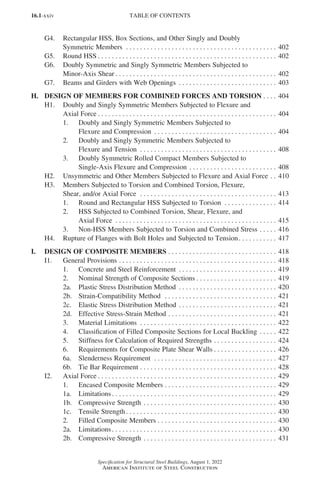
steel in ASTM A572/A572M includes plate only up to 22 in. (63 mm) in thickness.
Another limitation on availability is that even when a product is included in this
Specification, it may be infrequently produced by the mills. Specifying these prod-
ucts may result in procurement delays or require ordering large quantities directly
from the producing mills. Consequently, it is prudent to check availability before
completing the details of a design. The AISC web site provides this information
(www.aisc.org).
Properties in the direction of rolling are of principal interest in the design of steel
structures. Hence, yield stress, as determined by the standard tensile test, is the prin-
cipal mechanical property recognized in the selection of the steels approved for use
under this Specification. It must be recognized that other mechanical and physical
properties of rolled steel, such as anisotropy, ductility, notch toughness, formability,
corrosion resistance, etc., may also be important to the satisfactory performance of
a structure.
For rotary-straightened W-shapes, an area of reduced notch toughness has been
documented in a limited region of the web immediately adjacent to the flange.
Considerations in design and detailing that recognize this situation are presented in
Chapter J.
It is not possible to incorporate in the Commentary adequate information to impart
full understanding of all factors that might merit consideration in the selection and
specification of materials for unique or especially demanding applications. In such
a situation, the user of this Specification is advised to make use of reference mate-
rial contained in the literature on the specific properties of concern and to specify
supplementary material production or quality requirements as provided for in ASTM
material specifications.
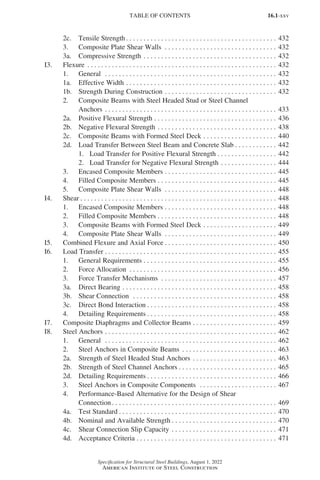
The following special cases should be considered:
Highly Restrained Welded Connections and Lamellar Tearing. Rolled steel is aniso-
tropic, especially insofar as ductility is concerned; therefore, weld contraction strains
in the region of highly restrained welded connections may exceed the strength of the
material if special attention is not given to material selection, details, workmanship,
and inspection (AISC, 1973).
Potential through-thickness structural problems of hot-rolled steel, including lamel-
lar tearing and delamination, result from an interaction of several factors: connection
design and detailing; fabrication and erection procedures; and base metal properties,
including fracture toughness and ductility in the through-thickness direction. Highly
restrained connections of any hot-rolled members may be susceptible, regardless of
thickness, though this phenomenon is more likely with material that exceeds w in.
(19 mm). See “Through Thickness Properties of Structural Steels” (Barsom and
Korvink, 1997) for a complete discussion of the material considerations. As early in
the project as possible, the engineer should consult the steel producer regarding if
and where improved and consistent through-thickness properties are required. The
MATERIAL [Comm. A3.
Part 16.1 Commentary A-E (295-369).indd 298
Part 16.1 Commentary A-E (295-369).indd 298 2023-01-23 6:59 PM
2023-01-23 6:59 PM
16.1-299
Specification for Structural Steel Buildings, August 1, 2022
American Institute of Steel Construction
steel producer can supply steel with improved through-thickness properties by imple-
menting additional metallurgical or heat treatment processing.
The geometry of the welded connections should be designed to avoid through-thick-
ness tensile stresses and configure the joint to best limit restraint and reduce weld
metal volume. See recommendations in AWS D1.1/D1.1M Commentary C-4.7.3
(AWS, 2020) and “Commentary on Highly Restrained Welded Connections” (AISC,
1973).
Other measures the engineer can specify to mitigate through-thickness challenges
are listed below:
(1)	
Expand use of ultrasonic testing (UT) to inspect the steel at the location of the
weld and surrounding area before and after welding. AISC Seismic Provisions
for Structural Steel Buildings (AISC, 2022c) Section J7.2c requires the UT of
base metal thicker than 12 in. (38 mm) after joint (weld) completion behind and
adjacent to the fusion line, and refers to AWS D1.1/D1.1M (AWS, 2020), Table
8.2, for acceptance criteria.
(2)	
Specify nondestructive examination (NDE) during the fabrication process.
Visual examination, liquid penetrant, and magnetic particle testing can be used
to identify surface discontinuities. UT can be used to detect internal discontinui-
ties. Plate can be mill ordered with supplementary requirement S8, “Ultrasonic
Examination,” of ASTM A6/A6M, specifically ASTM A435/A435M (ASTM,
2017b) and ASTM A578/A578M (ASTM, 2017c). Radiography is not recom-
mended because the relevant orientation of the discontinuities of interest are
difficult to detect with this method. Results of NDE will enable the fabricator to
locate steel members such that particularly susceptible material is not subjected
to excessive through-thickness strains.
(3)	
Specify through-thickness tensile testing. For steel plates this is achieved in
accordance with ASTM A770/A770M (ASTM, 2018b). This test evaluates sus-
ceptibility to lamellar tearing, where a minimum area reduction value of 20% has
generally been shown to provide adequate ductility to help mitigate the problem,
though a minimum value of 15% may be acceptable. CEN (2005c) gives a pro-
cedure for specifying area reductions of 15% and greater.
Including any of these measures should be carefully considered with input from the
contractor and steel supplier regarding the cost, ease of implementation, and relative
effectiveness.
Fracture Control Design for Service Conditions. For especially demanding service
conditions, such as structures exposed to low temperatures, particularly those with
cyclic or impact loading, the specification of steels with superior notch toughness
may be warranted. However, for most buildings, the steel is relatively warm, strain
rates are essentially static, and the stress intensity and number of cycles of full design
stress are low. Accordingly, the probability of fracture in most building structures is
low. Good workmanship and good design details incorporating joint geometry that
avoids severe stress concentrations are generally the most effective means of provid-
ing fracture-resistant construction (AASHTO, 2014).
Comm. A3.] MATERIAL
Part 16.1 Commentary A-E (295-369).indd 299
Part 16.1 Commentary A-E (295-369).indd 299 2023-01-26 11:11 AM
2023-01-26 11:11 AM
16.1-300
Specification for Structural Steel Buildings, August 1, 2022
American Institute of Steel Construction
TABLE C-A3.1
Recommended CVN Requirements for
Exposure Below −
−30°
°F (−
−34°
°C)
Actual Yield
Strength, ksi (MPa)
Maximum
Thickness, in. (mm)
Minimum Average
Absorbed Energy,
ft-lbf (J)
Test Temperature,
°
°F (°
°C)
All 1
/2 (13) No recommendation provided
≤ 65 (≤ 450)
2 (50) 15 (20) 10 (−12)
4 (100) 20 (27) 10 (−12)
65  Fy ≤ 70
(450  Fy ≤ 485)
2 (50) 20 (27) −10 (−23)
4 (100) 25 (34) −10 (−23)
70  Fy ≤ 100
(485  Fy ≤ 690)
4 (100) 25 (34) −10 (−23)
The Charpy V-notch (CVN) test allows for the measurement of the amount of energy
absorbed during the fracture of standardized test specimens at a given temperature.
The absorbed energy is the measure of the material’s notch toughness. The CVN test-
ing temperature can be significantly different from the material’s service temperature
to account for the difference in strain rate between the Charpy impact test (on the
order of 10 sec−1in./in.) and the designed strain rate of the structure (typically 10−3
sec−1in./in. for static, wind, and seismic loadings) (Barsom and Rolfe, 1999).
Shapes produced with no minimum specified CVN requirements will generally pro-
vide some level of toughness, although no minimum values are guaranteed. In appli-
cations where increased fracture resistance is required, specified minimum CVN
properties may offer improved reliability. For structures that are exposed to tempera-
tures below −30°F (−34°C), contract documents should specify steel that meets the
minimum average absorbed energy recommended in Table C-A3.1 for main members
that are statically loaded and subjected to bending or tension.
Plates. Portions of the Commentary for hot-rolled shapes are also applicable for
plates.
Hollow Structural Sections (HSS). Specified minimum tensile properties are sum-
marized in Table C-A3.2 for various HSS material specifications and grades. ASTM
A53/A53M Grade B is a pipe specification included as an approved HSS material
specification because it is the most readily available round product in the United
States. Other North American HSS products that have properties and characteristics
that are similar to the approved ASTM products are produced in Canada under the
General Requirements for Rolled or Welded Structural Quality Steel (CSA, 2013).
In addition, pipe is produced to other specifications that meet the strength, ductility,
and weldability requirements of the materials in Section A3, but may have additional
requirements for notch toughness or pressure testing. As stated in Section A3.1b,
MATERIAL [Comm. A3.
Part 16.1 Commentary A-E (295-369).indd 300
Part 16.1 Commentary A-E (295-369).indd 300 2023-01-23 6:59 PM
2023-01-23 6:59 PM
16.1-301
Specification for Structural Steel Buildings, August 1, 2022
American Institute of Steel Construction
TABLE C-A3.2
Minimum Tensile Properties of HSS Steels
Specification Grade
Fy,
ksi (MPa)
Fu,
ksi (MPa)
ASTM A53/A53M B 35 (240) 60 (415)
ASTM A500/A500M
(square, rectangular, round)
B
C
46 (315)
50 (345)
58 (400)
62 (425)
ASTM A501/A501M
A
B
36 (250)
50 (345)
58 (400)
70 (485)
ASTM A618/A618M
(round)
I and II
[t ≤ 3
/4 in. (19 mm)]
III
50 (345)
50 (345)
70 (485)
65 (450)
ASTM A847/A847M − 50 (345) 70 (485)
CAN/CSA-G40.20/G40.21 350W 51 (350) 65 (450)
ASTM A1085/A1085M A 50 (345) 65 (450)
ASTM A1065/A1065M
50
50W
50 (345)
50 (345)
60 (415)
70 (480)
materials not specifically listed in Table A3.1 are permitted when suitability is deter-
mined by the engineer of record (EOR).
Round HSS can be readily obtained in ASTM A53/A53M material and ASTM
A500/A500M Grade C is also common. For rectangular HSS, ASTM A500/A500M
Grade C is the most commonly available material and a special order would be
required for any other material. Depending upon size, either welded or seamless
round HSS can be obtained. In North America, however, all ASTM A500/A500M
rectangular HSS for structural purposes are welded. Rectangular HSS differ from
box sections in that they have uniform thickness, except for some thickening in the
rounded corners.
Nominal strengths of directly welded T-, Y-, and K-connections of HSS have been
developed analytically and empirically. Connection deformation is anticipated and
is an acceptance limit for connection tests. Ductility is necessary to achieve the
expected deformations. The ratio of the specified minimum yield strength to the
specified minimum tensile strength (yield/tensile ratio) is one measure of material
ductility. Materials in HSS used in connection tests have had a yield/tensile ratio
of up to 0.80 and therefore that ratio has been adopted as a limit of applicability
for directly welded HSS connections. ASTM A500/A500M Grade A material does
not meet this ductility “limit of applicability” for direct connections in Chapter K.
ASTM A500/A500M Grade C has a yield/tensile ratio of 0.807 but it is reasonable
to use the rounding method described in ASTM E29 (ASTM, 2019c) and find this
material acceptable for use.
Comm. A3.] MATERIAL
Part 16.1 Commentary A-E (295-369).indd 301
Part 16.1 Commentary A-E (295-369).indd 301 2023-01-30 5:34 AM
2023-01-30 5:34 AM
16.1-302
Specification for Structural Steel Buildings, August 1, 2022
American Institute of Steel Construction
Even though ASTM A501/A501M includes rectangular HSS, hot-formed rectangu-
lar HSS are not currently produced in the United States. The General Requirements
for Rolled or Welded Structural Quality Steel (CSA, 2013) includes Class C (cold-
formed) and Class H (cold-formed and stress relieved) HSS. Class H HSS have
relatively low levels of residual stress, which enhances their performance in com-
pression and may provide better ductility in the corners of rectangular HSS.
API 5L (API, 2012) is a line pipe specification that has some requirements for
mechanical characteristics that make it advantageous for use in specific structural
applications, such as in long span roofs with long unbraced lengths or large com-
posite columns in heavy unbraced frames. Note, however, that Section A3.1b states,
for materials not specifically listed in Table A3.1, suitability must be determined by
the EOR. The specified minimum yield strength of API 5L ranges from 25 to 80 ksi
(170 to 550 MPa) and the specified minimum tensile strength ranges from 45 to
90 ksi (310 to 620 MPa), depending on product specification level and material
grade. For Grades X42 and higher, additional elements may be used upon agreement
between the purchaser and the manufacturer; however, care should be exercised
in determining the alloying content for any given size and wall thickness of pipe,
because the addition of such otherwise desirable elements may affect the weldability
of the pipe. PSL2 pipe is a common structural choice and Grade X52 is prob-
ably the most common grade for structural purposes. Some pertinent mechanical
and geometric properties for PSL2 X52N are Fy = 52 ksi (360 MPa); Fu = 66 ksi
(460 MPa); toughness = 20 ft-lbf @ 32°F (27 J @ 0oC) for D ≤ 30 in. (750 mm); a
wall thickness lower tolerance of −10% for 3/16 in.  t  19/32 in. (5 mm  t  15 mm),
and -0.02 in. (-0.5 mm) for t  3/16 in. (t  5 mm); and a mass or area tolerance of
-3.5% for regular plain-ended pipe. With a diameter range from 13/32 in. to 84 in.
(10 mm to 2 100 mm), this high-quality pipe material addresses a frequent need for
either large diameter or thick-walled round hollow sections. Other special features
of PSL2 pipe are an upper bound on the yield strength [for example, for X52 the
minimum and maximum yield strengths are 52 ksi (360 MPa) and 76 ksi (520 MPa),
respectively], and a maximum yield-to-tensile stress ratio of 0.93 in the as-delivered
pipe [for D  12.75 in. (319 mm)].
1d. Rolled Heavy Shapes
The web-to-flange intersection and the web center of heavy hot-rolled shapes, as well
as the interior portions of heavy plates, may contain a more coarse grain structure
and/or lower notch toughness material than other areas of these products (Cattan,
1995; Jaquess and Frank, 1999). This is probably caused by ingot segregation, the
somewhat lesser deformation during hot rolling, higher finishing temperature, and
the slower cooling rate after rolling for these heavy sections. This characteristic is
not detrimental to suitability for compression members or for nonwelded members.
However, when heavy cross sections are joined by splices or connections using com-
plete-joint-penetration groove welds that extend through the coarser and/or lower
notch-tough interior portions, tensile stresses induced by weld shrinkage may result
in cracking. An example is a complete-joint-penetration groove welded connection
of a heavy cross-section beam to any column section. When members of lesser thick-
ness are joined by complete-joint-penetration groove welds, which induce smaller
MATERIAL [Comm. A3.
Part 16.1 Commentary A-E (295-369).indd 302
Part 16.1 Commentary A-E (295-369).indd 302 2023-01-23 6:59 PM
2023-01-23 6:59 PM
16.1-303
Specification for Structural Steel Buildings, August 1, 2022
American Institute of Steel Construction
weld shrinkage strains, to the finer grained and/or more notch-tough surface material
of ASTM A6/A6M shapes and heavy built-up cross sections, the potential for crack-
ing is significantly lower. An example is a complete-joint-penetration groove welded
connection of a nonheavy cross-section beam to a heavy cross-section column.
For critical applications, such as primary tension members, material should be
specified to provide adequate notch toughness at service temperatures. Because of
differences in the strain rate between the Charpy V-notch (CVN) impact test and the
strain rate experienced in actual structures, the CVN test is conducted at a tempera-
ture higher than the anticipated service temperature for the structure. The location of
the CVN test specimens (“alternate core location”) is specified in ASTM A6/A6M,
Supplemental Requirement S30.
The notch toughness requirements of Sections A3.1d and A3.1e are intended only to
provide structural steel material with a nominal yield strength of 50 ksi with reason-
able notch toughness for ordinary service applications [enclosed structures or lowest
anticipated service temperature of 50°F (10°C) or higher]. For unusual applications,
low temperature service, and/or higher strength material, more restrictive require-
ments and/or notch toughness requirements for other section sizes and thicknesses
may be appropriate (Barsom and Rolfe, 1999). To minimize the potential for frac-
ture, the notch toughness requirements of Sections A3.1d and A3.1e must be used in
conjunction with good design and fabrication procedures. Specific requirements are
given in Sections J1.5, J1.6, J2.6, and J2.7.
1e. Built-Up Heavy Shapes
Portions of Commentary Section A3.1d for rolled heavy shapes are also applicable
for built-up heavy shapes.
2. Steel Castings and Forgings
Design and fabrication of cast and forged steel components are not covered in this
Specification.
Steel Castings. There are a number of ASTM Specifications for steel castings. The
Steel Founders’ Society of America (SFSA) Steel Castings Handbook (SFSA, 1995)
discusses a number of standards useful for steel structures. In addition to the require-
ments of this Specification, SFSA recommends that various other requirements be
considered for cast steel products. Continued quality assurance is critical to make
certain there is confidence in the cast product. This includes testing of first article
components as well as production testing. It may be appropriate to inspect the first
piece cast using magnetic particle inspection (MPI) in accordance with ASTM E125,
degree 1a, b, or c (ASTM, 2013). Radiographic inspection level III may be desirable
for the first piece cast. Ultrasonic testing (UT) in compliance with ASTM A609/
A609M (ASTM, 2012a) may be appropriate for the first cast piece over 6 in. (150
mm) thick. UT and MPI of production castings are also advisable. Design approval,
sample approval, periodic nondestructive testing, chemical testing, and selection of
the correct welding specification should be among the issues defined in the selection
and procurement of cast steel products. Refer to SFSA (1995) for design informa-
tion about cast steel products. For visual examination, refer to ASTM A802 (ASTM,
Comm. A3.] MATERIAL
Part 16.1 Commentary A-E (295-369).indd 303
Part 16.1 Commentary A-E (295-369).indd 303 2023-01-23 6:59 PM
2023-01-23 6:59 PM
16.1-304
Specification for Structural Steel Buildings, August 1, 2022
American Institute of Steel Construction
2015a); for magnetic particle and liquid penetrant surface and subsurface examina-
tion, refer to ASTM A903/A903M (ASTM, 2012b); for radiographic examination,
refer to ASTM E1030/E1030M (ASTM, 2015b); and for ultrasonic examination, refer
to ASTM A609/A609M (ASTM, 2012a). ASTM A958/A958M (ASTM, 2021b) is
a cast steel used in the Kaiser Bolted Bracket Moment Connection, a prequalified
moment connection in ANSI/AISC 358 (AISC, 2022b), but it may also be specified
in some nonseismic applications. Additional information about cast steels can be
found in the Steel Castings Handbook, Supplement 2 (SFSA, 2009).
Steel Forgings. There are a number of ASTM specifications for steel forgings.
The Forging Industry Association’s Forging Industry Handbook (FIA, 1985) dis-
cusses some typical forging issues, but more detailed information can be obtained at
www.forging.org. Steel forgings should conform to ASTM A668/A668M (ASTM,
2021a) and the related ASTM testing requirements. UT should be in compliance with
ASTM A388/A388M (ASTM, 2019b) and MPI in accordance with ASTM A275/
A275M (ASTM, 2018a). Many of the frequently used structural forgings are catalog
items for which the testing has been established. For custom forgings, the frequency
and type of testing required should be established to conform to ASTM requirements.
3. Bolts, Washers, and Nuts
ASTM F3125/F3125M is an umbrella specification, first referenced in the 2016 AISC
Specification for Structural Steel Buildings (AISC, 2016), that covers fasteners that
were previously referred to as ASTM A325/A325M, ASTM A490/A490M, ASTM
F1852, and ASTM F2280 fasteners. These previously separate standards have been
unified, coordinated, and made consistent with each other, turning them into Grades
of ASTM F3125/F3125M. From the user perspective, not much has changed, as
the head marks remain the same, and handling and installation remain the same.
Nevertheless, the specifier should be aware that ASTM F3125/F3125M now contains
Grades A325, A325M, A490, A490M, F1852, and F2280 fasteners. One change of
note is that under ASTM F3125/F3125M, Grades A325 and A325M fasteners are
uniformly 120 ksi (830 MPa); Grades A325 and A325M had a drop in strength to 105
ksi (725 MPa) for diameters over 1 in. (25 mm) in previous standards.
The ASTM standard specification for ASTM A307 bolts covers two grades of fasten-
ers. Either grade may be used under this Specification; however, it should be noted
that Grade B is intended for pipe-flange bolting and Grade A is the grade long in use
for structural applications.
4. Anchor Rods and Threaded Rods
ASTM F1554 is the primary specification for anchor rods. Because there is a limit
on the maximum available length of structural bolts, the attempt to use these bolts
for anchor rods with design lengths longer than the maximum available lengths has
presented problems in the past. The inclusion of ASTM A449 and ASTM A354
materials in this Specification allows the use of higher strength material for bolts
longer than structural bolts.
The EOR should specify the required strength for threaded rods used as load-carry-
ing members.
MATERIAL [Comm. A3.
Part 16.1 Commentary A-E (295-369).indd 304
Part 16.1 Commentary A-E (295-369).indd 304 2023-01-23 6:59 PM
2023-01-23 6:59 PM
16.1-305
Specification for Structural Steel Buildings, August 1, 2022
American Institute of Steel Construction
5. Consumables for Welding
The AWS filler metal specifications listed in Section A3.5 are general specifications
that include filler metal classifications suitable for building construction, as well
as classifications that may not be suitable for building construction. AWS D1.1/
D1.1M, Structural Welding Code—Steel (AWS, 2020) Table 5.4 lists the various
filler metals that may be used for prequalified welding procedure specifications, for
the various steels that are to be joined. This list specifically does not include various
classifications of filler metals that are not suitable for structural steel applications.
Filler metals listed under the various AWS A5 filler metal specifications may or may
not have specified notch toughness properties, depending on the specific electrode
classification. Section J2.6 identifies certain welded joints where notch toughness of
filler metal is needed in building construction. There may be other situations where
the EOR may elect to specify the use of filler metals with specified notch toughness
properties, such as for structures subjected to high loading rate, cyclic loading, or
seismic loading. Because AWS D1.1/D1.1M does not automatically require that the
filler metal used have specified notch toughness properties, it is important that filler
metals used for such applications be of an AWS classification, where such proper-
ties are required. This information can be found in the various AWS filler metal
specifications and is often contained on the filler metal manufacturer’s certificate of
conformance or product specification sheets.
When specifying filler metal and/or flux by AWS designation, the applicable stan-
dard specifications should be carefully reviewed to assure a complete understanding
of the designation reference. This is necessary because the AWS designation systems
are not consistent. For example, in the case of electrodes for shielded metal arc
welding, AWS A5.1/A5.1M, the first two or three digits indicate the nominal tensile
strength classification, in ksi, of the filler metal and the final two digits indicate the
type of coating. For metric designations, the first two digits times 10 indicate the
nominal tensile strength classification in MPa. In the case of mild steel electrodes
for submerged arc welding, AWS A5.17/A5.17M, the first one or two digits times
10 indicate the nominal tensile strength classification for both U.S. customary and
metric units, while the final digit or digits times 10 indicate the testing temperature
in °F for filler metal impact tests. In the case of low-alloy steel covered arc welding
electrodes, AWS A5.5/A5.5M, certain portions of the designation indicate a require-
ment for stress relief, while others indicate no stress relief requirement.
Engineers do not, in general, specify the exact filler metal to be employed on a par-
ticular structure. Rather, the decision as to which welding process and which filler
metal is to be utilized is usually left with the fabricator or erector. Codes restrict the
usage of certain filler metals or impose qualification testing to prove the suitability
of the specific electrode, so as to make certain that the proper filler metals are used.
A4. STRUCTURAL DESIGN DOCUMENTS AND SPECIFICATIONS
1. Structural Design Documents and Specifications Issued for Construction
This Specification provides minimum requirements that are deemed effective to
provide satisfactory results in steel buildings and other structures within the intended
Comm. A4.] STRUCTURAL DESIGN DOCUMENTS AND SPECIFICATIONS
Part 16.1 Commentary A-E (295-369).indd 305
Part 16.1 Commentary A-E (295-369).indd 305 2023-01-23 6:59 PM
2023-01-23 6:59 PM
16.1-306
Specification for Structural Steel Buildings, August 1, 2022
American Institute of Steel Construction
scope of the Specification. It is not intended or necessary to list all the requirements
stated in the Specification for listing in the design documents and specifications
issued for construction. The items specified in this section are deemed to be impor-
tant for specific mention and to be listed. When modified or additional requirements
are warranted for a particular project, these should be considered by the designer and
direct references to the Specification should be employed where appropriate.
The information specified to be shown on design documents issued for construction
is considered important for ensuring that all applicable elements of the structural
steel frame, including connections, are documented and addressed by the engineer
of record (EOR) as required by the Specification. The 2021 International Building
Code (IBC) (ICC, 2021) requires that a registered design professional in responsible
charge be assigned the role of reviewing and coordinating submittal documents pre-
pared by others, including phased and deferred submittals as defined in Chapter 1 of
the IBC. Some design information required for final construction as listed in Section
A4 may be contained in deferred submittals prepared by a specialty structural engi-
neer, if approved by the authority having jurisdiction. This practice may be used
for metal buildings and for joists and joist girders. The authority having jurisdiction
(AHJ) is the final authority dictating requirements for design documents issued for
permit and for final construction. Refer to the 2021 IBC and CASE Document 962-B
(CASE, 1996) for further information.
For projects that use a design-build delivery method, where the EOR or internal
design engineer, as applicable, is employed by the fabricator or incorporate deferred
submittals, such as buckling-restrained braces, custom fabricated trusses, or steel
connections, some information specified in Section A4 is transmitted between the
designer and fabricator internally and there may be no need to issue documents from
one entity to the other in order for construction to commence. However, the intent of
Section A4 is to document the information between parties. Section A4 anticipates
that this documentation would be in the form of structural design documents and
specifications as specified, although it is recognized that other means of documenting
the required information are possible.
When the AHJ, applicable building code, purchaser, owner, or EOR judge that
supplemental life safety requirements are advisable, such requirements should be
indicated in the documents that are released for construction. Such requirements
might include, for example, material testing, reporting and traceability, additional
quality control and nondestructive testing, specific erection requirements, or other
important items critical to life safety.
In reference to item (k), preset elevation requirements at free ends of cantilevered
members relative to their fixed-end elevations, it may be necessary to specify a rela-
tive elevation to which the free end of a cantilever must be erected (preset) prior to
load application, with the fixed end stabilized before the member is released from
the crane or temporary support and any other load is applied to it. This is needed so
that the cantilevered member can be detailed and fabricated to allow for any required
preset. This does not apply to a beam that is continuous over a support, which is
controlled by camber, not preset.
STRUCTURAL DESIGN DOCUMENTS AND SPECIFICATIONS [Comm. A4.
Part 16.1 Commentary A-E (295-369).indd 306
Part 16.1 Commentary A-E (295-369).indd 306 2023-01-23 6:59 PM
2023-01-23 6:59 PM
16.1-307
Specification for Structural Steel Buildings, August 1, 2022
American Institute of Steel Construction
Design of Structural Steel Connections. It is recognized that various means of des-
ignating and designing structural steel connections have been used in structural steel
construction. Therefore, it is important to address these means in this Commentary.
The Code of Standard Practice (AISC, 2022a) describes three options that can be
used. One of these options should be indicated for each connection in a project. It is
acceptable to group connection types and utilize a combination of these options for
the various connection types involved in a project.
When the EOR intends to provide complete connection design in the structural design
documents (described as Option 1 in the Code of Standard Practice), the design draw-
ings should include the following:
(a)	
All weld types, sizes, lengths, and electrode specification tensile strengths
(b) All bolt sizes, locations, quantities, and grades
(c) All plate and angle sizes, thicknesses, dimensions, and grades
(d) All work point locations and related information
Welds should be specified as required by AWS D1.1/D1.1M (AWS, 2020). This
includes the following:
(1)	
The effective weld length and required effective throat for partial-joint-penetra-
tion groove welds.
(2) The effective weld length and leg size for fillet welds.
(3)	
When the strength of the connected element must be developed, a weld sym-
bol without a dimension and without CJP in its tail designates a weld that will
develop the adjacent base metal strength in tension and shear.
(4) Any special end return requirements.
If standard welding symbols are insufficient to convey the design intent, special
conditions should be fully explained by added notes or details.
When other methods are used, the EOR must provide data concerning the loads,
including shears, moments, axial forces, and transfer forces, that are to be resisted
by the individual members and their connections, sufficient to allow the selection,
completion, or design of the connection details.
In some cases, connection design is dependent on multiple load combinations in the
members, and these member loads must be provided. Specific examples include the
following:
• 
Pr, the required axial strength, necessary to determine the web panel-zone shear
strength in Section J10.6
• 
The required axial and flexural strengths in a hollow structural section (HSS) chord
at a joint necessary to determine strength relative to many limit states in Section
J10 and Chapter K
When the EOR intends to allow an experienced steel detailer to select or complete
the structural steel connections (described as Option 2 in the Code of Standard
Practice), the EOR is the only engineer involved in the process. The experienced
steel detailer is not expected to perform engineering calculations.
Comm. A4.] STRUCTURAL DESIGN DOCUMENTS AND SPECIFICATIONS
Part 16.1 Commentary A-E (295-369).indd 307
Part 16.1 Commentary A-E (295-369).indd 307 2023-01-23 6:59 PM
2023-01-23 6:59 PM
16.1-308
Specification for Structural Steel Buildings, August 1, 2022
American Institute of Steel Construction
When structural steel connection design is delegated to be designed by a licensed
engineer (described as Option 3 in the Code of Standard Practice), the EOR must
provide project-specific schematic connection details based on realistic design forces
to define the design intent and sufficient information, provided in writing, for the
delegated connection designer (the licensed engineer to whom the work is delegated)
to understand the scope and nature of the delegated work and its relationship to the
overall design. The information that is required to perform the delegated design
shall be commensurate with the nature and complexity of the project. It may include
not only member loads, but also references to technical articles, journals, and other
performance standards; or other relevant and related information, as appropriate, to
understand the design intent and perform the required calculations.
Delegated structural steel connection design does not serve as a peer review of the
EOR’s design documents.
The EOR must review and approve the substantiating connection information and
the resulting shop drawings, or other documents that are submitted, for conformance
with the specified criteria and compatibility with the design intent. The EOR is the
final authority and responsible party for the connections utilized on the project.
Design of Member Reinforcement. Ideally, members should be sized for local
effects at locations of structural steel connections such that local reinforcement is
not required. If members are not sized for local effects at locations of structural
steel connections, member reinforcement may be required to satisfy strength and
equilibrium of forces through the connection. Such local member reinforcement
may include column stiffeners, web doubler plates, beam bearing stiffeners, HSS
joint cans, external chord stiffeners, and all other forms of reinforcement. Methods
for designing and fabricating such reinforcing are well-established and addressed in
this Specification for some cases. For other cases, such as for connections involving
HSS, methods for designing and fabricating reinforcing are not addressed and can be
complex. In any case, such local reinforcement (or when structural steel connection
design is delegated, the potential need for such local reinforcement) is addressed in
the Code of Standard Practice and must be identified in the design documents.
2. Structural Design Documents and Specifications Issued for Any Purpose
Structural design documents are commonly issued for various purposes on a structural
steel project. These include, but are not necessarily limited to, issued for construction,
for permit, for fabrication and erection (for example, commencing work on the proj-
ect by the fabricator and erector, ordering structural steel, and commencing work on
shop drawings, etc.), or for all or a portion of the project as specified. They can also
be issued for preliminary or intermediate budget pricing, an initial or final guaranteed
maximum price (IGMP or GMP), for bidding, and for contract documents, as defined
in the Code of Standard Practice. The intent of this section of the Specification is
that the EOR and the various project stakeholders fully communicate and have a
common understanding of the purpose for which the documents are being issued and
that such documents be clearly labeled for that purpose and dated. It is anticipated
that the purpose and date would be applied in the title block of each drawing that is
issued, which has been customary in past and current practice on many projects. If
STRUCTURAL DESIGN DOCUMENTS AND SPECIFICATIONS [Comm. A4.
Part 16.1 Commentary A-E (295-369).indd 308
Part 16.1 Commentary A-E (295-369).indd 308 2023-01-23 6:59 PM
2023-01-23 6:59 PM
16.1-309
Specification for Structural Steel Buildings, August 1, 2022
American Institute of Steel Construction
the releasing entity (for example, owner, general contractor, construction manager, or
other party) releases the documents for bidding, negotiating for, or executing a con-
tract, this Specification requires that documents released be so labeled by the EOR for
such purpose. The EOR is the only party that fully understands and can interpret the
design status and whether sufficient information is shown on the documents for the
purpose of bidding or contract. Release of documents for bidding or contract that are
not sufficiently complete could have life safety implications if the structural design is
not advanced to allow proper definition of the scope of work. The issuance of design
documents and specifications for construction by the EOR and the requirements listed
under Section A4.1 are deemed to protect life safety and public welfare. It is recom-
mended that structural design documents issued for permit, ordering structural steel,
or placing a mill order also meet the stated requirements for documents issued for
construction. Issuance of structural design documents for these purposes, when the
documents are partially complete and the design is evolving, requires good commu-
nication among the parties and careful coordination of handling items that are not yet
designed and shown on the design documents. While ideally all design information
should be provided at the start of construction, this is not always practical or possible
with an accelerated design schedule. The safety of the structure mandates that the
requirements for design documents in this section be satisfied before construction on
the specified portion of the structure is initiated. Revisions to design documents may
require adjustments to the contract price and schedule. However, such contractual
matters are beyond the scope of the Specification and are addressed in the Code of
Standard Practice. Refer to the Code of Standard Practice Section 3.2 for require-
ments when issuing structural design documents and specifications that serve as the
basis for contract documents as defined therein.
A5. APPROVALS
Code of Standard Practice (AISC, 2022a) Section 4.4 addresses the approval process.
Engineers do not commonly construct buildings; instead, they produce design docu-
ments and specifications to inform the construction process. The review and approval
of the approval documents is a vital part of the construction process and is a confirma-
tion that the engineer of record's (EOR) design intent has been correctly interpreted; it
is an important part of the design and construction process, the ultimate goal of which
is the safety of the structure, and, therefore, is now addressed in this Specification.
CASE Document 962-D (CASE, 2020) indicates that when the design of some ele-
ment of the primary structural system is delegated to someone other than the struc-
tural EOR, “…such elements, including connections designed by others, should be
reviewed by the structural engineer of record or other responsible engineer. He [or
she] should review such designs and details, accept or reject them and be responsible
for their effects on the primary structural system.” Historically, the Code of Standard
Practice has embraced this same concept.
Submittal documents as prepared by a specialty structural engineer and approved by
the EOR or registered design professional in responsible charge is commonly accepted
practice with manufacturers of metal buildings, proprietary seismic components, and
steel joist manufacturers, provided it is approved by the authority having jurisdiction.
Refer to the 2021 IBC Chapter 1, Section 107 (ICC, 2021), for additional information.
Comm. A5.] APPROVALS
Part 16.1 Commentary A-E (295-369).indd 309
Part 16.1 Commentary A-E (295-369).indd 309 2023-01-23 6:59 PM
2023-01-23 6:59 PM
16.1-310
Specification for Structural Steel Buildings, August 1, 2022
American Institute of Steel Construction
CHAPTER B
DESIGN REQUIREMENTS
Chapter B includes the following major changes and additions in this edition of the
Specification:
(1) 
The approximate method for inelastic moment redistribution (often referred to as the
nine-tenths rule) has been relocated to Appendix 8.
(2) 
Clarification is provided for use of partially restrained (PR) moment connections by
expanding the requirements.
(3) 
Design for ponding provisions have been expanded, given that Appendix 2, Ponding,
has been removed from the Specification.
(4) 
Section B4.1 has clarified the requirement that webs and flanges be continuously
attached.
(5) 
Section B4.3 has clarified that the holes being considered are bolt holes.
(6) 
Section B8, Dimensional Tolerances, has been added to clarify that the provisions of
the Specification are based on tolerances provided in the Code of Standard Practice and
referenced ASTM standards.
B1. GENERAL PROVISIONS
This Specification is meant to be primarily applicable to the common types of build-
ing frames with gravity loads carried by beams and girders and lateral loads carried
by moment frames, braced frames, or shear walls. However, there are many unusual
buildings or building-like structures for which this Specification is also applicable.
Rather than attempt to establish the purview of the Specification with an exhaustive
classification of construction types, Section B1 requires that the design of members
and their connections be consistent with the intended use of the structure and the
assumptions made in the analysis of the structure.
Section B1 widens the purview of this Specification to a class of construction types
broader than those addressed in editions of the Specification prior to 2016. Section
B1 recognizes that a structural system is a combination of members connected in
such a way that the structure can respond in different ways to meet different design
objectives under different loads. Even within the purview of ordinary buildings, there
can be enormous variety in the design details.
Previous to the 2005 edition, the Specification contained a section titled “Types of
Construction”; for example, Section A2 in the 1999 Load and Resistance Factor
Design Specification for Structural Steel Buildings (AISC, 2000b). In this Specifi-
cation, there is no such section and the requirements related to “types of construc-
tion” have been divided between Section B1, Section B3.4, and Section J1.
Part 16.1 Commentary A-E (295-369).indd 310
Part 16.1 Commentary A-E (295-369).indd 310 2023-01-30 5:36 AM
2023-01-30 5:36 AM
16.1-311
Specification for Structural Steel Buildings, August 1, 2022
American Institute of Steel Construction
Comm. B2.] LOADS AND LOAD COMBINATIONS
B2. LOADS AND LOAD COMBINATIONS
The loads, load combinations, and nominal loads for use with this Specification
are given in the applicable building code. In the absence of an applicable specific
local, regional, or national building code, the loads (for example, D, L, Lr, S, R, W,
and E), load factors, load combinations, and nominal loads (numeric values for D,
L, and other loads) are as specified in ASCE/SEI 7, Minimum Design Loads and
Associated Criteria for Buildings and Other Structures (ASCE, 2022). The 2022
edition of ASCE/SEI 7 has adopted many of the seismic design provisions of the
NEHRP Recommended Seismic Provisions for New Buildings and Other Structures
(FEMA, 2020), as have the AISC Seismic Provisions for Structural Steel Buildings
(AISC, 2022c). The reader is referred to the commentaries of these documents for an
expanded discussion on loads, load factors, and seismic design.
This Specification is based on strength limit states that apply to structural steel design
in general. The Specification permits design for strength using either load and resis-
tance factor design (LRFD) or allowable strength design (ASD). It should be noted
that the terms “strength” and “stress” reflect whether the appropriate section property
has been applied in the calculation of the available strength. In most instances, the
Specification uses “strength” rather than “stress.” In all cases, it is a simple matter to
recast the provisions into a stress format. The terminology used to describe load com-
binations in ASCE/SEI 7 is somewhat different from that used by this Specification.
ASCE/SEI 7, Section 2.3, defines Combining Factored Loads Using Strength Design;
these combinations are applicable to design using the LRFD approach. ASCE/SEI 7,
Section 2.4, defines Combining Nominal Loads Using Allowable Stress Design;
these combinations are applicable to design using the ASD approach.
LRFD Load Combinations. If the LRFD approach is selected, the load combination
requirements are defined in ASCE/SEI 7, Section 2.3.
The load combinations in ASCE/SEI 7, Section 2.3, are based on modern probabilis-
tic load modeling and a comprehensive survey of reliabilities inherent in traditional
design practice (Galambos et al., 1982; Ellingwood et al., 1980; Ellingwood et al.,
1982). These load combinations utilize a “principal action-companion action for-
mat,” which is based on the notion that the maximum combined load effect occurs
when one of the time-varying loads takes on its maximum lifetime value (principal
action) while the other variable loads are at “arbitrary point-in-time” values (com-
panion actions), the latter being loads that would be measured in a load survey at any
arbitrary time. The dead load, which is considered to be permanent, is the same for
all combinations in which the load effects are additive. Research has shown that this
approach to load combination analysis is consistent with the manner in which loads
actually combine on structural elements and systems in situations in which strength
limit states may be approached. The load factors reflect uncertainty in individual load
magnitudes and in the analysis that transforms load to load effect. The nominal loads
in ASCE/SEI 7 are substantially in excess of the arbitrary point-in-time values. The
basis for the LRFD load combinations can be found in the Commentary to ASCE/
SEI 7, Section 2.3.
Part 16.1 Commentary A-E (295-369).indd 311
Part 16.1 Commentary A-E (295-369).indd 311 2023-01-26 11:13 AM
2023-01-26 11:13 AM
16.1-312
Specification for Structural Steel Buildings, August 1, 2022
American Institute of Steel Construction
The return period associated with earthquake loads was revised in both the 2003 and
2009 editions of the NEHRP Recommended Seismic Provisions for New Buildings
and Other Structures (FEMA, 2003, 2009). In the 2009 edition, adopted as the basis
for ASCE/SEI 7-10 (ASCE, 2010), the earthquake loads at most locations were
intended to produce a collapse probability of 1% in a 50 year period, a performance
objective that is achieved by requiring that the probability of incipient collapse,
given the occurrence of the maximum considered earthquake (MCE), is less than
10%. This continues to be the basis of the current version of ASCE/SEI 7 (ASCE,
2022). At some sites in regions of high seismic activity, where high intensity events
occur frequently, deterministic limits on the ground motion result in somewhat
higher collapse probabilities. The ASCE/SEI 7, Chapter 1 Commentary, provides
information on the intended maximum probability of structural failure under earth-
quake and other loads.
Load combinations of ASCE/SEI 7, Section 2.3, which apply specifically to cases
in which the structural actions due to lateral forces and gravity loads counteract one
another and the dead load stabilizes the structure, incorporate a load factor on dead
load of 0.9.
ASD Load Combinations. If the ASD approach is selected, the load combination
requirements are defined in ASCE/SEI 7, Section 2.4.
The load combinations in ASCE/SEI 7, Section 2.4, are similar to those traditionally
used in allowable stress design. In ASD, safety is provided by the safety factor, Ω,
and the nominal loads in the basic combinations involving gravity loads, earth pres-
sure, or fluid pressure are not factored. The reduction in the combined time-varying
load effect in combinations incorporating wind or earthquake load is achieved by the
load combination factor 0.75. This load combination factor dates back to the 1972
edition of ANSI Standard A58.1 (ANSI, 1972), the predecessor of ASCE/SEI 7. It
should be noted that in ASCE/SEI 7, the 0.75 factor applies only to combinations of
variable loads; it is irrational to reduce the dead load because it is always present and
does not fluctuate with time. It should also be noted that certain ASD load combina-
tions may actually result in a higher required strength than similar load combinations
for LRFD. Load combinations that apply specifically to cases in which the structural
actions due to lateral forces and gravity loads counteract one another, where the
dead load stabilizes the structure, incorporate a load factor on dead load of 0.6. This
eliminates a deficiency in the traditional treatment of counteracting loads in ASD
and emphasizes the importance of checking stability. The earthquake load effect is
multiplied by 0.7 in applicable combinations involving that load to align ASD for
earthquake effects with the definition of E in the sections of ASCE/SEI 7 defining
seismic load effects and combinations.
The load combinations in ASCE/SEI 7, Sections 2.3 and 2.4, apply to design for
strength limit states. They do not account for gross error or negligence. Loads and
load combinations for nonbuilding structures and other structures may be defined in
ASCE/SEI 7 or other applicable industry standards and practices.
LOADS AND LOAD COMBINATIONS [Comm B2.
Part 16.1 Commentary A-E (295-369).indd 312
Part 16.1 Commentary A-E (295-369).indd 312 2023-01-23 6:59 PM
2023-01-23 6:59 PM
16.1-313
Specification for Structural Steel Buildings, August 1, 2022
American Institute of Steel Construction
B3. DESIGN BASIS
As stated in this Specification: “design shall be such that no applicable strength or
serviceability limit state shall be exceeded when the structure is subjected to all
applicable load combinations.” A limit state is a condition in which a structural
system or component becomes unfit for its intended purpose (serviceability limit
state) or has reached its ultimate load-carrying capacity (strength limit state). Limit
states may be dictated by functional requirements, such as maximum deflections or
drift; they may be related to structural behavior, such as the formation of a plastic
hinge or mechanism; or they may represent the collapse of the whole or part of the
structure, such as by instability or rupture. The design provisions in this Specification
are established so that the probability of exceeding a limit state is acceptably small
by stipulating the combination of load factors, resistance or safety factors, nominal
loads, and nominal strengths consistent with the design assumptions.
Two kinds of limit states apply to structures: (a) strength limit states, which define
safety against local or overall failure conditions during the intended life of the struc-
ture; and (b) serviceability limit states, which define functional requirements. This
Specification, like other structural design codes, focuses primarily on strength limit
states because of overriding considerations of public safety. This does not mean that
limit states of serviceability (see Chapter L) are not important to the designer, who
must provide for functional performance and economy of design. However, service-
ability considerations permit more exercise of judgment on the part of the designer.
Load and resistance factor design (LRFD) and allowable strength design (ASD) are
distinct methods for satisfying strength limit states. They are equally acceptable by
this Specification, but their provisions are not interchangeable. Indiscriminate use
of combinations of the two methods could result in unpredictable performance or
unsafe design. Thus, the LRFD and ASD methods are specified as alternatives. There
are, however, circumstances in which the two methods could be used in the design,
modification, or renovation of a structural system without conflict, such as provid-
ing modifications to a structural floor system of an older building after assessing the
as-built conditions.
Strength limit states vary from element to element, and several limit states may apply
to a given element. The most common strength limit states are yielding, buckling,
and rupture. The most common serviceability limit states include deflections or drift,
and vibrations.
1. Design for Strength Using Load and Resistance Factor Design (LRFD)
Design for strength by LRFD is performed in accordance with Equation B3-1. The
left side of Equation B3-1, Ru, represents the required strength computed by struc-
tural analysis based on load combinations stipulated in ASCE/SEI 7, Section 2.3 (or
their equivalent) (ASCE, 2022), while the right side, φRn, represents the limiting
structural resistance, or design strength, provided by the member or element.
The resistance factor, φ, in this Specification is equal to or less than 1.00. When
compared to the nominal strength, Rn, computed according to the methods given in
Chapters D through K, a φ of less than 1.00 accounts for approximations in the theory
Comm. B3.] DESIGN BASIS
Part 16.1 Commentary A-E (295-369).indd 313
Part 16.1 Commentary A-E (295-369).indd 313 2023-01-23 6:59 PM
2023-01-23 6:59 PM
16.1-314
Specification for Structural Steel Buildings, August 1, 2022
American Institute of Steel Construction
and variations in mechanical properties and dimensions of members and frames. For
limit states where φ = 1.00, the nominal strength is judged to be sufficiently conser-
vative when compared to the actual strength that no reduction is needed.
The LRFD provisions are based on (1) probabilistic models of loads and resistance,
(2) a calibration of the LRFD provisions to the 1978 edition of the ASD Specification
for selected members (AISC, 1978), and (3) the evaluation of the resulting provi-
sions by judgment and past experience aided by comparative design office studies of
representative structures.
In the probabilistic basis for LRFD (Ravindra and Galambos, 1978; Ellingwood et
al., 1982), the load effects, Q, and the resistances, R, are modeled as statistically
independent random variables. In Figure C-B3.1, relative frequency distributions
for Q and R are portrayed as separate curves on a common plot for a hypothetical
case. As long as the resistance, R, is greater than (to the right of) the effects of the
loads, Q, a margin of safety for the particular limit state exists. However, because Q
and R are random variables, there is a small probability that R may be less than Q.
The probability of this limit state is related to the degree of overlap of the frequency
distributions in Figure C-B3.1, which depends on the positioning of their mean
values (Rm versus Qm) and their dispersions.
The probability that R is less than Q depends on the distributions of the many vari-
ables (material, loads, etc.) that determine resistance and total load effect. Often, only
the means and the standard deviations or coefficients of variation of the variables
involved in the determination of R and Q can be estimated. However, this informa-
tion is sufficient to build an approximate design provision that is independent of the
knowledge of these distributions, by stipulating the following design condition:
β V V R Q
R Q m m
2 2
+ ≤ ( )
ln (C-B3-1)
where
Rm = mean value of the resistance, R
Qm = mean value of the load effect, Q
Fig. C-B3.1. Frequency distribution of load effect, Q, and resistance, R.
DESIGN BASIS [Comm. B3.
Part 16.1 Commentary A-E (295-369).indd 314
Part 16.1 Commentary A-E (295-369).indd 314 2023-01-23 6:59 PM
2023-01-23 6:59 PM
16.1-315
Specification for Structural Steel Buildings, August 1, 2022
American Institute of Steel Construction
VQ = coefficient of variation of the load effect, Q
VR = coefficient of variation of the resistance, R
β = reliability index
For structural elements and the usual loading, Rm, Qm, and the coefficients of varia-
tion, VR and VQ, can be estimated, so a calculation of
β =
( )
+
1
2 2
n R Q
V V
m m
R Q
(C-B3-2)
will give a comparative measure of reliability of a structure or component. Exten-
sions to the determination of β in Equation C-B3-2 to accommodate additional
probabilistic information and more complex design situations are described in
Ellingwood et al. (1982) and have been used in the development of the recommended
load combinations in ASCE/SEI 7.
The original studies that determined the statistical properties (mean values and coef-
ficients of variation) for the basic material properties and for steel beams, columns,
composite beams, plate girders, beam-columns, and connection elements that were
used to develop the LRFD provisions are presented in a series of eight articles in the
September 1978 issue of the Journal of the Structural Division (ASCE, 1978). The
corresponding load statistics are given in Galambos et al. (1982). Based on these sta-
tistics, the values of β inherent in the 1978 Specification for the Design, Fabrication,
and Erection of Structural Steel for Buildings (AISC, 1978) were evaluated under
different load combinations (live/dead, wind/dead, etc.) and for various tributary
areas for typical members (beams, columns, beam-columns, structural components,
etc.). As might be expected, there was a considerable variation in the range of
β-values. For example, compact rolled beams (flexure) and tension members (yield-
ing) had β-values that decreased from about 3.1 at L D = 0.50 to 2.4 at L D = 4.
This decrease is a result of ASD applying the same factor to dead load, which is
relatively predictable, and live load, which is more variable. For bolted or welded
connections, β was in the range of 4 to 5.
The variation in β that was inherent to ASD is reduced substantially in LRFD by
specifying several target β-values and selecting load and resistance factors to meet
these targets. The Committee on Specifications set the point at which LRFD is
calibrated to ASD at L D = 3.0 for braced compact beams in flexure and tension
members at yield. The resistance factor, φ, for these limit states is 0.90, and the
implied β is approximately 2.6 for members and 4.0 for connections. The larger
β-value for connections reflects the complexity in modeling their behavior, effects of
workmanship, and the benefit provided by additional strength. Limit states for other
members are handled similarly.
The databases on steel strength used in previous editions of the LRFD Specification
(AISC, 1986, 1993, 2000b) were based mainly on research conducted prior to 1970.
An important study of the material properties of structural shapes (Bartlett et al.,
2003) reflected changes in steel production methods and steel materials that had
occurred over the 15 years since the original study. This study indicated that the new
steel material characteristics did not warrant changes in the φ-values.
Comm. B3.] DESIGN BASIS
Part 16.1 Commentary A-E (295-369).indd 315
Part 16.1 Commentary A-E (295-369).indd 315 2023-01-23 6:59 PM
2023-01-23 6:59 PM
16.1-316
Specification for Structural Steel Buildings, August 1, 2022
American Institute of Steel Construction
2. Design for Strength Using Allowable Strength Design (ASD)
The ASD method is provided in this Specification as an alternative to LRFD for use
by engineers who prefer to deal with ASD load combinations. The term “allowable
strength” has been introduced to emphasize that the basic equations of structural
mechanics that underlie the provisions are the same for LRFD and ASD.
Traditional ASD is based on the concept that the maximum stress in a component
shall not exceed a specified allowable stress under normal service conditions. The
load effects are determined on the basis of an elastic analysis of the structure, while
the allowable stress is the limiting stress (at yielding, instability, rupture, etc.)
divided by a safety factor. The magnitude of the safety factor and the resulting allow-
able stress depend on the particular governing limit state against which the design
must produce a certain margin of safety. For any single element, there may be a
number of different allowable stresses that must be checked.
The safety factor in traditional ASD provisions was a function of both the mate-
rial and the component being considered. It may have been influenced by factors
such as member length, member behavior, load source, and anticipated quality of
workmanship. The traditional safety factors were based solely on experience and
had remained unchanged for over 50 years. Although ASD-designed structures have
performed adequately over the years, the actual level of safety provided was never
known. This was a principal drawback of the traditional ASD approach. An illustra-
tion of typical performance data is provided in Bjorhovde (1978), where theoretical
and actual safety factors for columns are examined.
Design for strength by ASD is performed in accordance with Equation B3-2. The
ASD method provided in the Specification recognizes that the controlling modes
of failure are the same for structures designed by ASD and LRFD. Thus, the nomi-
nal strength that forms the foundation of LRFD is the same nominal strength that
provides the foundation for ASD. When considering available strength, the only dif-
ference between the two methods is the resistance factor in LRFD, φ, and the safety
factor in ASD, Ω.
In developing appropriate values of Ω for use in this Specification, the aim was to
result in similar levels of safety and reliability for the two methods. A straightfor-
ward approach for relating the resistance factor and the safety factor was developed.
The original LRFD Specification (AISC, 1986) was calibrated to the 1978 ASD
Specification (AISC, 1978) at a live load-to-dead load ratio of 3. Thus, by equating
the designs for the two methods at a live load-to-dead load ratio of 3, the relationship
between φ and Ω can be determined. Using the live plus dead load combinations with
L = 3D yields the following relationships.
For design according to Section B3.1 (LRFD)
φRn = 1.2D + 1.6L = 1.2D + 1.6(3D) = 6D (C-B3-3)
R
D
n =
6
φ
DESIGN BASIS [Comm. B3.
Part 16.1 Commentary A-E (295-369).indd 316
Part 16.1 Commentary A-E (295-369).indd 316 2023-01-23 6:59 PM
2023-01-23 6:59 PM
16.1-317
Specification for Structural Steel Buildings, August 1, 2022
American Institute of Steel Construction
For design according to Section B3.2 (ASD)
R
D L D D D
n
Ω
= + = + =
3 4 (C-B3-4)
Rn = Ω(4D)
Equating Rn from the LRFD and ASD formulations and solving for Ω yields
Ω =





 =
6 1
4
1 5
D
D
φ φ
. (C-B3-5)
Throughout this Specification, the values of Ω were obtained from the values of φ
by Equation C-B3-5.
Based on Equation C-B3-5, the relationship between available strengths for LRFD
and ASD is seen to be a constant of 1.5. However, that cannot be said for the rela-
tionship between required strengths for LRFD and ASD that are based on the load
combinations given in ASCE/SEI 7. Thus, the exact level of safety will vary between
LRFD and ASD. For the gravity load combinations given in Equations C-B3-3 and
C-B3-4, and the assumed L = 3D, ASD safety is equivalent to that for LRFD accord-
ing to Equation C-B3-5. An alternative way to present the relationship between
LRFD and ASD is to consider the ratio of the LRFD demand-to-capacity ratio
DCR R R
LRFD u n
=
( )
φ to the ASD demand-to-capacity ratio DCR R R
ASD a n
= ( )
[ ]
Ω
(Salmon et al., 2008). Thus,
DCR
DCR
R R
R R
LRFD
ASD
u n
a n
=
( )
φ
Ω
(C-B3-6)
Equation C-B3-6 can be understood to provide the LRFD evaluation of an ASD
design, with values below unity indicating that ASD is conservative with respect to
LRFD and values above unity indicating that ASD is unconservative with respect to
LRFD. With the parameters Ru = 1.2D + 1.6L, Ra = D + L, and Ω =1 5
. φ, Equation
C-B3-6 will provide ratios of DCRs ranging from 0.830 to 1.067. Values of L D  3
have a ratio below unity (indicating ASD is conservative compared to LRFD) and
values of L D  3 have a ratio above unity (indicating ASD is unconservative com-
pared to LRFD). The unconservative value of 1.067 is considered acceptable; such a
minor difference does not have a significant effect on reliability.
A much larger variation in the ratio of DCRs may be observed for the ASCE/SEI 7
wind and earthquake lateral load combinations. For example, for members in which
the ratio of the wind load effect to the dead load effect is high (W D  3), a situation
that may be assumed for the design of several elements in a lateral force-resisting
system such as diagonal braces and often the columns that support them, the ratio
of the DCRs ranged from 0.90 to as high as 1.36 depending on the significance of
second-order effects, which were varied from B2 = 1.0 to 1.5, and the live load-to-dead
load ratio, which was varied from L D = 0 5
to . The L D ratio was taken to apply
to both the element and, for determination of second-order effects, the structure as
a whole. With the exception of L D  0 2
. , all of the ratios of DCRs exceeded unity,
with values exceeding 1.20 for the majority of the range of B2 and L D considered.
Comm. B3.] DESIGN BASIS
Part 16.1 Commentary A-E (295-369).indd 317
Part 16.1 Commentary A-E (295-369).indd 317 2023-01-26 1:19 PM
2023-01-26 1:19 PM
16.1-318
Specification for Structural Steel Buildings, August 1, 2022
American Institute of Steel Construction
The larger ratios of DCRs, values exceeding 1.2, were observed for B2 values in
excess of 1.1 and L D ratios in excess of 2.0. It is noted that steel buildings with
such B2 values and L D ratios may not be uncommon. Similar results were obtained
for lateral load combinations including earthquake loads, E, although the ratio of
DCRs tended to be smaller. Designers should thus be aware of the differences in
design results between the two methods at these higher ratios of W D, E D, and
L D, with ASD potentially being less conservative than LRFD and having a lower
level of safety and reliability.
One way to bring the safety and reliability of ASD into alignment with that of LRFD
when considering lateral load combinations is to supplement the ASD lateral load
combinations with LRFD lateral load combinations divided by 1.5. By also using an
ASD/LRFD force level adjustment factor of α = 1.5 instead of α = 1.6, as prescribed
in Section C2, lateral systems designed using ASD will be exactly the same as those
designed by LRFD. The resulting ASD designs would then be consistent with LRFD
load combinations and would thus achieve the same level of safety and reliability
as LRFD designs. A better approach, however, is to completely switch to design by
LRFD. This will provide an approach to design with safety and reliability at a con-
sistent level across all conditions.
3. Required Strength
This Specification permits the use of elastic or inelastic, which includes plastic,
structural analysis. Generally, design is performed by elastic analysis. Provisions
for inelastic and plastic analysis are given in Appendix 1. The required strength is
determined by the appropriate methods of structural analysis.
In some circumstances, as in the proportioning of stability bracing members that
carry no calculated forces (see, for example, Appendix 6), the required strength is
explicitly stated in this Specification.
4. Design of Connections and Supports
This section provides the charging language for Chapter J and Chapter K on the
design of connections and supports. Chapter J covers the proportioning of the indi-
vidual elements of a connection (angles, welds, bolts, etc.) once the load effects on
the connection are known. According to the provisions of this section, the modeling
assumptions associated with the structural analysis must be consistent with the con-
ditions used in Chapter J to proportion the connecting elements.
In many situations, it is not necessary to include the connection elements as part of
the analysis of the structural system. For example, simple and fully restrained (FR)
connections may often be idealized as pinned or fixed, respectively, for the purposes
of structural analysis. Once the analysis has been completed, the deformations or
forces computed at the joints may be used to proportion the connection elements. The
classifications of FR and simple connections are meant to justify these idealizations
for analysis with the provision that if, for example, one assumes a connection to be
FR for the purposes of analysis, the actual connection must meet the FR conditions.
In other words, it must have adequate strength and stiffness, as described in the pro-
visions, and discussed in the following.
DESIGN BASIS [Comm. B3.
Part 16.1 Commentary A-E (295-369).indd 318
Part 16.1 Commentary A-E (295-369).indd 318 2023-01-23 6:59 PM
2023-01-23 6:59 PM
16.1-319
Specification for Structural Steel Buildings, August 1, 2022
American Institute of Steel Construction
In certain cases, the deformation of the connection elements affects the way the
structure resists load and hence the connections must be included in the analysis of
the structural system. These connections are referred to as partially restrained (PR)
moment connections. For structures with PR connections, the connection flexibility
must be estimated and included in the structural analysis, as described in the fol-
lowing sections. Once the analysis is complete, the load effects and deformations
computed for the connection can be used to check the adequacy of the connecting
elements.
For simple and FR connections, the connection proportions are established after the
final analysis of the structural design is completed, thereby greatly simplifying the
design cycle. In contrast, the design of PR connections (like member selection) is
inherently iterative because one must assume values of the connection proportions in
order to establish the force-deformation characteristics of the connection needed to
perform the structural analysis. The life-cycle performance characteristics must also
be considered. The adequacy of the assumed proportions of the connection elements
can be verified once the outcome of the structural analysis is known. If the con-
nection elements are inadequate, then the values must be revised and the structural
analysis repeated. The potential benefits of using PR connections for various types of
framing systems are discussed in the literature referenced in the following.
Connection Classification. The basic assumption made in classifying connections
is that the most important behavioral characteristics of the connection can be mod-
eled by a moment-rotation, M-θ, curve. Figure C-B3.2 shows a typical M-θ curve.
Implicit in the moment-rotation curve is the definition of the connection as being a
region of the column and beam along with the connecting elements. The connection
response is defined this way because the rotation of the member in a physical test
is generally measured over a length that incorporates the contributions of not only
the connecting elements, but also the ends of the members being connected and the
column panel zone.
Fig. C-B3.2. Definition of stiffness, strength, and ductility characteristics of the
moment-rotation response of a partially restrained connection.
Comm. B3.] DESIGN BASIS
Part 16.1 Commentary A-E (295-369).indd 319
Part 16.1 Commentary A-E (295-369).indd 319 2023-01-23 6:59 PM
2023-01-23 6:59 PM
16.1-320
Specification for Structural Steel Buildings, August 1, 2022
American Institute of Steel Construction
Examples of connection classification schemes include those in Bjorhovde et al.
(1990) and Eurocode 3 (CEN, 2005a). These classifications account directly for the
stiffness, strength, and ductility of the connections.
Connection Stiffness. Because the nonlinear behavior of the connection manifests
itself even at low moment-rotation levels, the initial stiffness of the connection, Ki,
(shown in Figure C-B3.2) does not adequately characterize connection response at
service levels. Furthermore, many connection types do not exhibit a reliable ini-
tial stiffness, or it exists only for a very small moment-rotation range. The secant
stiffness, Ks, at service loads is taken as an index property of connection stiffness.
Specifically,
K M
s s s
= θ (C-B3-7)
where
Ms = moment at service loads, kip-in. (N-mm)
θs =rotation at service loads, rad
In the following discussion, L and EI are the length and bending rigidity, respec-
tively, of the beam.
If K L EI
s ≥ 20, it is acceptable to consider the connection to be fully restrained (in
other words, able to maintain the angles between members). If K L EI
s ≤ 2, it is
acceptable to consider the connection to be simple (in other words, it rotates without
developing moment). Connections with stiffnesses between these two limits are par-
tially restrained and the stiffness, strength, and ductility of the connection must be
considered in the design (Leon, 1994). Examples of FR, PR, and simple connection
response curves are shown in Figure C-B3.3. The points marked θs indicate the ser-
vice load states for the example connections and thereby define the secant stiffnesses
for those connections.
Fig. C-B3.3. Classification of moment-rotation response of fully restrained (FR),
partially restrained (PR), and simple connections.
DESIGN BASIS [Comm. B3.
Part 16.1 Commentary A-E (295-369).indd 320
Part 16.1 Commentary A-E (295-369).indd 320 2023-01-23 6:59 PM
2023-01-23 6:59 PM
16.1-321
Specification for Structural Steel Buildings, August 1, 2022
American Institute of Steel Construction
Connection Strength. The strength of a connection is the maximum moment that it
is capable of carrying, Mn, as shown in Figure C-B3.2. The strength of a connection
can be determined on the basis of an ultimate limit-state model of the connection,
or from physical tests. If the moment-rotation response does not exhibit a peak load
then the strength can be taken as the moment at a rotation of 0.02 rad (Hsieh and
Deierlein, 1991; Leon et al., 1996).
It is also useful to define a lower limit on strength below which the connection may
be treated as a simple connection. Connections that transmit less than 20% of the
fully plastic moment of the beam at a rotation of 0.02 rad may be considered to have
no flexural strength for design. However, it should be recognized that the aggregate
strength of many weak connections can be important when compared to that of a few
strong connections (FEMA, 1997).
In Figure C-B3.3, the points marked Mn indicate the maximum strength states of the
example connections. The points marked θu indicate the maximum rotation states
of the example connections. Note that it is possible for an FR connection to have a
strength less than the strength of the beam. It is also possible for a PR connection to
have a strength greater than the strength of the beam. The strength of the connection
must be adequate to resist the moment demands implied by the design loads.
Connection Ductility. If the connection strength substantially exceeds the fully
plastic moment strength of the beam, then the ductility of the structural system is
controlled by the beam and the connection can be considered elastic. If the connec-
tion strength only marginally exceeds the fully plastic moment strength of the beam,
then the connection may experience substantial inelastic deformation before the
beam reaches its full strength. If the beam strength exceeds the connection strength,
then deformations can concentrate in the connection. The ductility required of a
connection will depend upon the particular application. For example, the ductility
requirement for a braced frame in a nonseismic area will generally be less than the
ductility required in a high seismic area. The rotation ductility requirements for seis-
mic design depend upon the structural system (AISC, 2022c).
In Figure C-B3.2, the rotation capacity, θu, can be defined as the value of the connec-
tion rotation at the point where either (a) the resisting strength of the connection has
dropped to 0.8Mn or (b) the connection has deformed beyond 0.03 rad. This second
criterion is intended to apply to connections where there is no loss in strength until
very large rotations occur. It is not prudent to rely on these large rotations in design.
The available rotation capacity, θu, should be compared with the rotation required
at the strength limit state, as determined by an analysis that takes into account the
nonlinear behavior of the connection. (Note that for design by ASD, the rotation
required at the strength limit state should be assessed using analyses conducted at 1.6
times the ASD load combinations.) In the absence of an accurate analysis, a rotation
capacity of 0.03 rad is considered adequate. This rotation is equal to the minimum
beam-to-column connection capacity as specified in the seismic provisions for spe-
cial moment frames (AISC, 2022c). Many types of PR connections, such as top- and
seat-angle connections, meet this criterion.
Comm. B3.] DESIGN BASIS
Part 16.1 Commentary A-E (295-369).indd 321
Part 16.1 Commentary A-E (295-369).indd 321 2023-01-23 6:59 PM
2023-01-23 6:59 PM
16.1-322
Specification for Structural Steel Buildings, August 1, 2022
American Institute of Steel Construction
Structural Analysis and Design. When a connection is classified as PR, the relevant
response characteristics of the connection must be included in the analysis of the
structure to determine the member and connection forces, displacements, and the
frame stability. Therefore, PR construction requires, first, that the moment-rotation
characteristics of the connection be known and, second, that these characteristics be
incorporated in the analysis and member design.
Typical moment-rotation curves for many PR connections are available from one of
several databases (Goverdhan, 1983; Ang and Morris, 1984; Nethercot, 1985; Kishi
and Chen, 1986). Care should be exercised when utilizing tabulated moment-rotation
curves not to extrapolate to sizes or conditions beyond those used to develop the
database because other failure modes may control (ASCE, 1997). When the connec-
tions to be modeled do not fall within the range of the databases, it may be possible
to determine the response characteristics from tests, simple component modeling, or
finite element studies (FEMA, 1995). Examples of procedures to model connection
behavior are given in the literature (Bjorhovde et al., 1988; Chen and Lui, 1991;
Bjorhovde et al., 1992; Lorenz et al., 1993; Chen and Toma, 1994; Chen et al., 1995;
Bjorhovde et al., 1996; Leon et al., 1996; Leon and Easterling, 2002; Bijlaard et al.,
2005; Bjorhovde et al., 2008).
The degree of sophistication of the analysis depends on the problem at hand. Design
for PR construction usually requires separate analyses for the serviceability and
strength limit states. For serviceability, an analysis using linear springs with a stiff-
ness given by Ks (see Figure C-B3.2) is sufficient if the resistance demanded of the
connection is well below the strength. When subjected to strength load combinations,
a procedure is needed whereby the characteristics assumed in the analysis are con-
sistent with those of the connection response. The response is especially nonlinear
as the applied moment approaches the connection strength. In particular, the effect
of the connection nonlinearity on second-order moments and other stability checks
needs to be considered (ASCE, 1997). The use of the direct analysis method with
PR connections has been demonstrated (Surovek et al., 2005; White and Goverdhan,
2008).
5. Design of Diaphragms and Collectors
This section provides charging language for the design of structural steel components
(members and their connections) of diaphragms and collector systems.
Diaphragms transfer in-plane lateral loads to the lateral force-resisting system.
Typical diaphragm elements in a building structure are the floor and roof systems,
which accumulate lateral forces due to gravity, wind, and/or seismic loads, and
distribute these forces to individual elements (braced frames, moment frames, shear
walls, etc.) of the vertically oriented lateral force-resisting system of the building
structure. Collectors (also known as drag struts) are often used to collect and deliver
diaphragm forces to the lateral force-resisting system.
Diaphragms are classified into one of three categories: rigid, semi-rigid, or flexible.
Rigid diaphragms distribute the in-plane forces to the lateral force-resisting system
with negligible in-plane deformation of the diaphragm. A rigid diaphragm may be
assumed to distribute the lateral loads in proportion to the relative stiffness of the
DESIGN BASIS [Comm. B3.
Part 16.1 Commentary A-E (295-369).indd 322
Part 16.1 Commentary A-E (295-369).indd 322 2023-01-23 6:59 PM
2023-01-23 6:59 PM
16.1-323
Specification for Structural Steel Buildings, August 1, 2022
American Institute of Steel Construction
individual elements of the lateral force-resisting system. A semi-rigid diaphragm
distributes the lateral loads in proportion to the in-plane stiffness of the diaphragm
and the relative stiffness of the individual elements of the lateral force-resisting sys-
tem. With a flexible diaphragm, the in-plane stiffness of the diaphragm is negligible
compared to the stiffness of the lateral force-resisting system and, therefore, the
distribution of lateral forces is independent of the relative stiffness of the individual
elements of the lateral force-resisting system. In this case, the distribution of lateral
forces may be computed in a manner analogous to a series of simple beams spanning
between the lateral force-resisting system elements.
Diaphragms should be designed for the shear, moment, and axial forces resulting
from the design loads. The diaphragm response may be considered analogous to a
deep beam where the flanges (often referred to as chords of the diaphragm) develop
tension and compression forces, and the web resists the shear. The component ele-
ments of the diaphragm need to have strength and deformation capacity consistent
with the assumptions and intended behavior.
6. Design of Anchorages to Concrete
This section provides the charging language for Chapter I and Chapter J on design
of anchorages to concrete.
7. Design for Stability
This section provides the charging language for Chapter C on design for stability.
8. Design for Serviceability
This section provides the charging language for Chapter L on design for service-
ability.
9. Design for Structural Integrity
This section provides the minimum connection design criteria for satisfying struc-
tural integrity requirements where required by the applicable building code. Section
1616 of the International Building Code (ICC, 2021) assigns structural integrity
requirements to high-rise buildings in risk category III or IV, which means that the
number of buildings to which this requirement currently applies is limited.
Evaluation of built structures that have been subjected to extraordinary events
indicates that structures that have a higher level of connectivity perform better than
those that do not. The intent of the integrity requirements is to achieve this improved
connectivity by limiting the possibility of a connection failure when it is subjected to
unanticipated tension forces. The forces can result from a wide range of events such
as cool-down after a fire, failure of adjacent structural members, and blast or impact
loads on columns. The Specification integrity checks are similar in principle to those
defined in other model codes and international codes that have provided good his-
torical performance (Geschwindner and Gustafson, 2010). The fundamental aspect
of the integrity requirement is that it is a connection design requirement only and is
not a design force applied to any part of the structure other than the connection itself.
In addition, the forces determined for the integrity check are not to be combined
with any other forces and the integrity connection design check is to be conducted
Comm. B3.] DESIGN BASIS
Part 16.1 Commentary A-E (295-369).indd 323
Part 16.1 Commentary A-E (295-369).indd 323 2023-01-23 6:59 PM
2023-01-23 6:59 PM
16.1-324
Specification for Structural Steel Buildings, August 1, 2022
American Institute of Steel Construction
separately. The structural integrity requirements are a detailing requirement for the
connection and not a load or force applied to the structure.
Section B3.9(a) provides the nominal tensile strength for column splices. The intent
of this requirement is to provide a minimum splice capacity for the resistance of
unanticipated forces. This requirement is based on the assumption that two floors are
supported by the splice. Any live load reduction should be the same as that used for
the design of the connections of the floor members framing to the column. The ten-
sion design force should be distributed reasonably uniformly between the flanges and
web so that some bending and shear capacity is provided in addition to the tension
capacity. A load path for this tension force does not need to be provided.
Section B3.9(b) provides the minimum nominal axial tensile strength of the end
connection of beams that frame to girders and also for beams or girders that frame
to columns. Geschwindner and Gustafson (2010) have shown that single-plate con-
nections designed to resist shear according to this Specification will satisfy this
requirement. Because inelastic deformation is permitted for the integrity check, it is
expected that most other framed connections, such as double-angle connections, can
be shown to satisfy this requirement through nonlinear analysis or yield line analysis.
The forces determined in this section are to be applied to only the connection design
itself and are not to be included in the member design. In particular, checking the
local bending of column and beam webs induced by the tension is not required by
this section.
Section B3.9(c) provides the minimum nominal tensile force to brace columns.
Maintaining column bracing is one of the fundamental principles for providing struc-
tural integrity. Because column bracing elements are usually much lighter than the
column, extraordinary events have more potential to affect the bracing member or the
slab surrounding the column than the column itself. This is the reason that the steel
connection itself is required to provide the bracing force. The assumption is that the
extraordinary event has compromised the ability of the column to be braced by the slab
or by one of the beams framing to the column. This tensile bracing force requirement
is to be applied separately from other bracing requirements, as specified in Appendix
6. Note that the requirements of this section will usually govern for the lower stories
of high-rise buildings, whereas Section B3.9(a) will govern in most other situations.
Although the integrity requirements need be applied only when required by code,
they should be considered for any building where improved structural performance
under undefined extraordinary events is desired. For structures that have a defined
extraordinary load, reference should be made to ASCE/SEI 7 (ASCE, 2022). For
structures that are required to be designed to resist progressive (disproportionate)
collapse, reference should be made to the ASCE/SEI 7 Commentary.
10. Design for Ponding
As used in this Specification, ponding refers to the retention of water due solely to
the deflection of roof framing under all loads (including dead loads) present at the
onset of ponding and the subsequent accumulation of rainwater and snowmelt. The
amount of accumulated water is dependent on the stiffness of the roof’s structural
framing system. Unbounded incremental deflections due to the incremental increase
DESIGN BASIS [Comm. B3.
Part 16.1 Commentary A-E (295-369).indd 324
Part 16.1 Commentary A-E (295-369).indd 324 2023-01-23 6:59 PM
2023-01-23 6:59 PM
16.1-325
Specification for Structural Steel Buildings, August 1, 2022
American Institute of Steel Construction
in retained water can result in the collapse of the roof. The problem becomes cata-
strophic when more water causes more deflection, resulting in a greater opportunity
for more water to accumulate until the roof collapses.
The Specification requires that design for ponding be considered if water is
impounded on the roof, irrespective of roof slope. Camber and deflections due to
loads acting concurrently with rain loads must be considered in establishing the
initial conditions.
Determination of ponding stability is typically done by structural analysis where
the rain loads are increased by the incremental deflections of the structural framing
system to the accumulated rainwater, assuming the primary roof drains are blocked.
Previous editions of this Specification detailed provisions and design aids for deter-
mining ponding stability and strength in Appendix 2. These methods were applicable
to a limited class of roof configurations and were inconsistent with the remainder
of the Specification. For these reasons, they have been removed, and methods and
discussions for analyzing and designing for ponding stability may be found in SJI
Technical Digest 3, Structural Design of Steel Joist Roofs to Resist Ponding Loads
(Fisher and Denavit, 2018).
11. Design for Fatigue
Fatigue is a limit state that must be considered like other limit states but only in
specific applications. There are situations where fatigue may be a controlling limit
state, such as in crane runways and their supports. Experience has shown that the
cyclic loading associated with the effects of wind or snow loading on typical build-
ing systems does not cause fatigue because the number of high stress-range cycles is
typically low enough to preclude fatigue crack initiation.
Appendix 3 deals with high cycle, low stress-range fatigue; while seismic loading is
also cyclic, it involves low cycle, high stress-range fatigue, which is not considered
in Appendix 3. The effects of low cycle fatigue are implicitly considered in the
requirements of the AISC Seismic Provisions for Structural Steel Buildings (AISC,
2022c), and the AISC Prequalified Connections for Special and Intermediate Steel
Moment Frames for Seismic Applications (AISC, 2022b).
12. Design for Fire Conditions
This section provides the charging language for Appendix 4 on structural design
for fire resistance. Both alternatives, (a) qualification testing and (b) analysis, are
deemed acceptable for providing fire resistance. Design by analysis is addressed in
Appendix 4, Sections 4.1 and 4.2. Qualification testing is addressed in Appendix 4,
Section 4.3, which includes relevant provisions reproduced from the International
Building Code (ICC, 2018), ASCE/SEI/SFPE Standard 29 (ASCE, 2005), ASTM
E119 (ASTM, 2020d), and similar documents.
13. Design for Corrosion Effects
Steel members may deteriorate in some service environments. This deterioration
may appear either as external corrosion, which would be visible upon inspection,
Comm. B3.] DESIGN BASIS
Part 16.1 Commentary A-E (295-369).indd 325
Part 16.1 Commentary A-E (295-369).indd 325 2023-01-23 6:59 PM
2023-01-23 6:59 PM
16.1-326
Specification for Structural Steel Buildings, August 1, 2022
American Institute of Steel Construction
or in undetected changes that would reduce member strength. The designer should
recognize these problems by either factoring a specific amount of tolerance for
damage into the design or providing adequate protection (for example, coatings or
cathodic protection) and/or planned maintenance programs so that such problems do
not occur.
Because the interior of a hollow structural section (HSS) is difficult to inspect, some
concern has been expressed regarding internal corrosion. However, good design prac-
tice can eliminate the concern and the need for expensive protection. Corrosion occurs
in the presence of oxygen and water. In an enclosed building, it is improbable that there
would be sufficient reintroduction of moisture to cause severe corrosion. Therefore,
internal corrosion protection is a consideration only in HSS exposed to weather.
In a sealed HSS, internal corrosion cannot progress beyond the point where the
oxygen or moisture necessary for chemical oxidation is consumed (AISI, 1970). The
oxidation depth is insignificant when the corrosion process must stop, even when a
corrosive atmosphere exists at the time of sealing. If fine openings exist at connec-
tions, moisture and air can enter the HSS through capillary action or by aspiration
due to the partial vacuum that is created if the HSS is cooled rapidly (Blodgett,
1967). This can be prevented by providing pressure-equalizing holes in locations that
make it impossible for water to flow into the HSS by gravity.
Situations where conservative practice would recommend an internal protective
coating include (a) open HSS where changes in the air volume by ventilation or
direct flow of water is possible, and (b) open HSS subjected to a temperature gradient
that would cause condensation.
HSS that are filled or partially filled with concrete should not be sealed. In the event
of fire, water in the concrete will vaporize and may create pressure sufficient to burst
a sealed HSS. Care should be taken to keep water from remaining in the HSS during
or after construction, because the expansion caused by freezing can create pressure
that is sufficient to burst an HSS.
Galvanized HSS assemblies should not be completely sealed because rapid pressure
changes during the galvanizing process tend to burst sealed assemblies.
B4. MEMBER PROPERTIES
1. Classification of Sections for Local Buckling
Cross sections with a limiting width-to-thickness ratio, λ, greater than those pro-
vided in Table B4.1 are subject to local buckling limit states. Since the 2010 AISC
Specification (AISC, 2010), Table B4.1 has been separated into two parts: B4.1a for
compression members and B4.1b for flexural members. Separation of Table B4.1
into two parts reflects the fact that compression members are only categorized as
either slender or nonslender, while flexural members may be slender, noncompact,
or compact. In addition, separation of Table B4.1 into two parts clarifies ambiguities
in λr. The width-to-thickness ratio, λr, may be different for columns and beams, even
for the same element in a cross section, reflecting both the underlying stress state of
the connected elements and the different design methodologies between columns,
DESIGN BASIS [Comm. B3.
Part 16.1 Commentary A-E (295-369).indd 326
Part 16.1 Commentary A-E (295-369).indd 326 2023-01-26 11:21 AM
2023-01-26 11:21 AM
16.1-327
Specification for Structural Steel Buildings, August 1, 2022
American Institute of Steel Construction
Chapter E and Appendix 1, and beams, Chapter F and Appendix 1. A comprehensive
review of the basis for the local buckling width-to-thickness limits of Table B4.1 is
presented by Schafer et al. (2022).
Limiting Width-to-Thickness Ratios for Compression Elements in Members
Subjected to Axial Compression. Compression members containing any elements
with width-to-thickness ratios greater than λr provided in Table B4.1a are desig-
nated as slender and are subject to the local buckling reductions detailed in Section
E7. Nonslender compression members (all elements having width-to-thickness ratio
≤ λr) are not subject to local buckling reductions.
Flanges of Built-Up I-Shaped Sections. In the 1993 Load and Resistance Factor
Design Specification for Structural Steel Buildings (AISC, 1993), for built-up
I-shaped sections under axial compression (Case 2 in Table B4.1a), modifications
were made to the flange local buckling criterion to include web-flange interac-
tion. The kc in the λr limit is the same as that used for flexural members. Theory
indicates that the web-flange interaction in axial compression is at least as severe
as in flexure. Rolled shapes are excluded from this provision because there are no
standard sections with proportions where the interaction would occur at commonly
available yield stresses. In built-up sections where the interaction causes a reduction
in the flange local buckling strength, it is likely that the web is also a thin stiffened
element. The kc factor accounts for the interaction of flange and web local buckling
demonstrated in experiments reported in Johnson (1985). The maximum limit of
0.76 corresponds to F E
cr = 0 69 2
. λ , which was used as the local buckling strength in
earlier editions of both the ASD and LRFD Specifications. An h tw = 27 5
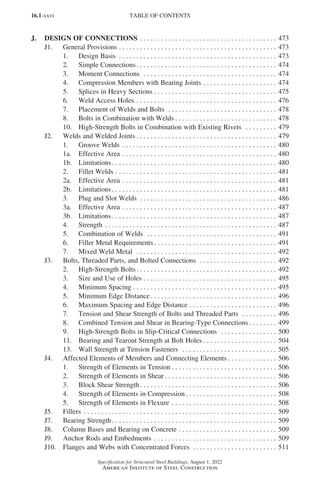
. is required
to reach kc = 0.76. Fully fixed restraint for an unstiffened compression element cor-
responds to kc = 1.3 while zero restraint gives kc = 0.42. Because of web-flange
interactions, it is possible to get kc  0.42 from the kc formula. If h t E F
w y
 5 70
. ,
use h t E F
w y
= 5 70
. in the kc equation, which corresponds to the 0.35 limit.
Rectangular HSS in Compression. The limits for rectangular HSS walls in uniform
compression (Case 6 in Table B4.1a) have been used in AISC Specifications since
1969 (AISC, 1969). They are based on Winter (1968), where adjacent stiffened
compression elements in box sections of uniform thickness were observed to provide
negligible torsional restraint for one another along their corner edges.
Round HSS in Compression. The λr limit for round HSS in compression (Case 9 in
Table B4.1a) was first used in the 1978 Specification for the Design, Fabrication,
and Erection of Structural Steel for Buildings (AISC, 1978). It was recommended in
Schilling (1965) based upon research reported in Winter (1968). Excluding the use
of round HSS with D t E Fy
 0 45
. was also recommended in Schilling (1965). This
is implied in Sections E7 and F8 where no criteria are given for round HSS with D t
greater than this limit.
Limiting Width-to-Thickness Ratios for Compression Elements in Members Sub-
jected to Flexure. Flexural members containing compression elements, all with
width-to-thickness ratios less than or equal to λp as provided in Table B4.1b, are desig-
nated as compact. Compact sections are capable of developing a fully plastic stress
Comm. B4.] MEMBER PROPERTIES
Part 16.1 Commentary A-E (295-369).indd 327
Part 16.1 Commentary A-E (295-369).indd 327 2023-01-23 6:59 PM
2023-01-23 6:59 PM
16.1-328
Specification for Structural Steel Buildings, August 1, 2022
American Institute of Steel Construction
distribution and they typically possess a rotation capacity, Rcap, of approximately 3
(see Figure C-A-1.2) before the onset of local buckling (Yura et al., 1978). Flexural
members containing any compression element with width-to-thickness ratios greater
than λp, but still with all compression elements having width-to-thickness ratios less
than or equal to λr, are designated as noncompact. Noncompact sections can develop
partial yielding in compression elements before local buckling occurs but will not
resist inelastic local buckling at the strain levels required for a fully plastic stress
distribution. Flexural members containing any compression elements with width-to-
thickness ratios greater than λr are designated as slender. Slender-element sections
have one or more compression elements that will buckle elastically before the yield
stress is achieved. Noncompact and slender-element sections are subject to flange
local buckling or web local buckling reductions as provided in Chapter F, and sum-
marized in Table User Note F1.1, and in Appendix 1.
The values of the limiting ratios, λp and λr, specified in Table B4.1b are similar to
those in the 1989 Specification for Structural Steel Buildings—Allowable Stress
Design and Plastic Design (AISC, 1989) and Table 2.3.3.3 of Galambos (1978),
except that λp y
E F
= 0 38
. , limited in Galambos (1978) to determinate beams
and to indeterminate beams when moments are determined by elastic analysis, was
adopted for all conditions on the basis of Yura et al. (1978). For greater inelastic
rotation capacities than provided by the limiting value of λp given in Table B4.1b or
for structures in areas of high seismicity, see AISC Seismic Provisions for Structural
Steel Buildings, Chapter D and Table D1.1 (AISC, 2022c).
Webs in Flexure. In the 2010 Specification for Structural Steel Buildings (AISC,
2010), and continuing for this Specification, formulas for λp were added as Case
16 in Table B4.1b for I-shaped beams with unequal flanges based on White (2008).
In extreme cases where the plastic neutral axis is located in the compression flange,
hp = 0 and the web is considered to be compact.
Rectangular HSS in Flexure. The lp limit for compact sections is adopted from Limit
States Design of Steel Structures (CSA, 2009). Lower values of λp are specified for
high-seismic design in the AISC Seismic Provisions for Structural Steel Buildings
(AISC, 2022c), based upon tests (Lui and Goel, 1987) that have shown that rectan-
gular HSS braces subjected to reversed axial load fracture catastrophically under
relatively few cycles if a local buckle forms. This was confirmed in tests (Sherman,
1995a) where rectangular HSS braces sustained over 500 cycles when a local buckle
did not form, even though general column buckling had occurred, but failed in less
than 40 cycles when a local buckle developed. Since 2005, the lp limit for webs in
rectangular HSS flexural members (Case 19 in Table B4.1b) has been reduced from
λp y
E F
= 3 76
. to λp y
E F
= 2 42
. based on the work of Wilkinson and Hancock
(1998, 2002).
Box Sections in Flexure. Since the 2016 Specification (AISC, 2016), box sections
have been defined separately from rectangular HSS. Thus, Case 21 in Table B4.1b
addresses flanges of box sections and Case 19 addresses webs of box sections.
Round HSS in Flexure. The λp values for round HSS in flexure (Case 20, Table
B4.1b) are based on Sherman (1976), Sherman and Tanavde (1984), and Ziemian
MEMBER PROPERTIES [Comm. B4.
Part 16.1 Commentary A-E (295-369).indd 328
Part 16.1 Commentary A-E (295-369).indd 328 2023-01-23 6:59 PM
2023-01-23 6:59 PM
16.1-329
Specification for Structural Steel Buildings, August 1, 2022
American Institute of Steel Construction
(2010). Beyond this, the local buckling strength decreases rapidly, making it imprac-
tical to use these sections in building construction.
Limiting Width-to-Thickness Ratios Where the Web and Flange are not Continu-
ously Attached. The Specification does not explicitly provide requirements for cases
where the cross-section elements are not continuously attached; this is due to the fact
that the buckling occurs over a short length and it is generally not practical to provide
less than continuous connection and still limit local buckling. Of course, a stiffened
element with one longitudinal edge intermittently connected may be conservatively
considered as an unstiffened element for the purposes of determining limiting width-
to-thickness ratios.
If an intermittent connection is to provide restraint similar to a continuous connec-
tion, it must provide adequate stiffness and strength at a spacing within the local
buckling half-wavelength of the cross-section element, in other words, at a spacing
less than approximately one-half the width-to-thickness ratio from Table B4.1 mul-
tiplied times the thickness. In general, width-to-thickness ratios similar to those in
Table B4.1 can be derived if the local buckling stress, Fcr, is accurately known. In
classic form, the local buckling stress is expressed as
F k
E t
b
cr =
−
( )






π
ν
2
2
2
12 1
(C-B4-1)
and is, therefore, a function of the material properties, dimensions, loading, and
boundary conditions as reflected through the plate buckling coefficient, k; see
Ziemian (2010). As detailed in Seif and Schafer (2010), if Fcr is known, then the lim-
iting width-to-thickness ratio, λr, from Table B4.1 is the b t such that F F
y cr = 0 7
.
for elements in compression and = 1.0 for elements in flexure. The limiting width-
to-thickness ratio, λp, from Table B4.1b is the b t such that F F
y cr = 0 46
. for
unstiffened elements and = 0.58 for stiffened elements. Thus, if the engineer can
approximate k, or perform a local buckling analysis consistent with the intermittent
connections for finding Fcr, then a limiting width-to-thickness ratio may be approxi-
mated. For an intermittently connected plate, AISI (2016) uses the approximation
of a pin-ended column of length equal to the connector spacing for determining Fcr.
For complex connection conditions, the provisions of Appendix 1 may provide an
alternative path for Specification-compliant design.
2. Design Wall Thickness for HSS
ASTM A500/A500M tolerances allow for a wall thickness that is not greater than
±10% of the nominal value. Because the plate and strip from which these HSS are
made are produced to a much smaller thickness tolerance, manufacturers in the
United States consistently produce these HSS with a wall thickness that is near the
lower-bound wall thickness limit. Consequently, AISC and the Steel Tube Institute
of North America (STI) recommend that 0.93 times the nominal wall thickness be
used for calculations involving engineering design properties of these HSS. This
results in a weight (mass) variation that is similar to that found in other structural
shapes. The design wall thickness and section properties based upon this reduced
thickness have been tabulated in AISC and STI publications since 1997.
Comm. B4.] MEMBER PROPERTIES
Part 16.1 Commentary A-E (295-369).indd 329
Part 16.1 Commentary A-E (295-369).indd 329 2023-01-23 6:59 PM
2023-01-23 6:59 PM
16.1-330
Specification for Structural Steel Buildings, August 1, 2022
American Institute of Steel Construction
Two new HSS material standards were added to the 2016 Specification (AISC,
2016). ASTM A1085/A1085M is a standard in which the wall thickness is permitted
to be no more than 5% under the nominal thickness and the mass is permitted to be
no more than 3.5% under the nominal mass. This is in addition to a Charpy V-notch
toughness limit and a limit on the range of yield strength that makes ASTM A1085/
A1085M suitable for seismic applications. With these tolerances, the design wall
thickness may be taken as the nominal thickness of the HSS. Other acceptable HSS
products that do not have the same thickness and mass tolerances must still use the
design thickness as 0.93 times the nominal thickness as discussed previously.
The other material standard added to the 2016 Specification was ASTM A1065/
A1065M. These HSS are produced by cold-forming two C-shaped sections and
joining them with two electric-fusion seam welds to form a square or rectangular
HSS. These sections are available in larger sizes than those produced in a tube mill.
Because the thickness meets plate tolerance limits, the design wall thickness may
be taken as the nominal thickness. Prior to the 2016 AISC Specification, they were
classified as box sections because they were not produced according to an ASTM
standard. With the ASTM A1065/A1065M standard, they are included as acceptable
HSS and the term box section is used for sections made by corner welding four plates
to form a hollow box.
3. Gross and Net Area Determination
3a. Gross Area
Gross area is the total area of the cross section without deductions for holes or inef-
fective portions of elements subjected to local buckling.
3b. Net Area
The net area is based on net width and load transfer at a particular chain. Because
of possible damage around a bolt hole during drilling or punching operations, z in.
(2 mm) is added to the nominal bolt hole diameter when computing the net area for
tension or shear.
Unless indicated otherwise, the net area associated with net tensile checks in the
Specification assumes the material that is removed represents bolt holes formed in
accordance with Section M2.5. For statically loaded structures, open bolt holes and
bolt holes filled with snug-tight or pretensioned bolts can be treated identically rela-
tive to the net area and net tensile checks. Holes for plug, slot, or fillet welds in holes
or slots are treated in the same manner as bolt holes.
B5. FABRICATION AND ERECTION
Section B5 provides the charging language for Chapter M on fabrication and erec-
tion.
B6. QUALITY CONTROL AND QUALITY ASSURANCE
Section B6 provides the charging language for Chapter N on quality control and
quality assurance.
MEMBER PROPERTIES [Comm. B4.
Part 16.1 Commentary A-E (295-369).indd 330
Part 16.1 Commentary A-E (295-369).indd 330 2023-01-23 6:59 PM
2023-01-23 6:59 PM
16.1-331
Specification for Structural Steel Buildings, August 1, 2022
American Institute of Steel Construction
B7. EVALUATION OF EXISTING STRUCTURES
Section B7 provides the charging language for Appendix 5 on the evaluation of
existing structures.
B8. DIMENSIONAL TOLERANCES
This new section replaces Section M2.7, Dimensional Tolerances, in the 2016 AISC
Specification (AISC, 2016).
Dimensional tolerances (and production methods) are used to limit the magnitude of
geometric imperfections present in members and structures. In some instances there
is a direct relationship between the permitted dimensional tolerances of the member
or structure and the design provisions provided in this Specification. Geometric
imperfections have the most significant effect relative to the stability of the members
and structures. Evaluation of members and structures outside the assumed tolerances
falls outside the scope of this Specification and should be based on tests or analysis,
subject to the approval of the authority having jurisdiction.
There are a number of conditions that could result in geometric imperfections greater
than those assumed in the Specification being present in structural steel elements.
• 
Engineers sometimes elect to employ materials that are not approved for use. In
such cases, the tolerances imposed by the standards for the chosen material may
exceed those permitted by comparable ASTM standards or no tolerances may be
enforced at all. Engineers must therefore either specify tighter tolerances consis-
tent with those assumed in the Specification or must account for the larger possible
tolerances in their designs,
• The AISC Code Standard Practice for Steel Buildings and Bridges (AISC, 2022a),
hereafter referred to as the Code of Standard Practice does not address every pos-
sible variation that could be encountered in practice. When a tolerance that is not
specified in the Code of Standard Practice is required so that the fabricated and
erected structural steel satisfy the design intent, the tolerance should be specified
in the contract documents. In some instances, it may be impractical to satisfy
tolerances comparable to those provided in the Code of Standard Practice or the
ASTM standards. In such cases, engineers must account for the larger permitted
tolerances in their designs,
• 
For various reasons, structural steel elements are sometimes unintentionally pro-
vided out-of-tolerance. In some instances, the problem may be discovered at a
point where repair of the element is impractical or unsafe. In such cases, engineers
must account for the larger permitted tolerances in their designs and reinforcement
of the member may be an option.
The classification of sections for local buckling in Section B4.1 assumes tolerances
and production methods inherent in the ASTM standards approved for use under
this Specification in Section A3.1a. The limiting width-to-thickness ratios, λr and λp,
may have to be adjusted if larger geometric imperfections exist. Chapter C permits
the use of any rational method of design for stability as long as the listed effects are
considered. Geometric imperfections is one of the effects that must be considered.
The effect of geometric imperfections larger than those permitted in the ASTM
Comm. B8.] DIMENSIONAL TOLERANCES
Part 16.1 Commentary A-E (295-369).indd 331
Part 16.1 Commentary A-E (295-369).indd 331 2023-01-26 11:21 AM
2023-01-26 11:21 AM
16.1-332
Specification for Structural Steel Buildings, August 1, 2022
American Institute of Steel Construction
standards approved for use under this Specification is not addressed in the effective
length method, the first-order analysis method, and the approximate second-order
analysis method. The use of these methods where such geometric imperfections
exist or are permitted is not consistent with the intent of the Specification. The
available compressive strength determined in Chapter E and the minimum strength
and stiffness to provide a braced point determined in Appendix 6 also assume that
dimensional tolerances provided in the Code of Standard Practice and in the ASTM
standards are satisfied.
AISC Design Guide 28, Stability Design of Steel Buildings (Griffis and White, 2013),
provides guidance relative to addressing geometric imperfections other than those
assumed in the Specification.
There are also conditions for which geometric imperfections may have negligible
effect on the strength of the element. Out-of-straightness within reasonable toler-
ances does not affect the strength of tension members. Applied tension tends to
reduce, whereas compression tends to amplify, out-of-straightness. Sometimes
cambering of beams can result in distortion of the web. Lateral deflection or out-of-
flatness of webs of girders subjected to static loading is of no structural significance.
See also the commentaries to Chapters C, E, and F, and Appendices 1 and 7.
DIMENSIONAL TOLERANCES [Comm. B8.
Part 16.1 Commentary A-E (295-369).indd 332
Part 16.1 Commentary A-E (295-369).indd 332 2023-01-23 6:59 PM
2023-01-23 6:59 PM
16.1-333
Specification for Structural Steel Buildings, August 1, 2022
American Institute of Steel Construction
CHAPTER C
DESIGN FOR STABILITY
Chapter C has no major changes or additions in this edition of the Specification.
Design for stability is the combination of analysis to determine the required strengths of
components and proportioning of components to have adequate available strengths. Various
methods are available to provide for stability (Ziemian, 2010).
Chapter C addresses the stability design requirements for steel buildings and other structures.
It is based upon the direct analysis method, which can be used in all cases. The effective
length method and first-order analysis method are addressed in Appendix 7 as alternative
methods of design for stability, and may be used when the limits in Appendix 7, Sections
7.2.1 and 7.3.1, respectively, are satisfied. A complete discussion of each of these methods,
along with example problems, may be found in AISC Design Guide 28, Stability Design
of Steel Buildings (Griffis and White, 2013). Other approaches are permitted provided the
general requirements in Section C1 are satisfied. For example, Appendix 1 provides logical
extensions to the direct analysis method, in which design provisions are provided for explic-
itly modeling member imperfections and inelasticity. First-order elastic structural analysis
without stiffness reductions for inelasticity is not sufficient to assess stability because the
analysis and the equations for component strengths are inextricably interdependent.
C1. GENERAL STABILITY REQUIREMENTS
There are many parameters and behavioral effects that influence the stability of steel-
framed structures (Birnstiel and Iffland, 1980; McGuire, 1992; White and Chen,
1993; ASCE, 1997; Ziemian, 2010). The stability of structures and individual ele-
ments must be considered from the standpoint of the structure as a whole, including
not only compression members, but also beams, bracing systems, and connections.
Many building codes include stiffness requirements for control of seismic drift,
which act as an indirect limit on sidesway amplification. ASCE/SEI 7, Minimum
Design Loads and Associated Criteria for Buildings and Other Structures (ASCE,
2022), directly limits a stability coefficient, q, (approximately equal to 1 1 2
− B ) to
0.25 for seismic design of buildings, effectively requiring that ∆ ∆
2 1
nd order st order
- - ,
calculated with nominal stiffness, not exceed a value of 1.33 if Pmf = 0 nor 1.44 if
Pmf = Pstory (Sabelli and Griffis, 2021). This limit is well within the more general
recommendation that sidesway amplification, calculated with reduced stiffness,
should be equal to or less than 2.5. The latter recommendation is made because at
larger levels of amplification, small changes in gravity loads and/or structural stiff-
ness can result in relatively larger changes in sidesway deflections and second-order
effects, due to large geometric nonlinearities.
Table C-C1.1 shows how the five general requirements, provided in Section C1, are
addressed in the direct analysis method (Sections C2 and C3) and the effective length
method (Appendix 7, Section 7.2). The first-order analysis method (Appendix 7,
Part 16.1 Commentary A-E (295-369).indd 333
Part 16.1 Commentary A-E (295-369).indd 333 2023-01-23 6:59 PM
2023-01-23 6:59 PM
16.1-334
Specification for Structural Steel Buildings, August 1, 2022
American Institute of Steel Construction
TABLE C-C1.1
Comparison of Basic Stability Requirements with
Specific Provisions
Basic Requirement in Section C1
Provision in
Direct Analysis
Method
(DM)
Provision in
Effective Length
Method
(ELM)
(1) Consider all deformations C2.1(a). Consider
all deformations
Same as DM
(by reference to C2.1)
(2) 
Consider second-order effects (both P-∆ and
P-δ)
C2.1(b). Consider
second-order effects
(P-∆ and P-δ)[b]
Same as DM
(by reference to C2.1)
(3) 
Consider geometric
imperfections
This includes joint-
position imperfections[a]
(which affect structure
response) and member
imperfections (which
affect structure
response and member
strength).
Effect of system
imperfections on
structure response
C2.2a. Direct
modeling or
C2.2b. Notional loads
Same as DM,
second option only
(by reference to C2.2b)
Effect of member
imperfections on
structure response
Included in the
stiffness reduction
specified in C2.3
All these effects are
considered by using
Lc = KL from a
sidesway buckling
analysis in the
member strength check.
Note that the differences
between DM and ELM
are as follows:
• 
DM uses reduced
stiffness in the
analysis and Lc = L
in the member
strength check.
• 
ELM uses full stiffness
in the analysis and
Lc = KL from sidesway
buckling analysis in
the member strength
check.
Effect of member
imperfections on
member strength
Included in member
strength formulas,
with Lc = L
(4) 
Consider stiffness
reduction due to
inelasticity
This affects structure
response and member
strength.
Effect of stiffness
reduction on
structure response
Included in the
stiffness reduction
specified in C2.3
Effect of stiffness
reduction on member
strength
Included in member
strength formulas,
with Lc = L
(5) 
Consider uncertainty in
strength and stiffness
This affects structure
response and member
strength.
Effect of stiffness/
strength uncertainty
on structure response
Included in the
stiffness reduction
specified in C2.3
Effect of stiffness/
strength uncertainty
on member strength
Included in member
strength formulas,
with Lc = L
[a]In typical building structures, the “joint-position imperfections” refers to column out-of-plumbness.
[b]
Second-order effects may be considered either by a computational P-∆ and P-δ analysis or by the approxi-
mate method (using B1 and B2 multipliers) specified in Appendix 8.
Section 7.3) is not included in Table C-C1.1 because it addresses these requirements
in an indirect manner using a mathematical manipulation of the direct analysis
method. The additional lateral load required in Appendix 7, Section 7.3.2(a), is
calibrated to achieve roughly the same result as the collective effects of notional
loads required in Section C2.2b, P-∆ effects required in Section C2.1(b), and the
stiffness reduction required in Section C2.3. Additionally, a B1 multiplier addresses
P-δ effects as defined in Appendix 8, Section 8.1.2.
In the 2010 AISC Specification (AISC, 2010), uncertainties in stiffness and strength
was added to the list of effects that should be considered when designing for stability.
GENERAL STABILITY REQUIREMENTS [Comm. C1.
Part 16.1 Commentary A-E (295-369).indd 334
Part 16.1 Commentary A-E (295-369).indd 334 2023-01-23 6:59 PM
2023-01-23 6:59 PM
16.1-335
Specification for Structural Steel Buildings, August 1, 2022
American Institute of Steel Construction
Although all methods detailed in this Specification, including the direct analysis
method, the effective length method, and the first-order elastic method, satisfy this
requirement, the effect is listed so that it is clear that it is to be included, along with
the original four other effects, when any other rational method of designing for sta-
bility is employed.
C2. CALCULATION OF REQUIRED STRENGTHS
Analysis to determine required strengths in accordance with this section and the
assessment of member and connection available strengths in accordance with Section
C3 form the basis of the direct analysis method of design for stability. This method
is useful for the stability design of all structural steel systems, including moment
frames, braced frames, shear walls, and combinations of these and similar systems
(AISC-SSRC, 2003a). While the precise formulation of this method is unique to the
Specification, some of its features are similar to those found in other major design
specifications around the world, including the Eurocodes, the Australian standard,
the Canadian standard, and ACI 318 (ACI, 2019).
The direct analysis method allows a more accurate determination of the load effects
in the structure through the inclusion of the effects of geometric imperfections and
stiffness reductions directly within the structural analysis. This also allows the use
of K =1 0
. in calculating the in-plane column strength, Pc, within the beam-column
interaction equations of Chapter H. This is a significant simplification in the design
of steel moment frames and combined systems. Verification studies for the direct
analysis method are provided by Deierlein et al. (2002), Maleck and White (2003),
and Martinez-Garcia and Ziemian (2006).
1. General Analysis Requirements
Deformations to be Considered in the Analysis. It is required that the analysis
consider flexural, shear, and axial deformations, and all other component and con-
nection deformations that contribute to the displacement of the structure. However,
it is important to note that “consider” is not synonymous with “include,” and some
deformations can be neglected after rational consideration of their likely effect. For
example, the in-plane deformation of a concrete-on-steel deck floor diaphragm in an
office building usually can be neglected, but that of a cold-formed steel roof deck
in a large warehouse with widely spaced lateral force-resisting elements usually
cannot. As another example, shear deformations in beams and columns in a low-
rise moment frame usually can be neglected, but this may not be true in a high-rise
framed-tube system with relatively deep members and short spans. For such frames,
the use of rigid offsets to account for member depths may significantly overestimate
frame stiffness and consequently underestimate second-order effects due to high
shear stresses within the panel zone of the connections. For example, Charney and
Johnson (1986) found that for the range of columns and beam sizes they studied, the
deflections of a subassembly modeled using centerline dimensions could vary from
an overestimation of 23% to an underestimation of 20% when compared to a finite
element model. Charney and Johnson conclude that analysis based on centerline
dimensions may either underestimate or overestimate drift, with results depending
on the span of the girder and on the web thickness of the column.
Comm. C2.] CALCULATION OF REQUIRED STRENGTHS
Part 16.1 Commentary A-E (295-369).indd 335
Part 16.1 Commentary A-E (295-369).indd 335 2023-01-23 6:59 PM
2023-01-23 6:59 PM
16.1-336
Specification for Structural Steel Buildings, August 1, 2022
American Institute of Steel Construction
Second-Order Effects. The direct analysis method includes the basic requirement to
calculate the internal load effects using a second-order analysis that accounts for both
P-∆ and P-δ effects (see Figure C-C2.1). P-∆ effects are the effects of loads acting
on the displaced location of joints or member-end nodes in a structure. P-δ effects
are the effect of loads acting on the deflected shape of a member between joints or
member-end nodes.
Many, but not all, modern commercial structural analysis programs are capable of
accurately and directly modeling all significant P-∆ and P-δ second-order effects.
Programs that accurately estimate second-order effects typically solve the govern-
ing differential equations either through the use of a geometric stiffness approach
(McGuire et al., 2000; Ziemian, 2010) or the use of stability functions (Chen and Lui,
1987). What is, and just as importantly what is not, included in the analysis should be
verified by the user for each particular program. Some programs neglect P-δ effects
in the analysis of the structure, and because this is a common approximation that is
permitted under certain conditions, it is discussed at the end of this section.
Methods that modify first-order analysis results through second-order multipliers are
permitted. The use of the B1 and B2 multipliers provided in Appendix 8 is one such
method. The accuracy of other methods should be verified.
Analysis Benchmark Problems. The following benchmark problems are recom-
mended as a first-level check to determine whether an analysis procedure meets the
requirements of a P-∆ and P-δ second-order analysis adequate for use in the direct
analysis method (and the effective length method in Appendix 7). Some second-
order analysis procedures may not include the effects of P-δ on the overall response
of the structure. These benchmark problems are intended to reveal whether or not
these effects are included in the analysis. It should be noted that in accordance with
the requirements of Section C2.1(b), it is not always necessary to include P-δ effects
in the second-order analysis (additional discussion of the consequences of neglecting
these effects will follow).
Fig. C-C2.1. P-Δ and P-δ effects in beam-columns.
CALCULATION OF REQUIRED STRENGTHS [Comm. C2.
Part 16.1 Commentary A-E (295-369).indd 336
Part 16.1 Commentary A-E (295-369).indd 336 2023-01-23 6:59 PM
2023-01-23 6:59 PM
16.1-337
Specification for Structural Steel Buildings, August 1, 2022
American Institute of Steel Construction
The benchmark problem descriptions and solutions are shown in Figures C-C2.2
and C-C2.3. Proportional loading is assumed and axial, flexural, and shear deforma-
tions are included. Case 1 is a simply supported beam-column subjected to an axial
load concurrent with a uniformly distributed transverse load between supports. This
problem contains only P-δ effects because there is no translation of one end of the
member relative to the other. Case 2 is a fixed-base cantilevered beam-column sub-
jected to an axial load concurrent with a lateral load at its top. This problem contains
both P-∆ and P-δ effects. In confirming the accuracy of the analysis method, both
moments and deflections should be checked at the locations shown for the various
levels of axial load on the member and in all cases should agree within 3% and 5%,
respectively.
P
28.0
ft
(8.53
m)
Major-axis bending
W14´48 (W360´72)
E = 29,000 ksi (200 000 MPa)
0.200
kip/ft
(2.92
kN/m)
Axial Force, P (kips) 0 150 300 450
235 270 316 380
[235] [269] [313] [375]
Mmid (kip-in.)
Dmid (in.)
0.202 0.230 0.269 0.322
[0.197] [0.224] [0.261] [0.311]
Axial Force, P´10 (N) 0 667 1,330 2,000
26.6 30.5 35.7 42.9
[26.6] [30.4] [35.4] [42.4]
Mmid´10 (N-mm)
Dmid (mm)
5.13 5.84 6.83 8.18
[5.00] [5.69] [6.63] [7.90]
Analyses include axial, flexural, and shear deformations.
[Values in brackets] exclude shear deformations.
-3
-6
Fig. C-C2.2. Benchmark problem Case 1.
Fig. C-C2.3. Benchmark problem Case 2.
Comm. C2.] CALCULATION OF REQUIRED STRENGTHS
Part 16.1 Commentary A-E (295-369).indd 337
Part 16.1 Commentary A-E (295-369).indd 337 2023-01-23 6:59 PM
2023-01-23 6:59 PM
16.1-338
Specification for Structural Steel Buildings, August 1, 2022
American Institute of Steel Construction
Given that there are many attributes that must be studied to confirm the accuracy of
a given analysis method for routine use in the design of general framing systems,
a wide range of benchmark problems should be employed. Several other targeted
analysis benchmark problems can be found in White et al. (2021), Chen and Lui
(1987), and McGuire et al. (2000). When using benchmark problems to assess the
correctness of a second-order procedure, the details of the analysis used in the bench-
mark study, such as the number of elements used to represent the member and the
numerical solution scheme employed, should be replicated in the analysis used to
design the actual structure. Because the ratio of design load to elastic buckling load
is a strong indicator of the influence of second-order effects, benchmark problems
with such ratios on the order of 0.6 to 0.7 should be included.
Effect of Neglecting P-δ
δ. A common type of approximate analysis is one that captures
only P-∆ effects due to member end translations (for example, interstory drift) but fails
to capture P-δ effects due to curvature of the member relative to its chord. This type of
analysis is referred to as a P-∆ analysis. Where P-δ effects are significant, errors arise
in approximate methods that do not accurately account for the effect of P-δ moments
on amplification of both local (δ) and global (∆) displacements, and corresponding
internal moments. These errors can occur both with second-order computer analysis
programs and with the B1 and B2 amplifiers. For instance, the RM modifier in Equation
A-8-7 is an adjustment factor that approximates the effects of P-δ (due to column
curvature) on the overall sidesway displacements, ∆, and the corresponding moments.
For regular rectangular moment frames, a single-element-per-member P-∆ analysis is
equivalent to using the B2 amplifier of Equation A-8-6 with RM = 1, and hence, such
an analysis neglects the effect of P-δ on the response of the structure.
Section C2.1(b) indicates that a P-∆-only analysis (one that neglects the effect of
P-δ deformations on the response of the structure) is permissible for typical building
structures when the ratio of second-order drift to first-order drift is less than 1.7 and
no more than one-third of the total gravity load on the building is on columns that
are part of moment-resisting frames. The latter condition is equivalent to an RM value
of 0.95 or greater. When these conditions are satisfied, the error in lateral displace-
ment from a P-∆-only analysis typically will be less than 3%. However, when the
P-δ effect in one or more members is large (corresponding to a B1 multiplier of more
than about 1.2), use of a P-∆-only analysis may lead to larger errors in the nonsway
moments in components connected to the high-P-δ members.
The engineer should be aware of this possible error before using a P-∆-only analysis
in such cases. For example, consider the evaluation of the fixed-base cantilevered
beam-column shown in Figure C-C2.4 using the direct analysis method. The side-
sway displacement amplification factor is 3.83 and the base moment amplifier is
3.32, giving Mu = 1,390 kip-in. (157 × 106 N-mm).
For the loads shown, the beam-column strength interaction according to Equation
H1-1a is equal to 1.0. The sidesway displacement and base moment amplification
determined by a single-element P-∆ analysis, which ignores the effect of P-δ on
the response of the structure, is 2.55, resulting in an estimated Mu = 1,070 kip-in.
(121 × 106 N-mm)an error of 23.2% relative to the more accurate value of Mu—
and a beam-column interaction value of 0.91.
CALCULATION OF REQUIRED STRENGTHS [Comm. C2.
Part 16.1 Commentary A-E (295-369).indd 338
Part 16.1 Commentary A-E (295-369).indd 338 2023-01-23 6:59 PM
2023-01-23 6:59 PM
16.1-339
Specification for Structural Steel Buildings, August 1, 2022
American Institute of Steel Construction
P-δ effects can be captured in some (but not all) P-∆-only analysis methods by subdi-
viding the members into multiple elements. For this example, three equal-length P-∆
analysis elements are required to reduce the errors in the second-order base moment
and sidesway displacement to less than 3% and 5%, respectively.
It should be noted that, in this case, the unconservative error that results from ignor-
ing the effect of P-δ on the response of the structure is removed through the use of
Equation A-8-8. For the loads shown in Figure C-C2.4, Equations A-8-6 and A-8-7
with RM = 0 85
. give a B2 amplifier of 3.52. This corresponds to Mu = 1,480 kip-in.
(170 × 106 N-mm) in the preceding example; approximately 6% over that determined
from a computational second-order analysis that includes both P-∆ and P-δ effects.
For sway columns with nominally simply supported base conditions, the errors in the
second-order internal moment and in the second-order displacements from a P-∆-only
analysis are generally smaller than 3% and 5%, respectively, when αP P
r eL ≤ 0 05
. ,
where
a = 1.0 (LRFD)
=
1.6 (ASD)		
Pr = required axial force, ASD or LRFD, kips (N)
PeL = π2 2
EI L if the analysis uses nominal stiffness, kips (N)
=

0 8 2 2
. τ π
b EI L if the analysis uses a flexural stiffness reduction of 0.8τb,
kips (N)
For sway columns with rotational restraint at both ends of at least 1 5
. EI L
( ) if the
analysis uses nominal stiffness, or 1 5 0 8
. . τbEI L
( ) if the analysis uses a flexural
stiffness reduction of 0.8τb, the errors in the second-order internal moments and
displacements from a P-∆-only analysis are generally smaller than 3% and 5%, respec-
tively, when αP P
r eL ≤ 0 12
. .
 
 
0.50, 1.0
0.80 29,000 ksi 23,200 ksi (160 000 MPa)
2 1 8,920 ksi (61 500 MPa)
u y
P P
E
G E
  
  
   
 
  
2
6
Computational - and - analysis:
2.22 in. (56.4 mm)
1
,390 kip-in. 157 10 N-mm
8 9 1.00
nd
u
u c n u b n
P P
M
P P M M
 
 
 
   
 
  
1
6
1
1
- 6
1
-
Single-element - analysis:
0.580 in. (15 mm)
419 kip-in. (47.3 10 N-mm)
1
2.55
1
2.55 1,070 kip-in. (121 10 N-mm)
8 9 0.910
st
st
u st
P
u st
P
u c n u b n
P
M HL
P HL
M M
P P M M



 
  

 
 
 
  
   
Pu  440 kips (1.96106
N)
15.0
ft
(4.6
m)
Major-axis bending
Fully braced out-of-plane
W1060 (W25089)
Fy  50 ksi (345 MPa)
Include axial, flexural,
and shear deformations
H  Hu  Ni
 1.45 kips  0.002(440 kips)
 2.33 kips (10 400 N)
Fig. C-C2.4. Illustration of potential errors associated with
the use of a single-element-per-member P-∆ analysis.
Comm. C2.] CALCULATION OF REQUIRED STRENGTHS
Part 16.1 Commentary A-E (295-369).indd 339
Part 16.1 Commentary A-E (295-369).indd 339 2023-01-23 6:59 PM
2023-01-23 6:59 PM
16.1-340
Specification for Structural Steel Buildings, August 1, 2022
American Institute of Steel Construction
For members subjected predominantly to nonsway end conditions, the errors in the
second-order internal moments and displacements from a P-∆-only analysis are gen-
erally smaller than 3% and 5%, respectively, when αP P
r eL ≤ 0 05
. .
In meeting these limitations for use of a P-∆-only analysis, it is important to note
that in accordance with Section C2.1(b) the moments along the length of the member
(in other words, the moments between the member-end nodal locations) should be
amplified as necessary to include P-δ effects. One device for achieving this is the
use of a B1 factor.
White et al. (2021) provide further guidelines for the appropriate number of P-∆
analysis elements in cases where the P-∆-only analysis limits are exceeded, as well
as guidelines for calculating internal element second-order moments. They also pro-
vide relaxed guidelines for the number of elements required per member when using
typical second-order analysis capabilities that include both P-∆ and P-δ effects.
As previously indicated, the engineer should verify the accuracy of second-order
analysis software by comparisons to known solutions for a range of representative
loadings. In addition to the examples presented in Chen and Lui (1987) and McGuire
et al. (2000), White et al. (2021) provides five useful benchmark problems for testing
second-order analysis of frames composed of prismatic members. In addition, they
provide benchmarks for evaluation of second-order analysis capabilities for web-
tapered members.
Analysis with Factored Loads. It is essential that the analysis of the system be
made with loads factored to the strength limit state level because of the nonlinearity
associated with second-order effects. For design by ASD, this load level is estimated
as 1.6 times the ASD load combinations, and the analysis must be conducted at this
elevated load to capture second-order effects at the strength level.
Because second-order effects are dependent on the ratios of applied loads and mem-
ber forces to structural and member stiffnesses, equivalent results may be obtained
by using 1.0 times ASD load combinations if all stiffnesses are reduced by a fac-
tor of 1.6, in other words, using 0.5E instead of 0.8E in the second-order analysis
(note that the use of 0.5E is similar to the 12/23 factor used in the definition of ′
Fe
in earlier ASD Specifications). With this approach, required member strengths are
provided directly by the analysis and do not have to be divided by 1.6 when evaluat-
ing member capacities using ASD. Notional loads, Ni, would also be defined using
1.0 times ASD load combinations, in other words, α = 1.0. tb would be redefined as
τb = 1.0 when P P
r ns ≤ 0 3
. and τb r ns r ns
P P P P
= ( ) −
( )
4 0 6 1 0 6
. . when P P
r ns  0 3
. .
The stiffness of components comprised of other materials should be evaluated at
design loads and reduced by the same 1.6 factor, although this may be overly con-
servative if these stiffnesses already include φ-factors. Serviceability criteria may
be assessed using 50% of the deflections from this analysis, although this will over-
estimate second-order effects at service loads.
2. Consideration of Initial System Imperfections
Current stability design provisions are based on the premise that the member forces
are calculated by second-order elastic analysis, where equilibrium is satisfied on the
CALCULATION OF REQUIRED STRENGTHS [Comm. C2.
Part 16.1 Commentary A-E (295-369).indd 340
Part 16.1 Commentary A-E (295-369).indd 340 2023-01-23 6:59 PM
2023-01-23 6:59 PM
16.1-341
Specification for Structural Steel Buildings, August 1, 2022
American Institute of Steel Construction
deformed geometry of the structure. Initial imperfections in the structure, such as
out-of-plumbness and material and fabrication tolerances, create additional destabi-
lizing effects.
In the development and calibration of the direct analysis method, initial geometric
imperfections were conservatively assumed equal to the maximum material, fabrica-
tion, and erection tolerances permitted in the AISC Code of Standard Practice for
Steel Buildings and Bridges (AISC, 2005a), which at the time included a member
out-of-straightness equal to L 1,000, where L is the member length between brace
or framing points, and a frame out-of-plumbness equal to H 500, where H is the
story height. Although the L 1,000 requirement on member out-of-straightness is no
longer specified in the current Code of Standard Practice (AISC, 2022a), it continues
to be specified in applicable ASTM material standards. The permitted out-of-plumb-
ness may be smaller in some cases, as specified in the Code of Standard Practice.
Initial imperfections may be accounted for in the direct analysis method through
direct modeling (Section C2.2a) or the inclusion of notional loads (Section C2.2b).
When second-order effects are such that the maximum sidesway amplification,
∆ ∆
2 1
nd order st order
- - or B2 ≤ 1.7 using the reduced elastic stiffness (or 1.5 using the
unreduced elastic stiffness) for all lateral load combinations, it is permitted to apply
notional loads only in gravity load-only combinations and not in combination with
other lateral loads. At this low range of sidesway amplification or B2, the errors in
internal forces caused by not applying the notional loads in combination with other
lateral loads are relatively small. When B2 is above this threshold, notional loads
must also be applied in combination with other lateral loads.
Appendix 1, Section 1.2, includes an extension to the direct analysis method that per-
mits direct modeling of initial imperfections along the lengths of members (member
imperfections) as well as at member ends (system imperfections). This extension
permits axially loaded members (columns and beam-columns according to Chapters
E and H, respectively) to be designed by employing a nominal compressive strength
that is taken as the cross-sectional strength; this is equivalent to the use of an effec-
tive member length, Lc = 0, when computing the nominal compressive strength, Pn,
of compression members.
The Specification requirements for consideration of initial imperfections are intended
to apply only to analyses for strength limit states. It is not necessary, in most cases, to
consider initial imperfections in analyses for serviceability conditions such as drift,
deflection, and vibration.
3. Adjustments to Stiffness
Partial yielding accentuated by residual stresses in members can produce a general
softening of the structure at the strength limit state that further creates additional
destabilizing effects. The direct analysis method is also calibrated against inelastic
distributed-plasticity analyses that account for the spread of plasticity through the
member cross section and along the member length. In these calibration studies,
residual stresses in wide-flange shapes were assumed to have a maximum value of
0.3Fy in compression at the flange tips, and a distribution matching the so-called
Comm. C2.] CALCULATION OF REQUIRED STRENGTHS
Part 16.1 Commentary A-E (295-369).indd 341
Part 16.1 Commentary A-E (295-369).indd 341 2023-01-23 6:59 PM
2023-01-23 6:59 PM
16.1-342
Specification for Structural Steel Buildings, August 1, 2022
American Institute of Steel Construction
Lehigh pattern—a linear variation across the flanges and uniform tension in the web
(Ziemian, 2010).
Reduced stiffness (EI* = 0.8τbEI and EA* = 0.8τbEA) is used in the direct analysis
method for two reasons. First, for frames with slender members, where the limit state
is governed by elastic stability, the 0.8 factor on stiffness results in a system avail-
able strength equal to 0.8 times the elastic stability limit. This is roughly equivalent
to the margin of safety implied in the design provisions for slender columns by the
effective length procedure where, from Equation E3-3, fPn = 0.90(0.877Pe) = 0.79Pe.
Second, for frames with intermediate or stocky columns, the 0.8τb factor reduces the
stiffness to account for inelastic softening prior to the members reaching their design
strength. The τb factor is similar to the inelastic stiffness reduction factor implied
in the column curve to account for loss of stiffness under high compression loads
(αPr  0.5Pns), and the 0.8 factor accounts for additional softening under combined
axial compression and bending. It is a fortuitous coincidence that the reduction coef-
ficients for both slender and stocky columns are close enough, such that the single
reduction factor of 0.8τb works over the full range of slenderness. For the 2016 AISC
Specification (AISC, 2016), the definition for τb was modified to account for the
effects of local buckling of slender elements in compression members.
The use of reduced stiffness only pertains to analyses for strength and stability limit
states. It does not apply to analyses for other stiffness-based conditions and criteria,
such as for drift, deflection, vibration, and period determination.
For ease of application in design practice, where τb = 1, the reduction on EI and EA
can be applied by modifying E in the analysis. However, for computer programs that
do semi-automated design, one should confirm that the reduced E is applied only for
the second-order analysis. The elastic modulus should not be reduced in nominal
strength equations that include E (for example, Mn for lateral-torsional buckling in
an unbraced beam).
As shown in Figure C-C2.5, the net effect of modifying the analysis in the man-
ner just described is to amplify the second-order forces such that they are closer to
the actual internal forces in the structure. It is for this reason that the beam-column
interaction for in-plane flexural buckling is checked using an axial strength, PnL,
calculated from the column curve using the actual unbraced member length, Lc = L,
in other words, with K = 1.0.
In cases where the flexibility of other structural components (connections, column
base details, horizontal trusses acting as diaphragms) is modeled explicitly in the
analysis, the stiffness of these components also should be reduced. The stiffness
reduction may be taken conservatively as EA* = 0.8EA and EI* = 0.8EI for all cases.
Surovek et al. (2005) discusses the appropriate reduction of connection stiffness in
the analysis of partially restrained frames.
Where concrete or masonry shear walls or other nonsteel components contribute to
the stability of the structure and the governing codes or standards for those elements
specify a greater stiffness reduction, the greater reduction should be applied.
CALCULATION OF REQUIRED STRENGTHS [Comm. C2.
Part 16.1 Commentary A-E (295-369).indd 342
Part 16.1 Commentary A-E (295-369).indd 342 2023-01-23 6:59 PM
2023-01-23 6:59 PM
16.1-343
Specification for Structural Steel Buildings, August 1, 2022
American Institute of Steel Construction
Comm. C3.] CALCULATION OF AVAILABLE STRENGTHS
C3. CALCULATION OF AVAILABLE STRENGTHS
Section C3 provides that when the analysis meets the requirements in Section C2,
the member provisions for available strength in Chapters D through I and connection
provisions in Chapters J and K complete the process of design by the direct analysis
method. The effective length for flexural buckling may be taken as the unbraced
length for all members in the strength checks.
Where beams and columns rely upon braces that are not part of the lateral force-
resisting system to define their unbraced length, the braces themselves must have
sufficient strength and stiffness to control member movement at the brace points
(see Appendix 6). Design requirements for braces that are part of the lateral force-
resisting system (that is, braces that are included within the analysis of the structure)
are included within Chapter C.
(a) Effective length method (PnKL is the nominal compressive strength used in
the effective length method; see Appendix 7)
(b) Direct analysis method (DM)
Fig. C-C2.5. Comparison of in-plane beam-column interaction checks for
(a) the effective length method and (b) the direct analysis method (DM).
Part 16.1 Commentary A-E (295-369).indd 343
Part 16.1 Commentary A-E (295-369).indd 343 2023-01-23 6:5
AISC 360-22 Specification for Structural Steel Buildings.pdf

AISC 360-22 Specification for Structural Steel Buildings.pdf

  • 1.
    ANSI/AISC 360-22 An AmericanNational Standard Specification for Structural Steel Buildings August 1, 2022 Supersedes the Specification for Structural Steel Buildings dated June 7, 2016, and all previous versions Approved by the Committee on Specifications
  • 3.
    ANSI/AISC 360-22 An AmericanNational Standard Specification for Structural Steel Buildings August 1, 2022 Supersedes the Specification for Structural Steel Buildings dated June 7, 2016, and all previous versions Approved by the Committee on Specifications
  • 4.
    16.1-ii Specification for StructuralSteel Buildings, August 1, 2022 American Institute of Steel Construction © AISC 2022 by American Institute of Steel Construction All rights reserved. This book or any part thereof must not be reproduced in any form without the written permission of the publisher. The AISC logo is a registered trademark of AISC. The information presented in this publication has been prepared by a balanced commit- tee following American National Standards Institute (ANSI) consensus procedures and recognized principles of design and construction. While it is believed to be accurate, this information should not be used or relied upon for any specific application without compe- tent professional examination and verification of its accuracy, suitability, and applicability by a licensed engineer or architect. The publication of this information is not a representa- tion or warranty on the part of the American Institute of Steel Construction, its officers, agents, employees, or committee members, or of any other person named herein, that this information is suitable for any general or particular use, or of freedom from infringement of any patent or patents. All representations or warranties, express or implied, other than as stated above, are specifically disclaimed. Anyone making use of the information presented in this publication assumes all liability arising from such use. Caution must be exercised when relying upon standards and guidelines developed by other bodies and incorporated by reference herein since such material may be modified or amended from time to time subsequent to the printing of this edition. The American Institute of Steel Construction bears no responsibility for such material other than to refer to it and incorporate it by reference at the time of the initial publication of this edition. Printed in the United States of America Revised September 2023 Part 16.1 Prelims (i-lxvi).indd 2 Part 16.1 Prelims (i-lxvi).indd 2 2023-09-24 11:00 PM 2023-09-24 11:00 PM
  • 5.
    16.1-iii Specification for StructuralSteel Buildings, August 1, 2022 American Institute of Steel Construction DEDICATION Theodore V. Galambos, P.E., Ph.D., DM.ASCE, M.NAE This edition of the AISC Specification is dedicated to Dr. Theodore (Ted) V. Galambos, a long-time member of the AISC Committee on Specifications and several of its Task Committees. His pivotal research and publications on the load and resistance factor design (LRFD) method transformed the AISC Specification. This method of designing steel build- ings was first introduced in the 1986 AISC Load and Resistance Factor Design Specification for Structural Steel Buildings. Ted led the effort to adopt this new method and helped main- tain it through numerous editions of the Specification. Ted was also the co-author of the Development of a Probability Based Load Criterion for American National Standard, the document on which ASCE/SEI 7 is based. For his contributions to research, development, and teaching of behavior, analysis, and design of steel structures, and application of probabilistic methods, Ted was elected as a member of the National Academy of Engineering in 1979 and as a Distinguished Member of the American Society of Civil Engineers (ASCE) in 1990. In addition to his work on code committees, Ted has been directly involved with numer- ous other publications that have promoted the state-of-the-art of structural steel design and construction, including as author of Structural Members and Frames (1968) and senior author of Basic Steel Design with LRFD (1996), as well as serving as editor of the 4th and 5th editions of the Guide to Stability Design Criteria for Metal Structures (1988, 1998). He has also continually demonstrated a commitment to the practice of engineering by serving as a consultant to industry through his activities with AISC, the Steel Joist Institute, and the American Iron and Steel Institute. After receiving his doctorate from Lehigh University in 1959, Ted became a Research Assistant Professor at Lehigh University. In the late 1950s and early 1960s, his research focused on the stability behavior and plastic design of steel beam-columns and multistory steel frames. While at Lehigh, he conducted fundamental tests on the inelastic behavior of steel wide-flange members. In 1965, Ted moved to Washington University in St. Louis as the first holder of the Harold D. Jolley Professorship, and he served as Department Chair from 1970 to 1978. At this time, Ted also began his ground-breaking research on LRFD of struc- tures. Ted was appointed the James L. Record Professor of Civil Engineering at the University of Minnesota in 1981, where he continued a distinguished record of research, teaching, and service through professional committee activities, including ASCE, the Structural Stability Research Council, the Transportation Research Board, and the International Association for Bridge and Structural Engineering. Part 16.1 Prelims (i-lxvi).indd 3 Part 16.1 Prelims (i-lxvi).indd 3 2023-01-11 9:08 AM 2023-01-11 9:08 AM
  • 6.
    16.1-iv Specification for StructuralSteel Buildings, August 1, 2022 American Institute of Steel Construction As a professor, Ted is a beloved teacher who instructed many future engineers in steel design with an exemplary blending of theory and practice. Ted’s commitment to sharing his knowledge, his willingness to mentor several generations of young researchers, and his strong ethical standards have made him one of the giants of his generation. His contributions on the behavior of steel structures will have a lasting impact on the structural engineering profession. DEDICATION Part 16.1 Prelims (i-lxvi).indd 4 Part 16.1 Prelims (i-lxvi).indd 4 2023-01-11 9:08 AM 2023-01-11 9:08 AM
  • 7.
    16.1-v Specification for StructuralSteel Buildings, August 1, 2022 American Institute of Steel Construction PREFACE (This Preface is not part of ANSI/AISC 360-22, Specification for Structural Steel Buildings, but is included for informational purposes only.) This Specification is based upon past successful usage, advances in the state of knowl- edge, and changes in design practice. The 2022 American Institute of Steel Construction’s Specification for Structural Steel Buildings provides an integrated treatment of allowable strength design (ASD) and load and resistance factor design (LRFD), and replaces earlier Specifications. As indicated in Chapter B of the Specification, designs can be made accord- ing to either ASD or LRFD provisions. This ANSI-approved Specification has been developed as a consensus document using ANSI-accredited procedures to provide a uniform practice in the design of steel-framed buildings and other structures. The intention is to provide design criteria for routine use and not to provide specific criteria for infrequently encountered problems that occur in the full range of structural design. This Specification is the result of the consensus deliberations of a committee of structural engineers with wide experience and high professional standing, representing a wide geo- graphical distribution throughout the United States. The committee includes approximately equal numbers of engineers in private practice and code agencies, engineers involved in research and teaching, and engineers employed by steel fabricating and producing compa- nies. The contributions and assistance of more than 50 additional professional volunteers working in task committees are also hereby acknowledged. The Symbols, Glossary, Abbreviations, and Appendices to this Specification are an integral part of the Specification. A nonmandatory Commentary has been prepared to pro- vide background for the Specification provisions and the user is encouraged to consult it. Additionally, nonmandatory User Notes are interspersed throughout the Specification to provide concise and practical guidance in the application of the provisions. A number of significant technical modifications have also been made since the 2016 edi- tion of the Specification, including the following: •  A new table is incorporated into Section A3 that lists allowable grades and strengths and other specific limitations of referenced materials. •  Section J3 adopts ASTM F3148 bolts that provide a strength of 144 ksi. A new combined installation method is incorporated into Chapter J applicable to these bolts by reference to the RCSC Specification. •  Section A4 provides a detailed list related to what information must be provided on structural design documents. These criteria have been moved from the Code of Standard Practice for Structural Steel Buildings. •  A new Section A5, Approvals, is added to specifically address the review and approval of approval documents. •  A new Section B8, Dimensional Tolerances, is added to clarify that the provisions of the Specification are based on specific tolerances provided in the Code of Standard Practice and referenced ASTM standards. •  Provisions are added in Section E4 for doubly symmetric I-shaped compression members to address lateral bracing that is offset from the shear center. Part 16.1 Prelims (i-lxvi).indd 5 Part 16.1 Prelims (i-lxvi).indd 5 2023-01-11 9:08 AM 2023-01-11 9:08 AM
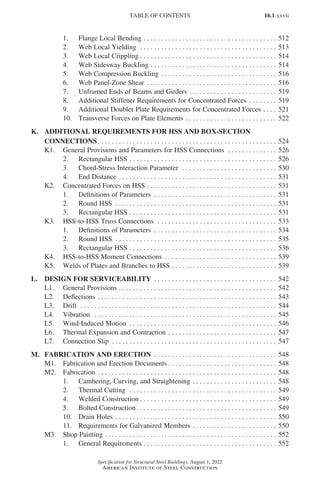
  • 8.
    16.1-vi Specification for StructuralSteel Buildings, August 1, 2022 American Institute of Steel Construction •  For flexural strength of members with holes in the tension flange, it is clarified that the Section F13.1 provisions apply only to bolt holes. •  Provisions are added to Chapter G to permit tension field action in end panels. •  Provisions are added to Chapter H for HSS subjected to combined forces, to include biaxial bending and shear. •  Provisions are added to Chapter I for longitudinal and transverse reinforcing steel require- ments for filled composite columns and for both encased composite and filled composite beams. •  Chapter I now includes additional stiffness and strength provisions for concrete filled composite plate shear walls consisting of two steel plates connected by tie bars. •  Provisions for the design of rectangular filled composite members constructed from mate- rials with strengths above the limits noted in Chapter I are added in a new Appendix 2. •  Section J2 provides revised requirements to qualify partial-joint-penetration groove welds with effective throats larger than those prescribed in AWS D1.1/D1.1M. •  Requirements regarding the use of low-hydrogen electrodes as they relate to minimum size fillet welds are revised in Table J2.4. •  The directional strength increase for transversely loaded fillet welds is rewritten and pro- hibited for use in the ends of rectangular HSS. •  An alternative bolt tensile strength based on the net tensile area of bolts is added. •  Added limit states for rectangular HSS moment connections in Chapter K. •  Section N4 now addresses coating inspection personnel requirements. •  A new Section N8, Minimum Requirements for Shop or Field Applied Coatings, is added. •  Appendix 2, Design for Ponding, is removed and replaced with updated guidance on this topic in Section B3.10. •  Appendix 3 clarifies hole forming provisions for elements subjected to fatigue. • Appendix 4 incorporates temperature-dependent stress-strain equations from the Eurocode to provide material properties for steel at elevated temperatures. •  Prescriptive steel fire-protection design equations and related information based on stan- dard ASTM E119 fire tests are incorporated into Appendix 4. •  Appendix 4, Section 4.4d, Design by Simple Methods of Analysis, includes provisions for compressive strength in filled composite columns and for compression in filled composite plate shear walls. •  Provisions for calculating rivet strength are added in Appendix 5. This Specification was approved by the Committee on Specifications: James O. Malley, Chair Bruce R. Ellingwood, Emeritus Scott F. Armbrust, Vice Chair Michael D. Engelhardt Allen Adams Shu-Jin Fang, Emeritus Taha D. Al-Shawaf James M. Fisher, Emeritus William F. Baker John W. Fisher, Emeritus John M. Barsom, Emeritus Theodore V. Galambos, Emeritus Roger L. Brockenbrough, Emeritus Michael E. Gase Susan B. Burmeister Louis F. Geschwindner Gregory G. Deierlein Ramon E. Gilsanz Bo Dowswell Lawrence G. Griffis Carol J. Drucker Jerome F. Hajjar W. Samuel Easterling Ronald O. Hamburger PREFACE Part 16.1 Prelims (i-lxvi).indd 6 Part 16.1 Prelims (i-lxvi).indd 6 2023-01-11 9:08 AM 2023-01-11 9:08 AM
  • 9.
    16.1-vii Specification for StructuralSteel Buildings, August 1, 2022 American Institute of Steel Construction Patrick M. Hassett R. Shankar Nair, Emeritus Tony C. Hazel Conrad Paulson Todd A. Helwig Douglas A. Rees-Evans Richard A. Henige, Jr. Rafael Sabelli Mark V. Holland Thomas A. Sabol John D. Hooper Fahim H. Sadek Nestor R. Iwankiw Benjamin W. Schafer William P. Jacobs, V Robert E. Shaw, Jr. Ronald J. Janowiak Donald R. Sherman, Emeritus Lawrence A. Kloiber, Emeritus W. Lee Shoemaker Lawrence F. Kruth William A. Thornton, Emeritus Jay W. Larson Chia-Ming Uang Roberto T. Leon Amit H. Varma Judy Liu Donald W. White Duane K. Miller Jamie Winans Larry S. Muir Ronald D. Ziemian Thomas M. Murray, Emeritus Cynthia J. Duncan, Secretary The Committee honors former members, vice-chair, Patrick J. Fortney, and emeritus members, Reidar Bjorhovde, Duane S. Ellifritt, and Raymond H.R. Tide, who passed away during this cycle. The Committee gratefully acknowledges AISC Board Oversights, Matt Smith and Duff Zimmerman; advisory members, Carlos Aguirre and Tiziano Perea; and the following task committee and staff members for their involvement in the development of this document. Farid Alfawakhiri Rodney D. Gibble Abbas Aminmansour Nathaniel P. Gonner Caroline R. Bennett Arvind V. Goverdhan Robert Berhinig Perry S. Green Eric Bolin Christina Harber Mark Braekevelt John Harris Michel Bruneau Alfred A. Herget Art Bustos Stephen M. Herlache Joel A. Chandler Steven J. Herth Robert Chmielowski Devin Huber Lisa Choe Ronald B. Johnson Douglas Crampton Jeffrey Keileh Rachel Chicchi Cross Kerry Kreitman Mark D. Denavit David W. Landis Matthew F. Fadden Chad M. Larson Larry A. Fahnestock Dawn E. Lehman Shelley C. Finnigan Andres Lepage Erica C. Fischer Brent Leu Timothy P. Fraser Carlo Lini Christine Freisinger LeRoy A. Lutz Michael Gannon Andrew Lye Rupa Garai Bonnie E. Manley Jeffrey Gasparott Michael R. Marian PREFACE Part 16.1 Prelims (i-lxvi).indd 7 Part 16.1 Prelims (i-lxvi).indd 7 2023-01-11 9:08 AM 2023-01-11 9:08 AM
  • 10.
    16.1-viii Specification for StructuralSteel Buildings, August 1, 2022 American Institute of Steel Construction Jason P. McCormick Kristi Sattler Austin A. Meier Brandt Saxey Jared Moseley Thomas J. Schlafly J.R. Ubejd Mujagic Jim Schoen Kimberley T. Olson William Scott Jeffrey A. Packer Richard Scruton Garner Palenske Bahram M. Shahrooz Robert Pekelnicky Thomas Sputo Thomas D. Poulos Ryan Staudt Max Puchtel Andrea E. Surovek Christopher H. Raebel James A. Swanson Gian Andrea Rassati Matthew Trammell Charles W. Roeder Sriramulu Vinnakota John A. Rolfes Michael A. West Sougata Roy PREFACE Part 16.1 Prelims (i-lxvi).indd 8 Part 16.1 Prelims (i-lxvi).indd 8 2023-01-11 9:08 AM 2023-01-11 9:08 AM
  • 11.
    16.1-ix Specification for StructuralSteel Buildings, August 1, 2022 American Institute of Steel Construction TABLE OF CONTENTS SYMBOLS . . . . . . . . . . . . . . . . . . . . . . . . . . . . . . . . . . . . . . . . . . . . . . . . . . . . . . . . . . . xxxi GLOSSARY . . . . . . . . . . . . . . . . . . . . . . . . . . . . . . . . . . . . . . . . . . . . . . . . . . . . . . . . . . . . . l ABBREVIATIONS . . . . . . . . . . . . . . . . . . . . . . . . . . . . . . . . . . . . . . . . . . . . . . . . . . . . . lxv A. GENERAL PROVISIONS   . . . . . . . . . . . . . . . . . . . . . . . . . . . . . . . . . . . . . . . . . . . . . 1 A1. Scope . . . . . . . . . . . . . . . . . . . . . . . . . . . . . . . . . . . . . . . . . . . . . . . . . . . . . . . . . . 1 1. Seismic Applications. . . . . . . . . . . . . . . . . . . . . . . . . . . . . . . . . . . . . . . . . . 2 2. Nuclear Applications. . . . . . . . . . . . . . . . . . . . . . . . . . . . . . . . . . . . . . . . . . 2 A2. Referenced Specifications, Codes, and Standards. . . . . . . . . . . . . . . . . . . . . . . . 2 A3. Material . . . . . . . . . . . . . . . . . . . . . . . . . . . . . . . . . . . . . . . . . . . . . . . . . . . . . . . . 6 1. Structural Steel Materials . . . . . . . . . . . . . . . . . . . . . . . . . . . . . . . . . . . . . . 6 1a. Listed Materials. . . . . . . . . . . . . . . . . . . . . . . . . . . . . . . . . . . . . . . . . . . . . . 8 1b. Other Materials . . . . . . . . . . . . . . . . . . . . . . . . . . . . . . . . . . . . . . . . . . . . . . 8 1c. Unidentified Steel . . . . . . . . . . . . . . . . . . . . . . . . . . . . . . . . . . . . . . . . . . . . 8 1d. Rolled Heavy Shapes . . . . . . . . . . . . . . . . . . . . . . . . . . . . . . . . . . . . . . . . . 9 1e. Built-Up Heavy Shapes. . . . . . . . . . . . . . . . . . . . . . . . . . . . . . . . . . . . . . . . 9 2. Steel Castings and Forgings . . . . . . . . . . . . . . . . . . . . . . . . . . . . . . . . . . . 10 3. Bolts, Washers, and Nuts . . . . . . . . . . . . . . . . . . . . . . . . . . . . . . . . . . . . . 10 4. Anchor Rods and Threaded Rods. . . . . . . . . . . . . . . . . . . . . . . . . . . . . . . 10 5. Consumables for Welding. . . . . . . . . . . . . . . . . . . . . . . . . . . . . . . . . . . . . 11 6. Headed Stud Anchors . . . . . . . . . . . . . . . . . . . . . . . . . . . . . . . . . . . . . . . . 11 A4. Structural Design Documents and Specifications . . . . . . . . . . . . . . . . . . . . . . . 11 1. Structural Design Documents and Specifications Issued for Construction . . . . . . . . . . . . . . . . . . . . . . . . . . . . . . . . . . . . . . . . . . . . . . . 11 2. Structural Design Documents and Specifications Issued for Any Purpose . . . . . . . . . . . . . . . . . . . . . . . . . . . . . . . . . . . . . . . . . . . . . . . 13 A5. Approvals. . . . . . . . . . . . . . . . . . . . . . . . . . . . . . . . . . . . . . . . . . . . . . . . . . . . . . 14 B. DESIGN REQUIREMENTS. . . . . . . . . . . . . . . . . . . . . . . . . . . . . . . . . . . . . . . . . . . 15 B1. General Provisions. . . . . . . . . . . . . . . . . . . . . . . . . . . . . . . . . . . . . . . . . . . . . . . 15 B2. Loads and Load Combinations . . . . . . . . . . . . . . . . . . . . . . . . . . . . . . . . . . . . . 15 B3. Design Basis. . . . . . . . . . . . . . . . . . . . . . . . . . . . . . . . . . . . . . . . . . . . . . . . . . . . 15 1. Design for Strength Using Load and Resistance Factor Design (LRFD) . . . . . . . . . . . . . . . . . . . . . . . . . . . . . . . . . . . . . . . . . . . . . 16 2. Design for Strength Using Allowable Strength Design (ASD) . . . . . . . . 16 3. Required Strength . . . . . . . . . . . . . . . . . . . . . . . . . . . . . . . . . . . . . . . . . . . 16 4. Design of Connections and Supports . . . . . . . . . . . . . . . . . . . . . . . . . . . . 17 4a. Simple Connections   . . . . . . . . . . . . . . . . . . . . . . . . . . . . . . . . . . . . . . . . . 17 4b. Moment Connections . . . . . . . . . . . . . . . . . . . . . . . . . . . . . . . . . . . . . . . . 17 5. Design of Diaphragms and Collectors . . . . . . . . . . . . . . . . . . . . . . . . . . . 17 6. Design of Anchorages to Concrete . . . . . . . . . . . . . . . . . . . . . . . . . . . . . . 18 7. Design for Stability . . . . . . . . . . . . . . . . . . . . . . . . . . . . . . . . . . . . . . . . . . 18 Part 16.1 Prelims (i-lxvi).indd 9 Part 16.1 Prelims (i-lxvi).indd 9 2023-01-11 9:08 AM 2023-01-11 9:08 AM
  • 12.
    16.1-x Specification for StructuralSteel Buildings, August 1, 2022 American Institute of Steel Construction 8. Design for Serviceability. . . . . . . . . . . . . . . . . . . . . . . . . . . . . . . . . . . . . . 18 9. Design for Structural Integrity . . . . . . . . . . . . . . . . . . . . . . . . . . . . . . . . . 18 10. Design for Ponding. . . . . . . . . . . . . . . . . . . . . . . . . . . . . . . . . . . . . . . . . . 18 11. Design for Fatigue. . . . . . . . . . . . . . . . . . . . . . . . . . . . . . . . . . . . . . . . . . . 19 12. Design for Fire Conditions . . . . . . . . . . . . . . . . . . . . . . . . . . . . . . . . . . . . 19 13. Design for Corrosion Effects . . . . . . . . . . . . . . . . . . . . . . . . . . . . . . . . . . 19 B4. Member Properties. . . . . . . . . . . . . . . . . . . . . . . . . . . . . . . . . . . . . . . . . . . . . . . 19 1. Classification of Sections for Local Buckling . . . . . . . . . . . . . . . . . . . . . 19 1a. Unstiffened Elements . . . . . . . . . . . . . . . . . . . . . . . . . . . . . . . . . . . . . . . . 20 1b. Stiffened Elements . . . . . . . . . . . . . . . . . . . . . . . . . . . . . . . . . . . . . . . . . . 20 2. Design Wall Thickness for HSS. . . . . . . . . . . . . . . . . . . . . . . . . . . . . . . . 24 3. Gross and Net Area Determination. . . . . . . . . . . . . . . . . . . . . . . . . . . . . . 24 3a. Gross Area. . . . . . . . . . . . . . . . . . . . . . . . . . . . . . . . . . . . . . . . . . . . . . . . . 24 3b. Net Area . . . . . . . . . . . . . . . . . . . . . . . . . . . . . . . . . . . . . . . . . . . . . . . . . . 24 B5. Fabrication and Erection . . . . . . . . . . . . . . . . . . . . . . . . . . . . . . . . . . . . . . . . . . 25 B6. Quality Control and Quality Assurance. . . . . . . . . . . . . . . . . . . . . . . . . . . . . . . 25 B7. Evaluation of Existing Structures . . . . . . . . . . . . . . . . . . . . . . . . . . . . . . . . . . . 25 B8. Dimensional Tolerances. . . . . . . . . . . . . . . . . . . . . . . . . . . . . . . . . . . . . . . . . . . 25 C. DESIGN FOR STABILITY. . . . . . . . . . . . . . . . . . . . . . . . . . . . . . . . . . . . . . . . . . . . 26 C1. General Stability Requirements. . . . . . . . . . . . . . . . . . . . . . . . . . . . . . . . . . . . . 26 1. Direct Analysis Method of Design. . . . . . . . . . . . . . . . . . . . . . . . . . . . . . 26 2. Alternative Methods of Design. . . . . . . . . . . . . . . . . . . . . . . . . . . . . . . . . 27 C2. Calculation of Required Strengths. . . . . . . . . . . . . . . . . . . . . . . . . . . . . . . . . . . 27 1. General Analysis Requirements . . . . . . . . . . . . . . . . . . . . . . . . . . . . . . . . 27 2. Consideration of Initial System Imperfections. . . . . . . . . . . . . . . . . . . . . 28 2a. Direct Modeling of Imperfections. . . . . . . . . . . . . . . . . . . . . . . . . . . . . . . 28 2b. Use of Notional Loads to Represent Imperfections . . . . . . . . . . . . . . . . . 29 3. Adjustments to Stiffness. . . . . . . . . . . . . . . . . . . . . . . . . . . . . . . . . . . . . . 30 C3. Calculation of Available Strengths . . . . . . . . . . . . . . . . . . . . . . . . . . . . . . . . . . 31 D. DESIGN OF MEMBERS FOR TENSION . . . . . . . . . . . . . . . . . . . . . . . . . . . . . . . 32 D1. Slenderness Limitations. . . . . . . . . . . . . . . . . . . . . . . . . . . . . . . . . . . . . . . . . . . 32 D2. Tensile Strength. . . . . . . . . . . . . . . . . . . . . . . . . . . . . . . . . . . . . . . . . . . . . . . . . 32 D3. Effective Net Area. . . . . . . . . . . . . . . . . . . . . . . . . . . . . . . . . . . . . . . . . . . . . . . 33 D4. Built-Up Members. . . . . . . . . . . . . . . . . . . . . . . . . . . . . . . . . . . . . . . . . . . . . . . 33 D5. Pin-Connected Members . . . . . . . . . . . . . . . . . . . . . . . . . . . . . . . . . . . . . . . . . . 35 1. Tensile Strength. . . . . . . . . . . . . . . . . . . . . . . . . . . . . . . . . . . . . . . . . . . . . 35 2. Dimensional Requirements. . . . . . . . . . . . . . . . . . . . . . . . . . . . . . . . . . . . 36 D6. Eyebars. . . . . . . . . . . . . . . . . . . . . . . . . . . . . . . . . . . . . . . . . . . . . . . . . . . . . . . . 36 1. Tensile Strength. . . . . . . . . . . . . . . . . . . . . . . . . . . . . . . . . . . . . . . . . . . . . 36 2. Dimensional Requirements. . . . . . . . . . . . . . . . . . . . . . . . . . . . . . . . . . . . 37 E. DESIGN OF MEMBERS FOR COMPRESSION . . . . . . . . . . . . . . . . . . . . . . . . . 38 E1. General Provisions. . . . . . . . . . . . . . . . . . . . . . . . . . . . . . . . . . . . . . . . . . . . . . . 38 E2. Effective Length. . . . . . . . . . . . . . . . . . . . . . . . . . . . . . . . . . . . . . . . . . . . . . . . . 40 E3. Flexural Buckling of Members without Slender Elements. . . . . . . . . . . . . . . . 40 TABLE OF CONTENTS Part 16.1 Prelims (i-lxvi).indd 10 Part 16.1 Prelims (i-lxvi).indd 10 2023-01-11 9:08 AM 2023-01-11 9:08 AM
  • 13.
    16.1-xi Specification for StructuralSteel Buildings, August 1, 2022 American Institute of Steel Construction E4. Torsional and Flexural-Torsional Buckling of Single Angles and Members without Slender Elements . . . . . . . . . . . . . . . . . . . . . . . . . . . . . . . . . 41 E5. Single-Angle Compression Members . . . . . . . . . . . . . . . . . . . . . . . . . . . . . . . . 43 E6. Built-Up Members. . . . . . . . . . . . . . . . . . . . . . . . . . . . . . . . . . . . . . . . . . . . . . . 45 1. Compressive Strength. . . . . . . . . . . . . . . . . . . . . . . . . . . . . . . . . . . . . . . . 45 2. General Requirements. . . . . . . . . . . . . . . . . . . . . . . . . . . . . . . . . . . . . . . . 46 E7. Members with Slender Elements. . . . . . . . . . . . . . . . . . . . . . . . . . . . . . . . . . . . 48 1. Slender Element Members Excluding Round HSS . . . . . . . . . . . . . . . . . 48 2. Round HSS . . . . . . . . . . . . . . . . . . . . . . . . . . . . . . . . . . . . . . . . . . . . . . . . 49 F. DESIGN OF MEMBERS FOR FLEXURE. . . . . . . . . . . . . . . . . . . . . . . . . . . . . . . 50 F1. General Provisions. . . . . . . . . . . . . . . . . . . . . . . . . . . . . . . . . . . . . . . . . . . . . . . 52 F2. Doubly Symmetric Compact I-Shaped Members and Channels Bent About Their Major Axis . . . . . . . . . . . . . . . . . . . . . . . . . . . . . . . . . . . . . . 53 1. Yielding. . . . . . . . . . . . . . . . . . . . . . . . . . . . . . . . . . . . . . . . . . . . . . . . . . . 53 2. Lateral-Torsional Buckling. . . . . . . . . . . . . . . . . . . . . . . . . . . . . . . . . . . . 53 F3. Doubly Symmetric I-Shaped Members with Compact Webs and Noncompact or Slender Flanges Bent About Their Major Axis. . . . . . . . . . . . 55 1. Lateral-Torsional Buckling. . . . . . . . . . . . . . . . . . . . . . . . . . . . . . . . . . . . 55 2. Compression Flange Local Buckling . . . . . . . . . . . . . . . . . . . . . . . . . . . . 55 F4. Other I-Shaped Members with Compact or Noncompact Webs Bent About Their Major Axis . . . . . . . . . . . . . . . . . . . . . . . . . . . . . . . . . . . . . . 56 1. Compression Flange Yielding. . . . . . . . . . . . . . . . . . . . . . . . . . . . . . . . . . 56 2. Lateral-Torsional Buckling. . . . . . . . . . . . . . . . . . . . . . . . . . . . . . . . . . . . 56 3. Compression Flange Local Buckling . . . . . . . . . . . . . . . . . . . . . . . . . . . . 59 4. Tension Flange Yielding. . . . . . . . . . . . . . . . . . . . . . . . . . . . . . . . . . . . . . 59 F5. Doubly Symmetric and Singly Symmetric I-Shaped Members with Slender Webs Bent About Their Major Axis . . . . . . . . . . . . . . . . . . . . . . . . . . 60 1. Compression Flange Yielding. . . . . . . . . . . . . . . . . . . . . . . . . . . . . . . . . . 60 2. Lateral-Torsional Buckling. . . . . . . . . . . . . . . . . . . . . . . . . . . . . . . . . . . . 60 3. Compression Flange Local Buckling . . . . . . . . . . . . . . . . . . . . . . . . . . . . 61 4. Tension Flange Yielding. . . . . . . . . . . . . . . . . . . . . . . . . . . . . . . . . . . . . . 61 F6. I-Shaped Members and Channels Bent About Their Minor Axis. . . . . . . . . . . 61 1. Yielding. . . . . . . . . . . . . . . . . . . . . . . . . . . . . . . . . . . . . . . . . . . . . . . . . . . 62 2. Flange Local Buckling . . . . . . . . . . . . . . . . . . . . . . . . . . . . . . . . . . . . . . . 62 F7. Square and Rectangular HSS and Box Sections . . . . . . . . . . . . . . . . . . . . . . . . 62 1. Yielding. . . . . . . . . . . . . . . . . . . . . . . . . . . . . . . . . . . . . . . . . . . . . . . . . . . 63 2. Flange Local Buckling . . . . . . . . . . . . . . . . . . . . . . . . . . . . . . . . . . . . . . . 63 3. Web Local Buckling. . . . . . . . . . . . . . . . . . . . . . . . . . . . . . . . . . . . . . . . . 63 4. Lateral-Torsional Buckling. . . . . . . . . . . . . . . . . . . . . . . . . . . . . . . . . . . . 64 F8. Round HSS. . . . . . . . . . . . . . . . . . . . . . . . . . . . . . . . . . . . . . . . . . . . . . . . . . . . . 65 1. Yielding. . . . . . . . . . . . . . . . . . . . . . . . . . . . . . . . . . . . . . . . . . . . . . . . . . . 65 2. Local Buckling . . . . . . . . . . . . . . . . . . . . . . . . . . . . . . . . . . . . . . . . . . . . . 65 F9. Tees and Double Angles Loaded in the Plane of Symmetry. . . . . . . . . . . . . . . 65 1. Yielding. . . . . . . . . . . . . . . . . . . . . . . . . . . . . . . . . . . . . . . . . . . . . . . . . . . 65 2. Lateral-Torsional Buckling. . . . . . . . . . . . . . . . . . . . . . . . . . . . . . . . . . . . 66 TABLE OF CONTENTS Part 16.1 Prelims (i-lxvi).indd 11 Part 16.1 Prelims (i-lxvi).indd 11 2023-01-11 9:08 AM 2023-01-11 9:08 AM
  • 14.
    16.1-xii Specification for StructuralSteel Buildings, August 1, 2022 American Institute of Steel Construction 3. Flange Local Buckling of Tees and Double-Angle Legs. . . . . . . . . . . . . 67 4. Local Buckling of Tee Stems and Double-Angle Web Legs in Flexural Compression. . . . . . . . . . . . . . . . . . . . . . . . . . . . . . . . . . . . . . . . 67 F10. Single Angles. . . . . . . . . . . . . . . . . . . . . . . . . . . . . . . . . . . . . . . . . . . . . . . . . . . 68 1. Yielding. . . . . . . . . . . . . . . . . . . . . . . . . . . . . . . . . . . . . . . . . . . . . . . . . . . 69 2. Lateral-Torsional Buckling. . . . . . . . . . . . . . . . . . . . . . . . . . . . . . . . . . . . 69 3. Leg Local Buckling. . . . . . . . . . . . . . . . . . . . . . . . . . . . . . . . . . . . . . . . . . 70 F11. Rectangular Bars and Rounds . . . . . . . . . . . . . . . . . . . . . . . . . . . . . . . . . . . . . . 71 1. Yielding. . . . . . . . . . . . . . . . . . . . . . . . . . . . . . . . . . . . . . . . . . . . . . . . . . . 71 2. Lateral-Torsional Buckling. . . . . . . . . . . . . . . . . . . . . . . . . . . . . . . . . . . . 71 F12. Unsymmetrical Shapes. . . . . . . . . . . . . . . . . . . . . . . . . . . . . . . . . . . . . . . . . . . . 71 1. Yielding. . . . . . . . . . . . . . . . . . . . . . . . . . . . . . . . . . . . . . . . . . . . . . . . . . . 72 2. Lateral-Torsional Buckling. . . . . . . . . . . . . . . . . . . . . . . . . . . . . . . . . . . . 72 3. Local Buckling . . . . . . . . . . . . . . . . . . . . . . . . . . . . . . . . . . . . . . . . . . . . . 72 F13. Proportions of Beams and Girders. . . . . . . . . . . . . . . . . . . . . . . . . . . . . . . . . . . 72 1. Strength Reductions for Members with Bolt Holes in the Tension Flange . . . . . . . . . . . . . . . . . . . . . . . . . . . . . . . . . . . . . . . . . . . . . 72 2. Proportioning Limits for I-Shaped Members . . . . . . . . . . . . . . . . . . . . . . 73 3. Cover Plates. . . . . . . . . . . . . . . . . . . . . . . . . . . . . . . . . . . . . . . . . . . . . . . . 73 4. Built-Up Beams. . . . . . . . . . . . . . . . . . . . . . . . . . . . . . . . . . . . . . . . . . . . . 74 G. DESIGN OF MEMBERS FOR SHEAR . . . . . . . . . . . . . . . . . . . . . . . . . . . . . . . . . 75 G1. General Provisions. . . . . . . . . . . . . . . . . . . . . . . . . . . . . . . . . . . . . . . . . . . . . . . 75 G2. I-Shaped Members and Channels . . . . . . . . . . . . . . . . . . . . . . . . . . . . . . . . . . . 75 1. Shear Strength of Webs. . . . . . . . . . . . . . . . . . . . . . . . . . . . . . . . . . . . . . . 75 2. Shear Strength of Interior Web Panels with a h ≤ 3 Considering Tension Field Action . . . . . . . . . . . . . . . . . . . . . . . . . . . . . . 77 3. Shear Strength of End Web Panels with a h ≤ 3 Considering Tension Field Action. . . . . . . . . . . . . . . . . . . . . . . . . . . . . . . . . . . . . . . . . 78 4. Transverse Stiffeners. . . . . . . . . . . . . . . . . . . . . . . . . . . . . . . . . . . . . . . . . 78 G3. Single Angles and Tees . . . . . . . . . . . . . . . . . . . . . . . . . . . . . . . . . . . . . . . . . . . 80 G4. Rectangular HSS, Box Sections, and Other Singly and Doubly Symmetric Members . . . . . . . . . . . . . . . . . . . . . . . . . . . . . . . . . . . . . . . . . . . . . 80 G5. Round HSS. . . . . . . . . . . . . . . . . . . . . . . . . . . . . . . . . . . . . . . . . . . . . . . . . . . . . 80 G6. Doubly Symmetric and Singly Symmetric Members Subjected to Minor-Axis Shear. . . . . . . . . . . . . . . . . . . . . . . . . . . . . . . . . . . . . . . . . . . . . . . . 81 G7. Beams and Girders with Web Openings . . . . . . . . . . . . . . . . . . . . . . . . . . . . . . 81 H. DESIGN OF MEMBERS FOR COMBINED FORCES AND TORSION. . . . . . 82 H1. Doubly and Singly Symmetric Members Subjected to Flexure and Axial Force. . . . . . . . . . . . . . . . . . . . . . . . . . . . . . . . . . . . . . . . . . . . . . . . . . . . . 82 1. Doubly and Singly Symmetric Members Subjected to Flexure and Compression. . . . . . . . . . . . . . . . . . . . . . . . . . . . . . . . . . . . . . . . . . . . 82 2. Doubly and Singly Symmetric Members Subjected to Flexure and Tension . . . . . . . . . . . . . . . . . . . . . . . . . . . . . . . . . . . . . . . . . 83 3. Doubly Symmetric Rolled Compact Members Subjected to Single-Axis Flexure and Compression. . . . . . . . . . . . . . . . . . . . . . . . . . . 83 TABLE OF CONTENTS Part 16.1 Prelims (i-lxvi).indd 12 Part 16.1 Prelims (i-lxvi).indd 12 2023-01-11 9:08 AM 2023-01-11 9:08 AM
  • 15.
    16.1-xiii Specification for StructuralSteel Buildings, August 1, 2022 American Institute of Steel Construction H2. Unsymmetric and Other Members Subjected to Flexure and Axial Force. . . . . . . . . . . . . . . . . . . . . . . . . . . . . . . . . . . . . . . . . . . . . . . . . . . . . 84 H3. Members Subjected to Torsion and Combined Torsion, Flexure, Shear, and/or Axial Force. . . . . . . . . . . . . . . . . . . . . . . . . . . . . . . . . . . . . . . . . . 85 1. Round and Rectangular HSS Subjected to Torsion . . . . . . . . . . . . . . . . . 85 2. HSS Subjected to Combined Torsion, Shear, Flexure, and Axial Force . . . . . . . . . . . . . . . . . . . . . . . . . . . . . . . . . . . . . . . . . . . . . . . . 86 3. Non-HSS Members Subjected to Torsion and Combined Stress. . . . . . . 87 H4. Rupture of Flanges with Bolt Holes and Subjected to Tension . . . . . . . . . . . . 87 I. DESIGN OF COMPOSITE MEMBERS. . . . . . . . . . . . . . . . . . . . . . . . . . . . . . . . . 89 I1. General Provisions. . . . . . . . . . . . . . . . . . . . . . . . . . . . . . . . . . . . . . . . . . . . . . . 89 1. Concrete and Steel Reinforcement . . . . . . . . . . . . . . . . . . . . . . . . . . . . . . 89 2. Nominal Strength of Composite Sections. . . . . . . . . . . . . . . . . . . . . . . . . 90 2a. Plastic Stress Distribution Method . . . . . . . . . . . . . . . . . . . . . . . . . . . . . . 90 2b. Strain Compatibility Method. . . . . . . . . . . . . . . . . . . . . . . . . . . . . . . . . . . 90 2c. Elastic Stress Distribution Method. . . . . . . . . . . . . . . . . . . . . . . . . . . . . . 90 2d. Effective Stress-Strain Method . . . . . . . . . . . . . . . . . . . . . . . . . . . . . . . . . 91 3. Material Limitations . . . . . . . . . . . . . . . . . . . . . . . . . . . . . . . . . . . . . . . . . 91 4. Classification of Filled Composite Sections for Local Buckling. . . . . . . 91 5. Stiffness for Calculation of Required Strengths. . . . . . . . . . . . . . . . . . . . 93 6. Requirements for Composite Plate Shear Walls. . . . . . . . . . . . . . . . . . . . 94 6a. Slenderness Requirement . . . . . . . . . . . . . . . . . . . . . . . . . . . . . . . . . . . . . 95 6b. Tie Bar Requirement. . . . . . . . . . . . . . . . . . . . . . . . . . . . . . . . . . . . . . . . . 95 I2. Axial Force. . . . . . . . . . . . . . . . . . . . . . . . . . . . . . . . . . . . . . . . . . . . . . . . . . . . . 95 1. Encased Composite Members. . . . . . . . . . . . . . . . . . . . . . . . . . . . . . . . . . 95 1a. Limitations. . . . . . . . . . . . . . . . . . . . . . . . . . . . . . . . . . . . . . . . . . . . . . . . . 95 1b. Compressive Strength. . . . . . . . . . . . . . . . . . . . . . . . . . . . . . . . . . . . . . . . 96 1c. Tensile Strength. . . . . . . . . . . . . . . . . . . . . . . . . . . . . . . . . . . . . . . . . . . . . 97 1d. Load Transfer . . . . . . . . . . . . . . . . . . . . . . . . . . . . . . . . . . . . . . . . . . . . . . 97 1e. Detailing Requirements. . . . . . . . . . . . . . . . . . . . . . . . . . . . . . . . . . . . . . . 97 2. Filled Composite Members. . . . . . . . . . . . . . . . . . . . . . . . . . . . . . . . . . . . 98 2a. Limitations. . . . . . . . . . . . . . . . . . . . . . . . . . . . . . . . . . . . . . . . . . . . . . . . . 98 2b. Compressive Strength. . . . . . . . . . . . . . . . . . . . . . . . . . . . . . . . . . . . . . . . 98 2c. Tensile Strength. . . . . . . . . . . . . . . . . . . . . . . . . . . . . . . . . . . . . . . . . . . . . 99 2d. Load Transfer . . . . . . . . . . . . . . . . . . . . . . . . . . . . . . . . . . . . . . . . . . . . . . 99 2e. Detailing Requirements. . . . . . . . . . . . . . . . . . . . . . . . . . . . . . . . . . . . . . 100 3. Composite Plate Shear Walls . . . . . . . . . . . . . . . . . . . . . . . . . . . . . . . . . 100 3a. Compressive Strength. . . . . . . . . . . . . . . . . . . . . . . . . . . . . . . . . . . . . . . 100 3b. Tensile Strength. . . . . . . . . . . . . . . . . . . . . . . . . . . . . . . . . . . . . . . . . . . . 100 I3. Flexure . . . . . . . . . . . . . . . . . . . . . . . . . . . . . . . . . . . . . . . . . . . . . . . . . . . . . . . 100 1. General . . . . . . . . . . . . . . . . . . . . . . . . . . . . . . . . . . . . . . . . . . . . . . . . . . 100 1a. Effective Width. . . . . . . . . . . . . . . . . . . . . . . . . . . . . . . . . . . . . . . . . . . . 100 1b. Strength During Construction. . . . . . . . . . . . . . . . . . . . . . . . . . . . . . . . . 100 2. Composite Beams with Steel Headed Stud or Steel Channel Anchors. . . . . . . . . . . . . . . . . . . . . . . . . . . . . . . . . . . . . . . . . . . 101 2a. Positive Flexural Strength. . . . . . . . . . . . . . . . . . . . . . . . . . . . . . . . . . . . 101 TABLE OF CONTENTS Part 16.1 Prelims (i-lxvi).indd 13 Part 16.1 Prelims (i-lxvi).indd 13 2023-01-11 9:08 AM 2023-01-11 9:08 AM
  • 16.
    16.1-xiv Specification for StructuralSteel Buildings, August 1, 2022 American Institute of Steel Construction 2b. Negative Flexural Strength. . . . . . . . . . . . . . . . . . . . . . . . . . . . . . . . . . . 101 2c. Composite Beams with Formed Steel Deck. . . . . . . . . . . . . . . . . . . . . . 101 1. General . . . . . . . . . . . . . . . . . . . . . . . . . . . . . . . . . . . . . . . . . . . . . . . 101 2. Deck Ribs Oriented Perpendicular to Steel Beam . . . . . . . . . . . . . . 102 3. Deck Ribs Oriented Parallel to Steel Beam . . . . . . . . . . . . . . . . . . . 102 2d. Load Transfer Between Steel Beam and Concrete Slab. . . . . . . . . . . . . 102 1. Load Transfer for Positive Flexural Strength. . . . . . . . . . . . . . . . . . 102 2. Load Transfer for Negative Flexural Strength. . . . . . . . . . . . . . . . . 103 3. Encased Composite Members. . . . . . . . . . . . . . . . . . . . . . . . . . . . . . . . . 103 3a. Limitations. . . . . . . . . . . . . . . . . . . . . . . . . . . . . . . . . . . . . . . . . . . . . . . . 103 3b. Detailing Requirements. . . . . . . . . . . . . . . . . . . . . . . . . . . . . . . . . . . . . . 104 4. Filled Composite Members. . . . . . . . . . . . . . . . . . . . . . . . . . . . . . . . . . . 104 4a. Limitations. . . . . . . . . . . . . . . . . . . . . . . . . . . . . . . . . . . . . . . . . . . . . . . . 104 4b. Flexural Strength. . . . . . . . . . . . . . . . . . . . . . . . . . . . . . . . . . . . . . . . . . . 105 4c. Detailing Requirements. . . . . . . . . . . . . . . . . . . . . . . . . . . . . . . . . . . . . . 106 5. Composite Plate Shear Walls . . . . . . . . . . . . . . . . . . . . . . . . . . . . . . . . . 106 I4. Shear. . . . . . . . . . . . . . . . . . . . . . . . . . . . . . . . . . . . . . . . . . . . . . . . . . . . . . . . . 106 1. Encased Composite Members. . . . . . . . . . . . . . . . . . . . . . . . . . . . . . . . . 106 2. Filled Composite Members. . . . . . . . . . . . . . . . . . . . . . . . . . . . . . . . . . . 106 3. Composite Beams with Formed Steel Deck. . . . . . . . . . . . . . . . . . . . . . 107 4. Composite Plate Shear Walls . . . . . . . . . . . . . . . . . . . . . . . . . . . . . . . . . 107 I5. Combined Flexure and Axial Force. . . . . . . . . . . . . . . . . . . . . . . . . . . . . . . . . 108 I6. Load Transfer. . . . . . . . . . . . . . . . . . . . . . . . . . . . . . . . . . . . . . . . . . . . . . . . . . 109 1. General Requirements. . . . . . . . . . . . . . . . . . . . . . . . . . . . . . . . . . . . . . . 109 2. Force Allocation . . . . . . . . . . . . . . . . . . . . . . . . . . . . . . . . . . . . . . . . . . . 109 2a. External Force Applied to Steel Section. . . . . . . . . . . . . . . . . . . . . . . . . 110 2b. External Force Applied to Concrete. . . . . . . . . . . . . . . . . . . . . . . . . . . . 110 2c. External Force Applied Concurrently to Steel and Concrete. . . . . . . . . 111 3. Force Transfer Mechanisms . . . . . . . . . . . . . . . . . . . . . . . . . . . . . . . . . . 111 3a. Direct Bearing. . . . . . . . . . . . . . . . . . . . . . . . . . . . . . . . . . . . . . . . . . . . . 111 3b. Shear Connection . . . . . . . . . . . . . . . . . . . . . . . . . . . . . . . . . . . . . . . . . . 111 3c. Direct Bond Interaction. . . . . . . . . . . . . . . . . . . . . . . . . . . . . . . . . . . . . . 112 4. Detailing Requirements. . . . . . . . . . . . . . . . . . . . . . . . . . . . . . . . . . . . . . 112 4a. Encased Composite Members. . . . . . . . . . . . . . . . . . . . . . . . . . . . . . . . . 112 4b. Filled Composite Members. . . . . . . . . . . . . . . . . . . . . . . . . . . . . . . . . . . 112 I7. Composite Diaphragms and Collector Beams. . . . . . . . . . . . . . . . . . . . . . . . . 112 I8. Steel Anchors. . . . . . . . . . . . . . . . . . . . . . . . . . . . . . . . . . . . . . . . . . . . . . . . . . 113 1. General . . . . . . . . . . . . . . . . . . . . . . . . . . . . . . . . . . . . . . . . . . . . . . . . . . 113 2. Steel Anchors in Composite Beams . . . . . . . . . . . . . . . . . . . . . . . . . . . . 113 2a. Strength of Steel Headed Stud Anchors. . . . . . . . . . . . . . . . . . . . . . . . . 113 2b. Strength of Steel Channel Anchors. . . . . . . . . . . . . . . . . . . . . . . . . . . . . 114 2c. Required Number of Steel Anchors . . . . . . . . . . . . . . . . . . . . . . . . . . . . 115 2d. Detailing Requirements. . . . . . . . . . . . . . . . . . . . . . . . . . . . . . . . . . . . . . 115 3. Steel Anchors in Composite Components . . . . . . . . . . . . . . . . . . . . . . . 115 3a. Shear Strength of Steel Headed Stud Anchors in Composite Components . . . . . . . . . . . . . . . . . . . . . . . . . . . . . . . . . . . . . 116 TABLE OF CONTENTS Part 16.1 Prelims (i-lxvi).indd 14 Part 16.1 Prelims (i-lxvi).indd 14 2023-01-11 9:08 AM 2023-01-11 9:08 AM
  • 17.
    16.1-xv Specification for StructuralSteel Buildings, August 1, 2022 American Institute of Steel Construction 3b. Tensile Strength of Steel Headed Stud Anchors in Composite Components. . . . . . . . . . . . . . . . . . . . . . . . . . . . . . . . . . . . . . . . . . . . . . . 117 3c. Strength of Steel Headed Stud Anchors for Interaction of Shear and Tension in Composite Components. . . . . . . . . . . . . . . . . . . . 118 3d. Shear Strength of Steel Channel Anchors in Composite Components. . . . . . . . . . . . . . . . . . . . . . . . . . . . . . . . . . . . . . . . . . . . . . . 119 3e. Detailing Requirements in Composite Components. . . . . . . . . . . . . . . . 119 4. Performance-Based Alternative for the Design of Shear Connection. . . . . . . . . . . . . . . . . . . . . . . . . . . . . . . . . . . . . . . . . . . . . . . . 119 4a. Test Standard. . . . . . . . . . . . . . . . . . . . . . . . . . . . . . . . . . . . . . . . . . . . . . 119 4b. Nominal and Available Strength. . . . . . . . . . . . . . . . . . . . . . . . . . . . . . . 120 4c. Shear Connection Slip Capacity. . . . . . . . . . . . . . . . . . . . . . . . . . . . . . . 120 4d. Acceptance Criteria. . . . . . . . . . . . . . . . . . . . . . . . . . . . . . . . . . . . . . . . . 120 J. DESIGN OF CONNECTIONS. . . . . . . . . . . . . . . . . . . . . . . . . . . . . . . . . . . . . . . . 121 J1. General Provisions. . . . . . . . . . . . . . . . . . . . . . . . . . . . . . . . . . . . . . . . . . . . . . 121 1. Design Basis . . . . . . . . . . . . . . . . . . . . . . . . . . . . . . . . . . . . . . . . . . . . . . 121 2. Simple Connections. . . . . . . . . . . . . . . . . . . . . . . . . . . . . . . . . . . . . . . . . 121 3. Moment Connections . . . . . . . . . . . . . . . . . . . . . . . . . . . . . . . . . . . . . . . 122 4. Compression Members with Bearing Joints. . . . . . . . . . . . . . . . . . . . . . 122 5. Splices in Heavy Sections. . . . . . . . . . . . . . . . . . . . . . . . . . . . . . . . . . . . 122 6. Weld Access Holes. . . . . . . . . . . . . . . . . . . . . . . . . . . . . . . . . . . . . . . . . 123 7. Placement of Welds and Bolts . . . . . . . . . . . . . . . . . . . . . . . . . . . . . . . . 123 8. Bolts in Combination with Welds. . . . . . . . . . . . . . . . . . . . . . . . . . . . . . 123 9. Welded Alterations to Structures with Existing Rivets or Bolts . . . . . . 124 10. High-Strength Bolts in Combination with Existing Rivets . . . . . . . . . . 124 J2. Welds and Welded Joints. . . . . . . . . . . . . . . . . . . . . . . . . . . . . . . . . . . . . . . . . 124 1. Groove Welds . . . . . . . . . . . . . . . . . . . . . . . . . . . . . . . . . . . . . . . . . . . . . 125 1a. Effective Area. . . . . . . . . . . . . . . . . . . . . . . . . . . . . . . . . . . . . . . . . . . . . 125 1b. Limitations. . . . . . . . . . . . . . . . . . . . . . . . . . . . . . . . . . . . . . . . . . . . . . . . 126 2. Fillet Welds. . . . . . . . . . . . . . . . . . . . . . . . . . . . . . . . . . . . . . . . . . . . . . . 126 2a. Effective Area. . . . . . . . . . . . . . . . . . . . . . . . . . . . . . . . . . . . . . . . . . . . . 126 2b. Limitations. . . . . . . . . . . . . . . . . . . . . . . . . . . . . . . . . . . . . . . . . . . . . . . . 127 3. Plug and Slot Welds . . . . . . . . . . . . . . . . . . . . . . . . . . . . . . . . . . . . . . . . 129 3a. Effective Area. . . . . . . . . . . . . . . . . . . . . . . . . . . . . . . . . . . . . . . . . . . . . 129 3b. Limitations. . . . . . . . . . . . . . . . . . . . . . . . . . . . . . . . . . . . . . . . . . . . . . . . 129 4. Strength. . . . . . . . . . . . . . . . . . . . . . . . . . . . . . . . . . . . . . . . . . . . . . . . . . 130 5. Combination of Welds . . . . . . . . . . . . . . . . . . . . . . . . . . . . . . . . . . . . . . 133 6. Filler Metal Requirements . . . . . . . . . . . . . . . . . . . . . . . . . . . . . . . . . . . 133 7. Mixed Weld Metal . . . . . . . . . . . . . . . . . . . . . . . . . . . . . . . . . . . . . . . . . 133 J3. Bolts, Threaded Parts, and Bolted Connections . . . . . . . . . . . . . . . . . . . . . . . 134 1. Common Bolts. . . . . . . . . . . . . . . . . . . . . . . . . . . . . . . . . . . . . . . . . . . . . 134 2. High-Strength Bolts. . . . . . . . . . . . . . . . . . . . . . . . . . . . . . . . . . . . . . . . . 134 3. Size and Use of Holes. . . . . . . . . . . . . . . . . . . . . . . . . . . . . . . . . . . . . . . 135 4. Minimum Spacing. . . . . . . . . . . . . . . . . . . . . . . . . . . . . . . . . . . . . . . . . . 138 5. Minimum Edge Distance. . . . . . . . . . . . . . . . . . . . . . . . . . . . . . . . . . . . . 139 6. Maximum Spacing and Edge Distance. . . . . . . . . . . . . . . . . . . . . . . . . . 140 TABLE OF CONTENTS Part 16.1 Prelims (i-lxvi).indd 15 Part 16.1 Prelims (i-lxvi).indd 15 2023-01-11 9:08 AM 2023-01-11 9:08 AM
  • 18.
    16.1-xvi Specification for StructuralSteel Buildings, August 1, 2022 American Institute of Steel Construction 7. Tensile and Shear Strength of Bolts and Threaded Parts. . . . . . . . . . . . 141 8. Combined Tension and Shear in Bearing-Type Connections. . . . . . . . . 141 9. High-Strength Bolts in Slip-Critical Connections . . . . . . . . . . . . . . . . . 142 10. Combined Tension and Shear in Slip-Critical Connections. . . . . . . . . . 143 11. Bearing and Tearout Strength at Bolt Holes. . . . . . . . . . . . . . . . . . . . . . 143 11a. Snug-Tightened or Pretensioned High-Strength Bolted Connections. . . . . . . . . . . . . . . . . . . . . . . . . . . . . . . . . . . . . . . . . . . . . . . 143 11b. Connections Made Using Bolts or Rods That Pass Completely Through an Unstiffened Box Member or HSS. . . . . . . . . . . . . . . . . . . . 144 12. Special Fasteners. . . . . . . . . . . . . . . . . . . . . . . . . . . . . . . . . . . . . . . . . . . 145 13. Wall Strength at Tension Fasteners . . . . . . . . . . . . . . . . . . . . . . . . . . . . 145 J4. Affected Elements of Members and Connecting Elements. . . . . . . . . . . . . . . 145 1. Strength of Elements in Tension. . . . . . . . . . . . . . . . . . . . . . . . . . . . . . . 145 2. Strength of Elements in Shear. . . . . . . . . . . . . . . . . . . . . . . . . . . . . . . . . 145 3. Block Shear Strength. . . . . . . . . . . . . . . . . . . . . . . . . . . . . . . . . . . . . . . . 146 4. Strength of Elements in Compression. . . . . . . . . . . . . . . . . . . . . . . . . . . 146 5. Strength of Elements in Flexure. . . . . . . . . . . . . . . . . . . . . . . . . . . . . . . 146 J5. Fillers . . . . . . . . . . . . . . . . . . . . . . . . . . . . . . . . . . . . . . . . . . . . . . . . . . . . . . . . 147 1. Fillers in Welded Connections . . . . . . . . . . . . . . . . . . . . . . . . . . . . . . . . 147 1a. Thin Fillers . . . . . . . . . . . . . . . . . . . . . . . . . . . . . . . . . . . . . . . . . . . . . . . 147 1b. Thick Fillers . . . . . . . . . . . . . . . . . . . . . . . . . . . . . . . . . . . . . . . . . . . . . . 147 2. Fillers in Bolted Bearing-Type Connections. . . . . . . . . . . . . . . . . . . . . . 147 J6. Splices . . . . . . . . . . . . . . . . . . . . . . . . . . . . . . . . . . . . . . . . . . . . . . . . . . . . . . . 147 J7. Bearing Strength. . . . . . . . . . . . . . . . . . . . . . . . . . . . . . . . . . . . . . . . . . . . . . . . 148 J8. Column Bases and Bearing on Concrete. . . . . . . . . . . . . . . . . . . . . . . . . . . . . 148 J9. Anchor Rods and Embedments . . . . . . . . . . . . . . . . . . . . . . . . . . . . . . . . . . . . 149 J10. Flanges and Webs with Concentrated Forces . . . . . . . . . . . . . . . . . . . . . . . . . 150 1. Flange Local Bending. . . . . . . . . . . . . . . . . . . . . . . . . . . . . . . . . . . . . . . 150 2. Web Local Yielding . . . . . . . . . . . . . . . . . . . . . . . . . . . . . . . . . . . . . . . . 151 3. Web Local Crippling. . . . . . . . . . . . . . . . . . . . . . . . . . . . . . . . . . . . . . . . 151 4. Web Sidesway Buckling. . . . . . . . . . . . . . . . . . . . . . . . . . . . . . . . . . . . . 152 5. Web Compression Buckling. . . . . . . . . . . . . . . . . . . . . . . . . . . . . . . . . . 153 6. Web Panel-Zone Shear . . . . . . . . . . . . . . . . . . . . . . . . . . . . . . . . . . . . . . 153 7. Unframed Ends of Beams and Girders. . . . . . . . . . . . . . . . . . . . . . . . . . 154 8. Additional Stiffener Requirements for Concentrated Forces. . . . . . . . . 155 9. Additional Doubler Plate Requirements for Concentrated Forces. . . . . 155 10. Transverse Forces on Plate Elements. . . . . . . . . . . . . . . . . . . . . . . . . . . 156 K. ADDITIONAL REQUIREMENTS FOR HSS AND BOX-SECTION CONNECTIONS. . . . . . . . . . . . . . . . . . . . . . . . . . . . . . . . . . . . . . . . . . . . . . . . . . . . 157 K1. General Provisions and Parameters for HSS Connections . . . . . . . . . . . . . . . 157 1. Definitions of Parameters . . . . . . . . . . . . . . . . . . . . . . . . . . . . . . . . . . . . 158 2. Rectangular HSS. . . . . . . . . . . . . . . . . . . . . . . . . . . . . . . . . . . . . . . . . . . 159 2a. Effective Width for Connections to Rectangular HSS. . . . . . . . . . . . . . 159 3. Chord-Stress Interaction Parameter . . . . . . . . . . . . . . . . . . . . . . . . . . . . 159 4. End Distance. . . . . . . . . . . . . . . . . . . . . . . . . . . . . . . . . . . . . . . . . . . . . . 160 K2. Concentrated Forces on HSS. . . . . . . . . . . . . . . . . . . . . . . . . . . . . . . . . . . . . . 160 TABLE OF CONTENTS Part 16.1 Prelims (i-lxvi).indd 16 Part 16.1 Prelims (i-lxvi).indd 16 2023-01-11 9:08 AM 2023-01-11 9:08 AM
  • 19.
    16.1-xvii Specification for StructuralSteel Buildings, August 1, 2022 American Institute of Steel Construction 1. Definitions of Parameters . . . . . . . . . . . . . . . . . . . . . . . . . . . . . . . . . . . . 160 2. Round HSS . . . . . . . . . . . . . . . . . . . . . . . . . . . . . . . . . . . . . . . . . . . . . . . 160 3. Rectangular HSS. . . . . . . . . . . . . . . . . . . . . . . . . . . . . . . . . . . . . . . . . . . 160 K3. HSS-to-HSS Truss Connections . . . . . . . . . . . . . . . . . . . . . . . . . . . . . . . . . . . 160 1. Definitions of Parameters . . . . . . . . . . . . . . . . . . . . . . . . . . . . . . . . . . . . 162 2. Round HSS . . . . . . . . . . . . . . . . . . . . . . . . . . . . . . . . . . . . . . . . . . . . . . . 162 3. Rectangular HSS. . . . . . . . . . . . . . . . . . . . . . . . . . . . . . . . . . . . . . . . . . . 162 K4. HSS-to-HSS Moment Connections. . . . . . . . . . . . . . . . . . . . . . . . . . . . . . . . . 164 1. Definitions of Parameters . . . . . . . . . . . . . . . . . . . . . . . . . . . . . . . . . . . . 164 2. Round HSS . . . . . . . . . . . . . . . . . . . . . . . . . . . . . . . . . . . . . . . . . . . . . . . 164 3. Rectangular HSS. . . . . . . . . . . . . . . . . . . . . . . . . . . . . . . . . . . . . . . . . . . 168 K5. Welds of Plates and Branches to HSS . . . . . . . . . . . . . . . . . . . . . . . . . . . . . . 168 L. DESIGN FOR SERVICEABILITY . . . . . . . . . . . . . . . . . . . . . . . . . . . . . . . . . . . . 174 L1. General Provisions. . . . . . . . . . . . . . . . . . . . . . . . . . . . . . . . . . . . . . . . . . . . . . 174 L2. Deflections . . . . . . . . . . . . . . . . . . . . . . . . . . . . . . . . . . . . . . . . . . . . . . . . . . . . 174 L3. Drift . . . . . . . . . . . . . . . . . . . . . . . . . . . . . . . . . . . . . . . . . . . . . . . . . . . . . . . . . 174 L4. Vibration. . . . . . . . . . . . . . . . . . . . . . . . . . . . . . . . . . . . . . . . . . . . . . . . . . . . . . 175 L5. Wind-Induced Motion . . . . . . . . . . . . . . . . . . . . . . . . . . . . . . . . . . . . . . . . . . . 175 L6. Thermal Expansion and Contraction. . . . . . . . . . . . . . . . . . . . . . . . . . . . . . . . 175 L7. Connection Slip . . . . . . . . . . . . . . . . . . . . . . . . . . . . . . . . . . . . . . . . . . . . . . . . 175 M. FABRICATION AND ERECTION . . . . . . . . . . . . . . . . . . . . . . . . . . . . . . . . . . . . 176 M1. Fabrication and Erection Documents. . . . . . . . . . . . . . . . . . . . . . . . . . . . . . . . 176 1. Fabrication Documents for Steel Construction. . . . . . . . . . . . . . . . . . . . 176 2. Erection Documents for Steel Construction. . . . . . . . . . . . . . . . . . . . . . 176 M2. Fabrication . . . . . . . . . . . . . . . . . . . . . . . . . . . . . . . . . . . . . . . . . . . . . . . . . . . . 176 1. Cambering, Curving, and Straightening. . . . . . . . . . . . . . . . . . . . . . . . . 176 2. Thermal Cutting . . . . . . . . . . . . . . . . . . . . . . . . . . . . . . . . . . . . . . . . . . . 177 3. Planing of Edges. . . . . . . . . . . . . . . . . . . . . . . . . . . . . . . . . . . . . . . . . . . 178 4. Welded Construction. . . . . . . . . . . . . . . . . . . . . . . . . . . . . . . . . . . . . . . . 178 5. Bolted Construction. . . . . . . . . . . . . . . . . . . . . . . . . . . . . . . . . . . . . . . . . 178 6. Compression Joints. . . . . . . . . . . . . . . . . . . . . . . . . . . . . . . . . . . . . . . . . 178 7. Dimensional Tolerances . . . . . . . . . . . . . . . . . . . . . . . . . . . . . . . . . . . . . 178 8. Finish of Column Bases . . . . . . . . . . . . . . . . . . . . . . . . . . . . . . . . . . . . . 179 9. Holes for Anchor Rods. . . . . . . . . . . . . . . . . . . . . . . . . . . . . . . . . . . . . . 179 10. Drain Holes . . . . . . . . . . . . . . . . . . . . . . . . . . . . . . . . . . . . . . . . . . . . . . . 179 11. Requirements for Galvanized Members. . . . . . . . . . . . . . . . . . . . . . . . . 179 M3. Shop Painting. . . . . . . . . . . . . . . . . . . . . . . . . . . . . . . . . . . . . . . . . . . . . . . . . . 179 1. General Requirements. . . . . . . . . . . . . . . . . . . . . . . . . . . . . . . . . . . . . . . 179 2. Inaccessible Surfaces . . . . . . . . . . . . . . . . . . . . . . . . . . . . . . . . . . . . . . . 180 3. Contact Surfaces . . . . . . . . . . . . . . . . . . . . . . . . . . . . . . . . . . . . . . . . . . . 180 4. Finished Surfaces . . . . . . . . . . . . . . . . . . . . . . . . . . . . . . . . . . . . . . . . . . 180 5. Surfaces Adjacent to Field Welds. . . . . . . . . . . . . . . . . . . . . . . . . . . . . . 180 M4. Erection . . . . . . . . . . . . . . . . . . . . . . . . . . . . . . . . . . . . . . . . . . . . . . . . . . . . . . 180 1. Column Base Setting . . . . . . . . . . . . . . . . . . . . . . . . . . . . . . . . . . . . . . . 180 2. Stability and Connections. . . . . . . . . . . . . . . . . . . . . . . . . . . . . . . . . . . . 180 3. Alignment . . . . . . . . . . . . . . . . . . . . . . . . . . . . . . . . . . . . . . . . . . . . . . . . 180 TABLE OF CONTENTS Part 16.1 Prelims (i-lxvi).indd 17 Part 16.1 Prelims (i-lxvi).indd 17 2023-01-11 9:08 AM 2023-01-11 9:08 AM
  • 20.
    16.1-xviii Specification for StructuralSteel Buildings, August 1, 2022 American Institute of Steel Construction 4. Fit of Column Compression Joints and Base Plates. . . . . . . . . . . . . . . . 180 5. Field Welding . . . . . . . . . . . . . . . . . . . . . . . . . . . . . . . . . . . . . . . . . . . . . 181 6. Field Painting. . . . . . . . . . . . . . . . . . . . . . . . . . . . . . . . . . . . . . . . . . . . . . 181 N. QUALITY CONTROL AND QUALITY ASSURANCE. . . . . . . . . . . . . . . . . . . 182 N1. General Provisions . . . . . . . . . . . . . . . . . . . . . . . . . . . . . . . . . . . . . . . . . . . . . . 182 N2. Fabricator and Erector Quality Control Program . . . . . . . . . . . . . . . . . . . . . . 183 1. Material Identification . . . . . . . . . . . . . . . . . . . . . . . . . . . . . . . . . . . . . . 183 2. Fabricator Quality Control Procedures. . . . . . . . . . . . . . . . . . . . . . . . . . 183 3. Erector Quality Control Procedures . . . . . . . . . . . . . . . . . . . . . . . . . . . . 183 N3. Fabricator and Erector Documents . . . . . . . . . . . . . . . . . . . . . . . . . . . . . . . . . 184 1. Submittals for Steel Construction. . . . . . . . . . . . . . . . . . . . . . . . . . . . . . 184 2. Available Documents for Steel Construction. . . . . . . . . . . . . . . . . . . . . 184 N4. Inspection and Nondestructive Testing Personnel. . . . . . . . . . . . . . . . . . . . . . 185 1. Quality Control Inspector Qualifications . . . . . . . . . . . . . . . . . . . . . . . . 185 2. Quality Assurance Inspector Qualifications . . . . . . . . . . . . . . . . . . . . . . 185 3. NDT Personnel Qualifications . . . . . . . . . . . . . . . . . . . . . . . . . . . . . . . . 186 N5. Minimum Requirements for Inspection of Structural Steel Buildings . . . . . . 186 1. Quality Control . . . . . . . . . . . . . . . . . . . . . . . . . . . . . . . . . . . . . . . . . . . . 186 2. Quality Assurance. . . . . . . . . . . . . . . . . . . . . . . . . . . . . . . . . . . . . . . . . . 186 3. Coordinated Inspection. . . . . . . . . . . . . . . . . . . . . . . . . . . . . . . . . . . . . . 187 4. Inspection of Welding. . . . . . . . . . . . . . . . . . . . . . . . . . . . . . . . . . . . . . . 187 5. Nondestructive Testing of Welded Joints. . . . . . . . . . . . . . . . . . . . . . . . 188 5a. Procedures. . . . . . . . . . . . . . . . . . . . . . . . . . . . . . . . . . . . . . . . . . . . . . . . 188 5b. CJP Groove Weld NDT . . . . . . . . . . . . . . . . . . . . . . . . . . . . . . . . . . . . . 189 5c. Welded Joints Subjected to Fatigue . . . . . . . . . . . . . . . . . . . . . . . . . . . . 189 5d. Ultrasonic Testing Rejection Rate . . . . . . . . . . . . . . . . . . . . . . . . . . . . . 190 5e. Reduction of Ultrasonic Testing Rate. . . . . . . . . . . . . . . . . . . . . . . . . . . 190 5f. Increase in Ultrasonic Testing Rate . . . . . . . . . . . . . . . . . . . . . . . . . . . . 190 5g. Documentation . . . . . . . . . . . . . . . . . . . . . . . . . . . . . . . . . . . . . . . . . . . . 190 6. Inspection of High-Strength Bolting. . . . . . . . . . . . . . . . . . . . . . . . . . . . 190 7. Inspection of Galvanized Structural Steel Main Members. . . . . . . . . . . 192 8. Other Inspection Tasks . . . . . . . . . . . . . . . . . . . . . . . . . . . . . . . . . . . . . . 192 N6. Approved Fabricators and Erectors. . . . . . . . . . . . . . . . . . . . . . . . . . . . . . . . . 193 N7. Nonconforming Material and Workmanship. . . . . . . . . . . . . . . . . . . . . . . . . . 193 N8. Minimum Requirements for Shop- or Field-Applied Coatings. . . . . . . . . . . . 194 APPENDIX 1. DESIGN BY ADVANCED ANALYSIS . . . . . . . . . . . . . . . . . . . . . . 195 1.1. General Requirements . . . . . . . . . . . . . . . . . . . . . . . . . . . . . . . . . . . . . . . . . . . 195 1.2. Design by Elastic Analysis . . . . . . . . . . . . . . . . . . . . . . . . . . . . . . . . . . . . . . . 195 1. General Stability Requirements . . . . . . . . . . . . . . . . . . . . . . . . . . . . . . . 195 2. Calculation of Required Strengths . . . . . . . . . . . . . . . . . . . . . . . . . . . . . 195 2a. General Analysis Requirements . . . . . . . . . . . . . . . . . . . . . . . . . . . . . . . 196 2b. Adjustments to Stiffness. . . . . . . . . . . . . . . . . . . . . . . . . . . . . . . . . . . . . 196 3. Calculation of Available Strengths. . . . . . . . . . . . . . . . . . . . . . . . . . . . . 197 1.3. Design by Inelastic Analysis . . . . . . . . . . . . . . . . . . . . . . . . . . . . . . . . . . . . . . 197 1. General Requirements. . . . . . . . . . . . . . . . . . . . . . . . . . . . . . . . . . . . . . . 197 2. Ductility Requirements. . . . . . . . . . . . . . . . . . . . . . . . . . . . . . . . . . . . . . 198 TABLE OF CONTENTS Part 16.1 Prelims (i-lxvi).indd 18 Part 16.1 Prelims (i-lxvi).indd 18 2023-01-11 9:08 AM 2023-01-11 9:08 AM
  • 21.
    16.1-xix Specification for StructuralSteel Buildings, August 1, 2022 American Institute of Steel Construction 2a. Material. . . . . . . . . . . . . . . . . . . . . . . . . . . . . . . . . . . . . . . . . . . . . . . . . . 198 2b. Cross Section. . . . . . . . . . . . . . . . . . . . . . . . . . . . . . . . . . . . . . . . . . . . . . 198 2c. Unbraced Length. . . . . . . . . . . . . . . . . . . . . . . . . . . . . . . . . . . . . . . . . . . 199 2d. Axial Force . . . . . . . . . . . . . . . . . . . . . . . . . . . . . . . . . . . . . . . . . . . . . . . 200 3. Analysis Requirements . . . . . . . . . . . . . . . . . . . . . . . . . . . . . . . . . . . . . . 200 3a. Material Properties and Yield Criteria . . . . . . . . . . . . . . . . . . . . . . . . . . 200 3b. Geometric Imperfections. . . . . . . . . . . . . . . . . . . . . . . . . . . . . . . . . . . . . 201 3c. Residual Stress and Partial Yielding Effects . . . . . . . . . . . . . . . . . . . . . 201 APPENDIX 2. DESIGN OF FILLED COMPOSITE MEMBERS (HIGH STRENGTH) . . . . . . . . . . . . . . . . . . . . . . . . . . . . . . . . . . . . . 202 2.1. Rectangular Filled Composite Members. . . . . . . . . . . . . . . . . . . . . . . . . . . . . 202 1. Limitations. . . . . . . . . . . . . . . . . . . . . . . . . . . . . . . . . . . . . . . . . . . . . . . . 202 2. Compressive Strength . . . . . . . . . . . . . . . . . . . . . . . . . . . . . . . . . . . . . . . 202 3. Flexural Strength. . . . . . . . . . . . . . . . . . . . . . . . . . . . . . . . . . . . . . . . . . . 203 4. Combined Flexure and Axial Force . . . . . . . . . . . . . . . . . . . . . . . . . . . . 203 APPENDIX 3. FATIGUE. . . . . . . . . . . . . . . . . . . . . . . . . . . . . . . . . . . . . . . . . . . . . . . 204 3.1. General Provisions. . . . . . . . . . . . . . . . . . . . . . . . . . . . . . . . . . . . . . . . . . . . . . 204 3.2. Calculation of Maximum Stresses and Stress Ranges. . . . . . . . . . . . . . . . . . . 205 3.3. Plain Material and Welded Joints . . . . . . . . . . . . . . . . . . . . . . . . . . . . . . . . . . 205 3.4. Bolts and Threaded Parts. . . . . . . . . . . . . . . . . . . . . . . . . . . . . . . . . . . . . . . . . 207 3.5. Fabrication and Erection Requirements for Fatigue . . . . . . . . . . . . . . . . . . . . 208 3.6. Nondestructive Examination Requirements for Fatigue . . . . . . . . . . . . . . . . . 209 APPENDIX 4. STRUCTURAL DESIGN FOR FIRE CONDITIONS . . . . . . . . . . 230 4.1. General Provisions. . . . . . . . . . . . . . . . . . . . . . . . . . . . . . . . . . . . . . . . . . . . . . 230 1. Performance Objective . . . . . . . . . . . . . . . . . . . . . . . . . . . . . . . . . . . . . . 230 2. Design by Engineering Analysis. . . . . . . . . . . . . . . . . . . . . . . . . . . . . . . 231 3. Design by Qualification Testing. . . . . . . . . . . . . . . . . . . . . . . . . . . . . . . 231 4. Load Combinations and Required Strength . . . . . . . . . . . . . . . . . . . . . . 231 4.2. Structural Design for Fire Conditions by Analysis. . . . . . . . . . . . . . . . . . . . . 231 1. Design-Basis Fire . . . . . . . . . . . . . . . . . . . . . . . . . . . . . . . . . . . . . . . . . . 231 1a. Localized Fire . . . . . . . . . . . . . . . . . . . . . . . . . . . . . . . . . . . . . . . . . . . . . 232 1b. Post-Flashover Compartment Fires. . . . . . . . . . . . . . . . . . . . . . . . . . . . . 232 1c. Exterior Fires. . . . . . . . . . . . . . . . . . . . . . . . . . . . . . . . . . . . . . . . . . . . . . 232 1d. Active Fire-Protection Systems. . . . . . . . . . . . . . . . . . . . . . . . . . . . . . . . 232 2. Temperatures in Structural Systems Under Fire Conditions . . . . . . . . . 233 3. Material Properties at Elevated Temperatures . . . . . . . . . . . . . . . . . . . . 233 3a. Thermal Elongation. . . . . . . . . . . . . . . . . . . . . . . . . . . . . . . . . . . . . . . . . 233 3b. Mechanical Properties of Structural Steel, Hot-Rolled Reinforcing Steel, and Concrete at Elevated Temperatures. . . . . . . . . . 233 4. Structural Design Requirements. . . . . . . . . . . . . . . . . . . . . . . . . . . . . . . 237 4a. General Requirements. . . . . . . . . . . . . . . . . . . . . . . . . . . . . . . . . . . . . . . 237 4b. Strength Requirements and Deformation Limits . . . . . . . . . . . . . . . . . . 238 4c. Design by Advanced Methods of Analysis . . . . . . . . . . . . . . . . . . . . . . 238 4d. Design by Simple Methods of Analysis. . . . . . . . . . . . . . . . . . . . . . . . . 239 4e. Design by Critical Temperature Method. . . . . . . . . . . . . . . . . . . . . . . . . 244 TABLE OF CONTENTS Part 16.1 Prelims (i-lxvi).indd 19 Part 16.1 Prelims (i-lxvi).indd 19 2023-01-11 9:08 AM 2023-01-11 9:08 AM
  • 22.
    16.1-xx Specification for StructuralSteel Buildings, August 1, 2022 American Institute of Steel Construction 4.3. Design by Qualification Testing . . . . . . . . . . . . . . . . . . . . . . . . . . . . . . . . . . . 246 1. Qualification Standards. . . . . . . . . . . . . . . . . . . . . . . . . . . . . . . . . . . . . . 246 2. Structural Steel Assemblies. . . . . . . . . . . . . . . . . . . . . . . . . . . . . . . . . . . 246 2a. Steel Columns. . . . . . . . . . . . . . . . . . . . . . . . . . . . . . . . . . . . . . . . . . . . . 246 2b. Composite Steel-Concrete Columns. . . . . . . . . . . . . . . . . . . . . . . . . . . . 260 2c. Composite or Noncomposite Steel I-Shaped Beams and Girders . . . . . 262 2d. Concrete-Encased Steel Beams and Girders. . . . . . . . . . . . . . . . . . . . . . 264 2e. Trusses. . . . . . . . . . . . . . . . . . . . . . . . . . . . . . . . . . . . . . . . . . . . . . . . . . . 264 2f. Concrete Floor Slabs on Steel Deck. . . . . . . . . . . . . . . . . . . . . . . . . . . . 264 2g. Composite Plate Shear Walls . . . . . . . . . . . . . . . . . . . . . . . . . . . . . . . . . 265 3. Restrained Construction . . . . . . . . . . . . . . . . . . . . . . . . . . . . . . . . . . . . . 266 4. Unrestrained Construction. . . . . . . . . . . . . . . . . . . . . . . . . . . . . . . . . . . . 266 APPENDIX 5. EVALUATION OF EXISTING STRUCTURES . . . . . . . . . . . . . . 267 5.1. General Provisions. . . . . . . . . . . . . . . . . . . . . . . . . . . . . . . . . . . . . . . . . . . . . . 267 5.2. Material Properties. . . . . . . . . . . . . . . . . . . . . . . . . . . . . . . . . . . . . . . . . . . . . . 267 1. Determination of Required Tests . . . . . . . . . . . . . . . . . . . . . . . . . . . . . . 267 2. Tensile Properties . . . . . . . . . . . . . . . . . . . . . . . . . . . . . . . . . . . . . . . . . . 267 3. Chemical Composition . . . . . . . . . . . . . . . . . . . . . . . . . . . . . . . . . . . . . . 268 4. Base Metal Notch Toughness. . . . . . . . . . . . . . . . . . . . . . . . . . . . . . . . . 268 5. Weld Metal . . . . . . . . . . . . . . . . . . . . . . . . . . . . . . . . . . . . . . . . . . . . . . . 268 6. Bolts and Rivets . . . . . . . . . . . . . . . . . . . . . . . . . . . . . . . . . . . . . . . . . . . 268 5.3. Evaluation by Structural Analysis. . . . . . . . . . . . . . . . . . . . . . . . . . . . . . . . . . 268 1. Dimensional Data . . . . . . . . . . . . . . . . . . . . . . . . . . . . . . . . . . . . . . . . . . 268 2. Strength Evaluation. . . . . . . . . . . . . . . . . . . . . . . . . . . . . . . . . . . . . . . . . 268 2a. Rivets. . . . . . . . . . . . . . . . . . . . . . . . . . . . . . . . . . . . . . . . . . . . . . . . . . . . 269 3. Serviceability Evaluation . . . . . . . . . . . . . . . . . . . . . . . . . . . . . . . . . . . . 269 5.4. Evaluation by Load Tests. . . . . . . . . . . . . . . . . . . . . . . . . . . . . . . . . . . . . . . . . 269 1. General Requirements. . . . . . . . . . . . . . . . . . . . . . . . . . . . . . . . . . . . . . . 269 2. Determination of Load Rating by Testing . . . . . . . . . . . . . . . . . . . . . . . 269 3. Serviceability Evaluation . . . . . . . . . . . . . . . . . . . . . . . . . . . . . . . . . . . . 270 5.5. Evaluation Report. . . . . . . . . . . . . . . . . . . . . . . . . . . . . . . . . . . . . . . . . . . . . . . 270 APPENDIX 6. MEMBER STABILITY BRACING . . . . . . . . . . . . . . . . . . . . . . . . . 271 6.1. General Provisions. . . . . . . . . . . . . . . . . . . . . . . . . . . . . . . . . . . . . . . . . . . . . . 271 6.2. Column Bracing. . . . . . . . . . . . . . . . . . . . . . . . . . . . . . . . . . . . . . . . . . . . . . . . 272 1. Panel Bracing . . . . . . . . . . . . . . . . . . . . . . . . . . . . . . . . . . . . . . . . . . . . . 272 2. Point Bracing. . . . . . . . . . . . . . . . . . . . . . . . . . . . . . . . . . . . . . . . . . . . . . 273 6.3. Beam Bracing. . . . . . . . . . . . . . . . . . . . . . . . . . . . . . . . . . . . . . . . . . . . . . . . . . 273 1. Lateral Bracing . . . . . . . . . . . . . . . . . . . . . . . . . . . . . . . . . . . . . . . . . . . . 274 1a. Panel Bracing . . . . . . . . . . . . . . . . . . . . . . . . . . . . . . . . . . . . . . . . . . . . . 274 1b. Point Bracing. . . . . . . . . . . . . . . . . . . . . . . . . . . . . . . . . . . . . . . . . . . . . . 275 2. Torsional Bracing . . . . . . . . . . . . . . . . . . . . . . . . . . . . . . . . . . . . . . . . . . 275 2a. Point Bracing. . . . . . . . . . . . . . . . . . . . . . . . . . . . . . . . . . . . . . . . . . . . . . 275 2b. Continuous Bracing. . . . . . . . . . . . . . . . . . . . . . . . . . . . . . . . . . . . . . . . . 277 6.4. Beam-Column Bracing. . . . . . . . . . . . . . . . . . . . . . . . . . . . . . . . . . . . . . . . . . . 277 TABLE OF CONTENTS Part 16.1 Prelims (i-lxvi).indd 20 Part 16.1 Prelims (i-lxvi).indd 20 2023-01-11 9:08 AM 2023-01-11 9:08 AM
  • 23.
    16.1-xxi Specification for StructuralSteel Buildings, August 1, 2022 American Institute of Steel Construction APPENDIX 7. ALTERNATIVE METHODS OF DESIGN FOR STABILITY. . . . . . . . . . . . . . . . . . . . . . . . . . . . . . . . . . . . . . . . . . . . . 279 7.1. General Stability Requirements. . . . . . . . . . . . . . . . . . . . . . . . . . . . . . . . . . . . 279 7.2. Effective Length Method. . . . . . . . . . . . . . . . . . . . . . . . . . . . . . . . . . . . . . . . . 279 1. Limitations. . . . . . . . . . . . . . . . . . . . . . . . . . . . . . . . . . . . . . . . . . . . . . . . 279 2. Required Strengths . . . . . . . . . . . . . . . . . . . . . . . . . . . . . . . . . . . . . . . . . 279 3. Available Strengths. . . . . . . . . . . . . . . . . . . . . . . . . . . . . . . . . . . . . . . . . 280 7.3. First-Order Analysis Method. . . . . . . . . . . . . . . . . . . . . . . . . . . . . . . . . . . . . . 280 1. Limitations. . . . . . . . . . . . . . . . . . . . . . . . . . . . . . . . . . . . . . . . . . . . . . . . 280 2. Required Strengths . . . . . . . . . . . . . . . . . . . . . . . . . . . . . . . . . . . . . . . . . 281 3. Available Strengths. . . . . . . . . . . . . . . . . . . . . . . . . . . . . . . . . . . . . . . . . 282 APPENDIX 8. APPROXIMATE ANALYSIS. . . . . . . . . . . . . . . . . . . . . . . . . . . . . . 283 8.1. Approximate Second-Order Elastic Analysis . . . . . . . . . . . . . . . . . . . . . . . . . 283 1. Calculation Procedure. . . . . . . . . . . . . . . . . . . . . . . . . . . . . . . . . . . . . . . 283 2. Multiplier B1 for P-δ Effects. . . . . . . . . . . . . . . . . . . . . . . . . . . . . . . . . . 284 3. Multiplier B2 for P-Δ Effects . . . . . . . . . . . . . . . . . . . . . . . . . . . . . . . . . 285 8.2. Approximate Inelastic Moment Redistribution. . . . . . . . . . . . . . . . . . . . . . . . 286 COMMENTARY ON THE SPECIFICATION FOR STRUCTURAL STEEL BUILDINGS INTRODUCTION . . . . . . . . . . . . . . . . . . . . . . . . . . . . . . . . . . . . . . . . . . . . . . . . . . . . . . 287 COMMENTARY SYMBOLS. . . . . . . . . . . . . . . . . . . . . . . . . . . . . . . . . . . . . . . . . . . . . 288 COMMENTARY GLOSSARY . . . . . . . . . . . . . . . . . . . . . . . . . . . . . . . . . . . . . . . . . . . 292 A. GENERAL PROVISIONS. . . . . . . . . . . . . . . . . . . . . . . . . . . . . . . . . . . . . . . . . . . . 295 A1. Scope . . . . . . . . . . . . . . . . . . . . . . . . . . . . . . . . . . . . . . . . . . . . . . . . . . . . . . . . 295 A2. Referenced Specifications, Codes, and Standards. . . . . . . . . . . . . . . . . . . . . . 297 A3. Material . . . . . . . . . . . . . . . . . . . . . . . . . . . . . . . . . . . . . . . . . . . . . . . . . . . . . . 297 1. Structural Steel Materials . . . . . . . . . . . . . . . . . . . . . . . . . . . . . . . . . . . . 297 1a. Listed Materials. . . . . . . . . . . . . . . . . . . . . . . . . . . . . . . . . . . . . . . . . . . . 297 1d. Rolled Heavy Shapes . . . . . . . . . . . . . . . . . . . . . . . . . . . . . . . . . . . . . . . 302 1e. Built-Up Heavy Shapes. . . . . . . . . . . . . . . . . . . . . . . . . . . . . . . . . . . . . . 303 2. Steel Castings and Forgings . . . . . . . . . . . . . . . . . . . . . . . . . . . . . . . . . . 303 3. Bolts, Washers, and Nuts . . . . . . . . . . . . . . . . . . . . . . . . . . . . . . . . . . . . 304 4. Anchor Rods and Threaded Rods. . . . . . . . . . . . . . . . . . . . . . . . . . . . . . 304 5. Consumables for Welding. . . . . . . . . . . . . . . . . . . . . . . . . . . . . . . . . . . . 305 A4. Structural Design Documents and Specifications . . . . . . . . . . . . . . . . . . . . . . 305 1. Structural Design Documents and Specifications Issued for Construction. . . . . . . . . . . . . . . . . . . . . . . . . . . . . . . . . . . . . . 305 2. Structural Design Documents and Specifications Issued for Any Purpose . . . . . . . . . . . . . . . . . . . . . . . . . . . . . . . . . . . . . . . . . . . . . . 308 A5. Approvals. . . . . . . . . . . . . . . . . . . . . . . . . . . . . . . . . . . . . . . . . . . . . . . . . . . . . 309 B. DESIGN REQUIREMENTS. . . . . . . . . . . . . . . . . . . . . . . . . . . . . . . . . . . . . . . . . . 310 B1. General Provisions. . . . . . . . . . . . . . . . . . . . . . . . . . . . . . . . . . . . . . . . . . . . . . 310 B2. Loads and Load Combinations . . . . . . . . . . . . . . . . . . . . . . . . . . . . . . . . . . . . 311 TABLE OF CONTENTS Part 16.1 Prelims (i-lxvi).indd 21 Part 16.1 Prelims (i-lxvi).indd 21 2023-01-11 9:08 AM 2023-01-11 9:08 AM
  • 24.
    16.1-xxii Specification for StructuralSteel Buildings, August 1, 2022 American Institute of Steel Construction B3. Design Basis. . . . . . . . . . . . . . . . . . . . . . . . . . . . . . . . . . . . . . . . . . . . . . . . . . . 313 1. Design for Strength Using Load and Resistance Factor Design (LRFD) . . . . . . . . . . . . . . . . . . . . . . . . . . . . . . . . . . . . . . . . . . . . 313 2. Design for Strength Using Allowable Strength Design (ASD) . . . . . . . 316 3. Required Strength . . . . . . . . . . . . . . . . . . . . . . . . . . . . . . . . . . . . . . . . . . 318 4. Design of Connections and Supports . . . . . . . . . . . . . . . . . . . . . . . . . . . 318 5. Design of Diaphragms and Collectors . . . . . . . . . . . . . . . . . . . . . . . . . . 322 6. Design of Anchorages to Concrete . . . . . . . . . . . . . . . . . . . . . . . . . . . . . 323 7. Design for Stability. . . . . . . . . . . . . . . . . . . . . . . . . . . . . . . . . . . . . . . . . 323 8. Design for Serviceability. . . . . . . . . . . . . . . . . . . . . . . . . . . . . . . . . . . . . 323 9. Design for Structural Integrity . . . . . . . . . . . . . . . . . . . . . . . . . . . . . . . . 323 10. Design for Ponding. . . . . . . . . . . . . . . . . . . . . . . . . . . . . . . . . . . . . . . . . 324 11. Design for Fatigue. . . . . . . . . . . . . . . . . . . . . . . . . . . . . . . . . . . . . . . . . . 325 12. Design for Fire Conditions . . . . . . . . . . . . . . . . . . . . . . . . . . . . . . . . . . . 325 13. Design for Corrosion Effects . . . . . . . . . . . . . . . . . . . . . . . . . . . . . . . . . 325 B4. Member Properties. . . . . . . . . . . . . . . . . . . . . . . . . . . . . . . . . . . . . . . . . . . . . . 326 1. Classifications of Sections for Local Buckling. . . . . . . . . . . . . . . . . . . . 326 2. Design Wall Thickness for HSS. . . . . . . . . . . . . . . . . . . . . . . . . . . . . . . 329 3. Gross and Net Area Determination. . . . . . . . . . . . . . . . . . . . . . . . . . . . . 330 3a. Gross Area. . . . . . . . . . . . . . . . . . . . . . . . . . . . . . . . . . . . . . . . . . . . . . . . 330 3b. Net Area . . . . . . . . . . . . . . . . . . . . . . . . . . . . . . . . . . . . . . . . . . . . . . . . . 330 B5. Fabrication and Erection . . . . . . . . . . . . . . . . . . . . . . . . . . . . . . . . . . . . . . . . . 330 B6. Quality Control and Quality Assurance. . . . . . . . . . . . . . . . . . . . . . . . . . . . . . 330 B7. Evaluation of Existing Structures . . . . . . . . . . . . . . . . . . . . . . . . . . . . . . . . . . 331 B8. Dimensional Tolerances. . . . . . . . . . . . . . . . . . . . . . . . . . . . . . . . . . . . . . . . . . 331 C. DESIGN FOR STABILITY. . . . . . . . . . . . . . . . . . . . . . . . . . . . . . . . . . . . . . . . . . . 333 C1. General Stability Requirements. . . . . . . . . . . . . . . . . . . . . . . . . . . . . . . . . . . . 333 C2. Calculation of Required Strengths. . . . . . . . . . . . . . . . . . . . . . . . . . . . . . . . . . 335 1. General Analysis Requirements . . . . . . . . . . . . . . . . . . . . . . . . . . . . . . . 335 2. Consideration of Initial System Imperfections. . . . . . . . . . . . . . . . . . . . 340 3. Adjustments to Stiffness. . . . . . . . . . . . . . . . . . . . . . . . . . . . . . . . . . . . . 341 C3. Calculation of Available Strengths . . . . . . . . . . . . . . . . . . . . . . . . . . . . . . . . . 343 D. DESIGN OF MEMBERS FOR TENSION . . . . . . . . . . . . . . . . . . . . . . . . . . . . . . 345 D1. Slenderness Limitations. . . . . . . . . . . . . . . . . . . . . . . . . . . . . . . . . . . . . . . . . . 345 D2. Tensile Strength. . . . . . . . . . . . . . . . . . . . . . . . . . . . . . . . . . . . . . . . . . . . . . . . 346 D3. Effective Net Area. . . . . . . . . . . . . . . . . . . . . . . . . . . . . . . . . . . . . . . . . . . . . . 346 D4. Built-Up Members. . . . . . . . . . . . . . . . . . . . . . . . . . . . . . . . . . . . . . . . . . . . . . 350 D5. Pin-Connected Members . . . . . . . . . . . . . . . . . . . . . . . . . . . . . . . . . . . . . . . . . 350 1. Tensile Strength. . . . . . . . . . . . . . . . . . . . . . . . . . . . . . . . . . . . . . . . . . . . 350 2. Dimensional Requirements. . . . . . . . . . . . . . . . . . . . . . . . . . . . . . . . . . . 351 D6. Eyebars. . . . . . . . . . . . . . . . . . . . . . . . . . . . . . . . . . . . . . . . . . . . . . . . . . . . . . . 351 1. Tensile Strength. . . . . . . . . . . . . . . . . . . . . . . . . . . . . . . . . . . . . . . . . . . . 352 2. Dimensional Requirements. . . . . . . . . . . . . . . . . . . . . . . . . . . . . . . . . . . 352 E. DESIGN OF MEMBERS FOR COMPRESSION . . . . . . . . . . . . . . . . . . . . . . . . 353 E1. General Provisions. . . . . . . . . . . . . . . . . . . . . . . . . . . . . . . . . . . . . . . . . . . . . . 353 TABLE OF CONTENTS Part 16.1 Prelims (i-lxvi).indd 22 Part 16.1 Prelims (i-lxvi).indd 22 2023-01-11 9:08 AM 2023-01-11 9:08 AM
  • 25.
    16.1-xxiii Specification for StructuralSteel Buildings, August 1, 2022 American Institute of Steel Construction E2. Effective Length. . . . . . . . . . . . . . . . . . . . . . . . . . . . . . . . . . . . . . . . . . . . . . . . 354 E3. Flexural Buckling of Members without Slender Elements. . . . . . . . . . . . . . . 356 E4. Torsional and Flexural-Torsional Buckling of Single Angles and Members without Slender Elements . . . . . . . . . . . . . . . . . . . . . . . . . . . . . . . . 358 E5. Single-Angle Compression Members . . . . . . . . . . . . . . . . . . . . . . . . . . . . . . . 362 E6. Built-Up Members. . . . . . . . . . . . . . . . . . . . . . . . . . . . . . . . . . . . . . . . . . . . . . 363 1. Compressive Strength. . . . . . . . . . . . . . . . . . . . . . . . . . . . . . . . . . . . . . . 364 2. General Requirements. . . . . . . . . . . . . . . . . . . . . . . . . . . . . . . . . . . . . . . 365 E7. Members with Slender Elements. . . . . . . . . . . . . . . . . . . . . . . . . . . . . . . . . . . 366 1. Slender Element Members Excluding Round HSS . . . . . . . . . . . . . . . . 366 2. Round HSS . . . . . . . . . . . . . . . . . . . . . . . . . . . . . . . . . . . . . . . . . . . . . . . 369 F. DESIGN OF MEMBERS FOR FLEXURE. . . . . . . . . . . . . . . . . . . . . . . . . . . . . . 370 F1. General Provisions. . . . . . . . . . . . . . . . . . . . . . . . . . . . . . . . . . . . . . . . . . . . . . 372 F2. Doubly Symmetric Compact I-Shaped Members and Channels Bent About Their Major Axis . . . . . . . . . . . . . . . . . . . . . . . . . . . . . . . . . . . . . 377 F3. Doubly Symmetric I-Shaped Members with Compact Webs and Noncompact or Slender Flanges Bent About Their Major Axis. . . . . . . . . . . 378 F4. Other I-Shaped Members with Compact or Noncompact Webs Bent About Their Major Axis . . . . . . . . . . . . . . . . . . . . . . . . . . . . . . . . . . . . . 379 F5. Doubly Symmetric and Singly Symmetric I-Shaped Members with Slender Webs Bent About Their Major Axis . . . . . . . . . . . . . . . . . . . . . . . . . 381 F6. I-Shaped Members and Channels Bent About Their Minor Axis. . . . . . . . . . 381 F7. Square and Rectangular HSS and Box Sections . . . . . . . . . . . . . . . . . . . . . . . 381 F8. Round HSS. . . . . . . . . . . . . . . . . . . . . . . . . . . . . . . . . . . . . . . . . . . . . . . . . . . . 383 F9. Tees and Double Angles Loaded in the Plane of Symmetry. . . . . . . . . . . . . . 383 F10. Single Angles. . . . . . . . . . . . . . . . . . . . . . . . . . . . . . . . . . . . . . . . . . . . . . . . . . 388 1. Yielding. . . . . . . . . . . . . . . . . . . . . . . . . . . . . . . . . . . . . . . . . . . . . . . . . . 388 2. Lateral-Torsional Buckling. . . . . . . . . . . . . . . . . . . . . . . . . . . . . . . . . . . 389 3. Leg Local Buckling. . . . . . . . . . . . . . . . . . . . . . . . . . . . . . . . . . . . . . . . . 392 F11. Rectangular Bars and Rounds . . . . . . . . . . . . . . . . . . . . . . . . . . . . . . . . . . . . . 392 F12. Unsymmetrical Shapes. . . . . . . . . . . . . . . . . . . . . . . . . . . . . . . . . . . . . . . . . . . 393 F13. Proportions of Beams and Girders. . . . . . . . . . . . . . . . . . . . . . . . . . . . . . . . . . 393 1. Strength Reductions for Members with Bolt Holes in the Tension Flange . . . . . . . . . . . . . . . . . . . . . . . . . . . . . . . . . . . . . . . . . . . . 393 2. Proportioning Limits for I-Shaped Members . . . . . . . . . . . . . . . . . . . . . 394 3. Cover Plates. . . . . . . . . . . . . . . . . . . . . . . . . . . . . . . . . . . . . . . . . . . . . . . 394 G. DESIGN OF MEMBERS FOR SHEAR . . . . . . . . . . . . . . . . . . . . . . . . . . . . . . . . 396 G1. General Provisions. . . . . . . . . . . . . . . . . . . . . . . . . . . . . . . . . . . . . . . . . . . . . . 396 G2. I-Shaped Members and Channels . . . . . . . . . . . . . . . . . . . . . . . . . . . . . . . . . . 396 1. Shear Strength of Webs. . . . . . . . . . . . . . . . . . . . . . . . . . . . . . . . . . . . . . 396 2. Shear Strength of Interior Web Panels with a h ≤ 3 Considering Tension Field Action. . . . . . . . . . . . . . . . . . . . . . . . . . . . . . . . . . . . . . . . 398 3. Shear Strength of End Web Panels with a h ≤ 3 Considering Tension Field Action. . . . . . . . . . . . . . . . . . . . . . . . . . . . . . . . . . . . . . . . 399 4. Transverse Stiffeners. . . . . . . . . . . . . . . . . . . . . . . . . . . . . . . . . . . . . . . . 401 G3. Single Angles and Tees . . . . . . . . . . . . . . . . . . . . . . . . . . . . . . . . . . . . . . . . . . 401 TABLE OF CONTENTS Part 16.1 Prelims (i-lxvi).indd 23 Part 16.1 Prelims (i-lxvi).indd 23 2023-01-11 9:08 AM 2023-01-11 9:08 AM
  • 26.
    16.1-xxiv Specification for StructuralSteel Buildings, August 1, 2022 American Institute of Steel Construction G4. Rectangular HSS, Box Sections, and Other Singly and Doubly Symmetric Members . . . . . . . . . . . . . . . . . . . . . . . . . . . . . . . . . . . . . . . . . . . . 402 G5. Round HSS. . . . . . . . . . . . . . . . . . . . . . . . . . . . . . . . . . . . . . . . . . . . . . . . . . . . 402 G6. Doubly Symmetric and Singly Symmetric Members Subjected to Minor-Axis Shear. . . . . . . . . . . . . . . . . . . . . . . . . . . . . . . . . . . . . . . . . . . . . . . 402 G7. Beams and Girders with Web Openings . . . . . . . . . . . . . . . . . . . . . . . . . . . . . 403 H. DESIGN OF MEMBERS FOR COMBINED FORCES AND TORSION. . . . . 404 H1. Doubly and Singly Symmetric Members Subjected to Flexure and Axial Force. . . . . . . . . . . . . . . . . . . . . . . . . . . . . . . . . . . . . . . . . . . . . . . . . . . . 404 1. Doubly and Singly Symmetric Members Subjected to Flexure and Compression . . . . . . . . . . . . . . . . . . . . . . . . . . . . . . . . . . . . 404 2. Doubly and Singly Symmetric Members Subjected to Flexure and Tension . . . . . . . . . . . . . . . . . . . . . . . . . . . . . . . . . . . . . . . . 408 3. Doubly Symmetric Rolled Compact Members Subjected to Single-Axis Flexure and Compression. . . . . . . . . . . . . . . . . . . . . . . . . . 408 H2. Unsymmetric and Other Members Subjected to Flexure and Axial Force. . . 410 H3. Members Subjected to Torsion and Combined Torsion, Flexure, Shear, and/or Axial Force . . . . . . . . . . . . . . . . . . . . . . . . . . . . . . . . . . . . . . . . 413 1. Round and Rectangular HSS Subjected to Torsion . . . . . . . . . . . . . . . . 414 2. HSS Subjected to Combined Torsion, Shear, Flexure, and Axial Force . . . . . . . . . . . . . . . . . . . . . . . . . . . . . . . . . . . . . . . . . . . . . . . 415 3. Non-HSS Members Subjected to Torsion and Combined Stress. . . . . . 416 H4. Rupture of Flanges with Bolt Holes and Subjected to Tension. . . . . . . . . . . . 417 I. DESIGN OF COMPOSITE MEMBERS. . . . . . . . . . . . . . . . . . . . . . . . . . . . . . . . 418 I1. General Provisions. . . . . . . . . . . . . . . . . . . . . . . . . . . . . . . . . . . . . . . . . . . . . . 418 1. Concrete and Steel Reinforcement . . . . . . . . . . . . . . . . . . . . . . . . . . . . . 419 2. Nominal Strength of Composite Sections. . . . . . . . . . . . . . . . . . . . . . . . 419 2a. Plastic Stress Distribution Method . . . . . . . . . . . . . . . . . . . . . . . . . . . . . 420 2b. Strain-Compatibility Method . . . . . . . . . . . . . . . . . . . . . . . . . . . . . . . . . 421 2c. Elastic Stress Distribution Method . . . . . . . . . . . . . . . . . . . . . . . . . . . . . 421 2d. Effective Stress-Strain Method. . . . . . . . . . . . . . . . . . . . . . . . . . . . . . . . 421 3. Material Limitations . . . . . . . . . . . . . . . . . . . . . . . . . . . . . . . . . . . . . . . . 422 4. Classification of Filled Composite Sections for Local Buckling. . . . . . 422 5. Stiffness for Calculation of Required Strengths. . . . . . . . . . . . . . . . . . . 424 6. Requirements for Composite Plate Shear Walls. . . . . . . . . . . . . . . . . . . 426 6a. Slenderness Requirement . . . . . . . . . . . . . . . . . . . . . . . . . . . . . . . . . . . . 427 6b. Tie Bar Requirement. . . . . . . . . . . . . . . . . . . . . . . . . . . . . . . . . . . . . . . . 428 I2. Axial Force. . . . . . . . . . . . . . . . . . . . . . . . . . . . . . . . . . . . . . . . . . . . . . . . . . . . 429 1. Encased Composite Members. . . . . . . . . . . . . . . . . . . . . . . . . . . . . . . . . 429 1a. Limitations. . . . . . . . . . . . . . . . . . . . . . . . . . . . . . . . . . . . . . . . . . . . . . . . 429 1b. Compressive Strength. . . . . . . . . . . . . . . . . . . . . . . . . . . . . . . . . . . . . . . 430 1c. Tensile Strength. . . . . . . . . . . . . . . . . . . . . . . . . . . . . . . . . . . . . . . . . . . . 430 2. Filled Composite Members. . . . . . . . . . . . . . . . . . . . . . . . . . . . . . . . . . . 430 2a. Limitations. . . . . . . . . . . . . . . . . . . . . . . . . . . . . . . . . . . . . . . . . . . . . . . . 430 2b. Compressive Strength. . . . . . . . . . . . . . . . . . . . . . . . . . . . . . . . . . . . . . . 431 TABLE OF CONTENTS Part 16.1 Prelims (i-lxvi).indd 24 Part 16.1 Prelims (i-lxvi).indd 24 2023-01-29 11:40 AM 2023-01-29 11:40 AM
  • 27.
    16.1-xxv Specification for StructuralSteel Buildings, August 1, 2022 American Institute of Steel Construction 2c. Tensile Strength. . . . . . . . . . . . . . . . . . . . . . . . . . . . . . . . . . . . . . . . . . . . 432 3. Composite Plate Shear Walls . . . . . . . . . . . . . . . . . . . . . . . . . . . . . . . . . 432 3a. Compressive Strength. . . . . . . . . . . . . . . . . . . . . . . . . . . . . . . . . . . . . . . 432 I3. Flexure . . . . . . . . . . . . . . . . . . . . . . . . . . . . . . . . . . . . . . . . . . . . . . . . . . . . . . . 432 1. General . . . . . . . . . . . . . . . . . . . . . . . . . . . . . . . . . . . . . . . . . . . . . . . . . . 432 1a. Effective Width. . . . . . . . . . . . . . . . . . . . . . . . . . . . . . . . . . . . . . . . . . . . 432 1b. Strength During Construction. . . . . . . . . . . . . . . . . . . . . . . . . . . . . . . . . 432 2. Composite Beams with Steel Headed Stud or Steel Channel Anchors. . . . . . . . . . . . . . . . . . . . . . . . . . . . . . . . . . . . . . . . . . . . . . . . . . 433 2a. Positive Flexural Strength. . . . . . . . . . . . . . . . . . . . . . . . . . . . . . . . . . . . 436 2b. Negative Flexural Strength. . . . . . . . . . . . . . . . . . . . . . . . . . . . . . . . . . . 438 2c. Composite Beams with Formed Steel Deck. . . . . . . . . . . . . . . . . . . . . . 440 2d. Load Transfer Between Steel Beam and Concrete Slab. . . . . . . . . . . . . 442 1. Load Transfer for Positive Flexural Strength. . . . . . . . . . . . . . . . . . 442 2. Load Transfer for Negative Flexural Strength. . . . . . . . . . . . . . . . . 444 3. Encased Composite Members. . . . . . . . . . . . . . . . . . . . . . . . . . . . . . . . . 445 4. Filled Composite Members. . . . . . . . . . . . . . . . . . . . . . . . . . . . . . . . . . . 445 5. Composite Plate Shear Walls . . . . . . . . . . . . . . . . . . . . . . . . . . . . . . . . . 448 I4. Shear. . . . . . . . . . . . . . . . . . . . . . . . . . . . . . . . . . . . . . . . . . . . . . . . . . . . . . . . . 448 1. Encased Composite Members. . . . . . . . . . . . . . . . . . . . . . . . . . . . . . . . . 448 2. Filled Composite Members. . . . . . . . . . . . . . . . . . . . . . . . . . . . . . . . . . . 448 3. Composite Beams with Formed Steel Deck. . . . . . . . . . . . . . . . . . . . . . 449 4. Composite Plate Shear Walls . . . . . . . . . . . . . . . . . . . . . . . . . . . . . . . . . 449 I5. Combined Flexure and Axial Force. . . . . . . . . . . . . . . . . . . . . . . . . . . . . . . . . 450 I6. Load Transfer. . . . . . . . . . . . . . . . . . . . . . . . . . . . . . . . . . . . . . . . . . . . . . . . . . 455 1. General Requirements. . . . . . . . . . . . . . . . . . . . . . . . . . . . . . . . . . . . . . . 455 2. Force Allocation . . . . . . . . . . . . . . . . . . . . . . . . . . . . . . . . . . . . . . . . . . . 456 3. Force Transfer Mechanisms . . . . . . . . . . . . . . . . . . . . . . . . . . . . . . . . . . 457 3a. Direct Bearing. . . . . . . . . . . . . . . . . . . . . . . . . . . . . . . . . . . . . . . . . . . . . 458 3b. Shear Connection . . . . . . . . . . . . . . . . . . . . . . . . . . . . . . . . . . . . . . . . . . 458 3c. Direct Bond Interaction. . . . . . . . . . . . . . . . . . . . . . . . . . . . . . . . . . . . . . 458 4. Detailing Requirements. . . . . . . . . . . . . . . . . . . . . . . . . . . . . . . . . . . . . . 458 I7. Composite Diaphragms and Collector Beams. . . . . . . . . . . . . . . . . . . . . . . . . 459 I8. Steel Anchors. . . . . . . . . . . . . . . . . . . . . . . . . . . . . . . . . . . . . . . . . . . . . . . . . . 462 1. General . . . . . . . . . . . . . . . . . . . . . . . . . . . . . . . . . . . . . . . . . . . . . . . . . . 462 2. Steel Anchors in Composite Beams . . . . . . . . . . . . . . . . . . . . . . . . . . . . 463 2a. Strength of Steel Headed Stud Anchors. . . . . . . . . . . . . . . . . . . . . . . . . 463 2b. Strength of Steel Channel Anchors. . . . . . . . . . . . . . . . . . . . . . . . . . . . . 465 2d. Detailing Requirements. . . . . . . . . . . . . . . . . . . . . . . . . . . . . . . . . . . . . . 466 3. Steel Anchors in Composite Components . . . . . . . . . . . . . . . . . . . . . . . 467 4. Performance-Based Alternative for the Design of Shear Connection. . . . . . . . . . . . . . . . . . . . . . . . . . . . . . . . . . . . . . . . . . . . . . . . 469 4a. Test Standard. . . . . . . . . . . . . . . . . . . . . . . . . . . . . . . . . . . . . . . . . . . . . . 470 4b. Nominal and Available Strength. . . . . . . . . . . . . . . . . . . . . . . . . . . . . . . 470 4c. Shear Connection Slip Capacity. . . . . . . . . . . . . . . . . . . . . . . . . . . . . . . 471 4d. Acceptance Criteria. . . . . . . . . . . . . . . . . . . . . . . . . . . . . . . . . . . . . . . . . 471 TABLE OF CONTENTS Part 16.1 Prelims (i-lxvi).indd 25 Part 16.1 Prelims (i-lxvi).indd 25 2023-01-29 11:40 AM 2023-01-29 11:40 AM
  • 28.
    16.1-xxvi Specification for StructuralSteel Buildings, August 1, 2022 American Institute of Steel Construction J. DESIGN OF CONNECTIONS. . . . . . . . . . . . . . . . . . . . . . . . . . . . . . . . . . . . . . . . 473 J1. General Provisions. . . . . . . . . . . . . . . . . . . . . . . . . . . . . . . . . . . . . . . . . . . . . . 473 1. Design Basis . . . . . . . . . . . . . . . . . . . . . . . . . . . . . . . . . . . . . . . . . . . . . . 473 2. Simple Connections. . . . . . . . . . . . . . . . . . . . . . . . . . . . . . . . . . . . . . . . . 474 3. Moment Connections . . . . . . . . . . . . . . . . . . . . . . . . . . . . . . . . . . . . . . . 474 4. Compression Members with Bearing Joints. . . . . . . . . . . . . . . . . . . . . . 474 5. Splices in Heavy Sections. . . . . . . . . . . . . . . . . . . . . . . . . . . . . . . . . . . . 475 6. Weld Access Holes. . . . . . . . . . . . . . . . . . . . . . . . . . . . . . . . . . . . . . . . . 476 7. Placement of Welds and Bolts . . . . . . . . . . . . . . . . . . . . . . . . . . . . . . . . 478 8. Bolts in Combination with Welds. . . . . . . . . . . . . . . . . . . . . . . . . . . . . . 478 10. High-Strength Bolts in Combination with Existing Rivets . . . . . . . . . . 479 J2. Welds and Welded Joints. . . . . . . . . . . . . . . . . . . . . . . . . . . . . . . . . . . . . . . . . 479 1. Groove Welds . . . . . . . . . . . . . . . . . . . . . . . . . . . . . . . . . . . . . . . . . . . . . 480 1a. Effective Area. . . . . . . . . . . . . . . . . . . . . . . . . . . . . . . . . . . . . . . . . . . . . 480 1b. Limitations. . . . . . . . . . . . . . . . . . . . . . . . . . . . . . . . . . . . . . . . . . . . . . . . 480 2. Fillet Welds. . . . . . . . . . . . . . . . . . . . . . . . . . . . . . . . . . . . . . . . . . . . . . . 481 2a. Effective Area. . . . . . . . . . . . . . . . . . . . . . . . . . . . . . . . . . . . . . . . . . . . . 481 2b. Limitations. . . . . . . . . . . . . . . . . . . . . . . . . . . . . . . . . . . . . . . . . . . . . . . . 481 3. Plug and Slot Welds . . . . . . . . . . . . . . . . . . . . . . . . . . . . . . . . . . . . . . . . 486 3a. Effective Area. . . . . . . . . . . . . . . . . . . . . . . . . . . . . . . . . . . . . . . . . . . . . 487 3b. Limitations. . . . . . . . . . . . . . . . . . . . . . . . . . . . . . . . . . . . . . . . . . . . . . . . 487 4. Strength. . . . . . . . . . . . . . . . . . . . . . . . . . . . . . . . . . . . . . . . . . . . . . . . . . 487 5. Combination of Welds . . . . . . . . . . . . . . . . . . . . . . . . . . . . . . . . . . . . . . 491 6. Filler Metal Requirements. . . . . . . . . . . . . . . . . . . . . . . . . . . . . . . . . . . . 491 7. Mixed Weld Metal . . . . . . . . . . . . . . . . . . . . . . . . . . . . . . . . . . . . . . . . . 492 J3. Bolts, Threaded Parts, and Bolted Connections . . . . . . . . . . . . . . . . . . . . . . . 492 2. High-Strength Bolts. . . . . . . . . . . . . . . . . . . . . . . . . . . . . . . . . . . . . . . . . 492 3. Size and Use of Holes. . . . . . . . . . . . . . . . . . . . . . . . . . . . . . . . . . . . . . . 495 4. Minimum Spacing. . . . . . . . . . . . . . . . . . . . . . . . . . . . . . . . . . . . . . . . . . 495 5. Minimum Edge Distance. . . . . . . . . . . . . . . . . . . . . . . . . . . . . . . . . . . . . 496 6. Maximum Spacing and Edge Distance. . . . . . . . . . . . . . . . . . . . . . . . . . 496 7. Tension and Shear Strength of Bolts and Threaded Parts . . . . . . . . . . . 496 8. Combined Tension and Shear in Bearing-Type Connections. . . . . . . . . 499 9. High-Strength Bolts in Slip-Critical Connections . . . . . . . . . . . . . . . . . 500 11. Bearing and Tearout Strength at Bolt Holes. . . . . . . . . . . . . . . . . . . . . . 504 13. Wall Strength at Tension Fasteners . . . . . . . . . . . . . . . . . . . . . . . . . . . . 505 J4. Affected Elements of Members and Connecting Elements. . . . . . . . . . . . . . . 506 1. Strength of Elements in Tension. . . . . . . . . . . . . . . . . . . . . . . . . . . . . . . 506 2. Strength of Elements in Shear. . . . . . . . . . . . . . . . . . . . . . . . . . . . . . . . . 506 3. Block Shear Strength. . . . . . . . . . . . . . . . . . . . . . . . . . . . . . . . . . . . . . . . 506 4. Strength of Elements in Compression. . . . . . . . . . . . . . . . . . . . . . . . . . . 508 5. Strength of Elements in Flexure. . . . . . . . . . . . . . . . . . . . . . . . . . . . . . . 508 J5. Fillers . . . . . . . . . . . . . . . . . . . . . . . . . . . . . . . . . . . . . . . . . . . . . . . . . . . . . . . . 509 J7. Bearing Strength. . . . . . . . . . . . . . . . . . . . . . . . . . . . . . . . . . . . . . . . . . . . . . . . 509 J8. Column Bases and Bearing on Concrete. . . . . . . . . . . . . . . . . . . . . . . . . . . . . 509 J9. Anchor Rods and Embedments . . . . . . . . . . . . . . . . . . . . . . . . . . . . . . . . . . . . 509 J10. Flanges and Webs with Concentrated Forces . . . . . . . . . . . . . . . . . . . . . . . . . 511 TABLE OF CONTENTS Part 16.1 Prelims (i-lxvi).indd 26 Part 16.1 Prelims (i-lxvi).indd 26 2023-01-21 12:00 PM 2023-01-21 12:00 PM
  • 29.
    16.1-xxvii Specification for StructuralSteel Buildings, August 1, 2022 American Institute of Steel Construction 1. Flange Local Bending. . . . . . . . . . . . . . . . . . . . . . . . . . . . . . . . . . . . . . . 512 2. Web Local Yielding . . . . . . . . . . . . . . . . . . . . . . . . . . . . . . . . . . . . . . . . 513 3. Web Local Crippling. . . . . . . . . . . . . . . . . . . . . . . . . . . . . . . . . . . . . . . . 514 4. Web Sidesway Buckling. . . . . . . . . . . . . . . . . . . . . . . . . . . . . . . . . . . . . 514 5. Web Compression Buckling. . . . . . . . . . . . . . . . . . . . . . . . . . . . . . . . . . 516 6. Web Panel-Zone Shear . . . . . . . . . . . . . . . . . . . . . . . . . . . . . . . . . . . . . . 516 7. Unframed Ends of Beams and Girders. . . . . . . . . . . . . . . . . . . . . . . . . . 519 8. Additional Stiffener Requirements for Concentrated Forces. . . . . . . . . 519 9. Additional Doubler Plate Requirements for Concentrated Forces. . . . . 521 10. Transverse Forces on Plate Elements . . . . . . . . . . . . . . . . . . . . . . . . . . . 522 K. ADDITIONAL REQUIREMENTS FOR HSS AND BOX-SECTION CONNECTIONS. . . . . . . . . . . . . . . . . . . . . . . . . . . . . . . . . . . . . . . . . . . . . . . . . . . . 524 K1. General Provisions and Parameters for HSS Connections . . . . . . . . . . . . . . . 526 2. Rectangular HSS . . . . . . . . . . . . . . . . . . . . . . . . . . . . . . . . . . . . . . . . . . . 526 3. Chord-Stress Interaction Parameter . . . . . . . . . . . . . . . . . . . . . . . . . . . . 530 4. End Distance. . . . . . . . . . . . . . . . . . . . . . . . . . . . . . . . . . . . . . . . . . . . . . 531 K2. Concentrated Forces on HSS . . . . . . . . . . . . . . . . . . . . . . . . . . . . . . . . . . . . . . 531 1. Definitions of Parameters . . . . . . . . . . . . . . . . . . . . . . . . . . . . . . . . . . . . 531 2. Round HSS . . . . . . . . . . . . . . . . . . . . . . . . . . . . . . . . . . . . . . . . . . . . . . . 531 3. Rectangular HSS. . . . . . . . . . . . . . . . . . . . . . . . . . . . . . . . . . . . . . . . . . . 531 K3. HSS-to-HSS Truss Connections . . . . . . . . . . . . . . . . . . . . . . . . . . . . . . . . . . . 533 1. Definitions of Parameters . . . . . . . . . . . . . . . . . . . . . . . . . . . . . . . . . . . . 534 2. Round HSS . . . . . . . . . . . . . . . . . . . . . . . . . . . . . . . . . . . . . . . . . . . . . . . 535 3. Rectangular HSS. . . . . . . . . . . . . . . . . . . . . . . . . . . . . . . . . . . . . . . . . . . 536 K4. HSS-to-HSS Moment Connections . . . . . . . . . . . . . . . . . . . . . . . . . . . . . . . . . 539 K5. Welds of Plates and Branches to HSS. . . . . . . . . . . . . . . . . . . . . . . . . . . . . . . 539 L. DESIGN FOR SERVICEABILITY . . . . . . . . . . . . . . . . . . . . . . . . . . . . . . . . . . . . 542 L1. General Provisions. . . . . . . . . . . . . . . . . . . . . . . . . . . . . . . . . . . . . . . . . . . . . . 542 L2. Deflections . . . . . . . . . . . . . . . . . . . . . . . . . . . . . . . . . . . . . . . . . . . . . . . . . . . . 543 L3. Drift . . . . . . . . . . . . . . . . . . . . . . . . . . . . . . . . . . . . . . . . . . . . . . . . . . . . . . . . . 544 L4. Vibration  . . . . . . . . . . . . . . . . . . . . . . . . . . . . . . . . . . . . . . . . . . . . . . . . . . . . . 545 L5. Wind-Induced Motion . . . . . . . . . . . . . . . . . . . . . . . . . . . . . . . . . . . . . . . . . . . 546 L6. Thermal Expansion and Contraction. . . . . . . . . . . . . . . . . . . . . . . . . . . . . . . . 547 L7. Connection Slip . . . . . . . . . . . . . . . . . . . . . . . . . . . . . . . . . . . . . . . . . . . . . . . . 547 M. FABRICATION AND ERECTION . . . . . . . . . . . . . . . . . . . . . . . . . . . . . . . . . . . . 548 M1. Fabrication and Erection Documents. . . . . . . . . . . . . . . . . . . . . . . . . . . . . . . . 548 M2. Fabrication . . . . . . . . . . . . . . . . . . . . . . . . . . . . . . . . . . . . . . . . . . . . . . . . . . . . 548 1. Cambering, Curving, and Straightening. . . . . . . . . . . . . . . . . . . . . . . . . 548 2. Thermal Cutting . . . . . . . . . . . . . . . . . . . . . . . . . . . . . . . . . . . . . . . . . . . 549 4. Welded Construction. . . . . . . . . . . . . . . . . . . . . . . . . . . . . . . . . . . . . . . . 549 5. Bolted Construction. . . . . . . . . . . . . . . . . . . . . . . . . . . . . . . . . . . . . . . . . 549 10. Drain Holes . . . . . . . . . . . . . . . . . . . . . . . . . . . . . . . . . . . . . . . . . . . . . . . 550 11. Requirements for Galvanized Members. . . . . . . . . . . . . . . . . . . . . . . . . 550 M3. Shop Painting . . . . . . . . . . . . . . . . . . . . . . . . . . . . . . . . . . . . . . . . . . . . . . . . . . 552 1. General Requirements. . . . . . . . . . . . . . . . . . . . . . . . . . . . . . . . . . . . . . . 552 TABLE OF CONTENTS Part 16.1 Prelims (i-lxvi).indd 27 Part 16.1 Prelims (i-lxvi).indd 27 2023-01-11 9:08 AM 2023-01-11 9:08 AM
  • 30.
    16.1-xxviii Specification for StructuralSteel Buildings, August 1, 2022 American Institute of Steel Construction 3. Contact Surfaces . . . . . . . . . . . . . . . . . . . . . . . . . . . . . . . . . . . . . . . . . . . 552 5. Surfaces Adjacent to Field Welds. . . . . . . . . . . . . . . . . . . . . . . . . . . . . . 552 M4. Erection . . . . . . . . . . . . . . . . . . . . . . . . . . . . . . . . . . . . . . . . . . . . . . . . . . . . . . 552 2. Stability and Connections. . . . . . . . . . . . . . . . . . . . . . . . . . . . . . . . . . . . 552 4. Fit of Column Compression Joints and Base Plates. . . . . . . . . . . . . . . . 552 5. Field Welding . . . . . . . . . . . . . . . . . . . . . . . . . . . . . . . . . . . . . . . . . . . . . 552 N. QUALITY CONTROL AND QUALITY ASSURANCE. . . . . . . . . . . . . . . . . . . 554 N1. General Provisions. . . . . . . . . . . . . . . . . . . . . . . . . . . . . . . . . . . . . . . . . . . . . . 554 N2. Fabricator and Erector Quality Control Program . . . . . . . . . . . . . . . . . . . . . . 555 N3. Fabricator and Erector Documents . . . . . . . . . . . . . . . . . . . . . . . . . . . . . . . . . 556 1. Submittals for Steel Construction. . . . . . . . . . . . . . . . . . . . . . . . . . . . . . 556 2. Available Documents for Steel Construction. . . . . . . . . . . . . . . . . . . . . 556 N4. Inspection and Nondestructive Testing Personnel. . . . . . . . . . . . . . . . . . . . . . 557 1. Quality Control Inspector Qualifications . . . . . . . . . . . . . . . . . . . . . . . . 557 2. Quality Assurance Inspector Qualifications . . . . . . . . . . . . . . . . . . . . . . 557 3. NDT Personnel Qualifications . . . . . . . . . . . . . . . . . . . . . . . . . . . . . . . . 558 N5. Minimum Requirements for Inspection of Structural Steel Buildings . . . . . . 558 1. Quality Control . . . . . . . . . . . . . . . . . . . . . . . . . . . . . . . . . . . . . . . . . . . . 558 2. Quality Assurance. . . . . . . . . . . . . . . . . . . . . . . . . . . . . . . . . . . . . . . . . . 559 3. Coordinated Inspection. . . . . . . . . . . . . . . . . . . . . . . . . . . . . . . . . . . . . . 560 4. Inspection of Welding. . . . . . . . . . . . . . . . . . . . . . . . . . . . . . . . . . . . . . . 560 5. Nondestructive Testing of Welded Joints. . . . . . . . . . . . . . . . . . . . . . . . 564 5a. Procedures. . . . . . . . . . . . . . . . . . . . . . . . . . . . . . . . . . . . . . . . . . . . . . . . 564 5b. CJP Groove Weld NDT . . . . . . . . . . . . . . . . . . . . . . . . . . . . . . . . . . . . . 565 5c. Welded Joints Subjected to Fatigue . . . . . . . . . . . . . . . . . . . . . . . . . . . . 565 5e. Reduction of Ultrasonic Testing Rate. . . . . . . . . . . . . . . . . . . . . . . . . . . 565 5f. Increase in Ultrasonic Testing Rate . . . . . . . . . . . . . . . . . . . . . . . . . . . . 566 6. Inspection of High-Strength Bolting. . . . . . . . . . . . . . . . . . . . . . . . . . . . 566 7. Inspection of Galvanized Structural Steel Main Members. . . . . . . . . . . 568 8. Other Inspection Tasks . . . . . . . . . . . . . . . . . . . . . . . . . . . . . . . . . . . . . . 570 N6. Approved Fabricators and Erectors. . . . . . . . . . . . . . . . . . . . . . . . . . . . . . . . . 570 N8. Minimum Requirements for Shop- or Field-Applied Coatings. . . . . . . . . . . . 571 APPENDIX 1. DESIGN BY ADVANCED ANALYSIS . . . . . . . . . . . . . . . . . . . . . . 572 1.1. General Requirements . . . . . . . . . . . . . . . . . . . . . . . . . . . . . . . . . . . . . . . . . . . 572 1.2. Design by Elastic Analysis . . . . . . . . . . . . . . . . . . . . . . . . . . . . . . . . . . . . . . . 572 1. General Stability Requirements . . . . . . . . . . . . . . . . . . . . . . . . . . . . . . . 573 2. Calculation of Required Strengths . . . . . . . . . . . . . . . . . . . . . . . . . . . . . 574 3. Calculation of Available Strengths. . . . . . . . . . . . . . . . . . . . . . . . . . . . . 579 1.3. Design by Inelastic Analysis . . . . . . . . . . . . . . . . . . . . . . . . . . . . . . . . . . . . . . 579 1. General Requirements. . . . . . . . . . . . . . . . . . . . . . . . . . . . . . . . . . . . . . . 579 2. Ductility Requirements. . . . . . . . . . . . . . . . . . . . . . . . . . . . . . . . . . . . . . 582 2a. Material. . . . . . . . . . . . . . . . . . . . . . . . . . . . . . . . . . . . . . . . . . . . . . . . . . 582 2b. Cross Section. . . . . . . . . . . . . . . . . . . . . . . . . . . . . . . . . . . . . . . . . . . . . . 582 2c. Unbraced Length. . . . . . . . . . . . . . . . . . . . . . . . . . . . . . . . . . . . . . . . . . . 583 2d. Axial Force . . . . . . . . . . . . . . . . . . . . . . . . . . . . . . . . . . . . . . . . . . . . . . . 585 3. Analysis Requirements . . . . . . . . . . . . . . . . . . . . . . . . . . . . . . . . . . . . . . 585 TABLE OF CONTENTS Part 16.1 Prelims (i-lxvi).indd 28 Part 16.1 Prelims (i-lxvi).indd 28 2023-01-30 10:49 AM 2023-01-30 10:49 AM
  • 31.
    16.1-xxix Specification for StructuralSteel Buildings, August 1, 2022 American Institute of Steel Construction 3a. Material Properties and Yield Criteria . . . . . . . . . . . . . . . . . . . . . . . . . . 585 3b. Geometric Imperfections. . . . . . . . . . . . . . . . . . . . . . . . . . . . . . . . . . . . . 586 3c. Residual Stresses and Partial Yielding Effects. . . . . . . . . . . . . . . . . . . . 586 APPENDIX 2. DESIGN OF FILLED COMPOSITE MEMBERS (HIGH STRENGTH) . . . . . . . . . . . . . . . . . . . . . . . . . . . . . . . . . . . . . 588 2.1 Rectangular Filled Composite Members. . . . . . . . . . . . . . . . . . . . . . . . . . . . . 588 1. Limitations   . . . . . . . . . . . . . . . . . . . . . . . . . . . . . . . . . . . . . . . . . . . . . . . 588 2. Compressive Strength. . . . . . . . . . . . . . . . . . . . . . . . . . . . . . . . . . . . . . . 588 4. Combined Flexure and Axial Force . . . . . . . . . . . . . . . . . . . . . . . . . . . . 588 APPENDIX 3. FATIGUE   . . . . . . . . . . . . . . . . . . . . . . . . . . . . . . . . . . . . . . . . . . . . . . 589 3.1. General Provisions. . . . . . . . . . . . . . . . . . . . . . . . . . . . . . . . . . . . . . . . . . . . . . 589 3.2. Calculation of Maximum Stresses and Stress Ranges. . . . . . . . . . . . . . . . . . . 590 3.3. Plain Material and Welded Joints . . . . . . . . . . . . . . . . . . . . . . . . . . . . . . . . . . 590 3.4. Bolts and Threaded Parts. . . . . . . . . . . . . . . . . . . . . . . . . . . . . . . . . . . . . . . . . 592 3.5. Fabrication and Erection Requirements for Fatigue . . . . . . . . . . . . . . . . . . . . 595 APPENDIX 4. STRUCTURAL DESIGN FOR FIRE CONDITIONS . . . . . . . . . . 597 4.1. General Provisions. . . . . . . . . . . . . . . . . . . . . . . . . . . . . . . . . . . . . . . . . . . . . . 597 1. Performance Objective . . . . . . . . . . . . . . . . . . . . . . . . . . . . . . . . . . . . . . 598 2 Design by Engineering Analysis. . . . . . . . . . . . . . . . . . . . . . . . . . . . . . . 598 4. Load Combinations and Required Strength . . . . . . . . . . . . . . . . . . . . . . 599 4.2. Structural Design for Fire Conditions by Analysis. . . . . . . . . . . . . . . . . . . . . 600 1. Design-Basis Fire . . . . . . . . . . . . . . . . . . . . . . . . . . . . . . . . . . . . . . . . . . 600 1a. Localized Fire . . . . . . . . . . . . . . . . . . . . . . . . . . . . . . . . . . . . . . . . . . . . . 600 1b. Post-Flashover Compartment Fires. . . . . . . . . . . . . . . . . . . . . . . . . . . . . 600 1c. Exterior Fires. . . . . . . . . . . . . . . . . . . . . . . . . . . . . . . . . . . . . . . . . . . . . . 601 1d. Active Fire-Protection Systems. . . . . . . . . . . . . . . . . . . . . . . . . . . . . . . . 601 2. Temperatures in Structural Systems Under Fire Conditions . . . . . . . . . 601 3. Material Properties at Elevated Temperatures . . . . . . . . . . . . . . . . . . . . 605 4. Structural Design Requirements. . . . . . . . . . . . . . . . . . . . . . . . . . . . . . . 608 4a. General Requirements. . . . . . . . . . . . . . . . . . . . . . . . . . . . . . . . . . . . . . . 608 4b. Strength Requirements and Deformation Limits . . . . . . . . . . . . . . . . . . 609 4c. Design by Advanced Methods of Analysis  . . . . . . . . . . . . . . . . . . . . . . 610 4d. Design by Simple Methods of Analysis . . . . . . . . . . . . . . . . . . . . . . . . . 612 4e. Design by Critical Temperature Method . . . . . . . . . . . . . . . . . . . . . . . . 617 4.3. Design by Qualification Testing . . . . . . . . . . . . . . . . . . . . . . . . . . . . . . . . . . . 617 1. Qualification Standards. . . . . . . . . . . . . . . . . . . . . . . . . . . . . . . . . . . . . . 617 2. Structural Steel Assemblies. . . . . . . . . . . . . . . . . . . . . . . . . . . . . . . . . . . 621 2a. Steel Columns. . . . . . . . . . . . . . . . . . . . . . . . . . . . . . . . . . . . . . . . . . . . . 623 2b. Composite Steel-Concrete Columns. . . . . . . . . . . . . . . . . . . . . . . . . . . . 623 2c. Composite or Noncomposite Steel I-Shaped Beams and Girders . . . . . 624 2e. Trusses. . . . . . . . . . . . . . . . . . . . . . . . . . . . . . . . . . . . . . . . . . . . . . . . . . . 625 2f. Concrete Floor Slabs on Steel Deck. . . . . . . . . . . . . . . . . . . . . . . . . . . . 625 2g. Composite Plate Shear Walls . . . . . . . . . . . . . . . . . . . . . . . . . . . . . . . . . 626 3. Restrained Construction . . . . . . . . . . . . . . . . . . . . . . . . . . . . . . . . . . . . . 626 4. Unrestrained Construction. . . . . . . . . . . . . . . . . . . . . . . . . . . . . . . . . . . . 627 TABLE OF CONTENTS Part 16.1 Prelims (i-lxvi).indd 29 Part 16.1 Prelims (i-lxvi).indd 29 2023-01-29 11:43 AM 2023-01-29 11:43 AM
  • 32.
    16.1-xxx Specification for StructuralSteel Buildings, August 1, 2022 American Institute of Steel Construction APPENDIX 5. EVALUATION OF EXISTING STRUCTURES  . . . . . . . . . . . . . . 628 5.1. General Provisions. . . . . . . . . . . . . . . . . . . . . . . . . . . . . . . . . . . . . . . . . . . . . . 628 5.2. Material Properties. . . . . . . . . . . . . . . . . . . . . . . . . . . . . . . . . . . . . . . . . . . . . . 628 1. Determination of Required Tests . . . . . . . . . . . . . . . . . . . . . . . . . . . . . . 628 2. Tensile Properties . . . . . . . . . . . . . . . . . . . . . . . . . . . . . . . . . . . . . . . . . . 628 3. Chemical Composition . . . . . . . . . . . . . . . . . . . . . . . . . . . . . . . . . . . . . . 629 4. Base Metal Notch Toughness. . . . . . . . . . . . . . . . . . . . . . . . . . . . . . . . . 629 5. Weld Metal . . . . . . . . . . . . . . . . . . . . . . . . . . . . . . . . . . . . . . . . . . . . . . . 629 6. Bolts and Rivets . . . . . . . . . . . . . . . . . . . . . . . . . . . . . . . . . . . . . . . . . . . 630 5.3. Evaluation by Structural Analysis. . . . . . . . . . . . . . . . . . . . . . . . . . . . . . . . . . 630 2. Strength Evaluation. . . . . . . . . . . . . . . . . . . . . . . . . . . . . . . . . . . . . . . . . 630 2a. Rivets. . . . . . . . . . . . . . . . . . . . . . . . . . . . . . . . . . . . . . . . . . . . . . . . . . . . 630 5.4. Evaluation by Load Tests  . . . . . . . . . . . . . . . . . . . . . . . . . . . . . . . . . . . . . . . . 630 1. General Requirements. . . . . . . . . . . . . . . . . . . . . . . . . . . . . . . . . . . . . . . 630 2. Determination of Load Rating by Testing . . . . . . . . . . . . . . . . . . . . . . . 631 3. Serviceability Evaluation . . . . . . . . . . . . . . . . . . . . . . . . . . . . . . . . . . . . 631 5.5. Evaluation Report  . . . . . . . . . . . . . . . . . . . . . . . . . . . . . . . . . . . . . . . . . . . . . . 631 APPENDIX 6. MEMBER STABILITY BRACING . . . . . . . . . . . . . . . . . . . . . . . . . 632 6.1. General Provisions. . . . . . . . . . . . . . . . . . . . . . . . . . . . . . . . . . . . . . . . . . . . . . 632 6.2. Column Bracing. . . . . . . . . . . . . . . . . . . . . . . . . . . . . . . . . . . . . . . . . . . . . . . . 639 6.3. Beam Bracing. . . . . . . . . . . . . . . . . . . . . . . . . . . . . . . . . . . . . . . . . . . . . . . . . . 640 1. Lateral Bracing . . . . . . . . . . . . . . . . . . . . . . . . . . . . . . . . . . . . . . . . . . . . 640 2. Torsional Bracing . . . . . . . . . . . . . . . . . . . . . . . . . . . . . . . . . . . . . . . . . . 642 6.4. Beam-Column Bracing. . . . . . . . . . . . . . . . . . . . . . . . . . . . . . . . . . . . . . . . . . . 645 APPENDIX 7. ALTERNATIVE METHODS OF DESIGN FOR STABILITY . . . . . . . . . . . . . . . . . . . . . . . . . . . . . . . . . . . . . . . . . . . . . 648 7.2. Effective Length Method. . . . . . . . . . . . . . . . . . . . . . . . . . . . . . . . . . . . . . . . . 648 7.3. First-Order Analysis Method. . . . . . . . . . . . . . . . . . . . . . . . . . . . . . . . . . . . . . 657 APPENDIX 8. APPROXIMATE ANALYSIS. . . . . . . . . . . . . . . . . . . . . . . . . . . . . . 659 8.1. Approximate Second-Order Elastic Analysis . . . . . . . . . . . . . . . . . . . . . . . . . 659 8.2. Approximate Inelastic Moment Redistribution. . . . . . . . . . . . . . . . . . . . . . . . 665 REFERENCES . . . . . . . . . . . . . . . . . . . . . . . . . . . . . . . . . . . . . . . . . . . . . . . . . . . . . . . . 667 METRIC CONVERSION FACTORS FOR COMMON STEEL DESIGN UNITS USED IN THE AISC SPECIFICATION. . . . . . . . . . . . . . . . . . . . . . . . . . . . . . . . 709 TABLE OF CONTENTS Part 16.1 Prelims (i-lxvi).indd 30 Part 16.1 Prelims (i-lxvi).indd 30 2023-01-11 9:08 AM 2023-01-11 9:08 AM
  • 33.
    16.1-xxxi Specification for StructuralSteel Buildings, August 1, 2022 American Institute of Steel Construction SYMBOLS Definitions for the symbols used in this standard are provided here and reflect the defini- tions provided in the body of this standard. Some symbols may be used and defined multiple times throughout the document. The section or table number shown in the right-hand column of the list identifies the first time the symbol is used in this document. Symbols without text definitions are omitted. Symbol Definition Section ABM Area of the base metal, in.2 (mm2) . . . . . . . . . . . . . . . . . . . . . . . . . . . . . . . . J2.4 Ab Nominal unthreaded body area of bolt or threaded part, in.2 (mm2) . . . . . . J3.7 Ab Nominal body area of undriven rivet, in.2 (mm2). . . . . . . . . . . . . . App. 5.3.2a Ac Area of concrete, in.2 (mm2) . . . . . . . . . . . . . . . . . . . . . . . . . . . . . . . . . . . . . I1.5 Ac Area of concrete slab within effective width, in.2 (mm2). . . . . . . . . . . . . . I3.2d Ac Area of concrete infill, in.2 (mm2). . . . . . . . . . . . . . . . . . . . . . . . . . . . . . . . . I4.2 Ae Effective net area, in.2 (mm2) . . . . . . . . . . . . . . . . . . . . . . . . . . . . . . . . . . . . D2 Ae Summation of the effective areas of the cross section based on reduced effective widths, be, de, or he, or the area as given by Equation E7-6 or E7-7, in.2 (mm2) . . . . . . . . . . . . . . . . . . . . . . . . . . . . . . . . . . . . . . . . . . . . . E7 Ae Effective area, in.2 (mm2) . . . . . . . . . . . . . . . . . . . . . . . . . . . . . . . . . . . . . . E7.2 Afc Area of compression flange, in.2 (mm2) . . . . . . . . . . . . . . . . . . . . . . . . . . . G2.2 Afg Gross area of tension flange, calculated in accordance with Section B4.3a, in.2 (mm2) . . . . . . . . . . . . . . . . . . . . . . . . . . . . . . . . . . . . . F13.1 Afn Net area of tension flange, calculated in accordance with Section B4.3b, in.2 (mm2). . . . . . . . . . . . . . . . . . . . . . . . . . . . . . . . . . . . . . . . . . . . F13.1 Aft Area of tension flange, in.2 (mm2) . . . . . . . . . . . . . . . . . . . . . . . . . . . . . . . . G2.2 Ag Gross area of angle, in.2 (mm2). . . . . . . . . . . . . . . . . . . . . . . . . . . . . . . . . F10.2 Ag Gross area of member, in.2 (mm2) . . . . . . . . . . . . . . . . . . . . . . . . . . . . . . . B4.3a Ag Gross area of eyebar body, in.2 (mm2) . . . . . . . . . . . . . . . . . . . . . . . . . . . . D6.1 Ag Gross area of composite member, in.2 (mm2). . . . . . . . . . . . . . . . . . . . . . . I2.1a Ag Gross cross-sectional area of member, in.2 (mm2) . . . . . . . . . . . . . . . . . . . K1.1 Agv Gross area subjected to shear, in.2 (mm2). . . . . . . . . . . . . . . . . . . . . . . . . . . J4.2 An Net area of member, in.2 (mm2) . . . . . . . . . . . . . . . . . . . . . . . . . . . . . . . . B4.3b An Area of directly connected elements, in.2 (mm2) . . . . . . . . . . . . . . . Table D3.1 Ant Net area subjected to tension, in.2 (mm2) . . . . . . . . . . . . . . . . . . . . . . . . . . . J4.3 Anv Net area subjected to shear, in.2 (mm2). . . . . . . . . . . . . . . . . . . . . . . . . . . . . J4.2 Apb Projected area in bearing, in.2 (mm2). . . . . . . . . . . . . . . . . . . . . . . . . . . . . . . . J7 As Area of steel section, in.2 (mm2). . . . . . . . . . . . . . . . . . . . . . . . . . . . . . . . . . I1.5 As Cross-sectional area of structural steel section, in.2 (mm2) . . . . . . . . . . . . I2.1b As Cross-sectional area of column, in.2 (mm2). . . . . . . . . . . . . . . . . . . App. 4.3.2a Asa Cross-sectional area of steel headed stud anchor, in.2 (mm2). . . . . . . . . . . I8.2a Asf Area on the shear failure path, in.2 (mm2) . . . . . . . . . . . . . . . . . . . . . . . . . D5.1 Asr Area of continuous longitudinal reinforcing bars, in.2 (mm2). . . . . . . . . . . I2.1a Asr Area of developed longitudinal reinforcing steel within the effective width of the concrete slab, in.2 (mm2) . . . . . . . . . . . . . . . . . . . I3.2d.2 Part 16.1 Prelims (i-lxvi).indd 31 Part 16.1 Prelims (i-lxvi).indd 31 2023-01-11 9:08 AM 2023-01-11 9:08 AM
  • 34.
    16.1-xxxii Specification for StructuralSteel Buildings, August 1, 2022 American Institute of Steel Construction Asw Area of steel plates in the direction of in-plane shear, in.2 (mm2) . . . . . . . . I1.5 AT Nominal forces and deformations due to the design-basis fire defined in Section 4.2.1. . . . . . . . . . . . . . . . . . . . . . . . . . . . . . . . . . . App. 4.1.4 At Net area in tension, in.2 (mm2) . . . . . . . . . . . . . . . . . . . . . . . . . . . . . . . App. 3.4 Av Shear area of the steel portion of a composite member, in.2 (mm2). . . . . . . I4.2 Aw Area of web, the overall depth times the web thickness, dtw, in.2 (mm2) . . . G2.1 Aw Area of web or webs, taken as the sum of the overall depth times the web thickness, dtw, in.2 (mm2). . . . . . . . . . . . . . . . . . . . . . . . . . . . . . . . . G4 Awe Effective area of the weld, in.2 (mm2) . . . . . . . . . . . . . . . . . . . . . . . . . . . . . . J2.4 Awel Effective area of longitudinally loaded fillet welds, in.2 (mm2). . . . . . . . . . J2.4 Awet Effective area of transversely loaded fillet welds, in.2 (mm2). . . . . . . . . . . . J2.4 A1 Loaded area of concrete, in.2 (mm2) . . . . . . . . . . . . . . . . . . . . . . . . . . . . . . I6.3a A1 Area of steel concentrically bearing on a concrete support, in.2 (mm2). . . . . J8 A2 Maximum area of the portion of the supporting surface that is geometrically similar to and concentric with the loaded area, in.2 (mm2). . . . . . . . . . . . . . . J8 B Overall width of rectangular HSS member, measured 90° to the plane of the connection, in. (mm) . . . . . . . . . . . . . . . . . . . . . . . . . . . Table D3.1 B Overall width of rectangular HSS chord member, measured 90° to the plane of the connection, in. (mm) . . . . . . . . . . . . . . . . . . . . . . . . . . . . . K1.1 B Flange width of rectangular cross section, in. (mm). . . . . . . . . . . . . App. 2.1.4 Bb Overall width of rectangular HSS branch member or plate, measured 90° to the plane of the connection, in. (mm). . . . . . . . . . . . . . . . . . . . . . . . K1.1 Be Effective width of rectangular HSS branch member or plate for local yielding of the transverse element, in. (mm). . . . . . . . . . . . . . . . . . . . . . . . K1.1 Bep Effective width of rectangular HSS branch member or plate for punching shear, in. (mm) . . . . . . . . . . . . . . . . . . . . . . . . . . . . . . . . . . . . . . . K1.1 B1 Multiplier to account for P-δ effects. . . . . . . . . . . . . . . . . . . . . . . . . App. 8.1.1 B2 Multiplier to account for P-∆ effects. . . . . . . . . . . . . . . . . . . . . . . . . App. 8.1.1 C HSS torsional constant, in.3 (mm3) . . . . . . . . . . . . . . . . . . . . . . . . . . . . . . . H3.1 C Compressive force due to unfactored dead load and live load, kips (kN) . . . . . . . . . . . . . . . . . . . . . . . . . . . . . . . . . . . . . . . . . . . . . App. 4.3.2b Cb Lateral-torsional buckling modification factor for nonuniform moment diagrams when both ends of the segment are braced . . . . . . . . . . . . . . . . . . . F1 Cf Constant from Table A-3.1 for the fatigue category. . . . . . . . . . . . . . . App. 3.3 Cm Equivalent uniform moment factor, assuming no relative translation of member ends . . . . . . . . . . . . . . . . . . . . . . . . . . . . . . . . App. 8.1.2 Cr Reduction factor for shear rupture on pin-connected members . . . . . . . . . D5.1 Cv1 Web shear strength coefficient . . . . . . . . . . . . . . . . . . . . . . . . . . . . . . . . . . . G2.1 Cv2 Web shear buckling coefficient . . . . . . . . . . . . . . . . . . . . . . . . . . . . . . . . . . G2.2 Cw Warping constant, in.6 (mm6) . . . . . . . . . . . . . . . . . . . . . . . . . . . . . . . . . . . . . E4 C1 Coefficient for calculation of effective rigidity of encased composite compression member. . . . . . . . . . . . . . . . . . . . . . . . . . . . . . . . . . . . . . . . . . I2.1b C1, C2, Material dependent constants prescribed in specified rated C3, C4 assembly. . . . . . . . . . . . . . . . . . . . . . . . . . . . . . . . . . . . . . . . . . . . . . App. 4.3.2a C2 Edge distance increment, in. (mm) . . . . . . . . . . . . . . . . . . . . . . . . . . Table J3.5 SYMBOLS Symbol Definition Section Part 16.1 Prelims (i-lxvi).indd 32 Part 16.1 Prelims (i-lxvi).indd 32 2023-01-11 9:08 AM 2023-01-11 9:08 AM
  • 35.
    16.1-xxxiii Specification for StructuralSteel Buildings, August 1, 2022 American Institute of Steel Construction C3 Coefficient for calculation of effective rigidity of filled composite compression member. . . . . . . . . . . . . . . . . . . . . . . . . . . . . . . . . . . . . . . . . . I2.2b D Nominal dead load, kips (N) . . . . . . . . . . . . . . . . . . . . . . . . . . . . . . . . . . . . B3.9 D Width of stiffened element, taken as the outside diameter of round HSS, in. (mm) . . . . . . . . . . . . . . . . . . . . . . . . . . . . . . . . . . . . . . . . . B4.1b D Outside diameter of round HSS, in. (mm) . . . . . . . . . . . . . . . . . . . . . Table D3.1 D Outside diameter of round HSS chord member, in. (mm) . . . . . . . . . . . . . K1.1 D Heated perimeter of the beam, in. (mm) . . . . . . . . . . . . . . . . . . . . . App. 4.3.2b D Heated perimeter of the column, in. (mm) . . . . . . . . . . . . . . . . . . . App. 4.3.2a D Inside heated perimeter of the gypsum board, in. (mm). . . . . . . . . App. 4.3.2a D Outside diameter for circular columns, outside dimension for square columns, or least outside dimension for rectangular columns, in. (mm) . . . . . . . . . . . . . . . . . . . . . . . . . . . . . . . . . . . . . . App. 4.3.2b D Nominal dead load rating . . . . . . . . . . . . . . . . . . . . . . . . . . . . . . . . . . App. 5.4.2 Db Outside diameter of round HSS branch member, in. (mm) . . . . . . . . . . . . K1.1 Du A multiplier that reflects the ratio of the mean installed bolt pretension to the specified minimum bolt pretension . . . . . . . . . . . . . . . . . . J3.9 D1 Heated perimeter of substitute beam or girder, in. (mm) . . . . . . . . App. 4.3.2c E Modulus of elasticity of steel = 29,000 ksi (200 000 MPa) . . . . . . Table B4.1a E T ( ) Modulus of elasticity of steel at elevated temperature, ksi (MPa) . . . . . . . . . . . . . . . . . . . . . . . . . . . . . . . . . . . . . . . . . . . . . App. 4.2.3b Ec Modulus of elasticity of concrete = w f c c 1 5 . ′, ksi (0 043 1 5 . . w f c c′, MPa). . . . . . . . . . . . . . . . . . . . . . . . . . . . . . . . . . . . . . . . . . . I1.5 Ec T ( ) Modulus of elasticity of concrete at elevated temperature, ksi (MPa) . . . . . . . . . . . . . . . . . . . . . . . . . . . . . . . . . . . . . . . . . . . . . App. 4.2.3b Es Modulus of elasticity of steel = 29,000 ksi (200 000 MPa) . . . . . . . . . . . . . I1.5 (EI)eff Effective stiffness of composite section, kip-in.2 (N-mm2) . . . . . . . . . . . . I2.1b F T ( ) Engineering stress at elevated temperature, ksi (MPa). . . . . . . . . . App. 4.2.3b Fc Available stress in chord member, ksi (MPa). . . . . . . . . . . . . . . . . . . . . . . K1.1 Fc T ( ) Concrete compressive stress, ksi (MPa) . . . . . . . . . . . . . . . . . . . . . App. 4.2.3b Fca Available axial stress at the point of consideration, determined in accordance with Chapter E for compression or Section D2 for tension, ksi (MPa) . . . . . . . . . . . . . . . . . . . . . . . . . . . . . . . . . . . . . . . . . . H2 Fcbw, Fcbz Available flexural stress at the point of consideration, determined in accordance with Chapter F, ksi (MPa) . . . . . . . . . . . . . . . . . . . . . . . . . . . . . H2 Fcr Critical stress, ksi (MPa) . . . . . . . . . . . . . . . . . . . . . . . . . . . . . . . . . . . . . . . F2.2 Fcr Lateral-torsional buckling stress for the section as determined by analysis, ksi (MPa). . . . . . . . . . . . . . . . . . . . . . . . . . . . . . . . . . . . . . . . . . . F12.2 Fcr Local buckling stress for the section as determined by analysis, ksi (MPa) . . . . . . . . . . . . . . . . . . . . . . . . . . . . . . . . . . . . . . . . . . . . . . . . . . F12.3 Fcr Buckling stress for the section as determined by analysis, ksi (MPa) . . . . H3.3 Fe Elastic buckling stress, ksi (MPa) . . . . . . . . . . . . . . . . . . . . . . . . . . . . . . . . . . E3 Fel Elastic local buckling stress determined according to Equation E7-5 or an elastic local buckling analysis, ksi (MPa) . . . . . . . . . . . . . . . . . . . . . E7.1 FEXX Filler metal classification strength, ksi (MPa). . . . . . . . . . . . . . . . . . Table J2.5 Fin Nominal bond stress, ksi (MPa) . . . . . . . . . . . . . . . . . . . . . . . . . . . . . . . . . I6.3c SYMBOLS Symbol Definition Section Part 16.1 Prelims (i-lxvi).indd 33 Part 16.1 Prelims (i-lxvi).indd 33 2023-01-11 9:08 AM 2023-01-11 9:08 AM
  • 36.
    16.1-xxxiv Specification for StructuralSteel Buildings, August 1, 2022 American Institute of Steel Construction FL Nominal compression flange stress above which the inelastic buckling limit states apply, ksi (MPa). . . . . . . . . . . . . . . . . . . . . . . . . . . . . F4.2 Fn Nominal stress, ksi. . . . . . . . . . . . . . . . . . . . . . . . . . . . . . . . . . . . . . . . . . . . . . E3 Fn Critical buckling stress for structural steel section of filled composite members, ksi (MPa). . . . . . . . . . . . . . . . . . . . . . . . . . . . . . . . . . . . . . . . . . . I2.2b Fn Nominal tensile stress, Fnt, or shear stress, Fnv, from Table J3.2, ksi (MPa) . . . . . . . . . . . . . . . . . . . . . . . . . . . . . . . . . . . . . . . . . . . . . . . . . . . . J3.7 FnBM Nominal stress of the base metal, ksi (MPa). . . . . . . . . . . . . . . . . . . . . . . . . J2.4 Fnt Nominal tensile stress from Table J3.2, ksi (MPa). . . . . . . . . . . . . . . . . . . . J3.7 Fnt Nominal tensile strength of the driven rivet from Table A-5.3.1, ksi (MPa) . . . . . . . . . . . . . . . . . . . . . . . . . . . . . . . . . . . . . . . . . . . . . App. 5.3.2a Fnt T ( ) Nominal tensile strength of the bolt, ksi (MPa) . . . . . . . . . . . . . . . App. 4.2.3b F′ nt Nominal tensile stress modified to include the effects of shear stress, ksi (MPa)  . . . . . . . . . . . . . . . . . . . . . . . . . . . . . . . . . . . . . . . . . . . . . . J3.8 Fnv Nominal shear stress from Table J3.2, ksi (MPa). . . . . . . . . . . . . . . . . . . . . J3.7 Fnv Nominal shear strength of the driven rivet from Table A-5.3.1, ksi (MPa) . . . . . . . . . . . . . . . . . . . . . . . . . . . . . . . . . . . . . . . . . . . . . App. 5.3.2a Fnv T ( ) Nominal shear strength of the bolt, ksi (MPa) . . . . . . . . . . . . . . . . App. 4.2.3b Fnw Nominal stress of the weld metal, ksi (MPa) . . . . . . . . . . . . . . . . . . . . . . . . J2.4 Fp T ( ) Proportional limit at elevated temperature . . . . . . . . . . . . . . . . . . . App. 4.2.3b FSR Allowable stress range, ksi (MPa). . . . . . . . . . . . . . . . . . . . . . . . . . . . . App. 3.3 FTH Threshold allowable stress range, maximum stress range for indefinite design life from Table A-3.1, ksi (MPa). . . . . . . . . . . . . . . . App. 3.3 Fu Specified minimum tensile strength, ksi (MPa) . . . . . . . . . . . . . . . . . . . . . . D2 Fu Specified minimum tensile strength of a steel headed stud anchor, ksi (MPa) . . . . . . . . . . . . . . . . . . . . . . . . . . . . . . . . . . . . . . . . . . . . . . . . . . . I8.2a Fu Specified minimum tensile strength of the connected material, ksi (MPa). . . . . . . . . . . . . . . . . . . . . . . . . . . . . . . . . . . . . . . . . . . . . . . . . . . . . . J3.11 Fu Specified minimum tensile strength of HSS chord member material, ksi (MPa) . . . . . . . . . . . . . . . . . . . . . . . . . . . . . . . . . . . . . . . . . . . . . . . . . . . K1.1 Fu T ( ) Specified minimum tensile strength at elevated temperature, ksi (MPa) . . . . . . . . . . . . . . . . . . . . . . . . . . . . . . . . . . . . . . . . . . . . . App. 4.2.3b Fub Specified minimum tensile strength of HSS branch member material, ksi (MPa) . . . . . . . . . . . . . . . . . . . . . . . . . . . . . . . . . . . . . . . . . . . K1.1 Fy Specified minimum yield stress, ksi (MPa). As used in this Specification, “yield stress” denotes either the specified minimum yield point (for those steels that have a yield point) or specified yield strength (for those steels that do not have a yield point). . . . Table B4.1a Fy Specified minimum yield stress of the type of steel being used, ksi (MPa) . . . . . . . . . . . . . . . . . . . . . . . . . . . . . . . . . . . . . . . . . . . . . . . . . . . . . E3 Fy Specified minimum yield stress of the column web, ksi (MPa) . . . . . . . . . J10.6 Fy Specified minimum yield stress of HSS chord member material, ksi (MPa) . . . . . . . . . . . . . . . . . . . . . . . . . . . . . . . . . . . . . . . . . . . . . . . . . . . K1.1 Fy Specified minimum yield stress of the compression flange, ksi (MPa) . . . . . . . . . . . . . . . . . . . . . . . . . . . . . . . . . . . . . . . . . . . . . . . . App. 8.2 SYMBOLS Symbol Definition Section Part 16.1 Prelims (i-lxvi).indd 34 Part 16.1 Prelims (i-lxvi).indd 34 2023-01-11 9:08 AM 2023-01-11 9:08 AM
  • 37.
    16.1-xxxv Specification for StructuralSteel Buildings, August 1, 2022 American Institute of Steel Construction Fy T ( ) Specified minimum yield stress of steel at elevated temperature, ksi (MPa) . . . . . . . . . . . . . . . . . . . . . . . . . . . . . . . . . . . . . . . . . . . . . App. 4.2.3b Fyb Specified minimum yield stress of HSS branch member or plate material, ksi (MPa) . . . . . . . . . . . . . . . . . . . . . . . . . . . . . . . . . . . . . . . . . . . K1.1 Fyf Specified minimum yield stress of the flange, ksi (MPa) . . . . . . . . . . . . . . J10.1 Fysr Specified minimum yield stress of reinforcing steel, ksi (MPa) . . . . . . . . . I2.1b Fyst Specified minimum yield stress of the stiffener material, ksi (MPa) . . . . . G2.4 Fyw Specified minimum yield stress of the web material, ksi (MPa) . . . . . . . . . G2.3 Fy,max Maximum permitted yield stress of steel, ksi (MPa) . . . . . . . . . . . . .App. 2.1.4 G Shear modulus of elasticity of steel = 11,200 ksi (77 200 MPa) . . . . . . . . . . E4 G T ( ) Shear modulus of elasticity of steel at elevated temperature, ksi (MPa) . . . . . . . . . . . . . . . . . . . . . . . . . . . . . . . . . . . . . . . . . . . . . App. 4.2.3b Gc Shear modulus of concrete = 0.4Ec, ksi (MPa). . . . . . . . . . . . . . . . . . . . . . . I1.5 Gs Shear modulus of steel = 11,200 ksi (77 200 MPa), ksi (MPa) . . . . . . . . . . I1.5 H Overall height of rectangular HSS member, measured in the plane of the connection, in. (mm) . . . . . . . . . . . . . . . . . . . . . . . . . . . . . . . . Table D3.1 H Flexural constant . . . . . . . . . . . . . . . . . . . . . . . . . . . . . . . . . . . . . . . . . . . . . . . E4 H Maximum transverse dimension of rectangular steel member, in. (mm) . . . . . . . . . . . . . . . . . . . . . . . . . . . . . . . . . . . . . . . . . . . . . . . . . . . . I6.3c H Overall height of rectangular HSS chord member, measured in the plane of the connection, in. (mm) . . . . . . . . . . . . . . . . . . . . . . . . . . . . . K1.1 H Web depth of rectangular cross section, in. (mm) . . . . . . . . . . . . . . . App. 2.1.4 H Ambient temperature thermal capacity of the steel column, Btu/ft-°F (kJ/m-K). . . . . . . . . . . . . . . . . . . . . . . . . . . . . . . . . . . . . . App. 4.3.2a H Total story shear, in the direction of translation being considered, produced by the lateral forces used to compute ∆H, kips (N). . . . . . App. 8.1.3 Hb Overall height of rectangular HSS branch member, measured in the plane of the connection, in. (mm) . . . . . . . . . . . . . . . . . . . . . . . . . . . . . K1.1 I Moment of inertia in the plane of bending, in.4 (mm4) . . . . . . . . . . . App. 8.1.2 Ic Moment of inertia of the concrete section about the elastic neutral axis of the composite section, in.4 (mm4) . . . . . . . . . . . . . . . . . . . . . . . . . . . I1.5 Is Moment of inertia of steel shape about the elastic neutral axis of the composite section, in.4 (mm4) . . . . . . . . . . . . . . . . . . . . . . . . . . . . . . . . . . . . I1.5 Isr Moment of inertia of reinforcing bars about the elastic neutral axis of the composite section, in.4 (mm4). . . . . . . . . . . . . . . . . . . . . . . . . . . . . . I2.1b Ist Moment of inertia of transverse stiffeners about an axis in the web center for stiffener pairs, or about the face in contact with the web plate for single stiffeners, in.4 (mm4) . . . . . . . . . . . . . . . . . . . . . . . . . G2.4 Ist1 Minimum moment of inertia of transverse stiffeners required for development of the full shear post buckling resistance of the stiffened web panels, Vr = Vc1, in.4 (mm4) . . . . . . . . . . . . . . . . . . . . . . . . . . . . . . . . . G2.4 Ist2 Minimum moment of inertia of transverse stiffeners required for development of web shear buckling resistance, Vr = Vc2, in.4 (mm4) . . . . . G2.4 Ix, Iy Moment of inertia about the principal axes, in.4 (mm4) . . . . . . . . . . . . . . . . . E4 Iy Moment of inertia about the y-axis, in.4 (mm4). . . . . . . . . . . . . . . . . . . . . . F2.2 SYMBOLS Symbol Definition Section Part 16.1 Prelims (i-lxvi).indd 35 Part 16.1 Prelims (i-lxvi).indd 35 2023-01-11 9:08 AM 2023-01-11 9:08 AM
  • 38.
    16.1-xxxvi Specification for StructuralSteel Buildings, August 1, 2022 American Institute of Steel Construction Iyeff Effective out-of-plane moment of inertia, in.4 (mm4). . . . . . . . . . . App. 6.3.2a Iyc Moment of inertia of the compression flange about the y-axis, in.4 (mm4) . . . . . . . . . . . . . . . . . . . . . . . . . . . . . . . . . . . . . . . . . . . . . . . . . . F4.2 Iyt Moment of inertia of the tension flange about the y-axis, in.4 (mm4) . . . . . . . . . . . . . . . . . . . . . . . . . . . . . . . . . . . . . . . . . . . . App. 6.3.2a J Torsional constant, in.4 (mm4). . . . . . . . . . . . . . . . . . . . . . . . . . . . . . . . . . . . . E4 K Effective length factor . . . . . . . . . . . . . . . . . . . . . . . . . . . . . . . . . . . . . . . . . . . E2 Kc Ambient temperature thermal conductivity of the concrete, Btu/hr-ft-°F (W/m-K) . . . . . . . . . . . . . . . . . . . . . . . . . . . . . . . . . . . . App. 4.3.2a Kc Thermal conductivity of concrete or clay masonry unit, Btu/hr-ft-°F (W/m-K) . . . . . . . . . . . . . . . . . . . . . . . . . . . . . . . . . . . . App. 4.3.2a Kx Effective length factor for flexural buckling about x-axis . . . . . . . . . . . . . . . . E4 Ky Effective length factor for flexural buckling about y-axis . . . . . . . . . . . . . . . . E4 Kz Effective length factor for torsional buckling about the longitudinal axis . . . E4 L Nominal live load, kips (N). . . . . . . . . . . . . . . . . . . . . . . . . . . . . . . . . . . . . B3.9 L Laterally unbraced length of member, in. (mm) . . . . . . . . . . . . . . . . . . . . . . . E2 L Length of member between work points at truss chord centerlines, in. (mm) . . . . . . . . . . . . . . . . . . . . . . . . . . . . . . . . . . . . . . . . . . . . . . . . . . . . . . E5 L Length of member, in. (mm) . . . . . . . . . . . . . . . . . . . . . . . . . . . . . . . . . . . . H3.1 L Laterally unbraced length of element, in. (mm) . . . . . . . . . . . . . . . . . . . . . . J4.4 L Nominal occupancy live load, kips (N) . . . . . . . . . . . . . . . . . . . . . . . App. 4.1.4 L Interior dimension of one side of a square concrete box protection, in. (mm). . . . . . . . . . . . . . . . . . . . . . . . . . . . . . . . . . . . . App. 4.3.2a L Nominal live load rating . . . . . . . . . . . . . . . . . . . . . . . . . . . . . . . . . . App. 5.4.2 L Length of span, in. (mm). . . . . . . . . . . . . . . . . . . . . . . . . . . . . . . . . App. 6.3.2a L Height of story, in. (mm). . . . . . . . . . . . . . . . . . . . . . . . . . . . . . . . . . App. 7.3.2 Lb Length between points that are either braced against lateral displacement of compression flange or braced against twist of the cross section, in. (mm). . . . . . . . . . . . . . . . . . . . . . . . . . . . . . . . . . . . . . . . . F2.2 Lb Laterally unbraced length of member, in. (mm) . . . . . . . . . . . . . . . . . . . . F10.2 Lb Length between points that are either braced against lateral displacement of the compression region, or between points braced to prevent twist of the cross section, in. (mm) . . . . . . . . . . . . . . . . . . . . . F11.2 Lb Largest laterally unbraced length along either flange at the point of load, in. (mm) . . . . . . . . . . . . . . . . . . . . . . . . . . . . . . . . . . . . . . . . . . . . . . . . J10.4 Lbr Unbraced length within the panel under consideration, in. (mm). . . App. 6.2.1 Lbr Unbraced length adjacent to the point brace, in. (mm). . . . . . . . . . . App. 6.2.2 Lc Effective length of member, in. (mm). . . . . . . . . . . . . . . . . . . . . . . . . . . . . . . E2 Lc Effective length of member for buckling about the minor axis, in. (mm) . . . E5 Lc Effective length of built-up member, in. (mm). . . . . . . . . . . . . . . . . . . . . . E6.1 Lc Column effective length, ft (mm) . . . . . . . . . . . . . . . . . . . . . . . . . . App. 4.3.2b Lcx Effective length of member for buckling about x-axis, in. (mm) . . . . . . . . . . E4 Lcy Effective length of member for buckling about y-axis, in. (mm) . . . . . . . . . . E4 Lcz Effective length of member for buckling about longitudinal axis, in. (mm) . . . . . . . . . . . . . . . . . . . . . . . . . . . . . . . . . . . . . . . . . . . . . . . . . . . . . . E4 SYMBOLS Symbol Definition Section Part 16.1 Prelims (i-lxvi).indd 36 Part 16.1 Prelims (i-lxvi).indd 36 2023-01-11 9:08 AM 2023-01-11 9:08 AM
  • 39.
    16.1-xxxvii Specification for StructuralSteel Buildings, August 1, 2022 American Institute of Steel Construction Lc1 Effective length in the plane of bending, calculated based on the assumption of no lateral translation at the member ends, set equal to the laterally unbraced length of the member unless analysis justifies a smaller value, in. (mm) . . . . . . . . . . . . . . . . . . . . . . . . . . . App. 8.1.2 Lin Load introduction length, determined in accordance with Section I6.4, in. (mm) . . . . . . . . . . . . . . . . . . . . . . . . . . . . . . . . . . . . . . . . . I6.3c Lp Limiting laterally unbraced length for the limit state of yielding, in. (mm) . . . . . . . . . . . . . . . . . . . . . . . . . . . . . . . . . . . . . . . . . . . . . . . . . . . . F2.2 Lr Limiting laterally unbraced length for the limit state of inelastic lateral-torsional buckling, in. (mm). . . . . . . . . . . . . . . . . . . . . . . . . . . . . . . F2.2 Lr Nominal roof live load. . . . . . . . . . . . . . . . . . . . . . . . . . . . . . . . . . . . App. 5.4.2 Lv Distance from maximum to zero shear force, in. (mm) . . . . . . . . . . . . . . . . G5 Lx, Ly, Lz Laterally unbraced length of the member for each axis, in. (mm) . . . . . . . . . E4 MA Absolute value of moment at quarter point of the unbraced segment, kip-in. (N-mm) . . . . . . . . . . . . . . . . . . . . . . . . . . . . . . . . . . . . . . . . . . . . . . . . . F1 MB Absolute value of moment at centerline of the unbraced segment, kip-in. (N-mm). . . . . . . . . . . . . . . . . . . . . . . . . . . . . . . . . . . . . . . . . . . . . . . . . F1 Mbr Required flexural strength of the brace, kip-in. (N-mm) . . . . . . . . . App. 6.3.2a MC Absolute value of moment at three-quarter point of the unbraced segment, kip-in. (N-mm). . . . . . . . . . . . . . . . . . . . . . . . . . . . . . . . . . . . . . . . . F1 Mc Available flexural strength, φbMn or Mn Ωb, determined in accordance with Chapter F, kip-in. (N-mm) . . . . . . . . . . . . . . . . . . . . . . . . H1.1 Mc Design flexural strength, determined in accordance with Section I3, kip-in. (N-mm) . . . . . . . . . . . . . . . . . . . . . . . . . . . . . . . . . . . . . . . . . . . . . . . . . I5 Mc Allowable flexural strength, determined in accordance with Section I3, kip-in. (N-mm). . . . . . . . . . . . . . . . . . . . . . . . . . . . . . . . . . . . . . . . . . . . . . . . . I5 Mc-ip Available strength for in-plane bending, kip-in. (N-mm). . . . . . . . . Table K4.1 Mc-op Available strength for out-of-plane bending, kip-in. (N-mm) . . . . . . Table K4.1 Mcr Elastic lateral-torsional buckling moment, kip-in. (N-mm) . . . . . . . . . . . F10.2 Mcx Available lateral-torsional strength for major-axis flexure determined in accordance with Chapter F using Cb = 1.0, kip-in. (N-mm). . . . . . . . . . H1.3 Mcx Available flexural strength about x-axis for the limit state of tensile rupture of the flange, φbMn or Mn Ωb, determined according to Section F13.1, kip-in. (N-mm) . . . . . . . . . . . . . . . . . . . . . . . . . . . . . . . . . . . H4 Mcx, Mcy Available flexural strength, φbMn or Mn Ωb, determined in accordance with Chapter F, kip-in. (N-mm) . . . . . . . . . . . . . . . . . . . . . . . . H3.2 Mlt First-order moment using LRFD or ASD load combinations, due to lateral translation of the structure only, kip-in. (N-mm). . . . . . . . App. 8.1.1 Mmax Absolute value of maximum moment in the unbraced segment, kip-in. (N-mm). . . . . . . . . . . . . . . . . . . . . . . . . . . . . . . . . . . . . . . . . . . . . . . . . F1 Mmid Moment at middle of unbraced length, kip-in. (N-mm) . . . . . . . . . App. 1.3.2c Mn Nominal flexural strength, kip-in. (N-mm) . . . . . . . . . . . . . . . . . . . . . . . . . . . F1 Mn Nominal flexural strength at ambient temperature calculated in accordance with provisions of Chapter I, kip-in. (N-mm) . . . . . . . App. 4.2.4d SYMBOLS Symbol Definition Section Part 16.1 Prelims (i-lxvi).indd 37 Part 16.1 Prelims (i-lxvi).indd 37 2023-01-11 9:08 AM 2023-01-11 9:08 AM
  • 40.
    16.1-xxxviii Specification for StructuralSteel Buildings, August 1, 2022 American Institute of Steel Construction Mn Nominal flexural strength due to yielding at ambient temperature determined in accordance with the provisions in Section F2.1, kip-in. (N-mm) . . . . . . . . . . . . . . . . . . . . . . . . . . . . . . . . . . . . . . . . . App. 4.2.4e Mnt First-order moment using LRFD or ASD load combinations, with the structure restrained against lateral translation, kip-in. (N-mm) . . . . App. 8.1.1 Mp Plastic moment, kip-in. (N-mm) . . . . . . . . . . . . . . . . . . . . . . . . . . . Table B4.1b Mp Moment corresponding to plastic stress distribution over the composite cross section, kip-in. (N-mm) . . . . . . . . . . . . . . . . . . . . . . . . . . . I3.4b Mpf Plastic moment of a section composed of the flange and a segment of the web with a depth, de, kip-in. (N-mm). . . . . . . . . . . . . . . . . . . . . . . . G2.3 Mpm Smaller of Mpf and Mpst, kip-in. (N-mm) . . . . . . . . . . . . . . . . . . . . . . . . . . G2.3 Mpst Plastic moment of a section composed of the end stiffener plus a length of web equal to de plus the distance from the inside face of the stiffener to the end of the beam, except that the distance from the inside face of the stiffener to the end of the beam shall not exceed 0 84 . t E F w y for calculation purposes, kip-in. (N-mm) . . . . . . . . . G2.3 Mr Required flexural strength, determined in accordance with Chapter C, using LRFD or ASD load combinations, kip-in. (N-mm) . . . . H1.1 Mr Required flexural strength, determined in accordance with Section I1.5, using LRFD or ASD load combinations, kip-in. (N-mm). . . . . I5 Mr Required flexural strength using LRFD or ASD load combinations, kip-in. (N-mm). . . . . . . . . . . . . . . . . . . . . . . . . . . . . . . . . . . . . . . . . . . . . . . J10.4 Mr Required flexural strength of the beam within the panel under consideration, using LRFD or ASD load combinations, kip-in. (N-mm) . . . . . . . . . . . . . . . . . . . . . . . . . . . . . . . . . . . . . . . . . . . . . . . App. 6.3.1a Mr Largest of the required flexural strengths of the beam within the unbraced lengths adjacent to the point brace, using LRFD or ASD load combinations, kip-in. (N-mm) . . . . . . . . . . . . . . . . . . App. 6.3.1b Mr Required second-order flexural strength using LRFD or ASD load combinations, kip-in. (N-mm). . . . . . . . . . . . . . . . . . . . . . . . . . App. 8.1.1 Mro Required flexural strength in the HSS chord member at a joint, on the side of joint with lower compression stress for round HSS and higher compression stress for rectangular HSS, kip-in. (N-mm) . . . . . . . . K1.3 Mr-ip Required in-plane flexural strength in branch using LRFD or ASD load combinations, kip-in. (N-mm). . . . . . . . . . . . . . . . . . . . . . . . . . Table K4.1 Mr-op Required out-of-plane flexural strength in branch using LRFD or ASD load combinations, kip-in. (N-mm) . . . . . . . . . . . . . . . . . . . Table K4.1 Mrx Required flexural strength at the location of the bolt holes, determined in accordance with Chapter C, using LRFD or ASD load combinations, positive for tension and negative for compression in the flange under consideration, kip-in. (N-mm). . . . . . . . . . . . . . . . . . . . . . . . . . . . . . . . . . . . H4 Mrx, Mry Required flexural strength, determined in accordance with Chapter C, using LRFD or ASD load combinations, kip-in. (N-mm) . . . . . . . . . . . . . . H3.2 Mu Required flexural strength at elevated temperature, determined using the load combination in Equation A-4-1 and greater than 0.01Mn, kip-in. (N-mm). . . . . . . . . . . . . . . . . . . . . . . . . . . . . . . . . . . . . . . . . App. 4.2.4e SYMBOLS Symbol Definition Section Part 16.1 Prelims (i-lxvi).indd 38 Part 16.1 Prelims (i-lxvi).indd 38 2023-01-11 9:08 AM 2023-01-11 9:08 AM
  • 41.
    16.1-xxxix Specification for StructuralSteel Buildings, August 1, 2022 American Institute of Steel Construction My Moment at yielding of the extreme fiber, kip-in. (N-mm) . . . . . . . Table B4.1b My Yield moment about the axis of bending, kip-in. (N-mm) . . . . . . . . . . . . . F9.1 My Yield moment calculated using the geometric section modulus, kip-in. (N-mm). . . . . . . . . . . . . . . . . . . . . . . . . . . . . . . . . . . . . . . . . . . . . . F10.2 My Yield moment corresponding to yielding of the tension flange and first yield of the compression flange, kip-in. (N-mm). . . . . . . . . . . . . . . . . I3.4b Myc Yield moment in the compression flange, kip-in. (N-mm). . . . . . . . . . . . . F4.1 Myt Yield moment in the tension flange, kip-in. (N-mm) . . . . . . . . . . . . . . . . . F4.4 M1′ Effective moment at the end of the unbraced length opposite from M2, kip-in. (N-mm) . . . . . . . . . . . . . . . . . . . . . . . . . . . . . . . . . . . . . App. 1.3.2c M1 Smaller moment at end of unbraced length, kip-in. (N-mm) . . . . . App. 1.3.2c M2 Larger moment at end of unbraced length, kip-in. (N-mm) . . . . . . App. 1.3.2c Ni Notional load applied at level i, kips (N). . . . . . . . . . . . . . . . . . . . . . . . . . C2.2b Ni Additional lateral load applied at any level, kips (N) . . . . . . . . . . . . App. 7.3.2 Pbr Required strength of end and intermediate point braces, kips (N) . . App. 6.2.2 Pc Available compressive strength, φcPn or Pn Ωc, determined in accordance with Chapter E, kips (N). . . . . . . . . . . . . . . . . . . . . . . . . . . . . . H1.1 Pc Available tensile strength, ftPn or Pn Ωt, determined in accordance with Chapter D, kips (N) . . . . . . . . . . . . . . . . . . . . . . . . . . . . . . . . . . . . . . . H1.2 Pc Available compressive strength in plane of bending, kips (N) . . . . . . . . . . H1.3 Pc Available tensile or compressive strength, φPn or Pn Ω, determined in accordance with Chapter D or E, kips (N) . . . . . . . . . . . . . . . . . . . . . . . H3.2 Pc Available axial strength for the limit state of tensile rupture of the net section at the location of bolt holes, φtPn or Pn Ωt, determined in accordance with Section D2(b), kips (N). . . . . . . . . . . . . . . . . . . . . . . . . . . . H4 Pc Allowable axial strength, determined in accordance with Section I2, kips (N) . . . . . . . . . . . . . . . . . . . . . . . . . . . . . . . . . . . . . . . . . . . . . . . . . . . . . . . .I5 Pc Design axial strength, determined in accordance with Section I2, kips (N) . . . . . . . . . . . . . . . . . . . . . . . . . . . . . . . . . . . . . . . . . . . . . . . . . . . . . . . I5 Pc Available axial strength obtained from Table K3.1, kips (N). . . . . . Table K4.1 Pcy Available compressive strength out of the plane of bending, kips (N). . . . H1.3 Pe Elastic critical buckling load determined in accordance with Chapter C or Appendix 7, kips (N) . . . . . . . . . . . . . . . . . . . . . . . . . . . . . . . I2.1b Pe story Elastic critical buckling strength for the story in the direction of translation being considered, kips (N). . . . . . . . . . . . . . . . . . . . . . . . . App 8.1.3 Pe1 Elastic critical buckling strength of the member in the plane of bending, kips (N) . . . . . . . . . . . . . . . . . . . . . . . . . . . . . . . . . . . . . . . . App. 8.1.2 Plt First-order axial force using LRFD or ASD load combinations, due to lateral translation of the structure only, kips (N) . . . . . . . . . . App. 8.1.1 Pmf Total vertical load in columns in the story that are part of moment frames, if any, in the direction of translation being considered, kips (N) . . . . . . . . . . . . . . . . . . . . . . . . . . . . . . . . . . . . . . . . . . . . . . . . App. 8.1.3 Pn Nominal compressive strength, kips (N) . . . . . . . . . . . . . . . . . . . . . . . . . . . . . E1 Pn Nominal axial strength, kips (N) . . . . . . . . . . . . . . . . . . . . . . . . . . . . App. 2.1.4 Pn Nominal compressive strength at ambient temperature determined in accordance with Section E3, kips (N). . . . . . . . . . . . App. 4.2.4e SYMBOLS Symbol Definition Section Part 16.1 Prelims (i-lxvi).indd 39 Part 16.1 Prelims (i-lxvi).indd 39 2023-01-11 9:08 AM 2023-01-11 9:08 AM
  • 42.
    16.1-xl Specification for StructuralSteel Buildings, August 1, 2022 American Institute of Steel Construction Pno Nominal axial compressive strength without consideration of length effects, kips (N) . . . . . . . . . . . . . . . . . . . . . . . . . . . . . . . . . . . . . . . . . . . . . . I2.1b Pns Cross-section compressive strength, kips (N) . . . . . . . . . . . . . . . . . . . . . . . C2.3 Pnt First-order axial force using LRFD or ASD load combinations, with the structure restrained against lateral translation, kips (N) . . . App. 8.1.1 Pp Nominal bearing strength, kips (N) . . . . . . . . . . . . . . . . . . . . . . . . . . . . . . . . . J8 Pp Plastic axial compressive strength, kips (N) . . . . . . . . . . . . . . . . . . . . . . . . I2.2b Pr Required axial compressive strength using LRFD or ASD load combinations, kips (N). . . . . . . . . . . . . . . . . . . . . . . . . . . . . . . . . . . . . . . . . C2.3 Pr Required compressive strength determined in accordance with Chapter C using LRFD or ASD load combinations, kips (N). . . . . . . . . . . H1.1 Pr Required tensile strength determined in accordance with Chapter C using LRFD or ASD load combinations, kips (N) . . . . . . . . . . . . . . . . . . . H1.2 Pr Required axial strength determined in accordance with Chapter C using LRFD or ASD load combinations, kips (N) . . . . . . . . . . . . . . . . . . . H3.2 Pr Required axial strength of the member at the location of the bolt holes determined in accordance with Chapter C using LRFD or ASD load combinations, positive in tension and negative in compression, kips (N) . . H4 Pr Required axial strength, determined in accordance with Section I1.5 using LRFD or ASD load combinations, kips (N) . . . . . . . . . . . . . . . . . . I5 Pr Required external force applied to the composite member, kips (N). . . . . I6.2a Pr Required axial strength using LRFD or ASD load combinations, kips (N) . . . . . . . . . . . . . . . . . . . . . . . . . . . . . . . . . . . . . . . . . . . . . . . . . . . . J10.6 Pr Required axial strength in branch using LRFD or ASD load combinations, kips (N) . . . . . . . . . . . . . . . . . . . . . . . . . . . . . . . . . . . . Table K4.1 Pr Required axial strength of the column within the panel under consideration using LRFD or ASD load combinations, kips (N). . . App. 6.2.1 Pr Largest of the required axial strengths of the column within the unbraced lengths adjacent to the point brace using LRFD or ASD load combinations, kips (N) . . . . . . . . . . . . . . . . . . . . . . . . . . . . . . . . App. 6.2.2 Pr Required second-order axial strength using LRFD or ASD load combinations, kips (N) . . . . . . . . . . . . . . . . . . . . . . . . . . . . . . . . . . . . App. 8.1.1 Pro Required axial strength in the HSS chord member at a joint, on the side of joint with lower compression stress for round HSS and higher compression stress for rectangular HSS, kips (N). . . . . . . . . . . . . . . . . . . . K1.3 Pstory Total vertical load supported by the story using LRFD or ASD load combinations, as applicable, including loads in columns that are not part of the lateral force-resisting system, kips (N) . . . . . . . . . . . . . . App. 8.1.3 Pu Required axial strength in compression using LRFD load combinations, kips (N) . . . . . . . . . . . . . . . . . . . . . . . . . . . . . . . . . . . App. 1.3.2b Pu Required compressive strength at elevated temperature, determined using the load combination in Equation A-4-1, kips (N) . . . . . . . . App. 4.2.4e Py Axial yield strength of the column, kips (N) . . . . . . . . . . . . . . . . . . . . . . . J10.6 Qct Available tensile strength, determined in accordance with Section I8.3b, kips (N) . . . . . . . . . . . . . . . . . . . . . . . . . . . . . . . . . . . . . . . . . I8.3c SYMBOLS Symbol Definition Section Part 16.1 Prelims (i-lxvi).indd 40 Part 16.1 Prelims (i-lxvi).indd 40 2023-01-11 9:08 AM 2023-01-11 9:08 AM
  • 43.
    16.1-xli Specification for StructuralSteel Buildings, August 1, 2022 American Institute of Steel Construction Qcv Available shear strength, determined in accordance with Section I8.3a, kips (N) . . . . . . . . . . . . . . . . . . . . . . . . . . . . . . . . . . . . . . . . . . . . . . . I8.3c Qf Chord-stress interaction parameter . . . . . . . . . . . . . . . . . . . . . . . . . . . . . . . J10.3 Qn Nominal shear strength of one steel headed stud or steel channel anchor, kips (N). . . . . . . . . . . . . . . . . . . . . . . . . . . . . . . . . . . . . . . . . . . . . . I3.2d Qne Nominal tested strength of shear connections, kips (N) . . . . . . . . . . . . . . . I8.4b Qnt Nominal tensile strength of steel headed stud anchor, kips (N) . . . . . . . . . I8.3b Qnv Nominal shear strength of steel headed stud anchor, kips (N) . . . . . . . . . . I8.3a Qrt Required tensile strength, kips (N) . . . . . . . . . . . . . . . . . . . . . . . . . . . . . . . I8.3c Qrv Required shear strength, kips (N) . . . . . . . . . . . . . . . . . . . . . . . . . . . . . . . . I8.3c R Radius of joint surface, in. (mm) . . . . . . . . . . . . . . . . . . . . . . . . . . . . Table J2.2 R Transition radius, in. (mm) . . . . . . . . . . . . . . . . . . . . . . . . . . . . . . . Table A-3.1 R Fire endurance at equilibrium moisture conditions, min . . . . . . . . . App. 4.3.2a R Fire resistance, min . . . . . . . . . . . . . . . . . . . . . . . . . . . . . . . . . . . . . App. 4.3.2a R Fire-resistance rating of column assembly, hr . . . . . . . . . . . . . . . . App. 4.3.2a R Fire-resistance rating, hr . . . . . . . . . . . . . . . . . . . . . . . . . . . . . . . . . App. 4.3.2b R Nominal load due to rainwater or snow, exclusive of ponding contribution . . . . . . . . . . . . . . . . . . . . . . . . . . . . . . . . . . . . . . . . . . . . App. 5.4.2 Ra Required strength using ASD load combinations . . . . . . . . . . . . . . . . . . . . B3.2 RFIL Reduction factor for joints using a pair of transverse fillet welds only . . . . . . . . . . . . . . . . . . . . . . . . . . . . . . . . . . . . . . . . . . . . . . . App. 3.3 Rn Nominal strength . . . . . . . . . . . . . . . . . . . . . . . . . . . . . . . . . . . . . . . . . . . . . B3.1 Rn Nominal bond strength, kips (N). . . . . . . . . . . . . . . . . . . . . . . . . . . . . . . . . I6.3c Rn Nominal slip resistance, kips (N) . . . . . . . . . . . . . . . . . . . . . . . . . . . . . . . . . J1.8 Rn Nominal strength of the connected material, kips (N) . . . . . . . . . . . . . . . . J3.11 Rn Nominal yielding strength at ambient temperature determined in accordance with Section D2, kips (N) . . . . . . . . . . . . . . . . . . . . . App. 4.2.4e Ro Fire endurance at zero moisture content, min. . . . . . . . . . . . . . . . . App. 4.3.2a Rpc Web plastification factor, determined in accordance with Section F4.2(c)(6) . . . . . . . . . . . . . . . . . . . . . . . . . . . . . . . . . . . . . . . . . . . . F4.1 Rpg Bending strength reduction factor . . . . . . . . . . . . . . . . . . . . . . . . . . . . . . . . F5.2 RPJP Reduction factor for reinforced or nonreinforced transverse partial-joint-penetration (PJP) groove welds . . . . . . . . . . . . . . . . . . . . . App. 3.3 Rpt Web plastification factor corresponding to the tension flange yielding limit state. . . . . . . . . . . . . . . . . . . . . . . . . . . . . . . . . . . . . . . . . . . . F4.4 Ru Required tensile strength at elevated temperature, determined using the load combination in Equation A-4-1 and greater than 0.01Rn, kips (N) . . . . . . . . . . . . . . . . . . . . . . . . . . . . . . . . . . . . . . . . . . . . . . App. 4.2.4e Ru Required strength using LRFD load combinations . . . . . . . . . . . . . . . . . . . B3.1 S Elastic section modulus about the axis of bending, in.3 (mm3) . . . . . . . . . F7.2 S Nominal snow load, kips (N) . . . . . . . . . . . . . . . . . . . . . . . . . . . . . . . App. 4.1.4 Sc Elastic section modulus, in.3 (mm3) . . . . . . . . . . . . . . . . . . . . . . . . . . . . . . F9.4 Sc Elastic section modulus to the toe in compression relative to the axis of bending, in.3 (mm3). . . . . . . . . . . . . . . . . . . . . . . . . . . . . . . . . . . . . . . . F10.3 Se Effective section modulus determined with the effective width of the compression flange, in.3 (mm3) . . . . . . . . . . . . . . . . . . . . . . . . . . . . . . . . . . F7.2 SYMBOLS Symbol Definition Section Part 16.1 Prelims (i-lxvi).indd 41 Part 16.1 Prelims (i-lxvi).indd 41 2023-01-11 9:08 AM 2023-01-11 9:08 AM
  • 44.
    16.1-xlii Specification for StructuralSteel Buildings, August 1, 2022 American Institute of Steel Construction Sip Effective elastic section modulus of welds for in-plane bending, in.3 (mm3) . . . . . . . . . . . . . . . . . . . . . . . . . . . . . . . . . . . . . . . . . . . . . . . . . . . . K5 Smin Minimum elastic section modulus relative to the axis of bending, in.3 (mm3) . . . . . . . . . . . . . . . . . . . . . . . . . . . . . . . . . . . . . . . . . . . . . . . . . . . . F12 Sop Effective elastic section modulus of welds for out-of-plane bending, in.3 (mm3) . . . . . . . . . . . . . . . . . . . . . . . . . . . . . . . . . . . . . . . . . . . . . . . . . . . . K5 Sx Elastic section modulus taken about the x-axis, in.3 (mm3) . . . . . . . . . . . . F2.2 Sx Minimum elastic section modulus taken about the x-axis, in.3 (mm3) . . . F13.1 Sxc, Sxt Elastic section modulus referred to compression and tension flanges, respectively, in.3 (mm3) . . . . . . . . . . . . . . . . . . . . . . . . . . . Table B4.1b Sy Elastic section modulus taken about the y-axis, in.3 (mm3) . . . . . . . . . . . . F6.1 T Elevated temperature of steel due to unintended fire exposure, °F (°C) . . . . . . . . . . . . . . . . . . . . . . . . . . . . . . . . . . . . . . . . . . . . . . . App. 4.2.4d T Temperature of steel, °F (°C) . . . . . . . . . . . . . . . . . . . . . . . . . . . . . App. 4.2.4d Ta Required tension force using ASD load combinations, kips (kN) . . . . . . . J3.10 Tb Minimum fastener pretension given in Table J3.1 or Table J3.1M, kips (kN) . . . . . . . . . . . . . . . . . . . . . . . . . . . . . . . . . . . . . . . . . . . . . . . . . . . . J3.9 Tc Available torsional strength, φTTn or Tn ΩT, determined in accordance with Section H3.1, kip-in. (N-mm) . . . . . . . . . . . . . . . . . . . . . H3.2 Tcr Critical temperature in °F (°C) . . . . . . . . . . . . . . . . . . . . . . . . . . . . App. 4.2.4e Te Equivalent thickness of concrete or clay masonry unit, in accordance with ACI 216.1 (ACI 216.1M), in. (mm) . . . . . . . . . . . App. 4.3.2a Tr Required torsional strength, determined in accordance with Chapter C, using LRFD or ASD load combinations, kip-in. (N-mm) . . . . H3.2 Tu Required tension force using LRFD load combinations, kips (kN) . . . . . . J3.10 T1 Thickness of fire protection materials calculated for the substitute beam or girder, in. (mm) . . . . . . . . . . . . . . . . . . . . . . . . . . . . . . . . . App. 4.3.2c U Shear lag factor . . . . . . . . . . . . . . . . . . . . . . . . . . . . . . . . . . . . . . . . . . . . . . . D3 ′ V Nominal shear force between the steel beam and the concrete slab transferred by steel anchors, kips (N) . . . . . . . . . . . . . . . . . . . . . . . . . . . . . I3.2d Vbr Required shear strength of the bracing system, kips (N) . . . . . . . . . App. 6.2.1 Vc Available shear strength, φvVn or Vn Ωv, determined in accordance with Chapter G, kips (N). . . . . . . . . . . . . . . . . . . . . . . . . . . . . . . . . . . . . . . H3.2 Vc1 Available shear strength calculated with Vn as defined in Section G2.1 or G2.2. as applicable, kips (N). . . . . . . . . . . . . . . . . . . . . . . . . . . . . . . . . . G2.4 Vc2 Available shear strength, kips (N) . . . . . . . . . . . . . . . . . . . . . . . . . . . . . . . . G2.4 Vn Nominal shear strength, kips (N) . . . . . . . . . . . . . . . . . . . . . . . . . . . . . . . . . . G1 Vr Required shear strength in the panel being considered, kips (N) . . . . . . . . G2.4 Vr Required shear strength, determined in accordance with Chapter C, using LRFD or ASD load combinations, kips (N) . . . . . . . . . . . . . . . . . . . H3.2 ′ Vr Required shear force to be transferred to the steel or concrete, kips (N) . . . . . . . . . . . . . . . . . . . . . . . . . . . . . . . . . . . . . . . . . . . . . . . . . . . . . I6.1 W Nominal weight of steel shape, lb/ft (kg/m) . . . . . . . . . . . . . . . . . . App. 4.3.2a W Weight of columns, lb/ft (kg/m) . . . . . . . . . . . . . . . . . . . . . . . . . . . App. 4.3.2a W Average weight of column, lb/ft (kg/m) . . . . . . . . . . . . . . . . . . . . . App. 4.3.2a W Weight of beam or girder, lb/ft (kg/m) . . . . . . . . . . . . . . . . . . . . . . App. 4.3.2c SYMBOLS Symbol Definition Section Part 16.1 Prelims (i-lxvi).indd 42 Part 16.1 Prelims (i-lxvi).indd 42 2023-01-11 9:08 AM 2023-01-11 9:08 AM
  • 45.
    16.1-xliii Specification for StructuralSteel Buildings, August 1, 2022 American Institute of Steel Construction W′ Total weight of steel shape and gypsum wallboard protection, lb/ft (kg/m). . . . . . . . . . . . . . . . . . . . . . . . . . . . . . . . . . . . . . . . . . . . App. 4.3.2a W1 Weight of substitute beam or girder, lb/ft (kg/m). . . . . . . . . . . . . . App. 4.3.2c Yi Gravity load applied at level i from the LRFD load combination or ASD load combination, as applicable, kips (N) . . . . . . . . . . . . . . . . . . C2.2b Z Plastic section modulus taken about the axis of bending, in.3 (mm3) . . . . . F7.1 Zb Plastic section modulus of branch taken about the axis of bending, in.3 (mm3) . . . . . . . . . . . . . . . . . . . . . . . . . . . . . . . . . . . . . . . . . . . . . . . . . . . K4.1 Zx Plastic section modulus taken about the x-axis, in.3 (mm3) . . . . . . Table B4.1b Zy Plastic section modulus taken about the y-axis, in.3 (mm3) . . . . . . . . . . . . F6.1 a Shortest distance from edge of pin hole to edge of member measured parallel to the direction of force, in. (mm) . . . . . . . . . . . . . . . . . D5.1 a Distance between connectors, in. (mm) . . . . . . . . . . . . . . . . . . . . . . . . . . . . E6.1 a Clear distance between transverse stiffeners, in. (mm) . . . . . . . . . . . . . . . F13.2 a Detail length, in. (mm) . . . . . . . . . . . . . . . . . . . . . . . . . . . . . . . . . . . Table A-3.1 aw Ratio of 2 times the web area in compression to the compression flange area. . . . . . . . . . . . . . . . . . . . . . . . . . . . . . . . . . . . . . . F13.2 b Width of compression element as shown in Table B4.1, in. (mm). . . . . . . B4.1 b Width of the element, in. (mm). . . . . . . . . . . . . . . . . . . . . . . . . . . . . . . . . . E7.1 b Width of compression flange as defined in Section B4.1b, in. (mm). . . . . F7.2 b Width of leg, in. (mm). . . . . . . . . . . . . . . . . . . . . . . . . . . . . . . . . . . . . . . . F10.2 b Full width of leg in compression, in. (mm). . . . . . . . . . . . . . . . . . . . . . . . F10.3 b Width of the leg resisting the shear force or depth of tee stem, in. (mm) . . . . . . . . . . . . . . . . . . . . . . . . . . . . . . . . . . . . . . . . . . . . . . . . . . . . . G3 b Largest clear distance between rows of steel anchors or ties, in. (mm) . . . . . . . . . . . . . . . . . . . . . . . . . . . . . . . . . . . . . . . . . . . . . . . . . . . . I1.6a b Thickness of attachment, in. (mm) . . . . . . . . . . . . . . . . . . . . . . . . . Table A-3.1 bcf Width of column flange, in. (mm) . . . . . . . . . . . . . . . . . . . . . . . . . . . . . . . . J10.6 be Effective width, in. (mm) . . . . . . . . . . . . . . . . . . . . . . . . . . . . . . . . . . . . . . . E7.1 bf Width of flange, in. (mm) . . . . . . . . . . . . . . . . . . . . . . . . . . . . . . . . . . . . . . B4.1 bf Width of column flange, in. (mm). . . . . . . . . . . . . . . . . . . . . . . . . . App. 4.3.2a bfc Width of compression flange, in. (mm) . . . . . . . . . . . . . . . . . . . . . . . . . . . . F4.2 bft Width of tension flange, in. (mm) . . . . . . . . . . . . . . . . . . . . . . . . . . . . . . . . G2.2 bl Length of longer leg of angle, in. (mm) . . . . . . . . . . . . . . . . . . . . . . . . . . . . . E5 bp Smaller of the dimensions a and h, in. (mm) . . . . . . . . . . . . . . . . . . . . . . . G2.4 bs Length of shorter leg of angle, in. (mm). . . . . . . . . . . . . . . . . . . . . . . . . . . . . E5 bs Stiffener width for one-sided stiffeners; twice the individual stiffener width for pairs of stiffeners, in. (mm) . . . . . . . . . . . . . . . . App. 6.3.2a c Distance from the neutral axis to the extreme compressive fibers, in. (mm) . . . . . . . . . . . . . . . . . . . . . . . . . . . . . . . . . . . . . . . . App. 6.3.2a cc Ambient temperature specific heat of concrete, Btu/lb-°F (kJ/kg-K) . . . . . . . . . . . . . . . . . . . . . . . . . . . . . . . . . . . . . . . . . . . . . App. 4.3.2a c1 Effective width imperfection adjustment factor determined from Table E7.1 . . . . . . . . . . . . . . . . . . . . . . . . . . . . . . . . . . . . . . . . . . . . . . . . . . E7.1 d Full depth of the section, for stems of tees, in. (mm). . . . . . . . . . . . . . . . B4.1a d Depth of section, in. (mm) . . . . . . . . . . . . . . . . . . . . . . . . . . . . . . . . . Table D3.1 SYMBOLS Symbol Definition Section Part 16.1 Prelims (i-lxvi).indd 43 Part 16.1 Prelims (i-lxvi).indd 43 2023-01-11 9:08 AM 2023-01-11 9:08 AM
  • 46.
    16.1-xliv Specification for StructuralSteel Buildings, August 1, 2022 American Institute of Steel Construction d Depth of section from which the tee was cut, in. (mm) . . . . . . . . . . Table D3.1 d Diameter of pin, in. (mm) . . . . . . . . . . . . . . . . . . . . . . . . . . . . . . . . . . . . . . D5.1 d Depth of tee or width of web leg in tension, in. (mm) . . . . . . . . . . . . . . . . F9.2 d Depth of tee or width of web leg in compression, in. (mm) . . . . . . . . . . . . F9.2 d Nominal diameter of fastener, in. (mm) . . . . . . . . . . . . . . . . . . . . . . . . . . . . J3.4 d Diameter, in. (mm) . . . . . . . . . . . . . . . . . . . . . . . . . . . . . . . . . . . . . . . . . . . . . . J7 d Full nominal depth of member, in. (mm). . . . . . . . . . . . . . . . . . . . . . . . . . . J10.2 d Depth of column, in. (mm) . . . . . . . . . . . . . . . . . . . . . . . . . . . . . . . App. 4.3.2a db Depth of beam, in. (mm) . . . . . . . . . . . . . . . . . . . . . . . . . . . . . . . . . . . . . . . J10.6 db Nominal diameter (body or shank diameter), in. (mm) . . . . . . . . . . . . . App. 3.4 dc Depth of column, in. (mm) . . . . . . . . . . . . . . . . . . . . . . . . . . . . . . . . . . . . . J10.6 de Effective width for tees, in. (mm) . . . . . . . . . . . . . . . . . . . . . . . . . . . . . . . . E7.1 dh Diameter of hole, in. (mm) . . . . . . . . . . . . . . . . . . . . . . . . . . . . . . . . . . . . . D5.1 dm Density of the concrete or clay masonry unit, lb/ft3 (kg/m3) . . . . . App. 4.3.2a dsa Diameter of steel headed stud anchor, in. (mm) . . . . . . . . . . . . . . . . . . . . . . I8.1 dtie Effective diameter of the tie bar, in. (mm) . . . . . . . . . . . . . . . . . . . . . . . . . I1.6b e Eccentricity in a truss connection, positive being away from the branches, in. (mm). . . . . . . . . . . . . . . . . . . . . . . . . . . . . . . . . . . . . . . . . . . . K3.1 emid-ht Distance from the edge of steel headed stud anchor shank to the steel deck web, in. (mm) . . . . . . . . . . . . . . . . . . . . . . . . . . . . . . . . . . . . . . . I8.2a ′ fc Specified compressive strength of concrete, ksi (MPa) . . . . . . . . . . . . . . . I1.2a ′ fc 28-day compressive strength of concrete, ksi (MPa) . . . . . . . . . . . App. 4.3.2b ′ fc T ( ) Specified compressive strength of concrete at elevated temperature, ksi (MPa) . . . . . . . . . . . . . . . . . . . . . . . . . . . . . . . . . . App. 4.2.3b fra Required axial stress at the point of consideration, determined in accordance with Chapter C, using LRFD or ASD load combinations, ksi (MPa) . . . . . . . . . . . . . . . . . . . . . . . . . . . . . . . . . . . . . . . . . . . . . . . . . . . . H2 frbw, frbz Required flexural stress at the point of consideration, determined in accordance with Chapter C, using LRFD or ASD load combinations, ksi (MPa) . . . . . . . . . . . . . . . . . . . . . . . . . . . . . . . . . . . . . . . . . . . . . . . . . . . . H2 frv Required shear stress using LRFD or ASD load combinations, ksi (MPa) . . . . . . . . . . . . . . . . . . . . . . . . . . . . . . . . . . . . . . . . . . . . . . . . . . . . J3.8 g Transverse center-to-center spacing (gage) between fastener gage lines, in. (mm) . . . . . . . . . . . . . . . . . . . . . . . . . . . . . . . . . . . . . . . . . . . . . . B4.3b g Gap between toes of branch members in a gapped K-connection, neglecting the welds, in. (mm) . . . . . . . . . . . . . . . . . . . . . . . . . . . . . . . . . . K3.1 h Width of compression element as shown in Table B4.1, in. (mm) . . . . . . . B4.1 h Depth of web, as defined in Section B4.1b, in. (mm). . . . . . . . . . . . . . . . . F7.3 h Clear distance between flanges less the fillet at each flange, in. (mm). . . . G2.1 h For built-up welded sections, the clear distance between flanges, in. (mm) . . . . . . . . . . . . . . . . . . . . . . . . . . . . . . . . . . . . . . . . . . . . . . . . . . . . G2.1 h For built-up bolted sections, the distance between fastener lines, in. (mm) . . . . . . . . . . . . . . . . . . . . . . . . . . . . . . . . . . . . . . . . . . . . . . . . . . . . G2.1 SYMBOLS Symbol Definition Section Part 16.1 Prelims (i-lxvi).indd 44 Part 16.1 Prelims (i-lxvi).indd 44 2023-01-11 9:08 AM 2023-01-11 9:08 AM
  • 47.
    16.1-xlv Specification for StructuralSteel Buildings, August 1, 2022 American Institute of Steel Construction h Width resisting the shear force, taken as the clear distance between the flanges less the inside corner radius on each side for HSS or the clear distance between flanges for box sections; for built-up welded sections, the clear distance between flanges; for built-up bolted sections, the distance between fastener lines, in. (mm) . . . . . . . . . . . . . . . . . . . . . . . . . . . G4 h Flat width of longer side, as defined in Section B4.1b(d), in. (mm) . . . . . . H3.1 h Total nominal thickness of Type X gypsum wallboard, in. (mm) . App. 4.3.2a h Thickness of the concrete cover, measured between the exposed concrete and nearest outer surface of the encased steel column section, in. (mm) . . . . . . . . . . . . . . . . . . . . . . . . . . . . . . . . . . . . . . . App. 4.3.2a h Thickness of sprayed fire-resistant material, in. (mm) . . . . . . . . . . App. 4.3.2a hc Twice the distance from the center of gravity to the following: the inside face of the compression flange less the fillet or corner radius, for rolled shapes; the nearest line of fasteners at the compression flange or the inside faces of the compression flange when welds are used, for built-up sections, in. (mm) . . . . . . . . . . . . . . . . . . . . . . . . . . B4.1b he Effective width for webs, in. (mm) . . . . . . . . . . . . . . . . . . . . . . . . . . . . . . . E7.1 hf Factor for fillers . . . . . . . . . . . . . . . . . . . . . . . . . . . . . . . . . . . . . . . . . . . . . . . J3.9 ho Distance between flange centroids, in. (mm) . . . . . . . . . . . . . . . . . . . . . . . . . E4 hp Twice the distance from the plastic neutral axis to the nearest line of fasteners at the compression flange or the inside face of the compression flange when welds are used, in. (mm) . . . . . . . . . . . . . . . . . B4.1b h1 Concrete slab thickness above steel deck, in. (mm) . . . . . . . . . . . . . App. 4.3.2f h2 Depth of steel deck, in. (mm) . . . . . . . . . . . . . . . . . . . . . . . . . . . . . . App. 4.3.2f k Distance from outer face of flange to the web toe of fillet, in. (mm). . . . . J10.2 kE, kp, ky Retention factors for steel . . . . . . . . . . . . . . . . . . . . . . . . . . . . . . . . App. 4.2.3b kEc, kc Retention factors for concrete . . . . . . . . . . . . . . . . . . . . . . . . . . . . . App. 4.2.3b kb Retention factor for high-strength bolts . . . . . . . . . . . . . . . . . . . . . . App. 4.2.3b kc Coefficient for slender unstiffened elements. . . . . . . . . . . . . . . . . . . Table B4.1 kds Directional strength increase factor. . . . . . . . . . . . . . . . . . . . . . . . . . . . . . . . J2.4 ksb Retention factor depending on bottom flange temperature, T, as given in Table A-4.2.4. . . . . . . . . . . . . . . . . . . . . . . . . . . . . . . . . . . App. 4.2.4d kv Web plate shear buckling coefficient . . . . . . . . . . . . . . . . . . . . . . . . . . . . . G2.1 l Actual length of end-loaded weld, in. (mm) . . . . . . . . . . . . . . . . . . . . . . . . . J2.2 l Length of connection, in. (mm). . . . . . . . . . . . . . . . . . . . . . . . . . . . . Table D3.1 la Length of channel anchor, in. (mm) . . . . . . . . . . . . . . . . . . . . . . . . . . . . . . I8.2b lb Bearing length of the load, measured parallel to the axis of the HSS member (or measured across the width of the HSS in the case of loaded cap plates), in. (mm) . . . . . . . . . . . . . . . . . . . . . . . . . . . . . . . . . . K2.1 lb Length of bearing, in. (mm) . . . . . . . . . . . . . . . . . . . . . . . . . . . . . . . . . . . . . . . J7 lc Clear distance, in the direction of the force, between the edge of the hole and the edge of the adjacent hole or edge of the material, in. (mm) . . . . . . . . . . . . . . . . . . . . . . . . . . . . . . . . . . . . . . . . . . . . . . . . . . . . J3.11 le Total effective weld length of groove and fillet welds to HSS for weld strength calculations, in. (mm) . . . . . . . . . . . . . . . . . . . . . . . . . . . . . . . K5 SYMBOLS Symbol Definition Section Part 16.1 Prelims (i-lxvi).indd 45 Part 16.1 Prelims (i-lxvi).indd 45 2023-01-11 9:08 AM 2023-01-11 9:08 AM
  • 48.
    16.1-xlvi Specification for StructuralSteel Buildings, August 1, 2022 American Institute of Steel Construction lend Distance from the near side of the connecting branch or plate to end of chord, in. (mm) . . . . . . . . . . . . . . . . . . . . . . . . . . . . . . . . . . . . . . . . . . . . K1.1 lov Overlap length measured along the connecting face of the chord beneath the two branches, in. (mm) . . . . . . . . . . . . . . . . . . . . . . . . . . . . . . . K3.1 lp Projected length of the overlapping branch on the chord, in. (mm). . . . . . K3.1 l1 Largest upper width of deck rib, in. (mm) . . . . . . . . . . . . . . . . . . . . App. 4.3.2f l2 Bottom width of deck rib, in (mm) . . . . . . . . . . . . . . . . . . . . . . . . . . App. 4.3.2f l3 Width of deck upper flange, in (mm) . . . . . . . . . . . . . . . . . . . . . . . . App. 4.3.2f m Equilibrium moisture content of concrete by volume, % . . . . . . . . App. 4.3.2a m Moisture content of the concrete slab, % . . . . . . . . . . . . . . . . . . . . . App. 4.3.2f n Number of braced points within the span . . . . . . . . . . . . . . . . . . . . App. 6.3.2a n Threads per inch (per mm) . . . . . . . . . . . . . . . . . . . . . . . . . . . . . . . . . . App. 3.4 nb Number of bolts carrying the applied tension. . . . . . . . . . . . . . . . . . . . . . . J3.10 ns Number of slip planes required to permit the connection to slip . . . . . . . . . J3.9 nSR Number of stress range fluctuations in design life . . . . . . . . . . . . . . . . App. 3.3 p Inner perimeter of concrete or clay masonry protection, in. (mm) . . . . . . . . . . . . . . . . . . . . . . . . . . . . . . . . . . . . . . . . . . . . . . App. 4.3.2a p Pitch, in. per thread (mm per thread). . . . . . . . . . . . . . . . . . . . . . . . . . . App. 3.4 pb Perimeter of the steel-concrete bond interface within the composite cross section, in. (mm). . . . . . . . . . . . . . . . . . . . . . . . . . . . . . . . . . . . . . . . . I6.3c pc Concrete density, lb/ft3 (kg/m3). . . . . . . . . . . . . . . . . . . . . . . . . . . . App. 4.3.2a r Radius of gyration, in. (mm) . . . . . . . . . . . . . . . . . . . . . . . . . . . . . . . . . . . . . . E2 ra Radius of gyration about the geometric axis parallel to the connected leg, in. (mm). . . . . . . . . . . . . . . . . . . . . . . . . . . . . . . . . . . . . . . . . . E5 ri Minimum radius of gyration of individual component, in. (mm). . . . . . . . E6.1 ro Polar radius of gyration about the shear center, in. (mm). . . . . . . . . . . . . . . . E4 rt Effective radius of gyration for lateral-torsional buckling. For I-shapes with a channel cap or a cover plate attached to the compression flange, radius of gyration of the flange components in flexural compression plus one-third of the web area in compression due to application of major-axis bending moment alone, in. (mm) . . . . . . . . . . . . . . . . . . . . . . . F4.2 rx Radius of gyration about x-axis, in. (mm). . . . . . . . . . . . . . . . . . . . . . . . . . . . E4 ry Radius of gyration about y-axis, in. (mm). . . . . . . . . . . . . . . . . . . . . . . . . . . . E4 ry Radius of gyration about minor axis, in. (mm). . . . . . . . . . . . . . . . App. 1.3.2c rz Radius of gyration about the minor principal axis, in. (mm) . . . . . . . . . . . . . E5 s Longitudinal center-to-center spacing (pitch) of any two consecutive bolt holes, in. (mm) . . . . . . . . . . . . . . . . . . . . . . . . . . . . . . . . . . . . . . . . . . B4.3b st Largest clear spacing of the ties, in. (mm) . . . . . . . . . . . . . . . . . . . . . . . . . I1.6b t Design wall thickness of HSS member, in. (mm). . . . . . . . . . . . . . . . . . . . B4.2 t Thickness of plate, in. (mm) . . . . . . . . . . . . . . . . . . . . . . . . . . . . . . . . . . . . D5.1 t Thickness of wall, in. (mm). . . . . . . . . . . . . . . . . . . . . . . . . . . . . . . . . . . . . E7.2 t Thickness of angle leg, in. (mm). . . . . . . . . . . . . . . . . . . . . . . . . . . . . . . . F10.2 t Thickness of angle leg or tee stem, in. (mm) . . . . . . . . . . . . . . . . . . . . . . . . G3 t Thickness of web, in. (mm). . . . . . . . . . . . . . . . . . . . . . . . . . . . . . . . . . . . . . G4 t Thickness of connected material, in. (mm). . . . . . . . . . . . . . . . . . . . . . . . . J3.11 t Total thickness of fillers, in. (mm) . . . . . . . . . . . . . . . . . . . . . . . . . . . . . . . . J5.2 SYMBOLS Symbol Definition Section Part 16.1 Prelims (i-lxvi).indd 46 Part 16.1 Prelims (i-lxvi).indd 46 2023-01-11 9:08 AM 2023-01-11 9:08 AM
  • 49.
    16.1-xlvii Specification for StructuralSteel Buildings, August 1, 2022 American Institute of Steel Construction t Design wall thickness of HSS chord member, in. (mm). . . . . . . . . . . . . . . K1.1 t Distance from the neutral axis to the extreme tensile fibers, in. (mm) . . . . . . . . . . . . . . . . . . . . . . . . . . . . . . . . . . . . . . . . . . . . . . App. 6.3.2a tb Design wall thickness of HSS branch member or thickness of plate, in. (mm) . . . . . . . . . . . . . . . . . . . . . . . . . . . . . . . . . . . . . . . . . . . . . . . K1.1 tcf Thickness of column flange, in. (mm). . . . . . . . . . . . . . . . . . . . . . . . . . . . . J10.6 tf Thickness of flange, in. (mm) . . . . . . . . . . . . . . . . . . . . . . . . . . . . . . . . . . . F3.2 tf Thickness of the loaded flange, in. (mm) . . . . . . . . . . . . . . . . . . . . . . . . . . J10.1 tf Thickness of channel anchor flange, in. (mm) . . . . . . . . . . . . . . . . . . . . . . I8.2b tfc Thickness of compression flange, in. (mm) . . . . . . . . . . . . . . . . . . . . . . . . . F4.2 tp Thickness of tension loaded plate, in. (mm) . . . . . . . . . . . . . . . . . . . . . App. 3.3 tsc Thickness of composite plate shear wall, in. (mm) . . . . . . . . . . . . . . . . . . . I1.6b tst Thickness of web stiffener, in. (mm) . . . . . . . . . . . . . . . . . . . . . . . . App. 6.3.2a tw Thickness of web, in. (mm). . . . . . . . . . . . . . . . . . . . . . . . . . . . . . . . . . . . . F4.2 tw Thickness of channel anchor web, in. (mm) . . . . . . . . . . . . . . . . . . . . . . . . I8.2b tw Thickness of column web, in. (mm) . . . . . . . . . . . . . . . . . . . . . . . . . . . . . . J10.6 tw Smallest effective weld throat thickness around the perimeter of branch or plate, in. (mm). . . . . . . . . . . . . . . . . . . . . . . . . . . . . . . . . . . . . . . . K5 tw Thickness of beam web, in. (mm). . . . . . . . . . . . . . . . . . . . . . . . . . App. 6.3.2a w Width of plate, in. (mm) . . . . . . . . . . . . . . . . . . . . . . . . . . . . . . . . . . Table D3.1 w Width of cover plate, in. (mm) . . . . . . . . . . . . . . . . . . . . . . . . . . . . . . . . . F13.3 w Size of weld leg, in. (mm). . . . . . . . . . . . . . . . . . . . . . . . . . . . . . . . . . . . . . J2.2b w Subscript relating symbol to major principal axis bending. . . . . . . . . . . . . . H2 w Leg size of the reinforcing or contouring fillet, if any, in the direction of the thickness of the tension-loaded plate, in. (mm). . . . . . App. 3.3 wc Weight of concrete per unit volume (90 ≤ wc ≤ 155 lb/ft3 or 1500 ≤ wc ≤ 2500 kg/m3) . . . . . . . . . . . . . . . . . . . . . . . . . . . . . . . . . . . . . . . I1.5 wr Average width of concrete rib or haunch, in. (mm) . . . . . . . . . . . . . . . . . . I3.2c x Subscript relating symbol to major-axis bending . . . . . . . . . . . . . . . . . . . . H1.1 xa Bracing offset distance along x-axis, in. (mm) . . . . . . . . . . . . . . . . . . . . . . . . E4 xo, yo Coordinates of the shear center with respect to the centroid, in. (mm) . . . . . E4 x Eccentricity of connection, in. (mm). . . . . . . . . . . . . . . . . . . . . . . . . Table D3.1 y Subscript relating symbol to minor-axis bending . . . . . . . . . . . . . . . . . . . . H1.1 ya Bracing offset distance along y-axis, in. (mm) . . . . . . . . . . . . . . . . . . . . . . . . E4 z Subscript relating symbol to minor principal axis bending. . . . . . . . . . . . . . H2 ∆ First-order interstory drift due to the LRFD or ASD load combinations, in. (mm) . . . . . . . . . . . . . . . . . . . . . . . . . . . . . . . . . . . App. 7.3.2 ∆H First-order interstory drift, in the direction of translation being considered, due to lateral forces, in. (mm) . . . . . . . . . . . . . . . . . . . . App. 8.1.3 Ω Safety factor. . . . . . . . . . . . . . . . . . . . . . . . . . . . . . . . . . . . . . . . . . . . . . . . . B3.2 Ωb Safety factor for flexure . . . . . . . . . . . . . . . . . . . . . . . . . . . . . . . . . . . . . . . . . . I5 Ωc Safety factor for compression . . . . . . . . . . . . . . . . . . . . . . . . . . . . . . . . . . . . . I5 β Reduction factor . . . . . . . . . . . . . . . . . . . . . . . . . . . . . . . . . . . . . . . . . . . . . . J2.2b β Width ratio; the ratio of branch diameter to chord diameter for round HSS; the ratio of overall branch width to chord width for rectangular HSS. . . . . . . . . . . . . . . . . . . . . . . . . . . . . . . . . . . . . . . . . . . . . . K1.1 SYMBOLS Symbol Definition Section Part 16.1 Prelims (i-lxvi).indd 47 Part 16.1 Prelims (i-lxvi).indd 47 2023-01-11 9:08 AM 2023-01-11 9:08 AM
  • 50.
    16.1-xlviii Specification for StructuralSteel Buildings, August 1, 2022 American Institute of Steel Construction βT Overall brace system required stiffness, kip-in./rad (N-mm/rad) . . App. 6.3.2a βbr Required shear stiffness of the bracing system, kip/in. (N/mm). . . . App. 6.2.1 βbr Required flexural stiffness of the brace, kip/in. (N/mm) . . . . . . . . . App. 6.3.2a βeff Effective width ratio; the sum of the perimeters of the two branch members in a K-connection divided by eight times the chord width . . . . . K1.1 βsec Web distortional stiffness, including the effect of web transverse stiffeners, if any, kip-in./rad (N-mm/rad) . . . . . . . . . . . . . . . . . . . . App. 6.3.2a βw Section property for single angles about major principal axis, in. (mm) . . . . . . . . . . . . . . . . . . . . . . . . . . . . . . . . . . . . . . . . . . . . . . . . . . . F10.2 γ Chord slenderness ratio; the ratio of one-half the diameter to the wall thickness for round HSS; the ratio of one-half the width to wall thickness for rectangular HSS . . . . . . . . . . . . . . . . . . . . . . . . . . . . . . . . . . . K1.1 ε T ( ) Engineering strain at elevated temperature, in./in.(mm/mm) . . . . . App. 4.2.3b εc T ( ) Concrete compressive strain, in./in. (mm/mm). . . . . . . . . . . . . . . . App. 4.2.3b εcu T ( ) Concrete strain corresponding to ′ fc T ( ) at elevated temperature, in./in. (mm/mm). . . . . . . . . . . . . . . . . . . . . . . . . . . . . . . . . . . . . . . . App. 4.2.3b εp T ( ) Engineering strain at the proportional limit at elevated temperature, in./in. (mm/mm) . . . . . . . . . . . . . . . . . . . . . . . . . . . . . App. 4.2.3b εu T ( ) Ultimate strain at elevated temperature, in./in. (mm/mm) . . . . . . . App. 4.2.3b εy T ( ) Engineering yield strain at elevated temperature, in./in. (mm/mm). . . . . . . . . . . . . . . . . . . . . . . . . . . . . . . . . . . . . . . . . . . . . App. 4.2.3b ζ Gap ratio; the ratio of the gap between the branches of a gapped K-connection to the width of the chord for rectangular HSS . . . . . . . . . . . K3.1 η Load length parameter, applicable only to rectangular HSS; the ratio of the length of contact of the branch with the chord in the plane of the connection to the chord width . . . . . . . . . . . . . . . . . . . . . . . . . . . . . . . . K1.1 θ Angle between the line of action of the required force and the weld longitudinal axis, degrees . . . . . . . . . . . . . . . . . . . . . . . . . . . . . . . . . . . . . . . J2.4 θ Acute angle between the branch and chord, degrees . . . . . . . . . . . . . . . . . . K1.1 λ Width-to-thickness ratio for the element as defined in Section B4.1 . . . . . E7.1 λp Limiting width-to-thickness ratio (compact/noncompact) . . . . . . . Table B4.1b λpf Limiting width-to-thickness ratio for compact flange, as defined in Table B4.1b . . . . . . . . . . . . . . . . . . . . . . . . . . . . . . . . . . . . . . . . . . . . . . . F3.2 λpw Limiting width-to-thickness ratio for compact web, as defined in Table B4.1b . . . . . . . . . . . . . . . . . . . . . . . . . . . . . . . . . . . . . . . . . . . . . . . . . F4.2 λr Limiting width-to-thickness ratio (noncompact/slender) . . . . . . . . Table B4.1b λr Limiting width-to-thickness ratio (nonslender/slender) . . . . . . . . . Table B4.1a λrf Limiting width-to-thickness ratio for noncompact flange, as defined in Table B4.1b . . . . . . . . . . . . . . . . . . . . . . . . . . . . . . . . . . . . . . . . . F3.2 λrw Limiting width-to-thickness ratio for noncompact web, as defined in Table B4.1b . . . . . . . . . . . . . . . . . . . . . . . . . . . . . . . . . . . . . . . . . . . . . . . F4.2 µ Mean slip coefficient for Class A or B surfaces, as applicable, or as established by tests . . . . . . . . . . . . . . . . . . . . . . . . . . . . . . . . . . . . . . . . . . . . . J3.9 ρsr Reinforcement ratio for continuous longitudinal reinforcement . . . . . . . . . . I2.1 ρw Maximum shear ratio within the web panels on each side of the transverse stiffener. . . . . . . . . . . . . . . . . . . . . . . . . . . . . . . . . . . . . . . . . . . . G2.4 SYMBOLS Symbol Definition Section Part 16.1 Prelims (i-lxvi).indd 48 Part 16.1 Prelims (i-lxvi).indd 48 2023-01-30 10:50 AM 2023-01-30 10:50 AM
  • 51.
    16.1-xlix Specification for StructuralSteel Buildings, August 1, 2022 American Institute of Steel Construction τb Stiffness reduction parameter . . . . . . . . . . . . . . . . . . . . . . . . . . . . . . . . . . . C2.3 φ Resistance factor . . . . . . . . . . . . . . . . . . . . . . . . . . . . . . . . . . . . . . . . . . . . . B3.1 φb Resistance factor for flexure . . . . . . . . . . . . . . . . . . . . . . . . . . . . . . . . . . . . . . I5 φc Resistance factor for compression. . . . . . . . . . . . . . . . . . . . . . . . . . . . . . . . . . I5 Symbol Definition Section SYMBOLS Part 16.1 Prelims (i-lxvi).indd 49 Part 16.1 Prelims (i-lxvi).indd 49 2023-01-11 9:08 AM 2023-01-11 9:08 AM
  • 52.
    16.1-l Specification for StructuralSteel Buildings, August 1, 2022 American Institute of Steel Construction GLOSSARY Notes: (1)  Terms designated with † are common AISI-AISC terms that are coordinated between the two standards development organizations. (2)  Terms designated with * are usually qualified by the type of load effect, for example, nominal tensile strength, available compressive strength, and design flexural strength. (3)  Terms designated with ** are usually qualified by the type of component, for example, web local buckling and flange local bending. Active fire protection. Building materials and systems that are activated by a fire to mitigate adverse effects or to notify people to take action to mitigate adverse effects. Allowable strength*†. Nominal strength divided by the safety factor, Rn Ω. Allowable stress*. Allowable strength divided by the applicable section property, such as section modulus or cross-sectional area. Anchor bolt. See Anchor rod. Anchor rod. A mechanical device that is either cast in concrete or drilled and chemically adhered, grouted, or wedged into concrete and/or masonry for the purpose of the subse- quent attachment of structural steel. Applicable building code†. Building code under which the structure is designed. Approval documents. The structural steel shop drawings, erection drawings, and embedment drawings, or where the parties have agreed in the contract documents to provide digital model(s), the fabrication and erection models. Approval documents may include a com- bination of drawings and digital models. ASD (allowable strength design)†. Method of proportioning structural components such that the allowable strength equals or exceeds the required strength of the component under the action of the ASD load combinations. ASD load combination†. Load combination in the applicable building code intended for allowable strength design (allowable stress design). Authority having jurisdiction (AHJ). Organization, political subdivision, office, or indi- vidual charged with the responsibility of administering and enforcing the provisions of this Specification. Available strength*†. Design strength or allowable strength, as applicable. Available stress*. Design stress or allowable stress, as applicable. Average rib width. In a formed steel deck, average width of the rib of a corrugation. Beam. Nominally horizontal structural member that has the primary function of resisting bending moments. Beam-column. Structural member that resists both axial force and bending moment. Bearing (local compressive yielding)†. Limit state of local compressive yielding due to the action of a member bearing against another member or surface. Part 16.1 Prelims (i-lxvi).indd 50 Part 16.1 Prelims (i-lxvi).indd 50 2023-01-11 9:08 AM 2023-01-11 9:08 AM
  • 53.
    16.1-li Specification for StructuralSteel Buildings, August 1, 2022 American Institute of Steel Construction Bearing-type connection. Bolted connection where shear forces are transmitted by the bolt bearing against the connection elements. Block shear rupture†. In a connection, limit state of tension rupture along one path and shear yielding or shear rupture along another path. Bolting assembly. An assembly of bolting components that is installed as a unit. Bolting component. Bolt, nut, washer, direct tension indicator, or other element used as a part of a bolting assembly. Box section. Square or rectangular doubly symmetric member made with four plates welded together at the corners such that it behaves as a single member. Braced frame†. Essentially vertical truss system that provides resistance to lateral forces and provides stability for the structural system. Bracing. Member or system that provides stiffness and strength to limit the out-of-plane movement of another member at a brace point. Branch member. In an HSS connection, member that terminates at a chord member or main member. Buckling†. Limit state of sudden change in the geometry of a structure or any of its elements under a critical loading condition. Buckling strength. Strength for instability limit states. Built-up member, cross section, section, shape. Member, cross section, section, or shape fabricated from structural steel elements that are welded or bolted together. Camber. Curvature fabricated into a beam or truss so as to compensate for deflection in- duced by loads. Charpy V-notch impact test. Standard dynamic test measuring notch toughness of a specimen. Chord member. In an HSS connection, primary member that extends through a truss connection. Cladding. Exterior covering of structure. Cold-formed steel structural member†. Shape manufactured by press-braking blanks sheared from sheets, cut lengths of coils or plates, or by roll forming cold- or hot-rolled coils or sheets; both forming operations being performed at ambient room temperature, that is, without manifest addition of heat such as would be required for hot forming. Collector. Also known as drag strut; member that serves to transfer loads between floor diaphragms and the members of the lateral force-resisting system. Column. Nominally vertical structural member that has the primary function of resisting axial compressive force. Column base. Assemblage of structural shapes, plates, connectors, bolts, and rods at the base of a column used to transmit forces between the steel superstructure and the foundation. Combined method. Pretensioning procedure incorporating the application of a prescribed initial torque or tension, followed by the application of a prescribed relative rotation between the bolt and nut. Compact composite section. Filled composite section that can reach the plastic axial com- pressive strength or plastic moment before local buckling of the steel elements occurs as defined by the steel element width-to-thickness ratios less than or equal to λp. GLOSSARY Part 16.1 Prelims (i-lxvi).indd 51 Part 16.1 Prelims (i-lxvi).indd 51 2023-01-11 9:08 AM 2023-01-11 9:08 AM
  • 54.
    16.1-lii Specification for StructuralSteel Buildings, August 1, 2022 American Institute of Steel Construction Compact section. Section that can reach the plastic moment before local buckling occurs as defined by the element width-to-thickness ratio less than or equal to λp. Compartmentation. Enclosure of a building space with elements that have a specific fire endurance. Complete-joint-penetration (CJP) groove weld. Groove weld in which weld metal extends through the joint thickness, except as permitted for HSS connections. Composite. Condition in which steel and concrete elements and members work as a unit in the distribution of internal forces. Composite beam. Structural steel beam in contact with and acting compositely with a rein- forced concrete slab. Composite component. Member, connecting element, or assemblage in which steel and con- crete elements work as a unit in the distribution of internal forces, with the exception of the special case of composite beams where steel anchors are embedded in a solid concrete slab or in a slab cast on formed steel deck. Composite plate shear wall. Composite wall composed of structural steel plates, ties, steel anchors, and structural concrete acting together. Concrete breakout surface. The surface delineating a volume of concrete surrounding a steel headed stud anchor that separates from the remaining concrete. Concrete crushing. Limit state of compressive failure in concrete having reached the ulti- mate strain. Concrete-encased beam. Beam totally encased in concrete cast integrally with the slab. Concrete haunch. In a composite floor system constructed using a formed steel deck, the section of solid concrete that results from stopping the deck on each side of the girder. Connection†. Combination of structural elements and joints used to transmit forces between two or more members. Construction documents. Written, graphic, and pictorial documents prepared or assembled for describing the design (including the structural system), location, and physical charac- teristics of the elements of a building necessary to obtain a building permit and construct a building. Contract documents. The documents that define the responsibilities of the parties that are involved in bidding, fabricating, and erecting structural steel. Contract documents include the design documents, the specifications, and the contract. Cope. Cutout made in a structural member to remove a flange and conform to the shape of an intersecting member. Cover plate. Plate welded or bolted to the flange of a member to increase cross-sectional area, section modulus, or moment of inertia. Cross-connection. HSS connection in which forces in branch members or connecting ele- ments transverse to the main member are primarily equilibrated by forces in other branch members or connecting elements on the opposite side of the main member. Cyclic loading. Repeated transient loading of sufficient frequency and magnitude of stress which could result in fatigue crack initiation and propagation. GLOSSARY Part 16.1 Prelims (i-lxvi).indd 52 Part 16.1 Prelims (i-lxvi).indd 52 2023-01-11 9:08 AM 2023-01-11 9:08 AM
  • 55.
    16.1-liii Specification for StructuralSteel Buildings, August 1, 2022 American Institute of Steel Construction Design. The process of establishing the physical and other properties of a structure for the purpose of achieving the desired strength, serviceability, durability, constructability, economy, and other desired characteristics. Design for strength, as used in this Specifica- tion, includes analysis to determine required strength and proportioning to have adequate available strength. Design-basis fire. Set of conditions that define the development of a fire and the spread of combustion products throughout a building or portion thereof. Design documents. Design drawings, design model, or a combination of drawings and models. In this Specification, reference to these design documents indicates design docu- ments that are issued for construction as defined in Section A4. Design drawings. Graphic and pictorial portions of the design documents showing the design, location, and dimensions of the work. Design drawings generally include, but are not necessarily limited to, plans, elevations, sections, details, schedules, diagrams, and notes. Design load†. Applied load determined in accordance with either LRFD load combinations or ASD load combinations, as applicable. Design model. Three-dimensional digital model of the structure that conveys the structural steel requirements as specified in Section A4. Design strength*†. Resistance factor multiplied by the nominal strength, φRn. Design wall thickness. HSS wall thickness assumed in the determination of section properties. Diagonal stiffener. Web stiffener at column panel zone oriented diagonally to the flanges, on one or both sides of the web. Diaphragm†. Roof, floor, or other membrane or bracing system that transfers in-plane forces to the lateral force-resisting system. Direct bond interaction. In a composite section, mechanism by which force is transferred between steel and concrete by bond stress. Distortional failure. Limit state of an HSS truss connection based on distortion of a rectan- gular HSS chord member into a rhomboidal shape. Distortional stiffness. Out-of-plane flexural stiffness of web. Double-concentrated forces. Two equal and opposite forces applied normal to the same flange, forming a couple. Double curvature. Deformed shape of a beam with one or more inflection points within the span. Doubler. Plate added to, and parallel with, a beam or column web to increase strength at locations of concentrated forces. Drift. Lateral deflection of structure. Effective length. Length of an otherwise identical compression member with the same strength when analyzed with simple end conditions. Effective length factor, K. Ratio between the effective length and the unbraced length of the member. Effective net area. Net area modified to account for the effect of shear lag. GLOSSARY Part 16.1 Prelims (i-lxvi).indd 53 Part 16.1 Prelims (i-lxvi).indd 53 2023-01-11 9:08 AM 2023-01-11 9:08 AM
  • 56.
    16.1-liv Specification for StructuralSteel Buildings, August 1, 2022 American Institute of Steel Construction Effective section modulus. Section modulus reduced to account for buckling of slender compression elements. Effective width. Reduced width of a plate or slab with an assumed uniform stress distribution which produces the same effect on the behavior of a structural member as the actual plate or slab width with its nonuniform stress distribution. Elastic analysis. Structural analysis based on the assumption that the structure returns to its original geometry on removal of the load. Elevated temperatures. Heating conditions experienced by building elements or structures as a result of fire which are in excess of the anticipated ambient conditions. Encased composite member. Composite member consisting of a structural concrete member and one or more embedded steel shapes. End panel. Web panel with an adjacent panel on one side only. End return. Length of fillet weld that continues around a corner in the same plane. Engineer of record. Licensed professional responsible for sealing the design documents and specifications. Erection documents. The field-installation or member-placement drawings that are prepared by the fabricator to show the location and attachment of the individual structural steel shipping pieces. Where the parties have agreed in the contract documents to provide digital model(s), a dimensionally accurate 3D digital model produced to convey the information necessary to erect the structural steel, which may be the same digital model as the fabrication model. Erection documents may include a combination of drawings and digital models. Expansion rocker. Support with curved surface on which a member bears that is able to tilt to accommodate expansion. Expansion roller. Round steel bar on which a member bears that is able to roll to accom- modate expansion. Eyebar. Pin-connected tension member of uniform thickness, with forged or thermally cut head of greater width than the body, proportioned to provide approximately equal strength in the head and body. Fabrication documents. The shop drawings of the individual structural steel shipping pieces that are to be produced in the fabrication shop. Where the parties have agreed in the con- tract documents to provide digital model(s), a dimensionally accurate 3D digital model produced to convey the information necessary to fabricate the structural steel, which may be the same digital model as the erection model. Fabrication documents may include a combination of drawings and digital models. Factored load†. Product of a load factor and the nominal load. Fastener. Generic term for bolts, rivets, or other connecting devices. Fatigue†. Limit state of crack initiation and growth resulting from repeated application of live loads. Faying surface. Contact surface of connection elements transmitting a shear force. Filled composite member. Composite member consisting of an HSS or box section filled with structural concrete. GLOSSARY Part 16.1 Prelims (i-lxvi).indd 54 Part 16.1 Prelims (i-lxvi).indd 54 2023-01-11 9:08 AM 2023-01-11 9:08 AM
  • 57.
    16.1-lv Specification for StructuralSteel Buildings, August 1, 2022 American Institute of Steel Construction Filler. Plate used to build up the thickness of one component. Filler metal. Metal or alloy added in making a welded joint. Fillet weld. Weld of generally triangular cross section made between intersecting surfaces of elements. Fillet weld reinforcement. Fillet welds added to groove welds. Finished surface. Surfaces fabricated with a roughness height value measured in accordance with ANSI/ASME B46.1 that is equal to or less than 500 µin. (13 µm). Fire. Destructive burning, as manifested by any or all of the following: light, flame, heat, or smoke. Fire barrier. Element of construction formed of fire-resisting materials and tested in accor- dance with an approved standard fire-resistance test, to demonstrate compliance with the applicable building code. Fire resistance. Property of assemblies that prevents or retards the passage of excessive heat, hot gases, or flames under conditions of use and enables the assemblies to continue to perform a stipulated function. First-order analysis. Structural analysis in which equilibrium conditions are formulated on the undeformed structure; second-order effects are neglected. Fitted bearing stiffener. Stiffener used at a support or concentrated load that fits tightly against one or both flanges of a beam so as to transmit load through bearing. Flare-bevel-groove weld. Weld in a groove formed by a member with a curved surface in contact with a planar member. Flare-V-groove weld. Weld in a groove formed by two members with curved surfaces. Flashover. Transition to a state of total surface involvement in a fire of combustible materi- als within an enclosure. Flat width. Nominal width of rectangular HSS minus twice the outside corner radius. In the absence of knowledge of the corner radius, the flat width is permitted to be taken as the total section width minus three times the thickness. Flexibility. The ratio of the displacement (or rotation) to the corresponding applied force (or moment); the inverse of the stiffness. Flexural buckling†. Buckling mode in which a compression member deflects laterally with- out twist or change in cross-sectional shape. Flexural-torsional buckling†. Buckling mode in which a compression member bends and twists simultaneously without change in cross-sectional shape. Force. Resultant of distribution of stress over a prescribed area. Formed steel deck. In composite construction, steel cold formed into a decking profile used as a permanent concrete form. Fully restrained moment connection. Connection capable of transferring moment with neg- ligible rotation between connected members. Gage. Transverse center-to-center spacing of fasteners. Gapped connection. HSS truss connection with a gap or space on the chord face between intersecting branch members. GLOSSARY Part 16.1 Prelims (i-lxvi).indd 55 Part 16.1 Prelims (i-lxvi).indd 55 2023-01-11 9:08 AM 2023-01-11 9:08 AM
  • 58.
    16.1-lvi Specification for StructuralSteel Buildings, August 1, 2022 American Institute of Steel Construction Geometric axis. Axis parallel to web, flange, or angle leg. Girder. See Beam. Girder filler. In a composite floor system constructed using a formed steel deck, narrow piece of sheet steel used as a fill between the edge of a deck sheet and the flange of a girder. Gouge. Relatively smooth surface groove or cavity resulting from plastic deformation or removal of material. Gravity load. Load acting in the downward direction, such as dead and live loads. Grip (of bolt). Thickness of material through which a bolt passes. Groove weld. Weld in a groove between connection elements. See also AWS D1.1/D1.1M. Gusset plate. Plate element connecting truss members or a strut or brace to a beam or column. Heat flux. Radiant energy per unit surface area. Heat release rate. Rate at which thermal energy is generated by a burning material. High-strength bolt. An ASTM F3125/F3125M or ASTM F3148 bolt, or an alternative design bolt that meets the requirements in RCSC Specification Section 2.12. Horizontal shear. In a composite beam, force at the interface between steel and concrete surfaces. HSS (hollow structural section). Square, rectangular, or round hollow structural steel sec- tion produced in accordance with one of the product specifications in Section A3.1a(b). Inelastic analysis. Structural analysis that takes into account inelastic material behavior, including plastic analysis. Initial tension. Minimum bolt tension attained before application of the required rotation when using the combined method to pretension bolting assemblies. In-plane instability†. Limit state involving buckling in the plane of the frame or the member. Instability†. Limit state reached in the loading of a structural component, frame, or structure in which a slight disturbance in the loads or geometry produces large displacements. Introduction length. The length along which the required longitudinal shear force is assumed to be transferred into or out of the steel shape in an encased or filled composite column. Issued for construction. The engineer of record’s designation that the design documents and specifications are authorized to be used to construct the steel structure depicted in the design documents and specifications and that these design documents and specifications incorporate the information that is to be provided per the requirements of Section A4. Joint†. Area where two or more ends, surfaces, or edges are attached. Categorized by type of fastener or weld used and method of force transfer. Joint eccentricity. In an HSS truss connection, perpendicular distance from chord member center-of-gravity to intersection of branch member work points. k-area. The region of the web that extends from the tangent point of the web and the flange- web fillet (AISC k dimension) a distance 12 in. (38 mm) into the web beyond the k-dimension. GLOSSARY Part 16.1 Prelims (i-lxvi).indd 56 Part 16.1 Prelims (i-lxvi).indd 56 2023-01-11 9:08 AM 2023-01-11 9:08 AM
  • 59.
    16.1-lvii Specification for StructuralSteel Buildings, August 1, 2022 American Institute of Steel Construction K-connection. HSS connection in which forces in branch members or connecting elements transverse to the main member are primarily equilibrated by forces in other branch mem- bers or connecting elements on the same side of the main member. Lacing. Plate, angle, or other steel shape, in a lattice configuration, that connects two steel shapes together. Lap joint. Joint between two overlapping connection elements in parallel planes. Lateral bracing. Member or system that is designed to inhibit lateral buckling or lateral- torsional buckling of structural members. Lateral force-resisting system. Structural system designed to resist lateral loads and provide stability for the structure as a whole. Lateral load. Load acting in a lateral direction, such as wind or earthquake effects. Lateral-torsional buckling†. Buckling mode of a flexural member involving deflection out of the plane of bending occurring simultaneously with twist about the shear center of the cross section. Leaning column. Column designed to carry gravity loads only, with connections that are not intended to provide resistance to lateral loads. Length effects. Consideration of the reduction in strength of a member based on its unbraced length. Lightweight concrete. Structural concrete with an equilibrium density of 115 lb/ft3 (1 840 kg/m3) or less, as determined by ASTM C567/C567M. Limit state†. Condition in which a structure or component becomes unfit for service and is judged either to be no longer useful for its intended function (serviceability limit state) or to have reached its ultimate load-carrying capacity (strength limit state). Load†. Force or other action that results from the weight of building materials, occupants and their possessions, environmental effects, differential movement, or restrained dimen- sional changes. Load effect†. Forces, stresses, and deformations produced in a structural component by the applied loads. Load factor. Factor that accounts for deviations of the nominal load from the actual load, for uncertainties in the analysis that transforms the load into a load effect and for the prob- ability that more than one extreme load will occur simultaneously. Load transfer region. Region of a composite member over which force is directly applied to the member, such as the depth of a connection plate. Local bending**†. Limit state of large deformation of a flange under a concentrated trans- verse force. Local buckling**. Limit state of buckling of a compression element within a cross section. Local yielding**†. Yielding that occurs in a local area of an element. LRFD (load and resistance factor design)†. Method of proportioning structural components such that the design strength equals or exceeds the required strength of the component under the action of the LRFD load combinations. LRFD load combination†. Load combination in the applicable building code intended for strength design (load and resistance factor design). GLOSSARY Part 16.1 Prelims (i-lxvi).indd 57 Part 16.1 Prelims (i-lxvi).indd 57 2023-02-07 1:05 PM 2023-02-07 1:05 PM
  • 60.
    16.1-lviii Specification for StructuralSteel Buildings, August 1, 2022 American Institute of Steel Construction Member imperfection. Initial displacement of points along the length of individual members (between points of intersection of members) from their nominal locations, such as the out-of-straightness of members due to manufacturing and fabrication. Mill scale. Oxide surface coating on steel formed by the hot rolling process. Moment connection. Connection that transmits bending moment between connected members. Moment frame†. Framing system that provides resistance to lateral loads and provides stability to the structural system, primarily by shear and flexure of the framing members and their connections. Negative flexural strength. Flexural strength of a composite beam in regions with tension due to flexure on the top surface. Net area. Gross area reduced to account for removed material. Nominal dimension. Designated or theoretical dimension, as in tables of section properties. Nominal load†. Magnitude of the load specified by the applicable building code. Nominal rib height. In a formed steel deck, height of deck measured from the underside of the lowest point to the top of the highest point. Nominal strength*†. Strength of a structure or component (without the resistance factor or safety factor applied) to resist load effects, as determined in accordance with this Specification. Noncompact composite section. Filled composite section that is not able to reach the plastic axial compressive strength or plastic moment due to insufficient confinement of the infill concrete, as defined by the steel element width-to-thickness ratio greater than λp and less than or equal to λr. Noncompact section. Section that is not able to reach the plastic moment before inelastic local buckling occurs as defined by the element width-to-thickness ratio greater than λp and less than or equal to λr. Nondestructive testing. Inspection procedure wherein no material is destroyed and the integ- rity of the material or component is not affected. Notch toughness. Energy absorbed at a specified temperature as measured in the Charpy V-notch impact test. Notional load. Virtual load applied in a structural analysis to account for destabilizing effects that are not otherwise accounted for in the design provisions. Out-of-plane buckling†. Limit state of a beam, column, or beam-column involving lateral or lateral-torsional buckling. Overlapped connection. HSS truss connection in which intersecting branch members overlap. Panel brace. Brace that limits the relative movement of two adjacent brace points along the length of a beam or column or the relative lateral displacement of two stories in a frame. Panel zone. Web area of beam-to-column connection delineated by the extension of beam and column flanges through the connection, transmitting moment through a shear panel. Partial-joint-penetration (PJP) groove weld. Groove weld in which the penetration is inten- tionally less than the complete thickness of the connected element. Partially restrained moment connection. Connection capable of transferring moment with rotation between connected members that is not negligible. GLOSSARY Part 16.1 Prelims (i-lxvi).indd 58 Part 16.1 Prelims (i-lxvi).indd 58 2023-01-11 9:08 AM 2023-01-11 9:08 AM
  • 61.
    16.1-lix Specification for StructuralSteel Buildings, August 1, 2022 American Institute of Steel Construction Percent elongation. Measure of ductility, determined in a tensile test as the maximum elongation of the gage length divided by the original gage length expressed as a percentage. Pipe. See HSS. Pitch. Longitudinal center-to-center spacing of fasteners. Center-to-center spacing of bolt threads along axis of bolt. Plastic analysis. Structural analysis based on the assumption of rigid-plastic behavior, that is, that equilibrium is satisfied and the stress is at or below the yield stress throughout the structure. Plastic hinge. Fully yielded zone that forms in a structural member when the plastic moment is attained. Plastic moment. Theoretical resisting moment developed within a fully yielded cross section. Plastic stress distribution method. In a composite member, method for determining stresses assuming that the steel section and the concrete in the cross section are fully plastic. Plastification. In an HSS connection, limit state based on an out-of-plane flexural yield line mechanism in the chord at a branch member connection. Plug weld. Weld made in a circular hole in one element of a joint fusing that element to another element. Point brace. Brace that limits lateral movement or twist independently of other braces at adjacent brace points. Ponding. Retention of water due solely to the deflection of flat roof framing. Positive flexural strength. Flexural strength of a composite beam in regions with compres- sion due to flexure on the top surface. Pretensioned bolt. Bolt tightened to the specified minimum pretension. Pretensioned joint. Joint with high-strength bolts tightened to the specified minimum pretension. Properly developed. Reinforcing bars detailed to yield in a ductile manner before crushing of the concrete occurs. Bars meeting the provisions of ACI 318, insofar as development length, spacing, and cover are deemed to be properly developed. Prying action. Amplification of the tension force in a bolt caused by leverage between the point of applied load, the bolt, and the reaction of the connected elements. Punching load. In an HSS connection, component of branch member force perpendicular to a chord. P-δ effect. Effect of loads acting on the deflected shape of a member between joints or nodes. P-∆ effect. Effect of loads acting on the displaced location of joints or nodes in a structure. In tiered building structures, this is the effect of loads acting on the laterally displaced location of floors and roofs. Quality assurance. Monitoring and inspection tasks to ensure that the material provided and work performed by the fabricator and erector meet the requirements of the approved construction documents and referenced standards. Quality assurance includes those tasks designated “special inspection” by the applicable building code. GLOSSARY Part 16.1 Prelims (i-lxvi).indd 59 Part 16.1 Prelims (i-lxvi).indd 59 2023-01-11 9:08 AM 2023-01-11 9:08 AM
  • 62.
    16.1-lx Specification for StructuralSteel Buildings, August 1, 2022 American Institute of Steel Construction Quality assurance inspector (QAI). Individual designated to provide quality assurance inspection for the work being performed. Quality assurance plan (QAP). Program in which the agency or firm responsible for quality assurance maintains detailed monitoring and inspection procedures to ensure confor- mance with the approved construction documents and referenced standards. Quality control. Controls and inspections implemented by the fabricator or erector, as appli- cable, to ensure that the material provided and work performed meet the requirements of the approved construction documents and referenced standards. Quality control inspector (QCI). Individual designated to perform quality control inspection tasks for the work being performed. Quality control program (QCP). Program in which the fabricator or erector, as applicable, maintains detailed fabrication or erection and inspection procedures to ensure confor- mance with the approved design documents, specifications, and referenced standards. Reentrant. In a cope or weld access hole, a cut at an abrupt change in direction in which the exposed surface is concave. Registered design professional in responsible charge. A registered design professional engaged by the owner or the owner’s authorized agent to review and coordinate certain aspects of the project, as determined by the authority having jurisdiction, for compatibil- ity with the design of the building or structure, including submittal documents prepared by others, deferred submittal documents, and phased submittal documents. Required strength*†. Forces, stresses, and deformations acting on a structural component, determined by either structural analysis, for the LRFD or ASD load combinations, as applicable, or as specified by this Specification or Standard. Resistance factor, φ†. Factor that accounts for unavoidable deviations of the nominal strength from the actual strength and for the manner and consequences of failure. Restrained construction. Floor and roof assemblies and individual beams in buildings where the surrounding or supporting structure is capable of resisting significant thermal expan- sion throughout the range of anticipated elevated temperatures. Reverse curvature. See Double curvature. Root of joint. Portion of a joint to be welded where the members are closest to each other. Rupture strength†. Strength limited by breaking or tearing of members or connecting elements. Safety factor, Ω†. Factor that accounts for deviations of the actual strength from the nominal strength, deviations of the actual load from the nominal load, uncertainties in the analy- sis that transforms the load into a load effect, and for the manner and consequences of failure. Second-order effect. Effect of loads acting on the deformed configuration of a structure; includes P-δ effect and P-∆ effect. Seismic force-resisting system. That part of the structural system that has been considered in the design to provide the required resistance to the seismic forces prescribed in ASCE/ SEI 7. Seismic response modification factor. Factor that reduces seismic load effects to strength level. GLOSSARY Part 16.1 Prelims (i-lxvi).indd 60 Part 16.1 Prelims (i-lxvi).indd 60 2023-01-11 9:08 AM 2023-01-11 9:08 AM
  • 63.
    16.1-lxi Specification for StructuralSteel Buildings, August 1, 2022 American Institute of Steel Construction Serviceability limit state†. Limiting condition affecting the ability of a structure to pre- serve its appearance, maintainability, durability, comfort of its occupants, or function of machinery, under typical usage. Service load†. Load under which serviceability limit states are evaluated. Service load combination. Load combination under which serviceability limit states are evaluated. Shear buckling†. Buckling mode in which a plate element, such as the web of a beam, de- forms under pure shear applied in the plane of the plate. Shear lag. Nonuniform tensile stress distribution in a member or connecting element in the vicinity of a connection. Shear wall†. Wall that provides resistance to lateral loads in the plane of the wall and pro- vides stability for the structural system. Shear yielding (punching). In an HSS connection, limit state based on out-of-plane shear strength of the chord wall to which branch members are attached. Sheet steel. In a composite floor system, steel used for closure plates or miscellaneous trim- ming in a formed steel deck. Shim. Thin layer of material used to fill a space between faying or bearing surfaces. Shop drawings. Drawings of the individual structural steel pieces that are to be produced in the fabrication shop. Sidesway buckling (frame). Stability limit state involving lateral sidesway instability of a frame. Simple connection. Connection that transmits negligible bending moment between con- nected members. Single-concentrated force. Tensile or compressive force applied normal to the flange of a member. Single curvature. Deformed shape of a beam with no inflection point within the span. Slender-element composite section. Filled composite section that is able to only reach an axial or flexural strength limited by local buckling of a steel element, and by not adequately confining the infill concrete to reach the confined compressive strength, as defined by the steel element width-to-thickness ratio greater than λr. Slender-element section. Section that is able to only reach a strength limited by local buck- ling of an element defined by element width-to-thickness ratio greater than λr. Slip. In a bolted connection, limit state of relative motion of connected parts prior to the attainment of the available strength of the connection. Slip-critical connection. Bolted connection designed to resist movement by friction on the faying surface of the connection under the clamping force of the bolts. Slot weld. Weld made in an elongated hole fusing an element to another element. Specifications. The portion of the construction documents and the contract documents that consist of the written requirements for materials, standards, and workmanship. Specified minimum tensile strength. Lower limit of tensile strength specified for a material as defined by ASTM. GLOSSARY Part 16.1 Prelims (i-lxvi).indd 61 Part 16.1 Prelims (i-lxvi).indd 61 2023-01-11 9:08 AM 2023-01-11 9:08 AM
  • 64.
    16.1-lxii Specification for StructuralSteel Buildings, August 1, 2022 American Institute of Steel Construction Specified minimum yield stress†. Lower limit of yield stress specified for a material as defined by ASTM. Splice. Connection between two structural elements joined at their ends to form a single, longer element. Stability. Condition in the loading of a structural component, frame, or structure in which a slight disturbance in the loads or geometry does not produce large displacements. Steel anchor. Headed stud or hot rolled channel welded to a steel member and embedded in the concrete of a composite member to transmit shear, tension, or a combination of shear and tension, at the interface of the two materials. Stiffened element. Flat compression element with adjoining out-of-plane elements along both edges parallel to the direction of loading. Stiffener. Structural element, typically an angle or plate, attached to a member to distribute load, transfer shear, or prevent buckling. Stiffness. Resistance to deformation of a member or structure, measured by the ratio of the applied force (or moment) to the corresponding displacement (or rotation). Story drift. Horizontal deflection at the top of the story relative to the bottom of the story. Story drift ratio. Story drift divided by the story height. Strain compatibility method. In a composite member, method for determining the stresses considering the stress-strain relationships of each material and its location with respect to the neutral axis of the cross section. Strength limit state†. Limiting condition in which the maximum strength of a structure or its components is reached. Stress. Force per unit area caused by axial force, moment, shear, or torsion. Stress concentration. Localized stress considerably higher than average due to abrupt changes in geometry or localized loading. Stress range. The magnitude of the change in stress due to the application, reversal, or removal of the applied cyclic load. Strong axis. Major principal centroidal axis of a cross section. Structural analysis†. Determination of load effects on members and connections based on principles of structural mechanics. Structural component†. Member, connector, connecting element, or assemblage. Structural integrity. Performance characteristic of a structure indicating resistance to cata- strophic failure. Structural steel. Steel elements as defined in the AISC Code of Standard Practice for Steel Buildings and Bridges Section 2.1. Structural system. An assemblage of load-carrying components that are joined together to provide interaction or interdependence. Substantiating connection information. Information submitted by the fabricator in support of connections either selected by the steel detailer or designed by the licensed engineer working for the fabricator. System imperfection. Initial displacement of points of intersection of members from their nominal locations, such as the out-of-plumbness of columns due to erection tolerances. GLOSSARY Part 16.1 Prelims (i-lxvi).indd 62 Part 16.1 Prelims (i-lxvi).indd 62 2023-01-11 9:08 AM 2023-01-11 9:08 AM
  • 65.
    16.1-lxiii Specification for StructuralSteel Buildings, August 1, 2022 American Institute of Steel Construction T-connection. HSS connection in which the branch member or connecting element is per- pendicular to the main member and in which forces transverse to the main member are primarily equilibrated by shear in the main member. Tensile strength (of material)†. Maximum tensile stress that a material is capable of sustain- ing as defined by ASTM. Tensile strength (of member). Maximum tension force that a member is capable of sustaining. Tension and shear rupture†. In a bolt or other type of mechanical fastener, limit state of rupture due to simultaneous tension and shear force. Tension field action. Behavior of a panel under shear in which diagonal tensile forces develop in the web and compressive forces develop in the transverse stiffeners in a manner similar to a Pratt truss. Thermally cut. Cut with gas, plasma, or laser. Tie plate. Plate element used to join two parallel components of a built-up column, girder, or strut rigidly connected to the parallel components and designed to transmit shear between them. Toe of fillet. Junction of a fillet weld face and base metal. Tangent point of a fillet in a rolled shape. Torsional bracing. Bracing resisting twist of a beam or column. Torsional buckling†. Buckling mode in which a compression member twists about its shear center axis. Transverse reinforcement. In an encased composite column, steel reinforcement in the form of closed ties or welded wire fabric providing confinement for the concrete surrounding the steel shape. Transverse stiffener. Web stiffener oriented perpendicular to the flanges, attached to the web. Tubing. See HSS. Turn-of-nut method. Procedure whereby the specified pretension in high-strength bolts is controlled by rotating the fastener component a predetermined amount after the bolt has been snug tightened. Unbraced length. Distance between braced points of a member, measured between the cen- ters of gravity of the bracing members. Uneven load distribution. In an HSS connection, condition in which the stress is not distrib- uted uniformly through the cross section of connected elements. Unframed end. The end of a member not restrained against rotation by stiffeners or con- nection elements. Unrestrained construction. Floor and roof assemblies and individual beams in buildings that are assumed to be free to rotate and expand throughout the range of anticipated elevated temperatures. Unstiffened element. Flat compression element with an adjoining out-of-plane element along one edge parallel to the direction of loading. Weak axis. Minor principal centroidal axis of a cross section. Weathering steel. High-strength, low-alloy steel that, with sufficient precautions, is able to be used in typical atmospheric exposures (not marine) without protective paint coating. GLOSSARY Part 16.1 Prelims (i-lxvi).indd 63 Part 16.1 Prelims (i-lxvi).indd 63 2023-01-11 9:08 AM 2023-01-11 9:08 AM
  • 66.
    16.1-lxiv Specification for StructuralSteel Buildings, August 1, 2022 American Institute of Steel Construction Web local crippling†. Limit state of local failure of web plate in the immediate vicinity of a concentrated load or reaction. Web sidesway buckling. Limit state of lateral buckling of the tension flange opposite the location of a concentrated compression force. Weld access hole. An opening that permits access for welding, backgouging, or for insertion of backing. Weld metal. Portion of a fusion weld that has been completely melted during welding. Weld metal has elements of filler metal and base metal melted in the weld thermal cycle. Weld root. See Root of joint. Y-connection. HSS connection in which the branch member or connecting element is not perpendicular to the main member and in which forces transverse to the main member are primarily equilibrated by shear in the main member. Yield moment†. In a member subjected to bending, the moment at which the extreme outer fiber first attains the yield stress. Yield point†. First stress in a material at which an increase in strain occurs without an increase in stress as defined by ASTM. Yield strength†. Stress at which a material exhibits a specified limiting deviation from the proportionality of stress to strain as defined by ASTM. Yield stress†. Generic term to denote either yield point or yield strength, as applicable for the material. Yielding†. Limit state of inelastic deformation that occurs when the yield stress is reached. Yielding (plastic moment)†. Yielding throughout the cross section of a member as the moment reaches the plastic moment. Yielding (yield moment)†. Yielding at the extreme fiber on the cross section of a member when the moment reaches the yield moment. GLOSSARY Part 16.1 Prelims (i-lxvi).indd 64 Part 16.1 Prelims (i-lxvi).indd 64 2023-01-11 9:08 AM 2023-01-11 9:08 AM
  • 67.
    16.1-lxv Specification for StructuralSteel Buildings, August 1, 2022 American Institute of Steel Construction ABBREVIATIONS The following abbreviations appear in this Specification. ACI (American Concrete Institute) AHJ (authority having jurisdiction) AISC (American Institute of Steel Construction) AISI (American Iron and Steel Institute) ANSI (American National Standards Institute) ASCE (American Society of Civil Engineers) ASD (allowable strength design) ASME (American Society of Mechanical Engineers) ASNT (American Society for Nondestructive Testing) AWI (associate welding inspector) AWS (American Welding Society) CJP (complete joint penetration) CVN (Charpy V-notch) ENA (elastic neutral axis) EOR (engineer of record) ERW (electric resistance welded) FCAW (flux cored arc welding) FR (fully restrained) GMAW (gas metal arc welding) HSLA (high-strength low-alloy) HSS (hollow structural section) LRFD (load and resistance factor design) MT (magnetic particle testing) NDT (nondestructive testing) OSHA (Occupational Safety and Health Administration) PJP (partial joint penetration) PNA (plastic neutral axis) PQR (procedure qualification record) PR (partially restrained) PT (penetrant testing) QA (quality assurance) QAI (quality assurance inspector) QAP (quality assurance plan) Part 16.1 Prelims (i-lxvi).indd 65 Part 16.1 Prelims (i-lxvi).indd 65 2023-01-11 9:08 AM 2023-01-11 9:08 AM
  • 68.
    16.1-lxvi Specification for StructuralSteel Buildings, August 1, 2022 American Institute of Steel Construction QC (quality control) QCI (quality control inspector) QCP (quality control program) RCSC (Research Council on Structural Connections) RT (radiographic testing) SAW (submerged arc welding) SEI (Structural Engineering Institute) SFPE (Society of Fire Protection Engineers) SMAW (shielded metal arc welding) SWI (senior welding inspector) UNC (Unified National Coarse) UT (ultrasonic testing) WI (welding inspector) WPQR (welder performance qualification records) WPS (welding procedure specification) ABBREVIATIONS Part 16.1 Prelims (i-lxvi).indd 66 Part 16.1 Prelims (i-lxvi).indd 66 2023-01-11 9:08 AM 2023-01-11 9:08 AM
  • 69.
    16.1-1 Specification for StructuralSteel Buildings, August 1, 2022 American Institute of Steel Construction CHAPTER A GENERAL PROVISIONS This chapter states the scope of this Specification, lists referenced specifications, codes, and standards, and provides requirements for materials and structural design documents. The chapter is organized as follows: A1. Scope A2. Referenced Specifications, Codes, and Standards A3. Material A4. Structural Design Documents and Specifications A5. Approvals A1. SCOPE The Specification for Structural Steel Buildings (ANSI/AISC 360), hereafter referred to as this Specification, shall apply to the design, fabrication, erection, and quality of the structural steel system or systems with structural steel acting compositely with reinforced concrete, where the steel elements are defined in Section 2.1 of the AISC Code of Standard Practice for Steel Buildings and Bridges (ANSI/AISC 303), here- after referred to as the Code of Standard Practice. This Specification includes the Symbols, Glossary, Abbreviations, Chapters A through N, and Appendices 1 through 8. The Commentary to this Specification and the User Notes interspersed throughout are not part of this Specification. The phrases “is permitted” and “are permitted” in this document identify provisions that comply with this Specification, but are not mandatory. User Note: User notes are intended to provide concise and practical guidance in the application of the Specification provisions. This Specification sets forth criteria for the design, fabrication, and erection of structural steel buildings and other structures, where other structures are defined as structures designed, fabricated, and erected in a manner similar to buildings, with building-like vertical and lateral load-resisting elements. Wherever this Specification refers to the applicable building code and there is none, the loads, load combinations, system limitations, and general design require- ments shall be those in ASCE Minimum Design Loads and Associated Criteria for Buildings and Other Structures (ASCE/SEI 7). Where conditions are not covered by this Specification, designs are permitted to be based on tests or analysis, subject to the approval of the authority having jurisdic- tion (AHJ). Alternative methods of analysis and design are permitted, provided such alternative methods or criteria are acceptable to the AHJ. Part 16.1 A-F (001-074).indd 1 Part 16.1 A-F (001-074).indd 1 2023-01-10 7:31 PM 2023-01-10 7:31 PM
  • 70.
    16.1-2 Specification for StructuralSteel Buildings, August 1, 2022 American Institute of Steel Construction User Note: For the design of cold-formed steel structural members, the provi- sions in the AISI North American Specification for the Design of Cold-Formed Steel Structural Members, with Supplement 2 (AISI S100-16w/S2-20) are recom- mended, except for cold-formed hollow structural sections (HSS), which are designed in accordance with this Specification. 1. Seismic Applications The AISC Seismic Provisions for Structural Steel Buildings (ANSI/AISC 341) shall apply to the design, fabrication, erection, and quality of seismic force-resisting systems of structural steel or of structural steel acting compositely with reinforced concrete, unless specifically exempted by the applicable building code. User Note: ASCE/SEI 7 (Table 12.2-1, Item H) specifically exempts structural steel systems in seismic design categories B and C from the requirements in the AISC Seismic Provisions for Structural Steel Buildings if they are designed according to this Specification and the seismic loads are computed using a seismic response modification coefficient, R, of 3; composite systems are not covered by this exemption. The Seismic Provisions for Structural Steel Buildings do not apply in seismic design category A. 2. Nuclear Applications The design, fabrication, erection, and quality of safety-related nuclear structures shall comply with the provisions of this Specification as modified by the require- ments of the AISC Specification for Safety-Related Steel Structures for Nuclear Facilities (ANSI/AISC N690). A2. REFERENCED SPECIFICATIONS, CODES, AND STANDARDS The following specifications, codes, and standards are referenced in this Specification: (a) American Concrete Institute (ACI) ACI 216.1-14(19) and ACI 216.1M-14(19) Code Requirements for Determining Fire Resistance of Concrete and Masonry Construction Assemblies ACI 318-19 Building Code Requirements for Structural Concrete and Commentary ACI 318M-19 Metric Building Code Requirements for Structural Concrete and Commentary ACI 349-13 Code Requirements for Nuclear Safety-Related Concrete Structures and Commentary ACI 349M-13 Code Requirements for Nuclear Safety-Related Concrete Struc- tures and Commentary (Metric) (b) American Institute of Steel Construction (AISC) ANSI/AISC 303-22 Code of Standard Practice for Steel Buildings and Bridges ANSI/AISC 341-22 Seismic Provisions for Structural Steel Buildings ANSI/AISC N690-18 Specification for Safety-Related Steel Structures for Nuclear Facilities SCOPE [Sect. A1. Part 16.1 A-F (001-074).indd 2 Part 16.1 A-F (001-074).indd 2 2023-01-10 7:31 PM 2023-01-10 7:31 PM
  • 71.
    16.1-3 Specification for StructuralSteel Buildings, August 1, 2022 American Institute of Steel Construction (c) American Iron and Steel Institute (AISI) AISI S923-20 Test Standard for Determining the Strength and Stiffness of Shear Connections of Composite Members AISI S924-20 Test Standard for Determining the Effective Flexural Stiffness of Composite Members (d) American Society of Civil Engineers (ASCE) ASCE/SEI 7-22 Minimum Design Loads and Associated Criteria for Buildings and Other Structures ASCE/SEI/SFPE 29-05 Standard Calculation Methods for Structural Fire Protection (e) American Society of Mechanical Engineers (ASME) ASME B1.1-2019 Unified Inch Screw Threads (UN, UNR, and UNJ Thread Forms) ASME B18.2.6-19 Fasteners for Use in Structural Applications ASME B46.1-19 Surface Texture, Surface Roughness, Waviness, and Lay (f) American Society for Nondestructive Testing (ASNT) ANSI/ASNT CP-189-2020 Standard for Qualification and Certification of Nondestructive Testing Personnel ASNT SNT-TC-1A-2020 Personnel Qualification and Certification in Nonde- structive Testing (g) ASTM International (ASTM) A6/A6M-19 Standard Specification for General Requirements for Rolled Struc- tural Steel Bars, Plates, Shapes, and Sheet Piling A36/A36M-19 Standard Specification for Carbon Structural Steel A53/A53M-20 Standard Specification for Pipe, Steel, Black and Hot-Dipped, Zinc-Coated, Welded and Seamless A193/A193M-20 Standard Specification for Alloy-Steel and Stainless Steel Bolting Materials for High Temperature or High Pressure Service and Other Special Purpose Applications A194/A194M-20a Standard Specification for Carbon Steel, Alloy Steel, and Stainless Steel Nuts for Bolts for High Pressure or High Temperature Service, or Both A283/A283M-18 Standard Specification for Low and Intermediate Tensile Strength Carbon Steel Plates A307-21 Standard Specification for Carbon Steel Bolts, Studs, and Threaded Rod 60,000 PSI Tensile Strength User Note: ASTM A325/A325M is included as a grade within ASTM F3125/ F3125M. A354-17e2 Standard Specification for Quenched and Tempered Alloy Steel Bolts, Studs, and Other Externally Threaded Fasteners A370-20 Standard Test Methods and Definitions for Mechanical Testing of Steel Products Sect. A2.] REFERENCED SPECIFICATIONS, CODES, AND STANDARDS Part 16.1 A-F (001-074).indd 3 Part 16.1 A-F (001-074).indd 3 2023-01-10 7:31 PM 2023-01-10 7:31 PM
  • 72.
    16.1-4 Specification for StructuralSteel Buildings, August 1, 2022 American Institute of Steel Construction A449-14(2020) Standard Specification for Hex Cap Screws, Bolts and Studs, Steel, Heat Treated, 120/105/90 ksi Minimum Tensile Strength, General Use User Note: ASTM A490/A490M is included as a grade within ASTM F3125/ F3125M. A500/A500M-21 Standard Specification for Cold-Formed Welded and Seamless Carbon Steel Structural Tubing in Rounds and Shapes A501/A501M-14 Standard Specification for Hot-Formed Welded and Seamless Carbon Steel Structural Tubing A502-03(2015) Standard Specification for Rivets, Steel, Structural A514/A514M-18e1 Standard Specification for High-Yield-Strength, Quenched and Tempered Alloy Steel Plate, Suitable for Welding A529/A529M-19 Standard Specification for High-Strength Carbon-Manganese Steel of Structural Quality A563/A563M-21 Standard Specification for Carbon and Alloy Steel Nuts (Inch and Metric) A568/A568M-19a Standard Specification for Steel, Sheet, Carbon, Structural, and High-Strength, Low-Alloy, Hot-Rolled and Cold-Rolled, General Re- quirements for A572/A572M-21e1 Standard Specification for High-Strength Low-Alloy Colum- bium-Vanadium Structural Steel A588/A588M-19 Standard Specification for High-Strength Low-Alloy Struc- tural Steel, up to 50 ksi [345 MPa] Minimum Yield Point, with Atmospheric Corrosion Resistance A606/A606M-18 Standard Specification for Steel, Sheet and Strip, High-Strength, Low-Alloy, Hot-Rolled and Cold-Rolled, with Improved Atmospheric Corro- sion Resistance A618/A618M-04(2015) Standard Specification for Hot-Formed Welded and Seamless High-Strength Low-Alloy Structural Tubing A673/A673M-17 Standard Specification for Sampling Procedure for Impact Testing of Structural Steel A709/A709M-18 Standard Specification for Structural Steel for Bridges A751-20 Standard Test Methods, Practices, and Terminology for Chemical Analysis of Steel Products A847/A847M-20 Standard Specification for Cold-Formed Welded and Seamless High-Strength, Low-Alloy Structural Tubing with Improved Atmospheric Corrosion Resistance A913/A913M-19 Standard Specification for High-Strength Low-Alloy Steel Shapes of Structural Quality, Produced by Quenching and Self-Tempering Process (QST) A992/A992M-20 Standard Specification for Structural Steel Shapes A1011/A1011M-18a Standard Specification for Steel, Sheet and Strip, Hot-Rolled, Carbon, Structural, High-Strength Low-Alloy, High-Strength Low-Alloy with Improved Formability, and Ultra-High Strength A1043/A1043M-18 Standard Specification for Structural Steel with Low Yield to Tensile Ratio for Use in Buildings REFERENCED SPECIFICATIONS, CODES, AND STANDARDS [Sect. A2. Part 16.1 A-F (001-074).indd 4 Part 16.1 A-F (001-074).indd 4 2023-01-10 7:31 PM 2023-01-10 7:31 PM
  • 73.
    16.1-5 Specification for StructuralSteel Buildings, August 1, 2022 American Institute of Steel Construction A1065/A1065M-18 Standard Specification for Cold-Formed Electric-Fusion (Arc) Welded High-Strength Low-Alloy Structural Tubing in Shapes, with 50 ksi [345 MPa] Minimum Yield Point A1066/A1066M-11(2015)e1 Standard Specification for High-Strength Low- Alloy Structural Steel Plate Produced by Thermo-Mechanical Controlled Process (TMCP) A1085/A1085M-15 Standard Specification for Cold-Formed Welded Carbon Steel Hollow Structural Sections (HSS) C567/C567M-19 Standard Test Method for Determining Density of Structural Lightweight Concrete E119-20 Standard Test Methods for Fire Tests of Building Construction and Materials F436/F436M-19 Standard Specification for Hardened Steel Washers Inch and Metric Dimensions F606/F606M-21 Standard Test Methods for Determining the Mechanical Properties of Externally and Internally Threaded Fasteners, Washers, Direct Tension Indicators, and Rivets F844-19 Standard Specification for Washers, Steel, Plain (Flat), Unhardened for General Use F959/F959M-17a Standard Specification for Compressible-Washer-Type Direct Tension Indicators for Use with Structural Fasteners, Inch and Metric Series F1554-20 Standard Specification for Anchor Bolts, Steel, 36, 55, and 105-ksi Yield Strength User Note: ASTM F1554 is the most commonly referenced specification for anchor rods. Grade and weldability must be specified. User Note: ASTM F1852 and F2280 are grades within ASTM F3125/F3125M. F3043-15 Standard Specification for “Twist Off” Type Tension Control Struc- tural Bolt/Nut/Washer Assemblies, Alloy Steel, Heat Treated, 200 ksi Mini- mum Tensile Strength F3111-16 Standard Specification for Heavy Hex Structural Bolt/Nut/Washer Assemblies, Alloy Steel, Heat Treated, 200 ksi Minimum Tensile Strength F3125/F3125M-19e2 Standard Specification for High Strength Structural Bolts and Assemblies, Steel and Alloy Steel, Heat Treated, Inch Dimensions 120 ksi and 150 ksi Minimum Tensile Strength, and Metric Dimensions 830 MPa and 1040 MPa Minimum Tensile Strength F3148-17a Standard Specification for High Strength Structural Bolt Assemblies, Steel and Alloy Steel, Heat Treated, 144 ksi Minimum Tensile Strength, Inch Dimensions (h) American Welding Society (AWS) AWS A5.1/A5.1M:2012 Specification for Carbon Steel Electrodes for Shielded Metal Arc Welding AWS A5.5/A5.5M:2014 Specification for Low-Alloy Steel Electrodes for Shielded Metal Arc Welding Sect. A2.] REFERENCED SPECIFICATIONS, CODES, AND STANDARDS Part 16.1 A-F (001-074).indd 5 Part 16.1 A-F (001-074).indd 5 2023-01-10 7:31 PM 2023-01-10 7:31 PM
  • 74.
    16.1-6 Specification for StructuralSteel Buildings, August 1, 2022 American Institute of Steel Construction AWS A5.17/A5.17M:2019 Specification for Carbon Steel Electrodes and Fluxes for Submerged Arc Welding AWS A5.18/A5.18M:2017 Specification for Carbon Steel Electrodes and Rods for Gas Shielded Arc Welding AWS A5.20/A5.20M:2005 (R2015) Specification for Carbon Steel Electrodes for Flux Cored Arc Welding AWS A5.23/A5.23M:2011 Specification for Low-Alloy Steel Electrodes and Fluxes for Submerged Arc Welding AWS A5.25/A5.25M:1997 (R2009) Specification for Carbon and Low-Alloy Steel Electrodes and Fluxes for Electroslag Welding AWS A5.26/A5.26M:2020 Specification for Carbon and Low-Alloy Steel Elec- trodes for Electrogas Welding AWS A5.28/A5.28M:2020 Specification for Low-Alloy Steel Electrodes and Rods for Gas Shielded Arc Welding AWS A5.29/A5.29M:2010 Specification for Low-Alloy Steel Electrodes for Flux Cored Arc Welding AWS A5.32M/A5.32:2011 Welding Consumables—Gases and Gas Mixtures for Fusion Welding and Allied Processes AWS B5.1:2013-AMD1 Specification for the Qualification of Welding Inspectors AWS D1.1/D1.1M:2020 Structural Welding Code—Steel AWS D1.3/D1.3M:2018 Structural Welding Code—Sheet Steel (i) Gypsum Association GA-600-2021 Fire Resistance and Sound Control Design Manual (j) Research Council on Structural Connections (RCSC) Specification for Structural Joints Using High-Strength Bolts, 2020 (k) Steel Deck Institute (SDI) ANSI/SDI QA/QC-2022 Standard for Quality Control and Quality Assurance for Installation of Steel Deck (l) Underwriters Laboratories, Inc. (UL) ANSI/UL 263, Edition 14m, Standard for Fire Tests of Building Construction and Materials, 2018 ANSI/UL 263 Fire-Resistance Ratings—BXUV, Design No. X526, 2022 ANSI/UL 263 Fire-Resistance Ratings—BXUV, Design No. X528, 2022 A3. MATERIAL 1. Structural Steel Materials Material test reports or reports of tests made by the fabricator or a testing laboratory shall constitute sufficient evidence of conformity with one of the standard designa- tions listed in Table A3.1, subject to the grades and limitations listed. For hot-rolled structural shapes, plates, and bars, such tests shall be made in accordance with ASTM A6/A6M; for sheets, such tests shall be made in accordance with ASTM A568/A568M; and for tubing and pipe, such tests shall be made in accordance with the requirements of the applicable ASTM standards listed in Section A2 for those product forms. REFERENCED SPECIFICATIONS, CODES, AND STANDARDS [Sect. A2. Part 16.1 A-F (001-074).indd 6 Part 16.1 A-F (001-074).indd 6 2023-01-10 7:31 PM 2023-01-10 7:31 PM
  • 75.
    16.1-7 Specification for StructuralSteel Buildings, August 1, 2022 American Institute of Steel Construction TABLE A3.1 Listed Materials Standard Designation Permissible Grades/Strengths Other Limitations (a) Hot-Rolled Shapes ASTM A36/A36M − − ASTM A529/A529M Gr. 50 [345] or Gr. 55 [380] − ASTM A572/A572M Gr. 42 [290], Gr. 50 [345], Gr. 55 [380], Gr. 60 [415], or Gr. 65 [450] Type 1, 2, or 3 ASTM A588/A588M − − ASTM A709/A709M Gr. 36 [250], Gr. 50 [345], Gr. 50S [345S], Gr. 50W [345W], QST 50 [QST345], QST 50S [QST345S], QST 65 [QST450], or QST 70 [QST485] − ASTM A913/A913M Gr. 50 [345], Gr. 60 [415], Gr. 65 [450], Gr. 70 [485], or Gr. 80 [550] − ASTM A992/A992M − − ASTM A1043/A1043M Gr. 36 [250] or Gr. 50 [345] − (b) Hollow Structural Sections (HSS) ASTM A53/A53M Gr. B − ASTM A500/A500M Gr. B, Gr. C, or Gr. D − ASTM A501/A501M Gr. B ERW or seamless ASTM A618/A618M Gr. Ia, Gr. Ib, Gr. II, or Gr. III ERW or seamless ASTM A847/A847M – – ASTM A1065/A1065M Gr. 50 [345] or Gr. 50W [345W] A572, A588, or A709 HPS 50W [345W] ASTM A1085/ A1085M[a] Gr. A − (c) Plates ASTM A36/A36M − − ASTM A283/A283M Gr. C or Gr. D − ASTM A514/A514M – See Note [b]. ASTM A529/A529M Gr. 50 [345] or Gr. 55 [380] – ASTM A572/A572M Gr. 42 [290], Gr. 50 [345], Gr. 55 [380], Gr. 60 [415], or Gr. 65 [450] Type 1, 2, or 3 ASTM A588/A588M − − ASTM A709/A709M Gr. 36 [250], Gr. 50 [345], Gr. 50W [345W], HPS 50W [HPS345W], HPS 70W [HPS485W], or HPS 100W [HPS 690W] − − indicates no restriction applicable on grades/strengths or there are no limitations, as applicable ERW = electric resistance welded [a] ASTM A1085/A1085M material is only available in Grade A, therefore it is permitted to specify ASTM A1085/ A1085M without any grade designation. [b] For welded construction, the steel producer shall be contacted for recommendations on minimum and maximum preheat limits, and minimum and maximum heat input limits. Sect. A3.] MATERIAL Part 16.1 A-F (001-074).indd 7 Part 16.1 A-F (001-074).indd 7 2023-01-10 7:31 PM 2023-01-10 7:31 PM
  • 76.
    16.1-8 Specification for StructuralSteel Buildings, August 1, 2022 American Institute of Steel Construction TABLE A3.1 (continued) Listed Materials Standard Designation Permissible Grades/Strengths Other Limitations (c) Plates (cont’d) ASTM A1043/A1043M Gr. 36 [250] or Gr. 50 [345] − ASTM A1066/A1066M Gr. 50 [345], Gr. 60 [415], Gr. 65 [450], Gr. 70 [485], or Gr. 80 [550] − (d) Bars ASTM A36/A36M – − ASTM A529/A529M Gr. 50 [345] or Gr. 55 [380] − ASTM A572/A572M Gr 42 [290], Gr. 50 [345],Gr. 55 [380], Gr. 60 [415], or Gr. 65 [450] Type 1, 2, or 3 ASTM A709/A709M Gr. 36 [250], Gr. 50 [345], 50W [345W], or HPS 50W [HPS345W] − (e) Sheet ASTM A606/A606M Gr. 45 [310] or Gr. 50 [345] Type 2, 4, or 5 ASTM A1011/A1011M Gr. 30 [205] through Gr. 80 [550] SS, HSLAS, HSLAS-F; all types and classes − indicates no restriction applicable on grades/strengths or there are no limitations, as applicable ERW = electric resistance welded 1a. Listed Materials Structural steel material conforming to one of the standard designations shown in Table A3.1 subject to the grades and limitations listed are considered to perform as anticipated in the other provisions of this Specification and are approved for use under this Specification. User Note: Plates, sheets, strips, and bars are different products; however, design rules do not make a differentiation between these products. The most common differences among these products are their physical dimensions of width and thickness. 1b. Other Materials Materials other than those listed in Table A3.1 are permitted for specific applications when the suitability of the material is determined to be acceptable by the engineer of record (EOR). 1c. Unidentified Steel Unidentified steel, free of injurious defects, is permitted to be used only for members or details whose failure will not reduce the strength of the structure, either locally or overall. Such use shall be subject to the approval of the EOR. MATERIAL [Sect. A3. Part 16.1 A-F (001-074).indd 8 Part 16.1 A-F (001-074).indd 8 2023-01-10 7:31 PM 2023-01-10 7:31 PM
  • 77.
    16.1-9 Specification for StructuralSteel Buildings, August 1, 2022 American Institute of Steel Construction User Note: Unidentified steel may be used for details where the precise mechani- cal properties and weldability are not of concern. These are commonly curb plates, shims, and other similar pieces. 1d. Rolled Heavy Shapes ASTM A6/A6M hot-rolled shapes with a flange thickness exceeding 2 in. (50 mm) are considered to be rolled heavy shapes. Rolled heavy shapes used as members sub- jected to primary (computed) tensile forces due to tension or flexure and spliced or connected using complete-joint-penetration groove welds that fuse through the thick- ness of the flange or the flange and the web shall be specified as follows. The structural design documents shall require that such shapes be supplied with Charpy V-notch (CVN) impact test results in accordance with ASTM A6/A6M, Supplementary Requirement S30, Charpy V-Notch Impact Test for Structural Shapes—Alternate Core Location. The impact test shall meet a minimum average value of 20 ft-lbf (27 J) absorbed energy at a maximum temperature of +70°F (+21°C). The requirements in this section do not apply if the splices and connections are made by bolting. Where a rolled heavy shape is welded to the surface of another shape using groove welds, the requirements apply only to the shape that has weld metal fused through the cross section. User Note: Additional requirements for rolled heavy-shape welded joints are given in Sections J1.5, J1.6, J2.6, and M2.2. 1e. Built-Up Heavy Shapes Built-up cross sections consisting of plates with a thickness exceeding 2 in. (50 mm) are considered built-up heavy shapes. Built-up heavy shapes used as members sub- jected to primary (computed) tensile forces due to tension or flexure and spliced or connected to other members using complete-joint-penetration groove welds that fuse through the thickness of the plates, shall be specified as follows. The structural design documents shall require that the steel be supplied with Charpy V-notch im- pact test results in accordance with ASTM A6/A6M, Supplementary Requirement S5, Charpy V-Notch Impact Test. The impact test shall be conducted in accordance with ASTM A673/A673M, Frequency P, and shall meet a minimum average value of 20 ft-lbf (27 J) absorbed energy at a maximum temperature of +70°F (+21°C). When a built-up heavy shape is welded to the face of another member using groove welds, these requirements apply only to the shape that has weld metal fused through the cross section. User Note: Additional requirements for built-up heavy-shape welded joints are given in Sections J1.5, J1.6, J2.6, and M2.2. Sect. A3.] MATERIAL Part 16.1 A-F (001-074).indd 9 Part 16.1 A-F (001-074).indd 9 2023-01-10 7:31 PM 2023-01-10 7:31 PM
  • 78.
    16.1-10 Specification for StructuralSteel Buildings, August 1, 2022 American Institute of Steel Construction 2. Steel Castings and Forgings Steel castings and forgings shall conform to an ASTM standard intended for struc- tural applications and shall provide strength, ductility, weldability, and toughness adequate for the purpose. Test reports produced in accordance with the ASTM refer- ence standards shall constitute sufficient evidence of conformity with such standards. 3. Bolts, Washers, and Nuts Bolt, washer, and nut material conforming to one of the following ASTM standards is approved for use under this Specification: User Note: ASTM F3125/F3125M is an umbrella standard that incorporates Grades A325, A325M, A490, A490M, F1852, and F2280, which were previously separate standards. (a) Bolts ASTM A307 ASTM A354 ASTM A449 ASTM F3043 ASTM F3111 ASTM F3125/F3125M ASTM F3148 (b) Nuts ASTM A194/A194M ASTM A563/A563M (c) Washers ASTM F436/F436M ASTM F844 (d) Compressible-Washer-Type Direct Tension Indicators ASTM F959/F959M Manufacturer’s certification shall constitute sufficient evidence of conformity with the standards. 4. Anchor Rods and Threaded Rods Anchor rod and threaded rod material conforming to one of the following ASTM standards is approved for use under this Specification: ASTM A36/A36M ASTM A193/A193M ASTM A354 ASTM A449 ASTM A572/A572M ASTM A588/A588M ASTM F1554 MATERIAL [Sect. A3. Part 16.1 A-F (001-074).indd 10 Part 16.1 A-F (001-074).indd 10 2023-01-10 7:31 PM 2023-01-10 7:31 PM
  • 79.
    16.1-11 Specification for StructuralSteel Buildings, August 1, 2022 American Institute of Steel Construction User Note: ASTM F1554 is the preferred material specification for anchor rods. ASTM A449 material is permitted for high-strength anchor rods and threaded rods of any diameter. Threads on anchor rods and threaded rods shall conform to Class 2A, Unified Coarse Thread Series of ASME B1.1, except for anchor rods over 1 in. (25 mm) diameter which are permitted to conform to Class 2A, 8UN Thread Series. Manufacturer’s certification shall constitute sufficient evidence of conformity with the standards. 5. Consumables for Welding Filler metals and fluxes shall conform to one of the following specifications of the American Welding Society: AWS A5.1/A5.1M AWS A5.5/A5.5M AWS A5.17/A5.17M AWS A5.18/A5.18M AWS A5.20/A5.20M AWS A5.23/A5.23M AWS A5.25/A5.25M AWS A5.26/A5.26M AWS A5.28/A5.28M AWS A5.29/A5.29M AWS A5.32M/A5.32 Manufacturer’s certification shall constitute sufficient evidence of conformity with the standards. 6. Headed Stud Anchors Steel headed stud anchors shall conform to the requirements of the Structural Welding Code—Steel (AWS D1.1/D1.1M). Manufacturer’s certification shall constitute sufficient evidence of conformity with AWS D1.1/D1.1M. A4. STRUCTURAL DESIGN DOCUMENTS AND SPECIFICATIONS Structural design documents and specifications issued for construction of all or a portion of the work shall be clearly legible and drawn to an identified scale that is appropriate to clearly convey the information. 1. Structural Design Documents and Specifications Issued for Construction Structural design documents and specifications shall be based on the consideration of the design loads, forces, and deformations to be resisted by the structural frame in the completed project and give the following information, as applicable, to define the scope of the work to be fabricated and erected: Sect. A4.] STRUCTURAL DESIGN DOCUMENTS AND SPECIFICATIONS Part 16.1 A-F (001-074).indd 11 Part 16.1 A-F (001-074).indd 11 2023-01-10 7:31 PM 2023-01-10 7:31 PM
  • 80.
    16.1-12 Specification for StructuralSteel Buildings, August 1, 2022 American Institute of Steel Construction (a) Information as required by the applicable building code (b) Statement of the method of design used: LRFD or ASD (c) The section, size, material grade, and location of all members (d) All geometry and work points necessary for layout (e) Column base, floor, and roof elevation (f) Column centers and offsets (g) Identification of the lateral force-resisting system and connecting diaphragm elements that provide for lateral strength and stability in the completed structure (h) Design provisions for initial imperfections, if different than specified in Chapter C for stability design (i) Fabrication and erection tolerances not included in or different from the Code of Standard Practice (j) Any special erection conditions or other considerations that are required by the design concept, such as identification of a condition when the structural steel frame in the fully erected and fully connected state requires interaction with nonstructural steel elements for strength or stability, the use of shores, jacks, or loads that must be adjusted as erection progresses to set or maintain camber, position within specified tolerances, or prestress (k) Preset elevation requirements, if any, at free ends of cantilevered members rela- tive to their fixed-end elevations (l) Column differential shortening information, including performance require- ments for monitoring and adjusting for column differential shortening (m) Requirements for all connections and member reinforcement (n) Joining requirements between elements of built-up members (o) Camber requirements for members, including magnitude, direction, and location (p) Requirements for material grade, size, capacity, and detailing of steel headed stud anchors as specified in Chapter I (q) Anticipated deflections and the associated loading conditions for major struc- tural elements (such as transfer girders and trusses) that support columns and hangers (r) Requirements for openings in structural steel members for other trades (s) Shop painting and surface preparation requirements as required for the design of bolted connections (t) Requirements for approval documents in addition to what is specified in the Code of Standard Practice Section 4 (u) Charpy V-notch toughness (CVN) requirements for rolled heavy shapes or built-up heavy shapes, if different than what is required in Section A3 STRUCTURAL DESIGN DOCUMENTS AND SPECIFICATIONS [Sect. A4. Part 16.1 A-F (001-074).indd 12 Part 16.1 A-F (001-074).indd 12 2023-01-10 7:31 PM 2023-01-10 7:31 PM
  • 81.
    16.1-13 Specification for StructuralSteel Buildings, August 1, 2022 American Institute of Steel Construction (v) Identification of members and joints subjected to fatigue (w) Identification of members and joints requiring nondestructive testing in addition to what is required in Chapter N (x) Additional project requirements, as deemed appropriate by the engineer of record (EOR), that impact the life safety of the structure User Note: According to the Code of Standard Practice Section 3, it is permitted in the structural design documents and specifications to refer to architectural, electrical, and/or mechanical design documents for some information as required in this section. When structural steel connection design is delegated, the design documents and specifications shall include the following: (a) Design requirements for the delegated design (b) Requirements for substantiating connection information User Note: For projects that require consideration of seismic provisions, addi- tional requirements for information to be shown on the structural design documents and specifications are contained in Section A4 of the AISC Seismic Provisions for Structural Steel Buildings. For safety-related steel structures for nuclear facilities, additional requirements for information to be shown are con- tained in ANSI/AISC N690, Section NA4. User Note: The intent of the information required to be shown on design docu- ments issued for construction as identified in Section A4 is to ensure that these items are documented and addressed by the EOR prior to construction. Some information may be contained in deferred submittals prepared by a specialty structural engineer and approved by the registered design professional in responsible charge. Additional information regarding design documents and submittals pertaining to metal buildings and steel joists can be found in the Common Industry Practices published by the Metal Building Manufacturers Association (MBMA) and the Code of Standard Practice for Steel Joists and Joist Girders published by the Steel Joist Institute (SJI), respectively. Steel (open-web) joists and steel joist girders are not structural steel per the Code of Standard Practice Section 2.2 and therefore fall outside the scope of this Specification. 2. Structural Design Documents and Specifications Issued for Any Purpose Structural design documents and specifications shall be clearly identified by the EOR with the intended purpose and date of issuance before being released by any party for the purpose of bidding or as the basis for a contract. User Note: The terminology now used in this Specification and the Code of Standard Practice is that structural design documents and specifications are Sect. A4.] STRUCTURAL DESIGN DOCUMENTS AND SPECIFICATIONS Part 16.1 A-F (001-074).indd 13 Part 16.1 A-F (001-074).indd 13 2023-01-11 9:14 AM 2023-01-11 9:14 AM
  • 82.
    16.1-14 Specification for StructuralSteel Buildings, August 1, 2022 American Institute of Steel Construction “issued” by the EOR for a designated purpose as shown in the documents and “released” by any other party to a contract (e.g., owner, general contractor, con- struction manager, etc.). The documents that are released must be labeled with the EOR’s purpose and date of issuance. A5. APPROVALS The engineer of record (EOR) or registered design professional in responsible charge, as applicable, shall require submission of approval documents and shall review and approve, reject, or provide review comments on the approval documents. User Note: Submittal documents prepared by a specialty structural engineer for metal buildings and for steel joists and joist girders is commonly accepted prac- tice, provided it is approved by the authority having jurisdiction. When structural steel connection design is delegated to a licensed engineer working with the fabricator, the EOR shall require submission of the substantiating connec- tion information and shall review the information submitted for compliance with the information requested. The review shall confirm the following: (a) The substantiating connection information has been prepared by a licensed engineer (b) The substantiating connection information conforms to the design documents and specifications (c) The connection design work conforms to the design intent of the EOR on the overall project User Note: Communication requirements among the parties involved in the approval process are discussed in the Code of Standard Practice Section 4. The Commentary to Section 4.1 recommends that a pre-detailing conference be held to facilitate good communication among the parties regarding the engineer’s design intent, requests for information, and the approval documents required for a project. STRUCTURAL DESIGN DOCUMENTS AND SPECIFICATIONS [Sect. A4. Part 16.1 A-F (001-074).indd 14 Part 16.1 A-F (001-074).indd 14 2023-01-10 7:31 PM 2023-01-10 7:31 PM
  • 83.
    16.1-15 Specification for StructuralSteel Buildings, August 1, 2022 American Institute of Steel Construction CHAPTER B DESIGN REQUIREMENTS This chapter addresses general requirements for the design of steel structures applicable to all chapters and appendices of this Specification. The chapter is organized as follows: B1. General Provisions B2. Loads and Load Combinations B3. Design Basis B4. Member Properties B5. Fabrication and Erection B6. Quality Control and Quality Assurance B7. Evaluation of Existing Structures B8. Dimensional Tolerances B1. GENERAL PROVISIONS The design of members and connections shall be consistent with the intended behav- ior of the structural system and the assumptions made in the structural analysis. B2. LOADS AND LOAD COMBINATIONS The loads, nominal loads, and load combinations shall be those stipulated by the applicable building code. In the absence of a building code, the loads, nominal loads, and load combinations shall be those stipulated in Minimum Design Loads and Associated Criteria for Buildings and Other Structures (ASCE/SEI 7). User Note: When using ASCE/SEI 7 for design according to Section B3.1 (LRFD), the load combinations in ASCE/SEI 7, Section 2.3, apply. For design, according to Section B3.2 (ASD), the load combinations in ASCE/SEI 7, Section 2.4, apply. B3. DESIGN BASIS Design shall be such that no applicable strength or serviceability limit state shall be exceeded when the structure is subjected to all applicable load combinations. Design for strength shall be performed according to the provisions for load and resis- tance factor design (LRFD) or to the provisions for allowable strength design (ASD). User Note: The term “design,” as used in this Specification, is defined in the Glossary. Part 16.1 A-F (001-074).indd 15 Part 16.1 A-F (001-074).indd 15 2023-01-10 7:31 PM 2023-01-10 7:31 PM
  • 84.
    16.1-16 Specification for StructuralSteel Buildings, August 1, 2022 American Institute of Steel Construction 1. Design for Strength Using Load and Resistance Factor Design (LRFD) Design according to the provisions for load and resistance factor design (LRFD) satisfies the requirements of this Specification when the design strength of each structural component equals or exceeds the required strength determined on the basis of the LRFD load combinations. All provisions of this Specification, except for those in Section B3.2, shall apply. Design shall be performed in accordance with Equation B3-1: Ru ≤ φRn (B3-1) where Ru = required strength using LRFD load combinations Rn = nominal strength φ = resistance factor φRn = design strength The nominal strength, Rn, and the resistance factor, φ, for the applicable limit states are specified in Chapters D through K. 2. Design for Strength Using Allowable Strength Design (ASD) Design according to the provisions for allowable strength design (ASD) satisfies the requirements of this Specification when the allowable strength of each structural component equals or exceeds the required strength determined on the basis of the ASD load combinations. All provisions of this Specification, except those of Section B3.1, shall apply. Design shall be performed in accordance with Equation B3-2: R R a n ≤ Ω (B3-2) where Ra = required strength using ASD load combinations Rn = nominal strength Ω = safety factor Rn Ω = allowable strength The nominal strength, Rn, and the safety factor, Ω, for the applicable limit states are specified in Chapters D through K. 3. Required Strength The required strength of structural members and connections shall be determined by structural analysis for the applicable load combinations, as stipulated in Section B2. Design by elastic or inelastic analysis is permitted. Requirements for analysis are stipulated in Chapter C and Appendix 1. DESIGN BASIS [Sect. B3. Part 16.1 A-F (001-074).indd 16 Part 16.1 A-F (001-074).indd 16 2023-01-10 7:31 PM 2023-01-10 7:31 PM
  • 85.
    16.1-17 Specification for StructuralSteel Buildings, August 1, 2022 American Institute of Steel Construction 4. Design of Connections and Supports Connection elements shall be designed in accordance with the provisions of Chapters J and K. The forces and deformations used in design of the connections shall be consistent with the intended performance of the connection and the assumptions used in the design of the structure. Self-limiting inelastic deformations of the connections are permitted. At points of support, beams, girders, and trusses shall be restrained against rotation about their longitudinal axis unless it can be shown by analysis that the restraint is not required. User Note: Code of Standard Practice Section 3.1.2 addresses communication of necessary information for the design of connections. 4a. Simple Connections A simple connection transmits a negligible moment. In the analysis of the structure, simple connections may be assumed to allow unrestrained relative rotation between the framing elements being connected. A simple connection shall have sufficient rotation capacity to accommodate the required rotation determined by the analysis of the structure. 4b. Moment Connections Two types of moment connections, fully restrained and partially restrained, are per- mitted, as specified below. (a) Fully restrained (FR) moment connections A fully restrained (FR) moment connection transfers moment with a negligible rotation between the connected members. In the analysis of the structure, the connection may be assumed to allow no relative rotation. An FR connection shall have sufficient strength and stiffness to maintain the initial angle between the connected members at the strength limit states. (b) Partially restrained (PR) moment connections Partially restrained (PR) moment connections transfer moments, but the relative rotation between connected members is not negligible. In the analysis of the struc- ture, the moment-rotation response characteristics of any PR connection shall be included. The response characteristics of the PR connection shall be based on the technical literature or established by analytical or experimental means. The component elements of a PR connection shall have sufficient strength, stiffness, and deformation capacity such that the moment-rotation response can be realized up to and including the required strength of the connection. 5. Design of Diaphragms and Collectors Diaphragms and collectors shall be designed for forces that result from loads, as stipulated in Section B2. They shall be designed in conformance with the provisions of Chapters C through K, as applicable. Sect. B3.] DESIGN BASIS Part 16.1 A-F (001-074).indd 17 Part 16.1 A-F (001-074).indd 17 2023-01-10 7:31 PM 2023-01-10 7:31 PM
  • 86.
    16.1-18 Specification for StructuralSteel Buildings, August 1, 2022 American Institute of Steel Construction 6. Design of Anchorages to Concrete Anchorage between steel and concrete acting compositely shall be designed in accordance with Chapter I. The design of column bases and anchor rods shall be in accordance with Chapter J. 7. Design for Stability The structure and its elements shall be designed for stability in accordance with Chapter C. 8. Design for Serviceability The overall structure and the individual members and connections shall be evaluated for serviceability limit states in accordance with Chapter L. 9. Design for Structural Integrity When design for structural integrity is required by the applicable building code, the requirements in this section shall be met. (a) Column splices shall have a nominal tensile strength equal to or greater than D + L for the area tributary to the column between the splice and the splice or base immediately below, where D = nominal dead load, kips (N) L = nominal live load, kips (N) (b) Beam and girder end connections shall have a minimum nominal axial tensile strength equal to (i) two-thirds of the required vertical shear strength for design according to Section B3.1 (LRFD) or (ii) the required vertical shear strength for design according to Section B3.2 (ASD), but not less than 10 kips in either case. (c) End connections of members bracing columns shall have a nominal tensile strength equal to or greater than (i) 1% of two-thirds of the required column axial strength at that level for design according to Section B3.1 (LRFD) or (ii) 1% of the required column axial strength at that level for design according to Section B3.2 (ASD). The strength requirements for structural integrity in this section shall be evaluated independently of other strength requirements. For the purpose of satisfying these re- quirements, bearing bolts in connections with short-slotted holes parallel to the direc- tion of the tension force and inelastic deformation of the connection are permitted. 10. Design for Ponding The roof system shall be investigated through structural analysis to ensure stability and strength under ponding conditions unless the roof surface is configured to pre- vent the accumulation of water. Ponding stability and strength analysis shall consider the effect of the deflections of the roof’s structural framing under all applicable loads present at the onset of pond- ing and the subsequent accumulation of rainwater and snowmelt. DESIGN BASIS [Sect. B3. Part 16.1 A-F (001-074).indd 18 Part 16.1 A-F (001-074).indd 18 2023-01-10 7:31 PM 2023-01-10 7:31 PM
  • 87.
    16.1-19 Specification for StructuralSteel Buildings, August 1, 2022 American Institute of Steel Construction The nominal strength and resistance or safety factors for the applicable limit states are specified in Chapters D through K. 11. Design for Fatigue Design of members and their connections shall consider fatigue in accordance with Appendix 3. Fatigue need not be considered for seismic effects or for the effects of wind loading on typical building lateral force-resisting systems and building enclo- sure components. 12. Design for Fire Conditions Design for fire conditions shall satisfy the requirements stipulated in Appendix 4. Two methods of design for fire conditions are provided in Appendix 4: (a) by analysis and (b) by qualification testing. Compliance with the fire-protection require- ments in the applicable building code shall be deemed to satisfy the requirements of Appendix 4. User Note: Design by qualification testing is the prescriptive method specified in most building codes. Traditionally, on most projects where the architect is the prime professional, the architect has been the responsible party to specify and coordinate fire protection requirements. Design by analysis is a newer engi- neering approach to fire protection. Designation of the person(s) responsible for designing for fire conditions is a contractual matter to be addressed on each proj- ect. This section is not intended to create or imply a contractual requirement for the engineer of record responsible for the structural design or any other member of the design team. 13. Design for Corrosion Effects Where corrosion could impair the strength or serviceability of a structure, structural components shall be designed to tolerate corrosion or shall be protected against corrosion. B4. MEMBER PROPERTIES 1. Classification of Sections for Local Buckling For members subjected to axial compression, sections are classified as nonslender- element or slender-element sections. For a nonslender-element section, the width-to- thickness ratios of its compression elements shall not exceed λr from Table B4.1a. If the width-to-thickness ratio of any compression element exceeds λr, the section is a slender-element section. For members subjected to flexure, sections are classified as compact, noncompact, or slender-element sections. For all sections addressed in Table B4.1b, flanges must be continuously connected to the web or webs. For a section to qualify as compact, the width-to-thickness ratios of its compression elements shall not exceed the limiting width-to-thickness ratios, λp, from Table B4.1b. If the width-to-thickness ratio of Sect. B4.] MEMBER PROPERTIES Part 16.1 A-F (001-074).indd 19 Part 16.1 A-F (001-074).indd 19 2023-01-10 7:31 PM 2023-01-10 7:31 PM
  • 88.
    16.1-20 Specification for StructuralSteel Buildings, August 1, 2022 American Institute of Steel Construction one or more compression elements exceeds λp, but does not exceed λr from Table B4.1b, the section is noncompact. If the width-to-thickness ratio of any compression element exceeds λr, the section is a slender-element section. For cases where the web and flange are not continuously attached, consideration of element slenderness shall account for the unattached length of the elements and the appropriate plate buckling boundary conditions. User Note: The Commentary discusses element slenderness when the web and flange are not continuously attached. 1a. Unstiffened Elements For unstiffened elements supported along only one edge parallel to the direction of the compression force, the width shall be taken as follows: (a) For flanges of I-shaped members and tees, the width, b, is one-half the full-flange width, bf. (b) For legs of angles and flanges of channels and zees, the width, b, is the full leg or flange width. (c) For plates, the width, b, is the distance from the free edge to the first row of fasteners or line of welds. (d) For stems of tees, d is the full depth of the section. User Note: Refer to Table B4.1 for the graphic representation of unstiffened ele- ment dimensions. 1b. Stiffened Elements For stiffened elements supported along two edges parallel to the direction of the compression force, the width shall be taken as follows: (a) For webs of rolled sections, h is the clear distance between flanges less the fillet at each flange; hc is twice the distance from the centroid to the inside face of the compression flange less the fillet or corner radius. (b) For webs of built-up sections, h is the distance between adjacent lines of fasten- ers or the clear distance between flanges when welds are used, and hc is twice the distance from the centroid to the nearest line of fasteners at the compression flange or the inside face of the compression flange when welds are used; hp is twice the distance from the plastic neutral axis to the nearest line of fasteners at the compression flange or the inside face of the compression flange when welds are used. (c) For flange plates in built-up sections, the width, b, is the distance between adja- cent lines of fasteners or lines of welds. MEMBER PROPERTIES [Sect. B4. Part 16.1 A-F (001-074).indd 20 Part 16.1 A-F (001-074).indd 20 2023-01-10 7:31 PM 2023-01-10 7:31 PM
  • 89.
    16.1-21 Specification for StructuralSteel Buildings, August 1, 2022 American Institute of Steel Construction TABLE B4.1a Width-to-Thickness Ratios: Compression Elements Members Subjected to Axial Compression Case Description of Element Width-to- Thickness Ratio Limiting Width-to- Thickness Ratio λ λr (nonslender/ slender) Examples Unstiffened Elements 1 (1) Flanges of rolled I-shaped sections (2) Plates projecting from rolled I-shaped sections (3) Outstanding legs of pairs of angles connected with continuous contact (4) Flanges of channels (5) Flanges of tees b t 0 56 . E Fy 2 (1) Flanges of built-up I-shaped sections (2) Plates or angle legs projecting from built-up I-shaped sections b t [a] 0 64 . k E F c y 3 (1) Legs of single angles (2) Legs of double angles with separators (3) All other unstiffened elements b t 0 45 . E Fy 4 Stems of tees d t 0 75 . E Fy Stiffened Elements 5 Webs of doubly symmetric rolled and built-up I-shaped sections and channels h tw 1 49 . E Fy 6 Walls of rectangular HSS b t 1 40 . E Fy 7 Flange cover plates between lines of fasteners or welds b t 1 40 . E Fy 8 All other stiffened elements b t 1 49 . E Fy 9 Round HSS D t 0 11 . E Fy E = modulus of elasticity of steel = 29,000 ksi (200 000 MPa) Fy = specified minimum yield stress, ksi (MPa) [a] k h t c w = 4 , but shall not be taken as less than 0.35 nor greater than 0.76 for calculation purposes. Sect. B4.] MEMBER PROPERTIES Part 16.1 A-F (001-074).indd 21 Part 16.1 A-F (001-074).indd 21 2023-01-10 7:31 PM 2023-01-10 7:31 PM
  • 90.
    16.1-22 Specification for StructuralSteel Buildings, August 1, 2022 American Institute of Steel Construction TABLE B4.1b Width-to-Thickness Ratios: Compression Elements Members Subjected to Flexure Case Description of Element Width-to- Thickness Ratio Limiting Width-to-Thickness Ratio Examples λ λp (compact/ noncom- pact) λ λr (non- compact/ slender) Unstiffened Elements 10 (1) Flanges of rolled I-shaped sections (2) Flanges of channels (3) Flanges of tees b t 0 38 . E Fy 1 0 . E Fy 11 Flanges of doubly and singly symmetric I-shaped built-up sections b t 0 38 . E Fy [a] [b] 0 95 . k E F c L 12 Legs of single angles b t 0 54 . E Fy 0 91 . E Fy 13 Flanges of all I-shaped sections and channels in flexure about the minor axis b t 0 38 . E Fy 1 0 . E Fy 14 Stems of tees d t 0 84 . E Fy 1 52 . E Fy (d) For flanges of rectangular hollow structural sections (HSS), the width, b, is the clear distance between webs less the inside corner radius on each side. For webs of rectangular HSS, h is the clear distance between the flanges less the inside corner radius on each side. If the corner radius is not known, b and h shall be taken as the corresponding outside dimension minus three times the thickness. The thickness, t, shall be taken as the design wall thickness, per Section B4.2. (e) For flanges or webs of box sections and other stiffened elements, the width, b, is the clear distance between the elements providing stiffening. (f) For perforated cover plates, b is the transverse distance between the nearest line of fasteners, and the net area of the plate is taken at the widest hole. (g) For round hollow structural sections (HSS), the width shall be taken as the out- side diameter, D, and the thickness, t, shall be taken as the design wall thickness, as defined in Section B4.2. MEMBER PROPERTIES [Sect. B4. Part 16.1 A-F (001-074).indd 22 Part 16.1 A-F (001-074).indd 22 2023-01-29 12:33 PM 2023-01-29 12:33 PM
  • 91.
    16.1-23 Specification for StructuralSteel Buildings, August 1, 2022 American Institute of Steel Construction TABLE B4.1b (continued) Width-to-Thickness Ratios: Compression Elements Members Subjected to Flexure Case Description of Element Width-to- Thickness Ratio Limiting Width-to-Thickness Ratio Examples λ λp (compact/ noncompact) λ λr (non- compact/ slender) Stiffened Elements 15 Webs of doubly symmetric I-shaped sections and channels h tw 3 76 . E Fy 5 70 . E Fy 16 Webs of singly symmetric I-shaped sections hc tw [c] h h E F M M c p y p y r 0 54 0 09 2 . . −       ≤ λ 5 70 . E Fy 17 Flanges of rectangular HSS b t 1 12 . E Fy 1 40 . E Fy 18 Flange cover plates between lines of fasteners or welds b t 1 12 . E Fy 1 40 . E Fy 19 Webs of rectangular HSS and box sections h t 2 42 . E Fy 5 70 . E Fy 20 Round HSS D t 0 07 . E Fy 0 31 . E Fy 21 Flanges of box sections b t 1 12 . E Fy 1 49 . E Fy [a] kc h tw = 4 but shall not be taken as less than 0.35 nor greater than 0.76 for calculation purposes. [b] F F L y = 7 0. for slender web I-shaped members and major-axis bending of compact and noncompact web built-up I-shaped members with S S xt xc ≥ 0.7; and F F S S F L y x xc y = ≥ t 5 0. for major-axis bending of compact and noncompact web built-up I-shaped members with S S xt xc 0.7, where S , S xc xt = elastic section modulus referred to compression and tension flanges, respectively, in.3 (mm3) [c] My is the moment at yielding of the extreme fiber, kip-in. (N-mm); Mp = Fy Zx, plastic moment, kip-in. (N-mm), where Zx = plastic section modulus taken about the x-axis, in.3 (mm3) ENA = elastic neutral axis PNA = plastic neutral axis Sect. B4.] MEMBER PROPERTIES Part 16.1 A-F (001-074).indd 23 Part 16.1 A-F (001-074).indd 23 2023-01-10 7:31 PM 2023-01-10 7:31 PM
  • 92.
    16.1-24 Specification for StructuralSteel Buildings, August 1, 2022 American Institute of Steel Construction User Note: Refer to Table B4.1 for the graphic representation of stiffened ele- ment dimensions. For tapered flanges of rolled sections, the thickness is the nominal value halfway between the free edge and the corresponding face of the web. 2. Design Wall Thickness for HSS The design wall thickness, t, shall be used in calculations involving the wall thick- ness of hollow structural sections (HSS). The design wall thickness, t, shall be taken equal to the nominal thickness for box sections and HSS produced according to ASTM A1065/A1065M or ASTM A1085/A1085M. For HSS produced according to other standards approved for use under this Specification, the design wall thickness, t, shall be taken equal to 0.93 times the nominal wall thickness. User Note: A pipe can be designed using the provisions of this Specification for round HSS as long as the pipe conforms to ASTM A53/A53M Grade B and the appropriate limitations of this Specification are used. 3. Gross and Net Area Determination 3a. Gross Area The gross area, Ag, of a member is the total cross-sectional area. 3b. Net Area The net area, An, of a member is the sum of the products of the thickness and the net width of each element computed as follows: In computing net area for tension and shear, the width of a bolt hole shall be taken as z in. (2 mm) greater than the nominal dimension of the hole. For a chain of bolt holes extending across a part in any diagonal or zigzag line, the net width of the part shall be obtained by deducting from the gross width the sum of the diameters or slot dimensions as provided in this section, of all holes in the chain, and adding, for each gage space in the chain, the quantity s g 2 4 , where g = transverse center-to-center spacing (gage) between fastener gage lines, in. (mm) s = longitudinal center-to-center spacing (pitch) of any two consecutive bolt holes, in. (mm) For angles, the gage for bolt holes in opposite adjacent legs shall be the sum of the gages from the back of the angles less the thickness. For slotted HSS welded to a gusset plate, the net area, An, is the gross area minus the product of the thickness and the total width of material that is removed to form the slot. MEMBER PROPERTIES [Sect. B4. Part 16.1 A-F (001-074).indd 24 Part 16.1 A-F (001-074).indd 24 2023-01-10 7:31 PM 2023-01-10 7:31 PM
  • 93.
    16.1-25 Specification for StructuralSteel Buildings, August 1, 2022 American Institute of Steel Construction In determining the net area across plug or slot welds, the weld metal shall not be considered as adding to the net area. For members without holes, the net area, An, is equal to the gross area, Ag. B5. FABRICATION AND ERECTION Fabrication, shop painting, and erection shall satisfy the requirements stipulated in Chapter M. User Note: Code of Standard Practice Section 4 addresses requirements for fab- rication and erection documents and Section 4.4 addresses the approval process for approval documents. B6. QUALITY CONTROL AND QUALITY ASSURANCE Quality control and quality assurance activities shall satisfy the requirements stipu- lated in Chapter N. B7. EVALUATION OF EXISTING STRUCTURES The evaluation of existing structures shall satisfy the requirements stipulated in Appendix 5. B8. DIMENSIONAL TOLERANCES The provisions in this Specification are based on the assumption that dimensional tolerances provided in the Code of Standard Practice and in the ASTM standards provided in Section A3.1a are satisfied. Where larger tolerances are permitted, the effects of such tolerances shall be considered. Sect. B8.] DIMENSIONAL TOLERANCES Part 16.1 A-F (001-074).indd 25 Part 16.1 A-F (001-074).indd 25 2023-01-10 7:31 PM 2023-01-10 7:31 PM
  • 94.
    16.1-26 Specification for StructuralSteel Buildings, August 1, 2022 American Institute of Steel Construction CHAPTER C DESIGN FOR STABILITY This chapter addresses requirements for the design of structures for stability. The direct analysis method is presented herein. The chapter is organized as follows: C1. General Stability Requirements C2. Calculation of Required Strengths C3. Calculation of Available Strengths User Note: Alternative methods for the design of structures for stability are provided in Appendices 1 and 7. Appendix 1 provides alternatives that allow consideration of mem- ber imperfections and/or inelasticity directly within the analysis and provides for a more detailed evaluation of the limit states. Appendix 7 provides the effective length method and a first-order elastic method. C1. GENERAL STABILITY REQUIREMENTS Stability shall be provided for the structure as a whole and for each of its elements. The effects of all of the following on the stability of the structure and its elements shall be considered: (a) flexural, shear, and axial member deformations, and all other component and connection deformations that contribute to the displacements of the structure; (b) second-order effects (including P-∆ and P-δ effects); (c) geometric imperfections; (d) stiffness reductions due to inelasticity, including the effect of partial yielding of the cross section which may be accentuated by the presence of residual stresses; and (e) uncertainty in system, member, and connection strength and stiffness. All load-dependent effects shall be calculated at a level of loading cor- responding to LRFD load combinations or 1.6 times ASD load combinations. Any rational method of design for stability that considers all of the listed effects is permitted; this includes the methods identified in Sections C1.1 and C1.2. User Note: See Commentary Section C1 and Table C-C1.1 for an explanation of how requirements (a) through (e) of Section C1 are satisfied in the methods of design listed in Sections C1.1 and C1.2. 1. Direct Analysis Method of Design The direct analysis method of design is permitted for all structures and can be based on either elastic or inelastic analysis. For design by elastic analysis, required strengths shall be calculated in accordance with Section C2 and the calculation of available strengths in accordance with Section C3. For design by advanced analysis, the provisions of Appendix 1, Section 1.1, and Section 1.2 or 1.3, shall be satisfied. Part 16.1 A-F (001-074).indd 26 Part 16.1 A-F (001-074).indd 26 2023-01-10 7:31 PM 2023-01-10 7:31 PM
  • 95.
    16.1-27 Specification for StructuralSteel Buildings, August 1, 2022 American Institute of Steel Construction 2. Alternative Methods of Design The effective length method and the first-order analysis method, both defined in Appendix 7, are based on elastic analysis and are permitted as alternatives to the direct analysis method for structures that satisfy the limitations specified in that appendix. C2. CALCULATION OF REQUIRED STRENGTHS For the direct analysis method of design, the required strengths of components of the structure shall be determined from an elastic analysis conforming to Section C2.1. The analysis shall include consideration of initial imperfections in accordance with Section C2.2 and adjustments to stiffness in accordance with Section C2.3. 1. General Analysis Requirements The analysis of the structure shall conform to the following requirements: (a) The analysis shall consider flexural, shear, and axial member deformations, and all other component and connection deformations that contribute to displace- ments of the structure. The analysis shall incorporate reductions in all stiffnesses that are considered to contribute to the stability of the structure, as specified in Section C2.3. (b) The analysis shall be a second-order analysis that considers both P-Δ and P-δ effects, except that it is permissible to neglect the effect of P-δ on the response of the structure when the following conditions are satisfied: (1) the structure supports gravity loads primarily through nominally vertical columns, walls, or frames; (2) the ratio of maximum second-order drift to maximum first-order drift (both determined for LRFD load combinations or 1.6 times ASD load combina- tions, with stiffnesses adjusted as specified in Section C2.3) in all stories is equal to or less than 1.7; and (3) no more than one-third of the total gravity load on the structure is supported by columns that are part of moment-resisting frames in the direction of translation being considered. It is necessary in all cases to consider P-δ effects in the evaluation of individual members subjected to compression and flexure. User Note: A P-Δ-only second-order analysis (one that neglects the effects of P-δ on the response of the structure) is permitted under the conditions listed. In this case, the requirement for considering P-δ effects in the evalu- ation of individual members can be satisfied by applying the B1 multiplier defined in Appendix 8, Section 8.1.2, to the required flexural strength of the member. Use of the approximate method of second-order analysis provided in Appendix 8, Section 8.1, is permitted. (c) The analysis shall consider all gravity and other applied loads that may influence the stability of the structure. Sect. C2.] CALCULATION OF REQUIRED STRENGTHS Part 16.1 A-F (001-074).indd 27 Part 16.1 A-F (001-074).indd 27 2023-01-10 7:31 PM 2023-01-10 7:31 PM
  • 96.
    16.1-28 Specification for StructuralSteel Buildings, August 1, 2022 American Institute of Steel Construction User Note: It is important to include in the analysis all gravity loads, includ- ing loads on leaning columns and other elements that are not part of the lateral force-resisting system. (d) For design by LRFD, the second-order analysis shall be carried out under LRFD load combinations. For design by ASD, the second-order analysis shall be car- ried out under 1.6 times the ASD load combinations, and the results shall be divided by 1.6 to obtain the required strengths of components. 2. Consideration of Initial System Imperfections The effect of initial imperfections in the position of points of intersection of members on the stability of the structure shall be taken into account either by direct modeling of these imperfections in the analysis as specified in Section C2.2a or by the applica- tion of notional loads as specified in Section C2.2b. User Note: The imperfections required to be considered in this section are imperfections in the locations of points of intersection of members (system imper- fections). In typical building structures, the important imperfection of this type is the out-of-plumbness of columns. Consideration of initial out-of-straightness of individual members (member imperfections) is not required in the structural analysis when using the provisions of this section; it is accounted for in the compression member design provisions of Chapter E and need not be considered explicitly in the analysis as long as it is within the limits specified in the Code of Standard Practice. Appendix 1, Section 1.2, provides an extension to the direct analysis method that includes modeling of member imperfections (initial out-of- straightness) within the structural analysis. 2a. Direct Modeling of Imperfections In all cases, it is permissible to account for the effect of initial system imperfections by including the imperfections directly in the analysis. The structure shall be ana- lyzed with points of intersection of members displaced from their nominal locations. The magnitude of the initial displacements shall be the maximum amount considered in the design; the pattern of initial displacements shall be such that it provides the greatest destabilizing effect. User Note: Initial displacements similar in configuration to both displacements due to loading and anticipated buckling modes should be considered in the model- ing of imperfections. The magnitude of the initial displacements should be based on permissible construction tolerances, as specified in the Code of Standard Practice or other governing requirements, or on actual imperfections if known. In the analysis of structures that support gravity loads primarily through nominally vertical columns, walls, or frames, where the ratio of maximum second-order story drift to maximum first-order story drift (both determined for LRFD load combina- tions or 1.6 times ASD load combinations, with stiffnesses adjusted as specified in Section C2.3) in all stories is equal to or less than 1.7, it is permissible to include CALCULATION OF REQUIRED STRENGTHS [Sect. C2. Part 16.1 A-F (001-074).indd 28 Part 16.1 A-F (001-074).indd 28 2023-01-10 7:31 PM 2023-01-10 7:31 PM
  • 97.
    16.1-29 Specification for StructuralSteel Buildings, August 1, 2022 American Institute of Steel Construction initial system imperfections in the analysis for gravity-only load combinations and not in the analysis for load combinations that include applied lateral loads. 2b. Use of Notional Loads to Represent Imperfections For structures that support gravity loads primarily through nominally vertical col- umns, walls, or frames, it is permissible to use notional loads to represent the effects of initial system imperfections in the position of points of intersection of members in accordance with the requirements of this section. The notional load shall be applied to a model of the structure based on its nominal geometry. User Note: In general, the notional load concept is applicable to all types of structures and to imperfections in the positions of both points of intersection of members and points along members, but the specific requirements in Sections C2.2b(a) through C2.2b(d) are applicable only for the particular class of structure and type of system imperfection identified here. (a) Notional loads shall be applied as lateral loads at all levels. The notional loads shall be additive to other lateral loads and shall be applied in all load combina- tions, except as indicated in Section C2.2b(d). The magnitude of the notional loads shall be Ni = 0.002αYi (C2-1) where α = 1.0 (LRFD); α = 1.6 (ASD) Ni = notional load applied at level i, kips (N) Yi = gravity load applied at level i from the LRFD load combination or ASD load combination, as applicable, kips (N) User Note: The use of notional loads can lead to additional (generally small) fictitious base shears in the structure. The correct horizontal reactions at the foundation may be obtained by applying an additional horizontal force at the base of the structure, equal and opposite in direction to the sum of all notional loads, distributed among vertical load-carrying elements in the same propor- tion as the gravity load supported by those elements. The notional loads can also lead to additional overturning effects, which are not fictitious. (b) The notional load at any level, Ni, shall be distributed over that level in the same manner as the gravity load at the level. The notional loads shall be applied in the direction that provides the greatest destabilizing effect. User Note: For most building structures, the requirement regarding notional load direction may be satisfied as follows: for load combinations that do not include lateral loading, consider two alternative orthogonal directions of notional load application, in a positive and a negative sense in each of the two directions, in the same direction at all levels; for load combinations that include lateral loading, apply all notional loads in the direction of the resul- tant of all lateral loads in the combination. Sect. C2.] CALCULATION OF REQUIRED STRENGTHS Part 16.1 A-F (001-074).indd 29 Part 16.1 A-F (001-074).indd 29 2023-01-10 7:31 PM 2023-01-10 7:31 PM
  • 98.
    16.1-30 Specification for StructuralSteel Buildings, August 1, 2022 American Institute of Steel Construction (c) The notional load coefficient of 0.002 in Equation C2-1 is based on a nominal initial story out-of-plumbness ratio of 1/500; where the use of a different maxi- mum out-of-plumbness is justified, it is permissible to adjust the notional load coefficient proportionally. User Note: An out-of-plumbness of 1/500 represents the maximum tolerance on column plumbness specified in the Code of Standard Practice. In some cases, other specified tolerances, such as those on the plan location of col- umns, will govern and will require a tighter plumbness tolerance. (d) For structures in which the ratio of maximum second-order drift to maximum first-order drift (both determined for LRFD load combinations or 1.6 times ASD load combinations, with stiffnesses adjusted as specified in Section C2.3) in all stories is equal to or less than 1.7, it is permissible to apply the notional load, Ni, only in gravity-only load combinations and not in combinations that include other lateral loads. 3. Adjustments to Stiffness The analysis of the structure to determine the required strengths of components shall use reduced stiffnesses, as follows: (a) A factor of 0.80 shall be applied to all stiffnesses that are considered to contrib- ute to the stability of the structure. It is permissible to apply this reduction factor to all stiffnesses in the structure. User Note: Applying the stiffness reduction to some members and not others can, in some cases, result in artificial distortion of the structure under load and possible unintended redistribution of forces. This can be avoided by applying the reduction to all members, including those that do not contribute to the stability of the structure. (b) An additional factor, the stiffness reduction parameter, τb, shall be applied to the flexural stiffnesses of all members whose flexural stiffnesses are considered to contribute to the stability of the structure. For noncomposite members, τb shall be defined as follows (see Section I1.5 for the definition of τb for composite members): (1) When αP P r ns ≤ 0.5 τb . =10 (C2-2a) (2) When αP P r ns 0.5 τ α α b r ns r ns P P P P = ( ) − ( )     4 1 (C2-2b) where α = 1.0 (LRFD); α = 1.6 (ASD) Pr = required axial compressive strength using LRFD or ASD load combina- tions, kips (N) CALCULATION OF REQUIRED STRENGTHS [Sect. C2. Part 16.1 A-F (001-074).indd 30 Part 16.1 A-F (001-074).indd 30 2023-01-10 7:31 PM 2023-01-10 7:31 PM
  • 99.
    16.1-31 Specification for StructuralSteel Buildings, August 1, 2022 American Institute of Steel Construction Pns = cross-section compressive strength; for nonslender-element sections, Pns = FyAg, and for slender-element sections, Pns = FyAe, where Ae is as defined in Section E7 with Fn = Fy, kips (N) User Note: Taken together, Sections (a) and (b) require the use of 0.8τb times the nominal elastic flexural stiffness and 0.8 times other nominal elastic stiff- nesses for structural steel members in the analysis. (c) In structures to which Section C2.2b is applicable, in lieu of using τb 1.0, where αP P r ns 0.5, it is permissible to use τb = 1.0 for all noncomposite members if a notional load of 0 00 . 1αYi [where Yi is as defined in Section C2.2b(a)] is applied at all levels, in the direction specified in Section C2.2b(b), in all load combina- tions. These notional loads shall be added to those, if any, used to account for the effects of initial imperfections in the position of points of intersection of members and shall not be subject to the provisions of Section C2.2b(d). (d) Where components composed of materials other than structural steel are consid- ered to contribute to the stability of the structure, and the governing codes and specifications for the other materials require greater reductions in stiffness, such greater stiffness reductions shall be applied to those components. C3. CALCULATION OF AVAILABLE STRENGTHS For the direct analysis method of design, the available strengths of members and con- nections shall be calculated in accordance with the provisions of Chapters D through K, as applicable, with no further consideration of overall structure stability. The effective length for flexural buckling of all members shall be taken as the unbraced length unless a smaller value is justified by rational analysis. Bracing intended to define the unbraced lengths of members shall have sufficient stiffness and strength to control member movement at the braced points. User Note: Methods of satisfying this bracing requirement are provided in Appendix 6. The requirements of Appendix 6 are not applicable to bracing that is included in the design of the lateral force-resisting system of the overall structure. Sect. C3.] CALCULATION OF AVAILABLE STRENGTHS Part 16.1 A-F (001-074).indd 31 Part 16.1 A-F (001-074).indd 31 2023-01-10 7:31 PM 2023-01-10 7:31 PM
  • 100.
    16.1-32 Specification for StructuralSteel Buildings, August 1, 2022 American Institute of Steel Construction CHAPTER D DESIGN OF MEMBERS FOR TENSION This chapter applies to members subjected to axial tension. The chapter is organized as follows: D1. Slenderness Limitations D2. Tensile Strength D3. Effective Net Area D4. Built-Up Members D5. Pin-Connected Members D6. Eyebars User Note: For cases not included in this chapter, the following sections apply: • B3.11 Members subjected to fatigue • Chapter H Members subjected to combined axial tension and flexure • J3 Threaded rods • J4.1 Connecting elements in tension • J4.3 Block shear rupture strength at end connections of tension members D1. SLENDERNESS LIMITATIONS There is no maximum slenderness limit for members in tension. User Note: For members designed on the basis of tension, the slenderness ratio of the member as fabricated—taken as the fabricated length of the member divided by the least radius of gyration of the section—preferably should not exceed 300. This suggestion does not apply to rods. D2. TENSILE STRENGTH The design tensile strength, φtPn, and the allowable tensile strength, Pn t Ω , of ten- sion members shall be the lower value obtained according to the limit states of tensile yielding in the gross section and tensile rupture in the net section. (a) For tensile yielding P F A n y g = (D2-1) φt = 0.90 (LRFD)   Ωt = 1.67 (ASD) Part 16.1 A-F (001-074).indd 32 Part 16.1 A-F (001-074).indd 32 2023-01-10 7:31 PM 2023-01-10 7:31 PM
  • 101.
    16.1-33 Specification for StructuralSteel Buildings, August 1, 2022 American Institute of Steel Construction (b) For tensile rupture P F A n u e = (D2-2) φt = 0.75 (LRFD)   Ωt = 2.00 (ASD) where Ae = effective net area, in.2 (mm2) Ag = gross area of member, in.2 (mm2) Fy = specified minimum yield stress, ksi (MPa) Fu = specified minimum tensile strength, ksi (MPa) Where connections use plug, slot, or fillet welds in holes or slots, the effective net area through the holes shall be used in Equation D2-2. D3. EFFECTIVE NET AREA The gross area, Ag, and net area, An, of tension members shall be determined in accordance with the provisions of Section B4.3. The effective net area of tension members shall be determined as Ae = AnU (D3-1) where U, the shear lag factor, is determined as shown in Table D3.1. For open cross sections such as W, M, S, C, or HP shapes, WTs, STs, and single and double angles, the shear lag factor, U, need not be less than the ratio of the gross area of the connected element(s) to the member gross area. This provision does not apply to closed sections, such as HSS, nor to plates. D4. BUILT-UP MEMBERS For limitations on the longitudinal spacing of connectors between elements in con- tinuous contact consisting of a plate and a shape, or two plates, see Section J3.6. Lacing, perforated cover plates, or tie plates without lacing are permitted to be used on the open sides of built-up tension members. Tie plates shall have a length not less than two-thirds the distance between the lines of welds or fasteners connecting them to the components of the member. The thickness of such tie plates shall not be less than one-fiftieth of the distance between these lines. The longitudinal spacing of intermittent welds or fasteners at tie plates shall not exceed 6 in. (150 mm). User Note: The longitudinal spacing of connectors between components should preferably limit the slenderness ratio in any component between the connectors to 300. Sect. D4.] BUILT-UP MEMBERS Part 16.1 A-F (001-074).indd 33 Part 16.1 A-F (001-074).indd 33 2023-01-10 7:31 PM 2023-01-10 7:31 PM
  • 102.
    16.1-34 Specification for StructuralSteel Buildings, August 1, 2022 American Institute of Steel Construction TABLE D3.1 Shear Lag Factors for Connections to Tension Members Case Description of Element Shear Lag Factor, U Examples 1 All tension members where the tension load is transmitted directly to each of the cross-sectional elements by fasteners or welds (except as in Cases 4, 5, and 6). U = 1.0 – 2 All tension members, except HSS, where the tension load is transmitted to some but not all of the cross-sectional elements by fasteners or by longitudinal welds in combination with transverse welds. Alternatively, Case 7 is permitted for W, M, S, and HP shapes and Case 8 is permitted for angles. U x = − 1 l x x x x 3 All tension members where the tension load is transmitted only by transverse welds to some but not all of the cross- sectional elements. U = 1.0 and An = area of the directly connected elements – 4[a] Plates, angles, channels with welds at heels, tees, and W-shapes with connected elements, where the tension load is transmitted by longitudinal welds only. See Case 2 for definition of x. U w x = + −       3 3 1 2 2 2 l l l 5 Round and rectangular HSS with single concentric gusset through slots in the HSS. x R t U x l p = − = +               − sin . θ θ θ 1 2 1 3 2 10 in rad x x b b tH t H b t U x l = − + − + − = − 2 2 2 4 4 1 2 2 x 6 Rectangular HSS with two side gusset plates. U BU HU H B U B U H B H B H = + + = + = + 3 3 3 3 2 2 2 2 2 2 l l l l B = overall width of rectangular HSS member, measured 90° to the plane of the connection, in. (mm); D = outside diameter of round HSS, in. (mm); H = overall height of rectangular HSS member, measured in the plane of the connection, in. (mm); d = depth of section, in. (mm); for tees, d = depth of the section from which the tee was cut, in. (mm); l = length of connection, in. (mm); w = width of plate, in. (mm); x = eccentricity of connection, in. (mm). [a] l l l = + 1 2 2 , where l1 and l2 shall not be less than 4 times the weld size. BUILT-UP MEMBERS [Sect. D4. Part 16.1 A-F (001-074).indd 34 Part 16.1 A-F (001-074).indd 34 2023-01-11 9:19 AM 2023-01-11 9:19 AM
  • 103.
    16.1-35 Specification for StructuralSteel Buildings, August 1, 2022 American Institute of Steel Construction TABLE D3.1 (continued) Shear Lag Factors for Connections to Tension Members Case Description of Element Shear Lag Factor, U Examples 7 W-, M-, S-, or HP-shapes, or tees cut from these shapes. (If U is calculated per Case 2, the larger value is permitted to be used.) with flange connected with three or more fasteners per line in the direction of loading b d U f ≥ = 2 3 0 0 , .9 b d U f = 2 3 0 85 , . – with web connected with four or more fasteners per line in the direction of loading U = 0.70 – 8 Single and double angles. (If U is calculated per Case 2, the larger value is permitted to be used.) with four or more fasteners per line in the direction of loading U = 0.80 – with three fasteners per line in the direction of loading (with fewer than three fasteners per line in the direction of loading, use Case 2) U = 0.60 – B = overall width of rectangular HSS member, measured 90° to the plane of the connection, in. (mm); D = outside diameter of round HSS, in. (mm); H = overall height of rectangular HSS member, measured in the plane of the connection, in. (mm); d = depth of section, in. (mm); for tees, d = depth of the section from which the tee was cut, in. (mm); l = length of connection, in. (mm); w = width of plate, in. (mm); x = eccentricity of connection, in. (mm). [a] l l l = + 1 2 2 , where l1 and l2 shall not be less than 4 times the weld size. D5. PIN-CONNECTED MEMBERS 1. Tensile Strength The design tensile strength, φtPn, and the allowable tensile strength, Pn t Ω , of pin- connected members, shall be the lower value determined according to the limit states of tensile rupture, shear rupture, bearing, and yielding. (a) For tensile rupture P F tb n u e ( ) = 2 (D5-1) φt = 0.75 (LRFD)   Wt = 2.00 (ASD) (b) For shear rupture P C F A n r u sf . = 0 6 (D5-2) φsf = 0.75 (LRFD)   Wsf = 2.00 (ASD) where Asf = 2t a d + ( ) 2 = area on the shear failure path, in.2 (mm2) Sect. D5.] PIN-CONNECTED MEMBERS Part 16.1 A-F (001-074).indd 35 Part 16.1 A-F (001-074).indd 35 2023-01-10 7:31 PM 2023-01-10 7:31 PM
  • 104.
    16.1-36 Specification for StructuralSteel Buildings, August 1, 2022 American Institute of Steel Construction Cr = reduction factor for shear rupture on pin-connected members = 1.0 when dh - d ≤ 32 in. (1 mm) = 0.95 when 32 in. dh - d ≤ z in. (1 mm dh - d ≤ 2 mm) a = shortest distance from edge of the pin hole to the edge of the member measured parallel to the direction of the force, in. (mm) be = 2t + 0.63, in. (= 2t + 16, mm), but not more than the actual distance from the edge of the hole to the edge of the part measured in the direction normal to the applied force, in. (mm) d = diameter of pin, in. (mm) dh = diameter of hole, in. (mm) t = thickness of plate, in. (mm) (c) For bearing on the projected area of the pin, use Section J7. (d) For yielding on the gross section, use Section D2(a). 2. Dimensional Requirements Pin-connected members shall meet the following requirements: (a) The pin hole shall be located midway between the edges of the member in the direction normal to the applied force. (b) When the pin is expected to provide for relative movement between connected parts while under full load, the diameter of the pin hole shall not be more than 32 in. (1 mm) greater than the diameter of the pin for pins less than 3 in. (75 mm) in diameter and not more than z in. (2 mm) greater than the diameter of the pin for pins of 3 in. (75 mm) in diameter or greater. (c) The width of the plate at the pin hole shall not be less than 2be + d and the mini- mum extension, a, beyond the bearing end of the pin hole, parallel to the axis of the member, shall not be less than 1.33be. (d) The corners beyond the pin hole are permitted to be cut at 45° to the axis of the member, provided the net area beyond the pin hole, on a plane perpendicular to the cut, is not less than that required beyond the pin hole parallel to the axis of the member. D6. EYEBARS 1. Tensile Strength The available tensile strength of eyebars shall be determined in accordance with Section D2, with Ag taken as the gross area of the eyebar body. For calculation purposes, the width of the body of the eyebar shall not exceed eight times its thickness. PIN-CONNECTED MEMBERS [Sect. D5. Part 16.1 A-F (001-074).indd 36 Part 16.1 A-F (001-074).indd 36 2023-01-10 7:31 PM 2023-01-10 7:31 PM
  • 105.
    16.1-37 Specification for StructuralSteel Buildings, August 1, 2022 American Institute of Steel Construction 2. Dimensional Requirements Eyebars shall meet the following requirements: (a) Eyebars shall be of uniform thickness, without reinforcement at the pin holes, and have circular heads with the periphery concentric with the pin hole. (b) The radius of transition between the circular head and the eyebar body shall not be less than the head diameter. (c) The pin diameter shall not be less than seven-eighths times the eyebar body width, and the pin-hole diameter shall not be more than 32 in. (1 mm) greater than the pin diameter. (d) For steels having Fy greater than 70 ksi (485 MPa), the hole diameter shall not exceed five times the plate thickness, and the width of the eyebar body shall be reduced accordingly. (e) A thickness of less than 2 in. (13 mm) is permissible only if external nuts are provided to tighten pin plates and filler plates into snug contact. (f) The width from the hole edge to the plate edge perpendicular to the direction of applied load shall be greater than two-thirds and, for the purpose of calculation, not more than three-fourths times the eyebar body width. Sect. D6.] EYEBARS Part 16.1 A-F (001-074).indd 37 Part 16.1 A-F (001-074).indd 37 2023-01-10 7:31 PM 2023-01-10 7:31 PM
  • 106.
    16.1-38 Specification for StructuralSteel Buildings, August 1, 2022 American Institute of Steel Construction CHAPTER E DESIGN OF MEMBERS FOR COMPRESSION This chapter addresses members subjected to axial compression. The chapter is organized as follows: E1. General Provisions E2. Effective Length E3. Flexural Buckling of Members Without Slender Elements E4. Torsional and Flexural-Torsional Buckling of Single Angles and Members Without Slender Elements E5. Single-Angle Compression Members E6. Built-Up Members E7. Members with Slender Elements User Note: For cases not included in this chapter, the following sections apply: • H1–H2 Members subjected to combined axial compression and flexure • H3 Members subjected to axial compression and torsion • I2 Composite axially loaded members • J4.4 Compressive strength of connecting elements E1. GENERAL PROVISIONS The design compressive strength, φc n P , and the allowable compressive strength, Pn c Ω , are determined as follows. The nominal compressive strength, Pn, shall be the lowest value obtained based on the applicable limit states of flexural buckling, torsional buckling, and flexural- torsional buckling. φc = 0.90 (LRFD)   Ωc = 1.67 (ASD) Part 16.1 A-F (001-074).indd 38 Part 16.1 A-F (001-074).indd 38 2023-01-10 7:31 PM 2023-01-10 7:31 PM
  • 107.
    16.1-39 Specification for StructuralSteel Buildings, August 1, 2022 American Institute of Steel Construction TABLE USER NOTE E1.1 Selection Table for the Application of Chapter E Sections Cross Section Without Slender Elements With Slender Elements Sections in Chapter E Limit States Sections in Chapter E Limit States E3 E4 FB TB E7 LB FB TB E3 E4 FB FTB E7 LB FB FTB E3 FB E7 LB FB E3 FB E7 LB FB E3 E4 FB FTB E7 LB FB FTB E6 E3 E4 FB FTB E6 E7 LB FB FTB E3 E4 E5 FB FTB E5 E7 LB FB E3 FB NA NA Unsymmetrical shapes other than single angles E4 FTB E7 LB FTB FB = flexural buckling; FTB = flexural-torsional buckling; LB = local buckling; TB = torsional buckling; NA = not applicable Sect. E1.] GENERAL PROVISIONS Part 16.1 A-F (001-074).indd 39 Part 16.1 A-F (001-074).indd 39 2023-01-10 7:31 PM 2023-01-10 7:31 PM
  • 108.
    16.1-40 Specification for StructuralSteel Buildings, August 1, 2022 American Institute of Steel Construction E2. EFFECTIVE LENGTH The effective length, Lc, for calculation of member slenderness, L r c , shall be deter- mined in accordance with Chapter C or Appendix 7, where Lc = effective length of member, in. (mm) = KL K = effective length factor L = laterally unbraced length of the member, in. (mm) r = radius of gyration, in. (mm) User Note: For members designed on the basis of compression, the effective slenderness ratio, L r c , preferably should not exceed 200. Furthermore, the slen- derness ratio of the member as fabricated—taken as the fabricated length of the member divided by the least radius of gyration of the section—preferably should not exceed 300. User Note: The effective length, Lc, may be determined using an effective length factor, K, or a buckling analysis. E3. FLEXURAL BUCKLING OF MEMBERS WITHOUT SLENDER ELEMENTS This section applies to nonslender-element compression members, as defined in Section B4.1, for elements in axial compression. User Note: When the torsional effective length is larger than the lateral effective length, Section E4 may control. The nominal compressive strength, Pn, shall be determined based on the limit state of flexural buckling: P F A n n g = (E3-1) The nominal stress, Fn, is determined as follows: (a) When L r E F c y ≤ 4 71 .      (or ) F F y e ≤ 2 25 . F F n F F y y e =         0 658 . (E3-2) (b) When L r E F c y 4 71 .      (or ) F F y e 2 25 . F F n e = 0 877 . (E3-3) EFFECTIVE LENGTH [Sect. E2. Part 16.1 A-F (001-074).indd 40 Part 16.1 A-F (001-074).indd 40 2023-01-29 11:48 AM 2023-01-29 11:48 AM
  • 109.
    16.1-41 Specification for StructuralSteel Buildings, August 1, 2022 American Institute of Steel Construction where Ag = gross area of member, in.2 (mm2) E = modulus of elasticity of steel, ksi (MPa) = 29,000 ksi (200 000 MPa) Fe = elastic buckling stress determined according to Equation E3-4; or as specified in Appendix 7, Section 7.2.3(b); or through an elastic buckling analysis, as applicable, ksi (MPa) = π2 2 E L r c       (E3-4) Fy = specified minimum yield stress of the type of steel being used, ksi (MPa) r = radius of gyration, in. (mm) User Note: The two inequalities for calculating the limits of applicability of Sections E3(a) and E3(b), one based on L r c and one based on F F y e, provide the same result for flexural buckling. E4. TORSIONAL AND FLEXURAL-TORSIONAL BUCKLING OF SINGLE ANGLES AND MEMBERS WITHOUT SLENDER ELEMENTS This section applies to singly symmetric and unsymmetric members, certain doubly symmetric members, such as cruciform or built-up members, and doubly symmetric members when the torsional unbraced length exceeds the lateral unbraced length, all without slender elements. These provisions also apply to single angles with b t E Fy 0 71 . , where b is the width of the longest leg and t is the thickness. The nominal compressive strength, Pn, shall be determined based on the limit states of torsional and flexural-torsional buckling: P F A n n g = (E4-1) The nominal stress, Fn, shall be determined according to Equation E3-2 or E3-3, using the torsional or flexural-torsional elastic buckling stress, Fe, determined as follows: (a) For doubly symmetric members twisting about the shear center F EC L GJ I I e w cz x y = +       + π2 2 1 (E4-2) (b) For singly symmetric members twisting about the shear center where y is the axis of symmetry F F F H F F H F F e ey ez ey ez ey ez = +       − − +         2 1 1 4 2 ( ) (E4-3) Sect. E4.] TORSIONAL AND FLEXURAL-TORSIONAL BUCKLING Part 16.1 A-F (001-074).indd 41 Part 16.1 A-F (001-074).indd 41 2023-01-10 7:31 PM 2023-01-10 7:31 PM
  • 110.
    16.1-42 Specification for StructuralSteel Buildings, August 1, 2022 American Institute of Steel Construction User Note: For singly symmetric members with the x-axis as the axis of sym- metry, such as channels, Equation E4-3 is applicable with Fey replaced by Fex. (c) For unsymmetric members twisting about the shear center, Fe is the lowest root of the cubic equation F F F F F F F F F x r F F F e ex e ey e ez e e ey o o e e ex − ( ) − ( ) − ( )− − ( )      − − ( 2 2 2 ) )       = y r o o 2 0 (E4-4) where Cw = warping constant, in.6 (mm6) Fex = π2 2 E L r cx x       (E4-5) Fey = π2 2 E L r cy y       (E4-6) Fez = π2 2 2 1 EC L GJ A r w cz g o +       (E4-7) G = shear modulus of elasticity of steel = 11,200 ksi (77 200 MPa) H = flexural constant = 1 2 2 2 − + x y r o o o (E4-8) Ix, Iy = moment of inertia about the principal axes, in.4 (mm4) J = torsional constant, in.4 (mm4) Kx = effective length factor for flexural buckling about x-axis Ky = effective length factor for flexural buckling about y-axis Kz = effective length factor for torsional buckling about the longitudinal axis Lcx = effective length of member for buckling about x-axis, in. (mm) = KxLx Lcy = effective length of member for buckling about y-axis, in. (mm) = KyLy Lcz = effective length of member for buckling about longitudinal axis, in. (mm) = KzLz Lx, Ly, Lz = laterally unbraced length of the member for each axis, in. (mm) ro = polar radius of gyration about the shear center, in. (mm) ro 2 = x y I I A o o x y g 2 2 + + + (E4-9) rx = radius of gyration about x-axis, in. (mm) ry = radius of gyration about y-axis, in. (mm) xo, yo = coordinates of the shear center with respect to the centroid, in. (mm) TORSIONAL AND FLEXURAL-TORSIONAL BUCKLING [Sect. E4. Part 16.1 A-F (001-074).indd 42 Part 16.1 A-F (001-074).indd 42 2023-01-29 11:49 AM 2023-01-29 11:49 AM
  • 111.
    16.1-43 Specification for StructuralSteel Buildings, August 1, 2022 American Institute of Steel Construction User Note: For doubly symmetric I-shaped sections, Cw may be taken as I h y o 2 4, where ho is the distance between flange centroids, in lieu of a more precise analysis. For tees and double angles, the term with Cw may be omitted when computing Fez. (d) For doubly symmetric I-shaped members with minor-axis lateral bracing offset from the shear center F EI L h y GJ A r e y cz o a g o = +       +         π2 2 2 2 2 4 1 (E4-10) where ho = distance between flange centroids, in. (mm) ro 2 = r r y x x y a a 2 2 2 2 + + + (E4-11) xa = bracing offset distance along x-axis = 0 ya = bracing offset distance along y-axis, in. (mm) (e) For doubly symmetric I-shaped members with major-axis lateral bracing offset from the shear center F EI L h I I x GJ A r e y cz o x y a g o = +       +         π2 2 2 2 2 4 1 (E4-12) where ro 2 = r r y x x y a a 2 2 2 2 + + + (E4-11) xa = bracing offset distance along x-axis, in. (mm) ya = bracing offset distance along y-axis = 0 (f) For all other members with lateral bracing offset from the shear center, the elas- tic buckling stress, Fe, shall be determined by analysis. User Note: Bracing offset from the shear center is often referred to as con- strained-axis torsional buckling and is discussed further in the Commentary. Members that buckle in this mode will exhibit twisting because the braces restrain only lateral movement. E5. SINGLE-ANGLE COMPRESSION MEMBERS The nominal compressive strength, Pn, of single-angle members shall be the lowest value based on the limit states of flexural buckling in accordance with Section E3 or Section E7, as applicable, or flexural-torsional buckling in accordance with Section E4. Flexural-torsional buckling need not be considered when b t E Fy ≤ 0 71 . . The effects of eccentricity on single-angle members are permitted to be neglected and the member evaluated as axially loaded using one of the effective slenderness ratios specified in Section E5(a) or E5(b), provided that the following requirements are met: Sect. E5.] SINGLE-ANGLE COMPRESSION MEMBERS Part 16.1 A-F (001-074).indd 43 Part 16.1 A-F (001-074).indd 43 2023-01-10 7:31 PM 2023-01-10 7:31 PM
  • 112.
    16.1-44 Specification for StructuralSteel Buildings, August 1, 2022 American Institute of Steel Construction (1) Members are loaded at the ends in compression through the same one leg. (2) Members are attached by welding or by connections with a minimum of two bolts. (3) There are no intermediate transverse loads. (4) L r c as determined in this section does not exceed 200. (5) For unequal leg angles, the ratio of long leg width to short leg width is less than 1.7. Single-angle members that do not meet these requirements or the requirements described in Section E5(a) or (b) shall be evaluated for combined axial load and flexure using the provisions of Chapter H. (a) For angles that are individual members or are web members of planar trusses with adjacent web members attached to the same side of the gusset plate or chord (1) For equal-leg angles or unequal-leg angles connected through the longer leg (i) When L ra ≤ 80 L r L r c a = + 72 0 75 . (E5-1) (ii) When L ra 80 L r L r c a = + 32 1 25 . (E5-2) (2) For unequal-leg angles connected through the shorter leg, L r c from Equa- tions E5-1 and E5-2 shall be increased by adding 4 1 2 b b l s ( )     – , but L r c of the members shall not be taken as less than 0.95L rz . (b) For angles that are web members of box or space trusses with adjacent web members attached to the same side of the gusset plate or chord (1) For equal-leg angles or unequal-leg angles connected through the longer leg (i) When L ra ≤ 75 L r L r c a = + 60 0 8 . (E5-3) (ii) When L ra 75 L r L r c a = + 45 (E5-4) (2) For unequal-leg angles with leg length ratios less than 1.7 and connected through the shorter leg, L r c from Equations E5-3 and E5-4 shall be in- creased by adding 6 b b l s ( )     2 1 – , but L r c of the member shall not be taken as less than 0 82 . L rz . SINGLE-ANGLE COMPRESSION MEMBERS [Sect. E5. Part 16.1 A-F (001-074).indd 44 Part 16.1 A-F (001-074).indd 44 2023-01-10 7:31 PM 2023-01-10 7:31 PM
  • 113.
    16.1-45 Specification for StructuralSteel Buildings, August 1, 2022 American Institute of Steel Construction where L = length of member between work points at truss chord centerlines, in. (mm) Lc = effective length of the member for buckling about the minor axis, in. (mm) bl = length of longer leg of angle, in. (mm) bs = length of shorter leg of angle, in. (mm) ra = radius of gyration about the geometric axis parallel to the connected leg, in. (mm) rz = radius of gyration about the minor principal axis, in. (mm) E6. BUILT-UP MEMBERS 1. Compressive Strength This section applies to built-up members composed of two shapes either (a) inter- connected by bolts or welds or (b) with at least one open side interconnected by perforated cover plates or lacing with tie plates. The end connection shall be welded or connected by means of pretensioned bolts with Class A or B faying surfaces. User Note: It is acceptable to design a bolted end connection of a built-up com- pression member for the full compressive load with bolts in bearing and bolt design based on the shear strength; however, the bolts must be pretensioned. In built-up compression members, such as double-angle struts in trusses, a small relative slip between the elements can significantly reduce the compressive strength of the strut. Therefore, the connection between the elements at the ends of built-up members should be designed to resist slip. The nominal compressive strength of built-up members composed of two shapes that are interconnected by bolts or welds shall be determined in accordance with Sections E3, E4, or E7, subject to the following modification. In lieu of more accurate analy- sis, if the buckling mode involves relative deformations that produce shear forces in the connectors between individual shapes, L r c is replaced by L r c m ( ) , determined as follows: (a) For intermediate connectors that are bolted snug-tight L r L r a r c m c o i       =       +       2 2 (E6-1) (b) For intermediate connectors that are welded or are connected by means of pre- tensioned bolts with Class A or B faying surfaces (1) When a ri ≤ 40 L r L r c m c o       =       (E6-2a) Sect. E6.] BUILT-UP MEMBERS Part 16.1 A-F (001-074).indd 45 Part 16.1 A-F (001-074).indd 45 2023-01-29 11:50 AM 2023-01-29 11:50 AM
  • 114.
    16.1-46 Specification for StructuralSteel Buildings, August 1, 2022 American Institute of Steel Construction (2) When a ri 40 L r L r K a r c m c o i i       =       +       2 2 (E6-2b) where L r c m       = modified slenderness ratio of built-up member L r c o       = slenderness ratio of built-up member acting as a unit in the buckling direction being addressed Lc = effective length of built-up member, in. (mm) Ki = 0.50 for angles back-to-back = 0.75 for channels back-to-back = 0.86 for all other cases a = distance between connectors, in. (mm) ri = minimum radius of gyration of individual component, in. (mm) 2. General Requirements Built-up members shall meet the following requirements: (a) Individual components of compression members composed of two or more shapes shall be connected to one another at intervals, a, such that the slender- ness ratio, a ri , of each of the component shapes between the fasteners does not exceed three-fourths times the governing slenderness ratio of the built-up member. The minimum radius of gyration, ri, shall be used in computing the slenderness ratio of each component part. (b) At the ends of built-up compression members bearing on base plates or finished surfaces, all components in contact with one another shall be connected by a weld having a length not less than the maximum width of the member or by bolts spaced longitudinally not more than four diameters apart for a distance equal to 12 times the maximum width of the member. Along the length of built-up compression members between the end connections required in the foregoing, longitudinal spacing of intermittent welds or bolts shall be adequate to provide the required strength. For limitations on the longitu- dinal spacing of fasteners between elements in continuous contact consisting of a plate and a shape, or two plates, see Section J3.6. Where a component of a built-up compression member consists of an outside plate, the maximum spac- ing shall not exceed the thickness of the thinner outside plate times 0 75 . / E Fy , nor 12 in. (300 mm), when intermittent welds are provided along the edges of the components or when fasteners are provided on all gage lines at each section. When fasteners are staggered, the maximum spacing of fasteners on each gage line shall not exceed the thickness of the thinner outside plate times 1 12 . / E Fy , nor 18 in. (450 mm). BUILT-UP MEMBERS [Sect. E6. Part 16.1 A-F (001-074).indd 46 Part 16.1 A-F (001-074).indd 46 2023-01-10 7:31 PM 2023-01-10 7:31 PM
  • 115.
    16.1-47 Specification for StructuralSteel Buildings, August 1, 2022 American Institute of Steel Construction (c) Open sides of compression members built up from plates or shapes shall be provided with continuous cover plates perforated with a succession of access openings. The unsupported width of such plates at access openings, as defined in Section B4.1, is assumed to contribute to the available strength provided the following requirements are met: (1) The width-to-thickness ratio shall conform to the limitations of Section B4.1. User Note: It is conservative to use the limiting width-to-thickness ratio for Case 7 in Table B4.1a with the width, b, taken as the transverse dis- tance between the nearest lines of fasteners. The net area of the plate is taken at the widest hole. In lieu of this approach, the limiting width-to- thickness ratio may be determined through analysis. (2) The ratio of length (in direction of stress) to width of hole shall not ex- ceed 2. (3) The clear distance between holes in the direction of stress shall be not less than the transverse distance between nearest lines of connecting fasteners or welds. (4) The periphery of the holes at all points shall have a minimum radius of 12 in. (38 mm). (d) As an alternative to perforated cover plates, lacing with tie plates is permitted at each end and at intermediate points if the lacing is interrupted. Tie plates shall be as near the ends as practicable. In members providing available strength, the end tie plates shall have a length of not less than the distance between the lines of fasteners or welds connecting them to the components of the member. Intermediate tie plates shall have a length not less than one-half of this distance. The thickness of tie plates shall be not less than one-fiftieth of the distance between lines of welds or fasteners connecting them to the segments of the mem- bers. In welded construction, the welding on each line connecting a tie plate shall total not less than one-third the length of the plate. In bolted construction, the spacing in the direction of stress in tie plates shall be not more than six diameters and the tie plates shall be connected to each segment by at least three fasteners. (e) Lacing, including flat bars, angles, channels, or other shapes employed as lacing, shall be so spaced that L r of the flange element included between their con- nections shall not exceed three-fourths times the governing slenderness ratio for the member as a whole. Lacing shall be proportioned to provide a shearing strength normal to the axis of the member equal to 2% of the available compres- sive strength of the member. For lacing bars arranged in single systems, L r shall not exceed 140. For double lacing, this ratio shall not exceed 200. Double lacing bars shall be joined at the intersections. For lacing bars in compression, L is permitted to be taken as the unsupported length of the lacing bar between welds or fasteners connecting it to the components of the built-up member for single lacing, and 70% of that distance for double lacing. Sect. E6.] BUILT-UP MEMBERS Part 16.1 A-F (001-074).indd 47 Part 16.1 A-F (001-074).indd 47 2023-01-10 7:31 PM 2023-01-10 7:31 PM
  • 116.
    16.1-48 Specification for StructuralSteel Buildings, August 1, 2022 American Institute of Steel Construction User Note: The inclination of lacing bars to the axis of the member shall pref- erably be not less than 60º for single lacing and 45° for double lacing. When the distance between the lines of welds or fasteners in the flanges is more than 15 in. (380 mm), the lacing should preferably be double or made of angles. For additional spacing requirements, see Section J3.6. E7. MEMBERS WITH SLENDER ELEMENTS This section applies to slender-element compression members, as defined in Section B4.1 for elements in axial compression. The nominal compressive strength, Pn, shall be the lowest value based on the appli- cable limit states of flexural buckling, torsional buckling, and flexural-torsional buckling in interaction with local buckling. Pn = Fn Ae (E7-1) where Ae = summation of the effective areas of the cross section based on reduced effec- tive widths, be, de, or he, or the area as given by Equation E7-6 or E7-7, in.2 (mm2) Fn = nominal stress determined in accordance with Section E3 or E4, ksi (MPa). For single angles, determine Fn in accordance with Section E3 only. User Note: The effective area, Ae, may be determined by deducting from the gross area, Ag, the reduction in area of each slender element determined as b b t e – ( ) . 1. Slender Element Members Excluding Round HSS The effective width, be (for tees, this is de; for webs, this is he), for slender elements is determined as follows: (a) When λ λ ≤ r y n F F be = b (E7-2) (b) When λ λ r y n F F b b c F F F F e el n el n = −       1 1 (E7-3) where b = width of the element (for tees this is d; for webs this is h), in. (mm) c1 = effective width imperfection adjustment factor determined from Table E7.1 c2 = 1 1 4 2 1 1 − − c c (E7-4) BUILT-UP MEMBERS [Sect. E6. Part 16.1 A-F (001-074).indd 48 Part 16.1 A-F (001-074).indd 48 2023-01-10 7:31 PM 2023-01-10 7:31 PM
  • 117.
    16.1-49 Specification for StructuralSteel Buildings, August 1, 2022 American Institute of Steel Construction TABLE E7.1 Effective Width Imperfection Adjustment Factors, c1 and c2 Case Slender Element c1 c2 (a) Stiffened elements except walls of square and rectangular HSS 0.18 1.31 (b) Walls of square and rectangular HSS 0.20 1.38 (c) All other elements 0.22 1.49 λ = width-to-thickness ratio for the element as defined in Section B4.1 λr = limiting width-to-thickness ratio as defined in Table B4.1a Fel = c F r y 2 2 λ λ       (E7-5) = elastic local buckling stress determined according to Equation E7-5 or an elastic local buckling analysis, ksi (MPa) 2. Round HSS The effective area, Ae, is determined as follows: (a) When D t E Fy ≤ 0 11 . Ae = Ag (E7-6) (b) When 0 11 0 45 . . E F D t E F y y A E F D t A e y g = +       0 038 2 3 . ( / ) (E7-7) where D = outside diameter of round HSS, in. (mm) t = thickness of wall, in. (mm) Sect. E7.] MEMBERS WITH SLENDER ELEMENTS Part 16.1 A-F (001-074).indd 49 Part 16.1 A-F (001-074).indd 49 2023-01-10 7:31 PM 2023-01-10 7:31 PM
  • 118.
    16.1-50 Specification for StructuralSteel Buildings, August 1, 2022 American Institute of Steel Construction CHAPTER F DESIGN OF MEMBERS FOR FLEXURE This chapter applies to members subjected to simple bending about one principal axis. For simple bending, the member is loaded in a plane parallel to a principal axis that passes through the shear center or is restrained against twisting at load points and supports. The chapter is organized as follows: F1. General Provisions F2. Doubly Symmetric Compact I-Shaped Members and Channels Bent About Their Major Axis F3. Doubly Symmetric I-Shaped Members with Compact Webs and Noncompact or Slender Flanges Bent About Their Major Axis F4. Other I-Shaped Members with Compact or Noncompact Webs Bent About Their Major Axis F5. Doubly Symmetric and Singly Symmetric I-Shaped Members with Slender Webs Bent About Their Major Axis F6. I-Shaped Members and Channels Bent About Their Minor Axis F7. Square and Rectangular HSS and Box Sections F8. Round HSS F9. Tees and Double Angles Loaded in the Plane of Symmetry F10. Single Angles F11. Rectangular Bars and Rounds F12. Unsymmetrical Shapes F13. Proportions of Beams and Girders User Note: For cases not included in this chapter, the following sections apply: • Chapter G Design provisions for shear • H1–H3 Members subjected to biaxial flexure or to combined flexure and axial force • H3 Members subjected to flexure and torsion • Appendix 3 Members subjected to fatigue For guidance in determining the appropriate sections of this chapter to apply, Table User Note F1.1 may be used. Part 16.1 A-F (001-074).indd 50 Part 16.1 A-F (001-074).indd 50 2023-01-10 7:31 PM 2023-01-10 7:31 PM
  • 119.
    16.1-51 Specification for StructuralSteel Buildings, August 1, 2022 American Institute of Steel Construction TABLE USER NOTE F1.1 Selection Table for the Application of Chapter F Sections Section in Chapter F Cross Section Flange Slenderness Web Slenderness Limit States F2 C C Y, LTB F3 NC, S C LTB, FLB F4 C, NC, S C, NC CFY, LTB, FLB, TFY F5 C, NC, S S CFY, LTB, FLB, TFY F6 C, NC, S NA Y, FLB F7 C, NC, S C, NC, S Y, FLB, WLB, LTB F8 NA NA Y, LB F9 C, NC, S NA Y, LTB, FLB, WLB F10 NA NA Y, LTB, LLB F11 NA NA Y, LTB F12 Unsymmetrical shapes, other than single angles NA NA All limit states C = compact; CFY = compression flange yielding; FLB = flange local buckling; LB = local buckling; LLB = leg local buckling; LTB = lateral-torsional buckling; NC = noncompact; S = slender; TFY = tension flange yielding; WLB = web local buckling; Y = yielding; NA = not applicable Chap. F.] DESIGN OF MEMBERS FOR FLEXURE Part 16.1 A-F (001-074).indd 51 Part 16.1 A-F (001-074).indd 51 2023-01-10 7:31 PM 2023-01-10 7:31 PM
  • 120.
    16.1-52 Specification for StructuralSteel Buildings, August 1, 2022 American Institute of Steel Construction F1. GENERAL PROVISIONS The design flexural strength, fbMn, and the allowable flexural strength, Mn b Ω , shall be determined as follows: (a) For all provisions in this chapter φb = 0.90 (LRFD)   Ωb = 1.67 (ASD) and the nominal flexural strength, Mn, shall be determined according to Sections F2 through F13. (b) The provisions in this chapter are based on the assumption that points of support for beams and girders are restrained against rotation about their longitudinal axis. (c) For singly symmetric members in single curvature and all doubly symmetric members The lateral-torsional buckling modification factor, Cb, for nonuniform moment diagrams when both ends of the segment are braced is determined as follows: C M M M M M b max max A B C = + + + 12 5 2 5 3 4 3 . . (F1-1) where Mmax = absolute value of maximum moment in the unbraced segment, kip-in. (N-mm) MA = absolute value of moment at quarter point of the unbraced segment, kip-in. (N-mm) MB = absolute value of moment at centerline of the unbraced segment, kip- in. (N-mm) MC = absolute value of moment at three-quarter point of the unbraced seg- ment, kip-in. (N-mm) User Note: For doubly symmetric members with no transverse loading between brace points, Equation F1-1 reduces to 1.0 for the case of equal end moments of opposite sign (uniform moment), 2.27 for the case of equal end moments of the same sign (reverse curvature bending), and to 1.67 when one end moment equals zero. For singly symmetric members, a more detailed analysis for Cb is presented in the Commentary. The Commentary provides additional equations for Cb that provide improved characterization of the effects of a variety of member boundary conditions. For cantilevers where warping is prevented at the support and where the free end is unbraced, Cb = 1.0. (d) In singly symmetric members subjected to reverse curvature bending, the lateral- torsional buckling strength shall be checked for both flanges. The available flexural strength shall be greater than or equal to the maximum required moment causing compression within the flange under consideration. GENERAL PROVISIONS [Sect. F1. Part 16.1 A-F (001-074).indd 52 Part 16.1 A-F (001-074).indd 52 2023-01-10 7:31 PM 2023-01-10 7:31 PM
  • 121.
    16.1-53 Specification for StructuralSteel Buildings, August 1, 2022 American Institute of Steel Construction F2. DOUBLY SYMMETRIC COMPACT I-SHAPED MEMBERS AND CHANNELS BENT ABOUT THEIR MAJOR AXIS This section applies to doubly symmetric I-shaped members and channels bent about their major axis, having compact webs and compact flanges as defined in Section B4.1 for flexure. User Note: For Fy = 50 ksi (345 MPa), all current ASTM A6/A6M W, S, M, C, and MC shapes except W21×48, W14×99, W14×90, W12×65, W10×12, W8×31, W8×10, W6×15, W6×9, W6×8.5, and M4×6 have compact flanges. For Fy ≤ 70 ksi (485 MPa), all current ASTM A6/A6M W, S, M, HP, C, and MC shapes have compact webs. The nominal flexural strength, Mn, shall be the lower value obtained according to the limit states of yielding (plastic moment) and lateral-torsional buckling. 1. Yielding Mn = Mp = Fy Zx (F2-1) where Fy = specified minimum yield stress of the type of steel being used, ksi (MPa) Zx = plastic section modulus about the x-axis, in.3 (mm3) 2. Lateral-Torsional Buckling (a) When Lb ≤ Lp, the limit state of lateral-torsional buckling does not apply. (b) When Lp Lb ≤ Lr M C M M F S L L L L M n b p p y x b p r p p = − − ( ) − −               ≤ 0 7 . (F2-2) (c) When Lb Lr Mn = Fcr Sx ≤ Mp (F2-3) where Lb = length between points that are either braced against lateral displacement of the compression flange or braced against twist of the cross section, in. (mm) Fcr = critical stress, ksi (MPa) = C E L r Jc S h L r b b ts x o b ts π2 2 2 1 0 078       +       . (F2-4) E = modulus of elasticity of steel = 29,000 ksi (200 000 MPa) J = torsional constant, in.4 (mm4) Sx = elastic section modulus taken about the x-axis, in.3 (mm3) ho = distance between the flange centroids, in. (mm) Sect. F2.] DOUBLY SYMMETRIC COMPACT I-SHAPED MEMBERS AND CHANNELS Part 16.1 A-F (001-074).indd 53 Part 16.1 A-F (001-074).indd 53 2023-01-10 7:31 PM 2023-01-10 7:31 PM
  • 122.
    16.1-54 Specification for StructuralSteel Buildings, August 1, 2022 American Institute of Steel Construction User Note: The square root term in Equation F2-4 may be conservatively taken as equal to 1.0. User Note: Equations F2-3 and F2-4 provide identical solutions to the following expression for lateral-torsional buckling of doubly symmetric members that has been presented in past editions of this Specification: M C L EI GJ E L I C cr b b y b y w = +       π π 2 The advantage of Equations F2-3 and F2-4 is that the form is very similar to the expression for lateral-torsional buckling of singly symmetric I-shaped members given in Equations F4-3 and F4-5. Lp, the limiting laterally unbraced length for the limit state of yielding, in. (mm), is L r E F p y y =1 76 . (F2-5) Lr, the limiting unbraced length for the limit state of inelastic lateral-torsional buckling, in. (mm), is L r E F Jc S h Jc S h F E r ts y x o x o y = +       +       1 95 0 7 6 76 0 7 2 2 . . . . (F2-6) where ry = radius of gyration about y-axis, in. (mm) r I C S ts y w x 2 = (F2-7) and the coefficient c is determined as follows: (1) For doubly symmetric I-shapes c = 1 (F2-8a) (2) For channels c h I C o y w = 2 (F2-8b) where Iy = moment of inertia about the y-axis, in.4 (mm4) User Note: For doubly symmetric I-shapes with rectangular flanges, C I h w y o = 2 4 , and, thus, Equation F2-7 becomes DOUBLY SYMMETRIC COMPACT I-SHAPED MEMBERS AND CHANNELS [Sect. F2. Part 16.1 A-F (001-074).indd 54 Part 16.1 A-F (001-074).indd 54 2023-01-10 7:31 PM 2023-01-10 7:31 PM
  • 123.
    16.1-55 Specification for StructuralSteel Buildings, August 1, 2022 American Institute of Steel Construction r I h S ts y o x 2 2 = rts may be approximated accurately to conservatively as the radius of gyration of the compression flange plus one-sixth of the web: r b ht b t ts f w f f = +       12 1 1 6 F3. DOUBLY SYMMETRIC I-SHAPED MEMBERS WITH COMPACT WEBS AND NONCOMPACT OR SLENDER FLANGES BENT ABOUT THEIR MAJOR AXIS This section applies to doubly symmetric I-shaped members bent about their major axis having compact webs and noncompact or slender flanges as defined in Section B4.1 for flexure. User Note: The following shapes have noncompact flanges for Fy = 50 ksi (345 MPa): W21×48, W14×99, W14×90, W12×65, W10×12, W8×31, W8×10, W6×15, W6×9, W6×8.5, and M4×6. All other ASTM A6/A6M W, S, and M shapes have compact flanges for Fy ≤ 50 ksi (345 MPa). The nominal flexural strength, Mn, shall be the lower value obtained according to the limit states of lateral-torsional buckling and compression flange local buckling. 1. Lateral-Torsional Buckling For lateral-torsional buckling, the provisions of Section F2.2 shall apply. 2. Compression Flange Local Buckling (a) For sections with noncompact flanges M M M F S n p p y x pf rf pf = − − ( ) − −       0 7 . λ λ λ λ (F3-1) (b) For sections with slender flanges M Ek S n c x = 0 9 2 . λ (F3-2) where kc = 4 h tw and shall not be taken as less than 0.35 nor greater than 0.76 for calculation purposes h = distance as defined in Section B4.1b, in. (mm) tw = thickness of the web, in. (mm) Sect. F3.] DOUBLY SYMMETRIC I-SHAPED MEMBERS WITH COMPACT WEBS Part 16.1 A-F (001-074).indd 55 Part 16.1 A-F (001-074).indd 55 2023-01-29 11:51 AM 2023-01-29 11:51 AM
  • 124.
    16.1-56 Specification for StructuralSteel Buildings, August 1, 2022 American Institute of Steel Construction λ = b t f f 2 bf = width of the flange, in. (mm) tf = thickness of the flange, in. (mm) λpf = λp, the limiting width-to-thickness ratio for a compact flange as defined in Table B4.1b λrf = λr, the limiting width-to-thickness ratio for a noncompact flange as defined in Table B4.1b F4. OTHER I-SHAPED MEMBERS WITH COMPACT OR NONCOMPACT WEBS BENT ABOUT THEIR MAJOR AXIS This section applies to doubly symmetric I-shaped members bent about their major axis with noncompact webs and singly symmetric I-shaped members with webs attached to the mid-width of the flanges, bent about their major axis, with compact or noncompact webs, as defined in Section B4.1 for flexure. User Note: I-shaped members for which this section is applicable may be de- signed conservatively using Section F5. The nominal flexural strength, Mn, shall be the lowest value obtained according to the limit states of compression flange yielding, lateral-torsional buckling, compres- sion flange local buckling, and tension flange yielding. 1. Compression Flange Yielding Mn = RpcMyc (F4-1) where Myc = yield moment in the compression flange, kip-in. (N-mm) = FySxc Rpc = web plastification factor, determined in accordance with Section F4.2(c)(6) Sxc = elastic section modulus referred to compression flange, in.3 (mm3) 2. Lateral-Torsional Buckling (a) When Lb ≤ Lp, the limit state of lateral-torsional buckling does not apply. (b) When Lp Lb ≤ Lr M C R M R M F S L L L L R M n b pc yc pc yc L xc b p r p pc yc = − − ( ) − −               ≤ (F4-2) (c) When Lb Lr Mn = FcrSxc ≤ RpcMyc (F4-3) where (1) Myc, the yield moment in the compression flange, kip-in. (N-mm), is Myc = FySxc (F4-4) DOUBLY SYMMETRIC I-SHAPED MEMBERS WITH COMPACT WEBS [Sect. F3. Part 16.1 A-F (001-074).indd 56 Part 16.1 A-F (001-074).indd 56 2023-01-10 7:31 PM 2023-01-10 7:31 PM
  • 125.
    16.1-57 Specification for StructuralSteel Buildings, August 1, 2022 American Institute of Steel Construction (2) Fcr, the critical stress, ksi (MPa), is F C E L r J S h L r cr b b t xc o b t =       +       π2 2 2 1 0 078 . (F4-5) For I I yc y ≤ 0.23, J shall be taken as zero, where Iyc = moment of inertia of the compression flange about the y-axis, in.4 (mm4) (3) FL, nominal compression flange stress above which the inelastic buckling limit states apply, ksi (MPa), is determined as follows: (i) When S S xt xc ≥ 0 7 . FL = 0.7Fy (F4-6a) (ii) When S S xt xc 0 7 . F F S S F L y xt xc y = ≥ 0 5 . (F4-6b) where Sxt = elastic section modulus referred to tension flange, in.3 (mm3) (4) Lp, the limiting laterally unbraced length for the limit state of yielding, in. (mm), is Lp = 1.1rt F E y (F4-7) (5) Lr, the limiting unbraced length for the limit state of inelastic lateral- torsional buckling, in. (mm), is L r E F J S h J S h F E r t L xc o xc o L = +       +       1 95 6 76 2 2 . . (F4-8) (6) Rpc, the web plastification factor, is determined as follows: (i) When I I yc y 0 23 . (a) When h t c w pw ≤ λ R M M pc p yc = (F4-9a) Sect. F4.] OTHER I-SHAPED MEMBERS WITH COMPACT OR NONCOMPACT WEBS Part 16.1 A-F (001-074).indd 57 Part 16.1 A-F (001-074).indd 57 2023-01-10 7:31 PM 2023-01-10 7:31 PM
  • 126.
    16.1-58 Specification for StructuralSteel Buildings, August 1, 2022 American Institute of Steel Construction (b) When h t c w pw λ R M M M M M M pc p yc p yc pw rw pw p yc = − −       − −               ≤ 1 λ λ λ λ (F4-9b) (ii) When I I yc y ≤ 0 23 . Rpc = 1.0 (F4-10) where Mp = FyZx ≤ 1.6FySx hc = twice the distance from the centroid to the following: the inside face of the compression flange less the fillet or corner radius, for rolled shapes; the nearest line of fasteners at the compression flange or the inside face of the compression flange when welds are used, for built-up sections, in. (mm) λ = h t c w λpw = λp, the limiting width-to-thickness ratio for a compact web as defined in Table B4.1b λrw = λr, the limiting width-to-thickness ratio for a noncompact web as defined in Table B4.1b (7) rt, the effective radius of gyration for lateral-torsional buckling, in. (mm), is determined as follows: (i) For I-shapes with a rectangular compression flange r b a t fc w = +       12 1 1 6 (F4-11) where aw = h t b t c w fc fc (F4-12) bfc = width of compression flange, in. (mm) tfc = thickness of compression flange, in. (mm) tw = thickness of web, in. (mm) (ii) For I-shapes with a channel cap or a cover plate attached to the compres- sion flange rt = radius of gyration of the flange components in flexural compression plus one-third of the web area in compression due to application of major-axis bending moment alone, in. (mm) OTHER I-SHAPED MEMBERS WITH COMPACT OR NONCOMPACT WEBS [Sect. F4. Part 16.1 A-F (001-074).indd 58 Part 16.1 A-F (001-074).indd 58 2023-01-10 7:31 PM 2023-01-10 7:31 PM
  • 127.
    16.1-59 Specification for StructuralSteel Buildings, August 1, 2022 American Institute of Steel Construction 3. Compression Flange Local Buckling (a) For sections with compact flanges, the limit state of local buckling does not apply. (b) For sections with noncompact flanges M R M R M F S n pc yc pc yc L xc pf rf pf = − − ( ) − −       λ λ λ λ (F4-13) (c) For sections with slender flanges M Ek S n c xc = 0 9 2 . λ (F4-14) where FL is defined in Equations F4-6a and F4-6b Rpc is the web plastification factor, determined by Equation F4-9a, F4-9b, or F4-10 k h t c w = 4 and shall not be taken as less than 0.35 nor greater than 0.76 for cal- culation purposes λ = b t fc fc 2 λpf = λp, the limiting width-to-thickness ratio for a compact flange as defined in Table B4.1b λrf = λr, the limiting width-to-thickness ratio for a noncompact flange as defined in Table B4.1b 4. Tension Flange Yielding (a) When Sxt ≥ Sxc, the limit state of tension flange yielding does not apply. (b) When Sxt Sxc Mn = RptMyt (F4-15) where Myt = yield moment in the tension flange, kip-in. (N-mm) = FySxt Rpt, the web plastification factor corresponding to the tension flange yielding limit state, is determined as follows: (1) When Iyc Iy 0.23 (i) When h t c w pw ≤ λ R M M pt p yt = (F4-16a) (ii) When h t c w pw λ R M M M M M M pt p yt p yt pw rw pw p yt = − −       − −               ≤ 1 λ λ λ λ (F4-16b) Sect. F4.] OTHER I-SHAPED MEMBERS WITH COMPACT OR NONCOMPACT WEBS Part 16.1 A-F (001-074).indd 59 Part 16.1 A-F (001-074).indd 59 2023-01-10 7:31 PM 2023-01-10 7:31 PM
  • 128.
    16.1-60 Specification for StructuralSteel Buildings, August 1, 2022 American Institute of Steel Construction (2) When Iyc Iy ≤ 0.23 Rpt = 1.0 (F4-17) where Mp = FyZx ≤ 1.6FySx λ = h tw λpw = λp, the limiting width-to-thickness ratio for a compact web as defined in Table B4.1b λrw = λr, the limiting width-to-thickness ratio for a noncompact web as defined in Table B4.1b F5. DOUBLY SYMMETRIC AND SINGLY SYMMETRIC I-SHAPED MEMBERS WITH SLENDER WEBS BENT ABOUT THEIR MAJOR AXIS This section applies to doubly symmetric and singly symmetric I-shaped members with slender webs attached to the mid-width of the flanges and bent about their major axis as defined in Section B4.1 for flexure. The nominal flexural strength, Mn, shall be the lowest value obtained according to the limit states of compression flange yielding, lateral-torsional buckling, compres- sion flange local buckling, and tension flange yielding. 1. Compression Flange Yielding Mp = Rpg Fy Sxc (F5-1) 2. Lateral-Torsional Buckling Mn = Rpg Fcr Sxc (F5-2) (a) When Lb ≤ Lp, the limit state of lateral-torsional buckling does not apply. (b) When Lp Lb ≤ Lr F C F F L L L L F cr b y y b p r p y = − ( ) − −               ≤ 0 3 . (F5-3) (c) When Lb Lr F C E L r F cr b b t y =       ≤ π2 2 (F5-4) where Lp is defined by Equation F4-7 Lr = πr E F t y 0 7 . (F5-5) OTHER I-SHAPED MEMBERS WITH COMPACT OR NONCOMPACT WEBS [Sect. F4. Part 16.1 A-F (001-074).indd 60 Part 16.1 A-F (001-074).indd 60 2023-01-10 7:31 PM 2023-01-10 7:31 PM
  • 129.
    16.1-61 Specification for StructuralSteel Buildings, August 1, 2022 American Institute of Steel Construction rt = effective radius of gyration for lateral-torsional buckling as defined in Section F4, in. (mm) Rpg, the bending strength reduction factor, is R a a h t E F pg w w c w y = − + −       ≤ 1 1 200 300 5 7 1 0 , . . (F5-6) aw is defined by Equation F4-12, but shall not exceed 10 3. Compression Flange Local Buckling Mn = RpgFcrSxc (F5-7) (a) For sections with compact flanges, the limit state of compression flange local buckling does not apply. (b) For sections with noncompact flanges F F F cr y y pf rf pf = − ( ) − −       0 3 . λ λ λ λ (F5-8) (c) For sections with slender flanges F Ek b t cr c f f =       0 9 2 2 . (F5-9) where kc = 4 h tw and shall not be taken as less than 0.35 nor greater than 0.76 for cal- culation purposes λ = b t fc fc 2 λpf = λp, the limiting width-to-thickness ratio for a compact flange as defined in Table B4.1b λrf = λr, the limiting width-to-thickness ratio for a noncompact flange as defined in Table B4.1b 4. Tension Flange Yielding (a) When Sxt ≥ Sxc, the limit state of tension flange yielding does not apply. (b) When Sxt Sxc Mn = FySxt (F5-10) F6. I-SHAPED MEMBERS AND CHANNELS BENT ABOUT THEIR MINOR AXIS This section applies to I-shaped members and channels bent about their minor axis. The nominal flexural strength, Mn, shall be the lower value obtained according to the limit states of yielding (plastic moment) and flange local buckling. Sect. F6.] I-SHAPED MEMBERS AND CHANNELS BENT ABOUT THEIR MINOR AXIS Part 16.1 A-F (001-074).indd 61 Part 16.1 A-F (001-074).indd 61 2023-01-10 7:31 PM 2023-01-10 7:31 PM
  • 130.
    16.1-62 Specification for StructuralSteel Buildings, August 1, 2022 American Institute of Steel Construction 1. Yielding Mn = Mp = FyZy ≤ 1.6FySy (F6-1) where Sy = elastic section modulus taken about the y-axis, in.3 (mm3) Zy = plastic section modulus taken about the y-axis, in.3 (mm3) 2. Flange Local Buckling (a) For sections with compact flanges, the limit state of flange local buckling does not apply. User Note: For Fy = 50 ksi (345 MPa), all current ASTM A6/A6M W, S, M, C, and MC shapes except W21×48, W14×99, W14×90, W12×65, W10×12, W8×31, W8×10, W6×15, W6×9, W6×8.5, and M4×6 have compact flanges. (b) For sections with noncompact flanges M M M F S n p p y y pf rf pf = − − ( ) − −       0 70 . λ λ λ λ (F6-2) (c) For sections with slender flanges M F S n cr y = (F6-3) where Fcr = 0 70 2 . E b tf       (F6-4) b = for flanges of I-shaped members, half the full flange width, bf ; for flanges of channels, the full nominal dimension of the flange, in. (mm) tf = thickness of the flange, in. (mm) λ = b tf λpf = λp, the limiting width-to-thickness ratio for a compact flange as defined in Table B4.1b λrf = λr, the limiting width-to-thickness ratio for a noncompact flange as defined in Table B4.1b F7. SQUARE AND RECTANGULAR HSS AND BOX SECTIONS This section applies to square and rectangular HSS, and box sections bent about either axis, having compact, noncompact, or slender webs or flanges, as defined in Section B4.1 for flexure. The nominal flexural strength, Mn, shall be the lowest value obtained according to the limit states of yielding (plastic moment), flange local buckling, web local buck- ling, and lateral-torsional buckling under pure flexure. I-SHAPED MEMBERS AND CHANNELS BENT ABOUT THEIR MINOR AXIS [Sect. F6. Part 16.1 A-F (001-074).indd 62 Part 16.1 A-F (001-074).indd 62 2023-01-10 7:31 PM 2023-01-10 7:31 PM
  • 131.
    16.1-63 Specification for StructuralSteel Buildings, August 1, 2022 American Institute of Steel Construction 1. Yielding Mn = Mp = FyZ (F7-1) where Z = plastic section modulus about the axis of bending, in.3 (mm3) 2. Flange Local Buckling (a) For compact sections, the limit state of flange local buckling does not apply. (b) For sections with noncompact flanges M M M F S M n p p y pf rf pf p = − − ( ) − −       ≤ λ λ λ λ (F7-2) where S = elastic section modulus about the axis of bending, in.3 (mm3) λ = b tf b = width of compression flange as defined in Section B4.1b, in. (mm) tf = thickness of the flange, in. (mm) λpf = λp, the limiting width-to-thickness ratio for a compact flange as defined in Table B4.1b λrf = λr, the limiting width-to-thickness ratio for a noncompact flange as defined in Table B4.1b (c) For sections with slender flanges Mn = FySe (F7-3) where Se = effective section modulus determined with the effective width, be, of the compression flange taken as follows: (1) For HSS b t E F b t E F b e f y f y = −       ≤ 1 92 1 0 38 . . (F7-4) (2) For box sections b t E F b t E F b e f y f y = −       ≤ 1 92 1 0 34 . . (F7-5) 3. Web Local Buckling (a) For compact sections, the limit state of web local buckling does not apply. (b) For sections with noncompact webs M M M F S M n p p y pw rw pw p = − − ( ) − −       ≤ λ λ λ λ (F7-6) Sect. F7.] SQUARE AND RECTANGULAR HSS AND BOX SECTIONS Part 16.1 A-F (001-074).indd 63 Part 16.1 A-F (001-074).indd 63 2023-01-10 7:31 PM 2023-01-10 7:31 PM
  • 132.
    16.1-64 Specification for StructuralSteel Buildings, August 1, 2022 American Institute of Steel Construction where λ = h tw h = depth of web, as defined in Section B4.1b, in. (mm) tw = thickness of the web, in. (mm) λpw = λp, the limiting width-to-thickness ratio for a compact web as defined in Table B4.1b λrw = λr, the limiting width-to-thickness ratio for a noncompact web as de- fined in Table B4.1b (c) For sections with slender webs and compact or noncompact flanges Mn = RpgFyS (F7-7) where Rpg is defined by Equation F5-6 with aw = 2ht bt w f ( ) User Note: Box sections with slender webs and slender flanges are not ad- dressed in this Specification. User Note: There are no HSS with slender webs. 4. Lateral-Torsional Buckling (a) When Lb ≤ Lp, the limit state of lateral-torsional buckling does not apply. (b) When Lp Lb ≤ Lr M C M M F S L L L L M n b p p y x b p r p p = − − ( ) − −               ≤ 0 7 . (F7-8) (c) When Lb Lr M EC JA L r M n b g b y p = ≤ 2 (F7-9) where Ag = gross area of member, in.2 (mm2) Lp, the limiting laterally unbraced length for the limit state of yielding, in. (mm), is L Er JA M p y g p = 0 13 . (F7-10) Lr, the limiting laterally unbraced length for the limit state of inelastic lateral- torsional buckling, in. (mm), is L Er JA F S r y g y x = 2 0 7 . (F7-11) SQUARE AND RECTANGULAR HSS AND BOX SECTIONS [Sect. F7. Part 16.1 A-F (001-074).indd 64 Part 16.1 A-F (001-074).indd 64 2023-09-24 11:07 PM 2023-09-24 11:07 PM
  • 133.
    16.1-65 Specification for StructuralSteel Buildings, August 1, 2022 American Institute of Steel Construction User Note: Lateral-torsional buckling will not occur in square sections or sec- tions bending about their minor axis. In HSS sizes, deflection will usually control before there is a significant reduction in flexural strength due to lateral-torsional buckling. The same is true for box sections, and lateral-torsional buckling will usually only be a consideration for sections with high depth-to-width ratios. F8. ROUND HSS This section applies to round HSS having D t ratios of less than 0 45 . E Fy . The nominal flexural strength, Mn, shall be the lower value obtained according to the limit states of yielding (plastic moment) and local buckling. 1. Yielding Mn = Mp = FyZ (F8-1) 2. Local Buckling (a) For compact sections, the limit state of flange local buckling does not apply. (b) For noncompact sections M E D t F S n y =       +             0 021 . (F8-2) (c) For sections with slender walls Mn = FcrS (F8-3) where D = outside diameter of round HSS, in. (mm) Fcr = 0 33 . E D t       (F8-4) t = design wall thickness of HSS member, in. (mm) F9. TEES AND DOUBLE ANGLES LOADED IN THE PLANE OF SYMMETRY This section applies to tees and double angles loaded in the plane of symmetry. The nominal flexural strength, Mn, shall be the lowest value obtained according to the limit states of yielding (plastic moment), lateral-torsional buckling, flange local buckling, and local buckling of tee stems and double angle web legs. 1. Yielding Mn = Mp (F9-1) Sect. F9.] TEES AND DOUBLE ANGLES LOADED IN THE PLANE OF SYMMETRY Part 16.1 A-F (001-074).indd 65 Part 16.1 A-F (001-074).indd 65 2023-01-10 7:31 PM 2023-01-10 7:31 PM
  • 134.
    16.1-66 Specification for StructuralSteel Buildings, August 1, 2022 American Institute of Steel Construction where (a) For tee stems and web legs in tension Mp = Fy Zx ≤ 1.6My (F9-2) where My = yield moment about the axis of bending, kip-in. (N-mm) = FySx (F9-3) (b) For tee stems in compression Mp = My (F9-4) (c) For double angles with web legs in compression Mp = 1.5My (F9-5) 2. Lateral-Torsional Buckling (a) For stems and web legs in tension (1) When Lb ≤ Lp, the limit state of lateral-torsional buckling does not apply. (2) When Lp Lb ≤ Lr M M M M L L L L n p p y b p r p = − − ( ) − −       (F9-6) (3) When Lb Lr Mn = Mcr (F9-7) where Lp = 1 76 . r E F y y (F9-8) Lr = 1 95 2 36 1 . . E F I J S F E dS J y y x y x             + (F9-9) Mcr = 1 95 1 2 . E L I J B B b y + + ( ) (F9-10) B = 2 3 . d L I J b y       (F9-11) d = depth of tee or width of web leg in tension, in. (mm) (b) For stems and web legs in compression anywhere along the unbraced length, Mcr is given by Equation F9-10 with B d L I J b y = −       2 3 . (F9-12) where d = depth of tee or width of web leg in compression, in. (mm) TEES AND DOUBLE ANGLES LOADED IN THE PLANE OF SYMMETRY [Sect. F9. Part 16.1 A-F (001-074).indd 66 Part 16.1 A-F (001-074).indd 66 2023-01-10 7:31 PM 2023-01-10 7:31 PM
  • 135.
    16.1-67 Specification for StructuralSteel Buildings, August 1, 2022 American Institute of Steel Construction (1) For tee stems Mn = Mcr ≤ My (F9-13) (2) For double-angle web legs, Mn shall be determined using Equations F10-2 and F10-3 with Mcr determined using Equation F9-10 and My determined using Equation F9-3. 3. Flange Local Buckling of Tees and Double-Angle Legs (a) For tee flanges (1) For sections with a compact flange in flexural compression, the limit state of flange local buckling does not apply. (2) For sections with a noncompact flange in flexural compression M M M F S M n p p y xc pf rf pf y = − − ( ) − −               ≤ 0 7 1 6 . . λ λ λ λ (F9-14) (3) For sections with a slender flange in flexural compression M ES b t n xc f f =       0 7 2 2 . (F9-15) where Sxc = elastic section modulus referred to the compression flange, in.3 (mm3) l = b t f f 2 lpf = lp, the limiting width-to-thickness ratio for a compact flange as defined in Table B4.1b lrf = lr, the limiting width-to-thickness ratio for a noncompact flange as defined in Table B4.1b (b) For double-angle flange legs The nominal flexural strength, Mn, for double angles with the flange legs in com- pression shall be determined in accordance with Section F10.3, with Sc referred to the compression flange. 4. Local Buckling of Tee Stems and Double-Angle Web Legs in Flexural Compression (a) For tee stems Mn = FcrSx (F9-16) where Sx = elastic section modulus taken about the x-axis, in.3 (mm3) Fcr, the critical stress, is determined as follows: (1) When d t E F w y ≤ 0 84 . Sect. F9.] TEES AND DOUBLE ANGLES LOADED IN THE PLANE OF SYMMETRY Part 16.1 A-F (001-074).indd 67 Part 16.1 A-F (001-074).indd 67 2023-01-10 7:31 PM 2023-01-10 7:31 PM
  • 136.
    16.1-68 Specification for StructuralSteel Buildings, August 1, 2022 American Institute of Steel Construction Fcr = Fy (F9-17) (2) When 0 84 1 52 . . E F d t E F y w y ≤ F d t F E F cr w y y = −       1 43 0 515 . . (F9-18) (3) When d t E F w y 1 52 . F E d t cr w =       1 52 2 . (F9-19) (b) For double-angle web legs The nominal flexural strength, Mn, for double angles with the web legs in com- pression shall be determined in accordance with Section F10.3, with Sc taken as the elastic section modulus. F10. SINGLE ANGLES This section applies to single angles with and without continuous lateral restraint along their length. Single angles with continuous lateral-torsional restraint along the length are per- mitted to be designed on the basis of geometric axis (x, y) bending. Single angles without continuous lateral-torsional restraint along the length shall be designed using the provisions for principal axis bending except where the provision for bending about a geometric axis is permitted. If the moment resultant has components about both principal axes, with or without axial load, or the moment is about one principal axis and there is axial load, the com- bined stress ratio shall be determined using the provisions of Section H2. User Note: For geometric axis design, use section properties computed about the x- and y-axis of the angle, parallel and perpendicular to the legs. For principal axis design, use section properties computed about the major and minor principal axes of the angle. The nominal flexural strength, Mn, shall be the lowest value obtained according to the limit states of yielding (plastic moment), lateral-torsional buckling, and leg local buckling. User Note: For bending about the minor principal axis, only the limit states of yielding and leg local buckling apply. TEES AND DOUBLE ANGLES LOADED IN THE PLANE OF SYMMETRY [Sect. F9. Part 16.1 A-F (001-074).indd 68 Part 16.1 A-F (001-074).indd 68 2023-01-10 7:31 PM 2023-01-10 7:31 PM
  • 137.
    16.1-69 Specification for StructuralSteel Buildings, August 1, 2022 American Institute of Steel Construction 1. Yielding Mn = 1.5My (F10-1) 2. Lateral-Torsional Buckling For single angles without continuous lateral-torsional restraint along the length (a) When M M y cr ≤1 0 . M M M M M n y cr y y = −       ≤ 1 92 1 17 1 5 . . . (F10-2) (b) When M M y cr 1 0 . M M M M n cr y cr = −       0 92 0 17 . . (F10-3) where Mcr, the elastic lateral-torsional buckling moment, is determined as follows: (1) For bending about the major principal axis of single angles M EA r tC L r L t r L t cr g z b b w z b w z b = +       +         9 8 1 4 4 4 4 2 . . β β (F10-4) where Cb is computed using Equation F1-1 with a maximum value of 1.5 Ag = gross area of angle, in.2 (mm2) Lb = laterally unbraced length of member, in. (mm) rz = radius of gyration about the minor principal axis, in. (mm) t = thickness of angle leg, in. (mm) βw = section property for single angles about major principal axis, in. (mm). βw ispositivewithshortlegsincompressionandnegativewithlonglegs in compression for unequal-leg angles, and zero for equal-leg angles. If the long leg is in compression anywhere along the unbraced length of the member, the negative value of βw shall be used. User Note: The equation for βw and values for common angle sizes are listed in the Commentary. (2) For bending about one of the geometric axes of an equal-leg angle with no axial compression (i) With no lateral-torsional restraint (a) With maximum compression at the toe M Eb tC L L t b cr b b b = +       −         0 58 1 0 88 1 4 2 2 2 . . (F10-5a) Sect. F10.] SINGLE ANGLES Part 16.1 A-F (001-074).indd 69 Part 16.1 A-F (001-074).indd 69 2023-01-10 7:31 PM 2023-01-10 7:31 PM
  • 138.
    16.1-70 Specification for StructuralSteel Buildings, August 1, 2022 American Institute of Steel Construction (b) With maximum tension at the toe M Eb tC L L t b cr b b b = +       +         0 58 1 0 88 1 4 2 2 2 . . (F10-5b) where My shall be taken as 0.80 times the yield moment calculated using the geometric section modulus. b = width of leg, in. (mm) (ii) With lateral-torsional restraint at the point of maximum moment only: Mcr shall be taken as 1.25 times Mcr computed using Equation F10-5a or F10-5b. My shall be taken as the yield moment calculated using the geometric sec- tion modulus. User Note: Mn may be taken as My for single angles with their vertical leg toe in compression, and having a span-to-depth ratio less than or equal to 1 64 1 4 2 . . E F t b F E y y       − 3. Leg Local Buckling The limit state of leg local buckling applies when the toe of the leg is in compression. (a) For compact sections, the limit state of leg local buckling does not apply. (b) For sections with noncompact legs M F S b t F E n y c y = −               2 43 1 72 . . (F10-6) (c) For sections with slender legs Mn = Fcr Sc (F10-7) where Fcr = 0 71 2 . E b t       (F10-8) Sc = elastic section modulus to the toe in compression relative to the axis of bend- ing, in.3 (mm3). For bending about one of the geometric axes of an equal-leg angle with no lateral-torsional restraint, Sc shall be 0.80 of the geometric axis section modulus. b = full width of leg in compression, in. (mm) SINGLE ANGLES [Sect. F10. Part 16.1 A-F (001-074).indd 70 Part 16.1 A-F (001-074).indd 70 2023-01-10 7:31 PM 2023-01-10 7:31 PM
  • 139.
    16.1-71 Specification for StructuralSteel Buildings, August 1, 2022 American Institute of Steel Construction F11. RECTANGULAR BARS AND ROUNDS This section applies to rectangular bars bent about either geometric axis, and rounds. The nominal flexural strength, Mn, shall be the lower value obtained according to the limit states of yielding (plastic moment) and lateral-torsional buckling. 1. Yielding For rectangular bars Mn = Mp = FyZ ≤ 1.5FySx (F11-1) For rounds Mn = Mp = FyZ ≤ 1.6FySx (F11-2) 2. Lateral-Torsional Buckling (a) For rectangular bars with L d t E F b y 2 0 08 ≤ . bent about their major axis, rectangular bars bent about their minor axis, and rounds, the limit state of lateral-torsional buckling does not apply. (b) For rectangular bars with 0 08 1 9 2 . . E F L d t E F y b y ≤ bent about their major axis M C L d t F E M M n b b y y p = −             ≤ 1 52 0 274 2 . . (F11-3) where Lb = length between points that are either braced against lateral displacement of the compression region, or between points braced to prevent twist of the cross section, in. (mm) (c) For rectangular bars with L d t E F b y 2 1 9 . bent about their major axis Mn = FcrSx ≤ Mp (F11-4) where F EC L d t cr b b = 1 9 2 . (F11-5) F12. UNSYMMETRICAL SHAPES This section applies to all unsymmetrical shapes except single angles. The nominal flexural strength, Mn, shall be the lowest value obtained according to the limit states of yielding (yield moment), lateral-torsional buckling, and local buckling where Mn = FnSmin (F12-1) Sect. F12.] UNSYMMETRICAL SHAPES Part 16.1 A-F (001-074).indd 71 Part 16.1 A-F (001-074).indd 71 2023-01-10 7:31 PM 2023-01-10 7:31 PM
  • 140.
    16.1-72 Specification for StructuralSteel Buildings, August 1, 2022 American Institute of Steel Construction where Smin = minimum elastic section modulus relative to the axis of bending, in.3 (mm3) User Note: The design provisions within this section can be overly conserva- tive for certain shapes, unbraced lengths, and moment diagrams. To improve economy, the provisions of Appendix 1.3 are recommended as an alternative for determining the nominal flexural strength of members of unsymmetrical shape. 1. Yielding Fn = Fy (F12-2) 2. Lateral-Torsional Buckling Fn = Fcr ≤ Fy (F12-3) where Fcr = lateral-torsional buckling stress for the section as determined by analysis, ksi (MPa) User Note: In the case of Z-shaped members, it is recommended that Fcr be taken as 0.5Fcr of a channel with the same flange and web properties. 3. Local Buckling Fn = Fcr ≤ Fy (F12-4) where Fcr = local buckling stress for the section as determined by analysis, ksi (MPa) F13. PROPORTIONS OF BEAMS AND GIRDERS 1. Strength Reductions for Members with Bolt Holes in the Tension Flange This section applies to rolled or built-up shapes and cover-plated beams with stan- dard and oversized bolt holes or short- and long-slotted bolt holes parallel to the direction of load, proportioned on the basis of flexural strength of the gross section. In addition to the limit states specified in other sections of this chapter, the nominal flexural strength, Mn, shall be limited according to the limit state of tensile rupture of the tension flange. (a) When FuAfn ≥ YtFyAfg, the limit state of tensile rupture does not apply. (b) When FuAfn YtFyAfg, the nominal flexural strength, Mn, at the location of the holes in the tension flange shall not be taken as greater than M F A A S n u fn fg x = (F13-1) where Afg = gross area of tension flange, calculated in accordance with Section B4.3a, in.2 (mm2) UNSYMMETRICAL SHAPES [Sect. F12. Part 16.1 A-F (001-074).indd 72 Part 16.1 A-F (001-074).indd 72 2023-01-10 7:31 PM 2023-01-10 7:31 PM
  • 141.
    16.1-73 Specification for StructuralSteel Buildings, August 1, 2022 American Institute of Steel Construction Afn = net area of tension flange, calculated in accordance with Section B4.3b, in.2 (mm2) Fu = specified minimum tensile strength, ksi (MPa) Sx = minimum elastic section modulus taken about the x-axis, in.3 (mm3) Yt = 1.0 for Fy Fu ≤ 0.8 = 1.1 otherwise 2. Proportioning Limits for I-Shaped Members Singly symmetric I-shaped members shall satisfy the following limit: 0 1 0 9 . . ≤ ≤ I I yc y (F13-2) Singly and doubly symmetric I-shaped members with slender webs shall satisfy the following limits: (a) When (a) When a h ≤1 5 . h t E F w max y       =12 0 . (F13-3) (b) When (b) When a h 1 5 . h t E F w max y       = 0 40 . (F13-4) where a = clear distance between transverse stiffeners, in. (mm) In unstiffened girders, h tw shall not exceed 260. The ratio of 2 times the web area in compression to the compression flange area, aw, as defined by Equation F4-12, shall not exceed 10. 3. Cover Plates (a) For members with cover plates, the following provisions apply: Flanges of welded beams or girders are permitted to be varied in thickness or width by splicing a series of plates or by the use of cover plates. (b) High-strength bolts or welds connecting flange to web, or cover plate to flange, shall be proportioned to resist the total horizontal shear resulting from the bending forces on the girder. The longitudinal distribution of these bolts or intermittent welds shall be in proportion to the intensity of the shear. (c) However, the longitudinal spacing shall not exceed the maximum specified for compression or tension members in Section E6 or D4, respectively. Bolts or welds connecting flange to web shall also be proportioned to transmit to the web any loads applied directly to the flange, unless provision is made to transmit such loads by direct bearing. (d) Partial-length cover plates shall be extended beyond the theoretical cutoff point and the extended portion shall be attached to the beam or girder by high-strength Sect. F13.] PROPORTIONS OF BEAMS AND GIRDERS Part 16.1 A-F (001-074).indd 73 Part 16.1 A-F (001-074).indd 73 2023-01-10 7:31 PM 2023-01-10 7:31 PM
  • 142.
    16.1-74 Specification for StructuralSteel Buildings, August 1, 2022 American Institute of Steel Construction bolts in a slip-critical connection or fillet welds. The attachment shall, at the applicable strength given in Section J2.2, J3.9, or B3.11, develop the cover plate’s portion of the flexural strength in the beam or girder at the theoretical cutoff point. (e) For welded cover plates, the welds connecting the cover plate termination to the beam or girder shall be continuous welds along both edges of the cover plate in the length a′, defined in the following, and shall develop the cover plate’s portion of the available strength of the beam or girder at the distance a′ from the end of the cover plate. (1) When there is a continuous weld equal to or larger than three-fourths of the plate thickness across the end of the plate a′ = w (F13-5) where w = width of cover plate, in. (mm) (2) When there is a continuous weld smaller than three-fourths of the plate thickness across the end of the plate a′ = 1.5w (F13-6) (3) When there is no weld across the end of the plate a′ = 2w (F13-7) 4. Built-Up Beams Where two or more beams or channels are used side by side to form a flexural member, they shall be connected together in compliance with Section E6.2. When concentrated loads are carried from one beam to another or distributed between the beams, diaphragms having sufficient stiffness to distribute the load shall be welded or bolted between the beams. PROPORTIONS OF BEAMS AND GIRDERS [Sect. F13. Part 16.1 A-F (001-074).indd 74 Part 16.1 A-F (001-074).indd 74 2023-01-10 7:31 PM 2023-01-10 7:31 PM
  • 143.
    16.1-75 Specification for StructuralSteel Buildings, August 1, 2022 American Institute of Steel Construction CHAPTER G DESIGN OF MEMBERS FOR SHEAR This chapter addresses webs of singly or doubly symmetric members subjected to shear in the plane of the web, single angles and HSS subjected to shear, and shear in the weak direc- tion of singly or doubly symmetric shapes. The chapter is organized as follows: G1. General Provisions G2. I-Shaped Members and Channels G3. Single Angles and Tees G4. Rectangular HSS, Box Sections, and Other Singly and Doubly Symmetric Members G5. Round HSS G6. Doubly Symmetric and Singly Symmetric Members Subjected to Minor-Axis Shear G7. Beams and Girders with Web Openings User Note: For cases not included in this chapter, the following sections apply: • H3.3 Unsymmetric sections • J4.2 Shear strength of connecting elements • J10.6 Web panel-zone shear G1. GENERAL PROVISIONS The design shear strength, φvVn, and the allowable shear strength, Vn v Ω , shall be determined as follows: (a) For all provisions in this chapter except Section G2.1(a) φv = 0.90 (LRFD)   Wv = 1.67 (ASD) (b) The nominal shear strength, Vn, shall be determined according to Sections G2 through G7. G2. I-SHAPED MEMBERS AND CHANNELS This section addresses the determination of shear strength for I-shaped members and channels. Section G2.1 is applicable for webs with and without transverse stiffeners. Alternatively, Sections G2.2 and G2.3 are permitted to be used for webs with trans- verse stiffeners. 1. Shear Strength of Webs The nominal shear strength, Vn, is Vn = 0.6FyAwCv1 (G2-1) Part 16.1 G-I (075-120).indd 75 Part 16.1 G-I (075-120).indd 75 2023-09-24 11:06 PM 2023-09-24 11:06 PM
  • 144.
    16.1-76 Specification for StructuralSteel Buildings, August 1, 2022 American Institute of Steel Construction where Fy = specified minimum yield stress of the type of steel being used, ksi (MPa) Aw = area of web, the overall depth times the web thickness, dtw, in.2 (mm2) (a) For webs of rolled I-shaped members with h t E F w y ≤ 2 24 . φv = 1.00 (LRFD)  Wv = 1.50 (ASD) and Cv1 = 1.0 (G2-2) where E = modulus of elasticity of steel = 29,000 ksi (200 000 MPa) h = clear distance between flanges less the fillet at each flange, in. (mm) tw = thickness of web, in. (mm) User Note: All current ASTM A6/A6M W, S, and HP shapes except W44×230, W40×149, W36×135, W33×118, W30×90, W24×55, W16×26, and W12×14 meet the criteria stated in Section G2.1(a) for Fy = 50 ksi (345 MPa). (b) For all other I-shaped members and channels (1) The web shear strength coefficient, Cv1, is determined as follows: (i) When h t k E F w v y ≤1 10 . Cv1 = 1.0 (G2-3) where h = for built-up welded sections, the clear distance between flanges, in. (mm) = for built-up bolted sections, the distance between fastener lines, in. (mm) (ii) When h t k E F w v y 1 10 . C k E F h t v v y w 1 1 10 = . (G2-4) (2) The web plate shear buckling coefficient, kv, is determined as follows: (i) For webs without transverse stiffeners kv = 5.34 (ii) For webs with transverse stiffeners kv = 5 5 2 + ( ) a h (G2-5) = 5.34 when a h 3.0 where a = clear distance between transverse stiffeners, in. (mm) I-SHAPED MEMBERS AND CHANNELS [Sect. G2. Part 16.1 G-I (075-120).indd 76 Part 16.1 G-I (075-120).indd 76 2023-01-10 7:41 PM 2023-01-10 7:41 PM
  • 145.
    16.1-77 Specification for StructuralSteel Buildings, August 1, 2022 American Institute of Steel Construction User Note: Cv1 = 1.0 for all ASTM A6/A6M W, S, M, and HP shapes except M12.5×12.4, M12.5×11.6, M12×11.8, M12×10.8, M12×10, M10×8, and M10×7.5, when Fy = 50 ksi (345 MPa). 2. Shear Strength of Interior Web Panels with a h ≤ ≤ 3 Considering Tension Field Action The nominal shear strength, Vn, is determined as follows: (a) When h t k E F w v y ≤1 10 . Vn = 0.6FyAw (G2-6) (b) When h t k E F w v y 1 10 . (1) When 2 2 5 A A A w fc ft + ( )≤ . , h bfc ≤ 6 0 . , and h bft ≤ 6 0 . V F A C C a h n y w v v = + − + ( )           0 6 1 1 15 1 2 2 2 . . (G2-7) (2) Otherwise V F A C C a h a h n y w v v = + − + + ( )                   0 6 1 1 15 1 2 2 2 . . (G2-8) where the web shear buckling coefficient, Cv2, is determined as follows: (i)    When h t k E F w v y ≤1 10 . Cv2 = 1.0 (G2-9) (ii)   When 1 10 1 37 . . k E F h t k E F v y w v y ≤ C k E F h t v v y w 2 1 10 = . (G2-10) (iii) When h t k E F w v y 1 37 . C k E h t F v v w y 2 2 1 51 = ( ) . (G2-11) Afc = area of compression flange, in.2 (mm2) Aft = area of tension flange, in.2 (mm2) bfc = width of compression flange, in. (mm) bft = width of tension flange, in. (mm) kv is as defined in Section G2.1(b)(2) Sect. G2.] I-SHAPED MEMBERS AND CHANNELS Part 16.1 G-I (075-120).indd 77 Part 16.1 G-I (075-120).indd 77 2023-01-10 7:41 PM 2023-01-10 7:41 PM
  • 146.
    16.1-78 Specification for StructuralSteel Buildings, August 1, 2022 American Institute of Steel Construction The nominal shear strength is permitted to be taken as the larger of the values from Sections G2.1 and G2.2. User Note: Section G2.1 may predict a higher strength for members that do not meet the requirements of Section G2.2(b)(1). 3. Shear Strength of End Web Panels with a h ≤ ≤ 3 Considering Tension Field Action (a) The nominal shear strength for I-shaped members with equal flange areas in the end panel, Vn, is V F A C C a h n yw w v v v = + − + ( )                   0 6 1 1 15 1 2 2 2 . . β (G2-12) where βv = 2 8 1 1 0 2 . . M M M M h F t C pf pm pst pm yw w v + + + ( ) − ( ) ≤ (G2-13) Fyw = specified minimum yield stress of the web material, ksi (MPa) Mpf = plastic moment of a section composed of the flange and a segment of the web with the depth, de, kip-in. (N-mm) Mpm = smaller of Mpf and Mpst, kip-in. (N-mm) Mpst = plastic moment of a section composed of the end stiffener plus a length of web equal to de plus the distance from the inside face of the stiffener to the end of the beam, except that the distance from the inside face of the stiffener to the end of the beam shall not exceed 0 84 . t E F w y for calculation purposes, kip-in. (N-mm) (i) When Cv2 ≤ 0.8 d t C e w v = − ( ) 35 0 8 2 2 . (G2-14) (ii) When Cv2 0.8 de = 0 (G2-15) The flexural stress in the tension flange, αM S r xt, in the end panel shall not be larger than 0.35Fy, where a =1.0 (LRFD); a = 1.6 (ASD) (b) The nominal shear strength for I-shaped members with unequal flange areas shall be determined by analysis. User Note: An approach for I-shaped members with unequal flange areas is discussed in the Commentary. 4. Transverse Stiffeners For transverse stiffeners, the following shall apply. I-SHAPED MEMBERS AND CHANNELS [Sect. G2. Part 16.1 G-I (075-120).indd 78 Part 16.1 G-I (075-120).indd 78 2023-01-10 7:41 PM 2023-01-10 7:41 PM
  • 147.
    16.1-79 Specification for StructuralSteel Buildings, August 1, 2022 American Institute of Steel Construction (a) Transverse stiffeners are not required where h t E F w y ≤ 2 54 . , or where the available shear strength provided in accordance with Section G2.1 for kv = 5.34 is greater than the required shear strength. (b) Transverse stiffeners are permitted to be stopped short of the tension flange, provided bearing is not needed to transmit a concentrated load or reaction. The weld by which transverse stiffeners are attached to the web shall be terminated not less than four times nor more than six times the web thickness from the near toe of the web-to-flange weld or web-to-flange fillet. When stiffeners are used, they shall be detailed to resist twist of the compression flange. (c) Bolts connecting stiffeners to the girder web shall be spaced not more than 12 in. (300 mm) on center. If intermittent fillet welds are used, the clear distance between welds shall not be more than 16 times the web thickness nor more than 10 in. (250 mm). (d) b t E F st yst ( ) ≤ 0 56 . (G2-16) (e) I I I I st st st st w ≥ + − ( ) 2 1 2 ρ (G2-17) where Fyst = specified minimum yield stress of the stiffener material, ksi (MPa) Ist = moment of inertia of the transverse stiffeners about an axis in the web center for stiffener pairs, or about the face in contact with the web plate for single stiffeners, in.4 (mm4) Ist1 = minimum moment of inertia of the transverse stiffeners required for development of the full shear post-buckling resistance of the stiffened web panels, Vr = Vc1, in.4 (mm4) = h F E st yw 4 1 3 1 5 40 ρ . .       (G2-18) Ist2 = minimum moment of inertia of the transverse stiffeners required for development of the web shear buckling resistance, Vr = Vc2, in.4 (mm4) = 2 5 2 0 5 2 3 3 . . a h b t b t p w p w ( ) −         ≥ (G2-19) Vc1 = available shear strength calculated with Vn as defined in Section G2.1 or G2.2, as applicable, kips (N) Vc2 = available shear strength, kips (N), calculated with Vn = 0.6FyAwCv2 Vr = required shear strength in the panel being considered, kips (N) bp = smaller of the dimensions a and h, in. (mm) b t st ( ) = width-to-thickness ratio of the stiffener rst = larger of F F yw yst and 1.0 rw = maximum shear ratio, V V V V r c c c − −       ≥ 2 1 2 0 within the web panels on each side of the transverse stiffener Sect. G2.] I-SHAPED MEMBERS AND CHANNELS Part 16.1 G-I (075-120).indd 79 Part 16.1 G-I (075-120).indd 79 2023-01-10 7:41 PM 2023-01-10 7:41 PM
  • 148.
    16.1-80 Specification for StructuralSteel Buildings, August 1, 2022 American Institute of Steel Construction User Note: Ist may conservatively be taken as Ist1. Equation G2-18 provides the minimum stiffener moment of inertia required to attain the web shear post- buckling resistance according to Sections G2.1 and G2.2, as applicable. If less post-buckling shear strength is required, Equation G2-17 provides a linear inter- polation between the minimum moment of inertia required to develop web shear buckling and that required to develop the web shear post-buckling strength. G3. SINGLE ANGLES AND TEES The nominal shear strength, Vn, of a single-angle leg or a tee stem is Vn = 0.6FybtCv2 (G3-1) where Cv2 = web shear buckling strength coefficient, as defined in Section G2.2 with h tw = b t and kv = 1.2 b = width of the leg resisting the shear force or depth of the tee stem, in. (mm) t = thickness of angle leg or tee stem, in. (mm) G4. RECTANGULAR HSS, BOX SECTIONS, AND OTHER SINGLY AND DOUBLY SYMMETRIC MEMBERS The nominal shear strength, Vn, is Vn = 0.6FyAwCv2 (G4-1) For rectangular HSS and box sections Aw = 2ht, in.2 (mm2) Cv2 = web shear buckling strength coefficient, as defined in Section G2.2, with h tw = h t and kv = 5 h = width resisting the shear force, taken as the clear distance between the flanges less the inside corner radius on each side for HSS or the clear distance between flanges for box sections, in. (mm). If the corner radius is not known, h shall be taken as the corresponding outside dimension minus 3 times the thickness. t = design wall thickness, as defined in Section B4.2, in. (mm) For other singly or doubly symmetric shapes Aw = area of web or webs, taken as the sum of the overall depth times the web thickness, dtw, in.2 (mm2) Cv2 = web shear buckling strength coefficient, as defined in Section G2.2, with h tw = h t and kv = 5 h = width resisting the shear force, in. (mm) = for built-up welded sections, the clear distance between flanges, in. (mm) = for built-up bolted sections, the distance between fastener lines, in. (mm) t = thickness of web, as defined in Section B4, in. (mm) G5. ROUND HSS The nominal shear strength, Vn, of round HSS, according to the limit states of shear yielding and shear buckling, shall be determined as I-SHAPED MEMBERS AND CHANNELS [Sect. G2. Part 16.1 G-I (075-120).indd 80 Part 16.1 G-I (075-120).indd 80 2023-01-10 7:41 PM 2023-01-10 7:41 PM
  • 149.
    16.1-81 Specification for StructuralSteel Buildings, August 1, 2022 American Institute of Steel Construction V F A n cr g = 2 (G5-1) where Fcr shall be the larger of F E L D D t cr v =       1 60 5 4 . (G5-2a) and F E D t cr =       0 78 3 2 . (G5-2b) but shall not exceed 0.6Fy Ag = gross area of member, in.2 (mm2) D = outside diameter, in. (mm) Lv = distance from maximum to zero shear force, in. (mm) t = design wall thickness, in. (mm) User Note: The shear buckling equations, Equations G5-2a and G5-2b, will con- trol for D t over 100, high-strength steels, and long lengths. For standard sections, shear yielding will usually control and Fcr = 0.6Fy. G6. DOUBLY SYMMETRIC AND SINGLY SYMMETRIC MEMBERS SUBJECTED TO MINOR-AXIS SHEAR For doubly and singly symmetric members loaded in the minor axis without torsion, the nominal shear strength, Vn, for each shear resisting element is Vn = 0.6FybftfCv2 (G6-1) where Cv2 = web shear buckling strength coefficient, as defined in Section G2.2 with h t b t w f f = 2 for I-shaped members and tees, or h t b t w f f = for channels, and kv = 1.2 bf = width of flange, in. (mm) tf = thickness of flange, in. (mm) User Note: Cv2 = 1.0 for all ASTM A6/A6M W, S, M, and HP shapes, when Fy ≤ 70 ksi (485 MPa). G7. BEAMS AND GIRDERS WITH WEB OPENINGS The effect of all web openings on the shear strength of steel and composite beams shall be determined. Reinforcement shall be provided when the required strength exceeds the available strength of the member at the opening. Sect. G7.] BEAMS AND GIRDERS WITH WEB OPENINGS Part 16.1 G-I (075-120).indd 81 Part 16.1 G-I (075-120).indd 81 2023-01-10 7:41 PM 2023-01-10 7:41 PM
  • 150.
    16.1-82 Specification for StructuralSteel Buildings, August 1, 2022 American Institute of Steel Construction CHAPTER H DESIGN OF MEMBERS FOR COMBINED FORCES AND TORSION This chapter addresses members subjected to axial force and flexure about one or both axes, with or without torsion, and members subjected to torsion only. The chapter is organized as follows: H1. Doubly and Singly Symmetric Members Subjected to Flexure and Axial Force H2. Unsymmetric and Other Members Subjected to Flexure and Axial Force H3. Members Subjected to Torsion and Combined Torsion, Flexure, Shear, and/or Axial Force H4. Rupture of Flanges with Bolt Holes and Subjected to Tension User Note: For composite members, see Chapter I. H1. DOUBLY AND SINGLY SYMMETRIC MEMBERS SUBJECTED TO FLEXURE AND AXIAL FORCE 1. Doubly and Singly Symmetric Members Subjected to Flexure and Compression The interaction of flexure and compression in doubly symmetric members and singly symmetric members constrained to bend about a geometric axis (x and/or y) shall be limited by Equations H1-1a and H1-1b. User Note: Section H2 may be used in lieu of the provisions of this section. (a) When P P r c ≥ 0 2 . P P M M M M r c rx cx ry cy + +       ≤ 8 9 1 0 . (H1-1a) (b) When P P r c 0 2 . P P M M M M r c rx cx ry cy 2 1 0 + +       ≤ . (H1-1b) where Pr = required compressive strength, determined in accordance with Chapter C, using LRFD or ASD load combinations, kips (N) Pc = available compressive strength, fcPn or Pn c Ω , determined in accordance with Chapter E, kips (N) Part 16.1 G-I (075-120).indd 82 Part 16.1 G-I (075-120).indd 82 2023-01-10 7:41 PM 2023-01-10 7:41 PM
  • 151.
    16.1-83 Specification for StructuralSteel Buildings, August 1, 2022 American Institute of Steel Construction Mr = required flexural strength, determined in accordance with Chapter C, using LRFD or ASD load combinations, kip-in. (N-mm) Mc = available flexural strength, fbMn or Mn b Ω , determined in accordance with Chapter F, kip-in. (N-mm) x = subscript relating symbol to major-axis bending y = subscript relating symbol to minor-axis bending User Note: All terms in Equations H1-1a and H1-1b are to be taken as positive. 2. Doubly and Singly Symmetric Members Subjected to Flexure and Tension The interaction of flexure and tension in doubly symmetric members and singly symmetric members constrained to bend about a geometric axis (x and/or y) shall be limited by Equations H1-1a and H1-1b, where Pr = required tensile strength, determined in accordance with Chapter C, using LRFD or ASD load combinations, kips (N) Pc = available tensile strength, ftPn or Pn t Ω , determined in accordance with Chapter D, kips (N) For doubly symmetric members, Cb in Chapter F is permitted to be multiplied by 1+ αP P r ey when axial tension acts concurrently with flexure, where P EI L ey y b = π2 2 (H1-2) α =1 0 . = 1.0 (LRFD); α =1 6 . (ASD) E = modulus of elasticity of steel = 29,000 ksi (200 000 MPa) Iy = moment of inertia about the y-axis, in.4 (mm4) Lb = length between points that are either braced against lateral displacement of the compression flange or braced against twist of the cross section, in.4 (mm4) 3. Doubly Symmetric Rolled Compact Members Subjected to Single-Axis Flexure and Compression For doubly symmetric rolled compact members, with the effective length for tor- sional buckling less than or equal to the effective length for y-axis flexural buckling, Lcz ≤ Lcy, subjected to flexure and compression with moments primarily about their major axis, it is permissible to address the two independent limit states, in-plane instability and out-of-plane buckling or lateral-torsional buckling, separately in lieu of the combined approach provided in Section H1.1, where Lcy = effective length for buckling about the y-axis, in. (mm) Lcz = effective length for buckling about the longitudinal axis, in. (mm) Sect. H1.] DOUBLY AND SINGLY SYMMETRIC MEMBERS Part 16.1 G-I (075-120).indd 83 Part 16.1 G-I (075-120).indd 83 2023-01-29 11:52 AM 2023-01-29 11:52 AM
  • 152.
    16.1-84 Specification for StructuralSteel Buildings, August 1, 2022 American Institute of Steel Construction For members with M M ry cy ≥ 0 05 . , the provisions of Section H1.1 shall be followed. (a) For the limit state of in-plane instability, Equations H1-1a and H1-1b shall be used with Pc taken as the available compressive strength in the plane of bending and Mcx taken as the available flexural strength based on the limit state of yielding. (b) For the limit state of out-of-plane buckling and lateral-torsional buckling P P P P M C M r cy r cy rx b cx 1 5 0 5 1 0 2 . . . −       +       ≤ (H1-3) where Cb = lateral-torsional buckling modification factor determined from Section F1 Mcx = available lateral-torsional strength for major-axis flexure determined in accordance with Chapter F using Cb =1 0 . , kip-in. (N-mm) Pcy = available compressive strength out of the plane of bending, kips (N) User Note: In Equation H1-3, CbMcx may be larger than fbMpx (LRFD) or Mpx b Ω (ASD). All variables in Equation H1-3 are to be taken as positive. The yielding resistance of the beam-column is captured by Equations H1-1a and H1-1b. H2. UNSYMMETRIC AND OTHER MEMBERS SUBJECTED TO FLEXURE AND AXIAL FORCE This section addresses the interaction of flexure and axial stress for shapes not cov- ered in Section H1. It is permitted to use the provisions of this section for any shape in lieu of the provisions of Section H1. f F f F f F ra ca rbw cbw rbz cbz + + ≤1 0 . (H2-1) where fra = required axial stress at the point of consideration, determined in accord- ance with Chapter C, using LRFD or ASD load combinations, ksi (MPa) Fca = availableaxialstressatthepointofconsideration,determinedinaccord- ance with Chapter E for compression or Section D2 for tension, ksi (MPa) frbw, frbz = required flexural stress at the point of consideration, determined in accordance with Chapter C, using LRFD or ASD load combinations, ksi (MPa) Fcbw, Fcbz = available flexural stress at the point of consideration, determined in accordance with Chapter F, ksi (MPa). Use the section modulus, S, for the specific location in the cross section and consider the sign of the stress. w = subscript relating symbol to major principal axis bending z = subscript relating symbol to minor principal axis bending DOUBLY AND SINGLY SYMMETRIC MEMBERS [Sect. H1. Part 16.1 G-I (075-120).indd 84 Part 16.1 G-I (075-120).indd 84 2023-01-29 11:52 AM 2023-01-29 11:52 AM
  • 153.
    16.1-85 Specification for StructuralSteel Buildings, August 1, 2022 American Institute of Steel Construction User Note: The subscripts w and z refer to the principal axes of the unsym- metric cross section. For doubly symmetric cross sections, these can be replaced by the x and y subscripts. Equation H2-1 shall be evaluated using the principal bending axes by considering the sense of the flexural stresses at the critical points of the cross section. The flexural terms are either added to or subtracted from the axial term as applicable. When the axial force is compression, second-order effects shall be included according to the provisions of Chapter C. A more detailed analysis of the interaction of flexure and tension is permitted in lieu of Equation H2-1. H3. MEMBERS SUBJECTED TO TORSION AND COMBINED TORSION, FLEXURE, SHEAR, AND/OR AXIAL FORCE 1. Round and Rectangular HSS Subjected to Torsion The design torsional strength, fTTn, and the allowable torsional strength, Tn T Ω , for round and rectangular HSS according to the limit states of torsional yielding and torsional buckling shall be determined as follows: Tn = FcrC (H3-1) fT = 0.90 (LRFD)   WT = 1.67 (ASD) where C = HSS torsional constant, in.3 (mm3) The critical stress, Fcr, shall be determined as follows: (a) For round HSS, Fcr shall be the larger of (1) 1 23 5 4 . E L D D t       (H3-2a) and (2) F E D t cr =       0 60 3 2 . (H3-2b) but shall not exceed 0.6Fy, where D = outside diameter, in. (mm) L = length of member, in. (mm) t = design wall thickness defined in Section B4.2, in. (mm) (b) For rectangular HSS (1) When h t E Fy ≤ 2 45 . Sect. H3.] MEMBERS SUBJECTED TO TORSION AND COMBINED TORSION Part 16.1 G-I (075-120).indd 85 Part 16.1 G-I (075-120).indd 85 2023-01-10 7:41 PM 2023-01-10 7:41 PM
  • 154.
    16.1-86 Specification for StructuralSteel Buildings, August 1, 2022 American Institute of Steel Construction Fcr = 0.6Fy (H3-3) (2) When 2 45 3 07 . . E F h t E F y ≤ y F F E F h t cr y y = ( )       0 6 2 45 . . (H3-4) (3) When 3 07 260 . E F h t y ≤ F E h t cr 458 2 =       0 2 . π (H3-5) where h = flat width of longer side, as defined in Section B4.1b(d), in. (mm) User Note: The torsional constant, C, may be conservatively taken as: For round HSS: C D t t = − ( ) π 2 2 For rectangular HSS: C B t H t t t = − − − − 2 4 5 4 3 ( )( ) . ( ) π 2. HSS Subjected to Combined Torsion, Shear, Flexure, and Axial Force When the required torsional strength, Tr, is less than or equal to 20% of the available torsional strength, Tc, the interaction of torsion, shear, flexure, and axial force for HSS may be determined by Section H1 and the torsional effects may be neglected. When Tr exceeds 20% of Tc, the interaction of torsion, shear, flexure, and/or axial force shall be limited, at the point of consideration, by P P M M M M V V T T r c rx cx ry cy r c r c + +       + +       ≤ 2 1 0 . (H3-6) where V V r c shall be taken as the larger value for the x- or y-axis and Pr = required axial strength, determined in accordance with Chapter C, using LRFD or ASD load combinations, kips (N) Pc = available tensile or compressive strength, fPn or Pn Ω, determined in accordance with Chapter D or E, kips (N) Mrx, Mry = required flexural strength, determined in accordance with Chapter C, using LRFD or ASD load combinations, kip-in. (N-mm) Mcx, Mcy = available flexural strength, fbMn or Mn b Ω , determined in accordance with Chapter F, kip-in. (N-mm) Vr = required shear strength, determined in accordance with Chapter C, using LRFD or ASD load combinations, kips (N) MEMBERS SUBJECTED TO TORSION AND COMBINED TORSION [Sect. H3. Part 16.1 G-I (075-120).indd 86 Part 16.1 G-I (075-120).indd 86 2023-01-10 7:41 PM 2023-01-10 7:41 PM
  • 155.
    16.1-87 Specification for StructuralSteel Buildings, August 1, 2022 American Institute of Steel Construction Vc = available shear strength, fvVn or Vn v Ω , determined in accordance with Chapter G, kips (N) Tr = required torsional strength, determined in accordance with Chapter C, using LRFD or ASD load combinations, kip-in. (N-mm) Tc = available torsional strength, fTTn or Tn T Ω , determined in accordance with Section H3.1, kip-in. (N-mm) x = subscript relating symbol to major-axis bending y = subscript relating symbol to minor-axis bending User Note: All terms in Equations H3-6 are to be taken as positive. 3. Non-HSS Members Subjected to Torsion and Combined Stress The available torsional strength for non-HSS members shall be the lowest value obtained according to the limit states of yielding under normal stress, shear yielding under shear stress, or buckling, determined as follows: fT = 0.90 (LRFD)  WT = 1.67 (ASD) (a) For the limit state of yielding under normal stress Fn = Fy (H3-7) (b) For the limit state of shear yielding under shear stress Fn = 0.6Fy (H3-8) (c) For the limit state of buckling Fn = Fcr (H3-9) where Fcr = buckling stress for the section as determined by analysis, ksi (MPa) H4. RUPTURE OF FLANGES WITH BOLT HOLES AND SUBJECTED TO TENSION At locations of bolt holes in flanges subjected to tension under combined axial force and major-axis flexure, flange tensile rupture strength shall be limited by Equation H4-1. Each flange subjected to tension due to axial force and flexure shall be checked separately. P P M M r c rx cx + ≤ 1 0 . (H4-1) where Pr = required axial strength of the member at the location of the bolt holes, determined in accordance with Chapter C, using LRFD or ASD load com- binations, positive in tension and negative in compression, kips (N) Pc = available axial strength for the limit state of tensile rupture of the net sec- tion at the location of bolt holes, ftPn or Pn t Ω , determined in accordance with Section D2(b), kips (N) Sect. H4.] RUPTURE OF FLANGES WITH BOLT HOLES Part 16.1 G-I (075-120).indd 87 Part 16.1 G-I (075-120).indd 87 2023-01-29 11:53 AM 2023-01-29 11:53 AM
  • 156.
    16.1-88 Specification for StructuralSteel Buildings, August 1, 2022 American Institute of Steel Construction Mrx = required flexural strength at the location of the bolt holes, determined in accordance with Chapter C, using LRFD or ASD load combinations, positive for tension and negative for compression in the flange under con- sideration , kip-in. (N-mm) Mcx = available flexural strength about the x-axis for the limit state of tensile rupture of the flange, fbMn or Mn b Ω , determined according to Section F13.1. When the limit state of tensile rupture in flexure does not apply, use the plastic moment, Mp, determined with bolt holes not taken into consid- eration, kip-in. (N-mm) RUPTURE OF FLANGES WITH BOLT HOLES [Sect. H4. Part 16.1 G-I (075-120).indd 88 Part 16.1 G-I (075-120).indd 88 2023-01-30 5:13 AM 2023-01-30 5:13 AM
  • 157.
    16.1-89 Specification for StructuralSteel Buildings, August 1, 2022 American Institute of Steel Construction CHAPTER I DESIGN OF COMPOSITE MEMBERS This chapter addresses composite members composed of rolled or built-up structural steel shapes or HSS and structural concrete acting together, and steel beams supporting a rein- forced concrete slab so interconnected that the beams and the slab act together to resist bending. Simple and continuous composite beams with steel headed stud anchors, and encased and filled beams, constructed with or without temporary shores, are included. This chapter also addresses concrete filled composite plate shear walls composed of structural steel plates, ties, steel anchors, and structural concrete acting together. The chapter is organized as follows: I1. General Provisions I2. Axial Force I3. Flexure I4. Shear I5. Combined Flexure and Axial Force I6. Load Transfer I7. Composite Diaphragms and Collector Beams I8. Steel Anchors I1. GENERAL PROVISIONS In determining load effects in members and connections of a structure that includes composite members, consideration shall be given to the effective cross sections at the time each increment of load is applied. 1. Concrete and Steel Reinforcement The design, detailing, and material properties related to the concrete and reinforcing steel portions of composite construction shall comply with the reinforced concrete design specifications stipulated by the applicable building code. Additionally, the provisions in the Building Code Requirements for Structural Concrete (ACI 318) and the Metric Building Code Requirements for Structural Concrete (ACI 318M), subsequently referred to in Chapter I collectively as ACI 318, shall apply with the following exceptions and limitations: (a) Concrete and steel reinforcement material limitations shall be as specified in Section I1.3. (b) Longitudinal and transverse reinforcement requirements shall be as specified in Sections I2 and I3 in addition to those specified in ACI 318. Concrete and steel reinforcement components designed in accordance with ACI 318 shall be based on a level of loading corresponding to LRFD load combinations. Part 16.1 G-I (075-120).indd 89 Part 16.1 G-I (075-120).indd 89 2023-01-10 7:41 PM 2023-01-10 7:41 PM
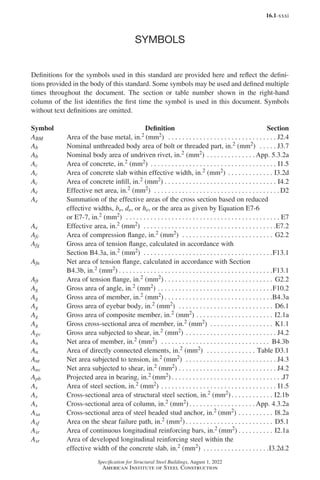
  • 158.
    16.1-90 Specification for StructuralSteel Buildings, August 1, 2022 American Institute of Steel Construction User Note: It is the intent of this Specification that the concrete and reinforcing steel portions of composite concrete members are designed and detailed utilizing the provisions of ACI 318 as modified by this Specification. All requirements specific to composite members are covered in this Specification. Note that the design basis for ACI 318 is strength design. Designers using ASD for steel must be conscious of the different load factors. 2. Nominal Strength of Composite Sections The nominal strength of composite sections shall be determined in accordance with either the plastic stress distribution method, the strain compatibility method, the elastic stress distribution method, or the effective stress-strain method, as defined in this section. The tensile strength of the concrete shall be neglected in the determination of the nominal strength of composite members. Local buckling effects shall be evaluated for filled composite members, as defined in Section I1.4. Local buckling effects need not be evaluated for encased composite members or composite plate shear walls meeting the requirements of this chapter. 2a. Plastic Stress Distribution Method For the plastic stress distribution method, the nominal strength shall be computed assuming that steel components have reached a stress of Fy in either tension or com- pression, and concrete components in compression due to axial force and/or flexure have reached a stress of 0 85 . ′ fc , where ′ fc is the specified compressive strength of concrete, ksi (MPa). For round HSS filled with concrete, a stress of 0.95 ′ fc is per- mitted to be used for concrete components in compression due to axial force and/or flexure to account for the effects of concrete confinement. 2b. Strain Compatibility Method For the strain compatibility method, a linear distribution of strains across the section shall be assumed, with the maximum concrete compressive strain equal to 0.003 in./in. (mm/mm). The stress-strain relationships for steel and concrete shall be obtained from tests or from published results. User Note: The strain compatibility method can be used to determine nominal strength for irregular sections and for cases where the steel does not exhibit elasto- plastic behavior. General guidelines for the strain compatibility method for encased members subjected to axial load, flexure, or both are given in AISC Design Guide 6, Load and Resistance Factor Design of W-Shapes Encased in Concrete. 2c. Elastic Stress Distribution Method For the elastic stress distribution method, the nominal strength shall be determined from the superposition of elastic stresses for the limit state of yielding or concrete crushing. GENERAL PROVISIONS [Sect. I1. Part 16.1 G-I (075-120).indd 90 Part 16.1 G-I (075-120).indd 90 2023-01-10 7:41 PM 2023-01-10 7:41 PM
  • 159.
    16.1-91 Specification for StructuralSteel Buildings, August 1, 2022 American Institute of Steel Construction 2d. Effective Stress-Strain Method For the effective stress-strain method, the nominal strength shall be computed assuming strain compatibility and effective stress-strain relationships for structural steel, reinforcing steel, and concrete components accounting for the effects of local buckling, yielding, interaction, and concrete confinement. 3. Material Limitations For concrete, structural steel, and reinforcing steel in composite systems, the fol- lowing limitations shall be met unless the design is based on the requirements of Appendix 2: (a) For the determination of the available strength, concrete shall have a specified compressive strength, ′ fc , of not less than 3 ksi (21 MPa) nor more than 10 ksi (69 MPa) for normal weight concrete and not less than 3 ksi (21 MPa) nor more than 6 ksi (41 MPa) for lightweight concrete. (b) The specified minimum yield stress of structural steel used in calculating the strength of composite members shall not exceed 75 ksi (525 MPa). (c) The specified minimum yield stress of reinforcing bars used in calculating the strength of composite members shall not exceed 80 ksi (550 MPa). The design of filled composite members constructed from materials with strengths above the limits noted in this section shall be in accordance with Appendix 2. User Note: Appendix 2 includes equations for determining the available strength of rectangular filled composite members with either the specified minimum yield stress of structural steel exceeding 75 ksi (525 MPa) but less than 100 ksi (690 MPa) or specified compressive strength, ′ fc , exceeding 10 ksi (69 MPa) but less than 15 ksi (100 MPa). 4. Classification of Filled Composite Sections for Local Buckling For compression, filled composite sections are classified as compact composite, non- compact composite, or slender-element composite sections. For a section to qualify as compact composite, the maximum width-to-thickness ratio, λ, of its compression steel elements shall not exceed the limiting width-to-thickness ratio, λp, from Table I1.1a. If the maximum width-to-thickness ratio of one or more steel compression elements exceeds λp, but does not exceed λr from Table I1.1a, the filled composite section is noncompact composite. If the maximum width-to-thickness ratio of any compression steel element exceeds λr, the section is slender-element composite. The maximum permitted width-to-thickness ratio shall be as specified in Table I1.1a. For flexure, filled composite sections are classified as compact composite, noncom- pact composite, or slender-element composite sections. For a section to qualify as compact composite, the maximum width-to-thickness ratio of its compression steel elements shall not exceed the limiting width-to-thickness ratio, λp, from Table I1.1b. If the maximum width-to-thickness ratio of one or more steel compression elements Sect. I1.] GENERAL PROVISIONS Part 16.1 G-I (075-120).indd 91 Part 16.1 G-I (075-120).indd 91 2023-01-10 7:41 PM 2023-01-10 7:41 PM
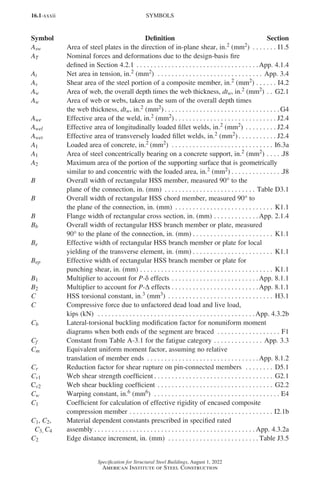
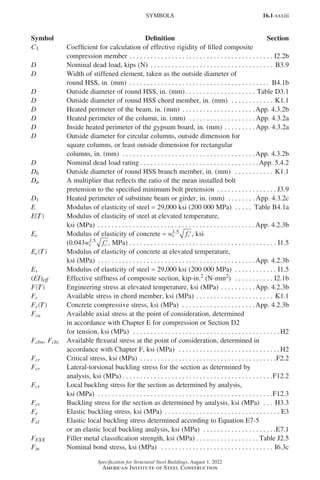
  • 160.
    16.1-92 Specification for StructuralSteel Buildings, August 1, 2022 American Institute of Steel Construction TABLE I1.1a Limiting Width-to-Thickness Ratios for Compression Steel Elements in Composite Members Subjected to Axial Compression for Use with Section I2.2 Description of Element Width-to- Thickness Ratio λ λp Compact Composite/ Noncompact Composite λ λr Noncompact Composite/ Slender- Element Composite Maximum Permitted Walls of rectangular HSS and box sections of uniform thickness b t 2 26 . E Fy 3 00 . E Fy 5 00 . E Fy Round HSS D t 0 15 . E Fy 0 19 . E Fy 0 31 . E Fy TABLE I1.1b Limiting Width-to-Thickness Ratios for Compression Steel Elements in Composite Members Subjected to Flexure for Use with Section I3.4 Description of Element Width-to- Thickness Ratio λ λp Compact Composite/ Noncompact Composite λ λr Noncompact Composite/ Slender- Element Composite Maximum Permitted Flanges of rectangular HSS and box sections of uniform thickness b t 2 26 . E Fy 3 00 . E Fy 5 00 . E Fy Webs of rectangular HSS and box sections of uniform thickness h t 3 00 . E Fy 5 70 . E Fy 5 70 . E Fy Round HSS D t 0 09 . E Fy 0 31 . E Fy 0 31 . E Fy exceeds λp, but does not exceed λr from Table I1.1b, the section is noncompact com- posite. If the width-to-thickness ratio of any steel element exceeds λr, the section is slender-element composite. The maximum permitted width-to-thickness ratio shall be as specified in Table I1.1b. Refer to Section B4.1b for definitions of width, b and D, and thickness, t, for rectan- gular and round HSS sections and box sections of uniform thickness. GENERAL PROVISIONS [Sect. I1. Part 16.1 G-I (075-120).indd 92 Part 16.1 G-I (075-120).indd 92 2023-01-10 7:41 PM 2023-01-10 7:41 PM
  • 161.
    16.1-93 Specification for StructuralSteel Buildings, August 1, 2022 American Institute of Steel Construction User Note: All current ASTM A500/A500M Grade C square HSS sections are compact composite according to the limits of Table I1.1a and Table I1.1b, except HSS7×7×1 /8, HSS8×8×1 /8, HSS10×10×3/16, HSS12×12×3/16, HSS14×14×1 /4, HSS16×16×1 /4, HSS18×18×5/16, and HSS20×20×5/16, which are noncompact composite for both axial compression and flexure, and HSS9×9×1 /8 and HSS18×18×1 /4, which are slender-element composite for both axial compression and flexure. All current ASTM A1085/A1085M square HSS are compact composite except for HSS8×8×1 /8, HSS 9×9×1 /8, HSS 12×12×3/16, HSS16×16×1 /4, HSS18×18×1 /4, HSS18×18×5/16, and HSS 20×20×5/16, which are noncompact composite for both axial compression and flexure. All current ASTM A500/A500M Grade C round HSS sections are compact composite according to the limits of Table I1.1a and Table I1.1b for both axial compression and flexure, with the exception of HSS6.625×0.125, HSS7.000×0.125, HSS9.625×0.188, HSS10.000×0.188, HSS10.75×0.188, HSS12.750×0.188, HSS12.750×0.250, HSS13.375×0.188, HSS13.375×0.250, HSS14.000×0.188, HSS14.000×0.250, HSS16.000×0.250, HSS16.000×0.312, HSS18.000×0.250, HSS18.000×0.313, HSS20.000×0.250, HSS20.000×0.313, HSS20.000×0.375, HSS22.000×0.313, HSS22.000×0.375, HSS24.000×0.313, HSS24.000×0.375, HSS26.000×0.375, HSS26.000×0.500, HSS28.000×0.375, and HSS28.000×0.500, which are noncompact composite for flexure, and HSS26.000×0.313, which is noncompact for compression and flexure. 5. Stiffness for Calculation of Required Strengths For the direct analysis method of design, the required strengths of encased composite members, filled composite members, and composite plate shear walls shall be deter- mined using the provisions of Section C2 and the following requirements: (a) The nominal flexural stiffness of encased and filled composite members subjected to net compression shall be taken as the effective stiffness of the composite sec- tion, (EI)eff, as defined in Section I2. (b) The nominal axial stiffness of encased and filled composite members subjected to net compression shall be taken as the summation of the elastic axial stiffnesses of each component. (c) The stiffness of encased and filled composite members subjected to net tension shall be taken as the stiffness of the bare steel members in accordance with Chapter C. (d) The stiffness reduction parameter, τb, shall be taken as 0.8 for encased and filled composite members. Sect. I1.] GENERAL PROVISIONS Part 16.1 G-I (075-120).indd 93 Part 16.1 G-I (075-120).indd 93 2023-01-10 7:41 PM 2023-01-10 7:41 PM
  • 162.
    16.1-94 Specification for StructuralSteel Buildings, August 1, 2022 American Institute of Steel Construction User Note: Taken together, the stiffness reduction factors require the use of 0.64(EI)eff for the flexural stiffness and 0.8 times the nominal axial stiffness of encased composite members and filled composite members subjected to net com- pression in the analysis. Stiffness values appropriate for the calculation of deflections and for use with the effective length method are discussed in the Commentary. (e) The flexural stiffness, (EI)eff, axial stiffness, (EA)eff, and shear stiffness, (GA)eff, of composite plate shear walls shall account for the extent of concrete cracking under LRFD load combinations or 1.6 times the ASD load combinations. It is permitted to use the following to estimate effective stiffness: (EI)eff = EsIs + 0.35EcIc (I1-1) (EA)eff = EsAs + 0.45EcAc (I1-2) (GA)eff = GsAsw + GcAc (I1-3) where Ac = area of concrete, in.2 (mm2) As = area of steel section, in.2 (mm2) Asw = area of steel plates in the direction of in-plane shear, in.2 (mm2) Ec = modulus of elasticity of concrete = w f c c 1 5 . ′, ksi (0 043 1 5 . . w f c c′, MPa) Es = modulus of elasticity of steel = 29,000 ksi (200 000 MPa) Gc = shear modulus of concrete = 0.4Ec Gs = shear modulus of steel = 11,200 ksi (77 200 MPa) Ic = moment of inertia of the concrete section about the elastic neutral axis of the composite section, in.4 (mm4) Is = moment of inertia of steel shape about the elastic neutral axis of the composite section, in.4 (mm4) wc = weight of concrete per unit volume (90 ≤ wc ≤ 155 lb/ft3 or 1 500 ≤ wc ≤ 2 500 kg/m3) (f) The stiffness reduction parameter, τb, shall be taken as 1.0 for composite plate shear walls. 6. Requirements for Composite Plate Shear Walls The steel plates shall comprise at least 1% but no more than 10% of the total com- posite cross-sectional area. The opposing steel plates shall be connected to each other using ties consisting of bars, structural shapes, or built-up members. For filled composite plate shear walls, the steel plates shall be anchored to the concrete using ties or a combination of ties and steel anchors. Walls without flange (closure) plates or boundary elements are not permitted. GENERAL PROVISIONS [Sect. I1. Part 16.1 G-I (075-120).indd 94 Part 16.1 G-I (075-120).indd 94 2023-01-10 7:41 PM 2023-01-10 7:41 PM
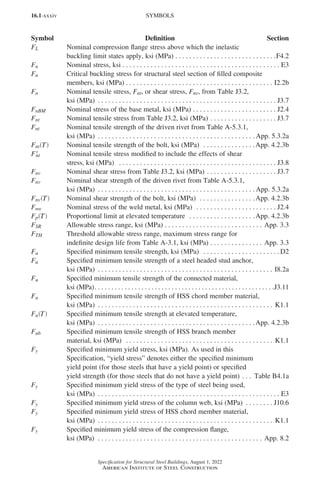
  • 163.
    16.1-95 Specification for StructuralSteel Buildings, August 1, 2022 American Institute of Steel Construction 6a. Slenderness Requirement The slenderness ratio of the plates, b t , shall be limited as follows: b t E Fy ≤1 2 . (I1-4) where b = largest clear distance between rows of steel anchors or ties, in. (mm) t = thickness of plate, in. (mm) 6b. Tie Bar Requirement Tie bars shall have spacing no greater than 1.0 times the wall thickness, tsc. The tie bar spacing to plate thickness ratio, s t t , shall be limited as follows: s t E t s ≤ + 1 0 2 1 . α (I1-5) s t E t s ≤ + 0 38 2 1 . α (I1-5M) α = −             1 7 2 4 . t t t d sc tie (I1-6) where dtie = effective diameter of the tie bar, in. (mm) st = largest clear spacing of the ties, in. (mm) t = thickness of plate, in. (mm) tsc = thickness of composite plate shear wall, in. (mm) I2. AXIAL FORCE This section applies to encased composite members, filled composite members, and composite plate shear walls subjected to axial force. 1. Encased Composite Members 1a. Limitations For encased composite members, the following limitations shall be met: (a) The cross-sectional area of the steel core shall comprise at least 1% of the total composite cross section. (b) Concrete encasement of the steel core shall be reinforced with continuous longi- tudinal bars and transverse reinforcement consisting of ties, hoops, and/or spirals. Detailing and placement of longitudinal reinforcement, including bar spacing and concrete cover requirements, shall conform to ACI 318. Transverse reinforcement where specified as ties or hoops shall consist of a minimum of either a No. 3 (10 mm) bar spaced at a maximum of 12 in. (300 mm) on center, or a No. 4 (13 mm) bar or larger spaced at a maximum of 16 in. Sect. I2.] AXIAL FORCE Part 16.1 G-I (075-120).indd 95 Part 16.1 G-I (075-120).indd 95 2023-01-10 7:41 PM 2023-01-10 7:41 PM
  • 164.
    16.1-96 Specification for StructuralSteel Buildings, August 1, 2022 American Institute of Steel Construction (400 mm) on center. Deformed wire or welded wire reinforcement of equivalent area is permitted. Maximum spacing of ties or hoops shall not exceed 0.5 times the smaller column dimension. (c) The minimum reinforcement ratio for continuous longitudinal reinforcement, ρsr, shall be 0.004, where ρsr is given by ρsr sr g A A = (I2-1) where Ag = gross area of composite member, in.2 (mm2) Asr = area of continuous longitudinal reinforcing bars, in.2 (mm2) (d) The maximum reinforcement ratio for continuous longitudinal reinforcement, ρsr, shall meet ACI 318 with the gross area of concrete, Ag, assumed in the cal- culations. User Note: Refer to ACI 318 for additional longitudinal and transverse steel provisions. Refer to Section I4 for shear requirements. 1b. Compressive Strength The design compressive strength, fcPn, and allowable compressive strength, Pn c Ω , of doubly symmetric axially loaded encased composite members shall be determined for the limit state of flexural buckling based on member slenderness as follows: fc = 0.75 (LRFD)   Wc = 2.00 (ASD) (a) When P P no e ≤ 2 25 . P P n no P P no e =         0 658 . (I2-2) (b) When P P no e 2 25 . Pn = 0.877Pe (I2-3) where Pe = elastic critical buckling load determined in accordance with Chapter C or Appendix 7, kips (N) = π2 ( ) EI L eff c 2 (I2-4) ( ) EI eff = effective stiffness of composite section, kip-in.2 (N-mm2) = EsIs + EsIsr + C1EcIc (I2-5) C1 = coefficient for calculation of effective rigidity of an encased composite compression member = 0 25 3 0 7 . . + +       ≤ A A A s sr g (I2-6) Ec = modulus of elasticity of concrete = w f c c 1 5 . ′ , ksi (0 043 1 5 . . w f c c′, MPa) AXIAL FORCE [Sect. I2. Part 16.1 G-I (075-120).indd 96 Part 16.1 G-I (075-120).indd 96 2023-01-10 7:41 PM 2023-01-10 7:41 PM
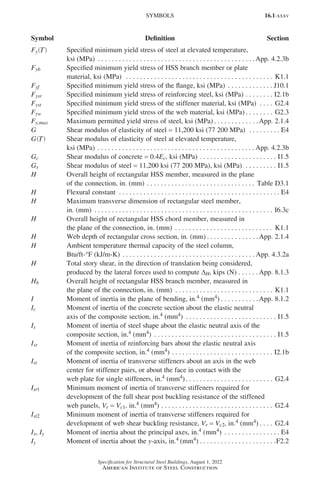
  • 165.
    16.1-97 Specification for StructuralSteel Buildings, August 1, 2022 American Institute of Steel Construction ′ fc = specified compressive strength of concrete, ksi (MPa) wc = weight of concrete per unit volume (90 ≤ wc ≤ 155 lb/ft3 or 1500 ≤ wc ≤ 2 500 kg/m3) Es = modulus of elasticity of steel = 29,000 ksi (200 000 MPa) Ic = moment of inertia of the concrete section about the elastic neutral axis of the composite section, in.4 (mm4) Is = moment of inertia of steel shape about the elastic neutral axis of the com- posite section, in.4 (mm4) Isr = moment of inertia of reinforcing bars about the elastic neutral axis of the composite section, in.4 (mm4) Lc = effective length of the member, in. (mm) = KL K = effective length factor L = laterally unbraced length of the member, in. (mm) Pno = nominal axial compressive strength without consideration of length effects, kips (N) = = + + ′ F A F A f A y s ysr sr c c 0 85 . (I2-7) Ac = area of concrete, in.2 (mm2) As = cross-sectional area of structural steel section, in.2 (mm2) Fy = specified minimum yield stress of structural steel section, ksi (MPa) Fysr = specified minimum yield stress of reinforcing steel, ksi (MPa) The available compressive strength need not be less than that determined for the bare steel member in accordance with Chapter E. 1c. Tensile Strength The available tensile strength of axially loaded encased composite members shall be determined for the limit state of yielding as Pn = FyAs + FysrAsr (I2-8) φt = 0.90 (LRFD)   Wt = 1.67 (ASD) 1d. Load Transfer Load transfer requirements for encased composite members shall be determined in accordance with Section I6. 1e. Detailing Requirements For encased composite members, the following detailing requirements shall be met: (a) Clear spacing between the steel core and longitudinal reinforcing bars shall be a minimum of 1.5 longitudinal reinforcing bar diameters, but not less than 1.5 in. (38 mm). (b) If the composite cross section is built up from two or more encased steel shapes, the shapes shall be interconnected with lacing, tie plates, or comparable com- ponents to prevent buckling of individual shapes due to loads applied prior to hardening of the concrete. Sect. I2.] AXIAL FORCE Part 16.1 G-I (075-120).indd 97 Part 16.1 G-I (075-120).indd 97 2023-01-10 7:41 PM 2023-01-10 7:41 PM
  • 166.
    16.1-98 Specification for StructuralSteel Buildings, August 1, 2022 American Institute of Steel Construction User Note: Refer to ACI 318 for additional longitudinal and transverse reinforc- ing steel requirements. Refer to Section I4 for requirements for members subjected to shear. The requirements of Section I2.1.1e are not applicable to composite plate shear walls. 2. Filled Composite Members 2a. Limitations For filled composite members, the following limitations shall be met: (a) The cross-sectional area of the structural steel section shall comprise at least 1% of the total composite cross section. (b) Filled composite members shall be classified for local buckling according to Section I1.4. (c) Minimum longitudinal reinforcement is not required. If longitudinal reinforce- ment is provided, internal transverse reinforcement is not required for strength; however, minimum internal transverse reinforcement shall be provided. Trans- verse reinforcement where specified as ties or hoops shall consist of a minimum of either a No. 3 (10 mm) bar spaced at a maximum of 12 in. (300 mm) on center, or a No. 4 (13 mm) bar or larger spaced at a maximum of 16 in. (400 mm) on center. Deformed wire or welded wire reinforcement of equivalent area is permitted. (d) If longitudinal reinforcing steel is provided for strength, the maximum reinforce- ment ratio shall be based on ACI 318 requirements for the gross area of concrete. User Note: Refer to ACI 318 for additional longitudinal and transverse steel provisions. Refer to Section I4 and Section I4 Commentary for shear in filled composite members. 2b. Compressive Strength The available compressive strength of axially loaded doubly symmetric filled compo- site members shall be determined for the limit state of flexural buckling in accor- dance with Section I2.1b with the following modifications: (a) For compact composite sections Pno = Pp (I2-9a) where Pp = plastic axial compressive strength, kips (N) = F A C f A A E E y s c c sr s c + ′ +       2 (I2-9b) C2 = 0.85 for rectangular sections and 0.95 for round sections (b) For noncompact composite sections P P P P no p p y r p p = − − − ( ) − ( ) λ λ λ λ 2 2 (I2-9c) AXIAL FORCE [Sect. I2. Part 16.1 G-I (075-120).indd 98 Part 16.1 G-I (075-120).indd 98 2023-01-10 7:41 PM 2023-01-10 7:41 PM
  • 167.
    16.1-99 Specification for StructuralSteel Buildings, August 1, 2022 American Institute of Steel Construction where λp and λr are width-to-thickness ratios determined from Table I1.1a. Pp is determined from Equation I2-9b. Py = F A f A A E E y s c c sr s c + ′ +       0 7 . (I2-9d) (c) For slender composite sections P F A f A A E E no n s c c sr s c = + ′ +       0 7 . (I2-9e) where the critical buckling stress for the structural steel section of filled composite members, Fn, is determined as follows: (1) For rectangular filled sections F E n s = 9 2 λ (I2-10) (2) For round filled sections F F D t F E n y y s =             0 72 0 2 . . (I2-11) See Section I1.4 for definitions of maximum width-to-thickness ratio, λ; width, D; and thickness, t, for rectangular and round HSS and box sections of uniform thickness. The effective stiffness of the composite section, ( ) EI eff , for all sections shall be ( ) EI eff = EsIs + EsIsr + C3EcIc (I2-12) where C3 = coefficient for calculation of effective rigidity of a filled composite compres- sion member = 0 45 3 0 9 . . + +       ≤ A A A s sr g (I2-13) The available compressive strength need not be less than that determined for the bare steel member in accordance with Chapter E. 2c. Tensile Strength The available tensile strength of axially loaded filled composite members shall be determined for the limit state of yielding as Pn = AsFy + AsrFysr (I2-14) φt = 0.90 (LRFD)   Wt = 1.67 (ASD) 2d. Load Transfer Load transfer requirements for filled composite members shall be determined in accordance with Section I6. Sect. I2.] AXIAL FORCE Part 16.1 G-I (075-120).indd 99 Part 16.1 G-I (075-120).indd 99 2023-01-10 7:41 PM 2023-01-10 7:41 PM
  • 168.
    16.1-100 Specification for StructuralSteel Buildings, August 1, 2022 American Institute of Steel Construction 2e. Detailing Requirements Clear spacing between the inside of the structural steel section and longitudinal rein- forcing steel, where provided, shall be a minimum of 1.5 reinforcing bar diameters, but not less than 1.5 in. (38 mm). 3. Composite Plate Shear Walls 3a. Compressive Strength The available compressive strength of axially loaded composite plate shear walls shall be determined for the limit state of flexural buckling in accordance with Section I2.1b. The value of flexural stiffness from Section I1.5 shall be used along with Pno determined as follows: P F A f A no y s c c = + ′ 0 85 . (I2-15) φc = 0.90 (LRFD)   Wc = 1.67 (ASD) 3b. Tensile Strength The available tensile strength of axially loaded composite plate shear walls shall be determined for the limit state of yielding as P A F n s y = (I2-16) φt = 0.90 (LRFD)   Wt = 1.67 (ASD) I3. FLEXURE This section applies to three types of composite members subjected to flexure: compo- site beams with steel anchors consisting of steel headed stud anchors or steel channel anchors, encased members, and filled members. 1. General 1a. Effective Width The effective width of the concrete slab shall be the sum of the effective widths for each side of the beam centerline, each of which shall not exceed (a) one-eighth of the beam span, center-to-center of supports; (b) one-half the distance to the centerline of the adjacent beam; or (c) the distance to the edge of the slab. 1b. Strength During Construction When temporary shores are not used during construction, the structural steel section alone shall have sufficient strength to support all loads applied prior to the concrete attaining 75% of its specified strength, ′ fc . The available flexural strength of the steel section shall be determined in accordance with Chapter F. AXIAL FORCE [Sect. I2. Part 16.1 G-I (075-120).indd 100 Part 16.1 G-I (075-120).indd 100 2023-01-10 7:41 PM 2023-01-10 7:41 PM
  • 169.
    16.1-101 Specification for StructuralSteel Buildings, August 1, 2022 American Institute of Steel Construction 2. Composite Beams with Steel Headed Stud or Steel Channel Anchors 2a. Positive Flexural Strength The design positive flexural strength, φbMn, and allowable positive flexural strength, Mn b Ω , shall be determined for the limit state of yielding as follows: φb = 0.90 (LRFD)   Wb = 1.67 (ASD) (a) When h t E F w y ≤ 3 76 . Mn shall be determined from the plastic stress distribution on the composite section for the limit state of yielding (plastic moment). User Note: All current ASTM A6/A6M W, S, and HP shapes satisfy the limit given in Section I3.2a(a) for Fy ≤ 70 ksi (485 MPa). (b) When h t E F w y 3 76 . Mn shall be determined from the superposition of elastic stresses, considering the effects of shoring, for the limit state of yielding (yield moment). 2b. Negative Flexural Strength The available negative flexural strength shall be determined for the structural steel section alone, in accordance with the requirements of Chapter F. Alternatively, the available negative flexural strength shall be determined from the plastic stress distribution for the composite section, for the limit state of yielding (plastic moment), with φb = 0.90 (LRFD)   Wb = 1.67 (ASD) provided that the following limitations are met: (a) The steel beam is compact and is braced in accordance with Chapter F. (b) Steel headed stud or steel channel anchors connect the slab to the steel beam in the negative moment region. (c) The slab longitudinal reinforcement parallel to the steel beam, within the effec- tive width of the slab, meets the development length requirements. User Note: To check compactness of a composite beam in negative flexure, Case 10 in Table B4.1b is appropriate to use for flanges, and Case 15 of Table B4.1b is appropriate to use for webs. 2c. Composite Beams with Formed Steel Deck 1. General The available flexural strength of composite construction consisting of con- crete slabs on formed steel deck connected to steel beams shall be determined Sect. I3.] FLEXURE Part 16.1 G-I (075-120).indd 101 Part 16.1 G-I (075-120).indd 101 2023-01-10 7:41 PM 2023-01-10 7:41 PM
  • 170.
    16.1-102 Specification for StructuralSteel Buildings, August 1, 2022 American Institute of Steel Construction by the applicable portions of Sections I3.2a and I3.2b, with the following requirements: (a) The nominal rib height shall not be greater than 3 in. (75 mm). The average width of concrete rib or haunch, wr, shall not be less than 2 in. (50 mm), but shall not be taken in calculations as more than the minimum clear width near the top of the steel deck. (b) The concrete slab shall be connected to the steel beam with steel headed stud anchors welded either through the deck or directly to the steel cross sec- tion. Steel headed stud anchors, after installation, shall extend not less than 12 in. (38 mm) above the top of the steel deck and there shall be at least 2 in. (13 mm) of specified concrete cover above the top of the steel headed stud anchors. (c) The slab thickness above the steel deck shall be not less than 2 in. (50 mm). (d) Steel deck shall be anchored to all supporting members at a spacing not to exceed 18 in. (450 mm). Such anchorage shall be provided by steel headed stud anchors, a combination of steel headed stud anchors and arc spot (puddle) welds, or other devices specified by the design documents and specifications issued for construction. 2. Deck Ribs Oriented Perpendicular to Steel Beam Concrete below the top of the steel deck shall be neglected in determining composite section properties and in calculating Ac for deck ribs oriented perpen- dicular to the steel beams. 3. Deck Ribs Oriented Parallel to Steel Beam Concrete below the top of the steel deck is permitted to be included in determin- ing composite section properties and in calculating Ac. Formed steel deck ribs over supporting beams are permitted to be split longitu- dinally and separated to form a concrete haunch. When the nominal depth of steel deck is 12 in. (38 mm) or greater, the average width, wr, of the supported haunch or rib shall be not less than 2 in. (50 mm) for the first steel headed stud anchor in the transverse row plus four stud diameters for each additional steel headed stud anchor. 2d. Load Transfer Between Steel Beam and Concrete Slab 1. Load Transfer for Positive Flexural Strength The entire horizontal shear at the interface between the steel beam and the concrete slab shall be assumed to be transferred by steel headed stud or steel channel anchors, except for concrete-encased beams as defined in Section I3.3. For composite action with concrete subjected to flexural compression, the nomi- nal shear force between the steel beam and the concrete slab transferred by steel anchors, V′, between the point of maximum positive moment and the point of zero moment shall be determined as the lowest value in accordance with the limit states of concrete crushing, tensile yielding of the steel section, or the shear strength of the steel anchors: FLEXURE [Sect. I3. Part 16.1 G-I (075-120).indd 102 Part 16.1 G-I (075-120).indd 102 2023-01-10 7:41 PM 2023-01-10 7:41 PM
  • 171.
    16.1-103 Specification for StructuralSteel Buildings, August 1, 2022 American Institute of Steel Construction (a) Concrete crushing ′ = ′ V f A c c 85 0. (I3-1a) (b) Tensile yielding of the steel section ′= V F A y s (I3-1b) (c) Shear strength of steel headed stud or steel channel anchors ′ = V Qn Σ (I3-1c) where Ac = area of concrete slab within effective width, in.2 (mm2) As = cross-sectional area of structural steel section, in.2 (mm2) ΣQn = sum of nominal shear strengths of steel headed stud or steel channel anchors between the point of maximum positive moment and the point of zero moment, kips (N) The effect of ductility (slip capacity) of the shear connection at the interface of the concrete slab and the steel beam shall be considered. 2. Load Transfer for Negative Flexural Strength In continuous composite beams where longitudinal reinforcing steel in the nega- tive moment regions is considered to act compositely with the steel beam, the total horizontal shear between the point of maximum negative moment and the point of zero moment shall be determined as the lower value in accordance with the following limit states: (a) For the limit state of tensile yielding of the slab longitudinal reinforcement ′= V F A y s Fysr Asr (I3-2a) where Asr = area of developed longitudinal reinforcing steel within the effective width of the concrete slab, in.2 (mm2) Fysr = specified minimum yield stress of the reinforcing steel, ksi (MPa) (b) For the limit state of shear strength of steel headed stud or steel channel anchors ′ = V Qn Σ (I3-2b) 3. Encased Composite Members 3a. Limitations For encased composite members, the following limitations shall be met: (a) The available flexural strength of concrete-encased members shall be determined as follows: φb = 0.90 (LRFD)   Wb = 1.67 (ASD) The nominal flexural strength, Mn, shall be determined using one of the follow- ing methods: (1) The superposition of elastic stresses on the composite section, considering the effects of shoring for the limit state of yielding (yield moment). Sect. I3.] FLEXURE Part 16.1 G-I (075-120).indd 103 Part 16.1 G-I (075-120).indd 103 2023-01-10 7:41 PM 2023-01-10 7:41 PM
  • 172.
    16.1-104 Specification for StructuralSteel Buildings, August 1, 2022 American Institute of Steel Construction (2) The plastic stress distribution on the steel section alone, for the limit state of yielding (plastic moment) on the steel section. (3) The plastic stress distribution on the composite section or the strain-com- patibility method, for the limit state of yielding (plastic moment) on the composite section. For concrete-encased members, steel anchors shall be provided. (b) The total cross-sectional area of the steel core shall comprise at least 1% of the total composite cross section. (c) Concrete encasement of the steel core shall be reinforced with continuous longi- tudinal bars and transverse reinforcement (stirrups, ties, hoops, or spirals). Detailing of longitudinal reinforcement, including bar spacing and concrete cover requirements, shall conform to ACI 318. Transverse reinforcement that consists of stirrups, ties, or hoops shall be a mini- mum of either a No. 3 (10 mm) bar spaced at a maximum of 12 in. (300 mm) on center, or a No. 4 (13 mm) bar or larger spaced at a maximum of 16 in. (400 mm) on center. Deformed wire or welded wire reinforcement of equivalent area is permitted. (d) The minimum reinforcement ratio for continuous longitudinal reinforcement, ρsr, shall be 0.004, where ρsr is given by ρsr sr g A A = (I3-3) where Ag = gross area of composite member, in.2 (mm2) Asr = area of continuous longitudinal reinforcing bars, in.2 (mm2) (e) Composite beam members with Pu 0.10Pn shall be tension controlled as de- fined in ACI 318. The determination of Pn shall include the area of both the structural steel section and the longitudinal reinforcement. User Note: The effect of this limitation is to restrict the reinforcement ratio to provide ductile behavior in case of an overload. Refer to ACI 318 for additional longitudinal and transverse steel provisions. Refer to Section I4 for shear require- ments. 3b. Detailing Requirements Clear spacing between the steel core and longitudinal reinforcing steel shall be a minimum of 1.5 reinforcing bar diameters, but not less than 1.5 in. (38 mm). 4. Filled Composite Members 4a. Limitations For filled composite members, the following limitations shall be met: (a) Filled composite sections shall be classified for local buckling according to Section I1.4. FLEXURE [Sect. I3. Part 16.1 G-I (075-120).indd 104 Part 16.1 G-I (075-120).indd 104 2023-01-10 7:41 PM 2023-01-10 7:41 PM
  • 173.
    16.1-105 Specification for StructuralSteel Buildings, August 1, 2022 American Institute of Steel Construction (b) The total cross-sectional area of the structural steel section shall comprise at least 1% of the total composite cross section. (c) Longitudinal reinforcement is not required. Where longitudinal reinforcement is provided, the minimum reinforcement ratio for continuous longitudinal reinforcement, ρsr, shall be 0.004, where ρsr is given by ρsr sr g A A = (I3-4) If longitudinal reinforcement is provided, internal transverse reinforcement is not required for strength; however, minimum internal transverse reinforcement shall be provided. The minimum transverse reinforcement shall be hoops and ties or hoops alone consisting of a minimum of either a No. 3 (10 mm) bar spaced at a maximum of 12 in. (300 mm) on center, or a No. 4 (13 mm) bar or larger spaced at a maximum of 16 in. (400 mm) on center. Deformed wire or welded wire reinforcement of equivalent area is permitted. (d) Composite beam members with Pu 0.10Pn shall be tension controlled as de- fined in ACI 318. The determination of Pn shall include the area of both the structural steel section and the longitudinal reinforcement. User Note: The effect of this limitation is to restrict the longitudinal reinforce- ment ratio to provide ductile behavior in case of an overload. Refer to ACI 318 for additional provisions for the longitudinal and transverse steel reinforcement. Refer to Section I4 for shear requirements. The limitations and requirements of Section I3.4a are not applicable to composite plate shear walls. 4b. Flexural Strength The available flexural strength of filled composite members shall be determined as follows: φb = 0.90 (LRFD)   Wb = 1.67 (ASD) The nominal flexural strength, Mn, shall be determined as follows: (a) For compact composite sections Mn = Mp (I3-5a) where Mp = moment corresponding to plastic stress distribution over the composite cross section, kip-in. (N-mm) (b) For noncompact composite sections M M M M n p p y p r p = ( ) − −       – – λ λ λ λ (I3-5b) where l, lp, and lr are width-to-thickness ratios determined from Table I1.1b. Sect. I3.] FLEXURE Part 16.1 G-I (075-120).indd 105 Part 16.1 G-I (075-120).indd 105 2023-01-10 7:41 PM 2023-01-10 7:41 PM
  • 174.
    16.1-106 Specification for StructuralSteel Buildings, August 1, 2022 American Institute of Steel Construction My = yield moment corresponding to yielding of the tension flange and first yield of the compression flange, kip-in. (N-mm). The capacity at first yield shall be calculated assuming a linear elastic stress distribution with the maximum concrete compressive stress limited to 0.7 ′ fc and the maximum steel stress limited to Fy. (c) For slender-element composite sections, Mn shall be determined as the first yield moment. The compression flange stress shall be limited to the critical buck- ling stress, Fn, determined using Equation I2-10 or I2-11. The concrete stress distribution shall be linear elastic with the maximum compressive stress limited to 0.70 ′ fc . 4c. Detailing Requirements Clear spacing between the inside of the steel section and longitudinal reinforcing steel where provided shall be a minimum of 1.5 reinforcing bar diameters, but not less than 1.5 in. (38 mm). 5. Composite Plate Shear Walls The available flexural strength of composite plate shear walls shall be determined in accordance with Section I1.2, where φb = 0.90 (LRFD)   Wb = 1.67 (ASD) I4. SHEAR 1. Encased Composite Members The design shear strength, φvVn, and allowable shear strength, Vn v Ω , of encased composite members shall be determined based on one of the following: (a) The available shear strength of the structural steel section alone as specified in Chapter G (b) The available shear strength of the reinforced concrete portion (concrete plus transverse reinforcement) alone as defined by ACI 318 with φv = 0.75 (LRFD)   Wv = 2.00 (ASD) (c) The nominal shear strength of the structural steel section, as defined in Chapter G, plus the nominal strength of the transverse reinforcement, as defined by ACI 318, with a combined resistance or safety factor of φv = 0.75 (LRFD)   Wv = 2.00 (ASD) 2. Filled Composite Members The design shear strength, φvVn, and allowable shear strength, Vn v Ω , of filled com- posite members shall be determined as follows: φv = 0.90 (LRFD)   Wv = 1.67 (ASD) The nominal shear strength, Vn, shall include the contributions of the structural steel section and concrete infill as follows: FLEXURE [Sect. I3. Part 16.1 G-I (075-120).indd 106 Part 16.1 G-I (075-120).indd 106 2023-01-10 7:41 PM 2023-01-10 7:41 PM
  • 175.
    16.1-107 Specification for StructuralSteel Buildings, August 1, 2022 American Institute of Steel Construction V A F K A f n v y c c c = + ′ 0 6 0 06 . . (I4-1) where Av = shear area of the steel portion of a composite member. The shear area for a round section is equal to 2As π, and for a rectangular section is equal to the sum of the area of webs in the direction of in-plane shear, in.2 (mm2) Ac = area of concrete infill, in.2 (mm2) Kc = 1 for members with shear span-to-depth, M V d u u ( ) , greater than or equal to 0.7, where Mu and Vu are equal to the maximum required flexural and shear strengths, respectively, along the member length, and d is equal to the member depth in the direction of bending = 10 for members with rectangular compact composite cross sections and M V d u u ( ) less than 0.5 = 9 for members with round compact composite cross sections and M V d u u ( ) less than 0.5 = 1 for members having other than compact composite cross sections, for all values of M V d u u ( ) Linear interpolation between these Kc values shall be used for members with com- pact composite cross sections and with M V d u u ( ) between 0.5 and 0.7. User Note: For most members, Kc will be equal to 1.0. Low shear span-to-depth ratios may occur in connection design (panel zones) or other special situations, for which higher values of Kc ( 1.0) are more appropriate. 3. Composite Beams with Formed Steel Deck The available shear strength of composite beams with steel headed stud or steel chan- nel anchors shall be determined based upon the properties of the steel section alone in accordance with Chapter G. 4. Composite Plate Shear Walls The design in-plane shear strength, φvVn, and allowable shear strength, Vn v Ω , of composite plate shear walls shall be determined as follows: φv = 0.90 (LRFD)   Wv = 1.67 (ASD) The nominal shear strength, Vn, shall account for the contributions of the structural steel section and concrete infill as follows: V K K K K A F n s sc s sc sw y = + + 3 2 2 (I4-2) where Asw = area of steel plates in the direction of in-plane shear, in.2 (mm2) Ks = GsAsw (I4-3) Gs = shear modulus of steel = 11,200 ksi (77 200 MPa) Ksc = 0 7 4 . E A E A E A E A c c s sw s sw c c ( )( ) + (I4-4) Sect. I4.] SHEAR Part 16.1 G-I (075-120).indd 107 Part 16.1 G-I (075-120).indd 107 2023-01-10 7:41 PM 2023-01-10 7:41 PM
  • 176.
    16.1-108 Specification for StructuralSteel Buildings, August 1, 2022 American Institute of Steel Construction I5. COMBINED FLEXURE AND AXIAL FORCE The interaction between flexure and axial forces in composite members shall account for stability as required by Chapter C. The available compressive strength and the available flexural strength shall be determined as defined in Sections I2 and I3, respectively. To account for the influence of length effects on the axial strength of the member, the nominal axial strength of the member shall be determined in accordance with Section I2. (a) For encased composite members and for filled composite members with compact composite sections, the interaction between axial force and flexure shall be based on the interaction equations of Section H1.1 or one of the methods defined in Section I1.2. (b) For filled composite members with noncompact composite or slender-element composite sections, the interaction between axial force and flexure shall be based either on the interaction equations of Section H1.1, the method defined in Section I1.2d, or Equations I5-1a and b. (1) When P P c r c p ≥ P P c c M M r c p m r c + −       ≤ 1 1 0 . (I5-1a) (2) When P P c r c p 1 1 0 −             + ≤ c c P P M M m p r c r c . (I5-1b) where For design according to Section B3.1 (LRFD) Mr = required flexural strength, determined in accordance with Section I1.5, using LRFD load combinations, kip-in. (N-mm) Mc = design flexural strength determined in accordance with Section I3, kip-in. (N-mm) = φbMn Pr = required axial strength, determined in accordance with Section I1.5 using LRFD load combinations, kips (N) Pc = design axial strength, determined in accordance with Section I2, kips (N) = φcPn φc = resistance factor for compression = 0.75 φb = resistance factor for flexure = 0.90 COMBINED FLEXURE AND AXIAL FORCE [Sect. I5. Part 16.1 G-I (075-120).indd 108 Part 16.1 G-I (075-120).indd 108 2023-01-10 7:41 PM 2023-01-10 7:41 PM
  • 177.
    16.1-109 Specification for StructuralSteel Buildings, August 1, 2022 American Institute of Steel Construction For design according to Section B3.2 (ASD) Mr = required flexural strength, determined in accordance with Section I1.5, using ASD load combinations, kip-in. (N-mm) Mc = allowable flexural strength, determined in accordance with Section I3, kip-in. (N-mm) = Mn b Ω Pr = required axial strength, determined in accordance with Section I1.5 using ASD load combinations, kips (N) Pc = allowable axial strength, determined in accordance with Section I2, kips (N) = Pn c Ω Wb = safety factor for flexure = 1.67 Wc = safety factor for compression = 2.00 cm and cp are determined from Table I5.1 csr = c A F A F A f sr s y sr yr c c = + ′ (I5-2) (c) For composite plate shear walls, the interaction between axial force and flexure shall be based on the methods defined in Section I1.2. I6. LOAD TRANSFER 1. General Requirements When external forces are applied to an axially loaded encased or filled composite member, the introduction of force to the member and the transfer of longitudinal shear within the member shall be assessed in accordance with the requirements for force allocation presented in this section. The available strength of the applicable force transfer mechanisms as determined in accordance with Section I6.3 shall equal or exceed the required shear force to be transferred, ′ Vr , as determined in accordance with Section I6.2. Force transfer mecha- nisms shall be located within the load transfer region as determined in accordance with Section I6.4. 2. Force Allocation Force allocation shall be determined based upon the distribution of external force in accordance with the following requirements. User Note: Bearing strength provisions for externally applied forces are provided in Section J8. For filled composite members, the term A A 2 1 in Equation J8-2 may be taken equal to 2.0 due to confinement effects. Sect. I6.] LOAD TRANSFER Part 16.1 G-I (075-120).indd 109 Part 16.1 G-I (075-120).indd 109 2023-01-10 7:41 PM 2023-01-10 7:41 PM
  • 178.
    16.1-110 Specification for StructuralSteel Buildings, August 1, 2022 American Institute of Steel Construction TABLE I5.1 Coefficients cp and cm for Use with Equations I5-1a and I5-1b Filled Composite Member Type cp cm when csr ≥ ≥ 0.5 when csr 0.5 Rectangular c c p sr = 0 17 0 4 . . c c m sr = ≥ 1 06 1 0 0 11 . . . c c m sr = ≤ 0 90 1 67 0 36 . . . Round HSS c c p sr = 0 27 0 4 . . c c m sr = ≥ 1 10 1 0 0 08 . . . c c m sr = ≤ 0 95 1 67 0 32 . . . 2a. External Force Applied to Steel Section When the entire external force is applied directly to the steel section, the force re- quired to be transferred to the concrete, ′ Vr , shall be determined as ′ = ( ) V P F A P r r y s no 1– (I6-1) where Pno = nominal axial compressive strength without consideration of length effects, determined by Equation I2-7 for encased composite members, and Equation I2-9a or Equation I2-9c, as applicable, for compact composite or noncom- pact composite filled composite members, kips (N) Pr = required external force applied to the composite member, kips (N) User Note: Equation I6-1 does not apply to slender filled composite members for which the external force is applied directly to the concrete fill in accordance with Section I6.2b, or concurrently to the steel and concrete, in accordance with Section I6.2c. 2b. External Force Applied to Concrete When the entire external force is applied directly to the concrete encasement or con- crete fill, the force required to be transferred to the steel, ′ Vr , shall be determined as follows: (a) For encased or filled composite members that are compact composite or non- compact composite ′ = ( ) V P F A P r r y s no (I6-2a) (b) For slender filled composite members ′ = ( ) V P F A P r r n s no (I6-2b) where Fn = critical buckling stress for structural steel sections of filled composite members determined using Equation I2-10 or Equation I2-11, as applicable, ksi (MPa) LOAD TRANSFER [Sect. I6. Part 16.1 G-I (075-120).indd 110 Part 16.1 G-I (075-120).indd 110 2023-01-10 7:41 PM 2023-01-10 7:41 PM
  • 179.
    16.1-111 Specification for StructuralSteel Buildings, August 1, 2022 American Institute of Steel Construction Pno = nominal axial compressive strength without consideration of length effects, determined by Equation I2-7 for encased composite members, and Equa- tion I2-9a, Equation I2-9c, or Equation I2-9e for filled composite members, kips (N) 2c. External Force Applied Concurrently to Steel and Concrete When the external force is applied concurrently to the steel section and concrete encasement or concrete fill, ′ Vr shall be determined as the force required to establish equilibrium of the cross section. User Note: The Commentary provides an acceptable method of determining the longitudinal shear force required for equilibrium of the cross section. 3. Force Transfer Mechanisms The available strength of the force transfer mechanisms of direct bond interaction, shear connection, and direct bearing shall be determined in accordance with this sec- tion. Use of the force transfer mechanism providing the largest nominal strength is permitted. Force transfer mechanisms shall not be superimposed. The force transfer mechanism of direct bond interaction shall not be used for encased composite members or for filled composite members where bond failure would result in uncontrolled slip. 3a. Direct Bearing Where force is transferred in an encased or filled composite member by direct bear- ing from internal bearing mechanisms, the available bearing strength of the concrete for the limit state of concrete crushing shall be determined as R f A n c = ′ 1 7 1 . (I6-3) φB = 0.65 (LRFD)  ΩB = 2.31 (ASD) where A1 = loaded area of concrete, in.2 (mm2) User Note: An example of force transfer via an internal bearing mechanism is the use of internal steel plates within a filled composite member. 3b. Shear Connection Where force is transferred in an encased or filled composite member by shear con- nectors, the available shear strength of steel headed stud or steel channel anchors shall be determined as Rc = SQcv (I6-4) where SQcv = sum of available shear strengths, φvQnv (LRFD) or Qnv Ωv (ASD), as ap- plicable, of steel headed stud or steel channel anchors, determined in accordance with Section I8.3a or Section I8.3d, respectively, placed within the load introduction length as defined in Section I6.4, kips (N) Sect. I6.] LOAD TRANSFER Part 16.1 G-I (075-120).indd 111 Part 16.1 G-I (075-120).indd 111 2023-01-10 7:41 PM 2023-01-10 7:41 PM
  • 180.
    16.1-112 Specification for StructuralSteel Buildings, August 1, 2022 American Institute of Steel Construction 3c. Direct Bond Interaction Where force is transferred in a filled composite member by direct bond interaction, the available bond strength between the steel and concrete shall be determined as follows: Rn = pbLinFin (I6-5) φd = 0.50 (LRFD)  Ωd = 3.00 (ASD) where D = outside diameter of round HSS, in. (mm) Fin = nominal bond stress, ksi (MPa) = 12 0 1 2 t H ≤ . , ksi (2 100 0 7 2 t H ≤ . MPa) for rectangular cross sections = 30 0 2 2 t D ≤ . , ksi (5 300 1 4 2 t D ≤ . MPa) for round cross sections H = maximum transverse dimension of rectangular steel member, in. (mm) Lin = load introduction length, determined in accordance with Section I6.4, in. (mm) Rn = nominal bond strength, kips (N) pb = perimeter of the steel-concrete bond interface within the composite cross section, in. (mm) t = design wall thickness of HSS member as defined in Section B4.2, in. (mm) 4. Detailing Requirements 4a. Encased Composite Members Force transfer mechanisms shall be distributed within the load introduction length, which shall not exceed a distance of two times the minimum transverse dimension of the encased composite member above and below the load transfer region. Anchors utilized to transfer shear shall be placed on at least two faces of the structural steel shape in a generally symmetric configuration about the steel shape axes. Steel anchor spacing, both within and outside of the load introduction length, shall conform to Section I8.3e. 4b. Filled Composite Members Force transfer mechanisms shall be distributed within the load introduction length, which shall not exceed a distance of two times the minimum transverse dimension of a rectangular steel member or two times the diameter of a round steel member both above and below the load transfer region. For the specific case of load applied to the concrete of a filled composite member containing no internal longitudinal reinforcement, the load introduction length shall extend beyond the load transfer region in only the direction of the applied force. Steel anchor spacing within the load introduction length shall conform to Section I8.3e. I7. COMPOSITE DIAPHRAGMS AND COLLECTOR BEAMS Composite slab diaphragms and collector beams shall be designed and detailed to transfer loads between the diaphragm, the diaphragm’s boundary members and col- lector elements, and elements of the lateral force-resisting system. User Note: Design guidelines for composite diaphragms and collector beams can be found in the Commentary. LOAD TRANSFER [Sect. I6. Part 16.1 G-I (075-120).indd 112 Part 16.1 G-I (075-120).indd 112 2023-01-10 7:41 PM 2023-01-10 7:41 PM
  • 181.
    16.1-113 Specification for StructuralSteel Buildings, August 1, 2022 American Institute of Steel Construction I8. STEEL ANCHORS 1. General The diameter of a steel headed stud anchor, dsa, shall be w in. (19 mm) or less, except where anchors are utilized solely for shear transfer in solid slabs, in which case, d-in.- (22-mm-) and 1-in.- (25-mm-) diameter anchors are permitted. Additionally, dsa shall not be greater than 2.5 times the thickness of the base metal to which it is welded, unless it is welded to a flange directly over a web. Section I8.2 applies to a composite flexural member where steel anchors are embed- ded in a solid concrete slab or in a slab cast on a formed steel deck. Section I8.3 applies to all other cases. 2. Steel Anchors in Composite Beams The length of steel headed stud anchors shall not be less than four stud diameters from the base of the steel headed stud anchor to the top of the stud head after instal- lation. 2a. Strength of Steel Headed Stud Anchors The nominal shear strength of one steel headed stud anchor embedded in a solid concrete slab or in a composite slab with decking shall be determined as follows: Q A f E R R A F n sa c c g p sa u = ′ ≤ 0 5 . (I8-1) where Asa = cross-sectional area of steel headed stud anchor, in.2 (mm2) Ec = modulus of elasticity of concrete = w f c c 1 5 . ′ , ksi (0 043 1 5 . . w f c c′, MPa) Fu = specified minimum tensile strength of a steel headed stud anchor, ksi (MPa) Rg = 1.0 for the following: (a) One steel headed stud anchor welded in a steel deck rib with the deck oriented perpendicular to the steel shape (b) Any number of steel headed stud anchors welded in a row directly to the steel shape (c) Any number of steel headed stud anchors welded in a row through steel deck with the deck oriented parallel to the steel shape and the ratio of the average rib width to rib depth ≥ 1.5 = 0.85 for the following: (a) Two steel headed stud anchors welded in a steel deck rib with the deck oriented perpendicular to the steel shape (b) One steel headed stud anchor welded through steel deck with the deck oriented parallel to the steel shape and the ratio of the average rib width to rib depth 1.5 = 0.7 for three or more steel headed stud anchors welded in a steel deck rib with the deck oriented perpendicular to the steel shape Rp = 0.75 for the following: (a) Steel headed stud anchors welded directly to the steel shape Sect. I8.] STEEL ANCHORS Part 16.1 G-I (075-120).indd 113 Part 16.1 G-I (075-120).indd 113 2023-01-10 7:41 PM 2023-01-10 7:41 PM
  • 182.
    16.1-114 Specification for StructuralSteel Buildings, August 1, 2022 American Institute of Steel Construction (b) Steel headed stud anchors welded in a composite slab with the deck oriented perpendicular to the beam and emid-ht ≥ 2 in. (50 mm) (c) Steel headed stud anchors welded through steel deck, or steel sheet used as girder filler material and embedded in a composite slab with the deck oriented parallel to the beam = 0.6 for steel headed stud anchors welded in a composite slab with deck oriented perpendicular to the beam and emid-ht 2 in. (50 mm) emid-ht = distance from the edge of steel headed stud anchor shank to the steel deck web, measured at mid-height of the deck rib, and in the load bearing direction of the steel headed stud anchor (in other words, in the direction of maximum moment for a simply supported beam), in. (mm) User Note: The table below presents values for Rg and Rp for several cases. Available strengths for steel headed stud anchors can be found in the AISC Steel Construction Manual. Condition Rg Rp No decking 1.0 0.75 Decking oriented parallel to the steel shape w h r r ≥ 1 5 . w h r r 1 5 . 1.0 0.85[a] 0.75 0.75 Decking oriented perpendicular to the steel shape Number of steel headed stud anchors occupying the same decking rib: 1 2 3 or more 1.0 0.85 0.7 0.6[b] 0.6[b] 0.6[b] hr = nominal rib height, in. (mm) wr = average width of concrete rib or haunch (as defined in Section I3.2c), in. (mm) [a]For a single steel headed stud anchor [b]This value may be increased to 0.75 when emid-ht ≥ 2 in. (50 mm). 2b. Strength of Steel Channel Anchors The nominal shear strength of one hot-rolled channel anchor embedded in a solid concrete slab shall be determined as Q t t l f E n f w a c c = + ′ 0 3 0 5 . ( . ) (I8-2) where la = length of channel anchor, in. (mm) tf = thickness of channel anchor flange, in. (mm) tw = thickness of channel anchor web, in. (mm) The strength of the channel anchor shall be developed by welding the channel to the beam flange for a force equal to Qn, considering eccentricity on the anchor. STEEL ANCHORS [Sect. I8. Part 16.1 G-I (075-120).indd 114 Part 16.1 G-I (075-120).indd 114 2023-01-11 9:35 AM 2023-01-11 9:35 AM
  • 183.
    16.1-115 Specification for StructuralSteel Buildings, August 1, 2022 American Institute of Steel Construction 2c. Required Number of Steel Anchors The number of anchors required between the section of maximum bending moment, positive or negative, and the adjacent section of zero moment shall be equal to the horizontal shear as determined in Sections I3.2d.1 and I3.2d.2 divided by the nomi- nal shear strength of one steel anchor as determined from Section I8.2a or Section I8.2b. The number of steel anchors required between any concentrated load and the nearest point of zero moment shall be sufficient to develop the maximum moment required at the concentrated load point. 2d. Detailing Requirements Steel anchors in composite beams shall meet the following requirements: (a) Steel anchors required on each side of the point of maximum bending moment, positive or negative, shall be distributed uniformly between that point and the adjacent points of zero moment, unless specified otherwise on the design docu- ments and specifications issued for construction. (b) Steel anchors shall have at least 1 in. (25 mm) of lateral concrete cover in the direction perpendicular to the shear force, except for anchors installed in the ribs of formed steel decks. (c) The minimum distance from the center of a steel anchor to a free edge in the direction of the shear force shall be 8 in. (200 mm) if normal weight concrete is used and 10 in. (250 mm) if lightweight concrete is used. The provisions of ACI 318, Chapter 17, are permitted to be used in lieu of these values. (d) Minimum center-to-center spacing of steel headed stud anchors shall be four diameters in any direction. For composite beams that do not contain anchors located within formed steel deck oriented perpendicular to the beam span, an additional minimum spacing limit of six diameters along the longitudinal axis of the beam shall apply. (e) The maximum center-to-center spacing of steel anchors shall not exceed eight times the total slab thickness or 36 in. (900 mm). 3. Steel Anchors in Composite Components This section shall apply to the design of cast-in-place steel headed stud anchors and steel channel anchors in composite components. The provisions of the applicable building code or ACI 318, Chapter 17, are permitted to be used in lieu of the provisions in this section. User Note: The steel headed stud anchor strength provisions in this section are applicable to anchors located primarily in the load transfer (connection) region of composite columns and beam-columns, concrete-encased and filled composite beams, composite coupling beams, and composite walls, where the steel and concrete are working compositely within a member. They are not intended for hybrid construction where the steel and concrete are not working compositely, such as with embed plates. Sect. I8.] STEEL ANCHORS Part 16.1 G-I (075-120).indd 115 Part 16.1 G-I (075-120).indd 115 2023-01-10 7:41 PM 2023-01-10 7:41 PM
  • 184.
    16.1-116 Specification for StructuralSteel Buildings, August 1, 2022 American Institute of Steel Construction Section I8.2 specifies the strength of steel anchors embedded in a solid concrete slab or in a concrete slab with formed steel deck in a composite beam. Limit states for the steel shank of the anchor and for concrete breakout in shear are covered directly in this section. Additionally, the spacing and dimensional limitations provided in these provisions preclude the limit states of concrete pryout for anchors loaded in shear and concrete breakout for anchors loaded in tension as defined by ACI 318, Chapter 17. For normal weight concrete: Steel headed stud anchors subjected to shear only shall not be less than five stud diameters in length from the base of the steel headed stud to the top of the stud head after installation. Steel headed stud anchors subjected to tension or interaction of shear and tension shall not be less than eight stud diameters in length from the base of the stud to the top of the stud head after installation. For lightweight concrete: Steel headed stud anchors subjected to shear only shall not be less than seven stud diameters in length from the base of the steel headed stud to the top of the stud head after installation. Steel headed stud anchors subjected to tension shall not be less than ten stud diameters in length from the base of the stud to the top of the stud head after installation. The nominal strength of steel headed stud anchors subjected to interaction of shear and tension for lightweight concrete shall be determined as stipulated by the applicable building code or ACI 318, Chapter 17. Steel headed stud anchors subjected to tension or interaction of shear and tension shall have a diameter of the head greater than or equal to 1.6 times the diameter of the shank. User Note: The following table presents values of minimum steel headed stud anchor h d ratios for each condition covered in this Specification. Loading Condition Normal Weight Concrete Lightweight Concrete Shear h dsa ≥ 5 h dsa ≥ 7 Tension h dsa ≥ 8 h dsa ≥ 10 Shear and tension h dsa ≥ 8 NA[a] h dsa ≥ 5 = ratio of steel headed stud anchor shank length to the top of the stud head-to-shank diameter. [a] Refer to ACI 318, Chapter 17, for the calculation of interaction effects of anchors embedded in lightweight concrete. 3a. Shear Strength of Steel Headed Stud Anchors in Composite Components Where concrete breakout strength in shear is not an applicable limit state, the design shear strength, φvQnv, and allowable shear strength, Qnv v Ω , of one steel headed stud anchor shall be determined as STEEL ANCHORS [Sect. I8. Part 16.1 G-I (075-120).indd 116 Part 16.1 G-I (075-120).indd 116 2023-01-10 7:41 PM 2023-01-10 7:41 PM
  • 185.
    16.1-117 Specification for StructuralSteel Buildings, August 1, 2022 American Institute of Steel Construction Qnv = FuAsa (I8-3) fv = 0.65 (LRFD)   Wv = 2.31 (ASD) where Asa = cross-sectional area of a steel headed stud anchor, in.2 (mm2) Fu = specified minimum tensile strength of a steel headed stud anchor, ksi (MPa) Qnv = nominal shear strength of a steel headed stud anchor, kips (N) Where concrete breakout strength in shear is an applicable limit state, the available shear strength of one steel headed stud anchor shall be determined by one of the following: (a) Where anchor reinforcement is developed in accordance with ACI 318 on both sides of the concrete breakout surface for the steel headed stud anchor, the mini- mum of the steel nominal shear strength from Equation I8-3 and the nominal strength of the anchor reinforcement shall be used for the nominal shear strength, Qnv, of the steel headed stud anchor. (b) As stipulated by the applicable building code or ACI 318, Chapter 17. User Note: If concrete breakout strength in shear is an applicable limit state (for example, where the breakout prism is not restrained by an adjacent steel plate, flange, or web), appropriate anchor reinforcement is required for the provisions of this section to be used. Alternatively, the provisions of the applicable building code or ACI 318, Chapter 17, may be used. 3b. Tensile Strength of Steel Headed Stud Anchors in Composite Components Where the distance from the center of an anchor to a free edge of concrete in the direction perpendicular to the height of the steel headed stud anchor is greater than or equal to 1.5 times the height of the steel headed stud anchor measured to the top of the stud head, and where the center-to-center spacing of steel headed stud anchors is greater than or equal to three times the height of the steel headed stud anchor mea- sured to the top of the stud head, the available tensile strength of one steel headed stud anchor shall be determined as Qnt = FuAsa (I8-4) ft = 0.75 (LRFD)   Wt = 2.00 (ASD) where Qnt = nominal tensile strength of steel headed stud anchor, kips (N) Where the distance from the center of an anchor to a free edge of concrete in the direction perpendicular to the height of the steel headed stud anchor is less than 1.5 times the height of the steel headed stud anchor measured to the top of the stud head, or where the center-to-center spacing of steel headed stud anchors is less than three times the height of the steel headed stud anchor measured to the top of the stud head, the nominal tensile strength of one steel headed stud anchor shall be determined by one of the following: Sect. I8.] STEEL ANCHORS Part 16.1 G-I (075-120).indd 117 Part 16.1 G-I (075-120).indd 117 2023-01-10 7:41 PM 2023-01-10 7:41 PM
  • 186.
    16.1-118 Specification for StructuralSteel Buildings, August 1, 2022 American Institute of Steel Construction (a) Where anchor reinforcement is developed in accordance with ACI 318 on both sides of the concrete breakout surface for the steel headed stud anchor, the minimum of the steel nominal tensile strength from Equation I8-4 and the nomi- nal strength of the anchor reinforcement shall be used for the nominal tensile strength, Qnt, of the steel headed stud anchor. (b) As stipulated by the applicable building code or ACI 318, Chapter 17. User Note: Supplemental confining reinforcement is recommended around the anchors for steel headed stud anchors subjected to tension or interaction of shear and tension to avoid edge effects or effects from closely spaced anchors. See the Commentary and ACI 318 for guidelines. 3c. Strength of Steel Headed Stud Anchors for Interaction of Shear and Tension in Composite Components Where concrete breakout strength in shear is not a governing limit state, and where the distance from the center of an anchor to a free edge of concrete in the direction perpendicular to the height of the steel headed stud anchor is greater than or equal to 1.5 times the height of the steel headed stud anchor measured to the top of the stud head, and where the center-to-center spacing of steel headed stud anchors is greater than or equal to three times the height of the steel headed stud anchor measured to the top of the stud head, the nominal strength for interaction of shear and tension of one steel headed stud anchor shall be determined as rv       + ≤ 1.0 Q cv Q rt       Q ct Q 5/3 5/3 (I8-5) where Qct = available tensile strength, determined in accordance with Section I8.3b, kips (N) Qcv = available shear strength, determined in accordance with Section I8.3a, kips (N) Qrt = required tensile strength, kips (N) Qrv = required shear strength, kips (N) Where concrete breakout strength in shear is a governing limit state, or where the distance from the center of an anchor to a free edge of concrete in the direction perpendicular to the height of the steel headed stud anchor is less than 1.5 times the height of the steel headed stud anchor measured to the top of the stud head, or where the center-to-center spacing of steel headed stud anchors is less than three times the height of the steel headed stud anchor measured to the top of the stud head, the nominal strength for interaction of shear and tension of one steel headed stud anchor shall be determined by one of the following: (a) Where anchor reinforcement is developed in accordance with ACI 318 on both sides of the concrete breakout surface for the steel headed stud anchor, the mini- mum of the steel nominal shear strength from Equation I8-3 and the nominal STEEL ANCHORS [Sect. I8. Part 16.1 G-I (075-120).indd 118 Part 16.1 G-I (075-120).indd 118 2023-01-10 7:41 PM 2023-01-10 7:41 PM
  • 187.
    16.1-119 Specification for StructuralSteel Buildings, August 1, 2022 American Institute of Steel Construction strength of the anchor reinforcement shall be used for the nominal shear strength, Qnv, of the steel headed stud anchor, and the minimum of the steel nominal tensile strength from Equation I8-4 and the nominal strength of the anchor rein- forcement shall be used for the nominal tensile strength, Qnt, of the steel headed stud anchor for use in Equation I8-5. (b) As stipulated by the applicable building code or ACI 318, Chapter 17. 3d. Shear Strength of Steel Channel Anchors in Composite Components The available shear strength of steel channel anchors shall be based on the provisions of Section I8.2b with the following resistance factor and safety factor: fv = 0.75 (LRFD)   Wv = 2.00 (ASD) 3e. Detailing Requirements in Composite Components Steel anchors in composite components shall meet the following requirements: (a) Minimum concrete cover to steel anchors shall be in accordance with ACI 318 provisions for concrete protection of headed shear stud reinforcement. (b) Minimum center-to-center spacing of steel headed stud anchors shall be four diameters in any direction. (c) The maximum center-to-center spacing of steel headed stud anchors shall not ex- ceed 32 times the shank diameter. (d) The maximum center-to-center spacing of steel channel anchors shall be 24 in. (600 mm). User Note: Detailing requirements provided in this section are absolute limits. See Sections I8.3a, I8.3b, and I8.3c for additional limitations required to preclude edge and group effect considerations. 4. Performance-Based Alternative for the Design of Shear Connection In lieu of shear connection prescribed by, and the corresponding strength determined in accordance with, Sections I8.1 and I8.2, it is permitted to use an alternate form of shear connection and determine its strength through testing, provided its perfor- mance requirements are established in accordance with Sections I8.4a through I8.4d and satisfy the approval requirements of the authority having jurisdiction. The geo- metric limitations of Sections I3.2c, I8.1, and I8.2 do not apply to the performance evaluated by Section I8.4. 4a. Test Standard Shear connection strength, slip capacity, and stiffness shall be established in accor- dance with AISI S923. An alternative test protocol may be used in the evaluation when approved by the authority having jurisdiction. Sect. I8.] STEEL ANCHORS Part 16.1 G-I (075-120).indd 119 Part 16.1 G-I (075-120).indd 119 2023-01-29 11:54 AM 2023-01-29 11:54 AM
  • 188.
    16.1-120 Specification for StructuralSteel Buildings, August 1, 2022 American Institute of Steel Construction 4b. Nominal and Available Strength When determining available strength of a flexural member, the nominal tested strength of shear connection, Qne, shall be taken as 0.85 times the mean tested strength determined in accordance with Section I8.4a. When required, the design shear strength, φvQne, and the allowable shear strength, Qne v Ω , shall be determined in accordance with Section I8.3a. Alternatively, it is permitted to take Qne as the mean tested strength provided that φvQne or Qne v Ω , as applicable, is determined on the basis of a reliability analysis. User Note: An approach for establishing available strength using test data is provided in Chapter K of AISI North American Specification for the Design of Cold-Formed Steel Structural Members, with Supplement 2. 4c. Shear Connection Slip Capacity The nominal shear connection slip capacity shall be taken as the average shear con- nection slip corresponding to each specific tested shear connection configuration. Shear connection slip capacity shall be measured at no less than 95% of the post- peak strength. 4d. Acceptance Criteria The design using tested properties of the shear connection per Section I8.4a through Section I8.4c shall be limited to the geometric and material properties tested. The nominal performance characteristics are permitted to be used in design provided either conditions (1), (2), and (3) are satisfied, or condition (4) is met. (1) The maximum permitted coefficient of variation corresponding to each tested configuration of shear connection does not exceed 0.09 established over four replicate tests, or 0.15 established over nine replicate tests. It is permitted, for this purpose, to establish the number of tests using all tests of the same type of shear connection that exhibit the same failure mode. (2) The nominal shear connection slip capacity is at least 0.25 in. (6 mm). (3) The minimum shear elastic stiffness of the shear connection shall not be less than 2,000 kip/in. (180 N/mm). (4) Shear connections corresponding to the values of coefficient of variation, shear connection slip capacity, and elastic stiffness, other than those stipulated in conditions (1), (2), and (3), shall be deemed acceptable, provided their effect is captured in the design. In lieu of using in an analysis the shear connection elastic stiffness determined per this section, it is permitted to establish the stiffness of a composite section, incorporating shear connection evaluated by this section, directly through testing in accordance with AISI S924. When stiffness of a com- posite section is established in accordance with AISI S924, it shall be a mean tested value established based on at least three tests. STEEL ANCHORS [Sect. I8. Part 16.1 G-I (075-120).indd 120 Part 16.1 G-I (075-120).indd 120 2023-01-10 7:41 PM 2023-01-10 7:41 PM
  • 189.
    16.1-121 Specification for StructuralSteel Buildings, August 1, 2022 American Institute of Steel Construction CHAPTER J DESIGN OF CONNECTIONS This chapter addresses connecting elements, connectors, and the affected elements of con- nected members not subjected to fatigue loads. The chapter is organized as follows: J1. General Provisions J2. Welds and Welded Joints J3. Bolts, Threaded Parts, and Bolted Connections J4. Affected Elements of Members and Connecting Elements J5. Fillers J6. Splices J7. Bearing Strength J8. Column Bases and Bearing on Concrete J9. Anchor Rods and Embedments J10. Flanges and Webs with Concentrated Forces User Note: For cases not included in this chapter, the following sections apply: • Chapter K Additional Requirements for HSS and Box-Section Connections • Appendix 3 Fatigue J1. GENERAL PROVISIONS 1. Design Basis The design strength, φRn, and the allowable strength, Rn Ω, of connections shall be determined in accordance with the provisions of this chapter and the provisions of Chapter B. The required strength of the connections shall be determined by structural analysis for the specified design loads, consistent with the type of construction specified, or shall be a proportion of the required strength of the connected members when so specified herein. Where the gravity axes of intersecting axially loaded members do not intersect at one point, the effects of eccentricity shall be considered. 2. Simple Connections Simple connections of beams, girders, and trusses shall be designed as flexible and are permitted to be proportioned for the reaction shears only, except as otherwise indicated in the design documents. Flexible beam connections shall accommodate end rotations of simple beams. Some inelastic but self-limiting deformation in the connection is permitted to accommodate the end rotation of a simple beam. Part 16.1 J-N (121-194).indd 121 Part 16.1 J-N (121-194).indd 121 2023-01-10 8:06 PM 2023-01-10 8:06 PM
  • 190.
    16.1-122 Specification for StructuralSteel Buildings, August 1, 2022 American Institute of Steel Construction 3. Moment Connections End connections of restrained beams, girders, and trusses shall be designed for the combined effect of forces resulting from moment and shear induced by the rigidity of the connections. Response criteria for moment connections are provided in Section B3.4b. User Note: See Chapter C and Appendix 7 for analysis requirements to establish the required strength for the design of connections. 4. Compression Members with Bearing Joints Compression members relying on bearing for load transfer shall meet the following requirements: (a) For columns bearing on bearing plates or finished to bear at splices, there shall be sufficient connectors to hold all parts in place. (b) For compression members other than columns finished to bear, the splice mate- rial and its connectors shall be arranged to hold all parts in line and their required strength shall be the lesser of (1) An axial tensile force equal to 50% of the required compressive strength of the member; or (2) The moment and shear resulting from a transverse load equal to 2% of the required compressive strength of the member. The transverse load shall be applied at the location of the splice exclusive of other loads that act on the member. The member shall be taken as pinned for the determination of the shears and moments at the splice. User Note: All compression joints should also be proportioned to resist any ten- sion developed by the load combinations stipulated in Section B2. 5. Splices in Heavy Sections When tensile forces due to applied tension or flexure are to be transmitted through splices in heavy shapes, as defined in Sections A3.1d and A3.1e, by complete- joint-penetration (CJP) groove welds, the following provisions apply: (a) material notch-toughness requirements as given in Sections A3.1d and A3.1e; (b) weld access hole details as given in Section J1.6; (c) filler metal requirements as given in Section J2.6; and (d) thermal cut surface preparation and inspection requirements as given in Section M2.2. The foregoing provision is not applicable to splices of elements of built-up shapes that are welded prior to assembling the shape. User Note: CJP groove welded splices of heavy sections can exhibit detrimental effects of weld shrinkage. Members that are sized for compression that are also subjected to tensile forces may be less susceptible to damage from shrinkage if they are spliced using partial-joint-penetration (PJP) groove welds on the flanges and fillet-welded web plates, or using bolts for some or all of the splice. GENERAL PROVISIONS [Sect. J1. Part 16.1 J-N (121-194).indd 122 Part 16.1 J-N (121-194).indd 122 2023-01-10 8:06 PM 2023-01-10 8:06 PM
  • 191.
    16.1-123 Specification for StructuralSteel Buildings, August 1, 2022 American Institute of Steel Construction 6. Weld Access Holes Weld access holes shall meet the following requirements: (a) All weld access holes required to facilitate welding operations shall be detailed to provide room for weld backing as needed. (b) The access hole shall have a length from the toe of the weld preparation not less than 12 times the thickness of the material in which the hole is made, nor less than 12 in. (38 mm). (c) The access hole shall have a height not less than the thickness of the material with the access hole, nor less than w in. (19 mm), nor does it need to exceed 2 in. (50 mm). (d) For sections that are rolled or welded prior to cutting, the edge of the web shall be sloped or curved from the surface of the flange to the reentrant surface of the access hole. (e) In hot-rolled shapes, and built-up shapes with CJP groove welds that join the web-to-flange, weld access holes shall be free of notches and sharp reentrant corners. (f) No arc of the weld access hole shall have a radius less than a in. (10 mm). (g) In built-up shapes with fillet or partial-joint-penetration (PJP) groove welds that join the web-to-flange, weld access holes shall be free of notches and sharp reentrant corners. (h) The access hole is permitted to terminate perpendicular to the flange, providing the weld is terminated at least a distance equal to the weld size away from the access hole. (i) For heavy shapes, as defined in Sections A3.1d and A3.1e, the thermally cut surfaces of weld access holes shall be ground to bright metal. (j) If the curved transition portion of weld access holes is formed by predrilled or sawed holes, that portion of the access hole need not be ground. 7. Placement of Welds and Bolts Groups of welds or bolts at the ends of any member that transmit axial force into that member shall be sized so that the center of gravity of the group coincides with the center of gravity of the member, unless provision is made for the eccentricity. The foregoing provision is not applicable to end connections of single-angle, double- angle, and similar members. 8. Bolts in Combination with Welds Bolts shall not be considered as sharing the load in combination with welds, except in the design of shear connections on a common faying surface where strain compat- ibility between the bolts and welds is considered. It is permitted to determine the available strength, φRn and Rn Ω, as applicable, of a joint combining the strengths of high-strength bolts and longitudinal fillet welds as Sect. J1.] GENERAL PROVISIONS Part 16.1 J-N (121-194).indd 123 Part 16.1 J-N (121-194).indd 123 2023-01-10 8:06 PM 2023-01-10 8:06 PM
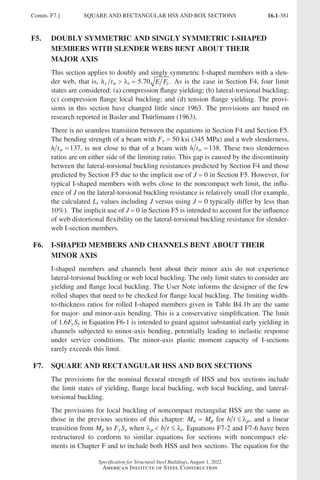
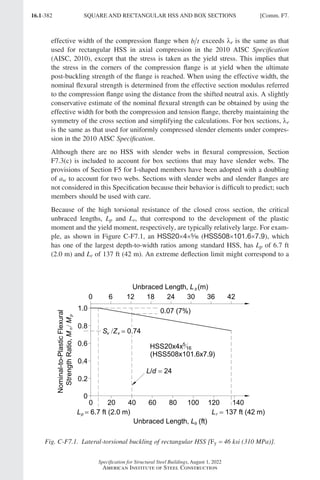
  • 192.
    16.1-124 Specification for StructuralSteel Buildings, August 1, 2022 American Institute of Steel Construction the sum of (1) the nominal slip resistance, Rn, for bolts as defined in Equation J3-4 according to the requirements of a slip-critical connection and (2) the nominal weld strength, Rn, as defined in Section J2.4, when the following apply: (a) φ = 0.75 (LRFD); Ω = 2.00 (ASD) for the combined joint. (b) When the high-strength bolts are pretensioned according to the requirements of Table J3.1 or Table J3.1M using the turn-of-nut or combined method, the longi- tudinal fillet welds shall have an available strength of not less than 50% of the required strength of the connection. (c) When the high-strength bolts are pretensioned according to the requirements of Table J3.1 or Table J3.1M using any method other than the turn-of-nut method, the longitudinal fillet welds shall have an available strength of not less than 70% of the required strength of the connection. (d) The high-strength bolts shall have an available strength of not less than 33% of the required strength of the connection. In joints with combined bolts and longitudinal welds, the strength of the connection need not be taken as less than either the strength of the bolts alone or the strength of the welds alone. 9. Welded Alterations to Structures with Existing Rivets or Bolts In making welded alterations to structures, existing rivets and high-strength bolts in standard or short-slotted holes transverse to the direction of load, and tightened to the requirements of slip-critical connections are permitted to be utilized for resist- ing loads present at the time of alteration, and the welding need only provide the additional required strength. The weld available strength shall provide the additional required strength, but not less than 25% of the required strength of the connection. User Note: The provisions of this section are generally recommended for altera- tion in building designs or for field corrections. Use of the combined strength of bolts and welds on a common faying surface is not recommended for new design. 10. High-Strength Bolts in Combination with Existing Rivets In connections designed as slip-critical connections in accordance with the provi- sions of Section J3, high-strength bolts are permitted to be considered as sharing the load with existing rivets. J2. WELDS AND WELDED JOINTS Welding shall conform to the provisions of the Structural Welding Code—Steel (AWS D1.1/D1.1M), hereafter referred to as AWS D1.1/D1.1M, except where those provisions differ from this Specification. This Specification governs where provi- sions differ from AWS D1.1/D1.1M. User Note: Examples of provisions in AWS D1.1/D1.1M that differ from the Specification provisions are shown in the Commentary. GENERAL PROVISIONS [Sect. J1. Part 16.1 J-N (121-194).indd 124 Part 16.1 J-N (121-194).indd 124 2023-01-10 8:06 PM 2023-01-10 8:06 PM
  • 193.
    16.1-125 Specification for StructuralSteel Buildings, August 1, 2022 American Institute of Steel Construction TABLE J2.1 Effective Throat of Partial-Joint-Penetration Groove Welds Welding Process Welding Position F (flat), H (horizontal), V (vertical), OH (overhead) Groove Type (AWS D1.1, Figure 5.2) Effective Throat Shielded metal arc (SMAW) All J or U groove 60° V depth of groove Gas metal arc (GMAW) Flux cored arc (FCAW) Submerged arc (SAW) F J or U groove 60° bevel or V Gas metal arc (GMAW) Flux cored arc (FCAW) F, H 45° bevel depth of groove Shielded metal arc (SMAW) All 45° bevel depth of groove minus 1 /8 in. (3 mm) Gas metal arc (GMAW) Flux cored arc (FCAW) V, OH 1. Groove Welds 1a. Effective Area The effective area of groove welds shall be taken as the length of the weld times the effective throat. The effective throat of a CJP groove weld shall be the thickness of the thinner part joined. When filled flush to the surface, the effective weld throat for a PJP groove weld shall be as given in Table J2.1 and the effective weld throat for a flare groove weld shall be as given in Table J2.2. The effective throat of a PJP groove weld or flare groove weld filled less than flush shall be as shown in Table J2.1 or Table J2.2, less the greatest perpendicular dimension measured from a line flush to the base metal surface to the weld surface. User Note: The effective throat of a PJP groove weld is dependent on the pro- cess used and the weld position. The design documents should either indicate the effective throat required or the weld strength required, and the fabricator should detail the joint based on the weld process and position to be used to weld the joint. For PJP groove welds, effective throats larger than those for prequalified PJP groove welds in AWS D1.1/D1.1M, Figure 5.2, and flare groove welds in Table J2.2 are permitted for a given welding procedure specification (WPS), provided the fabricator establishes by testing the consistent production of such larger effective throats. Testing shall consist of sectioning the weld normal to its axis, at mid-length, and at termi- nal ends. Such sectioning shall be made on a number of combinations of material Sect. J2.] WELDS AND WELDED JOINTS Part 16.1 J-N (121-194).indd 125 Part 16.1 J-N (121-194).indd 125 2023-01-10 8:06 PM 2023-01-10 8:06 PM
  • 194.
    16.1-126 Specification for StructuralSteel Buildings, August 1, 2022 American Institute of Steel Construction TABLE J2.2 Effective Throat of Flare Groove Welds Welding Process Flare-Bevel-Groove[a] Flare-V-Groove GMAW and FCAW-G 5 /8R 3 /4R SMAW and FCAW-S 5 /16R 5 /8R SAW 5 /16R 1 /2R R = radius of joint surface (is permitted to be assumed equal to 2t for HSS, where t is the design wall thick- ness), in. (mm) [a]For flare-bevel-groove with R 3 /8 in. (10 mm), use only reinforcing fillet weld on filled flush joint. TABLE J2.3 Minimum Effective Throat of Partial-Joint-Penetration Groove Welds Material Thickness of Thinner Part Joined, in. (mm) Minimum Effective Throat,[a] in. (mm) To 1 /4 (6) inclusive Over 1 /4 (6) to 1 /2 (13) Over 1 /2 (13) to 3 /4 (19) Over 3 /4 (19) to 11 /2 (38) Over 11 /2 (38) to 21 /4 (57) Over 21 /4 (57) to 6 (150) Over 6 (150) 1 /8 (3) 3 /16 (5) 1 /4 (6) 5 /16 (8) 3 /8 (10) 1 /2 (13) 5 /8 (16) [a]See Table J2.1. sizes representative of the range to be used in the fabrication. During production of welds with increased effective throats, single pass welds and the root pass of multi- pass welds shall be made using a mechanized, automatic, or robotic process, with no decrease in current or increase in travel speed from that used for testing. 1b. Limitations The minimum effective throat of a partial-joint-penetration groove weld shall not be less than the size required to transmit calculated forces nor the size shown in Table J2.3. Minimum weld size is determined by the thinner of the two parts joined. 2. Fillet Welds 2a. Effective Area The effective area of a fillet weld shall be the effective length multiplied by the effective throat. The effective throat of a fillet weld shall be the shortest distance from the root to the face of the diagrammatic weld. An increase in effective throat is permitted if consistent penetration beyond the root of the diagrammatic weld is dem- onstrated by tests using a given welding procedure specification (WPS), provided the fabricator establishes by testing the consistent production of such larger effective throat. Testing shall consist of sectioning the weld normal to its axis at mid-length WELDS AND WELDED JOINTS [Sect. J2. Part 16.1 J-N (121-194).indd 126 Part 16.1 J-N (121-194).indd 126 2023-01-10 8:06 PM 2023-01-10 8:06 PM
  • 195.
    16.1-127 Specification for StructuralSteel Buildings, August 1, 2022 American Institute of Steel Construction and terminal ends. During production, single pass welds and the root pass of multi- pass welds shall be made using a mechanized, automatic, or robotic process with no decrease in current or increase in travel speed from that used for testing. For fillet welds in holes and slots, the effective length shall be the length of the centerline of the weld along the center of the plane through the throat. In the case of overlapping fillets, the effective area shall not exceed the nominal cross-sectional area of the hole or slot in the plane of the faying surface. 2b. Limitations Fillet welds shall meet the following limitations: (a) The minimum size of fillet welds shall be not less than the size required to trans- mit calculated forces nor the size as shown in Table J2.4. These limitations do not apply to fillet weld reinforcements of groove welds. (b) The maximum specified size of fillet welds of connected parts shall be (1) Along edges of material less than 4 in. (6 mm) thick; not greater than the thickness of the material. (2) Along edges of material 4 in. (6 mm) or more in thickness; not greater than the thickness of the material minus z in. (2 mm), unless the weld is especially designated on the design and fabrication documents to be built out to obtain full-throat thickness. In the as-welded condition, the distance between the edge of the base metal and the toe of the weld is permitted to be less than z in. (2 mm), provided the weld size is clearly verifiable. (c) The minimum length of fillet welds designed on the basis of strength shall be not less than four times the nominal weld size, or else the effective size of the weld shall not be taken to exceed one-quarter of its length. (d) The effective length of end-loaded fillet welds shall be determined as follows: (1) For fillet welds with a length up to 100 times the weld size, it is permitted to take the effective length equal to the actual length. (2) When the length of the fillet weld exceeds 100 times the weld size, the effec- tive length shall be determined by multiplying the actual length by the reduction factor, β, determined as . . . β = − ≤ ( ) 1 2 0 002 1 0 l w (J2-1) where l = actual length of end-loaded weld, in. (mm) w = size of weld leg, in. (mm) (3) When the length of the weld exceeds 300 times the leg size, w, the effective length shall be taken as 180w. User Note: For the effect of longitudinal fillet weld length in end connections upon the effective area of the connected member, see Section D3. Sect. J2.] WELDS AND WELDED JOINTS Part 16.1 J-N (121-194).indd 127 Part 16.1 J-N (121-194).indd 127 2023-01-10 8:06 PM 2023-01-10 8:06 PM
  • 196.
    16.1-128 Specification for StructuralSteel Buildings, August 1, 2022 American Institute of Steel Construction TABLE J2.4 Minimum Size of Fillet Welds Material Thickness of Thinner Part Joined, in. (mm) Minimum Size of Fillet Weld,[a] in. (mm) To 1 /4 (6) inclusive Over 1 /4 (6) to 1 /2 (13) Over 1 /2 (13) to 3 /4 (19) Over 3 /4 (19) 1 /8 (3) 3 /16 (5) 1 /4 (6) 5 /16 (8) [a] Leg dimension of fillet welds. When non-low hydrogen electrodes are used, single pass welds must be used. Note: See Section J2.2b for maximum size of fillet welds. (e) Intermittent fillet welds are permitted to be used to transfer calculated stress across a joint or faying surfaces and to join components of built-up members. The length of any segment of intermittent fillet welding shall be not less than four times the weld size, with a minimum of 12 in. (38 mm). (f) In lap joints, the minimum amount of lap shall be five times the thickness of the thinner part joined, but not less than 1 in. (25 mm). Lap joints joining plates or bars subjected to axial stress that utilize transverse fillet welds only shall be fillet welded along the end of both lapped parts, except where the deflection of the lapped parts is sufficiently restrained to prevent opening of the joint under maximum loading. (g) Fillet weld terminations shall be detailed in a manner that does not result in a notch in the base metal subjected to applied tension loads. Components shall not be connected by welds where the weld would prevent the deformation required to provide assumed design conditions. User Note: Fillet weld terminations should be detailed in a manner that does not result in a notch in the base metal transverse to applied tension loads that can occur as a result of normal fabrication. An accepted practice to avoid notches in base metal is to stop fillet welds short of the edge of the base metal by a length approximately equal to the size of the weld. In most welds, the effect of stopping short can be neglected in strength calculations. There are two common details where welds are terminated short of the end of the joint to permit relative deformation between the connected parts: •  Welds on the outstanding legs of beam double-angle connections are returned on the top of the outstanding leg and stopped no more than 4 times the weld size and not greater than half the leg width from the outer toe of the angle. •  Fillet welds connecting transverse stiffeners to webs of girders that are w in. (19 mm) thick or less are stopped 4 to 6 times the web thickness from the web toe of the flange-to web fillet weld, except where the end of the stiff- ener is welded to the flange. Details of fillet weld terminations may be shown on shop standard details. WELDS AND WELDED JOINTS [Sect. J2. Part 16.1 J-N (121-194).indd 128 Part 16.1 J-N (121-194).indd 128 2023-01-10 8:06 PM 2023-01-10 8:06 PM
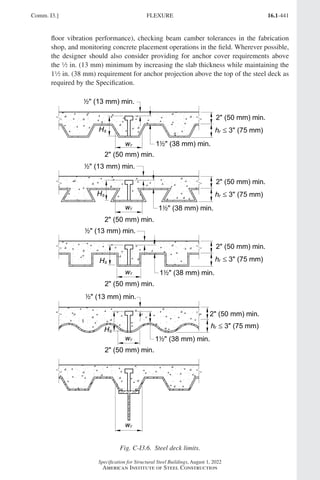
  • 197.
    16.1-129 Specification for StructuralSteel Buildings, August 1, 2022 American Institute of Steel Construction (h) Fillet welds in holes or slots are permitted to be used to transmit shear and resist loads perpendicular to the faying surface in lap joints or to prevent the buckling or separation of lapped parts and to join components of built-up members. Such fillet welds are permitted to overlap, subject to the provisions of Section J2. Fillet welds in holes or slots are not to be considered plug or slot welds. (i) For fillet welds in slots, the ends of the slot shall be semicircular or shall have the corners rounded to a radius of not less than the thickness of the part containing it, except those ends that extend to the edge of the part. 3. Plug and Slot Welds 3a. Effective Area The effective shear area of plug and slot welds shall be taken as the nominal area of the hole or slot in the plane of the faying surface. 3b. Limitations Plug or slot welds are permitted to be used to transmit shear in lap joints or to pre- vent buckling or separation of lapped parts, and to join component parts of built-up members, subject to the following limitations: (a) The diameter of the holes for a plug weld shall not be less than the thickness of the part containing it plus c in. (8 mm), rounded to the next larger odd z in. (even mm), nor greater than the minimum diameter plus 8 in. (3 mm) or 24 times the thickness of the weld. (b) The minimum center-to-center spacing of plug welds shall be four times the diameter of the hole. (c) The length of slot for a slot weld shall not exceed 10 times the thickness of the weld. (d) The width of the slot shall be not less than the thickness of the part containing it plus c in. (8 mm) rounded to the next larger odd z in. (even mm), nor shall it be larger than 24 times the thickness of the weld. (e) The ends of the slot shall be semicircular or shall have the corners rounded to a radius of not less than the thickness of the part containing it. (f) The minimum spacing of lines of slot welds in a direction transverse to their length shall be four times the width of the slot. (g) The minimum center-to-center spacing in a longitudinal direction on any line shall be two times the length of the slot. (h) The thickness of plug or slot welds in material s in. (16 mm) or less in thickness shall be equal to the thickness of the material. In material over s in. (16 mm) thick, the thickness of the weld shall be at least one-half the thickness of the material, but not less than s in. (16 mm). Sect. J2.] WELDS AND WELDED JOINTS Part 16.1 J-N (121-194).indd 129 Part 16.1 J-N (121-194).indd 129 2023-01-10 8:06 PM 2023-01-10 8:06 PM
  • 198.
    16.1-130 Specification for StructuralSteel Buildings, August 1, 2022 American Institute of Steel Construction 4. Strength (a) The design strength, φRn, and the allowable strength, Rn Ω, of welded joints shall be the lower value of the base material strength determined according to the limit states of tensile rupture and shear rupture and the weld metal strength determined according to the limit state of rupture as follows. For the base metal Rn = FnBMABM (J2-2) For complete-joint-penetration and partial-joint-penetration groove welds, and plug and slot welds Rn = FnwAwe (J2-3) For fillet welds Rn = FnwAwekds (J2-4) where ABM = area of the base metal, in.2 (mm2) Awe = effective area of the weld, in.2 (mm2) FnBM = nominal stress of the base metal, ksi (MPa) Fnw = nominal stress of the weld metal, ksi (MPa) kds = directional strength increase factor (1) For fillet welds where strain compatibility of the various weld ele- ments is considered kds = (1.0 + 0.50sin1.5θ) (J2-5) (2) For fillet welds to the ends of rectangular HSS loaded in tension kds = 1.0 (3) For all other conditions kds = 1.0 θ = angle between the line of action of the required force and the weld longitudinal axis, degrees The values of φ, Ω, FnBM, and Fnw, and limitations thereon, are given in Table J2.5. User Note: The base metal check need not be performed for fillet welds as illustrated in the Commentary. User Note: The instantaneous center method is a valid way to calculate the strength of weld groups consisting of weld elements in various directions that considers strain compatibility of the weld elements. Strain compatibility is satisfied for a linear weld group with a uniform leg size connecting elements with uniform stiffness that are loaded through the center of gravity and, therefore, the directional strength increase may be used. A linear weld group is one in which all elements are in a line or are parallel. WELDS AND WELDED JOINTS [Sect. J2. Part 16.1 J-N (121-194).indd 130 Part 16.1 J-N (121-194).indd 130 2023-01-10 8:06 PM 2023-01-10 8:06 PM
  • 199.
    16.1-131 Specification for StructuralSteel Buildings, August 1, 2022 American Institute of Steel Construction TABLE J2.5 Available Strength of Welded Joints, ksi (MPa) Load Type and Direction Relative to Weld Axis Pertinent Metal f f and W W Nominal Stress, FnBM or Fnw, ksi (MPa) Effective Area, ABM or Awe, in.2 (mm2) Required Filler Metal Strength Level[a][b] COMPLETE-JOINT-PENETRATION GROOVE WELDS Tension— normal to weld axis Strength of the joint is controlled by the base metal. Matching filler metal shall be used. For T- and corner-joints with backing left in place, notch tough filler metal is required. See Section J2.6. Compression— normal to weld axis Strength of the joint is controlled by the base metal. Filler metal with a strength level equal to or one strength level less than matching filler metal is permitted. Tension or compression— parallel to weld axis Tension or compression in parts joined parallel to a weld is permitted to be neglected in design of welds joining the parts. Filler metal with a strength level equal to or less than matching filler metal is permitted. Shear Strength of the joint is controlled by the base metal. Matching filler metal shall be used.[c] PARTIAL-JOINT-PENETRATION GROOVE WELDS INCLUDING FLARE-V-GROOVE AND FLARE-BEVEL-GROOVE WELDS Tension— normal to weld axis Base f f = 0.75 W W = 2.00 Fu See J4 Filler metal with a strength level equal to or less than matching filler metal is permitted. Weld f f = 0.80 W W = 1.88 0.60FEXX See J2.1a Compression— connections of members designed to bear as described in Section J1.4(b) Compressive stress is permitted to be neglected in design of welds joining the parts. Compression— connections not designed to bear Base f f = 0.90 W W = 1.67 Fy See J4 Weld f f = 0.80 W W = 1.88 0.90FEXX See J2.1a Tension or compression— parallel to weld axis Tension or compression in parts joined parallel to a weld is permitted to be neglected in design of welds joining the parts. Shear Base Governed by J4 Weld f f = 0.75 W W = 2.00 0.60FEXX See J2.1a Sect. J2.] WELDS AND WELDED JOINTS Part 16.1 J-N (121-194).indd 131 Part 16.1 J-N (121-194).indd 131 2023-01-10 8:06 PM 2023-01-10 8:06 PM
  • 200.
    16.1-132 Specification for StructuralSteel Buildings, August 1, 2022 American Institute of Steel Construction TABLE J2.5 (continued) Available Strength of Welded Joints, ksi (MPa) Load Type and Direction Relative to Weld Axis Pertinent Metal f f and W W Nominal Stress, FnBM or Fnw, ksi (MPa) Effective Area, ABM or Awe, in.2 (mm2) Required Filler Metal Strength Level[a][b] FILLET WELDS INCLUDING FILLETS IN HOLES AND SLOTS AND SKEWED T-JOINTS Shear Base Governed by J4 Filler metal with a strength level equal to or less than matching filler metal is permitted. Weld f f = 0.75 W W = 2.00 0.60FEXX [d] See J2.2a Tension or compression— parallel to weld axis Tension or compression in parts joined parallel to a weld is permitted to be neglected in design of welds joining the parts. PLUG AND SLOT WELDS Shear—parallel to faying surface on the effective area Base Governed by J4 Filler metal with a strength level equal to or less than matching filler metal is permitted. Weld f f = 0.75 W W = 2.00 0.60FEXX See J2.3a FEXX = filler metal classification strength, ksi (MPa) [a]For matching weld metal, see AWS D1.1/D1.1M, clause 5.6.1. [b]Filler metal with a strength level one strength level greater than matching is permitted. [c] Filler metals with a strength level less than matching are permitted to be used for CJP groove welds between the webs and flanges of built-up sections transferring shear loads, or in applications where high restraint is a concern. In these applications, the weld joint shall be detailed and the weld shall be designed using the thickness of the material as the effective throat, where f = 0.80, W = 1.88, and 0.60FEXX is the nominal strength. [d]The provisions of Section J2.4(a) are also applicable. (b) For fillet weld groups concentrically loaded and consisting of elements with a uniform leg size that are oriented both longitudinally and transversely to the direction of applied load, the nominal strength, Rn, of the fillet weld group is permitted to be determined as Rn = 0.85 FnwAwel + 1.5FnwAwet (J2-6) where Awel = effective area of longitudinally loaded fillet welds, in.2 (mm2) Awet = effective area of transversely loaded fillet welds, in.2 (mm2) User Note: The nominal strength of fillet welds groups consisting of ele- ments that are oriented both longitudinally and transversely to the direction of applied load can also be calculated in accordance with Section J2.4(a) neglecting the directional strength increase. WELDS AND WELDED JOINTS [Sect. J2. Part 16.1 J-N (121-194).indd 132 Part 16.1 J-N (121-194).indd 132 2023-01-10 8:06 PM 2023-01-10 8:06 PM
  • 201.
    16.1-133 Specification for StructuralSteel Buildings, August 1, 2022 American Institute of Steel Construction 5. Combination of Welds If two or more of the general types of welds (groove, fillet, plug, slot) are combined in a single joint, the strength of each shall be separately computed with reference to the axis of the group in order to determine the strength of the combination. 6. Filler Metal Requirements The choice of filler metal for use with CJP groove welds subjected to tension normal to the effective area shall comply with the requirements for matching filler metals given in AWS D1.1/D1.1M. User Note: The following User Note Table summarizes the AWS D1.1/D1.1M provisions for matching filler metals. Other restrictions exist. For a com- plete list of base metals and prequalified matching filler metals, see AWS D1.1/D1.1M, Table 5.3 and Table 5.4. Base Metal (ASTM) Matching Filler Metal A36/A36M ≤ 3 /4 in. (19 mm) thick 60 and 70 ksi filler metal A36/A36M 3 /4 in. (19 mm) thick, A588/ A588M[a], A1011/A1011M, A572/A572M Grade 50 (345) and 55 (380), A913/ A913M Grade 50 (345), A992/A992M SMAW: E7015, E7016, E7018, E7028 Other processes: 70 ksi filler metal A913/A913M Grade 60 (415) and 65 (450) 80 ksi (550 MPa) filler metal A913/A913M Grade 70 (485) 90 ksi (620 MPa) filler metal [a] For corrosion resistance and color similar to the base metal, see AWS D1.1/D1.1M, clause 5.6.2. Note: In joints with base metals of different strengths, either a filler metal that matches the higher strength base metal or a filler metal that matches the lower strength and produces a low hydro- gen deposit may be used when matching strength is required. Filler metal with a specified minimum Charpy V-notch toughness of 20 ft-lb (27 J) at 40°F (4°C) or lower shall be used in the following joints: (a) CJP groove welded T- and corner-joints with steel backing left in place, sub- jected to tension normal to the effective area, unless the joints are designed using the nominal strength and resistance factor or safety factor, as applicable, for a PJP groove weld (b) CJP groove welded splices subjected to tension normal to the effective area in heavy shapes, as defined in Sections A3.1d and A3.1e The manufacturer’s Certificate of Conformance shall be sufficient evidence of com- pliance. 7. Mixed Weld Metal When Charpy V-notch toughness is specified, the process consumables for all weld metal, tack welds, root pass, and subsequent passes deposited in a joint shall be compatible to ensure notch-tough composite weld metal. Sect. J2.] WELDS AND WELDED JOINTS Part 16.1 J-N (121-194).indd 133 Part 16.1 J-N (121-194).indd 133 2023-01-29 11:58 AM 2023-01-29 11:58 AM
  • 202.
    16.1-134 Specification for StructuralSteel Buildings, August 1, 2022 American Institute of Steel Construction J3. BOLTS, THREADED PARTS, AND BOLTED CONNECTIONS 1. Common Bolts ASTM A307 bolts are permitted except where pretensioning is specified. 2. High-Strength Bolts Use of high-strength bolts and bolting components shall conform to the provisions of the RCSC Specification for Structural Joints Using High-Strength Bolts, hereafter re- ferred to as the RCSC Specification, except where those provisions differ from this Specification. This Specification governs where provisions differ from the RCSC Specification. User Note: Examples of provisions in the RCSC Specification that differ from this Specification’s provisions are shown in the Commentary. High-strength bolts in this Specification are grouped according to material strength as follows: Group 120 ASTM F3125/F3125M Grades A325, A325M, F1852, and ASTM A354 Grade BC Group 144 ASTM F3148 Grade 144 Group 150 ASTM F3125/F3125M Grades A490, A490M, F2280, and ASTM A354 Grade BD Group 200 ASTM F3043 and ASTM F3111 Use of Group 144 bolting assemblies shall conform to the provisions of ASTM F3148. Use of Group 200 high-strength bolting assemblies shall conform to the applicable provisions of their ASTM standard. ASTM F3043 and ASTM F3111 Grade 1 assem- blies may be installed only to the snug-tight condition. ASTM F3043 and ASTM F3111 Grade 2 assemblies may be used in snug-tight, pretensioned, and slip-critical connections, using procedures provided in the applicable ASTM standard. User Note: The use of Group 200 bolting assemblies is limited to specific build- ing locations and noncorrosive environmental conditions by the applicable ASTM standard. When assembled, all joint surfaces, including those adjacent to the washers, shall be free of scale, except tight mill scale. (a) Bolting assemblies are permitted to be installed to the snug-tight condition when used in (1) Bearing-type connections, except as stipulated in Section E6 (2) Tension or combined shear and tension applications, for Group 120 bolts only, where loosening or fatigue due to vibration or load fluctuations are not design considerations BOLTS, THREADED PARTS, AND BOLTED CONNECTIONS [Sect. J3. Part 16.1 J-N (121-194).indd 134 Part 16.1 J-N (121-194).indd 134 2023-01-10 8:06 PM 2023-01-10 8:06 PM
  • 203.
    16.1-135 Specification for StructuralSteel Buildings, August 1, 2022 American Institute of Steel Construction (b) Bolts in the following connections shall be pretensioned: (1) As required by the RCSC Specification (2) Connections subjected to vibratory loads where bolt loosening is a consid- eration (3) End connections of built-up members composed of two shapes either interconnected by bolts, or with at least one open side interconnected by perforated cover plates or lacing with tie plates, as required in Section E6.1 (c) The following connections shall be designed as slip-critical: (1) As required by the RCSC Specification (2) The extended portion of bolted, partial-length cover plates, as required in Section F13.3 The snug-tight condition is defined in the RCSC Specification. Bolts to be tight- ened to a condition other than snug tight shall be clearly identified on the design documents. (See Table J3.1 or J3.1M for minimum bolt pretension for connections designated as pretensioned or slip-critical.) User Note: There are no specific minimum or maximum tension requirements for snug-tight bolts. Bolts that have been pretensioned are permitted in snug-tight connections unless specifically prohibited on design documents. When bolt requirements cannot be provided within the RCSC Specification limi- tations because of requirements for lengths exceeding 12 diameters or diameters exceeding 12 in. (38 mm), bolts or threaded rods conforming to Group 120 or Group 150 materials are permitted to be used in accordance with the provisions for threaded parts in Table J3.2. When ASTM A354 Grade BC, ASTM A354 Grade BD, or ASTM A449 bolts and threaded rods are used in pretensioned connections, the bolt geometry, including the thread pitch, thread length, head, and nut(s), shall be equal to or (if larger in diameter) proportional to that required by the RCSC Specification. Installation shall comply with all applicable requirements of the RCSC Specification with modifica- tions as required for the increased diameter and/or length to provide the design pretension. 3. Size and Use of Holes The following requirements apply for bolted connections: (a) The nominal dimensions of standard, oversized, short-slotted, and long-slotted holes for bolts are given in Table J3.3 or Table J3.3M. User Note: Bolt holes with a smaller nominal diameter are permitted. See RCSC Specification Table 3.1 for bolt hole fabrication tolerances. See Section J9 for diameters of holes in base plates for anchor rods providing anchorage to concrete. Sect. J3.] BOLTS, THREADED PARTS, AND BOLTED CONNECTIONS Part 16.1 J-N (121-194).indd 135 Part 16.1 J-N (121-194).indd 135 2023-01-10 8:06 PM 2023-01-10 8:06 PM
  • 204.
    16.1-136 Specification for StructuralSteel Buildings, August 1, 2022 American Institute of Steel Construction TABLE J3.1 Minimum Bolt Pretension, kips Bolt Size, in. Group 120[a] Group 144[b] and Group 150[b] Group 200, Grade 2[c] 1 /2 5 /8 3 /4 7 /8 1 11 /8 11 /4 13 /8 11 /2 12 19 28 39 51 64 81 97 118 15 24 35 49 64 80 102 121 148 − − − − 90 113 143 − − [a] Equal to 0.70 times the minimum tensile strength of bolts as specified in ASTM F3125/F3125M for Grade A325 rounded off to nearest kip. [b] Equal to 0.70 times the minimum tensile strength of bolts as specified in ASTM F3125/F3125M for Grade A490 rounded off to nearest kip. Group 144 (F3148) assemblies have the same specified minimum preten- sion as Group 150. [c] Equal to 0.70 times the minimum tensile strength of bolts as specified in ASTM F3043 and F3111 for Grade 2, rounded off to the nearest kip. TABLE J3.1M Minimum Bolt Pretension, kN Bolt Size, mm Group 120[a] Group 150[b] M12 M16 M20 M22 M24 M27 M30 M36 49 91 142 176 205 267 326 475 72 114 179 221 257 334 408 595 [a] Equal to 0.70 times the minimum tensile strength of bolts as specified in ASTM F3125/F3125M for Grade A325M bolts, rounded off to nearest kN. [b] Equal to 0.70 times the minimum tensile strength of bolts as specified in ASTM F3125/F3125M for Grade A490M bolts, rounded off to nearest kN. (b) Standard holes or short-slotted holes transverse to the direction of the load shall be provided in accordance with the provisions of this Specification, unless oversized holes, short-slotted holes parallel to the load, or long-slotted holes are approved by the engineer of record. (c) Finger shims up to 4 in. (6 mm) are permitted in slip-critical connections de- signed on the basis of standard holes without reducing the nominal shear strength of the fastener to that specified for slotted holes. User Note: Metric grades manufactured to ASTM F3125/F3125M Grade A325M and A490M are similar to Group 120 (830 MPa) and Group 150 (1 040 MPa), respectively. BOLTS, THREADED PARTS, AND BOLTED CONNECTIONS [Sect. J3. Part 16.1 J-N (121-194).indd 136 Part 16.1 J-N (121-194).indd 136 2023-01-10 8:06 PM 2023-01-10 8:06 PM
  • 205.
    16.1-137 Specification for StructuralSteel Buildings, August 1, 2022 American Institute of Steel Construction TABLE J3.2 Nominal Stress of Fasteners and Threaded Parts, ksi (MPa) Description of Fasteners Nominal Tensile Stress, Fnt, ksi (MPa)[a][b] Nominal Shear Stress in Bearing-Type Connections, Fnv, ksi (MPa)[c] Threads Not Excluded from Shear Planes— (N)[e] Threads Excluded from Shear Planes —(X) A307 bolts 45 (310)   27 (190)[d]   27 (190)[d] Group 120 (e.g., A325) 90 (620) 54 (370) 68 (470) Group 144 (e.g., F3148) 108 (750) 65 (450) 81 (560) Group 150 (e.g., A490) 113 (780) 68 (470) 84 (580) Group 200 (e.g., F3043) 150 (1000) 90 (620)[f] 113 (780)[f] Threaded parts meeting the requirements of Section A3.4 0.75Fu 0.450Fu 0.563Fu [a]For high-strength bolts subjected to tensile fatigue loading, see Appendix 3. [b] For nominal tensile strength it is permitted to use the tensile stress area of the threaded rod or bolt multi- plied by the specified minimum tensile stress of the rod or bolt material, in lieu of the tabulated values based on a nominal tensile stress area of 0.75 times the gross area. The tensile stress area shall be calculated in accordance with the applicable ASTM standard. [c] For end-loaded connections with a fastener pattern length greater than 38 in. (950 mm), Fnv shall be reduced to 83.3% of the tabulated values. Fastener pattern length is the maximum distance parallel to the line of force between the centerline of the bolts connecting two parts with one faying surface. [d] For ASTM A307 bolts, the tabulated values shall be reduced by 1% for each 1 /16 in. (2 mm) over five diam- eters of length in the grip. [e]Threads assumed and permitted in shear planes in all cases. [f] The transition area of Group 200 bolts is considered part of the threaded section. TABLE J3.3 Nominal Hole Dimensions, in. Bolt Diameter Hole Dimensions Standard (Dia.) Oversize (Dia.) Short-Slot (Width × × Length) Long-Slot (Width × × Length) 1 /2 5 /8 3 /4 7 /8 1 ≥11 /8 9 /16 11 /16 13 /16 15 /16 11 /8 d + 1 /8 5 /8 13 /16 15 /16 11 /16 11 /4 d + 5 /16 9 /16 × 11 /16 11 /16 × 7 /8 13 /16 × 1 15 /16 × 11 /8 11 /8 × 15 /16 (d + 1 /8) × (d + 3 /8) 9 /16 × 11 /4 11 /16 × 19 /16 13 /16 × 17 /8 15 /16 × 23 /16 11 /8 × 21 /2 (d + 1 /8) × 2.5d Sect. J3.] BOLTS, THREADED PARTS, AND BOLTED CONNECTIONS Part 16.1 J-N (121-194).indd 137 Part 16.1 J-N (121-194).indd 137 2023-01-10 8:06 PM 2023-01-10 8:06 PM
  • 206.
    16.1-138 Specification for StructuralSteel Buildings, August 1, 2022 American Institute of Steel Construction TABLE J3.3M Nominal Hole Dimensions, mm Bolt Diameter Hole Dimensions Standard (Dia.) Oversize (Dia.) Short-Slot (Width × × Length) Long-Slot (Width × × Length) M12 M16 M20 M22 M24 M27 M30 ≥M36 14 18 22 24 27[a] 30 33 d + 3 16 20 24 28 30 35 38 d + 8 14 × 18 18 × 22 22 × 26 24 × 30 27 × 32 30 × 37 33 × 40 (d + 3) × (d + 10) 14 × 30 18 × 40 22 × 50 24 × 55 27 × 60 30 × 67 33 × 75 (d + 3) × 2.5d [a]Clearance provided allows the use of a 1-in.-diameter bolt. (d) Oversized holes are permitted in any or all plies of slip-critical connections, but they shall not be used in bearing-type connections. (e) Short-slotted holes are permitted in any or all plies of slip-critical or bearing- type connections. The slots are permitted without regard to direction of loading in slip-critical connections, but the length shall be normal to the direction of the loading in bearing-type connections. (f) Long-slotted holes are permitted in only one of the connected parts of either a slip-critical or bearing-type connection at an individual faying surface. Long- slotted holes are permitted without regard to direction of loading in slip-critical connections, but shall be normal to the direction of loading in bearing-type con- nections. (g) Washers shall be provided in accordance with the RCSC Specification Section 6, except for Group 200 bolting assemblies where washers shall be provided in accordance with the applicable ASTM standard. User Note: When Group 200 heavy-hex bolting assemblies are used, a single washer is used under the bolt head and a single washer is used under the nut. When Group 200 twist-off bolting assemblies are used, a single washer is used under the nut. Washers are of the type specified in the ASTM standard for the bolting assembly. 4. Minimum Spacing The distance between centers of standard, oversized, or slotted holes shall not be less than 2q times the nominal diameter, d, of the fastener. However, the clear distance between bolt holes or slots shall not be less than d. User Note: A distance between centers of standard, oversized, or slotted holes of 3d is preferred. BOLTS, THREADED PARTS, AND BOLTED CONNECTIONS [Sect. J3. Part 16.1 J-N (121-194).indd 138 Part 16.1 J-N (121-194).indd 138 2023-01-10 8:06 PM 2023-01-10 8:06 PM
  • 207.
    16.1-139 Specification for StructuralSteel Buildings, August 1, 2022 American Institute of Steel Construction TABLE J3.4 Minimum Edge Distance[a] from Center of Standard Hole[b] to Edge of Connected Part, in. Bolt Diameter Minimum Edge Distance 1 /2 5 /8 3 /4 7 /8 1 11 /8 11 /4 Over 11 /4 3 /4 7 /8 1 11 /8 11 /4 11 /2 15 /8 11 /4d [a] If necessary, lesser edge distances are permitted provided the applicable provisions from Sections J3.11 and J4 are satisfied, but edge distances less than one bolt diameter are not permitted without approval from the engineer of record. [b]For oversized or slotted holes, see Table J3.5. TABLE J3.4M Minimum Edge Distance[a] from Center of Standard Hole[b] to Edge of Connected Part, mm Bolt Diameter Minimum Edge Distance 12 16 20 22 24 27 30 36 Over 36 18 22 26 28 30 34 38 46 1.25d [a] If necessary, lesser edge distances are permitted provided the applicable provisions from Sections J3.11 and J4 are satisfied, but edge distances less than one bolt diameter are not permitted without approval from the engineer of record. [b]For oversized or slotted holes, see Table J3.5M. 5. Minimum Edge Distance The distance from the center of a standard hole to an edge of a connected part in any direction shall not be less than either the applicable value from Table J3.4 or Table J3.4M, or as required in Section J3.11. The distance from the center of an oversized or slotted hole to an edge of a connected part shall be not less than that required for a standard hole to an edge of a connected part plus the applicable increment, C2, from Table J3.5 or Table J3.5M. Sect. J3.] BOLTS, THREADED PARTS, AND BOLTED CONNECTIONS Part 16.1 J-N (121-194).indd 139 Part 16.1 J-N (121-194).indd 139 2023-01-10 8:06 PM 2023-01-10 8:06 PM
  • 208.
    16.1-140 Specification for StructuralSteel Buildings, August 1, 2022 American Institute of Steel Construction TABLE J3.5 Values of Edge Distance Increment C2, in. Nominal Diameter of Fastener Oversized Holes Slotted Holes Long Axis Perpendicular to Edge Long Axis Parallel to Edge Short Slots Long Slots[a] ≤ 7 /8 1 /16 1 /8 3 /4d 0 1 1 /8 1 /8 ≥ 11 /8 1 /8 3 /16 [a] When the length of the slot is less than the maximum allowable (see Table J3.3), C2 is permitted to be reduced by one-half the difference between the maximum and actual slot lengths. TABLE J3.5M Values of Edge Distance Increment C2, mm Nominal Diameter of Fastener Oversized Holes Slotted Holes Long Axis Perpendicular to Edge Long Axis Parallel to Edge Short Slots Long Slots[a] ≤ 22 2 3 0.75d 0 24 3 3 ≥ 27 3 5 [a] When the length of the slot is less than the maximum allowable (see Table J3.3M), C2 is permitted to be reduced by one-half the difference between the maximum and actual slot lengths. User Note: The edge distances in Tables J3.4 and J3.4M are minimum edge dis- tances based on standard fabrication practices and workmanship tolerances. The appropriate provisions of Sections J3.11 and J4 must be satisfied. 6. Maximum Spacing and Edge Distance The maximum distance from the center of any bolt hole to the nearest edge of ele- ments in contact shall be 12 times the thickness of the connected element under consideration, but shall not exceed 6 in. (150 mm). The longitudinal spacing of bolt holes between elements consisting of a plate and a shape, or two plates, in continuous contact shall be as follows: (a) For painted members or unpainted members not subject to atmospheric corrosion, the spacing shall not exceed 24 times the thickness of the thinner part or 12 in. (300 mm). (b) For unpainted members of weathering steel subject to atmospheric corrosion, the spacing shall not exceed 14 times the thickness of the thinner part or 7 in. (180 mm). BOLTS, THREADED PARTS, AND BOLTED CONNECTIONS [Sect. J3. Part 16.1 J-N (121-194).indd 140 Part 16.1 J-N (121-194).indd 140 2023-01-10 8:06 PM 2023-01-10 8:06 PM
  • 209.
    16.1-141 Specification for StructuralSteel Buildings, August 1, 2022 American Institute of Steel Construction User Note: The dimensions in (a) and (b) do not apply to elements consisting of two shapes in continuous contact. 7. Tensile and Shear Strength of Bolts and Threaded Parts The design tensile or shear strength, φRn, and the allowable tensile or shear strength, Rn Ω, of a snug-tightened or pretensioned high-strength bolt or threaded part shall be determined according to the limit states of tension rupture and shear rupture as Rn = FnAb (J3-1) φ = 0.75 (LRFD)   Ω = 2.00 (ASD) where Ab = nominal unthreaded body area of bolt or threaded part, in.2 (mm2) Fn = nominal tensile stress, Fnt, or shear stress, Fnv, from Table J3.2, ksi (MPa) The required tensile strength shall include any tension resulting from prying action produced by deformation of the connected parts. User Note: The available strength of a bolt in shear depends on whether the bolt is sheared through its shank or through the threads or thread runout. Bolts that are relatively short may be produced as fully threaded, without a shank, and thus may not be able to be installed in the “threads excluded” condition. User Note: The force that can be resisted by a snug-tightened or pretensioned high-strength bolt or threaded part may be limited by the bearing or tearout strength at the bolt hole per Section J3.11. The effective strength of an individual fastener may be taken as the lesser of the fastener shear strength per Section J3.7 or the bearing or tearout strength at the bolt hole per Section J3.11. The strength of the bolt group is taken as the sum of the effective strengths of the individual fasteners. 8. Combined Tension and Shear in Bearing-Type Connections The available tensile strength of a bolt subjected to combined tension and shear shall be determined according to the limit states of tension and shear rupture as R F A n nt b = ′ (J3-2) φ = 0.75 (LRFD)   Ω = 2.00 (ASD) where ′ Fnt = nominal tensile stress modified to include the effects of shear stress, ksi (MPa) = 1 3 . F F F f F nt nt nv rv nt − ≤ φ (LRFD) (J3-3a) = 1 3 . F F F f F nt nt nv rv nt − ≤ Ω (ASD) (J3-3b) Fnt = nominal tensile stress from Table J3.2, ksi (MPa) Fnv = nominal shear stress from Table J3.2, ksi (MPa) frv = required shear stress using LRFD or ASD load combinations, ksi (MPa) Sect. J3.] BOLTS, THREADED PARTS, AND BOLTED CONNECTIONS Part 16.1 J-N (121-194).indd 141 Part 16.1 J-N (121-194).indd 141 2023-01-10 8:06 PM 2023-01-10 8:06 PM
  • 210.
    16.1-142 Specification for StructuralSteel Buildings, August 1, 2022 American Institute of Steel Construction The available shear stress of the fastener shall equal or exceed the required shear stress, frv. User Note: Note that when the required stress, f, in either shear or tension, is less than or equal to 30% of the corresponding available stress, the effects of combined stress need not be investigated. Also note that Equations J3-3a and J3-3b can be rewritten so as to find a nominal shear stress, ′ Fnv, as a function of the required tensile stress, ft. 9. High-Strength Bolts in Slip-Critical Connections Slip-critical connections shall be designed to prevent slip and for the limit states of bearing-type connections. When slip-critical bolts pass through fillers, all surfaces subject to slip shall be prepared to achieve design slip resistance. The single bolt available slip resistance for the limit state of slip shall be determined as follows: Rn = µDuhfTbns (J3-4) (a) For standard size and short-slotted holes perpendicular to the direction of the load φ = 1.00 (LRFD)   Ω = 1.50 (ASD) (b) For oversized and short-slotted holes parallel to the direction of the load φ = 0.85 (LRFD)   Ω = 1.76 (ASD) (c) For long-slotted holes φ = 0.70 (LRFD)   Ω = 2.14 (ASD) where Du = 1.13, a multiplier that reflects the ratio of the mean installed bolt pretension to the specified minimum bolt pretension. The use of other values are per- mitted if approved by the engineer of record. Tb = minimum fastener pretension given in Table J3.1 or Table J3.1M, kips (kN) hf = factor for fillers, determined as follows: (1) For one filler between connected parts hf = 1.0 (2) For two or more fillers between connected parts hf = 0.85 ns = number of slip planes required to permit the connection to slip µ = mean slip coefficient for Class A or B surfaces, as applicable, and determined as follows, or as established by tests: (1)  For Class A surfaces (unpainted clean mill scale steel surfaces or surfaces with Class A coatings on blast-cleaned steel or hot-dipped gal- vanized steel whether as-galvanized or hand roughened) µ = 0.30 BOLTS, THREADED PARTS, AND BOLTED CONNECTIONS [Sect. J3. Part 16.1 J-N (121-194).indd 142 Part 16.1 J-N (121-194).indd 142 2023-01-10 8:06 PM 2023-01-10 8:06 PM
  • 211.
    16.1-143 Specification for StructuralSteel Buildings, August 1, 2022 American Institute of Steel Construction (2)  For Class B surfaces (unpainted blast-cleaned steel surfaces or surfaces with Class B coatings on blast-cleaned steel) µ = 0.50 10. Combined Tension and Shear in Slip-Critical Connections When a slip-critical connection is subjected to an applied tension that reduces the net clamping force, the available slip resistance per bolt from Section J3.9 shall be multiplied by the factor, ksc, determined as follows: k T D T n sc u u b b = − ≥ 1 0 (LRFD) (J3-5a) k T D T n sc a u b b . = − ≥ 1 1 5 0 (ASD) (J3-5b) where Ta = required tension force using ASD load combinations, kips (kN) Tu = required tension force using LRFD load combinations, kips (kN) nb = number of bolts carrying the applied tension 11. Bearing and Tearout Strength at Bolt Holes The available strength, φRn and Rn Ω, at bolt holes shall be determined for the limit states of bearing and tearout, as follows: φ = 0.75 (LRFD)   Ω = 2.00 (ASD) The nominal strength of the connected material, Rn, shall be determined in accor- dance with Section J3.11a or Section J3.11b. 11a. Snug-Tightened or Pretensioned High-Strength Bolted Connections All plies of the connected elements shall be in firm contact. (1) The nominal strength of a connected element at a bolt in a connection with stan- dard, oversized, and short-slotted holes, independent of the direction of loading, or a long-slotted hole with the slot parallel to the direction of the bearing force, shall be the lesser of the following: (a) Bearing (i) When deformation at the bolt hole at service load is a design considera- tion Rn = 2.4dtFu (J3-6a) (ii) When deformation at the bolt hole at service load is not a design con- sideration Rn = 3.0dtFu (J3-6b) Sect. J3.] BOLTS, THREADED PARTS, AND BOLTED CONNECTIONS Part 16.1 J-N (121-194).indd 143 Part 16.1 J-N (121-194).indd 143 2023-01-10 8:06 PM 2023-01-10 8:06 PM
  • 212.
    16.1-144 Specification for StructuralSteel Buildings, August 1, 2022 American Institute of Steel Construction (b) Tearout (i) When deformation at the bolt hole at service load is a design con- sideration Rn = 1.2lctFu (J3-6c) (ii) When deformation at the bolt hole at service load is not a design con- sideration Rn = 1.5lctFu (J3-6d) (2) The nominal strength of a connected element at a bolt in a connection with long- slotted holes with the slot perpendicular to the direction of force is the lesser of the following: (a) Bearing Rn = 2.0dtFu (J3-6e) (b) Tearout Rn = 1.0lctFu (J3-6f) 11b. Connections Made Using Bolts or Rods that Pass Completely Through an Unstiffened Box Member or HSS (1) Bearing shall satisfy Section J7 and Equation J7-1 (2) Tearout (i) For a bolt in a connection with a standard hole or a short-slotted hole with the slot perpendicular to the direction of force (a) When deformation at the bolt hole at service load is a design consideration Rn = 1.2lctFu (J3-6g) (b) When deformation at the bolt hole at service load is not a design con- sideration Rn = 1.5lctFu (J3-6h) (ii) For a bolt in a connection with long-slotted holes with the slot perpendicular to the direction of force Rn = 1.0lctFu (J3-6i) where Fu = specified minimum tensile strength of the connected material, ksi (MPa) d = nominal diameter of fastener, in. (mm) lc = clear distance, in the direction of the force, between the edge of the hole and the edge of the adjacent hole or edge of the material, in. (mm) t = thickness of connected material, in. (mm) Bearing strength and tearout strength shall be checked for both bearing-type and slip-critical connections. The use of oversized holes and short- and long-slotted holes parallel to the line of force is restricted to slip-critical connections per Section J3.3. BOLTS, THREADED PARTS, AND BOLTED CONNECTIONS [Sect. J3. Part 16.1 J-N (121-194).indd 144 Part 16.1 J-N (121-194).indd 144 2023-01-10 8:06 PM 2023-01-10 8:06 PM
  • 213.
    16.1-145 Specification for StructuralSteel Buildings, August 1, 2022 American Institute of Steel Construction 12. Special Fasteners The nominal strength of special fasteners other than the bolts presented in Table J3.2 shall be verified by tests. 13. Wall Strength at Tension Fasteners When bolts or other fasteners in tension are attached to an unstiffened box or HSS wall, the strength of the wall shall be determined by rational analysis. J4. AFFECTED ELEMENTS OF MEMBERS AND CONNECTING ELEMENTS This section applies to elements of members at connections and connecting elements, such as plates, gussets, angles, and brackets. 1. Strength of Elements in Tension The design strength, φRn, and the allowable strength, Rn Ω, of affected and connect- ing elements loaded in tension shall be the lower value obtained according to the limit states of tensile yielding and tensile rupture. (a) For tensile yielding of connecting elements Rn = FyAg (J4-1) φ = 0.90 (LRFD)   Ω = 1.67 (ASD) (b) For tensile rupture of connecting elements Rn = FuAe (J4-2) φ = 0.75 (LRFD)   Ω = 2.00 (ASD) where Ae = effective net area as defined in Section D3, in.2 (mm2) User Note: The effects of shear lag or concentrated loads dispersed within the element may cause only a portion of the area to be effective in resisting the load. For shear lag, see Chapter D. 2. Strength of Elements in Shear The available shear strength of affected and connecting elements in shear shall be the lower value obtained according to the limit states of shear yielding and shear rupture: (a) For shear yielding of the element Rn = 0.60FyAgv (J4-3) φ = 1.00 (LRFD)   Ω = 1.50 (ASD) where Agv = gross area subjected to shear, in.2 (mm2) Sect. J4.] AFFECTED ELEMENTS OF MEMBERS AND CONNECTING ELEMENTS Part 16.1 J-N (121-194).indd 145 Part 16.1 J-N (121-194).indd 145 2023-01-10 8:06 PM 2023-01-10 8:06 PM
  • 214.
    16.1-146 Specification for StructuralSteel Buildings, August 1, 2022 American Institute of Steel Construction (b) For shear rupture of the element Rn = 0.60FuAnv (J4-4) φ = 0.75 (LRFD)   Ω = 2.00 (ASD) where Anv = net area subjected to shear, in.2 (mm2) 3. Block Shear Strength The available strength for the limit state of block shear rupture along a shear failure path or paths and a perpendicular tension failure path shall be determined as follows: R F A U F A F A U F A n u nv bs u nt y gv bs u nt = + ≤ + 6 6 0 0 0 0 . . (J4-5) φ = 0.75 (LRFD)   Ω = 2.00 (ASD) where Ant = net area subjected to tension, in.2 (mm2) Where the tension stress is uniform, Ubs = 1; where the tension stress is nonuniform, Ubs = 0.5. User Note: Typical cases where Ubs should be taken as equal to 0.5 are illustrated in the Commentary. 4. Strength of Elements in Compression The available strength of connecting elements in compression for the limit states of yielding and buckling shall be determined as follows: (a) When L r c ≤ 25 Pn = FyAg (J4-6) φ = 0.90 (LRFD)  Ω = 1.67 (ASD) (b) When L r c 25, the provisions of Chapter E apply, where Lc = effective length, in. (mm) = KL K = effective length factor L = laterally unbraced length of the element, in. (mm) User Note: The effective length factors used in computing compressive strengths of connecting elements are specific to the end restraint provided and may not necessarily be taken as unity when the direct analysis method is employed. 5. Strength of Elements in Flexure The available flexural strength of affected elements shall be the lower value obtained according to the limit states of flexural yielding, local buckling, flexural lateral- torsional buckling, and flexural rupture. AFFECTED ELEMENTS OF MEMBERS AND CONNECTING ELEMENTS [Sect. J4. Part 16.1 J-N (121-194).indd 146 Part 16.1 J-N (121-194).indd 146 2023-01-10 8:06 PM 2023-01-10 8:06 PM
  • 215.
    16.1-147 Specification for StructuralSteel Buildings, August 1, 2022 American Institute of Steel Construction J5. FILLERS 1. Fillers in Welded Connections Whenever it is necessary to use fillers in joints required to transfer applied force, the fillers and the connecting welds shall conform to the requirements of Section J5.1a or Section J5.1b, as applicable. 1a. Thin Fillers Fillers less than 4 in. (6 mm) thick shall not be used to transfer stress. When the thickness of the fillers is less than 4 in. (6 mm), or when the thickness of the filler is 4 in. (6 mm) or greater but not sufficient to transfer the applied force between the connected parts, the filler shall be kept flush with the edge of the outside connected part, and the size of the weld shall be increased over the required size by an amount equal to the thickness of the filler. 1b. Thick Fillers When the thickness of the fillers is sufficient to transfer the applied force between the connected parts, the filler shall extend beyond the edges of the outside connected base metal. The welds joining the outside connected base metal to the filler shall be sufficient to transmit the force to the filler and the region subjected to the applied force in the filler shall be sufficient to prevent overstressing the filler. The welds joining the filler to the inside connected base metal shall be sufficient to transmit the applied force. 2. Fillers in Bolted Bearing-Type Connections When a bolt that carries load passes through fillers that are equal to or less than 4 in. (6 mm) thick, the shear strength shall be used without reduction. When a bolt that carries load passes through fillers that are greater than 4 in. (6 mm) thick, one of the following requirements shall apply: (a) The shear strength of the bolts shall be multiplied by the factor 1 − 0.4(t − 0.25) 1 − 0.0154(t − 6) (S.I.) but not less than 0.85, where t is the total thickness of the fillers. (b) The fillers shall be welded or extended beyond the joint and bolted to uniformly distribute the total force in the connected element over the combined cross sec- tion of the connected element and the fillers. (c) The size of the joint shall be increased to accommodate a number of bolts that is equivalent to the total number required in (b). J6. SPLICES Groove-welded splices in beams shall develop the nominal strength of the smaller spliced section. Other types of splices in cross sections of beams shall develop the strength required by the forces at the point of the splice. Sect. J6.] SPLICES Part 16.1 J-N (121-194).indd 147 Part 16.1 J-N (121-194).indd 147 2023-01-10 8:06 PM 2023-01-10 8:06 PM
  • 216.
    16.1-148 Specification for StructuralSteel Buildings, August 1, 2022 American Institute of Steel Construction J7. BEARING STRENGTH The design bearing strength, φRn, and the allowable bearing strength, Rn Ω, of sur- faces in contact shall be determined for the limit state of bearing (local compressive yielding) as follows: φ = 0.75 (LRFD)   Ω = 2.00 (ASD) The nominal bearing strength, Rn, shall be determined as follows: (a) For finished surfaces, pins in reamed, drilled, or bored holes, bolts or rods that pass completely through an unstiffened box or HSS member, and ends of fitted bearing stiffeners Rn = 1.8FyApb (J7-1) where Apb = projected area in bearing, in.2 (mm2) Fy = specified minimum yield stress, ksi (MPa) (b) For expansion rollers and rockers (1) When d ≤ 25 in. (630 mm) R F l d n y b = ( ) 12 13 . 20 − (J7-2) R F l d n y b = ( ) 12 . 90 20 − (J7-2M) (2) When d 25 in. (630 mm) R F l d n y b = ( ) 6 0 20 . 13 − (J7-3) R F l d n y b = ( ) 30 2 90 20 . − (J7-3M) where d = diameter, in. (mm) lb = length of bearing, in. (mm) J8. COLUMN BASES AND BEARING ON CONCRETE Provisions shall be made to transfer the column loads and moments to the footings and foundations. In the absence of code regulations, the design bearing strength, φcPp, and the allow- able bearing strength, Pp c Ω , for the limit state of concrete crushing are permitted to be taken as follows: φc = 0.65 (LRFD)   Ωc = 2.31 (ASD) BEARING STRENGTH [Sect. J7. Part 16.1 J-N (121-194).indd 148 Part 16.1 J-N (121-194).indd 148 2023-01-10 8:06 PM 2023-01-10 8:06 PM
  • 217.
    16.1-149 Specification for StructuralSteel Buildings, August 1, 2022 American Institute of Steel Construction The nominal bearing strength, Pp, is determined as follows: (a) On the full area of a concrete support P f A p c = ′ 0.85 1 (J8-1) (b) On less than the full area of a concrete support P f A A A f A p c c = ′ ≤ ′ 0 85 1 2 1 . . 17 1 (J8-2) where A1 = area of steel concentrically bearing on a concrete support, in.2 (mm2) A2 = maximum area of the portion of the supporting surface that is geometrically similar to and concentric with the loaded area, in.2 (mm2) ′ fc = specified compressive strength of concrete, ksi (MPa) J9. ANCHOR RODS AND EMBEDMENTS Anchor rods shall be designed to provide the required resistance to loads on the completed structure at the base of columns including the net tensile components of any bending moment resulting from load combinations stipulated in Section B2. The anchor rods shall be designed in accordance with the requirements for threaded parts in Table J3.2. Design of anchor rods for the transfer of forces to the concrete foundation shall sat- isfy the requirements of ACI 318 (ACI 318M) or ACI 349 (ACI 349M). User Note: Column bases should be designed considering bearing against con- crete elements, including when columns are required to resist a horizontal force at the base plate. See AISC Design Guide 1, Base Plate and Anchor Rod Design, Second Edition, for column base design information. When anchor rods are used to resist horizontal forces, hole size, anchor rod setting tolerance, and the horizontal movement of the column shall be considered in the design. Holes and slots larger than oversized holes and slots in Table J3.3 or Table J3.3M are permitted in base plates when adequate bearing is provided for the nut by using ASTM F844 washers or plate washers to bridge the hole. User Note: The recommended hole sizes and corresponding washer dimensions and nuts are given in the AISC Steel Construction Manual and ASTM F1554. ASTM F1554 anchor rods may be furnished in accordance with product specifica- tions with a body diameter less than the nominal diameter. Load effects such as bending and elongation should be calculated based on minimum diameters per- mitted by the product specification. See ASTM F1554 and the table, “Applicable ASTM Specifications for Various Types of Structural Fasteners,” in the AISC Steel Construction Manual Part 2. Sect. J9.] ANCHOR RODS AND EMBEDMENTS Part 16.1 J-N (121-194).indd 149 Part 16.1 J-N (121-194).indd 149 2023-01-29 12:10 PM 2023-01-29 12:10 PM
  • 218.
    16.1-150 Specification for StructuralSteel Buildings, August 1, 2022 American Institute of Steel Construction User Note: See ACI 318 (ACI 318M) for embedment design and for shear fric- tion design. See OSHA for special erection requirements for anchor rods. J10. FLANGES AND WEBS WITH CONCENTRATED FORCES This section applies to single- and double-concentrated forces applied normal to the flange(s) of wide-flange sections and similar built-up shapes. A single-concentrated force is either tensile or compressive. Double-concentrated forces are one tensile and one compressive and form a couple on the same side of the loaded member. When the required strength exceeds the available strength as determined for the limit states listed in this section, stiffeners and/or doublers shall be provided and shall be sized for the difference between the required strength and the available strength for the applicable limit state. Stiffeners shall also meet the design requirements in Section J10.8. Doublers shall also meet the design requirements in Section J10.9. User Note: See Appendix 6, Section 6.3, for requirements for the ends of canti- lever members. Stiffeners are required at unframed ends of beams in accordance with the require- ments of Section J10.7. User Note: Design guidance for members other than wide-flange sections and similar built-up shapes, including HSS members, can be found in the Commentary. 1. Flange Local Bending This section applies to tensile single-concentrated forces and the tensile component of double-concentrated forces. The design strength, φRn, and the allowable strength, Rn Ω, for the limit state of flange local bending shall be determined as R F t n yf f = 6 25 . 2 (J10-1) φ = 0.90 (LRFD)   Ω = 1.67 (ASD) where Fyf = specified minimum yield stress of the flange, ksi (MPa) tf = thickness of the loaded flange, in. (mm) If the length of loading across the member flange is less than 0.15bf, where bf is the member flange width, Equation J10-1 need not be checked. When the concentrated force to be resisted is applied at a distance from the member end that is less than 10tf, Rn shall be reduced by 50%. When required, a pair of transverse stiffeners shall be provided. ANCHOR RODS AND EMBEDMENTS [Sect. J9. Part 16.1 J-N (121-194).indd 150 Part 16.1 J-N (121-194).indd 150 2023-01-10 8:06 PM 2023-01-10 8:06 PM
  • 219.
    16.1-151 Specification for StructuralSteel Buildings, August 1, 2022 American Institute of Steel Construction 2. Web Local Yielding This section applies to single-concentrated forces and both components of double- concentrated forces. The available strength for the limit state of web local yielding shall be determined as follows: φ = 1.00 (LRFD)   Ω = 1.50 (ASD) The nominal strength, Rn, shall be determined as follows: (a) When the concentrated force to be resisted is applied at a distance from the member end that is greater than the full nominal depth of the member, d R F t k l n yw w b = + ( ) 5 (J10-2) (b) When the concentrated force to be resisted is applied at a distance from the member end that is less than or equal to the full nominal depth of the member, d R F t k l n yw w b = + ( ) 2 5 . (J10-3) where Fyw = specified minimum yield stress of the web material, ksi (MPa) k = distance from outer face of the flange to the web toe of the fillet, in. (mm) lb = length of bearing, in. (mm) tw = thickness of web, in. (mm) When required, a pair of transverse stiffeners or a doubler plate shall be provided. 3. Web Local Crippling This section applies to compressive single-concentrated forces or the compressive component of double-concentrated forces. The available strength for the limit state of web local crippling shall be determined as follows: φ = 0.75 (LRFD)   Ω = 2.00 (ASD) The nominal strength, Rn, shall be determined as follows: (a) When the concentrated compressive force to be resisted is applied at a distance from the member end that is greater than or equal to d 2 R t l d t t EF t t Q n w b w f yw f w f = +                     0.80 2 1 5 1 3 . (J10-4) (b) When the concentrated compressive force to be resisted is applied at a distance from the member end that is less than d 2 (1) For l d b ≤ 0 2 . R t l d t t EF t t Q n w b w f yw f w f = +                     0.40 2 1 5 1 3 . (J10-5a) Sect. J10.] FLANGES AND WEBS WITH CONCENTRATED FORCES Part 16.1 J-N (121-194).indd 151 Part 16.1 J-N (121-194).indd 151 2023-01-10 8:06 PM 2023-01-10 8:06 PM
  • 220.
    16.1-152 Specification for StructuralSteel Buildings, August 1, 2022 American Institute of Steel Construction (2) For l d b ≤ 0 2 . 0.2 R t l d t t EF t t Q n w b w f yw f w f = + −                     0.40 2 1 5 1 4 0 2 . . (J10-5b) where Qf = chord-stress interaction parameter = 1.0 for wide-flange sections, channels, box sections, and for HSS (connecting surface) in tension = as given in Section K1.3 for all other HSS conditions d = full nominal depth of the member, in. (mm) When required, a transverse stiffener, a pair of transverse stiffeners, or a doubler plate extending at least three-quarters of the depth of the web shall be provided. 4. Web Sidesway Buckling This section applies only to compressive single-concentrated forces applied to mem- bers where relative lateral movement between the loaded compression flange and the tension flange is not restrained at the point of application of the concentrated force. The available strength of the web for the limit state of sidesway buckling shall be determined as follows: φ = 0.85 (LRFD)   Ω = 1.76 (ASD) The nominal strength, Rn, shall be determined as follows: (a) If the compression flange is restrained against rotation (1) When h t L b w b f ( ) ( )≤ 2 3 . R C t t h h t L b n r w f w b f = +               3 2 3 1 0 4 . (J10-6) (2) When h t L b w b f ( ) ( ) 2 3 . , the limit state of web sidesway buckling does not apply. When the required strength of the web exceeds the available strength, local lateral bracing shall be provided at the tension flange or either a pair of trans- verse stiffeners or a doubler plate shall be provided. (b) If the compression flange is not restrained against rotation (1) When h t L b w b f ( ) ( )≤1 7 . R C t t h h t L b n r w f w b f =               3 2 3 0 4 . (J10-7) (2) When h t L b w b f ( ) ( )1 7 . , the limit state of web sidesway buckling does not apply. FLANGES AND WEBS WITH CONCENTRATED FORCES [Sect. J10. Part 16.1 J-N (121-194).indd 152 Part 16.1 J-N (121-194).indd 152 2023-01-10 8:06 PM 2023-01-10 8:06 PM
  • 221.
    16.1-153 Specification for StructuralSteel Buildings, August 1, 2022 American Institute of Steel Construction When the required strength of the web exceeds the available strength, local lateral bracing shall be provided at both flanges at the point of application of the concentrated forces. In Equations J10-6 and J10-7, the following definitions apply: Cr = 960,000 ksi (6.6×10⁶ MPa), when αsMr My at the location of the force = 480,000 ksi (3.3×10⁶ MPa), when αsMr ≥ My at the location of the force Lb = largest laterally unbraced length along either flange at the point of load, in. (mm) Mr = required flexural strength using LRFD or ASD load combinations, kip-in. (N-mm) My = yield moment about the axis of bending, ksi (MPa) = FySx bf = width of flange, in. (mm) h = clear distance between flanges less the fillet or corner radius for rolled shapes; distance between adjacent lines of fasteners or the clear distance between flanges when welds are used for built-up shapes, in. (mm) αs = 1.0 (LRFD); 1.5 (ASD) User Note: For determination of adequate restraint, refer to Appendix 6. 5. Web Compression Buckling This section applies to a pair of compressive single-concentrated forces or the com- pressive components in a pair of double-concentrated forces, applied at both flanges of a member at the same location. The available strength for the limit state of web compression buckling shall be deter- mined as follows: R t EF h Q n w yw f =       24 3 (J10-8) φ = 0.90 (LRFD)   Ω = 1.67 (ASD) where Qf = 1.0 for wide-flange sections, channels, box sections, and for HSS (connecting surface) in tension = as given in Section K1.3 for all other HSS conditions When the pair of concentrated compressive forces to be resisted is applied at a dis- tance from the member end that is less than d 2, Rn shall be reduced by 50%. When required, a single transverse stiffener, a pair of transverse stiffeners, or a doubler plate extending the full depth of the web shall be provided. 6. Web Panel-Zone Shear This section applies to double-concentrated forces applied to one or both flanges of a member at the same location. Sect. J10.] FLANGES AND WEBS WITH CONCENTRATED FORCES Part 16.1 J-N (121-194).indd 153 Part 16.1 J-N (121-194).indd 153 2023-01-29 12:02 PM 2023-01-29 12:02 PM
  • 222.
    16.1-154 Specification for StructuralSteel Buildings, August 1, 2022 American Institute of Steel Construction The available strength of the web panel-zone for the limit state of shear yielding shall be determined as follows: φ = 0.90 (LRFD)   Ω = 1.67 (ASD) The nominal strength, Rn, shall be determined as follows: (a) When the effect of inelastic panel-zone deformation on frame stability is not accounted for in the analysis (1) For αPr ≤ 0.4Py Rn = 0.60Fydctw (J10-9) (2) For αPr 0.4Py R F d t P P n y c w r y = −       0 60 1 4 . . α (J10-10) (b) When the effect of inelastic panel-zone deformation on frame stability is ac- counted for in the analysis (1) For αPr ≤ 0.75Py R F d t b t d d t n y c w cf cf b c w = +       0 60 1 3 2 . (J10-11) (2) For αPr 0.75Py R F d t b t d d t P P n y c w cf cf b c w r y = +       −       0 60 1 3 1 9 1 2 2 . . . α (J10-12) where Fy = specified minimum yield stress of the column web, ksi (MPa) Pr = required axial strength using LRFD or ASD load combinations, kips (N) Py = axial yield strength of the column, kips (N) = FyAg Ag = gross area of member, in.2 (mm2) bcf = width of column flange, in. (mm) db = depth of beam, in. (mm) dc = depth of column, in. (mm) tcf = thickness of column flange, in. (mm) tw = thickness of column web, in. (mm) α = 1.0 (LRFD); = 1.6 (ASD) When required, doubler plate(s) or a pair of diagonal stiffeners shall be provided within the boundaries of the rigid connection whose webs lie in a common plane. See Section J10.9 for doubler plate design requirements. 7. Unframed Ends of Beams and Girders At unframed ends of beams and girders not otherwise restrained against rotation about their longitudinal axes, a pair of transverse stiffeners, extending the full depth of the web, shall be provided. FLANGES AND WEBS WITH CONCENTRATED FORCES [Sect. J10. Part 16.1 J-N (121-194).indd 154 Part 16.1 J-N (121-194).indd 154 2023-01-10 8:06 PM 2023-01-10 8:06 PM
  • 223.
    16.1-155 Specification for StructuralSteel Buildings, August 1, 2022 American Institute of Steel Construction 8. Additional Stiffener Requirements for Concentrated Forces Stiffeners required to resist tensile concentrated forces shall be designed in accor- dance with the requirements of Section J4.1 and welded to the loaded flange and the web. The welds to the flange shall be sized for the difference between the required strength and available strength. The stiffener to web welds shall be sized to transfer to the web the algebraic difference in tensile force at the ends of the stiffener. Stiffeners required to resist compressive concentrated forces shall be designed in accordance with the requirements in Section J4.4 and shall either bear on or be welded to the loaded flange and welded to the web. The welds to the flange shall be sized for the difference between the required strength and the applicable limit state strength. The weld to the web shall be sized to transfer to the web the algebraic dif- ference in compression force at the ends of the stiffener. For fitted bearing stiffeners, see Section J7. Transverse full depth bearing stiffeners for compressive forces applied to a beam flange(s) shall be designed as axially compressed members (columns) in accordance with the requirements of Section E6.2 and Section J4.4. The member properties shall be determined using an effective length of 0.75h and a cross section composed of two stiffeners and a strip of the web having a width of 25tw at interior stiffeners and 12tw at the ends of members. The weld connecting full depth bearing stiffeners to the web shall be sized to transmit the difference in compressive force at each of the stiffeners to the web. Transverse and diagonal stiffeners shall comply with the following additional re- quirements: (a) The width of each stiffener plus one-half the thickness of the column web shall not be less than one-third of the flange or moment connection plate width deliv- ering the concentrated force. (b) The thickness of a stiffener shall not be less than one-half the thickness of the flange or moment connection plate delivering the concentrated load nor less than the width divided by 16. (c) Transverse stiffeners shall extend a minimum of one-half the depth of the mem- ber except as required in Sections J10.3, J10.5, and J10.7. 9. Additional Doubler Plate Requirements for Concentrated Forces Doubler plates required for compression strength shall be designed in accordance with the requirements of Chapter E. Doubler plates required for tensile strength shall be designed in accordance with the requirements of Chapter D. Doubler plates required for shear strength (see Section J10.6) shall be designed in accordance with the provisions of Chapter G. Sect. J10.] FLANGES AND WEBS WITH CONCENTRATED FORCES Part 16.1 J-N (121-194).indd 155 Part 16.1 J-N (121-194).indd 155 2023-01-10 8:06 PM 2023-01-10 8:06 PM
  • 224.
    16.1-156 Specification for StructuralSteel Buildings, August 1, 2022 American Institute of Steel Construction Doubler plates shall comply with the following additional requirements: (a) The thickness and extent of the doubler plate shall provide the additional mate- rial necessary to equal or exceed the strength requirements. (b) The doubler plate shall be welded to develop the proportion of the total force transmitted to the doubler plate. 10. Transverse Forces on Plate Elements When a force is applied transverse to the plane of a plate element, the nominal strength shall consider the limit states of shear and flexure in accordance with Sections J4.2 and J4.5. User Note: The flexural strength can be checked based on yield-line theory and the shear strength can be determined based on a punching shear model. See AISC Steel Construction Manual Part 9 for further discussion. FLANGES AND WEBS WITH CONCENTRATED FORCES [Sect. J10. Part 16.1 J-N (121-194).indd 156 Part 16.1 J-N (121-194).indd 156 2023-01-10 8:06 PM 2023-01-10 8:06 PM
  • 225.
    16.1-157 Specification for StructuralSteel Buildings, August 1, 2022 American Institute of Steel Construction CHAPTER K ADDITIONAL REQUIREMENTS FOR HSS AND BOX-SECTION CONNECTIONS This chapter addresses additional requirements for connections to HSS members and box sections of uniform wall thickness, where seam welds between box-section elements are complete-joint-penetration (CJP) groove welds in the connection region. The requirements of Chapter J also apply. The chapter is organized as follows: K1. General Provisions and Parameters for HSS Connections K2. Concentrated Forces on HSS K3. HSS-to-HSS Truss Connections K4. HSS-to-HSS Moment Connections K5. Welds of Plates and Branches to HSS K1. GENERAL PROVISIONS AND PARAMETERS FOR HSS CONNECTIONS For the purposes of this chapter, the centerlines of branch members and chord mem- bers shall lie in a common plane. Rectangular HSS connections are further limited to having all members oriented with walls parallel to the plane. The tables in this chapter are often accompanied by limits of applicability. Connec- tions complying with the limits of applicability listed can be designed considering the limit states provided for each joint configuration. Connections not complying with the limits of applicability listed are not prohibited and must be designed by rational analysis. User Note: The connection strengths calculated in Chapter K, including the applicable sections of Chapter J, are based on strength limit states only. See the Commentary if excessive connection deformations may cause serviceability or stability concerns. User Note: Connection strength is often governed by the size of HSS mem- bers, especially the wall thickness of truss chords, and this must be considered in the initial design. To ensure economical and dependable connections can be designed, the connections should be considered in the design of the members. Angles between the chord and the branch(es) of less than 30° can make weld- ing and inspection difficult and should be avoided. The limits of applicability provided reflect limitations on tests conducted to date, measures to eliminate undesirable limit states, and other considerations discussed in the Commentary. See Section J3.11b for through-bolt provisions. Part 16.1 J-N (121-194).indd 157 Part 16.1 J-N (121-194).indd 157 2023-01-10 8:06 PM 2023-01-10 8:06 PM
  • 226.
    16.1-158 Specification for StructuralSteel Buildings, August 1, 2022 American Institute of Steel Construction This section provides parameters to be used in the design of plate-to-HSS and HSS- to-HSS connections. The design strength, φRn, φMn, and φPn, and the allowable strength, Rn Ω, Mn Ω, and Pn Ω, of connections shall be determined in accordance with the provisions of this chapter and the provisions of Chapter B. 1. Definitions of Parameters Ag = gross cross-sectional area of member, in.2 (mm2) B = overall width of rectangular HSS chord member measured 90° to the plane of the connection, in. (mm) Bb = overall width of rectangular HSS branch member or plate measured 90° to the plane of the connection, in. (mm) Be = effective width of rectangular HSS branch member or plate for local yielding of the transverse element, in. (mm) Bep = effective width of rectangular HSS branch member or plate for punching shear, in. (mm) D = outside diameter of round HSS chord member, in. (mm) Db = outside diameter of round HSS branch member, in. (mm) Fc = available stress in chord member, ksi (MPa) = Fy for LRFD; 0.60Fy for ASD Fu = specified minimum tensile strength of HSS chord member material, ksi (MPa) Fub = specified minimum tensile strength of HSS branch member material, ksi (MPa) Fy = specified minimum yield stress of HSS chord member material, ksi (MPa) Fyb = specified minimum yield stress of HSS branch member or plate material, ksi (MPa) H = overall height of rectangular HSS chord member measured in the plane of the connection, in. (mm) Hb = overall height of rectangular HSS branch member measured in the plane of the connection, in. (mm) Qf = chord-stress interaction parameter lend = distance from the near side of the connecting branch or plate to end of chord, in. (mm) t = design wall thickness of HSS chord member, in. (mm) tb = design wall thickness of HSS branch member or thickness of plate, in. (mm) β = width ratio; the ratio of branch diameter to chord diameter = D D b for round HSS; the ratio of overall branch width to chord width = B B b for rectangular HSS βeff = effective width ratio; the sum of the perimeters of the two branch members in a K-connection divided by eight times the chord width γ = chord slenderness ratio; the ratio of one-half the diameter to the wall thickness = D t 2 for round HSS, or the ratio of one-half the width to wall thickness = B t 2 for rectangular HSS η = load length parameter, applicable only to rectangular HSS; the ratio of the length of contact of the branch with the chord in the plane of the connection to the chord width = l B b θ = acute angle between the branch and chord, degrees GENERAL PROVISIONS AND PARAMETERS FOR HSS CONNECTIONS [Sect. K1. Part 16.1 J-N (121-194).indd 158 Part 16.1 J-N (121-194).indd 158 2023-01-10 8:06 PM 2023-01-10 8:06 PM
  • 227.
    16.1-159 Specification for StructuralSteel Buildings, August 1, 2022 American Institute of Steel Construction 2. Rectangular HSS 2a. Effective Width for Connections to Rectangular HSS For local yielding of transverse elements, the effective width of elements (plates or rectangular HSS branches) perpendicular to the longitudinal axis of a rectangular HSS member that deliver a force component transverse to the face of the member shall be taken as B B t F t F t B B e y yb b b b =             ≤ 10 (K1-1) For shear yielding (punching), the effective width of the face of a rectangular HSS member, adjacent to the transverse element (plates or rectangular HSS branches) shall be taken as B B t B B ep b b =       ≤ 10 (K1-2) User Note: Section J4 addresses the strength of affected elements in tension, compression, flexure, and shear. The effective widths defined in this section are used to establish the effective areas to be used when checking these limit states. The Commentary provides further guidance. 3. Chord-Stress Interaction Parameter Where required, the chord-stress interaction parameter, Qf, shall be taken as the fol- lowing: (a) For HSS chord member connecting surface in tension, Qf = 1 (b) For round HSS chord member connecting surface in compression Qf = 1 − 0.3U(1 + U) ≤ 1.0 (K1-3) (c) For rectangular HSS chord member connecting surface in compression (1) For T-, Y-, cross-, and transverse plate connections 0 4 1 3 0 4 1 0 . . . . ≤ = −       ≤ Q U f β (K1-4) (2) For gapped K-connections 0 4 1 3 0 4 1 0 . . . . ≤ = −       ≤ Q U f eff β (K1-5) (3) For longitudinal plate connections Qf = 1 − 0.3U(1 + U) ≤ 1.0 (K1-3) where U P F A M F S ro c g ro c = + ≤1 0 . (K1-6) Sect. K1.] GENERAL PROVISIONS AND PARAMETERS FOR HSS CONNECTIONS Part 16.1 J-N (121-194).indd 159 Part 16.1 J-N (121-194).indd 159 2023-01-10 8:06 PM 2023-01-10 8:06 PM
  • 228.
    16.1-160 Specification for StructuralSteel Buildings, August 1, 2022 American Institute of Steel Construction where Pro and Mro are determined in the HSS chord member on the side of the joint that has lower compression stress for round HSS and higher compression stress for rectangular HSS. Pro and Mro refer to required strengths in the HSS chord: Pro = Pu for LRFD, and Pa for ASD; Mro = Mu for LRFD, and Ma for ASD. Limits of applicability: D t ≤ 50 for round HSS T-, Y-, and K-connections D t ≤ 40 for round HSS cross-connections B t and H t ≤ 35 for rectangular HSS gapped K-connections and T-, Y-, and cross-connections Fy ≤ 52 ksi (360 MPa) F F y u ≤ 0.8 (Note: ASTM A500/A500M Grade C is acceptable.) 4. End Distance The available strength of the connection in Chapters J and K assume a chord member with a minimum end distance, lend, on both sides of a connection. (a) For rectangular sections l B end ≥ − 1 β , for b ≤ 0.85 (K1-7) (b) For round sections l D end ≥ −       1 25 2 . β (K1-8) When the connection occurs at a distance less than lend from an unreinforced end of the chord, the available strength of the connection shall be reduced by 50%. K2. CONCENTRATED FORCES ON HSS 1. Definitions of Parameters lb = bearing length of the load measured parallel to the axis of the HSS member (or measured across the width of the HSS in the case of loaded cap plates), in. (mm) 2. Round HSS The available strength of plate-to-round HSS connections, within the limits in Table K2.1A, shall be determined as shown in Table K2.1. 3. Rectangular HSS The available strength of connections to rectangular HSS with concentrated loads shall be determined based on the applicable limit states from Chapter J. K3. HSS-TO-HSS TRUSS CONNECTIONS HSS-to-HSS truss connections consist of one or more branch members directly welded to a chord that passes as a continuous element through the connection. Such connections shall be classified as follows: GENERAL PROVISIONS AND PARAMETERS FOR HSS CONNECTIONS [Sect. K1. Part 16.1 J-N (121-194).indd 160 Part 16.1 J-N (121-194).indd 160 2023-01-10 8:06 PM 2023-01-10 8:06 PM
  • 229.
    16.1-161 Specification for StructuralSteel Buildings, August 1, 2022 American Institute of Steel Construction TABLE K2.1 Available Strengths of Plate-to-Round HSS Connections Connection Type Connection Available Strength Plate Bending Transverse plate T-, Y-, and cross-connections Limit state: HSS local yielding Plate axial load In-plane Out-of-plane R F t B D Q n y b f sinθ = −                   2 5 5 1 0 81 . . (K2-1a) – Mn = 0.5BbRn (K2-1b) f = 0.90 (LRFD)   W = 1.67 (ASD) Longitudinal plate T-, Y-, and cross-connections Limit state: HSS plastification Plate axial load In-plane Out-of-plane R F t D Q n y b f sinθ = +             5 5 1 0 25 2 . . l (K2-2a) Mn = 0.8lbRn (K2-2b) – f = 0.90 (LRFD)   W = 1.67 (ASD) TABLE K2.1A Limits of Applicability of Table K2.1 HSS wall slenderness: D t ≤ 50 for T-connections under branch plate axial load or bending D t ≤ 40 for cross-connections under branch plate axial load or bending Width ratio: 0 2 1 0 . . ≤ B D b 0 2 1 0 . . ≤ B D b for transverse branch plate connections Material strength: Fy ≤ 52 ksi (360 MPa) Ductility: F F y u ≤ 0.8 Note: ASTM A500/A500M Grade C is acceptable. (a) When the punching load, Pr sinθ, in a branch member is equilibrated by beam shear in the chord member, the connection shall be classified as a T-connection when the branch is perpendicular to the chord, and classified as a Y-connection otherwise. (b) When the punching load, Pr sinθ, in a branch member is essentially equilibrated (within 20%) by loads in other branch member(s) on the same side of the con- nection, the connection shall be classified as a K-connection. The relevant gap is between the primary branch members whose loads equilibrate. User Note: A K-connection with one branch perpendicular to the chord is often called an N-connection. Sect. K3.] HSS-TO-HSS TRUSS CONNECTIONS Part 16.1 J-N (121-194).indd 161 Part 16.1 J-N (121-194).indd 161 2023-01-10 8:06 PM 2023-01-10 8:06 PM
  • 230.
    16.1-162 Specification for StructuralSteel Buildings, August 1, 2022 American Institute of Steel Construction (c) When the punching load, Pr sinθ, is transmitted through the chord member and is equilibrated by branch member(s) on the opposite side, the connection shall be classified as a cross-connection. (d) When a connection has more than two primary branch members or branch mem- bers in more than one plane, the connection shall be classified as a general or multiplanar connection. User Note: Limit states are not defined for general or multiplanar HSS-to- HSS truss connections. When branch members transmit part of their load as K-connections and part of their load as T-, Y-, or cross-connections, the adequacy of the connections shall be deter- mined by interpolation on the proportion of the available strength of each in total. For trusses that are made with HSS that are connected by welding branch members to chord members, eccentricities within the limits of applicability are permitted without consideration of the resulting moments for the design of the connection. 1. Definitions of Parameters Ov = l l ov p × 100, % e = eccentricity in a truss connection, positive being away from the branches, in. (mm) g = gap between toes of branch members in a gapped K-connection, neglecting the welds, in. (mm) lb = Hb sinθ, in. (mm) lov = overlap length measured along the connecting face of the chord beneath the two branches, in. (mm) lp = projected length of the overlapping branch on the chord, in. (mm) ζ = gap ratio; the ratio of the gap between the branches of a gapped K-connection to the width of the chord = g B for rectangular HSS 2. Round HSS The available strength of round HSS-to-HSS truss connections, within the limits in Table K3.1A, shall be taken as the lowest value obtained according to the limit states shown in Table K3.1. 3. Rectangular HSS The available strength, φPn and Pn Ω, of rectangular HSS-to-HSS truss connections within the limits in Table K3.2A, shall be taken as the lowest value obtained accord- ing to limit states shown in Table K3.2 and Chapter J. User Note: Outside the limits in Table K3.2A, the limit states of Chapter J are still applicable and the applicable limit states of Chapter K are not defined. User Note: Maximum gap size in Table K3.2A will be controlled by the e H limit. If the gap is large, treat as two Y-connections. HSS-TO-HSS TRUSS CONNECTIONS [Sect. K3. Part 16.1 J-N (121-194).indd 162 Part 16.1 J-N (121-194).indd 162 2023-01-10 8:06 PM 2023-01-10 8:06 PM
  • 231.
    16.1-163 Specification for StructuralSteel Buildings, August 1, 2022 American Institute of Steel Construction TABLE K3.1 Available Strengths of Round HSS-to-HSS Truss Connections Connection Type Connection Available Axial Strength General check for T-, Y-, cross-, and K-connections with gap, when D D t b (tens/comp) − ( ) 2 Limit state: shear yielding (punching) P F t D n y b = +       0 6 1 2 2 . π θ θ sin sin (K3-1) f = 0.95 (LRFD)    W = 1.58 (ASD) T- and Y-connections Limit state: chord plastification P F t Q n y f sinθ β γ = + ( ) 2 2 0 2 3 1 15 6 . . . (K3-2) f = 0.90 (LRFD)   W = 1.67 (ASD) Cross-connections Limit state: chord plastification P F t Q n y f sinθ β = −       2 5 7 1 0 81 . . (K3-3) f = 0.90 (LRFD)   W = 1.67 (ASD) K-connections with gap or overlap Limit state: chord plastification P F t D D n compression branch y b comp sinθ ( ) = +      2 2 0 11 33 . .        Q Q g f (K3-4) P P n tension branch n compression branch sin sin θ θ ( ) = ( ) (K3-5) f = 0.90 (LRFD)   W = 1.67 (ASD) Functions Q g t g = + −       +             γ γ 0 2 1 2 1 0 024 0 5 1 33 1 . . . . . exp (K3-6) Note that exp(x) is equal to ex, where e = 2.71828 is the base of the natural logarithm. Sect. K3.] HSS-TO-HSS TRUSS CONNECTIONS Part 16.1 J-N (121-194).indd 163 Part 16.1 J-N (121-194).indd 163 2023-01-10 8:06 PM 2023-01-10 8:06 PM
  • 232.
    16.1-164 Specification for StructuralSteel Buildings, August 1, 2022 American Institute of Steel Construction TABLE K3.1A Limits of Applicability of Table K3.1 Connection eccentricity: -0.55 ≤ e D ≤ 0.25 for K-connections Chord wall slenderness: D t ≤ 50 for T-, Y-, and K-connections D t ≤ 40 for cross-connections Branch wall slenderness: D t b b ≤ 50 for tension and compression branch D t b b ≤ 0 05 . E Fyb for compression branch Width ratio: 0.2 ≤ D D b ≤ 1 0 . for T-, Y-, cross-, and overlapped K-connections 0.4 ≤ D D b ≤ 1 0 . for gapped K-connections Gap: g ≥ tb comp + tb tens for gapped K-connections Overlap: 25% ≤ Ov ≤ 100% for overlapped K-connections Branch thickness: tb overlapping ≤ tb overlapped for branches in overlapped K-connections Material strength: Fy and Fyb ≤ 52 ksi (360 MPa) Ductility strength: F F y u and F F yb ub ≤ 0.8 Note: ASTM A500/A500M Grade C is acceptable. User Note: The available axial strength for rectangular HSS-to-HSS member connections, φPn or Pn Ω, is obtained from Chapter J and the AISC Steel Construc- tion Manual Part 9. K4. HSS-TO-HSS MOMENT CONNECTIONS HSS-to-HSS moment connections are defined as connections that consist of one or two branch members that are directly welded to a continuous chord that passes through the connection, with the branch or branches loaded by bending moments. A connection shall be classified as (a) A T-connection when there is one branch and it is perpendicular to the chord and as a Y-connection when there is one branch, but not perpendicular to the chord (b) A cross-connection when there is a branch on each (opposite) side of the chord 1. Definitions of Parameters Zb = plastic section modulus of branch about the axis of bending, in.3 (mm3) 2. Round HSS The available strength of round HSS-to-HSS moment connections within the limits of Table K4.1A shall be taken as the lowest value of the applicable limit states shown in Table K4.1. HSS-TO-HSS TRUSS CONNECTIONS [Sect. K3. Part 16.1 J-N (121-194).indd 164 Part 16.1 J-N (121-194).indd 164 2023-01-29 12:08 PM 2023-01-29 12:08 PM
  • 233.
    16.1-165 Specification for StructuralSteel Buildings, August 1, 2022 American Institute of Steel Construction TABLE K3.2 Available Strengths of Rectangular HSS-to-HSS Truss Connections Connection Type Connection Available Axial Strength Gapped K-Connections Limit state: chord wall plastification, for all b P F t Q n y eff f sinθ β γ = ( ) 2 0 5 9 8 . . (K3-7) f = 0.90 (LRFD)   W = 1.67 (ASD) Limit state: shear yielding (punching), when Bb B - 2t This limit state need not be checked for square branches. P F tB n y eop sinθ η β β = + + ( ) 0 6 2 . (K3-8) f = 0.95 (LRFD)   W = 1.58 (ASD) Limit state: shear of chord side walls in the gap region Determine Pnsinq in accordance with Section G4. This limit state need not be checked for square chords. Limit state: local yielding of branch/branches due to uneven load distribution This limit state need not be checked for square branches or where B t ≥ 15. P F t H B B t n yb b b b e b = + + − ( ) 2 4 (K3-9) f = 0.95 (LRFD)   W = 1.58 (ASD) Overlapped K-Connections Note that the force arrows shown for overlapped K-connections may be reversed; i and j control member identification. Limit state: local yielding of branch/branches due to uneven load distribution f = 0.95 (LRFD)   W = 1.58 (ASD) When 25% ≤ Ov 50% P F t O H t B B n i ybi bi v bi bi eoi eov , = − ( ) + +       50 2 4 (K3-10) When 50% ≤ Ov 80% P F t H t B B n i ybi bi bi bi eoi eov , = − + + ( ) 2 4 (K3-11) When 80% ≤ Ov ≤ 100% P F t H t B B n,i ybi bi bi bi bi eov = − + + ( ) 2 4 (K3-12) B B t F t F t B B eoi y ybi bi bi bi =       ≤ 10 (K3-13) B B t F t F t B B eov bj bj ybj bj ybi bi bi bi =       ≤ 10 (K3-14) Subscript i refers to the overlapping branch. Subscript j refers to the overlapped branch. P P F A F A n,j n,i ybj bj ybi bi =       (K3-15) Functions βeff b b compression branch mp b b tension branch B H B H B = + ( ) + + ( )     4 (K3-16) βeop ep B B = (K3-17) Sect. K4.] HSS-TO-HSS MOMENT CONNECTIONS Part 16.1 J-N (121-194).indd 165 Part 16.1 J-N (121-194).indd 165 2023-01-10 8:06 PM 2023-01-10 8:06 PM
  • 234.
    16.1-166 Specification for StructuralSteel Buildings, August 1, 2022 American Institute of Steel Construction TABLE K3.2A Limits of Applicability of Table K3.2 Connection eccentricity: -0.55 ≤ e H ≤ 0.25 for K-connections Chord wall slenderness: B t and H t ≤ 35 for gapped K-connections and T-, Y-, and cross-connections B t ≤ 30 for overlapped K-connections H t ≤ 35 for overlapped K-connections Branch wall slenderness: B t b b and H t b b ≤ 35 for tension branch ≤ 1 25 . E Fyb for compression branch of gapped K-, T-, Y-, and cross-connections ≤ 35 for compression branch of gapped K-, T-, Y-, and cross-connections ≤ 1 1 . E Fyb for compression branch of overlapped K-connections Width ratio: B B b and H B b ≥ 0.25 for T-, Y-, cross-, and overlapped K-connections Aspect ratio: 0.5 ≤ H B b b ≤ 2.0 and 0.5 ≤ H B ≤ 2.0 Overlap: 25% ≤ Ov ≤ 100% for overlapped K-connections Branch width ratio: B B bi bj ≥ 0.75 for overlapped K-connections, where subscript i refers to the overlapping branch and subscript j refers to the overlapped branch Branch thickness ratio: t t bi bj ≤ 1.0 for overlapped K-connections, where subscript i refers to the overlapping branch and subscript j refers to the overlapped branch Material strength: Fy and Fyb ≤ 52 ksi (360 MPa) Ductility: F F y u and F F yb ub ≤ 0.8 Note: ASTM A500/A500M Grade C is acceptable. Additional Limits for Gapped K-Connections Width ratio: B B b and H B b ≥ 0 1 50 . + γ beff ≥ 0.35 Gap ratio: x = g B ≥ 0 5 1 . − ( ) βeff Gap: g ≥ tb compression branch + tb tension branch Branch size: smaller Bb ≥ 0.63(larger Bb), if both branches are square HSS-TO-HSS MOMENT CONNECTIONS [Sect. K4. Part 16.1 J-N (121-194).indd 166 Part 16.1 J-N (121-194).indd 166 2023-01-10 8:06 PM 2023-01-10 8:06 PM
  • 235.
    16.1-167 Specification for StructuralSteel Buildings, August 1, 2022 American Institute of Steel Construction TABLE K4.1 Available Strengths of Round HSS-to-HSS Moment Connections Connection Type Connection Available Flexural Strength Branch(es) under in-plane bending T-, Y-, and cross-connections Limit state: chord plastification M F t D Q n ip y b f - sin =       5 39 2 0 5 . . γ β θ (K4-1) f = 0.90 (LRFD)   W = 1.67 (ASD) Limit state: shear yielding (punching), when D D t b − ( ) 2 M F tD n ip y b - sin sin = +       0 6 1 3 4 2 2 . θ θ (K4-2) f = 0.95 (LRFD)   W = 1.58 (ASD) Branch(es) under out-of-plane bending T-, Y-, and cross-connections Limit state: chord plastification M F t D Q n op y b f - sin = −       2 3 0 1 0 81 θ β . . (K4-3) f = 0.90 (LRFD)   W = 1.67 (ASD) Limit state: shear yielding (punching), when D D t b − ( ) 2 M F tD n op y b - sin sin = +       0 6 3 4 2 2 . θ θ (K4-4) f = 0.95 (LRFD)   W = 1.58 (ASD) For T-, Y-, and cross-connections, with branch(es) under combined axial load, in-plane bend- ing, and out-of-plane bending, or any combination of these load effects P P M M M M r c r ip c ip r op c op +       + ≤ - - - - 2 1.0 (K4-5) Pr = required axial strength in branch using LRFD or ASD load combinations, kips (N) Mr-ip = required in-plane flexural strength in branch using LRFD or ASD load combinations, kip-in. (N-mm) Mr-op = required out-of-plane flexural strength in branch using LRFD or ASD load combinations, kip-in. (N-mm) Pc = available axial strength obtained from Table K3.1, kips (N) Mc-ip = available strength for in-plane bending, kip-in. (N-mm) Mc-op = available strength for out-of-plane bending, kip-in. (N-mm) Sect. K4.] HSS-TO-HSS MOMENT CONNECTIONS Part 16.1 J-N (121-194).indd 167 Part 16.1 J-N (121-194).indd 167 2023-09-24 10:50 PM 2023-09-24 10:50 PM
  • 236.
    16.1-168 Specification for StructuralSteel Buildings, August 1, 2022 American Institute of Steel Construction TABLE K4.1A Limits of Applicability of Table K4.1 Chord wall slenderness: D t ≤ 50 for T- and Y-connections D t ≤ 40 for cross-connections Branch wall slenderness: D t b b ≤ 50 0 05 . E Fyb ≤ D t b b Width ratio: 0.2 D D b ≤ 1 0 . Material strength: Fy and Fyb ≤ 52 ksi (360 MPa) Ductility: F F y u and F F yb ub ≤ 0 8 . F F yb ub ≤ 0 8 . Note: ASTM A500/A500M Grade C is acceptable. 3. Rectangular HSS The available strength, φPn and Pn Ω, of rectangular HSS-to-HSS moment connec- tions within the limits in Table K4.2A shall be taken as the lowest value obtained according to limit states shown in Table K4.2 and Chapter J. User Note: Outside the limits in Table K4.2A, the limit states of Chapter J are still applicable and the applicable limit states of Chapter K are not defined. K5. WELDS OF PLATES AND BRANCHES TO HSS The available strength of branch connections shall be determined considering the nonuniformity of load transfer along the line of weld, due to differences in relative stiffness of HSS walls in HSS-to-HSS connections and between elements in trans- verse plate-to-HSS connections, as follows: Rn or Pn = Fnwtwle (K5-1) Mn-ip = FnwSip (K5-2) Mn-op = FnwSop (K5-3) Interaction shall be considered. (a) For fillet welds φ = 0.75 (LRFD) Ω = 2.00 (ASD) (b) For partial-joint-penetration groove welds φ = 0.80 (LRFD) Ω = 1.88 (ASD) HSS-TO-HSS MOMENT CONNECTIONS [Sect. K4. Part 16.1 J-N (121-194).indd 168 Part 16.1 J-N (121-194).indd 168 2023-01-10 8:06 PM 2023-01-10 8:06 PM
  • 237.
    16.1-169 Specification for StructuralSteel Buildings, August 1, 2022 American Institute of Steel Construction TABLE K4.2 Available Strengths of Rectangular HSS-to-HSS Moment Connections Connection Type Connection Available Flexural Strength Branch(es) under out-of-plane bending T- and cross-connections Limit state: chord sidewall local yielding M F t B t H t n op y b - = − ( ) + ( ) * 5 (K4-6) f = 1.00 (LRFD)   W = 1.50 (ASD) Limit state: chord distortional failure, for T-connections and unbalanced cross-connections M F t H t BHt B H n op y b - = + + ( )     2 (K4-7) f = 0.95 (LRFD)   W = 1.58 (ASD) Branch(es) under in-plane bending T- and cross-connections Limit state: sidewall local yielding When b ≥ 0.85 M F t H t n ip y b - = + ( ) 0 5 5 2 . * (K4-8) f = 1.00 (LRFD)   W = 1.50 (ASD) For T- and cross-connections, with branch(es) under combined axial load, in-plane bending, and out-of-plane bending, or any combination of these load effects P P M M M M r c r ip c ip r op c op + + ≤ - - - - 1.0 (K4-9) Pr = required axial strength in branch using LRFD or ASD load combinations, kips (N) Mr-ip = required in-plane flexural strength in branch using LRFD or ASD load combinations, kip-in. (N-mm) Mr-op = required out-of-plane flexural strength in branch using LRFD or ASD load combina- tions, kip-in. (N-mm) Pc = available axial strength, kips (N) Mc-ip = available strength for in-plane bending, kip-in. (N-mm) Mc-op = available strength for out-of-plane bending, kip-in. (N-mm) = fMn-op (LRFD); = Mn op - Ω (ASD) Functions Fy * = Fy for T-connections and 0.8Fy for cross-connections Pro = Pu for LRFD, and Pa for ASD; Mro = Mu for LRFD, and Ma for ASD Sect. K5.] WELDS OF PLATES AND BRANCHES TO HSS Part 16.1 J-N (121-194).indd 169 Part 16.1 J-N (121-194).indd 169 2023-01-29 12:11 PM 2023-01-29 12:11 PM
  • 238.
    16.1-170 Specification for StructuralSteel Buildings, August 1, 2022 American Institute of Steel Construction TABLE K4.2A Limits of Applicability of Table K4.2 Branch angle: q @ 90° Chord wall slenderness: B t and H t ≤ 35 Branch wall slenderness: B t b b and H t b b ≤ 35 ≤ 1 25 . E Fyb Width ratio: B B b ≥ 0.25 Aspect ratio: 0 5 2 0 . . ≤ ≤ H B b b ≤ 2.0 and 0.5 ≤ 0 5 2 0 . . ≤ ≤ H B Material strength: Fy and Fyb ≤ 52 ksi (360 MPa) Ductility: F F y u and F F yb ub ≤ 0 8 . F F yb ub ≤ 0 8 . Note: ASTM A500/A500M Grade C is acceptable. where Fnw = nominal stress of weld metal in accordance with Chapter J, ksi (MPa) Sip = effective elastic section modulus of welds for in-plane bending (Table K5.1), in.3 (mm3) Sop = effective elastic section modulus of welds for out-of-plane bending (Table K5.1), in.3 (mm3) le = total effective weld length of groove and fillet welds to HSS for weld strength calculations, in. (mm) tw = smallest effective weld throat thickness around the perimeter of branch or plate, in. (mm) User Note: Where flexure results in tension in any load case in the weld the directional strength increase factor cannot exceed 1.0 in fillet welds to the end of rectangular HSS. When a rectangular overlapped K-connection has been designed in accordance with Table K3.2, and the branch member component forces normal to the chord are 80% balanced (in other words, the branch member forces normal to the chord face differ by no more than 20%), the hidden weld under an overlapping branch may be omitted if the remaining welds to the overlapped branch everywhere develop the full capacity of the overlapped branch member walls. The weld checks in Tables K5.1 and K5.2 are not required if the welds are capable of developing the full strength of the branch member wall along its entire perimeter (or a plate along its entire length). User Note: The approach used here to allow downsizing of welds assumes a constant weld size around the full perimeter of the HSS branch. Special attention is required for equal width (or near-equal width) connections to rectangular HSS, which combine partial-joint-penetration groove welds along the matched edges of the connection, with fillet welds generally across the chord member face. WELDS OF PLATES AND BRANCHES TO HSS [Sect. K5. Part 16.1 J-N (121-194).indd 170 Part 16.1 J-N (121-194).indd 170 2023-01-11 12:27 PM 2023-01-11 12:27 PM
  • 239.
    16.1-171 Specification for StructuralSteel Buildings, August 1, 2022 American Institute of Steel Construction TABLE K5.1 Effective Weld Properties for Connections to Rectangular HSS Connection Type Weld Properties Transverse plate T- and cross- connections under plate axial load Effective weld properties le e B = 2 (K5-4) where le = total effective weld length for welds on both sides of the transverse plate, in. (mm) T-, Y-, and cross-connections under branch axial load or bending Effective weld properties le b e H B = + 2 2 sinθ (K5-5) S t H t B H ip w b w e b =       +       3 2 sin sin θ θ (K5-6) S t H B t B t B B B op w b b w b w b e b =       + ( )− ( ) − ( ) sinθ 3 3 2 3 (K5-7) When b 0.85 or q 50°, Be 2 shall not exceed Bb 4. Gapped K-connections under branch axial load Effective weld properties When q ≤ 50° le b b b b H t B t = − ( ) + − ( ) 2 1 2 2 1 2 . . sinθ (K5-8) When q ≥ 60° le b b b b H t B t = − ( ) + − 2 1 2 1 2 . . sinθ (K5-9) When 50° q 60°, linear interpolation shall be used to determine le. Sect. K5.] WELDS OF PLATES AND BRANCHES TO HSS Part 16.1 J-N (121-194).indd 171 Part 16.1 J-N (121-194).indd 171 2023-01-10 8:06 PM 2023-01-10 8:06 PM
  • 240.
    16.1-172 Specification for StructuralSteel Buildings, August 1, 2022 American Institute of Steel Construction TABLE K5.1 (continued) Effective Weld Properties for Connections to Rectangular HSS Connection Type Weld Properties Overlapped K-connections under branch axial load Note that the force arrows shown for overlapped K-connections may be reversed; i and j control member identification. Overlapping member effective weld properties (all dimensions are for the overlapping branch, i) When 25% ≤ Ov 50% le,i v v bi i v bi i j O O H O H = −             + + ( )   2 50 1 100 100 sin sin θ θ θ              + + B B eoi eov (K5-10) When 50% ≤ Ov 80% le,i v bi i v bi i j O H O H = −             + + ( )      2 1 100 100 sin sin θ θ θ               + + B B eoi eov (K5-11) When 80% ≤ Ov 100% le,i v bi i v bi i j O H O H = −             + + ( )      2 1 100 100 sin sin θ θ θ             + + B B bi eov (K5-12) B B t F t F t B B eoi y ybi bi bi bi =       ≤ 10 (K3-13) B B t F t F t B B eov bj bj ybj bj ybi bi bi bi =       ≤ 10 (K3-14) When B B bi 0 85 . or θi 50°, Beoi 2 shall not exceed Bbi 4 and when B B bi bj 0 85 . or 180 50 − − ( ) θ θ i j °, Beov 2 shall not exceed Bbi 4. Subscript i refers to the overlapping branch. Subscript j refers to the overlapped branch. Overlapped member effective weld properties (all dimensions are for the overlapped branch, j) le j bj j ej H B , = + 2 2 sinθ (K5-13) B B t F t F t B B ej y ybj bj bj bj =       ≤ 10 (K5-14) When B B bj 0.85 or θi 50° le j bj bj j H t , . = − ( ) 2 1 2 sinθ (K5-15) WELDS OF PLATES AND BRANCHES TO HSS [Sect. K5. Part 16.1 J-N (121-194).indd 172 Part 16.1 J-N (121-194).indd 172 2023-01-10 8:06 PM 2023-01-10 8:06 PM
  • 241.
    16.1-173 Specification for StructuralSteel Buildings, August 1, 2022 American Institute of Steel Construction TABLE K5.2 Effective Weld Properties for Connections to Round HSS Connection Type Weld Properties T-, Y-, and cross-connections under branch axial load Effective weld properties When 0.1≤ b ≤ 0.5, 60° ≤ q ≤ 90°, and 10 ≤ D t ≤ 50 l l l e w w D t = ( ) ≤ 4 2β (K5-16) where lw is the total weld length around the branch. This may be obtained from 3D models of intersection cylinders, or from lw b D = + π θ 1 1 2 sin (K5-17) Sect. K5.] WELDS OF PLATES AND BRANCHES TO HSS Part 16.1 J-N (121-194).indd 173 Part 16.1 J-N (121-194).indd 173 2023-01-10 8:06 PM 2023-01-10 8:06 PM
  • 242.
    16.1-174 Specification for StructuralSteel Buildings, August 1, 2022 American Institute of Steel Construction CHAPTER L DESIGN FOR SERVICEABILITY This chapter addresses the evaluation of the structure and its components for the service- ability limit states of deflections, drift, vibration, wind-induced motion, thermal distortion, and connection slip. The chapter is organized as follows: L1. General Provisions L2. Deflections L3. Drift L4. Vibration L5. Wind-Induced Motion L6. Thermal Expansion and Contraction L7. Connection Slip L1. GENERAL PROVISIONS Serviceability is a state in which the function of a building, its appearance, maintain- ability, durability, and the comfort of its occupants are preserved under typical usage. Limiting values of structural behavior for serviceability (such as maximum deflec- tions and accelerations) shall be chosen with due regard to the intended function of the structure. Serviceability shall be evaluated using applicable load combinations. User Note: Serviceability limit states, service loads, and appropriate load combi- nations for serviceability considerations can be found in ASCE Minimum Design Loads and Associated Criteria for Buildings and Other Structures (ASCE/ SEI 7) Appendix C and its Commentary. The performance requirements for ser- viceability in this chapter are consistent with ASCE/SEI 7, Appendix C. Service loads are those that act on the structure at an arbitrary point in time and are not usually taken as the nominal loads. Reduced stiffness values used in the direct analysis method, described in Chapter C, are not intended for use with the provisions of this chapter. L2. DEFLECTIONS Deflections in structural members and structural systems shall be limited so as not to impair the serviceability of the structure. L3. DRIFT Drift shall be limited so as not to impair the serviceability of the structure. Part 16.1 J-N (121-194).indd 174 Part 16.1 J-N (121-194).indd 174 2023-01-10 8:06 PM 2023-01-10 8:06 PM
  • 243.
    16.1-175 Specification for StructuralSteel Buildings, August 1, 2022 American Institute of Steel Construction L4. VIBRATION The effect of vibration on the comfort of the occupants and the function of the struc- ture shall be considered. The sources of vibration to be considered include occupant loading, vibrating machinery, and others identified for the structure. L5. WIND-INDUCED MOTION The effect of wind-induced motion of buildings on the comfort of occupants shall be considered. L6. THERMAL EXPANSION AND CONTRACTION The effects of thermal expansion and contraction of a building shall be considered. L7. CONNECTION SLIP The effects of connection slip shall be included in the design where slip at bolted connections may cause deformations that impair the serviceability of the structure. Where appropriate, the connection shall be designed to preclude slip. User Note: For the design of slip-critical connections, see Sections J3.9 and J3.10. For more information on connection slip, refer to the RCSC Specification for Structural Joints Using High-Strength Bolts. Sect. L7.] CONNECTION SLIP Part 16.1 J-N (121-194).indd 175 Part 16.1 J-N (121-194).indd 175 2023-01-10 8:06 PM 2023-01-10 8:06 PM
  • 244.
    16.1-176 Specification for StructuralSteel Buildings, August 1, 2022 American Institute of Steel Construction CHAPTER M FABRICATION AND ERECTION This chapter addresses requirements for fabrication and erection documents, fabrication, shop painting, and erection. The chapter is organized as follows: M1. Fabrication and Erection Documents M2. Fabrication M3. Shop Painting M4. Erection M1. FABRICATION AND ERECTION DOCUMENTS 1. Fabrication Documents for Steel Construction Fabrication documents shall indicate the work to be performed and shall include items required by the applicable building code and the following as applicable: (a) Locations of pretensioned bolts (b) Locations of Class A, or higher, faying surfaces (c) Weld access hole dimensions, surface profile, and finish requirements (d) Nondestructive testing (NDT) where performed by the fabricator 2. Erection Documents for Steel Construction Erection documents shall indicate the work to be performed, and include items re- quired by the applicable building code and the following as applicable: (a) Locations of pretensioned bolts (b) Those joints or groups of joints in which a specific assembly order, welding sequence, welding technique, or other special precautions are required User Note: Code of Standard Practice Section 4 addresses requirements for fab- rication and erection documents. M2. FABRICATION 1. Cambering, Curving, and Straightening Local application of heat or mechanical means is permitted to be used to introduce or correct camber, curvature, and straightness. For hot-rolled structural shapes, hollow structural sections (HSS), plates, and bars conforming to the standard designations listed in Section A3.1a, the temperature of heated regions shall not exceed 1,200°F (650°C), except that for ASTM A514/A514M the temperature of heated regions shall Part 16.1 J-N (121-194).indd 176 Part 16.1 J-N (121-194).indd 176 2023-01-10 8:06 PM 2023-01-10 8:06 PM
  • 245.
    16.1-177 Specification for StructuralSteel Buildings, August 1, 2022 American Institute of Steel Construction not exceed 1,100°F (590°C) and for ASTM A709/A709M, ASTM A913/A913M, and ASTM A1066/A1066M, the temperature shall not exceed the maximum as specified in the corresponding ASTM material standard. Subject to the approval of the engineer of record, alternative temperature limitations in accordance with recom- mendations by the producer of the material shall be used. User Note: For other materials, as identified in Section A3.1b, limitations for the temperature of the heated regions should be consistent with the recommendations of the producer of the material. 2. Thermal Cutting Thermally cut edges shall meet the requirements of Structural Welding Code—Steel (AWS D1.1/D1.1M) clauses 7.14.5.2, 7.14.8.3, and 7.14.8.4, hereafter referred to as AWS D1.1/D1.1M, with the exception that thermally cut free edges that will not be subject to fatigue shall be free of round-bottom gouges greater than x in. (5 mm) deep and sharp V-shaped notches. Gouges deeper than x in. (5 mm) and notches shall be removed by grinding or repaired by welding. Reentrant corners shall be formed with a curved transition. The radius need not exceed that required to fit the connection. Discontinuous corners are permitted where the material on both sides of the discontinuous reentrant corner is connected to a mating piece to prevent deformation and associated stress concentration at the corner. User Note: Reentrant corners with a radius of 2 to a in. (13 to 10 mm) are generally acceptable for statically loaded work. Where pieces need to fit tightly together, a discontinuous reentrant corner is acceptable if the pieces are connected close to the corner on both sides of the discontinuous corner. Slots in HSS for gussets may be made with semicircular ends or with curved corners. Square ends are acceptable provided the edge of the gusset is welded to the HSS. Weld access holes shall meet the geometrical requirements of Section J1.6. Beam copes and weld access holes in shapes that are to be galvanized shall be ground to bright metal. For shapes with a flange thickness not exceeding 2 in. (50 mm), the roughness of thermally cut surfaces of copes shall be no greater than a surface rough- ness value of 2,000 µin. (50 µm) as defined in Surface Texture, Surface Roughness, Waviness, and Lay (ASME B46.1), hereafter referred to as ASME B46.1. For beam copes and weld access holes in which the curved part of the access hole is thermally cut in ASTM A6/A6M hot-rolled shapes with a flange thickness exceeding 2 in. (50 mm) and welded built-up shapes with material thickness greater than 2 in. (50 mm), a preheat temperature of not less than 150°F (66°C) shall be applied prior to thermal cutting. The thermally cut surface of access holes in ASTM A6/A6M hot-rolled shapes with a flange thickness exceeding 2 in. (50 mm) and built-up shapes with a material thickness greater than 2 in. (50 mm) shall be ground. User Note: The AWS Surface Roughness Guide for Oxygen Cutting (AWS C4.1- 77) sample 2 may be used as a guide for evaluating the surface roughness of copes in shapes with flanges not exceeding 2 in. (50 mm) thick. Sect. M2.] FABRICATION Part 16.1 J-N (121-194).indd 177 Part 16.1 J-N (121-194).indd 177 2023-01-10 8:06 PM 2023-01-10 8:06 PM
  • 246.
    16.1-178 Specification for StructuralSteel Buildings, August 1, 2022 American Institute of Steel Construction 3. Planing of Edges Planing or finishing of sheared or thermally cut edges of plates or shapes is not required unless specifically called for in the construction documents or included in a stipu- lated edge preparation for welding. 4. Welded Construction Welding shall be performed in accordance with AWS D1.1/D1.1M, except as modi- fied in Section J2. User Note: Welder qualification tests on plate defined in AWS D1.1/D1.1M, clause 10, are appropriate for welds connecting plates, shapes, or HSS to other plates, shapes, or rectangular HSS. The 6GR tubular welder qualification is required for unbacked complete-joint-penetration groove welds of HSS T-, Y-, and K-connections. 5. Bolted Construction Parts of bolted members shall be pinned or bolted and rigidly held together during assembly. Use of a drift pin in bolt holes during assembly shall not distort the metal or enlarge the holes. Poor matching of holes shall be cause for rejection. Bolt holes shall comply with the provisions of the RCSC Specification for Structural Joints Using High-Strength Bolts Section 3.3, hereafter referred to as the RCSC Specification. Water jet and thermally cut bolt holes are permitted and shall have a surface roughness profile not exceeding 1,000 µin. (25 µm), as defined in ASME B46.1. Gouges shall not exceed a depth of z in. (2 mm). User Note: The AWS Surface Roughness Guide for Oxygen Cutting (AWS C4.1-77) sample 3 may be used as a guide for evaluating the surface roughness of thermally cut holes. Fully inserted finger shims, with a total thickness of not more than 4 in. (6 mm) within a joint, are permitted without changing the strength (based upon bolt hole type) for the design of connections. The orientation of such shims is independent of the direction of application of the load. The use of high-strength bolts shall conform to the requirements of the RCSC Specification, except as modified in Section J3. 6. Compression Joints Compression joints that depend on contact bearing as part of the splice strength shall have the bearing surfaces of individual fabricated pieces prepared by milling, saw- ing, or other equivalent means. 7. Dimensional Tolerances Dimensional tolerances shall be in accordance with Section 11 of the AISC Code of Standard Practice for Steel Buildings and Bridges, hereafter referred to as the Code of Standard Practice. FABRICATION [Sect. M2. Part 16.1 J-N (121-194).indd 178 Part 16.1 J-N (121-194).indd 178 2023-01-10 8:06 PM 2023-01-10 8:06 PM
  • 247.
    16.1-179 Specification for StructuralSteel Buildings, August 1, 2022 American Institute of Steel Construction 8. Finish of Column Bases Column bases and base plates shall be finished in accordance with the following requirements: (a) Steel bearing plates 2 in. (50 mm) or less in thickness are permitted without mill- ing provided a smooth and notch-free contact bearing surface is obtained. Steel bearing plates over 2 in. (50 mm) but not over 4 in. (100 mm) in thickness are permitted to be straightened by pressing or, if presses are not available, by mill- ing for bearing surfaces, except as stipulated in subparagraphs (b) and (c) of this section, to obtain a smooth and notch-free contact bearing surface. Steel bearing plates over 4 in. (100 mm) in thickness shall be milled for bearing surfaces, except as stipulated in subparagraphs (b) and (c) of this section. (b) Bottom surfaces of bearing plates and column bases that are grouted to ensure full bearing contact on foundations need not be milled. (c) Top surfaces of bearing plates need not be milled when complete-joint-penetra- tion groove welds are provided between the column and the bearing plate. 9. Holes for Anchor Rods Holes for anchor rods are permitted to be mechanically or manually thermally cut, provided the quality requirements in accordance with the provisions of Section M2.2 are met. 10. Drain Holes When water can collect inside HSS or box members, either during construction or during service, the member shall be sealed, provided with a drain hole at the base, or otherwise protected from water infiltration. 11. Requirements for Galvanized Members Members and parts to be galvanized shall be designed, detailed, and fabricated to provide for flow and drainage of pickling fluids and zinc and to prevent pressure buildup in enclosed parts. User Note: Drainage and vent holes should be detailed on fabrication documents. See the American Galvanizers Association (AGA) The Design of Products to be Hot-Dip Galvanized After Fabrication, and ASTM A123, ASTM A143/A143M, ASTM A385/A385M, ASTM F2329/F2329M, and ASTM A780/A780M for use- ful information on design and detailing of galvanized members. See Section M2.2 for requirements for copes of members that are to be galvanized. M3. SHOP PAINTING 1. General Requirements Shop painting and surface preparation shall be in accordance with the provisions in Code of Standard Practice Section 6. Shop paint is not required unless specified by the contract documents. Sect. M3.] SHOP PAINTING Part 16.1 J-N (121-194).indd 179 Part 16.1 J-N (121-194).indd 179 2023-02-14 6:01 PM 2023-02-14 6:01 PM
  • 248.
    16.1-180 Specification for StructuralSteel Buildings, August 1, 2022 American Institute of Steel Construction 2. Inaccessible Surfaces Except for contact surfaces, surfaces inaccessible after shop assembly shall be cleaned and painted prior to assembly, if required by the construction documents. 3. Contact Surfaces Paint is permitted in bearing-type connections. For slip-critical connections, the fay- ing surface requirements shall be in accordance with RCSC Specification Section 3.2.2. 4. Finished Surfaces Machine-finished surfaces shall be protected against corrosion by a rust inhibi- tive coating that can be removed prior to erection or has characteristics that make removal prior to erection unnecessary. 5. Surfaces Adjacent to Field Welds Unless otherwise specified in the design documents, surfaces within 2 in. (50 mm) of any field weld location shall be free of materials that would prevent weld quality from meeting the quality requirements of this Specification or produce unsafe fumes during welding. M4. ERECTION 1. Column Base Setting Column bases shall be set level and to correct elevation with full bearing on concrete or masonry as defined in Code of Standard Practice Section 7. 2. Stability and Connections The frame of structural steel buildings shall be carried up true and plumb within the limits defined in Code of Standard Practice Section 11. As erection progresses, the structure shall be secured to support dead, erection, and other loads anticipated to occur during the period of erection. Temporary bracing shall be provided, in accor- dance with the requirements of the Code of Standard Practice, wherever necessary to support the loads to which the structure may be subjected, including equipment and the operation of same. Such bracing shall be left in place as long as required for safety. 3. Alignment No permanent bolting or welding shall be performed until the affected portions of the structure have been aligned as required by the construction documents. 4. Fit of Column Compression Joints and Base Plates Lack of contact bearing not exceeding a gap of z in. (2 mm), regardless of the type of splice used (partial-joint-penetration groove welded or bolted), is permitted. If the gap exceeds z in. (2 mm), but is equal to or less than 4 in. (6 mm), and if an engineering investigation shows that sufficient contact area does not exist, the gap shall be packed out with nontapered steel shims. Shims need not be other than mild steel, regardless of the grade of the main material. SHOP PAINTING [Sect. M3. Part 16.1 J-N (121-194).indd 180 Part 16.1 J-N (121-194).indd 180 2023-02-14 6:01 PM 2023-02-14 6:01 PM
  • 249.
    16.1-181 Specification for StructuralSteel Buildings, August 1, 2022 American Institute of Steel Construction 5. Field Welding Surfaces in and adjacent to joints to be field welded shall be prepared as necessary to assure weld quality. This preparation shall include surface preparation necessary to correct for damage or contamination occurring subsequent to fabrication. 6. Field Painting Responsibility for touch-up painting, cleaning, and field painting shall be allocated in accordance with accepted local practices, and this allocation shall be set forth explicitly in the contract documents. Sect. M4.] ERECTION Part 16.1 J-N (121-194).indd 181 Part 16.1 J-N (121-194).indd 181 2023-01-10 8:06 PM 2023-01-10 8:06 PM
  • 250.
    16.1-182 Specification for StructuralSteel Buildings, August 1, 2022 American Institute of Steel Construction CHAPTER N QUALITY CONTROL AND QUALITY ASSURANCE This chapter addresses minimum requirements for quality control, quality assurance, and nondestructive testing for structural steel systems and steel elements of composite members for buildings and other structures. User Note: This chapter does not address quality control or quality assurance for the following items: (a) Steel (open web) joists and girders (b) Tanks or pressure vessels (c) Cables, cold-formed steel products, or gage material (d)  Concrete reinforcing bars, concrete materials, or placement of concrete for compo- site members The chapter is organized as follows: N1. General Provisions N2. Fabricator and Erector Quality Control Program N3. Fabricator and Erector Documents N4. Inspection and Nondestructive Testing Personnel N5. Minimum Requirements for Inspection of Structural Steel Buildings N6. Approved Fabricators and Erectors N7. Nonconforming Material and Workmanship N8. Minimum Requirements for Shop- or Field-Applied Coatings N1. GENERAL PROVISIONS Quality control (QC), as specified in this chapter, shall be provided by the fabricator and erector. Quality assurance (QA), as specified in this chapter, shall be provided by others when required by the authority having jurisdiction (AHJ), applicable building code, purchaser, owner, or engineer of record (EOR), and when required, responsi- bilities shall be specified in the contract documents. Nondestructive testing (NDT) shall be performed by the agency or firm responsible for quality assurance, except as permitted in accordance with Section N6. User Note: The QA/QC requirements in Chapter N are considered adequate and effective for most steel structures and are strongly encouraged without modifica- tion. When the applicable building code and AHJ requires the use of a QA plan, this chapter outlines the minimum requirements deemed effective to provide satisfactory results in steel building construction. There may be cases where supplemental inspections are advisable. Additionally, where the contractor’s QC program has demonstrated the capability to perform some tasks this plan has assigned to QA, modification of the plan could be considered. Part 16.1 J-N (121-194).indd 182 Part 16.1 J-N (121-194).indd 182 2023-01-10 8:06 PM 2023-01-10 8:06 PM
  • 251.
    16.1-183 Specification for StructuralSteel Buildings, August 1, 2022 American Institute of Steel Construction User Note: The producers of materials manufactured in accordance with the stan- dard specifications referenced in Section A3 and steel deck manufacturers are not considered to be fabricators or erectors. N2. FABRICATOR AND ERECTOR QUALITY CONTROL PROGRAM The fabricator and erector shall establish, maintain, and implement QC procedures to ensure that their work is performed in accordance with this Specification and the construction documents. 1. Material Identification Material identification procedures shall comply with the requirements of Section 6.1 of the AISC Code of Standard Practice for Steel Buildings and Bridges, hereafter referred to as the Code of Standard Practice, and shall be monitored by the fabrica- tor’s quality control inspector (QCI). 2. Fabricator Quality Control Procedures The fabricator’s QC procedures shall address inspection of the following as a mini- mum, as applicable: (a) Shop welding, high-strength bolting, and details in accordance with Section N5 (b) Shop cut and finished surfaces in accordance with Section M2 (c) Shop heating for cambering, curving, and straightening in accordance with Section M2.1 (d) Tolerances for shop fabrication in accordance with Code of Standard Practice Section 11.2 3. Erector Quality Control Procedures The erector’s quality control procedures shall address inspection of the following as a minimum, as applicable: (a) Field welding, high-strength bolting, and details in accordance with Section N5 (b) Steel deck in accordance with Standard for Quality Control and Quality Assur- ance for Installation of Steel Deck (ANSI/SDI QA/QC) (c) Headed steel stud anchor placement and attachment in accordance with Section N5.4 (d) Field cut surfaces in accordance with Section M2.2 (e) Field heating for straightening in accordance with Section M2.1 (f) Tolerances for field erection in accordance with Code of Standard Practice Section 11.3 Sect. N2.] FABRICATOR AND ERECTOR QUALITY CONTROL PROGRAM Part 16.1 J-N (121-194).indd 183 Part 16.1 J-N (121-194).indd 183 2023-01-10 8:06 PM 2023-01-10 8:06 PM
  • 252.
    16.1-184 Specification for StructuralSteel Buildings, August 1, 2022 American Institute of Steel Construction N3. FABRICATOR AND ERECTOR DOCUMENTS 1. Submittals for Steel Construction The fabricator or erector shall submit the following documents for review by the EOR or the EOR’s designee, in accordance with Code of Standard Practice Section 4.4, prior to fabrication or erection, as applicable: (a) Fabrication documents, unless fabrication documents have been furnished by others (b) Erection documents, unless erection documents have been furnished by others 2. Available Documents for Steel Construction The following documents shall be available in electronic or printed form for review by the EOR or the EOR’s designee prior to fabrication or erection, as applicable, unless otherwise required in the construction documents to be submitted: (a) For main structural steel elements, copies of material test reports in accordance with Section A3.1. (b) For steel castings and forgings, copies of material test reports in accordance with Section A3.2. (c) For fasteners, copies of manufacturer’s certifications in accordance with Section A3.3. (d) For anchor rods and threaded rods, copies of material test reports in accordance with Section A3.4. (e) For welding consumables, copies of manufacturer’s certifications in accordance with Section A3.5. (f) For headed stud anchors, copies of manufacturer’s certifications in accordance with Section A3.6. (g) Manufacturer’s product data sheets or catalog data for welding filler metals and fluxes to be used. The data sheets shall describe the product, limitations of use, recommended or typical welding parameters, and storage and exposure require- ments, including baking, if applicable. (h) Welding procedure specifications (WPS). (i) Procedure qualification records (PQR) for WPS that are not prequalified in accordance with Structural Welding Code—Steel (AWS D1.1/D1.1M), hereaf- ter referred to as AWS D1.1/D1.1M, or Structural Welding Code—Sheet Steel (AWS D1.3/D1.3M), as applicable. (j) Welding personnel performance qualification records (WPQR) and continuity records. (k) Fabricator’s or erector’s, as applicable, written QC manual that shall include, as a minimum, the following: (1) Material control procedures FABRICATOR AND ERECTOR DOCUMENTS [Sect. N3. Part 16.1 J-N (121-194).indd 184 Part 16.1 J-N (121-194).indd 184 2023-01-10 8:06 PM 2023-01-10 8:06 PM
  • 253.
    16.1-185 Specification for StructuralSteel Buildings, August 1, 2022 American Institute of Steel Construction (2) Inspection procedures (3) Nonconformance procedures (l) Fabricator’s or erector’s, as applicable, QCI qualifications. (m) Fabricator NDT personnel qualifications, if NDT is performed by the fabricator. N4. INSPECTION AND NONDESTRUCTIVE TESTING PERSONNEL 1. Quality Control Inspector Qualifications QC welding inspection personnel shall be qualified to the satisfaction of the fabrica- tor’s or erector’s QC program, as applicable, and in accordance with either of the following: (a) Associate welding inspectors (AWI) or higher as defined in Standard for the Qualification of Welding Inspectors (AWS B5.1), or (b) Qualified under the provisions of AWS D1.1/D1.1M, clause 8.1.4.2(5). QC bolting inspection personnel shall be qualified on the basis of documented train- ing and experience in structural bolting inspection. The fabricator’s or erector’s QCI performing coating inspection shall be qualified by training and experience as required by the firm’s quality control program. The QCI shall receive initial and periodic documented training. 2. Quality Assurance Inspector Qualifications QA welding inspectors shall be qualified to the satisfaction of the QA agency’s writ- ten practice, and in accordance with either of the following: (a) Welding inspectors (WI) or senior welding inspectors (SWI), as defined in Standard for the Qualification of Welding Inspectors (AWS B5.1), except AWI are permitted to be used under the direct supervision of WI, who are on the premises and available when weld inspection is being conducted, or (b) Qualified under the provisions of AWS D1.1/D1.1M, clause 8.1.4.2(5). QA bolting inspection personnel shall be qualified on the basis of documented train- ing and experience in structural bolting inspection. QA coating inspection personnel shall be qualified to the satisfaction of the QA agency’s written practice. The inspector shall have received documented training, have experience in coating inspection, and shall be qualified in accordance with one of the following: (a) AMPP Coating Inspector Program (CIP) Level 1 Certification (b) NACE Coating Inspector Program (CIP) Level 1 Certification (c) SSPC Protective Coatings Inspector Program (PCI) Level 1 Certification (d) On the basis of documented training and experience in coating application and inspection Sect. N4.] INSPECTION AND NONDESTRUCTIVE TESTING PERSONNEL Part 16.1 J-N (121-194).indd 185 Part 16.1 J-N (121-194).indd 185 2023-09-24 10:50 PM 2023-09-24 10:50 PM
  • 254.
    16.1-186 Specification for StructuralSteel Buildings, August 1, 2022 American Institute of Steel Construction 3. NDT Personnel Qualifications NDT personnel, for NDT other than visual, shall be qualified in accordance with their employer’s written practice, which shall meet or exceed the criteria of AWS D1.1/D1.1M, clause 8.14.6, and (a) Personnel Qualification and Certification in Nondestructive Testing (ASNT SNT-TC-1A), or (b) Standard for the Qualification and Certification of Nondestructive Testing Per- sonnel (ANSI/ASNT CP-189). N5. MINIMUM REQUIREMENTS FOR INSPECTION OF STRUCTURAL STEEL BUILDINGS 1. Quality Control QC inspection tasks shall be performed by the fabricator’s or erector’s QCI, as appli- cable, in accordance with Sections N5.4, N5.6, and N5.7. Tasks in Tables N5.4-1 through N5.4-3 and Tables N5.6-1 through N5.6-3 listed for QC are those inspections performed by the QCI to ensure that the work is performed in accordance with the construction documents. For QC inspection, the applicable construction documents are the fabrication docu- ments and the erection documents, and the applicable referenced specifications, codes, and standards. User Note: The QCI need not refer to the design documents and project specifi- cations. The Code of Standard Practice Section 4.2.1(a) requires the transfer of information from the contract documents (design documents and project specifi- cation) into accurate and complete fabrication and erection documents, allowing QC inspection to be based upon fabrication and erection documents alone. 2. Quality Assurance The QAI shall review the material test reports and certifications as listed in Section N3.2 for compliance with the construction documents. QA inspection tasks shall be performed by the QAI in accordance with Sections N5.4, N5.6, and N5.7. Tasks in Tables N5.4-1 through N5.4-3 and N5.6-1 through N5.6-3 listed for QA are those inspections performed by the QAI to ensure that the work is performed in accordance with the construction documents. Concurrent with the submittal of such reports to the AHJ, EOR, or owner, the QA agency shall submit to the fabricator and erector the following: (a) Inspection reports (b) NDT reports INSPECTION AND NONDESTRUCTIVE TESTING PERSONNEL [Sect. N4. Part 16.1 J-N (121-194).indd 186 Part 16.1 J-N (121-194).indd 186 2023-01-10 8:06 PM 2023-01-10 8:06 PM
  • 255.
    16.1-187 Specification for StructuralSteel Buildings, August 1, 2022 American Institute of Steel Construction Table N5.4-1 Inspection Tasks Prior to Welding Inspection Tasks Prior to Welding QC QA Welder qualification records and continuity records P O WPS available P P Manufacturer certifications for welding consumables available P P Material identification (type/grade) O O Welder identification system •  Fabricator or erector, as applicable, shall maintain a system by which a welder who has welded a joint or member can be identified. •  Die stamping of members subjected to fatigue shall be prohibited unless approved by the engineer of record. O O Fit-up of groove welds (including joint geometry) • Joint preparations • Dimensions (alignment, root opening, root face, bevel) • Cleanliness (condition of steel surfaces) • Tacking (tack weld quality and location) • Backing type and fit (if applicable) O O Fit-up of CJP groove welds of HSS T-, Y-, and K-connections with- out backing (including joint geometry) • Joint preparations • Dimensions (alignment, root opening, root face, bevel) • Cleanliness (condition of steel surfaces) • Tacking (tack weld quality and location) P O Configuration and finish of access holes O O Fit-up of fillet welds • Dimensions (alignment, gaps at root) • Cleanliness (condition of steel surfaces) • Tacking (tack weld quality and location) O O Check welding equipment O − 3. Coordinated Inspection When a task is noted to be performed by both QC and QA, it is permitted to coor- dinate the inspection function between the QCI and QAI so that the inspection functions are performed by only one party. When QA relies upon inspection func- tions performed by QC, the approval of the EOR and the AHJ is required. 4. Inspection of Welding Observation of welding operations and visual inspection of in-process and completed welds shall be the primary method to confirm that the materials, procedures, and workmanship are in conformance with the construction documents. Sect. N5.] MINIMUM REQUIREMENTS FOR INSPECTION Part 16.1 J-N (121-194).indd 187 Part 16.1 J-N (121-194).indd 187 2023-01-10 8:06 PM 2023-01-10 8:06 PM
  • 256.
    16.1-188 Specification for StructuralSteel Buildings, August 1, 2022 American Institute of Steel Construction TABLE N5.4-2 Inspection Tasks During Welding Inspection Tasks During Welding QC QA Control and handling of welding consumables • Packaging • Exposure control O O No welding over cracked tack welds O O Environmental conditions • Wind speed within limits • Precipitation and temperature O O WPS followed • Settings on welding equipment • Travel speed • Selected welding materials • Shielding gas type/flow rate • Preheat applied • Interpass temperature maintained (min./max.) • Proper position (F, V, H, OH) O O Welding techniques • Interpass and final cleaning • Each pass within profile limitations • Each pass meets quality requirements O O Placement and installation of steel headed stud anchors P P User Note: The technique, workmanship, appearance, and quality of welded construction are addressed in Section M2.4. As a minimum, welding inspection tasks shall be in accordance with Tables N5.4-1, N5.4-2, and N5.4-3. In these tables, the inspection tasks are as follows: (a) Observe (O): The inspector shall observe these items on a random basis. Opera- tions need not be delayed pending these inspections. (b) Perform (P): These tasks shall be performed for each welded joint or member. 5. Nondestructive Testing of Welded Joints 5a. Procedures Ultrasonic testing (UT), magnetic particle testing (MT), penetrant testing (PT), and radiographic testing (RT), where required, shall be performed by QA in accordance with AWS D1.1/D1.1M. User Note: The technique, workmanship, appearance, and quality of welded construction is addressed in Section M2.4. MINIMUM REQUIREMENTS FOR INSPECTION [Sect. N5. Part 16.1 J-N (121-194).indd 188 Part 16.1 J-N (121-194).indd 188 2023-01-10 8:06 PM 2023-01-10 8:06 PM
  • 257.
    16.1-189 Specification for StructuralSteel Buildings, August 1, 2022 American Institute of Steel Construction TABLE N5.4-3 Inspection Tasks After Welding Inspection Tasks After Welding QC QA Welds cleaned O O Size, length, and location of welds P P Welds meet visual acceptance criteria • Crack prohibition • Weld/base-metal fusion • Crater cross section • Weld profiles • Weld size • Undercut • Porosity P P Arc strikes P P k-area[a] P P Weld access holes in rolled heavy shapes and built-up heavy shapes[b] P P Backing removed and weld tabs removed (if required) P P Repair activities P P Document acceptance or rejection of welded joint or member[c] P P No prohibited welds have been added without the approval of the engineer of record O O [a] When welding of doubler plates, continuity plates, or stiffeners has been performed in the k-area, visually inspect the web k-area for cracks within 3 in. (75 mm) of the weld. [b] After rolled heavy shapes (see Section A3.1d) and built-up heavy shapes (see Section A3.1e) are welded, visually inspect the weld access hole for cracks. [c] Die stamping of members subjected to fatigue shall be prohibited unless approved by the engineer of record. 5b. CJP Groove Weld NDT For structures in risk category III or IV, as defined in ASCE/SEI 7, UT shall be performed by QA on all complete-joint-penetration (CJP) groove welds subjected to transversely applied tension loading in butt, T-, and corner joints, in material c in. (8 mm) thick or greater. For structures in risk category II, UT shall be performed by QA on 10% of CJP groove welds in butt, T-, and corner joints subjected to trans- versely applied tension loading, in materials c in. (8 mm) thick or greater. User Note: For structures in risk category I, NDT of CJP groove welds is not required. For all structures in all risk categories, NDT of CJP groove welds in materials less than c in. (8 mm) thick is not required. 5c. Welded Joints Subjected to Fatigue When required by Appendix 3, Table A-3.1, welded joints requiring weld soundness to be established by radiographic or ultrasonic inspection shall be tested by QA as prescribed. Reduction in the rate of UT is prohibited. Sect. N5.] MINIMUM REQUIREMENTS FOR INSPECTION Part 16.1 J-N (121-194).indd 189 Part 16.1 J-N (121-194).indd 189 2023-01-10 8:06 PM 2023-01-10 8:06 PM
  • 258.
    16.1-190 Specification for StructuralSteel Buildings, August 1, 2022 American Institute of Steel Construction 5d. Ultrasonic Testing Rejection Rate The ultrasonic testing rejection rate shall be determined as the number of welds containing defects divided by the number of welds completed. Welds that contain acceptable discontinuities shall not be considered as having defects when the rejec- tion rate is determined. For evaluating the rejection rate of continuous welds over 3 ft (1 m) in length where the effective throat is 1 in. (25 mm) or less, each 12 in. (300 mm) increment or fraction thereof shall be considered as one weld. For evalu- ating the rejection rate on continuous welds over 3 ft (1 m) in length where the effective throat is greater than 1 in. (25 mm), each 6 in. (150 mm) of length, or frac- tion thereof, shall be considered one weld. 5e. Reduction of Ultrasonic Testing Rate For projects that contain 40 or fewer welds, there shall be no reduction in the ultra- sonic testing rate. The rate of UT is permitted to be reduced if approved by the EOR and the AHJ. Where the initial rate of UT is 100%, the NDT rate for an individual welder or welding operator is permitted to be reduced to 25%, provided the rejection rate, the number of welds containing unacceptable defects divided by the number of welds completed, is demonstrated to be 5% or less of the welds tested for the welder or welding operator. A sampling of at least 40 completed welds shall be made for such reduced evaluation on each project. 5f. Increase in Ultrasonic Testing Rate For structures in risk category II and higher (where the initial rate for UT is 10%) the NDT rate for an individual welder or welding operator shall be increased to 100% should the rejection rate (the number of welds containing unacceptable defects divided by the number of welds completed) exceed 5% of the welds tested for the welder or welding operator. A sampling of at least 20 completed welds on each proj- ect shall be made prior to implementing such an increase. If the rejection rate for the welder or welding operator falls to 5% or less on the basis of at least 40 completed welds, the rate of UT may be decreased to 10%. 5g. Documentation All NDT performed shall be documented. For shop fabrication, the NDT report shall identify the tested weld by piece mark and location in the piece. For field work, the NDT report shall identify the tested weld by location in the structure, piece mark, and location in the piece. When a weld is rejected on the basis of NDT, the NDT record shall indicate the loca- tion of the defect and the basis of rejection. 6. Inspection of High-Strength Bolting Observation of bolting operations shall be the primary method used to confirm that the materials, procedures, and workmanship incorporated in construction are in conformance with the construction documents and the provisions of the RCSC Specification. MINIMUM REQUIREMENTS FOR INSPECTION [Sect. N5. Part 16.1 J-N (121-194).indd 190 Part 16.1 J-N (121-194).indd 190 2023-01-10 8:06 PM 2023-01-10 8:06 PM
  • 259.
    16.1-191 Specification for StructuralSteel Buildings, August 1, 2022 American Institute of Steel Construction TABLE N5.6-1 Inspection Tasks Prior to Bolting Inspection Tasks Prior to Bolting QC QA Manufacturer’s certifications available for fastener materials O P Fasteners marked in accordance with ASTM requirements O O Correct fasteners selected for the joint detail (grade, type, bolt length if threads are to be excluded from shear plane) O O Correct bolting procedure selected for joint detail O O Connecting elements, including the appropriate faying surface condition and hole preparation, if specified, meet applicable requirements O O Pre-installation verification testing by installation personnel observed and documented for fastener assemblies and methods used P O Protected storage provided for bolts, nuts, washers, and other fastener components O O (a) For snug-tight joints, pre-installation verification testing as specified in Table N5.6-1 and monitoring of the installation procedures as specified in Table N5.6-2 are not applicable. The QCI and QAI need not be present during the installation of fasteners in snug-tight joints. (b) For pretensioned joints and slip-critical joints, when the installer is using the turn-of-nut or combined method with matchmarking techniques, the direct- tension-indicator method, or the twist-off-type tension control bolt method, monitoring of bolt pretensioning procedures shall be as specified in Table N5.6- 2. The QCI and QAI need not be present during the installation of fasteners when these methods are used by the installer. (c) For pretensioned joints and slip-critical joints, when the installer is using the turn-of-nut or combined method without matchmarking, or the calibrated wrench method, monitoring of bolt pretensioning procedures shall be as specified in Table N5.6-2. The QCI and QAI shall be engaged in their assigned inspec- tion duties during installation of fasteners when these methods are used by the installer. As a minimum, bolting inspection tasks shall be in accordance with Tables N5.6-1, N5.6-2, and N5.6-3. In these tables, the inspection tasks are as follows: (a) Observe (O): The inspector shall observe these items on a random basis. Operations need not be delayed pending these inspections. (b) Perform (P): These tasks shall be performed for each bolted connection. Sect. N5.] MINIMUM REQUIREMENTS FOR INSPECTION Part 16.1 J-N (121-194).indd 191 Part 16.1 J-N (121-194).indd 191 2023-01-10 8:06 PM 2023-01-10 8:06 PM
  • 260.
    16.1-192 Specification for StructuralSteel Buildings, August 1, 2022 American Institute of Steel Construction TABLE N5.6-2 Inspection Tasks During Bolting Inspection Tasks During Bolting QC QA Fastener assemblies placed in all holes, and washers and nuts are positioned as required O O Joint brought to the snug-tight condition prior to the pretensioning operation O O Fastener component not turned by the wrench prevented from rotating O O Fasteners are pretensioned in accordance with the RCSC Specification, progressing systematically from the most rigid point toward the free edges O O TABLE N5.6-3 Inspection Tasks After Bolting Inspection Tasks After Bolting QC QA Document acceptance or rejection of bolted connections P P 7. Inspection of Galvanized Structural Steel Main Members Exposed cut surfaces of galvanized structural steel main members and exposed corners of rectangular HSS shall be visually inspected for cracks subsequent to gal- vanizing. Cracks shall be repaired or the member shall be rejected. User Note: It is normal practice for fabricated steel that requires hot-dip galvaniz- ing to be delivered to the galvanizer and then shipped to the jobsite. As a result, inspection on site is common. 8. Other Inspection Tasks The fabricator’s QCI shall inspect the fabricated steel to verify compliance with the details shown on the fabrication documents. User Note: This includes such items as the correct application of shop joint details at each connection. The erector’s QCI shall inspect the erected steel frame to verify compliance with the field installed details shown on the erection documents. User Note: This includes such items as braces, stiffeners, member locations, and correct application of field joint details at each connection. MINIMUM REQUIREMENTS FOR INSPECTION [Sect. N5. Part 16.1 J-N (121-194).indd 192 Part 16.1 J-N (121-194).indd 192 2023-01-10 8:06 PM 2023-01-10 8:06 PM
  • 261.
    16.1-193 Specification for StructuralSteel Buildings, August 1, 2022 American Institute of Steel Construction The QAI shall be on the premises for inspection during the placement of anchor rods and other embedments supporting structural steel for compliance with the construc- tion documents. As a minimum, the diameter, grade, type, and length of the anchor rod or embedded item, and the extent or depth of embedment into the concrete, shall be verified and documented prior to placement of concrete. The QAI shall inspect the fabricated steel or erected steel frame, as applicable, to verify compliance with the details shown on the construction documents. User Note: This includes such items as braces, stiffeners, member locations, and the correct application of joint details at each connection. The acceptance or rejection of joint details and the correct application of joint details shall be documented. N6. APPROVED FABRICATORS AND ERECTORS When the fabricator or erector has been approved by the AHJ to perform all inspec- tions without the involvement of a third-party, independent QAI, the fabricator or erector shall perform and document all of the QA inspections required by this chapter. NDT of welds completed in an approved fabricator’s shop is permitted to be per- formed by that fabricator when approved by the AHJ. When the fabricator performs the NDT, the NDT reports prepared by the fabricator’s NDT personnel shall be avail- able for review by the QA agency. At completion of fabrication, the approved fabricator shall submit a certificate of compliance to the AHJ stating that the materials supplied and work performed by the fabricator are in accordance with the construction documents. At completion of erec- tion, the approved erector shall submit a certificate of compliance to the AHJ stating that the materials supplied and work performed by the erector are in accordance with the construction documents. N7. NONCONFORMING MATERIAL AND WORKMANSHIP Identification and rejection of material or workmanship that is not in conformance with the construction documents is permitted at any time during the progress of the work. However, this provision shall not relieve the owner or the inspector of the obligation for timely, in-sequence inspections. Nonconforming material and work- manship shall be brought to the immediate attention of the fabricator or erector, as applicable. Nonconforming material or workmanship shall be brought into conformance or made suitable for its intended purpose as determined by the EOR. Concurrent with the submittal of such reports to the AHJ, EOR, or owner, the QA agency shall submit to the fabricator and erector: (a) Nonconformance reports (b) Reports of repair, replacement, or acceptance of nonconforming items Sect. N7.] NONCONFORMING MATERIAL AND WORKMANSHIP Part 16.1 J-N (121-194).indd 193 Part 16.1 J-N (121-194).indd 193 2023-01-10 8:06 PM 2023-01-10 8:06 PM
  • 262.
    16.1-194 Specification for StructuralSteel Buildings, August 1, 2022 American Institute of Steel Construction N8. MINIMUM REQUIREMENTS FOR SHOP- OR FIELD-APPLIED COATINGS When coating or touch up is specified in the contract documents to be performed by the fabricator or erector, the fabricator or erector, as applicable, shall establish, maintain, and implement QC procedures to ensure the proper application of coatings on structural steel in accordance with the coating manufacturer’s product data sheet. User Note: When there is a conflict between the coating manufacturer’s product data sheet and the contract documents for the proper application of a coating, it is recommended to clarify with the engineer of record which will govern. Unless there is direction to the contrary in the contract documents, observation of the coating process prior to, during, and after the application of the coating shall be the primary method to confirm that the coating material, procedures, and workmanship are in conformance with the construction documents. MINIMUM REQUIREMENTS FOR SHOP- OR FIELD-APPLIED COATINGS [Sect. N8. Part 16.1 J-N (121-194).indd 194 Part 16.1 J-N (121-194).indd 194 2023-01-10 8:06 PM 2023-01-10 8:06 PM
  • 263.
    16.1-195 Specification for StructuralSteel Buildings, August 1, 2022 American Institute of Steel Construction APPENDIX 1 DESIGN BY ADVANCED ANALYSIS This appendix permits the use of advanced methods of structural analysis to directly model system and member imperfections, and/or allow for the redistribution of member and con- nection forces and moments as a result of localized yielding. The appendix is organized as follows: 1.1 General Requirements 1.2 Design by Elastic Analysis 1.3 Design by Inelastic Analysis 1.1. GENERAL REQUIREMENTS The analysis methods permitted in this appendix shall ensure that equilibrium and compatibility are satisfied for the structure in its deformed shape, including all flexural, shear, axial, and torsional deformations, and all other component and con- nection deformations that contribute to the displacements of the structure. Design by the methods of this appendix shall be conducted in accordance with Section B3.1, using load and resistance factor design (LRFD). 1.2. DESIGN BY ELASTIC ANALYSIS 1. General Stability Requirements Design by a second-order elastic analysis that includes the direct modeling of system and member imperfections is permitted for all structures subject to the limitations defined in this section. All requirements of Section C1 apply, along with the fol- lowing additional requirements and exceptions. All load-dependent effects shall be calculated at a level of loading corresponding to LRFD load combinations. The influence of torsion shall be considered, including its impact on member defor- mations and second-order effects. The provisions of this method apply only to doubly symmetric members, includ- ing I-shapes, HSS, and box sections, unless evidence is provided that the method is applicable to other member types. 2. Calculation of Required Strengths For design using a second-order elastic analysis that includes the direct modeling of system and member imperfections, the required strengths of components of the struc- ture shall be determined from an analysis conforming to Section C2, with additional requirements and exceptions as noted in the following. Part 16.1 Appendix A1-A4 (195-266).indd 195 Part 16.1 Appendix A1-A4 (195-266).indd 195 2023-01-10 8:25 PM 2023-01-10 8:25 PM
  • 264.
    16.1-196 Specification for StructuralSteel Buildings, August 1, 2022 American Institute of Steel Construction 2a. General Analysis Requirements The analysis of the structure shall also conform to the following requirements: (a) Torsional member deformations shall be considered in the analysis. (b) The analysis shall consider geometric nonlinearities, including P-∆, P-δ, and twisting effects as applicable to the structure. The use of the approximate proce- dures appearing in Appendix 8 is not permitted. User Note: A rigorous second-order analysis of the structure is an important requirement for this method of design. Many analysis routines common in design offices are based on a more traditional second-order analysis approach that includes only P-∆ and P-δ effects without consideration of additional second-order effects related to member twist, which can be significant for some members with unbraced lengths near or exceeding Lr. The type of second-order analysis defined herein also includes the beneficial effects of additional member torsional strength and stiffness due to warping restraint, which can be conservatively neglected. Refer to the Commentary for addi- tional information and guidance. (c) In all cases, the analysis shall directly model the effects of initial imperfections due to both points of intersection of members displaced from their nominal locations (system imperfections), and initial out-of-straightness or offsets of members along their length (member imperfections). The magnitude of the ini- tial displacements shall be the maximum amount considered in the design; the pattern of initial displacements shall be such that it provides the greatest desta- bilizing effect for the load combination being considered. The use of notional loads to represent either type of imperfection is not permitted. User Note: Initial displacements similar in configuration to both displace- ments due to loading and anticipated buckling modes should be considered in the modeling of imperfections. The magnitude of the initial points of intersection of members displaced from their nominal locations (system imperfections) should be based on permissible construction tolerances, as specified in the AISC Code of Standard Practice for Steel Buildings and Bridges or other governing requirements, or on actual imperfections, if known. When these displacements are due to erection tolerances, 1/500 is often considered based on the tolerance of the out-of-plumbness ratio speci- fied in the Code of Standard Practice. For out-of-straightness of members (member imperfections), a 1/1,000 out-of-straightness ratio is often consid- ered. Refer to the Commentary for additional guidance. 2b. Adjustments to Stiffness The analysis of the structure to determine the required strengths of components shall use reduced stiffnesses as defined in Section C2.3. Such stiffness reduction, including factors of 0.8 and τb, shall be applied to all stiffnesses that are considered to contribute to the stability of the structure. The use of notional loads to represent τb is not permitted. DESIGN BY ELASTIC ANALYSIS [App. 1.2. Part 16.1 Appendix A1-A4 (195-266).indd 196 Part 16.1 Appendix A1-A4 (195-266).indd 196 2023-01-29 12:15 PM 2023-01-29 12:15 PM
  • 265.
    16.1-197 Specification for StructuralSteel Buildings, August 1, 2022 American Institute of Steel Construction User Note: Stiffness reduction should be applied to all member properties includ- ing torsional properties (GJ and ECw) affecting twist of the member cross section. One practical method of including stiffness reduction is to reduce E and G by 0.8τb, thereby leaving all cross-section geometric properties at their nominal value. Applying this stiffness reduction to some members and not others can, in some cases, result in artificial distortion of the structure under load and thereby lead to an unintended redistribution of forces. This can be avoided by applying the reduction to all members, including those that do not contribute to the stability of the structure. 3. Calculation of Available Strengths For design using a second-order elastic analysis that includes the direct modeling of system and member imperfections, the available strengths of members and connec- tions shall be calculated in accordance with the provisions of Chapters D through K, as applicable, except as defined below, with no further consideration of overall structure stability. The nominal compressive strength of members, Pn, may be taken as the cross-section compressive strength, FyAg, or as FyAe for members with slender elements, where Ae is as defined in Section E7. 1.3. DESIGN BY INELASTIC ANALYSIS User Note: Design by the provisions of this section is independent of the require- ments of Section 1.2. 1. General Requirements The design strength of the structural system and its members and connections shall equal or exceed the required strength as determined by the inelastic analysis. The provisions of Section 1.3 do not apply to seismic design. The inelastic analysis shall take into account (a) flexural, shear, axial, and torsional member deformations, and all other component and connection deformations that contribute to the displacements of the structure; (b) second-order effects (including P-∆, P-δ, and twisting effects); (c) geometric imperfections; (d) stiffness reductions due to inelasticity, including partial yielding of the cross section that may be accentu- ated by the presence of residual stresses; and (e) uncertainty in system, member, and connection strength and stiffness. Strength limit states detected by an inelastic analysis that incorporates all of the pre- ceding requirements in this section are not subject to the corresponding provisions of this Specification when a comparable or higher level of reliability is provided by the analysis. Strength limit states not detected by the inelastic analysis shall be evaluated using the corresponding provisions of Chapters D through K. App. 1.3.] DESIGN BY INELASTIC ANALYSIS Part 16.1 Appendix A1-A4 (195-266).indd 197 Part 16.1 Appendix A1-A4 (195-266).indd 197 2023-01-10 8:25 PM 2023-01-10 8:25 PM
  • 266.
    16.1-198 Specification for StructuralSteel Buildings, August 1, 2022 American Institute of Steel Construction Connections shall meet the requirements of Section B3.4. Members and connections subject to inelastic deformations shall be shown to have ductility consistent with the intended behavior of the structural system. Force redis- tribution due to rupture of a member or connection is not permitted. Any method that uses inelastic analysis to proportion members and connections to satisfy these general requirements is permitted. A design method based on inelastic analysis that meets the preceding strength requirements, the ductility requirements of Section 1.3.2, and the analysis requirements of Section 1.3.3 satisfies these general requirements. 2. Ductility Requirements Members and connections with elements subject to yielding shall be proportioned such that all inelastic deformation demands are less than or equal to their inelastic deformation capacities. In lieu of explicitly ensuring that the inelastic deformation demands are less than or equal to their inelastic deformation capacities, the following requirements shall be satisfied for steel members subject to plastic hinging. 2a. Material The specified minimum yield stress, Fy, of members subject to plastic hinging shall not exceed 65 ksi (450 MPa). 2b. Cross Section The cross section of members at plastic hinge locations shall be doubly symmetric with width-to-thickness ratios of their compression elements not exceeding λpd, where λpd is equal to λp from Table B4.1b, except as modified in the following: (a) For the width-to-thickness ratio, h tw, of webs of I-shaped members, rectangular HSS, and box sections subjected to combined flexure and compression (1) When P P u c y φ ≤ 0.125 λ φ pd y u c y E F P P = −       3 76 1 2 75 . . (A-1-1) (2) When P P u c y φ 0.125 λ φ pd y u c y y E F P P E F = −       ≥ 1 12 2 33 1 49 . . . (A-1-2) where Pu = required axial strength in compression, using LRFD load combinations, kips (N) Py = axial yield strength, kips (N) = FyAg h = as defined in Section B4.1, in. (mm) tw = thickness of web, in. (mm) φc = resistance factor for compression = 0.90 DESIGN BY INELASTIC ANALYSIS [App. 1.3. Part 16.1 Appendix A1-A4 (195-266).indd 198 Part 16.1 Appendix A1-A4 (195-266).indd 198 2023-01-10 8:25 PM 2023-01-10 8:25 PM
  • 267.
    16.1-199 Specification for StructuralSteel Buildings, August 1, 2022 American Institute of Steel Construction (b) For the width-to-thickness ratio, b t, of flanges of rectangular HSS and box sections, and for flange cover plates between lines of fasteners or welds λ pd y E F . = 94 0 (A-1-3) where b = as defined in Section B4.1, in. (mm) t = as defined in Section B4.1, in. (mm) (c) For the diameter-to-thickness ratio, D t, of round HSS in flexure λ pd y E F . = 45 0 0 (A-1-4) where D = outside diameter of round HSS, in. (mm) 2c. Unbraced Length In prismatic member segments that contain plastic hinges, the laterally unbraced length, Lb, shall not exceed Lpd, determined as follows. For members subjected to flexure only, or to flexure and axial tension, Lb shall be taken as the length between points braced against lateral displacement of the compression flange, or between points braced to prevent twist of the cross section. For members subjected to flexure and axial compression, Lb shall be taken as the length between points braced against both lateral displacement in the minor-axis direction and twist of the cross section. (a) For I-shaped members bent about their major axis L M M E F r pd y y = − ′       0 12 0 076 1 2 . . (A-1-5) where ry = radius of gyration about minor axis, in. (mm) (1) When the magnitude of the bending moment at any location within the unbraced length exceeds M2 M M 1′ = + 2 1 (A-1-6a) Otherwise, (2) When M M M mid ≤ + ( ) 1 2 2 M M 1′ = 1 (A-1-6b) (3) When M M M mid + ( ) 1 2 2 M M M M mid 1′ = ( ) 2 2 2 – (A-1-6c) where Mmid = moment at middle of unbraced length, kip-in. (N-mm) M1 = smaller moment at end of unbraced length, kip-in. (N-mm) M2 = larger moment at end of unbraced length, kip-in. (N-mm) (shall be taken as positive in all cases) M1′ = effective moment at end of unbraced length opposite from M2, kip-in. (N-mm) App. 1.3.] DESIGN BY INELASTIC ANALYSIS Part 16.1 Appendix A1-A4 (195-266).indd 199 Part 16.1 Appendix A1-A4 (195-266).indd 199 2023-01-10 8:25 PM 2023-01-10 8:25 PM
  • 268.
    16.1-200 Specification for StructuralSteel Buildings, August 1, 2022 American Institute of Steel Construction The moments M1 and Mmid are individually taken as positive when they cause compression in the same flange as the moment M2, and taken as negative otherwise. (b) For solid rectangular bars and for rectangular HSS and box sections bent about their major axis L M M E F r E F r pd y y y y = − ′       ≥ 0 17 0 10 0 10 1 2 . . . (A-1-7) For all types of members subjected to axial compression and containing plastic hinges, the laterally unbraced lengths about the cross-section major and minor axes shall not exceed 4 71 . r E F x y and 4 71 . r E F y y , respectively. There is no Lpd limit for member segments containing plastic hinges in the follow- ing cases: (a) Members with round or square cross sections subjected only to flexure or to combined flexure and tension (b) Members subjected only to flexure about their minor axis or combined tension and flexure about their minor axis (c) Members subjected only to tension 2d. Axial Force To ensure ductility in compression members with plastic hinges, the design strength in compression shall not exceed 0.75FyAg. 3. Analysis Requirements The structural analysis shall satisfy the general requirements of Section 1.3.1. These requirements are permitted to be satisfied by a second-order inelastic analysis meet- ing the requirements of this section. Exception: For continuous beams not subjected to axial compression, a first-order inelastic or plastic analysis is permitted and the requirements of Sections 1.3.3b and 1.3.3c are waived. User Note: Refer to the Commentary for guidance in conducting a traditional plastic analysis and design in conformance with these provisions. 3a. Material Properties and Yield Criteria The specified minimum yield stress, Fy, and the stiffness of all steel members and connections shall be reduced by a factor of 0.9 for the analysis, except as stipulated in Section 1.3.3c. The influence of axial force, major-axis bending moment, and minor-axis bending moment shall be included in the calculation of the inelastic response. DESIGN BY INELASTIC ANALYSIS [App. 1.3. Part 16.1 Appendix A1-A4 (195-266).indd 200 Part 16.1 Appendix A1-A4 (195-266).indd 200 2023-01-10 8:25 PM 2023-01-10 8:25 PM
  • 269.
    16.1-201 Specification for StructuralSteel Buildings, August 1, 2022 American Institute of Steel Construction The plastic strength of the member cross section shall be represented in the analysis either by an elastic-perfectly-plastic yield criterion expressed in terms of the axial force, major-axis bending moment, and minor-axis bending moment, or by explicit modeling of the material stress-strain response as elastic-perfectly-plastic. 3b. Geometric Imperfections In all cases, the analysis shall directly model the effects of initial imperfections due to both points of intersection of members displaced from their nominal locations (system imperfections) and initial out-of-straightness or offsets of members along their length (member imperfections). The magnitude of the initial displacements shall be the maximum amount considered in the design; the pattern of initial dis- placements shall be such that it provides the greatest destabilizing effect. 3c. Residual Stress and Partial Yielding Effects The analysis shall include the influence of residual stresses and partial yielding. This shall be done by explicitly modeling these effects in the analysis or by reducing the stiffness of all structural components as specified in Section C2.3. If the provisions of Section C2.3 are used, then (a) The 0.9 stiffness reduction factor specified in Section 1.3.3a shall be replaced by the reduction of the modulus of elasticity, E, by 0.80 as specified in Section C2.3, and (b) The elastic-perfectly-plastic yield criterion, expressed in terms of the axial force, major-axis bending moment, and minor-axis bending moment, shall satisfy the cross-section strength limit defined by Equations H1-1a and H1-1b using Pc = 0.9Py, Mcx = 0.9Mpx, and Mcy = 0.9Mpy. App. 1.3.] DESIGN BY INELASTIC ANALYSIS Part 16.1 Appendix A1-A4 (195-266).indd 201 Part 16.1 Appendix A1-A4 (195-266).indd 201 2023-01-10 8:25 PM 2023-01-10 8:25 PM
  • 270.
    16.1-202 Specification for StructuralSteel Buildings, August 1, 2022 American Institute of Steel Construction APPENDIX 2 DESIGN OF FILLED COMPOSITE MEMBERS (HIGH STRENGTH) This appendix provides methods for calculating the design strength of filled composite members constructed from either one or both materials (steel or concrete) with strengths above the limits noted in Section I1.3. All other provisions of Chapter I shall apply. 2.1. RECTANGULAR FILLED COMPOSITE MEMBERS 1. Limitations For rectangular filled composite members, the following limitations shall be met: (a) The area of the steel section shall comprise at least 1% of the total composite cross section. (b) Concrete shall be normal weight, and the specified compressive strength of con- crete, ′ fc , shall not exceed 15 ksi (100 MPa). (c) The specified minimum yield stress of steel, Fy, shall not exceed 100 ksi (690 MPa). (d) The maximum permitted width-to-thickness ratio for compression steel elements shall be limited to 5.00 E Fy . (e) Longitudinal reinforcement is not required. If longitudinal reinforcement is pro- vided, it shall not be considered in the calculation of available strength, and the minimum reinforcement requirements of Sections I2.2a and I3.4a shall apply. 2. Compressive Strength The available compressive strength shall be determined in accordance with Section I2.2b with the following modifications: P F A f A no n s c c = + ′ 0 85 . (A-2-1) F F n y = − ( . . ) 1 0 0 075λ (A-2-2) where Ac = area of concrete, in.2 (mm2) As = area of structural steel section, in.2 (mm2) Fn = critical buckling stress for steel section of filled composite members, kips (N) Fy = specified minimum yield stress, ksi (MPa) Pno = nominal axial compressive strength without consideration of length effects, kips (N) l = maximum width-to-thickness ratio of compression steel elements multiplied by F E y E = modulus of elasticity of steel, ksi (MPa) = 29,000 ksi (200 000 MPa) Part 16.1 Appendix A1-A4 (195-266).indd 202 Part 16.1 Appendix A1-A4 (195-266).indd 202 2023-01-10 8:25 PM 2023-01-10 8:25 PM
  • 271.
    16.1-203 Specification for StructuralSteel Buildings, August 1, 2022 American Institute of Steel Construction 3. Flexural Strength The available flexural strength shall be determined as follows: φb = 0.90 (LRFD)   Wb = 1.67 (ASD) The nominal flexural strength, Mn, shall be determined as 90% of the moment cor- responding to a stress distribution over the composite cross section assuming that steel components have reached a stress of Fy in tension and Fn in compression, where Fn is calculated using Equation A-2-2, and concrete components in compression have reached a stress of 0 85 . ′ fc , where ′ fc is the specified compressive strength of concrete, ksi (MPa). 4. Combined Flexure and Axial Force The interaction of flexure and compression shall be limited by Equations I5-1a and I5-1b, where the term cp is determined using Equation A-2-3 and cm is determined using Equation A-2-4: c B H P P f F p n no c y = − +       ′       0 175 0 075 0 3 . . . λ (A-2-3) c P P B H F F f F m n no y max y c y = +       +             ′     0 6 0 3 0 6 2 . . . , λ   (A-2-4) where B = flange width of rectangular cross section, in. (mm) H = web depth of rectangular cross section, in. (mm) Fy,max = maximum permitted yield stress of steel = 100 ksi (690 MPa) Pn = nominal axial strength calculated in accordance with Section 2.1.2, kips (N) Pno = nominal axial compressive strength without consideration of length ef- fects calculated in accordance with Section 2.1.2, kips (N) App. 2.1.] RECTANGULAR FILLED COMPOSITE MEMBERS Part 16.1 Appendix A1-A4 (195-266).indd 203 Part 16.1 Appendix A1-A4 (195-266).indd 203 2023-01-10 8:25 PM 2023-01-10 8:25 PM
  • 272.
    16.1-204 Specification for StructuralSteel Buildings, August 1, 2022 American Institute of Steel Construction APPENDIX 3 FATIGUE This appendix applies to members and connections subjected to high-cycle loading within the elastic range of stresses of frequency and magnitude sufficient to initiate cracking and progressive failure. User Note: See AISC Seismic Provisions for Structural Steel Buildings for structures subjected to seismic loads. The appendix is organized as follows: 3.1. General Provisions 3.2. Calculation of Maximum Stresses and Stress Ranges 3.3. Plain Material and Welded Joints 3.4. Bolts and Threaded Parts 3.5. Fabrication and Erection Requirements for Fatigue 3.6. Nondestructive Examination Requirements for Fatigue 3.1. GENERAL PROVISIONS The fatigue resistance of members consisting of shapes or plate shall be determined when the number of cycles of application of live load exceeds 20,000. No evaluation of fatigue resistance of members consisting of HSS in building-type structures sub- ject to code mandated wind loads is required. When the applied cyclic stress range is less than the threshold allowable stress range, FTH, no further evaluation of fatigue resistance is required. See Table A-3.1. The engineer of record shall provide either complete details including weld sizes or shall specify the planned cycle life and the maximum range of moments, shears, and reactions for the connections. The provisions of this appendix shall apply to stresses calculated on the basis of the applied cyclic load spectrum. The maximum permitted stress due to peak cyclic loads shall be 0.66Fy. In the case of a stress reversal, the stress range shall be com- puted as the numerical sum of maximum repeated tensile and compressive stresses or the numerical sum of maximum shearing stresses of opposite direction at the point of probable crack initiation. The cyclic load resistance determined by the provisions of this appendix is applicable to structures with suitable corrosion protection or subjected only to mildly corrosive atmospheres, such as normal atmospheric conditions. The cyclic load resistance determined by the provisions of this appendix is applicable only to structures subjected to temperatures not exceeding 300°F (150°C). Part 16.1 Appendix A1-A4 (195-266).indd 204 Part 16.1 Appendix A1-A4 (195-266).indd 204 2023-01-10 8:25 PM 2023-01-10 8:25 PM
  • 273.
    16.1-205 Specification for StructuralSteel Buildings, August 1, 2022 American Institute of Steel Construction 3.2. CALCULATION OF MAXIMUM STRESSES AND STRESS RANGES Calculated stresses shall be based upon elastic analysis. Stresses shall not be ampli- fied by stress concentration factors for geometrical discontinuities. For bolts and threaded rods subjected to axial tension, the calculated stresses shall include the effects of prying action, if any. In the case of axial stress combined with bending, the maximum stresses of each kind shall be those determined for concurrent arrangements of the applied load. For members having symmetric cross sections, the fasteners and welds shall be arranged symmetrically about the axis of the member, or the total stresses including those due to eccentricity shall be included in the calculation of the stress range. For axially loaded angle members where the center of gravity of the connecting welds lies between the line of the center of gravity of the angle cross section and the center of the connected leg, the effects of eccentricity shall be ignored. If the center of gravity of the connecting welds lies outside this zone, the total stresses, including those due to joint eccentricity, shall be included in the calculation of stress range. 3.3. PLAIN MATERIAL AND WELDED JOINTS In plain material and welded joints, the range of stress due to the applied cyclic loads shall not exceed the allowable stress range computed as follows. (a) For stress categories A, B, B′, C, D, E, and E′, the allowable stress range, FSR, shall be determined by Equation A-3-1 or A-3-1M, as follows: F C n F SR f SR TH =       ≥ 1 000 0 333 , . (A-3-1) F C n F SR f SR TH =       ≥ 6 900 0 333 . (A-3-1M) where Cf = constant from Table A-3.1 for the fatigue category FSR = allowable stress range, ksi (MPa) FTH = threshold allowable stress range, maximum stress range for indefinite de- sign life from Table A-3.1, ksi (MPa) nSR = number of stress range fluctuations in design life (b) For stress category F, the allowable stress range, FSR, shall be determined by Equation A-3-2 or A-3-2M as follows: F n SR SR =       ≥ 100 1 5 8 0 167 . . ksi (A-3-2) F n SR SR =       ≥ 690 1 5 55 0 167 . . MPa (A-3-2M) App. 3.3.] PLAIN MATERIAL AND WELDED JOINTS Part 16.1 Appendix A1-A4 (195-266).indd 205 Part 16.1 Appendix A1-A4 (195-266).indd 205 2023-01-10 8:25 PM 2023-01-10 8:25 PM
  • 274.
    16.1-206 Specification for StructuralSteel Buildings, August 1, 2022 American Institute of Steel Construction (c) For tension-loaded plate elements connected at their end by cruciform, T-, or corner-joint details with partial-joint-penetration (PJP) groove welds transverse to the direction of stress, with or without reinforcing or contouring fillet welds, or if joined with only fillet welds, the allowable stress range on the cross sec- tion of the tension-loaded plate element shall be determined as the lesser of the following: (1) Based upon crack initiation from the toe of the weld on the tension-loaded plate element (i.e., when RPJP = 1.0), the allowable stress range, FSR, shall be determined by Equation A-3-1 or A-3-1M for stress category C. (2) Based upon crack initiation from the root of the weld, the allowable stress range, FSR, on the tension loaded plate element using transverse PJP groove welds, with or without reinforcing or contouring fillet welds, the allowable stress range on the cross section at the root of the weld shall be determined by Equation A-3-3 or A-3-3M for stress category C′ as follows: F R n SR PJP SR =       1 000 4 4 0 333 , . . (A-3-3) F R n SR PJP SR =       6 900 4 4 0 333 . . (A-3-3M) where RPJP, the reduction factor for reinforced or nonreinforced transverse PJP groove welds, is determined as follows: R a t w t t PJP p p p = −       +       ≤ 0 65 0 59 2 0 72 1 0 0 167 . . . . . (A-3-4) R a t w t t PJP p p p = −       +       ≤ 1 12 1 01 2 1 24 1 0 0 167 . . . . . (A-3-4M) 2a = length of the nonwelded root face in the direction of the thickness of the tension-loaded plate, in. (mm) tp = thickness of tension loaded plate, in. (mm) w = leg size of the reinforcing or contouring fillet, if any, in the direction of the thickness of the tension-loaded plate, in. (mm) If RPJP = 1.0, the stress range will be limited by the weld toe and stress category C will control. (3) Based upon crack initiation from the roots of a pair of transverse fillet welds on opposite sides of the tension loaded plate element, the allowable stress range, FSR, on the cross section at the root of the welds shall be determined by Equation A-3-5 or A-3-5M, for stress category C′′ as follows: PLAIN MATERIAL AND WELDED JOINTS [App. 3.3. Part 16.1 Appendix A1-A4 (195-266).indd 206 Part 16.1 Appendix A1-A4 (195-266).indd 206 2023-01-10 8:25 PM 2023-01-10 8:25 PM
  • 275.
    16.1-207 Specification for StructuralSteel Buildings, August 1, 2022 American Institute of Steel Construction F R n SR FIL SR =       1 000 4 4 0 333 , . . (A-3-5) F R n SR FIL SR =       6 900 4 4 0 333 . . (A-3-5M) where RFIL = reduction factor for joints using a pair of transverse fillet welds only = + ( ) ≤ 0 06 0 72 1 0 0 167 . . . . w t t p p (A-3-6) = + ( ) ≤ 0 103 1 24 1 0 0 167 . . . . w t t p p (A-3-6M) If RFIL = 1.0, the stress range will be limited by the weld toe and stress cate- gory C will control. User Note: Stress categories C′ and C′′ are cases where the fatigue crack initiates in the root of the weld. These cases do not have a fatigue threshold and cannot be designed for an infinite life. Infinite life can be approximated by use of a very high cycle life such as 2 × 10⁸. Alternatively, if the size of the weld is increased such that RFIL or RPJP is equal to 1.0, then the base metal controls, resulting in stress category C, where there is a fatigue threshold and the crack initiates at the toe of the weld. 3.4. BOLTS AND THREADED PARTS In bolts and threaded parts, the range of stress of the applied cyclic load shall not exceed the allowable stress range computed as follows. (a) For mechanically fastened connections loaded in shear, the maximum range of stress in the connected material of the applied cyclic load shall not exceed the allowable stress range computed using Equation A-3-1 or A-3-1M, where Cf and FTH are taken from Section 2 of Table A-3.1. (b) For high-strength bolts, common bolts, threaded anchor rods, and hanger rods with cut, ground, or rolled threads, the maximum range of tensile stress on the net tensile area from applied axial load and moment plus load due to prying action shall not exceed the allowable stress range computed using Equation A-3-1 or A-3-1M, where Cf and FTH are taken from Case 8.5 (stress category G). The net area in tension, At, is given by Equation A-3-7 or A-3-7M. A d n t b = −       π 4 0 9743 2 . (A-3-7) A d p t b = − ( ) π 4 0 9382 2 . (A-3-7M) App. 3.4.] BOLTS AND THREADED PARTS Part 16.1 Appendix A1-A4 (195-266).indd 207 Part 16.1 Appendix A1-A4 (195-266).indd 207 2023-01-29 12:16 PM 2023-01-29 12:16 PM
  • 276.
    16.1-208 Specification for StructuralSteel Buildings, August 1, 2022 American Institute of Steel Construction where db = nominal diameter (body or shank diameter), in. (mm) n = threads per in. (per mm) p = pitch, in. per thread (mm per thread) For joints in which the material within the grip is not limited to steel or joints that are not tensioned to the requirements of Table J3.1 or J3.1M, all axial load and moment applied to the joint plus effects of any prying action shall be assumed to be carried exclusively by the bolts or rods. For joints in which the material within the grip is limited to steel and which are pretensioned to the requirements of Table J3.1 or J3.1M, an analysis of the rela- tive stiffness of the connected parts and bolts is permitted to be used to determine the tensile stress range in the pretensioned bolts due to the total applied cyclic load and moment, plus effects of any prying action. Alternatively, the stress range in the bolts shall be assumed to be equal to the stress on the net tensile area due to 20% of the absolute value of the applied cyclic axial load and moment from dead, live, and other loads. User Note: Where provisions of this Specification differ from provisions of the RCSC Specification for Structural Joints Using High-Strength Bolts or the AWS Welding CodeSteel (AWS D1.1/D1.1M), the provisions of this Specification govern. Some differences between this Specification and the RCSC Specification related to fatigue are described in the Commentary. 3.5. FABRICATION AND ERECTION REQUIREMENTS FOR FATIGUE Longitudinal steel backing, if used, shall be continuous. If splicing of steel backing is required for long joints, the splice shall be made with a complete-joint-penetration (CJP) groove weld, ground flush to permit a tight fit. If fillet welds are used to attach left-in-place longitudinal backing, they shall be continuous. In transverse CJP groove welded T- and corner-joints, a reinforcing fillet weld, not less than 4 in. (6 mm) in size, shall be added at reentrant corners. The surface roughness of thermally cut edges subjected to cyclic stress ranges, that include tension, shall not exceed 1,000 µin. (25 µm), where Surface Texture, Surface Roughness, Waviness, and Lay (ASME B46.1) is the reference standard. User Note: AWS Surface Roughness Guide for Oxygen Cutting (AWS C4.1-77) sample 3 may be used to evaluate compliance with this requirement. Reentrant corners at cuts, copes, and weld access holes shall form a radius not less than the prescribed radius in Table A-3.1. For transverse butt joints in regions of tensile stress, weld tabs shall be used to pro- vide for cascading the weld termination outside the finished joint. End dams shall not be used. Weld tabs shall be removed and the end of the weld finished flush with the edge of the member. BOLTS AND THREADED PARTS [App. 3.4. Part 16.1 Appendix A1-A4 (195-266).indd 208 Part 16.1 Appendix A1-A4 (195-266).indd 208 2023-01-10 8:25 PM 2023-01-10 8:25 PM
  • 277.
    16.1-209 Specification for StructuralSteel Buildings, August 1, 2022 American Institute of Steel Construction Fillet welds subjected to cyclic loading normal to the outstanding legs of angles, or on the outer edges of end plates, shall have end returns around the corner for a dis- tance not less than two times the weld size; the end return distance shall not exceed four times the weld size. 3.6. NONDESTRUCTIVE EXAMINATION REQUIREMENTS FOR FATIGUE In the case of CJP groove welds, the maximum allowable stress range calculated by Equation A-3-1 or A-3-1M applies only to welds that have been radiographically or ultrasonically tested and meet the acceptance requirements of Structural Welding Code—Steel, AWS D1.1/D1.1M, clause 8.12.2 or clause 8.13.2. App. 3.6.] NONDESTRUCTIVE EXAMINATION REQUIREMENTS FOR FATIGUE Part 16.1 Appendix A1-A4 (195-266).indd 209 Part 16.1 Appendix A1-A4 (195-266).indd 209 2023-01-10 8:25 PM 2023-01-10 8:25 PM
  • 278.
    16.1-210 Specification for StructuralSteel Buildings, August 1, 2022 American Institute of Steel Construction TABLE A-3.1 Fatigue Design Parameters Description Stress Category Constant, Cf Threshold, FTH, ksi (MPa) Potential Crack Initiation Point SECTION 1—PLAIN MATERIAL AWAY FROM ANY WELDING 1.1 Base metal, except noncoated weathering steel, with as-rolled or cleaned surfaces; flame-cut edges with surface roughness value of 1,000 µin. (25 mm) or less, but without reentrant corners A 25 24 (170) Away from all welds or structural connections 1.2 Noncoated weathering steel base metal with as-rolled or cleaned sur- faces; flame-cut edges with surface roughness value of 1,000 µin. (25 mm) or less, but without reentrant corners B 12 16 (110) Away from all welds or structural connections 1.3 Members with reentrant corners at copes, cuts, block-outs, or other geo- metrical discontinuities, except weld access holes At any external edge or at hole perimeter R ≥ 1 in. (25 mm), with the radius, R, formed by predrilling, subpunching and reaming, water-jet cutting, or thermal cutting and grinding to a bright metal surface C 4.4 10 (69) R ≥ 3 /8 in. (10 mm), with the radius, R, formed by drilling, punching, water-jet cutting, or thermal cutting; punched holes need not be reamed, and ther- mally cut surfaces need not be ground E′ 0.39 2.6 (18) 1.4 Rolled cross sections with weld access holes made to the requirements of Section J1.6 Access hole R ≥ 1 in. (25 mm) with radius, R, formed by predrilling, sub- punching and reaming, or thermal cutting and grinding to a bright metal surface Access hole R ≥ 3 /8 in. (10 mm) and the radius, R, need not be ground to a bright metal surface C E′ 4.4 0.39 10 (69) 2.6 (18) At reentrant corner of weld access hole 1.5 Members with drilled or reamed holes where the holes Contain pretensioned bolts Are open holes without bolts C D 4.4 2.2 10 (69) 7 (48) In net section originating at side of the hole FATIGUE DESIGN PARAMETERS [Table A-3.1. Part 16.1 Appendix A1-A4 (195-266).indd 210 Part 16.1 Appendix A1-A4 (195-266).indd 210 2023-01-10 8:25 PM 2023-01-10 8:25 PM
  • 279.
    16.1-211 Specification for StructuralSteel Buildings, August 1, 2022 American Institute of Steel Construction Table A-3.1.] FATIGUE DESIGN PARAMETERS TABLE A-3.1 (continued) Fatigue Design Parameters Illustrative Typical Examples SECTION 1—PLAIN MATERIAL AWAY FROM ANY WELDING 1.1 and 1.2 1.3 1.4 1.5 Part 16.1 Appendix A1-A4 (195-266).indd 211 Part 16.1 Appendix A1-A4 (195-266).indd 211 2023-01-29 12:18 PM 2023-01-29 12:18 PM
  • 280.
    16.1-212 Specification for StructuralSteel Buildings, August 1, 2022 American Institute of Steel Construction TABLE A-3.1 (continued) Fatigue Design Parameters Description Stress Category Constant, Cf Threshold, FTH, ksi (MPa) Potential Crack Initiation Point SECTION 2—CONNECTED MATERIAL IN MECHANICALLY FASTENED JOINTS 2.1 Gross area of base metal in lap joints connected by high-strength bolts where the joints satisfy all require- ments for slip-critical connections[a] B 12 16 (110) Through gross section not through the hole 2.2 Net area of base metal in lap joints connected by high-strength bolts where the joints satisfy all require- ments for pretensioned connections[b] B 12 16 (110) In net section originating at side of hole 2.3 Net section of base metal in exist- ing riveted joints D 2.2 7 (48) In net section originating at side of hole 2.4 Net section in base metal of eyebar or pin plate connections E 1.1 4.5 (31) In net section originating at side of hole [a] Slip-critical connections are required by the RCSC Specification for joints subject to the provisions of this appendix with reversal of the loading direction [see RCSC Specification Section 4.3(1)], and permitted for other loading conditions (see RCSC Specification Section 4.3 Commentary). Holes may be prepared by any method permitted by this Specification. [b] Pretensioned connections are restricted by the RCSC Specification to cyclically loaded connections where there is no reversal of loading direction [see RCSC Specification Section 4.2(3)]. Holes may be prepared by any method permitted by this Specification but the RCSC Specification requires thermally cut holes to be approved by the engineer of record (see RCSC Specification Section 3.3). FATIGUE DESIGN PARAMETERS [Table A-3.1. Part 16.1 Appendix A1-A4 (195-266).indd 212 Part 16.1 Appendix A1-A4 (195-266).indd 212 2023-01-10 8:25 PM 2023-01-10 8:25 PM
  • 281.
    16.1-213 Specification for StructuralSteel Buildings, August 1, 2022 American Institute of Steel Construction TABLE A-3.1 (continued) Fatigue Design Parameters Illustrative Typical Examples SECTION 2—CONNECTED MATERIAL IN MECHANICALLY FASTENED JOINTS 2.1 2.2 2.3 2.4 Table A-3.1.] FATIGUE DESIGN PARAMETERS Part 16.1 Appendix A1-A4 (195-266).indd 213 Part 16.1 Appendix A1-A4 (195-266).indd 213 2023-01-10 8:25 PM 2023-01-10 8:25 PM
  • 282.
    16.1-214 Specification for StructuralSteel Buildings, August 1, 2022 American Institute of Steel Construction TABLE A-3.1 (continued) Fatigue Design Parameters Description Stress Category Constant, Cf Threshold, FTH, ksi (MPa) Potential Crack Initiation Point SECTION 3—WELDED JOINTS JOINING COMPONENTS OF BUILT-UP MEMBERS 3.1 Base metal and weld metal in mem- bers without attachments built up of plates or shapes connected by con- tinuous longitudinal CJP groove welds, back gouged, and welded from second side, or by continuous fillet welds B 12 16 (110) From surface or internal discontinuities in weld 3.2 Base metal and weld metal in mem- bers without attachments built up of plates or shapes, connected by con- tinuous longitudinal CJP groove welds with left-in-place continuous steel backing, or by continuous PJP groove welds B′ 6.1 12 (83) From surface or internal discontinuities in weld 3.3 Base metal at the ends of longitudi- nal welds that terminate at weld access holes in connected built-up members, as well as weld toes of fillet welds that wrap around ends of weld access holes Access hole R ≥ 1 in. (25 mm) with radius, R, formed by predrilling, sub- punching and reaming, or thermally cut and ground to bright metal surface Access hole R ≥ 3 /8 in. (10 mm) and the radius, R, need not be ground to a bright metal surface D E′ 2.2 0.39 7 (48) 2.6 (18) From the weld termination into the web or flange 3.4 Base metal at ends of longitudinal intermittent fillet weld segments E 1.1 4.5 (31) In connected material at start and stop locations of any weld FATIGUE DESIGN PARAMETERS [Table A-3.1. Part 16.1 Appendix A1-A4 (195-266).indd 214 Part 16.1 Appendix A1-A4 (195-266).indd 214 2023-01-10 8:25 PM 2023-01-10 8:25 PM
  • 283.
    16.1-215 Specification for StructuralSteel Buildings, August 1, 2022 American Institute of Steel Construction TABLE A-3.1 (continued) Fatigue Design Parameters Illustrative Typical Examples SECTION 3—WELDED JOINTS JOINING COMPONENTS OF BUILT-UP MEMBERS 3.1 3.2 3.3 3.4 Table A-3.1.] FATIGUE DESIGN PARAMETERS Part 16.1 Appendix A1-A4 (195-266).indd 215 Part 16.1 Appendix A1-A4 (195-266).indd 215 2023-01-10 8:25 PM 2023-01-10 8:25 PM
  • 284.
    16.1-216 Specification for StructuralSteel Buildings, August 1, 2022 American Institute of Steel Construction TABLE A-3.1 (continued) Fatigue Design Parameters Description Stress Category Constant, Cf Threshold, FTH, ksi (MPa) Potential Crack Initiation Point SECTION 3—WELDED JOINTS JOINING COMPONENTS OF BUILT-UP MEMBERS (cont’d) 3.5 Base metal at ends of partial length welded cover plates narrower than the flange having square or tapered ends, with or without welds across the ends tf ≤ 0.8 in. (20 mm) tf 0.8 in. (20 mm) where tf = thickness of member flange, in. (mm) E E′ 1.1 0.39 4.5 (31) 2.6 (18) In flange at toe of end weld (if present) or in flange at termination of longitudinal weld 3.6 Base metal at ends of partial length welded cover plates or other attach- ments wider than the flange with welds across the ends tf ≤ 0.8 in. (20 mm) tf 0.8 in. (20 mm) E E′ 1.1 0.39 4.5 (31) 2.6 (18) In flange at toe of end weld or in flange at termination of longitudinal weld or in edge of flange 3.7 Base metal at ends of partial length welded cover plates wider than the flange without welds across the ends tf ≤ 0.8 in. (20 mm) tf 0.8 in. (20 mm) is not permitted E′ None 0.39 − 2.6 (18) − In edge of flange at end of cover plate weld SECTION 4—LONGITUDINAL FILLET WELDED END CONNECTIONS 4.1 Base metal at junction of axially loaded members with longitudinally welded end connections; welds are on each side of the axis of the member to balance weld stresses t ≤ 0.5 in. (13 mm) t 0.5 in. (13 mm) where t = connected member thickness, as shown in the Case 4.1 figure, in. (mm) E E′ 1.1 0.39 4.5 (31) 2.6 (18) Initiating from end of any weld termination extending into the base metal FATIGUE DESIGN PARAMETERS [Table A-3.1. Part 16.1 Appendix A1-A4 (195-266).indd 216 Part 16.1 Appendix A1-A4 (195-266).indd 216 2023-01-10 8:25 PM 2023-01-10 8:25 PM
  • 285.
    16.1-217 Specification for StructuralSteel Buildings, August 1, 2022 American Institute of Steel Construction TABLE A-3.1 (continued) Fatigue Design Parameters Illustrative Typical Examples SECTION 3—WELDED JOINTS JOINING COMPONENTS OF BUILT-UP MEMBERS (cont’d) 3.5 3.6 3.7 SECTION 4—LONGITUDINAL FILLET WELDED END CONNECTIONS 4.1 Table A-3.1.] FATIGUE DESIGN PARAMETERS Part 16.1 Appendix A1-A4 (195-266).indd 217 Part 16.1 Appendix A1-A4 (195-266).indd 217 2023-01-10 8:25 PM 2023-01-10 8:25 PM
  • 286.
    16.1-218 Specification for StructuralSteel Buildings, August 1, 2022 American Institute of Steel Construction TABLE A-3.1 (continued) Fatigue Design Parameters Description Stress Category Constant, Cf Threshold, FTH, ksi (MPa) Potential Crack Initiation Point SECTION 5—WELDED JOINTS TRANSVERSE TO DIRECTION OF STRESS 5.1 Weld metal and base metal in or adjacent to CJP groove welded splices in plate, rolled shapes, or built-up cross sections with no change in cross section with welds ground essentially parallel to the direction of stress and inspected in accordance with Section 3.6 B 12 16 (110) From internal discontinuities in weld metal or along the fusion boundary 5.2 Weld metal and base metal in or adjacent to CJP groove welded splices with welds ground essentially parallel to the direction of stress at transitions in thickness or width made on a slope no greater than 1:21 /2 and inspected in accordance with Section 3.6 Fy 90 ksi (620 MPa) Fy ≥ 90 ksi (620 MPa) B B′ 12 6.1 16 (110) 12 (83) From internal discontinuities in metal or along the fusion boundary or at start of transition when Fy ≥ 90 ksi (620 MPa) 5.3 Base metal and weld metal in or adjacent to CJP groove welded splices with welds ground essentially parallel to the direction of stress at transitions in width made on a radius, R, of not less than 24 in. (600 mm) with the point of tangency at the end of the groove weld and inspected in accordance with Section 3.6 B 12 16 (110) From internal discontinuities in weld metal or along the fusion boundary 5.4 Weld metal and base metal in or adjacent to CJP groove welds in T- or corner-joints or splices, without transi- tions in thickness or with transition in thickness having slopes no greater than 1:21 /2, when weld reinforcement is not removed, and is inspected in accor- dance with Section 3.6 C 4.4 10 (69) From weld extending into base metal or into weld metal FATIGUE DESIGN PARAMETERS [Table A-3.1. Part 16.1 Appendix A1-A4 (195-266).indd 218 Part 16.1 Appendix A1-A4 (195-266).indd 218 2023-01-10 8:25 PM 2023-01-10 8:25 PM
  • 287.
    16.1-219 Specification for StructuralSteel Buildings, August 1, 2022 American Institute of Steel Construction TABLE A-3.1 (continued) Fatigue Design Parameters Illustrative Typical Examples SECTION 5—WELDED JOINTS TRANSVERSE TO DIRECTION OF STRESS 5.1 5.2 5.3 5.4 Table A-3.1.] FATIGUE DESIGN PARAMETERS Part 16.1 Appendix A1-A4 (195-266).indd 219 Part 16.1 Appendix A1-A4 (195-266).indd 219 2023-01-10 8:25 PM 2023-01-10 8:25 PM
  • 288.
    16.1-220 Specification for StructuralSteel Buildings, August 1, 2022 American Institute of Steel Construction TABLE A-3.1 (continued) Fatigue Design Parameters Description Stress Category Constant, Cf Threshold, FTH, ksi (MPa) Potential Crack Initiation Point SECTION 5—WELDED JOINTS TRANSVERSE TO DIRECTION OF STRESS (cont’d) 5.5 Base metal and weld metal in or ad- jacent to transverse CJP groove welded butt splices with backing left in place Tack welds inside groove Tack welds outside the groove and not closer than 1 /2 in. (13 mm) to the edge of base metal D E 2.2 1.1 7 (48) 4.5 (31) From the toe of the groove weld or the toe of the weld attaching backing when applicable 5.6 Base metal and weld metal at transverse end connections of tension-loaded plate elements using PJP groove welds in butt, T-, or corner-joints, with reinforcing or contour- ing fillets; FSR shall be the smaller of the toe crack or root crack allowable stress range Crack initiating from weld toe Crack initiating from weld root C C′ 4.4 See Eq. A-3-3 or A-3-3M 10 (69) None Initiating from weld toe extending into base metal Initiating at weld root extending into and through weld 5.7 Base metal and weld metal at trans- verse end connections of tension-loaded plate elements using a pair of fillet welds on opposite sides of the plate; FSR shall be the smaller of the weld toe crack or weld root crack allowable stress range Crack initiating from weld toe Crack initiating from weld root C C′′ 4.4 See Eq. A-3-5 or A-3-5M 10 (69) None Initiating from weld toe extending into base metal Initiating at weld root extending into and through weld 5.8 Base metal of tension-loaded plate ele- ments, and on built-up shapes and rolled beam webs or flanges at toe of transverse fillet welds adjacent to welded transverse stiffeners C 4.4 10 (69) From geometrical discontinuity at toe of fillet extending into base metal FATIGUE DESIGN PARAMETERS [Table A-3.1. Part 16.1 Appendix A1-A4 (195-266).indd 220 Part 16.1 Appendix A1-A4 (195-266).indd 220 2023-01-10 8:25 PM 2023-01-10 8:25 PM
  • 289.
    16.1-221 Specification for StructuralSteel Buildings, August 1, 2022 American Institute of Steel Construction TABLE A-3.1 (continued) Fatigue Design Parameters Illustrative Typical Examples SECTION 5—WELDED JOINTS TRANSVERSE TO DIRECTION OF STRESS (cont’d) 5.5 ---­ Category D (a) (b) (c) 5.6 (a) (b) Site for potential crack initiation due to bending tensile stress (c) 5.7 (a) (b) (c) Root Crack Category C (d) (e) 5.8 Table A-3.1.] FATIGUE DESIGN PARAMETERS Part 16.1 Appendix A1-A4 (195-266).indd 221 Part 16.1 Appendix A1-A4 (195-266).indd 221 2023-01-10 8:25 PM 2023-01-10 8:25 PM
  • 290.
    16.1-222 Specification for StructuralSteel Buildings, August 1, 2022 American Institute of Steel Construction TABLE A-3.1 (continued) Fatigue Design Parameters Description Stress Category Constant, Cf Threshold, FTH, ksi (MPa) Potential Crack Initiation Point SECTION 6—BASE METAL AT WELDED TRANSVERSE MEMBER CONNECTIONS 6.1 Base metal of equal or unequal thick- ness at details attached by CJP groove welds subjected to longitudinal loading only when the detail embodies a transition radius, R, with the weld termination ground smooth and inspected in accordance with Section 3.6 R ≥ 24 in. (600 mm) 6 in. ≤ R 24 in. (150 mm ≤ R 600 mm) 2 in. ≤ R 6 in. (50 mm ≤ R 150 mm) R 2 in. (50 mm) B C D E 12 4.4 2.2 1.1 16 (110) 10 (69) 7 (48) 4.5 (31) Near point of tangency of radius at edge of member 6.2 Base metal at details of equal thick- ness attached by CJP groove welds, sub- jected to transverse loading, with or without longitudinal loading, when the detail em- bodies a transition radius, R, with the weld termination ground smooth and inspected in accordance with Section 3.6 (a) When weld reinforcement is removed R ≥ 24 in. (600 mm) 6 in. ≤ R 24 in. (150 mm ≤ R 600 mm) 2 in. ≤ R 6 in. (50 mm ≤ R 150 mm) R 2 in. (50 mm) (b) When weld reinforcement is not re- moved R ≥ 6 in. (150 mm) 2 in. ≤ R 6 in. (50 mm ≤ R 150 mm) R 2 in. (50 mm) B C D E C D E 12 4.4 2.2 1.1 4.4 2.2 1.1 16 (110) 10 (69) 7 (48) 4.5 (31) 10 (69) 7 (48) 4.5 (31) Near point of tangency of radius or in the weld or at fusion boundary of member or attachment At toe of the weld, either along edge of member or the attachment FATIGUE DESIGN PARAMETERS [Table A-3.1. Part 16.1 Appendix A1-A4 (195-266).indd 222 Part 16.1 Appendix A1-A4 (195-266).indd 222 2023-01-10 8:25 PM 2023-01-10 8:25 PM
  • 291.
    16.1-223 Specification for StructuralSteel Buildings, August 1, 2022 American Institute of Steel Construction TABLE A-3.1 (continued) Fatigue Design Parameters Illustrative Typical Examples SECTION 6—BASE METAL AT WELDED TRANSVERSE MEMBER CONNECTIONS 6.1 6.2 Table A-3.1.] FATIGUE DESIGN PARAMETERS Part 16.1 Appendix A1-A4 (195-266).indd 223 Part 16.1 Appendix A1-A4 (195-266).indd 223 2023-01-10 8:25 PM 2023-01-10 8:25 PM
  • 292.
    16.1-224 Specification for StructuralSteel Buildings, August 1, 2022 American Institute of Steel Construction TABLE A-3.1 (continued) Fatigue Design Parameters Description Stress Category Constant, Cf Threshold, FTH, ksi (MPa) Potential Crack Initiation Point SECTION 6—BASE METAL AT WELDED TRANSVERSE MEMBER CONNECTIONS (cont’d) 6.3 Base metal at details of unequal thick- ness attached by CJP groove welds, sub- jected to transverse loading, with or without longitudinal loading, when the detail em- bodies a transition radius, R, with the weld termination ground smooth and in accor- dance with Section 3.6 (a) When weld reinforcement is removed R 2 in. (50 mm) R ≤ 2 in. (50 mm) (b) When reinforcement is not removed Any radius D E E 2.2 1.1 1.1 7 (48) 4.5 (31) 4.5 (31) At toe of weld along edge of thinner material In weld termi- nation in small radius At toe of weld along edge of thinner material 6.4Basemetalofequalorunequalthickness, subjected to longitudinal stress at transverse members, with or without transverse stress, attached by fillet or PJP groove welds para- llel to direction of stress when the detail embodies a transition radius, R, with weld termination ground smooth R 2 in. (50 mm) R ≤ 2 in. (50 mm) D E 2.2 1.1 7 (48) 4.5 (31) Initiating in base metal at the weld termina- tion or at the toe of the weld extending into the base metal FATIGUE DESIGN PARAMETERS [Table A-3.1. Part 16.1 Appendix A1-A4 (195-266).indd 224 Part 16.1 Appendix A1-A4 (195-266).indd 224 2023-01-10 8:25 PM 2023-01-10 8:25 PM
  • 293.
    16.1-225 Specification for StructuralSteel Buildings, August 1, 2022 American Institute of Steel Construction TABLE A-3.1 (continued) Fatigue Design Parameters Illustrative Typical Examples SECTION 6—BASE METAL AT WELDED TRANSVERSE MEMBER CONNECTIONS (cont’d) 6.3 6.4 Table A-3.1.] FATIGUE DESIGN PARAMETERS Part 16.1 Appendix A1-A4 (195-266).indd 225 Part 16.1 Appendix A1-A4 (195-266).indd 225 2023-01-10 8:25 PM 2023-01-10 8:25 PM
  • 294.
    16.1-226 Specification for StructuralSteel Buildings, August 1, 2022 American Institute of Steel Construction TABLE A-3.1 (continued) Fatigue Design Parameters Description Stress Category Constant, Cf Threshold, FTH, ksi (MPa) Potential Crack Initiation Point SECTION 7—BASE METAL AT SHORT ATTACHMENTS[a] 7.1 Base metal subjected to longitudinal loading at details with welds parallel or transverse to the direction of stress, with or without transverse load on the detail, where the detail embodies no transition radius, R, and with detail length, a, in direction of stress and thickness of the attachment, b a 2 in. (50 mm) for any thickness, b 2 in. (50 mm) ≤ a ≤ 4 in. (100 mm) and a ≤ 12b 2 in. (50 mm) ≤ a ≤ 4 in. (100 mm) and a 12b a 4 in. (100 mm) and b ≤ 0.8 in. (20 mm) a 4 in. (100 mm) and b 0.8 in. (20 mm) C D E E′ 4.4 2.2 1.1 0.39 10 (69) 7 (48) 4.5 (31) 2.6 (18) Initiating in base metal at the weld termina- tion or at the toe of the weld extending into the base metal 7.2 Base metal subjected to longitudinal stress at details attached by fillet or PJP groove welds, with or without transverse load on detail, when the detail embodies a transition radius, R, with weld termination ground smooth R 2 in. (50 mm) R ≤ 2 in. (50 mm) D E 2.2 1.1 7 (48) 4.5 (31) Initiating in base metal at the weld termina- tion, extending into the base metal [a] “Attachment,” as used herein, is defined as any steel detail welded to a member that causes a deviation in the stress flow in the member and, thus, reduces the fatigue resistance. The reduction is due to the pres- ence of the attachment, not due to the loading on the attachment. FATIGUE DESIGN PARAMETERS [Table A-3.1. Part 16.1 Appendix A1-A4 (195-266).indd 226 Part 16.1 Appendix A1-A4 (195-266).indd 226 2023-01-10 8:25 PM 2023-01-10 8:25 PM
  • 295.
    16.1-227 Specification for StructuralSteel Buildings, August 1, 2022 American Institute of Steel Construction TABLE A-3.1 (continued) Fatigue Design Parameters Illustrative Typical Examples SECTION 7—BASE METAL AT SHORT ATTACHMENTS[a] 7.1 7.2 [a] “Attachment,” as used herein, is defined as any steel detail welded to a member that causes a deviation in the stress flow in the member and, thus, reduces the fatigue resistance. The reduction is due to the pres- ence of the attachment, not due to the loading on the attachment. Table A-3.1.] FATIGUE DESIGN PARAMETERS Part 16.1 Appendix A1-A4 (195-266).indd 227 Part 16.1 Appendix A1-A4 (195-266).indd 227 2023-01-10 8:25 PM 2023-01-10 8:25 PM
  • 296.
    16.1-228 Specification for StructuralSteel Buildings, August 1, 2022 American Institute of Steel Construction TABLE A-3.1 (continued) Fatigue Design Parameters Description Stress Category Constant, Cf Threshold, FTH, ksi (MPa) Potential Crack Initiation Point SECTION 8—MISCELLANEOUS 8.1 Base metal at steel headed stud anchors attached by fillet weld or auto- matic stud welding C 4.4 10 (69) At toe of weld in base metal 8.2 Shear on throat of any fillet weld, continuous or intermittent, longitudinal or transverse F See Eq. A-3-2 or A-3-2M See Eq. A-3-2 or A-3-2M Initiating at the root of the fillet weld, extending into the weld 8.3 Base metal at plug or slot welds E 1.1 4.5 (31) Initiating in the base metal at the end of the plug or slot weld, extending into the base metal 8.4 Shear on plug or slot welds F See Eq. A-3-2 or A-3-2M See Eq. A-3-2 or A-3-2M Initiating in the weld at the faying surface, extending into the weld 8.5 High-strength bolts, common bolts, threaded anchor rods, and hanger rods, whether pretensioned in accordance with Table J3.1 or J3.1M, or snug-tight- ened with cut, ground, or rolled threads; stress range on tensile stress area due to applied cyclic load plus prying action, when applicable G 0.39 7 (48) Initiating at the root of the threads, extending into the fastener FATIGUE DESIGN PARAMETERS [Table A-3.1. Part 16.1 Appendix A1-A4 (195-266).indd 228 Part 16.1 Appendix A1-A4 (195-266).indd 228 2023-01-10 8:25 PM 2023-01-10 8:25 PM
  • 297.
    16.1-229 Specification for StructuralSteel Buildings, August 1, 2022 American Institute of Steel Construction TABLE A-3.1 (continued) Fatigue Design Parameters Illustrative Typical Examples SECTION 8—MISCELLANEOUS 8.1 8.2 8.3 8.4 8.5 Table A-3.1.] FATIGUE DESIGN PARAMETERS Part 16.1 Appendix A1-A4 (195-266).indd 229 Part 16.1 Appendix A1-A4 (195-266).indd 229 2023-01-10 8:25 PM 2023-01-10 8:25 PM
  • 298.
    16.1-230 Specification for StructuralSteel Buildings, August 1, 2022 American Institute of Steel Construction APPENDIX 4 STRUCTURAL DESIGN FOR FIRE CONDITIONS This appendix provides criteria for the design and evaluation of structural steel components, systems, and frames for fire conditions. These criteria provide for the determination of the heat input, thermal expansion, and degradation in mechanical properties of materials at elevated temperatures that cause progressive decrease in strength and stiffness of structural components and systems at elevated temperatures. User Note: Throughout this chapter, the term “elevated temperatures” refers to tempera- tures due to unintended fire exposure only. The appendix is organized as follows: 4.1. General Provisions 4.2. Structural Design for Fire Conditions by Analysis 4.3. Design by Qualification Testing User Note: Appendix 4 incorporates provisions reproduced with permission from the International Building Code; Standard Calculation Methods for Structural Fire Protection (ASCE/SEI/SFPE 29); Eurocode 3: Design of Steel Structures, Part 1.2: General Rules, Structural Fire Design; and Eurocode 4: Design of Composite Steel and Concrete Structures, Part 1.2: General Rules, Structural Fire Design. See the Commentary to Appendix 4 for a listing of the specific provisions reproduced with per- mission from each of these sources. 4.1. GENERAL PROVISIONS The methods contained in this appendix provide regulatory evidence of compliance in accordance with the design applications outlined in this section. 1. Performance Objective Structural components, members, and building frame systems shall be designed so as to maintain their load-bearing function during the design-basis fire and to satisfy other performance requirements specified for the building occupancy. Deformation criteria shall be applied where the means of providing structural fire resistance, or the design criteria for fire barriers, requires evaluation of the deforma- tion of the load-carrying structure. Within the compartment of fire origin, forces and deformations from the design-basis fire shall not cause a breach of horizontal or vertical compartmentation. Part 16.1 Appendix A1-A4 (195-266).indd 230 Part 16.1 Appendix A1-A4 (195-266).indd 230 2023-01-10 8:25 PM 2023-01-10 8:25 PM
  • 299.
    16.1-231 Specification for StructuralSteel Buildings, August 1, 2022 American Institute of Steel Construction 2. Design by Engineering Analysis The analysis methods in Section 4.2 are permitted to be used to document the antici- pated performance of steel framing when subjected to design-basis fire scenarios. Methods in Section 4.2 provide evidence of compliance with performance objectives established in Section 4.1.1. The analysis methods in Section 4.2 are permitted to be used to demonstrate an equivalency for an alternative material or method, as permitted by the applicable building code (ABC). Structural design for fire conditions using Appendix 4.2 shall be performed using the load and resistance factor design (LRFD) method in accordance with the provi- sions of Section B3.1, unless a design based on advanced analysis is performed in accordance with Section 4.2.4c. Ambient resistance factors shall be used with the LRFD method. 3. Design by Qualification Testing The qualification testing methods in Section 4.3 are permitted to be used to document the fire resistance of steel framing subject to the standardized fire testing protocols required by the ABC. 4. Load Combinations and Required Strength In the absence of ABC provisions for design under fire exposures, the required strength of the structure and its elements shall be determined from the gravity load combination as follows: (0.9 or 1.2)D + AT + 0.5L + 0.2S (A-4-1) where AT = nominal forces and deformations due to the design-basis fire defined in Section 4.2.1 D = nominal dead load L = nominal occupancy live load S = nominal snow load User Note: ASCE/SEI 7, Section 2.5, contains Equation A-4-1 for extraordinary events, which includes fire. Live load reduction is usually considered in accor- dance with ASCE/SEI 7. 4.2. STRUCTURAL DESIGN FOR FIRE CONDITIONS BY ANALYSIS It is permitted to design structural members, components, and building frames for elevated temperatures in accordance with the requirements of this section. 1. Design-Basis Fire A design-basis fire shall be identified to describe the heating and cooling conditions for the structure. These heating and cooling conditions shall relate to the fuel com- modities and compartment characteristics present in the assumed fire area. The fuel App. 4.2.] STRUCTURAL DESIGN FOR FIRE CONDITIONS BY ANALYSIS Part 16.1 Appendix A1-A4 (195-266).indd 231 Part 16.1 Appendix A1-A4 (195-266).indd 231 2023-01-10 8:25 PM 2023-01-10 8:25 PM
  • 300.
    16.1-232 Specification for StructuralSteel Buildings, August 1, 2022 American Institute of Steel Construction load density based on the occupancy of the space shall be considered when deter- mining the total fuel load. Heating and cooling conditions shall be specified either in terms of a heat flux or temperature of the upper gas layer created by the fire. The variation of the heating and cooling conditions with time shall be determined for the duration of the fire. The analysis methods in Section 4.2 shall be used in accordance with the provisions for alternative materials, designs, and methods as permitted by the ABC. When the analysis methods in Section 4.2 are used to demonstrate equivalency to hourly ratings based on qualification testing in Section 4.3, the design-basis fire is permitted to be determined in accordance with ASTM E119 or ANSI/UL 263. 1a. Localized Fire Where the heat release rate from the fire is insufficient to cause flashover, a localized fire exposure shall be assumed. In such cases, the fuel composition, arrangement of the fuel array, and floor area occupied by the fuel shall be used to determine the radi- ant heat flux from the flame and smoke plume to the structure. 1b. Post-Flashover Compartment Fires Where the heat release rate from the fire is sufficient to cause flashover, a post- flashover compartment fire shall be assumed. The determination of the temperature versus time profile resulting from the fire shall include fuel load, ventilation charac- teristics of the space (natural and mechanical), compartment dimensions, and thermal characteristics of the compartment boundary. The fire duration in a particular area shall be determined from the total combustible mass or fuel load in the space. In the case of either a localized fire or a post-flashover compartment fire, the fire duration shall be determined as the total combustible mass divided by the mass loss rate. 1c. Exterior Fires The exposure effects of the exterior structure to flames projecting from windows or other wall openings as a result of a post-flashover compartment fire shall be addressed along with the radiation from the interior fire through the opening. The shape and length of the flame projection shall be used along with the distance between the flame and the exterior steelwork to determine the heat flux to the steel. The method identi- fied in Section 4.2.1b shall be used for describing the characteristics of the interior compartment fire. 1d. Active Fire-Protection Systems The effects of active fire-protection systems shall be addressed when describing the design-basis fire. Where automatic smoke and heat vents are installed in nonsprinklered spaces, the resulting smoke temperature shall be determined from calculation. STRUCTURAL DESIGN FOR FIRE CONDITIONS BY ANALYSIS [App. 4.2. Part 16.1 Appendix A1-A4 (195-266).indd 232 Part 16.1 Appendix A1-A4 (195-266).indd 232 2023-01-10 8:25 PM 2023-01-10 8:25 PM
  • 301.
    16.1-233 Specification for StructuralSteel Buildings, August 1, 2022 American Institute of Steel Construction 2. Temperatures in Structural Systems Under Fire Conditions Temperatures within structural members, components, and frames due to the heat- ing conditions posed by the design-basis fire shall be determined by a heat transfer analysis. 3. Material Properties at Elevated Temperatures The effects of elevated temperatures on the physical and mechanical properties of materials shall be considered in the analysis and design of structural members, com- ponents, and systems. Any rational method that establishes material properties at elevated temperatures that is based on test data is permitted, including the methods defined in Sections 4.2.3a and 4.2.3b. 3a. Thermal Elongation The coefficients of thermal expansion shall be taken to be as follows. (a) For structural and reinforcing steels: For calculations at temperatures above 150°F (66°C), the coefficient of thermal expansion is 7.8 × 10⁻⁶/°F (1.4 × 10⁻⁵/°C). (b) For normal weight concrete: For calculations at temperatures above 150°F (66°C), the coefficient of thermal expansion is 10 × 10-6/°F (1.8 ×10⁻⁵/°C). (c) For lightweight concrete: For calculations at temperatures above 150°F (66°C), the coefficient of thermal expansion is 4.4 × 10⁻⁶/°F (7.9 × 10⁻⁶/°C). 3b. Mechanical Properties of Structural Steel, Hot-Rolled Reinforcing Steel, and Concrete at Elevated Temperatures The uniaxial engineering stress-strain-temperature relationship for structural steel, hot-rolled reinforcing steel, and concrete shall be determined using this section. This applies only to structural and reinforcing steels with a specified minimum yield strength, Fy, equal to 65 ksi (450 MPa) or less, and to concrete with a specified com- pressive strength, ′ fc , equal to 8 ksi (55 MPa) or less. (a) Structural and hot-rolled reinforcing steel Table A-4.2.1 provides retention factors, kE, kp, and ky, for steel which are expressed as the ratio of the mechanical property at elevated temperature with respect to the property at ambient, assumed to be 68°F (20°C). It is permitted to interpolate between these values. The properties at elevated temperature, T, are defined as follows: E T ( ) is the modulus of elasticity of steel at elevated temperature, ksi (MPa), which is calculated as the retention factor, kE, times the ambient property as specified in Table A-4.2.1. G T ( ) is the shear modulus of elasticity of steel at elevated temperature, ksi (MPa), which is calculated as the retention factor, kE, times the ambient property as specified in Table A-4.2.1. Fy T ( ) is the specified minimum yield stress of steel at elevated temperature, ksi (MPa), which is calculated as the retention factor, ky, times the ambient property as specified in Table A-4.2.1. App. 4.2.] STRUCTURAL DESIGN FOR FIRE CONDITIONS BY ANALYSIS Part 16.1 Appendix A1-A4 (195-266).indd 233 Part 16.1 Appendix A1-A4 (195-266).indd 233 2023-01-10 8:25 PM 2023-01-10 8:25 PM
  • 302.
    16.1-234 Specification for StructuralSteel Buildings, August 1, 2022 American Institute of Steel Construction TABLE A-4.2.1 Properties of Steel at Elevated Temperatures Steel Temperature, ºF (ºC) k E T E G T G E = = = ( ( ) ) = = = ( ( ) ) k F T F p p y = = = ( ( ) ) k F T F y y y = = = ( ( ) )   68 (20) 1.00 1.00 1.00 200 (93) 1.00 1.00 1.00 400 (200) 0.90 0.80 1.00 600 (320) 0.78 0.58 1.00 750 (400) 0.70 0.42 1.00 800 (430) 0.67 0.40 0.94 1000 (540) 0.49 0.29 0.66 1200 (650) 0.22 0.13 0.35 1400 (760) 0.11 0.06 0.16 1600 (870) 0.07 0.04 0.07 1800 (980) 0.05 0.03 0.04 2000 (1100) 0.02 0.01 0.02 2200 (1200) 0.00 0.00 0.00 Fp T ( ) is the proportional limit at elevated temperature, which is calculated as the retention factor, kp, times the yield strength as specified in Table A-4.2.1. Fu T ( ) is the specified minimum tensile strength at elevated temperature, which is equal to Fy T ( ) for temperatures greater than 750°F (400°C). For temperatures less than or equal to 750°F (400°C), Fu may be used in place of Fu T ( ). The engineering stress at elevated temperature, F T ( ), at each strain range shall be determined as follows: (1) When in the elastic range T T p ( ) ≤ ( )     ε ε F T ( ) = E T ( )e T ( ) (A-4-2) (2) When in the nonlinear range T T p( ) ( )  ε ε T ( )  εy F T ( ) = Fp T ( ) - c + b a a − 2 2 T T y( ) − ( )     ε ε (A-4-3) (3) When in the plastic range T T y( ) ≤ ( )  ε ε T ≤ ( )  εu F T ( ) = Fy T ( ) (A-4-4) STRUCTURAL DESIGN FOR FIRE CONDITIONS BY ANALYSIS [App. 4.2. Part 16.1 Appendix A1-A4 (195-266).indd 234 Part 16.1 Appendix A1-A4 (195-266).indd 234 2023-01-10 8:25 PM 2023-01-10 8:25 PM
  • 303.
    16.1-235 Specification for StructuralSteel Buildings, August 1, 2022 American Institute of Steel Construction where e T ( ) = engineering strain at elevated temperature, in./in. (mm/mm) ep T ( ) = engineering strain at the proportional limit at elevated temperature, in./in. (mm/mm) = T p( ) F T ( ) E eu T ( ) = ultimate strain at elevated temperature = 0.15 in./in. (mm/mm) ey T ( ) = engineering yield strain at elevated temperature = 0.02 in./in. (mm/mm) a2 = c E T ( )       T y ( ) ε T − ( ) εp + T y( ) −  ε T ( )  εp (A-4-5) b2 = = ( ) ( ) − ( ) + E T T T c c y p ε ε 2     (A-4-6) c = 2 T y( ) −  F T ( )  Fp T T p ( ) − ( )     ε ε y T T p ( ) − ( )     F F y − 2 T ( ) E (A-4-7) User Note: The equation for the plastic range conservatively neglects the strain-hardening portion, but strain-hardening may be included. The plateau of the plastic range does not exceed the ultimate strain, eu T ( ). User Note: This section applies to structural steel materials specified in Section A3.1 and to hot-rolled reinforcing steel with a specified minimum yield strength, Fy, equal to 65 ksi (450 MPa) or less. This includes ASTM A615/A615M Grade 60 (420) and ASTM A706/A706M Grade 60 (420) steel reinforcement. (b) Concrete Table A-4.2.2 provides retention factors, kc and kEc, for concrete which are expressed as the ratio of the mechanical property at elevated temperature with respect to the property at ambient, assumed to be 68°F (20°C). It is permitted to interpolate between these values. For lightweight concrete, values of ecu T ( ) shall be obtained from tests. The properties at elevated temperature, T, are defined as follows: Ec T ( ) = modulus of elasticity of concrete at elevated temperature, ksi (MPa), which is calculated as the retention factor, kEc, times the ambient prop- erty as specified in Table A-4.2.2 ′ f T c ( ) = specified compressive strength of concrete at elevated temperature, ksi (MPa), which is calculated as the retention factor, kc, times the ambient property as specified in Table A-4.2.2 ecu T ( ) = concrete strain corresponding to ′ f T c ( ) at elevated temperature, in./in. (mm/mm), which is specified in Table A-4.2.2 App. 4.2.] STRUCTURAL DESIGN FOR FIRE CONDITIONS BY ANALYSIS Part 16.1 Appendix A1-A4 (195-266).indd 235 Part 16.1 Appendix A1-A4 (195-266).indd 235 2023-01-10 8:25 PM 2023-01-10 8:25 PM
  • 304.
    16.1-236 Specification for StructuralSteel Buildings, August 1, 2022 American Institute of Steel Construction TABLE A-4.2.2 Properties of Concrete at Elevated Temperatures Concrete Temperature, ° °F (° °C) k f T f c c c = = = ′( ( ) ) ′ k E T E Ec c c = = = ( ( ) ) ε εcu T ( ), in./in. (mm/mm) Normal Weight Concrete Lightweight Concrete Normal Weight Concrete   68 (20) 1.00 1.00 1.00 0.0025 200 (93) 0.95 1.00 0.93 0.0034 400 (200) 0.90 1.00 0.75 0.0046 550 (290) 0.86 1.00 0.61 0.0058 600 (320) 0.83 0.98 0.57 0.0062 800 (430) 0.71 0.85 0.38 0.0080 1000 (540) 0.54 0.71 0.20 0.0106 1200 (650) 0.38 0.58 0.092 0.0132 1400 (760) 0.21 0.45 0.073 0.0143 1600 (870) 0.10 0.31 0.055 0.0149 1800 (980) 0.05 0.18 0.036 0.0150 2000 (1100) 0.01 0.05 0.018 0.0150 2200 (1200) 0.00 0.00 0.000 0.0000 The uniaxial stress-strain-temperature relationship for concrete in compression is permitted to be calculated as follows: F T f T c c c cu c cu = ′       +               3 2 3 ε ε ε ε        ( ) ( ) T ( ) T ( ) T ( ) T ( ) (A-4-8) where Fc T ( ) and ec T ( ) are the concrete compressive stress and strain, respec- tively, at elevated temperature. User Note: The tensile strength of concrete at elevated temperature can be taken as zero, or not more than 10% of the compressive strength at the corresponding temperature. (c) Strengths of bolts at elevated temperatures Table A-4.2.3 provides the retention factor, kb, for high-strength bolts that is expressed as the ratio of the mechanical property at elevated temperature with respect to the property at ambient, which is assumed to be 68°F (20°C). The properties at elevated temperature, T, are defined as follows: STRUCTURAL DESIGN FOR FIRE CONDITIONS BY ANALYSIS [App. 4.2. Part 16.1 Appendix A1-A4 (195-266).indd 236 Part 16.1 Appendix A1-A4 (195-266).indd 236 2023-01-10 8:25 PM 2023-01-10 8:25 PM
  • 305.
    16.1-237 Specification for StructuralSteel Buildings, August 1, 2022 American Institute of Steel Construction TABLE A-4.2.3 Properties of Group 120 and Group 150 High-Strength Bolts at Elevated Temperatures Bolt Temperature, ° °F (° °C) k F T F F T F b nt nt nv nv = = = = = = ( ( ) ) ( ( ) )   68 (20) 1.00 200 (93) 0.97 300 (150) 0.95 400 (200) 0.93 600 (320) 0.88 800 (430) 0.71 900 (480) 0.59 1000 (540) 0.42 1200 (650) 0.16 1400 (760) 0.08 1600 (870) 0.04 1800 (980) 0.01 2000 (1100) 0.00 Fnt T ( ) = nominal tensile strength of the bolt, ksi (MPa), which is calculated as the retention factor, kb, times the ambient property as specified in Table A-4.2.3 Fnv T ( ) = nominal shear strength of the bolt, ksi (MPa), which is calculated as the retention factor, kb, times the ambient property as specified in Table A-4.2.3 4. Structural Design Requirements 4a. General Requirements The structural frame and foundation shall be capable of providing the strength and deformation capacity to withstand, as a system, the structural actions developed dur- ing the fire within the prescribed limits of deformation. The structural system shall be designed to sustain local damage with the structural system as a whole remaining stable. Frame stability and required strength shall be determined in accordance with the requirements of Section C1. Continuous load paths shall be provided to transfer all forces from the exposed region to the final point of resistance. The size and spacing of vent holes in filled composite members shall be evaluated such that no applicable strength limit states in the steel elements are exceeded due App. 4.2.] STRUCTURAL DESIGN FOR FIRE CONDITIONS BY ANALYSIS Part 16.1 Appendix A1-A4 (195-266).indd 237 Part 16.1 Appendix A1-A4 (195-266).indd 237 2023-01-10 8:25 PM 2023-01-10 8:25 PM
  • 306.
    16.1-238 Specification for StructuralSteel Buildings, August 1, 2022 American Institute of Steel Construction to the build-up of steam pressure. Any rational method that considers heat transfer through the cross section, water content in concrete, fire protection, and the allow- able pressure build up in the member is permitted for calculating the size and spacing of vent holes. User Note: Section 4.3.2b(a) provides a possible vent hole configuration for filled composite columns. 4b. Strength Requirements and Deformation Limits Conformance of the structural system to these requirements shall be demonstrated by constructing a mathematical model of the structure based on principles of structural mechanics and evaluating this model for the internal forces and deformations in the members of the structure developed by the temperatures from the design-basis fire. Individual members shall have the design strength necessary to resist the shears, axial forces, and moments determined in accordance with these provisions. Structural components shall be designed and detailed to resist the imposed load- ing and deformation demands during a design-basis fire as required to meet the performance objectives stated in Section 4.1.1. Where the means of providing fire resistance requires the evaluation of deformation criteria, the deformation of the structural system, or members thereof, under the design-basis fire shall not exceed the prescribed limits. User Note: Typical simple shear connections may need additional design en- hancements for ductility and resistance to large compression and tensile forces that may develop during the design-basis fire exposure. A fire exposure will not only affect the magnitude of member end reactions, but may also change the limit state to one different from the controlling mode at ambient temperature. It is permitted to include membrane action of composite floor slabs for fire resistance if the design provides for the effects of increased connection tensile forces and redis- tributed gravity load demands on the adjacent framing supports. 4c. Design by Advanced Methods of Analysis Design by advanced methods of analysis is permitted for the design of all steel building structures for fire conditions. The design-basis fire exposure shall be that determined in Section 4.2.1. The analysis shall include both a thermal response and the mechanical response to the design-basis fire. The thermal response shall produce a temperature field in each structural element as a result of the design-basis fire and shall incorporate temperature-dependent thermal properties of the structural elements and fire-resistive materials, as per Section 4.2.2. The mechanical response shall include the forces and deformations in the struc- tural system due to the thermal response calculated from the design-basis fire. The STRUCTURAL DESIGN FOR FIRE CONDITIONS BY ANALYSIS [App. 4.2. Part 16.1 Appendix A1-A4 (195-266).indd 238 Part 16.1 Appendix A1-A4 (195-266).indd 238 2023-01-10 8:25 PM 2023-01-10 8:25 PM
  • 307.
    16.1-239 Specification for StructuralSteel Buildings, August 1, 2022 American Institute of Steel Construction mechanical response shall take into account explicitly the deterioration in strength and stiffness with increasing temperature, the effects of thermal expansions, inelastic behavior and load redistribution, large deformations, time-dependent effects such as creep, and uncertainties resulting from variability in material properties at elevated temperature. Support and restraint conditions (forces, moments, and boundary condi- tions) shall represent the behavior of the structure during a design-basis fire. Material properties shall be defined as per Section 4.2.3. The resulting analysis shall address all relevant limit states, such as excessive deflec- tions, connection ruptures, and global and local buckling, and shall demonstrate an adequate level of safety as required by the authority having jurisdiction. 4d. Design by Simple Methods of Analysis The methods of analysis in this section are permitted to be used for the evaluation of the performance of structural components and frames at elevated temperatures dur- ing exposure to a design-basis fire. When evaluating structural components, the stiffnesses and boundary conditions applicable at ambient temperatures are permitted to be assumed to remain unchanged throughout the fire exposure for the calculation of required strengths. For evaluating the performance of structural frames during exposure to a design-basis fire, the required strengths are also permitted to be determined through considera- tion of reduced stiffness at elevated temperatures, boundary conditions, and thermal deformations. User Note: Determining the required strength assuming ambient temperatures throughout the fire exposure is generally applicable to members in regular gravity frames. Determining the required strength accounting for elevated temperatures may be more appropriate for irregular structural frames. The design strength shall be determined as in Section B3.1. The nominal strength, Rn, shall be calculated using material properties, as provided in Section 4.2.3b, at the temperature developed by the design-basis fire and as stipulated in Sections 4.2.4d(a) through (h). The simple method is only applicable to members with nonslender and/or compact sections. It is permitted to model the thermal response of steel and composite members using a lumped heat capacity analysis with heat input as determined by the design-basis fire defined in Section 4.2.1, using the temperature equal to the maximum steel tempera- ture. For composite beams, the maximum steel temperature shall be assigned to the bottom flange and a temperature gradient shall be applied to incorporate thermally induced moments as stipulated in Section 4.2.4d(f). For steel temperatures less than or equal to 400°F (200°C), the member and con- nection design strengths are permitted to be determined without consideration of temperature effects on the nominal strengths. App. 4.2.] STRUCTURAL DESIGN FOR FIRE CONDITIONS BY ANALYSIS Part 16.1 Appendix A1-A4 (195-266).indd 239 Part 16.1 Appendix A1-A4 (195-266).indd 239 2023-01-10 8:25 PM 2023-01-10 8:25 PM
  • 308.
    16.1-240 Specification for StructuralSteel Buildings, August 1, 2022 American Institute of Steel Construction User Note: Lumped heat capacity analysis assumes uniform temperature over the section and length of the member, which is generally a reasonable assumption for many structural members exposed to post-flashover fires. Consideration should be given to the use of the uniform temperature assumption as it may not always be applicable or conservative. The simple methods of analysis are not intended for temperatures below 400°F (200°C). The nominal strengths for temperatures below 400°F (200°C) should be calculated without any consideration of temperature effects on material properties or member behavior. (a) Design for tension The nominal strength for tension shall be determined using the provisions of Chapter D, with steel properties as stipulated in Section 4.2.3b(a) and assuming a uniform temperature over the cross section using the temperature equal to the maximum steel temperature. (b) Design for compression For nonslender-element columns, the nominal strength for flexural buckling of compression members shall be determined using the provisions of Chapter E with steel properties as stipulated in Section 4.2.3b(a). Equation A-4-9 shall be used in lieu of Equations E3-2 and E3-3 to calculate the nominal compressive strength for flexural buckling: F T F T n F T F T y y e ( )=       ( ) ( ) ( ) 0 42 . (A-4-9) where Fy T ( ) is the yield stress at elevated temperature and Fe T ( ) is the critical elastic buckling stress calculated from Equation E3-4 with the elastic modulus, E T ( ), at elevated temperature. Fy T ( ) and E T ( ) are obtained using coefficients from Table A-4.2.1. The strength of gravity-only columns that do not provide resistance to lateral loads is permitted to be increased by the rotational restraints from cooler columns in the stories above and below the story exposed to the fire. This increased strength applies to fires on only one floor and should not be used for multiple story fires. It is permitted to account for the increase in design strength by reducing the column slenderness, L r c , used to calculate Fe T ( ) in Equation A-4-9 to L r c T ( ) as follows: L r T n L r n T c c = − − ( )       − ( ) − ( )≥ 1 32 3 600 35 3 600 32 0 , , T ( ) , °F (A-4-10) L r T n L r T n c c = − ( )       − ( ) ≥ 1 2 000 35 2 000 0 T ( ) , °C (A-4-10M) STRUCTURAL DESIGN FOR FIRE CONDITIONS BY ANALYSIS [App. 4.2. Part 16.1 Appendix A1-A4 (195-266).indd 240 Part 16.1 Appendix A1-A4 (195-266).indd 240 2023-01-29 12:19 PM 2023-01-29 12:19 PM
  • 309.
    16.1-241 Specification for StructuralSteel Buildings, August 1, 2022 American Institute of Steel Construction where Lc = effective length of member, in. (mm) = KL K = 1.0 for gravity-only columns L = laterally unbraced length of the member, in. (mm) T = temperature of structural steel, °F (°C) n = 1 for columns with cooler columns both above and below n = 2 for columns with cooler columns either above or below only r = radius of gyration, in. (mm) User Note: The design equations for compression predict flexural buckling capacities of wide-flange rolled shapes, but do not consider local buckling and torsional buckling. If applicable, these additional limit states must be considered with an alternative method. For most fire conditions, uniform heating and temperatures govern the design for compression. When uniform heating is not a reasonable assumption, alternative methods must be used to account for the effects of nonuniform heating and resulting thermal gradi- ents on the design strength of compression members, as the simple method assumes a uniform temperature distribution. (c) Design for compression in filled composite columns For filled composite columns, the nominal strength for compression shall be determined using the provisions of Section I2.2 with steel and concrete proper- ties as stipulated in Section 4.2.3b. Equation A-4-11 shall be used in lieu of Equations I2-2 and I2-3 to calculate the nominal compressive strength for flex- ural buckling: P T P T n P T P T no no e ( ) =       ( ) ( ) ( )       0 54 0 3 . . (A-4-11) where Pno T ( ) is calculated at elevated temperature using Equations I2-9, I2-10, and I2-11. Pe T ( ) is calculated at elevated temperature using Equation I2-4. EIeff T ( ) is calculated at elevated temperature using Equations I2-12 and I2-13. Fy T ( ), ′ f T c ( ), Es T ( ), and Ec T ( ) are obtained using coefficients from Tables A-4.2.1 and A-4.2.2. (d) Design for compression in filled composite plate shear walls For filled composite plate shear walls, the nominal strength for compression shall be determined using the provisions of Section I2.3 with steel and concrete properties as stipulated in Section 4.2.3b and Equation A-4-12 used in lieu of Equations I2-2 and I2-3 to calculate the nominal compressive strength for flex- ural buckling: P T P T n P T P T no no e ( ) =       ( ) ( ) ( )       0 32 0 3 . . (A-4-12) App. 4.2.] STRUCTURAL DESIGN FOR FIRE CONDITIONS BY ANALYSIS Part 16.1 Appendix A1-A4 (195-266).indd 241 Part 16.1 Appendix A1-A4 (195-266).indd 241 2023-09-24 10:51 PM 2023-09-24 10:51 PM
  • 310.
    16.1-242 Specification for StructuralSteel Buildings, August 1, 2022 American Institute of Steel Construction where Pno T ( ) is calculated at elevated temperature using Equation I2-15. Pe T ( ) is calculated at elevated temperature using Equation I2-4. EIeff T ( ) is calculated at elevated temperatures using Equation I1-1. Fy T ( ), ′ f T c ( ) T ( ), Es T ( ), and Ec T ( ) are obtained using coefficients from Tables A-4.2.1 and A-4.2.2. User Note: For composite members, the steel temperature is determined using heat transfer equations with heat input corresponding to the design-basis fire. The temperature distribution in concrete infill can be calculated using one- or two-dimensional heat transfer equations. The regions of concrete infill will have varying temperatures and mechanical properties. Concrete contribution to axial strength and effective stiffness can therefore be calculated by dis- cretizing the cross section into smaller elements (with each concrete element considered to have a uniform temperature) and summing up the contribution of individual elements. (e) Design for flexure For steel beams, the temperature over the depth of the member shall be taken as the temperature calculated for the bottom flange. The nominal strength for flexure shall be determined using the provisions of Chapter F with steel properties as stipulated in Section 4.2.3b(a). Equations A-4-13 through A-4-19 shall be used in lieu of Equations F2-2 through F2-8 to calculate the nominal flexural strength for lateral-torsional buckling of doubly symmetric compact rolled wide-flange shapes bent about their major axis. (1) When L L b r ≤ T ( ) M C F S M F S L L n b L x p L x b r cx = + −     −               1    ≤ Mp T ( ) T ( ) T ( ) T ( ) T ( ) T ( ) (A-4-13) (2) When L L b r T ( ) M T F T S M T n cr x p = ≤ ( ) ( ) ( ) (A-4-14) where F T C E T L r Jc S h L r cr b b ts x o b ts . =       +       π2 2 2 1 0 078 ( ) ( ) (A-4-15) L T r E T F T Jc S h Jc S h F T E T r ts L x o x o L . . = +       +   1 95 6 76 2      2 ( ) ( ) ( ) ( ) ( ) (A-4-16) F T F k k L y p y . = − ( ) 0 3 ( ) (A-4-17) M T F T Z p y x = ( ) ( ) (A-4-18) c T x = + ≤ 0 53 450 3 0 . . where T is in °F (A-4-19) STRUCTURAL DESIGN FOR FIRE CONDITIONS BY ANALYSIS [App. 4.2. Part 16.1 Appendix A1-A4 (195-266).indd 242 Part 16.1 Appendix A1-A4 (195-266).indd 242 2023-09-25 9:30 AM 2023-09-25 9:30 AM
  • 311.
    16.1-243 Specification for StructuralSteel Buildings, August 1, 2022 American Institute of Steel Construction c T x = + ≤ 0 6 250 3 0 . . where T is in °C (A-4-19M) and T = elevated temperature of steel due to unintended fire exposure, °F (°C) The material properties at elevated temperatures, E T ( ) and Fy T ( ), and the reten- tion factors, kp and ky, are calculated in accordance with Table A-4.2.1, and other terms are as defined in Chapter F. User Note: FL T ( ) represents the initial yield stress, which assumes a residual stress of 0.3Fy. Alternatively, 10 ksi (69 MPa) may be used in place of 0.3Fy for calculation of FL T ( ). User Note: The equations for lateral-torsional buckling do not consider local buckling. If applicable, the effects of local buckling must be considered with an alternative method. (f) Design for flexure in composite beams For composite beams, the calculated bottom flange temperature shall be taken as constant between the bottom flange and mid-depth of the web and shall decrease linearly by no more than 25% from the mid-depth of the web to the top flange of the beam. The nominal strength of a composite flexural member shall be determined using the provisions of Chapter I, with reduced yield stresses in the steel as determined from Table A-4.2.1. Steel properties will vary as the temperature along the depth of section changes. Alternatively, the nominal flexural strength of a composite beam, Mn T ( ), is permitted to be calculated using the bottom flange temperature, T, as follows: M T k M n cb n = ( ) (A-4-20) where Mn = nominal flexural strength at ambient temperature calculated in accor- dance with provisions of Chapter I, kip-in. (N-mm) kcb = retention factor depending on bottom flange temperature, T, as given in Table A-4.2.4 (g) Design for shear The nominal strength for shear yielding shall be determined in accordance with the provisions of Chapter G, with steel properties as stipulated in Section 4.2.3b(a) and assuming a uniform temperature over the cross section. User Note: Shear yielding equations do not consider shear buckling or ten- sion field action. If applicable, these limit states must be considered with an alternative method. App. 4.2.] STRUCTURAL DESIGN FOR FIRE CONDITIONS BY ANALYSIS Part 16.1 Appendix A1-A4 (195-266).indd 243 Part 16.1 Appendix A1-A4 (195-266).indd 243 2023-01-10 8:25 PM 2023-01-10 8:25 PM
  • 312.
    16.1-244 Specification for StructuralSteel Buildings, August 1, 2022 American Institute of Steel Construction TABLE A-4.2.4 Retention Factor for Flexure in Composite Beams Bottom Flange Temperature, ° °F (° °C) k M T M cb n n = = = ( )   68 (20) 1.00 300 (150) 0.98 600 (320) 0.95 800 (430) 0.89 1000 (540) 0.71 1200 (650) 0.49 1400 (760) 0.26 1600 (870) 0.12 1800 (980) 0.05 2000 (1100) 0.00 (h) Design for combined forces and torsion The nominal strength for combinations of axial force and flexure about one or both axes, with or without torsion, shall be in accordance with the provisions of Chapter H with the design axial, flexural, and shear strengths as stipulated in Sections 4.2.4d(a), (b), (e), and (g). Nominal strength for torsion shall be deter- mined in accordance with the provisions of Chapter H, with the steel properties as stipulated in Section 4.2.3b(a), assuming uniform temperature over the cross section. 4e. Design by Critical Temperature Method The critical temperature of a structural member is the temperature at which the demand on the member exceeds its capacity under fire conditions. The temperature of a loaded structural member exposed to the design-basis fire defined in Section 4.2.1 shall not exceed the critical temperature as calculated in this section. The evalu- ation methods in this section are permitted to be used in lieu of Section 4.2.4d for tension members, continuously braced beams not supporting concrete slabs, or com- pression members that are assumed to be simply supported and develop a uniform temperature over the cross section throughout the fire exposure. The use of the critical temperature method shall be limited to steel members with wide-flange rolled shapes that have nonslender elements per Section B4. (a) Design for tensile yielding The critical temperature of a tension member is permitted to be calculated as follows: T R R cr u n = −       816 306ln in °F (A-4-21) STRUCTURAL DESIGN FOR FIRE CONDITIONS BY ANALYSIS [App. 4.2. Part 16.1 Appendix A1-A4 (195-266).indd 244 Part 16.1 Appendix A1-A4 (195-266).indd 244 2023-01-10 8:25 PM 2023-01-10 8:25 PM
  • 313.
    16.1-245 Specification for StructuralSteel Buildings, August 1, 2022 American Institute of Steel Construction T R R cr u n = −       435 170ln in °C (A-4-21M) where Rn = nominal yielding strength at ambient temperature determined in accor- dance with Section D2, kips (N) Ru = equired tensile strength at elevated temperature, determined using the load combination in Equation A-4-1 and greater than 0.01Rn, kips (N) Tcr = critical temperature in °F (°C) User Note: Tensile rupture in the net section is not considered in this critical temperature calculation. It can be considered using an alternative method. (b) Design for compression The critical temperature of a compression member for flexural buckling is per- mitted to be calculated as follows: T L r P P cr c u n = −       −       1580 0 814 1300 . in °F (A-4-22) T L r P P cr c u n = −       −       858 0 455 722 . in °C (A-4-22M) where Pn = nominal compressive strength at ambient temperature determined in accordance with the provisions in Section E3, kips (N) Pu = required compressive strength at elevated temperature, determined using the load combination in Equation A-4-1, kips (N) (c) Design for flexural yielding The critical temperature of a continuously braced beam not supporting a con- crete slab is permitted to be calculated as follows: T M M cr u n = −       816 306ln in °F (A-4-23) T M M cr u n = −       435 170ln in °C (A-4-23M) where Mn = nominal flexural strength due to yielding at ambient temperature determined in accordance with the provisions in Section F2.1, kip-in. (N-mm) Mu = required flexural strength at elevated temperature, determined using the load combination in Equation A-4-1 and greater than 0.01Mn, kip-in. (N-mm) Tcr = critical temperature in °F (°C) App. 4.2.] STRUCTURAL DESIGN FOR FIRE CONDITIONS BY ANALYSIS Part 16.1 Appendix A1-A4 (195-266).indd 245 Part 16.1 Appendix A1-A4 (195-266).indd 245 2023-01-10 8:25 PM 2023-01-10 8:25 PM
  • 314.
    16.1-246 Specification for StructuralSteel Buildings, August 1, 2022 American Institute of Steel Construction User Note: Lateral-torsional buckling of beams is not considered in this criti- cal temperature calculation. It can be considered using an alternative method. 4.3. DESIGN BY QUALIFICATION TESTING 1. Qualification Standards Structural members and components in steel buildings shall be qualified for the rating period in conformance with ASTM E119 or ANSI/UL 263. Demonstration of com- pliance with these requirements using the procedures specified for steel construction in Section 5 of Standard Calculation Methods for Structural Fire Protection (ASCE/ SEI/SFPE 29) is permitted. It is also permitted to demonstrate equivalency to such standard fire-resistance ratings using the advanced analysis methods in Section 4.2 in combination with the fire exposure specified in ASTM E119 or ANSI/UL 263 as the design-basis fire. User Note: There are other standard fire exposures that are more severe than that prescribed in ASTM E119, for example the hydrocarbon pool fire scenario defined in ASTM E1529 (UL 1709). Fire-resistance ratings developed on the basis of ASTM E119 are not directly substitutable for such more demanding conditions. The generic steel assemblies described in Table A-4.3.1 shall be deemed to have the fire-resistance ratings prescribed therein. 2. Structural Steel Assemblies The provisions of this section contain procedures by which the standard fire-resis- tance ratings of structural steel assemblies are established by calculations. Use of these provisions is permitted in place of and/or as a supplement to published fire- resistive assemblies based on ASTM E119 or ANSI/UL 263. The installation of the fire-protection material shall comply with the applicable requirements of the building code, the referenced approved assemblies, and manufacturer instructions. The weight-to-heated-perimeter ratios, W D, and area-to-heated-perimeter ratios, A P, shall be determined in accordance with the definitions given in this section. As used in these sections, W is the average weight of a shape in pounds per linear foot and A is the area in square inches. The heated perimeter, D or P, is the inside perimeter of the fire-resistant material or exterior contour of the steel shape in inches, as defined for each type of member. 2a. Steel Columns The fire-resistance ratings of columns shall be based on the size of the member and the type of protection provided in accordance with this section. The application of these procedures for noncomposite steel column assemblies shall be limited to designs in which the fire-resistant material is not designed to carry any of the load acting on the column. STRUCTURAL DESIGN FOR FIRE CONDITIONS BY ANALYSIS [App. 4.2. Part 16.1 Appendix A1-A4 (195-266).indd 246 Part 16.1 Appendix A1-A4 (195-266).indd 246 2023-01-10 8:25 PM 2023-01-10 8:25 PM
  • 315.
    16.1-247 Specification for StructuralSteel Buildings, August 1, 2022 American Institute of Steel Construction TABLE A-4.3.1 Minimum Fire Protection and Fire-Resistance Ratings of Steel Assemblies[e] Assembly Item Number Fire-Protection Material Used Minimum Thickness of Insulating Material for Fire- Resistance Times, in. (mm) 4 hrs 3 hrs 2 hrs 1 hr 1. Steel columns and all of primary trusses 1-1.1 Carbonate, lightweight, and sand-light- weight aggregate concrete, members 6 in. × 6 in. (150 mm × 150 mm) or greater (not including sandstone, granite, and siliceous gravel)[a] 21 /2 (63) 2 (50) 11 /2 (38) 1 (25) 1-1.2 Carbonate, lightweight, and sand-light- weight aggregate concrete, members 8 in. × 8 in. (200 mm × 200 mm) or greater (not including sandstone, granite, and siliceous gravel)[a] 2 (50) 11 /2 (38) 1 (25) 1 (25) 1-1.3 Carbonate, lightweight, and sand-light- weight aggregate concrete, members 12 in. × 12 in. (300 mm × 300 mm) or greater (not including sandstone, granite, and siliceous gravel)[a] 11 /2 (38) 1 (25) 1 (25) 1 (25) 1-1.4 Siliceous aggregate concrete and concrete excluded in Item 1-1.1, members 6 in. × 6 in. (150 mm × 150 mm) or greater[a] 3 (75) 2 (50) 11 /2 (38) 1 (25) 1-1.5 Siliceous aggregate concrete and concrete excluded in Item 1-1.1, members 8 in. × 8 in. (200 mm × 200 mm) or greater[a] 21 /2 (63) 2 (50) 1 (25) 1 (25) 1-1.6 Siliceous aggregate concrete and concrete excluded in Item 1-1.1, members 12 in. × 12 in. (300 mm × 300 mm) or greater[a] 2 (50) 1 (25) 1 (25) 1 (25) 1-2.1 Clay or shale brick with brick and mortar fill[a] 33 /4 (94) – – 21 /4 (56) 1-4.1 Cement plaster over metal lath wire tied to 3 /4 in. (19 mm) cold-rolled vertical channels with 0.049 in. (1.2 mm) (No. 18 B.W. Gage) wire ties spaced 3 to 6 in. (75 to 150 mm) on center; plaster mixed 1:2.5 by volume, cement to sand – – 21 /2 [b] (63)[b] 7 /8 (22) B.W. = Birmingham Wire [a]Reentrant parts of protected members to be filled solidly. [b]Two layers of equal thickness with a 3 /4 in. (19 mm) airspace between. [e] Generic fire-resistance ratings (those not designated as PROPRIETARY* in the listing) in GA-600 shall be accepted as if herein listed. Table A-4.3.1.] MINIMUM FIRE PROTECTION AND FIRE-RESISTANCE RATINGS Part 16.1 Appendix A1-A4 (195-266).indd 247 Part 16.1 Appendix A1-A4 (195-266).indd 247 2023-01-10 8:25 PM 2023-01-10 8:25 PM
  • 316.
    16.1-248 Specification for StructuralSteel Buildings, August 1, 2022 American Institute of Steel Construction TABLE A-4.3.1 (continued) Minimum Fire Protection and Fire-Resistance Ratings of Steel Assemblies[e] Assembly Item Number Fire-Protection Material Used Minimum Thickness of Insulating Material for Fire- Resistance Times, in. (mm) 4 hrs 3 hrs 2 hrs 1 hr 1. Steel columns and all of primary trusses 1-5.1 Vermiculite concrete, 1:4 mix by volume over paperbacked wire fabric lath wrapped directly around column with additional 2 × 2 in. 0.065 / 0.065 in. (No. 16/16 B.W. Gage) (50 × 50 mm 1.7 / 1.7 mm) wire fabric placed 3 /4 in. (19 mm) from outer concrete surface; wire fabric tied with 0.049 in. (1.2 mm) (No. 18 B.W. Gage) wire spaced 6 in. (150 mm) on center for inner layer and 2 in. (50 mm) on center for outer layer 2 (50) – – – 1-6.1 Perlite or vermiculite gypsum plaster over metal lath wrapped around column and furred 11 /4 in. (31 mm) from column flanges; sheets lapped at ends and tied at 6 in. (150 mm) intervals with 0.049 in. (1.2 mm) (No. 18 B.W. Gage) tie wire; plaster pushed through to flanges 11 /2 (38) 1 (25) – – 1-6.2 Perlite or vermiculite gypsum plaster over self-furring metal lath wrapped directly around column, lapped 1 in. (25 mm) and tied at 6 in. (150 mm) intervals with 0.049 in. (1.2 mm) (No. 18 B.W. Gage) wire 13 /4 (44) 13 /8 (35) 1 (25) – 1-6.3 Perlite or vermiculite gypsum plaster on metal lath applied to 3 /4 in. (19 mm) cold-rolled channels spaced 24 in. (600 mm) apart vertically and wrapped flatwise around column 11 /2 (38) – – – 1-6.4 Perlite or vermiculite gypsum plaster over two layers of 1 /2 in. (13 mm) plain full-length gypsum lath applied tight to column flanges; lath wrapped with 1 in. (25 mm) hexagonal mesh of 0.035 in. (0.89 mm) (No. 20 Gage) wire and tied with doubled 0.049-in.- (1.2-mm-) diameter (No. 18 B.W. Gage) wire ties spaced 23 in. (580 mm) on center; for three-coat work, the plaster mix for the second coat shall not exceed 100 pounds (45 kg) of gypsum to 2.5 ft3 (0.071 m3) of aggregate for the 3 hour system 21 /2 (63) 2 (50) – – B.W. = Birmingham Wire [e] Generic fire-resistance ratings (those not designated as PROPRIETARY* in the listing) in GA-600 shall be accepted as if herein listed. MINIMUM FIRE PROTECTION AND FIRE-RESISTANCE RATINGS [Table A-4.3.1. Part 16.1 Appendix A1-A4 (195-266).indd 248 Part 16.1 Appendix A1-A4 (195-266).indd 248 2023-01-10 8:25 PM 2023-01-10 8:25 PM
  • 317.
    16.1-249 Specification for StructuralSteel Buildings, August 1, 2022 American Institute of Steel Construction TABLE A-4.3.1 (continued) Minimum Fire Protection and Fire-Resistance Ratings of Steel Assemblies[e] Assembly Item Number Fire-Protection Material Used Minimum Thickness of Insulating Material for Fire- Resistance Times, in. (mm) 4 hrs 3 hrs 2 hrs 1 hr 1. Steel columns and all of primary trusses 1-6.5 Perlite or vermiculite gypsum plaster over one layer of 1 /2 in. (13 mm) plain full-length gypsum lath applied tight to column flanges. Lath tied with doubled 0.049 in. (1.2 mm) (No. 18 B.W. Gage) wire ties spaced 23 in. (580 mm) on center and scratch coat wrapped with 1 in. (25 mm) hexagonal mesh 0.035 in. (0.89 mm) (No. 20 B.W. Gage) wire fabric; for three-coat work, the plaster mix for the second coat shall not exceed 100 pounds (45 kg) of gypsum to 2.5 ft3 (0.071 m3) of aggregate – 2 (50) – – 1-7.1 Multiple layers of 1 /2 in. (13 mm) gypsum wallboard[c] adhesively[d] secured to column flanges and successive layers; wallboard applied without horizontal joints; corner edges of each layer staggered; wallboard layer below outer layer secured to column with doubled 0.049 in. (1.2 mm) (No. 18 B.W. Gage) steel wire ties spaced 15 in. (380 mm) on center; exposed corners taped and treated – – 2 (50) 1 (25) 1-7.2 Three layers of 5 /8 in. (16 mm) Type X gypsum wallboard;[c] first and second layer held in place by 1 /8-in.-diameter by 13 /8-in.-long (3-mm-diameter by 35-mm-long) ring shank nails with 5 /16-in.- (8-mm-) diameter heads spaced 24 in. (600 mm) on center at corners; middle layer also secured with metal straps at mid-height and 18 in. (450 mm) from each end, and by metal corner bead at each corner held by the metal straps; third layer attached to corner bead with 1-in.- (25-mm-) long gypsum wallboard screws spaced 12 in. (300 mm) on center – – 17 /8 (47) – B.W. = Birmingham Wire [c] For all of the construction with gypsum wallboard, gypsum base for veneer plaster of the same size, thickness, and core type is permitted to be substituted for gypsum wallboard, provided attachment is identical to that specified for the wallboard, the joints on the face layer are reinforced, and the entire surface is covered with not less than 1 /16 in. (2 mm) gypsum veneer plaster. [d]An approved adhesive qualified under ASTM E119 or ANSI/UL 263. [e] Generic fire-resistance ratings (those not designated as PROPRIETARY* in the listing) in GA-600 shall be accepted as if herein listed. Table A-4.3.1.] MINIMUM FIRE PROTECTION AND FIRE-RESISTANCE RATINGS Part 16.1 Appendix A1-A4 (195-266).indd 249 Part 16.1 Appendix A1-A4 (195-266).indd 249 2023-01-10 8:25 PM 2023-01-10 8:25 PM
  • 318.
    16.1-250 Specification for StructuralSteel Buildings, August 1, 2022 American Institute of Steel Construction TABLE A-4.3.1 (continued) Minimum Fire Protection and Fire-Resistance Ratings of Steel Assemblies[e] Assembly Item Number Fire-Protection Material Used Minimum Thickness of Insulating Material for Fire- Resistance Times, in. (mm) 4 hrs 3 hrs 2 hrs 1 hr 1. Steel columns and all of primary trusses 1-7.3 Three layers of 5 /8 in. (16 mm) Type X gypsum wallboard,[c] each layer screw attached to 15 /8 in. (41 mm) steel studs, 0.018 in. (0.46 mm) thick (No. 25 carbon sheet steel gage) at each corner of column; middle layer also secured with 0.049 in. (1.2 mm) (No. 18 B.W. Gage) double-strand steel wire ties, 24 in. (600 mm) on center; screws are No. 6 by 1 in. (25 mm) spaced 24 in. (600 mm) on center for inner layer, No. 6 by 15 /8 in. (41 mm) spaced 12 in. (300 mm) on center for middle layer and No. 8 by 21 /4 in. (56 mm) spaced 12 in. (300 mm) on center for outer layer – 17 /8 (47) – – 1-9.1 Minimum W8×35 wide-flange steel column (W D ≥ 0.75; W D is the weight-to-heated perimeter ratio, where W = weight of shape and D = heated perimeter) with each web cavity filled even with the flange tip with normal weight carbonate or siliceous aggregate concrete, 3,000 psi specified compressive strength with 145 pcf ± 3 pcf unit weight (21 MPa specified compressive strength with 2 300 kg/m3 ± 48 kg/m3 unit weight). Reinforce the concrete in each web cavity with minimum No. 4 (13 mm) deformed reinforcing bar installed vertically and centered in the cavity, and secured to the column web with minimum No. 2 (6 mm) horizontal deformed reinforcing bar welded to the web every 18 in. (450 mm) on center vertically. As an alternative to the No. 4 (13 mm) rebar, 3 /4-in.-diameter by 3-in.-long (19-mm-diameter by 75-mm-long) headed studs, spaced at 12 in. (300 mm) on center vertically, shall be welded on each side of the web midway between the column flanges. – – – See Note [f] B.W. = Birmingham Wire [c] For all of the construction with gypsum wallboard, gypsum base for veneer plaster of the same size, thickness, and core type is permitted to be substituted for gypsum wallboard, provided attachment is identical to that specified for the wallboard, the joints on the face layer are reinforced, and the entire surface is covered with not less than 1 /16 in. (2 mm) gypsum veneer plaster. [e] Generic fire-resistance ratings (those not designated as PROPRIETARY* in the listing) in GA-600 shall be accepted as if herein listed. [f] Additional insulating material is not required on the exposed outside face of the column flange to achieve a 1 hour fire-resistance rating. MINIMUM FIRE PROTECTION AND FIRE-RESISTANCE RATINGS [Table A-4.3.1. Part 16.1 Appendix A1-A4 (195-266).indd 250 Part 16.1 Appendix A1-A4 (195-266).indd 250 2023-01-10 8:25 PM 2023-01-10 8:25 PM
  • 319.
    16.1-251 Specification for StructuralSteel Buildings, August 1, 2022 American Institute of Steel Construction TABLE A-4.3.1 (continued) Minimum Fire Protection and Fire-Resistance Ratings of Steel Assemblies[e] Assembly Item Number Fire-Protection Material Used Minimum Thickness of Insulating Material for Fire- Resistance Times, in. (mm) 4 hrs 3 hrs 2 hrs 1 hr 2. Webs or flanges of steel beams and girders 2-1.1 Carbonate, lightweight, and sand-light- weight aggregate concrete (not including sandstone, granite, and siliceous gravel) with 3 in. (75 mm) or finer metal mesh placed 1 in. (25 mm) from the finished surface anchored to the top flange and providing not less than 0.025 in.2 of steel area per ft (53 mm2/m) in each direction 2 (50) 11 /2 (38) 1 (25) 1 (25) 2-1.2 Siliceous aggregate concrete and con- crete excluded in Item 2-1.1 with 3 in. (75 mm) or finer metal mesh placed 1 in. (25 mm) from the finished surface anchored to the top flange and providing not less than 0.025 in.2 of steel area per ft (53 mm2/m) in each direction 21 /2 (63) 2 (50) 11 /2 (38) 1 (25) 2-2.1 Cement plaster on metal lath attached to 3 /4 in. (19 mm) cold-rolled channels with 0.04 in. (1 mm) (No. 18 B.W. Gage) wire ties spaced 3 in. to 6 in. (75 mm to 150 mm) on center; plaster mixed 1:2.5 by volume, cement to sand – – 21 /2 [b] (63)[b] 7 /8 (22) 2-3.1 Vermiculite gypsum plaster on a metal lath cage, wire tied to 0.165 in. (4.2 mm) diameter (No. 8 B.W. Gage) steel wire hangers wrapped around beam and spaced 16 in. (400 mm) on center; metal lath ties spaced approximately 5 in. (125 mm) on center at cage sides and bottom – 7 /8 (22) – – B.W. = Birmingham Wire [b]Two layers of equal thickness with a 3 /4 in. (19 mm) airspace between. [e] Generic fire-resistance ratings (those not designated as PROPRIETARY* in the listing) in GA-600 shall be accepted as if herein listed. Table A-4.3.1.] MINIMUM FIRE PROTECTION AND FIRE-RESISTANCE RATINGS Part 16.1 Appendix A1-A4 (195-266).indd 251 Part 16.1 Appendix A1-A4 (195-266).indd 251 2023-01-10 8:25 PM 2023-01-10 8:25 PM
  • 320.
    16.1-252 Specification for StructuralSteel Buildings, August 1, 2022 American Institute of Steel Construction TABLE A-4.3.1 (continued) Minimum Fire Protection and Fire-Resistance Ratings of Steel Assemblies[e] Assembly Item Number Fire-Protection Material Used Minimum Thickness of Insulating Material for Fire- Resistance Times, in. (mm) 4 hrs 3 hrs 2 hrs 1 hr 2. Webs or flanges of steel beams and girders 2-4.1 Two layers of 5 /8 in. (16 mm) Type X gypsum wallboard[c] are attached to U-shaped brackets spaced 24 in. (600 mm) on center. 0.018-in.- (0.46-mm-) thick (No. 25 carbon sheet steel gage), 15 /8-in.-deep by 1 in. (41-mm-deep by 25 mm) galvanized steel runner channels are first installed parallel to and on each side of the top beam flange to provide a 1 /2 in. (13 mm) clearance to the flange. The channel runners are attached to steel deck or concrete floor con- struction with approved fasteners spaced 12 in. (300 mm) on center. U-shaped brackets are formed from members identical to the chan- nel runners. At the bent portion of the U-shaped bracket, the flanges of the channel are cut out so that 15 /8-in.- (41-mm-) deep corner channels can be inserted without attachment parallel to each side of the lower flange. As an alternative, 0.021 in. (0.53 mm) thick (No. 24 carbon sheet steel gage) 1 in. × 2 in. (25 mm × 50 mm) runner and corner angles shall be used in lieu of channels, and the web cutouts in the U-shaped brackets shall not be required. Each angle is attached to the bracket with 1 /2-in.- (13-mm-) long, No. 8, self-drilling screws. The vertical legs of the U-shaped bracket are attached to the runners with one 1/2-in.- (13-mm-) long, No. 8, self-drilling screw. The completed steel framing provides a 21 /8 in. (53 mm) and 11 /2 in. (38 mm) space between the inner layer of wallboard and the sides and bot- tom of the steel beam, respectively. The inner layer of wallboard is attached to the top runners and bottom corner channels or corner angles with 11 /4-in.- (31-mm-) long, No. 6, self-drilling screws spaced 16 in. (400 mm) on center. The outer layer of wallboard is applied with 13 /4-in.- (44-mm-) long, No. 6, self-drilling screws spaced 8 in. (200 mm) on center. The bottom corners are reinforced with metal corner beads. – – 11 /4 (31) – B.W. = Birmingham Wire [c] For all of the construction with gypsum wallboard, gypsum base for veneer plaster of the same size, thickness, and core type is permitted to be substituted for gypsum wallboard, provided attachment is identical to that specified for the wallboard, the joints on the face layer are reinforced, and the entire surface is covered with not less than 1 /16 in. (2 mm) gypsum veneer plaster. [e] Generic fire-resistance ratings (those not designated as PROPRIETARY* in the listing) in GA-600 shall be accepted as if herein listed. MINIMUM FIRE PROTECTION AND FIRE-RESISTANCE RATINGS [Table A-4.3.1. Part 16.1 Appendix A1-A4 (195-266).indd 252 Part 16.1 Appendix A1-A4 (195-266).indd 252 2023-01-10 8:25 PM 2023-01-10 8:25 PM
  • 321.
    16.1-253 Specification for StructuralSteel Buildings, August 1, 2022 American Institute of Steel Construction TABLE A-4.3.1 (continued) Minimum Fire Protection and Fire-Resistance Ratings of Steel Assemblies[e] Assembly Item Number Fire-Protection Material Used Minimum Thickness of Insulating Material for Fire- Resistance Times, in. (mm) 4 hrs 3 hrs 2 hrs 1 hr 2. Webs or flanges of steel beams and girders 2-4.2 Three layers of 5 /8 in. (16 mm) Type X gypsum wallboard[c] attached to a steel suspension system as described in Item 2-4.1 utilizing the 0.018-in.- (0.46-mm-) thick (No. 25 carbon sheet steel gage), 1 in. × 2 in. (25 mm x 50 mm), lower corner angles. The framing is located so that a 21 /8 in. (53 mm) and 2 in. (50 mm) space is provided between the inner layer of wallboard and the sides and bottom of the beam, respectively. The first two layers of wallboard are attached as described in Item 2-4.1. A layer of 0.035-in.- (0.89-mm-) thick (No. 20 B.W. Gage), 1 in. (25 mm) hexagonal, galvanized wire mesh is applied under the soffit of the middle layer and up the sides approximately 2 in. (50 mm). The mesh is held in posi- tion with the No. 6 15 /8-in.- (41-mm-) long screws installed in the vertical leg of the bottom corner angles. The outer layer of wallboard is attached with No. 6 21 /4-in.- (56-mm-) long screws spaced 8 in. (200 mm) on center. One screw is also installed at the mid-depth of the bracket in each layer. Bottom corners are finished as described in Item 2-4.1. – 17 /8 (47) – – B.W. = Birmingham Wire [c] For all of the construction with gypsum wallboard, gypsum base for veneer plaster of the same size, thickness, and core type is permitted to be substituted for gypsum wallboard, provided attachment is identical to that specified for the wallboard, the joints on the face layer are reinforced, and the entire surface is covered with not less than 1 /16 in. (2 mm) gypsum veneer plaster. [e] Generic fire-resistance ratings (those not designated as PROPRIETARY* in the listing) in GA-600 shall be accepted as if herein listed. Mechanical, electrical, and plumbing elements shall not be embedded in required fire-resistant materials, unless fire-endurance test results are available to establish the adequacy of the resulting condition. User Note: The International Building Code requires fire-resistance-rated col- umns to be protected on all sides for the full column height, including connections with other structural members and protection continuity through any ceilings to the top of the column. Table A-4.3.1.] MINIMUM FIRE PROTECTION AND FIRE-RESISTANCE RATINGS Part 16.1 Appendix A1-A4 (195-266).indd 253 Part 16.1 Appendix A1-A4 (195-266).indd 253 2023-01-10 8:25 PM 2023-01-10 8:25 PM
  • 322.
    16.1-254 Specification for StructuralSteel Buildings, August 1, 2022 American Institute of Steel Construction (a) Gypsum wallboard protection The fire resistance of columns with weight-to-heated perimeter ratios, W D, less than or equal to 3.65 lb/ft/in. (0.21 kg/m/mm) and protected with Type X gypsum wallboard is permitted to be determined from the following expression for a maximum column rating of 4 hours: R h W D = ′               130 2 0 75 . (A-4-24) R h W D = ′               96 2 0 75 . (A-4-24M) where D = inside heated perimeter of the gypsum board, in. (mm) R = fire resistance, min W = nominal weight of steel shape, lb/ft (kg/m) ′ W = total weight of steel shape and gypsum wallboard protection, lb/ft (kg/m) h = total nominal thickness of Type X gypsum wallboard, in. (mm) and ′ = + W D W D h 50 144 (A-4-25) ′ = + W D W D h 0 0008 . (A-4-25M) For columns with weight-to-heated-perimeter ratios, W D, greater than 3.65 lb/ft/in. (0.21 kg/m/mm), the thickness of Type X gypsum wallboard required for specified fire-resistance ratings shall be the same as the thickness determined for W D = 3.65 lb/ft/in. (0.21 kg/m/mm). User Note: This equation has been developed and long used for steel column fire protection with any Type X gypsum board. Because Type C gypsum board has demonstrated improved fire performance relative to Type X board, these provisions may also be conservatively applied to column protection with any Type C gypsum board. The supporting test data and accompanying gypsum board installation methods limit the computed fire-resistance rating of the steel column to a maximum of 3 hours or 4 hours, as specified in the next section. The gypsum board or gypsum panel products shall be installed and supported as required either in ANSI/UL 263, Design No. X526, for fire-resistance ratings of four hours or less, or in ANSI/UL 263, Design No. X528, for fire-resistance ratings of three hours or less. DESIGN BY QUALIFICATION TESTING [App. 4.3. Part 16.1 Appendix A1-A4 (195-266).indd 254 Part 16.1 Appendix A1-A4 (195-266).indd 254 2023-01-10 8:25 PM 2023-01-10 8:25 PM
  • 323.
    16.1-255 Specification for StructuralSteel Buildings, August 1, 2022 American Institute of Steel Construction User Note: The attachment of the Type X gypsum board protection for the steel columns must be done in accordance with the referenced UL assemblies. UL X526 is applicable only when exterior steel covers are installed over the gypsum board; otherwise, ANSI/UL 263, Design No. X528, describes the more general gypsum board installation. (b) Sprayed and intumescent or mastic fire-resistant materials The fire resistance of columns protected with sprayed or intumescent or mastic fire-resistant coatings shall be determined on the basis of standard fire-resistance- rated assemblies, any associated computations, and limits as provided in the applicable rated assemblies. The fire resistance of wide-flange columns protected with sprayed fire-resistant materials is permitted to be determined as follows: R C W D C h =       +       1 2 (A-4-26) R C W D C h =       +       3 4 (A-4-26M) where C1, C2, C3, and C4 = material-dependent constants prescribed in specified rated assembly D = heated perimeter of the column, in. (mm) R = fire resistance, min W = weight of columns, lb/ft (kg/m) h = thickness of sprayed fire-resistant material, in. (mm) The material-dependent constants, C1, C2, C3, and C4, shall be determined for specific fire-resistant materials on the basis of standard fire endurance tests. The computational usage for each correlation, protection product, and its material- dependent constants shall be limited to the range of their underlying fire test basis reflected in the selected rated assembly. User Note: The fire-resistance-rated steel column assemblies, published by UL and by other test laboratories, will often include such interpolation equations and specific constants that depend on the particular fire-protection product. The applicability limits of each given design correlation relative to the column assembly, sprayed fire-resistant protection product, W D, rating duration, minimum required thickness, and similar properties, must be fol- lowed to remain within the range of the existing fire test data range. App. 4.3.] DESIGN BY QUALIFICATION TESTING Part 16.1 Appendix A1-A4 (195-266).indd 255 Part 16.1 Appendix A1-A4 (195-266).indd 255 2023-01-10 8:25 PM 2023-01-10 8:25 PM
  • 324.
    16.1-256 Specification for StructuralSteel Buildings, August 1, 2022 American Institute of Steel Construction The fire resistance of HSS columns protected with sprayed fire-resistant materi- als is permitted to be determined from empirical correlations similar to Equation A-4-25 and A-4-25M expressed in terms of A P values, where A is the area in in.2 (mm2) and P is the heated perimeter. The applicability limits specified in the rated column assembly for each correlation and its material-dependent constants shall be followed. (c) Noncomposite columns encased in concrete The fire resistance of noncomposite columns fully encased within concrete pro- tection is permitted to be determined from the following expression: R R m o = + ( ) 1 0 03 . (A-4-27) where Ro R W D h K H p c h L h o c c c =       + + + ( )             10 17 1 26 0 7 1 6 0 2 0 8 . . . .      (A-4-28) Ro R W D h K H p c h L h o c c c =       + + + ( )       73 0 162 1 31000 0 7 1 6 0 2 0 8 . . . . .            (A-4-28M) D = heated perimeter of the column, in. (mm) H = ambient temperature thermal capacity of the steel column, Btu/ft-°F (kJ/m-K) = 0.11W (0.46W) Kc = ambient temperature thermal conductivity of the concrete, Btu/hr-ft-°F (W/m-K) L = interior dimension of one side of a square concrete box protection, in. (mm) R = fire endurance at equilibrium moisture conditions, min Ro = fire endurance at zero moisture content, min W = average weight of the column, lb/ft (kg/m) cc = ambient temperature specific heat of concrete, Btu/lb-°F (kJ/kg-K) h = thickness of the concrete cover, measured between the exposed con- crete and nearest outer surface of the encased steel column section, in. (mm) m = equilibrium moisture content of the concrete by volume, % pc = concrete density, lb/ft3 (kg/m3) When the inside perimeter of the concrete protection is not square, L shall be taken as the average of its two rectangular side lengths (L1 and L2). If the thick- ness of the concrete cover is not constant, h shall be taken as the average of h1 and h2. DESIGN BY QUALIFICATION TESTING [App. 4.3. Part 16.1 Appendix A1-A4 (195-266).indd 256 Part 16.1 Appendix A1-A4 (195-266).indd 256 2023-01-10 8:25 PM 2023-01-10 8:25 PM
  • 325.
    16.1-257 Specification for StructuralSteel Buildings, August 1, 2022 American Institute of Steel Construction User Note: The variables in these equations are illustrated in the following figures. (a) Precast concrete (b) Concrete-encased (c) Concrete-encased column covers HSS wide-flange shape For wide-flange columns completely encased in concrete with all reentrant spaces filled, the thermal capacity of the concrete within the reentrant spaces is permitted to be added to the ambient thermal capacity of the steel column, as follows: H W p c b d A c c f s = +       − ( ) 0 11 144 . (A-4-29) H W p c b d A c c f s = +       − ( ) 0 46 1000 000 . (A-4-29M) where As = area of the steel column, in.2 (mm2) bf = width of the column flange, in. (mm) d = depth of the column, in. (mm) User Note: It is conservative to neglect this additional concrete term in the column fire-resistance calculation. In the absence of more specific data for the ambient properties of the concrete encasement, it is permitted to use the values provided in Table A-4.3.2. User Note: The estimated free moisture content of concrete given in Table A-4.3.2 may not be appropriate for all conditions, particularly for older con- crete that has already been in service for a longer time. For these and similar situations of uncertainty, it is conservative to not rely on this beneficial effect of the free moisture and to assume the concrete is completely dry with m = 0 for fire resistance of R = Ro. (d) Noncomposite columns encased in masonry units of concrete or clay The fire resistance of noncomposite columns protected by encasement with concrete masonry units or with clay masonry units is permitted to be determined from the following expression: App. 4.3.] DESIGN BY QUALIFICATION TESTING Part 16.1 Appendix A1-A4 (195-266).indd 257 Part 16.1 Appendix A1-A4 (195-266).indd 257 2023-01-10 8:25 PM 2023-01-10 8:25 PM
  • 326.
    16.1-258 Specification for StructuralSteel Buildings, August 1, 2022 American Institute of Steel Construction R W D T K A d e c s =       +               + 0 17 0 285 1 0 42 7 0 7 1 6 0 2 . . . . . . . m m e e T p T ( ) + ( )                   0 25 0 8 . . (A-4-30) R W D T K A e c s =       +               + 1 22 0 0027 1 0 1249 0 7 1 6 0 2 . . . . . . d d T p T m e e ( ) + ( )                   0 25 0 8 . . (A-4-30M) where As = cross-sectional area of column, in.2 (mm2) D = heated perimeter of column, in. (mm) Kc = thermal conductivity of concrete or clay masonry unit, Btu/hr-ft-°F (W/m-K) (see Table A-4.3.3) R = fire-resistance rating of column assembly, hr Te = equivalent thickness of concrete or clay masonry unit, in accordance with ACI 216.1, in. (mm) W = average weight of column, lb/ft (kg/m) dm = density of the concrete or clay masonry unit, lb/ft3 (kg/m3) p = inner perimeter of concrete or clay masonry protection, in. (mm) The thermal conductivity values given in Table A-4.3.3 as a function of the concrete or clay masonry unit density is permitted for use with this encasement protection formulation. User Note: Equations A-4-30 and A-4-30M are derived from Equation A-4-27 assuming m = 0, cc = 0.2 Btu/lb-°F (840 J/kg-K), h = Te, and L = p 4. The following cross sections illustrate three different configurations for concrete masonry units or clay masonry unit encasement of steel columns, along with the applicable fire-protection design variables. W-shape column Pipe column HSS column D = 2(w + d) + 2(w - tw) D = pd D = 2w + 2d d = depth of a wide-flange column, outside diameter of pipe column, or out- side dimension of hollow structural section column, in. (mm) tw = thickness of web of wide-flange column, in. (mm) w = width of flange of wide-flange or hollow structural section, in. (mm) DESIGN BY QUALIFICATION TESTING [App. 4.3. Part 16.1 Appendix A1-A4 (195-266).indd 258 Part 16.1 Appendix A1-A4 (195-266).indd 258 2023-01-10 8:25 PM 2023-01-10 8:25 PM
  • 327.
    16.1-259 Specification for StructuralSteel Buildings, August 1, 2022 American Institute of Steel Construction TABLE A-4.3.2 Ambient Properties of Concrete Encasement for Steel Column Fire Resistance Property Normal Weight Concrete Lightweight Concrete Thermal conductivity, Kc 0.95 Btu/hr-ft-°F (1.64 W/m-K) 0.35 Btu/hr-ft-°F (0.61 W/m-K) Specific heat, cc 0.20 Btu/lb-°F (0.840 kJ/kg-K) 0.20 Btu/lb-°F (0.840 kJ/kg-K) Density, pc 145 lb/ft3 (2 300 kg/m3) 110 lb/ft3 (1 800 kg/m3) Equilibrium (free) moisture content, m, by volume 4% 5% TABLE A-4.3.3 Thermal Conductivity of Masonry Units for Steel Column Encasement Unit Density, dm, lb/ft3 (kg/m3) Unit Thermal Conductivity Kc, Btu/hr-ft-° °F (W/m-K) Concrete Masonry Units 80 (1 300) 0.207 (0.36) 85 (1 400) 0.228 (0.40) 90 (1 400) 0.252 (0.44) 95 (1 500) 0.278 (0.48) 100 (1 600) 0.308 (0.53) 105 (1 700) 0.340 (0.59) 110 (1 800) 0.376 (0.65) 115 (1 800) 0.416 (0.72) 120 (1 900) 0.459 (0.80) 125 (2 000) 0.508 (0.88) 130 (2 100) 0.561 (0.97) 135 (2 200) 0.620 (1.1) 140 (2 200) 0.685 (1.2) 145 (2 300) 0.758 (1.3) 150 (2 400) 0.837 (1.5) Clay Masonry Units 120 (1 900) 1.25 (2.2) 130 (2 100) 2.25 (3.9) App. 4.3.] DESIGN BY QUALIFICATION TESTING Part 16.1 Appendix A1-A4 (195-266).indd 259 Part 16.1 Appendix A1-A4 (195-266).indd 259 2023-01-10 8:25 PM 2023-01-10 8:25 PM
  • 328.
    16.1-260 Specification for StructuralSteel Buildings, August 1, 2022 American Institute of Steel Construction 2b. Composite Steel-Concrete Columns The fire-resistance rating of columns acting compositely with concrete (filled or encased) is permitted to be based on the size of the composite member and concrete protection in accordance with this section. (a) Filled columns The fire-resistance rating, R, of hollow structural section (HSS) columns filled with unreinforced normal weight concrete, steel-fiber-reinforced normal weight concrete, or bar-reinforced normal weight concrete is permitted to be determined in accordance with Equation A-4-31 or A-4-31M: R a f D D C L c c = ′ + ( )       − 0 58 2 9 3 28 2 0 5 . . . . (A-4-31) R a f D D C L c c = ′ + ( )       − ( ) 20 60 1 000 2 0 5 . (A-4-31M) where C = compressive force due to unfactored dead load and live load, kips (kN) D = outside diameter for circular columns, in. (mm) = outside dimension for square columns, in. (mm) = least outside dimension for rectangular columns, in. (mm) Lc = column effective length, ft (mm) R = fire-resistance rating, hr a = constant determined from Table A-4.3.4 ′ fc = 28-day compressive strength of concrete, ksi (MPa) The application of Equations A-4-31 and A-4-31M shall be limited by all of the following conditions: (1) The required fire-resistance rating, R, shall be less than or equal to the limits specified in Tables A-4.3.5 or A-4.3.5M. (2) The specified compressive strength of concrete, ′ fc , the column effective length, Lc, the dimension D, the concrete reinforcement ratio, and the thick- ness of the concrete cover shall be within the limits specified in Tables A-4.3.5 or A-4.3.5M. (3) C shall not exceed the design strength of the concrete or the reinforced con- crete core determined in accordance with this Specification. (4) A minimum of two 2-in.- (13-mm-) diameter holes shall be placed oppo- site each other at the top and bottom of the column and at maximum 12 ft (3.7 m) on center spacing along the column height. Each set of vent holes should be rotated 90° relative to the adjacent set of holes to relieve steam pressure. DESIGN BY QUALIFICATION TESTING [App. 4.3. Part 16.1 Appendix A1-A4 (195-266).indd 260 Part 16.1 Appendix A1-A4 (195-266).indd 260 2023-01-10 8:25 PM 2023-01-10 8:25 PM
  • 329.
    16.1-261 Specification for StructuralSteel Buildings, August 1, 2022 American Institute of Steel Construction TABLE A-4.3.4 Values of Constant a for Normal Weight Concrete Aggregate Type Concrete Fill Type Reinforcement Ratio, % a Circular Columns Square or Rectangular Columns siliceous unreinforced NA 0.070 0.060 siliceous steel-fiber- reinforced 2 0.075 0.065 siliceous steel-bar- reinforced 1.5−3 0.080 0.070 3−5 0.085 0.070 carbonate unreinforced NA 0.080 0.070 carbonate steel-fiber- reinforced 2 0.085 0.075 carbonate steel-bar- reinforced 1.5−3 0.090 0.080 3−5 0.095 0.085 NA = not applicable TABLE A-4.3.5 Limits for the Use of Equation A-4-31 Parameters Parameter Concrete Fill Type Unreinforced Steel-Fiber- Reinforced Steel-Bar- Reinforced R, hr ≤ 2 ≤ 3 ≤ 3 ′ fc , ksi 2.9−5.8 2.9−8.0 2.9−8.0 Lc, ft 6.5−13.0 6.5−15.0 6.5−15.0 D (round), in. 5.5−16.0 5.5−16.0 6.5−16.0 D (square or rectangular), in. 5.5−12.0 4.0−12.0 7.0−12.0 Reinforcement, % NA 2% of concrete mix by mass 1.5−5% of section area Concrete cover, in. NA NA ≥ 1.0 NA = not applicable (b) Composite columns encased in concrete The fire resistance of composite columns fully encased within normal weight or lightweight concrete and with no unfilled spaces is permitted to be determined as the lesser of Equation A-4-30 or A-4-30M and the values in Table A-4.3.6. App. 4.3.] DESIGN BY QUALIFICATION TESTING Part 16.1 Appendix A1-A4 (195-266).indd 261 Part 16.1 Appendix A1-A4 (195-266).indd 261 2023-01-10 8:25 PM 2023-01-10 8:25 PM
  • 330.
    16.1-262 Specification for StructuralSteel Buildings, August 1, 2022 American Institute of Steel Construction TABLE A-4.3.5M Limits for the Use of Equation A-4-31M Parameters Parameter Concrete Fill Type Unreinforced Steel-Fiber- Reinforced Steel-Bar- Reinforced R, hrs ≤ 2 ≤ 3 ≤ 3 ′ fc , MPa 20−40 20−55 20−55 Lc, mm 2 000−4 000 2 000−4 500 2 000−4 500 D (round), mm 140−410 140−410 165−410 D (square or rectangular), mm 140−305 102−305 175−305 Reinforcement, % NA 2% of concrete mix by mass 1.5−5% of section area Concrete cover (mm) NA NA ≥ 25 NA = not applicable TABLE A-4.3.6 Minimum Size and Concrete Cover Limits for Fire Resistance of Composite Steel Columns Encased in Concrete with No Unfilled Spaces Fire-Resistance Rating, hr Minimum Concrete Cover, h, in. (mm) Minimum Column Outside Dimension, in. (mm) 1 1 (25) 8 (200) 2 2 (50) 10 (250) 3 2 (50) 12 (300) 4 2 (50) 14 (350) 2c. Composite or Noncomposite Steel I-Shaped Beams and Girders The fire-resistance ratings of composite or noncomposite beams and girders shall be based upon the size of the element and the type of protection provided in accordance with this section. These procedures establish a basis for determining resistance of structural steel beams and girders that differ in size from that specified in approved fire-resistance- rated assemblies as a function of the thickness of fire-resistant material and the weight, W, and heated perimeter, D, of the beam or girder. The beams provided in approved fire-resistance-rated assemblies shall be considered to be the minimum permissible size. Other beam or girder shapes are permitted to be substituted provided that the weight-to-heated-perimeter ratio, W D, of the sub- stitute beam is equal to or greater than that of the minimum beam specified in the approved assembly. DESIGN BY QUALIFICATION TESTING [App. 4.3. Part 16.1 Appendix A1-A4 (195-266).indd 262 Part 16.1 Appendix A1-A4 (195-266).indd 262 2023-01-10 8:25 PM 2023-01-10 8:25 PM
  • 331.
    16.1-263 Specification for StructuralSteel Buildings, August 1, 2022 American Institute of Steel Construction The provisions in this section apply to beams and girders protected with sprayed or intumescent or mastic fire-resistant materials. Larger or smaller composite or noncomposite beam and girder shapes protected with sprayed fire-resistant materials are permitted to be substituted for beams specified in approved unrestrained or restrained fire-resistance-rated assemblies, provided that the thickness of the fire-resistant material is adjusted in accordance with Equation A-4-32 or A-4-32M. The use of these equations shall be limited by all of the following conditions: (a) The weight-to-heated-perimeter ratio for the substitute beam or girder, W D 1 1, shall be not less than 0.37 (U.S. customary units) or 0.022 (SI units). (b) The thickness of fire-protection materials calculated for the substitute beam or girder, T1, shall be not less than a in. (10 mm). (c) The unrestrained or restrained beam rating shall be not less than 1 hour. (d) Where used to adjust the material thickness for a restrained beam, the use of this procedure is limited to sections classified as compact. h h W D W D 2 1 1 1 2 2 0 60 0 60 = ( )+     ( )+     . . (A-4-32) h h W D W D 2 1 1 1 2 2 0 036 0 036 = ( )+     ( )+     . . (A-4-32M) where D = heated perimeter of the beam, in. (mm) W = weight of the beam or girder, lb/ft (kg/m) h = thickness of sprayed fire-resistant material, in. (mm) Subscript 1 refers to the substitute beam or girder and the required thickness of fire- resistant material. Subscript 2 refers to the beam and fire-resistant material thickness in the approved assembly. User Note: This substitution equation based on W D for beams protected with spray-applied fire-resistive materials was developed by UL with the given limita- tions. The minimum W D ratio of 0.37 (0.022) prevents the use of this equation for determining the fire resistance of very small shapes that have not been tested. The a in. (10 mm) minimum thickness of protection is a practical application limit based upon the most commonly used spray-applied fire protection materials. The fire resistance of composite or noncomposite beams and girders protected with intumescent or mastic fire-resistant coatings shall be determined on the basis of standard fire-resistance-rated assemblies, and associated computations and limits as provided in the applicable rated assemblies. App. 4.3.] DESIGN BY QUALIFICATION TESTING Part 16.1 Appendix A1-A4 (195-266).indd 263 Part 16.1 Appendix A1-A4 (195-266).indd 263 2023-01-10 8:25 PM 2023-01-10 8:25 PM
  • 332.
    16.1-264 Specification for StructuralSteel Buildings, August 1, 2022 American Institute of Steel Construction 2d. Concrete-Encased Steel Beams and Girders The fire-resistance rating of concrete-encased steel beams and girders is permitted to be determined in accordance with Item 2-1.1 or 2-1.2 of Table A-4.3.1. 2e. Trusses The fire resistance of trusses with members individually protected by fire-resistant materials applied onto each of the individual truss elements is permitted to be determined for each member in accordance with Appendix 4, Section 4.3.1. The protection thickness of truss elements that can be simultaneously exposed to fire on all sides shall be determined for the same weight-to-heated perimeter ratio,W D, as columns. The protection thickness of truss elements that directly support a floor or roof assembly is permitted to be determined for the same weight-to-heated-perimeter ratio,W D, as for beams and girders. 2f. Concrete Floor Slabs on Steel Deck For composite concrete floor slabs on trapezoidal steel decking wherein the upper width of the deck rib is equal to or greater than its bottom rib width, the fire-resis- tance rating, based on the thermal insulation criterion for the unexposed surface temperature, is permitted to be calculated using the following equation: R a a h a h a l a l a m a h a h h a h l a h l a = + + + + + + + + + + 0 1 1 2 2 3 2 4 3 5 6 1 2 7 1 2 8 1 2 9 1 3 1 10 1 11 2 2 12 2 3 13 2 14 2 3 15 2 16 3 h m a h l a h l a h m a l l a l m a l m + + + + + + (A-4-33) where R = fire-resistance rating, min h1 = concrete slab thickness above steel deck, in. (mm) h2 = depth of steel deck, in. (mm) l1 = largest upper width of deck rib, in. (mm) l2 = bottom width of deck rib, in. (mm) l3 = width of deck upper flange, in (mm) m = moisture content of the concrete slab, %. Range of applicability is between 0% (0.0) and 10% (0.1). User Note: The slab dimensions in Equation A-4-33 are illustrated in the follow- ing figure. The coefficients a0 to a16 are given in Table A-4.3.7. DESIGN BY QUALIFICATION TESTING [App. 4.3. Part 16.1 Appendix A1-A4 (195-266).indd 264 Part 16.1 Appendix A1-A4 (195-266).indd 264 2023-01-10 8:25 PM 2023-01-10 8:25 PM
  • 333.
    16.1-265 Specification for StructuralSteel Buildings, August 1, 2022 American Institute of Steel Construction TABLE A-4.3.7 Coefficients a0 to a16 for Use with Equation A-4-33 Coefficient Coefficient Value Normal weight concrete Lightweight concrete a0 38.6 min 68.7 min a1 -5.08 min/in. (-0.2 min/mm) -36.58 min/in. (-1.44 min/mm) a2 -1.45 min/in. (-0.057 min/mm) -2.79 min/in. (-0.11 min/mm) a3 -3.30 min/in. (-0.13 min/mm) -12.70 min/in. (-0.5 min/mm) a4 -2.08 min/in. (-0.082 min/mm) 20.07 min/in. (0.79 min/mm) a5 -118.1 min -784.2 min a6 4.06 min/in.2 (0.0063 min/mm2) 8.84 min/in.2 (0.014 min/mm2) a7 1.48 min/in.2 (0.0023 min/mm2) 3.61 min/in.2 (0.0056 min/mm2) a8 1.87 min/in.2 (0.0029 min/mm2) 3.68 min/in.2 (0.0057 min/mm2) a9 0 -2.39 min/in.2 (-0.0037 min/mm2) a10 263.1 min/in. (10 min/mm) 444.5 min/in. (18 min/mm) a11 1.16 min/in.2 (0.0018 min/mm2) 2.06 min/in.2 (0.0032 min/mm2) a12 0 -3.42 min/in.2 (-0.0053 min/mm2) a13 0 91.44 min/in. (3.6 min/mm) a14 -0.65 min/in.2 (-0.001 min/mm2) -0.97 min/in.2 (-0.0015 min/mm2) a15 0 42.42 min/in. (1.67 min/mm) a16 0 -66.04 min/in. (-2.6 min/mm) User Note: If moisture content values are not available, m = 4% can be used for normal weight concrete, and m = 5% can be used for lightweight concrete, con- sistent with Annex D of Eurocode 4. Dry conditions (m = 0%) will yield the most conservative fire-resistance rating. 2g. Composite Plate Shear Walls For unprotected composite plate shear walls meeting the requirements of Chapter I and satisfying the following conditions, the fire-resistance rating shall be determined in accordance with Equation A-4-34 or A-4-34M. (a) Wall slenderness ratio, L tsc, is less than or equal to 20 (b) Axial load ratio, P P u n, is less than or equal to 0.2 (c) Wall thickness, tsc, is greater than or equal to 8 in. (200 mm) R P P t u n L t sc sc = −       +           −  −       18 5 15 1 9 8 1 0 24 230 . . .      (A-4-34) App. 4.3.] DESIGN BY QUALIFICATION TESTING Part 16.1 Appendix A1-A4 (195-266).indd 265 Part 16.1 Appendix A1-A4 (195-266).indd 265 2023-01-10 8:25 PM 2023-01-10 8:25 PM
  • 334.
    16.1-266 Specification for StructuralSteel Buildings, August 1, 2022 American Institute of Steel Construction R P P t u n L t sc sc = −       +           − −       18 5 15 1 9 200 0 24 230 . . . 1 1       (A-4-34M) where R is the fire rating in hours, Pu is the required axial load in kips (N), and L, Pn, and tsc are as defined in Chapter I. 3. Restrained Construction For floor and roof assemblies and individual beams in buildings, a restrained condi- tion exists when the surrounding or supporting structure is capable of resisting forces and accommodating deformations caused by thermal expansion throughout the range of anticipated elevated temperatures. Cast-in-place or prefabricated concrete floor or roof construction secured to steel framing members, and individual steel beams and girders that are welded or bolted to integral framing members, shall be considered restrained construction. 4. Unrestrained Construction Steel beams, girders, and frames that do not support a concrete slab shall be considered unrestrained unless the members are bolted or welded to surrounding construction that has been specifically designed and detailed to resist the effects of elevated temperatures. A steel member bearing on a wall in a single span or at the end span of multiple spans shall be considered unrestrained unless the wall has been designed and detailed to resist the effects of thermal expansion. DESIGN BY QUALIFICATION TESTING [App. 4.3. Part 16.1 Appendix A1-A4 (195-266).indd 266 Part 16.1 Appendix A1-A4 (195-266).indd 266 2023-01-10 8:25 PM 2023-01-10 8:25 PM
  • 335.
    16.1-267 Specification for StructuralSteel Buildings, August 1, 2022 American Institute of Steel Construction APPENDIX 5 EVALUATION OF EXISTING STRUCTURES This appendix applies to the evaluation of the strength and stiffness of existing structures by structural analysis, by load tests, or by a combination of structural analysis and load tests where specified by the engineer of record or in the contract documents. Load testing in accordance with this appendix applies to static vertical gravity load effects. The appendix is organized as follows: 5.1. General Provisions 5.2. Material Properties 5.3. Evaluation by Structural Analysis 5.4. Evaluation by Load Tests 5.5. Evaluation Report 5.1. GENERAL PROVISIONS These provisions shall be applicable where the evaluation of an existing steel structure is specified for (a) verification of a specific set of design loadings or (b) determination of the available strength of a load-resisting member or system. The evaluation shall be performed by structural analysis (Section 5.3), by load tests (Section 5.4), or by a combination of structural analysis and load tests, where speci- fied in the contract documents by the engineer of record (EOR). 5.2. MATERIAL PROPERTIES For evaluations in accordance with this appendix, steel grades other than those listed in Section A3.1 are permitted. 1. Determination of Required Tests The EOR shall determine the specific tests that are required from Sections 5.2.2 through 5.2.6 and specify the locations where they are required. The use of appli- cable project records is permitted to reduce or eliminate the need for testing. 2. Tensile Properties Tensile properties of members shall be established for use in evaluation by structural analysis (Section 5.3) or load tests (Section 5.4). Such properties shall include the yield stress, tensile strength, and percentage of elongation. Certified material test reports or certified reports of tests made by the fabricator or a testing laboratory in accordance with ASTM A6/A6M or ASTM A568/A568M, as applicable, are permit- ted for this purpose. Otherwise, tensile tests shall be conducted in accordance with ASTM A370 from samples taken from components of the structure. Part 16.1 Appendix A5-A8 (267-286).indd 267 Part 16.1 Appendix A5-A8 (267-286).indd 267 2023-01-10 8:28 PM 2023-01-10 8:28 PM
  • 336.
    16.1-268 Specification for StructuralSteel Buildings, August 1, 2022 American Institute of Steel Construction 3. Chemical Composition Where welding is anticipated for repair or modification of existing structures, the chemical composition of the steel shall be determined for use in preparing a welding procedure specification. Results from certified material test reports or certi- fied reports of tests made by the fabricator or a testing laboratory in accordance with ASTM procedures are permitted for this purpose. Otherwise, analyses shall be con- ducted in accordance with ASTM A751 from the samples used to determine tensile properties or from samples taken from the same locations. 4. Base Metal Notch Toughness Where welded tension splices in heavy shapes and plates as defined in Section A3.1e are critical to the performance of the structure, the Charpy V-notch toughness shall be determined in accordance with the provisions of Section A3.1e. If the notch toughness so determined does not meet the provisions of Section A3.1e, the EOR shall determine if remedial actions are required. 5. Weld Metal Where structural performance is dependent on existing welded connections, repre- sentative samples of weld metal shall be obtained. Chemical analysis and mechanical tests shall be made to characterize the weld metal. A determination shall be made of the magnitude and consequences of imperfections. If the requirements of Structural Welding Code—Steel, AWS D1.1/D1.1M, are not met, the EOR shall determine if remedial actions are required. 6. Bolts and Rivets Representative samples of bolts shall be visually inspected to determine markings and classifications. Where it is not possible to classify bolts by visual inspection, representative samples shall be taken and tested to determine tensile strength in accordance with ASTM F606/F606M and the bolt classified accordingly. Alter- natively, the assumption that the bolts are ASTM A307 is permitted. Rivets shall be assumed to be ASTM A502, Grade 1, unless a higher grade is established through documentation or testing. 5.3. EVALUATION BY STRUCTURAL ANALYSIS 1. Dimensional Data All dimensions used in the evaluation, such as spans, column heights, member spacings, bracing locations, cross-section dimensions, thicknesses, and connection details, shall be determined from a field survey. Alternatively, it is permitted to determine such dimensions from applicable project design or fabrication documents with field verification of critical values. 2. Strength Evaluation Forces (load effects) in members and connections shall be determined by structural analysis applicable to the type of structure evaluated. The load effects shall be deter- mined for the loads and factored load combinations stipulated in Section B2. MATERIAL PROPERTIES [App. 5.2. Part 16.1 Appendix A5-A8 (267-286).indd 268 Part 16.1 Appendix A5-A8 (267-286).indd 268 2023-01-11 9:47 AM 2023-01-11 9:47 AM
  • 337.
    16.1-269 Specification for StructuralSteel Buildings, August 1, 2022 American Institute of Steel Construction Table A-5.3.1 Nominal Strength of Rivets Description of Rivet Nominal Tensile Strength, Fnt, ksi (MPa)[a] Nominal Shear Strength, Fnv, ksi (MPa)[b] A502, Grade 1, hot-driven rivets 45 (310) 25 (170) [a]Static loading only. [b]Refer to Table J3.2, footnote c. The available strength of members and connections shall be determined from appli- cable provisions of Chapters B through K and Appendix 5 of this Specification. 2a. Rivets The design tensile or shear strength, φRn, and the allowable tensile or shear strength, Rn Ω, of a driven rivet shall be determined according to Section J3.7, and driven rivets under combined tension and shear shall satisfy the requirements of Section J3.8, where Ab = nominal body area of undriven rivet, in.2 (mm2) Fnt = nominal tensile strength of the driven rivet from Table A-5.3.1, ksi (MPa) Fnv = nominal shear strength of the driven rivet from Table A-5.3.1, ksi (MPa) 3. Serviceability Evaluation Where required, the deformations at service loads shall be calculated and reported. 5.4. EVALUATION BY LOAD TESTS 1. General Requirements This section applies only to static vertical gravity loads applied to existing roofs or floors. Where load tests are used, the EOR shall first analyze the structure, prepare a testing plan, and develop a written procedure for the test. The plan shall consider collapse and/or excessive levels of permanent deformation, as defined by the EOR, and shall include procedures to preclude either occurrence during testing. 2. Determination of Load Rating by Testing To determine the load rating of an existing floor or roof structure by testing, a test load shall be applied incrementally in accordance with the EOR’s plan. The structure shall be visually inspected for signs of distress or imminent failure at each load level. Measures shall be taken to prevent collapse if these or any other unusual conditions are encountered. App. 5.4.] EVALUATION BY LOAD TESTS Part 16.1 Appendix A5-A8 (267-286).indd 269 Part 16.1 Appendix A5-A8 (267-286).indd 269 2023-01-10 8:28 PM 2023-01-10 8:28 PM
  • 338.
    16.1-270 Specification for StructuralSteel Buildings, August 1, 2022 American Institute of Steel Construction The tested strength of the structure shall be taken as the maximum applied test load plus the in-situ dead load. The live load rating of a floor structure shall be determined by setting the tested strength equal to 1.2D + 1.6L, where D is the nominal dead load and L is the nominal live load rating for the structure. For roof structures, Lr, S, or R shall be substituted for L, where Lr = nominal roof live load R = nominal load due to rainwater or snow, exclusive of the ponding contribution S = nominal snow load More severe load combinations shall be used where required by the applicable build- ing codes. Periodic unloading is permitted once the service load level is attained, and after the onset of inelastic structural behavior is identified, to document the amount of perma- nent set and the magnitude of the inelastic deformations. Deformations of the structure, such as member deflections, shall be monitored at critical locations during the test, referenced to the initial position before loading. It shall be demonstrated, while main- taining maximum test load for one hour, that the deformation of the structure does not increase by more than 10% above that at the beginning of the holding period. It is per- missible to repeat the test loading sequence if necessary to demonstrate compliance. Deformations of the structure shall also be recorded 24 hours after the test loading is removed to determine the amount of permanent set. Where it is not feasible to load test the entire structure, a segment or zone of not less than one complete bay representative of the most critical condition shall be selected. 3. Serviceability Evaluation Where load tests are prescribed, the structure shall be loaded incrementally to the service load level. The service test load shall be held for a period of one hour and deformations shall be recorded at the beginning and at the end of the one-hour hold- ing period. 5.5. EVALUATION REPORT After the evaluation of an existing structure has been completed, the EOR shall prepare a report documenting the evaluation. The report shall indicate whether the evaluation was performed by structural analysis, by load testing, or by a combination of structural analysis and load testing. Furthermore, where testing is performed, the report shall include the loads and load combination used and the load-deformation and time-deformation relationships observed. All relevant information obtained from design documents, material test reports, and auxiliary material testing shall also be reported. The report shall indicate whether the structure, including all members and connections, can withstand the load effects. EVALUATION BY LOAD TESTS [App. 5.4. Part 16.1 Appendix A5-A8 (267-286).indd 270 Part 16.1 Appendix A5-A8 (267-286).indd 270 2023-01-10 8:28 PM 2023-01-10 8:28 PM
  • 339.
    16.1-271 Specification for StructuralSteel Buildings, August 1, 2022 American Institute of Steel Construction APPENDIX 6 MEMBER STABILITY BRACING This appendix addresses the minimum strength and stiffness necessary for bracing to develop the required strength of a column, beam, or beam-column. The appendix is orga- nized as follows: 6.1. General Provisions 6.2. Column Bracing 6.3. Beam Bracing 6.4. Beam-Column Bracing User Note: Stability requirements for lateral force-resisting systems are provided in Chapter C. The provisions in this appendix apply to bracing that is not gener- ally included in the analysis model of the overall structure, but is provided to stabilize individual columns, beams, and beam-columns. Guidance for applying these provisions to stabilize trusses is provided in the Commentary. 6.1. GENERAL PROVISIONS Bracing systems shall have the strength and stiffness specified in this appendix, as applicable. Where such a system braces more than one member, the strength and stiffness of the bracing shall be based on the sum of the required strengths of all members being braced, and shall consider the flexibility of all components in the system. The evaluation of the stiffness furnished by the bracing shall include the effects of connections and anchoring details. User Note: More detailed analyses for bracing strength and stiffness are pre- sented in the Commentary. A panel brace (formerly referred to as a relative brace) limits the angular devia- tion of a segment of the braced member between braced points (that is, the lateral displacement of one end of the segment relative to the other). A point brace (formerly referred to as a nodal brace) limits the movement at the braced point without direct interaction with adjacent braced points. A continuous bracing system consists of bracing that is attached along the entire member length. The available strength and stiffness of the bracing members and connections shall equal or exceed the required strength and stiffness, respectively, unless analysis indicates that smaller values are justified. Columns, beams, and beam-columns with end and intermediate braced points designed to meet the requirements in Sections 6.2, 6.3, and 6.4, as applicable, are permitted to be designed based on lengths Lc and Lb, as defined in Chapters E and F, taken equal to the distance between the braced points. Part 16.1 Appendix A5-A8 (267-286).indd 271 Part 16.1 Appendix A5-A8 (267-286).indd 271 2023-01-10 8:28 PM 2023-01-10 8:28 PM
  • 340.
    16.1-272 Specification for StructuralSteel Buildings, August 1, 2022 American Institute of Steel Construction In lieu of the requirements of Sections 6.2, 6.3, and 6.4, (a) The required brace strength and stiffness can be obtained using a second-order analysis that satisfies the provisions of Chapter C or Appendix 1, as appropriate, and includes brace points displaced from their nominal locations in a pattern that provides for the greatest demand on the bracing. (b) The required bracing stiffness can be obtained as 2 φ (LRFD) or 2Ω (ASD) times the ideal bracing stiffness determined from a buckling analysis. The required brace strength can be determined using the provisions of Sections 6.2, 6.3, and 6.4, as applicable. (c) For either of the above analysis methods, members with end or intermediate braced points meeting these requirements may be designed based on effective lengths, Lc and Lb, taken less than the distance between braced points. User Note: The stability bracing requirements in Sections 6.2, 6.3, and 6.4 are based on buckling analysis models involving idealizations of common bracing conditions. Computational analysis methods may be used for greater generality, accuracy, and efficiency for more complex bracing conditions. The Commentary to Section 6.1 provides guidance on these considerations. 6.2. COLUMN BRACING It is permitted to laterally brace an individual column at end and intermediate points along its length using either panel or point bracing. User Note: This section provides requirements only for lateral bracing. Column lateral bracing is assumed to be located at the shear center of the column. When lateral bracing does not limit twist, the column is susceptible to torsional buck- ling as addressed in Section E4. When the lateral bracing is offset from the shear center, the column is susceptible to constrained-axis torsional buckling, which is also addressed in Section E4 and its accompanying Commentary. 1. Panel Bracing The panel bracing system shall have the strength and stiffness specified in this sec- tion. The connection of the bracing system to the column shall have the strength specified in Section 6.2.2 for a point brace at that location. User Note: If the stiffness of the connection to the panel bracing system is com- parable to the stiffness of the panel bracing system itself, the panel bracing system and its connection to the column function as a panel and point bracing system arranged in series. Such cases may be evaluated using the alternative analysis methods listed in Section 6.1. In the direction perpendicular to the longitudinal axis of the column, the required shear strength of the bracing system is Vbr = 0.005Pr (A-6-1) GENERAL PROVISIONS [App. 6.1. Part 16.1 Appendix A5-A8 (267-286).indd 272 Part 16.1 Appendix A5-A8 (267-286).indd 272 2023-01-10 8:28 PM 2023-01-10 8:28 PM
  • 341.
    16.1-273 Specification for StructuralSteel Buildings, August 1, 2022 American Institute of Steel Construction and the required shear stiffness of the bracing system is βbr r br P L =       1 2 φ (LRFD) (A-6-2a) βbr r br P L =       Ω 2 (ASD) (A-6-2b) φ = 0.75 (LRFD)   Ω = 2.00 (ASD) where Lbr = unbraced length within the panel under consideration, in. (mm) Pr = required axial strength of the column within the panel under consideration using LRFD or ASD load combinations, kips (N) 2. Point Bracing In the direction perpendicular to the longitudinal axis of the column, the required strength of end and intermediate point braces is P P br r = 0 01 . (A-6-3) and the required stiffness of the brace is β φ br r br P L =       1 8 (LRFD) (A-6-4a) βbr r br P L =       Ω 8 (ASD) (A-6-4b) φ = 0.75 (LRFD)   Ω = 2.00 (ASD) where Lbr = unbraced length adjacent to the point brace, in. (mm) Pr = largest of the required axial strengths of the column within the unbraced lengths adjacent to the point brace using LRFD or ASD load combinations, kips (N) When the unbraced lengths adjacent to a point brace have different P L r br values, the larger value shall be used to determine the required brace stiffness. For intermediate point bracing of an individual column, Lbr in Equations A-6-4a or A-6-4b need not be taken as less than the maximum effective length, Lc, permitted for the column based upon the required axial strength, Pr. 6.3. BEAM BRACING Beams shall be restrained against rotation about their longitudinal axis at points of support. When a braced point is assumed in the design between points of support, lateral bracing, torsional bracing, or a combination of the two shall be provided to limit the relative displacement of the top and bottom flanges (i.e., to resist twist). In members subjected to double curvature bending, the inflection point shall not be considered a braced point unless bracing is provided at that location. App. 6.3.] BEAM BRACING Part 16.1 Appendix A5-A8 (267-286).indd 273 Part 16.1 Appendix A5-A8 (267-286).indd 273 2023-01-10 8:28 PM 2023-01-10 8:28 PM
  • 342.
    16.1-274 Specification for StructuralSteel Buildings, August 1, 2022 American Institute of Steel Construction The requirements of this section shall apply to bracing of doubly and singly sym- metric I-shaped members subjected to flexure within a plane of symmetry and zero net axial force. 1. Lateral Bracing Lateral bracing shall be attached at or near the beam compression flange, except as follows: (a) At the free end of a cantilevered beam, lateral bracing shall be attached at or near the top (tension) flange. (b) For braced beams subjected to double curvature bending, bracing shall be at- tached at or near both flanges at the braced point nearest the inflection point. It is permitted to use either panel or point bracing to provide lateral bracing for beams. 1a. Panel Bracing The panel bracing system shall have the strength and stiffness specified in this sec- tion. The connection of the bracing system to the member shall have the strength specified in Section 6.3.1b for a point brace at that location. User Note: The stiffness contribution of the connection to the panel bracing system should be assessed as provided in the User Note to Section 6.2.1. The required shear strength of the bracing system is V h br r d o M C =       0 01 . (A-6-5) and, the required shear stiffness of the bracing system is βbr r d br o M C L h =       1 4 φ (LRFD) (A-6-6a) βbr r d br o M C L h =       Ω 4 (ASD) (A-6-6b) φ = 0.75 (LRFD)   Ω = 2.00 (ASD) where Cd = 1.0, except in the following case = 2.0 for the brace closest to the inflection point in a beam subjected to double curvature bending Lbr = unbraced length within the panel under consideration, in. (mm) Mr = required flexural strength of the beam within the panel under consideration using LRFD or ASD load combinations, kip-in. (N-mm) ho = distance between flange centroids, in. (mm) BEAM BRACING [App. 6.3. Part 16.1 Appendix A5-A8 (267-286).indd 274 Part 16.1 Appendix A5-A8 (267-286).indd 274 2023-01-10 8:28 PM 2023-01-10 8:28 PM
  • 343.
    16.1-275 Specification for StructuralSteel Buildings, August 1, 2022 American Institute of Steel Construction 1b. Point Bracing In the direction perpendicular to the longitudinal axis of the beam, the required strength of end and intermediate point braces is P M C h br r d o =       0 02 . (A-6-7) and the required stiffness of the brace is β φ br r d br o M C L h =       1 10 (LRFD) (A-6-8a) βbr r d br o M C L h =       Ω 10 (ASD) (A-6-8b) φ = 0.75 (LRFD)   Ω = 2.00 (ASD) where Lbr = unbraced length adjacent to the point brace, in. (mm) Mr = largest of the required flexural strengths of the beam within the unbraced lengths adjacent to the point brace using LRFD or ASD load combinations, kip-in. (N-mm) When the unbraced lengths adjacent to a point brace have different M L r br values, the larger value shall be used to determine the required brace stiffness. For intermediate point bracing of an individual beam, Lbr in Equations A-6-8a or A-6-8b need not be taken as less than the maximum effective length, Lb, permitted for the beam based upon the required flexural strength, Mr. 2. Torsional Bracing It is permitted to attach torsional bracing at any cross-section location, and it need not be attached near the compression flange. User Note: Torsional bracing can be provided as point bracing, such as cross- frames, moment-connected beams, or vertical diaphragm elements, or as continu- ous bracing, such as slabs or decks. 2a. Point Bracing About the longitudinal axis of the beam, the required flexural strength of the brace is M L nEI M C L h M br yeff r b br o r =             ≥ 3 6 500 0 02 2 . . (A-6-9) and the required flexural stiffness of the brace is β β β β br T T = −       1 sec (A-6-10) App. 6.3.] BEAM BRACING Part 16.1 Appendix A5-A8 (267-286).indd 275 Part 16.1 Appendix A5-A8 (267-286).indd 275 2023-01-29 12:21 PM 2023-01-29 12:21 PM
  • 344.
    16.1-276 Specification for StructuralSteel Buildings, August 1, 2022 American Institute of Steel Construction where β φ T yeff r b L nEI M C =       1 3 6 2 . β φ T yeff r b L nEI M C =       1 3 6 2 . (LRFD) (A-6-11a) βT yeff r b L nEI M C =       Ω 3 6 2 . βT yeff r b L nEI M C =       Ω 3 6 2 . (ASD) (A-6-11b) βsec o o w st s E h h t t b = +       3 3 1 5 12 12 3 3 . . (A-6-12) and f = 0.75 (LRFD); W = 3.00 (ASD) User Note: The relationship between f and W used in Equations A-6-11a and A-6-11b is Ω =1 52 . φ = 3.00, because the moment term is squared. bsec can be taken as equal to infinity, and β β br T = , when a cross-frame is attached near both flanges or a vertical diaphragm element is used that is approximately the same depth as the beam being braced. E = modulus of elasticity of steel = 29,000 ksi (200 000 MPa) Iyeff = effective out-of-plane moment of inertia, in.4 (mm4) = I t c I yc yt + ( ) Iyc = moment of inertia of the compression flange about the y-axis, in.4 (mm4) Iyt = moment of inertia of the tension flange about the y-axis, in.4 (mm4) L = length of span, in. (mm) Lbr = unbraced length adjacent to the point brace, in. (mm) Mr = largest of the required flexural strengths of the beam within the unbraced lengths adjacent to the point brace, using LRFD or ASD load combinations, kip-in. (N-mm) M C r b = maximum value of the required flexural strength of the beam divided by the moment gradient factor, within the unbraced lengths adjacent to the point brace, using LRFD or ASD load combinations, kip-in. (N-mm) bs = stiffener width for one-sided stiffeners, in. (mm) = twice the individual stiffener width for pairs of stiffeners, in. (mm) c = distance from the neutral axis to the extreme compressive fibers, in. (mm) n = number of braced points within the span t = distance from the neutral axis to the extreme tensile fibers, in. (mm) tst = thickness of web stiffener, in. (mm) tw = thickness of beam web, in. (mm) βT = overall brace system required stiffness, kip-in./rad (N-mm/rad) βsec = web distortional stiffness, including the effect of web transverse stiffeners, if any, kip-in./rad (N-mm/rad) BEAM BRACING [App. 6.3. Part 16.1 Appendix A5-A8 (267-286).indd 276 Part 16.1 Appendix A5-A8 (267-286).indd 276 2023-01-10 8:28 PM 2023-01-10 8:28 PM
  • 345.
    16.1-277 Specification for StructuralSteel Buildings, August 1, 2022 American Institute of Steel Construction User Note: If βsec βT, Equation A-6-10 is negative, which indicates that tor- sional beam bracing will not be effective due to inadequate web distortional stiffness. User Note: For doubly symmetric members, c = t and Iyeff = out-of-plane moment of inertia, Iy, in.4 (mm4). When required, a web stiffener shall extend the full depth of the braced member and shall be attached to the flange if the torsional brace is also attached to the flange. Alternatively, it is permissible to stop the stiffener short by a distance equal to 4tw from any beam flange that is not directly attached to the torsional brace. When the expression, M C L r b br ( )2 , within the unbraced lengths adjacent to a point brace, has different values, the larger value shall be used to determine the required brace strength and stiffness. In Equation A-6-9, Lbr need not be taken as less than the maximum unbraced length permitted for the beam based upon the required flexural strength, Mr. 2b. Continuous Bracing For continuous torsional bracing: (a) The brace strength requirement per unit length along the beam shall be taken as Equation A-6-9 divided by the maximum unbraced length permitted for the beam based upon the required flexural strength, Mr. The required flexural strength, Mr, shall be taken as the maximum value throughout the beam span. (b) The brace stiffness requirement per unit length shall be given by Equations A-6-10 and A-6-11 with L n = 1.0. (c) The web distortional stiffness shall be taken as βsec w o Et h = 3 3 12 3 . (A-6-13) 6.4. BEAM-COLUMN BRACING For bracing of beam-columns, the required strength and stiffness for the axial force shall be determined as specified in Section 6.2, and the required strength and stiffness for flexure shall be determined as specified in Section 6.3. The values so determined shall be combined as follows: (a) When panel bracing is used, the required strength shall be taken as the sum of the values determined using Equations A-6-1 and A-6-5, and the required stiffness shall be taken as the sum of the values determined using Equations A-6-2 and A-6-6. (b) When point bracing is used, the required strength shall be taken as the sum of the values determined using Equations A-6-3 and A-6-7, and the required stiffness shall be taken as the sum of the values determined using Equations A-6-4 and App. 6.4.] BEAM-COLUMN BRACING Part 16.1 Appendix A5-A8 (267-286).indd 277 Part 16.1 Appendix A5-A8 (267-286).indd 277 2023-01-10 8:28 PM 2023-01-10 8:28 PM
  • 346.
    16.1-278 Specification for StructuralSteel Buildings, August 1, 2022 American Institute of Steel Construction A-6-8. In Equations A-6-4 and A-6-8, Lbr for beam-columns shall be taken as the actual unbraced length; the provision in Sections 6.2.2 and 6.3.1b, that Lbr need not be taken as less than the maximum permitted effective length based upon Pr and Mr, shall not be applied. (c) When torsional bracing is provided for flexure in combination with panel or point bracing for the axial force, the required strength and stiffness shall be com- bined or distributed in a manner that is consistent with the resistance provided by the element(s) of the actual bracing details. (d) When the combined stress effect from axial force and flexure results in compres- sion to both flanges, either lateral bracing shall be added to both flanges or both flanges shall be laterally restrained by a combination of lateral and torsional bracing. UserNote:Forcase(d),additionalguidelinesareprovidedintheCommentary. BEAM-COLUMN BRACING [App. 6.4. Part 16.1 Appendix A5-A8 (267-286).indd 278 Part 16.1 Appendix A5-A8 (267-286).indd 278 2023-01-10 8:28 PM 2023-01-10 8:28 PM
  • 347.
    16.1-279 Specification for StructuralSteel Buildings, August 1, 2022 American Institute of Steel Construction APPENDIX 7 ALTERNATIVE METHODS OF DESIGN FOR STABILITY This appendix presents alternatives to the direct analysis method of design for stability defined in Chapter C. The two alternative methods covered are the effective length method and the first-order analysis method. The appendix is organized as follows: 7.1. General Stability Requirements 7.2. Effective Length Method 7.3. First-Order Analysis Method 7.1. GENERAL STABILITY REQUIREMENTS The general requirements of Section C1 shall apply. As an alternative to the direct analysis method (defined in Sections C1 and C2), it is permissible to design struc- tures for stability in accordance with either the effective length method, specified in Section 7.2, or the first-order analysis method, specified in Section 7.3, subject to the limitations indicated in those sections. 7.2. EFFECTIVE LENGTH METHOD 1. Limitations When using the effective length method, the following conditions shall be met: (a) The structure supports gravity loads primarily through nominally vertical col- umns, walls, or frames. (b) The ratio of maximum second-order drift to maximum first-order drift (both determined for load and resistance factor design (LRFD) load combinations or 1.6 times allowable strength design (ASD) load combinations, with stiffness not adjusted as specified in Section C2.3) in all stories is equal to or less than 1.5. User Note: The ratio of second-order drift to first-order drift in a story may be taken as the B2 multiplier, calculated as specified in Appendix 8. 2. Required Strengths The required strengths of components shall be determined from an elastic analysis conforming to the requirements of Section C2.1, except that the stiffness reduction indicated in Section C2.1(a) shall not be applied; the nominal stiffnesses of all struc- tural steel components shall be used. Notional loads shall be applied in the analysis in accordance with Section C2.2b. Part 16.1 Appendix A5-A8 (267-286).indd 279 Part 16.1 Appendix A5-A8 (267-286).indd 279 2023-01-10 8:28 PM 2023-01-10 8:28 PM
  • 348.
    16.1-280 Specification for StructuralSteel Buildings, August 1, 2022 American Institute of Steel Construction User Note: Because the condition specified in Section C2.2b(d) will be satisfied in all cases where the effective length method is applicable, the notional load need only be applied in gravity-only load cases. 3. Available Strengths The available strengths of members and connections shall be calculated in accor- dance with the provisions of Chapters D through K, as applicable. For flexural buckling, the effective length, Lc, of members subjected to compression shall be taken as KL, where K is as specified in (a) or (b), in the following, as appli- cable, and L is the laterally unbraced length of the member. (a) In braced-frame systems, shear-wall systems, and other structural systems where lateral stability and resistance to lateral loads does not rely on the flexural stiffness of columns, the effective length factor, K, of members subjected to compression shall be taken as unity unless a smaller value is justified by rational analysis. (b) In moment-frame systems and other structural systems in which the flexural stiff- nesses of columns are considered to contribute to lateral stability and resistance to lateral loads, the effective length factor, K, or elastic critical buckling stress, Fe, of those columns whose flexural stiffnesses are considered to contribute to lateral stability and resistance to lateral loads shall be determined from a sidesway buckling analysis of the structure; K shall be taken as 1.0 for columns whose flexural stiffnesses are not considered to contribute to lateral stability and resistance to lateral loads. Exception: It is permitted to use K = 1.0 in the design of all columns if the ratio of maximum second-order drift to maximum first-order drift (both determined for LRFD load combinations or 1.6 times ASD load combinations) in all stories is equal to or less than 1.1. User Note: Methods of calculating the effective length factor, K, are dis- cussed in the Commentary. Bracing intended to define the unbraced lengths of members shall have sufficient stiffness and strength to limit member movement at the braced points. User Note: Methods of satisfying the bracing requirement are provided in Appendix 6. The requirements of Appendix 6 are not applicable to bracing that is included in the design of the lateral force-resisting system of the overall structure. 7.3. FIRST-ORDER ANALYSIS METHOD 1. Limitations When using the first-order analysis method, the following conditions shall be met: (a) The structure supports gravity loads primarily through nominally vertical col- umns, walls, or frames. EFFECTIVE LENGTH METHOD [App. 7.2. Part 16.1 Appendix A5-A8 (267-286).indd 280 Part 16.1 Appendix A5-A8 (267-286).indd 280 2023-01-10 8:28 PM 2023-01-10 8:28 PM
  • 349.
    16.1-281 Specification for StructuralSteel Buildings, August 1, 2022 American Institute of Steel Construction (b) The required axial compressive strengths in nominally horizontal members in moment frames subjected to bending satisfy the following limitation: αPr ≤ 0.08Pe (A-7-1) where α = 1.0 (LRFD); α = 1.6 (ASD) Pe = π2 2 EI L , kips (N) E = modulus of elasticity of steel, ksi (MPa) = 29,000 ksi (200 000 MPa) I = moment of inertia in the plane of bending, in.4 (mm4) L = height of story, in. (mm) Pr = required axial compressive strength using LRFD or ASD load combina- tions, kips (N) (c) The ratio of maximum second-order drift to maximum first-order drift (both determined for LRFD load combinations or 1.6 times ASD load combinations, with stiffness not adjusted as specified in Section C2.3) in all stories is equal to or less than 1.5. User Note: The ratio of second-order drift to first-order drift in a story may be taken as the B2 multiplier, calculated as specified in Appendix 8. (d) The required axial compressive strengths of all members whose flexural stiff- nesses are considered to contribute to the lateral stability of the structure satisfy the following limitation: αPr ≤ 0.5Pns (A-7-2) where Pns = cross-section compressive strength; for nonslender-element sections, Pns = FyAg, and for slender-element sections, Pns = FyAe, where Ae is as defined in Section E7 with Fn = Fy, kips (N) 2. Required Strengths The required strengths of components shall be determined from a first-order analysis, with additional requirements (a) and (b) given in the following. The analysis shall consider flexural, shear, and axial member deformations, and all other deformations that contribute to displacements of the structure. (a) All load combinations shall include an additional lateral load, Ni, applied in combination with other loads at each level of the structure: N L Y Y i i i . ( ) . = ≥ 2 1 42 α ∆ 0 00 (A-7-3) where α = 1.0 (LRFD); α = 1.6 (ASD) Yi = gravity load applied at level i from the LRFD load combination or ASD load combination, as applicable, kips (N) ∆ L = maximum ratio of ∆ to L for all stories in the structure App. 7.3.] FIRST-ORDER ANALYSIS METHOD Part 16.1 Appendix A5-A8 (267-286).indd 281 Part 16.1 Appendix A5-A8 (267-286).indd 281 2023-01-10 8:28 PM 2023-01-10 8:28 PM
  • 350.
    16.1-282 Specification for StructuralSteel Buildings, August 1, 2022 American Institute of Steel Construction ∆ = first-order interstory drift due to the LRFD or ASD load combination, as applicable, in. (mm). Where ∆ varies over the plan area of the struc- ture, ∆ shall be the average drift weighted in proportion to vertical load or, alternatively, the maximum drift. L = height of story, in. (mm) The additional lateral load at any level, Ni, shall be distributed over that level in the same manner as the gravity load at the level. The additional lateral loads shall be applied in the direction that provides the greatest destabilizing effect. User Note: For most building structures, the requirement regarding the direc- tion of Ni may be satisfied as follows: (a) For load combinations that do not include lateral loading, consider two alternative orthogonal directions for the additional lateral load in a positive and a negative sense in each of the two directions, same direction at all levels; (b) for load combinations that include lateral loading, apply all the additional lateral loads in the direction of the resultant of all lateral loads in the combination. (b) The nonsway amplification of beam-column moments shall be included by applying the B1 amplifier of Appendix 8 to the total member moments. User Note: Since there is no second-order analysis involved in the first-order analysis method for design by ASD, it is not necessary to amplify ASD load com- binations by 1.6 before performing the analysis, as required in the direct analysis method and the effective length method. 3. Available Strengths The available strengths of members and connections shall be calculated in accor- dance with the provisions of Chapters D through K, as applicable. The effective length for flexural buckling of all members shall be taken as the unbraced length unless a smaller value is justified by rational analysis. Bracing intended to define the unbraced lengths of members shall have sufficient stiffness and strength to limit member movement at the braced points. User Note: Methods of satisfying this requirement are provided in Appendix 6. The requirements of Appendix 6 are not applicable to bracing that is included in the analysis of the overall structure as part of the overall force-resisting system. FIRST-ORDER ANALYSIS METHOD [App. 7.3. Part 16.1 Appendix A5-A8 (267-286).indd 282 Part 16.1 Appendix A5-A8 (267-286).indd 282 2023-01-10 8:28 PM 2023-01-10 8:28 PM
  • 351.
    16.1-283 Specification for StructuralSteel Buildings, August 1, 2022 American Institute of Steel Construction APPENDIX 8 APPROXIMATE ANALYSIS This appendix provides approximate analysis procedures for determining the required strength of structural members and connections. The appendix is organized as follows: 8.1. Approximate Second-Order Elastic Analysis 8.2. Approximate Inelastic Moment Redistribution 8.1. APPROXIMATE SECOND-ORDER ELASTIC ANALYSIS Second-order effects in structures may be approximated by amplifying the required strengths determined by two first-order elastic analyses. The use of this procedure is limited to structures that support gravity loads primarily through nominally vertical columns, walls, or frames, except that it is permissible to use the procedure specified for determining P-δ effects for any individual compression member. This method is not permitted for design by advanced analysis using the provisions of Appendix 1. User Note: The two first-order elastic analyses are (1) restrained against lateral translation (ntno translation), and (2) lateral translation (lt), using the subscript notation in Equations A-8-1 and A-8-2. 1. Calculation Procedure The required second-order flexural strength, Mr, and axial strength, Pr, of all mem- bers shall be determined as Mr = B1Mnt + B2Mlt (A-8-1) Pr = Pnt + B2Plt (A-8-2) where B1 = multiplier to account for P-δ effects, determined for each member subjected to compression and flexure, and each direction of bending of the member in accordance with Appendix 8, Section 8.1.2. B1 shall be taken as 1.0 for members not subjected to compression. B2 = multiplier to account for P-∆ effects, determined for each story of the struc- ture and each direction of lateral translation of the story in accordance with Appendix 8, Section 8.1.3. Mlt = first-order moment using LRFD or ASD load combinations, due to lateral translation of the structure only, kip-in. (N-mm) Mnt = first-order moment using LRFD or ASD load combinations, with the struc- ture restrained against lateral translation, kip-in. (N-mm) Mr = required second-order flexural strength using LRFD or ASD load combina- tions, kip-in. (N-mm) Part 16.1 Appendix A5-A8 (267-286).indd 283 Part 16.1 Appendix A5-A8 (267-286).indd 283 2023-01-10 8:28 PM 2023-01-10 8:28 PM
  • 352.
    16.1-284 Specification for StructuralSteel Buildings, August 1, 2022 American Institute of Steel Construction Plt = first-order axial force using LRFD or ASD load combinations, due to lateral translation of the structure only, kips (N) Pnt = first-order axial force using LRFD or ASD load combinations, with the structure restrained against lateral translation, kips (N) Pr = required second-order axial strength using LRFD or ASD load combina- tions, kips (N) User Note: Equations A-8-1 and A-8-2 are applicable to all members in all structures. Note, however, that B1 values other than unity apply only to moments in beam-columns; B2 applies to moments and axial forces in components of the lateral force-resisting system (including columns, beams, bracing members, and shear walls). See the Commentary for more on the application of Equations A-8-1 and A-8-2. 2. Multiplier B1 for P-δ δ Effects The B1 multiplier for each member subjected to compression and each direction of bending of the member is calculated as follows: B C P P m r e 1 1 1 1 = − ≥ α (A-8-3) where α = 1.0 (LRFD); α = 1.6 (ASD) Cm = equivalent uniform moment factor, assuming no relative translation of the member ends, determined as follows: (a) For beam-columns not subjected to transverse loading between supports in the plane of bending C M M m = − ( ) 0 0 . . 6 4 1 2 (A-8-4) where M1 and M2, calculated from a first-order analysis, are the smaller and larger moments, respectively, at the ends of that portion of the member unbraced in the plane of bending under consideration. M M 1 2 is positive when the member is bent in reverse curvature and negative when bent in single curvature. (b) For beam-columns subjected to transverse loading between supports, the value of Cm shall be determined either by analysis or conservatively taken as 1.0 for all cases. Pe1 = elastic critical buckling strength of the member in the plane of bending, calculated based on the assumption of no lateral translation at the member ends, kips (N) = π2 1 2 EI Lc * ( ) (A-8-5) EI*= flexural rigidity required to be used in the analysis, kip-in.2 (N-mm2) (= 0.8tbEI when used in the direct analysis method, where tb is as defined in Chapter C; = EI for the effective length and first-order analysis methods) APPROXIMATE SECOND-ORDER ELASTIC ANALYSIS [App. 8.1. Part 16.1 Appendix A5-A8 (267-286).indd 284 Part 16.1 Appendix A5-A8 (267-286).indd 284 2023-01-10 8:28 PM 2023-01-10 8:28 PM
  • 353.
    16.1-285 Specification for StructuralSteel Buildings, August 1, 2022 American Institute of Steel Construction E = modulus of elasticity of steel = 29,000 ksi (200 000 MPa) I = moment of inertia in the plane of bending, in.4 (mm4) Lc1 = effective length in the plane of bending, calculated based on the assump- tion of no lateral translation at the member ends, set equal to the laterally unbraced length of the member unless analysis justifies a smaller value, in. (mm) It is permitted to use the first-order estimate of Pr (i.e., P P P r nt lt = + ) in Equation A-8-3. 3. Multiplier B2 for P-D D Effects The B2 multiplier for each story and each direction of lateral translation is calculated as follows: B P P story e story 2 1 1 1 = − ≥ α (A-8-6) where α = 1.0 (LRFD); α = 1.6 (ASD) Pstory = total vertical load supported by the story using LRFD or ASD load com- binations, as applicable, including loads in columns that are not part of the lateral force-resisting system, kips (N) Pe story = elastic critical buckling strength for the story in the direction of trans- lation being considered, kips (N), determined by sidesway buckling analysis or as given in Equation A-8-7. = R HL M H ∆ (A-8-7) H = total story shear, in the direction of translation being considered, pro- duced by the lateral forces used to compute DH, kips (N) L = height of story, in. (mm) RM = 1 0 15 − ( ) . P P mf story (A-8-8) Pmf = total vertical load in columns in the story that are part of moment frames, if any, in the direction of translation being considered (= 0 for braced- frame systems), kips (N) ∆H = first-order interstory drift, in the direction of translation being con- sidered, due to lateral forces, in. (mm), computed using the stiffness required to be used in the analysis. (When the direct analysis method is used, stiffness is reduced according to Section C2.3.) Where ∆H varies over the plan area of the structure, it shall be the average drift weighted in proportion to vertical load or, alternatively, the maximum drift. User Note: The story gravity load (Pstory and Pmf) includes loading from levels above and on nonframe columns and walls, and the weight of wall panels later- ally supported by the lateral force-resisting system; it need not include the vertical component of the seismic force. App. 8.1.] APPROXIMATE SECOND-ORDER ELASTIC ANALYSIS Part 16.1 Appendix A5-A8 (267-286).indd 285 Part 16.1 Appendix A5-A8 (267-286).indd 285 2023-01-10 8:28 PM 2023-01-10 8:28 PM
  • 354.
    16.1-286 Specification for StructuralSteel Buildings, August 1, 2022 American Institute of Steel Construction User Note: RM can be taken as 0.85 as a lower-bound value for stories that include moment frames, and RM = 1 if there are no moment frames in the story. H and DH in Equation A-8-7 may be based on any lateral loading that provides a representative value of story lateral stiffness, H H ∆ . 8.2. APPROXIMATE INELASTIC MOMENT REDISTRIBUTION The required flexural strength of indeterminate beams composed of compact sec- tions, as defined in Section B4.1, carrying gravity loads only, and satisfying the unbraced length requirements provided in this section, is permitted to be taken as nine-tenths of the negative moments at the points of support, produced by the gravity loading and determined by an elastic analysis satisfying the requirements of Chapter C, provided that the maximum positive moment is increased by one-tenth of the aver- age negative moment determined by an elastic analysis. This moment redistribution is not permitted for moments in members with Fy exceeding 65 ksi (450 MPa), for moments produced by loading on cantilevers, for design using partially restrained (PR) moment connections, or for design by inelastic analysis using the provisions of Appendix 1.3. This moment redistribution is permitted for design according to Section B3.1 (LRFD) and for design according to Section B3.2 (ASD). The required axial strength shall not exceed 0.15φcFyAg for LRFD or 0 15 . F A y g c Ω for ASD, where φc and Ωc are determined from Section E1, Ag = gross area of member, in.2 (mm2), and Fy = specified minimum yield stress, ksi (MPa). The laterally unbraced length, Lb, of the compression flange adjacent to the redistrib- uted end moment locations shall not exceed Lm determined as follows. (a) For doubly symmetric and singly symmetric I-shaped beams with Iyc of the compression flange equal to or larger than Iyt of the tension flange loaded in the plane of the web L M M E F r m y y = +                   0 12 0 076 1 2 . . (A-8-9) (b) For solid rectangular bars and for rectangular HSS and symmetric box beams bent about their major axis L M M E F r E F r m y y y y = +                   ≥       0 17 0 10 0 10 1 2 . . . (A-8-10) where Fy = specified minimum yield stress of the compression flange, ksi (MPa) M1 = smaller moment at end of unbraced length, kip-in. (N-mm) M2 = larger moment at end of unbraced length, kip-in. (N-mm) ry = radius of gyration about y-axis, in. (mm) M M 1 2 ( ) is positive when moments cause reverse curvature and negative for single curvature There is no limit on Lb for members with round or square cross sections or for any beam bent about its minor axis. APPROXIMATE SECOND-ORDER ELASTIC ANALYSIS [App. 8.1. Part 16.1 Appendix A5-A8 (267-286).indd 286 Part 16.1 Appendix A5-A8 (267-286).indd 286 2023-01-10 8:28 PM 2023-01-10 8:28 PM
  • 355.
    16.1-287 Specification for StructuralSteel Buildings, August 1, 2022 American Institute of Steel Construction COMMENTARY on the Specification for Structural Steel Buildings August 1, 2022 (The Commentary is not a part of ANSI/AISC 360-22, Specification for Structural Steel Buildings, but is included for informational purposes only.) INTRODUCTION The Specification is intended to be complete for normal design usage. The Commentary furnishes background information and references for the benefit of the design professional seeking further understanding of the basis, derivations, and limits of the Specification. The Specification and Commentary are intended for use by design professionals with demon- strated engineering competence. Part 16.1 Commentary Prelims (287-294).indd 287 Part 16.1 Commentary Prelims (287-294).indd 287 2023-01-26 11:10 AM 2023-01-26 11:10 AM
  • 356.
    16.1-288 Specification for StructuralSteel Buildings, August 1, 2022 American Institute of Steel Construction COMMENTARY SYMBOLS The Commentary uses the following symbols in addition to the symbols defined in the Specification. The section number in the right-hand column refers to the Commentary sec- tion where the symbol is first used. Symbol Definition Section Ar Area of properly developed slab reinforcement parallel to the steel beam and within the effective width of the slab, in.2 (mm2).......................I3.2b B Overall width of rectangular HSS, in. (mm).....................................................I3 C Compression force in the concrete slab, kips (N)........................................I3.2a Cf Compression force in concrete slab for fully composite beam; smaller of FyAs and 0.85f ′ cAc, kips (N)..........................................................I3.2 D Heat perimeter, in. (mm).....................................................................App. 4.2.2 Fy Reported yield stress, ksi (MPa).........................................................App. 5.2.2 Fyr Specified minimum yield stress of the slab reinforcement, ksi (MPa)......................................................................................................I3.2b Fys Static yield stress, ksi (MPa)...............................................................App. 5.2.2 H Overall height of rectangular HSS, in. (mm)....................................................I3 H Height of anchor, in. (mm).............................................................................I8.2 ILB Lower-bound moment of inertia, in.4 (mm4).................................................I3.2 Ineg Effective moment of inertia for negative moment, in.4 (mm4)......................I3.2 Ip Moment of inertia of the steel faceplates, in.4 (mm4)..................................I1.6b Ipos Effective moment of inertia for positive moment, in.4 (mm4).......................I3.2 Is Moment of inertia for the structural steel section, in.4 (mm4).......................I3.2 Itr Moment of inertia for fully composite uncracked transformed section, in.4 (mm4)..........................................................................................I3.2 Iw Moment of inertia for the major principal axis, in.4 (mm4)..........Table C-F10.1 Iy Top Moment of inertia of the top flange about an axis through the web, in.4 (mm4)................................................................................................F1 KS Secant stiffness, kip-in. (N-mm).................................................................. B3.4 L Unbraced member length of steel encasement, in. (mm).............................I2.2a Lc Length of anchor, in. (mm)..........................................................................I8.2b MC Design flexural strength at point C′′, determined in accordance with Section I3, kip-in. (N-mm)................................................................................I5 MC Allowable flexural strength at point C′′, determined in accordance with Section I3, kip-in. (N-mm)................................................................................I5 MCL Moment at the middle of the unbraced length, kip-in. (N-mm)......................F1 MS Moment at service loads, kip-in. (N-mm).................................................... B3.4 MT Torsional moment, kip-in. (N-mm)................................................................. G3 Ma1 Sum of the moments due to the nominal lateral loads and the moments due to the nominal gravity loads on the windward side of the connection, kip-in. (N-mm)...............................................................J10.6 Ma1G Moment due to the nominal gravity loads on the windward side of the connection, kip-in. (N-mm)....................................................................J10.6 Part 16.1 Commentary Prelims (287-294).indd 288 Part 16.1 Commentary Prelims (287-294).indd 288 2023-01-23 11:57 AM 2023-01-23 11:57 AM
  • 357.
    16.1-289 Specification for StructuralSteel Buildings, August 1, 2022 American Institute of Steel Construction Ma1L Moment due to the nominal lateral loads on the windward side of the connection, kip-in. (N-mm)....................................................................J10.6 Ma2 Difference between the moments due to the nominal lateral loads and the moments due to the nominal gravity loads on the leeward side of the connection, kip-in. (N-mm)........................................................J10.6 Ma2G Moment due to the nominal gravity loads on the leeward side of the connection, kip-in. (N-mm)..........................................................................J10.6 Ma2L Moment due to the nominal lateral loads on the leeward side of the connection, kip-in. (N-mm)..........................................................................J10.6 Mo Moment at end of unbraced length that gives the largest compressive stress in the bottom flange, kip-in. (N-mm).....................................................F1 Mo Maximum first-order moment within the member due to the transverse loading, kip-in. (N-mm)............................................................................App. 8 Mu1 Sum of the moments due to the factored lateral loads and the moments due to the factored gravity loads on the windward side of the connection, kip-in. (N-mm)...............................................................J10.6 Mu1G Moment due to the factored gravity loads on the windward side of the connection, kip-in. (N-mm)....................................................................J10.6 Mu1L Moment due to the factored lateral loads on the windward side of the connection, kip-in. (N-mm)....................................................................J10.6 Mu2 Difference between the moments due to the factored lateral loads and the moments due to the factored gravity loads on the leeward side of the connection, kip-in. (N-mm)....................................................................J10.6 Mu2G Moment due to the factored gravity loads on the leeward side of the connection, kip-in. (N-mm)..........................................................................J10.6 Mu2L Moment due to the factored lateral loads on the leeward side of the connection, kip-in. (N-mm)..........................................................................J10.6 M1 Moment at other end of unbraced length, kip-in. (N-mm)..............................F1 N Number of cycles to failure....................................................................App. 3.3 PA Design axial compressive strength at point A′′ in Figure C-I5.3, determined in accordance with Section I2, kips (N).........................................I5 PA Allowable compressive strength at point A′′ in Figure C-I5.3, determined in accordance with Section I2, kips (N).........................................I5 PC Design axial compressive strength at point C′′, kips (N)..................................I5 PC Allowable axial compressive strength at point C′′, kips (N)............................I5 Pbr Required brace strength, kips (N)..........................................................App. 6.1 Pn Nominal axial tensile strength, kips (N)........................................................I6.2 Pr Required external tensile force applied to the composite member, kips (N)...........................................................................................................I6.2 Py Tensile strength of steel section, kips (N)....................................................I3.2a Pyc Compressive strength of steel section, kips (N)...........................................I3.2b Qm Mean value of the load effect Q................................................................... B3.1 Qy First moment of the area of one component about the y-axis, in.3 (mm3)....E6.1 R Radius of fillet between the flange and web of channel anchor, in. (mm)........................................................................................................I8.2b Rcap Minimum rotation capacity.................................................................App. 1.3.1 Symbol Definition Section COMMENTARY SYMBOLS Part 16.1 Commentary Prelims (287-294).indd 289 Part 16.1 Commentary Prelims (287-294).indd 289 2023-01-23 11:57 AM 2023-01-23 11:57 AM
  • 358.
    16.1-290 Specification for StructuralSteel Buildings, August 1, 2022 American Institute of Steel Construction Rm Mean value of the resistance R..................................................................... B3.1 SB Stefan-Boltzmann constant..................................................................App. 4.2.2 Sr Stress range.............................................................................................App. 3.3 Ss Section modulus for the structural steel section, referred to the tension flange, in.3 (mm3)...........................................................................................I3.2 Str Section modulus for the fully composite uncracked transformed section, referred to the tension flange of the steel section, in.3 (mm3).......................I3.2 TF Temperature of the fire, °F (°C)..........................................................App. 4.2.2 Ts Temperature of the steel, °F (°C)........................................................App. 4.2.2 VQ Coefficient of variation of the load effect Q................................................ B3.1 VR Coefficient of variation of the resistance R.................................................. B3.1 Vb Component of the shear force parallel to the angle leg with width b and thickness t, kips (N).................................................................................. G3 ′ Vr Required longitudinal shear force to be transferred to the steel section or longitudinal reinforcement, kips (N).............................................I6.2 W Weight (mass) per unit length, lb/ft (kg/m)........................................App. 4.2.2 a Heat transfer coefficient, Btu/(ft2-s-°F) (W/m2-°C)............................App. 4.2.2 a Bracing offset measured from the shear center in x-direction, in. (mm)............................................................................................................E4 ac Convective heat transfer coefficient....................................................App. 4.2.2 acr Neutral axis location for force equilibrium, slender section, in. (mm)..........I3.4 ap Neutral axis location for force equilibrium, compact section, in. (mm)........I3.4 ar Radiative heat transfer coefficient.......................................................App. 4.2.2 ay Neutral axis location for force equilibrium, noncompact section, in. (mm)..........................................................................................................I3.4 b Bracing offset measured from the shear center in y-direction, in. (mm).........E4 b Shorter overall outside width of rectangular cross section, in. (mm)..........I2.2a b Effective width of concrete slab, in. (mm)...................................................I3.2a bc Shorter inner width of rectangular cross section, in. (mm)..........................I2.2a cs Specific heat of the steel, Btu/lb-°F (J/kg-°C)....................................App. 4.2.2 dm1, dm2 Distance between flange forces in the moment connection, in. (mm).........J10.6 d1 Distance from the centroid of the compression force in the concrete slab to the top of the steel section, in. (mm)................................................I3.2a d1 Distance from the centroid of the longitudinal slab reinforcement to the top of the steel section, in. (mm)............................................................I3.2b d2 Distance from the centroid of the compression force in the steel section to the top of the steel section, in. (mm)...........................................I3.2a d2 Distance from the centroid of the tension force in the steel section to the top of the steel section, in. (mm).......................................................I3.2b d3 Distance from the resultant steel tension force for full section tension yield to the top of the steel, in. (mm).............................................................I3.2 d3 Distance from Py to the top of the steel section, in. (mm)...........................I3.2a f Critical stress when slender element is not considered, ksi (MPa)...............E7.1 fv Shear stress in angle, ksi (MPa)...................................................................... G3 h Longer overall outside width of rectangular cross section, in. (mm)..........I2.2a hc Shorter inner width of rectangular cross section, in. (mm)..........................I2.2a COMMENTARY SYMBOLS Symbol Definition Section Part 16.1 Commentary Prelims (287-294).indd 290 Part 16.1 Commentary Prelims (287-294).indd 290 2023-01-23 11:57 AM 2023-01-23 11:57 AM
  • 359.
    16.1-291 Specification for StructuralSteel Buildings, August 1, 2022 American Institute of Steel Construction k Plate buckling coefficient characteristic of the type of plate edge-restraint.................................................................................................E7.1 p Hydrostatic pressure, ksi (MPa)...................................................................I2.2a q′′ Net heat flux incident on the steel member, Btu/s-ft-in. (J/s-m2)........ App.4.2.2 st Tie bar spacing, in.4 (mm4)..........................................................................I1.6b t Thickness of wall, in. (mm).........................................................................I2.2a tf Thickness of channel anchor flange, in. (mm).............................................I8.2b tw Thickness of channel anchor web, in. (mm)................................................I8.2b zo Coordinate along the z-axis of the shear center with respect to the centroid, in. (mm)....................................................................Table C-F10.1 WB Safety factor for bearing on concrete...........................................................I6.3a ap Ratio of the flexural stiffness of the steel plate to the flexural stiffness of the tie bar...................................................................................I1.6b β Reliability index........................................................................................... B3.1 β Brace stiffness, kip/in. (N/mm)..............................................................App. 6.1 βact Actual bracing stiffness provided, kip/in. (N/mm)................................App. 6.1 δo Maximum deflection due to transverse loading, in. (mm)........................App. 8 εF Emissivity of the fire and view coefficient..........................................App. 4.2.2 θS Rotation at service loads, rad....................................................................... B3.4 ν Poisson’s ratio................................................................................................E7.1 fB Resistance factor for bearing on concrete....................................................I6.3a ω Empirical adjustment factor.............................................................................E4 COMMENTARY SYMBOLS Symbol Definition Section Part 16.1 Commentary Prelims (287-294).indd 291 Part 16.1 Commentary Prelims (287-294).indd 291 2023-01-23 11:57 AM 2023-01-23 11:57 AM
  • 360.
    16.1-292 Specification for StructuralSteel Buildings, August 1, 2022 American Institute of Steel Construction COMMENTARY GLOSSARY The Commentary uses the following terms in addition to the terms defined in the Glossary of the Specification. Alignment chart. Nomograph for determining the effective length factor, K, for some types of columns. Biaxial bending. Simultaneous bending of a member about two perpendicular axes. Brittle fracture. Abrupt cleavage with little or no prior ductile deformation. Column curve. Curve expressing the relationship between axial column strength and slen- derness ratio. Critical load. Load at which a perfectly straight member under compression may either assume a deflected position or may remain undeflected, or a beam under flexure may either deflect and twist out-of-plane or remain in its in-plane deflected position, as determined by a theoretical stability analysis. Drift damage index. Parameter used to measure the potential damage caused by interstory drift. Effective moment of inertia. Moment of inertia of the cross section of a member that remains elastic when partial plastification of the cross section takes place, usually under the combination of residual stress and applied stress; also, the moment of inertia based on effective widths of elements that buckle locally; also, the moment of inertia used in the design of partially composite members. Effective stiffness. Stiffness of a member computed using the effective moment of inertia of its cross section. Fatigue threshold. Stress range at which fatigue cracking will not initiate regardless of the number of cycles of loading. First-order plastic analysis. Structural analysis based on the assumption of rigid-plastic behavior—in other words, that equilibrium is satisfied throughout the structure and the stress is at or below the yield stress—and in which equilibrium conditions are formu- lated on the undeformed structure. Flexible connection. Connection permitting a portion, but not all, of the simple beam rota- tion of a member end. Inelastic action. Material deformation that does not disappear on removal of the force that produced it. Interstory drift. Lateral deflection of a floor relative to the lateral deflection of the floor immediately below, divided by the distance between floors, ( ) δ − δ n n h −1 . Permanent load. Load in which variations over time are rare or of small magnitude. All other loads are variable loads. Plastic plateau. Portion of the stress-strain curve for uniaxial tension or compression in which the stress remains essentially constant during a period of substantially increased strain. Primary member. For ponding analysis, beam or girder that supports the concentrated reac- tions from the secondary members framing into it. Part 16.1 Commentary Prelims (287-294).indd 292 Part 16.1 Commentary Prelims (287-294).indd 292 2023-01-23 11:57 AM 2023-01-23 11:57 AM
  • 361.
    16.1-293 Specification for StructuralSteel Buildings, August 1, 2022 American Institute of Steel Construction Residual stress. Stress that remains in an unloaded member after it has been formed into a finished product. (Examples of such stresses include, but are not limited to, those induced by cold bending, cooling after rolling, or welding.) Rigid frame. Structure in which connections maintain the angular relationship between beam and column members under load. Secondary member. For ponding analysis, beam or joist that directly supports the distributed ponding loads on the roof of the structure. Sidesway. Lateral movement of a structure under the action of lateral loads, unsymmetrical vertical loads, or unsymmetrical properties of the structure. Sidesway buckling. Buckling mode of a multistory frame precipitated by the relative lateral displacements of joints leading to failure by sidesway of the frame. Shape factor. Ratio of the plastic moment to the yield moment, M M p y, also given by Z S. St. Venant torsion. Portion of the torsion in a member that induces only shear stresses in the member. Strain hardening. Phenomenon wherein ductile steel, after undergoing considerable defor- mation at or just above yield point, exhibits the capacity to resist substantially higher loading than that which caused initial yielding. Stub-column. A short compression test specimen utilizing the complete cross section, suf- ficiently long to provide a valid measure of the stress-strain relationship as averaged over the cross section, but short enough so that it will not buckle as a column in the elastic or plastic range. Total building drift. Lateral frame deflection at the top of the most occupied floor divided by the height of the building to that level, ∆ H. Undercut. Notch resulting from the melting and removal of base metal at the edge of a weld. Variable load. Load with substantial variation over time. Warping torsion. Portion of the total resistance to torsion that is provided by resistance to warping of the cross section. COMMENTARY GLOSSARY Part 16.1 Commentary Prelims (287-294).indd 293 Part 16.1 Commentary Prelims (287-294).indd 293 2023-01-23 11:57 AM 2023-01-23 11:57 AM
  • 362.
    16.1-294 Specification for StructuralSteel Buildings, August 1, 2022 American Institute of Steel Construction Part 16.1 Commentary Prelims (287-294).indd 294 Part 16.1 Commentary Prelims (287-294).indd 294 2023-01-23 11:57 AM 2023-01-23 11:57 AM
  • 363.
    16.1-295 Specification for StructuralSteel Buildings, August 1, 2022 American Institute of Steel Construction CHAPTER A GENERAL PROVISIONS Chapter A includes the following major changes and additions in this edition of the Specification: (1)  Referenced specifications, codes, and standards have been updated to the most recent and applicable versions. (2)  ASTM F3148 bolts have been added as an acceptable bolt product. (3)  Section A3.1 has been revised to present the approved ASTM standards in Table A3.1, which lists the permissible strengths and grades and other limitations for the referenced ASTM standards. (4)  Section A4 has been expanded to include information from the AISC Code of Standard Practice for Steel Buildings and Bridges (AISC, 2022a) that is to be provided in the structural design documents. Clarification has been added regarding requirements for structural design documents issued for construction or issued for any purpose. (5)  Section A5, Approvals, has been added to include requirements for review and approval of documents by the engineer of record or registered design professional. A1. SCOPE The scope of this Specification is essentially the same as the 2016 Specification for Structural Steel Buildings (AISC, 2016) that it replaces. The basic purpose of the provisions in this Specification is the determination of the nominal and available strengths of the members, connections, and other components of steel building structures. This Specification provides two methods of design: (a) Load and resistance factor design (LRFD): The nominal strength is multiplied by a resistance factor, φ, resulting in the design strength, which is then required to equal or exceed the required strength determined by structural analysis for the appropriate LRFD load combinations specified by the applicable building code. (b) Allowable strength design (ASD): The nominal strength is divided by a safety factor, Ω, resulting in the allowable strength, which is then required to equal or exceed the required strength determined by structural analysis for the appropri- ate ASD load combinations specified by the applicable building code. This Specification gives provisions for determining the values of the nominal strengths according to the applicable limit states and lists the corresponding values of the resistance factor, φ, and the safety factor, Ω. Nominal strength is usually defined in terms of resistance to a load effect, such as axial force, bending moment, shear, or torque, but in some instances it is expressed in terms of a stress. The ASD safety factors are calibrated to give the same structural reliability and the same component Part 16.1 Commentary A-E (295-369).indd 295 Part 16.1 Commentary A-E (295-369).indd 295 2023-01-23 6:59 PM 2023-01-23 6:59 PM
  • 364.
    16.1-296 Specification for StructuralSteel Buildings, August 1, 2022 American Institute of Steel Construction size as the LRFD method at a live-to-dead load ratio of 3. The term “available strength” is used throughout the Specification to denote design strength and allow- able strength, as applicable. This Specification is applicable to both buildings and other structures. Many struc- tures found in petrochemical plants, power plants, and other industrial applications are designed, fabricated, and erected in a manner similar to buildings. It is not in- tended that this Specification address steel structures with vertical and lateral force- resisting systems that are not similar to buildings, nor those constructed of shells or catenary cables. The Specification may be used for the design of structural steel elements, as defined in the AISC Code of Standard Practice for Steel Buildings and Bridges (AISC, 2022a), hereafter referred to as the Code of Standard Practice, when used as com- ponents of nonbuilding structures or other structures. Engineering judgment must be applied to the Specification requirements when the structural steel elements are exposed to environmental or service conditions and loads not usually applicable to building structures. The Code of Standard Practice defines the practices that are the commonly accepted standards of custom and usage for structural steel fabrication and erection. As such, the Code of Standard Practice is primarily intended to serve as a contractual document to be incorporated into the contract between the buyer and seller of fabri- cated structural steel. Some parts of the Code of Standard Practice, however, form the basis for some of the provisions in this Specification. Therefore, the Code of Standard Practice is referenced in selected locations in this Specification to maintain the ties between these documents, where appropriate. The Specification disallows seismic design of buildings and other structures using the provisions of Appendix 1, Section 1.3. The R-factor specified in ASCE/SEI 7-22 (ASCE, 2022) used to determine the seismic loads is based on a nominal value of system overstrength and ductility that is inherent in steel structures designed by elastic analysis using this Specification. Therefore, it would be inappropriate to take advantage of the additional strength afforded by the inelastic design approach presented in Appendix 1, Section 1.3, while simultaneously using the code specified R-factor. In addition, the provisions for ductility in Appendix 1, Section 1.3.2, are not fully consistent with the intended levels for seismic design. In the Specification, which is used in general commercial applications, the quality assurance (QA) and quality control (QC) terms primarily refer to fabrication and erection procedures, qualifications, documents, and inspection, and they distinguish between responsibilities of the representatives of the owner and the authority having jurisdiction and the responsibilities of the steel contractor. In the AISC Specification for Safety-Related Steel Structures for Nuclear Facilities (AISC, 2018b), QA refers to evaluation of all parts of the process that have an effect on the final product, including structural analysis and design, as well as fabrication and erection, and QC refers to inspection and testing performed during the steel fabrication and erection process. The elements of QA in the nuclear industry are based on the U.S. Code of Federal Regulations. SCOPE [Comm. A1. Part 16.1 Commentary A-E (295-369).indd 296 Part 16.1 Commentary A-E (295-369).indd 296 2023-01-23 6:59 PM 2023-01-23 6:59 PM
  • 365.
    16.1-297 Specification for StructuralSteel Buildings, August 1, 2022 American Institute of Steel Construction A2. REFERENCED SPECIFICATIONS, CODES, AND STANDARDS Section A2 provides references to documents cited in this Specification. The date of the referenced document found in this Specification is the intended date referenced in this Commentary unless specifically indicated otherwise. Note that not all grades of a particular material specification are necessarily approved for use according to this Specification. For a list of approved materials and grades, see Section A3. A3. MATERIAL 1. Structural Steel Materials 1a. Listed Materials There are hundreds of steel materials and products. This Specification lists those products/materials that are commonly useful to structural engineers and those that have a history of satisfactory performance as anticipated in the other provisions of the Specification. Other materials may be suitable for specific applications, but the evaluation of those materials is the responsibility of the engineer specifying them. In addition to typical strength properties, considerations for materials may include, but are not limited to, strength properties in transverse directions, ductility, formability, soundness, weldability including sensitivity to thermal cycles, notch toughness, and other forms of crack sensitivity, coatings, and corrosivity. Consideration for product form may include material considerations in addition to effects of production, toler- ances, testing, reporting, and surface profiles. Table A3.1 includes information concerning permitted grades and strengths and other limitations that are beyond what has historically been presented. ASTM A572/A572M Type 5 is not included due to potential problems associated with welding. HSS are limited to electric-resistance welding (ERW) or seamless to prohibit the use of furnace welding that may result in seams that do not achieve full strength of the base metal. Materials used in the production of ASTM A1065/A1065M are limited because other materials listed in ASTM A1065/A1065M do not have a history of satisfactory perfor- mance when used in buildings. Welding quenched and tempered steels such as ASTM A514/A514M can be challenging due to their higher strength and the need to control welding procedures more carefully. If proper procedures are not followed, high hard- ness in the heat affected zone is possible. This can lead to premature or even immediate failure. While this should not prohibit its use, the engineer should consult the steel pro- ducer if they choose to use the material. ASTM A709/A709M Grade 50CR (345CR) is a stainless steel and is not approved for use with the Specification. Hot-Rolled Shapes. The commentary herein contains information relevant to hot- rolled shapes, as well as plates. Particularly, in segments of this commentary where the term “rolled steel” or “hot-rolled steel” is used, the information may be appli- cable to both shapes and plates. The grades of steel approved for use under this Specification, covered by ASTM Specifications, extend to a yield stress of 80 ksi (550 MPa) for rolled shapes and 100 ksi (690 MPa) for plates. Some of the ASTM Specifications specify a minimum yield point, while others specify a minimum yield strength. The term “yield stress” is used in this Specification as a generic term to denote either the yield point or the yield strength. Comm. A3.] MATERIAL Part 16.1 Commentary A-E (295-369).indd 297 Part 16.1 Commentary A-E (295-369).indd 297 2023-01-23 6:59 PM 2023-01-23 6:59 PM
  • 366.
    16.1-298 Specification for StructuralSteel Buildings, August 1, 2022 American Institute of Steel Construction It is important to be aware of limitations of availability that may exist for some combinations of strength and size. Not all structural section sizes are included in the various material specifications. For example, the 60 ksi (415 MPa) yield stress steel in ASTM A572/A572M includes plate only up to 22 in. (63 mm) in thickness. Another limitation on availability is that even when a product is included in this Specification, it may be infrequently produced by the mills. Specifying these prod- ucts may result in procurement delays or require ordering large quantities directly from the producing mills. Consequently, it is prudent to check availability before completing the details of a design. The AISC web site provides this information (www.aisc.org). Properties in the direction of rolling are of principal interest in the design of steel structures. Hence, yield stress, as determined by the standard tensile test, is the prin- cipal mechanical property recognized in the selection of the steels approved for use under this Specification. It must be recognized that other mechanical and physical properties of rolled steel, such as anisotropy, ductility, notch toughness, formability, corrosion resistance, etc., may also be important to the satisfactory performance of a structure. For rotary-straightened W-shapes, an area of reduced notch toughness has been documented in a limited region of the web immediately adjacent to the flange. Considerations in design and detailing that recognize this situation are presented in Chapter J. It is not possible to incorporate in the Commentary adequate information to impart full understanding of all factors that might merit consideration in the selection and specification of materials for unique or especially demanding applications. In such a situation, the user of this Specification is advised to make use of reference mate- rial contained in the literature on the specific properties of concern and to specify supplementary material production or quality requirements as provided for in ASTM material specifications. The following special cases should be considered: Highly Restrained Welded Connections and Lamellar Tearing. Rolled steel is aniso- tropic, especially insofar as ductility is concerned; therefore, weld contraction strains in the region of highly restrained welded connections may exceed the strength of the material if special attention is not given to material selection, details, workmanship, and inspection (AISC, 1973). Potential through-thickness structural problems of hot-rolled steel, including lamel- lar tearing and delamination, result from an interaction of several factors: connection design and detailing; fabrication and erection procedures; and base metal properties, including fracture toughness and ductility in the through-thickness direction. Highly restrained connections of any hot-rolled members may be susceptible, regardless of thickness, though this phenomenon is more likely with material that exceeds w in. (19 mm). See “Through Thickness Properties of Structural Steels” (Barsom and Korvink, 1997) for a complete discussion of the material considerations. As early in the project as possible, the engineer should consult the steel producer regarding if and where improved and consistent through-thickness properties are required. The MATERIAL [Comm. A3. Part 16.1 Commentary A-E (295-369).indd 298 Part 16.1 Commentary A-E (295-369).indd 298 2023-01-23 6:59 PM 2023-01-23 6:59 PM
  • 367.
    16.1-299 Specification for StructuralSteel Buildings, August 1, 2022 American Institute of Steel Construction steel producer can supply steel with improved through-thickness properties by imple- menting additional metallurgical or heat treatment processing. The geometry of the welded connections should be designed to avoid through-thick- ness tensile stresses and configure the joint to best limit restraint and reduce weld metal volume. See recommendations in AWS D1.1/D1.1M Commentary C-4.7.3 (AWS, 2020) and “Commentary on Highly Restrained Welded Connections” (AISC, 1973). Other measures the engineer can specify to mitigate through-thickness challenges are listed below: (1) Expand use of ultrasonic testing (UT) to inspect the steel at the location of the weld and surrounding area before and after welding. AISC Seismic Provisions for Structural Steel Buildings (AISC, 2022c) Section J7.2c requires the UT of base metal thicker than 12 in. (38 mm) after joint (weld) completion behind and adjacent to the fusion line, and refers to AWS D1.1/D1.1M (AWS, 2020), Table 8.2, for acceptance criteria. (2) Specify nondestructive examination (NDE) during the fabrication process. Visual examination, liquid penetrant, and magnetic particle testing can be used to identify surface discontinuities. UT can be used to detect internal discontinui- ties. Plate can be mill ordered with supplementary requirement S8, “Ultrasonic Examination,” of ASTM A6/A6M, specifically ASTM A435/A435M (ASTM, 2017b) and ASTM A578/A578M (ASTM, 2017c). Radiography is not recom- mended because the relevant orientation of the discontinuities of interest are difficult to detect with this method. Results of NDE will enable the fabricator to locate steel members such that particularly susceptible material is not subjected to excessive through-thickness strains. (3) Specify through-thickness tensile testing. For steel plates this is achieved in accordance with ASTM A770/A770M (ASTM, 2018b). This test evaluates sus- ceptibility to lamellar tearing, where a minimum area reduction value of 20% has generally been shown to provide adequate ductility to help mitigate the problem, though a minimum value of 15% may be acceptable. CEN (2005c) gives a pro- cedure for specifying area reductions of 15% and greater. Including any of these measures should be carefully considered with input from the contractor and steel supplier regarding the cost, ease of implementation, and relative effectiveness. Fracture Control Design for Service Conditions. For especially demanding service conditions, such as structures exposed to low temperatures, particularly those with cyclic or impact loading, the specification of steels with superior notch toughness may be warranted. However, for most buildings, the steel is relatively warm, strain rates are essentially static, and the stress intensity and number of cycles of full design stress are low. Accordingly, the probability of fracture in most building structures is low. Good workmanship and good design details incorporating joint geometry that avoids severe stress concentrations are generally the most effective means of provid- ing fracture-resistant construction (AASHTO, 2014). Comm. A3.] MATERIAL Part 16.1 Commentary A-E (295-369).indd 299 Part 16.1 Commentary A-E (295-369).indd 299 2023-01-26 11:11 AM 2023-01-26 11:11 AM
  • 368.
    16.1-300 Specification for StructuralSteel Buildings, August 1, 2022 American Institute of Steel Construction TABLE C-A3.1 Recommended CVN Requirements for Exposure Below − −30° °F (− −34° °C) Actual Yield Strength, ksi (MPa) Maximum Thickness, in. (mm) Minimum Average Absorbed Energy, ft-lbf (J) Test Temperature, ° °F (° °C) All 1 /2 (13) No recommendation provided ≤ 65 (≤ 450) 2 (50) 15 (20) 10 (−12) 4 (100) 20 (27) 10 (−12) 65 Fy ≤ 70 (450 Fy ≤ 485) 2 (50) 20 (27) −10 (−23) 4 (100) 25 (34) −10 (−23) 70 Fy ≤ 100 (485 Fy ≤ 690) 4 (100) 25 (34) −10 (−23) The Charpy V-notch (CVN) test allows for the measurement of the amount of energy absorbed during the fracture of standardized test specimens at a given temperature. The absorbed energy is the measure of the material’s notch toughness. The CVN test- ing temperature can be significantly different from the material’s service temperature to account for the difference in strain rate between the Charpy impact test (on the order of 10 sec−1in./in.) and the designed strain rate of the structure (typically 10−3 sec−1in./in. for static, wind, and seismic loadings) (Barsom and Rolfe, 1999). Shapes produced with no minimum specified CVN requirements will generally pro- vide some level of toughness, although no minimum values are guaranteed. In appli- cations where increased fracture resistance is required, specified minimum CVN properties may offer improved reliability. For structures that are exposed to tempera- tures below −30°F (−34°C), contract documents should specify steel that meets the minimum average absorbed energy recommended in Table C-A3.1 for main members that are statically loaded and subjected to bending or tension. Plates. Portions of the Commentary for hot-rolled shapes are also applicable for plates. Hollow Structural Sections (HSS). Specified minimum tensile properties are sum- marized in Table C-A3.2 for various HSS material specifications and grades. ASTM A53/A53M Grade B is a pipe specification included as an approved HSS material specification because it is the most readily available round product in the United States. Other North American HSS products that have properties and characteristics that are similar to the approved ASTM products are produced in Canada under the General Requirements for Rolled or Welded Structural Quality Steel (CSA, 2013). In addition, pipe is produced to other specifications that meet the strength, ductility, and weldability requirements of the materials in Section A3, but may have additional requirements for notch toughness or pressure testing. As stated in Section A3.1b, MATERIAL [Comm. A3. Part 16.1 Commentary A-E (295-369).indd 300 Part 16.1 Commentary A-E (295-369).indd 300 2023-01-23 6:59 PM 2023-01-23 6:59 PM
  • 369.
    16.1-301 Specification for StructuralSteel Buildings, August 1, 2022 American Institute of Steel Construction TABLE C-A3.2 Minimum Tensile Properties of HSS Steels Specification Grade Fy, ksi (MPa) Fu, ksi (MPa) ASTM A53/A53M B 35 (240) 60 (415) ASTM A500/A500M (square, rectangular, round) B C 46 (315) 50 (345) 58 (400) 62 (425) ASTM A501/A501M A B 36 (250) 50 (345) 58 (400) 70 (485) ASTM A618/A618M (round) I and II [t ≤ 3 /4 in. (19 mm)] III 50 (345) 50 (345) 70 (485) 65 (450) ASTM A847/A847M − 50 (345) 70 (485) CAN/CSA-G40.20/G40.21 350W 51 (350) 65 (450) ASTM A1085/A1085M A 50 (345) 65 (450) ASTM A1065/A1065M 50 50W 50 (345) 50 (345) 60 (415) 70 (480) materials not specifically listed in Table A3.1 are permitted when suitability is deter- mined by the engineer of record (EOR). Round HSS can be readily obtained in ASTM A53/A53M material and ASTM A500/A500M Grade C is also common. For rectangular HSS, ASTM A500/A500M Grade C is the most commonly available material and a special order would be required for any other material. Depending upon size, either welded or seamless round HSS can be obtained. In North America, however, all ASTM A500/A500M rectangular HSS for structural purposes are welded. Rectangular HSS differ from box sections in that they have uniform thickness, except for some thickening in the rounded corners. Nominal strengths of directly welded T-, Y-, and K-connections of HSS have been developed analytically and empirically. Connection deformation is anticipated and is an acceptance limit for connection tests. Ductility is necessary to achieve the expected deformations. The ratio of the specified minimum yield strength to the specified minimum tensile strength (yield/tensile ratio) is one measure of material ductility. Materials in HSS used in connection tests have had a yield/tensile ratio of up to 0.80 and therefore that ratio has been adopted as a limit of applicability for directly welded HSS connections. ASTM A500/A500M Grade A material does not meet this ductility “limit of applicability” for direct connections in Chapter K. ASTM A500/A500M Grade C has a yield/tensile ratio of 0.807 but it is reasonable to use the rounding method described in ASTM E29 (ASTM, 2019c) and find this material acceptable for use. Comm. A3.] MATERIAL Part 16.1 Commentary A-E (295-369).indd 301 Part 16.1 Commentary A-E (295-369).indd 301 2023-01-30 5:34 AM 2023-01-30 5:34 AM
  • 370.
    16.1-302 Specification for StructuralSteel Buildings, August 1, 2022 American Institute of Steel Construction Even though ASTM A501/A501M includes rectangular HSS, hot-formed rectangu- lar HSS are not currently produced in the United States. The General Requirements for Rolled or Welded Structural Quality Steel (CSA, 2013) includes Class C (cold- formed) and Class H (cold-formed and stress relieved) HSS. Class H HSS have relatively low levels of residual stress, which enhances their performance in com- pression and may provide better ductility in the corners of rectangular HSS. API 5L (API, 2012) is a line pipe specification that has some requirements for mechanical characteristics that make it advantageous for use in specific structural applications, such as in long span roofs with long unbraced lengths or large com- posite columns in heavy unbraced frames. Note, however, that Section A3.1b states, for materials not specifically listed in Table A3.1, suitability must be determined by the EOR. The specified minimum yield strength of API 5L ranges from 25 to 80 ksi (170 to 550 MPa) and the specified minimum tensile strength ranges from 45 to 90 ksi (310 to 620 MPa), depending on product specification level and material grade. For Grades X42 and higher, additional elements may be used upon agreement between the purchaser and the manufacturer; however, care should be exercised in determining the alloying content for any given size and wall thickness of pipe, because the addition of such otherwise desirable elements may affect the weldability of the pipe. PSL2 pipe is a common structural choice and Grade X52 is prob- ably the most common grade for structural purposes. Some pertinent mechanical and geometric properties for PSL2 X52N are Fy = 52 ksi (360 MPa); Fu = 66 ksi (460 MPa); toughness = 20 ft-lbf @ 32°F (27 J @ 0oC) for D ≤ 30 in. (750 mm); a wall thickness lower tolerance of −10% for 3/16 in. t 19/32 in. (5 mm t 15 mm), and -0.02 in. (-0.5 mm) for t 3/16 in. (t 5 mm); and a mass or area tolerance of -3.5% for regular plain-ended pipe. With a diameter range from 13/32 in. to 84 in. (10 mm to 2 100 mm), this high-quality pipe material addresses a frequent need for either large diameter or thick-walled round hollow sections. Other special features of PSL2 pipe are an upper bound on the yield strength [for example, for X52 the minimum and maximum yield strengths are 52 ksi (360 MPa) and 76 ksi (520 MPa), respectively], and a maximum yield-to-tensile stress ratio of 0.93 in the as-delivered pipe [for D 12.75 in. (319 mm)]. 1d. Rolled Heavy Shapes The web-to-flange intersection and the web center of heavy hot-rolled shapes, as well as the interior portions of heavy plates, may contain a more coarse grain structure and/or lower notch toughness material than other areas of these products (Cattan, 1995; Jaquess and Frank, 1999). This is probably caused by ingot segregation, the somewhat lesser deformation during hot rolling, higher finishing temperature, and the slower cooling rate after rolling for these heavy sections. This characteristic is not detrimental to suitability for compression members or for nonwelded members. However, when heavy cross sections are joined by splices or connections using com- plete-joint-penetration groove welds that extend through the coarser and/or lower notch-tough interior portions, tensile stresses induced by weld shrinkage may result in cracking. An example is a complete-joint-penetration groove welded connection of a heavy cross-section beam to any column section. When members of lesser thick- ness are joined by complete-joint-penetration groove welds, which induce smaller MATERIAL [Comm. A3. Part 16.1 Commentary A-E (295-369).indd 302 Part 16.1 Commentary A-E (295-369).indd 302 2023-01-23 6:59 PM 2023-01-23 6:59 PM
  • 371.
    16.1-303 Specification for StructuralSteel Buildings, August 1, 2022 American Institute of Steel Construction weld shrinkage strains, to the finer grained and/or more notch-tough surface material of ASTM A6/A6M shapes and heavy built-up cross sections, the potential for crack- ing is significantly lower. An example is a complete-joint-penetration groove welded connection of a nonheavy cross-section beam to a heavy cross-section column. For critical applications, such as primary tension members, material should be specified to provide adequate notch toughness at service temperatures. Because of differences in the strain rate between the Charpy V-notch (CVN) impact test and the strain rate experienced in actual structures, the CVN test is conducted at a tempera- ture higher than the anticipated service temperature for the structure. The location of the CVN test specimens (“alternate core location”) is specified in ASTM A6/A6M, Supplemental Requirement S30. The notch toughness requirements of Sections A3.1d and A3.1e are intended only to provide structural steel material with a nominal yield strength of 50 ksi with reason- able notch toughness for ordinary service applications [enclosed structures or lowest anticipated service temperature of 50°F (10°C) or higher]. For unusual applications, low temperature service, and/or higher strength material, more restrictive require- ments and/or notch toughness requirements for other section sizes and thicknesses may be appropriate (Barsom and Rolfe, 1999). To minimize the potential for frac- ture, the notch toughness requirements of Sections A3.1d and A3.1e must be used in conjunction with good design and fabrication procedures. Specific requirements are given in Sections J1.5, J1.6, J2.6, and J2.7. 1e. Built-Up Heavy Shapes Portions of Commentary Section A3.1d for rolled heavy shapes are also applicable for built-up heavy shapes. 2. Steel Castings and Forgings Design and fabrication of cast and forged steel components are not covered in this Specification. Steel Castings. There are a number of ASTM Specifications for steel castings. The Steel Founders’ Society of America (SFSA) Steel Castings Handbook (SFSA, 1995) discusses a number of standards useful for steel structures. In addition to the require- ments of this Specification, SFSA recommends that various other requirements be considered for cast steel products. Continued quality assurance is critical to make certain there is confidence in the cast product. This includes testing of first article components as well as production testing. It may be appropriate to inspect the first piece cast using magnetic particle inspection (MPI) in accordance with ASTM E125, degree 1a, b, or c (ASTM, 2013). Radiographic inspection level III may be desirable for the first piece cast. Ultrasonic testing (UT) in compliance with ASTM A609/ A609M (ASTM, 2012a) may be appropriate for the first cast piece over 6 in. (150 mm) thick. UT and MPI of production castings are also advisable. Design approval, sample approval, periodic nondestructive testing, chemical testing, and selection of the correct welding specification should be among the issues defined in the selection and procurement of cast steel products. Refer to SFSA (1995) for design informa- tion about cast steel products. For visual examination, refer to ASTM A802 (ASTM, Comm. A3.] MATERIAL Part 16.1 Commentary A-E (295-369).indd 303 Part 16.1 Commentary A-E (295-369).indd 303 2023-01-23 6:59 PM 2023-01-23 6:59 PM
  • 372.
    16.1-304 Specification for StructuralSteel Buildings, August 1, 2022 American Institute of Steel Construction 2015a); for magnetic particle and liquid penetrant surface and subsurface examina- tion, refer to ASTM A903/A903M (ASTM, 2012b); for radiographic examination, refer to ASTM E1030/E1030M (ASTM, 2015b); and for ultrasonic examination, refer to ASTM A609/A609M (ASTM, 2012a). ASTM A958/A958M (ASTM, 2021b) is a cast steel used in the Kaiser Bolted Bracket Moment Connection, a prequalified moment connection in ANSI/AISC 358 (AISC, 2022b), but it may also be specified in some nonseismic applications. Additional information about cast steels can be found in the Steel Castings Handbook, Supplement 2 (SFSA, 2009). Steel Forgings. There are a number of ASTM specifications for steel forgings. The Forging Industry Association’s Forging Industry Handbook (FIA, 1985) dis- cusses some typical forging issues, but more detailed information can be obtained at www.forging.org. Steel forgings should conform to ASTM A668/A668M (ASTM, 2021a) and the related ASTM testing requirements. UT should be in compliance with ASTM A388/A388M (ASTM, 2019b) and MPI in accordance with ASTM A275/ A275M (ASTM, 2018a). Many of the frequently used structural forgings are catalog items for which the testing has been established. For custom forgings, the frequency and type of testing required should be established to conform to ASTM requirements. 3. Bolts, Washers, and Nuts ASTM F3125/F3125M is an umbrella specification, first referenced in the 2016 AISC Specification for Structural Steel Buildings (AISC, 2016), that covers fasteners that were previously referred to as ASTM A325/A325M, ASTM A490/A490M, ASTM F1852, and ASTM F2280 fasteners. These previously separate standards have been unified, coordinated, and made consistent with each other, turning them into Grades of ASTM F3125/F3125M. From the user perspective, not much has changed, as the head marks remain the same, and handling and installation remain the same. Nevertheless, the specifier should be aware that ASTM F3125/F3125M now contains Grades A325, A325M, A490, A490M, F1852, and F2280 fasteners. One change of note is that under ASTM F3125/F3125M, Grades A325 and A325M fasteners are uniformly 120 ksi (830 MPa); Grades A325 and A325M had a drop in strength to 105 ksi (725 MPa) for diameters over 1 in. (25 mm) in previous standards. The ASTM standard specification for ASTM A307 bolts covers two grades of fasten- ers. Either grade may be used under this Specification; however, it should be noted that Grade B is intended for pipe-flange bolting and Grade A is the grade long in use for structural applications. 4. Anchor Rods and Threaded Rods ASTM F1554 is the primary specification for anchor rods. Because there is a limit on the maximum available length of structural bolts, the attempt to use these bolts for anchor rods with design lengths longer than the maximum available lengths has presented problems in the past. The inclusion of ASTM A449 and ASTM A354 materials in this Specification allows the use of higher strength material for bolts longer than structural bolts. The EOR should specify the required strength for threaded rods used as load-carry- ing members. MATERIAL [Comm. A3. Part 16.1 Commentary A-E (295-369).indd 304 Part 16.1 Commentary A-E (295-369).indd 304 2023-01-23 6:59 PM 2023-01-23 6:59 PM
  • 373.
    16.1-305 Specification for StructuralSteel Buildings, August 1, 2022 American Institute of Steel Construction 5. Consumables for Welding The AWS filler metal specifications listed in Section A3.5 are general specifications that include filler metal classifications suitable for building construction, as well as classifications that may not be suitable for building construction. AWS D1.1/ D1.1M, Structural Welding Code—Steel (AWS, 2020) Table 5.4 lists the various filler metals that may be used for prequalified welding procedure specifications, for the various steels that are to be joined. This list specifically does not include various classifications of filler metals that are not suitable for structural steel applications. Filler metals listed under the various AWS A5 filler metal specifications may or may not have specified notch toughness properties, depending on the specific electrode classification. Section J2.6 identifies certain welded joints where notch toughness of filler metal is needed in building construction. There may be other situations where the EOR may elect to specify the use of filler metals with specified notch toughness properties, such as for structures subjected to high loading rate, cyclic loading, or seismic loading. Because AWS D1.1/D1.1M does not automatically require that the filler metal used have specified notch toughness properties, it is important that filler metals used for such applications be of an AWS classification, where such proper- ties are required. This information can be found in the various AWS filler metal specifications and is often contained on the filler metal manufacturer’s certificate of conformance or product specification sheets. When specifying filler metal and/or flux by AWS designation, the applicable stan- dard specifications should be carefully reviewed to assure a complete understanding of the designation reference. This is necessary because the AWS designation systems are not consistent. For example, in the case of electrodes for shielded metal arc welding, AWS A5.1/A5.1M, the first two or three digits indicate the nominal tensile strength classification, in ksi, of the filler metal and the final two digits indicate the type of coating. For metric designations, the first two digits times 10 indicate the nominal tensile strength classification in MPa. In the case of mild steel electrodes for submerged arc welding, AWS A5.17/A5.17M, the first one or two digits times 10 indicate the nominal tensile strength classification for both U.S. customary and metric units, while the final digit or digits times 10 indicate the testing temperature in °F for filler metal impact tests. In the case of low-alloy steel covered arc welding electrodes, AWS A5.5/A5.5M, certain portions of the designation indicate a require- ment for stress relief, while others indicate no stress relief requirement. Engineers do not, in general, specify the exact filler metal to be employed on a par- ticular structure. Rather, the decision as to which welding process and which filler metal is to be utilized is usually left with the fabricator or erector. Codes restrict the usage of certain filler metals or impose qualification testing to prove the suitability of the specific electrode, so as to make certain that the proper filler metals are used. A4. STRUCTURAL DESIGN DOCUMENTS AND SPECIFICATIONS 1. Structural Design Documents and Specifications Issued for Construction This Specification provides minimum requirements that are deemed effective to provide satisfactory results in steel buildings and other structures within the intended Comm. A4.] STRUCTURAL DESIGN DOCUMENTS AND SPECIFICATIONS Part 16.1 Commentary A-E (295-369).indd 305 Part 16.1 Commentary A-E (295-369).indd 305 2023-01-23 6:59 PM 2023-01-23 6:59 PM
  • 374.
    16.1-306 Specification for StructuralSteel Buildings, August 1, 2022 American Institute of Steel Construction scope of the Specification. It is not intended or necessary to list all the requirements stated in the Specification for listing in the design documents and specifications issued for construction. The items specified in this section are deemed to be impor- tant for specific mention and to be listed. When modified or additional requirements are warranted for a particular project, these should be considered by the designer and direct references to the Specification should be employed where appropriate. The information specified to be shown on design documents issued for construction is considered important for ensuring that all applicable elements of the structural steel frame, including connections, are documented and addressed by the engineer of record (EOR) as required by the Specification. The 2021 International Building Code (IBC) (ICC, 2021) requires that a registered design professional in responsible charge be assigned the role of reviewing and coordinating submittal documents pre- pared by others, including phased and deferred submittals as defined in Chapter 1 of the IBC. Some design information required for final construction as listed in Section A4 may be contained in deferred submittals prepared by a specialty structural engi- neer, if approved by the authority having jurisdiction. This practice may be used for metal buildings and for joists and joist girders. The authority having jurisdiction (AHJ) is the final authority dictating requirements for design documents issued for permit and for final construction. Refer to the 2021 IBC and CASE Document 962-B (CASE, 1996) for further information. For projects that use a design-build delivery method, where the EOR or internal design engineer, as applicable, is employed by the fabricator or incorporate deferred submittals, such as buckling-restrained braces, custom fabricated trusses, or steel connections, some information specified in Section A4 is transmitted between the designer and fabricator internally and there may be no need to issue documents from one entity to the other in order for construction to commence. However, the intent of Section A4 is to document the information between parties. Section A4 anticipates that this documentation would be in the form of structural design documents and specifications as specified, although it is recognized that other means of documenting the required information are possible. When the AHJ, applicable building code, purchaser, owner, or EOR judge that supplemental life safety requirements are advisable, such requirements should be indicated in the documents that are released for construction. Such requirements might include, for example, material testing, reporting and traceability, additional quality control and nondestructive testing, specific erection requirements, or other important items critical to life safety. In reference to item (k), preset elevation requirements at free ends of cantilevered members relative to their fixed-end elevations, it may be necessary to specify a rela- tive elevation to which the free end of a cantilever must be erected (preset) prior to load application, with the fixed end stabilized before the member is released from the crane or temporary support and any other load is applied to it. This is needed so that the cantilevered member can be detailed and fabricated to allow for any required preset. This does not apply to a beam that is continuous over a support, which is controlled by camber, not preset. STRUCTURAL DESIGN DOCUMENTS AND SPECIFICATIONS [Comm. A4. Part 16.1 Commentary A-E (295-369).indd 306 Part 16.1 Commentary A-E (295-369).indd 306 2023-01-23 6:59 PM 2023-01-23 6:59 PM
  • 375.
    16.1-307 Specification for StructuralSteel Buildings, August 1, 2022 American Institute of Steel Construction Design of Structural Steel Connections. It is recognized that various means of des- ignating and designing structural steel connections have been used in structural steel construction. Therefore, it is important to address these means in this Commentary. The Code of Standard Practice (AISC, 2022a) describes three options that can be used. One of these options should be indicated for each connection in a project. It is acceptable to group connection types and utilize a combination of these options for the various connection types involved in a project. When the EOR intends to provide complete connection design in the structural design documents (described as Option 1 in the Code of Standard Practice), the design draw- ings should include the following: (a) All weld types, sizes, lengths, and electrode specification tensile strengths (b) All bolt sizes, locations, quantities, and grades (c) All plate and angle sizes, thicknesses, dimensions, and grades (d) All work point locations and related information Welds should be specified as required by AWS D1.1/D1.1M (AWS, 2020). This includes the following: (1) The effective weld length and required effective throat for partial-joint-penetra- tion groove welds. (2) The effective weld length and leg size for fillet welds. (3) When the strength of the connected element must be developed, a weld sym- bol without a dimension and without CJP in its tail designates a weld that will develop the adjacent base metal strength in tension and shear. (4) Any special end return requirements. If standard welding symbols are insufficient to convey the design intent, special conditions should be fully explained by added notes or details. When other methods are used, the EOR must provide data concerning the loads, including shears, moments, axial forces, and transfer forces, that are to be resisted by the individual members and their connections, sufficient to allow the selection, completion, or design of the connection details. In some cases, connection design is dependent on multiple load combinations in the members, and these member loads must be provided. Specific examples include the following: •  Pr, the required axial strength, necessary to determine the web panel-zone shear strength in Section J10.6 •  The required axial and flexural strengths in a hollow structural section (HSS) chord at a joint necessary to determine strength relative to many limit states in Section J10 and Chapter K When the EOR intends to allow an experienced steel detailer to select or complete the structural steel connections (described as Option 2 in the Code of Standard Practice), the EOR is the only engineer involved in the process. The experienced steel detailer is not expected to perform engineering calculations. Comm. A4.] STRUCTURAL DESIGN DOCUMENTS AND SPECIFICATIONS Part 16.1 Commentary A-E (295-369).indd 307 Part 16.1 Commentary A-E (295-369).indd 307 2023-01-23 6:59 PM 2023-01-23 6:59 PM
  • 376.
    16.1-308 Specification for StructuralSteel Buildings, August 1, 2022 American Institute of Steel Construction When structural steel connection design is delegated to be designed by a licensed engineer (described as Option 3 in the Code of Standard Practice), the EOR must provide project-specific schematic connection details based on realistic design forces to define the design intent and sufficient information, provided in writing, for the delegated connection designer (the licensed engineer to whom the work is delegated) to understand the scope and nature of the delegated work and its relationship to the overall design. The information that is required to perform the delegated design shall be commensurate with the nature and complexity of the project. It may include not only member loads, but also references to technical articles, journals, and other performance standards; or other relevant and related information, as appropriate, to understand the design intent and perform the required calculations. Delegated structural steel connection design does not serve as a peer review of the EOR’s design documents. The EOR must review and approve the substantiating connection information and the resulting shop drawings, or other documents that are submitted, for conformance with the specified criteria and compatibility with the design intent. The EOR is the final authority and responsible party for the connections utilized on the project. Design of Member Reinforcement. Ideally, members should be sized for local effects at locations of structural steel connections such that local reinforcement is not required. If members are not sized for local effects at locations of structural steel connections, member reinforcement may be required to satisfy strength and equilibrium of forces through the connection. Such local member reinforcement may include column stiffeners, web doubler plates, beam bearing stiffeners, HSS joint cans, external chord stiffeners, and all other forms of reinforcement. Methods for designing and fabricating such reinforcing are well-established and addressed in this Specification for some cases. For other cases, such as for connections involving HSS, methods for designing and fabricating reinforcing are not addressed and can be complex. In any case, such local reinforcement (or when structural steel connection design is delegated, the potential need for such local reinforcement) is addressed in the Code of Standard Practice and must be identified in the design documents. 2. Structural Design Documents and Specifications Issued for Any Purpose Structural design documents are commonly issued for various purposes on a structural steel project. These include, but are not necessarily limited to, issued for construction, for permit, for fabrication and erection (for example, commencing work on the proj- ect by the fabricator and erector, ordering structural steel, and commencing work on shop drawings, etc.), or for all or a portion of the project as specified. They can also be issued for preliminary or intermediate budget pricing, an initial or final guaranteed maximum price (IGMP or GMP), for bidding, and for contract documents, as defined in the Code of Standard Practice. The intent of this section of the Specification is that the EOR and the various project stakeholders fully communicate and have a common understanding of the purpose for which the documents are being issued and that such documents be clearly labeled for that purpose and dated. It is anticipated that the purpose and date would be applied in the title block of each drawing that is issued, which has been customary in past and current practice on many projects. If STRUCTURAL DESIGN DOCUMENTS AND SPECIFICATIONS [Comm. A4. Part 16.1 Commentary A-E (295-369).indd 308 Part 16.1 Commentary A-E (295-369).indd 308 2023-01-23 6:59 PM 2023-01-23 6:59 PM
  • 377.
    16.1-309 Specification for StructuralSteel Buildings, August 1, 2022 American Institute of Steel Construction the releasing entity (for example, owner, general contractor, construction manager, or other party) releases the documents for bidding, negotiating for, or executing a con- tract, this Specification requires that documents released be so labeled by the EOR for such purpose. The EOR is the only party that fully understands and can interpret the design status and whether sufficient information is shown on the documents for the purpose of bidding or contract. Release of documents for bidding or contract that are not sufficiently complete could have life safety implications if the structural design is not advanced to allow proper definition of the scope of work. The issuance of design documents and specifications for construction by the EOR and the requirements listed under Section A4.1 are deemed to protect life safety and public welfare. It is recom- mended that structural design documents issued for permit, ordering structural steel, or placing a mill order also meet the stated requirements for documents issued for construction. Issuance of structural design documents for these purposes, when the documents are partially complete and the design is evolving, requires good commu- nication among the parties and careful coordination of handling items that are not yet designed and shown on the design documents. While ideally all design information should be provided at the start of construction, this is not always practical or possible with an accelerated design schedule. The safety of the structure mandates that the requirements for design documents in this section be satisfied before construction on the specified portion of the structure is initiated. Revisions to design documents may require adjustments to the contract price and schedule. However, such contractual matters are beyond the scope of the Specification and are addressed in the Code of Standard Practice. Refer to the Code of Standard Practice Section 3.2 for require- ments when issuing structural design documents and specifications that serve as the basis for contract documents as defined therein. A5. APPROVALS Code of Standard Practice (AISC, 2022a) Section 4.4 addresses the approval process. Engineers do not commonly construct buildings; instead, they produce design docu- ments and specifications to inform the construction process. The review and approval of the approval documents is a vital part of the construction process and is a confirma- tion that the engineer of record's (EOR) design intent has been correctly interpreted; it is an important part of the design and construction process, the ultimate goal of which is the safety of the structure, and, therefore, is now addressed in this Specification. CASE Document 962-D (CASE, 2020) indicates that when the design of some ele- ment of the primary structural system is delegated to someone other than the struc- tural EOR, “…such elements, including connections designed by others, should be reviewed by the structural engineer of record or other responsible engineer. He [or she] should review such designs and details, accept or reject them and be responsible for their effects on the primary structural system.” Historically, the Code of Standard Practice has embraced this same concept. Submittal documents as prepared by a specialty structural engineer and approved by the EOR or registered design professional in responsible charge is commonly accepted practice with manufacturers of metal buildings, proprietary seismic components, and steel joist manufacturers, provided it is approved by the authority having jurisdiction. Refer to the 2021 IBC Chapter 1, Section 107 (ICC, 2021), for additional information. Comm. A5.] APPROVALS Part 16.1 Commentary A-E (295-369).indd 309 Part 16.1 Commentary A-E (295-369).indd 309 2023-01-23 6:59 PM 2023-01-23 6:59 PM
  • 378.
    16.1-310 Specification for StructuralSteel Buildings, August 1, 2022 American Institute of Steel Construction CHAPTER B DESIGN REQUIREMENTS Chapter B includes the following major changes and additions in this edition of the Specification: (1)  The approximate method for inelastic moment redistribution (often referred to as the nine-tenths rule) has been relocated to Appendix 8. (2)  Clarification is provided for use of partially restrained (PR) moment connections by expanding the requirements. (3)  Design for ponding provisions have been expanded, given that Appendix 2, Ponding, has been removed from the Specification. (4)  Section B4.1 has clarified the requirement that webs and flanges be continuously attached. (5)  Section B4.3 has clarified that the holes being considered are bolt holes. (6)  Section B8, Dimensional Tolerances, has been added to clarify that the provisions of the Specification are based on tolerances provided in the Code of Standard Practice and referenced ASTM standards. B1. GENERAL PROVISIONS This Specification is meant to be primarily applicable to the common types of build- ing frames with gravity loads carried by beams and girders and lateral loads carried by moment frames, braced frames, or shear walls. However, there are many unusual buildings or building-like structures for which this Specification is also applicable. Rather than attempt to establish the purview of the Specification with an exhaustive classification of construction types, Section B1 requires that the design of members and their connections be consistent with the intended use of the structure and the assumptions made in the analysis of the structure. Section B1 widens the purview of this Specification to a class of construction types broader than those addressed in editions of the Specification prior to 2016. Section B1 recognizes that a structural system is a combination of members connected in such a way that the structure can respond in different ways to meet different design objectives under different loads. Even within the purview of ordinary buildings, there can be enormous variety in the design details. Previous to the 2005 edition, the Specification contained a section titled “Types of Construction”; for example, Section A2 in the 1999 Load and Resistance Factor Design Specification for Structural Steel Buildings (AISC, 2000b). In this Specifi- cation, there is no such section and the requirements related to “types of construc- tion” have been divided between Section B1, Section B3.4, and Section J1. Part 16.1 Commentary A-E (295-369).indd 310 Part 16.1 Commentary A-E (295-369).indd 310 2023-01-30 5:36 AM 2023-01-30 5:36 AM
  • 379.
    16.1-311 Specification for StructuralSteel Buildings, August 1, 2022 American Institute of Steel Construction Comm. B2.] LOADS AND LOAD COMBINATIONS B2. LOADS AND LOAD COMBINATIONS The loads, load combinations, and nominal loads for use with this Specification are given in the applicable building code. In the absence of an applicable specific local, regional, or national building code, the loads (for example, D, L, Lr, S, R, W, and E), load factors, load combinations, and nominal loads (numeric values for D, L, and other loads) are as specified in ASCE/SEI 7, Minimum Design Loads and Associated Criteria for Buildings and Other Structures (ASCE, 2022). The 2022 edition of ASCE/SEI 7 has adopted many of the seismic design provisions of the NEHRP Recommended Seismic Provisions for New Buildings and Other Structures (FEMA, 2020), as have the AISC Seismic Provisions for Structural Steel Buildings (AISC, 2022c). The reader is referred to the commentaries of these documents for an expanded discussion on loads, load factors, and seismic design. This Specification is based on strength limit states that apply to structural steel design in general. The Specification permits design for strength using either load and resis- tance factor design (LRFD) or allowable strength design (ASD). It should be noted that the terms “strength” and “stress” reflect whether the appropriate section property has been applied in the calculation of the available strength. In most instances, the Specification uses “strength” rather than “stress.” In all cases, it is a simple matter to recast the provisions into a stress format. The terminology used to describe load com- binations in ASCE/SEI 7 is somewhat different from that used by this Specification. ASCE/SEI 7, Section 2.3, defines Combining Factored Loads Using Strength Design; these combinations are applicable to design using the LRFD approach. ASCE/SEI 7, Section 2.4, defines Combining Nominal Loads Using Allowable Stress Design; these combinations are applicable to design using the ASD approach. LRFD Load Combinations. If the LRFD approach is selected, the load combination requirements are defined in ASCE/SEI 7, Section 2.3. The load combinations in ASCE/SEI 7, Section 2.3, are based on modern probabilis- tic load modeling and a comprehensive survey of reliabilities inherent in traditional design practice (Galambos et al., 1982; Ellingwood et al., 1980; Ellingwood et al., 1982). These load combinations utilize a “principal action-companion action for- mat,” which is based on the notion that the maximum combined load effect occurs when one of the time-varying loads takes on its maximum lifetime value (principal action) while the other variable loads are at “arbitrary point-in-time” values (com- panion actions), the latter being loads that would be measured in a load survey at any arbitrary time. The dead load, which is considered to be permanent, is the same for all combinations in which the load effects are additive. Research has shown that this approach to load combination analysis is consistent with the manner in which loads actually combine on structural elements and systems in situations in which strength limit states may be approached. The load factors reflect uncertainty in individual load magnitudes and in the analysis that transforms load to load effect. The nominal loads in ASCE/SEI 7 are substantially in excess of the arbitrary point-in-time values. The basis for the LRFD load combinations can be found in the Commentary to ASCE/ SEI 7, Section 2.3. Part 16.1 Commentary A-E (295-369).indd 311 Part 16.1 Commentary A-E (295-369).indd 311 2023-01-26 11:13 AM 2023-01-26 11:13 AM
  • 380.
    16.1-312 Specification for StructuralSteel Buildings, August 1, 2022 American Institute of Steel Construction The return period associated with earthquake loads was revised in both the 2003 and 2009 editions of the NEHRP Recommended Seismic Provisions for New Buildings and Other Structures (FEMA, 2003, 2009). In the 2009 edition, adopted as the basis for ASCE/SEI 7-10 (ASCE, 2010), the earthquake loads at most locations were intended to produce a collapse probability of 1% in a 50 year period, a performance objective that is achieved by requiring that the probability of incipient collapse, given the occurrence of the maximum considered earthquake (MCE), is less than 10%. This continues to be the basis of the current version of ASCE/SEI 7 (ASCE, 2022). At some sites in regions of high seismic activity, where high intensity events occur frequently, deterministic limits on the ground motion result in somewhat higher collapse probabilities. The ASCE/SEI 7, Chapter 1 Commentary, provides information on the intended maximum probability of structural failure under earth- quake and other loads. Load combinations of ASCE/SEI 7, Section 2.3, which apply specifically to cases in which the structural actions due to lateral forces and gravity loads counteract one another and the dead load stabilizes the structure, incorporate a load factor on dead load of 0.9. ASD Load Combinations. If the ASD approach is selected, the load combination requirements are defined in ASCE/SEI 7, Section 2.4. The load combinations in ASCE/SEI 7, Section 2.4, are similar to those traditionally used in allowable stress design. In ASD, safety is provided by the safety factor, Ω, and the nominal loads in the basic combinations involving gravity loads, earth pres- sure, or fluid pressure are not factored. The reduction in the combined time-varying load effect in combinations incorporating wind or earthquake load is achieved by the load combination factor 0.75. This load combination factor dates back to the 1972 edition of ANSI Standard A58.1 (ANSI, 1972), the predecessor of ASCE/SEI 7. It should be noted that in ASCE/SEI 7, the 0.75 factor applies only to combinations of variable loads; it is irrational to reduce the dead load because it is always present and does not fluctuate with time. It should also be noted that certain ASD load combina- tions may actually result in a higher required strength than similar load combinations for LRFD. Load combinations that apply specifically to cases in which the structural actions due to lateral forces and gravity loads counteract one another, where the dead load stabilizes the structure, incorporate a load factor on dead load of 0.6. This eliminates a deficiency in the traditional treatment of counteracting loads in ASD and emphasizes the importance of checking stability. The earthquake load effect is multiplied by 0.7 in applicable combinations involving that load to align ASD for earthquake effects with the definition of E in the sections of ASCE/SEI 7 defining seismic load effects and combinations. The load combinations in ASCE/SEI 7, Sections 2.3 and 2.4, apply to design for strength limit states. They do not account for gross error or negligence. Loads and load combinations for nonbuilding structures and other structures may be defined in ASCE/SEI 7 or other applicable industry standards and practices. LOADS AND LOAD COMBINATIONS [Comm B2. Part 16.1 Commentary A-E (295-369).indd 312 Part 16.1 Commentary A-E (295-369).indd 312 2023-01-23 6:59 PM 2023-01-23 6:59 PM
  • 381.
    16.1-313 Specification for StructuralSteel Buildings, August 1, 2022 American Institute of Steel Construction B3. DESIGN BASIS As stated in this Specification: “design shall be such that no applicable strength or serviceability limit state shall be exceeded when the structure is subjected to all applicable load combinations.” A limit state is a condition in which a structural system or component becomes unfit for its intended purpose (serviceability limit state) or has reached its ultimate load-carrying capacity (strength limit state). Limit states may be dictated by functional requirements, such as maximum deflections or drift; they may be related to structural behavior, such as the formation of a plastic hinge or mechanism; or they may represent the collapse of the whole or part of the structure, such as by instability or rupture. The design provisions in this Specification are established so that the probability of exceeding a limit state is acceptably small by stipulating the combination of load factors, resistance or safety factors, nominal loads, and nominal strengths consistent with the design assumptions. Two kinds of limit states apply to structures: (a) strength limit states, which define safety against local or overall failure conditions during the intended life of the struc- ture; and (b) serviceability limit states, which define functional requirements. This Specification, like other structural design codes, focuses primarily on strength limit states because of overriding considerations of public safety. This does not mean that limit states of serviceability (see Chapter L) are not important to the designer, who must provide for functional performance and economy of design. However, service- ability considerations permit more exercise of judgment on the part of the designer. Load and resistance factor design (LRFD) and allowable strength design (ASD) are distinct methods for satisfying strength limit states. They are equally acceptable by this Specification, but their provisions are not interchangeable. Indiscriminate use of combinations of the two methods could result in unpredictable performance or unsafe design. Thus, the LRFD and ASD methods are specified as alternatives. There are, however, circumstances in which the two methods could be used in the design, modification, or renovation of a structural system without conflict, such as provid- ing modifications to a structural floor system of an older building after assessing the as-built conditions. Strength limit states vary from element to element, and several limit states may apply to a given element. The most common strength limit states are yielding, buckling, and rupture. The most common serviceability limit states include deflections or drift, and vibrations. 1. Design for Strength Using Load and Resistance Factor Design (LRFD) Design for strength by LRFD is performed in accordance with Equation B3-1. The left side of Equation B3-1, Ru, represents the required strength computed by struc- tural analysis based on load combinations stipulated in ASCE/SEI 7, Section 2.3 (or their equivalent) (ASCE, 2022), while the right side, φRn, represents the limiting structural resistance, or design strength, provided by the member or element. The resistance factor, φ, in this Specification is equal to or less than 1.00. When compared to the nominal strength, Rn, computed according to the methods given in Chapters D through K, a φ of less than 1.00 accounts for approximations in the theory Comm. B3.] DESIGN BASIS Part 16.1 Commentary A-E (295-369).indd 313 Part 16.1 Commentary A-E (295-369).indd 313 2023-01-23 6:59 PM 2023-01-23 6:59 PM
  • 382.
    16.1-314 Specification for StructuralSteel Buildings, August 1, 2022 American Institute of Steel Construction and variations in mechanical properties and dimensions of members and frames. For limit states where φ = 1.00, the nominal strength is judged to be sufficiently conser- vative when compared to the actual strength that no reduction is needed. The LRFD provisions are based on (1) probabilistic models of loads and resistance, (2) a calibration of the LRFD provisions to the 1978 edition of the ASD Specification for selected members (AISC, 1978), and (3) the evaluation of the resulting provi- sions by judgment and past experience aided by comparative design office studies of representative structures. In the probabilistic basis for LRFD (Ravindra and Galambos, 1978; Ellingwood et al., 1982), the load effects, Q, and the resistances, R, are modeled as statistically independent random variables. In Figure C-B3.1, relative frequency distributions for Q and R are portrayed as separate curves on a common plot for a hypothetical case. As long as the resistance, R, is greater than (to the right of) the effects of the loads, Q, a margin of safety for the particular limit state exists. However, because Q and R are random variables, there is a small probability that R may be less than Q. The probability of this limit state is related to the degree of overlap of the frequency distributions in Figure C-B3.1, which depends on the positioning of their mean values (Rm versus Qm) and their dispersions. The probability that R is less than Q depends on the distributions of the many vari- ables (material, loads, etc.) that determine resistance and total load effect. Often, only the means and the standard deviations or coefficients of variation of the variables involved in the determination of R and Q can be estimated. However, this informa- tion is sufficient to build an approximate design provision that is independent of the knowledge of these distributions, by stipulating the following design condition: β V V R Q R Q m m 2 2 + ≤ ( ) ln (C-B3-1) where Rm = mean value of the resistance, R Qm = mean value of the load effect, Q Fig. C-B3.1. Frequency distribution of load effect, Q, and resistance, R. DESIGN BASIS [Comm. B3. Part 16.1 Commentary A-E (295-369).indd 314 Part 16.1 Commentary A-E (295-369).indd 314 2023-01-23 6:59 PM 2023-01-23 6:59 PM
  • 383.
    16.1-315 Specification for StructuralSteel Buildings, August 1, 2022 American Institute of Steel Construction VQ = coefficient of variation of the load effect, Q VR = coefficient of variation of the resistance, R β = reliability index For structural elements and the usual loading, Rm, Qm, and the coefficients of varia- tion, VR and VQ, can be estimated, so a calculation of β = ( ) + 1 2 2 n R Q V V m m R Q (C-B3-2) will give a comparative measure of reliability of a structure or component. Exten- sions to the determination of β in Equation C-B3-2 to accommodate additional probabilistic information and more complex design situations are described in Ellingwood et al. (1982) and have been used in the development of the recommended load combinations in ASCE/SEI 7. The original studies that determined the statistical properties (mean values and coef- ficients of variation) for the basic material properties and for steel beams, columns, composite beams, plate girders, beam-columns, and connection elements that were used to develop the LRFD provisions are presented in a series of eight articles in the September 1978 issue of the Journal of the Structural Division (ASCE, 1978). The corresponding load statistics are given in Galambos et al. (1982). Based on these sta- tistics, the values of β inherent in the 1978 Specification for the Design, Fabrication, and Erection of Structural Steel for Buildings (AISC, 1978) were evaluated under different load combinations (live/dead, wind/dead, etc.) and for various tributary areas for typical members (beams, columns, beam-columns, structural components, etc.). As might be expected, there was a considerable variation in the range of β-values. For example, compact rolled beams (flexure) and tension members (yield- ing) had β-values that decreased from about 3.1 at L D = 0.50 to 2.4 at L D = 4. This decrease is a result of ASD applying the same factor to dead load, which is relatively predictable, and live load, which is more variable. For bolted or welded connections, β was in the range of 4 to 5. The variation in β that was inherent to ASD is reduced substantially in LRFD by specifying several target β-values and selecting load and resistance factors to meet these targets. The Committee on Specifications set the point at which LRFD is calibrated to ASD at L D = 3.0 for braced compact beams in flexure and tension members at yield. The resistance factor, φ, for these limit states is 0.90, and the implied β is approximately 2.6 for members and 4.0 for connections. The larger β-value for connections reflects the complexity in modeling their behavior, effects of workmanship, and the benefit provided by additional strength. Limit states for other members are handled similarly. The databases on steel strength used in previous editions of the LRFD Specification (AISC, 1986, 1993, 2000b) were based mainly on research conducted prior to 1970. An important study of the material properties of structural shapes (Bartlett et al., 2003) reflected changes in steel production methods and steel materials that had occurred over the 15 years since the original study. This study indicated that the new steel material characteristics did not warrant changes in the φ-values. Comm. B3.] DESIGN BASIS Part 16.1 Commentary A-E (295-369).indd 315 Part 16.1 Commentary A-E (295-369).indd 315 2023-01-23 6:59 PM 2023-01-23 6:59 PM
  • 384.
    16.1-316 Specification for StructuralSteel Buildings, August 1, 2022 American Institute of Steel Construction 2. Design for Strength Using Allowable Strength Design (ASD) The ASD method is provided in this Specification as an alternative to LRFD for use by engineers who prefer to deal with ASD load combinations. The term “allowable strength” has been introduced to emphasize that the basic equations of structural mechanics that underlie the provisions are the same for LRFD and ASD. Traditional ASD is based on the concept that the maximum stress in a component shall not exceed a specified allowable stress under normal service conditions. The load effects are determined on the basis of an elastic analysis of the structure, while the allowable stress is the limiting stress (at yielding, instability, rupture, etc.) divided by a safety factor. The magnitude of the safety factor and the resulting allow- able stress depend on the particular governing limit state against which the design must produce a certain margin of safety. For any single element, there may be a number of different allowable stresses that must be checked. The safety factor in traditional ASD provisions was a function of both the mate- rial and the component being considered. It may have been influenced by factors such as member length, member behavior, load source, and anticipated quality of workmanship. The traditional safety factors were based solely on experience and had remained unchanged for over 50 years. Although ASD-designed structures have performed adequately over the years, the actual level of safety provided was never known. This was a principal drawback of the traditional ASD approach. An illustra- tion of typical performance data is provided in Bjorhovde (1978), where theoretical and actual safety factors for columns are examined. Design for strength by ASD is performed in accordance with Equation B3-2. The ASD method provided in the Specification recognizes that the controlling modes of failure are the same for structures designed by ASD and LRFD. Thus, the nomi- nal strength that forms the foundation of LRFD is the same nominal strength that provides the foundation for ASD. When considering available strength, the only dif- ference between the two methods is the resistance factor in LRFD, φ, and the safety factor in ASD, Ω. In developing appropriate values of Ω for use in this Specification, the aim was to result in similar levels of safety and reliability for the two methods. A straightfor- ward approach for relating the resistance factor and the safety factor was developed. The original LRFD Specification (AISC, 1986) was calibrated to the 1978 ASD Specification (AISC, 1978) at a live load-to-dead load ratio of 3. Thus, by equating the designs for the two methods at a live load-to-dead load ratio of 3, the relationship between φ and Ω can be determined. Using the live plus dead load combinations with L = 3D yields the following relationships. For design according to Section B3.1 (LRFD) φRn = 1.2D + 1.6L = 1.2D + 1.6(3D) = 6D (C-B3-3) R D n = 6 φ DESIGN BASIS [Comm. B3. Part 16.1 Commentary A-E (295-369).indd 316 Part 16.1 Commentary A-E (295-369).indd 316 2023-01-23 6:59 PM 2023-01-23 6:59 PM
  • 385.
    16.1-317 Specification for StructuralSteel Buildings, August 1, 2022 American Institute of Steel Construction For design according to Section B3.2 (ASD) R D L D D D n Ω = + = + = 3 4 (C-B3-4) Rn = Ω(4D) Equating Rn from the LRFD and ASD formulations and solving for Ω yields Ω =       = 6 1 4 1 5 D D φ φ . (C-B3-5) Throughout this Specification, the values of Ω were obtained from the values of φ by Equation C-B3-5. Based on Equation C-B3-5, the relationship between available strengths for LRFD and ASD is seen to be a constant of 1.5. However, that cannot be said for the rela- tionship between required strengths for LRFD and ASD that are based on the load combinations given in ASCE/SEI 7. Thus, the exact level of safety will vary between LRFD and ASD. For the gravity load combinations given in Equations C-B3-3 and C-B3-4, and the assumed L = 3D, ASD safety is equivalent to that for LRFD accord- ing to Equation C-B3-5. An alternative way to present the relationship between LRFD and ASD is to consider the ratio of the LRFD demand-to-capacity ratio DCR R R LRFD u n = ( ) φ to the ASD demand-to-capacity ratio DCR R R ASD a n = ( ) [ ] Ω (Salmon et al., 2008). Thus, DCR DCR R R R R LRFD ASD u n a n = ( ) φ Ω (C-B3-6) Equation C-B3-6 can be understood to provide the LRFD evaluation of an ASD design, with values below unity indicating that ASD is conservative with respect to LRFD and values above unity indicating that ASD is unconservative with respect to LRFD. With the parameters Ru = 1.2D + 1.6L, Ra = D + L, and Ω =1 5 . φ, Equation C-B3-6 will provide ratios of DCRs ranging from 0.830 to 1.067. Values of L D 3 have a ratio below unity (indicating ASD is conservative compared to LRFD) and values of L D 3 have a ratio above unity (indicating ASD is unconservative com- pared to LRFD). The unconservative value of 1.067 is considered acceptable; such a minor difference does not have a significant effect on reliability. A much larger variation in the ratio of DCRs may be observed for the ASCE/SEI 7 wind and earthquake lateral load combinations. For example, for members in which the ratio of the wind load effect to the dead load effect is high (W D 3), a situation that may be assumed for the design of several elements in a lateral force-resisting system such as diagonal braces and often the columns that support them, the ratio of the DCRs ranged from 0.90 to as high as 1.36 depending on the significance of second-order effects, which were varied from B2 = 1.0 to 1.5, and the live load-to-dead load ratio, which was varied from L D = 0 5 to . The L D ratio was taken to apply to both the element and, for determination of second-order effects, the structure as a whole. With the exception of L D 0 2 . , all of the ratios of DCRs exceeded unity, with values exceeding 1.20 for the majority of the range of B2 and L D considered. Comm. B3.] DESIGN BASIS Part 16.1 Commentary A-E (295-369).indd 317 Part 16.1 Commentary A-E (295-369).indd 317 2023-01-26 1:19 PM 2023-01-26 1:19 PM
  • 386.
    16.1-318 Specification for StructuralSteel Buildings, August 1, 2022 American Institute of Steel Construction The larger ratios of DCRs, values exceeding 1.2, were observed for B2 values in excess of 1.1 and L D ratios in excess of 2.0. It is noted that steel buildings with such B2 values and L D ratios may not be uncommon. Similar results were obtained for lateral load combinations including earthquake loads, E, although the ratio of DCRs tended to be smaller. Designers should thus be aware of the differences in design results between the two methods at these higher ratios of W D, E D, and L D, with ASD potentially being less conservative than LRFD and having a lower level of safety and reliability. One way to bring the safety and reliability of ASD into alignment with that of LRFD when considering lateral load combinations is to supplement the ASD lateral load combinations with LRFD lateral load combinations divided by 1.5. By also using an ASD/LRFD force level adjustment factor of α = 1.5 instead of α = 1.6, as prescribed in Section C2, lateral systems designed using ASD will be exactly the same as those designed by LRFD. The resulting ASD designs would then be consistent with LRFD load combinations and would thus achieve the same level of safety and reliability as LRFD designs. A better approach, however, is to completely switch to design by LRFD. This will provide an approach to design with safety and reliability at a con- sistent level across all conditions. 3. Required Strength This Specification permits the use of elastic or inelastic, which includes plastic, structural analysis. Generally, design is performed by elastic analysis. Provisions for inelastic and plastic analysis are given in Appendix 1. The required strength is determined by the appropriate methods of structural analysis. In some circumstances, as in the proportioning of stability bracing members that carry no calculated forces (see, for example, Appendix 6), the required strength is explicitly stated in this Specification. 4. Design of Connections and Supports This section provides the charging language for Chapter J and Chapter K on the design of connections and supports. Chapter J covers the proportioning of the indi- vidual elements of a connection (angles, welds, bolts, etc.) once the load effects on the connection are known. According to the provisions of this section, the modeling assumptions associated with the structural analysis must be consistent with the con- ditions used in Chapter J to proportion the connecting elements. In many situations, it is not necessary to include the connection elements as part of the analysis of the structural system. For example, simple and fully restrained (FR) connections may often be idealized as pinned or fixed, respectively, for the purposes of structural analysis. Once the analysis has been completed, the deformations or forces computed at the joints may be used to proportion the connection elements. The classifications of FR and simple connections are meant to justify these idealizations for analysis with the provision that if, for example, one assumes a connection to be FR for the purposes of analysis, the actual connection must meet the FR conditions. In other words, it must have adequate strength and stiffness, as described in the pro- visions, and discussed in the following. DESIGN BASIS [Comm. B3. Part 16.1 Commentary A-E (295-369).indd 318 Part 16.1 Commentary A-E (295-369).indd 318 2023-01-23 6:59 PM 2023-01-23 6:59 PM
  • 387.
    16.1-319 Specification for StructuralSteel Buildings, August 1, 2022 American Institute of Steel Construction In certain cases, the deformation of the connection elements affects the way the structure resists load and hence the connections must be included in the analysis of the structural system. These connections are referred to as partially restrained (PR) moment connections. For structures with PR connections, the connection flexibility must be estimated and included in the structural analysis, as described in the fol- lowing sections. Once the analysis is complete, the load effects and deformations computed for the connection can be used to check the adequacy of the connecting elements. For simple and FR connections, the connection proportions are established after the final analysis of the structural design is completed, thereby greatly simplifying the design cycle. In contrast, the design of PR connections (like member selection) is inherently iterative because one must assume values of the connection proportions in order to establish the force-deformation characteristics of the connection needed to perform the structural analysis. The life-cycle performance characteristics must also be considered. The adequacy of the assumed proportions of the connection elements can be verified once the outcome of the structural analysis is known. If the con- nection elements are inadequate, then the values must be revised and the structural analysis repeated. The potential benefits of using PR connections for various types of framing systems are discussed in the literature referenced in the following. Connection Classification. The basic assumption made in classifying connections is that the most important behavioral characteristics of the connection can be mod- eled by a moment-rotation, M-θ, curve. Figure C-B3.2 shows a typical M-θ curve. Implicit in the moment-rotation curve is the definition of the connection as being a region of the column and beam along with the connecting elements. The connection response is defined this way because the rotation of the member in a physical test is generally measured over a length that incorporates the contributions of not only the connecting elements, but also the ends of the members being connected and the column panel zone. Fig. C-B3.2. Definition of stiffness, strength, and ductility characteristics of the moment-rotation response of a partially restrained connection. Comm. B3.] DESIGN BASIS Part 16.1 Commentary A-E (295-369).indd 319 Part 16.1 Commentary A-E (295-369).indd 319 2023-01-23 6:59 PM 2023-01-23 6:59 PM
  • 388.
    16.1-320 Specification for StructuralSteel Buildings, August 1, 2022 American Institute of Steel Construction Examples of connection classification schemes include those in Bjorhovde et al. (1990) and Eurocode 3 (CEN, 2005a). These classifications account directly for the stiffness, strength, and ductility of the connections. Connection Stiffness. Because the nonlinear behavior of the connection manifests itself even at low moment-rotation levels, the initial stiffness of the connection, Ki, (shown in Figure C-B3.2) does not adequately characterize connection response at service levels. Furthermore, many connection types do not exhibit a reliable ini- tial stiffness, or it exists only for a very small moment-rotation range. The secant stiffness, Ks, at service loads is taken as an index property of connection stiffness. Specifically, K M s s s = θ (C-B3-7) where Ms = moment at service loads, kip-in. (N-mm) θs =rotation at service loads, rad In the following discussion, L and EI are the length and bending rigidity, respec- tively, of the beam. If K L EI s ≥ 20, it is acceptable to consider the connection to be fully restrained (in other words, able to maintain the angles between members). If K L EI s ≤ 2, it is acceptable to consider the connection to be simple (in other words, it rotates without developing moment). Connections with stiffnesses between these two limits are par- tially restrained and the stiffness, strength, and ductility of the connection must be considered in the design (Leon, 1994). Examples of FR, PR, and simple connection response curves are shown in Figure C-B3.3. The points marked θs indicate the ser- vice load states for the example connections and thereby define the secant stiffnesses for those connections. Fig. C-B3.3. Classification of moment-rotation response of fully restrained (FR), partially restrained (PR), and simple connections. DESIGN BASIS [Comm. B3. Part 16.1 Commentary A-E (295-369).indd 320 Part 16.1 Commentary A-E (295-369).indd 320 2023-01-23 6:59 PM 2023-01-23 6:59 PM
  • 389.
    16.1-321 Specification for StructuralSteel Buildings, August 1, 2022 American Institute of Steel Construction Connection Strength. The strength of a connection is the maximum moment that it is capable of carrying, Mn, as shown in Figure C-B3.2. The strength of a connection can be determined on the basis of an ultimate limit-state model of the connection, or from physical tests. If the moment-rotation response does not exhibit a peak load then the strength can be taken as the moment at a rotation of 0.02 rad (Hsieh and Deierlein, 1991; Leon et al., 1996). It is also useful to define a lower limit on strength below which the connection may be treated as a simple connection. Connections that transmit less than 20% of the fully plastic moment of the beam at a rotation of 0.02 rad may be considered to have no flexural strength for design. However, it should be recognized that the aggregate strength of many weak connections can be important when compared to that of a few strong connections (FEMA, 1997). In Figure C-B3.3, the points marked Mn indicate the maximum strength states of the example connections. The points marked θu indicate the maximum rotation states of the example connections. Note that it is possible for an FR connection to have a strength less than the strength of the beam. It is also possible for a PR connection to have a strength greater than the strength of the beam. The strength of the connection must be adequate to resist the moment demands implied by the design loads. Connection Ductility. If the connection strength substantially exceeds the fully plastic moment strength of the beam, then the ductility of the structural system is controlled by the beam and the connection can be considered elastic. If the connec- tion strength only marginally exceeds the fully plastic moment strength of the beam, then the connection may experience substantial inelastic deformation before the beam reaches its full strength. If the beam strength exceeds the connection strength, then deformations can concentrate in the connection. The ductility required of a connection will depend upon the particular application. For example, the ductility requirement for a braced frame in a nonseismic area will generally be less than the ductility required in a high seismic area. The rotation ductility requirements for seis- mic design depend upon the structural system (AISC, 2022c). In Figure C-B3.2, the rotation capacity, θu, can be defined as the value of the connec- tion rotation at the point where either (a) the resisting strength of the connection has dropped to 0.8Mn or (b) the connection has deformed beyond 0.03 rad. This second criterion is intended to apply to connections where there is no loss in strength until very large rotations occur. It is not prudent to rely on these large rotations in design. The available rotation capacity, θu, should be compared with the rotation required at the strength limit state, as determined by an analysis that takes into account the nonlinear behavior of the connection. (Note that for design by ASD, the rotation required at the strength limit state should be assessed using analyses conducted at 1.6 times the ASD load combinations.) In the absence of an accurate analysis, a rotation capacity of 0.03 rad is considered adequate. This rotation is equal to the minimum beam-to-column connection capacity as specified in the seismic provisions for spe- cial moment frames (AISC, 2022c). Many types of PR connections, such as top- and seat-angle connections, meet this criterion. Comm. B3.] DESIGN BASIS Part 16.1 Commentary A-E (295-369).indd 321 Part 16.1 Commentary A-E (295-369).indd 321 2023-01-23 6:59 PM 2023-01-23 6:59 PM
  • 390.
    16.1-322 Specification for StructuralSteel Buildings, August 1, 2022 American Institute of Steel Construction Structural Analysis and Design. When a connection is classified as PR, the relevant response characteristics of the connection must be included in the analysis of the structure to determine the member and connection forces, displacements, and the frame stability. Therefore, PR construction requires, first, that the moment-rotation characteristics of the connection be known and, second, that these characteristics be incorporated in the analysis and member design. Typical moment-rotation curves for many PR connections are available from one of several databases (Goverdhan, 1983; Ang and Morris, 1984; Nethercot, 1985; Kishi and Chen, 1986). Care should be exercised when utilizing tabulated moment-rotation curves not to extrapolate to sizes or conditions beyond those used to develop the database because other failure modes may control (ASCE, 1997). When the connec- tions to be modeled do not fall within the range of the databases, it may be possible to determine the response characteristics from tests, simple component modeling, or finite element studies (FEMA, 1995). Examples of procedures to model connection behavior are given in the literature (Bjorhovde et al., 1988; Chen and Lui, 1991; Bjorhovde et al., 1992; Lorenz et al., 1993; Chen and Toma, 1994; Chen et al., 1995; Bjorhovde et al., 1996; Leon et al., 1996; Leon and Easterling, 2002; Bijlaard et al., 2005; Bjorhovde et al., 2008). The degree of sophistication of the analysis depends on the problem at hand. Design for PR construction usually requires separate analyses for the serviceability and strength limit states. For serviceability, an analysis using linear springs with a stiff- ness given by Ks (see Figure C-B3.2) is sufficient if the resistance demanded of the connection is well below the strength. When subjected to strength load combinations, a procedure is needed whereby the characteristics assumed in the analysis are con- sistent with those of the connection response. The response is especially nonlinear as the applied moment approaches the connection strength. In particular, the effect of the connection nonlinearity on second-order moments and other stability checks needs to be considered (ASCE, 1997). The use of the direct analysis method with PR connections has been demonstrated (Surovek et al., 2005; White and Goverdhan, 2008). 5. Design of Diaphragms and Collectors This section provides charging language for the design of structural steel components (members and their connections) of diaphragms and collector systems. Diaphragms transfer in-plane lateral loads to the lateral force-resisting system. Typical diaphragm elements in a building structure are the floor and roof systems, which accumulate lateral forces due to gravity, wind, and/or seismic loads, and distribute these forces to individual elements (braced frames, moment frames, shear walls, etc.) of the vertically oriented lateral force-resisting system of the building structure. Collectors (also known as drag struts) are often used to collect and deliver diaphragm forces to the lateral force-resisting system. Diaphragms are classified into one of three categories: rigid, semi-rigid, or flexible. Rigid diaphragms distribute the in-plane forces to the lateral force-resisting system with negligible in-plane deformation of the diaphragm. A rigid diaphragm may be assumed to distribute the lateral loads in proportion to the relative stiffness of the DESIGN BASIS [Comm. B3. Part 16.1 Commentary A-E (295-369).indd 322 Part 16.1 Commentary A-E (295-369).indd 322 2023-01-23 6:59 PM 2023-01-23 6:59 PM
  • 391.
    16.1-323 Specification for StructuralSteel Buildings, August 1, 2022 American Institute of Steel Construction individual elements of the lateral force-resisting system. A semi-rigid diaphragm distributes the lateral loads in proportion to the in-plane stiffness of the diaphragm and the relative stiffness of the individual elements of the lateral force-resisting sys- tem. With a flexible diaphragm, the in-plane stiffness of the diaphragm is negligible compared to the stiffness of the lateral force-resisting system and, therefore, the distribution of lateral forces is independent of the relative stiffness of the individual elements of the lateral force-resisting system. In this case, the distribution of lateral forces may be computed in a manner analogous to a series of simple beams spanning between the lateral force-resisting system elements. Diaphragms should be designed for the shear, moment, and axial forces resulting from the design loads. The diaphragm response may be considered analogous to a deep beam where the flanges (often referred to as chords of the diaphragm) develop tension and compression forces, and the web resists the shear. The component ele- ments of the diaphragm need to have strength and deformation capacity consistent with the assumptions and intended behavior. 6. Design of Anchorages to Concrete This section provides the charging language for Chapter I and Chapter J on design of anchorages to concrete. 7. Design for Stability This section provides the charging language for Chapter C on design for stability. 8. Design for Serviceability This section provides the charging language for Chapter L on design for service- ability. 9. Design for Structural Integrity This section provides the minimum connection design criteria for satisfying struc- tural integrity requirements where required by the applicable building code. Section 1616 of the International Building Code (ICC, 2021) assigns structural integrity requirements to high-rise buildings in risk category III or IV, which means that the number of buildings to which this requirement currently applies is limited. Evaluation of built structures that have been subjected to extraordinary events indicates that structures that have a higher level of connectivity perform better than those that do not. The intent of the integrity requirements is to achieve this improved connectivity by limiting the possibility of a connection failure when it is subjected to unanticipated tension forces. The forces can result from a wide range of events such as cool-down after a fire, failure of adjacent structural members, and blast or impact loads on columns. The Specification integrity checks are similar in principle to those defined in other model codes and international codes that have provided good his- torical performance (Geschwindner and Gustafson, 2010). The fundamental aspect of the integrity requirement is that it is a connection design requirement only and is not a design force applied to any part of the structure other than the connection itself. In addition, the forces determined for the integrity check are not to be combined with any other forces and the integrity connection design check is to be conducted Comm. B3.] DESIGN BASIS Part 16.1 Commentary A-E (295-369).indd 323 Part 16.1 Commentary A-E (295-369).indd 323 2023-01-23 6:59 PM 2023-01-23 6:59 PM
  • 392.
    16.1-324 Specification for StructuralSteel Buildings, August 1, 2022 American Institute of Steel Construction separately. The structural integrity requirements are a detailing requirement for the connection and not a load or force applied to the structure. Section B3.9(a) provides the nominal tensile strength for column splices. The intent of this requirement is to provide a minimum splice capacity for the resistance of unanticipated forces. This requirement is based on the assumption that two floors are supported by the splice. Any live load reduction should be the same as that used for the design of the connections of the floor members framing to the column. The ten- sion design force should be distributed reasonably uniformly between the flanges and web so that some bending and shear capacity is provided in addition to the tension capacity. A load path for this tension force does not need to be provided. Section B3.9(b) provides the minimum nominal axial tensile strength of the end connection of beams that frame to girders and also for beams or girders that frame to columns. Geschwindner and Gustafson (2010) have shown that single-plate con- nections designed to resist shear according to this Specification will satisfy this requirement. Because inelastic deformation is permitted for the integrity check, it is expected that most other framed connections, such as double-angle connections, can be shown to satisfy this requirement through nonlinear analysis or yield line analysis. The forces determined in this section are to be applied to only the connection design itself and are not to be included in the member design. In particular, checking the local bending of column and beam webs induced by the tension is not required by this section. Section B3.9(c) provides the minimum nominal tensile force to brace columns. Maintaining column bracing is one of the fundamental principles for providing struc- tural integrity. Because column bracing elements are usually much lighter than the column, extraordinary events have more potential to affect the bracing member or the slab surrounding the column than the column itself. This is the reason that the steel connection itself is required to provide the bracing force. The assumption is that the extraordinary event has compromised the ability of the column to be braced by the slab or by one of the beams framing to the column. This tensile bracing force requirement is to be applied separately from other bracing requirements, as specified in Appendix 6. Note that the requirements of this section will usually govern for the lower stories of high-rise buildings, whereas Section B3.9(a) will govern in most other situations. Although the integrity requirements need be applied only when required by code, they should be considered for any building where improved structural performance under undefined extraordinary events is desired. For structures that have a defined extraordinary load, reference should be made to ASCE/SEI 7 (ASCE, 2022). For structures that are required to be designed to resist progressive (disproportionate) collapse, reference should be made to the ASCE/SEI 7 Commentary. 10. Design for Ponding As used in this Specification, ponding refers to the retention of water due solely to the deflection of roof framing under all loads (including dead loads) present at the onset of ponding and the subsequent accumulation of rainwater and snowmelt. The amount of accumulated water is dependent on the stiffness of the roof’s structural framing system. Unbounded incremental deflections due to the incremental increase DESIGN BASIS [Comm. B3. Part 16.1 Commentary A-E (295-369).indd 324 Part 16.1 Commentary A-E (295-369).indd 324 2023-01-23 6:59 PM 2023-01-23 6:59 PM
  • 393.
    16.1-325 Specification for StructuralSteel Buildings, August 1, 2022 American Institute of Steel Construction in retained water can result in the collapse of the roof. The problem becomes cata- strophic when more water causes more deflection, resulting in a greater opportunity for more water to accumulate until the roof collapses. The Specification requires that design for ponding be considered if water is impounded on the roof, irrespective of roof slope. Camber and deflections due to loads acting concurrently with rain loads must be considered in establishing the initial conditions. Determination of ponding stability is typically done by structural analysis where the rain loads are increased by the incremental deflections of the structural framing system to the accumulated rainwater, assuming the primary roof drains are blocked. Previous editions of this Specification detailed provisions and design aids for deter- mining ponding stability and strength in Appendix 2. These methods were applicable to a limited class of roof configurations and were inconsistent with the remainder of the Specification. For these reasons, they have been removed, and methods and discussions for analyzing and designing for ponding stability may be found in SJI Technical Digest 3, Structural Design of Steel Joist Roofs to Resist Ponding Loads (Fisher and Denavit, 2018). 11. Design for Fatigue Fatigue is a limit state that must be considered like other limit states but only in specific applications. There are situations where fatigue may be a controlling limit state, such as in crane runways and their supports. Experience has shown that the cyclic loading associated with the effects of wind or snow loading on typical build- ing systems does not cause fatigue because the number of high stress-range cycles is typically low enough to preclude fatigue crack initiation. Appendix 3 deals with high cycle, low stress-range fatigue; while seismic loading is also cyclic, it involves low cycle, high stress-range fatigue, which is not considered in Appendix 3. The effects of low cycle fatigue are implicitly considered in the requirements of the AISC Seismic Provisions for Structural Steel Buildings (AISC, 2022c), and the AISC Prequalified Connections for Special and Intermediate Steel Moment Frames for Seismic Applications (AISC, 2022b). 12. Design for Fire Conditions This section provides the charging language for Appendix 4 on structural design for fire resistance. Both alternatives, (a) qualification testing and (b) analysis, are deemed acceptable for providing fire resistance. Design by analysis is addressed in Appendix 4, Sections 4.1 and 4.2. Qualification testing is addressed in Appendix 4, Section 4.3, which includes relevant provisions reproduced from the International Building Code (ICC, 2018), ASCE/SEI/SFPE Standard 29 (ASCE, 2005), ASTM E119 (ASTM, 2020d), and similar documents. 13. Design for Corrosion Effects Steel members may deteriorate in some service environments. This deterioration may appear either as external corrosion, which would be visible upon inspection, Comm. B3.] DESIGN BASIS Part 16.1 Commentary A-E (295-369).indd 325 Part 16.1 Commentary A-E (295-369).indd 325 2023-01-23 6:59 PM 2023-01-23 6:59 PM
  • 394.
    16.1-326 Specification for StructuralSteel Buildings, August 1, 2022 American Institute of Steel Construction or in undetected changes that would reduce member strength. The designer should recognize these problems by either factoring a specific amount of tolerance for damage into the design or providing adequate protection (for example, coatings or cathodic protection) and/or planned maintenance programs so that such problems do not occur. Because the interior of a hollow structural section (HSS) is difficult to inspect, some concern has been expressed regarding internal corrosion. However, good design prac- tice can eliminate the concern and the need for expensive protection. Corrosion occurs in the presence of oxygen and water. In an enclosed building, it is improbable that there would be sufficient reintroduction of moisture to cause severe corrosion. Therefore, internal corrosion protection is a consideration only in HSS exposed to weather. In a sealed HSS, internal corrosion cannot progress beyond the point where the oxygen or moisture necessary for chemical oxidation is consumed (AISI, 1970). The oxidation depth is insignificant when the corrosion process must stop, even when a corrosive atmosphere exists at the time of sealing. If fine openings exist at connec- tions, moisture and air can enter the HSS through capillary action or by aspiration due to the partial vacuum that is created if the HSS is cooled rapidly (Blodgett, 1967). This can be prevented by providing pressure-equalizing holes in locations that make it impossible for water to flow into the HSS by gravity. Situations where conservative practice would recommend an internal protective coating include (a) open HSS where changes in the air volume by ventilation or direct flow of water is possible, and (b) open HSS subjected to a temperature gradient that would cause condensation. HSS that are filled or partially filled with concrete should not be sealed. In the event of fire, water in the concrete will vaporize and may create pressure sufficient to burst a sealed HSS. Care should be taken to keep water from remaining in the HSS during or after construction, because the expansion caused by freezing can create pressure that is sufficient to burst an HSS. Galvanized HSS assemblies should not be completely sealed because rapid pressure changes during the galvanizing process tend to burst sealed assemblies. B4. MEMBER PROPERTIES 1. Classification of Sections for Local Buckling Cross sections with a limiting width-to-thickness ratio, λ, greater than those pro- vided in Table B4.1 are subject to local buckling limit states. Since the 2010 AISC Specification (AISC, 2010), Table B4.1 has been separated into two parts: B4.1a for compression members and B4.1b for flexural members. Separation of Table B4.1 into two parts reflects the fact that compression members are only categorized as either slender or nonslender, while flexural members may be slender, noncompact, or compact. In addition, separation of Table B4.1 into two parts clarifies ambiguities in λr. The width-to-thickness ratio, λr, may be different for columns and beams, even for the same element in a cross section, reflecting both the underlying stress state of the connected elements and the different design methodologies between columns, DESIGN BASIS [Comm. B3. Part 16.1 Commentary A-E (295-369).indd 326 Part 16.1 Commentary A-E (295-369).indd 326 2023-01-26 11:21 AM 2023-01-26 11:21 AM
  • 395.
    16.1-327 Specification for StructuralSteel Buildings, August 1, 2022 American Institute of Steel Construction Chapter E and Appendix 1, and beams, Chapter F and Appendix 1. A comprehensive review of the basis for the local buckling width-to-thickness limits of Table B4.1 is presented by Schafer et al. (2022). Limiting Width-to-Thickness Ratios for Compression Elements in Members Subjected to Axial Compression. Compression members containing any elements with width-to-thickness ratios greater than λr provided in Table B4.1a are desig- nated as slender and are subject to the local buckling reductions detailed in Section E7. Nonslender compression members (all elements having width-to-thickness ratio ≤ λr) are not subject to local buckling reductions. Flanges of Built-Up I-Shaped Sections. In the 1993 Load and Resistance Factor Design Specification for Structural Steel Buildings (AISC, 1993), for built-up I-shaped sections under axial compression (Case 2 in Table B4.1a), modifications were made to the flange local buckling criterion to include web-flange interac- tion. The kc in the λr limit is the same as that used for flexural members. Theory indicates that the web-flange interaction in axial compression is at least as severe as in flexure. Rolled shapes are excluded from this provision because there are no standard sections with proportions where the interaction would occur at commonly available yield stresses. In built-up sections where the interaction causes a reduction in the flange local buckling strength, it is likely that the web is also a thin stiffened element. The kc factor accounts for the interaction of flange and web local buckling demonstrated in experiments reported in Johnson (1985). The maximum limit of 0.76 corresponds to F E cr = 0 69 2 . λ , which was used as the local buckling strength in earlier editions of both the ASD and LRFD Specifications. An h tw = 27 5 . is required to reach kc = 0.76. Fully fixed restraint for an unstiffened compression element cor- responds to kc = 1.3 while zero restraint gives kc = 0.42. Because of web-flange interactions, it is possible to get kc 0.42 from the kc formula. If h t E F w y 5 70 . , use h t E F w y = 5 70 . in the kc equation, which corresponds to the 0.35 limit. Rectangular HSS in Compression. The limits for rectangular HSS walls in uniform compression (Case 6 in Table B4.1a) have been used in AISC Specifications since 1969 (AISC, 1969). They are based on Winter (1968), where adjacent stiffened compression elements in box sections of uniform thickness were observed to provide negligible torsional restraint for one another along their corner edges. Round HSS in Compression. The λr limit for round HSS in compression (Case 9 in Table B4.1a) was first used in the 1978 Specification for the Design, Fabrication, and Erection of Structural Steel for Buildings (AISC, 1978). It was recommended in Schilling (1965) based upon research reported in Winter (1968). Excluding the use of round HSS with D t E Fy 0 45 . was also recommended in Schilling (1965). This is implied in Sections E7 and F8 where no criteria are given for round HSS with D t greater than this limit. Limiting Width-to-Thickness Ratios for Compression Elements in Members Sub- jected to Flexure. Flexural members containing compression elements, all with width-to-thickness ratios less than or equal to λp as provided in Table B4.1b, are desig- nated as compact. Compact sections are capable of developing a fully plastic stress Comm. B4.] MEMBER PROPERTIES Part 16.1 Commentary A-E (295-369).indd 327 Part 16.1 Commentary A-E (295-369).indd 327 2023-01-23 6:59 PM 2023-01-23 6:59 PM
  • 396.
    16.1-328 Specification for StructuralSteel Buildings, August 1, 2022 American Institute of Steel Construction distribution and they typically possess a rotation capacity, Rcap, of approximately 3 (see Figure C-A-1.2) before the onset of local buckling (Yura et al., 1978). Flexural members containing any compression element with width-to-thickness ratios greater than λp, but still with all compression elements having width-to-thickness ratios less than or equal to λr, are designated as noncompact. Noncompact sections can develop partial yielding in compression elements before local buckling occurs but will not resist inelastic local buckling at the strain levels required for a fully plastic stress distribution. Flexural members containing any compression elements with width-to- thickness ratios greater than λr are designated as slender. Slender-element sections have one or more compression elements that will buckle elastically before the yield stress is achieved. Noncompact and slender-element sections are subject to flange local buckling or web local buckling reductions as provided in Chapter F, and sum- marized in Table User Note F1.1, and in Appendix 1. The values of the limiting ratios, λp and λr, specified in Table B4.1b are similar to those in the 1989 Specification for Structural Steel Buildings—Allowable Stress Design and Plastic Design (AISC, 1989) and Table 2.3.3.3 of Galambos (1978), except that λp y E F = 0 38 . , limited in Galambos (1978) to determinate beams and to indeterminate beams when moments are determined by elastic analysis, was adopted for all conditions on the basis of Yura et al. (1978). For greater inelastic rotation capacities than provided by the limiting value of λp given in Table B4.1b or for structures in areas of high seismicity, see AISC Seismic Provisions for Structural Steel Buildings, Chapter D and Table D1.1 (AISC, 2022c). Webs in Flexure. In the 2010 Specification for Structural Steel Buildings (AISC, 2010), and continuing for this Specification, formulas for λp were added as Case 16 in Table B4.1b for I-shaped beams with unequal flanges based on White (2008). In extreme cases where the plastic neutral axis is located in the compression flange, hp = 0 and the web is considered to be compact. Rectangular HSS in Flexure. The lp limit for compact sections is adopted from Limit States Design of Steel Structures (CSA, 2009). Lower values of λp are specified for high-seismic design in the AISC Seismic Provisions for Structural Steel Buildings (AISC, 2022c), based upon tests (Lui and Goel, 1987) that have shown that rectan- gular HSS braces subjected to reversed axial load fracture catastrophically under relatively few cycles if a local buckle forms. This was confirmed in tests (Sherman, 1995a) where rectangular HSS braces sustained over 500 cycles when a local buckle did not form, even though general column buckling had occurred, but failed in less than 40 cycles when a local buckle developed. Since 2005, the lp limit for webs in rectangular HSS flexural members (Case 19 in Table B4.1b) has been reduced from λp y E F = 3 76 . to λp y E F = 2 42 . based on the work of Wilkinson and Hancock (1998, 2002). Box Sections in Flexure. Since the 2016 Specification (AISC, 2016), box sections have been defined separately from rectangular HSS. Thus, Case 21 in Table B4.1b addresses flanges of box sections and Case 19 addresses webs of box sections. Round HSS in Flexure. The λp values for round HSS in flexure (Case 20, Table B4.1b) are based on Sherman (1976), Sherman and Tanavde (1984), and Ziemian MEMBER PROPERTIES [Comm. B4. Part 16.1 Commentary A-E (295-369).indd 328 Part 16.1 Commentary A-E (295-369).indd 328 2023-01-23 6:59 PM 2023-01-23 6:59 PM
  • 397.
    16.1-329 Specification for StructuralSteel Buildings, August 1, 2022 American Institute of Steel Construction (2010). Beyond this, the local buckling strength decreases rapidly, making it imprac- tical to use these sections in building construction. Limiting Width-to-Thickness Ratios Where the Web and Flange are not Continu- ously Attached. The Specification does not explicitly provide requirements for cases where the cross-section elements are not continuously attached; this is due to the fact that the buckling occurs over a short length and it is generally not practical to provide less than continuous connection and still limit local buckling. Of course, a stiffened element with one longitudinal edge intermittently connected may be conservatively considered as an unstiffened element for the purposes of determining limiting width- to-thickness ratios. If an intermittent connection is to provide restraint similar to a continuous connec- tion, it must provide adequate stiffness and strength at a spacing within the local buckling half-wavelength of the cross-section element, in other words, at a spacing less than approximately one-half the width-to-thickness ratio from Table B4.1 mul- tiplied times the thickness. In general, width-to-thickness ratios similar to those in Table B4.1 can be derived if the local buckling stress, Fcr, is accurately known. In classic form, the local buckling stress is expressed as F k E t b cr = − ( )       π ν 2 2 2 12 1 (C-B4-1) and is, therefore, a function of the material properties, dimensions, loading, and boundary conditions as reflected through the plate buckling coefficient, k; see Ziemian (2010). As detailed in Seif and Schafer (2010), if Fcr is known, then the lim- iting width-to-thickness ratio, λr, from Table B4.1 is the b t such that F F y cr = 0 7 . for elements in compression and = 1.0 for elements in flexure. The limiting width- to-thickness ratio, λp, from Table B4.1b is the b t such that F F y cr = 0 46 . for unstiffened elements and = 0.58 for stiffened elements. Thus, if the engineer can approximate k, or perform a local buckling analysis consistent with the intermittent connections for finding Fcr, then a limiting width-to-thickness ratio may be approxi- mated. For an intermittently connected plate, AISI (2016) uses the approximation of a pin-ended column of length equal to the connector spacing for determining Fcr. For complex connection conditions, the provisions of Appendix 1 may provide an alternative path for Specification-compliant design. 2. Design Wall Thickness for HSS ASTM A500/A500M tolerances allow for a wall thickness that is not greater than ±10% of the nominal value. Because the plate and strip from which these HSS are made are produced to a much smaller thickness tolerance, manufacturers in the United States consistently produce these HSS with a wall thickness that is near the lower-bound wall thickness limit. Consequently, AISC and the Steel Tube Institute of North America (STI) recommend that 0.93 times the nominal wall thickness be used for calculations involving engineering design properties of these HSS. This results in a weight (mass) variation that is similar to that found in other structural shapes. The design wall thickness and section properties based upon this reduced thickness have been tabulated in AISC and STI publications since 1997. Comm. B4.] MEMBER PROPERTIES Part 16.1 Commentary A-E (295-369).indd 329 Part 16.1 Commentary A-E (295-369).indd 329 2023-01-23 6:59 PM 2023-01-23 6:59 PM
  • 398.
    16.1-330 Specification for StructuralSteel Buildings, August 1, 2022 American Institute of Steel Construction Two new HSS material standards were added to the 2016 Specification (AISC, 2016). ASTM A1085/A1085M is a standard in which the wall thickness is permitted to be no more than 5% under the nominal thickness and the mass is permitted to be no more than 3.5% under the nominal mass. This is in addition to a Charpy V-notch toughness limit and a limit on the range of yield strength that makes ASTM A1085/ A1085M suitable for seismic applications. With these tolerances, the design wall thickness may be taken as the nominal thickness of the HSS. Other acceptable HSS products that do not have the same thickness and mass tolerances must still use the design thickness as 0.93 times the nominal thickness as discussed previously. The other material standard added to the 2016 Specification was ASTM A1065/ A1065M. These HSS are produced by cold-forming two C-shaped sections and joining them with two electric-fusion seam welds to form a square or rectangular HSS. These sections are available in larger sizes than those produced in a tube mill. Because the thickness meets plate tolerance limits, the design wall thickness may be taken as the nominal thickness. Prior to the 2016 AISC Specification, they were classified as box sections because they were not produced according to an ASTM standard. With the ASTM A1065/A1065M standard, they are included as acceptable HSS and the term box section is used for sections made by corner welding four plates to form a hollow box. 3. Gross and Net Area Determination 3a. Gross Area Gross area is the total area of the cross section without deductions for holes or inef- fective portions of elements subjected to local buckling. 3b. Net Area The net area is based on net width and load transfer at a particular chain. Because of possible damage around a bolt hole during drilling or punching operations, z in. (2 mm) is added to the nominal bolt hole diameter when computing the net area for tension or shear. Unless indicated otherwise, the net area associated with net tensile checks in the Specification assumes the material that is removed represents bolt holes formed in accordance with Section M2.5. For statically loaded structures, open bolt holes and bolt holes filled with snug-tight or pretensioned bolts can be treated identically rela- tive to the net area and net tensile checks. Holes for plug, slot, or fillet welds in holes or slots are treated in the same manner as bolt holes. B5. FABRICATION AND ERECTION Section B5 provides the charging language for Chapter M on fabrication and erec- tion. B6. QUALITY CONTROL AND QUALITY ASSURANCE Section B6 provides the charging language for Chapter N on quality control and quality assurance. MEMBER PROPERTIES [Comm. B4. Part 16.1 Commentary A-E (295-369).indd 330 Part 16.1 Commentary A-E (295-369).indd 330 2023-01-23 6:59 PM 2023-01-23 6:59 PM
  • 399.
    16.1-331 Specification for StructuralSteel Buildings, August 1, 2022 American Institute of Steel Construction B7. EVALUATION OF EXISTING STRUCTURES Section B7 provides the charging language for Appendix 5 on the evaluation of existing structures. B8. DIMENSIONAL TOLERANCES This new section replaces Section M2.7, Dimensional Tolerances, in the 2016 AISC Specification (AISC, 2016). Dimensional tolerances (and production methods) are used to limit the magnitude of geometric imperfections present in members and structures. In some instances there is a direct relationship between the permitted dimensional tolerances of the member or structure and the design provisions provided in this Specification. Geometric imperfections have the most significant effect relative to the stability of the members and structures. Evaluation of members and structures outside the assumed tolerances falls outside the scope of this Specification and should be based on tests or analysis, subject to the approval of the authority having jurisdiction. There are a number of conditions that could result in geometric imperfections greater than those assumed in the Specification being present in structural steel elements. •  Engineers sometimes elect to employ materials that are not approved for use. In such cases, the tolerances imposed by the standards for the chosen material may exceed those permitted by comparable ASTM standards or no tolerances may be enforced at all. Engineers must therefore either specify tighter tolerances consis- tent with those assumed in the Specification or must account for the larger possible tolerances in their designs, • The AISC Code Standard Practice for Steel Buildings and Bridges (AISC, 2022a), hereafter referred to as the Code of Standard Practice does not address every pos- sible variation that could be encountered in practice. When a tolerance that is not specified in the Code of Standard Practice is required so that the fabricated and erected structural steel satisfy the design intent, the tolerance should be specified in the contract documents. In some instances, it may be impractical to satisfy tolerances comparable to those provided in the Code of Standard Practice or the ASTM standards. In such cases, engineers must account for the larger permitted tolerances in their designs, •  For various reasons, structural steel elements are sometimes unintentionally pro- vided out-of-tolerance. In some instances, the problem may be discovered at a point where repair of the element is impractical or unsafe. In such cases, engineers must account for the larger permitted tolerances in their designs and reinforcement of the member may be an option. The classification of sections for local buckling in Section B4.1 assumes tolerances and production methods inherent in the ASTM standards approved for use under this Specification in Section A3.1a. The limiting width-to-thickness ratios, λr and λp, may have to be adjusted if larger geometric imperfections exist. Chapter C permits the use of any rational method of design for stability as long as the listed effects are considered. Geometric imperfections is one of the effects that must be considered. The effect of geometric imperfections larger than those permitted in the ASTM Comm. B8.] DIMENSIONAL TOLERANCES Part 16.1 Commentary A-E (295-369).indd 331 Part 16.1 Commentary A-E (295-369).indd 331 2023-01-26 11:21 AM 2023-01-26 11:21 AM
  • 400.
    16.1-332 Specification for StructuralSteel Buildings, August 1, 2022 American Institute of Steel Construction standards approved for use under this Specification is not addressed in the effective length method, the first-order analysis method, and the approximate second-order analysis method. The use of these methods where such geometric imperfections exist or are permitted is not consistent with the intent of the Specification. The available compressive strength determined in Chapter E and the minimum strength and stiffness to provide a braced point determined in Appendix 6 also assume that dimensional tolerances provided in the Code of Standard Practice and in the ASTM standards are satisfied. AISC Design Guide 28, Stability Design of Steel Buildings (Griffis and White, 2013), provides guidance relative to addressing geometric imperfections other than those assumed in the Specification. There are also conditions for which geometric imperfections may have negligible effect on the strength of the element. Out-of-straightness within reasonable toler- ances does not affect the strength of tension members. Applied tension tends to reduce, whereas compression tends to amplify, out-of-straightness. Sometimes cambering of beams can result in distortion of the web. Lateral deflection or out-of- flatness of webs of girders subjected to static loading is of no structural significance. See also the commentaries to Chapters C, E, and F, and Appendices 1 and 7. DIMENSIONAL TOLERANCES [Comm. B8. Part 16.1 Commentary A-E (295-369).indd 332 Part 16.1 Commentary A-E (295-369).indd 332 2023-01-23 6:59 PM 2023-01-23 6:59 PM
  • 401.
    16.1-333 Specification for StructuralSteel Buildings, August 1, 2022 American Institute of Steel Construction CHAPTER C DESIGN FOR STABILITY Chapter C has no major changes or additions in this edition of the Specification. Design for stability is the combination of analysis to determine the required strengths of components and proportioning of components to have adequate available strengths. Various methods are available to provide for stability (Ziemian, 2010). Chapter C addresses the stability design requirements for steel buildings and other structures. It is based upon the direct analysis method, which can be used in all cases. The effective length method and first-order analysis method are addressed in Appendix 7 as alternative methods of design for stability, and may be used when the limits in Appendix 7, Sections 7.2.1 and 7.3.1, respectively, are satisfied. A complete discussion of each of these methods, along with example problems, may be found in AISC Design Guide 28, Stability Design of Steel Buildings (Griffis and White, 2013). Other approaches are permitted provided the general requirements in Section C1 are satisfied. For example, Appendix 1 provides logical extensions to the direct analysis method, in which design provisions are provided for explic- itly modeling member imperfections and inelasticity. First-order elastic structural analysis without stiffness reductions for inelasticity is not sufficient to assess stability because the analysis and the equations for component strengths are inextricably interdependent. C1. GENERAL STABILITY REQUIREMENTS There are many parameters and behavioral effects that influence the stability of steel- framed structures (Birnstiel and Iffland, 1980; McGuire, 1992; White and Chen, 1993; ASCE, 1997; Ziemian, 2010). The stability of structures and individual ele- ments must be considered from the standpoint of the structure as a whole, including not only compression members, but also beams, bracing systems, and connections. Many building codes include stiffness requirements for control of seismic drift, which act as an indirect limit on sidesway amplification. ASCE/SEI 7, Minimum Design Loads and Associated Criteria for Buildings and Other Structures (ASCE, 2022), directly limits a stability coefficient, q, (approximately equal to 1 1 2 − B ) to 0.25 for seismic design of buildings, effectively requiring that ∆ ∆ 2 1 nd order st order - - , calculated with nominal stiffness, not exceed a value of 1.33 if Pmf = 0 nor 1.44 if Pmf = Pstory (Sabelli and Griffis, 2021). This limit is well within the more general recommendation that sidesway amplification, calculated with reduced stiffness, should be equal to or less than 2.5. The latter recommendation is made because at larger levels of amplification, small changes in gravity loads and/or structural stiff- ness can result in relatively larger changes in sidesway deflections and second-order effects, due to large geometric nonlinearities. Table C-C1.1 shows how the five general requirements, provided in Section C1, are addressed in the direct analysis method (Sections C2 and C3) and the effective length method (Appendix 7, Section 7.2). The first-order analysis method (Appendix 7, Part 16.1 Commentary A-E (295-369).indd 333 Part 16.1 Commentary A-E (295-369).indd 333 2023-01-23 6:59 PM 2023-01-23 6:59 PM
  • 402.
    16.1-334 Specification for StructuralSteel Buildings, August 1, 2022 American Institute of Steel Construction TABLE C-C1.1 Comparison of Basic Stability Requirements with Specific Provisions Basic Requirement in Section C1 Provision in Direct Analysis Method (DM) Provision in Effective Length Method (ELM) (1) Consider all deformations C2.1(a). Consider all deformations Same as DM (by reference to C2.1) (2) Consider second-order effects (both P-∆ and P-δ) C2.1(b). Consider second-order effects (P-∆ and P-δ)[b] Same as DM (by reference to C2.1) (3) Consider geometric imperfections This includes joint- position imperfections[a] (which affect structure response) and member imperfections (which affect structure response and member strength). Effect of system imperfections on structure response C2.2a. Direct modeling or C2.2b. Notional loads Same as DM, second option only (by reference to C2.2b) Effect of member imperfections on structure response Included in the stiffness reduction specified in C2.3 All these effects are considered by using Lc = KL from a sidesway buckling analysis in the member strength check. Note that the differences between DM and ELM are as follows: •  DM uses reduced stiffness in the analysis and Lc = L in the member strength check. •  ELM uses full stiffness in the analysis and Lc = KL from sidesway buckling analysis in the member strength check. Effect of member imperfections on member strength Included in member strength formulas, with Lc = L (4) Consider stiffness reduction due to inelasticity This affects structure response and member strength. Effect of stiffness reduction on structure response Included in the stiffness reduction specified in C2.3 Effect of stiffness reduction on member strength Included in member strength formulas, with Lc = L (5) Consider uncertainty in strength and stiffness This affects structure response and member strength. Effect of stiffness/ strength uncertainty on structure response Included in the stiffness reduction specified in C2.3 Effect of stiffness/ strength uncertainty on member strength Included in member strength formulas, with Lc = L [a]In typical building structures, the “joint-position imperfections” refers to column out-of-plumbness. [b] Second-order effects may be considered either by a computational P-∆ and P-δ analysis or by the approxi- mate method (using B1 and B2 multipliers) specified in Appendix 8. Section 7.3) is not included in Table C-C1.1 because it addresses these requirements in an indirect manner using a mathematical manipulation of the direct analysis method. The additional lateral load required in Appendix 7, Section 7.3.2(a), is calibrated to achieve roughly the same result as the collective effects of notional loads required in Section C2.2b, P-∆ effects required in Section C2.1(b), and the stiffness reduction required in Section C2.3. Additionally, a B1 multiplier addresses P-δ effects as defined in Appendix 8, Section 8.1.2. In the 2010 AISC Specification (AISC, 2010), uncertainties in stiffness and strength was added to the list of effects that should be considered when designing for stability. GENERAL STABILITY REQUIREMENTS [Comm. C1. Part 16.1 Commentary A-E (295-369).indd 334 Part 16.1 Commentary A-E (295-369).indd 334 2023-01-23 6:59 PM 2023-01-23 6:59 PM
  • 403.
    16.1-335 Specification for StructuralSteel Buildings, August 1, 2022 American Institute of Steel Construction Although all methods detailed in this Specification, including the direct analysis method, the effective length method, and the first-order elastic method, satisfy this requirement, the effect is listed so that it is clear that it is to be included, along with the original four other effects, when any other rational method of designing for sta- bility is employed. C2. CALCULATION OF REQUIRED STRENGTHS Analysis to determine required strengths in accordance with this section and the assessment of member and connection available strengths in accordance with Section C3 form the basis of the direct analysis method of design for stability. This method is useful for the stability design of all structural steel systems, including moment frames, braced frames, shear walls, and combinations of these and similar systems (AISC-SSRC, 2003a). While the precise formulation of this method is unique to the Specification, some of its features are similar to those found in other major design specifications around the world, including the Eurocodes, the Australian standard, the Canadian standard, and ACI 318 (ACI, 2019). The direct analysis method allows a more accurate determination of the load effects in the structure through the inclusion of the effects of geometric imperfections and stiffness reductions directly within the structural analysis. This also allows the use of K =1 0 . in calculating the in-plane column strength, Pc, within the beam-column interaction equations of Chapter H. This is a significant simplification in the design of steel moment frames and combined systems. Verification studies for the direct analysis method are provided by Deierlein et al. (2002), Maleck and White (2003), and Martinez-Garcia and Ziemian (2006). 1. General Analysis Requirements Deformations to be Considered in the Analysis. It is required that the analysis consider flexural, shear, and axial deformations, and all other component and con- nection deformations that contribute to the displacement of the structure. However, it is important to note that “consider” is not synonymous with “include,” and some deformations can be neglected after rational consideration of their likely effect. For example, the in-plane deformation of a concrete-on-steel deck floor diaphragm in an office building usually can be neglected, but that of a cold-formed steel roof deck in a large warehouse with widely spaced lateral force-resisting elements usually cannot. As another example, shear deformations in beams and columns in a low- rise moment frame usually can be neglected, but this may not be true in a high-rise framed-tube system with relatively deep members and short spans. For such frames, the use of rigid offsets to account for member depths may significantly overestimate frame stiffness and consequently underestimate second-order effects due to high shear stresses within the panel zone of the connections. For example, Charney and Johnson (1986) found that for the range of columns and beam sizes they studied, the deflections of a subassembly modeled using centerline dimensions could vary from an overestimation of 23% to an underestimation of 20% when compared to a finite element model. Charney and Johnson conclude that analysis based on centerline dimensions may either underestimate or overestimate drift, with results depending on the span of the girder and on the web thickness of the column. Comm. C2.] CALCULATION OF REQUIRED STRENGTHS Part 16.1 Commentary A-E (295-369).indd 335 Part 16.1 Commentary A-E (295-369).indd 335 2023-01-23 6:59 PM 2023-01-23 6:59 PM
  • 404.
    16.1-336 Specification for StructuralSteel Buildings, August 1, 2022 American Institute of Steel Construction Second-Order Effects. The direct analysis method includes the basic requirement to calculate the internal load effects using a second-order analysis that accounts for both P-∆ and P-δ effects (see Figure C-C2.1). P-∆ effects are the effects of loads acting on the displaced location of joints or member-end nodes in a structure. P-δ effects are the effect of loads acting on the deflected shape of a member between joints or member-end nodes. Many, but not all, modern commercial structural analysis programs are capable of accurately and directly modeling all significant P-∆ and P-δ second-order effects. Programs that accurately estimate second-order effects typically solve the govern- ing differential equations either through the use of a geometric stiffness approach (McGuire et al., 2000; Ziemian, 2010) or the use of stability functions (Chen and Lui, 1987). What is, and just as importantly what is not, included in the analysis should be verified by the user for each particular program. Some programs neglect P-δ effects in the analysis of the structure, and because this is a common approximation that is permitted under certain conditions, it is discussed at the end of this section. Methods that modify first-order analysis results through second-order multipliers are permitted. The use of the B1 and B2 multipliers provided in Appendix 8 is one such method. The accuracy of other methods should be verified. Analysis Benchmark Problems. The following benchmark problems are recom- mended as a first-level check to determine whether an analysis procedure meets the requirements of a P-∆ and P-δ second-order analysis adequate for use in the direct analysis method (and the effective length method in Appendix 7). Some second- order analysis procedures may not include the effects of P-δ on the overall response of the structure. These benchmark problems are intended to reveal whether or not these effects are included in the analysis. It should be noted that in accordance with the requirements of Section C2.1(b), it is not always necessary to include P-δ effects in the second-order analysis (additional discussion of the consequences of neglecting these effects will follow). Fig. C-C2.1. P-Δ and P-δ effects in beam-columns. CALCULATION OF REQUIRED STRENGTHS [Comm. C2. Part 16.1 Commentary A-E (295-369).indd 336 Part 16.1 Commentary A-E (295-369).indd 336 2023-01-23 6:59 PM 2023-01-23 6:59 PM
  • 405.
    16.1-337 Specification for StructuralSteel Buildings, August 1, 2022 American Institute of Steel Construction The benchmark problem descriptions and solutions are shown in Figures C-C2.2 and C-C2.3. Proportional loading is assumed and axial, flexural, and shear deforma- tions are included. Case 1 is a simply supported beam-column subjected to an axial load concurrent with a uniformly distributed transverse load between supports. This problem contains only P-δ effects because there is no translation of one end of the member relative to the other. Case 2 is a fixed-base cantilevered beam-column sub- jected to an axial load concurrent with a lateral load at its top. This problem contains both P-∆ and P-δ effects. In confirming the accuracy of the analysis method, both moments and deflections should be checked at the locations shown for the various levels of axial load on the member and in all cases should agree within 3% and 5%, respectively. P 28.0 ft (8.53 m) Major-axis bending W14´48 (W360´72) E = 29,000 ksi (200 000 MPa) 0.200 kip/ft (2.92 kN/m) Axial Force, P (kips) 0 150 300 450 235 270 316 380 [235] [269] [313] [375] Mmid (kip-in.) Dmid (in.) 0.202 0.230 0.269 0.322 [0.197] [0.224] [0.261] [0.311] Axial Force, P´10 (N) 0 667 1,330 2,000 26.6 30.5 35.7 42.9 [26.6] [30.4] [35.4] [42.4] Mmid´10 (N-mm) Dmid (mm) 5.13 5.84 6.83 8.18 [5.00] [5.69] [6.63] [7.90] Analyses include axial, flexural, and shear deformations. [Values in brackets] exclude shear deformations. -3 -6 Fig. C-C2.2. Benchmark problem Case 1. Fig. C-C2.3. Benchmark problem Case 2. Comm. C2.] CALCULATION OF REQUIRED STRENGTHS Part 16.1 Commentary A-E (295-369).indd 337 Part 16.1 Commentary A-E (295-369).indd 337 2023-01-23 6:59 PM 2023-01-23 6:59 PM
  • 406.
    16.1-338 Specification for StructuralSteel Buildings, August 1, 2022 American Institute of Steel Construction Given that there are many attributes that must be studied to confirm the accuracy of a given analysis method for routine use in the design of general framing systems, a wide range of benchmark problems should be employed. Several other targeted analysis benchmark problems can be found in White et al. (2021), Chen and Lui (1987), and McGuire et al. (2000). When using benchmark problems to assess the correctness of a second-order procedure, the details of the analysis used in the bench- mark study, such as the number of elements used to represent the member and the numerical solution scheme employed, should be replicated in the analysis used to design the actual structure. Because the ratio of design load to elastic buckling load is a strong indicator of the influence of second-order effects, benchmark problems with such ratios on the order of 0.6 to 0.7 should be included. Effect of Neglecting P-δ δ. A common type of approximate analysis is one that captures only P-∆ effects due to member end translations (for example, interstory drift) but fails to capture P-δ effects due to curvature of the member relative to its chord. This type of analysis is referred to as a P-∆ analysis. Where P-δ effects are significant, errors arise in approximate methods that do not accurately account for the effect of P-δ moments on amplification of both local (δ) and global (∆) displacements, and corresponding internal moments. These errors can occur both with second-order computer analysis programs and with the B1 and B2 amplifiers. For instance, the RM modifier in Equation A-8-7 is an adjustment factor that approximates the effects of P-δ (due to column curvature) on the overall sidesway displacements, ∆, and the corresponding moments. For regular rectangular moment frames, a single-element-per-member P-∆ analysis is equivalent to using the B2 amplifier of Equation A-8-6 with RM = 1, and hence, such an analysis neglects the effect of P-δ on the response of the structure. Section C2.1(b) indicates that a P-∆-only analysis (one that neglects the effect of P-δ deformations on the response of the structure) is permissible for typical building structures when the ratio of second-order drift to first-order drift is less than 1.7 and no more than one-third of the total gravity load on the building is on columns that are part of moment-resisting frames. The latter condition is equivalent to an RM value of 0.95 or greater. When these conditions are satisfied, the error in lateral displace- ment from a P-∆-only analysis typically will be less than 3%. However, when the P-δ effect in one or more members is large (corresponding to a B1 multiplier of more than about 1.2), use of a P-∆-only analysis may lead to larger errors in the nonsway moments in components connected to the high-P-δ members. The engineer should be aware of this possible error before using a P-∆-only analysis in such cases. For example, consider the evaluation of the fixed-base cantilevered beam-column shown in Figure C-C2.4 using the direct analysis method. The side- sway displacement amplification factor is 3.83 and the base moment amplifier is 3.32, giving Mu = 1,390 kip-in. (157 × 106 N-mm). For the loads shown, the beam-column strength interaction according to Equation H1-1a is equal to 1.0. The sidesway displacement and base moment amplification determined by a single-element P-∆ analysis, which ignores the effect of P-δ on the response of the structure, is 2.55, resulting in an estimated Mu = 1,070 kip-in. (121 × 106 N-mm)an error of 23.2% relative to the more accurate value of Mu— and a beam-column interaction value of 0.91. CALCULATION OF REQUIRED STRENGTHS [Comm. C2. Part 16.1 Commentary A-E (295-369).indd 338 Part 16.1 Commentary A-E (295-369).indd 338 2023-01-23 6:59 PM 2023-01-23 6:59 PM
  • 407.
    16.1-339 Specification for StructuralSteel Buildings, August 1, 2022 American Institute of Steel Construction P-δ effects can be captured in some (but not all) P-∆-only analysis methods by subdi- viding the members into multiple elements. For this example, three equal-length P-∆ analysis elements are required to reduce the errors in the second-order base moment and sidesway displacement to less than 3% and 5%, respectively. It should be noted that, in this case, the unconservative error that results from ignor- ing the effect of P-δ on the response of the structure is removed through the use of Equation A-8-8. For the loads shown in Figure C-C2.4, Equations A-8-6 and A-8-7 with RM = 0 85 . give a B2 amplifier of 3.52. This corresponds to Mu = 1,480 kip-in. (170 × 106 N-mm) in the preceding example; approximately 6% over that determined from a computational second-order analysis that includes both P-∆ and P-δ effects. For sway columns with nominally simply supported base conditions, the errors in the second-order internal moment and in the second-order displacements from a P-∆-only analysis are generally smaller than 3% and 5%, respectively, when αP P r eL ≤ 0 05 . , where a = 1.0 (LRFD) = 1.6 (ASD) Pr = required axial force, ASD or LRFD, kips (N) PeL = π2 2 EI L if the analysis uses nominal stiffness, kips (N) = 0 8 2 2 . τ π b EI L if the analysis uses a flexural stiffness reduction of 0.8τb, kips (N) For sway columns with rotational restraint at both ends of at least 1 5 . EI L ( ) if the analysis uses nominal stiffness, or 1 5 0 8 . . τbEI L ( ) if the analysis uses a flexural stiffness reduction of 0.8τb, the errors in the second-order internal moments and displacements from a P-∆-only analysis are generally smaller than 3% and 5%, respec- tively, when αP P r eL ≤ 0 12 . .     0.50, 1.0 0.80 29,000 ksi 23,200 ksi (160 000 MPa) 2 1 8,920 ksi (61 500 MPa) u y P P E G E                2 6 Computational - and - analysis: 2.22 in. (56.4 mm) 1 ,390 kip-in. 157 10 N-mm 8 9 1.00 nd u u c n u b n P P M P P M M                1 6 1 1 - 6 1 - Single-element - analysis: 0.580 in. (15 mm) 419 kip-in. (47.3 10 N-mm) 1 2.55 1 2.55 1,070 kip-in. (121 10 N-mm) 8 9 0.910 st st u st P u st P u c n u b n P M HL P HL M M P P M M                       Pu  440 kips (1.96106 N) 15.0 ft (4.6 m) Major-axis bending Fully braced out-of-plane W1060 (W25089) Fy  50 ksi (345 MPa) Include axial, flexural, and shear deformations H  Hu  Ni  1.45 kips  0.002(440 kips)  2.33 kips (10 400 N) Fig. C-C2.4. Illustration of potential errors associated with the use of a single-element-per-member P-∆ analysis. Comm. C2.] CALCULATION OF REQUIRED STRENGTHS Part 16.1 Commentary A-E (295-369).indd 339 Part 16.1 Commentary A-E (295-369).indd 339 2023-01-23 6:59 PM 2023-01-23 6:59 PM
  • 408.
    16.1-340 Specification for StructuralSteel Buildings, August 1, 2022 American Institute of Steel Construction For members subjected predominantly to nonsway end conditions, the errors in the second-order internal moments and displacements from a P-∆-only analysis are gen- erally smaller than 3% and 5%, respectively, when αP P r eL ≤ 0 05 . . In meeting these limitations for use of a P-∆-only analysis, it is important to note that in accordance with Section C2.1(b) the moments along the length of the member (in other words, the moments between the member-end nodal locations) should be amplified as necessary to include P-δ effects. One device for achieving this is the use of a B1 factor. White et al. (2021) provide further guidelines for the appropriate number of P-∆ analysis elements in cases where the P-∆-only analysis limits are exceeded, as well as guidelines for calculating internal element second-order moments. They also pro- vide relaxed guidelines for the number of elements required per member when using typical second-order analysis capabilities that include both P-∆ and P-δ effects. As previously indicated, the engineer should verify the accuracy of second-order analysis software by comparisons to known solutions for a range of representative loadings. In addition to the examples presented in Chen and Lui (1987) and McGuire et al. (2000), White et al. (2021) provides five useful benchmark problems for testing second-order analysis of frames composed of prismatic members. In addition, they provide benchmarks for evaluation of second-order analysis capabilities for web- tapered members. Analysis with Factored Loads. It is essential that the analysis of the system be made with loads factored to the strength limit state level because of the nonlinearity associated with second-order effects. For design by ASD, this load level is estimated as 1.6 times the ASD load combinations, and the analysis must be conducted at this elevated load to capture second-order effects at the strength level. Because second-order effects are dependent on the ratios of applied loads and mem- ber forces to structural and member stiffnesses, equivalent results may be obtained by using 1.0 times ASD load combinations if all stiffnesses are reduced by a fac- tor of 1.6, in other words, using 0.5E instead of 0.8E in the second-order analysis (note that the use of 0.5E is similar to the 12/23 factor used in the definition of ′ Fe in earlier ASD Specifications). With this approach, required member strengths are provided directly by the analysis and do not have to be divided by 1.6 when evaluat- ing member capacities using ASD. Notional loads, Ni, would also be defined using 1.0 times ASD load combinations, in other words, α = 1.0. tb would be redefined as τb = 1.0 when P P r ns ≤ 0 3 . and τb r ns r ns P P P P = ( ) − ( ) 4 0 6 1 0 6 . . when P P r ns 0 3 . . The stiffness of components comprised of other materials should be evaluated at design loads and reduced by the same 1.6 factor, although this may be overly con- servative if these stiffnesses already include φ-factors. Serviceability criteria may be assessed using 50% of the deflections from this analysis, although this will over- estimate second-order effects at service loads. 2. Consideration of Initial System Imperfections Current stability design provisions are based on the premise that the member forces are calculated by second-order elastic analysis, where equilibrium is satisfied on the CALCULATION OF REQUIRED STRENGTHS [Comm. C2. Part 16.1 Commentary A-E (295-369).indd 340 Part 16.1 Commentary A-E (295-369).indd 340 2023-01-23 6:59 PM 2023-01-23 6:59 PM
  • 409.
    16.1-341 Specification for StructuralSteel Buildings, August 1, 2022 American Institute of Steel Construction deformed geometry of the structure. Initial imperfections in the structure, such as out-of-plumbness and material and fabrication tolerances, create additional destabi- lizing effects. In the development and calibration of the direct analysis method, initial geometric imperfections were conservatively assumed equal to the maximum material, fabrica- tion, and erection tolerances permitted in the AISC Code of Standard Practice for Steel Buildings and Bridges (AISC, 2005a), which at the time included a member out-of-straightness equal to L 1,000, where L is the member length between brace or framing points, and a frame out-of-plumbness equal to H 500, where H is the story height. Although the L 1,000 requirement on member out-of-straightness is no longer specified in the current Code of Standard Practice (AISC, 2022a), it continues to be specified in applicable ASTM material standards. The permitted out-of-plumb- ness may be smaller in some cases, as specified in the Code of Standard Practice. Initial imperfections may be accounted for in the direct analysis method through direct modeling (Section C2.2a) or the inclusion of notional loads (Section C2.2b). When second-order effects are such that the maximum sidesway amplification, ∆ ∆ 2 1 nd order st order - - or B2 ≤ 1.7 using the reduced elastic stiffness (or 1.5 using the unreduced elastic stiffness) for all lateral load combinations, it is permitted to apply notional loads only in gravity load-only combinations and not in combination with other lateral loads. At this low range of sidesway amplification or B2, the errors in internal forces caused by not applying the notional loads in combination with other lateral loads are relatively small. When B2 is above this threshold, notional loads must also be applied in combination with other lateral loads. Appendix 1, Section 1.2, includes an extension to the direct analysis method that per- mits direct modeling of initial imperfections along the lengths of members (member imperfections) as well as at member ends (system imperfections). This extension permits axially loaded members (columns and beam-columns according to Chapters E and H, respectively) to be designed by employing a nominal compressive strength that is taken as the cross-sectional strength; this is equivalent to the use of an effec- tive member length, Lc = 0, when computing the nominal compressive strength, Pn, of compression members. The Specification requirements for consideration of initial imperfections are intended to apply only to analyses for strength limit states. It is not necessary, in most cases, to consider initial imperfections in analyses for serviceability conditions such as drift, deflection, and vibration. 3. Adjustments to Stiffness Partial yielding accentuated by residual stresses in members can produce a general softening of the structure at the strength limit state that further creates additional destabilizing effects. The direct analysis method is also calibrated against inelastic distributed-plasticity analyses that account for the spread of plasticity through the member cross section and along the member length. In these calibration studies, residual stresses in wide-flange shapes were assumed to have a maximum value of 0.3Fy in compression at the flange tips, and a distribution matching the so-called Comm. C2.] CALCULATION OF REQUIRED STRENGTHS Part 16.1 Commentary A-E (295-369).indd 341 Part 16.1 Commentary A-E (295-369).indd 341 2023-01-23 6:59 PM 2023-01-23 6:59 PM
  • 410.
    16.1-342 Specification for StructuralSteel Buildings, August 1, 2022 American Institute of Steel Construction Lehigh pattern—a linear variation across the flanges and uniform tension in the web (Ziemian, 2010). Reduced stiffness (EI* = 0.8τbEI and EA* = 0.8τbEA) is used in the direct analysis method for two reasons. First, for frames with slender members, where the limit state is governed by elastic stability, the 0.8 factor on stiffness results in a system avail- able strength equal to 0.8 times the elastic stability limit. This is roughly equivalent to the margin of safety implied in the design provisions for slender columns by the effective length procedure where, from Equation E3-3, fPn = 0.90(0.877Pe) = 0.79Pe. Second, for frames with intermediate or stocky columns, the 0.8τb factor reduces the stiffness to account for inelastic softening prior to the members reaching their design strength. The τb factor is similar to the inelastic stiffness reduction factor implied in the column curve to account for loss of stiffness under high compression loads (αPr 0.5Pns), and the 0.8 factor accounts for additional softening under combined axial compression and bending. It is a fortuitous coincidence that the reduction coef- ficients for both slender and stocky columns are close enough, such that the single reduction factor of 0.8τb works over the full range of slenderness. For the 2016 AISC Specification (AISC, 2016), the definition for τb was modified to account for the effects of local buckling of slender elements in compression members. The use of reduced stiffness only pertains to analyses for strength and stability limit states. It does not apply to analyses for other stiffness-based conditions and criteria, such as for drift, deflection, vibration, and period determination. For ease of application in design practice, where τb = 1, the reduction on EI and EA can be applied by modifying E in the analysis. However, for computer programs that do semi-automated design, one should confirm that the reduced E is applied only for the second-order analysis. The elastic modulus should not be reduced in nominal strength equations that include E (for example, Mn for lateral-torsional buckling in an unbraced beam). As shown in Figure C-C2.5, the net effect of modifying the analysis in the man- ner just described is to amplify the second-order forces such that they are closer to the actual internal forces in the structure. It is for this reason that the beam-column interaction for in-plane flexural buckling is checked using an axial strength, PnL, calculated from the column curve using the actual unbraced member length, Lc = L, in other words, with K = 1.0. In cases where the flexibility of other structural components (connections, column base details, horizontal trusses acting as diaphragms) is modeled explicitly in the analysis, the stiffness of these components also should be reduced. The stiffness reduction may be taken conservatively as EA* = 0.8EA and EI* = 0.8EI for all cases. Surovek et al. (2005) discusses the appropriate reduction of connection stiffness in the analysis of partially restrained frames. Where concrete or masonry shear walls or other nonsteel components contribute to the stability of the structure and the governing codes or standards for those elements specify a greater stiffness reduction, the greater reduction should be applied. CALCULATION OF REQUIRED STRENGTHS [Comm. C2. Part 16.1 Commentary A-E (295-369).indd 342 Part 16.1 Commentary A-E (295-369).indd 342 2023-01-23 6:59 PM 2023-01-23 6:59 PM
  • 411.
    16.1-343 Specification for StructuralSteel Buildings, August 1, 2022 American Institute of Steel Construction Comm. C3.] CALCULATION OF AVAILABLE STRENGTHS C3. CALCULATION OF AVAILABLE STRENGTHS Section C3 provides that when the analysis meets the requirements in Section C2, the member provisions for available strength in Chapters D through I and connection provisions in Chapters J and K complete the process of design by the direct analysis method. The effective length for flexural buckling may be taken as the unbraced length for all members in the strength checks. Where beams and columns rely upon braces that are not part of the lateral force- resisting system to define their unbraced length, the braces themselves must have sufficient strength and stiffness to control member movement at the brace points (see Appendix 6). Design requirements for braces that are part of the lateral force- resisting system (that is, braces that are included within the analysis of the structure) are included within Chapter C. (a) Effective length method (PnKL is the nominal compressive strength used in the effective length method; see Appendix 7) (b) Direct analysis method (DM) Fig. C-C2.5. Comparison of in-plane beam-column interaction checks for (a) the effective length method and (b) the direct analysis method (DM). Part 16.1 Commentary A-E (295-369).indd 343 Part 16.1 Commentary A-E (295-369).indd 343 2023-01-23 6:5