International Indexed & Refereed Research Journal, January, 2013 ISSN 0975-3486, RNI- RAJBIL- 2009-30097, VOL- IV * ISSUE- 40
                                    Research Paper—Geomorphology
                     Water Quality Assessment of Four Different Wetlands
                            And Its Implication to Climate Change
 January,2013             * Sourav Saha
 *Research Scholar in Geomorphology, Centre for the Study of Regional Development, Jawaharlal Nehru
 University, New Delhi
A B S T R A C T
 Water quality index is considered as an effective indicator of the health of water. With the climate change scenarios the quality
 determination of wetlands becomes a burning issue. In India different wetlands have different set of regional and local
 teething troubles regarding their health. In the present paper a framework is set for water quality assessment and comparison
 between four wetlands having differing environmental constraints.
Key Words: Water Quality, Cultural Eutrophication, Ecoclimatic Regime, Bio-diversity.
Introduction:                                                      individual parametric analysis.
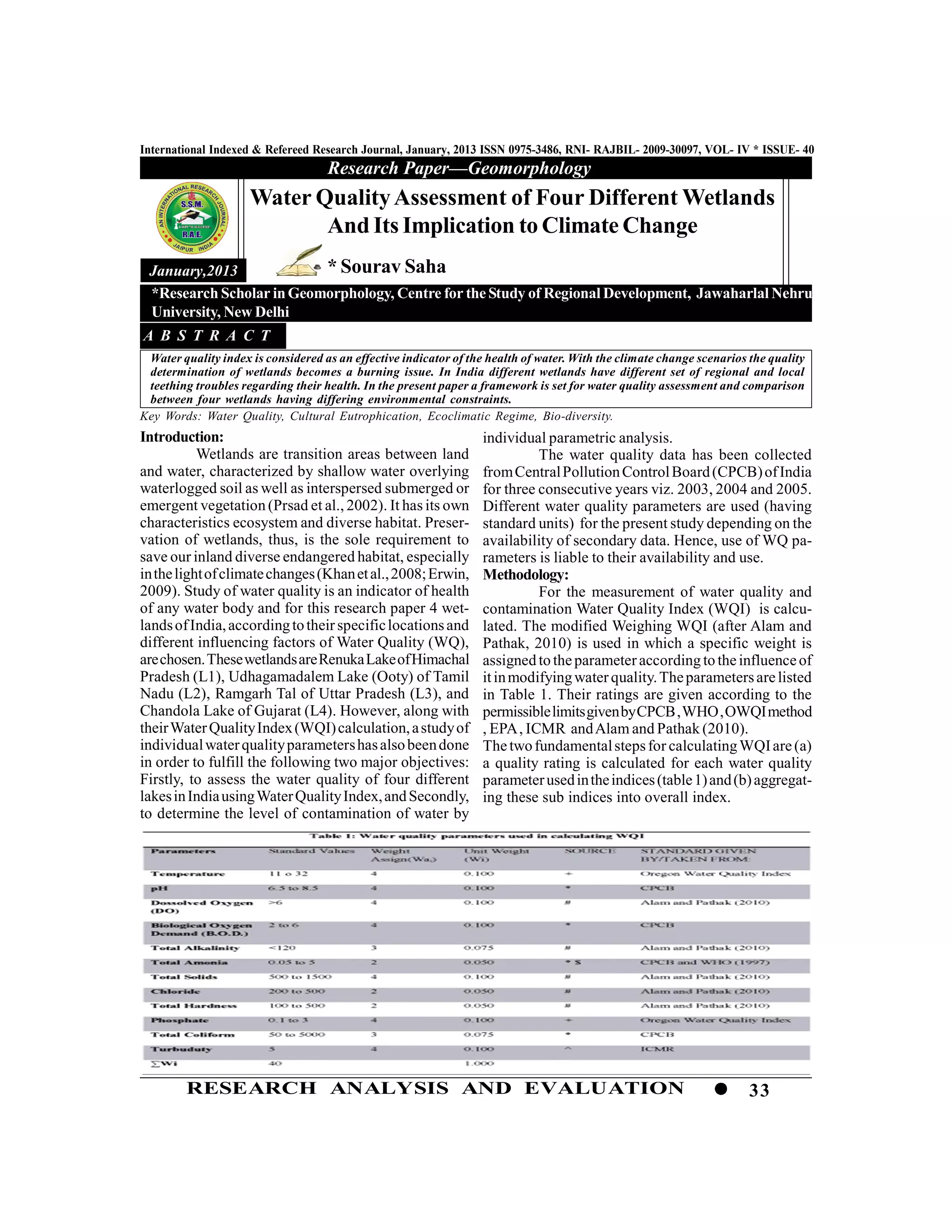
           Wetlands are transition areas between land                        The water quality data has been collected
and water, characterized by shallow water overlying                from Central Pollution Control Board (CPCB) of India
waterlogged soil as well as interspersed submerged or              for three consecutive years viz. 2003, 2004 and 2005.
emergent vegetation (Prsad et al., 2002). It has its own           Different water quality parameters are used (having
characteristics ecosystem and diverse habitat. Preser-             standard units) for the present study depending on the
vation of wetlands, thus, is the sole requirement to               availability of secondary data. Hence, use of WQ pa-
save our inland diverse endangered habitat, especially             rameters is liable to their availability and use.
in the light of climate changes (Khan et al., 2008; Erwin,         Methodology:
2009). Study of water quality is an indicator of health                      For the measurement of water quality and
of any water body and for this research paper 4 wet-               contamination Water Quality Index (WQI) is calcu-
lands of India, according to their specific locations and          lated. The modified Weighing WQI (after Alam and
different influencing factors of Water Quality (WQ),               Pathak, 2010) is used in which a specific weight is
are chosen. These wetlands are Renuka Lake of Himachal             assigned to the parameter according to the influence of
Pradesh (L1), Udhagamadalem Lake (Ooty) of Tamil                   it in modifying water quality. The parameters are listed
Nadu (L2), Ramgarh Tal of Uttar Pradesh (L3), and                  in Table 1. Their ratings are given according to the
Chandola Lake of Gujarat (L4). However, along with                 permissible limits given by CPCB , WHO , OWQI method
their Water Quality Index (WQI) calculation, a study of            , EPA , ICMR and Alam and Pathak (2010).
individual water quality parameters has also been done             The two fundamental steps for calculating WQI are (a)
in order to fulfill the following two major objectives:            a quality rating is calculated for each water quality
Firstly, to assess the water quality of four different             parameter used in the indices (table 1) and (b) aggregat-
lakes in India using Water Quality Index, and Secondly,            ing these sub indices into overall index.
to determine the level of contamination of water by


         RESEARCH ANALYSIS AND EVALUATION                                                                              33
International Indexed & Refereed Research Journal, January, 2013 ISSN 0975-3486, RNI- RAJBIL- 2009-30097, VOL- IV * ISSUE- 40


After allocation of weight, the unit weight is calculated
as follows:                                                   Findings: a .Water Quality of Four Different Wetlands
Unit weight (Wi) = Wai / ?Wani=1 and ? Wi = 1                 in India: The calculated WQI (applying 12 parameters;
Where, Wai = Weight assigned to parameter.                    *on the assumption that more the parameters more the
?Wani=1 = Sum of weights of all parameters                    actual index*) for the four different wetlands based on
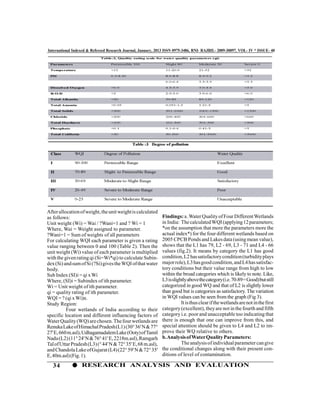
For calculating WQI each parameter is given a rating          2005 CPCB Ponds and Lakes data (using mean value),
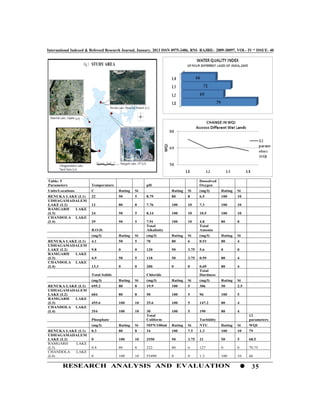
value ranging between 0 and 100 (Table 2). Then the           shows that the L1 has 79, L2 - 69, L3 - 71 and L4 - 66
unit weight (Wi) value of each parameter is multiplied        values (fig.2). It means by category the L1 has good
with the given rating qi (Si=Wi*qi) to calculate Subin-       condition, L2 has satisfactory condition (turbidity plays
dex (Si) and sum of Si (?Si) gives the WQI of that water      major role), L3 has good condition, and L4 has satisfac-
body.                                                         tory conditions but their value range from high to low
Sub Index (SI)i = qi x Wi                                     within the broad categories which is likely to note. Like,
Where, (SI)i = Subindex of ith parameter.                     L3 is slightly above the category (i.e. 70-89 = Good) but still
Wi = Unit weight of ith parameter.                            categorized in good WQ and that of L2 is slightly lower
qi = quality rating of ith parameter.                         than good but is categories as satisfactory. The variation
WQI = ? (qi x Wi)n.                                           in WQI values can be seen from the graph (Fig 3).
Study Region:                                                            It is thus clear if the wetlands are not in the first
          Four wetlands of India according to their           category (excellent), they are not in the fourth and fifth
specific location and different influencing factors of        category i.e. poor and unacceptable too indicating that
Water Quality (WQ) are chosen. The four wetlands are          there is enough that one can improve from this, and
Renuka Lake of Himachal Pradesh (L1) (30° 36' N & 77°         special attention should be given to L4 and L2 to im-
27' E, 660 m.asl), Udhagamadalem Lake (Ooty) of Tamil         prove their WQ relative to others.
Nadu (L2) (11° 24' N & 76° 41' E, 2218m.asl), Ramgarh         b. Analysis of Water Quality Parameters:
Tal of Uttar Pradesh (L3) (° 44' N & 72° 35' E, 68 m.asl),               The analysis of individual parameter can give
and Chandola Lake of Gujarat (L4) (22° 59' N & 72° 35'        the conditional changes along with their present con-
E, 40m.asl) (Fig. 1).                                         ditions of level of contamination.

   34             RESEARCH ANALYSIS AND EVALUATION
International Indexed & Refereed Research Journal, January, 2013 ISSN 0975-3486, RNI- RAJBIL- 2009-30097, VOL- IV * ISSUE- 40


Table: 5                                                                            Dossolved
Parameters              Temperature                   pH                            Oxygen
Units/Locations         C              Rating   Si                  Rating   Si     (mg/l)      Rating   Si
RENUKA LAKE (L1)        22             50       5     8.79          80       8      6.5         100      10
UDHAGAMADALEM
LAKE (L2)               12             80       8     7.76          100      10     7.3         100      10
RAMGARH   LAKE
(L3)                    24             50       5     8.14          100      10     10.5        100      10
CHANDOLA LAKE
(L4)                    29             50       5     7.91          100      10     4.8         80       8
                                                      Total                         Total
                        B.O.D.                        Alkalinity                    Amonia
                        (mg/l)         Rating   Si    (mg/l)        Rating   Si     (mg/l)      Rating   Si
RENUKA LAKE (L1)        4.1            50       5     70            80       6      0.53        80       4
UDHAGAMADALEM
LAKE (L2)               9.8            0        0     120           50       3.75   5.6         0        0
RAMGARH   LAKE
(L3)                    4.9            50       5     118           50       3.75   0.59        80       4
CHANDOLA LAKE
(L4)                    13.3           0        0     200           0        0      0.69        80       4
                                                                                    Total
                        Total Solids                  Chloride                      Hardness
                        (mg/l)         Rating   Si    (mg/l)        Rating   Si     (mg/l)      Rating   Si
RENUKA LAKE (L1)        695.2          80       8     19.9          100      5      306         50       2.5
UDHAGAMADALEM
LAKE (L2)               604            80       8     50            100      5      96          100      5
RAMGARH   LAKE
(L3)                    455.6          100      10    25.6          100      5      147.2       80       4
CHANDOLA LAKE
(L4)                    354            100      10    30            100      5      190         80       4
                                                      Total                                                    12
                        Phosphate                     Coliform                      Turbidity                  parameters
                        (mg/l)         Rating   Si    MPN/100ml     Rating   Si     NTU         Rating   Si    WQI
RENUKA LAKE (L1)        0.3            80       8     34            100      7.5    1.3         100      10    79
UDHAGAMADALEM
LAKE (L2)               0              100      10    2550          50       3.75   21          50       5     68.5
RAMGARH    LAKE
(L3)                    0.4            80       8     222           80       6      127         0        0     70.75
CHANDOLA   LAKE
(L4)                    0              100      10    55490         0        0      1.3         100      10    66

        RESEARCH ANALYSIS AND EVALUATION                                                                        35
International Indexed & Refereed Research Journal, January, 2013 ISSN 0975-3486, RNI- RAJBIL- 2009-30097, VOL- IV * ISSUE- 40


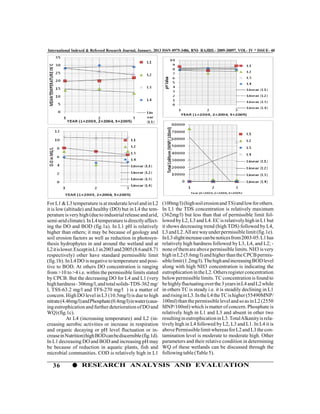
For L1 & L3 temperature is at moderate level and in L2        (100mg/l) (high soil erosion and TS) and low for others.
it is low (altitude) and healthy (DO) but in L4 the tem-      In L1 the TDS concentration is relatively maximum
perature is very high (due to industrial release and arid,    (362mg/l) but less than that of permissible limit fol-
semi-arid climate). In L4 temperature is directly affect-     lowed by L2, L3 and L4. EC is relatively high in L1 but
ing the DO and BOD (fig.1a). In L1 pH is relatively           it shows decreasing trend (high TDS) followed by L4,
higher than others; it may be because of geology and          L3 and L2. All are way under permissible limit (fig.1e).
soil erosion factors as well as reduction in photosyn-        In L3 slight increase can be notices from 2003-05. L1 has
thesis hydrophytes in and around the wetland and at           relatively high hardness followed by L3, L4, and L2; -
L2 it is lower. Except in L1 in 2003 and 2005 (8.6 and 8.71   none of them are above permissible limits. NH3 is very
respectively) other have standard permissible limit           high in L2 (5.6mg/l) and higher than the CPCB permis-
(fig.1b). In L4 DO is negative to temperature and posi-       sible limit (1.2mg/l). The high and increasing BOD level
tive to BOD. At others DO concentration is ranging            along with high NH3 concentration is indicating the
from >10 to >4 i.e. within the permissible limits stated      eutrophication in the L2. Others register concentration
by CPCB. But the decreasing DO for L4 and L1 (very            below permissible limits. TC concentration is found to
high hardness - 306mg/l, and total solids-TDS-362 mg/         be highly fluctuating over the 3 years in L4 and L2 while
l, TSS-63.2 mg/l and TFS-270 mg/l ) is a matter of            in others TC is steady i.e. it is steadily declining in L1
concern. High DO level in L3 (10.5mg/l) is due to high        and rising in L3. In the L4 the TC is higher (55490MNP/
nitrate (4.46mg/l) and Phosphate (0.4mg/l) in water (caus-    100ml) than the permissible level and so as in L2 (2550
ing eutrophication and further deterioration of DO and        MNP/100ml) which is matter of concern. Phosphate is
WQ) (fig.1c).                                                 relatively high in L1 and L3 and absent in other two
           At L4 (increasing temperature) and L2 (in-         resulting in eutrophication in L3. Total Alkanity is rela-
creasing aerobic activities or increase in respiration        tively high in L4 followed by L2, L3 and L1. In L4 it is
and organic decaying or pH level fluctuation or in-           above Permissible limit whereas for L2 and L3 the con-
crease in Nutrition) high BOD can be discernible (fig.1d).    tamination level is moderate to moderate high. Other
In L1 decreasing DO and BOD and increasing pH may             parameters and their relative condition in determining
be because of reduction in aquatic plants, fish and           WQ of these wetlands can be discussed through the
microbial communities. COD is relatively high in L1           following table (Table 5).

   36             RESEARCH ANALYSIS AND EVALUATION
International Indexed & Refereed Research Journal, January, 2013 ISSN 0975-3486, RNI- RAJBIL- 2009-30097, VOL- IV * ISSUE- 40


Conclusion And Suggestion:                                     having satisfactory condition according to WQI (69) in
           From the aforesaid study following conclu-          future. Ramgarh Tal (L3) has experienced high nitrate
sion can be drawn about the water quality of the four          and phosphate levels in recent years but DO is within
different wetlands of India. Renuka lake (L1) has been         permissible limits (with relatively high BOD) and thus
experiencing decreasing DO & BOD but increasing pH             vulnerable to eutrophication. Chandola Lake (L4) has
level, COD, high TS, high Total hardness and electric          experienced satisfactory water quality as per as WQI
conductivity. Soil erosion is high as well. That means         is concerned (66) but the very high water temperature
the high concentration of solids positively affects DO         (mean 29°C) and rapidly decreasing Dissolved Oxygen
concentration which adversely affect the BOD and the           is a major concern for the wetland.
aquatic life forms in the wetlands; the relatively high                 Hence, all the four wetlands have their own
pH along with decreasing DO and BOD and uniform                special problems related to their location and natural
temperature also support the adversely affected ecol-          and anthropogenic factors. Although by overall water
ogy in the wetland. High Total hardness and electric           quality all the four are satisfactory to good levels but
conductivity are also indicators of deteriorating water        individual parametric analysis gives more accurate
quality in the wetland. Hence although by WQI study            problems of the wetlands. Understanding of the wet-
the lake has good condition (79) but it is likely to be-       lands and their quality assessment become increas-
come more contaminated (or aging) in near future.              ingly more and more important in the future climatic
Udhagamadalem (Ooty) lake (L2) also has high Total             change scenario, hence more accurate and extensive
Amonia indicating eutrophication in the wetland. The           study of water quality of wetlands is worth require-
relatively high BOD also supports the above view. It is        ment.
likely it may lose its charm and water quality even after


R E F E R E N C E
1. Chandra Rachna, Nishadh K. A., Azeez P. A., (2010) Monitoring water quality of Coimbatore wetlands, Tamil Nadu, India.
   Springer Science. 2009; pp-671-676.
2. Cude Curtis G., (2001). Oregon Water Quality Index: A Tool for Evaluating Water Quality Management Effectiveness. Journal
   of American Water Resources Association, Vol.37, No.1, pp-125-137.
3. Dwivedi S.L. and Pathak, V., (2007) A Preliminary Assignment of Water Quality Index to Mandakini River, Chirakoot. Indian
   Journal of Environmental Protection, Vol.27. No.11, pp-1036-1038.
4. Erwin Kevin L., (2008). Wetlands and global climate change: the role of wetland restoration in a changing world. Wetlands
   Ecol Manage 17; pp-71-84.
5. Khan Sarfraz A. and Srivastava J., (2008). Interaction of Ions in Water Affects Water Quality of Freshwater Lake: A Case
   Study of Major Lakes of North India. Environmentalist 28; pp-217-221.
6. Mohammad, A. and Pathak, J.K., (2010) Rapid Assessment of Water Quality Index of Ramganga River, Western Uttar Pradesh
   (India) Using a Computer Programme. Nature and Science 1-8, pp-1-8.
7. Prasad S.N., Ramachandra T.V., Ahalya N., Sengupta T., Kumar Alok, Tiwari A.K., Vijayan, V.S. & Vijayan, L., (2002)
   Conservation of Wetlands of India - A Review, International Society for Tropical Ecology 43(1); pp-173-186.
8. Watershed Protection Plan Development Guidebook. APPENDIX B. Northeast Georgia Regional Development Center
   (EPA, USA). pp- B-1 to B-11.
        RESEARCH ANALYSIS AND EVALUATION                                                                        37

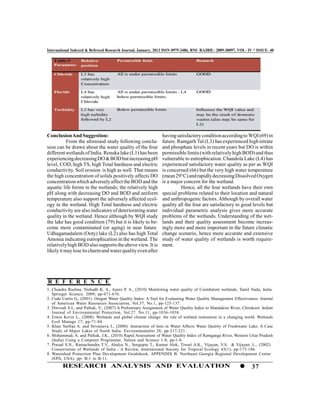
33 37

  • 1.
    International Indexed &Refereed Research Journal, January, 2013 ISSN 0975-3486, RNI- RAJBIL- 2009-30097, VOL- IV * ISSUE- 40 Research Paper—Geomorphology Water Quality Assessment of Four Different Wetlands And Its Implication to Climate Change January,2013 * Sourav Saha *Research Scholar in Geomorphology, Centre for the Study of Regional Development, Jawaharlal Nehru University, New Delhi A B S T R A C T Water quality index is considered as an effective indicator of the health of water. With the climate change scenarios the quality determination of wetlands becomes a burning issue. In India different wetlands have different set of regional and local teething troubles regarding their health. In the present paper a framework is set for water quality assessment and comparison between four wetlands having differing environmental constraints. Key Words: Water Quality, Cultural Eutrophication, Ecoclimatic Regime, Bio-diversity. Introduction: individual parametric analysis. Wetlands are transition areas between land The water quality data has been collected and water, characterized by shallow water overlying from Central Pollution Control Board (CPCB) of India waterlogged soil as well as interspersed submerged or for three consecutive years viz. 2003, 2004 and 2005. emergent vegetation (Prsad et al., 2002). It has its own Different water quality parameters are used (having characteristics ecosystem and diverse habitat. Preser- standard units) for the present study depending on the vation of wetlands, thus, is the sole requirement to availability of secondary data. Hence, use of WQ pa- save our inland diverse endangered habitat, especially rameters is liable to their availability and use. in the light of climate changes (Khan et al., 2008; Erwin, Methodology: 2009). Study of water quality is an indicator of health For the measurement of water quality and of any water body and for this research paper 4 wet- contamination Water Quality Index (WQI) is calcu- lands of India, according to their specific locations and lated. The modified Weighing WQI (after Alam and different influencing factors of Water Quality (WQ), Pathak, 2010) is used in which a specific weight is are chosen. These wetlands are Renuka Lake of Himachal assigned to the parameter according to the influence of Pradesh (L1), Udhagamadalem Lake (Ooty) of Tamil it in modifying water quality. The parameters are listed Nadu (L2), Ramgarh Tal of Uttar Pradesh (L3), and in Table 1. Their ratings are given according to the Chandola Lake of Gujarat (L4). However, along with permissible limits given by CPCB , WHO , OWQI method their Water Quality Index (WQI) calculation, a study of , EPA , ICMR and Alam and Pathak (2010). individual water quality parameters has also been done The two fundamental steps for calculating WQI are (a) in order to fulfill the following two major objectives: a quality rating is calculated for each water quality Firstly, to assess the water quality of four different parameter used in the indices (table 1) and (b) aggregat- lakes in India using Water Quality Index, and Secondly, ing these sub indices into overall index. to determine the level of contamination of water by RESEARCH ANALYSIS AND EVALUATION 33
  • 2.
    International Indexed &Refereed Research Journal, January, 2013 ISSN 0975-3486, RNI- RAJBIL- 2009-30097, VOL- IV * ISSUE- 40 After allocation of weight, the unit weight is calculated as follows: Findings: a .Water Quality of Four Different Wetlands Unit weight (Wi) = Wai / ?Wani=1 and ? Wi = 1 in India: The calculated WQI (applying 12 parameters; Where, Wai = Weight assigned to parameter. *on the assumption that more the parameters more the ?Wani=1 = Sum of weights of all parameters actual index*) for the four different wetlands based on For calculating WQI each parameter is given a rating 2005 CPCB Ponds and Lakes data (using mean value), value ranging between 0 and 100 (Table 2). Then the shows that the L1 has 79, L2 - 69, L3 - 71 and L4 - 66 unit weight (Wi) value of each parameter is multiplied values (fig.2). It means by category the L1 has good with the given rating qi (Si=Wi*qi) to calculate Subin- condition, L2 has satisfactory condition (turbidity plays dex (Si) and sum of Si (?Si) gives the WQI of that water major role), L3 has good condition, and L4 has satisfac- body. tory conditions but their value range from high to low Sub Index (SI)i = qi x Wi within the broad categories which is likely to note. Like, Where, (SI)i = Subindex of ith parameter. L3 is slightly above the category (i.e. 70-89 = Good) but still Wi = Unit weight of ith parameter. categorized in good WQ and that of L2 is slightly lower qi = quality rating of ith parameter. than good but is categories as satisfactory. The variation WQI = ? (qi x Wi)n. in WQI values can be seen from the graph (Fig 3). Study Region: It is thus clear if the wetlands are not in the first Four wetlands of India according to their category (excellent), they are not in the fourth and fifth specific location and different influencing factors of category i.e. poor and unacceptable too indicating that Water Quality (WQ) are chosen. The four wetlands are there is enough that one can improve from this, and Renuka Lake of Himachal Pradesh (L1) (30° 36' N & 77° special attention should be given to L4 and L2 to im- 27' E, 660 m.asl), Udhagamadalem Lake (Ooty) of Tamil prove their WQ relative to others. Nadu (L2) (11° 24' N & 76° 41' E, 2218m.asl), Ramgarh b. Analysis of Water Quality Parameters: Tal of Uttar Pradesh (L3) (° 44' N & 72° 35' E, 68 m.asl), The analysis of individual parameter can give and Chandola Lake of Gujarat (L4) (22° 59' N & 72° 35' the conditional changes along with their present con- E, 40m.asl) (Fig. 1). ditions of level of contamination. 34 RESEARCH ANALYSIS AND EVALUATION
  • 3.
    International Indexed &Refereed Research Journal, January, 2013 ISSN 0975-3486, RNI- RAJBIL- 2009-30097, VOL- IV * ISSUE- 40 Table: 5 Dossolved Parameters Temperature pH Oxygen Units/Locations C Rating Si Rating Si (mg/l) Rating Si RENUKA LAKE (L1) 22 50 5 8.79 80 8 6.5 100 10 UDHAGAMADALEM LAKE (L2) 12 80 8 7.76 100 10 7.3 100 10 RAMGARH LAKE (L3) 24 50 5 8.14 100 10 10.5 100 10 CHANDOLA LAKE (L4) 29 50 5 7.91 100 10 4.8 80 8 Total Total B.O.D. Alkalinity Amonia (mg/l) Rating Si (mg/l) Rating Si (mg/l) Rating Si RENUKA LAKE (L1) 4.1 50 5 70 80 6 0.53 80 4 UDHAGAMADALEM LAKE (L2) 9.8 0 0 120 50 3.75 5.6 0 0 RAMGARH LAKE (L3) 4.9 50 5 118 50 3.75 0.59 80 4 CHANDOLA LAKE (L4) 13.3 0 0 200 0 0 0.69 80 4 Total Total Solids Chloride Hardness (mg/l) Rating Si (mg/l) Rating Si (mg/l) Rating Si RENUKA LAKE (L1) 695.2 80 8 19.9 100 5 306 50 2.5 UDHAGAMADALEM LAKE (L2) 604 80 8 50 100 5 96 100 5 RAMGARH LAKE (L3) 455.6 100 10 25.6 100 5 147.2 80 4 CHANDOLA LAKE (L4) 354 100 10 30 100 5 190 80 4 Total 12 Phosphate Coliform Turbidity parameters (mg/l) Rating Si MPN/100ml Rating Si NTU Rating Si WQI RENUKA LAKE (L1) 0.3 80 8 34 100 7.5 1.3 100 10 79 UDHAGAMADALEM LAKE (L2) 0 100 10 2550 50 3.75 21 50 5 68.5 RAMGARH LAKE (L3) 0.4 80 8 222 80 6 127 0 0 70.75 CHANDOLA LAKE (L4) 0 100 10 55490 0 0 1.3 100 10 66 RESEARCH ANALYSIS AND EVALUATION 35
  • 4.
    International Indexed &Refereed Research Journal, January, 2013 ISSN 0975-3486, RNI- RAJBIL- 2009-30097, VOL- IV * ISSUE- 40 For L1 & L3 temperature is at moderate level and in L2 (100mg/l) (high soil erosion and TS) and low for others. it is low (altitude) and healthy (DO) but in L4 the tem- In L1 the TDS concentration is relatively maximum perature is very high (due to industrial release and arid, (362mg/l) but less than that of permissible limit fol- semi-arid climate). In L4 temperature is directly affect- lowed by L2, L3 and L4. EC is relatively high in L1 but ing the DO and BOD (fig.1a). In L1 pH is relatively it shows decreasing trend (high TDS) followed by L4, higher than others; it may be because of geology and L3 and L2. All are way under permissible limit (fig.1e). soil erosion factors as well as reduction in photosyn- In L3 slight increase can be notices from 2003-05. L1 has thesis hydrophytes in and around the wetland and at relatively high hardness followed by L3, L4, and L2; - L2 it is lower. Except in L1 in 2003 and 2005 (8.6 and 8.71 none of them are above permissible limits. NH3 is very respectively) other have standard permissible limit high in L2 (5.6mg/l) and higher than the CPCB permis- (fig.1b). In L4 DO is negative to temperature and posi- sible limit (1.2mg/l). The high and increasing BOD level tive to BOD. At others DO concentration is ranging along with high NH3 concentration is indicating the from >10 to >4 i.e. within the permissible limits stated eutrophication in the L2. Others register concentration by CPCB. But the decreasing DO for L4 and L1 (very below permissible limits. TC concentration is found to high hardness - 306mg/l, and total solids-TDS-362 mg/ be highly fluctuating over the 3 years in L4 and L2 while l, TSS-63.2 mg/l and TFS-270 mg/l ) is a matter of in others TC is steady i.e. it is steadily declining in L1 concern. High DO level in L3 (10.5mg/l) is due to high and rising in L3. In the L4 the TC is higher (55490MNP/ nitrate (4.46mg/l) and Phosphate (0.4mg/l) in water (caus- 100ml) than the permissible level and so as in L2 (2550 ing eutrophication and further deterioration of DO and MNP/100ml) which is matter of concern. Phosphate is WQ) (fig.1c). relatively high in L1 and L3 and absent in other two At L4 (increasing temperature) and L2 (in- resulting in eutrophication in L3. Total Alkanity is rela- creasing aerobic activities or increase in respiration tively high in L4 followed by L2, L3 and L1. In L4 it is and organic decaying or pH level fluctuation or in- above Permissible limit whereas for L2 and L3 the con- crease in Nutrition) high BOD can be discernible (fig.1d). tamination level is moderate to moderate high. Other In L1 decreasing DO and BOD and increasing pH may parameters and their relative condition in determining be because of reduction in aquatic plants, fish and WQ of these wetlands can be discussed through the microbial communities. COD is relatively high in L1 following table (Table 5). 36 RESEARCH ANALYSIS AND EVALUATION
  • 5.
    International Indexed &Refereed Research Journal, January, 2013 ISSN 0975-3486, RNI- RAJBIL- 2009-30097, VOL- IV * ISSUE- 40 Conclusion And Suggestion: having satisfactory condition according to WQI (69) in From the aforesaid study following conclu- future. Ramgarh Tal (L3) has experienced high nitrate sion can be drawn about the water quality of the four and phosphate levels in recent years but DO is within different wetlands of India. Renuka lake (L1) has been permissible limits (with relatively high BOD) and thus experiencing decreasing DO & BOD but increasing pH vulnerable to eutrophication. Chandola Lake (L4) has level, COD, high TS, high Total hardness and electric experienced satisfactory water quality as per as WQI conductivity. Soil erosion is high as well. That means is concerned (66) but the very high water temperature the high concentration of solids positively affects DO (mean 29°C) and rapidly decreasing Dissolved Oxygen concentration which adversely affect the BOD and the is a major concern for the wetland. aquatic life forms in the wetlands; the relatively high Hence, all the four wetlands have their own pH along with decreasing DO and BOD and uniform special problems related to their location and natural temperature also support the adversely affected ecol- and anthropogenic factors. Although by overall water ogy in the wetland. High Total hardness and electric quality all the four are satisfactory to good levels but conductivity are also indicators of deteriorating water individual parametric analysis gives more accurate quality in the wetland. Hence although by WQI study problems of the wetlands. Understanding of the wet- the lake has good condition (79) but it is likely to be- lands and their quality assessment become increas- come more contaminated (or aging) in near future. ingly more and more important in the future climatic Udhagamadalem (Ooty) lake (L2) also has high Total change scenario, hence more accurate and extensive Amonia indicating eutrophication in the wetland. The study of water quality of wetlands is worth require- relatively high BOD also supports the above view. It is ment. likely it may lose its charm and water quality even after R E F E R E N C E 1. Chandra Rachna, Nishadh K. A., Azeez P. A., (2010) Monitoring water quality of Coimbatore wetlands, Tamil Nadu, India. Springer Science. 2009; pp-671-676. 2. Cude Curtis G., (2001). Oregon Water Quality Index: A Tool for Evaluating Water Quality Management Effectiveness. Journal of American Water Resources Association, Vol.37, No.1, pp-125-137. 3. Dwivedi S.L. and Pathak, V., (2007) A Preliminary Assignment of Water Quality Index to Mandakini River, Chirakoot. Indian Journal of Environmental Protection, Vol.27. No.11, pp-1036-1038. 4. Erwin Kevin L., (2008). Wetlands and global climate change: the role of wetland restoration in a changing world. Wetlands Ecol Manage 17; pp-71-84. 5. Khan Sarfraz A. and Srivastava J., (2008). Interaction of Ions in Water Affects Water Quality of Freshwater Lake: A Case Study of Major Lakes of North India. Environmentalist 28; pp-217-221. 6. Mohammad, A. and Pathak, J.K., (2010) Rapid Assessment of Water Quality Index of Ramganga River, Western Uttar Pradesh (India) Using a Computer Programme. Nature and Science 1-8, pp-1-8. 7. Prasad S.N., Ramachandra T.V., Ahalya N., Sengupta T., Kumar Alok, Tiwari A.K., Vijayan, V.S. & Vijayan, L., (2002) Conservation of Wetlands of India - A Review, International Society for Tropical Ecology 43(1); pp-173-186. 8. Watershed Protection Plan Development Guidebook. APPENDIX B. Northeast Georgia Regional Development Center (EPA, USA). pp- B-1 to B-11. RESEARCH ANALYSIS AND EVALUATION 37