a                                                                             Low Voltage Temperature Sensors
                                                                                        TMP35/TMP36/TMP37
   FEATURES                                                                                    FUNCTIONAL BLOCK DIAGRAM
   Low Voltage Operation (2.7 V to 5.5 V)
   Calibrated Directly in ؇C                                                                                    +Vs (2.7V to 5.5V)

   10 mV/؇C Scale Factor (20 mV/؇C on TMP37)
   ؎2؇C Accuracy over Temperature (Typ)
   ؎0.5؇C Linearity (Typ)                                                                                              TMP35/
                                                                                                 SHUTDOWN              TMP36/             VOUT
   Stable with Large Capacitive Loads                                                                                  TMP37
   Specified –40؇C to +125؇C, Operation to +150؇C
   Less than 50 ␮A Quiescent Current
   Shutdown Current 0.5 ␮A Max
   Low Self-Heating
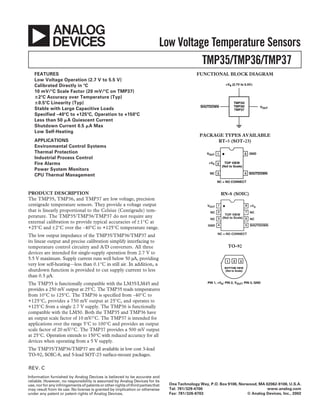
                                                                                                 PACKAGE TYPES AVAILABLE
   APPLICATIONS                                                                                        RT-5 (SOT-23)
   Environmental Control Systems
   Thermal Protection                                                                               VOUT 1                        5 GND
   Industrial Process Control
   Fire Alarms                                                                                       +VS 2      TOP VIEW
                                                                                                              (Not to Scale)
   Power System Monitors
                                                                                                      NC 3                        4 SHUTDOWN
   CPU Thermal Management
                                                                                                           NC = NO CONNECT


PRODUCT DESCRIPTION                                                                                           RN-8 (SOIC)
The TMP35, TMP36, and TMP37 are low voltage, precision
centigrade temperature sensors. They provide a voltage output                                        VOUT 1                       8 +VS
that is linearly proportional to the Celsius (Centigrade) tem-                                        NC 2                7 NC
                                                                                                             TOP VIEW
perature. The TMP35/TMP36/TMP37 do not require any                                                    NC 3 (Not to Scale) 6 NC
external calibration to provide typical accuracies of ± 1°C at
                                                                                                     GND 4                        5 SHUTDOWN
+25°C and ± 2°C over the –40°C to +125°C temperature range.
                                                                                                           NC = NO CONNECT
The low output impedance of the TMP35/TMP36/TMP37 and
its linear output and precise calibration simplify interfacing to
temperature control circuitry and A/D converters. All three                                                       TO-92
devices are intended for single-supply operation from 2.7 V to
5.5 V maximum. Supply current runs well below 50 µA, providing                                                   1    2     3
very low self-heating—less than 0.1°C in still air. In addition, a
                                                                                                                BOTTOM VIEW
shutdown function is provided to cut supply current to less                                                      (Not to Scale)

than 0.5 µA.
The TMP35 is functionally compatible with the LM35/LM45 and                                          PIN 1, +Vs; PIN 2, VOUT; PIN 3, GND

provides a 250 mV output at 25°C. The TMP35 reads temperatures
from 10°C to 125°C. The TMP36 is specified from –40°C to
+125°C, provides a 750 mV output at 25°C, and operates to
+125°C from a single 2.7 V supply. The TMP36 is functionally
compatible with the LM50. Both the TMP35 and TMP36 have
an output scale factor of 10 mV/°C. The TMP37 is intended for
applications over the range 5°C to 100°C and provides an output
scale factor of 20 mV/°C. The TMP37 provides a 500 mV output
at 25°C. Operation extends to 150°C with reduced accuracy for all
devices when operating from a 5 V supply.
The TMP35/TMP36/TMP37 are all available in low cost 3-lead
TO-92, SOIC-8, and 5-lead SOT-23 surface-mount packages.

REV. C
Information furnished by Analog Devices is believed to be accurate and
reliable. However, no responsibility is assumed by Analog Devices for its
use, nor for any infringements of patents or other rights of third parties that   One Technology Way, P.O. Box 9106, Norwood, MA 02062-9106, U.S.A.
may result from its use. No license is granted by implication or otherwise        Tel: 781/329-4700                               www.analog.com
under any patent or patent rights of Analog Devices.                              Fax: 781/326-8703                     © Analog Devices, Inc., 2002
(VS = 2.7 V to 5.5 V, –40؇C ≤ TA ≤ +125؇C, unless
TMP35/TMP36/TMP37–SPECIFICATIONS1 otherwise noted.)
Parameter                                                                     Symbol          Conditions                       Min       Typ       Max              Unit
ACCURACY
 TMP35/TMP36/TMP37F                                                                           TA = 25°C                                  ±1        ±2               °C
 TMP35/TMP36/TMP37G                                                                           TA = 25°C                                  ±1        ±3               °C
 TMP35/TMP36/TMP37F                                                                           Over Rated Temperature                     ±2        ±3               °C
 TMP35/TMP36/TMP37G                                                                           Over Rated Temperature                     ±2        ±4               °C
 Scale Factor, TMP35                                                                          10°C ≤ TA ≤ 125°C                          10        9.8/10.2         mV/°C
 Scale Factor, TMP36                                                                          –40°C ≤ TA ≤ +125°C                        10        9.8/10.2         mV/°C
 Scale Factor, TMP37                                                                          5°C ≤ TA ≤ 85°C                            20        19.6/20.4        mV/°C
                                                                                              5°C ≤ TA ≤ 100°C                           20        19.6/20.4        mV/°C
                                                                                              3.0 V ≤ +VS ≤ 5.5 V
  Load Regulation                                                                             0 µA ≤ IL ≤ 50 µA
                                                                                              –40°C ≤ TA ≤ +105°C                        6         20               m°C/µA
                                                                                              –105°C ≤ TA ≤ +125°C                       25        60               m°C/µA
  Power Supply Rejection Ratio                                                PSRR            TA = 25°C                                  30        100              m°C/V
                                                                                              3.0 V ≤ +VS ≤ 5.5 V                        50                         m°C/V
  Linearity                                                                                                                              0.5                        °C
  Long-Term Stability                                                                         TA = 150°C for 1 kHrs                      0.4                        °C
SHUTDOWN
 Logic High Input Voltage                                                     VIH             VS = 2.7 V                       1.8                                  V
 Logic Low Input Voltage                                                      VIL             VS = 5.5 V                                           400              mV
OUTPUT
 TMP35 Output Voltage                                                                         TA = 25°C                                  250                        mV
 TMP36 Output Voltage                                                                         TA = 25°C                                  750                        mV
 TMP37 Output Voltage                                                                         TA = 25°C                                  500                        mV
 Output Voltage Range                                                                                                          100                 2000             mV
 Output Load Current                                                          IL                                               0                   50               µA
 Short-Circuit Current                                                        ISC             Note 2                                               250              µA
 Capacitive Load Driving                                                      CL              No Oscillations2                 1000      10000                      pF
 Device Turn-On Time                                                                          Output within ± 1°C                        0.5       1                ms
                                                                                              100 kΩʈ100 pF Load2
POWER SUPPLY
 Supply Range                                                                 +VS                                              2.7                 5.5              V
 Supply Current                                                               ISY (ON)        Unloaded                                             50               µA
 Supply Current (Shutdown)                                                    ISY (OFF)       Unloaded                                   0.01      0.5              µA
NOTES
1
  Does not consider errors caused by self-heating.
2
  Guaranteed but not tested.
Specifications subject to change without notice.


                                                                         50


                                                                         40
                                                     LOAD REG – m؇C/␮A


                                                                         30


                                                                         20


                                                                         10


                                                                         0
                                                                          –50             0         50           100          150
                                                                                              TEMPERATURE – ؇C

                                                                     Figure 1. Load Reg vs. Temperature (m°C/µ A)


                                                                                                  –2–                                                                REV. C
TMP35/TMP36/TMP37
ABSOLUTE MAXIMUM RATINGS 1, 2, 3                                                           FUNCTIONAL DESCRIPTION
Supply Voltage . . . . . . . . . . . . . . . . . . . . . . . . . . . . . . . . . . 7 V     An equivalent circuit for the TMP3x family of micropower,
Shutdown Pin . . . . . . . . . . . . . . GND ≤ SHUTDOWN ≤ +VS                              centigrade temperature sensors is shown in Figure 2. At the
Output Pin . . . . . . . . . . . . . . . . . . . . . . GND Յ VOUT Յ +VS                    heart of the temperature sensor is a band gap core, which is
Operating Temperature Range . . . . . . . . . . –55°C to +150°C                            comprised of transistors Q1 and Q2, biased by Q3 to approxi-
Dice Junction Temperature . . . . . . . . . . . . . . . . . . . . . . 175°C                mately 8 µA. The band gap core operates both Q1 and Q2 at the
Storage Temperature Range . . . . . . . . . . . . –65°C to +160°C                          same collector current level; however, since the emitter area of
Lead Temperature (Soldering, 60 sec) . . . . . . . . . . . . . 300°C                       Q1 is 10 times that of Q2, Q1’s VBE and Q2’s VBE are not equal
NOTES                                                                                      by the following relationship:
1
  Stresses above those listed under Absolute Maximum Ratings may cause perma-
  nent damage to the device. This is a stress rating only; functional operation at or                                            A       
  above this specification is not implied. Exposure to maximum rating conditions for                               ∆VBE =VT × ln  E ,Q1 
  extended periods may affect device reliability.                                                                                 AE ,Q2 
 2
   Digital inputs are protected; however, permanent damage may occur on unpro-
  tected units from high energy electrostatic fields. Keep units in conductive foam
  or packaging at all times until ready to use. Use proper antistatic handling                  +VS
  procedures.
 3
  Remove power before inserting or removing units from their sockets.                          SHDN
                                                                                                                                                  25␮A

Package Type                              ␪JA            ␪JC         Unit
TO-92 (T9 Suffix)                         162            120         °C/W                                                                           3X    2X
SOIC-8 (S Suffix)                         158            43          °C/W
SOT-23 (RT Suffix)                        300            180         °C/W
θJA is specified for device in socket (worst-case conditions).
                                                                                                                                       Q2
                                                                                                       Q4                              1X
                                                                                                                                                         R1
                            ORDERING GUIDE                                                                                 Q1
                                                                                                                          10X
                      Accuracy         Linear                                                                                                R3

                      at 25؇C          Operating                        Package                +VOUT                                                     R2
Model                 (؇C max)         Temperature Range                Options1                                                     7.5␮A
                                                                                                                                Q3
TMP35FT9              ± 2.0            10°C to 125°C                    TO-92
TMP35GT9              ± 3.0            10°C to 125°C                    TO-92                                             6X
                                                                                                                                                                   2X

TMP35FS               ± 2.0            10°C to 125°C                    RN-8                    GND
TMP35GS               ± 3.0            10°C to 125°C                    RN-8
TMP35GRT2             ± 3.0            10°C to 125°C                    RT-5                            Figure 2. Temperature Sensor Simplified
                                                                                                        Equivalent Circuit
TMP36FT9              ± 2.0            –40°C to +125°C                  TO-92
TMP36GT9              ± 3.0            –40°C to +125°C                  TO-92              Resistors R1 and R2 are used to scale this result to produce the
TMP36FS               ± 2.0            –40°C to +125°C                  RN-8               output voltage transfer characteristic of each temperature sensor
TMP36GS               ± 3.0            –40°C to +125°C                  RN-8               and, simultaneously, R2 and R3 are used to scale Q1’s VBE as
TMP36GRT2             ± 3.0            –40°C to +125°C                  RT-5               an offset term in VOUT. Table I summarizes the differences
                                                                                           between the three temperature sensors’ output characteristics.
TMP37FT9              ± 2.0            5°C to 100°C                     TO-92
TMP37GT9              ± 3.0            5°C to 100°C                     TO-92                               Table I. TMP3x Output Characteristics
TMP37FS               ± 2.0            5°C to 100°C                     RN-8
TMP37GS               ± 3.0            5°C to 100°C                     RN-8                                Offset        Output Voltage             Output Voltage
TMP37GRT2             ± 3.0            5°C to 100°C                     RT-5               Sensor           Voltage (V)   Scaling (mV/؇C)            @ 25؇C (mV)
NOTES                                                                                      TMP35            0             10                         250
1
  SOIC = Small Outline Integrated Circuit; RT = Plastic Surface Mount;                     TMP36            0.5           10                         750
  TO = Plastic.
2
  Consult factory for availability.
                                                                                           TMP37            0             20                         500

                                                                                           The output voltage of the temperature sensor is available at the
                                                                                           emitter of Q4, which buffers the band gap core and provides
                                                                                           load current drive. Q4’s current gain, working with the available
                                                                                           base current drive from the previous stage, sets the short-circuit
                                                                                           current limit of these devices to 250 µA.
CAUTION
ESD (electrostatic discharge) sensitive device. Electrostatic charges as high as 4000 V readily
accumulate on the human body and test equipment and can discharge without detection. Although                                          WARNING!
the TMP35/TMP36/TMP37 features proprietary ESD protection circuitry, permanent damage
may occur on devices subjected to high energy electrostatic discharges. Therefore, proper ESD
                                                                                                                                                  ESD SENSITIVE DEVICE
precautions are recommended to avoid performance degradation or loss of functionality.

REV. C                                                                                   –3–
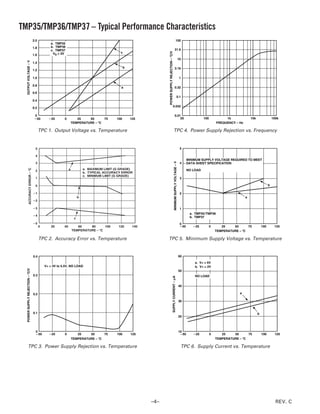
TMP35/TMP36/TMP37 – Typical Performance Characteristics
                                  2.0                                                                                                                          100
                                                a. TMP35
                                  1.8           b. TMP36
                                                c. TMP37                                                                                               31.6


                                                                                                                  POWER SUPPLY REJECTION – ؇C/V
                                                 VS = 3V                                     c
                                  1.6
                                                                                                                                                                               10
       OUTPUT VOLTAGE – V


                                  1.4
                                                                                                 b                                                     3.16
                                  1.2

                                  1.0                                                                                                                                          1

                                  0.8
                                                                                              a                                                        0.32
                                  0.6
                                                                                                                                                                       0.1
                                  0.4

                                  0.2                                                                                                      0.032

                                   0                                                                                                                   0.01
                                   ؊50        ؊25       0           25    50      75       100       125                                                   20                                   100            1k              10k                 100k
                                                                 TEMPERATURE – ؇C                                                                                                                         FREQUENCY – Hz

                                        TPC 1. Output Voltage vs. Temperature                                                                     TPC 4. Power Supply Rejection vs. Frequency


                                    5                                                                                                                                           5

                                    4
                                                                                                                                                                                      MINIMUM SUPPLY VOLTAGE REQUIRED TO MEET


                                                                                                                                                  MINIMUM SUPPLY VOLTAGE – V
                                    3                                                                                                                                           4     DATA SHEET SPECIFICATION
          ACCURACY ERROR – ؇C


                                                             a            a. MAXIMUM LIMIT (G GRADE)                                                                                  NO LOAD
                                    2
                                                                          b. TYPICAL ACCURACY ERROR
                                                                          c. MINIMUM LIMIT (G GRADE)
                                    1                                                                                                                                           3

                                    0                                                                                                                                                                                                          b

                                  ؊1                                                                                                                                            2
                                                                      b                                                                                                                                                    a
                                  ؊2

                                  ؊3                                                                                                                                            1
                                                                                                                                                                                       a. TMP35/TMP36
                                  ؊4                                                                                                                                                   b. TMP37
                                                                  c
                                  ؊5                                                                                                                                            0
                                        0       20      40          60    80      100       120       140                                                                       ؊50      ؊25          0      25    50      75            100        125
                                                                 TEMPERATURE – ؇C                                                                                                                         TEMPERATURE – ؇C

                                        TPC 2. Accuracy Error vs. Temperature                                     TPC 5. Minimum Supply Voltage vs. Temperature


                                  0.4                                                                                                                                          60

                                                                                                                                                                                          a. V+ = 5V
                                            V+ = 3V to 5.5V, NO LOAD                                                                                                                      b. V+ = 3V
  POWER SUPPLY REJECTION – ؇C/V


                                                                                                                                                                               50
                                  0.3                                                                                                                                                     NO LOAD
                                                                                                                                     SUPPLY CURRENT – ␮A


                                                                                                                                                                               40

                                  0.2                                                                                                                                                                                 a

                                                                                                                                                                               30


                                  0.1                                                                                                                                                                                                b
                                                                                                                                                                               20


                                    0                                                                                                                                          10
                                    ؊50       ؊25       0           25    50      75       100       125                                                                        ؊50      ؊25          0      25    50      75            100        125
                                                                 TEMPERATURE – ؇C                                                                                                                         TEMPERATURE – ؇C

          TPC 3. Power Supply Rejection vs. Temperature                                                                                                                         TPC 6. Supply Current vs. Temperature


                                                                                                            –4–                                                                                                                                      REV. C
TMP35/TMP36/TMP37
                                      50                                                                                                                   400
                                                                                                                                                                                                      = SHUTDOWN PIN
                                               TA = 25°C, NO LOAD
                                                                                                                                                                                                        HIGH TO LOW (3V TO 0V)
                                      40
                                                                                                                                                           300
               SUPPLY CURRENT – ␮A


                                                                                                                         RESPONSE TIME – ␮s
                                      30

                                                                                                                                                           200

                                      20


                                                                                                                                                           100
                                      10                                                                                                                                                             = SHUTDOWN PIN
                                                                                                                                                                                                       LOW TO HIGH (0V TO 3V)
                                                                                                                                                                                                       VOUT SETTLES WITHIN ±1°C

                                       0                                                                                                                     0
                                           0      1         2         3     4     5       6         7        8                                               ؊50     ؊25            0        25    50      75               100     125
                                                                    SUPPLY VOLTAGE – V                                                                                                    TEMPERATURE – ؇C

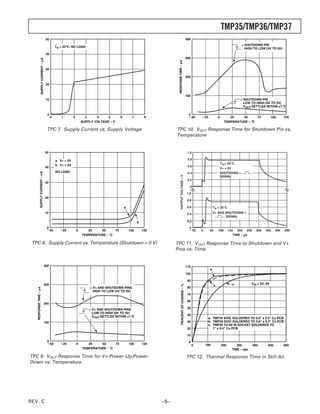
                                      TPC 7. Supply Current vs. Supply Voltage                                          TPC 10. VOUT Response Time for Shutdown Pin vs.
                                                                                                                        Temperature


                                     50                                                                                                                     1.0

                                               a. V+ = 5V                                                                                                   0.8
                                               b. V+ = 3V                                                                                                                               TA = 25 C
                                     40                                                                                                                     0.6
                                                                                                                                                                                        V+ = 3V
                                               NO LOAD
               SUPPLY CURRENT – nA


                                                                                                                                                            0.4                         SHUTDOWN =

                                                                                                                                OUTPUT VOLTAGE – V
                                                                                                                                                                                        SIGNAL
                                                                                                                                                            0.2
                                     30
                                                                                                                                                              0

                                                                                                                                                           1.0
                                     20
                                                                                                                                                            0.8

                                                                                              a                                                             0.6                 TA = 25 C
                                     10                                                                                                                     0.4                 V+ AND SHUTDOWN =
                                                                                                                                                                                       SIGNAL
                                                                                                        b                                                   0.2

                                      0                                                                                                                      0
                                      ؊50         ؊25           0      25    50      75           100       125                                              ؊50     0     50       100       150 200 250       300   350     400   450
                                                                    TEMPERATURE – ؇C                                                                                                             TIME – µs

 TPC 8. Supply Current vs. Temperature (Shutdown = 0 V)                                                                 TPC 11. VOUT Response Time to Shutdown and V+
                                                                                                                        Pins vs. Time


                                     400                                                                                                                   110
                                                                                                                                                                            a
                                                                                                                                                           100

                                                                                                                                                            90
                                     300                                                                                                                                                        c            VIN = 3V, 5V
                                                                                                                                   PERCENT OF CHANGE – %


                                                                                                                                                                                b
                                                                        = V+ AND SHUTDOWN PINS                                                              80
   RESPONSE TIME – ␮s


                                                                          HIGH TO LOW (3V TO 0V)
                                                                                                                                                            70

                                                                                                                                                            60
                                     200
                                                                        = V+ AND SHUTDOWN PINS                                                              50
                                                                          LOW TO HIGH (0V TO 3V)
                                                                          VOUT SETTLES WITHIN ±1°C                                                          40
                                                                                                                                                                           a. TMP35 SOIC SOLDERED TO 0.5" x 0.3" Cu PCB
                                     100                                                                                                                    30             b. TMP36 SOIC SOLDERED TO 0.6" x 0.4" Cu PCB
                                                                                                                                                                           c. TMP35 TO-92 IN SOCKET SOLDERED TO
                                                                                                                                                            20                1" x 0.4" Cu PCB

                                                                                                                                                            10
                                      0                                                                                                                      0
                                      ؊50         ؊25           0      25    50      75           100       125                                                  0       100            200        300       400        500         600
                                                                    TEMPERATURE – ؇C                                                                                                            TIME – sec

TPC 9. VOUT Response Time for V+ Power-Up/Power-                                                                                                           TPC 12. Thermal Response Time in Still Air
Down vs. Temperature


REV. C                                                                                                            –5–
TMP35/TMP36/TMP37
                         140

                                            a. TMP35 SOIC SOLDERED TO 0.5" x 0.3" Cu PCB                                                                                10mV                         1ms
                         120                b. TMP36 SOIC SOLDERED TO 0.6" x 0.4" Cu PC
                                            c. TMP35 TO-92 IN SOCKET SOLDERED TO
                                                                                                                                                           100
                                               1" x 0.4" Cu PCB
                                                                                                                                                           90
                         100
   TIME CONSTANT – sec


                                                                                                                                           VOLT/DIVISION
                         80
                                             VIN = 3V, 5V

                         60

                                        b
                         40                                                                                                                                10

                                                                  c                                                                                        0%


                         20

                                                             a
                           0
                               0       100       200       300    400     500        600   700                                                                                    TIME/DIVISION
                                                       AIR VELOCITY – FPM

TPC 13. Thermal Response Time Constant in Forced Air                                                   TPC 15. Temperature Sensor Wideband Output
                                                                                                       Noise Voltage. Gain = 100, BW = 157 kHz


                         110                                                                                                              2400
                                        a
                                                                                                                                          2200
                         100
                                                                                                                                          2000
                                                                                                         VOLTAGE NOISE DENSITY – nV/ Hz
                          90                                                                                                                                                                               b
                                                  c              VIN = 3V, 5V                                                             1800
                          80
                                   b                                                                                                      1600
                          70
      CHANGE – %


                                                                                                                                          1400
                          60
                                                                                                                                          1200
                          50
                                                                                                                                          1000
                          40                                                                                                               800
                                       a. TMP35 SOIC SOLDERED TO 0.5" x 0.3" Cu PCB
                          30           b. TMP36 SOIC SOLDERED TO 0.6" x 0.4" Cu PCB                                                        600
                                       c. TMP35 TO-92 IN SOCKET SOLDERED TO                                                                                                                                a
                          20              1" x 0.4" Cu PCB                                                                                 400                   a. TMP35/36
                          10                                                                                                               200                   b. TMP37

                           0                                                                                                                       0
                            0           10             20      30               40   50    60                                                       10                         100              1k             10k
                                                            TIME – sec                                                                                                            FREQUENCY – Hz


  TPC 14. Thermal Response Time in Stirred Oil Bath                                                    TPC 16. Voltage Noise Spectral Density vs. Frequency


                                                                                                 –6–                                                                                                           REV. C
TMP35/TMP36/TMP37
APPLICATIONS SECTION                                                    In the TO-92 package, the thermal resistance junction-to-case,
Shutdown Operation                                                      θJC, is 120°C/W. The thermal resistance case-to-ambient, θCA, is
All TMP3x devices include a shutdown capability that reduces the        the difference between θJA and θJC, and is determined by the
power supply drain to less than 0.5 µA maximum. This feature,           characteristics of the thermal connection. The temperature
available only in the SOIC-8 and the SOT-23 packages, is TTL/           sensor’s power dissipation, represented by PD, is the product of
CMOS level compatible, provided that the temperature sensor             the total voltage across the device and its total supply current
supply voltage is equal in magnitude to the logic supply voltage.       (including any current delivered to the load). The rise in die
Internal to the TMP3x at the SHUTDOWN pin, a pull-up current            temperature above the medium’s ambient temperature is given by:
source to VIN is connected. This permits the SHUTDOWN pin to
be driven from an open-collector/drain driver. A logic LOW, or                             TJ = PD × (θJC + θ CA ) + TA
zero-volt condition on the SHUTDOWN pin, is required to turn            Thus, the die temperature rise of a TMP35 “RT” package
the output stage OFF. During shutdown, the output of the                mounted into a socket in still air at 25°C and driven from a 5 V
temperature sensors becomes a high impedance state where the            supply is less than 0.04°C.
potential of the output pin would then be determined by external
circuitry. If the shutdown feature is not used, it is recommended       The transient response of the TMP3x sensors to a step change
that the SHUTDOWN pin be connected to VIN (Pin 8 on the                 in the temperature is determined by the thermal resistances and
SOIC-8, Pin 2 on the SOT-23).                                           the thermal capacities of the die, CCH, and the case, CC. The
                                                                        thermal capacity of the case, CC, varies with the measurement
The shutdown response time of these temperature sensors is              medium since it includes anything in direct contact with the
illustrated in TPCs 9, 10, and 11.                                      package. In all practical cases, the thermal capacity of the case is
Mounting Considerations                                                 the limiting factor in the thermal response time of the sensor
If the TMP3x temperature sensors are thermally attached and             and can be represented by a single-pole RC time constant
protected, they can be used in any temperature measurement              response. TPCs 12 and 14 illustrate the thermal response time
application where the maximum temperature range of the                  of the TMP3x sensors under various conditions. The thermal
medium is between –40°C to +125°C. Properly cemented or                 time constant of a temperature sensor is defined as the time
glued to the surface of the medium, these sensors will be within        required for the sensor to reach 63.2% of the final value for a
0.01°C of the surface temperature. Caution should be exercised,         step change in the temperature. For example, the thermal time
especially with TO-92 packages, because the leads and any               constant of a TMP35 “S” package sensor mounted onto a 0.5"
wiring to the device can act as heat pipes, introducing errors if       by 0.3" PCB is less than 50 sec in air, whereas in a stirred oil
the surrounding air-surface interface is not isothermal. Avoiding       bath, the time constant is less than 3 seconds.
this condition is easily achieved by dabbing the leads of the           Basic Temperature Sensor Connections
temperature sensor and the hookup wires with a bead of                  Figure 4 illustrates the basic circuit configuration for the
thermally conductive epoxy. This will ensure that the TMP3x             TMP3x family of temperature sensors. The table shown in the
die temperature is not affected by the surrounding air temperature.     figure illustrates the pin assignments of the temperature sensors
Because plastic IC packaging technology is used, excessive              for the three package types. For the SOT-23, Pin 3 is labeled as
mechanical stress should be avoided when fastening the device           “NC” as are Pins 2, 3, 6, and 7 on the SOIC-8 package. It is
with a clamp or a screw-on heat tab. Thermally conductive epoxy         recommended that no electrical connections be made to
or glue, which must be electrically nonconductive, is recommended       these pins. If the shutdown feature is not needed on the
under typical mounting conditions.                                      SOT-23 or the SOIC-8 package, the SHUTDOWN pin
These temperature sensors, as well as any associated circuitry,         should be connected to VS.
should be kept insulated and dry to avoid leakage and corrosion.                                    2.7V < Vs < 5.5V
In wet or corrosive environments, any electrically isolated metal
or ceramic well can be used to shield the temperature sensors.                                                         0.1␮F

Condensation at very cold temperatures can cause errors and
should be avoided by sealing the device, using electrically non-                                          Vs
conductive epoxy paints or dip or any one of many printed circuit                                       TMP3x
                                                                                       SHDN                                    VOUT
board coatings and varnishes.
                                                                                                         GND
Thermal Environment Effects
The thermal environment in which the TMP3x sensors are used
determines two important characteristics: self-heating effects
and thermal response time. Illustrated in Figure 3 is a thermal
model of the TMP3x temperature sensors that is useful in                             PIN ASSIGNMENTS

understanding these characteristics.                                                 PACKAGE       VS     GND      VOUT        SHDN
                                                                                     SOIC-8        8        4          1         5
                         TJ     ␪JC        TC    ␪CA                                 SOT-23-5      2        5          1         4
                                                                                     TO-92         1        3          2        NA


                                                                        Figure 4. Basic Temperature Sensor Circuit Configuration
 PD                CCH                CC                       TA


               Figure 3. Thermal Circuit Model

REV. C                                                                –7–
TMP35/TMP36/TMP37
Note the 0.1 µF bypass capacitor on the input. This capacitor                         The same circuit principles can be applied to the TMP36, but
should be a ceramic type, have very short leads (surface mount                        because of the TMP36’s inherent offset, the circuit uses two less
would be preferable), and be located as close a physical proxim-                      resistors as shown in Figure 5b. In this circuit, the output
ity to the temperature sensor supply pin as practical. Since these                    voltage transfer characteristic is 1 mV/°F but is referenced to
temperature sensors operate on very little supply current and                         the circuit’s common; however, there is a 58 mV (58°F) offset
could be exposed to very hostile electrical environments, it is                       in the output voltage. For example, the output voltage of the
important to minimize the effects of RFI (radio frequency                             circuit would read 18 mV were the TMP36 placed in –40°F
interference) on these devices. The effect of RFI on these                            ambient environment and 315 mV at 257°F.
temperature sensors in specific and analog ICs in general is
manifested as abnormal dc shifts in the output voltage due to
the rectification of the high frequency ambient noise by the IC.                                            VS
In those cases where the devices are operated in the presence of
high frequency radiated or conducted noise, a large value tanta-                                              VS
lum capacitor (Ͼ2.2 µF) placed across the 0.1 µF ceramic may
                                                                                                                       VOUT
offer additional noise immunity.                                                          0.1␮F           TMP36
Fahrenheit Thermometers                                                                                                             R1
                                                                                                                                    45.3k⍀
Although the TMP3x temperature sensors are centigrade tem-                                                       GND
perature sensors, a few components can be used to convert the
output voltage and transfer characteristics to directly read Fahr-                                                                  R2
                                                                                                                                             VOUT @ 1mV/؇F – 58؇F
enheit temperatures. Shown in Figure 5a is an example of a                                                                          10k⍀

simple Fahrenheit thermometer using either the TMP35 or the
TMP37. This circuit can be used to sense temperatures from
41°F to 257°F, with an output transfer characteristic of 1 mV/°F
using the TMP35 and from 41°F to 212°F using the TMP37
with an output characteristic of 2 mV/°F. This particular                                                                     VOUT @ –40؇F = 18mV
                                                                                                                              VOUT @ +257؇F = 315mV
approach does not lend itself well to the TMP36 because of its
inherent 0.5 V output offset. The circuit is constructed with an                         Figure 5b. TMP36 Fahrenheit Thermometer Version 1
AD589, a 1.23 V voltage reference, and four resistors whose values
for each sensor are shown in the figure table. The scaling of the                     At the expense of additional circuitry, the offset produced by the
output resistance levels was to ensure minimum output loading                         circuit in Figure 5b can be avoided by using the circuit in Figure 5c. In
on the temperature sensors. A generalized expression for the                          this circuit, the output of the TMP36 is conditioned by a single-
circuit’s transfer equation is given by:                                              supply, micropower op amp, the OP193. Although the entire
                                                                                      circuit operates from a single 3 V supply, the output voltage of the
              R1               R3                                                 circuit reads the temperature directly, with a transfer character-
      VOUT = 
              R1+ R2
                     
                               (
                       TMP 35 +          AD589
                                 R3 + R4
                                                 )             (            )         istic of 1 mV/°F, without offset. This is accomplished through
                                                                                      the use of an ADM660, a supply voltage inverter. The 3 V
where: TMP35 = Output voltage of the TMP35, or the TMP37,                             supply is inverted and applied to the P193’s V– terminal. Thus,
       at the measurement temperature, TM, and                                        for a temperature range between –40°F and +257°F, the
       AD589 = Output voltage of the reference = 1.23 V.                              output of the circuit reads –40 mV to +257 mV. A general
                                                                                      expression for the circuit’s transfer equation is given by:
Note that the output voltage of this circuit is not referenced to
the circuit’s common. If this output voltage were to be applied                                       R6   R4               R4 V 
directly to the input of an ADC, the ADC’s common should be                                   VOUT = 
                                                                                                     
                                                                                                                 1+
                                                                                                       R5 + R6  R3
                                                                                                                  
                                                                                                                               (
                                                                                                                      TMP 36 −    S 
                                                                                                                                R3  2 
                                                                                                                                             )
adjusted accordingly.
                      VS                                                              Average and Differential Temperature Measurement
         0.1␮F                                                                        In many commercial and industrial environments, temperature
                       VS                                                             sensors are often used to measure the average temperature in a
                                                           R1                         building, or the difference in temperature between two locations
                 TMP35/37          VOUT                                               on a factory floor or in an industrial process. The circuits in
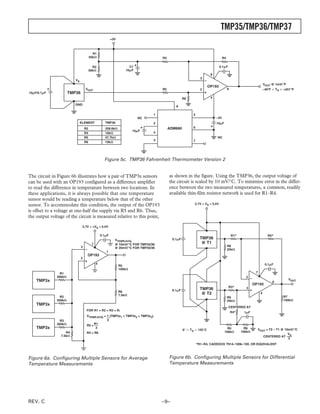
                                                                                      Figures 6a and 6b demonstrate an inexpensive approach
                       GND
                                                           R2                         to average and differential temperature measurement.
                                                                                      In Figure 6a, an OP193 is used to sum the outputs of three
                                                                         VOUT
                                                                                      temperature sensors to produce an output voltage scaled by
             AD589                                         R3
              1.23V                                                                   10 mV/°C that represents the average temperature at three loca-
                                                                                      tions. The circuit can be extended to as many temperature
                                                           R4                         sensors as required as long as the circuit’s transfer equation
                                                                                      is maintained. In this application, it is recommended that one
           PIN ASSIGNMENTS                                                            temperature sensor type be used throughout the circuit; other-
           SENSOR          TCVOUT R1 (k⍀) R2 (k⍀) R3 (k⍀) R4 (k⍀)                     wise, the output voltage of the circuit will not produce an
          TMP35            1mV/؇F         45.3       10   10       374
                                                                                      accurate reading of the various ambient conditions.
          TMP37            2mV/؇F         45.3       10   10       182


   Figure 5a. TMP35/TMP37 Fahrenheit Thermometers
                                                                                –8–                                                                         REV. C
TMP35/TMP36/TMP37
                                                         +3V


                                          R1
                                        50k⍀                                         R3                                         R4

                                          R2                         C1                                                       0.1␮F
                                        50k⍀                       10␮F
                                                                                                                      8
                                                                                                                2
                          VS
                                                                                                                                                                VOUT @ 1mV/ ؇F
                                                                                                                     OP193
                                   VOUT                                              R5                         3                    6                          –40؇F Յ TA Յ +257 ؇F
10␮F/0.1␮F             TMP36
                                                                                                    R6                4

                          GND
                                                                                              8

                                                                                 1                        5
                                                                          NC                                              –3V
                               ELEMENT              TMP36                        2                                        10␮F
                                   R2               258.6k⍀                               ADM660          6
                                                                       10␮F      4
                                   R4               10k⍀
                                   R5               47.7k⍀                                                                NC
                                                                                 3                        7
                                   R6               10k⍀


                                                   Figure 5c. TMP36 Fahrenheit Thermometer Version 2


The circuit in Figure 6b illustrates how a pair of TMP3x sensors                          as shown in the figure. Using the TMP36, the output voltage of
can be used with an OP193 configured as a difference amplifier                            the circuit is scaled by 10 mV/°C. To minimize error in the differ-
to read the difference in temperature between two locations. In                           ence between the two measured temperatures, a common, readily
these applications, it is always possible that one temperature                            available thin-film resistor network is used for R1–R4.
sensor would be reading a temperature below that of the other
sensor. To accommodate this condition, the output of the OP193                                             2.7V < VS < 5.5V

is offset to a voltage at one-half the supply via R5 and R6. Thus,
the output voltage of the circuit is measured relative to this point,
                                2.7V < +VS < 5.5V

                                                 0.1␮F                                                                                   R1*                       R2*
                                                           VTEMP( AVG)                      0.1␮F               TMP36
                                         7                 @ 10mV/ ؇C FOR TMP35/36                               @ T1
                               2                                                                                                     R8
                                                           @ 20mV/ ؇C FOR TMP35/36                                                   25k⍀
                                                    1
                                    OP193
                               3
                                             4                                                                                                                   0.1␮F
                                                               R5
                                                               100k⍀
                 R1                                                                                                                                     7
               300k⍀                                                                                                                             2
    TMP3x                                                                                                                                                                        VOUT
                                                                                                                                                                      6
                                                                                                                                                       OP193
                                                                                                                                      R3*        3
                                                                                           0.1␮F                TMP36
                                                               R6
                                                               7.5k⍀                                             @ T2                                       4
                 R2                                                                                                                  R9                                      R7
               300k⍀                                                                                                                 25k⍀                                    100k⍀
    TMP3x
                                                                                                                                      CENTERED AT
                                    FOR R1 = R2 = R3 = R;
                                                                                                                                         R4*    1␮F
                                    VTEMP( AVG) = 1 (TMP3x1 + TMP3x2 + TMP3x3)
                 R3                               3
               300k⍀                R5 = R1
    TMP3x                                 3
                                                                                                    0 Յ TA Յ 125 C                 R5            R6      VOUT = T2 – T1 @ 10mV/ ؇C
                    R4              R4 = R6                                                                                      100k⍀         100k⍀
                                                                                                                                                                            V
                 7.5k⍀                                                                                                                                      CENTERED AT S
                                                                                                                                                                            2
                                                                                                              *R1–R4, CADDOCK T914–100k–100, OR EQUIVALENT


Figure 6a. Configuring Multiple Sensors for Average                                       Figure 6b. Configuring Multiple Sensors for Differential
Temperature Measurements                                                                  Temperature Measurements


REV. C                                                                               –9–
TMP35/TMP36/TMP37
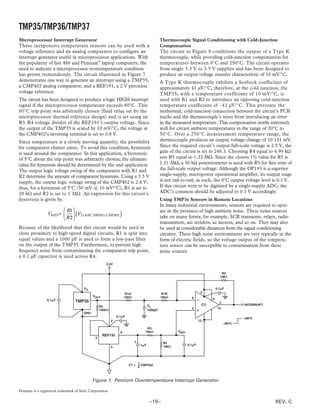
Microprocessor Interrupt Generator                                                         Thermocouple Signal Conditioning with Cold-Junction
These inexpensive temperature sensors can be used with a                                   Compensation
voltage reference and an analog comparator to configure an                                 The circuit in Figure 8 conditions the output of a Type K
interrupt generator useful in microprocessor applications. With                            thermocouple, while providing cold-junction compensation for
the popularity of fast 486 and Pentium® laptop computers, the                              temperatures between 0°C and 250°C. The circuit operates
need to indicate a microprocessor overtemperature condition                                from single 3.3 V to 5.5 V supplies and has been designed to
has grown tremendously. The circuit illustrated in Figure 7                                produce an output voltage transfer characteristic of 10 mV/°C.
demonstrates one way to generate an interrupt using a TMP35,                               A Type K thermocouple exhibits a Seebeck coefficient of
a CMP402 analog comparator, and a REF191, a 2 V precision                                  approximately 41 µV/°C; therefore, at the cold junction, the
voltage reference.                                                                         TMP35, with a temperature coefficient of 10 mV/°C, is
The circuit has been designed to produce a logic HIGH interrupt                            used with R1 and R2 to introduce an opposing cold-junction
signal if the microprocessor temperature exceeds 80°C. This                                temperature coefficient of –41 µV/°C. This prevents the
80°C trip point was arbitrarily chosen (final value set by the                             isothermal, cold-junction connection between the circuit’s PCB
microprocessor thermal reference design) and is set using an                               tracks and the thermocouple’s wires from introducing an error
R3–R4 voltage divider of the REF191’s output voltage. Since                                in the measured temperature. This compensation works extremely
the output of the TMP35 is scaled by 10 mV/°C, the voltage at                              well for circuit ambient temperatures in the range of 20°C to
the CMP402’s inverting terminal is set to 0.8 V.                                           50°C. Over a 250°C measurement temperature range, the
Since temperature is a slowly moving quantity, the possibility                             thermocouple produces an output voltage change of 10.151 mV.
for comparator chatter exists. To avoid this condition, hysteresis                         Since the required circuit’s output full-scale voltage is 2.5 V, the
is used around the comparator. In this application, a hysteresis                           gain of the circuit is set to 246.3. Choosing R4 equal to 4.99 kΩ
of 5°C about the trip point was arbitrarily chosen; the ultimate                           sets R5 equal to 1.22 MΩ. Since the closest 1% value for R5 is
value for hysteresis should be determined by the end application.                          1.21 MΩ, a 50 kΩ potentiometer is used with R5 for fine trim of
The output logic voltage swing of the comparator with R1 and                               the full-scale output voltage. Although the OP193 is a superior
R2 determine the amount of comparator hysteresis. Using a 3.3 V                            single-supply, micropower operational amplifier, its output stage
supply, the output logic voltage swing of the CMP402 is 2.6 V;                             is not rail-to-rail; as such, the 0°C output voltage level is 0.1 V.
thus, for a hysteresis of 5°C (50 mV @ 10 mV/°C), R1 is set to                             If this circuit were to be digitized by a single-supply ADC, the
20 kΩ and R2 is set to 1 MΩ. An expression for this circuit’s                              ADC’s common should be adjusted to 0.1 V accordingly.
hysteresis is given by:                                                                    Using TMP3x Sensors in Remote Locations
                                                                                           In many industrial environments, sensors are required to oper-
                         R1
                                  (
                 VHYS =   VLOGIC SWING, CMP402
                         R2
                                                                )                          ate in the presence of high ambient noise. These noise sources
                                                                                           take on many forms; for example, SCR transients, relays, radio
                                                                                           transmitters, arc welders, ac motors, and so on. They may also
Because of the likelihood that this circuit would be used in                               be used at considerable distances from the signal conditioning
close proximity to high speed digital circuits, R1 is split into                           circuitry. These high noise environments are very typically in the
equal values and a 1000 pF is used to form a low-pass filter                               form of electric fields, so the voltage output of the tempera-
on the output of the TMP35. Furthermore, to prevent high                                   ture sensor can be susceptible to contamination from these
frequency noise from contaminating the comparator trip point,                              noise sources.
a 0.1 µF capacitor is used across R4.
                                                     3.3V

                                                                                                                                R2
                                                                                                                               1M⍀


                                       VS                                                                                    0.1␮F
                                                                     R1A                    R1B                     3
                                             VOUT                   10k⍀                   10k⍀              6           4
                 0.1␮F            TMP35                                                                                        2
                                                  R5                              CL                                C1                     INTERRUPT
                                                                                                             5                14
                                                  100k⍀                           1000pF
                                       GND
                                                              0.1␮F
                                                                                                                                           >80؇C
                                                          2                                                        13
                                                                                                                                   <80؇C
                                                                                R3
                                                                6              16k⍀                 VREF
                                                    REF191
                                              3
                                                                                            R4
                                                                            1␮F                            0.1␮F
                                                          4                                 10k⍀


                                                                      C1 = 1 CMP402
                                                                           4


                                             Figure 7. Pentium Overtemperature Interrupt Generator

Pentium is a registered trademark of Intel Corporation.

                                                                                   –10–                                                                REV. C
TMP35/TMP36/TMP37
                                                                                          3.3V < VS < 5.5V


                                                       VS                                                                                            P1
                                                                                                                                                    50k⍀
                                                             VOUT                                  R3
                              0.1␮F                                                                       R4                            R5*
                                                                                                   10M⍀
                                                  TMP35                                            5%   4.99k⍀                        1.21M⍀


                                                                                                                                    0.1␮F
                                                       GND
                                                                                   R1*
                                                                                   24.9k⍀                                   7
                                                                                                                       2
                                                                                                                                       6               VOUT
                                                                              CU
                                                                                                                           OP193                       0V – 2.5V
                              CHROMEL                                                                                  3                       R6
                                                                                                                                               100k⍀
                                                                                                                                4              5%
         TYPE K
         THERMO-                                    COLD
         COUPLE                                   JUNCTION
                                                                              CU          NOTE:   ALL RESISTORS 1%
                              ALUMEL
                                                                                                  UNLESS OTHERWISE NOTED
                                                                                   R2*
                                                                                   102⍀
                                              ISOTHERMAL
                     0؇C Յ T Յ 250؇C             BLOCK


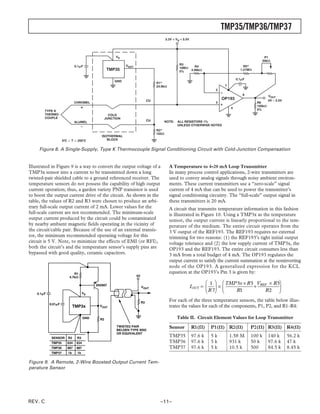
     Figure 8. A Single-Supply, Type K Thermocouple Signal Conditioning Circuit with Cold-Junction Compensation


Illustrated in Figure 9 is a way to convert the output voltage of a                         A Temperature to 4–20 mA Loop Transmitter
TMP3x sensor into a current to be transmitted down a long                                   In many process control applications, 2-wire transmitters are
twisted-pair shielded cable to a ground referenced receiver. The                            used to convey analog signals through noisy ambient environ-
temperature sensors do not possess the capability of high output                            ments. These current transmitters use a “zero-scale” signal
current operation; thus, a garden variety PNP transistor is used                            current of 4 mA that can be used to power the transmitter’s
to boost the output current drive of the circuit. As shown in the                           signal conditioning circuitry. The “full-scale” output signal in
table, the values of R2 and R3 were chosen to produce an arbi-                              these transmitters is 20 mA.
trary full-scale output current of 2 mA. Lower values for the                               A circuit that transmits temperature information in this fashion
full-scale current are not recommended. The minimum-scale                                   is illustrated in Figure 10. Using a TMP3x as the temperature
output current produced by the circuit could be contaminated                                sensor, the output current is linearly proportional to the tem-
by nearby ambient magnetic fields operating in the vicinity of                              perature of the medium. The entire circuit operates from the
the circuit/cable pair. Because of the use of an external transis-                          3 V output of the REF193. The REF193 requires no external
tor, the minimum recommended operating voltage for this                                     trimming for two reasons: (1) the REF193’s tight initial output
circuit is 5 V. Note, to minimize the effects of EMI (or RFI),                              voltage tolerance and (2) the low supply current of TMP3x, the
both the circuit’s and the temperature sensor’s supply pins are                             OP193 and the REF193. The entire circuit consumes less than
bypassed with good quality, ceramic capacitors.                                             3 mA from a total budget of 4 mA. The OP193 regulates the
                                                                                            output current to satisfy the current summation at the noninverting
                                                                                            node of the OP193. A generalized expression for the KCL
                            R1                                                              equation at the OP193’s Pin 3 is given by:
                         4.7k⍀                                      5V

                                                                                                                     1   TMP 3x × R3 VREF × R3
                                           2N2907
                                                                                                             IOUT =   ×             +
                                                                                                                                           R2 
                                                                         VOUT
                                    VS
                                                                                                                    R 7 
                                                                                                                              R1                
    0.1␮F

                                                                         R3
                                                                                            For each of the three temperature sensors, the table below illus-
            0.01␮F
                             TMP3x           VOUT                                           trates the values for each of the components, P1, P2, and R1–R4:

                                     GND     R2                                                   Table II. Circuit Element Values for Loop Transmitter
                                                        TWISTED PAIR
                                                        BELDEN TYPE 9502
                                                                                            Sensor           R1(⍀)    P1(⍀) R2(⍀)           P2(⍀) R3(⍀) R4(⍀)
                                                        OR EQUIVALENT
             SENSOR     R2     R3
                                                                                            TMP35            97.6 k   5k        1.58 M      100 k      140 k       56.2 k
             TMP35      634    634                                                          TMP36            97.6 k   5k        931 k       50 k       97.6 k      47 k
             TMP36      887    887                                                          TMP37            97.6 k   5k        10.5 k      500        84.5 k      8.45 k
             TMP37      1k     1k


Figure 9. A Remote, 2-Wire Boosted Output Current Tem-
perature Sensor


REV. C                                                                               –11–
TMP35/TMP36/TMP37
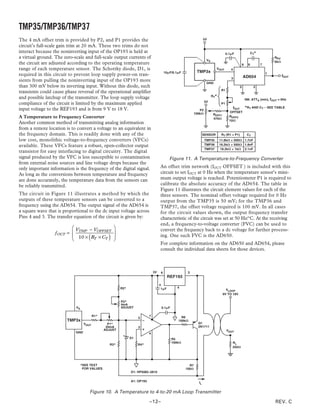
The 4 mA offset trim is provided by P2, and P1 provides the                                                      5V

circuit’s full-scale gain trim at 20 mA. These two trims do not
interact because the noninverting input of the OP193 is held at                                                                     0.1␮F                       CT*
a virtual ground. The zero-scale and full-scale output currents of                                                                                                            RPU
                                                                                                                   VS                                                         5k⍀
the circuit are adjusted according to the operating temperature                                                                                       8     6         7
range of each temperature sensor. The Schottky diode, D1, is                                                              VOUT         4
                                                                                        10␮F/0.1␮F          TMP3x                                                         1
required in this circuit to prevent loop supply power-on tran-                                                                                        AD654                         fOUT
                                                                                                                                       3
sients from pulling the noninverting input of the OP193 more                                                       GND
than 300 mV below its inverting input. Without this diode, such                                                                                   5              2
                                                                                                                               R1
transients could cause phase reversal of the operational amplifier
                                                                                                                        RT*
and possible latchup of the transmitter. The loop supply voltage                                                                                          NB: ATTA (min), fOUT = 0Hz
                                                                                                                  5V
compliance of the circuit is limited by the maximum applied                                                                    P1
                                                                                                                                           fOUT           *RT AND CT – SEE TABLE
input voltage to the REF193 and is from 9 V to 18 V.                                                         P2
                                                                                                          100k⍀                       OFFSET
                                                                                                                         ROFF1
A Temperature to Frequency Converter                                                                                     470⍀
                                                                                                                                      ROFF2
                                                                                                                                      10⍀
Another common method of transmitting analog information
from a remote location is to convert a voltage to an equivalent in
the frequency domain. This is readily done with any of the                                                       SENSOR        RT (R1 + P1)                CT
low cost, monolithic voltage-to-frequency converters (VFCs)                                                       TMP35       11.8k⍀ + 500⍀ 1.7nF
available. These VFCs feature a robust, open-collector output                                                     TMP36       16.2k⍀ + 500⍀ 1.8nF
                                                                                                                  TMP37        18.2k⍀ + 1k⍀ 2.1nF
transistor for easy interfacing to digital circuitry. The digital
signal produced by the VFC is less susceptible to contamination                            Figure 11. A Temperature-to-Frequency Converter
from external noise sources and line voltage drops because the
only important information is the frequency of the digital signal.                  An offset trim network (fOUT OFFSET ) is included with this
As long as the conversions between temperature and frequency                        circuit to set fOUT at 0 Hz when the temperature sensor’s mini-
are done accurately, the temperature data from the sensors can                      mum output voltage is reached. Potentiometer P1 is required to
be reliably transmitted.                                                            calibrate the absolute accuracy of the AD654. The table in
                                                                                    Figure 11 illustrates the circuit element values for each of the
The circuit in Figure 11 illustrates a method by which the                          three sensors. The nominal offset voltage required for 0 Hz
outputs of these temperature sensors can be converted to a                          output from the TMP35 is 50 mV; for the TMP36 and
frequency using the AD654. The output signal of the AD654 is                        TMP37, the offset voltage required is 100 mV. In all cases
a square wave that is proportional to the dc input voltage across                   for the circuit values shown, the output frequency transfer
Pins 4 and 3. The transfer equation of the circuit is given by:                     characteristic of the circuit was set at 50 Hz/°C. At the receiving
                                                                                    end, a frequency-to-voltage converter (FVC) can be used to
                          V     − VOFFSET                                         convert the frequency back to a dc voltage for further process-
                  f OUT =  TMP                      
                                    (
                           10 × RT × CT         )   
                                                     
                                                                                    ing. One such FVC is the AD650.
                                                                                    For complete information on the AD650 and AD654, please
                                                                                    consult the individual data sheets for those devices.


                                                                               3V   6                 2
                                                                                          REF193

                                                         R2*                        1␮F        4
                                                                                                                                   VLOOP
                                                                                                                                 9V TO 18V

                                                         P2*
                                                         4mA
                            VS                           ADJUST                     0.1␮F

                                         R1*                               7                      R6
                                                                    3
                        TMP3x                                                                   100k⍀
                                  VOUT           P1*                                                        Q1
                                                20mA                2                                       2N1711
                                               ADJUST                                                                               VOUT
                            GND                                            4
                                                               D1                           R5
                                                                                            100k⍀                                       RL
                                                 R3*                R4*
                                                                                                                                        250⍀


                                 *SEE TEXT                                                             R7
                                  FOR VALUES                                                         100⍀
                                                               D1: HP5082–2810

                                                               A1: OP193                                    IL


                                     Figure 10. A Temperature to 4-to-20 mA Loop Transmitter

                                                                           –12–                                                                                               REV. C
TMP35/TMP36/TMP37
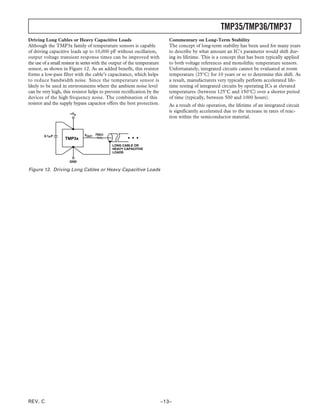
Driving Long Cables or Heavy Capacitive Loads                                 Commentary on Long-Term Stability
Although the TMP3x family of temperature sensors is capable                   The concept of long-term stability has been used for many years
of driving capacitive loads up to 10,000 pF without oscillation,              to describe by what amount an IC’s parameter would shift dur-
output voltage transient response times can be improved with                  ing its lifetime. This is a concept that has been typically applied
the use of a small resistor in series with the output of the temperature      to both voltage references and monolithic temperature sensors.
sensor, as shown in Figure 12. As an added benefit, this resistor             Unfortunately, integrated circuits cannot be evaluated at room
forms a low-pass filter with the cable’s capacitance, which helps             temperature (25°C) for 10 years or so to determine this shift. As
to reduce bandwidth noise. Since the temperature sensor is                    a result, manufacturers very typically perform accelerated life-
likely to be used in environments where the ambient noise level               time testing of integrated circuits by operating ICs at elevated
can be very high, this resistor helps to prevent rectification by the         temperatures (between 125°C and 150°C) over a shorter period
devices of the high frequency noise. The combination of this                  of time (typically, between 500 and 1000 hours).
resistor and the supply bypass capacitor offers the best protection.          As a result of this operation, the lifetime of an integrated circuit
                       +VS
                                                                              is significantly accelerated due to the increase in rates of reac-
                                                                              tion within the semiconductor material.


        0.1␮F                 VOUT 750⍀
                    TMP3x
                                              LONG CABLE OR
                                              HEAVY CAPACITIVE
                                              LOADS

                      GND

Figure 12. Driving Long Cables or Heavy Capacitive Loads


REV. C                                                                     –13–
TMP35/TMP36/TMP37
                                                                    OUTLINE DIMENSIONS


           3-Pin Plastic Header-Style Package [TO-92]                                               8-Lead Standard Small Outline Package [SOIC]
                            (TO-92)                                                                                 Narrow Body
                Dimensions shown in inches and (millimeters)                                                          (RN-8)
                                                                                                              Dimensions shown in millimeters and (inches)

                                                   0.205 (5.21)                                                      5.00 (0.1968)
                       0.135
                       (3.43)                      0.175 (4.45)                                                      4.80 (0.1890)
                         MIN
                                                                                                                      8          5
                                                 0.210 (5.33)                                       4.00 (0.1574)                     6.20 (0.2440)
                                                 0.170 (4.32)                                       3.80 (0.1497)     1          4    5.80 (0.2284)

               SEATING                                  0.050
                 PLANE                                  (1.27)
                                                        MAX                                                          1.27 (0.0500)                                    0.50 (0.0196)
                                                                                                                                         1.75 (0.0688)                              ؋ 45؇
                                                                                                                         BSC                                          0.25 (0.0099)
                                                                                             0.25 (0.0098)                               1.35 (0.0532)
                                                 0.019 (0.482)
                          0.500                                SQ                            0.10 (0.0040)
                         (12.70)                 0.016 (0.407)
                           MIN                                                                                                   0.51 (0.0201)                      8؇
                                                                                             COPLANARITY                         0.33 (0.0130)        0.25 (0.0098) 0؇ 1.27 (0.0500)
                                                                                                 0.10    SEATING                                                       0.41 (0.0160)
                                                                                                           PLANE                                      0.19 (0.0075)

                                                                                                        COMPLIANT TO JEDEC STANDARDS MS-012AA
                                                0.055 (1.40)                                  CONTROLLING DIMENSIONS ARE IN MILLIMETERS; INCH DIMENSIONS
                     0.105 (2.66)               0.045 (1.15)                                  (IN PARENTHESES) ARE ROUNDED-OFF MILLIMETER EQUIVALENTS FOR
                     0.095 (2.42)                                                             REFERENCE ONLY AND ARE NOT APPROPRIATE FOR USE IN DESIGN
                  0.115 (2.92)
                  0.080 (2.03)

                                                 0.165 (4.19)
                    0.115 (2.92)    1   2   3
                                                 0.125 (3.18)
                    0.080 (2.03)                                                                    5-Lead Plastic Surface-Mount Package [SOT-23]
                                                                                                                         (RT-5)
                                   BOTTOM VIEW
                                                                                                                          Dimensions shown in millimeters
              COMPLIANT TO JEDEC STANDARDS TO-226AA
      CONTROLLING DIMENSIONS ARE IN INCHES; MILLIMETERS DIMENSIONS                                                    2.90 BSC
      (IN PARENTHESES) ARE ROUNDED-OFF EQUIVALENTS FOR
      REFERENCE ONLY AND ARE NOT APPROPRIATE FOR USE IN DESIGN

                                                                                                                 5                4

                                                                                              1.60 BSC                                     2.80 BSC

                                                                                                                 1         2      3


                                                                                                      PIN 1
                                                                                                                                      0.95 BSC
                                                                                                                          1.90
                                                                                             1.30                         BSC
                                                                                             1.15
                                                                                             0.90

                                                                                                                                          1.45 MAX

                                                                                                                                                                       10؇
                                                                                            0.15 MAX                             0.50                                   0؇             0.60
                                                                                                                                           SEATING            0.22
                                                                                                                                 0.30      PLANE                                       0.45
                                                                                                                                                              0.08                     0.30
                                                                                                               COMPLIANT TO JEDEC STANDARDS MO-178AA


Revision History
Location                                                                                                                                                                                 Page
10/02—Data Sheet changed from REV. B to REV. C.
Deleted text from Commentary on Long-Term Stability section . . . . . . . . . . . . . . . . . . . . . . . . . . . . . . . . . . . . . . . . . . . . . . . . . . . 13
Update OUTLINE DIMENSIONS . . . . . . . . . . . . . . . . . . . . . . . . . . . . . . . . . . . . . . . . . . . . . . . . . . . . . . . . . . . . . . . . . . . . . . . . 14


                                                                                  –14–                                                                                            REV. C
–15–
–16–
       PRINTED IN U.S.A.   C00337–0–10/02(C)
This datasheet has been download from:

      www.datasheetcatalog.com

Datasheets for electronics components.

32847740 tmp35 6_7_c

  • 1.
    a Low Voltage Temperature Sensors TMP35/TMP36/TMP37 FEATURES FUNCTIONAL BLOCK DIAGRAM Low Voltage Operation (2.7 V to 5.5 V) Calibrated Directly in ؇C +Vs (2.7V to 5.5V) 10 mV/؇C Scale Factor (20 mV/؇C on TMP37) ؎2؇C Accuracy over Temperature (Typ) ؎0.5؇C Linearity (Typ) TMP35/ SHUTDOWN TMP36/ VOUT Stable with Large Capacitive Loads TMP37 Specified –40؇C to +125؇C, Operation to +150؇C Less than 50 ␮A Quiescent Current Shutdown Current 0.5 ␮A Max Low Self-Heating PACKAGE TYPES AVAILABLE APPLICATIONS RT-5 (SOT-23) Environmental Control Systems Thermal Protection VOUT 1 5 GND Industrial Process Control Fire Alarms +VS 2 TOP VIEW (Not to Scale) Power System Monitors NC 3 4 SHUTDOWN CPU Thermal Management NC = NO CONNECT PRODUCT DESCRIPTION RN-8 (SOIC) The TMP35, TMP36, and TMP37 are low voltage, precision centigrade temperature sensors. They provide a voltage output VOUT 1 8 +VS that is linearly proportional to the Celsius (Centigrade) tem- NC 2 7 NC TOP VIEW perature. The TMP35/TMP36/TMP37 do not require any NC 3 (Not to Scale) 6 NC external calibration to provide typical accuracies of ± 1°C at GND 4 5 SHUTDOWN +25°C and ± 2°C over the –40°C to +125°C temperature range. NC = NO CONNECT The low output impedance of the TMP35/TMP36/TMP37 and its linear output and precise calibration simplify interfacing to temperature control circuitry and A/D converters. All three TO-92 devices are intended for single-supply operation from 2.7 V to 5.5 V maximum. Supply current runs well below 50 µA, providing 1 2 3 very low self-heating—less than 0.1°C in still air. In addition, a BOTTOM VIEW shutdown function is provided to cut supply current to less (Not to Scale) than 0.5 µA. The TMP35 is functionally compatible with the LM35/LM45 and PIN 1, +Vs; PIN 2, VOUT; PIN 3, GND provides a 250 mV output at 25°C. The TMP35 reads temperatures from 10°C to 125°C. The TMP36 is specified from –40°C to +125°C, provides a 750 mV output at 25°C, and operates to +125°C from a single 2.7 V supply. The TMP36 is functionally compatible with the LM50. Both the TMP35 and TMP36 have an output scale factor of 10 mV/°C. The TMP37 is intended for applications over the range 5°C to 100°C and provides an output scale factor of 20 mV/°C. The TMP37 provides a 500 mV output at 25°C. Operation extends to 150°C with reduced accuracy for all devices when operating from a 5 V supply. The TMP35/TMP36/TMP37 are all available in low cost 3-lead TO-92, SOIC-8, and 5-lead SOT-23 surface-mount packages. REV. C Information furnished by Analog Devices is believed to be accurate and reliable. However, no responsibility is assumed by Analog Devices for its use, nor for any infringements of patents or other rights of third parties that One Technology Way, P.O. Box 9106, Norwood, MA 02062-9106, U.S.A. may result from its use. No license is granted by implication or otherwise Tel: 781/329-4700 www.analog.com under any patent or patent rights of Analog Devices. Fax: 781/326-8703 © Analog Devices, Inc., 2002
  • 2.
    (VS = 2.7V to 5.5 V, –40؇C ≤ TA ≤ +125؇C, unless TMP35/TMP36/TMP37–SPECIFICATIONS1 otherwise noted.) Parameter Symbol Conditions Min Typ Max Unit ACCURACY TMP35/TMP36/TMP37F TA = 25°C ±1 ±2 °C TMP35/TMP36/TMP37G TA = 25°C ±1 ±3 °C TMP35/TMP36/TMP37F Over Rated Temperature ±2 ±3 °C TMP35/TMP36/TMP37G Over Rated Temperature ±2 ±4 °C Scale Factor, TMP35 10°C ≤ TA ≤ 125°C 10 9.8/10.2 mV/°C Scale Factor, TMP36 –40°C ≤ TA ≤ +125°C 10 9.8/10.2 mV/°C Scale Factor, TMP37 5°C ≤ TA ≤ 85°C 20 19.6/20.4 mV/°C 5°C ≤ TA ≤ 100°C 20 19.6/20.4 mV/°C 3.0 V ≤ +VS ≤ 5.5 V Load Regulation 0 µA ≤ IL ≤ 50 µA –40°C ≤ TA ≤ +105°C 6 20 m°C/µA –105°C ≤ TA ≤ +125°C 25 60 m°C/µA Power Supply Rejection Ratio PSRR TA = 25°C 30 100 m°C/V 3.0 V ≤ +VS ≤ 5.5 V 50 m°C/V Linearity 0.5 °C Long-Term Stability TA = 150°C for 1 kHrs 0.4 °C SHUTDOWN Logic High Input Voltage VIH VS = 2.7 V 1.8 V Logic Low Input Voltage VIL VS = 5.5 V 400 mV OUTPUT TMP35 Output Voltage TA = 25°C 250 mV TMP36 Output Voltage TA = 25°C 750 mV TMP37 Output Voltage TA = 25°C 500 mV Output Voltage Range 100 2000 mV Output Load Current IL 0 50 µA Short-Circuit Current ISC Note 2 250 µA Capacitive Load Driving CL No Oscillations2 1000 10000 pF Device Turn-On Time Output within ± 1°C 0.5 1 ms 100 kΩʈ100 pF Load2 POWER SUPPLY Supply Range +VS 2.7 5.5 V Supply Current ISY (ON) Unloaded 50 µA Supply Current (Shutdown) ISY (OFF) Unloaded 0.01 0.5 µA NOTES 1 Does not consider errors caused by self-heating. 2 Guaranteed but not tested. Specifications subject to change without notice. 50 40 LOAD REG – m؇C/␮A 30 20 10 0 –50 0 50 100 150 TEMPERATURE – ؇C Figure 1. Load Reg vs. Temperature (m°C/µ A) –2– REV. C
  • 3.
    TMP35/TMP36/TMP37 ABSOLUTE MAXIMUM RATINGS1, 2, 3 FUNCTIONAL DESCRIPTION Supply Voltage . . . . . . . . . . . . . . . . . . . . . . . . . . . . . . . . . . 7 V An equivalent circuit for the TMP3x family of micropower, Shutdown Pin . . . . . . . . . . . . . . GND ≤ SHUTDOWN ≤ +VS centigrade temperature sensors is shown in Figure 2. At the Output Pin . . . . . . . . . . . . . . . . . . . . . . GND Յ VOUT Յ +VS heart of the temperature sensor is a band gap core, which is Operating Temperature Range . . . . . . . . . . –55°C to +150°C comprised of transistors Q1 and Q2, biased by Q3 to approxi- Dice Junction Temperature . . . . . . . . . . . . . . . . . . . . . . 175°C mately 8 µA. The band gap core operates both Q1 and Q2 at the Storage Temperature Range . . . . . . . . . . . . –65°C to +160°C same collector current level; however, since the emitter area of Lead Temperature (Soldering, 60 sec) . . . . . . . . . . . . . 300°C Q1 is 10 times that of Q2, Q1’s VBE and Q2’s VBE are not equal NOTES by the following relationship: 1 Stresses above those listed under Absolute Maximum Ratings may cause perma- nent damage to the device. This is a stress rating only; functional operation at or A  above this specification is not implied. Exposure to maximum rating conditions for ∆VBE =VT × ln  E ,Q1  extended periods may affect device reliability.  AE ,Q2  2 Digital inputs are protected; however, permanent damage may occur on unpro- tected units from high energy electrostatic fields. Keep units in conductive foam or packaging at all times until ready to use. Use proper antistatic handling +VS procedures. 3 Remove power before inserting or removing units from their sockets. SHDN 25␮A Package Type ␪JA ␪JC Unit TO-92 (T9 Suffix) 162 120 °C/W 3X 2X SOIC-8 (S Suffix) 158 43 °C/W SOT-23 (RT Suffix) 300 180 °C/W θJA is specified for device in socket (worst-case conditions). Q2 Q4 1X R1 ORDERING GUIDE Q1 10X Accuracy Linear R3 at 25؇C Operating Package +VOUT R2 Model (؇C max) Temperature Range Options1 7.5␮A Q3 TMP35FT9 ± 2.0 10°C to 125°C TO-92 TMP35GT9 ± 3.0 10°C to 125°C TO-92 6X 2X TMP35FS ± 2.0 10°C to 125°C RN-8 GND TMP35GS ± 3.0 10°C to 125°C RN-8 TMP35GRT2 ± 3.0 10°C to 125°C RT-5 Figure 2. Temperature Sensor Simplified Equivalent Circuit TMP36FT9 ± 2.0 –40°C to +125°C TO-92 TMP36GT9 ± 3.0 –40°C to +125°C TO-92 Resistors R1 and R2 are used to scale this result to produce the TMP36FS ± 2.0 –40°C to +125°C RN-8 output voltage transfer characteristic of each temperature sensor TMP36GS ± 3.0 –40°C to +125°C RN-8 and, simultaneously, R2 and R3 are used to scale Q1’s VBE as TMP36GRT2 ± 3.0 –40°C to +125°C RT-5 an offset term in VOUT. Table I summarizes the differences between the three temperature sensors’ output characteristics. TMP37FT9 ± 2.0 5°C to 100°C TO-92 TMP37GT9 ± 3.0 5°C to 100°C TO-92 Table I. TMP3x Output Characteristics TMP37FS ± 2.0 5°C to 100°C RN-8 TMP37GS ± 3.0 5°C to 100°C RN-8 Offset Output Voltage Output Voltage TMP37GRT2 ± 3.0 5°C to 100°C RT-5 Sensor Voltage (V) Scaling (mV/؇C) @ 25؇C (mV) NOTES TMP35 0 10 250 1 SOIC = Small Outline Integrated Circuit; RT = Plastic Surface Mount; TMP36 0.5 10 750 TO = Plastic. 2 Consult factory for availability. TMP37 0 20 500 The output voltage of the temperature sensor is available at the emitter of Q4, which buffers the band gap core and provides load current drive. Q4’s current gain, working with the available base current drive from the previous stage, sets the short-circuit current limit of these devices to 250 µA. CAUTION ESD (electrostatic discharge) sensitive device. Electrostatic charges as high as 4000 V readily accumulate on the human body and test equipment and can discharge without detection. Although WARNING! the TMP35/TMP36/TMP37 features proprietary ESD protection circuitry, permanent damage may occur on devices subjected to high energy electrostatic discharges. Therefore, proper ESD ESD SENSITIVE DEVICE precautions are recommended to avoid performance degradation or loss of functionality. REV. C –3–
  • 4.
    TMP35/TMP36/TMP37 – TypicalPerformance Characteristics 2.0 100 a. TMP35 1.8 b. TMP36 c. TMP37 31.6 POWER SUPPLY REJECTION – ؇C/V VS = 3V c 1.6 10 OUTPUT VOLTAGE – V 1.4 b 3.16 1.2 1.0 1 0.8 a 0.32 0.6 0.1 0.4 0.2 0.032 0 0.01 ؊50 ؊25 0 25 50 75 100 125 20 100 1k 10k 100k TEMPERATURE – ؇C FREQUENCY – Hz TPC 1. Output Voltage vs. Temperature TPC 4. Power Supply Rejection vs. Frequency 5 5 4 MINIMUM SUPPLY VOLTAGE REQUIRED TO MEET MINIMUM SUPPLY VOLTAGE – V 3 4 DATA SHEET SPECIFICATION ACCURACY ERROR – ؇C a a. MAXIMUM LIMIT (G GRADE) NO LOAD 2 b. TYPICAL ACCURACY ERROR c. MINIMUM LIMIT (G GRADE) 1 3 0 b ؊1 2 b a ؊2 ؊3 1 a. TMP35/TMP36 ؊4 b. TMP37 c ؊5 0 0 20 40 60 80 100 120 140 ؊50 ؊25 0 25 50 75 100 125 TEMPERATURE – ؇C TEMPERATURE – ؇C TPC 2. Accuracy Error vs. Temperature TPC 5. Minimum Supply Voltage vs. Temperature 0.4 60 a. V+ = 5V V+ = 3V to 5.5V, NO LOAD b. V+ = 3V POWER SUPPLY REJECTION – ؇C/V 50 0.3 NO LOAD SUPPLY CURRENT – ␮A 40 0.2 a 30 0.1 b 20 0 10 ؊50 ؊25 0 25 50 75 100 125 ؊50 ؊25 0 25 50 75 100 125 TEMPERATURE – ؇C TEMPERATURE – ؇C TPC 3. Power Supply Rejection vs. Temperature TPC 6. Supply Current vs. Temperature –4– REV. C
  • 5.
    TMP35/TMP36/TMP37 50 400 = SHUTDOWN PIN TA = 25°C, NO LOAD HIGH TO LOW (3V TO 0V) 40 300 SUPPLY CURRENT – ␮A RESPONSE TIME – ␮s 30 200 20 100 10 = SHUTDOWN PIN LOW TO HIGH (0V TO 3V) VOUT SETTLES WITHIN ±1°C 0 0 0 1 2 3 4 5 6 7 8 ؊50 ؊25 0 25 50 75 100 125 SUPPLY VOLTAGE – V TEMPERATURE – ؇C TPC 7. Supply Current vs. Supply Voltage TPC 10. VOUT Response Time for Shutdown Pin vs. Temperature 50 1.0 a. V+ = 5V 0.8 b. V+ = 3V TA = 25 C 40 0.6 V+ = 3V NO LOAD SUPPLY CURRENT – nA 0.4 SHUTDOWN = OUTPUT VOLTAGE – V SIGNAL 0.2 30 0 1.0 20 0.8 a 0.6 TA = 25 C 10 0.4 V+ AND SHUTDOWN = SIGNAL b 0.2 0 0 ؊50 ؊25 0 25 50 75 100 125 ؊50 0 50 100 150 200 250 300 350 400 450 TEMPERATURE – ؇C TIME – µs TPC 8. Supply Current vs. Temperature (Shutdown = 0 V) TPC 11. VOUT Response Time to Shutdown and V+ Pins vs. Time 400 110 a 100 90 300 c VIN = 3V, 5V PERCENT OF CHANGE – % b = V+ AND SHUTDOWN PINS 80 RESPONSE TIME – ␮s HIGH TO LOW (3V TO 0V) 70 60 200 = V+ AND SHUTDOWN PINS 50 LOW TO HIGH (0V TO 3V) VOUT SETTLES WITHIN ±1°C 40 a. TMP35 SOIC SOLDERED TO 0.5" x 0.3" Cu PCB 100 30 b. TMP36 SOIC SOLDERED TO 0.6" x 0.4" Cu PCB c. TMP35 TO-92 IN SOCKET SOLDERED TO 20 1" x 0.4" Cu PCB 10 0 0 ؊50 ؊25 0 25 50 75 100 125 0 100 200 300 400 500 600 TEMPERATURE – ؇C TIME – sec TPC 9. VOUT Response Time for V+ Power-Up/Power- TPC 12. Thermal Response Time in Still Air Down vs. Temperature REV. C –5–
  • 6.
    TMP35/TMP36/TMP37 140 a. TMP35 SOIC SOLDERED TO 0.5" x 0.3" Cu PCB 10mV 1ms 120 b. TMP36 SOIC SOLDERED TO 0.6" x 0.4" Cu PC c. TMP35 TO-92 IN SOCKET SOLDERED TO 100 1" x 0.4" Cu PCB 90 100 TIME CONSTANT – sec VOLT/DIVISION 80 VIN = 3V, 5V 60 b 40 10 c 0% 20 a 0 0 100 200 300 400 500 600 700 TIME/DIVISION AIR VELOCITY – FPM TPC 13. Thermal Response Time Constant in Forced Air TPC 15. Temperature Sensor Wideband Output Noise Voltage. Gain = 100, BW = 157 kHz 110 2400 a 2200 100 2000 VOLTAGE NOISE DENSITY – nV/ Hz 90 b c VIN = 3V, 5V 1800 80 b 1600 70 CHANGE – % 1400 60 1200 50 1000 40 800 a. TMP35 SOIC SOLDERED TO 0.5" x 0.3" Cu PCB 30 b. TMP36 SOIC SOLDERED TO 0.6" x 0.4" Cu PCB 600 c. TMP35 TO-92 IN SOCKET SOLDERED TO a 20 1" x 0.4" Cu PCB 400 a. TMP35/36 10 200 b. TMP37 0 0 0 10 20 30 40 50 60 10 100 1k 10k TIME – sec FREQUENCY – Hz TPC 14. Thermal Response Time in Stirred Oil Bath TPC 16. Voltage Noise Spectral Density vs. Frequency –6– REV. C
  • 7.
    TMP35/TMP36/TMP37 APPLICATIONS SECTION In the TO-92 package, the thermal resistance junction-to-case, Shutdown Operation θJC, is 120°C/W. The thermal resistance case-to-ambient, θCA, is All TMP3x devices include a shutdown capability that reduces the the difference between θJA and θJC, and is determined by the power supply drain to less than 0.5 µA maximum. This feature, characteristics of the thermal connection. The temperature available only in the SOIC-8 and the SOT-23 packages, is TTL/ sensor’s power dissipation, represented by PD, is the product of CMOS level compatible, provided that the temperature sensor the total voltage across the device and its total supply current supply voltage is equal in magnitude to the logic supply voltage. (including any current delivered to the load). The rise in die Internal to the TMP3x at the SHUTDOWN pin, a pull-up current temperature above the medium’s ambient temperature is given by: source to VIN is connected. This permits the SHUTDOWN pin to be driven from an open-collector/drain driver. A logic LOW, or TJ = PD × (θJC + θ CA ) + TA zero-volt condition on the SHUTDOWN pin, is required to turn Thus, the die temperature rise of a TMP35 “RT” package the output stage OFF. During shutdown, the output of the mounted into a socket in still air at 25°C and driven from a 5 V temperature sensors becomes a high impedance state where the supply is less than 0.04°C. potential of the output pin would then be determined by external circuitry. If the shutdown feature is not used, it is recommended The transient response of the TMP3x sensors to a step change that the SHUTDOWN pin be connected to VIN (Pin 8 on the in the temperature is determined by the thermal resistances and SOIC-8, Pin 2 on the SOT-23). the thermal capacities of the die, CCH, and the case, CC. The thermal capacity of the case, CC, varies with the measurement The shutdown response time of these temperature sensors is medium since it includes anything in direct contact with the illustrated in TPCs 9, 10, and 11. package. In all practical cases, the thermal capacity of the case is Mounting Considerations the limiting factor in the thermal response time of the sensor If the TMP3x temperature sensors are thermally attached and and can be represented by a single-pole RC time constant protected, they can be used in any temperature measurement response. TPCs 12 and 14 illustrate the thermal response time application where the maximum temperature range of the of the TMP3x sensors under various conditions. The thermal medium is between –40°C to +125°C. Properly cemented or time constant of a temperature sensor is defined as the time glued to the surface of the medium, these sensors will be within required for the sensor to reach 63.2% of the final value for a 0.01°C of the surface temperature. Caution should be exercised, step change in the temperature. For example, the thermal time especially with TO-92 packages, because the leads and any constant of a TMP35 “S” package sensor mounted onto a 0.5" wiring to the device can act as heat pipes, introducing errors if by 0.3" PCB is less than 50 sec in air, whereas in a stirred oil the surrounding air-surface interface is not isothermal. Avoiding bath, the time constant is less than 3 seconds. this condition is easily achieved by dabbing the leads of the Basic Temperature Sensor Connections temperature sensor and the hookup wires with a bead of Figure 4 illustrates the basic circuit configuration for the thermally conductive epoxy. This will ensure that the TMP3x TMP3x family of temperature sensors. The table shown in the die temperature is not affected by the surrounding air temperature. figure illustrates the pin assignments of the temperature sensors Because plastic IC packaging technology is used, excessive for the three package types. For the SOT-23, Pin 3 is labeled as mechanical stress should be avoided when fastening the device “NC” as are Pins 2, 3, 6, and 7 on the SOIC-8 package. It is with a clamp or a screw-on heat tab. Thermally conductive epoxy recommended that no electrical connections be made to or glue, which must be electrically nonconductive, is recommended these pins. If the shutdown feature is not needed on the under typical mounting conditions. SOT-23 or the SOIC-8 package, the SHUTDOWN pin These temperature sensors, as well as any associated circuitry, should be connected to VS. should be kept insulated and dry to avoid leakage and corrosion. 2.7V < Vs < 5.5V In wet or corrosive environments, any electrically isolated metal or ceramic well can be used to shield the temperature sensors. 0.1␮F Condensation at very cold temperatures can cause errors and should be avoided by sealing the device, using electrically non- Vs conductive epoxy paints or dip or any one of many printed circuit TMP3x SHDN VOUT board coatings and varnishes. GND Thermal Environment Effects The thermal environment in which the TMP3x sensors are used determines two important characteristics: self-heating effects and thermal response time. Illustrated in Figure 3 is a thermal model of the TMP3x temperature sensors that is useful in PIN ASSIGNMENTS understanding these characteristics. PACKAGE VS GND VOUT SHDN SOIC-8 8 4 1 5 TJ ␪JC TC ␪CA SOT-23-5 2 5 1 4 TO-92 1 3 2 NA Figure 4. Basic Temperature Sensor Circuit Configuration PD CCH CC TA Figure 3. Thermal Circuit Model REV. C –7–
  • 8.
    TMP35/TMP36/TMP37 Note the 0.1µF bypass capacitor on the input. This capacitor The same circuit principles can be applied to the TMP36, but should be a ceramic type, have very short leads (surface mount because of the TMP36’s inherent offset, the circuit uses two less would be preferable), and be located as close a physical proxim- resistors as shown in Figure 5b. In this circuit, the output ity to the temperature sensor supply pin as practical. Since these voltage transfer characteristic is 1 mV/°F but is referenced to temperature sensors operate on very little supply current and the circuit’s common; however, there is a 58 mV (58°F) offset could be exposed to very hostile electrical environments, it is in the output voltage. For example, the output voltage of the important to minimize the effects of RFI (radio frequency circuit would read 18 mV were the TMP36 placed in –40°F interference) on these devices. The effect of RFI on these ambient environment and 315 mV at 257°F. temperature sensors in specific and analog ICs in general is manifested as abnormal dc shifts in the output voltage due to the rectification of the high frequency ambient noise by the IC. VS In those cases where the devices are operated in the presence of high frequency radiated or conducted noise, a large value tanta- VS lum capacitor (Ͼ2.2 µF) placed across the 0.1 µF ceramic may VOUT offer additional noise immunity. 0.1␮F TMP36 Fahrenheit Thermometers R1 45.3k⍀ Although the TMP3x temperature sensors are centigrade tem- GND perature sensors, a few components can be used to convert the output voltage and transfer characteristics to directly read Fahr- R2 VOUT @ 1mV/؇F – 58؇F enheit temperatures. Shown in Figure 5a is an example of a 10k⍀ simple Fahrenheit thermometer using either the TMP35 or the TMP37. This circuit can be used to sense temperatures from 41°F to 257°F, with an output transfer characteristic of 1 mV/°F using the TMP35 and from 41°F to 212°F using the TMP37 with an output characteristic of 2 mV/°F. This particular VOUT @ –40؇F = 18mV VOUT @ +257؇F = 315mV approach does not lend itself well to the TMP36 because of its inherent 0.5 V output offset. The circuit is constructed with an Figure 5b. TMP36 Fahrenheit Thermometer Version 1 AD589, a 1.23 V voltage reference, and four resistors whose values for each sensor are shown in the figure table. The scaling of the At the expense of additional circuitry, the offset produced by the output resistance levels was to ensure minimum output loading circuit in Figure 5b can be avoided by using the circuit in Figure 5c. In on the temperature sensors. A generalized expression for the this circuit, the output of the TMP36 is conditioned by a single- circuit’s transfer equation is given by: supply, micropower op amp, the OP193. Although the entire circuit operates from a single 3 V supply, the output voltage of the  R1   R3  circuit reads the temperature directly, with a transfer character- VOUT =   R1+ R2  ( TMP 35 +   AD589  R3 + R4 ) ( ) istic of 1 mV/°F, without offset. This is accomplished through the use of an ADM660, a supply voltage inverter. The 3 V where: TMP35 = Output voltage of the TMP35, or the TMP37, supply is inverted and applied to the P193’s V– terminal. Thus, at the measurement temperature, TM, and for a temperature range between –40°F and +257°F, the AD589 = Output voltage of the reference = 1.23 V. output of the circuit reads –40 mV to +257 mV. A general expression for the circuit’s transfer equation is given by: Note that the output voltage of this circuit is not referenced to the circuit’s common. If this output voltage were to be applied  R6   R4  R4 V  directly to the input of an ADC, the ADC’s common should be VOUT =   1+ R5 + R6  R3   ( TMP 36 −    S   R3  2  ) adjusted accordingly. VS Average and Differential Temperature Measurement 0.1␮F In many commercial and industrial environments, temperature VS sensors are often used to measure the average temperature in a R1 building, or the difference in temperature between two locations TMP35/37 VOUT on a factory floor or in an industrial process. The circuits in Figures 6a and 6b demonstrate an inexpensive approach GND R2 to average and differential temperature measurement. In Figure 6a, an OP193 is used to sum the outputs of three VOUT temperature sensors to produce an output voltage scaled by AD589 R3 1.23V 10 mV/°C that represents the average temperature at three loca- tions. The circuit can be extended to as many temperature R4 sensors as required as long as the circuit’s transfer equation is maintained. In this application, it is recommended that one PIN ASSIGNMENTS temperature sensor type be used throughout the circuit; other- SENSOR TCVOUT R1 (k⍀) R2 (k⍀) R3 (k⍀) R4 (k⍀) wise, the output voltage of the circuit will not produce an TMP35 1mV/؇F 45.3 10 10 374 accurate reading of the various ambient conditions. TMP37 2mV/؇F 45.3 10 10 182 Figure 5a. TMP35/TMP37 Fahrenheit Thermometers –8– REV. C
  • 9.
    TMP35/TMP36/TMP37 +3V R1 50k⍀ R3 R4 R2 C1 0.1␮F 50k⍀ 10␮F 8 2 VS VOUT @ 1mV/ ؇F OP193 VOUT R5 3 6 –40؇F Յ TA Յ +257 ؇F 10␮F/0.1␮F TMP36 R6 4 GND 8 1 5 NC –3V ELEMENT TMP36 2 10␮F R2 258.6k⍀ ADM660 6 10␮F 4 R4 10k⍀ R5 47.7k⍀ NC 3 7 R6 10k⍀ Figure 5c. TMP36 Fahrenheit Thermometer Version 2 The circuit in Figure 6b illustrates how a pair of TMP3x sensors as shown in the figure. Using the TMP36, the output voltage of can be used with an OP193 configured as a difference amplifier the circuit is scaled by 10 mV/°C. To minimize error in the differ- to read the difference in temperature between two locations. In ence between the two measured temperatures, a common, readily these applications, it is always possible that one temperature available thin-film resistor network is used for R1–R4. sensor would be reading a temperature below that of the other sensor. To accommodate this condition, the output of the OP193 2.7V < VS < 5.5V is offset to a voltage at one-half the supply via R5 and R6. Thus, the output voltage of the circuit is measured relative to this point, 2.7V < +VS < 5.5V 0.1␮F R1* R2* VTEMP( AVG) 0.1␮F TMP36 7 @ 10mV/ ؇C FOR TMP35/36 @ T1 2 R8 @ 20mV/ ؇C FOR TMP35/36 25k⍀ 1 OP193 3 4 0.1␮F R5 100k⍀ R1 7 300k⍀ 2 TMP3x VOUT 6 OP193 R3* 3 0.1␮F TMP36 R6 7.5k⍀ @ T2 4 R2 R9 R7 300k⍀ 25k⍀ 100k⍀ TMP3x CENTERED AT FOR R1 = R2 = R3 = R; R4* 1␮F VTEMP( AVG) = 1 (TMP3x1 + TMP3x2 + TMP3x3) R3 3 300k⍀ R5 = R1 TMP3x 3 0 Յ TA Յ 125 C R5 R6 VOUT = T2 – T1 @ 10mV/ ؇C R4 R4 = R6 100k⍀ 100k⍀ V 7.5k⍀ CENTERED AT S 2 *R1–R4, CADDOCK T914–100k–100, OR EQUIVALENT Figure 6a. Configuring Multiple Sensors for Average Figure 6b. Configuring Multiple Sensors for Differential Temperature Measurements Temperature Measurements REV. C –9–
  • 10.
    TMP35/TMP36/TMP37 Microprocessor Interrupt Generator Thermocouple Signal Conditioning with Cold-Junction These inexpensive temperature sensors can be used with a Compensation voltage reference and an analog comparator to configure an The circuit in Figure 8 conditions the output of a Type K interrupt generator useful in microprocessor applications. With thermocouple, while providing cold-junction compensation for the popularity of fast 486 and Pentium® laptop computers, the temperatures between 0°C and 250°C. The circuit operates need to indicate a microprocessor overtemperature condition from single 3.3 V to 5.5 V supplies and has been designed to has grown tremendously. The circuit illustrated in Figure 7 produce an output voltage transfer characteristic of 10 mV/°C. demonstrates one way to generate an interrupt using a TMP35, A Type K thermocouple exhibits a Seebeck coefficient of a CMP402 analog comparator, and a REF191, a 2 V precision approximately 41 µV/°C; therefore, at the cold junction, the voltage reference. TMP35, with a temperature coefficient of 10 mV/°C, is The circuit has been designed to produce a logic HIGH interrupt used with R1 and R2 to introduce an opposing cold-junction signal if the microprocessor temperature exceeds 80°C. This temperature coefficient of –41 µV/°C. This prevents the 80°C trip point was arbitrarily chosen (final value set by the isothermal, cold-junction connection between the circuit’s PCB microprocessor thermal reference design) and is set using an tracks and the thermocouple’s wires from introducing an error R3–R4 voltage divider of the REF191’s output voltage. Since in the measured temperature. This compensation works extremely the output of the TMP35 is scaled by 10 mV/°C, the voltage at well for circuit ambient temperatures in the range of 20°C to the CMP402’s inverting terminal is set to 0.8 V. 50°C. Over a 250°C measurement temperature range, the Since temperature is a slowly moving quantity, the possibility thermocouple produces an output voltage change of 10.151 mV. for comparator chatter exists. To avoid this condition, hysteresis Since the required circuit’s output full-scale voltage is 2.5 V, the is used around the comparator. In this application, a hysteresis gain of the circuit is set to 246.3. Choosing R4 equal to 4.99 kΩ of 5°C about the trip point was arbitrarily chosen; the ultimate sets R5 equal to 1.22 MΩ. Since the closest 1% value for R5 is value for hysteresis should be determined by the end application. 1.21 MΩ, a 50 kΩ potentiometer is used with R5 for fine trim of The output logic voltage swing of the comparator with R1 and the full-scale output voltage. Although the OP193 is a superior R2 determine the amount of comparator hysteresis. Using a 3.3 V single-supply, micropower operational amplifier, its output stage supply, the output logic voltage swing of the CMP402 is 2.6 V; is not rail-to-rail; as such, the 0°C output voltage level is 0.1 V. thus, for a hysteresis of 5°C (50 mV @ 10 mV/°C), R1 is set to If this circuit were to be digitized by a single-supply ADC, the 20 kΩ and R2 is set to 1 MΩ. An expression for this circuit’s ADC’s common should be adjusted to 0.1 V accordingly. hysteresis is given by: Using TMP3x Sensors in Remote Locations In many industrial environments, sensors are required to oper-  R1 ( VHYS =   VLOGIC SWING, CMP402  R2 ) ate in the presence of high ambient noise. These noise sources take on many forms; for example, SCR transients, relays, radio transmitters, arc welders, ac motors, and so on. They may also Because of the likelihood that this circuit would be used in be used at considerable distances from the signal conditioning close proximity to high speed digital circuits, R1 is split into circuitry. These high noise environments are very typically in the equal values and a 1000 pF is used to form a low-pass filter form of electric fields, so the voltage output of the tempera- on the output of the TMP35. Furthermore, to prevent high ture sensor can be susceptible to contamination from these frequency noise from contaminating the comparator trip point, noise sources. a 0.1 µF capacitor is used across R4. 3.3V R2 1M⍀ VS 0.1␮F R1A R1B 3 VOUT 10k⍀ 10k⍀ 6 4 0.1␮F TMP35 2 R5 CL C1 INTERRUPT 5 14 100k⍀ 1000pF GND 0.1␮F >80؇C 2 13 <80؇C R3 6 16k⍀ VREF REF191 3 R4 1␮F 0.1␮F 4 10k⍀ C1 = 1 CMP402 4 Figure 7. Pentium Overtemperature Interrupt Generator Pentium is a registered trademark of Intel Corporation. –10– REV. C
  • 11.
    TMP35/TMP36/TMP37 3.3V < VS < 5.5V VS P1 50k⍀ VOUT R3 0.1␮F R4 R5* 10M⍀ TMP35 5% 4.99k⍀ 1.21M⍀ 0.1␮F GND R1* 24.9k⍀ 7 2 6 VOUT CU OP193 0V – 2.5V CHROMEL 3 R6 100k⍀ 4 5% TYPE K THERMO- COLD COUPLE JUNCTION CU NOTE: ALL RESISTORS 1% ALUMEL UNLESS OTHERWISE NOTED R2* 102⍀ ISOTHERMAL 0؇C Յ T Յ 250؇C BLOCK Figure 8. A Single-Supply, Type K Thermocouple Signal Conditioning Circuit with Cold-Junction Compensation Illustrated in Figure 9 is a way to convert the output voltage of a A Temperature to 4–20 mA Loop Transmitter TMP3x sensor into a current to be transmitted down a long In many process control applications, 2-wire transmitters are twisted-pair shielded cable to a ground referenced receiver. The used to convey analog signals through noisy ambient environ- temperature sensors do not possess the capability of high output ments. These current transmitters use a “zero-scale” signal current operation; thus, a garden variety PNP transistor is used current of 4 mA that can be used to power the transmitter’s to boost the output current drive of the circuit. As shown in the signal conditioning circuitry. The “full-scale” output signal in table, the values of R2 and R3 were chosen to produce an arbi- these transmitters is 20 mA. trary full-scale output current of 2 mA. Lower values for the A circuit that transmits temperature information in this fashion full-scale current are not recommended. The minimum-scale is illustrated in Figure 10. Using a TMP3x as the temperature output current produced by the circuit could be contaminated sensor, the output current is linearly proportional to the tem- by nearby ambient magnetic fields operating in the vicinity of perature of the medium. The entire circuit operates from the the circuit/cable pair. Because of the use of an external transis- 3 V output of the REF193. The REF193 requires no external tor, the minimum recommended operating voltage for this trimming for two reasons: (1) the REF193’s tight initial output circuit is 5 V. Note, to minimize the effects of EMI (or RFI), voltage tolerance and (2) the low supply current of TMP3x, the both the circuit’s and the temperature sensor’s supply pins are OP193 and the REF193. The entire circuit consumes less than bypassed with good quality, ceramic capacitors. 3 mA from a total budget of 4 mA. The OP193 regulates the output current to satisfy the current summation at the noninverting node of the OP193. A generalized expression for the KCL R1 equation at the OP193’s Pin 3 is given by: 4.7k⍀ 5V  1   TMP 3x × R3 VREF × R3 2N2907 IOUT =   ×  + R2  VOUT VS R 7   R1  0.1␮F R3 For each of the three temperature sensors, the table below illus- 0.01␮F TMP3x VOUT trates the values for each of the components, P1, P2, and R1–R4: GND R2 Table II. Circuit Element Values for Loop Transmitter TWISTED PAIR BELDEN TYPE 9502 Sensor R1(⍀) P1(⍀) R2(⍀) P2(⍀) R3(⍀) R4(⍀) OR EQUIVALENT SENSOR R2 R3 TMP35 97.6 k 5k 1.58 M 100 k 140 k 56.2 k TMP35 634 634 TMP36 97.6 k 5k 931 k 50 k 97.6 k 47 k TMP36 887 887 TMP37 97.6 k 5k 10.5 k 500 84.5 k 8.45 k TMP37 1k 1k Figure 9. A Remote, 2-Wire Boosted Output Current Tem- perature Sensor REV. C –11–
  • 12.
    TMP35/TMP36/TMP37 The 4 mAoffset trim is provided by P2, and P1 provides the 5V circuit’s full-scale gain trim at 20 mA. These two trims do not interact because the noninverting input of the OP193 is held at 0.1␮F CT* a virtual ground. The zero-scale and full-scale output currents of RPU VS 5k⍀ the circuit are adjusted according to the operating temperature 8 6 7 range of each temperature sensor. The Schottky diode, D1, is VOUT 4 10␮F/0.1␮F TMP3x 1 required in this circuit to prevent loop supply power-on tran- AD654 fOUT 3 sients from pulling the noninverting input of the OP193 more GND than 300 mV below its inverting input. Without this diode, such 5 2 R1 transients could cause phase reversal of the operational amplifier RT* and possible latchup of the transmitter. The loop supply voltage NB: ATTA (min), fOUT = 0Hz 5V compliance of the circuit is limited by the maximum applied P1 fOUT *RT AND CT – SEE TABLE input voltage to the REF193 and is from 9 V to 18 V. P2 100k⍀ OFFSET ROFF1 A Temperature to Frequency Converter 470⍀ ROFF2 10⍀ Another common method of transmitting analog information from a remote location is to convert a voltage to an equivalent in the frequency domain. This is readily done with any of the SENSOR RT (R1 + P1) CT low cost, monolithic voltage-to-frequency converters (VFCs) TMP35 11.8k⍀ + 500⍀ 1.7nF available. These VFCs feature a robust, open-collector output TMP36 16.2k⍀ + 500⍀ 1.8nF TMP37 18.2k⍀ + 1k⍀ 2.1nF transistor for easy interfacing to digital circuitry. The digital signal produced by the VFC is less susceptible to contamination Figure 11. A Temperature-to-Frequency Converter from external noise sources and line voltage drops because the only important information is the frequency of the digital signal. An offset trim network (fOUT OFFSET ) is included with this As long as the conversions between temperature and frequency circuit to set fOUT at 0 Hz when the temperature sensor’s mini- are done accurately, the temperature data from the sensors can mum output voltage is reached. Potentiometer P1 is required to be reliably transmitted. calibrate the absolute accuracy of the AD654. The table in Figure 11 illustrates the circuit element values for each of the The circuit in Figure 11 illustrates a method by which the three sensors. The nominal offset voltage required for 0 Hz outputs of these temperature sensors can be converted to a output from the TMP35 is 50 mV; for the TMP36 and frequency using the AD654. The output signal of the AD654 is TMP37, the offset voltage required is 100 mV. In all cases a square wave that is proportional to the dc input voltage across for the circuit values shown, the output frequency transfer Pins 4 and 3. The transfer equation of the circuit is given by: characteristic of the circuit was set at 50 Hz/°C. At the receiving end, a frequency-to-voltage converter (FVC) can be used to V − VOFFSET  convert the frequency back to a dc voltage for further process- f OUT =  TMP   (  10 × RT × CT )   ing. One such FVC is the AD650. For complete information on the AD650 and AD654, please consult the individual data sheets for those devices. 3V 6 2 REF193 R2* 1␮F 4 VLOOP 9V TO 18V P2* 4mA VS ADJUST 0.1␮F R1* 7 R6 3 TMP3x 100k⍀ VOUT P1* Q1 20mA 2 2N1711 ADJUST VOUT GND 4 D1 R5 100k⍀ RL R3* R4* 250⍀ *SEE TEXT R7 FOR VALUES 100⍀ D1: HP5082–2810 A1: OP193 IL Figure 10. A Temperature to 4-to-20 mA Loop Transmitter –12– REV. C
  • 13.
    TMP35/TMP36/TMP37 Driving Long Cablesor Heavy Capacitive Loads Commentary on Long-Term Stability Although the TMP3x family of temperature sensors is capable The concept of long-term stability has been used for many years of driving capacitive loads up to 10,000 pF without oscillation, to describe by what amount an IC’s parameter would shift dur- output voltage transient response times can be improved with ing its lifetime. This is a concept that has been typically applied the use of a small resistor in series with the output of the temperature to both voltage references and monolithic temperature sensors. sensor, as shown in Figure 12. As an added benefit, this resistor Unfortunately, integrated circuits cannot be evaluated at room forms a low-pass filter with the cable’s capacitance, which helps temperature (25°C) for 10 years or so to determine this shift. As to reduce bandwidth noise. Since the temperature sensor is a result, manufacturers very typically perform accelerated life- likely to be used in environments where the ambient noise level time testing of integrated circuits by operating ICs at elevated can be very high, this resistor helps to prevent rectification by the temperatures (between 125°C and 150°C) over a shorter period devices of the high frequency noise. The combination of this of time (typically, between 500 and 1000 hours). resistor and the supply bypass capacitor offers the best protection. As a result of this operation, the lifetime of an integrated circuit +VS is significantly accelerated due to the increase in rates of reac- tion within the semiconductor material. 0.1␮F VOUT 750⍀ TMP3x LONG CABLE OR HEAVY CAPACITIVE LOADS GND Figure 12. Driving Long Cables or Heavy Capacitive Loads REV. C –13–
  • 14.
    TMP35/TMP36/TMP37 OUTLINE DIMENSIONS 3-Pin Plastic Header-Style Package [TO-92] 8-Lead Standard Small Outline Package [SOIC] (TO-92) Narrow Body Dimensions shown in inches and (millimeters) (RN-8) Dimensions shown in millimeters and (inches) 0.205 (5.21) 5.00 (0.1968) 0.135 (3.43) 0.175 (4.45) 4.80 (0.1890) MIN 8 5 0.210 (5.33) 4.00 (0.1574) 6.20 (0.2440) 0.170 (4.32) 3.80 (0.1497) 1 4 5.80 (0.2284) SEATING 0.050 PLANE (1.27) MAX 1.27 (0.0500) 0.50 (0.0196) 1.75 (0.0688) ؋ 45؇ BSC 0.25 (0.0099) 0.25 (0.0098) 1.35 (0.0532) 0.019 (0.482) 0.500 SQ 0.10 (0.0040) (12.70) 0.016 (0.407) MIN 0.51 (0.0201) 8؇ COPLANARITY 0.33 (0.0130) 0.25 (0.0098) 0؇ 1.27 (0.0500) 0.10 SEATING 0.41 (0.0160) PLANE 0.19 (0.0075) COMPLIANT TO JEDEC STANDARDS MS-012AA 0.055 (1.40) CONTROLLING DIMENSIONS ARE IN MILLIMETERS; INCH DIMENSIONS 0.105 (2.66) 0.045 (1.15) (IN PARENTHESES) ARE ROUNDED-OFF MILLIMETER EQUIVALENTS FOR 0.095 (2.42) REFERENCE ONLY AND ARE NOT APPROPRIATE FOR USE IN DESIGN 0.115 (2.92) 0.080 (2.03) 0.165 (4.19) 0.115 (2.92) 1 2 3 0.125 (3.18) 0.080 (2.03) 5-Lead Plastic Surface-Mount Package [SOT-23] (RT-5) BOTTOM VIEW Dimensions shown in millimeters COMPLIANT TO JEDEC STANDARDS TO-226AA CONTROLLING DIMENSIONS ARE IN INCHES; MILLIMETERS DIMENSIONS 2.90 BSC (IN PARENTHESES) ARE ROUNDED-OFF EQUIVALENTS FOR REFERENCE ONLY AND ARE NOT APPROPRIATE FOR USE IN DESIGN 5 4 1.60 BSC 2.80 BSC 1 2 3 PIN 1 0.95 BSC 1.90 1.30 BSC 1.15 0.90 1.45 MAX 10؇ 0.15 MAX 0.50 0؇ 0.60 SEATING 0.22 0.30 PLANE 0.45 0.08 0.30 COMPLIANT TO JEDEC STANDARDS MO-178AA Revision History Location Page 10/02—Data Sheet changed from REV. B to REV. C. Deleted text from Commentary on Long-Term Stability section . . . . . . . . . . . . . . . . . . . . . . . . . . . . . . . . . . . . . . . . . . . . . . . . . . . 13 Update OUTLINE DIMENSIONS . . . . . . . . . . . . . . . . . . . . . . . . . . . . . . . . . . . . . . . . . . . . . . . . . . . . . . . . . . . . . . . . . . . . . . . . 14 –14– REV. C
  • 15.
  • 16.
    –16– PRINTED IN U.S.A. C00337–0–10/02(C)
  • 17.
    This datasheet hasbeen download from: www.datasheetcatalog.com Datasheets for electronics components.