INNOVATIVE THINKING
FOR THE REAL WORLD
Exploring the potential of electric
bicycles for people after stroke
Richard Weston, Naoimh McMahon, Caroline Watkins
Presentation to the Scientists for Cycling Colloquium
University of Aveiro, Portugal, 18 November 2016
INNOVATIVE THINKING
FOR THE REAL WORLD
Pilot study outline
• Stakeholder engagement event(s) were held to explore the potential use of electric
bicycles by people after stroke. Attendees included:
• Stroke survivors and their family/carers
• electric bike developers (Electric Bike Research Executive)
• third sector representatives (Preston on Wheels - Wheels for All)
• healthcare professionals
• The three research questions were:
1. What would make people after stroke want to start cycling, or to start cycling again?
2. What would their concerns/anxieties about cycling be?
3. How could these concerns/anxieties be overcome?
INNOVATIVE THINKING
FOR THE REAL WORLD
INNOVATIVE THINKING
FOR THE REAL WORLD
Research approach
• Three events:
– 1st @ UCLan sport arena
• demonstration of adapted bikes/ebikes, followed by a focus group
– 2nd @ local stroke group meeting
• demonstration of adapted bikes as part of local initiative, followed by 2
focus groups
– 3rd @ local stroke group meeting
• presentation of research findings, followed by open discussion
INNOVATIVE THINKING
FOR THE REAL WORLD
First Event
• Structured into two parts:
• in the morning participants to familiarise themselves with a
range of cycles, 2, 3 and four wheel, upright, recumbent,
seated, etc. and electric bikes.
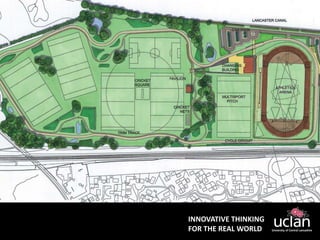
participants able to try cycles away from traffic on a 1.5 km
cycle track and to speak to professionals about adapting cycles
to suit their circumstances
• After lunch the participants participated in a focus group
discussing a number of issues to help identify the potential
benefits of, and barriers to, cycling and using electric bikes
INNOVATIVE THINKING
FOR THE REAL WORLD
INNOVATIVE THINKING
FOR THE REAL WORLD
INNOVATIVE THINKING
FOR THE REAL WORLD
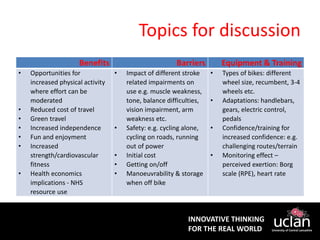
Topics for discussion
Benefits Barriers Equipment & Training
• Opportunities for
increased physical activity
where effort can be
moderated
• Reduced cost of travel
• Green travel
• Increased independence
• Fun and enjoyment
• Increased
strength/cardiovascular
fitness
• Health economics
implications - NHS
resource use
• Impact of different stroke
related impairments on
use e.g. muscle weakness,
tone, balance difficulties,
vision impairment, arm
weakness etc.
• Safety: e.g. cycling alone,
cycling on roads, running
out of power
• Initial cost
• Getting on/off
• Manoeuvrability & storage
when off bike
• Types of bikes: different
wheel size, recumbent, 3-4
wheels etc.
• Adaptations: handlebars,
gears, electric control,
pedals
• Confidence/training for
increased confidence: e.g.
challenging routes/terrain
• Monitoring effect –
perceived exertion: Borg
scale (RPE), heart rate
INNOVATIVE THINKING
FOR THE REAL WORLD
INNOVATIVE THINKING
FOR THE REAL WORLD
Findings
• The focus group findings fell into three
themes:
i. getting into cycling,
ii. concerns and challenges, and
iii. making it possible.
For each theme, further subthemes were identified.
INNOVATIVE THINKING
FOR THE REAL WORLD
INNOVATIVE THINKING
FOR THE REAL WORLD
Theme 1: Getting into Cycling
• Sub-themes:
i. improved mood through being outdoors,
… I wanted to get out of the house, … being cooped up adds to feeling a little
bit more down as time goes on
ii. doing something for yourself,
… one weekend I thought, I know, I’ll see if I can get up the stairs … a week or
two later at a case conference, I was listening to them say that I had done
this awful thing and gone upstairs … I felt naughty as if I shouldn’t have done
it
iii. being part of a community,
… since I’ve had this trike, one of the things that sort of amazed me when I’m
cycling along and proper cyclists come past they wave…you are part of that
group … you’re not labelled
INNOVATIVE THINKING
FOR THE REAL WORLD
INNOVATIVE THINKING
FOR THE REAL WORLD
Theme 2: Concerns & Challenges
• Sub-themes:
i. safety
… we decided that a three wheeler would have been the better bicycle for
me, which makes you feel safer, cause two wheelers, you’ve had it
… cars coming too close, I was told there is research … that showed that cars
go closer to cyclists in Lycra … so the secret is to look as unprofessional as
possible
ii. practical issues
getting to and from the cycling location, transporting a bike, cost issues,
storage and maintenance issues for those with their own bikes
INNOVATIVE THINKING
FOR THE REAL WORLD
INNOVATIVE THINKING
FOR THE REAL WORLD
Theme 3: Making it Possible
• Sub-themes:
i. starting slowly,
… if you practice during group sessions and you’re okay, you think, maybe I
could buy my own bike now that I’m used to it, so it’s a good way of testing if
you could do it
ii. getting properly set up,
… the mechanisms required to change things such as the seat height, gears
and brakes along with clipping the helmet buckle
iii. having a helping hand,
… I couldn’t do without my friend to help me, to lift in and out and that sort
of thing so I am dependent on my friend
INNOVATIVE THINKING
FOR THE REAL WORLD
INNOVATIVE THINKING
FOR THE REAL WORLD
In Summary
• high level of interest in taking up, or resuming, cycling
• getting out-and-about was a major motivator as well as the
social aspects of cycling – promoting mental wellbeing as well
as physical health
• primary concerns related to (road) safety and physical
limitations after stroke, together with the cost of adaptions
• most participants expressed a desire to carry on and go
further, but stroke related fatigue and reduced motor power
limited physical activity. The use of power assisted, or
pedelecs, were seen as a possible solution to this
INNOVATIVE THINKING
FOR THE REAL WORLD
INNOVATIVE THINKING
FOR THE REAL WORLD
Next steps
• understanding the limitations of the intervention –
who would/would not benefit?
• understanding the technical requirements of
adaptions, monitoring use, etc.
• recruiting suitable participants – have suitable
facilities, motivation, etc.
• attracting funding for a small pilot study to provide
bikes and monitor use and changes in physical health
and mental wellbeing
INNOVATIVE THINKING
FOR THE REAL WORLD
ANY
QUESTIONS?

3.2. richard weston

  • 1.
    INNOVATIVE THINKING FOR THEREAL WORLD Exploring the potential of electric bicycles for people after stroke Richard Weston, Naoimh McMahon, Caroline Watkins Presentation to the Scientists for Cycling Colloquium University of Aveiro, Portugal, 18 November 2016
  • 2.
    INNOVATIVE THINKING FOR THEREAL WORLD Pilot study outline • Stakeholder engagement event(s) were held to explore the potential use of electric bicycles by people after stroke. Attendees included: • Stroke survivors and their family/carers • electric bike developers (Electric Bike Research Executive) • third sector representatives (Preston on Wheels - Wheels for All) • healthcare professionals • The three research questions were: 1. What would make people after stroke want to start cycling, or to start cycling again? 2. What would their concerns/anxieties about cycling be? 3. How could these concerns/anxieties be overcome?
  • 3.
    INNOVATIVE THINKING FOR THEREAL WORLD INNOVATIVE THINKING FOR THE REAL WORLD Research approach • Three events: – 1st @ UCLan sport arena • demonstration of adapted bikes/ebikes, followed by a focus group – 2nd @ local stroke group meeting • demonstration of adapted bikes as part of local initiative, followed by 2 focus groups – 3rd @ local stroke group meeting • presentation of research findings, followed by open discussion
  • 4.
    INNOVATIVE THINKING FOR THEREAL WORLD First Event • Structured into two parts: • in the morning participants to familiarise themselves with a range of cycles, 2, 3 and four wheel, upright, recumbent, seated, etc. and electric bikes. participants able to try cycles away from traffic on a 1.5 km cycle track and to speak to professionals about adapting cycles to suit their circumstances • After lunch the participants participated in a focus group discussing a number of issues to help identify the potential benefits of, and barriers to, cycling and using electric bikes
  • 5.
  • 6.
    INNOVATIVE THINKING FOR THEREAL WORLD INNOVATIVE THINKING FOR THE REAL WORLD Topics for discussion Benefits Barriers Equipment & Training • Opportunities for increased physical activity where effort can be moderated • Reduced cost of travel • Green travel • Increased independence • Fun and enjoyment • Increased strength/cardiovascular fitness • Health economics implications - NHS resource use • Impact of different stroke related impairments on use e.g. muscle weakness, tone, balance difficulties, vision impairment, arm weakness etc. • Safety: e.g. cycling alone, cycling on roads, running out of power • Initial cost • Getting on/off • Manoeuvrability & storage when off bike • Types of bikes: different wheel size, recumbent, 3-4 wheels etc. • Adaptations: handlebars, gears, electric control, pedals • Confidence/training for increased confidence: e.g. challenging routes/terrain • Monitoring effect – perceived exertion: Borg scale (RPE), heart rate
  • 7.
    INNOVATIVE THINKING FOR THEREAL WORLD INNOVATIVE THINKING FOR THE REAL WORLD Findings • The focus group findings fell into three themes: i. getting into cycling, ii. concerns and challenges, and iii. making it possible. For each theme, further subthemes were identified.
  • 8.
    INNOVATIVE THINKING FOR THEREAL WORLD INNOVATIVE THINKING FOR THE REAL WORLD Theme 1: Getting into Cycling • Sub-themes: i. improved mood through being outdoors, … I wanted to get out of the house, … being cooped up adds to feeling a little bit more down as time goes on ii. doing something for yourself, … one weekend I thought, I know, I’ll see if I can get up the stairs … a week or two later at a case conference, I was listening to them say that I had done this awful thing and gone upstairs … I felt naughty as if I shouldn’t have done it iii. being part of a community, … since I’ve had this trike, one of the things that sort of amazed me when I’m cycling along and proper cyclists come past they wave…you are part of that group … you’re not labelled
  • 9.
    INNOVATIVE THINKING FOR THEREAL WORLD INNOVATIVE THINKING FOR THE REAL WORLD Theme 2: Concerns & Challenges • Sub-themes: i. safety … we decided that a three wheeler would have been the better bicycle for me, which makes you feel safer, cause two wheelers, you’ve had it … cars coming too close, I was told there is research … that showed that cars go closer to cyclists in Lycra … so the secret is to look as unprofessional as possible ii. practical issues getting to and from the cycling location, transporting a bike, cost issues, storage and maintenance issues for those with their own bikes
  • 10.
    INNOVATIVE THINKING FOR THEREAL WORLD INNOVATIVE THINKING FOR THE REAL WORLD Theme 3: Making it Possible • Sub-themes: i. starting slowly, … if you practice during group sessions and you’re okay, you think, maybe I could buy my own bike now that I’m used to it, so it’s a good way of testing if you could do it ii. getting properly set up, … the mechanisms required to change things such as the seat height, gears and brakes along with clipping the helmet buckle iii. having a helping hand, … I couldn’t do without my friend to help me, to lift in and out and that sort of thing so I am dependent on my friend
  • 11.
    INNOVATIVE THINKING FOR THEREAL WORLD INNOVATIVE THINKING FOR THE REAL WORLD In Summary • high level of interest in taking up, or resuming, cycling • getting out-and-about was a major motivator as well as the social aspects of cycling – promoting mental wellbeing as well as physical health • primary concerns related to (road) safety and physical limitations after stroke, together with the cost of adaptions • most participants expressed a desire to carry on and go further, but stroke related fatigue and reduced motor power limited physical activity. The use of power assisted, or pedelecs, were seen as a possible solution to this
  • 12.
    INNOVATIVE THINKING FOR THEREAL WORLD INNOVATIVE THINKING FOR THE REAL WORLD Next steps • understanding the limitations of the intervention – who would/would not benefit? • understanding the technical requirements of adaptions, monitoring use, etc. • recruiting suitable participants – have suitable facilities, motivation, etc. • attracting funding for a small pilot study to provide bikes and monitor use and changes in physical health and mental wellbeing
  • 13.
    INNOVATIVE THINKING FOR THEREAL WORLD ANY QUESTIONS?