Distributed Computing
EG 3113 CT Diploma in Computer Engineering
5th Semester
Unit 3.1 Fundamental Concept of Distributed System
Lecture by : Er. Ashish K.C(Khatri)
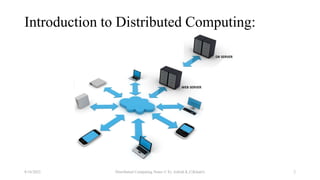
Introduction to Distributed Computing:
8/16/2022 Distributed Computing Notes © Er. Ashish K.C(Khatri) 2
Introduction to Distributed System:
• A distributed system is a collection of independent computers at networked
locations such that they communicate and interact only through message passing
that is viewed as a single coherent system by its users.
• Generally, all the components of the distributed system interact so as to obtain a
common goal.
• A computer program running in distributed system is called distributed program.
• Distributed programming is used to write distributed programs.
• It differs from parallel system as each computer in a distributed system has its own
memory i.e. distributed memory; but in parallel system, all processors have access
to shared memory for information exchange.
8/16/2022 Distributed Computing Notes © Er. Ashish K.C(Khatri) 3
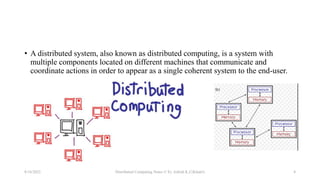
• A distributed system, also known as distributed computing, is a system with
multiple components located on different machines that communicate and
coordinate actions in order to appear as a single coherent system to the end-user.
8/16/2022 Distributed Computing Notes © Er. Ashish K.C(Khatri) 4
Examples of distributed computing :
• Intranets, Internet, WWW, email
• Telecommunication networks: Telephone networks and Cellular networks.
• The network of branch office computers -Information system to handle automatic
processing of orders,
• Real-time process control: Aircraft control systems,
• Electronic banking,
• Airline reservation systems,
• Sensor networks,
• Mobile and Pervasive Computing systems.
8/16/2022 Distributed Computing Notes © Er. Ashish K.C(Khatri) 5
Assignment:
Prepare the presentation slides on
Electronic Banking.
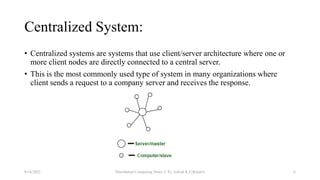
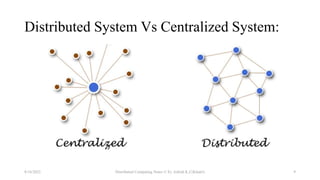
Centralized System:
• Centralized systems are systems that use client/server architecture where one or
more client nodes are directly connected to a central server.
• This is the most commonly used type of system in many organizations where
client sends a request to a company server and receives the response.
8/16/2022 Distributed Computing Notes © Er. Ashish K.C(Khatri) 6
Characteristics of Centralized System:
• Presence of a global clock: As the entire system consists of a central node(a
server/ a master) and many client nodes(a computer/ a slave), all client nodes sync
up with the global clock(the clock of the central node).
• One single central unit: One single central unit which serves/coordinates all the
other nodes in the system.
• Dependent failure of components: Central node failure causes entire system to
fail. This makes sense because when the server is down, no other entity is there to
send/receive response/requests.
8/16/2022 Distributed Computing Notes © Er. Ashish K.C(Khatri) 7
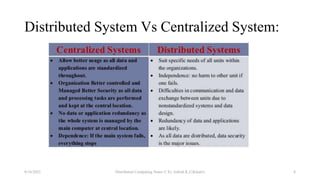
Distributed System Vs Centralized System:
8/16/2022 Distributed Computing Notes © Er. Ashish K.C(Khatri) 8
Distributed System Vs Centralized System:
8/16/2022 Distributed Computing Notes © Er. Ashish K.C(Khatri) 9
8/16/2022 Distributed Computing Notes © Er. Ashish K.C(Khatri) 10
Main Characteristics of Distributed System:
• Concurrency
• No global clock
• Independent failures
8/16/2022 Distributed Computing Notes © Er. Ashish K.C(Khatri) 11
1. Concurrency:
• Distributed system allows the programs that share resources to execute
concurrently(i.e. At the same time).
• It is a property that enables processes running in different machines to form a
common system that is capable of executing codes on multiple machines at the
same time.
• Example: A web application is concurrent as it can be used by various users at the
same time.
• Concurrency helps to reduce latency and increase throughput as a unit of work can
be concurrently done by sub-division.
8/16/2022 Distributed Computing Notes © Er. Ashish K.C(Khatri) 12
8/16/2022 Distributed Computing Notes © Er. Ashish K.C(Khatri) 13
2. No Global Clock:
• In other to coordinate to the remote networks it is necessary to synchronize clock
in primitive technologies.
• But as there is no single correct global timing system, it is very difficult to
synchronize global clock across all the networks of the system located at different
locations.
• The main characteristics of the distributed system is that it does not need any
global clock system to coordinate with the network at different locations because
the only way of communication is message passing through the network.
8/16/2022 Distributed Computing Notes © Er. Ashish K.C(Khatri) 14
3. Independent Failures:
• The computer system can fail or crash at any time.
• In primitive centralized system, if the server fails then the whole system fails to
operate leaving the negative consequences to the end users.
• With distributed system, even one network fails, it does not hamper the overall
system.
• The workload of the failed network can be overcome by the other networks within
the system situated at different locations.
• This provides reliable system to the end users.
8/16/2022 Distributed Computing Notes © Er. Ashish K.C(Khatri) 15
Advantages of Distributed System:
• All the computer components work independently dividing the main task. This
improves performance of the system and reduce latency time.
• Even if one component of the system crashes or fails, the system as a whole does
not crash. This improves availability and reliability of the system.
• As load is distributed among the components of the system, it enhances the total
computational power of the overall system.
• Computational power can be grown incrementally by adding small components to
the system.
• It allows users to share data and resources.
• The workload is distributed among different components or machines.
• Local database administrator have different degree of local autonomy(retains
control to some extent).
8/16/2022 Distributed Computing Notes © Er. Ashish K.C(Khatri) 16
Disadvantages of Distributed System:
• It is very difficult to implement the distributed system making it more costlier than
other systems.
• The exchange of information among the components require coordination which
creates processing overheads.
• It is difficult to ensure correctness of algorithms generally when some parts of
system is down and is being recovered.
8/16/2022 Distributed Computing Notes © Er. Ashish K.C(Khatri) 17

Fundamental Concept of Distributed Computing

  • 1.
    Distributed Computing EG 3113CT Diploma in Computer Engineering 5th Semester Unit 3.1 Fundamental Concept of Distributed System Lecture by : Er. Ashish K.C(Khatri)
  • 2.
    Introduction to DistributedComputing: 8/16/2022 Distributed Computing Notes © Er. Ashish K.C(Khatri) 2
  • 3.
    Introduction to DistributedSystem: • A distributed system is a collection of independent computers at networked locations such that they communicate and interact only through message passing that is viewed as a single coherent system by its users. • Generally, all the components of the distributed system interact so as to obtain a common goal. • A computer program running in distributed system is called distributed program. • Distributed programming is used to write distributed programs. • It differs from parallel system as each computer in a distributed system has its own memory i.e. distributed memory; but in parallel system, all processors have access to shared memory for information exchange. 8/16/2022 Distributed Computing Notes © Er. Ashish K.C(Khatri) 3
  • 4.
    • A distributedsystem, also known as distributed computing, is a system with multiple components located on different machines that communicate and coordinate actions in order to appear as a single coherent system to the end-user. 8/16/2022 Distributed Computing Notes © Er. Ashish K.C(Khatri) 4
  • 5.
    Examples of distributedcomputing : • Intranets, Internet, WWW, email • Telecommunication networks: Telephone networks and Cellular networks. • The network of branch office computers -Information system to handle automatic processing of orders, • Real-time process control: Aircraft control systems, • Electronic banking, • Airline reservation systems, • Sensor networks, • Mobile and Pervasive Computing systems. 8/16/2022 Distributed Computing Notes © Er. Ashish K.C(Khatri) 5 Assignment: Prepare the presentation slides on Electronic Banking.
  • 6.
    Centralized System: • Centralizedsystems are systems that use client/server architecture where one or more client nodes are directly connected to a central server. • This is the most commonly used type of system in many organizations where client sends a request to a company server and receives the response. 8/16/2022 Distributed Computing Notes © Er. Ashish K.C(Khatri) 6
  • 7.
    Characteristics of CentralizedSystem: • Presence of a global clock: As the entire system consists of a central node(a server/ a master) and many client nodes(a computer/ a slave), all client nodes sync up with the global clock(the clock of the central node). • One single central unit: One single central unit which serves/coordinates all the other nodes in the system. • Dependent failure of components: Central node failure causes entire system to fail. This makes sense because when the server is down, no other entity is there to send/receive response/requests. 8/16/2022 Distributed Computing Notes © Er. Ashish K.C(Khatri) 7
  • 8.
    Distributed System VsCentralized System: 8/16/2022 Distributed Computing Notes © Er. Ashish K.C(Khatri) 8
  • 9.
    Distributed System VsCentralized System: 8/16/2022 Distributed Computing Notes © Er. Ashish K.C(Khatri) 9
  • 10.
    8/16/2022 Distributed ComputingNotes © Er. Ashish K.C(Khatri) 10
  • 11.
    Main Characteristics ofDistributed System: • Concurrency • No global clock • Independent failures 8/16/2022 Distributed Computing Notes © Er. Ashish K.C(Khatri) 11
  • 12.
    1. Concurrency: • Distributedsystem allows the programs that share resources to execute concurrently(i.e. At the same time). • It is a property that enables processes running in different machines to form a common system that is capable of executing codes on multiple machines at the same time. • Example: A web application is concurrent as it can be used by various users at the same time. • Concurrency helps to reduce latency and increase throughput as a unit of work can be concurrently done by sub-division. 8/16/2022 Distributed Computing Notes © Er. Ashish K.C(Khatri) 12
  • 13.
    8/16/2022 Distributed ComputingNotes © Er. Ashish K.C(Khatri) 13
  • 14.
    2. No GlobalClock: • In other to coordinate to the remote networks it is necessary to synchronize clock in primitive technologies. • But as there is no single correct global timing system, it is very difficult to synchronize global clock across all the networks of the system located at different locations. • The main characteristics of the distributed system is that it does not need any global clock system to coordinate with the network at different locations because the only way of communication is message passing through the network. 8/16/2022 Distributed Computing Notes © Er. Ashish K.C(Khatri) 14
  • 15.
    3. Independent Failures: •The computer system can fail or crash at any time. • In primitive centralized system, if the server fails then the whole system fails to operate leaving the negative consequences to the end users. • With distributed system, even one network fails, it does not hamper the overall system. • The workload of the failed network can be overcome by the other networks within the system situated at different locations. • This provides reliable system to the end users. 8/16/2022 Distributed Computing Notes © Er. Ashish K.C(Khatri) 15
  • 16.
    Advantages of DistributedSystem: • All the computer components work independently dividing the main task. This improves performance of the system and reduce latency time. • Even if one component of the system crashes or fails, the system as a whole does not crash. This improves availability and reliability of the system. • As load is distributed among the components of the system, it enhances the total computational power of the overall system. • Computational power can be grown incrementally by adding small components to the system. • It allows users to share data and resources. • The workload is distributed among different components or machines. • Local database administrator have different degree of local autonomy(retains control to some extent). 8/16/2022 Distributed Computing Notes © Er. Ashish K.C(Khatri) 16
  • 17.
    Disadvantages of DistributedSystem: • It is very difficult to implement the distributed system making it more costlier than other systems. • The exchange of information among the components require coordination which creates processing overheads. • It is difficult to ensure correctness of algorithms generally when some parts of system is down and is being recovered. 8/16/2022 Distributed Computing Notes © Er. Ashish K.C(Khatri) 17