Distributed Computing
EG 3113 CT Diploma in Computer Engineering
5th Semester
Unit 3.4 Types of Distributed System
Lecture by : Er. Ashish K.C(Khatri)
Types of Distributed System:
• Distributed computing is a multifaceted field with infrastructures that can vary
widely.
• It is thus nearly impossible to define all types of distributed computing.
• However, this field of computer science is commonly divided into three subfields:
cloud computing
grid computing
cluster computing
8/16/2022 Distributed Computing Notes © Er. Ashish K.C(Khatri) 2
Cloud Computing:
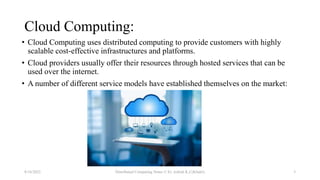
• Cloud Computing uses distributed computing to provide customers with highly
scalable cost-effective infrastructures and platforms.
• Cloud providers usually offer their resources through hosted services that can be
used over the internet.
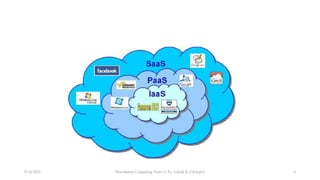
• A number of different service models have established themselves on the market:
8/16/2022 Distributed Computing Notes © Er. Ashish K.C(Khatri) 3
8/16/2022 Distributed Computing Notes © Er. Ashish K.C(Khatri) 4
• Software as a service (SaaS):
• In the case of SaaS, the customer uses the cloud provider’s applications and
associated infrastructure (e.g. servers, online storage, computing power).
• The applications can be accessed with a variety of devices via a thin client
interface (e.g. a browser-based web app).
• Maintenance and administration of the outsourced infrastructure is handled by the
cloud provider.
8/16/2022 Distributed Computing Notes © Er. Ashish K.C(Khatri) 5
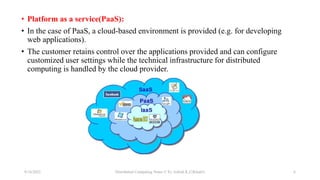
• Platform as a service(PaaS):
• In the case of PaaS, a cloud-based environment is provided (e.g. for developing
web applications).
• The customer retains control over the applications provided and can configure
customized user settings while the technical infrastructure for distributed
computing is handled by the cloud provider.
8/16/2022 Distributed Computing Notes © Er. Ashish K.C(Khatri) 6
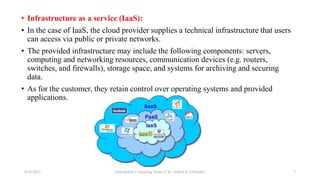
• Infrastructure as a service (IaaS):
• In the case of IaaS, the cloud provider supplies a technical infrastructure that users
can access via public or private networks.
• The provided infrastructure may include the following components: servers,
computing and networking resources, communication devices (e.g. routers,
switches, and firewalls), storage space, and systems for archiving and securing
data.
• As for the customer, they retain control over operating systems and provided
applications.
8/16/2022 Distributed Computing Notes © Er. Ashish K.C(Khatri) 7
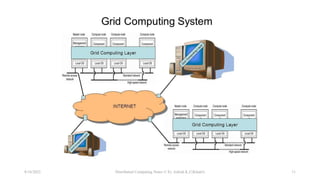
Grid Computing:
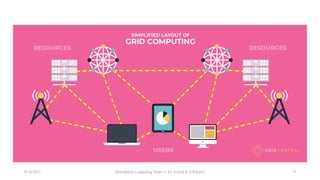
• Grid computing is based on the idea of a supercomputer with enormous computing
power.
• However, computing tasks are performed in many instances rather than just one.
• Servers and computers can thus perform different tasks independently of one
another.
• Grid computing can access resources in a very flexible manner when performing
tasks.
• Normally, participants will allocate specific resources to an entire project at night
when the technical infrastructure tends to be less heavily used.
8/16/2022 Distributed Computing Notes © Er. Ashish K.C(Khatri) 8
8/16/2022 Distributed Computing Notes © Er. Ashish K.C(Khatri) 9
• One advantage of this is that highly powerful systems can be quickly used and the
computing power can be scaled as needed.
• There is no need to replace or upgrade an expensive supercomputer with another
pricey one to improve performance.
• Since grid computing can create a virtual supercomputer from a cluster of loosely
interconnected computers, it is specialized in solving problems that are
particularly computationally intensive.
• This method is often used for ambitious scientific projects and decrypting
cryptographic codes.
8/16/2022 Distributed Computing Notes © Er. Ashish K.C(Khatri) 10
8/16/2022 Distributed Computing Notes © Er. Ashish K.C(Khatri) 11
Cluster Computing:
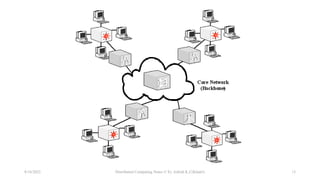
• Cluster computing or High-Performance computing frameworks is a form of computing
in which bunch of computers (often called nodes) that are connected through a LAN
(local area network) so that, they behave like a single machine.
• A computer cluster help to solve complex operations more efficiently with much faster
processing speed, better data integrity than a single computer and they only used for
mission-critical applications.
• It cannot be clearly differentiated from cloud and grid computing.
• It is a more general approach and refers to all the ways in which individual computers and
their computing power can be combined together in clusters.
• Examples of this include server clusters, clusters in big data and in cloud environments,
database clusters, and application clusters.
• Computer networks are also increasingly being used in high-performance computing
which can solve particularly demanding computing problems
8/16/2022 Distributed Computing Notes © Er. Ashish K.C(Khatri) 12
8/16/2022 Distributed Computing Notes © Er. Ashish K.C(Khatri) 13
End of Unit
8/16/2022 Distributed Computing Notes © Er. Ashish K.C(Khatri) 14

Types of Distributed System

  • 1.
    Distributed Computing EG 3113CT Diploma in Computer Engineering 5th Semester Unit 3.4 Types of Distributed System Lecture by : Er. Ashish K.C(Khatri)
  • 2.
    Types of DistributedSystem: • Distributed computing is a multifaceted field with infrastructures that can vary widely. • It is thus nearly impossible to define all types of distributed computing. • However, this field of computer science is commonly divided into three subfields: cloud computing grid computing cluster computing 8/16/2022 Distributed Computing Notes © Er. Ashish K.C(Khatri) 2
  • 3.
    Cloud Computing: • CloudComputing uses distributed computing to provide customers with highly scalable cost-effective infrastructures and platforms. • Cloud providers usually offer their resources through hosted services that can be used over the internet. • A number of different service models have established themselves on the market: 8/16/2022 Distributed Computing Notes © Er. Ashish K.C(Khatri) 3
  • 4.
    8/16/2022 Distributed ComputingNotes © Er. Ashish K.C(Khatri) 4
  • 5.
    • Software asa service (SaaS): • In the case of SaaS, the customer uses the cloud provider’s applications and associated infrastructure (e.g. servers, online storage, computing power). • The applications can be accessed with a variety of devices via a thin client interface (e.g. a browser-based web app). • Maintenance and administration of the outsourced infrastructure is handled by the cloud provider. 8/16/2022 Distributed Computing Notes © Er. Ashish K.C(Khatri) 5
  • 6.
    • Platform asa service(PaaS): • In the case of PaaS, a cloud-based environment is provided (e.g. for developing web applications). • The customer retains control over the applications provided and can configure customized user settings while the technical infrastructure for distributed computing is handled by the cloud provider. 8/16/2022 Distributed Computing Notes © Er. Ashish K.C(Khatri) 6
  • 7.
    • Infrastructure asa service (IaaS): • In the case of IaaS, the cloud provider supplies a technical infrastructure that users can access via public or private networks. • The provided infrastructure may include the following components: servers, computing and networking resources, communication devices (e.g. routers, switches, and firewalls), storage space, and systems for archiving and securing data. • As for the customer, they retain control over operating systems and provided applications. 8/16/2022 Distributed Computing Notes © Er. Ashish K.C(Khatri) 7
  • 8.
    Grid Computing: • Gridcomputing is based on the idea of a supercomputer with enormous computing power. • However, computing tasks are performed in many instances rather than just one. • Servers and computers can thus perform different tasks independently of one another. • Grid computing can access resources in a very flexible manner when performing tasks. • Normally, participants will allocate specific resources to an entire project at night when the technical infrastructure tends to be less heavily used. 8/16/2022 Distributed Computing Notes © Er. Ashish K.C(Khatri) 8
  • 9.
    8/16/2022 Distributed ComputingNotes © Er. Ashish K.C(Khatri) 9
  • 10.
    • One advantageof this is that highly powerful systems can be quickly used and the computing power can be scaled as needed. • There is no need to replace or upgrade an expensive supercomputer with another pricey one to improve performance. • Since grid computing can create a virtual supercomputer from a cluster of loosely interconnected computers, it is specialized in solving problems that are particularly computationally intensive. • This method is often used for ambitious scientific projects and decrypting cryptographic codes. 8/16/2022 Distributed Computing Notes © Er. Ashish K.C(Khatri) 10
  • 11.
    8/16/2022 Distributed ComputingNotes © Er. Ashish K.C(Khatri) 11
  • 12.
    Cluster Computing: • Clustercomputing or High-Performance computing frameworks is a form of computing in which bunch of computers (often called nodes) that are connected through a LAN (local area network) so that, they behave like a single machine. • A computer cluster help to solve complex operations more efficiently with much faster processing speed, better data integrity than a single computer and they only used for mission-critical applications. • It cannot be clearly differentiated from cloud and grid computing. • It is a more general approach and refers to all the ways in which individual computers and their computing power can be combined together in clusters. • Examples of this include server clusters, clusters in big data and in cloud environments, database clusters, and application clusters. • Computer networks are also increasingly being used in high-performance computing which can solve particularly demanding computing problems 8/16/2022 Distributed Computing Notes © Er. Ashish K.C(Khatri) 12
  • 13.
    8/16/2022 Distributed ComputingNotes © Er. Ashish K.C(Khatri) 13
  • 14.
    End of Unit 8/16/2022Distributed Computing Notes © Er. Ashish K.C(Khatri) 14