Launch: Please find the errors in the problems on the half sheet of paper.


                                                                             1
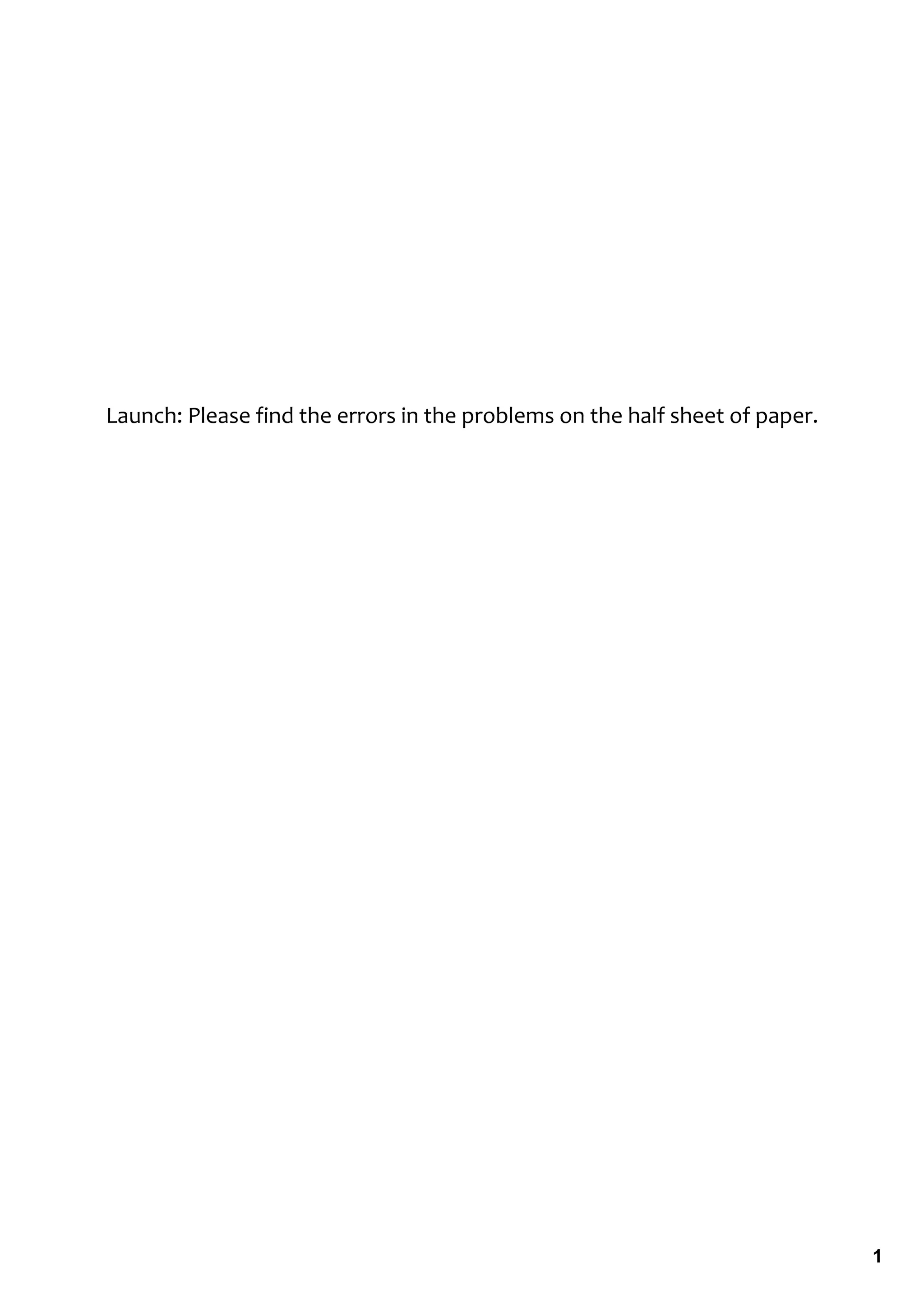
Section 3.15:         Two basic graphs:  y = cx  &  y = c
                                                               x


    y = cx               Describes the relationship between things that are in 
                         a constant ratio.
(                    )       Ex. 1: The days in each week.


                             Ex. 2: The weeks in each year.


                             Ex. 3: The minutes in each hour.


                         Your turn:

                              1. Write a direct variation equation to represent 
                              the number of hours in a day.


                              2. Write a direct variation equation to represent 
                              the number of feet in an inch.


                                                                                   2
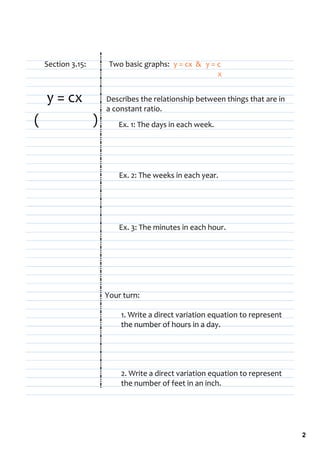
Using these       Use the information and the corresponding equation 
equations:        to find the requested value.

                      1. If 120 hours have past since your birthday, how 
                      many days is that?


                      2. If a cabinet in your house is 4 feet 6 inches tall, 
                      how many inches is that?


                      3. If you have been working at your job for 37 
                      weeks, how many years is that?


Thinking about     When your situation is modeled by direct variation, 
what these         if:
equations mean:
                        1. One quantity doubles, then:


                        2. One quantity decreases, then:


                        3. One quantity stays the same, then:


                                                                                3
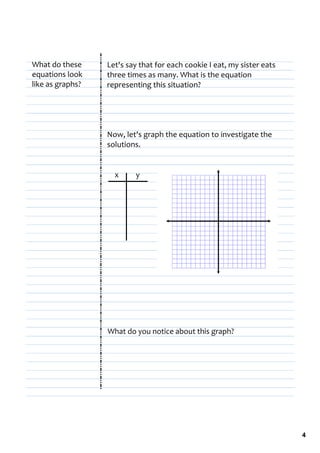
What do these     Let's say that for each cookie I eat, my sister eats 
equations look    three times as many. What is the equation 
like as graphs?   representing this situation?


                  Now, let's graph the equation to investigate the 
                  solutions.


                    x     y


                  What do you notice about this graph?


                                                                          4
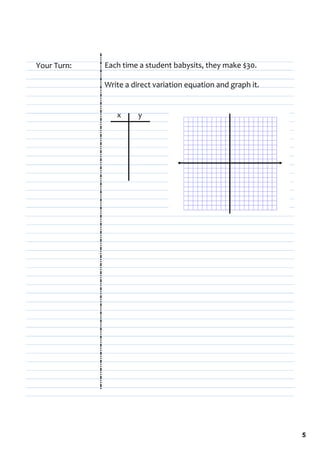
Your Turn:   Each time a student babysits, they make $30.

             Write a direct variation equation and graph it.


                x      y


                                                               5
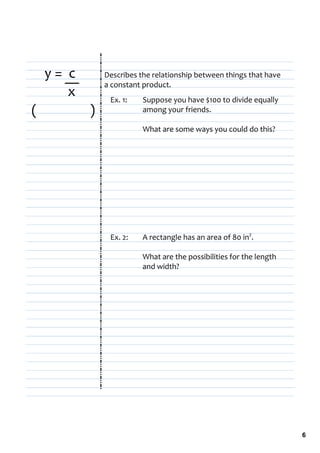
y =  c         Describes the relationship between things that have 
                   a constant product.
           x        Ex. 1:    Suppose you have $100 to divide equally 
(              )              among your friends.

                              What are some ways you could do this?


                    Ex. 2:    A rectangle has an area of 80 in2.

                              What are the possibilities for the length 
                              and width?


                                                                           6
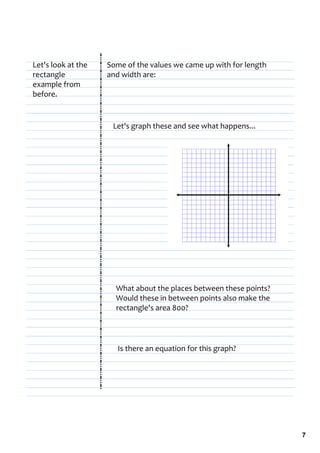
Let's look at the    Some of the values we came up with for length 
rectangle            and width are:
example from 
before.


                      Let's graph these and see what happens...


                       What about the places between these points? 
                       Would these in between points also make the 
                       rectangle's area 800?


                        Is there an equation for this graph?


                                                                      7
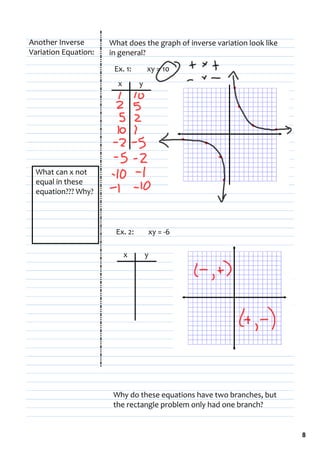
Another Inverse       What does the graph of inverse variation look like 
Variation Equation:   in general?

                       Ex. 1:        xy = 10
                        x        y


 What can x not 
 equal in these
 equation??? Why?


                        Ex. 2:       xy = ‐6

                            x        y


                       Why do these equations have two branches, but 
                       the rectangle problem only had one branch?


                                                                            8
Homework:    p. 281 #1, 2, 3abc, 4abc, 5, 7bc, 10, 12, 14


                                                            9
10

3.15 Notes A2

  • 1.
  • 2.
    Section 3.15:  Two basic graphs:  y = cx  &  y = c        x y = cx Describes the relationship between things that are in  a constant ratio. ( ) Ex. 1: The days in each week. Ex. 2: The weeks in each year. Ex. 3: The minutes in each hour. Your turn: 1. Write a direct variation equation to represent  the number of hours in a day. 2. Write a direct variation equation to represent  the number of feet in an inch. 2
  • 3.
    Using these  Use the information and the corresponding equation  equations: to find the requested value. 1. If 120 hours have past since your birthday, how  many days is that? 2. If a cabinet in your house is 4 feet 6 inches tall,  how many inches is that? 3. If you have been working at your job for 37  weeks, how many years is that? Thinking about When your situation is modeled by direct variation,  what these  if: equations mean: 1. One quantity doubles, then: 2. One quantity decreases, then: 3. One quantity stays the same, then: 3
  • 4.
    What do these Let's say that for each cookie I eat, my sister eats  equations look three times as many. What is the equation  like as graphs? representing this situation? Now, let's graph the equation to investigate the  solutions. x y What do you notice about this graph? 4
  • 5.
    Your Turn: Each time a student babysits, they make $30. Write a direct variation equation and graph it. x y 5
  • 6.
    y =  c Describes the relationship between things that have  a constant product.        x Ex. 1: Suppose you have $100 to divide equally  ( ) among your friends. What are some ways you could do this? Ex. 2: A rectangle has an area of 80 in2. What are the possibilities for the length  and width? 6
  • 7.
    Let's look at the  Some of the values we came up with for length  rectangle  and width are: example from  before. Let's graph these and see what happens... What about the places between these points?  Would these in between points also make the  rectangle's area 800? Is there an equation for this graph? 7
  • 8.
    Another Inverse What does the graph of inverse variation look like  Variation Equation: in general? Ex. 1:  xy = 10 x y What can x not  equal in these equation??? Why? Ex. 2: xy = ‐6 x y Why do these equations have two branches, but  the rectangle problem only had one branch? 8
  • 9.
    Homework:  p. 281 #1, 2, 3abc, 4abc, 5, 7bc, 10, 12, 14 9
  • 10.