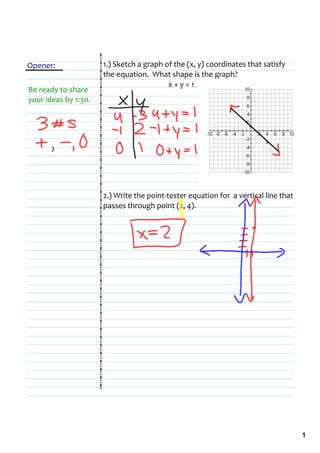
Opener:               1.) Sketch a graph of the (x, y) coordinates that satisfy 
                      the equation.  What shape is the graph?
                                          x + y = 1
Be ready to share 
your ideas by 1:30.


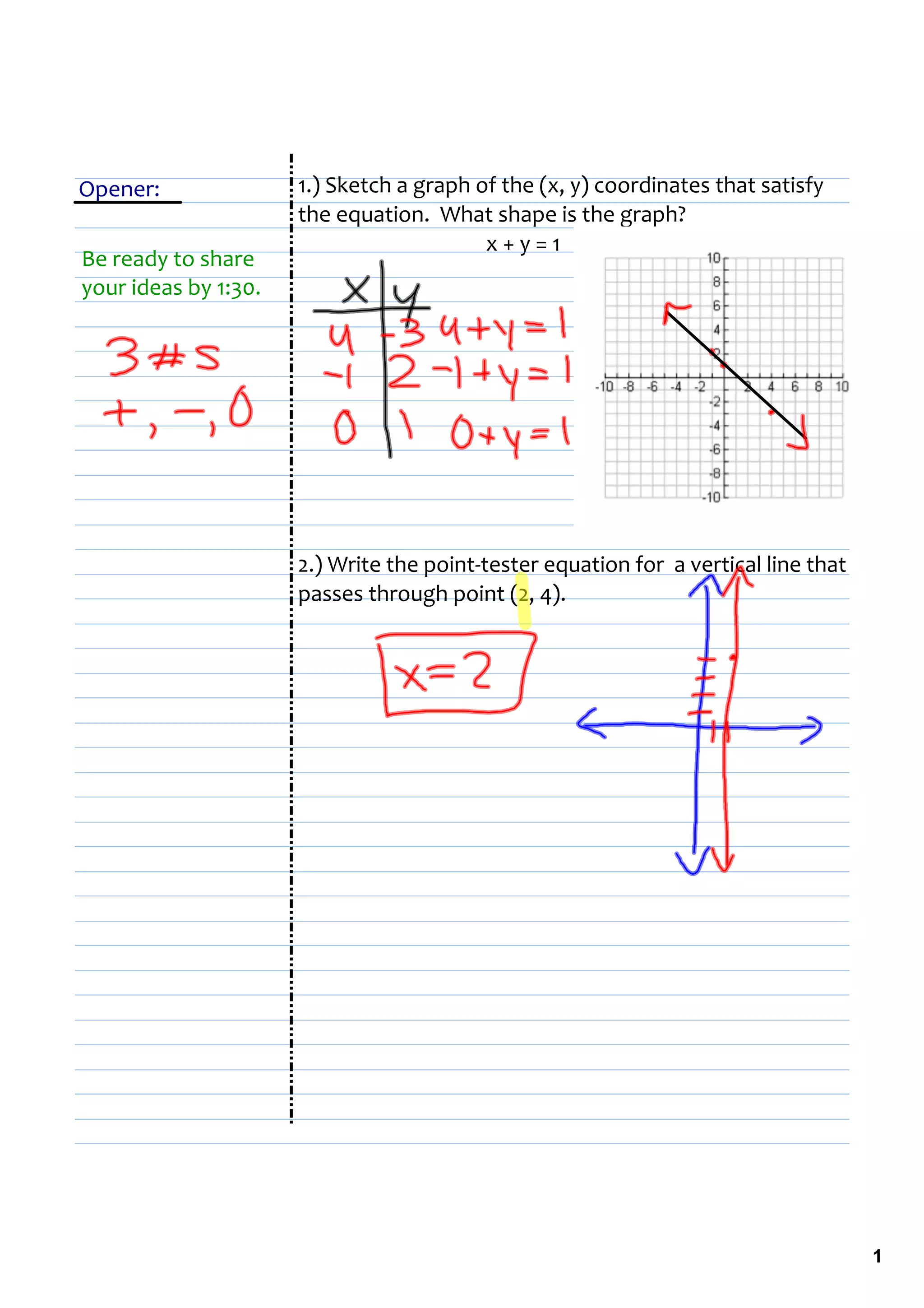
                      2.) Write the point‐tester equation for  a vertical line that 
                      passes through point (2, 4).


                                                                                       1
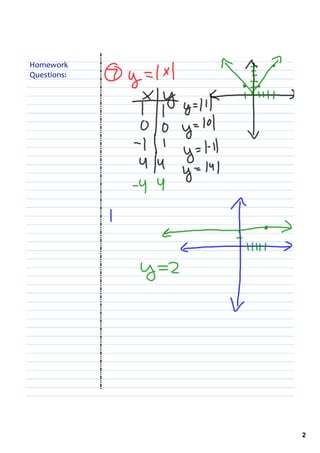
Homework 
Questions:


             2
12/9 & 12/10:    3.12 Graphing by Plotting

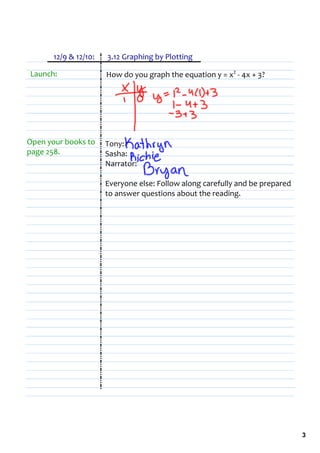
Launch:               How do you graph the equation y = x2 ‐ 4x + 3?


Open your books to    Tony:
page 258.             Sasha:
                      Narrator:

                      Everyone else: Follow along carefully and be prepared 
                      to answer questions about the reading.


                                                                               3
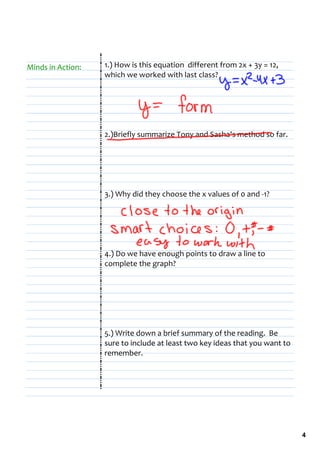
Minds in Action:   1.) How is this equation  different from 2x + 3y = 12, 
                   which we worked with last class?


                   2.)Briefly summarize Tony and Sasha's method so far.


                   3.) Why did they choose the x values of 0 and ‐1?


                   4.) Do we have enough points to draw a line to 
                   complete the graph?


                   5.) Write down a brief summary of the reading.  Be 
                   sure to include at least two key ideas that you want to 
                   remember.


                                                                              4
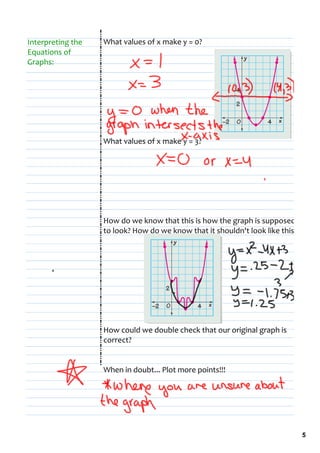
Interpreting the    What values of x make y = 0?
Equations of 
Graphs:


                    What values of x make y = 3?


                    How do we know that this is how the graph is supposed 
                    to look? How do we know that it shouldn't look like this?


                    How could we double check that our original graph is 
                    correct?


                    When in doubt... Plot more points!!!


                                                                                5
Ms. Betzel says....   • One partner from every partnership should take out 
                      a sheet of paper.

                      • Imagine your piece of paper is a coordinate plane.

                      • In big letters, write A in the 1st quadrant, B in the 2nd, 
                      C in the 3rd, and D in the 4th.

                      • Crease and tear the paper along the x‐axis.

                      • Give your partner the 3rd and 4th quadrants.

                      • Crease and tear the paper along the y‐axis.


                                                                                      6
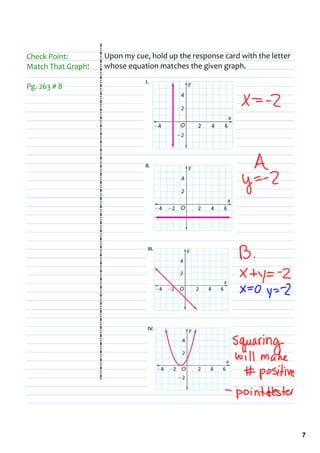
Check Point:        Upon my cue, hold up the response card with the letter 
Match That Graph!   whose equation matches the given graph.

Pg. 263 # 8


                                                                              7
3.13    Intersection of Graphs
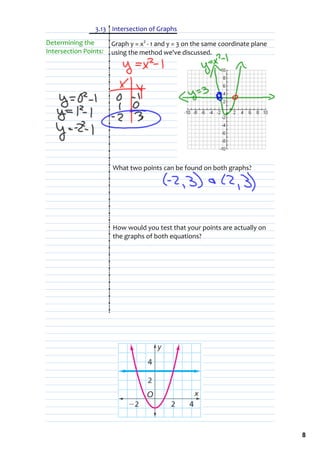
Determining the        Graph y = x2 ‐ 1 and y = 3 on the same coordinate plane 
Intersection Points:   using the method we've discussed.


                       What two points can be found on both graphs?


                       How would you test that your points are actually on 
                       the graphs of both equations?


                                                                                  8
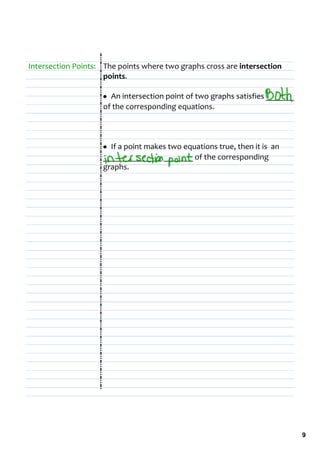
Intersection Points: The points where two graphs cross are intersection 
                     points.

                     • An intersection point of two graphs satisfies _______ 
                     of the corresponding equations.


                     • If a point makes two equations true, then it is  an 
                     ______________ _______ of the corresponding 
                     graphs.


                                                                                9
Challenge Problem:   Earlier we graphed the equation  y = x2 ‐ 4x + 3, which 
                     Tony said looked like a big smile.

                     Give an equation with a graph that has the shape of a 
                     big frown. 
                     (*Hint: Recall our discussion with transformations).


                                                                                10
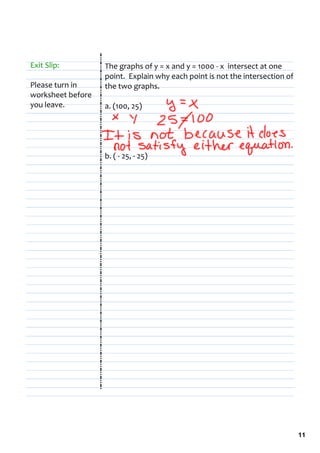
Exit Slip:          The graphs of y = x and y = 1000 ‐ x  intersect at one 
                    point.  Explain why each point is not the intersection of 
Please turn in      the two graphs.
worksheet before 
you leave.          a. (100, 25)


                    b. ( ‐ 25, ‐ 25)


                                                                                 11
Homework:   Pg. 263 # 4, 7, 9‐ 10 & 12‐13
            Pg. 267 # 6‐ 10


                                            12
13
14
15
16
17
18
19

3.12 3.13 Notes A

  • 1.
    Opener: 1.) Sketch a graph of the (x, y) coordinates that satisfy  the equation.  What shape is the graph? x + y = 1 Be ready to share  your ideas by 1:30. 2.) Write the point‐tester equation for  a vertical line that  passes through point (2, 4). 1
  • 2.
  • 3.
    12/9 & 12/10:    3.12 Graphing by Plotting Launch: How do you graph the equation y = x2 ‐ 4x + 3? Open your books to  Tony: page 258. Sasha: Narrator: Everyone else: Follow along carefully and be prepared  to answer questions about the reading. 3
  • 4.
    Minds in Action: 1.) How is this equation  different from 2x + 3y = 12,  which we worked with last class? 2.)Briefly summarize Tony and Sasha's method so far. 3.) Why did they choose the x values of 0 and ‐1? 4.) Do we have enough points to draw a line to  complete the graph? 5.) Write down a brief summary of the reading.  Be  sure to include at least two key ideas that you want to  remember. 4
  • 5.
    Interpreting the  What values of x make y = 0? Equations of  Graphs: What values of x make y = 3? How do we know that this is how the graph is supposed  to look? How do we know that it shouldn't look like this? How could we double check that our original graph is  correct? When in doubt... Plot more points!!! 5
  • 6.
    Ms. Betzel says.... • One partner from every partnership should take out  a sheet of paper. • Imagine your piece of paper is a coordinate plane. • In big letters, write A in the 1st quadrant, B in the 2nd,  C in the 3rd, and D in the 4th. • Crease and tear the paper along the x‐axis. • Give your partner the 3rd and 4th quadrants. • Crease and tear the paper along the y‐axis. 6
  • 7.
    Check Point: Upon my cue, hold up the response card with the letter  Match That Graph! whose equation matches the given graph. Pg. 263 # 8 7
  • 8.
    3.13    Intersection of Graphs Determining the  Graph y = x2 ‐ 1 and y = 3 on the same coordinate plane  Intersection Points: using the method we've discussed. What two points can be found on both graphs? How would you test that your points are actually on  the graphs of both equations? 8
  • 9.
    Intersection Points: The points where two graphs cross are intersection  points. • An intersection point of two graphs satisfies _______  of the corresponding equations. • If a point makes two equations true, then it is  an  ______________ _______ of the corresponding  graphs. 9

  • 10.
    Challenge Problem: Earlier we graphed the equation  y = x2 ‐ 4x + 3, which  Tony said looked like a big smile. Give an equation with a graph that has the shape of a  big frown.  (*Hint: Recall our discussion with transformations). 10
  • 11.
    Exit Slip: The graphs of y = x and y = 1000 ‐ x  intersect at one  point.  Explain why each point is not the intersection of  Please turn in the two graphs. worksheet before  you leave. a. (100, 25) b. ( ‐ 25, ‐ 25) 11
  • 12.
    Homework: Pg. 263 # 4, 7, 9‐ 10 & 12‐13 Pg. 267 # 6‐ 10 12
  • 13.
  • 14.
  • 15.
  • 16.
  • 17.
  • 18.
  • 19.