*Remember to write down any homework questions that 
Opener:   you had on the backboard BEFORE doing the opener!

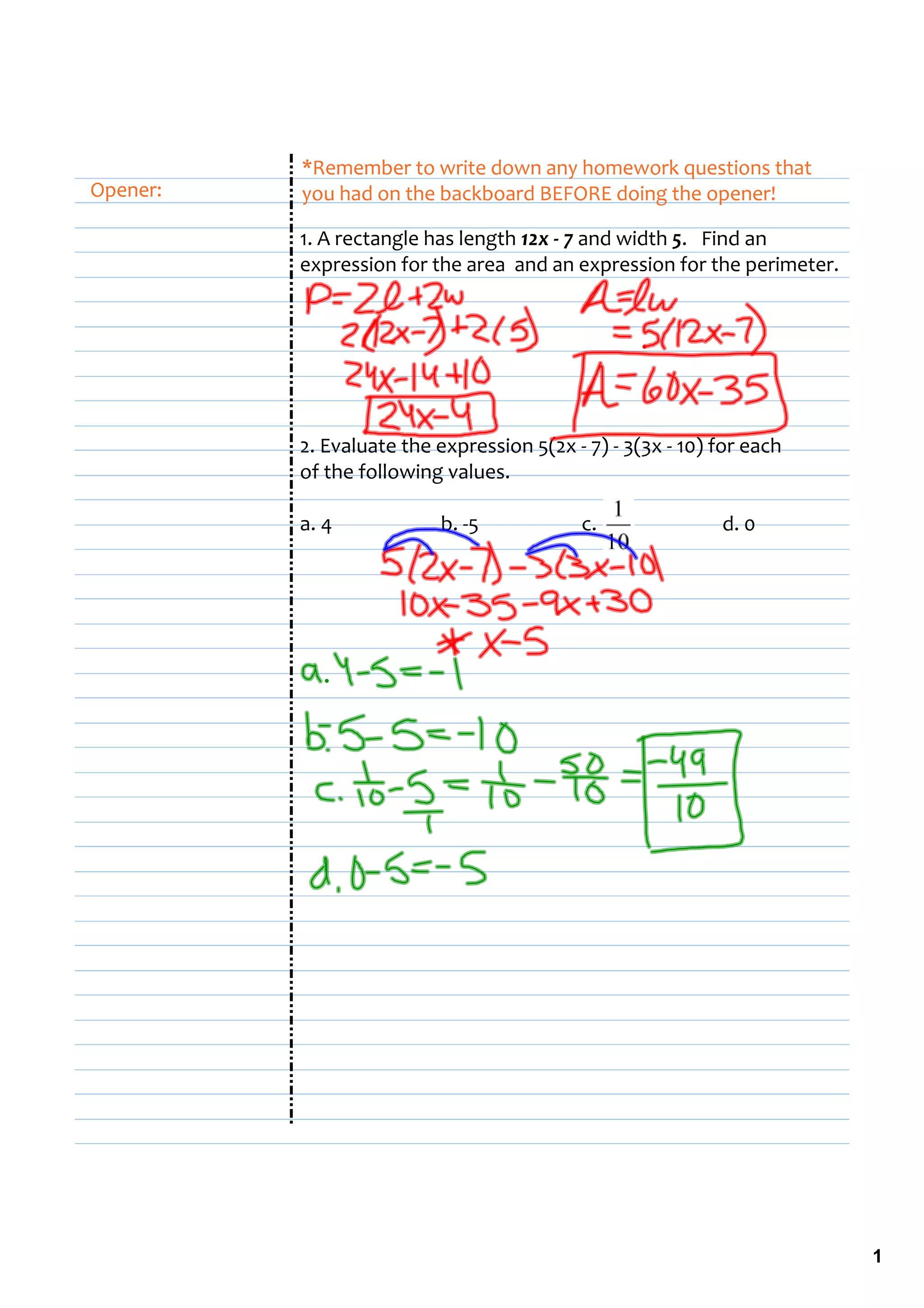
          1. A rectangle has length 12x ‐ 7 and width 5.   Find an 
          expression for the area  and an expression for the perimeter. 


          2. Evaluate the expression 5(2x ‐ 7) ‐ 3(3x ‐ 10) for each 
          of the following values.

          a. 4             b. ‐5            c.               d. 0


                                                                           1
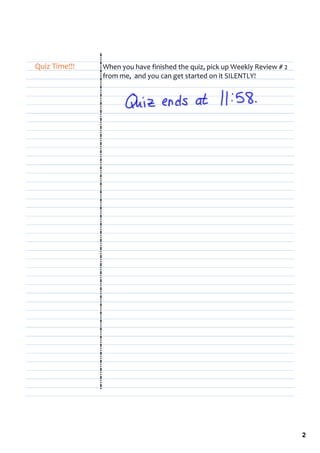
Quiz Time!!!   When you have finished the quiz, pick up Weekly Review # 2 
               from me,  and you can get started on it SILENTLY!


                                                                             2
3
Section 2.5                   Rephrasing the Basic Rules

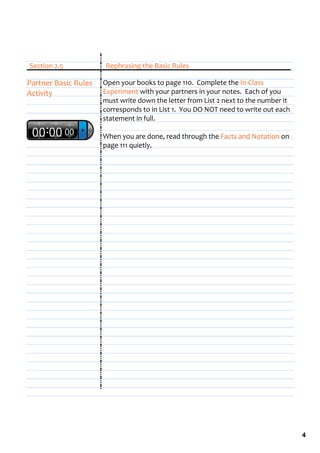
Partner Basic Rules      Open your books to page 110.  Complete the In‐Class 
Activity                 Experiment with your partners in your notes.  Each of you 
                         must write down the letter from List 2 next to the number it 
                         corresponds to in List 1.  You DO NOT need to write out each  
                         statement in full.

                         When you are done, read through the Facts and Notation on 
                         page 111 quietly.


                                                                                          4
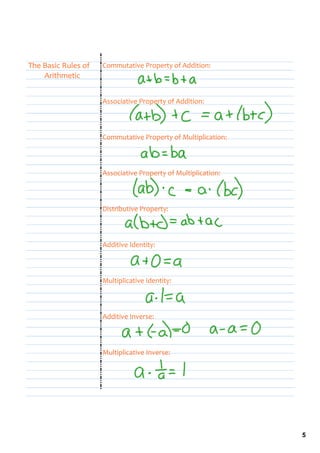
The Basic Rules of    Commutative Property of Addition:
    Arithmetic


                      Associative Property of Addition:


                      Commutative Property of Multiplication:


                      Associative Property of Multiplication:


                      Distributive Property:


                      Additive Identity:


                      Multiplicative Identity:


                      Additive Inverse:


                      Multiplicative Inverse:


                                                                5
Practicing the Basic    Ex 1:  Express each sentence without using variables:
Rules of Arithmetic
                        a. Dividing is the same as multiplying by the reciprocal.


                        b. Subtracting  is the same as adding the opposite.


                        c. If you have a product of two numbers, and you find the   
                            products of the opposites of the numbers, you get the same 
                            result.


                        d. If you multiply two numbers together and the result is 1, the 
                             numbers are reciprocals.


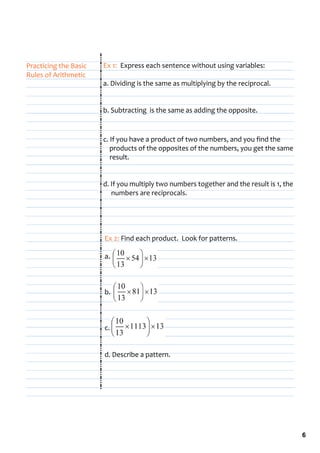
                        Ex 2: Find each product.  Look for patterns.

                        a.         


                        b. 


                        c.


                        d. Describe a pattern.


                                                                                            6
Expressions Survivor!!! Complete each of the following problems in your notes.  Once 
                        you agree on a final response write it down on your board, 
                        and lay your board face down until I say BOARDS UP!  Be 
                        careful in your work, as any incorrect answer will get you 
                        eliminated from the game.


                       Use the Commutative & Associative Properties and the 
                       Distributive Property to simplify each expression.  Please 
                       write down which properties you used in simplifying each one.

                       a. 2(x + 4) + 7


                       b. 13 + 3(1 + 2x)


                       c. 3(2x ‐ 5) ‐ 8


                       d. 4(x + 3) + 7(x + 3)


                       e. 6(3 ‐ 2x) ‐ 3(x + 1)


                                                                                        7
8

2.5 notes b

  • 1.
    *Remember to write down any homework questions that  Opener: you had on the backboard BEFORE doing the opener! 1. A rectangle has length 12x ‐ 7 and width 5.   Find an  expression for the area  and an expression for the perimeter.  2. Evaluate the expression 5(2x ‐ 7) ‐ 3(3x ‐ 10) for each  of the following values. a. 4 b. ‐5  c.  d. 0 1
  • 2.
    Quiz Time!!! When you have finished the quiz, pick up Weekly Review # 2  from me,  and you can get started on it SILENTLY! 2
  • 3.
  • 4.
    Section 2.5        Rephrasing the Basic Rules Partner Basic Rules  Open your books to page 110.  Complete the In‐Class  Activity Experiment with your partners in your notes.  Each of you  must write down the letter from List 2 next to the number it  corresponds to in List 1.  You DO NOT need to write out each   statement in full. When you are done, read through the Facts and Notation on  page 111 quietly. 4
  • 5.
    The Basic Rules of  Commutative Property of Addition: Arithmetic Associative Property of Addition: Commutative Property of Multiplication: Associative Property of Multiplication: Distributive Property: Additive Identity: Multiplicative Identity: Additive Inverse: Multiplicative Inverse: 5
  • 6.
    Practicing the Basic  Ex 1:  Express each sentence without using variables: Rules of Arithmetic a. Dividing is the same as multiplying by the reciprocal. b. Subtracting  is the same as adding the opposite. c. If you have a product of two numbers, and you find the        products of the opposites of the numbers, you get the same      result. d. If you multiply two numbers together and the result is 1, the       numbers are reciprocals. Ex 2: Find each product.  Look for patterns. a.          b.  c. d. Describe a pattern. 6
  • 7.
    Expressions Survivor!!! Complete each of the following problems in your notes.  Once  you agree on a final response write it down on your board,  and lay your board face down until I say BOARDS UP!  Be  careful in your work, as any incorrect answer will get you  eliminated from the game. Use the Commutative & Associative Properties and the  Distributive Property to simplify each expression.  Please  write down which properties you used in simplifying each one. a. 2(x + 4) + 7 b. 13 + 3(1 + 2x) c. 3(2x ‐ 5) ‐ 8 d. 4(x + 3) + 7(x + 3) e. 6(3 ‐ 2x) ‐ 3(x + 1) 7
  • 8.