Female sexual-offenders: Personality pathology as a mediator of the relationship between childhood sexual abuse history and sexual abuse perpetration against others Kelly Christopher, Catherine J.Lutz-Zois,  Amanda R. Reinhardt Reviewed by: Amy Offenbach, Caitlyn Shuy, and Tiera Bell November 11, 2008 Psyc 308 UMBC
Doris Ellen Moore Registered sex offender found on www.familywatchdog.us/Default.asp Sex offense 3 rd  degree Lives 1.42 miles from UMBC
Introduction Designed to explore reasons for the possible link between childhood victimization and sexual abuse of children perpetrated by women. Also to examine whether the nature of women’s own history of CSA (duration and relationship to the abuser) is associated with perpetration of sexual abuse of children
Intro and Background Previous studies have been small and participants have been psychiatric patients or prisoners Previous studies found most female sex offenders were victims of CSA. Some common expressed motivation given in previous studies for the sexual offenses have been revenge, anger or jealously.
Intro and Background (cont.) Previous studies have found subjects demonstrated PTSD, alcohol and substance abuse, self-injurious behaviors, border line personality disorders, Dissociative disorders and high rates of conduct disorder, ADD, and Oppositional Defiant Disorder No studies to the researchers knowledge have examined psychopathy in female sex-offenders
Intro and Background (cont.) Few studies have explored whether sexual-offenders suffered longer periods of sexual abuse than non-offenders with abuse histories, especially in an all-female sample. The duration of abuse has only previously been hypothesized as an important factor in predicting later perpetration of sexual abuse
Intro and Background (cont.) It has been found that duration of CSA is linked to a wide variety of other impairments in adult women such as physical health problems and more psychiatric symptoms. “ Scholars have proposed this as a mechanism for the abused-abuser cycle of some women and adolescent girls, this hypothesis has yet to be tested directly.”
Maidah Lorraine Amatullah Registered sex offender found on www.familywatchdog.us/Default.asp Rape 2 nd  degree Lives 2.6 miles from UMBC
About the Study Examine CSA personality traits and sexual abuse perpetration simultaneously instead of the relationship. Examine a large sample of females Investigate whether the nature of the abuse endured by female sex-offenders as children is an important predictor of sexual abuse perpetration in adulthood.
About the Study (cont.) Compare 2 groups Female prisoners convicted of sexual offenses against children Female prisoners convicted of other crimes
Hypotheses H1 Women in the sexual offense group would be more likely to report a history of CSA than those in the non-sex offender group H2 Antisocial and Borderline Personality tendencies would be positively correlated with a history of CSA H3 After statistical control, Antisocial and Borderline tendencies would predict sexual offender v. non-sex offender H4 After statistical control, Antisocial and Borderline tendencies CSA would not predict sexual offender v. non-sex offender H5 Women in the sexual offender group would report having suffered longer periods of CSA than those in non-sex offender H6 Women in sexual offender group would be more likely to report having been sexually victimized as a child by a family member than the women in the non-sex offender group H7 Women in sexual offender group would be more likely to have experiences a combination of sexual abuse and either physical or emotional abuse than those in the non-sex offender group
Methods Eligible participants were all inmates residing in a women’s correctional facility in the Midwest at the time of study There were 142 participants 61 who had sexually victimized or aided in the sexual victimization of another person 81 who had committed crimes other than sexual victimization (theft, drug offenses, or murder)
Methods Demographics
Methods  Measures History of childhood sexual abuse was measured by the Childhood Trauma Questionnaire. 28-item scale 5 point Likert scale Responses  “never true” to “very often true” CTQ was modified by adding two follow up questions that were fill in the blank If yes then who? How long did this occur?
Methods  Measures Antisocial personality traits were measured by the Levenson’s Self-Report Psychopathy Scale. 26 items 4 point Likert scale Responses “disagree strongly” to “agree strongly” 2 subscales Primary psychopathy subscale largely assesses selfishness and lack of concern for the well-being of others Secondary psychopathy subscale was designed to assess impulsivity and a self-defeating lifestyle
Methods  Measures Borderline personality traits were measured by the Borderline subscale of the Schizotypal Traits Questionnaire. 18 items Yes/No format
Methods Measures Social desirability is measured in order to assess the tendency of a person to present a favorable impression of themselves. It is measured by The Balanced Inventory of Desirable Responding (BIDR). The BIDR measures two contructs Self-deceptive enhancement Impression management
Methods Data Analyses Women in the sexual offender group had: Less education Fewer prior convictions Longer prison sentences H1 ANCOVA was calculated H2 evaluated by using partial correlations H3 & H4 calculated a discriminant function analysis H5 ANCOVA was calculated H6 calculated chi-square H7 two ANCOVA’s were calculated
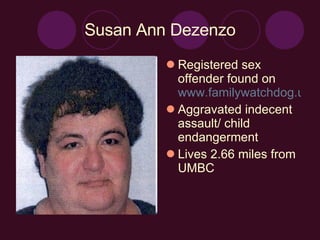
Susan Ann Dezenzo Registered sex offender found on  www.familywatchdog.us/Default.asp Aggravated indecent assault/ child endangerment Lives 2.66 miles from UMBC
Result Consistent with Hypotheses 1: sexual offenders group reported more frequent instances of CSA than non-sex offenders F (1,123)=4.7,  p <.05 Consistent with Hypotheses 2: CSA was significantly positively associated with Borderline Personality tendencies ( r  =.36,  p <.01) ;  but not with primary ( r = -.06, p>.05)or  secondary psychopathy ( r  = .14,  p >.05)
Results Cont. There was no support for Hypotheses 3: there was no significant difference in the hypothesized mediators (Borderline Personality tendencies and primary and secondary psychopathy Hypotheses 4 showed no support, because even with hypothesized mediators statically controlled, CSA still predicted sexual-offenders vs. non-sex offenders  F (1,116)=9.9, p<.01
Results Cont. Hypotheses 5: significant difference found between women of sexual-offenders and non-sex offenders, where sexual-offenders suffered from longer periods of CSA. F =(1,32)=4.6,  p <.05 Hypotheses 6: no significant relationship between being in the sexual-offender or non-sex offender group and the type of relationship between the participant and their sexual abuser as a child. X ² =.002,  p<.05
Results Cont. Hypotheses 7: of those who were sexually abused as a child there was no significant group difference in physical or emotional abuse  F (1,63)=3.1,  p >.05 F (1.63)=.4,  p >.05
Discussion In one of the first studies of its kind we found: That female prisoners convicted of sexual offenses against children reported more frequent instances of CSA than those not convicted And in terms of nature of the CSA history women in the sexual-offender group experienced CSA for a greater duration of time than those in the non-sex offender group
Discussion It has been assumed previously that CSA histories and sexual abuse perpetration in women are linked because the research has linked the two variables in men. Personality disorder tendencies did not seem to distinguish between sexual and non-sexual offenders. This may be in part because of a ceiling effect of female criminal behavior in general.
Discussion Consistent with past research the results indicated that the experience of CSA was related to personality disorders Duration of abuse appeared to be a much stronger predictor of sex-offending than the experience of abuse alone Great exposure as a child to CSA the more likely they are to view sexual relationships with children as “normal” and later model these actions
Discussion Limits Only used prison population Reading comprehension Not generalizeable results Because of criminal history one might expect more severe problems with personality pathology and history of sexual abuse
Disscussion In the future Research should also examine moderators of the relationship such as social support, coping skills, and involvement in early-intervention programs. More attention should be paid to duration of CSA
Reference Christopher, K., Lutz-Zois, C. J., & Reinhardt,  A. R. (2007). Female sexual-offenders:  Personality pathology as a mediator of the  relationship between childhood sexual  abuse history and sexual abuse perpetration  against others.  Child Abuse & Neglect ,  31 ,  871-883
Questions What are some likely predictors of a female sex-offender? What could be done to reduce/eliminate these predictors? Any other questions or thoughts?
Individual, family, and neighborhood factors distinguish resilient from non-resilient maltreated children: A cumulative stressor model Sara R. Jaffee, Avshalom Caspi,  Terrie E. Moffitt, Monica Polo-Tom ás, Alan Taylor Reviewed by: Amy Offenbach, Caitlyn Shuy, and Tiera Bell November 11, 2008 Psyc 308 UMBC
Introduction An estimated 906,000 children in the U.S were victims of abuse or neglect in 2003 Number of well-designed, prospective longitudinal studies have shown that children who are maltreated are at risk of a range of problems in childhood, adolescence and adulthood.
Introduction cont. Even though a lot of literature has identified multiple characteristics that are associated with resilience to maltreatment, this study contributes two things Identify individual, family, and neighborhood characteristics that predict stable, positive adaptation over a 2-year period Identify the interplay among risk and protective factors
Goals of Study and Hypotheses Goal 1: to test whether children who were defined as resilient according to these criteria were also functioning successfully in other domains Goal 2: to test whether individual, family and neighborhood characteristics would distinguish resilient from non-resilient maltreated children and whether the characteristics that were associated with resilience differed for girls and boys
Goals of Study and Hypotheses cont. Goals 2, hypotheses: children who have the attribute and who were maltreated will be behaviorally indistinguishable from children who have the attribute and were not maltreated. Also tested sex difference in the association since its not known whether resilience process differs between maltreated boys and girls
Goals of Study and Hypotheses cont. Goal 3: to test the hypothesis that children’s strength would predict resilience to maltreatment only when children were exposed to relatively few family and neighborhood stressors Comparing resilient to non-resilient allows them to test whether individual, family or neighborhood factors distinguished these two groups Comparing resilient to maltreated children allowed them to test whether maltreated children were doing as well and non-maltreated children simply
Methods
Methods Individual Characteristics: IQ scores were used and those who were at least half a SD above the mean IQ were considered above-average IQ . They also looked at temperament and children who were sociable and self controlled were said to have a well-adjusted temperament. They used the under-controlled temperament scale  and the shy temperament scale
Methods Family Characteristics: Maternal Warmth   Social Deprivation Mothers’ Major Depressive Disorder  Father’s and Mother’s History of Antisocial Behavior Drug and Alcohol Problems Adult Domestic Violence Sibling Warmth Sibling Conflict
Methods Neighborhood Characteristics: Crime  Informal Social Control Social Cohesion
Methods Child Behavior: At ages 5 and 7 parents were asked for permission to have their children’s teachers complete the Teacher Report Form. This assessed: Antisocial behaviors Emotional problems Prosocial behavior Reading ability was also assessed to test if children were reading at or above the median for the sample.
Methods Maltreatment: At the age 5 assessment, mothers were interviewed to assess if either child had ever been physically maltreated. Interviewers probed the mothers and were careful to word questions so they did not seem to implicate the mother as the perpetrator. The likelihood that the children were physically maltreated were categorized as: Not having been  Possibly been Definitely been
Methods 86% of children experienced no physical maltreatment They combined those who possibly experienced physical maltreatment and those who definitely experienced physical maltreatment so that 14% experienced some physical maltreatment. They used a Multinomial logistic regression analyses estimated the relative risk of being in one category (e.g., non-resilient) relative to a reference category (e.g., resilient) as a function of individual, family, and neighborhood covariates.
Results
Results cont.
Results cont.
Results cont.
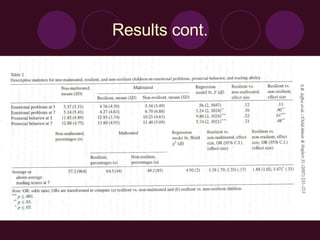
Discussion Maltreated before 5yrs, individual, family and neighborhood characteristics were associated with behavioral resilience. Boys with above average intelligence and whose parents had few symptoms of antisocial personality were more likely to be resilient. Exposure to multiple family and neighborhood stressors severely compromised children’s resilience.
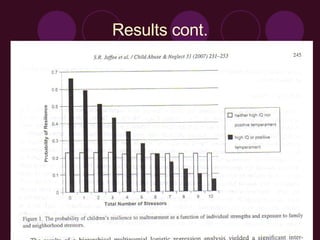
Discussion ¼ physically maltreated children were defined as resilient from teacher reports Those resilient at 5 years old were much more likely to be resilient at 7 years old. Persistent resilience, at least over 2 years can now be added to the literature. Individual strengths distinguished resilient from non-resilient children under conditions of low, but not high stress.
Discussion “ Our findings suggest that children who possess individual strengths and who can be protected from significant ongoing family and neighborhood stressors stand a good chance of maintaining positive functioning in the long-term. This, however, is an empirical proposition that must be put to the test with longitudinal data.”
Discussion Limits Those children defined as resilient may have functioned well because of experiencing relatively less severe or chronic episodes of maltreatment The proportion of children who were defined as resilient and the factors that distinguished resilient from non-resilient children might have varied depending on what type of abuse children experienced Children were all twins Advantages/disadvantages of the researchers creating an index of family and neighborhood factors.
Questions Do individual, family, and neighborhood factors distinguish resilient children from non-resilient and non-maltreated children? What increases you chances of being: Resilient? Non-resilient? Other thoughts or questions?
Reference Jaffee, S. R., Caspi, A., Moffitt, T. E., Polo- Tomás, M., & Taylor, A.(2007). Individual, family, and neighborhood factors distinguish resilient from non-resilient maltreated children: A cumulative stressor model.  Child Abuse & Neglect ,  31 , 231-253 Christopher, Kelly; Lutz-Zois, Catherine J.; Reinhardt, Amanda R.; (2007) Female sexual-offenders: personality pathology as a mediator of the relationship between childhood sexual abuse history and sexual abuse perpetration against others.; Child  Abuse & Neglect 31 , 871-883

308 Presentation

  • 1.
    Female sexual-offenders: Personalitypathology as a mediator of the relationship between childhood sexual abuse history and sexual abuse perpetration against others Kelly Christopher, Catherine J.Lutz-Zois, Amanda R. Reinhardt Reviewed by: Amy Offenbach, Caitlyn Shuy, and Tiera Bell November 11, 2008 Psyc 308 UMBC
  • 2.
    Doris Ellen MooreRegistered sex offender found on www.familywatchdog.us/Default.asp Sex offense 3 rd degree Lives 1.42 miles from UMBC
  • 3.
    Introduction Designed toexplore reasons for the possible link between childhood victimization and sexual abuse of children perpetrated by women. Also to examine whether the nature of women’s own history of CSA (duration and relationship to the abuser) is associated with perpetration of sexual abuse of children
  • 4.
    Intro and BackgroundPrevious studies have been small and participants have been psychiatric patients or prisoners Previous studies found most female sex offenders were victims of CSA. Some common expressed motivation given in previous studies for the sexual offenses have been revenge, anger or jealously.
  • 5.
    Intro and Background(cont.) Previous studies have found subjects demonstrated PTSD, alcohol and substance abuse, self-injurious behaviors, border line personality disorders, Dissociative disorders and high rates of conduct disorder, ADD, and Oppositional Defiant Disorder No studies to the researchers knowledge have examined psychopathy in female sex-offenders
  • 6.
    Intro and Background(cont.) Few studies have explored whether sexual-offenders suffered longer periods of sexual abuse than non-offenders with abuse histories, especially in an all-female sample. The duration of abuse has only previously been hypothesized as an important factor in predicting later perpetration of sexual abuse
  • 7.
    Intro and Background(cont.) It has been found that duration of CSA is linked to a wide variety of other impairments in adult women such as physical health problems and more psychiatric symptoms. “ Scholars have proposed this as a mechanism for the abused-abuser cycle of some women and adolescent girls, this hypothesis has yet to be tested directly.”
  • 8.
    Maidah Lorraine AmatullahRegistered sex offender found on www.familywatchdog.us/Default.asp Rape 2 nd degree Lives 2.6 miles from UMBC
  • 9.
    About the StudyExamine CSA personality traits and sexual abuse perpetration simultaneously instead of the relationship. Examine a large sample of females Investigate whether the nature of the abuse endured by female sex-offenders as children is an important predictor of sexual abuse perpetration in adulthood.
  • 10.
    About the Study(cont.) Compare 2 groups Female prisoners convicted of sexual offenses against children Female prisoners convicted of other crimes
  • 11.
    Hypotheses H1 Womenin the sexual offense group would be more likely to report a history of CSA than those in the non-sex offender group H2 Antisocial and Borderline Personality tendencies would be positively correlated with a history of CSA H3 After statistical control, Antisocial and Borderline tendencies would predict sexual offender v. non-sex offender H4 After statistical control, Antisocial and Borderline tendencies CSA would not predict sexual offender v. non-sex offender H5 Women in the sexual offender group would report having suffered longer periods of CSA than those in non-sex offender H6 Women in sexual offender group would be more likely to report having been sexually victimized as a child by a family member than the women in the non-sex offender group H7 Women in sexual offender group would be more likely to have experiences a combination of sexual abuse and either physical or emotional abuse than those in the non-sex offender group
  • 12.
    Methods Eligible participantswere all inmates residing in a women’s correctional facility in the Midwest at the time of study There were 142 participants 61 who had sexually victimized or aided in the sexual victimization of another person 81 who had committed crimes other than sexual victimization (theft, drug offenses, or murder)
  • 13.
  • 14.
    Methods MeasuresHistory of childhood sexual abuse was measured by the Childhood Trauma Questionnaire. 28-item scale 5 point Likert scale Responses “never true” to “very often true” CTQ was modified by adding two follow up questions that were fill in the blank If yes then who? How long did this occur?
  • 15.
    Methods MeasuresAntisocial personality traits were measured by the Levenson’s Self-Report Psychopathy Scale. 26 items 4 point Likert scale Responses “disagree strongly” to “agree strongly” 2 subscales Primary psychopathy subscale largely assesses selfishness and lack of concern for the well-being of others Secondary psychopathy subscale was designed to assess impulsivity and a self-defeating lifestyle
  • 16.
    Methods MeasuresBorderline personality traits were measured by the Borderline subscale of the Schizotypal Traits Questionnaire. 18 items Yes/No format
  • 17.
    Methods Measures Socialdesirability is measured in order to assess the tendency of a person to present a favorable impression of themselves. It is measured by The Balanced Inventory of Desirable Responding (BIDR). The BIDR measures two contructs Self-deceptive enhancement Impression management
  • 18.
    Methods Data AnalysesWomen in the sexual offender group had: Less education Fewer prior convictions Longer prison sentences H1 ANCOVA was calculated H2 evaluated by using partial correlations H3 & H4 calculated a discriminant function analysis H5 ANCOVA was calculated H6 calculated chi-square H7 two ANCOVA’s were calculated
  • 19.
    Susan Ann DezenzoRegistered sex offender found on www.familywatchdog.us/Default.asp Aggravated indecent assault/ child endangerment Lives 2.66 miles from UMBC
  • 20.
    Result Consistent withHypotheses 1: sexual offenders group reported more frequent instances of CSA than non-sex offenders F (1,123)=4.7, p <.05 Consistent with Hypotheses 2: CSA was significantly positively associated with Borderline Personality tendencies ( r =.36, p <.01) ; but not with primary ( r = -.06, p>.05)or secondary psychopathy ( r = .14, p >.05)
  • 21.
    Results Cont. Therewas no support for Hypotheses 3: there was no significant difference in the hypothesized mediators (Borderline Personality tendencies and primary and secondary psychopathy Hypotheses 4 showed no support, because even with hypothesized mediators statically controlled, CSA still predicted sexual-offenders vs. non-sex offenders F (1,116)=9.9, p<.01
  • 22.
    Results Cont. Hypotheses5: significant difference found between women of sexual-offenders and non-sex offenders, where sexual-offenders suffered from longer periods of CSA. F =(1,32)=4.6, p <.05 Hypotheses 6: no significant relationship between being in the sexual-offender or non-sex offender group and the type of relationship between the participant and their sexual abuser as a child. X ² =.002, p<.05
  • 23.
    Results Cont. Hypotheses7: of those who were sexually abused as a child there was no significant group difference in physical or emotional abuse F (1,63)=3.1, p >.05 F (1.63)=.4, p >.05
  • 24.
    Discussion In oneof the first studies of its kind we found: That female prisoners convicted of sexual offenses against children reported more frequent instances of CSA than those not convicted And in terms of nature of the CSA history women in the sexual-offender group experienced CSA for a greater duration of time than those in the non-sex offender group
  • 25.
    Discussion It hasbeen assumed previously that CSA histories and sexual abuse perpetration in women are linked because the research has linked the two variables in men. Personality disorder tendencies did not seem to distinguish between sexual and non-sexual offenders. This may be in part because of a ceiling effect of female criminal behavior in general.
  • 26.
    Discussion Consistent withpast research the results indicated that the experience of CSA was related to personality disorders Duration of abuse appeared to be a much stronger predictor of sex-offending than the experience of abuse alone Great exposure as a child to CSA the more likely they are to view sexual relationships with children as “normal” and later model these actions
  • 27.
    Discussion Limits Onlyused prison population Reading comprehension Not generalizeable results Because of criminal history one might expect more severe problems with personality pathology and history of sexual abuse
  • 28.
    Disscussion In thefuture Research should also examine moderators of the relationship such as social support, coping skills, and involvement in early-intervention programs. More attention should be paid to duration of CSA
  • 29.
    Reference Christopher, K.,Lutz-Zois, C. J., & Reinhardt, A. R. (2007). Female sexual-offenders: Personality pathology as a mediator of the relationship between childhood sexual abuse history and sexual abuse perpetration against others. Child Abuse & Neglect , 31 , 871-883
  • 30.
    Questions What aresome likely predictors of a female sex-offender? What could be done to reduce/eliminate these predictors? Any other questions or thoughts?
  • 31.
    Individual, family, andneighborhood factors distinguish resilient from non-resilient maltreated children: A cumulative stressor model Sara R. Jaffee, Avshalom Caspi, Terrie E. Moffitt, Monica Polo-Tom ás, Alan Taylor Reviewed by: Amy Offenbach, Caitlyn Shuy, and Tiera Bell November 11, 2008 Psyc 308 UMBC
  • 32.
    Introduction An estimated906,000 children in the U.S were victims of abuse or neglect in 2003 Number of well-designed, prospective longitudinal studies have shown that children who are maltreated are at risk of a range of problems in childhood, adolescence and adulthood.
  • 33.
    Introduction cont. Eventhough a lot of literature has identified multiple characteristics that are associated with resilience to maltreatment, this study contributes two things Identify individual, family, and neighborhood characteristics that predict stable, positive adaptation over a 2-year period Identify the interplay among risk and protective factors
  • 34.
    Goals of Studyand Hypotheses Goal 1: to test whether children who were defined as resilient according to these criteria were also functioning successfully in other domains Goal 2: to test whether individual, family and neighborhood characteristics would distinguish resilient from non-resilient maltreated children and whether the characteristics that were associated with resilience differed for girls and boys
  • 35.
    Goals of Studyand Hypotheses cont. Goals 2, hypotheses: children who have the attribute and who were maltreated will be behaviorally indistinguishable from children who have the attribute and were not maltreated. Also tested sex difference in the association since its not known whether resilience process differs between maltreated boys and girls
  • 36.
    Goals of Studyand Hypotheses cont. Goal 3: to test the hypothesis that children’s strength would predict resilience to maltreatment only when children were exposed to relatively few family and neighborhood stressors Comparing resilient to non-resilient allows them to test whether individual, family or neighborhood factors distinguished these two groups Comparing resilient to maltreated children allowed them to test whether maltreated children were doing as well and non-maltreated children simply
  • 37.
  • 38.
    Methods Individual Characteristics:IQ scores were used and those who were at least half a SD above the mean IQ were considered above-average IQ . They also looked at temperament and children who were sociable and self controlled were said to have a well-adjusted temperament. They used the under-controlled temperament scale and the shy temperament scale
  • 39.
    Methods Family Characteristics:Maternal Warmth Social Deprivation Mothers’ Major Depressive Disorder Father’s and Mother’s History of Antisocial Behavior Drug and Alcohol Problems Adult Domestic Violence Sibling Warmth Sibling Conflict
  • 40.
    Methods Neighborhood Characteristics:Crime Informal Social Control Social Cohesion
  • 41.
    Methods Child Behavior:At ages 5 and 7 parents were asked for permission to have their children’s teachers complete the Teacher Report Form. This assessed: Antisocial behaviors Emotional problems Prosocial behavior Reading ability was also assessed to test if children were reading at or above the median for the sample.
  • 42.
    Methods Maltreatment: Atthe age 5 assessment, mothers were interviewed to assess if either child had ever been physically maltreated. Interviewers probed the mothers and were careful to word questions so they did not seem to implicate the mother as the perpetrator. The likelihood that the children were physically maltreated were categorized as: Not having been Possibly been Definitely been
  • 43.
    Methods 86% ofchildren experienced no physical maltreatment They combined those who possibly experienced physical maltreatment and those who definitely experienced physical maltreatment so that 14% experienced some physical maltreatment. They used a Multinomial logistic regression analyses estimated the relative risk of being in one category (e.g., non-resilient) relative to a reference category (e.g., resilient) as a function of individual, family, and neighborhood covariates.
  • 44.
  • 45.
  • 46.
  • 47.
  • 48.
    Discussion Maltreated before5yrs, individual, family and neighborhood characteristics were associated with behavioral resilience. Boys with above average intelligence and whose parents had few symptoms of antisocial personality were more likely to be resilient. Exposure to multiple family and neighborhood stressors severely compromised children’s resilience.
  • 49.
    Discussion ¼ physicallymaltreated children were defined as resilient from teacher reports Those resilient at 5 years old were much more likely to be resilient at 7 years old. Persistent resilience, at least over 2 years can now be added to the literature. Individual strengths distinguished resilient from non-resilient children under conditions of low, but not high stress.
  • 50.
    Discussion “ Ourfindings suggest that children who possess individual strengths and who can be protected from significant ongoing family and neighborhood stressors stand a good chance of maintaining positive functioning in the long-term. This, however, is an empirical proposition that must be put to the test with longitudinal data.”
  • 51.
    Discussion Limits Thosechildren defined as resilient may have functioned well because of experiencing relatively less severe or chronic episodes of maltreatment The proportion of children who were defined as resilient and the factors that distinguished resilient from non-resilient children might have varied depending on what type of abuse children experienced Children were all twins Advantages/disadvantages of the researchers creating an index of family and neighborhood factors.
  • 52.
    Questions Do individual,family, and neighborhood factors distinguish resilient children from non-resilient and non-maltreated children? What increases you chances of being: Resilient? Non-resilient? Other thoughts or questions?
  • 53.
    Reference Jaffee, S.R., Caspi, A., Moffitt, T. E., Polo- Tomás, M., & Taylor, A.(2007). Individual, family, and neighborhood factors distinguish resilient from non-resilient maltreated children: A cumulative stressor model. Child Abuse & Neglect , 31 , 231-253 Christopher, Kelly; Lutz-Zois, Catherine J.; Reinhardt, Amanda R.; (2007) Female sexual-offenders: personality pathology as a mediator of the relationship between childhood sexual abuse history and sexual abuse perpetration against others.; Child Abuse & Neglect 31 , 871-883