Re-victimization patterns in a national longitudinal sample of children and youth DAVID FINKELHOR, RICHARD K. ORMROD, HEATHER A. TURNER Reviewed by Nina Bersabal & Amanda Gegor October 28, 2008 PSYC 308 UMBC
background Definitions of re-victimization Connection between  childhood victimization and adult victimization Repeat victimization (two victimizations occurring in closer proximity) Recurrence of episode of child maltreatment typically at hands of same perpetrator  Additions for this article Considering victimization broadly Victimization is ongoing How individuals escape re-victimization
introducdtion Objective: To understand persistent victimization for children from one year to the next Key Questions: Increased likelihood to be victimized again? Does one sort increase victimization for another sort? Are highly victimized youth in one year vulnerable to re-victimization? Risk factors and resilience factors?
Methods National sample of 1467 children Age 2 – 17  Recruited through random digit dialing Assessed vial telephone interviews (caretakers and youth) Asked about comprehensive range of victimization experiences in previous year Re-assessed after one-year interval
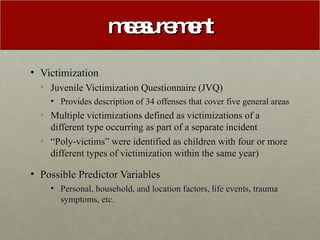
measurement Victimization Juvenile Victimization Questionnaire (JVQ) Provides description of 34 offenses that cover five general areas Multiple victimizations defined as victimizations of a different type occurring as part of a separate incident “ Poly-victims” were identified as children with four or more different types of victimization within the same year) Possible Predictor Variables Personal, household, and location factors, life events, trauma symptoms, etc.
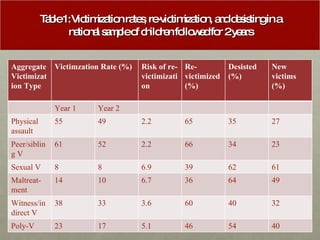
Table 1: Victimization rates, re-victimization, and desisting in a national sample of children followed for 2 years Aggregate Victimization Type Victimzation Rate (%) Risk of re-victimization Re-victimized (%) Desisted (%) New victims (%) Year 1 Year 2 Physical assault 55 49 2.2 65 35 27 Peer/sibling V 61 52 2.2 66 34 23 Sexual V 8 8 6.9 39 62 61 Maltreat-ment 14 10 6.7 36 64 49 Witness/indirect V 38 33 3.6 60 40 32 Poly-V 23 17 5.1 46 54 40
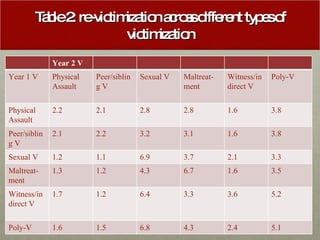
Table 2: re-victimization across different types of victimization Year 2 V Year 1 V Physical Assault Peer/sibling V Sexual V Maltreat-ment Witness/indirect V Poly-V Physical Assault 2.2 2.1 2.8 2.8 1.6 3.8 Peer/sibling V 2.1 2.2 3.2 3.1 1.6 3.8 Sexual V 1.2 1.1 6.9 3.7 2.1 3.3 Maltreat-ment 1.3 1.2 4.3 6.7 1.6 3.5 Witness/indirect V 1.7 1.2 6.4 3.3 3.6 5.2 Poly-V 1.6 1.5 6.8 4.3 2.4 5.1
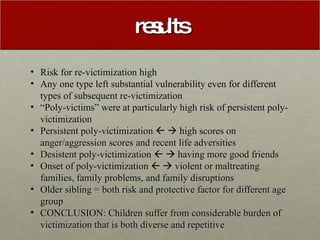
results Risk for re-victimization high Any one type left substantial vulnerability even for different types of subsequent re-victimization “ Poly-victims” were at particularly high risk of persistent poly-victimization Persistent poly-victimization       high scores on anger/aggression scores and recent life adversities Desistent poly-victimization       having more good friends Onset of poly-victimization       violent or maltreating families, family problems, and family disruptions Older sibling = both risk and protective factor for different age group CONCLUSION: Children suffer from considerable burden of victimization that is both diverse and repetitive
discussion Reconfirms children suffer high quantities of different sorts of victimization Emphasizes such victimizations have very high likelihood of persisting May be generalized causal pathways to explain re-victimization Didn’t identify any other positive desistence factors except for social network/support Start earlier and longer longitudinal study
references Finkelhor, David, Richard K. Ormrod & Heather A. Turner. (2007). Re-victimization patterns in a national longitudinal sample of children and youth.  Child Abuse & Neglect . 31, 479 – 502. Miller-Perrin, Cindy & R. D. Perrin. (2006).  Child Maltreatment . Second edition. Thousand Oaks, CA: Sage.

Presentation Re Victimization

  • 1.
    Re-victimization patterns ina national longitudinal sample of children and youth DAVID FINKELHOR, RICHARD K. ORMROD, HEATHER A. TURNER Reviewed by Nina Bersabal & Amanda Gegor October 28, 2008 PSYC 308 UMBC
  • 2.
    background Definitions ofre-victimization Connection between childhood victimization and adult victimization Repeat victimization (two victimizations occurring in closer proximity) Recurrence of episode of child maltreatment typically at hands of same perpetrator Additions for this article Considering victimization broadly Victimization is ongoing How individuals escape re-victimization
  • 3.
    introducdtion Objective: Tounderstand persistent victimization for children from one year to the next Key Questions: Increased likelihood to be victimized again? Does one sort increase victimization for another sort? Are highly victimized youth in one year vulnerable to re-victimization? Risk factors and resilience factors?
  • 4.
    Methods National sampleof 1467 children Age 2 – 17 Recruited through random digit dialing Assessed vial telephone interviews (caretakers and youth) Asked about comprehensive range of victimization experiences in previous year Re-assessed after one-year interval
  • 5.
    measurement Victimization JuvenileVictimization Questionnaire (JVQ) Provides description of 34 offenses that cover five general areas Multiple victimizations defined as victimizations of a different type occurring as part of a separate incident “ Poly-victims” were identified as children with four or more different types of victimization within the same year) Possible Predictor Variables Personal, household, and location factors, life events, trauma symptoms, etc.
  • 6.
    Table 1: Victimizationrates, re-victimization, and desisting in a national sample of children followed for 2 years Aggregate Victimization Type Victimzation Rate (%) Risk of re-victimization Re-victimized (%) Desisted (%) New victims (%) Year 1 Year 2 Physical assault 55 49 2.2 65 35 27 Peer/sibling V 61 52 2.2 66 34 23 Sexual V 8 8 6.9 39 62 61 Maltreat-ment 14 10 6.7 36 64 49 Witness/indirect V 38 33 3.6 60 40 32 Poly-V 23 17 5.1 46 54 40
  • 7.
    Table 2: re-victimizationacross different types of victimization Year 2 V Year 1 V Physical Assault Peer/sibling V Sexual V Maltreat-ment Witness/indirect V Poly-V Physical Assault 2.2 2.1 2.8 2.8 1.6 3.8 Peer/sibling V 2.1 2.2 3.2 3.1 1.6 3.8 Sexual V 1.2 1.1 6.9 3.7 2.1 3.3 Maltreat-ment 1.3 1.2 4.3 6.7 1.6 3.5 Witness/indirect V 1.7 1.2 6.4 3.3 3.6 5.2 Poly-V 1.6 1.5 6.8 4.3 2.4 5.1
  • 8.
    results Risk forre-victimization high Any one type left substantial vulnerability even for different types of subsequent re-victimization “ Poly-victims” were at particularly high risk of persistent poly-victimization Persistent poly-victimization   high scores on anger/aggression scores and recent life adversities Desistent poly-victimization   having more good friends Onset of poly-victimization   violent or maltreating families, family problems, and family disruptions Older sibling = both risk and protective factor for different age group CONCLUSION: Children suffer from considerable burden of victimization that is both diverse and repetitive
  • 9.
    discussion Reconfirms childrensuffer high quantities of different sorts of victimization Emphasizes such victimizations have very high likelihood of persisting May be generalized causal pathways to explain re-victimization Didn’t identify any other positive desistence factors except for social network/support Start earlier and longer longitudinal study
  • 10.
    references Finkelhor, David,Richard K. Ormrod & Heather A. Turner. (2007). Re-victimization patterns in a national longitudinal sample of children and youth. Child Abuse & Neglect . 31, 479 – 502. Miller-Perrin, Cindy & R. D. Perrin. (2006). Child Maltreatment . Second edition. Thousand Oaks, CA: Sage.