Child Maltreatment Among Immigrant Chinese Families: Characteristics and Patterns of Placement Researchers:   Siyon Rhee, Janet Chang, Dale Weaver and Danette Wong Reviewed By: Dominique Goldring Jaime Watkins Scott Wildesen Psyc 308 – October, 28 2008
Introduction One-fourth of the nation’s foreign-born residents in the US today are Asian.  More than 80% of Chinese people who currently live in the US are  foreign-born or have at least one parent who is foreign-born. Chinese immigrants, like people of other ethnicities, go through psychosocial  problems, such as domestic violence, family breakup, parent-child conflict,  substance abuse, juvenile delinquency, unemployment, and discrimination,  contrary to misconceptions. There is a mistaken belief that Chinese Americans don’t need as much  governmental assistance, social services and mental health care as other  ethnicities in the US population.  Abuse in Asian Americans is underrepresented in literature. CPS agencies do not have adequate post investigation placement  decisions for immigrant Asian American child abuse victims. The objective of this study was to examine types of child abuse in Chinese  immigrants and limited-English-speaking perpetrators in Los Angeles, and  behavioral characteristics of typical victims.
Introduction The study wanted to identify some of the variables CPS takes into  consideration for post investigation placement decisions.  Lastly, it aimed to present effective child welfare practices for Chinese  immigrant child abuse victims and their families. In a previous study by Gong (1985), showed that white Americans rated  vignettes depicting child physical and verbal abuse more severely than did  Asian Americans. Asian Americans were more focused on the child sexual  abuse vignettes.  Asian Americans also picked the least intrusive measures for intervention. This may be because of the collectivistic attitudes of the Chinese  culture.
Chinese Americans have different standards and definitions of child  maltreatment, so the newer they are to America, the less they know  about American standards for child maltreatment- acculturation. Asian cultures are generally more accepting of corporal  punishment. Introduction Courts should look more at cultural practices and the context of the abuse  when studying immigrant families.
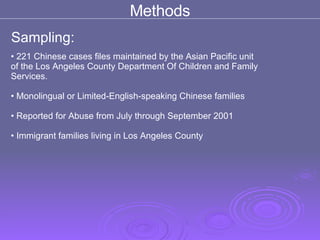
Methods Sampling: 221 Chinese cases files maintained by the Asian Pacific unit  of the Los Angeles County Department Of Children and Family  Services.  Monolingual or Limited-English-speaking Chinese families Reported for Abuse from July through September 2001 Immigrant families living in Los Angeles County
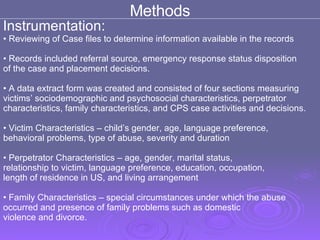
Methods Instrumentation: Reviewing of Case files to determine information available in the records Records included referral source, emergency response status disposition of the case and placement decisions.  A data extract form was created and consisted of four sections measuring  victims’ sociodemographic and psychosocial characteristics, perpetrator  characteristics, family characteristics, and CPS case activities and decisions. Victim Characteristics – child’s gender, age, language preference,  behavioral problems, type of abuse, severity and duration  Perpetrator Characteristics – age, gender, marital status,  relationship to victim, language preference, education, occupation,  length of residence in US, and living arrangement Family Characteristics – special circumstances under which the abuse  occurred and presence of family problems such as domestic  violence and divorce.
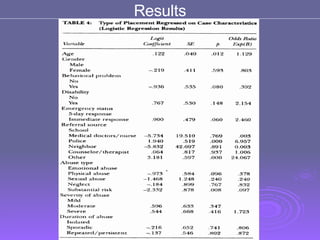
Methods Data Analysis: Data extracted from the case files were analyzed by using  descriptive statistics  Logistic regression analysis was used to examine the odds of children  being kept in or removed from the home on selected independent variables
Results
Results
Results
Results
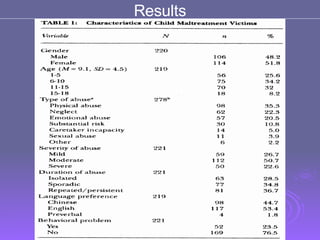
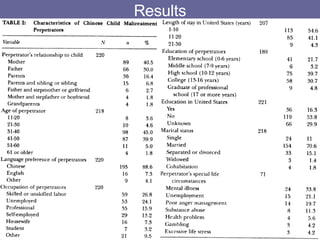
Discussion First study of its type  Study came to same results as Ima and Hohm Overall results similar to the study done by Change and his colleagues  In the study 18.9% of cases were of physical abuse and 27.4% neglect  and 11 cases were sexual abuse U.S. census shows Asian Americans are the second largest ethnic group  in California and also fastest growing minority in America  High Physical Abuse rates reflect  Cultural beliefs Family roles  Childs expectations  Gender  roles
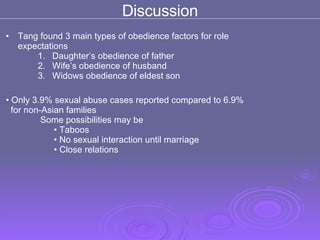
Discussion Tang found 3 main types of obedience factors for role expectations Daughter’s obedience of father Wife’s obedience of husband  Widows obedience of eldest son Only 3.9% sexual abuse cases reported compared to 6.9%  for non-Asian families    Some possibilities may be Taboos  No sexual interaction until marriage  Close relations
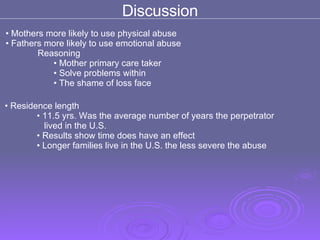
Mothers more likely to use physical abuse Fathers more likely to use emotional abuse  Reasoning Mother primary care taker  Solve problems within  The shame of loss face  Discussion Residence length  11.5 yrs. Was the average number of years the perpetrator  lived in the U.S.  Results show time does have an effect  Longer families live in the U.S. the less severe the abuse
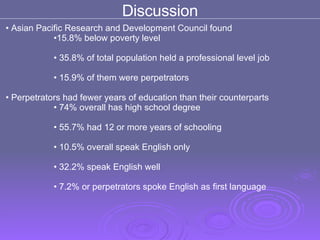
Discussion Asian Pacific Research and Development Council found  15.8% below poverty level 35.8% of total population held a professional level job  15.9% of them were perpetrators  Perpetrators had fewer years of education than their counterparts  74% overall has high school degree  55.7% had 12 or more years of schooling  10.5% overall speak English only  32.2% speak English well 7.2% or perpetrators spoke English as first language
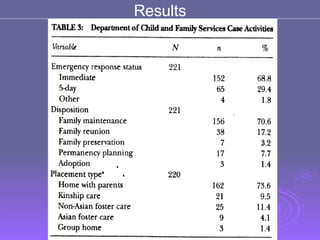
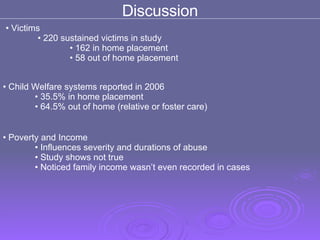
Discussion Victims 220 sustained victims in study  162 in home placement 58 out of home placement  Child Welfare systems reported in 2006  35.5% in home placement 64.5% out of home (relative or foster care) Poverty and Income Influences severity and durations of abuse  Study shows not true  Noticed family income wasn’t even recorded in cases
Discussion Needs for continuing the experiment Establish clear policies of abuse International collaboration Help from the community  More evidence  Ways of solve these problems  Outreach programs Inform immigrant families of situation Better teaching of methods to attain from abuse Better family systems
References Blair, R. G. (2000). Risk factors associated with PTSD and major depression  among Cambodian refugees in Utah.  Health & Social Work, 25 (1), 23-31.  Carlson, E. B., & Rosser-Hogan, R. (1993). Mental health status of Cambodian  refugees 10 years after leaving home .  American Journal of  Orthopsychiatry, 63 (2) ,  223-231.  Connelly, C. D., & Straus, M. R. (1992). Mother’s age and risk for physical abuse.  Child Abuse and Neglect, 16 , 709-718.  Do, P. V. (2002).  Between two cultures: Struggles of Vietnamese American  adolescents.  Retrieved October 29, 2002 from http://site.yahoo.com/  vstudies/petervando.html Hopkins, M. (1996).  Braving a new world: Cambodian (Khmer) refugees in an  American city.  Westport, CT: Bergin & Barvey.  Huang, K. (1991). Chinese Americans. In N. Mokuau, (Ed.),  Handbook of social services for Asian and Pacific Islanders  (pp. 79-96). New York:  Greenwood Press.
Hurh, W. M., & Kim, K. C. (1990). Correlates of Asian immigrants’ mental health. Journal of Nervous and Mental Disease ,  178 (11), 703-711.  Ima, K., & Hohm, C. F. (1991). Child maltreatment among Asian and Pacific  Islander refugees and immigrants: The San Diego case.  Journal of  Interpersonal Violence, 6 (3), 267-285.  Jarvis, H. (1997).  Cambodia: World bibliographical series,  Volume 200. Oxford,  England: Clio Press.  Kim, I. (1981).  New urban immigrants: The Asian community in New York .  Princeton, NJ: Princeton University Press.  Kim, D., Kim, K., Park, Y., Zhang, L., Lu, M., & Li, D. (2000). Children's experience of violence in China and Korea: A transcultural study.  Child Abuse and Neglect, 24 (9), 1163-1173.  Kitano, H. L., & Daniels, R. (1995 ). Asian Americans: Emerging minorities .  Englewood Cliffs, NJ: Prentice-Hall.  References
Kitano, H. L., & Nakaoka, S. (2001). Asian Americans in the twentieth century.  Journal of Human Behavior in the Social Environment, 3 (3/4), 7-17.  Min, P. G. (1998).  Changes and conflicts: Asian immigrant families in New York .  Needham Heights, MA: Allyn and Bacon.  Montero, D. (1979).  Vietnamese Americans: Patterns of resettlement and  socioeconomic adaptation in the United States . Boulder, CO: Westview  Press.  Park, M. S. (2001). The factors of child physical abuse in Asian immigrant  families.  Child Abuse and Neglect, 25 (7), 945-959.  Pfeifer, M. E. (2001). U.S. census 2000: An overview of national and regional  trends in Vietnamese residential distribution.  The Review of Vietnamese  Studies, 1 (1), 1-8. Retrieved June 16, 2005 from http://hmongstudies.com/  Pfeifer2001.pdf Rhee, S. (1996). Effective social work practice with Asian immigrant families. Journal of Multicultural Social Work ,  4 (1), 49-61.  References
Rutledge, P. (1992).  The Vietnamese experience in America . Bloomington: Indiana University Press.  Segal, U. A. (2000). Exploring child abuse among Vietnamese refugees.  Journal  of Multicultural Social Work, 8 (3/4), 159-191.  Song, K. (1986).  Defining child abuse: Asian community study . Unpublished  doctoral dissertation, University of California Los Angeles, School of Social Welfare.  Strand, P. J., & Jones, W. (1985).  Indochinese refugees in America: Problems of  adaptation and assimilation . Durham, NC: Duke University Press.  Takaki, R. (1989).  Strangers from a different shore: A history of Asian Americans. New York: Penguin Group.  Tenhula, J. (1991).  Voices from Southeast Asia: The refugee experience in the  United States . New York: Holmes & Meier Publishers, Inc.  Tower, C. C. (1999).  Understanding child abuse and neglect  (4th ed.) .  Boston:  Allyn and Bacon.  References
U.S. Census Bureau. (2000a).  Census 2000, summary file 2; generated by Census Data and Geographic Information Services; using American  Factfinder . Retrieved December 17, 2004 from http://factfinder.census.gov  U.S. Census Bureau. (2000b).  Census 2000 summary file: California . Retrieved December 17, 2004 from http://factfinder.census.gov/servlet/BasicFacts  Table?_lang=en&_vt_name=DEC_2000_SF1_U_DP1&_geo_id=04000US06  U.S. Census Bureau. (2002).  The Asian population 2000: Census 2000 brief . Retrieved December 10, 2004 from http://www.census.gov/prod/  2002pubs/c2kbr 01-16.pdf  U.S. Census Bureau (2003a).  Selected historical decennial census and housing  counts . Retrieved December 17, 2004 from http://www.censusdata/ hiscendata.html  U.S. Census Bureau. (2003b).  Facts for features Asian American heritage  month: May 2003 . Retrieved December 17, 2004 from http://www.census.gov/Press-Release/www/2003/cb03-ff05.html  References
U.S. Census Bureau. (2003c).  The Asian and Pacific Islander population in the  United States: March 2002 . Retrieved December 10, 2004 from http://www.census.gov/prod/2003pubs/p20-540.pdf  U.S. Census Bureau. (2003d).  State and county quick facts: Los Angeles County, California, July 15, 2003 . Retrieved December 10, 2004 from  http://quickfacts.census.gov/qfd/states/06/06037.html  U.S. Census Bureau (2003e ). Profile of general demographic characteristics:  2000 data set: Census 2000 summary file1 (SF 1) 100 percent data  geographic area: United States . Washington, DC: U.S. Government  Publication. U.S. Census Bureau (2003f). Income, poverty, and health insurance in the United  States: 2003, p60-226, Table1. Retrieved May 28, 2005 from http://www.irp.wisc.edu/faqs/faq3/table1.htm  Widom, C. S. (1989). Does violence beget violence? A critical examination of  the literature.  Psychological Bulletin, 106 (1), 3-28.  References
Wong, M. G. (1995). Chinese Americans. In P. G. Min (Ed.),  Asian Americans:  Contemporary Issues and Trends  (pp. 58-94). Thousand Oaks, CA: Sage  Publications, Inc.  Yu, E. Y., Choe, P., & Han, S. I. (2002, Spring/Summer). Asian population in the  United States, 2002: Demographic characteristics and socio-economic status.  International Journal of Asian Studies ,  6 (1), 71-107.  Zhou, M. (1999). Coming of age: The current situation of Asian American  children.  Amerasia Journal, 25 (1), 1-27.  References

Article1

  • 1.
    Child Maltreatment AmongImmigrant Chinese Families: Characteristics and Patterns of Placement Researchers: Siyon Rhee, Janet Chang, Dale Weaver and Danette Wong Reviewed By: Dominique Goldring Jaime Watkins Scott Wildesen Psyc 308 – October, 28 2008
  • 2.
    Introduction One-fourth ofthe nation’s foreign-born residents in the US today are Asian. More than 80% of Chinese people who currently live in the US are foreign-born or have at least one parent who is foreign-born. Chinese immigrants, like people of other ethnicities, go through psychosocial problems, such as domestic violence, family breakup, parent-child conflict, substance abuse, juvenile delinquency, unemployment, and discrimination, contrary to misconceptions. There is a mistaken belief that Chinese Americans don’t need as much governmental assistance, social services and mental health care as other ethnicities in the US population. Abuse in Asian Americans is underrepresented in literature. CPS agencies do not have adequate post investigation placement decisions for immigrant Asian American child abuse victims. The objective of this study was to examine types of child abuse in Chinese immigrants and limited-English-speaking perpetrators in Los Angeles, and behavioral characteristics of typical victims.
  • 3.
    Introduction The studywanted to identify some of the variables CPS takes into consideration for post investigation placement decisions. Lastly, it aimed to present effective child welfare practices for Chinese immigrant child abuse victims and their families. In a previous study by Gong (1985), showed that white Americans rated vignettes depicting child physical and verbal abuse more severely than did Asian Americans. Asian Americans were more focused on the child sexual abuse vignettes. Asian Americans also picked the least intrusive measures for intervention. This may be because of the collectivistic attitudes of the Chinese culture.
  • 4.
    Chinese Americans havedifferent standards and definitions of child maltreatment, so the newer they are to America, the less they know about American standards for child maltreatment- acculturation. Asian cultures are generally more accepting of corporal punishment. Introduction Courts should look more at cultural practices and the context of the abuse when studying immigrant families.
  • 5.
    Methods Sampling: 221Chinese cases files maintained by the Asian Pacific unit of the Los Angeles County Department Of Children and Family Services. Monolingual or Limited-English-speaking Chinese families Reported for Abuse from July through September 2001 Immigrant families living in Los Angeles County
  • 6.
    Methods Instrumentation: Reviewingof Case files to determine information available in the records Records included referral source, emergency response status disposition of the case and placement decisions. A data extract form was created and consisted of four sections measuring victims’ sociodemographic and psychosocial characteristics, perpetrator characteristics, family characteristics, and CPS case activities and decisions. Victim Characteristics – child’s gender, age, language preference, behavioral problems, type of abuse, severity and duration Perpetrator Characteristics – age, gender, marital status, relationship to victim, language preference, education, occupation, length of residence in US, and living arrangement Family Characteristics – special circumstances under which the abuse occurred and presence of family problems such as domestic violence and divorce.
  • 7.
    Methods Data Analysis:Data extracted from the case files were analyzed by using descriptive statistics Logistic regression analysis was used to examine the odds of children being kept in or removed from the home on selected independent variables
  • 8.
  • 9.
  • 10.
  • 11.
  • 12.
    Discussion First studyof its type Study came to same results as Ima and Hohm Overall results similar to the study done by Change and his colleagues In the study 18.9% of cases were of physical abuse and 27.4% neglect and 11 cases were sexual abuse U.S. census shows Asian Americans are the second largest ethnic group in California and also fastest growing minority in America High Physical Abuse rates reflect Cultural beliefs Family roles Childs expectations Gender roles
  • 13.
    Discussion Tang found3 main types of obedience factors for role expectations Daughter’s obedience of father Wife’s obedience of husband Widows obedience of eldest son Only 3.9% sexual abuse cases reported compared to 6.9% for non-Asian families Some possibilities may be Taboos No sexual interaction until marriage Close relations
  • 14.
    Mothers more likelyto use physical abuse Fathers more likely to use emotional abuse Reasoning Mother primary care taker Solve problems within The shame of loss face Discussion Residence length 11.5 yrs. Was the average number of years the perpetrator lived in the U.S. Results show time does have an effect Longer families live in the U.S. the less severe the abuse
  • 15.
    Discussion Asian PacificResearch and Development Council found 15.8% below poverty level 35.8% of total population held a professional level job 15.9% of them were perpetrators Perpetrators had fewer years of education than their counterparts 74% overall has high school degree 55.7% had 12 or more years of schooling 10.5% overall speak English only 32.2% speak English well 7.2% or perpetrators spoke English as first language
  • 16.
    Discussion Victims 220sustained victims in study 162 in home placement 58 out of home placement Child Welfare systems reported in 2006 35.5% in home placement 64.5% out of home (relative or foster care) Poverty and Income Influences severity and durations of abuse Study shows not true Noticed family income wasn’t even recorded in cases
  • 17.
    Discussion Needs forcontinuing the experiment Establish clear policies of abuse International collaboration Help from the community More evidence Ways of solve these problems Outreach programs Inform immigrant families of situation Better teaching of methods to attain from abuse Better family systems
  • 18.
    References Blair, R.G. (2000). Risk factors associated with PTSD and major depression among Cambodian refugees in Utah. Health & Social Work, 25 (1), 23-31. Carlson, E. B., & Rosser-Hogan, R. (1993). Mental health status of Cambodian refugees 10 years after leaving home . American Journal of Orthopsychiatry, 63 (2) , 223-231. Connelly, C. D., & Straus, M. R. (1992). Mother’s age and risk for physical abuse. Child Abuse and Neglect, 16 , 709-718. Do, P. V. (2002). Between two cultures: Struggles of Vietnamese American adolescents. Retrieved October 29, 2002 from http://site.yahoo.com/ vstudies/petervando.html Hopkins, M. (1996). Braving a new world: Cambodian (Khmer) refugees in an American city. Westport, CT: Bergin & Barvey. Huang, K. (1991). Chinese Americans. In N. Mokuau, (Ed.), Handbook of social services for Asian and Pacific Islanders (pp. 79-96). New York: Greenwood Press.
  • 19.
    Hurh, W. M.,& Kim, K. C. (1990). Correlates of Asian immigrants’ mental health. Journal of Nervous and Mental Disease , 178 (11), 703-711. Ima, K., & Hohm, C. F. (1991). Child maltreatment among Asian and Pacific Islander refugees and immigrants: The San Diego case. Journal of Interpersonal Violence, 6 (3), 267-285. Jarvis, H. (1997). Cambodia: World bibliographical series, Volume 200. Oxford, England: Clio Press. Kim, I. (1981). New urban immigrants: The Asian community in New York . Princeton, NJ: Princeton University Press. Kim, D., Kim, K., Park, Y., Zhang, L., Lu, M., & Li, D. (2000). Children's experience of violence in China and Korea: A transcultural study. Child Abuse and Neglect, 24 (9), 1163-1173. Kitano, H. L., & Daniels, R. (1995 ). Asian Americans: Emerging minorities . Englewood Cliffs, NJ: Prentice-Hall. References
  • 20.
    Kitano, H. L.,& Nakaoka, S. (2001). Asian Americans in the twentieth century. Journal of Human Behavior in the Social Environment, 3 (3/4), 7-17. Min, P. G. (1998). Changes and conflicts: Asian immigrant families in New York . Needham Heights, MA: Allyn and Bacon. Montero, D. (1979). Vietnamese Americans: Patterns of resettlement and socioeconomic adaptation in the United States . Boulder, CO: Westview Press. Park, M. S. (2001). The factors of child physical abuse in Asian immigrant families. Child Abuse and Neglect, 25 (7), 945-959. Pfeifer, M. E. (2001). U.S. census 2000: An overview of national and regional trends in Vietnamese residential distribution. The Review of Vietnamese Studies, 1 (1), 1-8. Retrieved June 16, 2005 from http://hmongstudies.com/ Pfeifer2001.pdf Rhee, S. (1996). Effective social work practice with Asian immigrant families. Journal of Multicultural Social Work , 4 (1), 49-61. References
  • 21.
    Rutledge, P. (1992). The Vietnamese experience in America . Bloomington: Indiana University Press. Segal, U. A. (2000). Exploring child abuse among Vietnamese refugees. Journal of Multicultural Social Work, 8 (3/4), 159-191. Song, K. (1986). Defining child abuse: Asian community study . Unpublished doctoral dissertation, University of California Los Angeles, School of Social Welfare. Strand, P. J., & Jones, W. (1985). Indochinese refugees in America: Problems of adaptation and assimilation . Durham, NC: Duke University Press. Takaki, R. (1989). Strangers from a different shore: A history of Asian Americans. New York: Penguin Group. Tenhula, J. (1991). Voices from Southeast Asia: The refugee experience in the United States . New York: Holmes & Meier Publishers, Inc. Tower, C. C. (1999). Understanding child abuse and neglect (4th ed.) . Boston: Allyn and Bacon. References
  • 22.
    U.S. Census Bureau.(2000a). Census 2000, summary file 2; generated by Census Data and Geographic Information Services; using American Factfinder . Retrieved December 17, 2004 from http://factfinder.census.gov U.S. Census Bureau. (2000b). Census 2000 summary file: California . Retrieved December 17, 2004 from http://factfinder.census.gov/servlet/BasicFacts Table?_lang=en&_vt_name=DEC_2000_SF1_U_DP1&_geo_id=04000US06 U.S. Census Bureau. (2002). The Asian population 2000: Census 2000 brief . Retrieved December 10, 2004 from http://www.census.gov/prod/ 2002pubs/c2kbr 01-16.pdf U.S. Census Bureau (2003a). Selected historical decennial census and housing counts . Retrieved December 17, 2004 from http://www.censusdata/ hiscendata.html U.S. Census Bureau. (2003b). Facts for features Asian American heritage month: May 2003 . Retrieved December 17, 2004 from http://www.census.gov/Press-Release/www/2003/cb03-ff05.html References
  • 23.
    U.S. Census Bureau.(2003c). The Asian and Pacific Islander population in the United States: March 2002 . Retrieved December 10, 2004 from http://www.census.gov/prod/2003pubs/p20-540.pdf U.S. Census Bureau. (2003d). State and county quick facts: Los Angeles County, California, July 15, 2003 . Retrieved December 10, 2004 from http://quickfacts.census.gov/qfd/states/06/06037.html U.S. Census Bureau (2003e ). Profile of general demographic characteristics: 2000 data set: Census 2000 summary file1 (SF 1) 100 percent data geographic area: United States . Washington, DC: U.S. Government Publication. U.S. Census Bureau (2003f). Income, poverty, and health insurance in the United States: 2003, p60-226, Table1. Retrieved May 28, 2005 from http://www.irp.wisc.edu/faqs/faq3/table1.htm Widom, C. S. (1989). Does violence beget violence? A critical examination of the literature. Psychological Bulletin, 106 (1), 3-28. References
  • 24.
    Wong, M. G.(1995). Chinese Americans. In P. G. Min (Ed.), Asian Americans: Contemporary Issues and Trends (pp. 58-94). Thousand Oaks, CA: Sage Publications, Inc. Yu, E. Y., Choe, P., & Han, S. I. (2002, Spring/Summer). Asian population in the United States, 2002: Demographic characteristics and socio-economic status. International Journal of Asian Studies , 6 (1), 71-107. Zhou, M. (1999). Coming of age: The current situation of Asian American children. Amerasia Journal, 25 (1), 1-27. References