Jordan University of Science and Technology
College of Architecture and Design
Department of Architecture
Islamic Architecture
Dr. Raed Al Tal
Jordan University of Science and Technology
College of Architecture and Design
Department of Architecture
Islamic Architecture
Dr. Raed Al Tal
Umayyad Desert Palaces:
Architecture and Decoration
Cultural Influences
Social Organization
The Umayyad Caliphate exhibited four main social classes:
1.Muslim Arabs
2.Muslim non-Arabs (clients of the Muslim Arabs)
3.Non-Muslim free persons (Christians, Jews, and
Zoroastrians)
4.Slaves
Read more:
http://www.answers.com/topic/umayyad#ixzz2wNIqER7b
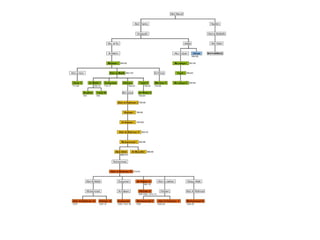
Caliphs of Damascus
Muawiya I ibn Abu Sufyan 661–680
Yazid I ibn Muawiyah 680–683
Muawiya II ibn Yazid 683–684
Marwan I ibn al-Hakam 684–685
Abd al-Malik ibn Marwan 685–705
al-Walid I ibn Abd al-Malik 705–715
Sulayman ibn Abd al-Malik 715–717
Umar ibn Abd al-Aziz 717–720
Yazid II ibn Abd al-Malik 720–724
Hisham ibn Abd al-Malik 724–743
al-Walid II ibn Yazid 743–744
Yazid III ibn al-Walid 744
Ibrahim ibn al-Walid 744
Marwan II ibn Muhammad (ruled from Harran in the Jazira) 744–750
Emirs of Cordoba
Abd al-Rahman I 756–788
Hisham I 788–796
al-Hakam I 796–822
Abd ar-Rahman II 822–852
Muhammad I 852–886
Al-Mundhir 886–888
Abdallah ibn Muhammad 888–912
Abd ar-Rahman III 912–929
Caliphs of Cordoba
Abd ar-Rahman III, as caliph 929–961
Al-Hakam II 961–976
Hisham II 976–1008
Muhammad II 1008–1009
Sulayman ibn al-Hakam 1009–1010
Hisham II, restored 1010–1012
Sulayman ibn al-Hakam, restored 1012–1017
Abd ar-Rahman IV 1021–1022
Abd ar-Rahman V 1022–1023
Muhammad III 1023–1024
Hisham III 1027–1031
Umayyad Desert Palaces, Architecture and Decoration:
How can we explain them? The new economic, geographic
and social orders
Villa Rustica: Pleasure and hunting (the notion of the Hayr,
the game park):
Estates in agricultural development projects
Fortified small towns
Umayyad Islamic Palaces
Hunting lodges with remarkable quality and highly ornamented
Luxury and public baths; banquet halls
For Oleg Grabar these fortified structures were not palaces rather
than forts to control vast farming operations
Farms belonged to the caliph and/or Arab chieftains
Geographical setting of Syria / regular rainfall and potential
richness requires long lasting political stability
Usage of Umayyad Islamic Palaces:
hunting parties for Arab aristocracy
Official receptions and country rituals
Examples:
In Syria:
Qasr al-Hayr al-Gharbi (West), Syria (724-27):
Qasr al-Hayr al-Sharqi (East), Syria (728-29)
The Palaces of Hisham (724-43):
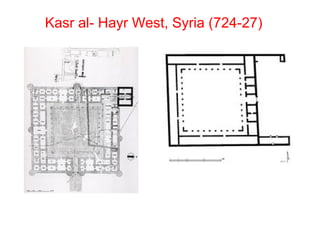
Qasr al-Hayr al-Gharbi (West), Syria (724-27):
Square courtyard enclosure with half-round towers
Adjacent to a pre-Islamic complex (caravanserai or barracks and
tower)
Lavish Sasanian carved stucco decoration with Byzantine motifs
Figural representations in floor mosaics, murals and sculpture
Kasr al- Hayr West, Syria (724-27)
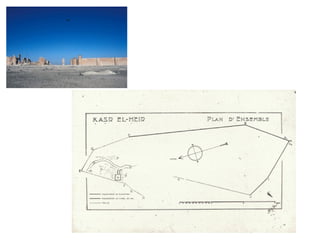
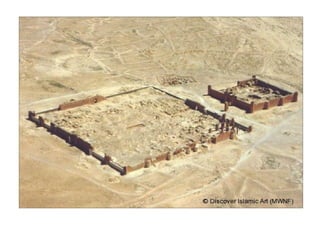
Qasr al-Hayr al-Sharqi (East), Syria (728-29):
•Two enclosures at the head of a valley walled to serve as
game park (Hayr)
•
•Large enclosure with mosque, probably barracks
•Small enclosure identified as caravanserai, probably royal
residence
The Palaces of al-Walid I (705-15):
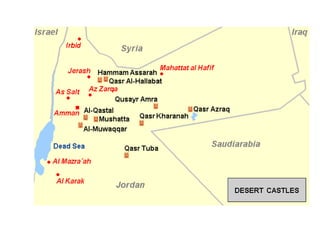
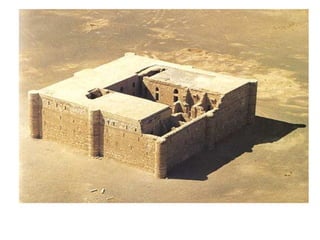
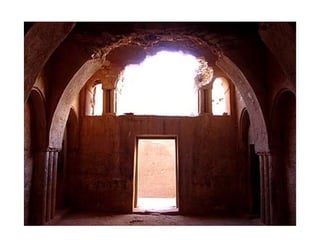
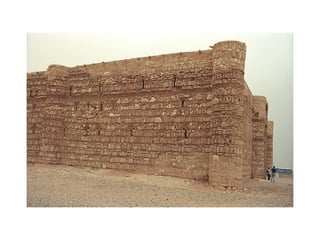
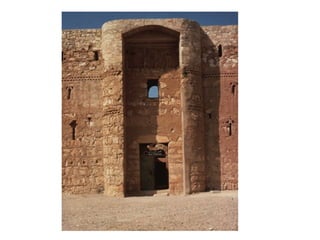
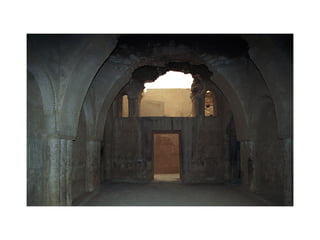
Qasr Kharana, Jordan (ca. 705-10):
Small fortified square enclosure with arrow slits and round
corner towers
Single monumental gate with a shallow arch
Rough stone and brick construction
Different vaulting techniques
Mosaic floors
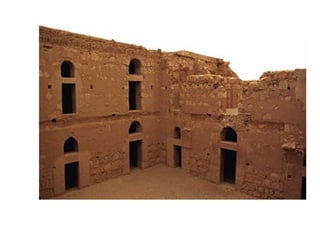
The construction and architectural technique betray
Sasanian influences, such as the use of squinches and
shallow vaults resting on transverse arches, in addition to
carved stucco decorations.
Qusayr ‘Amra, Jordan (between 711 and 715):
Part of a larger complex being excavated
Small hall with a magnificent bath
Complex vaulting systems, with the first appearance of the
pointed arches
hypocausts under the floor for hot air in the bath- caldarium
(Roman hot bathroom)
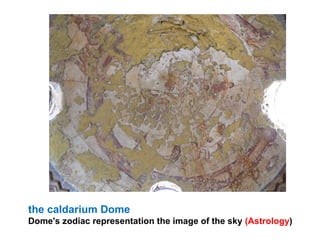
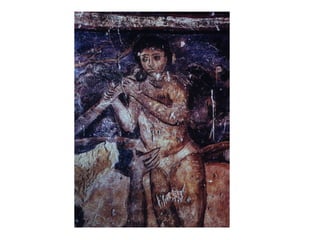
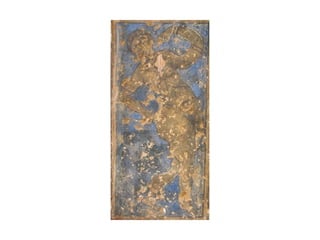
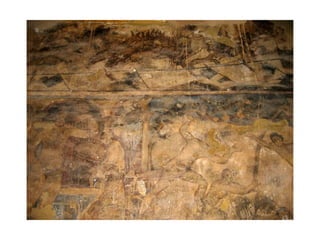
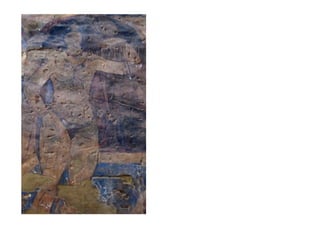
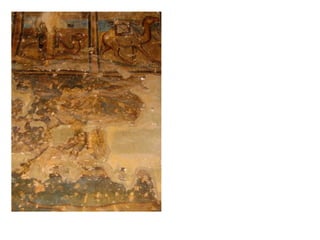
Famous fresco murals,
and dome's zodiac representation the image of the sky (Astrology)
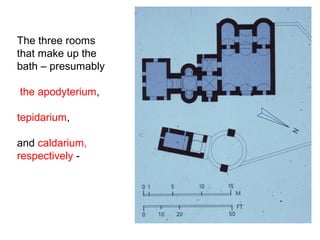
The three rooms
that make up the
bath – presumably
the apodyterium,
tepidarium,
and caldarium,
respectively -
The three rooms that make up the bath -- presumably
the apodyterium, tepidarium, and caldarium, respectively
-- are situated to the east of the hall's main entrance:
one of which is tunnel-vaulted;
another that is cross-vaulted and
the third contains a dome.
To the east of the caldarium, a tunnel-vaulted
passageway extends into a rectangular enclosed space
that remains uncovered
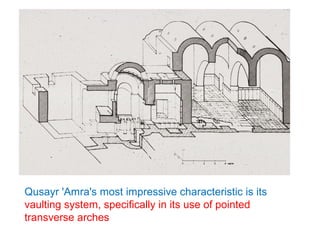
Qusayr 'Amra's most impressive characteristic is its
vaulting system, specifically in its use of pointed
transverse arches
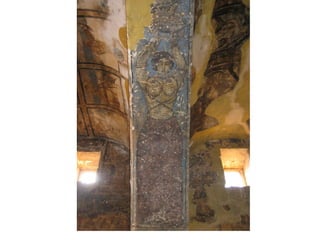
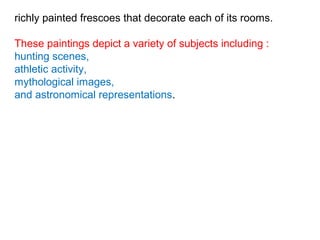
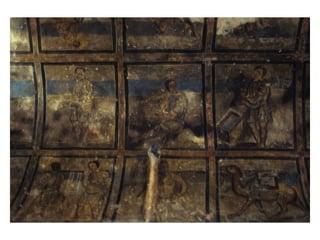
richly painted frescoes that decorate each of its rooms.
These paintings depict a variety of subjects including :
hunting scenes,
athletic activity,
mythological images,
and astronomical representations.
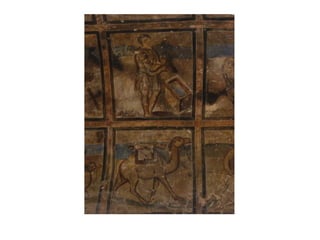
the caldarium Dome
Dome's zodiac representation the image of the sky (Astrology)
This portrayal is of monumental significance in that it is
the earliest known example of cosmological
representation on a non-flat, semi-circular surface.
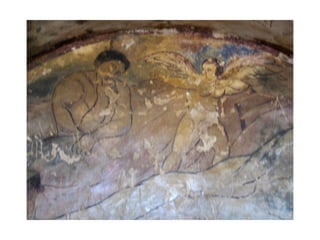
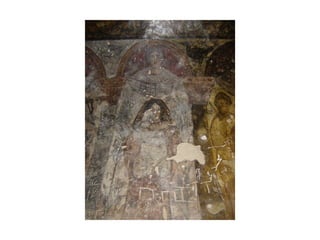
In the apse-like throne chamber, one painting
commemorates a haloed dignitary, possibly representing
the caliph, who sits under a canopy of fabric encircled by
birds and monsters.
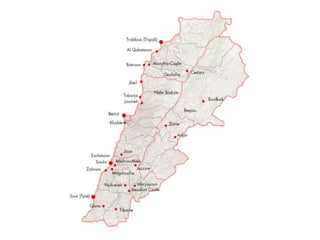
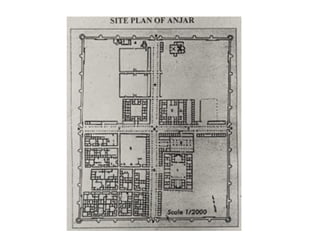
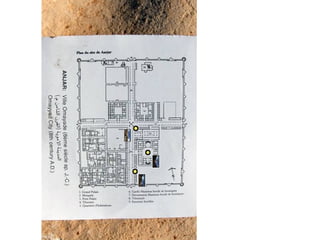
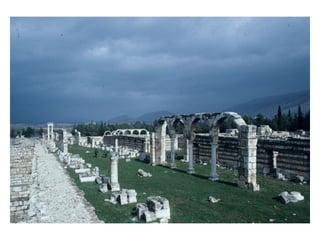
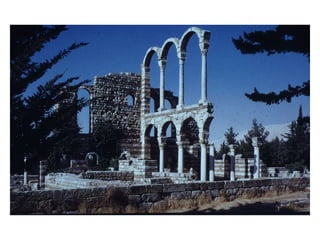
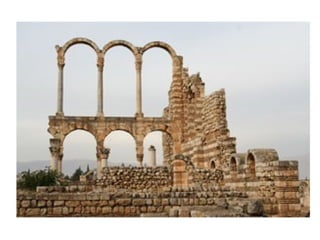
The Town of ‘Anjar, Lebanon (714-15):
Large enclosure (1100 ft. to the side) with half-round
towers and round corner towers
400 *320 meters
Cross-axial colonnaded, commercial streets dividing the
enclosure into four quarters
Two palaces, a bath, and one mosque excavated
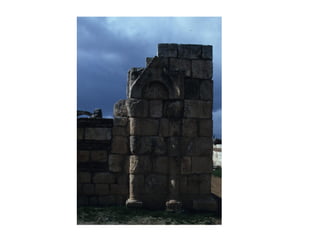
Qasr Hisham, Khirbat al Mafjar, Hisham's Palace, Kasr
Hisham(743):
Khirbet al-Mafjar, Palestine:
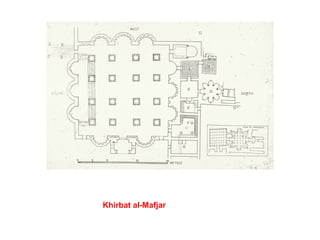
•Site contains a palatial (wide) complex, a reservoir fed
by an aqueduct, and a Hayr
•
•Complex comprises a square palace enclosure, a
mosque, and a large bath
•
•Irregularly planned and unified by a forecourt with a
fountain structure
•Palace is a two-storied square cast rum enclosure with
a mosque and a sirdab (basement)
Khirbat al-Mafjar
•Representation of caliph above entrance
•
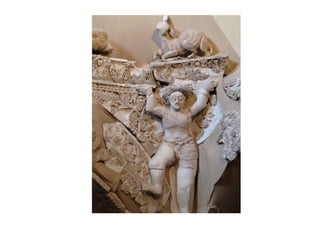
•Different statues of attendants and dancers
•Human and animal statues in the transitional zones
under domes as pendentives
•Human faces in stucco decoration
•
•Geometric and Symbolic mosaic panels in bath hall
•Mosque is a small rectangular hypostyle structure
with a courtyard
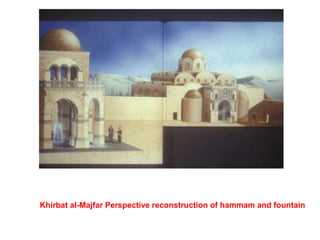
Khirbat al-Majfar Perspective reconstruction of hammam and fountain
•Bath is a square with three exedra to a side that formed
the Frigidarium and the Opodyterium, a private diwan, the
tepidarium and the caldarium on its south side
•Plentifully decorated bath hall and diwan
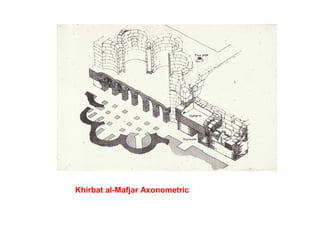
Khirbat al-Mafjar Axonometric
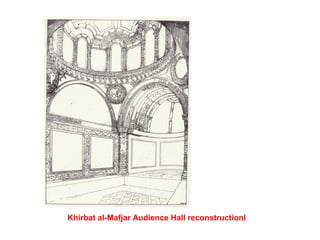
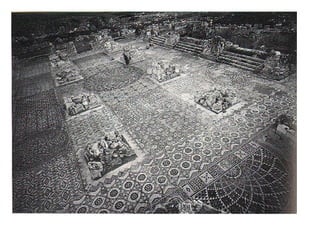
Khirbat al-Mafjar Audience Hall reconstructionl
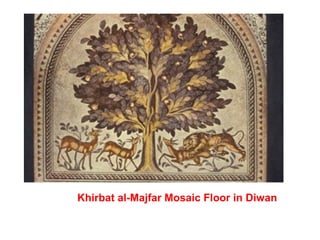
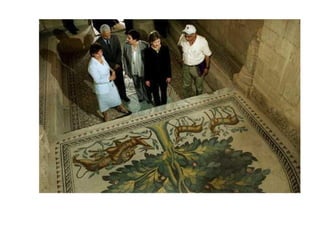
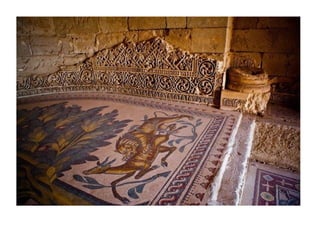
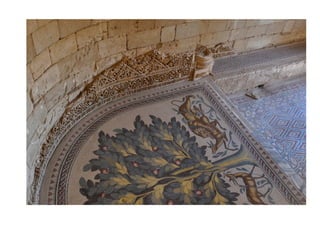
Khirbat al-Majfar Mosaic Floor in Diwan
In the audience hall, another famous mosaic panel at the
site displays
an apple tree providing cover on its right side to two
gazelles that chew at its foliage while to the left a lion is
shown attacking another gazelle from behind.
Interpretations of this scene speak to its symbolic
implications of the Umayyad caliphate:
life can be peaceful and serene under Umayyad authority
while those who threatened central power face physical
defeat.
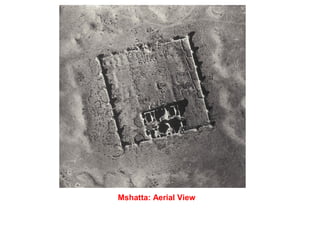
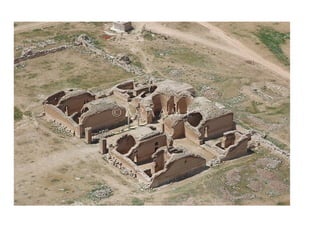
Mshatta, Jordan:
A product of the late Umayyad period, it is speculated by
several scholars that the Umayyad caliph al-Walid II built
Mshatta during his brief reign (743-44) in an effort to
commemorate his authority.
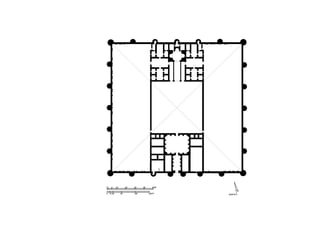
Mshatta, Jordan:
•A large square enclosure which was never completed
•As one of the largest and most impressive of the Umayyad palaces, the
unfinished, tawny-toned limestone and brick
•Divided into three longitudinal zones complex at Qasr al-Mshatta includes
an entrance hall, mosque, an audience hall, and residential quarters.
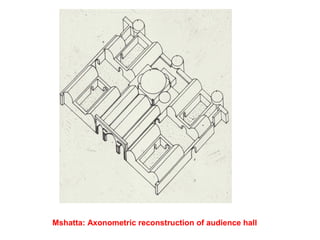
•Central section contains the gateway block and the throne hall block
•Throne hall is triple apses
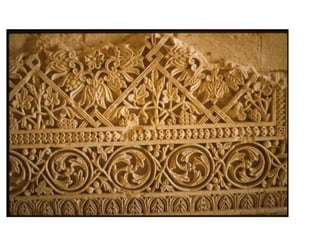
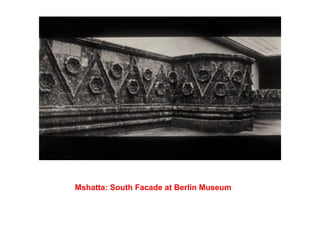
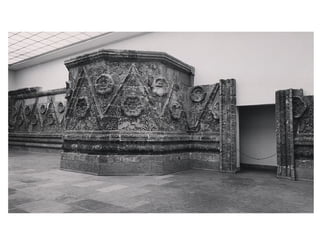
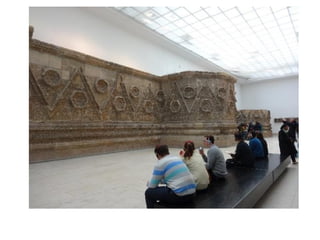
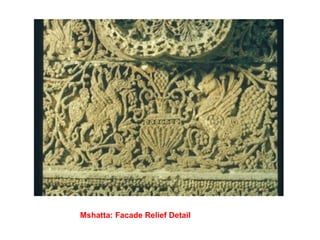
•South façade decorated with geometric, tracery-like carved band of
triangles and rosettes
•Conscious change in treatment of the external façade of the mosque
As one of the largest and most impressive of the
Umayyad palaces,
the unfinished,
tawny-toned limestone and brick complex at Qasr al-
Mshatta includes an entrance hall, mosque, an audience
hall, and residential quarters.
Mshatta: Aerial View
Mshatta: Axonometric reconstruction of audience hall
Mshatta: South Facade at Berlin Museum
Mshatta: Facade Relief Detail
The Architectural Characteristics of Umayyad Palaces:
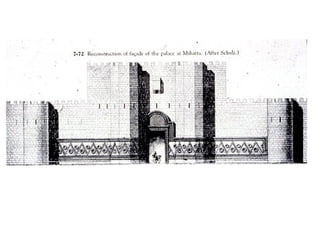
1. Square enclosure (cast rum type) with four round towers
in the corners
2. Monumental portals
3. Two-storied, porticoes courtyard structure
4. Bait Type units
5. Confluence of Byzantine and Sasanian construction
details and decorative techniques
6. Figural representations of rulers, courtiers and court
scenes (music, dance, drinking, hunting): The survival of
pre-Islamic images of the ruler.

3 umayyad-palaces - lecture 5

  • 1.
    Jordan University ofScience and Technology College of Architecture and Design Department of Architecture Islamic Architecture Islamic Architecture Dr. Raed Al Tal
  • 2.
    Jordan University ofScience and Technology College of Architecture and Design Department of Architecture Islamic Architecture Dr. Raed Al Tal Umayyad Desert Palaces: Architecture and Decoration
  • 3.
    Cultural Influences Social Organization TheUmayyad Caliphate exhibited four main social classes: 1.Muslim Arabs 2.Muslim non-Arabs (clients of the Muslim Arabs) 3.Non-Muslim free persons (Christians, Jews, and Zoroastrians) 4.Slaves Read more: http://www.answers.com/topic/umayyad#ixzz2wNIqER7b
  • 5.
    Caliphs of Damascus MuawiyaI ibn Abu Sufyan 661–680 Yazid I ibn Muawiyah 680–683 Muawiya II ibn Yazid 683–684 Marwan I ibn al-Hakam 684–685 Abd al-Malik ibn Marwan 685–705 al-Walid I ibn Abd al-Malik 705–715 Sulayman ibn Abd al-Malik 715–717 Umar ibn Abd al-Aziz 717–720 Yazid II ibn Abd al-Malik 720–724 Hisham ibn Abd al-Malik 724–743 al-Walid II ibn Yazid 743–744 Yazid III ibn al-Walid 744 Ibrahim ibn al-Walid 744 Marwan II ibn Muhammad (ruled from Harran in the Jazira) 744–750 Emirs of Cordoba Abd al-Rahman I 756–788 Hisham I 788–796 al-Hakam I 796–822 Abd ar-Rahman II 822–852 Muhammad I 852–886 Al-Mundhir 886–888 Abdallah ibn Muhammad 888–912 Abd ar-Rahman III 912–929 Caliphs of Cordoba Abd ar-Rahman III, as caliph 929–961 Al-Hakam II 961–976 Hisham II 976–1008 Muhammad II 1008–1009 Sulayman ibn al-Hakam 1009–1010 Hisham II, restored 1010–1012 Sulayman ibn al-Hakam, restored 1012–1017 Abd ar-Rahman IV 1021–1022 Abd ar-Rahman V 1022–1023 Muhammad III 1023–1024 Hisham III 1027–1031
  • 7.
    Umayyad Desert Palaces,Architecture and Decoration: How can we explain them? The new economic, geographic and social orders Villa Rustica: Pleasure and hunting (the notion of the Hayr, the game park): Estates in agricultural development projects Fortified small towns
  • 8.
    Umayyad Islamic Palaces Huntinglodges with remarkable quality and highly ornamented Luxury and public baths; banquet halls For Oleg Grabar these fortified structures were not palaces rather than forts to control vast farming operations Farms belonged to the caliph and/or Arab chieftains Geographical setting of Syria / regular rainfall and potential richness requires long lasting political stability Usage of Umayyad Islamic Palaces: hunting parties for Arab aristocracy Official receptions and country rituals
  • 9.
    Examples: In Syria: Qasr al-Hayral-Gharbi (West), Syria (724-27): Qasr al-Hayr al-Sharqi (East), Syria (728-29) The Palaces of Hisham (724-43): Qasr al-Hayr al-Gharbi (West), Syria (724-27): Square courtyard enclosure with half-round towers Adjacent to a pre-Islamic complex (caravanserai or barracks and tower) Lavish Sasanian carved stucco decoration with Byzantine motifs Figural representations in floor mosaics, murals and sculpture
  • 10.
    Kasr al- HayrWest, Syria (724-27)
  • 11.
    Qasr al-Hayr al-Sharqi(East), Syria (728-29): •Two enclosures at the head of a valley walled to serve as game park (Hayr) • •Large enclosure with mosque, probably barracks •Small enclosure identified as caravanserai, probably royal residence
  • 14.
    The Palaces ofal-Walid I (705-15): Qasr Kharana, Jordan (ca. 705-10): Small fortified square enclosure with arrow slits and round corner towers Single monumental gate with a shallow arch Rough stone and brick construction Different vaulting techniques Mosaic floors
  • 16.
    The construction andarchitectural technique betray Sasanian influences, such as the use of squinches and shallow vaults resting on transverse arches, in addition to carved stucco decorations.
  • 22.
    Qusayr ‘Amra, Jordan(between 711 and 715): Part of a larger complex being excavated Small hall with a magnificent bath Complex vaulting systems, with the first appearance of the pointed arches hypocausts under the floor for hot air in the bath- caldarium (Roman hot bathroom) Famous fresco murals, and dome's zodiac representation the image of the sky (Astrology)
  • 23.
    The three rooms thatmake up the bath – presumably the apodyterium, tepidarium, and caldarium, respectively -
  • 24.
    The three roomsthat make up the bath -- presumably the apodyterium, tepidarium, and caldarium, respectively -- are situated to the east of the hall's main entrance: one of which is tunnel-vaulted; another that is cross-vaulted and the third contains a dome. To the east of the caldarium, a tunnel-vaulted passageway extends into a rectangular enclosed space that remains uncovered
  • 25.
    Qusayr 'Amra's mostimpressive characteristic is its vaulting system, specifically in its use of pointed transverse arches
  • 34.
    richly painted frescoesthat decorate each of its rooms. These paintings depict a variety of subjects including : hunting scenes, athletic activity, mythological images, and astronomical representations.
  • 36.
    the caldarium Dome Dome'szodiac representation the image of the sky (Astrology)
  • 37.
    This portrayal isof monumental significance in that it is the earliest known example of cosmological representation on a non-flat, semi-circular surface. In the apse-like throne chamber, one painting commemorates a haloed dignitary, possibly representing the caliph, who sits under a canopy of fabric encircled by birds and monsters.
  • 47.
    The Town of‘Anjar, Lebanon (714-15): Large enclosure (1100 ft. to the side) with half-round towers and round corner towers 400 *320 meters Cross-axial colonnaded, commercial streets dividing the enclosure into four quarters Two palaces, a bath, and one mosque excavated
  • 55.
    Qasr Hisham, Khirbatal Mafjar, Hisham's Palace, Kasr Hisham(743): Khirbet al-Mafjar, Palestine: •Site contains a palatial (wide) complex, a reservoir fed by an aqueduct, and a Hayr • •Complex comprises a square palace enclosure, a mosque, and a large bath • •Irregularly planned and unified by a forecourt with a fountain structure •Palace is a two-storied square cast rum enclosure with a mosque and a sirdab (basement)
  • 56.
  • 57.
    •Representation of caliphabove entrance • •Different statues of attendants and dancers •Human and animal statues in the transitional zones under domes as pendentives •Human faces in stucco decoration • •Geometric and Symbolic mosaic panels in bath hall •Mosque is a small rectangular hypostyle structure with a courtyard
  • 59.
    Khirbat al-Majfar Perspectivereconstruction of hammam and fountain
  • 60.
    •Bath is asquare with three exedra to a side that formed the Frigidarium and the Opodyterium, a private diwan, the tepidarium and the caldarium on its south side •Plentifully decorated bath hall and diwan
  • 61.
  • 62.
    Khirbat al-Mafjar AudienceHall reconstructionl
  • 63.
  • 68.
    In the audiencehall, another famous mosaic panel at the site displays an apple tree providing cover on its right side to two gazelles that chew at its foliage while to the left a lion is shown attacking another gazelle from behind. Interpretations of this scene speak to its symbolic implications of the Umayyad caliphate: life can be peaceful and serene under Umayyad authority while those who threatened central power face physical defeat.
  • 71.
    Mshatta, Jordan: A productof the late Umayyad period, it is speculated by several scholars that the Umayyad caliph al-Walid II built Mshatta during his brief reign (743-44) in an effort to commemorate his authority.
  • 72.
    Mshatta, Jordan: •A largesquare enclosure which was never completed •As one of the largest and most impressive of the Umayyad palaces, the unfinished, tawny-toned limestone and brick •Divided into three longitudinal zones complex at Qasr al-Mshatta includes an entrance hall, mosque, an audience hall, and residential quarters. •Central section contains the gateway block and the throne hall block •Throne hall is triple apses •South façade decorated with geometric, tracery-like carved band of triangles and rosettes •Conscious change in treatment of the external façade of the mosque
  • 73.
    As one ofthe largest and most impressive of the Umayyad palaces, the unfinished, tawny-toned limestone and brick complex at Qasr al- Mshatta includes an entrance hall, mosque, an audience hall, and residential quarters.
  • 74.
  • 77.
  • 78.
    Mshatta: South Facadeat Berlin Museum
  • 82.
  • 83.
    The Architectural Characteristicsof Umayyad Palaces: 1. Square enclosure (cast rum type) with four round towers in the corners 2. Monumental portals 3. Two-storied, porticoes courtyard structure 4. Bait Type units 5. Confluence of Byzantine and Sasanian construction details and decorative techniques 6. Figural representations of rulers, courtiers and court scenes (music, dance, drinking, hunting): The survival of pre-Islamic images of the ruler.