Module 2
• There are two basic techniques for converting solar
radiation into useful power
vConversion of solar radiation into heat - Solar thermal
route
vConversion of solar radiation directly to electricity - Solar
photovoltaic route
• Solar thermal application covers solar water heating, solar
cooking in rural and urban areas, solar drying and
purification of water
• Solar energy is also used for space heating and cooling
• Solar photovoltaic technology convdrts sunlight into DC
electricity without any moving parts and utilised for
lighting, water pumping, computers and
telecommunications etc
• Stand alone SPV powerplants in rural areas provide
power for electrification
Assignment
• Applications of solar power
• Solar space heating and cooling of buildings, solar
pumping, solar cooker, solar still, solar drier, solar
refrigeration and air-conditioning, heliostat, solar furnace
• Submit on or before 24th October
Solar thermal energy collectors
• A solar thermal energy collector is an equipment in which
solar energy is collected by absorbing radiation in an
absorber and then transferring to a fluid
• In general there are two types of collectors:
1 Flat plat solar collector: It has no optical concentrator.
• Here, the collector area and the absorber area are
numerically the same
• The efficiency is low, and temperatures of the working
fluid can be raised only up to 100 C
• 2. Concentrating type solar collector: Here the area
rceiving the solar radiation is several times greater than
the absorber area and teh efficciency is high
• Mirrors and lenses are used to concentrate the sun’s rays
on the absorber, and the fluid temperature can be raised
up to 500 C
• For better performance, teh collector is mounted on a
tracking equipment to face the sun always with its
changing position
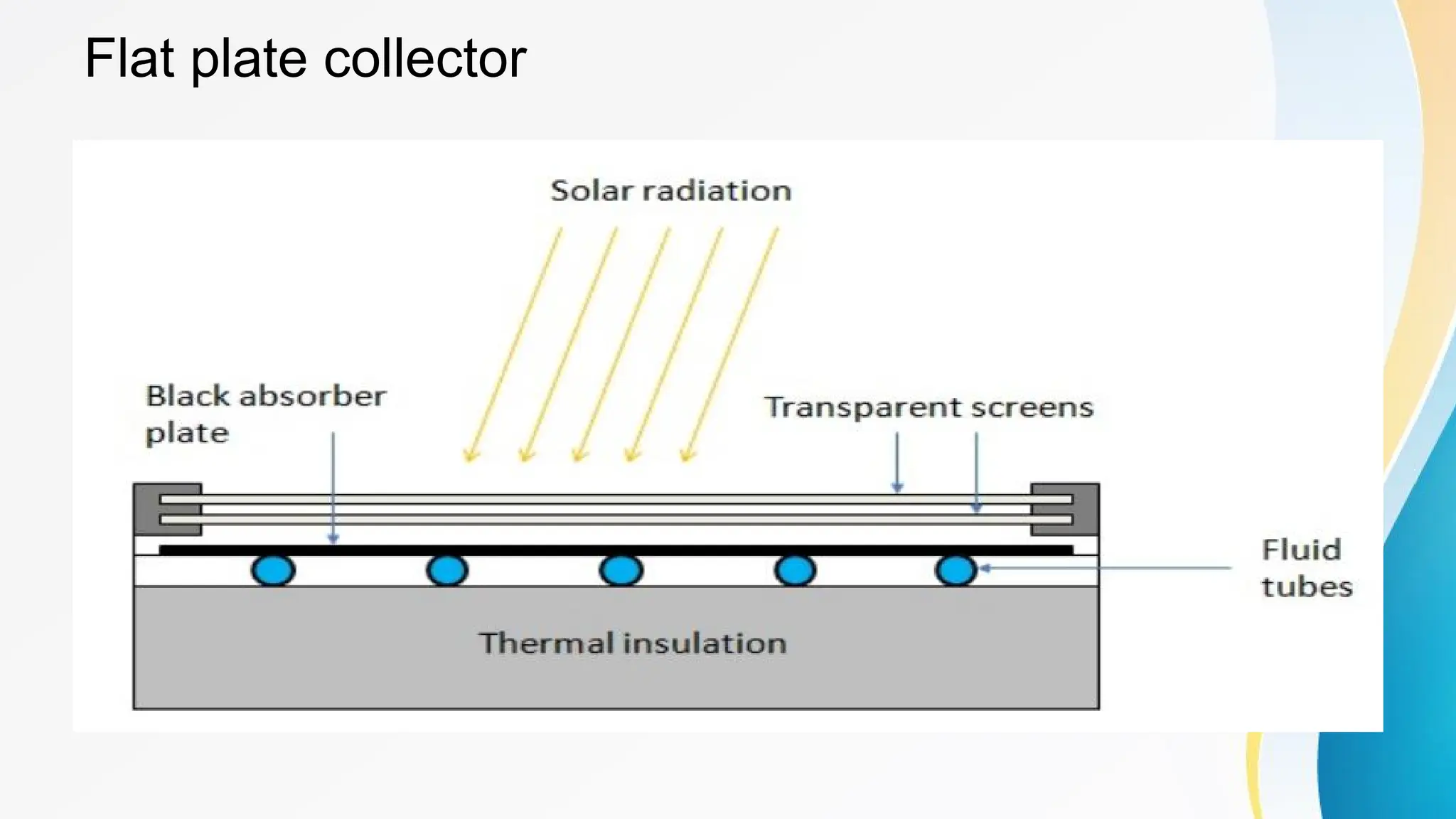
Flat plate collector
• A metallic flat absorber plat of high thermal conductivity
made of copper, steel or aluminium and having black
surface - Thickness ranges from 0.5 mm - 1 mm
• Tubes or channels are soldered to the absorber plate
Water flowing through these tubes takes away the heat
from teh absorber plate
• A transparent toughened glass sheet of 5 mm thickness is
provided as the cover plat
It reduces convection losses through a stagnant air layer
between the absorber plate and the glass
Radiation losses are also reduced as it is transparent to
short wave radiation and nearly opaque to long wave
thermal radiation emitted by interior collector walls and
absorbing plat
• Fibre glass insulation is provided at the bottom and on the
sides in order to minimize heat loss
• A container encloses the whole assembly in a box made
of metallic sheet or fibre glass
Solar concentrating collectors
• In flat plate collectors the solar radiation intensity is
uniformly distributed over the glass cover and the
absorber, keeping the temperature rise of the solar device
upto 100 C
• If solar radiation falling over a large surface is
concentrated to a smaller area of the absorber plate, the
temperature can be enhanced up to 500 C
• Concentration is achieved by an optical system either
from the reflecting mirrors of from teh refracting lenses
Parabolic trough
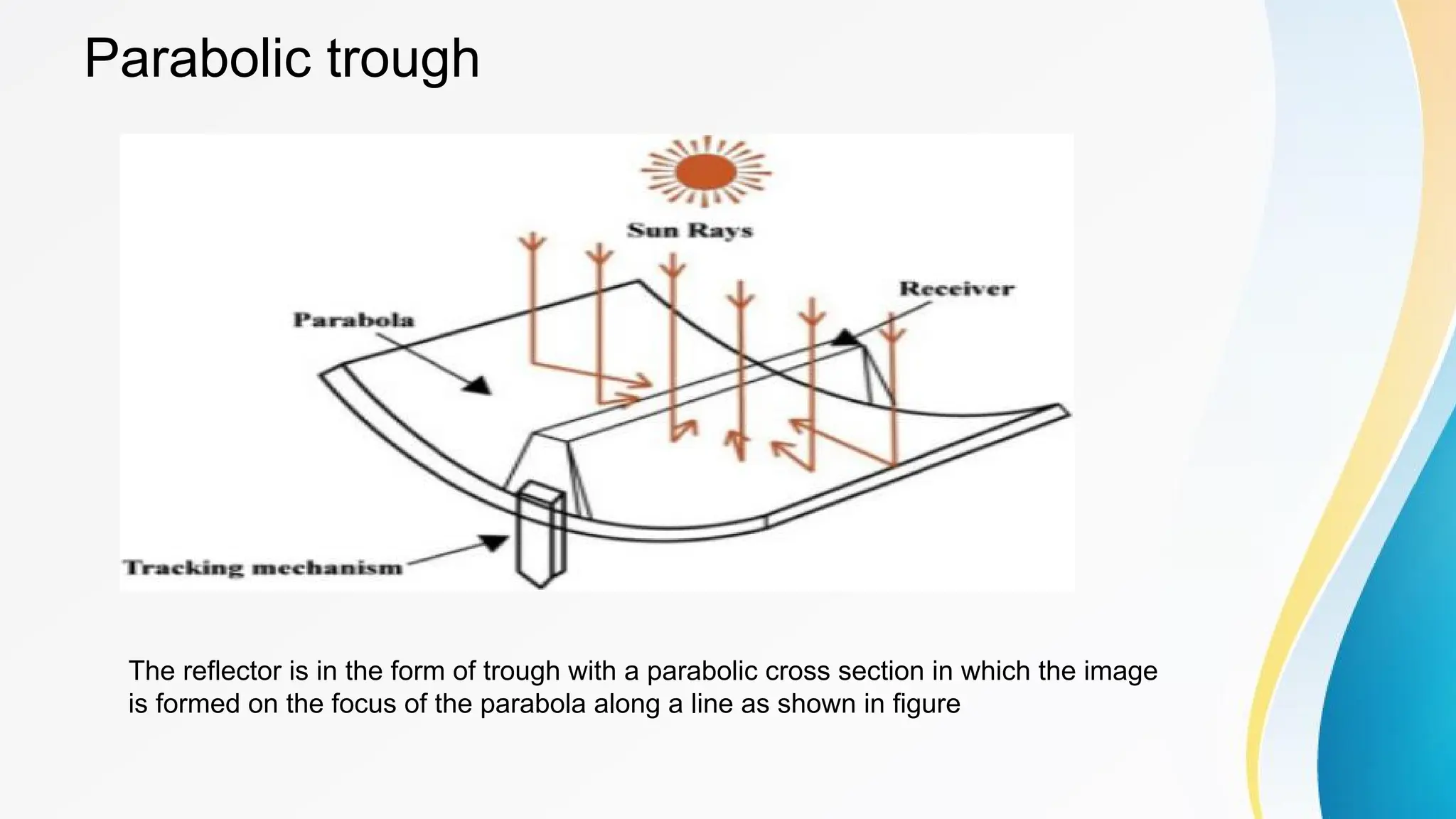
The reflector is in the form of trough with a parabolic cross section in which the image
is formed on the focus of the parabola along a line as shown in figure
• The basic parts are
i. an absorber tube with a selective coating located at the
focal axis through which the liquid to be heated flows
ii. a parabolic concentrator
iii. a concentric transparent cover
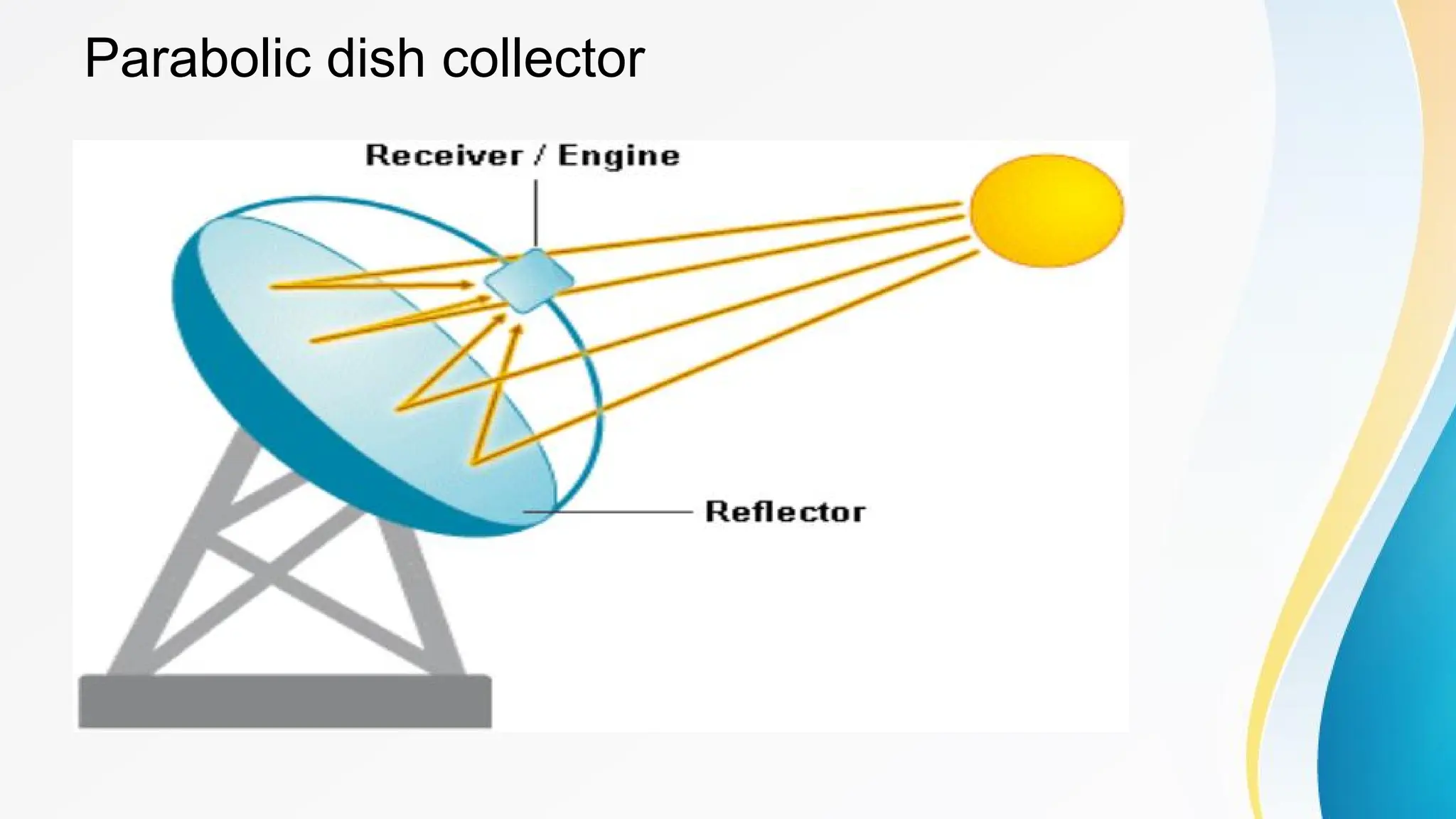
Parabolic dish collector
• Concentration ratio (CR) is high
• CR is the ratio of the effective area of the aperture to the
surface area of the absorber
• parabolic dish collector is of point focussing type as the
receiver is placed at the focus of the parabolic reflector
• CR ranges from 100 to a few thousands with maximum
temperature upto 2000 C
• Two-axis tracking is required so that the sun may remain
in line with the focus and vertes of the paraboloid
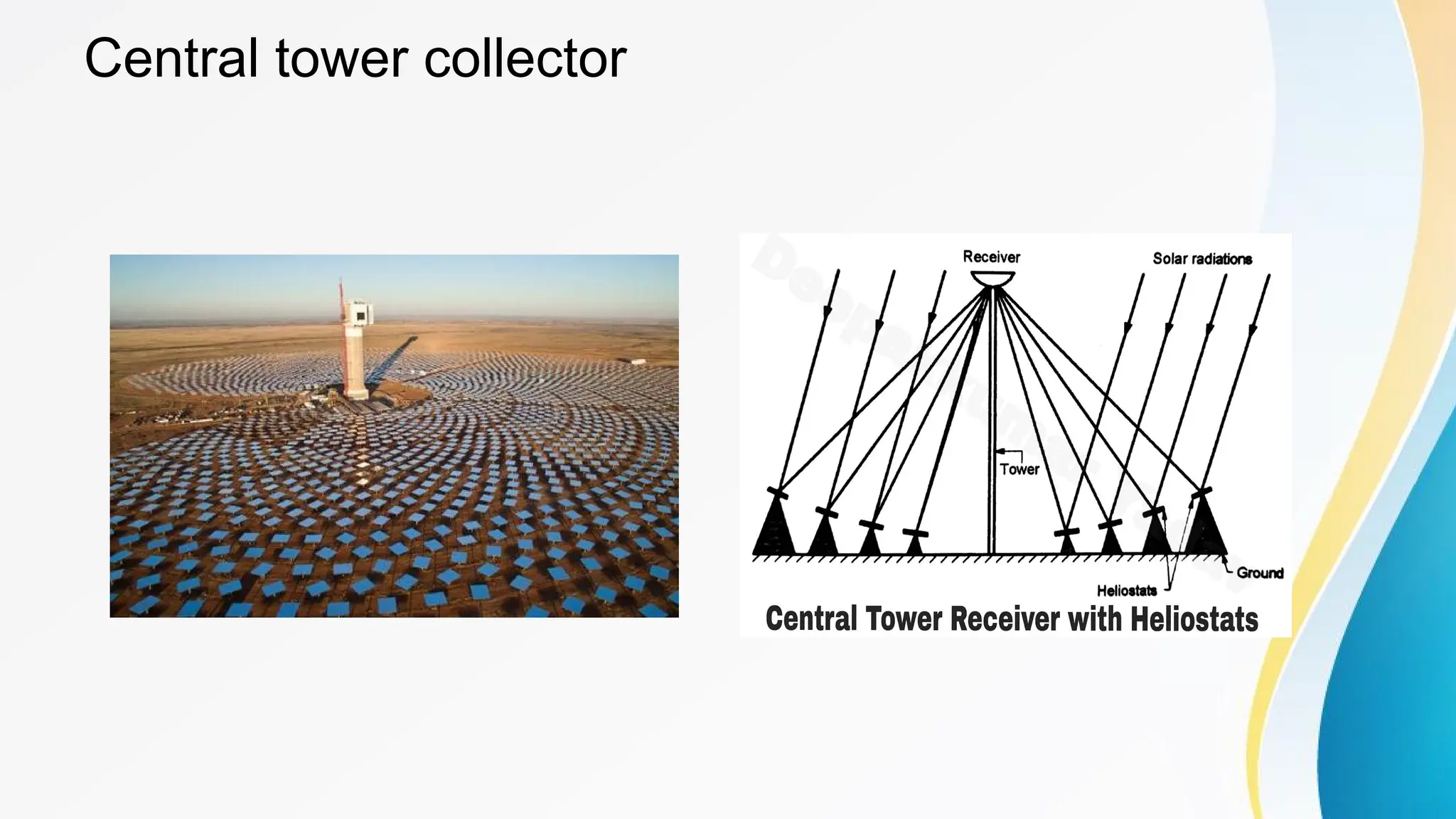
Central tower collector
• To collect large amounts of heat energy at one point, the
central receiver concept is followed
• Solar radiation is reflected from a field of heliostats (an
array of mirrors) to a centrally located receiver on a tower
• Heliostats follow the sun to harness maximum solar heat
heat
• Water flowing through the receiver absorbers heat to
procude steam which operates a Rankine cycle turbo
generator to generate electrical energy
• With a central receiver optical system, a large number of
sml mirrors are installed, each steerable to have an image
at the absorber on the central receiver
• A curvature is provided to the mirrors so as to focus the
sunlight in addition to directing it to the tower
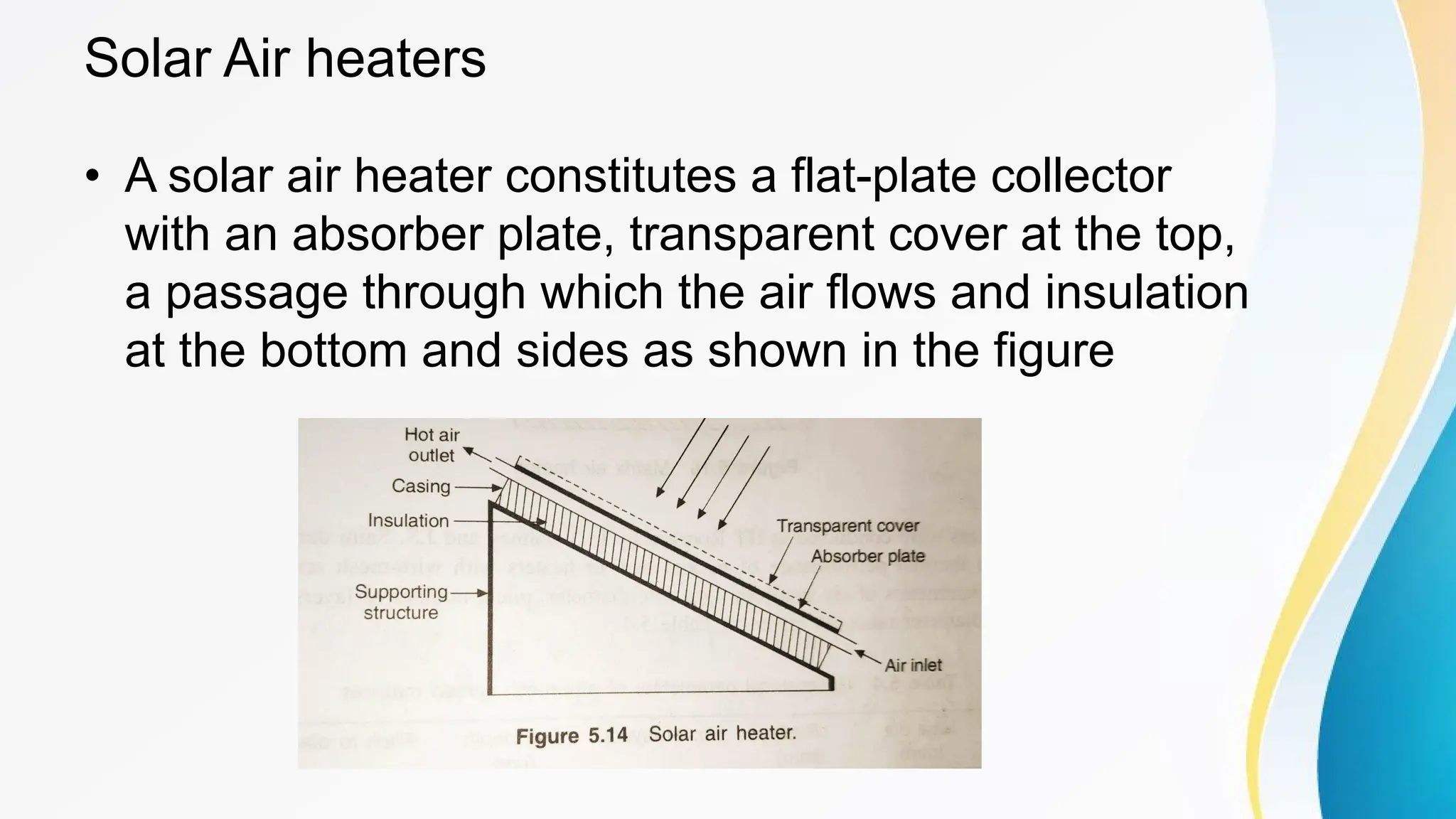
Solar Air heaters
• A solar air heater constitutes a flat-plate collector
with an absorber plate, transparent cover at the top,
a passage through which the air flows and insulation
at the bottom and sides as shown in the figure
• Air passage is only a parallel plat duct
• Air to be heated flows between the cover and the
absorber plate which is fabricated from a metal sheet of
1mm thickness
• Cover is either made of glass or plastic
• Glass wool is used for bottom and side insulation
• Full assembly is encased in a sheet metal box and kept
inclined at a suitable angle
• The face area of a solar heater is about 2m2, matching
the heat requirement
• As heat transfer between the absorber plate and air is low
the operating efficiency of a sinple air heater is also low
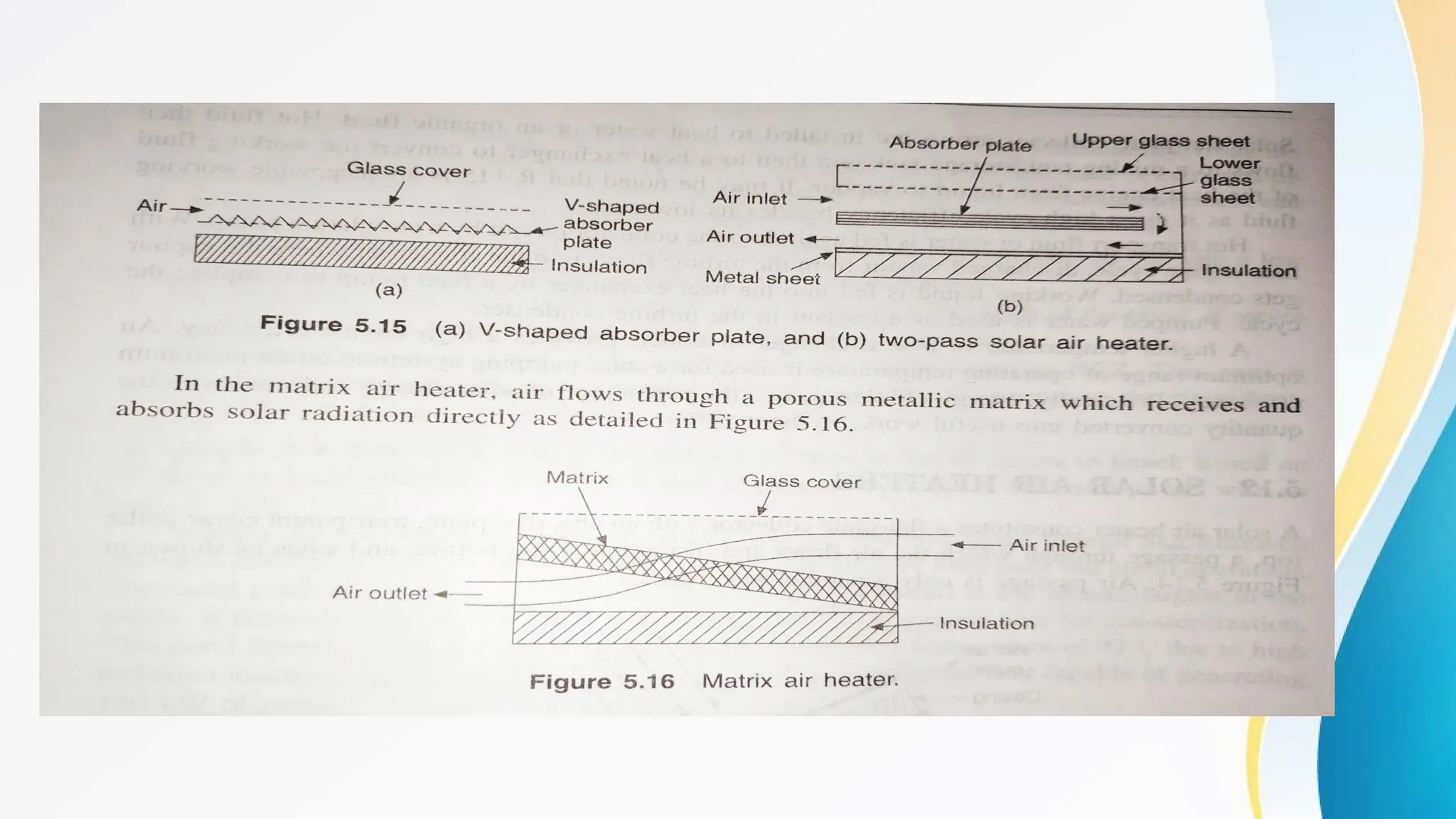
• To boost heat transfer, the contact area of air with the
absorber plate is increased either by
• adopting a V-shaped absorber plat
• or by designing two-pass air heaters
• The two-pass solar air heater carries two glass cover
sheets, separated by an air gap which reduces heat
losses
Solar Thermal power generation
• Solar thermal power generation involves the collection of
solar heat which is utilised to increase the temperatre of a
fluid in a turbine
• In other methods, hot fluid is allowed to pass through a
heat exchanger to evaporate a working fluid that operates
a turbine coupled with a generator
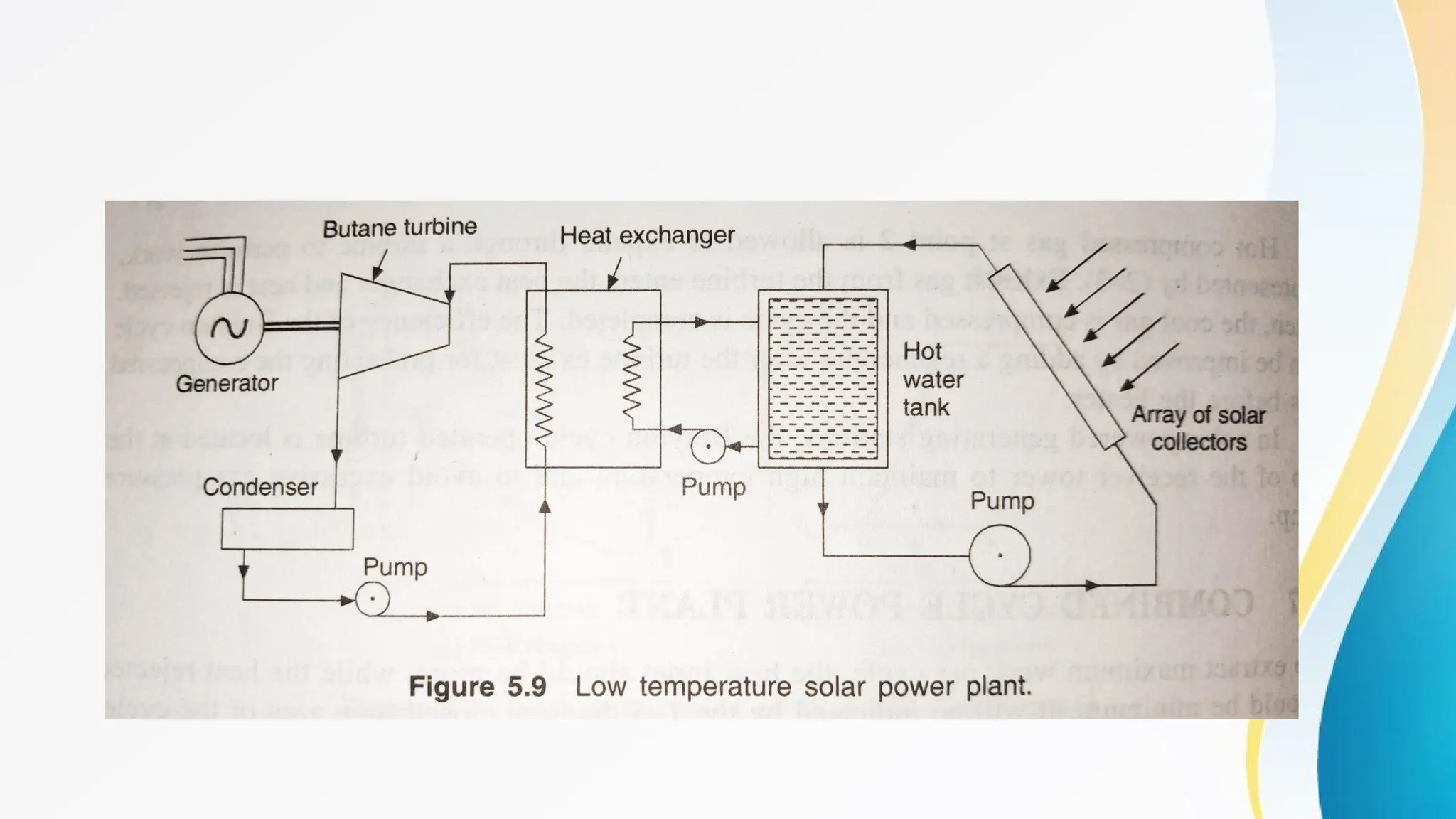
• A low temperature solar power plant uses flat plate
collector arrays
• Hot water above 90 C is collected in an air insulated tank
• It flows through a heat exchanger through which the
working fluid of the energy conversion cycle is also
circulated
To reduce the capital cost, solar ponds are sued instead of
flat-plate collectors
Such plants up to 150kW capacity are operative in Israel for
over 25 years
• In a solar thermal power plants operating on
mediumperatures up to 400 C, focussing parabolic
collector is used
• A suitable sun-tracking arrangement is made to ensure
that maximum quantit of solar radiation is focused on the
absorber pipeline
• Paraboloidal dish and the central receiver is used to
achieve high temperatures in high temperature solar
thermal power generator
Solar Thermal Energy Storage
• Solar energy is available only during the sunshine hours
• Consumer energy demands follow their own time pattern
and the solar energy does not fully match the demand
• As a result, energy storage is a must to meet the
consumer requirement
Sensible Heat Storage
• Heating a liquid or a solid which does not change phase
comes under this category
• The quantity of heat stored is proportional to the
temperature rise of the material
• If T1 and T2 represent the lower and higher temperature,
m the mass of the storage material, and C the specific
heat, the energy stored Q is
• Q= mC (T1-T2)
• For a sensible heat storae system, energy is stored by
heating a liquid or a solid
• Materials that are used in such a system include liquids
like water, inorganic molten salts and solids like rock,
gravel and refractories
• The choice of the material used depends on the
temperature level of its utilization
• Water is used for temperature below 100C whereas
refractory bricks can be used for temperature p to 1000 C
• Liquids used: The ability to store heat depends upon the
heat capacity and water has the highest in liquids
• Largely the solar water heating and space heating
systems utilise hot water storage tanks
• An optimum tank size for a flat plate collector system is
about 100 litres of storage per square metre of collector
area
• Molten inorganic salt may also be used for high
temperature applications (eg: Hitec, melting point is 15 C,
and cane used up to 400 C)
• Liquid solium is also in use as a storage fluid
• Solids: Rocks or gravel packed in an insulated vessel are
used with solar heaters
• It provides a large and inexpensive heat transfer surface
• Regractory materials like Magnesium oxide bricks, Silicon
oxide and Aluminium oxide are used in storage devices to
operate up to 600 C
Latent heat storage (Phase change heat storage)
• In this system, heat is stored in a material when it melts,
and heat is extracted from the material when it freezes
• Heat can also be stored when a liquid changes to
gaseous state, but as the volume change is large, such a
system is not economical
• Some organic materials like paraffin was and fatty acids
are very suitable for such applications
• Ice is quite suitable if energy is to be stored/extracted at
0oC
• Sodium Nitrate having a melting point of 310oC is suitable
for high temperature applications
Thermochemical Storage
• With a thermochemical storage system, solar heat energy
can start an endothermic chemical reaction and new
products of reactions remain intact
• To extract energy, a reverse exothermic reaction is
allowed to take place
• Actually, the thermochemical thermal energy is the
binding energy of reversible chemical reactions
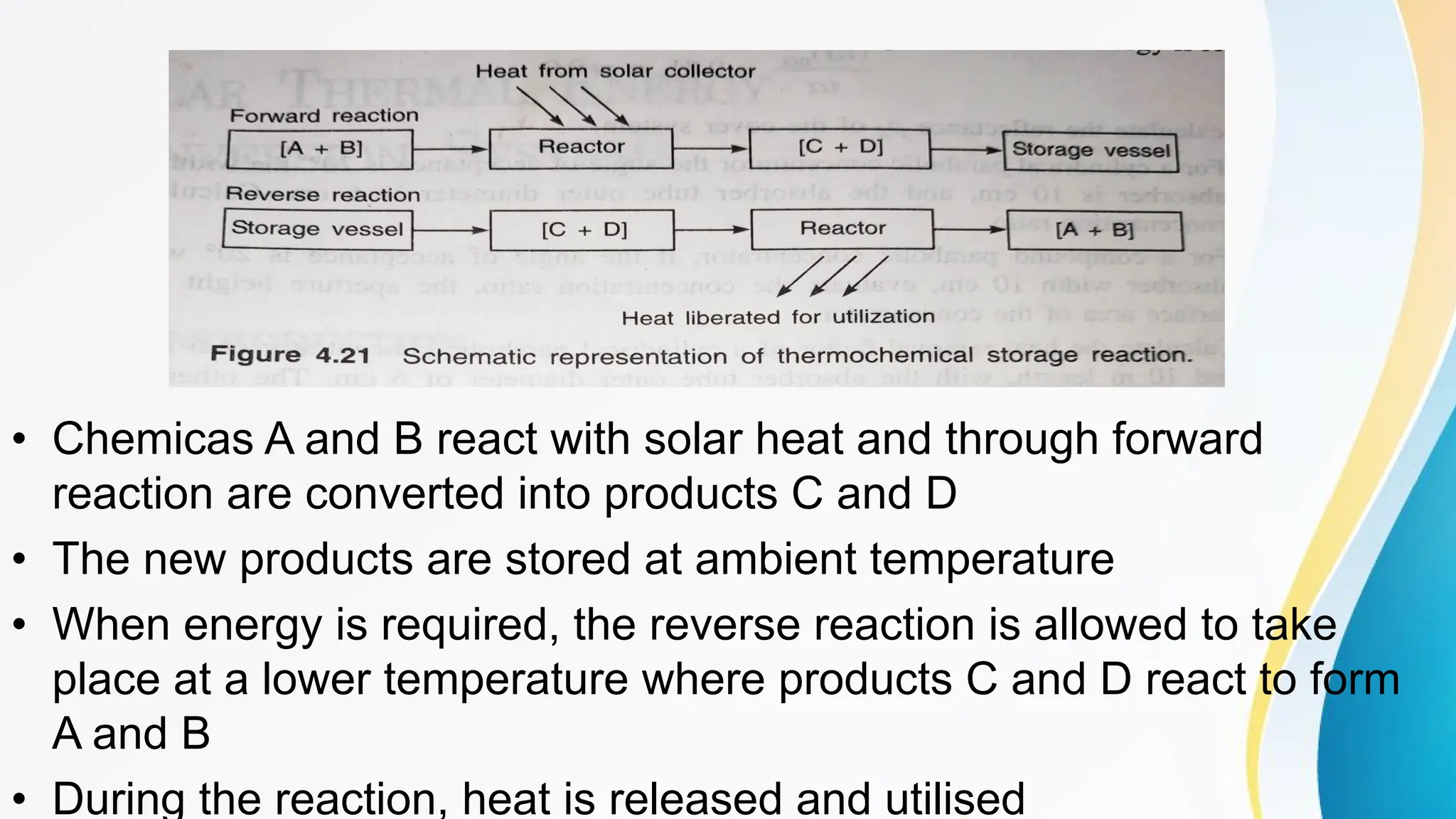
• Chemicas A and B react with solar heat and through forward
reaction are converted into products C and D
• The new products are stored at ambient temperature
• When energy is required, the reverse reaction is allowed to take
place at a lower temperature where products C and D react to form
A and B
• During the reaction, heat is released and utilised
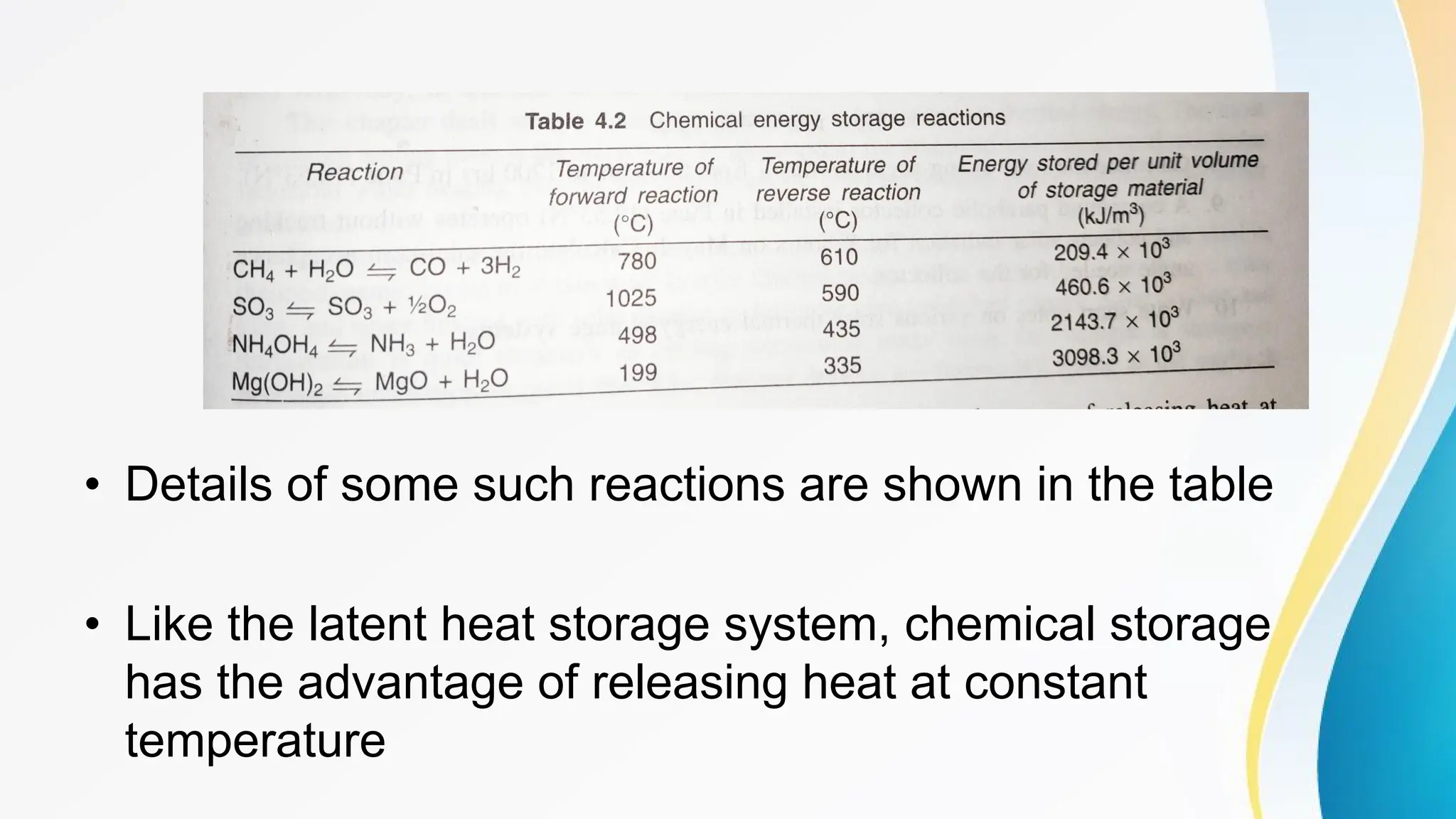
• Details of some such reactions are shown in the table
• Like the latent heat storage system, chemical storage
has the advantage of releasing heat at constant
temperature
Solar Pond
• The concept of solar pond was derived from the natural
lakes where the temperature rises towards the bottom
• It happens due to natural salt gradient in these lakes
where water at the bottom is denser
• In salt concentration lakes, convection does not occur and
heat loss from hot water takes place only by conduction
• This technique is utilized for collecting and storing solar
energy
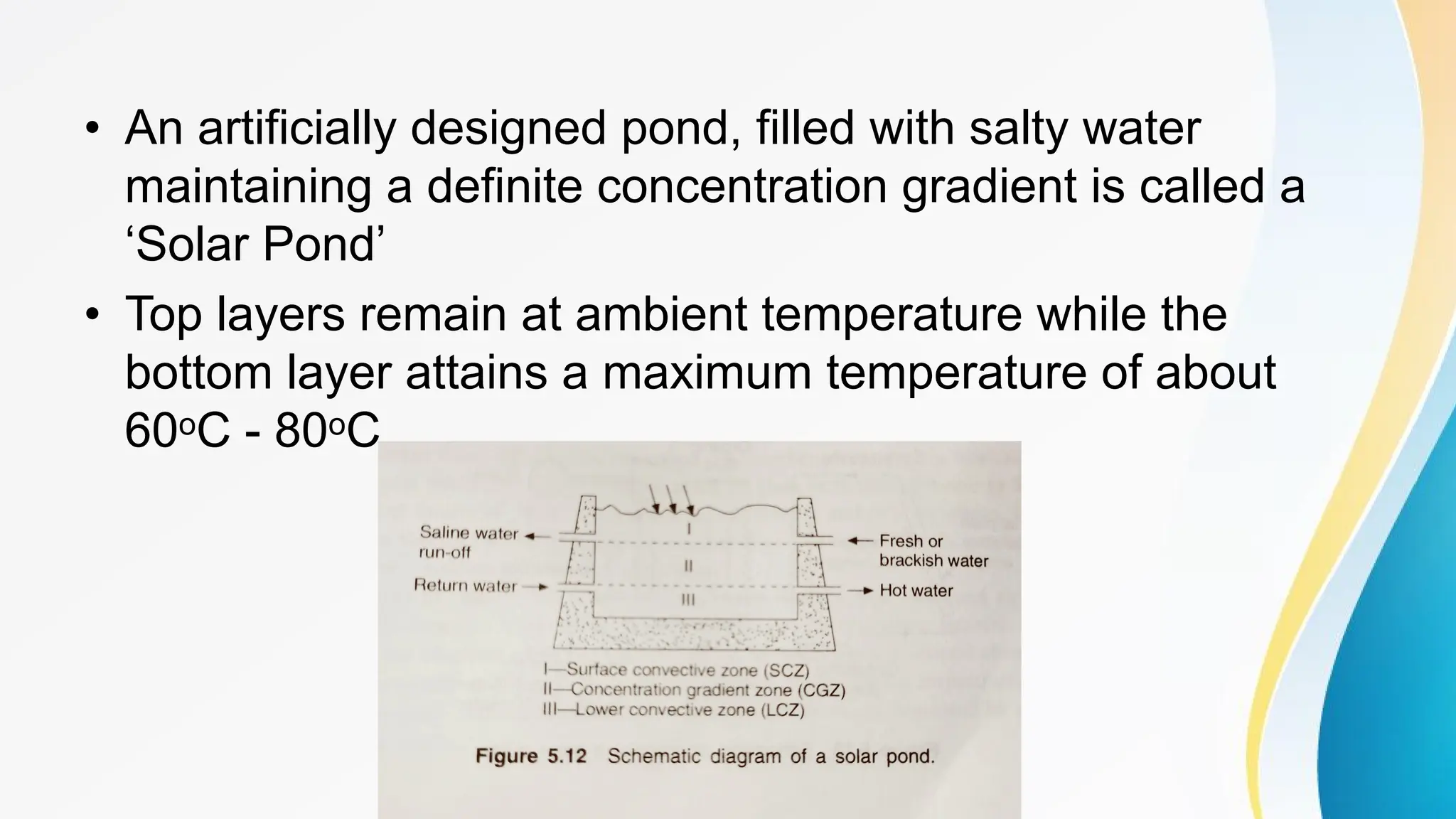
• An artificially designed pond, filled with salty water
maintaining a definite concentration gradient is called a
‘Solar Pond’
• Top layers remain at ambient temperature while the
bottom layer attains a maximum temperature of about
60oC - 80oC
• For extracting heat energy from the pond, hot water is
taken out continuously from the bottom and returned after
passing through a heat exchanger
• Or it can also be extracted by water flowing through a
submerged heat exchanger coil
• As a result of continuous movement and mixing of salty
water at the top and bottom, the solar pond can have
three zones
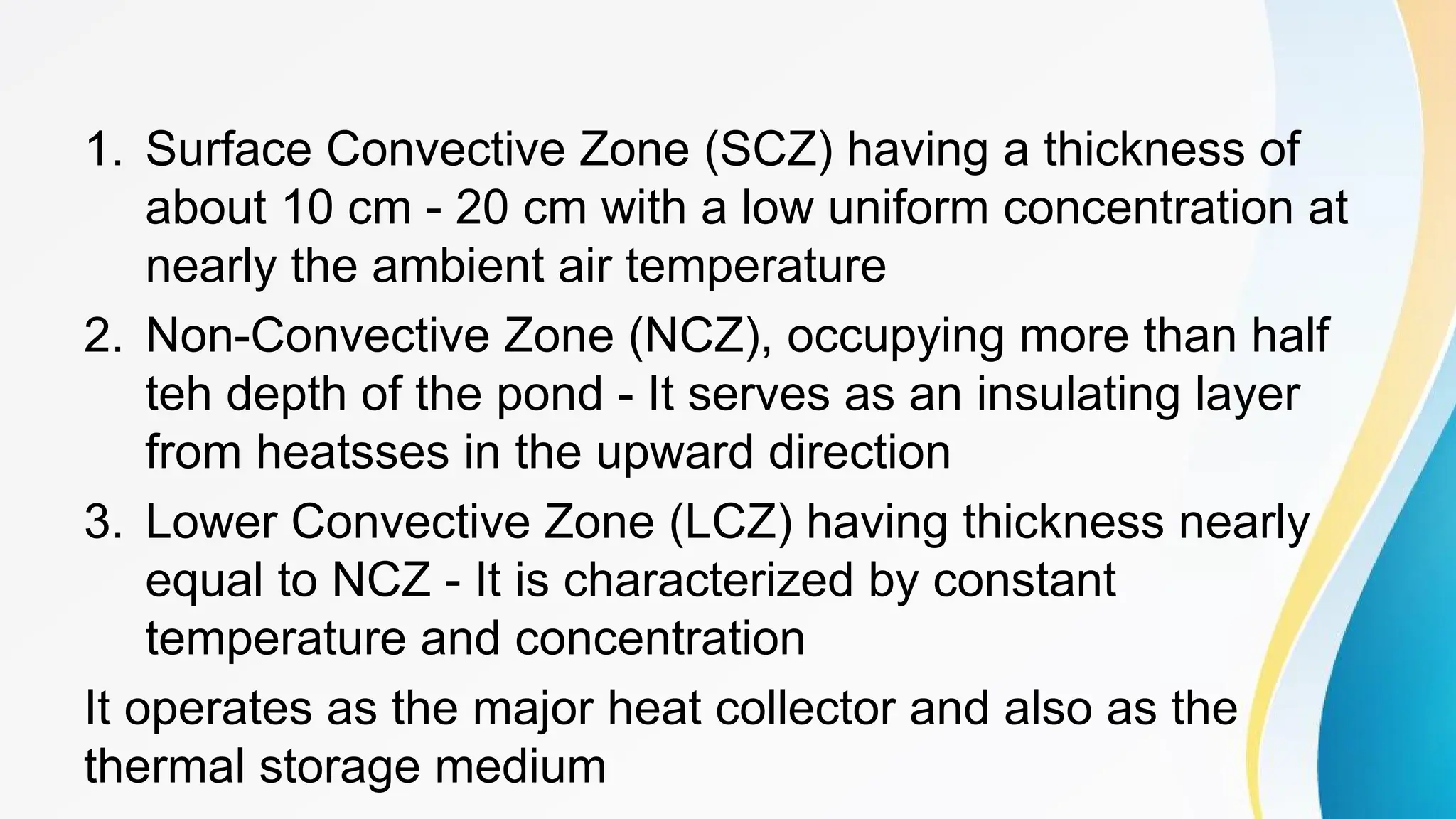
1. Surface Convective Zone (SCZ) having a thickness of
about 10 cm - 20 cm with a low uniform concentration at
nearly the ambient air temperature
2. Non-Convective Zone (NCZ), occupying more than half
teh depth of the pond - It serves as an insulating layer
from heatsses in the upward direction
3. Lower Convective Zone (LCZ) having thickness nearly
equal to NCZ - It is characterized by constant
temperature and concentration
It operates as the major heat collector and also as the
thermal storage medium
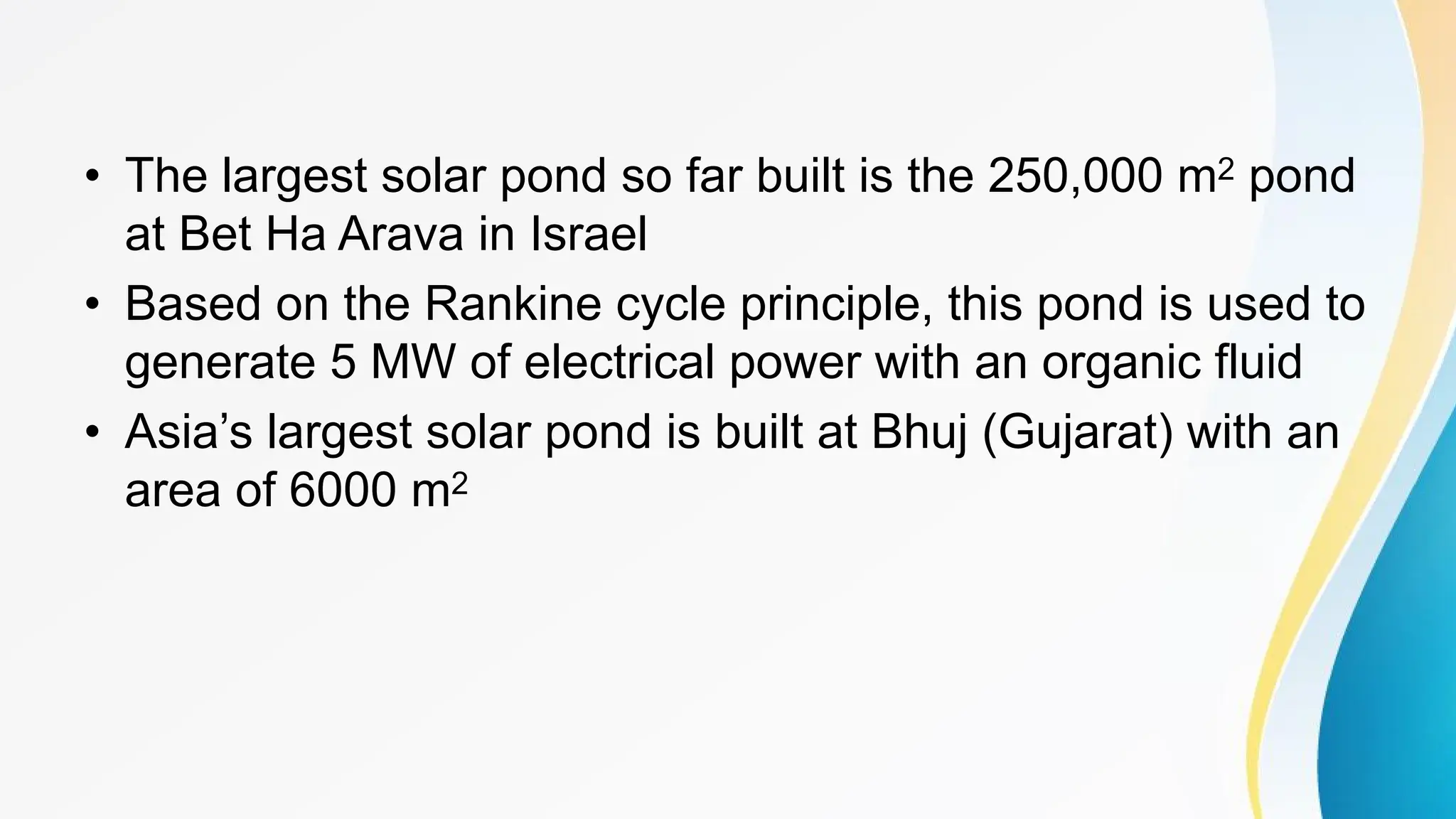
• The largest solar pond so far built is the 250,000 m2 pond
at Bet Ha Arava in Israel
• Based on the Rankine cycle principle, this pond is used to
generate 5 MW of electrical power with an organic fluid
• Asia’s largest solar pond is built at Bhuj (Gujarat) with an
area of 6000 m2
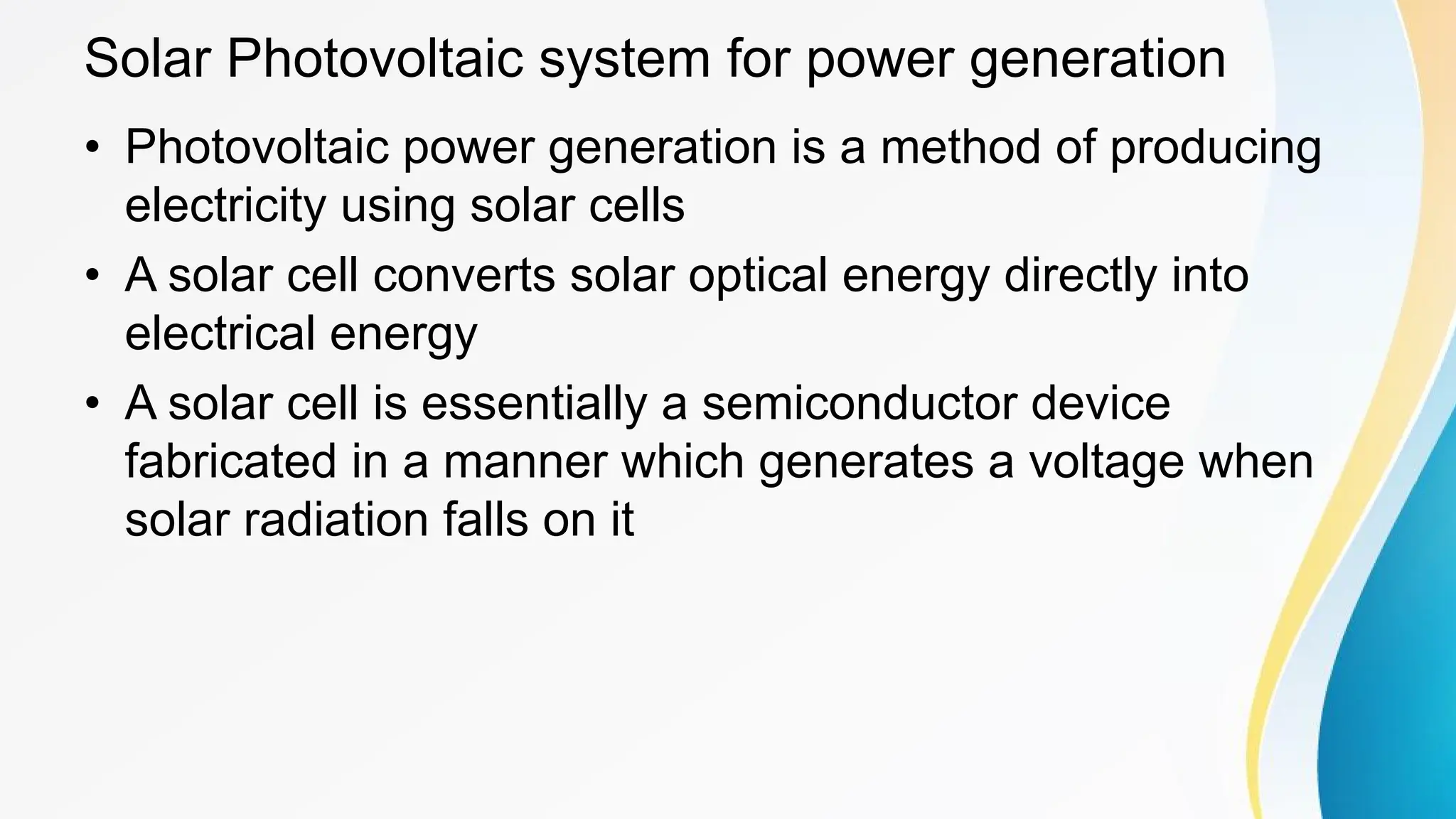
Solar Photovoltaic system for power generation
• Photovoltaic power generation is a method of producing
electricity using solar cells
• A solar cell converts solar optical energy directly into
electrical energy
• A solar cell is essentially a semiconductor device
fabricated in a manner which generates a voltage when
solar radiation falls on it
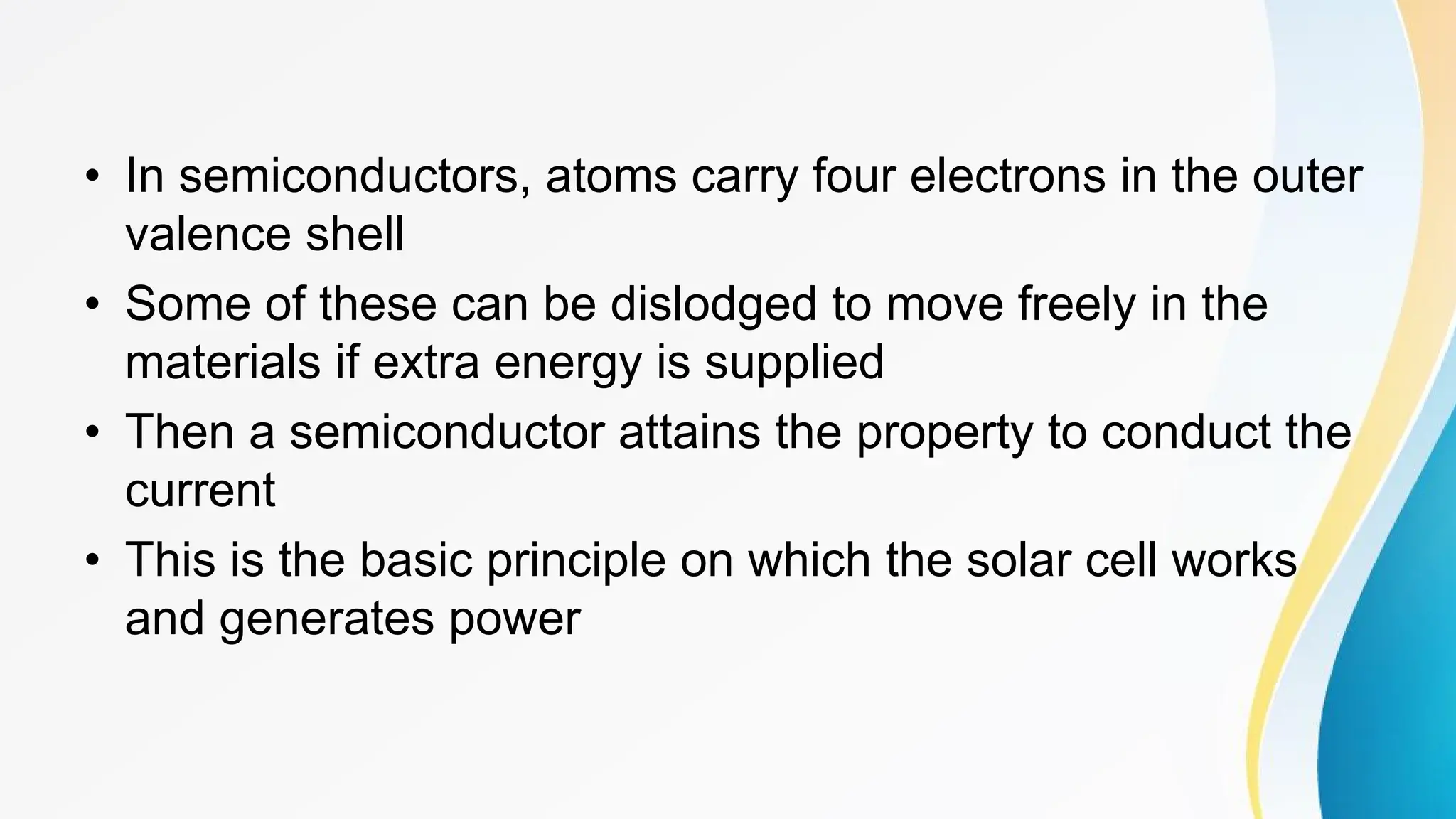
• In semiconductors, atoms carry four electrons in the outer
valence shell
• Some of these can be dislodged to move freely in the
materials if extra energy is supplied
• Then a semiconductor attains the property to conduct the
current
• This is the basic principle on which the solar cell works
and generates power
Solar cell
• Solar cell, also called photovoltaic cell, is any device that
directly converts the energy of light into electrical energy
through the photovoltaic effect
• The overwhelming majority of solar cells are fabricated
from silicon
• Unlike batteries or fuel cells, solar cells do not utilize
chemical reactions or require fuel to produce electric
power, and, unlike electric generators, they do not have
any moving parts.

• Solar Photovolataic system consists of an arrangement of
several components, including solar panels to absorb and
conver sunlight into electricity,
• a solar inverter to change the electric current from DC to
AC,
• as well as cabling, mouning and other electrical
assessories to set up a working system
• Sometimes, photovoltaic system uses a solar tracking
system to improve the system’s overall performance
• A typical photovoltaic cell efficiency is about 15% which
means it can convert 1/6 of solar energy into electricity
• Since there are no moving parts in a photovoltaic cell, it
does not produce any noise
• Photovoltaic systems do not emit pollutants into the
environment
• A photovoltaic cell has a lifetime of more than thirty years
and is one of the most reliable semiconductor product
Limitation of PV system
• Reflection losses on the surface
• Inefficient absorption of solar radiation
• Incomplete collection of electron hole pair
• Fluctuating voltage
Advantages of solar photovoltaic cell
• No environment problem
• There is no moving part
• Easy operation and maintenance
• High reliability
• System fabrication is easy
• Ability to function unattended for long periods enables
their use to remote area and space programme
• The source is unlimited
Disadvantages
• Cost of solar cell is very high
• Voltage output is not constant, it varies with time of the
day and weather
• Amount of power generated is small
• Solar cell: It is basically a bulk silicon cell where the bulk
material is the p-type silicon
• A thin layer of n-type silicon is formed at the top surface
• There is anti-reflective coating, textured rear surface
• Solar PV module: It is the basic building block of a PV
system
• It is the interconnection of a number of cells and all these
cells should have the same characteristics
• Partial shadowing may damage the module
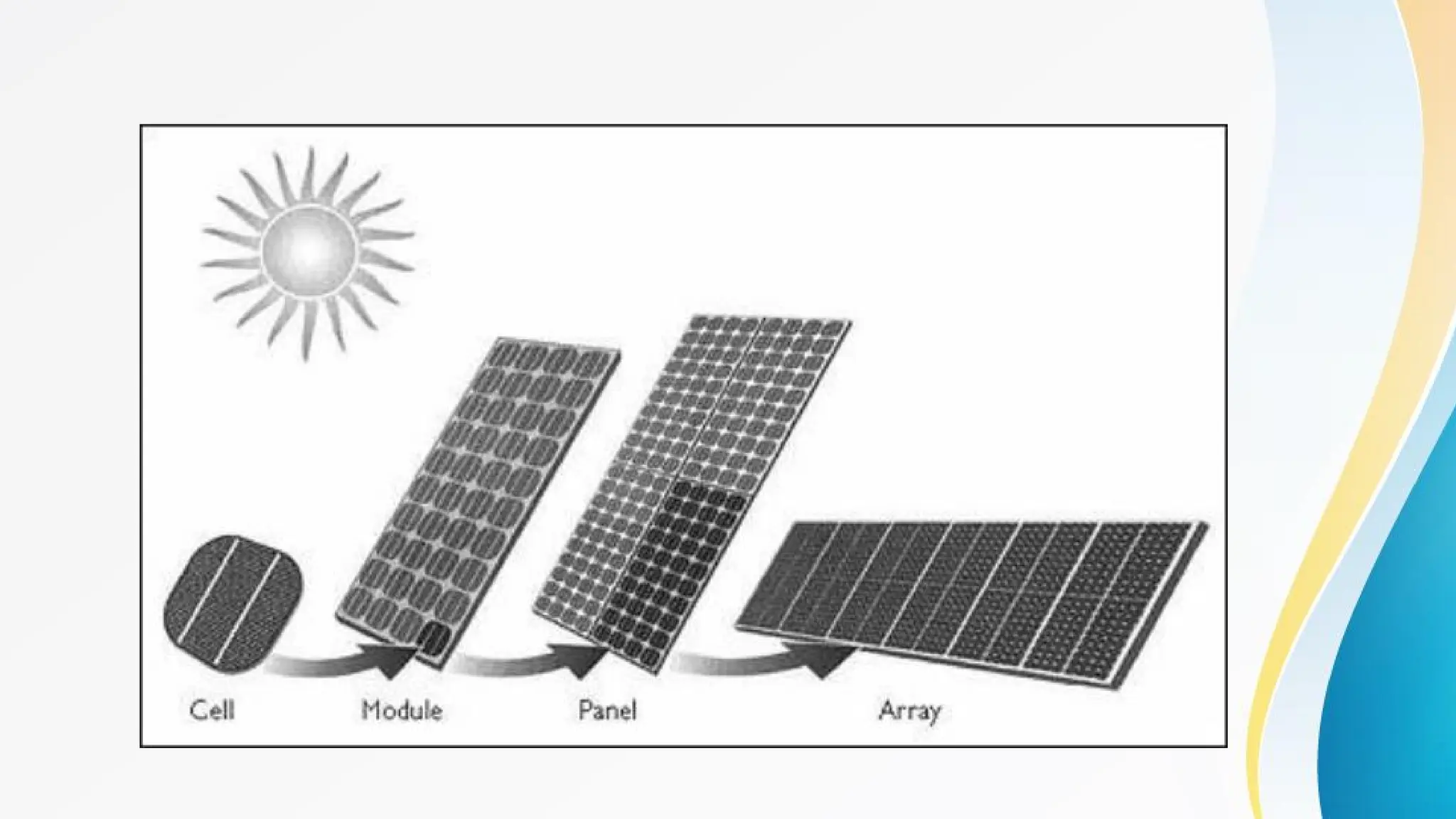
• Solar PV panel: Several solar modules are connected in
series/parallel to increaset he voltage/current ratings
• Solar panel is a group of several modules connected in
series parallel combination in a frame that can be
mounted on a structure
• The combination of such panels are called as a Solar
Array
Types of Silicon Solar cells
• Single crystal Silicon
ØThe basic raw materiial is sand (SiO2) from which Silica
(Si) is extracted and purified repeatedly to obtain the
metallurgical grade silicon
ØIt contains about 1% impurities and further processed to
convert it to a purer semiconductor grade silicon
ØIt is then finally converted into a single crystal ingot
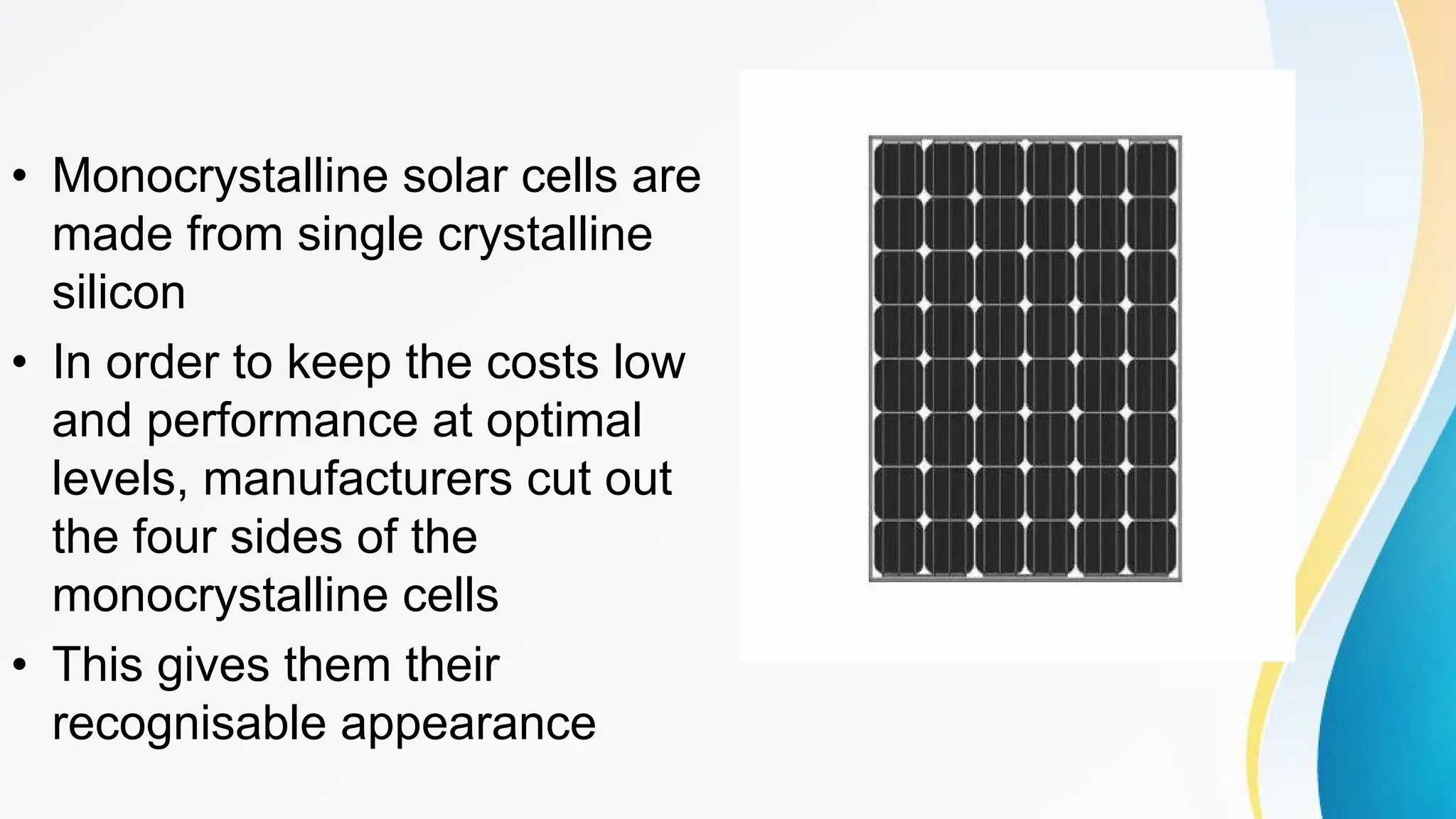
• Monocrystalline solar cells are
made from single crystalline
silicon
• In order to keep the costs low
and performance at optimal
levels, manufacturers cut out
the four sides of the
monocrystalline cells
• This gives them their
recognisable appearance
• They have the highest level of efficiency at 15-20%
• They require less space compared to other types due to
their high efficiency
• Manufacturers state that this form of solar cell lasts the
longest, with most giving them a 25-year warranty
• They perform better in low levels of sunlight, making them
ideal for cloudy areas
• They are the most expensive solar cells on the market
• The performance levels tend to suffer from an increase in
temperature
• There is a lot of waste material when the silicon is cut
during manufacture
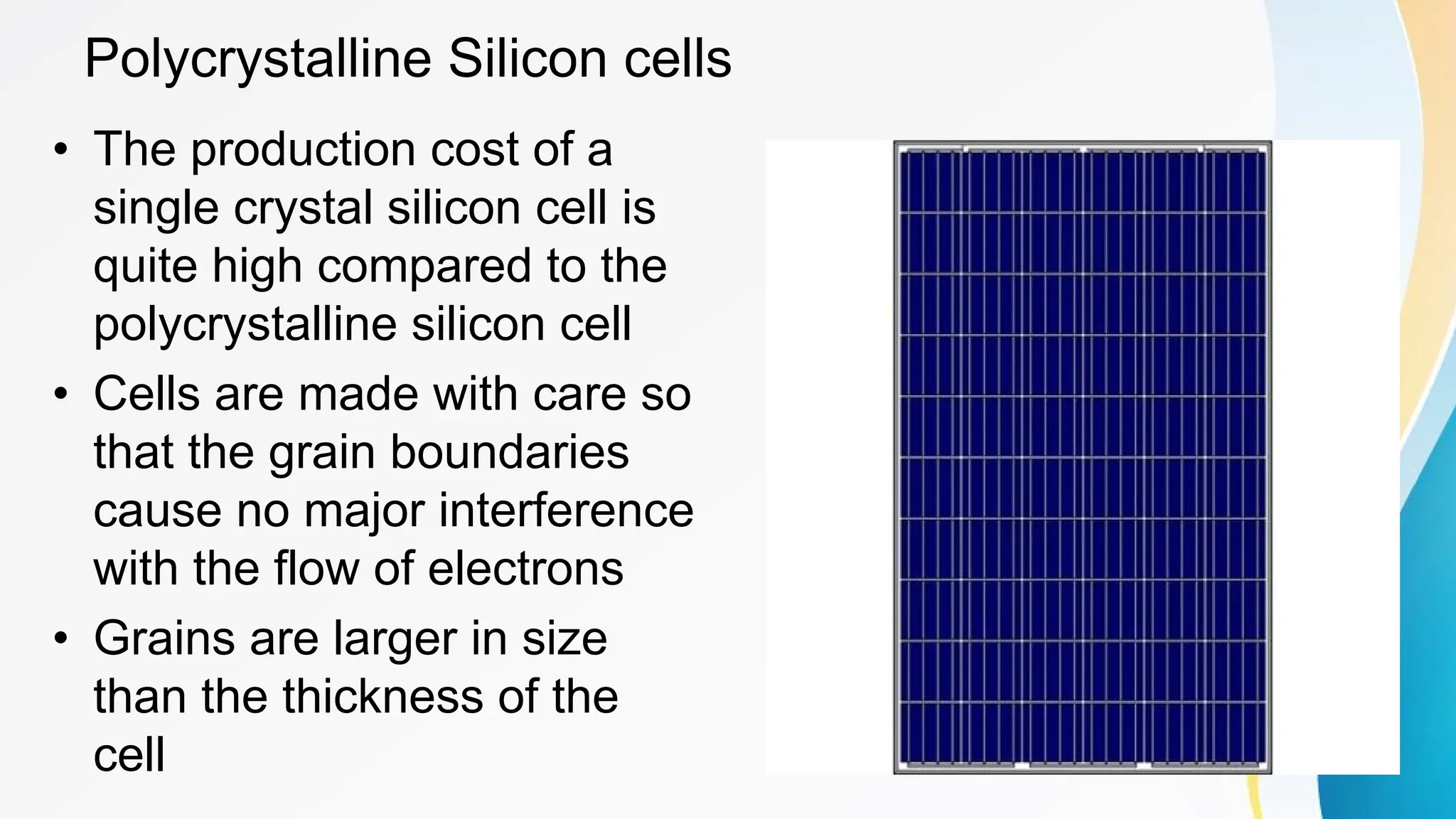
Polycrystalline Silicon cells
• The production cost of a
single crystal silicon cell is
quite high compared to the
polycrystalline silicon cell
• Cells are made with care so
that the grain boundaries
cause no major interference
with the flow of electrons
• Grains are larger in size
than the thickness of the
cell
• The silicon is melted and poured into square moulds
• These then form perfectly shaped square cells
• High temperatures have less negative effects on
efficiency compared with monocrystalline cells
• This makes the polycrystalline cells more attractive to
people in warmer areas as the price is lower
Amorphous Silicon Cells
• Amorphous silicon is pure silicon with no crystal
properties
• It is highly light absorbent
• They are manufactured by placing several thin layers of
photovoltaic on top of each other to creates the module
• Depending on the technology that has been used, the
efficiency rates for thin film solar cells tends to vary from
7% to 13%
• Since 2002, the knowledge levels and popularity for thin
film solar cells has risen dramatically, which also means
that research and development have been increased
• Due to this, we can expect future models to hold
efficiency rates of 10-16%.
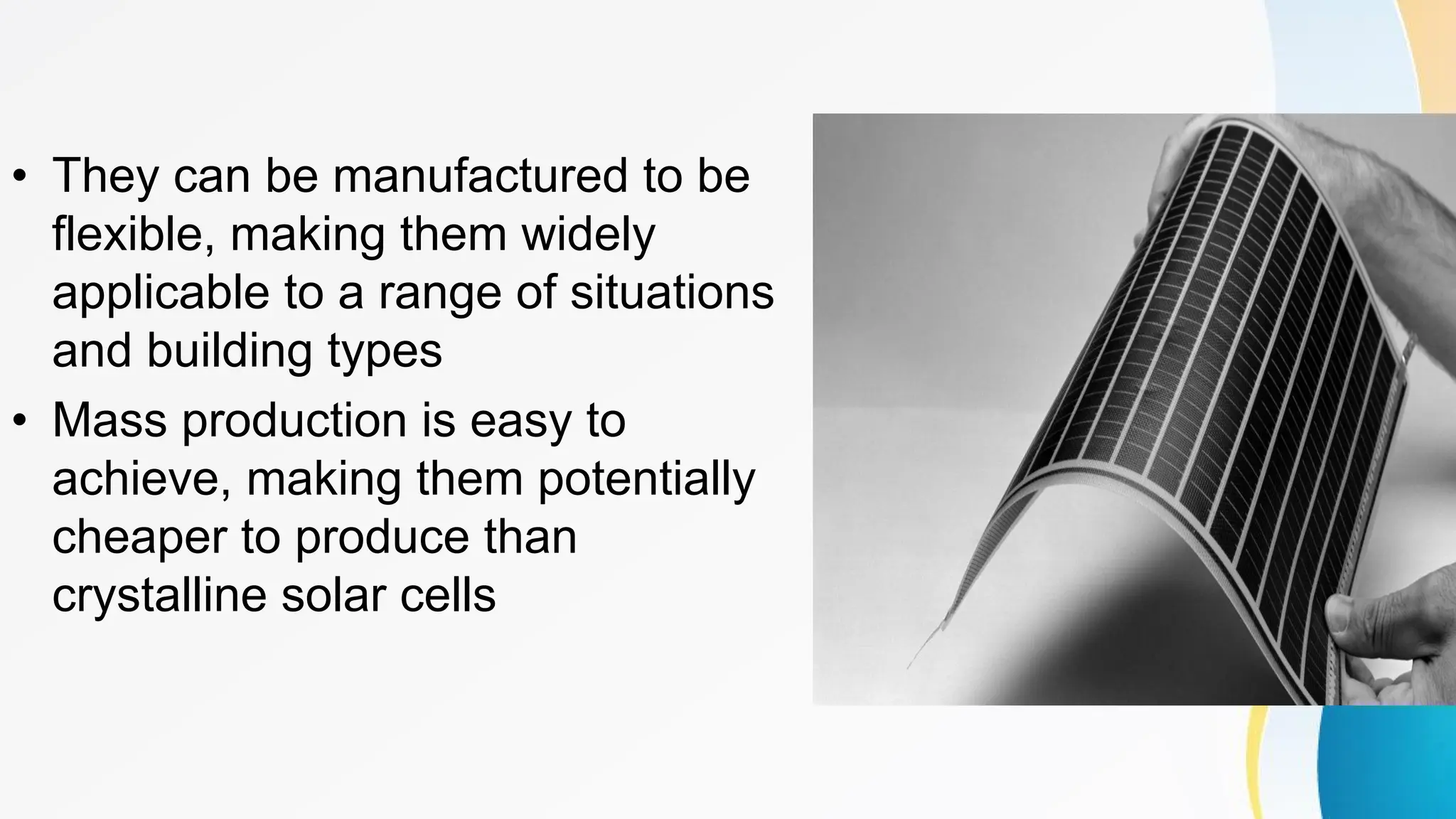
• They can be manufactured to be
flexible, making them widely
applicable to a range of situations
and building types
• Mass production is easy to
achieve, making them potentially
cheaper to produce than
crystalline solar cells
• They are not ideal for domestic use as thy take up a lot of
space
• Low space efficiency means that they will cause further
expenses in the form of enhancers, like cables of support
structures
• They have a shorter lifespan and so shorter warranty
periods

Module 2.pdf

  • 1.
  • 2.
    • There aretwo basic techniques for converting solar radiation into useful power vConversion of solar radiation into heat - Solar thermal route vConversion of solar radiation directly to electricity - Solar photovoltaic route
  • 3.
    • Solar thermalapplication covers solar water heating, solar cooking in rural and urban areas, solar drying and purification of water • Solar energy is also used for space heating and cooling • Solar photovoltaic technology convdrts sunlight into DC electricity without any moving parts and utilised for lighting, water pumping, computers and telecommunications etc • Stand alone SPV powerplants in rural areas provide power for electrification
  • 4.
    Assignment • Applications ofsolar power • Solar space heating and cooling of buildings, solar pumping, solar cooker, solar still, solar drier, solar refrigeration and air-conditioning, heliostat, solar furnace • Submit on or before 24th October
  • 5.
    Solar thermal energycollectors • A solar thermal energy collector is an equipment in which solar energy is collected by absorbing radiation in an absorber and then transferring to a fluid • In general there are two types of collectors: 1 Flat plat solar collector: It has no optical concentrator. • Here, the collector area and the absorber area are numerically the same • The efficiency is low, and temperatures of the working fluid can be raised only up to 100 C
  • 6.
    • 2. Concentratingtype solar collector: Here the area rceiving the solar radiation is several times greater than the absorber area and teh efficciency is high • Mirrors and lenses are used to concentrate the sun’s rays on the absorber, and the fluid temperature can be raised up to 500 C • For better performance, teh collector is mounted on a tracking equipment to face the sun always with its changing position
  • 7.
  • 8.
    • A metallicflat absorber plat of high thermal conductivity made of copper, steel or aluminium and having black surface - Thickness ranges from 0.5 mm - 1 mm • Tubes or channels are soldered to the absorber plate Water flowing through these tubes takes away the heat from teh absorber plate
  • 9.
    • A transparenttoughened glass sheet of 5 mm thickness is provided as the cover plat It reduces convection losses through a stagnant air layer between the absorber plate and the glass Radiation losses are also reduced as it is transparent to short wave radiation and nearly opaque to long wave thermal radiation emitted by interior collector walls and absorbing plat
  • 10.
    • Fibre glassinsulation is provided at the bottom and on the sides in order to minimize heat loss • A container encloses the whole assembly in a box made of metallic sheet or fibre glass
  • 11.
    Solar concentrating collectors •In flat plate collectors the solar radiation intensity is uniformly distributed over the glass cover and the absorber, keeping the temperature rise of the solar device upto 100 C • If solar radiation falling over a large surface is concentrated to a smaller area of the absorber plate, the temperature can be enhanced up to 500 C • Concentration is achieved by an optical system either from the reflecting mirrors of from teh refracting lenses
  • 12.
    Parabolic trough The reflectoris in the form of trough with a parabolic cross section in which the image is formed on the focus of the parabola along a line as shown in figure
  • 13.
    • The basicparts are i. an absorber tube with a selective coating located at the focal axis through which the liquid to be heated flows ii. a parabolic concentrator iii. a concentric transparent cover
  • 14.
  • 15.
    • Concentration ratio(CR) is high • CR is the ratio of the effective area of the aperture to the surface area of the absorber • parabolic dish collector is of point focussing type as the receiver is placed at the focus of the parabolic reflector • CR ranges from 100 to a few thousands with maximum temperature upto 2000 C • Two-axis tracking is required so that the sun may remain in line with the focus and vertes of the paraboloid
  • 16.
  • 17.
    • To collectlarge amounts of heat energy at one point, the central receiver concept is followed • Solar radiation is reflected from a field of heliostats (an array of mirrors) to a centrally located receiver on a tower • Heliostats follow the sun to harness maximum solar heat heat • Water flowing through the receiver absorbers heat to procude steam which operates a Rankine cycle turbo generator to generate electrical energy
  • 18.
    • With acentral receiver optical system, a large number of sml mirrors are installed, each steerable to have an image at the absorber on the central receiver • A curvature is provided to the mirrors so as to focus the sunlight in addition to directing it to the tower
  • 19.
    Solar Air heaters •A solar air heater constitutes a flat-plate collector with an absorber plate, transparent cover at the top, a passage through which the air flows and insulation at the bottom and sides as shown in the figure
  • 20.
    • Air passageis only a parallel plat duct • Air to be heated flows between the cover and the absorber plate which is fabricated from a metal sheet of 1mm thickness • Cover is either made of glass or plastic • Glass wool is used for bottom and side insulation • Full assembly is encased in a sheet metal box and kept inclined at a suitable angle • The face area of a solar heater is about 2m2, matching the heat requirement
  • 21.
    • As heattransfer between the absorber plate and air is low the operating efficiency of a sinple air heater is also low • To boost heat transfer, the contact area of air with the absorber plate is increased either by • adopting a V-shaped absorber plat • or by designing two-pass air heaters • The two-pass solar air heater carries two glass cover sheets, separated by an air gap which reduces heat losses
  • 23.
    Solar Thermal powergeneration • Solar thermal power generation involves the collection of solar heat which is utilised to increase the temperatre of a fluid in a turbine • In other methods, hot fluid is allowed to pass through a heat exchanger to evaporate a working fluid that operates a turbine coupled with a generator
  • 25.
    • A lowtemperature solar power plant uses flat plate collector arrays • Hot water above 90 C is collected in an air insulated tank • It flows through a heat exchanger through which the working fluid of the energy conversion cycle is also circulated To reduce the capital cost, solar ponds are sued instead of flat-plate collectors Such plants up to 150kW capacity are operative in Israel for over 25 years
  • 26.
    • In asolar thermal power plants operating on mediumperatures up to 400 C, focussing parabolic collector is used • A suitable sun-tracking arrangement is made to ensure that maximum quantit of solar radiation is focused on the absorber pipeline • Paraboloidal dish and the central receiver is used to achieve high temperatures in high temperature solar thermal power generator
  • 27.
    Solar Thermal EnergyStorage • Solar energy is available only during the sunshine hours • Consumer energy demands follow their own time pattern and the solar energy does not fully match the demand • As a result, energy storage is a must to meet the consumer requirement
  • 28.
    Sensible Heat Storage •Heating a liquid or a solid which does not change phase comes under this category • The quantity of heat stored is proportional to the temperature rise of the material • If T1 and T2 represent the lower and higher temperature, m the mass of the storage material, and C the specific heat, the energy stored Q is • Q= mC (T1-T2)
  • 29.
    • For asensible heat storae system, energy is stored by heating a liquid or a solid • Materials that are used in such a system include liquids like water, inorganic molten salts and solids like rock, gravel and refractories • The choice of the material used depends on the temperature level of its utilization • Water is used for temperature below 100C whereas refractory bricks can be used for temperature p to 1000 C
  • 30.
    • Liquids used:The ability to store heat depends upon the heat capacity and water has the highest in liquids • Largely the solar water heating and space heating systems utilise hot water storage tanks • An optimum tank size for a flat plate collector system is about 100 litres of storage per square metre of collector area • Molten inorganic salt may also be used for high temperature applications (eg: Hitec, melting point is 15 C, and cane used up to 400 C) • Liquid solium is also in use as a storage fluid
  • 31.
    • Solids: Rocksor gravel packed in an insulated vessel are used with solar heaters • It provides a large and inexpensive heat transfer surface • Regractory materials like Magnesium oxide bricks, Silicon oxide and Aluminium oxide are used in storage devices to operate up to 600 C
  • 32.
    Latent heat storage(Phase change heat storage) • In this system, heat is stored in a material when it melts, and heat is extracted from the material when it freezes • Heat can also be stored when a liquid changes to gaseous state, but as the volume change is large, such a system is not economical • Some organic materials like paraffin was and fatty acids are very suitable for such applications • Ice is quite suitable if energy is to be stored/extracted at 0oC • Sodium Nitrate having a melting point of 310oC is suitable for high temperature applications
  • 33.
    Thermochemical Storage • Witha thermochemical storage system, solar heat energy can start an endothermic chemical reaction and new products of reactions remain intact • To extract energy, a reverse exothermic reaction is allowed to take place • Actually, the thermochemical thermal energy is the binding energy of reversible chemical reactions
  • 34.
    • Chemicas Aand B react with solar heat and through forward reaction are converted into products C and D • The new products are stored at ambient temperature • When energy is required, the reverse reaction is allowed to take place at a lower temperature where products C and D react to form A and B • During the reaction, heat is released and utilised
  • 35.
    • Details ofsome such reactions are shown in the table • Like the latent heat storage system, chemical storage has the advantage of releasing heat at constant temperature
  • 36.
    Solar Pond • Theconcept of solar pond was derived from the natural lakes where the temperature rises towards the bottom • It happens due to natural salt gradient in these lakes where water at the bottom is denser • In salt concentration lakes, convection does not occur and heat loss from hot water takes place only by conduction • This technique is utilized for collecting and storing solar energy
  • 39.
    • An artificiallydesigned pond, filled with salty water maintaining a definite concentration gradient is called a ‘Solar Pond’ • Top layers remain at ambient temperature while the bottom layer attains a maximum temperature of about 60oC - 80oC
  • 40.
    • For extractingheat energy from the pond, hot water is taken out continuously from the bottom and returned after passing through a heat exchanger • Or it can also be extracted by water flowing through a submerged heat exchanger coil • As a result of continuous movement and mixing of salty water at the top and bottom, the solar pond can have three zones
  • 41.
    1. Surface ConvectiveZone (SCZ) having a thickness of about 10 cm - 20 cm with a low uniform concentration at nearly the ambient air temperature 2. Non-Convective Zone (NCZ), occupying more than half teh depth of the pond - It serves as an insulating layer from heatsses in the upward direction 3. Lower Convective Zone (LCZ) having thickness nearly equal to NCZ - It is characterized by constant temperature and concentration It operates as the major heat collector and also as the thermal storage medium
  • 42.
    • The largestsolar pond so far built is the 250,000 m2 pond at Bet Ha Arava in Israel • Based on the Rankine cycle principle, this pond is used to generate 5 MW of electrical power with an organic fluid • Asia’s largest solar pond is built at Bhuj (Gujarat) with an area of 6000 m2
  • 43.
    Solar Photovoltaic systemfor power generation • Photovoltaic power generation is a method of producing electricity using solar cells • A solar cell converts solar optical energy directly into electrical energy • A solar cell is essentially a semiconductor device fabricated in a manner which generates a voltage when solar radiation falls on it
  • 44.
    • In semiconductors,atoms carry four electrons in the outer valence shell • Some of these can be dislodged to move freely in the materials if extra energy is supplied • Then a semiconductor attains the property to conduct the current • This is the basic principle on which the solar cell works and generates power
  • 45.
    Solar cell • Solarcell, also called photovoltaic cell, is any device that directly converts the energy of light into electrical energy through the photovoltaic effect • The overwhelming majority of solar cells are fabricated from silicon • Unlike batteries or fuel cells, solar cells do not utilize chemical reactions or require fuel to produce electric power, and, unlike electric generators, they do not have any moving parts.
  • 46.
    • Solar Photovolataicsystem consists of an arrangement of several components, including solar panels to absorb and conver sunlight into electricity, • a solar inverter to change the electric current from DC to AC, • as well as cabling, mouning and other electrical assessories to set up a working system • Sometimes, photovoltaic system uses a solar tracking system to improve the system’s overall performance
  • 47.
    • A typicalphotovoltaic cell efficiency is about 15% which means it can convert 1/6 of solar energy into electricity • Since there are no moving parts in a photovoltaic cell, it does not produce any noise • Photovoltaic systems do not emit pollutants into the environment • A photovoltaic cell has a lifetime of more than thirty years and is one of the most reliable semiconductor product
  • 48.
    Limitation of PVsystem • Reflection losses on the surface • Inefficient absorption of solar radiation • Incomplete collection of electron hole pair • Fluctuating voltage
  • 49.
    Advantages of solarphotovoltaic cell • No environment problem • There is no moving part • Easy operation and maintenance • High reliability • System fabrication is easy • Ability to function unattended for long periods enables their use to remote area and space programme • The source is unlimited
  • 50.
    Disadvantages • Cost ofsolar cell is very high • Voltage output is not constant, it varies with time of the day and weather • Amount of power generated is small
  • 51.
    • Solar cell:It is basically a bulk silicon cell where the bulk material is the p-type silicon • A thin layer of n-type silicon is formed at the top surface • There is anti-reflective coating, textured rear surface
  • 52.
    • Solar PVmodule: It is the basic building block of a PV system • It is the interconnection of a number of cells and all these cells should have the same characteristics • Partial shadowing may damage the module
  • 53.
    • Solar PVpanel: Several solar modules are connected in series/parallel to increaset he voltage/current ratings • Solar panel is a group of several modules connected in series parallel combination in a frame that can be mounted on a structure • The combination of such panels are called as a Solar Array
  • 55.
    Types of SiliconSolar cells • Single crystal Silicon ØThe basic raw materiial is sand (SiO2) from which Silica (Si) is extracted and purified repeatedly to obtain the metallurgical grade silicon ØIt contains about 1% impurities and further processed to convert it to a purer semiconductor grade silicon ØIt is then finally converted into a single crystal ingot
  • 56.
    • Monocrystalline solarcells are made from single crystalline silicon • In order to keep the costs low and performance at optimal levels, manufacturers cut out the four sides of the monocrystalline cells • This gives them their recognisable appearance
  • 57.
    • They havethe highest level of efficiency at 15-20% • They require less space compared to other types due to their high efficiency • Manufacturers state that this form of solar cell lasts the longest, with most giving them a 25-year warranty • They perform better in low levels of sunlight, making them ideal for cloudy areas
  • 58.
    • They arethe most expensive solar cells on the market • The performance levels tend to suffer from an increase in temperature • There is a lot of waste material when the silicon is cut during manufacture
  • 59.
    Polycrystalline Silicon cells •The production cost of a single crystal silicon cell is quite high compared to the polycrystalline silicon cell • Cells are made with care so that the grain boundaries cause no major interference with the flow of electrons • Grains are larger in size than the thickness of the cell
  • 60.
    • The siliconis melted and poured into square moulds • These then form perfectly shaped square cells • High temperatures have less negative effects on efficiency compared with monocrystalline cells • This makes the polycrystalline cells more attractive to people in warmer areas as the price is lower
  • 61.
    Amorphous Silicon Cells •Amorphous silicon is pure silicon with no crystal properties • It is highly light absorbent • They are manufactured by placing several thin layers of photovoltaic on top of each other to creates the module
  • 62.
    • Depending onthe technology that has been used, the efficiency rates for thin film solar cells tends to vary from 7% to 13% • Since 2002, the knowledge levels and popularity for thin film solar cells has risen dramatically, which also means that research and development have been increased • Due to this, we can expect future models to hold efficiency rates of 10-16%.
  • 63.
    • They canbe manufactured to be flexible, making them widely applicable to a range of situations and building types • Mass production is easy to achieve, making them potentially cheaper to produce than crystalline solar cells
  • 64.
    • They arenot ideal for domestic use as thy take up a lot of space • Low space efficiency means that they will cause further expenses in the form of enhancers, like cables of support structures • They have a shorter lifespan and so shorter warranty periods