EPITHET
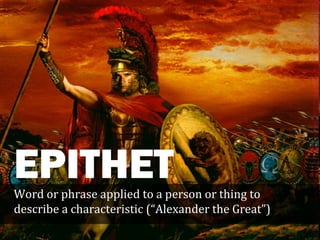
Word or phrase applied to a person or thing to
describe a characteristic (“Alexander the Great”)
EPITHET
• Often precedes or follows what/whom it describes
• Allows poets to extend a line by a few syllables

Examples from Homer:
• “rosy-fingered dawn”
• “gray-eyed Athena”
• “swift-footed Achilles”
FARCE
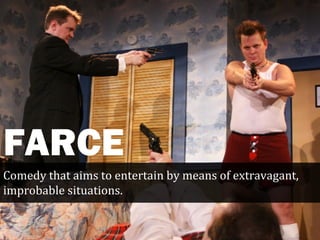
Comedy that aims to entertain by means of extravagant,
improbable situations.
FARCE
• Focuses more on development of situation than character
• Actors exhibit exaggerated speech and movement
FARCE
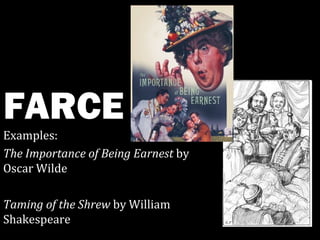
Examples:
The Importance of Being Earnest by
Oscar Wilde

Taming of the Shrew by William
Shakespeare
PUN
Humorous use of a
word in a way that
suggests two of its
meanings or the
meaning of another
similar-sounding word
PUN
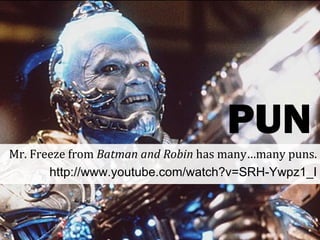
Mr. Freeze from Batman and Robin has many…many puns.
       http://www.youtube.com/watch?v=SRH-Ywpz1_I

3 pun-farce-epithet

  • 1.
    EPITHET Word or phraseapplied to a person or thing to describe a characteristic (“Alexander the Great”)
  • 2.
    EPITHET • Often precedesor follows what/whom it describes • Allows poets to extend a line by a few syllables Examples from Homer: • “rosy-fingered dawn” • “gray-eyed Athena” • “swift-footed Achilles”
  • 3.
    FARCE Comedy that aimsto entertain by means of extravagant, improbable situations.
  • 4.
    FARCE • Focuses moreon development of situation than character • Actors exhibit exaggerated speech and movement
  • 5.
    FARCE Examples: The Importance ofBeing Earnest by Oscar Wilde Taming of the Shrew by William Shakespeare
  • 6.
    PUN Humorous use ofa word in a way that suggests two of its meanings or the meaning of another similar-sounding word
  • 7.
    PUN Mr. Freeze fromBatman and Robin has many…many puns. http://www.youtube.com/watch?v=SRH-Ywpz1_I