2.001 - MECHANICS AND MATERIALS I
Lecture #1
9/6/2006
Prof. Carol Livermore
A first course in mechanics for understanding and designing complicated
systems.
PLAN FOR THE DAY:
1. Syllabus
2. Review vectors, forces, and moments
3. Equilibrium
4. Recitation sections
BASIC INGREDIENTS OF 2.001
1. Forces, Moments, and Equilibrium → Statics (No acceleration)
2. Displacements, Deformations, Compatibility (How displacements fit to-
gether)
3. Constitutive Laws: Relationships between forces and deformations
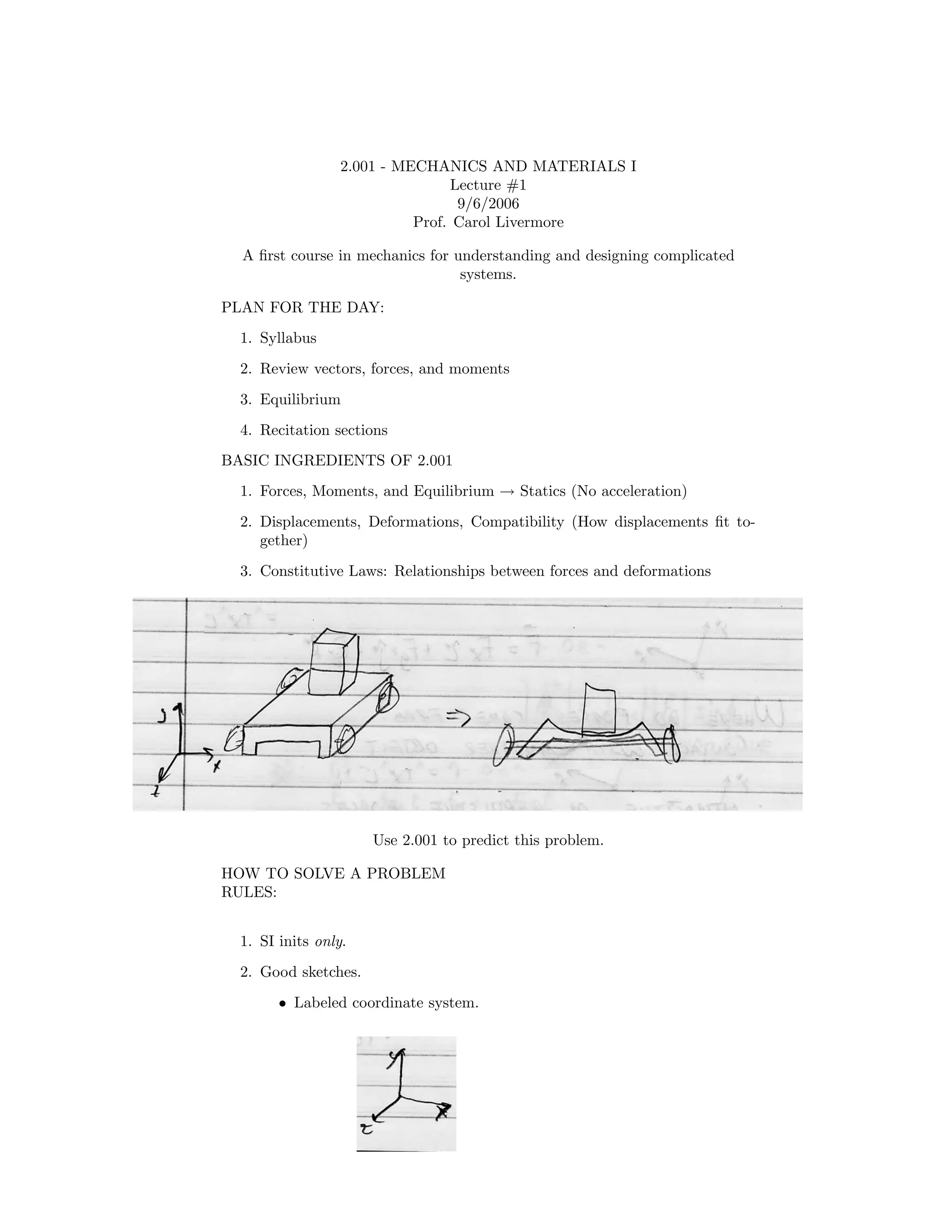
Use 2.001 to predict this problem.
HOW TO SOLVE A PROBLEM
RULES:
1. SI inits only.
2. Good sketches.
• Labeled coordinate system.
• Labeled dimensions and forces.
3. Show your thought process.
4. Follow all conventions.
5. Solve everything symbolically until the end.
6. Check answer ⇒ Does it make sense?
• Check trends.
• Check units.
7. Convert to SI, plug in to get answers.
VECTORS, FORCES, AND MOMENTS
Forces are vectors (Magnitude and Direction)
F = Fx
ˆi + Fy
ˆj + Fzkˆ
OR
F = Fx∗ iˆ∗ + Fy∗ jˆ∗ + Fz∗ kˆ∗
Where do forces come from?
• Contact with another object
• Gravity
• Attractive of repulsive forces
Moments are vectors. (Moment is another word for torque.)
• Forces at a distance from a point
• Couple
Moments are vectors.
M = My
ˆj.
EX:
2D:
FB = FBx
ˆi + FBy
ˆj
rAB = rABx
ˆi + rABy
ˆj
M × F =A = rAB B
= (rABx
ˆi + rABy
ˆj) × (FBx
ˆi + FBy
ˆj)
= (rABx FBy − rABy FBx )kˆ
OR
M | F sin φ using Right Hand RuleA = |rAB B
3D:
k
FB = FBx
ˆi + FBy
ˆj + FBz
kˆ
rAB = rABx
ˆi + rABy
ˆj + rABz
ˆ
MA ×FB = (rABx FBy FBx )kˆ+(rABz FBx FBz j+(rABy FBz FBy i= rAB −rABy −rABx )ˆ −rABz )ˆ
3
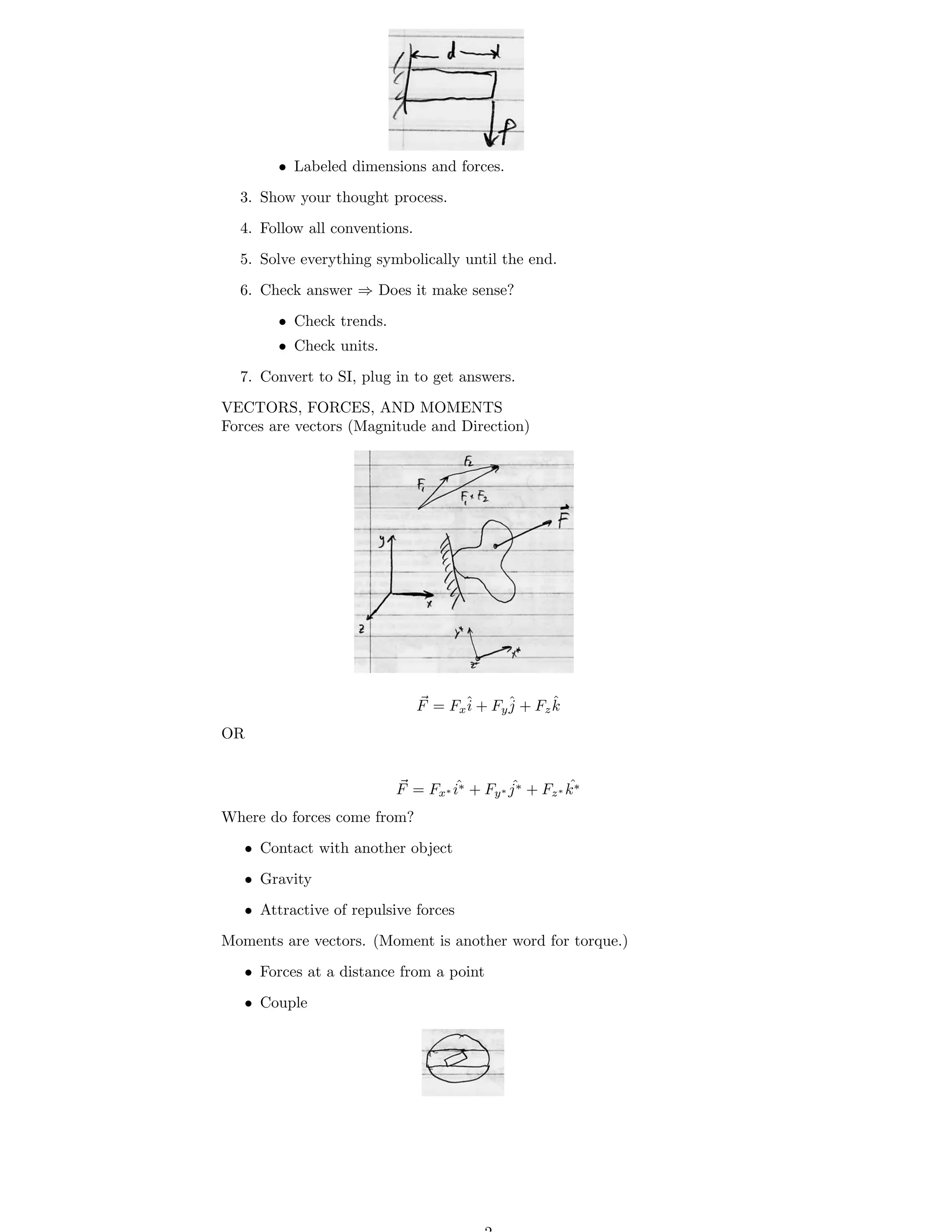
EX: Wrench
= dˆj
FB = FB
ˆi
M × F = dˆj × FB
ˆi = −dFBkˆ
rAB
A = rAB B
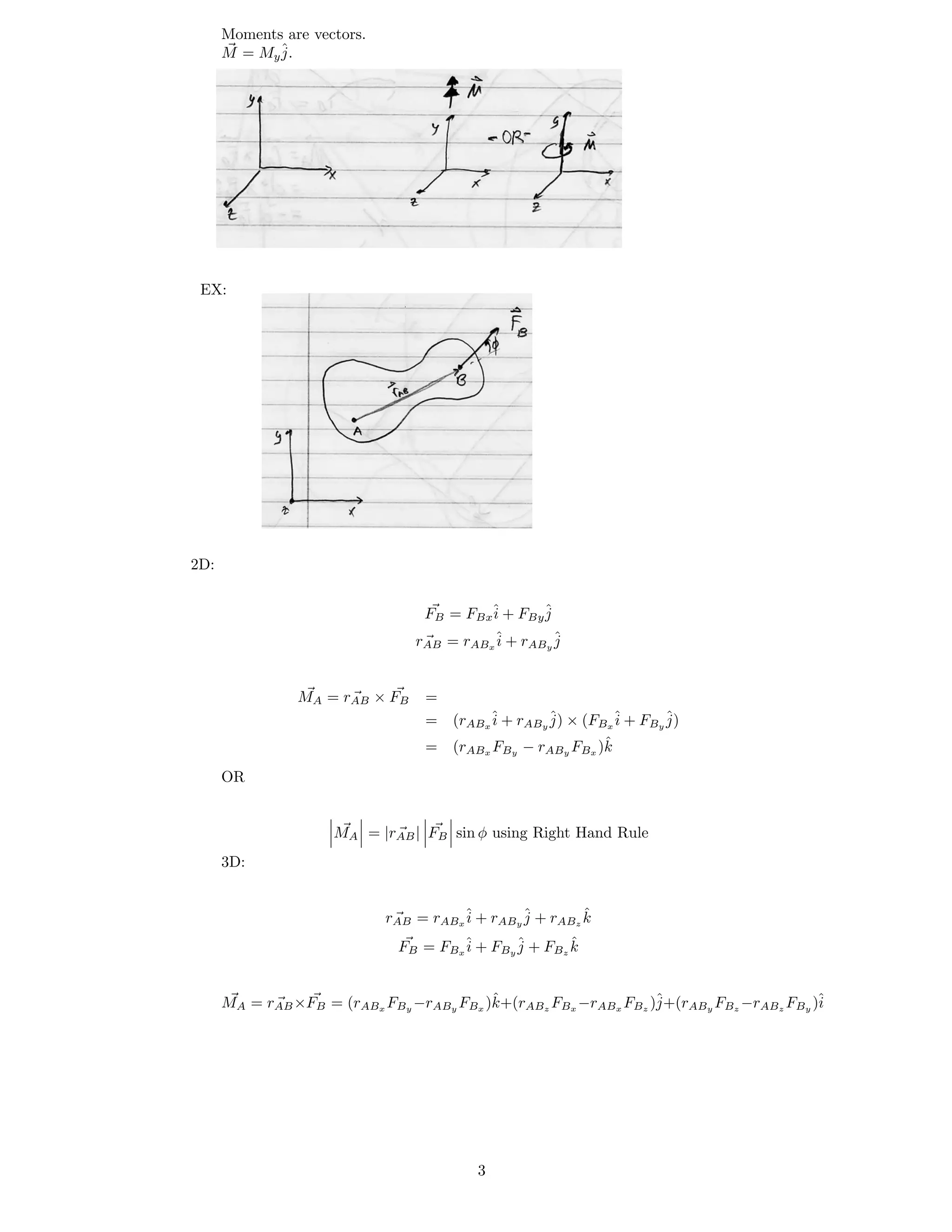
Equations of Static Equilibrium
ΣFx = 0
ΣF = 0 ΣFy = 0
ΣFz = 0
ΣM0x = 0
ΣM0 = 0 ΣM0y = 0
ΣM0z = 0
4
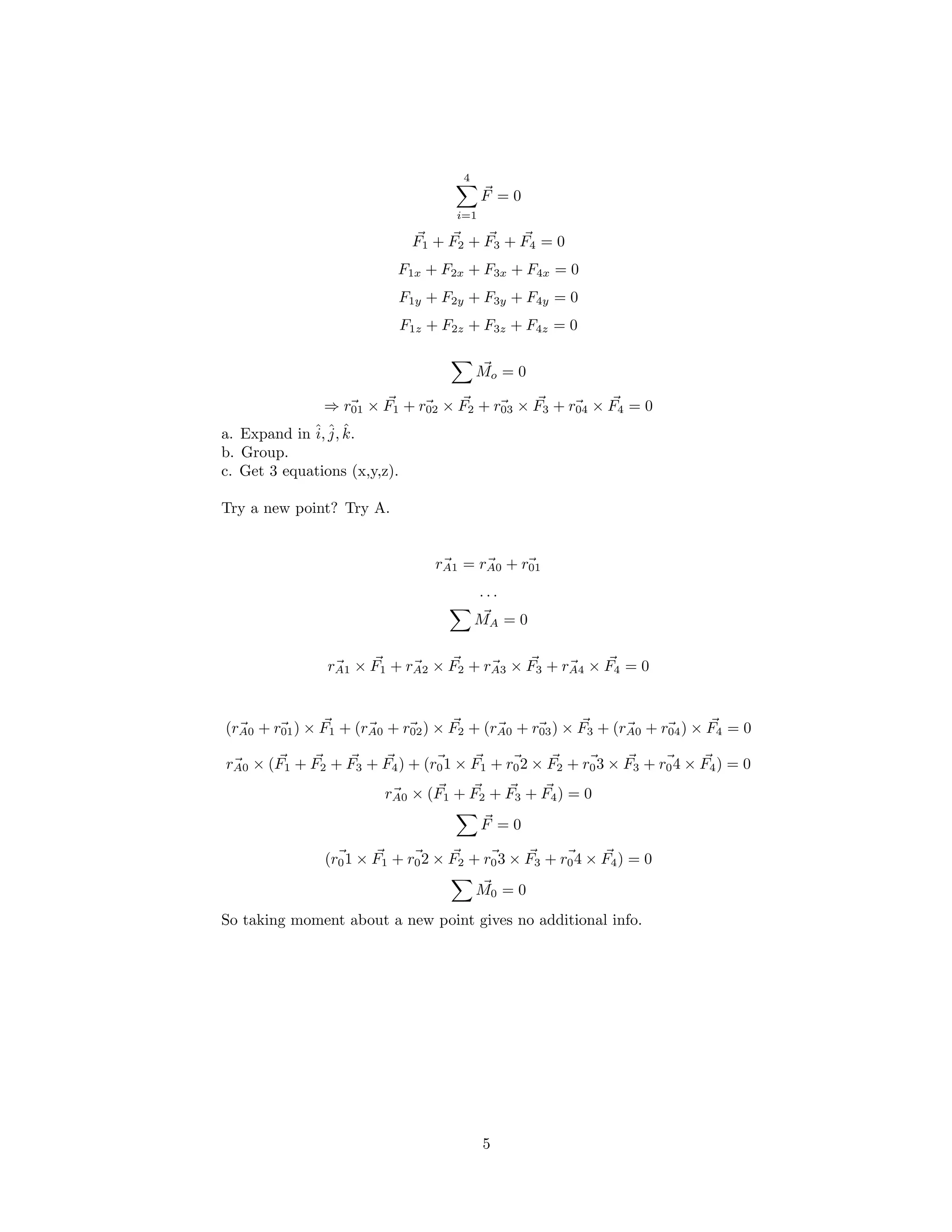
F = 0
i=1
F1 + F2 + F3 + F4 = 0
F1x + F2x + F3x + F4x = 0
F1y + F2y + F3y + F4y = 0
F1z + F2z + F3z + F4z = 0
Mo = 0
⇒ r01 × F1 + r02 × F2 + r03 × F3 + r04 × F4 = 0
a. Expand in ˆi, ˆj, kˆ.
b. Group.
c. Get 3 equations (x,y,z).
Try a new point? Try A.
rA1 = rA0 + r01
. . .
MA = 0
rA1 × F1 + rA2 × F2 + rA3 × F3 + rA4 × F4 = 0
(rA0 + r01) × F1 + (rA0 + r02) × F2 + (rA0 + r03) × F3 + (rA0 + r04) × F4 = 0
rA0 × (F1 + F2 + F3 + F4) + (r01 × F1 + r02 × F2 + r03 × F3 + r04 × F4) = 0
rA0 × (F1 + F2 + F3 + F4) = 0
F = 0
(r01 × F1 + r02 × F2 + r03 × F3 + r04 × F4) = 0
M0 = 0
So taking moment about a new point gives no additional info.
5

3 mechanics and materials lec1

  • 1.
    2.001 - MECHANICSAND MATERIALS I Lecture #1 9/6/2006 Prof. Carol Livermore A first course in mechanics for understanding and designing complicated systems. PLAN FOR THE DAY: 1. Syllabus 2. Review vectors, forces, and moments 3. Equilibrium 4. Recitation sections BASIC INGREDIENTS OF 2.001 1. Forces, Moments, and Equilibrium → Statics (No acceleration) 2. Displacements, Deformations, Compatibility (How displacements fit to- gether) 3. Constitutive Laws: Relationships between forces and deformations Use 2.001 to predict this problem. HOW TO SOLVE A PROBLEM RULES: 1. SI inits only. 2. Good sketches. • Labeled coordinate system.
  • 2.
    • Labeled dimensionsand forces. 3. Show your thought process. 4. Follow all conventions. 5. Solve everything symbolically until the end. 6. Check answer ⇒ Does it make sense? • Check trends. • Check units. 7. Convert to SI, plug in to get answers. VECTORS, FORCES, AND MOMENTS Forces are vectors (Magnitude and Direction) F = Fx ˆi + Fy ˆj + Fzkˆ OR F = Fx∗ iˆ∗ + Fy∗ jˆ∗ + Fz∗ kˆ∗ Where do forces come from? • Contact with another object • Gravity • Attractive of repulsive forces Moments are vectors. (Moment is another word for torque.) • Forces at a distance from a point • Couple
  • 3.
    Moments are vectors. M= My ˆj. EX: 2D: FB = FBx ˆi + FBy ˆj rAB = rABx ˆi + rABy ˆj M × F =A = rAB B = (rABx ˆi + rABy ˆj) × (FBx ˆi + FBy ˆj) = (rABx FBy − rABy FBx )kˆ OR M | F sin φ using Right Hand RuleA = |rAB B 3D: k FB = FBx ˆi + FBy ˆj + FBz kˆ rAB = rABx ˆi + rABy ˆj + rABz ˆ MA ×FB = (rABx FBy FBx )kˆ+(rABz FBx FBz j+(rABy FBz FBy i= rAB −rABy −rABx )ˆ −rABz )ˆ 3
  • 4.
    EX: Wrench = dˆj FB= FB ˆi M × F = dˆj × FB ˆi = −dFBkˆ rAB A = rAB B Equations of Static Equilibrium ΣFx = 0 ΣF = 0 ΣFy = 0 ΣFz = 0 ΣM0x = 0 ΣM0 = 0 ΣM0y = 0 ΣM0z = 0
  • 5.
    4 F = 0 i=1 F1+ F2 + F3 + F4 = 0 F1x + F2x + F3x + F4x = 0 F1y + F2y + F3y + F4y = 0 F1z + F2z + F3z + F4z = 0 Mo = 0 ⇒ r01 × F1 + r02 × F2 + r03 × F3 + r04 × F4 = 0 a. Expand in ˆi, ˆj, kˆ. b. Group. c. Get 3 equations (x,y,z). Try a new point? Try A. rA1 = rA0 + r01 . . . MA = 0 rA1 × F1 + rA2 × F2 + rA3 × F3 + rA4 × F4 = 0 (rA0 + r01) × F1 + (rA0 + r02) × F2 + (rA0 + r03) × F3 + (rA0 + r04) × F4 = 0 rA0 × (F1 + F2 + F3 + F4) + (r01 × F1 + r02 × F2 + r03 × F3 + r04 × F4) = 0 rA0 × (F1 + F2 + F3 + F4) = 0 F = 0 (r01 × F1 + r02 × F2 + r03 × F3 + r04 × F4) = 0 M0 = 0 So taking moment about a new point gives no additional info. 5