Roots - parts of the plant that are buried in the soil
from which they absorb water and minerals. Also
hold the plant firmly to the ground.
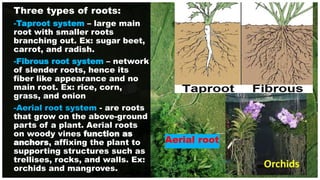
Three types of roots:
-Taproot system – large main
root with smaller roots
branching out. Ex: sugar beet,
carrot, and radish.
-Fibrous root system – network
of slender roots, hence its
fiber like appearance and no
main root. Ex: rice, corn,
grass, and onion
-Aerial root system - are roots
that grow on the above-ground
parts of a plant. Aerial roots
on woody vines function as
anchors, affixing the plant to
supporting structures such as
trellises, rocks, and walls. Ex:
orchids and mangroves.
Aerial root
Prop root system - allow the
Banyan Tree to provide
additional anchorage and
support. The circling of prop
roots allows these enormous
trees to not only grow taller
but also wider. A large Banyan
Tree can be over 100 feet( 30
meters) wide.-
Banyan tree
Parts of roots
- vascular bundles in roots – are organized into discrete
strands, each containing and . In the
roots, the vascular tissue is organized within a single
central vascular cylinder.
- is the complex tissue of plants, responsible for
transporting water and other nutrients to the plants.
-is living tissue, responsible for transporting food
and other organic materials.
STEM
part that transports water and minerals from
the roots to the other parts of the plant. Also
holds the leaves, flowers, and fruits of the
plants.
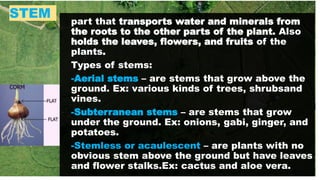
Types of stems:
-Aerial stems – are stems that grow above the
ground. Ex: various kinds of trees, shrubsand
vines.
-Subterranean stems – are stems that grow
under the ground. Ex: onions, gabi, ginger, and
potatoes.
-Stemless or acaulescent – are plants with no
obvious stem above the ground but have leaves
and flower stalks.Ex: cactus and aloe vera.
Stemless or
acaulescent
Parts of the Stem
- an area on a stem where
buds are located, where small
buds develop into leaves, stems
or flowers.
- is the region of a leaf
that connects the leaf blade to
the stem.
- a part or space
between two nodes, knots, or
joints, as the portion of a plant
stem between two nodes.
part where the plant makes its
food in a process called
photosynthesis.
Made of parts:
-Apex – tip
-Petiole – stalk connects the
leaf to the stem
-Blade – flat structure on each
side of the middle main vein
-Midrib – middle main vein
-Veins -
Leaf parts
- represent the
vascular structure of the organ,
extending into the leaf via the
petiole and providing transportation
of water and nutrients between leaf
and stem, and play a crucial role in
the maintenance of leaf water
status and photosynthetic capacity.
- either of a pair of small,
usually leaflike appendages borne at
the base of the petiole in many
plants.
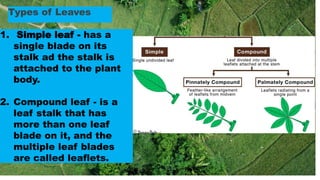
Types of Leaves
1. Simple leaf - has a
single blade on its
stalk ad the stalk is
attached to the plant
body.
2. Compound leaf - is a
leaf stalk that has
more than one leaf
blade on it, and the
multiple leaf blades
are called leaflets.

3 les 3 sci 3

  • 2.
    Roots - partsof the plant that are buried in the soil from which they absorb water and minerals. Also hold the plant firmly to the ground.
  • 3.
    Three types ofroots: -Taproot system – large main root with smaller roots branching out. Ex: sugar beet, carrot, and radish. -Fibrous root system – network of slender roots, hence its fiber like appearance and no main root. Ex: rice, corn, grass, and onion -Aerial root system - are roots that grow on the above-ground parts of a plant. Aerial roots on woody vines function as anchors, affixing the plant to supporting structures such as trellises, rocks, and walls. Ex: orchids and mangroves. Aerial root
  • 4.
    Prop root system- allow the Banyan Tree to provide additional anchorage and support. The circling of prop roots allows these enormous trees to not only grow taller but also wider. A large Banyan Tree can be over 100 feet( 30 meters) wide.- Banyan tree
  • 5.
    Parts of roots -vascular bundles in roots – are organized into discrete strands, each containing and . In the roots, the vascular tissue is organized within a single central vascular cylinder. - is the complex tissue of plants, responsible for transporting water and other nutrients to the plants. -is living tissue, responsible for transporting food and other organic materials.
  • 6.
    STEM part that transportswater and minerals from the roots to the other parts of the plant. Also holds the leaves, flowers, and fruits of the plants. Types of stems: -Aerial stems – are stems that grow above the ground. Ex: various kinds of trees, shrubsand vines. -Subterranean stems – are stems that grow under the ground. Ex: onions, gabi, ginger, and potatoes. -Stemless or acaulescent – are plants with no obvious stem above the ground but have leaves and flower stalks.Ex: cactus and aloe vera.
  • 7.
  • 8.
    Parts of theStem - an area on a stem where buds are located, where small buds develop into leaves, stems or flowers. - is the region of a leaf that connects the leaf blade to the stem. - a part or space between two nodes, knots, or joints, as the portion of a plant stem between two nodes.
  • 9.
    part where theplant makes its food in a process called photosynthesis. Made of parts: -Apex – tip -Petiole – stalk connects the leaf to the stem -Blade – flat structure on each side of the middle main vein -Midrib – middle main vein -Veins - Leaf parts
  • 10.
    - represent the vascularstructure of the organ, extending into the leaf via the petiole and providing transportation of water and nutrients between leaf and stem, and play a crucial role in the maintenance of leaf water status and photosynthetic capacity. - either of a pair of small, usually leaflike appendages borne at the base of the petiole in many plants.
  • 11.
    Types of Leaves 1.Simple leaf - has a single blade on its stalk ad the stalk is attached to the plant body. 2. Compound leaf - is a leaf stalk that has more than one leaf blade on it, and the multiple leaf blades are called leaflets.