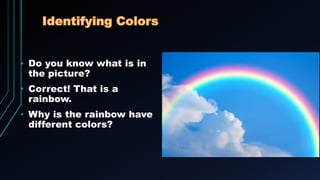
• Do you know what is in
the picture?
• Correct! That is a
rainbow.
• Why is the rainbow have
different colors?
Spectacular rays of color that come from white
light, or light made up of known as
.
Sunlight which appears and looks white, but it is
really made up of the colors red, orange, yellow,
green, blue, indigo, and violet.
It forms rainbow when light passes through
raindrops that are still in the air.
White light split up and different colors form.

Water droplets act as
prism or any material that
causes light to bend as it
passes through the
material.
You can make a rainbow
by shining light through a
glass prism, or even a
spray of water from a
garden hose.
The types of materials are :
TYPES OF MATERIALS
• material that allows
most of the light to pass
through, or transmit
light.
• Light easily pass
through in this kind of
material without being
scattered.
• Material may also
allow some light to
pass through it, but as
the light passes
through, the material
scatters the light rays.
• Can see something
behind a translucent
material but it may
appear blurred and it
may be quite difficult
to see the details.
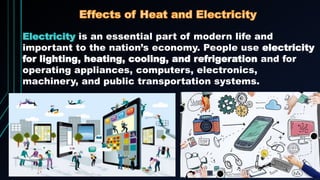
is an essential part of modern life and
important to the nation’s economy. People use electricity
for lighting, heating, cooling, and refrigeration and for
operating appliances, computers, electronics,
machinery, and public transportation systems.
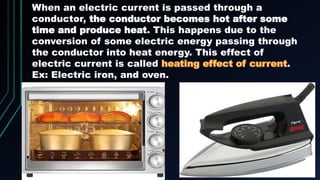
When an electric current is passed through a
conductor, the conductor becomes hot after some
time and produce heat. This happens due to the
conversion of some electric energy passing through
the conductor into heat energy. This effect of
electric current is called .
Ex: Electric iron, and oven.
- vibrations that travel through the air or
another medium and can be heard when they
reach a person's or animal's ear.
- sound produced by continuous and regular
vibrations, as opposed to noise.
- form of energy that you can hear and that
moves in the form of waves through a medium,
or the channel through which sound travels.
• medium is needed for the sound to travel.
• Vibrations that causes sound passed on to
atoms.
• As vibrations pass among particles of matter,
they generate sound waves.
• In short, the atoms carry the energy of sound.
• Sound CANNOT travel through empty space.
• Sound travels faster through a dense material –
object that is packed with a lot of particles, than
through less dense materials that are made up of
liquids and gases.
• Solids such as metals are made up of more
particles, particles that are closely packed
together.
• Liquids and gases are spaced farther apart from
each other.
• In other words, sound travels the fastest through
solids, and slowest through gases.
3 les 3 sci 5
3 les 3 sci 5

3 les 3 sci 5

  • 2.
    • Do youknow what is in the picture? • Correct! That is a rainbow. • Why is the rainbow have different colors?
  • 3.
    Spectacular rays ofcolor that come from white light, or light made up of known as . Sunlight which appears and looks white, but it is really made up of the colors red, orange, yellow, green, blue, indigo, and violet. It forms rainbow when light passes through raindrops that are still in the air. White light split up and different colors form. 
  • 4.
    Water droplets actas prism or any material that causes light to bend as it passes through the material. You can make a rainbow by shining light through a glass prism, or even a spray of water from a garden hose.
  • 5.
    The types ofmaterials are :
  • 6.
    TYPES OF MATERIALS •material that allows most of the light to pass through, or transmit light. • Light easily pass through in this kind of material without being scattered.
  • 7.
    • Material mayalso allow some light to pass through it, but as the light passes through, the material scatters the light rays. • Can see something behind a translucent material but it may appear blurred and it may be quite difficult to see the details.
  • 10.
    is an essentialpart of modern life and important to the nation’s economy. People use electricity for lighting, heating, cooling, and refrigeration and for operating appliances, computers, electronics, machinery, and public transportation systems.
  • 11.
    When an electriccurrent is passed through a conductor, the conductor becomes hot after some time and produce heat. This happens due to the conversion of some electric energy passing through the conductor into heat energy. This effect of electric current is called . Ex: Electric iron, and oven.
  • 12.
    - vibrations thattravel through the air or another medium and can be heard when they reach a person's or animal's ear. - sound produced by continuous and regular vibrations, as opposed to noise. - form of energy that you can hear and that moves in the form of waves through a medium, or the channel through which sound travels.
  • 14.
    • medium isneeded for the sound to travel. • Vibrations that causes sound passed on to atoms. • As vibrations pass among particles of matter, they generate sound waves. • In short, the atoms carry the energy of sound.
  • 15.
    • Sound CANNOTtravel through empty space. • Sound travels faster through a dense material – object that is packed with a lot of particles, than through less dense materials that are made up of liquids and gases. • Solids such as metals are made up of more particles, particles that are closely packed together. • Liquids and gases are spaced farther apart from each other. • In other words, sound travels the fastest through solids, and slowest through gases.