HEALTH
Learner’s Materials
UNIT 4
Department of Education
Republic of the Philippines
This instructional material was collaboratively
developed and reviewed by educators from public
and private schools, colleges, and or/universities. We
encourage teachers and other education
stakeholders to email their feedback, comments,
and recommendations to the Department of
Education at action@deped.gov.ph.
2 
 
Health – Grade 3
Learner’s Material
First Edition, 2013
ISBN: 978-971-0468-21-8
Republic Act 8293, section 176 states that: No copyright shall
subsist in any work of Government of the Philippines. However, prior
approval of the government agency or office wherein the work is
created shall be necessary for exploitation of such work for profit.
Such agency or office may, among other things, impose as a
condition the payment of royalties.
Borrowed materials (i.e., songs, stories, poems, picture, photos,
brand, names, trademarks, etc.) included in this book are owned by
their respective copyright owners. The publisher and authors do not
represent nor claim ownership over them.
Published by the Department of Education
Secretary: Br. Armin A. Luistro FSC
Undersecretary: Dina S. Ocampo, Ph.D.
Department of Education – Instructional Materials Council Secretariat (Dep Ed – IMCS)
Office Address: 5th Floor Mabini Bldg. DepEd Complex
Meralco Avenue, Pasig City
Philippines 1600
Telefax: (02) 634 – 1054 or 634 – 1072
E – mail Address: imcsetd@yahoo.com
Development Team of the Learner’s Material
Reviewers: Mark Kenneth S. Camiling, Rhodora L. Formento, Evelina M.
Vicencio
Authors: Rizaldy R. Cristo, Minerva C. David, Aidena Nuesca, Jennifer E.
Quinto, Gezyl G. Ramos, Emerson O. Sabadlab
Illustrator: Eric de S. Guia, Fermin M. Fabella, Raemon C. Dela Peña
Encoders: Danica Nicole G. Baña
Proof reviewer: Salvacion Olinares
Focal Person: Nerisa M. Beltran
3 
 
Table of Contents
Quarter 4 – Injury Prevention/Safety
Lesson 1: Keep Safe with Road Signs ................................5
Lesson 2: Crossing the Street Safely...................................9
Lesson 3: Safety at Loading and Unloading Zones .........12
Lesson 4: Safety First Inside a Vehicle................................16
Lesson 5: Unsafe Roads .......................................................20
Lesson 6: Hazards in the Community.................................24
Lesson 7: Be Alert ..................................................................26
Lesson 8: I Want to be Safe.................................................28
4 
 
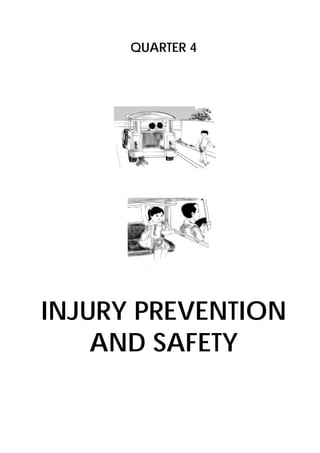
QUARTER 4
INJURY PREVENTION
AND SAFETY
5 
 
INTRODUCTION:
A young child like you enjoys to explore things and different places
whether this be at home, in school or in the community. This module
helps you learn how to be a safe passenger and pedestrian, so you
can avoid accidents as you go about your daily activities. Activities
will also show you some common community hazards and what you
need to do when this happens. So now get ready and learn how to
ensure your safety.
Lesson 1: Keep Safe with Road Signs
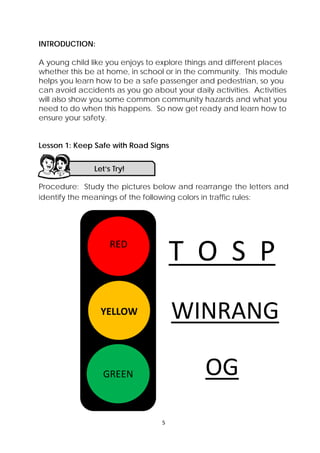
Procedure: Study the pictures below and rearrange the letters and
identify the meanings of the following colors in traffic rules:
Let’s Try! 
 
RED 
 
YELLOW
 
GREEN
T  O  S  P
WINRANG
OG 
6 
 
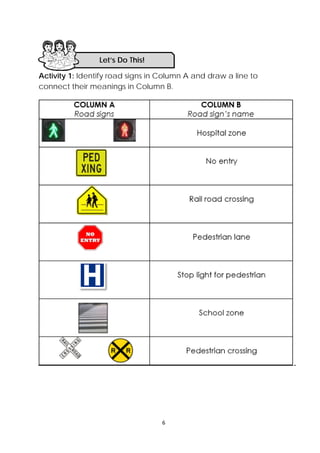
Activity 1: Identify road signs in Column A and draw a line to
connect their meanings in Column B.
Let’s Do This! 
7 
 
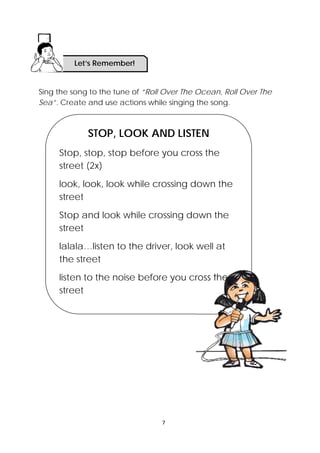
Sing the song to the tune of “Roll Over The Ocean, Roll Over The
Sea”. Create and use actions while singing the song.
STOP, LOOK AND LISTEN
Stop, stop, stop before you cross the
street (2x)
look, look, look while crossing down the
street
Stop and look while crossing down the
street
lalala…listen to the driver, look well at
the street
listen to the noise before you cross the
street
Let’s Remember!
 
8 
 
Complete the sentence below.
My Road Signs Mobile
Look for at least 3 road signs you will see as a pedestrian on your
home. Draw it in your notebook.
It is important to follow traffic road signs because…
______________________________________
______________________________________
______________________________________
______________________________________
Let’s Check! 
Let’s do this at home! 
9 
 
Lesson 2: Crossing the Street Safely
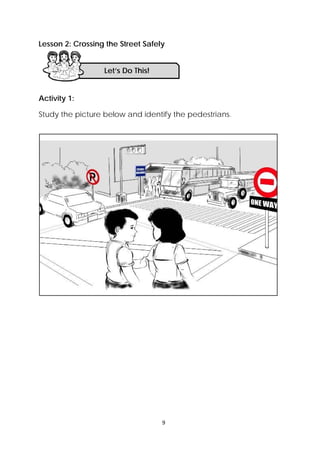
Activity 1:
Study the picture below and identify the pedestrians.
Let’s Do This! 
10 
 
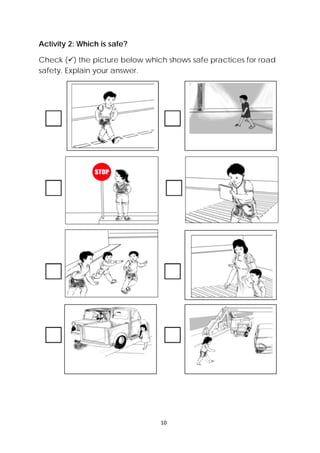
Activity 2: Which is safe?
Check () the picture below which shows safe practices for road
safety. Explain your answer.
11 
 
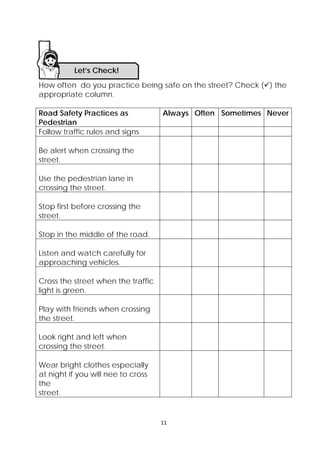
How often do you practice being safe on the street? Check () the
appropriate column.
Road Safety Practices as
Pedestrian
Always Often Sometimes Never
Follow traffic rules and signs
Be alert when crossing the
street.
Use the pedestrian lane in
crossing the street.
Stop first before crossing the
street.
Stop in the middle of the road.
Listen and watch carefully for
approaching vehicles.
Cross the street when the traffic
light is green.
Play with friends when crossing
the street.
Look right and left when
crossing the street.
Wear bright clothes especially
at night if you will nee to cross
the
street.
Let’s Check! 
12 
 
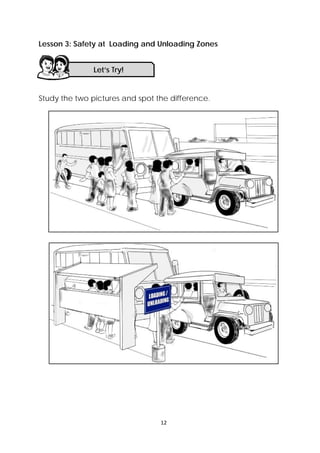
Lesson 3: Safety at Loading and Unloading Zones
Study the two pictures and spot the difference.
Let’s Try! 
13 
 
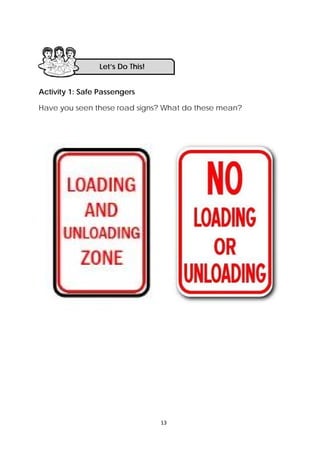
Activity 1: Safe Passengers
Have you seen these road signs? What do these mean?
 
                                                                                            
Let’s Do This! 
14 
 
   Activity 1: Don’t be in a hurry!
Let’s recite the poem.
Road Safety
By Aidena L. Nuesca
We can all be safer
If we follow all the safety rules;
There’s nothing we can never do
Never can do anything at all
Discipline, being safe is important
While we are riding, walking and waiting
Rules of the road we will obey
We shall all be accident free
Rules of the road we will obey
We shall all be accident free
Let’s Remember!
 
15 
 
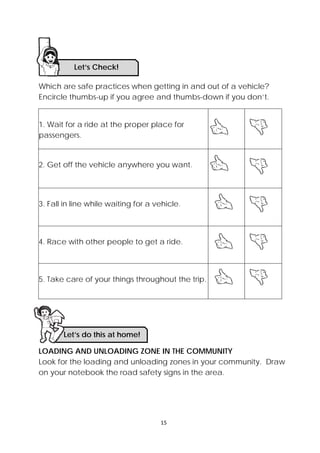
Which are safe practices when getting in and out of a vehicle?
Encircle thumbs-up if you agree and thumbs-down if you don’t.
1. Wait for a ride at the proper place for
passengers.
2. Get off the vehicle anywhere you want.
3. Fall in line while waiting for a vehicle.
4. Race with other people to get a ride.
5. Take care of your things throughout the trip.
LOADING AND UNLOADING ZONE IN THE COMMUNITY
Look for the loading and unloading zones in your community. Draw
on your notebook the road safety signs in the area.
Let’s Check! 
Let’s do this at home!
16 
 
Lesson 4: Safety First Inside the Vehicle
Read the poem.
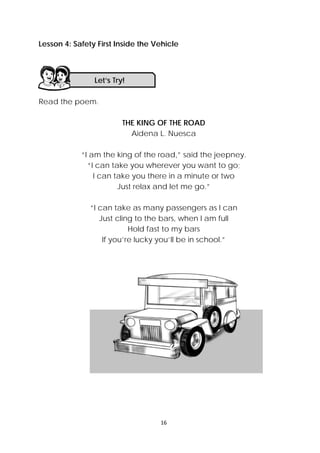
THE KING OF THE ROAD
Aidena L. Nuesca
“I am the king of the road,” said the jeepney.
“I can take you wherever you want to go;
I can take you there in a minute or two
Just relax and let me go.”
“I can take as many passengers as I can
Just cling to the bars, when I am full
Hold fast to my bars
If you’re lucky you’ll be in school.”
Let’s Try! 
17 
 
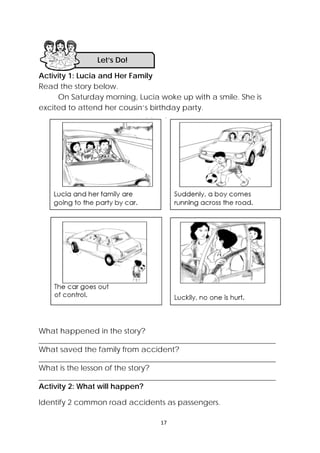
Activity 1: Lucia and Her Family
Read the story below.
On Saturday morning, Lucia woke up with a smile. She is
excited to attend her cousin’s birthday party.
What happened in the story?
_______________________________________________________________
What saved the family from accident?
_______________________________________________________________
What is the lesson of the story?
_______________________________________________________________
Activity 2: What will happen?
Identify 2 common road accidents as passengers.
Let’s Do! 
18 
 
Write ways to prevent these.
 
PREVENTION
 
ACCIDENTS


19 
 
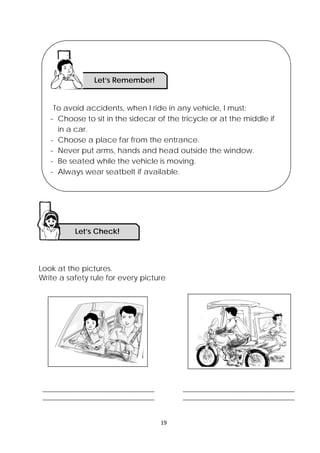
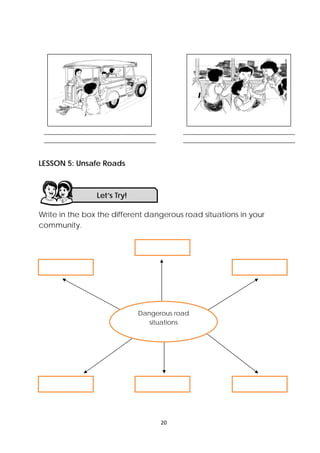
Look at the pictures.
Write a safety rule for every picture
To avoid accidents, when I ride in any vehicle, I must:
- Choose to sit in the sidecar of the tricycle or at the middle if
in a car.
- Choose a place far from the entrance.
- Never put arms, hands and head outside the window.
- Be seated while the vehicle is moving.
- Always wear seatbelt if available.
Let’s Check! 
______________________________________ 
______________________________________ 
______________________________________ 
______________________________________ 
Let’s Remember!
 
20 
 
LESSON 5: Unsafe Roads
Write in the box the different dangerous road situations in your
community.
Let’s Try! 
______________________________________ 
______________________________________ 
______________________________________ 
______________________________________ 
Dangerous road
situations 
21 
 
Read the news.
Let’s Do This! 
1 bata nasawi, 10 iba pa sugatan sa
aksidente sa kalsada
Isang bata ang nasawi at 10 iba pa ang nasugatan nang
mahulog sa gilid ng kalsada ang isang “school bus”sa isang
lugar sa Maynila.
Sa impormasyon mula sa pulisya, sinabing naganap ang
aksidente dakong 5:00 a.m. sa isang madilim at ginagawang
kalsada.
Nawalan umano ng kontrol sa manibela ang drayber ng bus
na dahilan para mahulog ito sa gilid ng kalsada. Sinasabing
ang drayber ay lango sa alak bago naganap ang aksidente at
hindi nya sinunod ang kaukulang babalang nakalagay bago
tuluyang tumaob ang bus.
Isinugod naman sa hospital ang 10 nasugatan sa aksidente
para malapatan ng lunas.
22 
 
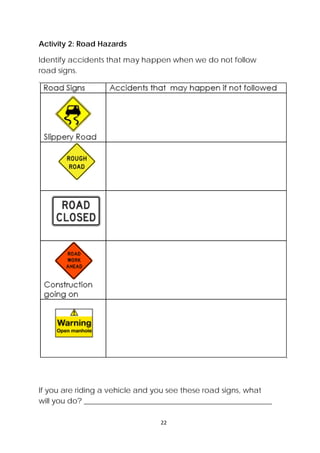
Activity 2: Road Hazards
Identify accidents that may happen when we do not follow
road signs.
If you are riding a vehicle and you see these road signs, what
will you do? __________________________________________________
23 
 
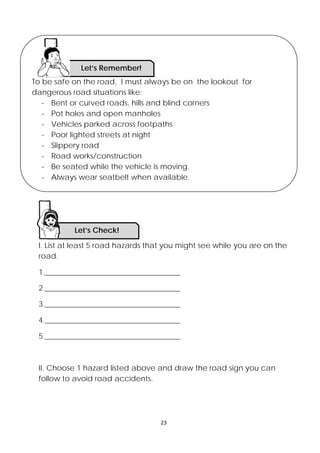
I. List at least 5 road hazards that you might see while you are on the
road.
1.____________________________________
2.____________________________________
3.____________________________________
4.____________________________________
5.____________________________________
II. Choose 1 hazard listed above and draw the road sign you can
follow to avoid road accidents.
Let’s Check! 
To be safe on the road, I must always be on the lookout for
dangerous road situations like:
- Bent or curved roads, hills and blind corners
- Pot holes and open manholes
- Vehicles parked across footpaths
- Poor lighted streets at night
- Slippery road
- Road works/construction
- Be seated while the vehicle is moving.
- Always wear seatbelt when available.
Let’s Remember!
 
24 
 
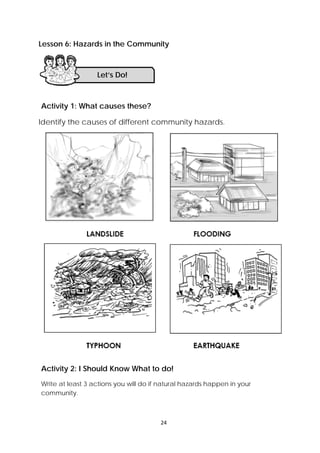
Lesson 6: Hazards in the Community
Activity 1: What causes these?
Identify the causes of different community hazards.
Activity 2: I Should Know What to do!
Write at least 3 actions you will do if natural hazards happen in your
community.
Let’s Do! 
25 
 
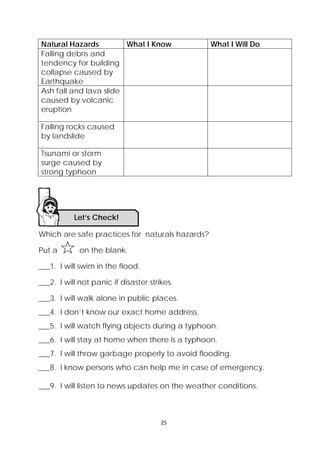
Natural Hazards What I Know What I Will Do
Falling debris and
tendency for building
collapse caused by
Earthquake
Ash fall and lava slide
caused by volcanic
eruption
Falling rocks caused
by landslide
Tsunami or storm
surge caused by
strong typhoon
Which are safe practices for naturals hazards?
Put a on the blank.
___1. I will swim in the flood.
___2. I will not panic if disaster strikes.
___3. I will walk alone in public places.
___4. I don’t know our exact home address.
___5. I will watch flying objects during a typhoon.
___6. I will stay at home when there is a typhoon.
___7. I will throw garbage properly to avoid flooding.
___8. I know persons who can help me in case of emergency.
___9. I will listen to news updates on the weather conditions.
Let’s Check! 
26 
 
___10. I will participate in barangay programs in cleaning the
community.
I am Safe at Home!
List at least 5 hazards in your home which can cause accidents if
natural disaster strikes.
Lesson 7: Be Prepared!
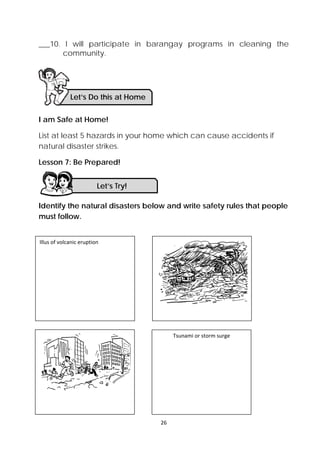
Identify the natural disasters below and write safety rules that people
must follow.
Let’s Do this at Home 
Let’s Try! 
Illus of volcanic eruption
Tsunami or storm surge 
27 
 
Make a contact of list of people you may call for help or report
community hazards.
Name _____________________________________________
Contact Number _____________________________________________
Address _____________________________________________
Name _____________________________________________
Contact Number _____________________________________________
Address _____________________________________________
Name _____________________________________________
Contact Number _____________________________________________
Address _____________________________________________
Name _____________________________________________
Contact Number _____________________________________________
Address _____________________________________________
Let’s Do this at Home 
28 
 
Lesson 8: I Want to be Safe!
Answer questions.
1. What will you do if you are alone and a stranger knocks on the
door?
____________________________________________________________
____________________________________________________________
2. What will you do if a stranger offers you food?
____________________________________________________________
____________________________________________________________
3. What will you do if you see a suspicious-looking person looking
in at your neighbor’s house?
_____________________________________________________________
_____________________________________________________________
4. Which is a safe route to take in going home? Why?
_____________________________________________________________
_____________________________________________________________
5. What will you do if someone harasses you and asks you to give
your money or things?
_____________________________________________________________
_____________________________________________________________
Let’s Try! 
29 
 
Activity 1: Drawing Maps
What is a map?
You must have seen maps on television, newspapers or even your
textbook.
You can draw a map. It is a representation of the things you see
around you. A map includes:
Title - tells the “what”, “where” and “when” of the map
Legend - tells the meaning of the symbols that the mapmaker has
used to help represent the things in the area shown in the map
Orientation - marks the directions of the map
With the help of your teacher, draw a map of your village.
Three groups will work on the following:
Group 1- safe route for walking in the community
Group 2-trace places/people to go when seeking help
Group 3-trace route of places where to report suspicious looking
people
Activity 2: Safer Community
Describe and make a poster of preventive actions for a safe
community.
Let’s Do! 

HEALTH 3 LEARNER'S MANUAL 4TH Q.

  • 1.
    HEALTH Learner’s Materials UNIT 4 Departmentof Education Republic of the Philippines This instructional material was collaboratively developed and reviewed by educators from public and private schools, colleges, and or/universities. We encourage teachers and other education stakeholders to email their feedback, comments, and recommendations to the Department of Education at action@deped.gov.ph.
  • 2.
    2    Health – Grade3 Learner’s Material First Edition, 2013 ISBN: 978-971-0468-21-8 Republic Act 8293, section 176 states that: No copyright shall subsist in any work of Government of the Philippines. However, prior approval of the government agency or office wherein the work is created shall be necessary for exploitation of such work for profit. Such agency or office may, among other things, impose as a condition the payment of royalties. Borrowed materials (i.e., songs, stories, poems, picture, photos, brand, names, trademarks, etc.) included in this book are owned by their respective copyright owners. The publisher and authors do not represent nor claim ownership over them. Published by the Department of Education Secretary: Br. Armin A. Luistro FSC Undersecretary: Dina S. Ocampo, Ph.D. Department of Education – Instructional Materials Council Secretariat (Dep Ed – IMCS) Office Address: 5th Floor Mabini Bldg. DepEd Complex Meralco Avenue, Pasig City Philippines 1600 Telefax: (02) 634 – 1054 or 634 – 1072 E – mail Address: imcsetd@yahoo.com Development Team of the Learner’s Material Reviewers: Mark Kenneth S. Camiling, Rhodora L. Formento, Evelina M. Vicencio Authors: Rizaldy R. Cristo, Minerva C. David, Aidena Nuesca, Jennifer E. Quinto, Gezyl G. Ramos, Emerson O. Sabadlab Illustrator: Eric de S. Guia, Fermin M. Fabella, Raemon C. Dela Peña Encoders: Danica Nicole G. Baña Proof reviewer: Salvacion Olinares Focal Person: Nerisa M. Beltran
  • 3.
    3    Table of Contents Quarter4 – Injury Prevention/Safety Lesson 1: Keep Safe with Road Signs ................................5 Lesson 2: Crossing the Street Safely...................................9 Lesson 3: Safety at Loading and Unloading Zones .........12 Lesson 4: Safety First Inside a Vehicle................................16 Lesson 5: Unsafe Roads .......................................................20 Lesson 6: Hazards in the Community.................................24 Lesson 7: Be Alert ..................................................................26 Lesson 8: I Want to be Safe.................................................28
  • 4.
  • 5.
    5    INTRODUCTION: A young childlike you enjoys to explore things and different places whether this be at home, in school or in the community. This module helps you learn how to be a safe passenger and pedestrian, so you can avoid accidents as you go about your daily activities. Activities will also show you some common community hazards and what you need to do when this happens. So now get ready and learn how to ensure your safety. Lesson 1: Keep Safe with Road Signs Procedure: Study the pictures below and rearrange the letters and identify the meanings of the following colors in traffic rules: Let’s Try!    RED    YELLOW   GREEN T  O  S  P WINRANG OG 
  • 6.
    6    Activity 1: Identifyroad signs in Column A and draw a line to connect their meanings in Column B. Let’s Do This! 
  • 7.
    7    Sing the songto the tune of “Roll Over The Ocean, Roll Over The Sea”. Create and use actions while singing the song. STOP, LOOK AND LISTEN Stop, stop, stop before you cross the street (2x) look, look, look while crossing down the street Stop and look while crossing down the street lalala…listen to the driver, look well at the street listen to the noise before you cross the street Let’s Remember!  
  • 8.
    8    Complete the sentencebelow. My Road Signs Mobile Look for at least 3 road signs you will see as a pedestrian on your home. Draw it in your notebook. It is important to follow traffic road signs because… ______________________________________ ______________________________________ ______________________________________ ______________________________________ Let’s Check!  Let’s do this at home! 
  • 9.
    9    Lesson 2: Crossingthe Street Safely Activity 1: Study the picture below and identify the pedestrians. Let’s Do This! 
  • 10.
    10    Activity 2: Whichis safe? Check () the picture below which shows safe practices for road safety. Explain your answer.
  • 11.
    11    How often doyou practice being safe on the street? Check () the appropriate column. Road Safety Practices as Pedestrian Always Often Sometimes Never Follow traffic rules and signs Be alert when crossing the street. Use the pedestrian lane in crossing the street. Stop first before crossing the street. Stop in the middle of the road. Listen and watch carefully for approaching vehicles. Cross the street when the traffic light is green. Play with friends when crossing the street. Look right and left when crossing the street. Wear bright clothes especially at night if you will nee to cross the street. Let’s Check! 
  • 12.
    12    Lesson 3: Safetyat Loading and Unloading Zones Study the two pictures and spot the difference. Let’s Try! 
  • 13.
    13    Activity 1: SafePassengers Have you seen these road signs? What do these mean?                                                                                                Let’s Do This! 
  • 14.
    14       Activity 1: Don’tbe in a hurry! Let’s recite the poem. Road Safety By Aidena L. Nuesca We can all be safer If we follow all the safety rules; There’s nothing we can never do Never can do anything at all Discipline, being safe is important While we are riding, walking and waiting Rules of the road we will obey We shall all be accident free Rules of the road we will obey We shall all be accident free Let’s Remember!  
  • 15.
    15    Which are safepractices when getting in and out of a vehicle? Encircle thumbs-up if you agree and thumbs-down if you don’t. 1. Wait for a ride at the proper place for passengers. 2. Get off the vehicle anywhere you want. 3. Fall in line while waiting for a vehicle. 4. Race with other people to get a ride. 5. Take care of your things throughout the trip. LOADING AND UNLOADING ZONE IN THE COMMUNITY Look for the loading and unloading zones in your community. Draw on your notebook the road safety signs in the area. Let’s Check!  Let’s do this at home!
  • 16.
    16    Lesson 4: SafetyFirst Inside the Vehicle Read the poem. THE KING OF THE ROAD Aidena L. Nuesca “I am the king of the road,” said the jeepney. “I can take you wherever you want to go; I can take you there in a minute or two Just relax and let me go.” “I can take as many passengers as I can Just cling to the bars, when I am full Hold fast to my bars If you’re lucky you’ll be in school.” Let’s Try! 
  • 17.
    17    Activity 1: Luciaand Her Family Read the story below. On Saturday morning, Lucia woke up with a smile. She is excited to attend her cousin’s birthday party. What happened in the story? _______________________________________________________________ What saved the family from accident? _______________________________________________________________ What is the lesson of the story? _______________________________________________________________ Activity 2: What will happen? Identify 2 common road accidents as passengers. Let’s Do! 
  • 18.
    18    Write ways toprevent these.   PREVENTION   ACCIDENTS      
  • 19.
    19    Look at thepictures. Write a safety rule for every picture To avoid accidents, when I ride in any vehicle, I must: - Choose to sit in the sidecar of the tricycle or at the middle if in a car. - Choose a place far from the entrance. - Never put arms, hands and head outside the window. - Be seated while the vehicle is moving. - Always wear seatbelt if available. Let’s Check!  ______________________________________  ______________________________________  ______________________________________  ______________________________________  Let’s Remember!  
  • 20.
    20    LESSON 5: UnsafeRoads Write in the box the different dangerous road situations in your community. Let’s Try!  ______________________________________  ______________________________________  ______________________________________  ______________________________________  Dangerous road situations 
  • 21.
    21    Read the news. Let’sDo This!  1 bata nasawi, 10 iba pa sugatan sa aksidente sa kalsada Isang bata ang nasawi at 10 iba pa ang nasugatan nang mahulog sa gilid ng kalsada ang isang “school bus”sa isang lugar sa Maynila. Sa impormasyon mula sa pulisya, sinabing naganap ang aksidente dakong 5:00 a.m. sa isang madilim at ginagawang kalsada. Nawalan umano ng kontrol sa manibela ang drayber ng bus na dahilan para mahulog ito sa gilid ng kalsada. Sinasabing ang drayber ay lango sa alak bago naganap ang aksidente at hindi nya sinunod ang kaukulang babalang nakalagay bago tuluyang tumaob ang bus. Isinugod naman sa hospital ang 10 nasugatan sa aksidente para malapatan ng lunas.
  • 22.
    22    Activity 2: RoadHazards Identify accidents that may happen when we do not follow road signs. If you are riding a vehicle and you see these road signs, what will you do? __________________________________________________
  • 23.
    23    I. List atleast 5 road hazards that you might see while you are on the road. 1.____________________________________ 2.____________________________________ 3.____________________________________ 4.____________________________________ 5.____________________________________ II. Choose 1 hazard listed above and draw the road sign you can follow to avoid road accidents. Let’s Check!  To be safe on the road, I must always be on the lookout for dangerous road situations like: - Bent or curved roads, hills and blind corners - Pot holes and open manholes - Vehicles parked across footpaths - Poor lighted streets at night - Slippery road - Road works/construction - Be seated while the vehicle is moving. - Always wear seatbelt when available. Let’s Remember!  
  • 24.
    24    Lesson 6: Hazardsin the Community Activity 1: What causes these? Identify the causes of different community hazards. Activity 2: I Should Know What to do! Write at least 3 actions you will do if natural hazards happen in your community. Let’s Do! 
  • 25.
    25    Natural Hazards WhatI Know What I Will Do Falling debris and tendency for building collapse caused by Earthquake Ash fall and lava slide caused by volcanic eruption Falling rocks caused by landslide Tsunami or storm surge caused by strong typhoon Which are safe practices for naturals hazards? Put a on the blank. ___1. I will swim in the flood. ___2. I will not panic if disaster strikes. ___3. I will walk alone in public places. ___4. I don’t know our exact home address. ___5. I will watch flying objects during a typhoon. ___6. I will stay at home when there is a typhoon. ___7. I will throw garbage properly to avoid flooding. ___8. I know persons who can help me in case of emergency. ___9. I will listen to news updates on the weather conditions. Let’s Check! 
  • 26.
    26    ___10. I willparticipate in barangay programs in cleaning the community. I am Safe at Home! List at least 5 hazards in your home which can cause accidents if natural disaster strikes. Lesson 7: Be Prepared! Identify the natural disasters below and write safety rules that people must follow. Let’s Do this at Home  Let’s Try!  Illus of volcanic eruption Tsunami or storm surge 
  • 27.
    27    Make a contactof list of people you may call for help or report community hazards. Name _____________________________________________ Contact Number _____________________________________________ Address _____________________________________________ Name _____________________________________________ Contact Number _____________________________________________ Address _____________________________________________ Name _____________________________________________ Contact Number _____________________________________________ Address _____________________________________________ Name _____________________________________________ Contact Number _____________________________________________ Address _____________________________________________ Let’s Do this at Home 
  • 28.
    28    Lesson 8: IWant to be Safe! Answer questions. 1. What will you do if you are alone and a stranger knocks on the door? ____________________________________________________________ ____________________________________________________________ 2. What will you do if a stranger offers you food? ____________________________________________________________ ____________________________________________________________ 3. What will you do if you see a suspicious-looking person looking in at your neighbor’s house? _____________________________________________________________ _____________________________________________________________ 4. Which is a safe route to take in going home? Why? _____________________________________________________________ _____________________________________________________________ 5. What will you do if someone harasses you and asks you to give your money or things? _____________________________________________________________ _____________________________________________________________ Let’s Try! 
  • 29.
    29    Activity 1: DrawingMaps What is a map? You must have seen maps on television, newspapers or even your textbook. You can draw a map. It is a representation of the things you see around you. A map includes: Title - tells the “what”, “where” and “when” of the map Legend - tells the meaning of the symbols that the mapmaker has used to help represent the things in the area shown in the map Orientation - marks the directions of the map With the help of your teacher, draw a map of your village. Three groups will work on the following: Group 1- safe route for walking in the community Group 2-trace places/people to go when seeking help Group 3-trace route of places where to report suspicious looking people Activity 2: Safer Community Describe and make a poster of preventive actions for a safe community. Let’s Do!