“ Don’t Give Up on Small Business” A Presentation for Delta Sigma Pi University of St. Thomas
Agenda About : Dan Derosier & Three Deep Small   Business : So What? Companies : Big vs. Small Passion : Find It Personality : Leverage It Experience : Get it or Create it Interviewing : Your Sales Pitch On The Job : Now What? Your Story : What’s the next Chapter?
ABOUT Three Deep and Dan Derosier
About Dan Derosier Fortune #105 @ $23 B Fortune #20 @ $96B Epiphany – Infor(Public) Three Deep – Private Co-founder and VP
Three Deep Marketing Digital Marketing Agency Founded in 2003 Search marketing, email marketing Database marketing, reporting/analytics 30 employees Up from 12 in early 2009 23% of employees are St. Thomas graduates Named #9 th  Best Places to Work in 2010 #1238 Inc. 5000 Fastest Growing Companies
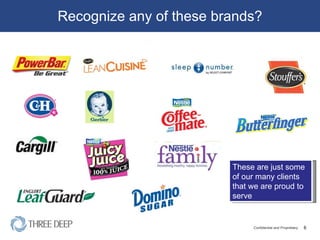
Recognize any of these brands? These are just some of our many clients that we are proud to serve
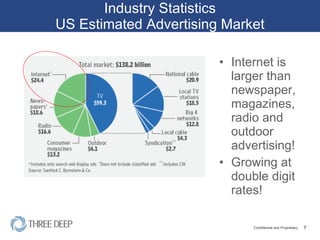
Industry Statistics US Estimated Advertising Market Internet is larger than newspaper, magazines, radio and outdoor advertising! Growing at double digit rates!
SMALL BUSINESS So What?
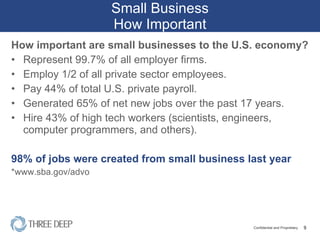
Small Business How Important How important are small businesses to the U.S. economy?  Represent 99.7% of all employer firms. Employ 1/2 of all private sector employees. Pay 44% of total U.S. private payroll. Generated 65% of net new jobs over the past 17 years. Hire 43% of high tech workers (scientists, engineers, computer programmers, and others). 98% of jobs were created from small business last year *www.sba.gov/advo
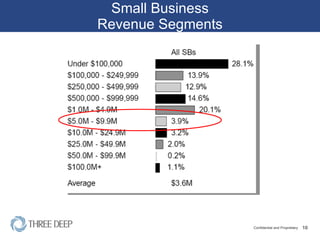
Small Business Revenue Segments
COMPANIES The Battle of Big vs. Small
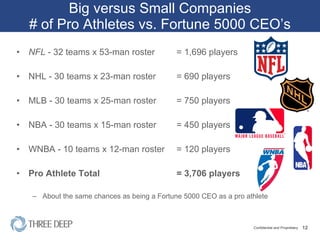
Big versus Small Companies # of Pro Athletes vs. Fortune 5000 CEO’s NFL  - 32 teams x 53-man roster  = 1,696 players NHL - 30 teams x 23-man roster  = 690 players MLB - 30 teams x 25-man roster  = 750 players NBA - 30 teams x 15-man roster  = 450 players WNBA - 10 teams x 12-man roster  = 120 players Pro Athlete Total = 3,706 players About the same chances as being a Fortune 5000 CEO as a pro athlete
Big versus Small Companies Resources – Advantage Big Big company – equipment , people and HR process are more available.  Small company - work you do can be incorporated into the next meeting or a future business plan Impact  - Advantage Small Big company - thousands of employees and you have a very specific tasks, but you know exactly what  to do Small company - your job directly contributes to the success of the business. Pace – Advantage Small Big company – projects take a long time to move forward and you may be involved in a specific one Small company – projects are varied and multi-tasking is important to get keep pace with all the work
Big versus Small Companies Best Practices – Advantage Big Big company – well defined project  management, financial  reporting, human resource policies & process disciplines Small company – may have some practices, don’t have the resources to support best practices across all business areas Development Opportunities -  Advantage Even Big company – variety of projects, international assignments,  can take classes for career development or leadership skills.  Small company – career development is more self directed, but you can take more ownership of projects Dependence – Advantage Even Big company – if your preference is more guidance, big is better Small company - The more independent you are, small is better
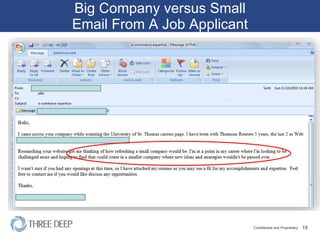
Big Company versus Small Email From A Job Applicant
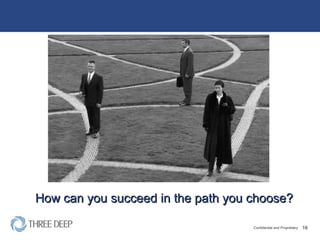
How can you succeed in the path you choose?
PASSION Find it
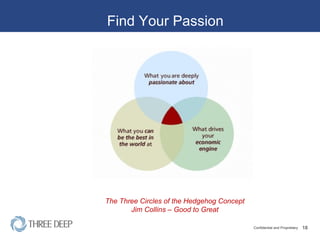
Find Your Passion The Three Circles of the Hedgehog Concept Jim Collins – Good to Great
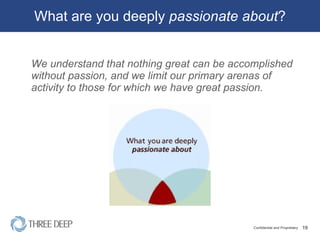
What are you deeply  passionate about ? We understand that nothing great can be accomplished without passion, and we limit our primary arenas of activity to those for which we have great passion.
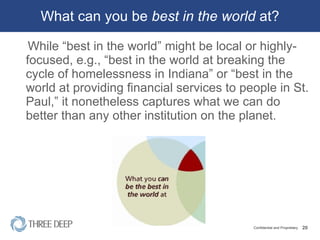
What can you be  best in the world  at? While “best in the world” might be local or highly-focused, e.g., “best in the world at breaking the cycle of homelessness in Indiana” or “best in the world at providing financial services to people in St. Paul,” it nonetheless captures what we can do better than any other institution on the planet.
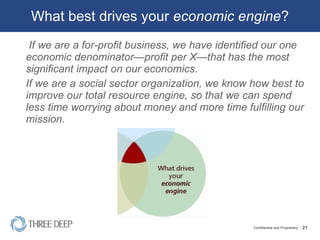
What best drives your  economic engine ? If we are a for-profit business, we have identified our one economic denominator—profit per X—that has the most significant impact on our economics.  If we are a social sector organization, we know how best to improve our total resource engine, so that we can spend less time worrying about money and more time fulfilling our mission.
PERSONALITY Leverage it
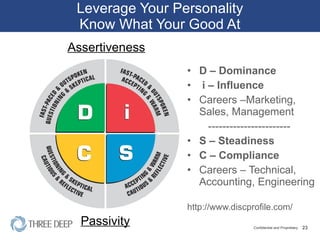
Leverage Your Personality Know What Your Good At D – Dominance i – Influence Careers –Marketing, Sales, Management ----------------------- S – Steadiness C – Compliance Careers – Technical, Accounting, Engineering http://www.discprofile.com/ Assertiveness Passivity
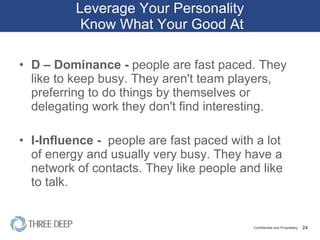
Leverage Your Personality  Know What Your Good At D – Dominance -  people are fast paced. They like to keep busy. They aren't team players, preferring to do things by themselves or delegating work they don't find interesting. I-Influence -  people are fast paced with a lot of energy and usually very busy. They have a network of contacts. They like people and like to talk.
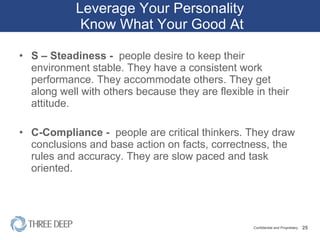
Leverage Your Personality  Know What Your Good At S – Steadiness -  people desire to keep their environment stable. They have a consistent work performance. They accommodate others. They get along well with others because they are flexible in their attitude. C-Compliance -  people are critical thinkers. They draw conclusions and base action on facts, correctness, the rules and accuracy. They are slow paced and task oriented.
JOB EXPERIENCE Get it or Create it
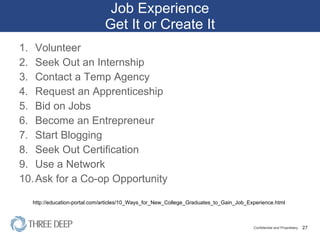
Job Experience Get It or Create It Volunteer Seek Out an Internship Contact a Temp Agency Request an Apprenticeship Bid on Jobs Become an Entrepreneur Start Blogging Seek Out Certification Use a Network Ask for a Co-op Opportunity http://education-portal.com/articles/10_Ways_for_New_College_Graduates_to_Gain_Job_Experience.html
Job Experience - Get It or Create It Interactive Marketing Tools Creative Design Email Marketing Paid Search Website Development Website Analysis Database Marketing Social Media Free or nearly free technologies…educate yourself!
INTERVIEWS Your personal Sales Pitch
Preparation Read up on each Company Bring Your Cover Letter Bring Your Resume Remove Questionable Jewelry Cover Body Art Avoid Distractions (Hands, Gum, etc) Dress Like an Executive
The Interview Have 3 – 4 key points about yourself that you absolutely want to get across School accomplishment – be specific Work experience – tell a story Personality trait – create a visual, if possible Write down 2 – 3 questions you may have about the company or the job Ask open ended questions
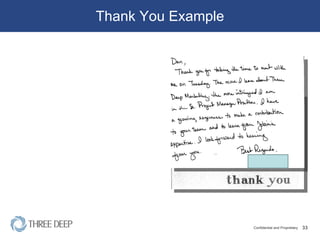
The Follow-up Write down the names of the people you interview with Ask the administrative person for the office and email addresses Prepare a short email with a thank you and mention something specific about your meeting Send a hand written “Thank You” card with to each person you interviewed with Don’t send any gifts
Thank You Example
The Offer How to decide which company if you have more than one job offer Growth industry and company stability Does the position matches your interests, skills and responsibilities Never decide on a job for the manager you will be working for - They’ll be gone either way!
ON THE JOB Now what?
On The Job Now What? Do completed staff work on every assignment regardless of importance Nothing wrong with asking for more work If you’re bored, then something’s wrong Ask to interview for open positions, even if you aren’t totally qualified You will be doing your next job level at least 6 months before you get promoted
YOUR STORY What’s the next Chapter?
Your Story What Is The Next Chapter? “ IQ is a measure to some degree of innate ability. But social savvy is knowledge. It’s a set of skills that have to be learned.” - Outliers – The Story of Success; Malcolm Gladwell Social savvy comes from your… Family and Surroundings Your College Experiences Your Career Choices Your career story has already started, not after you graduate. Get focused on it now!
ANY QUESTIONS? [email_address] 651-789-7704 THANK YOU!

Don't Give Up on Small Business

  • 1.
    “ Don’t GiveUp on Small Business” A Presentation for Delta Sigma Pi University of St. Thomas
  • 2.
    Agenda About :Dan Derosier & Three Deep Small Business : So What? Companies : Big vs. Small Passion : Find It Personality : Leverage It Experience : Get it or Create it Interviewing : Your Sales Pitch On The Job : Now What? Your Story : What’s the next Chapter?
  • 3.
    ABOUT Three Deepand Dan Derosier
  • 4.
    About Dan DerosierFortune #105 @ $23 B Fortune #20 @ $96B Epiphany – Infor(Public) Three Deep – Private Co-founder and VP
  • 5.
    Three Deep MarketingDigital Marketing Agency Founded in 2003 Search marketing, email marketing Database marketing, reporting/analytics 30 employees Up from 12 in early 2009 23% of employees are St. Thomas graduates Named #9 th Best Places to Work in 2010 #1238 Inc. 5000 Fastest Growing Companies
  • 6.
    Recognize any ofthese brands? These are just some of our many clients that we are proud to serve
  • 7.
    Industry Statistics USEstimated Advertising Market Internet is larger than newspaper, magazines, radio and outdoor advertising! Growing at double digit rates!
  • 8.
  • 9.
    Small Business HowImportant How important are small businesses to the U.S. economy? Represent 99.7% of all employer firms. Employ 1/2 of all private sector employees. Pay 44% of total U.S. private payroll. Generated 65% of net new jobs over the past 17 years. Hire 43% of high tech workers (scientists, engineers, computer programmers, and others). 98% of jobs were created from small business last year *www.sba.gov/advo
  • 10.
  • 11.
    COMPANIES The Battleof Big vs. Small
  • 12.
    Big versus SmallCompanies # of Pro Athletes vs. Fortune 5000 CEO’s NFL - 32 teams x 53-man roster = 1,696 players NHL - 30 teams x 23-man roster = 690 players MLB - 30 teams x 25-man roster = 750 players NBA - 30 teams x 15-man roster = 450 players WNBA - 10 teams x 12-man roster = 120 players Pro Athlete Total = 3,706 players About the same chances as being a Fortune 5000 CEO as a pro athlete
  • 13.
    Big versus SmallCompanies Resources – Advantage Big Big company – equipment , people and HR process are more available. Small company - work you do can be incorporated into the next meeting or a future business plan Impact - Advantage Small Big company - thousands of employees and you have a very specific tasks, but you know exactly what to do Small company - your job directly contributes to the success of the business. Pace – Advantage Small Big company – projects take a long time to move forward and you may be involved in a specific one Small company – projects are varied and multi-tasking is important to get keep pace with all the work
  • 14.
    Big versus SmallCompanies Best Practices – Advantage Big Big company – well defined project management, financial reporting, human resource policies & process disciplines Small company – may have some practices, don’t have the resources to support best practices across all business areas Development Opportunities - Advantage Even Big company – variety of projects, international assignments, can take classes for career development or leadership skills. Small company – career development is more self directed, but you can take more ownership of projects Dependence – Advantage Even Big company – if your preference is more guidance, big is better Small company - The more independent you are, small is better
  • 15.
    Big Company versusSmall Email From A Job Applicant
  • 16.
    How can yousucceed in the path you choose?
  • 17.
  • 18.
    Find Your PassionThe Three Circles of the Hedgehog Concept Jim Collins – Good to Great
  • 19.
    What are youdeeply passionate about ? We understand that nothing great can be accomplished without passion, and we limit our primary arenas of activity to those for which we have great passion.
  • 20.
    What can yoube best in the world at? While “best in the world” might be local or highly-focused, e.g., “best in the world at breaking the cycle of homelessness in Indiana” or “best in the world at providing financial services to people in St. Paul,” it nonetheless captures what we can do better than any other institution on the planet.
  • 21.
    What best drivesyour economic engine ? If we are a for-profit business, we have identified our one economic denominator—profit per X—that has the most significant impact on our economics. If we are a social sector organization, we know how best to improve our total resource engine, so that we can spend less time worrying about money and more time fulfilling our mission.
  • 22.
  • 23.
    Leverage Your PersonalityKnow What Your Good At D – Dominance i – Influence Careers –Marketing, Sales, Management ----------------------- S – Steadiness C – Compliance Careers – Technical, Accounting, Engineering http://www.discprofile.com/ Assertiveness Passivity
  • 24.
    Leverage Your Personality Know What Your Good At D – Dominance - people are fast paced. They like to keep busy. They aren't team players, preferring to do things by themselves or delegating work they don't find interesting. I-Influence - people are fast paced with a lot of energy and usually very busy. They have a network of contacts. They like people and like to talk.
  • 25.
    Leverage Your Personality Know What Your Good At S – Steadiness - people desire to keep their environment stable. They have a consistent work performance. They accommodate others. They get along well with others because they are flexible in their attitude. C-Compliance - people are critical thinkers. They draw conclusions and base action on facts, correctness, the rules and accuracy. They are slow paced and task oriented.
  • 26.
    JOB EXPERIENCE Getit or Create it
  • 27.
    Job Experience GetIt or Create It Volunteer Seek Out an Internship Contact a Temp Agency Request an Apprenticeship Bid on Jobs Become an Entrepreneur Start Blogging Seek Out Certification Use a Network Ask for a Co-op Opportunity http://education-portal.com/articles/10_Ways_for_New_College_Graduates_to_Gain_Job_Experience.html
  • 28.
    Job Experience -Get It or Create It Interactive Marketing Tools Creative Design Email Marketing Paid Search Website Development Website Analysis Database Marketing Social Media Free or nearly free technologies…educate yourself!
  • 29.
  • 30.
    Preparation Read upon each Company Bring Your Cover Letter Bring Your Resume Remove Questionable Jewelry Cover Body Art Avoid Distractions (Hands, Gum, etc) Dress Like an Executive
  • 31.
    The Interview Have3 – 4 key points about yourself that you absolutely want to get across School accomplishment – be specific Work experience – tell a story Personality trait – create a visual, if possible Write down 2 – 3 questions you may have about the company or the job Ask open ended questions
  • 32.
    The Follow-up Writedown the names of the people you interview with Ask the administrative person for the office and email addresses Prepare a short email with a thank you and mention something specific about your meeting Send a hand written “Thank You” card with to each person you interviewed with Don’t send any gifts
  • 33.
  • 34.
    The Offer Howto decide which company if you have more than one job offer Growth industry and company stability Does the position matches your interests, skills and responsibilities Never decide on a job for the manager you will be working for - They’ll be gone either way!
  • 35.
    ON THE JOBNow what?
  • 36.
    On The JobNow What? Do completed staff work on every assignment regardless of importance Nothing wrong with asking for more work If you’re bored, then something’s wrong Ask to interview for open positions, even if you aren’t totally qualified You will be doing your next job level at least 6 months before you get promoted
  • 37.
    YOUR STORY What’sthe next Chapter?
  • 38.
    Your Story WhatIs The Next Chapter? “ IQ is a measure to some degree of innate ability. But social savvy is knowledge. It’s a set of skills that have to be learned.” - Outliers – The Story of Success; Malcolm Gladwell Social savvy comes from your… Family and Surroundings Your College Experiences Your Career Choices Your career story has already started, not after you graduate. Get focused on it now!
  • 39.
    ANY QUESTIONS? [email_address]651-789-7704 THANK YOU!

Editor's Notes

  • #6 We have hired many students from St. Thomas My step-son graduated in 2003 My son Derek is a freshman here.
  • #8 Whether you are a business major, engineering or marketing major, the internet is having more
  • #13 Your odds of running a Fortune 500 company are about the same as being a top professional athlete in one of the top major sports.
  • #14 Resources: One of the biggest differences between these two environments is the amount of resources available. And not just money, but availability of up-to-date equipment and expert consultants. Advantage – Big Impact: It is really hard to feel like you are having a big impact on the business. There are generally thousands of employees and you have a very specific task. At a small company, the work you do can immediately incorporated into the next meeting or presentation, and how well your job directly contributes to the success of the business. Advantage – Small Pace: Sometimes projects can take a long time to move forward at big companies. Large corporations take the extra time to dot all the i’s and cross the t’s, and make sure that all reviews and business due diligence is performed before moving forward. Advantage – Small Best Practices: Big companies have a deep corporate history, and have put into place best practices on getting things done; from performance management, human resource policies & process discipline. Advantage - Big Development Opportunities: Big companies have a variety of projects that you have the opportunity to contribute to (stretching your skills), as well as classes available for learning important non-technical skills such as hiring, people and project management, career development, and leadership skills. Small companies don’t have the money to commit to developing their employees that large companies do, but you get to take more ownership of projects. Advantage – Even Dependence: If you preference is to be dependent on a company, big is better suited for you. The more independent you are, the better fit a small company is for you. If you require more guidance and like more structure and definition in your position, then a big company is likely the place to start. Advantage - Even
  • #15 Resources: One of the biggest differences between these two environments is the amount of resources available. And not just money, but availability of up-to-date equipment and expert consultants. Advantage – Big Impact: It is really hard to feel like you are having a big impact on the business. There are generally thousands of employees and you have a very specific task. At a small company, the work you do can immediately incorporated into the next meeting or presentation, and how well your job directly contributes to the success of the business. Advantage – Small Pace: Sometimes projects can take a long time to move forward at big companies. Large corporations take the extra time to dot all the i’s and cross the t’s, and make sure that all reviews and business due diligence is performed before moving forward. Advantage – Small Best Practices: Big companies have a deep corporate history, and have put into place best practices on getting things done; from performance management, human resource policies & process discipline. Advantage - Big Development Opportunities: Big companies have a variety of projects that you have the opportunity to contribute to (stretching your skills), as well as classes available for learning important non-technical skills such as hiring, people and project management, career development, and leadership skills. Small companies don’t have the money to commit to developing their employees that large companies do, but you get to take more ownership of projects. Advantage – Even Dependence: If you preference is to be dependent on a company, big is better suited for you. The more independent you are, the better fit a small company is for you. If you require more guidance and like more structure and definition in your position, then a big company is likely the place to start. Advantage - Even
  • #19 Our Hedgehog Concept reflects deep understanding of the three circles: 1) what we can be passionate about, 2) what we can be the best in world at, and 3) what best drives our economic or resource engine. We understand that nothing great can be accomplished without passion, and we limit our primary arenas of activity to those for which we have great passion.
  • #31 “ I know you already know this, but…” Read up on the company – Best Places to Work example Remove Questionable Jewelry example/Chewing gum
  • #32 Remember, your interview is like a sales call
  • #34 Thank them again Restate your interest Personalize it
  • #37 Do Completed Staff Work: “ Do not worry your manager with long explanations and emails. Writing an email to your manager does not constitute completed staff work, but writing an email for him to send to someone else does. Your views should be placed before him in finished form, so that he can make them his views simply by signing his name. In most cases, completed staff work produces a single document or presentation prepared for the manager’s use without accompanying comment. If the document stands on its own feet, it will speak for itself; if the manager wants further comment or explanation, he will ask for it.”
  • #39 Smarts are obviously important but you have to be able to adapt to your business environment and surroundings to be successful.