International Research Journal of Engineering and Technology (IRJET) e-ISSN: 2395 -0056
Volume: 04 Issue: 03 | Mar -2017 www.irjet.net p-ISSN: 2395-0072
© 2017, IRJET | Impact Factor value: 5.181 | ISO 9001:2008 Certified Journal | Page 693
3 AXIS DRAWING MACHINE
Anubhavi S. Pawar1, Monali J. Halunde2, Shabanam M. Nayakawadi3, Ms. P. P. Mirajkar4
1Student, Department of Electronics and Telecommunication, Annasaheb Dange College of Engineering and
Technology, Ashta, Maharashtra, India
2Student, Department of Electronics and Telecommunication, Annasaheb Dange College of Engineering and
Technology, Ashta, Maharashtra, India
3Student, Department of Electronics and Telecommunication, Annasaheb Dange College of Engineering and
Technology, Ashta, Maharashtra, India
4Assistant Professor, Department of Electronics and Telecommunication, Annasaheb Dange College of
Engineering and Technology, Ashta, Maharashtra, India
---------------------------------------------------------------------***---------------------------------------------------------------------
Abstract - This paper discusses design and
implementation of low cost 3 Axis Drawing Machine using
Arduino controller based on computerized numerical
controller (CNC) machine and open sourcesoftware(G-code
and GRBL) for controlling whole operation. Computer
numeric control (CNC) machine plays an important role in
the field of automation. The main aim of this project is to
reduce time consumed and it reduces human involvement
which eventually reduces rate of error and also increase the
accuracy of the production. Thecommunicationbetweenthe
open source software (G-code and GRBL) and hardware
(Arduino and CNC shield) is to be done with the help of USB.
1. INTRODUCTION
CNC Machining is a process usedinthemanufacturingsector
that involves the use of computers to control machine tools.
Tools that can be controlled in this manner include lathes,
mills, routers and grinders. The CNC in CNC Machining
stands for Computer Numerical Control. CNC – Computer
Numerical Control – Taking digitized data, a computer and
CAM program is used to control, automate, and monitor the
movementsofa machine. The CNC controller works together
with a series of motors and drive components to move and
control the machine axes, executing the programmed
motions. Open source microcontroller platform Arduino is
used for control of the motors, and open source software is
used for executing the G code for machining applications.
Several authors have studied the development of such
machines on a smaller, low-cost scale. For example,
V.K. Pabolu and K.N.H. Srinivas [4] have designed and
implemented a three axis CNC machine using an 8-bit
microcontroller. The development is in .Net platform using
C# programming language on a Windows XP computer, but
the motors have limited power.
T. Andrei and I. Nae [5] have developed a simpler
commercial size CNCrouter running withMach3softwareon
a desktop PC, but requiring a parallel port.
P.A. Sherring da Rocha Jr., R.D.S. Souza,and M.Emilia deLima
Tostes [6] have presented a prototype CNC machine under
development running on a PC with LabVIEW which has
advantage of ease of visual programming tools. The PC is
interfaced with low-cost embedded microcontrollers
through the serial port. The CNC machine designsaboverely
on the use of stepper motors of limited power in open loop
mode.
Xu, Y. Li, J. Sun, and S. Wang [8] discuss results of research
on an open CNC system using Windows PC with a four-axis
motion controller.
A major new development in computer technology is the
availability of low-cost open source hardware, such as the
Arduino micro-controller platform.[10]
1.1 Objectives -
The idea behind the fabrication of low cost 3 Axis Drawing
Machine is to fulfill demand of small scale industries. An
advantage of open source hardware is that a wide variety of
ready-to-use software is available for them on the Web,
therefore the prototyping and development times are
drastically reduced. Moreover, a wide range of low-cost
interfaces, sensors, and accessories such as Arduino shields
are also available on the Internet, along with clear
instructions, examples, and applicable program code.
In this paper, the development of a prototype 3-axis CNC
Router using Arduino-based control system is presented
with following specifications:
• Low cost
• Easily operable
• Easy interface
• Flexible
• Low power consumption
International Research Journal of Engineering and Technology (IRJET) e-ISSN: 2395 -0056
Volume: 04 Issue: 03 | Mar -2017 www.irjet.net p-ISSN: 2395-0072
© 2017, IRJET | Impact Factor value: 5.181 | ISO 9001:2008 Certified Journal | Page 694
1.2 Methodology
Level 1: Component selection and hardware
implementation.
Level 2: Testing of hardware.
Level 3: Designing of G code software and testing of
software.
Level 4: Burning of software with hardware.
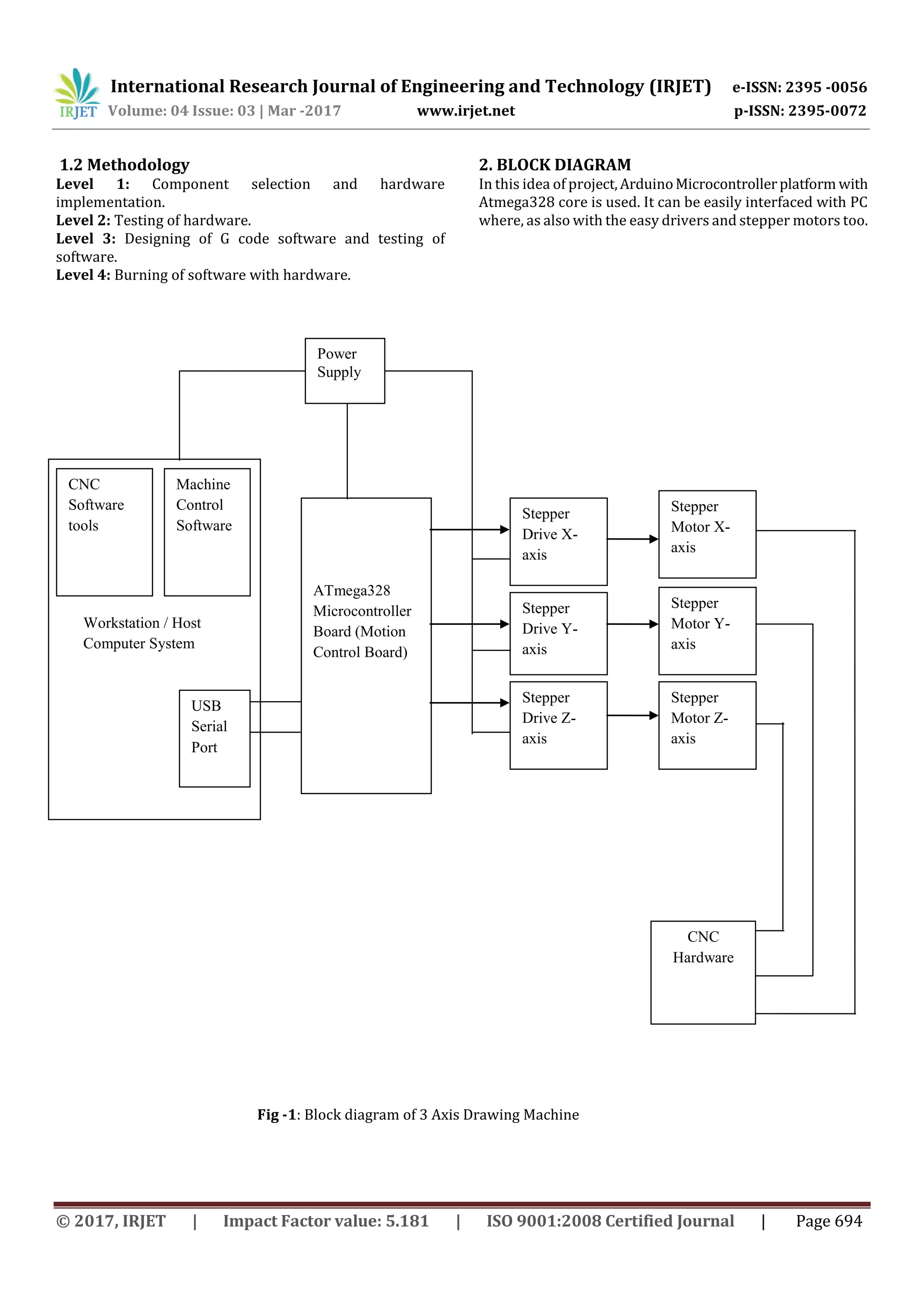
2. BLOCK DIAGRAM
In this idea of project,ArduinoMicrocontrollerplatform with
Atmega328 core is used. It can be easily interfaced with PC
where, as also with the easy drivers and stepper motors too.
Fig -1: Block diagram of 3 Axis Drawing Machine
CNC
Software
tools
Machine
Control
Software
USB
Serial
Port
Workstation / Host
Computer System
Power
Supply
ATmega328
Microcontroller
Board (Motion
Control Board)
Stepper
Drive X-
axis
Stepper
Drive Y-
axis
Stepper
Drive Z-
axis
Stepper
Motor X-
axis
Stepper
Motor Y-
axis
Stepper
Motor Z-
axis
CNC
Hardware
International Research Journal of Engineering and Technology (IRJET) e-ISSN: 2395 -0056
Volume: 04 Issue: 03 | Mar -2017 www.irjet.net p-ISSN: 2395-0072
© 2017, IRJET | Impact Factor value: 5.181 | ISO 9001:2008 Certified Journal | Page 695
2.1 G code:
G-Code is the language used to describe how a machine will
move to accomplish a given task, using numerical control
(NC) --- it is the most widely used NCprogramminglanguage
2.2 Arduino:
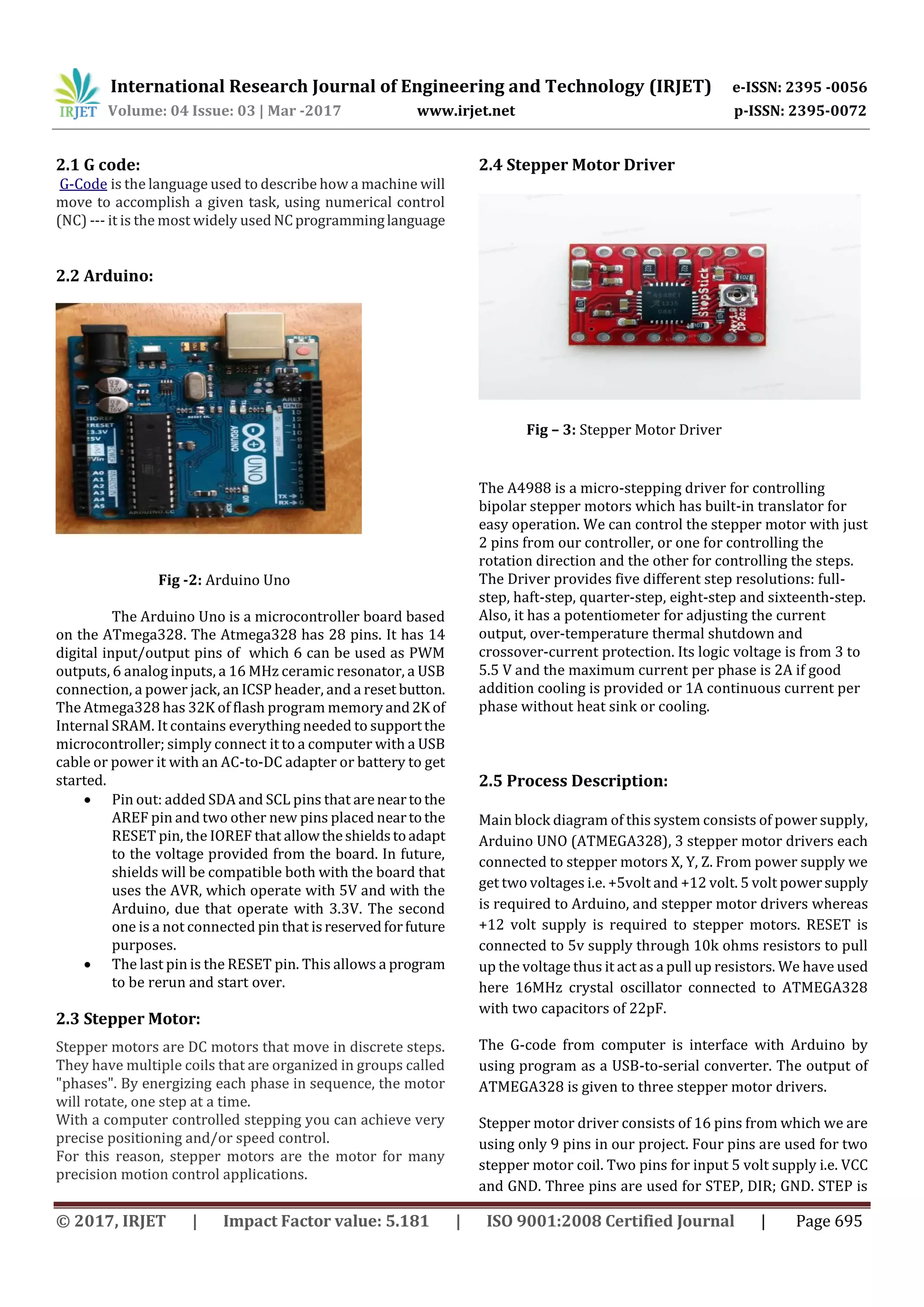
Fig -2: Arduino Uno
The Arduino Uno is a microcontroller board based
on the ATmega328. The Atmega328 has 28 pins. It has 14
digital input/output pins of which 6 can be used as PWM
outputs, 6 analog inputs, a 16 MHz ceramic resonator, a USB
connection, a power jack, an ICSP header, and a reset button.
The Atmega328 has 32K of flash program memoryand2K of
Internal SRAM. It contains everything needed to supportthe
microcontroller; simply connect it to a computer with a USB
cable or power it with an AC-to-DC adapter or battery to get
started.
 Pin out: added SDA and SCL pins that areneartothe
AREF pin and two other new pins placed neartothe
RESET pin, the IOREF that allowtheshieldstoadapt
to the voltage provided from the board. In future,
shields will be compatible both with the board that
uses the AVR, which operate with 5V and with the
Arduino, due that operate with 3.3V. The second
one is a not connected pin that isreservedforfuture
purposes.
 The last pin is the RESET pin. This allows a program
to be rerun and start over.
2.3 Stepper Motor:
Stepper motors are DC motors that move in discrete steps.
They have multiple coils that are organized in groups called
"phases". By energizing each phase in sequence, the motor
will rotate, one step at a time.
With a computer controlled stepping you can achieve very
precise positioning and/or speed control.
For this reason, stepper motors are the motor for many
precision motion control applications.
2.4 Stepper Motor Driver
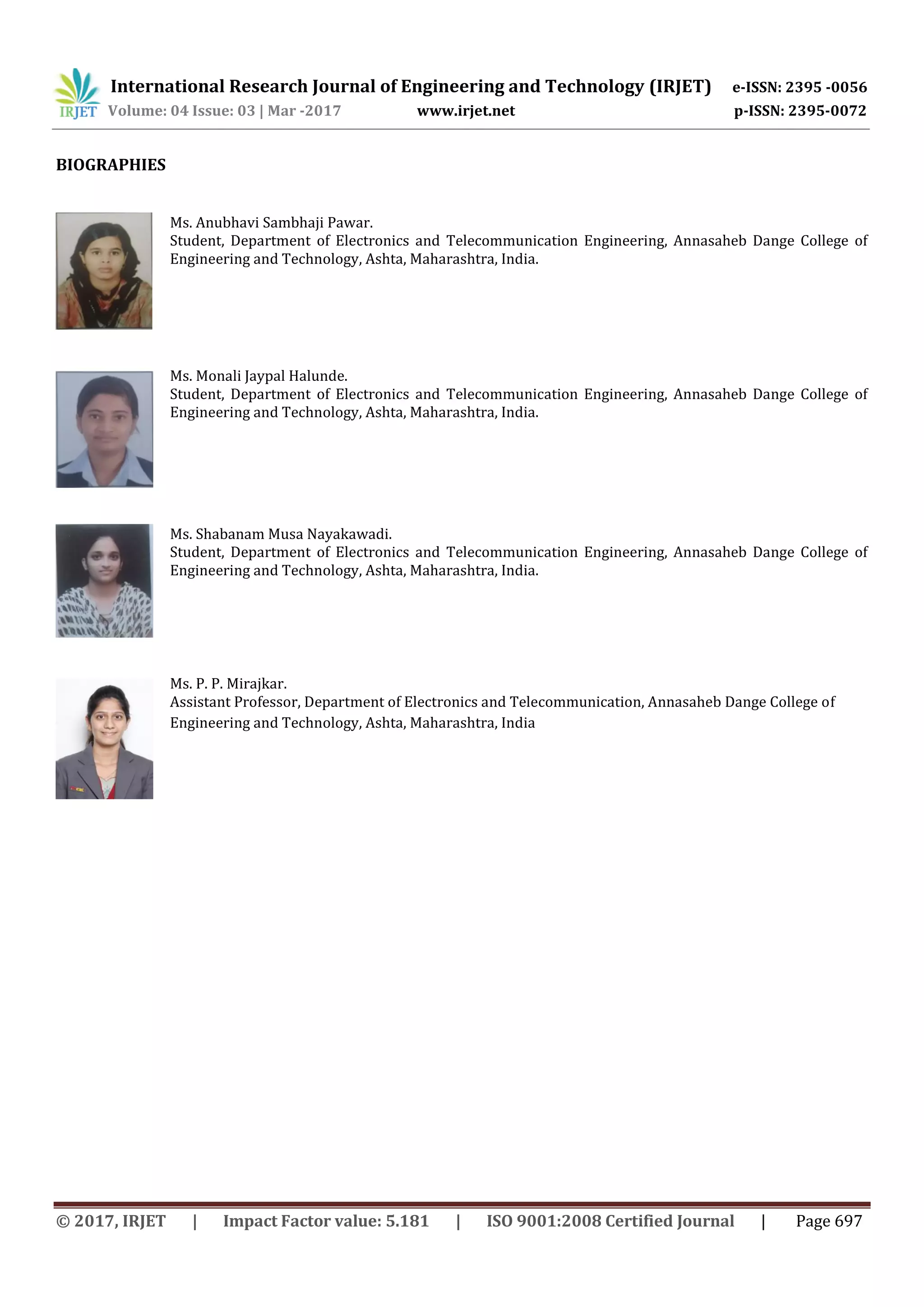
Fig – 3: Stepper Motor Driver
The A4988 is a micro-stepping driver for controlling
bipolar stepper motors which has built-in translator for
easy operation. We can control the stepper motor with just
2 pins from our controller, or one for controlling the
rotation direction and the other for controlling the steps.
The Driver provides five different step resolutions: full-
step, haft-step, quarter-step, eight-step and sixteenth-step.
Also, it has a potentiometer for adjusting the current
output, over-temperature thermal shutdown and
crossover-current protection. Its logic voltage is from 3 to
5.5 V and the maximum current per phase is 2A if good
addition cooling is provided or 1A continuous current per
phase without heat sink or cooling.
2.5 Process Description:
Main block diagram of this system consists of power supply,
Arduino UNO (ATMEGA328), 3 stepper motor drivers each
connected to stepper motors X, Y, Z. From power supply we
get two voltages i.e. +5volt and +12 volt. 5 volt powersupply
is required to Arduino, and stepper motor drivers whereas
+12 volt supply is required to stepper motors. RESET is
connected to 5v supply through 10k ohms resistors to pull
up the voltage thus it act as a pull up resistors. We have used
here 16MHz crystal oscillator connected to ATMEGA328
with two capacitors of 22pF.
The G-code from computer is interface with Arduino by
using program as a USB-to-serial converter. The output of
ATMEGA328 is given to three stepper motor drivers.
Stepper motor driver consists of 16 pins from which we are
using only 9 pins in our project. Four pins are used for two
stepper motor coil. Two pins for input 5 volt supply i.e. VCC
and GND. Three pins are used for STEP, DIR; GND. STEP is
International Research Journal of Engineering and Technology (IRJET) e-ISSN: 2395 -0056
Volume: 04 Issue: 03 | Mar -2017 www.irjet.net p-ISSN: 2395-0072
© 2017, IRJET | Impact Factor value: 5.181 | ISO 9001:2008 Certified Journal | Page 696
used for micro stepping. DIR is directioninputpinwhich will
move stepper motor according to the given dimensions.
Third pin is directly grounded.
3. Hardware Implementation:
3. CONCLUSION
This paper has presented the results of
development of a Low cost three-axis drawing machine
suitable for drawing letters andimageswithbetteraccuracy.
This setup of hardware with a combination of software
reduces the work load. G code make easy to find the
information of locations of all stepper motor moving, as the
status of our moving motor are directly seen on computer
hence we can start or stop the machine whenever we
needed. Making a small machine brings a flexibility to do
work.
REFERENCES
[1] Yung C. Shin, Henry Chin, Michael J. Brink,
―Characterization of CNC machining centers,‖ Journal of
Manufacturing Systems,1991
[2] Heisel, M Gringel, ―Machine Tool Design Requirements
for High Speed Machining‖,1999
[3] M Kumar, V Puttige, ―low cost automation for CNC
machining center‖, IJMET, Vol. 3.
I. Pahole, L. Rataj, M. Ficko, S. Klancnik, S.Brezovnik, M.
Brezocnik, and J. Balic,"Construction and evaluation of low-
cost tableCNC milling machine",2009
[4] V.K. Pabolu and K.N.H. Srinivas, "Design and
implementation of a three dimensional CNC machine",2010.
[5] T. Andrei and I. Nae, "Practical applicationsperformed by
a stepper motor CNC router",2010
[6] P.A. Sherring da Rocha Jr., R.D.S. Souza, and M.Emilia de
Lima Tostes, "Prototype CNC machinedesign",2012
[7] Ms. P. P. Mirajkar, Ms. Kavathekar Jyoti, Ms. Madhuri
Kamble, “AUTOMATIC POWER FACTOR RELAY USING PIC
CONTROLLER” is published in IJARECE, ISSN 2278-909X,
Volume 5, Issue 4, pp. 808-811 , April -2016
[8] Xu, Y. Li, J. Sun, and S. Wang, "Research and development
of open CNC system based on PC and motion
controller",2012.
[9] Ms. P. P. Mirajkar, Prof. S.D. Ruikar, “WAVELET BASED
IMAGE FUSION TECHNIQUES” is published in CIIT
International Journal of Digital Image Processing, Volume 4,
No. 15, September 2012
[10] www.arduino.cc
International Research Journal of Engineering and Technology (IRJET) e-ISSN: 2395 -0056
Volume: 04 Issue: 03 | Mar -2017 www.irjet.net p-ISSN: 2395-0072
© 2017, IRJET | Impact Factor value: 5.181 | ISO 9001:2008 Certified Journal | Page 697
BIOGRAPHIES
Ms. Anubhavi Sambhaji Pawar.
Student, Department of Electronics and Telecommunication Engineering, Annasaheb Dange College of
Engineering and Technology, Ashta, Maharashtra, India.
Ms. Monali Jaypal Halunde.
Student, Department of Electronics and Telecommunication Engineering, Annasaheb Dange College of
Engineering and Technology, Ashta, Maharashtra, India.
Ms. Shabanam Musa Nayakawadi.
Student, Department of Electronics and Telecommunication Engineering, Annasaheb Dange College of
Engineering and Technology, Ashta, Maharashtra, India.
Ms. P. P. Mirajkar.
Assistant Professor, Department of Electronics and Telecommunication, Annasaheb Dange College of
Engineering and Technology, Ashta, Maharashtra, India

3 Axis Drawing Machine

  • 1.
    International Research Journalof Engineering and Technology (IRJET) e-ISSN: 2395 -0056 Volume: 04 Issue: 03 | Mar -2017 www.irjet.net p-ISSN: 2395-0072 © 2017, IRJET | Impact Factor value: 5.181 | ISO 9001:2008 Certified Journal | Page 693 3 AXIS DRAWING MACHINE Anubhavi S. Pawar1, Monali J. Halunde2, Shabanam M. Nayakawadi3, Ms. P. P. Mirajkar4 1Student, Department of Electronics and Telecommunication, Annasaheb Dange College of Engineering and Technology, Ashta, Maharashtra, India 2Student, Department of Electronics and Telecommunication, Annasaheb Dange College of Engineering and Technology, Ashta, Maharashtra, India 3Student, Department of Electronics and Telecommunication, Annasaheb Dange College of Engineering and Technology, Ashta, Maharashtra, India 4Assistant Professor, Department of Electronics and Telecommunication, Annasaheb Dange College of Engineering and Technology, Ashta, Maharashtra, India ---------------------------------------------------------------------***--------------------------------------------------------------------- Abstract - This paper discusses design and implementation of low cost 3 Axis Drawing Machine using Arduino controller based on computerized numerical controller (CNC) machine and open sourcesoftware(G-code and GRBL) for controlling whole operation. Computer numeric control (CNC) machine plays an important role in the field of automation. The main aim of this project is to reduce time consumed and it reduces human involvement which eventually reduces rate of error and also increase the accuracy of the production. Thecommunicationbetweenthe open source software (G-code and GRBL) and hardware (Arduino and CNC shield) is to be done with the help of USB. 1. INTRODUCTION CNC Machining is a process usedinthemanufacturingsector that involves the use of computers to control machine tools. Tools that can be controlled in this manner include lathes, mills, routers and grinders. The CNC in CNC Machining stands for Computer Numerical Control. CNC – Computer Numerical Control – Taking digitized data, a computer and CAM program is used to control, automate, and monitor the movementsofa machine. The CNC controller works together with a series of motors and drive components to move and control the machine axes, executing the programmed motions. Open source microcontroller platform Arduino is used for control of the motors, and open source software is used for executing the G code for machining applications. Several authors have studied the development of such machines on a smaller, low-cost scale. For example, V.K. Pabolu and K.N.H. Srinivas [4] have designed and implemented a three axis CNC machine using an 8-bit microcontroller. The development is in .Net platform using C# programming language on a Windows XP computer, but the motors have limited power. T. Andrei and I. Nae [5] have developed a simpler commercial size CNCrouter running withMach3softwareon a desktop PC, but requiring a parallel port. P.A. Sherring da Rocha Jr., R.D.S. Souza,and M.Emilia deLima Tostes [6] have presented a prototype CNC machine under development running on a PC with LabVIEW which has advantage of ease of visual programming tools. The PC is interfaced with low-cost embedded microcontrollers through the serial port. The CNC machine designsaboverely on the use of stepper motors of limited power in open loop mode. Xu, Y. Li, J. Sun, and S. Wang [8] discuss results of research on an open CNC system using Windows PC with a four-axis motion controller. A major new development in computer technology is the availability of low-cost open source hardware, such as the Arduino micro-controller platform.[10] 1.1 Objectives - The idea behind the fabrication of low cost 3 Axis Drawing Machine is to fulfill demand of small scale industries. An advantage of open source hardware is that a wide variety of ready-to-use software is available for them on the Web, therefore the prototyping and development times are drastically reduced. Moreover, a wide range of low-cost interfaces, sensors, and accessories such as Arduino shields are also available on the Internet, along with clear instructions, examples, and applicable program code. In this paper, the development of a prototype 3-axis CNC Router using Arduino-based control system is presented with following specifications: • Low cost • Easily operable • Easy interface • Flexible • Low power consumption
  • 2.
    International Research Journalof Engineering and Technology (IRJET) e-ISSN: 2395 -0056 Volume: 04 Issue: 03 | Mar -2017 www.irjet.net p-ISSN: 2395-0072 © 2017, IRJET | Impact Factor value: 5.181 | ISO 9001:2008 Certified Journal | Page 694 1.2 Methodology Level 1: Component selection and hardware implementation. Level 2: Testing of hardware. Level 3: Designing of G code software and testing of software. Level 4: Burning of software with hardware. 2. BLOCK DIAGRAM In this idea of project,ArduinoMicrocontrollerplatform with Atmega328 core is used. It can be easily interfaced with PC where, as also with the easy drivers and stepper motors too. Fig -1: Block diagram of 3 Axis Drawing Machine CNC Software tools Machine Control Software USB Serial Port Workstation / Host Computer System Power Supply ATmega328 Microcontroller Board (Motion Control Board) Stepper Drive X- axis Stepper Drive Y- axis Stepper Drive Z- axis Stepper Motor X- axis Stepper Motor Y- axis Stepper Motor Z- axis CNC Hardware
  • 3.
    International Research Journalof Engineering and Technology (IRJET) e-ISSN: 2395 -0056 Volume: 04 Issue: 03 | Mar -2017 www.irjet.net p-ISSN: 2395-0072 © 2017, IRJET | Impact Factor value: 5.181 | ISO 9001:2008 Certified Journal | Page 695 2.1 G code: G-Code is the language used to describe how a machine will move to accomplish a given task, using numerical control (NC) --- it is the most widely used NCprogramminglanguage 2.2 Arduino: Fig -2: Arduino Uno The Arduino Uno is a microcontroller board based on the ATmega328. The Atmega328 has 28 pins. It has 14 digital input/output pins of which 6 can be used as PWM outputs, 6 analog inputs, a 16 MHz ceramic resonator, a USB connection, a power jack, an ICSP header, and a reset button. The Atmega328 has 32K of flash program memoryand2K of Internal SRAM. It contains everything needed to supportthe microcontroller; simply connect it to a computer with a USB cable or power it with an AC-to-DC adapter or battery to get started.  Pin out: added SDA and SCL pins that areneartothe AREF pin and two other new pins placed neartothe RESET pin, the IOREF that allowtheshieldstoadapt to the voltage provided from the board. In future, shields will be compatible both with the board that uses the AVR, which operate with 5V and with the Arduino, due that operate with 3.3V. The second one is a not connected pin that isreservedforfuture purposes.  The last pin is the RESET pin. This allows a program to be rerun and start over. 2.3 Stepper Motor: Stepper motors are DC motors that move in discrete steps. They have multiple coils that are organized in groups called "phases". By energizing each phase in sequence, the motor will rotate, one step at a time. With a computer controlled stepping you can achieve very precise positioning and/or speed control. For this reason, stepper motors are the motor for many precision motion control applications. 2.4 Stepper Motor Driver Fig – 3: Stepper Motor Driver The A4988 is a micro-stepping driver for controlling bipolar stepper motors which has built-in translator for easy operation. We can control the stepper motor with just 2 pins from our controller, or one for controlling the rotation direction and the other for controlling the steps. The Driver provides five different step resolutions: full- step, haft-step, quarter-step, eight-step and sixteenth-step. Also, it has a potentiometer for adjusting the current output, over-temperature thermal shutdown and crossover-current protection. Its logic voltage is from 3 to 5.5 V and the maximum current per phase is 2A if good addition cooling is provided or 1A continuous current per phase without heat sink or cooling. 2.5 Process Description: Main block diagram of this system consists of power supply, Arduino UNO (ATMEGA328), 3 stepper motor drivers each connected to stepper motors X, Y, Z. From power supply we get two voltages i.e. +5volt and +12 volt. 5 volt powersupply is required to Arduino, and stepper motor drivers whereas +12 volt supply is required to stepper motors. RESET is connected to 5v supply through 10k ohms resistors to pull up the voltage thus it act as a pull up resistors. We have used here 16MHz crystal oscillator connected to ATMEGA328 with two capacitors of 22pF. The G-code from computer is interface with Arduino by using program as a USB-to-serial converter. The output of ATMEGA328 is given to three stepper motor drivers. Stepper motor driver consists of 16 pins from which we are using only 9 pins in our project. Four pins are used for two stepper motor coil. Two pins for input 5 volt supply i.e. VCC and GND. Three pins are used for STEP, DIR; GND. STEP is
  • 4.
    International Research Journalof Engineering and Technology (IRJET) e-ISSN: 2395 -0056 Volume: 04 Issue: 03 | Mar -2017 www.irjet.net p-ISSN: 2395-0072 © 2017, IRJET | Impact Factor value: 5.181 | ISO 9001:2008 Certified Journal | Page 696 used for micro stepping. DIR is directioninputpinwhich will move stepper motor according to the given dimensions. Third pin is directly grounded. 3. Hardware Implementation: 3. CONCLUSION This paper has presented the results of development of a Low cost three-axis drawing machine suitable for drawing letters andimageswithbetteraccuracy. This setup of hardware with a combination of software reduces the work load. G code make easy to find the information of locations of all stepper motor moving, as the status of our moving motor are directly seen on computer hence we can start or stop the machine whenever we needed. Making a small machine brings a flexibility to do work. REFERENCES [1] Yung C. Shin, Henry Chin, Michael J. Brink, ―Characterization of CNC machining centers,‖ Journal of Manufacturing Systems,1991 [2] Heisel, M Gringel, ―Machine Tool Design Requirements for High Speed Machining‖,1999 [3] M Kumar, V Puttige, ―low cost automation for CNC machining center‖, IJMET, Vol. 3. I. Pahole, L. Rataj, M. Ficko, S. Klancnik, S.Brezovnik, M. Brezocnik, and J. Balic,"Construction and evaluation of low- cost tableCNC milling machine",2009 [4] V.K. Pabolu and K.N.H. Srinivas, "Design and implementation of a three dimensional CNC machine",2010. [5] T. Andrei and I. Nae, "Practical applicationsperformed by a stepper motor CNC router",2010 [6] P.A. Sherring da Rocha Jr., R.D.S. Souza, and M.Emilia de Lima Tostes, "Prototype CNC machinedesign",2012 [7] Ms. P. P. Mirajkar, Ms. Kavathekar Jyoti, Ms. Madhuri Kamble, “AUTOMATIC POWER FACTOR RELAY USING PIC CONTROLLER” is published in IJARECE, ISSN 2278-909X, Volume 5, Issue 4, pp. 808-811 , April -2016 [8] Xu, Y. Li, J. Sun, and S. Wang, "Research and development of open CNC system based on PC and motion controller",2012. [9] Ms. P. P. Mirajkar, Prof. S.D. Ruikar, “WAVELET BASED IMAGE FUSION TECHNIQUES” is published in CIIT International Journal of Digital Image Processing, Volume 4, No. 15, September 2012 [10] www.arduino.cc
  • 5.
    International Research Journalof Engineering and Technology (IRJET) e-ISSN: 2395 -0056 Volume: 04 Issue: 03 | Mar -2017 www.irjet.net p-ISSN: 2395-0072 © 2017, IRJET | Impact Factor value: 5.181 | ISO 9001:2008 Certified Journal | Page 697 BIOGRAPHIES Ms. Anubhavi Sambhaji Pawar. Student, Department of Electronics and Telecommunication Engineering, Annasaheb Dange College of Engineering and Technology, Ashta, Maharashtra, India. Ms. Monali Jaypal Halunde. Student, Department of Electronics and Telecommunication Engineering, Annasaheb Dange College of Engineering and Technology, Ashta, Maharashtra, India. Ms. Shabanam Musa Nayakawadi. Student, Department of Electronics and Telecommunication Engineering, Annasaheb Dange College of Engineering and Technology, Ashta, Maharashtra, India. Ms. P. P. Mirajkar. Assistant Professor, Department of Electronics and Telecommunication, Annasaheb Dange College of Engineering and Technology, Ashta, Maharashtra, India