
Who is Watching you?
Abu Muhammad – Ibn Usman
Muhammad Zahraddeen
TOPIC BREAK DOWN
To ease the task for myself and all, I hope to break down the topic into:
1
2
3
4
5
6
Introduction
Definition
Importance
Benefits
Consequences
of Lacking
Ways to
improve/attain it
Allah (Azza Wa Jalla) mentions in Suratun
Nisa’i (4), Ayah 131:
“And to Allah belongs all that is in the
heavens and all that is in the earth. And
Verily, We have recommended to the
people of the Scripture before you, and to
you (O Muslims) that you (all should have )
Taqwa and keep your duty to Him, But if
you disbelieve, then unto Allah belongs all
that is in the heavens and all that is in the
earth, and Allah is Ever Rich, Worthy of all
praise”.
Akhraja Imamut
Tirmidhi fi Sunanihi
(Kitabur Riqaq – Babun
fi Husnil Khuluq) min
hadithi Abu Dhar –
Jundub Bin Junada
(RA) wa aidan min
hadith Abu Abdur-
Rahman – Mu’adh Bin
Jabal (RA): ‘Annan
Nabiya (SAW) qaal
“Ittaqillaha haithu ma
kunta wat ba-is
sayyi’ata hasanata
tamhuha wa khaaliqin
bi khulqin hasan”
INTRODUCTION
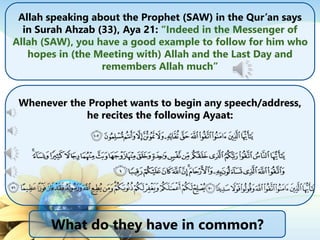
Allah speaking about the Prophet (SAW) in the Qur’an says
in Surah Ahzab (33), Aya 21: “Indeed in the Messenger of
Allah (SAW), you have a good example to follow for him who
hopes in (the Meeting with) Allah and the Last Day and
remembers Allah much”
Whenever the Prophet wants to begin any speech/address,
he recites the following Ayaat:
What do they have in common?
The first one is in Suratu Aali Imran(3),
Ayah 102 the meaning of the interpretation
is: “O you who believe! Have the Taqwa of
Allah (by doing all that He has ordered &
by abstaining from all He has forbidden),
the true Taqwa that He deserves (Obey
Him, be thankful to Him, and remember
Him always), and die not except in a state
of Islam”.
The second one is the first
Ayah of Suratun Nisa’i, it is
translated as follows: “O
mankind! have the Taqwa
of your Lord, Who created
you from a single person
(Adam), and from him
(Adam) He created his wife
(Hauwa – Eve), and from
them both He created many
men and women and have
Taqwa of Allah through
Whom you demand your
mutual (rights) and (do not
cut the relations of) the
womb (kinship). Surely,
Allah is alaikum Raqiba
(Ever an All-Watcher over
you)”
The third & forth are from Surah Ahzab
(33), Ayah 70 – 71, it reads: “O you who
believe! Have the Taqwa of Allah, and speak
(always) the truth” “He ill direct you to do
righteous good deeds and will forgive you
your sins. And whosoever obeys Allah and
His Messenger, he has indeed achieve a
great achievement (Admitance into Janna &
Saved from Jahannam)”
Notice I only said with regard to the second Aya (1st of Suratun Nisa’i) where
Allah said “… alaikum Raqiba (Ever an All-Watcher over you)”
Who is Watching you?
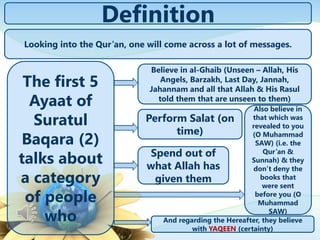
Definition
The first 5
Ayaat of
Suratul
Baqara (2)
talks about
a category
of people
who
Believe in al-Ghaib (Unseen – Allah, His
Angels, Barzakh, Last Day, Jannah,
Jahannam and all that Allah & His Rasul
told them that are unseen to them)
Perform Salat (on
time)
Spend out of
what Allah has
given them
Also believe in
that which was
revealed to you
(O Muhammad
SAW) (i.e. the
Qur’an &
Sunnah) & they
don’t deny the
books that
were sent
before you (O
Muhammad
SAW)
And regarding the Hereafter, they believe
with YAQEEN (certainty)
Looking into the Qur’an, one will come across a lot of messages.
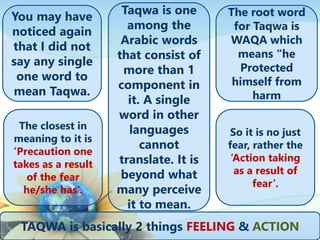
You may have
noticed again
that I did not
say any single
one word to
mean Taqwa.
The root word
for Taqwa is
WAQA which
means “he
Protected
himself from
harm
Taqwa is one
among the
Arabic words
that consist of
more than 1
component in
it. A single
word in other
languages
cannot
translate. It is
beyond what
many perceive
it to mean.
The closest in
meaning to it is
’Precaution one
takes as a result
of the fear
he/she has’.
So it is no just
fear, rather the
‘Action taking
as a result of
fear’.
TAQWA is basically 2 things FEELING & ACTION
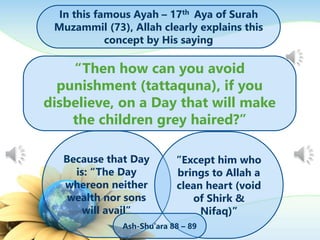
In this famous Ayah – 17th Aya of Surah
Muzammil (73), Allah clearly explains this
concept by His saying
“Then how can you avoid
punishment (tattaquna), if you
disbelieve, on a Day that will make
the children grey haired?”
Because that Day
is: “The Day
whereon neither
wealth nor sons
will avail”
”Except him who
brings to Allah a
clean heart (void
of Shirk &
Nifaq)”
Ash-Shu’ara 88 – 89
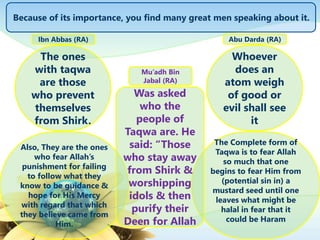
The ones
with taqwa
are those
who prevent
themselves
from Shirk.
Also, They are the ones
who fear Allah’s
punishment for failing
to follow what they
know to be guidance &
hope for His Mercy
with regard that which
they believe came from
Him.
Because of its importance, you find many great men speaking about it.
Ibn Abbas (RA)
Whoever
does an
atom weigh
of good or
evil shall see
it
The Complete form of
Taqwa is to fear Allah
so much that one
begins to fear Him from
(potential sin in) a
mustard seed until one
leaves what might be
halal in fear that it
could be Haram
Abu Darda (RA)
Was asked
who the
people of
Taqwa are. He
said: “Those
who stay away
from Shirk &
worshipping
idols & then
purify their
Deen for Allah
Mu’adh Bin
Jabal (RA)
1. An yuda’a fala
u’usa (Obeyed
and never
disobeyed)
2. Wa yuzkara fala
yunsa
(Remembered
& never
forgotten)
3. Wa yushkara
fala yukfar
(Thanked &
never shown
ungratefulness)
Because of its importance, you find many great men speaking about it.
Ali (RA)
Abdullah Bin Mas’ud
(RA)
1. Khaufu minal
jalil – Fear of
Allah The Most
Majestic
2. Amalu bit tanzil
– Acting
according to the
Qur’an
3. Rida bil qali –
Contented with
little
4. Isti’idadi li
yaumir rahil –
Preparation for
the great Day of
Departure.
Ubay Bin Ka’ab
(RA)
He was asked by
Umar Bin Khattab
‘What is Taqwa?’
‘Have you ever
walked a thorny
path?’
‘Yes’
‘How did you walk
across?
‘Careful walked
with my cloak
wrapped with
caution least it
gets hooked?’
‘That is Taqwa’ *3
Hasan Basri (RH)
says: The ones
who have Taqwa
protect
themselves from
what Allah has
prohibited and
act upon what
He has
mandated.
Taqwa remains
withthem until
they forsake
many halal
things fearing
that they could
be haram.
Sufyan Thauri (RH)
says: “They have
been called the
fearing because
they fear what is
not usually feared.
Ibn Rajab (RH) says:
“Wa aslut taqwa -
The essence of
Taqwa is
An yaj alal abdu
bainahu wa baina
ma yattaqihi
wiqaya – For a slave
to put a barrier
between himself &
that which he
fears”
Umar Bin Abdul-
Aziz (RH) says: “
Taqwa is not
fasting by the day
& standing for
prayer at night or
combining both.
Rather, it is to
refrain from what
Allah has
prohibited & act
upon what He has
mandated
Also, we find the
essence of existence in
Surah Dhariyat(51),
Ayah 56:
IMPORTANCE
Allah (Azza Wa Jalla) mentions in Suratun
Nisa’i (4), Ayah 131:
“And to Allah belongs all that is in the
heavens and all that is in the earth. And
Verily, We have recommended to the
people of the Scripture before you, and to
you (O Muslims) that you (all should have )
Taqwa and keep your duty to Him, But if
you disbelieve, then unto Allah belongs all
that is in the heavens and all that is in the
earth, and Allah is Ever Rich, Worthy of all
praise”.
“And I (Allah) created not
the jinns & humans
except they should
worship Me (Alone)”
In Ayah 21 of Suratul Baqara
(2), we find were Allah
informs us of the essence of
the IBADAH itself.
“O Mankind! Worship your Lord (Allah), Who
created you & those before you so that you
may become Al-Muttaqun (People of Taqwa)
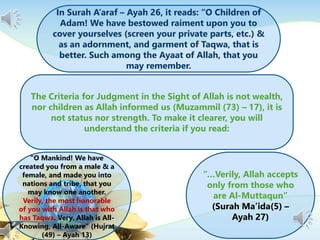
In Surah A’araf – Ayah 26, it reads: “O Children of
Adam! We have bestowed raiment upon you to
cover yourselves (screen your private parts, etc.) &
as an adornment, and garment of Taqwa, that is
better. Such among the Ayaat of Allah, that you
may remember.
The Criteria for Judgment in the Sight of Allah is not wealth,
nor children as Allah informed us (Muzammil (73) – 17), it is
not status nor strength. To make it clearer, you will
understand the criteria if you read:
“O Mankind! We have
created you from a male & a
female, and made you into
nations and tribe, that you
may know one another.
Verily, the most honorable
of you with Allah is that who
has Taqwa. Very, Allah is All-
Knowing, All-Aware” (Hujrat
(49) – Ayah 13)
“…Verily, Allah accepts
only from those who
are Al-Muttaqun”
(Surah Ma’ida(5) –
Ayah 27)
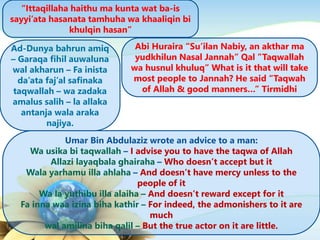
“Ittaqillaha haithu ma kunta wat ba-is
sayyi’ata hasanata tamhuha wa khaaliqin bi
khulqin hasan”
Abi Huraira “Su’ilan Nabiy, an akthar ma
yudkhilun Nasal Jannah” Qal ”Taqwallah
wa husnul khuluq” What is it that will take
most people to Jannah? He said “Taqwah
of Allah & good manners…” Tirmidhi
Umar Bin Abdulaziz wrote an advice to a man:
Wa usika bi taqwallah – I advise you to have the taqwa of Allah
Allazi layaqbala ghairaha – Who doesn’t accept but it
Wala yarhamu illa ahlaha – And doesn’t have mercy unless to the
people of it
Wa la yuthibu illa alaiha – And doesn’t reward except for it
Fa inna waa izina biha kathir – For indeed, the admonishers to it are
much
wal amilina biha qalil – But the true actor on it are little.
Ad-Dunya bahrun amiq
– Garaqa fihil auwaluna
wal akharun – Fa inista
da’ata faj’al safinaka
taqwallah – wa zadaka
amalus salih – la allaka
antanja wala araka
najiya.
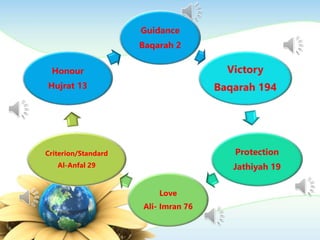
Guidance
Baqarah 2
Victory
Baqarah 194
Protection
Jathiyah 19
Love
Ali- Imran 76
Criterion/Standard
Al-Anfal 29
Honour
Hujrat 13
Suratut Talaq (65), Ayah 2 – 3 – 4 & 5
Surah Maryam (19), Ayah 72: Then We shall save
those who use to have Taqwa (in the Dunya). And
We shall leave the Zalimun totheir knees”
1. Sincere intention to improve or have Taqwa
2. Du’a (Allahumma inni as’alukal-huda wat-tuqa wal- ‘afafa wal-
ghina (O Allah I ask You for guidance, piety, chastity and self
sufficiency) – [Ibn Mas’ud - Muslim]
3. Recite the Qur'an with its meanings
4. Remember Allah
5. Busy yourself with good works
6. Be with good company
7. Learn religious knowledge
8. Always be alert and aware of whatever may
divert you away from Allah
9. Be humble in character
10.Do everything to please Allah
11.Focus on the main purpose of our lives
12.Remember much the destroyer of pleasures:
DEATH
How to Improve/Attain Taqwa
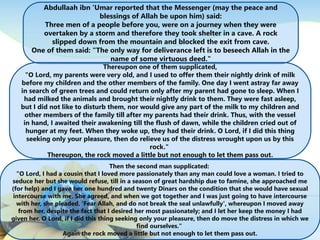
Abdullaah ibn ‘Umar reported that the Messenger (may the peace and
blessings of Allah be upon him) said:
Three men of a people before you, were on a journey when they were
overtaken by a storm and therefore they took shelter in a cave. A rock
slipped down from the mountain and blocked the exit from cave.
One of them said: "The only way for deliverance left is to beseech Allah in the
name of some virtuous deed."
Thereupon one of them supplicated,
"O Lord, my parents were very old, and I used to offer them their nightly drink of milk
before my children and the other members of the family. One day I went astray far away
in search of green trees and could return only after my parent had gone to sleep. When I
had milked the animals and brought their nightly drink to them. They were fast asleep,
but I did not like to disturb them, nor would give any part of the milk to my children and
other members of the family till after my parents had their drink. Thus, with the vessel
in hand, I awaited their awakening till the flush of dawn, while the children cried out of
hunger at my feet. When they woke up, they had their drink. O Lord, if I did this thing
seeking only your pleasure, then do relieve us of the distress wrought upon us by this
rock."
Thereupon, the rock moved a little but not enough to let them pass out.
Then the second man supplicated:
"O Lord, I had a cousin that I loved more passionately than any man could love a woman. I tried to
seduce her but she would refuse, till in a season of great hardship due to famine, she approached me
(for help) and I gave her one hundred and twenty Dinars on the condition that she would have sexual
intercourse with me. She agreed, and when we got together and I was just going to have intercourse
with her, she pleaded, 'Fear Allah, and do not break the seal unlawfully', whereupon I moved away
from her, despite the fact that I desired her most passionately; and I let her keep the money I had
given her. O Lord, if I did this thing seeking only your pleasure, then do move the distress in which we
find ourselves."
Again the rock moved a little but not enough to let them pass out.
Then the third supplicated:
"O Lord, I hired some labourers and paid them their dues, but one of them left leaving behind
what was due to him. I invested it in business and the business prospered greatly.
After a while, the labourer came back and said: 'O servant of Allah, hand over to me my wages.' I
said to him: 'All that you see is yours; camels, cattle, goats and slaves." He said: 'Don't play joke
with me, O servant of Allah.' I assured him: 'I am not joking.' So he took all of it sparing nothing.
O Lord, if I did this seeking only for your pleasure, do relieve us of our distress."
The rock then moved away, and all the three came out of the cave safe and sound.
The Question is now, “If you happen to be the 4th person with them, what will be the action
you will use to beseech Allah for opening?

Taqwah

  • 1.
    Who is Watchingyou? Abu Muhammad – Ibn Usman Muhammad Zahraddeen
  • 2.
    TOPIC BREAK DOWN Toease the task for myself and all, I hope to break down the topic into: 1 2 3 4 5 6 Introduction Definition Importance Benefits Consequences of Lacking Ways to improve/attain it
  • 3.
    Allah (Azza WaJalla) mentions in Suratun Nisa’i (4), Ayah 131: “And to Allah belongs all that is in the heavens and all that is in the earth. And Verily, We have recommended to the people of the Scripture before you, and to you (O Muslims) that you (all should have ) Taqwa and keep your duty to Him, But if you disbelieve, then unto Allah belongs all that is in the heavens and all that is in the earth, and Allah is Ever Rich, Worthy of all praise”. Akhraja Imamut Tirmidhi fi Sunanihi (Kitabur Riqaq – Babun fi Husnil Khuluq) min hadithi Abu Dhar – Jundub Bin Junada (RA) wa aidan min hadith Abu Abdur- Rahman – Mu’adh Bin Jabal (RA): ‘Annan Nabiya (SAW) qaal “Ittaqillaha haithu ma kunta wat ba-is sayyi’ata hasanata tamhuha wa khaaliqin bi khulqin hasan” INTRODUCTION
  • 4.
    Allah speaking aboutthe Prophet (SAW) in the Qur’an says in Surah Ahzab (33), Aya 21: “Indeed in the Messenger of Allah (SAW), you have a good example to follow for him who hopes in (the Meeting with) Allah and the Last Day and remembers Allah much” Whenever the Prophet wants to begin any speech/address, he recites the following Ayaat: What do they have in common?
  • 5.
    The first oneis in Suratu Aali Imran(3), Ayah 102 the meaning of the interpretation is: “O you who believe! Have the Taqwa of Allah (by doing all that He has ordered & by abstaining from all He has forbidden), the true Taqwa that He deserves (Obey Him, be thankful to Him, and remember Him always), and die not except in a state of Islam”. The second one is the first Ayah of Suratun Nisa’i, it is translated as follows: “O mankind! have the Taqwa of your Lord, Who created you from a single person (Adam), and from him (Adam) He created his wife (Hauwa – Eve), and from them both He created many men and women and have Taqwa of Allah through Whom you demand your mutual (rights) and (do not cut the relations of) the womb (kinship). Surely, Allah is alaikum Raqiba (Ever an All-Watcher over you)” The third & forth are from Surah Ahzab (33), Ayah 70 – 71, it reads: “O you who believe! Have the Taqwa of Allah, and speak (always) the truth” “He ill direct you to do righteous good deeds and will forgive you your sins. And whosoever obeys Allah and His Messenger, he has indeed achieve a great achievement (Admitance into Janna & Saved from Jahannam)” Notice I only said with regard to the second Aya (1st of Suratun Nisa’i) where Allah said “… alaikum Raqiba (Ever an All-Watcher over you)”
  • 6.
  • 7.
    Definition The first 5 Ayaatof Suratul Baqara (2) talks about a category of people who Believe in al-Ghaib (Unseen – Allah, His Angels, Barzakh, Last Day, Jannah, Jahannam and all that Allah & His Rasul told them that are unseen to them) Perform Salat (on time) Spend out of what Allah has given them Also believe in that which was revealed to you (O Muhammad SAW) (i.e. the Qur’an & Sunnah) & they don’t deny the books that were sent before you (O Muhammad SAW) And regarding the Hereafter, they believe with YAQEEN (certainty) Looking into the Qur’an, one will come across a lot of messages.
  • 8.
    You may have noticedagain that I did not say any single one word to mean Taqwa. The root word for Taqwa is WAQA which means “he Protected himself from harm Taqwa is one among the Arabic words that consist of more than 1 component in it. A single word in other languages cannot translate. It is beyond what many perceive it to mean. The closest in meaning to it is ’Precaution one takes as a result of the fear he/she has’. So it is no just fear, rather the ‘Action taking as a result of fear’. TAQWA is basically 2 things FEELING & ACTION
  • 9.
    In this famousAyah – 17th Aya of Surah Muzammil (73), Allah clearly explains this concept by His saying “Then how can you avoid punishment (tattaquna), if you disbelieve, on a Day that will make the children grey haired?” Because that Day is: “The Day whereon neither wealth nor sons will avail” ”Except him who brings to Allah a clean heart (void of Shirk & Nifaq)” Ash-Shu’ara 88 – 89
  • 10.
    The ones with taqwa arethose who prevent themselves from Shirk. Also, They are the ones who fear Allah’s punishment for failing to follow what they know to be guidance & hope for His Mercy with regard that which they believe came from Him. Because of its importance, you find many great men speaking about it. Ibn Abbas (RA) Whoever does an atom weigh of good or evil shall see it The Complete form of Taqwa is to fear Allah so much that one begins to fear Him from (potential sin in) a mustard seed until one leaves what might be halal in fear that it could be Haram Abu Darda (RA) Was asked who the people of Taqwa are. He said: “Those who stay away from Shirk & worshipping idols & then purify their Deen for Allah Mu’adh Bin Jabal (RA)
  • 11.
    1. An yuda’afala u’usa (Obeyed and never disobeyed) 2. Wa yuzkara fala yunsa (Remembered & never forgotten) 3. Wa yushkara fala yukfar (Thanked & never shown ungratefulness) Because of its importance, you find many great men speaking about it. Ali (RA) Abdullah Bin Mas’ud (RA) 1. Khaufu minal jalil – Fear of Allah The Most Majestic 2. Amalu bit tanzil – Acting according to the Qur’an 3. Rida bil qali – Contented with little 4. Isti’idadi li yaumir rahil – Preparation for the great Day of Departure. Ubay Bin Ka’ab (RA) He was asked by Umar Bin Khattab ‘What is Taqwa?’ ‘Have you ever walked a thorny path?’ ‘Yes’ ‘How did you walk across? ‘Careful walked with my cloak wrapped with caution least it gets hooked?’ ‘That is Taqwa’ *3
  • 12.
    Hasan Basri (RH) says:The ones who have Taqwa protect themselves from what Allah has prohibited and act upon what He has mandated. Taqwa remains withthem until they forsake many halal things fearing that they could be haram. Sufyan Thauri (RH) says: “They have been called the fearing because they fear what is not usually feared. Ibn Rajab (RH) says: “Wa aslut taqwa - The essence of Taqwa is An yaj alal abdu bainahu wa baina ma yattaqihi wiqaya – For a slave to put a barrier between himself & that which he fears” Umar Bin Abdul- Aziz (RH) says: “ Taqwa is not fasting by the day & standing for prayer at night or combining both. Rather, it is to refrain from what Allah has prohibited & act upon what He has mandated
  • 13.
    Also, we findthe essence of existence in Surah Dhariyat(51), Ayah 56: IMPORTANCE Allah (Azza Wa Jalla) mentions in Suratun Nisa’i (4), Ayah 131: “And to Allah belongs all that is in the heavens and all that is in the earth. And Verily, We have recommended to the people of the Scripture before you, and to you (O Muslims) that you (all should have ) Taqwa and keep your duty to Him, But if you disbelieve, then unto Allah belongs all that is in the heavens and all that is in the earth, and Allah is Ever Rich, Worthy of all praise”. “And I (Allah) created not the jinns & humans except they should worship Me (Alone)” In Ayah 21 of Suratul Baqara (2), we find were Allah informs us of the essence of the IBADAH itself. “O Mankind! Worship your Lord (Allah), Who created you & those before you so that you may become Al-Muttaqun (People of Taqwa)
  • 14.
    In Surah A’araf– Ayah 26, it reads: “O Children of Adam! We have bestowed raiment upon you to cover yourselves (screen your private parts, etc.) & as an adornment, and garment of Taqwa, that is better. Such among the Ayaat of Allah, that you may remember. The Criteria for Judgment in the Sight of Allah is not wealth, nor children as Allah informed us (Muzammil (73) – 17), it is not status nor strength. To make it clearer, you will understand the criteria if you read: “O Mankind! We have created you from a male & a female, and made you into nations and tribe, that you may know one another. Verily, the most honorable of you with Allah is that who has Taqwa. Very, Allah is All- Knowing, All-Aware” (Hujrat (49) – Ayah 13) “…Verily, Allah accepts only from those who are Al-Muttaqun” (Surah Ma’ida(5) – Ayah 27)
  • 15.
    “Ittaqillaha haithu makunta wat ba-is sayyi’ata hasanata tamhuha wa khaaliqin bi khulqin hasan” Abi Huraira “Su’ilan Nabiy, an akthar ma yudkhilun Nasal Jannah” Qal ”Taqwallah wa husnul khuluq” What is it that will take most people to Jannah? He said “Taqwah of Allah & good manners…” Tirmidhi Umar Bin Abdulaziz wrote an advice to a man: Wa usika bi taqwallah – I advise you to have the taqwa of Allah Allazi layaqbala ghairaha – Who doesn’t accept but it Wala yarhamu illa ahlaha – And doesn’t have mercy unless to the people of it Wa la yuthibu illa alaiha – And doesn’t reward except for it Fa inna waa izina biha kathir – For indeed, the admonishers to it are much wal amilina biha qalil – But the true actor on it are little. Ad-Dunya bahrun amiq – Garaqa fihil auwaluna wal akharun – Fa inista da’ata faj’al safinaka taqwallah – wa zadaka amalus salih – la allaka antanja wala araka najiya.
  • 16.
    Guidance Baqarah 2 Victory Baqarah 194 Protection Jathiyah19 Love Ali- Imran 76 Criterion/Standard Al-Anfal 29 Honour Hujrat 13
  • 17.
    Suratut Talaq (65),Ayah 2 – 3 – 4 & 5 Surah Maryam (19), Ayah 72: Then We shall save those who use to have Taqwa (in the Dunya). And We shall leave the Zalimun totheir knees”
  • 18.
    1. Sincere intentionto improve or have Taqwa 2. Du’a (Allahumma inni as’alukal-huda wat-tuqa wal- ‘afafa wal- ghina (O Allah I ask You for guidance, piety, chastity and self sufficiency) – [Ibn Mas’ud - Muslim] 3. Recite the Qur'an with its meanings 4. Remember Allah 5. Busy yourself with good works 6. Be with good company 7. Learn religious knowledge 8. Always be alert and aware of whatever may divert you away from Allah 9. Be humble in character 10.Do everything to please Allah 11.Focus on the main purpose of our lives 12.Remember much the destroyer of pleasures: DEATH How to Improve/Attain Taqwa
  • 19.
    Abdullaah ibn ‘Umarreported that the Messenger (may the peace and blessings of Allah be upon him) said: Three men of a people before you, were on a journey when they were overtaken by a storm and therefore they took shelter in a cave. A rock slipped down from the mountain and blocked the exit from cave. One of them said: "The only way for deliverance left is to beseech Allah in the name of some virtuous deed." Thereupon one of them supplicated, "O Lord, my parents were very old, and I used to offer them their nightly drink of milk before my children and the other members of the family. One day I went astray far away in search of green trees and could return only after my parent had gone to sleep. When I had milked the animals and brought their nightly drink to them. They were fast asleep, but I did not like to disturb them, nor would give any part of the milk to my children and other members of the family till after my parents had their drink. Thus, with the vessel in hand, I awaited their awakening till the flush of dawn, while the children cried out of hunger at my feet. When they woke up, they had their drink. O Lord, if I did this thing seeking only your pleasure, then do relieve us of the distress wrought upon us by this rock." Thereupon, the rock moved a little but not enough to let them pass out. Then the second man supplicated: "O Lord, I had a cousin that I loved more passionately than any man could love a woman. I tried to seduce her but she would refuse, till in a season of great hardship due to famine, she approached me (for help) and I gave her one hundred and twenty Dinars on the condition that she would have sexual intercourse with me. She agreed, and when we got together and I was just going to have intercourse with her, she pleaded, 'Fear Allah, and do not break the seal unlawfully', whereupon I moved away from her, despite the fact that I desired her most passionately; and I let her keep the money I had given her. O Lord, if I did this thing seeking only your pleasure, then do move the distress in which we find ourselves." Again the rock moved a little but not enough to let them pass out.
  • 20.
    Then the thirdsupplicated: "O Lord, I hired some labourers and paid them their dues, but one of them left leaving behind what was due to him. I invested it in business and the business prospered greatly. After a while, the labourer came back and said: 'O servant of Allah, hand over to me my wages.' I said to him: 'All that you see is yours; camels, cattle, goats and slaves." He said: 'Don't play joke with me, O servant of Allah.' I assured him: 'I am not joking.' So he took all of it sparing nothing. O Lord, if I did this seeking only for your pleasure, do relieve us of our distress." The rock then moved away, and all the three came out of the cave safe and sound. The Question is now, “If you happen to be the 4th person with them, what will be the action you will use to beseech Allah for opening?