Lecture
Topic: GMDSS frequencies. frequency ranges
Objective: to uncover the nature of the GMDSS frequencies.
frequency ranges
We consider the following questions:
1. Distribution of radio waves of various ranges
2. The influence of external environment on radio wave
propagation.
1. Distribution of radio waves of various ranges
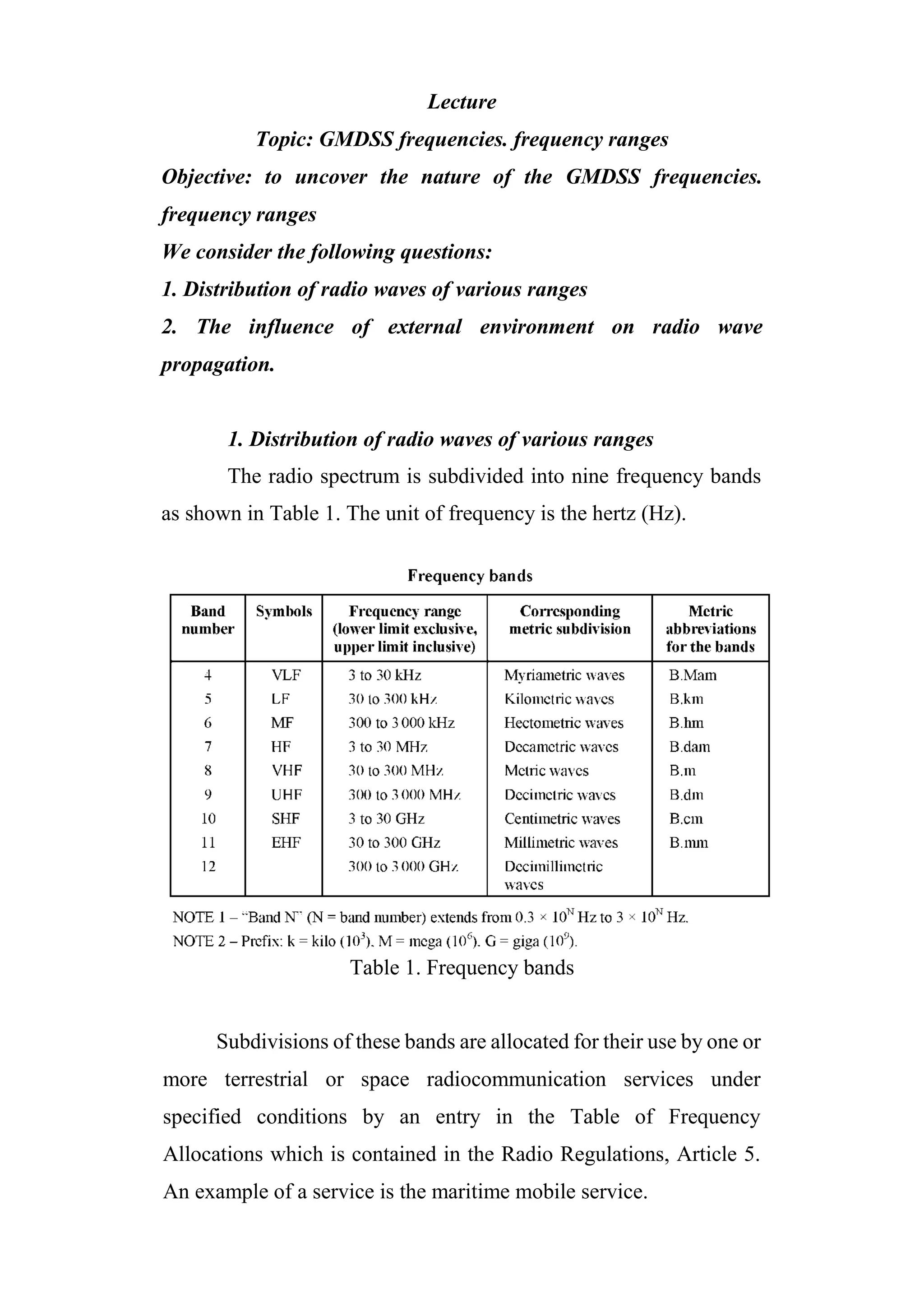
The radio spectrum is subdivided into nine frequency bands
as shown in Table 1. The unit of frequency is the hertz (Hz).
Table 1. Frequency bands
Subdivisions of these bands are allocated for their use by one or
more terrestrial or space radiocommunication services under
specified conditions by an entry in the Table of Frequency
Allocations which is contained in the Radio Regulations, Article 5.
An example of a service is the maritime mobile service.
Frequency bands may be allocated globally or to an ITU
Radiocommunication Region as shown in Fig. 1. The services may be
given primary or secondary categories where a secondary service
means that its stations shall not cause interference to stations of the
primary service and cannot claim protection. An example of a band
allocated globally to the maritime mobile service on a primary basis
is 156.4875-156.5625 MHz which is VHF channel 16 and its two
guard band channels 75 and 76.
Other bands used by ships may be in mobile bands, such as the
mobile-satellite band used by Inmarsat, in which case they are shared
with other mobile services. Alternately, they may not be available for
use in all regions or may be a secondary allocation. Special provisions
and additional application of the allocations are described by
footnotes to the Table of Frequency Allocations.
Frequencies are assigned to a user through authorization by an
administration for a radio station to use the frequency. The
procedures for the assignment of frequencies are given in the Radio
Regulations, Article 4. Basically, Member States of the ITU are
required to assign frequencies in accordance with the Table of
Frequency Allocations and the provisions of the Radio Regulations in
order to prevent interference.
Figure 1
The three regions for the allocation of frequencies
2. The influence of external environment on radio wave
propagation.
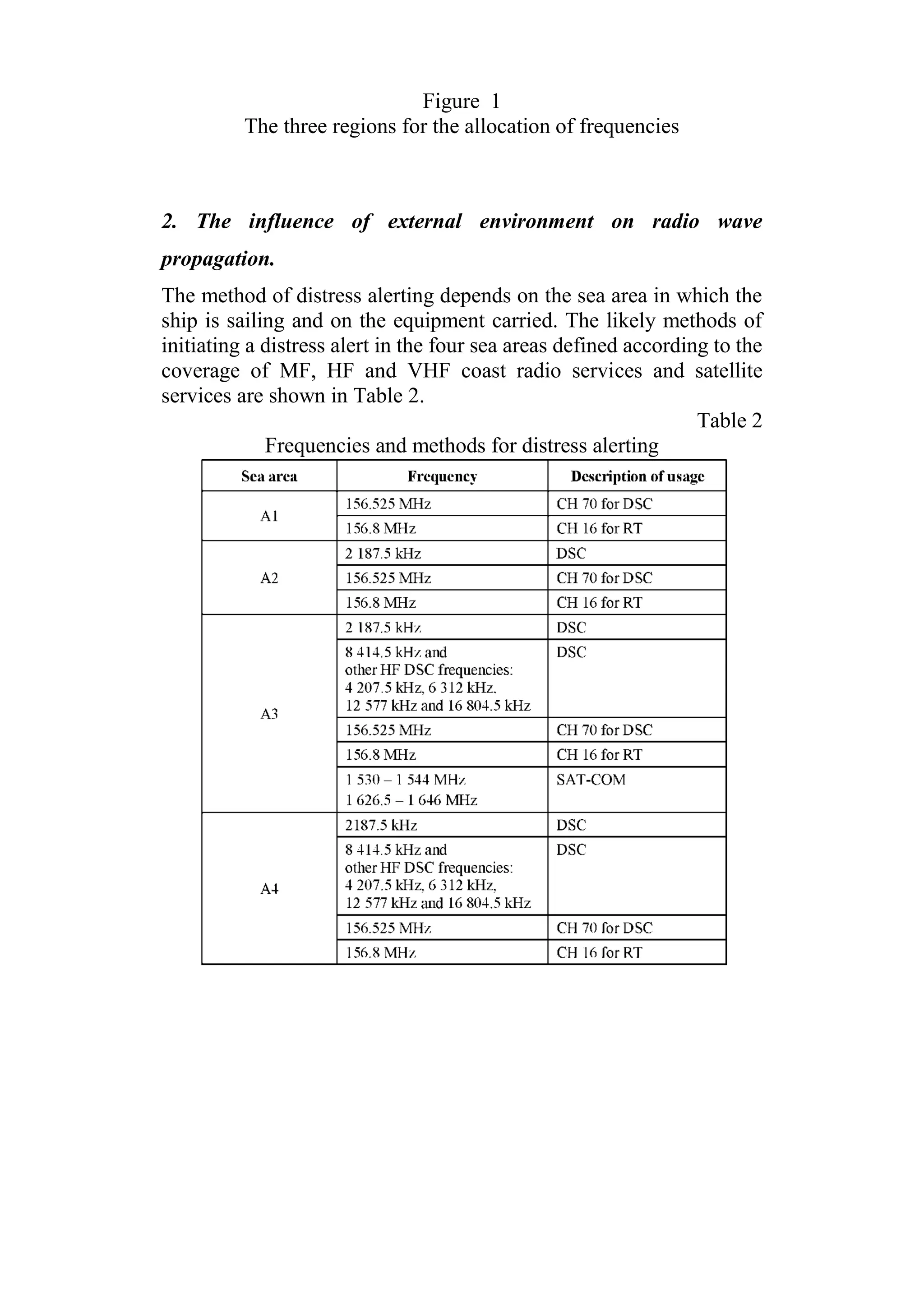
The method of distress alerting depends on the sea area in which the
ship is sailing and on the equipment carried. The likely methods of
initiating a distress alert in the four sea areas defined according to the
coverage of MF, HF and VHF coast radio services and satellite
services are shown in Table 2.
Table 2
Frequencies and methods for distress alerting

л3

  • 1.
    Lecture Topic: GMDSS frequencies.frequency ranges Objective: to uncover the nature of the GMDSS frequencies. frequency ranges We consider the following questions: 1. Distribution of radio waves of various ranges 2. The influence of external environment on radio wave propagation. 1. Distribution of radio waves of various ranges The radio spectrum is subdivided into nine frequency bands as shown in Table 1. The unit of frequency is the hertz (Hz). Table 1. Frequency bands Subdivisions of these bands are allocated for their use by one or more terrestrial or space radiocommunication services under specified conditions by an entry in the Table of Frequency Allocations which is contained in the Radio Regulations, Article 5. An example of a service is the maritime mobile service.
  • 2.
    Frequency bands maybe allocated globally or to an ITU Radiocommunication Region as shown in Fig. 1. The services may be given primary or secondary categories where a secondary service means that its stations shall not cause interference to stations of the primary service and cannot claim protection. An example of a band allocated globally to the maritime mobile service on a primary basis is 156.4875-156.5625 MHz which is VHF channel 16 and its two guard band channels 75 and 76. Other bands used by ships may be in mobile bands, such as the mobile-satellite band used by Inmarsat, in which case they are shared with other mobile services. Alternately, they may not be available for use in all regions or may be a secondary allocation. Special provisions and additional application of the allocations are described by footnotes to the Table of Frequency Allocations. Frequencies are assigned to a user through authorization by an administration for a radio station to use the frequency. The procedures for the assignment of frequencies are given in the Radio Regulations, Article 4. Basically, Member States of the ITU are required to assign frequencies in accordance with the Table of Frequency Allocations and the provisions of the Radio Regulations in order to prevent interference.
  • 3.
    Figure 1 The threeregions for the allocation of frequencies 2. The influence of external environment on radio wave propagation. The method of distress alerting depends on the sea area in which the ship is sailing and on the equipment carried. The likely methods of initiating a distress alert in the four sea areas defined according to the coverage of MF, HF and VHF coast radio services and satellite services are shown in Table 2. Table 2 Frequencies and methods for distress alerting