FCC REGULATORY TRAINING
BAKEWELL MEDIA / WBOK AM STAFF
Jeneba Jalloh Ghatt
The Ghatt Law Group
April 2, 2012
OVERVIEW
   BROADCASTING OBLIGATIONS

   RECORDKEEPING OBLIGATIONS

   REPORTING AND FILING OBLIGATIONS

   WALK THRU
     SEARCHING FOR FCC PUBLIC FILINGS
     SEARCHING FOR STATION FILES
     HOW TO FILE A REPORT
BROADCASTING
   PERSONAL ATTACK RULE

   POLITICAL EDITORIAL RULE

   EQUAL TIME RULE

   STATION IDENTIFICATION

   SPONSOR IDENTIFICATION
OTHER BROADCAST RULES.
   Station-Conducted Contests. A station that broadcasts or advertises
    information about a contest that it conducts must fully and accurately
    disclose the material terms of the contest, and must conduct the contest
    substantially as announced or advertised. Contest descriptions may not
    be false, misleading, or deceptive with respect to any material term,
    including the factors that define the operation of the contest and affect
    participation, such as entry deadlines, the prizes that can be won, and
    how winners will be selected. Additional information about the contest
    rule can be found at http://www.fcc.gov/cgb/consumerfacts/contests.html.

   Profane material also is protected by the First Amendment, so its
    broadcast cannot be outlawed entirely. The Commission has defined
    such program matter to include language that is both “so grossly
    offensive to members of the public who actually hear it as to amount to a
    nuisance” and is sexual or excretory in nature or derived from such
    terms. Such material may be the subject of possible Commission
    enforcement action if it is broadcast within the same time period
    applicable to indecent programming: between 6 a.m. and 10 p.m.
BROADCASTING – PERSONAL ATTACK RULE
   If a person or small group is attacked

   Notify those attacked

   Offer FREE time to respond, reasonable not equal
    time necessarily

   EXCEPTIONS
     Foreign person or Group
     Political Candidates or their reps (Old Fairness Doctrine
      was overuled in 2002)
BROADCASTING – POLITICAL EDITORIAL RULE
   If Station endorses a candidate, then it MUST give
    opponents reasonable time to reply

   FREE

   Reasonable not necessarily EQUAL time
BROADCASTING – EQUAL TIME RULE
   When station airs original programming or
    promotes another candidate via an ad

   MUST provide equal time to opponents

   EXCEPTIONS:
       (1) regularly scheduled newscasts
        (2) news interviews shows
        (3) documentaries (unless the documentary is about a
        candidate)
        (4) on-the-spot news events
BROADCASTING: STATION IDENTIFICATION

   Stations must air identification announcements when they
    sign on and off for the day. They also must broadcast these
    announcements every hour, as close to the start of the hour
    as possible, at a natural programming break. TV stations may
    make these announcements on-screen or by voice
    only. Official station identification includes the station’s call
    letters, followed by the community specified in its license as
    the station’s location. Between the call letters and its
    community, the station may insert the name of the licensee,
    the station’s channel number, and/or its frequency. It may
    also include any additional community or communities, as
    long as it first names the community to which it is licensed by
    the FCC. DTV stations also may identify their digital multicast
    programming streams separately if they wish, and, if so, must
    follow the format described in the FCC’s rules.
BROADCASTING: STATION SPONSORSHIP
   Section 317 of the Communications Act of 1934, as
    amended, 47 U.S.C. § 317, requires broadcasters
    to disclose to their listeners or viewers if matter has
    been aired in exchange for money, services or
    other valuable consideration. The announcement
    must be aired when the subject matter is
    broadcast.

   Section 507 – requires announcement when station
    given something in exchange
RECORDKEEPING
    Contents of the File. The following materials must be maintained in each station public
    inspection file:
              The License. Stations must keep a copy of their current FCC construction permit or license in
    the public file, together with any material documenting Commission-approved modifications to the
    authorization.
              Applications and Related Materials. The public file must contain copies of all applications
    involving the station filed with the Commission that are still pending before either the FCC or the
    courts. The station must also keep copies of any granted construction permit or assignment or transfer
    application if its grant required us to waive our rules. Applications that required a waiver, together with
    any related material, will reflect each particular rule that we waived, and must be maintained as long as
    any such waiver remains in effect.
              Citizen Agreements. Commercial stations must keep copies of any written agreements that
    they make with local viewers or listeners. These "citizen agreements" may deal with programming,
    employment, or other issues of community concern. The station must keep these agreements in the
    public file for as long as they are in effect.
              Contour Maps. The public file must contain copies of any station service contour maps or other
    information submitted with any application filed with the FCC that reflects the station's service contours
    and/or its main studio and transmitter locations.
              Material Relating to an FCC Investigation or Complaint. Stations must keep material
    relating to any matter that is the subject of an FCC investigation (including EEO audits) or a complaint
    that the station has violated the Communications Act or FCC rules. The station must keep this material
    in its file until the FCC notifies it that the material may be discarded.
RECORDKEEPING
   Letters and E-Mails from the Public. Commercial stations must keep in their files, for at least three years,
    written comments, suggestions, and e-mails received from the public regarding their operation. (Noncommercial
    educational stations are not subject to this requirement.) This obligation is limited to comments, suggestions, and
    e-mails sent to station management or a publicized station address.


   Letters need not be placed in the public inspection file when the author has requested that the letter not be made
    public or when the licensee feels that it should be excluded from public inspection because of the nature of its
    content (such as defamatory or obscene letters).


          Quarterly Programming Reports. Every three months, each broadcast radio and television station
    licensee must prepare and place in its station public file a list of programs containing its most significant treatment
    of community issues during the preceding three months (“issues/programs lists”). The list must briefly describe
    both the issue and the programming during which the issue was discussed, including the date and time that each
    such program was aired and its title and duration


           Time Brokerage Agreements. A time brokerage agreement is a type of contract that generally involves
    a station's sale of blocks of airtime to a third-party broker, who then supplies the programming to fill that time and
    sells the commercial spot announcements to support the programming. Commercial radio and television stations
    must keep in their public files a copy of every agreement involving: (1) time brokerage of that station, or (2) time
    brokerage by any other station owned by the same licensee. These agreements must be maintained in the file for
    as long as they are in force.


           Local Public Notice Announcements. As discussed at pages 10-11 of this Manual, when someone files
    an application to build a new station or to renew, sell, or modify an existing station, we generally require the
    applicant to make a series of local announcements to inform the public of the application's existence and nature.
    These announcements are either published in a local newspaper or made over the air on the station, and are
    intended to give the public an opportunity to comment on the application. A statement certifying compliance with
    this requirement, including the dates and times that notice was given, must be placed in the public file.
RECORDKEEPING
    Ownership Reports and Related Material. The public file must contain a copy of the most recent, complete
    ownership report (FCC Form 323 for commercial stations, FCC Form 323-E for noncommercial educational
    stations) filed for the station.
            List of Contracts Required to be Filed with the FCC. Stations must keep in the public file either copies
    of all the contracts that they have to file with the FCC, or an up-to-date list identifying all such contractsContracts
    required to be maintained or listed in the public inspection file include:
   ·         contracts relating to network service (network affiliation contracts)
   ·             contracts relating to ownership or control of the licensee or permittee or its stock. Examples include
    articles of incorporation, bylaws, agreements providing for the assignment of a license or permit or affecting stock
    ownership or voting rights (stock options, pledges, or proxies), and mortgage or loan agreements that restrict the
    licensee or permittee's freedom of operation; and
   ·   management consultant agreements with independent contractors, and contracts relating to the utilization in
    a management capacity of any person other than an officer, director, or regular employee of the licensee.
   Political File. Stations must keep a file which contains “a complete record of a request to purchase broadcast
    time that: (A) is made by or on behalf of a legally qualified candidate for public office; or (B) communicates a
    message relating to any political matter of national importance, including: (i) a legally qualified candidate; (ii) any
    election to federal office; or (iii) a national legislative issue of public importance.” The file must identify how the
    station responded to such requests and, if the request was granted, the charges made, a schedule of time
    purchased, the times the spots actually aired, the rates charged, and the classes of time purchased. The file also
    must reflect any free time provided to a candidate. The station must keep the political records in the file for two
    years after the spot airs. (You can find more information regarding the political broadcasting laws at pages 13-14
    of this Manual.)
   EEO Materials. As noted earlier, licensees must submit certain forms containing EEO information and include
    copies in their station public files. Thus, all stations employing five or more full-time employees must put an EEO
    public file report in their station public file each year. We also require each radio and TV station licensee to file a
    Form 396 EEO Program Report with its license renewal application and to include the Report in its public file.
            “The Public and Broadcasting.” Stations must keep a copy of the current version of this Manual in the
    public file and provide a copy, upon request, to any member of the public. As noted above, you can also request
    a copy from the FCC or access it on our Internet website
    at http://www.fcc.gov/mb/audio/decdoc/public_and_broadcasting.html.
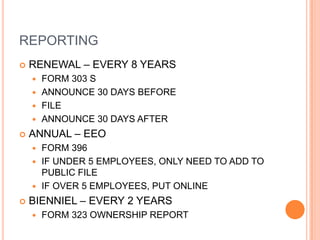
REPORTING
   RENEWAL – EVERY 8 YEARS
     FORM 303 S
     ANNOUNCE 30 DAYS BEFORE
     FILE
     ANNOUNCE 30 DAYS AFTER

   ANNUAL – EEO
     FORM 396
     IF UNDER 5 EMPLOYEES, ONLY NEED TO ADD TO
      PUBLIC FILE
     IF OVER 5 EMPLOYEES, PUT ONLINE

   BIENNIEL – EVERY 2 YEARS
       FORM 323 OWNERSHIP REPORT
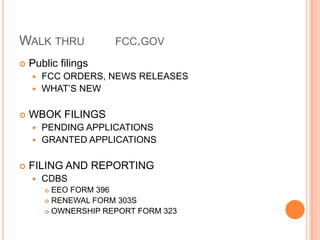
WALK THRU             FCC.GOV

   Public filings
     FCC ORDERS, NEWS RELEASES
     WHAT’S NEW


   WBOK FILINGS
     PENDING APPLICATIONS
     GRANTED APPLICATIONS


   FILING AND REPORTING
       CDBS
         EEO FORM 396
         RENEWAL FORM 303S

         OWNERSHIP REPORT FORM 323
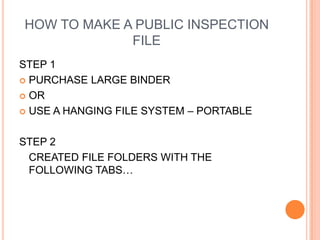
HOW TO MAKE A PUBLIC INSPECTION
             FILE
STEP 1
 PURCHASE LARGE BINDER

 OR

 USE A HANGING FILE SYSTEM – PORTABLE


STEP 2
 CREATED FILE FOLDERS WITH THE
 FOLLOWING TABS…
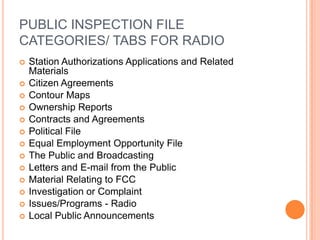
PUBLIC INSPECTION FILE
CATEGORIES/ TABS FOR RADIO
   Station Authorizations Applications and Related
    Materials
   Citizen Agreements
   Contour Maps
   Ownership Reports
   Contracts and Agreements
   Political File
   Equal Employment Opportunity File
   The Public and Broadcasting
   Letters and E-mail from the Public
   Material Relating to FCC
   Investigation or Complaint
   Issues/Programs - Radio
   Local Public Announcements
PUBLIC INSPECTION FILE
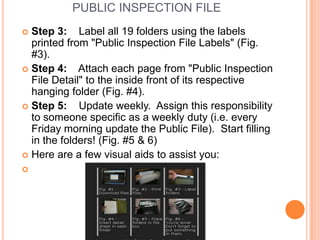
 Step 3: Label all 19 folders using the labels
  printed from "Public Inspection File Labels" (Fig.
  #3).
 Step 4:    Attach each page from "Public Inspection
  File Detail" to the inside front of its respective
  hanging folder (Fig. #4).
 Step 5:    Update weekly. Assign this responsibility
  to someone specific as a weekly duty (i.e. every
  Friday morning update the Public File). Start filling
  in the folders! (Fig. #5 & 6)
 Here are a few visual aids to assist you:


Fcc regulatory training

  • 1.
    FCC REGULATORY TRAINING BAKEWELLMEDIA / WBOK AM STAFF Jeneba Jalloh Ghatt The Ghatt Law Group April 2, 2012
  • 2.
    OVERVIEW  BROADCASTING OBLIGATIONS  RECORDKEEPING OBLIGATIONS  REPORTING AND FILING OBLIGATIONS  WALK THRU  SEARCHING FOR FCC PUBLIC FILINGS  SEARCHING FOR STATION FILES  HOW TO FILE A REPORT
  • 3.
    BROADCASTING  PERSONAL ATTACK RULE  POLITICAL EDITORIAL RULE  EQUAL TIME RULE  STATION IDENTIFICATION  SPONSOR IDENTIFICATION
  • 4.
    OTHER BROADCAST RULES.  Station-Conducted Contests. A station that broadcasts or advertises information about a contest that it conducts must fully and accurately disclose the material terms of the contest, and must conduct the contest substantially as announced or advertised. Contest descriptions may not be false, misleading, or deceptive with respect to any material term, including the factors that define the operation of the contest and affect participation, such as entry deadlines, the prizes that can be won, and how winners will be selected. Additional information about the contest rule can be found at http://www.fcc.gov/cgb/consumerfacts/contests.html.  Profane material also is protected by the First Amendment, so its broadcast cannot be outlawed entirely. The Commission has defined such program matter to include language that is both “so grossly offensive to members of the public who actually hear it as to amount to a nuisance” and is sexual or excretory in nature or derived from such terms. Such material may be the subject of possible Commission enforcement action if it is broadcast within the same time period applicable to indecent programming: between 6 a.m. and 10 p.m.
  • 5.
    BROADCASTING – PERSONALATTACK RULE  If a person or small group is attacked  Notify those attacked  Offer FREE time to respond, reasonable not equal time necessarily  EXCEPTIONS  Foreign person or Group  Political Candidates or their reps (Old Fairness Doctrine was overuled in 2002)
  • 6.
    BROADCASTING – POLITICALEDITORIAL RULE  If Station endorses a candidate, then it MUST give opponents reasonable time to reply  FREE  Reasonable not necessarily EQUAL time
  • 7.
    BROADCASTING – EQUALTIME RULE  When station airs original programming or promotes another candidate via an ad  MUST provide equal time to opponents  EXCEPTIONS:  (1) regularly scheduled newscasts (2) news interviews shows (3) documentaries (unless the documentary is about a candidate) (4) on-the-spot news events
  • 8.
    BROADCASTING: STATION IDENTIFICATION  Stations must air identification announcements when they sign on and off for the day. They also must broadcast these announcements every hour, as close to the start of the hour as possible, at a natural programming break. TV stations may make these announcements on-screen or by voice only. Official station identification includes the station’s call letters, followed by the community specified in its license as the station’s location. Between the call letters and its community, the station may insert the name of the licensee, the station’s channel number, and/or its frequency. It may also include any additional community or communities, as long as it first names the community to which it is licensed by the FCC. DTV stations also may identify their digital multicast programming streams separately if they wish, and, if so, must follow the format described in the FCC’s rules.
  • 9.
    BROADCASTING: STATION SPONSORSHIP  Section 317 of the Communications Act of 1934, as amended, 47 U.S.C. § 317, requires broadcasters to disclose to their listeners or viewers if matter has been aired in exchange for money, services or other valuable consideration. The announcement must be aired when the subject matter is broadcast.  Section 507 – requires announcement when station given something in exchange
  • 10.
    RECORDKEEPING  Contents of the File. The following materials must be maintained in each station public inspection file:  The License. Stations must keep a copy of their current FCC construction permit or license in the public file, together with any material documenting Commission-approved modifications to the authorization.  Applications and Related Materials. The public file must contain copies of all applications involving the station filed with the Commission that are still pending before either the FCC or the courts. The station must also keep copies of any granted construction permit or assignment or transfer application if its grant required us to waive our rules. Applications that required a waiver, together with any related material, will reflect each particular rule that we waived, and must be maintained as long as any such waiver remains in effect.  Citizen Agreements. Commercial stations must keep copies of any written agreements that they make with local viewers or listeners. These "citizen agreements" may deal with programming, employment, or other issues of community concern. The station must keep these agreements in the public file for as long as they are in effect.  Contour Maps. The public file must contain copies of any station service contour maps or other information submitted with any application filed with the FCC that reflects the station's service contours and/or its main studio and transmitter locations.  Material Relating to an FCC Investigation or Complaint. Stations must keep material relating to any matter that is the subject of an FCC investigation (including EEO audits) or a complaint that the station has violated the Communications Act or FCC rules. The station must keep this material in its file until the FCC notifies it that the material may be discarded.
  • 11.
    RECORDKEEPING  Letters and E-Mails from the Public. Commercial stations must keep in their files, for at least three years, written comments, suggestions, and e-mails received from the public regarding their operation. (Noncommercial educational stations are not subject to this requirement.) This obligation is limited to comments, suggestions, and e-mails sent to station management or a publicized station address.   Letters need not be placed in the public inspection file when the author has requested that the letter not be made public or when the licensee feels that it should be excluded from public inspection because of the nature of its content (such as defamatory or obscene letters).   Quarterly Programming Reports. Every three months, each broadcast radio and television station licensee must prepare and place in its station public file a list of programs containing its most significant treatment of community issues during the preceding three months (“issues/programs lists”). The list must briefly describe both the issue and the programming during which the issue was discussed, including the date and time that each such program was aired and its title and duration   Time Brokerage Agreements. A time brokerage agreement is a type of contract that generally involves a station's sale of blocks of airtime to a third-party broker, who then supplies the programming to fill that time and sells the commercial spot announcements to support the programming. Commercial radio and television stations must keep in their public files a copy of every agreement involving: (1) time brokerage of that station, or (2) time brokerage by any other station owned by the same licensee. These agreements must be maintained in the file for as long as they are in force.   Local Public Notice Announcements. As discussed at pages 10-11 of this Manual, when someone files an application to build a new station or to renew, sell, or modify an existing station, we generally require the applicant to make a series of local announcements to inform the public of the application's existence and nature. These announcements are either published in a local newspaper or made over the air on the station, and are intended to give the public an opportunity to comment on the application. A statement certifying compliance with this requirement, including the dates and times that notice was given, must be placed in the public file.
  • 12.
    RECORDKEEPING  Ownership Reports and Related Material. The public file must contain a copy of the most recent, complete ownership report (FCC Form 323 for commercial stations, FCC Form 323-E for noncommercial educational stations) filed for the station.  List of Contracts Required to be Filed with the FCC. Stations must keep in the public file either copies of all the contracts that they have to file with the FCC, or an up-to-date list identifying all such contractsContracts required to be maintained or listed in the public inspection file include:  · contracts relating to network service (network affiliation contracts)  · contracts relating to ownership or control of the licensee or permittee or its stock. Examples include articles of incorporation, bylaws, agreements providing for the assignment of a license or permit or affecting stock ownership or voting rights (stock options, pledges, or proxies), and mortgage or loan agreements that restrict the licensee or permittee's freedom of operation; and  · management consultant agreements with independent contractors, and contracts relating to the utilization in a management capacity of any person other than an officer, director, or regular employee of the licensee.  Political File. Stations must keep a file which contains “a complete record of a request to purchase broadcast time that: (A) is made by or on behalf of a legally qualified candidate for public office; or (B) communicates a message relating to any political matter of national importance, including: (i) a legally qualified candidate; (ii) any election to federal office; or (iii) a national legislative issue of public importance.” The file must identify how the station responded to such requests and, if the request was granted, the charges made, a schedule of time purchased, the times the spots actually aired, the rates charged, and the classes of time purchased. The file also must reflect any free time provided to a candidate. The station must keep the political records in the file for two years after the spot airs. (You can find more information regarding the political broadcasting laws at pages 13-14 of this Manual.)  EEO Materials. As noted earlier, licensees must submit certain forms containing EEO information and include copies in their station public files. Thus, all stations employing five or more full-time employees must put an EEO public file report in their station public file each year. We also require each radio and TV station licensee to file a Form 396 EEO Program Report with its license renewal application and to include the Report in its public file.  “The Public and Broadcasting.” Stations must keep a copy of the current version of this Manual in the public file and provide a copy, upon request, to any member of the public. As noted above, you can also request a copy from the FCC or access it on our Internet website at http://www.fcc.gov/mb/audio/decdoc/public_and_broadcasting.html.
  • 13.
    REPORTING  RENEWAL – EVERY 8 YEARS  FORM 303 S  ANNOUNCE 30 DAYS BEFORE  FILE  ANNOUNCE 30 DAYS AFTER  ANNUAL – EEO  FORM 396  IF UNDER 5 EMPLOYEES, ONLY NEED TO ADD TO PUBLIC FILE  IF OVER 5 EMPLOYEES, PUT ONLINE  BIENNIEL – EVERY 2 YEARS  FORM 323 OWNERSHIP REPORT
  • 14.
    WALK THRU FCC.GOV  Public filings  FCC ORDERS, NEWS RELEASES  WHAT’S NEW  WBOK FILINGS  PENDING APPLICATIONS  GRANTED APPLICATIONS  FILING AND REPORTING  CDBS  EEO FORM 396  RENEWAL FORM 303S  OWNERSHIP REPORT FORM 323
  • 15.
    HOW TO MAKEA PUBLIC INSPECTION FILE STEP 1  PURCHASE LARGE BINDER  OR  USE A HANGING FILE SYSTEM – PORTABLE STEP 2 CREATED FILE FOLDERS WITH THE FOLLOWING TABS…
  • 16.
    PUBLIC INSPECTION FILE CATEGORIES/TABS FOR RADIO  Station Authorizations Applications and Related Materials  Citizen Agreements  Contour Maps  Ownership Reports  Contracts and Agreements  Political File  Equal Employment Opportunity File  The Public and Broadcasting  Letters and E-mail from the Public  Material Relating to FCC  Investigation or Complaint  Issues/Programs - Radio  Local Public Announcements
  • 17.
    PUBLIC INSPECTION FILE Step 3: Label all 19 folders using the labels printed from "Public Inspection File Labels" (Fig. #3).  Step 4: Attach each page from "Public Inspection File Detail" to the inside front of its respective hanging folder (Fig. #4).  Step 5: Update weekly. Assign this responsibility to someone specific as a weekly duty (i.e. every Friday morning update the Public File). Start filling in the folders! (Fig. #5 & 6)  Here are a few visual aids to assist you: 