Elas%c	
  Recoil	
  Detec%on	
  and	
  Positron	
  
   Annihila%on	
  Studies	
  of	
  the	
  Mild	
  
              Baking	
  Effect	
  
                          A.	
  Romanenko	
  	
  
                                Fermilab	
  
                 L.	
  Goncharova,	
  P.	
  Simpson	
  	
  
                  Univ.	
  of	
  Western	
  Ontario	
  
                                D.	
  Gidley	
  	
  
                                 UMich	
  
Different	
  mild	
  baking	
  mechanisms	
  
•  Models	
  previously	
  considered	
  	
  
    –  Inters%%al	
  oxygen-­‐based	
  models	
  
    –  Natural	
  oxide	
  modifica%on	
  
•  Inters%%al	
  hydrogen	
  in	
  the	
  near-­‐surface	
  region	
  	
  
•  LaJce	
  defects	
  
    –  Local	
  misorienta%on	
  (disloca%on	
  density)	
  
       reduc%on	
  with	
  baking	
  revealed	
  by	
  EBSD	
  studies	
  
Historical	
  Prospec%ve	
  
•  “Stage	
  III	
  controversy”	
  
•  Origin	
  -­‐	
  observa%ons	
  of	
  resis%vity	
  recovery	
  (strong	
  
   change)	
  in	
  different	
  group	
  V	
  metals	
  (tungsten,	
  
   molybdenum,	
  niobium)	
  aSer	
  either	
  deforma%on	
  or	
  
   irradia%on	
  in	
  1960-­‐70s	
  
•  Controversy	
  essence	
  -­‐	
  is	
  it	
  inters%%al	
  impuri%es	
  or	
  
   laJce	
  defects,	
  which	
  are	
  changing	
  in	
  Stage	
  III	
  
•  Stage	
  III	
  happens	
  in	
  niobium	
  around	
  -­‐50C	
  without	
  any	
  
   hydrogen	
  and	
  at	
  around	
  120C	
  with	
  hydrogen	
  presence	
  	
  
•  Near-­‐surface	
  niobium	
  is	
  exactly	
  that	
  -­‐	
  niobium	
  with	
  
   some	
  hydrogen	
  
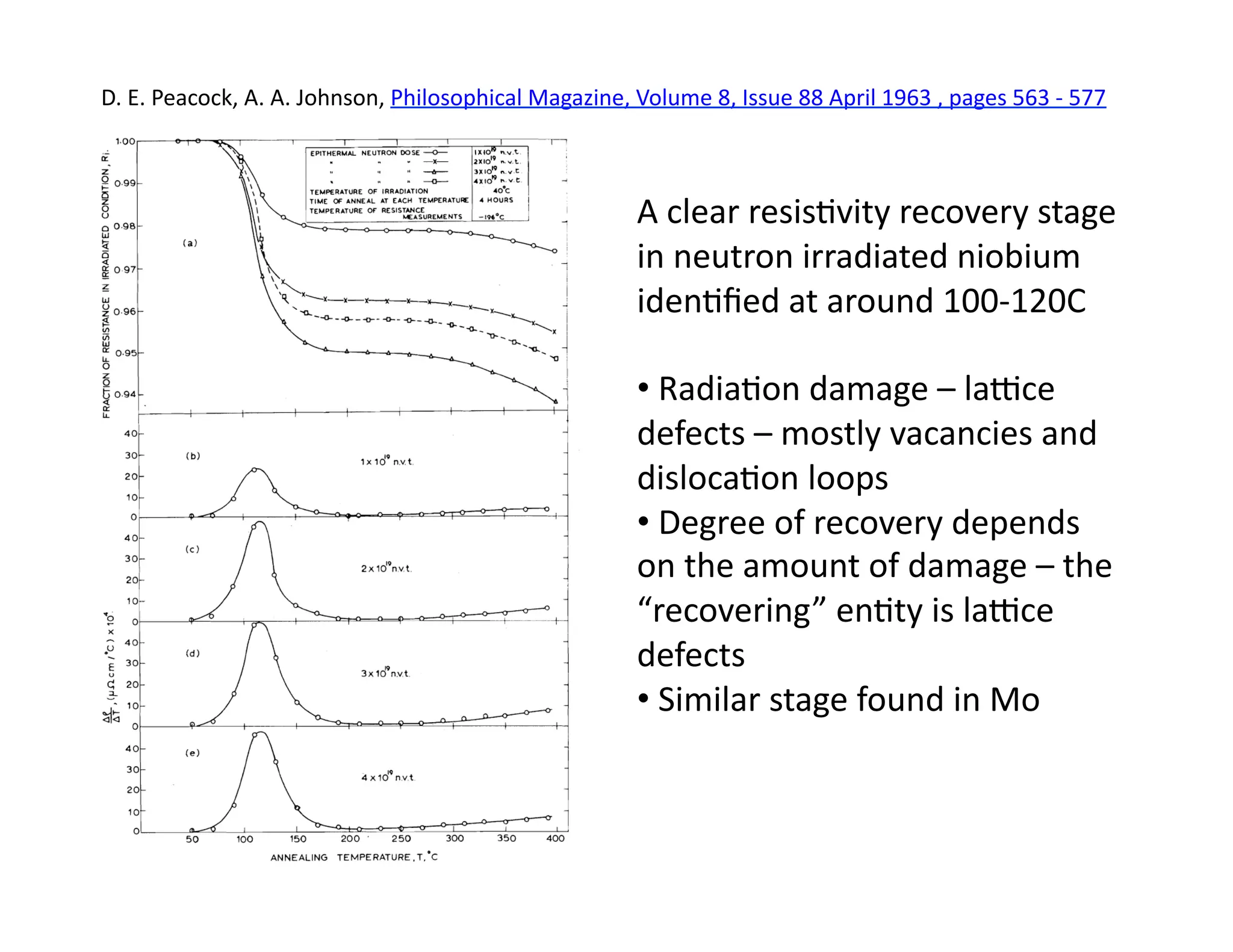
D.	
  E.	
  Peacock,	
  A.	
  A.	
  Johnson,	
  Philosophical	
  Magazine,	
  Volume	
  8,	
  Issue	
  88	
  April	
  1963	
  ,	
  pages	
  563	
  -­‐	
  577	


                                                                                       A	
  clear	
  resis%vity	
  recovery	
  stage	
  
                                                                                       in	
  neutron	
  irradiated	
  niobium	
  
                                                                                       iden%fied	
  at	
  around	
  100-­‐120C	
  

                                                                                       • 	
  Radia%on	
  damage	
  –	
  laJce	
  
                                                                                       defects	
  –	
  mostly	
  vacancies	
  and	
  
                                                                                       disloca%on	
  loops	
  
                                                                                       • 	
  Degree	
  of	
  recovery	
  depends	
  
                                                                                       on	
  the	
  amount	
  of	
  damage	
  –	
  the	
  
                                                                                       “recovering”	
  en%ty	
  is	
  laJce	
  
                                                                                       defects	
  
                                                                                       • 	
  Similar	
  stage	
  found	
  in	
  Mo	
  
L.	
  Stals	
  and	
  J.	
  Nihoul,	
  Phys.	
  Stat.	
  Sol.	
  8,	
  785,	
  1965	
  

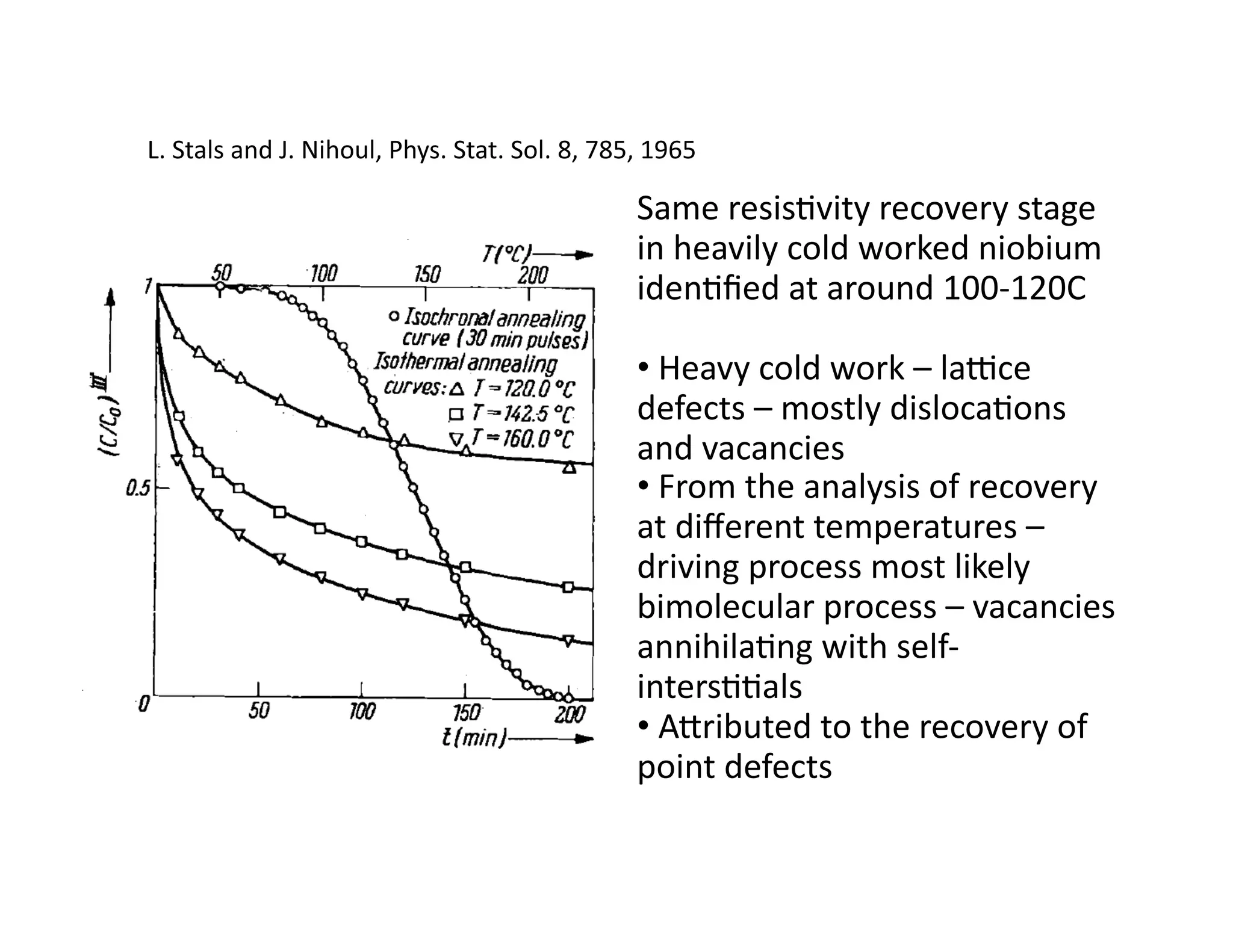
                                                                            Same	
  resis%vity	
  recovery	
  stage	
  
                                                                            in	
  heavily	
  cold	
  worked	
  niobium	
  
                                                                            iden%fied	
  at	
  around	
  100-­‐120C	
  

                                                                            • 	
  Heavy	
  cold	
  work	
  –	
  laJce	
  
                                                                            defects	
  –	
  mostly	
  disloca%ons	
  
                                                                            and	
  vacancies	
  
                                                                            • 	
  From	
  the	
  analysis	
  of	
  recovery	
  
                                                                            at	
  different	
  temperatures	
  –	
  
                                                                            driving	
  process	
  most	
  likely	
  
                                                                            bimolecular	
  process	
  –	
  vacancies	
  
                                                                            annihila%ng	
  with	
  self-­‐
                                                                            inters%%als	
  
                                                                            • 	
  Abributed	
  to	
  the	
  recovery	
  of	
  
                                                                            point	
  defects	
  
P.	
  Hautojarvi	
  et	
  al,	
  Phys.	
  Rev.	
  B,	
  
   Vol.	
  32,	
  Num.	
  7,	
  1985	


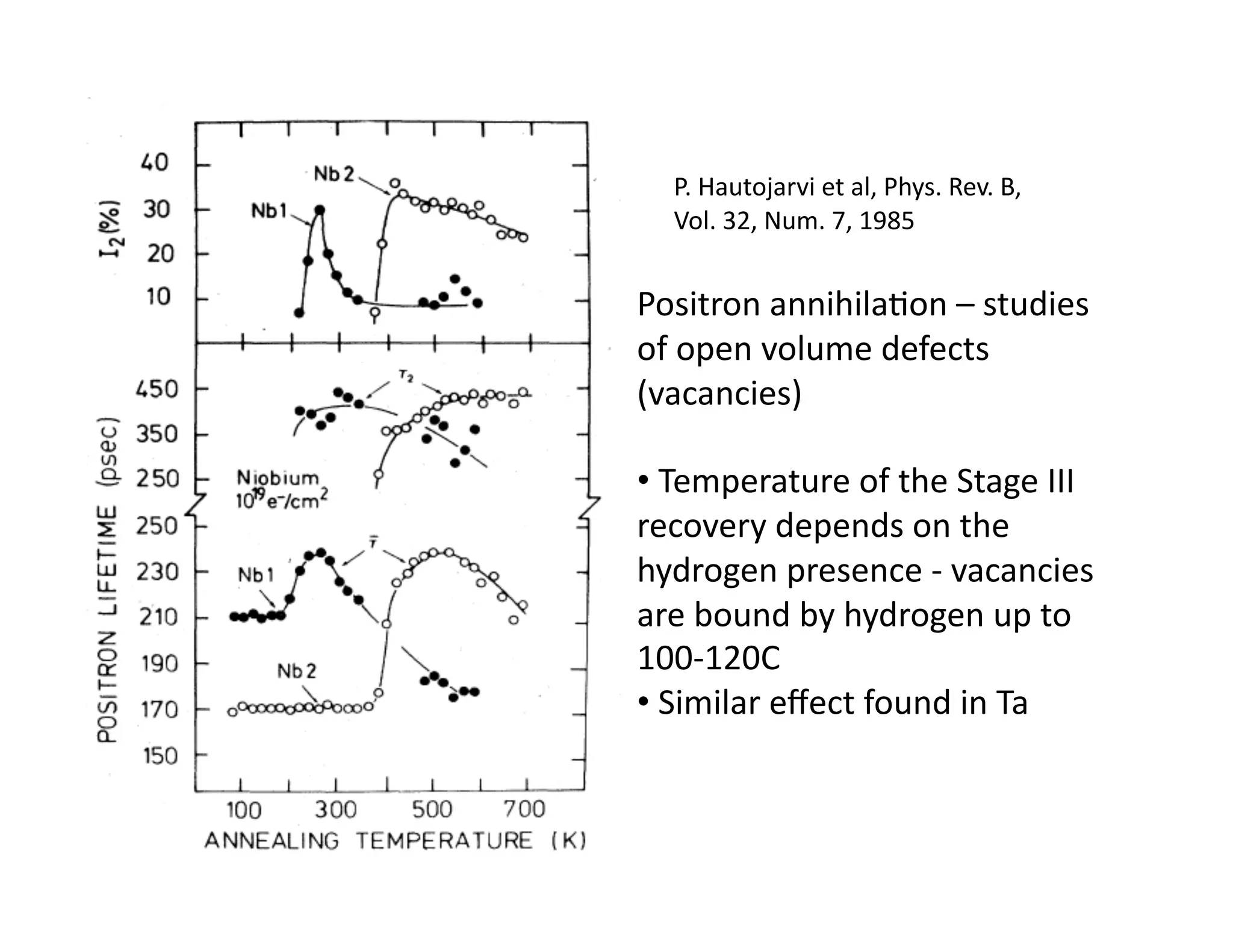
Positron	
  annihila%on	
  –	
  studies	
  
of	
  open	
  volume	
  defects	
  
(vacancies)	
  

• 	
  Temperature	
  of	
  the	
  Stage	
  III	
  
recovery	
  depends	
  on	
  the	
  
hydrogen	
  presence	
  -­‐	
  vacancies	
  
are	
  bound	
  by	
  hydrogen	
  up	
  to	
  
100-­‐120C	
  	
  
• 	
  Similar	
  effect	
  found	
  in	
  Ta	
  
Physica	
  Scripta.	
  Vol.	
  20,683-­‐684,	
  1979	
  
Annealing	
  of	
  Defects	
  in	
  Irradiated	
  Niobium	
  
0.	
  K.	
  Alekseeva	
  et	
  al.	


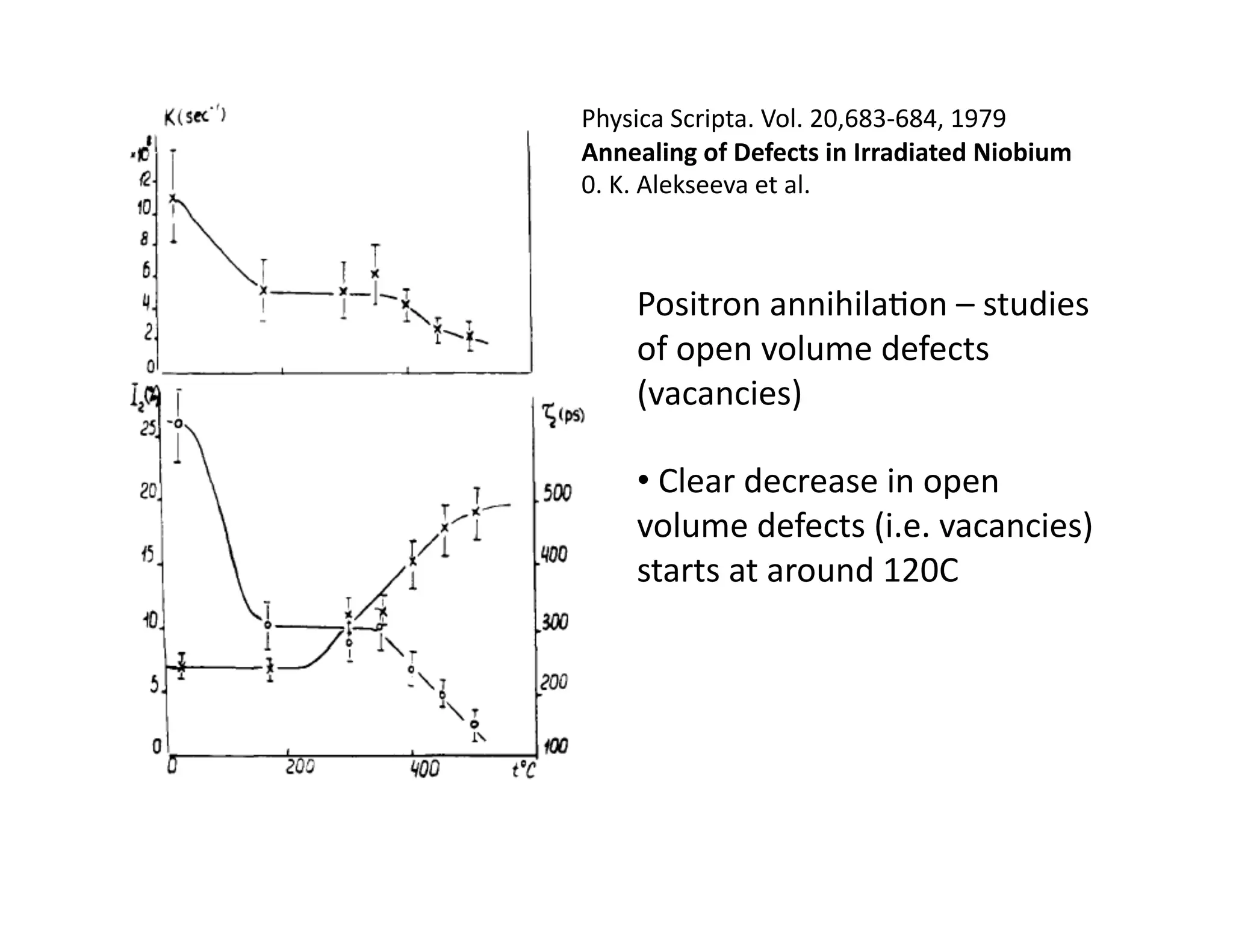
      Positron	
  annihila%on	
  –	
  studies	
  
      of	
  open	
  volume	
  defects	
  
      (vacancies)	
  

      • 	
  Clear	
  decrease	
  in	
  open	
  
      volume	
  defects	
  (i.e.	
  vacancies)	
  
      starts	
  at	
  around	
  120C	
  
Hydrogen-­‐induced	
  defects	
  
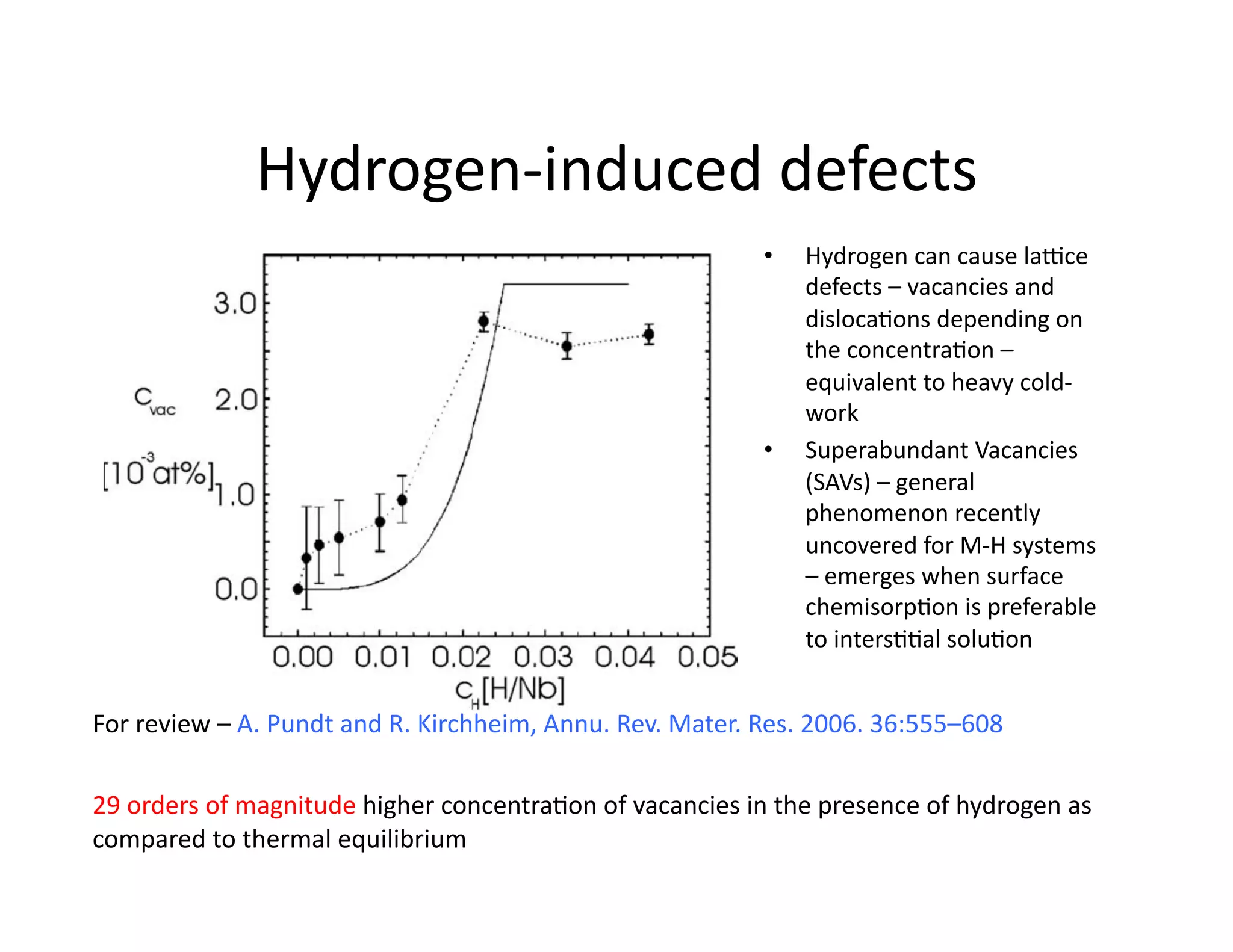
                                                                                         •    Hydrogen	
  can	
  cause	
  laJce	
  
                                                                                              defects	
  –	
  vacancies	
  and	
  
                                                                                              disloca%ons	
  depending	
  on	
  
                                                                                              the	
  concentra%on	
  –	
  
                                                                                              equivalent	
  to	
  heavy	
  cold-­‐
                                                                                              work	
  
                                                                                         •    Superabundant	
  Vacancies	
  
                                                                                              (SAVs)	
  –	
  general	
  
                                                                                              phenomenon	
  recently	
  
                                                                                              uncovered	
  for	
  M-­‐H	
  systems	
  
                                                                                              –	
  emerges	
  when	
  surface	
  
                                                                                              chemisorp%on	
  is	
  preferable	
  
                                                                                              to	
  inters%%al	
  solu%on	


For	
  review	
  –	
  A.	
  Pundt	
  and	
  R.	
  Kirchheim,	
  Annu.	
  Rev.	
  Mater.	
  Res.	
  2006.	
  36:555–608	
  

29	
  orders	
  of	
  magnitude	
  higher	
  concentra%on	
  of	
  vacancies	
  in	
  the	
  presence	
  of	
  hydrogen	
  as	
  
compared	
  to	
  thermal	
  equilibrium	
  
Inves%ga%on	
  of	
  near-­‐surface	
  hydrogen	
  
•  Mo%vated	
  by	
  the	
  possible	
  driving	
  mechanism	
  
   for	
  the	
  mild	
  baking	
  effect	
  –	
  Vac-­‐H	
  complexes	
  
   dissocia%on	
  occuring	
  around	
  100-­‐120C	
  
•  Leading	
  to	
  the	
  elimina%on	
  of	
  the	
  HFQS	
  by	
  
    –  LaJce	
  defect	
  density	
  reduc%on	
  in	
  the	
  near-­‐
       surface	
  layer?	
  [A	
  Romanenko	
  and	
  H	
  Padamsee	
  2010	
  Supercond.	
  Sci.	
  Technol.	
  
       23	
  045008]	
  

    –  Or	
  hydrogen	
  concentra%on	
  decrease?	
  -­‐	
  
       inves%gated	
  by	
  Elas%c	
  Recoil	
  Detec%on	
  (ERD)	
  
Elas%c	
  Recoil	
  Detec%on	
  
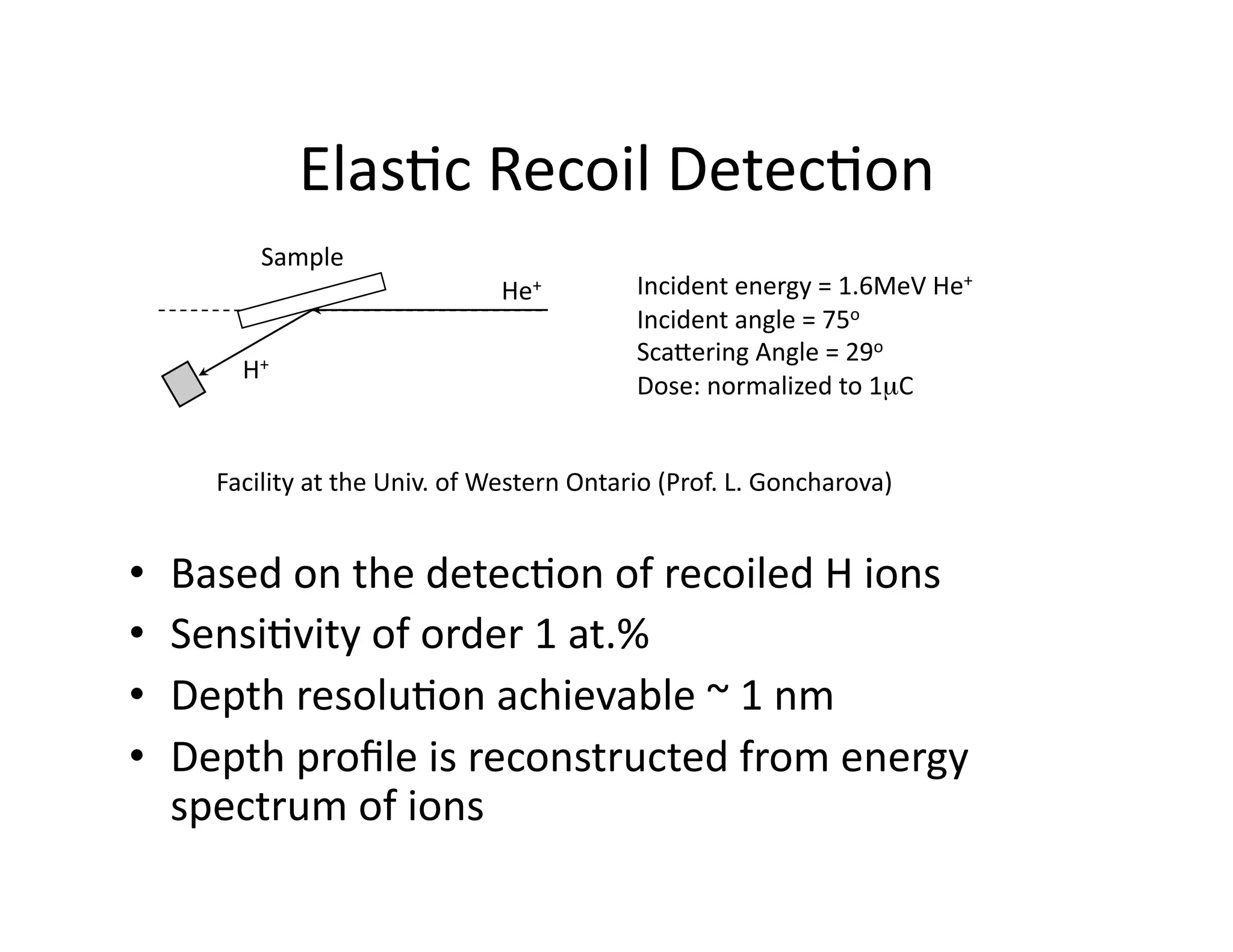
              Sample	
  
                                              He+	
              Incident	
  energy	
  =	
  1.6MeV	
  He+	
  
                                                                 Incident	
  angle	
  =	
  75o	
  
                                                                 Scabering	
  Angle	
  =	
  29o	
  
           H+	
  
                                                                 Dose:	
  normalized	
  to	
  1µC	


        Facility	
  at	
  the	
  Univ.	
  of	
  Western	
  Ontario	
  (Prof.	
  L.	
  Goncharova)	


•    Based	
  on	
  the	
  detec%on	
  of	
  recoiled	
  H	
  ions	
  
•    Sensi%vity	
  of	
  order	
  1	
  at.%	
  
•    Depth	
  resolu%on	
  achievable	
  ~	
  1	
  nm	
  
•    Depth	
  profile	
  is	
  reconstructed	
  from	
  energy	
  
     spectrum	
  of	
  ions	
  
Hydrogen Concentration profiles obtained from energy spectra
                           simulations


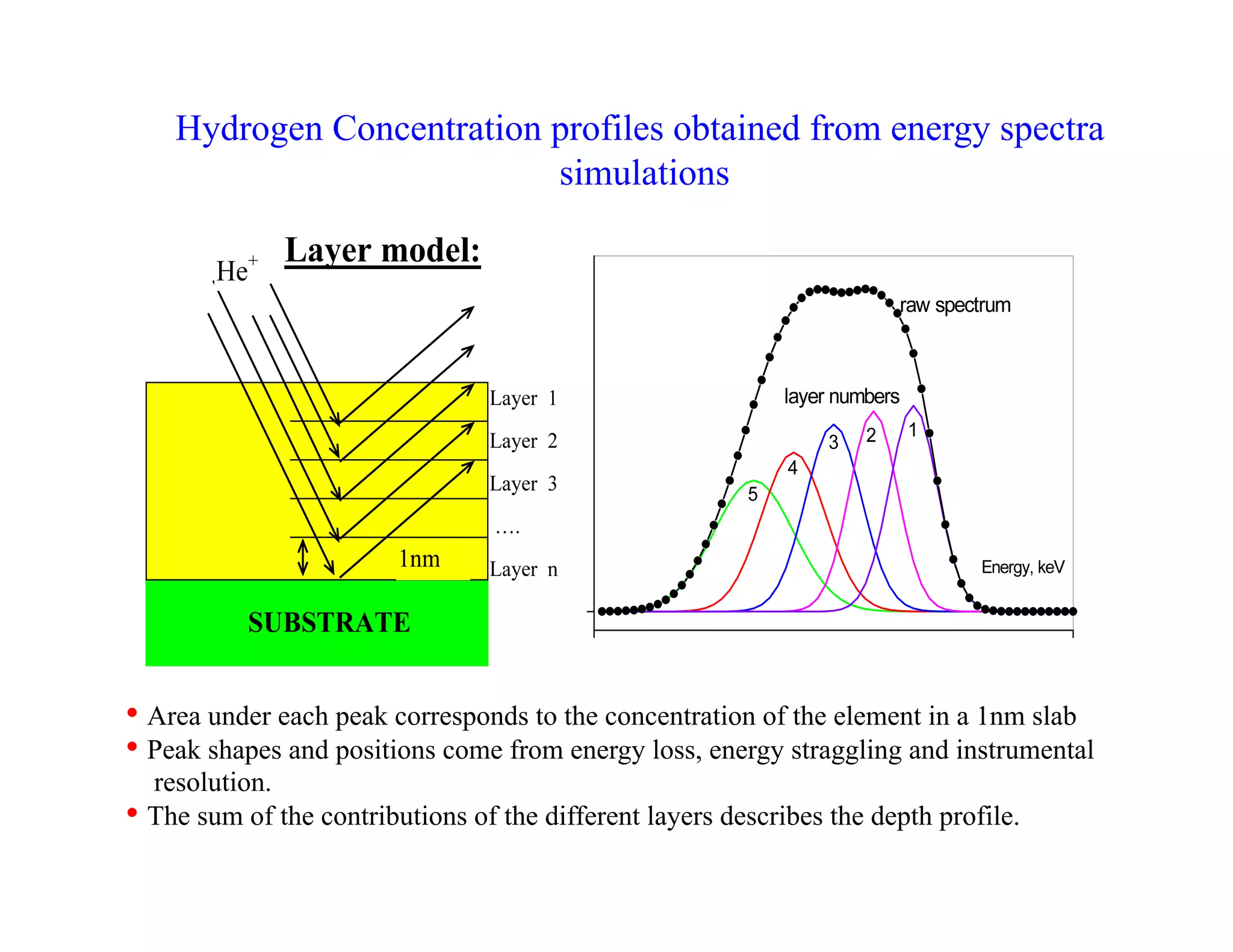
•  Area under each peak corresponds to the concentration of the element in a 1nm slab
•  Peak shapes and positions come from energy loss, energy straggling and instrumental
   resolution.
•  The sum of the contributions of the different layers describes the depth profile.
Samples	
  inves%gated	
  with	
  ERD	
  
Sample	
                        Origin	
                                  Treatment	
  
HA-­‐1	
                        Single	
  grain	
  Nb	
  	
               BCP	
  150	
  um	
  
HA-­‐2	
                        Single	
  grain	
  Nb	
                   BCP	
  150	
  um	
  +	
  800C	
  4	
  hrs	
  
HA-­‐3	
                        Single	
  grain	
  Nb	
                   BCP	
  150	
  um	
  +	
  800C	
  4	
  hrs	
  +	
  
                                                                          110C	
  74	
  hrs	
  
HA-­‐4	
                        Single	
  grain	
  Nb	
                   BCP	
  150	
  um	
  +	
  800C	
  4	
  hrs	
  +	
  
                                                                          110C	
  74	
  hrs	
  +	
  HF	
  rinse	
  10	
  
                                                                          min	
  
HA-­‐5	
                        Single	
  grain	
  Nb	
                   BCP	
  150	
  um	
  +	
  600C	
  10	
  hrs	
  
HA-­‐6	
                        Single	
  grain	
  Nb	
                   BCP	
  150	
  um	
  +	
  600C	
  10	
  hrs	
  
                                                                          +	
  110C	
  54	
  hrs	
  
LE1-­‐37	
  hot	
  spot	
       Large	
  grain	
  Nb	
  cavity	
          BCP	
  200	
  um	
  
                                cutout	
  
TE1AES004	
  cold	
  spot	
     Fine	
  grain	
  Nb	
  EP	
  cavity	
     EP	
  100	
  um	
  +	
  120C	
  48	
  hrs	
  
                                cutout	
  	
  
Experimental	
  data	
  (Overview)	


Incident	
  energy	
  =	
  1.6MeV	
  He+	
  
Incident	
  angle	
  =	
  75o	
                         He+	
  
Scabering	
  Angle	
  =	
  29o	
  
Dose:	
  normalized	
  to	
  1µC	
             H+	
  
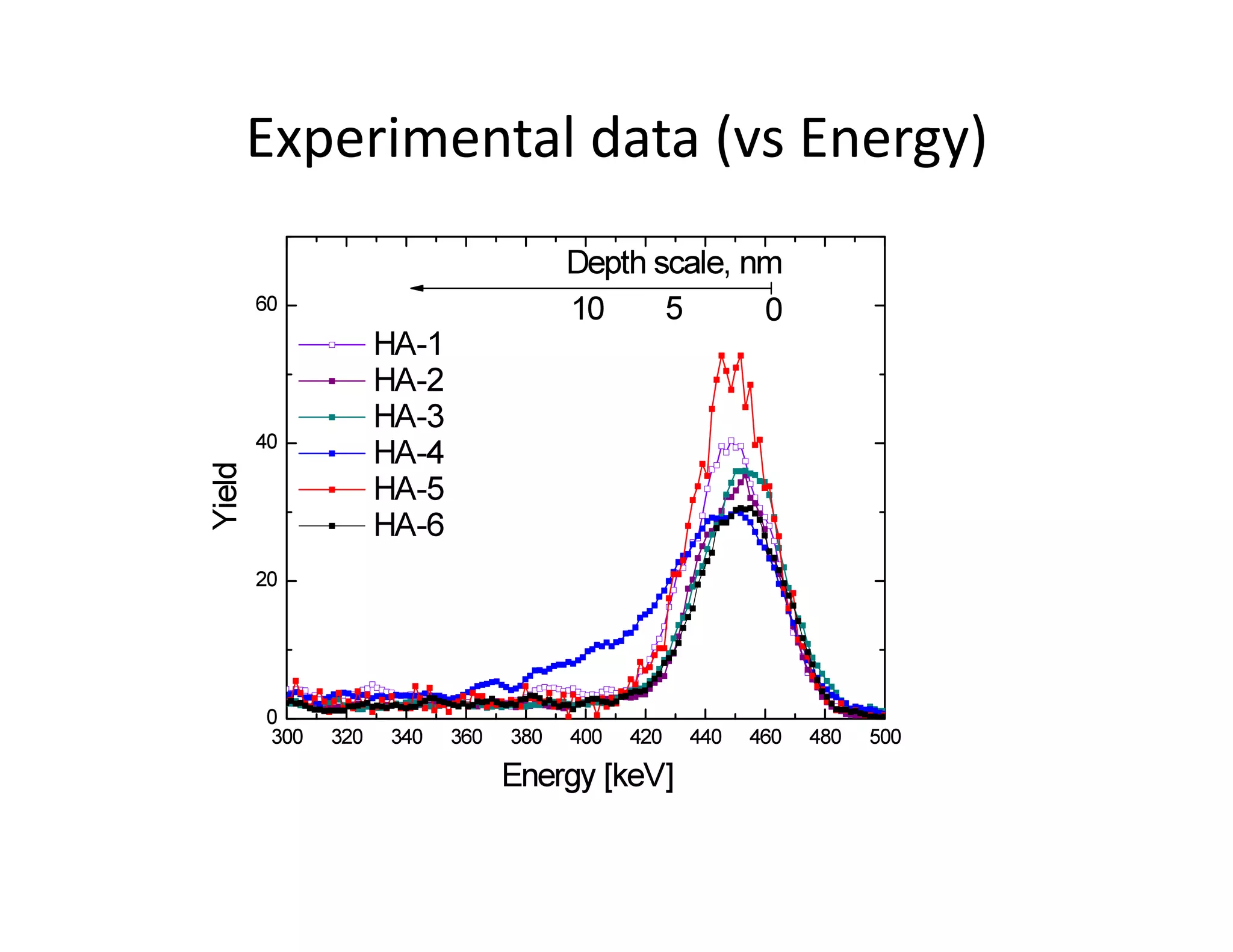
Experimental	
  data	
  (vs	
  Energy)	
  
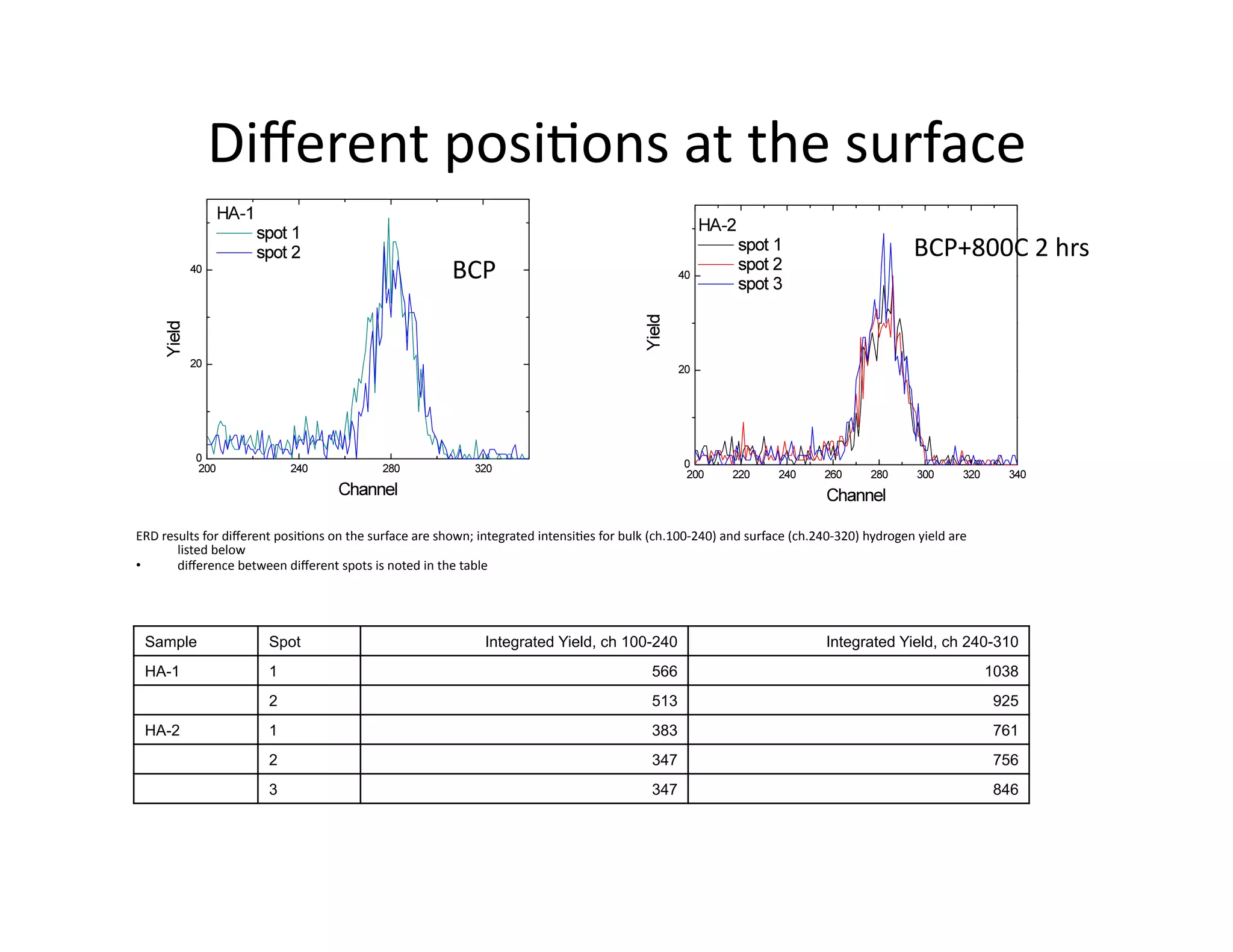
Different	
  posi%ons	
  at	
  the	
  surface	
  
                                                                                                                                                                                                        BCP+800C	
  2	
  hrs	
  
                                                                                 BCP	


ERD	
  results	
  for	
  different	
  posi%ons	
  on	
  the	
  surface	
  are	
  shown;	
  integrated	
  intensi%es	
  for	
  bulk	
  (ch.100-­‐240)	
  and	
  surface	
  (ch.240-­‐320)	
  hydrogen	
  yield	
  are	
  
          listed	
  below	
  
•         difference	
  between	
  different	
  spots	
  is	
  noted	
  in	
  the	
  table	


  Sample                          Spot                                                   Integrated Yield, ch 100-240                                                            Integrated Yield, ch 240-310
  HA-1                            1                                                                                                  566                                                                                  1038
                                  2                                                                                                  513                                                                                   925
  HA-2                            1                                                                                                  383                                                                                   761
                                  2                                                                                                  347                                                                                   756
                                  3                                                                                                  347                                                                                   846
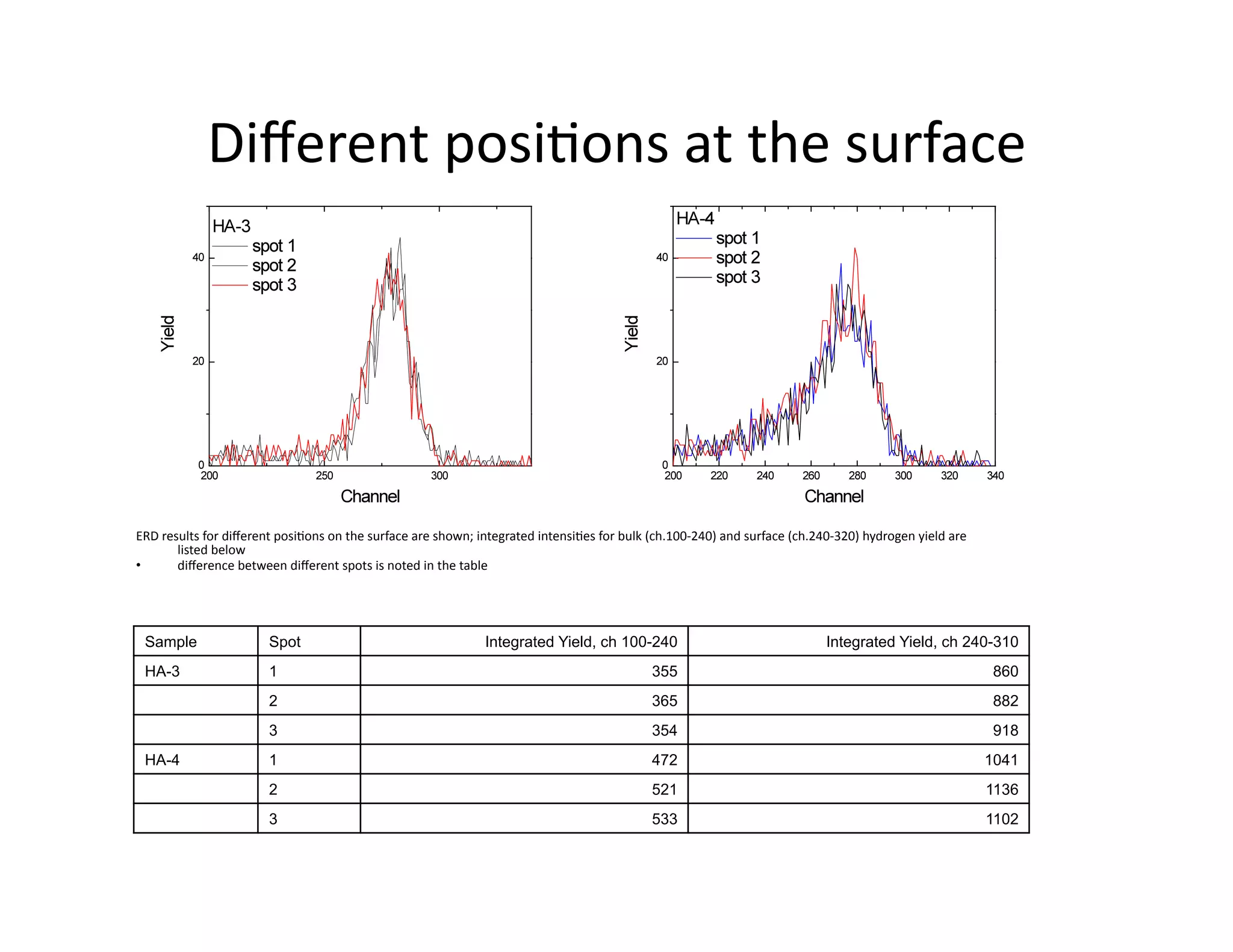
Different	
  posi%ons	
  at	
  the	
  surface	


ERD	
  results	
  for	
  different	
  posi%ons	
  on	
  the	
  surface	
  are	
  shown;	
  integrated	
  intensi%es	
  for	
  bulk	
  (ch.100-­‐240)	
  and	
  surface	
  (ch.240-­‐320)	
  hydrogen	
  yield	
  are	
  
          listed	
  below	
  
•         difference	
  between	
  different	
  spots	
  is	
  noted	
  in	
  the	
  table	


  Sample                          Spot                                                   Integrated Yield, ch 100-240                                                            Integrated Yield, ch 240-310
  HA-3                            1                                                                                                  355                                                                                   860
                                  2                                                                                                  365                                                                                   882
                                  3                                                                                                  354                                                                                   918
  HA-4                            1                                                                                                  472                                                                                  1041
                                  2                                                                                                  521                                                                                  1136
                                  3                                                                                                  533                                                                                  1102
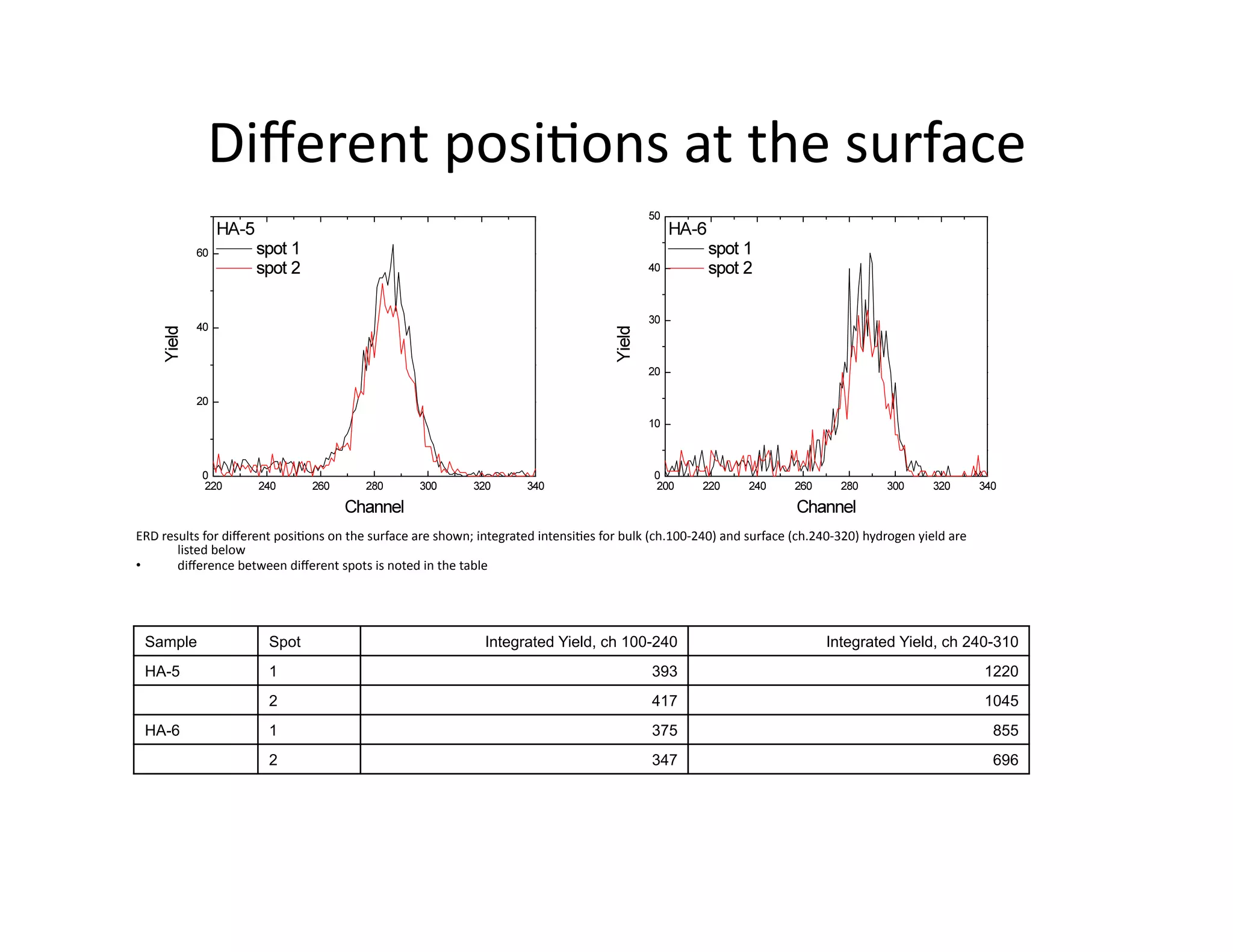
Different	
  posi%ons	
  at	
  the	
  surface	


ERD	
  results	
  for	
  different	
  posi%ons	
  on	
  the	
  surface	
  are	
  shown;	
  integrated	
  intensi%es	
  for	
  bulk	
  (ch.100-­‐240)	
  and	
  surface	
  (ch.240-­‐320)	
  hydrogen	
  yield	
  are	
  
          listed	
  below	
  
•         difference	
  between	
  different	
  spots	
  is	
  noted	
  in	
  the	
  table	


  Sample                          Spot                                                   Integrated Yield, ch 100-240                                                            Integrated Yield, ch 240-310
  HA-5                            1                                                                                                  393                                                                                  1220
                                  2                                                                                                  417                                                                                  1045
  HA-6                            1                                                                                                  375                                                                                   855
                                  2                                                                                                  347                                                                                   696
HA-­‐X	
  ERD	
  Summary	
  

Sample	
   Treatment                                                                       Surface	
  Content       Bulk	
  Content
#
HA-­‐1       BCP                                                                           53Å	
  Nb0.79H0.21       Nb0.994H0.008

HA-­‐2	
     BCP	
  +	
  800C	
  4hrs                                                      48Å	
  Nb0.80H0.20       Nb0.994H0.006

HA-­‐3	
     BCP	
  +	
  800C	
  4	
  hrs	
  +	
  110C	
  54	
  hrs                        53Å	
  Nb0.80H0.20       Nb0.994H0.006

HA-­‐4       BCP	
  +	
  800C	
  4	
  hrs	
  +	
  110C	
  54	
  hrs	
  +	
  HF	
  10	
     110ÅNb0.91H0.09/	
       Nb0.992H0.008
             min                                                                           170Å	
  Nb0.96H0.04
HA-­‐5	
     BCP	
  +	
  600C	
  10	
  hrs                                                 62Å	
  	
  Nb0.77H0.23   Nb0.994H0.006

HA-­‐6       BCP	
  +	
  600C	
  10	
  hrs	
  +	
  110C	
  72	
  hrs                       65Å	
  	
  Nb0.85H0.15   Nb0.994H0.006
Data	
  on	
  cutout	
  samples	
  
•  Used	
  samples,	
  which	
  were	
  cut	
  out	
  of	
  real	
  RF	
  
   cavi%es	
  characterized	
  with	
  thermometry	
  
   during	
  the	
  tests	
  	
  
•  One	
  sample	
  from	
  the	
  “hotspot”	
  in	
  Cornell	
  high	
  
   field	
  Q-­‐slope	
  limited	
  large	
  grain	
  BCP	
  cavity	
  
•  One	
  sample	
  from	
  FNAL	
  baked	
  fine	
  grain	
  EP	
  
   cavity	
  –	
  no	
  high	
  field	
  Q-­‐slope,	
  cavity	
  limited	
  by	
  
   local	
  quench	
  at	
  around	
  150	
  mT	
  at	
  the	
  other	
  
   loca%on	
  	
  
Cutouts	
  Data	


Incident	
  energy	
  =	
  1.6MeV	
  He+	
  
Incident	
  angle	
  =	
  75o	
                               He+	
  
Scabering	
  Angle	
  =	
  29o	
  
Dose	
  =	
  4µC	
                                   H+	
  
Large	
  grain	
  BCP	
  hot	
  spot	
                             Fine	
  grain	
  EP	
  baked	
  cutout	


Sample                  Spot                   Integrated Yield, ch 100-240                   Integrated Yield, ch 240-310
Large grain
BCP cutout                 1                                           464                                           1666
                           2                                           528                                           1877
                           3                                           511                                           2075
                           4                                           506                                           2082
     EP baked
        cutout             1                                           579                                           1829
                           2                                           596                                           2292
                           3                                           558                                           2279
                           4                                           636                                           2121
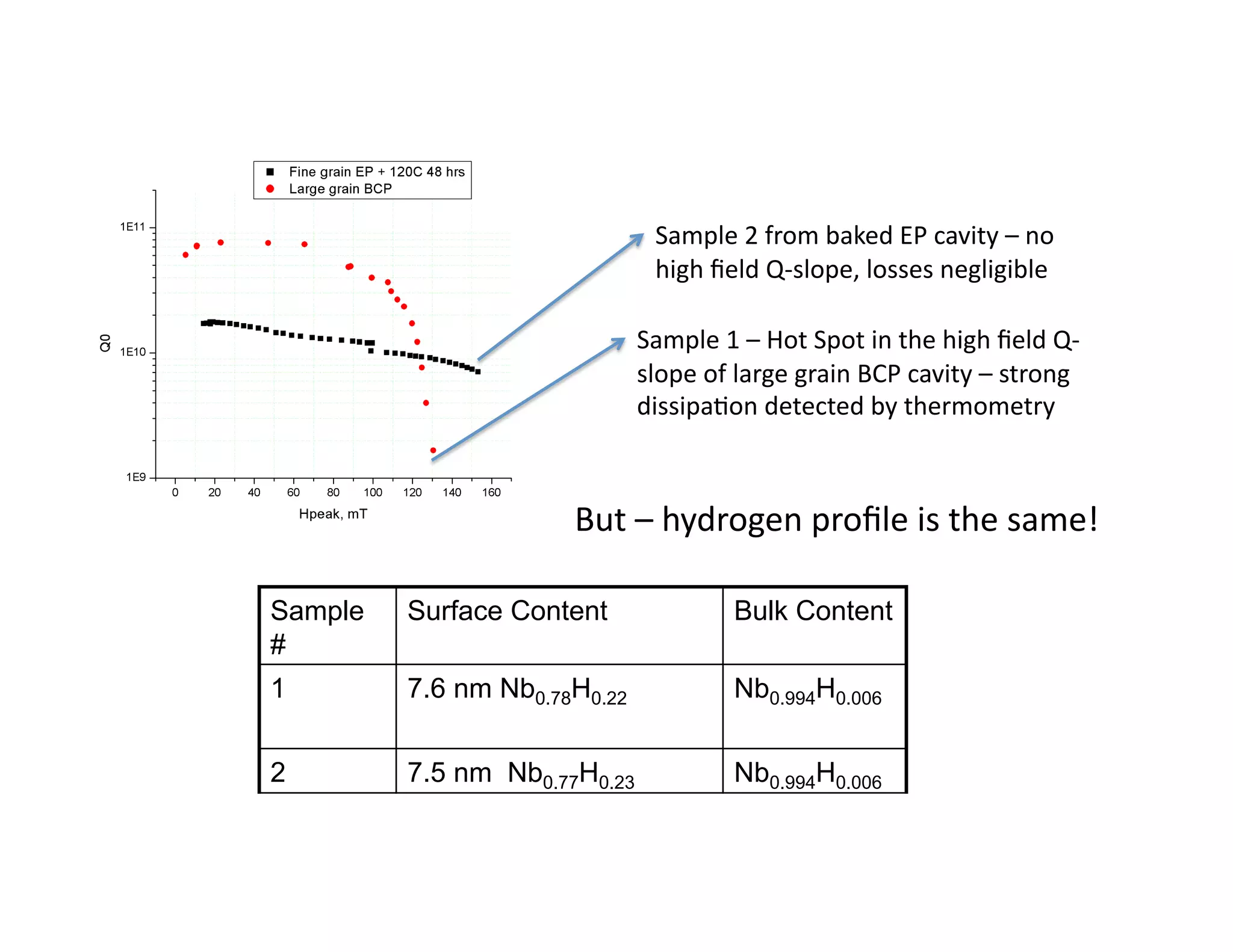
Sample	
  2	
  from	
  baked	
  EP	
  cavity	
  –	
  no	
  
                                high	
  field	
  Q-­‐slope,	
  losses	
  negligible	
  

                              Sample	
  1	
  –	
  Hot	
  Spot	
  in	
  the	
  high	
  field	
  Q-­‐
                              slope	
  of	
  large	
  grain	
  BCP	
  cavity	
  –	
  strong	
  
                              dissipa%on	
  detected	
  by	
  thermometry	


                      But	
  –	
  hydrogen	
  profile	
  is	
  the	
  same!	
  

Sample   Surface Content                    Bulk Content
#
1        7.6 nm Nb0.78H0.22                 Nb0.994H0.006


2        7.5 nm Nb0.77H0.23                 Nb0.994H0.006
Positron	
  Annihila%on	
  	
  
Doppler	
  Broadening	
  Spectroscopy	
  
                         • 	
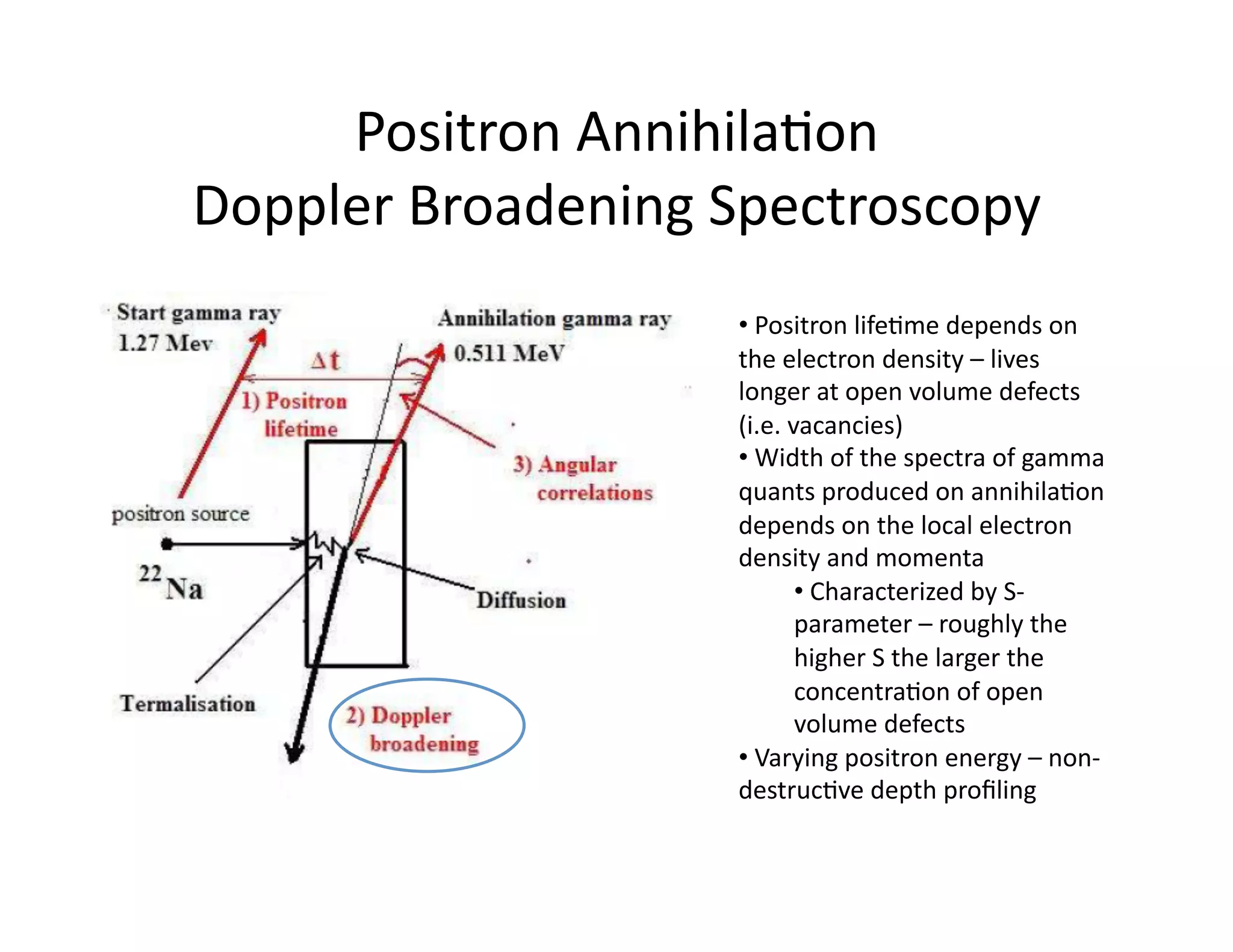
  Positron	
  life%me	
  depends	
  on	
  
                         the	
  electron	
  density	
  –	
  lives	
  
                         longer	
  at	
  open	
  volume	
  defects	
  
                         (i.e.	
  vacancies)	
  
                         • 	
  Width	
  of	
  the	
  spectra	
  of	
  gamma	
  
                         quants	
  produced	
  on	
  annihila%on	
  
                         depends	
  on	
  the	
  local	
  electron	
  
                         density	
  and	
  momenta	
  
                                   • 	
  Characterized	
  by	
  S-­‐
                                   parameter	
  –	
  roughly	
  the	
  
                                   higher	
  S	
  the	
  larger	
  the	
  
                                   concentra%on	
  of	
  open	
  
                                   volume	
  defects	
  	
  
                         • 	
  Varying	
  positron	
  energy	
  –	
  non-­‐
                         destruc%ve	
  depth	
  profiling	
  
Doppler	
  broadening	
  spectroscopy	
  –	
  
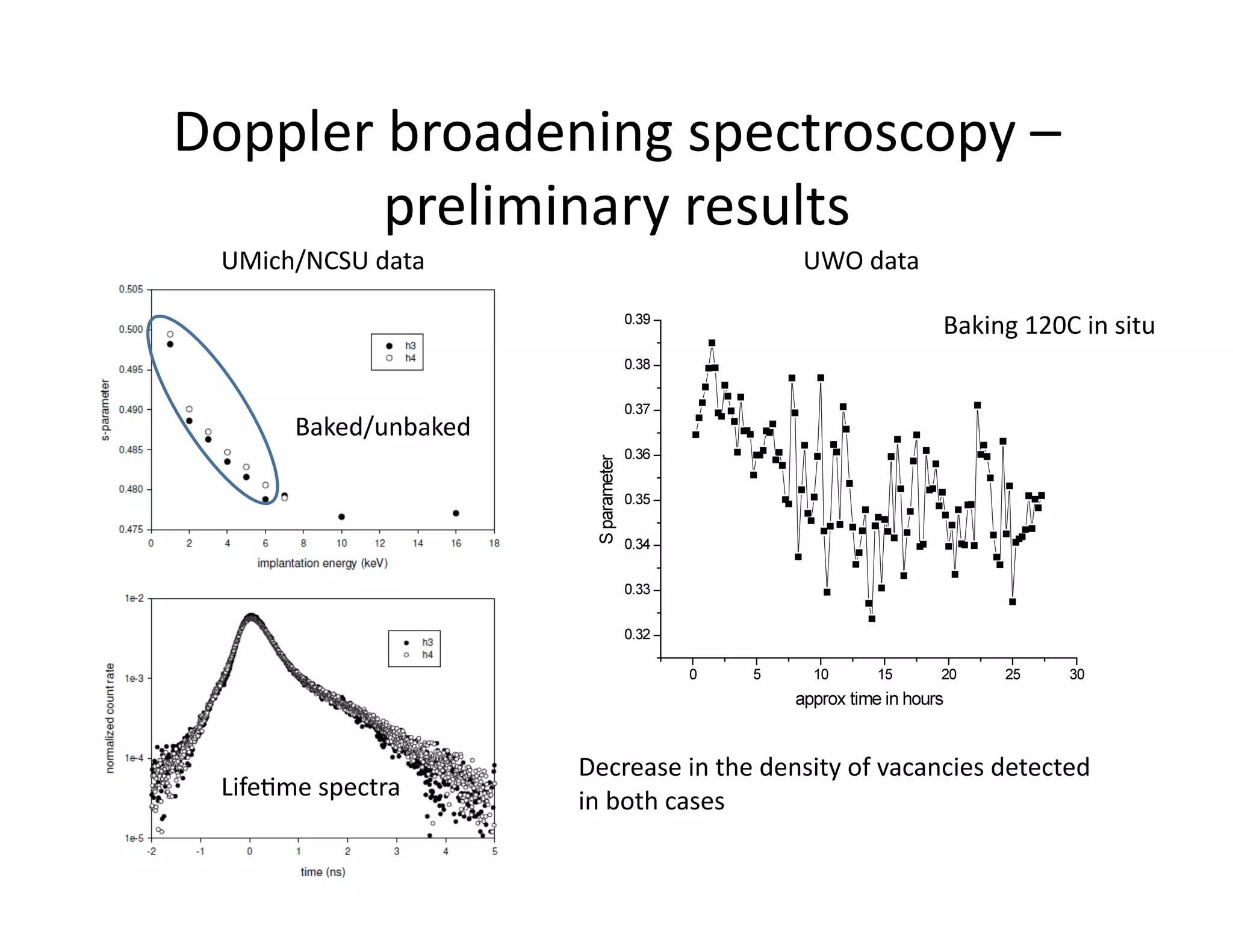
          preliminary	
  results	
  
  UMich/NCSU	
  data	
                                     UWO	
  data	
  

                                                                             Baking	
  120C	
  in	
  situ	


          Baked/unbaked	


                              Decrease	
  in	
  the	
  density	
  of	
  vacancies	
  detected	
  
  Life%me	
  spectra	
  
                              in	
  both	
  cases	
  
Conclusions	
  
•  Hydrogen	
  seems	
  to	
  be	
  uncorrelated	
  with	
  the	
  
   mild	
  baking	
  improvement	
  in	
  the	
  HFQS	
  
    –  Same	
  H	
  content	
  with/without	
  HFQS	
  
•  HF	
  rinsing	
  results	
  in	
  the	
  smearing	
  of	
  H-­‐profile	
  
•  Preliminary	
  positron	
  annihila%on	
  data	
  –	
  
   decrease	
  in	
  near-­‐surface	
  laJce	
  defects	
  during	
  
   mild	
  baking	
  
•  Same	
  samples	
  from	
  ERD	
  are	
  going	
  to	
  be	
  used	
  
   for	
  further	
  positron	
  annihila%on	
  studies	
  

Romanenko - Elastic Recoil Detection and Positron Annihilation Studies of the Mild Baking Effect

  • 1.
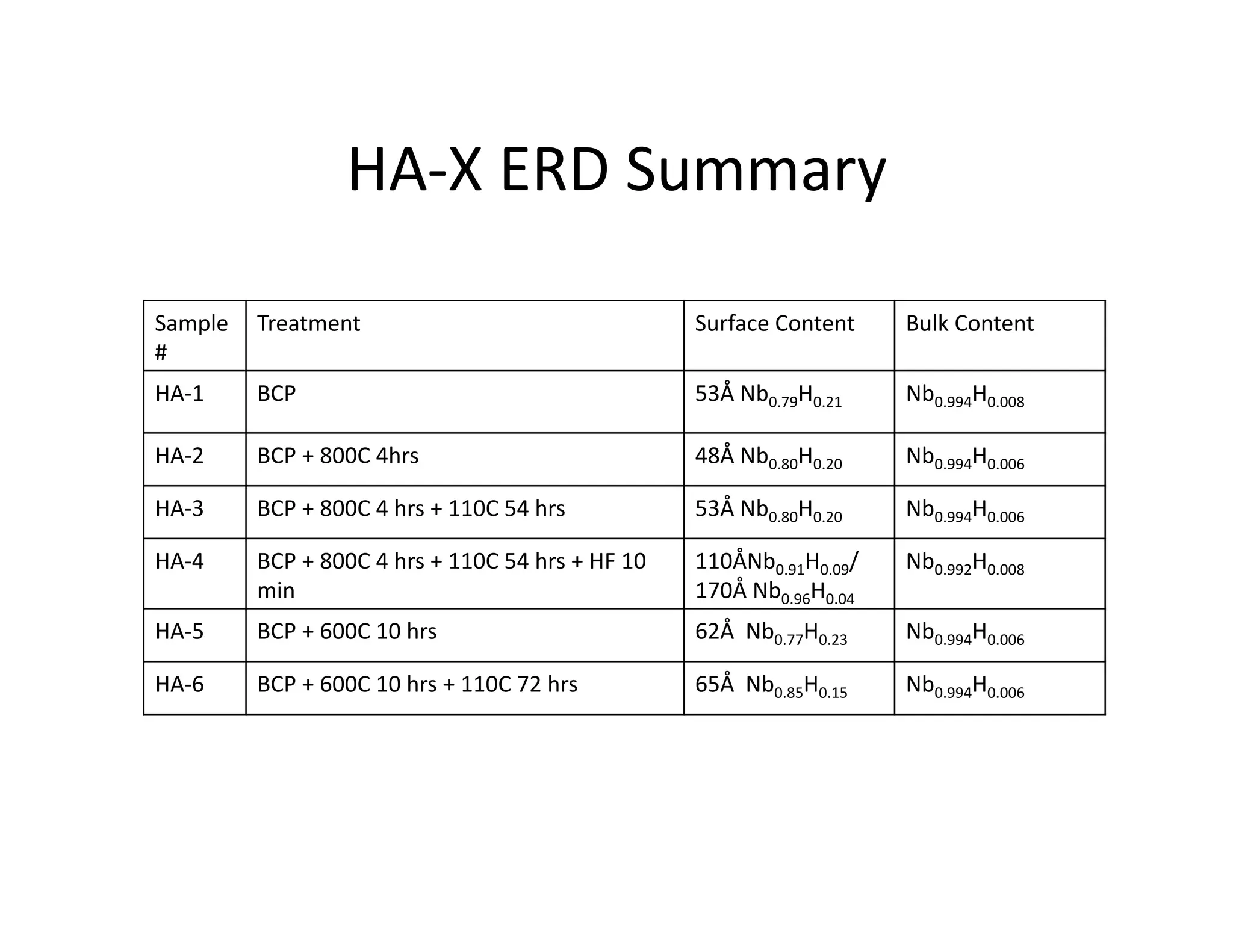
    Elas%c  Recoil  Detec%on  and  Positron   Annihila%on  Studies  of  the  Mild   Baking  Effect   A.  Romanenko     Fermilab   L.  Goncharova,  P.  Simpson     Univ.  of  Western  Ontario   D.  Gidley     UMich  
  • 2.
    Different  mild  baking  mechanisms   •  Models  previously  considered     –  Inters%%al  oxygen-­‐based  models   –  Natural  oxide  modifica%on   •  Inters%%al  hydrogen  in  the  near-­‐surface  region     •  LaJce  defects   –  Local  misorienta%on  (disloca%on  density)   reduc%on  with  baking  revealed  by  EBSD  studies  
  • 3.
    Historical  Prospec%ve   • “Stage  III  controversy”   •  Origin  -­‐  observa%ons  of  resis%vity  recovery  (strong   change)  in  different  group  V  metals  (tungsten,   molybdenum,  niobium)  aSer  either  deforma%on  or   irradia%on  in  1960-­‐70s   •  Controversy  essence  -­‐  is  it  inters%%al  impuri%es  or   laJce  defects,  which  are  changing  in  Stage  III   •  Stage  III  happens  in  niobium  around  -­‐50C  without  any   hydrogen  and  at  around  120C  with  hydrogen  presence     •  Near-­‐surface  niobium  is  exactly  that  -­‐  niobium  with   some  hydrogen  
  • 4.
    D.  E.  Peacock,  A.  A.  Johnson,  Philosophical  Magazine,  Volume  8,  Issue  88  April  1963  ,  pages  563  -­‐  577     A  clear  resis%vity  recovery  stage   in  neutron  irradiated  niobium   iden%fied  at  around  100-­‐120C   •   Radia%on  damage  –  laJce   defects  –  mostly  vacancies  and   disloca%on  loops   •   Degree  of  recovery  depends   on  the  amount  of  damage  –  the   “recovering”  en%ty  is  laJce   defects   •   Similar  stage  found  in  Mo  
  • 5.
    L.  Stals  and  J.  Nihoul,  Phys.  Stat.  Sol.  8,  785,  1965   Same  resis%vity  recovery  stage   in  heavily  cold  worked  niobium   iden%fied  at  around  100-­‐120C   •   Heavy  cold  work  –  laJce   defects  –  mostly  disloca%ons   and  vacancies   •   From  the  analysis  of  recovery   at  different  temperatures  –   driving  process  most  likely   bimolecular  process  –  vacancies   annihila%ng  with  self-­‐ inters%%als   •   Abributed  to  the  recovery  of   point  defects  
  • 6.
    P.  Hautojarvi  et  al,  Phys.  Rev.  B,   Vol.  32,  Num.  7,  1985   Positron  annihila%on  –  studies   of  open  volume  defects   (vacancies)   •   Temperature  of  the  Stage  III   recovery  depends  on  the   hydrogen  presence  -­‐  vacancies   are  bound  by  hydrogen  up  to   100-­‐120C     •   Similar  effect  found  in  Ta  
  • 7.
    Physica  Scripta.  Vol.  20,683-­‐684,  1979   Annealing  of  Defects  in  Irradiated  Niobium   0.  K.  Alekseeva  et  al.   Positron  annihila%on  –  studies   of  open  volume  defects   (vacancies)   •   Clear  decrease  in  open   volume  defects  (i.e.  vacancies)   starts  at  around  120C  
  • 8.
    Hydrogen-­‐induced  defects   •  Hydrogen  can  cause  laJce   defects  –  vacancies  and   disloca%ons  depending  on   the  concentra%on  –   equivalent  to  heavy  cold-­‐ work   •  Superabundant  Vacancies   (SAVs)  –  general   phenomenon  recently   uncovered  for  M-­‐H  systems   –  emerges  when  surface   chemisorp%on  is  preferable   to  inters%%al  solu%on   For  review  –  A.  Pundt  and  R.  Kirchheim,  Annu.  Rev.  Mater.  Res.  2006.  36:555–608   29  orders  of  magnitude  higher  concentra%on  of  vacancies  in  the  presence  of  hydrogen  as   compared  to  thermal  equilibrium  
  • 9.
    Inves%ga%on  of  near-­‐surface  hydrogen   •  Mo%vated  by  the  possible  driving  mechanism   for  the  mild  baking  effect  –  Vac-­‐H  complexes   dissocia%on  occuring  around  100-­‐120C   •  Leading  to  the  elimina%on  of  the  HFQS  by   –  LaJce  defect  density  reduc%on  in  the  near-­‐ surface  layer?  [A  Romanenko  and  H  Padamsee  2010  Supercond.  Sci.  Technol.   23  045008]   –  Or  hydrogen  concentra%on  decrease?  -­‐   inves%gated  by  Elas%c  Recoil  Detec%on  (ERD)  
  • 10.
    Elas%c  Recoil  Detec%on   Sample   He+   Incident  energy  =  1.6MeV  He+   Incident  angle  =  75o   Scabering  Angle  =  29o   H+   Dose:  normalized  to  1µC   Facility  at  the  Univ.  of  Western  Ontario  (Prof.  L.  Goncharova)   •  Based  on  the  detec%on  of  recoiled  H  ions   •  Sensi%vity  of  order  1  at.%   •  Depth  resolu%on  achievable  ~  1  nm   •  Depth  profile  is  reconstructed  from  energy   spectrum  of  ions  
  • 11.
    Hydrogen Concentration profilesobtained from energy spectra simulations •  Area under each peak corresponds to the concentration of the element in a 1nm slab •  Peak shapes and positions come from energy loss, energy straggling and instrumental resolution. •  The sum of the contributions of the different layers describes the depth profile.
  • 12.
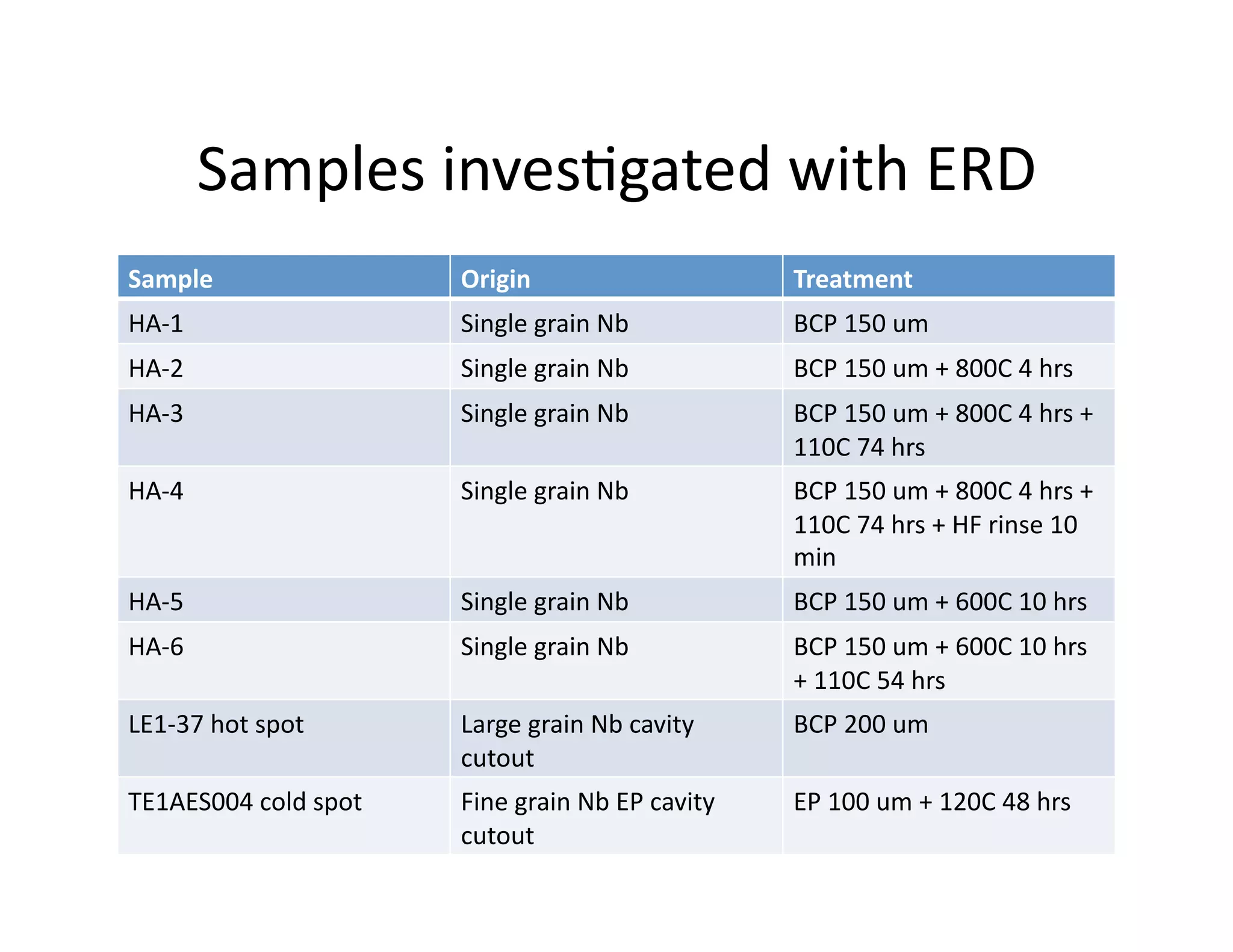
    Samples  inves%gated  with  ERD   Sample   Origin   Treatment   HA-­‐1   Single  grain  Nb     BCP  150  um   HA-­‐2   Single  grain  Nb   BCP  150  um  +  800C  4  hrs   HA-­‐3   Single  grain  Nb   BCP  150  um  +  800C  4  hrs  +   110C  74  hrs   HA-­‐4   Single  grain  Nb   BCP  150  um  +  800C  4  hrs  +   110C  74  hrs  +  HF  rinse  10   min   HA-­‐5   Single  grain  Nb   BCP  150  um  +  600C  10  hrs   HA-­‐6   Single  grain  Nb   BCP  150  um  +  600C  10  hrs   +  110C  54  hrs   LE1-­‐37  hot  spot   Large  grain  Nb  cavity   BCP  200  um   cutout   TE1AES004  cold  spot   Fine  grain  Nb  EP  cavity   EP  100  um  +  120C  48  hrs   cutout    
  • 13.
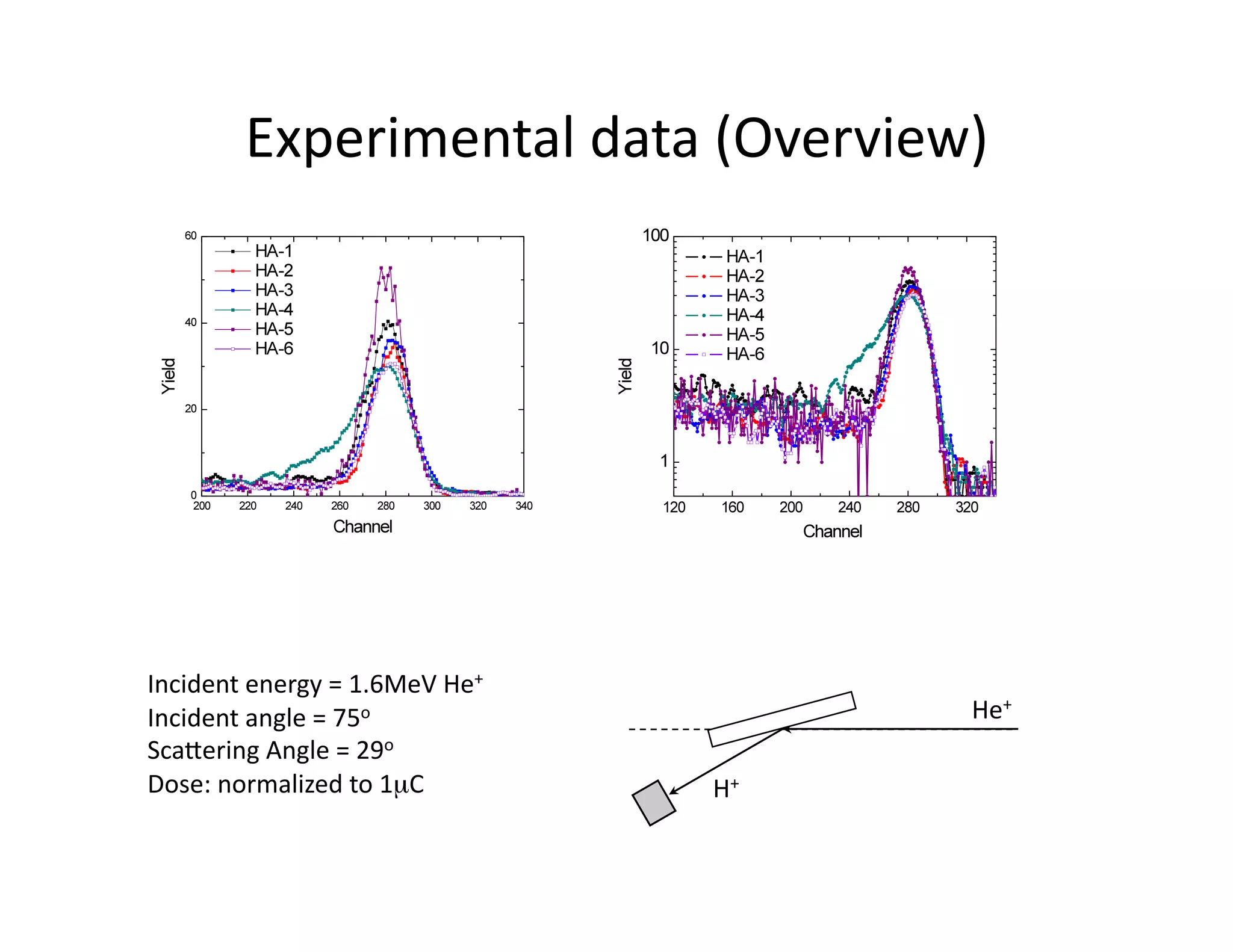
    Experimental  data  (Overview)   Incident  energy  =  1.6MeV  He+   Incident  angle  =  75o   He+   Scabering  Angle  =  29o   Dose:  normalized  to  1µC   H+  
  • 14.
  • 15.
    Different  posi%ons  at  the  surface   BCP+800C  2  hrs   BCP   ERD  results  for  different  posi%ons  on  the  surface  are  shown;  integrated  intensi%es  for  bulk  (ch.100-­‐240)  and  surface  (ch.240-­‐320)  hydrogen  yield  are   listed  below   •  difference  between  different  spots  is  noted  in  the  table   Sample Spot Integrated Yield, ch 100-240 Integrated Yield, ch 240-310 HA-1 1 566 1038 2 513 925 HA-2 1 383 761 2 347 756 3 347 846
  • 16.
    Different  posi%ons  at  the  surface   ERD  results  for  different  posi%ons  on  the  surface  are  shown;  integrated  intensi%es  for  bulk  (ch.100-­‐240)  and  surface  (ch.240-­‐320)  hydrogen  yield  are   listed  below   •  difference  between  different  spots  is  noted  in  the  table   Sample Spot Integrated Yield, ch 100-240 Integrated Yield, ch 240-310 HA-3 1 355 860 2 365 882 3 354 918 HA-4 1 472 1041 2 521 1136 3 533 1102
  • 17.
    Different  posi%ons  at  the  surface   ERD  results  for  different  posi%ons  on  the  surface  are  shown;  integrated  intensi%es  for  bulk  (ch.100-­‐240)  and  surface  (ch.240-­‐320)  hydrogen  yield  are   listed  below   •  difference  between  different  spots  is  noted  in  the  table   Sample Spot Integrated Yield, ch 100-240 Integrated Yield, ch 240-310 HA-5 1 393 1220 2 417 1045 HA-6 1 375 855 2 347 696
  • 18.
    HA-­‐X  ERD  Summary   Sample   Treatment Surface  Content Bulk  Content # HA-­‐1 BCP 53Å  Nb0.79H0.21 Nb0.994H0.008 HA-­‐2   BCP  +  800C  4hrs 48Å  Nb0.80H0.20 Nb0.994H0.006 HA-­‐3   BCP  +  800C  4  hrs  +  110C  54  hrs 53Å  Nb0.80H0.20 Nb0.994H0.006 HA-­‐4 BCP  +  800C  4  hrs  +  110C  54  hrs  +  HF  10   110ÅNb0.91H0.09/   Nb0.992H0.008 min 170Å  Nb0.96H0.04 HA-­‐5   BCP  +  600C  10  hrs 62Å    Nb0.77H0.23 Nb0.994H0.006 HA-­‐6 BCP  +  600C  10  hrs  +  110C  72  hrs 65Å    Nb0.85H0.15 Nb0.994H0.006
  • 19.
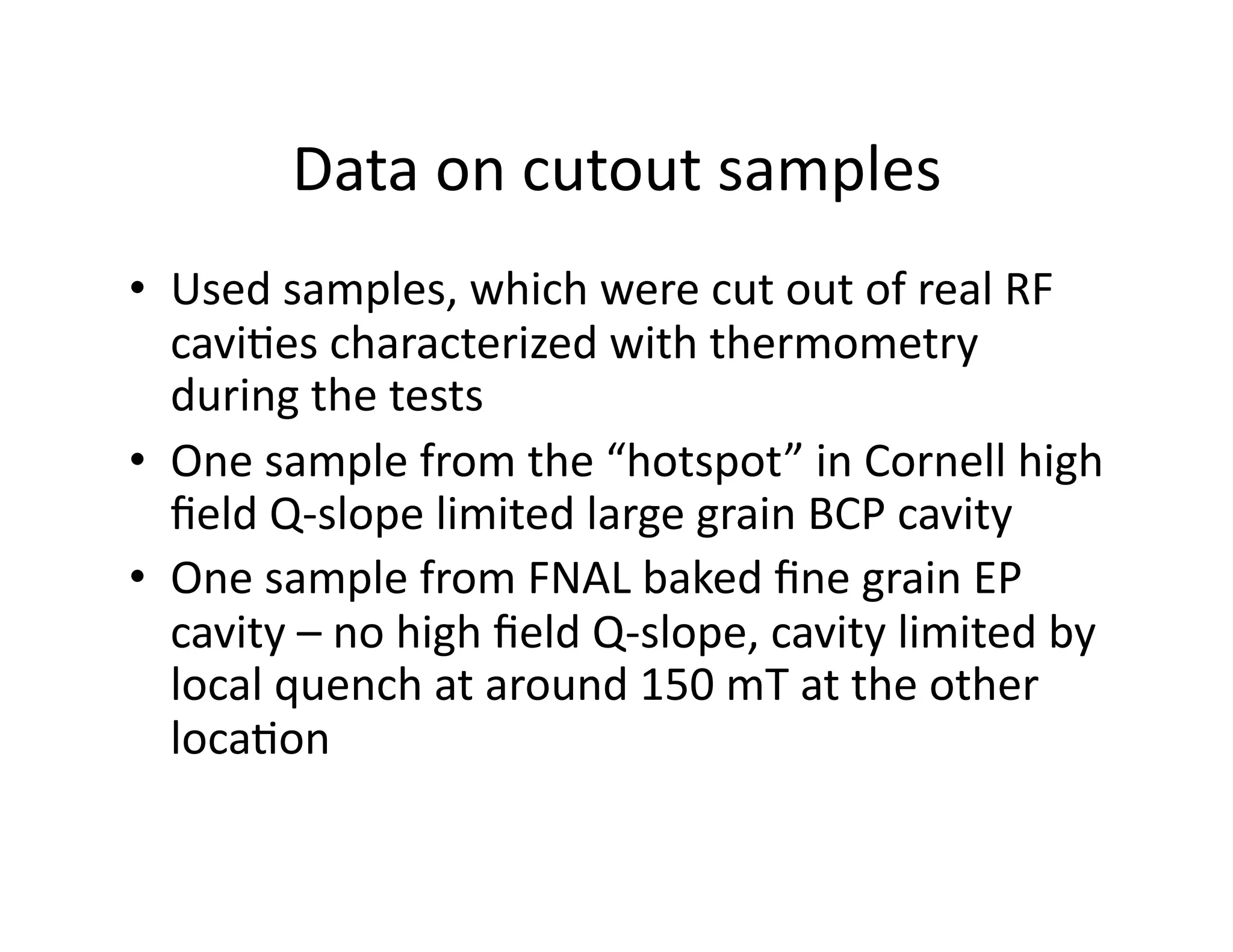
    Data  on  cutout  samples   •  Used  samples,  which  were  cut  out  of  real  RF   cavi%es  characterized  with  thermometry   during  the  tests     •  One  sample  from  the  “hotspot”  in  Cornell  high   field  Q-­‐slope  limited  large  grain  BCP  cavity   •  One  sample  from  FNAL  baked  fine  grain  EP   cavity  –  no  high  field  Q-­‐slope,  cavity  limited  by   local  quench  at  around  150  mT  at  the  other   loca%on    
  • 20.
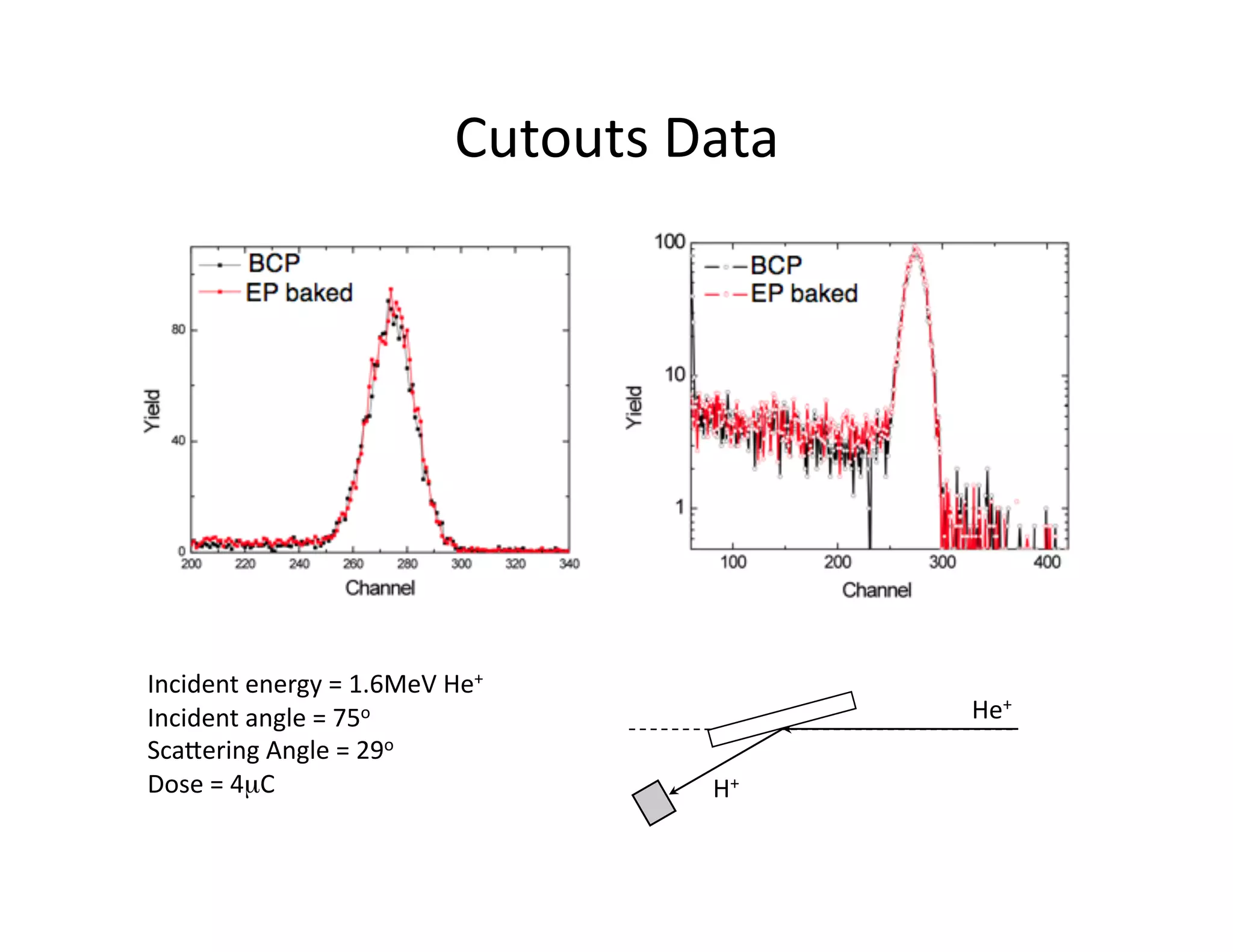
    Cutouts  Data   Incident  energy  =  1.6MeV  He+   Incident  angle  =  75o   He+   Scabering  Angle  =  29o   Dose  =  4µC   H+  
  • 21.
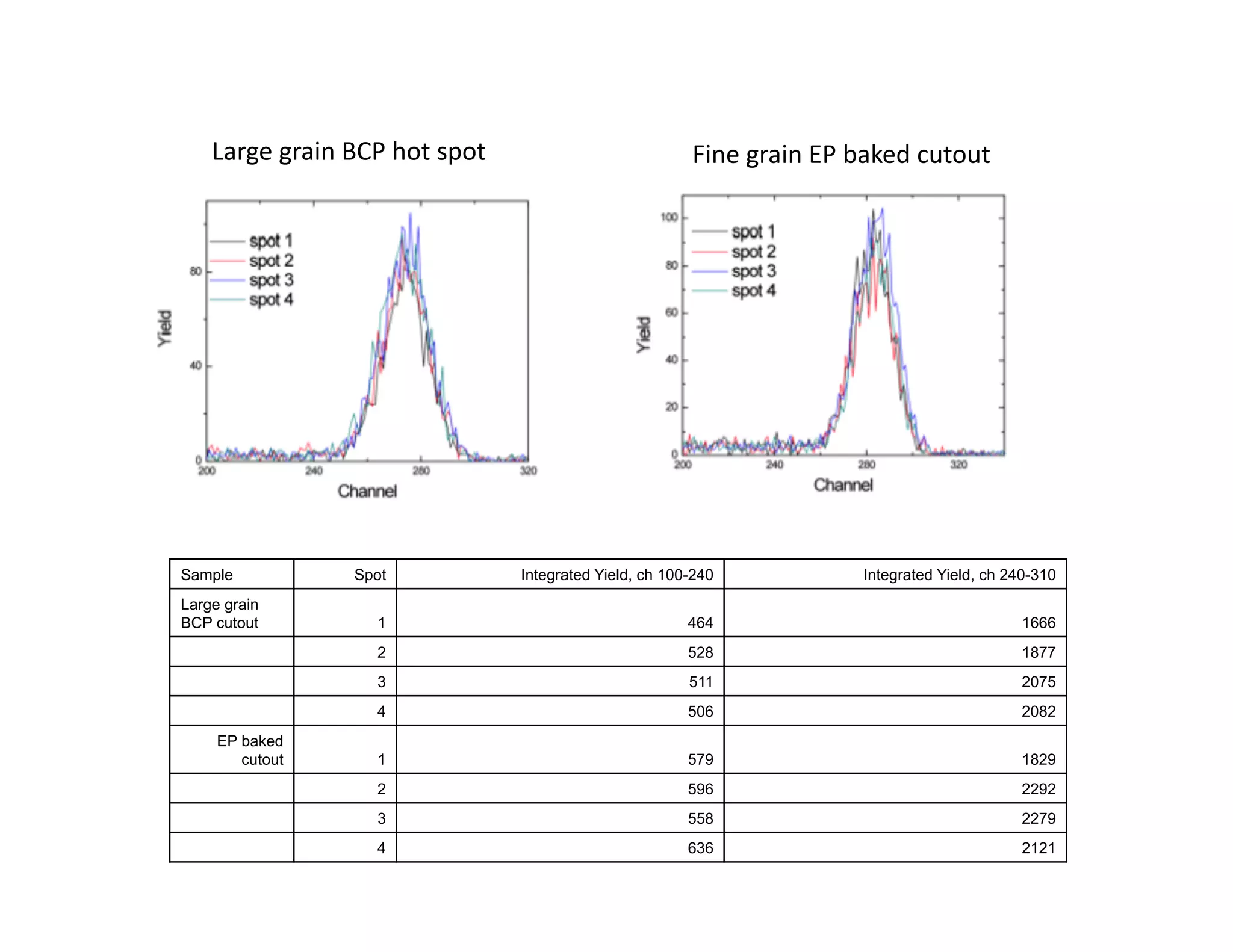
    Large  grain  BCP  hot  spot   Fine  grain  EP  baked  cutout   Sample Spot Integrated Yield, ch 100-240 Integrated Yield, ch 240-310 Large grain BCP cutout 1 464 1666 2 528 1877 3 511 2075 4 506 2082 EP baked cutout 1 579 1829 2 596 2292 3 558 2279 4 636 2121
  • 22.
    Sample  2  from  baked  EP  cavity  –  no   high  field  Q-­‐slope,  losses  negligible   Sample  1  –  Hot  Spot  in  the  high  field  Q-­‐ slope  of  large  grain  BCP  cavity  –  strong   dissipa%on  detected  by  thermometry   But  –  hydrogen  profile  is  the  same!   Sample Surface Content Bulk Content # 1 7.6 nm Nb0.78H0.22 Nb0.994H0.006 2 7.5 nm Nb0.77H0.23 Nb0.994H0.006
  • 23.
    Positron  Annihila%on     Doppler  Broadening  Spectroscopy   •   Positron  life%me  depends  on   the  electron  density  –  lives   longer  at  open  volume  defects   (i.e.  vacancies)   •   Width  of  the  spectra  of  gamma   quants  produced  on  annihila%on   depends  on  the  local  electron   density  and  momenta   •   Characterized  by  S-­‐ parameter  –  roughly  the   higher  S  the  larger  the   concentra%on  of  open   volume  defects     •   Varying  positron  energy  –  non-­‐ destruc%ve  depth  profiling  
  • 24.
    Doppler  broadening  spectroscopy  –   preliminary  results   UMich/NCSU  data   UWO  data   Baking  120C  in  situ   Baked/unbaked   Decrease  in  the  density  of  vacancies  detected   Life%me  spectra   in  both  cases  
  • 25.
    Conclusions   •  Hydrogen  seems  to  be  uncorrelated  with  the   mild  baking  improvement  in  the  HFQS   –  Same  H  content  with/without  HFQS   •  HF  rinsing  results  in  the  smearing  of  H-­‐profile   •  Preliminary  positron  annihila%on  data  –   decrease  in  near-­‐surface  laJce  defects  during   mild  baking   •  Same  samples  from  ERD  are  going  to  be  used   for  further  positron  annihila%on  studies