







Compliance and Safety
in Confined Spaces
for the Windpower
Industry
Sponsored By:
Before We Start
 This webinar will be available at
www.windpowerengineering.com & via email
 Q&A at the end of the presentation
 Tweet with hashtag #WindWebinar
Moderator
Steven Bushong
Windpower Engineering &
Development
Presenters
Scott Bramlett
EDF Renewable Services
Rob Siegel
ENSA North America
Confined / Enclosed Spaces in the
Wind Industry Scott Bramlett – EDF Renewable Services
Confined / Enclosed Spaces in the Wind Industry
• Introduction / Overview
• Employer Duties / OSHA
• Confined Space Assessment / Classification
• Written Program & Training
• Coordination
Occupational Safety & Health Administration
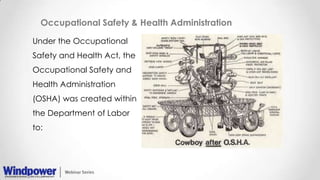
Under the Occupational
Safety and Health Act, the
Occupational Safety and
Health Administration
(OSHA) was created within
the Department of Labor
to:
Occupational Safety & Health Administration
• Encourage employers and employees to reduce
workplace hazards and to implement new or
improve existing safety and health programs;
• Innovation of H&S practices
• Develop rights / responsibilities
Occupational Safety & Health Administration
• Recordkeeping
• Training
• Develop / Enforce H&S Standards (29CFR)
• State programs
Employer Duties:
“General Duty Clause – Section 5(a)”
(a) Each employer
(1) shall furnish to each of his employees employment
and a place of employment which are free from
recognized hazards that are causing or are likely to
cause death or serious physical harm to his employees;
(2) shall comply with occupational safety and health
standards promulgated under this Act.
Employee Duties:
29 USC 654
(b) Each employee shall comply with occupational
safety and health standards and all
rules, regulations, and orders issued pursuant to this Act
which are applicable to his own actions and conduct.
Confined / Enclosed
Spaces
Enclosed vs Confined Space:
1910.269 – Enclosed Spaces
• Limited Entry / Egress
• Not designed for continuous occupancy
• Underground transmission areas or “vaults”
Enclosed vs Confined Space:
1910.146 – Confined Spaces
• Large enough for employee entry
• Limited Entry / Egress
• Not designed for continuous occupancy
Permit-Required Confined Spaces:
1910.146 – Permit-Required Confined Spaces
• Is a Confined or Enclosed Space
and…
• Contains or has the potential to contain a hazardous
atmosphere
• Contains material that could engulf an entrant
• Configuration is such that it could cause entrapment
• Any other recognized safety or health hazard…
OSHA Regulation and the Wind Industry:
• PRCS Reclassification (1910.146(c)5-7)
• (if) The employer can demonstrate that the only
hazard posed by the permit space is an actual or
potential hazardous atmosphere;
• The employer can demonstrate that continuous
forced air ventilation alone is sufficient to
maintain that permit space safe for entry
• Develop and provide continuous monitoring…
OSHA and the Wind
Industry
OSHA and the Wind Industry:
Electrical Power Generation, Transmission, and
Distribution (generally post-commissioning)
• 29CFR 1910.269 / 1910.146
• Enclosed / Permit-Required Confined Space
Employer Duties: Enclosed Spaces
• Evaluate potential hazards
• Safe practices – entry, work, rescue
• Training – hazards, entry & rescue procedures
• Rescue – Provide “prompt” rescue
• Based on the type of hazard / potential
Employer Duties: Permit-Required Confined Spaces
The Employer shall: (CFR1910.146(c)(1))
• Evaluate the workplace to determine if any spaces
are permit-required.
1910.146 Appendix A (flowchart)
• Inform Employees of the spaces and their location
Employer Duties: Permit-Required Confined Spaces
• Take effective measures to prevent its employees
from entering the permit spaces (if it decides not to
allow employees to enter prcs)
• Develop and implement a written permit space
program as applicable (employer decides to allow
prcs entry)
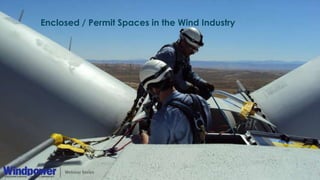
Enclosed / Permit Spaces in the Wind Industry
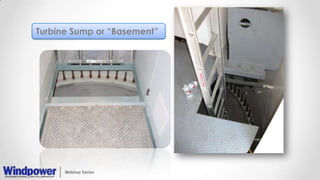
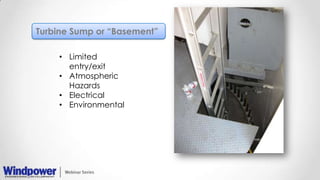
Turbine Sump or “Basement”
• Limited
entry/exit
• Atmospheric
Hazards
• Electrical
• Environmental
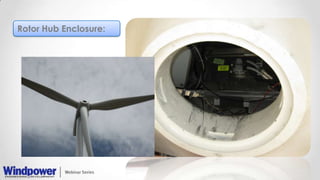
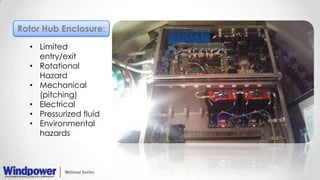
Rotor Hub Enclosure:
• Limited
entry/exit
• Rotational
Hazard
• Mechanical
(pitching)
• Electrical
• Pressurized fluid
• Environmental
hazards
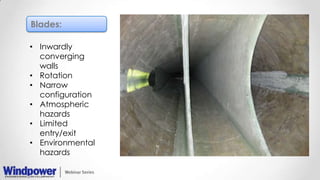
Blades:
• Inwardly
converging
walls
• Rotation
• Narrow
configuration
• Atmospheric
hazards
• Limited
entry/exit
• Environmental
hazards
Classification:
Start with the hazards in the space prior to entry
• Are they able to be eliminated?
• Are they controlled (Personal Protective
Equipment, ventilation etc.)
Classification:
What hazards will be present in the space once work
starts?
• Will the work create a hazardous atmosphere?
(Welding, painting etc)
• Does the work create any other significant
hazard?
Classification:
As a rule of thumb, if the hazard in the space is
significant enough to limit or prevent unassisted
evacuation of the space (because of
configuration, injury or exposure) the space should be
considered permit-required.
You must create safe working conditions inside the
space…
Written Program (1910.146):
• Identifies the spaces
• Prohibits unauthorized entry
• Specifies acceptable entry conditions
• Provide monitoring & access to monitoring
• Ensures hazard elimination
• Provides all necessary PPE
• Coordinates entry
• Ensures necessary training
Training:
• Authorized Entrant
• Authorized Attendant
• Entry Supervisor
• Rescue Team
• Annual Rescue training / evaluation
Coordination:
• Communicates status of the space / permit
• Ensures continuity of protection
• Shift changes
• Contractors
• Rescue services
In Summary
• Each employer must evaluate its enclosed or
confined spaces
• Develop a program addressing the hazards
associated with the space and potential hazards
• Provide the necessary equipment for safety / rescue
• Provide adequate training for Entrants, Attendants,
Supervisors, Exposed Employees
• Coordinate entries with contractors as necessary
For more information…
• 29 CFR 1910.269 (e) Electrical Power
Generation, Transmission, and Distribution
• 29 CFR 1910.146 Permit Required Confined Spaces
• American Wind Energy Association
Confined Space Entry – Wind Energy
37
Wind Turbines contain spaces that are considered to be "confined" because
their configurations hinder the activities of employees who must enter into,
work in or exit from them. Employees who work in confined spaces face
increased risk of exposure to serious physical injury from hazards such as:
 Entrapment,
 Engulfment and
 Hazardous atmospheric conditions
Confinement itself may pose entrapment hazards and work in confined spaces
exposes employees to hazards they would otherwise not be exposed to. For
example,
 Removal and reinstallation of heavy pitch pumps and motors
 Accumulator tanks
 Electrical cabinets and battery boxes
38
Many workers who enter into the narrow spaces of
the blade to inspect lightning protection equipment or
repair blades or fiberglass skin can be subjected to
space penetration distances that are excessive
without alternative means of access or escape.
Consequently the workers are then further isolated
from a rescuer.
A number of persons are killed or seriously injured in
confined spaces each year in North America and the
environment in which wind energy operates poses
many confined space hazards to both technicians and
those who would rescue them.
Discussion Objectives
• Locations of work vs. Determination
• Hazards Identified
• Hazard and Risk Assessments
• Rescue Planning
• Training Entry, Rescue and Company Policies
• Resources
Determination & Work Locations
Regardless of State or Province - Confined spaces are high
risk locations to perform work in. (Countries with Mature
Safety Standards)
o Same underlying theory exists for confined space work
• Determine if there is work in confinement
• Define those locations
• Assess for hazards
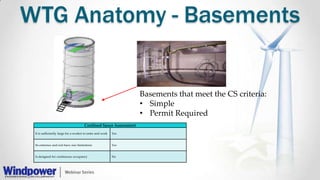
WTG Anatomy - Basements
Confined Space Assessment
It is sufficiently large for a worker to enter and work Yes
Its entrance and exit have size limitations Yes
Is designed for continuous occupancy No
Basements that meet the CS criteria:
• Simple
• Permit Required
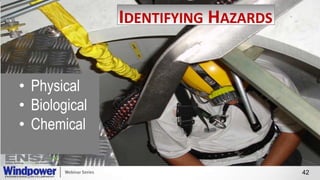
IDENTIFYING HAZARDS
• Physical
• Biological
• Chemical
42
Non-exhaustive Example
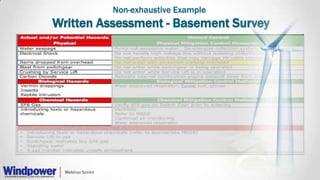
Written Assessment - Basement Survey
Non-exhaustive Example
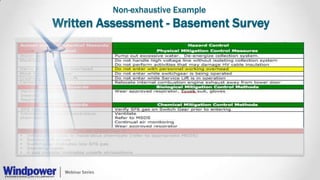
Written Assessment - Basement Survey
Non-exhaustive Example
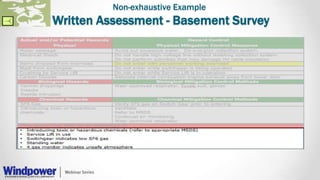
Written Assessment - Basement Survey
Non-exhaustive Example
Written Permit Entry
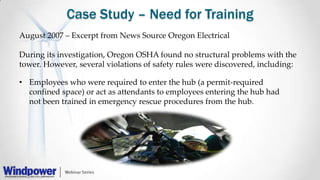
Case Study – Need for Training
• Employees who were required to enter the hub (a permit-required
confined space) or act as attendants to employees entering the hub had
not been trained in emergency rescue procedures from the hub.
August 2007 – Excerpt from News Source Oregon Electrical
During its investigation, Oregon OSHA found no structural problems with the
tower. However, several violations of safety rules were discovered, including:
Resources
• Confined Space and Structural Rope Rescue, Michael
Roop, Thomas Vines, and Richard
Wright, Published by Mosby, Inc., 1998.
• Safe Work in Confined Space-Wind Industry, Published
by Robert Siegel
ENSA Access and Rescue 2008
Robert Siegel – Executive Director
Robsiegel@ensa-northamerica.com
262-705-4558 Mobile
Training@ensa-northamerica.com
www.ensa-northamerica.com
www.ensawerks.com
Wind Energy
Questions?
Windpower Engineering
& Development
Steven Bushong
sbushong@wtwhmedia.com
Phone: 440.234.4531
Twitter: @WTWH_Renewables
ENSA North America
Rob Siegel
Rob.Siegel@malloryco.com
Phone: 262.705.4558
Twitter:@ENSATraining
EDF Renewable Services
Scott Bramlett
Scott.Bramlett@edf-re.com
Phone: 858.521.3575
Thank You
 Tweet with hashtag #WindWebinar
 This webinar will be available at windpowerengineering.com & email
 Connect with
 Discuss this on the EngineeringExchange.com

Compliance And Safety In Confined Spaces For The Windpower Industry

  • 1.
    Compliance and Safety inConfined Spaces for the Windpower Industry
  • 2.
  • 3.
    Before We Start This webinar will be available at www.windpowerengineering.com & via email  Q&A at the end of the presentation  Tweet with hashtag #WindWebinar
  • 4.
    Moderator Steven Bushong Windpower Engineering& Development Presenters Scott Bramlett EDF Renewable Services Rob Siegel ENSA North America
  • 5.
    Confined / EnclosedSpaces in the Wind Industry Scott Bramlett – EDF Renewable Services
  • 6.
    Confined / EnclosedSpaces in the Wind Industry • Introduction / Overview • Employer Duties / OSHA • Confined Space Assessment / Classification • Written Program & Training • Coordination
  • 7.
    Occupational Safety &Health Administration Under the Occupational Safety and Health Act, the Occupational Safety and Health Administration (OSHA) was created within the Department of Labor to:
  • 8.
    Occupational Safety &Health Administration • Encourage employers and employees to reduce workplace hazards and to implement new or improve existing safety and health programs; • Innovation of H&S practices • Develop rights / responsibilities
  • 9.
    Occupational Safety &Health Administration • Recordkeeping • Training • Develop / Enforce H&S Standards (29CFR) • State programs
  • 10.
    Employer Duties: “General DutyClause – Section 5(a)” (a) Each employer (1) shall furnish to each of his employees employment and a place of employment which are free from recognized hazards that are causing or are likely to cause death or serious physical harm to his employees; (2) shall comply with occupational safety and health standards promulgated under this Act.
  • 11.
    Employee Duties: 29 USC654 (b) Each employee shall comply with occupational safety and health standards and all rules, regulations, and orders issued pursuant to this Act which are applicable to his own actions and conduct.
  • 12.
  • 13.
    Enclosed vs ConfinedSpace: 1910.269 – Enclosed Spaces • Limited Entry / Egress • Not designed for continuous occupancy • Underground transmission areas or “vaults”
  • 14.
    Enclosed vs ConfinedSpace: 1910.146 – Confined Spaces • Large enough for employee entry • Limited Entry / Egress • Not designed for continuous occupancy
  • 15.
    Permit-Required Confined Spaces: 1910.146– Permit-Required Confined Spaces • Is a Confined or Enclosed Space and… • Contains or has the potential to contain a hazardous atmosphere • Contains material that could engulf an entrant • Configuration is such that it could cause entrapment • Any other recognized safety or health hazard…
  • 16.
    OSHA Regulation andthe Wind Industry: • PRCS Reclassification (1910.146(c)5-7) • (if) The employer can demonstrate that the only hazard posed by the permit space is an actual or potential hazardous atmosphere; • The employer can demonstrate that continuous forced air ventilation alone is sufficient to maintain that permit space safe for entry • Develop and provide continuous monitoring…
  • 17.
    OSHA and theWind Industry
  • 18.
    OSHA and theWind Industry: Electrical Power Generation, Transmission, and Distribution (generally post-commissioning) • 29CFR 1910.269 / 1910.146 • Enclosed / Permit-Required Confined Space
  • 19.
    Employer Duties: EnclosedSpaces • Evaluate potential hazards • Safe practices – entry, work, rescue • Training – hazards, entry & rescue procedures • Rescue – Provide “prompt” rescue • Based on the type of hazard / potential
  • 20.
    Employer Duties: Permit-RequiredConfined Spaces The Employer shall: (CFR1910.146(c)(1)) • Evaluate the workplace to determine if any spaces are permit-required. 1910.146 Appendix A (flowchart) • Inform Employees of the spaces and their location
  • 21.
    Employer Duties: Permit-RequiredConfined Spaces • Take effective measures to prevent its employees from entering the permit spaces (if it decides not to allow employees to enter prcs) • Develop and implement a written permit space program as applicable (employer decides to allow prcs entry)
  • 22.
    Enclosed / PermitSpaces in the Wind Industry
  • 23.
    Turbine Sump or“Basement”
  • 24.
    Turbine Sump or“Basement” • Limited entry/exit • Atmospheric Hazards • Electrical • Environmental
  • 25.
  • 26.
    Rotor Hub Enclosure: •Limited entry/exit • Rotational Hazard • Mechanical (pitching) • Electrical • Pressurized fluid • Environmental hazards
  • 27.
    Blades: • Inwardly converging walls • Rotation •Narrow configuration • Atmospheric hazards • Limited entry/exit • Environmental hazards
  • 28.
    Classification: Start with thehazards in the space prior to entry • Are they able to be eliminated? • Are they controlled (Personal Protective Equipment, ventilation etc.)
  • 29.
    Classification: What hazards willbe present in the space once work starts? • Will the work create a hazardous atmosphere? (Welding, painting etc) • Does the work create any other significant hazard?
  • 30.
    Classification: As a ruleof thumb, if the hazard in the space is significant enough to limit or prevent unassisted evacuation of the space (because of configuration, injury or exposure) the space should be considered permit-required. You must create safe working conditions inside the space…
  • 31.
    Written Program (1910.146): •Identifies the spaces • Prohibits unauthorized entry • Specifies acceptable entry conditions • Provide monitoring & access to monitoring • Ensures hazard elimination • Provides all necessary PPE • Coordinates entry • Ensures necessary training
  • 32.
    Training: • Authorized Entrant •Authorized Attendant • Entry Supervisor • Rescue Team • Annual Rescue training / evaluation
  • 33.
    Coordination: • Communicates statusof the space / permit • Ensures continuity of protection • Shift changes • Contractors • Rescue services
  • 34.
    In Summary • Eachemployer must evaluate its enclosed or confined spaces • Develop a program addressing the hazards associated with the space and potential hazards • Provide the necessary equipment for safety / rescue • Provide adequate training for Entrants, Attendants, Supervisors, Exposed Employees • Coordinate entries with contractors as necessary
  • 35.
    For more information… •29 CFR 1910.269 (e) Electrical Power Generation, Transmission, and Distribution • 29 CFR 1910.146 Permit Required Confined Spaces • American Wind Energy Association
  • 36.
    Confined Space Entry– Wind Energy
  • 37.
    37 Wind Turbines containspaces that are considered to be "confined" because their configurations hinder the activities of employees who must enter into, work in or exit from them. Employees who work in confined spaces face increased risk of exposure to serious physical injury from hazards such as:  Entrapment,  Engulfment and  Hazardous atmospheric conditions Confinement itself may pose entrapment hazards and work in confined spaces exposes employees to hazards they would otherwise not be exposed to. For example,  Removal and reinstallation of heavy pitch pumps and motors  Accumulator tanks  Electrical cabinets and battery boxes
  • 38.
    38 Many workers whoenter into the narrow spaces of the blade to inspect lightning protection equipment or repair blades or fiberglass skin can be subjected to space penetration distances that are excessive without alternative means of access or escape. Consequently the workers are then further isolated from a rescuer. A number of persons are killed or seriously injured in confined spaces each year in North America and the environment in which wind energy operates poses many confined space hazards to both technicians and those who would rescue them.
  • 39.
    Discussion Objectives • Locationsof work vs. Determination • Hazards Identified • Hazard and Risk Assessments • Rescue Planning • Training Entry, Rescue and Company Policies • Resources
  • 40.
    Determination & WorkLocations Regardless of State or Province - Confined spaces are high risk locations to perform work in. (Countries with Mature Safety Standards) o Same underlying theory exists for confined space work • Determine if there is work in confinement • Define those locations • Assess for hazards
  • 41.
    WTG Anatomy -Basements Confined Space Assessment It is sufficiently large for a worker to enter and work Yes Its entrance and exit have size limitations Yes Is designed for continuous occupancy No Basements that meet the CS criteria: • Simple • Permit Required
  • 42.
    IDENTIFYING HAZARDS • Physical •Biological • Chemical 42
  • 43.
  • 44.
  • 45.
  • 46.
  • 47.
    Case Study –Need for Training • Employees who were required to enter the hub (a permit-required confined space) or act as attendants to employees entering the hub had not been trained in emergency rescue procedures from the hub. August 2007 – Excerpt from News Source Oregon Electrical During its investigation, Oregon OSHA found no structural problems with the tower. However, several violations of safety rules were discovered, including:
  • 48.
    Resources • Confined Spaceand Structural Rope Rescue, Michael Roop, Thomas Vines, and Richard Wright, Published by Mosby, Inc., 1998. • Safe Work in Confined Space-Wind Industry, Published by Robert Siegel ENSA Access and Rescue 2008
  • 49.
    Robert Siegel –Executive Director Robsiegel@ensa-northamerica.com 262-705-4558 Mobile Training@ensa-northamerica.com www.ensa-northamerica.com www.ensawerks.com Wind Energy
  • 50.
    Questions? Windpower Engineering & Development StevenBushong sbushong@wtwhmedia.com Phone: 440.234.4531 Twitter: @WTWH_Renewables ENSA North America Rob Siegel Rob.Siegel@malloryco.com Phone: 262.705.4558 Twitter:@ENSATraining EDF Renewable Services Scott Bramlett Scott.Bramlett@edf-re.com Phone: 858.521.3575
  • 51.
    Thank You  Tweetwith hashtag #WindWebinar  This webinar will be available at windpowerengineering.com & email  Connect with  Discuss this on the EngineeringExchange.com

Editor's Notes

  • #11 Expectations…
  • #13 Brief overview of confined / enclosed spaces
  • #40 Share image of zones of turbine
  • #41 Obviously, if we are at this point an understanding of what a confined space is under the law should already be very clear. Confined and Enclosed Space regulations globally all have the same underlying theory.Determine if there are high risk locations by example. difficult to access locations on towers or structure , and confinement (AKA Work at Heights and Confined Space)Define those locations (whether or not its legally required)ANDAssessing the location for hazards prior to working in them.Regardless of whether or not your determination clearly defines work in confinement as a confined space or not, the hazard or risk assessment that follows must be performed by a qualified person, competent in performing risk surveys.The difference between a successful entry program and a life threatening mistake is the amount of due diligence provided and the frequency of review.
  • #42 In our determination surveys we are using Simple and PRCS for the labeling of areas where both work takes place. For companies choosing to follow enclosed space standards to develop their entry programs we find that the rotor exists as prcs and the nacelle down fits nicely in the enclosed space standard.Either way confined space training and planning for PRCS entry is crucial to accurate hazard control measuresOur criteria for simple confined space:Space under normal operating conditions poses no obvious hazards to an entrantEntry into the space is conducted following a safe work instruction OR pre-task plan and risk assessmentShould the risk assessment uncover hazards that the workers are introducing into the space then the space would be entered following the written permit process which may deem necessary an attendant be stationed outside the space for the duration of exposure to that hazard.Our end goal is get our workers to think like safety professionals and do all they can to declassify the space to a simple confined space with no obvious hazardsThe criteria for a space labeled PRCS is as most of you all know:Under normal conditions the space poses obvious hazards to an entrant which means that the process for entry as I explained above is to open a permit determine the risk of exposure and mitigate the hazards ALWAYS in an effort to declassify the space for routine entry and exit.Here is an example of hazard assessment used in conjunction with a confined space permit
  • #43 I call these the hazard silos.Grouping things like mechanical and electrical under physical for space saving which you will see in the example on the next page
  • #44 Red indicates what we are alerting the workers to in each category.
  • #45 Green indicates the hazard control measures necessary for safe entry or to declassify the space.I have highlighted the working above control measure which indicates that entry simply is not to be performed when people are working above. This measure like most is the guidline and with further due diligence can be made safe through collaborative planning.
  • #46 The bottom part of the form stays red to indicate that so long as the bullets listed existed, the declassification process is not an option the workers have.
  • #47 This is an excerpt from a permit and you will notice the permit we train to use is also carrying the same color coding as the hazard assessmentIm drawing attention now to the emergency pre planning section and you will notice we have indicated the need for locations, like the nearest first responder.This is the team capable of responding to an incident up tower on the same site. It very well might be someone at the O&M buidling or trailer as well.
  • #48 When something goes wrong in confinement whether the space was acurately classified or not. Entry into the space should be treated as a confined space with hazards.All workers and responders should be trained in PRCS so they know the protocol for rescue from confined spaces.Not all potential hazards are going to be obvious to those of us performing confined space assessments so its important that the work force is taught to perform dynamic risk assessments during day to day operations so that in the case of an emergency undo risk of exposure is mitigated