
11
Mind Power and Study Techniques
Dr. Ashok Kumar Jetawat (Chairman)
Ph.D., M.Tech, MBA, MCA, MAJM, MSW 
SCJP, MCP, IGCBP, Geneva (Switzerland)
Motivational Society of Achievers
email : motivationalsociety@gmail.com
Web: http://ashokjetawat.com
http://motivationalsociety.in
(M) 9001556010
22
Keep eye contact with
teachers in the class for
100% concentration
Effective use of left and right portion of mind
33
44
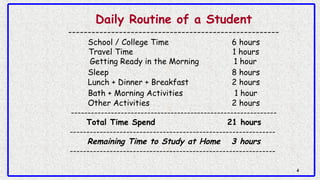
Daily Routine of a Student
------------------------------------------------------
School / College Time 6 hours
Travel Time 1 hours
Getting Ready in the Morning 1 hour
Sleep 8 hours
Lunch + Dinner + Breakfast 2 hours
Bath + Morning Activities 1 hour
Other Activities 2 hours
--------------------------------------------------------------
Total Time Spend 21 hours
--------------------------------------------------------------
Remaining Time to Study at Home 3 hours
--------------------------------------------------------------
Sequence of Study
Most Important  Important  Less Important
55
Take small rest after each
half an hour of study
66
77
88
How to Retain Better After You Learn Something
10 Min:
Revise previous class work when you reach and sit in the class or before the teacher starts the
class.
Quickly revise today’s class work when teacher finishes class and leave.
24 Hours:
Revise the whole day lessons at home in the night before going to sleep.
7 Days:
Revise the week’s class work on every Sunday.
1 Month:
Revise whole month lessons on every last Sunday of the month.
6 Months:
Revise complete course work at least twice in a year
99
Five Types of Revision
Systematic Revision
The Secrete of Good Memory
1010
1111
Daily Routine During Exam Days
• Do not eat just before exam.
• Read questions slowly.
• Think, plan and then write answers.
• Sleep well.
• Do not study too hard.
• Do not get tired.
 
Caring for your eyes
Light:
Sunlight is the best for your eyes.
Breathing:
When you study or concentrate, make sure that
your breathing is relaxed, deep and rhythmic.
Blinking:
Make sure that you blink when you concentrate.
Palming:
This technique is used to relax our eyes.
1212
1313
S.No. Winner Loser
1 Always has a program Always has an excuse
2 Has answer for every Problem Has problem for every answer
3 Says “It’s difficult but possible” Says “It’s possible but difficult”
4 Make commitment Make promises
5 Says “I will do something” Says “Something must be done”
6 Is a part of the team Apart from the team
7 Choose what they say Say what they choose
8 Looks possibilities Looks problems
9 Make it happen Let it happen
10 Use hard argument but soft words Use soft arguments but hard words
11 Sees the gain Sees the pain
12 Always part of the answer Always part of the problem
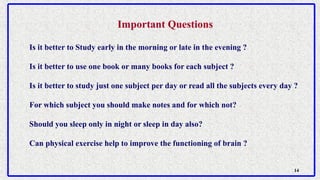
    Important Questions
Is it better to Study early in the morning or late in the evening ?
Is it better to use one book or many books for each subject ?
Is it better to study just one subject per day or read all the subjects every day ?
For which subject you should make notes and for which not?
Should you sleep only in night or sleep in day also?
Can physical exercise help to improve the functioning of brain ?
1414
                  Important Questions Cont …
Can Meditation help you get more marks in exam ?
What is the difference between exam and competition ?
What you can ask your parents to do for you for success ?
Should you use time-table for studying ?
Suppose you miss classes for two weeks, what should you study first : what the
teacher teaches now or what you missed ?
If general knowledge is not one of the papers in your syllabus, is it a waste of
time to read newspaper / magazine ?
1515
1616
Dr. Ashok Jetawat’s Tips for Effective Learning
•Use finger technique for faster reading.
•Keep eye contact with teachers in the class for concentration.
•Five Types of Revision
– 10 Min:
• Revise previous class work when you reach and sit in the class or before the teacher starts
the class.
• Quickly revise today’s class work when teacher finishes class and leave.
– 24 Hours:
• Revise the whole day lessons at home in the night before going to sleep.
– 7 Days:
• Revise the week’s class work on every Sunday.
– 1 Month:
• Revise whole month lessons on every last Sunday of the month.
– 6 Months:
• Revise complete course work at least twice in a year
1717
Dr. Ashok Jetawat’s Tips for Effective Learning cont…
• Take practical test similar to the actual tests.
• Take fruits and vitamins on daily basis.
• Convey teachers that you are studying hard for excellence.
• Cooperate with other students.
• Take small rest after each half an hour of study.
• Keep the sequence of study starting from most important to important and then
less important portion.
• Use both hand in day to day working for effective use of left and right portion of
mind.
Thank you!
1818
Any queries?
eMail: motivationalsociety@gmail.com
(M) 09001556010

Mind power study techniques

  • 1.
    11 Mind Power andStudy Techniques Dr. Ashok Kumar Jetawat (Chairman) Ph.D., M.Tech, MBA, MCA, MAJM, MSW  SCJP, MCP, IGCBP, Geneva (Switzerland) Motivational Society of Achievers email : motivationalsociety@gmail.com Web: http://ashokjetawat.com http://motivationalsociety.in (M) 9001556010
  • 2.
    22 Keep eye contactwith teachers in the class for 100% concentration
  • 3.
    Effective use ofleft and right portion of mind 33
  • 4.
    44 Daily Routine ofa Student ------------------------------------------------------ School / College Time 6 hours Travel Time 1 hours Getting Ready in the Morning 1 hour Sleep 8 hours Lunch + Dinner + Breakfast 2 hours Bath + Morning Activities 1 hour Other Activities 2 hours -------------------------------------------------------------- Total Time Spend 21 hours -------------------------------------------------------------- Remaining Time to Study at Home 3 hours --------------------------------------------------------------
  • 5.
    Sequence of Study MostImportant  Important  Less Important 55
  • 6.
    Take small restafter each half an hour of study 66
  • 7.
  • 8.
    88 How to RetainBetter After You Learn Something
  • 9.
    10 Min: Revise previousclass work when you reach and sit in the class or before the teacher starts the class. Quickly revise today’s class work when teacher finishes class and leave. 24 Hours: Revise the whole day lessons at home in the night before going to sleep. 7 Days: Revise the week’s class work on every Sunday. 1 Month: Revise whole month lessons on every last Sunday of the month. 6 Months: Revise complete course work at least twice in a year 99 Five Types of Revision
  • 10.
  • 11.
    1111 Daily Routine DuringExam Days • Do not eat just before exam. • Read questions slowly. • Think, plan and then write answers. • Sleep well. • Do not study too hard. • Do not get tired.  
  • 12.
    Caring for youreyes Light: Sunlight is the best for your eyes. Breathing: When you study or concentrate, make sure that your breathing is relaxed, deep and rhythmic. Blinking: Make sure that you blink when you concentrate. Palming: This technique is used to relax our eyes. 1212
  • 13.
    1313 S.No. Winner Loser 1Always has a program Always has an excuse 2 Has answer for every Problem Has problem for every answer 3 Says “It’s difficult but possible” Says “It’s possible but difficult” 4 Make commitment Make promises 5 Says “I will do something” Says “Something must be done” 6 Is a part of the team Apart from the team 7 Choose what they say Say what they choose 8 Looks possibilities Looks problems 9 Make it happen Let it happen 10 Use hard argument but soft words Use soft arguments but hard words 11 Sees the gain Sees the pain 12 Always part of the answer Always part of the problem
  • 14.
        Important Questions Isit better to Study early in the morning or late in the evening ? Is it better to use one book or many books for each subject ? Is it better to study just one subject per day or read all the subjects every day ? For which subject you should make notes and for which not? Should you sleep only in night or sleep in day also? Can physical exercise help to improve the functioning of brain ? 1414
  • 15.
                      Important QuestionsCont … Can Meditation help you get more marks in exam ? What is the difference between exam and competition ? What you can ask your parents to do for you for success ? Should you use time-table for studying ? Suppose you miss classes for two weeks, what should you study first : what the teacher teaches now or what you missed ? If general knowledge is not one of the papers in your syllabus, is it a waste of time to read newspaper / magazine ? 1515
  • 16.
    1616 Dr. Ashok Jetawat’sTips for Effective Learning •Use finger technique for faster reading. •Keep eye contact with teachers in the class for concentration. •Five Types of Revision – 10 Min: • Revise previous class work when you reach and sit in the class or before the teacher starts the class. • Quickly revise today’s class work when teacher finishes class and leave. – 24 Hours: • Revise the whole day lessons at home in the night before going to sleep. – 7 Days: • Revise the week’s class work on every Sunday. – 1 Month: • Revise whole month lessons on every last Sunday of the month. – 6 Months: • Revise complete course work at least twice in a year
  • 17.
    1717 Dr. Ashok Jetawat’sTips for Effective Learning cont… • Take practical test similar to the actual tests. • Take fruits and vitamins on daily basis. • Convey teachers that you are studying hard for excellence. • Cooperate with other students. • Take small rest after each half an hour of study. • Keep the sequence of study starting from most important to important and then less important portion. • Use both hand in day to day working for effective use of left and right portion of mind.
  • 18.
    Thank you! 1818 Any queries? eMail:motivationalsociety@gmail.com (M) 09001556010