ROCKS II
TAMILNADU IAS ACADEMY
ON THE BASIS OF NATURE OF SEDIMENTS:
MECHANICALLY FORMED SEDIMENTARY ROCKS
 Previously formed rocks - subjected to physical/mechanical disintegration
 Broken into fragments – becomes source material for the formation
 Fragments – transported and deposited ( exogenous processes)
 Further broken – mutual collision
 The fragments- deposited and consolidated in different water bodies – clastic sedimentary
rocks
 1. SANDSTONES
 When sand grins are deposited in water bodies and are aggregated and consolidated by
cementing elements ( silica, calcium, clay etc..) sandstones are formed
 Color – nature and amount of cementing elements
 Sandstones – RED- when cemented by iron oxides
 Sandstones –WHITE – when cemented by calcium carbonate
 Becomes hard and resistant when cemented by silica
 Naturally porous
 CLASSIFICATION : 1.QUARTZ ARENTIES 2. ARKOSE SANDSTONE
 3. LITHIC SANDSTONE 4. GRAYWACKES SANDSTONE
SANDSTONE
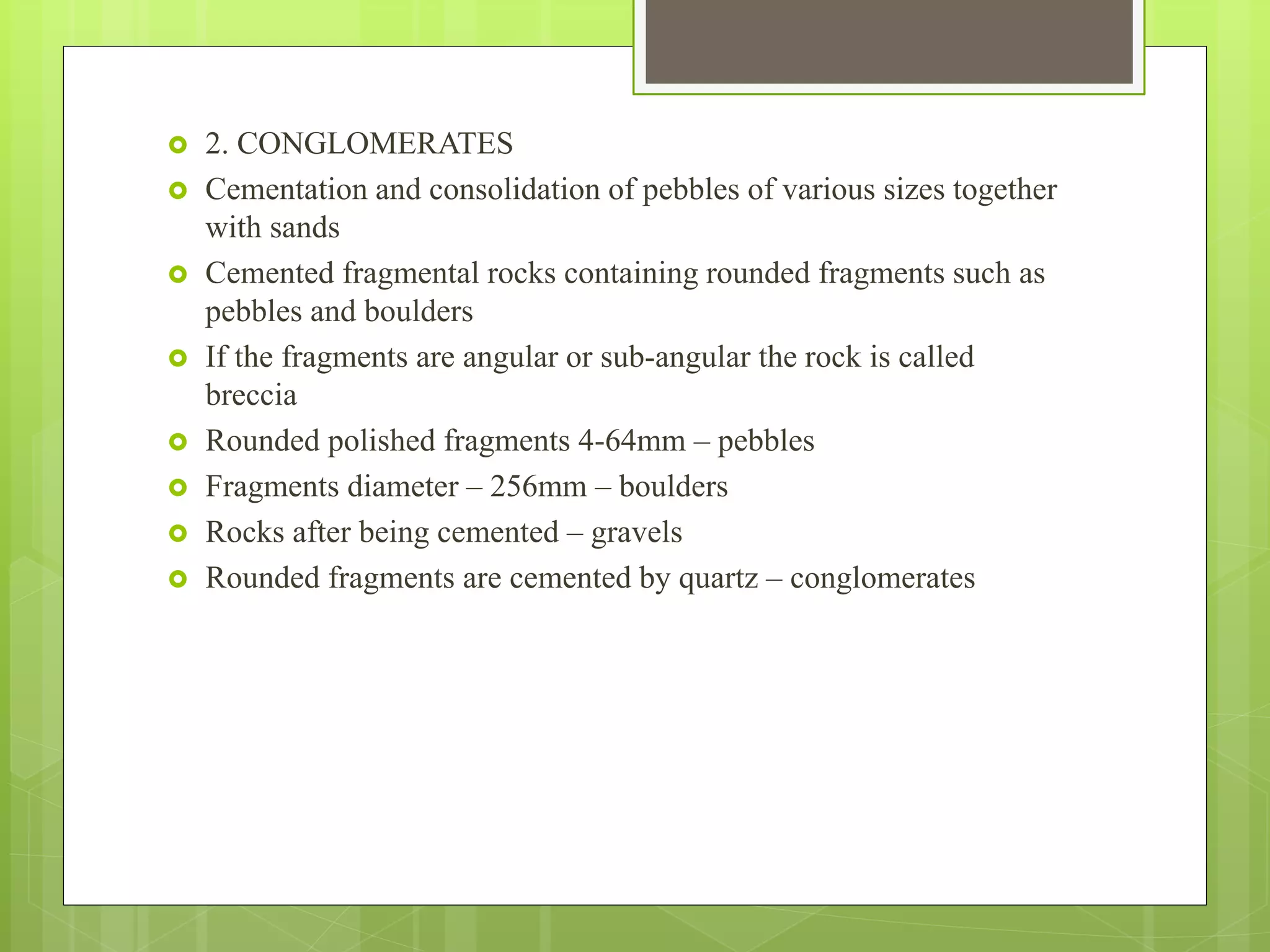
 2. CONGLOMERATES
 Cementation and consolidation of pebbles of various sizes together
with sands
 Cemented fragmental rocks containing rounded fragments such as
pebbles and boulders
 If the fragments are angular or sub-angular the rock is called
breccia
 Rounded polished fragments 4-64mm – pebbles
 Fragments diameter – 256mm – boulders
 Rocks after being cemented – gravels
 Rounded fragments are cemented by quartz – conglomerates
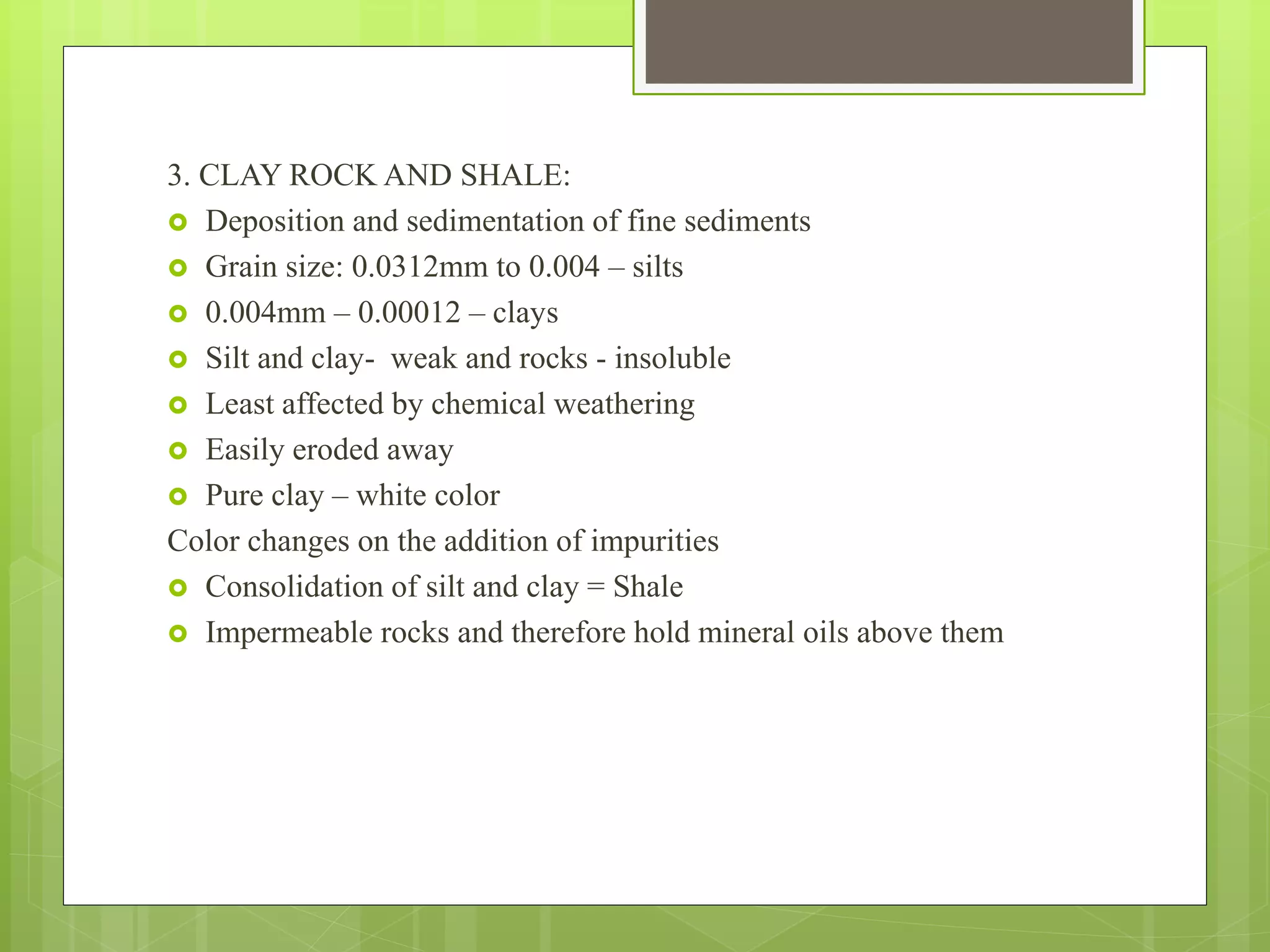
3. CLAY ROCK AND SHALE:
 Deposition and sedimentation of fine sediments
 Grain size: 0.0312mm to 0.004 – silts
 0.004mm – 0.00012 – clays
 Silt and clay- weak and rocks - insoluble
 Least affected by chemical weathering
 Easily eroded away
 Pure clay – white color
Color changes on the addition of impurities
 Consolidation of silt and clay = Shale
 Impermeable rocks and therefore hold mineral oils above them
CHEMICALLY FORMED SEDIMENTARY
ROCKS
 Running water contains chemicals in suspension
 Chemically active water + country rocks soluble materials removed form
the rock chemically formed settlements
 Chemical materials settle down --- rocks
 E.g.. Gypsum and salt rocks
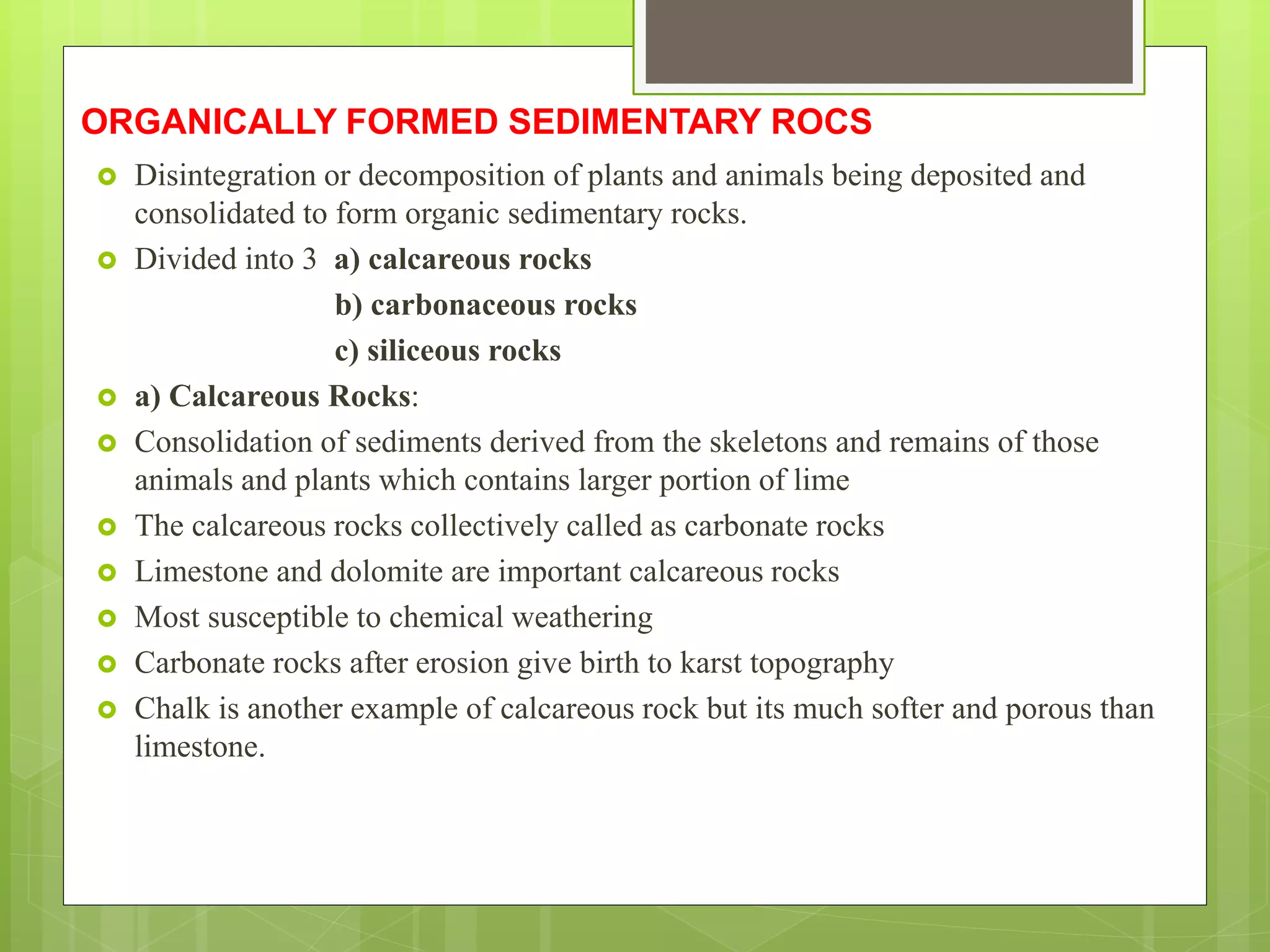
ORGANICALLY FORMED SEDIMENTARY ROCS
 Disintegration or decomposition of plants and animals being deposited and
consolidated to form organic sedimentary rocks.
 Divided into 3 a) calcareous rocks
b) carbonaceous rocks
c) siliceous rocks
 a) Calcareous Rocks:
 Consolidation of sediments derived from the skeletons and remains of those
animals and plants which contains larger portion of lime
 The calcareous rocks collectively called as carbonate rocks
 Limestone and dolomite are important calcareous rocks
 Most susceptible to chemical weathering
 Carbonate rocks after erosion give birth to karst topography
 Chalk is another example of calcareous rock but its much softer and porous than
limestone.
 b) Carbonaceous rocks:
 Dominated by carbonic materials which represent vegetation
remains
 Transformation of vegetation because of their burial during
earth movements and consequent weight and pressure of
overlying deposits
 Initial form being PEAT and the other subsequent forms
being LIGNITE, BITUMINOUS & ANTHRACITE coals
 Coal layers are known as coal seams
 ECONOMICALLY IMPORTANT
 c) Siliceous Rock
 Formed due to the dominance of silica content
 Aggregation and compaction of wastes derived from sponge and radiolarian
organisms and diatom plants
 E.g. geyserite – deposits of silica around glaciers
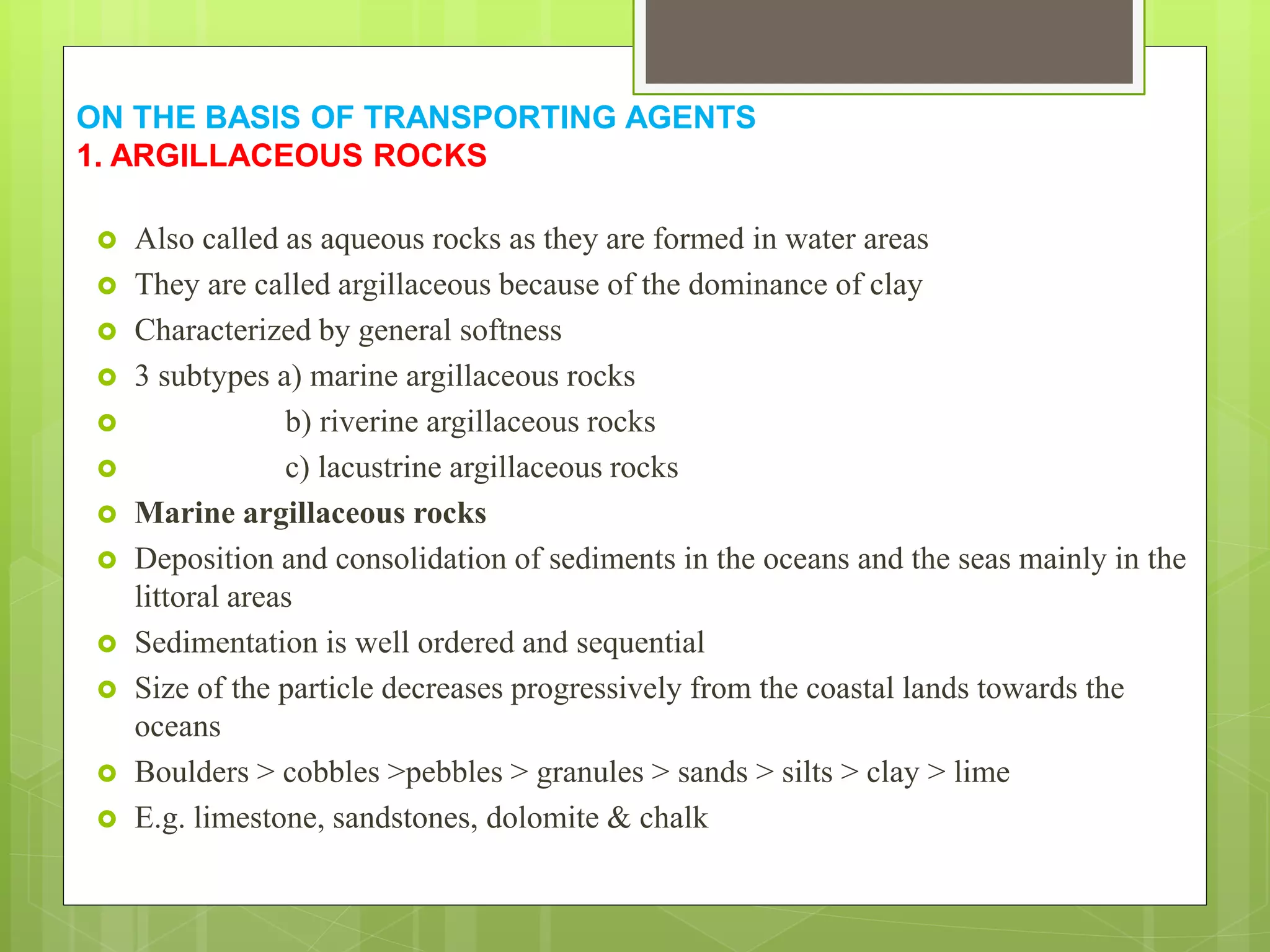
ON THE BASIS OF TRANSPORTING AGENTS
1. ARGILLACEOUS ROCKS
 Also called as aqueous rocks as they are formed in water areas
 They are called argillaceous because of the dominance of clay
 Characterized by general softness
 3 subtypes a) marine argillaceous rocks
 b) riverine argillaceous rocks
 c) lacustrine argillaceous rocks
 Marine argillaceous rocks
 Deposition and consolidation of sediments in the oceans and the seas mainly in the
littoral areas
 Sedimentation is well ordered and sequential
 Size of the particle decreases progressively from the coastal lands towards the
oceans
 Boulders > cobbles >pebbles > granules > sands > silts > clay > lime
 E.g. limestone, sandstones, dolomite & chalk
 Lacustrine argillaceous sedimentary rocks
 Deposition and consolidation of sediments in the lake
 The lacustrine rocks is visible under 3 conditions
 i) when the lake becomes dry
 ii) if the floor of the lake is raised due to earth movements
 iii) if the whole lake is filled up with sediments
 Riverine argillaceous sedimentary rocks
 Deposition of sediments in the river
 Deposition – beds of the rivers
 flood plains
 Deposition includes alluvia which are dominated by clay
 Alluvial deposits are renewed almost every year
2. AEOLIAN SEDIMENTARY ROCKS
 Deposition of sand brought down by the winds
 Continuous deposition of sands results in the formation of different layers but
these layers are not well consolidated
 Sometimes there is complete absence of layers
 LOESS is the most important member of this group
 They are heaps of unconsolidated matter
 They may stand like a vertical cliff or wall
 Extensive loessic deposits are found in north China – yellow river of china carries
largest amounts of deposits in the world – yellow color of the river is due to the
deposition of yellow colored Chinese loess
3. GLACIAL SEDIMENTARY ROCKS
 The materials deposited by glaciers are called glacial drifts which are
deposited in four conditions
 i) lateral moraines – When glacial deposits are deposited on the either side
of the glacier
 ii) medial moraines – When glacial sedimentary deposits are deposited
along the joining glaciers
 iii) ground moraines – when the glacial materials are deposited at the bed of
the glaciers
 iv) terminal moraines - when the glacier is ablated and materials are
deposited
METAMORPHIC ROCKS
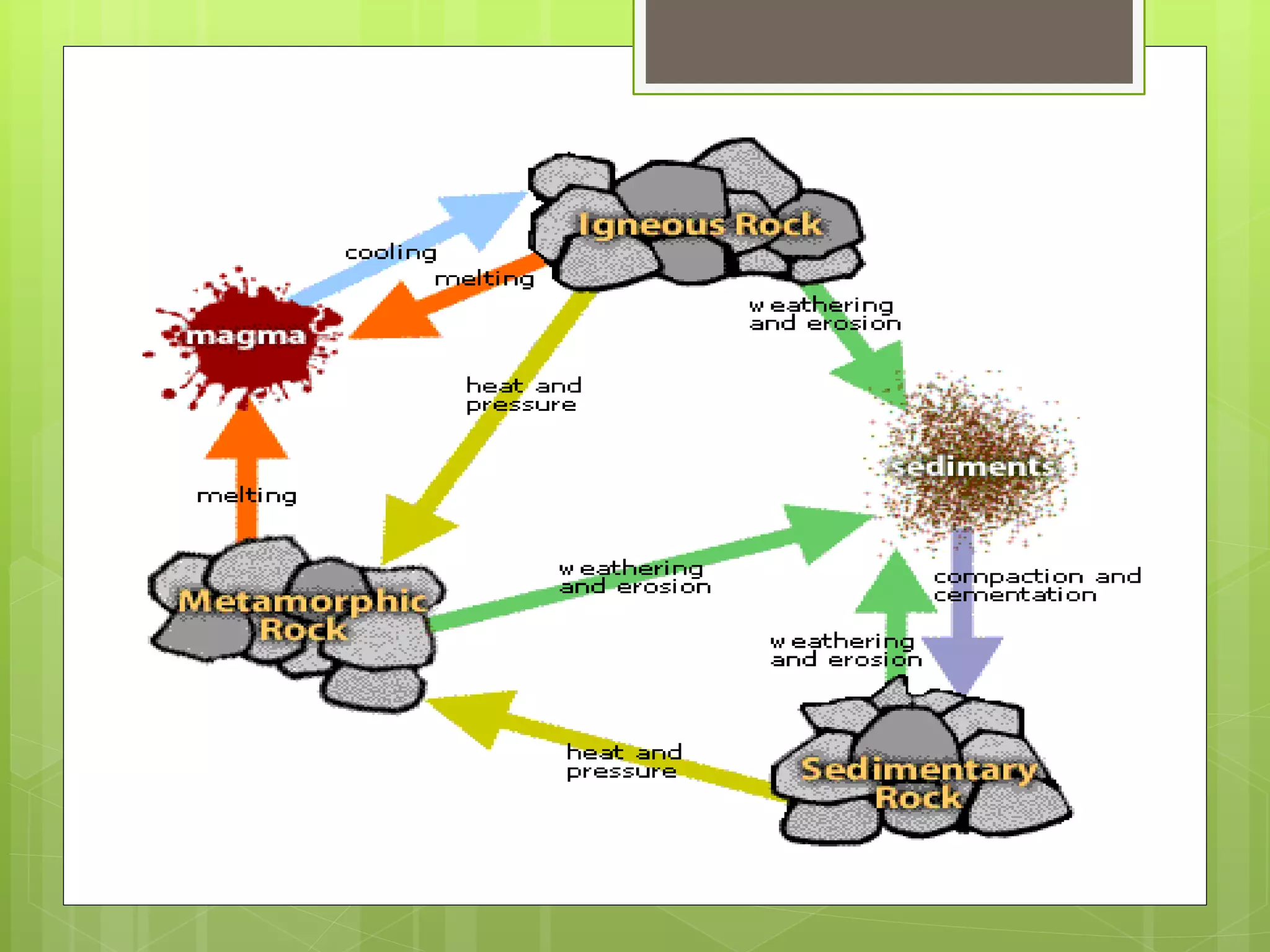
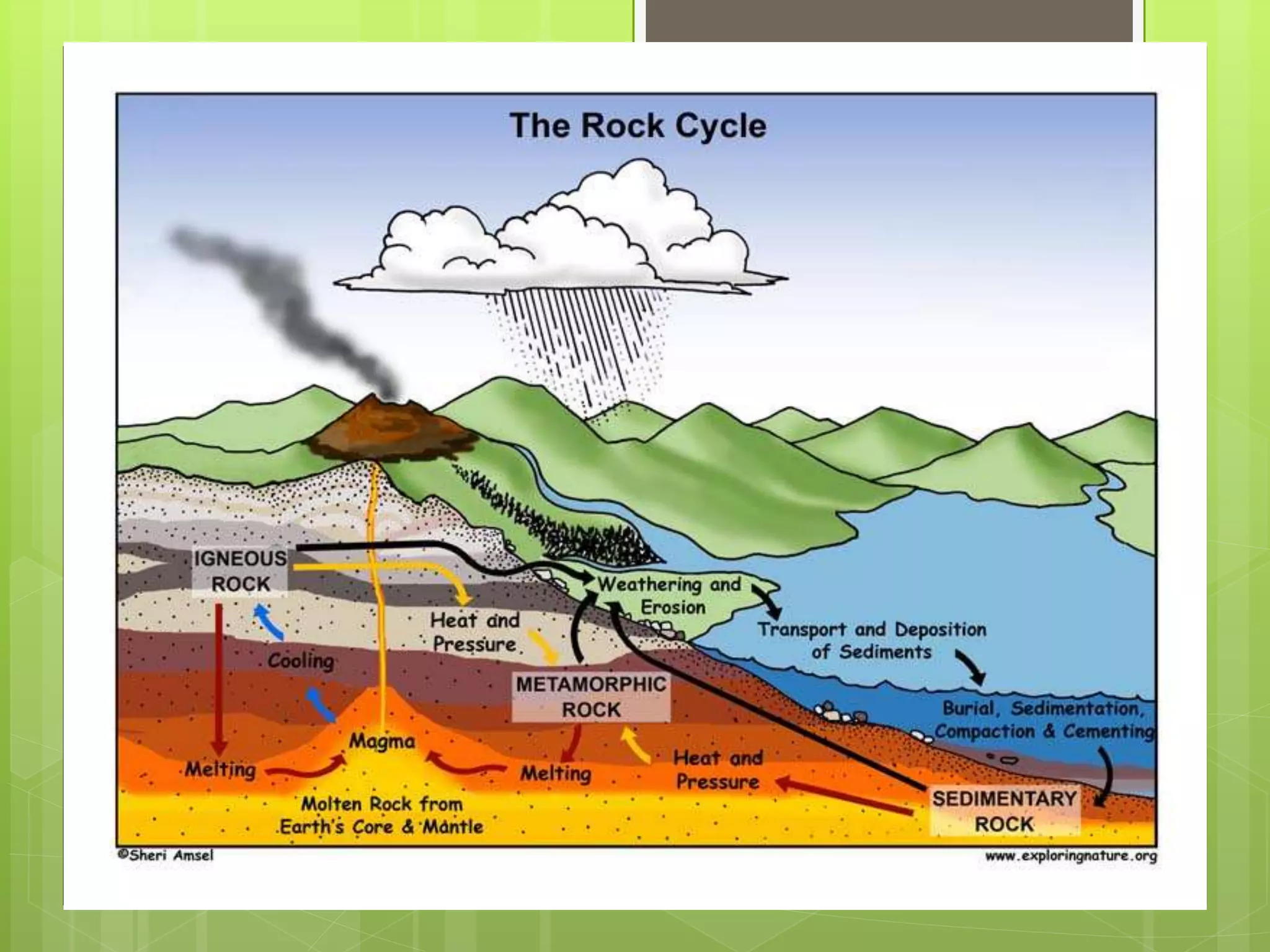
 METAMORPHIC ROCKS include rocks that have been changed
either in form or composition without disintegration
 CHRACTERISTICS:
 METAMORPHOSE – change in form
 A complete alteration of pre-existing rocks due to change in mineral
composition and texture through temperature and pressure
 Change in the form of sedimentary rocks , igneous rocks and even
previously formed metamorphic rocks
 No disintegration or decomposition
 Metamorphic rock – again metamorphosed – re-metamorphism
 When the rocks are metamorphosed at great intensity it is said to be
intense metamorphism
 i) physical metamorphism – changes in the textural
composition of rocks
 ii) chemical metamorphism – change in the chemical
composition of the rocks
 Sometimes both become operative together
 The texture of metamorphic rocks is the result of recrystallization or
conversion of one mineral to another in the solid state
 Foliation, defined as streaking or parallel arrangement of the constituent
crystals which generally cut the rocs at an angle to the bedding planes of
the original sediments of the parent rocks
 The coarse grained metamorphic rocks are imperfectly foliated (e.g.
gneisses from granites) while fine grained metamorphic rocks are perfectly
foliated
 The property of metamorphic rocks to part or split along the bedding
planes is known as fissility
 The structure of the presence of numerous closely spaced parallel planes of
splitting is known as cleavage
 Schistocity refers to the growth of large crystals and segregation of some
minerals into lighter and darker bands
 Agents of metamorphism:
 Heat : mineral composition is entirely changed due to intense
heat but the rocks are seldom melted
 Heat for metamorphism – vulcanicity
 Compression: convergent horizontal movement caused by
endogenic forces causes folding in rock beds
 Folding changes the form and composition of parent rock
 Operative during orogeny
 Solution: chemically active hot gases and water while passing
through the rocks change their chemical composition
 Magmatic water and water confined in the beds of sedimentary
rocks also helps in introducing chemical changes in the rocks
 Types of metamorphism:
 1. on the basis of the nature of agents:
 i) thermal metamorphism (due to heat)
 ii) dynamic metamorphism ( due to pressure)
 iii) hydro-metamorphism ( due to hydrostatic pressure)
 iv) hydro-thermal metamorphism (due to water and heat)
 2. on the basis of place or area
 i) contact metamorphism (localized in area)
 ii) regional metamorphism ( involving larger area)
 3. composite classification
 i) contact or thermal metamorphism
 ii) dynamic & regional metamorphism
 iii) hydro-metamorphism
 iv) hydro- thermal metamorphism
 1. CONTACT METAMORPHISM:
 Occurs when the Mineral composition of the surrounding rock known
as aureoles is changed due to intense heat of the intruding magmas
 Metamorphism occurs when the rocks come in contact with the
intruding magmas
 Also called thermal metamorphism because the rocks are changed
due to intense heat rising from magmas
 Limestone are changed to marbles due to contact metamorphism
 The margins of the altered rock around igneous intrusions are called
aureoles the width of which depends upon mainly two factors
 i) the temperature of intruding magma
 ii) the depth of magma intrusions in the crust
2. REGIONAL METAMORPHISM
 When the rocks are altered in their forms in extensive area the process is
called regional metamorphism
 Also known as dynamic metamorphism because pressure plays
dominant role in the alteration of the form of the rocks through
temperature is also an important factor
 Sedimentary rocks are folded due to compressional forces during the
period of mountain building
 Crystallization and recrystallization occurs
 Regional metamorphism is a characteristic feature of the mountain areas
 Two types i) dynamic regional metamorphism
 ii) static regional metamorphism
 Dynamic – metamorphosed due to compressive forces and resultant
high pressure caused by convergent horizontal movements
 Static- metamorphosed at greater depth due to intense pressure and
weight overlying rocks
 HYDRO METAMORPHISM
 The alteration in the composition of the rocks due to
hydrological factor takes place in a number of ways
 i) when the chemically active water passes through the
country rocks – changes occurs
 ii) the storage of immense volume of water in big
reservoir exerts high pressure on the underlying rocks
and thus rocks are altered in their forms
 HYDRO-THERMO-METAMORPHISM
 The minor alteration in the physical and chemical
composition of the rocks caused by the weight and
pressure of water mass and chemically active hot gases
and water vapor
CLASSIFICATON OF METAMORPHIC ROCKS
 1. META-SEDIMENTARY OR PARA METAMORPHIC ROCKS:
 Rocks formed due to the alteration of sedimentary rocks
 E.g. marbles from limestone
 Quartzite from sandstone
 Slates from shale and clay
 2. META IGNEOUS OR ORTHO METAMORPHIC ROCKS:
 Rocks formed due to the alteration of igneous rocks
 E.g. gneisses from granite
 Serpentine from gabbro
 Basic granulite from amphibolite
 Eclogite from basaltic rock
MARBLE
Rocks ii
Rocks ii
Rocks ii
Rocks ii
Rocks ii
Rocks ii
Rocks ii

Rocks ii

  • 1.
  • 2.
    ON THE BASISOF NATURE OF SEDIMENTS: MECHANICALLY FORMED SEDIMENTARY ROCKS  Previously formed rocks - subjected to physical/mechanical disintegration  Broken into fragments – becomes source material for the formation  Fragments – transported and deposited ( exogenous processes)  Further broken – mutual collision  The fragments- deposited and consolidated in different water bodies – clastic sedimentary rocks  1. SANDSTONES  When sand grins are deposited in water bodies and are aggregated and consolidated by cementing elements ( silica, calcium, clay etc..) sandstones are formed  Color – nature and amount of cementing elements  Sandstones – RED- when cemented by iron oxides  Sandstones –WHITE – when cemented by calcium carbonate  Becomes hard and resistant when cemented by silica  Naturally porous  CLASSIFICATION : 1.QUARTZ ARENTIES 2. ARKOSE SANDSTONE  3. LITHIC SANDSTONE 4. GRAYWACKES SANDSTONE
  • 3.
  • 4.
     2. CONGLOMERATES Cementation and consolidation of pebbles of various sizes together with sands  Cemented fragmental rocks containing rounded fragments such as pebbles and boulders  If the fragments are angular or sub-angular the rock is called breccia  Rounded polished fragments 4-64mm – pebbles  Fragments diameter – 256mm – boulders  Rocks after being cemented – gravels  Rounded fragments are cemented by quartz – conglomerates
  • 6.
    3. CLAY ROCKAND SHALE:  Deposition and sedimentation of fine sediments  Grain size: 0.0312mm to 0.004 – silts  0.004mm – 0.00012 – clays  Silt and clay- weak and rocks - insoluble  Least affected by chemical weathering  Easily eroded away  Pure clay – white color Color changes on the addition of impurities  Consolidation of silt and clay = Shale  Impermeable rocks and therefore hold mineral oils above them
  • 8.
    CHEMICALLY FORMED SEDIMENTARY ROCKS Running water contains chemicals in suspension  Chemically active water + country rocks soluble materials removed form the rock chemically formed settlements  Chemical materials settle down --- rocks  E.g.. Gypsum and salt rocks
  • 9.
    ORGANICALLY FORMED SEDIMENTARYROCS  Disintegration or decomposition of plants and animals being deposited and consolidated to form organic sedimentary rocks.  Divided into 3 a) calcareous rocks b) carbonaceous rocks c) siliceous rocks  a) Calcareous Rocks:  Consolidation of sediments derived from the skeletons and remains of those animals and plants which contains larger portion of lime  The calcareous rocks collectively called as carbonate rocks  Limestone and dolomite are important calcareous rocks  Most susceptible to chemical weathering  Carbonate rocks after erosion give birth to karst topography  Chalk is another example of calcareous rock but its much softer and porous than limestone.
  • 13.
     b) Carbonaceousrocks:  Dominated by carbonic materials which represent vegetation remains  Transformation of vegetation because of their burial during earth movements and consequent weight and pressure of overlying deposits  Initial form being PEAT and the other subsequent forms being LIGNITE, BITUMINOUS & ANTHRACITE coals  Coal layers are known as coal seams  ECONOMICALLY IMPORTANT
  • 15.
     c) SiliceousRock  Formed due to the dominance of silica content  Aggregation and compaction of wastes derived from sponge and radiolarian organisms and diatom plants  E.g. geyserite – deposits of silica around glaciers
  • 16.
    ON THE BASISOF TRANSPORTING AGENTS 1. ARGILLACEOUS ROCKS  Also called as aqueous rocks as they are formed in water areas  They are called argillaceous because of the dominance of clay  Characterized by general softness  3 subtypes a) marine argillaceous rocks  b) riverine argillaceous rocks  c) lacustrine argillaceous rocks  Marine argillaceous rocks  Deposition and consolidation of sediments in the oceans and the seas mainly in the littoral areas  Sedimentation is well ordered and sequential  Size of the particle decreases progressively from the coastal lands towards the oceans  Boulders > cobbles >pebbles > granules > sands > silts > clay > lime  E.g. limestone, sandstones, dolomite & chalk
  • 17.
     Lacustrine argillaceoussedimentary rocks  Deposition and consolidation of sediments in the lake  The lacustrine rocks is visible under 3 conditions  i) when the lake becomes dry  ii) if the floor of the lake is raised due to earth movements  iii) if the whole lake is filled up with sediments  Riverine argillaceous sedimentary rocks  Deposition of sediments in the river  Deposition – beds of the rivers  flood plains  Deposition includes alluvia which are dominated by clay  Alluvial deposits are renewed almost every year
  • 18.
    2. AEOLIAN SEDIMENTARYROCKS  Deposition of sand brought down by the winds  Continuous deposition of sands results in the formation of different layers but these layers are not well consolidated  Sometimes there is complete absence of layers  LOESS is the most important member of this group  They are heaps of unconsolidated matter  They may stand like a vertical cliff or wall  Extensive loessic deposits are found in north China – yellow river of china carries largest amounts of deposits in the world – yellow color of the river is due to the deposition of yellow colored Chinese loess
  • 19.
    3. GLACIAL SEDIMENTARYROCKS  The materials deposited by glaciers are called glacial drifts which are deposited in four conditions  i) lateral moraines – When glacial deposits are deposited on the either side of the glacier  ii) medial moraines – When glacial sedimentary deposits are deposited along the joining glaciers  iii) ground moraines – when the glacial materials are deposited at the bed of the glaciers  iv) terminal moraines - when the glacier is ablated and materials are deposited
  • 20.
    METAMORPHIC ROCKS  METAMORPHICROCKS include rocks that have been changed either in form or composition without disintegration  CHRACTERISTICS:  METAMORPHOSE – change in form  A complete alteration of pre-existing rocks due to change in mineral composition and texture through temperature and pressure  Change in the form of sedimentary rocks , igneous rocks and even previously formed metamorphic rocks  No disintegration or decomposition  Metamorphic rock – again metamorphosed – re-metamorphism  When the rocks are metamorphosed at great intensity it is said to be intense metamorphism  i) physical metamorphism – changes in the textural composition of rocks  ii) chemical metamorphism – change in the chemical composition of the rocks  Sometimes both become operative together
  • 21.
     The textureof metamorphic rocks is the result of recrystallization or conversion of one mineral to another in the solid state  Foliation, defined as streaking or parallel arrangement of the constituent crystals which generally cut the rocs at an angle to the bedding planes of the original sediments of the parent rocks  The coarse grained metamorphic rocks are imperfectly foliated (e.g. gneisses from granites) while fine grained metamorphic rocks are perfectly foliated  The property of metamorphic rocks to part or split along the bedding planes is known as fissility  The structure of the presence of numerous closely spaced parallel planes of splitting is known as cleavage  Schistocity refers to the growth of large crystals and segregation of some minerals into lighter and darker bands
  • 22.
     Agents ofmetamorphism:  Heat : mineral composition is entirely changed due to intense heat but the rocks are seldom melted  Heat for metamorphism – vulcanicity  Compression: convergent horizontal movement caused by endogenic forces causes folding in rock beds  Folding changes the form and composition of parent rock  Operative during orogeny  Solution: chemically active hot gases and water while passing through the rocks change their chemical composition  Magmatic water and water confined in the beds of sedimentary rocks also helps in introducing chemical changes in the rocks
  • 23.
     Types ofmetamorphism:  1. on the basis of the nature of agents:  i) thermal metamorphism (due to heat)  ii) dynamic metamorphism ( due to pressure)  iii) hydro-metamorphism ( due to hydrostatic pressure)  iv) hydro-thermal metamorphism (due to water and heat)  2. on the basis of place or area  i) contact metamorphism (localized in area)  ii) regional metamorphism ( involving larger area)  3. composite classification  i) contact or thermal metamorphism  ii) dynamic & regional metamorphism  iii) hydro-metamorphism  iv) hydro- thermal metamorphism
  • 24.
     1. CONTACTMETAMORPHISM:  Occurs when the Mineral composition of the surrounding rock known as aureoles is changed due to intense heat of the intruding magmas  Metamorphism occurs when the rocks come in contact with the intruding magmas  Also called thermal metamorphism because the rocks are changed due to intense heat rising from magmas  Limestone are changed to marbles due to contact metamorphism  The margins of the altered rock around igneous intrusions are called aureoles the width of which depends upon mainly two factors  i) the temperature of intruding magma  ii) the depth of magma intrusions in the crust
  • 28.
    2. REGIONAL METAMORPHISM When the rocks are altered in their forms in extensive area the process is called regional metamorphism  Also known as dynamic metamorphism because pressure plays dominant role in the alteration of the form of the rocks through temperature is also an important factor  Sedimentary rocks are folded due to compressional forces during the period of mountain building  Crystallization and recrystallization occurs  Regional metamorphism is a characteristic feature of the mountain areas  Two types i) dynamic regional metamorphism  ii) static regional metamorphism  Dynamic – metamorphosed due to compressive forces and resultant high pressure caused by convergent horizontal movements  Static- metamorphosed at greater depth due to intense pressure and weight overlying rocks
  • 30.
     HYDRO METAMORPHISM The alteration in the composition of the rocks due to hydrological factor takes place in a number of ways  i) when the chemically active water passes through the country rocks – changes occurs  ii) the storage of immense volume of water in big reservoir exerts high pressure on the underlying rocks and thus rocks are altered in their forms  HYDRO-THERMO-METAMORPHISM  The minor alteration in the physical and chemical composition of the rocks caused by the weight and pressure of water mass and chemically active hot gases and water vapor
  • 32.
    CLASSIFICATON OF METAMORPHICROCKS  1. META-SEDIMENTARY OR PARA METAMORPHIC ROCKS:  Rocks formed due to the alteration of sedimentary rocks  E.g. marbles from limestone  Quartzite from sandstone  Slates from shale and clay  2. META IGNEOUS OR ORTHO METAMORPHIC ROCKS:  Rocks formed due to the alteration of igneous rocks  E.g. gneisses from granite  Serpentine from gabbro  Basic granulite from amphibolite  Eclogite from basaltic rock
  • 33.