Series & Parallel Circuits WCJC Spring 2015 1
Series & Parallel Circuits
Introduction
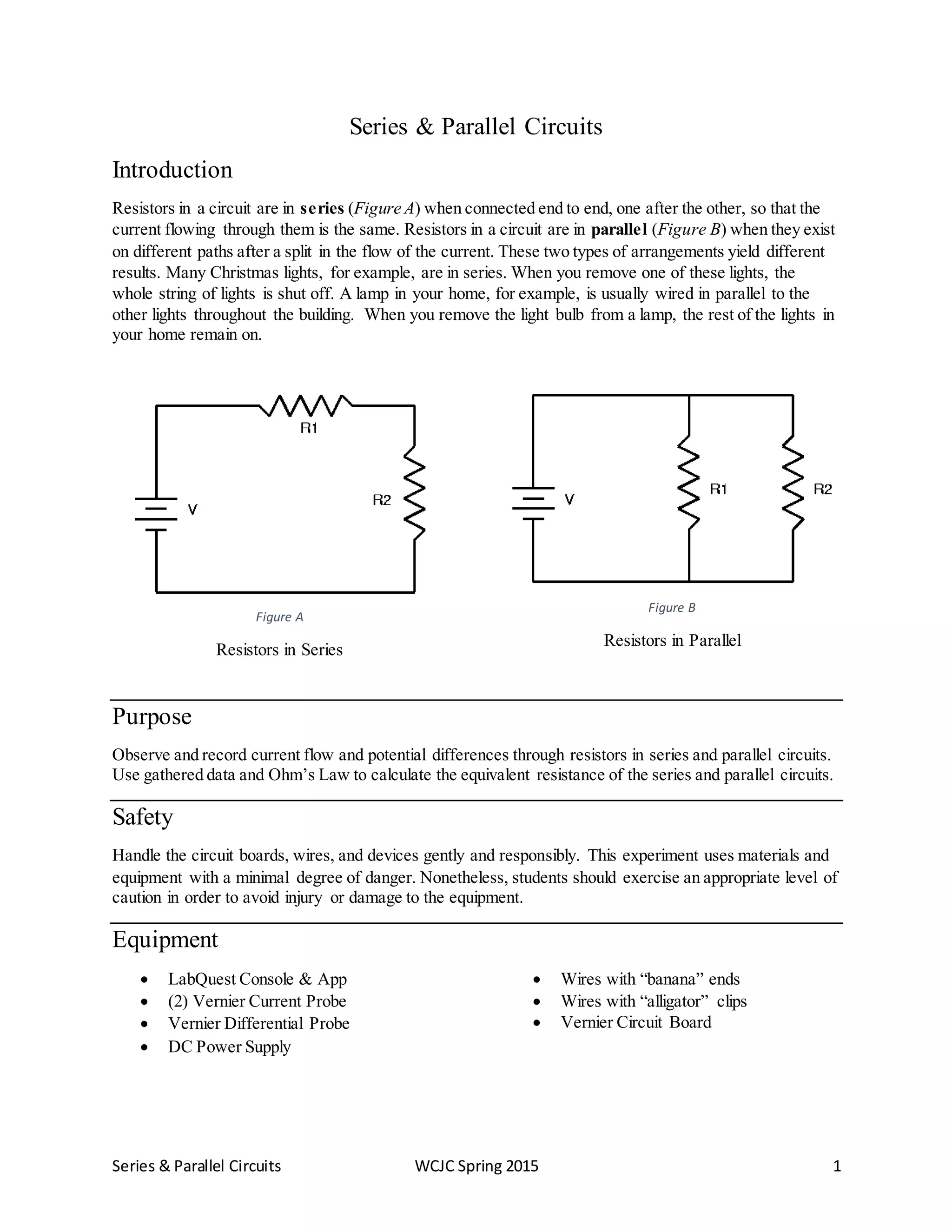
Resistors in a circuit are in series (Figure A) when connected end to end, one after the other, so that the
current flowing through them is the same. Resistors in a circuit are in parallel (Figure B) when they exist
on different paths after a split in the flow of the current. These two types of arrangements yield different
results. Many Christmas lights, for example, are in series. When you remove one of these lights, the
whole string of lights is shut off. A lamp in your home, for example, is usually wired in parallel to the
other lights throughout the building. When you remove the light bulb from a lamp, the rest of the lights in
your home remain on.
Figure A
Resistors in Series
Figure B
Resistors in Parallel
Purpose
Observe and record current flow and potential differences through resistors in series and parallel circuits.
Use gathered data and Ohm’s Law to calculate the equivalent resistance of the series and parallel circuits.
Safety
Handle the circuit boards, wires, and devices gently and responsibly. This experiment uses materials and
equipment with a minimal degree of danger. Nonetheless, students should exercise an appropriate level of
caution in order to avoid injury or damage to the equipment.
Equipment
 LabQuest Console & App
 (2) Vernier Current Probe
 Vernier Differential Probe
 DC Power Supply
 Wires with “banana” ends
 Wires with “alligator” clips
 Vernier Circuit Board
Series & Parallel Circuits WCJC Spring 2015 2
Procedure
Series vs. Parallel
1. Connect three light bulbs in series on the Vernier Circuit board and wire the circuit to the power
supply. DO NOT use any of the belowdiagrams to do this.Simply connect three light bulbs in a
series circuit.
2. Turn on the power supply and turn the voltage up enough to light up the bulbs. Turn the voltage
down until the bulbs are almost out. Does each bulb remain at the same brightness as the next?
3. Remove any one bulb from the circuits board and observe what happens to the others.
4. Repeat steps #1-3 for bulbs in a parallel circuit and compare these results to those for the series
circuit.
Set-up
1. Connect one Current Probe and the Differential Voltage probe to channels 1 and 2 on the
LabQuest console and select File and New in LabQuest.
2. Zero both probes by connecting together the two leads of the Differential Voltage Probe and
selecting Sensors – Zero – All Sensors in LabQuest.
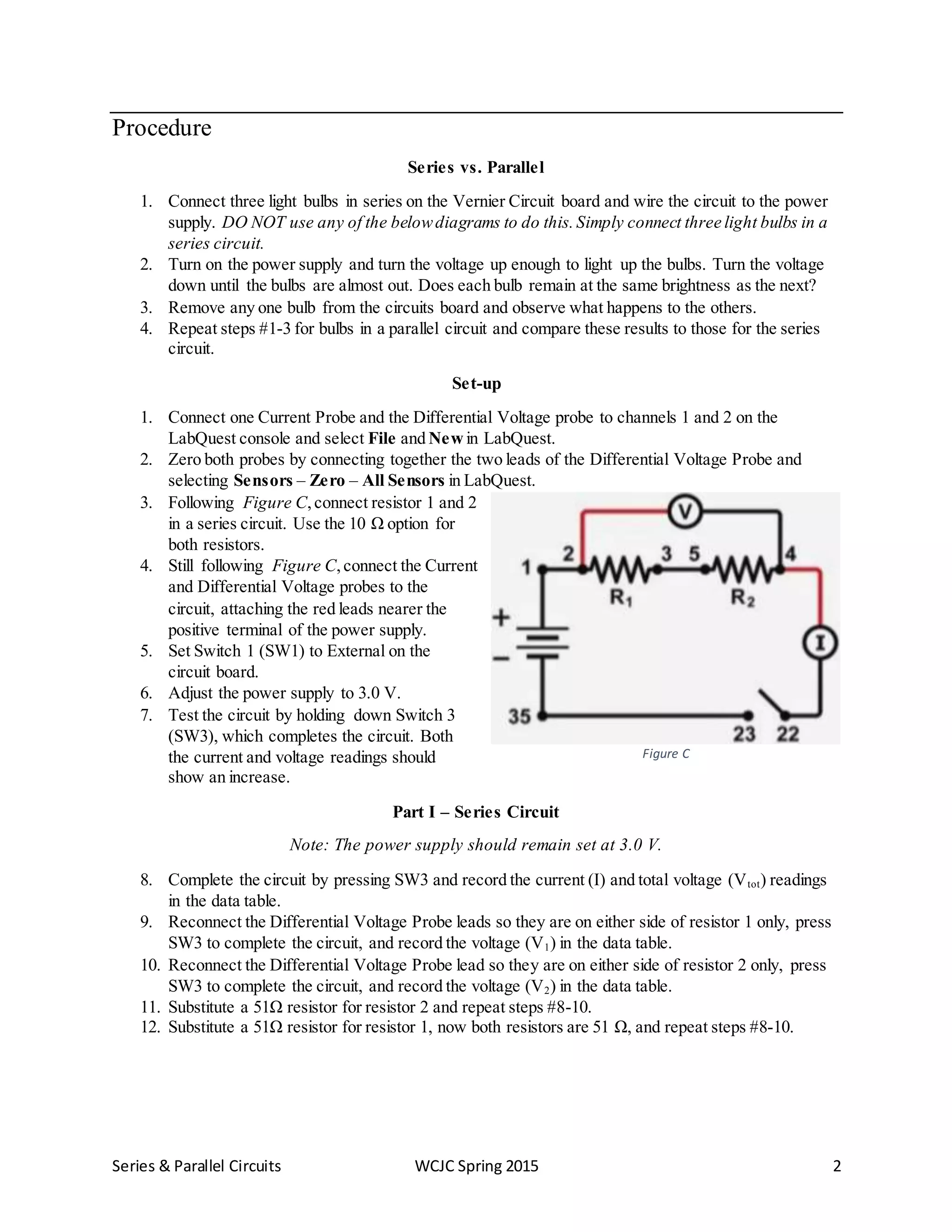
3. Following Figure C,connect resistor 1 and 2
in a series circuit. Use the 10 Ω option for
both resistors.
4. Still following Figure C,connect the Current
and Differential Voltage probes to the
circuit, attaching the red leads nearer the
positive terminal of the power supply.
5. Set Switch 1 (SW1) to External on the
circuit board.
6. Adjust the power supply to 3.0 V.
7. Test the circuit by holding down Switch 3
(SW3), which completes the circuit. Both
the current and voltage readings should
show an increase.
Part I – Series Circuit
Note: The power supply should remain set at 3.0 V.
8. Complete the circuit by pressing SW3 and record the current (I) and total voltage (Vtot) readings
in the data table.
9. Reconnect the Differential Voltage Probe leads so they are on either side of resistor 1 only, press
SW3 to complete the circuit, and record the voltage (V1) in the data table.
10. Reconnect the Differential Voltage Probe lead so they are on either side of resistor 2 only, press
SW3 to complete the circuit, and record the voltage (V2) in the data table.
11. Substitute a 51Ω resistor for resistor 2 and repeat steps #8-10.
12. Substitute a 51Ω resistor for resistor 1, now both resistors are 51 Ω, and repeat steps #8-10.
Figure C
Series & Parallel Circuits WCJC Spring 2015 3
Part II – Parallel Circuit
Note: The power supply should remain set at 3.0 V.
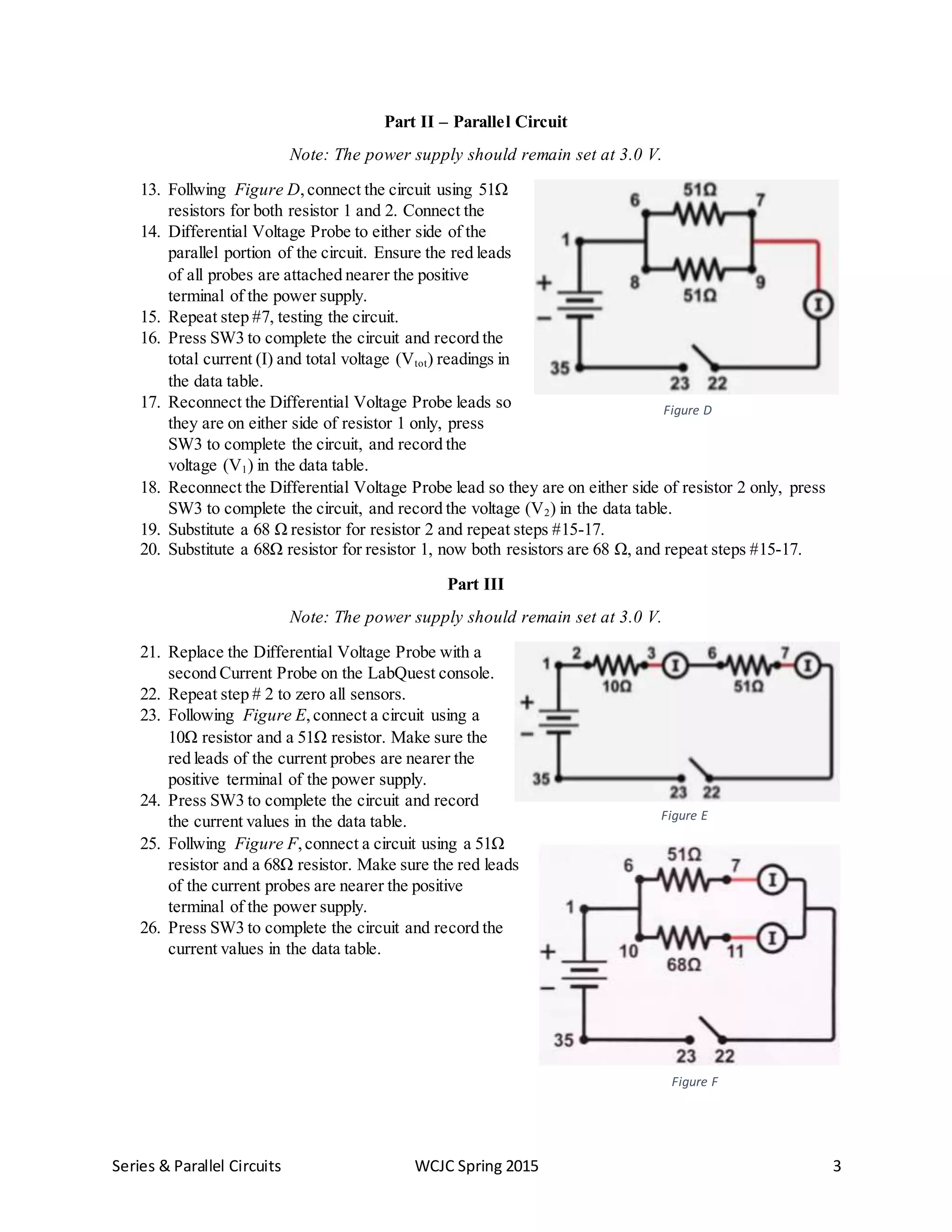
13. Follwing Figure D,connect the circuit using 51Ω
resistors for both resistor 1 and 2. Connect the
14. Differential Voltage Probe to either side of the
parallel portion of the circuit. Ensure the red leads
of all probes are attached nearer the positive
terminal of the power supply.
15. Repeat step #7, testing the circuit.
16. Press SW3 to complete the circuit and record the
total current (I) and total voltage (Vtot) readings in
the data table.
17. Reconnect the Differential Voltage Probe leads so
they are on either side of resistor 1 only, press
SW3 to complete the circuit, and record the
voltage (V1) in the data table.
18. Reconnect the Differential Voltage Probe lead so they are on either side of resistor 2 only, press
SW3 to complete the circuit, and record the voltage (V2) in the data table.
19. Substitute a 68 Ω resistor for resistor 2 and repeat steps #15-17.
20. Substitute a 68Ω resistor for resistor 1, now both resistors are 68 Ω, and repeat steps #15-17.
Part III
Note: The power supply should remain set at 3.0 V.
21. Replace the Differential Voltage Probe with a
second Current Probe on the LabQuest console.
22. Repeat step # 2 to zero all sensors.
23. Following Figure E,connect a circuit using a
10Ω resistor and a 51Ω resistor. Make sure the
red leads of the current probes are nearer the
positive terminal of the power supply.
24. Press SW3 to complete the circuit and record
the current values in the data table.
25. Follwing Figure F,connect a circuit using a 51Ω
resistor and a 68Ω resistor. Make sure the red leads
of the current probes are nearer the positive
terminal of the power supply.
26. Press SW3 to complete the circuit and record the
current values in the data table.
Figure E
Figure F
Figure D
Series & Parallel Circuits WCJC Spring 2015 4
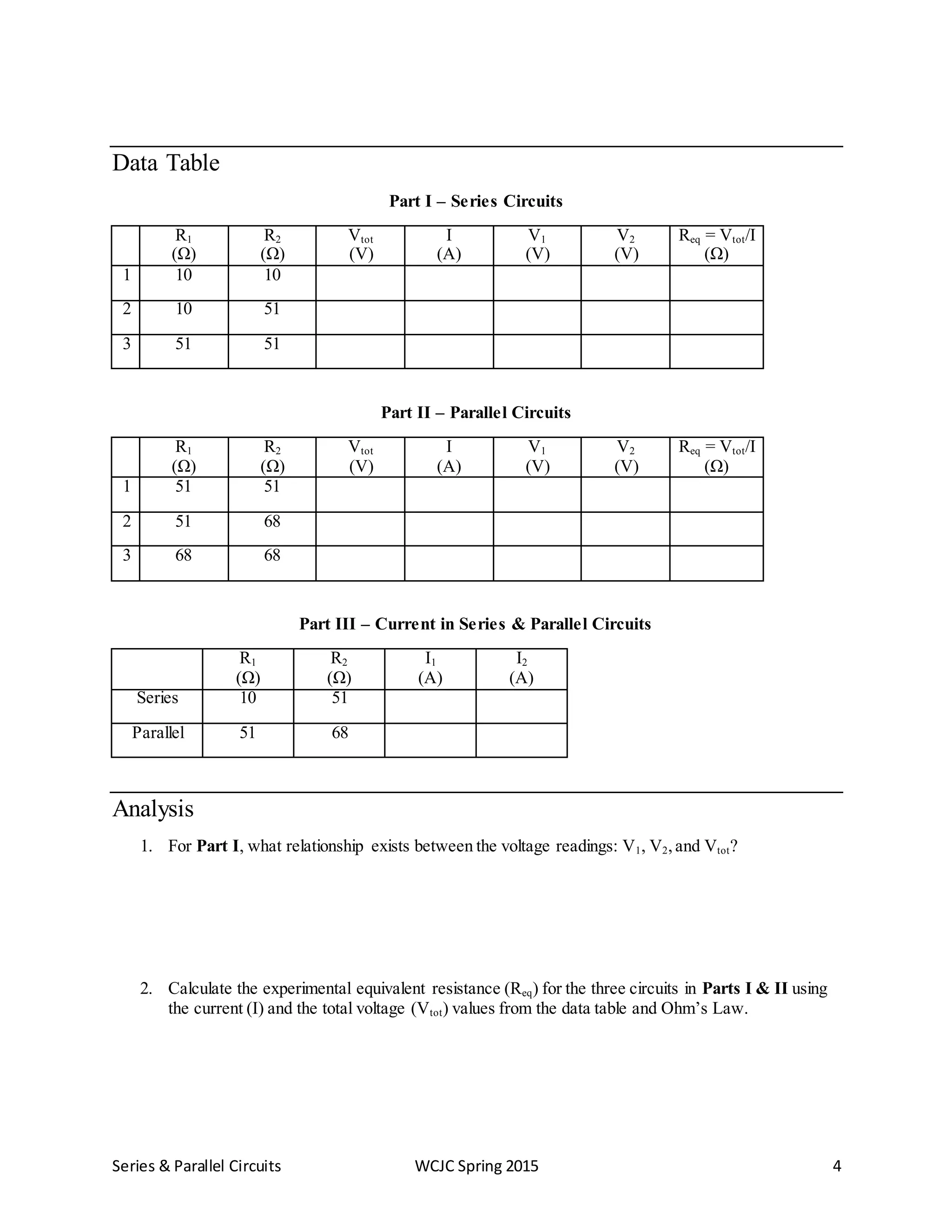
Data Table
Part I – Series Circuits
R1
(Ω)
R2
(Ω)
Vtot
(V)
I
(A)
V1
(V)
V2
(V)
Req = Vtot/I
(Ω)
1 10 10
2 10 51
3 51 51
Part II – Parallel Circuits
R1
(Ω)
R2
(Ω)
Vtot
(V)
I
(A)
V1
(V)
V2
(V)
Req = Vtot/I
(Ω)
1 51 51
2 51 68
3 68 68
Part III – Current in Series & Parallel Circuits
R1
(Ω)
R2
(Ω)
I1
(A)
I2
(A)
Series 10 51
Parallel 51 68
Analysis
1. For Part I, what relationship exists between the voltage readings: V1, V2,and Vtot?
2. Calculate the experimental equivalent resistance (Req) for the three circuits in Parts I & II using
the current (I) and the total voltage (Vtot) values from the data table and Ohm’s Law.
Series & Parallel Circuits WCJC Spring 2015 5
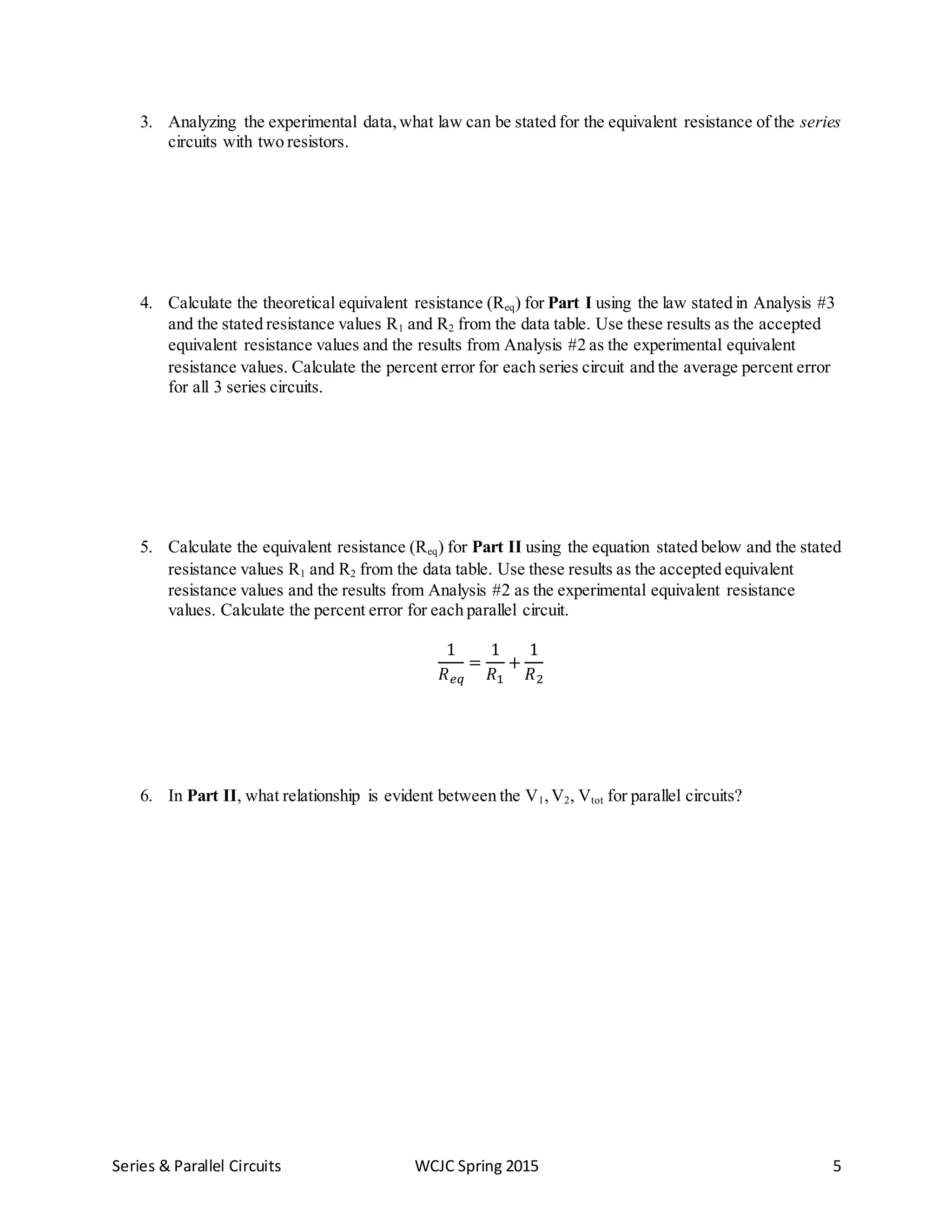
3. Analyzing the experimental data,what law can be stated for the equivalent resistance of the series
circuits with two resistors.
4. Calculate the theoretical equivalent resistance (Req) for Part I using the law stated in Analysis #3
and the stated resistance values R1 and R2 from the data table. Use these results as the accepted
equivalent resistance values and the results from Analysis #2 as the experimental equivalent
resistance values. Calculate the percent error for each series circuit and the average percent error
for all 3 series circuits.
5. Calculate the equivalent resistance (Req) for Part II using the equation stated below and the stated
resistance values R1 and R2 from the data table. Use these results as the accepted equivalent
resistance values and the results from Analysis #2 as the experimental equivalent resistance
values. Calculate the percent error for each parallel circuit.
1
𝑅 𝑒𝑞
=
1
𝑅1
+
1
𝑅2
6. In Part II, what relationship is evident between the V1,V2, Vtot for parallel circuits?

2426Lab7Series&ParallelCircuits

  • 1.
    Series & ParallelCircuits WCJC Spring 2015 1 Series & Parallel Circuits Introduction Resistors in a circuit are in series (Figure A) when connected end to end, one after the other, so that the current flowing through them is the same. Resistors in a circuit are in parallel (Figure B) when they exist on different paths after a split in the flow of the current. These two types of arrangements yield different results. Many Christmas lights, for example, are in series. When you remove one of these lights, the whole string of lights is shut off. A lamp in your home, for example, is usually wired in parallel to the other lights throughout the building. When you remove the light bulb from a lamp, the rest of the lights in your home remain on. Figure A Resistors in Series Figure B Resistors in Parallel Purpose Observe and record current flow and potential differences through resistors in series and parallel circuits. Use gathered data and Ohm’s Law to calculate the equivalent resistance of the series and parallel circuits. Safety Handle the circuit boards, wires, and devices gently and responsibly. This experiment uses materials and equipment with a minimal degree of danger. Nonetheless, students should exercise an appropriate level of caution in order to avoid injury or damage to the equipment. Equipment  LabQuest Console & App  (2) Vernier Current Probe  Vernier Differential Probe  DC Power Supply  Wires with “banana” ends  Wires with “alligator” clips  Vernier Circuit Board
  • 2.
    Series & ParallelCircuits WCJC Spring 2015 2 Procedure Series vs. Parallel 1. Connect three light bulbs in series on the Vernier Circuit board and wire the circuit to the power supply. DO NOT use any of the belowdiagrams to do this.Simply connect three light bulbs in a series circuit. 2. Turn on the power supply and turn the voltage up enough to light up the bulbs. Turn the voltage down until the bulbs are almost out. Does each bulb remain at the same brightness as the next? 3. Remove any one bulb from the circuits board and observe what happens to the others. 4. Repeat steps #1-3 for bulbs in a parallel circuit and compare these results to those for the series circuit. Set-up 1. Connect one Current Probe and the Differential Voltage probe to channels 1 and 2 on the LabQuest console and select File and New in LabQuest. 2. Zero both probes by connecting together the two leads of the Differential Voltage Probe and selecting Sensors – Zero – All Sensors in LabQuest. 3. Following Figure C,connect resistor 1 and 2 in a series circuit. Use the 10 Ω option for both resistors. 4. Still following Figure C,connect the Current and Differential Voltage probes to the circuit, attaching the red leads nearer the positive terminal of the power supply. 5. Set Switch 1 (SW1) to External on the circuit board. 6. Adjust the power supply to 3.0 V. 7. Test the circuit by holding down Switch 3 (SW3), which completes the circuit. Both the current and voltage readings should show an increase. Part I – Series Circuit Note: The power supply should remain set at 3.0 V. 8. Complete the circuit by pressing SW3 and record the current (I) and total voltage (Vtot) readings in the data table. 9. Reconnect the Differential Voltage Probe leads so they are on either side of resistor 1 only, press SW3 to complete the circuit, and record the voltage (V1) in the data table. 10. Reconnect the Differential Voltage Probe lead so they are on either side of resistor 2 only, press SW3 to complete the circuit, and record the voltage (V2) in the data table. 11. Substitute a 51Ω resistor for resistor 2 and repeat steps #8-10. 12. Substitute a 51Ω resistor for resistor 1, now both resistors are 51 Ω, and repeat steps #8-10. Figure C
  • 3.
    Series & ParallelCircuits WCJC Spring 2015 3 Part II – Parallel Circuit Note: The power supply should remain set at 3.0 V. 13. Follwing Figure D,connect the circuit using 51Ω resistors for both resistor 1 and 2. Connect the 14. Differential Voltage Probe to either side of the parallel portion of the circuit. Ensure the red leads of all probes are attached nearer the positive terminal of the power supply. 15. Repeat step #7, testing the circuit. 16. Press SW3 to complete the circuit and record the total current (I) and total voltage (Vtot) readings in the data table. 17. Reconnect the Differential Voltage Probe leads so they are on either side of resistor 1 only, press SW3 to complete the circuit, and record the voltage (V1) in the data table. 18. Reconnect the Differential Voltage Probe lead so they are on either side of resistor 2 only, press SW3 to complete the circuit, and record the voltage (V2) in the data table. 19. Substitute a 68 Ω resistor for resistor 2 and repeat steps #15-17. 20. Substitute a 68Ω resistor for resistor 1, now both resistors are 68 Ω, and repeat steps #15-17. Part III Note: The power supply should remain set at 3.0 V. 21. Replace the Differential Voltage Probe with a second Current Probe on the LabQuest console. 22. Repeat step # 2 to zero all sensors. 23. Following Figure E,connect a circuit using a 10Ω resistor and a 51Ω resistor. Make sure the red leads of the current probes are nearer the positive terminal of the power supply. 24. Press SW3 to complete the circuit and record the current values in the data table. 25. Follwing Figure F,connect a circuit using a 51Ω resistor and a 68Ω resistor. Make sure the red leads of the current probes are nearer the positive terminal of the power supply. 26. Press SW3 to complete the circuit and record the current values in the data table. Figure E Figure F Figure D
  • 4.
    Series & ParallelCircuits WCJC Spring 2015 4 Data Table Part I – Series Circuits R1 (Ω) R2 (Ω) Vtot (V) I (A) V1 (V) V2 (V) Req = Vtot/I (Ω) 1 10 10 2 10 51 3 51 51 Part II – Parallel Circuits R1 (Ω) R2 (Ω) Vtot (V) I (A) V1 (V) V2 (V) Req = Vtot/I (Ω) 1 51 51 2 51 68 3 68 68 Part III – Current in Series & Parallel Circuits R1 (Ω) R2 (Ω) I1 (A) I2 (A) Series 10 51 Parallel 51 68 Analysis 1. For Part I, what relationship exists between the voltage readings: V1, V2,and Vtot? 2. Calculate the experimental equivalent resistance (Req) for the three circuits in Parts I & II using the current (I) and the total voltage (Vtot) values from the data table and Ohm’s Law.
  • 5.
    Series & ParallelCircuits WCJC Spring 2015 5 3. Analyzing the experimental data,what law can be stated for the equivalent resistance of the series circuits with two resistors. 4. Calculate the theoretical equivalent resistance (Req) for Part I using the law stated in Analysis #3 and the stated resistance values R1 and R2 from the data table. Use these results as the accepted equivalent resistance values and the results from Analysis #2 as the experimental equivalent resistance values. Calculate the percent error for each series circuit and the average percent error for all 3 series circuits. 5. Calculate the equivalent resistance (Req) for Part II using the equation stated below and the stated resistance values R1 and R2 from the data table. Use these results as the accepted equivalent resistance values and the results from Analysis #2 as the experimental equivalent resistance values. Calculate the percent error for each parallel circuit. 1 𝑅 𝑒𝑞 = 1 𝑅1 + 1 𝑅2 6. In Part II, what relationship is evident between the V1,V2, Vtot for parallel circuits?