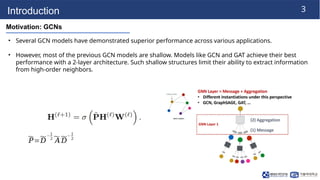
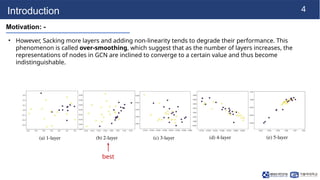
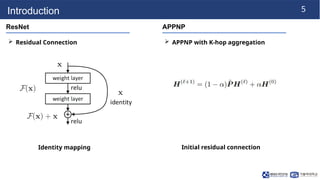
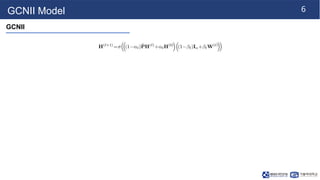
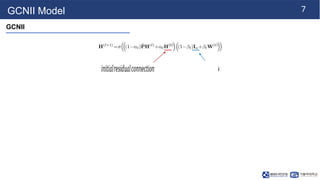
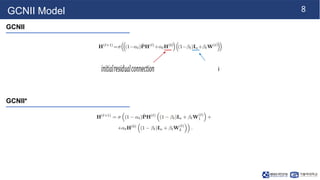
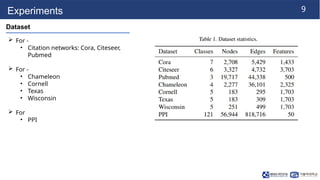
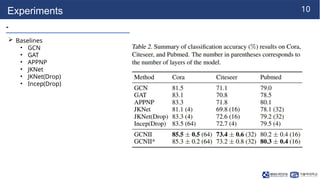
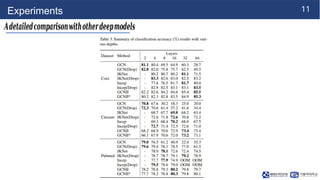
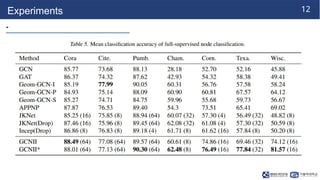
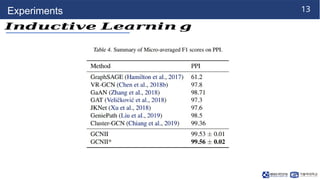
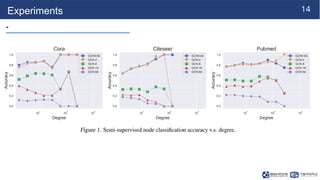
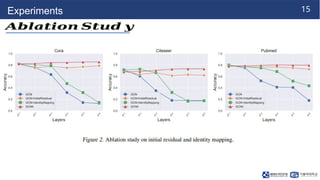
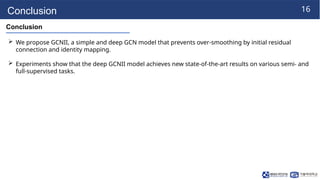
The document presents the GCNiI model, a new approach to graph convolutional networks (GCNs) designed to avoid over-smoothing through initial residual connections and identity mapping. Experimental results indicate that this deep GCN model achieves state-of-the-art performance on various semi- and full-supervised tasks, outperforming previous shallow models. Key experiments were conducted using multiple datasets, including citation networks and others.


![Review: [CIKM'21]UltraGCN.pptx](https://cdn.slidesharecdn.com/ss_thumbnails/cikm21ultragcn-220925132735-e808a200-thumbnail.jpg?width=640&height=640&fit=bounds)


![[PaperReview] LightGCN: Simplifying and Powering Graph Convolution Network fo...](https://cdn.slidesharecdn.com/ss_thumbnails/lightgcn-211217151725-thumbnail.jpg?width=640&height=640&fit=bounds)


![[NS][Lab_Seminar_250728]On the Trade-off between Over-smoothing and Over-squa...](https://cdn.slidesharecdn.com/ss_thumbnails/nslabseminar250728trade-off-250804130848-96f4b9c8-thumbnail.jpg?width=640&height=640&fit=bounds)


![[NS][Lab_Seminar_260126]MIHC: Multi-View Interpretable Hypergraph Neural Netw...](https://cdn.slidesharecdn.com/ss_thumbnails/nslabseminar260126-260126110047-559006b2-thumbnail.jpg?width=640&height=640&fit=bounds)
![260119_SH_LabSeminar[ENGRAM]_최종2_최종3_4.pdf](https://cdn.slidesharecdn.com/ss_thumbnails/260119shlabseminarengram234-260120052642-29f38c8f-thumbnail.jpg?width=640&height=640&fit=bounds)


![[NS][Lab_Seminar_260119][DHGFormer: Dynamic Hierarchical Graph Transformer fo...](https://cdn.slidesharecdn.com/ss_thumbnails/nslabseminar260119-260120052625-9b28e6ed-thumbnail.jpg?width=640&height=640&fit=bounds)


![260105_JH_LabSeminar[A Plant-Wide Industrial Process Control Problem].pptx](https://cdn.slidesharecdn.com/ss_thumbnails/260105jhlabseminartep-260106063928-34e9f1f6-thumbnail.jpg?width=640&height=640&fit=bounds)


