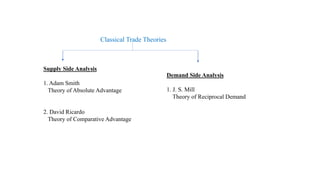
Classical Trade Theories
Supply Side Analysis
1. Adam Smith
Theory of Absolute Advantage
2. David Ricardo
Theory of Comparative Advantage
Demand Side Analysis
1. J. S. Mill
Theory of Reciprocal Demand
Theory of Absolute Advantage
Adam Smith
Free Trade
Division of labour enhanced in International Market
Total Output Maximised
Win-Win situation enhances international Welfare
Specialization:
• Specialisation among countries based on Absolute Advantage Principle.
• It is of the Nature of natural Advantage.
Specialization
Partial Specialisation
Majority of production of product having
natural Benefits but production of other
products is also done
Complete Specialisation
No production of other products than having
Natural Benefits
Assumptions:
1. 2 X 2 X 1 Model
2. Factors of production are Fully Employed.
3. Constant returns to Scale in production.
4. No Transportation Cost.
5. All Labour Units Are Homogenous.
6. Free Trade: No barrier as tariff or Quota exist.
7. Labour is the only Factor of production.
 Production of One unit of Labour
Hence, Absolute advantage for:
Nation A – Food
Nation B- Cloth
Nation A Nation B total
Food 20 unit 10 Unit
= 30 unit
Cloth 6 Unit 8 Unit
=14 unit
 Production of One unit of Labour
Nation A Nation B total
Food 20 unit 10 Unit
=40 unit(new)
Cloth 6 Unit 8 Unit
= 16 unit (New)
Major Drawback:
If one country is advanced and another is backward , than this situation can not be
explained with this theory.

2350_absolute advantage theory.pptx

  • 1.
    Classical Trade Theories SupplySide Analysis 1. Adam Smith Theory of Absolute Advantage 2. David Ricardo Theory of Comparative Advantage Demand Side Analysis 1. J. S. Mill Theory of Reciprocal Demand
  • 2.
    Theory of AbsoluteAdvantage Adam Smith
  • 3.
    Free Trade Division oflabour enhanced in International Market Total Output Maximised Win-Win situation enhances international Welfare
  • 4.
    Specialization: • Specialisation amongcountries based on Absolute Advantage Principle. • It is of the Nature of natural Advantage. Specialization Partial Specialisation Majority of production of product having natural Benefits but production of other products is also done Complete Specialisation No production of other products than having Natural Benefits
  • 5.
    Assumptions: 1. 2 X2 X 1 Model 2. Factors of production are Fully Employed. 3. Constant returns to Scale in production. 4. No Transportation Cost. 5. All Labour Units Are Homogenous. 6. Free Trade: No barrier as tariff or Quota exist. 7. Labour is the only Factor of production.
  • 6.
     Production ofOne unit of Labour Hence, Absolute advantage for: Nation A – Food Nation B- Cloth Nation A Nation B total Food 20 unit 10 Unit = 30 unit Cloth 6 Unit 8 Unit =14 unit
  • 7.
     Production ofOne unit of Labour Nation A Nation B total Food 20 unit 10 Unit =40 unit(new) Cloth 6 Unit 8 Unit = 16 unit (New)
  • 8.
    Major Drawback: If onecountry is advanced and another is backward , than this situation can not be explained with this theory.