The Renminbi
-Dollar Issue
Jeffrey Frankel
Harpel Professor
Spring Exercise, April 23, 2010
2
Topics to be covered
(I) Historical timeline of exchange rate diplomacy
(II) What is in China’s interest?
(III) What is in the US & RoW interest?
(IV) Shifting power relationships
• Addendum: The current account imbalances
3
Historical
timeline
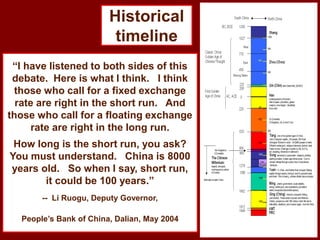
“I have listened to both sides of this
debate. Here is what I think. I think
those who call for a fixed exchange
rate are right in the short run. And
those who call for a floating exchange
rate are right in the long run.
How long is the short run, you ask?
You must understand. China is 8000
years old. So when I say, short run,
it could be 100 years.”
-- Li Ruogu, Deputy Governor,
People’s Bank of China, Dalian, May 2004
4
Historical timeline of currency diplomacy
• 1973: End of Bretton Woods era.
– Major currencies switch from fixed to floating. The rest keep their pegs.
• 1977: IMF members agree that each shall “avoid manipulating
exchange rates … in order to prevent effective balance of payments
adjustment or to gain an unfair competitive advantage over other members.”
[Principle (A) of the “1977 Decision on Surveillance over Exchange Rate Policies,” and Sect.1, Clause 3, of Article IV amended in 1978.]
– In practice, the IMF almost never pressures countries to revalue their currencies upward;
• It just pressures deficit countries to devalue.
• 1983-84: ¥/$ Agreement. 1985: Plaza Accord.
– Japan, US & others cooperate to bring down overvalued $, esp. vs. ¥
• 1987-89:
– Louvre Agreement: $ depreciation halted.
– Big bubbles in Japan’s equity & real estate markets,
– followed by crash, & severe Japanese stagnation in 1990s.
5
Timeline, continued
• 1988: The Omnibus Trade
& Competitiveness Act
mandates the US Treasury report to
Congress biannually on whether trading
partners were manipulating currencies.
– Section 3004 requires the Treasury to “consider whether countries
manipulate the rate of exchange between their currency and the United
States dollar for purposes of preventing effective balance of payments
adjustments or gaining unfair competitive advantage in international
trade.''
– The US must hold talks with governments deemed to be breaking rules.
– In the first Reports to Congress on International
Economics & Exchange Rate Policy, Korea &
Taiwan PoC were found to be guilty of manipulation,
• while Singapore & Hong Kong SAR “got off with a warning.”
• China was named in early 1990s.
6
Analysis of the Treasury
Department’s biannual
Report to Congress on
International Economics and
Exchange Rate Policy
-- Frankel & Wei (2007)
7
Two hypotheses regarding determinants of
US Treasury decisions whether partners
are manipulating currencies:
• (1) Legitimate economic variables
– the partner’s overall current account/GDP,
– its reserve changes,
– the real overvaluation of its currency; vs.
• (2) Variables suggestive of domestic
American political expediency
– the bilateral trade balance,
– US unemployment,
– an election year dummy .
8
Two hypotheses regarding determinants of
US Treasury decisions whether partners
are manipulating currencies:
• (1) Legitimate economic variables
– the partner’s overall current account/GDP,
– its reserve changes,
– the real overvaluation of its currency; vs.
• (2) Variables suggestive of domestic
American political expediency
– the bilateral trade balance,
– US unemployment,
– an election year dummy .
9
Timeline, continued
–Those countries named as manipulators, or
given warnings, have always been Asian.
–What political economy determines
Treasury findings?
• Econometric analysis:
• Domestic political variables are as important as global
manipulation criteria:
10
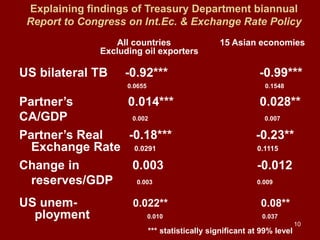
Explaining findings of Treasury Department biannual
Report to Congress on Int.Ec. & Exchange Rate Policy
All countries 15 Asian economies
Excluding oil exporters
US bilateral TB -0.92*** -0.99***
0.0655 0.1548
Partner’s 0.014*** 0.028**
CA/GDP 0.002 0.007
Partner’s Real -0.18*** -0.23**
Exchange Rate 0.0291 0.1115
Change in 0.003 -0.012
reserves/GDP 0.003 0.009
US unem- 0.022** 0.08**
ployment 0.010 0.037
*** statistically significant at 99% level
11
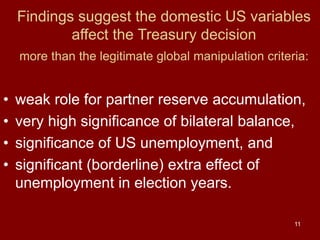
Findings suggest the domestic US variables
affect the Treasury decision
more than the legitimate global manipulation criteria:
• weak role for partner reserve accumulation,
• very high significance of bilateral balance,
• significance of US unemployment, and
• significant (borderline) extra effect of
unemployment in election years.
12
Implication
If the IMF were interpreting Article IV, rather
than the Treasury interpreting the 1988 US law,
– the criterion of consistent uni-directional forex
intervention would receive more emphasis,
– and US-specific variables such as the bilateral
trade balance would not appear at all.
13
Some sympathy for the Treasury
• It walks a fine line.
• An additional finding:
Treasury is eager not to single out one
country for unique opprobrium.
– No single country is left exposed on its own.
• the top-ranked country is less likely to be named than
if it had some other country to hide behind, while
• the 2nd- & 3rd-ranked countries are more likely to be
moved up, to give the leader company.
14
Timeline, continued:
Exchange rate
• Jan. 1994: China devalues its official rate,
– unifying its dual exchange rate system.
• 1997-98: East Asia crisis.
– China wins plaudits for keeping RMB (“yuan”’) fixed
• while all its neighbors are devaluing.
• 1995-2005: China continues to peg
– for 10 years
– at 8.28 RMB/$.
15
Timeline, continued:
US pressure
• Oct. 2003: Treasury Secretary Snow begins to
“browbeat” China to allow appreciation.
– Report: RMB merits concern & talks
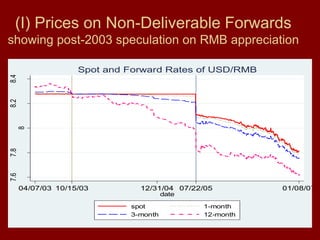
– Speculators in financial markets start to bet appreciation.
– as reflected in either capital flows (residual; see Prasad & Wei)
– or non-deliverable forwards (see appendix graph).
• Feb. 2005: Senators Schumer & Graham propose
first of bills to impose (WTO-illegal) tariffs of 27.5 %
against all Chinese goods if China does not
substantially revalue its currency.
– Subsequent versions, by Baucus-Grassley and others
substitute the phrase “currency misalignment” in place of
“unfair manipulation” to ease standard of proof.
16
• 2004- : Rapid growth puts China into Excess Demand condition.
• 2005-06: Despite large balance of payments surpluses, PBoC
sterilization of reserve inflows prevents excessive money growth & inflation.
• 2007-08: Sterilization finally falters: Money growth becomes excessive.
– Inflation becomes a serious concern.
– Shanghai stock market experiences a bubble.
• Mid-2008 – early 2009: Worst of the global recession hits.
– China loses 26% of exports
– Growth rate slows down; danger of overheating disappears.
• Mid-2009 – mid-2010: China resumes blistering growth
– In response to domestic demand stimulus + renewed exports
– China is now a major engine of growth in world economy.
– Danger of overheating returns: esp. asset market bubbles.
Timeline, continued:
China’s macroeconomy
17
Timeline, continued:
Exchange rate
• July 2005: China announces a new policy,
– Immediate 2.1% revaluation,
– Followed by “managed float”: controlled appreciation,
supposedly against an unspecified basket of currencies.
– But, as often, de jure exchange rate regime ≠ de facto.
• Econometric estimation of true regime reveals:
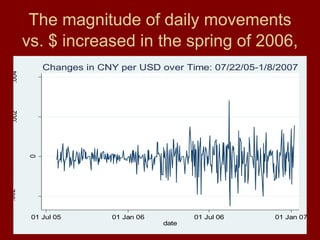
– $ link did not even begin to loosen until 2006.
– By 2007, implicit basket had shifted some weight
onto other currencies, especially the €.
– RMB appreciates against the $ from 2006 to 2008,
• But only because € does.
18
The magnitude of daily movements
vs. $ increased in the spring of 2006,
-.002
0
.002
.004
01 Jul 05 01 Jan 06 01 Jul 06 01 Jan 07
date
Changes in CNY per USD over Time: 07/22/05-1/8/2007
19
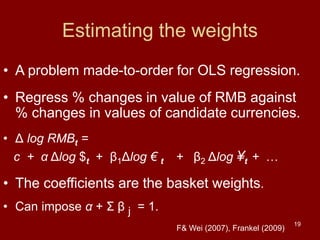
Estimating the weights
• A problem made-to-order for OLS regression.
• Regress % changes in value of RMB against
% changes in values of candidate currencies.
• Δ log RMBt =
c + α Δlog $t + β1Δlog € t + β2 Δlog ¥t + …
• The coefficients are the basket weights.
• Can impose α + Σ β j = 1.
F& Wei (2007), Frankel (2009)
20
Has US pressure pushed the pace
of increased flexibility?
• We searched an electronic database of news
reports (FACTIVA/NewsPlus) , recording the number of
US news reports of US officials asking China to
speed up RMB flexibility/revaluation.
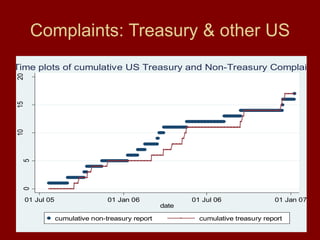
• Two separate time series on the cumulative
numbers of complaints
– from US Treasury and
– from officials of other government agencies (e.g. the
White House, Congress and Fed)
21
Complaints: Treasury & other US
0
5
10
15
20
01 Jul 05 01 Jan 06 01 Jul 06 01 Jan 07
date
cumulative non-treasury report cumulative treasury report
Time plots of cumulative US Treasury and Non-Treasury Complaints
22
We added # complaints as a regressor
(Table 19)
• No evidence that U.S. official complaints
are associated with RMB appreciation
relative to the currency basket.
• There is evidence that cumulative
complaints are associated with a reduction
in the RMB’s weight on the US dollar.
23
Timeline, continued:
Exchange rate
• May 2008: Chinese leaders hear exporter
complaints of competitiveness difficulties.
• Mid-2008-April 2010:
yuan repegs ≈ $ 6.84 RMB/$
• ≈ 20% stronger, vs. $, than 2005.
24
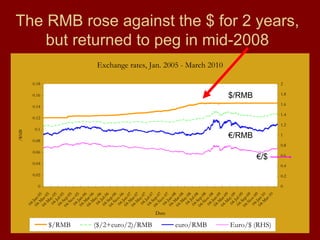
The RMB rose against the $ for 2 years,
but returned to peg in mid-2008
Exchange rates, Jan. 2005 - March 2010
0
0.02
0.04
0.06
0.08
0.1
0.12
0.14
0.16
0.18
0
4
-
J
a
n
-
0
5
0
4
-
M
a
r
-
0
5
0
4
-
M
a
y
-
0
5
0
4
-
J
u
l
-
0
5
0
4
-
S
e
p
-
0
5
0
4
-
N
o
v
-
0
5
0
4
-
J
a
n
-
0
6
0
4
-
M
a
r
-
0
6
0
4
-
M
a
y
-
0
6
0
4
-
J
u
l
-
0
6
0
4
-
S
e
p
-
0
6
0
4
-
N
o
v
-
0
6
0
4
-
J
a
n
-
0
7
0
4
-
M
a
r
-
0
7
0
4
-
M
a
y
-
0
7
0
4
-
J
u
l
-
0
7
0
4
-
S
e
p
-
0
7
0
4
-
N
o
v
-
0
7
0
4
-
J
a
n
-
0
8
0
4
-
M
a
r
-
0
8
0
4
-
M
a
y
-
0
8
0
4
-
J
u
l
-
0
8
0
4
-
S
e
p
-
0
8
0
4
-
N
o
v
-
0
8
0
4
-
J
a
n
-
0
9
0
4
-
M
a
r
-
0
9
0
4
-
M
a
y
-
0
9
0
4
-
J
u
l
-
0
9
0
4
-
S
e
p
-
0
9
0
4
-
N
o
v
-
0
9
0
4
-
J
a
n
-
1
0
0
4
-
M
a
r
-
1
0
Date
/RMB
0
0.2
0.4
0.6
0.8
1
1.2
1.4
1.6
1.8
2
$/RMB ($/2+euro/2)/RMB euro/RMB Euro/$ (RHS)
$/RMB
€/RMB
€/$
25
• Oct. 2006 -- IMF Article IV consultation
finds RMB “undervalued.”
• 2007: US Treasury temporarily passes
hot potato of exchange rate complaints to IMF,
– which gets mandate for exchange rate “surveillance.”
• 2008: Though financial crisis originates in US,
“flight to quality” temporarily raises demand for $.
• 2009: Chinese leaders, for the first time,
express concerns that their vast holdings
of US treasury bills may not be well-invested.
– Pres. Obama & Secy. Geithner seek to reassure.
Timeline, continued
26
2009: Chinese warnings
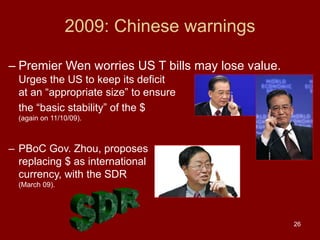
– Premier Wen worries US T bills may lose value.
Urges the US to keep its deficit
at an “appropriate size” to ensure
the “basic stability” of the $
(again on 11/10/09).
– PBoC Gov. Zhou, proposes
replacing $ as international
currency, with the SDR
(March 09).
27
Timeline, continued
2010
• Winter 2010: Pressure mounts --
– International pressure on Beijing to appreciate;
– Congressional pressure on US Treasury to find
China guilty of currency manipulation in its
biannual report due April 15.
– But Chinese say they will never bow to pressure.
• US-China relations deteriorate
– on other fronts as well.
28
April 1-9: Collision is averted at the last minute
-- or at least postponed
• April 1: China announces Hu Jintao trip to DC
– to attend April 12-13 summit.
• April 2: Beijing hints it may adjust pegging policy
– if visit goes smoothly.
• April 3: Treasury announces manipulation report postponed
– from mid-April deadline,
– probably until the summer:
• after Strategic & Economic Dialogue in May,
• & G-20 Summit meeting in June.
• Implication – The two governments must
have come to a face-saving understanding.
• April 9: Geithner makes surprise stop in Beijing.
29
• Countries should have the right to fix
their exchange rate if they want to.
• True, the IMF Articles of Agreement
and the US Omnibus Trade Act of 1988
call for action in the event that a country
is “unfairly manipulating its currency”.
• But
– Almost no countries have been forced to appreciate.
– Pressure on surplus countries to appreciate will inevitably
be less than pressure on deficit countries to depreciate.
– It is time to retire the language of “manipulation.”
• Usually, it is hard to say when a currency is undervalued.
• Don’t cheapen the language that is appropriate to WTO rules.
• China should do what is in its own long-term interest.
(II) From China’s viewpoint,
30
• My view: mutually-beneficial bargain, between equals
– E.g., China agrees that:
• its exchange rate is part of the problem,
• it will cooperate to lower the RMB/$ rate in a gradual manner,
• and of course it won’t dump US treasury bills.
– In exchange, US agrees that:
• its low national saving rate is part of the problem,
• it will cooperate to reduce the budget deficit,
• and of course it won’t close off the US market to Chinese goods.
• But perhaps a bargain isn’t even necessary;
– It is in China’s own interest to begin appreciating the RMB.
What is in China’s interest?
31
Five reasons China should let RMB
appreciate, in its own interest
1. Overheating of economy
2. Reserves are excessive.
– It gets harder to sterilize the inflow over time.
3. Attaining internal and external balance.
– To attain both, need 2 policy instruments.
– In a large country like China,
expenditure-switching policy should be the exchange rate.
4. Avoiding future crashes.
5. RMB undervalued, judged by
Balassa-Samuelson relationship.
32
1. Overheating of economy:
• Bottlenecks. Pace of economic growth is outrunning:
– raw material supplies, and
– labor supply in coastal provinces
• Asset bubbles.
– Shanghai stock market bubble in 2007.
• Inflation 6-7% in 2007
=> price controls
 shortages & social unrest.
• All of the above was suspended in late 2008,
– due to global recession.
– But it is back again now; skyrocketing real estate prices.
33
Attempts at “sterilization,” to insulate
domestic economy from the inflows
• Sterilization is defined as offsetting
of international reserve inflows,
so as to prevent them from showing up
domestically as excessive money growth & inflation.
• For awhile PBoC successfully sterilized…
– until 2007-08.
– The usual limitations finally showed up:
• Prolongation of capital inflows <= self-equilibrating mechanism shut off.
• Quasi-fiscal deficit: gap between domestic interest rates & US T bill rate
• Failure to sterilize: money supply rising faster than income
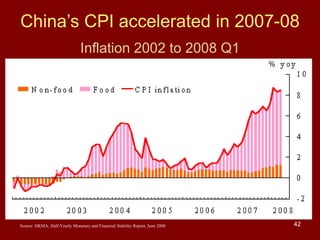
• Rising inflation (admittedly due not only to rising money supply)
34
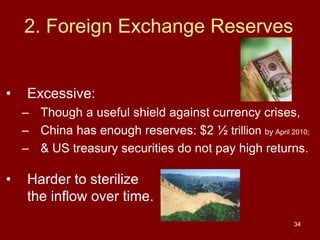
2. Foreign Exchange Reserves
• Excessive:
– Though a useful shield against currency crises,
– China has enough reserves: $2 ½ trillion by April 2010;
– & US treasury securities do not pay high returns.
• Harder to sterilize
the inflow over time.
35
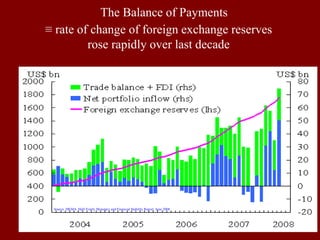
Source: HKMA, Half-Yearly Monetary and Financial Stability Report, June 2008
The Balance of Payments
≡ rate of change of foreign exchange reserves
rose rapidly over last decade
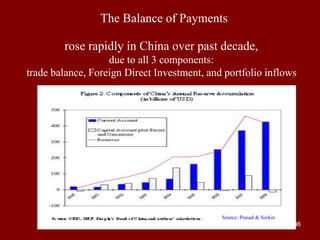
36
The Balance of Payments
rose rapidly in China over past decade,
due to all 3 components:
trade balance, Foreign Direct Investment, and portfolio inflows
Source: Prasad & Sorkin
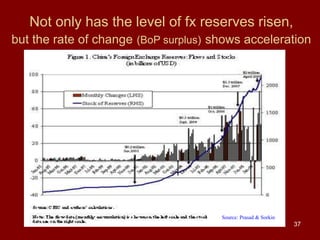
37
Not only has the level of fx reserves risen,
but the rate of change (BoP surplus) shows acceleration
Source: Prasad & Sorkin
38
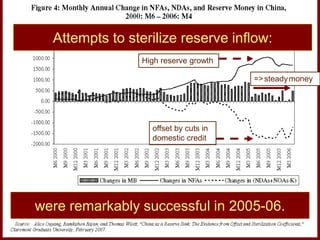
While reserves (NFA) rose rapidly, the growth of the monetary base
was kept to the growth of the real economy – even reduced in 2005-06.
Successful sterilization in China: 2005-06
Attempts to sterilize reserve inflow:
were remarkably successful in 2005-06.
High reserve growth
offset by cuts in
domestic credit
=>steadymoney
39
In 2007-08 China had more trouble
sterilizing the reserve inflow
• PBoC began to pay higher interest rate
domestically, & receive lower
interest rate on US T bills
=> quasi-fiscal deficit.
• Inflation became a serious problem.
– True, global increases in food & energy prices
were much of the explanation.
– But
• China’s overly rapid growth itself contributed.
• Appreciation is a good way to put immediate downward
pressure on local prices of farm & energy commodities.
• Price controls are inefficient and ultimately ineffective.
40
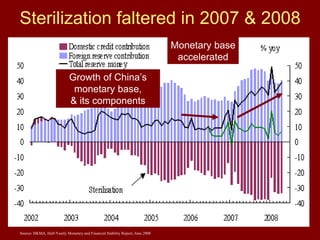
Sterilization faltered in 2007 & 2008
Source: HKMA, Half-Yearly Monetary and Financial Stability Report, June 2008
Monetary base
accelerated
Growth of China’s
monetary base,
& its components
41
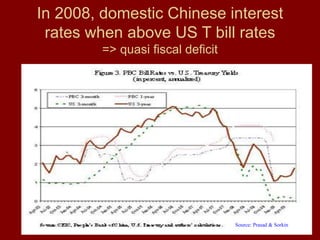
In 2008, domestic Chinese interest
rates when above US T bill rates
=> quasi fiscal deficit
Source: Prasad & Sorkin
42
China’s CPI accelerated in 2007-08
Inflation 2002 to 2008 Q1
Source: HKMA, Half-Yearly Monetary and Financial Stability Report, June 2008
43
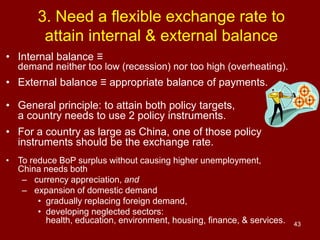
3. Need a flexible exchange rate to
attain internal & external balance
• Internal balance ≡
demand neither too low (recession) nor too high (overheating).
• External balance ≡ appropriate balance of payments.
• General principle: to attain both policy targets,
a country needs to use 2 policy instruments.
• For a country as large as China, one of those policy
instruments should be the exchange rate.
• To reduce BoP surplus without causing higher unemployment,
China needs both
– currency appreciation, and
– expansion of domestic demand
• gradually replacing foreign demand,
• developing neglected sectors:
health, education, environment, housing, finance, & services.
44
4. Avoiding future crashes
Experience of other emerging markets
suggests it is better to exit from a peg in
good times, when the BoP is strong, than
to wait until the currency is under attack.
Introducing some flexibility
now, even though not ready
for free floating.
45
5. Longer-run perspective:
Balassa-Samuelson relationship
• Prices of goods & services in China are low
– compared at the nominal exchange rate.
– Of course they are a fraction of those in the U.S.: < ¼ .
– This is to be expected,
explained by the Balassa-Samuelson effect
• which says that low-income countries have lower price levels.
• As countries’ real income grows, their currencies experience real
appreciation: approx. .3% for every 1 % in income per capita.
– But China is one of those countries that is cheap or
undervalued even taking into account Balassa-Samuelson.
46
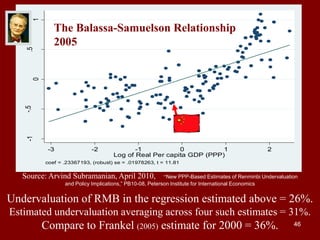
-1
-.5
0
.5
1
-3 -2 -1 0 1 2
Log of Real Per capita GDP (PPP)
coef = .23367193, (robust) se = .01978263, t = 11.81
Source: Arvind Subramanian, April 2010, “New PPP-Based Estimates of Renminbi Undervaluation
and Policy Implications,” PB10-08, Peterson Institute for International Economics
Undervaluation of RMB in the regression estimated above = 26%.
Estimated undervaluation averaging across four such estimates = 31%.
Compare to Frankel (2005) estimate for 2000 = 36%.
The Balassa-Samuelson Relationship
2005
47
Does the Balassa-Samuelson
relationship have predictive power?
 Typically across countries, gaps are corrected
halfway, on average, over subsequent decade.
 => 3-4 % real appreciation on average per year,
including effect of further growth differential
.
 Correction could take the form of either inflation or
nominal appreciation, but appreciation is preferable.
48
The conclusion – that it would be in China’s
interest to allow RMB to appreciate --
• has long been shared by top economic
officials in China, it is believed.
• But the decision is a political one:
• It is a matter of Hu and Wen !
49
49
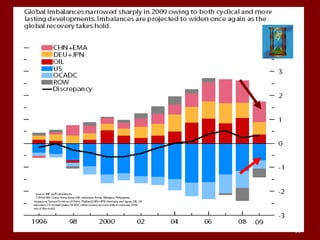
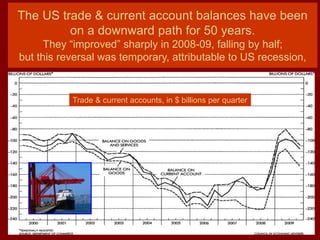
Solving the problem of current account imbalances,
• in particular, the US CA deficit & China’s surplus.
• Both have widened, on long-term trends.
• Imbalances narrowed sharply in 2009;
– the US deficit fell by almost ½ ;
– China’s CA surplus fell by almost ½.
• Its trade surplus actually dipped to 0 in March 2010.
• Problem solved?
• The imbalances will now resume widening.
(III) What is in the global interest?
50
50
51
The US trade & current account balances have been
on a downward path for 50 years.
They “improved” sharply in 2008-09, falling by half;
but this reversal was temporary, attributable to US recession,
Trade & current accounts, in $ billions per quarter
52
Dangers of the U.S. trade deficit
• Shorter-term dangers:
– Protectionist legislation
– A possible hard landing for the $.
• Long-term dangers:
– Dependence on foreign investors
– US net debt to RoW now ≈ $3 trillion,
• and rising.
• Will lower our children’s standard of living.
– When the US cuts its deficit,
that will mean the rest of
the world losing its surplus
• The longer adjustment is postponed, the harder it will be.
53
Policies to reduce the US CA deficit
• Reduce the US budget deficit over time,
– thus raising national saving.
– After all, this is where the deficits originated.
• Depreciate the $ more.
– Better to do it in a controlled way
• than in a sudden free-fall.
– The $ already depreciated a lot against the €
• & other currencies
• from 2002 to 2007.
– Who is left?
– The RMB is conspicuous as the one major currency
that is still undervalued against the dollar.
54
(IV) Changing power relationships
• It has never worked well for the US to make
a dozen different demands on China,
– IPR, human rights, help on N.Korea, Iran…
– when we only have one carrot/stick:
• keeping our markets open.
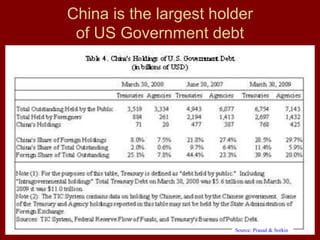
• As the world’s largest debtor, with China our primary
creditor, our ability to make demands is diminished.
• There is a particular tension between hoping China
will continue to buy our Treasury bills, while asking it
to stop buying our Treasury bills
– i.e., to stop buying $ / selling RMB,
• which is what keeps its currency from rising.
55
China is the largest holder
of US Government debt
Source: Prasad & Sorkin
56
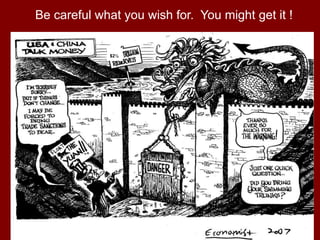
Be careful what you wish for. You might get it !
$2½
57
If China gave US politicians
what they say they want...
• For US output & employment to rise,
– we would first need other Asian
currencies to appreciate along with RMB.
• Otherwise, fall in US bilateral trade deficit
with China would be offset by rise in US bilateral deficit
with other cheap-labor countries.
– It also depends on excess capacity in US economy
• and no crowding out of domestic demand via higher interest rates.
• Those conditions are met in 2008-2010. But not 2007. 2012?
• Prices for Wal-Mart shoppers would go up.
58
If China gave US politicians
what they say they want...
• we might regret it.
– if it included reserve shift out of T bills,
to match switch in basket weights from $.
– we could have a hard landing for the $
– including a sharp fall of US securities prices.
• Skeptics argue China will not sell T bills
– because, as the largest holder,
it would be the biggest loser when the $ depreciated.
• Financial market fears that China might stop buying
US T bills could send the $ down in themselves.
• If the $ is falling, China will not want to be the only one left
“holding the bag.”
59
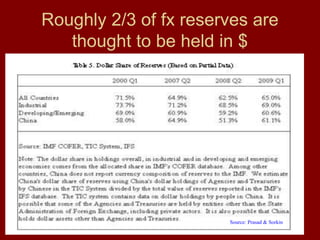
Roughly 2/3 of fx reserves are
thought to be held in $
Source: Prasad & Sorkin
60
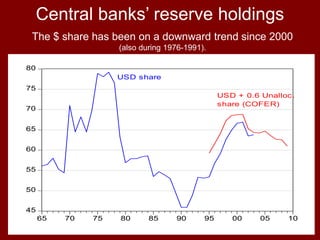
Central banks’ reserve holdings
45
50
55
60
65
70
75
80
65 70 75 80 85 90 95 00 05 10
USD share
USD + 0.6 Unalloc.
share (COFER)
The $ share has been on a downward trend since 2000
(also during 1976-1991).
61
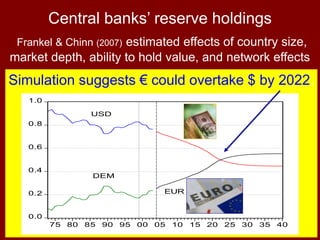
Central banks’ reserve holdings
Frankel & Chinn (2007) estimated effects of country size,
market depth, ability to hold value, and network effects
Simulation suggests € could overtake $ by 2022.
0.0
0.2
0.4
0.6
0.8
1.0
75 80 85 90 95 00 05 10 15 20 25 30 35 40
USD
DEM
EUR
62
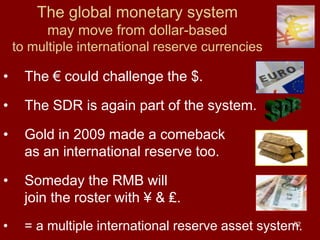
The global monetary system
may move from dollar-based
to multiple international reserve currencies
• The € could challenge the $.
• The SDR is again part of the system.
• Gold in 2009 made a comeback
as an international reserve too.
• Someday the RMB will
join the roster with ¥ & ₤.
• = a multiple international reserve asset system.
63
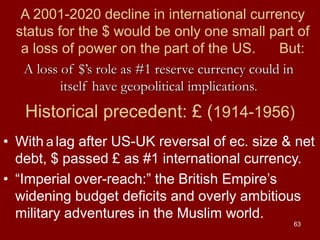
Historical precedent: £ (1914-1956)
• With a lag after US-UK reversal of ec. size & net
debt, $ passed £ as #1 international currency.
• “Imperial over-reach:” the British Empire’s
widening budget deficits and overly ambitious
military adventures in the Muslim world.
A 2001-2020 decline in international currency
status for the $ would be only one small part of
a loss of power on the part of the US. But:
A loss of $’s role as #1 reserve currency could in
itself have geopolitical implications.
64
64
• Precedent: The Suez crisis of 1956 [i]
– is often recalled as the occasion
on which Britain was forced
under US pressure to abandon
its remaining imperial designs.
– But recall also the important role
played by a simultaneous run on
the £, and America’s decision not
to help the beleaguered currency.
[i] Frankel, “Could the Twin Deficits Jeopardize US Hegemony,”
Journal of Policy Modeling, 28, no. 6, Sept. 2006.
At http://ksghome.harvard.edu/~jfrankel/SalvatoreDeficitsHegemonJan26Jul+.pdf .
65
http://ksghome.harvard.edu/~jfrankel/index.htm
66
Addenda
• Is the US Current account sustainable?
• The 2003 start of RMB speculation
• Internal & external balance
67
67
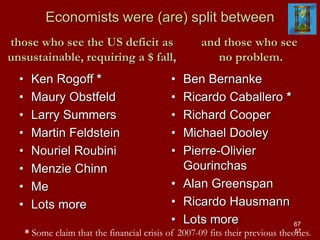
Economists were (are) split between
• Ken Rogoff *
• Maury Obstfeld
• Larry Summers
• Martin Feldstein
• Nouriel Roubini
• Menzie Chinn
• Me
• Lots more
• Ben Bernanke
• Ricardo Caballero *
• Richard Cooper
• Michael Dooley
• Pierre-Olivier
Gourinchas
• Alan Greenspan
• Ricardo Hausmann
• Lots more
those who see the US deficit as
unsustainable, requiring a $ fall,
and those who see
no problem.
* Some claim that the financial crisis of 2007-09 fits their previous theories.
68
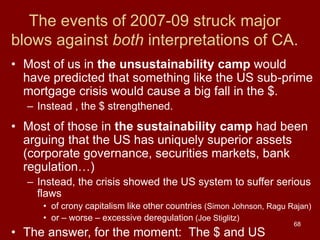
The events of 2007-09 struck major
blows against both interpretations of CA.
• Most of us in the unsustainability camp would
have predicted that something like the US sub-prime
mortgage crisis would cause a big fall in the $.
– Instead , the $ strengthened.
• Most of those in the sustainability camp had been
arguing that the US has uniquely superior assets
(corporate governance, securities markets, bank
regulation…)
– Instead, the crisis showed the US system to suffer serious
flaws
• of crony capitalism like other countries (Simon Johnson, Ragu Rajan)
• or – worse – excessive deregulation (Joe Stiglitz)
• The answer, for the moment: The $ and US
69
Critics of the twin deficits view say that the
US current account deficit is sustainable.
1. Global savings glut (Bernanke)
2. It’s a big world (R. Cooper; Al Greenspan..)
3. Valuation effects will pay for it (Gourinchas)
4. US as the World’s Banker (Kindleberger…)
5. The US offers superior-quality assets
(Caballero, Forbes, Quadrini & Rios-Rull, Wei & Wu …)
6. “Dark Matter” (Hausmann & Sturzenegger)
7. Bretton Woods II
(Dooley, Folkerts-Landau & Garber)
70
Exorbitant Privilege of $
• Among those who argue that the US
current account deficit is sustainable
are some who believe that the US will
continue to enjoy the unique privilege
of being able to borrow virtually unlimited
amounts in its own currency.
71
When does the “privilege” become “exorbitant?”
• if it accrues solely because of size & history,
without the US having done anything to earn
the benefit by virtuous policies such as budget
discipline, price stability & a stable exchange rate.
• Since 1973, the US has racked up $10 trillion
in debt and the $ has experienced a 30% loss
in value compared to other major currencies.
• It seems unlikely that macroeconomic policy
discipline is what has earned the US its privilege !
72
The “Bretton Woods II”
hypothesis
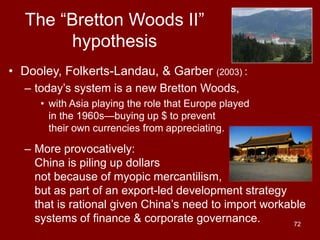
• Dooley, Folkerts-Landau, & Garber (2003) :
– today’s system is a new Bretton Woods,
• with Asia playing the role that Europe played
in the 1960s—buying up $ to prevent
their own currencies from appreciating.
– More provocatively:
China is piling up dollars
not because of myopic mercantilism,
but as part of an export-led development strategy
that is rational given China’s need to import workable
systems of finance & corporate governance.
73
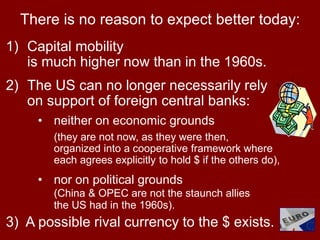
There is no reason to expect better today:
1) Capital mobility
is much higher now than in the 1960s.
2) The US can no longer necessarily rely
on support of foreign central banks:
• neither on economic grounds
(they are not now, as they were then,
organized into a cooperative framework where
each agrees explicitly to hold $ if the others do),
• nor on political grounds
(China & OPEC are not the staunch allies
the US had in the 1960s).
3) A possible rival currency to the $ exists.
74
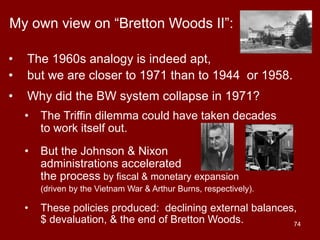
My own view on “Bretton Woods II”:
• The 1960s analogy is indeed apt,
• but we are closer to 1971 than to 1944 or 1958.
• Why did the BW system collapse in 1971?
• The Triffin dilemma could have taken decades
to work itself out.
• But the Johnson & Nixon
administrations accelerated
the process by fiscal & monetary expansion
(driven by the Vietnam War & Arthur Burns, respectively).
• These policies produced: declining external balances,
$ devaluation, & the end of Bretton Woods.
75
(I) Prices on Non-Deliverable Forwards
showing post-2003 speculation on RMB appreciation
7.6
7.8
8
8.2
8.4
04/07/03 10/15/03 12/31/04 07/22/05 01/08/07
date
spot 1-month
3-month 12-month
Spot and Forward Rates of USD/RMB
76
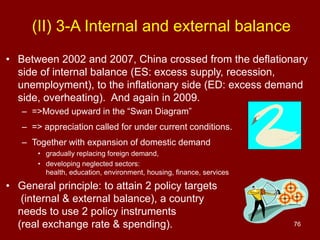
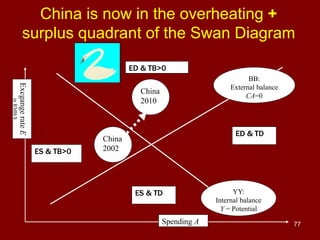
(II) 3-A Internal and external balance
• Between 2002 and 2007, China crossed from the deflationary
side of internal balance (ES: excess supply, recession,
unemployment), to the inflationary side (ED: excess demand
side, overheating). And again in 2009.
– =>Moved upward in the “Swan Diagram”
– => appreciation called for under current conditions.
– Together with expansion of domestic demand
• gradually replacing foreign demand,
• developing neglected sectors:
health, education, environment, housing, finance, services
• General principle: to attain 2 policy targets
(internal & external balance), a country
needs to use 2 policy instruments
(real exchange rate & spending).
77
China is now in the overheating +
surplus quadrant of the Swan Diagram
Excgange
rate
E
in
RMB/$
YY:
Internal balance
Y = Potential
ED & TD
ES & TD
ES & TB>0
China
2010
BB:
External balance
CA=0
China
2002
ED & TB>0
Spending A
78
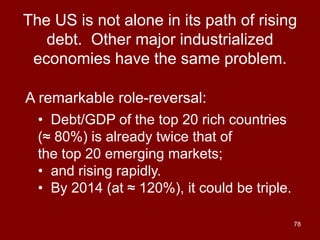
The US is not alone in its path of rising
debt. Other major industrialized
economies have the same problem.
A remarkable role-reversal:
• Debt/GDP of the top 20 rich countries
(≈ 80%) is already twice that of
the top 20 emerging markets;
• and rising rapidly.
• By 2014 (at ≈ 120%), it could be triple.
79
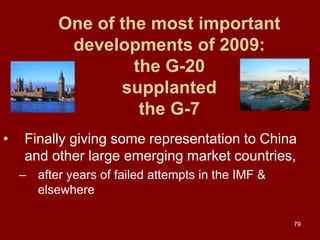
One of the most important
developments of 2009:
the G-20
supplanted
the G-7
• Finally giving some representation to China
and other large emerging market countries,
– after years of failed attempts in the IMF &
elsewhere

dokumen.tips_the-renminbi-dollar-issue-jeffrey-frankel-harpel-professor-spring-exercise.ppt

  • 1.
    The Renminbi -Dollar Issue JeffreyFrankel Harpel Professor Spring Exercise, April 23, 2010
  • 2.
    2 Topics to becovered (I) Historical timeline of exchange rate diplomacy (II) What is in China’s interest? (III) What is in the US & RoW interest? (IV) Shifting power relationships • Addendum: The current account imbalances
  • 3.
    3 Historical timeline “I have listenedto both sides of this debate. Here is what I think. I think those who call for a fixed exchange rate are right in the short run. And those who call for a floating exchange rate are right in the long run. How long is the short run, you ask? You must understand. China is 8000 years old. So when I say, short run, it could be 100 years.” -- Li Ruogu, Deputy Governor, People’s Bank of China, Dalian, May 2004
  • 4.
    4 Historical timeline ofcurrency diplomacy • 1973: End of Bretton Woods era. – Major currencies switch from fixed to floating. The rest keep their pegs. • 1977: IMF members agree that each shall “avoid manipulating exchange rates … in order to prevent effective balance of payments adjustment or to gain an unfair competitive advantage over other members.” [Principle (A) of the “1977 Decision on Surveillance over Exchange Rate Policies,” and Sect.1, Clause 3, of Article IV amended in 1978.] – In practice, the IMF almost never pressures countries to revalue their currencies upward; • It just pressures deficit countries to devalue. • 1983-84: ¥/$ Agreement. 1985: Plaza Accord. – Japan, US & others cooperate to bring down overvalued $, esp. vs. ¥ • 1987-89: – Louvre Agreement: $ depreciation halted. – Big bubbles in Japan’s equity & real estate markets, – followed by crash, & severe Japanese stagnation in 1990s.
  • 5.
    5 Timeline, continued • 1988:The Omnibus Trade & Competitiveness Act mandates the US Treasury report to Congress biannually on whether trading partners were manipulating currencies. – Section 3004 requires the Treasury to “consider whether countries manipulate the rate of exchange between their currency and the United States dollar for purposes of preventing effective balance of payments adjustments or gaining unfair competitive advantage in international trade.'' – The US must hold talks with governments deemed to be breaking rules. – In the first Reports to Congress on International Economics & Exchange Rate Policy, Korea & Taiwan PoC were found to be guilty of manipulation, • while Singapore & Hong Kong SAR “got off with a warning.” • China was named in early 1990s.
  • 6.
    6 Analysis of theTreasury Department’s biannual Report to Congress on International Economics and Exchange Rate Policy -- Frankel & Wei (2007)
  • 7.
    7 Two hypotheses regardingdeterminants of US Treasury decisions whether partners are manipulating currencies: • (1) Legitimate economic variables – the partner’s overall current account/GDP, – its reserve changes, – the real overvaluation of its currency; vs. • (2) Variables suggestive of domestic American political expediency – the bilateral trade balance, – US unemployment, – an election year dummy .
  • 8.
    8 Two hypotheses regardingdeterminants of US Treasury decisions whether partners are manipulating currencies: • (1) Legitimate economic variables – the partner’s overall current account/GDP, – its reserve changes, – the real overvaluation of its currency; vs. • (2) Variables suggestive of domestic American political expediency – the bilateral trade balance, – US unemployment, – an election year dummy .
  • 9.
    9 Timeline, continued –Those countriesnamed as manipulators, or given warnings, have always been Asian. –What political economy determines Treasury findings? • Econometric analysis: • Domestic political variables are as important as global manipulation criteria:
  • 10.
    10 Explaining findings ofTreasury Department biannual Report to Congress on Int.Ec. & Exchange Rate Policy All countries 15 Asian economies Excluding oil exporters US bilateral TB -0.92*** -0.99*** 0.0655 0.1548 Partner’s 0.014*** 0.028** CA/GDP 0.002 0.007 Partner’s Real -0.18*** -0.23** Exchange Rate 0.0291 0.1115 Change in 0.003 -0.012 reserves/GDP 0.003 0.009 US unem- 0.022** 0.08** ployment 0.010 0.037 *** statistically significant at 99% level
  • 11.
    11 Findings suggest thedomestic US variables affect the Treasury decision more than the legitimate global manipulation criteria: • weak role for partner reserve accumulation, • very high significance of bilateral balance, • significance of US unemployment, and • significant (borderline) extra effect of unemployment in election years.
  • 12.
    12 Implication If the IMFwere interpreting Article IV, rather than the Treasury interpreting the 1988 US law, – the criterion of consistent uni-directional forex intervention would receive more emphasis, – and US-specific variables such as the bilateral trade balance would not appear at all.
  • 13.
    13 Some sympathy forthe Treasury • It walks a fine line. • An additional finding: Treasury is eager not to single out one country for unique opprobrium. – No single country is left exposed on its own. • the top-ranked country is less likely to be named than if it had some other country to hide behind, while • the 2nd- & 3rd-ranked countries are more likely to be moved up, to give the leader company.
  • 14.
    14 Timeline, continued: Exchange rate •Jan. 1994: China devalues its official rate, – unifying its dual exchange rate system. • 1997-98: East Asia crisis. – China wins plaudits for keeping RMB (“yuan”’) fixed • while all its neighbors are devaluing. • 1995-2005: China continues to peg – for 10 years – at 8.28 RMB/$.
  • 15.
    15 Timeline, continued: US pressure •Oct. 2003: Treasury Secretary Snow begins to “browbeat” China to allow appreciation. – Report: RMB merits concern & talks – Speculators in financial markets start to bet appreciation. – as reflected in either capital flows (residual; see Prasad & Wei) – or non-deliverable forwards (see appendix graph). • Feb. 2005: Senators Schumer & Graham propose first of bills to impose (WTO-illegal) tariffs of 27.5 % against all Chinese goods if China does not substantially revalue its currency. – Subsequent versions, by Baucus-Grassley and others substitute the phrase “currency misalignment” in place of “unfair manipulation” to ease standard of proof.
  • 16.
    16 • 2004- :Rapid growth puts China into Excess Demand condition. • 2005-06: Despite large balance of payments surpluses, PBoC sterilization of reserve inflows prevents excessive money growth & inflation. • 2007-08: Sterilization finally falters: Money growth becomes excessive. – Inflation becomes a serious concern. – Shanghai stock market experiences a bubble. • Mid-2008 – early 2009: Worst of the global recession hits. – China loses 26% of exports – Growth rate slows down; danger of overheating disappears. • Mid-2009 – mid-2010: China resumes blistering growth – In response to domestic demand stimulus + renewed exports – China is now a major engine of growth in world economy. – Danger of overheating returns: esp. asset market bubbles. Timeline, continued: China’s macroeconomy
  • 17.
    17 Timeline, continued: Exchange rate •July 2005: China announces a new policy, – Immediate 2.1% revaluation, – Followed by “managed float”: controlled appreciation, supposedly against an unspecified basket of currencies. – But, as often, de jure exchange rate regime ≠ de facto. • Econometric estimation of true regime reveals: – $ link did not even begin to loosen until 2006. – By 2007, implicit basket had shifted some weight onto other currencies, especially the €. – RMB appreciates against the $ from 2006 to 2008, • But only because € does.
  • 18.
    18 The magnitude ofdaily movements vs. $ increased in the spring of 2006, -.002 0 .002 .004 01 Jul 05 01 Jan 06 01 Jul 06 01 Jan 07 date Changes in CNY per USD over Time: 07/22/05-1/8/2007
  • 19.
    19 Estimating the weights •A problem made-to-order for OLS regression. • Regress % changes in value of RMB against % changes in values of candidate currencies. • Δ log RMBt = c + α Δlog $t + β1Δlog € t + β2 Δlog ¥t + … • The coefficients are the basket weights. • Can impose α + Σ β j = 1. F& Wei (2007), Frankel (2009)
  • 20.
    20 Has US pressurepushed the pace of increased flexibility? • We searched an electronic database of news reports (FACTIVA/NewsPlus) , recording the number of US news reports of US officials asking China to speed up RMB flexibility/revaluation. • Two separate time series on the cumulative numbers of complaints – from US Treasury and – from officials of other government agencies (e.g. the White House, Congress and Fed)
  • 21.
    21 Complaints: Treasury &other US 0 5 10 15 20 01 Jul 05 01 Jan 06 01 Jul 06 01 Jan 07 date cumulative non-treasury report cumulative treasury report Time plots of cumulative US Treasury and Non-Treasury Complaints
  • 22.
    22 We added #complaints as a regressor (Table 19) • No evidence that U.S. official complaints are associated with RMB appreciation relative to the currency basket. • There is evidence that cumulative complaints are associated with a reduction in the RMB’s weight on the US dollar.
  • 23.
    23 Timeline, continued: Exchange rate •May 2008: Chinese leaders hear exporter complaints of competitiveness difficulties. • Mid-2008-April 2010: yuan repegs ≈ $ 6.84 RMB/$ • ≈ 20% stronger, vs. $, than 2005.
  • 24.
    24 The RMB roseagainst the $ for 2 years, but returned to peg in mid-2008 Exchange rates, Jan. 2005 - March 2010 0 0.02 0.04 0.06 0.08 0.1 0.12 0.14 0.16 0.18 0 4 - J a n - 0 5 0 4 - M a r - 0 5 0 4 - M a y - 0 5 0 4 - J u l - 0 5 0 4 - S e p - 0 5 0 4 - N o v - 0 5 0 4 - J a n - 0 6 0 4 - M a r - 0 6 0 4 - M a y - 0 6 0 4 - J u l - 0 6 0 4 - S e p - 0 6 0 4 - N o v - 0 6 0 4 - J a n - 0 7 0 4 - M a r - 0 7 0 4 - M a y - 0 7 0 4 - J u l - 0 7 0 4 - S e p - 0 7 0 4 - N o v - 0 7 0 4 - J a n - 0 8 0 4 - M a r - 0 8 0 4 - M a y - 0 8 0 4 - J u l - 0 8 0 4 - S e p - 0 8 0 4 - N o v - 0 8 0 4 - J a n - 0 9 0 4 - M a r - 0 9 0 4 - M a y - 0 9 0 4 - J u l - 0 9 0 4 - S e p - 0 9 0 4 - N o v - 0 9 0 4 - J a n - 1 0 0 4 - M a r - 1 0 Date /RMB 0 0.2 0.4 0.6 0.8 1 1.2 1.4 1.6 1.8 2 $/RMB ($/2+euro/2)/RMB euro/RMB Euro/$ (RHS) $/RMB €/RMB €/$
  • 25.
    25 • Oct. 2006-- IMF Article IV consultation finds RMB “undervalued.” • 2007: US Treasury temporarily passes hot potato of exchange rate complaints to IMF, – which gets mandate for exchange rate “surveillance.” • 2008: Though financial crisis originates in US, “flight to quality” temporarily raises demand for $. • 2009: Chinese leaders, for the first time, express concerns that their vast holdings of US treasury bills may not be well-invested. – Pres. Obama & Secy. Geithner seek to reassure. Timeline, continued
  • 26.
    26 2009: Chinese warnings –Premier Wen worries US T bills may lose value. Urges the US to keep its deficit at an “appropriate size” to ensure the “basic stability” of the $ (again on 11/10/09). – PBoC Gov. Zhou, proposes replacing $ as international currency, with the SDR (March 09).
  • 27.
    27 Timeline, continued 2010 • Winter2010: Pressure mounts -- – International pressure on Beijing to appreciate; – Congressional pressure on US Treasury to find China guilty of currency manipulation in its biannual report due April 15. – But Chinese say they will never bow to pressure. • US-China relations deteriorate – on other fronts as well.
  • 28.
    28 April 1-9: Collisionis averted at the last minute -- or at least postponed • April 1: China announces Hu Jintao trip to DC – to attend April 12-13 summit. • April 2: Beijing hints it may adjust pegging policy – if visit goes smoothly. • April 3: Treasury announces manipulation report postponed – from mid-April deadline, – probably until the summer: • after Strategic & Economic Dialogue in May, • & G-20 Summit meeting in June. • Implication – The two governments must have come to a face-saving understanding. • April 9: Geithner makes surprise stop in Beijing.
  • 29.
    29 • Countries shouldhave the right to fix their exchange rate if they want to. • True, the IMF Articles of Agreement and the US Omnibus Trade Act of 1988 call for action in the event that a country is “unfairly manipulating its currency”. • But – Almost no countries have been forced to appreciate. – Pressure on surplus countries to appreciate will inevitably be less than pressure on deficit countries to depreciate. – It is time to retire the language of “manipulation.” • Usually, it is hard to say when a currency is undervalued. • Don’t cheapen the language that is appropriate to WTO rules. • China should do what is in its own long-term interest. (II) From China’s viewpoint,
  • 30.
    30 • My view:mutually-beneficial bargain, between equals – E.g., China agrees that: • its exchange rate is part of the problem, • it will cooperate to lower the RMB/$ rate in a gradual manner, • and of course it won’t dump US treasury bills. – In exchange, US agrees that: • its low national saving rate is part of the problem, • it will cooperate to reduce the budget deficit, • and of course it won’t close off the US market to Chinese goods. • But perhaps a bargain isn’t even necessary; – It is in China’s own interest to begin appreciating the RMB. What is in China’s interest?
  • 31.
    31 Five reasons Chinashould let RMB appreciate, in its own interest 1. Overheating of economy 2. Reserves are excessive. – It gets harder to sterilize the inflow over time. 3. Attaining internal and external balance. – To attain both, need 2 policy instruments. – In a large country like China, expenditure-switching policy should be the exchange rate. 4. Avoiding future crashes. 5. RMB undervalued, judged by Balassa-Samuelson relationship.
  • 32.
    32 1. Overheating ofeconomy: • Bottlenecks. Pace of economic growth is outrunning: – raw material supplies, and – labor supply in coastal provinces • Asset bubbles. – Shanghai stock market bubble in 2007. • Inflation 6-7% in 2007 => price controls  shortages & social unrest. • All of the above was suspended in late 2008, – due to global recession. – But it is back again now; skyrocketing real estate prices.
  • 33.
    33 Attempts at “sterilization,”to insulate domestic economy from the inflows • Sterilization is defined as offsetting of international reserve inflows, so as to prevent them from showing up domestically as excessive money growth & inflation. • For awhile PBoC successfully sterilized… – until 2007-08. – The usual limitations finally showed up: • Prolongation of capital inflows <= self-equilibrating mechanism shut off. • Quasi-fiscal deficit: gap between domestic interest rates & US T bill rate • Failure to sterilize: money supply rising faster than income • Rising inflation (admittedly due not only to rising money supply)
  • 34.
    34 2. Foreign ExchangeReserves • Excessive: – Though a useful shield against currency crises, – China has enough reserves: $2 ½ trillion by April 2010; – & US treasury securities do not pay high returns. • Harder to sterilize the inflow over time.
  • 35.
    35 Source: HKMA, Half-YearlyMonetary and Financial Stability Report, June 2008 The Balance of Payments ≡ rate of change of foreign exchange reserves rose rapidly over last decade
  • 36.
    36 The Balance ofPayments rose rapidly in China over past decade, due to all 3 components: trade balance, Foreign Direct Investment, and portfolio inflows Source: Prasad & Sorkin
  • 37.
    37 Not only hasthe level of fx reserves risen, but the rate of change (BoP surplus) shows acceleration Source: Prasad & Sorkin
  • 38.
    38 While reserves (NFA)rose rapidly, the growth of the monetary base was kept to the growth of the real economy – even reduced in 2005-06. Successful sterilization in China: 2005-06 Attempts to sterilize reserve inflow: were remarkably successful in 2005-06. High reserve growth offset by cuts in domestic credit =>steadymoney
  • 39.
    39 In 2007-08 Chinahad more trouble sterilizing the reserve inflow • PBoC began to pay higher interest rate domestically, & receive lower interest rate on US T bills => quasi-fiscal deficit. • Inflation became a serious problem. – True, global increases in food & energy prices were much of the explanation. – But • China’s overly rapid growth itself contributed. • Appreciation is a good way to put immediate downward pressure on local prices of farm & energy commodities. • Price controls are inefficient and ultimately ineffective.
  • 40.
    40 Sterilization faltered in2007 & 2008 Source: HKMA, Half-Yearly Monetary and Financial Stability Report, June 2008 Monetary base accelerated Growth of China’s monetary base, & its components
  • 41.
    41 In 2008, domesticChinese interest rates when above US T bill rates => quasi fiscal deficit Source: Prasad & Sorkin
  • 42.
    42 China’s CPI acceleratedin 2007-08 Inflation 2002 to 2008 Q1 Source: HKMA, Half-Yearly Monetary and Financial Stability Report, June 2008
  • 43.
    43 3. Need aflexible exchange rate to attain internal & external balance • Internal balance ≡ demand neither too low (recession) nor too high (overheating). • External balance ≡ appropriate balance of payments. • General principle: to attain both policy targets, a country needs to use 2 policy instruments. • For a country as large as China, one of those policy instruments should be the exchange rate. • To reduce BoP surplus without causing higher unemployment, China needs both – currency appreciation, and – expansion of domestic demand • gradually replacing foreign demand, • developing neglected sectors: health, education, environment, housing, finance, & services.
  • 44.
    44 4. Avoiding futurecrashes Experience of other emerging markets suggests it is better to exit from a peg in good times, when the BoP is strong, than to wait until the currency is under attack. Introducing some flexibility now, even though not ready for free floating.
  • 45.
    45 5. Longer-run perspective: Balassa-Samuelsonrelationship • Prices of goods & services in China are low – compared at the nominal exchange rate. – Of course they are a fraction of those in the U.S.: < ¼ . – This is to be expected, explained by the Balassa-Samuelson effect • which says that low-income countries have lower price levels. • As countries’ real income grows, their currencies experience real appreciation: approx. .3% for every 1 % in income per capita. – But China is one of those countries that is cheap or undervalued even taking into account Balassa-Samuelson.
  • 46.
    46 -1 -.5 0 .5 1 -3 -2 -10 1 2 Log of Real Per capita GDP (PPP) coef = .23367193, (robust) se = .01978263, t = 11.81 Source: Arvind Subramanian, April 2010, “New PPP-Based Estimates of Renminbi Undervaluation and Policy Implications,” PB10-08, Peterson Institute for International Economics Undervaluation of RMB in the regression estimated above = 26%. Estimated undervaluation averaging across four such estimates = 31%. Compare to Frankel (2005) estimate for 2000 = 36%. The Balassa-Samuelson Relationship 2005
  • 47.
    47 Does the Balassa-Samuelson relationshiphave predictive power?  Typically across countries, gaps are corrected halfway, on average, over subsequent decade.  => 3-4 % real appreciation on average per year, including effect of further growth differential .  Correction could take the form of either inflation or nominal appreciation, but appreciation is preferable.
  • 48.
    48 The conclusion –that it would be in China’s interest to allow RMB to appreciate -- • has long been shared by top economic officials in China, it is believed. • But the decision is a political one: • It is a matter of Hu and Wen !
  • 49.
    49 49 Solving the problemof current account imbalances, • in particular, the US CA deficit & China’s surplus. • Both have widened, on long-term trends. • Imbalances narrowed sharply in 2009; – the US deficit fell by almost ½ ; – China’s CA surplus fell by almost ½. • Its trade surplus actually dipped to 0 in March 2010. • Problem solved? • The imbalances will now resume widening. (III) What is in the global interest?
  • 50.
  • 51.
    51 The US trade& current account balances have been on a downward path for 50 years. They “improved” sharply in 2008-09, falling by half; but this reversal was temporary, attributable to US recession, Trade & current accounts, in $ billions per quarter
  • 52.
    52 Dangers of theU.S. trade deficit • Shorter-term dangers: – Protectionist legislation – A possible hard landing for the $. • Long-term dangers: – Dependence on foreign investors – US net debt to RoW now ≈ $3 trillion, • and rising. • Will lower our children’s standard of living. – When the US cuts its deficit, that will mean the rest of the world losing its surplus • The longer adjustment is postponed, the harder it will be.
  • 53.
    53 Policies to reducethe US CA deficit • Reduce the US budget deficit over time, – thus raising national saving. – After all, this is where the deficits originated. • Depreciate the $ more. – Better to do it in a controlled way • than in a sudden free-fall. – The $ already depreciated a lot against the € • & other currencies • from 2002 to 2007. – Who is left? – The RMB is conspicuous as the one major currency that is still undervalued against the dollar.
  • 54.
    54 (IV) Changing powerrelationships • It has never worked well for the US to make a dozen different demands on China, – IPR, human rights, help on N.Korea, Iran… – when we only have one carrot/stick: • keeping our markets open. • As the world’s largest debtor, with China our primary creditor, our ability to make demands is diminished. • There is a particular tension between hoping China will continue to buy our Treasury bills, while asking it to stop buying our Treasury bills – i.e., to stop buying $ / selling RMB, • which is what keeps its currency from rising.
  • 55.
    55 China is thelargest holder of US Government debt Source: Prasad & Sorkin
  • 56.
    56 Be careful whatyou wish for. You might get it ! $2½
  • 57.
    57 If China gaveUS politicians what they say they want... • For US output & employment to rise, – we would first need other Asian currencies to appreciate along with RMB. • Otherwise, fall in US bilateral trade deficit with China would be offset by rise in US bilateral deficit with other cheap-labor countries. – It also depends on excess capacity in US economy • and no crowding out of domestic demand via higher interest rates. • Those conditions are met in 2008-2010. But not 2007. 2012? • Prices for Wal-Mart shoppers would go up.
  • 58.
    58 If China gaveUS politicians what they say they want... • we might regret it. – if it included reserve shift out of T bills, to match switch in basket weights from $. – we could have a hard landing for the $ – including a sharp fall of US securities prices. • Skeptics argue China will not sell T bills – because, as the largest holder, it would be the biggest loser when the $ depreciated. • Financial market fears that China might stop buying US T bills could send the $ down in themselves. • If the $ is falling, China will not want to be the only one left “holding the bag.”
  • 59.
    59 Roughly 2/3 offx reserves are thought to be held in $ Source: Prasad & Sorkin
  • 60.
    60 Central banks’ reserveholdings 45 50 55 60 65 70 75 80 65 70 75 80 85 90 95 00 05 10 USD share USD + 0.6 Unalloc. share (COFER) The $ share has been on a downward trend since 2000 (also during 1976-1991).
  • 61.
    61 Central banks’ reserveholdings Frankel & Chinn (2007) estimated effects of country size, market depth, ability to hold value, and network effects Simulation suggests € could overtake $ by 2022. 0.0 0.2 0.4 0.6 0.8 1.0 75 80 85 90 95 00 05 10 15 20 25 30 35 40 USD DEM EUR
  • 62.
    62 The global monetarysystem may move from dollar-based to multiple international reserve currencies • The € could challenge the $. • The SDR is again part of the system. • Gold in 2009 made a comeback as an international reserve too. • Someday the RMB will join the roster with ¥ & ₤. • = a multiple international reserve asset system.
  • 63.
    63 Historical precedent: £(1914-1956) • With a lag after US-UK reversal of ec. size & net debt, $ passed £ as #1 international currency. • “Imperial over-reach:” the British Empire’s widening budget deficits and overly ambitious military adventures in the Muslim world. A 2001-2020 decline in international currency status for the $ would be only one small part of a loss of power on the part of the US. But: A loss of $’s role as #1 reserve currency could in itself have geopolitical implications.
  • 64.
    64 64 • Precedent: TheSuez crisis of 1956 [i] – is often recalled as the occasion on which Britain was forced under US pressure to abandon its remaining imperial designs. – But recall also the important role played by a simultaneous run on the £, and America’s decision not to help the beleaguered currency. [i] Frankel, “Could the Twin Deficits Jeopardize US Hegemony,” Journal of Policy Modeling, 28, no. 6, Sept. 2006. At http://ksghome.harvard.edu/~jfrankel/SalvatoreDeficitsHegemonJan26Jul+.pdf .
  • 65.
  • 66.
    66 Addenda • Is theUS Current account sustainable? • The 2003 start of RMB speculation • Internal & external balance
  • 67.
    67 67 Economists were (are)split between • Ken Rogoff * • Maury Obstfeld • Larry Summers • Martin Feldstein • Nouriel Roubini • Menzie Chinn • Me • Lots more • Ben Bernanke • Ricardo Caballero * • Richard Cooper • Michael Dooley • Pierre-Olivier Gourinchas • Alan Greenspan • Ricardo Hausmann • Lots more those who see the US deficit as unsustainable, requiring a $ fall, and those who see no problem. * Some claim that the financial crisis of 2007-09 fits their previous theories.
  • 68.
    68 The events of2007-09 struck major blows against both interpretations of CA. • Most of us in the unsustainability camp would have predicted that something like the US sub-prime mortgage crisis would cause a big fall in the $. – Instead , the $ strengthened. • Most of those in the sustainability camp had been arguing that the US has uniquely superior assets (corporate governance, securities markets, bank regulation…) – Instead, the crisis showed the US system to suffer serious flaws • of crony capitalism like other countries (Simon Johnson, Ragu Rajan) • or – worse – excessive deregulation (Joe Stiglitz) • The answer, for the moment: The $ and US
  • 69.
    69 Critics of thetwin deficits view say that the US current account deficit is sustainable. 1. Global savings glut (Bernanke) 2. It’s a big world (R. Cooper; Al Greenspan..) 3. Valuation effects will pay for it (Gourinchas) 4. US as the World’s Banker (Kindleberger…) 5. The US offers superior-quality assets (Caballero, Forbes, Quadrini & Rios-Rull, Wei & Wu …) 6. “Dark Matter” (Hausmann & Sturzenegger) 7. Bretton Woods II (Dooley, Folkerts-Landau & Garber)
  • 70.
    70 Exorbitant Privilege of$ • Among those who argue that the US current account deficit is sustainable are some who believe that the US will continue to enjoy the unique privilege of being able to borrow virtually unlimited amounts in its own currency.
  • 71.
    71 When does the“privilege” become “exorbitant?” • if it accrues solely because of size & history, without the US having done anything to earn the benefit by virtuous policies such as budget discipline, price stability & a stable exchange rate. • Since 1973, the US has racked up $10 trillion in debt and the $ has experienced a 30% loss in value compared to other major currencies. • It seems unlikely that macroeconomic policy discipline is what has earned the US its privilege !
  • 72.
    72 The “Bretton WoodsII” hypothesis • Dooley, Folkerts-Landau, & Garber (2003) : – today’s system is a new Bretton Woods, • with Asia playing the role that Europe played in the 1960s—buying up $ to prevent their own currencies from appreciating. – More provocatively: China is piling up dollars not because of myopic mercantilism, but as part of an export-led development strategy that is rational given China’s need to import workable systems of finance & corporate governance.
  • 73.
    73 There is noreason to expect better today: 1) Capital mobility is much higher now than in the 1960s. 2) The US can no longer necessarily rely on support of foreign central banks: • neither on economic grounds (they are not now, as they were then, organized into a cooperative framework where each agrees explicitly to hold $ if the others do), • nor on political grounds (China & OPEC are not the staunch allies the US had in the 1960s). 3) A possible rival currency to the $ exists.
  • 74.
    74 My own viewon “Bretton Woods II”: • The 1960s analogy is indeed apt, • but we are closer to 1971 than to 1944 or 1958. • Why did the BW system collapse in 1971? • The Triffin dilemma could have taken decades to work itself out. • But the Johnson & Nixon administrations accelerated the process by fiscal & monetary expansion (driven by the Vietnam War & Arthur Burns, respectively). • These policies produced: declining external balances, $ devaluation, & the end of Bretton Woods.
  • 75.
    75 (I) Prices onNon-Deliverable Forwards showing post-2003 speculation on RMB appreciation 7.6 7.8 8 8.2 8.4 04/07/03 10/15/03 12/31/04 07/22/05 01/08/07 date spot 1-month 3-month 12-month Spot and Forward Rates of USD/RMB
  • 76.
    76 (II) 3-A Internaland external balance • Between 2002 and 2007, China crossed from the deflationary side of internal balance (ES: excess supply, recession, unemployment), to the inflationary side (ED: excess demand side, overheating). And again in 2009. – =>Moved upward in the “Swan Diagram” – => appreciation called for under current conditions. – Together with expansion of domestic demand • gradually replacing foreign demand, • developing neglected sectors: health, education, environment, housing, finance, services • General principle: to attain 2 policy targets (internal & external balance), a country needs to use 2 policy instruments (real exchange rate & spending).
  • 77.
    77 China is nowin the overheating + surplus quadrant of the Swan Diagram Excgange rate E in RMB/$ YY: Internal balance Y = Potential ED & TD ES & TD ES & TB>0 China 2010 BB: External balance CA=0 China 2002 ED & TB>0 Spending A
  • 78.
    78 The US isnot alone in its path of rising debt. Other major industrialized economies have the same problem. A remarkable role-reversal: • Debt/GDP of the top 20 rich countries (≈ 80%) is already twice that of the top 20 emerging markets; • and rising rapidly. • By 2014 (at ≈ 120%), it could be triple.
  • 79.
    79 One of themost important developments of 2009: the G-20 supplanted the G-7 • Finally giving some representation to China and other large emerging market countries, – after years of failed attempts in the IMF & elsewhere