IJAPRR Page 18
International Journal of Allied Practice, Research and Review
Website: www.ijaprr.com (ISSN 2350-1294)
A case study of women participation in Mahatma
Gandhi National Rural Employment Guarantee Act
(MGNERGA) in Kashmir
Babita Pandey1, Tanveer Ahmed Wani2
1Unique Institute of Management & Technology, Ghaziabad
2Research Scholar, Shri Venkateshwara University, Gajraula
Abstract - In Kashmir, the Gram Sabhas are not properly functioning because of internal security reasons. Although
the Gram Sabhas have started functioning again after revival of peace in the valley, the women participation in these
institutions is very negligible. Since decisions related to the implementation of NREGA works are supposed to take
place in gram sabhas, it is significant that most women should take part in gram sabha elections for that there is an
immediate need of internal security and social protection for them.
There are various factors which encourage the women worker’s participation under this scheme include
nature of work, which do not need skilled worker, the limited hours of work, availability of work locally, reduction of
migration of male member, substantial jump in the wage rate etc. Participation of women in MGNREGA is very low
in the state of Jammu and Kashmir.
KEYWORDS: MGNERGA; Wages; Employment
.
I. Introduction
The basic aim of MGNREGA was to generate as much as possible labour days both in lean
and non-lean seasons so that the seasonal impact on the earning could be minimized. But this
provision was also amended by a notification on Nov11, 2009 giving room to material intensive
projects by the consequence of this the labour days will get decreased and also gave a room & eroded
the powers granted to Panchayats under the Act and allowed material contractors to get a foot in the
door and also opened the door of corruption.
Living in the current inflationary situation to meet both ends meet has become so difficult
even for most of the middle class individuals. So by fixing wages are comparatively lower than the
prevailing market rates is also loophole of the Act. MGNREGA which gives 100 days of guaranteed
employment is not only violating the Minimum Wages Act came up with a notification issued on
Jan1,2009 has bought out the unbridled discretationary powers conferred on the Center by Sec6(1) of
the act to fix wages lower than minimum wages. As per available data available from the primary data
collected and also from the Ministry of Employment Labour, Government of India in Jammu and
Kashmir State notified minimum wages are Rs110 (100 +10) in which 100 stands for the minimum
wages and 10 is state contribution for MGNREGA workers, but if we look on political stability and
IJAPRR Page 19
geographical condition still a worker has to confine with hundred ten rupees wage. It is unjustified
when other persons can earn more than doing unorganized/ agricultural labour then why to turn out to
MGNREGA.
II. Review of Literature
After independence various studies have been done on various rural development programmes in
India. Jandu (2008) carried out a research in four states namely Chhattisgarh, Madhya Pradesh, Orissa
and Tamil Nadu. Survey data shows that women workers are more confident about their roles as
contributors to family expenditure and their work decisions and it gives them space in public sphere.
Ramesh & Kumar (2009) in their study also found that MGNREGA holds the powerful prospect of
bringing major changes in the lives of women. MGNREGA is playing a substantial role in
empowering women economically and laying the basis for greater independence and self-esteem. It
has become a beacon of light in the empowerment of the rural women, and contributed substantially
for the increased living and economic conditions. Pankaj & Tankha (2010) examines the
empowerment effects of MGNREGA through field survey in Bihar, Jharkhand, Rajasthan and
Himachal Pradesh. The study shows that a woman worker’s earnings from MGNREGA constituted 14
percent of the total annual income of the household on average across the four sample districts in
2008-09. This study also shows an increased participation of women in gram sabha meetings. Panda
& Umdor (2011) conducted a field study on the impact of MGNREGA in Assam. In their sample
villages, namely Barpeta, Jorhat, Karimganj, Morigaon and Tinsukia they found that on an average
only 42 percent said that MGNREGA had helped to uplift women. . There has been no change in the
status of women in four sample districts except Tinsukia.
III. Objectives of the study
The present research aims to assess the impact analysis of MGNREGA on Jammu and Kashmir
state, with the following objectives:
1. To assess the extent of additional employment generation through MGNREGA to the rural
poor.
2. To examine the impact of MGNREGA on the rural upliftment in the study area.
3. To make suggestions for strengthening the implementation strategy of MGNREGA.
IV. Methodology
The study is based on primary data. The study is based on purposive sampling technique. The
primary data’s are collected through structured questionnaire, 100 beneficiaries form the total sample
of the study. Simple statistical tools have been used to analyze the data.
V. Analysis
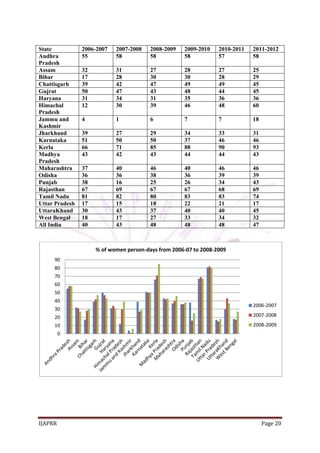
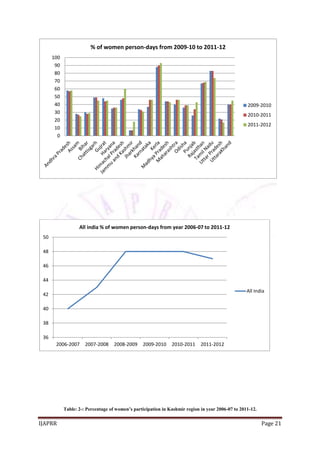
The socio-economic condition of the women’s in the study area is shown in table in 1 and 2.
Table: 1:-Percentage of women person-days from FY 2006-07 to FY 2011-2012
IJAPRR Page 20
0
10
20
30
40
50
60
70
80
90
% of women person-days from 2006-07 to 2008-2009
2006-2007
2007-2008
2008-2009
State 2006-2007 2007-2008 2008-2009 2009-2010 2010-2011 2011-2012
Andhra
Pradesh
55 58 58 58 57 58
Assam 32 31 27 28 27 25
Bihar 17 28 30 30 28 29
Chattisgarh 39 42 47 49 49 45
Gujrat 50 47 43 48 44 45
Haryana 31 34 31 35 36 36
Himachal
Pradesh
12 30 39 46 48 60
Jammu and
Kashmir
4 1 6 7 7 18
Jharkhand 39 27 29 34 33 31
Karnataka 51 50 50 37 46 46
Kerla 66 71 85 88 90 93
Madhya
Pradesh
43 42 43 44 44 43
Maharashtra 37 40 46 40 46 46
Odisha 36 36 38 36 39 39
Punjab 38 16 25 26 34 43
Rajasthan 67 69 67 67 68 69
Tamil Nadu 81 82 80 83 83 74
Uttar Pradesh 17 15 18 22 21 17
UttaraKhand 30 43 37 40 40 45
West Bengal 18 17 27 33 34 32
All India 40 43 48 48 48 47
IJAPRR Page 21
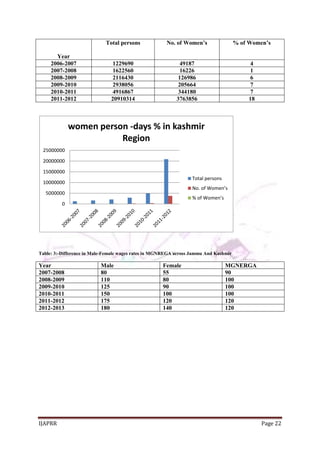
Table: 2-: Percentage of women’s participation in Kashmir region in year 2006-07 to 2011-12.
36
38
40
42
44
46
48
50
2006-2007 2007-2008 2008-2009 2009-2010 2010-2011 2011-2012
All india % of women person-days from year 2006-07 to 2011-12
All India
0
10
20
30
40
50
60
70
80
90
100
% of women person-days from 2009-10 to 2011-12
2009-2010
2010-2011
2011-2012
IJAPRR Page 22
Year
Total persons No. of Women’s % of Women’s
2006-2007 1229690 49187 4
2007-2008 1622560 16226 1
2008-2009 2116430 126986 6
2009-2010 2938056 205664 7
2010-2011 4916867 344180 7
2011-2012 20910314 3763856 18
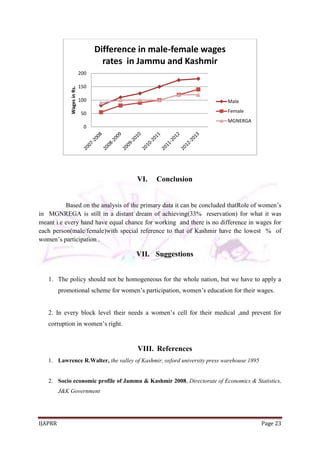
Table: 3:-Difference in Male-Female wages rates in MGNREGA across Jammu And Kashmir
Year Male Female MGNERGA
2007-2008 80 55 90
2008-2009 110 80 100
2009-2010 125 90 100
2010-2011 150 100 100
2011-2012 175 120 120
2012-2013 180 140 120
0
5000000
10000000
15000000
20000000
25000000
women person -days % in kashmir
Region
Total persons
No. of Women’s
% of Women’s
IJAPRR Page 23
VI. Conclusion
Based on the analysis of the primary data it can be concluded thatRole of women’s
in MGNREGA is still in a distant dream of achieving(33% reservation) for what it was
meant i.e every hand have equal chance for working and there is no difference in wages for
each person(male/female)with special reference to that of Kashmir have the lowest % of
women’s participation .
VII. Suggestions
1. The policy should not be homogeneous for the whole nation, but we have to apply a
promotional scheme for women’s participation, women’s education for their wages.
2. In every block level their needs a women’s cell for their medical ,and prevent for
corruption in women’s right.
VIII. References
1. Lawrence R.Walter, the valley of Kashmir, oxford university press warehouse 1895
2. Socio economic profile of Jammu & Kashmir 2008, Directorate of Economics & Statistics,
J&K Government
0
50
100
150
200WagesinRs.
Difference in male-female wages
rates in Jammu and Kashmir
Male
Female
MGNERGA
IJAPRR Page 24
3. Khan Amir ullah /MR Saluja(2006), Impact of the NREGA on Rural livelihoods, India
Development foundation, Delhi,India.
4. Khera, R., & Nayak, N. (2009). Woman Workers and Perceptions of the NREGA. Economic
and Political Weekly, 44, 49-57.
5. Hazarika, P. G. (2009). Promoting Women Empowerment and Gender Equality through the
Right to Decent Work: Implementation of National Rural Employment Guarantee
Programm (NREGP) in Assam State (India): A Case Study.
6. Ratna, M. Sudarshan. (2010). Women’s participation in the NREGA: the interplay between
wage work and care.
7. Pankaj, A., & Tankha, R. (2010). Empowerment Effects of the NREGS on Women Workers:
A Study in Four States. Economic and Political Weekly, 30, 45-55.
8. Das, Dinesh. (2012). Examining India’s Mahatma Gandhi National Rural Employment
Guarantee Act (MGNREGA) Its Impact and Women’s Participation. International Journal
of Social Science Tomorrow (IJSST).
9. NREGA guidelines. Ministry of Rural Development, Government of India, www.nrega.nic.in
10. Minimum wages, Ministry of Labour and Employment, Government of India,
www.labour.nic.in

22 ijaprr vol1-3-18-24babita

  • 1.
    IJAPRR Page 18 InternationalJournal of Allied Practice, Research and Review Website: www.ijaprr.com (ISSN 2350-1294) A case study of women participation in Mahatma Gandhi National Rural Employment Guarantee Act (MGNERGA) in Kashmir Babita Pandey1, Tanveer Ahmed Wani2 1Unique Institute of Management & Technology, Ghaziabad 2Research Scholar, Shri Venkateshwara University, Gajraula Abstract - In Kashmir, the Gram Sabhas are not properly functioning because of internal security reasons. Although the Gram Sabhas have started functioning again after revival of peace in the valley, the women participation in these institutions is very negligible. Since decisions related to the implementation of NREGA works are supposed to take place in gram sabhas, it is significant that most women should take part in gram sabha elections for that there is an immediate need of internal security and social protection for them. There are various factors which encourage the women worker’s participation under this scheme include nature of work, which do not need skilled worker, the limited hours of work, availability of work locally, reduction of migration of male member, substantial jump in the wage rate etc. Participation of women in MGNREGA is very low in the state of Jammu and Kashmir. KEYWORDS: MGNERGA; Wages; Employment . I. Introduction The basic aim of MGNREGA was to generate as much as possible labour days both in lean and non-lean seasons so that the seasonal impact on the earning could be minimized. But this provision was also amended by a notification on Nov11, 2009 giving room to material intensive projects by the consequence of this the labour days will get decreased and also gave a room & eroded the powers granted to Panchayats under the Act and allowed material contractors to get a foot in the door and also opened the door of corruption. Living in the current inflationary situation to meet both ends meet has become so difficult even for most of the middle class individuals. So by fixing wages are comparatively lower than the prevailing market rates is also loophole of the Act. MGNREGA which gives 100 days of guaranteed employment is not only violating the Minimum Wages Act came up with a notification issued on Jan1,2009 has bought out the unbridled discretationary powers conferred on the Center by Sec6(1) of the act to fix wages lower than minimum wages. As per available data available from the primary data collected and also from the Ministry of Employment Labour, Government of India in Jammu and Kashmir State notified minimum wages are Rs110 (100 +10) in which 100 stands for the minimum wages and 10 is state contribution for MGNREGA workers, but if we look on political stability and
  • 2.
    IJAPRR Page 19 geographicalcondition still a worker has to confine with hundred ten rupees wage. It is unjustified when other persons can earn more than doing unorganized/ agricultural labour then why to turn out to MGNREGA. II. Review of Literature After independence various studies have been done on various rural development programmes in India. Jandu (2008) carried out a research in four states namely Chhattisgarh, Madhya Pradesh, Orissa and Tamil Nadu. Survey data shows that women workers are more confident about their roles as contributors to family expenditure and their work decisions and it gives them space in public sphere. Ramesh & Kumar (2009) in their study also found that MGNREGA holds the powerful prospect of bringing major changes in the lives of women. MGNREGA is playing a substantial role in empowering women economically and laying the basis for greater independence and self-esteem. It has become a beacon of light in the empowerment of the rural women, and contributed substantially for the increased living and economic conditions. Pankaj & Tankha (2010) examines the empowerment effects of MGNREGA through field survey in Bihar, Jharkhand, Rajasthan and Himachal Pradesh. The study shows that a woman worker’s earnings from MGNREGA constituted 14 percent of the total annual income of the household on average across the four sample districts in 2008-09. This study also shows an increased participation of women in gram sabha meetings. Panda & Umdor (2011) conducted a field study on the impact of MGNREGA in Assam. In their sample villages, namely Barpeta, Jorhat, Karimganj, Morigaon and Tinsukia they found that on an average only 42 percent said that MGNREGA had helped to uplift women. . There has been no change in the status of women in four sample districts except Tinsukia. III. Objectives of the study The present research aims to assess the impact analysis of MGNREGA on Jammu and Kashmir state, with the following objectives: 1. To assess the extent of additional employment generation through MGNREGA to the rural poor. 2. To examine the impact of MGNREGA on the rural upliftment in the study area. 3. To make suggestions for strengthening the implementation strategy of MGNREGA. IV. Methodology The study is based on primary data. The study is based on purposive sampling technique. The primary data’s are collected through structured questionnaire, 100 beneficiaries form the total sample of the study. Simple statistical tools have been used to analyze the data. V. Analysis The socio-economic condition of the women’s in the study area is shown in table in 1 and 2. Table: 1:-Percentage of women person-days from FY 2006-07 to FY 2011-2012
  • 3.
    IJAPRR Page 20 0 10 20 30 40 50 60 70 80 90 %of women person-days from 2006-07 to 2008-2009 2006-2007 2007-2008 2008-2009 State 2006-2007 2007-2008 2008-2009 2009-2010 2010-2011 2011-2012 Andhra Pradesh 55 58 58 58 57 58 Assam 32 31 27 28 27 25 Bihar 17 28 30 30 28 29 Chattisgarh 39 42 47 49 49 45 Gujrat 50 47 43 48 44 45 Haryana 31 34 31 35 36 36 Himachal Pradesh 12 30 39 46 48 60 Jammu and Kashmir 4 1 6 7 7 18 Jharkhand 39 27 29 34 33 31 Karnataka 51 50 50 37 46 46 Kerla 66 71 85 88 90 93 Madhya Pradesh 43 42 43 44 44 43 Maharashtra 37 40 46 40 46 46 Odisha 36 36 38 36 39 39 Punjab 38 16 25 26 34 43 Rajasthan 67 69 67 67 68 69 Tamil Nadu 81 82 80 83 83 74 Uttar Pradesh 17 15 18 22 21 17 UttaraKhand 30 43 37 40 40 45 West Bengal 18 17 27 33 34 32 All India 40 43 48 48 48 47
  • 4.
    IJAPRR Page 21 Table:2-: Percentage of women’s participation in Kashmir region in year 2006-07 to 2011-12. 36 38 40 42 44 46 48 50 2006-2007 2007-2008 2008-2009 2009-2010 2010-2011 2011-2012 All india % of women person-days from year 2006-07 to 2011-12 All India 0 10 20 30 40 50 60 70 80 90 100 % of women person-days from 2009-10 to 2011-12 2009-2010 2010-2011 2011-2012
  • 5.
    IJAPRR Page 22 Year Totalpersons No. of Women’s % of Women’s 2006-2007 1229690 49187 4 2007-2008 1622560 16226 1 2008-2009 2116430 126986 6 2009-2010 2938056 205664 7 2010-2011 4916867 344180 7 2011-2012 20910314 3763856 18 Table: 3:-Difference in Male-Female wages rates in MGNREGA across Jammu And Kashmir Year Male Female MGNERGA 2007-2008 80 55 90 2008-2009 110 80 100 2009-2010 125 90 100 2010-2011 150 100 100 2011-2012 175 120 120 2012-2013 180 140 120 0 5000000 10000000 15000000 20000000 25000000 women person -days % in kashmir Region Total persons No. of Women’s % of Women’s
  • 6.
    IJAPRR Page 23 VI.Conclusion Based on the analysis of the primary data it can be concluded thatRole of women’s in MGNREGA is still in a distant dream of achieving(33% reservation) for what it was meant i.e every hand have equal chance for working and there is no difference in wages for each person(male/female)with special reference to that of Kashmir have the lowest % of women’s participation . VII. Suggestions 1. The policy should not be homogeneous for the whole nation, but we have to apply a promotional scheme for women’s participation, women’s education for their wages. 2. In every block level their needs a women’s cell for their medical ,and prevent for corruption in women’s right. VIII. References 1. Lawrence R.Walter, the valley of Kashmir, oxford university press warehouse 1895 2. Socio economic profile of Jammu & Kashmir 2008, Directorate of Economics & Statistics, J&K Government 0 50 100 150 200WagesinRs. Difference in male-female wages rates in Jammu and Kashmir Male Female MGNERGA
  • 7.
    IJAPRR Page 24 3.Khan Amir ullah /MR Saluja(2006), Impact of the NREGA on Rural livelihoods, India Development foundation, Delhi,India. 4. Khera, R., & Nayak, N. (2009). Woman Workers and Perceptions of the NREGA. Economic and Political Weekly, 44, 49-57. 5. Hazarika, P. G. (2009). Promoting Women Empowerment and Gender Equality through the Right to Decent Work: Implementation of National Rural Employment Guarantee Programm (NREGP) in Assam State (India): A Case Study. 6. Ratna, M. Sudarshan. (2010). Women’s participation in the NREGA: the interplay between wage work and care. 7. Pankaj, A., & Tankha, R. (2010). Empowerment Effects of the NREGS on Women Workers: A Study in Four States. Economic and Political Weekly, 30, 45-55. 8. Das, Dinesh. (2012). Examining India’s Mahatma Gandhi National Rural Employment Guarantee Act (MGNREGA) Its Impact and Women’s Participation. International Journal of Social Science Tomorrow (IJSST). 9. NREGA guidelines. Ministry of Rural Development, Government of India, www.nrega.nic.in 10. Minimum wages, Ministry of Labour and Employment, Government of India, www.labour.nic.in