'Living Longer, Living Better?' – 
Queering the Heteronormative 
and Cisnormative Space of 
Aged Care in Australia 
Sujay Kentlyn 
Outrageous Ageing LGBTI Elders' Wellbeing Project 
sujay@outrageousageing.org.au
Introduction 
1. Living Longer, Living Better 2012 Reform of 
Australia's Aged Care sector 
2. The 'space' of aged care in Australia 
3. Queering the space – including/acknowledging 
LGBTI 
- Legislation and policy 
- Service Provision 
- Outreach: 'Outrageous Ageing'
1. 'Living Longer, Living Better' 
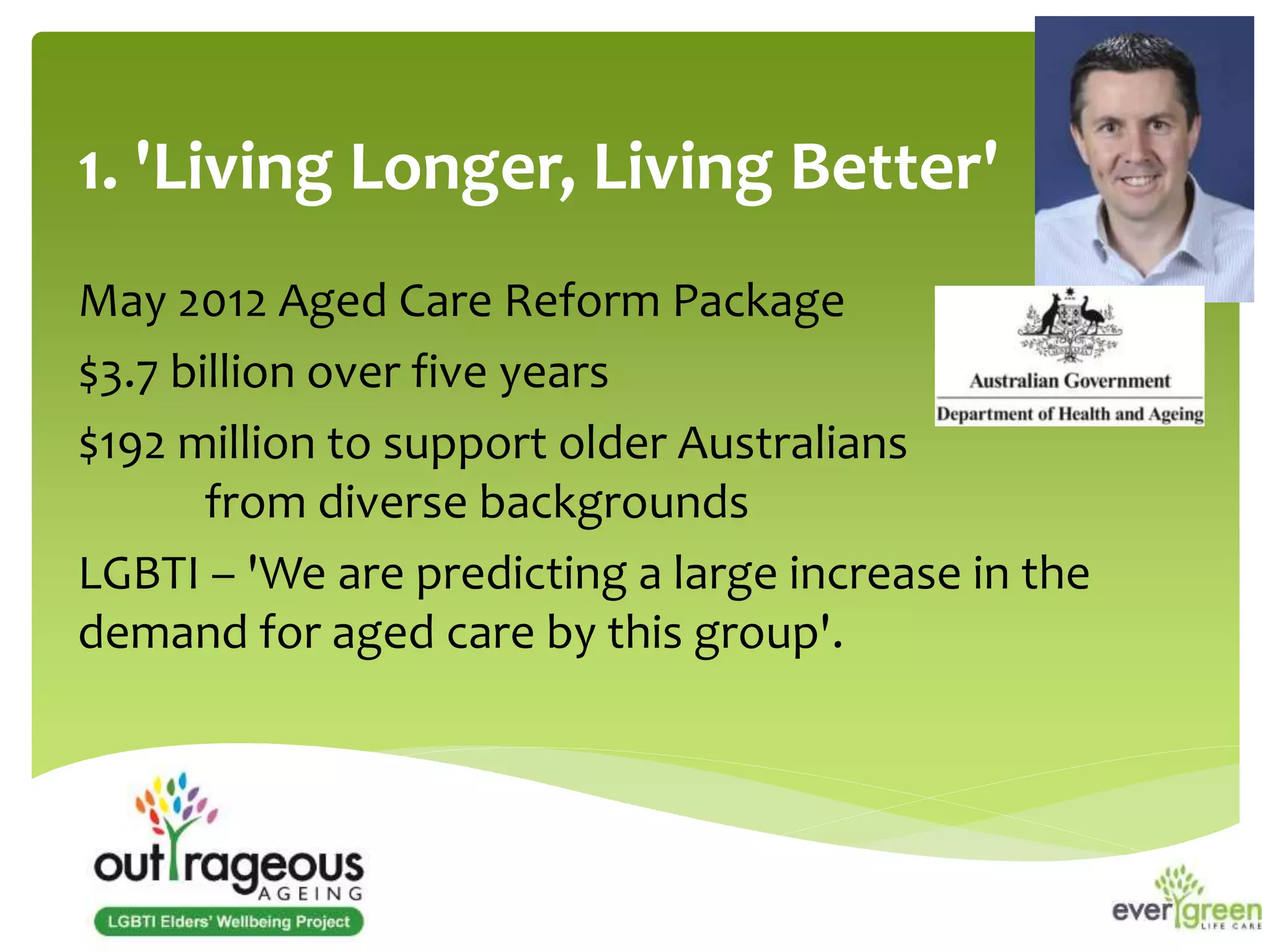
May 2012 Aged Care Reform Package 
$3.7 billion over five years 
$192 million to support older Australians 
from diverse backgrounds 
LGBTI – 'We are predicting a large increase in the 
demand for aged care by this group'.
Caring for Older Australians 
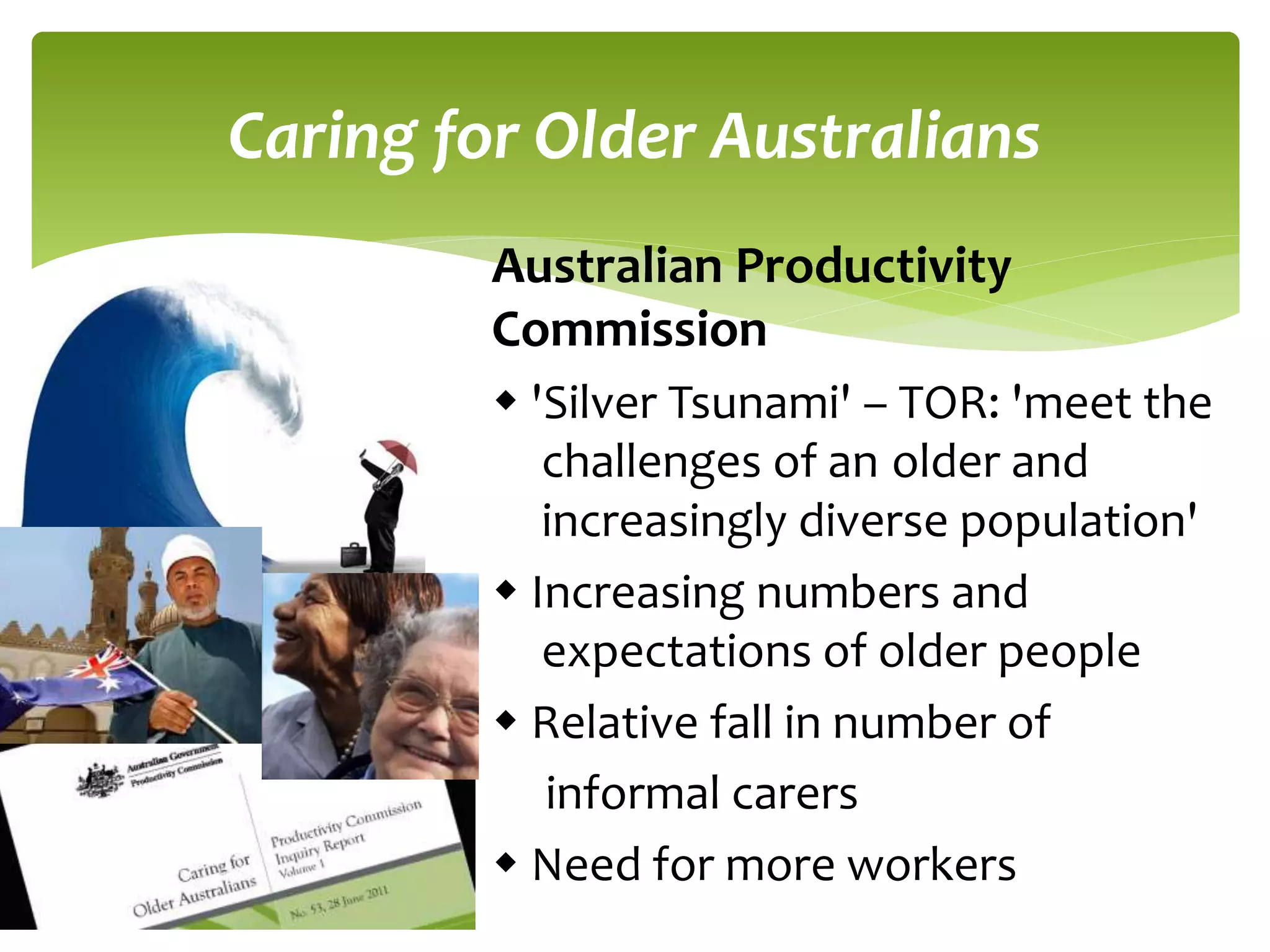
Australian Productivity 
Commission 
 'Silver Tsunami' – TOR: 'meet the 
challenges of an older and 
increasingly diverse population' 
 Increasing numbers and 
expectations of older people 
 Relative fall in number of 
informal carers 
 Need for more workers
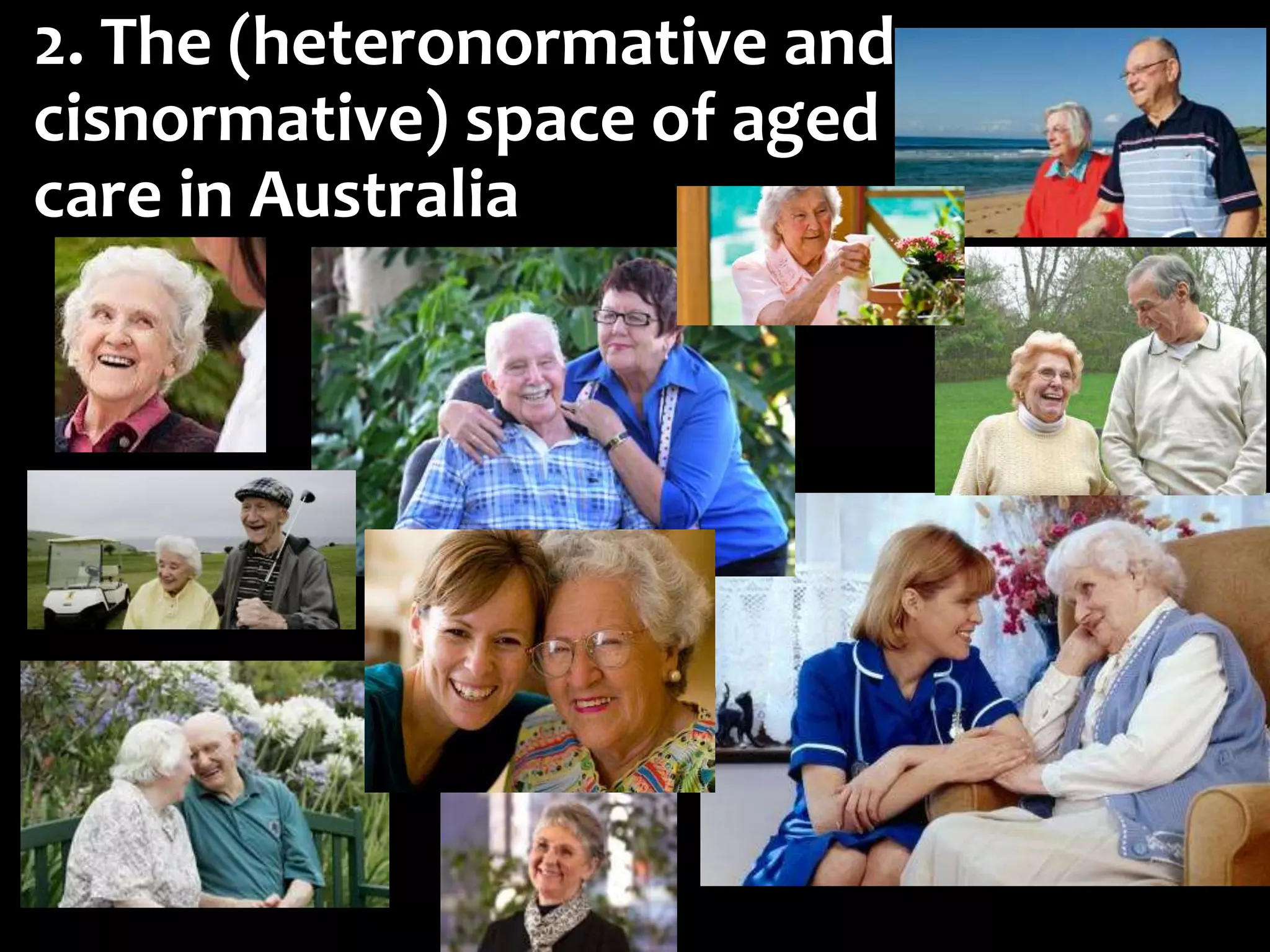
2. The (heteronormative and 
cisnormative) space of aged 
care in Australia
Aged Care Service Providers 
The Federal government regulates aged care services 
by allocating places to approved service providers. 
Residential places: 78% 
Community (services that come into the client's 
home): 22% 
For-Profit providers: 29% 
Not-For-Profit providers: 71% 
Based on Department of Health and Ageing figures at 30 June 2010 
http://www.health.gov.au/internet/main/publishing.nsf/content/ageing-rescare-servlist-providers-services.htm#ap01
NFP Service Providers - Religious 
Governments have increasingly moved out of direct service 
provision into outsourcing. 
Religious organisations figure prominently in service 
provision, especially to lower income and marginalised 
groups. 
Religious organisations have been allocated: 
30% of Commonwealth places overall 
42% of Commonwealth places allocated to the NFP 
sector. 
Faith-based organisations have exemption from 
both state and federal Anti-Discrimination 
legislation.
NFP Service Providers - Religious 
Australia is a largely secular nation 
Self-reported weekly church attendance (2001) 8.8% 
(and falling) 
US self-reported weekly church attendance (2010) 
43.1% (and rising) 
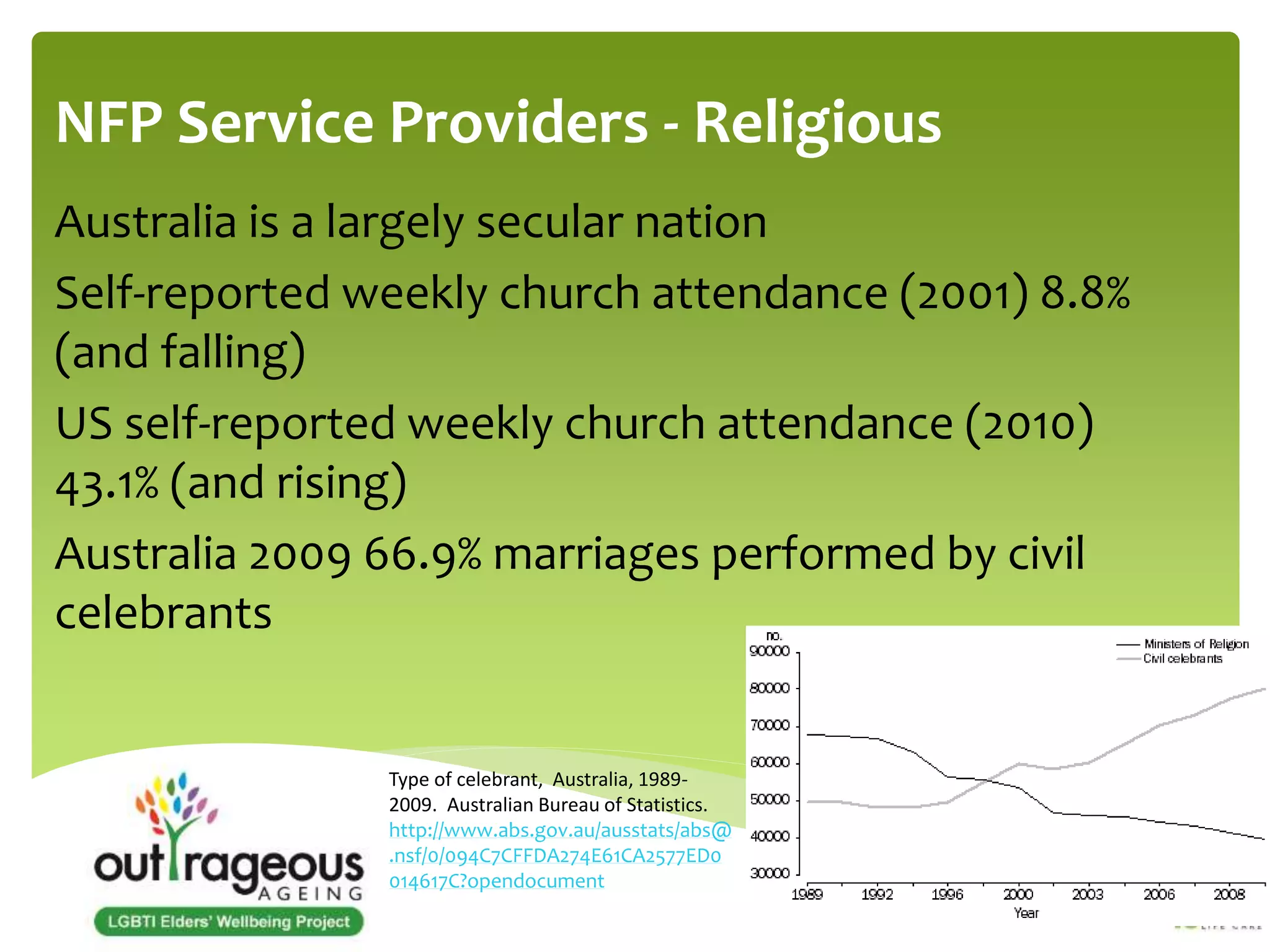
Australia 2009 66.9% marriages performed by civil 
celebrants 
Type of celebrant, Australia, 1989- 
2009. Australian Bureau of Statistics. 
http://www.abs.gov.au/ausstats/abs@ 
.nsf/0/094C7CFFDA274E61CA2577ED0 
014617C?opendocument
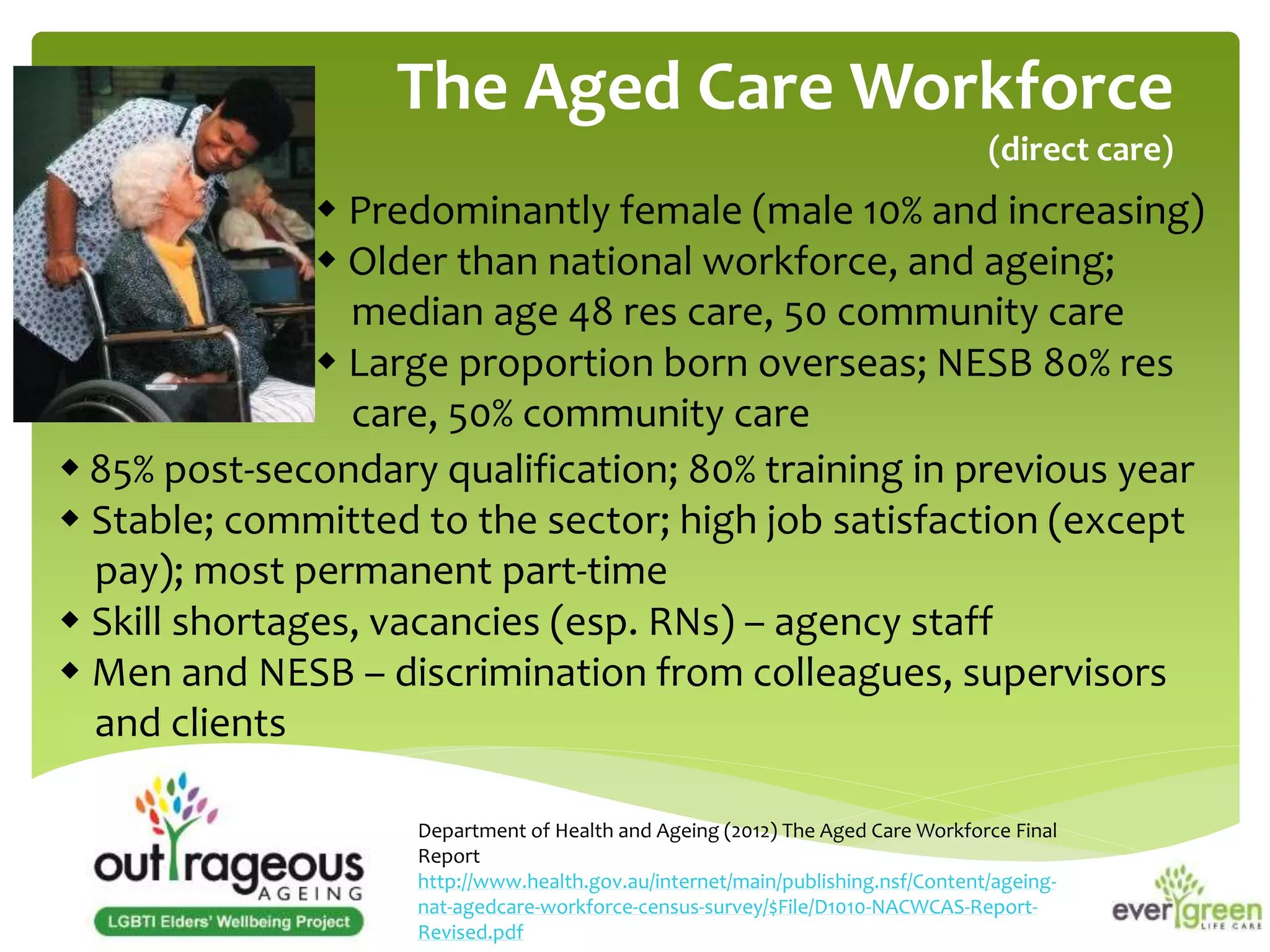
The Aged Care Workforce 
(direct care) 
 Predominantly female (male 10% and increasing) 
 Older than national workforce, and ageing; 
median age 48 res care, 50 community care 
 Large proportion born overseas; NESB 80% res 
care, 50% community care 
 85% post-secondary qualification; 80% training in previous year 
 Stable; committed to the sector; high job satisfaction (except 
pay); most permanent part-time 
 Skill shortages, vacancies (esp. RNs) – agency staff 
 Men and NESB – discrimination from colleagues, supervisors 
and clients 
Department of Health and Ageing (2012) The Aged Care Workforce Final 
Report 
http://www.health.gov.au/internet/main/publishing.nsf/Content/ageing-nat- 
agedcare-workforce-census-survey/$File/D1010-NACWCAS-Report- 
Revised.pdf
Implications for 
LGBTI clients 
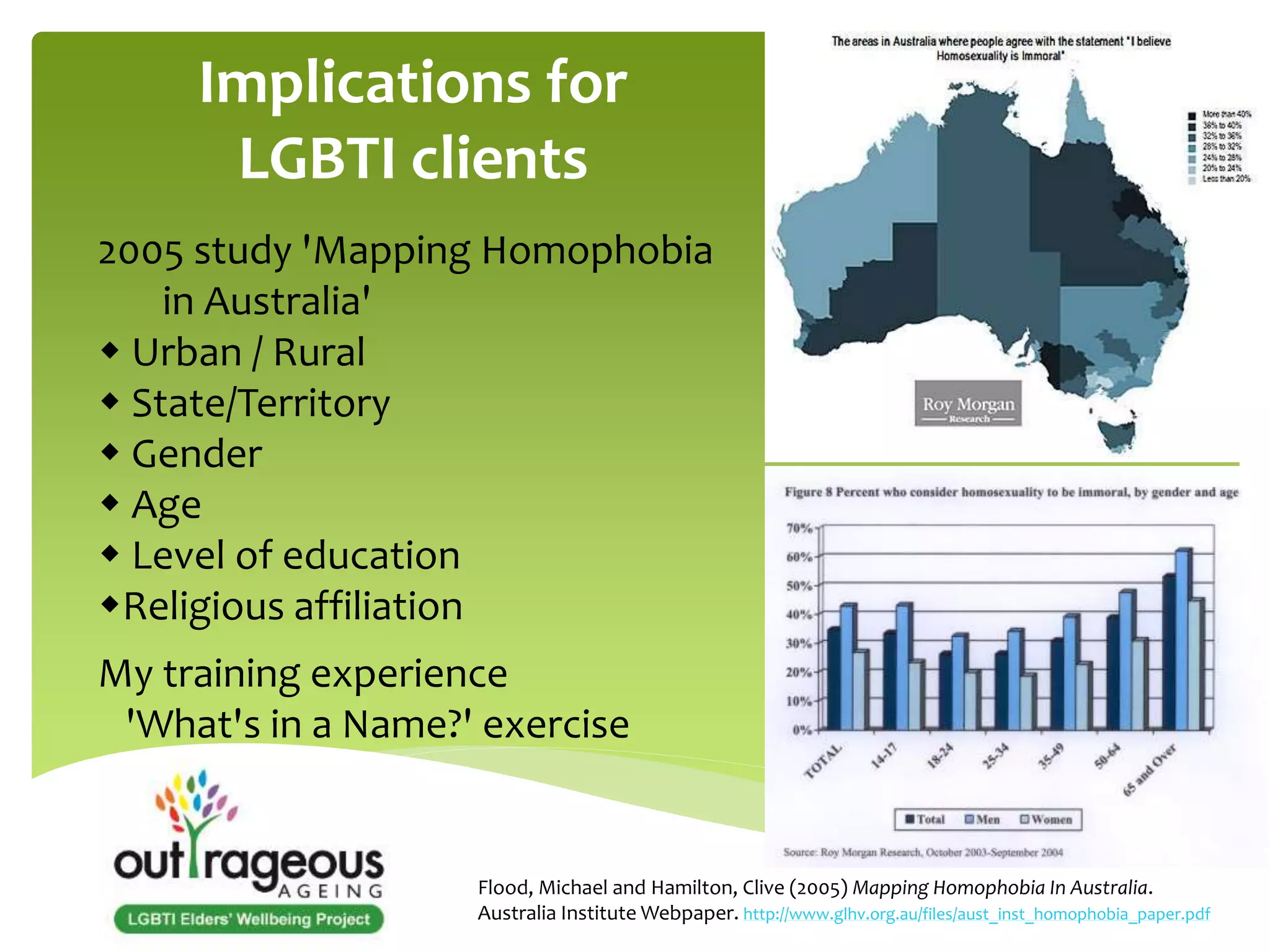
2005 study 'Mapping Homophobia 
in Australia' 
 Urban / Rural 
 State/Territory 
 Gender 
 Age 
 Level of education 
Religious affiliation 
My training experience 
'What's in a Name?' exercise 
Flood, Michael and Hamilton, Clive (2005) Mapping Homophobia In Australia. 
Australia Institute Webpaper. http://www.glhv.org.au/files/aust_inst_homophobia_paper.pdf
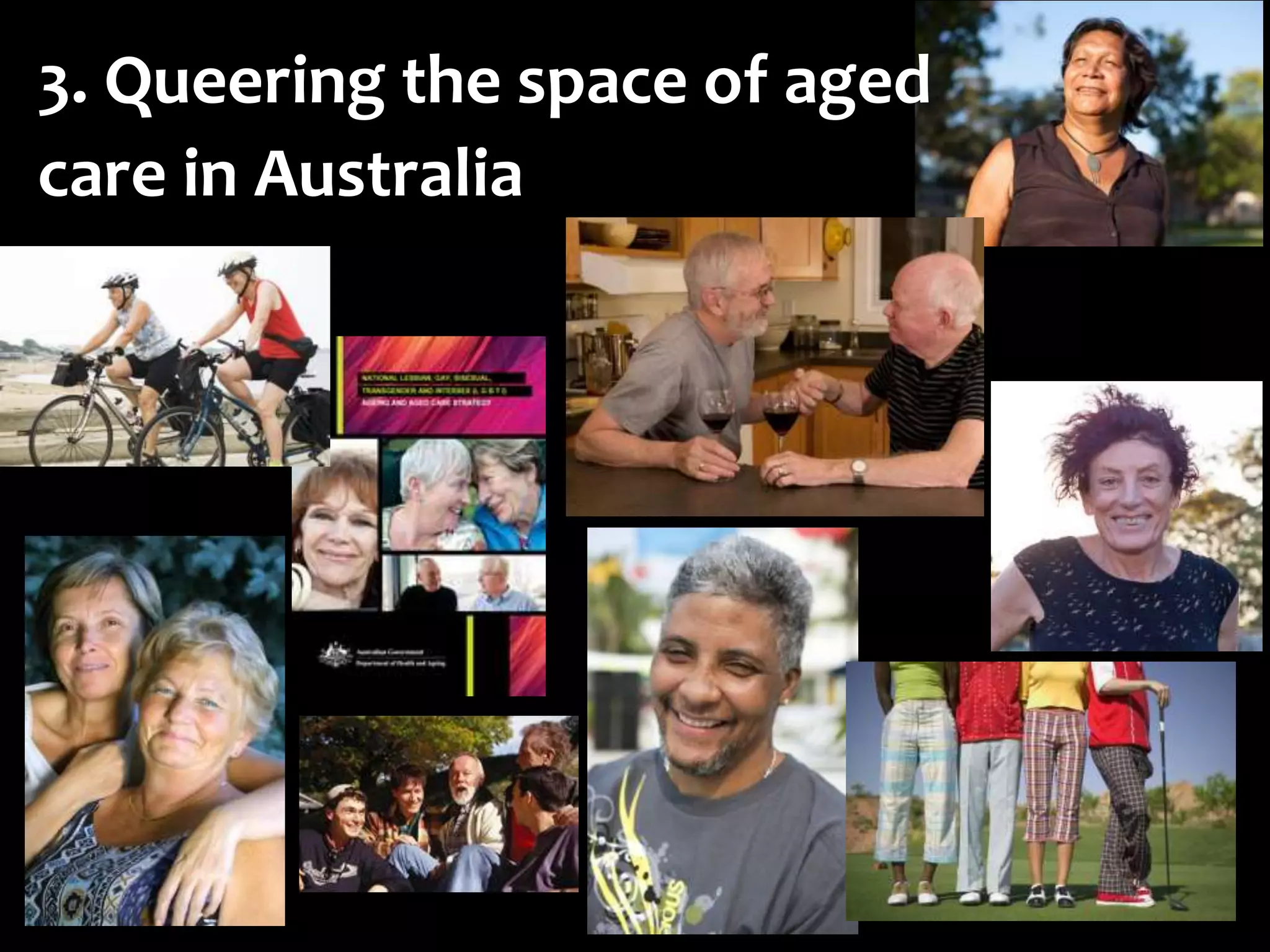
3. Queering the space of aged 
care in Australia
Population Density Comparison 
Map: 2000 Population 
density in persons per 
square mile, lower 48 
states only. 
Area continental US: 
3,119,885 square miles 
2010 population 
continental US: 
306,675,006 
Density: 98.3 persons 
per square mile. 
United States 
Map Source: National Atlas of the United States 
http://www.nationalatlas.gov/mld/ce2000t.html [Accessed 30/03/2013]
Population Density Comparison 
Map: 2010 Population 
density in persons per 
square kilometre. 
Area Australia: 
2,967,909 square 
miles (only about 152,000 
mi2 smaller) 
2010 population 
Australia: 22,342,000 
Density: 7.5 persons 
Australia 
Map Source: Australian Bureau of Statistics. per square mile. 
http://www.abs.gov.au/ausstats/abs@.nsf/Lookup/by%20Subject/1301.0~2012~Main%20Features~ 
Geographic%20distribution%20of%20the%20population~49 [Accessed 30/03/2013]
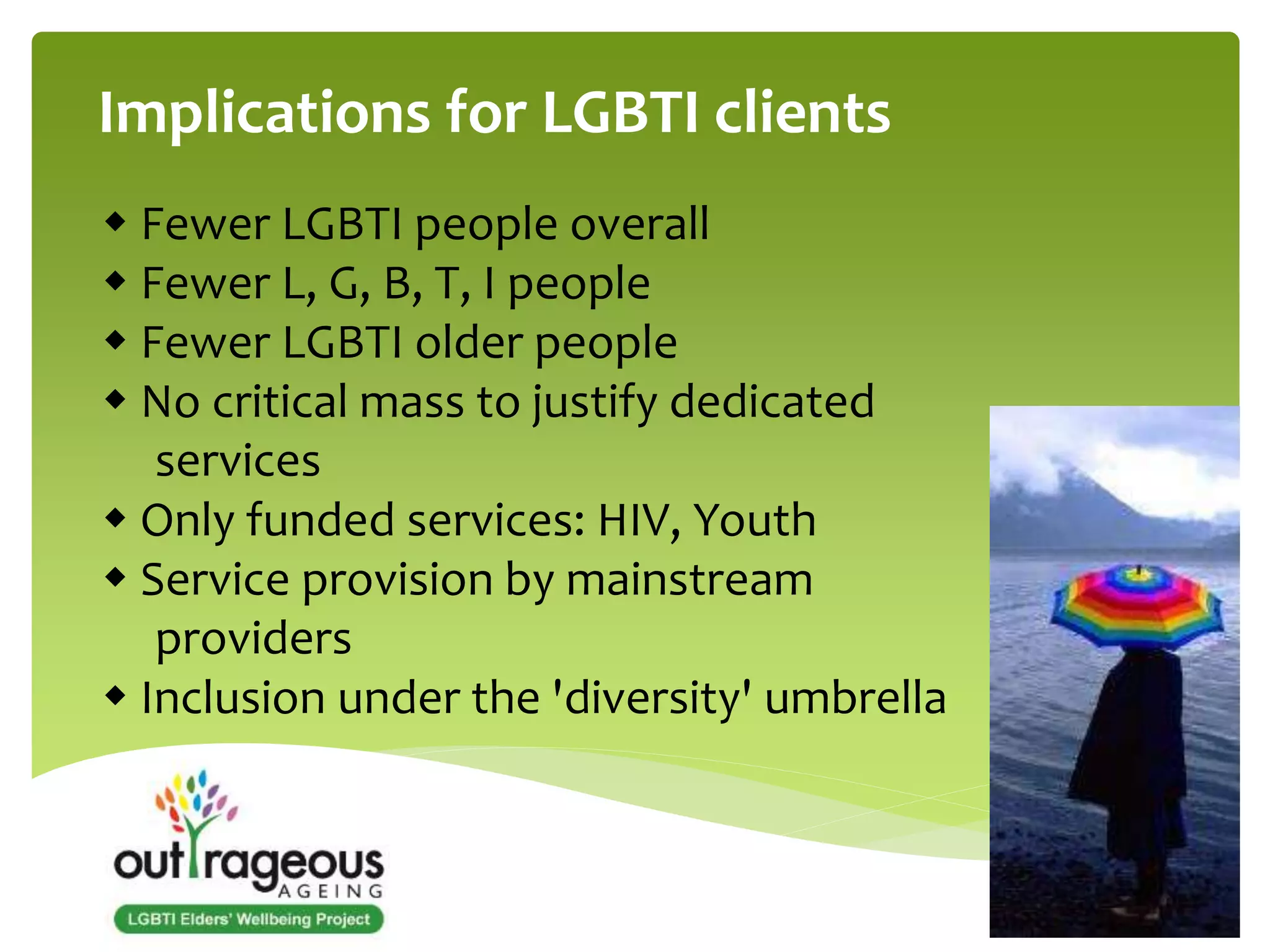
Implications for LGBTI clients 
 Fewer LGBTI people overall 
 Fewer L, G, B, T, I people 
 Fewer LGBTI older people 
 No critical mass to justify dedicated 
services 
 Only funded services: HIV, Youth 
 Service provision by mainstream 
providers 
 Inclusion under the 'diversity' umbrella
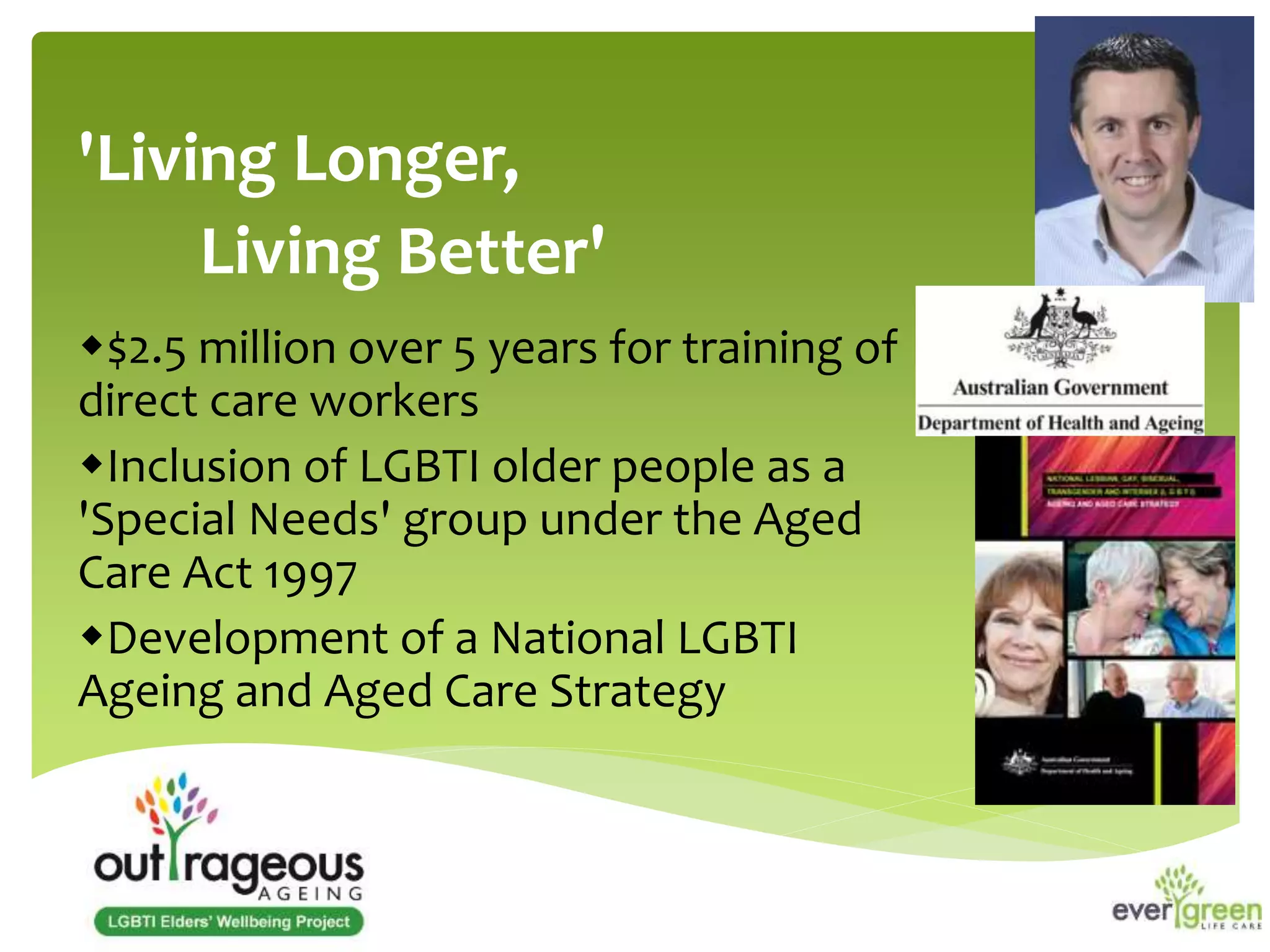
'Living Longer, 
Living Better' 
$2.5 million over 5 years for training of 
direct care workers 
Inclusion of LGBTI older people as a 
'Special Needs' group under the Aged 
Care Act 1997 
Development of a National LGBTI 
Ageing and Aged Care Strategy
'Special Needs' Groups 
 Indigenous people; 
 people from Culturally and Linguistically Diverse (CALD) 
backgrounds; 
 people who live in rural and remote areas; 
 people who are financially and/or socially disadvantaged; 
 people who are homeless; 
 veterans and their widow/ers; 
 care leavers - people brought up in care away from their family as 
state wards or raised in children’s homes, orphanages or other 
institutions, or in foster care. 
What this means in practice is that when the 
Commonwealth is allocating funding for aged care 
services, they take into account the capacity of 
service providers to meet the needs of these groups.
The National LGBTI Ageing and 
Aged Care Strategy 
Goal 1: LGBTI people will experience equitable access to appropriate 
ageing and aged care services 
Goal 2: The aged care and LGBTI sectors will be supported and 
resourced to proactively address the needs of LGBTI older people 
Goal 3: Ageing and aged care services will be supported to deliver 
LGBTI-inclusive services 
Goal 4: LGBTI-inclusive ageing and aged care services will be delivered 
by a skilled and competent paid and volunteer workforce 
Goal 5: LGBTI communities, including older LGBTI people, will be 
actively engaged in the planning, delivery and evaluation of 
ageing and aged care policies, programs and services 
Goal 6: LGBTI people, their families and carers will be a priority for 
ageing and aged care research 
Department of Health and Ageing (2012) National LGBTI Ageing and 
Aged Care Strategy. 
http://www.health.gov.au/internet/main/publishing.nsf/Content/44E7132570CB0438 
CA257AD9001432CD/$File/lgbti-strategy.pdf
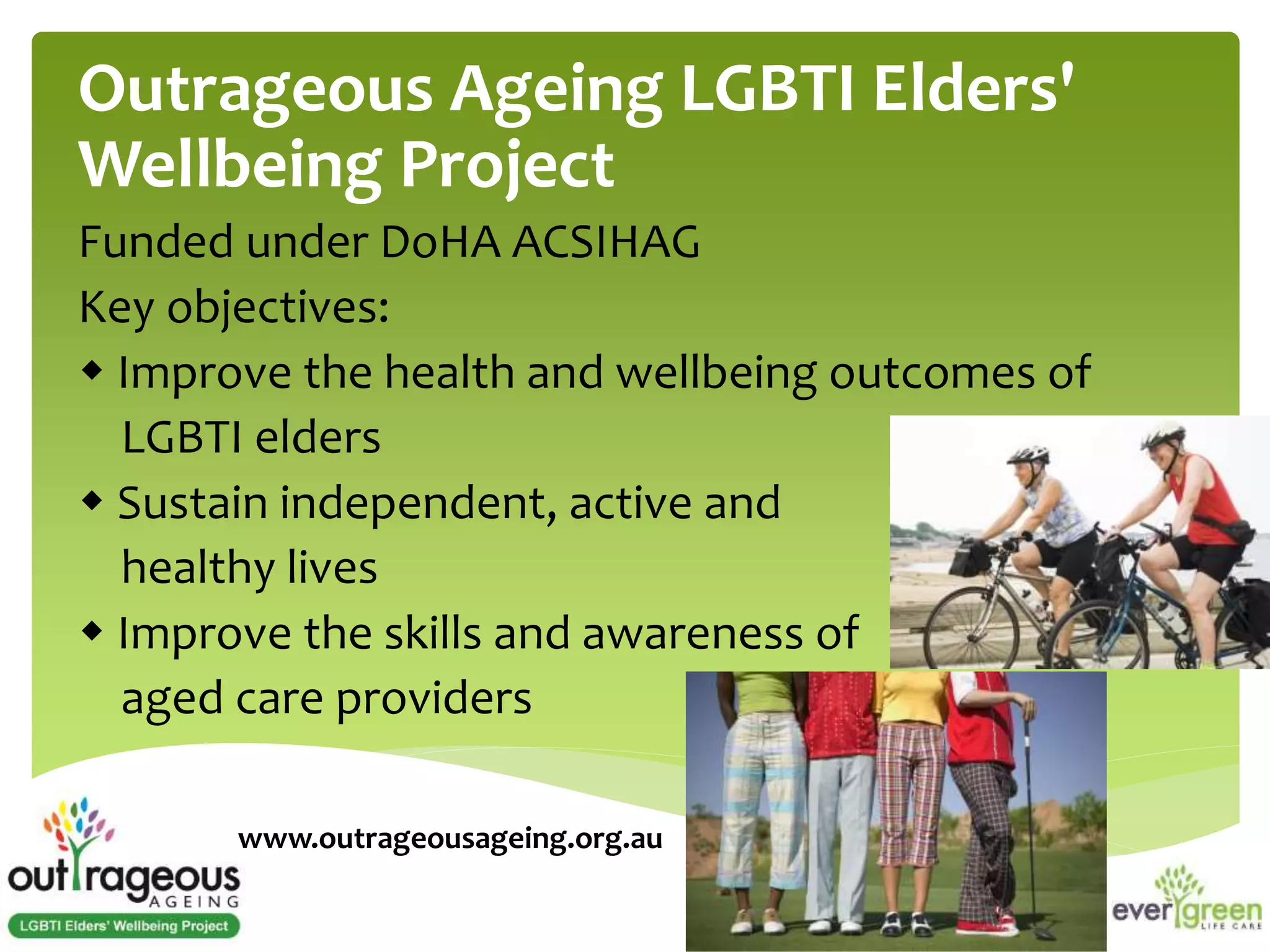
Outrageous Ageing LGBTI Elders' 
Wellbeing Project 
Funded under DoHA ACSIHAG 
Key objectives: 
 Improve the health and wellbeing outcomes of 
LGBTI elders 
 Sustain independent, active and 
healthy lives 
 Improve the skills and awareness of 
aged care providers 
www.outrageousageing.org.au
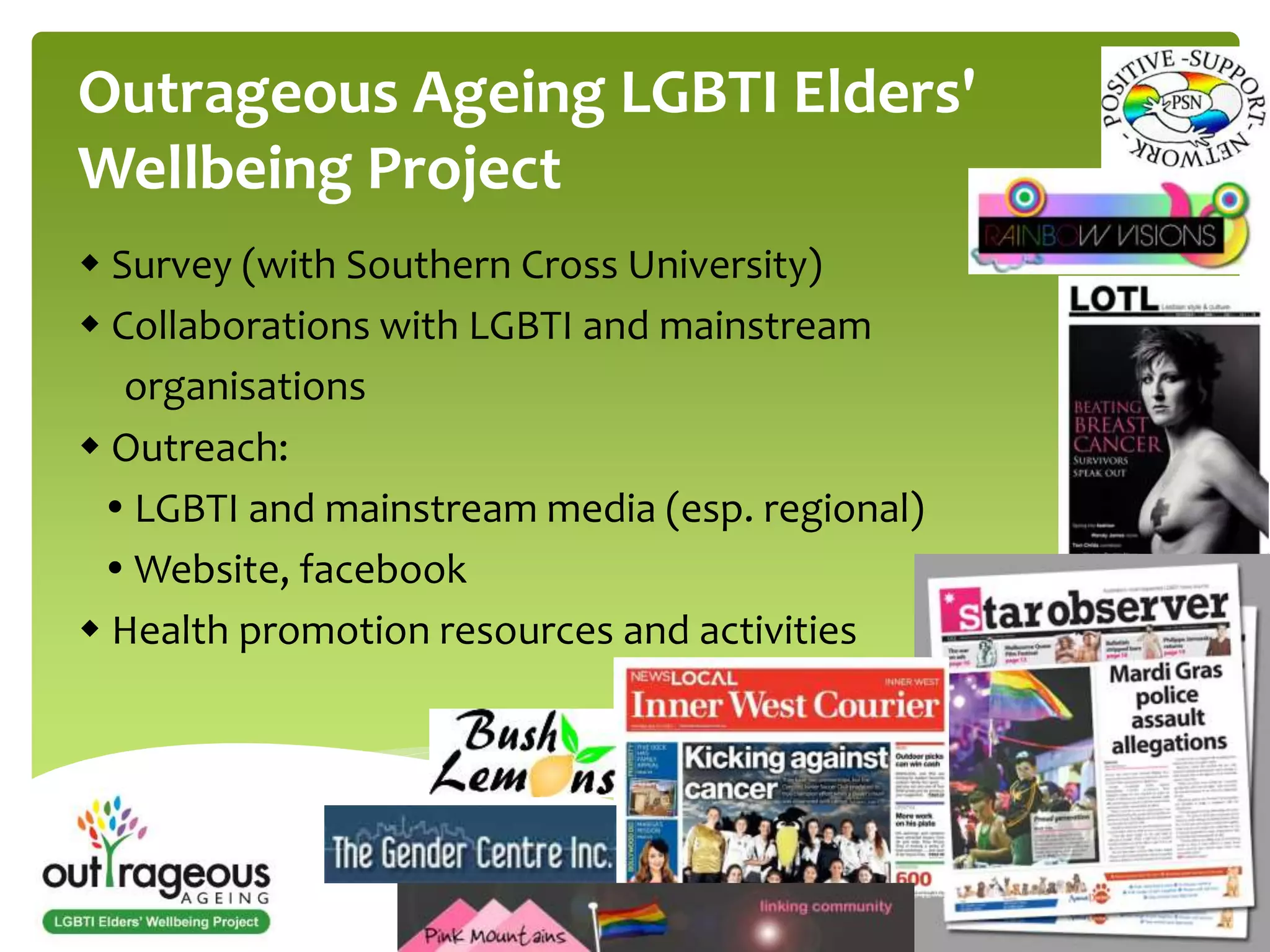
Outrageous Ageing LGBTI Elders' 
Wellbeing Project 
 Survey (with Southern Cross University) 
 Collaborations with LGBTI and mainstream 
organisations 
 Outreach: 
 LGBTI and mainstream media (esp. regional) 
 Website, facebook 
 Health promotion resources and activities
Accreditation 
GLHV: GLBTI inclusive practice – a set of 
national standards 
 Beyond: 'we treat everyone the same'. 
A report on the 2010-2011 program: How2 create a 
gay, lesbian, bisexual, transgender and intersex 
inclusive service. 
 GLBTI Inclusive Practice in Rural Communities 
 Inclusive Practice Audit Tool 
 Rainbow Tick Prospectus and Standards 
 CAC pack – community aged care
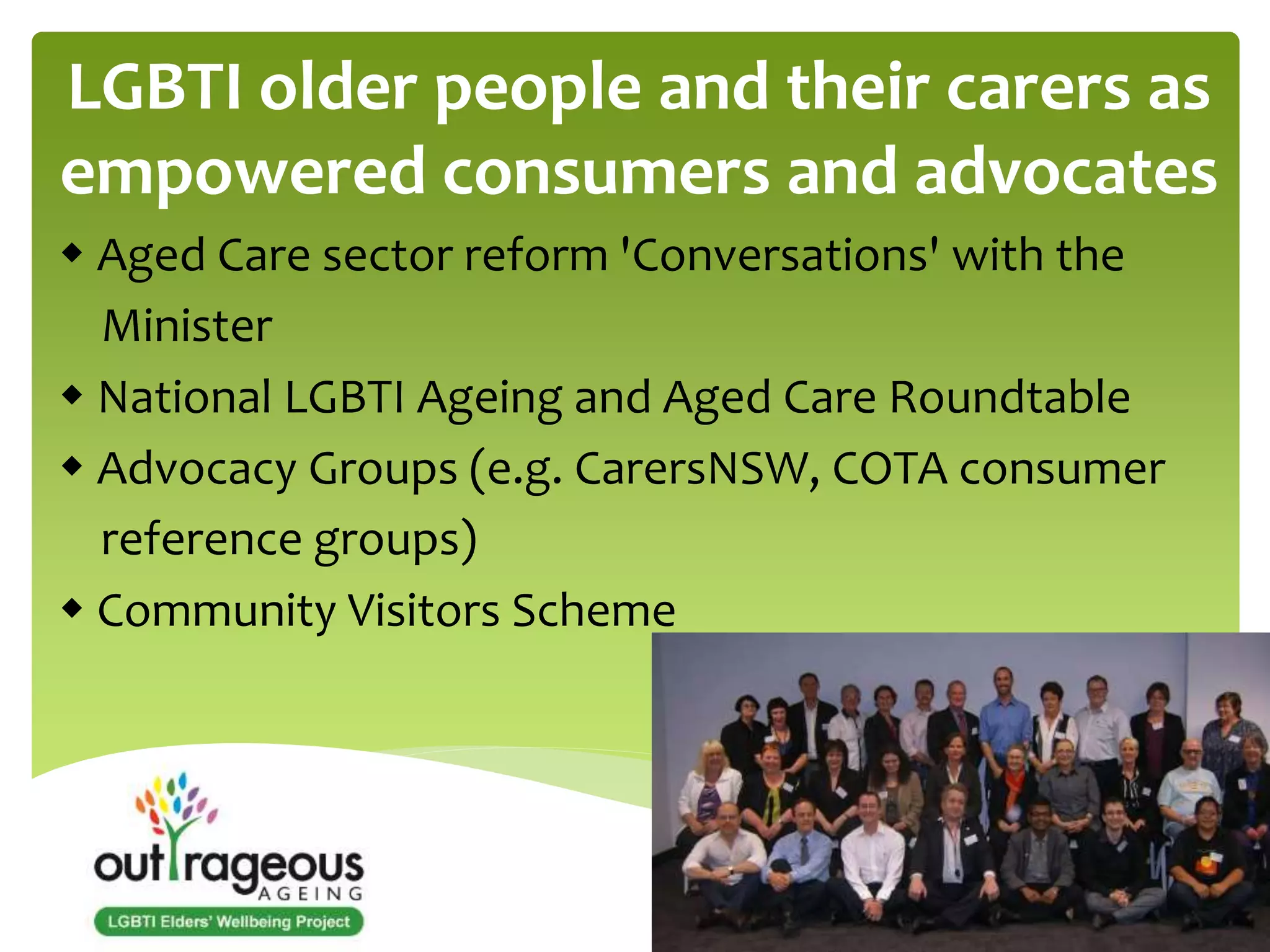
LGBTI older people and their carers as 
empowered consumers and advocates 
 Aged Care sector reform 'Conversations' with the 
Minister 
 National LGBTI Ageing and Aged Care Roundtable 
 Advocacy Groups (e.g. CarersNSW, COTA consumer 
reference groups) 
 Community Visitors Scheme

2.1.5 ms sujay kentlyn

  • 1.
    'Living Longer, LivingBetter?' – Queering the Heteronormative and Cisnormative Space of Aged Care in Australia Sujay Kentlyn Outrageous Ageing LGBTI Elders' Wellbeing Project sujay@outrageousageing.org.au
  • 2.
    Introduction 1. LivingLonger, Living Better 2012 Reform of Australia's Aged Care sector 2. The 'space' of aged care in Australia 3. Queering the space – including/acknowledging LGBTI - Legislation and policy - Service Provision - Outreach: 'Outrageous Ageing'
  • 3.
    1. 'Living Longer,Living Better' May 2012 Aged Care Reform Package $3.7 billion over five years $192 million to support older Australians from diverse backgrounds LGBTI – 'We are predicting a large increase in the demand for aged care by this group'.
  • 4.
    Caring for OlderAustralians Australian Productivity Commission  'Silver Tsunami' – TOR: 'meet the challenges of an older and increasingly diverse population'  Increasing numbers and expectations of older people  Relative fall in number of informal carers  Need for more workers
  • 5.
    2. The (heteronormativeand cisnormative) space of aged care in Australia
  • 6.
    Aged Care ServiceProviders The Federal government regulates aged care services by allocating places to approved service providers. Residential places: 78% Community (services that come into the client's home): 22% For-Profit providers: 29% Not-For-Profit providers: 71% Based on Department of Health and Ageing figures at 30 June 2010 http://www.health.gov.au/internet/main/publishing.nsf/content/ageing-rescare-servlist-providers-services.htm#ap01
  • 7.
    NFP Service Providers- Religious Governments have increasingly moved out of direct service provision into outsourcing. Religious organisations figure prominently in service provision, especially to lower income and marginalised groups. Religious organisations have been allocated: 30% of Commonwealth places overall 42% of Commonwealth places allocated to the NFP sector. Faith-based organisations have exemption from both state and federal Anti-Discrimination legislation.
  • 8.
    NFP Service Providers- Religious Australia is a largely secular nation Self-reported weekly church attendance (2001) 8.8% (and falling) US self-reported weekly church attendance (2010) 43.1% (and rising) Australia 2009 66.9% marriages performed by civil celebrants Type of celebrant, Australia, 1989- 2009. Australian Bureau of Statistics. http://www.abs.gov.au/ausstats/abs@ .nsf/0/094C7CFFDA274E61CA2577ED0 014617C?opendocument
  • 9.
    The Aged CareWorkforce (direct care)  Predominantly female (male 10% and increasing)  Older than national workforce, and ageing; median age 48 res care, 50 community care  Large proportion born overseas; NESB 80% res care, 50% community care  85% post-secondary qualification; 80% training in previous year  Stable; committed to the sector; high job satisfaction (except pay); most permanent part-time  Skill shortages, vacancies (esp. RNs) – agency staff  Men and NESB – discrimination from colleagues, supervisors and clients Department of Health and Ageing (2012) The Aged Care Workforce Final Report http://www.health.gov.au/internet/main/publishing.nsf/Content/ageing-nat- agedcare-workforce-census-survey/$File/D1010-NACWCAS-Report- Revised.pdf
  • 10.
    Implications for LGBTIclients 2005 study 'Mapping Homophobia in Australia'  Urban / Rural  State/Territory  Gender  Age  Level of education Religious affiliation My training experience 'What's in a Name?' exercise Flood, Michael and Hamilton, Clive (2005) Mapping Homophobia In Australia. Australia Institute Webpaper. http://www.glhv.org.au/files/aust_inst_homophobia_paper.pdf
  • 11.
    3. Queering thespace of aged care in Australia
  • 12.
    Population Density Comparison Map: 2000 Population density in persons per square mile, lower 48 states only. Area continental US: 3,119,885 square miles 2010 population continental US: 306,675,006 Density: 98.3 persons per square mile. United States Map Source: National Atlas of the United States http://www.nationalatlas.gov/mld/ce2000t.html [Accessed 30/03/2013]
  • 13.
    Population Density Comparison Map: 2010 Population density in persons per square kilometre. Area Australia: 2,967,909 square miles (only about 152,000 mi2 smaller) 2010 population Australia: 22,342,000 Density: 7.5 persons Australia Map Source: Australian Bureau of Statistics. per square mile. http://www.abs.gov.au/ausstats/abs@.nsf/Lookup/by%20Subject/1301.0~2012~Main%20Features~ Geographic%20distribution%20of%20the%20population~49 [Accessed 30/03/2013]
  • 14.
    Implications for LGBTIclients  Fewer LGBTI people overall  Fewer L, G, B, T, I people  Fewer LGBTI older people  No critical mass to justify dedicated services  Only funded services: HIV, Youth  Service provision by mainstream providers  Inclusion under the 'diversity' umbrella
  • 15.
    'Living Longer, LivingBetter' $2.5 million over 5 years for training of direct care workers Inclusion of LGBTI older people as a 'Special Needs' group under the Aged Care Act 1997 Development of a National LGBTI Ageing and Aged Care Strategy
  • 16.
    'Special Needs' Groups  Indigenous people;  people from Culturally and Linguistically Diverse (CALD) backgrounds;  people who live in rural and remote areas;  people who are financially and/or socially disadvantaged;  people who are homeless;  veterans and their widow/ers;  care leavers - people brought up in care away from their family as state wards or raised in children’s homes, orphanages or other institutions, or in foster care. What this means in practice is that when the Commonwealth is allocating funding for aged care services, they take into account the capacity of service providers to meet the needs of these groups.
  • 17.
    The National LGBTIAgeing and Aged Care Strategy Goal 1: LGBTI people will experience equitable access to appropriate ageing and aged care services Goal 2: The aged care and LGBTI sectors will be supported and resourced to proactively address the needs of LGBTI older people Goal 3: Ageing and aged care services will be supported to deliver LGBTI-inclusive services Goal 4: LGBTI-inclusive ageing and aged care services will be delivered by a skilled and competent paid and volunteer workforce Goal 5: LGBTI communities, including older LGBTI people, will be actively engaged in the planning, delivery and evaluation of ageing and aged care policies, programs and services Goal 6: LGBTI people, their families and carers will be a priority for ageing and aged care research Department of Health and Ageing (2012) National LGBTI Ageing and Aged Care Strategy. http://www.health.gov.au/internet/main/publishing.nsf/Content/44E7132570CB0438 CA257AD9001432CD/$File/lgbti-strategy.pdf
  • 18.
    Outrageous Ageing LGBTIElders' Wellbeing Project Funded under DoHA ACSIHAG Key objectives:  Improve the health and wellbeing outcomes of LGBTI elders  Sustain independent, active and healthy lives  Improve the skills and awareness of aged care providers www.outrageousageing.org.au
  • 19.
    Outrageous Ageing LGBTIElders' Wellbeing Project  Survey (with Southern Cross University)  Collaborations with LGBTI and mainstream organisations  Outreach:  LGBTI and mainstream media (esp. regional)  Website, facebook  Health promotion resources and activities
  • 20.
    Accreditation GLHV: GLBTIinclusive practice – a set of national standards  Beyond: 'we treat everyone the same'. A report on the 2010-2011 program: How2 create a gay, lesbian, bisexual, transgender and intersex inclusive service.  GLBTI Inclusive Practice in Rural Communities  Inclusive Practice Audit Tool  Rainbow Tick Prospectus and Standards  CAC pack – community aged care
  • 21.
    LGBTI older peopleand their carers as empowered consumers and advocates  Aged Care sector reform 'Conversations' with the Minister  National LGBTI Ageing and Aged Care Roundtable  Advocacy Groups (e.g. CarersNSW, COTA consumer reference groups)  Community Visitors Scheme

Editor's Notes

  • #6 Tim Cresswell 2004 Place: A Short Introduction. People "in-place" or "out-of-place".