Reinventing The Game
Introducing disruptive products to tech-savvy markets
Dana Bullister, ProductCamp 2017
Saturday, June 10, 2017
Who am I
• Dana Bullister
• Background in computer science, human cognition
• Data scientist and then D.S. product owner at SolarWinds,
an enterprise IT software company
What we will talk about
• What is disruptive innovation
• How development, launch of disruptive innovation is
unique
• Why knowing how to disruptively innovate is critical
for startups and large companies alike
• Questions
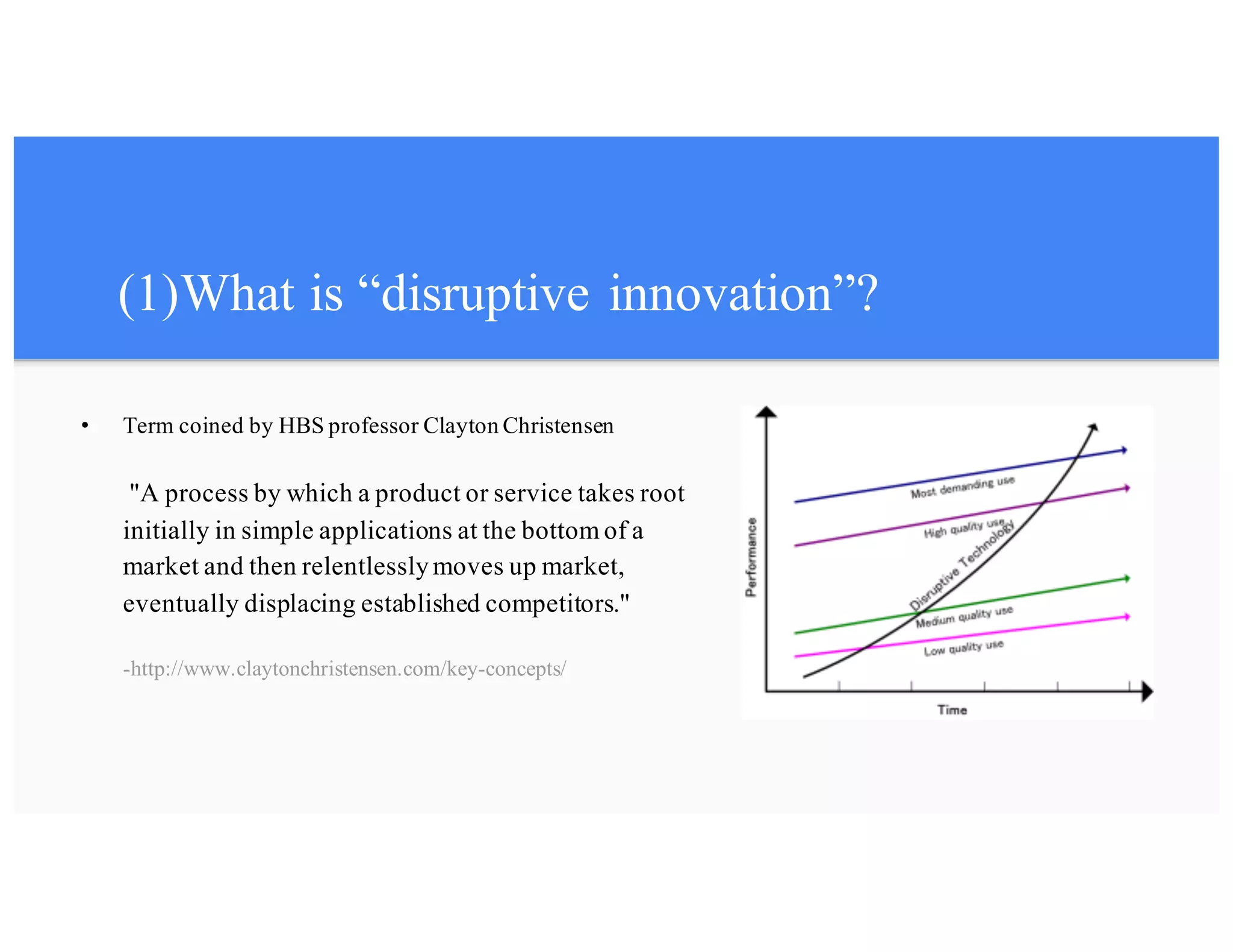
(1)What is “disruptive innovation”?
• Term coined by HBS professor Clayton Christensen
"A process by which a product or service takes root
initially in simple applications at the bottom of a
market and then relentlesslymoves up market,
eventually displacing established competitors."
-http://www.claytonchristensen.com/key-concepts/
Case Study: Airbnb
• Company started in 2008 by Brian Chesky, Joe
Gebbia, and Nathan Blecharczyk after the first
two decided to put an air mattress in their living
room and turn it into a bed and breakfast.
• Evolved into an online platform enabling users to
easily rent out beds, rooms, and properties to other
users.
• Now has >3M listings in 191 countries and valued
at ~$31 Billion.
The Airbnb
Experience (at the
beginning)
The Traditional Hotel
Experience
• What kinds of customers did Airbnb initially attract?
• How might a traditional hotel have viewed fledgling
Airbnb?
• How do they view it now?
-More expensive “up market”
-Live in luxury
-Traditional/familiar
-More polished, you know
exactly what you’re getting
-Cheaper “down market”
-Live like a local
-New/cutting edge/app
driven
-Not as polished/still
working out the kinks of
the app
Case Study: Airbnb
Disruptive vs. Sustaining Innovation
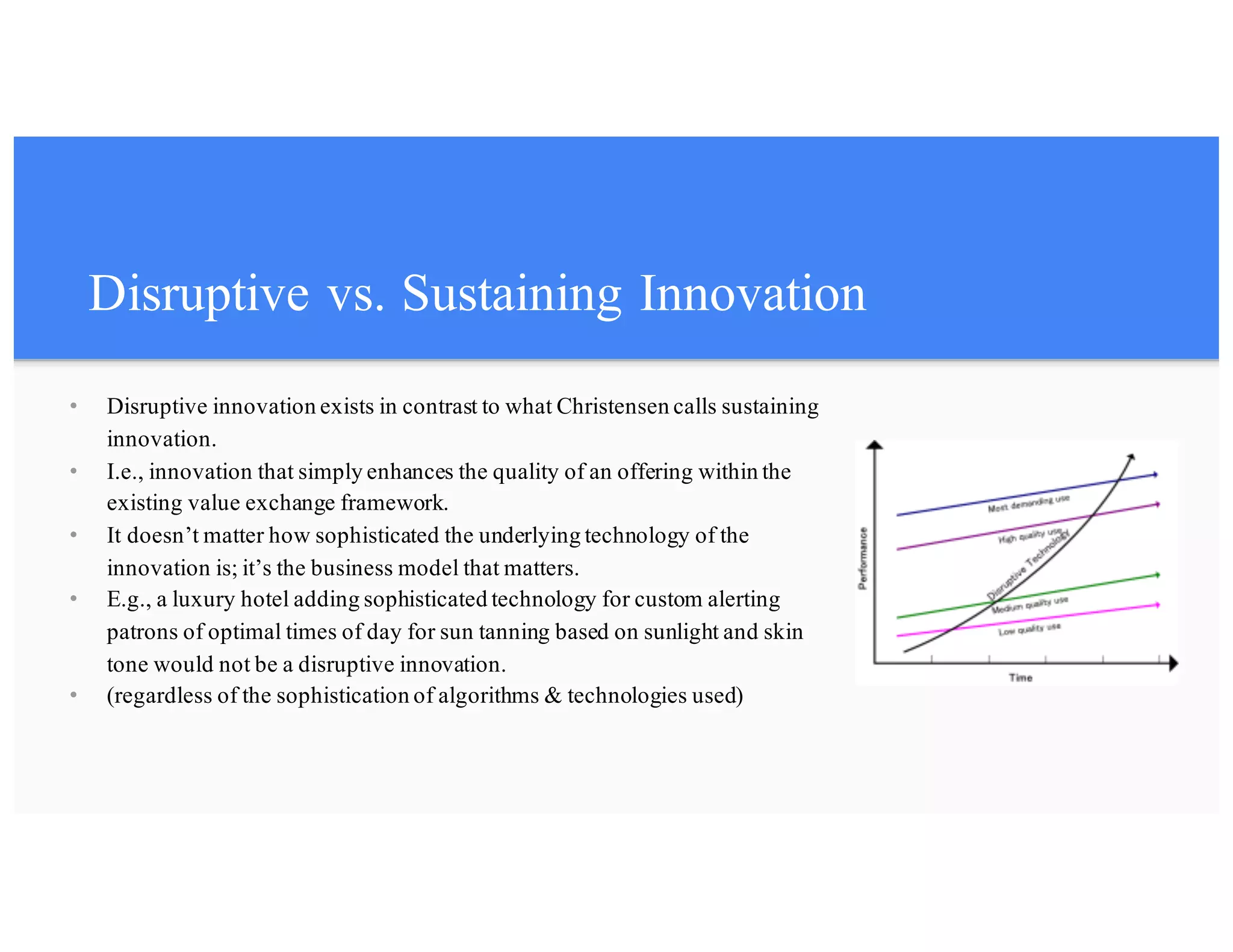
• Disruptive innovation exists in contrast to what Christensen calls sustaining
innovation.
• I.e., innovation that simply enhances the quality of an offering within the
existing value exchange framework.
• It doesn’t matter how sophisticated the underlying technology of the
innovation is; it’s the business model that matters.
• E.g., a luxury hotel adding sophisticated technology for custom alerting
patrons of optimal times of day for sun tanning based on sunlight and skin
tone would not be a disruptive innovation.
• (regardless of the sophistication of algorithms & technologies used)
• The Honda Acura ILX
• Coursera
• Apple II computer
• IBM’s second generation,
transistor-based mainframe
computers replacing vacuum
tubes
Disruptive or
Sustaining?
Is the project that you are working on disruptive or
sustaining?
- Disruptive
- Sustaining
- Disruptive
- Sustaining
- Disruptive
- Sustaining
• The Ford Model T
• Harvard University online
portals for current students
(2) Creating disruptive innovation is different
from introducing sustaining innovation
• Both are important. But a PM that is good at one is often very bad at the other.
• What do we notice about all of the disruptive innovations from the previous slide?
• They were produced by outsiders and entrepreneurs, not companies dominant in their
industries. This is not always the case, but is a trend.
• Largely because many of the strategies required for successful disruption are diametrically
counter to those required for sustaining innovation (which is the generally the main priority
of market incumbents).
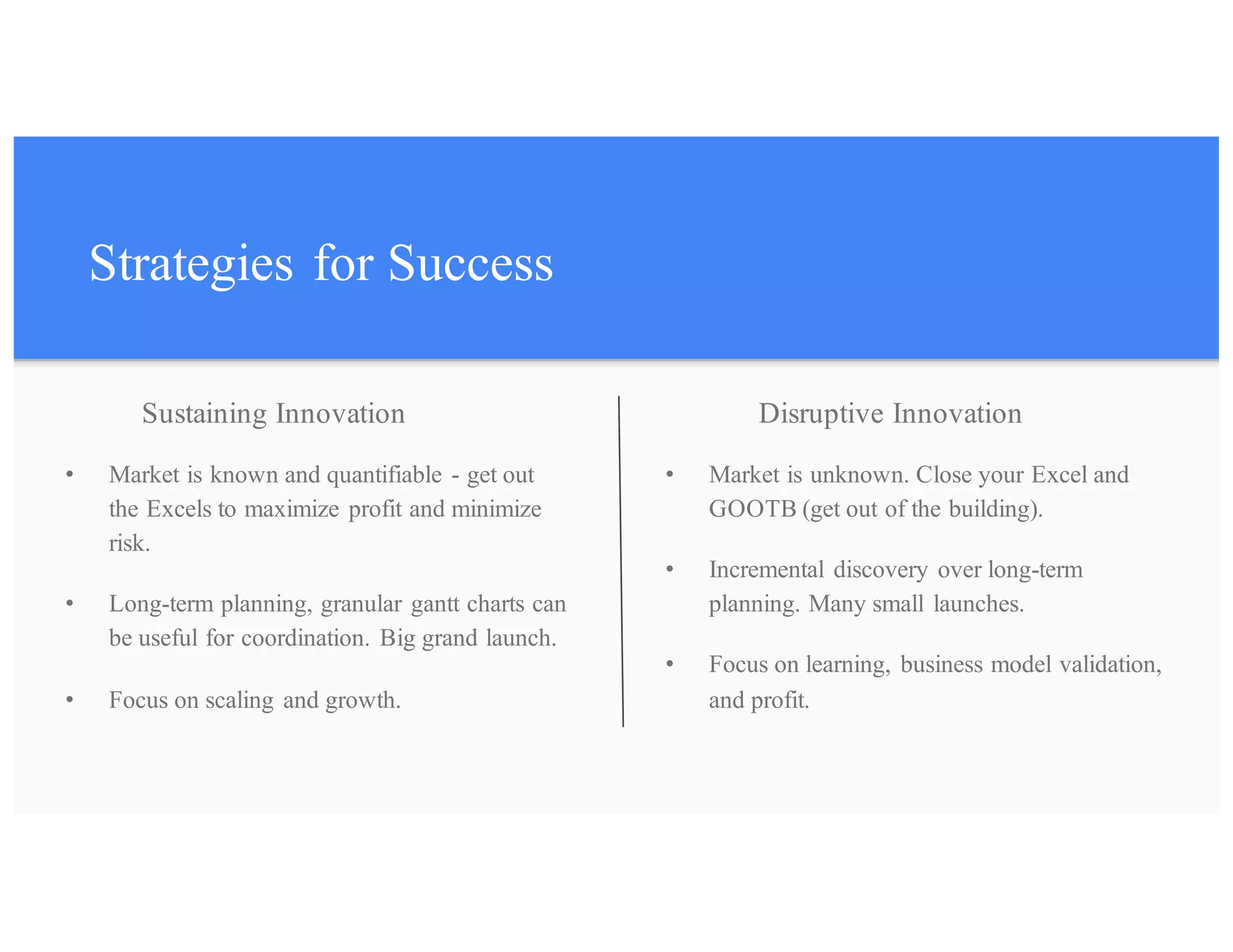
Strategies for Success
• Market is known and quantifiable - get out
the Excels to maximize profit and minimize
risk.
• Long-term planning, granular gantt charts can
be useful for coordination. Big grand launch.
• Focus on scaling and growth.
• Market is unknown. Close your Excel and
GOOTB (get out of the building).
• Incremental discovery over long-term
planning. Many small launches.
• Focus on learning, business model validation,
and profit.
Disruptive InnovationSustaining Innovation
(3) Why familiarity with disruptive innovation is
critical for startups *and* mature businesses
• Everyone is fundamentally working within a changing
market landscape.
• Of evolving technologies, competition, fads, suppliers, distributors,
policies, regulations, etc...
• An extreme change in any of these factors could enable or destroy a
business model.
• Businesses must learn not just to adapt, but to proactively seek out
disruptive opportunities.
• Conclusion: Clayton Christensen and the “startup machine”: My
own experience within SolarWinds.
For more topical information
• The Innovator'sDilemma:When New TechnologiesCause Great Firmsto Fail by ClaytonM.Christensen
• The Innovator'sSolution:Creatingand SustainingSuccessful Growth by Clayton M.Christensen,Michael E.Raynor
• Competing Against Luck:The Story of Innovation and CustomerChoice by Clayton M.Christensen,Taddy Hall
• Crossing the Chasm:Marketingand Selling Technology Projectsto MainstreamCustomers by Geoffrey A. Moore
• Only the Paranoid Survive by AndrewGrove
• Blue Ocean Strategy:How to Create UncontestedMarket Space andMake Competition Irrelevant by W.Chan Kim,Renee
Mauborgne
• Scrumby Jeff Sutherland,JJSutherland
• Disciplined Entrepreneurshipby Bill Aulet
• The Lean Startup:How Today'sEntrepreneursUse ContinuousInnovation to CreateRadically Successful Businesses by Eric
Ries
• When Computing Got Personal:A History of the Desktop Computer by Matt Nicholson
Questions?
Thank you!
Dana Bullister
dana.bullister@gmail.com
https://www.linkedin.com/in/danabullister/

212 Reinventing The Game: Introducing disruptive products to tech-savvy markets

  • 1.
    Reinventing The Game Introducingdisruptive products to tech-savvy markets Dana Bullister, ProductCamp 2017 Saturday, June 10, 2017
  • 2.
    Who am I •Dana Bullister • Background in computer science, human cognition • Data scientist and then D.S. product owner at SolarWinds, an enterprise IT software company
  • 3.
    What we willtalk about • What is disruptive innovation • How development, launch of disruptive innovation is unique • Why knowing how to disruptively innovate is critical for startups and large companies alike • Questions
  • 4.
    (1)What is “disruptiveinnovation”? • Term coined by HBS professor Clayton Christensen "A process by which a product or service takes root initially in simple applications at the bottom of a market and then relentlesslymoves up market, eventually displacing established competitors." -http://www.claytonchristensen.com/key-concepts/
  • 5.
    Case Study: Airbnb •Company started in 2008 by Brian Chesky, Joe Gebbia, and Nathan Blecharczyk after the first two decided to put an air mattress in their living room and turn it into a bed and breakfast. • Evolved into an online platform enabling users to easily rent out beds, rooms, and properties to other users. • Now has >3M listings in 191 countries and valued at ~$31 Billion.
  • 6.
    The Airbnb Experience (atthe beginning) The Traditional Hotel Experience • What kinds of customers did Airbnb initially attract? • How might a traditional hotel have viewed fledgling Airbnb? • How do they view it now? -More expensive “up market” -Live in luxury -Traditional/familiar -More polished, you know exactly what you’re getting -Cheaper “down market” -Live like a local -New/cutting edge/app driven -Not as polished/still working out the kinks of the app Case Study: Airbnb
  • 7.
    Disruptive vs. SustainingInnovation • Disruptive innovation exists in contrast to what Christensen calls sustaining innovation. • I.e., innovation that simply enhances the quality of an offering within the existing value exchange framework. • It doesn’t matter how sophisticated the underlying technology of the innovation is; it’s the business model that matters. • E.g., a luxury hotel adding sophisticated technology for custom alerting patrons of optimal times of day for sun tanning based on sunlight and skin tone would not be a disruptive innovation. • (regardless of the sophistication of algorithms & technologies used)
  • 8.
    • The HondaAcura ILX • Coursera • Apple II computer • IBM’s second generation, transistor-based mainframe computers replacing vacuum tubes Disruptive or Sustaining? Is the project that you are working on disruptive or sustaining? - Disruptive - Sustaining - Disruptive - Sustaining - Disruptive - Sustaining • The Ford Model T • Harvard University online portals for current students
  • 9.
    (2) Creating disruptiveinnovation is different from introducing sustaining innovation • Both are important. But a PM that is good at one is often very bad at the other. • What do we notice about all of the disruptive innovations from the previous slide? • They were produced by outsiders and entrepreneurs, not companies dominant in their industries. This is not always the case, but is a trend. • Largely because many of the strategies required for successful disruption are diametrically counter to those required for sustaining innovation (which is the generally the main priority of market incumbents).
  • 10.
    Strategies for Success •Market is known and quantifiable - get out the Excels to maximize profit and minimize risk. • Long-term planning, granular gantt charts can be useful for coordination. Big grand launch. • Focus on scaling and growth. • Market is unknown. Close your Excel and GOOTB (get out of the building). • Incremental discovery over long-term planning. Many small launches. • Focus on learning, business model validation, and profit. Disruptive InnovationSustaining Innovation
  • 11.
    (3) Why familiaritywith disruptive innovation is critical for startups *and* mature businesses • Everyone is fundamentally working within a changing market landscape. • Of evolving technologies, competition, fads, suppliers, distributors, policies, regulations, etc... • An extreme change in any of these factors could enable or destroy a business model. • Businesses must learn not just to adapt, but to proactively seek out disruptive opportunities. • Conclusion: Clayton Christensen and the “startup machine”: My own experience within SolarWinds.
  • 12.
    For more topicalinformation • The Innovator'sDilemma:When New TechnologiesCause Great Firmsto Fail by ClaytonM.Christensen • The Innovator'sSolution:Creatingand SustainingSuccessful Growth by Clayton M.Christensen,Michael E.Raynor • Competing Against Luck:The Story of Innovation and CustomerChoice by Clayton M.Christensen,Taddy Hall • Crossing the Chasm:Marketingand Selling Technology Projectsto MainstreamCustomers by Geoffrey A. Moore • Only the Paranoid Survive by AndrewGrove • Blue Ocean Strategy:How to Create UncontestedMarket Space andMake Competition Irrelevant by W.Chan Kim,Renee Mauborgne • Scrumby Jeff Sutherland,JJSutherland • Disciplined Entrepreneurshipby Bill Aulet • The Lean Startup:How Today'sEntrepreneursUse ContinuousInnovation to CreateRadically Successful Businesses by Eric Ries • When Computing Got Personal:A History of the Desktop Computer by Matt Nicholson
  • 13.
  • 14.