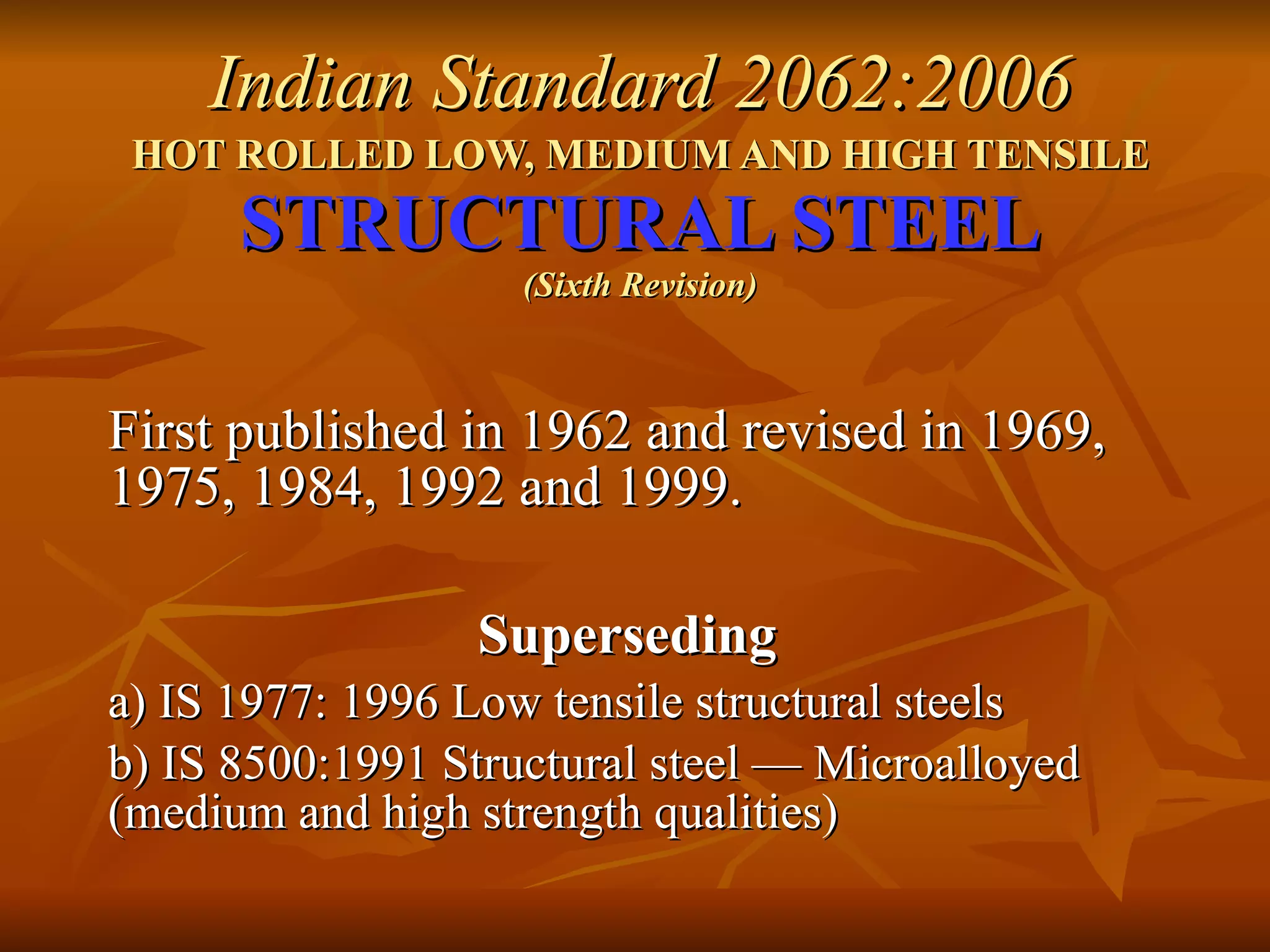
Indian Standard 2062:2006 HOT ROLLED LOW, MEDIUM AND HIGH TENSILE   STRUCTURAL STEEL (Sixth Revision) First published in 1962 and revised in 1969, 1975, 1984, 1992 and 1999. Superseding   a) IS 1977: 1996 Low tensile structural steels b) IS 8500:1991 Structural steel — Microalloyed (medium and high strength qualities)
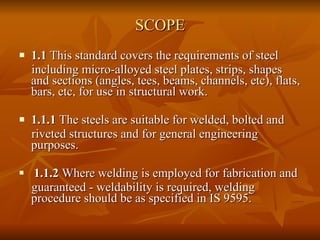
SCOPE 1.1  This standard covers the requirements of steel including micro-alloyed steel plates, strips, shapes and sections (angles, tees, beams, channels, etc), flats, bars, etc, for use in structural work. 1.1.1  The steels are suitable for welded, bolted and riveted structures and for general engineering purposes. 1.1.2  Where welding is employed for fabrication and guaranteed - weldability is required, welding procedure should be as specified in IS 9595.
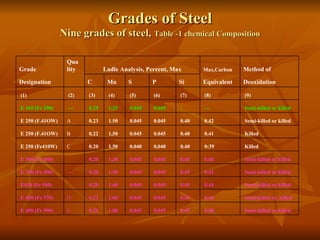
Grades of Steel Nine grades of steel,  Table -1 chemical Composition Semi-killed or killed  0.48  0.45  0,045  0.045  1.80  0.22  E E 450 (Fe 590)  Semi-killed or .killed  0.46  0.45  0.045  0.045  1.60  0.22  D E 450 (Fe 570)  Semi-killed or killed  0.44  0.45  0.045  0.045  1.60  0.20  E410 (Fe 540)  Semi-killed or killed  0.42  0.45  0,045  0.045  1.50  0.20  —  E 350 (Fe 490)  Semi-killed or killed  0.40  0,45  0,045  0.045  1,30  0.20  E 300 (Fe 440)  Killed  0:39  0.40  0,040  0.040  1.50  0.20  C E 250 (Fe410W)  Killed  0.41  0.40  0.045  0.045  1,50  0.22  B E 250 (F.41OW)  Semi-killed or killed  0.42  0.40  0.045  0.045  1.50  0.23  A E 250 (F.41OW)  Semi-killed or killed  —  -   0.045  0.045  1.25  0.25  —  E 165 (Fe 290)  (9)  (8)  (7)  (6)  (5)  (4)  (3)  (2)  (1)  Deoxidation Equivalent Si P S Mn C   Designation Method of  Max,Carbon Ladle Analysis, Percent, Max Qua lity Grade
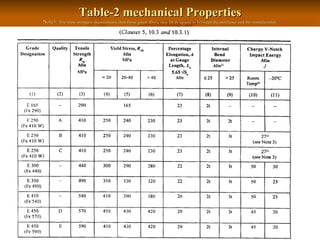
Table-2 mechanical Properties Note3:   The more stringent requirements than those given above may be as agreed to between the purchaser and the manufacturer.
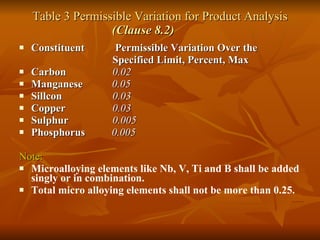
Table 3 Permissible Variation for Product Analysis  (Clause 8.2)  Constituent  Permissible Variation Over the  Specified Limit, Percent, Max   Carbon    0.02  Manganese  0.05  Sillcon    0.03  Copper    0.03  Sulphur    0.005  Phosphorus  0.005  Note: Microalloying elements like Nb, V, Ti and B shall be added singly or in combination.  Total micro alloying elements shall not be more than 0.25.
FREEDOM FROM DEFECTS All finished steel shall be well and cleanly rolled to the Dimensions, sections and masses specified.  Shall be reasonably free from surface flaws; laminations; rough/jagged and imperfect edges and all other harmful defects. Minor surface defects   may be removed subject to mutual agreement  between the purchaser and the manufacturer/supplier. By grinding provided the thickness is  not reduced  locally by more  than  4 %  below the minimum specified thickness. Reduction in thickness by grinding  greater than   4%   but not  exceeding 7 percent  may be made.
Defects   may be repaired by chipping or grinding followed by Welding and inspection, before welding, the thickness of the item is in no place reduced by more than 20 percent. ( exclusive  of  grade  E250C material ) Welding is carried out by  approved procedure approved electrode Competent welder, and To the finish grinding, the item may be required to be normalized or otherwise heat-treated at the purchaser’s discretion.
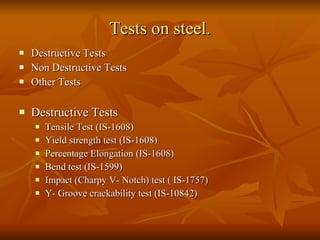
Tests on steel. Destructive Tests Non Destructive Tests  Other Tests Destructive Tests Tensile Test (IS-1608) Yield strength test (IS-1608) Percentage Elongation (IS-1608)  Bend test (IS-1599) Impact (Charpy V- Notch) test ( IS-1757) Y- Groove crackability test (IS-10842)
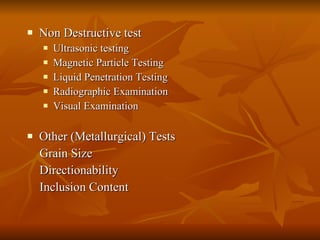
Non Destructive test Ultrasonic testing Magnetic Particle Testing Liquid Penetration Testing Radiographic Examination Visual Examination Other (Metallurgical) Tests Grain Size Directionability Inclusion Content
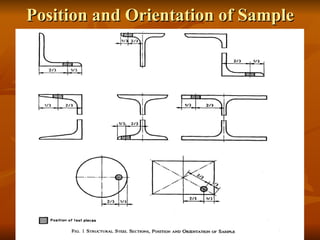
Position and Orientation of Sample
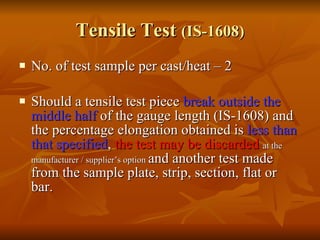
Tensile Test  (IS-1608) No. of test sample per cast/heat – 2 Should a tensile test piece  break outside the middle half  of the gauge length (IS-1608) and the percentage elongation obtained is  less than that specified ,  the test may be discarded  at the manufacturer / supplier’s option  and another test made from the sample plate, strip, section, flat or bar.
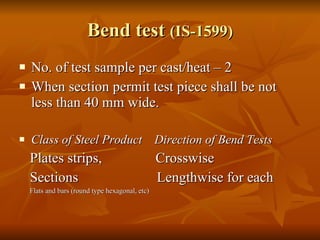
Bend test  (IS-1599) No. of test sample per cast/heat – 2 When section permit test piece shall be not less than 40 mm wide. Class of Steel Product  Direction of Bend Tests Plates strips,  Crosswise Sections  Lengthwise for each Flats and bars (round type hexagonal, etc)
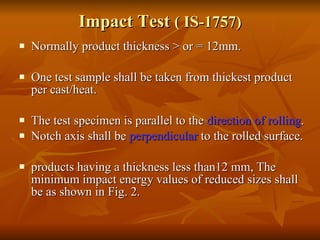
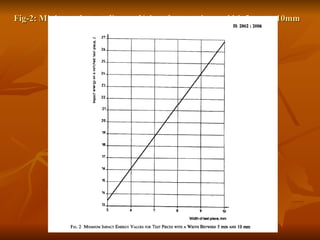
Impact Test  ( IS-1757) Normally product thickness > or = 12mm. One test sample shall be taken from thickest product per cast/heat. The test specimen is parallel to the  direction of rolling . Notch axis shall be  perpendicular  to the rolled surface. products having a thickness less than12 mm, The minimum impact energy values of reduced sizes shall be as shown in Fig. 2.
Fig-2: Minimum Impact Energy Values for test pieces width 5mm to 10mm
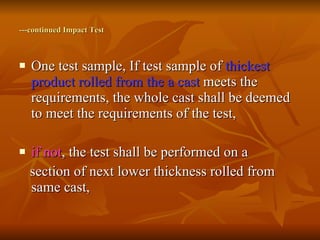
---continued Impact Test One test sample, If test sample of  thickest product rolled from the a cast  meets the requirements, the whole cast shall be deemed to meet the requirements of the test, if not , the test shall be performed on a section of next lower thickness rolled from  same cast,
Y GROOVE CRACKABILITY TEST  (IS-10842)   Test only for  plates and sections. having thickness 12 mm and above.  Grade E 250 C material  Note - Test will not be applicable for rounds.
Thank You

2062

  • 1.
    Indian Standard 2062:2006HOT ROLLED LOW, MEDIUM AND HIGH TENSILE STRUCTURAL STEEL (Sixth Revision) First published in 1962 and revised in 1969, 1975, 1984, 1992 and 1999. Superseding a) IS 1977: 1996 Low tensile structural steels b) IS 8500:1991 Structural steel — Microalloyed (medium and high strength qualities)
  • 2.
    SCOPE 1.1 This standard covers the requirements of steel including micro-alloyed steel plates, strips, shapes and sections (angles, tees, beams, channels, etc), flats, bars, etc, for use in structural work. 1.1.1 The steels are suitable for welded, bolted and riveted structures and for general engineering purposes. 1.1.2 Where welding is employed for fabrication and guaranteed - weldability is required, welding procedure should be as specified in IS 9595.
  • 3.
    Grades of SteelNine grades of steel, Table -1 chemical Composition Semi-killed or killed 0.48 0.45 0,045 0.045 1.80 0.22 E E 450 (Fe 590) Semi-killed or .killed 0.46 0.45 0.045 0.045 1.60 0.22 D E 450 (Fe 570) Semi-killed or killed 0.44 0.45 0.045 0.045 1.60 0.20 E410 (Fe 540) Semi-killed or killed 0.42 0.45 0,045 0.045 1.50 0.20 — E 350 (Fe 490) Semi-killed or killed 0.40 0,45 0,045 0.045 1,30 0.20 E 300 (Fe 440) Killed 0:39 0.40 0,040 0.040 1.50 0.20 C E 250 (Fe410W) Killed 0.41 0.40 0.045 0.045 1,50 0.22 B E 250 (F.41OW) Semi-killed or killed 0.42 0.40 0.045 0.045 1.50 0.23 A E 250 (F.41OW) Semi-killed or killed — - 0.045 0.045 1.25 0.25 — E 165 (Fe 290) (9) (8) (7) (6) (5) (4) (3) (2) (1) Deoxidation Equivalent Si P S Mn C   Designation Method of Max,Carbon Ladle Analysis, Percent, Max Qua lity Grade
  • 4.
    Table-2 mechanical PropertiesNote3: The more stringent requirements than those given above may be as agreed to between the purchaser and the manufacturer.
  • 5.
    Table 3 PermissibleVariation for Product Analysis (Clause 8.2) Constituent Permissible Variation Over the Specified Limit, Percent, Max Carbon 0.02 Manganese 0.05 Sillcon 0.03 Copper 0.03 Sulphur 0.005 Phosphorus 0.005 Note: Microalloying elements like Nb, V, Ti and B shall be added singly or in combination. Total micro alloying elements shall not be more than 0.25.
  • 6.
    FREEDOM FROM DEFECTSAll finished steel shall be well and cleanly rolled to the Dimensions, sections and masses specified. Shall be reasonably free from surface flaws; laminations; rough/jagged and imperfect edges and all other harmful defects. Minor surface defects may be removed subject to mutual agreement between the purchaser and the manufacturer/supplier. By grinding provided the thickness is not reduced locally by more than 4 % below the minimum specified thickness. Reduction in thickness by grinding greater than 4% but not exceeding 7 percent may be made.
  • 7.
    Defects may be repaired by chipping or grinding followed by Welding and inspection, before welding, the thickness of the item is in no place reduced by more than 20 percent. ( exclusive of grade E250C material ) Welding is carried out by approved procedure approved electrode Competent welder, and To the finish grinding, the item may be required to be normalized or otherwise heat-treated at the purchaser’s discretion.
  • 8.
    Tests on steel.Destructive Tests Non Destructive Tests Other Tests Destructive Tests Tensile Test (IS-1608) Yield strength test (IS-1608) Percentage Elongation (IS-1608) Bend test (IS-1599) Impact (Charpy V- Notch) test ( IS-1757) Y- Groove crackability test (IS-10842)
  • 9.
    Non Destructive testUltrasonic testing Magnetic Particle Testing Liquid Penetration Testing Radiographic Examination Visual Examination Other (Metallurgical) Tests Grain Size Directionability Inclusion Content
  • 10.
  • 11.
    Tensile Test (IS-1608) No. of test sample per cast/heat – 2 Should a tensile test piece break outside the middle half of the gauge length (IS-1608) and the percentage elongation obtained is less than that specified , the test may be discarded at the manufacturer / supplier’s option and another test made from the sample plate, strip, section, flat or bar.
  • 12.
    Bend test (IS-1599) No. of test sample per cast/heat – 2 When section permit test piece shall be not less than 40 mm wide. Class of Steel Product Direction of Bend Tests Plates strips, Crosswise Sections Lengthwise for each Flats and bars (round type hexagonal, etc)
  • 13.
    Impact Test ( IS-1757) Normally product thickness > or = 12mm. One test sample shall be taken from thickest product per cast/heat. The test specimen is parallel to the direction of rolling . Notch axis shall be perpendicular to the rolled surface. products having a thickness less than12 mm, The minimum impact energy values of reduced sizes shall be as shown in Fig. 2.
  • 14.
    Fig-2: Minimum ImpactEnergy Values for test pieces width 5mm to 10mm
  • 15.
    ---continued Impact TestOne test sample, If test sample of thickest product rolled from the a cast meets the requirements, the whole cast shall be deemed to meet the requirements of the test, if not , the test shall be performed on a section of next lower thickness rolled from same cast,
  • 16.
    Y GROOVE CRACKABILITYTEST (IS-10842) Test only for plates and sections. having thickness 12 mm and above. Grade E 250 C material Note - Test will not be applicable for rounds.
  • 17.