Professional Development for
the Information Professional
Jesse Wilkins
President and Principal Consultant
Athro Consulting
January 19, 2022
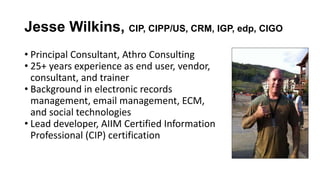
Jesse Wilkins, CIP, CIPP/US, CRM, IGP, edp, CIGO
• Principal Consultant, Athro Consulting
• 25+ years experience as end user, vendor,
consultant, and trainer
• Background in electronic records
management, email management, ECM,
and social technologies
• Lead developer, AIIM Certified Information
Professional (CIP) certification
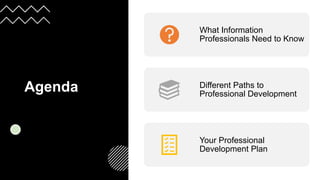
Agenda
What Information
Professionals Need to Know
Different Paths to
Professional Development
Your Professional
Development Plan
What Information
Professionals Need
to Know
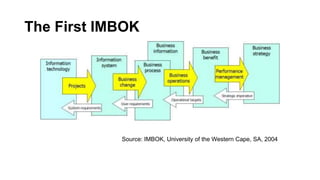
The First IMBOK
Source: IMBOK, University of the Western Cape, SA, 2004
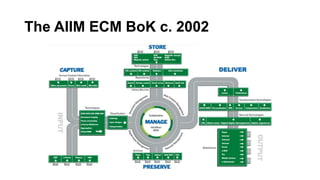
The AIIM ECM BoK c. 2002
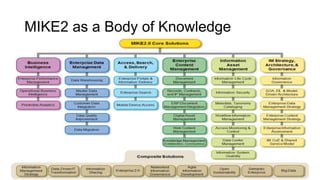
MIKE2 as a Body of Knowledge
Source: MIKE2
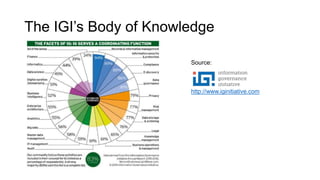
The IGI’s Body of Knowledge
Source:
http://www.iginitiative.com
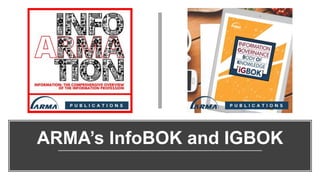
ARMA’s InfoBOK and IGBOK
The Definitive IM Body of
Knowledge…
…doesn’t exist.
Boundary
Issues
• No IM body of knowledge
addresses every single
information management-
related domain.
• Engineering drawing
management
• Customer communication
management
• Web content management
• Document control
Taxonomy and
Terminology Issues
• Terms means
different things to
different
organizations and
even different
departments.
• “Record”
• “Knowledge
management”
• “Information
governance”
The Expertise
Dilemma
• Bodies of knowledge about a
thing…
• Are built by those who have
done it for a long time
• Who are probably more
senior, meaning they aren’t
“in the trenches” anymore
• And who may not be up to
speed on the newest
developments.
It Depends…
• What you need to know
depends on…
• Where you are in your career
• Where you want to go in your
career
• What you want to do for the
next X years
Different Paths to
Professional Development
Success begins with figuring out
what you want, then making the
choices that will get you there.
Shellye Archambeau
Former CEO, MetricStream
AIIM21 Keynote
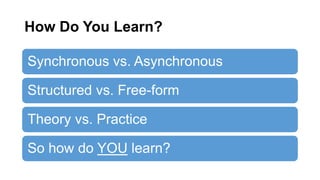
How Do You Learn?
Synchronous vs. Asynchronous
Structured vs. Free-form
Theory vs. Practice
So how do YOU learn?
Position Yourself for
Success
It’s your professional development plan.
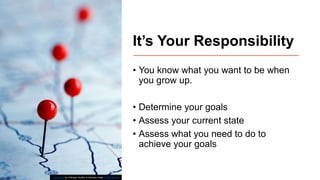
It’s Your Responsibility
• You know what you want to be when
you grow up.
• Determine your goals
• Assess your current state
• Assess what you need to do to
achieve your goals
This Photo by Unknown Author is licensed under CC BY-NC-ND
It’s Your
Responsibility
You’re probably paying
for it.
This Photo by Unknown Author is licensed under CC BY-NC-ND
A Framework for
Professional Development
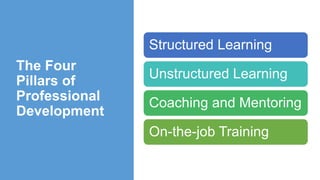
The Four
Pillars of
Professional
Development
Structured Learning
Unstructured Learning
Coaching and Mentoring
On-the-job Training
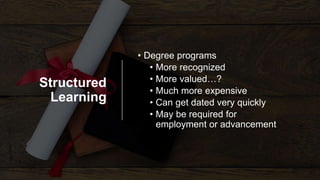
Structured
Learning
• Degree programs
• More recognized
• More valued…?
• Much more expensive
• Can get dated very quickly
• May be required for
employment or advancement
Structured Learning
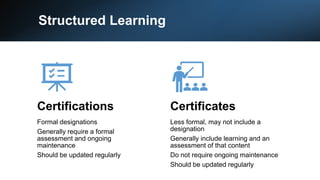
Certifications
Formal designations
Generally require a formal
assessment and ongoing
maintenance
Should be updated regularly
Certificates
Less formal, may not include a
designation
Generally include learning and an
assessment of that content
Do not require ongoing maintenance
Should be updated regularly
Training
Courses
Certifications (& Cert Prep Courses)
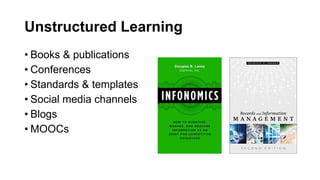
Unstructured Learning
• Books & publications
• Conferences
• Standards & templates
• Social media channels
• Blogs
• MOOCs
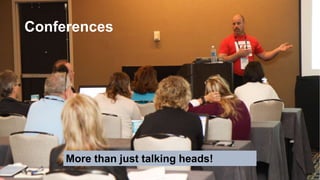
Conferences
More than just talking heads!
Massive Open
Online Courses
(MOOC)
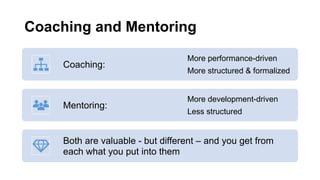
Coaching and Mentoring
Coaching:
More performance-driven
More structured & formalized
Mentoring:
More development-driven
Less structured
Both are valuable - but different – and you get from
each what you put into them
On-the-job
Training
• Observation of skilled practitioners
• “Practice” at job tasks under close
supervision
• Example: Conduct a records inventory
• Review the inventory process and approach
documentation
• Shadow team members who are conducting
the inventory
• Inventory a dedicated training location
• Inventory your own file share
• Very good for employees and
organization – but needs focus and
attention to be successful
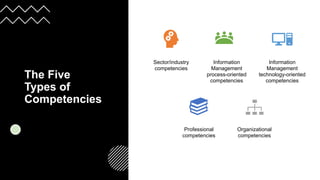
The Five
Types of
Competencies
Sector/industry
competencies
Information
Management
process-oriented
competencies
Information
Management
technology-oriented
competencies
Professional
competencies
Organizational
competencies
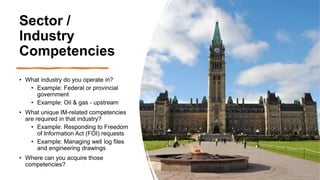
Sector /
Industry
Competencies
• What industry do you operate in?
• Example: Federal or provincial
government
• Example: Oil & gas - upstream
• What unique IM-related competencies
are required in that industry?
• Example: Responding to Freedom
of Information Act (FOI) requests
• Example: Managing well log files
and engineering drawings
• Where can you acquire those
competencies?
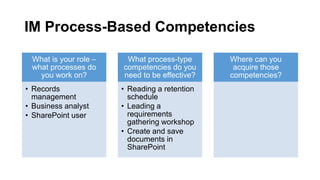
IM Process-Based Competencies
What is your role –
what processes do
you work on?
• Records
management
• Business analyst
• SharePoint user
What process-type
competencies do you
need to be effective?
• Reading a retention
schedule
• Leading a
requirements
gathering workshop
• Create and save
documents in
SharePoint
Where can you
acquire those
competencies?
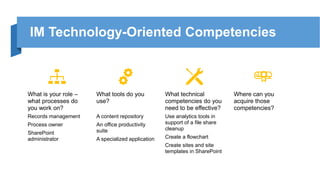
IM Technology-Oriented Competencies
What is your role –
what processes do
you work on?
Records management
Process owner
SharePoint
administrator
What tools do you
use?
A content repository
An office productivity
suite
A specialized application
What technical
competencies do you
need to be effective?
Use analytics tools in
support of a file share
cleanup
Create a flowchart
Create sites and site
templates in SharePoint
Where can you
acquire those
competencies?
Professional Competencies
Every information professional
needs these!
Examples include:
Project management
Communication / public
speaking
Change management
What else are we missing?
Where can you acquire those
competencies?
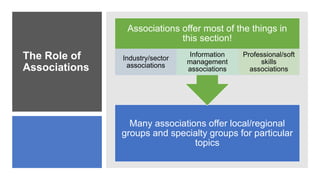
The Role of
Associations
Many associations offer local/regional
groups and specialty groups for particular
topics
Associations offer most of the things in
this section!
Industry/sector
associations
Information
management
associations
Professional/soft
skills
associations
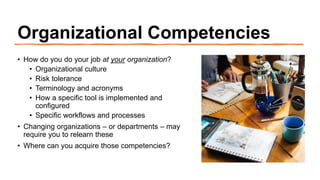
Organizational Competencies
• How do you do your job at your organization?
• Organizational culture
• Risk tolerance
• Terminology and acronyms
• How a specific tool is implemented and
configured
• Specific workflows and processes
• Changing organizations – or departments – may
require you to relearn these
• Where can you acquire those competencies?
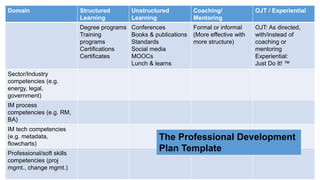
The PD Plan Matrix
Domain Structured
Learning
Unstructured
Learning
Coaching/
Mentoring
OJT / Experiential
Degree programs
Training
programs
Certifications
Certificates
Conferences
Books & publications
Standards
Social media
MOOCs
Lunch & learns
Formal or informal
(More effective with
more structure)
OJT: As directed,
with/instead of
coaching or
mentoring
Experiential:
Just Do It! ™
Sector/Industry
competencies (e.g.
energy, legal,
government)
IM process
competencies (e.g. RM,
BA)
IM tech competencies
(e.g. metadata,
flowcharts)
Professional/soft skills
competencies (proj
mgmt., change mgmt.)
The Professional Development
Plan Template
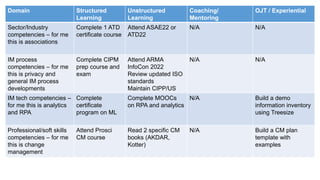
My Plan for 2021
Domain Structured
Learning
Unstructured
Learning
Coaching/
Mentoring
OJT / Experiential
Sector/Industry
competencies – for me
this is associations
Complete 1 ATD
certificate course
Attend ASAE22 or
ATD22
N/A N/A
IM process
competencies – for me
this is privacy and
general IM process
developments
Complete CIPM
prep course and
exam
Attend ARMA
InfoCon 2022
Review updated ISO
standards
Maintain CIPP/US
N/A N/A
IM tech competencies –
for me this is analytics
and RPA
Complete
certificate
program on ML
Complete MOOCs
on RPA and analytics
N/A Build a demo
information inventory
using Treesize
Professional/soft skills
competencies – for me
this is change
management
Attend Prosci
CM course
Read 2 specific CM
books (AKDAR,
Kotter)
N/A Build a CM plan
template with
examples
Questions?
For More
Information
Jesse Wilkins
Principal Consultant, Athro Consulting
https://www.athroconsulting.com
jesse.wilkins@athroconsulting.com
Twitter: @jessewilkins
LinkedIn:
https://www.linkedin.com/in/jessewilkins

20220119 ARMA Toronto Professional Development for the Information Professional workshop

  • 1.
    Professional Development for theInformation Professional Jesse Wilkins President and Principal Consultant Athro Consulting January 19, 2022
  • 2.
    Jesse Wilkins, CIP,CIPP/US, CRM, IGP, edp, CIGO • Principal Consultant, Athro Consulting • 25+ years experience as end user, vendor, consultant, and trainer • Background in electronic records management, email management, ECM, and social technologies • Lead developer, AIIM Certified Information Professional (CIP) certification
  • 4.
    Agenda What Information Professionals Needto Know Different Paths to Professional Development Your Professional Development Plan
  • 5.
  • 6.
    The First IMBOK Source:IMBOK, University of the Western Cape, SA, 2004
  • 7.
    The AIIM ECMBoK c. 2002
  • 8.
    MIKE2 as aBody of Knowledge Source: MIKE2
  • 9.
    The IGI’s Bodyof Knowledge Source: http://www.iginitiative.com
  • 10.
  • 11.
    The Definitive IMBody of Knowledge… …doesn’t exist.
  • 12.
    Boundary Issues • No IMbody of knowledge addresses every single information management- related domain. • Engineering drawing management • Customer communication management • Web content management • Document control
  • 13.
    Taxonomy and Terminology Issues •Terms means different things to different organizations and even different departments. • “Record” • “Knowledge management” • “Information governance”
  • 14.
    The Expertise Dilemma • Bodiesof knowledge about a thing… • Are built by those who have done it for a long time • Who are probably more senior, meaning they aren’t “in the trenches” anymore • And who may not be up to speed on the newest developments.
  • 15.
    It Depends… • Whatyou need to know depends on… • Where you are in your career • Where you want to go in your career • What you want to do for the next X years
  • 16.
  • 17.
    Success begins withfiguring out what you want, then making the choices that will get you there. Shellye Archambeau Former CEO, MetricStream AIIM21 Keynote
  • 18.
    How Do YouLearn? Synchronous vs. Asynchronous Structured vs. Free-form Theory vs. Practice So how do YOU learn?
  • 19.
    Position Yourself for Success It’syour professional development plan.
  • 20.
    It’s Your Responsibility •You know what you want to be when you grow up. • Determine your goals • Assess your current state • Assess what you need to do to achieve your goals This Photo by Unknown Author is licensed under CC BY-NC-ND
  • 21.
    It’s Your Responsibility You’re probablypaying for it. This Photo by Unknown Author is licensed under CC BY-NC-ND
  • 22.
  • 23.
    The Four Pillars of Professional Development StructuredLearning Unstructured Learning Coaching and Mentoring On-the-job Training
  • 24.
    Structured Learning • Degree programs •More recognized • More valued…? • Much more expensive • Can get dated very quickly • May be required for employment or advancement
  • 25.
    Structured Learning Certifications Formal designations Generallyrequire a formal assessment and ongoing maintenance Should be updated regularly Certificates Less formal, may not include a designation Generally include learning and an assessment of that content Do not require ongoing maintenance Should be updated regularly
  • 26.
  • 27.
  • 28.
    Unstructured Learning • Books& publications • Conferences • Standards & templates • Social media channels • Blogs • MOOCs
  • 29.
  • 30.
  • 31.
    Coaching and Mentoring Coaching: Moreperformance-driven More structured & formalized Mentoring: More development-driven Less structured Both are valuable - but different – and you get from each what you put into them
  • 32.
    On-the-job Training • Observation ofskilled practitioners • “Practice” at job tasks under close supervision • Example: Conduct a records inventory • Review the inventory process and approach documentation • Shadow team members who are conducting the inventory • Inventory a dedicated training location • Inventory your own file share • Very good for employees and organization – but needs focus and attention to be successful
  • 33.
  • 34.
    Sector / Industry Competencies • Whatindustry do you operate in? • Example: Federal or provincial government • Example: Oil & gas - upstream • What unique IM-related competencies are required in that industry? • Example: Responding to Freedom of Information Act (FOI) requests • Example: Managing well log files and engineering drawings • Where can you acquire those competencies?
  • 35.
    IM Process-Based Competencies Whatis your role – what processes do you work on? • Records management • Business analyst • SharePoint user What process-type competencies do you need to be effective? • Reading a retention schedule • Leading a requirements gathering workshop • Create and save documents in SharePoint Where can you acquire those competencies?
  • 36.
    IM Technology-Oriented Competencies Whatis your role – what processes do you work on? Records management Process owner SharePoint administrator What tools do you use? A content repository An office productivity suite A specialized application What technical competencies do you need to be effective? Use analytics tools in support of a file share cleanup Create a flowchart Create sites and site templates in SharePoint Where can you acquire those competencies?
  • 37.
    Professional Competencies Every informationprofessional needs these! Examples include: Project management Communication / public speaking Change management What else are we missing? Where can you acquire those competencies?
  • 38.
    The Role of Associations Manyassociations offer local/regional groups and specialty groups for particular topics Associations offer most of the things in this section! Industry/sector associations Information management associations Professional/soft skills associations
  • 39.
    Organizational Competencies • Howdo you do your job at your organization? • Organizational culture • Risk tolerance • Terminology and acronyms • How a specific tool is implemented and configured • Specific workflows and processes • Changing organizations – or departments – may require you to relearn these • Where can you acquire those competencies?
  • 40.
    The PD PlanMatrix Domain Structured Learning Unstructured Learning Coaching/ Mentoring OJT / Experiential Degree programs Training programs Certifications Certificates Conferences Books & publications Standards Social media MOOCs Lunch & learns Formal or informal (More effective with more structure) OJT: As directed, with/instead of coaching or mentoring Experiential: Just Do It! ™ Sector/Industry competencies (e.g. energy, legal, government) IM process competencies (e.g. RM, BA) IM tech competencies (e.g. metadata, flowcharts) Professional/soft skills competencies (proj mgmt., change mgmt.) The Professional Development Plan Template
  • 41.
    My Plan for2021 Domain Structured Learning Unstructured Learning Coaching/ Mentoring OJT / Experiential Sector/Industry competencies – for me this is associations Complete 1 ATD certificate course Attend ASAE22 or ATD22 N/A N/A IM process competencies – for me this is privacy and general IM process developments Complete CIPM prep course and exam Attend ARMA InfoCon 2022 Review updated ISO standards Maintain CIPP/US N/A N/A IM tech competencies – for me this is analytics and RPA Complete certificate program on ML Complete MOOCs on RPA and analytics N/A Build a demo information inventory using Treesize Professional/soft skills competencies – for me this is change management Attend Prosci CM course Read 2 specific CM books (AKDAR, Kotter) N/A Build a CM plan template with examples
  • 42.
  • 44.
    For More Information Jesse Wilkins PrincipalConsultant, Athro Consulting https://www.athroconsulting.com jesse.wilkins@athroconsulting.com Twitter: @jessewilkins LinkedIn: https://www.linkedin.com/in/jessewilkins

Editor's Notes

  • #4 5:34:15 First of all, it means that information professionals have to keep learning. Many of the things you know today, and you’re an expert at today, won’t be as valuable tomorrow or next year or in five years. Some principles are timeless, to be sure, but different times, tools, and technologies will require different tactics.
  • #30 More than just talking heads! Education Networking “Kick the tires” of technology solutions
  • #31 Self-contained, self-defined learning paths May offer credentials or not