STID3033 Topic 2
    People, Organizations, and Systems
    Management


    1
Lecture Outline

 How technology is reshaping
  organization?
 Importance of HRM

 IT HRM


2
Trends in IT
   Main usage is for data         Cost & size decreased
    processing                     Use of PCs increased
       government & military      Business & IT staff
       Businesses: financial       began to interact
        automation
                                   Technology issues
   Computers were costly           increased
    and large in size              Networks, E-mail, and
   Not widely used                 Internet became
                                    necessity
           3
Role of IT

 No longer just serves a business
 Integral in business strategy

 Impacts every area of business

 Complexity increases

 Responsible for the integration of
  information


    4
How Technology Reshapes
           Organizations?
   With rapid advances in telecommunication technology
       Businesses are able to:
         • expand their operations
         • form alliances and joint ventures
         • restructure their assets for greater effectiveness
       Organizations are using telecommunications to:
         • reduce the barriers of time and distance
         • establish vital new relationships with suppliers and customers


           5
How Technology Reshapes
          Organizations?
   A new model of leadership:
       Contemporary leaders need to be more flexible
         • competence: have overall business knowledge and skills
              • great communicator, individual coach, team player, technology
                master, problem solver, foreign ambassador, change agent,
                lifelong learner
   From hierarchy to collaborative work relationships
       structures that favor the use of self-managed teams
   Increasing diversity in the workplace
    (globalization)
          6
How Technology Reshapes
         Organizations?
   The changes in organization is partly due to the
    introduction of various ICT applications:
       Electronic Applications
       Virtual Learning
       Telecommuting/Telework/SOHO
       Globalization/Borderless
   i.e. to become global powerhouses, companies
    invest in
       Global e-business/e-commerce/other IT initiatives

         7
Importance of Human Resource

 Vital assets that contribute to
  business success
 Organizational performance usually
  relates directly to individual
  performance


    8
IT/IS Human Resource

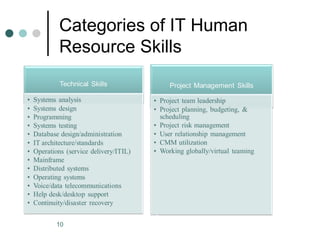
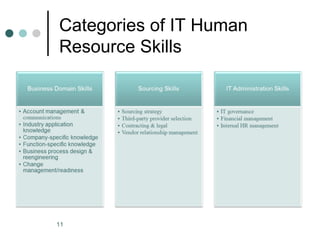
   Five categories of IT/IS personnel skills:
     Technical
     Project Management
     Business Domain
     Sourcing
     IT Administration


     9
Categories of IT Human
                                  Resource Skills


                                                                       Fig 13.12
                                10
Copyright © 2011 Pearson Education, Inc. publishing as Prentice Hall               13-10
Categories of IT Human
                                  Resource Skills


                                11
                                                                       Fig 13.12 continued
Copyright © 2011 Pearson Education, Inc. publishing as Prentice Hall                         13-11
Managing IT Human Resources
   Recruiting, training and retaining
   Evaluating employee job performance
   Rewarding outstanding performance
   Setting salary and wage levels
   Designing career paths
         Chief Information Officer (CIO)/
         Chief Technology Officer (CTO)
         E-commerce architect
         Technical team leader
         Systems analyst
     12
Managing IT Human Resources
   Challenges
       scarcity of skilled employees & experienced
        managers
         • Attracting, recruiting, & retaining
     Essential people management skills
     Attitude & beliefs of good people manager
     Gaining employees’ trust & confidence


          13
Scarcity of Skilled Employees
 IT managers and their superiors must plan
  to cope with skill shortages
 Organizations that fail to manage their
  present staff stand little chance of obtaining
  and retaining outstanding individuals


    14
Scarcity of Skilled Employees

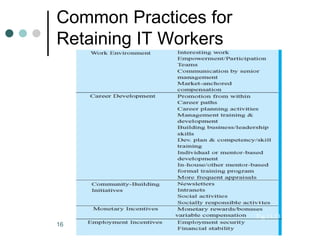
   Attracting, recruiting, and retaining qualified staff is a
    key responsibility for IS managers in collaboration
    with an organization’s HR staff
   Some common practices that managers use to
    retain valued IS personnel include:
       Changing the work environment to be more
        employee-friendly
       Increasing career development opportunities
       Providing community-building initiatives
       Establishing monetary or other employee incentives

         15
Common Practices for
                                Retaining IT Workers


                                                                       Fig 13.13
                                16
Copyright © 2011 Pearson Education, Inc. publishing as Prentice Hall               13-16
Essential People-Management
     Skills
 manage the employees with sensitivity
 provide effective leadership
 engage the employees in a meaningful, self-
  satisfying work that offers them a chance for
  self-development
 respect for individual dignity
 understand each individual’s preferences
  and motivations

     17
Essential People-Management
      Skills
 Ability to communicate across business
  disciplines
 Ability to employ consulting skills

 Ability to influence decision making

 Understanding on the related business
  process
 Understanding organizational philosophy

 Understanding the strategic goals and
  objectives
       18
Attitudes and Beliefs of Good
        People Managers
   employees are honest and industrious and act
    with the firm’s best interests in mind
     Believe employees are intelligent and willing to
      learn
     That they desire self-fulfillment
 establish environments of high but reasonable
  expectations for their employees
 management equals leadership


        19
Attitudes and Beliefs of Good
       People Managers
   Assume responsibility to remove or reduce
    barriers to accomplishment
   Expect employees to be thoughtful about their
    work, but they also expect action
   Expect employees to solve problems for the firm,
    but they also expect them to prevent problems
    from occurring
   Establish an environment of high productivity and
    good morale


       20
Increasing Employee Trust
         and Confidence
1.   Maintain two-way communication with employees to
     understand their needs and desires and to share
     company information
2.   Provide training and complete information so that
     employees can work effectively and efficiently
3.   Inform employees of promotional and career
     advancement opportunities
4.   Listen to employee suggestions for improving the
     work environment, and respond encouragingly to all
     suggestions
         21
Increasing Employee Trust
       and Confidence
1.   Sponsor teamwork and cooperation among
     department members
2.   Be available when employees seek consultation
3.   Understand the amount and quality of each
     employee’s work
4.   Use the knowledge of each employee’s work to grant
     fair salary increases and promotions
5.   Lead the department enthusiastically toward
     achieving its goals and objectives

       22
Assignment 1 (Group)
   Question:
       Select an organization (government @ private), identify
        three related IT positions in the organization. The
        positions should represent each level of the three
        management levels. For each position, identify its job
        specification and describe its responsibilities.
   Report Format:
       Paragraph: TNR 12 & single spacing
       Pages: 3-5
   Date of submission: 13 March 2012

     23
Assignment 1 (Group)
   Question:
       Determine key skills, traits, and levels of experience
        that enable a CIO to be successful.
   Report Format:
       Paragraph: TNR 12 & single spacing
       Pages: 1-3
   Date of submission: 6 March 2012


     24
Quiz 1

 Next class (6 March 2012)
 Coverage
        Topic 1 & 2


25

Week 2 people_org_mgmt_sys

  • 1.
    STID3033 Topic 2 People, Organizations, and Systems Management 1
  • 2.
    Lecture Outline  Howtechnology is reshaping organization?  Importance of HRM  IT HRM 2
  • 3.
    Trends in IT  Main usage is for data  Cost & size decreased processing  Use of PCs increased  government & military  Business & IT staff  Businesses: financial began to interact automation  Technology issues  Computers were costly increased and large in size  Networks, E-mail, and  Not widely used Internet became necessity 3
  • 4.
    Role of IT No longer just serves a business  Integral in business strategy  Impacts every area of business  Complexity increases  Responsible for the integration of information 4
  • 5.
    How Technology Reshapes Organizations?  With rapid advances in telecommunication technology  Businesses are able to: • expand their operations • form alliances and joint ventures • restructure their assets for greater effectiveness  Organizations are using telecommunications to: • reduce the barriers of time and distance • establish vital new relationships with suppliers and customers 5
  • 6.
    How Technology Reshapes Organizations?  A new model of leadership:  Contemporary leaders need to be more flexible • competence: have overall business knowledge and skills • great communicator, individual coach, team player, technology master, problem solver, foreign ambassador, change agent, lifelong learner  From hierarchy to collaborative work relationships  structures that favor the use of self-managed teams  Increasing diversity in the workplace (globalization) 6
  • 7.
    How Technology Reshapes Organizations?  The changes in organization is partly due to the introduction of various ICT applications:  Electronic Applications  Virtual Learning  Telecommuting/Telework/SOHO  Globalization/Borderless  i.e. to become global powerhouses, companies invest in  Global e-business/e-commerce/other IT initiatives 7
  • 8.
    Importance of HumanResource  Vital assets that contribute to business success  Organizational performance usually relates directly to individual performance 8
  • 9.
    IT/IS Human Resource  Five categories of IT/IS personnel skills:  Technical  Project Management  Business Domain  Sourcing  IT Administration 9
  • 10.
    Categories of ITHuman Resource Skills Fig 13.12 10 Copyright © 2011 Pearson Education, Inc. publishing as Prentice Hall 13-10
  • 11.
    Categories of ITHuman Resource Skills 11 Fig 13.12 continued Copyright © 2011 Pearson Education, Inc. publishing as Prentice Hall 13-11
  • 12.
    Managing IT HumanResources  Recruiting, training and retaining  Evaluating employee job performance  Rewarding outstanding performance  Setting salary and wage levels  Designing career paths  Chief Information Officer (CIO)/  Chief Technology Officer (CTO)  E-commerce architect  Technical team leader  Systems analyst 12
  • 13.
    Managing IT HumanResources  Challenges  scarcity of skilled employees & experienced managers • Attracting, recruiting, & retaining  Essential people management skills  Attitude & beliefs of good people manager  Gaining employees’ trust & confidence 13
  • 14.
    Scarcity of SkilledEmployees  IT managers and their superiors must plan to cope with skill shortages  Organizations that fail to manage their present staff stand little chance of obtaining and retaining outstanding individuals 14
  • 15.
    Scarcity of SkilledEmployees  Attracting, recruiting, and retaining qualified staff is a key responsibility for IS managers in collaboration with an organization’s HR staff  Some common practices that managers use to retain valued IS personnel include:  Changing the work environment to be more employee-friendly  Increasing career development opportunities  Providing community-building initiatives  Establishing monetary or other employee incentives 15
  • 16.
    Common Practices for Retaining IT Workers Fig 13.13 16 Copyright © 2011 Pearson Education, Inc. publishing as Prentice Hall 13-16
  • 17.
    Essential People-Management Skills  manage the employees with sensitivity  provide effective leadership  engage the employees in a meaningful, self- satisfying work that offers them a chance for self-development  respect for individual dignity  understand each individual’s preferences and motivations 17
  • 18.
    Essential People-Management Skills  Ability to communicate across business disciplines  Ability to employ consulting skills  Ability to influence decision making  Understanding on the related business process  Understanding organizational philosophy  Understanding the strategic goals and objectives 18
  • 19.
    Attitudes and Beliefsof Good People Managers  employees are honest and industrious and act with the firm’s best interests in mind  Believe employees are intelligent and willing to learn  That they desire self-fulfillment  establish environments of high but reasonable expectations for their employees  management equals leadership 19
  • 20.
    Attitudes and Beliefsof Good People Managers  Assume responsibility to remove or reduce barriers to accomplishment  Expect employees to be thoughtful about their work, but they also expect action  Expect employees to solve problems for the firm, but they also expect them to prevent problems from occurring  Establish an environment of high productivity and good morale 20
  • 21.
    Increasing Employee Trust and Confidence 1. Maintain two-way communication with employees to understand their needs and desires and to share company information 2. Provide training and complete information so that employees can work effectively and efficiently 3. Inform employees of promotional and career advancement opportunities 4. Listen to employee suggestions for improving the work environment, and respond encouragingly to all suggestions 21
  • 22.
    Increasing Employee Trust and Confidence 1. Sponsor teamwork and cooperation among department members 2. Be available when employees seek consultation 3. Understand the amount and quality of each employee’s work 4. Use the knowledge of each employee’s work to grant fair salary increases and promotions 5. Lead the department enthusiastically toward achieving its goals and objectives 22
  • 23.
    Assignment 1 (Group)  Question:  Select an organization (government @ private), identify three related IT positions in the organization. The positions should represent each level of the three management levels. For each position, identify its job specification and describe its responsibilities.  Report Format:  Paragraph: TNR 12 & single spacing  Pages: 3-5  Date of submission: 13 March 2012 23
  • 24.
    Assignment 1 (Group)  Question:  Determine key skills, traits, and levels of experience that enable a CIO to be successful.  Report Format:  Paragraph: TNR 12 & single spacing  Pages: 1-3  Date of submission: 6 March 2012 24
  • 25.
    Quiz 1  Nextclass (6 March 2012)  Coverage  Topic 1 & 2 25

Editor's Notes

  • #13 Recruiting, training and retaining qualified IS personnel Evaluating employee job performance Rewarding outstanding performance with salary increases and promotions Setting salary and wage levels Designing career paths for IT Executives Chief Information Officer (CIO) Oversees all uses of information technology Brings them into alignment with strategic business goals Chief Technology Officer (CTO) In charge of all information technology planning and deployment Manages the IT platform Second in command E-commerce architect Technical team leader Practice manager Systems analyst